

Myst
The complete eight-chapter narrative history of Fermenting Innards’ 1995 album Myst: Berlin, the recording sessions in Örebro, the music and its later reissues.
Album details
Tracklist · original CD (10 tracks)
- Blood and Thunder2:24
- Myst5:15
- Those Burning Thorns7:03
- Hateful3:22
- Transfiguration of the Withered Beauty4:41
- Eternal Sadness6:07
- Mourning3:47
- The Rising in Northern Storm5:21
- Svartfoldet Hat6:28
- Battles on Ice2:22
Total duration: 46:50
Band members and contributors
- Mario Weinhold
- lead vocals
- Rico Spiller
- guitar, bass, backing vocals
- Andreas Hilbert
- guitar, bass, backing vocals
- Marek Kassubeck
- drums, backing vocals
- Dan Swanö
- guest vocals, keyboards, lead guitar; sound engineer
- Rickard Alriksson
- guest vocals
- Mortiis
- music / instrumental recordings (tracks 1, 10)
- Øystein G. Brun
- lyrics (tracks 3, 9)
Recording and release
- Recording
- 1995-05-21 – 1995-05-29 · Unisound, Örebro, Sweden
- Engineer
- Dan Swanö
- Mixing
- Dan Swanö & Fermenting Innards
- Mastering
- Peter In de Betou · Cutting Room, Stockholm
- Label
- Invasion Records · I.R. 016 · CD
- Release
- September 1995 · exact day unverified
- Original cover art
- Marco Gemmet / Darken Art
Official music services
Physical editions · reissues
2025 reissues rather than the original 1995 CD. Availability and price may change.
Band channels
Official channels and verified band profiles
A City Opens Up
When Bonesawer, the precursor to what would become Fermenting Innards, appeared in Berlin's underground scene, the everyday life of the city was undergoing a transformation. Between those beginnings around 1990 and Myst in 1995, more changed than a band name and a handful of recordings. Germany was reunified, routes that had long been closed reopened, old institutions disappeared, and new networks formed. Within a few years, these German musicians found their way to a Swedish studio, where compositions by a Norwegian contributor and the possibilities offered by a small German label also became part of the album's story. No single political upheaval set that journey in motion, but neither can it be separated from the changing world of the city.
Berlin Through the Centuries
Long before its division, Berlin's history had been shaped by the meeting of different routes. The first written mentions of Berlin and Cölln, which developed on opposite banks of the Spree, are dated by the city's chronology to 1244 and 1237 respectively; the two settlements formed an alliance in 1307. What began as a centre of trade by water and land eventually became an important administrative and military city of the Electorate of Brandenburg, and later of the Prussian state. After German unification in 1871, it continued to grow as an imperial capital. Its population passed one million in 1877; alongside the factories came workers' housing, transport networks and institutions of mass culture. Later independent music would inherit, most of all, the city's dense web of connections, its press, its transport system and opportunities for people to organise themselves.
The following century repeatedly ruptured that inheritance. The years of the republic after the First World War, and then the creation of Greater Berlin in 1920, brought an extraordinarily rich life in theatre, radio and entertainment, even as political conflict and economic crises shook the city. After the persecutions of Nazi rule between 1933 and 1945 and the destruction of the war, four occupying powers divided Berlin between them. The blockade of 1948–49, the founding of two German states in 1949, and finally the wall erected on 13 August 1961 drove the two parts of the city ever further apart. According to the Berlin Wall Foundation, West Berlin was surrounded by a border system roughly 155 kilometres long. The border reshaped the lives of families, workplaces, cultural communities and transport routes. When it opened on 9 November 1989, those decades did not simply vanish with it.
Two Underground Traditions
Independent music, too, arrived at that moment carrying two distinct histories. From the late 1970s, West Berlin developed its own public sphere around clubs associated with punk, autonomous art and experimentation. Around SO36, concert life intersected with squatter communities and other subcultures. In a later recollection, Karl-Ulrich Walterbach traced a path from the connections between KZ36, SO36 and Aggressive Rock Produktionen to Noise Records. During the 1980s, that network found room not only for punk but also for the international distribution of thrash and other forms of metal. Bands in East Germany worked under different conditions. Western radio broadcasts, copied tapes, and concerts held in churches or unofficial venues helped them reach beyond the constraints of the official cultural system. The experience of state supervision and self-organisation could not be merged overnight with the western club market after the Wall opened.
Fermenting Innards' connection to Berlin belongs within this double inheritance. Yet the childhood addresses of its individual members are not known precisely enough to turn the history of either part of the city into a personal biography. Early records place Bonesawer in 1990–91 and mention a rehearsal tape titled The Pionierhaus Session, with Marek Kassubeck on drums. From 1991 onward, the name Fermenting Innards appears. Rico Spiller is also credited as a guitarist on Premature Autopsy; the same listing identifies the name Flitze, used at the time, with Fred Wollenberg. The precise identity of the singer mentioned as Nico, however, remains uncertain. We cannot therefore project the complete four-piece line-up of 1995 back onto those first names, even though Marek and Rico already provide some continuity.
Reunification and Urban Change
At the same time, the new structures of the German state followed one another almost month by month. In February 1990, Helmut Kohl proposed monetary union. An interstate treaty followed in May, economic and monetary union took effect on 1 July, and reunification came on 3 October. A retrospective account by the Deutsche Bundesbank notes that the changeover to the new monetary system affected tens of millions of bank accounts. It reshaped the workings of businesses and institutions as much as everyday financial life. There were tangible signs in Berlin's transport system: through train services resumed on the Stadtbahn on 2 July 1990, and several previously closed north–south stations reopened on 1 September. Potsdamer Platz station returned to full service in March 1992; connections to Potsdam and other destinations in Brandenburg also expanded that year. After the railway companies merged in 1994, a separate S-Bahn Berlin company was established in 1995. Track by track and station by station, the reunited city was slowly being joined together again.
These new possibilities did not make the transition a smooth one. According to the urban sociologists Andrej Holm and Armin Kuhn, the earlier wave of squatting in West Berlin was shaped mainly by housing shortages and renovation policy, whereas the eastern movement around 1990 grew out of the collapse of state ownership structures and the emergence of an urban order governed by the market. Hundreds of young people and activists took part in the occupations on Friedrichshain's Mainzer Straße in May 1990. Communal kitchens, workshops, bookshops and residential communities followed, before a severe conflict over evictions on 12–14 November. There is no evidence that members of the band took part, but the struggle over cultural spaces was part of the city's history. Meanwhile, on 21 November, a European charter signed in Paris proclaimed cooperation after the Cold War. Between 1990 and 1995, the continent's institutional order, its single market and the European Union itself were taking shape. The local transition belonged to a much larger rearrangement.
Music Spaces and Early Tapes
Berlin's music scene opened in several directions. Knaack-Klub offered a home to the reorganising eastern rock and alternative scene, while Tacheles hosted workshops, exhibitions and concerts. Tresor opened in a former city-centre vault on 13 March 1991 and over time became an important meeting point between Detroit and European electronic music. Einstürzende Neubauten, from the western part of the city, represented another inheritance through its industrial and avant-garde experiments of the 1980s. Metal was one community among these many sounds, without every local band necessarily drawing directly from the others. Political attention, meanwhile, turned to the future of the capital. On 20 June 1991, after a debate lasting roughly eleven to twelve hours, the Bundestag voted 338 to 320 in favour of Berlin's future governmental and parliamentary role. A planning competition for Potsdamer Platz in 1991 was followed by major construction from 1993 onward. Deciding where institutions should be located and actually moving them remained two separate processes.
The titles of the early tapes still suggested a band coming from death metal and grindcore. Years later, shwartzheim wrote that the name Fermenting Innards had made him think of Carcass and grindcore before he encountered the very different mixture on Myst. That listener's association conveys the distance between the early direction and the later album; it does not establish the band's personal reasons for choosing its name. The repertoire continued to grow. Records for Only Shreds Remain, dated to September 1992, list six tracks. Concert materials mention covers of Fear of God and Entrails Massacre, although it is not possible to assign a definite concert date to every song. Compilation tapes may have carried the band's name to more distant listeners: Thrashing East Attack Vol. II in 1992 listed Intro and Exhumed by Satan’s Order; Requiem – Morbid Symphonies of Death in 1993 included Deny Jesus Christ; and the 1994 Winterthrone Sampler featured Tomorrow. By the time a full-length album appeared, the band already had a history stretching back several years, preserved across different formats.
The Routes Taken by Letters
Alongside the recordings, a few concert dates have survived. The calendar of Entrails Massacre lists Fermenting Innards, Postmortem and TMK on the bill at HKB in Neubrandenburg on 26 December 1992. An entry for 9 October 1993 in Seelow names Fermenting Innards and Manos. These two dates do not amount to evidence of a nationwide tour, and neither audience numbers nor the complete programmes are known. They do, however, bring the geography of the band's local connections into sharper focus. The smaller towns of Brandenburg and Mecklenburg were part of the same underground circulation from which an international studio connection would later emerge.
Concert Venues in the East
Neubrandenburg preserved its medieval past in its city wall, four gates and towers. Its foundation in the thirteenth century was followed by the wars of the seventeenth, the arrival of the railway in the nineteenth and the destruction of the twentieth. The municipality's historical account puts the devastation of the city centre in April 1945 at more than four fifths. An administrative reorganisation in East Germany in 1952 made Neubrandenburg a district capital. Around 1990, it therefore entered the new period with a substantial network of institutions and residential districts; an institution of higher education was established there in 1991 as well. Seelow was a smaller administrative centre in eastern Brandenburg, marked by memories of the nearby military operations of 1945 during the battle for Berlin. Its administrative status was changing at the time of the band's concert in 1993. Following a reform adopted in 1992, former districts including Seelow and Bad Freienwalde were united at the end of the year in Märkisch-Oderland, with Seelow as its centre. The two concert locations thus brought different urban pasts into the same new German present.
Across the Brandenburg countryside, patterns of landownership and work also changed. The legacy of the hundreds of agricultural cooperatives and state farms still operating around 1989 gave rise to numerous successor organisations, enterprises and privately owned farms. Potsdam became the state capital in 1990. Alongside its long history of Prussian palaces, gardens and cultural institutions came the withdrawal of troops, the management of UNESCO sites, housing construction, alternative occupations and young cultural communities. The figures for East Germany's economic restructuring reveal an even more severe transformation. The Treuhand was involved in restructuring roughly 8,500 state-owned enterprises employing some four million people. Total employment fell from 9.8 million in autumn 1989 to approximately 6.7 million by the end of 1991. Retraining and social programmes accompanied the loss of jobs, but regional disparities persisted. In 1994, unemployment was 14.8 per cent in the eastern regions and 8.1 per cent in the western ones, while the figures were 12.1 per cent in Berlin and 14.5 per cent in Brandenburg. These are figures for the society around the musicians, not accounts of their families' employment histories. In a later interview, Andreas Hilbert himself distinguished between working in rural Brandenburg and the opportunities offered by metropolitan Berlin.
Letters and Band Connections
In a conversation with Masterful Magazine, Andreas dated his arrival in Fermenting Innards to 1993. The band's other guitarist, Rico Spiller, was already maintaining correspondence and tape-trading contacts that would later take on particular importance. In a GOLEM interview with Voices From The Darkside, Andreas explicitly credited Rico with making the Swedish connections, and access to Dan Swanö, possible. His experiences in the two bands were connected musically as well. He described Fermenting Innards in terms of more direct song structures that could be played live and were, in his own word, more danceable. What he learned there about condensing ideas into tighter songs found its way back into his work with GOLEM. Recollections from around 2004–2005 preserve the importance of both this musical experience and the friendships, although that did not make the histories of the two bands identical.
GOLEM had formed as early as 1989 and developed its own death metal repertoire after 1991's Visceral Scab. Rico helped on bass for the Recall the Day of Incarnation demo and indirectly opened paths towards Invasion Records and Unisound. The international orientation of these German bands therefore rested on personal work, not merely on a shared label or similar musical tastes. Looking back on their experiences from 1984 to 1991, Alan Moses and Brian Pattison recalled photocopied fanzines produced in tiny numbers, postal addresses, handwritten replies, tapes and unexpected extra copies. In 2020, Dima Andreyuk pointed to the traces of those memories still scattered across hundreds of fanzines. In such a scene, an active correspondent could be a genuine professional resource. Andreas later recalled two separate periods of work in Sweden: after Myst was recorded in May, GOLEM worked with the same engineer at Unisound in Örebro in August. One shared connection thus gave rise to two separate records and two separate paths for the bands.
This overlapping of roles also belonged to the earlier history of German independent music. Discussing the punk roots of Noise Records, Walterbach remembered demos arriving in the post, fanzines and arrangements made over the telephone. Jan-Peter Herbst's study of the West German metal industry emphasised the same interconnection: fan, musician, label owner and distributor were often the same person. Rock Hard began as a fanzine in 1983 and gained nationwide distribution in 1987. Markus Staiger described the early years of Nuclear Blast, also founded in 1987, as a punk and hardcore venture; death metal became more prominent later. Century Media began its own journey in Dortmund in 1988 as a small-scale operation. By the time Myst appeared, a denser market had grown from these varied beginnings, but Fermenting Innards' place in it was still defined by Invasion Records.
Drowned: Two Releases and Different Reactions
The most direct precursor to the first full-length album was 1994’s Drowned. That title, however, refers to two distinct releases: a three-track tape marked WR003 on Witchcraft Records, and a four-track CD EP numbered I.R. 006 on Invasion. The CD contained In Hate, Innocent or Indecent, Drowned and Eternal Sadness. The second title appears as Innocent or Incident in a later review; without a reliable reading of the original lettering, an editor cannot simply erase the discrepancy. The line-up already included Rico, Andreas, Marek and Mario, while the studio credits also named Rainer and the artwork credits Marco Gemmet. The four musicians of 1995 were not therefore a group assembled casually for the album. The music, developing since the demo years, was already connected to the label and to the artist who would shape its visual identity.
The third issue of Witchcraft recognised the change in 1994. Its review of Drowned described a move away from an earlier Swedish-style guitar foundation towards an approach opening up to black metal, with aggressive vocals, and looked forward to the full album. The idea that this transition had a prehistory was therefore not invented after the fact. The early music, meanwhile, travelled by the same postal routes that provided Rico with contacts. In a 2009 retrospective for Asmodian Coven, Velkaarn wrote that he first heard Drowned on a copied tape sent by a German correspondent, at a time when the CD was difficult to obtain. He considered the music a black/death mixture leaning towards death metal. Tape trading thus played a tangible part not only in a musician's recollection but also in a listener's memory.
Writing for MetalBite on 30 July 2021, Carl gave the EP 7.5 out of 10 and preferred its death metal passages. He associated them with Carcass and Swedish death metal, while hearing a turn towards doom in the title track and Eternal Sadness. The instrumental ending brought Paradise Lost, Anathema and My Dying Bride to mind. The more pronounced black metal character of the later Myst entered a different set of expectations. The genre itself drew on several traditions: the extreme music shaped by Venom, Bathory and Hellhammer in the 1980s was not identical to the Norwegian scene's self-definition in the following decade. There, alongside appearance and a stricter musical aesthetic, drawing a line between black metal and death metal could become a question of community identity. These distinctions belong to the album's reception; they do not establish that every musician shared the same ideology.
For that reason, the phrase 'change of fashion' is not enough on its own to explain the position of Fermenting Innards. Andreas spoke about his own experience with live song structures, while critics favoured different stages of the music's transformation. One account cannot automatically disclose the intentions behind the other. Andreas traced the connection to Invasion through guitarist Maja Majewski and Lunatic Invasion. In the world of small labels, friendship and acquaintance between bands could also create business opportunities. His later disappointments remained personal experiences; the precise financial terms of Myst's contract are not known. What clearly linked Drowned to the following album was the continuity of the musicians, the label and an already recognisable search for a musical direction across genres. Rico's Swedish contacts offered that emerging music a new working environment.
The Journey to Sweden
Örebro, which the musicians behind Myst reached in 1995, had come into that same European present through a different historical order from Berlin. The town grew at a junction of medieval trade routes and the traffic associated with the iron-mining region of Bergslagen. Royal and administrative institutions joined commerce in the sixteenth and seventeenth centuries, while railways and industry transformed the town in the nineteenth. Following the great fire of 1854, the centre was rebuilt; later, shoe manufacturing, food processing and railway workshops provided important employment. By the 1990s, however, the weight of those traditional industries had changed. The Swedish studio town, then, had its own layers of older history, much like the German locations. Extreme metal became one more chapter in that story.
The city's cultural memory and musical communities had also been forming long before the studio appeared. Its municipal archive was formally established in 1965, its local-history collections developed during the 1970s, and at the end of 1993 it moved to Grenadjärstaden. Rockmagasinet, organised in 1979, represented a different kind of community work. Lolita Pop played its first concert on 26 May 1979, and alternative rock, punk and many kinds of guitar music found a home around the venue. A surviving local press review of a Lolita Pop concert in 1988 gives a more concrete glimpse of this concert world. Unisound did not begin operating in a cultural vacuum. It found a place in a town where bands, associations and independently organised performances had long been bringing people together.
In the early 1990s, Örebro appeared in another international music story. Peter Ahlqvist's Burning Heart Records built personal and business relationships around Millencolin and No Fun At All. In recollections published by Ox Fanzine, early fanzine culture, office organisation and international mailings figure as everyday work, just as they did for the small German metal labels. Millencolin's Life on a Plate brought Swedish punk another opening abroad in 1995. The two genres existed in the same city at the same time and relied partly on similar methods of organisation, but this does not mean that all the people involved knew one another personally. Unisound was the recording location for Myst; its record label still had to be found in Germany.
Sweden in a Time of Change
The year of the Swedish sessions was preceded by an economic crisis and closer European integration. On 16 September 1992, the Riksbank temporarily raised its key interest rate to 500 per cent in defence of the krona's fixed exchange rate, yet on 19 November it allowed the currency to float. An inflation target was announced in January 1993, with the framework intended to operate fully from 1995. The shocks to banking, finance and employment arose from different institutional causes than German reunification, although both countries experienced profound changes in the same years. Sweden applied to join the European Union in 1991 and began negotiations in 1993. On 13 November 1994, a referendum returned 52.3 per cent in favour and 46.8 per cent against. Sweden became a member of the EU on 1 January 1995 alongside Finland and Austria. Berlin's S-Bahn also entered a new corporate structure that day. Four and a half months later, the German musicians were working in Örebro, though Andreas's recollections explain the direct path to the studio far more through Rico's earlier contacts.
The spring months brought Berlin events of their own, separate from the band's musical work. From 28 March to 7 April, the city hosted the first Conference of the Parties to the United Nations Framework Convention on Climate Change. On 27 April, the governments of Berlin and Brandenburg signed a treaty concerning a proposed joint federal state. It was still a plan, not a completed merger. On 8 May, Berlin marked the fiftieth anniversary of the end of the war in Europe. Two weeks later, recording sessions for Myst began in Sweden. Set beside one another, these dates convey the atmosphere of the year without turning the commemoration or political plans into documented inspirations for the songs. Alongside new institutions on the continent after the Cold War, wars and displacement were also part of the present. Europe's transformation was not a uniformly peaceful progression.
The Musical World of the Studios
For the band, the journey to Sweden also meant entering a particular studio tradition. Death metal was not the invention of any single country or recording room. In Florida, Morrisound and Scott Burns made the recordings of Death, Obituary and other bands part of an important centre of activity. In his recollections, Burns also discussed the development of multitrack recording and the challenges of capturing fast, extreme-metal drumming. In Sweden, Tomas Skogsberg worked at Sunlight with Nihilist, Entombed and Dismember, linking the characteristic guitar sound to use of the BOSS HM-2 pedal and to experiments carried out with the musicians. Stockholm's Sunlight and Örebro's Unisound nevertheless remained two separate studios. When a later critic heard a kinship with Swedish death metal on Myst, that was a musical comparison, not evidence of a Sunlight recording or identical guitar equipment.
Dan Swanö traced his own path back to making music with his family and recording demos. In a 2018 recollection, early work with Ghost, the thrash period of Brejn Dedd and a November 1989 recording by a local hardcore band appeared among the steps preceding Edge of Sanity. He gradually moved from four-track equipment to regular multitrack studio work. The members of Katatonia reached him through a fan letter, showing that correspondence on the Swedish side, too, could develop into a recording collaboration. Earlier Unisound projects included Katatonia, Necrony, Edge of Sanity, Merciless, Unanimated and Godgory. In May 1995, Mörk Gryning also made its album Tusen år har gått there with Swanö. Sharing an engineer and a studio year provides a genuine point of connection between the two albums, but does not prove that the bands met or used identical playing and mixing techniques.
Nine Days at Unisound
The most firmly established dates for Fermenting Innards' work are 21–29 May 1995. The album credits preserve those nine days and the location of Unisound in Örebro, distinguishing the recording and mixing period from the later September release. Andreas recalled that during the first Swedish trip they stayed in a holiday house belonging to the family of a Defleshed member. His memories of living together there were not harmonious, and for GOLEM's later session he asked for different accommodation. This small episode reveals an everyday side of recording abroad: the professional connection built through correspondence still required travel and temporary lodging. It is impossible to reconstruct a day-by-day sequence from the memory, yet the significance of the accommodation experience is clear.
Fermenting Innards received the production credit, Dan Swanö was the sound engineer, and the mixing was credited to them jointly. After recording, the work moved to another city and another specialist: Peter In de Betou mastered the album at Cutting Room in Stockholm. The facility, operating since 1978, already had a professional history of its own. Older and newer stories also met in the cultural surroundings of the Swedish capital. Södra stadshuset beside Slussen, designed in 1662 and completed in 1680, had served purposes connected with commerce, law and anatomical teaching, and later housed a museum. Fires and rebuilding altered its surroundings. In 1991, Moderna Museet chose Rafael Moneo's new design and moved to a temporary location in 1994. This is the urban background to the final work completed in Stockholm, not an itinerary of places the band is known to have visited.
The People Behind the Recording
The core line-up of the album featured Mario Weinhold on lead vocals and Marek Kassubeck on drums, while Rico Spiller and Andreas Hilbert worked on both guitar and bass. Instrumental duties were not confined to four fixed roles, however. Rico also played acoustic guitar on the title track, on the fifth song, Transfiguration of the Withered Beauty, and on the sixth, Eternal Sadness. Andreas contributed to the acoustic part of the fifth song and played lead guitar on the seventh, Mourning. Both are named for keyboards on the eighth track, The Rising in Northern Storm. Marek's vocal contributions included backing vocals and the spoken voice on Those Burning Thorns. The music emerged from many different tasks, and the credits preserve at least some of those smaller distinctions.
Most of the composing credits went to Rico: he was credited on tracks two through six and again on the eighth and ninth. Marek was also named for the music of Myst, and Mario for Svartfoldet Hat. A track-by-track Discogs entry for the title song also names Mario, although another summary does not repeat that information. In the arrangement credits, Rico appears throughout the run from track two to track nine. Andreas is credited on the third, and on tracks six through eight; Marek on the second and third, and on tracks five through eight. The accounts vary in detail, but they reveal the same important circumstance: not every contribution to writing and arranging was distributed equally behind the collective band name.
The German quartet's work was complemented by guests from the north. Swanö contributed additional vocals and keyboards to Myst, lead guitar to Those Burning Thorns, and keyboards again to Svartfoldet Hat. Rickard Alriksson appeared as a guest singer on Eternal Sadness. Øystein G. Brun contributed two sets of lyrics, for the third track, Those Burning Thorns, and the ninth, Svartfoldet Hat. Mortiis occupied an exceptional position: his two independent instrumental compositions framed the band's songs. All these names did not displace the centre of the album. Fermenting Innards remained at its heart, while personal connections entered the work in the concrete form of instruments, voices and words.
The Musical Influences of Swanö and Hilbert
There is also a surviving account of Swanö's thinking from that same year. In a 1995 interview conducted by Gino Filicetti for Chronicles of Chaos, the engineer discussed his interest in Genesis, Yes and Pink Floyd, and spoke of feeling particularly close to Marillion. His musical attention extended from country to complex progressive music. Studio work provided the foundation of his livelihood, while side projects belonged to the same musical life. The conversation also touched on the physical strain of intense singing and the different costs of touring Europe and America. Swanö was meanwhile outlining a plan for Crimson, an approximately forty-five-minute single piece for Edge of Sanity, with a short period of songwriting envisaged. This concerned the future of his own band, not the recipe behind Myst. It nevertheless suggests how wide-ranging were the musical interests of the person working alongside Fermenting Innards.
Andreas's later interests were similarly wider than one might assume from a single genre. In 2005, he named Stravinsky, Bartók and Ravel among the composers who interested him. In GOLEM interviews from 2004, he described the then-current pattern of composing at home and refining material in the rehearsal room, contrasting it with an earlier practice based on tape recording. That later working method cannot simply be moved back to 1995, but the difference between the periods also illuminates the development of a musician's career. Myst remained the work of people who came together at one particular moment, and whose interests and methods continued to change afterwards.
Behind the Blue Surface
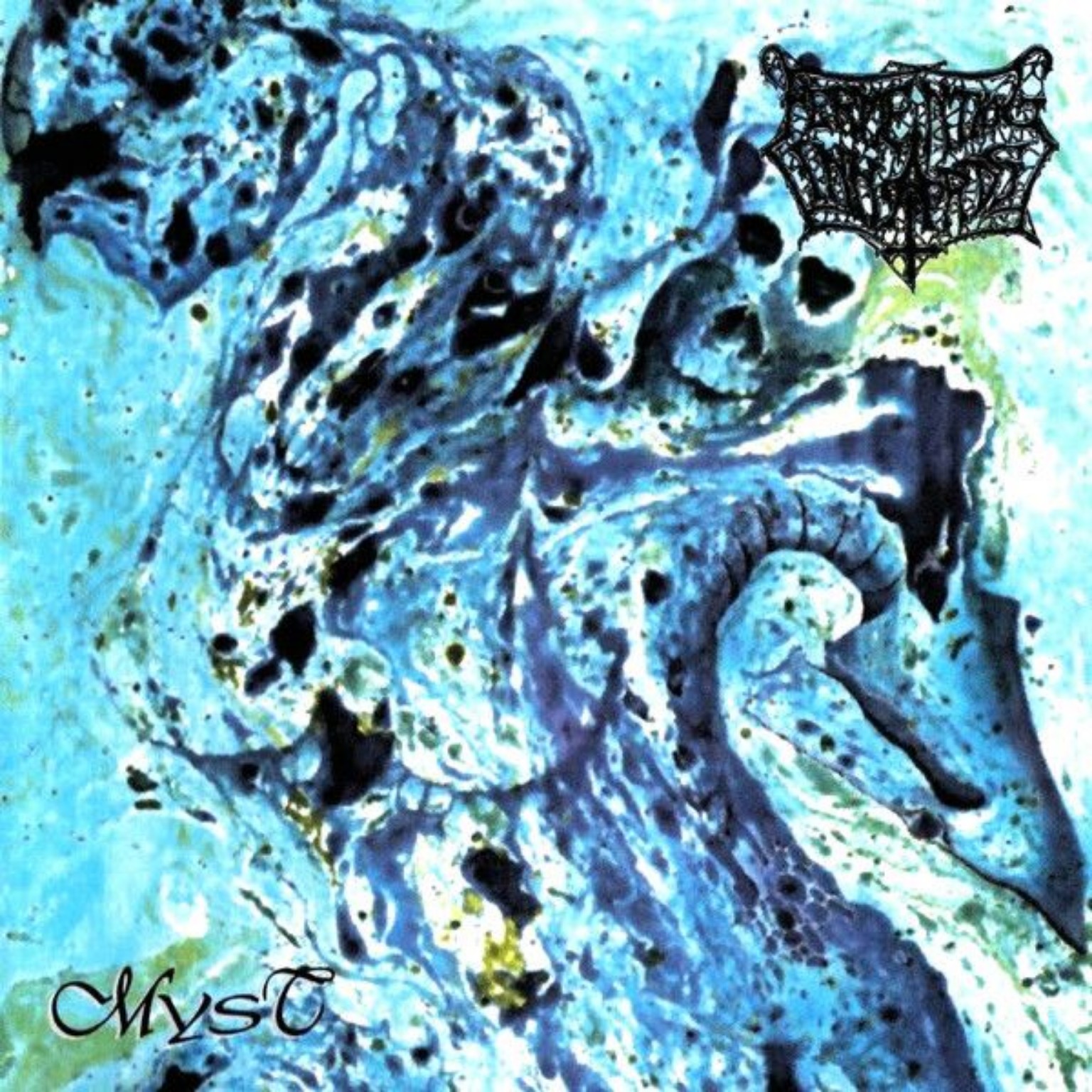
The cover image of Myst unsettles the viewer even before the music begins. Marco Gemmet, the graphic artist behind Darken Art, did not give the album an easily identifiable location or a scene built around a single figure. Turquoise and pale-blue surfaces are cut through by dark-blue recesses, openings fading into black and whitish curves, with a few greenish-yellow patches. Small forms gather in the upper left, while a large, bending shape fills the space on the right. No reliable horizon allows the eye to place the other details. Cavern-like hollows, organic remains and patches suggesting faces become recognisable at different scales.
On the right, the pale curved shape might recall a beak or a bone, but the association cannot settle who or what we are seeing. Forms flow into one another, and the close-up details almost erase the familiar separation between foreground and background. The surface creates the impression of both drawing and painting; the precise technique used to make it is not established. The two pieces of lettering provide firmer reference points. At the upper right, the black, branching Fermenting Innards logo compresses its lines into a thicket; at the lower left, the lighter, slanted word Myst leaves more room to breathe. The two names balance each other at opposite ends of a diagonal: one nearly disappears into the image like tangled growth, while the other emerges more clearly.
These hard-to-separate forms and cold tones connect the visual world to the album. A design that refuses to settle on a single readily identifiable motif can be set beside the crossings between death and black metal described by later reviewers. That is an interpretation of the image, not a documented statement of Gemmet's intentions. Without a personal explanation from the artist, its details cannot be given meanings invented after the fact. The cover holds our attention precisely because it does not resolve into one object or a scene that can be neatly retold. It opens a world whose uncertainty can coexist with the album's own identity, moving between several musical genres.
Against this difficult-to-define space, the back cover shows people identified by name. Andreas and Rico appear above, Mario and Marek below, in four portraits with painted faces. Their poses and make-up belong to the visual language of black metal at the time, but appearance cannot stand in for the members' religious or political self-definitions. Instead, the named faces give the abstract front cover a human counterpart. The blue artwork extends onto the CD itself, bringing the case, the image and the disc together as a single object. Already in the original 1995 version, this consistent visual approach moved away from the straightforward death/grind expectation that the band name and early recording titles might have created. The layout of the original is credited to Invasion Records, and the photographs to the band. Later formats would build on this visual inheritance.
Between Two Frames
The original CD runs for 46 minutes and 50 seconds, placing eight tracks by the band between two short compositions by Mortiis. The sequence itself shows that Myst does not rely on one unchanging musical vocabulary. The 2:24 opening piece, Blood and Thunder, brings the atmosphere of another creator into the album. In autothrall's 2023 account, it appears as a dark ambient introduction with a martial character, after which the guitar-and-vocal songs open onto another space.
Mortiis himself recalled the origins of his contribution in a Decibel interview published on 16 October 2017. He spoke of making introductory and closing music for a German band, then recognised Myst when the interviewer suggested the name Fermenting Innards. He later released the pieces under his own name on the 1996 Blood and Thunder single. The opening thus belongs to two histories at once: it begins the German album while also continuing into the separate body of work of another artist. That double life would become important again when the record was reissued.
The Title Track and Burning Thorns
After the instrumental introduction, the 5:15 title track is the first to reveal the sound of the full band. Autothrall considered Myst one of the album's strongest pieces, emphasising its dense guitar language moving between death and black metal. For him, the crossing between the genres was a creative possibility, not merely a sign of uncertain direction. Swanö's additional vocals and keyboards, together with Rico's acoustic guitar credit, add further layers. The inner kingdom of the title track's lyrics is equally complex: the ruler, the judge and the forest are all organised around the self. The speaker builds a world from his own mind, yet identifies himself with his own lie. In the lyrics by Mario Weinhold and Rico Spiller, the power of self-creation is thus joined to self-deception and isolation. The imagined realm is not simply a triumphant refuge but a space full of contradictions.
The next track, Those Burning Thorns, is the album's longest at 7:03. Here the later reviewers came particularly close in their assessments. In 2011, shwartzheim praised the successful combination of genres, while in 2023 autothrall tried to convey the unusual guitar writing through a comparison with Demilich. That likeness reflects the reviewer's impression, not a documented declaration of influence by the German band. Rico's music is joined by lyrics from Øystein G. Brun; Swanö plays lead guitar, and Marek contributes a spoken voice. In images full of blood, forests, wounds, an owl and an eagle, the injured body and movement through the sky belong to the same visionary world. A crown of burning thorns, cold and fire strain against each other rather than outlining a peaceful landscape. Coming directly after the title track, the long composition gives this denser vision space to develop.
Hatred, Transformation and Grief
After those two longer pieces, the 3:22 Hateful takes on a shorter, more compressed form. Rico composed the music and Mario wrote the lyrics, but beneath the English title is a voice speaking Norwegian. A demon dwelling inside another person speaks, seeing the body as a prison and the skin as a cage. This inner voice demands its own throne and promises that its eventual escape will bring destruction. The earlier kingdom built by the self gives way to a trapped body waiting to be torn apart. The lyrics' anti-Christian attack also uses an ethnic and religious designation; it cannot be described merely as generic darkness. The speaker's words and images can be identified, but the entire political worldview of the musicians cannot be inferred from one song. In addition to its brevity, this turn of language and role gives Hateful a distinctive place in the running order.
The 4:41 Transfiguration of the Withered Beauty moves towards a different kind of injury. Alongside Those Burning Thorns, shwartzheim singled it out as a particularly successful example of black and death metal coming together. The music is Rico's and the words Mario's; both Rico and Andreas appear among the acoustic guitar credits, while Marek contributes to the arrangement. Several distinct band duties thus stand behind the variety the reviewer admired. The lyric addresses someone directly and is shaped by humiliation, physical and emotional abuse, and forgiveness refused. Snow, ice and northern cold become images of hardening. The recurring garden of Isegrimm remains an unusual place of the imagination. Neither a single certain literary origin nor a specific biographical event can be established from it. The transformation named in the title acquires its meaning within this wounded, hate-filled relationship.
On the 6:07 Eternal Sadness, the variety turns in another direction again. Rickard Alriksson's guest vocals and Rico's acoustic guitar work belong to a track that both the 2011 and 2023 reviewers described as a Gothic piece tending towards Paradise Lost. Shwartzheim counted it among the album's weaker moments. Autothrall, by contrast, found it enjoyable, though a diversion that disrupted the record's unity, and also highlighted the deeper clean singing. The title had already appeared on the Drowned EP; Carl described it there as an instrumental conclusion approaching doom. The shared name is evidence of continuity between two periods, not proof that the same recording was reused unchanged. On Myst, the lyrics by Mario and Rico turn towards emptiness after a person's loss, cold rooms, and life continuing despite death. In place of the earlier language of rule and aggression, what remains here is the aftermath of absence.
A Different Voice in a Cover Version
Mourning, in seventh place and lasting 3:47, brings a different distribution of roles to the fore. The music credit names the band Nirvana 2002 and the lyrics credit Orvar Säfström; Rico takes over the vocals, while Andreas plays lead guitar. The number 2002 in that band's name is not a year, nor does the name refer to the grunge world of the American Nirvana. The track appeared on the 1995 album as a cover of a song originally written by Nirvana 2002. Both later Metal Archives reviewers felt it sat uneasily in the sequence. Shwartzheim did not consider it a bad song, but thought it disturbed the flow; autothrall described it as an interpretation close to the original. Their reservations thus concerned its place within the whole, not simply the merits of the song.
Northern Storm and Instrumental Finale
After that cover, The Rising in Northern Storm begins the sequence of the album's final two longer vocal tracks. Autothrall heard the 5:21 piece as a powerful black metal focal point. Rico's composition brings together Mario's words and keyboard contributions by both guitarists, Rico and Andreas. Fire and ice, stone and current, mist and thunder move against one another in the lyric, while the speaker's ascent leads towards Valhall. The protection and hall of the one-eyed father are explicitly present, so the connection to northern mythology is not an association suggested by the title alone. The figure passing through the elements becomes stronger and approaches paternal protection. This imagined world can be described in detail without turning the lyric into a direct confession of the musicians' personal religious beliefs.
The 6:28 Svartfoldet Hat continues that northern character, but with a different constellation of writers. Music credits for Rico Spiller and Mario Weinhold are joined by Brun's lyrics and Swanö's keyboards. Autothrall likewise counted it among the album's black metal focal points. As the last major band performance, it connects with Those Burning Thorns through its outside lyricist, and with the title track through the guest keyboard player. The Norwegian title alone does not provide a complete story of the words; what can be followed with confidence lies in the credits and the sequence. After this six-and-a-half-minute composition, another Fermenting Innards song does not follow. Instead, the artist who opened the album returns.
The 2:22 closing piece, Battles on Ice, almost exactly matches the length of the 2:24 Blood and Thunder. Mortiis's two brief instrumental works thus provide not only an atmosphere but also an audible structural boundary for the eight songs between them. The ending is not a continuation of Svartfoldet Hat but a return to another composer's world. In a 2024 interview with Bardo Methodology, Mortiis named Tangerine Dream, Klaus Schulze, home demo recording and the primacy of atmosphere among his early interests. That separate tradition of electronic ambience also finds a place in the album through his contributions.
Voices from an Inner Landscape
Even at the end of its ten tracks, Myst has not become a single continuous story. It is shared between several languages and different kinds of speakers. The desire to rule, captivity, injury, mourning and ascent are not successive stages in the life of one figure. Yet recurring connections are recognisable. The self-created kingdom of the title track and the demon imprisoned inside a body in Hateful both unsettle the boundary between inner and outer worlds. One speaker invents his own laws and judgments, while the other prepares to break through boundaries imposed from outside. Words of power—dominion, throne, judgment—gather around the self. The blurred shapes of the cover, turning into one another, can be read alongside them. But such a reading does not establish that the artist and lyricists pursued a detailed programme together.
Nature is not merely a backdrop in these songs, either. The forest of the title track is an inner realm; the plants and animals of Those Burning Thorns share a space with wounds, bodily remains and happenings in the sky. The cold of Transfiguration of the Withered Beauty becomes an image of resentment hardening, while The Rising in Northern Storm arranges opposing elements into a path towards greater strength. Fire, ice, mist and storm can therefore take on different meanings in the mouths of different speakers. Eternal Sadness offers a quieter direction within this system of imagery: in cold rooms and in the space left by someone lost, there is no heroic ascent, only an enduring absence. The critics' descriptions of Gothic and doom affinities can be placed beside these lyrics, but there is no need to invent an undocumented loss in the musicians' families to explain them.
Nor should the darkness of these lyrics become a label that obscures every distinction. Anti-Christian language in the title track and Hateful is accompanied by ethnic and religious language that may also carry anti-Jewish associations. A historical reading needs to identify this concrete feature rather than treating it as mere decoration. It does not follow, however, that the entire band adhered to a single political programme: no statement by the participants establishes such a thing. The role played by a speaker in the lyrics, that speaker's aggressive language and the musicians' personal self-definitions remain different levels of interpretation. A careful reading does not make the uncertainty disappear in either direction.
The range of voices is also reflected in the writing credits. Mario wrote lyrics for several tracks; Rico took part in writing the words of the title song and Eternal Sadness, while Those Burning Thorns and Svartfoldet Hat are connected with Brun. Mourning is a cover taken from other writers. Although English has the strongest presence, the Norwegian-language voice of Hateful creates a distinct linguistic difference. Myst is therefore held together less by one character speaking from beginning to end than by recurring images, related emotional spaces and the order of the songs. That variety would later become a decisive question for critics: did it enrich the album, or pull its unity apart?
The Different Times of One Record
The CD released by Invasion Records under catalogue number I.R. 016 appeared in September 1995; the exact original release date has not been established. Later listings on Apple Music and Amazon Music give 4 September, but that digital catalogue date does not prove that physical copies reached shops on that day. The May studio work in Örebro was a separate period. Emerging from the German underground, the album moved between death and black metal, a passage between genres that later critics would respond to in strikingly different ways. The history of the September surrounding its appearance can be recalled, but it cannot be turned into the story of one release day reconstructed with certainty.
The Context of the September Release
The Berlin from which Fermenting Innards had emerged was still reorganising its life at the start of September. The IFA, the city's international electronics exhibition, closed on the third; the following day, S-Bahn services resumed between Adlershof and Schönefeld after summer works. The years since reunification had not made Berlin a finished or unchanging place. The restoration of routes that had once been severed and the search for a new cultural public sphere unfolded at the same time as the band's recordings, made in Sweden, were becoming a record. No direct connection between those two stories is known, but considered together they suggest the Berlin to which Myst belonged in 1995.
Nor were the worlds of death and black metal standing still around the album. Several retrospective lists place Athenian Echoes, the album by Greece's Nightfall released on Holy Records, on 1 September. It represented another meeting point for melodic death metal and darker, slower moods. Poland's Vader carried the much more direct line of death metal forward on De Profundis; some discographies date it to 5 September, while other records give 5 July. It is therefore not established that either record reached the market on exactly the same day as Myst. Their proximity nevertheless matters. In the same year, albums from different countries offered very different answers to where extreme metal might go next. There is no evidence that the members of Fermenting Innards had heard these releases or that the artists influenced one another.
The larger record market, meanwhile, operated on a different scale. In Germany's official album chart for 4–10 September, Pur's Abenteuerland held the top position, while Paradise Lost's Draconian Times was at number fifty. The latter name also appeared as a musical point of comparison in later reviews of Myst, but its chart placement tells us nothing about sales of the small Invasion Records release. In world news, fresh NATO air strikes in the Bosnian war and the opening of the international women's conference in Beijing commanded attention. All of this belonged to September's histories unfolding on different scales. Alongside the great public worlds of politics and music, a little-documented black/death metal album began a journey that later listeners' memories would help reconstruct.
After September, the remainder of the year carried forward the separate stories of both cities. Millencolin's Life on a Plate was released in Europe on 11 October; in that same year, Örebro also saw a different kind of international breakthrough for punk. On 22 October, a referendum in Berlin confirmed the city's new constitution. Neither event can be placed among the causes of Myst's earlier creation, yet both belong to the 1995 in which the German record appeared. In parallel, the music's own journey was already leading towards listeners and the many circles of the press.
The Contemporary Negative Review
Among the surviving early reviews, Raf's is particularly harsh. On page 49 of the fourth issue of Headfucker, dated January 1997, the short review of Myst rejected not just an instrumental technique or one unsuccessful track, but the entire choice of a death/black direction. It portrayed the record as having been swept off course by the prevailing musical fashion. Raf awarded four points, but the scale is unclear, so they cannot automatically be treated as four out of ten. The severity of the rejection is apparent from the text itself. This is a sharp contrast with the expectant response to Drowned in Witchcraft in 1994, although the two critics were not judging the same recording. The favourable opinion of the EP and the dismissal of the album remain judgments made at different times about different objects.
Later Listeners’ Interpretations
When shwartzheim gave the album 80 per cent on Metal Archives on 20 June 2011, he approached it from another angle. Surprise at the distance between a band name suggesting grindcore and the black/death music led him towards comparisons with Swedish death metal, Norwegian black metal of the period, and early-to-middle Katatonia. For him, Those Burning Thorns and Transfiguration of the Withered Beauty combined the genres particularly effectively. That praise did not extend to every track. He found the Paradise Lost-like approach of Eternal Sadness weak and thought Mourning an enjoyable cover in isolation, but one that fitted less comfortably into the album's flow. He wrote favourably about the studio work, while taking issue with some drumming choices. His judgment was not simply an uncritical fan's defence: it also showed where, in his view, the balance of an otherwise valuable mixture began to falter.
Another listener's trace from the same year is a mocking piece by Hatpastorn about the cover art. The blue design appeared there not as a mysterious space but as a target for ironic imagery. The album's appearance therefore remained a subject of discussion in its own right; not every later encounter led to a respectful reassessment. These differing opinions do not form a single retrospective score that improves steadily over time. Myst continued to live in personal encounters and in the very different worlds of taste they represented.
Rediscovery and Lasting Reception
In an article published by No Clean Singing on 27 July 2016, Neill Jameson described how a negative opinion had led to a discovery. A dismissive review in an old fanzine aroused his curiosity. He was uncertain of the magazine's name, remembering it perhaps as Nordic Vision. That recollection is not enough to identify the issue or the precise wording of the old article. What remains is Jameson's own positive encounter: he recommended the album as an underrated, atmospheric black metal memory. Seen in retrospect, the policing of scene boundaries around a band with a death metal past achieved the opposite of what a dismissive review might have suggested. It encouraged another musician to listen.
A record-recommending conversation published by Hatpastorn and Heidenhammer on 27 November 2019 preserved another, more mixed memory. Mortiis's opening and closing pieces had stayed with them particularly strongly, while they discussed the band's black metal tracks more ironically. Their joking speculation about distribution around Invasion belonged to the conversation between listeners, not to independent evidence about an old contract. The short framing pieces by the guest contributor almost eclipsed their memories of the songs in the middle. That is a different focus from shwartzheim's favourite guitar-driven tracks, and it shows how different parts of the same record could organise its afterlife for different listeners.
Autothrall's Metal Archives review of 26 January 2023 returned to a longstanding favourite with a score of 90 per cent. His memory of record shopping at import stores evoked an era when less accessible metal albums were discoveries to be made. The guitar language of the title track and Those Burning Thorns, and their movement between two genres, retained their force for him. The Rising in Northern Storm and Svartfoldet Hat counted as further black metal focal points. Alongside the growls and rasping vocals, he valued the sense of layered voices as part of the record's richness. He, too, noticed how Eternal Sadness and Mourning stood apart, but heard them as enjoyable departures that did not diminish the whole. He wondered whether music moving between the two genres might have hindered the band's success at the time, but left this as a question rather than stating it as a business fact. To him, Myst still sounded fresh and worthy of reissue. The 80 per cent in 2011 and the 90 per cent in 2023 are two listeners' judgments, not points on one shared, changing scale; the difference also lies in the details and in their willingness to accept individual departures from the album's main direction.
A Different Frame Thirty Years Later
Over time, the recording of Myst acquired a life partly independent of the musicians' later careers. GOLEM's 1996 album Eternity – The Weeping Horizons became another outcome of the same German–Swedish connection in which Andreas had emphasised Rico's role as an intermediary. The bands nevertheless followed separate paths. There is no first-hand account that settles every question about Fermenting Innards' concerts later in the 1990s, or the precise date and reasons for the band's end. The continuation of Rico's and Andreas's musical work can be followed more readily through GOLEM interviews. Meanwhile, the original CD became a rare object and, for some listeners, a discovery cherished for years. The recording already had a history of its own beyond the members' subsequent activities.
Mortiis’s Recollections and Later Circulation
Mortiis's recollections in Decibel in 2017 added a more difficult story to that afterlife. Remembering the two compositions he made for Myst, he spoke of a dispute and recalled a problem over payment that had left him feeling wronged. Details recovered uncertainly from memory cannot be turned into a definitive legal account; no contract or court ruling is known that would establish the position of everyone involved. In the same conversation, he also criticised with irony what he saw as double standards applied to bands moving from death metal into black metal. The collaboration thus belonged both to his personal memory and to the history of how the music was received across genres.
The album's later circulation as a physical object was far from uniform. A Russian CD from 2022 bearing the Invasion name is explicitly classified as unofficial in release listings. Images associated with it may preserve old credits and inscriptions, but that does not make the release a legitimate reissue. The recording's familiarity, its desirability to collectors, and its renewed official availability were separate matters. The next major step again required personal connections leading back to the original participants.
Preparing the Anniversary Edition
In a personal recollection sent to Open Metal Album Library in October 2026, Martin, a representative of Rotting Misery Records, explained how the anniversary project began. After a lengthy search, he first found Andreas Hilbert and then reached Rico through him. Initially he wanted to make a vinyl edition of Myst, which had originally been released on CD. Rico, however, had also preserved additional photographs and rare recordings, and material for a project broader than a simple change of format began to emerge. Dan Swanö agreed to work with the archive recordings. Once again, the new release was made possible by people finding one another and by documents that had survived in their possession.
There was already a public trace of these preparations in 2024. In a Swanö interview published by Truemetal on 24 June, Fermenting Innards came up in connection with tapes containing rough mixes from around 1995, rehearsal material and live recordings. Swanö was working to transfer them. The account is not a day-by-day log of the original Unisound session, but a glimpse of its continuation decades later: recordings had come to light, yet work was still necessary to prepare material that could be used for a new release. The anniversary edition therefore became more than an unchanged physical copy of an old CD.
New Musical Framing and Archive Material
The greatest structural difference concerned the two pieces by Mortiis. According to Martin, the old dispute meant they could not reuse them, so in June 2024 Rico recorded new opening and closing compositions. Whispers from an ancient realm and Companion into the endless void became the new edition's own frame. They belong to a different composer and a different time from 1995's Blood and Thunder and Battles on Ice, even though they occupy similar places in the sequence. The anniversary material did not merely grow longer: its beginning and ending changed as well, giving the old and new sequences distinct meanings.
The new credits distinguish the original recording of May 1995 from Swanö's remastering work in May and October 2024. They associate rehearsal recordings with Blue Art Studio in Buckow in March and May 1995, and Rico's new framing pieces with June 2024. Österby and Unisound are named in connection with the remaster, although the geographical interpretation of the country given in print remains uncertain. The track listing for the four-sided LP preserves a further small difference: it uses IV/1995 and V/1995, whereas the credits page specifies March and May. These two statements cannot be reconciled by an arbitrary editorial correction. The earlier rehearsal group also contains early versions of songs. These different dates do not describe one new album recorded in the original CD's sequence; the 2024 version of Mourning likewise remains a separate new recording.
Old and new graphic work also received distinct credits. Marco Gemmet's original artwork remained the foundation, while Rico and Rotting Misery are named for the anniversary layout. Archival photographs and montages showing instrumental, stage or rehearsal situations offer a broader picture of the band than the four portraits on the original back cover. Yet the complete list of people, location and exact date of each scene is not always established. Nor can an individual portrait with painted face be securely assigned to a particular person from facial appearance alone. The photographs thus become part of the memory without every image being turned into a new episode that can be narrated in detail.
Editions and the Album’s Legacy
The anniversary edition appeared in several formats, with information differing between them. Northern Silence's description of the two-CD edition mentions 300 copies and a twenty-four-page booklet. The accompanying card for the vinyl instead indicates a run of 500, with the photographed copy bearing the handwritten number 148/500. These print runs refer to different formats and are therefore not contradictory. The two-CD listing gives 6 December 2025 as the date; it cannot automatically be treated as the release date for every anniversary format. Rotting Misery's German vinyl listings give the catalogue number RM019 and describe an LP, or, in another account, two twelve-inch discs. A separate limited test pressing with white labels also appears under the same number. No catalogue number or country is stated for the two-CD version. The old I.R. 016 CD and these later editions are different physical stages in the history of the same recording.
Martin described the preparation as lengthy and saw the completed result as a success; in his judgment, the parties involved could be satisfied with it. That is his personal assessment, not a verdict delivered on behalf of every contributor. Through the anniversary edition, rehearsals, photographs and recordings made at different times around the old album became accessible in a new context. The replaced frame also revealed a boundary created by the intervening decades: not every relationship or earlier solution could be carried forward in the same way thirty years later.
Ultimately, the record's endurance is not explained by one dramatic turn of events. Beginnings in Berlin, concert locations in Brandenburg and Mecklenburg, correspondence and tape trading, the work of a small label and recording sessions in Sweden all met within it. A death metal past, songs opening towards black metal, a Gothic detour and Mortiis's separate musical world did not represent the same thing, but found room within one album. Some listeners heard inconsistency; others discovered an unusual guitar language and the strength of movement between genres. The anniversary edition of 2025 did not erase Raf's rejection, nor did it resolve all the different memories of those who took part. It joined new encounters, recordings and documents to the old music. Myst retained its distinctive shape through this continuing history: a record rooted in a local scene but made across borders, whose life reached well beyond its first release.
Sources and references110 bibliographic items identified in the PDF; the complete original research database is unavailable.
Period fanzines and magazines 8
- FI95-004Myst – contemporary album review, page 49
- FI95-007Andreas Hilbert – interview about Golem
Source identity uncertain, as recorded in the PDF.
- FI95-008Mortiis – From Black Metal to Dungeon Synth and BeyondSource site ↗
- FI95-017Fermenting Innards – Drowned MCD, contemporary review
- FI95-111Markus Staiger and Nuclear Blast – from punk/hardcore to extreme metal
- FI95-112History of Burning Heart: Peter Ahlqvist on the Swedish–European network
- FI95-113Punk in Örebro: shared infrastructure of Millencolin and Burning Heart
- FI95-120Analog Archives – Tape Dealer and cassette trading, 1984–1994
Reviews and later commentary 3
- FI95-005Nordic Vision – alleged early negative review of Myst (issue unidentified)
Source identity uncertain, as recorded in the PDF.
- FI95-016Myst – Swedish commentary on the cover and album
- FI95-028Review: Fermenting Innards – Drowned (comparison with Myst)Source site ↗
Band, label and participant sources 32
- FI95-006Andreas Hilbert – Golem interview mentioning Fermenting Innards and Unisound
Source identity uncertain, as recorded in the PDF.
- FI95-009Intervista Dan SwanöSource site ↗
- FI95-010Neill Jameson: Black Metal (Pt. 2) – Fermenting Innards / MystSource site ↗
- FI95-013Fermenting Innards – band profile
- FI95-014Myst – original album listing and musician creditsSource site ↗
- FI95-015Fermenting Innards – Drowned EP (1994), retrospective collector's notes
- FI95-018Interview mit Andreas Hilbert von Golem (2005)Source site ↗
- FI95-019GOLEM – Andreas Hilbert (Gitarre, Vocals), 27.02.04
- FI95-020Golem – interview with Andreas Hilbert (2004)
- FI95-021Golem – autobiographical band retrospective in the first person
- FI95-032Bonesawer – profile of the precursor band to Fermenting Innards
- FI95-033Bonesawer → Fermenting Innards – detailed band overview
Source identity uncertain, as recorded in the PDF.
- FI95-037Drowned (1994) – historical listing of the Witchcraft Records demo tape
- FI95-038Drowned (1994) – Invasion Records EP: tracks and studio credits
- FI95-039Marco Gemmet (Darken Art) – album artwork contributions
- FI95-040Rico Spiller – early roles in Fermenting Innards and Golem
- FI95-041Marek Kassubeck – Bonesawer and Fermenting Innards chronology
- FI95-042Mario Weinhold – early lead-vocal performances
- FI95-043Flitze / Fred Wollenberg – evidence of a guitarist in 1991
- FI95-044Nico – vocal contribution in 1991
- FI95-047Mortiis – Blood and Thunder (1996): later life of the two Myst framing pieces
- FI95-091Lolita Pop and Rockmagasinet – Örebro's music scene founded in 1979
- FI95-093Dan Swanö: Ghost, Brejn Dedd and the beginnings of Edge of Sanity in 1989
- FI95-104Unisound (Örebro): list of album and demo sessions, 1992–1996
- FI95-108Karl-Ulrich Walterbach: from Berlin punk to Noise Records and demo tapes
- FI95-114Swedish death metal and the Sunlight sound – retrospective by participants
- FI95-115Boss HM-2 – technology behind the Swedish death-metal guitar sound
- FI95-116The Sunlight studio sound – Swedish interview with Tomas Skogsberg
- FI95-118Scott Burns / Morrisound: American death-metal studio, 1987–1997
- FI95-121Glorious Times – early death-metal fanzines and tape trading, interview with participants
- FI95-123Mortiis and early cassette-based ambient/dungeon synth – origins in 1993
- FI95-128Gino Filicetti: On the Edge of Complete Conquest. Chronicles of Chaos interview with Edge of Sanity, 1995; the original date “8/11” cannot unambiguously be resolved as month/day
Historical and musical background 60
- FI95-023Myst – 30th Anniversary Edition (2025): 24-page booklet, contents not verifiedSource site ↗
- FI95-026Hatpastorn & Heidenhammer gissar skivor – Fermenting Innards: Myst
- FI95-027Eerily Hauling Winds – later comment on the chronological order of Myst and Drowned
- FI95-034Entrails Massacre – dated list of historical concerts
- FI95-036Only Shreds Remain (1992) – early live and studio track list
- FI95-049Berlin and Cölln – origins of the medieval trading city
- FI95-050Berlin – imperial capital, industrialisation and changes in the working-class city
- FI95-051Berlin in the Weimar era – transport and metropolitan culture
- FI95-052Berlin after 1945 – destruction, four-power occupation and division
- FI95-053The Berlin Wall, 1961–1989 – spatial and social division
- FI95-054History of Örebro – medieval trade and the shoe industry
- FI95-055Stockholm's Slussen – a public building and urban change from the 17th to the 20th century
- FI95-056Berlin, 1990–1995 – institutional chronology of the reunified capital
- FI95-058S-Bahn Berlin – reconnection of the divided railway network, 1990–1992
- FI95-059Potsdamer Platz – 1991 design competition and construction from 1993
- FI95-060Mainzer Straße and Berlin's 1989–1991 squatters' movement – research study
- FI95-061Neubrandenburg – city history in the GDR and during the transition of 1990
- FI95-062Märkisch-Oderland archive district – Seelow's 1993 administrative reorganisation
- FI95-063Brandenburg's agricultural society, 1989–1992 – East German structural change
- FI95-064Potsdam – urban and administrative changes since 1990
- FI95-065German monetary, economic and social union, 1 July 1990
- FI95-06620 June 1991 – Berlin–Bonn parliamentary decision
- FI95-067Treuhandanstalt and economic transformation in eastern Germany, 1990–1994
- FI95-068Unemployment in eastern and western Germany, 1990–1995
- FI95-069Swedish krona exchange-rate crisis of 1992 – Riksbank chronology
- FI95-070Swedish inflation targets and socioeconomic conditions, 1993–1995
- FI95-071Sweden's accession to the EU and the 1994 referendum
- FI95-072Örebro city archives – relocation in 1993 and 1994 regional archival catalogue
- FI95-073Restructuring of municipalities in Örebro County in 1995
- FI95-074Stockholm's fine-arts institutions and urban development, 1991–1994
- FI95-075European Union, 1990–1999 – single market and 1995 enlargement
- FI95-076Charter of Paris, 1990 – Europe's post-Cold War settlement
- FI95-077Peace process in the Bosnian War and the late-1995 ceasefire
- FI95-078UNHCR: Asylum in Europe / Summer of Sadness (September 1995)
- FI95-079European political and world-history documents – OSCE timeline, 1990–1995
- FI95-080German and international events calendar, 1995 – May and September
- FI95-0818 May 1995 – 50th anniversary of the end of the war, Berlin
- FI95-082Berlin COP1 climate conference, March–April 1995
- FI95-083First official report on Berlin COP1, dated 24 May 1995
- FI95-084Legal act on Sweden's EU accession of 1 January 1995
- FI95-085Documentation of the April 1995 Berlin/Brandenburg unification treaty
- FI95-086Punk in the Church: East Berlin, 1979–1989
- FI95-087Punk in der DDR: East German punk and cassettes since 1978
- FI95-088SO36 – Kreuzberg's punk and alternative-club heritage
- FI95-089Einstürzende Neubauten – autobiographical account of the Berlin industrial/experimental band
- FI95-090Örebro Rockmagasinet, 1979–1980: original gig listings and participants
- FI95-092Lolita Pop's 1988 Rockmagasinet/Kulturhuset concert – contemporary report
- FI95-094Örebro's Lolita Pop, 1979–1992 – band chronology
- FI95-095Knaack-Klub – restructuring of East Berlin's clubs after 1990
- FI95-096Tacheles since 1990 – rehearsal spaces and an alternative cultural centre
- FI95-097Tresor – opening in Berlin in 1991 and Detroit–Berlin techno exchange
- FI95-101Millencolin – Life on a Plate: Örebro punk in 1995, official album page
- FI95-105Cutting Room Stockholm – official history of the mastering studio
- FI95-106Rock Hard – from a 1983 fanzine to a nationally distributed German metal magazine
- FI95-109The Recording Industry as the Enemy? Early West German Metal
- FI95-110Century Media Records – German underground label model since 1988
- FI95-117Black metal (norsk) – evolution of the genre, 1990–1995
- FI95-125West Berlin and experimental electronic bands – Tresor Foundation
- FI95-126May 1995 – Mörk Gryning at Unisound during the same period
- FI95-127Mörk Gryning: Tusen år har gått (1995) and the Dan Swanö recordings
Album imagery, primary documents and personal correspondence 7
- FI95-U001Metal Archives: autothrall, “Better than the island” (26 Jan 2023, 90%); based on the original English review
- FI95-U002Metal Archives: shwartzheim, “Talk about misleading band names” (20 June 2011, 80%); based on the original English review
- FI95-U003Martin / Rotting Misery Records: personal communication to Open Metal Album Library, 18–19 October 2026. Historical details summarised; the correspondence is private
- FI95-U004Original album data, track-by-track credits, lyrics and release information. Exports from Discogs and Metal Archives, October 2026
- FI95-U005Original front cover, back cover, CD image and labelled band-member portraits
- FI95-U006Images from an unofficial 2022 CD, used as a historical document
- FI95-U007Images from the 2025 Rotting Misery LP: track listing, archival montage, credits, portrait and insert card
Band channels and profiles
Official channels and verified band profiles
Explore related albums
From the same musical world in our archive
Reader comments
Comments only appear after approval. Messages are displayed in their original language.
Comment submissions are not enabled yet.