Death Metal
The story of Dismember’s 1997 album Death Metal: from the early Stockholm scene through the recording and its twelve songs to the record’s lasting impact, with an analysis of the original cover.
The Birth of the Stockholm Sound
The Story
Stockholm, 1988. No one yet knew that within a few years the city's name would become shorthand for an entire death metal sound. There was no ready-made formula to follow, no rulebook for how a Swedish death metal band ought to sound. There were, however, young people, tapes, rehearsal rooms, cheap amplifiers, distortion pedals, fanzines and an underground scene in which everyone watched what everyone else was doing.
Dismember emerged from that scene. Robert Sennebäck, David Blomqvist and Fred Estby had not inherited an established tradition. Rather, they were among those who would eventually become part of one. They listened to heavy metal but were equally drawn to the rawness of fast hardcore. These two worlds did not meet in them as an abstract theory. They never sat down to decide how much metal and how much punk to include. They simply drew on the sounds that excited and unsettled them.
Fred Estby remembered it this way many years later. He said that they listened extensively to both kinds of music and that those influences found their own way into what they played. Yet Dismember had a stronger pull towards heavy metal from the outset than Carnage, for example. That distinction would later matter. Alongside the brutality there remained an instinctive longing for melody, and that tension followed the band throughout its history.
The same faces kept turning up around the rehearsal rooms. The future members of Entombed, Grave, Unleashed, Carnage and Dismember did not inhabit separate worlds. They listened to the same records, attended one another's shows and moved between bands. The tape-trading network carried demos farther than any of them could have travelled. Even a badly duplicated cassette could open a door to another country's underground.
Stockholm already had many more sides to it than its rehearsal rooms and record shops could reveal. The city grew through the mid-1990s: according to Statistics Sweden, the municipality of Stockholm had 711,119 inhabitants at the end of 1995, 718,462 at the end of 1996 and 727,339 at the end of 1997. These figures do not describe the wider metropolitan area, but they convey something of the expanding and changing city that also contained the close-knit circles of early Swedish death metal.
There was, however, no single way of life shared by the city centre and the surrounding residential areas. A Swedish government study of major cities published in 1997 examined inequalities of income and housing as well as unequal access to public institutions. Its wider definition of Stockholm included Botkyrka, Haninge, Huddinge and Södertälje. None of this tells us which street any individual member of Dismember lived on. Yet the urban context matters: several very different Stockholms existed side by side at the same time.
Sometimes the meeting of old and new could be seen at the entrance to a library. Stockholm Public Library introduced a digital catalogue in 1993 and was already holding internet demonstrations in the summer of 1995. The web was still far from an everyday fixture in every home. Local institutions were slowly opening up to computer-based information, while bands, listeners and fanzines continued to rely on letters, tapes and personal encounters to keep in touch.
Dismember's first chapter nevertheless came to an early halt. The members scattered; Fred Estby moved on to Carnage, and David Blomqvist also ended up in that circle. From the outside it could have looked like the end of a short-lived venture. In fact, everything was merely rearranging itself. The songs, riffs and connections did not disappear. Some Dismember material made its way into Carnage's story, while the musicians learned how quickly everything around a band could change.
When Carnage came to an end, Dismember reunited. Matti Kärki took over vocals, Richard Cabeza joined on bass and Robert Sennebäck returned. Suddenly this was no longer merely a continuation of an unfinished story, but the possibility of a new beginning. The 1990 demo Reborn in Blasphemy captured that moment. Nuclear Blast took notice. Beyond the underground's door, another world came into view: studio time, a record label, albums, tours and deadlines.
The next stop was Sunlight Studios. The place would later become legendary, but at the time it was more workshop than shrine. The sound created in Tomas Skogsberg's small studio did not come from lavish equipment. Fred later recalled how cramped the space was and how basic the gear. Years afterwards, he almost laughed as he summed up the recipe for the guitar tone: an HM-2 pedal and a Marshall or Peavey amplifier. Yet the real secret was not in the pedal. Anyone could buy one. The tension generated by five young musicians playing together was not something a shop could sell.
They had twelve days to record Like an Ever Flowing Stream. By today's standards the pace seems almost insane, but it was enough for them. They knew the songs, which had already taken shape in rehearsal, and the tight deadline concentrated their energy rather than containing it. The album appeared in 1991, and from then on the name Dismember spread through more than just cassettes and letters. One of Swedish death metal's foundational records had been born.
Success did not arrive in one grand moment, however. It came through a string of small changes. More shows. More travelling. More people telling them how the band should sound. More money, but more expenses too. More opportunities and, along with them, more danger of compromise. The rawness of the Pieces EP still seemed to preserve the instincts of the early years. Fred would later smile when describing how insanely rough that recording sounded. It was made quickly, without being polished smooth, and that was precisely why it remained alive.
By the time of 1993's Indecent & Obscene, they were working differently. They rehearsed constantly. Being in the band became a way of life. More ideas appeared in the songs, their instrumental skills improved and classic heavy metal melodies broke through the wall of guitars with increasing confidence. Perhaps at times they crammed too much into a single song, but beneath that excess was creative hunger. Dismember did not want to stand still, yet neither did they want to lose what made them recognisable.
Behind the changes in the city lay an upheaval affecting the entire country. Sweden underwent a serious banking and financial crisis in the early 1990s. In September 1992, the central bank briefly raised its marginal lending rate to 500 per cent in an attempt to defend the currency, before abandoning the krona's fixed exchange rate. By the time Dismember's fourth album began to take shape, that dramatic day was in the past, but the economic order that emerged from the crisis continued to shape Swedish life.
Unemployment was still below two per cent around 1990; by 1993 it had risen above eight per cent. It would be wrong to infer anything about an individual musician's livelihood from these figures. What is certain is that the young people of the following years lived in a country where debates about the cost of the welfare state, job security and municipal resources sounded very different from those of the late 1980s.
The Limits of Compromise
The real rupture came around 1995.
When they made Massive Killing Capacity, the band wanted a more expansive album. Fred Estby explained at the time that every member had become more involved in songwriting and that their old heavy metal influences were more pronounced. The aim was to write different kinds of songs while still sounding like Dismember. They spent longer recording, worked out more detail, and the record really did breathe differently from its two predecessors.
Nor was there only one way forward for Swedish death metal. Entombed's 1993 album Wolverine Blues had already combined rock and roll's drive with the raw power of death metal. It would become a familiar reference point for death 'n' roll. Dismember's change of direction in 1995 belonged to that wider period, yet Fred Estby's recollections are a reminder that a band's own musical ambitions and its label's expectations are not necessarily the same thing.
This was not the period in which Swedish death metal vanished. Some bands retained their earlier ferocity; others explored a more rock-oriented pulse, more elaborate melodies or new arrangements. The question was no longer simply how heavy a guitar could sound, but also what place a familiar sound could retain in a scene offering an increasingly wide range of answers.
As the years passed, however, Fred also described another side of that period. They felt pressure from Nuclear Blast to slow down and move towards a more rock-oriented kind of metal. Nor did they agree with every production decision Tomas Skogsberg made. Fred remembered that elements they regarded as quintessentially Dismember had been taken out of the music. At the time, they allowed it to happen. Only later did they fully realise how much it bothered them.
In March 1996, Göran Persson became Sweden's prime minister. A central concern of the budget for 1997, presented that autumn, was to reduce earlier deficits and restore order to public finances. Economic stabilisation was not confined to parliamentary debate: funding for local services, education and cultural opportunities was also at issue. New initiatives were taking shape in the city at the same time. In 1996 Stockholm launched Lava, a youth cultural workshop intended to give young people space and equipment for their own creative work.
The social uncertainty of the period cannot be read directly into any particular riff or into the musicians' intentions. But when considering what happened in the studio in 1996, the surrounding circumstances are worth bearing in mind: the capital's cultural life was full of opportunities and constraints, while the country was still looking for answers to the consequences of the preceding years' crisis.
It was not a matter of disowning Massive Killing Capacity. Decades later Fred still stressed that the album contained a great deal of good material. Everyone had begun writing; the band had become more melodic, and they retained much of what those changes had brought. But some songs struck him as too rock-oriented, too groove-driven, too far removed from what Dismember instinctively meant to them.
In a band's life, the most important warning is sometimes not failure but a success that begins to feel uncomfortable. For Dismember, Massive Killing Capacity became that kind of record. It showed that they could expand their boundaries, but also where the point lay beyond which their own music started to feel alien to them.
Their answer did not immediately take the form of a full-length album. First came the Misanthropic EP. They wrote and rehearsed extensively and began playing harder again. Fred later said they finally felt able to strike back after Massive Killing Capacity. They did not want to put the songs they had already written aside, so they released an EP. It became the bridge between the two records.
Meanwhile, a different kind of melodicism was taking hold in Gothenburg. At the Gates' Slaughter of the Soul from 1995 foregrounded tight, concentrated song forms; Dark Tranquillity's The Gallery, released the same year, pursued more intricate melodic movement; and In Flames' The Jester Race from 1996 emphasised intertwining guitar melodies. These were different bands, and sharing a city did not mean they had agreed on a common artistic programme.
The later label 'Gothenburg sound' can easily flatten the complexities of that time. Dark Tranquillity vocalist Mikael Stanne spoke precisely about each band searching for its own voice. Nor would it be right to cast Stockholm simply as the city of brutality and Gothenburg as the city of melody: Dismember's story, too, was shot through with melodies inherited from traditional heavy metal. What changed between 1995 and 1997 showed, rather, how many different forms that same musical foundation could take without ceasing to be extreme.
Record-label catalogues testified to this diversity as well. Alongside Dismember, Nuclear Blast distributed In Flames' The Jester Race and Therion's 1996 album Theli. One moved towards more melodic death metal; the other towards symphonic arrangements. They were not pursuing the same goal, and neither path in itself proves what future the label envisioned for Dismember. But the breadth of the catalogue was real.
Meanwhile Fred was growing into another role. For years he had watched Tomas Skogsberg work at Sunlight. He had seen how a recording came together, how the mixing desk worked and how decisions were made about the place of the drums, guitar or vocals. In that old studio, the technology was still something you could put your hands on. Rather than relying on automation, several people moved the controls at once. Fred did not learn sound engineering from a textbook. He stood beside the sessions, helped, watched and asked questions, until one day Tomas told him that he understood the whole process and ought to take it more seriously.
In the autumn of 1996, that knowledge suddenly became central. Dismember was making a new album, and Fred Estby did not merely want to play drums on it. He wanted to record it. He also wanted to be the producer in charge.
Behind that decision lay everything they had learned from the previous record. Don't listen to the label. Don't listen to people who tell us we have to go this way or that. Make it the way we need to make it. That was very close to how Fred later described the feeling. The next album would not simply be a collection of new songs. It would be an act of reclaiming the right to decide for themselves.
Sweden was by then a member of the European Union, having joined on 1 January 1995 alongside Finland and Austria. Membership opened a new chapter in the country's political and economic relationships. Stockholm, meanwhile, was preparing for the following year: in 1998 it would be a European Capital of Culture. The programmes in preparation, debates over public funding and new youth institutions were different facets of the same mid-1990s transformation.
Europe's extreme metal scene was not neatly divided into two Swedish camps. The Finnish band Amorphis wove folk influences and progressive ideas into its death-metal-rooted music on 1996's Elegy; on Passage, the Swiss band Samael brought mechanical and electronic elements to the fore. Parts of the Norwegian black metal scene were exploring symphonic sounds, while others remained committed to something raw and direct. Those recordings did not necessarily influence Dismember; they outline the musical world in which an extreme metal album appeared in 1997.
Sunlight Studios had meanwhile grown. It was no longer the cramped place where, during the first album, some of the drum sounds had to be supplemented electronically. For Fred, however, the essential point remained the same: the studio should not sterilise the band. What they felt in the rehearsal room had to survive on the recording.
They worked on the songs from October to December 1996. Mixing extended into January 1997. Tomas Skogsberg contributed engineering work on the drums, Anders Lindström worked on their recording, and mastering was later handled by Peter In de Betou at Cutting Room. But responsibility for the album's sound now rested on Fred's shoulders.
An increasingly complex record industry lay behind the decisions taken in the studio. According to a Swedish government study of music exports published in 1999, domestic record sales in 1997 were worth approximately 1.68 billion Swedish kronor, and CDs accounted for about 92 per cent of units sold. These are figures for the Swedish market as a whole, not Dismember's sales. They do, however, make clear that difficulties facing an underground genre did not amount to the collapse of the wider music industry.
The recording itself was only one stage in the journey. Labels, licensing partners, manufacturers, distributors, specialist shops, magazines and tour organisers linked the finished record to its listeners. Germany's Nuclear Blast, Century Media, Earache and Relapse assembled different catalogues but operated in the same international world of music journalism and trade. For bands, protecting their own sound while reaching an agreement with a label could therefore be both an artistic and a practical concern.
Sunlight Studios' recognisable sound was not the era's only studio ideal. Studio Fredman and Fredrik Nordström became defining names in recordings made in Gothenburg, while Unleashed's 1997 Warrior was associated with another Stockholm recording facility, EMI Studios. Differences between studios cannot be reduced to inventories of equipment. What mattered was the meeting between how a band played and the decisions made about recording, mixing and the balance of instruments.
Fred was not yet an experienced producer. He never later tried to hide that. Decades afterwards he could still hear the mistakes. He could hear that the vocals sat further back than he would later have placed them, and that too many elements of the mix competed for attention. But he could hear something else as well: the energy. He would not have traded that energy for technical perfection.
The underground's network of connections was changing too. Alongside mailed cassettes, fanzines, letters and meetings in specialist shops, independent online metal magazines slowly appeared. Chronicles of Chaos was already operating as an online metal magazine in 1995, and towards the end of 1996 it published an interview with members of Grave. Yet the older network did not vanish: concerts and festivals, printed magazines and recordings passed from hand to hand remained important meeting points.
In the end, the album's title left no room for misunderstanding.
Death Metal.
It did not even need two words. One was enough.
The title was almost defiantly simple. It explained no concept, announced no new direction and made no attempt to sell the band under a more fashionable label. Dismember played death metal. In 1997, with the genre itself changing and many of their former contemporaries striking out in other directions, that title became a declaration.
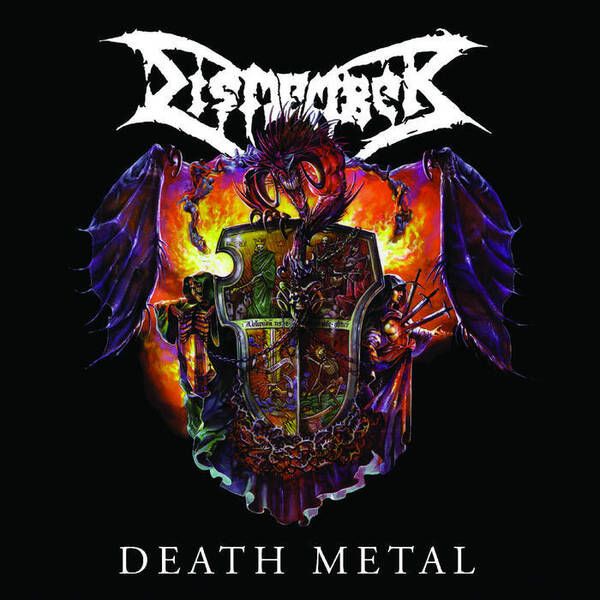
Alvaro Tapia's cover came from that same world: dark, grotesque, heavy. It made no attempt to tame the music. Together, the artwork, logo and unadorned title were like a door with no promise behind it beyond what was waiting inside.
A Crest of Flames
Against the black background, the first things to emerge are the flames and two enormous purple-tinged wings. Between them hangs an ornate shape reminiscent of a heraldic shield, with a reddish, dragon-like creature bending over it from above. The tangled outlines of its head and its long claws seem to coil around the shield. The dark blue and violet folds of the wings frame the scene on either side, while yellow and orange-red flames blaze behind them. The cool colours standing out against that glowing background make the image feel both scorching and chilling.
The shield's surface is crowded with tiny, interlocking scenes. Greenish and reddish figures, details resembling bones, weapons and swirling ornament make the composition difficult to decipher at first glance. On the left stands a cloaked, skeletal figure; on the right is a grotesque figure surrounded by spikes and weapon-like shapes. Yet the image does not fall apart: the shield's vertical axis and the outstretched wings gather these visions of horror into an almost ceremonial, heraldic order. It is as though an emblem once intended to proclaim glory has been taken over by violence itself.
At the top, Dismember's jagged white logo seems to cut into the darkness. Below it, the title DEATH METAL appears in far calmer letters, spaced well apart. The contrast evokes the same tension that runs between the record's rough guitar tone and the melodies that repeatedly break through its ferocity. The artwork does not tell the story of a single song. Instead, it compresses an entire world into one blazing, threatening emblem: an image of extreme brutality rendered memorable by the richness of its detail.
Twelve Songs, One Statement
The record opened with Of Fire, and within the first few minutes it was clear that this return was not a journey back in time. The song attacked at speed, but above the guitars ran the melodies Dismember had been allowing into their music with increasing confidence over the preceding years. They did not choose between the old brutality and their newer melodic instincts. They set the two against each other.
Trendkiller was more direct still: short, combative, almost a manifesto. Its title contained everything the band had learned in recent years about trends and expectations. No lengthy explanation was needed. The fast, punk-fuelled assault said enough about the direction they had chosen.
Misanthropic connected the album to the preceding EP by its very title. Richard Cabeza's and Fred Estby's ideas met in the song, while Matti Kärki's voice rode the wall of guitars as though there had never been another possible path. Melody did not tame the music. It made it more memorable.
Let the Napalm Rain weighed on the listener in a different way. It did not need to be fast all the time to be brutal. Its marching, mid-paced riffs gave substance to images of war. Human violence became one of the album's recurring themes: not imaginary monsters but humanity's capacity to make its own world uninhabitable.
Live for the Fear of Pain opened up the band's melodic side again. In this collaborative composition by David Blomqvist, Robert Sennebäck and Fred, the guitar lines rose out of the raw foundation without surrendering their sense of menace for a moment. It was among the strongest evidence that Death Metal did not reject Massive Killing Capacity. Dismember kept what genuinely belonged to them and discarded what felt alien.
Stillborn Ways slowed everything down. The space grew heavier and darker, as though the album's headlong rush had struck a wall and the same force was now pulling downward rather than forward. Killing Compassion then tore through that heaviness in a brief, compact eruption. It did not set out to tell a long story. It was one concentrated blow.
Bred for War resumed the march. Here war seemed not merely an event but a condition, something for which humankind is prepared again and again. When Hatred Killed the Light darkened the picture further. Less ornament, more fury. Hatred emerged not simply as an emotion but as a force capable of extinguishing everything around it.
Ceremonial Comedy rushed ahead with an almost mocking speed, and then Silent Are the Watchers showed once more how deeply classic heavy metal lived within Dismember. The harmonised guitars belonged to a world the band had never wanted to shed. Reviewers later often heard echoes of Iron Maiden, but the song never became an imitation. Melody spoke through a wall of chainsaw-toned guitars and became a language of its own.
At last came Mistweaver.
The record did not try to disappear in one final burst of speed. Its closing track opened a slower, hazier space with a stronger doom metal feel. Keren Bruce's viola cast an unfamiliar light over the guitars. After twelve songs, Dismember did not bring the sentence to a full stop; they let the atmosphere slowly swallow the last notes.
The Afterlife of a Rough Sound
When the record was finished, Fred Estby could not have known how people would judge it twenty years later. All he could know was that it was closer to what the band wanted. The production was rough. The vocals did not push their way to the front. Guitars, drums and voice almost fought one another in the mix. But perhaps that was also why the recording possessed something a more careful, smoother production might have lost.
In August 1997, Death Metal emerged from the walls of Sunlight Studios.
The reception was anything but unanimous. Some contemporary reviewers immediately recognised that Dismember had become more aggressive after Massive Killing Capacity. Others noted how much melody remained. For some, the raw production was a sign of honesty; for others, a shortcoming. The album did not create the sensation that 1991 had happened all over again. It could not have done so. The world, death metal and Dismember themselves had all changed.
Unleashed also released a new album in 1997, while Entombed brought out To Ride, Shoot Straight and Speak the Truth. Dismember's Death Metal reached listeners in a Swedish scene where bands loyal to the old school coexisted with those looking for change. Concerts and festivals continued, though opportunities to perform and earn a living were far from equal for everyone. Towards the end of 1996, Grave musician Ola Lindgren was still talking about shows in Europe; much later, however, he remembered the years that followed as a more difficult period for touring.
All this cast the album's simple title in a particular light. Death metal was not a closed chapter of the past but the name of a genre whose meaning was being reshaped by many different artistic decisions. Knowing Dismember's earlier path makes the desire to return understandable; knowing how the scene around them was changing shows why that choice carried weight.
Certain songs, however, kept coming back into the conversation. Of Fire became an entry point into the whole album for many listeners. The weight of Let the Napalm Rain, the melodies of Silent Are the Watchers and Mistweaver's dark conclusion became landmarks to which later reviews repeatedly returned.
Reclaiming musical control did not make life easier for the band after the release. Death metal's market position had changed. It was becoming increasingly difficult for the members to live solely from the band. Day jobs entered their lives, and arranging rehearsals and time together grew harder. Richard Cabeza later departed and moved to America. A longer gap followed before the next full-length album.
The Sunlight era came to an end as well. A few months after Death Metal's release, the Das Boot studio was established, where Fred continued working as a producer and sound engineer. The learning process that had begun years before beside Sunlight's small mixing desk had now developed into a separate professional career.
Meanwhile, Death Metal remained in the catalogue. At first it was simply Dismember's fourth album. Then time passed, and every new record subtly changed the position of the older ones. When reissues were prepared in the 2000s, Fred and David personally worked on the earlier material. They cared about keeping their past alive through something better than poor-quality bootlegs and random copies.
By then Fred heard Death Metal with different ears. He had more experience as a producer. He knew exactly what he would do differently. But the passing years had not distanced him from the album. If anything, they had brought him closer.
In a retrospective around 2005, he described it as the album on which they finally returned to a more aggressive direction, and the first one he had recorded and produced himself. He called it raw, a reflection of his inexperience. Yet he also called it good, direct and uncompromising.
Years later he put it even more strongly.
Asked about his career as a sound engineer, he recalled that Death Metal was the first album he had engineered in its entirety. He said he loved the record and called it his favourite Dismember album. Not because he heard it as flawless, but because its raw sound preserved the moment when they said: don't listen to the record companies, don't listen to the people telling us where to go, let's do it the way we think it should be done.
From a distance of decades, those words seem to shine straight back into the autumn of 1996.
Reviews of the album continued to accumulate. In the 2000s it was no longer heard as a new release but as part of Dismember's history. The production question came up again and again. The vocals are too far back. The sound is raw. The mix is not as balanced as it might be. Yet the same reviewers often added that the strength of the songs cut through all of it.
That became Death Metal's peculiar fate. Its flaws never disappeared, but they no longer needed to. They became part of how the album was remembered.
Around 2021 Fred was speaking about it from a distance of more than twenty years. When an interviewer suggested that the vocals lacked presence and sat too far back in the mix, he did not argue. He knew exactly what was meant. But he immediately added that, for him, it was still one of the best albums they had ever made. The production was raw, with many elements competing for attention, yet the songwriting and energy, in his view, ranked among the band's finest.
What Remained of Death Metal
Perhaps that answer contains the whole story.
Young musicians start a band in 1988. They scatter, come together again and find their voice in a small Stockholm studio. They become successful, develop and make room for more and more melody, until one day they feel that too many other voices are telling them what to do. They do not throw away everything they have learned along the way. They simply take back the decision.
That is why Death Metal is not merely a return to the roots. You cannot return to your roots in quite the same way. Once you have set out on a journey, you have already changed by the time you look back.
In 1997 Dismember were no longer the same five young men who recorded Like an Ever Flowing Stream in twelve days in 1991. They knew more about studios. They knew more about the music business. They understood their strengths better, and they also knew what compromise felt like. Death Metal became the meeting point between that knowledge and the old instinct that still lived within them.
In later years, Swedish death metal itself became history. The sound a handful of Stockholm bands had once shaped almost by accident, spurring one another on, became a tradition for new generations. Fred Estby said that death metal might survive as a milestone in music history. He did not want to attach any grander philosophical meaning to it. But even that, he felt, would be a great achievement.
Nor did Dismember want to turn their own past into a museum. When the old records were reissued, preserving their original character mattered. They did not want to rewrite music born in another era to give it a modern sound. The rawness, the dynamics and even the strange balances were part of the story.
That was how Death Metal survived too.
Not as a perfect record.
Not as Dismember's only defining record.
But as a moment when a band recognised itself again.
Anyone listening to it today already knows what happened before and after. They know that this album marked the end of Dismember's time at Sunlight Studios. They know that harder years followed: changes of personnel, day jobs, new studios, new albums and, after a long interval, a reunion and a renewed claim to the old catalogue. They also know that, decades later, Fred Estby still refused to disown the record's rough sound.
But in 1997, none of that was certain.
Back then there was only a cover bearing the band's name and a simple title.
Death Metal.
Behind it, twelve songs.
And behind them, nine years of travelling from a Stockholm rehearsal room to the moment Dismember decided that no one else would be allowed to tell them how to be Dismember.
Reader comments
Comments only appear after approval. Messages are displayed in their original language.
Comment submissions are not enabled yet.