


The Ultimate Passion
The story of Slovak band WAYD’s debut album: the Prešov beginnings, a meeting of jazz and extreme metal, the 1997–98 release question and the black-and-white cover.
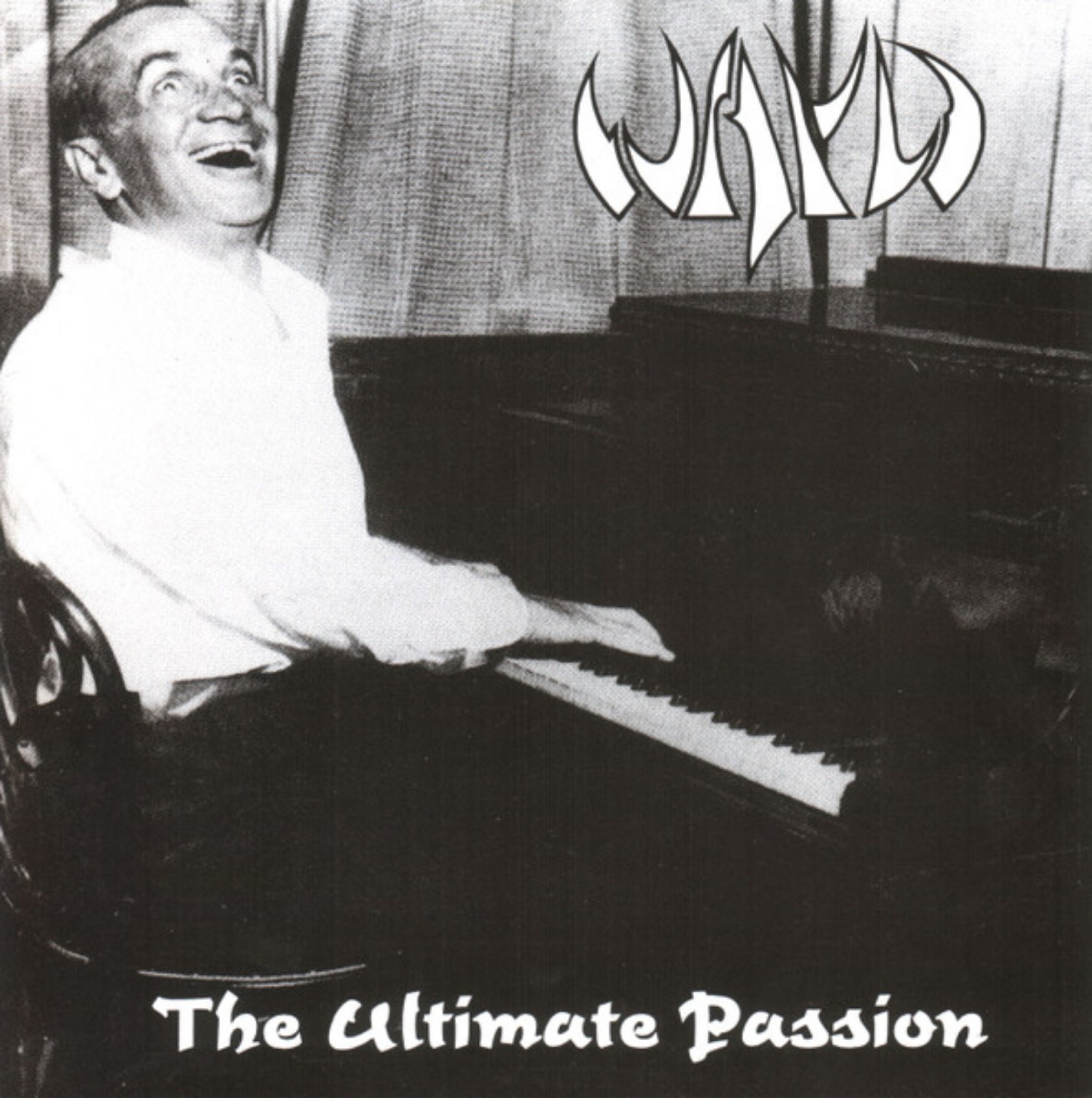
Prelude – The Laughing Pianist
On the black-and-white cover, a man sits at a piano, laughing. He hardly looks as though he belongs at the entrance to a death metal album from the 1990s. There is no blood, no ruined landscape, no menace built around a demonic emblem. Instead, there is an instrument, a face, a gesture and a sense of release so unguarded that it is almost disconcerting. Above him is the name WAYD; below him, two words: The Ultimate Passion. If one image could show what set this band apart from the world it emerged from, it would be hard to find a more fitting place to begin.
The album's story does not follow a straight line. It brings together two earlier bands, two different musical languages within metal, the local scene of a small eastern Slovak city, radio broadcasts taped onto cassettes, rehearsals kept going on a shoestring, a 1995 demo, a King Crimson concert, a week in Šulekovo near Hlohovec, a small label and a first CD. Even the year of release resists being settled with a single number. Today's discographies preserve 6 June 1997, while a genuinely contemporary Czech fanzine was still describing it as a forthcoming release in the summer of 1998. That uncertainty is not a flaw in the story. It is a reminder of what the underground was like when an album's journey was traced not by databases but by boxes, letters, fanzines, cassettes and news passed from hand to hand.
The Ultimate Passion runs for only thirty-four and a half minutes. Yet an entire band identity is concentrated within it. Thrash and death metal still provide a strong framework, but there are already keyboards, a female voice, brief instrumental interludes, a progressive curiosity and a stubborn determination that WAYD should not simply be a local version of an established style. Years later, the band recalled that this record had, to some extent, given them their face. The following pages trace how that identity took shape.
I. Before It Had a Name
In Richard Majer's recollections, the story begins back in the 1980s, long before anyone wrote WAYD on a poster or cassette sleeve. He and Drahoš Juřík listened closely to Větrník on Czechoslovak radio and taped whatever they could. Western rock and metal were not a click away; every recording and every scrap of information they obtained carried its own value. Majer taught himself guitar on his father's red Jolana Tornádo. He did not tell this as a romantic legend but as a description of a world in which technical ability was built on long hours of searching, imitation, listening and trial and error.
Later, two separate groups began to develop the musical mother tongue from which WAYD would emerge. Majer and Juřík played in the death metal band DYSENTERY. In the same Prešov scene, Milan Savko and Braňo Kóša were working with MARION, which approached metal from more of a thrash direction. When MARION came to an end, Savko and Kóša looked for a bassist. Juřík came over from DYSENTERY, and Majer joined them as a second guitarist. That meeting gave rise to WAYD in 1994.
The band's core four-piece line-up soon settled into place: Milan Savko on guitar and vocals, Richard Majer on guitar, Drahoš Juřík on bass and vocals, and Braňo Kóša on drums. The name came from Kóša, who devised it as a playful abbreviation. Perhaps it is a coincidence, or perhaps it only seems telling in retrospect, but even the name offered no ready-made meaning. Nor would their music later provide an easy genre label that answered precisely where they belonged.
WAYD's early strength came precisely from the fact that its members had not all brought the same things with them. The tightness of thrash and the weight of death metal sharpened rather than cancelled each other out. Initially, the band was still closer to those foundations than to the jazz-inflected progressive world that many would later associate with its name. But the possibility of movement was present from the outset: four musicians who did not have to come from the same place to set off in the same direction.
II. A World Built from Cassettes
In 1995, barely a year after forming, WAYD recorded the demo Shape of Your Mind. Ten tracks went onto cassette. The recording was made at a home studio in Veľký Šariš, and every later recollection conveys how different it felt at the time for a young band to gain access to a studio. There was no unlimited recording time, no expensive collection of instruments, no safety net of digital fixes. The opportunity to record was itself something that had to be seized.
Majer later recalled that thrash metal still dominated this material, and that several ideas grew out of what DYSENTERY and MARION had been doing. The demo was therefore not a finished blueprint for the later WAYD. It was more like a photograph in which the band is already recognizable but does not yet know how far it will move from the spot where it stands. The response did not suddenly carry them to the top of the underground, but it made the next step increasingly clear: they wanted something more than simply a heavier or more technical thrash/death release.
The musicians began to open up their sound. Not because they wanted to disown metal, but because it no longer seemed enough for every song to obey the same rulebook. On their next recording they wanted to make room for different instruments, female vocals, new textures and musical ideas from beyond metal. Shape of Your Mind thus became more than a first document: it was a milestone, with the band's initial coming together behind it and, ahead, the territory in which The Ultimate Passion could take shape.
III. The Gates of Prešov
WAYD did not take shape in a vacuum. In Richard Majer's memories, Prešov's music scene in the 1990s was a varied and surprisingly cooperative world. Clubs, rehearsal rooms, outdoor concerts and events in nearby Košice brought musicians together. Akrimon, later Netopier, the locally remembered Marakana and concerts in Myslava were more than names on a list of venues. In those spaces, bands watched one another perform, friendships formed and it became natural to bring an idea back from somebody else's musical world.
In this environment, jazz was not some distant academic concept either. Majer recalled jazz teaching in the city associated with musicians from the AMC Trio, and several local players, including members of WAYD, came into contact with that way of thinking. The change did not happen from one rehearsal to the next. Jazz did not arrive and make death metal suddenly disappear. Instead, it opened new possibilities: a different rhythmic sensibility, greater harmonic freedom, and an acceptance of improvisation and unexpected turns.
Then, on 18 June 1996, King Crimson came to Prešov. The band, in its THRAK-era incarnation, played the amphitheatre. More than two decades later, Majer still singled out that very evening when asked what had pushed their thinking forward. The members of WAYD went straight from rehearsal to the show and, in Majer's words, the experience certainly moved their creative work along. This is not a critic's comparison. It is not a case of someone retrospectively hearing Cynic or Pestilence in the music. A musician is describing a specific evening after which it became possible to imagine differently what a rock band might do with form, rhythm and instrumentation.
None of this means that The Ultimate Passion was a King Crimson imitation or a jazz album. Quite the opposite. The point was that WAYD increasingly felt less obliged to observe boundaries. Thrash and death remained the foundation, but the space around them opened up. The band was no longer asking only how to play heavier or faster. They also began asking what might happen if a sound appeared in a song that, by conventional rules, had no business being there.
The Decade Behind the City
When WAYD came together in 1994, Prešov no longer belonged to the country in which its musicians had grown up. Czechoslovakia split on 1 January 1993; the new Slovak Republic inherited the buildings of old industrial towns, their cultural centres and the uncertainty of transition. The streets did not change overnight, but the structures of work, livelihoods and opportunity were transformed over a few years. After the fall of the old regime, price liberalization and the opening of foreign trade, the loss of former markets and industrial restructuring brought substantial social costs. According to a later summary by the International Monetary Fund, roughly 300,000 jobs disappeared in Slovakia between 1990 and 1993; unemployment remained persistently high during the young state's early years.
These changes were especially stark in eastern Slovakia. According to regional data compiled by the World Bank, unemployment in 1997 stood at 17.8 per cent in the Prešov Region and 17.1 per cent in the Košice Region, compared with a national rate of around 12.5 per cent. A year later, the regional figures had climbed to 22.1 and 20.8 per cent respectively. These are regional figures, not separate unemployment rates for the cities of Prešov and Košice. They nonetheless show clearly that the country's east faced different economic circumstances from the capital. Behind the figures lay not one event but the legacy of state-socialist industry, privatization, the uneven spread of investment and transport difficulties.
Košice, as the region's larger industrial and transport centre, and Prešov, with its own educational and cultural institutions and small music scenes, were both part of this world. Their proximity offered bands opportunities to find audiences, gigs and contacts nearby, but geographical closeness did not abolish financial constraints. The distance between eastern Slovakia and Bratislava mattered economically as well. A later World Bank study found that a large share of foreign investment in 1997 was concentrated around the capital, while businesses in the Prešov Region received a much smaller portion of the incoming funds. None of this tells us about the personal finances of WAYD's four members. It does, however, help us picture the setting in which a band with no particular commercial orientation had to operate.
For a new group, a rehearsal room, an amplifier, a drum part, a cassette, photographs or a day in the studio all meant tangible objects and expenses. Rock music did not live on talent alone: rehearsals required shared time, bands needed somewhere to play, concerts needed organizers, and somebody had to take responsibility for duplicating recordings. The Rocková liga gatherings for amateur bands had begun in Prešov in the second half of the 1980s and continued after the political transition. Such a public platform was no guarantee of success. It meant that a few small but important occasions remained when music could move from the enclosed world of the rehearsal room to an audience.
The political landscape was scarcely more settled. Vladimír Mečiar's years in office were marked by fierce domestic disputes, and the path toward European integration was far from straightforward. In its 1997 assessment, the European Commission voiced reservations about the functioning of Slovakia's democratic institutions. Accession negotiations had begun with several other Central European applicants by spring 1998, but not with Slovakia. After the September parliamentary election, a renewed political opportunity emerged for closer European ties. These events formed part of everyday life's backdrop; they cannot be claimed to have directly shaped WAYD's lyrics or studio decisions.
Europe was also learning to redraw its cultural map. By the mid-1990s, information crossed borders much more freely than it had a decade earlier, but travel and making contacts still did not cost everyone the same time or money. A Central European band might know the same album titles as its Western contemporaries and yet find labels and audiences by a different route. In the age of physical formats, music really did travel through networks of towns, countries, post offices and clubs.
By the end of the 1990s, the wider world was talking about the rapid spread of the internet, new communications and the possibilities of digital technology. For the metal underground, however, a parcel posted overseas was still far from obsolete. In WAYD's story, the letter, cassette and CD do not stand for an absence of modernity but for the way work actually got done at the time. That is how the histories of a new state and a new musical identity come to sit side by side: changes on very different scales, taking place in the same country at the same time.
The Sounds of the City
Prešov's musical life cannot be reduced to the history of a single genre. In the late 1990s, the same city was home to alternative rock bands, jazz players, experimental groups and artists who would later become nationally known. WAYD did not emerge from this diversity through some formal school. Its musicians could encounter different musical languages at one another's shows, in rehearsal rooms and among friends. Histories looking back at Prešov's music scene suggest that the city's popular music enjoyed a more visible upswing around 1998; the earlier years were not uneventful, but there were far fewer opportunities to perform.
That makes the local year-end music review written in December 1998 particularly revealing. Its author covered not just the year's successful records but concert venues and a growing concentration of events. Rocková liga, Guitarfest, Festival za slobodu prejavu, Electro vs. Rock and several outdoor occasions all appeared in the account. So did WAYD, alongside acts such as Frown, Chiki Liki Tu-a and Kathegories Muflon. This does not mean they all played the same music. Quite the reverse: a small local scene was finding common stages across genre boundaries.
The contemporary chronicle's contradictions are almost tangible. Its author welcomed the busier concert calendar, yet finished the year by pointing out that Prešov still lacked the permanent rock club its scene needed. That single observation offers a subtler picture than any retrospective legend. The city's musical life was neither a complete desert nor an effortless golden age. It moved between flashes of opportunity, volunteer promoters, makeshift venues and missing infrastructure. Akrimon and Netopier, the names remembered around WAYD, were therefore not mere scenery but parts of a concert culture that was difficult to sustain.
Meanwhile, Slovakia's metal world did not stop at Prešov. A MUSIC EXTREME scene report written from Košice in 2001 surveyed the eastern Slovak underground band by band, complete with contact addresses. Alongside WAYD, the writer described, for example, the death metal group Perversity; WAYD's sound was characterized as a blend of technical death, thrash, progressive rock, jazz and melodic elements. Importantly, this was a retrospective account from 2001, not an immediate review of the 1997 album. The postal addresses themselves are revealing evidence of the period, however: someone interested in a band could write to it, request a demo or initiate a tape-trading relationship.
By the mid-1990s, death metal itself had begun testing its own limits. Cynic's 1993 album Focus drew together the instrumental approaches of jazz fusion and metal; Pestilence's Spheres, also released that year, experimented with synthesizers and unusual timbres. Alongside technical death metal, progressive metal and fusion rock offered other rhythmic patterns, instrumental roles and approaches to composition. The genre map of the time was therefore not a single line of development but several parallel paths. Years later, WAYD would be compared with those names; that resemblance should not automatically be treated as evidence that the musicians had consciously chosen them as models.
In WAYD's case, the directly documented connection is far more revealing: Richard Majer's later account of King Crimson's 1996 Prešov concert, and the openness the group brought to its thrash/death foundations. They did not have to surrender heaviness to make room beside guitars and drums for keyboards, female vocals or different harmonic ideas. The guest parts on The Ultimate Passion are therefore not alien additions: they belong to the band's search for a musical direction, a quality contemporary critics noticed too.
The next stage of that creative process was the studio. Within the contemporary underground, making a recording, duplicating a demo cassette and manufacturing a commercial CD were not the same thing. Rehearsal-room ideas had to be recorded, the recordings mixed, physical copies manufactured, artwork printed and finished copies delivered to actual addresses. WAYD's early demo and the album made at Exponent in Hlohovec represent two distinct stages of that process. The booklet names the participants and the studio, but does not specify the tape machines, microphones or mixing console used; it would be wrong to invent those details after the fact.
At the time, the international scene was kept moving by mail trading, small labels, fanzines and distributors. Cassettes were easy to hand over and copy, whereas manufacturing CDs demanded separate expenditure and organization. The arrival of the internet did not instantly erase these networks. News of an underground album often reached a fanzine editor before it reached the shelves of a larger record shop. That is why a small source such as Metal Breath's contemporary label news matters: it is not a grand critical judgement but a trace of the way a record tried to reach its listeners.
The Ultimate Passion was not created in isolation from Slovak metal, nor was it a copy of the great international records. What mattered was finding its own place: demonstrating how the rigid language of thrash and death could become more intricate music with room for unexpected rhythms and timbres. The city's clubs, the wider region's distribution routes and international experiments with genre are not all influences on the band supported by the same degree of evidence. Together, however, they sketch the environment in which WAYD's first full-length album becomes intelligible.
IV. Between 1997 and 1998
One of the peculiar beauties of The Ultimate Passion's story is that even its date refuses to fall neatly into place. The band's present-day Bandcamp page and Metal Archives record 6 June 1997. In a 2002 interview, WAYD placed its debut album two years after the 1995 demo, again pointing toward 1997. But then there is issue 41 of the Czech fanzine Metal Breath, from the second half of 1998, in which the album still appears among Metal Age Productions' forthcoming CDs, slated for release during the summer. Several later Slovak sources also use 1998.
In today's digital catalogues, this would look like a mistake to be corrected as quickly as possible. But in the underground of the 1990s, a release was not a single moment when a file appeared on a server. The music could be finished, a catalogue number assigned and a date planned, while pressing, artwork, the label's schedule and actual distribution began at different times. The sources currently available do not let us say with certainty which step belonged to 1997 and which to 1998. For now, the album stands on the boundary between two years.
Meanwhile, the world around it was changing rapidly. In 1997, news of Dolly the sheep brought the boundaries of genetics into public debate, IBM's Deep Blue defeated Garry Kasparov, Hong Kong returned to China, Mars Pathfinder landed on Mars and the Kyoto Protocol was adopted at year's end. If the main wave of physical distribution really occurred in 1998, the backdrop also includes the Good Friday Agreement, the fledgling company Google, the first module of the International Space Station and Slovakia's political turning point. None of these events should be read into the songs. They are not proven influences. They simply show the times in which a metal band from Prešov was trying to reach the wider world with a few hundred or a few thousand physical copies.
Slovakia itself was a young country. It had existed as an independent state only since 1993, and in 1997 its path toward European integration was fraught with political tension. WAYD did not document itself as a political band, so the public events of the period cannot be used as a key to its lyrics. What matters is understanding the distance involved: from Prešov, a small label, postal promotion, fanzines and distributors were needed to make contact with an international scene we can now reach in seconds.
Metal Age Productions was more than a logo on the back cover in that world. The label offered access to physical manufacturing and to the underground network. The band later recalled sending records abroad to magazines and companies. The Ultimate Passion thus continued its journey through parcels and letters, across fanzine pages and distribution lists. Its travels by post belong to the album's history as much as the studio does.
Two Years, Two Formats
The debut album left two distinct physical traces. The Metal Age Productions cassette edition, dated 1997, is listed under the identifier MA 0016-4-331. The original CD itself bears the inscription MAP 0016, while record catalogues also give the designation MAP-00016 and the release date of 6 June 1997. The different spellings and format identifiers should not be confused: the cassette and the compact disc are two separate physical formats.
There is stronger, genuinely contemporary testimony in favour of 1998. Issue 41 of the Czech Metal Breath mentions the album as a CD that had yet to appear; a Prešov music review written at the end of 1998, meanwhile, describes it as an already released Metal Age Productions CD. Taken together, these two notices show that the discographical information pointing to 1997 coexists with contemporary reports of CD distribution in 1998.
The documents examined so far cannot establish with absolute certainty the day on which the first copies of the CD reached listeners. Completion of the recording, a catalogue date, physical manufacture and actual commercial release are different events. Rather than arbitrarily settling the dispute, the story preserves the way a single ten-track recording came to stand at the meeting point between the cassette underground and the CD era.
V. A Week in Šulekovo
Decades later, Richard Majer condensed the recording period into one brief recollection: they went to Šulekovo for a week and worked intensively on the album. The technical credits in the booklet name Exponent studio in Hlohovec; Šulekovo is part of Hlohovec, so the two names refer to the same geographical area. Memory preserved the place, while the booklet preserved the studio's name and those who recorded the work: Roman Slávik and Tomáš Kmeť.
Two guests joined the four members of WAYD. Martina Gogová Ferková's female vocals and Richard Referovič's keyboards seem less like decorations added later than the first unmistakable signs of the openness the band had been seeking since the demo. The hard core remained unchanged: Savko and Majer's guitars, Juřík's bass, Kóša's drums, and the voices of Savko and Juřík. But a second layer of colour was now emerging around them.
According to the booklet, the music was written by WAYD. Drahoš Juřík wrote most of the lyrics, while Milan Savko was responsible for the words to Nothing More to Give. That small difference becomes significant later, because the song carries a somewhat more direct social bitterness than the rest of the album's lyrics, which tend to dwell on inner crises and self-examination.
In 2004, the band recalled that the material had not necessarily been intended for CD in the first place and that, looking back, they remained somewhat dissatisfied with the production. Yet that was not the heart of the story. In the same retrospective account, they said something much more important: the music already reflected their ambition to play metal differently from the prevailing fashion. The first CD thus carried both the limits of their resources and the birth of an identity.
Nor was the pressing enormous. In a 2001 interview, Kóša spoke of around a thousand CDs plus further cassettes; a few years later, the band gave a broader figure of between one and two thousand for its early records. We do not have the accounts, so these numbers remain recollections. What seems firmer is that this was a small underground run, many copies of which went into promotional and overseas channels, and that the band later recalled the first pressing selling out.
The cover, meanwhile, began to lead a life of its own. In black and white, it shows a man laughing at a piano, whose identity is not documented in the sources now available. The design credit preserves the names Metal Age and R. Kraker. An interviewer later thought the figure resembled Louis de Funès, but that was only a playful comparison. A more substantial connection lies between the title and the picture. In the title track, playing music is presented as a healing, liberating force. The laughing pianist therefore seems to freeze a moment of passion, even though the band never officially explained the image in those terms.
The Laughter and the Black Keys
At first glance, the picture almost protests against the genre to which the record belongs. Instead of a dark landscape, a monstrous figure or a flaming emblem, we meet a man sitting at a piano, tilting back his head, looking upward and laughing broadly. Light catches his face and pale clothing, while the dark piano stretches beside him as a heavy, almost unbroken mass. The keyboard runs diagonally toward the lower right of the image. His hands remain at the instrument, but his face has already moved beyond the intense concentration of performance. The whole composition lives in that duality.
The grain of the black-and-white photograph and its strong tonal contrasts suggest not a formal concert portrait but a living moment caught in passing. Vertical folds in the background give the space a faintly theatrical quality without telling us where the photograph was taken. At the top sits WAYD's angular logo, its lines breaking into sharp points, a design that could easily belong on a far more threatening metal cover. Underneath it, however, the image is filled not with blood or destruction but with sincere, almost irrepressible delight. At the bottom, the energetic white lettering of The Ultimate Passion softens the logo's severity.
The cover's strength does not come from a puzzle. Every important motif is visible, and its simplicity is precisely what makes it startling. The viewer's gaze moves between face and hands: what connects technique with joy? Alongside the discipline of thrash and death metal, the album's music makes room for unexpected melodies, keyboards and brief instrumental departures. The title track speaks of music-making as a liberating force. The photograph does not prove that this was the single meaning the band intended, yet the association is hard to ignore: passion is not just oppressive obsession here, but the pleasure of playing. The man's identity and the circumstances in which the photograph was taken remain unverified in the available documentation.
VI. Inside the Record
The ten tracks on The Ultimate Passion add up to thirty-four minutes and thirty-four seconds. There is no sprawling epic composition; the title track, at five minutes and five seconds, is the longest. Yet brevity does not mean narrowness. Three instrumental pieces are threaded among seven songs with lyrics, as if the story occasionally set down its words in order to breathe another way.
The opening This Time traps someone within their own crisis from its very first images. A web of despair, surroundings turning into a grave, pain and indifference depict a state from which no external saviour leads the speaker out. The change comes from within: a moment arrives when continuing in the same way is no longer possible. The song is therefore more than a dark overture. It already contains one of the album's most important movements: the decision to break free from stagnation.
There is hardly time for the weight of the lyrics to settle before the fifty-four-second Tequila arrives. An early review called it a refreshing instrumental. In the album's dramatic structure it is like a side door thrown open without warning: the words vanish, and for a moment the band shows that an album need not consist solely of one full-length song after another. After this brief piece, New Light draws the listener back to the inner struggle, but in a different light. The vision of the future has vanished, life and death draw close and a person becomes trapped by their own helplessness. Still, there remains a crack in the wall wide enough for a sentence: open your eyes, look for a new light. Frenky's early review considered this perhaps the album's strongest track.
Nothing More to Give is darker and more earthbound. Milan Savko's lyrics mix personal exhaustion with money, inequality, indifference and disgust at social reality. It would be easy to link all this directly to Slovak politics in the 1990s, but the sources provide no such key. The song's force lies precisely in not needing a footnote: it expresses the state of someone who feels that all reserves are exhausted and there is nothing left to give.
The Rise Song promises ascent in its title, but its lyrics refuse to turn that promise into a simple victory story. Pieces must be gathered among ruins; the ice is too thin, the movement too fast, the available choices increasingly scarce. Rising and falling occur within the same motion. By now it is clear that the album does not collect darkness for its own sake. Instead, it explores what happens when someone realizes the truth of their situation and that realization does not automatically solve the problem.
The title track stands at the album's centre. Over the five minutes and five seconds of The Ultimate Passion, passion is given a clear name for the first time: making music. Playing heals, changes the day, shows a way forward and revives the soul. Amid all the record's doubts and inner crises, this is its most direct moment of liberation. It is no religious or political programme, but music as a means of survival. If the laughing pianist on the cover communicates anything, this feeling comes closest to it.
Spiritual Stagediving abandons words again for one minute and twenty-three seconds. The title alone builds a curious bridge between the physical experience of a concert and an inner, almost spiritual state. The sources do not explain the music in detail, so inventing a narrative for it would serve little purpose. Its function is clear enough, however: after the larger span of the title track, it leads into the record's second half and again disrupts a uniform song structure.
Museum of Idols returns to the human mind, but this time through artificially manufactured idols rather than despair. Faces behind glass, reflections, the taste of the age's rhythm and the inner price paid for it come into view. Ultimately, the song returns to autonomy: the mind can still be free. It is the same idea in another guise, the idea that drove the search for new light in New Light and the crossing of a breaking point in This Time.
The two-minute-twenty instrumental pause Autumn Peace slows things down through its very title. It offers one last deeper breath before the record ends. From here begins The Path, which refuses to close the journey with an easy solution. Frost lies beneath a beautiful surface, imperfection behind sterility, while passion carries both life and a wound. Yet beneath the autumn leaves, a trace of the path appears. It is not a happy ending so much as the realization that leaving darkness does not mean making all one's shadows disappear. One learns to walk with them.
The ten tracks, then, do not tell a conventional story with characters and a plot, yet they have a direction. From the opening crisis, through decisions, renewed beginnings, exhaustion and self-examination, they arrive at music as a liberating force, and then, through the dismantling of idols, at a more complex self-knowledge. The three instrumental pieces interrupt the rule of words along the way. Perhaps that is why the album's title works on several levels: passion is not only joy. It is a force that can heal, but may also leave a wound.
VII–VIII. Echoes and Reinterpretations
VII. The First Echoes
The earliest securely dated trace is not a review but a promise. A 1998 issue of Metal Breath mentions The Ultimate Passion among Metal Age's forthcoming releases and describes WAYD as technical-progressive death metal from eastern Slovakia. Only a few lines, yet they tell us a good deal: the words technical and progressive already featured in contemporary discussion surrounding the album, even while the precise timing of its release remained unsettled.
In March 2001, Michal Frank published a longer review of the record. He heard WAYD deliberately breaking metal's formulas and conventions. He singled out the female vocals, keyboards, the changes between heavy guitars and gentler passages, and the musicians' instrumental ability. He treated the short songs not as a shortcoming but as a source of momentum, and found New Light particularly compelling. The review matters because it is not attempting to place the record within history from a distance of decades. It is still close to the event, capturing both the confusion and excitement that an uncategorizable debut CD could inspire.
That same year, the Slovak metal scene report in MUSIC EXTREME described WAYD as a mixture of technical death metal, thrash, progressive rock, jazz and melody. The description piles one label on top of another, but that is precisely the point: even a few years after its release, the album could not be reduced to a single word.
According to the band's own recollections, the response was not overwhelming in quantity but was mostly positive. In 2001, Kóša said they had not encountered negative reviews. In 2003, Majer recalled favourable reactions from abroad and thought perhaps the best things had been written about them in France. Much of this French material remains missing from the picture: perhaps it survives in undigitized fanzines, perhaps it is waiting in lost or poorly indexed archives. Its absence is as much a part of the story as what has survived.
VIII. When the Past Begins to Interpret Itself
In 2005, a Polish review looked at The Ultimate Passion from a greater distance. The writer for Metal Centre found it too restrictive simply to call the record death metal. They wrote of a balance between death and thrash, a high technical standard, female vocals and colours borrowed from jazz and progressive rock, and used Cynic, Sadist and Pestilence as points of comparison. Those parallels do not prove that WAYD had taken its direct inspiration from those bands. Rather, they show the frame of reference through which an outsider could explain what the Slovak four-piece was doing.
By 2020, Invisible Oranges was mapping an entire country's death metal past. In that perspective, WAYD became one of the more intriguing examples of Slovak technical-progressive death metal. The Ultimate Passion appeared thrashier and more direct than the albums that followed, while still pointing toward the progressive and experimental elements that grew stronger from record to record. That later reading comes surprisingly close to the way the band itself told the story: the search did not end with the first CD; its direction became visible there for the first time.
The most important sentence, however, comes from the band's own retrospective comments in 2004. They said that this CD had, to some degree, defined their face. They did not claim it was perfect. Nor did they suggest that all their later ideas were already fully formed on it. Quite the opposite comes through: they had reservations about the production, and audiences did not immediately find it easy to take in, yet it was on this recording that they first recognized themselves.
IX. The Door Left Open
After The Ultimate Passion, WAYD did not turn back; it continued along the road opened by its first CD. Barriers arrived in 2001 with an even wider range of instrumentation. Saxophone, keyboards, percussion, samples and guest vocals were built around the metal core; Katarína Knechtová also took part. The release again encountered difficulties: a planned German edition was delayed and ultimately fell through, while artwork, pressing and the label's schedule slowed the process. Musically, however, the question was no longer whether boundaries could be crossed, but how far they could go.
By the time of 2003's Decadance, the band was speaking even more openly about jazz, avant-garde ideas and improvisational elements. Ghostwalk in 2007 marked the end of a long first period. The creative core of the classic four-piece was still there, but the members' circumstances, work abroad and the distances between them increasingly complicated the band's continuous operation.
A long silence followed. Not an official breakup so much as a state of hibernation. The name WAYD did not disappear, but everyday activity stopped. Around 2017 they returned to the stage in Prešov, and new songs gradually began to appear. In 2022, Walpurgas signalled that the return was more than an exercise in nostalgia. Meanwhile, founding drummer Braňo Kóša left after many years and was replaced by Peter Jakubík, who had already helped the band with live performances.
In 2024, the Shape of Your Mind demo received a restored reissue. Then, in 2025, eighteen years after Ghostwalk, Reinvent appeared. The title is almost too apt to be without significance: to reinvent something while keeping its foundations intact. Guest musicians, wind instruments and keyboards were once again part of the picture. The door opened in the days of The Ultimate Passion had not closed, even decades later.
Epilogue – A Trace of the Path
Today, The Ultimate Passion is both a rare physical object and a more readily accessible digital memory. A black-and-white booklet, ten tracks, a few photographs from the period, a catalogue number, conflicting years and a handful of surviving interviews preserve the moment when WAYD first demonstrated over the length of an entire album that it did not intend to obey the lines drawn around it.
The record was not born perfect, and the band never tried to present it that way in retrospect. Memory has preserved the circumstances of recording, the limits of production and the audience's initial uncertainty too. Yet this was the starting point for the more open arrangements of Barriers, the experiments of Decadance, Ghostwalk and, after the long silence, Reinvent. The first CD was not a final statement; it was permission the band gave itself to keep searching.
Perhaps that is why the title remains so powerful. The ultimate passion is not the name of a style. It is not thrash, death, progressive metal or jazz. In the band's story, it is more nearly the act of playing itself, the compulsion and joy of creating. It is the force that leads from songs recorded off the radio onto cassette to a first demo, from a concert experience in Prešov to a studio in Hlohovec, and then, over the decades, repeatedly calls them back to the same question: where else could they go?
At the end of The Path, the trace of a road appears beneath autumn leaves. The image does not promise that the path will always be clear. Only that it exists. The afterlife of WAYD's first album is much the same: hidden in places, disputed in others, sometimes visible only on the pages of old fanzines. But the trace remains. Follow it, and we return to the place the laughing pianist pointed toward on the cover: music, which for a moment can become freedom.
Reader comments
Comments appear only after approval. Opinions are displayed in their original language.
Comment submissions are not yet enabled.