Adimiron Black
Gehenna’s 1998 turning point: from Stavanger to Soundsuite Studios, the shift towards black/death metal, the cover artwork, seven tracks and the album’s later history.
About the album
Tracklist · original seven-track album
- 01.The Killing Kind3:39
- 02.Deadlights5:38
- 03.Adimiron Black6:17
- 04.Seed of Man’s Destruction3:56
- 05.Devil’s Work7:41
- 06.Slowly Being Poisoned4:01
- 07.Eater of the Dead4:59
Sum of listed track times36:11
Band members
- Sanrabb
- vocals, lead guitar
- Dolgar
- vocals, rhythm guitar
- E.N. Death
- bass guitar
- Damien
- keyboards
- Blod
- drums
Guest musicians
- Sarcana
- guest keyboards on tracks 3 and 7
Recording and release
- Studio
- Soundsuite Studios, Norway
- Recorded
- January–February 1998
- Produced by
- Gehenna and Terje Refsnes
- Original label
- Moonfog Productions
- Original release
- 1998, FOG016, CD / 12″ LP
Official music platforms
Expanded digital editions have a different tracklist from the original seven-track album.
Qobuz sells the expanded digital edition dated 2004, not the original seven-track 1998 release.
Physical editions – where to buy
Official reissues · specialist retailers
Stock and prices may change. Sales conditions vary by country.
Album details refer to the original 1998 release; later reissues may include bonus tracks.
Band channels
Stavanger – The Birth of Darkness
Stavanger is not Oslo, and it is not Bergen. In January 1993, when Sanrabb, Dolgar and Sir Vereda founded Gehenna, this city in southwestern Norway followed its own rhythm on the emerging map of black metal. On the coast, decades of shipping and oil production met; within the musical underground, meanwhile, a band was taking shape that would soon find an unusual language of atmosphere and dark, ritualistic melody. The histories of Norway's different local scenes did not simply overlap. The beginnings in Stavanger had their own past, just as the bands of Oslo and Bergen had theirs.
Long before Gehenna made its first recordings, Stavanger had accumulated layers of maritime trade, industrial change and the institutions of a modern city. The place where the band began was therefore no mere northern backdrop. It was a real environment made up of many kinds of work and many different communities, and its history unfolded alongside the three founders' first years in music.
By the mid-1990s, the city from which Gehenna emerged had long since become more than a port. Stavanger stood on Norway's southwestern coast, in Rogaland county, closely bound to the sea and the fjords; coastal traffic and work in the North Sea were both part of everyday life. Around the harbour, older layers of seafaring and merchant-town history remained visible, even as an industry on an entirely different scale had reshaped the local economy since the 1960s. A city once associated with sardines and canning had become one of the principal centres of Norway's oil and gas industry. This was more than a change of label. Oil companies, subcontractors and service businesses created a world of work whose presence could be felt in the streets, in commuting patterns and in the changing make-up of workplaces.
The Transformation of a Port City
That transformation had a history of its own. Herring fishing and shipping had kept the city moving, followed by the canning industry. As industry modernised, the older factories declined in importance, and by the 1960s Stavanger needed new foundations for its livelihoods. After the discoveries made by offshore oil exploration, the city's leaders made a concerted effort to attract international companies, technical specialists and supporting facilities to the region. In 1972 both the state-owned Statoil and the Norwegian petroleum administration established their headquarters here. The oil economy employed far more people than those working out at sea: engineering design, repairs, transport, hospitality, construction and office services all became entwined with it. The expanding business district of nearby Forus revealed a different face of Stavanger from the rows of older buildings in the city centre.
Yet behind the city of petroleum workers lay an active cultural centre. Sølvberget, the library and cultural centre that opened in 1987, offered room for reading, events and encounters. Theatres, community institutions and organisations concerned with local history sustained the city's public life; a local historical society was also founded in 1991. Everyday life in modern Stavanger thus extended far beyond the industrial installations along the shore. Its shops, institutions, residential neighbourhoods and cultural spaces together gave the place its character.
The city was changing quickly, but even in 1998 its scale was still that of a regional centre. Figures from Statistics Norway record 112,565 inhabitants at the end of 1997 and 113,954 at the end of 1998. These numbers do not describe a metropolis suddenly springing into existence. They describe a place where work connected to the North Sea stood alongside old family and commercial ties, new corporate services and cultural interests that could differ markedly from one another, all in close proximity.
The most conspicuous symbol of the transformation was the construction of the new petroleum museum. The idea had been proposed as early as 1974, funding was in place by 1996, and construction began in June 1997. In the year of Adimiron Black, the museum was still an unfinished building, a monument to the city's petroleum history slowly taking shape. It did not open its doors until 20 May 1999. By then, Stavanger had come to regard the modern world of North Sea work as part of its history, just as it had previously done with fishing and shipping.
This modern city had hard industrial outlines. Offshore platforms, repair workshops, shipments and technical systems shaped the region's economic life. Years later, the cramped, cold, industrial imagery of the Adimiron Black cover would approach the sight of bodies and machinery by an entirely different route. Together they suggest a distinctive mood of the period: the reality of a city modernising at speed, and the world of a darker metal album turning towards physical aggression.
The wider region of Rogaland was not simply an extension of central Stavanger. The flatter, intensively farmed landscapes of Jæren, the industrial and commercial districts of Sandnes to the south, and Sola's role as an air-transport hub were different faces of the same region. Movement between sea and land was not a romantic backdrop but an organising principle of daily life: it underpinned commuting, business travel, freight and personal connections between towns. Stavanger was no isolated point on the Norwegian plateau. It operated where coastal routes met road, rail and air connections. Sola Airport had been part of the city's wider region since 1937, while the history of rail links with southern Norway stretched back much further than the emergence of black metal.
Proximity did not, however, erase regional differences. Everyday life in the offshore oil industry could be very different from life in the agricultural districts along the coast, even as networks of suppliers connected the two. Oil brought substantial revenues to some sectors, while leaving other economic actors more vulnerable to fluctuations in export markets. The meaning of modernisation becomes clearest in this tension. The same region preserved traditions of fishing, agriculture, shipbuilding and trade while becoming ever more deeply integrated into the international energy industry.
Behind the boom lay the volatility of international markets. One local historical survey preserves a contemporary estimate that some 2,500 jobs in the region were at risk during the oil-price collapse of 1998. That is the order of magnitude given by a retrospective source, not a precise count of jobs actually lost. The story of the city's growth and vulnerability unfolded during the very decade in which Gehenna was moving ever further away from its original sound.
Stavanger’s Music Scene
By the second half of the 1990s, Stavanger was far more than a distant dot on Norway's metal map. Connections developed between the city's music scene and active bands in nearby Sandnes, Sola and Strand, and those connections did not need the approval of Oslo or Bergen. The differences between the musicians remained. Some came from an interest in solemn, church-like keyboards; others were drawn to the weightier guitars of death metal; still others preferred the theatrical forms of gothic metal built around contrasting voices. Yet the rehearsal spaces, venues and recording activities of the same region gave room to these divergent stories.
Folken, Stavanger's student and concert centre, opened in 1988 and provided a stage for performers from many genres. Checkpoint Charlie, the Hard Rock Cafe and Club Grotesque also appear in accounts of the local music scene. Places like these formed part of the concert and club culture of the 1990s. Alongside records and fanzines, cities had living, physical meeting places, even if the details of any particular band's performances must be established from separate documents.
Other kinds of dark music were taking shape in the area around Stavanger as well. The gothic and melodic ambitions of Theatre of Tragedy, associated with Sola, led towards the 1998 album Aégis. In that same year, Tristania built a different symphonic-gothic world with Widow's Weeds. In the metal history of southwestern Norway, music constructed from female and male voices and monumental arrangements existed side by side with Gehenna's increasingly raw and heavy ambitions.
By the end of the 1990s, then, no single musical answer had emerged from the region. Gehenna's journey covered a particularly great distance: from its early, slowly unfolding atmosphere to a more distorted, tense and guitar-driven sound. To understand how far it had travelled, we must return to the band's first recordings.
Gehenna’s First Recordings
Recordings followed within months of the band's formation. The Black Seared Heart demo was recorded at Soundsuite Studios in the summer of 1993; not long afterwards, Ancestors of the Darkly Sky also revealed the direction in which the original line-up was searching for its voice. Compared with the later full-length albums, the band's first tools were still taking shape. Yet the return to the same studio in 1998 would eventually give this radical transformation an unusual sense of continuity.
By the time of First Spell in 1994, Sarcana's keyboards were becoming increasingly important, and when Seen Through the Veils of Darkness appeared a year later, the instrument was no longer mere background. The synthesiser shaped the space, bound the guitars together and made the music seem larger and more distant. In Gehenna's first era, darkness had an echo. It did not simply strike you; it surrounded you.
At the Limits of the Old Sound
Malice—or Our Third Spell, as the band called it—became the culmination of that world in 1996. It was a bigger, more controlled and more cohesive album. Sanrabb later recalled listening back to the earlier material before every new record and tour, trying to work out where they should go next. Malice came close to what they had wanted to achieve at the time. And that, precisely, became the problem.
After Malice, however, the musical path they had been following reached its own limit. The band had fashioned its great, symphonic darkness; when they turned to the next work, the prospect of having to build another record out of the same gestures began to weigh on them. Sanrabb and Dolgar did not look for a way forward by merely adding more layers to their old sound. They sought immediacy, rhythmic assault and a greater emphasis on the harshness that had previously remained in the background.
Norway in Years of Change
Seen from a national perspective, Norway between 1996 and 1998 was not simply a society growing wealthier through oil. A central political question remained how the state could preserve its economic room for manoeuvre within an increasingly interconnected Europe. The Agreement on the European Economic Area came into force on 1 January 1994, but in a referendum held that same year 52.2 per cent of Norwegian voters rejected membership of the European Union. The effects of that decision remained present in the second half of the decade: Norway wanted to take part in European economic relations while staying outside full EU membership. That did not mean isolation, but a distinctive form of cooperation.
The government was not unchanged either. After Gro Harlem Brundtland's long period in office, Labour's Thorbjørn Jagland formed a government on 25 October 1996. Following the September 1997 election, a minority coalition of the Christian Democratic Party, the Centre Party and the liberal Venstre took office on 17 October under Kjell Magne Bondevik. The Christian Democrats' entry into government, the country's religious and philosophical traditions, and its alternative youth cultures all belonged to the history of the same period.
At the same time, the Norwegian state was working to establish a long-term economic structure. The first actual transfer of capital into the state petroleum fund, which would later become famous around the world, took place in 1996. In 1997 the decision was made to invest part of the fund in equities. A separate investment-management organisation was established within Norges Bank on 1 January 1998, and work on building the equity portfolio began in the first half of that year. The point of these institutional decisions was to ensure that the economic benefit of oil would not have to be spent entirely in the moment. Looking back from the enormous wealth the fund later accumulated, it is easy to imagine the process unfolding too quickly; in 1998 the system was still very much under construction.
The everyday economic picture was marked by conflicting signals throughout the year. According to Norges Bank's 1998 annual report, unemployment in the national labour-force survey fell from 4.1 per cent in 1997 to 3.2 per cent in 1998, while the export value of oil and natural gas declined significantly—by 43.5 billion kroner—compared with the previous year. It would therefore be misleading to describe the period in a single word as either boom or collapse. Employment could still present a favourable picture on average across the year, even as the turn in commodity markets signalled serious financial and regional strains.
In the second half of the year, the language of Norwegian economic policy began to change as well. In a speech on 28 August 1998, the central bank linked the Asian financial crisis with weakening demand for crude oil, pressure on the krone and interest-rate increases. By then, the January–February recording sessions for Gehenna's June album were long finished; in August, however, Stavanger and Norway's wider economic environment faced new, more difficult developments. Local industry and international financial movements thus formed overlapping stories as the year drew on.
New Directions in Norwegian Black Metal
Even in the middle of the 1990s, it was easy to speak of Norwegian black metal as though the genre had a single, immutable sound. Yet between 1996 and 1998 the very rules presumed to unite it were beginning to loosen. Alongside the raw, often deliberately narrow sound of the early decade, arrangement, studio work and composition gained increasing importance. A more clearly defined guitar track, a broader keyboard palette or a more varied rhythm did not necessarily mean a loss of intensity. Sometimes these things made it possible to hear not only the noise of destruction but its structure as well.
Satyricon's 1996 album Nemesis Divina still spoke the language of expansive, icy black metal, even as it sought a tighter and more purposeful sound. Emperor's 1997 Anthems to the Welkin at Dusk enlarged the symphonic and technical scale of the music without sacrificing its aggression. That same year, with the release of Enthrone Darkness Triumphant and now backed by Nuclear Blast, Dimmu Borgir carried more clearly arranged, large-scale black metal towards much wider international distribution. These albums were not identical, nor were they seeking the same solution. Yet together they illuminate a movement within the era: black metal had become a form in which decisions about sound, technique and audience had to be made at the same time.
Elsewhere, a deliberately colder and rawer approach remained alive, while harder-to-classify experiments began to emerge. On Arcturus's 1997 album La Masquerade Infernale, theatrical, avant-garde arrangements almost burst the familiar boundaries of black metal. Dødheimsgard's 1998 Satanic Art explored the possibilities of unsettling, fractured sounds and devices pointing towards industrial music. Rawness and carefully fashioned studio sound, orthodox tradition and unexpected foreign elements did not replace one another in a neat chronology: they operated side by side.
Within this musical landscape opening in so many directions, Gehenna's own transformation was not simply a matter of following a single fashion. In place of the more romantic, symphonic layers of Malice, the band moved towards heavier riffs, shorter bursts of attack and colder keyboard colours. The album remained recognisably Gehenna precisely because it did not erase the substance of its earlier darkness. It reorganised that material at a different pace, with different instrumental proportions and a different vocal force.
Around 1997, then, a conscious reaction began to take shape within the band rather than a continuation of the established course. In its own terms, the sound of Malice already formed a complete whole, but Sanrabb and Dolgar wanted to unleash a different kind of force in the next recordings. It was as though they were dismantling the grand symphonic space from within, making room for the more immediate weight of guitars and drums.
The Band’s New Line-up
The band itself was changing in the meantime. Sarcana and Dirge Rep left. Damien arrived on keyboards, while Blod took the drum stool, bringing an entirely different weight to the rhythm section through his death-metal background. Dolgar later made the point plainly: the new members had not forced the change in direction. He and Sanrabb already knew where they wanted to go. The newcomers simply made the band better equipped to give voice to that new, harder language.
Five people stood behind the new sound. Sanrabb's and Dolgar's guitar and vocal parts jointly shaped the band's centre; E.N. Death's bass pulled the rhythmic weight lower, while Blod's drums gave the songs a new kind of impact. On keyboards, Damien took over the instrument's changing responsibilities. The 1998 album booklet names all five. Together they made the transformation audible, even though retrospective accounts often explain it primarily through the intentions of Sanrabb and Dolgar.
For all Damien's arrival, the booklet did not forget a familiar name. Sarcana was credited as a guest keyboard contributor on two songs: the title track, Adimiron Black, and the closing Eater of the Dead. For the latter, the songwriting credits went a step further and listed her among the composers alongside Sanrabb. The departing musician did not thereby return to the band's everyday line-up, but she left work on the new record that can be defined precisely. The two songs in which the old and new Gehenna seem to meet can thus be linked to the transition not only through later interpretation but through the terse information in the original booklet.
The Beginning of the Moonfog Era
The atmosphere surrounding the record label was changing too. The Cacophonous period had come to an end; not every promise had been kept, and Gehenna increasingly felt it needed a new base of support. Moonfog had shown interest before, but their contract had prevented them from making a move at the time. When they finally joined Satyr's label in 1998, it seemed more than an administrative change. Moonfog was gathering around itself precisely that part of Norwegian extreme metal which no longer wanted to repeat the language of the early 1990s unchanged.
To release a metal album in the 1990s, writing and recording the songs was not enough. Someone had to pay for manufacturing, prepare the cover and booklet for printing, get copies to shops, distributors and journalists, and make sure the band's name became known even in countries where it had never played. For smaller labels, this meant far more than a logo on the back of a CD. They provided contacts, access and sometimes an entire aesthetic environment.
The British Cacophonous and the Norwegian Moonfog came from different institutional backgrounds. Moonfog was founded in the early 1990s by Satyr, the singer of Satyricon, and Tormod Opedal. Its catalogue during that decade included Satyricon, Darkthrone, Dødheimsgard and Gehenna alike. That proximity between releases carried a meaning of its own. When a listener picked up a new album, the label's name could evoke the sounds, photographs and covers of other bands, along with the sense of risk that a new record might promise.
Moonfog's catalogue numbers preserve a separate part of the story of this transition. The full-length album bore the number FOG016, while the related release Deadlights carried FOG 015. The lower number, together with contemporary reports, suggests that the EP also served as a preview. A later database, however, gives its release date as 31 July 1998—after the full-length album's stated date of 8 June. The recollection of the promotional sequence and the database date must therefore remain two parts of the story, rather than being fused without proof into a single certain timetable.
The move between the two record companies mattered independently of the musical decisions: after Cacophonous, Moonfog's name, catalogue and distribution network framed Gehenna's next releases. Without the precise private contractual and financial terms, the history of this label change can be traced through the albums, the release plans and the surviving physical evidence of the editions.
A Musical Decision Takes Shape
But by the time the contract was settled, the musical decision had already been made. In contemporary interviews, Sanrabb spoke more and more clearly of being tired of repetition. There had been too much lavish, synthesiser-laden black metal. They did not want to become softer; quite the opposite—they wanted to become more dangerous. They did not regard anti-Christianity, negativity, brutality and aggression as mere aesthetic accessories. If the old form could no longer convey these things forcefully enough, the form itself had to go.
After the tour with Marduk and Mysticum, that conviction grew stronger. On stage, even the old Gehenna songs sped up and became harder; instinctively, the band played them with greater force live. They could feel that the music worked differently, physically, in concert. Perhaps one of the deepest ideas behind Adimiron Black was to bring that live energy back into the studio.
Records could cross national borders to reach fans, but the stage demanded a different kind of encounter. It required a venue, an organiser, suitable equipment, travel and an audience that would actually be in the room that night. By the second half of the 1990s, increasing numbers of such connections were forming between Norway's metal scene and the wider European one. Small clubs and larger festivals were not interchangeable; playing in a confined space tested a band in one way; holding its own in an unfamiliar country tested it in another.
The story of Tristania, from Rogaland, offers a tangible example of this movement. Following its 1998 release, the band's appearances abroad included Belgium and a festival in Austria. Within a few years, work in a local rehearsal room could lead to an international network of concerts and record releases.
Other bands from the region were also making their way abroad. Tristania's post-1998 performances were one example of a wider Norwegian metal network: stages, correspondence and the circulation of records brought northern musicians and European listeners together along different routes. In that same landscape, Gehenna's tour with Marduk and Mysticum became a documented turning point of its own.
The Turn Towards the Guitar
By then, Sanrabb already had in mind a harder, more guitar-centred album, less driven by melody. When he used the word industrial, he was not thinking of drum machines or electronic club music. He meant something more mechanical. Angular rhythms. Noise. Claustrophobia. The feeling of being dropped into a war zone, with the pressure only lifting when the record came to an end.
The band listened to a great deal of music at the time. Bathory remained among their roots, but Slayer, Morbid Angel, Ministry, Mayhem, Darkthrone, Deicide, Abruptum and Marduk were also in the mix. They were not trying to copy a single band. Instead, they drew different things from different sources: the direct attack and thrash precision of Slayer; the physical weight of death metal in Morbid Angel; and, in Ministry, the machine-like, percussive industrial feeling that need not come from electronics, but can arise from the way a rhythm slams into the same wall over and over again.
Extreme metal at the end of the 1990s was not divided along clean boundaries. Death metal's deeper, heavier guitar sound, the bodily pressure of its vocals and the drums' rapid, attacking rhythms inhabited the same listening world as thrash metal's spring-loaded, precisely measured riffs. Industrial metal could add a different sensation: recurring figures, metallic impact, relentless repetition and a sense of machine-like accuracy. That did not necessarily make the music electronic. It was enough for live instruments to collide as though every human movement were confined by an invisible mechanism.
Within this setting, the keyboard could assume a different role as well. It no longer had to turn into a choir, a bank of mist or a distant tolling bell. It could replace a sense of space with a brief, cold noise, sharpen a beat, or create tension where melody might once have released it. The meeting of different genres was therefore not simply a collection of musical quotations, but a decision about arrangement and the perception of space.
The symphonic functions the music had previously relied on now gave way to a reorganisation of rhythm and timbre. They brought together the harder guitars of death and thrash, cold industrial textures and the dark emotional character familiar from black metal, until the weight of the arrangements depended less and less on traditionally grandiose keyboard themes.
By the autumn of 1997 the title already existed: Adimiron Black. Some of the lyrics were still unwritten, but the direction was clear. Dolgar later said that they understood the word Adimiron to be an old expression meaning blood. That interpretation has not been confirmed by an independent linguistic source, yet within the band's own world it worked perfectly. Black blood. Something bodily and mystical at the same time. As though the darkness of the old Gehenna had suddenly lost its mist and become a fluid, a substance clinging to a wound.
According to an earlier examination of Imhotep's 1998 interview, four new songs could already be heard at the beginning of January 1998, and studio time had been booked for that month. Even on its own, this detail gives a more precise picture of the plans that were taking shape in the autumn of 1997: there were already completed pieces behind the album title and its musical direction. The January–February 1998 sessions therefore did not begin from nothing, but from compositions already in development.
Inside the Recording Workshop
In January 1998, Gehenna were once again working with Terje Refsnes at Soundsuite Studios, returning to a recording location that had already figured in the story of their first demo. From the beginning, then, the studio had been one of the band's recurring places of work. This time, however, the music was radically different: where a spacious atmosphere had previously prevailed, live drums, densely rhythmic guitars and colder keyboard textures now took the foreground.
The recording cannot be reduced to a single day in January. The booklet gives us a more precise, yet still restrained, time frame: it specifies January and February 1998 and prints the name Soundsuite Studio alongside the recording information. It does not describe the sequence of working days, say which song was recorded when, or break the technical decisions into steps that can be reconstructed after the fact. What it does make unmistakably clear is that production was jointly credited to Gehenna and Terje Refsnes, while Refsnes was named as the recording engineer.
The production responsibilities were more complex than any single credit might suggest. Information attached to the original edition names Terje Refsnes as both engineer and producer; other, later versions also credit the band with production. Taken together, these details point to several participants in the studio process: the band's ideas and the practical work of recording jointly shaped the songs, the balance of the instruments and the harder, more immediate sound.
The Soundsuite name was not making its first appearance on a Gehenna release. Early material for Black Seared Heart had already been recorded at the studio in the Stavanger area. The place thus became a recurring stop in the band's history: the same working environment accommodated both their early atmospheric sound and the much sharper rhythmic approach of 1998.
Terje Refsnes moved to France in 1999. The January–February recordings of Adimiron Black still belong to the earlier, Norwegian period of Soundsuite. The studio's subsequent history and the time when the album was made can therefore be clearly distinguished.
That immediacy emerges even in the smallest details of the sound: the narrow space between one impact and the next guitar note, the separation of fast-moving instruments, the sustained pressure in the lower frequencies. In 1990s metal, controlling density became increasingly important if rhythmic shape was to remain audible alongside speed. The guitars and drums of Adimiron Black speak the language of that aesthetic, while the expansive reverberation of earlier Gehenna gives way to something more immediate, almost physically close.
They were not always interested in technical terminology. Sanrabb and Dolgar later spoke with some self-mockery about not necessarily knowing how to specify the exact knob or setting they wanted. They listened, experimented and made changes. Yet the goal was remarkably precise: less reverberation, more immediacy. They wanted the band to sound not as though it were playing in a distant Gothic hall, but as though it stood in the listener's own room.
For the first time they used drum triggers on Blod's kit. The bass was given a fuzz effect. Dolgar sought deeper growls. And the analogue synthesisers took on new duties. They no longer had to carry melodies or build romantic spaces. They became noise, metallic textures, rhythmic effects and cold shadows. The keyboard did not disappear from Gehenna. It simply stopped lifting the music upwards. Instead, it pressed it down.
This machine-like quality worked on three different levels. In timbre, the fuzz-laden bass and distorted guitars created a colder, almost metallic surface. In rhythm, Blod's live drums, emphasised by triggers, and the percussive guitar playing supplied the angular pulse. The third was the space the music seemed to occupy: the once expansive, floating keyboard world became a narrower, more oppressive presence. The album could acquire its industrial flavour in all three senses without turning into programmed machine music.
The Physical World of Record-Making
At the end of the 1990s, an extreme-metal album often reached its audience through a chain of physical objects. A CD cover could be held in the hand; the booklet's pages could be searched for musicians' names, photographs, studio credits and sometimes acknowledgements in tiny print. Cassettes moved differently: they were easier to mail, copy and exchange, and in some places they continued to circulate alongside official formats. Vinyl, meanwhile, still offered a distinctive, collectable form for listeners who understood a record not merely as sound but as an image and an object.
In the case of Adimiron Black, both a CD and a twelve-inch vinyl edition can be documented for the 1998 Moonfog release. The availability of vinyl is a contemporary fact, not a nostalgic reissue projected backwards onto the period. The release booklet presented the musicians, their instruments and the other contributors, alongside details of the Sound Suite sessions. Its visual world was not decoration detached from the music, but part of how the album came before its listener: sound acquired a form that could be held and leafed through.
Photocopied fanzines forged their own physical routes between listeners scattered across the continent. Editors assembling interviews, demo reviews and address lists did not merely pass on ready-made news: they often built the next issue from their own correspondence and contacts. Alongside Norway's Slayer fanzine and other underground publications, larger metal magazines and the slowly spreading internet formed parallel worlds. The very same album could reach different audiences at entirely different speeds.
Today, a few touches on a phone screen can bring a new album into view. In 1998 the rhythm was different. A fan might first learn from a short magazine notice that something was being prepared, discover its title in a review published in another country, and only later obtain the record itself. A parcel might take days or weeks to arrive; a contact could be sustained by letter, telephone, fax or the still more limited online presence. The musical community therefore extended far beyond its listeners, embracing distributors, correspondents, editors, organisers and the people working in small record shops.
Printed metal magazines could already make a style visible beyond one country's borders. Underground fanzines maintained smaller, often more personal channels alongside them. One of the scene's enduring tensions lay precisely here: the more accessible the music became, the more fiercely people questioned what still counted as authentic, dangerous or sufficiently isolated. Behind the albums of 1998 stood both the possibilities of international distribution and an attachment to earlier secrecy.
Fanzine copies, postal packages and international distributors were the slower, tangible routes along which metal releases travelled. The Moonfog album entered this world, where physical media and personal connections sustained one another.
Towards a Rawer Sound
This is one of the most important differences between Malice and Adimiron Black. The darkness of the old Gehenna surrounded you. The darkness of the new Gehenna struck you head-on. The riffs became thicker, the drums more physically aggressive, the bass noisier, the vocals deeper and more earthbound. The symphonic space contracted, and in its place appeared something modern, cramped and industrial.
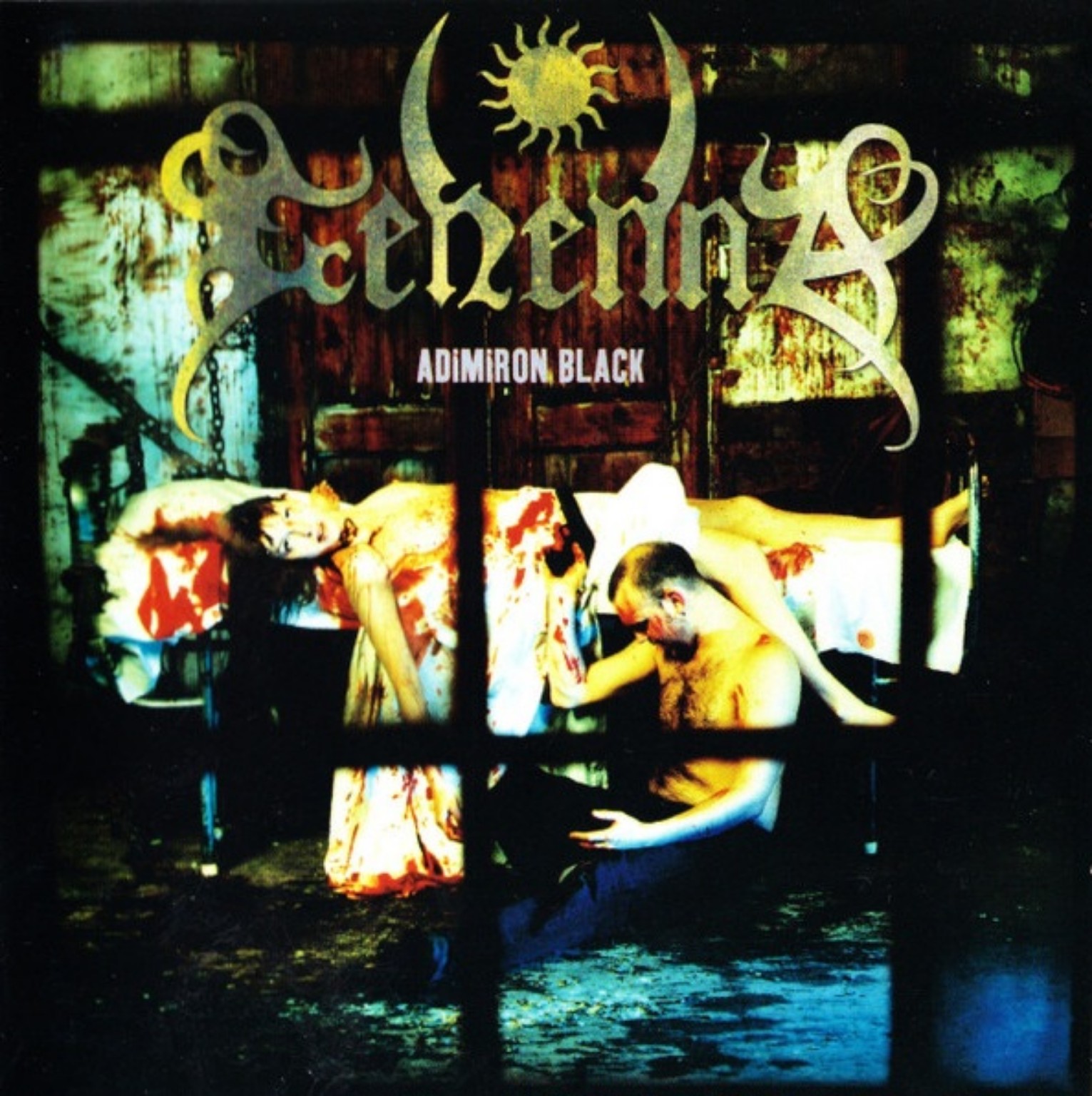
The imagery accompanying the music was equally direct. In place of familiar ruins and medieval-looking silhouettes came a dark, industrial interior, white fabric, stains suggestive of blood and two human figures. One possible reading of the image evokes a moment after fatal violence, but the photograph provides no firm evidence of what sequence of events led to the situation shown. Grid-like lines cut across the view while the music demands a similarly merciless closeness. The next chapter explores the details of this cover.
Behind the Bars – The Cover of Adimiron Black
The cover of Adimiron Black reveals a scene as though we were peering into a sealed, abandoned room. In the background are dark-brown surfaces with a rusted appearance and walls mottled with green. In front of them, a pale-skinned female figure with long black hair slumps to one side, her arm hanging down. Bright red stains resembling blood mark the white fabric behind her. Lower down, on the right, a bare-chested man sits or kneels with his head bowed. The figures' proximity, and the contrast between their postures, suggest a sombre, unsettling connection. Yet the photograph gives no certain account of what has happened to them.
Thick black vertical and horizontal bands stand between the viewer and the figures. They resemble a window frame, railing or bars; they divide the image into separate panels and prevent the eye from travelling freely across the bodies, the white material and the floor receding into shadow. The colours are almost raw: red bursts out of white, the yellowish light on skin clashes with cold greens and blues, and the edges of the composition close in towards near-blackness. The theatrical lighting and harsh contrasts do nothing to soften the scene. They make it uncanny.
At the top, Gehenna's elaborate, curling golden emblem dominates the space, ornamented with shapes reminiscent of the sun and a crescent moon. Beneath it, the simple, narrow white lettering of ADIMIRON BLACK looks unusually matter-of-fact. The older, ritual symbolism of black metal thus survives above a cold, physically immediate scene. The cover draws its force from this tension: in place of the mysterious distance of the earlier records, danger moves uncomfortably close. The same close, violent pressure characterises Gehenna's change of sound in 1998. The image does not tell the precise story of any one track; rather, it is the visual counterpart to the album's harder, less ornamented world.
Credits attributed to the original printed edition name several contributors. The earlier album study lists Peter Hegre as the creator of the cover and photographs, while an earlier version of the narrative used the spelling Petter Hegre. Without an independent examination of the original booklet, it is not safe to choose between the two. A. Griffin's photographic, design and illustration work appears in both sets of inherited materials, while Frode Slotnes is associated with the KATUSCHA typeface used in the lettering. The physical release thus preserves traces of collaboration between musicians, visual artists and a typographer, even while the exact spelling of one name remains unresolved.
The earlier narrative also preserved a memory of a personal dedication: according to that account, Blod dedicated the album to the memory of Georg Berge. The claim appears in the narrative available to us, but cannot be found in the searchable text of the earlier album study, and independent access to the original booklet has not been established. Georg Berge's name therefore remains part of the story, while the dedication's precise wording and background remain open pending source verification.
By 1998, black metal could no longer remain in the moment of a few years earlier, when mystery alone had seemed enough. Records were reaching ever more countries, the sounds within the genre were diverging more sharply, and bands had to choose what they would hold on to. Some found power in melodic monumentality. Others in avant-garde disintegration. Still others turned back to earlier rawness, or allowed the impact of death metal to move closer to the body of black metal.
In this sense, Gehenna's decision in 1998 was not an isolated oddity but one emphatic answer offered by an era. What had once sounded expansive, mist-shrouded and distant now became tighter and more merciless. Yet there was no single direction in the surrounding landscape. Symphonic and gothic metal were also gaining strength in the Stavanger region; nationally, technical, orthodox and experimental schools were developing alongside one another; and across Europe, labels, tours, magazines and physical records linked dispersed listeners together. Adimiron Black emerged from that noisy, contradictory world. It did not proclaim the end of black metal, nor some single new beginning. It was the sound of a band confronting its own past while the genre around it searched for its next form.
The World of the Seven Songs
The Killing Kind offers no gentle transition from Malice. Over three minutes and thirty-nine seconds, the band makes clear from the opening blows how black metal's rapid assaults, the rhythmic edges of thrash and the heavier guitars of death metal have moved closer together. The accents of the riffs speak almost in the language of the drumbeats, while the keyboards' former role in building a vast atmosphere recedes into the background. The song's view of humanity is merciless too: its title presents violence as a possible inner trait of human nature. This is one interpretation of the lyrics, not a separately verified explanation from their author. Both music and lyrics are credited to Sanrabb.
The strength of the opening lies in the fact that it sets the album's entire argument in motion with the very first track. The fast, black-metal attack has not disappeared, but it no longer organises space as it did on the earlier albums. Instead of melodies enveloping the listener, shorter, more physical rhythmic phrases demand attention. The opening song is not a self-contained miniature concept story, but the most concentrated expression of the new balance between the instruments. Later reviews both praised this concentration and raised the question of whether the greater immediacy and weight had made the old Gehenna's individuality harder to recognise.
After that first onslaught, Deadlights opens the music out. Across its five minutes and thirty-eight seconds, it retains more changes, dark melodic shades and traces of familiar atmosphere, even though the rhythmic weight of drums and guitars already belongs to the new era. It is no coincidence that a separate Deadlights release appeared alongside the track on the album: the song offered a passage between two different Gehenna sounds. The composition illuminates both what remained of the past and the harder edge of the new sound. The music and lyrics were written by Sanrabb.
The later fate of Deadlights within the band's history did not follow any single critical ranking. AllMusic's review placed it among the album's high points, yet in 2012 Dolgar said they no longer performed it live. Devil's Work, meanwhile, remained in the repertoire. A song's promotional role, a critic's personal choice and the musicians' later live practice created three different kinds of memory surrounding the material of 1998.
Across the seven tracks, the songwriting credits reveal how central Sanrabb remained. He was credited with both music and lyrics for the first three songs and Devil's Work; he wrote the music for Seed of Man's Destruction and Slowly Being Poisoned, whose lyrics were by Dolgar. Sarcana returned as a composer on Eater of the Dead, whose lyrics were written by Sanrabb. These booklet credits tell us nothing about any individual rehearsal day, but they allow us to trace throughout the album how the new dual guitar-and-vocal partnership, the legacy of the former keyboard player and the songwriting process were intertwined.
At six minutes and eighteen seconds, the title composition, Adimiron Black, has room to explore what the opening track could scarcely accommodate. Behind its heavy, angular rhythms, the more shadowy harmonies of earlier Gehenna come forward: Sarcana's guest keyboards join two eras, while melody no longer softens the blows of the guitars but holds their hardness in tension. Sanrabb is credited with both music and lyrics. In a contemporary statement, Dolgar interpreted the word adimiron as meaning blood. In the band's own explanation, the image of black blood marks the transformation of the old, mystical darkness into something bodily with remarkable precision. There is no independent linguistic confirmation of this proposed etymology.
The Title Track and the New Direction
The title track may hold the key to the album precisely because it does not choose a single world. In its more gradually unfolding interplay, broader, dark keyboard harmonies have as much of a place as the almost industrial impact of the harder drums and guitars. Several later critical readings valued this coherent duality. The way the music is built matters more here than any genre label: within a single song, one can hear that the instruments' former roles have changed without being destroyed.
Seed of Man's Destruction once again condenses the new Gehenna's assault into three minutes and fifty-six seconds. Its title looks for the origins of destruction in humanity itself, while the lyrics evoke war, human annihilation and modern technological violence. The source material for this study contains no detailed explanation by Dolgar tied solely to this song of the kind available for Slowly Being Poisoned. Its world must therefore be understood through its surviving themes and audible musical movement. After the concentrated, intensifying riffs of Sanrabb's music, the rhythmic pressure mounts in a way that prepares the darker, more extended progression of Devil's Work.
The imagery of the lyrics now turns away from the archaic, ritual darkness of Gehenna's older songs and towards modern warfare, machines, weapons and civilisation's own capacity for destruction. In Seed of Man's Destruction this change does not turn into a specific political document. Rather, it reveals another aspect of the album's shared vision of humanity. The mechanical sound and the metaphors of modern violence lead into the same colder space.
Placed between the third and fifth tracks, this shorter piece is especially effective. After the more intricate, atmospheric sound of Adimiron Black, it draws the rhythm together more rapidly; set against the following composition, which lasts more than seven minutes, it becomes a stage in a longer build-up of tension. This is one of the album's subtler dramatic features: brevity does not mean that a song plays a lesser part in the overall structure.
The Weight of Longer Compositions
At seven minutes and forty-one seconds, Devil's Work is the album's longest composition. Its slower, darker passages allow more time for sustaining the rhythm, unsettling the keyboard backdrop and then building towards renewed assaults. Here too, Sanrabb alone is credited with both music and lyrics. Its aggression comes not from the monotonous repetition of one tempo, but from the tension between heavier, extended passages and faster movements. Within the experimental sound of 1998, this piece preserves more of the earlier Gehenna's sweeping compositions than any other.
The song's later life casts that duality in another light. In a 2012 Decibel interview, the interviewer singled it out as a personal favourite, while Dolgar explained that Devil's Work was still part of their live set at a time when Deadlights was no longer being played. The concert repertoire does not explain every detail of the composition's significance, but it does testify that its longer, more changeable rhythmic arc still worked on the band's later stages.
The anti-religious lyrics of Devil's Work demand attention through raw language and repetition. Their anger towards Christianity sounds more like a direct attack than the more ceremonial occult vocabulary of the past. In the following Slowly Being Poisoned, lasting four minutes and one second, that same conflict becomes an internal process. In Dolgar's own account of its meaning, Christianity is a slow poisoning that builds guilt and dependence. Sanrabb's music follows this slow deterioration through drawn-out, chilly keyboard textures, while the mass of the guitars loses none of its weight.
This different sense of time sets Slowly Being Poisoned apart from several other pieces on the album, which are built around immediate violence. The keyboard background offers no romantic relief in the arrangement; instead, it puts the sustained notes under tension. Alongside the weight of the vocals and the changes of tempo, it is worth listening for those colder, lingering colours, because they give musical form to the lyrics' image of gradual deterioration.
The Closing Track and Deadlights
In the four-minute, fifty-eight-second closing track Eater of the Dead, Sarcana is credited not only as a guest keyboardist but also as a composer alongside Sanrabb. The lyrics are Sanrabb's. Forceful thrash eruptions, an atmospheric layer familiar from black metal and the new weight all come together in a single piece, but they do not resolve into a final, reassuring conclusion. In 2012 Dolgar specifically recalled liking the track and wanting to play it again, although a keyboard player would be needed to reproduce it properly live. Thus, even in the band's hardest period, the closing song showed how organically the synthesiser remained part of the composition.
By the end of the seven tracks, five distinct strands have emerged for the listener. The interlocking blows of drums and guitars are at their rawest in the shorter songs; in the longer ones, they become a language of repetition and interruption. The keyboard is sometimes an atmospheric inheritance, sometimes a cold colour in the background. Sanrabb's and Dolgar's contrasting vocal registers move between sharper delivery and a deeper, weightier voice. Tempo does not simply accelerate or slow down; it measures out the album's inner space. And beneath all this, the old Gehenna keeps glimmering back into view: a few melodic turns, accents and longer arcs that must now survive in an entirely different environment.
The story of the full-length album did not end with its seven tracks. Among the three songs associated with Deadlights, In Mother's Tomb originated during the same 1998 Soundsuite period. According to Dolgar's recollection, however, it proved too long and too distinct in sound to fit the tightly constructed full-length. Master Satan, by contrast, was a preserved, 1980s-flavoured thrash piece from the Malice era, intended for a retro-thrash compilation that never materialised. Together with Deadlights itself, these two recordings open doors onto opposite sides of the transition: they reveal both material carried over from the past and material from the new sessions that remained outside the thirty-six-minute, eleven-second album.
The Year of the Album’s Release
By spring 1998, Adimiron Black was beginning to take shape as an imminent release. A contemporary Slayer Magazine interview mentioned a planned launch performance in Oslo on 23 May with Gorgoroth and Dødheimsgard. The source preserves the planned performance with that exact date, although the original document has not been independently examined for this edition. The full-length is listed in the publication data for this study with the date 8 June 1998 and the Moonfog catalogue number FOG016. Between those two dates, the new music may already have been heard on stage, while the course of the releases took shape according to the different rhythms of shops and promotion.
The publication date given in this study falls on Monday, 8 June. Label biographies establish the year 1998, and a later collectors' catalogue also provides the exact day; the release week can therefore be reconstructed around that date. In Stavanger, the preceding Sunday evening belonged to a very different public event: Viking hosted Stabæk at Stavanger Stadion and lost 1–3. The Sunday league match and the album release dated to Monday belonged to the same city's week, though they unfolded on very different scales. Stavangerben az előző vasárnap estéhez egy egészen másféle nyilvános esemény tartozott: a Viking a Stavanger Stadionban fogadta a Stabæket, és 1–3-ra kikapott. A vasárnapi bajnoki és a hétfőre tett lemezmegjelenés ugyanannak a városnak két különböző léptékű története volt.
The twenty-four temperature reports for 8 June from the Sola meteorological station near Stavanger yield a daily average of 11.6 degrees Celsius, and rain was reported as well. The observation day covers twenty-four hours of Greenwich Mean Time. Another part of the local backdrop to that cool June day was a nationwide public-service strike. From 8 June, the AF trade-union confederation extended a strike begun in late May to another 1,505 workers; Rogaland was among the nine counties affected. A megjelenés köré rajzolható helyi háttérhez ezen a hűvös júniusi napon az országos közszolgálati munkabeszüntetés is hozzátartozott. Az AF szakszervezeti szövetség május végén kezdődött sztrájkját június 8-tól további 1505 dolgozóra terjesztették ki; az érintett kilenc megye között Rogaland is szerepelt.
Over the weekend, the destructive power of modern weapons was also on the international diplomatic agenda. In Resolution 1172, adopted on 6 June, the United Nations Security Council condemned India's nuclear tests in May and Pakistan's tests towards the end of that month, calling for no further tests to be carried out. Adimiron Black, recorded in January and February, had already been completed by then: the songs' imagery of modern warfare therefore reached listeners at a time when another nuclear crisis was in the news. This overlap is historical context, not evidence that the events influenced the recordings.
France became the setting for another major international event that week. On 8 June, the FIFA Congress in Paris elected Sepp Blatter president of world football's governing body. Two days later, Norway began its World Cup campaign in Montpellier, drawing 2–2 with Morocco. Just two days after the album's stated release date, the result from France became part of Norway's sporting story that week.
Europe and Norway in 1998
Nor can late-1990s Europe be reduced to a single reassuring picture. In one part of the continent, economic and political integration after the Cold War dominated the agenda, while in another, an armed conflict continued to threaten civilians. On 10 April 1998, the Belfast Agreement, also known as the Good Friday Agreement, was reached. After decades of conflict in Northern Ireland, it laid the foundation for a new system of power-sharing institutions, although putting peace into practice still required further work. In the same year that a longer-term political settlement became possible to contemplate again, images of war were arriving from another part of Europe.
The armed conflict in Kosovo intensified from the spring of 1998. In a statement issued in Vienna on 11 June, Bronisław Geremek, the OSCE Chairperson-in-Office, called for an end to the fighting, humanitarian access and dialogue in response to violence affecting settlements and the plight of people fleeing into Albania. A report dated 22 September 1998 by the Parliamentary Assembly of the Council of Europe described refugees and internally displaced people in the hundreds of thousands, homes rendered uninhabitable and serious difficulties in providing basic necessities. The destruction of 1998 historically preceded NATO's air campaign of 1999; the events of those two periods form different chapters of the region's crisis. Images of European peace negotiations and violence farther south were both in the news during the same year. Az Európa Tanács Parlamenti Közgyűlésének 1998. szeptember 22-i jelentése százezres nagyságrendű menekült és belső menekülő népességet, lakhatatlanná vált otthonokat és súlyos ellátási gondokat írt le. Az 1998-as pusztítás történetileg megelőzte az 1999-es NATO-légiháborút; a két időszak eseményei különböző fejezetek a térség válságában. Az európai béketárgyalások és a délebbre zajló erőszak képei ugyanabban az évben kerültek a hírekbe.
A different, longer-term tension was taking shape in European and global debate. The Kyoto Protocol was adopted on 11 December 1997, establishing a new framework for international climate policy. This is especially striking in the case of a country whose prosperity was deeply entwined with the oil and gas industries. Adoption of the protocol did not mean that it had already entered into force in 1998: that happened only in 2005. At the end of the 1990s, income from fossil fuels and the question of global environmental responsibility were therefore entering the political field of vision at the same time.
Crises far from Norway form part of Stavanger's history because the resources beneath the sea tied the city's economy to the wider world. In the summer of 1997, a financial shock began in Thailand and went on to inflict serious damage on the economies of other Asian countries. In 1998 the crisis deepened, investor confidence faltered and the downturn also affected energy demand. As early as September 1998, the International Monetary Fund was reporting that the spread of the Asian crisis and the Russian financial crisis were darkening prospects for growth in the world economy.
On 17 August, the devaluation of the rouble and the restructuring of part of Russia's sovereign debt revealed the depth of that country's financial crisis. Uncertainty spread further through international markets. By then, the June release of Adimiron Black lay in the past, even as the economic and social story of the continent continued to unfold. The rest of the year was not dominated by a simple picture of carefree expansion: financial losses, news of war and the promises of new European cooperation stood side by side.
The Album’s Contemporary Reception
The year 1998 thus survives as a period of peculiar contrasts. Alongside Stavanger's openness to the world economy, dependence on oil prices and international markets became increasingly apparent. In Europe, the promise of peace in the Belfast Agreement and the displacement caused by war in Kosovo belonged to the same historical landscape. The Kyoto Protocol, adopted the previous December, meanwhile opened a new era in thinking about climate policy. That year, Gehenna's new full-length no longer sought an arrangement capable of expressing the old, mist-shrouded darkness: it chose a more immediate, denser and more aggressive sound.
The contemporary reception already suggested in the summer that the new sound would divide opinion. A review associated with issue 135 of Rock Hard and dated 28 July 1998 awarded the album 8.5 points, according to the citation in this study; meanwhile, the September Metal Hammer interview foregrounded the shift towards more mechanical, industrial-tinged aggression. Praise arrived alongside disappointed expectations. In Dolgar's later recollection, many listeners had anticipated Malice Part 2 but encountered a very different Gehenna. These two responses do not cancel each other out. A review could be strongly positive while part of the established audience was drifting away from the band.
Reviews in the following years were no more unanimous. One retrospective reading found the record more generic and somewhat rushed, while still singling out Deadlights; other assessments celebrated precisely the distinctive, transitional character it had developed in its experimentation at the borders of black, death, thrash and industrial metal. Those conflicting emphases followed the album through the years after its release and gradually cast the change of direction itself in a different light.
In the band's later recollections, the reception of the new album appeared in a less cheerful light. Dolgar felt that much of the attention at the time was directed towards other Norwegian bands, including Dimmu Borgir, and that Adimiron Black did not bring them a large new following. He also specifically mentioned the lack of adequate tour support. Music shaped by the aggression of live performance thus had fewer chances to reach a wider audience from the stage.
From the outside, it would have been easy to say that Gehenna had abandoned black metal and moved into death metal. Sanrabb, however, did not see it that way. For him, black metal's identity was not merely a matter of guitar tuning or a drum pattern. Darkness, a satanic and anti-Christian character, contempt for society and aggression mattered more. The arrangement could change, but in his view the fundamental experience remained the same.
Perhaps that is why Adimiron Black is so difficult to pin down with a single genre label. Black metal's inheritance, death metal's weight, thrash's immediacy and an industrial sensation are all present at once. Moreover, the mechanical quality comes from flesh-and-blood musicians: live drums with trigger-enhanced strikes, percussive guitars, fuzz bass, analogue synthesisers and two distinct vocal characters. Organic and artificial at once. Human and machine-like.
The Afterlife of a Change in Direction
In 2000, Murder pushed the aggressive sound introduced by Adimiron Black further towards death and thrash metal. In Dolgar's words from 2012, they really did push the brutality to its limits on that record. But the difference between the two albums is not simply one of volume or tempo. The 1998 record still gives a strong presence to the older keyboard textures, Sarcana's guest appearance and songs built over longer spans; Murder preserved much less of that. In another later conversation, Dolgar also recalled the chaotic mixing period of Murder, complicated by a change of studio—a history distinct from the Soundsuite sessions associated with the 1998 album.
After Murder came another turn. In 2005, WW reached back towards the more stripped-down roots of black metal. That further turn showed that change in Gehenna's history was no one-off accident. It was the constant itself. Sanrabb had already said in 1998 that they were tired of doing the same thing over and over again. Adimiron Black did not create a new recipe to be followed forever. It showed how far they were prepared to go rather than repeat themselves.
And slowly, time changed the conversation around the record. What had caused bewilderment in 1998 attracted increasing praise years later. An old fan was no longer listening in expectation of another Malice. With the whole discography in view, it suddenly became possible to see that the album did not fit badly into Gehenna's history. Its place was precisely to resist an easy fit—to make the break visible.
Reissue and Reappraisal
The Peaceville CD reissue of 18 July 2011, with thirteen tracks and the catalogue number CDVILED346, brought together material from an entire era. Alongside the twenty-page booklet, the original seven songs were joined by recordings associated with the Deadlights period, rare demos, a cover of Darkthrone's Transilvanian Hunger and a concert intro. In 2012 Dolgar spoke with pleasure of the history preserved through the liner notes and bonus material. After the gradual disappearance of the Moonfog era, he also saw Peaceville's work as a practical safeguard for the survival of the old albums.
Meanwhile, the cover's history acquired a legal dimension. A German Bundesanzeiger notice cited in the earlier album study is dated 31 March 2015; according to that account, decision G 1/15 of 10 March 2015 linked the sound recording Adimiron Black to Part B of the list maintained for the protection of minors. The documentation mentioned there also refers to a 2001 decision by a court in Borna in connection with Section 131 of the German Criminal Code. This legal claim is preserved in the present work as a source trail from the earlier album study, not as a newly examined court record. According to a retailer's description, the later Peaceville vinyl edition of 26 March 2021, catalogue number VILELP889, was a 180-gram black record for which the original artwork appeared beneath a black outer covering and as a limited cover insert. The cover thus remained a separately unfolding part of the recording's history for decades.
The music itself still resists being placed neatly in any one genre. On the album, black metal's earlier history, the heavier rhythms of death and thrash, and an industrial-leaning mechanical quality move together, but the sound is still built from drums, guitars and keyboards played by human hands. Murder would later attack more radically, while WW turned back in 2005 towards barer black-metal roots. Seen across the band's whole career, the 1998 album's distinctive balance between two directions becomes especially audible.
What happened between Malice and Adimiron Black was not a total erasure of the past, but a fresh test of the band's identity. Sanrabb valued the freedom to change more than any single fixed formula for arranging the music. Dolgar, in turn, later experienced the initially bewildering album gaining more and more recognition. The seven songs are therefore not a detour, but a document of the turning point after which Gehenna no longer built its music from the same darkness.
Listen again to the wide, atmospheric spaces of Malice, and then to the tighter, almost physically close rhythms of Adimiron Black, and the difference sounds like more than a change of style. The band dismantled something that had once been its strength in order to try something else, even as the title track, Devil's Work and Eater of the Dead preserved living elements of the older arrangements.
This is Adimiron Black's most important legacy: not the triumph of a definitive new sound, but a risky decision that can genuinely be heard. In 1998 Gehenna preferred to risk incomprehension rather than repeat the previous record. More than two decades later, the album's strange force remains audible along that very fault line.
Sources and references59 historical notes, 50 critical notes and 50 bibliographic records
Historical and documentary endnotes 59
- OMAL-GEHENNA-T001T1 – Founding in January 1993, founding members, Stavanger
Cited sources: OMAL-GEHENNA-S008
- OMAL-GEHENNA-T002T2 – Black Seared Heart, Soundsuite in 1993 and Ancestors of the Darkly Sky
Cited sources: OMAL-GEHENNA-S008
- OMAL-GEHENNA-T003T3 – Chronology of First Spell and Second Spell, Sarcana and the role of keyboards
Cited sources: OMAL-GEHENNA-S008 · OMAL-GEHENNA-S001
- OMAL-GEHENNA-T004T4 – Malice, revisiting earlier material and Sanrabb’s own assessment of his goals
Cited sources: OMAL-GEHENNA-S001
- OMAL-GEHENNA-T005T5 – Limits of the melodic direction and the band’s reasons for changing course
Cited sources: OMAL-GEHENNA-S001 · OMAL-GEHENNA-S012
- OMAL-GEHENNA-T006T6 – The band’s reasons for deliberately adopting a harsher sound
Cited sources: OMAL-GEHENNA-S001 · OMAL-GEHENNA-S002 · OMAL-GEHENNA-S012
- OMAL-GEHENNA-T007T7 – Line-up changes and Dolgar’s account of the new members’ contribution
Cited sources: OMAL-GEHENNA-S008 · OMAL-GEHENNA-S002 · OMAL-GEHENNA-S003
- OMAL-GEHENNA-T008T8 – Names and instrumental roles of the five musicians
Cited sources: OMAL-GEHENNA-S009
- OMAL-GEHENNA-T009T9 – Sarcana’s two guest appearances and co-writing credit on Eater of the Dead
Cited sources: OMAL-GEHENNA-S009
- OMAL-GEHENNA-T010T10 – Promises made by Cacophonous, Moonfog’s earlier interest and the 1998 change of contract
Cited sources: OMAL-GEHENNA-S001 · OMAL-GEHENNA-S003 · OMAL-GEHENNA-S008
- OMAL-GEHENNA-T011T11 – FOG015/FOG016: advance promotion versus the database date of 31 July
Cited sources: OMAL-GEHENNA-S002 · OMAL-GEHENNA-S003 · OMAL-GEHENNA-S008 · OMAL-GEHENNA-S009 · OMAL-GEHENNA-S019
- OMAL-GEHENNA-T012T12 – Change of label and the band’s experience of promotion; no private contract is accessible
Cited sources: OMAL-GEHENNA-S001 · OMAL-GEHENNA-S003 · OMAL-GEHENNA-S005
- OMAL-GEHENNA-T013T13 – Sanrabb’s aversion to repetition and his own views on the genre
Cited sources: OMAL-GEHENNA-S001 · OMAL-GEHENNA-S002 · OMAL-GEHENNA-S005
- OMAL-GEHENNA-T014T14 – Tour with Marduk/Mysticum and the faster live performance of older songs
Cited sources: OMAL-GEHENNA-S002 · OMAL-GEHENNA-S003
- OMAL-GEHENNA-T015T15 – Only the concluding sentence concerning Gehenna’s tour
Cited sources: OMAL-GEHENNA-S002 · OMAL-GEHENNA-S003
- OMAL-GEHENNA-T016T16 – Industrial as mechanisation, rhythm, noise and claustrophobia
Cited sources: OMAL-GEHENNA-S001
- OMAL-GEHENNA-T017T17 – Listening influences named by the musicians; the functional breakdown is OMAL’s interpretation
Cited sources: OMAL-GEHENNA-S002 · OMAL-GEHENNA-S003
- OMAL-GEHENNA-T018T18 – Proposed title in autumn 1997; Dolgar’s own explanation involving blood, not a verified etymology
Cited sources: OMAL-GEHENNA-S001 · OMAL-GEHENNA-S004
- OMAL-GEHENNA-T019T19 – Four songs in early January 1998 and a January studio booking, attributed to Imhotep in the earlier volume
Cited sources: OMAL-GEHENNA-S001
- OMAL-GEHENNA-T020T20 – Soundsuite, the 1998 recording, Terje Refsnes and the link to the early demo
Cited sources: OMAL-GEHENNA-S008 · OMAL-GEHENNA-S009 · OMAL-GEHENNA-S013 · OMAL-GEHENNA-S003
- OMAL-GEHENNA-T021T21 – January–February recording period and variations in production credits
Cited sources: OMAL-GEHENNA-S009 · OMAL-GEHENNA-S013
- OMAL-GEHENNA-T022T22 – Refsnes’s engineering/production credit and the later co-production credit
Cited sources: OMAL-GEHENNA-S009 · OMAL-GEHENNA-S013
- OMAL-GEHENNA-T023T23 – Early recording at Soundsuite and recurring use of the studio
Cited sources: OMAL-GEHENNA-S008 · OMAL-GEHENNA-S003
- OMAL-GEHENNA-T024T24 – Technical self-irony, experimentation and a direct sound with little reverb
Cited sources: OMAL-GEHENNA-S001
- OMAL-GEHENNA-T025T25 – Drum triggers, fuzz bass, Dolgar’s lower vocals and analogue synthesisers
Cited sources: OMAL-GEHENNA-S003 · OMAL-GEHENNA-S001
- OMAL-GEHENNA-T026T26 – Live instruments and industrial rhythms; the three-layer model is OMAL’s interpretation
Cited sources: OMAL-GEHENNA-S001 · OMAL-GEHENNA-S003
- OMAL-GEHENNA-T027T27 – Only the original 1998 CD/vinyl and the contemporary plan for a vinyl edition
Cited sources: OMAL-GEHENNA-S009 · OMAL-GEHENNA-S002
- OMAL-GEHENNA-T028T28 – Credits for Peter Hegre, A. Griffin and Frode Slotnes as given in the earlier volume
Cited sources: OMAL-GEHENNA-S009
- OMAL-GEHENNA-T029T29 – The Killing Kind: 3:39; music and lyrics by Sanrabb; other observations on the music
Cited sources: OMAL-GEHENNA-S009
- OMAL-GEHENNA-T030T30 – Deadlights: 5:38, Sanrabb and the representative role of the associated release
Cited sources: OMAL-GEHENNA-S009 · OMAL-GEHENNA-S002 · OMAL-GEHENNA-S003 · OMAL-GEHENNA-S008
- OMAL-GEHENNA-T031T31 – Dolgar’s 2012 statement: Deadlights absent, Devil’s Work present in the live set
Cited sources: OMAL-GEHENNA-S012
- OMAL-GEHENNA-T032T32 – Division of songwriting across the seven tracks and Sarcana’s co-writing credit
Cited sources: OMAL-GEHENNA-S009 · OMAL-GEHENNA-S001 · OMAL-GEHENNA-S004
- OMAL-GEHENNA-T033T33 – Title track: 6:18, songwriter and guest musician; Dolgar’s explanation of the word is a separate claim
Cited sources: OMAL-GEHENNA-S009 · OMAL-GEHENNA-S004
- OMAL-GEHENNA-T034T34 – Seed of Man’s Destruction: 3:56; music by Sanrabb, lyrics by Dolgar
Cited sources: OMAL-GEHENNA-S009
- OMAL-GEHENNA-T035T35 – Modern violence and war as album themes; not linked to a specific political event
Cited sources: OMAL-GEHENNA-S001 · OMAL-GEHENNA-S003 · OMAL-GEHENNA-S006
- OMAL-GEHENNA-T036T36 – Devil’s Work: 7:41 and Sanrabb’s songwriting credit
Cited sources: OMAL-GEHENNA-S009
- OMAL-GEHENNA-T037T37 – Only Dolgar’s statement concerning the live repertoire
Cited sources: OMAL-GEHENNA-S012
- OMAL-GEHENNA-T038T38 – Slowly Being Poisoned: 4:01; lyrics by Dolgar/music by Sanrabb; Dolgar’s and Sanrabb’s criticism of religion
Cited sources: OMAL-GEHENNA-S001 · OMAL-GEHENNA-S009
- OMAL-GEHENNA-T039T39 – Eater of the Dead: 4:58, Sarcana/Sanrabb and Dolgar’s 2012 plan for live performances
Cited sources: OMAL-GEHENNA-S009 · OMAL-GEHENNA-S012
- OMAL-GEHENNA-T040T40 – Exclusion of In Mother’s Tomb; an earlier session for Master Satan and the unrealised compilation
Cited sources: OMAL-GEHENNA-S002 · OMAL-GEHENNA-S003 · OMAL-GEHENNA-S007 · OMAL-GEHENNA-S019
- OMAL-GEHENNA-T041T41 – Planned show on 23 May and album date of 8 June in the earlier volume; a plan does not prove an event took place
Cited sources: OMAL-GEHENNA-S002 · OMAL-GEHENNA-S009
- OMAL-GEHENNA-T042T42 – Metal Hammer: 2024 retrospective on a 1998 interview; Dolgar’s later recollection of a “Malice Part 2”
Cited sources: OMAL-GEHENNA-S010 · OMAL-GEHENNA-S012 · OMAL-GEHENNA-S007
- OMAL-GEHENNA-T043T43 – Dolgar’s assessment of new fans, Dimmu Borgir and the absence of a tour
Cited sources: OMAL-GEHENNA-S004 · OMAL-GEHENNA-S012
- OMAL-GEHENNA-T044T44 – Sanrabb’s self-definition and worldview, not an external judgement of genre
Cited sources: OMAL-GEHENNA-S002 · OMAL-GEHENNA-S005 · OMAL-GEHENNA-S006
- OMAL-GEHENNA-T045T45 – Documented basis for triggers, fuzz, analogue keyboards and hybrid instrumentation
Cited sources: OMAL-GEHENNA-S001 · OMAL-GEHENNA-S003 · OMAL-GEHENNA-S013
- OMAL-GEHENNA-T046T46 – The radicalisation of Murder and Dolgar’s later recollection of mixing and changing studios
Cited sources: OMAL-GEHENNA-S005 · OMAL-GEHENNA-S007 · OMAL-GEHENNA-S012
- OMAL-GEHENNA-T047T47 – WW and the band’s reasons for avoiding repetition
Cited sources: OMAL-GEHENNA-S012 · OMAL-GEHENNA-S002
- OMAL-GEHENNA-T048T48 – Dolgar’s recollection of later recognition, not an audience survey
Cited sources: OMAL-GEHENNA-S007 · OMAL-GEHENNA-S012
- OMAL-GEHENNA-T049T49 – 2011 CD reissue, catalogue, booklet/bonuses and Dolgar’s 2012 appraisal
Cited sources: OMAL-GEHENNA-S015 · OMAL-GEHENNA-S016 · OMAL-GEHENNA-S012
- OMAL-GEHENNA-T050T50 – 2015 German legal source trace and 2021 vinyl information; present legal implications unverified
Cited sources: OMAL-GEHENNA-S014 · OMAL-GEHENNA-S013 · OMAL-GEHENNA-S017
- OMAL-GEHENNA-T051T51 – Live instruments, Murder/WW and the chronology of the band’s career
Cited sources: OMAL-GEHENNA-S003 · OMAL-GEHENNA-S012
- OMAL-GEHENNA-T052T52 – Sanrabb’s freedom to change and Dolgar’s later assessment
Cited sources: OMAL-GEHENNA-S002 · OMAL-GEHENNA-S007 · OMAL-GEHENNA-S012
- OMAL-GEHENNA-T053T53 – Microhistory around the release
Cited sources: OMAL-GEHENNA-S008 · OMAL-GEHENNA-S013 · OMAL-GEHENNA-S043
- OMAL-GEHENNA-T054T54 – Microhistory around the release
Cited sources: OMAL-GEHENNA-S023
- OMAL-GEHENNA-T055T55 – Microhistory around the release
Cited sources: OMAL-GEHENNA-S020 · OMAL-GEHENNA-S021 · OMAL-GEHENNA-S022
- OMAL-GEHENNA-T056T56 – Microhistory around the release
Cited sources: OMAL-GEHENNA-S024
- OMAL-GEHENNA-T057T57 – Microhistory around the release
Cited sources: OMAL-GEHENNA-S027
- OMAL-GEHENNA-T058T58 – Microhistory around the release
Cited sources: OMAL-GEHENNA-S031 · OMAL-GEHENNA-S032
- OMAL-GEHENNA-T059T59 – Microhistory around the release
Cited sources: OMAL-GEHENNA-S033
Critical and analytical endnotes 50
- OMAL-GEHENNA-K001K1 – AllMusic singles out Deadlights
Cited sources: OMAL-GEHENNA-S018
- OMAL-GEHENNA-K002K2 – Reading of the title track as a coherent bridge between the old and new worlds
Cited sources: OMAL-GEHENNA-S018
- OMAL-GEHENNA-K003K3 – Devil’s Work as a bridge between early and later Gehenna
Cited sources: OMAL-GEHENNA-S018
- OMAL-GEHENNA-K004K4 – Chris Dick’s personal favourite, Devil’s Work
Cited sources: OMAL-GEHENNA-S012
- OMAL-GEHENNA-K005K5 – Eater of the Dead and its pronounced thrash outburst
Cited sources: OMAL-GEHENNA-S018
- OMAL-GEHENNA-K006K6 – Rock Hard, issue 135: 8.5 points, 28 July 1998
Cited sources: OMAL-GEHENNA-S011
- OMAL-GEHENNA-K007K7 – A more generic, somewhat rushed album; Deadlights singled out
Cited sources: OMAL-GEHENNA-S018
- OMAL-GEHENNA-K008K8 – Parallel between the cover and its industrial setting
Cited sources: OMAL-GEHENNA-DOC001 · OMAL-GEHENNA-DOC002
- OMAL-GEHENNA-K009K9 – Narrative transition into the musical change of direction
Cited sources: OMAL-GEHENNA-DOC001 · OMAL-GEHENNA-DOC002
- OMAL-GEHENNA-K010K10 – Reading of the early keyboards as a way of organising musical space
Cited sources: OMAL-GEHENNA-DOC001 · OMAL-GEHENNA-DOC002
- OMAL-GEHENNA-K011K11 – Malice as a more unified sound
Cited sources: OMAL-GEHENNA-DOC001 · OMAL-GEHENNA-DOC002
- OMAL-GEHENNA-K012K12 – Narrative interpretation of moving forward
Cited sources: OMAL-GEHENNA-DOC001 · OMAL-GEHENNA-DOC002
- OMAL-GEHENNA-K013K13 – Reading the change as preserving the earlier darkness
Cited sources: OMAL-GEHENNA-DOC001 · OMAL-GEHENNA-DOC002
- OMAL-GEHENNA-K014K14 – Image of stripping back the former instrumentation
Cited sources: OMAL-GEHENNA-DOC001 · OMAL-GEHENNA-DOC002
- OMAL-GEHENNA-K015K15 – Aesthetic interpretation of the record-label environment
Cited sources: OMAL-GEHENNA-DOC001 · OMAL-GEHENNA-DOC002
- OMAL-GEHENNA-K016K16 – Relationship between form and identity
Cited sources: OMAL-GEHENNA-DOC001 · OMAL-GEHENNA-DOC002
- OMAL-GEHENNA-K017K17 – Transforming live energy back into studio music
Cited sources: OMAL-GEHENNA-DOC001 · OMAL-GEHENNA-DOC002
- OMAL-GEHENNA-K018K18 – Functional interpretation of the named listening influences
Cited sources: OMAL-GEHENNA-DOC001 · OMAL-GEHENNA-DOC002
- OMAL-GEHENNA-K019K19 – Explanation of the death/thrash/industrial sound
Cited sources: OMAL-GEHENNA-DOC001 · OMAL-GEHENNA-DOC002
- OMAL-GEHENNA-K020K20 – Interpretation of the keyboards’ new function
Cited sources: OMAL-GEHENNA-DOC001 · OMAL-GEHENNA-DOC002
- OMAL-GEHENNA-K021K21 – Summary of the hybrid instrumentation
Cited sources: OMAL-GEHENNA-DOC001 · OMAL-GEHENNA-DOC002
- OMAL-GEHENNA-K022K22 – Literary image of black blood
Cited sources: OMAL-GEHENNA-DOC001 · OMAL-GEHENNA-DOC002
- OMAL-GEHENNA-K023K23 – Interpretation of the contrast between studio and sound
Cited sources: OMAL-GEHENNA-DOC001 · OMAL-GEHENNA-DOC002
- OMAL-GEHENNA-K024K24 – Analysis of the immediacy of the sound
Cited sources: OMAL-GEHENNA-DOC001 · OMAL-GEHENNA-DOC002
- OMAL-GEHENNA-K025K25 – Three-layer model of mechanisation
Cited sources: OMAL-GEHENNA-DOC001 · OMAL-GEHENNA-DOC002
- OMAL-GEHENNA-K026K26 – Comparison of the sound of Malice and Adimiron Black
Cited sources: OMAL-GEHENNA-DOC001 · OMAL-GEHENNA-DOC002
- OMAL-GEHENNA-K027K27 – Parallel between the closeness of the sound and cover image
Cited sources: OMAL-GEHENNA-DOC001 · OMAL-GEHENNA-DOC002
- OMAL-GEHENNA-K028K28 – Description of the cover and reading of the scene
Cited sources: OMAL-GEHENNA-DOC001 · OMAL-GEHENNA-DOC002
- OMAL-GEHENNA-K029K29 – Description of the grid, colours and composition
Cited sources: OMAL-GEHENNA-DOC001 · OMAL-GEHENNA-DOC002
- OMAL-GEHENNA-K030K30 – Emblem, typography and the visual parallel to the sound
Cited sources: OMAL-GEHENNA-DOC001 · OMAL-GEHENNA-DOC002
- OMAL-GEHENNA-K031K31 – The album as a response to its era
Cited sources: OMAL-GEHENNA-DOC001 · OMAL-GEHENNA-DOC002
- OMAL-GEHENNA-K032K32 – Instrumental and lyrical reading of the opening track
Cited sources: OMAL-GEHENNA-DOC001 · OMAL-GEHENNA-DOC002
- OMAL-GEHENNA-K033K33 – Tension between focus and individuality
Cited sources: OMAL-GEHENNA-DOC001 · OMAL-GEHENNA-DOC002
- OMAL-GEHENNA-K034K34 – Deadlights as a musical passageway
Cited sources: OMAL-GEHENNA-DOC001 · OMAL-GEHENNA-DOC002
- OMAL-GEHENNA-K035K35 – The layered construction of the title track
Cited sources: OMAL-GEHENNA-DOC001 · OMAL-GEHENNA-DOC002
- OMAL-GEHENNA-K036K36 – OMAL’s own analysis of a coherent duality
Cited sources: OMAL-GEHENNA-DOC001 · OMAL-GEHENNA-DOC002
- OMAL-GEHENNA-K037K37 – Structural and thematic reading of Seed of Man’s Destruction
Cited sources: OMAL-GEHENNA-DOC001 · OMAL-GEHENNA-DOC002
- OMAL-GEHENNA-K038K38 – Modern technological violence as lyrical interpretation
Cited sources: OMAL-GEHENNA-DOC001 · OMAL-GEHENNA-DOC002
- OMAL-GEHENNA-K039K39 – The dramaturgy of shorter and longer tracks
Cited sources: OMAL-GEHENNA-DOC001 · OMAL-GEHENNA-DOC002
- OMAL-GEHENNA-K040K40 – Structural analysis of Devil’s Work
Cited sources: OMAL-GEHENNA-DOC001 · OMAL-GEHENNA-DOC002
- OMAL-GEHENNA-K041K41 – Musical relationship between Devil’s Work and Slowly Being Poisoned
Cited sources: OMAL-GEHENNA-DOC001 · OMAL-GEHENNA-DOC002
- OMAL-GEHENNA-K042K42 – Slowly Being Poisoned: gradual deterioration as a musical image
Cited sources: OMAL-GEHENNA-DOC001 · OMAL-GEHENNA-DOC002
- OMAL-GEHENNA-K043K43 – Structural reading of the closing track
Cited sources: OMAL-GEHENNA-DOC001 · OMAL-GEHENNA-DOC002
- OMAL-GEHENNA-K044K44 – Five listening paths
Cited sources: OMAL-GEHENNA-DOC001 · OMAL-GEHENNA-DOC002
- OMAL-GEHENNA-K045K45 – The duality of organic and machine-like sound
Cited sources: OMAL-GEHENNA-DOC001 · OMAL-GEHENNA-DOC002
- OMAL-GEHENNA-K046K46 – Comparison of Adimiron Black and Murder
Cited sources: OMAL-GEHENNA-DOC001 · OMAL-GEHENNA-DOC002
- OMAL-GEHENNA-K047K47 – Interpretation of an intermediate balance in the band’s career
Cited sources: OMAL-GEHENNA-DOC001 · OMAL-GEHENNA-DOC002
- OMAL-GEHENNA-K048K48 – Self-identity through change
Cited sources: OMAL-GEHENNA-DOC001 · OMAL-GEHENNA-DOC002
- OMAL-GEHENNA-K049K49 – The persistence of earlier instrumentation
Cited sources: OMAL-GEHENNA-DOC001 · OMAL-GEHENNA-DOC002
- OMAL-GEHENNA-K050K50 – Concluding interpretation of the decision and fault line
Cited sources: OMAL-GEHENNA-DOC001 · OMAL-GEHENNA-DOC002
Period fanzines and magazines 4
- OMAL-GEHENNA-S001Imhotep, 1998
- OMAL-GEHENNA-S002Slayer Magazine, 1998
- OMAL-GEHENNA-S003Ledo Takas, 1999
- OMAL-GEHENNA-S004Nightwalk, 2000
Interviews, reviews and the music press 7
- OMAL-GEHENNA-S005P5 = W13The unverified URL reported in the earlier volume has been retained in the internal CSV register.
- OMAL-GEHENNA-S006P6The unverified URL reported in the earlier volume has been retained in the internal CSV register.
- OMAL-GEHENNA-S007P7 = W14The unverified URL reported in the earlier volume has been retained in the internal CSV register.
- OMAL-GEHENNA-S010W3The unverified URL reported in the earlier volume has been retained in the internal CSV register.
- OMAL-GEHENNA-S011W4The unverified URL reported in the earlier volume has been retained in the internal CSV register.
- OMAL-GEHENNA-S012W5The unverified URL reported in the earlier volume has been retained in the internal CSV register.
- OMAL-GEHENNA-S018W11The unverified URL reported in the earlier volume has been retained in the internal CSV register.
Band, label and release-history sources 8
- OMAL-GEHENNA-S008W1The unverified URL reported in the earlier volume has been retained in the internal CSV register.https://peaceville.com/bands/gehenna-3/
- OMAL-GEHENNA-S009W2The unverified URL reported in the earlier volume has been retained in the internal CSV register.
- OMAL-GEHENNA-S013W6The unverified URL reported in the earlier volume has been retained in the internal CSV register.https://burningshed.com/gehenna_adimiron-black_vinyl
- OMAL-GEHENNA-S015W8The unverified URL reported in the earlier volume has been retained in the internal CSV register.
- OMAL-GEHENNA-S016W9The unverified URL reported in the earlier volume has been retained in the internal CSV register.
- OMAL-GEHENNA-S017W10The unverified URL reported in the earlier volume has been retained in the internal CSV register.
- OMAL-GEHENNA-S019W12The unverified URL reported in the earlier volume has been retained in the internal CSV register.
- OMAL-GEHENNA-S043Gehenna – Adimiron Black, collectors’ cataloguehttps://thebigblackmachine.com/mediabase/artist.php?ArtistID=327&collection=all&library=digital&view=digital
Original documents and legal background 3
- OMAL-GEHENNA-S014W7The unverified URL reported in the earlier volume has been retained in the internal CSV register.
- OMAL-GEHENNA-DOC001Locally preserved 33-page OMAL album study, intermediary for P/W sources
- OMAL-GEHENNA-DOC002Locally preserved earlier seven-chapter OMAL novel; not, by itself, original external evidence
Weather and meteorological records 4
- OMAL-GEHENNA-S020Global Summary of the Day – SOLA, 1998https://www.ncei.noaa.gov/data/global-summary-of-the-day/access/1998/01415099999.csv
- OMAL-GEHENNA-S021Integrated Surface Database station historyhttps://www.ncei.noaa.gov/pub/data/noaa/isd-history.csv
- OMAL-GEHENNA-S022Global Surface Summary of Day – readmehttps://www.ncei.noaa.gov/data/global-summary-of-the-day/doc/readme.txt
- OMAL-GEHENNA-S047Global Summary of the Day – OSLO-BLINDERN, 1998https://www.ncei.noaa.gov/data/global-summary-of-the-day/access/1998/01492099999.csv
Historical and social events in release week 17
- OMAL-GEHENNA-S023Tippeligaen 1998 – results archivehttps://www.fotball.no/fotballdata/turnering/hjem/?fiksId=82972
- OMAL-GEHENNA-S024Ot.prp. nr.81 (1997–98), 2. Partsforhandlinger og meklinghttps://www.regjeringen.no/no/dokumenter/otprp-nr-81-1997-98-/id159230/?ch=2
- OMAL-GEHENNA-S027S/RES/1172 (1998)https://documents.un.org/doc/undoc/gen/n98/158/60/pdf/n9815860.pdf
- OMAL-GEHENNA-S031Past Presidents – Joseph S. Blatterhttps://inside.fifa.com/en/organisation/president/past-presidents
- OMAL-GEHENNA-S032Morocco–Norway 2:2 – 1998 World Cuphttps://datencenter.dfb.de/en/data-center/fifa-world-cup/1998-in-france/group-a/morocco-norway-137293
- OMAL-GEHENNA-S033OSCE deplores use of force by Serb military in Kosovohttps://www.osce.org/cio/52615
- OMAL-GEHENNA-S025Offisielt fra statsråd 5. juni 1998https://www.regjeringen.no/no/aktuelt/offisielt-fra-statsrad-5-juni-1998/id101582/
- OMAL-GEHENNA-S026Dokument nr.15:226 (1997–98) – samfunnstryggleikhttps://www.stortinget.no/no/Saker-og-publikasjoner/Sporsmal/Skriftlige-sporsmal-og-svar/Skriftlig-sporsmal/?qnid=7985
- OMAL-GEHENNA-S028GA/9411 – opening of the special session on drugshttps://press.un.org/en/1998/19980608.ga9411.html
- OMAL-GEHENNA-S029GA/9416 – general debate, fourth meetinghttps://press.un.org/en/1998/19980609.ga9416.html
- OMAL-GEHENNA-S030GA/9422 – closing of the special sessionhttps://press.un.org/en/1998/19980610.ga9422.html
- OMAL-GEHENNA-S034Kjelvene postkontorhttps://www.erlingjensen.net/kjelvene-postkontor/
- OMAL-GEHENNA-S035Official Singles Chart, 7–13 June 1998https://www.officialcharts.com/charts/singles-chart/19980607/7501/
- OMAL-GEHENNA-S036Official Albums Chart, 7–13 June 1998https://www.officialcharts.com/charts/albums-chart/19980607/7502/
- OMAL-GEHENNA-S044DAILY PRESS BRIEFING, 8 June 1998https://press.un.org/en/1998/19980608.db060898.html
- OMAL-GEHENNA-S045Time to turn over a new page and break with Nigeria’s brutal pasthttps://www.refworld.org/reference/countryrep/amnesty/1998/56785
- OMAL-GEHENNA-S046UNEP/28 – Global 500 environmental awardshttps://press.un.org/en/1998/19980526.unep28.html
Contemporary music and release context 7
- OMAL-GEHENNA-S037Ancient Rites – News 1998–2001https://www.ancientrites.be/news/news00.html
- OMAL-GEHENNA-S038Månegarm – Nordstjärnans tidsålderhttps://www.albumoftheyear.org/album/165375-manegarm-nordstjrnans-tidslder.php
- OMAL-GEHENNA-S039Månegarm – Vargstenen: label biographyhttps://blacklodge.se/project/manegarm-vargstenen/
- OMAL-GEHENNA-S040ACLYS – helduntergang, PK024https://perkororecords.bandcamp.com/album/helduntergang
- OMAL-GEHENNA-S041Mercyful Fate – Dead Againhttps://mercyfulfate.bandcamp.com/album/dead-again
- OMAL-GEHENNA-S042Gorguts – Obscura, Slipdisc 633129https://www.allmusic.com/album/release/obscura-mr0000496294
- OMAL-GEHENNA-S048Slayer – Diabolus in Musica (digital catalogue)https://music.apple.com/us/album/diabolus-in-musica/1440838520
Band channels and profiles
Official channels and verified band profiles
Explore related albums
From the same musical world in our archive