

Pandemonic Requiem
The story of the Swedish band Noctes and its debut: from Concealed and the 1996 Sunlight sessions through eleven tracks, the artwork, early reviews and the record’s afterlife. The complete English book.
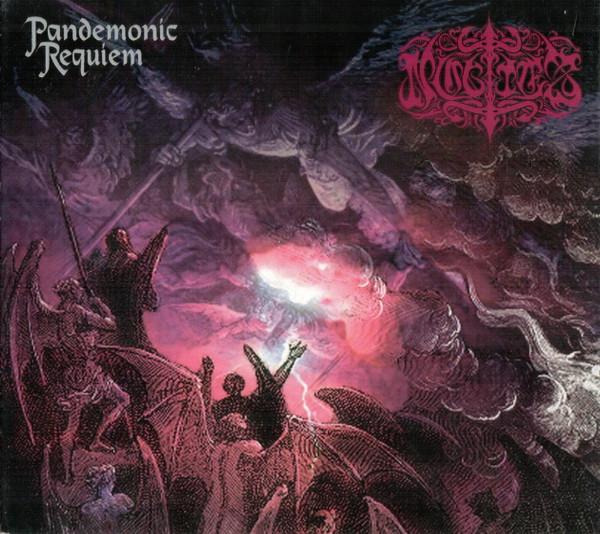
Album details
Tracklist · original 11 tracks
- Twilight Elysium04:29
- Reverie05:00
- Hokmah Nistara03:23
- In Silence04:39
- Attila04:35
- Butterfly03:55
- Winterdawn03:30
- Purgatory Temptations04:11
- Orphean Horizons03:59
- Lamia05:50
- Outro01:55
Band members
- Johan Lönn
- vocals
- Hugo Thorsin
- drums
- Holger Thorsin
- guitars, bass
- Pasi Lundegård
- guitars, bass
- Carl Leijon
- keyboards
Guest musicians
- Lord Havila
- guest vocals, track 9
- Åsa Rosenberg
- guest vocals, track 10
Recording and release
- Recording
- December 1996 · Sunlight Studio, Stockholm, Sweden
- Original label
- No Fashion Records · 1997
- Catalogue number
- NFR025
- Original format
- CD · digipak
- Reissue
- 2024 · A Fine Day to Die Records · cassette
Official music services
Services may vary by region. Links point to this specific album.
Physical editions – availability
Reissue label and specialist record shop
Stock, price and shipping conditions may change. The label’s cassette listing is currently sold out.
The original 1997 No Fashion Records edition contains 11 tracks. The later cassette reissue is a separate edition. Sources differ on the precise release date; only the documented year 1997 is given here.
The Name of the Nights
Some albums have entire institutions behind them, long tours and stories repeated across generations. Others leave behind a handful of names, yellowing newspaper pages and a single slim booklet. Noctes' debut album belongs to the latter kind. Pandemonic Requiem was not born at the centre of the world's attention, and by the time little remained of it beyond the recording itself, its history had not settled into one definitive legend. Instead, it had scattered: across the back cover of a record, the later words of Swedish musicians, questions in an American fanzine, the judgements of Canadian and German critics, and memories that found one another years later in the depths of the internet.
The cover bears one title, but behind it begin at least three different chronologies. The music was recorded at Sunlight Studio in December 1996. The back cover of the original No Fashion Records release gives the year as 1997. The introduction to a later interview names April 1998 as the time of release. None of these details should arbitrarily replace the others. The month when an album was recorded, the year printed on its physical edition and the date it reached the shops are three different matters. One of the peculiarities of this story is that even such a seemingly basic detail refuses to fit neatly into the single year recorded in later databases.
But the story began earlier still. Its origins must be sought not under the name Noctes, but behind another, less familiar name: Concealed. Surviving recollections take us back to Södertälje, Sweden, in 1992, when a young band began to take shape around Holger Thorsin and Johan Lönn. The sound that would later be associated with Pandemonic Requiem had not yet emerged. Their starting point was rawer death metal, and it took the musicians years to make melody, more extreme vocals, historical and mythological allusions, and atmospheric arrangements part of a musical language they shared.
The surviving interviews bring us voices from different years. In January 2000 Åsa Rosenberg looked back on Concealed's beginnings, while in 1999 Bill Zebub questioned Johan Lönn in the pages of Grimoire of Exalted Deeds, in the loud, sometimes provocative idiom of underground fanzines. In another interview, preserved in Psicoterror, Holger and Hugo Thorsin assessed the lessons of their first attempt from the vantage point of the second album. These voices do not speak from the same moment, nor are they trying to tell precisely the same story in every detail. Even so, their testimony provides the firmest points of reference. A critic's view shows how the record affected that critic. A musician's answer, at the very least, tells us how the musician thought about their own work at the time of speaking.
It would be easy to build a dramatic founding scene from these fragments: to imagine young people in a rehearsal room, invent a first handshake, a November storm, or the instant the band's new name was born. We know none of those things. What we do know is enough to tell the story. Two founders, a town, a musical journey beginning in 1992, a few demos, and then an album that different listeners would later regard as both memorable and not yet fully developed. What makes Noctes' past dramatic is not the missing scenes, but the distance that can open up between the surviving sound and the surviving paper.
The City and the Other Name
Södertälje's history cannot be reduced to that of a single band. The city had an industrial past, a canal, transport links and its own local institutions, while nearby Stockholm served as the centre of a wider cultural and musical network. Many later regarded Noctes as part of the capital's metal scene, but the sources place Concealed's early home in Södertälje. There is no contradiction between the two geographical names. Rather, they describe the space in which a local band could step onto a larger scene attracting international attention.
Concealed was formed on the initiative of Holger Thorsin and Johan Lönn. In the early period Johan did more than sing: he also played bass. The line-up documented for 1995 also includes Holger, guitarist Stefan Lehtonen and drummer Hugo Thorsin. Later the distribution of instruments and responsibilities changed, new people appeared and the old name suited the music they were making less and less. The band's evolution was not a single rupture with the past, but a gradual rearrangement. Song titles that would later appear on the CD already suggested during the Concealed years that threads of the same work continued under both names.
Nor was Sweden in the early 1990s the static backdrop that a metal myth constructed in hindsight might suggest. The country underwent a severe economic shock. In the autumn of 1992, the Riksbank imposed extraordinarily high interest rates to defend the krona, and in November the authorities abandoned the fixed exchange-rate regime. Recession and unemployment were social facts of the era. Yet no testimony about the band members' families or personal circumstances allows us to derive a direct songwriting motive from that crisis. The background remains credible only if we refrain from speaking on behalf of the people involved.
The same is true of the city's atmosphere. An industrial landscape readily supplies dark images for an album whose title and artwork evoke restless nights. But a factory chimney proves nothing about any particular guitar theme. Södertälje was where Concealed began; Stockholm was the world of wider connections. The journey between them was not an imaginary allegory, but a geographical and music-industry opportunity.
Swedish death metal had already made itself heard far beyond Sweden. Recordings by Entombed, Dismember and Grave, the well-known work of Sunlight Studio, and the different emphases of the melodic approaches emerging around Gothenburg all formed part of the environment in which critics could place a new band. This does not mean that Noctes consciously followed every stylistic relative later identified by others. Similarities were often heard in the songs by journalists; direct acknowledgements of influence from the musicians establish a narrower set of connections.
Åsa Rosenberg later recalled that Stockholm's underground concert life seemed livelier around 1995 and 1996 and that, in her view, some of this energy had been lost by the end of the decade. This is a participant's memory, not a set of concert statistics. Even so, it helps us imagine why a local show could matter when the band's later members said that they had not yet played abroad. From the outset, the story of Noctes moved between two kinds of boundary: the city and the wider world, and the sounds within reach and the stages still beyond it.
On Both Banks of the Canal – Södertälje, 1992–1997
The City Travellers Passed Through
Södertälje is not a distant copy of Stockholm. It developed its own identity where the waterways leading from Lake Mälaren towards the Baltic Sea meet overland routes. The canal and lock reshaped traffic long before the era of rock albums. Construction undertaken between 1917 and 1924 opened a connection towards the inland ports even for larger cargo vessels. Railway and road corridors remained just as important. Within this network the city was not a remote outpost, but a connecting point, with its own industrial centre and an opening towards the capital.
A small change of name in the station's history also shows how natural the connection between the two cities was. The central station received the name Södertälje Centrum in 1994; suburban trains had already provided direct links towards Stockholm from the early 1980s. To understand the musical world of the 1990s, we need not assume that Noctes took a particular train service. What matters is that concerts in the capital, record shops, contacts and studios could become real geographical possibilities rather than distant legends for a young band based in Södertälje.
Two names particularly shaped twentieth-century Södertälje: Scania, the maker of trucks and buses, and the pharmaceutical company Astra. The presence of factories meant more than buildings. Supplier businesses, vocational training, transport and residential areas developed around jobs, while the city's population and cultural institutions changed with industrial growth. Local historical overviews consequently described Södertälje for many years as a working-class city. This is a social-historical framework, not evidence of what the families of Holger Thorsin or Johan Lönn did for a living; the sources used here preserve no verifiable information on that point.
Södertälje's inhabitants did not form a uniform community. During the second half of the century, the industrial city also became home to immigrants and families with different linguistic and cultural backgrounds. Shared urban life in such a place did not mean everyone had the same experiences. When Concealed emerged in 1992, it did so in a complex, living city of jobs, local services, schools and a changing population, not an imaginary, dark northern landscape. The sources do not, however, reliably identify a particular Noctes rehearsal room, neighbourhood or regular meeting place. An invented club name or street scene cannot fill that gap.
The Years When a Sense of Security Was Broken
Behind the city lay uncertainty affecting the country as a whole. In the early 1990s, following Sweden's banking and property crisis, weakening demand and measures to defend the krona's exchange rate, the economy contracted sharply. The 1992 currency crisis matters because it visibly shook the established image of security associated with Swedish society. Unemployment remained substantial even around the middle of the decade. A European Parliament employment overview from 1997 reported a Swedish unemployment rate of 10.7 per cent, according to Eurostat, for April that year, and particularly stressed the difficult position of young people. This was not a Södertälje-specific figure, nor does it describe the band members' circumstances. It illustrates the social difficulties affecting the country as a whole.
Yet life did not stop with the recession. Industry and services adapted, while public debates addressed the future of work, government spending and the welfare system. Meanwhile Sweden was rebuilding its European relationships on a new basis. In a referendum in November 1994, the country voted on membership of the European Union and joined on 1 January 1995. The following years do not form a march in one direction: domestic economic pressure and international opening existed simultaneously. Noctes' recording session in December 1996 belongs within this tension, rather than serving as proof that the songs' dark imagery was caused by it.
For music, crossing borders was not merely a political concept. A critic in Germany, Britain or North America could encounter a Swedish underground recording even if the band could not yet tour abroad. Mail order, label distribution, correspondence among fanzine editors and tape copying were all working channels of the era. They appear in the histories of the demos and their later reception as well. The wider background shows that, even amid the country's economic upheaval, music circulated in ways that often did not follow the rhythm of major media organisations.
Stockholm's Proximity and Its Invisible Communities
To young followers of extreme metal in the 1990s, Stockholm did not mean a single, clearly defined place. Small venues, record shops, musicians' acquaintances, cassettes and letters kept a scene in motion from which some bands went on to international recognition. Åsa Rosenberg's recollection of the excitement around 1995–1996 cannot therefore be substituted for a municipal events calendar. Her voice is the personal memory of an insider in a scene to which the later members of Noctes also drew close. It cannot be generalised to the entire city or every club, but its personal character is precisely what makes it valuable.
The route from the band's beginnings in Södertälje to the Stockholm studio was therefore much more than a pair of geographical addresses. Listeners within the same network could pick up demos recorded under a local name in 1995, just as that network had helped make a particular sound of Swedish death metal known around the world a few years earlier. The existence of those connections does not prove direct friendships with other bands, shared rehearsals or any particular meeting in a record shop. What we can firmly establish are the places, the recordings, the people involved and the cultural infrastructure that made movement between Södertälje and Stockholm possible.
Two Faces of Swedish Extreme Metal – 1992–1997
Sunlight's Reputation and the Changing Language of Guitar Music
By the time Noctes emerged, Swedish death metal no longer meant one recipe applicable to every band. The sound of Stockholm's first internationally recognised wave became identifiable through bands such as Entombed, which grew out of Nihilist, along with Dismember and their contemporaries Grave and Unleashed. On early records, down-tuned guitars, saturated, crackling distortion and short, heavy motifs combined into an unusually distinctive density. Sunlight Studio, with Tomas Skogsberg, became a defining recording location in the history of that sound. This was not because every musician working there played the same music, but because experience from several important recordings accumulated within the same studio.
The chainsaw-like guitar tone often described as legendary was not a matter of mysticism alone. Musicians who shaped that sound and later technical accounts of the studio also identify the Boss HM-2 distortion pedal and down-tuned instruments. The manufacturer's retrospective on the pedal also quotes Skogsberg and members of Dismember. Entombed's 1993 album Wolverine Blues meanwhile showed that the tone could be retained even when the rhythms and songwriting turned towards rock and roll. By 1996, the studio's name therefore carried the memory of different approaches. It would be wrong to assume automatically that all of Noctes' recording procedures, or the equipment of its individual guitarists, were identical.
Dismember represented a different kind of continuity. From the early demos through 1991's Like an Ever Flowing Stream and 1995's Massive Killing Capacity to 1997's Death Metal, the band maintained a recognisable, emphatically guitar-centred tradition. The record label's historical account also traces their career along that continuous line. On the Noctes album, by contrast, the surviving credits alone show that the keyboards had a distinct role, while two guest vocalists also appeared. This is no ranking, merely a more precise distinction: within the shared geography of Sunlight, different artistic ideas sought expression.
When Melody Came from Another Direction
By the middle of the decade, a different language, called melodic death metal, was also becoming increasingly recognisable around Gothenburg. Albums by At the Gates, Dark Tranquillity and In Flames, themselves distinct from one another, placed pronounced melodic lines, interlocking guitar parts and runs familiar from traditional heavy metal alongside heavy vocals and drumming. This direction was not born in a single day, nor did it suddenly displace the Stockholm approach. Many bands coexisted, each with different emphases.
Among Swedish bands moving closer to black metal, Dissection and Unanimated are particularly important points of comparison. Dissection's The Somberlain in 1993, followed by Storm of the Light's Bane in 1995, joined cold, dark atmospheres to more intricate guitar melodies. Unanimated's 1995 album Ancient God of Evil likewise demonstrated that death metal and black metal were not sealed, mutually exclusive territories. In music made along their borders, melody did not necessarily soften the bleakness; rather, it gave that bleakness shape. Critics writing about Noctes later invoked music resembling these bands and albums. Such critical comparisons do not prove that Noctes' songwriters named every one of them as a personal model.
The differences also require a more precise vocabulary. Death metal generally brought thick masses of guitar sound, weighty riff rhythms and low or abrasive vocals to the foreground. In melodic death metal, longer melodic guitar lines, harmonised parts and counterpoint gained greater weight. Melodic black/death often added colder, rawer vocals and darker harmonic settings. These are not rigid laws but aids to orientation used in reviews both at the time and later. Noctes' keyboard textures and its titles drawn from history and mythology can therefore be approached from several directions without assuming that one label explains every detail.
The Personal Networks of Record Releasing
The role of No Fashion Records deserves particular explanation. It was founded in the early 1990s by Tomas Nyqvist, previously a fanzine maker and tape trader. Its beginnings are closely connected to an era when magazines and demos circulating in just a few hundred copies could be enough for news of a new band to reach beyond its country's borders. The early No Fashion catalogue included names such as Marduk, Katatonia, Dissection and Unanimated; later, the label's operations and distribution moved to House of Kicks. The NFR025 printed on the cover of Pandemonic Requiem is therefore no random number. It places the record within a specific catalogue linking several different strands of extreme metal.
The logic of this transitional era was simple, but its effects were considerable. A small label emerging from fanzine culture could rely on personal taste while entering more organised postal and wholesale distribution. Producing a CD required money, manufacturing and printing, while promotion often depended on the work of editors corresponding by post, radio presenters and smaller music magazines. Internet forums and websites already existed in 1997, but this distribution network did not become digital overnight. Noctes' peculiar situation makes sense in this context: the album could appear in foreign reviews even when, according to some accounts, the band had not yet embarked on concert tours abroad on a comparable scale.
Reviews at the end of the 1990s often contradicted one another. One listener heard unusual depth in the keyboards; another thought they were overemphasised. Some valued the distinct voices of the two guitars, while others questioned the clarity of the recording. The difference is not simply a matter of uncertain professional judgement. Several kinds of extreme-metal expectations met on a single disc: the heavy riff sound of Stockholm, the icy melodic language of northern Europe and the possibilities of atmospheric arrangements. Opinions about the sound of Noctes acquire their true meaning within this varied environment.
The Journey of the Cassettes
A long journey often lay behind an album before it ever received a record-label catalogue number. In the underground of the 1990s, that journey was not marked by the instant releases and sharing we know today. A cassette was both a recording and a letter of introduction. A fanzine served as a magazine, but also as a network for making contacts. Postal parcels, photocopied covers and replies from editors abroad were not incidental accessories of the scene; they were the means by which a band became visible.
Concealed's 1995 demo Dance of Dying Dreams is one surviving trace of that earlier history. Four tracks are documented. The early line-up included Johan, Holger, Stefan Lehtonen and Hugo. The surviving information does not tell us exactly what creative changes led to the recording. It does show clearly, however, that a shared way of making music already existed before the later full-length album. The division of work that developed among these names matters at least as much as the genre label later attached to the demo.
The memory of the Winterdawn promotional demo also survives from that year. A rare cassette listing mentions the summer and autumn of 1995, the name Dead Air Recordings and twenty completed copies. That last figure cannot be corroborated from an original physical copy available for examination, so the precise duplication quantity remains unresolved. But a small cassette run should not be treated as a measure of artistic value. It was precisely these narrow avenues of distribution that made getting a cassette into the right hands so important.
One of Winterdawn's most intriguing legacies is a pair of song titles. Butterfly and In Silence appeared on the early promotional track list and later reappeared on Pandemonic Requiem. The titles unquestionably match; whether the recordings themselves are identical has not been established. No reliably identified audio recordings of the early and later versions are available for direct comparison. It would therefore be impossible to give a credible account of exactly which guitar passages changed or which melody was preserved intact. Continuity does not need such invented detail. The evidence that the same titles survived from the demos to the album is enough.
The title Winterdawn took on a double life: first as the title of a demo, then as the name of a track on the album. Separate databases later listed recordings associated with the name under Concealed in 1995 and Noctes in 1996. Without the physical and audio documents, however, it is not always possible to establish how many genuinely distinct versions those entries represent. When an entire era is connected only by cassette sleeves, secondary listings and a few surviving interviews, a shared title cannot justify inventing a complete studio history.
Meanwhile, the meaning of distance was changing too. Sweden joined the European Union in 1995, and the early internet slowly entered the communication networks that had previously depended on letters, telephones, faxes and fanzines. For a smaller band, though, the mere existence of the World Wide Web did not yet bring an instant audience. A letter arriving from abroad and a printed review coming back in the post belonged to a very different timescale from the way we now click on a recording twenty or thirty years old.
When Concealed Became Noctes
Eventually, the change needed a name. According to Åsa Rosenberg's recollections, both changes in personnel and shifts in the music played a part in replacing the band's old name, and Johan Lönn suggested the new one. Noctes means 'nights' in Latin. It is a short word with something plural and open-ended about it: not a single night, but a whole succession of them. The meaning suits the atmosphere listeners would later find in the record. There is no direct evidence, however, that choosing this name amounted to a prearranged philosophical or religious programme encompassing every song.
Under the band's new name, responsibilities also became more clearly defined. The original Pandemonic Requiem booklet credits Johan Lönn with vocals, Holger Thorsin with lead guitar, Pasi Lundegård with guitar, Hugo Thorsin with drums and Carl Leijon with synthesizers. Holger and Pasi handled the bass parts on the recording. Here, a few lines of small print in the original credits tell us more than later summaries drawn from memory. Roles assumed onstage or on the following album must not automatically be projected back onto material recorded in December 1996.
Two of the guest musicians' names are especially important. Lord Havila provides guest vocals on Orphean Horizons, and Åsa Rosenberg on Lamia. Åsa later became known as Noctes' regular bassist, which can easily create the impression that she had already played bass on the debut. The original record says otherwise. This is no trivial distinction: it is evidence that personal relationships and instrumental roles within a band's history genuinely shifted over time.
Nor did the main creative responsibilities for the lyrics and music necessarily lie with the same person. In 2000, Åsa attributed much of the lyrical world to Johan, while stressing Holger's role in creating the musical material. She also described how the others worked together during rehearsals to develop the ideas already taking shape. This does not give us a precise, day-by-day songwriting diary. Instead, it suggests a shared workshop: one person set the direction of the words and images, another carried much of the musical weight, and the recording brought their different contributions together into a single presence.
According to the band's later statements, Johan's lyrical world was shaped by the overlapping territories of history, religion, philosophy and imagination. Titles such as Attila, Orphean Horizons, Lamia and Purgatory Temptations invoke very different traditions even on their own. One evokes a historical figure, another a mythological journey, a third a demonic, shape-shifting figure and the fourth a world of religious imagery. There is no need to force them all into a single dogma. Nor do the band's own statements entitle us to treat every such word as certain evidence of an overarching hidden doctrine.
This openness would later become a point of disagreement among critics. Some listeners found richness precisely in the coexistence of melodic guitars, more extreme vocals and keyboard-generated atmosphere. Others heard the same diversity as overly conspicuous and, in places, unpolished. Assessments of a musical decision can change, but the original credits and the participants' words tell us most about the division of labour behind those decisions.
Towards Sunlight
Noctes' journey eventually brought them to a name that had already acquired particular significance in the history of Swedish extreme metal. By the mid-1990s Sunlight Studio was more than a place to record. Accounts from the period recognised Tomas Skogsberg's workplace as an important centre of death metal, and several already-established bands were associated with its sound. All this establishes the studio's history, at most; it does not establish every technical decision Noctes made there. The legend surrounding a celebrated engineer cannot tell us which pedal Holger stepped on, where a microphone was placed or how many takes were made of a guitar part.
For Pandemonic Requiem, what matters is the reliable wording of the original booklet. Recording took place at Sunlight in December 1996. The list of musicians and guests appears there too. The date is therefore one dependable point in the music's creation, while the inner workings of the sessions can be reconstructed only in fragments. We do not know the precise recording schedule, the number of attempts made at each song, or every disagreement among those present. It would be easy to fill those gaps with colourful scenes for the sake of a novel. But the record's true history consists of what happened and can be supported, not what is easy to imagine.
The finished material nonetheless reveals something about the band's choices. According to the instrumental credits, drums, two guitars, vocals, synthesizers and shared bass duties formed the foundation, joined by two separate guest-vocal contributions. This recording arrangement did not necessarily reproduce the live line-up exactly. It was the relationship among these elements that critics would later debate. Some singled out the interweaving guitars and the dark atmosphere created by the keyboards; others questioned the precision of the guitar playing, the amount of reverb and the prominence of the synthesizer.
Comparing the two positions cannot tell us precisely what the raw recordings actually sounded like in the control room. Reviews bear witness to what a particular writer heard and felt. Making that distinction does not impoverish the account; it protects it from mistakenly presenting someone else's judgement as the band's own discovery.
When Holger and Hugo Thorsin later discussed the second album, they recalled having more studio time, working with more unified ideas and wanting to use synthesizers more sparingly. These remarks express a desire to develop. They do not prove any one specifically identifiable flaw in the debut's recordings. They do show, however, that the musicians did not regard what they recorded in December 1996 as a finished model to follow indefinitely. For them, the music made at Sunlight was a stage along the way, not a predetermined destination.
The Memory of the Cover
Sometimes an old album begins speaking through its images before the music has even started. The front and back covers, disc label and inner booklet of the original Pandemonic Requiem CD formed a single physical object. In the digital collection now available to us, thirty-two image files associated with the booklet preserve different parts of it: cover variations, portraits of musicians, lyric pages, acknowledgements and wider spreads. But thirty-two files do not mean thirty-two separate historical photographs. Some are different crops or different-resolution versions of the same page.
The original back cover is more than an illustration. It carries the name No Fashion Records, catalogue number NFR025, the running order of the songs and the year 1997. The inner pages confirm the Sunlight recording in December 1996 and the musicians' division of responsibilities. The physical artefact and its printed pages thus preserved facts that a brief internet listing produced later could easily conflate. A physical recording has a memory of its own: it does not explain everything, but what it says deserves to be read.
The album's imagery was already a subject of interpretative disagreement in its own time. In his 1999 interview, Bill Zebub approached the artwork and certain lyrical motifs with deliberately provocative questions. Johan Lönn's answers did not simply endorse every assumption made by his interviewer. That matters. A provocative question is not, in itself, evidence of what a band meant to express. The creator's words can distinguish what a viewer reads into an image from what a participant actually says about it.
The booklet's lyric pages break a different sort of silence. A separately compiled lyrics transcription included only four songs, making it appear at first as if no reliable textual source had survived for the others. Yet further original lyrics can be read in the images. An incomplete transcription is therefore not the same as a song having no lyrics. This discovery matters to the narrative as well: the historical imagery of Attila, the mythic expanses of Orphean Horizons, the religious vocabulary of Purgatory Temptations and the associations of transformation suggested by Lamia can only be interpreted with reference to the original documents.
Yet the cover and lyrics do not offer a single key that answers every question. Images of night, death, religion, human history and myth stand alongside one another, but the writer did not explain the personal experience attached to each of them in every song. Thus even the most compelling reading remains an interpretation until a direct statement supports it. This book need not invent what the original booklet leaves unsaid. Paper is more patient than that: it allows some questions to remain questions.
The Visual World of the Pandemonic Requiem Cover
Figures Gathering Around the Light
Neither a path nor a solitary ruin guides our gaze on the cover: we enter a dense gathering of overlapping figures. Its edges are nearly black, but the darkness is not a single colour. From patches of smoky violet, deep burgundy and ash grey emerge shapes reminiscent of wings, bending bodies and organic details that are hard to distinguish from one another. At the lower left, demonic-looking figures drawn with pointed, leathery wings and elongated limbs crowd together. More shapes can be seen behind them, but the lines deliberately resist giving every figure a distinct outline.
At the centre of the composition, a white-hot patch of light opens up, surrounded by reddish pink. It is not a regular disc of sunlight, but more like a vortex or a radiance tearing open. Thin, jagged bright lines beneath and around it recall lightning. The winged figures reaching upwards or towards the centre give the light a double role: it both attracts and threatens the forms gathering around it. We cannot decide unequivocally whether the scene depicts liberation, destruction or some kind of otherworldly transformation. Its power lies precisely in that unresolved relationship.
Above and on the right, larger forms resembling fragments of faces or hanging bodies lean over the scene. The viewer's attention moves between the small figures assembled below and the blurred giant shape bending close over us. Distance becomes uncertain: something that ought to be behind us seems to lean above our heads, while what stands in front appears to be only a shadow. Curving pale bands along the right edge break up the dark mass; on the left, a diagonal spear-like line pushes apart the crowd of figures.
Two competing inscriptions frame all this. At the upper left, the title Pandemonic Requiem appears in white, antique-inspired lettering with fractured strokes, almost belonging to the cold light itself. On the right, the intricately entwined pinkish-red Noctes logo seems to echo the swirling shapes within the picture. The title is easier to read; the band's name is deliberately harder to decipher. These two visual voices do not cancel each other out. One gives words to the scene; the other condenses the band's identity into a symbol.
A requiem is a mass for the dead, while pandemonium evokes demonic chaos. Read through the title, the cover looks as if the imagery of a ritual collides with that of unrestrained turmoil. But that meaning is the reader's interpretation, formed by connecting the title with the image. It does not prove that the artist or musicians intended to depict a particular religious programme. Studying the original artwork is therefore most accurate when we name the visible forms first and only then ask what they might symbolise.
The inner booklet also presents a different visual world: framed portraits of the musicians, pale landscapes, moonlit colours and text arranged around the songs. The crowded outer cover is thus not merely another picture among pictures. It is an outer gateway, leading into spaces on the inner pages that are more personal and, in places, quieter and colder in tone. No single interpretation can explain the relationship between the CD cover and the lyrical world explored earlier in this book. Instead, many smaller images seem to answer one another.
Eleven Paths Through the Same Night
Pandemonic Requiem consists of eleven recordings, amounting to roughly forty-five and a half minutes of music. The opening track is called Twillight Elysium in the audio files available to us. This spelling has two l's in Twillight, whereas the English word twilight has only one. The low-resolution lettering on the original back cover does not allow every variant to be settled with confidence. Such small details show particularly clearly how vulnerable the written memory of an old record can be. The opening title may evoke dusk and a landscape beyond this world, or some ideal realm. What we can say with certainty is that it comes first and has its own lyric page in the booklet. The symbolic power of this opening comes from our reading of the album as a whole, not from any surviving statement of artistic intent.
Reverie follows. The word opens up spaces of daydreaming, introspection and imagination temporarily released from reality. The original lyrics survive not only in the images but also in the separate lyrics collection, so their textual form can be traced with relative confidence compared with many of the other songs. A 2007 review on Sputnikmusic discusses this composition while praising the album's rich variety of transitions. That listener's experience provides an interesting accompanying voice: it helps explain why some people paid attention to the varied arrangements, but it does not turn a critic's opinion into Johan's or Holger's own explanation.
With the third track, the spelling of the title itself resists final settlement. The available audio files use Hokmah Nistarah, while other listings use Hokmah Nistara. The title suggests religious, mystical and perhaps Hebrew associations, but does not in itself prove that any particular Kabbalistic teaching lies behind the lyrics. Johan did indeed speak in general terms of interests in history, philosophy and religion. Yet the gap between those statements and this particular title cannot be bridged by choosing one interpretation arbitrarily. The title remains more like a door whose key might perhaps lie in a more detailed statement that has not yet come to light.
In Silence opens a passage not only between meanings, but between years. The title also appeared on the track list of Concealed's 1995 cassette. On the CD it became part of a later, definitive release, making the continuity between the two band names tangible. The title may suggest readings concerned with silence, concealment and inner withdrawal, but the lyrics' actual images must be followed in the booklet. Without audio from the early demo, we cannot establish precisely how much the music of In Silence changed. Its story remains powerful nonetheless: the same name stands at the two ends of a journey from early attempts to a released album.
Attila carries a different sense of time. Here the title evokes not an inner state or a mythological secret, but one of the most frequently reinterpreted rulers in European history. The Hun king's name can summon conquest, threat, memory and conflicting traditions, but the song cannot be reduced to an inventory of the historical Attila's life. Writing as Descalabro in 2003, a critic cited this track when praising the contrasting parts of Noctes' two guitars. Other listeners later criticised the precision of the guitar playing on the same album. The historical weight of the title thus meets a curious duality in its reception: outstanding musical interplay for one listener, uneven execution for another.
At the album's midpoint, Butterfly takes us back to Concealed. The title, also found on the early Winterdawn promo, offers a strange, almost fragile counterpoint to words drawn from history and demons. A butterfly may signify transformation, transience or rebirth, but none of these symbols should, on its own, be declared Johan's intention. The original lyrics belonging to the record are valuable precisely because they preserve a particular writer's actual words rather than generic symbols behind the title. Like In Silence, this song demonstrates that the birth of Noctes did not erase the music of earlier years.
Winterdawn turns back time in its very name. After a demo, a track on the full-length album now carries the same title. The idea of a winter dawn seems to promise light against the nights of Noctes, though how the lyrics handle that image must be established from the surviving documents, not from the atmosphere of the word alone. Descalabro mentions it among the pieces notable for their keyboard atmosphere. What one later critic regarded as one of Noctes' greatest strengths became, for other writers, grounds for criticism of the sound's balance. Winterdawn is thus also a point of contact between the old cassettes and the arrangements that were later debated.
In the title Purgatory Temptations, the intermediate state of purification and the pull of temptation strain against one another. An allusion to Christian imagery is natural, but it proves neither the presence of a particular denominational teaching nor that Johan was writing a profession of religious faith. Sputnikmusic's 2007 review mentions the track among those discussed in more detail and assesses the record's varied structure favourably overall. Others heard too many elements and less discipline. Without listening to the music independently, we cannot make firm claims about its musical details. Even so, the juxtaposed religious terms already create a distinctive tension of meaning.
In ninth place, Orphean Horizons turns towards a different myth. Traditions associated with Orpheus's journey into the underworld, loss and the act of looking back open up images of distance and another shore, but no detailed statement by the songwriter is available to authenticate every such reading. One thing is quite certain: the booklet credits Lord Havila with guest vocals on this track. His full identity and every technical detail of the vocal contribution cannot be established from the surviving sources. The name need not bear any larger burden. The guest appearance alone reminds us that the record was assembled through the work of several people.
Lamia is slightly longer than the other songs: according to the audio files available, it is the album's longest piece. Its title recalls shape-shifting, threatening figures of myth, often appearing as women. Johan Lönn was also questioned about it in the 1999 Grimoire interview. In his reply he discussed different forms of the myth and connections between danger and transformation. The interviewer was strongly provocative here too, so only Johan's actual answers can be regarded as statements by the band.
The other firmly established fact is Åsa Rosenberg's guest vocal appearance. When we encounter her as the bassist in the later history of Noctes, Lamia reminds us of her earlier role and of how easily time blurs the sequence of such responsibilities.
Finally comes Outro, a closing track of almost two minutes in eleventh place: the point where the record, as a finished release, comes to an end. Descalabro linked the piece with atmospheric keyboard work, but this does not mean that we can reliably describe every instrument or any vocal content on the recording. Between the opening twilight and this named ending came titles invoking history, religion, dreams and myth. They may be read as successive landscapes opening within the same night. That is this book's interpretation, not a detailed concept demonstrably established by the band. The order of the tracks, however, is beyond dispute: this is the sequence in which the record was left to us.
Eleven Songs – Motifs in the Booklet and the Album's Inner Arc
The First Four Stages
In the title Twillight Elysium, what appears to be a misspelling of an English word meets the classical image of a blissful realm. The printed lyric page does not offer a simple idyllic beginning: recurring shadows, the disappearance of safety and a succession of dreamlike passages are associated with the twilight. This lyrical space is not a geographical location. It is more a realm in which movement and being lost are possible at once. Like the light bursting from the centre of the cover, the title can carry both hope and threat. There is no need to assemble the song into a conventional narrative; its interrelated images retain their openness.
On Reverie's original, separate booklet page, dreaming is more than rest. Stillness, wings, reality sought in darkness, longed-for escape and a recurring inward journey are among the images preserved there. Because of the lyrics' repeated motifs, reverie becomes movement between two worlds rather than carefree immersion. The printed artwork sets these images against a sombre violet background. Alongside the later critic's judgement about atmospheric richness, we therefore have actual printed lyrics: an assessment of the melodies and the recurrent dream images are two distinct kinds of evidence.
The strange title Hokmah Nistarah might tempt us to name a ready-made esoteric doctrine. But the surviving low-resolution booklet material does not provide a complete lyric text for this track that can be read and assigned to it with the same certainty. The word form permits a religious or philosophical reading; it does not explain itself or prove that a particular ritual text was adopted. One may look for connections between the title and the recurring notions of secrecy, knowledge and concealment in the album as a whole. Here, though, distinguishing possible interpretation from the surviving original document is especially important.
The visual and lyrical world of In Silence begins with silence, but does not remain in mute emptiness. The printed page connects seclusion with dreams, the crossing of thresholds, uncertain visions and darkness. Because the song originated in Concealed's early period, the title also forms a link in the history of the documents. The reader is not being shown proof that the 1995 and 1997 recordings have identical arrangements, only that an earlier title found a place in the context of a new album. The lyrics' inner silence and the continuity between the two names therefore meet in the same track, though on different planes.
Figures of History and Transformation
Attila brings us closer to a distinctive poetic voice than to the familiar historical image of the Hun king. The original printed text is not a modern historian's biography. Instead, it presents the name through the legacy of kingship and war: images of lineage, paternal inheritance, weapons, conquest and a reputation inspiring dread recur. The stanzas arranged beside a portrait create a solemn, almost chronicle-like tone. Yet the historical Attila and the voice speaking in the song cannot simply be treated as identical; the lyrics are a poetic construction. If the 2003 review praises the two guitars' contrasting parts on this particular composition, that is one musical reading. The booklet's martial rhetoric can be examined independently of it.
Butterfly makes a peculiar counterpoint to Attila. In the printed images, an evening landscape and a horizon that suggests water accompany the butterfly's name. The lyrics place light beside darkness, attraction beside terror, fragile movement beside time threatening dissolution. The butterfly is not a simple one-word solution: it may be an image of change and vulnerability, but interpretation does not require a statement proving the author's intention. It is worth remembering that the title was also known from the Concealed period. Earlier motifs could have assumed new forms without our being able to call the early recording identical to the CD version today.
The title Winterdawn might lead us to expect a cold, clear morning, but its booklet page portrays a more contradictory world. Darkness, sight trying to break through shadows, wings of knowledge, dust of Eden and anticipation of a new day become entwined. Especially strong is the tension between the search for dawn and the lyrics' repeated evocation of communion with darkness. The cold purple-blue tones of the landscape background suggest the light before daybreak. The title is thus not a completed deliverance but a threshold: dawn is possible, yet the night in which the words have dwelt has not passed.
Temptation, Myth and Fading into Silence
The tension in the printed verses of Purgatory Temptations comes from the meeting of religious language and passionate bodily imagery. Angels, temptations, heavenly forms, suffering and purification belong to the text's range of associations. In the title, purgatory denotes an intermediate state, while temptation signals the danger of crossing a boundary. The song is no sequence of theological propositions. It uses images in conflict with one another, evoking traditions ranging from medieval religious rhetoric to dark Romanticism. The earthy red of the original booklet intensifies the text's unrest. That is an observation about artwork and lyrics, not a claim about the religious convictions of the band members.
Within its mythological references, Orphean Horizons is built around distance and return. The printed page joins words evoking moonlit spaces, mysterious visions and horizons opening far away. Orpheus's name can suggest the tradition of descending to the underworld in search of a lost companion, but the surviving lyrics do not necessarily follow every event of the Greek myth. Lord Havila's guest vocals are documented, making it particularly intriguing to consider what additional voice this may have brought to the song. The booklet does not give a complete technical breakdown of the vocal roles, so imagined exchanges must not be substituted for it.
Lamia is a piece on a broader scale, and myth and the body come into still closer contact on its booklet page. Images of nocturnal presence, desire, danger and being carried away are linked to the figure in the lyrics. We are not reading an illustration of an entry in a Greek mythological dictionary: the name retains its shape-shifting force while the verse explores the duality of threat and attraction. Åsa Rosenberg's contribution represents another, entirely real layer of the same history. The mythological female figure and the guest vocalist must not be merged into a single symbolic identification; one belongs to the imagery of the song, the other to the factual credits of the original album.
Outro finally brings the sequence of titles to a close. No separate lyric page could be positively identified among the examined booklet images, but this alone proves neither a complete absence of lyrics nor the exact instrumentation. What we can say with confidence is that it runs briefly, stands eleventh in the sequence and was described by a critic at the time in terms of its keyboard atmosphere. The ending matters also because, after Elysium, religious imagery, the Hun king, the butterfly, Orpheus and Lamia, we are given not another explanatory title but a function: an exit from the album's world.
A reading that brings the eleven pieces together is not a newly discovered, verified libretto. The songs sometimes come from different periods and imaginative worlds, and the memory of the band's earlier demos remains within them. That is precisely what makes them a distinctive whole: dreams stand beside history, mythology beside inward-looking religious language, images of fragility beside threatening landscapes. The original release confirms their sequence; the diversity of their inner meanings is attested jointly, though not with equal evidential weight, by the legible booklet pages and their later reception.
The Record Goes Out into the World
The recording did not simply travel from the studio to its audience. First it had to become a record: a manufactured object, a cover, a release that could be ordered, promotional material that could be sent to magazines. The name No Fashion Records appears in every surviving trace of this process. Noctes' debut was assigned catalogue number NFR025; the second album later appeared on the same label as NFR034. Without the label, Pandemonic Requiem could not have entered international record distribution in quite this way. But a company's ability to manufacture and release a CD did not mean it could necessarily provide every other opportunity a band needed.
A Noctes review is listed in issue 133 of Germany's Rock Hard, published in May 1998, with a score of eight out of ten. The German edition of Metal Hammer covered the album in August of the same year. The full original articles are not included in the collection, so it would be dishonest to narrate in detail what they said about the drums, the singer or the atmosphere of the songs. The documented review entries, their dates and the surviving score nevertheless show that the CD reached several European forums of contemporary metal journalism.
Farther away, in Canada, the third issue of Sang Frais preserved a trace that may now be more valuable than the missing full review from a larger magazine. On page twenty-eight of the issue published in February 1999, a writer signing as 'J' offered a brief but genuinely independent assessment of Noctes. The reviewer described a sound akin to Naglfar, praised the musicianship and song structures, but found the originality less impressive. That judgement already contains one of the central tensions of the album's subsequent life: can something be valuable and well written while sounding, to a critic, too close to bands that are already familiar?
The band's own disappointment gradually entered the discussion. Answering questions from Necrosis Magazine in early 2000, Åsa Rosenberg did not soften her account of dealing with No Fashion Records. She spoke of delays, difficult communication and problems with the artwork. She recalled the label financing one T-shirt and a few black-and-white flyers to promote Pandemonic Requiem. These are not an independent financial reconstruction of the label's entire operation, but the specific experiences of one participant. They still matter: international reviews of a record and the practical support received by its band did not always go hand in hand.
Holger and Hugo Thorsin later also spoke about the lack of foreign performances. They recalled positive experiences of concerts in Sweden, especially Stockholm, but could not recall a tour abroad at that time. The collection contains neither a complete set of posters and concert dates nor the label's accounts from the period. We cannot invent countries, tour stops or cancelled concerts. Yet the separation is clear enough: news of the album crossed borders, while the musicians' travels did not always follow.
And the uncertainty over the year remained. A manufacturing document, distribution list or precisely dated promotional sheet from the time might finally connect the 1997 back cover with the later introduction referring to April 1998. No such evidence is at hand. We need not write an exact day into the story merely because a neatly told beginning would be tempting. The history of Noctes rings true precisely because not every turning point can be dated.
Page Twenty-Eight of a Fanzine
Statements by bands are often preserved in recollections made years later. Issue fourteen of Grimoire of Exalted Deeds offers a different kind of passage through time. A digitised, sixty-seven-page copy of the American underground fanzine from 1999 contains an interview with Johan Lönn on page twenty-eight. Its visual layout, dense columns and the direct tone of the printed magazine together preserve the era in which the album was discussed. What matters is not only what appears on the page, but that these answers were given in a world of communication very different from the one in which later internet album reviews appeared.
Bill Zebub's questions are often provocations rather than calm expressions of curiosity. He puts forward forceful assumptions about religious ideas associated with the genre, sexuality and cultural differences. They cannot simply be treated as statements made by Johan Lönn. An interview contains two voices: the interviewer's and the interviewee's. Confusing them means losing the very thing for which the original document was sought: the musician's own words and line of thought.
The discussion surrounding Lamia illustrates this particularly well. Johan speaks about different forms of the myth, female and male manifestations, danger and transformation. His replies offer insight into the interpretative world surrounding the title, but they do not provide a complete, point-by-point mythological handbook for the lyrics. We cannot attach characters, philosophical concepts or detailed sequences of events that the musician never mentioned. The booklet text and the interview are not rival explanations; they are two distinct primary documents that illuminate one another.
The cover also became a subject of discussion. The interviewer tried to assign definite, often exaggerated meanings to the image, but Johan's reaction offered far fewer ready-made answers. This reminds us that dark imagery is not the same thing as a declaration of a particular ideology. The period's press often constructed a single sensational narrative around Scandinavian black metal, but each band must be understood on its own terms and through its own evidence. Noctes cannot arbitrarily be inserted into stories written elsewhere about other musicians.
The Grimoire page is therefore more than a rare bibliographical discovery. The original page also makes visible how much can be said about a musician without the musician having said it. The interviews in Necrosis and Psicoterror have a different focus: they discuss creative roles, experiences with the record label and lessons drawn from the second album in greater detail. Together, however, they do not make a flawless, unified biography. They offer something much more interesting: people speaking at different moments, whose words both help and place limits on what later generations can imagine.
In the Shadow of the Second Album
The completion of Pandemonic Requiem did not bring the story of Noctes to an end. The next recording work can be placed in the autumn of 1998, and the second full-length album, Vexilla Regis Prodeunt Inferni, appeared in 1999 through No Fashion Records under catalogue number NFR034. This album also contained eleven tracks, but significant differences in personnel and arrangements separated the two releases. Åsa Rosenberg was now credited as bassist, whereas she had been a guest vocalist on Lamia on the debut. That distinction alone tells a story of development that later brief band listings can easily obscure.
According to Holger and Hugo's recollections, the band had more studio time for the second album, the musical ideas became more coherent and the keyboards were given a more restrained role. This observation also casts a long shadow over the debut. Critics who praised Pandemonic Requiem celebrated precisely the atmospheric devices that others later heard as overly prominent or insufficiently refined. It has not been established that the band shared every complaint made by later reviewers. Their statements about the second album do make clear, however, that the members did not regard their first work as an unalterable standard beyond improvement.
The next change was not confined to the sound. In an interview in January 2000, Åsa reported that Johan Lönn and Pasi Lundegård had left the band during 1999; she associated Pasi's departure particularly with the summer of that year. Johan was one of the founders, the vocalist on both albums and the principal lyricist. Pasi was involved in Concealed's final period and Noctes' defining years and, according to the original debut credits, played some of the bass parts as well. Their departures were therefore more than a simple change of personnel: they rearranged the roles from which both records had emerged.
Yet the next firmly documented moment is not one of collapse. In early 2000, Åsa spoke about an active band making plans. They were working on new material, she and Holger were also taking on vocal duties, and a third album was envisaged around 2001 after another studio session. The interview does indeed document that plan. The available material does not prove how far the songs progressed, whether a complete final recording existed, or whether an approved cover and precise release plan had been prepared. A possibility must not be turned into an imaginary release.
One of the most difficult points in the history of Noctes follows here. Later listings place the end of the band's activity around 2000, but there is no clear first-hand testimony available that establishes the reason for its dissolution with certainty. Tensions with the label did occur. Members left. The band spoke of a third album whose release is not substantiated by the sources. These facts can be placed alongside one another, but they do not prove that a single chain of cause and effect brought the band to an end.
An easy narrative would invent a final argument, an abandoned rehearsal room or a decisive meeting at this point. The actual story survives differently. The last clearly forward-looking statement still held out the possibility of continuing. The sources that followed spoke not of new songs in preparation, but of the reception of the two albums already released. We do not know precisely when a sentence spoken about the future became a memory expressed in the past tense. The silence left here permits no conclusion beyond itself.
The Critics' Second Lives
Even when Noctes was no longer present onstage and in record-label news in quite the same way, the story of Pandemonic Requiem did not stop. In other countries and at other times, new people encountered the album, each bringing different questions to it. The first critics tried to find a place for it among the new releases of their own era. Listeners after 2000 often sought its meaning in the broader history of a bygone current of Swedish melodic black/death metal. As time passes, criticism does not merely repeat earlier judgements; it creates a new perspective.
Descalabro's 2003 Metal Archives review, awarding ninety per cent, sounded almost like a fan's rediscovery. The writer praised the distinct parts played by the two guitars, the variety of the vocals, the synthesizer's dark atmosphere and the imagination of the compositions. The reviewer also discerned influences associated with Dissection, but did not regard Noctes as a mere imitation. Attila, Winterdawn and the closing Outro were especially memorable to this listener. That view is not a universal truth about the history of a genre, but a firm position taken by an individual: it shows what someone could discover in the record years after its release.
During the same period, the Russian site Darkside.ru published judgements that could hardly be reconciled. In 2003, zoARp gave the work a middling assessment, noting its structural and atmospheric ambition but finding the sound quality inadequate. D.Northdark was openly dismissive in 2004, writing of pronounced derivativeness and little individuality. In 2005, Tanat viewed the record considerably more favourably, praising its dark melodies, mood and balance of keyboard parts, while still expressing reservations about the sound. They were discussing the same album, yet one might imagine that they held three different records in their hands. In fact, their standards of judgement differed.
At the end of 2004, Reaper, writing for the Czech Metalopolis, devoted particular attention to Noctes in a longer article examining bands related in sound to Dissection. This was not a stand-alone album review, but part of a comparison across the genre's history. The proximity to Swedish melodic extreme metal could not be avoided here either. The question remained whether the similarity testified to the music's appeal or exposed its limitations. On the French site Thrashocore in 2008, Mitch acknowledged the strengths of the melodies and compositions but emphasised their close resemblance to the music of Unanimated, Necrophobic and Dissection. A score of seven and a half was therefore both praise and a reservation.
A 2007 Sputnikmusic article placed the album's variety at its centre, with more detailed consideration of Reverie, Purgatory Temptations, Hokmah Nistarah, In Silence and Butterfly, as well as the instrumentation and changes of rhythm. Alongside a rating of four and a half stars, Dethtrasher also identified minor flaws. A year later, odradek was much sterner on Metal Archives: while acknowledging the imagination behind the songwriting, the writer criticised the reverb in the mix, inaccuracies in the instrumental performance and the weight given to the keyboards. These criticisms concerned aspects of the sound that other listeners had praised as part of the record’s distinctive character.
In 2017, Pandemonic Requiem resurfaced in a genre-history series published by Mystification Zine. The short assessment treated it as a forgotten Swedish work with many worthwhile melodies but also uneven passages; the guitar sound, symphonic devices and even the cover did not entirely convince the author. This was no longer a debate from the years around the release, but a return to an earlier era: how does an album sound to another generation once its original setting has become history?
There is no need to total these judgements as though they were votes. Their different scores do not mean the album lacks an identity; they show how differently that identity appears depending on what a listener hears in it. One listens for melodies, another for instrumental precision, a third for how much the music added to its genre. The reception history of Pandemonic Requiem is therefore not one increasingly certain ranking, but a multitude of voices speaking at different times.
What Remained of the Nights
The fate of a short-lived band sometimes becomes most interesting after the band itself has ceased to exist. Noctes' recordings survived, even though we no longer know what became of some of the relationships and plans from the band's active years. According to information associated with a later No Fashion Records compilation, Twilight Elysium also appeared on the label's retrospective collection. Not even the title's spelling matches in every source the Twillight form given on the audio file supplied with the debut. Such differences remind us that even letters lead separate lives in a recording's afterlife.
Collectors' listings also mention a 2024 cassette release on A Fine Day to Die Records, with catalogue number ANTI-POSER 93. A late physical edition of this sort does not mean that the band re-formed, made new recordings or resolved every old misunderstanding. It shows that someone still considered the music worth putting onto another format decades after the original CD. The record thus returned to a medium that had also mattered at Concealed's beginnings: the cassette. But what had once been an introduction became, in another age, an act of preservation.
There was a more personal trace of its continuing life too. In 2023, Tanner Anderson of Majesties mentioned Pandemonic Requiem by name among the older Scandinavian metal albums important to him. This is valuable, direct evidence that the record lived on in the memory of a later-generation musician who had listened to it. It does not, however, establish that any subsequent song or guitar theme grew directly out of a particular Noctes riff. Remembering music and demonstrating a specific musical influence are not the same thing.
The name Eyes of the Oak also appears in the later musical paths of Holger and Hugo Thorsin. The band's 2023 release The Stone Vortex and other material document that the two brothers' involvement in music did not end entirely with Noctes. That is a human continuity, but it does not prove that the more recent music follows the same creative programme. A musician's later work is not always a continuation of an album made in their youth. Sometimes it simply demonstrates that life and creativity go on even after band names disappear.
The archive left by Noctes is incomplete. There is no complete, dated list of early concerts, not every manufacturing and distribution document is available, and the relationship between the two sets of Winterdawn information remains unresolved in places. We do not know the complete material planned for the third album, and no first-hand statement unequivocally identifying the cause of the band's end has come to light. Nor can the people pictured in some low-resolution booklet portraits be identified with confidence. The complete 1998 reviews in Rock Hard and Metal Hammer are missing, while Sang Frais and Grimoire have survived more fortunately. The trace of a lost Vae Solis review reminds us how easily part of the early internet's history could vanish.
Yet amid these gaps, something remains surprisingly solid. Concealed's beginnings in 1992, the 1995 demos, the name Noctes, the Sunlight recording in December 1996, the label's printed year of 1997, the order of the eleven songs and the original personnel credits can still be placed side by side. The two full-length albums, the frustrations and plans expressed in later interviews, the personnel changes and the shifting critical judgements all connect to them. And the audio files are still there, in verifiable form, for listeners yet to come.
The history of Pandemonic Requiem is not, then, the tragic wreckage of a career once promised to be great. It is more an example of how a band active for only a short time can preserve something of its own era. The earliest cassettes reveal the attempts of its beginnings; the studio credits, its collaborative work; the album, the recorded result; the fanzines, the language people used at the time; and the later reviews, how the experience of listening changes over time. Perhaps a definitive final judgement and a complete history will never be possible. But the name meaning 'nights' will be read again and again on a cover. And when the eleventh track ends, it is not merely a CD that falls silent. A few preserved voices from a vanished age remain in the quiet.
Reader comments
Comments only appear after approval. Messages are displayed in their original language.
Comment submissions are not enabled yet.