

Anti-Genesis (On the 8th Day I Destroy Godcreation)
The literary history of Eminenz’s third album, from its roots in the Ore Mountains through the recordings, songs and cover to the record’s later reputation.
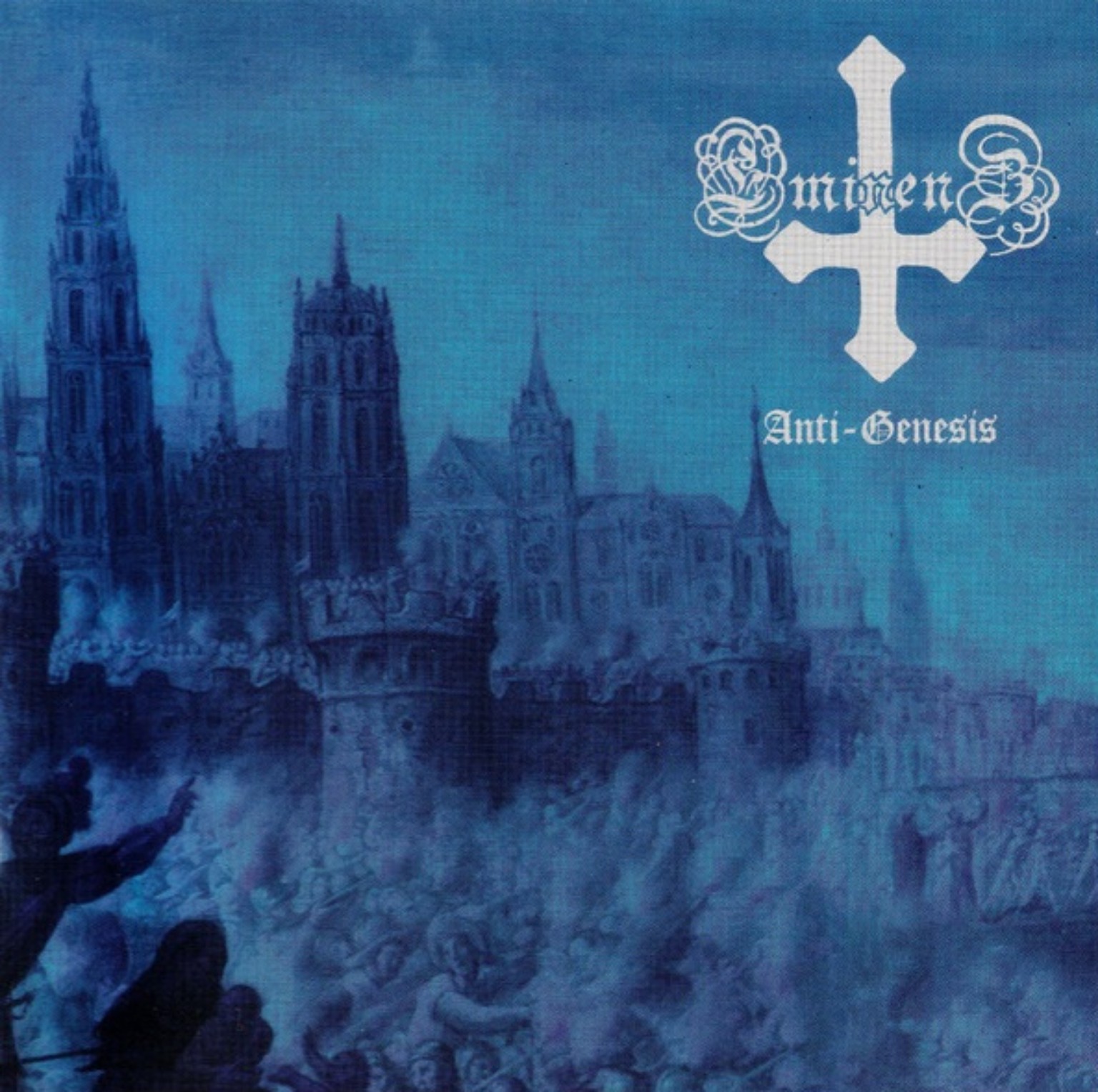
Album details
Track list
- Nocturnal Horizon05:13
- Gods Downfall06:40
- Praise the Death04:26
- Army of Immortals06:40
- Apocalypse08:45
- Triumph of the Nightforces05:09
- Grey Souls03:58
- Conspiracy of the Witches06:40
- Anti-Genesis07:50
Line-up
- Black Abyss
- bass
- Darkman
- guitars, bass
- Leviathan
- vocals
- Lorenzo (Falk Lorenz)
- keyboards
- Iten
- drums
Recording / release
- Studio
- Digan Tonstudio, Annaberg, Germany
- Label
- Last Episode
- Catalog number
- LEP 023 / 007392-2 LEP
Official links
Availability and purchase options depend on the provider.
Physical editions – where to buy
CD, vinyl or cassette · labels and specialist record shops
Stock and prices may change. Purchases take place on the retailer’s website.
The track list and timings refer to the specified original edition; reissues may differ.
The Ore Mountains and the Beginning
Winter carries a different weight in the Ore Mountains. The fog does not merely settle on the slopes; it seems to seep between the roads, into the walls of houses, into the silence of the valleys themselves. Around Annaberg-Buchholz in the late 1980s, metal did not arrive as a fashion imported from the big cities. There was no record shop on every corner, no steady procession of international tours, and no way to obtain at a moment's notice something that had already been circulating for weeks in London, Vienna or Oslo. Whatever someone managed to find was copied, recorded onto cassette, passed on and kept. Scarce information was more precious because it did not simply wash over people. News of an album or a concert was not background noise but an event. It was in this environment that a handful of young people began dreaming of a band, when they could not yet be certain who would end up playing which instrument.
In the Ore Mountains, a town can carry several pasts at once. In the streets of Annaberg-Buchholz, the memory of mining was not merely an exhibit locked away in a museum. This settlement among the mountains had long possessed industry, commerce, railways, churches and craft traditions that connected it to distant markets. Workshops and houses had once sprung up in pursuit of silver; later, braid factories, packaging plants and smaller industrial enterprises provided employment. The mountains did not form a wall around the town. Instead, they drew a distinctive map: steep streets, long winters and roads along which people and goods had once travelled to the other side.
In the autumn of 1989, that map took on a new meaning. Change did not appear only on television screens in Berlin. On 4 November, thousands gathered by the Methodist church in Annaberg-Buchholz. Local historical memory speaks of roughly seven thousand participants and of demonstrations continuing over the following weeks. In the very streets where daily life was still occupied with work, obtaining necessities and family worries, people could suddenly speak openly about how their country ought to change.
We cannot now arbitrarily pick any future musician out of that crowd. We have no reliable document establishing whether any of them stood there. Yet the coincidence in time remains real. When we date Eminenz's beginnings to 1989, we name the same year in which the familiar political order around them began to falter. The birth of a band and the transformation of a country are not the same story. They simply took place in the same air.
The town can therefore remain both a personal setting and a precisely described place. There was no need to invent a separate legend above the rooftops of Annaberg; the region already carried history of its own. The Gothic church, the market square, the industrial heritage and the train making its way along the Ore Mountain routes are firmer ground than any dark mythology read back into the past. Images of the Last Judgment, the inversion of religious language and visions of nocturnal landscapes would later find their place in Eminenz's music. In the reality of the town in 1989, however, people were standing up for political freedom. These two worlds must not be confused, even though they meet on the same timeline.
The Formation of Eminenz
The future members of Eminenz had already been experimenting toward the end of the 1980s, but they placed the band's official beginning in the spring of 1989. There is something stubbornly simple about the story: it was not a meticulously planned project setting out, but a few young men trying to make something out of what they had. Equipment was scarce, experience was lacking, and even the individual roles took shape only gradually. Yet none of this meant that their imaginations were limited. The names Venom, Bathory, Celtic Frost and Possessed opened doors through which very different worlds filtered into the Ore Mountains. Speed, heaviness, blasphemy, occult imagery and that particular freedom of a time when the boundaries between death, black, thrash and speed metal had not yet hardened into walls all influenced them at once.
The same name appeared on the later album covers, but in 1989 Eminenz was a joint undertaking by five people, before any of the subsequent changes of line-up. Zwerg and Butcher played guitar; Heiko Müller, later known as Darkman, took up the bass; Iten sat behind the drums; and Leviathan added his voice to music whose very genre was not yet entirely clear. It is easier today to find separate shelves for black metal, death metal, thrash and speed metal than it was then, when a young band could draw inspiration from several directions at the same time.
That first list of names shows better than anything how far the road still stretched to Anti-Genesis. By 1998, Darkman was principally handling the guitars, a new bassist had arrived, and the keyboards had their own musician. The name remained the same, but the people working behind it, and the instruments they played, did not. Eminenz's story is therefore not simply a succession of records; it is the story of a community that was constantly changing while remaining recognisable.
The Years of Reunification
Barely a year passed between the fall of the Wall and reunification. A new economic and monetary order came into force in July 1990; in October, the East German state ceased to exist as a separate country. Saxony became a federal state again, elected its own parliament and gradually established a new administration. For generations who had grown up in the GDR, these were not abstract dates. Passports, employment contracts, the contents of a shop's shelves, the prospects of a company and a family's plans could all find themselves governed by different conditions.
At the time, freedom did not have a single face that meant the same thing to everyone. Alongside new trade and more open connections came unemployment, sudden competition and a world of factories undergoing restructuring or shutting down. Entire industries in the eastern part of Germany lost workers. Some people found new opportunities; for others, the 1990s meant having to work out, again and again, how they were going to make a living. The statistics were national, but loss was individual everywhere. We cannot write the personal stories of the members of Eminenz into those figures without evidence. Their surroundings were nevertheless shaped by the contradictions of those years.
In the Ore Mountains, old and new met with particular intensity. Alongside the centuries-old memory of mining stood industrial workshops and border settlements whose former everyday life had also been tied to a political order that no longer existed. A decade and a half later, it is easy to describe all this with a single word: transformation. At the time, however, transformation took very concrete forms. A factory acquired a new owner; a trade disappeared; a public institution bought new books because it now operated in a different kind of country. In 1990 the municipal library in Annaberg returned to its building on Klosterstraße, and by 1993 it had begun its transition to computerised lending. It is a small but telling date. New tools appeared within the walls of an old building while the town's familiar map seemed almost unchanged.
Experimentation and uncertainty, then, were not exclusively musical concepts. Anyone attempting to create something in the Ore Mountains at the beginning of the 1990s faced constraints unlike those of a few years earlier, but neither did they inhabit a fully furnished new world. The early demos and albums are best understood against this double sense of time. The black clothes on stage, extreme language and unfamiliar sounds were not simply direct reflections of a political era. They had musical histories of their own. But they were heard in a region that was learning anew what it meant to have a choice, and what price change might exact.
Early Demos and the Underground
Years later, Leviathan recalled that period as something he would not erase from his life despite the difficulties. The few tapes and records available passed from hand to hand; people travelled across the country by train when a band they wanted to see was playing somewhere. In a strange way, scarcity held the scene together. The question was not yet which subgenre someone belonged to, but whether they were a metalhead at all. That openness remained part of Eminenz's music in later years. Many described the band as black metal, but its members repeatedly resisted being confined to a single box. For them, dark music was not a rulebook but a space in which death, hostility to religion, satanic imagery, natural phenomena and human fear could all find a place.
The early demos were traces of that search. What mattered was not only how they sounded, but that they had been made at all. Eminenz did not become a band discussed beyond Germany overnight. Its sound gradually grew denser. Alongside the guitars, atmosphere, dark tonal colours and the shadow of keyboards assumed ever greater importance. Among the concerts, a particular evening in Annaberg when they supported Mayhem took on special significance. The story was later repeatedly confused with the legendary Leipzig concert, but Heiko emphasised years afterwards that Eminenz had not been in Leipzig: they had played in Annaberg. Memory, however, likes to merge places, particularly when the names involved have accumulated their own mythology.
The early recordings still have a sequence of their own, even if the surviving discographies do not agree on the exact year of the first tape. Slayer of My Daughter belongs to the very beginning of the 1990s, with sources variously dating it to 1990 or 1991. Necronomicon Exmortis followed, then Ghost and Preachers of Darkness in 1992. A live demo titled Blasphemy Live also survives in the record of that year. All these titles belong to a period when Eminenz was finding its way through individual recordings rather than full-length albums.
The titles alone are revealing. Among them are death, hostility to religion, ghosts, darkness and the name of an ancient forbidden book. This was not a world invented retrospectively for 1998: the themes and images of the third album were already rooted in the earliest cassettes. There is no need to fabricate a legend about those demos that no surviving cover can substantiate. It is enough that they existed; that a few song titles resurfaced years later; and that, within a relatively short time, the journey led to a completed full-length album released by a record label.
The Metal Scene of the Ore Mountains
Seen through its records, the town's history yields a different map. Someone playing loud music in the Ore Mountains in the mid-1990s did not necessarily remain confined to audiences in one town. Demo tapes were recorded across Saxony, small concerts led to further appearances, and one band's name appeared alongside another on posters. Annaberg-Buchholz was no isolated point on that map. Alongside Eminenz, another black metal band founded in 1995, Dunkelgrafen, was associated with the town. Its music, too, would later appear among Last Episode's releases. These are two separate stories, but together they show the same thing: the scene did not exist only in big cities.
And there was Saxorior, which began with a demo cassette in 1994, had recorded its first album by the end of 1995 and held an album-launch concert in the Ore Mountain town of Altenberg in the autumn of 1996. The later history of its musicians also records shared performances with Eminenz. The exact dates of those evenings have not survived in this account, but the memory of the connection has. This is no longer mere speculation about roads being open beyond the mountains: actual band names and encounters that genuinely took place connect the region. In subsequent years Saxorior moved within a scene that also featured acts such as Eisregen, Dunkelgrafen and Enslaved. There was nothing miraculous about a local band finding itself on the same concert-history page as a band from a distant country. That was how the underground worked: connections slowly climbed the mountainsides and sometimes led far beyond their point of origin.
During those years, metal life across eastern Germany was also reorganising itself. Some of the old clubs disappeared; elsewhere, new promoters, new bands and new audiences found one another. Opportunities did not suddenly become limitless overnight. Yet if we tell the story solely in terms of isolation, we miss precisely what local musical memories have preserved: determined organisation, homemade recordings and the performances without which a band's name would scarcely have travelled beyond the surrounding towns.
In Leviathan's memory, Euronymous was not a demonic figure but an approachable man who spoke about the scene, about music and about where they might go for another drink after the concert. Dead, by contrast, was barely seen all evening, almost vanishing into the background. This small, everyday recollection deserves to be preserved because it shows just how far reality still stood from the stark black-and-white mythology into which Norwegian black metal of the early 1990s was later packaged. Eminenz stood at the edge of that history, following its own German path, while breathing the same air from which the mythology of an entire era would later emerge.
Demos, Concerts and the First Albums
When Exorial appeared in 1994, the band acquired, for the first time, a framework in which its earlier ideas could come together on a larger scale. The recording was made under more professional conditions, and the album almost immediately earned a peculiar status of its own. Later reviews repeatedly returned to the same combination: oppressive keyboards, riffs rooted in death metal, a sickly vocal delivery and an atmosphere of darkness that made no attempt to sound purely Scandinavian or purely German. There was something distinctive about Exorial's raw solemnity. Keyboards already mattered, but they did not push their way to the front; instead, they supplied the cold air within the walls, the space in which the riffs could move.
Exorial was more than simply a new set of songs. Ghost, Blasphemy, Angel Rip Angel and other pieces whose titles had appeared on the early recordings also found a place on the full-length album. It was as though thoughts scattered across the cassettes of the first years had suddenly assembled into one long story. We cannot assume that every later recording was identical to its demo counterpart, but the songs' journey can still be traced. Eminenz did not forget its beginnings; it carried them forward.
The personnel credited on the debut album, recorded in a Vienna studio, reveal a great deal about that moment. Leviathan sang; Zwerg and Butcher played guitars; Darkman handled bass; Iten was on drums; and Benedikt Kern played keyboards. The work of six musicians came together, and already among them was the instrument whose place in the music would provoke so much debate after Anti-Genesis was released. Keyboards, then, did not enter the story in 1998. They merely became more conspicuous to the listener than ever before.
The Heretic and a Changing Line-up
Two years later, The Heretic pushed the band in a harder, more extreme direction. The line-up changed in the meantime, but the recognisable core of Eminenz survived. Leviathan would later describe personnel changes as both a curse and a blessing. Each newcomer set the work back because the musicians had to learn how to play together again, yet also brought fresh influences. That observation perhaps tells us more about the band's entire history than any genre label. Eminenz's albums do not follow one another like successive variations on an unchanged idea. They are more like stops along a journey in which the same name attempts to preserve its identity amid different people, different technical possibilities and different eras.
The change was visible in the musicians themselves. On Exorial, Darkman still played bass, while Zwerg and Butcher handled the guitars. In the personnel list for The Heretic in 1996, Darkman was already credited with guitars, Black Abyss played bass and Lorenzo sat at the keyboards. Leviathan's voice and Iten's drumming linked the eras. Eminenz had not ceased to exist; the balance within the band had shifted, and with it the ways in which new songs could come into being.
Anyone looking solely at the successive years printed on the covers of the three albums might not even notice that work. Yet every new instrumentalist means something different to a band: different rehearsals, a different attentiveness to one another and another possibility for giving voice to the same idea. When Anti-Genesis appeared in 1998, this five-piece line-up was no hastily assembled group. The same people, in the same basic instrumental roles, can already be found on the preceding album.
Europe in the Mid-1990s
By 1994, the great historical rupture had become part of the ordinary calendar of the town. Annaberg-Buchholz hosted the regional Tag der Sachsen festival that year, and in the same year it was granted the status of a major district town. In the second half of the 1990s, its boundaries changed as well: Frohnau was incorporated in 1996 and Cunersdorf in 1998. Such small administrative dates say more about the reality of a place than an arbitrary name on a map. While the band was making new recordings, the world around it did not stop at the old political borders.
New routes were also being drawn elsewhere in Europe. The single market of 1993 and the Maastricht Treaty provided a new framework for relationships within western Europe. Two years later, certain western European countries began dismantling border checks under the Schengen arrangements. Along the Czech border, however, this did not simply mean that the border had vanished. The neighbouring Czech Republic was not yet a member of the European Union, and different rules applied at the Saxon–Czech frontier. The Ore Mountains were at once an old crossing place and a boundary of a new political era.
Change was visible not only on maps of countries but also in the way ideas could travel from one person to another. When CERN made World Wide Web technology freely available in 1993, no one could know exactly how rapidly communication would change. In 1997, German adults and younger internet users still made up only a small minority of the population; by 1998, the proportion was increasing rapidly, yet face-to-face contact, printed magazines, letters and physical recordings remained important to most people. The internet did not erase geographical distance with a wave of a wand. Rather, it opened another route alongside the old ones, one that was still far from equally accessible to all.
And so we arrive at 1998. The memory of the old world was still close, while the digital routines of the following decade had not yet arrived. The municipal library already used computers, but the World Wide Web was still not something everyone could access from a pocket. Germany had been reunified, but the economic differences affecting its eastern regions persisted. Borders had acquired new meanings, yet not every border had disappeared. Eminenz's third album took shape in this in-between time. That does not mean history wrote the songs on the band's behalf. It means, rather, that the album found its form at a particular point in a changing world, together with the musicians' own local and musical experiences.
Black Metal’s Diverging Paths
By the middle of the decade, black metal in Europe could no longer be described in a single voice. The rawness of the first waves and the icy edge of Scandinavian recordings still haunted the music, but increasingly new spaces opened up behind the guitars. Keyboards could do more than draw a threatening cloud over a song; they could evoke choirs, conjure a slow and solemn procession, or even build an entire imagined landscape. Other bands sought new paths in rhythmic complexity or in heavier riffs inherited from death metal. The difference was not simply how many instruments each group brought into play. What mattered was also which element they allowed to dominate the music.
The British band Cradle of Filth presented an internationally visible world of darkness and theatricality with its 1996 album Dusk... and Her Embrace. Norway's Dimmu Borgir released Enthrone Darkness Triumphant through Nuclear Blast in 1997, bringing melody, synthesizers and heavy guitars together; contemporary reviews already singled out its mid-tempo passages as important distinguishing features. That same year, Emperor moved in another direction with Anthems to the Welkin at Dusk, toward denser, more complex compositions. Earlier work by Austria's Summoning, released in 1995 and 1996, offered another example of how black metal could become music devoted to an epic atmosphere.
These different records cannot be arranged into one inevitable line of development with Eminenz waiting at the end. What matters is that these sounds already existed by 1998. Anyone working with keyboards, heavy guitars and longer-form songs at that point was not making choices in an empty space. They entered a debate that others were also having: what keeps music threatening when melody enters it, and what does its raw power lose or gain when atmosphere demands ever more room? The conflicting judgments later passed on Anti-Genesis also have their roots in this broader question.
The Birth of Anti-Genesis
By the time 1998 arrived, the band had existed for nearly a decade. Behind it lay the demo years, two full-length records, concerts, personnel changes, experience with labels and an increasingly deliberate sense of what kind of music it wanted to play. Last Episode provided a new home for the third album. Even its title, Anti-Genesis, sought to say more than an ordinary album title. The eighth day imagined as a continuation of the biblical story of Creation becomes, here, not another act of creation but its reversal: the world made by God is destroyed by human hands or in a diabolical vision. The gesture is theatrical, blasphemous and thoroughly characteristic of the 1990s, but for Eminenz it was no mere stage dressing. Hostility to religion, death, heresy and occult themes had long belonged to the band's world.
Last Episode was not some elegant office in a major music-industry capital. It was a small label and mail-order distributor within the German metal underground, a world in which a catalogue, an order placed by post and an advertisement announcing a new record were often handled by the same business. Originally established as Last Epitaph, the company had become known as Last Episode by 1996. Eminenz did not stand alone among its 1998 releases. The same catalogue also included recordings by Mystic Circle, Eisregen and other German extreme-metal acts.
This did not confer fame automatically. A record on an independent label travelled only as far as distribution, the press and the attention of listeners allowed. Yet Anti-Genesis became more than a tape passed around a rehearsal room. It was issued on CD, acquired a catalogue number of its own and entered the contemporary distribution network. That was one of the distinctive dualities of Germany's underground in 1998: the music was still made within small, passionate communities, but a mail-order request or a name spotted in a specialist magazine might be enough for a record to reach a shelf in an entirely different city.
In the history of the underground, a fanzine was always a little more than something to read. Someone typed or edited the text, glued together a cover, copied the pages and exchanged letters with bands; the same news was passed along repeatedly through dozens of small circles. Rock Hard, which would become one of Germany's major metal magazines, had itself begun as a photocopied publication in the 1980s. By the end of the 1990s, another kind of window was opening beside the printed magazines. The forerunner of metal.de began operating on the Web in 1996 under the name The Dark Site, and by the following year some reviews were already accompanied by brief audio samples.
None of this made the decade's closing years resemble the present. Music still had a physical body: cassettes or CDs had to be obtained, a cover held in one's hands, and an order could mean days of waiting. Printed magazines and the early internet offered parallel places where band names could appear. A label advertisement, a review in the music press and a short text opening on a screen were three possible routes to the same album. To later listeners they are merely texts preserved from the past; to someone who discovered the record in 1998, they were part of the choices made and the anticipation felt.
The Studio and the 1998 Line-up
There was also a very specific place associated with the 1998 album, easily obscured by later opinions. The small-print credits in its booklet give the name of Digan Tonstudio in Annaberg. This is not a symbolic fog or an imaginary studio, but the recording location named in the documents accompanying the release itself. The album therefore preserves more than the story of a band connected to the town: the recording of its music was also rooted in the musicians' home region.
That single credit does not tell us exactly which machines stood in the studio, in what order the parts were committed to tape or another recording medium, or where the sound subsequently changed. Recording the performance and creating the finished sound are not the same moment. The musicians' playing, mixing the recorded material and preparing the final physical release are separate steps, any of which can alter the balance. That is why something related later in this book from Leviathan's recollections is particularly interesting: for him, the keyboards' dominance was not simply an aesthetic question but also a problem of listening back to the finished work and of post-production. The name of the Annaberg studio is a documented fact; the later explanation is a participant's memory. Each is credible in its own way, but they do not establish the same thing.
Five faces look back at anyone opening the CD case of Anti-Genesis. The photographs of Leviathan, Lorenzo, Darkman, Black Abyss and Iten are not a modern retrospective or a promotional picture of a band re-formed years later. Those are precisely the people credited on this record. Leviathan provided the voice, Lorenzo the keyboards, Darkman the guitar—and, according to the release credits, a contribution on bass as well—Black Abyss the bass, and Iten the drums.
The portraits hold time still. Before the later albums were made, further line-up changes would occur, but these photographs from 1998 preserve the precise moment when those five people appeared together on this release. The listener holds not merely an album title, but a trace of work shared by a particular line-up and passed on to posterity, work that no subsequent personnel change can retrospectively attribute to someone else.
Iten's name can still be read among the drum credits on this album. The next full-length release, The Blackest Dimension from 2000, was already recorded with Heretic. There is no need to invent a farewell scene between those two eras: the releases themselves mark the change. Anti-Genesis remains a document of five people's shared work, while belonging to a story in which change almost never stopped.
The City in the Blue Haze
Even today, the cover looks like a fragment of a half-remembered dream. A bluish, mist-filled cityscape, sacred buildings, a crowd, a cross, figures that seem more like shadows than people. The image is not sharp, and that is precisely why it works. It is as though someone were looking at a city full of church towers through misted glass, while something gathered in the distance. A later reviewer at Metal Archives appreciated exactly those qualities: the blurred, occult image, the sacred architecture, the crowd and the figure who seems to point the way straight toward damnation. Curiously, that same blurriness would become the central point of dispute about the album's sound.
The buildings rise into the upper half of the image in an extraordinary arrangement. To the left stands a succession of pointed towers, with narrow openings and intricate, lace-like details; nearer the centre, thicker crenellated walls and round bastions encircle the city. The façades receding into the depths offer no firm basis for identifying a single real location. Rather, it feels as if the architecture of several earlier centuries had been compressed into one vision.
Beneath the soaring towers, however, nothing is peaceful. Tiny human figures and movements crowd together at the foot of the walls; the scene might suggest an uprising, a siege or a confused mass of people, but none can be identified with certainty. On the left, at the edge of the foreground, an almost black figure stretches an arm toward the city. It might be showing the way, issuing a warning or simply participating in the turmoil. The gesture remains unsettling because the haze prevents our gaze from getting close to the figures.
The image is held together by its heavily subdued blue-black palette. The dark shapes in the foreground, the deep outlines of the walls and the lighter, fading contours of distant towers seem to slide into one another. There is no single sunlit detail to bring order to the view; the eye keeps moving between a crowd that seems close and buildings drawing away into the distance. This uncertain depth is counterbalanced by the sharp white symbol in the upper right: a form resembling an inverted cross, with its upper arm longer, across which the ornate Eminenz logo is laid. Below it, in smaller Gothic lettering, stands the title Anti-Genesis. Together, the sacred city and the cross turned upside down suggest the familiar order slipping out of balance.
The cover does not offer a single story to be solved; it draws the viewer into a state of mind. The city's sombre monumentality finds an echo in the album's heavy, often slowly unfolding passages, while the blue layer that softens every contour is akin to the dense atmosphere of the keyboards. That is a recognisable connection between the image and the music, not a documented explanation from the cover's creator. The power of the image lies in its refusal to tell us whether destruction is gathering outside the walls or within them.
Songs in an Unbroken Fog
Anti-Genesis does not rush. That alone sets it apart from the image of black metal in which speed and aggression sweep everything else aside. A contemporary review in Underground Empire celebrated precisely the fact that the band did not think solely in terms of relentless, grinding assaults. The reviewer heard grim riffs, thunderous double-bass drumming and ghostly keyboards, interpreting the restrained tempo not as weakness but as a source of weight and intensity. For that publication, Anti-Genesis was the high point of the band's career so far and one of that year's strongest German extreme-metal albums.
A few days later, Vampster approached the same music from a different angle. The name Dimmu Borgir was almost bound to come up: by the end of the 1990s, melodic, keyboard-rich black metal had a powerful and readily recognisable point of reference. At first, the reviewer was inclined to place Eminenz in that shadow as well, but the opinion changed as the album progressed. There were too many ideas of the band's own in the songwriting to dismiss it as a copy. The melodies, easily followed structures, grooves and brief, striking guitar solos lent the material a character that, in the reviewer's view, stood out from the flood of black-metal releases.
Metal.de, by contrast, regarded those very same elements as weaknesses barely more than two weeks after the album appeared. The production seemed excessively smooth, as though it had dulled the aggression. The keyboards were perceived no longer as atmospheric colouring but as an irritating layer pushed too far forward. Behind that critique lay a fear that Eminenz was losing what had previously made it distinctive and was drifting into the more fashionable melodic black-metal sound of its time. Within a few weeks, then, the same record could be hailed as a career peak, a promising individual path and a dangerous wrong turn. Few albums show so clearly that listening is not a measurement but an encounter.
The Songs in Detail
The opening track, Nocturnal Horizon, immediately foreshadows why opinions would diverge so sharply. It has drama, melody and something like a heroic bearing, but from the first few minutes the keyboards almost spread themselves over the entire song. They are not simply behind the music; they hover above it as well. The guitar struggles beneath the fog, the drums keep everything moving, and the vocals prevent the music from becoming too beautiful. A later review singled out a break that slightly interrupts the song's flow. Even so, it is an important beginning, because it does not prepare the listener for a world to come: it is already the world the album inhabits.
After Gods Downfall, it grows increasingly clear that Anti-Genesis is not built around the impact of an opening blow. Instead, it gradually accustoms the ear to the dense, mid-tempo atmosphere in which the songs move. The titles evoke warfare, opposition to religion and the end of the world, yet the sound is not always as savage as the words might suggest. The tension is strange. It is as if the apocalypse were arriving not with an explosion but in a slow procession, amid churchlike mist, heavy drums and a continuous layer of synthesizers.
Praise the Death is one of the points where the band's feel for groove comes distinctly to the fore. Vampster highlighted it in particular: on paper, it might seem alien to black metal, yet it sits naturally within the song. The music does not lose its darkness when it begins to pulse. On the contrary, it becomes more human, more physically tangible. It is no longer only a distant atmosphere, but something that moves the body as well. That is one reason Anti-Genesis is not simply a keyboard-driven black-metal record. Its rhythmic weight matters at least as much as its fog.
In Army of Immortals, that world expands. For the reviewer at Vampster it was the album's high point, because its epic character, melodies and the band's characteristic devices were concentrated in a single song. Later retrospectives also mentioned the bells as a detail that genuinely worked. Here the keyboards do not merely cover the guitars; they seem to be attempting to raise a monumental space above them. If there is a moment when the controversial sound of Anti-Genesis offers its own justification, this is probably one of them.
Around the album's midpoint, Apocalypse asks for a longer span of attention. At this point it becomes clear whether the listener has entered the record's rhythm or remained outside it. For someone who accepts the slower, ritualistic development, its length can be hypnotic. For someone who has already had enough of the uniform keyboard layer, the same eight or nine minutes can become exhausting. This is one of the album's most interesting properties: its virtues and its flaws are not found in separate places. They are made of the same material.
The Closing Tracks
Triumph of the Nightforces brings another grand title and another elevated gesture, and would later be among the songs to which the band returned. That fact alone may say more than any review. A band does not necessarily preserve the parts of its work that audiences rewarded with the highest scores. It preserves what still feels its own. Several songs from Anti-Genesis remained in that category. There may have been problems with the sound, but the songs themselves never disappeared from the band's memory of its own work.
The instrumental detour Grey Souls arrives at a less fortunate point. A later review at Metal Archives considered it explicitly unnecessary, finding no distinctive moment to justify its inclusion. The comment is interesting because it touches on a hidden problem within Anti-Genesis. The record builds one atmosphere so consistently that when a shorter instrumental passage adds no new colour, it simply dissolves into the same fog. At such a moment, consistency is no longer a strength but a risk.
Conspiracy of the Witches and the title track Anti-Genesis draw the story back into the world from which it began: witchcraft, heresy, hostility to religion and destruction. Years later Leviathan spoke of the band's lyrical world in general terms as a dark space in which death, satanic themes, blasphemy, witch-hunts and suicide all coexisted. Yet the titles and the band's established thematic concerns are enough to give the ending its direction. The record does not merely stop; it bends back toward its own title.
The Price of the Sound and the Years That Followed
The most important turn in the story, however, came only later. When Anti-Genesis was released, listeners could hear only what was on the record. They had no way of knowing how much was intentional and how much the result of technical circumstances. Naturally, then, the reviews praised or criticised the finished sound. Two years later, Leviathan spoke openly in an interview for the first time about the unusually prominent keyboards not being entirely the result of a conscious decision. Something shifted during mixing and digitisation; certain layers emerged far more forcefully than intended, and by the time the band noticed, it was too late.
Years later, in an interview with Crossfire, he put it even more simply. They had sent the record off for post-production, but had not listened to the result carefully enough afterwards. The keyboards ended up in front of the guitars. The explanation is especially interesting because it retrospectively connects the reviews. Metal.de had not imagined the problem, nor had a later writer at Musik-Sammler. Nor was it a coincidence that Vampster suggested the band invest in a better keyboard sound. They were all hearing the same thing. They differed only in how far they could live with it.
Strangest of all, perhaps, is that the flaw eventually became part of the album's identity. Had Anti-Genesis sounded different, it might have been a better album. The guitars might have been clearer, the contrasts greater, the drums given more breathing room. But perhaps it would also have been less recognisable. The overly loud keyboard is like an overlong exposure in a badly taken photograph: it blurs some things while producing a picture no one had originally intended. Error and individuality spring from the same source.
That is why Musik-Sammler's retrospective, published years afterwards, is so compelling. Its author called the album the best-sounding Eminenz recording up to that point, praising the power of the guitars, Iten's drumming and the recognisable melodic motifs present in almost every song. Yet that writer, too, considered the keyboards too loud and even doubted that it was a simple technical accident. Perhaps, the reviewer speculated, it had been a deliberate choice at the time, one the band later came to find uncomfortable. The suspicion cannot be proved and contradicts Leviathan's own explanation, but it shows how hard it can be for a listener to accept that the character of an entire album really might be shaped by a poor decision during post-production.
A quarter of a century later, Felix 1666 was listening to the album almost as a historical artefact. He remembered Last Episode advertisements and still found the cover appealing, but thought the sound flat and foggy. In his view, the keyboards spread a continuous veil of vapour over the songs, taking the edge off the guitars. He still considered Nocturnal Horizon interesting, as well as certain passages in Army of Immortals, but overall he felt that the mid-tempo development and uniform keyboard sound left too few genuine climaxes. His score of sixty-one per cent was not merely a number but a sign that Anti-Genesis was still raising the same questions twenty-five years on.
The Band’s Later Years
Eminenz, meanwhile, moved forward. Iten left, new members arrived, and The Blackest Dimension was released in 2000. This time nothing was left to chance during mixing. According to Leviathan, the band had more time, could work more calmly and finally achieved precisely the sound it wanted. That statement is almost an indirect response to Anti-Genesis. There was no need to say explicitly that they had learnt from the mistake; the care they took said it for them.
The world of record labels, however, did not become any simpler. Memories of Lethal Records would later return as a bitter story, murky matters persisted around Last Episode as well, and Eminenz gradually learnt ever more strongly that it could rely primarily on itself. This was not a band that issued a new record at tidy two-year intervals and toured without interruption. Its members worked, had families, lived in different towns and played in other projects. Eminenz survived not as an industrial machine but as a stubborn passion pursued in spare time. Perhaps that, too, is why it lasted so long.
When the twentieth anniversary arrived, the band did not want to close the past with a simple compilation. It recorded old songs again. Leviathan said this was partly because old recording media were becoming difficult to reconcile with modern technology, and partly because the musicians felt those songs deserved at last to be heard in a proper production. For material from Anti-Genesis, that had particular significance. For the first time they could show how they had wanted those songs to sound when the same technical and financial freedom had not yet been available to them.
The Album's Afterglow
Those later re-recordings did not erase the original, however. Nor could they have done so. Records are not like manuscripts that can simply be corrected. Once something has been released, it continues to exist, flaws and all. It can be remixed, replayed or remastered, but the first version always preserves the moment in which it was born. With Anti-Genesis, that moment is particularly powerful, because technical limitations, aesthetic intentions and the sound of the era were woven so tightly together that they can no longer be completely separated.
Yet in 2022 Heiko placed the album surprisingly plainly within the band's legacy. Asked about the strongest points in Eminenz's career, he named Anti-Genesis alongside The Blackest Dimension and the much later Diabolical Warfare, also elevating Nemesis Noctura into that upper tier. The retrospective matters because it prevents us from reducing the whole story to one technical failure. The band is not ashamed of the album. It does not regard it as a mistake. Its members might correct aspects of the sound, but they continue to value the songs and the record's place in their own history.
Perhaps that is the true afterglow of Anti-Genesis. Not its review scores, nor which critic was right, but the fact that the album still provokes argument because it never resolves its own contradictions. It is melodic and heavy, dark and strangely smoothed over, atmospheric and overcrowded all at once. At times the keyboards genuinely open up a vast space; at others, the very same tone conceals the guitar's edge. Mid-tempo movement becomes a solemn procession in one passage and monotony in another. The groove sometimes sets the music free and sometimes breaks its dark flow. The record refuses to be dismissed with a single adjective.
And when one looks at the cover again, it becomes difficult not to think of the sound. The blue fog, the church towers, the crowd, the cross and the distant figure seem to depict not merely an image but a mixing decision. Everything is there, yet nothing is entirely sharp. The guitars, drums, keyboards and voice seem to look back from the same distance. The album does not charge toward us. Instead, it draws us into its haze and leaves us to decide whether we are hearing atmosphere or fog, monumental space or lost detail.
In 1989 Eminenz could not have known that people would still be talking about the band twenty-five years later because of a record like this. Back then, they simply wanted to make music in a world where records, equipment and information were difficult to obtain. Since then, the GDR has vanished, numerous clubs have disappeared, labels have come and gone, members have changed, and black metal has built a global history of its own. Yet Anti-Genesis remains, like a strange blue-tinted photograph from that journey. Not the clearest recording. Not the easiest to love. Perhaps not even the best. But it contains something that flawless albums sometimes lack: the irreversibility of a moment.
For that, in the end, is what remains most strongly. Not the technical explanation, not the argument among critics, not whether someone thought the keyboards too loud or the production too smooth. Rather, the strange feeling that a band tried to move forward and, in doing so, created something it had not quite intended to make in that form. Anti-Genesis is therefore more than a record from 1998. It is a balance that went wrong and, over time, became a balance of its own. A mistake that did not vanish but was burned into the face of the album. A fog through which the songs are still visible. And perhaps we return to them precisely because we can never see them with complete clarity.
Reader comments
Comments only appear after approval. Messages are displayed in their original language.
Comment submissions are not enabled yet.