MOPEN METAL
ALBUM LIBRARYFREE-TO-READ ARCHIVE
← Back to the archive
Newsletter updatesSubscribe to the newsletter
RSS
HUENDERO

CHAPTERS · 9

001The City That Already Had a Sound002Open Doors, Restless Streets003Beyond the Rehearsal Rooms004Beyond the Capital005Between the Recording and the Cassette006Light Above the Motionless Figure007The Two Sides of Time008The Names Return009The Time of the Old Songs

Cronos — …și voi ucide timpul

HUENDERO
Uses voices installed on your device.
CRONOS · 1998 · OPEN METAL ALBUM LIBRARY

…și voi ucide timpul

Released: 1998 · original cassette
Available languages:
HUENDERO
Start reading ↓

The complete nine-chapter, source-annotated English history of Cronos’ …și voi ucide timpul (1998).
Cronos — …și voi ucide timpul (1998)
Also available in other languages Romanian

Album details

Tracklist · original seven-track cassette

Side A · 01–04   /   Side B · 05–07

  1. 01. Intro~00:54
  2. 02. Loc blestemat~05:22
  3. 03. Spre apus~03:23
  4. 04. Nimic~04:11
  5. 05. Toamna~05:44
  6. 06. …și voi ucide timpul~05:11
  7. 07. End~00:58

Total running time: approximately 25:43

Band members · original recording

  • Mihai Drăgan — vocals
  • Andrei Gângă — guitar
  • Vlad Bușcă — bass
  • Adrian Ungureanu — keyboards
  • Dan „Raţă” Petrescu — drums

Recording and release

Recorded at Migas Real Compact (sources differ regarding the recording year). Mixing involved Adi Ordean. Original label: Promusic, 1998, PM 002; cassette. Exact release date is unverified.

Official music services

No verified direct official album page has been found for this exact 1998 release.

Physical edition

Original Promusic PM 002 cassette (1998). Historically documented release; no currently orderable product page has been verified.

Band contacts

MAMetal Archives

Independent discography listing; not an official social profile of the band.

Share this article
FacebookXWhatsAppTelegramRedditE-mail
01 / 09

01. The City That Already Had a Sound

Beneath Bucharest, the courses of two rivers trace a map older than the streets and apartment blocks. Above the low floodplains of the Dâmbovița and the Colentina rise terraces two to four metres high in some places, eight to twelve in others. In a landscape that is almost flat, even these modest differences in elevation mattered: they shaped the locations of roads, markets and homes. The rivers' changing water levels, the soil and the terrain along their banks also influenced farming, transport and construction. Over the centuries, the capital grew into a single city above the channelled riverbeds and the retreating Vlăsiei forest. Traces of an increasingly urban settlement can be followed here from the second half of the thirteenth century; the name Bucharest appears in a document issued by Vlad Țepeș on 20 September 1459. The princely residence became a centre of administrative and commercial life. Chancery records from 1459 to 1625—spanning more than a century and a half—name dozens of settlements that the expanding city would later absorb. 37383940

It was work, as much as the princely court, that gave the city its density. Blacksmiths, potters, tanners and tailors became associated with particular neighbourhoods; trades that depended on river water settled beside the Dâmbovița. The paths of freight carriers, craftspeople and their customers converged in the merchants' world. The forerunner of today's Lipscani was already mentioned as a principal commercial street in 1589. Its market set both goods and people in motion, while around it grew a social space that successive eras would repeatedly reshape to suit their own ways of life. 38

In the early nineteenth century, Bucharest sought to bring order to its growth through an increasing number of institutions. Municipal and administrative reforms around 1830 were followed by the first cadastral plan in 1846: roads, plots and buildings were entered into a more systematic register. Markets, lending institutions, craft workshops and factories became connected to the capital's administrative offices. With the opening of Filaret station in 1869, a railway connection began operating towards Giurgiu; around 1870, links to the north-east also expanded. Figures for mills and other industrial enterprises in 1878 already reveal a city with a complex productive economy. The regulation of the Dâmbovița, the later tram network, new banks, editorial offices and performance halls did more than change the city's appearance: they changed how people could move, work and meet within it. 3940

The city’s musical institutions

Music, too, found new institutions within this urban world. During the nineteenth century, foreign theatre companies, travelling opera troupes and musical theatre productions came to Wallachia and Moldavia; young people who studied abroad brought new genres home. Alongside Byzantine ecclesiastical, folk, lăutari, Ottoman and Greek court traditions, Western opera and chamber music began to claim a place. The combination of local melodic traditions with new formal structures proved especially fruitful in choral music. The Bucharest Conservatory, founded in 1863, opened its doors on 6 October 1864. Its curriculum broadened further around the turn of the century, adding chamber music in 1900 and composition in 1905. Reorganisation in 1931 gave the institution the status of an academy; the state-socialist period later brought new names and organisational frameworks. 6668

Among musicians, tradition also survived through a different kind of continuity. Performers from the Dinicu family, Cristache Ciolac, Nicolae Buică and Lică Ștefănescu appear alongside George Enescu in letters, photographs and concert programmes. Enescu collected melodies from Ciolac; in statements made in 1921 and 1928, he praised the knowledge preserved across generations by professional folk musicians. The exchange between notated art music and urban instrumental practice existed through the shared work of actual people. In Enescu's music, reaching its maturity around 1910, late Romanticism, European modernism and Romanian tradition came together. Beside him, Dimitrie Georgescu-Kiriac emphasised national distinctiveness, while Alfonso Castaldi opened towards French and other European models and taught composition at the Bucharest Conservatory. Transylvanian, German, Austro-Hungarian and French connections converged in Romanian compositional thinking after 1918; after 1945, the work of composers and teachers came under new political restrictions. 6667

The twentieth century also transformed the scale of everyday life in the city. After two wars and changes in the form of government, nationalisation in 1948 placed employment and housing within a centrally directed economy. Chemical, engineering, assembly and construction industries were developed alongside the older light and food industries; the number of workers in construction and assembly grew to well over twice its earlier level between 1950 and 1983. New workplaces came with new residential districts. For many people these provided more modern homes and employment, though within the limits of an authoritarian regime and dependence on the planned economy. A historical survey of the capital records more than four hundred thousand homes built between 1965 and 1984. The names Titan–Balta Albă, Drumul Taberei, Berceni and Militari came to stand for a world of apartment blocks, transport and industrial work. By the early 1970s, Balta Albă had become an urban district with several hundred thousand residents. Using data from 2011, later urban research attributed roughly four-fifths of the capital's housing stock to estates built during socialism. During the rapid privatisation after 1990, maintenance and renovation often fell to property owners, yet heating, transport, commerce and shared spaces continued to shape life on the estates together. 4041

Meanwhile, the city acquired a new sound. From the 1960s, Romanian rock developed its own performers, audiences and language of performance. Phoenix emerged in Timișoara in 1962; after beat music, the band moved through psychedelic and progressive rock towards the ethnorock of the 1970s, drawing on the region's folk heritage. Access to sounds from abroad was still a long and personal undertaking. Broadcasts from Radio Free Europe, Radio Luxembourg and Radio Monte Carlo, together with imported vinyl records, borrowed discs and recordings copied onto magnetic tape, carried the new music. People returned again and again to material that was difficult to obtain, and each copy passed from one acquaintance to another. Scrutiny of lyrics imposed a separate constraint on performers. Setting classical poems and folkloric texts to music also opened routes for expression; literary and musical traditions became intertwined in the work of Phoenix and Sfinx. 69707185

The age of recorded sound

Electrecord was the nationwide hub for turning sounds into physical recordings. Established in 1932, the company had its own studio from 1937 and continued to expand as a state enterprise after 1948. The successive spread of vinyl, stereo recordings and cassettes brought recorded music into new listening spaces. The company's history cites annual production of six to seven million copies around 1980. Manufacturing, state-controlled releases and the private exchange of tapes were different routes through the same world of music listening: personal circulation persisted alongside mass-produced recordings. 85

The encounters acquired an address of their own on Blănari Street. Emil Barbu, known as “Mac”, came home from observing foreign student circles with the idea of a club. After architecture students launched their initiative in 1967, they found a suitable basement in 1968, and Club A opened in 1969. They fitted out the space themselves, acquiring its furnishings through their own labour and contributions. Around eight hundred founding members joined the community. The evenings of the week were divided among theatre, discussions of politics and diplomacy, literature, jazz, film and dance music. After the 1969 festival at the Preoteasa cultural centre, events in 1971, 1979, 1981, and later in 1990 and 1999 also left traces in the archive. New performers took to the stage alongside Phoenix and Roșu și Negru; audiences for rock, jazz and folk all found a place there. Tightening political supervision in the 1970s restricted the club's operations as well. Decades later, Emil Ionescu recalled that the music of Iris, Sfinx and other performers had offered a way of setting themselves apart from official culture and expressing dissent. 737269

A network of live performances was also taking shape beyond the capital. From student programmes, a path led through competitions in Iași in 1968 and at Club A in 1969 to events organised by youth centres. In Buzău, the Casa Tineretului still hosted local rock and folk bands at Top T in 1983; by 1985 the competition had become national, and in 1986 the separate folk section was discontinued. The multi-day Posada Rock festival began in Câmpulung that same year. Regional gatherings brought together audiences, institutions and organisational experience. Their financial foundations remained vulnerable: as late as 2011, Top T's organisers were seeking new sponsors to keep the event going. Old and new meeting places had become connected across the country's rock map by the time the young people of the late 1980s set out to form bands of their own. 818284

02 / 09

02. Open Doors, Restless Streets

Vlad Bușcă had known the Arenele Romane since 1985, when he performed there as a folk dancer. A few years later, he was listening to Iris, Compact and Holograf at concerts in the Sala Polivalentă. In a later interview, from 2018, he also remembered how he and a neighbour searched for jeans and a khaki shirt, piecing together the clothes of a rock fan. Recordings made from foreign radio broadcasts were gradually joined by tapes he recorded at concerts himself. Decades later, the story of this collecting continued in materials published by Arhiva Mea. The musician named Tornado, Abigail and Cronos as successive stages along the same personal path. 35

In December 1989, the Ceaușescu dictatorship collapsed, and the space for public expression was transformed. Yet the months that followed did not bring the calm of a completed revolution. A university students' association was founded in Bucharest on 7 January 1990; demonstrations and counter-demonstrations challenged the emerging political order. The first intervention by miners followed on 29 January, and another violent confrontation took place on 18 February. Political parties, newly forming institutions and civic groups were all struggling to find their place as new newspapers and cultural initiatives were entering public life. 43 44 55

After the Proclamation of Timișoara was read aloud in March, a continuing protest began in University Square on 22 April. On 29 April, the square was symbolically declared a “zone free of neo-communism”. Debate over the legacy of communist rule and the conduct of the new authorities did not end with the parliamentary and presidential elections of 20 May. On 13 June, clashes escalated following police action and arrests. On 14–15 June, miners arriving from the Jiu Valley attacked demonstrators, university buildings, opposition party headquarters and independent press institutions. The events of those days, contemporary political statements, and investigations and indictments issued much later preserve different layers in the history of the transition. The question of freedom in the streets and in the press became bound up with the credibility of democratic institutions. 43 45

Social history and industrial towns

Behind the working-class communities making their way to Bucharest lay a century and a half of industrial history. Coal production in the Jiu Valley had expanded from the nineteenth century onward; after 1948, the planned economy gave particular importance to coal as an energy source and to employment in the mining region. The danger and vulnerability that marked work in these large industrial communities had also emerged during the strikes at Lupeni in 1929 and again in 1977. In 1990, this legacy met the protests in the capital and the struggle for political power. The social background and the grave consequences of the June violence remained inseparable parts of the period's history. 44

Meanwhile, a different story of renewal was unfolding through the doors of Club A. Adrian Șoaită joined the people running it in February 1990. In his recollections shared in 2024, keeping the venue going meant voluntary work, maintaining the premises, tending the bar and buying drinks. Audiences were seeking encounters in person; a concert evening had to be organised, and the venue had to remain operational. The initial enthusiasm was soon accompanied by the demands of a new economy: choosing a business structure, learning how taxation worked, and keeping alive something that had previously existed under a different institutional order. Behind the music, people's daily work made it possible for them to gather. 83

Laurențiu “Lenți” Chiriac found a new space for music on the radio. He became acquainted with studio technical work in 1987; in February 1990, Studio Rock began broadcasting. At first the programme was broadcast from prerecorded tape, but over time it assumed a broader musical and communal role. New releases, interviews, domestic news and contact with listeners came together in a single programme. Correspondence with foreign record labels, and the recordings they sent, built a new network of musical discovery around the radio show. Alongside the concert venue and the cassette counter, there was now a programme capable of carrying unfamiliar band names to different parts of the country. 86 87

In Bușcă's personal musical chronology, 13 August 1991 remained a date apart. According to a recollection published in August 2019, that was the day he received a cassette of Metallica's new album, one day after its release. He listened to recordings again and again, following the lyrics; later he contrasted that slower way of absorbing music with an almost limitless supply of material and too little time. In his memories of that year, Sepultura's Arise and Death's Human stood alongside Nirvana's Nevermind, Soundgarden's Badmotorfinger and Queen's Innuendo. Memories of rock discos around Lipscani were also associated with Sepultura. Both the moment he obtained the cassette and the repeated returns to it became part of the musician's later autobiographical memory. 23

The first band connections

Tornado was formed in the autumn of 1991, and Bușcă described it as his first band. He played bass alongside guitarist and vocalist Andrei Gângă, with Adi Pop on guitar and Radu Rogoveanu on drums; Dan Radu worked with them as a sound technician. Their first performance took place in the autumn of 1992 at a high-school freshmen's ball, followed by other schools and youth venues. Music-making in the rehearsal room first became a live performance, and then a recording. In May 1994, they recorded The Calm Before the Storm at the Trash Corporation premises associated with Vank's rehearsal space; it was mixed at Apocalypse Records. These names and working spaces would later meet again in the histories of other bands. 5

Beneath the freer cultural life, the economy was changing more slowly. A retrospective overview published by the IMF on 16 July 1997 described the sluggish transformation of the first half of the decade. Apart from a brief initiative in 1993, comprehensive privatisation and the restructuring of loss-making enterprises did not gather speed until around 1995; at the end of 1996, considerable state ownership, price controls and support for losses were still in place. The new opportunities opening to businesses developed amid uncertain financing conditions. The new institutions of freedom did not inherit a ready-made economic foundation: that foundation had to be built through the work of everyday life. 55

Young communities were finding ways to express themselves in several musical languages at once. Techno, house, trance and eurodance spread through the clubs and community events that followed 1989. Their Romanian antecedents reached back as far as electroacoustic experimentation, including the work of Corneliu Cezar and Octavian Nemescu in the 1970s; the internationally recognised identity of rominimal would take shape mainly in the 2000s. Hip-hop followed a different route. Studying its Romanian history between 1992 and 2008, Michaela Praisler, Isabela Merilă and Daniela Șorcaru described a youth subculture in post-communist society: through structured interviews, questionnaires, song lyrics and film material, they mapped a world in which social irony, poverty and unemployment also found a voice. Rock clubs, dance-music communities and hip-hop opened different paths for the young people living through the same transition. 92 93

03 / 09

03. Beyond the Rehearsal Rooms

By 1993, Cronos’s first demo had appeared in Bucharest. In the early line-up, Bart sang, Adrian Ungureanu played guitar and keyboards, and Bogdan Vișan handled bass, drums and vocal duties as well; the name “Mielu” also appears alongside them. In these formative years, one musician often filled several roles. The year of the band’s founding in Bucharest is documented, but the location of its first rehearsal, the exact date of its founding and the story behind its name remain unclear; not all the members’ places of origin can be identified either. Over the following years, the band's history becomes traceable through the rhythm of surviving recordings and personnel lists. 6 11

Europe, meanwhile, entered a new institutional era. The single market began operating on 1 January 1993; the Maastricht Treaty, signed on 7 February 1992, entered into force on 1 November 1993, establishing the European Union. Romania had signed its association agreement on 1 February 1993, but it did not take effect until 1 February 1995. By then the map of the continent had changed again: in January 1995 Austria, Finland and Sweden joined the Union, and on 26 March the Schengen rules began to be applied in seven countries. Romania submitted its application for membership in June. Association, application and actual membership were distinct milestones on a continent changing at different speeds.60 61 65

Cronos followed this with Apropierea sfârșitului in February 1994. Adrian Ungureanu's keyboards were joined by Bogdan Vișan on bass and vocals, Cristian Eftimie on drums and Felix Fuerea on guitar. Fuerea later became known as BB Hanneman; he appears under different names in the band’s subsequent history. On Coșmar, completed later that year, Adrian is listed on keyboards and vocals, Bogdan on bass and vocals, Bebe Hanneman on guitar and vocals, and Dan Petrescu on drums. The lyrics were credited to Adi Ungureanu, and the special effects to Dan Petrescu. The surviving credits present the music, cover concept and recording as collective work by Cronos. The changes in the line-up accompanied the transformations of the band's creative workshop. 6

The response to the early recordings

The demo found a path beyond the rehearsal room. According to Bușcă's later archival recollection, in 1994 one of Tornado's recordings stood third on the Vox Pop Rock ranking, behind Grimegod and Cronos. Besides The Calm Before the Storm, Tornado's recordings also included 7 Days of Heaven and Hell. Ultimately, the loss of its rehearsal space proved decisive for Tornado. Andrei Gângă moved towards Cronos, and Vlad Bușcă towards Abigail. This did not mean that their personal connections were severed for good: the inlay of Cronos's 1998 cassette later documented that both took part in the recording. 5

By 1995, Cronos had also appeared in a foreign report on the scene. The nearly hour-long conceptual demo referred to as Nightmare was described in the review as an unusual meeting of doom, death and thrash, punctuated by unexpected excursions on keyboards. The English title Nightmare, a rendering of the Romanian Coșmar, brought a young Bucharest band's experiments to readers following the Romanian underground. The same survey of the scene placed Tectonic, Altar, Neurotica, Grimegod, Ultimatum, Gothic and Taine side by side. Differences in genre found a common public forum. Many years later, Mihai “Coro” Caravețeanu would recall the 1994 demos Apropierea sfârșitului and Coșmar as personal favourites. In July 2018, he singled out Cronos alongside Tectonic, Pansament and Altar when remembering cassette trading, encounters with music from abroad and the earliest attempts to make music themselves. He also recalled that relatively few local bands performing extreme styles chose to sing in their mother tongue. 1 16 89 90

Others helped music find its way to readers and listeners. By 1994, Lenți Chiriac recalled, he had gathered enough professional contacts and interviews of his own that he no longer needed to build his magazine on translations from foreign publications. He took the August trial issue of Heavy Metal Magazine to Popkomm in Cologne, where he sought out labels and distributors. The first regular issue appeared in September. The magazine reached music shops, bookshops, cassette vendors and networks of personal acquaintances across Romania. A counter that sold cassettes also passed on information. Issues of the Hungarian Metal Hammer reached Romanian listeners too; the album listings in English and the centre poster made them useful even to people who could not understand the Hungarian articles. Music and the news surrounding it did not travel within the same linguistic boundaries. 87

From rehearsals to the stage

Meanwhile, musicians continued to move between bands. Bogdan Tufeanu had been among Taine's early bassists; in 1995, Bogdan Vișan joined them from Cronos. Looking back in 2020 on his years with Taine, Vișan emphasised their permanent rehearsal room, which later became a studio. He connected the growth of an audience, citing Altar and Neurotica, to concerts performed before records came out: in his recollection, a large following could not be explained simply by the technical quality of recordings. An archived personnel list for a Cronos appearance at the Sala Polivalentă in 1995 names BB Hanneman, Bogdan Vișan, Andrei Gângă, Cristina Petru, Adrian Ungureanu and Dan Petrescu, sharing the vocal and instrumental duties. These are the participants in one particular live performance, at a moment different from the one captured on the later cassette. 12 15 24

Live performances could win audiences over to very different kinds of music. A contemporary report on Timpuri Noi's performance at Rockmania Live ’95 attributed the strength of the show to good sound, relaxed playing on stage and the connection established with the crowd. The band, which had moved from new wave towards alternative, funk-influenced fusion, had a history of its own. After its beginnings in 1982 came a conflict connected with censorship of its lyrics in 1985 and a temporary restriction on performing; the end of communist rule opened new opportunities in management, record releases and television. The contemporary article also reported an international showing of the band's 1990 TVR music video. The journey from restricted expression to a new public sphere could thus be traced through the career of a particular Romanian rock band. 76

The language of metal was also changing in other parts of Europe. Paradise Lost’s early death/doom heaviness increasingly made room for melody and gothic timbres, while its albums marked successive stages: Lost Paradise in 1990, Gothic in 1991, Shades of God in 1992, Icon in 1993 and Draconian Times in 1995. My Dying Bride demonstrated another transformation of death metal through slow, elegiac compositions. Turn Loose the Swans appeared in 1993, followed by The Angel and the Dark River in 1995 and Like Gods of the Sun in 1996; the last belonged to a period whose sound was expanding towards the gothic. Alongside guitar and voice, violin and keyboards became means of creating contrasts in atmosphere; a critical retrospective of Turn Loose the Swans in 2006 placed particular emphasis on slow tempos and powerful contrasts. Meanwhile in Romania, Taine's more technical thrash background and Gothic's doom/death/gothic direction each found their own listeners and concert paths. The Cluj-Napoca band Altar began in 1991 with an early death-metal identity, while later stages were associated with thrash and hardcore. In Timișoara, after the 1994–1995 precursor Wiccan Rede, the name Negură Bunget emerged in 1995; the band's music would later expand beyond black metal towards atmospheric and progressive approaches. 89 90 12 75 95 98 99 97

04 / 09

04. Beyond the Capital

Coșmar travelled beyond Cronos's immediate circle. It appeared as the seventh track on the second instalment of East & Art's Underground Romania series, among songs by Interitus, Taine, Abigail and Grimegod. A list published by Bușcă in 2015 dates the compilation to 1996, whereas a later Metal Archives entry gives 1995. The sources therefore give different years for a compilation carrying the same song. The 1997 edition of the series also featured Negură Bunget, Dies Irae and Zdob și Zdub. Shared compilation tapes went hand in hand with shared stages. At the third Metalfan competition, held at Club Hard’n’Heavy from 11 to 14 May 1996, Taine won the grand prize; Gothic took the doom/death category ahead of Grimegod, while hard’n’heavy, progressive and power styles had their own categories. Archival descriptions of separate Cronos club material from 1996 identify performances of Intro/Coșmar and Toamna/Loc blestemat, with BB Hanneman, Bogdan Vișan, Bogdan Tufeanu, Adrian Ungureanu and Dan Petrescu taking part. Two song titles from the later cassette were already part of the band's earlier life on stage. 31 11 75 25 26

The journey towards Piatra Neamț led into a different urban past. At the confluence of the Bistrița and Cuejdiu rivers, the trade routes of Moldavia had formed an old centre. Local historical accounts record a settlement mentioned as Kamena in 1387, a local house appearing in a deed of donation in 1431, and the granting of princely market-town status in 1453. In the small provincial town of the early twentieth century, gardening and animal husbandry remained sources of livelihood; others worked at the Bistrița's timber yards, sawmills and paper mills. Logs floated down the river linked forestry in the mountains with industrial processing. Schools, including the Petru Rareș Lyceum, along with local newspapers, museums and, later, theatrical institutions, helped shape the town's cultural life. 46 48

Industry also changed the face of the neighbourhoods. The history of papermaking reached back to Asachi's mill of 1841; textiles, timber, sawmilling, food production and chemicals subsequently formed interconnected worlds of work. The Piatra Neamț–Bacău railway, inaugurated in 1885, provided a new transport link. From the 1950s, the Izvorul Muntelui reservoir and the Săvinești industrial complex accelerated industrialisation. Apartment blocks, schools and public buildings appeared around Precista, Mărăței and Dărmănești; a new county library opened in 1972. Local memory also preserves the disappearance of older streets and factories. After 1989, production at several plants declined or ceased, while trade and services assumed greater importance. Alongside state-run tourism, privately operated accommodation and guesthouses opened. The town's old industrial heritage and its new business opportunities continued to exist side by side. 48 47

Concerts and historical memories

Photographer Ioan Clopoțel offered a different, more immediate recollection of December 1989. At first, he followed Romanian television coverage and reports from Radio Free Europe and Voice of America, then went out himself to photograph events in the streets. Rumours spread of poisoned drinking water and armed men approaching from Bacău. On 22 December he developed his photographs of the gathering at home and took them to the local newspaper. The editorial office was working only fitfully, and no issue appeared the next day. Even the most basic practical arrangements for freely circulating information had to be reorganised. In a recollection republished in 2018, Clopoțel also observed that fear disappeared from relationships between people more slowly than formal prohibitions did. 53

In the summer of 1996, preparations were under way here for the third Young Rock for Youngs event. A local report dated 18 June listed a rock camp, competition and social programmes planned for 21–28 July. Bands could enter rhythm & blues, hard’n’heavy and metal categories; other camp events addressed environmental protection, AIDS prevention, human rights, xenophobia and questions of war. The estimated cost was around 62 million lei, and full funding had yet to be secured. Sponsors were needed for sound, lighting, accommodation and the programme as a whole. While the newspaper report survives from the June planning stage, a later concert archive lists Cronos, Abigail and Interitus Dei among the performers. After the compilation cassette and the Bucharest club, this provincial youth event provided another meeting place for the music. 78 77

Râmnicu Vâlcea had its own layered cultural history. The medieval centre of episcopal life and printing later became a town of local newspapers, associations and cultural societies. A national congress of cultural associations was held here in 1919, and further community groups operated between the wars. In the second half of the twentieth century, a cultural centre, amateur theatre and music education opened up new spaces for people to meet. Operettas were staged from 1961 onwards, some performing groups later gave rise to a semi-symphonic orchestra, and summer music courses began in 1976. Rock bands called Lotus, Antract and Paradox emerged in the 1970s and 1980s, while Constelații Rock acquired a nationwide reputation. By 2011, the town's cultural strategy was discussing the revival of the festival as a heritage worth preserving. 49 80

In December 1996, Cronos appeared at Constelații Rock alongside Abigail, Dies Irae and God. An archival concert description associated with Toamna names Vlad Bușcă, Răzvan Alexandru, Adrian Ungureanu and Dan Petrescu. These names refer to that particular occasion. In organiser George Robu's recollections, published in 2022, Adrian Ordean was at the mixing desk for the 1996 festival. The growing number of demo tapes submitted by applicants, the shortage of sponsors, relations with the municipal authorities and the technical work were all part of the event. A band’s chance to be heard depended not only on its rehearsal-room preparation but also on the work of the sound engineer and organisers behind the stage. 22 28 79

05 / 09

05. Between the Recording and the Cassette

Adi Ordean brought a long career as an instrumentalist to this work. Adrian Ordean was born in Sibiu on 10 March 1955, began learning violin at six and piano at seven, and taught himself guitar from the age of fifteen. He played in Stereo and Riff in the 1970s and later joined Roșu și Negru; from 1988 to 1996 he was a member of Compact. With Gheorghe Beleanú, he established Migas Real Compact, a lighting and sound company and studio, in late 1990. His work as a musician and sound technician converged along the same career path: his name appeared both at the mixing desk of a regional festival and in the mixing credit of an underground recording. 52 79 105

In Cronos's recording history, 1996 is associated with that studio. An archived account of a 2012 interview with Vlad Bușcă dates the work at Migas Real Compact, and Adi Ordean's involvement, to that year. The physical cassette bears the date 1998. The details of the intervening wait between recording and release, and the precise sequence of work, remain unclear. One date comes from a musician’s recollection; the other comes from the physical recording. 4 105 107

In the autumn of 1996, Romania was preparing for a different kind of turning point. The election campaign began in early September, with more than seventeen million people expected to take part. Private broadcasters were already competing with state television for attention, although access to regional private broadcasters remained limited. International observers criticised the balance of television coverage, political advertising and the use of telephone opinion polls; the role of national news sources and the character of public debate were changing. In the first round of the presidential election on 3 November, just over 13 million of more than 17.2 million registered voters cast their ballots. Ion Iliescu received 4,081,093 valid votes, Emil Constantinescu 3,569,941, and Petre Roman 2,598,545. With Iliescu on 32.5 per cent and Constantinescu on 28.21 per cent, no candidate won an outright majority in the first round. The Romanian Constitutional Court certified the result in Decision No. 74 of 8 November. Constantinescu won the second round on 17 November with 54.41 per cent of the vote; more than three quarters of the electorate took part. The ODIHR report finalised on 17 December accepted the principal outcome while identifying inaccurate electoral registers and the limited powers of domestic observers as serious problems. The political change brought debate about the workings of public life and institutions into a new phase. 58 57

The people behind the recording

The original inlay does not offer a single personnel list that matches every later account of the band’s line-up. It names Mihai on vocals, Adi on keyboards, Edy on guitar, Nick on bass and Dan on drums. A separate account also identifies Vlad Bușcă and Andrei Gângă as participants in the recording. By contrast, an archival discography from 2012 lists Mihai Drăgan, Andrei Gângă, Vlad Bușcă, Adrian Ungureanu and Dan Petrescu as the five musicians associated with the EP. The full identities of Edy and Nick, and the division of roles between the two lists, have not been established. The inlay attributes the music to Cronos and the lyrics to Adi; it does not allocate composition and arrangement credits by song. Migas Real Compact is identified as the recording location, with Adi Ordean credited for his involvement in mixing. The producer, the person responsible for mastering, and the creators of the graphics and photographs cannot be identified with certainty. Bogdan Vișan and Bebe Hanneman receive thanks in the inlay, along with good wishes for their work with Taine and Abigail. This gesture, too, carries forward the bonds between former bandmates. 103 105 6 52

In the summer of 1997, Cronos's journey reached Buzău. The market town's history preserves evidence of the movements linking the region: a bishop's donation of a mill in 1525, traces of a market in 1575, and a merchants' town of wooden houses described in 1589. A document from 1778 records the Drăgaica fair operating at a site closer to the town. Cultural and youth institutions later took shape alongside the centuries-old gatherings of traders. On the stage of the Casa Tineretului, Top T became a recurring meeting place for Romania's rock scene. 50 81

A Mediafax report published on 7 July about the festival held on 3–5 July 1997 mentioned a special prize for Cronos's keyboard player, naming him as “Marian Ungureanu (Cronos)”. The archive gives Adrian Ungureanu, while the original cassette says “Adi”: the discrepancy between the press report and the inlay remains unresolved. God, Taine and Negură Bunget were also present in the festival's orbit. The prizes included opportunities for recording and promotion by record labels. Recognition on stage could thus open up the prospect of recording and reaching a wider audience. 32 6 81 103

At the same time, Europe's institutions were following different timetables. Romania's accession to CEFTA was signed on 12 April 1997; the agreement entered into force on 1 July, while the notification registered with the WTO was dated 8 January 1998. The approach to European security structures moved at a different pace. NATO's Madrid declaration of 8 July invited the Czech Republic, Hungary and Poland to begin accession talks and praised reforms in Romania and Slovenia, but did not extend invitations to either country. In July, as part of Agenda 2000, the European Commission issued its opinion on Romania's application for membership. The Treaty of Amsterdam was signed on 2 October, although it did not enter into force until 1 May 1999; the first regular report on Romania followed in November 1998. The differing pace of trade agreements, association arrangements and security-policy rapprochement continued to leave European countries in different positions. 64 62 60 65

The cassette’s release

Meanwhile, cultural enterprises had to find their own place in an economy undergoing transformation. By 1996, the history of Electrecord recorded a severe decline in manufacturing output, associated with the spread of CDs and the arrival of new competitors. Alongside the old large-scale industry, small studios and independent labels were opening other routes. Amid the reform efforts following the political change of 1996, the difficulties of privatisation and the uneven development of social opportunities, the cassette remained an important, workable format. Getting music from the studio to its listeners depended on many small decisions and practical arrangements. 85 55 57 3 102 105 106 107

While independent labels were adapting to the demands of the new market, the Romanian government faced another crisis in the spring of 1998. Victor Ciorbea resigned on 30 March, and on 15 April parliament passed a vote of confidence in Radu Vasile's government. 109 110 The much-promised economic transformation was still proceeding amid everyday disputes, drawn-out negotiations and uncertain conditions for investment. Telecommunications reform was also part of a longer process: the agreement for the partial privatisation of Romtelecom, with the state retaining a majority stake, was signed on 12 November. 111 In the same year, Bucharest's GAUDEAMUS book fair moved from the foyer of the Radio building, which had become too small, to Pavilion B at Romexpo for 25–29 November. 112 Book publishers, record labels and new businesses did not operate in the same market, but all of them had to find a way to reach audiences in a country being reshaped.

Promusic released Cronos’s recording on cassette in 1998. The catalogue number PM 002, the words “Made in Romania” and the year 1998 beside the © and ℗ symbols identify the release on both the inlay and the cassette shell. Seven tracks were divided between its two sides, with a total running time of approximately twenty-five minutes and forty-two seconds; the exact month and day of release are unknown. It has been described both as an EP and as a full-length release, two different classifications of the same cassette. In an interview on Kogaion dated 30 July 2002, Nelu Brândușan placed Promusic's founding in 1996 and the beginning of its actual sound-carrier releases in 1998. Among the seventeen titles that followed the first Romanian Metal Underground compilation, he specifically mentioned …și voi ucide timpul. In the label's retrospective account, Cronos remained part of its earliest catalogue. 102 106 107 3 11 108

Brândușan's work brought together releases, concerts, a retail network and international contacts. Poorly recorded home demos were more difficult to promote; rather than championing a single metal style, he chose music he found interesting and good. In 2002, he described a business whose investment had still not paid for itself. The Monday rock nights at Club MAX and the label's newsletter provided additional ways to reach an audience. Nationwide and foreign distribution form part of the company's broader history; the details of Cronos's contract, the cassette's print run and the numbers that reached individual countries are unknown. Yet the cassette gave listeners a tangible result of the meeting between a studio and a small independent label. 3

The Romanian label network

Meanwhile, other bands were also able to make recordings in the orbit of Promusic, and musicians moving between groups connected different stories in the Romanian scene. In 1998, Taine worked on Cealaltă parte at the Glas Transilvan studio in Cluj-Napoca. 113 Andrei “Andy” Ionescu recalled in 2019 the financial difficulties of the work supported by Brândușan and the long hours spent in the studio; Bogdan Vișan was also among the musicians involved in the recording. 114 The cassette was finally released in April 1999. Two distinct recording histories emerge: Cronos's work at Migas Real Compact in Bucharest and Taine's in the Cluj studio, with the network of connections around Promusic and the musicians visible in both.

Those release years also saw experiments with language and sound across metal. On Paradise Lost's 1997 album One Second, electronic elements had already taken on a role: after the band's early death/doom, its gothic sound underwent another transformation. In the region, Moldova's Zdob și Zdub followed a different path through language. Formed in 1994, the band released its debut album in 1996 with lyrics mostly in Russian; a year later, it also recorded ten songs in Romanian to reach listeners in Romania. Cronos met its cassette audience with Romanian song titles and vocals of its own. Even before the songs began, the album's name spoke of time: …și voi ucide timpul. 95 98 91

Across the international metal scene, darker sounds took different directions in 1998. Moonspell released Sin/Pecado on 26 January; 115 Katatonia's Discouraged Ones, released on 27 April, moved away from the band's heavier roots towards a quieter, more melancholic language. 116 Anathema's Alternative 4 arrived on 22 June, 117 followed, according to Nuclear Blast's listing, on 6 October by My Dying Bride's experimental 34.788%... Complete. 118 Alongside differing approaches to instrumentation and vocals, bands reshaped the balance between heaviness, atmosphere and melody in many ways. In that varied international year, Cronos's Romanian-language music, recorded on cassette, represented a distinct story from Bucharest.

06 / 09

06. Light Above the Motionless Figure

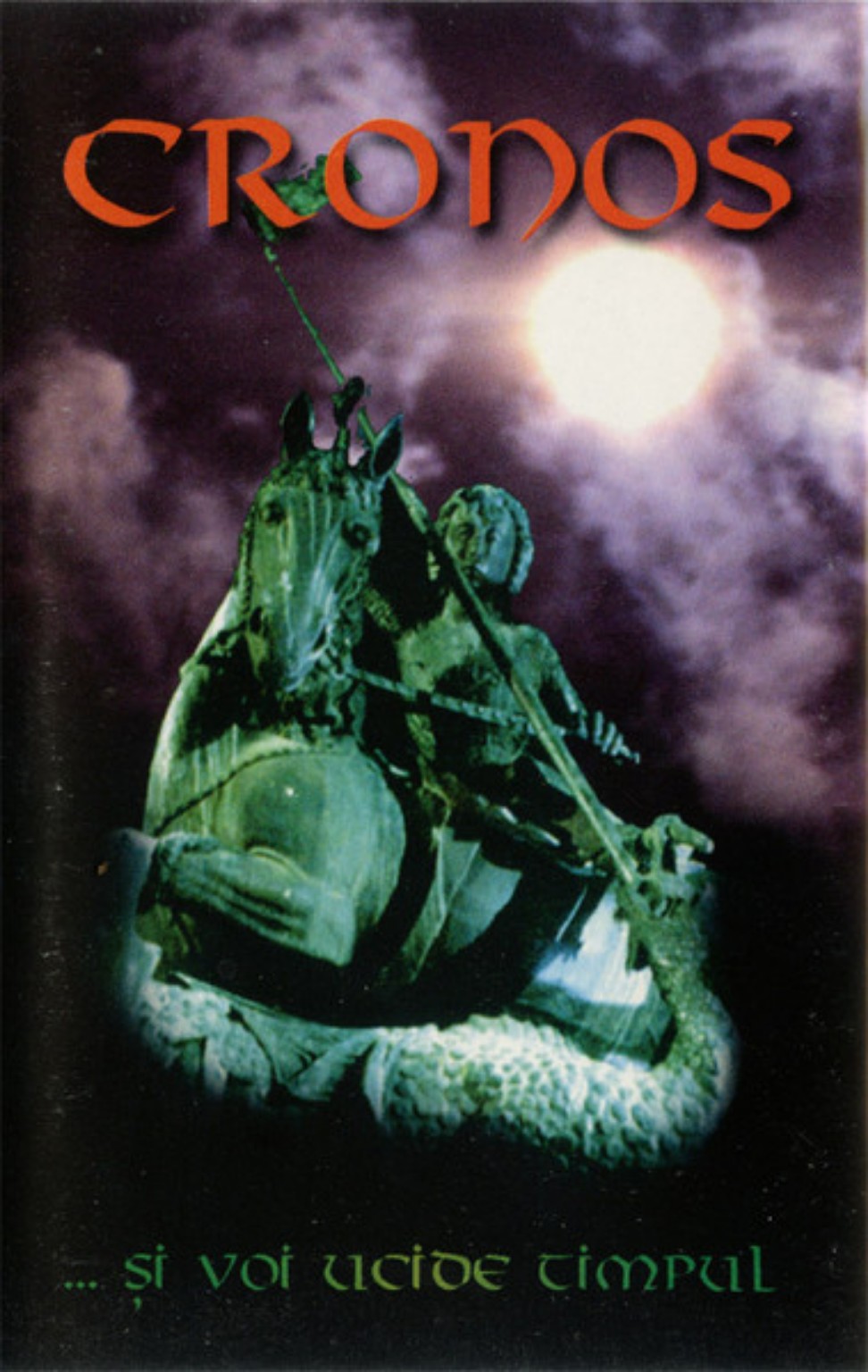
A dark vertical space rises across the front cover of Cronos's cassette. The band's name is set at the top in orange-red letters, while …și voi ucide timpul runs along the bottom in greenish lettering. Between them, grey-violet clouds meet a green-tinted, statue-like mass. In the upper right, a white celestial body or other source of light appears in the sky; the light coming through the clouds picks out the sharper edges of the central form against the black foreground. The warm orange-red of the name counterbalances the composition's cold colours. 101

The form is solid and monumental, suggesting an equestrian figure or a warlike sculptural group. Rounded and curved elements below are surmounted by shapes rising into points, while a thin line running towards the upper left interrupts the enclosed mass. A seemingly rigid form stands beneath clouds that suggest movement. The contrasts of light and shadow, green and violet make the scene seem both hard-edged and uncertain. Neither the specific statue nor the depicted figure nor the artist responsible for the graphic can be identified with certainty; the image remains before us through its visible forms. 101

Placed alongside the title, the cover invites a contrast between stillness and flow. Below, matter seems to have come to a halt; above, light and cloud signal change. The phrase about killing time finds a striking visual counterpart here. This reading by an observer also accords with a later review emphasising the music's atmospheric character, but the precise history of the creators' original intentions remains unknown. After the dark image, the cassette's running order carries the same title forward through names and sequence. 101 2

07 / 09

07. The Two Sides of Time

Side A begins with a single short word: Intro. It lasts about fifty-four seconds before the programme reaches its first longer composition. At the other end stands End; between the two lie five songs with Romanian titles. The short opening and closing pieces frame the sequence from opposite ends. No specifically identified instrumental motif from the introduction survives in the reviews, but its title and position clearly make it an opening piece. The cassette begins by moving through Loc blestemat, Spre apus and Nimic; Side B passes through Toamna and the title track before reaching the end. 102 103 106 107 108

Loc blestemat follows Intro. Its title means roughly “Cursed Place”, and its duration of approximately five minutes and twenty-two seconds places it among the longer compositions. A place is characterised by the title, but without complete lyrics no reliable story can be constructed around it. The song's earlier life on stage is documented, however: it appears alongside Toamna in archival material from Club Hard’n’Heavy in 1996. A later album review praised the cassette's melodies and songwriting but singled out no particular passage from this track. The title, duration, second position in the running order and earlier live history together preserve its traces. 102 103 26 2 108

Running for about three minutes and twenty-three seconds, Spre apus continues Side A. The Romanian word apus evokes both sunset and a movement towards the west: “Towards Sunset” or “Towards the West” are possible English readings. Between Loc blestemat and Nimic, the title retains both meanings within the sequence. Without the full lyrics, neither meaning can be treated as the only possible interpretation. No separate account of the song's creation or individual track review accompanies it; what survives is knowledge of its title and place in the sequence. 102 103 108

At the end of Side A, Nimic names a single abstract concept: “Nothing”. The song, lasting roughly four minutes and eleven seconds, follows two Romanian titles suggesting place and direction. The word's brevity cannot replace the missing lyrics with a philosophical or personal story. Here, though, the cassette itself shapes the order of listening: after Nimic, the listener must turn it over. The fourth track thus marks a physical boundary, less evident in a later, continuous digital track list. 102 103 106 108

Side B of the cassette

Side B of the cassette opens with Toamna (“Autumn”). At about five minutes and forty-four seconds, it is the longest of the seven tracks; the season's name joins titles that speak of time and passing. The song is also documented in records of concerts from 1996. Besides the Hard’n’Heavy entry for Toamna/Loc blestemat, a separate description of Constelații Rock preserves its title, identifying Vlad Bușcă, Răzvan Alexandru, Adrian Ungureanu and Dan Petrescu in connection with that occasion. The same song title passes through several live appearances before reaching the opening position on Side B. 102 107 26 28 108

The title track follows Toamna. …și voi ucide timpul is the second track on Side B and the sixth in the complete programme, with a running time of approximately five minutes and eleven seconds. “…and I will kill time”: the sentence seems to continue something left unsaid; the “and” after the ellipsis promises a continuation. Rather than a self-contained description, the title therefore sounds like another part of something already being said. The original inlay credits the music to Cronos and the lyrics to Adi. Without a verified publication of the complete lyrics, the title's linguistic force is what can safely be interpreted, not a lyrical narrative invented to fill the gap. 101 103 107 108

After the title track, End brings the programme to a close in roughly fifty-eight seconds. Like Intro, it is a short, separately named piece. Together they last less than two minutes, while the five longer compositions between them make up about twenty-four minutes. Proportion and sequence thus emerge as organising principles of the cassette. The specific instrumentation of the two framing pieces, or any shared motif linking them, has not been documented separately. Across the seven titles, references to a place, dusk or direction, absence, a season and time lead towards the ending. 103 107 108

The recording’s reception

The recording's reception outside the band did not confine this dark world of titles to a single musical category. A German review from 2000 described it as atmospheric metal with a slight gothic inclination, difficult to assign one genre label. The reviewer praised its melodies and songwriting, hearing the Romanian vocals as a feature that strengthened its character. For the reviewer, its resistance to easy classification was a mark of individuality. In Promusic's catalogue, Cronos appeared alongside cassettes by Protest and Anarhia, while the Romanian five-piece was explicitly distinguished from the identically named project of Venom's singer. After Electrecord's earlier dominance, different routes taken by private labels such as Bestial, Promusic and Vivo were also becoming visible on the scene's map. A brief, undated English review of the EP instead stressed a combination of doom and thrash. These assessments of the complete cassette strike a different note from a 1995 account of the Nightmare/Coșmar demo, with its conceptual blend of doom, death and thrash and its keyboard passages. The differences preserve several perspectives on the music's reception, each from its own time and concerned with a different recording. 2 10 1

08 / 09

08. The Names Return

After the cassette's release, Romania's underground public sphere continued to change. In 2002, Lenți Chiriac spoke about the press, radio and disputes among fans of different metal styles, contrasting the strong interest of an earlier period with changes he had subsequently noticed in audiences. In the recollections of those active in the scene, the energy that had once linked magazines, concerts and recordings was already receding into the past. Meanwhile, the name Cronos did not disappear entirely from the live scene. 3 86

On 25 April 2006, a Bucharest concert forum advertised a shared bill for 28 April: Legacy of Hate, Hathor, Cronos and Tiarra at the Old School. The announcement associated with Metalhead gave a 9 p.m. start and an entrance fee of eight lei. It presented Cronos as a band returning after several years away, specifically mentioning Bebe, associated with L.O.S.T., and Bogdan, who had previously played in Taine. The venue occupied an upper floor of the Grigore Preoteasa student cultural centre at 61 Calea Plevnei. The announcement documents a planned return and the line-up as presented at the time; it cannot establish the actual set list that evening or whether songs from 1998 were played. On 28 April of the same year, another preview had already appeared for the twenty-second Top T, announced for 11–14 May. Cronos was included in the 11 May programme with Deviant, Rising Shadow, Avskild, Magica and Trooper. The plans listed concerts, exhibitions of instruments and photographs, discussions, jam sessions and record launches. The article gave 1990 as the festival's starting year, while the organiser's recollection dates its origins to 1983: the discrepancy remains. A later archive description of the 2006 Top T lists BB Hanneman, Andrei Gângă, Bogdan Vișan and Dan Petrescu for Cronos; the detailed set list is unknown. 33 94 81 29

Later encounters and memories

The name Cronos resurfaced in a different context in Costin Chioreanu's recollections. In 2013, the visual artist recalled old Cronos demos and the …și voi ucide timpul cassette among the recordings he had listened to regularly in his youth. His later graphic work also connected him with L.O.S.T. His connection with this early music was personal: he had returned to the recording repeatedly as a listener. A title in a cassette catalogue thus acquired new meaning in the personal history of a later underground artist. 9

By 2016, Vlad Bușcă and BB Hanneman were speaking from the perspective of L.O.S.T. about Romanian-language songs and the challenges of sustaining a musical community. For Vlad, the choice of language depended on how a particular song's meaning could best be expressed. He called for mutual support between bands, audiences, promoters and the media. BB stressed his attachment to old-school metal and the difficulties of earning a living; he associated his first performances with Magma, around 1993. Beyond the early rehearsal rooms, the questions of self-organisation and singing in one's own language remained present in another band. As the musicians' paths spread across decades, the same people continued to find themselves in new communities. 17

09 / 09

09. The Time of the Old Songs

The next major gathering was scheduled at Quantic in Bucharest. The poster for We Are the Underground brought together two evenings on 10–11 January 2025: Anarhia, God and Taine on Friday, followed by Cronos, L.O.S.T., Grimegod and Gothic on Saturday. Cronos was scheduled to begin at 7:45 p.m., and the preview described its return after nineteen years. The running order establishes what was advertised, not the exact minute the band actually took the stage. Even so, the programme brought different strands of the old scene together on one bill. 8 36

A report published in March confirmed that Cronos had performed. It singled out BB Hanneman's guitar and vocals and Bogdan Vișan's bass and vocals, calling the performance one of the evening's most welcome surprises. The difference between the early recordings and the new live experience made it possible to hear the older material in a different way. Grimegod's Godless Cry, material from Taine's Cealaltă parte and music from Gothic's Touch of Eternity period also evoked the former network. Radio presenters and journalists appeared in the reminiscence by name: Florin-Silviu Ursulescu, Gabi Gomboș, Petre Magdin and Nelu Stratone. The article also mentioned television interview work and Remix broadcasts planned for a later date; whether these were actually broadcast has not been established. The concert, the recollections in the press and the musicians' personal journeys came together once more around the same gathering. 19

The story continues

Bogdan Vișan's work continued in a new direction after the reunion. In January 2026, he spoke about the music video for Goban's Born to Die Rich: the idea for the song had originated around 2009–2010, while filming took place on a single freezing, snowy day. He said he wanted to portray figures struggling with confinement, fears and obsessions. Alongside his early years in Cronos, his time with Taine and the recent reunion, there was also his independent creative work. The old cassette did not mark the end of the musician's path. 21

Yet these paths continue to intersect around …și voi ucide timpul. The membership of those early musical circles changed, rehearsal spaces may have disappeared, and the recordings found their way into later archives and personal memories. Romanian-language expression and music that moved across genre boundaries survived on Promusic's 1998 cassette and were carried forward by a later generation of listeners and by musicians meeting again. The songs framed by Intro and End are arranged on an object from a particular era, but their story can no longer be measured by the duration of a single cassette side. 2 9 16 19 101 102

CRONOS · 1998 · EN

Sources and references

All 99 original EPUB source notes, with their text preserved · 184 ↗

Critical and review endnotes · 6

1. CRITICAL / REVIEW Report on the Romanian Scene SHISM, no. 1 (4), 1995, p. 18; author not identified by name. Originally in Russian; an English translation was used for the research.

Specific evidence, relevance and limitations. On page 18 of SHISM no. 1 (4), published in 1995, the foreign contributor mentions Bucharest-based Cronos among young Romanian bands. Discussing their approximately hour-long Nightmare/Coșmar demo, which the writer considered conceptual, the review highlights a blend of doom, death and thrash metal and unusual keyboard passages. This provides contemporary external critical evidence for the 1994 demo, not for the musical reception of the later 1998 cassette or for the band’s own statements. The Russian original and the available English translation refer to the same article; no public digital location is supplied for this fanzine.

Back to reference 1 (Chapter 3) · Back to reference 2 (Chapter 7)

2. CRITICAL / REVIEW Gerald Mittinger – Stefan Glas: Rumänien-Szene-Report-Special (CRONOS section) Underground Empire – Online Empire 3, 2000. Gerald Mittinger and Stefan Glas review Cronos in the context of Promusic’s cassette catalogue. They praise its atmosphere, melodies and songwriting and regard the Romanian-language vocals as part of its distinctive character. Their subject is the 1998 cassette; the publisher’s archive index dates the review to 2000. The exact publication day and a numerical rating have not been established.

Specific evidence, relevance and limitations. In their 2000 German-language Romanian scene report, the authors describe the Cronos release encountered through the Promusic cassette scene as atmospheric metal with gothic elements. They praise the melodies and song structures, as well as the character lent by the Romanian-language vocals. This is a retrospective critical judgement, not a studio record from 1998; the genre designation must not be attributed to the musicians themselves. Neither a rating nor an exact publication date has been verified.

The report explicitly discusses the cassette releases of CRONOS, PROTEST and ANARHIA, distinguishes the five-piece Romanian band from the Venom singer’s similarly named project, and separately discusses the earlier role of Electrecord and the activities of Vivo, Bestial and Promusic. These are directly supported claims, not merely generic scene background. Original source page · Back to reference 1 (Chapter 6) · Back to reference 2 (Chapter 7) · Back to reference 3 (Chapter 7) · Back to reference 4 (Chapter 9)

10. CRITICAL / REVIEW CRONOS (ROMANIA) – …Si Voi Ucide Timpul EP mini-review The Thrash Metal Guide; date of original publication not verified. The known short review of the EP mentions doom and thrash elements. Neither the publication date nor a fuller assessment or numerical rating has been established.

Specific evidence, relevance and limitations. The brief review previously recorded from The Thrash Metal Guide mentions doom and thrash traits. Its original year of publication and the contents of the complete page are unverified; the research log records an HTTP 502 error when attempting direct access. The book can therefore attribute only this previously observed genre impression to the reviewer. A detailed instrumental analysis, quotation or rating cannot be authenticated.

Original source page · Back to reference 1 (Chapter 7)

19. CRITICAL / REVIEW Doru Ionescu: We are the Underground Actualitatea Muzicală, no. 3/2025, pp. 47–48. A concert review of the Quantic festival held on 10–11 January 2025.

Specific evidence, relevance and limitations. In his retrospective account of the 10–11 January festival, Ionescu calls Cronos the surprise of the evening. He describes BB Hanneman as guitarist/vocalist and Bogdan Vișan as bassist/vocalist, and considers the present-day live versions of older material more convincing than some period recordings. This is the journalist’s own critical appraisal, not a studio credit from 1998. The article’s announcement of forthcoming TVR Cultural Remix broadcasts does not in itself prove that those programmes subsequently aired.

Back to reference 1 (Chapter 9) · Back to reference 2 (Chapter 9)

76. CRITICAL / REVIEW Andrei Ando: La Festivalul Rockmania LIVE ’95: Timpuri Noi Adevărul (Arad), Tineret supplement, 21 July 1995, p. 11. Contemporary critical review.

Specific evidence, relevance and limitations. Ando’s account “La Festivalul Rockmania LIVE ’95: Timpuri Noi” appeared on page 11 of the Tineret supplement to Adevărul in Arad on 21 July 1995. He praises the band’s stage energy, sound and interaction with the crowd, and discusses its shift from new-wave beginnings towards funk and fusion, along with historical performance restrictions in the 1980s. This review documents the variety of Romanian rock festivals, but it is neither a Cronos performance report nor a review of the 1998 EP. The public print reference is Adevărul, 1995.

Back to reference 1 (Chapter 3)

97. CRITICAL / REVIEW Nick Terry: The Making of Turn Loose the Swans Decibel Magazine – Hall of Fame, 19 May 2006. The publicly available introduction to a retrospective on the 1993 album Turn Loose the Swans discusses slow tempos, contrasts and violin and keyboard textures. The full argument of the magazine feature is not represented by the brief preview.

Specific evidence, relevance and limitations. Terry’s Hall of Fame introduction for Decibel, dated 19 May 2006, highlights the slow death/doom atmosphere and string/keyboard contrasts of My Dying Bride’s 1993 release. The surviving online text is only a short preview; the full magazine analysis has not been examined. This is a critical perspective on genre history, not evidence of a direct Cronos inspiration.

Original source page · Back to reference 1 (Chapter 3)

Historical and documentary endnotes · 93

3. HISTORICAL / DOCUMENTARY Nelu Brândușan / PROMUSIC RECORDS – Romania Underground (interview) Nelu Brândușan, Promusic Records label head and interviewee; Doru, author. Kogaionon, 30 July 2002. The interview compilation includes several interviewees. Brândușan discusses the label’s formal founding in 1996, the actual start of publishing activity in 1998, the catalogue and the failure to recover the investment. A separate section features Lenți Chiriac; their statements must not be interchanged.

Specific evidence, relevance and limitations. In the compilation dated 30 July 2002, Brândușan distinguishes Promusic’s formal founding in 1996 from its operational start in 1998. After the inaugural Romanian Metal Underground, he explicitly mentions the Cronos release. His remarks about the publishing venture, distribution and unrecovered investment are personal business recollections. Statements by Lenți Chiriac on the same page must not be attributed to Brândușan. The recording year is a separate question addressed with CRN-004 and the original cassette insert.

Original source page · Back to reference 1 (Chapter 5) · Back to reference 2 (Chapter 5) · Back to reference 3 (Chapter 5) · Back to reference 4 (Chapter 8)

4. HISTORICAL / DOCUMENTARY L.O.S.T. Vlad Bușcă – interjú. Interview by Richard Constantinidi, ClickZoomBytes, 29 March 2012. The archived account connects Cronos’s 1996 recording sessions with Migas Real Compact and Adi Ordean. The original cassette establishes the release year; the preserved extract cannot establish further details of the recording process.

Specific evidence, relevance and limitations. Bușcă’s account from 2012 supports recording activity at Migas Real Compact in 1996 and Adi Ordean’s involvement. This must be read separately from the year 1998 on the physical Promusic cassette: recording and release are two different events. The surviving interview extract does not establish an exact studio date, the order in which individual tracks were recorded or additional, otherwise undocumented personnel.

Original source page · Back to reference 1 (Chapter 5)

5. HISTORICAL / DOCUMENTARY. Tornado – istoria formației la Radio Unison Vaslui (1995-06-03). Vlad Bușcă; Cornel Dragomirescu; Benedict Sârbu. Arhiva Mea / Radio Unison Vaslui. 3 June 1995; republished online on 21 January 2015. Early work in Tornado by later Cronos members Vlad Bușcă and Andrei Gângă; according to the retrospective accompanying text, Andrei went on to join Cronos.

Specific evidence, relevance and limitations. The Radio Unison Vaslui programme about Tornado, broadcast on 3 June 1995, together with the archival commentary Vlad Bușcă added later, offers evidence about the period preceding Cronos. Bușcă recalls Tornado starting in autumn 1991, its first performance in autumn 1992 and two demos in 1994. He then records that, after the group lost its rehearsal space, Andrei Gângă joined Cronos and he himself joined Abigail in 1995. The programme’s original broadcast date should not be confused with the January 2015 online republication; the later recollection must not be treated as a verbatim statement made in 1995. Original source page

Back: reference 1 (chapter 2) · Back: reference 2 (chapter 3)

6. HISTORICAL / DOCUMENTARY Cronos – Discografie completă (1993–1998) Arhiva Mea, 25 August 2012. An archival discography that separates the demos and the EP by year. Its later personnel list differs from the five abbreviated names on the original cassette insert and from the separately credited recording contributors. The discrepancy between the records is preserved.

Specific evidence, relevance and limitations. The 2012 Arhiva Mea discography lists the 1993 demo, two 1994 demos and the 1998 release separately. Its later five-member list names Mihai Drăgan, Andrei Gângă, Vlad Bușcă, Adrian Ungureanu and Dan Petrescu; the original cassette insert instead lists Mihai, Adi, Edy, Nick and Dan as its core names, with additional recording contributors. This discrepancy between sources cannot be resolved by automatically projecting the later list onto the 1998 photograph or recording.

Original source page · Back to reference 1 (Chapter 3) · Back to reference 2 (Chapter 3) · Back to reference 3 (Chapter 5) · Back to reference 4 (Chapter 5)

8. HISTORICAL / DOCUMENTARY We are the underground – Cronos’s return in 2025 Article by Cristian Matei, Știrile ProTV, 5 January 2025. Documents the band’s return to the stage in 2025, its new line-up and the retrospective context of the 1990s.

Specific evidence, relevance and limitations. Matei’s news item of 5 January 2025 identifies Cronos among the returning acts at the We Are the Underground festival at Quantic in Bucharest. As a preview, the article documents the planned reunion and publicity for the event, not the individual recording credits of the 1998 release. The actual concert review is a separate source, CRN-019.

Original source page · Back to reference 1 (Chapter 9)

9. HISTORICAL / DOCUMENTARY Artistul român care face design pentru cele mai dark trupe din lume Costin Chioreanu, interviewee; Mihai Popescu, author. VICE România, 15 May 2013. Discusses the graphic artist’s personal memories of listening to Cronos in the 1990s and the scene connections that later led to work with L.O.S.T.

Specific evidence, relevance and limitations. In Mihai Popescu’s VICE interview of 15 May 2013, Costin Chioreanu recalls listening personally and repeatedly to the two Cronos demos and the 1998 cassette. His later artwork for L.O.S.T. helps document the recording’s reception and personal connections within the music scene; it does not mean that Chioreanu designed the original cover of the 1998 Cronos cassette.

Original source page · Back to reference 1 (Chapter 8) · Back to reference 2 (Chapter 9)

11. HISTORICAL / DOCUMENTARY Cronos – Romanian band profile Encyclopaedia Metallum / Metal Archives; publication date unknown. Provides Bucharest, a formation date of 1993, contributors associated with the 1998 EP and distinctions between bands sharing the same name.

Specific evidence, relevance and limitations. The Encyclopaedia Metallum band entry describes Cronos as formed in Bucharest in 1993, classifies its music as thrash/doom and lists musicians from several periods. The database line-up of Vlad Bușcă, Dan Petrescu, Andrei Gângă, Adrian Ungureanu and Mihai Drăgan cannot automatically be equated with every role in the original 1998 booklet. The “Split-up” designation is a database status which is historically qualified by a separate source documenting the 2025 concert.

Original source page · Back to reference 1 (Chapter 3) · Back to reference 2 (Chapter 4) · Back to reference 3 (Chapter 5)

12. HISTORICAL / DOCUMENTARY Taine – The Story (connections with Cronos) Taine official website; initial publication date not verified. A cross-reference for the early Bucharest scene shared by Cronos and Taine and Bogdan Vișan’s departure around 1995.

Specific evidence, relevance and limitations. Taine’s official band history describes its formation in 1993, a network of friendly concert appearances involving Cronos, and the arrival in Taine in 1995 of Bogdan Vișan, formerly of Cronos. Taine’s recording of B’Inișor in 1997 and the release of Cealaltă parte in April 1999 belong to Taine’s history and do not verify Cronos’s Migas Real Compact sessions. This official biography is a retrospective source from the band’s own perspective.

Original source page · Back to reference 1 (Chapter 3) · Back to reference 2 (Chapter 3)

15. HISTORICAL / DOCUMENTARY 2020 retrospective on Taine and Bogdan Vișan’s membership of Cronos Știrile ProTV, 16 January 2020. Used to check the Cronos–Taine connection around 1995 and the contemporary Vox Pop Rock music scene.

Specific evidence, relevance and limitations. Cristian Matei’s 2020 interview describes Bogdan Vișan as a musician who moved from Cronos to Taine in 1995. Vișan discusses Romania’s metal audience, the enthusiasm of the post-communist period and such examples as Altar and Neurotica; his January 2020 anniversary concert is a separate event. These are retrospective personal assessments, not testimony about the engineering or artistic intentions of the 1998 Cronos release.

Original source page · Back to reference 1 (Chapter 3)

16. HISTORICAL / DOCUMENTARY Romanian Scene Report – A dark letter from the land of Dracula (Cronos section) Mihai “Coro” Caravețeanu, Systematic Desensitization Zine, 7 July 2018. The author includes Cronos’s 1994 demos Apropierea sfârșitului and Coșmar among his personal favourites of the period. The article concerns the band’s early reception and the history of the Romanian underground in the 1990s; it is not a review of the 1998 EP.

Specific evidence, relevance and limitations. In his scene report published on 7 July 2018, Caravețeanu cites the 1994 Cronos demos Apropierea sfârșitului and Coșmar among his preferred examples of Romanian-language extreme music. He recalls later, from personal experience, how difficult it was in the 1990s to obtain instruments, tapes, access to clubs and press coverage. The author himself treats the report as subjective and sketch-like. It is not a contemporary review of the 1998 cassette and does not demonstrate specific musical borrowing by Cronos from Gothic or Grimegod.

Original source page · Back to reference 1 (Chapter 3) · Back to reference 2 (Chapter 9)

17. HISTORICAL / DOCUMENTARY Mișcarea pentru underground – Interviu cu Vlad și BB de la L.O.S.T. Cristian Matei, Știrile ProTV, 8 October 2016. A joint later interview with EP bassist Vlad Bușcă and early Cronos founder BB Hanneman, who did not take part in the EP recording. BB recalls rehearsals in the 1990s and his early stage experiences. The exploratory view of the page did not establish any specific detail about the 1998 EP.

Specific evidence, relevance and limitations. In the 8 October 2016 L.O.S.T. interview, Bușcă talks about that band’s beginnings in 2004 and its Romanian-language songs, while BB Hanneman discusses old-school sound and the finances of live performance. Their respective statements must not be conflated. L.O.S.T.’s self-understanding in 2016 cannot be retroactively assigned to the goals of Cronos’s 1996 studio work; neither does Hanneman’s early Cronos involvement automatically amount to an EP recording credit in 1998.

Original source page · Back to reference 1 (Chapter 8)

21. HISTORICAL / DOCUMENTARY Goban – Born to Die Rich: Bogdan Vișan’s own creative statement in 2026 Bogdan Vișan, an early Cronos member but not a verified contributor to the 1998 EP. Metalfan Romania, 30 January 2026. The former Cronos vocalist and bassist discusses making a video for his Goban project. The page also mentions Cronos’s return in 2025, but it does not contain a verified first-hand statement about the 1998 EP under study.

Specific evidence, relevance and limitations. The Metalfan Romania report of 30 January 2026 identifies Vișan’s former memberships of Cronos and Taine, then quotes him on the Goban video Born to Die Rich. He describes the one-day shoot in minus four degrees Celsius and a post-apocalyptic concept whose origins he dates to 2009–2010. These details concern the musician’s later career and must not be attributed to the creation of the 1998 Cronos release.

Original source page · Back to reference 1 (Chapter 9)

22. HISTORICAL / DOCUMENTARY Jurnal: Festivalul Constelații Rock Râmnicu Vâlcea, December 1996 Vlad Bușcă’s website / Arhivamea archive, 16 February 2012. A later archival record of an event held in December 1996 featuring Cronos, Abigail, Dies Irae and God. No distinct interview about the 1998 EP has been verified. The 2012 publication date must not be mistaken for the 1996 concert date.

Specific evidence, relevance and limitations. Bușcă’s short archive entry dated 16 February 2012 names Cronos, Abigail, Dies Irae and God at the December 1996 Constelații Rock event in Râmnicu Vâlcea. A 1997 designation in the web address does not prove a different event year; the audiovisual contents of the linked recording have not been checked to the same depth. The page’s date is its publication date, not the concert date.

Original source page · Back to reference 1 (Chapter 4)

23. HISTORICAL / DOCUMENTARY. Anul de grație 1991, sau de ce suntem uneori „old school”. Vlad Bușcă (personal Arhivamea archive). Arhivamea.ro. 13 August 2019. A personal account by the bassist who played on the Cronos EP, concerning his musical experiences in 1991, listening habits and discovery of different genres. The article does not describe the making of the 1998 EP; it is relevant to the documented artistic and cultural background.

Specific evidence, relevance and limitations. In his own 2019 article, Bușcă remembers obtaining a Metallica cassette on 13 August 1991, rock discos around Lipscani, following song lyrics and listening to tapes repeatedly. Metallica, Sepultura, Death, Nirvana, Queen and Soundgarden all appear in the musical world he names. These are one future Cronos contributor’s personal memories from 1991; they must not be presented as a verified list of musical influences shared by the entire band. Original source page

Back: reference 1 (chapter 2)

24. HISTORICAL / DOCUMENTARY Cronos – Evadat: live recording, Sala Polivalentă (1995) Archived by Vlad Bușcă / Arhivamea. Concert archive entry with a link to original concert footage, published 24 February 2012; original performance in 1995. The documented Bucharest concert line-up: BB Hanneman (guitar/vocals), Bogdan Vișan (bass/vocals), Andrei Gângă (guitar), Cristina Petru (vocals), Adrian Ungureanu (keyboards) and Dan Petrescu (drums).

Specific evidence, relevance and limitations. Bușcă’s 2012 concert archive associates the Evadat performance at Sala Polivalentă in 1995 with these six named musicians and roles. The event date and personnel are assertions in the archive description; an independent inspection of the video’s complete sound has not been established. The live line-up must not be treated as the recording personnel listed on the 1998 cassette insert.

Original source page · Back to reference 1 (Chapter 3)

25. HISTORICAL / DOCUMENTARY Cronos – Intro / Coșmar: Club Hard’n’Heavy, Bucharest (1996) Archived by Vlad Bușcă / Arhivamea. Concert archive entry with a link to original footage, published 24 February 2012; performance in 1996. Documented club line-up: BB Hanneman (guitar/vocals), Bogdan Vișan (guitar/vocals), Bogdan Tufeanu (bass), Adrian Ungureanu (keyboards) and Dan Petrescu (drums).

Specific evidence, relevance and limitations. The Arhiva Mea concert listing released in 2012 assigns these five musicians to the 1996 Bucharest Club Hard’n’Heavy performances of Intro and Coșmar. The song-specific video link and personnel list provide documentary evidence of the concert, but do not independently establish that every performer participated in the 1998 studio tape or that the footage has been examined frame by frame.

Original source page · Back to reference 1 (Chapter 4)

26. HISTORICAL / DOCUMENTARY Cronos – Toamna / Loc blestemat: Club Hard’n’Heavy (1996) Archived by Vlad Bușcă / Arhivamea. Concert archive entry with a link to original footage, published 24 February 2012; original event in 1996. The same club line-up is documented for a different live excerpt containing two further songs.

Specific evidence, relevance and limitations. A separate archived Hard’n’Heavy video entry dated to 1996 names the live performances of Toamna and Loc blestemat, with the same club line-up as in CRN-025. These are separate excerpts from the same archive: two links do not constitute two independent eyewitnesses. The exact arrangement of the studio versions cannot be inferred from video titles alone.

Original source page · Back to reference 1 (Chapter 4) · Back to reference 2 (Chapter 7) · Back to reference 3 (Chapter 7)

28. HISTORICAL / DOCUMENTARY Cronos – Toamna: Constelații Rock, Râmnicu Vâlcea (December 1996) Archived by Vlad Bușcă / Arhivamea. Concert archive entry linking to original footage, published 24 February 2012; original event in December 1996. The archive lists Vlad Bușcă (bass/vocals), Răzvan Alexandru (guitar), Adrian Ungureanu (keyboards) and Dan Petrescu (drums).

Specific evidence, relevance and limitations. For the Toamna performance at Constelații Rock in Râmnicu Vâlcea in December 1996, the Arhiva Mea concert archive published in 2012 names these four performers. The line-up is specific to that concert, before the 1998 cassette was released. The organiser’s recollection published in 2022 about Adrian Ordean’s live-sound work must not be confused with the original mixing credit on the cassette.

Original source page · Back to reference 1 (Chapter 4) · Back to reference 2 (Chapter 7)

29. HISTORICAL / DOCUMENTARY Cronos – live recording, Top T, Buzău (2006) Archived by Vlad Bușcă / Arhivamea. Concert archive entry linking to original footage, published 24 February 2012; original event in 2006. The 2006 Top T line-up: BB Hanneman (guitar/vocals), Andrei Gângă (guitar), Bogdan Vișan (bass/vocals) and Dan Petrescu (drums).

Specific evidence, relevance and limitations. Bușcă’s archive entry for Cronos at Top T in Buzău in 2006 lists these four musicians. This later performance and its date must be distinguished from the 1997 Top T award and the 1998 release. The archived video link indicates a concert document but does not amount to an independent, complete examination of the picture and sound.

Original source page · Back to reference 1 (Chapter 8)

31. HISTORICAL / DOCUMENTARY Compilațiile Underground Romania, 1995–97 – Cronos/Coșmar Vlad Bușcă / Arhivamea, 12 January 2015. The archived track listing for Underground Romania 2 lists Cronos – Coșmar as track seven and dates it to 1996. A separate database associates 1995 with the same item.

Specific evidence, relevance and limitations. The 2015 Arhiva Mea compilation overview places Cronos – Coșmar at track seven on Underground Romania 2 and gives 1996. A secondary metal database dates the same compilation to 1995. The discrepancy has not been resolved; the two dates must be reported with their respective sources. A single archived track list does not establish the pressing quantity, exact release day or a separate reissue.

Original source pageBack to reference 1 (Chapter 4)

32. HISTORICAL / DOCUMENTARY Mediafax: Top T ’97 – special keyboard award for Cronos Mediafax (reporter not named in the article); later plain-text archive copy at rockmania.net. 7 July 1997. The report on Top T held on 3–5 July identifies the special keyboard award recipient as “Marian Ungureanu (Cronos)”. The forms Adrian Ungureanu and Adi occur in other sources. A presumed typographical error is not a verified resolution.

Specific evidence, relevance and limitations. The original form in the MEDIAFAX report of 7 July 1997 about Top T in Buzău on 3–5 July is “Marian Ungureanu (Cronos)”, beside the special award for keyboards. The cassette insert has Adi; another archive names Adrian Ungureanu. Although these three forms may refer to the same person, the wording of the original press report must not be silently corrected without evidence. This is a contemporary results report, not a later organiser’s recollection.

Original source page · Back to reference 1 (Chapter 5)

33. HISTORICAL / DOCUMENTARY Metalhead concert announcement: Legacy of Hate / Hathor / Cronos / Tiarra (28 April 2006) Morrison / Metalhead, FANCLUB.ro rock forum, 28 April 2006 at 11:38 (forum post). The Metalhead representative lists Cronos alongside Legacy of Hate, Hathor and Tiarra for an evening at the Old School club in Bucharest.

Specific evidence, relevance and limitations. Morrison’s forum notices dated 25 and 28 April 2006 advertise a joint Old School appearance by Legacy of Hate, Hathor, Cronos and Tiarra, scheduled for 21:00 with an entrance fee of 8 lei. The organiser describes Cronos as returning after several years with an old line-up, naming Bebe and Bogdan. Both notices convey information from the same organiser; they do not independently confirm that the concert actually took place.

A separate forum announcement by the same Metalhead organiser, posted later in 2006, gives the venue address and floor: Calea Plevnei 61, Grigore Preoteasa Students’ Cultural Centre, second floor. This corroborates the club location in 2006, not whether the April concert actually took place. Original source page · Separate 2006 organiser announcement confirming the club address and floor.Back to reference 1 (Chapter 8)

35. HISTORICAL / DOCUMENTARY. Povestea rockerului ... Head of Digital la Universal Music România (Vlad Bușcă). Wall-Street România (individual author not recorded in the available excerpt). Wall-Street România. 4 February 2018. A career profile tracing Vlad Bușcă’s musical path through Tornado, Cronos, Abigail and L.O.S.T., as well as his work in the music industry; the known excerpt does not discuss the specific recording of the 1998 EP.

Specific evidence, relevance and limitations. The 2018 Wall-Street interview recalls Vlad Bușcă’s childhood performances as a folk dancer, his experiences of Iris, Compact and Holograf concerts in the 1980s, the taping of foreign radio broadcasts and his efforts to preserve a personal concert archive. It also mentions his membership in Tornado, Cronos, Abigail and L.O.S.T., his work for Transglobal Media in 1997 and his later employment at Universal Music. This 2018 career retrospective does not establish the terms of any Promusic agreement in 1998. Original source page

Back: reference 1 (chapter 2)

36. HISTORICAL / DOCUMENTARY We Are The Underground Festival @ Quantic – detailed programme for 2025 Zile și Nopți, citing Quantic Facebook as the programme source; January 2025, exact publication day not verified. The schedule announces Cronos for 19:45 on 11 January at the festival of 10–11 January 2025 and describes its appearance as a return after 19 years.

Specific evidence, relevance and limitations. The January 2025 Quantic schedule reproduced by Zile și Nopți places Cronos at 19:45 on 11 January, followed by L.O.S.T., Grimegod and Gothic. The phrase “after 19 years” reflects the organisers’ framing of the comeback; it is not independent proof that no concerts occurred from 2006 to 2025. The advertised starting time should not be presented as the actual stage time, which belongs to the separate concert account in CRN-019.

Original source page · Back to reference 1 (Chapter 9)

37. HISTORICAL / DOCUMENTARY București – Relief (Câmpia Română, Dâmbovița, Colentina) Bucharest City Hall (PMB), publication year not stated. Geographical and settlement-historical background: the Dâmbovița and Colentina rivers, river terraces and the Romanian Plain.

Specific evidence, relevance and limitations. The municipality’s relief profile describes the Dâmbovița and Colentina valleys and relative terrace heights of 2–4 and 8–12 metres; it locates the city in the Romanian Plain. Floodplain engineering and the retreat of the Vlăsiei woodland are part of the geographical and settlement background. These figures come from the city’s official description; they document neither any particular Cronos rehearsal room nor a musician’s home address.

Original source page · Back to reference 1 (Chapter 1)

38. HISTORICAL / DOCUMENTARY București – Epoca medievală Bucharest City Hall (PMB), publication year not stated. First documentary mention on 20 September 1459; princely seat; Lipscani documented in 1589; craftsmen’s quarters, commerce and later manufactories.

Specific evidence, relevance and limitations. The municipal overview of medieval Bucharest cites the document dated 20 September 1459 under Vlad Țepeș, the role of the princely court, the work of blacksmiths, potters and tanners, and a documented mention of Lipscani Street in 1589. The historical cityscape in paragraphs c01p001–c01p002 relies on this chronology. The profile is not a biographical source about Cronos, and its exact publication date has not been verified.

Original source page · Back to reference 1 (Chapter 1) · Back to reference 2 (Chapter 1)

39. HISTORICAL / DOCUMENTARY București – Epoca modernă Bucharest City Hall (PMB), publication year not stated. Changes beginning in 1821, urban administration around 1830, a cadastral plan from 1846 and the development of urban and civic institutions during the nineteenth century.

Specific evidence, relevance and limitations. The municipality’s overview of modern Bucharest notes the changes after 1821, administrative organisation around 1830, the cadastral plan of 1846 and the Bucharest–Giurgiu railway connection of 1869 as distinct milestones. These developments belong to the city’s longer urban, cultural and commercial history, not to the musicians’ family histories. The dates of the historical events are not the publication dates of the later institutional account.

Original source page · Back to reference 1 (Chapter 1) · Back to reference 2 (Chapter 1)

40. HISTORICAL / DOCUMENTARY București – Epoca contemporană Bucharest City Hall (PMB), publication year not stated. Nationalisation and industry after 1948, housing-estate life and large working-class neighbourhoods, the 1989 regime change and the structure of employment in the capital in 1993.

Specific evidence, relevance and limitations. The city’s twentieth-century historical profile summarises post-1948 nationalisation, industrialisation and the construction of housing estates; it gives 39,700 construction and installation workers in 1950 and more than 97,000 in 1983. The political changes of 1989 unfolded against this existing urban fabric. These retrospective municipal statistics do not establish the occupation of any individual metal musician in the 1990s.

Original source page · Back to reference 1 (Chapter 1) · Back to reference 2 (Chapter 1) · Back to reference 3 (Chapter 1)

41. HISTORICAL / DOCUMENTARY The Many (Still) Functional Housing Estates of Bucharest, Romania Academic book chapter by Vera Marin and Liviu Chelcea, Springer, 2018. Studies the history of socialist housing estates, the scale of Balta Albă and maintenance after privatisation. The figure suggesting that these estates account for approximately four fifths of the housing stock concerns 2011, not the early 1990s.

Specific evidence, relevance and limitations. Marin and Chelcea’s 2018 Springer chapter distinguishes smaller decorated apartment blocks of 1945–1955 from the later mass-built housing estates in Bucharest and examines the large scale of Balta Albă in the 1970s. The figures of around four fifths for the housing stock and resident population refer retrospectively to 2011, not to a 1993 count. This scholarly account of housing maintenance after post-1990 privatisation provides social context; it is not a personal source about Cronos.

Original source page · Back to reference 1 (Chapter 1)

43. HISTORICAL / DOCUMENTARY. Cronologia extinsă a Fenomenului Piața Universității. Museum of the University of Bucharest. 2020 (describing events in 1990). The dates of protests in University Square, from 22 April through June 1990, and the mineriad (miners’ incursions); background on the social and political life of Bucharest before the band was formed.

Specific evidence, relevance and limitations. The University of Bucharest Museum’s chronology distinguishes the Proclamation of Timișoara on 11 March 1990, the beginning of the University Square protests on 22 April, the symbolic declaration of a “free zone” on 29 April, the election on 20 May and the violent conclusion on 13–15 June. It supports the political sequence presented in c02p002–c02p003. This is a modern museum reconstruction of historical events; it does not claim that any individual band member took part. Original source page

Back: reference 1 (chapter 2) · Back: reference 2 (chapter 2)

44. HISTORICAL / DOCUMENTARY. Mineriadele: February and June 1990. Museum of the University of Bucharest. 2020 (historical background covering 1989–1990). Conflicts involving workers’ groups, students and opposition movements in Bucharest during the post-1989 transition; social violence and political divisions.

Specific evidence, relevance and limitations. The museum’s separate account distinguishes the mining communities’ long history of labour and strikes in the Jiu Valley (Lupeni in 1929 and the strike of 1977) from the party-political struggles after 1989 and the miners’ marches in 1990. Mining communities must not be treated as a single group with a uniform political outlook. The source adds background and context for interpreting the violence in Bucharest; it does not establish the political views of Cronos members. Original source page

Back: reference 1 (chapter 2) · Back: reference 2 (chapter 2)

45. HISTORICAL / DOCUMENTARY. POST-REVOLUTION ROMANIA 1990: Mineriad of 13–15 June. AGERPRES, the Romanian news agency. 12 June 2020. A later historical reconstruction of the events of 13–15 June 1990, used as an independent check on the museum chronology.

Specific evidence, relevance and limitations. AGERPRES’s retrospective published on 12 June 2020 distinguishes the police action and arrests of 13 June from the miners’ arrival and attacks on opposition, university and independent press institutions on 14–15 June. Allegations in later prosecutorial investigations or court proceedings are not equivalent to final judicial findings. The retrospective corroborates the chronology; it does not attest that any particular musician was personally present. Original source page

Back: reference 1 (chapter 2)

46. HISTORICAL / DOCUMENTARY. Orașul nostru – istoria și economia Piatra Neamț. Piatra Neamț City Hall – municipal authority. Publication year not stated. Piatra Neamț's first documentary mention in 1387, its history as a Moldavian trading town and its location in the Bistrița valley; background to the documented Cronos festival venue in 1996.

Specific evidence, relevance and limitations. The city profile published by Piatra Neamț City Hall identifies the confluence of the Bistrița and Cuejdiu, the early mention from 1387, the charter of 1431 and the town's development as a market centre in the fifteenth century. These details support the geographical and medieval background in Chapter 4. A modern municipal profile does not, by itself, establish how the Young Rock for Youngs concert was organised in 1996. Original source page

Back to reference 1 (Chapter 4)

47. HISTORICAL / DOCUMENTARY. Strategia de dezvoltare integrată a Municipiului Piatra Neamț 2014–2020 (retrospective historical chapter). Piatra Neamț City Hall – municipal authority. 2014 (historical chapter). Source location: printed pages 25 and 159 of the official document (PDF pages 29 and 163). Evidence concerning the town's craftsmen and traders in the seventeenth to nineteenth centuries, its paper industry in 1841, and industrial restructuring and unemployment after 1989; social background of the concert city in 1996.

Specific evidence, relevance and limitations. The historical chapter of Piatra Neamț's 2014–2020 urban development strategy mentions Asachi's paper mill of 8 November 1841, the textile plant of 1852 and the railway of 1885 on printed page 159; page 25 discusses the construction of the Mărăței, Dărmănești and Precista housing estates between 1960 and 1989. The city's policy aims from 2014 must not be treated as conditions in 1996. The document establishes the festival town's industrial and social setting, not the course of Cronos's performance. Original source page

Back to reference 1 (Chapter 4)

48. HISTORICAL / DOCUMENTARY. Piatra-Neamţ în presa vremii – a local-history press survey. Apostolul – cultural journal of the Neamț region. 2021 (historical retrospective). Paper and timber processing along the Bistrița, residential districts, the socialist-era cityscape and factory closures after 1989; a source for the local social environment.

Specific evidence, relevance and limitations. The 2021 local-history press survey in Apostolul recalls the sawmills and paper mills along the Bistrița, the Săvinești industrial site, the growth of housing estates after 1950 and the opening of the Kirileanu Library in 1972. Judgements about the loss of older parts of the town also reflect the retrospective author's perspective. The mere existence of these institutions cannot establish where the audience for the 1996 concert gathered. Original source page

Back to reference 1 (Chapter 4) · Back to reference 2 (Chapter 4)

49. HISTORICAL / DOCUMENTARY Râmnicu Vâlcea – local cultural history in a municipal resolution Râmnicu Vâlcea City Hall, local government resolution, 2011 (retrospective overview). Addresses the first surviving documents from 1388–1389, trade routes through the Olt valley and the city’s long history; background for Cronos’s performance there in December 1996.

Specific evidence, relevance and limitations. The city’s cultural strategy of 28 February 2011 recalls the Olt valley, the history of the bishopric and printing, cultural institutions after 1957 and the festival for young talent launched in 1979. The relaunch of Constelații Rock is mentioned as a goal in 2011; this does not establish that a particular concert took place that year. The Cronos performance in 1996 must be documented by a separate concert source.

Original source page · Back to reference 1 (Chapter 4)

50. HISTORICAL / DOCUMENTARY Istoria Buzăului Buzău City Hall, publication year not stated. Discusses the first documented market-town mention of Buzău on 30 January 1431, trading routes, industry and institutions; historical setting of the Top T festival in 1997.

Specific evidence, relevance and limitations. The official city history records the 1431 market-town reference, a bishopric mill donation in 1525, commercial institutions in 1575 and a description of the market in 1589, among other items. Paragraph c05p005 uses these details to introduce the history of the Top T festival’s setting. Cronos’s 1997 award is documented by the contemporary MEDIAFAX report in CRN-032, not by this municipal webpage.

Original source page · Back to reference 1 (Chapter 5)

52. HISTORICAL / DOCUMENTARY Adrian Ordean / Migas Real Compact – archival biographical news report Mihailovici.ro / archived AGERPRES text, 2015 (retrospective on 1990–1996). A biography based on an AGERPRES item dated 10 March 2015 describes Ordean’s childhood instrumental training, his time with Stereo, Riff, Roșu și Negru and Compact, and his founding of Migas Real Compact with Gheorghe Belean in late 1990. The direct evidence for his mixing credit on the Cronos recording is the cassette insert.

Specific evidence, relevance and limitations. The AGERPRES-derived 2015 biography records that Ordean was born in Sibiu on 10 March 1955 and studied violin and piano; it then traces his work with Stereo, Riff, Roșu și Negru and Compact and the establishment of Migas Real Compact at the end of 1990. The retrospective’s praise for the studio’s production standards is the article’s own assessment. The primary evidence for Adi Ordean’s mixing credit on Cronos is the original cassette insert, not this biography alone.

Original source page · Back to reference 1 (Chapter 5) · Back to reference 2 (Chapter 5)

53. HISTORICAL / DOCUMENTARY. Memoria arhivei – Revoluția la Piatra Neamț, Ioan Clopoțel. Monitorul de Neamț – local newspaper. January 2018 (republication of memories from 1989). Recollections by a photographer who recorded local demonstrations in December 1989; a first-hand social-history source for changes in the town that would host the 1996 festival.

Specific evidence, relevance and limitations. According to Ioan Clopoțel's recollections, republished in 2018, the photographer from Piatra Neamț photographed the demonstration on 22 December 1989 together with his wife, developed the film at home and took it to the local newspaper's editorial office. He also mentions the role of foreign radio broadcasts and the difficulties of telephone communication at the time. This is personal testimony and local recollection, not an account by members of Cronos. Original source page

Back to reference 1 (Chapter 4)

55. HISTORICAL / DOCUMENTARY. Romania: Recent Economic Developments (IMF Country Report). International Monetary Fund. 16 July 1997. IMF Staff Country Reports, 1997/046. The claims used here come from the publicly available summary regarding slow privatisation, reform initiatives around 1995 and continuing predominance of state ownership at the end of 1996. No individual figures are derived from the tables in the full report.

Specific evidence, relevance and limitations. The publicly accessible summary of IMF country report 1997/046, dated 16 July 1997, documents the slow pace of Romanian privatisation and reform of loss-making state enterprises in the 1990s, the acceleration around 1995 and the continued predominance of state ownership at the end of 1996. This account uses only the accessible overview, rather than the full report and all its tables. It cannot be used to calculate the pay of individual Cronos members, studio costs or terms of the Promusic contract. Original source page

Back: reference 1 (chapter 2) · Back: reference 2 (chapter 2) · Back: reference 3 (chapter 5)

57. HISTORICAL / DOCUMENTARY Romania – Parliamentary and Presidential Elections, 3 and 17 November 1996 OSCE/ODIHR international election observation, final report dated 17 December 1996. Covers the voting on 3 and 17 November 1996, television balance in the campaign, electoral rolls and observers’ assessments. First round: Iliescu 32.5%, Constantinescu 28.21%; second round: Constantinescu 54.41%.

Specific evidence, relevance and limitations. The 16-page OSCE/ODIHR report dated 17 December 1996 separately considers the parliamentary and presidential vote of 3 November and the presidential runoff on 17 November. The observers report visiting more than 1,500 polling stations in the first round and more than 400 in the second, together with concerns about campaign media balance and voting registers. Election results and the observers’ criticism are distinct layers of evidence; neither represents a political statement by Cronos.

Original source page · Back to reference 1 (Chapter 5) · Back to reference 2 (Chapter 5)

58. HISTORICAL / DOCUMENTARY HOTĂRÎRE nr. 74 din 8 noiembrie 1996 – first round of the presidential election Romanian official legislation database / Constitutional Court, 8 November 1996. Contemporary court decision documenting the presidential first round on 3 November and the designation of 17 November for the runoff.

Specific evidence, relevance and limitations. The Romanian Constitutional Court’s Decision No. 74 of 8 November 1996 validates the presidential first-round results from 3 November: Ion Iliescu received 4,081,093 votes, Emil Constantinescu 3,569,941 and Petre Roman 2,598,545. As no candidate won an absolute majority, a second round was scheduled. This contemporary legal document validates the figures for the first round; the second-round result is given by the separate OSCE/ODIHR report, not this decision.

Original source page · Back to reference 1 (Chapter 5)

60. HISTORICAL / DOCUMENTARY Romania – EU relationship concise historical timeline European Commission Representation in Romania; contemporary institutional timeline with milestones from 1993–1998. Covers Romania’s EU membership application in June 1995, the Agenda 2000 opinion in July 1997 and the first country report in November 1998.

Specific evidence, relevance and limitations. The European Commission’s timeline records Romania signing its association agreement on 1 February 1993, its entry into force on 1 February 1995, the country’s accession application in June 1995, the Agenda 2000 opinion in July 1997 and the first country report in November 1998. Signature, entry into force, application and evaluation are separate legal and political stages. Romania joined the EU only in 2007. This source does not document any political response by the band.

Original source page · Back to reference 1 (Chapter 3) · Back to reference 2 (Chapter 5)

61. HISTORICAL / DOCUMENTARY Maastricht Treaty – European Union founding agreement European Union official historical overview. Entered into force on 1 November 1993. The creation of the European Union and the institutional framework of the single market form a parallel continental context for the band’s first period in Bucharest.

Specific evidence, relevance and limitations. The signing of the Maastricht Treaty on 7 February 1992 and its entry into force on 1 November 1993 are different events. Entry into force marks the institutional establishment of the European Union, and must not be confused with the signature in 1993 or entry into force in 1995 of Romania’s EU association agreement. The chronology in c03p002 provides continental context rather than a political position expressed by Cronos.

Original source page · Back to reference 1 (Chapter 3)

62. HISTORICAL / DOCUMENTARY Madrid Declaration – NATO Summit July 1997 NATO original summit declaration, 8 July 1997. Addresses the security-policy turning point at the Madrid summit of 8–9 July and the first round of enlargement, providing context for Central and Eastern Europe and Romania’s situation.

Specific evidence, relevance and limitations. The NATO declaration issued in Madrid on 8 July 1997 invited the Czech Republic, Hungary and Poland to begin accession talks. It praised reforms in Romania and Slovenia, but neither country received an invitation at that time. The declaration helps establish the date and scope of the events discussed in c05p007: the document would not justify claiming Romania had become a NATO member in 1997.

Original source page · Back to reference 1 (Chapter 5)

64. HISTORICAL / DOCUMENTARY CEFTA – Romania accession (12 April / 1 July 1997) WTO Regional Trade Agreements Database, signing 12 April 1997; entry into force 1 July 1997. Records Romania’s accession to the Central European Free Trade Agreement and the economic transition’s European connections.

Specific evidence, relevance and limitations. The WTO regional-agreements database dates Romania’s signing of CEFTA accession to 12 April 1997, its entry into force as 1 July 1997, and its notification to the WTO as 8 January 1998. These are three distinct institutional acts and should not be conflated in the background timeline of c05p007. The agreement provides no specific evidence about the export quantities of Promusic cassettes.

Original source page · Back to reference 1 (Chapter 5)

65. HISTORICAL / DOCUMENTARY The European Union – 1990–1999 historical timeline European Union official historical overview of 1990–1999 (compiled retrospectively). Covers the single market in 1993, the dissolution of Yugoslavia, enlargement in 1995 and Schengen as part of the decade’s continental social, economic and political context.

Specific evidence, relevance and limitations. The EU’s official timeline dates the start of the single market to 1 January 1993, Maastricht’s entry into force to November 1993, the accession of Austria, Finland and Sweden to 1 January 1995, and the start of Schengen implementation in seven countries to 26 March 1995. The Treaty of Amsterdam, signed in 1997, came into force only in May 1999. None of these developments meant that Romania was itself an EU member.

Original source page · Back to reference 1 (Chapter 3) · Back to reference 2 (Chapter 5)

66. HISTORICAL / DOCUMENTARY Romanian Music up to 1944: National Emphases among Romanticism and Modernism Valentina Sandu-Dediu, short music-history overview; an English PDF available at a 2018 location, two pages, pp. 1–2. This is a brief overview, not a full-length book. It covers the adoption of Western musical forms in the nineteenth century, choral culture, Enescu, Georgescu-Kiriac and Castaldi.

Specific evidence, relevance and limitations. Sandu-Dediu’s short English overview discusses Byzantine, folk, Ottoman and Greek influences, professional lăutari musicians, the adoption of Western genres in the nineteenth century and the later relationship of Enescu and choral traditions. It distinguishes Dimitrie Georgescu-Kiriac’s national-art ideal from Alfonso Castaldi’s European orientation as contrasting schools. The available material is a two-page overview rather than a full monograph, suitable only for the long cultural background of c01p004–c01p005 and not as evidence of a direct influence on Cronos.

Original source page · Back to reference 1 (Chapter 1) · Back to reference 2 (Chapter 1)

67. HISTORICAL / DOCUMENTARY George Enescu şi muzica lăutărească românească – online exhibition George Enescu National Museum, online exhibition; publication date unknown. Historical materials on Bucharest lăutari traditions, musicians, Enescu and urban musical communities from 1760 into the twentieth century.

Specific evidence, relevance and limitations. The museum exhibition uses contemporary statements from 1921 and 1928, the Dinicu musician family and the careers of Nicolae Buică and Cristache Ciolac to show connections between Enescu and the urban lăutari tradition. The exhibition documents historical connections between art music and professional traditional musicians. It does not establish that Cronos borrowed particular elements of its own music from these performers.

Original source page · Back to reference 1 (Chapter 1)

68. HISTORICAL / DOCUMENTARY Istoric și Carta UNMB – history of the Bucharest Conservatory National University of Music Bucharest (UNMB), institutional history page; publication date not given. Documents the beginnings of the institution in 1863, the start of classes in October 1864 and classical and vocal education as part of the city’s long-term musical infrastructure.

Specific evidence, relevance and limitations. According to the institution’s official history, the conservatory was founded in June 1863, began teaching on 6 October 1864 and introduced chamber-music training in 1900 and composition training in 1905. Between 1990 and 1998 it used the name Academia de Muzică București. This provides institutional background for paragraph c01p004; it does not prove that members of Cronos studied at the conservatory.

Original source page · Back to reference 1 (Chapter 1)

69. HISTORICAL / DOCUMENTARY Rock şi contestaţie în comunism Steliu Lambru, Radio România Internațional, 20 May 2019. Explores the development of Romanian beat and rock between 1960 and 1980, censorship and performer resistance, using Phoenix, Sfinx, Timpuri Noi and Mircea Florian as examples.

Specific evidence, relevance and limitations. Lambru’s Radio România Internațional programme of 20 May 2019 discusses Romanian beat and rock in the period 1960–1980 and the limited opportunities for resistance and artistic expression under censorship, including examples from Phoenix, Sfinx, Timpuri Noi and Mircea Florian. This is retrospective radio history, not a statement of artistic self-definition made by Cronos, which formed later.

Original source page · Back to reference 1 (Chapter 1) · Back to reference 2 (Chapter 1)

70. HISTORICAL / DOCUMENTARY Phoenix – official band history and the shift towards ethno-rock Phoenix official band website; retrospective narrative, publication date not given. Traces the band from its 1962 beginnings through beat, progressive and hard rock to ethno-rock and folk-inspired changes in instrumentation and texture.

Specific evidence, relevance and limitations. Phoenix’s own history follows its formation in Timișoara in 1962 through beat and psychedelic music towards progressive/hard rock, then the folk-influenced direction known as ethno-rock. Its trajectory illustrates the diversity of Romanian rock across several decades. This official retrospective presents the band’s own history; it establishes neither a direct link with Cronos nor any particular influence acknowledged by Cronos.

Original source page · Back to reference 1 (Chapter 1)

71. HISTORICAL / DOCUMENTARY Muzica anilor 70–80 – Comunismul în România Romanian public-history archive, published around 2015. Discusses intensified censorship after 1971 and the position of folk and rock clubs, Sfinx, Phoenix and concert institutions during the 1970s and 1980s.

Specific evidence, relevance and limitations. The museum-based history of Romanian communism describes listening to Radio Free Europe, Radio Luxembourg and Radio Monte Carlo, copied magnetic tapes and imported vinyl as channels of musical discovery in the 1970s and 1980s. It also mentions musical settings of classical poetry and folklore under official scrutiny of lyrics. It supports the historical context in c01p007, but not claims about what individual Cronos members listened to.

Original source page · Back to reference 1 (Chapter 1)

72. HISTORICAL / DOCUMENTARY Arhiva Club A – source collection on Bucharest club and concert culture PostModernism Museum / Muzeul Rock, contemporary archive of events originally held from 1969 to 1999. Contains posters and memories associated with club festivals around 1969, 1971, 1979, 1981 and 1990, documenting the longer development of urban music infrastructure.

Specific evidence, relevance and limitations. The Club A collection held by PostModernism Museum/Muzeul Rock includes festival posters, photographs and cultural documents dating from about 1969, 1971, 1979, 1981 and 1990. These are primary documentary traces of the jazz, folk, rock and club culture in Bucharest discussed in c01p009. Posters and collection titles do not demonstrate that Cronos played there unless the band is actually named in a preserved programme.

Original source page · Back to reference 1 (Chapter 1)

73. HISTORICAL / DOCUMENTARY Istoric – Club A, 1967–1997 Official Club A project page; institutional timeline with no verified publication date. Covers the opening of the club in 1969, its festival in 1990, opening to the wider public in 1991 and cultural events in 1997.

Specific evidence, relevance and limitations. Club A’s own chronology traces Emil Barbu “Mac” and his student-club idea in 1967, development of the cellar on Blănari Street in 1968 and the launch of the club in 1969, associating around 800 people with its early membership. The programme’s mixture of theatre, literature, jazz, cinema and rock illustrates the development of an urban cultural venue. This later institutional retrospective cannot serve as proof of a particular Cronos concert in the 1990s.

Original source page · Back to reference 1 (Chapter 1)

75. HISTORICAL / DOCUMENTARY Festivalul Metalfan, Club Hard’n’Heavy (București), 11–14 mai 1996 Arhivamea.ro concert archive. Original event 11–14 May 1996; online compilation dated 8 January 2015. Source location: Club Hard’n’Heavy, Bucharest. The metal festival featured genre categories and bands including Taine, Gothic, Grimegod and Neutron, with video traces; a Cronos performance at this particular event has not been verified.

Specific evidence, relevance and limitations. Bușcă’s 2015 archival retrospective associates the third Metalfan festival of 11–14 May 1996 with Club Hard’n’Heavy, Taine’s grand prize, Gothic’s first and Grimegod’s second place in doom/death. The listed video titles are no substitute for examining the recordings themselves. The recovered page does not establish that Cronos played at this festival; other 1996 Cronos shows at Hard’n’Heavy are documented separately.

Original source page · Back to reference 1 (Chapter 3) · Back to reference 2 (Chapter 4)

77. HISTORICAL / DOCUMENTARY Young Rock for Youngs (1996) – complete festival archive page relating to Cronos Arhivamea.ro, Vlad Bușcă archive entry. Event in July 1996; website entry of 30 January 2012. Exact day of the Cronos performance remains unverified. The archive links Cronos, Abigail and Interitus Dei to the festival in Piatra Neamț and contains photographs and video references.

Specific evidence, relevance and limitations. Bușcă’s Arhiva Mea compilation dated January 2012 associates the bands Cronos, Abigail and Interitus Dei, along with photographic and video links, with Young Rock for Youngs at Piatra Neamț in 1996. This later concert archive entry can be compared with the June preview in Ceahlăul, but is not the same item. It does not give a verified precise date for Cronos’s appearance, and the full audio of the linked videos has not been independently assessed.

Original source page · Back to reference 1 (Chapter 4)

78. HISTORICAL / DOCUMENTARY Young Rock for Youngs – report on organisation and financing Ceahlăul, 18 June 1996, year VIII, no. 1681, p. 3. Contemporary press preview.

Specific evidence, relevance and limitations. Page 3 of Ceahlăul dated 18 June 1996 reports on the Young Rock for Youngs festival planned for 21–28 July. The programme proposal includes a hard/heavy/metal category and environmental and AIDS-prevention initiatives. The projected cost of organising the event was approximately 62 million lei. This is a contemporary funding and programme preview, not a confirmed list of all performers or evidence that Cronos actually took the stage. Public print reference: Ceahlăul, 1996.

Back to reference 1 (Chapter 4)

79. HISTORICAL / DOCUMENTARY Constelații Rock Râmnicu Vâlcea – 1979–1997: organisers’ recollections Curierul de Râmnic, 29 August 2022. Retrospective on the Râmnicu Vâlcea rock festival, its 1996 venue and resources, and, according to the organisers, Adrian Ordean’s presence at the live sound desk.

Specific evidence, relevance and limitations. The organisers’ retrospective on Constelații Rock published by Curierul de Râmnic in August 2022 records George Robu’s memories of 1996 and Adrian Ordean’s sound-desk work at the festival. Recollections recorded decades after the event are not equivalent to a programme booklet printed in 1996. Ordean’s live sound role at the festival and the studio mixing credit on the Cronos cassette insert are two separate facts requiring separate evidence.

Original source page · Back to reference 1 (Chapter 4) · Back to reference 2 (Chapter 5)

80. HISTORICAL / DOCUMENTARY Spiritualitate, Cultură şi Artă în Râmnicul Epocii contemporane Istorie Locală, regional history portal, exact publication year unknown. Covers the musical communities of the Vâlcea region in 1970–1990, including Antract, Lotus and Paradox, and the Constelații Rock tradition.

Specific evidence, relevance and limitations. The cultural history of Râmnicu Vâlcea notes the 1961 operetta premiere Crai nou, music courses for young performers in 1976, the launch of a youth festival in 1979 and the founding of the Euphonia chamber ensemble in 1982. Lotus, Antract and Paradox are named as examples of the region’s rock scene. This later local history does not provide a schedule of Cronos’s performances in 1996.

Original source page · Back to reference 1 (Chapter 4)

81. HISTORICAL / DOCUMENTARY Top T Buzău – retrospective on the festival’s early history (1983 onward) Adevărul, 3 April 2011. Describes the festival’s beginnings in 1983, its move to a national format in 1985 and separation of folk and rock competitions in 1986, as historical background for Cronos’s Top T appearance in 1997.

Specific evidence, relevance and limitations. The Adevărul retrospective of 3 April 2011 dates the beginnings of local rock and folk events in Buzău to 1983, the national expansion to 1985 and the division between folk and rock to 1986. The organisational history supplies festival background; contemporary proof of the 1997 special keyboard award for Cronos is CRN-032. A 2006 announcement cited in CRN-094, however, gives 1990 as the starting year. The conflicting dates remain unresolved and must not be silently harmonised.

Original source page · Back to reference 1 (Chapter 1) · Back to reference 2 (Chapter 5) · Back to reference 3 (Chapter 5) · Back to reference 4 (Chapter 8)

82. HISTORICAL / DOCUMENTARY Rock Festival – historical overview of Romanian rock festivals Nelu Stratone’s Romanian rock-history project; retrospective, exact publication year not given. Surveys the national network of regional events, including Top T, Constelații, Posada, Rock Fest and MetalFan.

Specific evidence, relevance and limitations. Stratone’s festival history arranges the student festival in Iași in 1968, Club A’s competitions beginning in 1969 and the later regional network of Top T, Constelații, Posada, Rock Fest and Metalfan in chronological order. The shift from youth cultural centres in the 1980s to more varied organisers in the 1990s provides institutional context. The retrospective does not establish that Cronos performed at each festival it mentions.

Original source page · Back to reference 1 (Chapter 1)

83. HISTORICAL / DOCUMENTARY. Club A after 1990 – personal interview with Adrian Șoaită. Interview by Eugen Istodor; Adrian Șoaită interviewed. HotNews.ro. 9 November 2024. A club operator’s recollections of the economy and audiences surrounding Bucharest’s underground rock, jazz and alternative scene after 1990.

Specific evidence, relevance and limitations. In an interview by Eugen Istodor for HotNews in November 2024, Adrian Șoaită recalls starting at Club A in February 1990, maintaining the club through voluntary labour, operating the bar and music evenings, and later confronting the difficulties of business administration and taxation. The interviewee’s recollections must be distinguished from the interviewer’s interpretation. The material provides context for the urban, economic and social transition around the club; it does not establish that Cronos performed there. Original source page

Back: reference 1 (chapter 2)

84. HISTORICAL / DOCUMENTARY Posada Rock – official historical introduction to the festival Posada Rock official festival website, fortieth-anniversary history page from 2026. Describes a Romanian rock festival founded in 1986 as part of the nationwide live-music and promotional network relevant to the 1990s.

Specific evidence, relevance and limitations. Posada Rock’s own fortieth-anniversary presentation in 2026 dates the festival’s origin in Câmpulung Muscel to 1986. Present-day claims such as being the “oldest” are promotional evaluations by the organisers and do not document any direct Cronos performance at Posada. The source is relevant only as background to the regional festival network.

Original source page · Back to reference 1 (Chapter 1)

85. HISTORICAL / DOCUMENTARY Despre – institutional history of Electrecord Electrecord official record-label website; retrospective, no publication date given. History of the monopoly in Romanian record manufacturing and the transition to CDs after 1990, including market difficulties and studio restructuring around 1996.

Specific evidence, relevance and limitations. Electrecord’s official institutional history recalls the start of record production in 1932, nationalisation in 1948, the introduction of stereo records in 1973 and output of approximately six to seven million sound carriers annually around 1980. Competition in the CD market following privatisation and a steep downturn around 1996 provide industry background for the emergence of independent Promusic. The history of this older Romanian label does not establish that Electrecord released the 1998 Cronos cassette.

Original source page · Back to reference 1 (Chapter 1) · Back to reference 2 (Chapter 1) · Back to reference 3 (Chapter 5)

86. HISTORICAL / DOCUMENTARY. 30 years for STUDIO ROCK – radio and the metal scene. Romania Journal. 28 February 2020. Lenți Chiriac’s Studio Rock programme, launched in February 1990, with international recordings, Romanian bands, radio promotion of concerts and a culture of correspondence.

Specific evidence, relevance and limitations. The Romania Journal anniversary article of 28 February 2020 looks back on the February 1990 launch of Lenți Chiriac’s Studio Rock, its presentation of recordings, interviews, correspondence with listeners and role in the underground scene. It supports the existence of the radio programme and its cultural function; it does not establish that any particular Cronos song was broadcast or the exact date of such a broadcast. Original source page

Back: reference 1 (chapter 2) · Back: reference 2 (chapter 8)

87. HISTORICAL / DOCUMENTARY. Lenți Chiriac – extensive 2026 interview about Romanian rock media. Interview by Grig Bute; Laurențiu “Lenți” Chiriac interviewed. Ora de Turism. 4 September 2026. Grig Bute’s interview with Chiriac covers the radio scene, Studio Rock in 1990 and Heavy Metal Magazine in 1994, including interviews, contacts made at Popkomm and distribution through cassette shops. The date of the recollection is distinct from the dates of the events described.

Specific evidence, relevance and limitations. In the interview published by Grig Bute on 4 September 2026, Lenți Chiriac personally describes beginning work in radio technology in 1987, the launch of Studio Rock in February 1990, the August 1994 promotional issue of Heavy Metal Magazine and the regular issue that followed in September. His recollections of cassette shops and press distribution describe the Romanian rock-media network of the 1990s. The interviewee’s retrospective chronology can be compared with other press evidence, but it is not a Cronos studio log and does not automatically prove that a particular song was played on air. Original source page

Back: reference 1 (chapter 2) · Back: reference 2 (chapter 3)

89. HISTORICAL / DOCUMENTARY Altar – Romanian thrash/death/hardcore background, 1991–1998 Encyclopaedia Metallum band database, updated over time. Describes a Transylvanian thrash/death/hardcore band established in 1991, illustrating the national stylistic context during 1993–1998; not evidence of participation in Cronos.

Specific evidence, relevance and limitations. The secondary Encyclopaedia Metallum entry for Altar identifies the band’s founding in Cluj-Napoca in 1991 and classifications involving death metal, thrash and hardcore. Alongside Cronos, it illustrates regional stylistic variety in Romanian extreme metal. These genre labels are editorial classifications that can change as a database evolves, not evidence of direct collaboration or statements by Cronos members.

Original source page · Back to reference 1 (Chapter 3) · Back to reference 2 (Chapter 3)

90. HISTORICAL / DOCUMENTARY Negură Bunget – Romanian black metal background, 1994–1998 Encyclopaedia Metallum band database, updated over time. Covers Wiccan Rede in 1994–1995 and the beginnings of Negură Bunget after 1995, providing national context for stylistic developments in Romanian extreme metal in 1997.

Specific evidence, relevance and limitations. The database entry records Wiccan Rede as a 1994–1995 precursor, Negură Bunget’s beginning in Timișoara in 1995 and its subsequent atmospheric, progressive and folk-influenced directions. This offers a point of comparison within the Romanian scene, not evidence of an influence on any particular Cronos composition. Secondary genre and line-up information must be attributed to the database itself.

Original source page · Back to reference 1 (Chapter 3) · Back to reference 2 (Chapter 3)

91. HISTORICAL / DOCUMENTARY Zdob şi Zdub – Moldovan hardcore and Romanian-language context, 1994–1997 Radio România Actualități, 2 September 2009. The group’s early Moldovan hardcore between 1994 and 1997, Russian- and Romanian-language versions and distribution in Romania in 1997 provide cross-genre and linguistic background.

Specific evidence, relevance and limitations. The radio retrospective from 2009 describes Zdob și Zdub’s foundation in 1994, recording the predominantly Russian-language Hardcore Moldovenesc material in 1996 and re-recording ten songs in Romanian in 1997. It relates the change of language to distribution in Romania. Another band’s language decision does not establish a similar commercial motive behind Cronos’s Romanian-language vocals.

Original source page · Back to reference 1 (Chapter 5)

92. HISTORICAL / DOCUMENTARY. The history of Rominimal: origins, global expansion, and the socio-cultural challenges of Romanian minimal techno. Dorottya Herbály. Me.dok, vol. 21, no. 1 (30 June 2026), pp. 81–88. DOI: 10.2478/medok-2026-0005.

Specific evidence, relevance and limitations. Sections 1.1.1–1.1.2 of the full article examine the electroacoustic experiments underlying Romanian electronic music in the 1970s and the growth of techno, trance, house and related dance-music scenes after 1989, particularly during the 1990s. The internationally recognised Rominimal style developed mainly in the 2000s. The article provides cross-genre and social background; it does not establish an influence on Cronos or document the band's particular performances. The bibliographic record and relevant sections have been checked. Original source page

Back: reference 1 (chapter 2)

93. HISTORICAL / DOCUMENTARY. Hip-Hop in Romania (1992–2008) – scholarly abstract. CEEOL academic article database. Original publication date not confirmed in the abstract. Public abstract of a study by Michaela Praisler, Isabela Merilă and Daniela Șorcaru. It covers 1992–2008 and reports the use of 30 structured interviews, 40 questionnaires, song lyrics and film materials. The abstract cannot substitute for the detailed findings of the full study.

Specific evidence, relevance and limitations. Only the abstract available on CEEOL is recorded for Michaela Praisler, Isabela Merilă and Daniela Șorcaru’s work on Romanian hip-hop. The study covers the period 1992–2008 and mentions thirty structured interviews and forty questionnaires. The abstract establishes the study’s subject and methods, but not its full argument; it cannot support claims about connections between Cronos and hip-hop or specific claims about the 1990s. Original source page

Back: reference 1 (chapter 2)

94. HISTORICAL / DOCUMENTARY Rock la greu – Top T Buzău and the context of early record-label prizes Jurnalul Național, archived article from around 2006. Overview of the Top T competition and promotional prizes offered by labels including Electrecord, East&Art, Bestial and Promusic, connecting regional festivals and the record market.

Specific evidence, relevance and limitations. The Jurnalul Național preview of 28 April 2006 announces an event on 11–14 May, advertises Cronos for 11 May and refers to record-label awards, including Promusic. An advance announcement does not confirm that the advertised concert actually took place. The article dates Top T’s beginning to 1990, contrary to the 1983 date in the organiser-based retrospective CRN-081; both must be retained as an explicit, unresolved date contradiction.

Original source page · Back to reference 1 (Chapter 8)

95. HISTORICAL / DOCUMENTARY Paradise Lost – official musical development timeline, 1990–1997 Paradise Lost official website, album chronology. Gothic (1991), Icon (1993), Draconian Times (1995) and One Second (1997) mark stylistic changes in European doom and gothic metal.

Specific evidence, relevance and limitations. The official Paradise Lost discography charts Lost Paradise (1990), Gothic (1991), Shades of God (1992), Icon (1993), Draconian Times (1995) and One Second (1997). This sequence offers a chronology for European death/doom and gothic metal. British release dates alone cannot establish which records Cronos musicians heard, whether any song drew on them, or how those records reached Romanian listeners.

Original source page · Back to reference 1 (Chapter 3) · Back to reference 2 (Chapter 5)

98. HISTORICAL / DOCUMENTARY Paradise Lost – origins and stylistic changes, 1990–1997 Peaceville Records label history of the band; retrospective promotional profile. Discusses the importance of Gothic in 1991, the transition to gothic metal in 1993–1995 and a more electronic direction by 1997 within the European genre scene.

Specific evidence, relevance and limitations. Peaceville’s retrospective takes the band from its founding in 1988 through the death/doom sound of Lost Paradise in 1990, the gothic-metal character of Gothic in 1991 and the more electronic direction of One Second in 1997. The label’s characterisation of the band as a “genre founder” is promotional evaluation, not an objectively settled fact by itself. Stylistic parallels with Cronos’s wider musical environment may be discussed, but personal influence has not been independently demonstrated.

Original source page · Back to reference 1 (Chapter 3) · Back to reference 2 (Chapter 5)

99. HISTORICAL / DOCUMENTARY My Dying Bride – early European doom metal and distribution Peaceville Records retrospective label profile. Covers the 1992 debut, stylistic developments in 1993–1995 and the European context of studios, touring and record companies.

Specific evidence, relevance and limitations. Peaceville’s retrospective tracks My Dying Bride from the Towards the Sinister demo and As the Flower Withers through Turn Loose the Swans, The Angel and the Dark River and Like Gods of the Sun. It provides context for the development of European death/doom metal. Present-day label promotion is neither contemporary 1990s critical testimony nor proof of any particular Cronos member’s influences or the detailed history of subsequent releases.

Original source page · Back to reference 1 (Chapter 3)

101. HISTORICAL / DOCUMENTARY Original cassette insert / cassette, 1998 – front cover The original front cover presents the band name, album title and visual composition.

Specific evidence, relevance and limitations. The front cover of the physical Promusic PM 002 edition from 1998 is a direct visual primary source: it shows the name Cronos, the title …și voi ucide timpul and the arranged visual motifs. The novel’s interpretation of the imagery is a literary reading, not a documented statement of the artist’s intentions. The surviving image alone does not establish the identity of the cover’s designer.

Back to reference 1 (Chapter 6) · Back to reference 2 (Chapter 6) · Back to reference 3 (Chapter 6) · Back to reference 4 (Chapter 7) · Back to reference 5 (Chapter 9)

102. HISTORICAL / DOCUMENTARY Original cassette insert / cassette, 1998 – spine and programme panel The track lists for sides A and B, the identifier PM 002, Promusic and “Made in Romania”.

Specific evidence, relevance and limitations. The original spine and programme panel directly document the Promusic PM 002 designation, the text “Made in Romania”, the track programme divided between the two cassette sides and the release title. Information visible on the physical printed artefact takes precedence over abbreviations in later online track lists. The cassette printing does not, on its own, establish the recording date.

Back to reference 1 (Chapter 5) · Back to reference 2 (Chapter 5) · Back to reference 3 (Chapter 7) · Back to reference 4 (Chapter 7) · Back to reference 5 (Chapter 7) · Back to reference 6 (Chapter 7) · Back to reference 7 (Chapter 7) · Back to reference 8 (Chapter 9)

103. HISTORICAL / DOCUMENTARY Original cassette insert / cassette, 1998 – songwriting and musician credits Mihai, Adi, Edy, Nick and Dan; music: Cronos; lyrics: Adi.

Specific evidence, relevance and limitations. The cassette insert credits five names: Mihai, Adi, Edy, Nick and Dan and give “Cronos” for music and “Adi” for lyrics. The identities behind the shortened names and the roles of separately identified studio contributors must be treated as distinct questions; a later online list with complete names cannot overwrite the original statement without evidence.

Back to reference 1 (Chapter 5) · Back to reference 2 (Chapter 5) · Back to reference 3 (Chapter 7) · Back to reference 4 (Chapter 7) · Back to reference 5 (Chapter 7) · Back to reference 6 (Chapter 7) · Back to reference 7 (Chapter 7) · Back to reference 8 (Chapter 7)

105. HISTORICAL / DOCUMENTARY Original cassette insert / cassette, 1998 – studio and acknowledgements Migas Real Compact; Adi Ordean; Vlad Bușcă and Andrei Gângă; special thanks to Bogdan Vișan and Bebe Hanneman.

Specific evidence, relevance and limitations. The studio and acknowledgements section of the physical cassette insert names Migas Real Compact, Adi Ordean, Vlad Bușcă and Andrei Gângă among the recording-related credits; Bogdan Vișan and Bebe Hanneman receive separate thanks. Being thanked is not the same as being credited as a musician playing on this recording. Bușcă’s later interview, CRN-004, is needed for the 1996 recording date, whereas the 1998 release year is printed on the physical artefact.

Back to reference 1 (Chapter 5) · Back to reference 2 (Chapter 5) · Back to reference 3 (Chapter 5) · Back to reference 4 (Chapter 5)

106. HISTORICAL / DOCUMENTARY Original cassette insert / cassette, 1998 – side A Four tracks: Intro, Loc blestemat, Spre apus, Nimic; ©/℗ 1998; Promusic Rec.

Specific evidence, relevance and limitations. The original Promusic cassette prints the sequence Intro, Loc blestemat, Spre apus and Nimic for side A, together with the ©/℗ 1998 notice. The label directly establishes the running order and the printed release year, but does not give verified track-by-track running times or complete song lyrics. As a primary source, it carries more weight than a subsequently edited online track list.

Back to reference 1 (Chapter 5) · Back to reference 2 (Chapter 5) · Back to reference 3 (Chapter 7) · Back to reference 4 (Chapter 7)

107. HISTORICAL / DOCUMENTARY Original cassette insert / cassette, 1998 – side B Three tracks: Toamna, …și voi ucide timpul, End; ©/℗ 1998; Promusic Rec.

Specific evidence, relevance and limitations. The physical cassette lists Toamna, …și voi ucide timpul and End in that order on side B, with the Promusic 1998 rights notice. The complete seven-track programme can be checked against the front cover and the programme panel. Hungarian translations of the song titles are literary renderings, not official Hungarian titles printed on the cassette.

Back to reference 1 (Chapter 5) · Back to reference 2 (Chapter 5) · Back to reference 3 (Chapter 5) · Back to reference 4 (Chapter 7) · Back to reference 5 (Chapter 7) · Back to reference 6 (Chapter 7) · Back to reference 7 (Chapter 7)

108. HISTORICAL / DOCUMENTARY Playing times Indicative, rounded track lengths, adding up to approximately 25 minutes and 42 seconds. The original cassette insert does not give individual song durations.

Specific evidence, relevance and limitations. The track lengths and total of about 25:42 are approximate measurements associated with the surviving audio, not minute-and-second durations printed on the original insert. The figures may vary slightly between physical carriers or digitised versions. Indicative timing does not establish the length of the studio master tape or prove that all contemporary copies had exactly the same runtime.

Back to reference 1 (Chapter 5) · Back to reference 2 (Chapter 7) · Back to reference 3 (Chapter 7) · Back to reference 4 (Chapter 7) · Back to reference 5 (Chapter 7) · Back to reference 6 (Chapter 7) · Back to reference 7 (Chapter 7) · Back to reference 8 (Chapter 7)

109. HISTORICAL / DOCUMENTARY RFE/RL: Romania PM Steps Down, Reforms in Disarray 31 March 1998, according to the body of the report (website metadata differs). Concerns the resignation of Prime Minister Victor Ciorbea on 30 March 1998. The event date and publication date must be distinguished.

Specific evidence, relevance and limitations. The Radio Free Europe/Radio Liberty report dated 31 March 1998 covers Ciorbea’s resignation on 30 March and the political crisis affecting the Romanian reform government. The publication day is not identical to the day of the event described. This political background provides no evidence that any Cronos member responded to those events in a particular song.

Original source page · Back to reference 1 (Chapter 5)

110. HISTORICAL / DOCUMENTARY Romanian Parliament: Government confidence resolution no. 6/1998 Decision on 15 April 1998; publication on 16 April. Records the parliamentary confidence vote for Radu Vasile’s government. The event and publication dates are distinct.

Specific evidence, relevance and limitations. Romanian parliamentary resolution 6/1998 documents the confidence vote for Radu Vasile’s cabinet on 15 April 1998, with publication the following day. This primary legal source fixes the government-formation chronology, not the day the Cronos record appeared. The date of the decision and the date of its publication must not be conflated.

Original source page · Back to reference 1 (Chapter 5)

111. HISTORICAL / DOCUMENTARY Romanian Competition Council: Decision 132/1998 – Romtelecom Decision dated 18 December 1998; official publication 18 February 1999. The document also mentions a privatisation agreement of 12 November 1998. Event and publication dates are distinct.

Specific evidence, relevance and limitations. Romanian Competition Council Decision 132/1998 was made on 18 December 1998 and officially published on 18 February 1999; it also refers to a Romtelecom privatisation agreement dated 12 November 1998. These three dates help place the developments within the economic chronology of 1998. No terms of Cronos’s cassette-release agreement follow from the telecommunications transaction.

Original source page · Back to reference 1 (Chapter 5)

112. HISTORICAL / DOCUMENTARY Radio România / GAUDEAMUS: history of the book fair Institutional retrospective; original event 25–29 November 1998. Records the 1998 move of the GAUDEAMUS fair to Pavilion B at Romexpo. The event and later historical account have different dates.

Specific evidence, relevance and limitations. The institutional timeline of Radio România/GAUDEAMUS records the book fair held on 25–29 November 1998 and its relocation to Romexpo’s Pavilion B. The fair provides an example of public cultural life and commerce in 1998, but no evidence has been documented that Cronos appeared at a particular stand. The modern institutional chronology is a later source about the original event.

Original source page · Back to reference 1 (Chapter 5)

113. HISTORICAL / DOCUMENTARY Taine: The Roots – official band history Studio work in 1998; release in April 1999. Covers recording Cealaltă parte at Glas Transilvan in Cluj and the subsequent release chronology. The original recording events and later account have distinct dates.

Specific evidence, relevance and limitations. Taine’s official history distinguishes the 1998 recording of Cealaltă parte at Glas Transilvan in Cluj from its cassette release in April 1999. This parallel case illustrates the recording-to-release process of another Romanian metal band active alongside Cronos, not the studio credits of the Cronos material from Migas Real Compact. Recording year and release year differ here as well.

Original source page · Back to reference 1 (Chapter 5)

114. HISTORICAL / DOCUMENTARY Știrile ProTV: 20 de ani de la Cealaltă Parte 4 April 2019. Includes later recollections by Andrei Ionescu and details about Taine’s recording contributors. Original events and later publication have distinct dates.

Specific evidence, relevance and limitations. The twentieth-anniversary article published by Știrile ProTV on 4 April 2019 covers later memories of Taine founder Andrei Ionescu and recording contributors to Cealaltă parte. A statement made in 2019 is not a primary studio record from 1998 and does not recount Cronos’s own recording history. It is relevant only as a parallel example of Romanian record releases from the period.

Original source page · Back to reference 1 (Chapter 5)

115. HISTORICAL / DOCUMENTARY Moonspell – Sin/Pecado; official discography Original album release: 26 January 1998. Release date and genre context; the original event and the later source publication are distinct.

Specific evidence, relevance and limitations. Moonspell’s official discography records the album Sin/Pecado as released on 26 January 1998. This provides a point of comparison in the 1998 European metal release timeline, not the precise release date of the Cronos cassette and not evidence of direct influence or personal acquaintance between the bands.

Original source page · Back to reference 1 (Chapter 5)

116. HISTORICAL / DOCUMENTARY Katatonia – Discouraged Ones; Encyclopaedia Metallum Original album release: 27 April 1998. Release date and genre context; the original event and later source publication are distinct.

Specific evidence, relevance and limitations. Katatonia’s Encyclopaedia Metallum entry gives 27 April 1998 for Discouraged Ones. This secondary discographical entry belongs to the international chronology of dark and atmospheric metal at the time; it is not a statement of Cronos’s own stylistic identity or evidence of a personal relationship between the bands.

Original source page · Back to reference 1 (Chapter 5)

117. HISTORICAL / DOCUMENTARY Anathema – Alternative 4; Encyclopaedia Metallum Original album release: 22 June 1998. Release date and genre context; the original event and later source publication are distinct.

Specific evidence, relevance and limitations. The Encyclopaedia Metallum entry for Anathema dates Alternative 4 to 22 June 1998. This helps establish the international release chronology but does not demonstrate that members of Cronos listened to the album or establish an exact release day for the Romanian Promusic cassette.

Original source page · Back to reference 1 (Chapter 5)

118. HISTORICAL / DOCUMENTARY My Dying Bride – 34.788%... Complete; Nuclear Blast Original album release: 6 October 1998. Release date and genre context; the original event and later source publication are distinct.

Specific evidence, relevance and limitations. Nuclear Blast’s label page documents the release of My Dying Bride’s 34.788%... Complete on 6 October 1998. This is release information about another band in the European metal scene of the period. Releases in the same year do not establish any studio connection or documented artistic influence between the two bands.

The Nuclear Blast release listing gives 6 October 1998, whereas Encyclopaedia Metallum dates the original Peaceville CD (CDVILE 74) to 19 October. The discrepancy over the precise day is retained; the narrative explicitly attributes 6 October to Nuclear Blast. Original source page · Different release date given for the original Peaceville CD.Back to reference 1 (Chapter 5)

Band contacts

MAMetal Archives

Independent discography listing; not an official social profile of the band.
Related album articles

KratosLooking Behind the Mirror… · 1999WAYDThe Ultimate Passion · 1997DisincarnateDreams of the Carrion Kind · 1993
Share this article
FacebookXWhatsAppTelegramRedditE-mail
OPEN METAL ALBUM LIBRARY · Newsletter

Never miss a new album feature

Get updates when new album features and music research are published.

Subscribe to the newsletter

Subscription opens on the external Brevo website. Your email address is entered there, not on this website. Privacy notice.

OPEN METAL ALBUM LIBRARY · English · Ad-free
Imprint & Copyright · [email protected]
Use of original cover artwork requires a valid legal basis. We promptly review rights-holder concerns.

Search within the text