Uses voices installed on your device.
KRATOS · 1999 · OPEN METAL ALBUM LIBRARY
Looking Behind the Mirror...
Released:
Start reading ↓
The complete 14-chapter, source-indexed English history of Kratos’ Looking Behind the Mirror… (1999).
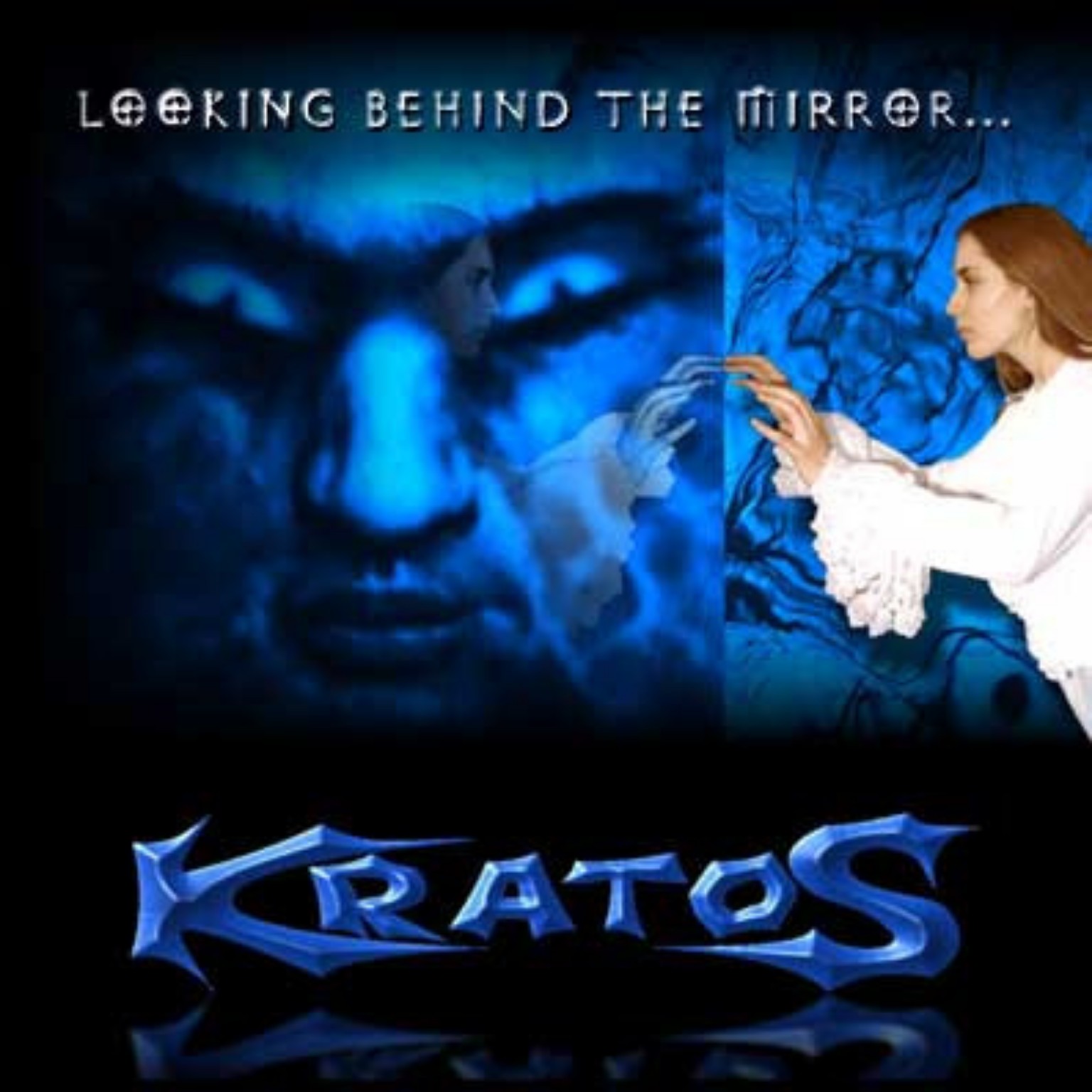
Cover artwork: Francisc Țințu · original 1999 artwork
Album details
Tracklist · original six-track cassette
- 01.Images03:09
- 02.A Waste of Time06:00
- 03.Piece of Us07:26
- 04.Inside the Storm07:21
- 05.Looking Behind the Mirror...13:22
- 06.Tempest Within06:26
Total running time: 43:44
Band members
- Monica Barta — vocals
- Daniel Dron — guitars, vocals
- Marius Zota — guitars
- Alexandru Blaj — keyboards
- Sorin Tudor — bass guitar
- Adrian Drenciu — drums
Recording and release
Recording and mixing: Oliver Vegh, Glas Transilvan Studio (Cluj-Napoca). Mastering: Kiss Loránd. Cover artwork: Francisc Țințu. The band’s discography contains a differing artwork credit, documented separately.
Official music services
Listen to the complete album
BandcampDigital album · download
The band’s official Bandcamp release
Physical editions · documented original
Verified release history and official catalogue · not a current sales offer
Original release: Bestial Records (Romania), 1999; BR 018; cassette.
Band contacts
01 / 14
01. The City That Rose Above the River
Beneath Bucharest lie older Bucharests. The same river linked the world of the princely court and the merchants’ town to the capital that would follow; street names and purposes might change, yet the ages built one upon another continued to live in buildings, institutions, and the roads joining one district to the next. The history of the banks of the Dâmbovița encompassed the proximity of the court, the multitude of workshops and markets, and, in time, every outward expansion of the modern metropolis. The ceremonial capital of the nineteenth century and the twentieth-century city centre spreading through new housing estates were different embodiments of that same long history., ,
The museum’s account traces the oldest evidence of urban life around Curtea Veche back to the thirteenth century. In the centuries that followed, the court of the Wallachian voivodes lent the settlement growing importance. The written mention of Bucharest in 1459 became one of the firm points by which its surviving past could be grasped; around the court, administration, religious life, commerce, and the crafts all found a place. The prince’s presence drew an entire urban order about it. Târgoviște and Bucharest long shared the function of princely residence, until after 1660 Bucharest’s importance as a capital acquired greater permanence. The ruins of the old court preserve traces of this slow shift in the centre of gravity.
Day after day, the growing settlement had to contend with its own density. Among houses, shops, and workshops, the cleanliness of the water, the disposal of refuse, and the ordering of the streets became matters of common concern. The life of the city depended upon the Dâmbovița, even as that same river repeatedly confronted its administrators with problems demanding solutions. The experience of epidemics and floods accompanied the gradual transformation of habits; new burdens did not disappear at the stroke of a single decree. Behind the public-health provisions of later times lay centuries in which the consequences of overcrowding were borne, again and again, by the communities of inhabitants.
On 23 March 1847, a great fire devastated Bucharest. More lies behind such a date than a tally of damaged buildings: shops and homes, livelihoods interrupted, and the entire pattern of streets awaiting reconstruction. The records of the Califarov archive preserve accounts of those who suffered losses, of neighbourhoods, rescue efforts, and recovery. The names and figures attached to the historical study also convey the scale of individual loss within this urban catastrophe. When the flames had passed, the long labour of rebuilding remained: where destruction had stood, the city had to organise a functioning life once more. Reconstruction became part of the transformation that would bring new institutions and new urban needs in the second half of the century.
One of the clearest signs of change appeared in the movement of people through the city. Horse-drawn trams arrived in 1871; on 9 December 1894, the first electric tram began running between Obor and Cotroceni. The tracks established regular connections between districts. The journey to a workplace, market, or public office could become a familiar part of daily life even across distances that the older city had perceived quite differently. The modernisation of the capital included the changing world of the royal palace and the imposing order of new public buildings, but it also included those rails: the lines by which the metropolis bound its own parts together.,
At the same time, music found new homes for its audiences. The conservatoire established in 1864 and the philharmonic society founded in 1868 offered institutional continuity to musical education and public performance. The history of the Athenaeum belongs to the concert life of the late nineteenth century; the survey of musical history associates its building with 1889. Opera, the salon, military bands, and bourgeois concerts together shaped the city’s listening habits. Different social and ethnic communities encountered European musical models while retaining customs of their own. The audience’s tastes, too, were formed within this intricate urban life.,
The preservation of traditional music followed another path. Collecting folk music called for patient documentation, organisation, and, eventually, sound recording. The history of the institute named after Constantin Brăiloiu provides an institutional setting for that inheritance. While a public audience for performed art was gathering in concert halls, collectors worked to ensure the survival of melodies handed down across generations and of local musical customs. The musical life of the same country possessed several kinds of memory; newer instruments and recording media would eventually join that diversity.
In time, Bucharest made room for electric guitars and amplifiers as well, and another generation began recording its music on homemade demos and cassettes. When the name Kratos appeared in this capital in 1996, its musical meeting places and audiences already had a long history behind them. Three years later, the story of Looking Behind the Mirror… bound several cities to one album: Bucharest provided the band, Cluj-Napoca the studio, Timișoara the label, while Buzău and Câmpulung Muscel marked important stops on the festival circuit. Music setting out from the city that had risen above the river travelled the roads of the country before assuming its material form., , ,
02 / 14
02. The Passage of Sound Through Walls
On 6 December 1916, foreign military forces entered Bucharest. During the occupation, which lasted until 1918, the capital’s institutions and buildings acquired other uses; military requirements reshaped the civilian city. Ration cards, restrictions, and the difficulties of everyday provisioning brought the war into the life of every household. The city’s standing as a political centre offered its inhabitants little protection from vulnerability. The memory of the occupation survived both in the histories of public buildings and in the smallest documents of ordinary life.
Between the world wars, the capital continued to exercise its cultural and political role, but destruction returned in 1944. Between April and August, Bucharest endured Anglo-American and then German air raids. Residential neighbourhoods and central buildings were damaged; the history of the royal palace likewise records the wounds inflicted by war. Another layer of absence was thus added to the city’s accumulated past. The decisions of reconstruction would already be shaped by a new political era.,
Post-war change led to a state-socialist dictatorship, and the monarchy came to an end in late 1947. State direction and ideological expectations framed the operation of cultural institutions. In that world, rock became one of the new languages of youth. From the 1960s onward, bands, clubs, radio programmes, and youth events made room for it, while administrative supervision repeatedly marked out the limits of what was permitted. The public life of guitar music developed between opportunities that opened and then narrowed again.,
Sound nevertheless travelled along many routes. Foreign radio broadcasts, records, and magnetic tapes maintained contact with music from beyond the borders. Radio Free Europe, Radio Luxembourg, and Radio Monte Carlo opened a listening space that would otherwise have been difficult to enter. A recording that could be copied made transferable what a single broadcast could offer only once. The club and the amateur festival could then turn music into a communal occasion: sound arrived in the midst of personal encounters.
Within the historical memory of Romanian rock, the names Phoenix, Sfinx, Timpuri Noi, and Iris are also associated with possibilities for cultural resistance. A radio retrospective drawing upon Emil Ionescu’s recollections evokes the relationship between the bands, their audiences, and the narrowly circumscribed public sphere. Performing, dressing, and appearing together in public could acquire significance in an era when the space for open political speech remained restricted. The way of life taking shape around rock offered means of expression extending beyond the notes themselves.
Within walls that had survived the city’s political eras, music wrote a history of its own. Club A emerged from the initiative of architecture students between 1967 and 1969, formally opening its doors in March 1969. A later historical survey counted 420 concerts and 150 bands. Among the nationwide festivals associated with the same name were those of 1969, 1971, 1979, 1981, and 1990: one generation inherited the meeting place from another, even as organisation and programming changed. Transformations after 1991 and towards the end of the 1990s brought fresh demands into the old premises; the club’s continuity was preserved not by a single audience, but by a succession of audiences.,
Meanwhile, the urban surroundings of Club A were threaded with ever-longer routes. New transport nodes appeared among the capital’s housing estates and industrial workplaces, until construction of the metro began on 20 September 1975. The first section opened to the public on 19 November 1979: 8.1 kilometres and six stations. The years 1984, 1986, 1987, and 1989 brought further stretches of line; expansion of the network continued in 1991 and 1992. From then on, clubs, concert venues, and the other meeting points of daily life occupied a capital connected not only by streets on the surface, but by transport beneath the ground.
In December 1989, the streets of Bucharest became the setting for a violent change of regime. The victims of the events of 21–22 December are commemorated in the city’s monuments and museums; Piața Revoluției remained one of the decisive places in the upheaval. After the dictatorship’s fall, the press, political parties, and cultural initiatives gained new possibilities. Yet the transformation of institutions, property relations, and economic connections took far longer than the few days to which public memory attaches the political rupture.,
Protests in University Square began on 22 April 1990; on 13–15 June, the miners’ intervention brought fresh violence to the capital. The actions of the police, followed by the presence of miners arriving on 14 June, revealed the gravity of the political struggles that followed the change of regime. The freedom of subsequent years was accompanied by economic uncertainty and social tension. In these changing surroundings, new independent stages and smaller cultural enterprises sought a place of their own. The next sound recordings would set out into a more open world, though one still far from settled in material terms.,
03 / 14
03. A World That Could Be Copied
A cassette was a small object compared with the distances it could travel. In the Romanian underground of the 1990s, demos, fanzines, letters sent through the post, and local concerts joined forces to create a public sphere. A recording made by the musicians themselves became news that could be passed on, while the printed page brought names and addresses into contact with the music. Editors also took on correspondence and translation; the distributor was often a member of the very community that attended the concerts. Behind such modest forms, a great deal of personal effort kept those connections alive.,
Photocopied pages and reports circulating by post traced the outlines of a single scene across different cities. In its 1995 report on Romania, SHISM named Tectonic, Altar, Neurotica, Cronos, and Grimegod. Alongside thrash and death metal, paths leading towards doom/death and gothic sounds were already visible. The foreign fanzine encountered no single national sound but workshops distinct from one another. Each name stood for a different city and a different musical choice, and the underground strove to carry precisely that diversity to readers farther afield.
The news then became something that could be heard. The Underground Romania compilations placed the music of Rising Shadow on the 1995 release; Grimegod, Taine, and Cronos appeared on the 1996 compilation, while the 1997 edition also brought Negură Bunget, GOD, and Hovercraft together. Across three successive years, the same principle of distribution endured: a single physical release opened a path for the voices of several smaller communities. Someone who picked up the compilation for one band could discover the others. Thus the nationwide web of contacts, previously sustained by letters and fanzines, assumed a tangible shape.
Behind the names on those compilations, separate histories were already unfolding. In Arad, Grimegod began in 1991; around the middle of the decade, Gothic became one of the noteworthy groups in the doom/death field, and a later press retrospective linked its 1998 album Touch of Eternity to Bestial Records. In Iași, the path of GOD was accompanied by the names of the Lăpușneanu brothers, Constantin and Eugen: after their beginnings in 1993 came the Iconografic demos of 1994–1996, followed by From the Moldavian Ecclesiastic Throne in 1997, within the Bestial label’s orbit. On the 1997 compilation, Negură Bunget represented another branch of Romanian black metal. Arad, Iași, and the other cities did not simply give different names to one sound; each contributed music of its own to the map of a scene taking form across the country., , , ,
Bucharest also offered this variety of sounds a stage and a competition. According to the surviving results of the Metalfan festival, held at the Hard’n’Heavy club on 11–14 May 1996, Taine won the grand prize, while in the doom/death category Gothic took first place and Grimegod second. The separate categories, performers, and awards spoke of internal standards already beginning to emerge. That same year, Bestial Records began operating in Timișoara: for death, doom, gothic, and other branches of metal, another route opened between the composition of a song and its appearance on a released recording. National gatherings and label work thus gave music heard in the clubs a lasting form in different ways.,
Printed forums often had short lives. In Adrian Dan’s 2017 recollection, Underground Chronicle, Ardeal, Tempest, and Pest appeared as publications that ran to between one and four issues. A great deal of work stood between an editorial plan and the next edition; yet paper could preserve what a later website might lose. The spread of webzines gave this activity a new direction, while the personal importance of print endured. Adrian Dan also recalled the first hundred-copy run of Rotten Romania: a small circulation, but a distinct undertaking in the service of preservation.
Alongside the rock and metal scene, other public forums multiplied in Romanian cities. The memory of Romanian anarchist publications, pamphlets, and fanzines was later preserved in the Anarhiva yearbook. Electronic music also drew upon older electroacoustic circles: following the work of Corneliu Cezar and Octavian Nemescu in the 1970s and 1980s, clubs in the 1990s created new places to meet. In Bucharest, the appearance of Studio Martin in 1994 and Web Club in 1997 marked this development. Rominimal would develop its distinctive international profile only in the 2000s; at that earlier time, the histories of the various musical communities still opened in many directions.,
Beyond the little fanzines and the world of the clubs, public radio also opened a new musical space. At eight in the morning on 24 March 1997, Radio România Muzical George Enescu began broadcasting on 72.08 MHz. With its classical and art-music programming, it was an institution of a different scale from a short-lived fanzine; yet both belonged to the widening musical public sphere of the time. Sound found its audiences by different routes: over radio frequencies and on photocopied pages, on club stages and through cassette compilations. The forms differed; the opportunities for listening continued to multiply.
The generation that wanted to enter this world with bands of its own was no longer without institutional precedents. A local stage might lead to a national event; a smaller label might take up a demo. In the autumn of 1996, Daniel Dron set about founding a new band in Bucharest. Its name was Kratos.
04 / 14
04. A New Name for Autumn
The band’s biography, written later, preserved the autumn of 1996 as the time of its founding. The exact date of the first rehearsal and the order of the meetings remain unclear; Monica Barta’s personal recollection, however, says that a female friend of the band suggested its name. The city and the founder’s name provide firm points of reference: Bucharest and Daniel Dron. Kratos soon moved forward with a recording bearing a title of its own. By 1997, The Essence had already given the band’s name a repertoire and left a path open towards the next album., ,
First-hand account by Monica Barta · First-hand written recollection · 31 October 2026
In the band’s biography, the autumn of 1996 has been preserved as the time of its founding. Dan, however, had already been flirting with playing guitar before that. I know he had even tried to start a band called SRI :)). It was something rather “small”, let’s say, without any official recordings, and at that time they rehearsed in the room every apartment block called the drying room.
As for the band’s name, it was found by a female friend of theirs at the time. Somehow the members connected with it, feeling that it was the perfect name for the idea and concept behind the lyrics.
Meanwhile, the elections of November 1996 altered the political landscape of Romania. On 3 November, the parliamentary election brought an advance for the CDR and a new arrangement of government. Emil Constantinescu won the second round of the presidential election on 17 November; a contemporary report dates his inauguration to 29 November. The democratic transfer of power entered the news as a historical turning point. Yet substantial state ownership and controlled prices remained in the economy: behind the swift dates of political change, the slower labour of transformation continued., ,
The band’s discography lists the singer Maria Tica among the personnel of The Essence. Two years later, the Looking Behind the Mirror… cassette named Monica Barta instead. A change of vocalist lies between the two records, although the exact date remains unknown. Monica Barta says Maria Tica left of her own accord; Monica only speculates about the underlying personal reason. One title, however, carries us between the two periods: A Waste of Time appeared both in the early repertoire and on the debut full-length album. The song survived while the line-up changed., , ,
First-hand account by Monica Barta · First-hand written recollection · 31 October 2026
Maria Tica’s departure from the band was entirely Maria’s personal choice… We already knew each other… Our relations were normal, good. Even now, when we meet at an event, it is a pleasure to stop and talk. I suppose her decision was something like a change of direction in her own life…
Knowing that Kratos were looking for a new female singer (at the time I was already involved in the metal community; I was writing articles about bands and musical events), this caught my interest, as I had some experience of singing from earlier on. I went to their rehearsal room, auditioned, and… we shook hands on it :)). Looking back, things intertwined and unfolded in a very beautiful way: how I entered the metal scene, how I got to know bands, and so on.
The title of the early material spoke of a search for essence, while the song carried over to the later album questioned the origins of human existence and the absence of answers. The two fields of meaning remained close. The band’s own questioning can thus be followed from the early recording to the full-length. Monica Barta’s first-hand account now confirms that A Waste of Time was re-recorded at Glas Transilvan during the album sessions, though it does not specify what changes, if any, were made to its arrangement., , ,
First-hand account by Monica Barta · First-hand written recollection · 31 October 2026
The song “A Waste of Time” was recorded again for Looking Behind at Glas Transilvan, when we recorded the entire album.
First-hand account by Monica Barta · First-hand written recollection · 31 October 2026
Regarding the album cover, as the title Looking Behind the Mirror suggests, the essential idea is that behind what can be seen “on the surface”, with the naked eye, there is something else; complementary elements, a “positive” side and a “negative” side that complete one another. Light cannot exist without darkness, “good” without “evil”… otherwise we would not name and identify them as light, darkness, good and evil… The human mind dividing the Whole as it searches for answers to what it does not yet understand.
By November and December 1997, the band’s concert archive was already listing performances in Bucharest. Soon after its formation, then, Kratos was appearing on stages in its own city. Demo and concert became successive landmarks in the life of the band: the recorded programme was joined by public performance. In the band’s own chronology of events, assembled later, these entries carry the founding year forward.
While the musicians rehearsed and performed, the country’s economic institutions were pursuing the difficult road to stabilisation. On 23 April 1997, the IMF approved a thirteen-month stand-by arrangement worth 301.5 million SDRs, equivalent, according to the conversion published at the time, to approximately 414 million US dollars. Curbing inflation, reducing the deficit, and structural reform were stated as objectives. The forecast projected a 1.5 per cent decline in GDP for 1997. The following year’s assessment reported a much steeper contraction: the distance between economic plans and the changes that actually occurred continued to widen.,
In this period of economic uncertainty, the world of physical media carrying music was changing too. Internationally, the CD was gaining ground, yet cassettes continued to live on in both large and small musical communities. Bands and labels adapted reproduction and distribution to the means available to them. The first Kratos full-length would appear on cassette: it found its place in a format already at home on the nationwide routes travelled by demos and compilations.,
05 / 14
05. Dark Melodies Across Europe
During the years in which Kratos began, heavy guitar music opened towards melody and atmosphere in several directions. At the boundaries of doom, death, and gothic metal, cleaner singing, layers of keyboards, and longer forms offered kinds of tension other than sheer heaviness. The relationship between contrasting voices became one of the important possibilities. On the international map of the mid-1990s, the Netherlands, Portugal, Norway, Finland, and the United States each appeared with different musical histories., , , ,
One striking Dutch example of melody meeting weight was The Gathering’s Mandylion, released in 1995. Clean female vocals sounded within a melancholy, atmospheric metal setting, while the instrumental foundation retained its force. Here, contrast did not merely offer an interlude between heavier passages; it became one of the supporting elements in the songs’ internal construction. Metal of the period increasingly made room for different vocal characters coexisting, and the building of atmosphere could become a power in its own right.
While the meeting of clean vocals and a heavy instrumental backdrop was establishing new proportions in the Netherlands, Portugal offered music of quite another kind of layering from Moonspell. Irreligious appeared on 29 July 1996; studio work between 25 March and 11 May incorporated male vocals, female guest voices, and synthesisers. An American review dated 1 September heard the work as gothic and eclectic metal: layered guitars and keyboards were accompanied by lyrics with literary reference points, some written in Portuguese. The production work of Waldemar Sorychta also entered contemporary interpretations. In this case, the widening of genre boundaries was already recorded in the words of a critic writing at the time.,
Another form of vocal opposition was preserved on Theatre of Tragedy’s 1996 album Velvet Darkness They Fear: deep, growling male vocals were set beside a clean female voice. This kind of contrast was later often called “Beauty and the Beast.” From Norway, Tristania carried forward a distinctive gothic-metal world on its nine-track Widow’s Weeds, released on 9 March 1998. The part played by contrasting voices and atmosphere is apparent from the fact that Kratos’s music would later be compared with the early work of these two bands. Such a comparison concerned musical characteristics; it was not a single label that erased all the differences between their sounds., ,
In Finland, the path towards female vocals began from a different point. According to Nightwish’s own retrospective, the founding idea was born in July 1996 at a campsite beside Lake Pyhäjärvi near Kitee; the project was originally conceived as acoustic music featuring a female singer. By 30 September 1997, that idea had led to the album Angels Fall First. In the Netherlands that same year, Within Temptation entered the world of albums with Enter, followed by Mother Earth in 2000 as another milestone. The same kind of vocal presence could find a home in very different instrumental and compositional surroundings., ,
Darkly atmospheric music did not live only on the records and in the clubs of European bands. The American group Type O Negative’s October Rust, dated 20 August 1996, was also available in a cassette edition on Roadrunner Records bearing the catalogue number RR 88744. Music from different continents reached audiences on different physical media; the coexistence of the LP, cassette, and CD belonged to the material reality of the time. Within this international diversity, smaller Romanian labels also brought their own repertoires to market: the many languages of music and the various means of its distribution were developing side by side.,
The later line-up of Kratos credited two vocal roles, two guitars, and separate keyboards. In the responses to the album, the melancholy of doom and the atmosphere of gothic metal were both invoked. Meanwhile, musical journeys within Romania connected tangible institutions to the work: a label in Timișoara and a studio in Cluj-Napoca joined the Bucharest band. The expanding world of European music and the story of its local realisation converged around a single album., ,
06 / 14
06. Along the Festival Route
On 17 July 1998, Kratos appeared at Top T in Buzău. The band’s concert archive associates that date with the Bestial Records Prize. The following year, the same label would appear on the band’s cassette under catalogue number BR 018. According to Monica Barta’s first-hand account, the special prize specifically included recording and releasing the album, with duplication and licensing. The precise date, written contractual terms and number of copies issued nevertheless remain unknown. The festival performance marked a point at which a stage appearance and the name of the future record label had already drawn close together., ,
First-hand account by Monica Barta · First-hand written recollection · 31 October 2026
At Top T in Buzău in July 1998, Kratos won the Bestial Records special prize. It consisted of recording the album and putting it on the market, including everything that entailed: duplication, licences, and so on.
It was a great opportunity for the band, a point of major importance for its future. Looking back now, it is wonderful to see that, despite the circumstances and limited resources of those times compared with today, there were and still are people who offered and offer support, who believe in music, in metal, in the metal movement, and most importantly, who believe that things can be set in motion, that they can work… and that together we make things move. I feel profound gratitude for that.
In September, the sequence of events led towards the foothills of the Southern Carpathians. Trade routes and connections across the passes had shaped the old commercial and political significance of Câmpulung Muscel; memories of its medieval development also survived in later surveys of local history. It was in this regional urban setting that Posada Rock took place. A nationwide network of festivals carried the metropolitan band onwards to towns with histories of their own and cultural audiences of their own.,
The thirteenth Posada Rock, held on 23–25 September, was a different stage from July’s Top T. The festival history names Kratos of Bucharest among the participants and among those receiving a “Mențiuni” commendation. The Bestial Records Prize awarded in July was a different form of recognition; the dates and distinctions of the two events must be kept separate. The surviving festival history also drew upon later reconstructions because the original participation sheets for certain years were missing. Nevertheless, the recorded result remains one of the documented stops on Kratos’s journey beyond Bucharest in 1998.
After Buzău, the name of Câmpulung Muscel entered the concert history of Kratos as well. The band had begun playing beyond the limits of Bucharest, with a distinction attached to each of the two appearances. The following year’s cassette had not yet been released, yet the songs and the band’s name were already meeting audiences onstage. The festivals led to musical circles in other cities, giving the year before the album a continuity of public performances.,
Between those festival years, Romania’s economic downturn grew deeper. In its statement of 6 October 1998, following consultations held on 15 September, the IMF described a GDP contraction of almost seven per cent for the previous year and forecast a further fall of about four per cent in 1998. Inflation had slowed, yet strains on the current account and public finances remained unresolved. Alongside the plans for stabilisation, processes continued that restricted the everyday possibilities of households and businesses. The distance between forecasts and the economic circumstances people lived through belonged to the history of that same country in transformation.
Another important destination for musical work was Cluj-Napoca. In 2019, looking back on Taine’s recordings of 1998, Andy Ionescu spoke of difficulties with instruments and finances, time spent in Cluj, and the promotional circle surrounding Nelu Brândușan. At Glas Transilvan Studio, an eight-track ADAT system operated alongside an analogue mixing console; Oliver Vegh carried out recording and mixing. The recollection of the creation of Cealaltă parte offers a closer glimpse of the workings of an entire studio circle. Before long, the names Glas Transilvan and Oliver Vegh would also appear on the Kratos cassette., ,
First-hand account by Monica Barta · First-hand written recollection · 31 October 2026
We went into Glas Transilvan studio in 1999, I think sometime from spring towards summer… I no longer remember the exact time of year. We stayed there for two weeks, during which we recorded the album. Oliver supported us throughout the recording, not just with “the technical side” but also with ideas about how particular passages might work or what we could add. In other words, the production side too. His involvement and support were one hundred per cent. It was an intense, beautiful and at the same time challenging experience for us. Naturally we wanted it to turn out as well as possible, and there was quite a lot of stress. But that is all part of the process, and I am glad we had the chance to experience it at that age. In the end, these experiences shaped both me and the others for what came afterwards.
07 / 14
07. The Transylvanian Workshop and the Six Names
The history of Cluj-Napoca led back to different centuries and different urban traditions from those of Bucharest. The grant of free royal city privileges in 1316 marked one of the decisive points in its medieval development. In modern times, the commercial and civic centre developed into a major university city where several languages and cultural traditions met. The documents of the Franz Joseph University founded in 1872, the institutional changes of the twentieth century, and the unification of the Babeș and Bolyai traditions in 1959 preserve ages layered one upon another. Centuries of professional life in the city stood behind the new enterprises of the 1990s.,
After the fall of the old regime, questions of minority rights and political representation remained part of the country’s public life. On the basis of the 1992 census, the 1996 WRITENET report spoke of approximately 1.62 million people of Hungarian ethnicity across Romania. Multilingual inheritance, institutional memory, and contemporary political debate remained parts of the same social landscape. In the city’s cultural life, old continuities existed beside new ways of working.
Musical institutions, too, possessed considerable historical depth. The history of the Gheorghe Dima Music Academy records a conservatoire active as early as 1819, with instruction in German and Hungarian, well before the state foundation of 1919. Professional musical life thus had several generations behind it. The modern private studio subsequently entered the same city’s cultural activities as an enterprise devoted to another kind of work: alongside teaching and live performance, recording required workshops of its own.
Among the musical workshops of Cluj-Napoca, Glas Transilvan Studio remains one of the secure locations associated with recordings of the period. Behind its activities stood a legally traceable company: GLAS TRANSILVAN STUDIO S.R.L. was registered on 20 June 1996 under number J12/1103/1996 and identifier 8574092. Behind this dry record, Taine’s memories of the studio evoke the human and professional details of creative work. In the case of Kratos, the original cassette named the place and the person responsible for recording and mixing: Oliver Vegh, Glas Transilvan Studio. Those two names therefore survive in a primary document belonging to the album itself., ,
The original mastering credit names Kiss Loránd, while the artwork is credited to Francisc Țințu. The cassette collectively credits Kratos with music and lyrics; Monica Barta identifies Daniel Dron as principal composer, Adi Drenciu as principal lyricist and Andrei Magureanu as author of some earlier Romanian lyrics. Bestial Records of Timișoara released the album. Monica says Oliver Vegh contributed production ideas as well as technical work; this does not in itself establish a formal producer credit. Recording lasted about two weeks in 1999, perhaps between spring and summer, though precise dates and equipment remain uncertain. Yet the list of credits for recording, mixing, mastering, and graphic design already reveals how many different kinds of labour came together in the finished album., , ,
The later official discography tells a different story on two points: it attributes both mixing and mastering to Oliver Vegh, and names Dan Șerbănescu in connection with the artwork. The original cassette and the band’s matching Bandcamp statement, by contrast, credit Kiss Loránd and Francisc Țințu for those tasks. The historical discrepancy between the published sources remains documented; Monica Barta’s first-hand account of 31 October 2026, however, corroborates the original cassette credits for Kiss Loránd and Francisc Țințu. For the personnel involved in the 1999 record, the contemporary printed credits are the most direct evidence; the later statement preserves its own account separately., , ,
Behind the instruments stood six musicians. Monica Barta was credited on vocals, Dan Dron on guitar and vocals, Marius Zota on the other guitar, and Sorin Tudor on bass. Adi Drenciu was credited with drums and percussion, Alex Blaj with keyboards. The later discography also expands the shortened given names to Daniel, Adrian, and Alexandru. Two guitars, a separate bass, percussion, and keyboards came together alongside two distinct singing roles.,
In the booklet’s group photograph, an architectural backdrop of arches gathers the performers into a shared space. The picture appears on the page with acknowledgements and credits, while portraits continue across the inner pages of lyrics in the same visual world. The record thus assigned faces to the instruments. The acknowledgements name Oliver Vegh, Nelu Brândușan, and Francisc Țințu; the band also expresses particular gratitude to the members’ families for moral and material support. The precise form and amount of that help are not given, but the gesture preserves the wider community behind the finished work.
The music associated with those six musicians appeared on the cassette as a collective creation. Individual songwriting shares and the internal decisions behind arrangements remain undocumented, although Monica Barta’s recollection now identifies the principal composer and lyricist. The relationship between female and male vocals, and between harsher and gentler musical characters, later became one of the important themes of critical reception. The band’s shared repertoire built a world out of its own contrasts: alongside differences of instrumentation and voice, the lyrics placed hope beside hatred, and fear beside purification., , , ,
First-hand account by Monica Barta · First-hand written recollection · 31 October 2026
Recording and mixing: Oliver Vegh
Principal composer: Daniel Dron
Principal lyricist for the “Looking” album: Adi Drenciu. Some songs were adapted into English; they had originally been written in Romanian by Andrei Magureanu (the band’s guitarist) and sung in Romanian at the time of the “The Essence” demo.
08 / 14
08. The Year Leading to September
In 1999, the Romanian economy was still searching for a path to stability. The restructuring of state-owned enterprises and the question of balancing the budget carried forward the legacy of earlier years. In spring, the Kosovo war confronted the country with foreign-policy decisions. The parliamentary declaration of 30 March spoke of a deteriorating humanitarian situation, urging protection for civilians, safety for refugees, and a negotiated political settlement. The conflict in the former Yugoslav region brought the questions of European security policy close at hand.,
On 22 April, Resolution No. 14 of the Romanian Parliament authorised NATO aircraft to use Romanian airspace for operations on the territory of Yugoslavia. The decision was accompanied by calls for further guarantees and a political solution. On 18 June, NATO’s own declaration addressed the refugee crisis and the framework for international settlement. The traces of the spring war thus remained present in official language as both a military and a humanitarian matter.,
On that same 18 June, Bucharest also looked back upon an older institution of rock culture. Club A celebrated its thirtieth anniversary with a gala at the Sala Palatului, featuring important Romanian rock performers and a compilation associated with Electrecord. The history of the club became an occasion for celebration. Alongside the memory of the old meeting place, newer cassettes, smaller labels, and private studios were already shaping the music of the present.
As the summer of 1999 neared its end, Romania was still contending with the difficulties of economic transformation. On 5 August, the IMF issued a statement about a new stand-by arrangement. The restructuring of state-owned enterprises and the establishment of a predictable market environment continued to present problems; the country also bore the economic consequences of the preceding Russian financial crisis and the Kosovo war. The approach towards the European Union imposed legal and political conditions upon Romania. The beginning of September arrived against this still unsettled economic background., ,
The week of the album’s release coincided with tangible moments in Romania’s economic transition. On the last day of August, no buyer had submitted an offer by the deadline for the state-owned shares in Upetrom, the petroleum-equipment manufacturer in Ploiești; on 2 September, the finance ministry was already announcing planned changes to excise duties for the following week. On one side stood the future of factories and state enterprises, on the other the burdens imposed upon everyday consumption. In this shifting economic setting, Bestial Records of Timișoara released a product of a different nature, but an equally physical one: a cassette containing six songs by Kratos.
The days of September led to the completed album Looking Behind the Mirror…. The physical cassette bears the year 1999, the name Bestial Records, and the Timișoara label’s catalogue number BR 018. A later announcement on the band’s Bandcamp page gives 2 September as the release date. The Kratos concert archive lists a Top T appearance in Buzău on the following day, 3 September, marked “album release.” The two dates remain immediately adjacent: one is the subsequently published release date, the other a performance associated with the documented presentation of the album. Monica Barta independently recalls the album’s launch at Top T in Buzău in 1999, without specifying the day. The cassette had become a release, and another public event took shape around it., , ,
First-hand account by Monica Barta · First-hand written recollection · 31 October 2026
The album “Looking Behind the Mirror” was launched in 1999 at that year’s Top T festival in Buzău.
On the day after the Buzău presentation, Romania’s national football team played in Bratislava. On 4 September, in a European Championship qualifier against Slovakia, Romania won 5–1; Adrian Ilie scored early, followed by Gheorghe Hagi, and Liviu Ciobotariu and Viorel Moldovan, the latter twice, scored in the second half. The two successive days in September offered different kinds of national publicity: in Buzău, Kratos’s concert archive recorded the presentation of its new album, while in Bratislava the national team’s victory carried news of Romanian sport farther afield.
On 28 September, after the album’s first presentation, the WTO’s trade-policy review of Romania referred to a third consecutive year of recession. Difficulties in restructuring state-owned enterprises and creating a predictable market environment persisted. The review also considered the economic effects of the Russian financial crisis and the Kosovo war; the legal and political conditions for closer ties with the European Union belonged to this same prolonged transformation. Cultural life continued through the closing days of September amid the drawn-out process of economic change., ,
After the early September presentation in Buzău, the last days of the month once again brought the festival road. According to its own concert list, Kratos played at Posada Rock in Câmpulung Muscel on 30 September. The festival history places the non-competitive 1999 event on 30 September and 1 October. After the recognition of the previous year, the band returned in the year of its album’s release; news of the finished cassette could also travel along the country’s festival routes.,
In later recollections, the year could shift. A Top T retrospective dated 28 April 2006 associated the Kratos record with 1998, whereas the original cassette, the band’s published release information, and the September album presentation converge on 1999. The newspaper article preserved the connection between the band and Bestial but passed on a different chronology of the album at this point. The year printed on the cassette retains its place despite the later discrepancy., ,
The six-song programme was divided between two sides. Side A carried Images, A Waste of Time, Piece of Us, and Inside the Storm; Side B held Looking Behind the Mirror… and Tempest Within. The printed timings added up to 22:59 for the first side and 19:49 for the second, making 42:48 in all. This seemingly modest object held a great expanse of musical time. The title composition alone occupied almost a third of the programme.
09 / 14
09. The Hand and the Face
Blue and black dominate the front of the cassette. On the right, a female figure in light clothing turns to the left; her hands reach towards the centre of the image. Opposite her appears a magnified fragment of a face tinted blue. The human forms are depicted at markedly different scales, and the space loses its everyday certainty. The image suggests confrontation rather than a clearly identifiable setting: a gesture and a face meeting in a relationship whose nature the viewer must consider further.
The vertical boundary running through the centre can also be read, in the light of the title, as the edge of a mirror. Near the pale hand, dark lines gather like branches or tendrils; the dress stands out sharply against the cold background, while the warmer colour of the hair provides a smaller counterpoint. At the top, narrow pale lettering spells out the album title; at the bottom, the fractured lines of the large Kratos logo close the composition. Between inscription and bodily gesture, the eye is drawn towards the face.
Photographic elements and superimposed layers create a world reminiscent of a montage. The title directs attention behind the mirror, beyond the visible surface, towards a place where another self or a meaning previously concealed might be suspected. The idea of turning back towards the light and emerging from sorrow also recurs in the lyrics. The identity of the woman on the cover and the precise meaning of the face remain uncertain, but the tension in their relationship is unmistakable. Francisc Țințu’s original artwork credit belongs to an image that supplies no ready-made story for its own gestures.,
The album’s singer, Monica Barta, has since clarified the cover’s concept from her own recollection: what lies beyond the visible surface and the complementary opposites of positive and negative, light and darkness. Her account does not itself establish the identity of the figures depicted.
In the early reception of the music, personal questions were likewise joined to melancholy. One short review emphasised the alternation of harder and softer melodies, rough vocals, and blues-inflected shades of doom. Later promotional material stressed female singing, male growling and singing, and atmospheric keyboards. Different words outlined the same darker emotional space, for which the image before the mirror became a visual gateway.,
After the cover’s images, the first audible piece on the album also bore the title Images. It was an instrumental introduction without sung lyrics, and the original cassette printed a duration of 3:10 beside it. Compared with the ensuing pieces, which lasted about six minutes or longer, it stood at the head of the programme as a shorter prelude. The album would bring together very different measures of time, with the title composition opening a much wider space over more than thirteen minutes. At this brief beginning, the songs approached the reader not through words, but through the sound of the instruments.,
After Images came the time for questions to be sung. The short surviving description of the album’s doom sound offered no separate instrumental history of this opening piece; nevertheless, the sequence and the absence of singing gave the transition a significance of their own: the words still had to wait. From the world of images, the album turned towards the questioning of A Waste of Time. The differing lengths of the six songs thus appeared not merely as timings but as successive stations on an inward journey., ,
10 / 14
10. The Time of Questions
A Waste of Time was already part of the repertoire of The Essence in 1997; on the 1999 cassette, it was allotted six minutes. After the instrumental opening, the song gives voice to questions about humanity’s place and origins. Many questions meet with few answers; the seeker after meaning arrives at silence. This first song with vocals therefore brings part of the band’s early history into the new album., ,
Day and night, the origins of earth, sky, and fire open out onto the most universal human questions. From creation the speaker turns to time: who may rule it, and what worth is there in a search that remains unanswered again and again? The title names the exhaustion of apparent futility, even as the voice continues to ask. The seeker’s condition becomes restless precisely because of this: uncertainty about an answer does not extinguish the need for meaning.
The voices of the past add the perspective of other lives to the individual’s question. The pain of hoping and weeping appears as a long human continuity, as though the same questioning passed through successive generations. Alongside the judgement of futility there remains the stubbornness of a renewed search. The composition preserved between the early material and the full-length album thus opens its intellectual journey: the person standing before time speaks the first explicit question.,
The album’s reception as melancholic, blues-inflected doom emphasised the coexistence of hard and soft melodic characters. This perspective is also close to the weariness that lives alongside the continuing urge to speak in the questioning lyrics. The brief review identifies the emotional position of the programme as a whole; the movement of meaning within A Waste of Time comes from the song’s recurring questions.,
At 7:27, Piece of Us became the next stage. After the great question of existence, the focus shifts to the contradictions residing within a human being. Hope and remorse, love and hatred, trust and betrayal crowd into the speaker’s life. The plural in the title opens up a common human space, even as the voice passes through its own experience. Fear, the uncertainty of victory, and trials of the will become the changing faces of the same person.,
The sequence of oppositions widens further. Fire and water, courage and fear, demons and angels, sun and moon are placed side by side. Poles that can be distinguished in the world coexist within a single life. Hope takes the place of a friend, hatred begins its attack, and emotions form an inner battlefield. The wish to force a star to obey the will expresses an extravagant desire; flight and hiding carry forward the consequences of uncertain control. The self loses its balance again and again.
The first vocal song had questioned the origin of the world; now the question is how so many conflicting emotions can inhabit one person. At moments the speaker recognises this multiplicity as their own life, at others they doubt even that. The “us” therefore speaks through the most personal experience: others may recognise themselves within it. The suffering, willing person remains the same, and the song does not make choice easy by banishing any feeling forever.
The coexistence of hope and hatred in Piece of Us can also be set alongside the band’s two vocal roles. The line-up named both a female and a male singer; later promotional material highlighted atmospheric keyboards, female vocals, and male growling and singing. Yet the original documentation did not assign individual verses of Piece of Us to each vocalist. The weight of the lyrics, built upon opposition, can therefore be heard without inventing a detailed division of parts: the foreground belongs to feelings struggling against one another within the same self.,
From the imagery of the instrumental Images, the album had travelled through two vocal songs into the interior of the self. Questions of creation had been followed by hope and hatred sharing a home, before the next title, Inside the Storm, named the location of the struggle. Side A moved towards ever denser human conflicts: the questions of the preceding songs awaited another answer within the storm.,
11 / 14
11. Between the Storm and the Mirror
Inside the Storm is the last track on Side A. The cassette gives its duration as 6:22, while the band’s digital release gives approximately 7:21. The figures differ by almost a minute; the cause remains unclear and does not, by itself, establish anything about whether the recordings or arrangements are identical. Its place in the original sequence, however, is unmistakable: the inward storm closes the journey that began with Images on the first side., ,
The storm in the lyrics is built of pain and fear. Its wind brings suffering, the seeds of death grow within it, and the leaves of joy fall away. Fear can bite, and threat takes on a bodily form. An entire world is wounded around the soul, while the speaker stands amid a succession of blows. The images draw attention both outwards and inwards: everything appearing to be the surroundings also gives form to the suffering within the human being.
Weapons, a bleeding soul, thorns, and a surging flood intensify the struggle. Faith and fear, sin and a dream falling apart arrive as different attacks upon the same place. The turn comes with the naming of the battlefield: the demons and the conflict are within. The storm thereby takes on the form of the soul’s own struggle. At the end of the cassette’s first side stands the person who is both caught in the maelstrom and carries its forces within.
Side B opens with the title piece. With a printed duration of 13:23, Looking Behind the Mirror… is allotted nearly twice as much space as several of its companions, accounting for almost a third of the complete 42:48 track listing. The work that gives the album its name becomes central in its proportions of time as well. The path leads from storm to mirror, but confronting oneself requires time: the longest composition brings together personal history and the possibility of change.
The lyrics open with the image of a soul glimpsed behind the glass of a mirror. Beyond one’s own face, thoughts turn to souls behind clouds and to a staircase one hopes to reach. The speaker looks back upon an earlier life: fantasies, wishes, flight, and hiding. In the pursuit of desired experiences, other people may also have been hurt. Thus the self comes face to face with its responsibility, and alongside suffering stands the suffering that it may have caused to others.,
This is what gives self-examination a new gravity. A Waste of Time had revolved around the absence of answers; in the title piece, change now concerns the person’s own life. Inner peace and a return to the light appear as possibilities that would demand a different view of the past. The broken mirror can also be read as the interruption of an earlier way of seeing; the face turning towards the sky seeks a new direction. Recognition does not make sorrow disappear, but the question moves towards the possibility of active change.
The address to the Lord, the longing for a time without sin, and the rebirth imagined through tears also give this search a religious meaning. The lyrics express a longing for purification while still asking how, and why, life might be lived differently. Doubt remains beside the promise. Looking behind the mirror does not make a human being simpler; it brings closer those parts of the self that were once easier to leave behind.
In the longer lyrics published on the band’s Bandcamp page, further images of fear and threat follow in the title piece. Passages familiar from Tempest Within also recur there. The kinship between the published texts can be recognised, but the identity of verses actually sung on the recordings, and the reason for that editorial arrangement, have not been established. Mirror, purification, and inward storm therefore remain closely entwined towards the end of the album. The woman and face turned towards each other on the cover occupy a common visual space with the lyrics’ self-examination., ,
The mirror both permits sight and separates the observer from what it shows. The gaze directed “behind” it searches for meaning beyond the surface. Looking back from here, even the title Images acquires a different light: the journey has led from the opening images to the album’s most extensive exploration of the self. Yet after the composition ends, one more piece remains: Tempest Within. The cassette’s closing track, lasting 6:26, names another storm, this time situated from the outset inside the person.,
Chains, dark fears, frozen breath, and the desperate demand to survive create a disturbing closeness. A speaking voice addresses the sufferer and feels their tears and fear, yet at the same time feeds upon their dreams and hope. The language of compassionate intimacy turns into threatening possession. The ghosts of the past and hidden fear find the person once more; the inner enemy draws its strength from the substance of that life itself.
From a sea of despair, the final questions seek forgiveness and a better path. Is it possible to be freed from the demons, to go onwards in another way? The questioning that has endured since the first vocal song has travelled from the great mystery of origins to the transformation of one’s own life. The person must now live with themselves. Turning towards the light was a possibility in the title composition; Tempest Within preserves beside it the continuing threat.
Together, the final two tracks give Side B a coherent progression. After the desire for purification, past and fear endure, and confrontation leads to yet another question. The album ends in an unfinished human condition: the inward storm of the person who questioned time has not yet subsided. Within the relationship between the six titles, hope and uncertainty both retain their places, and not even the cassette’s last minutes force this journey into a single certain interpretation.,
12 / 14
12. The Cassette’s Echo
The six-song programme found unity in its contrasting proportions of time and its shared themes. After the instrumental opening came vocal pieces lasting around six minutes or more, while the title work, extending beyond thirteen minutes, became a centre of gravity in its own right. The lyrical arc moves from images to the origins of existence, then to human emotional contradictions, inward struggle, and self-examination. The two sides of the cassette held this movement together in their physical sequence. Later digital timings indicate a programme approximately one minute longer, mainly owing to the difference in the duration of Inside the Storm., ,
Alongside the two credited guitars and a separate keyboard position, two different vocal roles gave names to the contrasts between performers. The dualities of hardness and softness, weight and melody, also entered the language used about the record. In response to emotions clashing within the lyrics, listeners noted the alternation of vocal characters; from the Romanian cassette scene, the album entered international comparisons involving doom and gothic metal., ,
Three years later, the cassette still reached a critic’s desk. In 2002, a short review in Sonic Splendour described the music of Kratos as melancholic doom metal with a blues foundation. It heard rough, brutal vocals alongside an alternation of hard and soft melodies. The recommendation was favourable but restrained, aimed chiefly at listeners who preferred the more melodic direction. The review offered no documented numerical score and did not attempt a track-by-track analysis; in a few sentences, it captured the mood and the coexistence of opposing musical characters.
The adjective “bluesy” named the melancholy from a different direction than the gothic comparisons that would come to the fore later. The value of the review lay precisely in its measure: it tied its recommendation to personal liking and the tastes of the intended audience. The account of 2002 was already looking back on the cassette from several years away. The album’s echo thus continued beyond its release in 1999.
When the old songs became the focus of another review in a seven-track release identified as a 2004 promo, a different language emerged to describe them. The promotional programme opened with Reverse Effect (2004 new), followed by the original six tracks in their earlier order; the review also mentioned a multimedia promotional section. The year 2004 is the designation of the material, while the exact date of the review’s original publication remains unclear. The promo evaluated in this form received a favourable score of 8/10. This later judgement heard the old six songs within another frame.
Atmospheric keyboards, female vocals, male growling and singing, and a sorrowful gothic mood came to the forefront of the description. Early Theatre of Tragedy and Tristania, together with Paradise Lost, served as stylistic points of reference. The recommendation still left room for differing tastes among listeners. Alongside the higher numerical rating remained an awareness that recognising musical kinship, and feeling drawn towards it, are matters of individual reception.
The difference between these two reviews lay less in complete agreement than in shifting emphasis. The Sonic Splendour review of 2002 approached the cassette through doom and blues-inflected melancholy; the account of the 2004 promo foregrounded gothic atmosphere and contrasts between voices. Behind shared emotional characteristics stood different programmes and different historical circumstances: Reverse Effect now served as a new opening before the six older songs. The initial reception of the 1999 cassette and the later evaluation of the promo therefore remain two distinct moments in the afterlife of the band’s music.,
Meanwhile, Kratos’s debut retained its own historical identity. The joint work of six Bucharest musicians reached cassette through a label in Timișoara and a studio in Cluj-Napoca. The spacious title piece and the recurring pursuit of self-understanding held the programme together. Precise paths of local accomplishment were joined to new possibilities opening in European metal; the later reception carried forward the work originally issued on this modest object.,
13 / 14
13. The Tracks Leading Onward
A self-released CD-R of the Looking Behind the Mirror… material was also produced in 2002. After the original six tracks, Reverse Effect appeared in seventh place, marked “promo 2002.” The front rearranged the earlier artwork in different proportions, and the back cover recorded the expanded programme. In the later promotional review, the same title bore the notation “2004 new” and moved to the beginning of the sequence. The differing date labels and positions remain; whether the two recordings are identical has not been established.,
The old songs, meanwhile, continued to live beyond the physical release in the band’s history. In 2016, Sebi Boke recalled a journey to Pitești in 2001. He and his friends had set out for a Kratos concert at which he hoped to appear as a guest. Delays and extraordinary misadventures on the railway journey, however, frustrated the plan; the shared performance never took place. In this instance, memory preserved what had not happened onstage: a meeting that had been planned, and the failure of the journey meant to bring it about.
The difficulties of organising events also belonged to the underground’s musical connections. An older Axa Valaha interview with Mihai “Coro” Caraveteanu discussed the four Turris Metal Night events held between 1998 and 2001, possibilities for distribution abroad, and the financial sustainability of promotion. Kratos appeared both among the performers and among the bands associated with Axa Valaha Management. Metalfan republished the conversation on 19 December 2024; the original year is incomplete in the surviving date line. Within the later republication, the voice of an earlier period of concert organisation remained audible.
In another interview, dated 8 October 2018, Caraveteanu recalled an evening at Club A in Bucharest in January 2004. Avatar and Kratos shared the bill with a Bulgarian band; the concert had to take place between 6 p.m. and 10 p.m., because a disco programme followed later that night. The venue’s time was divided among several audiences and kinds of entertainment. The underground organiser had to find, within these boundaries, the few hours during which he could gather his own bands together.
The organiser’s recollection placed the concert on 31 January and mentioned 494 paying spectators. The Kratos list, however, dates the shared evening of Avatar, Hyperborea, and Kratos to 30 January. The discrepancy of one day remains between the two accounts; the attendance figure comes from Caraveteanu’s later recollection. The history of the tightly scheduled concert thus survives with two different dates. The community of performers and the venue’s programme both belong to what no mere list of records could reveal.,
The old songs continued to travel after their cassette release. The self-issued CD-R carried them onto another format, while performances and club nights offered further opportunities to be heard. There was also a cancelled guest appearance and an unrealised plan, preserved in the later recollection of an organiser; on other nights Kratos shared the stage with other groups. In the 2004 promo, the new Reverse Effect was placed before the earlier six tracks. From 2006 onward, the band’s concert archive lists performances in several European countries, while the next decade brought further record titles and professional collaborators. The continuation of the old programme therefore unfolded not through a single new edition, but through a variety of musical encounters., , , ,
14 / 14
14. When the Old Song Returned
The band’s biography records the title Beyond Knowing for 2010 and It’s Empty for 2013. A Maximum Rock news item about It’s Empty II, dated 5 October 2013, however, described an eleven-year interval after Reverse Effect without a new original song. The two accounts set different boundaries around the intervening years. The image of a long silence remains a powerful phrase in the press, while the biography’s 2010 milestone does not disappear beside it. Concert performances and the history of recordings released do not necessarily move at the same pace.,
In its report on It’s Empty II, the news item named Jens Bogren for mastering and Costin Chioreanu for artwork. The professional credits had branched away from the names associated with 1999: Oliver Vegh, Kiss Loránd, and Francisc Țințu. The sound and visual presentation of the band’s new period were linked to new collaborators. The old cassette, meanwhile, remained among its predecessors with a six-song world of its own.,
On 6 May 2016, the Fabrica venue in Bucharest hosted the launch of Arlechino. Inside the Storm was performed that night, alongside Reverse Effect, and former bassist Sorin Tudor appeared as a guest. The presence of one member of the earlier line-up gave the connection across time a personal form. A song from 1999 became part of a concert presenting a new album in the present. The composition about an inward storm had travelled beyond the medium on which it first appeared.
A Dutch review of Arlechino awarded the 2016 album 76/100 on 23 June. It recognised the old debut as a predecessor, while emphasising symphonic, dark, and gothic elements in the later music, a powerful keyboard presence, Monica Barta’s vocal performances, and Dan Dron’s growling. Modern riffs also entered the description, although the writer considered certain compositions weaker. Reservations therefore remained alongside the favourable assessment. The score of 76 belonged to Arlechino, the later work that carried a long history forward in a new sound.
Foreign reception could occasionally get even the band’s geographical origin wrong. One sentence in the Dutch review described the Romanian Kratos as Hungarian, although the early records locate the band in Bucharest. The later judgement and the historical identification left conflicting traces within the same text. The music reached audiences of other languages, yet the information circulating about it did not always faithfully reflect the evidence of the original cassette.,
A web introduction to the issue of Pařát published on 17 June 2016 presented an interview with Monica Barta. It recalled the 1999 album as a pleasant memory that had once seemed to belong to a concluded past; from that viewpoint, Arlechino was an unexpected continuation. Seventeen years later, the old record could still be called back to mind. The introduction clearly preserves this much of its reception history: there was a memory of the cassette that stirred again at the news of a new release.
Monica Barta’s name later surfaced in another creative setting as well. A WarHymn interview of 13 November 2022 linked her to a guest contribution, adding a further stage to the career of the singer heard in 1999. Kratos’s past thus continued through songs and people alike. Inside the Storm found another occasion on the Fabrica stage, while the former contributor’s name led on towards other music.,
Decades later, the bands once placed beside one another on Underground Romania compilations still traced recognisable connections in the memory of the Romanian underground. A press article published on 5 January 2025 listed GOD, Gothic, Taine, Grimegod, L.O.S.T., Cronos, and Anarhia among the performers announced for a Quantic event in Bucharest on 10–11 January. In place of the shared pages of the old cassette compilations, a two-day concert programme now brought different generations near one another. The survival of the old scene was signalled not only by recordings that remained, but by communities preparing to meet again.
Many names returned in the history of the scene, but the memory of Looking Behind the Mirror… remains bound to a single six-song programme and to the names of six musicians. From Bucharest’s long urban history, the path of Kratos led to a workshop in Cluj-Napoca and then to the BR 018 cassette issued by Bestial Records in Timișoara. On the first side, instrumental images opened into questions, questions into inner contradictions, and finally into storm; on the second, a gaze turned behind the mirror in search of the possibility of purification. Fear had not disappeared even in the final song. The album’s human time therefore continues in unresolved tension: the questions of the person in search of themselves remain open even after the closing sound.,