


Majestic Nothingness
The story behind Majestic Nothingness, from Sydney to Norwegian studios: Astennu, Nagash, the songs and the 1997 release. The complete English album essay.
Album details
Tracklist · original 7 tracks
- Temptress Luna06:58
- Requiem Spell04:36
- Velvet Claws05:15
- Drain the Labyrinth07:22
- Perpetual Dancer04:52
- Sullen Becometh07:24
- Blood Dance07:03
Band members
- Astennu (Jamie Stinson)
- guitars, bass, keyboards, drum programming, songwriting and additional vocals
- Nagash (Stian Arnesen)
- lead vocals
Guest musician and contributor
- Ariadne A. Donnelaith
- female vocals, lyrics and conceptual contribution
Recording and release
- Recorded
- 1995 · Norway and Australia
- Studio
- Creative Studios (Norway); J Wank Hard Studios (Sydney)
- Original release
- 1997 · Head Not Found · HNF 036 · CD (7 tracks)
- Verified later editions
- 2001 · Head Not Found, CD; 2023 · Nuclear War Now! Productions, CD / LP / cassette
- Formats
- CD, LP and cassette (different editions)
Official music services
The online editions may have different release dates from the original 1997 CD. Retailer stock may change.
Listen to the full album
YouTube · third-party upload, not an official label channelPhysical editions – where to find them
2023 · Nuclear War Now! Productions · LP / CD / MC
Long Roads in Sydney
The road to Carpe Tenebrum's first album began in Sydney. Jamie Stinson, who became known in the metal world as Astennu, studied there and developed his first way of working in a band before his career brought him into contact with Norwegian musicians, studios and a record label. Majestic Nothingness, released in 1997, belongs to the shared story of those two countries. Alongside the Australian origins of its guitar themes came Nagash's lead vocals and Ariadne A. Donnelaith's work on the lyrics, concept and vocal parts. Behind the album's Norwegian label identity lay a creative process that had begun much earlier and reached much farther afield.
Since the nineteenth century, Sydney had grown as a port, a centre of trade and a destination for immigration. British colonisation, the dispossession of Indigenous communities and the history of later arrivals formed successive layers of the city. Its industrial and service districts, railway suburbs and inner neighbourhoods of widely differing social circumstances did not offer the same lives to everyone who put the same city name on their letters. In the 1990s, musicians moved through this many-centred urban landscape on their way to school, rehearsals, record shops and concerts.
Places would continue to play different roles in Astennu's career. Sydney was linked to his beginnings and his first instrumental material; personal connections in Norway took shape in Sarpsborg; Oslo offered meeting places and a centre for record labels. South of the capital, the Kolbotn–Sofiemyr area entered the album's story through Creative Studio. Before those locations became connected, however, a young guitarist had to learn how to turn his varied musical experiences into songs of his own.
Incubus, later the bassist of Lord Kaos, recalled a quieter life on the outskirts of Sydney in a 1996 interview with Nefandus. He described Leppington as a sparsely built-up, wooded fringe area where the rural surroundings and long journeys shaped how young people spent their free time. From there, going to clubs in the city centre required travel, planning and a schedule adapted to the distances involved. Leppington was the area where he said he lived. Astennu's childhood neighbourhood cannot be established with the same certainty; his surviving story can reliably be traced only within the broader Sydney area.
Astennu later said that he had picked up a guitar as a small child. During his final two years of high school, he followed an educational programme that combined general subjects with intensive musical training. Instead of the contemporary popular-music stream, he chose classical music. He found music theory difficult, but the discipline left him with knowledge he could use: his ear, instrumental technique and sense of musical structure developed together.
Alongside his school education, he considered practice at home decisive. Metallica riffs sharpened the rhythmic accuracy of his right hand, while Megadeth songs exercised the movement of his left. He named the solos of Marty Friedman, Alex Skolnick and Rocky George among his models. Classical discipline and the practice of metal guitar therefore became equally embedded in what he sought from his instrument. In a 2025 interview with The Gallery, he traced this duality even further back: classical music had filled his childhood home, although metal attracted him most strongly.
The extreme music of the early 1990s gave that interest a new direction. In his long retrospective interview of 2024, Astennu spoke about the overwhelming power of Emperor's In the Nightside Eclipse, the pulse of Satyricon's The Shadowthrone and the keyboard lines that seemed to live a life of their own in early Cradle of Filth. The Gathering's Always… was another important discovery. These musical experiences came one after another, each changing his idea of the music he wanted to write.
He did not abandon his earlier guitar training in the process. He still wanted to use the skills he had acquired from thrash and solo-oriented metal, but he made melody serve the song as a whole. As he remembered it, the material for the first Lord Kaos album came together during a period of rapid creativity: after school, he wrote new ideas and then took them to rehearsals. The synthesiser offered a way to place an independent musical thought alongside the guitar. Not every part had to follow the same movement.
Incubus dated the beginning of Lord Kaos to 1994. In Nefandus in 1996, he said that he and Astennu had started organising the band together. A drummer and a keyboard player initially performed with them, while Nocturnal Funeral handled the vocals. After internal difficulties, the drummer and keyboard player left, but work on the music continued. They chose programmed solutions for the rhythm and keyboard parts, creating a different kind of workshop in place of a conventional band line-up.
Incubus named Astennu as the writer of most of the music. He described the construction of the drum and keyboard parts as meticulous, note-by-note work that demanded a great deal of time. The instrumental centre of the later Carpe Tenebrum can already be recognised in this Sydney practice: the composing guitarist gradually took responsibility for more and more tasks. The lack of a drummer created a situation to which the band responded by changing its working methods.
The independent 1995 cassette demo Path to My Funeral Light credits four participants. Lord of Night Summoning sang, Incubus played bass, Astennu handled guitar and drum programming, and Octavious was listed on keyboards. The release comprised six tracks, with the brief opening piece identified as an instrumental. The line-up recorded on this demo preserves one early state of Lord Kaos and differs from the division of labour on the later Carpe Tenebrum album.
The interviewer at Nefandus heard an atmosphere reminiscent of Emperor in the music. Incubus explained the similarity through the mood-setting use of keyboards, not through any intention to reproduce another band's music unchanged. Alongside the guitars, the keyboard parts had therefore already become one of the music's main pillars before Majestic Nothingness reached its listeners.
Astennu would later recall the creation of Crystal Lakes as a particularly important turning point. In this Lord Kaos song, the keyboard was no longer meant simply to double the guitar notes. He could try out a riff, a rhythm and a keyboard idea independently, then rearrange the sections. He worked with a four-track tape recorder, a computer and MIDI equipment, taking some of the devices to the rehearsal room as well. He remembered that Nocturnal Funeral had supported the new direction even before the first presentation of the material was halfway through.
Rehearsals therefore often began with a structure already prepared. Through experimentation at home, Astennu could decide which section would follow another and how the guitar and keyboards would answer each other. What he brought to the other musicians was not merely a collection of riffs placed side by side, but a possible song. His memory of Crystal Lakes makes this division of labour tangible: a similar practice already existed before the concentrated arrangements of Majestic Nothingness.
Meanwhile, Lord Kaos found an audience onstage. In 2023, Astennu remembered their weekend performances in 1994 and 1995 as more successful than expected. He mentioned a Sydney venue called the Agincourt and audiences of several hundred; in his view, the crowd extended beyond the narrower circle of extreme-metal fans. This was the musician's estimate many years later, but it clearly conveys the importance he attached to those local shows.
Nefandus preserved a closer account of another evening. On 15 June 1996, the magazine saw Lord Kaos, Neuropath and Oracle of the Void perform together at the Tomb. The writer reported a small audience but considered Lord Kaos an increasingly accomplished act with room to develop. He mentioned the painted faces and paid particular attention to Nocturnal Funeral's stage presence. The memory of a more successful Agincourt show and the more modest night at the Tomb together reveal a working local band: they performed regularly, but the size of the audience varied from one occasion to another.
The next step seemed to be a record release. In February 1996, Incubus spoke of a contract that had not yet been signed and expressed the hope that a CD would soon appear through Warhead Records. Plans involving the local label were therefore already part of the band's public history. Later, when Astennu recalled the conflict surrounding a Norwegian offer, that existing Australian relationship represented a real alternative.
Thorns of Impurity is listed as a 1997 release in the discography of Warhead's CD WHCD15, although other band histories give 1996. The recording, the agreement and the actual release did not necessarily take place at the same time. Alongside the Sydney studio work, mastering at 301 Studios is associated with this Lord Kaos album. It was from this local creative and record-label setting that Astennu moved on, already accumulating new musical ideas of his own.
Between Cities on a Distant Continent
The Sydney world surrounding Lord Kaos was one part of a broader Australian music scene. Distances between bands, the work of local record labels and sound engineers, record shops and occasional national gatherings all influenced how far a group could go. The underground scenes taking shape in different cities were connected by musical affinities, but that did not give everyone the same opportunities.
Benjamin Hillier's research into the history of Australian extreme metal follows the differences that emerged from the thrash scene of the 1980s. Alongside Sydney, Melbourne and Brisbane, independent communities formed in other states as well; varieties of death, black and war metal became linked to local studios and distributors. By the mid-1990s, an Australian infrastructure already existed that could support records and concerts as well as international contacts.
Placed side by side, the 1993 releases Transcendence Into the Peripheral and Jar of Kingdom, Bestial Warlust's 1994 Vengeance War ’till Death, and the 1995 albums Lunasphere and Totem trace several different paths. disEMBOWELMENT, Alchemist, Bestial Warlust and Nazxul worked with heaviness, melody, extreme tempos and experimental arrangements in differing proportions. Meanwhile, the language of thrash guitar did not disappear: Sydney's Addictive and Perth's Allegiance carried its earlier rhythmic and instrumental vocabulary forward in different ways.
Hillier singles out galloping rhythms and modal harmonies in Addictive, and a stronger emphasis on chromatic writing and riffs built from full chords in Allegiance. Such distinctions matter because they show how much active musical practice survived from thrash into the mid-1990s. Astennu's practice with Metallica and Megadeth fits into this wider guitar culture; that does not mean, however, that the influences he personally named can be replaced with any other band from his surroundings.
On other recordings, slowness and sustained notes became the principal forces shaping the music. Hillier examines the meeting of extremely slow, dissonant passages and faster death-metal sections in disEMBOWELMENT. On Paramaecium's 1993 album Exhumed From the Earth, he describes less extreme tempos, heavy, measured rhythms and, in some passages, operatic female vocals. The funeral doom of Mournful Congregation joined elongated melodies to clean acoustic guitar and long, held notes. Female voices, expanded forms and acoustic passages thus served distinct purposes in different branches of Australian music.
Perth's Infected took another direction with its 1995 release Control. In the opening of Entry Wound and in Blood, Hillier discusses samples, distorted speech, synthesised intervals and heavily manipulated effects. An industrial environment had become part of the sound itself. Alchemist's Garden of Eroticism created another kind of crossing: harmonies introduced by marimba, psychedelic passages and death metal all met in one piece. Keyboards and atmosphere did not belong to a single genre. Different composers approached them from different directions.
The division of musical labour also varied between bands. On Nazxul's 1994 cassette demo, three musicians played several instruments, including keyboards, but there was a separate drummer. On Baltak's 1995 album Macedonian Darkness and Evil, guitar, keyboards, programming and vocals are credited under the name Gorgoroth, while Steve the Mechanix appears as the drummer. Programming could therefore coexist with live drums; it did not always fill the same kind of gap.
Bestial Warlust's 1994 album Vengeance War ’till Death involved two guitarists, a separate drummer and a bassist. The recordings are associated with Carlton, a district of Melbourne. Far from Astennu's beginnings in Sydney, this location nevertheless represented a different organisational form within the same national underground. In Nazxul's 1995 album Totem, Hillier identifies relationships between the lower registers and guitar parts that differ from the high, penetrating sound often associated with Norwegian black metal. Even Australian records placed within the same genre do not add up to a single shared sound.
Within Deströyer 666's blend of black and thrash metal, the balance could change inside a single composition. Hillier connects the tremolo-based passages of Unchain the Wolves with the atmosphere-making of black metal, while following the momentum of thrash in other sections built around triplets or syncopation. In Australian and Anti-Christ, he also examines the rhythmic divisions shared by guitar, bass and drums. Gospel of the Horns turned more strongly towards older thrash and the first wave of black metal, even though the networks of musicians partly overlapped.
Around Adelaide, StarGazer, Cauldron Black Ram, Misery's Omen and Martire formed a different black/death milieu. Damon Good and Denny Blake worked in several groups. The period's documentation includes demos and singles: StarGazer's Gloat cassette appeared in 1996 and the Borne single in 1997; Cauldron Black Ram's self-titled demo also dates from 1997. The 2020 reissue of StarGazer's early material belongs to a much later chapter of this history.
Hillier describes StarGazer's music as combining an emphasis on the low register, chromatic and dissonant death-metal devices, and the tremolo melodies of black metal. In contrast, he highlights a mid-paced, triplet-based groove in Cauldron Black Ram's 1997 demo song From Dawn, Now Stone, while the vocals and atmosphere retain more features of black metal. Comparing Martire's 1991 EP with the 1998 single Lucifer also reveals changing proportions of rhythm, riffs and vocal style. The latter appeared after Majestic Nothingness: it continues the story of musical exchanges rather than proving an earlier influence on the album's composer.
In Tasmania, Russell Menzies, known as Sin Nanna, developed another form of concentrated creative control. After the earlier project Kathaaria in 1994, he worked under the name Striborg from 1997, organising the undertaking around a single person. Images of landscape and isolation gave it a distinctive artistic world. One musician likewise took charge of the fundamental instrumental work on Carpe Tenebrum's debut, but the vocals, lyrics and concept were shared among several people. Nagash and Ariadne's contributions therefore remain independent parts of the album's history alongside Astennu's central role as composer.
Everyday places such as the Utopia record shop made the circulation of music possible. Foreign recordings, information, opportunities for correspondence and personal acquaintances came together in shops. Mail order and cassette trading maintained networks inherited from the 1980s, while Three Hours of Power, a programme launched on Triple J in 1990, gave extreme music access to a national radio audience.
In Canberra, Metal for the Brain began in 1991 as a benefit concert following Alec Hurley's injury. Armoured Angel initially stood behind it; after the band's dissolution in 1996, Alchemist continued the organisation. The annual event allowed bands and audiences from different cities to meet. But personal contact had different practical requirements from regular touring: even a major gathering could not change the country's immense distances.
Hillier describes the Melbourne–Sydney–Brisbane route as a journey on the scale of roughly 1,800 kilometres. Most musicians supported themselves through other work, so travelling required time off and a workable schedule as well as money. By European comparison, Oslo, Gothenburg, Stockholm and Helsinki lay within a denser network of connections, although international travel was costly there too. Reaching a European or American circuit from Australia required airfares, the transport of equipment, accommodation and enough money to cover lost earnings.
After Armoured Angel's tour of Europe and America in 1995, the band broke up the following year. Drawing on a participant's later recollection, Hillier attributes a role in this outcome to the strain of travel and the members' exhaustion. Sadistik Exekution's appearances in Europe, however, demonstrated a different possibility. Routes abroad existed, but they were not equally viable for every local band. The later disagreement between Astennu and his colleagues who wanted to remain in Australia acquired weight within this practical world.
In 1996, the editors of Nefandus, The Unnamed and Nefastus, wanted to communicate in two directions: to introduce foreign extreme metal to Australians and the domestic underground to international readers. Their Lord Kaos interview and concert report formed part of that undertaking, while their short reviews preserved something of what listeners of the period paid attention to.
Writing about December Wolves, they mentioned acoustic and keyboard parts as well as female vocals. They praised the comparatively restrained keyboards and female voice on a 1996 record by the Dutch band Liar of Golgotha, and noticed the role of the synthesiser on the American Black Funeral album Vampyr – Throne of the Beast. They described Vorak as a group extending the boundaries of symphonic black metal. On a demo by Brisbane's Porphyria Coven, they highlighted the two-person core, the guest vocalist and the atmospheric introductions taken from films.
A review of Alchemist's Lunasphere heard experimental music connecting several genres. In another conversation, a member of Baalberith included Lord Kaos among the local bands deserving support. The community thus began to take shape in its own printed memory. The textual and vocal diversity of Majestic Nothingness belonged to this period, although Astennu's own statements remain the source for the particular influences he named.
The City's Changing Years
While Astennu was working on Lord Kaos songs, Sydney was preparing for the 2000 Olympic Games. Winning the right to host the event encouraged investment in transport, sports facilities, hotels and property. Yet the metropolis's expansion affected communities in different ways: alongside new developments, questions of housing, public services, social welfare and limits on public spending remained part of everyday politics.
In New South Wales, the Liberal–National government that came to power in 1988 initiated privatisation and administrative reforms. In the debates of the following years, independent members of parliament and institutional oversight gained in importance. The 1995 election brought a narrow victory for Labor. Bob Carr took over as premier from John Fahey on 4 April 1995, linking the years in which Lord Kaos developed to a change of government in the state.
A national change followed on 2 March 1996. The Liberal–National bloc won 94 of the 148 seats in the Australian House of Representatives, with 49 going to Labor and five to independents. The local music scene was a small part of this changing society, operating through institutions of its own. The dates of political history mark the same years on a different scale from that of the rehearsals and shows remembered by the musician.
Economic recovery and uncertain livelihoods characterised the period at the same time. According to the Reserve Bank of Australia's 1995 report, unemployment fell from 11 percent in 1992–93 to 8.3 percent by June 1995. Growth in domestic demand and an imbalance in foreign trade were both features of the strengthening economic cycle of 1994–95. Yet improved indicators did not mean secure job opportunities for many young people.
Growth slowed in 1995–96, the earlier rapid rise in wages eased, and unemployment remained around 8.5 percent. The central bank loosened monetary policy in July 1996. Conditions for people who had been out of work for an extended period improved somewhat, but long-term unemployment did not disappear from the country's social problems.
By August 1997, the year in which Majestic Nothingness was released, inflation had fallen below 2 percent. The economy accelerated again in the first half of the year, while unemployment had remained close to 8.5 percent for almost two years. Bands were therefore operating in an expanding urban environment, but that did not put money for travel, instruments or studio time within easy reach of everyone.
The history of Redfern shows another face of the same city. The area around what later became Reconciliation Park went through many changes, from nineteenth-century subdivision to the presence of Indigenous communities in the twentieth century. The 1984 mural Think Globally Act Locally and the 1992 Redfern Park speech became part of public reflection on the colonial legacy and the place of the community. The park's 1997 renaming, invoking reconciliation, was one urban sign of this longer process.
Alongside the harbour and business district, this Sydney also existed: a city concerned with housing, Indigenous rights, memory and the use of public space. The year of the album therefore belonged both to a period of global-city development and to a rethinking of an older social inheritance. Lord Kaos and Astennu's personal story unfolded in that setting, but this does not turn the visionary female figures in the lyrics into allegories of any particular urban conflict.
On Australia's economic horizon, the financial uncertainty in Southeast Asia also emerged in the summer of 1997. The central bank's August assessment followed pressure on the Thai baht and the tensions spreading from May to other regional currencies. Because of Australia's exports and trading relationships with Asia, events in distant markets became matters of immediate concern in public debate at home. The eventual course of the crisis was not yet foreseeable; the contemporary report was trying to make sense of events while they unfolded.
Meanwhile, in Europe, the restructuring that followed the Cold War and the expansion of telecommunications networks opened new cultural connections. The International Telecommunication Union documented this growth in its 1996–97 overview. Yet older tools of the metal underground survived: postal letters, cassettes, faxes and printed fanzines continued to be used alongside newer means of sharing information. Connections between Australia and Norway still depended on people, and music still travelled in physical objects.
At the end of the year, the adoption of the Kyoto Protocol also brought environmental responsibility to the forefront as an international issue. The financial crisis and climate policy showed the interdependence of distant countries in different ways. In the immediate story of Majestic Nothingness, however, more personal connections were decisive: a concert, listening to a record at home, an offer from a Norwegian label and the choice made by a musician.
Behind the encounter that would later prove so important lay an older world of correspondence. The seventh issue of Slayer Magazine in 1989 already distinguished among postage and ordering costs for Scandinavian, other European and overseas readers. Advertisements placed a Swedish label, Swedish and Austrian demos, a French fanzine and Greek music side by side. Currencies, postal charges and recordings that could be sent through the mail made geographical distances concrete.
In that same issue, a musician from Sore Throat discussed how to retain creative control when choosing between very small releases and cooperation with an independent label. Getting music to listeners required independence and assistance at the same time. Such questions formed part of underground life long before Astennu's dispute over record contracts.
Dima Andreyuk and Mark Riddick recalled the memory of this network from another angle in a 2020 interview with Decibel. Andreyuk spoke about the scattered information left by demos, tape trading and fanzines, mostly from between 1984 and 1994. Riddick remembered how, in his youth, mail exchanges had brought him the most extreme music alongside what he could find in shops. International attention therefore travelled along tangible routes. The Slayer editor's journey to Australia grew out of this world of connections.
A Visit Becomes a New Life
As editor of a fanzine and a figure associated with the Head Not Found label, Jon “Metalion” Kristiansen belonged both to the world of music journalism and to that of record releases. In 2020, he described his 1996 trip to Australia: at a suburban railway station in Sydney, he met Rok of Sadistik Exekution and went on to see the band perform twice. The visit was preceded by years of correspondence through the mail. The editorial acknowledgements in issue eleven of Slayer later preserved the name Jamie “Astennu” as well.
In 2023, Astennu linked the turning point to a Lord Kaos concert at the Agincourt. He recalled that Chris Hayes had put him in touch with the Norwegian visitor; they met again the following day, when Metalion listened at Astennu's home to the already recorded Thorns of Impurity. The possibility of releasing the album through Head Not Found arose at that point. To the musician, the offer promised to bring the band closer to an international scene he admired.
The Norwegian opportunity, however, arrived alongside the existing plan with Warhead in Australia. The choice between two record companies also exposed different ideas of the future among the band members. Astennu wanted to make music the centre of his career, while some of his colleagues imagined continuing alongside their work and lives in Australia. The disagreement was therefore about more than which name would appear on a record.
According to Astennu's account, the discussions even reached the stage of a territorial compromise. Warhead could have handled Australia, while Head Not Found would take other countries. By then, however, he had lost confidence that everyone wanted to go in the same direction. He returned or relinquished the equipment to his bandmates and decided to visit Norway.
Nor did he later reduce the reason for his decision to a single dispute. In 2024, when an interviewer suggested that he might never have gone to Norway without the record-label conflict, Astennu qualified the idea. He would have wanted to visit Scandinavia even if the others had accepted the offer, and he had hoped they would come with him. The dispute influenced the split; it did not create his interest in the destination.
The Australian Metal Guide described the break-up of Lord Kaos differently. Its account says Astennu was dismissed, whereas the guitarist's own recollection emphasises leaving and the band's diverging intentions. The precise sequence of decisions remains unclear. The successive actions of the Australian label, the Norwegian partner and the band cannot be reconciled into a single story in every detail, but the collapse of their joint work and Astennu's separate path are visible in all versions.
At first, the journey was intended as a visit. In a 2023 conversation with Scars and Guitars, Astennu dated his initial three-month stay in Norway to 1996 and a more permanent return to February 1997. In the meantime, a series of personal encounters transformed his opportunities. Metalion's home in Sarpsborg became an important place in this process.
In one account, Astennu said that Shagrath was staying there in connection with Ragnarok's studio work. His guitar playing caught the attention of the Norwegian musicians, and Nagash then called to ask whether he would join a Covenant rehearsal. He remembered playing in the presence of Nagash, Blackheart and Hellhammer; the prospect of working together persuaded him to return. In another interview, he highlighted Sverd's role: it was Sverd who noticed his playing at Metalion's place, and the contact with Nagash followed.
In an interview published by Rocking.gr on 30 April 2025, Nagash named Oslo's Elm Street bar as the place where they met. They subsequently encountered one another at Metalion's apartment, where hearing the guitar playing suggested a possible collaboration with Covenant. The participants remembered different moments, but the shared outcome of the meetings is clear: the young Australian composer established personal connections with Norwegian musicians and also found a singer for his own developing material. He invited Nagash to take part in the separate album during, or immediately after, the rehearsal.
Astennu then went home to Australia, sold most of his possessions and, by his account, returned carrying essentially a guitar and a bag. His recollection of moving in February 1997 conveys the weight of that personal decision. Yet the studio credits for Majestic Nothingness give recording dates in 1995. The discrepancy between the year of travel in the later recollection and the printed recording dates remains unresolved; neither automatically supplies a corrected date for the other.
In Norway, the capital and the surrounding settlements represented places with different histories. Oslo had developed from a medieval settlement into the city called Christiania under Danish rule, and later became the capital of the independent state after 1905, entering a twentieth-century period of welfare development and urban expansion. The meeting places used by musicians belonged to this metropolitan infrastructure, but the surroundings of Creative Studio had a different local history.
The railway marked one of the major turning points in Kolbotn's development. Local history describes the landscape before railway construction in the 1870s and 1880s as predominantly agricultural land with scattered farms. It links railway facilities in the place called Kullebunden to the 1890s and the opening of the stop to 1895. Homes gathered around the railway, creating a new local centre; in 1915 it became the administrative seat of the newly independent municipality of Oppegård. The official adoption of the name Kolbotn in 1923 was connected to Norway's history of place-name standardisation and debates about language.
The development of neighbouring Sofiemyr, to the south and southeast, accelerated after the Second World War. During the 1960s and 1970s, detached houses, terraced housing and smaller apartment buildings appeared on formerly undeveloped land. Behind the name lay a past of marshland, peat extraction and industrial uses. Sports facilities and the Oppegård upper secondary school, established in 1970, also helped consolidate the later residential community.
The former municipality lay in a hilly, largely forested landscape between the Bunnefjord and Sørmarka. Suburban building concentrated along the Østfold railway line, while the southern E6/E18 routes and Road 152 created further regional connections. The studio of the 1990s thus stood within a commuter belt with good transport links. Oppegård did not merge with Ski until much later, in 2020; at the time of the album, it was still a municipality in its own right.
The country's economic environment was then emerging from an earlier downturn. According to an OECD report of 1995, real GDP, including the oil sector, grew by more than 5 percent in 1994, while private-sector employment rose for the first time since 1987. Unemployment had fallen by about one percentage point from a peak of roughly 6.5 percent reached in mid-1993.
An assessment of the country at the beginning of 1997 was approved on 3 February following a review in January. It already treated the recovery that began in the second half of 1993 as a process lasting several years: average annual growth of around 4.5 percent was recorded for 1994–96. Oil exports, other exports, domestic consumption and investment all contributed to economic activity, and the seasonally adjusted proportion of jobseekers had dropped to 4.5 percent by the end of 1996. Individual opportunities within this growing economy nevertheless remained uneven.
Relations with Europe were also the subject of debate. Norwegian voters rejected membership of the European Union in November 1994. Gro Harlem Brundtland's period as prime minister ended on 25 October 1996, after which Thorbjørn Jagland took office. Following the next election, Kjell Magne Bondevik's coalition assumed power on 17 October 1997. Astennu's adjustment to life in Norway and the album's release took place against the backdrop of economic recovery and political change.
The help of fellow musicians had a much more personal effect on his everyday life. Astennu spoke of Blasphemer, or Rune Eriksen, as someone who helped him find an apartment and a place to settle. For a time, they lived next door to each other. He remembered monthly rent of about 1,200 Norwegian kroner, equivalent in his own comparison at the time to roughly 200 Australian dollars. He thought it was cheap, but still had to find the money regularly.
Sorting out his residence and the right to work became a longer story. In the 2023 interview, he described repeated entries and exits, an uncertain situation and legal assistance that he eventually sought. On one occasion at the border, he explained his journeys by saying that he was helping transport a band's equipment. These were memories recalled decades later: the opportunity to make music together arrived before all the practical conditions of a stable life had been established.
The new environment did not welcome him with one voice. Some Norwegian musicians stood by him; from others he experienced rejection as an outsider. He continued to recall both the support and the uncertainty. Meanwhile, the material developed in Sydney entered a Norwegian collaboration that could produce a record of his own and a new future in bands.
The Musical Ideas Take a New Name
Databases date the founding of Carpe Tenebrum in Oslo to 1995. Behind that brief entry, however, lay several stages. Astennu had not arrived at his Norwegian contacts empty-handed: by his own account, he had already written guitar ideas intended for the next Lord Kaos album. After the split, those ideas entered a new creative situation.
In 2024, he explained the distinction in terms of the relationship between a riff and a finished song. He wrote and collected the ideas first, but arranged them later to suit the actual musical circumstances. It was not simply a completed second Lord Kaos album given another name. The same beginnings could produce a different structure, with a different singer and different decisions about arrangement. That was how he qualified the interviewer's suggestion that Majestic Nothingness might have taken another shape had the band not broken apart.
The name Carpe Tenebrum therefore identified an independent undertaking. Astennu could now take more direct control of the instrumental material than before and, with support from a Norwegian label, carry his own vision forward. The origins of the riffs do not diminish the album's independence: forming them into songs and changing the people involved were as much part of creation as writing the first guitar idea.
Astennu remained the centre of the instrumental sound. He handled guitars, bass, keyboards and drum programming, and is also credited with chanting and additional vocals. Nagash provided the lead voice. Ariadne A. Donnelaith contributed the lyrics and concept as well as female chanting. Metal Archives abbreviates her name to Ariadne A. Done; the credit page of the 2023 LP reads Donnelaith.
The later printed credits assign all the music and chanting to Astennu, vocals to Nagash, and lyrics, concept and female chanting to Ariadne. Concentrating the instrumental work did not mean the complete isolation of one person. Three different creative roles came together, and Ariadne's contribution belongs as fully to the album's identity as those of the two musicians who are mentioned more often.
In a later exclusive interview, Nagash spoke about their collaboration in terms of friendship. After meeting in the circles around Elm Street, he was happy to sing on Astennu's first material. The guitarist's central role as composer and the Norwegian singer's personal involvement are therefore preserved in the same story: the music belonged to Astennu, yet the record took shape through the meeting of distinct voices and ideas expressed in words.
The first issue of Terroraiser in 1999 looked back on these connections from within the world of Norwegian bands working alongside one another. The editors assembled statements previously published in other magazines; they did not present a new interview of their own. In one reproduced statement, Blackheart credited himself with an important role in encouraging Astennu to travel to Scandinavia. He recalled persuading the guitarist to make the visit; later, Astennu was working in Norway as a member of Covenant and Dimmu Borgir.
The emphases differ between accounts given closer to the events and those recalled much later. Blackheart stressed his own invitation; Astennu later described Metalion's mediation and his personal decision in greater detail. Each participant saw the network from a different position. In the same 1999 compilation, Nagash called Covenant his main band and described Carpe Tenebrum separately as Astennu's project. Their parallel band activities did not merge into a single enterprise. Despite the shared musicians, the first Carpe album occupied its own compositional ground.
The recording documentation divides the album's making between Sydney and Norway. The entry for Creative Studios in the Kolbotn area gives October–November 1995, with Kris and Astennu credited as engineers. At J Wank Hard Studios in Sydney, the stated period runs from September to December 1995. There, Captain Fruit Cake and Astennu are associated with engineering, production and mixing. The two locations and their date ranges remain distinct on the credit page of the 2023 ANTI-GOTH 682 reissue.
The overlapping months suggest work carried out in two countries, but the credits do not allocate individual instruments or songs to particular sessions. They do not reveal precisely where or when individual guitar parts or vocal recordings were made. Nor is a separate mastering contributor clearly identified for the first album. The mastering work at 301 Studios associated with the Lord Kaos record, and the Abyss studio used for later Carpe recordings, belong to the histories of different releases.
The printed dates from 1995 and Astennu's later recollection of a first trip to Norway in 1996 do not fit into one certain chronology. The album credit survives as documentation close to the recordings, while the interview preserves a personal memory. Neither can automatically be corrected from the other. The original release year of Majestic Nothingness, 1997, is more secure than an exact reconciliation of every earlier event by month.
By then, the name Creative was already associated with several generations of Norwegian recordings. Mayhem recorded the Deathcrush EP at the Kolbotn studio in February–March 1987, and Darkthrone recorded A Blaze in the Northern Sky there in August 1991. On the former, even the vocals were divided between two people on different songs; the latter documented separate lead and rhythm guitarists, a drummer and a guest bassist. The same place accommodated different ways of organising a musical work.
The studio is associated with the Landerudsenteret area of Sofiemyr and with Harald Synnes in local historical accounts. Einar of Beyond Dawn mentioned it as the location of his band's mini-CD in a 1994 interview with Slayer. He described a positive experience and said he would gladly return. Astennu's material was therefore connected with a working space that had already brought together underground music of widely differing sounds.
Workshops in Norwegian Music
By the mid-1990s, different ways of making music coexisted behind Astennu's Norwegian connections. A musician might play almost every instrument on one project, contribute only the voice to another and work as part of a larger ensemble in a third. Carpe Tenebrum entered that world carrying Astennu's experiences from Australia.
Nagash's Troll album Drep de kristne, released in February 1996, was, according to the personnel credits, essentially a one-man work. Under the name Blackheart, Nagash is associated with all the instruments; the recording is dated to October 1995 in Sarpsborg, with the studio identified as X-Ray or Det Ukjente Lydstudio. On Majestic Nothingness, the same musician joined another composer's instrumental material primarily as a singer.
The original version of Covenant's first album, In Times Before the Light, released in 1997, was still the work of two musicians, Nagash and Blackheart. Recording took place in Sarpsborg in autumn 1995, with vocals, guitars, bass, drums and keyboards divided between them. Astennu was not part of the original line-up. By 1998's Nexus Polaris, however, a different ensemble had been assembled: his guitar was surrounded by Nagash's vocals and bass, Blackheart's other guitar, Sverd's keyboards, Hellhammer's drums and Sarah Jezebel Deva's soprano. In the enlarged circle of musicians, the tasks once carried out by two people were distributed anew.
Meanwhile, Head Not Found did not promote a single model of arrangement. It released Ragnarok's 1995 album Nattferd as catalogue number HNF 012. The material was recorded early in 1995 at X-Ray Studios in Sarpsborg; alongside the band, keyboardist Pål Espen Johannessen appears as a guest and as a participant in recording and production. Within the same label series, the role of a keyboard contributor thus differed from Astennu's concentrated work.
On Gehenna's 1995 record Seen Through the Veils of Darkness, Sarcana contributed to songwriting as well as playing keyboards and organ within the five-piece band. On Emperor's 1997 album Anthems to the Welkin at Dusk, Ihsahn's work as guitarist, singer, keyboardist, composer and lyricist existed alongside separate instrumental roles for Samoth, Alver and Trym. In neither case did a composer taking on several tasks automatically eliminate the band's division of labour.
In the Voices of Wonder orbit, the Trondheim band The 3rd and the Mortal gave considerable space to female vocals on its 1994 album Tears Laid in Earth. Kari Rueslåtten's voice and occasional keyboard playing met several guitarists and a separate rhythm section. On Ulver's Kveldssanger, by contrast, acoustic guitar, flute, cello and voice extended the world of Head Not Found. Recorded in 1995, the album appeared in 1996 under the designation HNF 014. Information about the much later 2009 reissue belongs to its afterlife, not to its original making.
Majestic Nothingness's contemporary in 1997, Enthrone Darkness Triumphant, documents a Dimmu Borgir line-up employing separate drummers, keyboardists and guitarists. Astennu, by contrast, handled the instrumental foundation of his own debut himself. The symphonic black metal of the time thus followed different paths in both sound and organisation; a shared genre name does not describe the workshop on its own.
In interviews from contemporary issues of Slayer, musicians themselves expressed contrasting ideas. In issue ten, Mortiis described the instrumental and choral effects of Født Til Å Herske as a one-person undertaking: he created them all with a synthesiser. Imagination, mythology, literary associations and personal symbolism organised his world. The former Emperor musician had created a space of his own in which he no longer needed a conventional band line-up.
In the same issue, Satyr emphasised his own role in shaping Satyricon's concept and lyrics, while also valuing Frost's drumming and the possibility of guest musicians. He still spoke of strings and further use of synthesiser as plans for the future. Here, a central composer meant music realised with collaborators, whose tasks differed from those in Mortiis's workshop.
In issue eleven of Slayer, Infernus of Gorgoroth also showed an interest in imaginary, cinematic musical spaces. Alongside Mortiis, he mentioned Tangerine Dream in his response. Rejection of electronic atmosphere was therefore far from universal even among musicians associated with a stricter form of black metal. These individual views preserve the diversity of the Norwegian scene; Astennu's own account of his interest in melody and keyboards is explained directly by the musical experiences he personally named.
In 1994, Mikael Åkerfeldt described Opeth's early music as compositions that were long, melodic and built on rich guitar harmonies. In Slayer issue ten, he linked the length of the pieces to what happened within them: a short song would not necessarily be able to express the same changing atmospheres. For him, the value of a long form lay in the musical journey it could contain, not in the number of minutes elapsed.
Members of The 3rd and the Mortal, speaking in the same issue, connected poetic lyrics, the female voice and arrangements developed together. Band members brought suggestions to the songs, and one author did not settle their final form alone. Ravn of Mysticum raised another practical question: the drum machine used under the name Sabazios and discussions about the possibility of a live drummer. Programmed rhythm therefore had its own distinct history in Norway as well.
Beyond Dawn approached arrangement through changes in mood. Einar named Sisters of Mercy, Fields of the Nephilim, Dead Can Dance, Swans and Celtic Frost as music he had listened to or been influenced by. The group, which also used trombone, refused a narrow genre framework; interest in goth and dark wave opened the Norwegian underground from another direction. Einar's memory of recording a mini-CD at Creative Studio also links that aesthetic breadth to a concrete place of production.
The Swedish musician interviewed from Dissection in the same publication sought a union of melody, aggression and atmosphere. He spoke of the acoustic elements in The Somberlain as parts of the larger structure, mentioning the independently composed Feathers Fell and the acoustic ending of Heaven's Damnation. Long forms, female voices, electronic rhythms and acoustic passages therefore carried meaning in several different workshops even before Majestic Nothingness. Carpe Tenebrum's own music found listeners in this varied environment, but behind each comparison stood a different creative history.
Prelude in a Dark Drawing
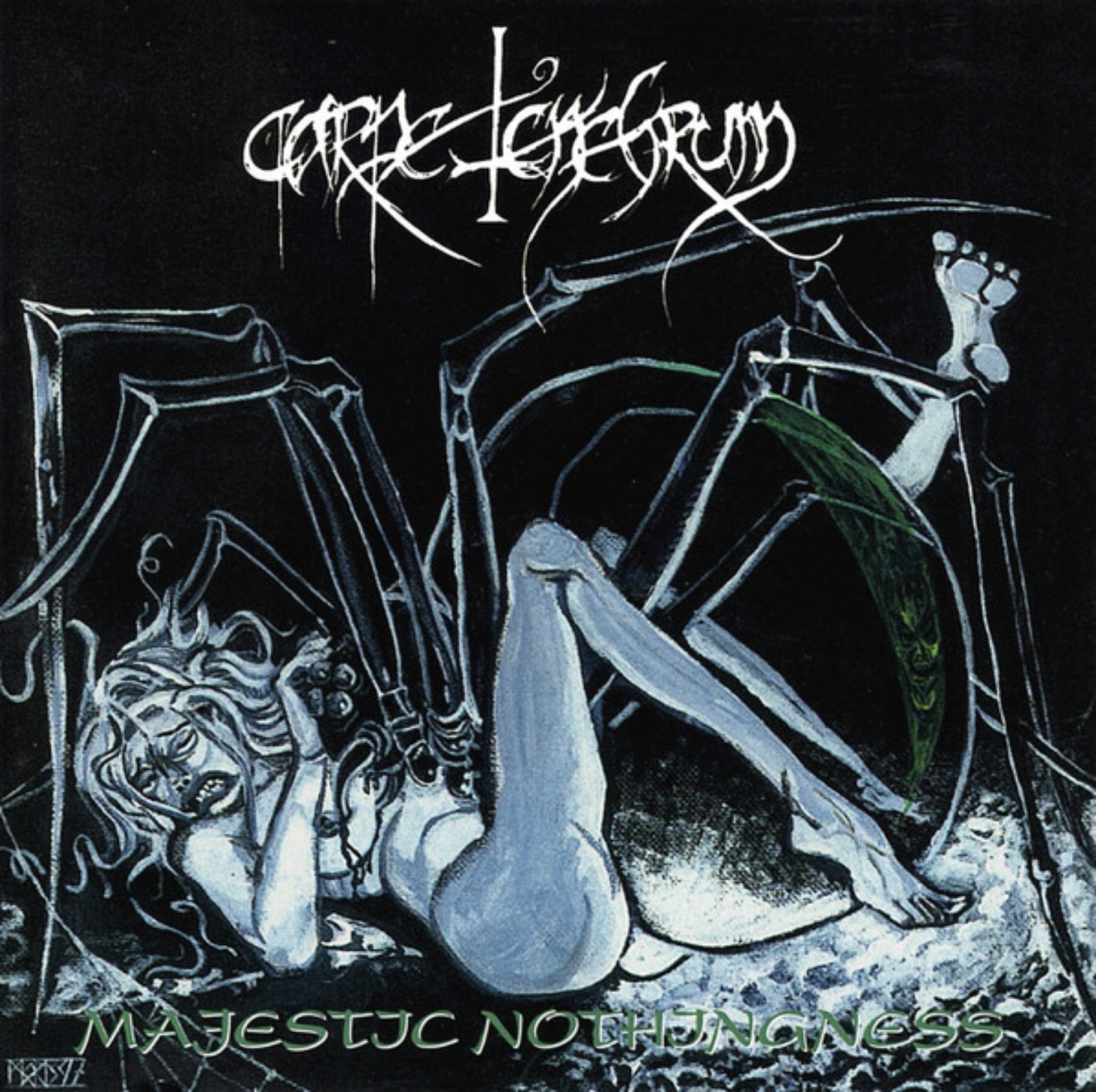
From the darkness of the original 1997 Head Not Found cover, a pale, distorted body rises. In Morte's drawing, skeletal, jointed shapes bend around the figure's long limbs and head thrown back. The setting evokes an insect or spider while also suggesting the disintegration of a human outline. The viewer recognises the reclining body but is given no certain story about what is happening to it.
Light gathers on the patches of skin, face and grainy ground below. Around them, green fading into black swallows the boundaries of the space. The raised leg, angled limbs and leaf-like green shape create converging directions that keep the composition restless. Grotesque posture accompanies delicate linework: the figure is at once strange and vulnerable.
Above, the thin, thorn-like lines of Morgana Rafaele's white logo answer the sharp shapes in the drawing. Below, the green lettering of Majestic Nothingness retreats into the dark space, while the body remains lighter than the title. The name, promising majesty, therefore speaks through a disturbing bodily image. Nothingness is not an empty surface: it is felt instead through the uncertainty of a familiar human form.
Female figures associated with the moon, the labyrinth and the threatened body also recur in the lyrics. Critical descriptions of a dark musical atmosphere offer a counterpart to the image. The artist's precise concept and the definitive story of the scene, however, are unknown. Through its visible forms, the cover holds sensuality, otherness and vulnerability together without settling them into a single explanation.
From the Moon to the Blood Dance
Seven pieces follow one another on the original CD of Majestic Nothingness. Their published running times add up to 43 minutes and 30 seconds, and the sequence runs from Temptress Luna to Blood Dance. Between them, Requiem Spell and Velvet Claws lead into the longer centrepiece Drain the Labyrinth, followed by the shorter passage of Perpetual Dancer and another extended work, Sullen Becometh. The titles and changing scale of the pieces already draw the outline of the album's structure.
In 2024, Astennu characterised the first album by a darker, predominantly mid-tempo pulse when comparing it with the faster character of the second. Critics approached those proportions from different directions. In 1997, Pedro Azevedo found promising keyboard themes and a few particularly strong songs, but did not consider every riff equally distinctive. Ten years later, Lars Christiansen appreciated the fact that the guitar melodies remained at the forefront.
Ariadne A. Donnelaith's conceptual work on the lyrics is connected with a system of symbols running across the album. In the English texts reproduced by LRCLIB and Metal Archives, moon figures, mirrors, gateways and dances answer one another. Exact agreement between individual words and the printed version remains uncertain, but the recognisable motifs form a connected world. It does not unfold as one continuous plot; rather, recurring visions link the seven pieces.
Temptress Luna
The opening Temptress Luna, at 6:58, introduces this world through the moon and the figure of a seductive woman. Mountains, snow and flight through the night appear alongside demons and a witches' gathering. The figure moves between natural and otherworldly spaces; light and shadow place her in changing surroundings, while graves and underground halls bring the nearness of annihilation into the image of freedom.
Gateway, labyrinth and rebirth already appear here. Seduction does not become a simple promise: attraction and threat are both perceptible around the female presence. This beginning prepares the night of the later texts and the woman who returns in changing roles, without establishing her as the protagonist of a single realistic story.
For Azevedo, the overall effect of Temptress Luna was one of the album's strongest points. He highlighted the track in his 1997 review, and the writer at OccultBlackMetalZine also included it among the recommendations in 2013. Attention from those two different moments preserves the opening as a recurring point of emphasis. Their descriptions of melodic guitars and dark keyboards across the album also provide a musical frame for hearing this song.
Requiem Spell
At 4:36, Requiem Spell is the shortest piece, creating a more compact space after an opening of almost seven minutes. Its title brings together a funeral rite and an enchantment: the possibility of transformation and passage immediately accompanies the idea of an ending. Mirror, silver, black desert, stars and precious stones carry the imagery from physical closeness to cosmic distances.
The first-person voice is displaced by the woman being addressed, royal signs and images of sacrifice. Existence beyond death appears not as a linear story but in visions opening into one another. The mirror becomes a sign of uncertain identity and returns later in the album.
Drain the Labyrinth
The surviving reviews do not single out the instrumental details of this song as clearly as, for example, the chanting passages of Drain the Labyrinth. Its place on the album is conveyed instead by its shorter form and the symbols carried forward from the opening: after the expansive beginning, the second track concentrates images of majesty, uncertainty and transience.
Velvet Claws
In the title Velvet Claws, the touch of velvet collides with the injury caused by a claw. This third piece, lasting 5:15, joins beauty to danger, just as the strange bodily shapes on the cover both attract and disturb the viewer. Crosses, church signs, demons and images of judgement and hell create a more openly provocative language after the cosmic spaces of Requiem Spell.
Dance appears as a ritual and communal gesture. The threatening voice sometimes slips into a theatrical, ironic tone, so the images do not function as declarations of a single personal creed. The soft and the sharp, the alluring and the aggressive remain in motion through their juxtaposition. The provocative role-playing of black metal approaches Gothic sensuality.
The 2013 OccultBlackMetalZine review also recommended Velvet Claws by name. The writer perceived the melodic guitars, varied tempos and changing voices across the album as a richness of atmosphere. On the original CD, this third track leads towards the long centrepiece, while in the later review it remains a memorable stopping point in its own right.
In Drain the Labyrinth, the labyrinth becomes the space organising the entire poem. An amber crown, a sarcophagus, branches and snakes surround the woman; other figures gather around her to restrain her. Confinement is met with resistance, but neither cancels out the other. Danger belongs at once to the vulnerable body and to the space around it.
The recurring image of the bedroom draws the erotic, aggressive and grotesque into a single unsettling intimacy. A smile or laughter does not reliably signify victory: role-playing, resistance and vulnerability may all remain within it. The return of the labyrinth also implies recurrence and repetition, a space from which the figure cannot simply walk away.
Perpetual Dancer
The track's 7:22 duration gives this enclosed world considerable weight in fourth place on the original CD. Azevedo singled out the darker chanting voice and counted Drain the Labyrinth among the record's strongest tracks. In his contemporary observation, this vocal layer added a distinct colour to the album's middle. The sequence on the later LP differs at this point: Perpetual Dancer appears first, followed by the lengthy labyrinth piece.
Sullen Becometh
Perpetual Dancer, fifth on the original CD, runs for 4:52. It places a shorter piece between Drain the Labyrinth and Sullen Becometh, the two surrounding tracks that each exceed seven minutes. The ever-dancing figure is organised around time, repetition and desire. Mirror and the promise of certainty attract and unsettle at the same time.
Blood Dance
Here, dance is not simply a liberating movement. Rejection accompanies an approach; the endless moment is disturbing precisely because it lasts. The repeated address in the short surviving English lyric text keeps attention fixed on the motif. The title connects the ritual dance of Velvet Claws with the more extreme bodily imagery of the later Blood Dance, without making every figure identical.
The brevity of the text does not mean that the piece is instrumental. Critics do not separately analyse its instrumental character in detail; its secure place on the album is established by the sequence, running time and recurring motif. Between two larger forms, Perpetual Dancer emphasises the idea of repetition before the album opens into another ritual space.
At 7:24, Sullen Becometh is the longest composition, exceeding Drain the Labyrinth by two seconds. A castle, witches, a spell, the moon, wind and storm create a dense landscape. Different voices call towards a world beyond a gateway or fence. After the confinement of the earlier labyrinth, the other side of a boundary comes into focus: crossing it is both opportunity and danger.
Signs of clothing and a priestly role connect with initiation, prohibition and mystery. Some turns of the deliberately archaic English are ambiguous, but the ritual setting is clearly recognisable. Occult and mythological allusions build a vision; they do not constitute a single demonstrable religious or philosophical doctrine.
OccultBlackMetalZine also included this song among its three recommendations in 2013. The writer valued the album's slower and faster movements, its different vocal timbres and the darkness of the keyboards together. In its penultimate position, Sullen Becometh opens up a long space before the ending. Its moon and gateway connect back to the opening motifs, while the track became another main reference point in later criticism of the album.
The 7:03 Blood Dance again places a female figure opposite a watching point of view. The gaze moves from the forest towards cats and the intimacy of a room, while blood lends emphatic bodily significance to the earlier visions. Dream and reality overlap with signs of birth or motherhood and images of destruction.
The cauldron, witchlike ritual and figure of death bring back the nocturnal vocabulary of the opening. Repetition still does not solve every mystery: it cannot be established that the woman in Temptress Luna and the woman in the closing song are literally the same named figure. Their connection is created instead by recurring images. By the album's end, dance has absorbed the nearness of blood alongside seduction, ritual and compulsion.
Azevedo found the melodic turns of Blood Dance unusual and placed this finale among the strongest parts of the record. Alongside Temptress Luna and Drain the Labyrinth, it was the third song he singled out in the 1997 review. Opening, centre and ending therefore received distinctive emphasis at three separate points in the album's earliest reception. The long closing track also brings both the original CD's proportions and its recurring lyrical world to a conclusion.
Across the seven songs, a moonlit night, a changing female presence, mirrors, gateways and a labyrinth interlock. Dance may be invitation or compulsion; the female figure may be alluring and threatened; a threshold promises and obstructs at once. Gothic horror, symbolic visions and the occult role-playing of black metal offer related interpretations, but no single identifiable literary borrowing follows from them.
The writers who listened to the music also judged its proportions differently. Some considered the guitar melodies central to the record; others noticed promising keyboard themes that emerged less frequently than they wished. The variety of vocal styles could elicit praise or reservation. In Astennu's later memory, the first album was associated with a darker groove and a melodic way of thinking. He did not regard a solo as a mandatory component: he wanted to use one only where the song itself called for it. In that view, the early education of the guitarist connects with his later freedom as a composer.
The Record Reaches Its Listeners
Majestic Nothingness appeared in 1997 as Head Not Found CD HNF036. The original year of release is securely identifiable, but the exact release date has not been established. On the back cover, Voices of Wonder Records AS is credited with manufacturing and distribution. The label's identity and the organisational structure bringing the record to market thus appeared under two connected names.
The album also appeared in its original year on a cassette from Mystic Production, catalogue number 104. The CD and cassette carried the same album into the hands of listeners and collectors in different formats. A brief description might readily have identified Carpe Tenebrum as a Norwegian project, but behind it lay guitar ideas from Australia and studio work carried out in two countries.
An advertisement for Head Not Found in issue eleven of Slayer Magazine placed the cover within its contemporary label catalogue. Alongside it were Windir's Sóknardalr, Troll's Drep de Kristne and Cybele's Brightly Blackhearted, while promotion for Forlorn's The Crystal Palace dominated the top of the page. Voices of Wonder's name and Norwegian postal address appeared below. Majestic Nothingness thus entered the printed public sphere as part of an active catalogue encompassing different kinds of extreme music.
On the adjacent editorial page, Metalion wrote about how much of his time record releases and the Australian trip had occupied since the previous Slayer issue. Astennu's name remained among those thanked. The personal visit and the released album now stood side by side on these two pages: the same fanzine connected the memory of the journey with an advertisement for the record. The neighbouring covers indicated a shared label context, but did not themselves establish lines of musical influence.
Pedro Azevedo rated the album 7/10 for Chronicles of Chaos as early as 1997. He recognised its Norwegian band connections, yet did not dismiss it as an imitation of early Dimmu Borgir. He considered it important that the music was Astennu's work, with Nagash's prominent singing and Ariadne's lyrical and conceptual involvement. Behind the familiar names, he also made the actual creative roles visible.
He found promising melodies among the keyboard themes, but wished they had appeared more often in a leading role. He considered some of the connecting guitar riffs forgettable and the guitar sound occasionally blurred. The 7/10 score thus reflected an assessment that acknowledged both the strengths and unevenness of the album. Temptress Luna, Drain the Labyrinth and Blood Dance stood out to him within the complete work.
Azevedo also connected the interval between recording and release with the rapidly expanding scene for melodic black metal. He thought the delay might have worked against the album's prospects. Earlier studio dates stood behind this critical conclusion, but they do not permit a reconstruction of the label's precise business decisions. By the time of release, the genre could have occupied a different environment from the one in which the earliest ideas had taken shape.
Akron was more severe in a review for metal.de dated 18 January 1998. He found the execution acceptable, but heard few surprises and repetitive guitar ideas in the songs. He recommended that listeners of Dimmu Borgir, Troll and Covenant give it a try, yet awarded only 5/10 overall. The early reception therefore produced no single shared verdict. Azevedo heard a promising but uneven work; for Akron, the lack of a distinctive identity remained the stronger impression.
Norwegian bands were meanwhile operating on different scales of record-label activity. In an interview in Slayer issue eleven, Silenoz traced Dimmu Borgir's progress from smaller partners to Nuclear Blast. He recalled Necromantic Gallery and Cacophonous from his own point of view, and highlighted Peter Tägtgren's part in the recording of Enthrone Darkness Triumphant at The Abyss studio in Sweden.
Astennu's Head Not Found album and Dimmu Borgir's move towards a larger international operation found their respective record-label environments during the same decade. Astennu later worked within both worlds. His first album nevertheless preserved compositional material whose roots reached back before that broader international exposure.
Different Albums, Different Choices
After Majestic Nothingness, Astennu's story continued in several bands. In the collaborative songwriting for Covenant's Nexus Polaris, he drew on his classical training and his thinking about keyboards, while on Dimmu Borgir's Spiritual Black Dimensions he appeared as a lead guitarist. Nagash played bass on the same Dimmu album and contributed to some of its lyrics. Recording took place at Abyss between August and October 1998; the album was released in 1999.
Over time, choices had to be made between the schedules and artistic directions of the larger bands. Astennu chose Dimmu Borgir, while Nagash chose Covenant. Recalling the studio work on Animatronic, Nagash said the guitarist's live commitments had prevented his participation. The two musicians saw different sides of the same phase of their careers: alongside shared plans, it was becoming harder to maintain every attachment at once.
Meanwhile, Carpe Tenebrum remained Astennu's own compositional space. In larger ensembles, he shared specific tasks and decisions with others; on his own albums, the instrumental centre still belonged to him. The changes after the first record, however, were shaped by new studios, record-label circumstances and musical ideas.
Mirrored Hate Painting appeared in 1999 as Hammerheart Records album HHR033. Nagash sang, while Astennu handled guitars, bass, keyboards and programmed drums, as well as additional vocal duties. The recordings are associated with The Abyss studio in Sweden in 1998; mixing credits name Tommy Tägtgren and Astennu. The second record was thus made in a different workshop from the two-country recording history of Majestic Nothingness.
In 2024, Astennu recalled hearing distortion on the released copy that had not been present on the final DAT mix he submitted. He said he had not established precisely where the problem arose or what happened during mastering. The memory qualifies his relationship with the second album; it does not establish the same problem on any version of the first.
He also connected the finishing stages of Mirrored Hate Painting with a remark by Shagrath, who said that he could imagine some of the guitar ideas as Dimmu Borgir songs. The anecdote reveals movement between his parallel commitments. A compositional idea might serve his own project, while a fellow musician heard in it the sound of another band. Preserving Astennu's independence became especially important in situations like this.
The third album, Dreaded Chaotic Reign, appeared in 2002 under the Hammerheart designation HHR070 and reflected another division of labour. Astennu was responsible for every instrument, the vocals, music and lyrics, as well as recording, mixing and production. The material associated with Amethyst Studios was more tightly concentrated around one creator. Its artwork credited Niklas Sundin and layout designer Marco Jeurissen; they belonged to the third album, not the original Majestic Nothingness cover.
In an interview with Markus Eck for Metal Message on 28 March 2002, Astennu explained his change of direction through his longstanding attraction to death metal. After the earlier melodic black metal, he consciously wanted to move elsewhere on this release, and also recorded the lead vocals himself. By contrast, he linked the stronger Dimmu Borgir affinities of Mirrored Hate Painting to his band work at that time. He then viewed his own past through change and growing distance.
In that same 2002 interview, he also stated that he had not yet played live under the name Carpe Tenebrum. The early Sydney performances of Lord Kaos had therefore not automatically become a concert history for the separate project. Its studio-centred operation and the composer's musical curiosity together carried the name forward.
On 5 October 2024, he looked back on Dreaded Chaotic Reign as a personal excursion into death metal and said that a desire to escape an earlier contract had also played a role in making it. This was his later interpretation of the third album. Meanwhile, the early Australian Metal Guide viewed the first two albums as part of a symphonic black-metal period and the third as a change of course. Both the composer's statements and external retrospectives therefore distinguished among the releases.
Nor were his Australian connections severed for good. Astennu's name also appears in the Sydney history of Infernal Method. A membership database dates his joining to 2002, while the Australian Metal Guide places it in May 2003, as Andrew Lilley's replacement. The precise starting date is documented differently, but both accounts record his later involvement in Australia. After the prehistory of the first Carpe Tenebrum album, his career connected once more with the Sydney circle of musicians.
The record-label side also brought an era to a close. Speaking to Niklas Göransson in 2020, Metalion described the operation of Head Not Found from the perspective of having stepped away. At first, he was attracted by the joy of putting out records; later, modest sales and tensions with bands became a burden. He did not rule out his own responsibility, believing that he might have handled some situations more carefully.
Different intentions also met in the relationship with Voices of Wonder. His partners were mainly looking for Norwegian bands, but after a 1996 demo by the British group Adorior, he insisted on signing them. He dated the agreement to 1997 and recalled the members' visit to Norway as a personal memory. Behind the fanzine and label lay more than support for a single country's scene: one man's interests helped bring British and Australian musicians into the Norwegian network as well.
According to Metalion's recollection, Voices of Wonder bought his share in 2000. Leaving the business gave him a sense of relief, although he felt sorry for the bands left behind. The performer's choice recalled by Astennu and the label operator's retrospective self-criticism reveal different sides of the fragility of the same small-scale system. The original release of Majestic Nothingness belonged to the meeting of personal enthusiasm and business responsibility.
A New Life for the Old Material
Majestic Nothingness did not disappear completely in the decades that followed. Head Not Found reissued it on CD in 2001 under the designation HNF 036. This gave listeners renewed access, while the music and its creative history still led back to the same debut. Someone already familiar with the musicians' later work might hear the older recording differently, but no unified retrospective judgement emerged.
On 10 March 2007, Lars Christiansen gave the record a score of 3.5/5 for The Metal Crypt. He valued the openness of the guitar melodies and the separation of the instrumental parts, and regarded the relative restraint of the keyboards favourably. He looked for musical kinship with early Dimmu Borgir and with Arcturus around Aspera Hiems Symfonia.
Reservations remained alongside his broadly favourable impression. He did not call the music revolutionary, and he was less fond of Nagash's cleaner vocal approaches. The weight placed on guitar melody attracted him, but he did not grant the record an unconditional pass on originality or vocals. The later republication of the piece on Metal Archives preserves the same opinion, not a new independent evaluation.
The writer at OccultBlackMetalZine approached the album differently on 17 March 2013. Melodic guitar, contrasting tempos, dark keyboard colours and changes of vocal style all contributed to its appeal. The writer recommended Temptress Luna, Velvet Claws and Sullen Becometh in particular. The cleaner vocals, which Christiansen had treated with some reservation, appeared here more as part of the music's varied atmosphere.
The article named Hammerheart as the original label. On that point, the inscription on the 1997 Head Not Found HNF036 CD preserves a different, secure fact: Hammerheart belongs to the history of the later Carpe Tenebrum albums. The review's impressions of mood remain its own judgement, but the label attribution must be treated separately in light of the original release.
On 22 June 2021, Xisuma again judged Majestic Nothingness more strictly, awarding 5/10. He recognised its synthesised atmosphere and certain effective rhythmic ideas, yet found the guitar dull, the songs insufficiently lasting and the singing weak. He also attributed the vocals too generally to Astennu, although the credits distinguish Nagash's lead singing from Astennu's chanting. The criticism of the performance cannot therefore be assigned securely to the voice of a single musician throughout.
More than two decades separate Akron's 5/10 in 1998 from Xisuma's identical score in 2021. The mark was the same, but the reasoning and the listener's background differed. A perceived lack of memorable material became a recurring objection, yet later attention did more than repeat the first judgement. The album continued to draw contrasting assessments: some listeners sought melodic and atmospheric virtues, while others missed novelty and compositions that would endure.
In 2023, Nuclear War Now! Productions brought the recording back in several formats under catalogue number ANTI-GOTH 682. There was a CD; the 12-inch gatefold LP is dated 10 July 2023 in the database, and the cassette 30 August. The label's presentation connected the earlier ideas to the Lord Kaos period and situated the work within guitar-centred symphonic black metal. This promotional perspective aimed at a new audience joined the independent criticism already surrounding the record.
The running order changed in the middle of the 2023 LP: Perpetual Dancer precedes Drain the Labyrinth, while the original and later CDs retain the earlier sequence. Swapping these two tracks changes the organisation of the middle section, but does not by itself indicate another performance or a new recording. The six officially documented versions—the 1997 Head Not Found CD and Mystic cassette, the 2001 CD, and the 2023 CD, LP and cassette—preserve the same album title in different forms.
In the visual afterlife of the record, another cover motif and portraits of the musicians appeared alongside the earlier drawing. Inside the 2023 LP, a photograph of Astennu with a guitar and a separate portrait of Nagash accompanied their credits. They do not depict a shared studio moment: the two independent images relate to the roles of composer and singer. Dan Friedl is named in the reproduction credit. Meanwhile, Morte's original artwork and Morgana Rafaele's logo remain recognisable elements of the album's first visual identity.
A Japanese-language obi strip on a copy of HNF-036 also preserves evidence of the Norwegian release's presentation far from home. Beside the words “VOICES OF WONDER SELECTION 55,” it gives a price of 2,350 yen. The detailed content of the accompanying Japanese text remains uncertain, so no independent statement by a musician or critic can be derived from it. The object traces the geographical path of distribution; it does not establish a different original release date.
For Astennu, the old material later became a usable starting point once more. In a conversation on 5 October 2024, he discussed new Carpe Tenebrum riffs and looked for a possible balance between the first two albums. He wanted to combine the darker, mid-tempo groove of Majestic Nothingness with the faster approaches of Mirrored Hate Painting. He still did not regard virtuosic soloing as something every song required: melody had to arise from the musical idea itself.
In another interview, Nagash expressed openness to further collaboration. The conversations document possible joint work and new ideas, not a completed new Carpe Tenebrum album. It remains striking that the composer was turning back to the same early material from which he had distanced himself towards death metal in 2002. The first record became, first, a stage he had wished to move beyond and, later, a musical experience worth revisiting.
At the beginning of that path were the guitar school of Sydney and the meticulous work of Lord Kaos. The Norwegian encounters brought a vocalist, recording spaces and a record-label opportunity to riffs that already existed. Astennu remained the instrumental centre, but Nagash's voice and Ariadne A. Donnelaith's lyrical world joined it as distinct creative contributions. Majestic Nothingness took its shape from that meeting.
The better-known bands that came later are important to the participants' careers, but they do not rewrite the debut's Australian beginnings. The Sydney clubs and Nefandus belong to its story as much as Norway's Creative Studio and Head Not Found. Work from a local musical workshop became an international release, and that release became a subject of memories accompanied by differing critical judgements.
The moon figure, the mirror, the labyrinth and the blood dance do not yield a single decipherable story, yet they lead through the album's visual world. The record's history likewise preserves transitions: from an Australian band to independent authorship, from a personal visit to a Norwegian release, and from early criticism to reissues. Time did not bring unanimous acclaim. It brought new listeners, different questions and, for the composer himself, a musical memory he could draw upon again as the recording continued to circulate.
Reader comments
Comments appear only after approval. Comments are shown in their original language.
Comment submissions are not yet enabled.