

…And So the Night Became
The story of Aeternus’s second full-length album: its Bergen roots, the emergence of dark metal, the Grieghallen sessions, the songs, Morrigan’s artwork and the record’s afterlife.
Before Night Fell
In Bergen in the early 1990s, it was easy to feel that dark music was drawing closer with every street. Within a short time, the city's name had become inseparable from an entire generation of Norwegian extreme metal. But when Ronny Hovland founded Aeternus in 1993, he did not sit down to write music as the heir to an established tradition. Years later, known as Ares, he put the period in simple terms: he wanted to play in a band, so he formed one. He had played guitar since he was fifteen, yet before Aeternus he had little experience he could confidently build on. Hades was a strong early influence. Looking back, he was not embarrassed by that; he spoke of it more as the natural condition of a young musician who had yet to find his own voice.
That voice soon mattered more than any superficial resemblance. Through practice and constant songwriting, Ares tried to shed the first patterns he had instinctively borrowed. The band's name, too, became part of this search for an identity. The Latin word aeternus—eternal—suited what he found in the idea of eternity: something immense, at once distant and personal. Decades later he still spoke of the name as though it were not merely an old decision, but something that would endure for as long as he himself was able to create music.
The First Recordings
During the first year, the lineup continued to shift around him. People came and went, and Ares later attached little importance to that early uncertainty. Vrolok, however, soon became a constant presence. He was already behind the drums on the 1994 demo Walk My Path, while Ares recorded both guitar and bass himself. The three early songs were still raw, but their imagery already anticipated one of the qualities that would come to define Aeternus. They spoke of fire and wind, a man struggling against darkness, and a power promising the truth of eternity. Nature was not a backdrop but a force in its own right; darkness was not simply a colour but an inner state.
Ares's voice belonged to that world from just as early on. He had originally imagined Aeternus as a death metal band, and deep, growled vocals remained natural to him even as the music gradually moved away from conventional death metal formulas. As early as 1996, he said he did not want to play either death metal or black metal in the straightforward sense of those terms. The name he chose was dark metal. Fast, aggressive riffs alongside slow, melodic passages, dark atmosphere and deep vocals. He was not trying to write a new rulebook for a genre; he was giving a name to the feeling he sought when making music.
The Walk My Path cassette found its way into the world through the channels of its time. There was no social media, no streaming, and no single moment when a new band could introduce itself to the world with one upload. Demos travelled through letters, tape-trading packages, small distributors and fanzines. That was how the recording reached the Czech label View Beyond Records. The small company offered an opportunity, and the Dark Sorcery mini-CD followed in 1995. Ares did not later try to make the release look more impressive than it had been. He was not especially taken with its design himself, but what mattered then was getting the music out. There had been no other serious offer. And the record did what it needed to do: it pushed the band forward.
The Trio and the First Album
Then Morrigan arrived. She moved from England to Norway in 1996, looking for a band, and found in Aeternus a place where she quickly became far more than simply the bassist. She also played keyboards and piano, later contributed music and lyrics, and added her own system of symbols to the albums' visual world. Ares, Morrigan and Vrolok became the core from which the first two full-length albums grew.
The deal with Hammerheart Records represented a different scale of opportunity. For a young band, the promise of a label could feel as though the world had suddenly opened before them. In 2006, after many bitter experiences, Ares still did not deny that they had been young and inexperienced, and that merely signing a contract had been enough to excite them. Those later disagreements were still far away. First came Beyond the Wandering Moon, their debut full-length, and with it their first real journey across Europe.
By 1997, Aeternus's music was recognisably its own. The cold expansiveness of black metal, the weight of death metal, keyboards and long songs that changed gradually all contributed to a form the band made no attempt to render immediately accessible. Touring, however, promptly revealed its practical demands. Layered guitars recorded in the studio called for a second guitarist onstage, so session musicians helped them out. They played with Emperor and Limbonic Art, shared stages and roads with other Norwegian bands, and rediscovered night after night just how much power those long songs contained—and how difficult it could be to sustain that power in a live set.
Ares also played bass in Gorgoroth for a time, and in 1998 spent three weeks on tour with Immortal as a session musician. Even later, he did not treat every such connection as though it automatically implied a musical influence. They meant, rather, experience, stagecraft, human relationships and that peculiar Bergen milieu in which the same people moved among different bands. By the time Aeternus turned towards its second album, it was no longer merely a promising rehearsal-room project. The band knew what it felt like to stand on European stages, knew what happened when a song ran too long for a tightly paced concert set, and knew it did not want to lose its own voice simply because cutting everything shorter would be easier.
Bergen Before the Night
Light never arrived in Bergen quite as it did in a large inland city. Weather moving in from the sea could transform the appearance of the mountains and harbour within hours; between Bryggen's old wooden buildings and the modern streets, the city's trading past stood unusually close to life at the end of the twentieth century. In the second half of the 1990s, Bergen was more than an emblem of Norway's harsh landscape: it was a port, a university centre, a place of work and a meeting ground for different generations. The local university had long been among western Norway's intellectual centres. The city was preparing for the year 2000, when it would become a European Capital of Culture. Thus, while the band's second album was taking shape, Bergen's cultural life could hardly be reduced to a single music scene.
Around the old trading harbour, movement between sea and city remained part of everyday life. The fjords, islands and mountain ranges of western Norway meant that its settlements were connected in ways unlike those of a flat country. Sea routes, roads and the railway running out of Bergen represented both connection and distance. For a resident, rain, steep hillsides, the bustle of the harbour and journeys through the fjords offered a different geographical experience from daily life in the Norwegian capital. This was a real environment, not a key with which to decode the album's lyrics. It would be easy to project the landscape onto every melody, but Aeternus's music resists so simple an interpretation.
The practical conditions of making music as a young band are better illuminated by something Ares himself later described: he collected ideas at home with his guitar and a partly faulty multitrack cassette recorder, then brought them to his bandmates. The daily movement between a room at home, a rehearsal space and an instrument shop or concert venue was a familiar working pattern in independent music at the time. Keeping in touch required patience: letters, copied tapes, fanzines and records arriving in parcels carried news from a small band to its next listener. No detailed account survives of Ares's, Morrigan's or Vrolok's home lives that would allow us to reconstruct their days precisely. That is why the tapes, rehearsals and glimpses from touring reveal so much: they make the work behind the music visible without dressing the musicians' private lives in imagined stories.
Norway was then living according to two different clocks. The considerable income from earlier years of oil and gas production, together with economic growth, suggested a relatively prosperous country. Yet in the summer of 1998 the fall in international commodity prices, the shocks of the Asian financial crisis and the weakening krone threatened consequences that could be felt in ordinary life. By late August, Norway's central bank had raised interest rates substantially in several steps; changes in the financial world could affect people through loans, prices and business decisions. None of this proves that any member of Aeternus experienced precisely such pressures. It simply means that economic security was far from untroubled beneath the surface of everyday Norwegian life in 1998.
Meanwhile, events elsewhere in Europe were making headlines that promised both reconciliation and new divisions. The Northern Ireland peace agreement of April 1998 opened the possibility of ending a long conflict; in Kosovo, however, armed violence drove tens of thousands, and later hundreds of thousands, from their homes. Following the Asian crisis, Russia's financial collapse added to uncertainty on international markets. The world was moving towards the launch of the common European currency in early 1999, while young bands exchanged postal addresses and spent entire days waiting for a reply.
The album's archaic warriors are not figures from this daily flow of news. Its titles and lyrics cannot be read as allegories of the Kosovo War or Norwegian interest-rate policy. Yet it matters to distinguish the imagined ancient world from the actual date of its creation. Ares and his bandmates used the transport, recording equipment, correspondence and European concert tours of the late twentieth century to make music that seemed to come from a much older age. The night was timeless inside the speakers; making the recording belonged very much to a particular era.
Towards the Second Album
The songs for the second album were not born of one grand decision. Decades later Ares described his method as though opening the door to an old room: he sat at home with his guitar, wrote riffs and recorded them onto cassette. He also had a four-track recorder, one of whose tracks did not work properly. Such a technical limitation might seem almost romantic today, but at the time it was simply part of the process. The music was not made on a screen. There was tape, rewinding, playing things again, and finally taking the finished ideas to the rehearsal room.
Once there, the ideas were no longer one person's alone. Morrigan and Vrolok listened to the material; they rehearsed the passages together, and the songs gradually took the form in which they appeared on the record. In a later interview, Ares spoke about how those old recordings were sometimes played over coffee or beer before the band developed them further together. It is a far more ordinary scene than the monumental atmosphere of the finished album suggests. The record was not born on a misty mountaintop but in an apartment, on cassette and in a rehearsal room. Its archaic world was assembled by modern, decidedly tangible means.
After Beyond the Wandering Moon, their aim was not to sever ties with the past. At the time of release, Ares made it clear that the second album was a continuation of Aeternus, but thicker, heavier and more forceful. They wanted a wall of sound bigger than the one on the debut, an atmosphere that would settle more deeply into the listener. At the same time, development must not erase that distinctive touch by which the band was instantly recognisable. Ares would later call it preserving the “Aeternus touch”.
The Inner World of Dark Metal
This was when the idea of dark metal truly took on its fullest shape. For Ares, darkness had many faces. War, glory, pride, nature and the spirits of the night all belonged to the same inner realm. He did not describe them as a programme first set down on paper and then translated into music. They were, rather, an emotional source. The darkness came from within, he said, and flowed through the music. Brutality and majesty were not opposing poles that needed to be joined artificially. For Aeternus it was natural for both to inhabit the same song.
Folk music was important for the same reason. Ares did not mean an occasional acoustic interlude. He felt its atmosphere was ancient and noble, a force that could nourish not only the softer passages but even the most brutal riffs. The idea later became particularly important in understanding the album. If one searches only for acoustic instruments, folk can easily seem like a separate layer laid over the metal. By the band's own account, however, it lay deeper: a kind of memory embedded in the melodies and the mood.
The lyrics drew from the same source. Battle, blood, moon, raven, fire, wind, mountain and ancient forces recur throughout them. In 1998, Ares named war, combat, nature, magic and power among the album's emotional starting points. At the same time, he did not equate contemporary warfare with this romantic vision. He explicitly distinguished the reality of modern war from the archaic, idealised atmosphere of combat that interested him. The distinction matters because the world was full of real conflicts in the year the album was created, but there is no evidence that they directly entered the record.
Europe in 1998 nevertheless formed the backdrop. Northern Ireland saw the Good Friday Agreement, the armed crisis in Kosovo escalated, the Russian financial crisis shook markets, while the weakening krone and monetary policy made news in Norway. From Bergen, these were all realities of the same year. But the inner time of Aeternus's album was not the political time of 1998. Its gaze turned much further back, towards an imagined ancient world where nature, battle and night were not subjects for news bulletins but a mythic language.
The Underground Network
The circulation of the music, by contrast, belonged squarely to its present. Fanzines, interviews sent by post, promotional CDs, contacts arranged by letter and printed magazines kept the underground moving. The future editor of Aegis began organising a fanzine around 1998, and when he recalled that world years later, even the slowness of postal correspondence seemed an ordinary part of it. Aeternus's second album was made in this environment, just before the great acceleration of the internet age, when news of a release could still take weeks or months to seep across national borders.
Meanwhile, the band was already feeling the weight of its first album's legacy. Long songs, numerous riffs and multiple guitar layers were at once an opportunity and a problem. While making the second record, they had no wish to pull back from that approach.
Quite the opposite: they followed the same path even further, making the music denser still. Only later, when working on the next album, did they realise that they did not want to repeat this form unchanged for a third time. That makes …And So the Night Became a peculiar record: the culmination of a creative language that already carried within it the limits of that language.
The Paths of Dark Metal
By the middle of the 1990s, Norwegian extreme metal no longer meant quite what it had a few years earlier. Alongside the deliberately abrasive, narrow sound of some early black metal, more and more bands were exploring longer compositions, keyboard textures, melody and the language of ancient tales. Genre boundaries had not disappeared, but they had become easier to cross: one band in the same country might favour a raw assault while another emphasised symphonic development or the memory of folk music. Aeternus's own term, dark metal, was a personal name for this diverse movement, not a label intended to govern everyone else.
Bergen occupied a special place in that story. The names Immortal, Gorgoroth and Enslaved were already familiar in international extreme metal circles. Yet the city's musical world did not operate as one group organised around a common table. Sharing a rehearsal-space acquaintance, appearing as a guest or touring together could establish a genuine connection, but it did not prove that one band followed another's musical ideas. In Aeternus's case, the lineup and personal relationships offered firmer ground: with Ares, first Vrolok and then Morrigan shaped a distinctive balance between vocals, guitar, drums, bass and keyboards.
Still, the city's name appears again and again on record sleeves because of the studio credits. Grieghallen and the work of Eirik “Pytten” Hundvin created a tangible link between Norwegian recordings that were heading in very different directions. The studio was no mysterious sanctuary: it was a collection of equipment, microphones, recording tracks, time constraints and decisions. That is precisely what makes it remarkable that such different albums could emerge from the same city and similar professional circumstances. Alongside the layered guitars and deep vocals of …And So the Night Became, piano, keyboards and the timbres of historical instruments also found a place. The guest musicians' contributions were not mere ornament: their different sounds formed part of the same expansive, dark musical space.
Beyond the studio, the finished album's journey passed through several countries. After the earlier release on the Czech label View Beyond Records, the Dutch company Hammerheart Records offered the next level of opportunity. The label had begun in 1995 as a small underground operation, and the work of companies like it involved more than printing a logo. They arranged manufacturing, negotiated with distributors, sent promotional copies and brought bands to the attention of magazines and concert organisers. In the European music scene of the late 1990s, a fanzine editor's letter, a CD chosen from a catalogue and a conversation after a tour could still form successive links in one chain. No single working method can be assumed for everyone involved, but it is through this infrastructure that Aeternus's known label and concert connections make sense.
At the same time, the international metal market was becoming more differentiated. Reports on Scandinavian black metal, death metal's strong international network and the more melodic, atmospheric styles found audiences side by side. Aeternus did not build its music from a single category. The deep vocals came from death metal, the cool guitar lines and broad open spaces were related to other northern traditions, while the folk atmosphere offered a third route. Such a meeting is not the same as mechanically gluing genres together: in these long songs, the contrasting passages had to alternate without losing the underlying tension.
By 1997, Ares and his bandmates had also experienced on European tours what that meant in practice. Recording a song with overdubbed guitar tracks was one thing; sustaining the same dramatic arc onstage was another. Concert arrangements, travel and hiring additional musicians on a temporary basis were not incidental stories around the music: they were among the conditions required to preserve its long forms. The second full-length did not grow more expansive because a fashion demanded it. Rather, it showed how far an already emerging musical language could go, using the tangible means of the old Norwegian underground but enjoying the possibilities of a band listened to across borders.
Grieghallen
Eventually, the songs reached Grieghallen. By then, in Bergen, the name meant more than a studio. Many Norwegian recordings from the history of extreme metal were associated with it, and Eirik “Pytten” Hundvin's work had acquired such a reputation that people later spoke as though a ready-made Grieghallen sound existed. In 2024, Ares jokingly objected to the idea. There was no big red button on the mixing desk labelled “Grieghallen sound”. Pytten simply understood the music, listened to the band, contributed ideas and wanted a good result just as much as they did.
The aim, in any case, was clear. Ares wanted a thicker wall of sound, more weight and a deeper atmosphere. They had used multiple guitar layers and plenty of reverb on the early recordings, and that approach came into its own on the second album. In the studio, the trio's foundation remained straightforward: Ares handled guitar and vocals, Morrigan played bass, keyboards and piano, and Vrolok was on drums. Around them, however, guest instruments appeared that took the album's world beyond conventional metal arrangements.
K. Nordeide brought lute, clàrsach, a crwth-like bowed instrument, lyre, dronepipes, hurdy-gurdy, piano, guitar and percussion to the recording. Torquemada played additional war drums, while Janto provided extra vocals on two songs. These elements were not simply exotic touches confined to the closing track. As Ares explained, a folk atmosphere could already be present in the composition itself; the old instruments merely made audible what had been moving through the riffs all along.
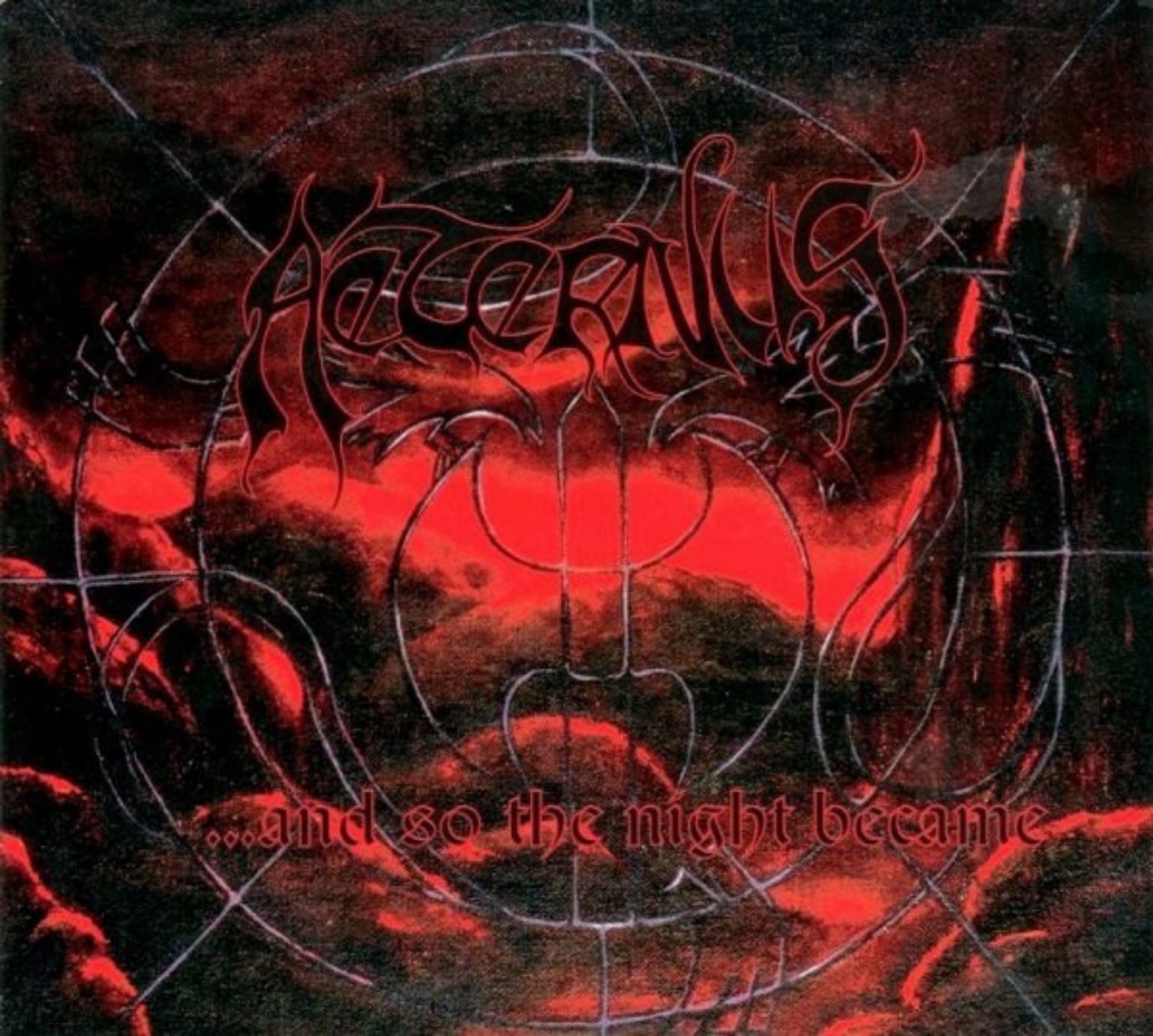
Morrigan's role was particularly complex. She did more than play bass and keyboards. She co-wrote the music to two songs with Ares, wrote two sets of lyrics and created the cover artwork. Thus the visual world came from the same inner circle as the music. Later, Ares had the band's emblem, which Morrigan had drawn at his request, tattooed on his body. Asked in 2024 what it meant to him, he offered not a historical explanation but words of feeling: darkness, unity, magic, strength and power. The record's appearance was therefore not mere packaging. It became the visual side of the same language.
The recording was hard work. Yet when Ares looked back twenty years later, he recalled good memories, especially of the studio. Everyone had done solid work. In a 2001 interview, however, he also said he would gladly have improved the mastering on the first two albums. There is no contradiction between those memories. One can be proud of what one has made while still hearing things one would change technically today.
The relationship with Pytten did not end with this record. Aeternus returned to work with him repeatedly, and decades later Ares spoke of several albums they had made together. The sound of …And So the Night Became was therefore not a one-off studio miracle. It was an early, defining point in a long collaboration, at a moment when the band was pushing its first creative form to its greatest scale.
Beyond the Cover
Before the first track has even sounded, the cover has already done something to the listener's imagination. Its dominant colours are black and red: a glowing light stretches behind dark layers, as though the depths have split open for a single moment. What emerges is not a clear landscape, but smoky, overlapping surfaces that seem almost incandescent. Thin, curving lines sweep across the centre and edges, suggesting circles, intersections and sharp, plant-like or metallic shapes. They do not resolve into any reliably identifiable object; instead, they hold the eye against the dark background.
Above, the band's reddish, barely legible emblem is not merely lettering but another layer of tangled lines. Below, the album title appears in a far smaller, more fragile form. There is no gentle transition between the colours: the glow and the blackness strain against one another. The lighter arcs and rings in the image may invite several associations, but it would be inaccurate to identify them definitively as a particular astronomical phenomenon, ritual instrument or historical symbol. Morrigan created the cover; its power lies precisely in refusing to explain everything in one way.
The music works in a similar fashion. A melody rising out of the dense weave of guitars does not remove their weight, and the slower passages do not dispel the threat. In the album's long-developing pieces, the flashes of red and the black background relate to each other as surges of intensity and lingering shadow do in the sound. The cover offers not a solution to the songs but an entrance into the same world. First the eye hears the night; a moment later the music takes over.
And So the Night Became
When the record begins, it takes its time. Running for more than thirteen minutes, “There's No Wine Like the Blood's Crimson” announces from the outset that these are no short stories. Later listeners and critics described a long, gradual opening in which the music creates space as though the landscape must first be revealed before anyone can enter the battle. One need not take every image suggested by the sound literally to understand the gesture: Aeternus does not try to seize the listener with a chorus. It demands time.
The battlefield of the lyrics is not a historical location. A blood-red sky, cold wind, blood not yet cooled, a raised hammer and a raven appear. Gradually the speaker reveals himself not simply as a warrior but as the embodiment of war, and at the end the name Ares also emerges. This moment is particularly powerful in light of the way the frontman later discussed his stage name. For him there was always an emotional distance between Ronny Hovland and Ares. The stage name was not merely a mask to put on, but a personality in which the force he associated with music could emerge more freely.
From there, “As I March” does not enter a different world; it moves deeper into the same one. The imagery grows more personal: moonlight, mountains, sword, rain, wind and sea surround a figure in motion. Nature acts. It does not watch the warrior from the background but breathes alongside him. In the lyrics the mountain almost takes bodily form, the storm answers, and the movement of battle becomes a rite. The music written together by Ares and Vrolok displays the intimate connection between drums and riff that had developed within the three-piece band. Later reviews often described the track as moving more slowly and heavily; the lyrics create that weight through space rather than events.
“Warrior of the Crescent Moon” approaches from another direction. Morrigan wrote the lyrics and shares the music credit with Ares. Its words assemble signs drawn from nature and animals—raven, serpent, wolf, dragon and the shadow of the crescent moon—like a ritual invocation. They do not tell a story in the conventional sense; they summon power. Later critics heard an acoustic opening and a structure that gradually grew heavier. Here, perhaps more than anywhere else, Ares's explanation of folk music becomes clear. For him, folk did not begin when an old instrument was heard. It could already be present in the atmosphere behind the melody.
“Blodsverging” switches to Norwegian. Ares spoke plainly about singing in his own language: there was nothing wrong with singing in Norwegian. In the lyrics, the solitary figure gives way to a community. Strong souls, pride sealed by blood, brotherhood, storm, sword and respect for the ancestors take its place. Janto's guest vocals may have given this passage a still more communal voice. By this point the album is no longer the vision of a single warrior. The outlines of an imagined ancient order appear, in which blood, land and community bind the individual to others.
The Album’s Second Half
After the record's midpoint comes “When the Crow's Shadow Falls”, and suddenly the sources offer less to work with. The surviving lyric material does not preserve the complete text; all that can be said with certainty is that Morrigan wrote it. Later reviews spoke of ancient melodies, a bittersweet introduction and then a fast, intense eruption. One fan interpretation found fallen warriors and the dignity of death in the song, but this cannot be presented as the author's intention. Perhaps that very absence preserves something distinctive about its place on the record: much can be said about the music, while the lyrics do not fully give themselves back to us.
“Ild Dans”, by contrast, is one of the album's best-documented moments, because Ares discussed it in detail in 1998. He said it was the song that travelled furthest from what one might call a typical Aeternus track, and yet remained entirely Aeternus. Its Norwegian lyrics concern a fire consuming sacred ground. It features many melodies, acoustic guitar and clean vocals at the end. Ares had even wanted bagpipes, but that never came about. Later, he mentioned the missed opportunity with something close to regret.
Fire in the song is not merely destruction. Something awakens beneath the earth, wind and flame become movement, and the holy place turns to ash. Later critics, too, singled out the tension between clean and harsh vocals, acoustic and distorted sounds as one of the album's strongest emotional moments. Ares loved the song because it was different. In doing so, he unwittingly expressed something essential about the record: dark metal never meant to them that everything had to be dark in exactly the same way.
The title track, “…And So the Night Became”, is already turning towards a conclusion. Ares and Morrigan composed the music together, with Ares credited for the lyrics. Cold earth, blackened souls, forbidden thoughts and storms appear, before the imagery gives way to ascent. Night is no longer simply a time of day or a mood. It becomes a space in which something returns from beneath the ground, brothers meet and darkness sets them in motion. In statements from the period, Ares always attributed a special power to the night. He spoke of it as another face of nature, one felt only by those open to it.
The Closing Piece
Yet the record still does not end there. In “Fyrndeheimen” the vocals disappear, bringing to the foreground the world of old instruments that until then had lain partly concealed behind the riffs. In the music written by Ares and K. Nordeide, lute, bowed strings, harp-like instruments, dronepipes, piano and percussion open up a different kind of space. Later reviews heard a Renaissance or archaic atmosphere, but Ares's own view of folk provides a more precise key. For him this music held an atmosphere both ancient and noble. The closing piece is therefore no appendix, no alien addition attached after the metal has ended. Rather, it sheds the distortion and reveals a source from which the rest of the album has also drawn.
Thus the eight songs come together not as eight separate stories. The battlefield becomes a mountain, the mountain a rite, the rite a community, then fire and night, and at last a musical memory that no longer needs words. In retrospect, the album title almost becomes a full sentence: it is not merely about night falling, but about how darkness has taken shape through every image and sound that came before it.
When the Record Left the Studio
By the autumn of 1998, the album had become a physical object. Bearing Hammerheart's catalogue number HHR 023, it set out as a digipak CD, with vinyl and cassette versions in other markets, along the same slow network that had carried Walk My Path from hand to hand just a few years earlier. Only the scale had changed. Aeternus was already a familiar name in the underground, had toured, and its second full-length was sent to magazines and fanzines that were no longer listening for the promise of a first demo but for the next step of an established band.
A contemporary review in Chronicles of Chaos awarded it 9/10. To the reviewer, the album was so dense that something was always happening within it: this was music not merely to listen to but to immerse oneself in. That early reaction is interesting because it contains none of the certainty of a later cult following. The reviewer could not know what the album would mean ten or twenty years later. All he could hear was music that was vast, dark and rich in detail.
Over the following years, that first impression was gradually rewritten. In 2004, Eternal Terror encountered it as a reissue and heard both the greater weight of death metal and the old dark metal foundations. In 2011, Decibel's Lazarus Pit series approached it in search of a forgotten classic. The writer regarded the second album as one of Aeternus's high points and perceived a historical bridge between Norway's second wave and the more atmospheric extreme metal that followed. This was a different kind of listening: not a contemporary response but a look back at an era that had meanwhile become history.
In 2012, a writer for Contaminated Tones described the album almost as a journey. The movement between songs, the succession of battlefields, ancient melodies and ritual imagery came across as a unified narrative. Later, lengthy fan reviews on Metal Archives, followed by Turkish, German and other retrospective pieces, increasingly used terms such as masterpiece, cult classic or underrated. These are not objective facts. They do, however, document how the album's place in cultural memory changed.
For a long time, the bigger Norwegian names partly overshadowed Aeternus's career. The band never entered the same central mythology built around Immortal, Emperor and other figures of the second wave. That is precisely why the later discovery of …And So the Night Became offered many listeners a more personal experience: they did not encounter it as an obligatory work in the canon, but as though they had unearthed something for themselves. Some of the enthusiasm in later reviews stems from that thrill of discovery.
Ares himself was much less inclined to mythologise the record. In 2001 he said that he loved the first two full-lengths and was proud of them, though he wished they had been mastered better. In 2018, as the album turned twenty, he simply remembered the recording fondly. The band's own voice therefore offers a sober counterpoint to the cult that grew around it. It does not claim they knew in 1998 that they were making a classic. It says they worked, tried to make their music thicker and stronger, and continued to stand by the result.
After the Album
The strangest thing is that Aeternus turned away from this form at the very moment it had fully realised it. In January 2000, Ares was already speaking clearly about why change had become necessary. On the first two albums, they had concentrated on very long, slow pieces steeped in deep atmosphere. Multiple guitars, extensive reverb and lengthy sequences of riffs built the wall of sound. In the studio, the result could be overwhelming, but within the band a question arose more and more often: what should stay, what should go, and how could one cut back an eight- or nine-minute song without damaging it?
Touring made the problem sharper still. Time passes differently in a concert set than it does through headphones. It was difficult to assemble a tightly paced show from the old songs, and the constant turnover of session guitarists also showed that the sound constructed in the studio did not simply transfer to the stage. When Radek joined as a permanent second guitarist, the band became both more stable live and more ready to compose differently.
Shadows of Old was therefore not a rejection of …And So the Night Became but a response to it. Shorter, more direct songs with a stronger death metal character emerged. Ares later remarked that making another album in the same form as the first two would have been almost boring. The decision was driven not by shame but by curiosity. The band wanted to discover what would remain of Aeternus with fewer long introductions, fewer layers and a more immediate attack.
Over the following years, that direction moved still further towards death metal. Around Ascension of Terror, however, Ares insisted that they did not simply want to become a death metal band. Shorter songs and death/thrash elements were tools, not a new identity. Nevertheless, the era of the first two albums had ended. In a 2001 interview, he all but said it outright: the period of long songs filled with countless riffs was over.
Morrigan's departure gave that dividing line a human shape. Sources do not agree in every detail about the precise year, but contemporary interviews suggest that around 2001 it became clear she would no longer be onstage with a bass guitar. At one of the first concerts she did not play, she was standing in the front row of the audience. It is an image both beautiful and final. The classic trio that made the first two albums did not disappear in an acrimonious split; one of its members simply chose another life and another musical path.
The relationship with Hammerheart was changing too. For the young band, it had once meant opportunity: studio access, tours and distribution. Later, Ares spoke with increasing bitterness about the business side. The 2004 reissues became a particular sore point. According to the band, the early records were remastered and re-released without their meaningful involvement. In 2006, Ares advised anyone who could to stick to the original versions. Yet the anger cannot erase the earlier years: he had also acknowledged that the label supported their tours and that they had learned a great deal from working together.
The album thus began another life, partly independent of the band itself. Tour editions, cassettes, regional CD releases, versions from Karmageddon and Candlelight, and later Soulseller reissues appeared. Each new copy carried the same music into a different era. In the 1990s, the record could still be discovered among fanzine addresses and mail-order forms; two decades later, digital catalogues and new vinyl editions made it visible once more.
What Remained of the Night
In time, Aeternus was drawn back towards its own past in a curious way. Through much of the 2000s, the band travelled far from the atmosphere of its first two albums, but that distance did not mean the old musical language had been lost. Around 2013, Ares began talking about searching for certain elements of their earlier work again. Not because he wanted to write exactly the same songs once more, but because he felt something remained in the deep, dark atmosphere of the 1990s that even the death metal period had never entirely replaced.
By the time of Heathen, that intention had become clearer. In several interviews in 2018, Ares said they had tried to recover the old guitar sound and atmosphere of the early albums while writing new riffs and exploring new ideas. The distinction matters. This was not a nostalgic copy but a recognition that an old set of creative tools could be useful again.
That same year, …And So the Night Became turned twenty. Ares did not write a long autobiographical essay about it. He spoke only of good memories, the studio, hard work and how well everyone had performed. Perhaps that very restraint says a great deal. For him the album had not become a sacred object that had to be defended in every sentence. It remained part of a journey from which other directions later emerged.
In 2023, Morrigan and Vrolok returned as guests for the band's thirtieth-anniversary celebration in Bergen. They did not play the 1998 album from beginning to end; Ares is not especially enthusiastic about such nostalgic evenings anyway. Yet when the former members stood together on the same stage again, the early period was suddenly not an archive but something happening in the present. Ares later recalled how good it felt to experience that old atmosphere once more.
The following year, in a long interview, he allowed the interviewer to come closer to the physical memories of the 1998 record. Out came the old four-track recorder with its defective track, the cassettes, the rehearsal room and the listening sessions together. Morrigan's sigil came up too, the one Ares wears on his chest. He associated the symbol with darkness, unity, magic, strength and power. Twenty-five years after the album, the same words returned with which the young band had tried to describe the essence of dark metal.
Perhaps that is why …And So the Night Became has endured as more than simply an early record. Not because every later Aeternus song followed from it. Quite the opposite: the band went in another direction afterwards. The album matters because, for one moment, it made Aeternus's first great creative impulse entirely visible. The deep death metal vocals, the cold space associated with black metal, the memory of folk, the long forms, images of nature and battle, Morrigan's melodies and artwork, Vrolok's drums, Pytten's studio, the experience gained on tour and Ares's stubborn attachment to his own darkness all came together in a single work.
Later critics called it, by turns, a black/death classic, an atmospheric forerunner or a lost masterpiece. Those labels change as listeners change. The band's own statements suggest a simpler picture. Ares wanted a second album that was thicker, heavier and better than the first, yet still recognisably theirs. On the following album, he wanted to work differently. And decades later he returned to the atmosphere from which he had once turned away.
The night therefore did not survive as a closed story. It is more like a sound that returns now and then. It lives in old cassettes, in memories of Grieghallen, in Morrigan's drawn emblem, in questions asked on the twentieth anniversary, in the grooves of reissues and in listeners discovering the music for the first time decades later. Perhaps that is why the album title still works so well. It does not say simply that night has fallen. It says: and so the night became. As though we had reached the end of a process and only then noticed that the world around us had changed along the way.
Reader comments
Comments only appear after approval. Messages are displayed in their original language.
Comment submissions are not enabled yet.