Loreia – The Story of a Debut Album
The complete English six-chapter literary and historical exploration of Siebenbürgen’s Loreia (1997), including a separate cover analysis in chapter three.
Siebenbürgen — The Band's World in Loreia's Early Years
The story begins not in Transylvania but much farther north, in Stockholm, in the middle of a decade when extreme metal in Europe had long since ceased to speak with a single voice. In 1994, Marcus Ehlin met Anders Rosdahl at a friend's home. Ehlin already had a name in mind: Siebenbürgen. He had not chosen it merely as a foreign word with a pleasing sound. The German name led to Transylvania, and Transylvania to the dark world of images that had fascinated him for years: vampire stories, nocturnal forests, old legends, and the romantic as well as predatory sides of horror. In later interviews he repeatedly explained that he had never wanted to confine the band to one narrow genre label. What mattered to him was that they played metal. Yet the name established, from the very first moment, the imaginary landscape in which their music would eventually find a home.
Ehlin and Rosdahl began rehearsing. Bassist Fredrik Brockert and guitarist Linus Ekström soon joined them, and the four-piece core that would record Loreia gradually took shape. Later recollections reveal not a carefully drafted career plan but a band growing out of rehearsals, songs, and increasingly concrete ideas. Ehlin's musical memory held W.A.S.P., Iron Maiden, Dio, Kiss, Helloween, and other heavy- and thrash-metal sounds inherited from the eighties. This background remained audible: Siebenbürgen's guitars still liked to form tangible riffs in the classical sense, even as black-metal vocals, tremolo runs, and colder tones gathered around them. The band's early identity thus occupied a kind of borderland from the beginning. It drew extensively on the language of black metal, but never intended to exist solely by its rules.
The story of Siebenbürgen carries two different geographies. The album's imagined world passes through forests, graveyards, castles, and dark landscapes that are not the same as the verifiable locations of the band's life. Its actual beginnings lay in the formation of the band in Sweden in 1994, its rehearsals and contacts; the securely identified location of the debut album's recording was Six String Studio in Stockholm, in April 1997. Between those two points, the initial rehearsals developed into demos, performances, and finally an album session. The distance between the ordinary, real-life setting and the emerging mythology is not a contradiction. It shows precisely that this fantasy world was fashioned by people living and working in the real Sweden of the late nineties.
Stockholm was a capital formed where the Baltic Sea meets Lake Mälaren, divided by expanses of water and islands. For decades, the connection between the inner city and its suburbs had been shaped by the metro, railway, and bus networks. In the mid-nineties it was not a single, uniformly lived-in urban fabric: behind its central shops, workplaces, universities, and cultural institutions lay residential districts built in different periods. They ranged from older, densely developed urban environments to suburbs planned around metro stations in the second half of the twentieth century. This is the space to imagine as the real backdrop to the Stockholm recording sessions, rather than a timeless northern city that was nothing but gloomy and dark.
The city's size was changing too. Statistics Sweden recorded 711,119 inhabitants in the MUNICIPALITY of Stockholm at the end of 1995 and 727,339 at the end of 1997; these figures do not represent the population of the entire, much larger continuous urban area. Alongside population growth, the reuse of former industrial areas and land available for development was reshaping the capital's environment. The city's historical archive also highlights the housing built from the nineties onward on old industrial sites and at the edges of established districts. Development was therefore visible not only in the appearance of the historic center but also in the coexistence of old and new living environments.
A precise turning point can also be named in transport history. In 1994, the green metro line was extended to Skarpnäck, and Bagarmossen received an underground station. It is a small but identifiable piece of urban history, demonstrating that Stockholm's routes and residential areas were still changing in the years before Loreia. There is no evidence that any member of the band traveled on this particular line: the metro's history is background to the city as a whole, not an invented memory of the musicians. Yet the everyday urban landscape did include the simple fact that home, work, study, rehearsals, and entertainment did not necessarily take place within the same handful of streets.
The capital was more than a place of work and commuting. It contained museums, libraries, theaters, university institutions, and communal spaces of varying sizes. Its public cultural life was far broader than any single underground scene. One indication was Stockholm's preparation for its term as European Capital of Culture in 1998; according to the European Commission's retrospective documentation, the following year brought more than a thousand cultural events and exhibitions. In 1997, those events still belonged to the immediate future. At the time of the album's recording, they were part of the city's horizon for the year just ahead.
Beyond the center, Stockholm County and the wider commuting region encompassed strikingly different towns and residential districts. The urban core, transit-connected suburbs, housing estates built in different eras, and neighboring municipalities could not be reduced to one uniform social picture. The region's economic opportunities attracted many people, but the nationwide upheaval of the early 1990s had consequences here as well. Everyday life in the middle of the decade included both a big city's range of services and cultural offerings and uncertainty over employment, together with income disparities between residential areas.
The Swedish government inquiry Delade städer (Divided Cities), published in Stockholm in September 1997, examined changes in metropolitan areas between 1985 and 1995. It found not a single, easily described crisis but intertwined economic, social, and residential inequalities. According to the report, the high unemployment of the 1990s created an unfamiliar situation in a Sweden previously known for exceptionally low unemployment; the differences in opportunity between poorer and wealthier districts increased. Importantly, the government analysis itself warned against explaining all of this merely as an ethnic issue: social and economic structures were a fundamental part of the story.
A later parliamentary report on the wider capital labor market preserved another stark circumstance: in the first half of the 1990s, the Stockholm labor-market region lost tens of thousands of jobs; the analysis recorded the disappearance of roughly 103,000 positions during the period it examined. This number is not information about the personal livelihoods of Siebenbürgen's members but a measure of the social era in which young people's educational, employment, and leisure opportunities took shape. It does not establish that the musicians were poor or unemployed. Their beginning nevertheless fell in the middle of a decade that was far from economically carefree.
When Loreia was taking shape, Sweden was marked both by the long institutional legacy of its welfare state and by the aftermath of the financial crisis that had shaken its economy in the early 1990s. Earlier liberalization of bank lending, problems in the property market, and international capital flows combined into a severe test. In the autumn of 1992 the central bank tried to defend the krona's fixed exchange rate through extraordinary interest-rate increases; in September its marginal lending rate briefly reached 500 percent. The defense ultimately failed to preserve the existing exchange-rate system, and the Swedish krona was allowed to float. This was not an event of 1997, but an immediate historical antecedent that shaped living conditions between 1994 and 1997.
After the crisis, its consequences persisted for years in the statistics and in families' economic security. The Riksbank's historical overview notes that unemployment rose above ten percent in the early 1990s and subsequently fell in the latter half of the decade, but did not quickly return to its earlier, extremely low level. This represented a sharp social change in a country where the ideal of full employment had previously played a particularly important role. It would therefore be misleading to depict the mid-nineties simply as a wealthy, untroubled Scandinavian golden age. An exclusively bleak picture would be just as inaccurate: established cultural and public-service institutions, a growing capital, and economic insecurity all existed at the same time.
The political environment also changed rapidly. Carl Bildt left the prime minister's office on 7 October 1994, and a Social Democratic government took office under Ingvar Carlsson. Göran Persson became prime minister on 22 March 1996. These details establish the chronology of the period; they do not prove that the band's lyrical world or its members' personal decisions arose from any particular party-political position. The social background is intelligible without such an assumption: 1994, 1996, and 1997 marked distinct governmental and economic moments, while the band being built out of rehearsals and demos continued at its own pace.
The most conspicuous change at the national level was accession to Europe. In the referendum of 13 November 1994, 52.3 percent of voters supported EU membership and 46.8 percent opposed it. Sweden joined the European Union on 1 January 1995 alongside Austria and Finland. The debate showed that Sweden's previous understanding of its place in foreign affairs and the economy was being reshaped: closer European integration offered opportunities while also raising questions about independence and decision-making powers. This is part of the historical setting; there is no evidence establishing the band members' views on the EU.
Siebenbürgen's founding in 1994 did not coincide with the birth of Swedish metal but with an underground scene that was already richly layered. By the middle of the nineties, death metal, black metal, more melodic styles, and music rooted in older heavy metal had spread across various Swedish cities. Genre names provided useful bearings, but these approaches often crossed paths in rehearsal rooms, at concerts, and on small labels. Understanding Loreia's significance is not a matter of claiming that it invented a new genre, but of showing how many different possibilities were available within those same few years.
In Stockholm, the diversity of the music scene was readily apparent. According to Dark Funeral's official history, Lord Ahriman moved there in 1991, the band formed in 1993, and it released a self-financed EP in 1994 and the full-length The Secrets of the Black Arts in 1996. Its musical approach is best understood through fast, forceful black metal and guitar melodies, not through Loreia's more restrained, darkly romantic arrangements with multiple vocal voices. Careers unfolding within the same city therefore did not imply a single shared sound.
Unanimated also belonged to this capital-city scene; its 1995 album Ancient God of Evil was released by the Swedish label No Fashion Records. The record offered its own example of lead melodies on guitar at the boundary between death and black metal. Diabolical Masquerade likewise originated in Stockholm and released Ravendusk in My Heart in 1996 and The Phantom Lodge in April 1997; these works approached fantasy, layered sound, and dark atmosphere in different ways. Their existence shows that the city's underground scene had room for rawer and more ornamented forms at the same time. It does not, however, prove that they shared concerts or personal connections with Siebenbürgen.
No faithful account of Swedish metal between 1994 and 1997 can be built by naming only one famous band. From the black-metal side, Dissection's 1995 Storm of the Light's Bane is a key marker of the era: alongside rapid rhythms and a bleak atmosphere, interlocking guitar melodies played an essential part. Sacramentum's 1996 full-length Far Away from the Sun likewise belonged to this melodic yet heavy musical language. Naglfar's Vittra, released in December 1995, offers another example of how fast, black-toned metal did not necessarily push melody into the background. The bands differed in how much they used keyboards, changes of tempo, or contrasting vocal parts; there is no one 'Swedish sound' that applies equally to everyone.
Another exceptionally fertile current at the same time was Gothenburg's melodic death metal. At the Gates' Slaughter of the Soul (1995), Dark Tranquillity's The Gallery (1995), and In Flames' The Jester Race, released in February 1996, combined guitar melodies, the heritage of traditional metal, and extreme vocals in differing proportions. In Flames' label explicitly describes The Jester Race as melodic death metal with folk-inflected elements. These records should not automatically be called black metal: a lesson of the era is precisely that darker, aggressive genres used the same guitar-centered inheritance toward different ends. The context for Loreia's melodic guitar playing and harsh male voice thus extends beyond black-metal albums alone, but this does not establish the named Gothenburg bands as documented influences on Siebenbürgen.
The country's musical geography therefore matters. Stockholm is the documented recording location of Siebenbürgen's debut album; in Gothenburg a different, no less significant melodic extreme-metal scene was developing, while other Swedish groups from smaller towns or more northerly regions reached listeners nationally and internationally. Musical careers in different cities therefore did not amount to one closely interconnected community.
From the Demos to the Studio: Sounds of an Era
They approached their stage appearance with similar pragmatism. Ehlin described corpsepaint as a means of creating atmosphere, not a statement of belief. Amid the highly symbolic gestures of nineties metal, that distinction was not insignificant. Siebenbürgen's darkness was built primarily from images and stories, not from a determination to fit at any cost into the self-definition of an established scene. The early songs thus already carried a defining feature of the later Loreia: a curious duality that sought to be raw and melodic at once, threatening yet sensitive to beauty, evocative of ancient stories while speaking unmistakably in its own time.
By 1996, the world of the rehearsal room had condensed into recordings. The first, self-titled demo was completed in February. Concerts followed, including appearances alongside Bewitched, Sacramentum, and In Aeturnum. On Halloween weekend of that year, the band recorded its second demo, Ungentum Pharelis. The title alone suggested that this band had no wish to speak in ordinary language. A mythology of its own was forming ever more clearly behind the songs, while the musicians gradually moved from the world of small clubs and demos into the view of an international label. Later summaries associate the Napalm Records deal with this second demo. Not every detail of the negotiations survives in the available material, but the next secure point was no longer another cassette: it was the plan for a full-length album.
By then, two women had also entered Siebenbürgen's story, in very different ways. Mara Puuruunen contributed not an instrument but words and images. She wrote the lyrics from track three through track ten on Loreia; Ehlin wrote those of the first two songs. Connected to Mara's creative world was Grimjaur, a fantasy realm of its own that Ehlin would later explicitly distinguish from Swedish folklore. They were not adapting a pre-existing folk legend but creating their own myths. In the invented language, 'Grimjaur' meant midnight. That imaginary midnight became one of the album's hidden coordinates: a place, a time, and a mood at once.
The other important figure was Lovisa Hallstedt. From the band's beginnings, Ehlin had considered mixing female vocals into Siebenbürgen's sound, and in Hallstedt he found the voice that could realize that idea. Lovisa did not enter the story as a songwriter. She contributed singing and violin as a guest, and Ehlin later emphasized separately that she neither wrote nor arranged the compositions. Even so, when Loreia was finished, her presence was strong enough to be mentioned in virtually every later review. The female voice did not simply blend into the music as decoration. It created a counterweight to Ehlin's rough singing, while the violin's infrequent appearances lent certain moments an archaic character that keyboards could have produced more easily, perhaps, but less distinctively.
The surviving interviews offer no diary-like account of the album's most intimate creative details: precisely which rehearsal produced which riff, who brought in a finished passage on which day, or how the arrangements were discussed. For that reason, Loreia's story cannot be told honestly as if we could look behind every studio door. A firmer picture emerges instead from the creative roles. Ehlin associated most of the music with himself, Mara supplied the majority of the lyrics, and Hallstedt added female vocals and violin to songs already taking shape. Ehlin later said that he disliked making rigid plans in advance when writing songs: the music changed as they worked, and the final form often only became apparent along the way. This does not prove that every minute of Loreia was made in precisely that fashion, but it accords with a record whose tracks belong to the same world without sounding like copies of a single predetermined template.
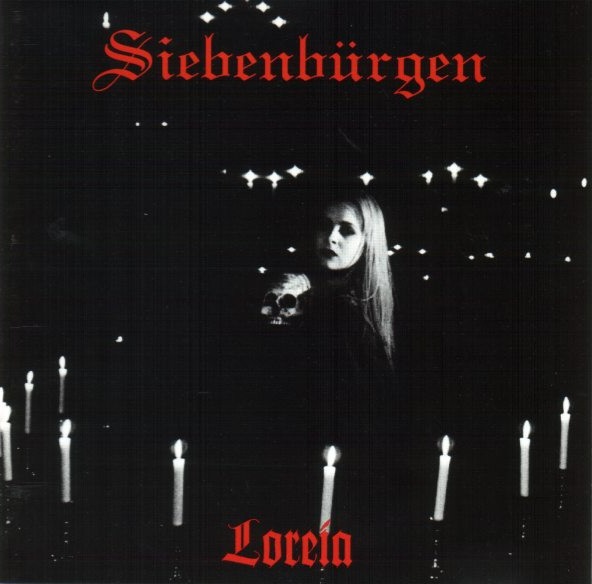
Mara gave the record more than most of its lyrics. She also appears on the cover, amid candles and darkness. Loreia's visual world was therefore unusually close to the person whose imagination gave rise to most of its songs. Loreia, the title character, was not merely a sonorous woman's name. In early interviews Ehlin described her as the vampire queen of Grimjaur, a figure who lures male victims deep into the woods and drinks their blood. The cover was thus not an attempt to recreate historical Transylvania, nor was it a documentary image of folklore. It opened an internal mythology of the band's own: a world to which the listener was given a key only through the songs.
In the spring of 1997, the band began recording its first full-length at Six String Studio in the heart of Stockholm. According to the surviving album credits, the sessions took place between 4 and 13 April. Nine days: a short period whose imprint continued to be reissued decades later. The studio did not remain a one-off stop in Siebenbürgen's history; the band returned for later records. Yet the sound of Loreia is still that of a band at the beginning. It is not perfectly polished, but it is already recognizable. Later reviews differed in their judgments of the production's details, but nearly all agreed that the album's atmosphere did not come from studio tricks. Guitars, male and female voices, the occasional violin, and the Swedish language together formed the space into which the listener entered.
Europe in the mid-1990s was far from an unchanging backdrop. After the end of the Cold War and the emergence of new political and economic relations, institutional integration accelerated in the western part of the continent. The European single market began operating on 1 January 1993; on 1 November of the same year, the Maastricht Treaty entered into force, establishing the European Union. The 1995 enlargement formally brought Sweden into this framework. Post-Iron Curtain Europe thus meant not merely new geographic possibilities but changing state borders, legal frameworks, economic routes, and institutions.
During that same decade, other parts of Europe were experiencing devastating wars. The breakup of Yugoslavia was followed by armed conflicts; fighting in Bosnia and Herzegovina ended in October 1995, the basis of the Dayton peace agreement was settled on 21 November 1995, and the agreement was signed in Paris on 14 December. Sweden's accession to the EU and the Balkan wars were simultaneous developments, showing the same continent drawing together and falling apart at once. That contrast helps explain the complexity of Europe's historical setting, but there is no evidence whatsoever that these wars directly determined Loreia's particular lyrics, vampire mythology, or the band's decisions.
The world's information networks were visibly changing in the mid-nineties, but 1997 was not yet the age of streaming, social media, and mobile internet familiar today. The World Wide Web's release for public and free use in 1993 accelerated the spread of the internet. Sweden had had a provider offering commercial internet access since 1990; in 1994, Algonet was already targeting private subscribers, and in August 1994 the cultural section of Aftonbladet appeared online. These early developments do not imply that every household was connected by 1994, but rather that old and new media systems coexisted for several years.
In 1995, Swedish web portals and online searching reached further milestones; 1996 saw the emergence of personal home pages and early community platforms. On 26 August 1997, Internetstiftelsen was founded, in part because the growing administration of Sweden's .se domain could no longer be managed through the earlier, almost personally run system. The Swedish Internet Museum's timeline illustrates the very acceleration the country was living through when Loreia appeared, although its later results were not yet part of everyday life. The transition between physical postal communication and the beginnings of a web-based public sphere is an essential feature of the era.
Here lies one of the most important contrasts of the record's historical moment. Loreia appeared in a world in which European institutions and opportunities for communication were moving rapidly closer together, yet for a young underground band, recording sessions, the tangible physical release, and a slower international network remained fundamental realities. Behind the album's imaginary forests, characters, and crypts stood not an era returned from the past, but a Sweden shaken economically, changing socially, and transforming technologically, together with a Europe in a similarly transitional state. This does not make the record a political or economic allegory. It simply restores to the story the real time and place that had been absent from it.
Between 1994 and 1997, the northern European black-metal scene broadened its aesthetic range dramatically. In Norway, Emperor released In the Nightside Eclipse in 1994, followed by Anthems to the Welkin at Dusk in 1997. The latter illustrates how, alongside black metal's fast and abrasive elements, larger, more deliberately structured forms and keyboard layers could belong to the genre's vocabulary. Dimmu Borgir's 1997 album Enthrone Darkness Triumphant shows another route through the same broadening: hard-edged guitars and atmospheric, symphonic emphases were present together. Neither example implies that every black-metal band of 1997 followed the same path.
England's Cradle of Filth offered another direction, drawing on gothic horror, theatrical delivery, and musical ornamentation, with The Principle of Evil Made Flesh (1994) and Dusk... and Her Embrace (1996). The band's own discography confirms the years and sequence of these releases. While some artists emphasized musical rawness, others adopted richer arrangements and more dramatic lyrical and visual worlds. Loreia's vampire themes can therefore be understood as one possible expression of contemporary European horror romanticism, but there is no evidence that Siebenbürgen wrote its own songs specifically in imitation of any Cradle of Filth record.
Nor was the contrast between male and female voices an invention of the 2000s. Norway's Theatre of Tragedy released its self-titled record in 1995 and followed it with Velvet Darkness They Fear in 1996. In that music, deep, rough male vocals were counterpointed by a clear female voice; this was often recognized as an important vocal device in the gothic metal of the period. Yet two contrasting voices could carry very different musical meanings for different bands. Siebenbürgen's own alternation between male and female singing, described in detail in the preceding account, was therefore related to an existing European possibility, not a demonstrable imitation of it.
Other kinds of experimentation were underway in Sweden itself. Tiamat's 1994 album Wildhoney opened atmospheric, psychedelic, and gothic directions beyond conventional metal; Therion's Theli (1996), with its choral and symphonic aspirations, placed heavy guitar music within a wholly different soundscape. Two markedly different artistic programs showed that, by 1997, a dark atmosphere no longer necessarily meant rapid tempos and the dominance of distorted guitars. In this multifaceted period, Loreia audibly relied more on guitars and the interplay of voices; its rarely heard violin remained an unusual, personal touch.
Loreia's public life cannot be followed only as far as the studio door. Independent labels in the 1990s played a crucial part in helping the records of still little-known bands singing in local languages travel to other countries. In Sweden, No Fashion Records issued significant releases by Unanimated and Dark Funeral during this period; France's Adipocere Records released albums by Sacramentum and Diabolical Masquerade, among others. The range offered by these labels helped listeners cross between musical directions, even if the details of every contract and postal route are not entirely known.
Austria's Napalm Records was one of the rapidly developing players in that network. The label's own history dates its origins to 1992 in Eisenerz, within the family setting of Markus Riedler, and recalls that in its earliest days music was even demonstrated to interested people over the phone, with the receiver held close to the music player. Personal contact, mail orders, and physical recordings were not supplementary details under those early conditions, but the foundation of the business. The label later became more institutionalized; in 1997, however, it was not yet defined by the international offices and online store of subsequent years.
Napalm's catalogue from 1994 to 1996 shows particularly well why such a label could appeal to a dark metal band of distinctive character. According to Austrian group Abigor's own history, it signed a multi-album deal with Napalm in 1994 after its demos and then released Nachthymnen in 1995 and Opus IV in 1996. Fellow Austrians Summoning, with Minas Morgul in 1995 and Dol Guldur in 1996, occupied a curious meeting point between black metal and dark, keyboard-driven music devoted to building fantasy worlds. These examples do not mean that Loreia copied those works. Rather, they show that, before Loreia, the label was already introducing listeners to different underground aesthetics.
In the mid-nineties, the phrase 'we have finished a demo' could refer to many practical processes. A demo might have been a simple rehearsal or live recording, a home multitrack production, or material recorded in a smaller studio. The resulting sound quality and costs varied substantially, but the shared purpose was to make a song, arrangement, or whole band available for others to hear. A basic cassette copy remained a physical object one could hold, complete with labels, cover, letter, or ordering address. Siebenbürgen's two demos are known, but the exact equipment and recording circumstances are not. The technical examples from the period therefore illuminate the broader era rather than these particular sessions.
Multitrack recording at home was already far from unattainable by this time. The cassette-based four-track machines of the Tascam Portastudio family, and similar devices, made it possible to record separate instrumental and vocal tracks. A Sound on Sound specialist review published in September 1996 still discussed the analog-cassette Tascam 424 MkII as a current and popular product, while describing a market already competing with portable digital systems. This is contemporary evidence of available technology, not an assumption about which model Siebenbürgen used.
At the same time, digital multitrack solutions were becoming accessible to smaller professional and project studios. Alesis's corporate history highlights the 1991 unveiling of its ADAT digital tape system; a 1996 Sound on Sound interview with the company's founder is contemporary evidence of its spread, while a 1998 technical retrospective records the 1992 market launch and the 1996 ADAT XT version. The distinction matters: new digital recording technology did not automatically make every extreme-metal album digital or flawless. The character of a recording still depended on the instruments, performance, microphone placement, room, mixing, and available time.
Several Swedish studio names had already become recognizable on record sleeves by then. Naglfar's 1995 Vittra was recorded at Abyss Studio, while the credits for Diabolical Masquerade's The Phantom Lodge, released in 1997, place its recording at Unisound Studio in September 1996. These two factual examples show that participants in Sweden's extreme-metal scene could choose among different smaller and more professional studios. Siebenbürgen's Loreia was demonstrably recorded at Stockholm's Six String Studio on 4–13 April 1997. These were separate locations, with different recordings and equipment.
An extreme-metal band formed in 1994 could not, in 1997, simply open a social-media profile in the modern sense and reach tens of thousands of people within moments. The scene was held together largely by physical objects and persistent human relationships: photocopied or printed fanzines, concert announcements, cassettes, demo releases, promotional copies, parcels, and letters sent back and forth. Tape trading, the exchange of cassette recordings, was far more than exchanging sounds. It also passed along addresses, recommendations of other bands, names of small labels, questions for musicians, and contacts. Several later eyewitness accounts describe it as a fundamental means of building underground communities at the time.
The role of printed metal journalism in Sweden is independently documented. Close-Up Magazine began in 1991 under the editorship of Robert Becirovic; a 2016 anniversary report by the Swedish public broadcaster SVT shows its first issue and describes it as an important specialist magazine for heavy metal and related genres. Its existence establishes that a Swedish-language specialist press was active in the years before and around Loreia. There is, however, no evidence that the magazine published an interview with Siebenbürgen in 1997.
At the same time, formats extending beyond the older printed world were emerging. According to its own institutional history, Chronicles of Chaos was founded in the summer of 1995 specifically as an internet-based metal magazine. Its first issue included not only album reviews but demo reviews, interviews, and a concert report. This provides excellent evidence that by 1997 the internet was already a genuine, although not yet universally accessible, channel for metal journalism. For several years, print and online music writing shaped the public reception of records side by side.
One consequence of the transition was that awareness and distribution did not necessarily grow together, or even travel along the same route. Someone might read about a recording in a fanzine before being able to obtain it; a demo might reach a few fellow musicians before it came to the notice of a wider circle of critics. The label catalogue was not merely a business document, but a guide to a world difficult to survey. Delays, personal recommendations, and physical copies were all part of the environment in which Napalm Records sent Loreia into circulation. Yet any claim about Siebenbürgen's particular correspondence must still rest on the surviving evidence of the album's history.
When Loreia appeared in the summer of 1997, black metal in Europe no longer meant the same thing to every band. Some pursued extremes of tempo and raw guitar sound; others foregrounded melody, keyboard arrangements, gothic darkness, or the older vocal and dramatic traditions of metal. The very coexistence of albums from 1994 to 1997 shows why it is mistaken, in retrospect, to judge the experiments of the era by a single standardized sound.
Within that diversity, Siebenbürgen's record combined several clearly identifiable elements. The Swedish-language lyrics of Loreia, rooted in a world of gothic horror, were paired with harsh male vocals, cleaner female singing, melodic guitars, and occasional violin. There is no need to analyze those features all over again through the same examples. A new conclusion emerges: the arrangement had affinities both with Sweden's melody-centered extreme metal and with the gothic and dramatic approaches developing across Europe, while not depending to the same extent on the pronounced keyboard atmosphere becoming one of the era's striking fashions. This is an interpretive synthesis, not a statement by the musicians or evidence of a consciously formulated program.
Seen against the wider scene, Loreia was thus neither a late appendage to a major movement nor an isolated phenomenon without precedents. The Stockholm band worked at the intersection of the local underground and the international, chiefly European record market; with its debut album, it moved beyond Sweden through an Austrian independent label that was already established and active. Its musical individuality becomes most visible when we stop pretending that every contemporary black-metal record was aiming for the same thing. Out of that diversity of sounds, Loreia selected its own voice, its own world of stories, and its own balance.
The Night Enclosed in Candlelight
On the cover of Loreia, darkness swallows almost everything. No recognizable landscape or building can be seen; from the black expanse emerges a woman with long, light-colored hair, slightly to the right of the image's center. Her pale face and hair stand out sharply against the background, while her dress and the lower part of her figure almost disappear into it. In front of the woman, at chest height, a skull can be faintly made out. The closeness of the two faces forms the unsettling heart of the image: beauty that appears alive is placed directly alongside the emblem of death.
The lower half of the image is divided by slender, pale candles of different heights. Their small flames establish a vertical rhythm in the darkness without illuminating the scene as a whole. Above and behind the woman, several sharp, star-like points of light interrupt the blackness; their precise origin cannot be determined from the photograph. The nearly monochrome, grainy image is dominated by the extreme contrast between black and white. The only strong color comes from two red inscriptions: Siebenbürgen's name above and the title Loreia below. The Gothic letterforms do more than identify the record: they lend the scene a solemn, archaic frame.
The composition does not threaten the viewer with bloodshed or a spectacular monster. Instead, the restrained combination of the motionless woman, the skull, and the candles creates an atmosphere both ominous and alluring. It suits the dark romanticism of Loreia's vampire stories, as well as the contrast on the album between melodic guitars, rough male vocals, and a clear female voice. The image does not explain the story; it makes the story's quiet, death-haunted atmosphere visible.
Loreia's Release and the World of Its Ten Songs
Napalm Records did more than simply put its name on the cover. During the nineties, the label built an international distribution and correspondence network through which a Swedish underground band's record could reach listeners in Germany, Austria, and elsewhere in Europe. A later retrospective by Napalm even recalled that an early interview with Siebenbürgen was conducted by post for the label's mail-order catalogue. The full original interview has not survived in the present source collection, but that trace reveals the world in which news of an album circulated: catalogues, fanzines, letters, promotional CDs, and connections that moved more slowly yet were surprisingly international. Loreia found its audience within that system, long before digital music could cross borders with a single click.
Later sources have not preserved the album's exact release date consistently. The available Metal Archives entry gives 18 July, whereas a later official digital page gives 26 June. The secure points are therefore the year and season: in the summer of 1997 Napalm Records issued Siebenbürgen's debut full-length under catalogue number NPR030. Ten songs, running for a little over fifty-one minutes. By this point the label's name had become associated with a growing number of dark, atmospheric European metal releases, and Loreia entered that network while retaining an identity of its own.
The record does not rush at the listener. Rather, it opens a door. In the first minutes of Vampyria, all the important signs are already there: night, forest, moonlight, blood, a female figure, and the suggestion of a violin sounding from afar. In the lyrics, the vampire is not a mere monster but the mistress of the night, at once threatening and alluring. Here, too, Siebenbürgen's musical formula first emerges in full. Melodic guitars move beneath Ehlin's rasping voice, while Lovisa's clear singing does not tame the darkness but lends it another shade. Later listeners and reviewers often singled out this song because the contrast still works freshly, without explanation. We do not know what world we have entered, but we already feel its air.
Nattens väv does not open up a new landscape so much as continue weaving the night begun in the first song. Its title evokes the fabric of night, and the lyrics trace a cycle: figures emerging from darkness, voices turning toward the Moon, the temporary peace of dawn, and the certainty of return. Daylight is no triumph here, merely a brief interruption. This idea runs through all of Loreia. Light is never final. Behind it waits the evening, and behind the evening the world in which the band's stories can come alive again. The music is not trying to prove itself through speed, either. Mid-tempo movement, melodic riffs, and recurring motifs create a steady current, as though the album were leading us not to ten separate places but along different paths through the same forest.
One of the most intriguing features of the recording is that Loreia's dark romanticism almost entirely dispenses with an instrument that would become essential to many melodic and symphonic black-metal records only a few years later: the keyboard. Contemporary reviewers noticed this specifically. Siebenbürgen summoned the night not with a veil of synthesizers, but with guitar melodies, vocal layers, and the violin's rare appearances. Whether a deliberate aesthetic program or simply the natural result of the instrumentation available to the musicians, this choice became one of the album's most enduring sonic signatures. The guitars cannot retreat into the background: they must carry the weight, the melodies, and much of the atmosphere all at once.
Mardröm is less a landscape outside us. The nightmare approaches not from the dark forest but from within. Again and again, the speaker of the lyrics falls into the same torment, slowly realizing that there is no real escape because the home of fear is inside the self. Alongside the vampire stories, this is one of the moments when Loreia's darkness turns psychological. Ehlin would later name Mardröm among the songs they played faster in concert because, in retrospect, he found the studio version too slow. This small recollection makes the record more human: the completed album was not a sacred, finished object to the band, but music they continued to shape on stage.
With its title, Ungentum Pharelis reaches back to the second demo, as if the band were incorporating its own brief past into the new album. In the lyrics, a figure emerging from a church travels through the night toward a mountain, where images of an oath, intoxication, a weapon forged in fire, and a bargain with the devil arise. Ritual and terror almost touch. The music takes on a more archaic flavor to match. The violin does not dominate the song, but when it enters, it changes the air. Even contemporary criticism heard its more folk-like character, and later commentators trying to describe what made Loreia distinctive returned to it repeatedly. The violin is effective precisely because it is not everywhere. It is not permanent scenery, but a signal appearing at particular thresholds.
The fifth track, ...om hösten död, brings a different kind of cold. Amid images of the autumn forest, damp earth, morning light, and a white body grown cold, death appears not as a supernatural predator but as a human decision and an endpoint. The longing for death in these lyrics is quieter than the bloodlust of the vampire stories, which may make it more disturbing. Musically, however, critics heard a faster movement closer to traditional black metal, with shifts in tempo and stronger surges. This is one of Loreia's peculiarities: the lyrics and music do not always make the same gesture. Beneath moving riffs there sometimes lies a motionless image of death; behind a clear female voice stands a predatory figure; and behind melody, words in which scarcely any light remains.
At the album's center, Loreia herself finally steps forward. Not as backstory or explanation, but as an image. Moonlight touches her body; her lips are the color of blood, her skin pale, her eyes dead, her soul black. Hunger is not a passing state but the foundation of her being. In an early interview, Ehlin called her a vampire queen, the ruling figure of Mara's world. It becomes clear here why the title character's name can contain the entire album. Loreia is both a person and an emblem: through her emerges everything the record finds alluring and terrible about the night. The presence of the female voice offers a strange reflection of this. Hallstedt's clear singing is not a literal dramatization of Loreia, but the juxtaposition of her timbre and the subject almost inevitably lends shape to the figure.
The title Att dricka någons blod leaves little room for uncertainty: to drink someone's blood. Yet it does not speak of the act as a distant legend. The lyrics are first-person and intimate, and for that very reason unsettling. The vampire speaks of love while taking a life; tenderness and hunger inhabit the same sentences. The music, too, moves in two directions: a calmer opening develops into tauter passages, and the male and female voices, placed side by side, sharpen the contrast rather than resolve it. Here Loreia has already moved beyond mere vampire decoration. It uses the vampire image as a relationship, a dependence, a closeness both seductive and destructive.
The speaker in Vittring av liv no longer views immortality from outside. From deep within an icy crypt comes the awareness of the living nearby, the scent of beating hearts, and flight from the sun. Transformation is not merely a curse, however. The lyrics also contain the intoxication of new existence: love of night and the promise of continuity beyond death. Several reviews placed the song among the record's more heavy-metal-oriented moments. Behind the swift guitars and tightly driven drums one can sense the same instinct for classic riffs that leads back to Ehlin's youthful influences. He later mentioned this number too among those the band played faster live. Darkness captured in the studio thus became more restless still on stage.
Morgataria is one of the album's deepest points, not in volume but in its sense of space. In an interview with Freezing Flames, Ehlin described the place as an ancient cemetery in Grimjaur where souls can find no rest. The lyrics evoke a moss-covered gate, unmarked graves, damp earth, and a frozen necropolis. Lines in an invented language deepen the sense that we are no longer in Sweden or in the historical landscape of Transylvania, but in a geography existing solely for this record. The music builds over a longer arc, and the acceleration toward the end seems briefly to set the cemetery's stillness in motion. Later reviews often remembered it as one of the album's strongest and most memorable tracks.
At almost seven minutes, Dödens sömn is not only the album's longest track but its natural conclusion. Images of a castle, gallows, rose thorns, wolves, locked doors, and vanished girls gather within it, culminating in mourning for the death of a snow-white woman with blood-red lips. Vampire romance, gothic balladry, and the imagery of death flow into the same slow conclusion. Critics later drew attention to the acoustic guitar, backing vocals, and alternation between elegiac and aggressive passages. The song closes Loreia while looking back on everything through which the listener has passed: forest, blood, crypt, female figures, night, and the dawn that never proved final.
There is no conventional narrator between the songs explaining how they connect. The connections arise instead from recurring objects and states: forest, Moon, blood, grave, cold, dawn, hunger, sleep, and return. The same words reappear in different roles. As a result, the album's story does not advance like the chapters of a novel, but like a dream in which the setting changes while recognizable motifs surface again and again. Dawn, for example, never provides genuine resolution. At most, it offers a temporary pause in the night. The grave is not necessarily an endpoint, since the dead do not always remain at rest. Nor is love necessarily a refuge, since it can mingle with hunger. These motifs create an inner order that makes Loreia feel unified even though its stories do not form a single linear plot.
Listening to these songs one after another, it soon becomes possible to understand the debate that accompanied the record from its beginning. The same consistency that creates an entire world for one listener may sound like repetition to another. Loreia is not an album of radical stylistic shifts. It does not try to show a new face in every song. Instead, it explores different hours of the same night. The riffs, tempos, and moods resemble one another, which is precisely why some listeners eventually perceive little dynamic contrast between them. Yet that same quality allows the record to survive in memory not as a collection of tracks but as one continuous space.
Swedish gives this space a distinct sound of its own. In an early interview Ehlin said they felt the Swedish lyrics were more personal, and that Mara's verses fitted the music naturally in that language. They had not chosen Swedish to appear more exotic. For listeners abroad, however, it became one of the record's distinguishing features. The harder consonants, the rhythms of the words, and the unfamiliar song titles instinctively set Loreia apart from the familiar world of English-language metal. Listeners could sense the mood of the lyrics even when they understood not a single line. Language became both meaning and instrument.
The role of the female vocals was marked by a similar duality. After Loreia appeared, many critics felt it was Hallstedt who gave the record the particular character without which it might more readily have blended into the era's melodic black metal. Ehlin, however, later emphasized several times that the band was not built around female vocals. The song came first, the female part afterward. This distinction matters because it helps explain why Lovisa did not become a permanently present front figure. Her voice left a powerful memory, but the band's internal structure did not revolve around her. Perhaps that is why Loreia became such a singular moment: the imprint of an encounter that would never recur in exactly the same proportions.
The press noticed this distinctiveness quickly around the time of release. The Chronicles of Chaos review dated 14 July 1997 described Loreia as a mid-tempo, melancholy, black-metal-oriented album and highlighted the folk-like female vocals and the violin. It found Ungentum Pharelis and the title track interesting for those reasons, while pointing to the more traditional heavy-metal side of Dödens sömn and Vittring av liv. Yet the reviewer had already voiced the reservation that would recur among others later: over a playing time of more than fifty minutes, similar structures and tempos could begin to feel repetitive.
The Years of Response and Change
By the time the first reviews appeared, the band was already hearing onstage what worked differently from the studio. Ehlin later recalled that several songs—including Mardröm and Vittring av liv—were played faster live because he considered their album versions too slow. That adjustment says more about the band's character than a mere technical observation. They did not carry Loreia with them as an untouchable artifact but treated it as living material. In concert, the songs adapted to the audience, the room, and the musicians' energy in the moment. Thus, shortly after its release, the record already existed in two forms: the fixed, darkly rolling studio version and its more rapidly breathing stage incarnations.
That same year, Sonic Seducer highlighted instead the contrast between male and female voices and the comparatively detailed sound for black metal. An October review on metal.de articulated even more precisely what Lovisa's presence meant: rather than the familiar male-female formula of Gothic metal at the time, the reviewer heard a more plaintive, unusual, faintly Eastern-sounding nuance that lent the music a character of its own. The contemporary press offered different scores and reservations, yet the underlying impression remained remarkably similar. Loreia stood out not for speed or brutality, but for the way melodic guitar, hoarse male singing, a clear female voice, and violin were woven into a single dark fabric.
From inside the band, the situation looked somewhat simpler. In a 1998 interview with Freezing Flames, Ehlin said they had received favorable responses in Sweden, Germany, and other countries. As far as he knew, more than six thousand copies of Loreia had been sold by then. This is not an audited sales figure from the label but a musician's recollection; nevertheless, it indicates the scale: a debut album that had traveled from a Stockholm rehearsal room to an international audience. Napalm Records' network made that distance possible to bridge. And the band moved on almost at once.
Loreia's success did not lock them into the formula that had worked. By the time Freezing Flames sent its questions to Ehlin, they were already working on the next album. Grimjaur arrived in 1998, making direct comparisons almost inevitable. A contemporary reviewer for Chronicles of Chaos felt that the new material had pushed into the background precisely those elements that had made Loreia especially memorable: folk influences, catchy riffs, and Lovisa's female vocals. Hallstedt's role had indeed become smaller. Ehlin acknowledged as much himself in 1999 and said that their collaboration later came to an end.
In later interviews, Ehlin generally spoke of Napalm Records as supportive. He did not portray the story as one in which a record label imposed a ready-made style on the band from outside. Quite the reverse: Siebenbürgen's own world was already forming on the demos, and the label enabled that world to reach a wider audience. This matters because, in hindsight, Loreia's distinctive features might easily look like a calculated commercial recipe: vampires, female vocals, violin, a Gothic cover. The sources suggest instead that these features arose from the meeting of different personal and creative strands, and that only the completed album's reception revealed the strength of their combined effect.
Seen from this perspective, the story underscores the singular nature of the debut even more. Loreia was not the first example of a formula that would remain unchanged for years; it was a brief creative alignment. Ehlin's musical leadership, Mara's lyrical world and the mythology of Grimjaur, Lovisa's voice and violin, the four-member core of the band, and Six String Studio all came together in the same few months. Later, the personnel, the place of the female vocals, the sound, and the production would change. The dark melodicism and fascination with horror survived, but the particular balance achieved on Loreia was never reproduced in quite the same way.
Interestingly, Ehlin's later interviews do not tell a story of radical rupture. When asked about the band's changes in the 2000s, he regularly rejected the notion that Siebenbürgen had leapt between unrelated genres. For him, metal remained the common denominator. In a retrospective interview in 2005, he even remarked that something of Loreia's melodic harmonies lived on in the later album Darker Designs & Images. In this way, the debut did not remain a closed-off detour in the discography. It persisted instead as a foundation: some motifs disappeared, others were transformed, but its appetite for dark melody and storytelling continued to move through subsequent releases.
Over time, criticism added new layers of its own to Loreia. A review on Musiker-Board in 2005, looking back with some historical distance, noted that extreme metal featuring female vocals had become more familiar, making it easy to forget how unusual it had sounded in 1997. Spirit of Metal praised the dark, mythical atmosphere in 2006 while also detecting a lack of variety. In 2011, a personal blog post remembered it simply as a record worth returning to on a rainy day. By 2012, Studio Suicide was contrasting it with the modern, domesticated image of the vampire and praising its recovery of something from the predatory, medieval vampire myth.
As the years passed, Loreia increasingly ceased to belong exclusively to its own era. Later critics heard it with knowledge of genre developments that had not yet been taken for granted in 1997. Female singing in extreme metal had become far more common, a whole wave of Gothic and symphonic elements had emerged, and digital production had brought an entirely different ideal of sound. In this new setting, Loreia's rawness and its keyboard-free melodicism began to feel not simply contemporary but historically distinctive. The old album had not changed, but the musical language surrounding it had—and with it, what successive generations heard in its grooves.
Midnight in Grimjaur — The Legacy of the First Album
Others judged it more harshly. Some rejected the drums, the female vocals, or the entire aesthetic; others objected to predictable song structures and similar tempos. Such views do not diminish the album's story. Rather, they show that Loreia's strong character is far from neutral. For listeners who embrace its unified atmosphere, the similarities hold the record together. For those seeking greater contrast, those same similarities turn into monotony. There is scarcely better evidence of an album's distinct identity than when one and the same quality becomes both the chief source of praise and the chief object of criticism.
Meanwhile, the album kept returning in physical form. The original 1997 Napalm Records CD was followed by a cassette edition that same year. Later came editions associated with Witch of the East, Napalm Records America, Hellion, and Irond. A vinyl release appeared in 2016, a digital edition in 2018, a new cassette and CD in 2023, and orange vinyl in 2024. These formats do not necessarily tell us everything about the mastering or the technical differences between editions, but they demonstrate one thing clearly: Loreia did not vanish in the year it was born. More than a quarter of a century later, labels still saw a reason to give those fifty-one minutes of music a new physical form.
Perhaps that is because Loreia is more than the sound of an era. Too many personal, concrete strands converge within it. A young band's first serious studio project; a man raised on classic heavy metal but searching for a darker language of his own; a woman who supplied an imaginary world and much of the lyrics; another woman whose voice and violin brought such a striking color to the album that almost every reviewer would return to them decades later. And there is the record label that carried the material from the Swedish underground into international distribution, along with the brief period in the studio when all of this became a recording.
The band's subsequent history went much further than anyone could have confidently foreseen when the debut appeared. New albums, personnel changes, interruptions, and new beginnings followed one another. Yet whenever later periods were discussed, the first two albums repeatedly returned as points of reference. Loreia and Grimjaur were not merely early entries in a catalogue; they provided a way to hear what had changed within the band. The diminished role of female vocals, the evolution of the production, changes in the language of the lyrics, and the growing influence of more traditional metal all became more apparent because this dark, Swedish-language starting point existed.
For that reason, Loreia's story cannot be reduced to the phrase “Siebenbürgen's debut album.” The word debut is too neat, too administrative. This record is closer to a moment frozen in time. By the time the band reached its next album, the emphasis had already shifted. By the time Ehlin spoke in more detail about Grimjaur and Loreia in 1999, Mara had become part of his past, and his relationship with Lovisa had deteriorated. In retrospect, the debut became even more clearly the document of a period when its participants looked in the same direction for a brief while.
And yet it is not at its strongest as an object of nostalgia. On the cover, Mara's figure still stands in the same candlelight. With the first notes of Vampyria, the fabric of the night opens just as it did before. The nightmare of Mardröm still rises from within, the rite of Ungentum Pharelis still leads toward the mountain, and the image of autumnal death still chills the landscape. Loreia still steps into the moonlight; Att dricka någons blod still binds love and hunger together; the crypt in Vittring av liv still holds the scent of the living nearby; and the gate of Morgataria still opens onto a cemetery that exists only within this mythology. Finally, Dödens sömn closes the circle without extinguishing the darkness completely.
Perhaps that is precisely why the album has outlasted so many shifts in taste. Not because it is flawless. Ehlin himself heard things on it that he would have done differently later. Critics, too, repeatedly pointed to the similar tempos, the long running time, and weaknesses in the production or the balance between particular instruments. Loreia's value lies not in perfection but in recognizability. The world it creates could scarcely be mistaken for that of many other records. Its dark melody without keyboards, riff-writing inherited from classic metal, hoarse Swedish male voice, Lovisa's clear singing and violin, Mara's stories, and the distinctive names of Grimjaur together form an imprint that survives the period-specific limitations of individual details.
Siebenbürgen later moved on, as every band does if it survives. There were new lineups, new albums, new studios, new disputes, and new directions. But in later interviews, when the members looked back, Loreia did not disappear into the background. Memories of its melodic harmonies, its early world of horror, the unusual role of the female voice, and the momentum of Napalm Records' early years all surfaced again. The debut thus became more than a first chapter: it became a point of comparison. Every later change was visible, in part, against what had been present on this first album and what had since vanished or been transformed.
If someone today takes the original CD off a shelf, puts on a reissue, or starts a digital version, they do not get 1997 back. Time does not reverse. The Stockholm rehearsals, the demo recorded at Halloween, the nine days at Six String Studio, Mara's manuscripts, Lovisa's recorded studio parts, and the mail-order world of Napalm Records at that time are all at a historical distance now. But music can do something documents alone cannot: preserve those things while making them present again. When it begins to play, we do not hear footnotes. We hear a world.
That world never occupied a place on a real map. The name Siebenbürgen evokes historical geography, but Loreia does not tell the story of Transylvania. Nor will Grimjaur be found in an atlas. No road leads to Morgataria's cemetery. Queen Loreia is not a historical figure. Yet the album's inner coherence has kept these names alive in listeners' imaginations for decades. A band becomes truly recognizable when it can create not just a sound but a space of its own. On Siebenbürgen's debut, that space is still raw, sometimes repetitive, at times awkwardly illuminated, but already entirely theirs.
Perhaps that is why the idea of midnight suits it best. In Grimjaur's invented language, that is what the name meant: midnight. Neither the beginning of darkness nor its end, but its very center. Loreia holds a similar place in Siebenbürgen's history. Before it lie the rehearsals, the demos, the search; after it come Grimjaur, the later albums, changing lineups, and retrospective accounts. And in the middle stands this 1997 record, like a moment captured and held still. The surrounding world has changed, the band has changed, and the listeners have changed. But midnight remains where it was.
And when the last sounds of Dödens sömn fade away, no explanation remains to close the story. Only that strange feeling that contemporary reviewers were already trying to put into words: Loreia is at once familiar and alien. Familiar, because behind its guitars stands the long tradition of heavy metal, the cold language of black metal, and the centuries-old imagery of Gothic horror. Alien, because it takes these elements and builds not a copy but its own nocturnal territory. That territory is neither flawless nor boundless. But it has a name, its inhabitants, its cemetery, its queen, and its voice. And as long as someone starts the album again, that voice will find its way through the forest, back to midnight in Grimjaur.
Reader comments
Comments only appear after approval. Messages are displayed in their original language.
Comment submissions are not enabled yet.