Arising Realm – The Rising Realm
The complete English literary and historical exploration of Ragnarok’s Arising Realm (1997), including a separate cover analysis in chapter four.
Norway in the Years of Transformation
The Town That Did Not Stay the Same
Anyone thinking of Sarpsborg in the summer of 1994 should not imagine an unchanging, remote Norwegian town. Situated near the River Glomma and the Sarpefossen waterfall, the town had a long industrial history, yet its most consequential recent event had been a change of boundaries: on 1 January 1992, Sarpsborg merged with the municipalities of Tune, Skjeberg and Varteig. This should be understood not as gradual expansion but as the outcome of a specific administrative decision. The population of the former, narrowly defined urban municipality did not simply increase by as many people as might have been added through a few years of natural growth: the town's new boundaries encompassed entire surrounding residential, forested, agricultural and coastal areas.
The enlarged municipality had 46,381 inhabitants in 1994, 46,449 in 1995, 46,424 in 1996 and 46,440 in 1997. These figures do not refer merely to the inhabitants of the densely built-up central town. They describe the amalgamated Sarpsborg. Its population was essentially stagnant in those years rather than growing explosively. The period began not in a vast metropolis but in a medium-sized regional centre with industrial traditions, a place where urban and rural surroundings alternated within a few kilometres.
Nature here was not merely a poetic adornment on a map. The Glomma shaped the town's form, the connections between roads and districts, the location of industry and the use of the surrounding countryside. Factories operating near Sarpefossen, loading areas beside the river, residential neighbourhoods around the centre and the wooded and coastal districts of the formerly separate municipalities existed in close proximity. Anyone who pictures Sarpsborg only as deserted northern forests overlooks its factory chimneys and traffic; anyone who sees only an industrial town likewise misses the river, the forests and the open landscape. Both faces belonged to the same place at the same time.
Another, more distant layer of the town's history was already embedded in its name. Its foundation in 1016 is associated with King Olav Haraldsson, later Saint Olav; memories of medieval kingship and Christianity in the region still formed part of local history at the end of the twentieth century. This creates an especially intriguing tension around an album whose lyrical world repeatedly confronts Christianity and evokes images of an earlier northern world. The local historical connection is genuine, but it does not follow that Ragnarok's members were specifically thinking of the events of 1016 when writing individual lyrics. Such an intention could only be attributed to them on the basis of their own statements.
A Working Town: Waterfall, Factories and Closures
Borregaard played a central role in shaping modern Sarpsborg. The pulp mills and later chemical plants established near the waterfall brought workers, industrial infrastructure and a working culture that permeated the entire town for many years. In the later decades of the twentieth century, that industrial world no longer operated within a single unchanging system. According to Borregaard's history, Orkla Industries and Borregaard merged in 1986; further corporate restructuring followed in 1992, while the Borregaard business division remained headquartered in Sarpsborg. Neither the factories nor industry disappeared, but their ownership and organisational structures changed.
The municipality's own historical account describes closures and labour disputes from the early 1980s onwards. One of Borregaard's synthetic-fibre divisions closed in 1982. The fate of the Rich. Pfeiffer transformer factory relates even more directly to the year before the album's story began: after the plant was acquired by ABB, it was closed, and in June 1993 workers demonstrated against the decision along the E6 traffic corridor. All this took place a year before the band's formation in 1994. For the town, industrial restructuring was not a remote item of economic news: it concerned factory gates, communities of workers and families' livelihoods.
For precisely that reason, it would also be misleading to portray the entire period from 1994 to 1997 simply as a Norwegian society sliding into poverty and decline. The local losses associated with industrial restructuring were real, while the national economy was already recovering from the downturn of the preceding years. Sarpsborg's own town history reports how smaller businesses, commerce, offices, schools, childcare and social institutions gradually grew in importance alongside the factories. The old industrial town became a regional centre supported by many kinds of work, not overnight, but through different spheres of employment developing side by side.
This history has a human dimension even though we have no reliable information about any band member's employment or family income. Eight-hour shifts, searching for new work, transport and the running of public institutions were genuine conditions shaping life in the town as a whole, not reconstructions of the private lives of Ragnarok's members. What can confidently be said about the rehearsal room is the collaboration already known from the band's history. Without new documents, it is impossible to answer responsibly where individual musicians lived, how they earned the money for their equipment, which streets they took home or what jobs they held.
Both Banks of the River and Roads Across the Border
What truly defines Sarpsborg's historical position is that the coast, the inland districts, the capital and Sweden were not entirely separate worlds from there. In southeastern Norway's Østfold region, the town was linked to Fredrikstad and Halden, and through the railway and road network to Oslo and settlements beyond the national border. The history of the main transport routes is not identical to the timetables of the 2020s; a road built or improved later cannot simply be projected back onto 1995. Nonetheless, these geographical connections and the railway lines operating in Østfold were already among the region's essential transport options during the 1990s.
The connection between Sarpsborg on the Glomma and Fredrikstad closer to its estuary is no modern coincidence. The two towns form neighbouring employment and service areas, with different industrial, port and town-centre functions. The route from Sarpsborg to Oslo is an equally important geographical fact: eastern Norway's major metropolitan centre was not impossibly far away. This does not in itself prove that Ragnarok regularly visited any particular club or shop or cultivated a specific personal network. The verifiable concerts and studio events described in the existing narrative remain distinct from this; the regional description restores the landscape that made movement possible.
Østfold was also defined by its position on the border. The direction towards Sweden was not merely a geographical edge: transport links between southern Norway and Sweden mattered for both trade and personal connections. Later, this region became particularly important for Scandinavian freight traffic and commuting. A faithful depiction of the period, however, must not present today's traffic figures as facts about 1994. What can be established is more modest but significant: Sarpsborg was no isolated northern island, but a town embedded in a network of rivers, railways, roads, the capital and an international border.
Norway After the Crisis: Recovery and Uncertainty at Once
The time when Ragnarok formed can be described as the years of recovery after a crisis in Norway's economic history. Following credit expansion and a property boom in the 1980s, household and corporate debt, high real interest rates, falling demand and banking losses led to a serious crisis. According to an analysis by Statistics Norway, the low point came in 1992. In the following year, however, lower interest rates and improving international demand began a more sustained upswing.
The change can also be measured numerically. A historical table from Statistics Norway's labour-force survey lists 118,147 people wholly unemployed in 1993, 110,280 in 1994, 102,154 in 1995, 90,936 in 1996 and 73,525 in 1997, as an annual series. This is neither the register of officially registered unemployment compiled using another methodology, nor a local unemployment series for Østfold or Sarpsborg. The decline is a national trend, showing how rapidly the wider economic environment changed between the release of Nattferd and the studio sessions for Arising Realm.
Jobs created elsewhere in the country, of course, did not automatically heal the losses suffered by workers at a closed transformer factory in Sarpsborg. That is why the figures and local memory matter side by side. A national upswing, but local upheaval. Growing employment, but also the experience of losing industrial security. The image of an effortlessly prosperous Norway in later decades cannot simply be imposed on this transitional period. The economy was improving, but society still remembered the downturn of the preceding years.
Connected with this was the question of how the state should manage its oil revenues in a new way. In 1990 the Norwegian parliament legislated for the establishment of the Government Petroleum Fund, although the first actual transfer, of almost two billion Norwegian kroner, did not take place until May 1996. The system for managing national wealth that later generations would view as one of the symbols of Norway's prosperity was still in its infancy in the year Arising Realm was recorded. We should imagine not an enormous cash reserve already operating for decades, but a newly funded institutional framework.
The political setting changed as well. The final phase of Gro Harlem Brundtland's Labour government gave way to Thorbjørn Jagland's cabinet on 25 October 1996. When Ragnarok entered the studio in early November, the country had changed prime minister only days before. This is not in itself connected to the album's composition, but it places the events more precisely in time. After the September 1997 election, Jagland resigned and Kjell Magne Bondevik's first government took office on 17 October. The record thus emerged from a country in which the middle of the 1990s brought changes not only in the economy but also at the boundaries between political administrations.
The Debate Over National Independence and the Place of Christian Tradition
Among Norway's major public debates in 1994, the question of joining the European Union deserves particular attention. Norwegians voted in a referendum on 28 November 1994, and 52.2 per cent of those participating opposed membership. This did not mean that the country remained outside Europe's economic systems. The Agreement on the European Economic Area had already entered into force on 1 January 1994, connecting Norway to an extensive body of rules on the movement of goods, services, people and capital. The country therefore retained its political position outside the EU while participating in the common European economic area.
The decision was accompanied by diverse individual views: national independence, the location of democratic decision-making and the price of European integration became intersecting questions. The Nordic context was changing rapidly too. On 1 January 1995 Sweden and Finland, together with Austria, joined the EU, while Norway stayed outside. The country's borders did not move, but their political meaning changed. A young Norwegian reading newspapers at the time could encounter both the language of economic integration and debates over sovereignty. However, this collection contains no verifiable statement by Ragnarok that would justify deriving the band's lyrics from that referendum.
Attitudes towards Christianity in Norway at the time were not simply matters of personal faith. The Church of Norway operated as a historic Evangelical Lutheran state church; the institutional rules linking church and state were still part of the foundations of public life in the 1990s. The relationship between the state and the church was already undergoing internal change: a new church law in 1996 regulated the legal position of congregations, local church councils and the relationship between state and municipal funding. In 1997, a school subject dealing jointly with Christianity, other religions and life stances became the focus of legislative debate.
This background adds nuance to the historical position of Arising Realm's anti-religious lyrics. The Church of Norway was not merely a medieval relic preserved in museums, but a functioning institution associated with church buildings, national and local regulations, rituals and questions about schooling. The band's own statements, already quoted in the narrative, make it possible to discuss the ideas of Thyme and his companions; social history does not replace those statements but shows the institutional setting in which they could be voiced. Genuine religious freedom in the Norwegian state and the band's vehement anti-Christian language could both exist in the same society.
The two historical periods must not be conflated. Only a long and complicated historical development connects the centuries associated with Saint Olav in Sarpsborg's foundation story to Norway's church law of 1996. It would be wrong to describe the Christianisation of around the turn of the first millennium as a form of political domination that had remained unchanged into the twentieth century. Equally wrong would be to trace every anti-Christian image back to a specific church or administrative event. Artistic expression, local memory and social institutions form three distinct levels of history.
Two Kinds of Time: The Age of Post and the Beginning of the Network
A further transition makes the mid-1990s distinctive. For today's reader, the internet is the obvious backdrop to the circulation of music. Yet when Arising Realm was being written, Norway too was moving from a public sphere based on paper and physical mail towards digital networks. One system did not replace the other overnight. The transition was not merely a curiosity of technological history: it was a condition of the age that determined the speed and accessibility of information.
Oslonett had already established a Norwegian commercial website in 1993. During the Lillehammer Winter Olympics in February 1994, updates to competition results demonstrated a new kind of online information service; the same provider subsequently experimented with publishing the results of the November 1994 EU referendum on the internet. The network therefore existed and Norwegian public life was beginning to pay attention to it, but it was not yet a permanent connection carried in everyone's pocket.
According to Norid's historical overview, Norway still had only about a thousand domain names in 1995. Email may have become commonplace earlier in universities and research environments, but it spread among the wider population only in the second half of the decade. A historical survey by the National Library of Norway also records that the press was already arguing about the network in 1996: some dismissed it as an overrated novelty, even as the internet was beginning to become a mass medium. That contradiction marks the period: a new age of communication was beginning, but access in daily life remained highly uneven.
The existing narrative already explains how Ragnarok sent its early demo to fanzines, radio stations and record labels. That concrete history need not be rewritten. Its wider historical context is that paper correspondence and the mailing of physical recordings were not yet obsolete in 1995. Cassettes sent in envelopes or parcels, label names seen on magazine pages and letters exchanged with editors operated within a public sphere that web technology had not yet completely transformed. This is a period-wide context, not separately verified information about precisely how many letters or cassettes Ragnarok posted on any given day.
The period therefore had a dual character: the band entered international public awareness through a more traditional, slower information infrastructure, just as Europe and Norway were building new channels. Without the instant access taken for granted today, an article in a foreign language, a radio broadcast or a release reaching another country had particular value when it actually arrived somewhere. At the same time, the early history of the internet offers a warning: it is not true that 'there was no internet' in 1996; rather, its role, accessibility and everyday use were entirely different from what they are today.
The Shifting Map of Europe
The album's prehistory between 1994 and 1997 falls in the middle of a decade that was reshaping Europe. After the end of the Cold War, political systems changed, countries sought new alliances and European integration took new institutional forms. The European single market began at the start of 1993, the Maastricht Treaty entered into force that same year and the EU expanded by three new members in 1995. Norway's position cannot therefore be described simply as standing apart from Western integration: it joined the EEA while rejecting EU membership.
In southeastern Europe, very different events were unfolding at the same time. The breakup of Yugoslavia was followed by armed conflicts, and the Bosnian war, which had continued since 1992, reached a peace process only in the autumn of 1995. The agreement was initialled at Dayton in November 1995 and signed in Paris on 14 December. The Yugoslav wars provide no proven direct explanation for Arising Realm's lyrics. They illustrate the political climate of a continent in which cross-border economic cooperation was deepening even as wars were being waged in the name of national communities.
Norway also played a visible role in international diplomacy. Yasser Arafat, Shimon Peres and Yitzhak Rabin received the 1994 Nobel Peace Prize for the Israeli–Palestinian process that had emerged from secret talks in Oslo in 1993. This fact is connected neither to Ragnarok's beliefs nor to any of its songs, but reveals another side of the country's international public presence. The world was also watching Norway in February 1994 during the Lillehammer Winter Olympics. A small country's political and cultural presence could not be reduced to a single musical movement.
The decade, then, was by no means only a time of technological modernisation. Freedom and control, community and separation, tradition and new identities, efforts towards peace and violence all appeared together in European news. These things provide a historical horizon for a dark musical world taking shape in Norway; they are not an automatically proven list of influences. A work may be called the consequence of a historical event only where the musicians' own accounts or primary documents support such a claim. Everything else belongs to the period's circumstances and does not speak on behalf of the artists.
The Threshold of 1997
When Arising Realm reached listeners in 1997, Sarpsborg's population had scarcely changed since work on the album began, but the town had already spent several years under the administrative structure established by the 1992 merger. Memories of heavy industry remained present while local services expanded their role. In a few short years, Norway had moved from stabilisation after a severe economic downturn towards more sustained growth; in 1996, institutional saving of oil wealth had begun. The European single market connected the country, though outside the EU, to its neighbours, while new digital communication was only beginning to reshape the movement of news, letters and information.
The Changing World of Norwegian Black Metal
Sarpsborg: An Album Far from the Capital Yet Inside the Network
In the mid-1990s Sarpsborg was not a town routinely named as the centre of the movement in short international histories of black metal. Attention usually turned to Oslo and Bergen, sometimes to Stavanger or the Telemark milieu. Yet distance from a major media centre is not the same as musical isolation. A band from Sarpsborg could join the same nationwide and transnational underground as the familiar bands from the capital by means of letters, demo cassettes, fanzines, record-label addresses, auditions and occasional gigs. In Ragnarok's case, this was more than a theoretical possibility. The existing narrative documents the mailing of the Pagan Land demo, the Head Not Found contract, the Oslo performance, the recording location at X-Ray Studios in Sarpsborg and the mastering at Strype Audio in Oslo. Those links are already part of the story; the context explains why they mattered.
One reliable point in Sarpsborg's microcosm is X-Ray Studios itself: the recording credits of the original Arising Realm release place the November 1996 studio work in Sarpsborg. The album's creation was therefore not simply an event falling under the international label 'Norwegian black metal', but a recording made in a particular town. The available sources, however, do not describe the actual room, the mixing console, the microphone models or the schedule of those days. None of these may be invented as period detail or literary scene. Nor can a complete list of local rehearsal rooms, record shops and regular concert venues between 1994 and 1997 be reliably reconstructed.
This imbalance in the surviving sources itself characterises the era. A record often preserves where and when the music was recorded, but not necessarily precise information about who attended rehearsals, which shops stocked the CD during release week, or how a local teenager heard about the next concert. Memory of the fanzine era often rests on a handful of surviving photographs, flyers, postal addresses and release credits. Those gaps do not warrant imagining audiences, posters or noisy stage scenes and adding them to the existing narrative's factual material.
Østfold and Oslo: Musical Routes Do Not Follow Administrative Boundaries
From Østfold, Oslo was a geographically accessible cultural hub whose significance extended beyond the possibility of performing there. The capital was home to contacts in record labels, record retailing, the media and audio engineering that could open national or international paths for a provincial band. In Ragnarok's existing history, the Oslo connection takes several forms: a concert, contractual interest, mastering and the fanzine and label network associated with Head Not Found. It is worth resisting the temptation to combine these into a single vague 'Oslo scene'. A performance could mean an audience; a label, physical production and distribution; mastering, a separate technical stage of work.
The activities of Jon 'Metalion' Kristiansen, the man behind Head Not Found, are particularly helpful in understanding the network between towns. He was not merely an administrative figure at a record label: as editor of the fanzine Slayer Mag he spent many years establishing personal and postal contacts throughout the underground. An interview with Metalion published in 2020 is a historical retrospective, not a verbatim diary from 1996. Nevertheless, it provides a first-hand view of the double nature of small labels: the pleasure of releasing records, and the contractual, financial, production and sales burdens that eventually made running them difficult. Metalion said that some records did not sell in the numbers he had hoped for; later he experienced label work as a burden. This is his personal experience, not proof of the details of any particular accounting arrangement with Ragnarok.
The geographical network, then, did not mean that every Norwegian black metal musician met in the same rooms. It traced instead the paths of information, contracts, promotional copies, specialists and records. Arising Realm's recording in Sarpsborg and post-production in Oslo provide a well-documented instance of such divided labour. Looking back from today's world of cloud-shared music files, it is particularly important to remember that moving work between different locations then did not necessarily mean sending files over the internet. The precise way Ragnarok transferred tapes or data is unknown.
Where Did the So-Called Second Wave Come From?
By the time Arising Realm appeared, Norwegian black metal was no longer a new genre emerging from nowhere. Its fundamental artistic decisions had taken shape during the first half of the decade, often earlier still. The legacy of Venom, Hellhammer/Celtic Frost and Bathory in the 1980s offered not only a sound but a stage vocabulary, extreme vocals, visual language and an idea of separateness from institutional rock culture. The Norwegian second wave did not simply copy these models. In contrast to death metal's deeper, fuller vocals and heavier, often intricately segmented riffs, many bands emphasised higher-pitched shrieks, long rapid-picked guitar motifs and cold distortion, at times approaching noise.
Dates matter in understanding this. Darkthrone released A Blaze in the Northern Sky in 1992; Mayhem's De Mysteriis Dom Sathanas and Emperor's In the Nightside Eclipse followed in 1994. By the studio sessions of 1996, the aesthetic foundations of early Norwegian records were no longer novel. That earlier legacy was simultaneously an inspiration, a benchmark and a subject of dispute. In black metal a raw sound did not automatically mean technical inadequacy: for many performers an unpolished sound could be an artistic choice linked to authenticity. That must not, however, be translated into a conscious decision to achieve 'poor recording quality' on every record, including Arising Realm, without evidence.
Violent crimes and attacks on church buildings associated with the scene became a scandal in wider Norwegian public life between 1992 and 1994. Histories of the genre record their actual role. The extreme imagery connected with those crimes, however, cannot be equated with the activity of the entire black metal milieu or of all Ragnarok's members. A band founded in 1994 cannot be written into earlier criminal cases without specific evidence. The significance of this background is rather that the genre had acquired a burdened, fiercely disputed cultural meaning by then: every new record attracted attention under its shadow.
1994–1997: Diverse Sonic Ideals Emerge Alongside Rawness
If we imagined the era as a single black-and-white photograph, we would lose precisely the richness of Arising Realm's time. Norwegian black metal encompassed different aesthetic principles even during its earliest efforts at self-definition. Some musicians favoured a drier sound stripped to essentials. Others incorporated broader melodic arcs, epic forms, storytelling, folk motifs, acoustic instruments and keyboard textures. Store norske leksikon stresses that the works already varied considerably beneath shared characteristics such as tremolo playing, distortion and a dark aesthetic. Genre boundaries therefore cannot be described through a single type of instrumentation.
Emperor's 1994 album In the Nightside Eclipse is an early and influential example of how a synthesizer in black metal need not be an attempt to soften the music or make a concession to pop. The keyboards could create a space of their own behind the guitars, an atmosphere of solemn, almost architectural dimensions. Emperor's next full-length album, Anthems to the Welkin at Dusk, was recorded in late 1996 and released in 1997: a band counted among the genre's founders was itself continuing to explore new forms. The surviving credits document its 1996 recording at Grieg Hall and subsequent work linked to Strype Audio. This intriguing parallel does not mean, however, that Ragnarok and Emperor knew the details of each other's working methods or based their songs on one another's material.
Satyricon's 1996 album Nemesis Divina points towards another possible direction. The Moonfog Productions release was characterised by a more coherent album identity, a distinctive label image and clearly identifiable compositions; retrospectives describe it as a step towards broader visibility for the extreme underground. Nemesis Divina is not an exact duplicate of the keyboard-driven, anthemic approach but evidence that black metal's intensity could assume different compositional and sonic forms in the same year. The comparison sketches the aesthetic options of the era, not a new account of Ragnarok's intentions.
Gehenna's development in Stavanger offers a particularly useful comparison. The local musical archive Rogalyd describes the 1995 album Seen Through the Veils of Darkness (The Second Spell) as explicitly melodic and atmospheric, with keyboards essential to the songwriting. For the following year's Malice (Our Third Spell), the same source stresses a stronger focus on riffs and the presence of thrash and traditional heavy metal elements. We need not see a universal law of development between the two: what matters is that a single band could change its proportions within a short time. In the context of Arising Realm, this helps explain why raw guitar music and atmospheric keyboard arrangements were not contradictory in 1996.
A New Role for Keyboards: Shagrath and an Entire Era
One particularly strong fact associated with Ragnarok's album, already present in the narrative, is that the guest keyboard parts were played by Shagrath of Dimmu Borgir. The original album credits confirm this. There is no need to invent or rewrite the story of how they met, how the invitation arose or what Shagrath might have said in the studio: the available credits give no answer to those questions. The musical context, however, tells us much about the period.
In a long 2026 Metal Hammer interview, Shagrath and Silenoz themselves looked back on Dimmu Borgir's early career. According to their account, keyboards producing a dark atmosphere mattered to the band from the beginning, although there was often tension between what they imagined in the rehearsal room and the equipment they had available. After For All Tid and Stormblåst, the release of Enthrone Darkness Triumphant on Germany's Nuclear Blast on 30 May 1997 placed the band in a larger record-industry setting. The article also discusses changes in their sound and their relationship with the established music business. Their account of early keyboard aspirations concerns Dimmu Borgir: Shagrath's personal ideas about particular Ragnarok passages cannot be inferred from it.
By 1996 and 1997, then, a clear distinction had emerged between a synthesizer used merely for accompaniment and a keyboard world that shaped a composition's very form. Documented releases by Gehenna, Emperor, early Dimmu Borgir and Arcturus each offered different answers to that possibility. The recording credits of Arcturus's 1996 album Aspera Hiems Symfonia likewise confirm the existence of a complex Norwegian current built around keyboards. These examples do not automatically turn Arising Realm into a symphonic metal album; they show that keyboard atmosphere was no longer the exclusive innovation of a single band in 1996.
Another Northern Path: Folk Music, Acoustic Sounds and Extreme Rawness
Alongside the keyboard approach, other Norwegian albums were exploring nearly opposite directions. Among Ulver's early works, Bergtatt (1995) became known for combining acoustic motifs, images of nature and extreme metal. The almost entirely acoustic Kveldssanger then moved away from loud guitar music. Nattens Madrigal returned to heavily distorted, more merciless sonics; however, Ulver's own historical archive and the entry for the original 1997 release give differing years, so no unverified, uniformly precise release date is used here. This trio of albums shows particularly well that black metal and related northern art did not follow a linear narrative of becoming ever 'prettier' and 'cleaner'.
Enslaved's work is another major example of Scandinavian history, the Norwegian language, pagan historical imagery and musical experimentation. For Arising Realm, the connection can indicate no more than a thematic kinship within the era: it does not prove that Ragnarok derived its lyrics directly from Enslaved. Northern landscapes, images of nature and myth could all draw upon a shared cultural repertoire. Store norske leksikon also discusses this current of Norwegian black metal in relation to national romanticism and folk-music references, while emphasising the genre's diversity.
Beyond the North: Europe in the Same Decade
While the Norwegian milieu developed its own profile, Scandinavian and continental European black metal were not merely passive followers of Norwegian models. Dissection's Storm of the Light's Bane was released in Sweden on Nuclear Blast in November 1995. Its original release entry documents the March recordings at Hellspawn/Unisound, the longer song forms and the contributors to the songwriting. This release aptly illustrates the existence of a more melodic Scandinavian approach on the boundary between black and death metal. It does not automatically establish the direction of influence between individual bands.
In Austria, Summoning developed a different kind of expansion. Napalm Records' official account emphasises the pronounced shift in style on Minas Morgul (1995) compared with the band's earlier raw black metal, along with a concept based on Tolkien's world. Long musical structures concentrating on instrumental atmosphere already offered a distinct alternative within European extreme metal. The example is not presented as a model for Ragnarok but as evidence that the international scene of the mid-1990s was expanding simultaneously in several directions: there was room for raw assault, broader melodies, keyboard monumentality and fantasy-centred music organised with a different rhythmic logic.
The importance of German labels was evident in cross-border record distribution. The fact that Dissection in 1995 and Dimmu Borgir in 1997 both released records associated with Nuclear Blast indicates the internationalisation of the independent metal market. Other labels—Britain's Candlelight, France's Osmose and Norway's Moonfog and Head Not Found—participated in the same currents with different sizes and business models. 'Independent' did not mean that the records were available only in the band's home town.
What Did a Small Record Label Mean Then?
The record market of the era was characterised by cooperation, competition and sometimes strained relations between larger names and small businesses often sustained by the work of only a few people. Head Not Found was linked to Metalion, Slayer Mag and Voices of Wonder. The existing Ragnarok narrative already contains the label offer, the renewed contract and the interest from Century Media. The purpose of this contextual chapter is not to investigate that history anew, but to illuminate the genuine economic decisions underlying a contractual situation.
A label did not merely provide a name to print on the spine of the CD. It had to arrange duplication or pressing of the recordings, physical copies, production of the cover and booklet, various distribution channels, promotional materials and—depending on the contract—other costs. Shop sales, mail order and foreign licensing involved different tasks, while payments and rights were shared among several parties. Metalion's interview offers first-hand support for the difficulty that sometimes arose between personal enthusiasm and financial reality. But a general account of how labels operated cannot be used to invent royalty percentages, pressing quantities or advances for Ragnarok.
Voices of Wonder also figures, for example, in Enslaved's history. In a later, detailed conversation with Ballade, Ivar Bjørnson recalled that, after the death of its founder, Voices of Wonder took over the Deathlike Silence catalogue, affecting the release path of Enslaved's first album. For later recordings, Enslaved turned to France's Osmose Productions. We encounter some of the same participants as in the wider Norwegian milieu, but within another band's different history. A useful portrait of the era shows precisely that difference: the companies connected people, but their contractual paths were not identical.
From Demo Cassette to CD: How the Music Reached Listeners
Unlike today's music platforms, much of the information circulating within the extreme-metal underground from 1994 to 1997 travelled physically. A demo cassette was not merely a cheap sound carrier. The band's name written on the tape, the postal address inserted in its sleeve, the rewound or recopied recording and an accompanying letter could form a single package of communication. Fanzines passed on addresses, reviews, interviews, news and advertisements. Postal distance meant elapsed time: one waited for a parcel to arrive, for its recipient to listen and for a reply to return. Metalion, who lived within this world as the editor of Slayer Mag, later spoke in detail about the personal and economic life of fanzines.
Ragnarok's mailing of the Pagan Land demo is therefore no incidental episode. The route already documented in the narrative—demo, fanzine, radio, record label—corresponds to real mechanisms of distribution in that period. This addition neither retells it nor supplements it with imaginary correspondence. The point is that a new band did not necessarily reach labels through a major television appearance. Contact might begin with a hand-addressed package and a cassette containing a few tracks.
The commercial CD issued in 1997 represented another level. The documented HNF 028 catalogue number of the Arising Realm release, its back-cover details and the CD matrix are physical traces useful for identification; the original-release page at Metal Archives records a version of the disc inscription 'CD PLANT AB HNF 028 CDM01'. This reminds us that the album existed not merely as a music file but as the product of physical manufacture, printing and distribution. The CD matrix alone cannot establish pressing quantities, sales by country or an exact day of release.
Vinyl records and cassettes did not disappear overnight, either. Collector-oriented small print runs and the visual experience associated with particular formats remained especially significant in the metal market. Among comparable period releases, CD and vinyl editions of the same album can be found. The complete history of Ragnarok's official editions, however, belongs to the separate A1 discography task: this contextual chapter does not authorise inventing missing, unverified pressings or promotional versions.
The Studio Is No Magic Box: Recording, Mixing and Mastering
The sound of the mid-1990s cannot be described by a simple contrast between an 'old analogue age' and a 'modern digital age'. The period was transitional, and different studios used very different equipment. Aktiv Audio's own company history, for example, documents its beginnings with eight-track analogue equipment in 1986, its move to sixteen tracks at the end of the decade and its conversion to a fully digital studio with automation in 1996. That is the history of a particular Norwegian facility, not a claim about X-Ray Studios. The distinction matters because the existence of a technical possibility in a given era does not prove that Ragnarok used those machines.
Recording, mixing and mastering are three distinct tasks. Recording captures the instruments and voices; mixing shapes the volume, timbre, spatial character and relationships among the recorded parts; mastering is an important stage in unifying the final programme material and preparing it appropriately for duplication. Specific technical procedures vary from studio to studio and release to release. Ragnarok's original credits document production and mixing work associated with Pål-Espen Johannesen and the band, and mastering at Strype Audio in Oslo under the name of Tom Kvålsvoll. Thus the distinction between stages is not speculation, while the exact equipment used remains unknown.
Strype Audio also appears as a musical institution in its own right in releases from the period. The credits for Emperor's 1997 album Anthems to the Welkin at Dusk likewise specify mastering at Strype Audio, as do the details of certain Arcturus releases from 1996. A shared post-production location is a connection within the music industry, not automatic proof of the same instrumentation, producer or ideal of sound. Still, it makes tangible the fact that recording chains for geographically separate bands could converge on the same professional infrastructure.
The increasing use of keyboards was also linked to recording possibilities. A synthesizer could add an entirely different palette of sounds to distorted guitars and could be fitted into a studio mix in various ways. We do not know the make or model of synthesizer Shagrath played on Arising Realm, or how each keyboard part was recorded. This study does not name imaginary instrument models, software, sampling arrangements or programming techniques. What is actually verified about the 1996 X-Ray recording is the guest keyboard contribution, not a detailed reconstruction of the working process.
Live Concert or Studio Creation? Not Every Career Was the Same
The first international successes of black metal did not grow out of a uniform touring system. Some bands concentrated primarily on records and studio work; others played abroad with increasing regularity. In a 2015 retrospective, Ivar Bjørnson recalled that Enslaved toured with Marduk in 1995 with the help of a European organiser and also reached towards the United States later that year. One important detail in his account is that the band still consisted of young people living within school and family environments, and that they only gradually organised their business more professionally. This demonstrates that not every internationally known Norwegian band had a major apparatus behind it from the beginning.
The Ragnarok narrative includes three early, documented concerts and the path towards later foreign performances. Its pace differed from that of Enslaved. There is no reason to fit the development of every band to one template. Organising performances involved transport expenses, moving instruments, securing venues and technical equipment, promotion and attracting audiences—but these are general factors in concert organisation, not chapters from an undocumented Ragnarok tour diary. A faithful period portrait that presents the studio, label and concert venue side by side in their different functions says more than a detailed but invented scene of travel on a tour bus.
By 1997 some bands in this milieu were already appearing at major European festivals. In a later interview, members of Dimmu Borgir recalled the Dynamo festival in the Netherlands, where a separate stage was provided for black metal. This event is not part of Ragnarok's concert history. It indicates that by the middle of the decade the style had begun to move beyond the exclusive world of a handful of tiny clubs. The boundary between the underground and broader public visibility nonetheless remained contested.
The Debate Over Authenticity: Underground Spirit and an Expanding Market
In black metal, more elaborate recording and wider distribution raised questions not only of sound but of identity. For those who saw the genre as a radical separation from the outside world, larger labels, better studios and more conspicuous promotion could easily look like signs of 'softening'. Other artists regarded improved technology and more stable distribution as opportunities to make more complex ideas audible. The Norwegian encyclopedia discusses Dimmu Borgir's later commercial opening in the context of such disputes within the scene. Shagrath and Silenoz's later recollections also emphasise the initial hostility surrounding the Nuclear Blast contract and the professional possibilities that changed afterwards.
Such debates cannot be entirely separated from sales figures and the press. On a small underground release, the enthusiasm of even a few distributors or fanzines could be decisive. A larger label, by contrast, might command more promotional channels. It would still be wrong to project later, well-known commercial successes onto every band in 1997. Ragnarok's course with Head Not Found and Dimmu Borgir's move to Nuclear Blast were parallel but distinct histories. The two had different contractual room for manoeuvre and different documented release circumstances.
New Press and New Networks: The Printed Underground Did Not Vanish with a Click
Online information had already begun to appear in Norway by the mid-1990s, as described in detail by the Norwegian sources cited in the T1 historical overview. Yet correspondence, fanzines, cassettes and physical records remained important to the musical underground. Those two worlds of communication could operate alongside one another. It is not accurate to depict 1996 either as a completely internet-free time or as the age of instant digital music distribution.
A personal fanzine, moreover, required editorial and physical work unlike that of today's websites: conducting interviews, preparing articles, printing or copying pages, addressing copies and mailing them. Metalion's own reminiscences preserve the decades-long history of Slayer Mag. His published interviews reveal direct connections between fanzines and record releases: the person who knew how to reach a network of fans was also trying to issue records. The operation of this relationship belongs to the background of Arising Realm's path through the record industry.
The role of radio must not be misunderstood, either. Specialised underground broadcasts, programmes introducing demos and contact networks could make otherwise inaccessible music known during the period; however, the available material does not establish a playlist, transmission date or presenter's name for any particular airing of Ragnarok's Pagan Land demo. We therefore retain the existing narrative's claim that the demo also reached radio stations, without adding invented programme titles. An appearance on the internet cannot be assumed automatically merely because websites already existed in 1996.
The Moment of 1997: When in Music History Did Arising Realm Appear?
Ragnarok's second album was created at a moment when the characteristic sound of Norwegian black metal's first era had already emerged, but individual bands were still searching for different continuations. The direct musical context of the record made at X-Ray Studios in Sarpsborg in autumn 1996 included Gehenna's Malice, Satyricon's Nemesis Divina, Arcturus's Aspera Hiems Symfonia and the recording period of Emperor's soon-to-be-released Anthems to the Welkin at Dusk. Dimmu Borgir's international release in 1997 indicated that a direction expanded through keyboards could gain ever greater attention beyond the underground. These chronological parallels can be established, but they were not part of a jointly drafted plan for a movement.
Arising Realm's documented line-up—Thyme on vocals, Rym on guitar, Jerv on bass, Jontho on drums and Shagrath on guest keyboards—represented one possible instrumental configuration for the genre in 1996. X-Ray Studios, Pål-Espen Johannesen, the band's participation in mixing and Strype Audio make the tangible story of the work's creation more precise. An overview of the genre cannot replace the accounts of individual songs already present in the narrative. On the contrary, it offers the national and international background against which readers can begin to understand why raw instrumental force, cold atmosphere and mythological-dark imagery could appear side by side—without having to explain any of them by invoking an unproven influence from another band.
This album did not arrive in a musical vacuum. The network connecting the Norwegian capital and its regions, independent European labels, increasingly diverse studios, fanzines and foreign tours was already functioning. What distinguished the era from earlier decades was not simply greater technical ability but a diversity of possibilities: one band could choose a raw, narrow form; another could expand through keyboards; a third could experiment with folk and acoustic music; and all could remain part of the same fiercely argumentative underground culture. Ragnarok's significance within this picture emerges from the band's own creative decisions already documented in the existing narrative, not from supposedly imitating some better-known group.
From Sarpsborg to X-Ray Studios
In the summer of 1994 clouds drifted over Sarpsborg as they always had, and nothing in the town's streets suggested that something was slowly taking shape in the minds of a few young musicians, something whose name would become familiar far beyond Norway within a few years. Jontho and Jerv were still approaching the end of a different story. In a band called Thoth, Jontho played guitar and synthesizer, Jerv played bass and sang some of the vocals, while a third member, known as Possessed Evil, played drums and handled most of the singing. It did not last. Their collaboration deteriorated, and Jontho and Jerv believed less and less that this line-up could become what they were looking for. When they left, they initially tried to continue as a duo, but soon realised they needed more people, more voices and more fury.
Rym and Thyme joined them in August 1994. From that moment four names—Thyme, Rym, Jerv and Jontho—stood behind a single word: Ragnarok. The name already carried the meanings of an end time, collapse and rebirth. At that stage, though, the band was not a myth but a rehearsal room, amplifiers, instruments and four young men trying to discover a sound that could express everything they thought about the world around them.
By the end of August they were writing songs. Pagan Land. From the Darkest Deep. Hammerens Slag. Et Vinter Land I Nord. Ragnarok. The titles already sketched a landscape: forests, winter, the north, a pagan past, darkness. These images were not mere decoration. For Thyme, nature was a genuine force. He would later say in an interview that he believed in no god, even though he regarded the ancient Scandinavian gods as powerful, warlike figures. In nature, by contrast, he felt a power that needed no temple. There, he said, he could contemplate things he could not think through anywhere else. Religion seemed to him instead a bond, a restriction, even a form of slavery.
By February 1995 those early songs had become the Pagan Land demo. The band sent it to record labels, fanzines and radio stations. They had no great machinery behind them. The cassette had to reach places they themselves could not yet go. It also reached Metalion, one of the defining figures of the Norwegian underground, and through him the label Head Not Found. Ragnarok received an offer. In May they were already at X-Ray Studios working on Nattferd.
Thyme later remembered being satisfied with the studio sound of Pagan Land. Few copies of the demo were sold, because a record deal arrived in the meantime and the earlier material became a sort of antechamber to the CD. Nattferd augmented the demo songs with four new compositions and an outro. When it was released in November 1995, Ragnarok were no longer simply another new Norwegian black metal band, but a group with a record, a label, its own visual language and an increasingly clear idea of what it wanted to speak against and what it stood for.
Success, however, did not bring peace. Relations with Head Not Found soon became strained. The band wanted to change labels. In a peculiar turn, Head Not Found then made a better offer, and Ragnarok ultimately remained for two more albums. Later, when Century Media expressed an interest after a concert in Oslo, they were no longer free. The decision brought both security and a door closing.
Meanwhile the band's inner world was taking shape. Thyme did not mince words when asked about the lyrics in 1996. He called hatred and destruction central ideas. Christianity was, in his view, not merely a foreign religion but a force that had severed Norway from an older world. Yet it would be a mistake to read everything he said as a straightforward profession of Satanist faith. During the same period he explicitly declared: he was not a Satanist. He did not need divine beings to give the world meaning. His interests were nature, the past, human passions and the images arising from them.
Rym was drawn to the unknown, to the occult and to strange phenomena in outer space. Sources describe Jerv and Jontho as interested in the Satanic Bible and the outlook associated with it. Ragnarok therefore never belonged to the ideas of a single person. Pagan Norway, nature, Satanic symbolism, misanthropy and cosmic darkness ran into one another in the songs. Their contradictions did not weaken that world; they made it come alive.
All this needed a face on stage. They did not regard demonic face paint as everyday clothing. It appeared in photographs and at concerts, and in Thyme's explanation it was connected with the fury and bestial power of the ancestors. They had already played a release show, though he would later refer to that evening with a bitter laugh: because of the drinking, things had not quite gone as planned.
But he made one thing clear: they did not want a peaceful performance. Ragnarok's stage had to be aggressive.
The contemporary biography recorded three concerts up to that point, two in Sarpsborg and one in Oslo. In another conversation, a further Oslo performance was mentioned, as was a possible short tour in Germany, but Thyme did not want to talk about anything that was not yet certain. At the same time, the next album was already taking shape around them. At the end of a 1996 interview they spoke of six new songs. Arising Realm did not yet exist as a finished object, but the gates of the realm were already open.
For Thyme, writing lyrics was not simply a matter of throwing a few impressive words together. He said that they constructed the music collectively and that a good lyric required first finding an idea, then finding the form in which that idea genuinely worked. He called it difficult work. This matters because the later images of Arising Realm—the blood-red horizon, a refuge among the stars, the fall of Christianity, nature's revenge, a time before light—did not end up beside one another by accident. They were pieces of a conceptual space that the band had spent months constructing.
At the beginning of November 1996 they returned to X-Ray Studios in Sarpsborg. The same place where they had already learned to force the power of the rehearsal room onto a record. This time, however, a different band arrived. Behind them lay Pagan Land, Nattferd, the struggle with the label, several concerts, interviews, letters and fanzines; ahead of them were ten songs, an intro and an outro.
The Realm Opening Above the Ruins
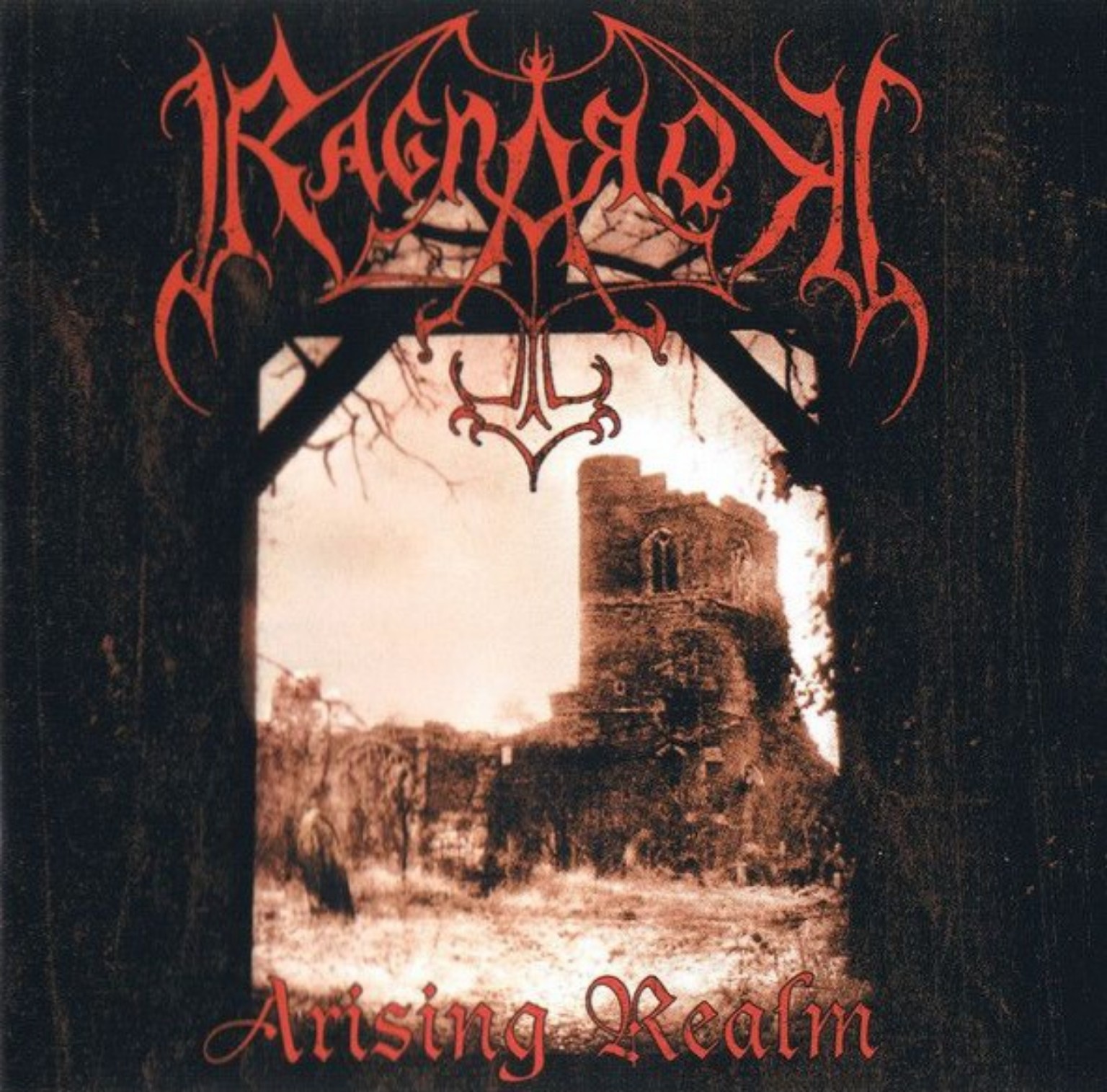
What first emerges from the darkness is not a landscape but a name. The letters of Ragnarok spread red across the upper third of the cover, as though assembled not from writing but from sharpened branches, blades and elongated tongues of flame. The word is recognisable, yet it does not immediately submit to reading. The eye has to find a path between the letters. The outer strokes bend like claws, the interior lines intersect, and a long ornament descends from the central axis into the brighter space of the picture. Before the eye even reaches the old stone walls, the red logo has already set a restless, threatening movement in motion.
Beneath the name, however, an unexpected silence awaits. The centre of the image is filled not with a fighting figure, a demonic face or a ritual scene but with a faded, sepia-toned landscape. A tall, damaged stone structure rises above the vegetation. We can clearly make out that it is tower-like, that its upper edge breaks off irregularly, and that a narrow arched opening is dark within one of the wall's higher sections. Below it are fractured stone surfaces and shadows suggesting openings or collapsed portions of the wall. Bushes, trees, tangled branches and low vegetation surround the structure. No human figure stands before it; nothing suggests that the place is inhabited or cared for in the present moment depicted. Its original function cannot be identified reliably from this view alone. Yet precisely because of that uncertainty it recalls at once a ruined castle, the remains of an old religious building and a constructed world whose former meaning has been severed from its walls.
The most important compositional choice is that the ruin is not presented in an entirely open, unobstructed view. Dark masses press in on the bright central image from every direction. On either side there are nearly continuous black bands; at the top diagonal lines and branch-like shapes cut across the light. The interior scene thus seems to be viewed through a shadowy opening, doorway or window towards the landscape beyond. The actual material and location of this opening cannot be determined: the black frame may be part of the photograph or a result of the graphic design. Its effect, however, is unmistakable. We do not command the landscape. First we have to look past something obscuring part of the horizon, and only then can we discover the ruin.
The cover consequently maintains two different distances. The dark foreground almost touches us; the stone tower rises much farther away, behind the vegetation. The eye travels from the black edge towards the bright, almost overexposed sky, then back to the dark window of the stone wall, and finally down among the bushes and grassy foreground. Crossing this imagined threshold is not impossible, but no path has been marked out. The place opening at the centre of the cover never becomes completely accessible. This withholding of space is one reason the picture feels more unsettling than an ordinary photograph of ruins.
The stone structure does not stand at the exact geometric centre. Its mass gathers more to the right, while a larger, brighter expanse of air remains to the left. The pale sky and the irregular line of the wall define one another: where the stone ends, the eye falls into an almost empty background. The vertical mass on the right is answered by the dark lines reaching down from above, while the red band emblem, striving towards symmetry, floats over this lopsided landscape. Two kinds of order meet: the deliberately formed, nearly axial structure of the graphic logo, and the uneven, apparently accidental shapes of a ruined building and nature.
At first glance the colours form a narrow range, yet the picture is far from monochromatic. The darkness at the edges is not uniformly pure black: brownish and reddish grains and worn surfaces break it up. Within the central, photographic-looking field, milky cream, pale orange, rust brown and deeper earth tones mingle. In the tower's shadows, the browns almost turn black; the blades of grass in the foreground echo the light of the sky. The logo stands outside this subdued palette: its fuller, glowing red does not continue the landscape but cuts into it. The cover is therefore not simply 'black and red'. The bone-coloured sky, the earthlike browns and the edges disappearing into darkness allow the red lettering to make its strange and powerful impression.
The light deserves particular attention. No single clearly defined light source is visible, and the image tells no reliable story about the time of day. The sky is bright, the denser vegetation dark, while sections of the building are separated from one another unevenly. The high brightness does not create cheerfulness: instead, it bleaches the distance, obscures details and leaves the solid mass of stone isolated within it. Against this brightness, the black foreground becomes still more emphatic. We are not looking at a starry night sky or an unmistakable sunset. The cover's peculiar mood comes precisely from the fact that the darkness lies not above the landscape, but between the viewer and the landscape.
The photographic core of the image is grainy, sometimes soft and broken in tone. Its surfaces do not resemble those of a modern, high-resolution architectural photograph. The edges of the stones blur, the vegetation becomes a dense pattern, and in places the ruin's forms are more readily guessed at than counted with precision. This clearly visible quality of the printed album artwork makes the location harder to identify but strengthens the feeling of age. We cannot assert that an analogue photograph was intentionally aged or specify which darkroom or printing process was used. What the finished image does reveal is that its texture does not direct attention towards clean documentation. Instead, it suggests that the surviving picture of the past itself bears the marks of time.
The tower's upper outline and narrow opening make the structure strangely human and alien at once. The arched window is a trace of human planning, masonry and building: someone once shaped the stone to create a particular passage between inside and outside. But no one looks back from the dark interior visible now. There is no guard, inhabitant, priest or visitor in the image. A human-made form still stands in the landscape, but the life that once may have given it meaning is absent. Thus the ruin does not merely show destruction. It reveals the survival of an abandoned order: the material of a vanished world can remain even when its use and explanation have been lost.
Such a reading can approach the mythic atmosphere of Ragnarok's name, but it does not amount to a depiction of any particular scene from the myth. The characters, gods and battles of Ragnarök are not shown on the cover. We do not know whether the wall is the ruin of a particular religious institution, and there is no reason to read a specific historical event into its stonework. Nevertheless, the image can carry the double idea of ending and new beginning. The walls are damaged but have not disappeared; human order has retreated while vegetation has occupied its surroundings. Destruction does not leave a blank white page behind. Something else begins in the places that the former order can no longer entirely possess.
In this scene, nature is no idyllic refuge. Branches reach across the brighter sections, bushes partly conceal the base of the building, and uneven patches cover the ground. The living vegetation appears not as a carefully maintained garden but as a slow, patient reclamation. Against the immobility of stone comes the duration of growth: the long process that reshapes a human structure not through a single catastrophe but through an endless sequence of small changes. If the cover speaks of a fall, it shows not the single second of an explosion but the time after the fall.
The album title runs along the very bottom of the picture. The elongated, ornate, archaic letterforms of 'Arising Realm', outlined in red and dark colour, emerge against the pale vegetation. They do not overpower the central image as the enormous logo above does. They appear instead at the edge of the landscape, as though a title from an old chronicle had been placed over a distant view. The meaning of the title—an ascending or emerging realm or world—stands in tension with the building shown. The eye sees no triumphant construction, no kingdom throwing its gates open, no new walls, but the surviving, damaged fragments of an old structure. The rising world is not yet complete. Perhaps it begins behind the ruin, perhaps in its place, perhaps in the very interpretation of its destruction.
The relative scale of the two inscriptions is also revealing. Above, the band's logo reigns: broad, sharp, complex, almost ritualistic. Below, the album title closes the composition as a narrower, less continuous ornament. Between these two red layers of text lies a subdued, almost monochrome photograph. The eye therefore keeps moving vertically: from the upper sign to the ruin, then to the title and finally back to the dark opening at the centre. In this arrangement, the cover does not illustrate any single line of a song. It has a rhythm of its own, with the red graphic elements supplying the strong accents and the motionless ruin providing the longer sustained duration.
Illegible, thorny logos, sombre historical or natural surroundings and strong contrasts were familiar devices on black metal album covers in the 1990s. Arising Realm uses this vocabulary recognisably, but it does more than simply place ordinary genre signals next to one another. Its most interesting quality is its sense of proportion. The landscape is not crowded; the ruin is not surrounded by an invented battle, monsters or a multitude of symbols. Much of the threat resides in the graphic structure, while the central photograph preserves the quiet of a deserted, silenced place. The black frame and red logo almost attack the landscape, yet the landscape does not answer. This strange imbalance has a deeper effect than a directly violent image.
The cover's visual idea can also be linked to the album's documented themes. The title 'The Fall of Christianity' evokes the collapse of a religious order, while 'En verden av stein' directs attention towards a world made of stone even in its literal meaning. 'Time Before Birth of Light' and 'The Predicted Future' open the imagination towards distant edges of time. The ruin on the cover can mediate between these motifs: it is at once material, historical and open to symbolic interpretation. We cannot, however, establish that the building shown was selected for the specific words of any of these songs, or that the band assigned predetermined meanings to each visual detail. The connection rests here on intelligible, mutually reinforcing motifs of the album and image, not on any discovered declaration by the artists.
The cover has a subtler link to the musical world in which extreme sound could coexist with keyboard-generated atmosphere. The red logo almost pierces, the black border confines and compresses, yet the pale sky leaves an expanse of space around the ruin. Graphic density and photographic space coexist, just as raw, powerful instrumental sound may coexist within a composition with a more sustained passage that creates atmosphere. This is an aesthetic parallel, not a claim that any musician consciously intended to depict that particular musical structure in the artwork. Through its own means the cover makes tangible the simultaneous effects of raw force and distance.
Yet in the entire picture the most unsettling thing is not the red lettering but the opening high in the wall. A narrow, dark form in the stone that the eye involuntarily tries to peer into. Perhaps a window; the visible details suggest an arched, divided opening. It reveals nothing of what may lie behind. From a black foreground we observe a ruin; through the ruin's wall we glimpse another dark interior. One threshold opens beyond another, and the space that could be known with certainty is always one step farther away. That is the image's true drama. Not a visible event but the process of approach and withholding.
The world rising in the album's title therefore does not appear on its cover at a moment of triumph. Rather, it begins where an old order has left behind only material, shadow and a few recognisable forms. The red letters bring into the picture a force about to make itself heard; the stone, grass and blurred sky convey its longer, silent history. The viewer looks upon the landscape from behind the black frame, as though standing in a doorway that they have not yet crossed. The cover does not say what realm is rising, or over whose ruins. That is precisely why it remains memorable. It does not solve the mystery of the title; it opens it.
The Album Comes to Life
Pål-Espen Johannesen once again played an important role in shaping the sound. According to the credits, Ragnarok themselves also took part in production and mixing. Mastering was subsequently carried out at Strype Audio in Oslo, with Tom Kvålsvoll involved. One of the album’s most significant guests was Shagrath of Dimmu Borgir, who played the synthesizers. The keyboards did not obscure the guitars; instead they opened up a space behind them, a cold horizon against which the raw riffs seemed larger, more distant and more ominous.
The album does not begin with an explosion. Intro lets the listener enter slowly. The keyboards and sombre atmosphere make it feel as though someone were stepping into a dark room before being able to see its walls. A later reviewer heard the funeral-march opening gradually take on a more solemn, almost triumphant quality. By the time God Is Wasted begins, the gate has already closed behind us.
There is no reconciliation in the world of God Is Wasted. The Christian God is portrayed as a spent, fallen power, while Christ appears not as a saviour but as an outsider to be driven away. The song’s imagery is brutal, but behind it lies the same idea Thyme repeatedly voiced in interviews: in his view, Christianity had violently severed Norway from an older order. The music conveys this not through argument but through icy repetition. An early review detected melody even beneath the raw Norwegian sound; a later listener singled out the moment when the riff turns into a hypnotic cycle.
Searching for My Dark Desire turns inward. This is not a battle between countries and religions but the growth of darkness within one person. Grief, hatred and a demonic shadow appear not as external enemies but as forces the speaker himself wishes to join. Part of the song’s power lies precisely in Ragnarok’s refusal to evoke the historical past here: instead, they create a psychological landscape. Later reviewers heard a melancholy interruption within it, a brief opening into a sadder, deeper space amid the rush.
En verden av stein takes us back to Norway. Dark forests, snow-covered mountains, rivers and the ancient spirit of the homeland rise into view. If one song links the pagan world of Nattferd to the harsher anti-religious stance of Arising Realm, it is this one. Nature is not a backdrop here. It is a character. It can be crushed or wounded, but it can strike back. Thyme’s words from interviews almost echo between the lines: nature is a force, and the past is not dead as long as someone can imagine it.
Time Before Birth of Light reaches still further. Not into Norwegian history, but into a mythical age before light, an era in which dark power alone held sway and Christianity had not yet come into being. The song’s logic is not historical but cosmic. Later critics heard echoes of Bathory and Hellhammer in it, yet the melodies and keyboards meant that Ragnarok were not merely looking backwards. They were building a space of their own.
The title My Hate Is His Spirit already contains the essence of the song: personal hatred and dark power merge into one another. The blood-red horizon, the vanishing sun and the coming of night speak the same visual language as the flames and black-and-white band photographs in the booklet. By now the album is no longer a succession of songs, but one long night.
My Refuge in Darkness, however, unexpectedly seeks shelter in that night. The speaker longs to be among the stars, in a world without people and without contact with humanity. Here death is not simply an ending but a way out. The cosmic imagery also resonates with Rym’s interest in the occult and outer space. With its more acoustic opening and broader melodies, the song feels as though the album momentarily raised its head from the earth and looked towards the sky—only to find darkness there as well.
The Reflection From the Star World Above carries that image further. Light and night are not simply opposites but two cosmic forces. Darkness waits, knowing that light will one day go out. The track reveals one of the band’s strongest qualities: behind the raw aggression, they can open a sorrowful, almost majestic space. A later review highlighted precisely this shift, the deep synthesizer and the mournful guitar melody.
The Fall of Christianity is shorter and more direct. It does not hint; it declares. Wolves, ravens, a full moon and a winter night surround the fall of Christianity. Here the Scandinavian landscape becomes a vision of war. The piano and keyboard accents give the song a strange solemnity, as though a victory ritual were already following the destruction.
At more than seven minutes, The Predicted Future is the album’s broadest expanse. It begins on a misty autumn night, then passes through nature’s fury and humanity’s bestial transformation towards an image of a new world. Almost every earlier motif returns: opposition to religion, nature, blood, war, dark brotherhood, and the idea that the present order is not final. Here the “rising realm” of the album’s title truly comes into view.
Finally, For the World I Am Blinded turns away from all of this. It is not a victory march, but a departure. The speaker seeks a world without people, an eternal winter night in which death is a passageway. The social and religious hatred of the earlier songs becomes personal emptiness here. The final sung moment of the record does not say that the world can be conquered, but that perhaps it must be left behind.
Outro explains nothing more. It leads the listener out of the space the preceding nearly fifty minutes have constructed. Ragnarok do not resolve the tension. They simply close the door.
Reception and the Roads Ahead
When Arising Realm was released, the sources did not entirely agree even on the precise date. Release records give 23 April 1997, while the band biography from the period mentions May. That same biography claims that the record sold four thousand copies in two months. For an underground black metal band, this was no insignificant figure, especially in an age when reputations were built through letters, fanzines, tape trading, concert posters and CDs that circulated slowly.
Its reception did not take shape in a single instant either. On 1 January 1998, Andrew Lewandowski of Chronicles of Chaos awarded the album seven out of ten. He could hear its power and melodies, but did not treat it as a flawless masterpiece. This early caution provides an interesting contrast with the way it would be discussed later.
An Ancient Beliefs piece from 2003, republished years later by Soundpertures, gave it eight points. It called it good, typical 1990s black metal, with powerful drums, devastating rasped vocals, fast guitars and atmospheric keyboards. For that reviewer, the record was a succession of dark anthems, a journey through ideological destruction.
In 2009, the writer at From the Dust Returned went even further. Nine and a half points. “Epic Win.” Elements that might once have sounded too raw or uneven had by then become virtues: Thyme’s voice, the sharp guitar, the vast reverb and the synthesizer pulsing in the background. Time had altered the record’s surroundings. What in 1997 had been one more Norwegian black metal album among many sounded a decade later like a peculiar imprint of an era.
Meanwhile, the stage remained important. After the uncertain plans of 1996, the band really did take to the road in the years following the release of Arising Realm. In an interview from around 1999, Jontho stated the facts simply: the second album was out, they had toured, and the third was being prepared. Later historical sources date the first international tour to 1998, alongside Sweden’s Siebenbürgen and Germany’s Atanatos. They mention eight shows: one in Copenhagen and seven in Germany. A summer appearance at a German festival followed the tour.
Touring confirmed what Thyme had said earlier about performing live. Ragnarok did not want to be merely a studio band. In 2000, Jontho said it would be wonderful to play Wacken and that, for him, an ideal concert venue was simply somewhere many people liked the band and the crowd went completely wild when they played. He wanted to be on the road far more often within five years. The desire was straightforward: Ragnarok should become one of the scene’s well-known bands and keep moving forward.
Yet by the time he said this, Arising Realm was behind them and the band had turned in another direction. Discussing the forthcoming Diabolical Age, Jerv and Jontho spoke of faster, more technical and more brutal music. They did not want to abandon melody, but they had scaled back the keyboards. Jerv’s retrospective view is particularly revealing about Arising Realm: he associated the first album more with Viking and pagan mythology and the second more strongly with satanic beliefs, while stressing its spiritual character. The third record marked another step.
X-Ray Studios was also slowly becoming part of the past. Jerv later spoke of it as the place where the “usual Ragnarok sound” had taken shape, highlighting the perfectionism of Pål-Espen’s work. Diabolical Age was recorded at Endless Studio in Oslo instead. They had not merely changed studios. An era had come to an end.
And yet Arising Realm remained between those two worlds. It no longer possessed the innocence of their very first statement, but neither did it have the deliberate brutality of the later records. It became an album on which Ragnarok looked back towards an imagined pagan past and forward towards a dark, cosmic future at the same time. Thyme’s vision of nature, Rym’s fascination with the unknown, Jerv’s and Jontho’s interest in satanism, the cold light of Shagrath’s keyboards and the raw sound of X-Ray Studios all met within the same fifty minutes.
For this reason, the album’s later reputation perhaps tells us more about it than any reaction from its first week. A twenty-fifth-anniversary retrospective in 2022 already treated it as a work that must not be forgotten. Review scores climbed from seven to eight and then nine and a half, but what mattered more than the numbers was what had happened behind them: Arising Realm had outlived its own era.
The booklet images, the flames, the black-and-white faces, the logo and the densely typeset list of thanks are now artifacts of another music industry. They come from a time when a band printed a postal address in its booklet, when relationships were formed through letters and fanzines, and when news of a Norwegian underground record travelled slowly to the other end of Europe. At this stage of Ragnarok’s history, every small object like these was part of how the music spread.
The Afterlife of the Flame
And perhaps that is the true resonance left by Arising Realm. Not its precise ranking on some later list, nor the number of points one critic or another awarded it. Rather, the fact that decades later it can still be taken down from the shelf, and that one can still hear within it the moment when four young musicians from Sarpsborg, together with a few companions, entered a studio and tried to give a voice to the world they saw around them and within themselves.
At the beginning of this story, Jontho and Jerv left a band because they no longer believed in it. By the end, they had left behind an album in which, even twenty-five years later, others could find something worth believing in—not as a religion, perhaps, but as music, as memory, as the dark imprint of an era.
The flame in the booklet burned out long ago. The November days at X-Ray Studios are gone. The letters, the demos, the three early concerts and the first tour have become history. Yet when the first notes of Intro sound, the gate opens again. And Arising Realm, for those fifty minutes at least, rises once more.
Reader comments
Comments only appear after approval. Messages are displayed in their original language.
Comment submissions are not enabled yet.