

Landscape Symphonies
The recording story, all eight tracks and the album’s legacy in the complete English book.
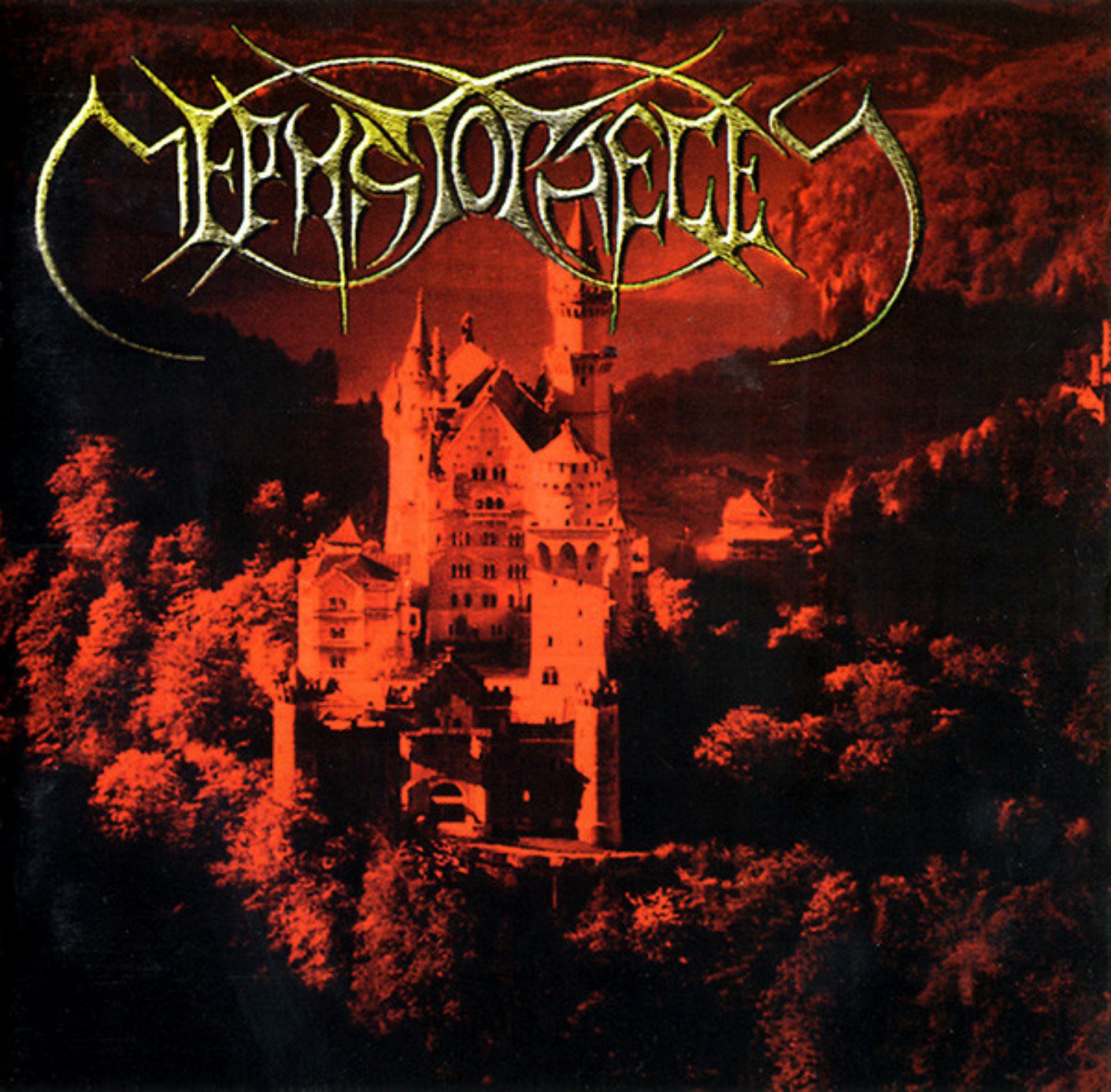
Album details
Tracklist · original 8 tracks
- A Landscape Symphony (Introduction)2:08
- Cosmos...8:20
- Dark Clouds Rise Above the Kingdom5:45
- Destiny Calls5:47
- The Overture of the Night4:39
- My Throne of Wisdom8:27
- Infinite Dreams6:17
- I Will Not Forget... (Outro)2:52
Band members · recorded performance
- Nordischer Künstler
- Vocals, keyboards
- Xenien
- Guitars (lead, rhythm, acoustic), bass
- Selphratus
- Drums
Ferun (rhythm guitar) and Friirr (bass) are listed in the booklet’s line-up; however Xenien performed the recorded bass, rhythm, lead and acoustic guitar parts.
Guest musician
- Denise
- Female vocals
Recording and release
- Release date
- 7 July 1997
- Recording / mixing / mastering
- Hell’s Gate Studio, Behrste · Late summer 1996
- Original label
- Adipocere Records
- Catalogue number
- CD AR 040 / 27361 68102
- Original edition
- CD · 8 tracks
- Engineering
- Detlef Wiedecke (with Mephistopheles)
- Cover design / artwork
- Reyk Borgardt; N.K. (booklet credits)
Original 1997 Adipocere Records CD edition; the recordings originated as demo material.
Cover artwork history and interpretation: Chapter III
Listen to the complete album
The uploader states that Adipocere Records authorised this upload. This is a full-album video, not a verified YouTube Music catalogue page; I have not independently confirmed the label’s permission.
Physical CD – product page and label catalogue
1997 · Adipocere Records · CD AR 040 · stock not verified
No directly orderable CD has been confirmed online. These links do not guarantee stock; O’CD currently marks the item out of stock.
I. Before the Landscape Was Born
Around Oldenburg, 1994–1996
The story of Landscape Symphonies begins not with a finished record, but with a handful of very young musicians in northern Germany around 1994, searching for a way to turn the images they carried within them into sound. The first incarnation of Mephistopheles took shape around Xenien, Nordischer Künstler and Ineb. Behind the early rehearsals and performances, still supported by a drum machine, there was already something that would eventually define the entire debut album: they wanted more than simply to play heavy music; they wanted the music to open up a space. Behind the riffs they were looking for something more distant, something beyond the walls of their rehearsal room.
When Selphratus, whose real name is André Kummer, joined in December 1994, the music acquired the pulse of live drums. According to one later recollection, he was only fifteen when he recorded the drums for Landscape Symphonies; another source puts him a year older, but the essential point remains unchanged. The musicians behind this record were not seasoned studio veterans. They were little more than teenagers, and had yet to learn which impulses they were supposed to hold back. That inexperience would become both a weakness of the recording and a source of its peculiar strength.
After Ineb’s departure in 1995, the band lost more than a single member. His absence changed what the group was able to do. Playing concerts became harder, and by 1996 their attention increasingly turned towards writing and recording. It was then that Xenien assumed a decisive role: he recorded the rhythm and lead guitars, acoustic passages and bass on the material they were preparing. Other members would appear in the line-up printed in the album’s booklet, but almost all the recorded string-instrument parts were, in fact, his work.
Meanwhile, Nordischer Künstler did more than sing and play keyboards. Later interviews also attribute the lyrical world of the band’s early period to him. This matters because Landscape Symphonies is not simply a collection of melodic black metal songs. The lyrics and the music open onto the same vistas: sky, winter, death, unknown horizons, stars, memory, and landscapes that are closer to inner states than to real geographical places.
At that stage, the band had not sat down to plan a “great debut album.” They wanted to make an introductory recording. That fact would later change the way almost everything about it could be understood. Landscape Symphonies began life with the intention of being a demo, but became something that could no longer be taken back to the rehearsal room, pulled apart and started again. All at once, a sketch had acquired a definitive form.
The Exact Credits in the Booklet
The album booklet’s personnel credits establish an important distinction. In the printed band line-up, Nordischer Künstler is listed on vocals and keyboards; Xenien on lead guitar and six- and twelve-string acoustic guitars; Ferun on rhythm guitar; Friirr on bass; and Selphratus on drums and percussion. On the same page, however, a separate note expressly states that Xenien played every bass, rhythm-guitar, lead-guitar and acoustic-guitar part on the album. The line-up in the booklet is therefore not identical to the list of instrumentalists who actually performed on the studio recording. Nordischer Künstler and Xenien are credited jointly with the music, while Nordischer Künstler wrote all the lyrics; Denise is credited with the female vocal parts. The booklet names Detlef Wiedecke and Mephistopheles in connection with recording, engineering, mixing and mastering, specifying Hell’s Gate Studio and the late summer of 1996. Distinguishing between creative and performing roles in this way does not diminish the musicians listed as band members: it simply gives us a more accurate picture of how the album as we hear it took shape.
A CITY LIVING IN MORE THAN ONE ERA
When Mephistopheles formed, Oldenburg was a northwestern German city grown out of a former ducal seat, one of the administrative, commercial and educational centres of the Weser–Ems region. Churches, cultural institutions, merchants’ houses and remnants of neoclassical architecture shaped its old centre. Waterways and wet meadows characterised the surrounding area, while the wider region was marked by its proximity to the coast and the flat northern German landscape. But the Oldenburg of the 1990s cannot be recalled as a postcard scene alone. Everyday life was shaped both by a growing service and university centre and by the retreat of the old industrial economy.
The factories of Osternburg, once developed as a working-class district, had played an important part in local history. The glassworks and the Warpsspinnerei textile plant closed during the second half of the twentieth century. The city’s historical overview highlights the shift away from industrial labour towards administration, financial services and higher education. The founding of Carl von Ossietzky University in 1973 had helped set the stage for that change: students, research centres and new institutions became part of the life of a city with a very different working culture in its past. By the 1990s Oldenburg carried both the memory of the old industrial working class and the promise of an economy based on services and knowledge.
Change, however, did not guarantee a secure living for everyone. Contemporary chronicles held by the municipal archive record an average of 7,296 unemployed people and an unemployment rate of 11.4 per cent in 1994; 7,897 and 12.4 per cent in 1995; and 8,510 and 13.1 per cent in 1996. The figures show a clear deterioration over those three years. They do not establish that any band member lost a job, or that the group wrote its lyrics in response to these circumstances. Yet these numbers alter the historical picture: the creative ambitions of teenagers and young adults were taking shape in a city where material security was becoming more uncertain for many of its inhabitants.
The events recorded in the chronicles show how economic change became visible in the streets and institutions. In 1994, strikes and demonstrations over wages and working conditions were recorded at AEG and the Brand shipyard. In February 1995, the bankruptcy of Brand Werft was also noted. At the same time, new jobs, businesses, services and residential districts were developing; the city did not simply become a declining industrial town. Old and new Oldenburg existed side by side.
On January 6, 1995, the city celebrated the 650th anniversary of its civic rights. Events at the Lambertikirche, town hall, theatre and Weser-Ems-Halle made the anniversary a celebration of shared urban memory. Oldenburg’s past was not merely a museum exhibit that day: its citizens could see their city, their history and their sense of belonging reflected in it. That same year, new shops opened, political debates took place and cultural events took place. The period of the first Mephistopheles recordings was therefore not some timeless northern darkness, but the everyday life of a living, contradictory society.
BEYOND OLDENBURG: LANDSCAPE, TRANSPORT, CONNECTIONS
Oldenburg was linked to surrounding communities in Ammerland, Wesermarsch, Friesland and northwestern Lower Saxony, as well as to the city of Bremen. Overland transport relied on railways and roads, while everyday routines were organised around commuting and smaller communities in which people lived and worked. The lowlands near the sea, waterways, agriculture and urban services were not parts of a single way of life, yet they continually intersected. The Oldenburg chronicle notes the return of an Intercity connection on June 1, 1996, and another ICE link on June 1, 1997. These details illuminate the region’s transport network; they do not prove that the band undertook any particular journey or played any particular show.
The booklet gives a contemporary postal address in Oldenburg. This is an important indication that the band maintained contact with the wider world through the city, but it does not tell us where the members lived, where they rehearsed or where the record was made. The recording took place at Hell’s Gate Studio in Behrste. Oldenburg was the city where the band began, not the location of the studio. The two places must remain distinct in the story of the album.
After German reunification in 1990, the former internal German border disappeared, but political and economic transformation did not end overnight. Germany in the mid-1990s was trying to find its position in an increasingly integrated European economy while debating the future of social security. In Oldenburg, the everyday imprint of these changes lay not in grand historical speeches, but in shifts in the urban labour market, shops, institutions, schools and transport. That broader background surrounded the band; it could only be called a personal motive for songwriting if the participants themselves had expressly said so.
THE LIMITS OF NEW CONNECTIONS
It is easy to misunderstand how information travelled in that period if we judge it by our own experience today. Alongside letters, printed fanzines, dealers’ catalogues and audio cassettes, forms of digital communication had already appeared in the first half of the 1990s, but access was far from universal. Oldenburg’s city chronicle records the start of a cultural programme entitled “Klick: Kultur im Internet” on May 28, 1996. Its account of the city on January 1, 1997, mentions a local initiative with a 34-megabit-per-second internet connection. By then the Nordwest-Zeitung was offering its own internet access; on January 22, 1997, EWE and the newspaper agreed on regional dial-up nodes for Nordwest-Net. This marked the beginning of a new era, not proof that an underground band in 1996 was already publishing online in the modern sense.
The coexistence of a local environment and far-reaching connections gave musicians a remarkable opportunity. A recording made in the rehearsal room of a small community could travel to listeners in unfamiliar cities and other countries. In the history of Landscape Symphonies, the decisive point in that transition was the recording’s arrival at a French record label: the finished demo became a physical release that travelled far beyond its original surroundings. That transformation is part of the album’s documented history.
THE CITY DID NOT LIVE BY ONE KIND OF MUSIC
Oldenburg’s concert life between 1994 and 1997 cannot be viewed retrospectively through black metal alone. The local yearbooks report chamber and orchestral performances, jazz, theatre music, pop concerts and rock shows alike. Kulturetage and Weser-Ems-Halle offered venues on two very different scales, while the Cadillac youth cultural centre provided a meeting place for young performers and a range of musical styles. The municipal archive records drummer Billy Cobham giving a workshop at Cadillac in October 1994; performances by Herman Brood at Werk 2 and Die Ärzte at Weser-Ems-Halle in May 1996; the launch of the cultural internet programme that same month; and a concert at Cadillac in December 1997. These events demonstrate the diversity of local musical life, not that Mephistopheles attended any of them.
In such a city, rock and metal listeners did not discover their music through one large institution. There were bigger halls and clubs, smaller community venues, a local press, conventional shops selling recordings, and networks sustained by amateur enthusiasts. Surviving sources do not reveal which rehearsal room, shop or club first brought Mephistopheles into contact with others. But understanding how the period worked does not require inventing a particular concert: the musical environment around the band can still be reconstructed.
A CASSETTE WAS MORE THAN A RECORDING MEDIUM
In the geographically scattered international scenes of black and death metal, a demo served a young band at once as an introduction, a calling card and a risk. Recordings could be duplicated, provided with covers and contact details, mailed out or exchanged for other tapes and fanzine issues. Not every contact led to a record deal, and not every deal changed how a recording sounded. What mattered about tape trading, however, was that music could reach listeners without first passing through the filter of a label or national radio station.
In a recollection published in 2014, Stefan Löns, who made the German Witchcraft fanzine, described how music exchanges at school and photocopied zines obtained from a few acquaintances began in the late 1980s, and how letters, demos and tape trading subsequently brought contacts abroad. He placed particular value on country-by-country cassette compilations, which opened windows onto scenes previously unknown to him. His account is not testimony from a member of Mephistopheles; it is first-hand evidence from a German metal fanzine maker of the same general period about how that network operated in practice. The documented contents of Witchcraft’s third issue, published in June 1994, already include Adipocere Records alongside various European and overseas bands. The label’s name was thus present in the printed international underground even before Mephistopheles released its debut.
Karim Daire, one of the founders of the Hamburg fanzine Lärmbelästigung, describes something similar. In contacts established before the 1990s and carried into that decade, copying CDs, international tape trading and the culture of the amateur computer scene overlapped. Hamburg and Oldenburg are separate cities, and there is no documented connection between the people he recalled and Mephistopheles. Nevertheless, this example from the wider north German region provides an important counterweight to the later picture of music listening as an entirely digital activity.
THE NETWORK THAT LED TO THE FRENCH LABEL
Christian Bivel, founder of Adipocere Records, later recalled in his own words that he had been involved in the underground since 1985, through radio programmes, fanzines, foreign travel and interviews. According to his account, he formally launched the label in June 1992. He did more than sign bands: he exchanged records with other labels, organised mail-order sales and began by producing singles, followed by CDs. This was distribution built from the ground up. What local recordings could not reach through radio or retail chains could become available through personally maintained correspondence and connections with small distributors.
Adipocere, then, was more than a logo on the back of the album. Between Mephistopheles’ 1996 recording and its French release in 1997 stood a label equipped to work within the small international networks of extreme metal. We have no source, however, telling us exactly when Bivel first heard the Mephistopheles demo, who gave it to him or what he initially thought of it. Such a meeting or conversation must not be invented for this narrative. What is actually documented is the label’s business model and its release of the album.
THE MID-1990s: TWO IDEALS OF SOUND
Black metal did not evolve along a single stylistic path. Alongside the rawer, more austere recordings of the early part of the decade, a growing number of bands turned towards longer songs, keyboard textures, melodic guitar lines and more intricate structures. These changes did not occur everywhere at once or move in the same direction. Some records preserved a deliberately abrasive sound; others sought increasingly clear studio production and more expansive arrangements. Mephistopheles’ eventual place in this history is best understood not as the triumph of one movement, but as the coexistence of these different possibilities.
Dimmu Borgir’s Enthrone Darkness Triumphant, released on May 30, 1997, clearly illustrates the branch of more melodic, keyboard-heavy black metal moving towards international reach and better studio conditions. Nuclear Blast’s official release information confirms the album and its date, while the band’s own discography places it as the follow-up to 1996’s Stormblåst. This is a parallel within the period, not a claim about documented personal influences on Mephistopheles. Released in the same year, Landscape Symphonies is particularly revealing when heard against that broader background: it uses keyboards and creates melodic space, but retains the rougher, less polished, demo-born sound of its young creators.
By the second half of the 1990s, the CD was one of the principal media for professionally distributed music. A later statistical review by the German music industry association identifies 1997 as the peak year for CD revenues. Yet demo cassettes, photocopied inserts and catalogues obtained in shops or by mail order still had a place in the world of smaller labels. The two systems did not exclude one another: it was precisely by crossing between them that a recording originally intended as a demo could become an officially distributed CD.
Festivals also increased the visibility of metal in the wider northern German region. According to Wacken Open Air’s own retrospective, it began in 1990 with an audience of around eight hundred; by 1996, attendance had reached approximately eight thousand. This does not mean that festivalgoers necessarily encountered Mephistopheles. The numbers instead suggest how quickly a musical culture once organised on the margins in small communities could grow in scale in certain places. Meanwhile, correspondence-based tape trading and small fanzines continued to sustain a different, more direct kind of contact.
Landscape Symphonies is a document of this dual era: the music of a young band reached a European record company through the underground’s distinctive network of relationships, just as several currents within black metal were gaining access to larger-scale arrangements and commercial opportunities. In subsequent assessments of the album, production that sounded primitive and melodies that proved unusually memorable could remain equally present. This is precisely what makes the work historically interesting: neither side can simply be erased by the other.
II. The Demo That Hardened into an Album
Hell’s Gate Studio, 1996
The recordings were made in the late summer of 1996 at Hell’s Gate Studio in Behrste. Detlef Wiedecke is credited with the recording, engineering, mixing and mastering. In retrospect, the studio’s name sounds almost like a literary exaggeration, as though an album like this could only have been recorded somewhere called “Hell’s Gate.” The reality was far simpler. The young band worked with what they had: songs, ideas, little experience, and an imagination far greater than the technical resources at their disposal.
That contrast remains the most striking feature of the recording’s sound. The production makes no attempt to conceal its age or appear grander than it is. The guitars are rough-edged, the drums do not merge into a polished wall of sound, the vocals are raw, and at times the keyboards seem to float above the band like a separate layer of air. Yet this is precisely where the sense of space comes from, the quality so many listeners would later regard as the album’s greatest strength. The band triumphs not through sonic perfection, but because, through all those limitations, the music keeps looking in the same direction.
Denise’s guest vocals stand out all the more sharply against this dark, abrasive backdrop. She does not take over the songs or turn them into conventional male–female duets. Instead, her voice is like a brief change of light over a clouded landscape. The contrast does not make the music less dark; on the contrary, it throws its contours into sharper relief.
Years later, Jury listened back to the material as a member of a far more technically accomplished and exacting Mephistopheles. He called the production poor and spoke of mistakes the band would no longer have allowed to pass. There is nothing surprising in that perspective. Artists often hear above all what they would now correct in their youthful work. Listeners, however, hear something that happened once and can never happen in quite the same way again. The peculiar power of Landscape Symphonies exists somewhere between those two points of view.
The demo attracted the attention of the French label Adipocere Records, and the material became an album. Later accounts differ over how unchanged the demo remained when it was issued officially, so the process cannot be reduced to one simple statement. What is certain is that Mephistopheles originally intended it as an introductory recording, while the world received it as a debut full-length album in 1997. From then on, every note was fixed in place.
III. Behind the Cover
July 7, 1997
Landscape Symphonies was released by Adipocere Records on July 7, 1997. Its cover greeted the listener with mountains, a castle and a romantic landscape, as though the record wanted to announce before the first note that what lay within was not a club or rehearsal room but another geography altogether. Even the title is plural—symphonies and landscapes—as if the band were promising not one story but a succession of places opening into one another.
The album, running a little over forty-four minutes, takes us through eight stages. Three are instrumentals: the opening A Landscape Symphony, the centrally placed Destiny Calls, and the closing I Will Not Forget... They are not empty interludes. Listening to the album from beginning to end, we discover that they provide its breathing space. Between the denser, more confrontational world of the songs with lyrics, these pieces admit a wider expanse of air.
The recording’s dynamics also serve this journey. Its opening and ending are much more restrained, while the long central songs repeatedly gather into greater density before withdrawing unexpectedly. The album does not travel in a straight line. It swells, pauses, starts again, almost disappears into fog at times, and then suddenly stands before us once more at full force.
This is why Landscape Symphonies is best heard as a whole. The songs work individually, but together they become something more. The opening keyboards prepare the long horizon of Cosmos...; the instrumental pause in the middle sheds new light on the second half; and the outro draws the entire record back to its point of departure: an image, a memory, a landscape.
On the cover, the eye is drawn first to a strange castle of old-fashioned construction. Its towers and steep roofs rise above dark foliage and the surrounding terrain, while the foreground is filled with details sinking almost into blackness. Red and glowing orange tones distinguish the distant building from the deep shadows. The scene looks at once like an actual landscape viewed from afar and the setting of an old, unsettling tale. There is no prominent protagonist whose actions direct our gaze. The building and its surroundings take on that role instead. The sense of height, distance and isolation is therefore present on the cover even before the album’s opening piece begins.
The contrast between colours is especially important to the composition. The red is not clear daylight; against the black shadows it gives the castle a glow that feels like a memory, slightly unreal. The eye’s movement from the dark foreground towards the structure resembles the way the album’s longer songs often pass from one inner landscape to another. This is an interpretive parallel between the music and the image, not a documented statement of artistic intent from its designers. The booklet credits Reyk Borgardt and N. K. for aspects of the cover concept, layout and graphic design.
The dedication inside the booklet adds another layer of meaning. The album is dedicated to the eternal beauty of nature, and its reflection on boundaries approaches them as limitations created by human beings. The castle, mountains, trees and recurring skies of the album are therefore more than merely adjacent pieces of scenery. The tension between the breadth of the natural world and the stone walls built by humanity also resonates with the songs’ recurring motifs of borders and journeys. The booklet itself opens the way to this interpretation through the creators’ own words; the interpretation makes no claim beyond what those words support.
IV. A Landscape Symphony
The First Gateway
Inside the album. Eight movements, one story.
The opening notes are in no hurry. A Landscape Symphony begins as though the record first wants to reveal the air in which everything else will take place. The introduction is restrained and spacious: not a battle march, not a threatening declaration, but rather a door slowly opening. The keyboards do more than carry a melody. They create a sense of distance.
As the piece unfolds, the soundscape shifts several times, like successive layers of scenery sliding across one another. For a few moments the music grows slightly denser, then becomes quiet again. Towards the end, the music seems almost to dissolve. Rather than bringing things to a close, it leaves a space behind.
That space will hold the first breath of Cosmos.... This is why the introduction works best not as an independent instrumental, but as the rising curtain on a darkened stage. The story has yet to begin, but its world is already waiting.
V. Cosmos...
When the Horizon Opens
Cosmos... is more than the album’s first fully vocal song: it is the moment when the true scale of Landscape Symphonies becomes visible for the first time. This long composition refuses to rush towards its ending. Soon after the opening, the distinctive duality that defines the entire album takes shape: guitar and drums drive forward, while the keyboards seem constantly to expand the space upwards and outwards.
The first passage is dense but clearly defined. The guitars do not merely build a wall; they thread melodies through their own harshness, allowing the song to be both aggressive and exalted. The vocal sits within this scene like a human presence in the middle of a landscape too vast to comprehend. It does not rule the horizon, but seems almost lost within it. This is what makes the word “cosmos” feel less like a scientific term than a matter of proportion: humanity is small, while the surrounding space is almost immeasurable.
In the long central section, the music retreats dramatically. The density of the opening minutes suddenly thins out, as if the listener had reached a more exposed, colder plateau within the same landscape. Here the importance of contrast to Mephistopheles can be felt most clearly. The band does not build everything on relentless speed, but on knowing when to take something away. After passages that approach silence, the return of force feels so much greater.
When the song gathers itself again, it does not return to quite the same place. Earlier melodies circle through it like memories; drums and guitar once more thicken the sound, yet after the withdrawal in the middle everything seems more spacious. This is the composition’s finest quality: instead of growing in a straight line, it moves away from itself and then finds its way back in another light.
In a later reflection by the band, Cosmos... was named among the songs they would have liked to record again. Its structure already contains something of the ambition that the later Mephistopheles could have realised with considerably greater technical assurance. Yet listening to those eight and a half minutes today, what matters is precisely that they were not recorded later. This is the cosmos of the young band, not of the musicians they would eventually become.
What stays with us most strongly at the end is not how fast or heavy the song was, but the strange sensation that the first great chamber of the album now lies behind us. It is as though we had opened a single door in a castle, only to discover not a room but an entire sky.
The extraordinary breadth of Cosmos... comes not only from its musical construction. The lyrics begin with the personal perspective of a speaker gazing into the heavens, then describe distances extending beyond the known world. The unknown realm, the search for truth, the drift among the stars, the coldness of sorrow and a reference to Valhalla all intertwine. The mythological allusion does not produce a fully developed, coherent religious narrative. Instead, it suggests an image of ultimate knowledge and the limits of mortality. The booklet’s thought about boundaries returns within this very song, making it one of the most tangible echoes of the album’s dedication.
VI. Dark Clouds Rise Above the Kingdom
The Sky Closes over the Kingdom
Where Cosmos... opened towards the heavens, the very title Dark Clouds Rise Above the Kingdom brings us back down to earth. The landscape returns, but it is no longer boundless and star-filled: there is a kingdom, a horizon, and something dark gathering overhead. Accordingly, the music attacks more directly. At first the sound is brighter and sharper, less willing to let the listener drift comfortably within it.
Throughout the song, denser passages and brief retreats are locked in constant tension. The guitar melodies often lead the narrative rather than merely accompany it. The youthful rawness of the drumming suits this composition particularly well: instead of mechanical precision, it supplies tension, movement, the feeling of something about to happen.
The clouds in the title therefore seem more than decorative scenery. The whole movement of the song evokes changes in the weather. One passage thickens, another opens out, and then darkness descends over us again. The lyrics’ images of death and the world beyond do not appear as a separate explanation of the music but as part of that same sky.
Towards the end, the music advances once more with its full weight before suddenly releasing the tension. This ending is especially powerful because it does not try to resolve everything. The storm simply subsides, and silence remains in its wake.
It is no coincidence that years later this was the other early song the band wanted to record again. In Dark Clouds... it is easy to hear the possibilities of the Mephistopheles that would come later. Yet it truly belongs to the world of Landscape Symphonies in precisely this raw form.
Behind those dark clouds, the lyrics also evoke a vanishing kingdom and a personal turning point. The light of the past gives way to collapse, forgotten time and a moment experienced as the last. Yet the images suggesting death do not remain a final, irrevocable endpoint: the possibility of rebirth also appears at the end of the text. Alongside an image of historical decline, the kingdom can therefore be read as a setting for inner states. The invocation of ancient gods provides a mythological frame for this transformation, but the booklet does not name the fate of any particular historical people or actual ruler. The sombre music thus meets the dual themes of loss and change.
VII. Destiny Calls
A Turning Point without Words
With the arrival of Destiny Calls, the album stops trying to explain anything for a while. The instrumental seems to step out of the narrative after Dark Clouds..., leaving only the movement of the landscape behind. This is not the same opening of a gateway as the introduction. We already know the world we are travelling through, and the quieter, airier moments therefore recall what we have left behind.
Towards the middle, the dynamics stir once more and then fall away. There is no great dramatic climax, and that is precisely the point. The first half of Landscape Symphonies was filled with long, vocal compositions laden with images. Destiny Calls sets words aside and allows the listener’s imagination to catch up.
If the album tells a single story, this is the scene where its protagonist stops. Nothing visible happens, yet everything shifts. The next song enters a different night.
VIII. The Overture of the Night
Night Does Not Arrive All at Once
Appearing in the second half of the album, The Overture of the Night does not wait for darkness to fall completely. It brings denser material back from its opening moments, but refuses to remain at a single emotional pitch. It moves quickly between more aggressive, sharply outlined passages and sections that withdraw a little. “Overture” is therefore exactly the right word in the title: this is not night itself, but its gradual arrival.
The keyboards are more than decoration here. When they rise behind the guitars, they seem to sketch a distant light beyond the darkness. This is one of the characteristic devices of Landscape Symphonies: even at its fiercest, the music retains a romantic atmosphere. It does not separate beauty from menace, but holds both within the same picture.
In the middle, there is a brief sense of retreat before the full instrumental weight builds again. As a result, the song does not repeat itself in circles, but approaches in waves. It is as though night first filled only the valleys, then slowly climbed the mountainsides.
By the end, there is no doubt: the album’s second half has entered darker, more serious territory. The next composition, My Throne of Wisdom, proceeds from here and takes that inner journey deeper still.
The printed booklet gives The Overture of the Night a separate subtitle, identifying it as the first chapter of the Mephistopheles Saga. This brief designation alone makes the composition a possible opening to a larger story beyond the eight-track album. The lyrics alternate images of setting out, a path through fear, the cycle of time, death and further thresholds. All this certainly suits a first chapter. It does not, however, prove that an entire saga had been fully planned, or establish which later songs might have continued it. The booklet confirms only this opening designation and the lyrics of this song.
IX. My Throne of Wisdom
The Album’s Deepest Chamber
My Throne of Wisdom is the other major composition on Landscape Symphonies to run for more than eight minutes, yet it behaves very differently from Cosmos.... Through its first substantial passage, the music presses confidently forward: guitars and drums sustain a dense texture while the keyboards repeatedly widen the space behind them. The “throne” of the title suggests not triumphant power, but a solitary place from which far too much can be seen.
Given the lyrics’ images of knowledge, insight and inward exaltation, it would be easy to call the song simply philosophical, but the music does more than that. After a long journey, it seems almost to withdraw from itself. In the central section the sound grows markedly quieter and thinner, setting aside for a long stretch the weight that had carried it forward.
This withdrawal is one of the album’s most powerful dramatic moments. It is not a pause of a few seconds, but a genuine empty space. It is as though the band had suddenly extinguished some of the lights in a vast hall. The listener cannot know when the full force will return, and so the smallest movement acquires greater significance.
When the sound builds once more, the return is not merely louder. It feels heavier because we have experienced its absence. Perhaps no other song shows so clearly that early Mephistopheles did not think only in melodies and blast beats. The band could compose with time itself: prolonging anticipation, holding energy back, then releasing it again.
Towards the end, brighter and sharper layers return. It is as though the inward journey that led to the dark chamber of the central section has finally found an exit. Not necessarily peace, but a clearer view.
This is why My Throne of Wisdom is one of the keys to the album. If Cosmos... opened towards an outer infinity, this song expands that same space inwards. Here Landscape Symphonies is no longer simply speaking of castles and scenery. It is exploring the chambers of its own consciousness.
The throne of wisdom in these lyrics is no ordinary royal seat. The speaker longs for unknown borders, travels along a path of stars and arrives in a hall of souls. He seeks knowledge amid images of rising from the ashes of time and of mortality. What he attains therefore appears both as fulfilment and as a dangerous final destination. The recurring throne is personal and cosmic at once: it may be read as an inner kingdom that cannot be reduced either to an actual earthly monarchy or to a single concept from any defined philosophical system. The booklet leaves that tension unresolved within the lyrics.
X. Infinite Dreams
The Album’s Most Vibrant Current
Infinite Dreams moves differently from the very first moment. Most of the album’s longer songs rely on a swelling, mid-tempo development, but here the pulse is more alive and the surface changes more quickly. It is as though this record, so often gazing into the distance, suddenly sprang into motion, turning the landscape from a still picture into passing forests, light and shadow.
At the beginning and in its central sections, guitar and drums create a denser, more mobile environment. The keyboards do not disappear; they assume a different role. Rather than dominating the horizon, they draw streaks of light across a faster-moving background. The vocals, too, sound more urgent, with less empty air surrounding them.
Yet the composition is no simple headlong rush. Its weight changes several times, and as it approaches the ending it gradually loosens its grip. The final passage no longer drives forward with the same momentum as the beginning. It is as though the dream that had flowed so freely were slowly becoming aware that waking was near.
The title is particularly apt for that reason. “Infinite” here need not mean endless time, but the sensation that, while we are inside the dream, the image has no edges. The song lasts almost six and a half minutes, yet behaves as though a moving fragment had been cut from a much longer story.
When its last surge of energy dies away, Landscape Symphonies has almost completed its journey. The next piece will need no more words.
At first glance, Infinite Dreams seems to bring the journey back to earth: an ancient castle rises on a mountaintop, a cold wind blows, and voices and dark waters take shape in the valley. Gradually, however, the landscape becomes a place of grief, solitude, silence and mortality. The lyric’s speaker evokes the last earthly hour, passing beyond and accepting death. The dream is no longer merely an escape, but a passage between familiar life and an imagined infinity. The castle motif in the booklet may also recall the building on the cover, although the lyrics never say that they depict the same place. The resonance between them remains a cautious visual and literary interpretation.
XI. I Will Not Forget...
The Landscape Becomes a Memory
The closing instrumental, I Will Not Forget..., begins almost tentatively. It is far quieter and airier than the songs preceding it, as though the album has no desire to slam a door behind itself. The sound slowly gathers in the opening minutes, but even at its strongest points it does not seek to recover the full weight of the earlier tracks.
In an unusual way, the title speaks on our behalf. There are no vocals, yet the title still forms a sentence: “I will not forget...” The ellipsis leaves open what must be remembered. The landscape? Lost time? The young band? Images of death, winter, stars and dreams? The music refuses to choose for us.
In the final passage the sound becomes somewhat fuller, but this is not another climax. It feels more like a memory flaring briefly for the last time. Then everything is gradually released: not through a grand finale, but through a slow withdrawal into the distance.
When the record falls silent, it becomes strikingly clear how precisely it has enclosed its own world. The opening instrumental merely opened a gateway; the outro closes it behind us. Landscape Symphonies ends not in resolution, but in remembrance.
XII. When the Album Went Out into the World
Promotion, Reviews, Remembrance
In 1997 an underground album travelled a very different road from the one it would take today. Listeners did not discover it through recommendation algorithms, but through promotional CDs, fanzines, letters, distributors’ catalogues, radio programmes and compilations. Traces of Landscape Symphonies survive in these older channels. Its songs appeared on compilations and radio playlists, reaching listeners who may never have seen Mephistopheles perform live.
Later reviews reveal an intriguing, contradictory memory of the record. A 2005 article in Thrashocore discusses it with the enthusiasm of a devoted fan, highlighting its spontaneity, romantic atmosphere and long, journey-like songs. A retrospective published by VS-Webzine in 2007 is more personal still: it connects the record with memories of the symphonic black metal wave of the 1990s and hears not simply flaws in the weak production, but charm.
Others have been much cooler. A Swedish retrospective from 2022 finds the album considerably less exceptional. That difference matters. Landscape Symphonies is not a work every listener will value in the same way. It is the kind of record that either lets you into its own landscape or leaves you standing outside.
The arc from beginning to end helps explain this duality. The album’s power lies neither in a single riff nor in one vocal melody or faultless production. It lies in the journey as a whole. The subdued opening, the expansion of Cosmos..., the great withdrawal within My Throne of Wisdom, the restless movement of Infinite Dreams and the outro’s slow retreat together create something that is difficult to explain when the parts are taken separately.
XIII. The Band Looks Back
What They Heard Differently Later
In 1996 the band recorded a demo in Behrste that became the full-length album Landscape Symphonies the following year.
In 1999, Songs of the Desolate Ones appeared on a different label and with a different internal balance. After Nordischer Künstler left, responsibility for lyrics and vocals was redistributed. The later albums moved steadily away from the romantic world broadened by keyboards that had defined Landscape Symphonies.
Yet the band never entirely broke with its beginnings. Jury later spoke of wanting to revisit an old song, partly so that audiences could gain a sense of the band’s career up to that point. In a fan vote, Cosmos... and Dark Clouds Rise Above the Kingdom stood out. These are precisely the songs that also emerge, across the album as a whole, as its broadest and most distinctive moments.
Musicians, however, hear something different in them from their listeners. Jury singled out flaws in the production and inaccuracies in the playing. Fans, by contrast, often cling to the original recording because it contains its own moment in time. Had these songs been rerecorded with better technique, they would probably have sounded more powerful, cleaner and more precise. But they would not have been the same songs.
Landscape Symphonies thus became a curious family photograph within the band’s history. Its creators can see the mistakes of their youth. Listeners see a moment that can never be repeated.
XIV. After the Landscape
1999–2003
Mephistopheles developed rapidly. The later albums became harder and more technically accomplished, the keyboards grew less prominent, and vocals and lyrics passed into the hands of other members. By the time Modern Instinct's Purity appeared in 2001, Landscape Symphonies seemed not simply an earlier record, but an imprint of another era.
Death Unveiled closed the sequence of full-length albums in 2003, and the band’s story ended that same year. Four albums remained: four stages separated by surprisingly great distances. The debut stands apart not because it contained the seeds of every later development in equal measure, but because it brought together elements that would never again form quite the same constellation.
Nordischer Künstler’s early lyrics, Xenien’s playing on nearly all the recorded guitar and bass parts, Selphratus’s extraordinary youth, Denise’s guest vocals, the demo origins and the period production all came together in a singular alignment. The band continued to evolve, but never built this landscape a second time.
XV. Epilogue — The Eternal Landscape
What Remains after Listening to the Entire Album Again
The story of Landscape Symphonies needs no legend added after the fact. Reality is strange enough: a young band records a demo despite an incomplete line-up; the recording attracts a label’s attention; material intended as a demo becomes an official full-length album; and years later the band hears mistakes and weak production where some listeners still treasure a raw, unrepeatable atmosphere.
Listening to the album again from beginning to end, the essential discovery is that it is more than eight separate ideas. It breathes. The opening piece slowly opens up the space; Cosmos... expands it; Dark Clouds... draws a storm overhead; Destiny Calls stops time; The Overture of the Night brings back darkness; My Throne of Wisdom admits us into the deepest inner chamber; Infinite Dreams sets the landscape moving again; and the outro gradually dissolves everything into memory.
This drama does not arise from flawless studio technique. Quite the opposite. We can hear the limitations of the mid-1990s, the uncertainty of young musicians, the uneven balance between instruments and the excesses of enthusiasm. But we can also hear how almost instinctively the band knew when to let a melody live a little longer, when to restrain the full force of the sound, and when to open, through keyboards, a horizon that the guitar alone could never have drawn.
That is why Landscape Symphonies endures not because it is flawless, but because it has a place of its own. The listener may enter that place and once again find the dark cloud, the star-filled distance, the castle, the frozen air, the twilight and that strange youthful conviction that music can build a world larger than the room in which it was born.
In the end, only what the title of the final piece promises truly remains: not to forget. Not because this album is a must-hear classic, or because all its flaws have somehow become virtues. But because, the album gave rise to a landscape of its own. And anyone who has entered that landscape can recognise the path even after the silence falls.
Reader comments
Comments only appear after approval. Messages are displayed in their original language.
Comment submissions are not enabled yet.