Signs of the Decline
The history of the French death/thrash band’s third album in twelve chapters, with complete source notes.
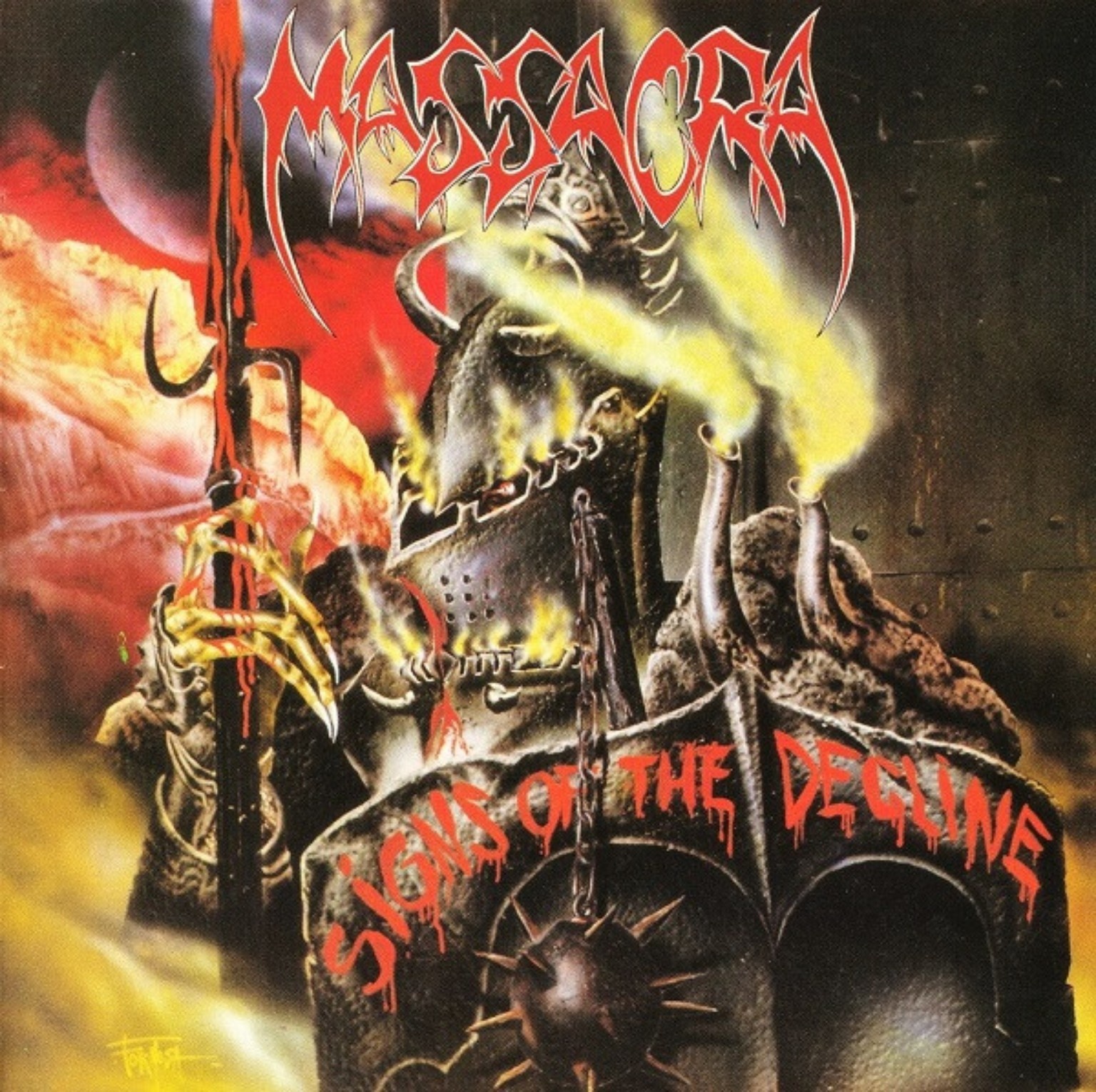
Original cover artwork: Formosa.
Album details
Tracklist · original ten-track edition
- 01.Evidence of Abominations4:00
- 02.Defying Man’s Creation3:39
- 03.Baptized in Decadence4:27
- 04.Mortify Their Flesh4:02
- 05.Traumatic Paralyzed Mind3:56
- 06.Excruciating Commands3:48
- 07.World Dies Screaming3:22
- 08.Signs of the Decline4:02
- 09.Civilisation in Regression4:04
- 10.Full Frontal Assault4:27
39:47 · 10 tracks
Band members
- Pascal Jorgensen – vocals, bass
- Jean-Marc Tristani – guitar
- Fred Death – guitar, vocals (tracks 5 and 9)
- Matthias Limmer – drums
Recording and release
- T&T Recording Studio, Gelsenkirchen, Germany
- Recorded April 1992; mixed June 1992
- Tim Buktu – recording, production; Axel Thubeauville – production; Wolfgang Stach – engineering; Colin Richardson – mixing
- Cover artwork: Formosa; photography: Hucky Heppke
- Vertigo / Phonogram · 1992 · CD / LP / MC
Official music platforms
Original edition: Vertigo / Phonogram (1992). Streaming links refer to the 2014 reissue.
Physical editions
2024 vinyl reissue; verify current availability on the seller’s product page.
Roads Between the Houses
In 1992, the path of a French band's third album led from Franconville to Gelsenkirchen. Signs of the Decline travelled from a suburb of Paris to a recording studio in the Ruhr: from a place where a residential town had grown around an old village to one where coal and iron had built a city, and where the retreat of industry had subsequently reshaped everyday life. Both places already had long histories. Massacra began in Franconville; in Gelsenkirchen they recorded music in which the work of two successive drummers came together.1,10,14
Even the dates at the beginning of the French town's history point in two directions. One account of local history published by the municipality begins the written record with Suger in 1137; Aux origines de Franconville, published in 2025, reaches back to 832 and a charter preserving the name Francorum Villa. Behind these two different starting points lies the slowly unfolding life of the same place: fields, roads leading towards Paris and ecclesiastical institutions. The roads brought travellers and work, while the fields provided crops; together, they sustained the village.1,2
Inns welcomed travellers along the road connecting Paris and Rouen. Farmers grew fruit, grapes, grain and vegetables; alongside them worked weavers, blacksmiths, coopers and carters. Medieval Franconville was a small community: around 1470, twelve households were recorded; in 1725 it had 725 inhabitants, and shortly before the Revolution roughly a thousand. Alongside services for travellers, mutual care within the community also played a part. A leprosarium is documented as early as 1229; notarial and church records from the second half of the sixteenth century, including baptismal and marriage entries from 1588, help bring the community into view. The provision of aid to the sick recorded in 1636 gave this shared life an organised form.1,2
Saint-Marc was first a small part of the settlement, then an urban neighbourhood. Springs and streams on the Cormeilles hill supplied gardens, households and places for washing. Many of these sources of water later disappeared, but their names lived on in streets and neighbourhoods. Franconville was partly bypassed by the great industrial transformation of the nineteenth century; only towards the turn of the new century were dressmaking businesses, corset and umbrella makers, and a brickyard established alongside its orchards. For a long time, the old economy persisted alongside new forms of work.2
From Revolution to Railways
The French Revolution, however, did not pass village public life by. Gabriel Bertin was elected its first mayor. A few years later, Jean-Baptiste Guichard sought a workable order amid the conflict between the Popular Society established in 1793 and the more moderate municipal administration. Guichard headed the municipality in 1792–1794 and again in 1800–1813. Father Portefaix was removed during the dispute over the constitutional oath required of the clergy. That conflict also disrupted religious life: in March 1795, a mass was organised without a priest, and official worship was not restored until 1802. After the reorganisation of the new civil administration and the longstanding ties to the Church, war came again. In 1814 and then again after Waterloo in 1815, occupying troops and temporary supply barracks had to be accommodated. When the wars had passed, most of the land surrounding a settlement of some 1,124 inhabitants in 1820 still consisted of arable fields, vineyards and orchards.1,3
Then distances began to change. In 1841, a railway linking Paris with Belgium was still a plan; by 1845, a trial service was running. That same year, the Compagnie du Chemin de Fer du Nord was founded. The route through the Montmorency valley also reached Franconville: the Paris–Saint-Ouen-l'Aumône section was completed by 7 January 1846, the international connection was celebrated between 13 and 16 June, and commercial traffic began on 18 June. Franconville's passenger station connected travellers to the new network in 1846. Alongside the routes of horse-drawn mail coaches, it was now possible to travel by rail to Paris, Lille and Brussels; Taverny's separate passenger station opened on 26 August 1876. The material foundations of the later commuter suburb began to take shape decades before the large housing developments.1,3,4,15
As early as the beginning of the nineteenth century, Franconville had to negotiate with its neighbours Sannois and Cormeilles over tolls and drainage. The boundary and drainage dispute with Cormeilles continued between 1791 and 1820; in 1800, Sannois asked for the abolition of a toll that obstructed trade, and by 1806 that obstacle had been removed. Such everyday burdens also mattered to the development of communities that depended on one another. Meanwhile, Franconville's streets were gradually changing: lamps appeared in public spaces in 1838, a boys' school opened in 1842, and a girls' school in 1849. During the siege of 1870–1871, part of the population fled to Paris. The local baker was also stranded in the capital, so the elder Louis Leboucq had to start baking bread again; his return to the trade helped feed those who stayed behind. The population grew from 1,300 to 1,850 between 1872 and 1896. Connections expanded as well: the telegraph arrived in 1880, gas lighting in 1884, a freight station in 1892, and the telephone in 1899. Behind the changes in transport and administration, acts like these had kept daily life functioning even during the siege.1,3,4
At the beginning of the twentieth century, gardens, orchards, horse-drawn deliveries and roadside trades still shaped the rhythm of everyday life. The rebuilding of the Sainte-Madeleine church began in 1903, followed by construction of the Ferdinand Buisson school in 1909. The school was not inaugurated until 1919; in the intervening years, war swept through. The military zone protecting Paris restricted the use of roads and railways, and in September 1914 troops and artillery moving towards the Marne appeared. Uncertain supplies in 1915–1917 pushed plans for street lighting and the school into the background. Coal ration cards were introduced for households, agricultural stocks were requisitioned, and people organised collectively in response to rising prices. Associations and churches arranged convalescence for wounded soldiers and relief for prisoners of war.6,5
War and Urban Growth
In 1918, Spanish influenza, the need to house refugees and air-raid alerts placed further strain on Franconville. The local history records 2,718 inhabitants and 194 Belgian or French refugees that year. After the war, the names of 122 dead were inscribed on the memorial erected in 1921. Here the great European conflict left behind names, problems of supply, buildings pressed into service and family economies that had been transformed.6
Immigration between the two world wars and the construction of houses on garden plots tied ever more homes to employment in the capital. The war of 1939–1945 brought German occupation, local resistance and executions at the Montigny brickworks. After the local fighting that accompanied liberation in 1944, the community once again faced a housing shortage. From 1956, plans were drawn up to renew the old centre, and around 1960 blocks of flats began to rise. The decisive step came on 5 July 1960: the appointment of the SEMEASO urban-planning company, followed by an implementation agreement in 1962, prepared the redevelopment of twenty-one hectares. Previously, that area had contained 482 homes and 86 commercial premises, housing 1,377 people; many dwellings were overcrowded and lacked running water. By 1970, more than a thousand new homes, shops, a school, sports facilities and public services had replaced the old layout.5,7,9
The growth of the town as a whole was on an even greater scale: its population was recorded as 11,185 in 1962, 16,200 in 1966, and twenty thousand in 1976. Set between the Montmorency and Parisis heights in the Montmorency valley, seventeen kilometres northwest of Paris, the settlement had become a densely populated suburb. When Massacra formed in 1986, the band began working within this rapidly rebuilt environment. The old village and the new town lay one upon the other; the history of roads and connections now continued through the movements of an international band.5,7,9
The Routes of Sound
Music, too, was looking for a place in the cities. Different sounds belonged to religious services, communal celebrations and places of entertainment across the Paris region, while distinct institutions passed on instrumental skills. After the eighteenth-century predecessors of the royal school of singing and the new organisations of the Revolution, the Paris Conservatoire was founded in 1795. Its precise antecedents were the Royal School of Singing and Declamation, founded on 3 January 1783, and the municipal school established in 1792 to train musicians for the National Guard. The unified Conservatoire received its state framework on 3 August 1795. Its instrumental teaching was also connected with national celebrations and the development of new teaching methods. In Franconville, smaller groups kept opportunities for music alive. The local fanfare ensemble, organised in 1867, brought collective brass music into the town's public life. Alongside the railway tracks, new schools and lamps came an institution devoted to making music together.16,4
In Paris, the Conservatoire's student orchestras and concerts, departments and instrument museum were building a world of professional training. A professional concert culture gradually grew around the student orchestra established in 1806 and the student concerts introduced in 1823; the instrument museum founded in 1864 added the tangible memory of the past to musical education. The occupation shattered this world as well: between 1940 and 1942, Jewish teachers and students were expelled from the institution. The student orchestra created by Claude Delvincourt in 1943 could subsequently also offer shelter from compulsory labour. After the war, training expanded into new fields, with a separate percussion course introduced in 1947. By the time the bands of the late 1980s were making their first records, sound-engineering instruction had begun in 1989. The move to La Villette in December 1990 was followed by jazz and improvisation courses in 1991. The institutional boundaries of music were shifting too.4,16
The French Underground Scene
During the 1960s and 1970s, guitar music emerging from blues and early rock began to grow louder. Alongside hard rock and heavy metal, punk taught a different way of working together: shorter, rougher songs, direct expression, and posters and magazines made by hand. In France, records from the English-speaking world, domestic rock and Parisian punk had begun to meet through clubs and small labels by the early 1980s. Live performances and independent distribution opened a path to audiences on their own terms. The independent world taking shape around Bérurier Noir followed that path.17,18,19,20,21,22,23,24
The airwaves were changing too. Carbone 14 began broadcasting in Paris in December 1981; the authorities seized the station in August 1983. That brief period saw technical experiments in broadcasting, editorial initiatives and clashes with regulators. Thierry Lefebvre's later history of radio examined the years 1981–1983. Meanwhile, recordings were reaching record shops along new routes as well. Roadrunner, which began with European imports in 1980, had established a presence in New York by 1986: alongside smaller national scenes, a more organised international record trade was taking shape.25,26
When Bérurier Noir began in Paris in 1983, Fanfan and Loran worked not only on the songs but also on the surroundings in which they would be heard. Artwork, booklets, a stage identity and concert organisation all formed part of making music. MJC youth clubs, inexpensive shows and small record shops brought together audiences also reached by the networks of Bondage, Boucherie Productions and New Rose. The French National Library's 2024 presentation and the Larousse overview preserved a record of how independent musical life operated through these objects and institutions. Thrash and death metal's tape-trading networks began to establish connections of their own across a Europe already full of clubs, shops and independently published music papers.18,20
Fanzines and Circulation
Photocopiers, in particular, greatly extended what amateur editors could achieve. Following the movements around 1968 and the counterculture of the 1960s and 1970s, punk's do-it-yourself approach carried on in the small-circulation magazines of the 1980s and 1990s. Comics, punk and heavy rock found ways into print. In its 1997 exhibition tracing rock fanzines from 1977 to 1997, the Fanzinothèque in Poitiers distinguished the varied beginnings of 1978–1982 from the denser network of 1983–1990. By then, a magazine often meant more than pages: it could also connect a club, a concert, a record release and a list of postal addresses. Networks likewise formed around readers of heavy, grind and death metal. From 1991 to 1997, computer-based layout and improved duplication techniques widened the possibilities still further, while genre boundaries became more permeable. Readers of Massacra's interviews from 1990 also drew close to the band through letters, copied tapes and the work of amateur interviewers.23,27,28,29,21
Alongside the photocopied magazines circulating by post, France's national metal press was changing as well. The original run of Enfer Magazine, which began in April 1983, can be traced through April 1987; meanwhile, Hard Force had launched its first series in October–November 1985. The latter crossed paths with the Rock Spirits supplement in 1991 and continued with a new numbering sequence from May 1992. By the time Signs of the Decline appeared, France's national metal press was searching for a new form: alongside the postal networks maintained by small editorial teams, professional magazines that were gaining strength again also gave the music a place.30,31
Within France, the postal network had several starting points. In Le Havre, Alienation moved from punk towards thrash and hardcore, while Alliage was produced in Commentry; around Toulon, the English-language Decibels Storm was already seeking readers abroad. Cursed built connections in Metz and Schizophrenia in the southeast, while Since linked Paris and Lille between 1990 and 1992. Issues of Decibels Storm from 1990, 1991 and early 1992, together with Schizophrenia's 1991–1993 run, reached their recipients by post, precisely during the period of Massacra's first three full-length albums. Through the correspondence and publications of these different local communities, it was not merely a single Parisian scene that began to stir around the band.32,27,28,33,34,35,36
In Franconville, old manor houses also acquired new communal purposes. The Cadet de Vaux house and Maison Suger gradually became places for culture and music during the twentieth century; a new building for the Maison Suger music school was inaugurated later, in 2007. The institutions of local musical life continued to evolve over many years. For musicians starting out in the 1980s, however, opportunities to make connections had already opened up beyond their home towns and across national borders.2
From Rehearsals to a Name
In the spring of 1986, the institutions of the French Republic were adjusting to an unusual arrangement in which opposing political forces had to govern side by side. François Mitterrand, elected president in 1981, now faced a government supported by a centre-right parliamentary majority from March onwards; the president and prime minister directed the country from different political camps. The first experiment in cohabitation unfolded amid unemployment, urban housing problems, industrial restructuring and adaptation to international markets. The Single European Act had been signed on 17 and 28 February and would enter into force on 1 July 1987. The legal foundations of the common market were taking shape; economic ties between France and West Germany were growing closer, although strong political frontiers still obstructed travel to the eastern part of the continent. The Europe of clubs and record shops offered an increasingly accessible network in the West, while journeys eastward remained more difficult.37,38,39,40,27,41,28,42
A new band had already taken shape in Franconville in January 1986. Massacra began as a five-piece, with rapid personnel changes; the drummer's position proved especially hard to stabilise. Looking back on those beginnings in 2013, Jean-Marc Tristani emphasised friendship, the pleasure of playing together and the sheer number of rehearsals. As they searched for harder songs, they also tested the limits of their own instrumental abilities. If the music was to travel beyond the rehearsal room, they needed to make recordings, duplicate tapes and send letters through the post. Guitar, vocal and bass duties gradually found their places. In the four-piece lineup known from the first two full-length albums, Jean-Marc played guitar, Fred Death played guitar and sang, Pascal Jorgensen played bass and sang, and Chris Palengat took over the drums. Matthias Limmer then played drums on the third album. By the time of the Deathvomit and Rot interviews in 1990, the group was clearly seeking an international audience.27,28,43,29,14,44
The Path of Chris Palengat
Chris's path towards a drum kit led through records, sleeves and concerts. As a schoolboy he collected music, listened and went to shows; later he played in Metal Storm. After AC/DC, Motörhead, Iron Maiden, Saxon and Judas Priest, he discovered other speeds: Metallica, Slayer, Anthrax and Venom followed. In the career retrospective given in Mennecy in 2024, Metal Church, Destruction and early Slayer also resurfaced alongside his Metal Storm years. Together with the 2016 interview, these recollections trace successive discoveries: a young hard-rock listener searching for ever more extreme musical possibilities.45,42,46
Among French records, Trust and Sortilège gave him points of reference. Yet belonging to the domestic scene also brought arguments. Speaking to Trash Maniac, Fred discussed how some hard-rock bands of the eighties had lost their former power, mentioning ADX and Vulcain in that context. Even as they listened to earlier favourites, the next generation could question the path taken by the bands that had come before them.29,42
Chris got to know Massacra's members through the concert scene. In December 1986 he entered military service; the next step towards the band came in a letter. According to his later account, Jean-Marc wrote the invitation on 2 November 1987. Chris joined in January 1988. This chronology survives in interviews from 2016 and 2025 and in the Mennecy presentation. Listening to music together and sharing tapes were connected with meetings in bars, amusement arcades and at concerts. From that acquaintance grew a regular working relationship.42,46,45
Moving between concert venues and rehearsal rooms in the Paris region, the band kept returning to the same task: making the songs tighter and more powerful together. Chris later showed photographs and posters from his own past and recalled the regular pattern of ordinary rehearsals. There was a period when they met six times a week. Speaking to the Spanish fanzine Blasphemer, Jean-Marc described roughly fifteen hours of rehearsal a week, alongside intensive tape trading. The two memories offer different views of the same musical life: speed and cohesion had to be earned through time. Le Gibus and the other Paris concert venues then provided the setting in which the results of those rehearsals met an audience.42,45,47,33,34
Among international influences Jean-Marc named Sodom, Slayer, Venom, Possessed, Kreator and Destruction; among newer recordings he mentioned Sepultura, Obituary, Terrorizer and Dark Angel. Sounds from Germany, Britain and America alike reached the French rehearsal rooms. Death, war, violence and apocalyptic images appeared in the lyrics; provocation was sometimes accompanied by ironic, personal responses. The later albums' questions about religious coercion, human responsibility and environmental destruction also grew out of those early themes. The Polish Diabolical Noise preserved a picture of the young band's search for direction and the strong response from Eastern European listeners.33,34,48
The First Demo
Legion of Torture was completed in 1987. The titles Apocalyptic Warrior and Toxic War already opened onto a world of warfare and imagined destruction. Yet those early attempts had not yielded a settled way of performing: speaking to Deathvomit, Jean-Marc described the search for new songs and music gradually finding its form. The following tapes carried that process forward. The 1988 demo Final Holocaust presented more organised riffs and a more deliberate visual identity, while the three longer tracks on 1989's Nearer from Death sought a sharper, more intense sound that also attracted attention abroad.27,28,49,50,51
Two different chronologies survive concerning the drummer on the first tape. The demo catalogue associates the recording dates of 5–6 March 1987 and a July release with Jean-Marc Tristani, Pascal Junet and Laurent Daval. The 2013 booklet of Day of the Massacra, however, also lists Chris Palengat in connection with the first demo. Chris dates his invitation to November and his actual entry into the group to January 1988. The drumming contribution to Legion of Torture therefore remains disputed; the formation of the four-piece lineup of the following years can be traced more securely. In any event, the band was on its way: after the first cassette they made a second, then a third, and the music began its journey from tape duplicators towards postboxes.49,44,46,52
Addresses on the Envelopes
In 1988, another electoral victory consolidated Mitterrand's position as president, while new transport connections opened across the Paris metropolitan area. Services began on the VMI branch of RER line C on 25 September. The commuter belt that had grown around older railway lines over generations was accommodating more and more people: the population of the Val-d’Oise department rose from 920,598 in 1982 to 1,049,598 by 1990. Average annual growth was 1.7 per cent between 1982 and 1990, slowing to 0.6 per cent from 1990 to 1999, when the earlier surplus from migration gave way to a negative balance. With 1962 as the base year, the population index stood at 191.4 in 1990 and 201.6 in 1999. These departmental figures track the growth of the outer Parisian ring; Franconville's own population numbers add the experience of one town within that larger area.53,54,15,55,56,38
Massacra's new recording was also made in the area around the capital. Chris recalled in 2016 that they recorded the second demo near the Grand Rex cinema over a single weekend. The 2013 booklet dates this Final Holocaust to March 1988: its six tracks were framed by an introduction and an ending. Two years remained before the full-length album of the same name. Its appearance had to help the cassette travel farther, too. Chris proudly remembered the colour or two-colour printed covers and the band's connection with Gil Formosa, who also adapted images from his own comics for them. Together, the artwork and the cassette sent through the post created a recognisable identity.45,50,51,52,44
The introduction to 1987's Legion of Torture was followed by Apocalyptic Warrior, Toxic War, Legion of Torture and Day of the Massacra. The six-part programme of 1988 was followed in January 1989 by three longer tracks: Apocalyptic Warriors (Chapter Final), Sentenced for Life and Nearer from Death. Chris played drums, Freddy guitar, while Pascal and Freddy shared the vocals. Nearer from Death was already moving towards more fully worked-out structures that unfolded over a longer span. When Century Media brought the three demos together on one compilation in 2013, it proceeded backwards from the most recent, in the order 1989–1988–1987. Later listeners could therefore retrace the band's early development in reverse.50,51,52,44,49
Chris later located the studio used for Nearer from Death somewhere around Ivry. In a 1990 interview with Trash Maniac, the band sharply criticised the technician there: they felt he did not understand thrash rhythms and proportions, so they had to direct the development of the sound themselves. They would have been satisfied even with a simple eight-track recording. What they sought in the raw sound was a recording that preserved the power they had intended in the music. The person behind the desk had to understand that intention too.29,45
The Journey of the Tapes
The tapes then set off towards their recipients. Speaking to Deathvomit, Jean-Marc estimated sales of Nearer from Death at around eight or nine hundred; in Rot, Pascal gave a range between six hundred and a thousand. Chris later recalled circulation of roughly a thousand copies of another of their demos. Behind these estimates were tapes duplicated and packaged by hand, accompanied by letters and new addresses. For a fledgling French band, such work by fans built an international reach that established institutions could scarcely yet offer them.27,28,45
Playing music also came with administrative work. In his Mennecy presentation, Chris mentioned handling matters related to the band's name at the INPI and filings with SACEM as his own responsibilities. Meanwhile, promises of tours could carry very immediate consequences. He passed up a job opportunity because of a possible Scandinavian trip in 1988, but the promised dates never became a real run of shows. Money, documents, a visa and a reliable partner all had to be found; an unreliable promise could threaten not just a musical career but a livelihood.42
A retrospective account in the contemporary Pro Murder placed the first Paris show in June 1986 and mentioned a Swiss appearance alongside Messiah in May 1987. For the Canadian trips of 1989, it named Sadistic Visions and Damnation alongside Massacra. The magazine remembered two open-air festivals during an August visit to Poland, one with an audience of about seven hundred. These press recollections already suggested a range of movement much wider than the band's rehearsals at home.35,33,57
Early in 1989, while the band was playing in Québec, the musicians also made it as far as New York to look for a record label. Decades later, Chris remembered hiring a car and having a minor accident in which no one was injured, as vividly as waiting in a record company's corridor before handing over their demo cassette. The 1990 Trash Maniac interview likewise returned to their personal visits to American labels. Distances that their tapes had previously travelled inside envelopes were now being crossed by the musicians themselves.42,29
Labels and Concert Organisation
Wild Rags offered the prospect of an American release, but would have left the recording itself and its costs to Massacra. The band saw this primarily as a licensing opportunity and sought a partner willing to take on more of the production process. Earlier, after the second demo, representatives of Jungle Hop had visited a rehearsal, but the vocal approach failed to convince the French label. Personal approaches to Roadracer and Combat likewise led to no contract. Ultimately it was Germany's Shark Records that opened the way to the debut full-length album.29,27
The concert trips took shape through similarly personal connections. In Rot, Pascal spoke of appearances alongside Samael, Tankard, Messiah and Immolation, bringing together memories of trips to Poland, Switzerland and France. Speaking to Diabolical Noise, Fred stressed the raw energy of the stage and the band's self-definition as death/thrash. To him, the Polish crowd in 1989 seemed more animated than audiences at home. In 2013 Jean-Marc likewise remembered the tour as receiving an enthusiastic welcome, in contrast to the more limited opportunities to play in France. During a conversation with the Polish Thrash’Em All, plans for the next studio work were already being discussed. A performance, an interview and the correspondence that followed could lead on to further stops.28,42,33,36,44
The community concert archive for 1989 records a show at Le Gibus in Paris on 4 February and another at Les Foufounes Électriques in Montreal on 16 February. These are separate entries, but the February records alone do not establish the complete route of the North American tour. On 30 September Tankard, Massacra and Immolation performed together at Le Gibus in Paris once more. A later eyewitness remembered it as his first concert, at the age of fifteen: the small club and the intense moshing stayed with him. The three surviving archive entries for 1989 record only a few known stops along that route, not every show played that year.47,58
Pro Murder described the agreement with Shark as a contract for three albums. The magazine estimated that the debut full-length had sold ten thousand copies by then and mentioned recording in the Essen area in October 1989. In the earlier Polish interview, Freddy had still spoken of Bochum and completion in November; the definitive credits record Gelsenkirchen and October 1989. One account presented a plan still being made, the other work already completed.35,36,57,33
While the band's first full-length album was being made, the Berlin border crossings opened on 9 November 1989. The political conditions governing contact across Europe changed within a few months. In Chris's later memories of Poland, visas, inspections, train changes, taxis and hours spent at the border remained vivid. Passports, language barriers and the difficulty of paying for things demanded money and attention before a concert could even begin. The band's international career was built partly from such journeys: to make a recording or play a show, they first had to get somewhere.59,28,42
Side by Side, in Different Voices
By the late 1980s, extreme metal was approaching the same boundary from several directions. After the fast, raw music close to thrash and hardcore, deeper vocals, denser riffs, double-bass drumming and sudden changes of rhythm gave heaviness a new form. American and European bands alike were testing the possibilities of tuning and performance. Yet when Rot asked Pascal about the subject, he emphasised Massacra's own style first. Among his favourite records were Obituary, Incubus, Morgoth and Asphyx, alongside Death, Morbid Angel, Pestilence and Possessed. Entombed, Carcass and Bolt Thrower shared space with Sepultura, Metallica and Voivod. Music from the Netherlands, Sweden, Britain, Germany and America met within a single listener's world; amid this breadth of curiosity, the desire remained for Massacra to follow its own path.27,45,60,61,62,63,28
Within France, too, the paths did not all begin in one city. In Lille, Loudblast's 1985 demo Behind the Dark Mist was followed by Ultimate Violence in 1986. The following year brought Licensed to Thrash, shared with Agressor, and in September 1988 the band made the Bazooka Rehearsal recording, which could also be ordered by post. Meanwhile, a different story was taking shape in Antibes. Songwriting under the name Kataclism in 1985–1986 led to Agressor by August 1986; the band's chronology associates no recording or performance with the earlier name. Both scenes used tapes and self-organisation, but their sounds and routes through record labels remained distinct.60,61
Mercyless emerged from Mulhouse. Formed in 1987, the band moved from the more melodic side of thrash towards death metal; in 2020 Max Otero recalled that transition around 1989. Cassettes sent through the post and addresses found in fanzines offered him ways to discover music and build connections, while Massacra and a few earlier French groups had already moved closer to record labels. Within the same extreme-music scene, fast-driving thrash guitars, the slower weight of death metal, melody and solos were combined in different proportions. Jean-Marc had already spoken favourably of an early Mercyless demo in a 1990 interview with Trash Maniac. The bands paid attention to one another, yet their shared interests left room for several distinct identities to grow.29,60,61,62,63,64
German Labels and Fan Networks
In Germany, new institutions were gaining strength around records and the music press. Markus Staiger's launch of Nuclear Blast in 1987, with its roots in punk and hardcore, opened up to numerous strands of extreme metal in the years that followed. Uwe Lerch and Holger Stratmann had started Rock Hard as an independent fanzine back in 1983; by 1987 they had achieved nationwide distribution. The underground's personal connections, knowledge and critical vocabulary were finding an increasingly organised means of reaching people. In seeking German partners, Massacra turned towards this expanding market for music journalism and records.63,64,65,27,28
For listeners, all of this worked through more everyday means. In a 2021 conversation with Chris Forbes, the editor of Liquid of Life recalled a Massacra interview in a substantial English-language issue of Suffocations. The magazine could be obtained in exchange for postage stamps. The same recollection included a hard-to-catch radio signal at 95.8, a homemade aerial and a cassette used to record the programme. It was the reader's and listener's own effort that made a distant voice accessible: sending stamps, putting up an aerial, making a recording.66
Meanwhile, France's independent rock scene was doing similar organising work in its own clubs. The establishment of Boucherie Productions in 1986, followed by Mano Negra's change of label in 1989, marked stages in a changing market. In a 1995 article for Le Monde, Stéphane Davet traced a path from the growth surrounding Bérurier Noir and Mano Negra to the subsequent economic unravelling: the distribution networks behind New Rose and Danceteria faltered, and several bands moved to major labels. New business relationships reshaped the self-organising momentum of the second half of the 1980s. Massacra faced that question too: how could their own distribution efforts lead to a recording and release that would carry their music farther?22
In the Coal City
At the end of the road to the German studio lay Gelsenkirchen. Scattered manor farms, small centres and agricultural villages once stood on either side of the Emscher; predecessors of today's settlement names already appear in documents from around the turn of the first millennium. The Napoleonic era and the Congress of Vienna rearranged political rule, but it was coal that subsequently transformed the landscape. Exploration around 1840 was followed by drilling at Buer in 1846. On 15 May 1847 a station opened on the Cologne–Minden railway: coal from the new pits could now be shipped away, and industry began attracting workers and trade. During the 1850s, a succession of mining towns rose out of what had been a rural area.10,11
Shops, a post office and places to eat and drink sprang up between the old village of Gelsenkirchen and the station some seven hundred metres away. Regular production began at Hibernia in 1858 and Dahlbusch in 1860. Gelsenkirchen was granted town status on 29 November 1875, with a population of roughly eleven thousand; by the end of the century, the surrounding mines employed more than thirty thousand people. Improvements in mining technology, the railway and Prussian industrial policy jointly drove the expansion of operations northwards. As neighbouring settlements became interconnected and mining flourished, an industrial metropolis of almost four hundred thousand inhabitants eventually took shape; 386,874 residents were recorded in 1958. This industrial landscape bequeathed the name 'city of a thousand fires'.10,11
The workers came from many directions. At first, Westphalians took seasonal work while partly continuing to farm; in the final third of the nineteenth century, new families travelled to the mines from the Rhineland, Hesse, the Netherlands and Prussia's eastern provinces. By 1880, somewhat fewer than a third of the inhabitants had been born locally. Different languages, religions and customs came to live side by side in the mining settlements. The history of the industrial city also became a history of migrant communities.13
In the late 1950s, that same industry began to retreat. Competition from oil and natural gas, changes in railway energy use, mechanisation and shifting demands in West German industry all reduced the need for coal workers. In February 1958, production cuts forced thousands of workers in the Ruhr to miss scheduled shifts. In Gelsenkirchen, the closures of Wilhelmine Viktoria and Scholven, followed in 1966 by Graf Bismarck and Dahlbusch, affected entire districts and tens of thousands of people. After protests marked by black flags and a series of social agreements, Ruhrkohle AG was established in November 1968. Restructuring continued through coal-industry negotiations in the 1980s and then the 1991 Kohlekonzept. The mining city was looking for new employment and new purposes for its former industrial sites.12,11,13
The Studio and the First Album
Working life also provided a route into the local history of metal. Tom Angelripper became an apprentice miner in 1979 and worked at Zeche Hugo until 1989. At a 2025 book presentation in Bochum with Holger Schmenk, the Sodom musician recalled his family's initial misgivings, the accumulated strain of work shifts and rehearsals, and the everyday habits of miners returning to the surface. In the recollections recorded by Marek Firlej, one of the creators of Ruhr thrash went on to another kind of work after his shift ended. Sodom, the increasingly specialised music press and the studios were different parts of the region in which Massacra found German partners.67,65,28
Final Holocaust was recorded and mixed at RA.SH Studios in Gelsenkirchen in October 1989. Alongside the playing of Pascal, Fred, Jean-Marc and Chris came Ulli Pösselt's work on recording, mixing and production, with Axel Thubeauville as associate producer. Formosa created the cover art, and Denis GRR designed the logo. The contemporary Trash Maniac interview referred to the producer of the first album as Uly Presept. With the Shark release dated to March 1990, the band moved beyond demos to an international label and more predictable studio conditions. The speed of early thrash was now framed by deeper death metal vocals and denser riffs.27,29,57,28
Chris remembered the recording as a shared physical ordeal. Drums, bass and one guitar were played simultaneously; if the drummer reached the end of the song without a mistake, but another instrument slipped, they had to start again. The second guitar and the vocals were added later. He worked with large drumsticks and a metronome, and concentration grew harder to sustain towards the end of the sessions. Decades later, this way of working also helped him understand the album's less precisely timed passages. He embraced the description 'barbarian drumming' because he recognised in it the physical, seemingly unrestrained force of his own playing.42
Recording in Germany gave the band more possibilities, yet Pascal did not consider the result flawless. In Rot, he described the finished sound of Final Holocaust as not quite clean. Earlier, what he had missed in French studios was technicians who understood how to balance aggressive, distorted yet distinguishable death/thrash instruments. In Gelsenkirchen, the musicians had hoped for greater experience and better opportunities to capture their sound. The first album also taught them which aspects they wanted to hear differently next time.28,29
On the album, images of the Cold War and imaginary warriors collided with nuclear catastrophe and religious persecution. In Trash Maniac, the lyrics of that period were attributed to Chris; the later third album, associated with Greg Conan, was made under a different set of credits. The band discussed individual songs separately: War of Attrition depicted the logic of a war of exhaustion, Final Holocaust nuclear and chemical devastation, and Eternal Hate religious persecution. The Day of Massacra portrayed their own world of live performances. The early explanations also spoke of gladiators, punishment linked to secrets and Russian roulette: alongside images of destruction on a vast scale, individual human predicaments entered the songs. From these early visions of ruin, a path also led towards the human, social and environmental questions of the third album.29,68
Concerts in a Changing Europe
Even as Europe was being reshaped, images of war remained present. On 2 August 1990, Iraq invaded Kuwait; the United Nations Security Council adopted Resolution 660 that same day. Television made the Gulf crisis of 1990–1991 part of the daily news. Germany was reunified on 3 October 1990, and in the years that followed the conditions for connecting Eastern and Western concert circuits changed as well. Massacra's first full-length album had been prepared in the Europe of the previous era, but its songs travelled onward in the new circumstances.69,68,29
Concerts still had to be salvaged when a journey went wrong. Chris recalled an accident near Lyon in 1990: two musicians were travelling with the equipment in a Renault Express, while the other two went by train. The collision damaged the instruments as well. The drummer had to find usable equipment locally, so the concert could go ahead. What he remembered most at the end of the story was the improvised organising that had made the performance possible.42
After the 31 March show at Le Gibus in Paris, the surviving concert records for 1990 point towards clubs in neighbouring countries by October. The sequence begins at Hengelo on 12 October; Stabroek follows the next day and Goes on the 14th. After a pause of a few days, the archive lists Zwolle on the 19th, Schagen on the 20th and ’s-Hertogenbosch on the 21st, before Geleen on the 28th concludes its Belgian and Dutch entries. Including the Paris evening, the community year list preserves eight events, not a verified total of every show the band played in 1990. The album and the musicians' subsequent presence in person extended the journey begun with cassettes; when they returned for their next recording, they brought the experience of those concerts with them.70
The Bus and a Changing Europe
A different kind of change was already visible in the figures for the French record market. According to SNEP data for 1990, 56.2 million CDs were sold, a rise of 37.2 per cent from 40.9 million in 1989. Cassettes were still growing too: sales of 41.9 million units were 4.6 per cent higher than the year before. LPs, however, plunged to 6.7 million, a decline of 58.5 per cent. Revenue for the industry as a whole rose 9.9 per cent to 5,355.6 million French francs, even as the total number of recorded-music units sold barely moved, from 130.9 million to 131 million. The more expensive and increasingly popular CD was changing the market's proportions; it had not yet swept the cassette aside.78,79
By 1991, death metal had developed several recognisably different sound worlds. Alongside groups from Florida and elsewhere in America, bands in Northern Europe and Britain were searching for a balance between brutality and memorable song structures. Colin Richardson worked on Carcass's Necroticism; the following year he would mix Signs of the Decline. After three demo and EP releases made around 1988–1990, the French band Mercyless likewise worked with him on 1992's Abject Offerings, within the Vinyl Solution/World in Flames circle. Coloured Funeral in 1993 would take them to Century Media. The work of particular professionals also linked the sounds of different scenes.71,14,62
In January 1991, Massacra were working in Germany again, this time on Enjoy the Violence. Chris's diary preserved the studio dates, while his memories retained a broken cymbal and smaller problems that interrupted the work. He experienced the making of their second album as more organised and better controlled, though the band still had no intention of compromising on brutality. Interlocking guitar runs and rhythmic turns were coming together with increasing deliberation. Coverage in the French and German press, followed by concerts reaching more countries, brought this music before growing numbers of listeners.42,72
Later listeners came to recognise the second album as a turning point in the studio. A 2007 review emphasised the fuller RASH sound and Chris's tighter, more precise drumming: the rhythms now supported Jean-Marc and Fred's riffs more securely. After the extraordinarily fast opening, Gods of Hate and Full of Hatred allowed heavier tempos into the record, while Revealing Cruelty and Near Death Experience broadened its range with acoustic passages. Fred also took over the lead vocals on two tracks. In this retrospective assessment, which awarded the album 17 out of 20, the structural and sonic possibilities that the third album would develop further were already clearly audible.73
The response at the time, however, was far from unanimous. Chris also remembered a particularly negative review in Rock Power. The technical guitar playing and furious shifts could draw one listener closer and drive another away. Alongside the praise that would later be quoted so often, this contrary experience remained part of the story.42
On the Road
The tour with Benediction began with a departure from Paris at night and continued through Germany, Prague, Austria, Denmark and the Netherlands. Chris remembered the bus bunks, lack of sleep, hours of travel running into one another and the infrequent chances to wash. In the diary, even taking a shower could become an event in its own right. Incidents at shows and in places offering hospitality had to be dealt with; documents and belongings could go missing, and everyday business had to be managed in unfamiliar currencies and languages. The postal connections of earlier years now acquired the duration of journeys on the bus and at the stops along the route. Organising did not end when the band set out.42,74
The sixteen named events in the community concert list for 1991 trace a broad spring and summer route. It records Monsters of Death in Vienna on 19 May and Poznań on 26 May, followed by German and Danish stops towards the end of the month and shows in Sweden, the Netherlands, Belgium and France in early June. The archive also lists Belgrade on 20 May. Chris, however, recalled that the Belgrade performance was cancelled over safety concerns: growing tensions in Yugoslavia had changed the planned journey. Whether that show actually took place therefore remains disputed.75,42
By the end of 1991, the Soviet Union had ceased to exist, while the breakup of Yugoslavia was accompanied by armed violence. Within France, political debate focused on industrial adjustment and unemployment. Linked to German partners, Massacra crossed these borders from a background of small French labels and associations. Record sales, touring and financial arrangements became different tasks within the same career.42,74,40,29
Meanwhile, in Franconville, a long process of building up local musical life reached another milestone. The local-history group AEPPF later preserved the history of the rebuilding of Sainte-Madeleine church between 1899 and 1964; the organ was inaugurated on 27 September 1991. An eight-page booklet published in 2025 supplied the exact date of this local musical and religious occasion. The sound of the church and the metal band travelling across national borders belonged to different musical paths within the same suburb.76
The Turning Point in 1992
The Maastricht Treaty was signed on 7 February 1992. Its entry into force still lay ahead, but the single market and European integration had already moved to the centre of debate in France. Speaking to Paris Match on 7 May, Mitterrand discussed expectations of Europe and workers' fears of competition. He explained the constitutional amendment required before ratification, democratic authorisation, the possibility of a referendum or a parliamentary decision, and Germany's part in shaping the treaty. As a head of state defending his own political objectives, he interpreted the changes around him: the collapse of the Soviet Union, German reunification, violence in Yugoslavia and the situation of those left without work for extended periods. In replying to criticism of his government, he also listed the transformation of the radio and television monopoly after 1982 among his achievements. Political language promised an opening while trying to address the fears it inspired.39,41,77,25
The European decision still under consideration in early May moved into the institutional process in June. Following the rejection of the treaty in the Danish referendum, François Mitterrand announced on 3 June that French voters, too, would be able to express their view on ratifying the Maastricht Treaty.120 On 23 June, the Congress of the French Parliament adopted the constitutional change required for this.121 The debate of the spring had acquired institutional deadlines and an approaching referendum by the summer.
An industry assessment of the first half of 1992, published on 8 August, already showed declining sales of cassettes and singles. It reported around thirty million CDs and fourteen and a half million cassettes; the latter figure represented a drop of roughly 18.3 per cent. Copying and mailing demos still sustained the underground's personal network, but the balance between formats was changing rapidly on record-store shelves. Massacra's new album entered this shifting marketplace on CD, LP and cassette alike. Following the release's path takes us back to the end of 1991: the old drummer was still involved in preparing the recording, but it was the new musician who performed that work on the finished album.79,14,78
Passing on the Rhythm
Preparations for the third album had begun with Chris Palengat still in the band. In a 2026 interview with Dávid László, the drummer spoke of the second album as a record on which they had brought their raw outbursts under more conscious control: they thought about the audience's moshing, too, although their stamina was often pushed to the limit by the speed. He placed his departure towards the end of autumn 1991. He mentioned a loss of personal confidence and family difficulties, explaining the decision through changes in his own life. He himself rejected the story that he had joined a sect.80,45
Before leaving, he had also helped shape all the new compositions. At the presentation in Mennecy he showed a rehearsal cassette marked Signs of the Decline; as he remembered it, nine songs were almost ready, while work was still under way on the tenth. He programmed the drum parts they had developed into a drum machine. In a 2013 interview with Nathaniel Colas, Jean-Marc recalled that the group rehearsed to this foundation for a month. Rhythm thus continued to set the pace of their work together even when the former drummer was no longer sitting behind the kit.81,42,14,46,82,83
Matthias Limmer had to step into music that had already been prepared in this way. The band wanted a new drummer who would bring his own energy; it is his instrumental performance that can be heard on the record. For Jean-Marc, Chris's departure came at a particularly difficult moment, and finding a replacement demanded considerable attention in itself. In 2013, when the interviewer suggested that the third album was a less surprising follow-up, close to Enjoy the Violence, the guitarist rejected the idea of a repetition hurriedly put together. They did not want to change styles merely for the sake of novelty. They carried forward the songs they had shaped together, now with Matthias playing them.81,42,14
Limmer's name also appears in connection with two demos recorded in 1992 by the German band Obscuritas, where he is credited as Matthias 'Slaughter' Limmer. Massacra's membership chronology places Chris's period in 1987–1991 and Limmer's in 1992–1994; Björn Crugger followed between 1995 and 1997, while Jean-Marc and Pascal remained throughout the band's full 1986–1997 lifespan. Despite discrepancies in the accounts of Chris's involvement around the earliest demo, the drumming credit on 1992's Signs of the Decline is unequivocal: Matthias recorded the tracks.43,84,85
The Work at T&T Studio
With the new material, the band arrived at T&T Recording Studio in Gelsenkirchen in April 1992. They mixed the recording there in June. Their third full-length appeared that year, although the exact release date remains uncertain. After the earlier agreement with Shark, the name Vertigo now appeared on the physical releases. Jean-Marc later felt that Shark had failed to match the rising sales of the first two albums with sufficient promotion and communication. They had expected more support; after disagreements, Phonogram/Vertigo seemed to offer a new opportunity.14,86,87,81
The change also affected photography, advertising, concert opportunities and merchandise distribution. The band entered a more professional environment, yet Jean-Marc looked back on it with self-criticism: while they devoted almost all their attention to the music, they gave too little care to business and organisational matters. Even with a new partner, the same people had to learn how to carry forward the work surrounding their songs.81,88
What the guitarist remembered from the studio was Tim Buktu's openness. He did not try to force the band into a predetermined formula, but made room for experiments with sound. Their working relationship later became a friendship. When Jean-Marc recalled this period in 2013, he also spoke of Tim's death in 2011. The name in the album credits belonged to someone who, after the band's early demos and club shows, had become part of its daily work as it dealt with an international label.81,88
Tim Buktu recorded the material and also acted as executive producer for CLM Prod.; Axel Thubeauville was associate producer. Wolfgang Stach carried out additional engineering work, while Colin Richardson mixed the record in June. Massacra jointly received credit for the compositions and arrangements. On the Vertigo 512 897-1 LP, the 1992 phonogram and copyright notices for Phonogram GmbH in Cologne appeared alongside the publishing names Shark's Rockin' and Warner Chappell Music. Earlier connections and the new label framework thus became part of the story of the same recording.88
Credits and Advance Recordings
An advance copy of the album in preparation also survived on a cassette labelled by hand. 'Pre-release' was written on the Maxell XLII 90, followed by the ten song titles in order, from the opening Evidence of Abominations to the closing Full Frontal Assault. The eventual album sequence was already present on this simple medium. After recording in April and mixing in June, the music had reached its next stage of presentation to the record company.88
The experience gained in the studio was carried over to another band as well. Speaking about Mercyless's 1993 Coloured Funeral, Max Otero said that Richardson was looking for someone familiar with the rooms; Buktu had already worked there on Signs of the Decline. Knowledge of the premises from the earlier session thus proved useful on a new recording. Otero also recalled concerts shared with musicians from Massacra, Loudblast, Agressor, Mutilated, Catacomb and Death Power. Behind the addresses exchanged in letters were people who met in person, and these encounters could lead to studio work too.89
On the 1992 recording, Pascal Jorgensen sang and played bass, Jean-Marc Tristani and Fred Death played guitars, and Matthias Limmer played drums. Fred also took over the vocals on tracks five and nine. The third album found its finished sound in the performance of these four musicians: the legacy of the preparations and the drive of the new drummer were brought together in a single recorded programme.27,29,14
Ten Songs of Decline
On the finished Signs of the Decline, the dense assault of death metal and the agile rhythms of thrash are both finding their place. Again and again, speed gives way to a mid-paced section, a slowdown, an acoustic break, a solo or a vocal interlude. A Hungarian review from 2017 heard a step forward in form without treating the album as a direct continuation of the technical death metal of Atheist and Cynic. A French review in 2009 found Matthias's military precision to be lively and varied playing; after the rawness of the previous album, its author heard music that was clearer, more articulated and more compact, yet still preferred Enjoy the Violence. In metal.de's reading from 2006, the record comprised ten consistently good, traditional death metal songs: neither filler nor a standout hit that eclipsed everything else. Even the favourable assessments told different stories about the album's unity.90,91,92,93,94
Evidence of Abominations opens with human brutality. Alongside the horrors of war come looking away, indifference and the responsibility of the bystander: human choices create destruction, and the choices of others allow it to continue. Greg Conan is named in the lyric-writing credits for the first four tracks. Reviews from 2009, 2017 and 2025 all singled out the opening song's immediate energy. For the latest of these, it became one of the defining pieces of a third, still more brutal stage in the trilogy. From this point, the accelerations and abrupt halts are measured against the intensity established at once by the opening.48,14,93,90,91
The second track, Defying Man’s Creation, takes the question into the laboratory. Embryos and altered living beings appear, together with an intention to restore a damaged ecological order. But the consequences of intervention become unpredictable: technological power, intended as a solution, becomes part of the crisis itself. The 2009 review drew attention to a short sample, while the Hungarian article from 2017 highlighted mid-tempo transitions and unexpected accents. In these interpretations, the interplay of fast and slow passages keeps redirecting the song's structure before the listener can settle into a single pattern.48,93,90
Baptized in Decadence sets the words innocence, sin, money and hypocrisy against one another. The promise of redemption becomes the language of a self-destructive social order; religious rhetoric turns with bitter irony against power and hollowed-out values. At the end, an unaccompanied spoken declamation remains. A 2004 review and the 2005 Guts of Darkness critique heard it as a misjudged moment that jolted the listener out of the song. A reassessment in 2025 drew strength from precisely this break: for its author, the speech and the renewed entry of the voice in the following track created an effective dividing line. The 2009 article, too, paused over the spoken ending. The same interruption sounded like disintegration to one listener and tension to another.48,92,95,91,93
Trauma and Commands
In the fourth piece, Mortify Their Flesh, religious hypocrisy hardens into an institution that punishes the body. An accusation of heresy and torture justified in the name of saving the soul provide the language for the same power: a promise to wipe out sin conceals physical annihilation. The slower build-up mattered to the 2009 reviewer; Spirit of Metal in 2006 praised the vocals and the riffs that keep emerging anew. In the reading from 2025, it remained one of the album's most aggressive moments. The escalation, the sound and the immediate attacking force gave different kinds of emphasis to lyrics about the vulnerability of the body.48,93,96,91
Traumatic Paralyzed Mind then turns towards someone who has suffered violence. It speaks of fear returning after a sexual assault, silence, psychological trauma and a life grown narrower. Raw images carry forward the lasting consequences of abuse. Fred Death sings on this fifth track. The sudden acoustic interruptions and Jean-Marc's solo came to the fore in the 2009 review, while the 2025 critique praised the rich riffs, dynamics and tension of the slower tempo. In these ways of hearing it, the music accompanies the story of personal injury through contrasting instrumental textures and a continuity repeatedly broken.48,14,93,91
In Excruciating Commands, personal trauma gives way to the impersonality of a chain of command. Indoctrination and discipline strip the person carrying out a bombing of the ability to judge independently; obedience prepares the way for unfeeling action. The lyrics show the machinery of violence from the perspective of the human being turned into its instrument. An assessment from 2006 emphasised the force of the blows, while one from 2025 stressed the density and distinctive aggression. In later criticism, the song became a recurring example of structural unpredictability joined to physical intensity.48,96,91
The first-person voice in World Dies Screaming speaks in the language of exclusion, pain and self-destruction. Its rebellion against religious authority and social rules also turns against itself. Greg Conan is credited with the lyrics of the seventh track as well. The Hungarian review from 2017 dwelt on the heavy, almost doom-like introduction; in 2025, the slower passages were heard as the strength of another range of tempos on the album. In this reading, a more restrained pace carried just as many ideas and just as much aggression as outright speed. After individual anger, the next song names the destruction of the environment shared by everyone.48,14,90,91
Images of Decline
The title track, Signs of the Decline, assembles images of deforestation, toxic industrial materials, nuclear and chemical waste, pollution of the seas and acid rain. Political and economic self-interest accompanies the danger of atmospheric change. Decline is produced by specific human activities. The question of responsibility raised by the earlier songs here expands to an ecological scale: after the brutality of war, religious coercion and personal harm, the living space people share is placed in danger. The title lifts this crisis, with its wider consequences, above the entire set of songs.48
Civilisation in Regression takes further the notion of a society that calls itself rational and progressive turning against itself. After war, religious cruelty, racist destruction and the madness of power, the prospect of mutual annihilation remains. Fred Death also contributes vocals to the ninth track. The 2006 review heard its strength in unpredictable breaks and riffs built on a broader scale, while the 2009 assessment also paid attention to Pascal's vocal presence and the bass accompaniment. Rhythmic unease and images of civilisation destroying itself meet with particular intensity in this song.48,14,96,93
Finally, Full Frontal Assault returns to the battlefield. Ammunition runs low, comrades are lost, and soldiers become expendable in pursuit of the aims of political and military leaders. Human loss accumulates behind the language of attack. Greg Conan is also credited with the final track's lyrics. The 2025 critic counted this closing song among the especially powerful, aggressive compositions. By the end of the programme, the responsibilities of decision-maker, perpetrator, victim and witness are placed beside one another once more. The ten songs have passed through different situations and returned to the same human question: what does each person do with violence in which they have been involved, or which they have witnessed?48,14,91
The Record Goes Out into the World
The mixing work on Massacra's third album took place in Gelsenkirchen in June 1992.128 During the first half of the month, from 3 to 14 June, the United Nations Conference on Environment and Development met in Rio de Janeiro to discuss the relationship between human activity, natural resources and economic development.129 Participants adopted the Rio Declaration and the Agenda 21 programme of action.130 Around the same time, the sonic world being created for Signs of the Decline also evoked images of decline and deterioration, in its own language of death/thrash metal.131
In June 1992, Paris's public spaces and concert halls opened once more to music for the tenth Fête de la Musique.122 Concerts followed one another over the weekend of 20–21 June; contemporary reporting in Le Monde recorded in detail the performances by military bands at the Hôtel des Invalides on Sunday.123 Alongside this celebration of music on the streets and in institutions, extreme metal was building a different public presence, reaching listeners through promotional cassettes, record distribution and club shows.124 Surviving promotional materials and concert posters from Massacra's own time testify to the same work of releasing records and organising concerts.125
Just a few weeks after the June mixing sessions, another concert programme in France was already advertising Massacra. A green poster in La Roche-sur-Yon announced Saturday, 18 July 1992, and the fifth festival, with Salle des Fêtes as the venue. It listed ADX, Massacra, Merciless and Crusher. Later booklets preserved this printed poster as well: alongside the work completed in the studio, the band's next public appearance was already on the horizon.88
Cover, Mix and Release
The finished music was presented differently on the German market. The album advertisement placed Colin Richardson's name beside Signs of the Decline, with Napalm Death and Carcass also mentioned. To listeners, these names promised a particular sound and professional setting. The label's German-language promotional letter, bearing a Massacra heading, introduced the third album after Final Holocaust and Enjoy the Violence and listed all four musicians by name. Following the circulation of letters that had once accompanied the demos, organised label promotion now carried the band towards the music press.88
The album's visual identity remained recognisable too. On Formosa's apocalyptic red-and-black artwork, the Massacra logo and the title Signs of the Decline formed a coherent whole; the logo was the work of Denis GRR. In the booklet of the original Vertigo CD, the four-piece band stood together for a photograph on an outdoor staircase. Later Century Media booklets added further concert portraits and group photographs to the memory of this period. Hucky Hepke is named in the album's photography credits. The sound and the images together built the public presence of the same band.97,98,88,14
The ten tracks on the 1992 Vertigo album totalled 39 minutes and 44 seconds. The CD was issued as 512 897-2, the cassette as 512 897-4 and the LP as 512 897-1. The different formats carried the same programme both to people whose record collections still included vinyl and cassettes side by side and to those already looking for new music on CD. Greg Conan worked on the lyrics of the first four tracks, World Dies Screaming and Full Frontal Assault; alongside Pascal, Fred's singing on the fifth and ninth tracks added variety to the vocal line-up.88,79,14
The Album Across Europe
For Franconville, 1992 was not only a year in the album's subsequent history. A historical account of the town records an audience of twenty thousand at an international show-jumping competition held across the fifty hectares of the Bois des Éboulures.126 The town, by then integrated into the Paris metropolitan area, had also hosted a large event of its own that attracted an international audience, while the music of Massacra, born from local rehearsals, reached listeners abroad by different routes.127
The November tour records trace the finished album's journey through two intensive runs of concerts. The German dates follow one another: Berlin on 10 November, Hamburg on the 11th, Essen on the 12th and Dortmund on the 13th, where a photograph of the performance survives. In the second half of the month, the route reached clubs in several countries: the archive lists Kaatsheuvel on the 20th, Frankfurt on the 24th, Eindhoven on the 26th, Hengelo on the 27th and Leuven on the 28th. Nine stops in Germany, the Netherlands and Belgium thus make up this preserved, connected stretch of the late-autumn 1992 tour.99,100
In 1993, members of the French scene also appeared together on stage. The poster for Festival Nancy by Thrash! on 7 May listed Loudblast, Massacra, Agressor, Mercyless and Hoax beneath the venue name Salle des Fêtes de Vandoeuvre. Concert records for the same month also list Biebob in Vosselaar on 2 May, Negativ in Frankfurt on the 10th, Alter Schlachthof in Wels on the 15th and Garatge Club in Barcelona on the 22nd. After the early trilogy, the band continued along its French and international routes. Meanwhile, Signs of the Decline was taking on an independent life not only as material played on stage but also as an album that listeners would interpret again and again.88,101,102,103
The Same Break
The major-label release was already attracting attention in 1992. The introduction in issue 64 of Rock Hard presented Massacra's advance, after building an audience through underground work, as a sensation. DarkScene would later recall that contemporary tone. Its own, more recent assessment shifted the emphasis to the music: it regarded the third album as the band's peak, praising Limmer's drums, the accelerating and changing tempos, Jean-Marc and Fred's jagged, technical riffs, Pascal's aggressive vocals and production with greater clarity and impact. It heard the debut as weaker and the two subsequent changes of style as disappointments. In this reading, what had once been a notable label event became, over time, the musical summit of a career.104
Later listeners did not, however, find the album's strength in the same places. A review dated 3 June 2004, scoring it 68 per cent, admired the wealth of riffs but often heard the joins between fast death metal and mid-tempo thrash as abrupt cuts. To this listener, the dense changes disrupted the coherence of the songs. The spoken verse at the end of Baptized in Decadence became a particularly unsuccessful example of that unevenness. In the reviewer's view, the force of the slow groove was broken into fragments by fast sections entering at the wrong moments. References to Messiah's Choir of Horrors, Torture Squad, Kreator's Pleasure to Kill, Sodom and Suffocation were used to place the sound in context. These were comparisons made by the critic as a listener. Acknowledging the abundance of ideas did not, in this case, resolve the objection to the compositions.92
The argument over the breaks between fast and mid-tempo passages had not subsided in 2005. Guts of Darkness praised the cleaner recording, the hardening thrash/death guitar sound and the disciplined drumming, but heard the unaccompanied declamation as a break in style. For that reviewer, fast thrash riffs and long death-metal tremolo passages grew out of the heightened brutality of Enjoy the Violence; the openings of Mortify Their Flesh and Traumatic Paralyzed Mind gained particular dramatic force, while Evidence of Abominations and Full Frontal Assault became favourites. The latter was compared with the world of early Sepultura's Schizophrenia, while Slayer, Deicide and Cannibal Corpse provided points of comparison elsewhere. A year later, Spirit of Metal approached the same album through personal memories of youth and awarded it 18 out of 20. The riffs springing back into motion, the major breaks in Civilisation in Regression, the impacts of Excruciating Commands and the vocals in Mortify Their Flesh were its strongest moments; yet the recurring wah-wah solo sound drew criticism. Spirit of Metal heard a progression from the instinctive speed of the debut, reminiscent of early Kreator, through the more atmospheric and slower passages of the second record to the third album's dense changes, and found not a single weak song here. Nor did it dismiss the more accessible direction of Sick and Humanize Human as inherently poor music, although it thought some of the older audience had turned away. Thus, the two appreciative reviews drew the boundaries around this album and the later career in different places.95,96
On 10 May 2006, metal.de gave the album eight out of ten. In this interpretation, Massacra's third album had received less attention than it deserved amid the strong field of American, Dutch and Swedish death metal. The critic praised the consistent strength of the ten songs and the clearer production within the raw sound of the early 1990s. The Sick bonus tracks added to the 2006 reissue, however, were emphatically rejected: after the original programme, the later music sounded alien. The reviewer advised switching off the bonus material after the first ten songs. Rejecting the addition of the later stylistic turn was a personal listening decision: for this critic, retrospective editing disturbed the unity recognised in those ten tracks.94
Changing Critical Assessments
Czech reviews of 2006–2007 offered two contrasting listening experiences of the same ten-song album. Metal Forever's eight-point review heard the third album as the most balanced peak of early Massacra: technical guitar playing retained thrash's rhythmic force, while fast drumming and an increasingly clear sound formed a continuous advance. Yet adding several songs from Sick as bonuses once again broke the atmosphere of the older album. Metalopolis awarded seven points and, while also regarding the record as the peak of the early period, found that after longer listening it became increasingly difficult to distinguish the compositions because of similarities in tempo and sound, despite admiring the intensity of the first four tracks and the technical richness. Metal Forever approached the death-metal form growing out of a thrash rhythmic foundation, extraordinarily fast drums and sharp solos through comparisons with Sepultura's Beneath the Remains and early Morbid Angel, calling the later groove sound an attempt to follow trends. Metalopolis placed the wall of guitars, merciless drums and deep yet intelligible vocals somewhere between Beneath the Remains and Arise, and Altars of Madness, and singled out the title track. It described the lyrical world through historical and war-related, supernatural and science-fiction imagery. Assessments of the subsequent modernisation entered alongside parallels with Sepultura, Morbid Angel and Machine Head: the cohesive sound meant a well-rehearsed unity to one listener, but eventually monotony to another.105,106
In a review dated 13 February 2009, Thrashocore scored Signs of the Decline 9/10, hearing in it a technical and brutal high point comparable to Napalm Death's 1992 album. As a personal hypothesis, the critic associated the later change of direction with exhaustion caused by excessive complexity. Nevertheless, the author still preferred Enjoy the Violence, even while considering the third album more articulated, cleaner and more compact. Personal preference and technical admiration diverged. In 2013, Jean-Marc approached the change from another angle: they had consciously wanted to avoid repeating themselves. The listener's explanation and the creator's recollection thus offered different reasons for the same turn in the band's career.93,81
On 24 September 2014, a review scoring 95 per cent made unpredictability the album's chief virtue. It combined the drive of German thrash with the weight of early death metal, a thick bass-and-drum foundation and riffs constantly turning in new directions. Compared with the first two albums, the reviewer heard a particularly large leap in the 1992 sound, praising the sharply defined guitars, powerful drums, placement of the vocals and contribution of the bass. Comparisons were drawn with Pestilence, Kreator and Merciless to make the reviewer's own way of hearing the music more accessible. The writer, however, attributed the vocals as a whole to Fred. The recording's division of roles is more precise: Pascal was the lead vocalist, while Fred received separate vocal credits on the fifth and ninth tracks. That concrete distinction cannot be erased by an enthusiastic listener's judgement.107,14
In 2017, a Hungarian anniversary retrospective connected the debate over the album's complexity to the history of the French scene as a whole. Its author approached Massacra's particularly significant international trajectory through the heavy metal of Sortilège, ADX, H-Bomb and Blasphème and the more extreme underground of Morsüre, Mutilated and Loudblast. Across the three early albums, the writer heard development towards ever greater complexity without any loss of attacking force. From the entry of Evidence of Abominations, through the mid-tempo links and unexpected accents of Defying Man’s Creation, Baptized in Decadence and Mortify Their Flesh, to the doom-like opening of World Dies Screaming, the article traced the arc of the third album. It praised Limmer's playing on the finished recording; Chris's earlier songwriting and drum-machine programming belonged to its prehistory. The Morbid Angel-like harmonies and drum influence associated with Limmer were the author's own speculation, just as the comparisons with Fear Factory, Obituary, Thanatos, Asphyx and Bolt Thrower, invoked to evoke the scene of 1992, reflected that critic's perspective. The article suggested that the album reached shops in late summer after the April T&T recording and June mixing, while the Spirit of Metal album listing gives June. Neither of these differing time indications settles the exact day of release.90,96,81,46,82,83,80
Retrospectives and Reassessment
A review published on 28 October 2025 and scoring 99 per cent, written while listening to the 2014 remaster, described the third album as an even more death-metal-centred, almost maximally refined yet still savage death/thrash peak compared with its predecessor. It placed the attacking force of Evidence of Abominations, Mortify Their Flesh, Excruciating Commands and Full Frontal Assault alongside the dynamics of the slower Traumatic Paralyzed Mind and World Dies Screaming. Blast beats, solos, restrained acoustic moments and sudden tempo changes were, for this listener, parts of consciously unified compositions. The break once heard as disintegration had become a means of tense coherence. Jean-Marc's own recollection from 2013 lay behind the account of rehearsals with a drum machine; the judgement about the greatness of the resulting music belonged to the critic.81,91
Later compilations of review scores did not erase the differences between critical opinions. Thrashocore's aggregator recorded 5.5/7 for Metalnews—7.86 on a ten-point scale—and 5/7, or 7.14/10, next to the name Metal Hammer. In another secondary account, Wikipedia presented Eduardo Rivadavia's AllMusic opinion as viewing the album as a step backwards from Enjoy the Violence; this was an indirect summary, not a newly verified direct quotation from a review. Listeners' rankings of the record therefore never settled into a single definitive order. The alternations between fast and mid-tempo passages, the clearer sound and the two ranges of speed remained there on the same recording, but their value changed depending on when the music was heard and by what standards it was judged.108,109,110
The Songs Carry On
After the third album, Massacra began looking for different sounds and structures. Sick appeared in 1994 and Humanize Human in 1995; the early death/thrash focus shifted in a more groove-oriented direction. Jean-Marc spoke of this in 2013 as an attempt to avoid repeating themselves. He felt they could have written several more similar albums but regarded change as part of their creative freedom. Some later listeners experienced the decision as a disappointment, while others saw a new stage in the band's career. The early trilogy had by then come to mark a distinct period in their history.81,107,92,116
The search for a new sound also took shape under another name. In the industrial thrash band Zero Tolerance, founded in Franconville in 1995, Fred Death sang, Jean-Marc played guitar, Tom Berger handled programming and Daniel Klein worked with samples. Zero for All appeared in 1996. Electronic elements, too, found a voice along the separate musical paths taken by members of Massacra.116,111,112,115
Concerts continued in the meantime. The French dates of the Brutal Tour, also called the Brutal Generation Tour, between 6 and 19 November 1995 ran from Lille through Strasbourg and Montpellier to the Élysée Montmartre in Paris. Loudblast, No Return and Crusher appeared with Massacra on several nights, while the line-up changed elsewhere. Between 15 and 28 February 1996, the names Enschede, Eindhoven, Vosselaar, Osnabrück, Hamburg, Berlin, Ludwigsburg, Cologne, Essen and Trier trace another route through the Netherlands, Belgium and Germany. Stage life spanning many countries continued after the third album.101,102,103
Personal loss accompanied the closing of the story of a band active from 1986 to 1997. Fred 'Death' Daval lived from 1967 to 1997. In Century Media's 2014 booklet, a full-page memorial portrait and a farewell line bearing his name commemorate the guitarist, who also sang on two tracks of Signs of the Decline. The original band did not continue; its songs remained in the memories of the musicians, collectors, critics and later organisers.88,81,101,102,103,84,85,111,112,113,100,114,115,107,92
The Album’s Later Editions
As recorded-music formats changed, the recording reached ever more places. Alongside the original Vertigo CD, LP, cassette and advance promotional tape from 1992, a cassette marked King's Records in 1993 offered a trace of the album's unofficial copying after release. Vertigo's cassette issue of 1995 carried the format forward; releases by Metal Mind in 2006 and Disembodied in 2013 opened other avenues of access. After Century Media's CD and LP in 2014, releases by Never Dead in 2016, Shinigami in 2019 and Osmose LP editions in 2024 preserved the name Signs of the Decline in new territories and formats. The same recording remained present through different physical objects and different generations of listeners.14,88
Later releases sometimes extended beyond the original album. The 2006 edition appended six bonus tracks from Sick, recorded in 1994; the 2014 release added two live tracks recorded in Germany in June 1991. These additions belong to the history of the later editions. The original ten-track programme of 1992's Signs of the Decline remains distinct from the studio and concert material subsequently attached to it.88,97,98
The credits page from 2014 once again named the roles precisely: Pascal played bass and sang, Jean-Marc played lead guitar, Fred played rhythm guitar and sang on Traumatic Paralyzed Mind and Civilisation in Regression, and Matthias played drums. Alongside Tim Buktu's production and Colin Richardson's mixing, the names Formosa, Denis GRR and Hucky Hepke were retained. Patrick W. Engel carried out the remastering at Temple of Disharmony in October 2013. This was later audio treatment of the original recording, not a new mix made in 1992. The old work received a new presentation in another era of listening.88,14
In 2016, Max Otero remembered Massacra as a headstrong French band with a powerful stage presence and success abroad. He recalled that the members sometimes found it difficult to maintain contact with others and, later, seemed less able to find their place within the scene. As a fellow musician, he also spoke of the human difficulties of their shared scene, the reception of the turn in 1994–1995 and the loss of momentum after Fred's death. In his own recollection, the withdrawal of part of the audience after 1994–1995 was linked to the members' feeling of being misunderstood, while Fred's loss was an especially severe blow to Jean-Marc. Asked about the possibility of a reunion of the original line-up in 2016, he gave a negative answer. Yet the songs continued to acquire new lives on stage, later with other participants and under another name.117,118
Legacy and Return to the Stage
At the Fall of Summer tribute in 2016, early French death metal returned before an audience. Jessica Rozanes worked for months with a volunteer colleague on how Massacra's songs might be played again for the thirtieth anniversary of the band's formation. They planned to involve musicians from Loudblast and Agressor; at the time of the conversation, the possibility of original members joining in for one or two songs was still only an idea. The organiser wanted to strengthen public recognition of the early generation of French metal. SACEM's later account also preserved the names Alex Colin-Tocquaine, Frédéric Leclercq, Stéphane Buriez and Kevin Paradis among those involved in the tribute, with other musicians joining on subsequent occasions. The old repertoire lived on in new performances.119,113,118,81,14
Gérôme Guibert's history for the SACEM museum placed Massacra among French bands that had received less recognition from the domestic metal press but attracted a greater response abroad. In that account, the Fall of Summer appearance became a sign of a legacy that had not been forgotten. Another initiative, Massacra Legacy, then took shape around the Mennecy conference in 2024. Its own history dates the beginnings to 8 September 2024 and a career-retrospective conference prepared for Mennecy Metal Fest. After auditions, rehearsals and a private concert, it announced three introductory performances for autumn 2025. The general wording of its official biography describes Chris as the drummer on the first three albums. Matthias Limmer, however, performed in the studio on the third: the new formation was carrying forward memory and participation in the early creative process.119,113,118,81
In a May 2025 conversation with Crypt Tower, Chris stressed that Legacy did not mean him alone and was not a reunion of the original band. The initial shared repertoire drew on the first three albums and the early demos, pieces to whose writing and rehearsal-room origins he had his own creative memories. In this way, the music of 1992 also found its way back to one of the people who had prepared it. In different interviews, he placed earlier reunion approaches around 2005, 2006, 2009 and 2011; these dates remain differing versions of his recollections.82,83,80,45
In a 2026 Metal Invader interview, Chris was already speaking of a group rehearsing and performing regularly, with a broader set list. Modern sound reinforcement, more carefully controlled tempos and a click track on certain songs helped shape the performances, while he remained attached to his old Yamaha Rock Tour Custom kit. The playing style that had once driven their endurance to its limits was being recreated in a new technical environment. Chris also outlined plans for new songs and an imagined continuation of the early trilogy. At the time he spoke, this was a creative intention; it did not add another release to the list of existing albums.82,83,80,45
Franconville, too, revisited its own past. A historical walk on 23 September 2007 linked buildings near the town hall, the history of the schools, the Saint-Exupéry cultural centre and the icehouse in Cadet de Vaux park. Later, the town's losses in the First World War and women's experiences during the war received particular attention. Old spaces found new users and new storytellers. Massacra's songs travelled on in much the same way: with musicians who preserved the work they had once done, other performers and new listeners. The rhythm and sound recorded in 1992 remained unchanged on the recording, even as the music was heard again and again in different times.8