MOPEN METAL
ALBUM LIBRARYFREE-TO-READ ARCHIVE
← Back to the archive
Newsletter updatesSubscribe to the newsletter
RSS
HUENDE

CHAPTERS · 14

001Two Shores of the Water002The Time of the First Letters003Three Hundred Cassettes and a Single004The Krona and the Album005Their Companions’ Names in the Songs006After the Fourteen Days007The Rider and the Celestial Body008From the Depths to the Angels009From Retribution to the Final Note010November and the First Echo011City Names after the Record012The Other Side of the Years013The Same Recording, Different Ears014What Remained in the Sound

Dissection — Storm of the Light’s Bane

DEHU
Read aloud uses installed browser voices.
DISSECTION · 1995 · SOURCE-INDEXED ALBUM HISTORY

Storm of the Light’s Bane

Release: 17 November 1995
Available languages:
HUENDE
Start reading ↓

The complete 14-chapter, source-indexed history of Dissection’s Storm of the Light’s Bane (1995).
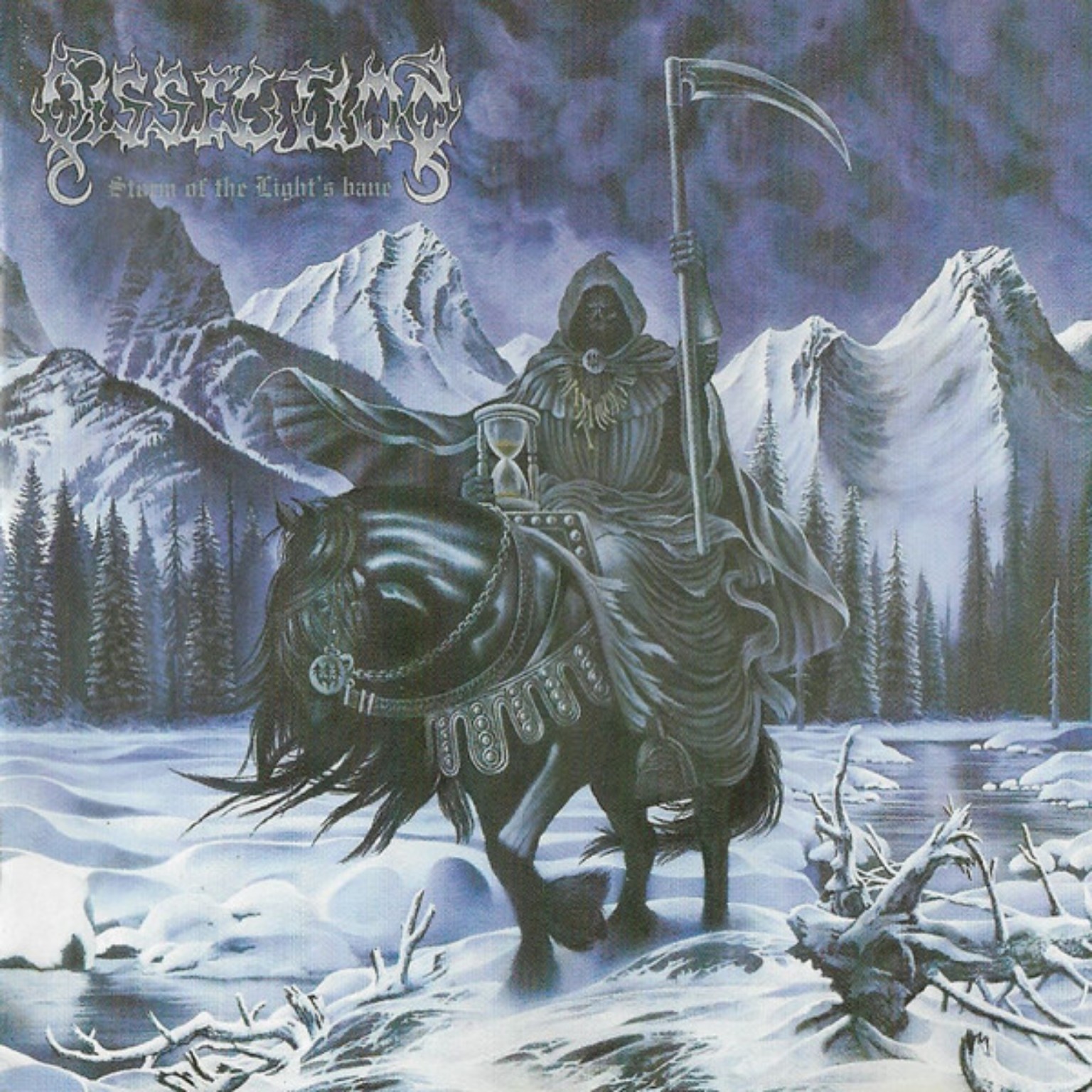
Dissection — Storm of the Light’s Bane (1995) · cover by Kristian Necrolord Wåhlin

Cover artwork: Kristian “Necrolord” Wåhlin

Album details

Tracklist · original eight-track album

  1. 01.At the Fathomless Depths1:56
  2. 02.Night’s Blood6:40
  3. 03.Unhallowed7:29
  4. 04.Where Dead Angels Lie5:51
  5. 05.Retribution – Storm of the Light’s Bane4:51
  6. 06.Thorns of Crimson Death8:06
  7. 07.Soulreaper6:57
  8. 08.No Dreams Breed in Breathless Sleep1:26

Total running time: 43:16 (Original CD (1995))

Band members

  • Jon Nödtveidt — vocals, guitars
  • Johan Norman — guitars
  • Peter Palmdahl — bass
  • Ole Öhman — drums

Additional musicians: Alexandra Balogh – piano (track 8); Dan Swanö – screams; IT – backing vocals (track 7); Legion – backing vocals (track 6).

Recording and release

Recorded 17–30 March 1995 at Hellspawn/Unisound Studios. Engineer: Dan Swanö. Produced by Dissection. Cover art: Kristian “Necrolord” Wåhlin.

Official music services

SpotifyApple MusicDeezerTIDALQobuz
◩ Digital album purchase · Qobuz ↗

◉ Physical editions

◉CDNorthern Silence Productions2CD · Icarus Music (2006)Buy ↗◉CDHammer Online Shop2CD · Black Horizon Music BHM003 · out of stockView product page ↗

Original release: Nuclear Blast Records, 17 November 1995; NB 129.

Band contacts

Band channels and reference pages

MAMetal Archives
Share this article
FacebookXWhatsAppTelegramRedditEmail
01 / 14

Two Shores of the Water

The town had a harbour long before it had a place in the history of music. Ships came in and carried goods away; fishermen and merchants reckoned with what the sea gave them, and with what it took. For a long time, Strömstad’s position was shaped by the nearby Norwegian border: coastline and national frontier imposed two different orders upon the same stretch of country. One opened routes of passage; the other divided jurisdictions and markets. From these movements the settlement derived its purpose and, as the years passed, the livelihoods that would change there again and again.

Bohuslän became part of Sweden in 1658. Across the border, older centres of trade were already established, while the Swedish state needed a northern trading place of its own. The town’s institutional birth extended over several years. In 1667 Strömstad became a köping, or market town; 1672 marked another stage in its urban development, and in 1676 King Charles XI confirmed its privileges. Three dates, three steps between local life and the order of the state. What appears as a single dot on a map takes its shape in history from successive decisions.

At the beginning of the next century, the trading settlement was assigned a military role. Charles XII also directed his Norwegian campaigns from here between 1716 and 1718. In 1717, the Danish fleet under Tordenskjold attacked Strömstad twice. War now measured the harbour’s importance; afterwards, everyday commerce, shipping and fishing came to the fore once more. The Atlantic herring trade also nourished the settlement’s growth. A population of roughly three hundred around 1750 had risen to nearly eleven hundred by 1805. The sea route made room for new people and new occupations.

In the final decades of the eighteenth century, travellers seeking relief from illness also discovered the coast. They drank the waters of Lejonkällan, stayed for cures, and fitted warm baths and sea air into the medical practices of their day. The town’s historical timeline dates its first warm-water bathhouse to 1786. Drinking cures and bathing called for accommodation, services and social life. Visitors arrived for weeks at a time: they bought themselves time in a town where others made their living from the sea or from trade. , 

The story of the spa town’s buildings did not end with its first warm-water bathhouse. Improvements made in 1813, 1827 and 1843 were followed by another stage in 1909. Meanwhile, a large cold-bathing establishment was built in southern Laholmen in 1887. The social assembly building, first completed in 1835, became a centre of town life in a later incarnation after the fire of 1877. The history of the Plantaget promenade reaches back to the 1830s. Gradually, alongside the labour of the harbour, there emerged paths, meeting places and buildings for the visitors as well.

On Sweden’s west-coast spa resorts, stays of four to six weeks were not unusual. A doctor-prescribed drinking cure might be accompanied by hot and cold baths, various additives and other treatments. Guests rented rooms, lived in boarding houses, walked and attended social gatherings. The older bathing culture of Gustafsberg and Strömstad’s development in the 1780s were two stories belonging to the same coastal world. By the middle of the nineteenth century, steamships and railways were bringing travel within reach of increasing numbers of people; after the turn of the century, changes in medicine and holiday habits transformed that old spa life as well.

A photograph from 1933 preserves the passenger vessel Olava in Strömstad’s inner harbour. Along with the visible order of the quayside, the ship’s name and the year of the picture have come down to us. In the twentieth century, canning and engineering also provided employment alongside harbour trade. Yet the population did not always move in the same direction: it declined between 1950 and 1975, rose again up to 1990, and changed hardly at all during the 1990s. The harbour remained in the same place, but successive generations inherited a town under increasingly different conditions of work and livelihood. , , 

Cross-border commerce opened another chapter in the harbour’s old connections. In the middle of the twentieth century, Swedish shoppers still crossed into Norway for sugar and margarine; from the mid-1990s onwards, however, trade increasingly flowed the other way, as Norwegians came to shop on the Swedish side. In a later study of urban development, Jimmy Magnusson estimated that trade across the entire Norwegian–Swedish border was worth four billion kronor in 1994 and sixteen billion in 2019. Those figures concern the whole border region; the shopping centres and roads built later belong to the consequences of that wider economic shift. , 

Western Sweden preserved a different kind of heritage as well. Songs and melodies collected in Bohuslän, Dalsland and Västergötland survived in folk-music archives. The catalogue of the Institute for Language and Folklore, which records some sixteen thousand recordings, reveals the variety of the region’s sounding past. Collectors, performers and institutions did different kinds of work, each in their own way guarding the same memory. Alongside this long musical inheritance, the towns’ popular music of the twentieth century created new audiences and new places in which to meet.

In Gothenburg, names such as Tages, Doris and Nationalteatern lead to other generations and other sorts of stages. Punk demanded a space of its own: Attentat made its first public appearance in 1978 at the two-day Mot Elitkultur festival at Sprängkullen. Making music also meant organising an occasion, finding a venue and gathering an audience. The beginnings of Andra generationen in 1988 brought another strand of urban music, growing out of immigrant family backgrounds. The port city possessed more than one musical past and more than one present existing side by side.

Quorthon recounted one important story of Swedish extreme metal in the 1980s in an interview from 1987. He traced Bathory’s beginnings to March 1983, recalling punk, Motörhead and the disintegration of the early line-up. After his own songwriting work, the release of Scandinavian Metal Attack in 1984 and the distribution of the first Bathory album carried the name further afield. Overseas imports, letters and news passed among fans built connections with more distant listeners. In its first days, the route taken by this new and extreme sound ran through channels that were small, yet closely interwoven.

The next generation inherited those recordings as well. When musicians who would later emerge from Gothenburg looked back on their beginnings, they spoke of youth centres, rehearsal rooms, equipment and record shops. In Mikael Stanne’s recollection, hearing Grotesque rehearse directly inspired him to plan a band of his own. Other memories describe a shared bus route and listening to cassettes together as bonds between young people. Around small concert spaces and Valvet, the musicians themselves helped sustain the community. Simply having a place that could be used made a whole succession of new encounters possible. , 

The youth centres recalled in later years also provided the infrastructure for the Rockslaget talent contest, rehearsals and first performances. A shared interest in Kiss, Iron Maiden and Metallica became the musical language of one generation looking back. Song ideas were captured on cassette and developed together in the rehearsal room; Anders Björler later contrasted this process with musicians working at a distance and sending one another digital files. The cassette that preserved an idea could also carry it to somebody else. Creation and distribution met within the same object. , 

02 / 14

The Time of the First Letters

Jon Nödtveidt and Peter Palmdahl had already played together in Siren’s Yell. Jon had also been a member of Rabbits Carrot before the name Dissection appeared. Later accounts placed the band’s beginnings both at the end of 1989 and at the start of 1990. Some stressed the musicians’ shared intention; others singled out Jon’s departure from his former band or the assembly of the new line-up. The group took shape in several stages, and the early statements preserved different moments in that process. , , , 

In 1990, when Tomas asked Jon about his break with Rabbits Carrot, he explained it in terms of his own dissatisfaction. He wanted guitars tuned lower and vocals that were darker and more growling; he was drawn towards death metal. As he recalled it, he began considering his departure in December and left at the beginning of February. He and Peter wanted to start another band and asked Froggy to play drums. The caption beneath a photograph in Putrefaction named the early trio and their instruments: Jon on guitar and vocals, Froggy on drums and Peter on bass.

To make music together, they needed somewhere to rehearse. In Jon’s account, the first songwriting was followed by their obtaining a rehearsal room in May 1990. In the Never Believe interview, as he discussed the February beginnings and his fellow musicians, he named Peter and Ole, and mentioned Mappe’s occasional participation on guitar. These names and moments stand alongside one another within the shifting arrangements of the band’s early work. In a story later compressed into a single founding date, leaving the old group, gathering new companions and finding somewhere to rehearse were distinct events. , 

During the years when these young musicians were finding a rehearsal room, the borders of their continent were acquiring new meanings too. The history of Solidarność had emerged from the Gdańsk shipyard strikes of 1980; the closing years of the decade were marked by the opening of the Hungarian border and, on 9 November 1989, the opening of the Berlin Wall. Greece, followed by Spain and Portugal, joined the European Communities during the decade. The Single European Act, which entered into force in 1987, prepared the way for the internal market, and the Erasmus programme began that same year. Across Europe, old dividing lines coexisted with new possibilities of passage. , 

There was an earlier and very different story of movement across borders. Radioactive material from Chernobyl reached southeastern Sweden in late April 1986. Meteorological studies traced its deposition through air currents and precipitation, particularly on 28–30 April and 8–10 May. As early as the afternoon of 28 April, Swedish atmospheric trajectory calculations and the examination of samples pointed towards a reactor accident on Soviet territory. Its consequences appeared in food inspections, questions of grazing and information provided to the public: a distant catastrophe became part of everyday life in Sweden. , 

After these historical years, attention returns to the smaller world of rehearsal rooms and letters, one in which the band could more directly shape events. Around the turn of the decade, young groups were searching for ways to circulate their own recordings. The editor of Putrefaction had already heard an introductory Dissection song; Jon corrected its title, misstated in the question, to Severing Into Shreds, and identified a scene from Hellraiser as the source of its lyrics. Hedonic Agony and The Mourning also appeared among the new song titles. The developing repertoire was still changing, but the intention to move towards death metal was firm, while recording the first studio demo remained a plan for the future.

The musicians expected to make the recording in the autumn of 1990. Froggy placed the work after Peter’s return from holiday, while the Never Believe interview anticipated recording in October and distribution in November. The demo’s journey would prove longer than the few weeks announced. Later chronologies describe a December recording and a release early in 1991. A plan was followed by an opportunity, and the timing of that opportunity changed the plan. , , 

At the end of the fanzine, an interested reader also found out what to do next. Jon invited letters and asked anyone wanting a rehearsal recording to send a blank cassette and a stamp or international reply coupon to cover postage. Besides making music, the musician had to prepare a parcel; a listener’s interest became a connection when the letter was sent. The fanzine carried the name and address, while the cassette could reach places where nobody had ever seen the band.

Those early conversations were personal and rough-edged. Jon and Froggy answered the editor’s jokes and interjections differently, and their musical tastes differed too. Gary Moore, the Beatles, Muddy Waters and B. B. King appeared in Jon’s list alongside more extreme bands. The new group’s sound grew from individual tastes that were not the same, even as its members committed themselves together to death metal. Jon thought Dissection was a suitably brutal name, though he was not entirely happy with it; in a later interview he again spoke more of the word’s impact than of any grand allegory. , 

Another strand of memory preserves Strömstad’s musical life through Skagerak Monday Live evenings, Simona, Strand, Seaside and the Laholmen jazz club. Local organisers who spoke in later years recalled audiences, expenses, periods of prosperity and decline. The small town had to make room for many kinds of music. Dissection’s early interviews placed the personal network of cassettes and death metal within that same local life. , 

03 / 14

Three Hundred Cassettes and a Single

By the time The Grief Prophecy was finished, opinions were already divided over the music itself. Writing in Drowned, Dave Rotten described studio work postponed until December after two earlier rehearsal recordings, and mixing that continued into February 1991. He listed three tracks: Severed into Shreds, The Call of the Mist and Consumed. He praised the raw death metal sound and Jon’s vocals. Behind the demo lay a longer process, with more stages than the initial announcements had suggested.

Rotten also recounted the personal side of the connection. Jon had been his guest and, on one occasion, sang covers of Death, Autopsy and Carnage songs at a Dissection rehearsal. Rotten remembered it as a one-day appearance as a singer, a curious little episode in the scene’s musical and friendly exchanges. He also mentioned a festival appearance in Strömstad alongside Entombed, Cadaver, Nosferatu and Rabbits Carrot. The report did not preserve the exact day, but it did preserve the names of the bands that shared the stage.

In the August 1991 issue of Putrefaction, the demo met with a different reception. The editor preferred the earlier rehearsal recording, found the demo vocals excessively brutal and wished for a more shrieking style of delivery. He also passed on news from Jon: the vocals had since changed, the music had grown darker and more mystical, and new songs were under way. These different reactions still belonged to the same early period. The musicians were moving towards another recording, while listeners judged what had already arrived on cassette.

The page pictured Peter, Ole, Jon and Mattias in that order, according to the photograph’s caption. After the earlier picture of three musicians, four now faced the magazine’s readers. The demo was advertised for five dollars, with three tracks and an intro listed. The editor announced plans for recordings at Sunlight and new material intended for a seven-inch single. The proposed summer studio session still lay in the future, as did the promise of the next release.

In the next Putrefaction interview, Jon spoke of more than three hundred copies sold before the band stopped selling the demo. The figure was his own contemporary tally. Yet even a few hundred cassettes could draw the attention of fanzines in several countries. In the world of postal distribution, distance was not overcome by sheer volume: a tape might reach an editor who would bring the band’s name before another readership.

The French label Corpsegrinder entered the story through Into Infinite Obscurity. Around the single, the publishing schedules of the press and the band’s own work preserved differing dates. An announcement written earlier, or printed later, could still speak of recordings yet to be made while another account already referred to the 1991 release. Rotten wrote about new songs planned for Sunlight and named John Zwetsloot as a new guitarist. The incoming musician’s contribution would also remain in two compositions on the second full-length album. , , 

In the January 1992 issue of Thanatography, the editor praised the demo’s three songs and still described the single as forthcoming. Jon spoke about his experience playing guitar in Rabbits Carrot and the new direction that was developing a character of its own. Alongside Falkenberg and Entombed, his recollections of performances also included Dark Tranquillity, Cadaver and Cemetary. The sound carried on cassette had its counterpart in experience on stage. Some connections were made through letters, others through evenings shared in person.

By then, the names of songs from the next creative phase were beginning to appear. In Putrefaction, Jon mentioned material titled Coldwinds and The Somberlain, for which he planned further recordings in early 1992. In these early accounts, the later full-length album still existed as something to come. The original issue of Psychopathological appeared in March 1992; unlike the 1991 label found on later transcripts, that is a secure date for the printed publication. The interview preserved Jon’s account of the band’s formation in early 1990 and his musical self-image at the time. , 

For a young musician appearing in fanzines, the album was not yet the natural measure of a career. A rehearsal recording, a demo and a short single could each give the songs a chance to be heard. New material took shape alongside the personal labour of direct distribution. From the cassette already released, the band moved towards its next record, while its name appeared in the news of small underground circles in more and more places. , , 

04 / 14

The Krona and the Album

During the crisis surrounding the krona in 1992, the customary sense of security in Sweden’s economy was shaken. In September, the Riksbank resorted to extraordinary interest-rate increases to defend the fixed exchange rate; the short-term rate briefly reached as high as five hundred percent. Yet on 19 November the krona was allowed to float. Instead of defending the exchange rate, a new foundation had to be found for monetary credibility. In January 1993 the central bank announced an inflation target of two percent, based on the consumer price index and accompanied by a tolerance band of one percentage point; the new framework was to apply from the beginning of 1995. , 

Behind the financial decisions, insecurity about employment was spreading through ever wider sections of society. In the SOM survey, three percent of respondents aged sixteen to sixty-four described themselves as unemployed in 1990; by 1993 that figure was twelve percent. Within the same questionnaire-based measure, the share reporting employment fell from seventy-seven to sixty-five percent. These numbers are not interchangeable with every other labour-market indicator: they represent the answers recorded by this particular survey. Even so, the distance between those dates shows how quickly everyday life in Sweden was changing under the pressure of insecure work and livelihoods. , 

In Gothenburg, the crisis arrived amid an industrial landscape that had already been changing for some time. From the 1840s to 1990, its shipyards built approximately seventeen hundred to eighteen hundred vessels, but after the crisis of the 1970s the yards’ fortunes changed one after another. From 1985, the reuse of former industrial land at Eriksberg and Lindholmen was given an institutional framework. Old buildings took on new purposes, and in time homes and offices rose on sites where people had once worked. The same waterfront joined the memory of shipbuilding to the ambitions of a changing city. , 

It was at this point that Dissection moved from its early recordings towards a first full-length album. In a 1993 interview with Nordic Vision, Jon was already talking about delays surrounding The Somberlain, which was still in preparation. Problems with printing and distribution pushed the expected August release further back. An album meant a new range of tasks: after recording came the artwork, manufacture and distribution on a scale beyond the personal mailing of cassettes. The music needed a physical form of its own if it was to reach an audience beyond the smaller circle of contacts.

The relationship that led to No Fashion was built through personal encounters and recordings. Looking back many years later, Tomas Nyqvist recalled meeting the young musician through Jon’s fanzine and being persuaded to release an album by a rehearsal recording of the band. He put the recording costs at around six thousand Swedish kronor and the first CD pressing, which sold out quickly, at five hundred copies. In the small label’s work, musical judgement went hand in hand with the financial risk of manufacture. By 2016, the account was a recollection of an earlier undertaking.

In that 1993 conversation, Jon described the contract as an agreement for a single album and also mentioned financial terms linked to sales. In later disputes about the label, the musician and the entrepreneur gave different accounts of what they remembered. Yet as the first album waited to reach the public, songwriting continued. The work made for No Fashion was still finding its way into the world when parts of the next record were already taking shape. , 

Skogen later praised The Somberlain as an important album that had now appeared. It placed the recording in the first days of March 1993 and its release in December. The writer was enthusiastic about the music and the artwork, but far less so about the acoustic pieces. More than once, the writer’s retrospective discussion of demos and some pressing figures openly acknowledged uncertainty. Thus even in the early praise, listeners did not value every musical choice on the album in the same way.

Jon later described the circumstances of the first recording in terms of members living far apart and having little opportunity to rehearse together. In the Requiem interview, he mentioned two rehearsals and parts that had to be rearranged before entering the studio. Yet in his 1994 conversation with Slayer he appeared satisfied with Dan Swanö’s work. Many years later, the engineer called the first album easier to make and closer to his own tastes. Viewed from the difficulties that followed, The Somberlain became a measure of an earlier collaboration. , , 

Meanwhile, Europe’s new institutions acquired their definitive names. The Maastricht Treaty was signed in 1992; on 1 November 1993 it entered into force and the European Union came into being. Alongside the existing communities came cooperation on foreign and security policy, justice and home affairs. After the dissolution of the Soviet Union in 1991, a new network of relationships promised the continent a different order. Sweden was drawing closer to membership of the Union during years of crisis at home. , 

For the musicians, the place where they worked together also became increasingly important. After living in different towns, they discussed the prospect of a shared rehearsal room in Gothenburg, mentioning a space shared with At the Gates. Two members lived together; more regular rehearsals and closer contact offered different conditions for developing the next songs. Other bands in the city were following their own paths through the same underground, between shared spaces and differing musical ideas. , 

05 / 14

Their Companions’ Names in the Songs

In a 1994 interview with Slayer, Jon was already discussing the second album, which he said was roughly half written. He imagined the next material as darker and more varied, yet even more brutal. He spoke of emotions: hatred, sorrow, depression, personal feelings that he wanted the music to convey. To him, intensity meant more than the physical force of sound. Melody and bleakness could serve the same creative purpose.

The change of guitarist took place during this period. In a later interview with Pit, Jon dated the decision to ask John Zwetsloot to leave to the summer of 1994. The article in Skogen mentioned June. Jon explained the break in terms of conflicts over rehearsals and the discipline of working together, while acknowledging Zwetsloot’s inventiveness as a player. Johan Norman, familiar through his connections with Decameron and Satanized, took his place. The explanation told from one musician’s perspective survived alongside the fact of the line-up change itself. , , 

Their shared past nevertheless remained within the compositions. John Zwetsloot’s name continued to appear beside Jon’s in the songwriting credits for Night’s Blood and Retribution. Johan Norman became a co-composer of the music for Unhallowed, Thorns of Crimson Death and Soulreaper. The 1995 album photograph already showed the new quartet, but the songwriting credits covered a longer stretch of time. A member’s departure and the fate of work created earlier remained two different stories.

Shortly after the guitarist’s departure, an earlier version of Where Dead Angels Lie was recorded for a compilation album. Jon recalled playing all the guitar parts alone on that occasion. Reports from the same period also mentioned a cover of Tormentor’s Elizabeth Bathory. In 2019 Swanö connected the early recordings of Night’s Blood and Where Dead Angels Lie with the work done between the two full-length albums. Songs that became familiar from the later record had already circulated among listeners in earlier forms. , 

Meanwhile, references to Feathers Fell and Black Horizons from The Somberlain, and reports about a new recording of Son of the Mourning, preserved another part of the first period. In the Requiem interview, Jon connected the newer version of that earlier song with the Japanese edition of The Somberlain. The relative time reference did not allow a reliable calendar month to be established, but the connection with the release remained clear. The next full-length album was being developed alongside several such earlier undertakings. , 

Jon attached great importance to the new label relationship. He regarded Nuclear Blast’s offer as the best available and stressed the greater promotion and distribution it promised. In several statements he criticised the earlier conduct of No Fashion. For a group that had mailed cassettes to fanzines, an international label offered a different scale of operation, later accompanied by touring support. At the same time, Jon retained his own, frequently polemical opinions about the company’s other musical directions. , , , 

In the underground, Jon did not answer questions only as a band member: as an editor, he also helped determine which musicians and recordings reached readers. In a 1994 column in Extreme Zone, he brought together news, releases and difficulties involving Einherjer, Hades, Nifelheim, Ophthalamia, Emperor and Opeth. He recommended demos and fanzines and urged readers to send in material of their own. By mentioning Dissection interviews in The Gathering, Peerless and Nordic Vision, he also directed readers from one conversation and publication to another. The man who appeared elsewhere as an interview subject was here helping to organise the movement of attention across a musical community.

The Estonia disaster of 28 September 1994 entered the Baltic region’s shared memory in a very different way. There were 989 people aboard the ferry sailing from Tallinn to Stockholm; 852 of them died. A joint Estonian–Finnish–Swedish investigation began the following day, and its final report was submitted in December 1997. The tragedy of a voyage intended to connect two shores became one of the region’s gravest modern calamities. Amid the familiar order of ports and timetables remained a loss that investigators spent years trying to understand.

At the end of the year, the equipment in Swanö’s studio changed. In December a digital mixing desk replaced the analogue console, although tape recording remained part of the process. New technology demanded new knowledge; in the producer’s later recollections, the difficulties of learning it were part of the story. Dissection’s next material returned to this workshop in transition. Their experience of making the first album was followed by new demands for sound and different tools.

06 / 14

After the Fourteen Days

On 1 January 1995, Sweden joined the European Union along with Austria and Finland. The organisation, now comprising fifteen member states, provided an institutional framework for new economic relations. On that same day, the Swedish central bank began applying the inflation target it had announced earlier. In the spring, the implementation of the Schengen system marked another stage in European movement, though the removal of checks at internal borders did not reach every new member state at once. The krona remained Sweden’s currency as the continent’s integration entered another phase. , , , 

The original booklet dated the music of Storm of the Light’s Bane to the period between 1993 and 1995. Following the years of composition and arrangement, it printed two precise dates for the recording: 17 and 30 March 1995. Hellspawn/Unisound was the studio named. Behind material recorded over almost two weeks lay the composing of the preceding years; ahead of it still stood the search for a sound that would be accepted. In the Pit interview, Jon likewise spoke of two weeks in the studio. The making of the finished record was to become a longer story. , 

Swanö later recalled Ole Öhman’s ideas about drum sound with particular vividness. Iron Maiden’s Piece of Mind and the progressive rock of Änglagård and Landberk figured in that recollection. The producer approached the drums through a more acoustic tone reminiscent of the 1970s and balanced the guitars and bass accordingly. The first completed mix sought a different kind of unity from what the label ultimately found acceptable. Nuclear Blast requested another version.

The first mix was later sometimes described as a rough version. Swanö insisted that it had in fact been the first finished mix. It embodied work and decisions: with that sound, they had already intended to present the album. Jon also spoke of the band’s partial dissatisfaction in the Crypt interview. The next opportunity required patience. The recording made at the old location could be mixed at the new studio, but scheduling meant a wait of approximately four months, as he recalled. The account did not preserve exact beginning and ending dates for that interval. , 

Swanö moved from the Finspång area to Örebro, bringing the studio’s work into the history of a much older trading town. Örebro stood beside a crossing of the Svartån, near the waters of Lake Hjälmaren. The iron trade of Bergslagen and the Hindersmässan market linked it to old routes. The history preserved in the archives suggests medieval privileges and then follows later changes in the town’s institutions and economy; even its name retains the memory of a bridge over a gravelly riverbed.

The fire of 1854 destroyed ninety-two plots in the town centre and left roughly a third of the population homeless. Rebuilding produced straighter streets and more stone buildings. Railways and the SJ workshops were joined by shoe factories and biscuit works. The population grew from about five thousand around 1850 to fifteen thousand by 1890, thirty thousand by 1910 and fifty thousand by 1950; in 1967 it was already around ninety thousand. Industrial competition later brought a decline in shoe manufacturing too. In this town, repeatedly reshaped by new demands, another kind of workplace—a recording studio—would become one of the decisive settings in the band’s story. , 

According to Swanö’s recollection, Jon came alone for the second mix. They re-recorded certain guitar tracks and vocal passages. The microphone stood in the control room, and the existing material was reworked with new details and different balances. This return was no longer simply a matter of completing the March recordings: some instrumental and vocal parts changed in the pursuit of another overall sound.

The label did not approve that version either. A third mix followed. Swanö was uncertain about Johan Norman’s presence on that occasion but remembered Jonas Björler more clearly. He was asked for a more modern sound associated with At the Gates, yet years later he could no longer decide whether Terminal Spirit Disease or early material from Slaughter of the Soul had actually been the point of comparison. The uncertainty between the two titles remained in the producer’s own account.

The newly fashioned drum sound incorporated a sampled snare and a triggered bass drum. Swanö used an Atari to control the timing of the tom channels’ gates, and he worked on the reverb and the balance between sounds. In the fast passages, each strike had to cut through the dense arrangement of instruments. Engineering added another layer to the performance: the playing captured on tape became a different drum sound, and that in turn changed the sound of the record as a whole.

The memory of the final work was bound up with illness and pressure of time. Swanö recalled running a high fever and having to send the material on to Cutting Room in Stockholm for mastering by Håkan Åkesson. He was no longer sure what kind of medium had carried it. The essential story was also supported by Jon’s contemporary remarks: the record had to be mixed several times, and its release was delayed. The producer’s detailed later recollection and the musician’s shorter account from the time both lead back to the same difficult undertaking. , 

In 2019, Swanö contrasted The Somberlain with the second album as an easier undertaking and one closer to his own musical tastes. He also spoke of differences between Dissection’s members over the desired sound, and of their growing attention to Norwegian black metal. A different interview in 2024 returned to the three mixes and the label’s deadline. For the producer, the album that would later acquire such stature also remained a difficult assignment. Its standing in music history did not erase the memory of the work. , 

The sound finally accepted brought the performances of four musicians, and the work of several other contributors, before the public. Jon Nödtveidt played guitar and sang, Johan Norman played guitar, Peter Palmdahl played bass and Ole Öhman played drums. Dissection was credited as producer, with Swanö responsible for engineering. The artwork was by Necrolord, and the original booklet named Oscar Mattsson in connection with the photographs. Behind an album that spoke with a unified voice were different tasks and distinct creative contributions. , 

Jon later responded particularly firmly to criticism that the bass could not be heard clearly. The interviewer from Pit raised the instrument’s subdued place in the mix, and Jon explained the part played by its distorted sound. According to the interviewer, Jon even called back after their conversation to make the point more precisely. In the debate over the sound, this detail remained important enough to the musician that he returned to it after the interview had ended. Later reviewers would again and again make the bass one of the questions on which they judged the mix. , 

07 / 14

The Rider and the Celestial Body

At the centre of the finished album’s visual world stands a hooded rider. The long handle of a scythe rises above the dark figure, while an hourglass holds the passing of time before him. The horse turns towards the foreground; its mane and the folds of the cloak lend movement to the painted scene. Behind them, a field of snow stretches away to distant fir trees and steep mountains. The dark figure stands out sharply against the pale snow, yet the bluish and violet shades bind him and the landscape within the same cold world.

In the upper left of the sky, partly concealed behind the logo, a darkened celestial body and a bright rim appear, like the sign of an eclipse. The distance of the white mountain peaks also alters the scale of the rider: the central figure becomes monumental, even as the landscape opens endlessly behind him. The scythe and hourglass are old European symbols of death and time. On the cover, both belong to the one figure who dominates the picture. The folds of cloth and the mane, suggesting the direction of the wind, turn a still image into the suggestion of an approach.

Necrolord created the front cover. In the Crypt interview, Jon also recalled the discussions that preceded it. His earlier idea had involved an angel, chains and an epic setting, after which he requested changes. Speaking of the finished image, he mentioned his own sense of a resemblance to King Diamond’s Abigail. Between the rider that appeared on the record and the earlier plan lay the course of the creative work, in which Jon had taken part. The painter’s finished picture gave the album’s world a distinct form.

Beneath the intricate Dissection logo runs a smaller, ornate inscription bearing the title. Snow and the figure of death are joined before the music has begun; the grandeur of the landscape meets the threat within it. Later reviews also praised the unity of image and sound. The cover’s recognisability became part of the album’s memory, leaving a visual world that a single glance could call to mind. , 

The music possessed a different kind of unity. In December 1995, Jon explained that the songs did not continue a single plot. Death was what bound them together. Six substantial vocal compositions lay between an instrumental opening and close; pieces of different lengths and characters followed their own paths within that shared theme. The printed timings added up to 43 minutes and 16 seconds. The image of the cold landscape, recurring words and changing music held the record together side by side. , , 

Jon’s fondness for older metal endured in the way he explained his music. Alongside Iron Maiden, Judas Priest and Venom came the names Metallica, Slayer, Kreator, Destruction and Sodom; in earlier conversations there had also been room for other kinds of music beside his death metal favourites. Laibach, Fields of the Nephilim and early Dead Can Dance revealed another side of his interest in atmosphere. Jon heard in sombre guitar harmonies a power that did not necessarily require a dense background of keyboards. Yet a piano was heard at the end of the album, in a piece by a different composer. , , , , 

Beyond the images on the cover lies another world, made from melody and roughness and constructed entirely in sound. Benjamin Phillip Hillier, a later analyst of Gothenburg’s music, examined Aeolian-based chord progressions, guitar melodies in parallel thirds, chromatic movement and shifts around a tonal centre in passages from The Gallery, Slaughter of the Soul and The Jester Race. By the term “quasi-tonality,” he described a distinctive balance in which a tonal centre and temporary departures from it can both be heard. While discussing a passage by Dark Tranquillity, he also mentioned Dissection as a possible black metal influence, explicitly framing it as a tentative suggestion. The region’s different musical traditions followed their own paths in shaping the relationship between melody and dissonance.

08 / 14

From the Depths to the Angels

At the threshold of the album stands At the Fathomless Depths, lasting 1 minute and 56 seconds. This instrumental composition by Jon Nödtveidt received its own title and place in the sequence. Later listeners drew attention to its percussive character and the frame it formed with the closing track. Before the long songs, this short passage opened a space; the record had made its first move before any singing began. , , 

The title invokes the depths. Jon’s earlier explanation of a backwards-spoken message connected with The Somberlain remained part of the history of the first album’s introduction. The new opening piece on Storm had a compositional place of its own. It also appeared later as a concert introduction: in the report on the California show of March 1996, the intro was followed by Night’s Blood. The album’s carefully arranged entry had passed into the opening of a live performance. , , 

With its duration of 6:40, Night’s Blood allows for more expansive movement. Jon and John Zwetsloot wrote the music, while Jon wrote the lyrics. The former guitarist’s name remains here even after the change of personnel. The melody’s history extends across the reshaping of the line-up; the finished studio record carried forward a part of the work undertaken together in previous years. Accounts recalling earlier versions preserve the longer journey of this same song. , , 

A contemporary review set the quieter, acoustic beginning beside the eruption of the fast passages that follow. Harmonically interwoven guitar parts were joined by extreme force. Later commentary returned to the changes of rhythm and the coexistence of death metal technique with black metal atmosphere. In these readings, the first vocal track demonstrated within a single composition the very different movements the album could bring together. , , 

Jon himself connected the song’s weight and melodic layers with his affection for older thrash metal. In the lyrics, night, cold, loneliness and the allure of darkness meet. Images of nature give the voice an inner state and a symbolic space; the returning refrain gathers those images into a denser form. As swift and sombre passages alternate, extreme force and emotional variation remain parts of the same composition. , 

Swanö later counted this song among his personal favourites, associating it with the earlier period. It also returned in concert sets, while critics named it time and again. Night’s Blood thus became one of the bearers of the album’s memory. Yet behind the recognisable song remained the story of two composers and several stages of recording. , , 

The next track, Unhallowed, lasts 7:29 and lists Johan Norman as Jon’s co-composer. Its lyrics are credited to Jon and Tony Särkkä. The work of the new band member meets a separate lyrical collaboration; the writers of this song reveal another collective side of the album’s creation. The original booklet preserved Särkkä’s name in the credits for the third track.

Here the music takes on a more warlike character. Images of nocturnal dominion, allegiance to dark forces, war and hostility towards Christianity gather in a collective, commanding voice. After the more solitary night of the preceding song, a different speaker takes possession of the scene. Images associated with death are joined to apocalyptic and aggressive words.

The Requiem review of 1996 called Unhallowed the album’s best track. In later readings, special attention went to the guitar solo, the guitar tone and the changes of dynamics within the piece. Its extended duration was understood as a composition rising through several sections. Early and later praise met here: one listener had already singled out the track near the time of release, and it remained a recurrent point of emphasis in the developing canon. , , , 

Where Dead Angels Lie then brings another kind of tension. Jon alone is credited with both music and lyrics for the 5:51 track. He had spoken of an earlier compilation recording in connection with the work following the change of guitarist, but the completed 1995 version occupies the centre of the full-length album. Over the course of its history, the piece took on independent lives as a recording, an album track and later the title of an EP. , , 

In conversations preserved by Mourn and Metalzin, Jon explained the song through an angel who walks at night. Darkness takes possession of the figure. Within images that move from light into night, seduction, transformation and stillness follow one another; against the white snow, the red of blood and roses becomes a particularly striking contrast. A movement resembling a story takes shape within the song, even though Jon linked the album’s separate lyrics only through their common theme of death. , , , 

The Swedish and Spanish versions preserve the traces of the same interview. Behind their matching questions and answers stands a single statement, carried by translation to different audiences. Jon also discussed the order in which he wrote: usually the music came before the lyrics, only rarely the other way around. Personal images and the instrumental work of his fellow musicians thus came together as separate tasks. In explaining his interest in Mayhem, he also named the conceptual impact of Dead’s lyrics. , 

The contemporary review found Where Dead Angels Lie unsettling and described the effect of its guitars through an image of the Carpathian Mountains. Later commentary focused on the acoustic and heavy sections, the more restrained tempo and the atmosphere. Here the tension rose in a different manner from the preceding long track: melodies and transitions created a form of intensity all their own. , , 

For Swanö, this song too remained a favourite associated with the older period. It appeared in the account of the California performance as part of the continuing set, and in later album-and-EP compilations its title took on a new role. A review considering those releases together emphasised both the strength of the original full-length record and the uneven quality of the additional material. The same name gathered several historical roles without confusing the origins of the individual recordings. , , 

09 / 14

From Retribution to the Final Note

The fifth track on the record is Retribution – Storm of the Light’s Bane. The title track has a printed duration of 4:51 and credits its music to Jon and John Zwetsloot. For the second time, the shared authorship links the original album to its former guitarist. After Night’s Blood, the song bearing the album’s name also carries forward work that began before the change in personnel.

The lyrics present a voice turning against dawn and light, with images of retribution and the last days. A fallen angelic figure enters a language of defiance and destruction. The song arranges the dark motifs of the other lyrics in an aggressive direction of its own. Within the shared theme of death, the title track places the word “retribution” at the forefront. , 

Reviewers remembered the internal dynamics and the changes in character. This more compact piece in the middle of the record acquired weight of its own among the longer compositions. A review from 1995 already named it, and later analyses highlighted changes between melody and force. On stage, the song carrying the album’s name returned as a recognisable part of the repertoire. , , , 

After it, Thorns of Crimson Death extends to 8 minutes and 6 seconds. It is the longest composition in the original eight-track programme. Jon and Johan Norman collaborated on the music, Jon wrote the lyrics, and Legion is named in the backing-vocal credit. Beside the work of the band itself, a separately acknowledged guest enters the song’s sound.

Its imagery turns towards frozen memories and the traces left by tragedy. Lost voices, signs remaining after an event long past, a fate bound to the earth and memory resisting oblivion are intertwined. Around the recurring questions, the past does not end: it becomes present again in the landscape and in the voice. After the aggressive language of the preceding piece, death returns here as the burden of remembrance.

Later opinions of this longer song emphasised the contrast between its melancholic and brutal passages. Drumming, the many distinct sections and the dynamics within the piece came to the fore. As late as 2022, these contrasts were named among the album’s outstanding accomplishments. To those listeners, the eight minutes allowed different characters to unfold, opening greater space for changes as the record approached its end. , , , 

Next in the sequence is Soulreaper, described as faster and lasting 6:57. Jon wrote the lyrics to music by himself and Norman; the musician known as It is named as the other guest backing vocalist. The guest voices on the last two vocal tracks thus remain present as distinct contributions in the credits. After the long Thorns, another substantial composition concludes the six sung pieces. , 

In the lyrics of Soulreaper, the cold wind, the forest, eternity and the harvesting of souls are intertwined. The power of death speaks, and the inevitability of destruction finds a voice. Discussing the song in 1996, Jon stressed the importance of inner images and emotions associated with death. For him the lyrics were symbolic; he did not wish the scenes to be understood as a simple succession of stories. , 

Later interpretations described the song’s speed and movement by comparing it with the preceding track. At this point, the album still advances with considerable instrumental and vocal force, but the ending has another direction in reserve. Soulreaper concludes the six major pieces, yet the record as a whole still has one brief final utterance to come. , , 

No Dreams Breed in Breathless Sleep was composed by Alexandra Balogh. The original booklet gives no lyrics for this 1:26 instrumental. Another creative hand receives a place of its own at the album’s conclusion. Described as a melancholic piano ending, the piece creates a last contrast in little time after the denser, more vehement compositions. , , 

Later reviewers heard it as part of a frame with the opening piece. Yet the two short tracks belong to different composers and make different movements: one introduces the vocal numbers and the other closes them. Even an early review singled out the ending, although it misspelled the title. Without words, the song carries the common theme of death into the final moment through its title and the mood that listeners described. , , , 

The original sequence holds together precisely through its differences. Jon said that aggression and melancholy were equally important; he connected the sombre quality of the guitar harmonies with older metal and classical music. Some listeners singled out the technical force of death metal, the atmosphere of black metal, and the alternation of blast beats with lead-guitar lines; others heard the importance of the acoustic transitions. In this way the eight tracks offered a recognisable path to listeners with different musical experiences. , , , , 

10 / 14

November and the First Echo

In the summer of 1995, the gravest crime of the Bosnian war unfolded in southeastern Europe. In 1993, the United Nations Security Council had declared Srebrenica a safe area, but its protection collapsed. Ratko Mladić’s forces captured the town on 11 July; international courts have classified the systematic killing of Bosnian Muslim men and boys as genocide. Thousands died and tens of thousands were driven from their homes. Mass violence remained present in the history of Europe’s new institutions after the Cold War.

The next episode, in November, survives in judicial records. On 16 November 1995, the International Criminal Tribunal in The Hague confirmed a new indictment against Radovan Karadžić and Ratko Mladić concerning the massacres at Srebrenica. The charges related to acts committed in July 1995, but the date of the tribunal’s announcement fell in the same November week in which Dissection’s second full-length album appeared. The consequences of war were now brought into public life not only by news from the front but also by international proceedings intended to establish responsibility.

Once the sound of the record had been accepted, the album entered the system of international distribution. The original release date of Storm of the Light’s Bane was recorded as 17 November 1995. The Nuclear Blast CD carried catalogue numbers NB 129 and 27361 61292; the release information distinguishes the German CD edition from the band’s Swedish origin. The recording dates in March were followed by the release in November. , , 

Meanwhile, the market for recorded music was undergoing major changes. According to a later Swedish government study of music exports, the CD’s share of sales rose from twenty-seven percent in 1988 to ninety-two percent in 1997. Cassettes and vinyl remained, but with a different weight in the market. The record by a band that had once sold its demo personally could now make use of larger label and retail networks. Behind the music worked rights, manufacturing and distribution across national borders. , 

The same report estimated Sweden’s total music exports in 1997 at approximately 3.3 billion kronor, nearly half a percent of total exports of goods and services. The author himself acknowledged the difficulties involved in making the estimate. The figures for this growing industry nevertheless provided a different scale from the sales of any one record: even in an interview from 2004, Jon could not give a firm total for the number of Storm copies sold. The album’s standing and its commercial volume survived with different degrees of certainty. , 

Regular use of the internet was also at the beginning of a new era. In 1995, one percent of SOM survey respondents used the network several times a week; a year later the share was four percent, and by 1997 it had reached sixteen percent. The year 1994 occupies a distinct place in the history of the internet among Sweden’s population. Growth was rapid, but fanzines and cassettes still circulated among listeners. For a time, the old postal routes and the new network routes of musical news carried the album’s name side by side. , , 

In the days surrounding the release, Sweden’s weather history also recorded an exceptional event. On the evening of 16 November, a deepening low-pressure system approached southern Götaland, and on the seventeenth heavy snowfall was measured at several locations in northern Götaland. Molla and Alingsås registered large daily amounts of snow in the meteorological data, while Gothenburg’s transport system suffered severe disruption. In the following days, considerable snow cover accumulated at several observation stations. Rail, road and air traffic were all affected, and the beginning of the working week in Gothenburg on 20 November did not immediately return to normal. , 

Measurements at weather stations give a more precise picture of the storm’s strength. Near the west coast, at Vinga, the mean wind from the north-northeast reached twenty-six metres per second; at one Gothenburg station the strongest gust reached 28.6 metres per second. Ordinary transport arrangements were overturned, and even the delivery of morning newspapers was interrupted. The memory of Friday, 17 November 1995 lived on in the city’s transport difficulties and in the recorded figures for wind and snow. , 

The first judgements of the record had already reached readers before its release on 17 November. A review in Chronicles of Chaos dated 8 November awarded it six out of ten. The writer heard affinities with Carcass and Iron Maiden from the early Bruce Dickinson era, combined with death metal vocals. He acknowledged the atmosphere and the stronger production and songwriting compared with the first album, yet his verdict remained measured: he heard resemblances to familiar musical devices even while recognising an individual character.

The mixed assessment ran through the songs discussed in the article. Retribution, Unhallowed, the instrumental opening and ending, and Thorns of Crimson Death all appeared in the early review. The article gave some titles inaccurately and also misstated the year of The Somberlain. Its significance as an assessment lay precisely in the fact that, despite the praise for individual details, the final score remained moderate. The reception of an album later called a classic was therefore not unanimous from the beginning.

An earlier judgement, dated 24 October in the Rock Hard archive, awarded eight and a half points. This was more favourable than the November score of six, but the detailed reasoning has not survived with the same degree of certainty. The difference between the scores is documented; the reviewer’s complete opinion of the instruments and songs cannot be reconstructed from a number alone.

By January of the following year, a more detailed tone of enthusiasm had also grown louder. On 22 January 1996, A&A praised outstanding songwriting, an aggressive death/doom structure and black metal elements, as well as production that kept the instruments clearly separated without leaving the sound empty. It compared the recording to early At the Gates while also naming the different expectations of listeners disappointed by Slaughter of the Soul. Comparisons intended for audiences of Amorphis, Gorefest and Iron Maiden brought several approaches to listening together.

The enthusiastic recommendation without a numerical score thus stood beside the reservations expressed in November. The Requiem review of 1996 also thought highly of the recording and printed a score of eight, without identifying the scale. It placed Unhallowed above the other tracks and paid attention to the quiet opening and eruption of Night’s Blood and the disturbing atmosphere of Where Dead Angels Lie. Öhman’s drumming and Palmdahl’s bass also received praise. The contemporary reception therefore unfolds not as the story of a single score but as a history of different ways of hearing. , , 

In the December conversation, Jon explained the album’s meaning from the musician’s side. He wanted to develop and avoid repeating himself. The heavy and the melancholic ranges were equally important to him, and death was the common thread running through the songs. Alongside the affinities identified by a critical listener stood the creator’s own intention. The record existed both as the work of those who made it and in the changing judgements of those who heard it.

11 / 14

City Names after the Record

The band’s visit to Britain began even before the full-length album was released. In a 1996 conversation with Requiem, Jon recalled two shows in London and one in Bradford with Cradle of Filth in April 1995. The short visit came after the March recordings but before the November release. Later, he did not yet regard journeys involving only a few concerts as full tours. Even then, however, the stage connected the group working on the recording with an audience abroad. , 

After the release, a continental tour with Dismember brought a different scale of activity. Jon associated the German leg with December 1995 and mentioned about seven shows there. Austria, Switzerland and the Czech Republic also formed part of the journey he recalled. He judged Nuclear Blast’s work not only by promotion and distribution but also by its support for concerts. The musicians’ own movements now accompanied the album’s international journey; its name became linked with cities that had represented very different distances in the correspondence surrounding the early demos. , 

Meanwhile, the touring band was already playing with a changed line-up. Tobias Kellgren replaced Ole Öhman. Jon spoke of differences over ambition and rehearsal discipline, describing the decision as a painful personal separation because of their shared beginnings. Öhman’s playing remained on the studio record. The recording preserved the contributor from March, while the band appearing in concert continued with a new drummer. , , 

In an interview published in the 1997 issue of Sloth, the shows with Dismember were already memories, while the plans for America with At the Gates still pointed ahead. The editor added a later note stating that the journey had since taken place. The printed magazine placed the time of the conversation beside the later moment of publication. These successive accounts therefore reveal the order of the tours, even though the exact date of the interview has not survived.

An eyewitness account of a single concert in America has also survived. At Latin Village in Pico Rivera, California, on 21 March 1996, Morbid Angel, At the Gates, Dissection and Sadistic Intent appeared. The journalist who attended named At the Fathomless Depths as Dissection’s intro, followed by Night’s Blood and Heaven’s Damnation in his account. The opening familiar from the record thus took on a recognisable form at the beginning of the live set.

Then the performance was interrupted by a technical failure. The venue’s general lights came on, an event the witness noted as an important part of the evening. The show resumed with Retribution – Storm of the Light’s Bane and Where Dead Angels Lie among the songs, while The Somberlain was remembered as the closing number. This is a recollection of a concert witnessed, not a complete set list. Even so, material from both albums came together in one performance, and several defining Storm tracks followed their course despite the interruption.

The eyewitness account of that evening reached the magazine on 18 April. The observer’s memories joined the songs played and the unexpected interruption into a single experience of the concert; this is a different kind of document from a poster published in advance or a list of cities assembled later. The source does not provide a complete programme, but it clearly preserves an occasion on which Storm tracks were heard in a live setting.

A later preserved concert listing provides a different sort of trace: it places Dissection, Gorgoroth and Satyricon in Trier on 17 April and records Hamburg for the following day. Together with the name World Tour of the Light’s Bane, these stops reveal the connection between the album and the road, though the various kinds of evidence are not equally detailed. The place names from the American and European legs of 1996 lived on in later photographs and record booklets, while the eyewitness report preserves one evening in closer detail. , 

The musicians also discussed further plans. Jon was considering trying a different studio for the next record, fearing that so many groups recording in one place might come to sound too much alike. New songs and another recording still belonged to the future ahead of them. Tours and fresh interviews continued to shape the story of the released Storm, even as the band’s attention was already opening towards what would follow. , 

12 / 14

The Other Side of the Years

The first period of the band’s activity was interrupted by Jon Nödtveidt’s arrest in 1997 and his conviction in a homicide case. After the years in prison and the disintegration of the line-up, a new period for the band began only in 2004. The record continued to circulate in the meantime. New listeners now encountered it with the creator’s subsequent history already standing behind it. From then on, the relationship between the recording and the judgement of the human life connected to it became another difficult question accompanying its reception. , , , 

In 2003, Jon spoke of a return that would not simply repeat earlier successes. He associated Live Legacy with the Wacken performance and the end of the first period. The musicians being considered and a possible new studio still belonged to work in the future. The old songs remained important, but he intended the next album as an independent step forward. The ambition he had described in December 1995 as a desire to develop emerged again in his words years later, under different circumstances. , 

In the 2003 conversation with Metal Centre, he also traced song ideas later revised back to plans from around 1997–1998. He spoke of eleven completed songs and studio work planned for 2004. In his account of his ideological development, he dated his joining the MLO to 1995, without claiming to have founded it himself. That year appears in his later recollection; the 1993–1995 period of composition recorded in Storm’s original booklet covered a broader stretch of creative work. , 

The new line-up introduced further musicians after the familiar names of the earlier period. In Helsinki at the end of 2004, Jon spoke with Set Teitan and Brice Leclercq about the new period. The old songs performed at the Stockholm concert on 30 October, and the weight of Storm itself, entered the conversation. Jon emphasised the dark atmosphere and its effect but could not state the total sales with certainty. By then the old album served as a point of comparison, while the new band sought its own sound.

In an interview at the A38 in Budapest on 10 June 2005, work on the third album had come to the fore. Connections in Stockholm involving Black Syndicate studio, Emil and Skinny Kangur meant a different creative environment. Jon’s understanding of himself at that time, and the programme behind the material under preparation, belonged to the history of the return. After the earlier dark symbolism, he now spoke of the new music in terms of a more explicitly formulated ideological system.

In the forum interview of May 2006, he linked the selection of new musicians with agreement in worldview and did not wish to recall the former members because of different creative and communal aims. The path of Rebirth, the new line-up and Reinkaos constituted a different period from the recording of the second album. Yet Storm repeatedly appeared as the point of reference against which the musician also measured his further development.

On 22 May, a news report conveyed the intention to disband. Jon spoke of reaching the end of the band’s path and of a body of work brought to a close; the report also mentioned farewell concerts and plans for reissues. The statement was the announcement of a decision. Later biographical summaries end Jon’s story with his death in 2006. By then Storm was continuing its journey as an older work, while its creator’s career had ended. , , 

The 2006 Black Horizon edition brought together an alternative mix and other older material, while the 2016 issue distinguished remastered and other versions. Swanö linked the second mix with the material made available in 2006. Reissuing the recording thus brought audible layers of the earlier studio work before later generations. The original eight tracks, the demo, bonus material and the alternate mix could appear together while retaining their distinct origins. , 

The images in the booklets also formed new layers of remembrance. A later edition might reproduce an old concert photograph or an early picture, while lists of tour cities recalled the journeys. The date of a publication and the moment preserved within it joined two different times. In the 2016 compilation, the remastered original album, the alternate mix and early material stood side by side, revealing several lives of the same music.

13 / 14

The Same Recording, Different Ears

The album’s stature did not arise from a single judgement. Reservations voiced close to its release were followed by an increasing number of enthusiastic reassessments in the 2000s. A MetalBite review in May 2001 awarded ten out of ten, praising the unity of six long songs and their instrumental frame, and the dual presence of melody and darkness. Another maximum rating appeared there in April 2002, this time weighing originality, performance, atmosphere and production separately. By then the recording was accompanied not just by first encounters but by the experience of listening again across several years.

The intertwining of genres became a recurrent virtue in other readings as well. A TrueMetal review in May 2002 gave it 95 points for the connection between the technical features of death metal and the atmosphere of black metal. It recalled the power of Night’s Blood, the solo in Unhallowed and the acoustic and heavy sections of Where Dead Angels Lie, leading the listener from the guitar-built atmosphere to the piano ending. In this later Italian reception, Dissection’s second album had already become an exceptional work.

Not every favourable review heard the whole release in the same way. A December piece in The Metal Crypt discussed the album together with the Where Dead Angels Lie EP, in a thirteen-track edition, and awarded it 4.75 out of five. The original eight tracks were joined by a piano interlude, a demo of the title song, covers of Slayer and Tormentor, and a new version of an older composition. The reviewer valued the connection with traditional heavy metal and the atmosphere of the guitars; Night’s Blood, Where Dead Angels Lie and Thorns of Crimson Death received particular praise, while Soulreaper was judged more critically.

Differences in sound and between editions also emerged in AllMusic’s assessments. One article singled out dark, minor-key themes, deliberately blurred guitar tone, fast and precise drumming, and Jon’s rasping vocals. It regarded the interconnection of melodies and the unity with the artwork as defining features; the order of the original eight recordings consisted of six developed compositions framed by two instrumentals. Another judgement, discussing the combined album-and-EP edition, heard the full-length record as powerful studio work but considered the added EP weaker. , 

The exact dates when the AllMusic pieces were published are not securely known, and the release dates associated with them refer to different events. One of the articles still called Storm the band’s final full-length album; that picture of its career, tied to a particular moment, could no longer be complete after the later appearance of Reinkaos. Both assessments therefore bear traces not only of the sound their writers heard but also of the history then available to them. , 

When metal.de awarded ten out of ten in 2007, it celebrated an exceptional work of Swedish melodic black metal rooted in death metal. The reasoning involved more than sheer speed: beside blast beats it placed lead-guitar passages, dissonant details and melodic lines drawn from classic heavy metal. The dynamic changes of the title track and the melancholy piano conclusion showed precisely the variety that descriptions concerned only with speed could not convey.

That same year, a listener’s personal journey also supplied a different critical viewpoint. An April user review at Sputnikmusic awarded four and a half out of five: its writer had grown to love the album after initially feeling indifferent. The fast guitars and drums, its place between black and death metal, and the more aggressive direction compared with the first record became lasting qualities for that listener. The personal score is not the same as the changing average displayed by the community website. In this account, the recording’s meaning changed through successive hearings.

A 2012 article in the French publication Music Waves heard, behind the speed, a continual movement between melancholy and force. Awarding five out of five, it emphasised the longer arc of Thorns, the acoustic transitions and the piano ending. The snowy plain, mountain and forest of the cover met the images evoked by the music in the writer’s analysis. In this interpretation, the varying intensity of the sections became the album’s inner order.

Elsewhere, listeners’ memories also carried the burden of the story beyond the music. A retrospective in VS-Webzine from 2012 began with the writer’s discovery of the album in 1997 and discussed both a fan’s attachment and the judgement of the creator’s later criminal history. Affection and the moral question did not cancel one another out. The memories of those who listened at the time of release and those who came later thus became attached in different ways to what would eventually be called a classic.

In Metalitalia’s nine-point review from September 2012, the structure of the songs came to the fore. The writer heard the production as more precisely shaped than that of The Somberlain and followed the album’s sequence from the percussion of the intro, through the rhythmic changes of Night’s Blood, the extended Thorns and the swift Soulreaper, to the piano conclusion. Here, alongside the meeting of death and black metal, the architecture of the complete programme offered one of the chief explanations of its unity.

Musical enthusiasm and reservations about the musician’s later life also stood side by side in a retrospective essay published by Angry Metal Guy in 2015. It praised Öhman’s drumming, the internal movement of the songs and the instrumental frame, while Jon’s criminal case remained an ethical difficulty in assessing the legacy. No separate numerical score for the album can be reliably attributed to the piece. The judgement was clear even without a number, and the question remained open.

Later reviews began to reveal differences even within high praise. A MetalBite piece from 2022, scoring 9.1, commended the contrasts of Thorns and its melodic writing but criticised a snare sound that became thin during the fastest sections. On the same site in April 2024, a review rated it 9.5, praising the broad architecture of the compositions and the drum sound while pointing to the bass’s limited audibility. The bass tone Jon had defended earlier was still provoking debate decades later. , 

A user review in Metal Music Archives in May 2024 again responded with the highest score. In the twin guitars, acoustic transitions and dynamic drumming, the writer heard the power of different genres meeting. Nearly three decades after the original release, the same musical traits that earlier critics had repeatedly noticed found another enthusiastic listener.

By contrast, a MetalBite review from December 2025 rated Storm at 8.1. It acknowledged the significance of its innovations but heard the melodies as less immediate and the guitar technique as simpler than on other melodic death metal albums. Thus one album page at MetalBite preserved five different judgements by five writers between 2001 and 2025. The record’s esteem had not disappeared between the early perfect scores and the later reservations, but the subject and limits of that praise had changed.

Behind every expression of praise stood the possibility of the opposite opinion. An exceptionally dismissive Metalious review, scoring the album at two percent, has an unknown publication date, and its author has not been identified with confidence. Where the first album had offered a dark unity, the writer heard melodies too closely related to traditional heavy metal, more direct and chorus-like structures, and riffs reminiscent of Gothenburg; the emphasis of the drumming also drew criticism. What others perceived as the strength of the melodies became, in this reading, evidence that the earlier atmosphere had been abandoned.

In the end, the history of the album’s reception cannot be plotted as a single upward line of scores. The early six and the contemporary eight-and-a-half rating, an enthusiastic recommendation without a score, later maximum marks and the radically dismissive review all occupy different historical places. Even when reviewers heard the same guitar melody, sombre tone or rapid passage, they were not looking for the same things within it. The recording remained unchanged, but successive decades brought new expectations and different listening histories around it. , , , , , 

14 / 14

What Remained in the Sound

The long journey of Storm of the Light’s Bane began in a harbour-town community where, alongside letters and cassettes, the musicians themselves had to work to establish connections. After a change of members and a change of label, the songs were still not in their final form when the March sessions began: repeated studio tasks and mixes prepared at different times lay between their creation and their release. The history of the compositions stretched further back than the appointed recording days, and the finished album carried everything that had taken shape before then to a new audience. , , , , 

In this story, the work of creators beyond the four performers also endured. John Zwetsloot remained present in two jointly composed songs, Tony Särkkä in the lyrics of Unhallowed, Legion and It through a backing-vocal contribution each, and Alexandra Balogh in the closing instrumental. Necrolord’s painting became the face of the record, and Oscar Mattsson’s photographs preserved the musicians. Swanö’s work joined the successive forms of the sound together. These different contributions ultimately became parts of the same forty-three-minute work. , 

Jon named death as the common theme of the songs. From the depths of the opening to the brief piano ending, images of night, angels, struggle, memory and the soul returned in different arrangements and different voices. At one moment listeners were seized by speed, at another by restraint, at another by the meeting of harsh vocals and guitar melody. The unity of the recording arose not from sameness but from the order created by these differences. , , , 

By the end of the record’s history, a name that had set out from Strömstad had become part of international releases and concert journeys. The years brought new booklets, different mixes and conflicting reviews, but the sequence of the original eight tracks remained. The instrumental opening, six substantial songs and brief final piece still lead listeners along the same path. The dark rider on the cover draws the gaze once more towards that recognisable sound. , , , 

Sources and references · 289 Endnotes · 94 Complete source catalogue

Endnotes

Historical and documentary sources · 210

1. Historical / documentary. Strömstad kommun: Strömstads historia. Municipal historical overview. Source note: Strömstad municipality's historical overview, updated 18 September 2026, is a retrospective account, not a primary document from the 17th–19th centuries. Bohuslän became Swedish in 1658. Trade across the Norwegian border created a need for a Swedish trading centre; Strömstad gained market-town status in 1667 and town status in 1672, with privileges confirmed in 1676 by Charles XI. Original source · Source catalogue (T63) · Back

2. Historical / documentary. Strömstad kommun: Strömstads historia. Municipal historical overview. Source note: Strömstad municipality's historical overview, updated 18 September 2026, is a retrospective account, not a primary document from the 17th–19th centuries. Bohuslän became Swedish in 1658. Trade across the Norwegian border created a need for a Swedish trading centre; Strömstad gained market-town status in 1667 and town status in 1672, with privileges confirmed in 1676 by Charles XI. Original source · Source catalogue (T63) · Back

3. Historical / documentary. Strömstad kommun: Strömstads historia. Municipal historical overview. Source note: Strömstad municipality's historical overview, updated 18 September 2026, is a retrospective account, not a primary document from the 17th–19th centuries. Bohuslän became Swedish in 1658. Trade across the Norwegian border created a need for a Swedish trading centre; Strömstad gained market-town status in 1667 and town status in 1672, with privileges confirmed in 1676 by Charles XI. Original source · Source catalogue (T63) · Back

4. Historical / documentary. Bohusläns museum: Badorten Strömstad. Source note: The Bohuslän Museum article traces Strömstad's spa history: Lejonkällan spring water was used for drinking cures in the 1780s, when the first well house and warm bath also appeared. Sea bathing shifted towards the centre early in the 19th century. Bathhouses were built in 1813, 1827 and 1843; a new facility replaced them in 1909. Original source · Source catalogue (T64) · Back

5. Historical / documentary. Bohusläns museum: Livet på västkustens badorter. Source note: The museum's historical survey explains how spa towns on Sweden's west coast developed from 18th-century European mineral-water and cure traditions. Gustafsberg and Strömstad were pioneers, combining drinking cures and salt-water bathing from the 1770s and 1780s respectively. Gustafsberg's spring had been known since the 1730s. Original source · Source catalogue (T65) · Back

6. Historical / documentary. Bohusläns museum: Badorten Strömstad. Source note: The Bohuslän Museum article traces Strömstad's spa history: Lejonkällan spring water was used for drinking cures in the 1780s, when the first well house and warm bath also appeared. Sea bathing shifted towards the centre early in the 19th century. Bathhouses were built in 1813, 1827 and 1843; a new facility replaced them in 1909. Original source · Source catalogue (T64) · Back

7. Historical / documentary. Bohusläns museum: Livet på västkustens badorter. Source note: The museum's historical survey explains how spa towns on Sweden's west coast developed from 18th-century European mineral-water and cure traditions. Gustafsberg and Strömstad were pioneers, combining drinking cures and salt-water bathing from the 1770s and 1780s respectively. Gustafsberg's spring had been known since the 1730s. Original source · Source catalogue (T65) · Back

8. Historical / documentary. Sjöhistoriska museet: Strömstad’s inner harbour with the vessel Olava, 1933. Collection photograph record. Source note: Museum object Fo21974 (DIMU 021015769027) depicts Strömstad's inner harbour in 1933 with the passenger steamer Olava (Halden). The photographer and provenance are unknown; Thure Ehrnlund is recorded as donor. DigitaltMuseum indicates Public Domain Mark. Collection metadata were checked, but the full-resolution original photograph was not separately downloaded or exhaustively examined visually. Evidence: the museum's online object record. Original source · Source catalogue (T67) · Back

9. Historical / documentary. Strömstad kommun: Strömstads historia. Municipal historical overview. Source note: Strömstad municipality's historical overview, updated 18 September 2026, is a retrospective account, not a primary document from the 17th–19th centuries. Bohuslän became Swedish in 1658. Trade across the Norwegian border created a need for a Swedish trading centre; Strömstad gained market-town status in 1667 and town status in 1672, with privileges confirmed in 1676 by Charles XI. Original source · Source catalogue (T63) · Back

10. Historical / documentary. Strömstad kommun: overview of population history and urban planning, around 2012–2013. Source note: A municipal planning overview suggests Strömstad's population rose from after 1975 until 1990 and remained approximately stable during the 1990s. Evidence: Översiktsplan för Strömstads kommun, Part 2, PDF p. 7 (printed p. 6), “befolkningsutveckling”. Original source · Source catalogue (T70) · Back

11. Historical / documentary. Jimmy Magnusson: Gränslös handel? Blekinge Tekniska Högskola, 2024; section 5.1. Source note: Jimmy Magnusson's 2024 research, especially section 5.1 and methodology, examines Strömstad's cross-border commerce. Earlier, Swedish consumers crossed to Norway for sugar and margarine; large-scale Norwegian shopping on the Swedish side, encouraged by price differences, expanded from the mid-1990s. Original source · Source catalogue (T71) · Back

12. Historical / documentary. Norwegian government report on cross-border trade, 2003. Source note: Table 8.4 of the Norwegian Finance Ministry's 2003 report juxtaposes estimates produced using different methods. The HSH column for 1995 estimates total Norway–Sweden border shopping at NOK 3,500 million, with 22% in Strömstad (NOK 770 million). A 1996 Grooss/Holt estimate suggests roughly 40% and NOK 800 million. Different sampling methods mean that the percentage change is not a precise measured trend. Original source · Source catalogue (T72) · Back

13. Historical / documentary. Institutet för språk och folkminnen: Hitta folkmusiken. Collection guide. Source note: The Swedish Institute for Language and Folklore's online catalogue maps about 16,000 folk-music and folk-song recording entries, with particularly strong representation from western Sweden (Bohuslän, Dalsland and Västergötland). Some recordings can be played online and the full collection is accessible at institutional listening stations. The catalogue documents the breadth of the region's traditions, not any specific metal musician's influences. Original source · Source catalogue (T90) · Back

14. Historical / documentary. Göteborgs Stadsteater: Göteborg Sound – om artisterna. 2021–2022. Source note: Gothenburg City Theatre's official 2021–2022 programme overview confirms Attentat's first public performance at the two-day Mot Elitkultur festival at Sprängkullen in 1978. It also surveys earlier and later city pop/rock history including Tages, Doris, Nationalteatern and Andra generationen (formed in 1988 with an immigrant-family background). These are distinct historical scenes, not evidence of a single black/death metal tradition. Original source · Source catalogue (T92) · Back

15. Historical / documentary. Metal Forces, 1987. Source note: The 1987 Metal Forces interview with Quorthon of Bathory is a contemporary primary source on an earlier Swedish extreme-metal milieu. It is not an interview with Dissection and does not directly establish the actions or thoughts of members of the band formed later. Original source · Source catalogue (T93) · Back

16. Historical / documentary. Tomaz and Jerneja: interview with Mikael Stanne. Terra Relicta, 4 June 2025. Source note: In an interview by Tomaz and Jerneja (2025), Mikael Stanne connects Gothenburg's early-1990s band milieu with Swedish youth centres that supplied rehearsal rooms, equipment and guidance from older musicians. He recalls a shared local record shop and a small venue where electronic, doom and death-metal subcultures met. Original source · Source catalogue (T99) · Back

17. Historical / documentary. Dom Lawson: Unchained Melody – the Gothenburg sound. Metal Hammer / Louder, 2 May 2017. Source note: Dom Lawson's long retrospective, with Mikael Stanne, Tomas Lindberg, Anders Fridén and Patrik Jensen, explores Gothenburg underground connections after 1988. Stanne recalls young musicians on the same city bus route sharing tapes; Lindberg mentions small clubs and youth venues. Fridén highlights the community-run concert space Valvet. Original source · Source catalogue (T100) · Back

18. Historical / documentary. Lars-Ove Johansson: Metal-staden Göteborg. Göteborgs-Posten, 15 December 2011. Source note: This Göteborgs-Posten article, published 15 December 2011 and updated 28 July 2023, starts with Outshine's everyday rehearsals and concert organisation. Markus Tagaris recalls Kiss, Iron Maiden and Metallica as influences on Gothenburg's hard-rock generation. Youth centres provided rehearsal rooms and performances, while the Rockslaget talent competition contributed infrastructure. Original source · Source catalogue (T97) · Back

19. Historical / documentary. Jonathan Horsley: Anders Björler talks guitar. MusicRadar, 4 December 2014. Source note: Anders Björler's multi-part MusicRadar interview discusses At the Gates' 2014 comeback album and songwriting. He contrasts early band arrangements developed together in rehearsal rooms and recorded on cassette with later digital demos and file exchange. It serves as a participant's analogy for working methods in 1990s guitar-based metal, not direct evidence of Dissection's recording process. Original source · Source catalogue (T101) · Back

20. Historical / documentary. Dissection.nu: The Biography; undated. Source note: The retrospective biography on Dissection.nu places the beginnings of Jon Nödtveidt and Peter Palmdahl in Strömstad in 1989 and surveys early formations, demos and albums. Its individual dates require comparison with interviews from 1990. The undated site is not automatically an official first-hand band source. Original source · Source catalogue (T52) · Back

21. Historical / documentary. Nordic Vision, 1993. Source note: The 1993 Jon Nödtveidt interview in Nordic Vision #1 concerns Dissection's early history and relations with No Fashion Records. The online text from 2008 is a later reproduction of this interview, distinct from the separate 1995 conversation in Nordic Vision #4. Jon's foundation dates require comparison with other statements from the period. Original source · Source catalogue (T23) · Back

22. Historical / documentary. Never Believe, 1990. Source note: The relevant section of the original Dissection interview in Never Believe #1 (1990) is on PDF pp. 13–14. It discusses Rabbit's Carrot, early personnel, rehearsals and a then-planned three-song demo. Announced recording or release dates for 1990 must not automatically be presented as completed events. Evidence: complete original scan, PDF pp. 13–14 (right-hand then left-hand half-pages). Original source · Source catalogue (T17) · Back

23. Historical / documentary. Putrefaction, 1990. Source note: Putrefaction #3 (1990) has 56 original pages; the interview is on PDF/printed pp. 15–16, while the bottom of p. 16 concerns another band. Jon and Froggy answer Tomas's questions. Jon speaks of moving away from Rabbit's Carrot and decisions in early 1990: these are first-hand contemporary statements, not separately proven events dated to the day. The Dutch band Dissect featured elsewhere is unrelated. Status: original pages previously recorded as missing or incomplete were subsequently recovered and documented; the inherited 9/F register was not altered. Original source · Source catalogue (T13) · Back

24. Historical / documentary. Putrefaction, 1990. Source note: Putrefaction #3 (1990) has 56 original pages; the interview is on PDF/printed pp. 15–16, while the bottom of p. 16 concerns another band. Jon and Froggy answer Tomas's questions. Jon speaks of moving away from Rabbit's Carrot and decisions in early 1990: these are first-hand contemporary statements, not separately proven events dated to the day. The Dutch band Dissect featured elsewhere is unrelated. Status: original pages previously recorded as missing or incomplete were subsequently recovered and documented; the inherited 9/F register was not altered. Original source · Source catalogue (T13) · Back

25. Historical / documentary. Putrefaction, 1990. Source note: Putrefaction #3 (1990) has 56 original pages; the interview is on PDF/printed pp. 15–16, while the bottom of p. 16 concerns another band. Jon and Froggy answer Tomas's questions. Jon speaks of moving away from Rabbit's Carrot and decisions in early 1990: these are first-hand contemporary statements, not separately proven events dated to the day. The Dutch band Dissect featured elsewhere is unrelated. Status: original pages previously recorded as missing or incomplete were subsequently recovered and documented; the inherited 9/F register was not altered. Original source · Source catalogue (T13) · Back

26. Historical / documentary. Never Believe, 1990. Source note: The relevant section of the original Dissection interview in Never Believe #1 (1990) is on PDF pp. 13–14. It discusses Rabbit's Carrot, early personnel, rehearsals and a then-planned three-song demo. Announced recording or release dates for 1990 must not automatically be presented as completed events. Evidence: complete original scan, PDF pp. 13–14 (right-hand then left-hand half-pages). Original source · Source catalogue (T17) · Back

27. Historical / documentary. European Union: History of the EU, 1980–1989. Source note: The EU's official 1980–1989 timeline provides institutional historical context. In August 1980, strikes at the shipyards in Gdańsk and the emergence of Solidarność became symbols of labour rights and political change in Poland. Original source · Source catalogue (T83) · Back

28. Historical / documentary. Swiss Federal Department of Foreign Affairs: The founding and evolution of the EU. Source note: A Swiss federal government historical chronology published on 30 October 2024 is a secondary institutional overview, not a band primary source. It links Hungary's border opening and the fall of the Berlin Wall in 1989 to Europe's transformations; the Soviet Union dissolved in 1991. Original source · Source catalogue (T84) · Back

29. Historical / documentary. Statens strålskyddsinstitut: Swedish measures following the Chernobyl accident, 1986. Source note: During the Chernobyl fallout on 28 April 1986, alarms were triggered at Forsmark's personnel exit checks; the Swedish radiation authority SSI convened experts at 10:30. Wind trajectories and FOA filter tests pointed to an accident outside the plant. The original report records monitoring, restrictions on grazing, advice on vegetables, rainwater and some fish, uncertain public communication, and as many as 2,000 calls on some days. Evidence: original report PDF p. 5 (Forsmark), pp. 10–13 (measures/food), pp. 13–14 (doses/information). Original source · Original source 2 · Source catalogue (T81) · Back

30. Historical / documentary. Persson–Rodhe–De Geer: The Chernobyl Accident. SMHI RMK 55, 1986; the original report is dated December. Source note: Persson, Rodhe and De Geer's original SMHI report RMK 55 is dated December 1986. Relevant parts of this meteorological analysis of Chernobyl-derived radioactive material reaching Sweden were checked: summary, introduction, weather conditions and conclusions. Evidence: 60-page original institutional PDF, pp. 0, 4, 8–12 and 54; two original pages were also viewed as images. Original source · Original source 2 · Source catalogue (T82) · Back

31. Historical / documentary. Putrefaction, 1990. Source note: Putrefaction #3 (1990) has 56 original pages; the interview is on PDF/printed pp. 15–16, while the bottom of p. 16 concerns another band. Jon and Froggy answer Tomas's questions. Jon speaks of moving away from Rabbit's Carrot and decisions in early 1990: these are first-hand contemporary statements, not separately proven events dated to the day. The Dutch band Dissect featured elsewhere is unrelated. Status: original pages previously recorded as missing or incomplete were subsequently recovered and documented; the inherited 9/F register was not altered. Original source · Source catalogue (T13) · Back

32. Historical / documentary. Putrefaction, 1990. Source note: Putrefaction #3 (1990) has 56 original pages; the interview is on PDF/printed pp. 15–16, while the bottom of p. 16 concerns another band. Jon and Froggy answer Tomas's questions. Jon speaks of moving away from Rabbit's Carrot and decisions in early 1990: these are first-hand contemporary statements, not separately proven events dated to the day. The Dutch band Dissect featured elsewhere is unrelated. Status: original pages previously recorded as missing or incomplete were subsequently recovered and documented; the inherited 9/F register was not altered. Original source · Source catalogue (T13) · Back

33. Historical / documentary. Never Believe, 1990. Source note: The relevant section of the original Dissection interview in Never Believe #1 (1990) is on PDF pp. 13–14. It discusses Rabbit's Carrot, early personnel, rehearsals and a then-planned three-song demo. Announced recording or release dates for 1990 must not automatically be presented as completed events. Evidence: complete original scan, PDF pp. 13–14 (right-hand then left-hand half-pages). Original source · Source catalogue (T17) · Back

34. Historical / documentary. Dissection.nu: The Biography; undated. Source note: The retrospective biography on Dissection.nu places the beginnings of Jon Nödtveidt and Peter Palmdahl in Strömstad in 1989 and surveys early formations, demos and albums. Its individual dates require comparison with interviews from 1990. The undated site is not automatically an official first-hand band source. Original source · Source catalogue (T52) · Back

35. Historical / documentary. Putrefaction, 1990. Source note: Putrefaction #3 (1990) has 56 original pages; the interview is on PDF/printed pp. 15–16, while the bottom of p. 16 concerns another band. Jon and Froggy answer Tomas's questions. Jon speaks of moving away from Rabbit's Carrot and decisions in early 1990: these are first-hand contemporary statements, not separately proven events dated to the day. The Dutch band Dissect featured elsewhere is unrelated. Status: original pages previously recorded as missing or incomplete were subsequently recovered and documented; the inherited 9/F register was not altered. Original source · Source catalogue (T13) · Back

36. Historical / documentary. Putrefaction, 1990. Source note: Putrefaction #3 (1990) has 56 original pages; the interview is on PDF/printed pp. 15–16, while the bottom of p. 16 concerns another band. Jon and Froggy answer Tomas's questions. Jon speaks of moving away from Rabbit's Carrot and decisions in early 1990: these are first-hand contemporary statements, not separately proven events dated to the day. The Dutch band Dissect featured elsewhere is unrelated. Status: original pages previously recorded as missing or incomplete were subsequently recovered and documented; the inherited 9/F register was not altered. Original source · Source catalogue (T13) · Back

37. Historical / documentary. Screams From the Gutter, 1996. Source note: Dave Rohrbach's contemporary interview with Jon Nödtveidt, “Finding Beauty in Darkness,” appeared in Screams From the Gutter #42 (June–July 1996), PDF pp. 6–7 (printed pp. 5–6). It records the singer's interpretation of the album and the band's situation then; it must not be confused with features on other bands in that issue. Evidence: issue cover PDF p. 1, article PDF pp. 6–7. Original source · Source catalogue (T6) · Back

38. Historical / documentary. Strömstad kommun: Musikscenen. Strömstad Stories; written transcript of the conversation. Source note: The complete eight-page municipal podcast transcript recalls Strömstad's live music in the 1980s–1990s. Tove Meyer, Marianne Lindén, Thor Ullestad, Christer Sjöö, Robert Axelsson, Pamela Olsén and other locals discuss audiences, promoters and venues. Stadshotellet/Simona, Skagerak, Strand, Seaside and the Laholmen jazz club were different locations; particularly relevant is Skagerak's “Monday Live” rock/pop series around 1990. Original source · Source catalogue (T96) · Back

39. Historical / documentary. Never Believe, 1990. Source note: The relevant section of the original Dissection interview in Never Believe #1 (1990) is on PDF pp. 13–14. It discusses Rabbit's Carrot, early personnel, rehearsals and a then-planned three-song demo. Announced recording or release dates for 1990 must not automatically be presented as completed events. Evidence: complete original scan, PDF pp. 13–14 (right-hand then left-hand half-pages). Original source · Source catalogue (T17) · Back

40. Historical / documentary. Drowned, 1991. Source note: Dave Rotten wrote the original Dissection report in Drowned Magazine #2 (1991), PDF p. 35 / printed p. 36. He describes a personal visit, informal singing at a rehearsal, the chronology of The Grief Prophecy demo and plans for an EP. This is a one-page first-person account, not a formal interview with Jon Nödtveidt and not proof of official guest-musician membership. Dissect on PDF p. 19 is another band. Status: previously missing/partial original page recovered and documented; no change to the inherited 9/F register. Original source · Source catalogue (T18) · Back

41. Historical / documentary. Drowned, 1991. Source note: Dave Rotten wrote the original Dissection report in Drowned Magazine #2 (1991), PDF p. 35 / printed p. 36. He describes a personal visit, informal singing at a rehearsal, the chronology of The Grief Prophecy demo and plans for an EP. This is a one-page first-person account, not a formal interview with Jon Nödtveidt and not proof of official guest-musician membership. Dissect on PDF p. 19 is another band. Status: previously missing/partial original page recovered and documented; no change to the inherited 9/F register. Original source · Source catalogue (T18) · Back

44. Historical / documentary. Putrefaction, 1991. Source note: The original interview with Jon Nödtveidt in Putrefaction #6 (1991) is on PDF pp. 8–9. It covers the distribution of The Grief Prophecy demo up to that point, the Into Infinite Obscurity single and recordings envisaged for 1992. Future-tense statements describe plans, not established events. Original source · Source catalogue (T12) · Back

45. Historical / documentary. Drowned, 1991. Source note: Dave Rotten wrote the original Dissection report in Drowned Magazine #2 (1991), PDF p. 35 / printed p. 36. He describes a personal visit, informal singing at a rehearsal, the chronology of The Grief Prophecy demo and plans for an EP. This is a one-page first-person account, not a formal interview with Jon Nödtveidt and not proof of official guest-musician membership. Dissect on PDF p. 19 is another band. Status: previously missing/partial original page recovered and documented; no change to the inherited 9/F register. Original source · Source catalogue (T18) · Back

46. Historical / documentary. Putrefaction, 1991. Source note: The original interview with Jon Nödtveidt in Putrefaction #6 (1991) is on PDF pp. 8–9. It covers the distribution of The Grief Prophecy demo up to that point, the Into Infinite Obscurity single and recordings envisaged for 1992. Future-tense statements describe plans, not established events. Original source · Source catalogue (T12) · Back

47. Historical / documentary. Dissection: Storm of the Light’s Bane. Nuclear Blast, 1995. Original cover and booklet; NB 129 / 27361 61292. Source note: The original 1995 Nuclear Blast artwork and booklet for Storm of the Light's Bane (NB 129 / 27361 61292) are primary physical release documents. They establish pictorial and named credits; they are not an online article and do not require an invented URL. Source catalogue (T118) · Back

48. Historical / documentary. Thanatography, 1992. Source note: An original January 1992 Jon Nödtveidt interview in Thanatography #4 is on PDF p. 13 (printed p. 11). It lists the three songs of The Grief Prophecy demo and mentions a proposed subsequent seven-inch release. An announced plan is not, by itself, proof of eventual publication. Evidence: Források 1.zip / Thanatography #4, PDF p. 13. Original source · Source catalogue (T11) · Back

49. Historical / documentary. Putrefaction, 1991. Source note: The original interview with Jon Nödtveidt in Putrefaction #6 (1991) is on PDF pp. 8–9. It covers the distribution of The Grief Prophecy demo up to that point, the Into Infinite Obscurity single and recordings envisaged for 1992. Future-tense statements describe plans, not established events. Original source · Source catalogue (T12) · Back

50. Historical / documentary. Psychopathological, 1992. Source note: The original print issue Psychopathological #1 can be dated to March 1992; the Dissection interview is identified on PDF p. 20. An online republication states 1991, but cannot override the evidence of the printed issue. The separate date on which the interview was conducted is unknown. Original source · Source catalogue (T14) · Back

51. Historical / documentary. Thanatography, 1992. Source note: An original January 1992 Jon Nödtveidt interview in Thanatography #4 is on PDF p. 13 (printed p. 11). It lists the three songs of The Grief Prophecy demo and mentions a proposed subsequent seven-inch release. An announced plan is not, by itself, proof of eventual publication. Evidence: Források 1.zip / Thanatography #4, PDF p. 13. Original source · Source catalogue (T11) · Back

52. Historical / documentary. Putrefaction, 1991. Source note: The original interview with Jon Nödtveidt in Putrefaction #6 (1991) is on PDF pp. 8–9. It covers the distribution of The Grief Prophecy demo up to that point, the Into Infinite Obscurity single and recordings envisaged for 1992. Future-tense statements describe plans, not established events. Original source · Source catalogue (T12) · Back

54. Historical / documentary. Sveriges Riksbank: institutional history of the 1992 exchange-rate crisis. Source note: The Swedish Riksbank's institutional history documents the currency crisis: on 16 September 1992 the marginal lending rate reached 500%; in November 1992 the krona moved to a floating exchange rate amid the banking crisis. Original source · Source catalogue (T76) · Back

55. Historical / documentary. Sveriges Riksbank: History of the inflation target. Source note: The Riksbank's official historical explanation (updated 20 January 2026) is institutional context, not a musician's statement. Following Sweden's early-1990s crisis and the failed defence of the fixed exchange rate, the krona was allowed to float on 19 November 1992. Original source · Source catalogue (T77) · Back

56. Historical / documentary. Statistiska centralbyrån: historical statistical yearbooks, 1989–1995. Source note: Statistics Sweden's official index lists statistical yearbooks for 1914–2014 (2014 was the last) and links to PDFs. The numerical tables in every separate 1989–1995 volume were NOT all examined. No specific 1995 population or social statistic should therefore be attributed to these volumes without checking it first. Original source · Source catalogue (T80) · Back

57. Historical / documentary. SOM Institute, University of Gothenburg: Swedish Trends 1986–2019. 2020. Source note: The University of Gothenburg SOM Institute's original 73-page Swedish Trends 1986–2019 report was checked for media technology and internet use. In the 1995 survey, 1% of all respondents reported using the internet several times weekly; this is neither the percentage of households with a subscription nor the usage of Dissection members. The same question yields 4% for 1996 and 16% for 1997. Evidence: printed pp. 57–58 (PDF pp. 59–60), national representative survey and methods. Original source · Source catalogue (T109) · Back

58. Historical / documentary. Älvstranden Utveckling: Vår historia. History of Gothenburg’s shipyards and the transformation of former industrial sites. Source note: Älvstranden Utveckling's own retrospective is a municipal-development/corporate perspective, not a neutral social history. Gothenburg's shipyards built approximately 1,700–1,800 vessels between the 1840s and 1990. Global industrial competition and restructuring in the 1970s transformed the fate of multiple yards. Original source · Source catalogue (T73) · Back

59. Historical / documentary. Sveriges Television: historical feature on Gothenburg’s shipyards, 2021. Source note: Swedish public broadcaster SVT's archive article of 25 May 2021 describes the scale of Gothenburg shipyard work in the mid-1970s: around 15,000 direct shipyard workers and another 3,000 supplier employees, with many more affected across the economy. Lindholmen was among the first major closures, and employees moved to rival Eriksberg. Original source · Source catalogue (T74) · Back

60. Historical / documentary. Nordic Vision, 1993. Source note: The 1993 Jon Nödtveidt interview in Nordic Vision #1 concerns Dissection's early history and relations with No Fashion Records. The online text from 2008 is a later reproduction of this interview, distinct from the separate 1995 conversation in Nordic Vision #4. Jon's foundation dates require comparison with other statements from the period. Original source · Source catalogue (T23) · Back

61. Historical / documentary. Niklas Göransson: Tomas Nyqvist – No Fashion / Putrefaction. Bardo Methodology, 8 September 2016. Source note: In a 2016 Bardo Methodology conversation with Niklas Göransson, Tomas Nyqvist looks back on No Fashion Records and the Putrefaction fanzine. This is a later participant's recollection: the original 1990–1991 articles take priority for claims about specific early issues. Original source · Source catalogue (T117) · Back

62. Historical / documentary. Nordic Vision, 1993. Source note: The 1993 Jon Nödtveidt interview in Nordic Vision #1 concerns Dissection's early history and relations with No Fashion Records. The online text from 2008 is a later reproduction of this interview, distinct from the separate 1995 conversation in Nordic Vision #4. Jon's foundation dates require comparison with other statements from the period. Original source · Source catalogue (T23) · Back

63. Slayer Zine, 1994. Complete source catalogue Back to passage

65. Historical / documentary. The Requiem, 1996. Source note: In the 1996 “Winter Holocaust” issue of The Requiem #6, the interview with Jon Nödtveidt appears on PDF pp. 8–10 (printed pp. 6–8). Statements about recording, musical direction and future plans are the musician's contemporary account. The separate album review in that issue is indexed as K116. Evidence: Források 1.zip / The Requiem Vol. VI, PDF pp. 8–10 and contemporary news on PDF p. 7. Original source · Source catalogue (T4) · Back

66. Slayer Zine, 1994. Complete source catalogue Back to passage

67. Historical / documentary. Chrysa Antoniadi: interview with Dan Swanö. The Gallery, 27 August 2019. Source note: Dan Swanö gives a first-hand account of the 1995 album's recording and mixing difficulties, including the three mixes and the relationship between two tracks recorded in the intervening period. Original source · Source catalogue (T29) · Back

68. Historical / documentary. European Union: History of the EU, 1980–1989. Source note: The EU's official 1980–1989 timeline provides institutional historical context. In August 1980, strikes at the shipyards in Gdańsk and the emergence of Solidarność became symbols of labour rights and political change in Poland. Original source · Source catalogue (T83) · Back

69. Historical / documentary. Swiss Federal Department of Foreign Affairs: The founding and evolution of the EU. Source note: A Swiss federal government historical chronology published on 30 October 2024 is a secondary institutional overview, not a band primary source. It links Hungary's border opening and the fall of the Berlin Wall in 1989 to Europe's transformations; the Soviet Union dissolved in 1991. Original source · Source catalogue (T84) · Back

70. Slayer Zine, 1994. Complete source catalogue Back to passage

71. Historical / documentary. Dom Lawson: Unchained Melody – the Gothenburg sound. Metal Hammer / Louder, 2 May 2017. Source note: Dom Lawson's long retrospective, with Mikael Stanne, Tomas Lindberg, Anders Fridén and Patrik Jensen, explores Gothenburg underground connections after 1988. Stanne recalls young musicians on the same city bus route sharing tapes; Lindberg mentions small clubs and youth venues. Fridén highlights the community-run concert space Valvet. Original source · Source catalogue (T100) · Back

72. Slayer Zine, 1994. Complete source catalogue Back to passage

73. Pit Magazine, 1996. Complete source catalogue Back to passage

75. Historical / documentary. The Requiem, 1996. Source note: In the 1996 “Winter Holocaust” issue of The Requiem #6, the interview with Jon Nödtveidt appears on PDF pp. 8–10 (printed pp. 6–8). Statements about recording, musical direction and future plans are the musician's contemporary account. The separate album review in that issue is indexed as K116. Evidence: Források 1.zip / The Requiem Vol. VI, PDF pp. 8–10 and contemporary news on PDF p. 7. Original source · Source catalogue (T4) · Back

76. Historical / documentary. Dissection: Storm of the Light’s Bane. Nuclear Blast, 1995. Original cover and booklet; NB 129 / 27361 61292. Source note: The original 1995 Nuclear Blast artwork and booklet for Storm of the Light's Bane (NB 129 / 27361 61292) are primary physical release documents. They establish pictorial and named credits; they are not an online article and do not require an invented URL. Source catalogue (T118) · Back

77. Historical / documentary. The Requiem, 1996. Source note: In the 1996 “Winter Holocaust” issue of The Requiem #6, the interview with Jon Nödtveidt appears on PDF pp. 8–10 (printed pp. 6–8). Statements about recording, musical direction and future plans are the musician's contemporary account. The separate album review in that issue is indexed as K116. Evidence: Források 1.zip / The Requiem Vol. VI, PDF pp. 8–10 and contemporary news on PDF p. 7. Original source · Source catalogue (T4) · Back

78. Historical / documentary. Chrysa Antoniadi: interview with Dan Swanö. The Gallery, 27 August 2019. Source note: Dan Swanö gives a first-hand account of the 1995 album's recording and mixing difficulties, including the three mixes and the relationship between two tracks recorded in the intervening period. Original source · Source catalogue (T29) · Back

79. Historical / documentary. The Requiem, 1996. Source note: In the 1996 “Winter Holocaust” issue of The Requiem #6, the interview with Jon Nödtveidt appears on PDF pp. 8–10 (printed pp. 6–8). Statements about recording, musical direction and future plans are the musician's contemporary account. The separate album review in that issue is indexed as K116. Evidence: Források 1.zip / The Requiem Vol. VI, PDF pp. 8–10 and contemporary news on PDF p. 7. Original source · Source catalogue (T4) · Back

80. Historical / documentary. The Crypt, around 1996; the exact year of publication has not been verified. Source note: The original page scans of Jon Nödtveidt's interview in The Crypt #2 appear on PDF pp. 23–25. It discusses the 1995 album sessions and three mixes. The previously stated publication year 1995 is uncertain: editorial clues suggest around 1996, but no exact year has been verified. Evidence: The Crypt #2, PDF pp. 23–25, alongside the editorial dating clues on pp. 2–3. Original source · Source catalogue (T3) · Back

81. Historical / documentary. Screams From the Gutter, 1996. Source note: Dave Rohrbach's contemporary interview with Jon Nödtveidt, “Finding Beauty in Darkness,” appeared in Screams From the Gutter #42 (June–July 1996), PDF pp. 6–7 (printed pp. 5–6). It records the singer's interpretation of the album and the band's situation then; it must not be confused with features on other bands in that issue. Evidence: issue cover PDF p. 1, article PDF pp. 6–7. Original source · Source catalogue (T6) · Back

82. Pit Magazine, 1996. Complete source catalogue Back to passage

83. Historical / documentary. Nuclear Blast: the label’s official historical introduction. Source note: Nuclear Blast's official company history records that Markus Staiger founded the German hardcore/metal label in 1987; it describes the transition from punk and hardcore roots towards metal. Original source · Source catalogue (T103) · Back

84. Historical / documentary. Interview with Markus Staiger. Metal1.info, 2020. Source note: In this 2020 retrospective interview, Markus Staiger recalls postal distribution, catalogue development and the growth of the record label. It is later personal testimony, not a contemporary 1980s document. Original source · Source catalogue (T104) · Back

85. Historical / documentary. Metal Zone, 1994. Source note: “Extreme Zone,” associated with Metal Zone #5 (1994), is Jon Nödtveidt's own survey of the scene and fanzines. Today's English text is a 2017 translation/republication, not the full original Dissection interview also mentioned in that issue. Mentions of earlier interviews in The Gathering and Peerless do not replace their missing original article pages. Original source · Source catalogue (T24) · Back

86. Historical / documentary. Statens haverikommission: summary of the investigation into the 1994 M/V Estonia disaster. Source note: The Swedish accident authority summarizes the Estonia–Finland–Sweden Joint Accident Investigation Commission (JAIC). M/V Estonia sank on 28 September 1994 en route from Tallinn to Stockholm; 852 of 989 people aboard died. The inquiry began on 29 September 1994, submitted its final report in December 1997, and Swedish files passed to the National Archives in 2002. Original source · Source catalogue (T86) · Back

87. Historical / documentary. Niklas Göransson: Dan Swanö III. Bardo Methodology, 17 January 2024. Source note: Detailed recollections by a studio participant cover March 1995, the three mixes, Öhman's desired drum sound, record-label feedback, the mastering deadline, Jon's vocals and a mention of Jonas Björler. Evidence: the 2024 Bardo Methodology article, Storm/Unisound section, approximately lines 21–108. The paid continuation from around line 135 was NOT examined. Original source · Source catalogue (T30) · Back

88. Historical / documentary. Sveriges regering: history of Sweden’s membership of the European Union. Source note: The official chronology records Sweden's 1991 application for EU membership, negotiations from 1993, the referendum of November 1994, and accession on 1 January 1995. Original source · Source catalogue (T78) · Back

89. Historical / documentary. Sveriges riksdag: SOU 2007:41; historical context of European integration. Source note: After the 1994 Swedish parliamentary election, Carl Bildt's centre-right government resigned and remained in caretaker office. Consultations led by the Speaker assessed support for Social Democrat leader Ingvar Carlsson; rather than a coalition, a single-party Social Democratic minority government emerged as the solution. Original source · Source catalogue (T79) · Back

90. Historical / documentary. Swiss Federal Department of Foreign Affairs: The founding and evolution of the EU. Source note: A Swiss federal government historical chronology published on 30 October 2024 is a secondary institutional overview, not a band primary source. It links Hungary's border opening and the fall of the Berlin Wall in 1989 to Europe's transformations; the Soviet Union dissolved in 1991. Original source · Source catalogue (T84) · Back

91. Historical / documentary. Sveriges Riksbank: History of the inflation target. Source note: The Riksbank's official historical explanation (updated 20 January 2026) is institutional context, not a musician's statement. Following Sweden's early-1990s crisis and the failed defence of the fixed exchange rate, the krona was allowed to float on 19 November 1992. Original source · Source catalogue (T77) · Back

92. Historical / documentary. Dissection: Storm of the Light’s Bane. Nuclear Blast, 1995. Original cover and booklet; NB 129 / 27361 61292. Source note: The original 1995 Nuclear Blast artwork and booklet for Storm of the Light's Bane (NB 129 / 27361 61292) are primary physical release documents. They establish pictorial and named credits; they are not an online article and do not require an invented URL. Source catalogue (T118) · Back

93. Pit Magazine, 1996. Complete source catalogue Back to passage

94. Historical / documentary. Niklas Göransson: Dan Swanö III. Bardo Methodology, 17 January 2024. Source note: Detailed recollections by a studio participant cover March 1995, the three mixes, Öhman's desired drum sound, record-label feedback, the mastering deadline, Jon's vocals and a mention of Jonas Björler. Evidence: the 2024 Bardo Methodology article, Storm/Unisound section, approximately lines 21–108. The paid continuation from around line 135 was NOT examined. Original source · Source catalogue (T30) · Back

95. Historical / documentary. Niklas Göransson: Dan Swanö III. Bardo Methodology, 17 January 2024. Source note: Detailed recollections by a studio participant cover March 1995, the three mixes, Öhman's desired drum sound, record-label feedback, the mastering deadline, Jon's vocals and a mention of Jonas Björler. Evidence: the 2024 Bardo Methodology article, Storm/Unisound section, approximately lines 21–108. The paid continuation from around line 135 was NOT examined. Original source · Source catalogue (T30) · Back

96. Historical / documentary. The Crypt, around 1996; the exact year of publication has not been verified. Source note: The original page scans of Jon Nödtveidt's interview in The Crypt #2 appear on PDF pp. 23–25. It discusses the 1995 album sessions and three mixes. The previously stated publication year 1995 is uncertain: editorial clues suggest around 1996, but no exact year has been verified. Evidence: The Crypt #2, PDF pp. 23–25, alongside the editorial dating clues on pp. 2–3. Original source · Source catalogue (T3) · Back

97. Historical / documentary. Björn Fransson: Örebros historia. Örebro stadsarkiv. Source note: Björn Fransson's municipal archive history of Örebro, published in 2016 and updated in 2023, is a retrospective account. It describes pre-early-medieval settlement in the area, the importance of the Svartån/Hjälmaren waterways, a river crossing and trade routes. The name Örebro is linked to a bridge (“Örebron”) across a gravelly (örar) river bed. Original source · Source catalogue (T69) · Back

98. Historical / documentary. Björn Fransson: Örebros historia. Örebro stadsarkiv. Source note: Björn Fransson's municipal archive history of Örebro, published in 2016 and updated in 2023, is a retrospective account. It describes pre-early-medieval settlement in the area, the importance of the Svartån/Hjälmaren waterways, a river crossing and trade routes. The name Örebro is linked to a bridge (“Örebron”) across a gravelly (örar) river bed. Original source · Source catalogue (T69) · Back

99. Historical / documentary. Niklas Göransson: Dan Swanö III. Bardo Methodology, 17 January 2024. Source note: Detailed recollections by a studio participant cover March 1995, the three mixes, Öhman's desired drum sound, record-label feedback, the mastering deadline, Jon's vocals and a mention of Jonas Björler. Evidence: the 2024 Bardo Methodology article, Storm/Unisound section, approximately lines 21–108. The paid continuation from around line 135 was NOT examined. Original source · Source catalogue (T30) · Back

100. Historical / documentary. Niklas Göransson: Dan Swanö III. Bardo Methodology, 17 January 2024. Source note: Detailed recollections by a studio participant cover March 1995, the three mixes, Öhman's desired drum sound, record-label feedback, the mastering deadline, Jon's vocals and a mention of Jonas Björler. Evidence: the 2024 Bardo Methodology article, Storm/Unisound section, approximately lines 21–108. The paid continuation from around line 135 was NOT examined. Original source · Source catalogue (T30) · Back

101. Historical / documentary. Niklas Göransson: Dan Swanö III. Bardo Methodology, 17 January 2024. Source note: Detailed recollections by a studio participant cover March 1995, the three mixes, Öhman's desired drum sound, record-label feedback, the mastering deadline, Jon's vocals and a mention of Jonas Björler. Evidence: the 2024 Bardo Methodology article, Storm/Unisound section, approximately lines 21–108. The paid continuation from around line 135 was NOT examined. Original source · Source catalogue (T30) · Back

102. Historical / documentary. Niklas Göransson: Dan Swanö III. Bardo Methodology, 17 January 2024. Source note: Detailed recollections by a studio participant cover March 1995, the three mixes, Öhman's desired drum sound, record-label feedback, the mastering deadline, Jon's vocals and a mention of Jonas Björler. Evidence: the 2024 Bardo Methodology article, Storm/Unisound section, approximately lines 21–108. The paid continuation from around line 135 was NOT examined. Original source · Source catalogue (T30) · Back

103. Historical / documentary. Niklas Göransson: Dan Swanö III. Bardo Methodology, 17 January 2024. Source note: Detailed recollections by a studio participant cover March 1995, the three mixes, Öhman's desired drum sound, record-label feedback, the mastering deadline, Jon's vocals and a mention of Jonas Björler. Evidence: the 2024 Bardo Methodology article, Storm/Unisound section, approximately lines 21–108. The paid continuation from around line 135 was NOT examined. Original source · Source catalogue (T30) · Back

104. Historical / documentary. The Crypt, around 1996; the exact year of publication has not been verified. Source note: The original page scans of Jon Nödtveidt's interview in The Crypt #2 appear on PDF pp. 23–25. It discusses the 1995 album sessions and three mixes. The previously stated publication year 1995 is uncertain: editorial clues suggest around 1996, but no exact year has been verified. Evidence: The Crypt #2, PDF pp. 23–25, alongside the editorial dating clues on pp. 2–3. Original source · Source catalogue (T3) · Back

105. Historical / documentary. Chrysa Antoniadi: interview with Dan Swanö. The Gallery, 27 August 2019. Source note: Dan Swanö gives a first-hand account of the 1995 album's recording and mixing difficulties, including the three mixes and the relationship between two tracks recorded in the intervening period. Original source · Source catalogue (T29) · Back

106. Historical / documentary. Interview with Dan Swanö. Acta Infernalis, 28 September 2024. Source note: Dan Swanö describes Storm as one of the most difficult mixing projects of his career, involving three mixes and an exceptionally tight label deadline. Original source · Source catalogue (T31) · Back

107. Historical / documentary. Dissection: Storm of the Light’s Bane. Nuclear Blast, 1995. Original cover and booklet; NB 129 / 27361 61292. Source note: The original 1995 Nuclear Blast artwork and booklet for Storm of the Light's Bane (NB 129 / 27361 61292) are primary physical release documents. They establish pictorial and named credits; they are not an online article and do not require an invented URL. Source catalogue (T118) · Back

108. Historical / documentary. Dissection: Storm of the Light’s Bane. Nuclear Blast NB 129 / 27361 61292. Release and album details; Discogs 378293 and Metal Archives 768. Source note: Release identification and catalogue comparison distinguish the original 1995 Nuclear Blast issue (NB 129 / 27361 61292) using Discogs and Metal Archives records from later variants. These catalogues are secondary discographic indexes and cannot replace the original physical booklet. Original source · Source catalogue (T119) · Back

109. Pit Magazine, 1996. Complete source catalogue Back to passage

111. Historical / documentary. Dissection: Storm of the Light’s Bane. Nuclear Blast, 1995. Original cover and booklet; NB 129 / 27361 61292. Source note: The original 1995 Nuclear Blast artwork and booklet for Storm of the Light's Bane (NB 129 / 27361 61292) are primary physical release documents. They establish pictorial and named credits; they are not an online article and do not require an invented URL. Source catalogue (T118) · Back

112. Historical / documentary. Dissection: Storm of the Light’s Bane. Nuclear Blast, 1995. Original cover and booklet; NB 129 / 27361 61292. Source note: The original 1995 Nuclear Blast artwork and booklet for Storm of the Light's Bane (NB 129 / 27361 61292) are primary physical release documents. They establish pictorial and named credits; they are not an online article and do not require an invented URL. Source catalogue (T118) · Back

113. Historical / documentary. The Crypt, around 1996; the exact year of publication has not been verified. Source note: The original page scans of Jon Nödtveidt's interview in The Crypt #2 appear on PDF pp. 23–25. It discusses the 1995 album sessions and three mixes. The previously stated publication year 1995 is uncertain: editorial clues suggest around 1996, but no exact year has been verified. Evidence: The Crypt #2, PDF pp. 23–25, alongside the editorial dating clues on pp. 2–3. Original source · Source catalogue (T3) · Back

116. Historical / documentary. Adrian Bromley: Dissecting and Devouring the Details With Dissection. Chronicles of Chaos, 13 December 1995. Source note: Adrian Bromley's complete contemporary online interview dated 13 December 1995 examines the album's sound and the band's musical development from the perspective of the time. Original source · Source catalogue (T8) · Back

117. Historical / documentary. Dissection: Storm of the Light’s Bane. Nuclear Blast, 1995. Original cover and booklet; NB 129 / 27361 61292. Source note: The original 1995 Nuclear Blast artwork and booklet for Storm of the Light's Bane (NB 129 / 27361 61292) are primary physical release documents. They establish pictorial and named credits; they are not an online article and do not require an invented URL. Source catalogue (T118) · Back

119. Historical / documentary. Adrian Bromley: Dissecting and Devouring the Details With Dissection. Chronicles of Chaos, 13 December 1995. Source note: Adrian Bromley's complete contemporary online interview dated 13 December 1995 examines the album's sound and the band's musical development from the perspective of the time. Original source · Source catalogue (T8) · Back

120. Historical / documentary. Metalzin, 1996. Source note: The Metalzin #1 Dissection conversation is dated 26 July 1996 and is now available in a digital republication. Comparison identifies it and the Swedish Mourn #1 version (T5) as two translations/publications of the same originally German Q&A, not independent interviews. Original source · Source catalogue (T20) · Back

121. Historical / documentary. Putrefaction, 1990. Source note: Putrefaction #3 (1990) has 56 original pages; the interview is on PDF/printed pp. 15–16, while the bottom of p. 16 concerns another band. Jon and Froggy answer Tomas's questions. Jon speaks of moving away from Rabbit's Carrot and decisions in early 1990: these are first-hand contemporary statements, not separately proven events dated to the day. The Dutch band Dissect featured elsewhere is unrelated. Status: original pages previously recorded as missing or incomplete were subsequently recovered and documented; the inherited 9/F register was not altered. Original source · Source catalogue (T13) · Back

122. Pit Magazine, 1996. Complete source catalogue Back to passage

123. Historical / documentary. Dissection: Storm of the Light’s Bane. Nuclear Blast, 1995. Original cover and booklet; NB 129 / 27361 61292. Source note: The original 1995 Nuclear Blast artwork and booklet for Storm of the Light's Bane (NB 129 / 27361 61292) are primary physical release documents. They establish pictorial and named credits; they are not an online article and do not require an invented URL. Source catalogue (T118) · Back

124. Historical / documentary. Benjamin Phillip Hillier: Musical Practices in Early Melodic Death Metal. Journal of Music Research Online, 11 (2020); online publication in 2022; DOI: 10.20851/7m97ym72. Source note: Benjamin Phillip Hillier's study (volume 11, 2020; online 2022) focuses on Dark Tranquillity's The Gallery (1995), At the Gates' Slaughter of the Soul (1995) and In Flames' The Jester Race (1996). It examines harmonic practice in relation to heavy metal and Swedish death-metal predecessors. It must not be misrepresented as being wholly about Dissection. Evidence: PDF pp. 1–3, 9–16, 16–22 and conclusion; Dissection-related hypothesis on p. 16. Original source · Source catalogue (T110) · Back

125. Historical / documentary. Dissection: Storm of the Light’s Bane. Nuclear Blast, 1995. Original cover and booklet; NB 129 / 27361 61292. Source note: The original 1995 Nuclear Blast artwork and booklet for Storm of the Light's Bane (NB 129 / 27361 61292) are primary physical release documents. They establish pictorial and named credits; they are not an online article and do not require an invented URL. Source catalogue (T118) · Back

128. Pit Magazine, 1996. Complete source catalogue Back to passage

129. Historical / documentary. Dissection: Storm of the Light’s Bane. Nuclear Blast, 1995. Original cover and booklet; NB 129 / 27361 61292. Source note: The original 1995 Nuclear Blast artwork and booklet for Storm of the Light's Bane (NB 129 / 27361 61292) are primary physical release documents. They establish pictorial and named credits; they are not an online article and do not require an invented URL. Source catalogue (T118) · Back

130. Historical / documentary. Nick Bassett: Morbid Angel / At the Gates / Dissection / Sadistic Intent. Chronicles of Chaos, 18 April 1996; Pico Rivera, 21 March 1996. Source note: Nick Bassett's eyewitness report, published in Chronicles of Chaos on 18 April 1996, describes the Morbid Angel / At the Gates / Dissection / Sadistic Intent concert held in Pico Rivera on 21 March 1996. It mentions Dissection songs and a technical problem during the performance, but the tracks listed are not an exhaustive official set list. Original source · Original source 2 · Source catalogue (T60) · Back

131. Historical / documentary. Dissection: Storm of the Light’s Bane. Nuclear Blast, 1995. Original cover and booklet; NB 129 / 27361 61292. Source note: The original 1995 Nuclear Blast artwork and booklet for Storm of the Light's Bane (NB 129 / 27361 61292) are primary physical release documents. They establish pictorial and named credits; they are not an online article and do not require an invented URL. Source catalogue (T118) · Back

132. Historical / documentary. Chrysa Antoniadi: interview with Dan Swanö. The Gallery, 27 August 2019. Source note: Dan Swanö gives a first-hand account of the 1995 album's recording and mixing difficulties, including the three mixes and the relationship between two tracks recorded in the intervening period. Original source · Source catalogue (T29) · Back

133. Historical / documentary. Screams From the Gutter, 1996. Source note: Dave Rohrbach's contemporary interview with Jon Nödtveidt, “Finding Beauty in Darkness,” appeared in Screams From the Gutter #42 (June–July 1996), PDF pp. 6–7 (printed pp. 5–6). It records the singer's interpretation of the album and the band's situation then; it must not be confused with features on other bands in that issue. Evidence: issue cover PDF p. 1, article PDF pp. 6–7. Original source · Source catalogue (T6) · Back

137. Historical / documentary. The Requiem, 1996. Source note: In the 1996 “Winter Holocaust” issue of The Requiem #6, the interview with Jon Nödtveidt appears on PDF pp. 8–10 (printed pp. 6–8). Statements about recording, musical direction and future plans are the musician's contemporary account. The separate album review in that issue is indexed as K116. Evidence: Források 1.zip / The Requiem Vol. VI, PDF pp. 8–10 and contemporary news on PDF p. 7. Original source · Source catalogue (T4) · Back

138. Historical / documentary. Dissection: Storm of the Light’s Bane. Nuclear Blast, 1995. Original cover and booklet; NB 129 / 27361 61292. Source note: The original 1995 Nuclear Blast artwork and booklet for Storm of the Light's Bane (NB 129 / 27361 61292) are primary physical release documents. They establish pictorial and named credits; they are not an online article and do not require an invented URL. Source catalogue (T118) · Back

139. Historical / documentary. Chrysa Antoniadi: interview with Dan Swanö. The Gallery, 27 August 2019. Source note: Dan Swanö gives a first-hand account of the 1995 album's recording and mixing difficulties, including the three mixes and the relationship between two tracks recorded in the intervening period. Original source · Source catalogue (T29) · Back

140. Historical / documentary. Nick Bassett: Morbid Angel / At the Gates / Dissection / Sadistic Intent. Chronicles of Chaos, 18 April 1996; Pico Rivera, 21 March 1996. Source note: Nick Bassett's eyewitness report, published in Chronicles of Chaos on 18 April 1996, describes the Morbid Angel / At the Gates / Dissection / Sadistic Intent concert held in Pico Rivera on 21 March 1996. It mentions Dissection songs and a technical problem during the performance, but the tracks listed are not an exhaustive official set list. Original source · Original source 2 · Source catalogue (T60) · Back

142. Historical / documentary. Dissection: Storm of the Light’s Bane. Nuclear Blast, 1995. Original cover and booklet; NB 129 / 27361 61292. Source note: The original 1995 Nuclear Blast artwork and booklet for Storm of the Light's Bane (NB 129 / 27361 61292) are primary physical release documents. They establish pictorial and named credits; they are not an online article and do not require an invented URL. Source catalogue (T118) · Back

143. Historical / documentary. Dissection: Storm of the Light’s Bane. Nuclear Blast, 1995. Original cover and booklet; NB 129 / 27361 61292. Source note: The original 1995 Nuclear Blast artwork and booklet for Storm of the Light's Bane (NB 129 / 27361 61292) are primary physical release documents. They establish pictorial and named credits; they are not an online article and do not require an invented URL. Source catalogue (T118) · Back

148. Historical / documentary. Dissection: Storm of the Light’s Bane. Nuclear Blast, 1995. Original cover and booklet; NB 129 / 27361 61292. Source note: The original 1995 Nuclear Blast artwork and booklet for Storm of the Light's Bane (NB 129 / 27361 61292) are primary physical release documents. They establish pictorial and named credits; they are not an online article and do not require an invented URL. Source catalogue (T118) · Back

149. Historical / documentary. The Requiem, 1996. Source note: In the 1996 “Winter Holocaust” issue of The Requiem #6, the interview with Jon Nödtveidt appears on PDF pp. 8–10 (printed pp. 6–8). Statements about recording, musical direction and future plans are the musician's contemporary account. The separate album review in that issue is indexed as K116. Evidence: Források 1.zip / The Requiem Vol. VI, PDF pp. 8–10 and contemporary news on PDF p. 7. Original source · Source catalogue (T4) · Back

151. Historical / documentary. Metalzin, 1996. Source note: The Metalzin #1 Dissection conversation is dated 26 July 1996 and is now available in a digital republication. Comparison identifies it and the Swedish Mourn #1 version (T5) as two translations/publications of the same originally German Q&A, not independent interviews. Original source · Source catalogue (T20) · Back

152. Mourn, 1996. Complete source catalogue Back to passage

153. Historical / documentary. Adrian Bromley: Dissecting and Devouring the Details With Dissection. Chronicles of Chaos, 13 December 1995. Source note: Adrian Bromley's complete contemporary online interview dated 13 December 1995 examines the album's sound and the band's musical development from the perspective of the time. Original source · Source catalogue (T8) · Back

154. Historical / documentary. Dissection: Storm of the Light’s Bane. Nuclear Blast, 1995. Original cover and booklet; NB 129 / 27361 61292. Source note: The original 1995 Nuclear Blast artwork and booklet for Storm of the Light's Bane (NB 129 / 27361 61292) are primary physical release documents. They establish pictorial and named credits; they are not an online article and do not require an invented URL. Source catalogue (T118) · Back

155. Mourn, 1996. Complete source catalogue Back to passage

156. Historical / documentary. Metalzin, 1996. Source note: The Metalzin #1 Dissection conversation is dated 26 July 1996 and is now available in a digital republication. Comparison identifies it and the Swedish Mourn #1 version (T5) as two translations/publications of the same originally German Q&A, not independent interviews. Original source · Source catalogue (T20) · Back

160. Historical / documentary. Chrysa Antoniadi: interview with Dan Swanö. The Gallery, 27 August 2019. Source note: Dan Swanö gives a first-hand account of the 1995 album's recording and mixing difficulties, including the three mixes and the relationship between two tracks recorded in the intervening period. Original source · Source catalogue (T29) · Back

161. Historical / documentary. Nick Bassett: Morbid Angel / At the Gates / Dissection / Sadistic Intent. Chronicles of Chaos, 18 April 1996; Pico Rivera, 21 March 1996. Source note: Nick Bassett's eyewitness report, published in Chronicles of Chaos on 18 April 1996, describes the Morbid Angel / At the Gates / Dissection / Sadistic Intent concert held in Pico Rivera on 21 March 1996. It mentions Dissection songs and a technical problem during the performance, but the tracks listed are not an exhaustive official set list. Original source · Original source 2 · Source catalogue (T60) · Back

163. Historical / documentary. Dissection: Storm of the Light’s Bane. Nuclear Blast, 1995. Original cover and booklet; NB 129 / 27361 61292. Source note: The original 1995 Nuclear Blast artwork and booklet for Storm of the Light's Bane (NB 129 / 27361 61292) are primary physical release documents. They establish pictorial and named credits; they are not an online article and do not require an invented URL. Source catalogue (T118) · Back

164. Historical / documentary. Dissection: Storm of the Light’s Bane. Nuclear Blast, 1995. Original cover and booklet; NB 129 / 27361 61292. Source note: The original 1995 Nuclear Blast artwork and booklet for Storm of the Light's Bane (NB 129 / 27361 61292) are primary physical release documents. They establish pictorial and named credits; they are not an online article and do not require an invented URL. Source catalogue (T118) · Back

165. Historical / documentary. Adrian Bromley: Dissecting and Devouring the Details With Dissection. Chronicles of Chaos, 13 December 1995. Source note: Adrian Bromley's complete contemporary online interview dated 13 December 1995 examines the album's sound and the band's musical development from the perspective of the time. Original source · Source catalogue (T8) · Back

169. Historical / documentary. Nick Bassett: Morbid Angel / At the Gates / Dissection / Sadistic Intent. Chronicles of Chaos, 18 April 1996; Pico Rivera, 21 March 1996. Source note: Nick Bassett's eyewitness report, published in Chronicles of Chaos on 18 April 1996, describes the Morbid Angel / At the Gates / Dissection / Sadistic Intent concert held in Pico Rivera on 21 March 1996. It mentions Dissection songs and a technical problem during the performance, but the tracks listed are not an exhaustive official set list. Original source · Original source 2 · Source catalogue (T60) · Back

170. Historical / documentary. Dissection: Storm of the Light’s Bane. Nuclear Blast, 1995. Original cover and booklet; NB 129 / 27361 61292. Source note: The original 1995 Nuclear Blast artwork and booklet for Storm of the Light's Bane (NB 129 / 27361 61292) are primary physical release documents. They establish pictorial and named credits; they are not an online article and do not require an invented URL. Source catalogue (T118) · Back

171. Historical / documentary. Dissection: Storm of the Light’s Bane. Nuclear Blast, 1995. Original cover and booklet; NB 129 / 27361 61292. Source note: The original 1995 Nuclear Blast artwork and booklet for Storm of the Light's Bane (NB 129 / 27361 61292) are primary physical release documents. They establish pictorial and named credits; they are not an online article and do not require an invented URL. Source catalogue (T118) · Back

176. Historical / documentary. Dissection: Storm of the Light’s Bane. Nuclear Blast, 1995. Original cover and booklet; NB 129 / 27361 61292. Source note: The original 1995 Nuclear Blast artwork and booklet for Storm of the Light's Bane (NB 129 / 27361 61292) are primary physical release documents. They establish pictorial and named credits; they are not an online article and do not require an invented URL. Source catalogue (T118) · Back

178. Historical / documentary. Dissection: Storm of the Light’s Bane. Nuclear Blast, 1995. Original cover and booklet; NB 129 / 27361 61292. Source note: The original 1995 Nuclear Blast artwork and booklet for Storm of the Light's Bane (NB 129 / 27361 61292) are primary physical release documents. They establish pictorial and named credits; they are not an online article and do not require an invented URL. Source catalogue (T118) · Back

179. Historical / documentary. Screams From the Gutter, 1996. Source note: Dave Rohrbach's contemporary interview with Jon Nödtveidt, “Finding Beauty in Darkness,” appeared in Screams From the Gutter #42 (June–July 1996), PDF pp. 6–7 (printed pp. 5–6). It records the singer's interpretation of the album and the band's situation then; it must not be confused with features on other bands in that issue. Evidence: issue cover PDF p. 1, article PDF pp. 6–7. Original source · Source catalogue (T6) · Back

183. Historical / documentary. Dissection: Storm of the Light’s Bane. Nuclear Blast, 1995. Original cover and booklet; NB 129 / 27361 61292. Source note: The original 1995 Nuclear Blast artwork and booklet for Storm of the Light's Bane (NB 129 / 27361 61292) are primary physical release documents. They establish pictorial and named credits; they are not an online article and do not require an invented URL. Source catalogue (T118) · Back

189. Historical / documentary. Adrian Bromley: Dissecting and Devouring the Details With Dissection. Chronicles of Chaos, 13 December 1995. Source note: Adrian Bromley's complete contemporary online interview dated 13 December 1995 examines the album's sound and the band's musical development from the perspective of the time. Original source · Source catalogue (T8) · Back

190. Historical / documentary. Adrian Bromley: Dissecting and Devouring the Details With Dissection. Chronicles of Chaos, 13 December 1995. Source note: Adrian Bromley's complete contemporary online interview dated 13 December 1995 examines the album's sound and the band's musical development from the perspective of the time. Original source · Source catalogue (T8) · Back

191. Pit Magazine, 1996. Complete source catalogue Back to passage

195. Historical / documentary. United Nations: historical documentation of the 1995 Srebrenica genocide. Source note: The UN historical account situates Srebrenica in the Bosnian War (1992–1995). Security Council resolution 819 of 16 April 1993 declared the area safe, but protection proved inadequate. Ratko Mladić's forces captured the town on 11 July 1995; international judicial findings classify the systematic killing of Bosnian Muslim men and boys as genocide. Original source · Source catalogue (T85) · Back

196. Historical / documentary. International Criminal Tribunal for the former Yugoslavia (ICTY): confirmation of the new Srebrenica-related indictment against Radovan Karadžić and Ratko Mladić, The Hague, 16 November 1995; contemporary press release (CC/PIO/026f). Source note: Contemporary ICTY press release CC/PIO/026f from The Hague, dated 16 November 1995, on the confirmation of new Srebrenica-related indictments against Radovan Karadžić and Ratko Mladić. Original source · Source catalogue (T121) · Back

197. Historical / documentary. Dissection: Storm of the Light’s Bane. Nuclear Blast NB 129 / 27361 61292. Release and album details; Discogs 378293 and Metal Archives 768. Source note: Release identification and catalogue comparison distinguish the original 1995 Nuclear Blast issue (NB 129 / 27361 61292) using Discogs and Metal Archives records from later variants. These catalogues are secondary discographic indexes and cannot replace the original physical booklet. Original source · Source catalogue (T119) · Back

200. Historical / documentary. Kim Forss: Att ta sig ton – om svensk musikexport 1974–1999. Ds 1999:28. Source note: Kim Forss's 1999 state-commissioned industry report, based on contemporary data, estimated Swedish music exports in 1997 at roughly SEK 3.3 billion, about 0.5% of the country's exports of goods and services, while stressing the uncertainty and difficulties of measurement. In the Swedish domestic recorded-music market, CDs' share of sales rose from 27% in 1988 to 92% in 1997 as tape and vinyl declined. Original source · Source catalogue (T107) · Back

201. Historical / documentary. Screams From the Gutter, 1996. Source note: Dave Rohrbach's contemporary interview with Jon Nödtveidt, “Finding Beauty in Darkness,” appeared in Screams From the Gutter #42 (June–July 1996), PDF pp. 6–7 (printed pp. 5–6). It records the singer's interpretation of the album and the band's situation then; it must not be confused with features on other bands in that issue. Evidence: issue cover PDF p. 1, article PDF pp. 6–7. Original source · Source catalogue (T6) · Back

202. Historical / documentary. Kim Forss: Att ta sig ton – om svensk musikexport 1974–1999. Ds 1999:28. Source note: Kim Forss's 1999 state-commissioned industry report, based on contemporary data, estimated Swedish music exports in 1997 at roughly SEK 3.3 billion, about 0.5% of the country's exports of goods and services, while stressing the uncertainty and difficulties of measurement. In the Swedish domestic recorded-music market, CDs' share of sales rose from 27% in 1988 to 92% in 1997 as tape and vinyl declined. Original source · Source catalogue (T107) · Back

203. Historical / documentary. Luxi Lahtinen: Jon Nödtveidt of Dissection. Metal-Rules, 4 December 2004. Source note: Luxi Lahtinen's Metal-Rules interview published on 4 December 2004 records statements by Jon Nödtveidt, Set Teitan and Brice Leclercq about the band's then-current line-up and its return. It is contemporary evidence of the 2004 reunion, not a direct document from the 1995 studio sessions. Evidence: the full indexed Q&A from Metal-Rules, 4 December 2004. Original source · Source catalogue (T37) · Back

204. Historical / documentary. SOM Institute, University of Gothenburg: Swedish Trends 1986–2019. 2020. Source note: The University of Gothenburg SOM Institute's original 73-page Swedish Trends 1986–2019 report was checked for media technology and internet use. In the 1995 survey, 1% of all respondents reported using the internet several times weekly; this is neither the percentage of households with a subscription nor the usage of Dissection members. The same question yields 4% for 1996 and 16% for 1997. Evidence: printed pp. 57–58 (PDF pp. 59–60), national representative survey and methods. Original source · Source catalogue (T109) · Back

205. Historical / documentary. Internetstiftelsen / Internetmuseum: the history of internet use among the Swedish public; the milestone of 1994. Source note: The Swedish internet-history timeline identifies SWIPnet in 1991 and Algonet in 1994. The mid-1990s music scene occupied a transitional period between print, mail and telephone networks and emerging digital communication. Original source · Source catalogue (T108) · Back

206. Historical / documentary. Metal Zone, 1994. Source note: “Extreme Zone,” associated with Metal Zone #5 (1994), is Jon Nödtveidt's own survey of the scene and fanzines. Today's English text is a 2017 translation/republication, not the full original Dissection interview also mentioned in that issue. Mentions of earlier interviews in The Gathering and Peerless do not replace their missing original article pages. Original source · Source catalogue (T24) · Back

207. Historical / documentary. SMHI: Snöfallet i norra Götaland 16–17 november 1995. Source note: The Swedish meteorological agency SMHI's retrospective, data-based account of unusual snowfall on 16–17 November 1995 in northern Götaland is not a band travel diary. A low-pressure system crossed northern Sweden on 15 November; cold air followed, while warmer air persisted in southern Götaland. Some areas received the equivalent of 20–25 mm of rain/snow precipitation on 15–16 November. Original source · Source catalogue (T87) · Back

208. Historical / documentary. SMHI: För 30 år sedan åkte göteborgarna skidor på Avenyn. 17 November 2025. Source note: The SMHI retrospective published 17 November 2025 and updated in September 2026 explains the exceptional snowfall of 17 November 1995 through a deepening low approaching southern Götaland from England on the evening of the 16th. Gothenburg experienced unusual early-winter snow; measurements on 18 November included Ödeshög 98 cm, Ramsjöholm 75 cm and Molla 60 cm. Original source · Source catalogue (T88) · Back

209. Historical / documentary. SMHI: Snöfallet i norra Götaland 16–17 november 1995; Sverker Hellström: För 30 år sedan åkte göteborgarna skidor på Avenyn (17 November 2025). Vinga: mean wind speed 26 m/s; Gothenburg: wind gust 28.6 m/s. Source note: Two SMHI reports document the extraordinary snowstorm of 16–17 November 1995. Recorded wind figures: mean wind speed of 26 m/s at Vinga and a gust of 28.6 m/s at Gothenburg; the second account is a later retrospective dated 17 November 2025. Original source · Original source 2 · Source catalogue (T122) · Back

210. Historical / documentary. Göteborgs-Posten: Snöstormen som lamslog Göteborg (17 November 2018); Minns snöstormen -95 (16 November 2005). Retrospective accounts of disruptions to morning newspaper deliveries; not reporting from the first day of the event. Source note: Göteborgs-Posten's 2018 and 2005 retrospectives recall disruptions to the delivery of morning newspapers during the 1995 snowstorm. They are later recollections, not reports published on the first day of the event. Original source · Original source 2 · Source catalogue (T123) · Back

218. Historical / documentary. Adrian Bromley: Dissecting and Devouring the Details With Dissection. Chronicles of Chaos, 13 December 1995. Source note: Adrian Bromley's complete contemporary online interview dated 13 December 1995 examines the album's sound and the band's musical development from the perspective of the time. Original source · Source catalogue (T8) · Back

219. Historical / documentary. The Requiem, 1996. Source note: In the 1996 “Winter Holocaust” issue of The Requiem #6, the interview with Jon Nödtveidt appears on PDF pp. 8–10 (printed pp. 6–8). Statements about recording, musical direction and future plans are the musician's contemporary account. The separate album review in that issue is indexed as K116. Evidence: Források 1.zip / The Requiem Vol. VI, PDF pp. 8–10 and contemporary news on PDF p. 7. Original source · Source catalogue (T4) · Back

220. Historical / documentary. Screams From the Gutter, 1996. Source note: Dave Rohrbach's contemporary interview with Jon Nödtveidt, “Finding Beauty in Darkness,” appeared in Screams From the Gutter #42 (June–July 1996), PDF pp. 6–7 (printed pp. 5–6). It records the singer's interpretation of the album and the band's situation then; it must not be confused with features on other bands in that issue. Evidence: issue cover PDF p. 1, article PDF pp. 6–7. Original source · Source catalogue (T6) · Back

221. Historical / documentary. Screams From the Gutter, 1996. Source note: Dave Rohrbach's contemporary interview with Jon Nödtveidt, “Finding Beauty in Darkness,” appeared in Screams From the Gutter #42 (June–July 1996), PDF pp. 6–7 (printed pp. 5–6). It records the singer's interpretation of the album and the band's situation then; it must not be confused with features on other bands in that issue. Evidence: issue cover PDF p. 1, article PDF pp. 6–7. Original source · Source catalogue (T6) · Back

222. Historical / documentary. Sloth, 1997. Source note: Sloth #3 (1997) preserves an older interview with Jon Nödtveidt: the issue year 1997 is not necessarily the interview year. Shows with Dismember are described in the past tense, whereas a US tour with At the Gates remains a future plan. The singer's statements and the editorial dating layer should be distinguished. Original source · Source catalogue (T19) · Back

223. Historical / documentary. Screams From the Gutter, 1996. Source note: Dave Rohrbach's contemporary interview with Jon Nödtveidt, “Finding Beauty in Darkness,” appeared in Screams From the Gutter #42 (June–July 1996), PDF pp. 6–7 (printed pp. 5–6). It records the singer's interpretation of the album and the band's situation then; it must not be confused with features on other bands in that issue. Evidence: issue cover PDF p. 1, article PDF pp. 6–7. Original source · Source catalogue (T6) · Back

224. Historical / documentary. The Requiem, 1996. Source note: In the 1996 “Winter Holocaust” issue of The Requiem #6, the interview with Jon Nödtveidt appears on PDF pp. 8–10 (printed pp. 6–8). Statements about recording, musical direction and future plans are the musician's contemporary account. The separate album review in that issue is indexed as K116. Evidence: Források 1.zip / The Requiem Vol. VI, PDF pp. 8–10 and contemporary news on PDF p. 7. Original source · Source catalogue (T4) · Back

225. Historical / documentary. Dissection: Storm of the Light’s Bane. Nuclear Blast, 1995. Original cover and booklet; NB 129 / 27361 61292. Source note: The original 1995 Nuclear Blast artwork and booklet for Storm of the Light's Bane (NB 129 / 27361 61292) are primary physical release documents. They establish pictorial and named credits; they are not an online article and do not require an invented URL. Source catalogue (T118) · Back

226. Historical / documentary. Sloth, 1997. Source note: Sloth #3 (1997) preserves an older interview with Jon Nödtveidt: the issue year 1997 is not necessarily the interview year. Shows with Dismember are described in the past tense, whereas a US tour with At the Gates remains a future plan. The singer's statements and the editorial dating layer should be distinguished. Original source · Source catalogue (T19) · Back

227. Historical / documentary. Nick Bassett: Morbid Angel / At the Gates / Dissection / Sadistic Intent. Chronicles of Chaos, 18 April 1996; Pico Rivera, 21 March 1996. Source note: Nick Bassett's eyewitness report, published in Chronicles of Chaos on 18 April 1996, describes the Morbid Angel / At the Gates / Dissection / Sadistic Intent concert held in Pico Rivera on 21 March 1996. It mentions Dissection songs and a technical problem during the performance, but the tracks listed are not an exhaustive official set list. Original source · Original source 2 · Source catalogue (T60) · Back

228. Historical / documentary. Nick Bassett: Morbid Angel / At the Gates / Dissection / Sadistic Intent. Chronicles of Chaos, 18 April 1996; Pico Rivera, 21 March 1996. Source note: Nick Bassett's eyewitness report, published in Chronicles of Chaos on 18 April 1996, describes the Morbid Angel / At the Gates / Dissection / Sadistic Intent concert held in Pico Rivera on 21 March 1996. It mentions Dissection songs and a technical problem during the performance, but the tracks listed are not an exhaustive official set list. Original source · Original source 2 · Source catalogue (T60) · Back

229. Historical / documentary. Nick Bassett: Morbid Angel / At the Gates / Dissection / Sadistic Intent. Chronicles of Chaos, 18 April 1996; Pico Rivera, 21 March 1996. Source note: Nick Bassett's eyewitness report, published in Chronicles of Chaos on 18 April 1996, describes the Morbid Angel / At the Gates / Dissection / Sadistic Intent concert held in Pico Rivera on 21 March 1996. It mentions Dissection songs and a technical problem during the performance, but the tracks listed are not an exhaustive official set list. Original source · Original source 2 · Source catalogue (T60) · Back

230. Historical / documentary. Dissection & Gorgoroth live in Trier. Todestrieb Records, 17 April 2018; concerning the 1996 tour. Source note: Retrospective coverage of the concert in Trier on 17 April 1996 and contemporary audiovisual traces of the tour. The tour context includes March 1996 US shows with Morbid Angel and At the Gates, followed by April European dates with Satyricon and Gorgoroth. Original source · Source catalogue (T58) · Back

231. Historical / documentary. Dissection: Storm of the Light’s Bane. Black Horizon Music BHM003, 2006 and 2016. Booklets, photographs and mix identifications. Source note: Physical booklet comparison concerns the Black Horizon Music BHM003 issues of 2006 and 2016. Statements about mixing credits, artwork and release variants are identified as information from those editions. No invented web link is attached to the known physical copies. Source catalogue (T120) · Back

232. Historical / documentary. Screams From the Gutter, 1996. Source note: Dave Rohrbach's contemporary interview with Jon Nödtveidt, “Finding Beauty in Darkness,” appeared in Screams From the Gutter #42 (June–July 1996), PDF pp. 6–7 (printed pp. 5–6). It records the singer's interpretation of the album and the band's situation then; it must not be confused with features on other bands in that issue. Evidence: issue cover PDF p. 1, article PDF pp. 6–7. Original source · Source catalogue (T6) · Back

233. Historical / documentary. The Crypt, around 1996; the exact year of publication has not been verified. Source note: The original page scans of Jon Nödtveidt's interview in The Crypt #2 appear on PDF pp. 23–25. It discusses the 1995 album sessions and three mixes. The previously stated publication year 1995 is uncertain: editorial clues suggest around 1996, but no exact year has been verified. Evidence: The Crypt #2, PDF pp. 23–25, alongside the editorial dating clues on pp. 2–3. Original source · Source catalogue (T3) · Back

234. Historical / documentary. Dissection – Artist Biography. AllMusic; undated. Source note: Jason Ankeny's professional AllMusic biography follows the 1989 foundation by Jon Nödtveidt and Peter Palmdahl, Ole Öhman's arrival in spring 1990, The Grief Prophecy demo (1990), the 1991 Corpsegrinder release, the Somberlain demo and the debut album of 1993. It names Johan Norman as John Zwetsloot's replacement around Storm and treats the later events of 1997–2006 as a separate period. Original source · Source catalogue (T54) · Back

235. Historical / documentary. Dissection – band profile and chronology of members. Metal Storm; undated. Source note: Metal Storm lists Jon Nödtveidt (1989–2006), Peter Palmdahl (1989–1997), Ole Öhman and John Zwetsloot (both 1990–1995), and Johan Norman and Tobias Kellgren (1995–1997). It also records 1995 guest contributions: piano by Alexandra Balogh, backing vocals by Dan Swanö, and guest vocal credits for Erik Hagstedt and Tony Särkkä. Original source · Source catalogue (T55) · Back

236. Historical / documentary. Erik Bergkvist: interview with Jon Nödtveidt. Metalcentral, 2 August 2003. Source note: The interview places plans for a new 2003 album in relation to Storm (1995), while stating that the band did not wish simply to recreate its earlier success; this expresses Jon's later position, not a 1995 studio record. Original source · Source catalogue (T35) · Back

237. Historical / documentary. Luxi Lahtinen: Jon Nödtveidt of Dissection. Metal-Rules, 4 December 2004. Source note: Luxi Lahtinen's Metal-Rules interview published on 4 December 2004 records statements by Jon Nödtveidt, Set Teitan and Brice Leclercq about the band's then-current line-up and its return. It is contemporary evidence of the 2004 reunion, not a direct document from the 1995 studio sessions. Evidence: the full indexed Q&A from Metal-Rules, 4 December 2004. Original source · Source catalogue (T37) · Back

238. Historical / documentary. Erik Bergkvist: interview with Jon Nödtveidt. Metalcentral, 2 August 2003. Source note: The interview places plans for a new 2003 album in relation to Storm (1995), while stating that the band did not wish simply to recreate its earlier success; this expresses Jon's later position, not a 1995 studio record. Original source · Source catalogue (T35) · Back

239. Historical / documentary. Adrian Bromley: Dissecting and Devouring the Details With Dissection. Chronicles of Chaos, 13 December 1995. Source note: Adrian Bromley's complete contemporary online interview dated 13 December 1995 examines the album's sound and the band's musical development from the perspective of the time. Original source · Source catalogue (T8) · Back

240. Historical / documentary. Anastasiya Samotyja: interview with Jon Nödtveidt. Metal Centre, 24 June 2003. Source note: The interview covers the period after the first two Dissection albums, the forthcoming third album, the earlier career and new recordings envisaged in 1997–1998. Storm is presented as the close of the first phase of the band's history. Original source · Source catalogue (T36) · Back

241. Historical / documentary. Dissection: Storm of the Light’s Bane. Nuclear Blast, 1995. Original cover and booklet; NB 129 / 27361 61292. Source note: The original 1995 Nuclear Blast artwork and booklet for Storm of the Light's Bane (NB 129 / 27361 61292) are primary physical release documents. They establish pictorial and named credits; they are not an online article and do not require an invented URL. Source catalogue (T118) · Back

242. Historical / documentary. Luxi Lahtinen: Jon Nödtveidt of Dissection. Metal-Rules, 4 December 2004. Source note: Luxi Lahtinen's Metal-Rules interview published on 4 December 2004 records statements by Jon Nödtveidt, Set Teitan and Brice Leclercq about the band's then-current line-up and its return. It is contemporary evidence of the 2004 reunion, not a direct document from the 1995 studio sessions. Evidence: the full indexed Q&A from Metal-Rules, 4 December 2004. Original source · Source catalogue (T37) · Back

243. Historical / documentary. Encomium, 2017. Source note: The long Encomium conversation appeared in 2017 but, according to its introduction, was conducted on 10 June 2005 aboard the A38 in Budapest. Jon discusses the upcoming album, the then-current line-up and the live set. The publication year 2017 must not be mistaken for the interview date, and future plans mentioned in 2005 cannot be presumed to have taken place. Original source · Source catalogue (T38) · Back

244. Historical / documentary. Jon Nödtveidt: forum interview, May 2006. Dissection.nu; later archived publication. Source note: This later-archived May 2006 forum interview preserves Jon's late statements on the historical significance of the 1993 and 1995 records, the difference between old and new members, subsequent live repertoire and the band's ending. Original source · Source catalogue (T39) · Back

245. Historical / documentary. Dissection announce plans to split. Blabbermouth, 22 May 2006. Source note: A report from 22 May 2006 preserves text from Jon's announcement on an official forum about the band's intended end, including a Stockholm concert on 24 June. A contemporary news source for the closing phase of the band's history. Original source · Source catalogue (T59) · Back

246. Historical / documentary. Jon Nödtveidt: forum interview, May 2006. Dissection.nu; later archived publication. Source note: This later-archived May 2006 forum interview preserves Jon's late statements on the historical significance of the 1993 and 1995 records, the difference between old and new members, subsequent live repertoire and the band's ending. Original source · Source catalogue (T39) · Back

247. Historical / documentary. Dissection – Artist Biography. AllMusic; undated. Source note: Jason Ankeny's professional AllMusic biography follows the 1989 foundation by Jon Nödtveidt and Peter Palmdahl, Ole Öhman's arrival in spring 1990, The Grief Prophecy demo (1990), the 1991 Corpsegrinder release, the Somberlain demo and the debut album of 1993. It names Johan Norman as John Zwetsloot's replacement around Storm and treats the later events of 1997–2006 as a separate period. Original source · Source catalogue (T54) · Back

248. Historical / documentary. Niklas Göransson: Dan Swanö III. Bardo Methodology, 17 January 2024. Source note: Detailed recollections by a studio participant cover March 1995, the three mixes, Öhman's desired drum sound, record-label feedback, the mastering deadline, Jon's vocals and a mention of Jonas Björler. Evidence: the 2024 Bardo Methodology article, Storm/Unisound section, approximately lines 21–108. The paid continuation from around line 135 was NOT examined. Original source · Source catalogue (T30) · Back

249. Historical / documentary. Dissection: Storm of the Light’s Bane. Black Horizon Music BHM003, 2006 and 2016. Booklets, photographs and mix identifications. Source note: Physical booklet comparison concerns the Black Horizon Music BHM003 issues of 2006 and 2016. Statements about mixing credits, artwork and release variants are identified as information from those editions. No invented web link is attached to the known physical copies. Source catalogue (T120) · Back

250. Historical / documentary. Dissection: Storm of the Light’s Bane. Black Horizon Music BHM003, 2006 and 2016. Booklets, photographs and mix identifications. Source note: Physical booklet comparison concerns the Black Horizon Music BHM003 issues of 2006 and 2016. Statements about mixing credits, artwork and release variants are identified as information from those editions. No invented web link is attached to the known physical copies. Source catalogue (T120) · Back

265. Pit Magazine, 1996. Complete source catalogue Back to passage

275. Historical / documentary. Putrefaction, 1990. Source note: Putrefaction #3 (1990) has 56 original pages; the interview is on PDF/printed pp. 15–16, while the bottom of p. 16 concerns another band. Jon and Froggy answer Tomas's questions. Jon speaks of moving away from Rabbit's Carrot and decisions in early 1990: these are first-hand contemporary statements, not separately proven events dated to the day. The Dutch band Dissect featured elsewhere is unrelated. Status: original pages previously recorded as missing or incomplete were subsequently recovered and documented; the inherited 9/F register was not altered. Original source · Source catalogue (T13) · Back

277. Slayer Zine, 1994. Complete source catalogue Back to passage

278. Historical / documentary. Niklas Göransson: Dan Swanö III. Bardo Methodology, 17 January 2024. Source note: Detailed recollections by a studio participant cover March 1995, the three mixes, Öhman's desired drum sound, record-label feedback, the mastering deadline, Jon's vocals and a mention of Jonas Björler. Evidence: the 2024 Bardo Methodology article, Storm/Unisound section, approximately lines 21–108. The paid continuation from around line 135 was NOT examined. Original source · Source catalogue (T30) · Back

279. Historical / documentary. Dissection: Storm of the Light’s Bane. Nuclear Blast, 1995. Original cover and booklet; NB 129 / 27361 61292. Source note: The original 1995 Nuclear Blast artwork and booklet for Storm of the Light's Bane (NB 129 / 27361 61292) are primary physical release documents. They establish pictorial and named credits; they are not an online article and do not require an invented URL. Source catalogue (T118) · Back

280. Historical / documentary. Dissection: Storm of the Light’s Bane. Nuclear Blast, 1995. Original cover and booklet; NB 129 / 27361 61292. Source note: The original 1995 Nuclear Blast artwork and booklet for Storm of the Light's Bane (NB 129 / 27361 61292) are primary physical release documents. They establish pictorial and named credits; they are not an online article and do not require an invented URL. Source catalogue (T118) · Back

281. Historical / documentary. Niklas Göransson: Dan Swanö III. Bardo Methodology, 17 January 2024. Source note: Detailed recollections by a studio participant cover March 1995, the three mixes, Öhman's desired drum sound, record-label feedback, the mastering deadline, Jon's vocals and a mention of Jonas Björler. Evidence: the 2024 Bardo Methodology article, Storm/Unisound section, approximately lines 21–108. The paid continuation from around line 135 was NOT examined. Original source · Source catalogue (T30) · Back

282. Historical / documentary. Adrian Bromley: Dissecting and Devouring the Details With Dissection. Chronicles of Chaos, 13 December 1995. Source note: Adrian Bromley's complete contemporary online interview dated 13 December 1995 examines the album's sound and the band's musical development from the perspective of the time. Original source · Source catalogue (T8) · Back

283. Historical / documentary. Dissection: Storm of the Light’s Bane. Nuclear Blast, 1995. Original cover and booklet; NB 129 / 27361 61292. Source note: The original 1995 Nuclear Blast artwork and booklet for Storm of the Light's Bane (NB 129 / 27361 61292) are primary physical release documents. They establish pictorial and named credits; they are not an online article and do not require an invented URL. Source catalogue (T118) · Back

286. Historical / documentary. Nick Bassett: Morbid Angel / At the Gates / Dissection / Sadistic Intent. Chronicles of Chaos, 18 April 1996; Pico Rivera, 21 March 1996. Source note: Nick Bassett's eyewitness report, published in Chronicles of Chaos on 18 April 1996, describes the Morbid Angel / At the Gates / Dissection / Sadistic Intent concert held in Pico Rivera on 21 March 1996. It mentions Dissection songs and a technical problem during the performance, but the tracks listed are not an exhaustive official set list. Original source · Original source 2 · Source catalogue (T60) · Back

287. Historical / documentary. Dissection: Storm of the Light’s Bane. Black Horizon Music BHM003, 2006 and 2016. Booklets, photographs and mix identifications. Source note: Physical booklet comparison concerns the Black Horizon Music BHM003 issues of 2006 and 2016. Statements about mixing credits, artwork and release variants are identified as information from those editions. No invented web link is attached to the known physical copies. Source catalogue (T120) · Back

289. Historical / documentary. Dissection: Storm of the Light’s Bane. Nuclear Blast, 1995. Original cover and booklet; NB 129 / 27361 61292. Source note: The original 1995 Nuclear Blast artwork and booklet for Storm of the Light's Bane (NB 129 / 27361 61292) are primary physical release documents. They establish pictorial and named credits; they are not an online article and do not require an invented URL. Source catalogue (T118) · Back

Reviews and critical sources · 79

42. Criticism / review. Putrefaction, 1991. Source note: The 46-page original fanzine Putrefaction #5 (August 1991) carries an editorial review of The Grief Prophecy demo in the upper half of PDF/printed p. 6, not a Q&A interview. References to studios and new songs describe plans current at that time. The lower half concerns another band; the photograph caption identifies persons of that period, not the 1995 album line-up. Status: the original page previously listed as missing or partial has since been documented as recovered; the inherited 9/F register was not changed. Original source · Source catalogue (K15) · Back

43. Criticism / review. Putrefaction, 1991. Source note: The 46-page original fanzine Putrefaction #5 (August 1991) carries an editorial review of The Grief Prophecy demo in the upper half of PDF/printed p. 6, not a Q&A interview. References to studios and new songs describe plans current at that time. The lower half concerns another band; the photograph caption identifies persons of that period, not the 1995 album line-up. Status: the original page previously listed as missing or partial has since been documented as recovered; the inherited 9/F register was not changed. Original source · Source catalogue (K15) · Back

53. Criticism / review. Putrefaction, 1991. Source note: The 46-page original fanzine Putrefaction #5 (August 1991) carries an editorial review of The Grief Prophecy demo in the upper half of PDF/printed p. 6, not a Q&A interview. References to studios and new songs describe plans current at that time. The lower half concerns another band; the photograph caption identifies persons of that period, not the 1995 album line-up. Status: the original page previously listed as missing or partial has since been documented as recovered; the inherited 9/F register was not changed. Original source · Source catalogue (K15) · Back

64. Criticism / review. Skogen, undated; provisionally assigned to around 1994–1995. Source note: The contents page of the 74-image scan of Skogen #1 (Bild (235).jpg / printed p. 2) lists Dissection. The feature itself is in Bild (280).jpg / printed p. 47. It is an editorial account of the Swedish scene and band's history, not a formal interview. The archive's “1994” label does not establish the exact publication date; claims about the 1989–1990 beginnings require comparison with contemporary interviews. Status: previously missing/partial original page located in subsequent documented checking; the inherited 9/F register remained unchanged. Original source · Source catalogue (K16) · Back

74. Criticism / review. Skogen, undated; provisionally assigned to around 1994–1995. Source note: The contents page of the 74-image scan of Skogen #1 (Bild (235).jpg / printed p. 2) lists Dissection. The feature itself is in Bild (280).jpg / printed p. 47. It is an editorial account of the Swedish scene and band's history, not a formal interview. The archive's “1994” label does not establish the exact publication date; claims about the 1989–1990 beginnings require comparison with contemporary interviews. Status: previously missing/partial original page located in subsequent documented checking; the inherited 9/F register remained unchanged. Original source · Source catalogue (K16) · Back

110. Criticism / review. MetalBite: independent reviews by Luka (2001), Allan (2002), Felix (2022), Mandeep Arora (2024) and Adam M (2025). Luka: 9 May 2001, 10/10; Allan: 24 April 2002, 10/10; Felix: 20 November 2022, 9.1/10; Mandeep Arora: 17 April 2024, 9.5/10; Adam M: 3 December 2025, 8.1/10. Five separate authors’ judgements. Source note: The MetalBite album page contains five different authors' reviews: Luka (9 May 2001, 10/10), Allan (24 April 2002, 10/10), Felix (20 November 2022, 9.1/10), Mandeep Arora (17 April 2024, 9.5/10) and Adam M (3 December 2025, 8.1/10). These are five distinct critical positions across different years, not a single review written in 2025. Original source · Source catalogue (K49) · Back

114. Criticism / review. Thomas: Storm of the Light’s Bane. metal.de, 1 March 2007. Rating: 10/10. Source note: A retrospective German review dated 1 March 2007, rated 10/10, discusses the record at the intersection of black metal and death metal. Original source · Source catalogue (K42) · Back

115. Criticism / review. William York: Storm of the Light’s Bane. AllMusic. The publication time of the review is unknown. Its date of publication has not been verified. Source note: William York's own review appears on the AllMusic album page. The AllMusic date 23 January 1996 refers to ALBUM RELEASE information, not to a verified date for publication of the review; the latter is unknown. Original source · Source catalogue (K28) · Back

118. Criticism / review. William York: Storm of the Light’s Bane. AllMusic. The publication time of the review is unknown. Its date of publication has not been verified. Source note: William York's own review appears on the AllMusic album page. The AllMusic date 23 January 1996 refers to ALBUM RELEASE information, not to a verified date for publication of the review; the latter is unknown. Original source · Source catalogue (K28) · Back

126. Criticism / review. Claudio Giuliani: Storm of the Light’s Bane. Metalitalia, 11 September 2012. Rating: 9/10. Source note: An independent Italian album review from 2012, dated 11 September, with musical and production-oriented analysis; rating 9/10. Original source · Source catalogue (K46) · Back

127. Criticism / review. Saunders: Yer Metal Is Olde – Dissection. Angry Metal Guy, 16 September 2015. Retrospective essay; no separate album rating has been verified. Source note: This substantial retrospective essay from 2015 addresses not only the album's music but also questions of historical and ethical assessment. A separate numerical album rating has not been verified. Original source · Source catalogue (K47) · Back

134. Criticism / review. The Requiem, 1996. Source note: A separate 1996 review of Storm of the Light's Bane in The Requiem #6 runs across PDF pp. 62 and 64, interrupted by a full-page advertisement on p. 63. The reviewer is identified only by initials “CD”; the scale of the printed score “8” is unclear. It is distinct from the Jon Nödtveidt interview in the same issue (T4). Original source · Source catalogue (K116) · Back

135. Criticism / review. Matteo Bovio: Storm of the Light’s Bane. TrueMetal, 7 May 2002. Rating: 95 points. Source note: This independent Italian retrospective review from 2002 discusses the compositions, melodic structure and overall significance of the album; its score is 95 points. Original source · Source catalogue (K40) · Back

136. Criticism / review. Claudio Giuliani: Storm of the Light’s Bane. Metalitalia, 11 September 2012. Rating: 9/10. Source note: An independent Italian album review from 2012, dated 11 September, with musical and production-oriented analysis; rating 9/10. Original source · Source catalogue (K46) · Back

141. Criticism / review. Saunders: Yer Metal Is Olde – Dissection. Angry Metal Guy, 16 September 2015. Retrospective essay; no separate album rating has been verified. Source note: This substantial retrospective essay from 2015 addresses not only the album's music but also questions of historical and ethical assessment. A separate numerical album rating has not been verified. Original source · Source catalogue (K47) · Back

144. Criticism / review. The Requiem, 1996. Source note: A separate 1996 review of Storm of the Light's Bane in The Requiem #6 runs across PDF pp. 62 and 64, interrupted by a full-page advertisement on p. 63. The reviewer is identified only by initials “CD”; the scale of the printed score “8” is unclear. It is distinct from the Jon Nödtveidt interview in the same issue (T4). Original source · Source catalogue (K116) · Back

145. Criticism / review. Matteo Bovio: Storm of the Light’s Bane. TrueMetal, 7 May 2002. Rating: 95 points. Source note: This independent Italian retrospective review from 2002 discusses the compositions, melodic structure and overall significance of the album; its score is 95 points. Original source · Source catalogue (K40) · Back

146. Criticism / review. Claudio Giuliani: Storm of the Light’s Bane. Metalitalia, 11 September 2012. Rating: 9/10. Source note: An independent Italian album review from 2012, dated 11 September, with musical and production-oriented analysis; rating 9/10. Original source · Source catalogue (K46) · Back

147. Criticism / review. Saunders: Yer Metal Is Olde – Dissection. Angry Metal Guy, 16 September 2015. Retrospective essay; no separate album rating has been verified. Source note: This substantial retrospective essay from 2015 addresses not only the album's music but also questions of historical and ethical assessment. A separate numerical album rating has not been verified. Original source · Source catalogue (K47) · Back

150. Criticism / review. Jason Anderson: Storm of the Light’s Bane / Where Dead Angels Lie. AllMusic; publication date unverified. The original eight-track album and the additional five EP recordings are assessed separately. Source note: Jason Anderson's separate assessment appears with a 2002 bonus-track configuration and distinguishes the original eight tracks from five tracks associated with the EP. It is a different author and review from William York's AllMusic text (K28); its publication date is unverified. Original source · Source catalogue (K50) · Back

157. Criticism / review. The Requiem, 1996. Source note: A separate 1996 review of Storm of the Light's Bane in The Requiem #6 runs across PDF pp. 62 and 64, interrupted by a full-page advertisement on p. 63. The reviewer is identified only by initials “CD”; the scale of the printed score “8” is unclear. It is distinct from the Jon Nödtveidt interview in the same issue (T4). Original source · Source catalogue (K116) · Back

158. Criticism / review. Matteo Bovio: Storm of the Light’s Bane. TrueMetal, 7 May 2002. Rating: 95 points. Source note: This independent Italian retrospective review from 2002 discusses the compositions, melodic structure and overall significance of the album; its score is 95 points. Original source · Source catalogue (K40) · Back

159. Criticism / review. Claudio Giuliani: Storm of the Light’s Bane. Metalitalia, 11 September 2012. Rating: 9/10. Source note: An independent Italian album review from 2012, dated 11 September, with musical and production-oriented analysis; rating 9/10. Original source · Source catalogue (K46) · Back

162. Criticism / review. Jason Anderson: Storm of the Light’s Bane / Where Dead Angels Lie. AllMusic; publication date unverified. The original eight-track album and the additional five EP recordings are assessed separately. Source note: Jason Anderson's separate assessment appears with a 2002 bonus-track configuration and distinguishes the original eight tracks from five tracks associated with the EP. It is a different author and review from William York's AllMusic text (K28); its publication date is unverified. Original source · Source catalogue (K50) · Back

166. Criticism / review. Adrian Bromley: Dissection – Storm of the Light’s Bane. Chronicles of Chaos, 8 November 1995. Rating: 6/10. Source note: Adrian Bromley's contemporary Chronicles of Chaos review of 8 November 1995 rated the album 6/10, comparing aspects with Carcass and Iron Maiden and misstating some track titles. Its date precedes the official album release on 17 November 1995, but this alone cannot establish how the reviewer obtained a copy. Original source · Source catalogue (K26) · Back

167. Criticism / review. Thomas: Storm of the Light’s Bane. metal.de, 1 March 2007. Rating: 10/10. Source note: A retrospective German review dated 1 March 2007, rated 10/10, discusses the record at the intersection of black metal and death metal. Original source · Source catalogue (K42) · Back

168. Criticism / review. Saunders: Yer Metal Is Olde – Dissection. Angry Metal Guy, 16 September 2015. Retrospective essay; no separate album rating has been verified. Source note: This substantial retrospective essay from 2015 addresses not only the album's music but also questions of historical and ethical assessment. A separate numerical album rating has not been verified. Original source · Source catalogue (K47) · Back

172. Criticism / review. Hizia: Storm of the Light’s Bane. Music Waves, 9 May 2012. Rating: 5/5. Source note: An individually authored French review, dated 9 May 2012 and rated 5/5, addresses the original record's place in music history. Original source · Source catalogue (K44) · Back

173. Criticism / review. Claudio Giuliani: Storm of the Light’s Bane. Metalitalia, 11 September 2012. Rating: 9/10. Source note: An independent Italian album review from 2012, dated 11 September, with musical and production-oriented analysis; rating 9/10. Original source · Source catalogue (K46) · Back

174. Criticism / review. Saunders: Yer Metal Is Olde – Dissection. Angry Metal Guy, 16 September 2015. Retrospective essay; no separate album rating has been verified. Source note: This substantial retrospective essay from 2015 addresses not only the album's music but also questions of historical and ethical assessment. A separate numerical album rating has not been verified. Original source · Source catalogue (K47) · Back

175. Criticism / review. MetalBite: independent reviews by Luka (2001), Allan (2002), Felix (2022), Mandeep Arora (2024) and Adam M (2025). Luka: 9 May 2001, 10/10; Allan: 24 April 2002, 10/10; Felix: 20 November 2022, 9.1/10; Mandeep Arora: 17 April 2024, 9.5/10; Adam M: 3 December 2025, 8.1/10. Five separate authors’ judgements. Source note: The MetalBite album page contains five different authors' reviews: Luka (9 May 2001, 10/10), Allan (24 April 2002, 10/10), Felix (20 November 2022, 9.1/10), Mandeep Arora (17 April 2024, 9.5/10) and Adam M (3 December 2025, 8.1/10). These are five distinct critical positions across different years, not a single review written in 2025. Original source · Source catalogue (K49) · Back

177. Criticism / review. Claudio Giuliani: Storm of the Light’s Bane. Metalitalia, 11 September 2012. Rating: 9/10. Source note: An independent Italian album review from 2012, dated 11 September, with musical and production-oriented analysis; rating 9/10. Original source · Source catalogue (K46) · Back

180. Criticism / review. Claudio Giuliani: Storm of the Light’s Bane. Metalitalia, 11 September 2012. Rating: 9/10. Source note: An independent Italian album review from 2012, dated 11 September, with musical and production-oriented analysis; rating 9/10. Original source · Source catalogue (K46) · Back

181. Criticism / review. Saunders: Yer Metal Is Olde – Dissection. Angry Metal Guy, 16 September 2015. Retrospective essay; no separate album rating has been verified. Source note: This substantial retrospective essay from 2015 addresses not only the album's music but also questions of historical and ethical assessment. A separate numerical album rating has not been verified. Original source · Source catalogue (K47) · Back

182. Criticism / review. William York: Storm of the Light’s Bane. AllMusic. The publication time of the review is unknown. Its date of publication has not been verified. Source note: William York's own review appears on the AllMusic album page. The AllMusic date 23 January 1996 refers to ALBUM RELEASE information, not to a verified date for publication of the review; the latter is unknown. Original source · Source catalogue (K28) · Back

184. Criticism / review. Thomas: Storm of the Light’s Bane. metal.de, 1 March 2007. Rating: 10/10. Source note: A retrospective German review dated 1 March 2007, rated 10/10, discusses the record at the intersection of black metal and death metal. Original source · Source catalogue (K42) · Back

185. Criticism / review. Hizia: Storm of the Light’s Bane. Music Waves, 9 May 2012. Rating: 5/5. Source note: An individually authored French review, dated 9 May 2012 and rated 5/5, addresses the original record's place in music history. Original source · Source catalogue (K44) · Back

186. Criticism / review. Claudio Giuliani: Storm of the Light’s Bane. Metalitalia, 11 September 2012. Rating: 9/10. Source note: An independent Italian album review from 2012, dated 11 September, with musical and production-oriented analysis; rating 9/10. Original source · Source catalogue (K46) · Back

187. Criticism / review. Saunders: Yer Metal Is Olde – Dissection. Angry Metal Guy, 16 September 2015. Retrospective essay; no separate album rating has been verified. Source note: This substantial retrospective essay from 2015 addresses not only the album's music but also questions of historical and ethical assessment. A separate numerical album rating has not been verified. Original source · Source catalogue (K47) · Back

188. Criticism / review. Adrian Bromley: Dissection – Storm of the Light’s Bane. Chronicles of Chaos, 8 November 1995. Rating: 6/10. Source note: Adrian Bromley's contemporary Chronicles of Chaos review of 8 November 1995 rated the album 6/10, comparing aspects with Carcass and Iron Maiden and misstating some track titles. Its date precedes the official album release on 17 November 1995, but this alone cannot establish how the reviewer obtained a copy. Original source · Source catalogue (K26) · Back

192. Criticism / review. Matteo Bovio: Storm of the Light’s Bane. TrueMetal, 7 May 2002. Rating: 95 points. Source note: This independent Italian retrospective review from 2002 discusses the compositions, melodic structure and overall significance of the album; its score is 95 points. Original source · Source catalogue (K40) · Back

193. Criticism / review. Thomas: Storm of the Light’s Bane. metal.de, 1 March 2007. Rating: 10/10. Source note: A retrospective German review dated 1 March 2007, rated 10/10, discusses the record at the intersection of black metal and death metal. Original source · Source catalogue (K42) · Back

194. Criticism / review. Hizia: Storm of the Light’s Bane. Music Waves, 9 May 2012. Rating: 5/5. Source note: An individually authored French review, dated 9 May 2012 and rated 5/5, addresses the original record's place in music history. Original source · Source catalogue (K44) · Back

198. Criticism / review. Rock Hard, 1995. Source note: Rock Hard's official archive records its review of Storm of the Light's Bane in issue 102 as dated 24 October 1995, rated 8.5. The album listing gives 17 November 1995 as a separate release date. The original full review text was not accessible in the documented public source, so no specific critical arguments can be attributed to it. Limitation: only bibliographic details and score are verified, not the complete original review. Original source · Source catalogue (K25) · Back

199. Criticism / review. Claudio Giuliani: Storm of the Light’s Bane. Metalitalia, 11 September 2012. Rating: 9/10. Source note: An independent Italian album review from 2012, dated 11 September, with musical and production-oriented analysis; rating 9/10. Original source · Source catalogue (K46) · Back

211. Criticism / review. Adrian Bromley: Dissection – Storm of the Light’s Bane. Chronicles of Chaos, 8 November 1995. Rating: 6/10. Source note: Adrian Bromley's contemporary Chronicles of Chaos review of 8 November 1995 rated the album 6/10, comparing aspects with Carcass and Iron Maiden and misstating some track titles. Its date precedes the official album release on 17 November 1995, but this alone cannot establish how the reviewer obtained a copy. Original source · Source catalogue (K26) · Back

212. Criticism / review. Adrian Bromley: Dissection – Storm of the Light’s Bane. Chronicles of Chaos, 8 November 1995. Rating: 6/10. Source note: Adrian Bromley's contemporary Chronicles of Chaos review of 8 November 1995 rated the album 6/10, comparing aspects with Carcass and Iron Maiden and misstating some track titles. Its date precedes the official album release on 17 November 1995, but this alone cannot establish how the reviewer obtained a copy. Original source · Source catalogue (K26) · Back

213. Criticism / review. Rock Hard, 1995. Source note: Rock Hard's official archive records its review of Storm of the Light's Bane in issue 102 as dated 24 October 1995, rated 8.5. The album listing gives 17 November 1995 as a separate release date. The original full review text was not accessible in the documented public source, so no specific critical arguments can be attributed to it. Limitation: only bibliographic details and score are verified, not the complete original review. Original source · Source catalogue (K25) · Back

214. Criticism / review. Jon Worley: Dissection – Storm of the Light’s Bane. A&A, 22 January 1996. No numerical rating. Source note: Jon Worley's separate, full-length review is preserved under the Dissection entry of a discography archive, assigned to issue 96 of A&A, dated 22 January 1996, without a numerical rating. Original source · Source catalogue (K27) · Back

215. Criticism / review. Jon Worley: Dissection – Storm of the Light’s Bane. A&A, 22 January 1996. No numerical rating. Source note: Jon Worley's separate, full-length review is preserved under the Dissection entry of a discography archive, assigned to issue 96 of A&A, dated 22 January 1996, without a numerical rating. Original source · Source catalogue (K27) · Back

216. Criticism / review. Adrian Bromley: Dissection – Storm of the Light’s Bane. Chronicles of Chaos, 8 November 1995. Rating: 6/10. Source note: Adrian Bromley's contemporary Chronicles of Chaos review of 8 November 1995 rated the album 6/10, comparing aspects with Carcass and Iron Maiden and misstating some track titles. Its date precedes the official album release on 17 November 1995, but this alone cannot establish how the reviewer obtained a copy. Original source · Source catalogue (K26) · Back

217. Criticism / review. The Requiem, 1996. Source note: A separate 1996 review of Storm of the Light's Bane in The Requiem #6 runs across PDF pp. 62 and 64, interrupted by a full-page advertisement on p. 63. The reviewer is identified only by initials “CD”; the scale of the printed score “8” is unclear. It is distinct from the Jon Nödtveidt interview in the same issue (T4). Original source · Source catalogue (K116) · Back

251. Criticism / review. MetalBite: independent reviews by Luka (2001), Allan (2002), Felix (2022), Mandeep Arora (2024) and Adam M (2025). Luka: 9 May 2001, 10/10; Allan: 24 April 2002, 10/10; Felix: 20 November 2022, 9.1/10; Mandeep Arora: 17 April 2024, 9.5/10; Adam M: 3 December 2025, 8.1/10. Five separate authors’ judgements. Source note: The MetalBite album page contains five different authors' reviews: Luka (9 May 2001, 10/10), Allan (24 April 2002, 10/10), Felix (20 November 2022, 9.1/10), Mandeep Arora (17 April 2024, 9.5/10) and Adam M (3 December 2025, 8.1/10). These are five distinct critical positions across different years, not a single review written in 2025. Original source · Source catalogue (K49) · Back

252. Criticism / review. Matteo Bovio: Storm of the Light’s Bane. TrueMetal, 7 May 2002. Rating: 95 points. Source note: This independent Italian retrospective review from 2002 discusses the compositions, melodic structure and overall significance of the album; its score is 95 points. Original source · Source catalogue (K40) · Back

253. Criticism / review. Dakuroth: Storm of the Light’s Bane / Where Dead Angels Lie. The Metal Crypt, 11 December 2002. Rating: 4.75/5; review of the combined thirteen-track album–EP edition. Source note: Dakuroth's The Metal Crypt review of 11 December 2002 rates a 13-track configuration, combining the original eight-song album with material from the Where Dead Angels Lie EP, at 4.75/5. The later bonus-track edition must not be represented as a review of precisely the original eight-track 1995 release. Original source · Source catalogue (K41) · Back

254. Criticism / review. William York: Storm of the Light’s Bane. AllMusic. The publication time of the review is unknown. Its date of publication has not been verified. Source note: William York's own review appears on the AllMusic album page. The AllMusic date 23 January 1996 refers to ALBUM RELEASE information, not to a verified date for publication of the review; the latter is unknown. Original source · Source catalogue (K28) · Back

255. Criticism / review. Jason Anderson: Storm of the Light’s Bane / Where Dead Angels Lie. AllMusic; publication date unverified. The original eight-track album and the additional five EP recordings are assessed separately. Source note: Jason Anderson's separate assessment appears with a 2002 bonus-track configuration and distinguishes the original eight tracks from five tracks associated with the EP. It is a different author and review from William York's AllMusic text (K28); its publication date is unverified. Original source · Source catalogue (K50) · Back

256. Criticism / review. William York: Storm of the Light’s Bane. AllMusic. The publication time of the review is unknown. Its date of publication has not been verified. Source note: William York's own review appears on the AllMusic album page. The AllMusic date 23 January 1996 refers to ALBUM RELEASE information, not to a verified date for publication of the review; the latter is unknown. Original source · Source catalogue (K28) · Back

257. Criticism / review. Jason Anderson: Storm of the Light’s Bane / Where Dead Angels Lie. AllMusic; publication date unverified. The original eight-track album and the additional five EP recordings are assessed separately. Source note: Jason Anderson's separate assessment appears with a 2002 bonus-track configuration and distinguishes the original eight tracks from five tracks associated with the EP. It is a different author and review from William York's AllMusic text (K28); its publication date is unverified. Original source · Source catalogue (K50) · Back

258. Criticism / review. Thomas: Storm of the Light’s Bane. metal.de, 1 March 2007. Rating: 10/10. Source note: A retrospective German review dated 1 March 2007, rated 10/10, discusses the record at the intersection of black metal and death metal. Original source · Source catalogue (K42) · Back

259. Criticism / review. Unhallowed66: Storm of the Light’s Bane. Sputnikmusic, 22 April 2007. Rating: 4.5/5; independent user review. Source note: An independent community review on Sputnikmusic by the named author Unhallowed66, dated 22 April 2007 and rated 4.5/5. Original source · Source catalogue (K43) · Back

260. Criticism / review. Hizia: Storm of the Light’s Bane. Music Waves, 9 May 2012. Rating: 5/5. Source note: An individually authored French review, dated 9 May 2012 and rated 5/5, addresses the original record's place in music history. Original source · Source catalogue (K44) · Back

261. Criticism / review. Storm of the Light’s Bane – Remember. VS-Webzine, 30 June 2012. Partial source. Source note: The relevant text of VS-Webzine's retrospective dated 30 June 2012 was consulted through a search archive because the direct page intermittently failed. The year 1995 displayed on the site refers to the album, not the review's publication date. This is not a contemporary 1995 review; access to the full original text remains limited. Original source · Source catalogue (K45) · Back

262. Criticism / review. Claudio Giuliani: Storm of the Light’s Bane. Metalitalia, 11 September 2012. Rating: 9/10. Source note: An independent Italian album review from 2012, dated 11 September, with musical and production-oriented analysis; rating 9/10. Original source · Source catalogue (K46) · Back

263. Criticism / review. Saunders: Yer Metal Is Olde – Dissection. Angry Metal Guy, 16 September 2015. Retrospective essay; no separate album rating has been verified. Source note: This substantial retrospective essay from 2015 addresses not only the album's music but also questions of historical and ethical assessment. A separate numerical album rating has not been verified. Original source · Source catalogue (K47) · Back

264. Criticism / review. MetalBite: independent reviews by Luka (2001), Allan (2002), Felix (2022), Mandeep Arora (2024) and Adam M (2025). Luka: 9 May 2001, 10/10; Allan: 24 April 2002, 10/10; Felix: 20 November 2022, 9.1/10; Mandeep Arora: 17 April 2024, 9.5/10; Adam M: 3 December 2025, 8.1/10. Five separate authors’ judgements. Source note: The MetalBite album page contains five different authors' reviews: Luka (9 May 2001, 10/10), Allan (24 April 2002, 10/10), Felix (20 November 2022, 9.1/10), Mandeep Arora (17 April 2024, 9.5/10) and Adam M (3 December 2025, 8.1/10). These are five distinct critical positions across different years, not a single review written in 2025. Original source · Source catalogue (K49) · Back

266. Criticism / review. siLLy puPPy: Storm of the Light’s Bane. Metal Music Archives, 1 May 2024. Rating: 5/5. Source note: A standalone online review with a named author and date (1 May 2024), rated 5/5, discusses stylistic transitions and the album's historical value. Original source · Source catalogue (K48) · Back

267. Criticism / review. MetalBite: independent reviews by Luka (2001), Allan (2002), Felix (2022), Mandeep Arora (2024) and Adam M (2025). Luka: 9 May 2001, 10/10; Allan: 24 April 2002, 10/10; Felix: 20 November 2022, 9.1/10; Mandeep Arora: 17 April 2024, 9.5/10; Adam M: 3 December 2025, 8.1/10. Five separate authors’ judgements. Source note: The MetalBite album page contains five different authors' reviews: Luka (9 May 2001, 10/10), Allan (24 April 2002, 10/10), Felix (20 November 2022, 9.1/10), Mandeep Arora (17 April 2024, 9.5/10) and Adam M (3 December 2025, 8.1/10). These are five distinct critical positions across different years, not a single review written in 2025. Original source · Source catalogue (K49) · Back

268. Criticism / review. Iron Maiden meets Demonecromancy. Metalious; author and date unidentified. Rating: 2/100; neither the author nor the original date of publication has been established. Source note: An independently published and strongly negative critical counterexample, rated 2/100, demonstrating a different aesthetic assessment. Neither the original author nor the publication date has been verified. Original source · Source catalogue (K51) · Back

269. Criticism / review. Adrian Bromley: Dissection – Storm of the Light’s Bane. Chronicles of Chaos, 8 November 1995. Rating: 6/10. Source note: Adrian Bromley's contemporary Chronicles of Chaos review of 8 November 1995 rated the album 6/10, comparing aspects with Carcass and Iron Maiden and misstating some track titles. Its date precedes the official album release on 17 November 1995, but this alone cannot establish how the reviewer obtained a copy. Original source · Source catalogue (K26) · Back

270. Criticism / review. Rock Hard, 1995. Source note: Rock Hard's official archive records its review of Storm of the Light's Bane in issue 102 as dated 24 October 1995, rated 8.5. The album listing gives 17 November 1995 as a separate release date. The original full review text was not accessible in the documented public source, so no specific critical arguments can be attributed to it. Limitation: only bibliographic details and score are verified, not the complete original review. Original source · Source catalogue (K25) · Back

271. Criticism / review. Jon Worley: Dissection – Storm of the Light’s Bane. A&A, 22 January 1996. No numerical rating. Source note: Jon Worley's separate, full-length review is preserved under the Dissection entry of a discography archive, assigned to issue 96 of A&A, dated 22 January 1996, without a numerical rating. Original source · Source catalogue (K27) · Back

272. Criticism / review. The Requiem, 1996. Source note: A separate 1996 review of Storm of the Light's Bane in The Requiem #6 runs across PDF pp. 62 and 64, interrupted by a full-page advertisement on p. 63. The reviewer is identified only by initials “CD”; the scale of the printed score “8” is unclear. It is distinct from the Jon Nödtveidt interview in the same issue (T4). Original source · Source catalogue (K116) · Back

273. Criticism / review. MetalBite: independent reviews by Luka (2001), Allan (2002), Felix (2022), Mandeep Arora (2024) and Adam M (2025). Luka: 9 May 2001, 10/10; Allan: 24 April 2002, 10/10; Felix: 20 November 2022, 9.1/10; Mandeep Arora: 17 April 2024, 9.5/10; Adam M: 3 December 2025, 8.1/10. Five separate authors’ judgements. Source note: The MetalBite album page contains five different authors' reviews: Luka (9 May 2001, 10/10), Allan (24 April 2002, 10/10), Felix (20 November 2022, 9.1/10), Mandeep Arora (17 April 2024, 9.5/10) and Adam M (3 December 2025, 8.1/10). These are five distinct critical positions across different years, not a single review written in 2025. Original source · Source catalogue (K49) · Back

274. Criticism / review. Iron Maiden meets Demonecromancy. Metalious; author and date unidentified. Rating: 2/100; neither the author nor the original date of publication has been established. Source note: An independently published and strongly negative critical counterexample, rated 2/100, demonstrating a different aesthetic assessment. Neither the original author nor the publication date has been verified. Original source · Source catalogue (K51) · Back

276. Criticism / review. Putrefaction, 1991. Source note: The 46-page original fanzine Putrefaction #5 (August 1991) carries an editorial review of The Grief Prophecy demo in the upper half of PDF/printed p. 6, not a Q&A interview. References to studios and new songs describe plans current at that time. The lower half concerns another band; the photograph caption identifies persons of that period, not the 1995 album line-up. Status: the original page previously listed as missing or partial has since been documented as recovered; the inherited 9/F register was not changed. Original source · Source catalogue (K15) · Back

284. Criticism / review. Thomas: Storm of the Light’s Bane. metal.de, 1 March 2007. Rating: 10/10. Source note: A retrospective German review dated 1 March 2007, rated 10/10, discusses the record at the intersection of black metal and death metal. Original source · Source catalogue (K42) · Back

285. Criticism / review. Hizia: Storm of the Light’s Bane. Music Waves, 9 May 2012. Rating: 5/5. Source note: An individually authored French review, dated 9 May 2012 and rated 5/5, addresses the original record's place in music history. Original source · Source catalogue (K44) · Back

288. Criticism / review. William York: Storm of the Light’s Bane. AllMusic. The publication time of the review is unknown. Its date of publication has not been verified. Source note: William York's own review appears on the AllMusic album page. The AllMusic date 23 January 1996 refers to ALBUM RELEASE information, not to a verified date for publication of the review; the latter is unknown. Original source · Source catalogue (K28) · Back

Complete source catalogue

T63 — Strömstad kommun: Strömstads historia. Municipal historical overview. · First reference · Original source

T64 — Bohusläns museum: Badorten Strömstad. · First reference · Original source

T65 — Bohusläns museum: Livet på västkustens badorter. · First reference · Original source

T67 — Sjöhistoriska museet: Strömstad’s inner harbour with the vessel Olava, 1933. Collection photograph record. · First reference · Original source

T70 — Strömstad kommun: overview of population history and urban planning, around 2012–2013. · First reference · Original source

T71 — Jimmy Magnusson: Gränslös handel? Blekinge Tekniska Högskola, 2024; section 5.1. · First reference · Original source

T72 — Norwegian government report on cross-border trade, 2003. · First reference · Original source

T90 — Institutet för språk och folkminnen: Hitta folkmusiken. Collection guide. · First reference · Original source

T92 — Göteborgs Stadsteater: Göteborg Sound – om artisterna. 2021–2022. · First reference · Original source

T93 — Metal Forces, 1987. · First reference · Original source

T99 — Tomaz and Jerneja: interview with Mikael Stanne. Terra Relicta, 4 June 2025. · First reference · Original source

T100 — Dom Lawson: Unchained Melody – the Gothenburg sound. Metal Hammer / Louder, 2 May 2017. · First reference · Original source

T97 — Lars-Ove Johansson: Metal-staden Göteborg. Göteborgs-Posten, 15 December 2011. · First reference · Original source

T101 — Jonathan Horsley: Anders Björler talks guitar. MusicRadar, 4 December 2014. · First reference · Original source

T52 — Dissection.nu: The Biography; undated. · First reference · Original source

T23 — Nordic Vision, 1993. · First reference · Original source

T17 — Never Believe, 1990. · First reference · Original source

T13 — Putrefaction, 1990. · First reference · Original source

T83 — European Union: History of the EU, 1980–1989. · First reference · Original source

T84 — Swiss Federal Department of Foreign Affairs: The founding and evolution of the EU. · First reference · Original source

T81 — Statens strålskyddsinstitut: Swedish measures following the Chernobyl accident, 1986. · First reference · Original source · Original source 2

T82 — Persson–Rodhe–De Geer: The Chernobyl Accident. SMHI RMK 55, 1986; the original report is dated December. · First reference · Original source · Original source 2

T6 — Screams From the Gutter, 1996. · First reference · Original source

T96 — Strömstad kommun: Musikscenen. Strömstad Stories; written transcript of the conversation. · First reference · Original source

T18 — Drowned, 1991. · First reference · Original source

K15 — Putrefaction, 1991. · First reference · Original source

T12 — Putrefaction, 1991. · First reference · Original source

T118 — Dissection: Storm of the Light’s Bane. Nuclear Blast, 1995. Original cover and booklet; NB 129 / 27361 61292. · First reference

T11 — Thanatography, 1992. · First reference · Original source

T14 — Psychopathological, 1992. · First reference · Original source

T76 — Sveriges Riksbank: institutional history of the 1992 exchange-rate crisis. · First reference · Original source

T77 — Sveriges Riksbank: History of the inflation target. · First reference · Original source

T80 — Statistiska centralbyrån: historical statistical yearbooks, 1989–1995. · First reference · Original source

T109 — SOM Institute, University of Gothenburg: Swedish Trends 1986–2019. 2020. · First reference · Original source

T73 — Älvstranden Utveckling: Vår historia. History of Gothenburg’s shipyards and the transformation of former industrial sites. · First reference · Original source

T74 — Sveriges Television: historical feature on Gothenburg’s shipyards, 2021. · First reference · Original source

T117 — Niklas Göransson: Tomas Nyqvist – No Fashion / Putrefaction. Bardo Methodology, 8 September 2016. · First reference · Original source

T1 — Slayer Zine, 1994. · First reference ·

K16 — Skogen, undated; provisionally assigned to around 1994–1995. · First reference · Original source

T4 — The Requiem, 1996. · First reference · Original source

T29 — Chrysa Antoniadi: interview with Dan Swanö. The Gallery, 27 August 2019. · First reference · Original source

T9 — Pit Magazine, 1996. · First reference ·

T3 — The Crypt, around 1996; the exact year of publication has not been verified. · First reference · Original source

T103 — Nuclear Blast: the label’s official historical introduction. · First reference · Original source

T104 — Interview with Markus Staiger. Metal1.info, 2020. · First reference · Original source

T24 — Metal Zone, 1994. · First reference · Original source

T86 — Statens haverikommission: summary of the investigation into the 1994 M/V Estonia disaster. · First reference · Original source

T30 — Niklas Göransson: Dan Swanö III. Bardo Methodology, 17 January 2024. · First reference · Original source

T78 — Sveriges regering: history of Sweden’s membership of the European Union. · First reference · Original source

T79 — Sveriges riksdag: SOU 2007:41; historical context of European integration. · First reference · Original source

T69 — Björn Fransson: Örebros historia. Örebro stadsarkiv. · First reference · Original source

T31 — Interview with Dan Swanö. Acta Infernalis, 28 September 2024. · First reference · Original source

T119 — Dissection: Storm of the Light’s Bane. Nuclear Blast NB 129 / 27361 61292. Release and album details; Discogs 378293 and Metal Archives 768. · First reference · Original source

K49 — MetalBite: independent reviews by Luka (2001), Allan (2002), Felix (2022), Mandeep Arora (2024) and Adam M (2025). Luka: 9 May 2001, 10/10; Allan: 24 April 2002, 10/10; Felix: 20 November 2022, 9.1/10; Mandeep Arora: 17 April 2024, 9.5/10; Adam M: 3 December 2025, 8.1/10. Five separate authors’ judgements. · First reference · Original source

K42 — Thomas: Storm of the Light’s Bane. metal.de, 1 March 2007. Rating: 10/10. · First reference · Original source

K28 — William York: Storm of the Light’s Bane. AllMusic. The publication time of the review is unknown. Its date of publication has not been verified. · First reference · Original source

T8 — Adrian Bromley: Dissecting and Devouring the Details With Dissection. Chronicles of Chaos, 13 December 1995. · First reference · Original source

T20 — Metalzin, 1996. · First reference · Original source

T110 — Benjamin Phillip Hillier: Musical Practices in Early Melodic Death Metal. Journal of Music Research Online, 11 (2020); online publication in 2022; DOI: 10.20851/7m97ym72. · First reference · Original source

K46 — Claudio Giuliani: Storm of the Light’s Bane. Metalitalia, 11 September 2012. Rating: 9/10. · First reference · Original source

K47 — Saunders: Yer Metal Is Olde – Dissection. Angry Metal Guy, 16 September 2015. Retrospective essay; no separate album rating has been verified. · First reference · Original source

T60 — Nick Bassett: Morbid Angel / At the Gates / Dissection / Sadistic Intent. Chronicles of Chaos, 18 April 1996; Pico Rivera, 21 March 1996. · First reference · Original source · Original source 2

K116 — The Requiem, 1996. · First reference · Original source

K40 — Matteo Bovio: Storm of the Light’s Bane. TrueMetal, 7 May 2002. Rating: 95 points. · First reference · Original source

K50 — Jason Anderson: Storm of the Light’s Bane / Where Dead Angels Lie. AllMusic; publication date unverified. The original eight-track album and the additional five EP recordings are assessed separately. · First reference · Original source

T5 — Mourn, 1996. · First reference ·

K26 — Adrian Bromley: Dissection – Storm of the Light’s Bane. Chronicles of Chaos, 8 November 1995. Rating: 6/10. · First reference · Original source

K44 — Hizia: Storm of the Light’s Bane. Music Waves, 9 May 2012. Rating: 5/5. · First reference · Original source

T85 — United Nations: historical documentation of the 1995 Srebrenica genocide. · First reference · Original source

T121 — International Criminal Tribunal for the former Yugoslavia (ICTY): confirmation of the new Srebrenica-related indictment against Radovan Karadžić and Ratko Mladić, The Hague, 16 November 1995; contemporary press release (CC/PIO/026f). · First reference · Original source

K25 — Rock Hard, 1995. · First reference · Original source

T107 — Kim Forss: Att ta sig ton – om svensk musikexport 1974–1999. Ds 1999:28. · First reference · Original source

T37 — Luxi Lahtinen: Jon Nödtveidt of Dissection. Metal-Rules, 4 December 2004. · First reference · Original source

T108 — Internetstiftelsen / Internetmuseum: the history of internet use among the Swedish public; the milestone of 1994. · First reference · Original source

T87 — SMHI: Snöfallet i norra Götaland 16–17 november 1995. · First reference · Original source

T88 — SMHI: För 30 år sedan åkte göteborgarna skidor på Avenyn. 17 November 2025. · First reference · Original source

T122 — SMHI: Snöfallet i norra Götaland 16–17 november 1995; Sverker Hellström: För 30 år sedan åkte göteborgarna skidor på Avenyn (17 November 2025). Vinga: mean wind speed 26 m/s; Gothenburg: wind gust 28.6 m/s. · First reference · Original source · Original source 2

T123 — Göteborgs-Posten: Snöstormen som lamslog Göteborg (17 November 2018); Minns snöstormen -95 (16 November 2005). Retrospective accounts of disruptions to morning newspaper deliveries; not reporting from the first day of the event. · First reference · Original source · Original source 2

K27 — Jon Worley: Dissection – Storm of the Light’s Bane. A&A, 22 January 1996. No numerical rating. · First reference · Original source

T19 — Sloth, 1997. · First reference · Original source

T58 — Dissection & Gorgoroth live in Trier. Todestrieb Records, 17 April 2018; concerning the 1996 tour. · First reference · Original source

T120 — Dissection: Storm of the Light’s Bane. Black Horizon Music BHM003, 2006 and 2016. Booklets, photographs and mix identifications. · First reference

T54 — Dissection – Artist Biography. AllMusic; undated. · First reference · Original source

T55 — Dissection – band profile and chronology of members. Metal Storm; undated. · First reference · Original source

T35 — Erik Bergkvist: interview with Jon Nödtveidt. Metalcentral, 2 August 2003. · First reference · Original source

T36 — Anastasiya Samotyja: interview with Jon Nödtveidt. Metal Centre, 24 June 2003. · First reference · Original source

T38 — Encomium, 2017. · First reference · Original source

T39 — Jon Nödtveidt: forum interview, May 2006. Dissection.nu; later archived publication. · First reference · Original source

T59 — Dissection announce plans to split. Blabbermouth, 22 May 2006. · First reference · Original source

K41 — Dakuroth: Storm of the Light’s Bane / Where Dead Angels Lie. The Metal Crypt, 11 December 2002. Rating: 4.75/5; review of the combined thirteen-track album–EP edition. · First reference · Original source

K43 — Unhallowed66: Storm of the Light’s Bane. Sputnikmusic, 22 April 2007. Rating: 4.5/5; independent user review. · First reference · Original source

K45 — Storm of the Light’s Bane – Remember. VS-Webzine, 30 June 2012. Partial source. · First reference · Original source

K48 — siLLy puPPy: Storm of the Light’s Bane. Metal Music Archives, 1 May 2024. Rating: 5/5. · First reference · Original source

K51 — Iron Maiden meets Demonecromancy. Metalious; author and date unidentified. Rating: 2/100; neither the author nor the original date of publication has been established. · First reference · Original source

Band contacts

Band channels and reference pages
MAMetal Archives

Related album articles

Immortal — At the Heart of Winter (1999)Gehenna — Adimiron Black (1998)Naglfar — Diabolical (1998)
Share this article
FacebookXWhatsAppTelegramRedditEmail
OPEN METAL ALBUM LIBRARY · Newsletter

Never miss a new album feature

Get updates when new album features and music research are published.

Subscribe to the newsletter

Subscription opens on the external Brevo website. Your email address is entered there, not on this website. Privacy notice.

OPEN METAL ALBUM LIBRARY · English edition · Ad-free
Imprint & Copyright · [email protected]
Use of original cover artwork requires a valid legal basis. We promptly review rights-holder concerns.

Search within the text