

Diabolical
The literary history of Naglfar’s 1998 album Diabolical, from its beginnings in Sweden through the recording sessions and nine tracks to its reception, legacy and original cover artwork.
The First Sounds in Umeå
The story did not begin with the pale face and its glowing eyes on the cover of Diabolical. Nor did it begin in January 1998, when Naglfar entered Ballerina Audio in Umeå. It began years earlier, when even the band's name had yet to exist and all there was was a handful of young people with a stubborn conviction about the music they wanted to hear—and the music they refused to leave to anyone else to make. Umeå, northern Sweden. 1992. Jens Rydén and Kristoffer Olivius were then trying to give shape to what would become Naglfar, under the name Uninterred. Rydén played guitar and sang; Olivius played bass. A circle gradually formed around them, its members unaware that the years ahead would be marked by constant change: people arriving and leaving, rehearsal rooms changing, drummers coming and going. The songs, however, kept returning, each time in a more clearly defined form.
The City Where It All Began
In 1992, Umeå was more than a point somewhere in the north of a Swedish map. The administrative centre of Västerbotten County, it stood beside the Ume River, not far from where the river runs towards the Gulf of Bothnia. Forests, waterways and vast distances shaped the surrounding landscape. Yet northern Sweden's geography did not make Umeå a cultural wasteland cut off from the world. The city had rail and air connections, access to a port, a university, a hospital, a theatre and a concert scene. Someone hoping to form a band there in the early 1990s could inhabit two realities at once: a major regional centre, and a comparatively small city in which personal acquaintances mattered.
The population figures alone suggest how much was changing. At the end of 1992, Umeå Municipality had 94,912 inhabitants; by 1995, the figure was 101,337, and by 1998 it had reached 103,517. These numbers refer not to the city centre but to the entire municipality, including surrounding settlements. The distinction matters, but so does the growth itself. During Naglfar's early years, Umeå was no static northern town. In 1992 it overtook Sundsvall to become Norrland's most populous municipality. This steady flow of arrivals and change provided an urban backdrop to a story in which the band's own line-up would seldom remain unchanged for long.
The university had already transformed the city well before then. Founded in 1965, Umeå University had, by the mid-1990s, attracted a student population large enough to exert a substantial influence on everyday life. According to the municipality's chronology, enrolment had passed 19,000 by 1995. Interest in further education increased during the recession, and the university responded by expanding its facilities: new buildings for behavioural sciences, mathematics and computer science, and engineering were completed in 1994, followed by a new teacher-training building in 1996. Places for learning, meeting and independent cultural activity were thus multiplying in the city at the very time when a struggling economy elsewhere made the future seem increasingly uncertain.
Umeå's youthful cultural life cannot be reduced to a single musical genre. Alongside the already established Norrlandsoperan, the jazz festival and the cultural venues opened during the 1980s, the 1990s saw the growth of a particularly vigorous counterculture organised by young people themselves. Refused emerged in 1992, while the city's hardcore and straight-edge scene gradually acquired a reputation beyond Sweden. The youth and concert venue known as Galaxen was more than a place to watch bands perform. Participants designed their own posters, publications and clothing, made recordings and organised concerts. Later recollections by people in the local community emphasise this hands-on, self-directed approach to creativity, which could thrive even with very little money. Umeå was nurturing organisers as well as musicians and audiences.
It is important, however, not to confuse this with Naglfar's personal history. There is no evidence that the band's members took part in the hardcore movement centred on Galaxen, or that they shared its political convictions. The two histories unfolded in the same city at the same time. That is precisely what makes the comparison worthwhile: in the early 1990s, Umeå accommodated several powerful musical languages, sometimes far removed from one another. Naglfar's extreme metal did not arise in a vacuum, but its distinctive character must not be explained away as the product of someone else's movement.
The wider region of Västerbotten provided another kind of setting. The county stretches westwards from the shores of the Gulf of Bothnia towards the Norwegian border. Beyond its coastal towns and university centres lie sparsely populated areas of forest and river valleys. Distance is more than scenery in a place like this: instruments, musicians, rehearsals, concerts and recording sessions all have to be brought together. Yet neither the climate nor the dark winters and northern forests can, by themselves, explain the content of a single Naglfar song. They are features of the place, not documented statements of artistic intent. What happened over the following years shows how the musicians developed an increasingly assured set of tools of their own within that environment.
A Friendship That Predated the Band
The formation of the band did not, of course, mark its members' first contact with the wider metal world. In a 2020 interview, many decades after Uninterred was founded, Kristoffer Olivius recalled a connection that reached much further back: he had become friends with Necrophobic drummer Joakim Sterner before Naglfar even existed. He described them as childhood friends. This does not establish that the two bands had any joint plans, or that Sterner taught the young Olivius to play. It does show that the band's beginnings in northern Sweden should not be imagined as complete isolation. A young musician might already have personal ties to important figures in Swedish extreme metal before his own band even had its definitive name.
In that same interview, Olivius stressed almost the opposite of what an elaborate, retrospective myth about the scene might suggest: as he remembered it, Naglfar did not belong closely to any great, unified movement. Umeå was a long way from the major cities of southern Sweden, and the members were primarily occupied with making their own music. Friendships with other musicians naturally developed, but they had no desire to be everywhere at once as concertgoers or prominent figures on the scene. This is a later account of how the band saw itself, not a substitute for a diary from 1992 or a contemporary interview. Even so, it helps correct two equally misleading pictures of the band's beginnings: Naglfar came neither out of nowhere nor simply as an extension of a ready-made, tightly organised local metal network.
The sources currently available do not establish exactly where, when or under what circumstances Jens Rydén and Kristoffer Olivius first met. There is therefore no invented rehearsal room, school playground, off-licence or first jam session in this account. What we can place alongside the two founders' shared beginning in 1992 is the earlier connection Olivius himself recalled, which gives a more nuanced picture of the circumstances in which Naglfar emerged.
The earliest line-ups had Ulf Andersson on drums, with Morgan Hansson and Fredrik Degerström on guitars; Andreas Nilsson joined in 1993. By then it was clear that they were not thinking in terms of a straightforward four-piece rock band. Layered guitars, a balance between melody and aggression, and an atmosphere of darkness were becoming ever more important. Rydén could gradually concentrate on singing, and the musicians decided to take what had been a project much more seriously. In later recollections Andreas Nilsson singled out 1993 as a turning point: that was when they changed their name to Naglfar and adopted an attitude that would remain with them for many years. They did not want to worry about how many records they sold, or shape their music to meet the scene's expectations. They wanted to play what they themselves wanted to hear. The name suited that outlook perfectly. In Norse mythology Naglfar is the ship of the dead, made from the fingernails and toenails of corpses and set loose at Ragnarök. The word carried a world to which the band was instinctively drawn: death, destruction, fate and the collapse of familiar order. It needed little explanation. The name became an image, and the image slowly became a sound.
A name, however, did nothing to solve their everyday problems. In 1994 Fredrik Degerström left because of personal and musical differences, and Ulf Andersson also departed to concentrate on Nocturnal Rites. Naglfar found themselves without a drummer at precisely the moment they wanted to make their first serious demo. Many bands' stories simply end there. What happened instead would prove characteristic of Naglfar time and again: they adapted. If they had no drummer, they would have to record drums another way. If conditions were less than ideal, the songs still had to be finished.
In September 1994, Umeå's Garageland Studio provided the first substantial evidence of that determination. The demo Stellae Trajectio was recorded with programmed drums. Jens Rydén handled vocals and keyboards and helped programme the drums; Kristoffer Olivius played bass and provided backing vocals; Andreas Nilsson and Morgan Hansson played guitars. Emma Ögren contributed female vocals. The three songs—Enslave the Astral Fortress, Sunless Dawn and The Eclipse of Empire Storms—were already more than tentative experiments. Later, reworked and rerecorded, they would become part of a full-length album. The Eclipse of Empire Storms was renamed The Eclipse of Infernal Storms, but the essential point remained: the band did not discard material in which they saw potential. They kept working on it, over and over.
Stellae Trajectio is therefore more than a rare cassette. It resembles an early map on which the lines are still uncertain but the broad direction is already visible. Dark harmonies, a melodic approach to guitar writing and the extremity drawn from black metal existed side by side. This was not yet the sound that would be called Diabolical a few years later, but the underlying instinct was pointing in the same direction.
With Mattias Holmgren's arrival in 1995, the band once again had a drummer playing live. Rydén, Nilsson, Hansson, Olivius and Holmgren now formed a line-up capable of taking the next step. They returned to Garageland to record what became known as Promo '95, also remembered in their early history under the title We Are Naglfar - Fuck You! The Vittra intro, Through the Midnight Spheres, Failing Wings and Emerging from Her Weepings did not disappear into the world of demos. These pieces, too, continued on the journey with them.
Naglfar's early working method was becoming clear. Each recording was not treated as the end of one period and a reason to start everything from scratch. The songs grew alongside the band. They appeared on a demo, were revisited, placed in a new context and recorded again with a different sound and greater experience. By the time the musicians reached their debut full-length, what they had in hand was not a hastily assembled set of songs but a musical language shaped over several years.
The Recording That First Arrived as a Letter
In the extreme metal world of the 1990s, demos served a far greater purpose than the phrase 'rudimentary recording' might suggest today. A cassette was not merely something to listen to. It could be sent to somebody in another town who wrote a fanzine, ran a record label or was looking for bands to play a show. The address printed on its sleeve, the short biography enclosed with it and the sound of the recording together determined whether the recipient would pay attention. The music travelled as a physical object; the response often arrived weeks later, in a letter, a printed magazine or another cassette passed on to someone else. This was a general way of working within the genre; no complete list survives of exactly how many demos Naglfar posted or to whom.
A particularly clear glimpse of that system can be found in the Swedish magazine Akasha's cassette column of 1995, which presented demos as a critical world in their own right. The magazine did not treat the cassette solely as a stepping stone towards a later album: the flood of demos was itself the subject under review. The third issue of Falken in 1995 carried a piece about Naglfar, while its Vittra review that year described the record as an 'advance CD'—a promotional review copy circulated before the commercial release. Akasha's 1996 review of Vittra mentioned Wrong Again and HOK and referred to the band's biography as accompanying material. These are small but decisive details: they document how the music reached editors on physical media, together with written information.
HOK stands for House of Kicks, a Swedish record distributor. It is not the title of a record, a musical style or yet another name for Naglfar's label. In contemporary Swedish review listings it denotes distribution. An industry directory from 1997 separately listed House of Kicks as a distributor; that is verifiable information about the record business generally, not proof in itself of the sales route taken by any particular Naglfar release. The journeys of a label's release, a distributor's stock and a promotional copy sent to the press were not always identical. A local band might initially try to reach the right listeners with its own demo, only for distributors and promotional partners to become involved after a record deal. A published review must therefore not be read automatically as evidence of nationwide availability in shops or substantial record sales.
Within this network the fanzine was not a colourful accessory to the music; it was a link in the chain. Editors often chose among submissions that arrived through the post, and distributors or local record shops might pay attention to the same opinions. News of a demo or single could therefore travel much farther than the people who made it. A printed issue could be handed from one reader to another, an item could be ordered again using the address it provided, and correspondence could begin with the editor. Between the local rehearsal room and a listener in another country stood several people and institutions. This was not necessarily a romantic world. It was a slow, uncertain web of relationships that demanded a great deal of personal effort, and in which a confusing address or a vanished label could become a very practical obstacle.
By the time Vittra appeared as an album, Naglfar had experienced this transition for themselves: the road from local demo to press promotion and then to an album reviewed internationally was not a single leap. Stellae Trajectio and Promo '95, discussed earlier, are consequently more than preliminary entries in the discography. They belong to a period in which every physical recording could carry the band's reputation a little further. The fact that contemporary reviews of Diabolical would later be available in German and English reflects the expansion of this many-sided network, not an early version of today's instant online publishing.
The next stop lay beyond Umeå. Peter Tägtgren's Abyss Studio was not yet the almost mythical place whose name would later appear on countless Swedish extreme metal records. Even so, it became crucial to Naglfar. Tägtgren worked as engineer on Vittra and contributed backing vocals. Decades later, Kristoffer Olivius spoke about how the band had always liked to avoid certain all-too-obvious paths. Looking back on the choice of producers, he recalled that almost everybody was working with Dan Swanö at the time, so they went to Tägtgren instead. The decision suited Naglfar's outlook. They did not want to fall into line simply because everybody else had done so.
Vittra and the Search for a Direction
Vittra was released in 1995 by Wrong Again Records. Songs from Stellae Trajectio and Promo '95 were given a new life on the record, alongside new compositions. What had previously existed on cassettes, in rehearsal rooms and through changing line-ups suddenly became an album. Looking back years later, Olivius associated this period with a difficult youth, but in the same breath he described Vittra as the work of an extraordinarily ambitious group of young people. For months, they did almost nothing but write songs, rehearse and prepare to record. Their passion exceeded their knowledge, he said many years later, and perhaps it was precisely this that made the album, in his eyes, impossible to repeat.
Fault Lines in Sweden in the 1990s
As the first demo recordings took shape and the path towards Vittra became clearer, Sweden was confronting economic changes that would shape the mood of the 1990s for years. Following the credit and property boom of the late 1980s, a severe banking and economic crisis unfolded. In September 1992, Sweden's central bank took the extraordinary step of raising its marginal lending rate to 500 per cent in an effort to defend the krona. The attempt failed to preserve the fixed exchange rate: in November, Sweden allowed its currency to float. The sudden economic contraction, difficulties faced by businesses and rising unemployment were far more than a brief background disturbance. For many young people of the period, education, employment, further study and the beginning of independent adult life all became less predictable.
The reversal in the labour market hit young people particularly hard, as the statistics show. In the long-term series published by Statistics Sweden, unemployment among men aged twenty to twenty-four was four per cent in 1990 and twenty-seven per cent in 1994–1995; for women in the same age group, the rate rose from four per cent to twenty per cent by 1995. These are national labour-market figures, not data concerning the jobs held by members of the Umeå band. Even so, they convey why the phrase ‘a young band in the early nineties’ did not necessarily imply a carefree time of general prosperity in Sweden.
At the same time, Umeå was a growing university town. In its own historical account, the university explicitly connects its expanding student numbers with the recession of the period. The two developments were not contradictory: in the same country where many jobs were becoming insecure, some higher-education centres gained new students and new buildings. Opportunities to shape civic and cultural life in the city therefore did not disappear under economic pressure. The institutional world and an independent, self-organised cultural life existed side by side.
Yet the crisis did not harden into an unchanging condition for the rest of the decade. In its assessment of Sweden published in September 1998—the very year of Diabolical—the International Monetary Fund described 1994–1995 as a period of export-led growth, followed by slower, more restrained expansion in 1996–1997. Sweden in the 1990s can therefore be portrayed neither as a country in permanent collapse nor as one enjoying uninterrupted recovery. Recession, adjustment and renewed growth followed one another. During those same years, Naglfar recorded their first demos, their debut album and then their second. The connection is one of chronology, not a proven artistic cause and effect.
Political realignment accompanied these social changes. Following the end of the Cold War, a new debate began about Sweden's relationship with Europe. On 13 November 1994, 52.3 per cent of voters supported membership of the European Union, while 46.8 per cent voted against it. On 1 January 1995, Sweden joined the European Union alongside Austria and Finland. Umeå, too, was undergoing structural changes of its own. In 1996, a decision was made to disband the local military unit, Lapplandsbrigaden. The municipal chronology associates 1998 with the process of closing Västerbottens regemente, formally completed in 2000. The city's industrial, institutional and academic character continued to change, not through one decisive event but through several overlapping transformations.
Vittra, then, emerged in a country whose supposedly dependable economic rules were being reshaped. Diabolical followed in a country that had passed through the worst of the collapse but had not yet escaped its consequences. This does not turn either record into an allegory of economic history. Rather, it helps establish the period in which the story unfolded: unsettled everyday life and great ambitions could exist together. The people involved must still be judged by their own documented decisions, records and recollections.
Jens Rydén's Other Work: A World of Words and Logos
Jens Rydén shaped Naglfar's world in ways that reached beyond the microphone and the recordings. In the mid-1990s, he was also involved with an underground music publication called Dusk Magazine. This is not merely a claim from a fan biography assembled long afterwards. In a 2024 interview reflecting on his early years, Thyrfing's founding guitarist Patrik Lindgren specifically mentioned Dusk and its editor, Jens Rydén. Lindgren recalled how much it meant to a young Swedish demo band to attract attention outside Stockholm's tightly knit scene. Dusk provided that attention for him. He was not describing some otherwise unknown Naglfar rehearsal or concert, but recalling that Rydén's name was also part of the Swedish underground in the 1990s in his capacity as an editor.
His work on the magazine of the time casts the band's history in an unusual light. On one side is a musician seeking a voice for his own songs; on the other, the same person must present other bands' recordings, histories, names and identities in a form readers can understand. We do not know every year of Dusk's existence, every issue it published or the full details of its distribution, so those particulars cannot be stated with certainty. What is clear is that even before Diabolical appeared, Rydén's work extended beyond singing. A Swedish Dark Forces review from 2000 likewise refers to the now-defunct Dusk, which he had run.
One document from 1998 is particularly valuable in relation to his graphic work. In the first issue of the Encomium fanzine, an interviewer speaking with the Swedish black metal band Zavorash also asked about its connections with Naglfar. The musician replied that Jens Rydén had designed their logo, while personal contact had been maintained through another member of the band. It is a brief answer, but it provides firsthand evidence from the period. It establishes that in 1998 Rydén carried out a specific piece of graphic work for another underground act. It does not establish that the two bands played concerts together, entered into any contract, or that a definable Zavorash influence can be traced in Rydén's other work.
Jens Rydén's name already appears in the Diabolical booklet in connection with the logo and visual layout; that much is also familiar from the album's history. What makes the additional evidence significant is that it takes his work beyond the boundaries of his own band. When we see the record's cover, typography and sound as parts of a single world, we are not merely describing decorative choices made after the fact. Graphic design was already a practical pursuit for Rydén during this period, one that could bring him into contact with other participants in the scene. The common thread is not some mysterious secret alliance, but the tangible labour of creating sound and image.
Vittra was melodic, atmospheric and charged with youthful intensity. It moved along the boundary between black and death metal, without settling comfortably on either side. Critics immediately heard its affinities with the Swedish sound of the time. Dissection repeatedly appeared in comparisons, while others treated the album as a significant record in the new wave of melodic death metal. Years later, reviewing Diabolical, Götz Kühnemund went so far as to call Vittra a milestone. He wrote that its mixture of memorable melodies and Slayer-like brutality had played an important part in the transformation of the period's metal. The debut had therefore placed a legacy on the band's shoulders that was both a gift and a burden.
Two Loud Musical Worlds in the Same City
Umeå's music scene in the early 1990s was not as sharply divided as one might assume from scenes that later drifted further apart. The history of the city's hardcore community became well known, but extreme metal also had its own bands, rehearsals, performances and connections. The audiences for the two kinds of music were not always separate. In a Swedish Close-Up interview conducted in 1999—just one year after the release of Diabolical—Marcus ‘Vargher’ Norman, singer and guitarist of Umeå's Bewitched, recalled that in the early years of the decade, young people involved in death metal and hardcore still partly shared a live music scene. He mentioned a night at Galaxen featuring Furbowl, Therion, Ancient and Refused. This is not evidence that Naglfar performed at that concert. It is, however, evidence that for a time the city's different forms of heavy music occupied the same space in the most literal sense.
The local network was about more than people attending the same concerts. Musicians passed through several bands, and equipment, recording experience and sometimes even drummers could be found through shared circles of acquaintances. Disorge, for example, combined death, black and thrash metal elements early in the decade. Umeå's collection of band histories also records later membership links from that group to Auberon, Nocturnal Rites, 6th Awakening and Naglfar. In nearby Tavelsjö, Purgatorium recorded a demo as early as 1989, followed by further recordings in 1992 and 1993. These two examples are enough to show that Umeå's musical history did not begin and end with one band founded in 1992: earlier death metal activity and several intersecting creative circles already existed in the area.
Such movement between scenes did not, however, produce any lasting unity of genre. In that same 1999 Close-Up conversation, Norman specifically described how metal and the local hardcore scene had grown apart. This was his personal assessment at the time, not the opinion of every musician in the city. Still, it shows how quickly a relatively small musical community could change: a concert that might have been organised jointly at the start of the decade could seem alien to some of its participants only a few years later. All the while, Naglfar were searching for their own place within this constantly shifting set of relationships.
It is especially revealing that Bewitched, the band featured in the interview, was not merely a parallel example. At that point its bassist was Kristoffer Olivius, one of Naglfar's founders; Ulf Andersson, Naglfar's former drummer, also played in Bewitched. The connection therefore goes beyond a shared hometown: there is a documented overlap in personnel. Yet the two bands did not play the same music. According to Norman, Bewitched originally looked back to the 1980s world of Bathory and Venom, updating its sound and deliberately strengthening its classic heavy metal influences. This reveals the breadth of the local scene: the same musician could allow raw old-school black metal, the momentum of thrash or melodic guitar playing to come to the fore in very different proportions in another band.
By the mid-1990s, Umeå's metal scene was therefore better understood as a network of people, rehearsals, bands with differing aims and smaller audiences than as a single unified school of sound. Naglfar's early rehearsal-room and drummer problems, described earlier in this story, make more sense in this wider setting. The band did not step into the studio from a fully formed industry: it came from a city where the boundaries between genres were also shaped by musicians' everyday decisions, line-ups and access to resources.
Success, however, did not bring stability. Mattias Holmgren left. The drum position became uncertain once again, and with it the band's ability to function live. Later recollections show that the lack of a stable line-up even cost them opportunities to play concerts. Naglfar were attracting increasing attention while still struggling internally with the same basic practical problems they had faced before.
In 1996 they recorded the promotional release Maiden Slaughter. It contained three tracks: their own ‘12th Rising’, a cover of Iron Maiden's ‘The Evil That Men Do’ and one of Kreator's ‘Pleasure to Kill’. The two covers were not simply a detour. Olivius would later make it clear that these were among the bands they had grown up with and still regarded as classics. The tension between melody and extremity in Naglfar's music becomes much easier to understand if one considers both Iron Maiden's instinct for guitar melodies and Kreator's attacking force. ‘12th Rising’, meanwhile, pointed directly towards the next full-length album.
By this point, the band knew what it meant to have everyone watching for a follow-up to a debut album. After Vittra, simply putting out more songs would no longer be enough: their own past had become the yardstick. Moreover, the Swedish scene was changing at an astonishing pace. By the time Diabolical appeared in 1998, countless bands were already playing melodic, fast music on the border between black and death metal. Götz Kühnemund remarked that talented, high-speed melodic death metal bands seemed to be springing up on almost every street corner in Sweden. What had sounded fresh in 1995 had become an entire wave within a few years.
When Melody and Violence Came Together
Between 1995 and 1998, the term ‘melodic black metal’ did not denote one settled style understood in precisely the same way by everyone. Different strands of Swedish extreme metal used the same tools—fast, aggressive drumming, tremolo-picked guitars, two complementary guitar parts, occasional keyboards, and harsh or shrieking vocals—in different proportions. Some musicians approaching from death metal sought clearly defined melodic phrases, almost reminiscent of classic heavy metal. For those starting from black metal, melody often created a space that felt threatening, icy or solemn. The meeting of these approaches was fertile, but it also meant that labels imposed from outside could not always describe exactly what the audience was hearing.
In 1995, two significant Swedish records demonstrated this diversity side by side. Dissection's Storm of the Light's Bane combined the dark atmosphere of black metal with powerful guitar melodies and carefully developed structures. That same year, At the Gates' Slaughter of the Soul offered one of the most disciplined and immediately aggressive forms of Gothenburg melodic death metal, built from short melodic phrases. These records were not stops along a single road. What may have interested musicians and listeners at the time was precisely how many different ways melody could be used within extreme metal without sacrificing intensity.
Meanwhile, classic heavy and thrash metal had not disappeared from musicians' thinking. Naglfar's recordings after Vittra included covers of Iron Maiden and Kreator, a documented part of the band's early history. Yet their significance extends beyond paying tribute to two older favourites. The genre's musical vocabulary in those years did not arise through the wholesale rejection of earlier metal. Fast, interlocking lead-guitar lines, tight rhythmic attack and a commitment to melody were often direct reworkings of older heavy and thrash metal traditions. The striking innovation of the mid-1990s was not that the music cast off every influence, but that it forced seemingly distant approaches into a single sound.
Developments elsewhere in the world were also accelerating the change. The Norwegian band Emperor pursued different priorities on their 1997 album Anthems to the Welkin at Dusk: dense arrangements, more complex structures and a solemn, layered atmosphere were brought into a black metal framework. Such records appear here not as direct influences on Naglfar, but as evidence that even before Diabolical, the genre was experimenting in several directions. Some musicians wanted music that was grander and more densely layered; others returned to a drier, more aggressive sound. Beneath a shared stylistic label lay an increasing variety of musical ideas, often at odds with one another.
Naglfar's second album cannot therefore be adequately described as having become simply ‘more melodic’ or ‘rawer’. The two qualities are not mutually exclusive. Diabolical audibly retained its melodic approach to guitar writing while compressing the parts more tightly and often more ruthlessly. In May 1998, the reviewer at metal.de described high speed, keyboard textures and a clear, cold recorded sound in the same breath. A few months later, a Chronicles of Chaos review likewise praised the energy and the skilful integration of keyboards while also acknowledging the kinship with Dissection. Besides the different scores those reviews awarded, what matters is that listeners at the time recognised several tendencies operating simultaneously in the sound.
By the end of the decade, it was precisely this diversity that increased the pressure to draw sharper distinctions. Bands were not merely competing within one popular style: they also wanted to set their own sound apart from everyone else's. Naglfar's harder, more cutting second album takes on its true weight in that setting. It did not abandon melody, but put it to different work. This helps explain more precisely why Andreas Nilsson could later speak of a consciously rawer direction even though the songs on Diabolical remain full of recognisable guitar motifs charged with tension.
Towards the Second Album
Naglfar's response was not to immerse themselves still further in what had already brought them success. Looking back in 2004, when he had enough distance from the period to assess it, Andreas Nilsson described the turning point in strikingly simple terms: they had grown tired of the melodic black metal scene and decided to make a truly raw album. Diabolical was the result. That remark captures the essence of the record. It was not that they had lost their gift for melody, nor that they had disowned Vittra. Rather, they did not want to repeat the same gesture.
The arrival of Mattias Grahn in 1997 finally brought greater stability to the drum position. Jens Rydén remained on vocals, Andreas Nilsson on lead guitar, Morgan Hansson on rhythm guitar and Kristoffer Olivius on bass, while Grahn took over the drums. This was the line-up that made Diabolical. The difference went beyond a list of names. The second album was the work of a band that had already weathered the uncertainty of demos, the pressure surrounding a debut full-length, changes in personnel and the experience of having other people's expectations attached to its name.
That same year, they recorded ‘When Autumn Storms Come’ and ‘The Brimstone Gate’ with Nils Johansson at Ballerina Audio. The two tracks appeared on a seven-inch release that, in retrospect, served almost as an antechamber to Diabolical. Both compositions later appeared on the album itself. Ballerina Audio, meanwhile, became more than just a studio. As Kristoffer Olivius explained in 2003, they had used the place for every record apart from Vittra because they knew the producer well and he understood exactly what they wanted. There was a practical reason, too: they did not have to travel to southern Sweden and live together for months simply to make a record. They could work in their own city, with someone to whom the language of Naglfar did not need to be explained each time.
The label situation was also shifting. Wrong Again Records, which had released Vittra, disappeared before re-emerging under the name War Music. Diabolical was associated with this new name. In later years, the legal status of the early albums would also raise questions, and Olivius felt that the world of those first labels could not be compared with the professional distribution and promotion networks of the larger international company they worked with later. Naglfar were not making their second album at the centre of a smoothly running industry machine. They were trying to maintain their own direction within a changing underground environment.
The People and Routes Behind the Record-Label Names
In the 1990s, the name of a small metal label did not necessarily stand for a permanent office, an unchanging team and consistent distribution across borders. Such a company might simultaneously handle financing releases, dealing with studios and printers, labelling, manufacturing records, supplying review copies and ensuring that finished CDs reached shops at all. Usually, very few people did all this work. When partners went separate ways, names and personal relationships familiar to a band could appear under a different company on its next album.
The story of the labels linking Naglfar's first two albums is a good example. Vittra was associated with Wrong Again Records. According to the available label-history information, the company was founded in 1993 by Per Gyllenbäck and Wez Wenedikter. In 1997, the founders parted ways: Gyllenbäck went on to Regain Records, while Wenedikter continued with War Music. The original CD edition of Diabolical was released on 4 May 1998 under the War Music name, with catalogue number WAR 0005. The seven-inch picture disc featuring ‘When Autumn Storms Come’ and ‘The Brimstone Gate’ was also registered that year, under the designation W1. Distinguishing the labels matters because Regain Records and War Music cannot be treated as two interchangeable names for a single registered label.
From a personal perspective, however, the story may have seemed simpler. In an interview published around 2004–2005, Kristoffer Olivius effectively identified War Music for the interviewer as the people behind the earlier Wrong Again operation. The band's later way of talking about the labels thus emphasised continuity between individuals, whereas label-history databases and the history published by Regain distinguish two separate successor businesses. Neither account should be silently erased in order to reconcile the wording. To the musician, relationships and familiar faces may have continued even as a different company's name appeared on the record label.
That distinction also helps explain why one record label could differ so greatly from another. A recording might meet a high technical standard and still struggle to reach foreign markets without strong distribution or consistent press work. Regain's published company history specifically mentions weak distribution among the difficulties of its early years after 1997. That fact concerns Regain's operations; it is not the same as claiming that any distribution problems affecting Diabolical had the same cause. Naglfar later worked with a far larger international label. To understand the difference in scale at the end of the 1990s, it is enough to recognise how fragile the institutional support behind an underground record could be.
Another European model from the period offers further perspective. In a detailed interview given years later, Hervé Herbaut, founder of the French label Osmose Productions, explained how he initially tried to build wider distribution through his own mail-order business and sales at concerts. Unsold stock eventually forced him to seek international distributors. The undertaking was financially risky and often had to be managed alongside an ordinary job. This account does not concern a Naglfar contract or provide information about War Music. It is a first-person description from the founder of an independent European label of the physical and financial work that went into releasing a record at the time.
When Diabolical's catalogue number appeared on its cover, therefore, it was not merely a graphic mark. A long chain of studio work, mixing, mastering, duplication, shipping, press activity and commercial relationships was needed to bring a recording made in northern Sweden into the hands of a metal fan abroad. Naglfar made the record, but its path to the listener had to be opened by a much larger, constantly changing international system.
Europe and an Expanding World of Information
As Naglfar approached their second full-length, the map of Europe no longer meant quite what it had in the years before the band was founded. At the beginning of the decade after the Cold War, former dividing lines and political frameworks had changed. The Maastricht Treaty, which entered into force in 1993, opened a new institutional era for the European Union, and Sweden's accession at the start of 1995 extended that process into northern Europe. The changes did not make life easy for every band overnight. Rather, they showed that established borders and networks of relationships were continuing under new rules.
The means of international communication were also changing rapidly in the second half of the decade. The internet did not begin in 1998, but over just a few years it gradually spread beyond the relatively narrow circle of research institutions and technical specialists. On 30 April 1993, CERN made the early World Wide Web software freely available; more accessible browsers released that same year accelerated its spread. By 1998, people had possibilities very different from those available when Uninterred began to take shape in 1992. Yet the change must not be confused with the world of today's smartphones.
According to a Swedish survey conducted in the summer of 1998 and published that September, forty-six per cent of people aged eighteen to seventy-four had some form of internet access, while slightly fewer than forty per cent actually used the internet at home or at work. Those percentages refer neither to the entire population nor to Naglfar's fans. They nevertheless reveal the dual character of the period: digital communication was spreading dramatically, while a substantial proportion of people still had no opportunity to make it part of daily life. The telephone, letters, printed press, physical recordings and face-to-face encounters remained important.
This transitional situation is especially useful for seeing Diabolical in its own time. By 1998, the work of a northern Swedish band could reach beyond its local audience, but international attention was by no means automatic. A recording needed a studio; a release needed a label; reaching the wider world required distribution and press contacts. Naglfar's own history provides concrete examples of these requirements. Such historical figures do not, however, tell us exactly which internet services the members used or what their personal communication habits were. Those details should not be invented for them.
Everyday life in northern Sweden and the transformation of the continent thus meet in a single year: 1998. Umeå municipality had a population exceeding 103,000, the future of former military sites was changing, and the university and young cultural communities continued to attract people of different backgrounds. Sweden had been an EU member for three years. The Web was spreading rapidly, but the physical and personal infrastructure of music was far from disappearing. Naglfar's second album appeared at this precisely identifiable historical moment. What the band had to say on Diabolical must still be understood through reliable statements and reviews connected with the recordings; the world outlined here provides the setting for the shifting period in which the album was born.
The Birth of Diabolical
In January and February 1998, the strands that had been pulling in different directions during the preceding years finally came together. Ballerina Audio was the setting. Nils Johansson recorded and mixed the material. Mastering was carried out at another of Umeå's important studios, Tonteknik, with Pelle Henricsson. Johansson also contributed piano and synthesizer to the recordings, while guest vocals made ‘Blades’ even more extreme. The visual world was completed by Chad Michael Ward's artwork, Ingrid Sjöberg's photographs and Jens Rydén's work on the logo and layout. The band did not simply place nine songs one after another. They sought to enclose sound, image, typography and mood within the same cold, dark space.
The Gaze from the Darkness
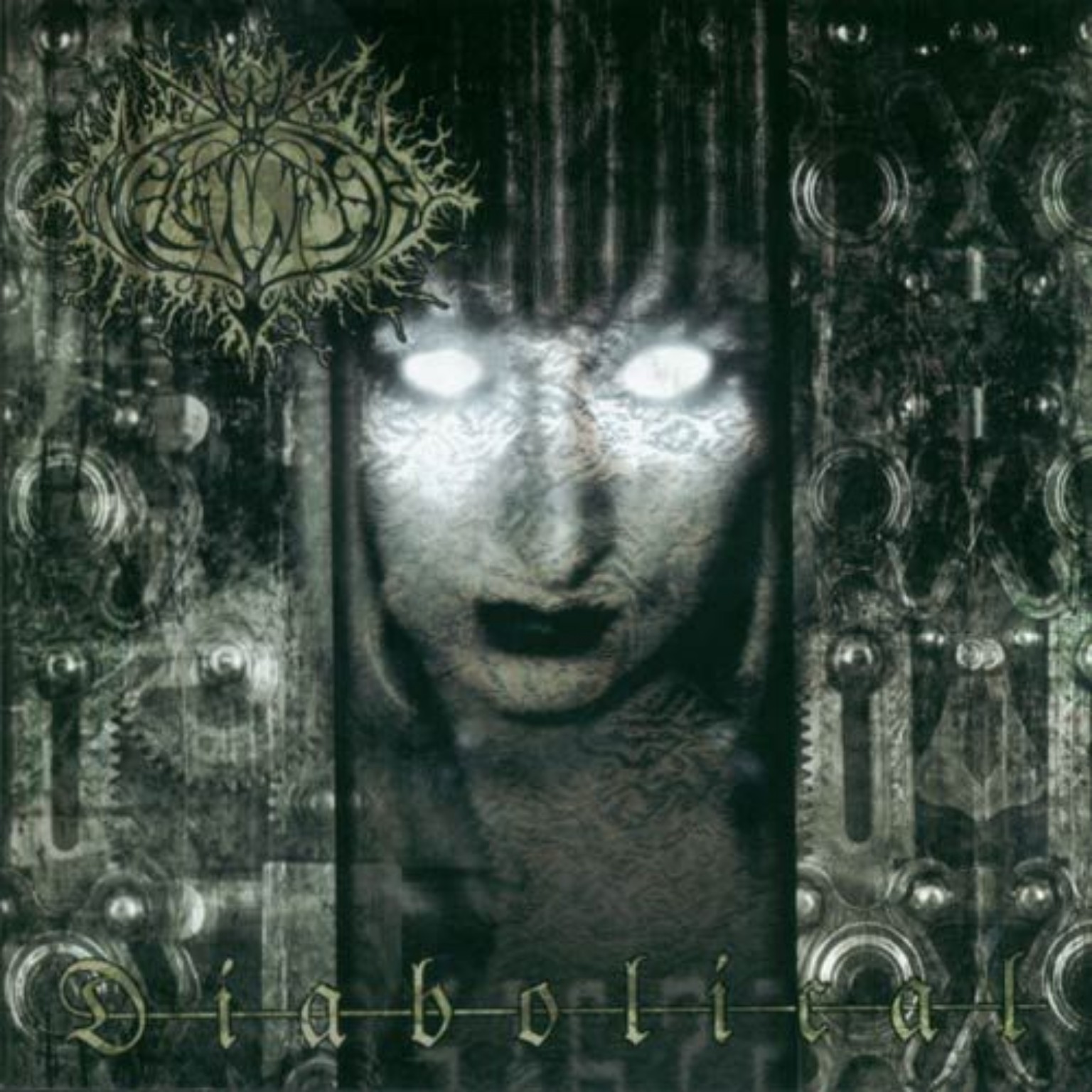
A human face appears at the centre of Diabolical's cover, yet there is something disturbingly alien about it. It looks straight at us, almost motionless. Fine lines resembling cracks or engraved patterns run across the pale, ash-grey face, while a blinding white light burns where its two eyes should be. The mouth, opening into darkness, offers no clear answer as to whether the figure is screaming, breathing or simply staring back with a vacant expression. This is what gives the image its power: it shows no unmistakable movement, yet creates a threatening presence.
Heavy vertical ornaments frame the face on both sides. They contain details suggesting circular metal fittings, carved surfaces and mechanical structures, but the dark, layered image does not allow any one building or machine to be identified with certainty. The forms at the edges compress the centre into a narrow, enclosed space. Amid shades of olive green, faded grey and black, the light from the eyes dominates; everything else seems to sink slowly into shadow around them. The Naglfar logo, fashioned from a dense tangle of branching lines, occupies the top left corner, while the narrow, widely spaced letters of Diabolical extend across the bottom. An unusual tension arises between the delicate typography and the disconcertingly close face.
Seen in this way, Chad Michael Ward's image does not name a particular demon or historical figure. Instead, it makes visible that borderline state in which familiar human features can no longer offer reassurance. The same contrast operates in Diabolical's music: in place of the previous album's more readily recognisable melodicism, a harder, denser sound moves to the foreground. The melodies do not vanish; they simply retreat deeper into the music. The cover's cold light and constricting frame may therefore serve as a precise visual counterpart to the record's atmosphere. The viewer cannot know what lies behind the face, and the music offers no resolution to that uncertainty.
The Dark World of the Songs
The album's opening signals within its first seconds that it is not intended to work as a mere continuation of Vittra. ‘Horncrowned Majesty’ begins with a distant train whistle, and then suddenly all sense of distance disappears. Guitars burst in, drums drive the song forward, and Jens Rydén's voice does not decorate the music but cuts straight through it. Several later critics singled out this intensity. Melody remains present, though no longer pushed to the front as it was in Vittra's grand, instantly memorable turns. Here it is pressed into the attack itself.
The lyrics reinforce that opening. ‘Horncrowned Majesty’ addresses a figure in which images of the morning star, the bringer of light, death and sin converge. The speaker does not defend himself against the darkness: he invites it in, asking it to destroy everything within him that was ever pure. This is not a story in the conventional sense, but a vision of inner transformation. The same movement recurs throughout Diabolical: something pulls downward, leads through a gate, empties out the former order and replaces it with another world.
‘Embracing the Apocalypse’ carries the onslaught forward almost without pause. The title itself makes the purpose clear: the apocalypse is not something to escape but to embrace. In the lyrics, heavenly realms crumble to dust, angels fall, ancient powers return, and sulphurous destruction appears not as punishment but as liberation. Musically, the song maintains the momentum of the opener, as though the album refuses to give the listener time to settle into it comfortably.
‘12th Rising’ brought across an idea familiar from the days of Maiden Slaughter, but the surroundings of Diabolical give it a new role. The song is fast and riff-driven, so much so that a later review almost emphasised its instrumental power. The vocals sink into the sound while the guitars carry the movement. The rising implied by the title is not triumphant but ominous. Perhaps nowhere else does the band show more clearly what melody meant to it in 1998: not a separate motif, beautifully lit, but something housed within speed and tension.
‘Into the Cold Voids of Eternity’ opens a different space. Choir-like synthesizers, piano effects and string textures appear, suddenly giving the album's almost unbroken attack a deeper atmosphere. The image of cold eternity is not confined to the title. The music, too, attempts to create emptiness: a place where aggression is no longer merely speed, but distance and frozen space. Naglfar are not returning to Vittra here. They are showing that the rawness of Diabolical need not mean a lack of variety.
Arriving around the middle of the record, ‘The Brimstone Gate’ is particularly important. It already existed in 1997, and by the time it appeared on the album it had become a passage between two periods. The opening bass can be heard clearly, the drums' toms have more room to breathe, and choir-like synthesizers move in the background. The brimstone gate of the title becomes almost a physical object: something that must be passed through. Some later critics singled the song out as one of the record's best, and not without reason. Here Naglfar manage to remain raw while allowing room for the melodic instinct that no one had ever been able to separate entirely from them since Vittra.
‘Blades’ employs different means. Images of blades, cutting, pain and hatred bring a direct brutality to which sampled sounds and guest vocals also contribute. Olivius himself would later describe it as one of Naglfar's most misanthropic and hate-filled songs. It has no wish to be pleasant. It stands at the point on the album where the dark aesthetic ceases to be a distant mythology and erupts as an explicitly anti-human feeling.
‘When Autumn Storms Come’ shifts the emphasis once more. Its title alone creates a mood; the atmospheric introduction, the title heard in the background and the gradual expansion of the music demonstrate that Diabolical is not simply a faster, harder album than Vittra. It knows how to give tension time to develop. Later listeners were especially fond of its ending, where synthesizers, bell-like tones, sounds of wind and string textures carry the music ever farther from conventional song form.
From this emerges, almost naturally, ‘A Departure in Solitude’, a short instrumental piano piece. On an album so often identified with intensity and rawness, this quieter interlude is no weakness. It feels more like an empty space opening up after a long rush. Solitude does not interrupt the album; it continues the same darkness in a different form.
The closing track, ‘Diabolical – The Devil's Child’, repeats the album's name in its own title, as if the world built up to this point were turning to point at itself. The drumming is especially varied, with half-time passages alternating with faster sections. At moments the instruments recede while the voice remains; then an odd pulsation, a deeper spoken voice and a string-like atmosphere bring the journey to an end. This is not merely a finale. It is a summing up of brutality, atmosphere, extremity and the band's tendency always to leave a door open within its own music to something unexpected.
Release and Reception
Diabolical was released on 4 May 1998 by War Music, under catalogue number WAR 0005. Nine tracks from a band whose previous album had already created almost legendary expectations. Reviews published before and after the release show just how difficult a position they faced. Nobody listened to the new record as though approaching a blank slate. Vittra stood behind every new melody.
From the Studio Walls to the Reviewer's Desk
The sound of Diabolical and its reception were the results of two separate processes. The first took place in the studio: recording individual instruments, fitting tracks together, and determining the balance between distorted guitars, drums, vocals and keyboards. The second began afterwards, when copies of the finished material reached the press, shops and listeners. The first process did not automatically guarantee success for the second. Even a well-made recording needed someone to listen to it, explain it intelligibly and distribute it to the right audience.
The available album documentation establishes precisely where the second full-length was made: at Ballerina Audio in Umeå during January and February 1998 under the supervision of Nils Johansson, with mastering by Pelle Henricsson at Tonteknik. These facts already appear earlier in the book and need not be rehearsed in full here. It is worth distinguishing two stages of the recording process, however. Recording and mixing build the individual performances into a finished, balanced soundscape; mastering then shapes the audio for the final release format. The precise equipment, number of tracks, details of analogue or digital working methods and countless smaller mixing decisions cannot be established from these credits. None of those details should be attributed to the band retrospectively.
Ideas about the ideal sound of extreme metal were hardly uniform at the time. A cleaner recording meant different things to different critics: some heard greater power, while others feared the loss of black metal's original roughness. The metal.de review of Diabolical published on 17 May 1998 specifically singled out its cold, clear sound and high speed. The Chronicles of Chaos reviewer writing on 19 November placed more emphasis on its energy and the combined effect of the arrangements. Their readings differed, which is precisely how the same record could become at once an exercise in technical craft, a critical event and a statement about genre.
At the time of release, the music press itself straddled two eras. A review of Diabolical appeared in issue 132 of the German magazine Rock Hard, while metal.de's May review belonged to an online publication; Chronicles of Chaos also covered the record in 1998. These precisely datable traces show that news of the album could travel through several countries and kinds of media. They do not allow us to calculate the actual readership, the number of copies sold or every radio programme that featured Naglfar. Documented critical coverage must not be equated with an assumed level of widespread circulation.
The tools for making contacts reflected the same duality. A directory of independent Swedish labels from the late 1990s listed a postal address, landline telephone number, fax number and email address for House of Kicks. This is not a surviving record of Naglfar's own correspondence, but tangible evidence of the methods of communication used in the distribution business at the time. During the same period, a label or fanzine editor could send printed review material, make telephone calls and communicate electronically.
These two worlds—print journalism and the early online music press—continued to exist side by side for a long time. An underground journalist might obtain a promotional CD from a label, hear about a record from another fan or publish a short assessment in the next issue. The reader could not necessarily listen to the complete album straight away: often they had to find a record shop, order by post or borrow a copy. We must not project today's instant access to music back onto that situation. Reviews of Diabolical from the period mattered precisely because they could influence someone's decision before they had even held the record in their hands.
The album's entire book-like physical presentation also mattered in this process. The logo, typography, cover, booklet and photographs created a visual world that could be associated with the music. The actual graphic and photographic elements of Naglfar's original booklet can be checked in the available ZIP and should be carefully preserved in the later illustrated PDF, with missing details supplied as appropriate. Identifying exactly what an image depicts, or whose face appears in it, requires separate visual confirmation. This T2 section does not supply the book-cover interpretation, as that is a separate task in the list of missing material.
The music scene of the time was thus built neither on a single approach to sound nor merely on competition among a few major bands. City-level relationships, rehearsal rooms, demos, record labels, manufacturing, physical distribution, fanzines and emerging online reviews formed the interlocking environment in which Diabolical could be released and attract attention abroad. This broader background does not replace Naglfar's own story; it gives a more precise picture of the journey the album took from the Umeå studio to its listeners.
On 29 April 1998, before the album was even released, Götz Kühnemund reviewed it for Rock Hard. His enthusiasm for the first record almost cast a shadow over its successor. He regarded Vittra as a milestone and therefore expected more from Diabolical than a merely good album. He wanted it to deliver the same overwhelming experience again. His conclusion was that the new record was first-rate, but that its great, immediately striking melodies appeared less often. In his view, ‘The Brimstone Gate’, ‘12th Rising’, ‘Into the Cold Voids of Eternity’ and ‘Horncrowned Majesty’ revealed their real power after several listens. The album had not failed to meet the standard; it simply worked differently from its predecessor.
A few weeks later, the review at metal.de expressed a similar tension. Its author felt as though the death ship had finally put out to sea again after a long stay in harbour. He had nearly given up hope of a follow-up to Vittra when Diabolical arrived. Yet his conclusion was twofold: Naglfar had maintained their standard without surpassing their debut. He also stressed that the record was faster and harder, with a crystal-clear, cold and sterile sound—exactly the kind that suited this material. He found ‘12th Rising’ especially strong and praised Jens Rydén's vocals as well.
That ambivalence ran through much of the early response to Diabolical. Many critics looked for Vittra in the new record, whereas the band had made it precisely to avoid producing another Vittra. What some listeners heard as a shortcoming, the musicians would later describe as a conscious decision. Diabolical's rawness did not arise from a loss of inspiration. It was a response to what they saw happening around melodic black metal.
Opinions grew even more varied in the second half of the year. The reviewer at In Music We Trust felt that Naglfar had followed an overly familiar path, sacrificing some of metal's weight and aggression to a black metal formula. This was almost the exact opposite of what others heard in the same record. The November piece in Chronicles of Chaos, for example, celebrated its intensity from the opening sentence. Paul Schwarz awarded it 8.5 out of ten, hearing a band that had become better musicians over three years and learned to channel its energy more effectively. He, too, recognised similarities to Dissection, but believed that an almost uninterrupted stream of force in the drums, riffs and vocals compensated for any lack of originality.
A November review in CMJ New Music Report placed even more explicit emphasis on the combination of force and melody. It saw Diabolical as a monumental, crushing form of Swedish black/death metal and recommended ‘Horncrowned Majesty’, ‘12th Rising’ and ‘Blades’. Within just a few months, the same record could sound overly familiar to one listener and rank among the strongest releases of the scene for another. By this point, Naglfar were interesting not because everyone agreed about them, but because their music was difficult to ignore.
1998: The Record Was No Longer Confined to the Umeå Studio
The picture we have of Diabolical's first months is incomplete if we look only at reviews and record shops. In the weeks following its release, Naglfar moved beyond the recordings made in Umeå and the world of reviews circulating by post. On the European Summer Clash concert run, from late May to mid-June 1998, they appeared alongside bands including Deicide, Six Feet Under, Brutal Truth and Amon Amarth. This tour is documented by more than later discographical summaries. In a 2018 interview about his touring memories, former Ancient Rites guitarist Jan Yrlund explicitly named Naglfar among the participants in the shared 1998 concert tour. A Naglfar biography published much later by War Music also mentions shows connected with Deicide. These accounts reinforce one another, although later recollections are of course not equivalent to a complete tour diary printed in 1998.
A public concert archive lists the following Naglfar appearances in 1998: Strasbourg on 30 May, Barcelona on 31 May, Toulouse on 1 June, Pratteln on 3 June, Werdau on 6 June, Berlin on 7 June, Stuttgart on 8 June, Essen on 9 June, London on 10 June, Bradford on 11 June and Tilburg on 12 June. There is also a separate entry for the London event at Astoria 2, listing Deicide, Brutal Truth, Six Feet Under, Naglfar and Amon Amarth. Another archive collecting setlists records the Stuttgart and Essen shows of 8 and 9 June. Databases of this kind provide important reference points for a band's history, but are often edited collaboratively. For that reason, we do not elevate individual dates to established fact without checking a surviving ticket or poster, nor claim that the list contains every stop on the tour.
Even without those finer details, the historical change is clear. Following the release of their second album, Naglfar entered an international live setting in which Swedish melodic black/death metal shared the bill with American death metal and faster, rawer strains of extreme music. Audience members no longer had to decide how different Diabolical was from Vittra on the pages of a Swedish specialist magazine. On the same night, in the same room, they could encounter dramatically different approaches to music. This does not mean that we know Naglfar's setlist at any particular show, the audience size or precisely how the performance was received. The sources checked so far offer insufficient evidence for such claims. They do, however, allow us to place a direct European presence alongside the studio and printed press in the story of Diabolical in 1998.
The Album's Afterlife
On War Music's 1999 compilation War Dance, Naglfar were represented by one song each from Diabolical and Vittra. The release itself showed the kind of environment the album had come from: the legacy of Wrong Again, War Music operating under its new name, and a Swedish underground scene that had produced a whole succession of internationally known bands in a short period. Naglfar no longer appeared as newcomers. Vittra and Diabolical together represented an initial period in the band's history to which they would return repeatedly in later years.
In the years that followed, Diabolical slowly escaped the comparisons that had surrounded its arrival. A Necrosis Magazine review published around 2000 was no longer preoccupied with whether it was better than Vittra. It simply described Naglfar as a technically accomplished, astonishingly fast and brutal band that had found its own balance on the border between death and black metal. Morbid Angel and Dissection were mentioned, but the conclusion was that Naglfar did not truly resemble either. As time passed, Diabolical became less and less simply the second Naglfar album. It developed a character of its own.
The silence after the record, however, stretched on for a long time. No new full-length arrived quickly after 1998. Olivius and the other members later mentioned several reasons: constant difficulties finding rehearsal spaces, label and business problems, and the simple challenge of creating circumstances in which they could meet regularly and write songs. In 2003, Olivius said they had occupied at least ten different rehearsal rooms since Diabolical. In Umeå, as he put it, finding a place for a bunch of long-haired people playing satanic music was not easy. The remark is both funny and an exact illustration of how mundane obstacles can bring a band to a halt even while its music speaks of demons, apocalypse and eternity. Naglfar's members did not live off their music. In 2004, they spoke openly about having ordinary jobs, often working on stages, scenery and structures in theatres or opera houses, or as road crew and in other technical roles. They took day jobs so they could continue to make music. This independence later became one of the defining elements of how the band understood itself. They did not need to release a record to earn a living. They did not need to tour because the following month's bills depended on it. The price was a slower pace, but it also gave them freedom.
When Naglfar played Wacken Open Air in 2001, songs from Diabolical returned to the stage as established fixtures. The concert conditions were far from ideal. A programme reshuffle moved them from the originally planned Party Stage to the Wet Stage tent, and they had to start earlier. The space was stifling and crowded, and the sound equipment did not work perfectly. According to the Underground Empire report, condensation eventually began dripping from the roof, as though the tent itself were sweating. Nevertheless, both surviving accounts reached the same conclusion: Naglfar delivered a powerful show.
The metal.de correspondent wrote that Jens Rydén seemed visibly moved by the audience's enthusiasm. Songs from Vittra and Diabolical were played, including ‘Emerging from Her Weepings’ and ‘The Brimstone Gate’. A new composition, ‘Of Gorgons Spawned Through Witchcraft’, also appeared, opening a door to the next period. Diabolical had therefore not become a sealed relic. It was living material from which the band could move on.
By the release of the Ex Inferis EP that same year, fans' impatience for another full-length was palpable. The MetalBite reviewer angrily demanded to know why three years had produced only one new song when the release also contained older and remastered material. Yet when he discussed the songs taken from Diabolical, he expressed particular affection for ‘The Brimstone Gate’. It created a curious situation: fans wanted both to move beyond Diabolical and to hear again what they had come to love about it.
Sheol finally appeared in 2003. After the long wait, the band once again tried to connect the poles that its first two albums had pulled apart. Andreas Nilsson explained it very clearly in 2004. Diabolical had become raw and fast because they were tired of the melodic black metal environment. With Sheol, however, they wanted to return to Vittra's more melodic atmosphere without sacrificing brutality. In other words, Diabolical was not a dead end. It became an extreme point from which the later band could seek a new balance.
The first two albums gradually became opposite poles in Naglfar's own story. Vittra represented the fuller, more melodic, more youthful side; Diabolical its deliberate counterpart—leaner, faster, colder and rawer. Kristoffer Olivius later said that every Naglfar album has its own colour and sound, and that these are not minor differences. The leap from Vittra to Diabolical may be the clearest example of that principle.
That duality survived in the album's subsequent critical life. A 2005 Sputnikmusic review awarded it 3.5 out of five and heard a more consistent, almost overly formulaic approach in its first half, followed by a second half that became increasingly varied and atmospheric. ‘The Brimstone Gate’, ‘Into the Cold Voids of Eternity’ and the title-bearing closing track struck the reviewer as especially strong. What had sounded like a raw change of direction in 1998 became audible a few years later as a distinctive structural quality.
More interesting than any review, however, is the place the album came to occupy in the band's own past. The same thought returns again and again in Naglfar's later interviews: they do not want to make albums on a production line. If they have nothing new to say, they would rather remain silent. They do not want to release mediocre records every year or two simply to have a reason to tour. Looking back, this philosophy also illuminates 1998. Diabolical had already proved that they could deliberately change their own sound, even if that meant risking the loss of the immediate points of connection that fans of the debut had enjoyed.
The band's identity continued to evolve through changes in membership and roles. Jens Rydén later left Naglfar, while Kristoffer Olivius gradually moved from bass and backing vocals into the lead-singer's role. In a later interview, he explained that they had briefly searched for a new vocalist before he wondered whether he might try doing it himself. On the first album he sang on, he was still finding his feet; later the role came naturally. This made Diabolical all the more a document of a period now over: one of the most important records of Jens Rydén's voice, and the work of a five-piece line-up that had long since ceased to exist in the same form.
Even so, it never became a museum piece. The songs lived on in concert. ‘The Brimstone Gate’ worked at Wacken, tracks from the Diabolical era returned in later setlists, and the album's name came up repeatedly in interviews whenever the band was asked about its development. Not necessarily as their best album, but as a necessary one: the point at which they decided they would not become a copy of themselves.
In Naglfar's history, that may matter more than any review score. A young band's first major success can easily become a trap. If Vittra had worked, the easiest choice would have been to make another Vittra, with more of the same melodies, a similar sound and the same promise. Instead, Diabolical turned the ship in another direction. Not everyone was pleased. Some missed the debut's great melodies; others found the style too familiar. Still others heard in the intensity, coldness and more brutal attack exactly what continued to make Naglfar distinctive.
Sound, Images and Meanings
The title itself seems increasingly precise as one makes one's way through the record. Diabolical. Not complicated, not poetic, not obscure. A single word standing on the cover like a verdict. The recurring image of Lucifer in the lyrics, the apocalypse, brimstone, blades, autumn storms, solitude and the devil's child are different points in the same inner landscape. The band would later say that they did not want to define themselves solely by the labels black metal or death metal. They simply played extreme metal. That attitude is already clearly audible on Diabolical. Its genre elements are recognisable, but the record is not trying to serve as a theoretical definition. It wants to have an effect.
And that effect does not come from speed alone. From the first assault of ‘Horncrowned Majesty’, through the almost unbroken continuation of ‘Embracing the Apocalypse’ and into the riffs of ‘12th Rising’, the album's opening section builds pressure relentlessly. ‘Into the Cold Voids of Eternity’ opens up the space, ‘The Brimstone Gate’ introduces richer movement in the arrangements, ‘Blades’ brings a more immediate, human cruelty, ‘When Autumn Storms Come’ an atmospheric descent, and ‘A Departure in Solitude’ silence. By the time the title-bearing closing track begins, the album seems to have developed an internal dramatic shape without becoming a conventional concept record.
This is where the novel-like narrative and documented reality come closest together. No invented scene is needed to trace the arc. It is enough to place the facts side by side. 1992: Uninterred. 1994: a demo recorded without a drummer. 1995: Promo '95, then Vittra. 1996: Maiden Slaughter. 1997: a new drummer, Ballerina Audio and two songs that would later join the album. January–February 1998: the studio sessions. 4 May: the release. Between those bare dates lies everything that makes them more than points on a timeline: personnel changes, rehearsal rooms, label uncertainty, musical defiance and an ever more deliberate sense of identity.
When Olivius later said that Naglfar had never been about image or fashion, he summed up an entire era. They did not want blood, fire and scandals on stage merely to attract attention. They went on dressed in black, headbanged and let the music carry the weight. That was more or less how they performed in the 1990s too, he said—perhaps with a few more studs. Such a restrained outward appearance is particularly interesting alongside an album whose lyrical world is so extreme. For Naglfar, darkness was not necessarily a spectacle. It was more a language.
That language remained with them through the decades, even as the members' lives changed completely. Families, children, jobs, extended breaks and less frequent touring all became part of the story. Olivius later observed that disillusionment with the world does not simply vanish when someone grows older or becomes a father. Rather, it changes form and, in some senses, grows stronger. Naglfar's dark lyrical world therefore did not remain the costume of youth. It could be reborn through different experiences and at different ages.
The band's independence became increasingly deliberate. They did not want to play every festival or spend long months on the road simply because the industry expected it. For Olivius, the concert itself was the point of touring; everything else was mostly waiting. This made their less frequent appearances a more special connection with the audience. Within that outlook, the songs from Diabolical acquired a different weight—not an obligatory legacy played by rote, but pieces called back from an earlier period.
When the band explained many years later that they did not want to make a living from metal, there was something in that attitude of the stubbornness that had led them to record their first demo without a drummer in 1994. The circumstances changed; the logic did not. If there was no suitable rehearsal room, they would find another. If there was no drummer, they would programme one. If everyone went to the same producer, they would choose someone else. If the scene pulled one way, they would try turning the other way. If they had nothing new to say, they would not make a record just to have something to sell.
In that sequence, Diabolical is no exception but a central piece of evidence. Immediately after their debut, the band showed that they were willing to put their newly won position at risk. According to the Rock Hard reviewer, they had lost ground since Vittra, in part because they had played so few concerts. The metal.de writer likewise felt that the scene had filled up with similar music in the meantime. Naglfar were not attacking from a comfortable position. They had to make themselves heard again at a moment when some of their own ideas had already become part of the shared language of entire styles.
That is what makes the contradictions between contemporary reviews so interesting. To one critic, they had sacrificed too much to the black metal trend. To another, they were among the few who still embodied the original power amid so many copies. One missed Vittra's catchy melodies; another described the energy of Diabolical as almost a physical force. A record that everyone hears in exactly the same way rarely stays truly intriguing. Yet Diabolical carried debate within it from the moment it appeared.
Nor was there any single agreed list of the best tracks. ‘Horncrowned Majesty’ came up almost everywhere, because as the opener it immediately set the direction. Several listeners ranked ‘12th Rising’ among the strongest moments. ‘The Brimstone Gate’ had an existence of its own even before the album, and later resurfaced in concert and on compilations. Years later, Sputnikmusic praised the record's second half instead, especially ‘Into the Cold Voids of Eternity’, ‘The Brimstone Gate’ and the closing track. This too demonstrates that Diabolical was not built around a single big hit. There are several ways into it.
Behind the religious and mythological images in the lyrics often lie more personal emotions. Hatred, abandonment, fear, solitude and self-destruction remained important themes for Naglfar in later years. In 2020, Olivius explained that they often wrote in the first person and did not intend to deliver religious sermons. They were storytellers instead. Looking back, that comment also places Diabolical in a different light. Satanic and apocalyptic imagery need not represent articles of faith; it can be a means of giving shape to an inner state.
The speaker of ‘Horncrowned Majesty’ surrenders to darkness. ‘Embracing the Apocalypse’ does not flee from the end. ‘Into the Cold Voids of Eternity’ seeks the cold, empty infinite. The pain of ‘Blades’ is almost physical. ‘When Autumn Storms Come’ turns the image of an external storm into an inner landscape. ‘A Departure in Solitude’ expresses that same loneliness without words. And the title track seems to condense the entire album into one dark figure. Heard in this way, Diabolical comes much closer to a continuous narrative than one might initially think.
The cover contributes to that sense of continuity. Chad Michael Ward's image does more than simply illustrate the music. The face at its centre, the cold gaze and the combination of mechanical and organic details suggest a presence beyond the human. It does not tell the story of a particular character, but conveys the feeling that runs throughout the songs: something is watching, something is changing, something is looking back from behind the familiar world. Ingrid Sjöberg's band photographs and Rydén's graphic contributions formed part of the same release, so Diabolical also remained, as a physical object, a coherent imprint of its era.
When an album continues to live twenty-five years or more after its release, it no longer means quite what it did on the day it appeared, even to the people who made it. Band members grow older and write different music; new people arrive and others leave. Review scores lose their urgency. A record label may cease to exist altogether. Studio technology once considered modern eventually becomes a marker of its period. What remains is the succession of decisions.
In 1998, Naglfar decided not to repeat Vittra. They decided to bury the melodies deeper inside the brutality. They decided to work in Umeå with Nils Johansson. They decided to accept the risk: perhaps some listeners would hear less immediate beauty, perhaps some would find the record too raw, and perhaps some would fall in love with it for exactly that reason. Diabolical is a document of those choices.
Later, when Sheol appeared, the band knew that a great deal of ground remained between the two extremes represented by the first albums. They could return to Vittra's melodies without discarding Diabolical's brutality. Their development thus became not a straight line but a pendulum. Each new record acquired its own colour, and the members spoke proudly of the fact that none was simply a copy of another. In that pattern, Diabolical is not a transitional stop. It is one of the extremes without which the balance they found later cannot be understood.
The Return of the Death Ship
The story eventually returns to where it began: a handful of young people in Umeå who did not form a band because they knew exactly how to build a career. They had no fully developed business plan. They had no stable line-up. Sometimes they did not even have a drummer. What they did have was a stubborn idea of the kind of metal they wanted to hear come out of themselves. The programmed drums on Stellae Trajectio, Promo '95, Vittra recorded at Abyss Studios, the covers on Maiden Slaughter, the arrival of Mattias Grahn, the two songs recorded at Ballerina Audio in 1997—all were steps in the same direction. Then, early in 1998, the pieces finally fell into place. Within the walls of Ballerina Audio, they made an album that did not need to prove Naglfar could write melodies. Vittra had already done that. What they now had to show was that the same band could deliberately harden its own musical language and still remain recognisable. On 4 May, the death ship sailed again.
The critics of the day stood on the shore, and each saw something different. One saw a ship no longer as radiant as on its first voyage. Another saw something faster and more dangerous. Some thought it was following too closely in other vessels' wake. Others believed most of the fleet was already being left behind. But the ship kept sailing, and that was what mattered most. Diabolical endured not because it settled every argument, but because it chose its own course.
Years later, when band members were building stages as their day jobs, starting families, making new records, touring less frequently and repeatedly being asked what they thought of their old albums, the same principle kept returning. Naglfar exists for its own sake. If they have something sincere and important to say, they make music. If not, they wait. They do not work to a calendar, to the fashions of a scene or to the demand that every successful record must be followed by another just like it.
That is why the story of Diabolical does not end in May 1998. It continues through the three years before the next full-length arrives. It continues in the sweltering tent at Wacken, where ‘The Brimstone Gate’ comes alive again. It continues in reviews that hear different details in the music after a few years' distance. It continues on Sheol, which attempts to bring the two worlds of Vittra and Diabolical together. It continues in every later interview in which band members describe the record as one of the counterweights in their musical development.
And it continues because today the album is both a document of its era and a work in its own right. It grew out of the Swedish extreme metal scene of 1998, but was never confined to it. You can hear the period in its sound, but you can also hear the band's determination not to blend in completely. The cold production, dense guitars, Rydén's voice, Grahn's drums, Olivius's bass and vocals, and the guitars of Nilsson and Hansson preserve a moment when five people knew exactly what they did not want to do again and tried to discover what they wanted instead.
Perhaps that is Diabolical's most beautiful contradiction. It became one of the most decisive statements by a band marked by changes of personnel and practical difficulties. A deliberately raw album from a group known for its melodicism. A record that some critics found less immediately appealing, yet one whose layers gradually opened up with time. A second full-length that did not try to overwrite the first, but gave it a new meaning.
If Vittra captures the moment when the young Naglfar discovered they could have a voice of their own, then Diabolical captures the moment they realised they could change that voice without losing themselves. That realisation lasted far longer than any comparison made at the time. Each subsequent album moved in a different direction, but the same freedom was at work in them. There is no need to invent a grand scene at the end of this story. The cover is enough. The titles of the nine songs are enough. It is enough to know that behind them lie six years of travelling from Uninterred to Naglfar, from programmed drums to a more stable line-up, from Garageland through Abyss to Ballerina Audio, from demo cassettes to a War Music CD. There are the critics who argued over the record, the fans who were still hoping to hear ‘The Brimstone Gate’ years later, and the musicians who said again and again that every album had to be different.
In 1998, the death ship did not sail with the same cargo it had carried three years earlier. It was colder, sharper and less forgiving. The melodies had not disappeared; they had simply moved deeper into the music. The darkness had not become more spectacular, only more immediate. And when silence followed the last notes of the closing song, one of the most important chapters in Naglfar's early history came to an end. Not permanently, for they would return to these songs many times. But decisively enough that every later album would have to find its place in relation to those two early landmarks: Vittra and Diabolical.
And so the uncertain beginnings of a young band from northern Sweden became an album that could not simply be ranked behind its predecessor even at the time of its release. A succession of personnel changes, studios, rehearsal rooms, label shifts and stubborn choices became one coherent story. That is why Diabolical has remained more than a record from 1998. It is not just nine songs, nor merely the sound of black/death metal in a particular era. It is evidence that even early in their career, Naglfar understood that being true to yourself does not mean always sounding the same. Sometimes it means precisely the opposite: having the courage to leave a path that has already led you safely to your destination.
Reader comments
Comments only appear after approval. Messages are displayed in their original language.
Comment submissions are not enabled yet.