

Diabolical Conquest
The story of Incantation’s third studio album in six chapters: the band, the recordings, Miran Kim’s cover art, all eight tracks and the album’s afterlife.
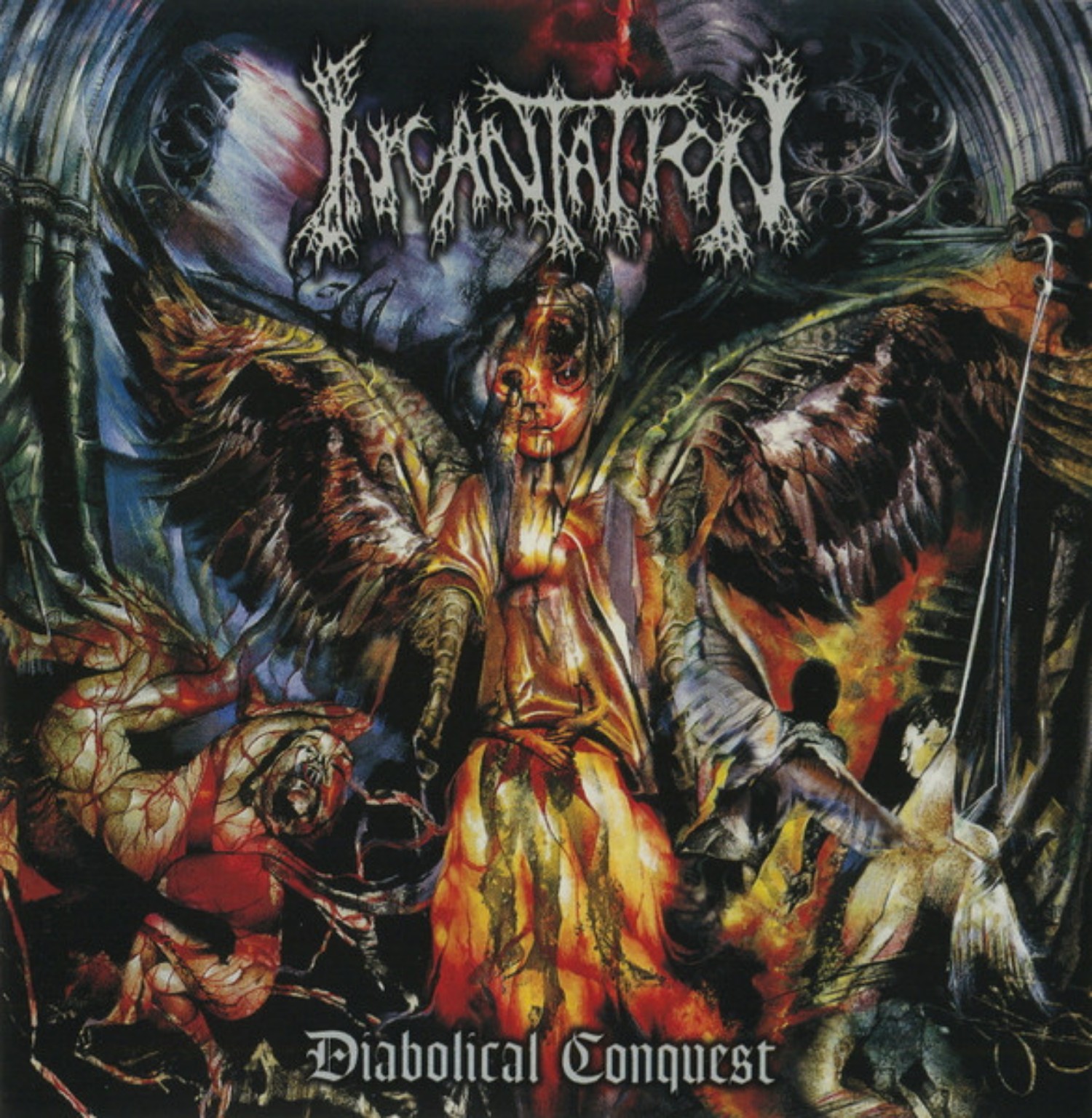
Album information
Tracklist · original CD (8 tracks)
- Impending Diabolical Conquest5:13
- Desecration (of the Heavenly Graceful)5:54
- Disciples of Blasphemous Reprisal3:33
- Unheavenly Skies2:20
- United in Repungence3:58
- Shadows of the Ancient Empire3:02
- Ethereal Misery4:30
- Unto Infinite Twilight / Majesty of Infernal Damnation16:47
Band members · 1997 recording
- John McEntee
- Guitar
- Daniel Corchado
- Vocals, bass, guitar
- Kyle Severn
- Drums
Recording and release
- Release date
- 28 April 1998
- Recording
- November–December 1997
- Studio
- Mars Studio · Cleveland, Ohio, USA
- Producer / engineer
- Bill Korecky · Incantation
- Mastering
- Dave Shirk; William J. Yurkiewicz, Jr.
- Original label
- Relapse Records
- Original catalogue number
- RR 6982-2
- Original format
- CD · 8 tracks
- Cover painting
- Miran Kim
Details refer to the original 1998 Relapse Records CD; the 2023 vinyl and later CD pressings are separate editions.
In-depth cover analysis: The Image of Conquest
Digital album purchase
Digital album available through the band’s official Bandcamp page.
Physical editions · CD and vinyl
The original album was released on CD in 1998; the 2023 vinyl and later CD pressings are separate editions.
Availability, stock and shipping vary by region and date. Original and reissued formats are distinguished.
01 / 06
The Band’s Journey to Its Third Full-Length Album
With some albums, you can almost hear the order behind them: long rehearsals, a settled lineup, carefully allotted studio time, musicians who know what comes next from the slightest movement of a bandmate. Diabolical Conquest emerged from almost the exact opposite. By the time Incantation set about recording their third full-length album in late 1997, they had nearly a decade of American death metal history behind them, but little certainty ahead. Lineup changes, disputes with record labels, exhaustion, personal turmoil and studio sessions that might easily have torn a less stubborn band apart were all converging. Yet out of that disarray came one of their most cohesive albums.
For John McEntee, death metal was never merely an exercise in style. Even during his time with Revenant, he had been searching for ways to write music that was darker, more extreme and less compromising. When he and Paul Ledney established the earliest incarnation of Incantation, the direction soon became clear: speed alone was not enough. A furious rush had to give way to a slower passage, a blast beat to a riff that descended like a stone slab sealing a tomb. Speed and weight were not opposites but two movements within the same darkness.
The Beginnings in New Jersey
Incantation's roots did not begin in Cleveland, nor in a single soundcheck. In the beginning, John McEntee was surrounded by a dense web of underground connections stretching between New York and New Jersey. By the mid-1980s, while playing in Revenant, he was already seeking out music that could not simply be found on the shelves of the nearest record store. Demos, cassettes arriving through the mail and fanzines assembled by hand or on a photocopier were not props in a legend invented later. They were how he learned who existed in another state or country, and what someone might make audible beyond the genre's established limits. McEntee would later recall in detail how early he learned that writing songs was not enough for a band: it also had to find the people its music could reach.
In 1988, organizers connected with Revenant and Immolation helped bring Morbid Angel shows to the New York and New Jersey area. By McEntee's own recollection, the Florida band's brutality onstage was a decisive experience: it showed him how much further he might go than what he had previously considered possible within the increasingly technical music of Revenant. Not every failed attempt or learned riff can be placed on a timeline, but this concert experience is a documented turning point. Incantation's formation in 1989 was therefore not an event separate from the first wave of death metal. It was more an answer from within that same milieu to one of its central questions: how could extremity be pushed further without becoming a mere display of virtuosity?
Incantation's first official concert took place in June 1990 at the 308 Bar in New York, alongside Mortician and Snag. According to McEntee's later account, they advertised the show with posters and flyers, in record shops and around other concerts. That small detail means more than the name of an old club. It shows how a band not yet made known by the national music industry could find an audience: they had to reach people attending other shows before those people went home. McEntee remembered an increasing number of venues in the New York, New Jersey and Pennsylvania area offering opportunities for death metal performances at the time. This is not a statistical account of the entire American scene, but one participant's experience of the local and regional network in which the band grew up.
The story later turned toward Cleveland, but the connections of the preceding years did not vanish. By the mid-1990s, after Craig Pillard's departure and repeated lineup changes, Ohio represented not just another place to live or record but a new circle of potential musicians. In a 1995 interview, McEntee spoke of Duane Morris, formerly of Cleveland's Decrepit and Embalmer, as Incantation's new vocalist. In the same conversation he described Kyle Severn as a new drummer who played fast and heavy. These are two documented musical connections from a period often obscured by the familiar names attached to later albums. Duane Morris did not sing on Diabolical Conquest, but his participation shows how Incantation was working with local Ohio musicians even before Corchado arrived.
Decrepit formed in the Parma and Cleveland area in 1991, while Embalmer took shape as a death metal band in Cleveland around 1990. Those two names matter not because Incantation can be shown to have adopted either band's sound; the available sources do not support that claim. They matter because McEntee's 1995 statement establishes a concrete link between the histories of all three bands through one musician. A local scene often becomes visible in precisely this way: not through a long succession of records in a single style, but through who knew whom, who could share a stage at short notice, and who had to find a replacement from one week to the next.
For that reason, Cleveland does not erase New Jersey from Incantation's history. Nor do the Ohio years form a single, self-contained 'Cleveland period.' The same guitarist carried the memory of the East Coast's concerts and tape-trading networks while trying to keep a band alive in a new place with new musicians. Diabolical Conquest cannot be confined to the walls of Mars Studio. By the time they reached it, the whole journey lay behind them: a musical ambition difficult to classify, a human continuity repeatedly broken, and relationships that were not easy to sustain even across state lines.
The three people who made Diabolical Conquest eight years later were not the musicians behind Incantation's earliest recordings. During the band's first months, the lineup was still taking shape, just as the music was. The partnership John McEntee and Paul Ledney began in 1989 soon divided: Ledney and other early associates went on toward Profanatica, while McEntee retained the Incantation name and his vision of joining death metal's speed to crushing, slower passages. Speaking to Canadian Assault in the summer of 1998, McEntee did not describe the split as a vague disagreement lost to time. He explained that his former bandmates were more strongly attracted to black metal and its imagery, whereas his first priority was the raw, death-metal power of the music.
The early three-track promotional recording preserved a simple but important dividing line. Alongside Profanation and Holy Massacre, they played Hellhammer's Third of the Storms. These three tracks were not yet the sequence of songs on a fully realized album, but a document of where the musicians had begun. The band heard on the recording cannot be mistaken for the later Incantation whose vocal identity was shaped by Craig Pillard and then Daniel Corchado. The name endured; the personnel and their roles did not.
The 1990 Entrantment of Evil was already the work of a new lineup. According to the surviving original release credits, John McEntee and Sal Seijo played guitar, Ronnie Deo played bass, Peter Barnevic played drums and Will Rahmer sang. Rahmer's name would have been familiar through Mortician to anyone following the same underground releases and demos. The four-track material was recorded around the turn of May and June 1990 at Stardust studio in Upper Montclair, New Jersey. Seraphic Decay issued it originally, and Relapse subsequently made it available in a new edition.
Later copies, however, can easily mislead anyone who identifies the performers solely from the musicians shown on the sleeve. The 1991 Relapse edition might already feature Craig Pillard's name or picture, but the original vocal track was not his: the voice is Will Rahmer's. Pillard had indeed become important to the band by then, but that does not retroactively alter the personnel on an earlier studio recording. In the history of a single seven-inch record, two different moments in the band's existence thus meet: the lineup that recorded the songs and the lineup presented to buyers of the reissue.
That is why it matters to follow early Incantation through the recordings rather than simply the order of album titles. The band's history was not a straight line drawn by friends playing continuously together. Demos, singles and different sleeves preserve brief moments in its changing life. The continuity of McEntee's path becomes visible precisely because so much around him changed. The three-piece lineup of Diabolical Conquest would become a late and exceptionally precise snapshot of this constant reorganization.
Early Records and Shifting Lineups
By 1991, the roles had shifted again. On the seven-inch Deliverance of Horrific Prophecies, Craig Pillard sang and played guitar alongside John McEntee, with Ronnie Deo on bass and Jim Roe on drums. Recording took place in May and June at Trax East in South River, New Jersey, with producer and engineer Steve Evetts. When Onward to Golgotha appeared in 1992, listeners heard essentially this same four-piece lineup on Incantation's first full-length album. The songs were recorded in the autumn of 1991 and mixed in January 1992. The interval between recording and arrival in record shops was as much a part of the story as the writing of the songs.
The second album was not, however, a simple extension of that period. The path through recording and mixing Mortal Throne of Nazarene proved particularly complicated. The familiar 1994 version was recorded in March at Excello studio in Brooklyn, then mixed in Cleveland in May and June. In the studio, McEntee and Pillard were joined by bassist Dan Kamp and drummer Jim Roe. The fact that recording and mixing took place in different cities shows in itself that Cleveland did not first enter Incantation's story when Diabolical Conquest was recorded at the end of 1997.
In 1995 Relapse released Upon the Throne of Apocalypse. It would be easy to mistake the title for an entirely new full-length album, but it was not. An earlier, rawer mix from the same 1994 studio sessions had been brought to light, with the running order reversed. There had also been an earlier attempt at recording in 1993, of which only a fragment was officially released. These three states must not be confused: the shelved 1993 recording is not the 1994 album, and the 1995 release is not a third complete recording of the same album.
For listeners, these distinctions are not merely collectors' trivia. The mixing of an album can alter how deeply the drums are set in the mix, how much space surrounds the guitars and how strongly the vocals make their presence felt. Incantation had encountered this issue long before Bill Korecky and Mars Studio. In several different versions, the band could hear how its music's weight might be preserved in recorded sound. Seen in that light, the more clearly defined yet still raw sound of Diabolical Conquest is not an isolated departure, but another stage in a much longer recording history.
The chronology of the earlier albums is thus more than two titles and two years. Behind Onward to Golgotha lay the work undertaken together in 1991; behind Mortal Throne, a more difficult recording process; and behind Upon the Throne, another version of that work made public. Through these experiences the band arrived at a period when preserving a lineup had become a challenge in its own right, alongside the challenge of capturing its sound in the studio.
Death Metal at the End of the 1990s
Onward to Golgotha and Mortal Throne of Nazarene made this musical language recognizable. By the middle of the 1990s, however, the atmosphere around death metal had changed. McEntee later recalled a time when even finding a musician willing to play death metal had become difficult. Many felt that the genre's moment had passed and that the band ought to modernize. Another sound, another fashion, another market. McEntee and Kyle Severn, by contrast, were determined that Incantation should not bend to some outside command. They had not begun playing death metal because it was fashionable, and they did not wish to stop just because it no longer was.
Around 1997, the word 'fashion' carried a peculiar weight in the mouth of someone who had begun playing the genre before most audiences knew its name. McEntee later remembered a strong following developing around the time of Onward to Golgotha, but attendance at some shows declining after Mortal Throne of Nazarene. He believed many listeners had turned toward black metal. That is a personal experience concerning one band's circumstances, not a survey of the sales of every American death metal album. Even so, it shows why the question could feel so urgent: if an audience begins searching for a different kind of darkness, must the band follow it?
In the second half of the 1990s, black metal did indeed produce European works whose impact reached far beyond their home scenes. Emperor's 1997 album Anthems to the Welkin at Dusk combined breakneck riffs with intricate, sweeping structures. In the same year, Dimmu Borgir's Enthrone Darkness Triumphant opened up a different space for keyboards and symphonic arrangements within extreme metal. It would be wrong to assume that every longtime Incantation fan chose these records instead. Yet the existence of these new directions, the fact that they were released on record labels and their audible differences make it clear that listeners were being offered several possible musical futures at once.
One future foregrounded the haze around the sound, layered harmonies, keyboards and a monumental atmosphere; another pushed technical solutions into territory rarely heard before. Incantation, meanwhile, continued to seek the greatest depth through the limited palette provided by guitar, bass, drums and a guttural voice. This difference is not a ranking of quality. Emperor, Dimmu Borgir and Incantation were not trying to answer the same question. Their concurrent records show that by then 'darkness' no longer referred to a single sound, and that new dividing lines might be forming between different underground audiences.
From McEntee's point of view, the change may have felt all the more painful because underground life had already been difficult long before 1997. For years the band had built an audience in places where performance arrangements, publicity and sometimes even distribution depended on personal connections. In his later accounts, black metal's appeal therefore represents more than a rival taste: it becomes a symbol of constantly shifting musical attention. The stubbornness of Diabolical Conquest makes sense in that context. The band was not trying to prove that every other direction was wrong, but that its own road had not ended simply because other routes were multiplying.
That determination became one of the invisible foundations of Diabolical Conquest. In 1998 the album was not a change of fashion but a demonstration that Incantation's own language could still uncover new depths. It needed no cleaner chorus, no radio-friendly song structures and none of the period's fashionable devices. All that was needed was to dig deeper into the same earth.
Every era has a story that is easy to tell in hindsight, and the convenient story of 1998 would be that death metal survived only as a shadow of its past. From Incantation's perspective, loss and uncertainty were real enough. Yet the albums released that year reveal another picture. By the time Diabolical Conquest appeared on April 28, Florida's Morbid Angel had already released Formulas Fatal to the Flesh. It approached weight, speed and riffing differently, with songs reflecting another way of thinking about structure and rhythm. That distinction matters more than an imaginary contest: two established death metal names were still making new music, but they were not following the same road.
April 28 holds another, almost symbolic coincidence: Nile's first full-length album, Amongst the Catacombs of Nephren-Ka, also appeared that day on Relapse. Two albums on the same release date from the same independent label, yet two very different worlds. One came after a long history of lineup changes and firsthand experience of death metal's early-1990s period; the other was the full-length debut of a band that would later become known for its distinctive ancient-world themes. Such parallels show more clearly than any single catalogue number that extreme metal record releases had not dried up in 1998. The old and the new were seeking their listeners simultaneously.
In Canada that June, Gorguts' Obscura offered another answer to what the genre might become. The Montreal band brought fractured rhythms, sharp dissonance and complex structures to the forefront. This album was not an extension of the path Incantation had chosen. Nor is there evidence that McEntee or Corchado wrote anything on Diabolical Conquest under its influence: their album had already appeared. What matters here is the difference between contemporaries. In 1998, a wide range of music went by the same broad name, and death metal was not relying on a single technique to survive the end of the decade.
That same summer, Deathcult for Eternity: The Triumph, by Corchado's Mexican-rooted band The Chasm, reached record shops and mail-order fans. The proximity of the releases does not mean that Diabolical Conquest and Deathcult copied one another. Quite the opposite: the same musician helped create two albums, each governed by its own internal logic. If Incantation's record sought a new balance between crushing weight and sombre ritual, The Chasm continued in its own more dramatic, winding musical language. No single genre label fully explains both.
There were also experiments from earlier years that continued to resonate, revealing how broad the territory between death metal and doom could be. The Australian band Disembowelment's 1993 album Transcendence into the Peripheral explored the extremities of slowness, overwhelming weight and atmosphere. There is no need to claim that Incantation knew this record or followed it directly. It is enough to recognize that death/doom already had more than one form before 1998. Some bands brought musical space almost to a halt, while others set great speed against plunging slowdowns within the same piece. Incantation used the latter contrast with distinctive consistency.
On September 1, 1998, Paul Schwarz awarded Diabolical Conquest nine out of ten in Chronicles of Chaos. At the end of his review, he described the year as a particularly strong one for death metal. That was a critic's judgment, not a measurement of the genre's commercial standing. Even so, it deserves to be considered alongside McEntee's earlier sense of an audience slipping away. In the same era, a musician might feel that the familiar points of support were disappearing around him, while another participant, a critic, ranked his newest work among the genre's finest once more. The history of 1998 lies between those two perceptions: not a resurrection from any proven death, but a scattered, vibrant musical presence, often difficult to finance.
Between the Underground and the Record Industry
Two different histories were unfolding alongside each other. One concerned the expansion of the record industry as a whole. The other concerned small communities still sustained by fragile personal relationships behind the impressive figures. More recorded music was circulating in the United States in the late 1990s than at almost any earlier point in its history. Yet that did not make an extreme death metal band easy to run. National sales records did not automatically translate into an audience at an underground concert, nor did the compact disc's growing domination of record-store shelves put an end to the letters through which musicians and fans exchanged demos.
The American recording industry's figures for 1997 illustrate this transition. More than 750 million album-format CDs were shipped to the American market that year, while cassette shipments were still well above 150 million. These formats did not belong to two neatly separated, successive eras: for a time, they coexisted. At the major labels, the compact disc in its plastic jewel case had become the leading product. In the underground, however, a duplicated, hand-labelled cassette and a printed fanzine could still connect people who had no prospect of national radio exposure. Technology here meant more than sound quality; it also determined whose attention an unknown band could reach, at what cost and after what delay.
For McEntee this was no legend invented after the fact. In the summer Diabolical Conquest was released, he told Dale Roy how he had built his connections through fanzines, demos and tape trading in the mid-1980s. He was interested not only in bands that already had records out, but also in those that could scarcely be heard about in any other way. The mail-based underground was not a romantically simple world. Singles arriving without sleeves, shipments never sent, and disputes between labels and distributors belonged to it just as much as enthusiasm did. Even while discussing the distribution of Incantation's early releases, McEntee remembered details in which the number of copies and the sleeves actually received mattered as much as the music on the recordings.
Meanwhile another possibility had appeared: the World Wide Web. In 1998, though, it was hardly a given that someone could sit at home and uncover a distant band's entire history with a single search. According to a United States government survey, roughly one household in five used the internet at home in 1997, rising to a little more than one in four in 1998. For a musical community, the new online route and the older postal route therefore existed side by side. Websites and electronic messages were becoming more important, but a fanzine handed over at a show, a letter sent to someone on an address list, a demo cassette and record-store distribution had hardly become things of the past overnight. The instant access that would later seem ordinary was still largely absent from this world.
In those circumstances, 'falling out of fashion' was not a universal verdict but a very tangible personal experience. McEntee saw that it was becoming harder to keep a band devoted to death metal together in his own surroundings. At the same time, the national music market could continue growing, other forms of heavy music could find different audiences, and an independent label could build an international network even around extreme records. These histories did not contradict each other; they helped explain each other. Behind the big industry's figures, Incantation's future still depended on a handful of musicians, a handful of contracts, a few chances to rehearse, and the reliability of people living far apart.
In the underground, distance meant more than kilometres. It also meant the number of hands a recording had to pass through before someone in another country could hear it. In 1998 McEntee still remembered how he discovered his earliest fanzines, including Philadelphia's Total Thrash, Japan's Deathrash Mayhem, Europe's Morbid and America's Splatter. His recollections show him using those pages and the letters exchanged between demo traders to draw a map of his own. Rather than following a single label's catalogue, he began writing to unfamiliar bands and collecting their sounds as though each package opened the borders of a previously closed continent.
In such a network, information often arrived together with the physical object that carried it. A fanzine offered questions and answers; an address written on a sleeve enabled another exchange of letters; a seven-inch record bought at a concert could carry a band's name to towns where it had never played. Labels were not some remote, purely administrative system in this process. In McEntee's account of those years, sleeveless copies of a Seraphic Decay single, unfilled orders and uncertain quantities were part of the same musical reality as a missing musician or a last-minute cancelled opportunity at a show.
During the 1990s Relapse Records sought to operate this small, personal world on the scale of a record label. Diabolical Conquest appeared on Relapse in 1998. Conflicts with labels had by then accompanied the band for years. What matters most in understanding the musical setting is that the same network could connect singles, CDs, mail-order enquiries, critical responses and tour plans. A label's name on the back of an album meant that the record could travel beyond the personal circles through which the band had previously been discovered. But that name was no guarantee of every desired concert, a favourable contract or widespread recognition.
That is also why the acknowledgement pages in the booklet matter. The dense small print listing bands, magazines, clubs, labels and individuals is not an invitation to invent a joint concert for every name. Rather, its very density speaks volumes. Behind a metal album in 1998 stood not only the three people making the recording, but the memory and labour of connections reaching in many directions. These people need not all speak individually in the narrative for the scale of the period to be felt. It is enough to know that when Incantation searched for a new but strangely familiar sound of its own, the fragmented yet living postal and record-label world built through years in the underground was moving behind it.
New Members, New Uncertainties
Yet in the background almost everything remained uncertain. The release of The Forsaken Mourning of Angelic Anguish and the confused circumstances surrounding Repulse, Relapse and later Visceral hardly suggested a comfortable, smoothly developing career. McEntee spoke bluntly of how Relapse had once shown too little faith in the band while still refusing to release it from contractual obligations. The path to the next full-length was therefore not a step already mapped out. It was another obstacle they had to fight their way through.
By the middle of the 1990s, changes followed each other so quickly that the story could easily be reduced, inaccurately, to a single change of vocalist. After Craig Pillard left, various musicians passed through Incantation's orbit, some joining for only one tour or recording. The 1996 promotional cassette, for example, did not feature the lineup that would later make Diabolical Conquest. In 1998 McEntee himself discussed temporary contributions from Mike Saez, Mary Ciullo and Will Rahmer. The recording and the attempts surrounding it did not usher in a stable, trouble-free era. Instead they showed how many different kinds of help could be required just to keep a band functioning.
The next important step was the 1997 EP The Forsaken Mourning of Angelic Anguish. Its principal recordings were already made at Mars Studio in Cleveland with Bill Korecky, before the Diabolical Conquest trio began working there. On the seven original tracks of the contemporary EP, guest vocalist Craig Pillard can be heard alongside John McEntee and Kyle Severn. Later bonus tracks were recorded at different times and under different circumstances; the release information for those tracks also lists Daniel Corchado on bass. These layers of recording history cannot retrospectively be treated as the work of one unchanging lineup.
One piece from that EP later crossed over onto the full-length: Shadows of the Ancient Empire. The song existed before the 1998 album and subsequently found its place in that album's running order. But it is worth recognizing the connection behind this movement. The two releases from the same period were genuinely linked, though not because every recording was made by the same three people. In 1997 Incantation was both the custodian of the last traces of an older lineup and the place where a new one was taking shape.
The relationship between Relapse and Repulse made that transition still more difficult. The EP appeared on Repulse, while the full-length went to Relapse. In his 1998 Canadian Assault interview, McEntee described Diabolical Conquest as fulfilling the final part of an earlier three-album contract. His statement does not reveal the other contractual details. The fact that the same band had to find its place under two record-label names within a short period says enough about the uncertainty of the time.
By the time recording of Diabolical Conquest began in late 1997, it was clearer who would see the project through. The stories of musicians who had passed through the band did not end there, but this new record gave shared shape to the work of McEntee, Corchado and Severn. The album does not erase the confusion of the preceding years. It shows where the band had arrived after a succession of temporary arrangements finally gave way to a single lineup capable of standing together before the microphones.
Within this American underground, distance could matter as much as a good guitarist or a workable contract. Incantation's earliest history was rooted in New Jersey and East Coast connections. McEntee later explained that when he moved to Cleveland, his earlier distribution work could no longer be maintained in the same way. They tried running Elegy Distribution with one operating base in New Jersey and another in Ohio. Dividing the work between the two places ultimately proved impractical, and he chose to concentrate on making music. Those few sentences sketch the logistics of an entire era. A small label or distribution business could not float freely across a map. It needed people to handle parcels, keep track of money, receive orders and actually be present where the work was done.
Geographical distance did not disappear just because records could travel far. Finished material from an Ohio studio could go to another city for mastering; an American label could seek European buyers; a fanzine could arrive through the mail from almost any continent. Such ties created a genuinely international space around death metal, but none meant that people themselves could travel, settle or work without restriction. A duplicated cassette could cross national borders more easily than the musician who had recorded it.
At the time of Diabolical Conquest, this carried particular weight. In July 1998 McEntee said that Daniel Corchado's Mexican citizenship had caused serious immigration and administrative difficulties, and that Daniel was unable to enter Canada for the Canadian stretch of the tour. Tom Stevens had to take over vocal duties for those performances. There is no need to invent a more precise legal explanation; that is as much as the contemporary account establishes. Even so, the episode reveals the fragility of international connections. A musician who had played a defining role on the record could not necessarily stand onstage with the same band on the other side of a border.
The Mexican connections were not merely an exotic backdrop, either. In the same interview, McEntee remembered a show in Guadalajara where official restrictions kept a substantial part of the audience gathered outside the club from getting in. This account should not be generalized to every concert in Mexico, but it shows exactly how local rules and institutions affected the international language of the underground in different ways. The fans were seeking the same music; organizers and musicians, however, had to adapt to different practical conditions from city to city and country to country.
The album's journey therefore involved more than stepping out of a rehearsal room and through the door of a Cleveland studio at the end of 1997. New Jersey, Ohio, Mexico, Canada and the records' more distant listeners were not interchangeable scenery but separate worlds of possibility and constraint. Getting the music heard and keeping the band together remained distinct tasks. Part of the human background to Diabolical Conquest lies precisely in that difference: while a recording could acquire a life of its own across the world, the people who made it still had to contend with contracts, moving house, crossing borders and the practical requirements of the next performance.
Daniel Corchado and Cleveland
Daniel Corchado entered this unsettled story. He did not arrive as someone recruited by a record label or management company to fill a vacancy. He became close to the band as a friend during a tour of Mexico and later shared a home with McEntee in Cleveland. In his own band, The Chasm, he was already creating an unusual, intensely personal, even bizarre world of death metal. He did not want to make Incantation more fashionable, nor did he seek to impose the identity of his other band upon it. He mattered precisely because he possessed a strong personality of his own without trying to take away what made Incantation itself.
In the end, the lineup contracted to almost the bare essentials: McEntee on guitar, Corchado on vocals, bass and guitar, and Severn behind the drums. It was a short-lived combination, but an unusual balance emerged. McEntee brought consistency. Severn supplied the physical engine of the extremes. Corchado brought an unfamiliar voice that could speak from within the music as though it had always belonged there.
The Cleveland where these three men finally came together was hardly a place at rest. The city grew on the southern shore of Lake Erie, at the mouth of the Cuyahoga River, and for decades steel, factories, the port, railways and interconnected industrial work had kept it moving. By the final decades of the century, many elements of that world had vanished or changed. As industrial sites emptied and employment shifted, new offices, services and entertainment venues appeared. The old city centre and the spreading suburbs around it changed in different directions. This was neither uniform regeneration nor straightforward decline: loss and new construction could be seen side by side.
The 1990 census still counted slightly more than half a million people in Cleveland; by 2000 the figure had fallen to 478,403. Figures for Cuyahoga County also remind us that the story was about more than skyscrapers downtown and new cultural investments. The whole ring of communities along the lakeshore and around northeastern Ohio's industrial region was changing. When Incantation recorded there at the end of 1997, the former industrial city and the visibly changing American metropolis occupied the very same streets.
Meanwhile the city's official public image seemed almost deliberately to be searching for a new identity. The Gateway sports complex opened in 1994, followed in 1995 by the Rock and Roll Hall of Fame on the shore of Lake Erie. The new museum did more than gather a few instruments: it proclaimed Cleveland's special place in the history of American popular music. It invoked the city's earlier radio and concert culture, Alan Freed's broadcasts, memories of early rock shows and a city that had often noticed new performers before other parts of the country. With its glass walls, the new building became a symbol of renewal. Yet not far away, musical scenes carried on for which the entertainment industry's idea of an official heritage mattered little.
Cleveland's popular-music world was diverse in the second half of the 1990s. The Flats, once a district of warehouses and port facilities near downtown, also became an area of night-time entertainment, with neighbouring clubs catering to different audiences. The Euclid Tavern near Euclid Avenue remained an important place in the history of alternative and rock music from earlier decades, and changed owners in 1997. On Coventry Road in Cleveland Heights, a separate municipality, the Grog Shop, which opened in the early 1990s, grew into a meeting place for independent music. Mentioning these venues does not establish that Incantation played in them. Nor can a city name alone establish that McEntee rehearsed there, Corchado lived there or Severn played there regularly. Their purpose is different: they show the densely layered cultural geography of the same region in which the band worked.
The distinction between Cleveland and Cleveland Heights is more than a cartographic detail. Musicians might associate their work with one city while the wider northeastern Ohio region operated across separate municipalities, transport routes, entertainment venues and audiences. The famous lakeside museum, nightclubs, former factories and smaller studios represented different sides of the same region. There is no need to invent an artificially hostile relationship between a public monument to rock music and the extreme underground. It is enough to see the difference: one celebrated what had already entered America's shared musical memory; the other often had to create the conditions of its own survival afresh each day.
In this world, Mars Studio provided a very concrete place to work. Unlike the Rock Hall, Mars was no public showpiece: it was a working studio with genuine engineering experience in heavy music. Bill Korecky's work would later be remembered especially within Cleveland's harder hardcore and metal scenes, and he recorded a number of local bands. In Incantation's history, this need be called neither a chance encounter nor an artistically predestined fate. The band was working in a city where local technical expertise in heavy guitar music existed alongside industrial and cultural change. Korecky did not merely rent the musicians a room: the sessions drew on the city's musical infrastructure.
Of course, it would be a mistake to project Cleveland's entire social history onto the album. There is no evidence that McEntee derived a riff from a particular factory closure, or that Corchado's voice sought to imitate the appearance of the city streets. Historical background is not a secret code to be deciphered in that way. Rather, it helps us understand that musicians and studios never exist in a vacuum. Diabolical Conquest was made in the same Cleveland of museums and new developments where independent music still depended on rehearsals, technicians, reliable collaborators and records passed from one person to another.
The Chasm Connection
Corchado's arrival opened the map southward from Cleveland as well. His band The Chasm had been seeking its own musical language in Mexico since 1993, and its history was not the same as Incantation's. Corchado was not simply a musician with another side project. He was a creator living between two bands, defending his own dark music with the same determination McEntee brought to Incantation. Corchado himself spoke about this when Scot Dunlap asked him about The Chasm in July 1998: he placed his personal feelings and musical authenticity at the centre of the band.
The details in that contemporary interview are remarkably tangible. The material for Deathcult for Eternity: The Triumph had been recorded in March 1997 at Tequila Studio in Mexico City; the album did not reach listeners until June 1998, through Oz Productions. So in the same July that Incantation toured behind its new full-length, Corchado's own band was also trying to get a newly released record into listeners' hands. Asked whether Incantation held back The Chasm, he could not offer a simple yes or no. Writing certain songs and even keeping up with The Chasm's correspondence had slowed, while the larger tours were also making more people familiar with the band's name.
In July 1998 Corchado said that Incantation was touring with Morbid Angel and Vader, and that this was also helping to spread awareness of his own group. The new Chasm album, however, still had only modest label resources behind it. At release, he could not yet speak of serious interest from bigger labels and was hoping that Oz Productions would promote it. In the same conversation, an appearance at Milwaukee Metal Fest that July was still discussed as something anticipated; this source alone therefore cannot establish that the concert actually took place. What matters instead is the duality: travel and stage exposure through Incantation did not suddenly transform The Chasm into a major-label band.
A physical place also connected the two histories. According to the credits for The Chasm's 1998 release Deathcult for Eternity, post-production and mastering of the material recorded in Mexico City were carried out at Mars Studio in Cleveland. This was the same studio in which Incantation recorded Diabolical Conquest in late 1997. The documented connection does not prove that the same engineer worked on every stage of both albums; The Chasm's original credits alone do not say that. It does establish that Cleveland was more than the recording location of one American band: the sound of a death metal album created in Mexico City also travelled there for its final preparation.
Corchado's other band did not live off Incantation's sound, nor was it part of some prearranged international merger. The Chasm carried its own musical heritage, earlier songs and unusual conception of melody. Their relationship can therefore be understood only if their differences are acknowledged. McEntee's American band held to a recognizable direction rooted in crushing, almost subterranean weight; Corchado's Mexican-rooted group continued writing its own inward-looking, dramatic stories. In 1998 the passage between them was not an abstract map of musical styles, but a reality organized around one musician's time, voice, instruments and decisions.
Looking back through the doorway of the Diabolical Conquest studio, we can now see more than three musicians walking inside. Behind them stand a concert history stretching from New York and New Jersey to Ohio, a succession of earlier vocalists from Ohio's death metal scene, and the correspondence, touring and delayed release of another band operating in Mexico City. Their musical world was not limited to a single city, scene or country. It could be so deeply personal precisely because maintaining every connection required real time, money and work.
02 / 06
Three People and a Studio
The original album booklet presented the three musicians in separate photographs: Kyle Severn behind the drums, Daniel Corchado with his instrument, and John McEntee with his guitar. Their roles were printed alongside the pictures. Those three names form the studio lineup credited on the finished record.
In November and December 1997, they entered Mars Studio in Cleveland to work with Bill Korecky. The circumstances were far from ideal from the very first day. According to McEntee's later recollection, Kyle Severn could barely be woken up on day one. He was struggling with serious drug problems. Corchado was no enthusiast for conventional studio routines. The vocals were recorded in two days, and tequila even played a part in the story of the sessions. Years later, McEntee still could not entirely understand how an album had emerged from it all.
But an album did emerge. And strangest of all, it did not sound as though it were falling apart.
The Sound of Mars Studio
Bill Korecky understood exactly what the band wanted: not a glossy, polished metal sound. The filth did not need to be washed away. The picture only needed enough clarity for its details to emerge. McEntee later estimated that the result was about ninety percent of what they had imagined. Every instrument became more audible, yet the music lost none of its rough edge.
That was a much more important change than simply achieving a better recording. Earlier Incantation often sounded as though someone were playing inside a burial chamber whose very walls swallowed sound. On Diabolical Conquest, the chamber was still there, but someone had suddenly switched on a light. Being visible did not make the stone walls any friendlier. Quite the reverse. Now their immense size could be seen.
The bass was no longer merely a shadow beneath the guitars. The drums did not form a simple wall of noise. Nor was Corchado's voice buried in the mix as a single low frequency. Suddenly the distance between fast and slow passages felt far greater. When the band broke into a blast beat, the assault surged forward. When the tempo plunged into half-time or doom-like heaviness, it carried the listener's entire body with it.
Kyle Severn's drumming became particularly important to this movement. His personal condition was fragile, yet nothing on the finished recording sounds fragile. In fast passages, the drums seem to coil tightly around the riffs. In the slowdowns, by contrast, what matters is how much he does not play. The space is not empty. It waits. In the silence between snare and kick, the weight of the next strike is already pressing upon the listener.
Corchado's voice transformed the picture in an equally distinctive way. Compared with Craig Pillard's depth, which seemed to bubble up from beneath the earth, Corchado's vocals were slightly higher, rougher and more articulated. But what mattered to McEntee was never how low someone could growl. He cared about passion, about a voice that had direction. On this album, Corchado does not simply growl over the music. He seems to be chanting a curse into it.
The Documented Recording Credits
The place and participants of the 1997 sessions are not lost in the haze of recollection. The original booklet documented them by name and date. Diabolical Conquest was recorded at Mars Studio in Cleveland in November and December 1997. Bill Korecky not only handled engineering but was also credited as a producer alongside Incantation. That dual credit is more precise than merely saying that the band 'recorded at Korecky's studio.' Capturing sound and shaping the developing material are distinct tasks, brought together in their collaborative work.
Not all of the album's audio production ended in Cleveland, however. According to the booklet, mastering took place on March 2, 1998, at Sonorous Mastering in Tempe, Arizona. Dave Shirk and William J. Yurkiewicz Jr. are named in connection with that work. Thus thousands of kilometres separated the recording sessions from the final technical preparation. The distance between the cities is established; the surviving credits do not describe how the recorded material travelled or the details of the technical coordination. There is no need to invent a scene to fill that gap.
Alongside the producer and engineer, the booklet names other contributors. Matthew F. Jacobson and William J. Yurkiewicz Jr. are credited as executive producers, a role relating to another aspect of bringing the release into existence, distinct from artistic production. Miran Kim created the cover illustration, Adam Peterson the graphic layout, and Steve Miller the photographs. Incantation's distinctive logo is associated with Bill Venner. Such names often survive only in the small print inside a record sleeve, though without them the released album would not be the same document.
Miran Kim's artwork became an especially powerful part of the public's encounter with the record. Yet painting the cover, designing its lettering and pages, taking the band photographs and recording the music were not the anonymous accomplishment of a single person. Three musicians stood at the centre of the studio performance; the released CD grew out of a broader, precisely documentable division of work. On April 28, 1998, Diabolical Conquest reached listeners not only as the sound of the late-1997 Cleveland sessions, but as a completed release with a cover, photographs, graphic design and finalized audio.
Tensions in the Studio
McEntee later told much more about the human disorder of the sessions than any booklet could contain. The credits matter for a different reason. They do not explain those extraordinary studio days, but establish what can be documented about the finished work: the participants' exact roles and the recorded dates. The dramatic account of the album and its sober release information together preserve a reality that neither legend nor a list of names could capture on its own.
The studios of the period were not all endpoints on one straight line of progress. During the 1990s, death metal productions seeking technical precision and clearer instrumental separation coexisted with recordings in which distortion, reverberation and a gloomy, enclosed soundscape remained part of the music's identity. Such choices were not necessarily imposed by equipment quality; in many cases they answered an aesthetic need. What struck contemporary reviewers of Diabolical Conquest was precisely that the instruments were more clearly separated while the recording remained merciless.
This musical language had a history before the sessions. Incantation's early live shows demanded a different sound from music assembled in a studio across separate tracks. The new Mars Studio recording retained traces of that tension. The aim was not to let the modern studio take control of the band, but to find a sound revealing more detail without sacrificing the brutality of the stage. The significance of Korecky's 1997 work also appears in the variety of contemporary production ideals: in extreme metal, obscuring the sound, foregrounding instrumental precision and building grand atmospheres were all techniques available at the same time.
Anyone looking only at the list of bands from that period could easily imagine an inevitable war between those directions. For a band, disappointing concert turnouts, a label's behaviour and fellow musicians' decisions could all be bitter experiences. But the history audible on the records is more complicated. Styles developed side by side, sometimes reaching listeners through the same labels, while individual musicians worked in different settings. That last point is particularly visible in Corchado's life in 1998. While his voice can be heard on one of Incantation's strangest records, The Chasm continued working toward a future for its own separate musical world.
Diabolical Conquest therefore answers more than the question of whether brutal death metal could still be played in 1998. It also demonstrates that the strength of a genre is not determined by one audience trend or one fashion in sound. Behind the door of the recording studio, at one particular moment, stood these three men. Outside, however, the diverse underground without which that moment cannot be understood was still in motion.
03 / 06
The Image of Conquest
There is no quiet point on the cover of Diabolical Conquest where the eye can rest. Incantation's name, woven from white, bone-like branching letters, hangs high above a figure with outstretched wings and a body that recalls a human form, which dominates the space beneath it. The yellowish and reddish tones of its head and torso suggest wounded flesh, tarnished gold and stone lit by fire all at once. The wings reach broadly to either side, their mass of dark brown and greenish feathers merging with the background. The painting does not allow us to settle comfortably on a single name for the figure. Something in it recalls the recognizable shape of an angel, but its face and body, and the scene unfolding around it, offer none of the conventional reassurance of gentle protection.
The centre of the picture thus contains a peculiar contradiction. At first sight, the symmetrical spread of the wings creates an ordered composition, but the shapes swirling around them disturb that order. On the left, a pale, twisted human form can be distinguished from the reddish darkness; beneath it, broken glimpses of interlocked limbs and distorted faces emerge. To the right, another body or downward-bending mass takes shape in the yellow-red light, while cold blue-green arches frame the scene in the background. There are no clear boundaries between the details. What looks like a wing one moment may resemble a wall, a fold of clothing or some alien organic surface the next.
Cathedral Space and Colours
The background has a weight of its own. From both edges of the image, ribbed lines suggesting columns and vaults extend inward. Above the arches, round forms resembling glass or discs can be seen. They can hardly be identified beyond doubt as specific architectural details, but the scene clearly does not float beneath an open sky. It gives the impression of an enclosed space rising upward. The figure does not simply stand at the painting's centre: it seems to emerge from the depths of a strange sanctuary overtaken by decay. This association with a temple, however, is an interpretation of the image, not a documented location. The painting does not identify a particular building or depict an unambiguously recognizable religious event.
The arrangement of colour creates a similarly deliberate tension. Against grey, blue, green and almost black areas that dominate the background, the central figure's yellow and blood-red seem almost to sear themselves into the viewer's eyes. This is no pure golden radiance. Dark cracks, brown stains and black chasms interrupt the lighter areas. The cold shades of the pale body on the left and the hotter red-yellow region on the right act as strange counterweights. Thinking of the record's extremes of speed and slowness, it is easy to sense a parallel, but that does not prove Miran Kim painted a specific guitar riff or song structure. The viewer may discover a harmony between music and painting; there is no need to invent artistic instructions to explain the image.
The figure's face is the detail hardest to avoid. Its features are human enough to make us search for a face, yet so damaged, blurred and distorted that recognition remains uncertain. The surrounding darkness, the yellowish and reddish streaks descending from the head, and the torso's irregular outlines all reinforce the sense that the body has lost its reassuring boundaries. Yet this is not simply an anatomical horror. The open wings and central placement also lend it a certain grandeur. Sublimity and bodily decay do not replace one another; they occupy the same form. That is how the title, Diabolical Conquest, becomes a real part of the cover: not an explanation written above a scene, but the name of a world in which the terrifying central figure already possesses the space.
There is no orderly procession of followers around it. The bodies and fragments in the picture do not form a regular march. Of some, only a twisted torso, a mouth or something resembling a hand or arm remains clearly visible; other forms merge with wings and background. But this disintegration serves a compositional purpose. Every path leads back to the centre. The red masses at the lower left, the yellowish lights on the right and the wing tips seem to magnify the central figure's presence. The painting is thus crowded and tightly held together at once, just as the album's heaviest sections construct a recognizable shape out of many separate sounds.
Lettering and Symbols
The title at the bottom also deserves a closer look. The white, Gothic-looking letters of Diabolical Conquest are not set apart from the painting like a sterile sign. They lie close against the red and black band below, as though resting on stone beneath the depicted scene. There is a contrast between the sharply pointed, interlocking forms of the band's name above and the more solemn lettering of the title below. The logo at the top is almost impossible to untangle; the title beneath is far more legible. Between the two, the entire composition performs a movement familiar from Incantation's music: a dominant form slowly emerging out of bewildering detail.
The painting does not function as an illustrated lyric sheet. Its central winged figure cannot be definitively matched to a single verse from any of the eight tracks. The album's lyrics invoke angels, corrupted holiness, damnation, profane realms and the image of an endless dusk. The cover touches those same areas of meaning without arranging them into an unequivocal story. The image creates a world more than it narrates a plot. We do not learn what happened to the figures before the depicted moment or what will happen to them next. Here conquest is a state of being, not a sequence of events being recounted.
The Artistic Vision
In a contemporary interview with Fobia Zine, John McEntee said he wanted a cover that was sick, demonic and distorted, one that did not seek to conform to whatever visual fashions were current. The painting certainly answers that description, but not merely by displaying repellent forms. Rather, it makes those forms familiar and strange at the same time. Wing, face, body, vault: each is recognizable from somewhere. Yet as they join together, none retains its original reassuring meaning. The cover therefore remains threatening even to a viewer accustomed to monstrous figures, and remains rich in detail even before the viewer has heard the album.
The opening track, Impending Diabolical Conquest, does not hesitate: it attacks the listener at once. Miran Kim's painting likewise allows little time for detachment. Yet the longer one looks, the more small details emerge from the darkness. This duality binds the cover most closely to the album. First comes the assault, then the sense of space. The winged figure at the centre does not dispel the horror but organizes it. What has disintegrated around it still belongs together in the composition. Turning back to the music from here, it becomes easier to understand how Diabolical Conquest could be raw, unsettling and unusually cohesive all at once.
04 / 06
Eight Pieces, an Endless Twilight
The First Seven Pieces
Impending Diabolical Conquest bursts in from the very first seconds. There is no introduction, no gate slowly opening. The blast beat establishes the space immediately, and then the band begins breaking up the tempo as though sheer speed were too simple a solution. The threat is already present in the title: conquest is only approaching. Images of Christian eternity turn back upon themselves as decay, and the song does more than negate a religious order. It begins building something in its place.
Desecration transforms that movement into a ritual. Sacrifice, signs of the underworld, rotting bodies, a curse upon paradise: the lyrics do not tell a story so much as perform a rite. The harsh sounds of the words, Corchado's delivery and the song's rhythm combine to create a pressure in which meaning can no longer be separated from sound. Importantly, Corchado is more than the performer here: as a songwriter and lyricist, he also helps shape the album's language.
Disciples of Blasphemous Reprisal concentrates this counter-liturgy still further. The blood of Christ, angels, the Holy Trinity, two thousand years and 666 do not cohere into a logical theological system, but pile up as overlapping symbols. Incantation does not argue. It takes familiar sacred words, turns them around and return them with their meanings reversed.
After those first three pieces, Unheavenly Skies feels almost as though someone has opened a wall for a moment. It is a brief instrumental passage, but not a rest: more a horizon. The voice disappears, and the music remains alone. There is no heaven, but there is a sky. No salvation, but there is space arching overhead. The title returns later within the lyrics' world, so this short piece is a bridge rather than a detached interlude.
United in Repungence crosses that bridge. Here profanation is no longer mere destruction. It becomes an identity. Purity is not taken away from the speaker: he casts it off himself. Darkness is not punishment, but a place freely chosen. The signs attached to traditional religious values are reversed, and what would be damnation elsewhere is presented here as liberation.
Shadows of the Ancient Empire seems to open another window onto the same world. The song already existed, and McEntee later said it went onto the full-length simply because it fitted so perfectly among the other tracks. The title even preserved a small human error: it was originally intended to be Shadows from the Ancient Empire, but they got it wrong. The music and lyrics, however, seem to know exactly where they are going. Ancient winds, purple dusk, blood-red skies, forsaken damnation. The direct blasphemy of the earlier songs dissolves here into a landscape. Darkness is no longer merely an enemy. It is home.
Ethereal Misery then draws the space tight once more. Riffs halt, restart and cut one another short. The listener is offered no comfortable regularity. In Incantation's musical logic, interruption is also a form of movement. The lyrics summon profane invaders, devoured souls, plague and satanic purification. The word 'purification' remains; only its moral sign is inverted. That is one of the most concise expressions of the album's whole lyrical world.
The Sixteen-Minute Finale
And now, after seven pieces, Diabolical Conquest does not end. It expands.
Unto Infinite Twilight / Majesty of Infernal Damnation is not merely a long song. At over a quarter of an hour, it retrospectively changes the proportions of the entire album. By now we have heard all its basic movements: blast beats, tremolo picking, crushing descents, guttural incantation. The closing piece presents none of these as something new. Instead, it turns them into time.
McEntee expressed his intention with great precision. He wanted total doom and emotion without having to add female vocals or keyboards. He wanted bass, guitar, drums and brutal vocals alone to reach that same emotional depth. Not through ornament, but through weight. Not through beauty, but through repetition, time and gravity.
The track's slowness is therefore not empty. Every note pulls downward. The guitar does not float; it bears down. The space between drum strikes is not silence but anticipation. Corchado's singing, in this setting, becomes more than a rhythmic element: he almost seems to be presiding over a ceremony. There is time for the listener to grow accustomed to the darkness. And when that happens, darkness is no longer an external environment but a sense of time itself.
In the lyrics, mountain summits, infernal turmoil, trembling divinity, forbidden visions, an endless eclipse and the loss of grace follow one another. At the album's beginning, conquest was still approaching. At its end, a counter-universe has come into being. Damnation is no longer misery, but majesty. Twilight is not a transition, but infinity.
That reversal is the album's most important lyrical gesture. Christian vocabulary is everywhere, but its meanings are inverted. Redemption is diabolical, purification satanic, damnation majestic, and darkness a place of peace. That is why these lyrics can be heard as a counter-liturgy. They do not simply reject a religious order: they occupy its language and build another ritual out of it.
Miran Kim's cover performs the same operation in images. Bodies, wings, demonic beings, religious and anatomical forms become entangled in ways that allow us to recognize them at first sight and then immediately lose their reassuring meanings. McEntee wanted a cover that was sick, distorted, demonic and unfashionable. The painting did not illustrate one particular lyric. It pictured the same world the music built out of sound.
05 / 06
Those Who Preserved It – The Album’s Afterlife
All the while, the human story behind the record remained disturbingly fragile. Kyle Severn struggled with serious drug problems during the sessions. McEntee did not romanticize this, and there is nothing to romanticize. Chaos does not automatically make art better. Quite the opposite: it might easily have ruined everything. What is strange is that the finished recording does not sound as though it is coming apart. Personal disorder became musical form.
Corchado's story was similarly brief and unrepeatable. He did not stay for years. His heart drew him back to The Chasm, he moved to Chicago, and the collaboration was limited to one full-length album. In hindsight, that gave Diabolical Conquest a particular aura. It was not the first attempt at a formula later refined over several records. It was the imprint of a single moment when three different people looked in the same direction.
Changing Lineups
Diabolical Conquest appeared in the spring of 1998, but the band's life onstage did not simply reproduce the studio trio unchanged. In a July 1998 interview with Canadian Assault, John McEntee discussed the considerable difficulties surrounding arrangements for Daniel Corchado's residence and work in the United States, and the fact that he could not enter Canada at the time. Tom Stevens, whom McEntee introduced through his work with Nokturnel and Morpheus Descends, took over vocal duties at the Canadian shows. That story does not call into question whose voice is heard on the album. On the contrary, it underscores that the studio lineup and the band performing on any given evening could be two different things.
Corchado did not abandon his own band in the meantime. In another interview as early as July 1998, he explained that work with The Chasm was continuing and that travelling with Incantation had brought the band's name to new listeners and contacts. There is therefore no need to project a rivalry or a final choice between the two bands backward onto the album sessions. The collaboration was real, and The Chasm's independent history remained real as well. By 1999, Corchado's statements showed more clearly that he was once again organizing his work around his own band's future.
A later retrospective in Chronicles of Chaos, published in 2002, also placed the transition in chronological order. Corchado joined Incantation as a permanent member in 1997, but their time together did not last long. By mid-1999 The Chasm had relocated to Chicago and was preparing new material there. From the vantage point of Diabolical Conquest, that distinction matters. The musician did not vanish overnight after the album came out, but neither did he remain in the same situation unchanged. He moved among several simultaneous musical and personal commitments, whose centre of gravity had shifted by the following year.
Incantation moved on to its next full-length with a new lineup. The Infernal Storm, released in 2000, follows Diabolical Conquest directly in the band's discography, but it did not carry Corchado's voice from the previous album onward as part of an unchanged chapter in the band's life. The distinctive one-album situation of the Diabolical Conquest lineup is therefore not a mood invented in retrospect. Contemporary conversations from 1998 and the later chronology point to the same historical boundary.
With the early recordings, it was important to distinguish the people pictured on a sleeve from the musicians who actually performed in the studio. Here the same distinction must be drawn between the band heard on the album and the later touring lineup. Incantation's membership changed frequently. The 1998 recording, however, endured. Not because the three men's paths remained joined forever afterward, but because for that brief time they had made something together whose existence could not be undone by their later separation.
Contemporary Reception
In 1998, that moment also drew the attention of critics. Contemporary reviews quickly noticed the clearer, more forceful production: each instrument could be heard more distinctly without the music becoming sterile. Others singled out Corchado's voice. Almost every substantial assessment returned to the extreme distance between the fast and slow poles, and especially to the closing piece, which was repeatedly described as the album's central achievement.
There were reservations, too. Some listeners found that the shorter tracks did not stand apart clearly enough from one another; others felt that certain sections went on too long. But even this says a great deal about Incantation's music. These songs rarely behave like self-contained hits. They are more like different densities of the same dark substance. Someone looking for choruses and instantly recognizable individual characters may hear monotony. Someone attentive to the tiny shifts in weight may find that unity the record's greatest virtue.
Reissues and Memory
The afterlife of Diabolical Conquest is marked by more than retrospective interviews and reviews written decades later. The record itself returned in new editions. For collectors, the original 1998 Relapse CD and subsequent vinyl versions are different physical objects, yet point back to the same recording. Release information includes a double-vinyl edition associated with Hells Headbangers, dated January 25, 2013, issued in a gatefold sleeve with a poster of the cover artwork and a specially etched side. These were not new songs, but signs of how the album took on new physical forms long after its first appearance in the CD era.
The next well-documented milestone was March 24, 2023. On that day, Relapse Records reissued Diabolical Conquest on vinyl. According to the label's own description, the record had not been available in that format for ten years. The new edition came in several colour variants, with the label also giving specific pressing quantities. Those figures need not be treated as precise measures of the album's popularity. They do, however, clearly show that more than two decades after the original release, the label once again issued it as a self-contained, carefully prepared physical record.
The history of these reissues suits this album, because the physical medium had also mattered enormously to Incantation's earliest recordings: which version appeared, under what cover, with whose names printed on it, and whether it actually reached the listener. McEntee was still discussing the troubled original distribution of Entrantment of Evil in detail in 1998. Later, Diabolical Conquest could continue its own life in a situation where the same label repeatedly made it available again. These are not identical stories, but they concern the same seldom-seen side of the story. The physical object does not replace the music's value, yet it helps determine how a recording survives on the shelves and turntables of the next generation.
Opinions gathered around the album do not become unanimous on that account. Since 1998 many people have written about the long closing piece, the clarity of the production and Corchado's role, and reviewers have not agreed about everything. But telling the history of the later editions does not require another parade of scores. It is enough that the recording repeatedly returned to the label's catalogue as an album in its own right. The sound was captured in the winter of 1997 and finally mastered in the spring of 1998, but the chronology of a work rarely ends on its release date. In the case of Diabolical Conquest, the records that can be held in one's hands years later continue the story once recorded together by those three musicians.
06 / 06
Order Drawn from Chaos
And perhaps that is why Diabolical Conquest remains such an unusual album in Incantation's history. Transitional because the lineup did not stay together. Transitional because it documents a stressful, uncertain era. Transitional because the band continued to change afterward. Yet it is complete. Not an abandoned experiment, but a single, finished moment.
Years later McEntee called it one of the finest Incantation records. That matters because, judging by the circumstances behind it, the album might easily have been a bitter memory. Yet it was not. Despite the chaos, the songs remained, and they worked. A production remained that revealed what Incantation could sound like when the filth was not concealed by murk, but illuminated sharply. A sound remained, clearer yet no less unclean.
Diabolical Conquest is ultimately important not because it was more modern than everything else in 1998. Quite the opposite. It was made at a time when, according to McEntee himself, many people were already fleeing death metal. Incantation did not look outward for an exit. They dug downward.
The clearer production did not open the burial chamber. It only revealed that the chamber was larger than we had imagined. The fast sections do not flee from slowness; the slow ones do not deny brutality. Corchado does not simply replace another singer: for a single moment, he gives the same darkness a face of his own. Even on the brink of personal collapse, Severn plays rhythms that keep the walls standing. And McEntee binds it all together with the stubbornness that kept Incantation from ever asking what the times expected of them.
At the start of the album, conquest is still approaching. By the end, there is nowhere left to retreat. The endless twilight closes in, and what remains within is not light, but form. Order drawn from chaos. Emotion drawn from weight. Majesty drawn from damnation.
Diabolical Conquest is not a way out of darkness. It is the realization that darkness has no walls.
Chaos did not disappear. It merely took shape.
Reader comments
Comments only appear after approval. Messages are displayed in their original language.
Comment submissions are not enabled yet.