

Conquering the Throne
The story of Hate Eternal’s 1999 debut: Erik Rutan, Florida death metal, the recording, Hans Memling’s painting, the eleven songs and the album’s afterlife. Complete English edition.
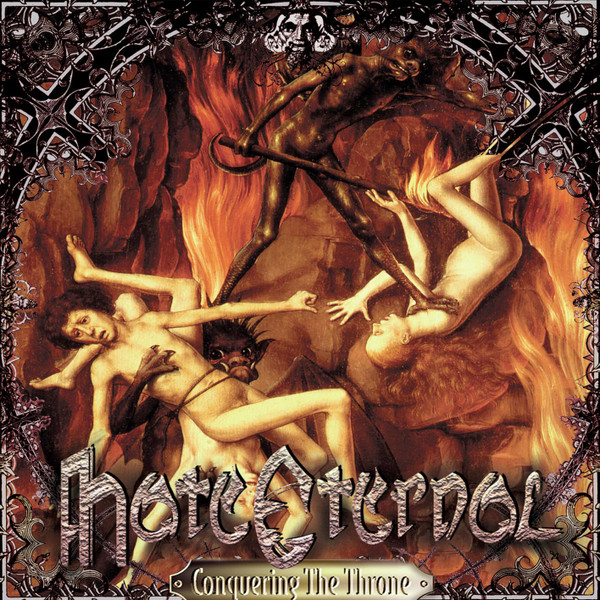
Album details
Tracklist · original 11 tracks
- Praise of the Almighty2:38
- Dogma Condemned3:00
- Catacombs3:16
- Nailed to Obscurity2:22
- By His Own Decree3:25
- The Creed of Chaotic Divinity2:58
- Dethroned2:35
- Sacrilege of Hate2:22
- Spiritual Holocaust3:27
- Darkness by Oath4:10
- Saturated in Dejection3:08
Band members
- Erik Rutan
- vocals, guitars
- Doug Cerrito
- guitar
- Jared Anderson
- bass, backing vocals
- Tim Yeung
- drums
Recording and release
- Recording
- February–May 1999 · Greenhouse FX Studios, Tampa, Florida
- Original label
- Wicked World Records (Earache Records), 1999
- Original catalogue number
- WICK 06CD
- Original format
- CD · 11 tracks
- Studio / producer
- Erik Rutan
- Painting used for the cover
- Hans Memling — The Last Judgment (detail of the Hell panel)
- Available reissue
- Earache / Wicked World · digipak CD · MOSH662CDD (2022 reissue)
Official music services
Service availability may vary by region; only confirmed album-specific links are listed.
Physical editions – availability
CD reissues of the original 1999 debut album. These editions are not the first 1999 pressing.
Stock, pricing and shipping may vary by country. The listed CD is a reissue, not the first 1999 pressing.
Sources disagree on the precise first release date; the verified original release year is 1999.
Opening
Before the Throne
One of the strange contradictions of 1999 was that the world of recorded music stood on the threshold of a new era, while much of the extreme metal scene still lived by the habits of the previous decade. People browsed discs in record shops; tapes and thin fanzines travelled by post; classified ads and letters carried news of the scene, increasingly joined by rudimentary websites. The mainstream music industry spoke of spectacular revenues, but in the underground, a new band still had to begin by finding a way to make even a handful of people hear its music. Two worlds this different existed in the same country, in the same year.
It was in this setting that Hate Eternal's debut album, Conquering the Throne, appeared. Its title promised the seizure of a throne, but the story behind it was not one of monarchs. It was the long, divergent journey of a group of musicians. Erik Rutan went from being a guitarist in Ripping Corpse and an experienced member of Morbid Angel to leading a band of his own. Tim Yeung, Jared Anderson and Doug Cerrito joined him by different routes. Recording took place between February and May 1999 at Greenhouse FX Studios in Tampa. The album's eleven tracks ran for little more than thirty-three minutes altogether. Yet the story behind them embraced far more time, and far more individual lives.
Years later, the band's leader would return again and again to the subject of that first album. The further the record receded from the moment of its release, the more it became both a memory and a point of reference. Interviews with the musicians from the period reveal the plans and their execution; later interviews reveal the significance they came to recognise in retrospect. Meanwhile, critics never reached complete agreement. To some, this was an extraordinary moment in extreme death metal; to others, the speed left too few memorable musical shapes in its wake. Neither voice can cancel out the other. It is precisely these differences that give the story its depth.
On the album cover, a far older layer of the past opened up. A detail from Hans Memling's late-medieval Last Judgment appeared on a death metal release from the end of the twentieth century. A painting concerned with judgment, the afterlife and the final ordering of things became the face of a record whose songs turn over the language of power, sacrilege, subjugation, ancient forces and darkness. Rutan himself discussed the choice of image. The connection in the case of the cover, then, is not simply a fantasy invented afterwards. There is, however, no demonstrated, item-by-item correspondence established by the authors between the individual lyrics and the figures in the painting. The meeting of visual and musical worlds should not be confused with detailed knowledge of some lost artistic master plan.
The story of Conquering the Throne therefore does not begin on the day it was released, nor does it end there. We must go back to New Jersey, understand the musical map of Florida, follow Morbid Angel on tour and eventually arrive at a studio of no particular fame, where the work of four musicians was left as a legacy in the grooves and digital samples of a record. From there the story continues, through decades and personal losses, to the point at which the first album is already history and yet still speaks, again and again, to listeners who came later.
Origins and musicians
The Shadow of What Came Before
Erik Rutan's story began in New Jersey, long before his name became associated with Florida. In the early 1990s, death metal was not a single, unified musical territory but a network of crossing paths. It was shaped at once by the speed of thrash metal, the weight of heavier extreme metal and increasingly intricate approaches to building riffs. Ripping Corpse belonged to a period when this language had not yet hardened into a ready-made formula. In the band, Rutan's work came together with that of Shaune Kelley, Scott Ruth, Dave Bizzigotti and Brandon Thomas. The 1991 album Dreaming with the Dead is more than an early credit in the later biography of Hate Eternal: it is evidence that Rutan already had considerable experience as a creative musician and band member.
The young guitarist later recalled that his instrument and music had given him something to hold on to during difficult adolescent years. This can be preserved as his own testimony, rather than presented as though every circumstance of his private life could be reconstructed from independent documents. During his time in Ripping Corpse, another gulf became visible: the distance between creating music and getting it released. A band might write its songs, refine its playing together and fill a stage, yet still depend on whether its label could carry its plans through. According to Rutan's recollections, some of the material composed later never reached a proper full-length release when the label's foundations faltered. This is not an odd exception but a recurring rule of the underground economy: making music does not automatically mean releasing it.
One of Ripping Corpse's earlier compositions was called Hate Eternal. Rutan later stated explicitly that he had carried this name over to his new band. Few musical connections are at once so simple and so revealing: the next chapter of his career had already been named in the previous one. Much changed between the 1992 Industry demo and the eventual 1999 album, but the title survived. The continuity lies in the name; it is not evidence that Hate Eternal's debut was a collection of earlier Ripping Corpse recordings.
The year 1993 opened a new chapter. Morbid Angel needed a guitarist during the touring period for Covenant, and Rutan joined the band's live work. His position did not immediately become permanent. The collaboration began with touring duties and had been prepared by earlier shared performances and the connection with manager Gunter Ford identified in Rutan's recollections. A year later he was trying to establish a more lasting place alongside the band in Florida. American and European stages followed, bringing with them all the discipline and constraints of professional touring. Rehearsing with a small underground group was one thing; fitting into the schedule of an internationally known extreme metal band was another.
Rutan contributed to five compositions on Morbid Angel's 1995 album Domination. This matters particularly because later accounts have sometimes spoken of him as though he had merely passed through the legendary band's history as a guest. In fact, he also took part in songwriting. Looking back, he recalled rehearsals, the creative work alongside Trey Azagthoth and the weight of expectations. Seen from here, Hate Eternal was not a rebellion against an insignificant supporting role. It was another choice by a musician who had already proved himself: to make room for his own ideas.
Alas was part of the same life story. That band name did not describe a rudimentary, less successful version of Hate Eternal, but a different aesthetic impulse: writing that was more melodic, drew on classical music and was open to a different kind of singing. Rutan did not deny this duality in his own statements. He did not necessarily experience brutality and a more delicately structured melodic world as opposites. One demanded different arrangements and a different group of musicians; the other called for Hate Eternal's concentrated, uncompromising force. A creative life cannot be locked inside a single genre label.
Red Bank's Two Musical Worlds
On the map of Ripping Corpse's history, New Jersey is not merely the name of a large northern state. The band was associated with Red Bank in Monmouth County, not far from the cultural routes of the Atlantic coast. The town was smaller in scale than New York, yet lived within its orbit: the independent local environment and the possibilities of the nearby metropolis together defined the musicians' range of movement. In the East Coast underground of the late 1980s, geographical distance was often less of an obstacle than finding the right gig, label or distributor. For Ripping Corpse, starting locally did not mean being confined to the local scene.
An older layer of Red Bank's musical identity belonged to jazz and the traditional concert world. In 1984, the local theatre was named after Count Basie, who came from the town: the naming made an earlier musical heritage visible. A few years later, in the same town, a young death/thrash band was working in an entirely different instrumental language. The coexistence is striking, but it does not mean Ripping Corpse emerged from the theatre's audience. The two stories are better understood as a reminder that a town's culture is never identical with any one genre.
The dense rhythmic shifts and exchanges between guitars on Ripping Corpse's 1991 album Dreaming with the Dead were already rooted in a kind of death metal that was no longer satisfied simply to accelerate the familiar pulse of thrash. According to a later Decibel retrospective drawing in part on participants' memories, the band built an audience in New Jersey and New York, but industry interest never became the security of a stable label. The article also records that the financial collapse of the Kraze/Maze label shortly after the album cut off some of its opportunities. Rapid musical development and a fragile business foundation thus existed side by side.
By the middle of the 1990s, Red Bank's urban planning documents were already concerned with renewing the town centre, calming through traffic, improving the area around the railway station and strengthening pedestrian connections. None of this allows us to deduce a musician's former address or rehearsal space. The background nevertheless reveals the ordinary urban world in which local identity, transport and places of cultural encounter were very real concerns. When Rutan's path later turned towards Florida, one personal musical history from this small but interconnected East Coast underground moved into the workshops of the South.
Four People in the Original Photograph
The original photograph of the four-piece band did not catch the musicians in mid-performance. On a graphic page of the booklet, four long-haired figures in dark clothes stand outdoors in a built-up setting; the photograph's colours were adjusted to suit the record's reddish, purplish and black visual identity. Their faces and postures briefly make visible the people whose names have so far appeared in this account chiefly as composers, instrumentalists and studio workers.
The line-up listed alongside the image names Erik Rutan on vocals and guitar, Tim Yeung on drums, Doug Cerrito on guitar and Jared Anderson on bass and backing vocals. This source is valuable because it does not preserve a later touring line-up or a memory reconstructed after the fact, but identifies the official four-person group responsible for the first album. At the same time, the photograph cannot tell us what any of them felt as they stood there, nor do we need to invent such a story. Four names and four roles are quite enough to prevent us from seeing the album as the solitary achievement of one musician.
The City That Was Not Just One City
In the history of death metal, Florida is often spoken of as though it were one enormous place-name. Yet the worlds of Tampa, the surrounding towns, more distant cities across the state and musicians arriving from farther north did not merge into some imaginary shared rehearsal room. Tampa was a port city, a complex place of workplaces, residential districts, transport routes, clubs, shops and everyday economic differences. Its local metal life formed only one layer of that city, even if it was a layer known internationally. This sense of proportion must not disappear from the story: the city did not exist as a backdrop to death metal, and not every resident was part of the scene.
Nevertheless, in the second half of the 1980s and the early 1990s, the genre found an especially vigorous creative centre in this region. The music of Morbid Angel, Deicide, Obituary and other associated bands travelled far beyond it, while the name Morrisound Recording became almost synonymous with the Florida death metal sound. The records made there are important historical precursors. That is precisely why the distinction needs to be clear: Conquering the Throne was not recorded at Morrisound. Hate Eternal worked at Greenhouse FX Studios, another location in Tampa. We cannot pay tribute to the great local tradition by inaccurately rewriting the history of this particular studio session.
At the time, musical knowledge did not spread through any single channel. Rehearsal rooms, venues, record shops and friendships mattered just as much as the international contacts maintained through demo tapes. A small-run release could travel by post and reach someone in Europe who would then review it or pass it on to another musician. The world of correspondence, faxes, analogue photographs and fanzines did not vanish overnight when the internet arrived. The underground around 1999 is better understood as a slow transition in which old and new technologies coexisted.
Meanwhile, musical currents across the Atlantic and in Europe offered different answers to the same broad desire: for extreme metal to move beyond its earlier forms. The more melodic and, at other times, heavier approaches of Swedish death metal, Norwegian black metal culture and American brutal death metal all occupied distinct regions of the same era. Rutan later said that towards the end of the 1990s he felt death metal needed to speak with particular force once again. This was his personal interpretation in retrospect; it should not be turned into a general, statistically proven verdict on the history of the genre. Hate Eternal's undertaking, however, makes sense in that setting: the aim was not to change genres but to push the chosen musical language to its limits.
Historical information about everyday life in the city matters because every band's achievement rests on travel, work, money, schedules and technical opportunities. Without evidence, though, we cannot turn a particular Tampa street corner into the location of the band's rehearsals, a well-known club into the site of its first performance or an event in the city into the inspiration for one of its songs. An account of the period remains credible when it shows the range of possibilities without asserting that some musician actually experienced every one of them. It is this distinction that makes the larger story believable on a human level.
Two Faces of the Tampa Bay Shore
Not every story falls in the same place on the map of 1990s Tampa. The historic Ybor City district and the studio operating near Temple Terrace served different functions within the city. In the late nineteenth century, Ybor City grew out of the tobacco-industry labour of Cuban, Spanish and Italian communities; its factory buildings and streets long preserved the industrial city's past. During the decades after the Second World War, the district's residential and industrial character changed considerably, and in 1988 the city officially designated it an area for redevelopment. By the end of the 1990s, shops, bars, clubs and galleries had brought life back to its streets.
This process did not create a city for just one musical genre. Ybor City's night-time economy attracted many kinds of audiences, while metal musicians across the Tampa Bay area were connected by a much wider network of rehearsal rooms, studios, opportunities to perform and personal acquaintances. Reusing old industrial buildings and running suburban studios were two different economic stories unfolding in the same urban region. We know of no document stating that Hate Eternal's debut album originated in a particular Ybor City club; the district's history is therefore background to the era, not an invented stop on the band's itinerary.
The early Florida death metal scene also extended towards the city's northeastern outskirts. Morrisound Recording opened in 1981 and moved from conventional studio work to recordings sought internationally by extreme metal bands. Local institutional memory now recognises the studio's role in its own right, and engineer Scott Burns has spoken in detail about the technical difficulties of capturing fast drums and guitars clearly. Noise gates, clearly defined drum attacks and separation between instruments were not tricks for their own sake: they helped prevent musical structure from disappearing amid the speed. The records that came out of Morrisound set a benchmark in the early 1990s, even though the bands did not all play alike.
Greenhouse FX Studios was a different place, with different personnel and a different recording to its name. Conquering the Throne is not a Morrisound album. To conflate the two studios would conceal precisely what made Tampa so important: by then, an entire region possessed the experience needed to make extreme metal, while each production still had to find its own technical solutions. In 1999 Erik Rutan did not simply adopt a ready-made formula for a sound; his own production decisions had to give shape to Hate Eternal's music.
In the region's everyday economy, all this met another, less conspicuous side of musical life. Studio sessions cost money; travel took time; jobs imposed obligations; manufacturing and shipping finished CDs carried expenses. Behind the international presence of a genre stood local services, technicians, printers, label connections and small agreements. Someone picking up the album in Europe in 1999 saw the name of the Florida band on the cover; most of the institutions and working conditions that had made the record possible remained invisible.
The Faces of the Studio Workers
On one of the inner pages of the original CD booklet, the names associated with the recording appear in the same composition as a group photograph. In the black-and-white image, four musicians stand in front of a wall; beneath and around them are the printed details of the record's production. Two kinds of memory meet here: a moment captured in faces and a more precise, verifiable trace of how the recording was made.
Production and mixing were Erik Rutan's work, with Wes Garren credited for engineering and mixing; the mastering credits preserve the names James Creer and Juan “Punchy” Gonzalez. The photograph, then, is not mere decoration beside the technical details. It helps identify the four-piece band, while the list of names alongside it reminds us that the album's sound was the outcome of several people coordinating different kinds of work. What listeners hear when the music starts is this shared achievement, shaped and carried through many stages.
The Geography of the Underground
The ease with which an album's name can now cross national borders in seconds can obscure the enormous distances that a band in the 1990s actually had to bridge. A fanzine editor did not necessarily live in the city where the studio was located. A listener might live in a country where the new record had never even reached the shops. Promotional materials and tapes often travelled along routes built through individual initiative. We should not imagine some romantic, secret world, but a great many small practical tasks: copying, addressing envelopes, waiting and constantly maintaining contacts.
Hate Eternal's 1997 promotional material clearly reveals this transitional infrastructure. Recordings were made before the album came out, and according to Rutan, they distributed a substantial quantity of CDs, tapes and material intended for the press. Individual letters that may not have survived in today's archives cannot be reconstructed after the fact. The historical logic of the process, however, is traceable. A band could attract a label’s attention, earn a magazine review or spark another musician’s interest even before professional band websites and instant digital playback existed.
Research into issue fourteen of Slayer Magazine illustrates just these limits of source preservation. A reference to an underground publication and a collector's photograph may survive while the complete text of the Hate Eternal feature mentioned in it remains unavailable. The source title is therefore a historical fact, but the missing questions and answers cannot be rewritten from conjecture. Elsewhere in the contemporary press, however, independent, complete interviews and reviews have survived. The old Rutan interview in Voices From The Darkside and a separate conversation originally published by Xtreem Music, for example, remain witnesses through which we can learn directly about the original intentions behind the album.
A local scene consisted not only of places but of movement. Florida bands did not all start out in Tampa; some musicians arrived from other towns or other states. Rutan brought his history from New Jersey, Cerrito had different connections through Suffocation, and Alex Webster formed a temporary link between the histories of Cannibal Corpse and Hate Eternal. The genre's geographical map is therefore not a simple list of a few clubs and studios, but a network of musicians' routes. Morrisound's presence is a fundamental part of the regional history, while the album recorded at Greenhouse FX marks another precisely identifiable point on that map.
In the world of 1999, international connections gained further layers from European labels and fanzine culture. Issues of Germany's Rock Hard, American webzines, releases associated with Britain's Earache and lesser-known fanzines could approach the same album with entirely different questions. One critic might examine the individual identity of the songs, another the musicians' virtuosity, and yet another the record's industry prospects. Its reception did not form as one homogeneous mass but in workshops far apart from one another. Today's aggregated databases can make these responses seem simultaneous; dates and places of publication restore their historical separation.
By the early 2000s, the transition between old and new channels had become increasingly pronounced. Independent copies and archived pages of older articles appeared online, and later critics could compare the debut with the band's subsequent work. Yet an article does not become a new source simply because it survives at a different URL. Historical memory preserves the same text in multiple copies. That is why the identity of the content matters: the diversity of the press is shown not by the number of repeated copies, but by genuinely different, independent conversations and judgments.
Eventually, the map of the underground becomes a long-term story even within the life of a single album. Documents about Hate Eternal from 1999 reveal the local work; interviews from 2002 already raise questions about the second album and touring; later retrospectives show how the debut retained its personal and critical weight. As the internet made archives easier to reach, it also made the gaps more visible. Some full articles survived; of others, only an issue number, a score or a mention remains. The larger story must carry this fragmentation with it.
Three Songs Before the Album Was Ready
According to Rutan's account, he began working in late 1996 or early 1997 on the material that would eventually become Conquering the Throne. Sources date the band's formation to 1997, but there is no single calendar day, identical across all documents, that can safely be recreated as a definitive historical scene. The decision was more of a process: alongside Morbid Angel, a musical idea was taking increasingly definite shape, and it called for a band of its own. The beginning of Hate Eternal is therefore not a shadow projected backwards from the finished album, but the story of a compositional endeavour gaining independence.
The bass player on the earliest recordings was different. Alongside drummer Tim Yeung and vocalist-guitarist Rutan, bass was played by Alex Webster of Cannibal Corpse. Webster's involvement was help offered as a friend, not evidence that he belonged to the permanent line-up for the 1999 album. This small but important distinction often vanishes from later brief entries. The early demo contained three compositions: Messiah of Rage, Sacrilege of Hate and Saturated in Dejection. The latter two subsequently appeared on the debut full-length; the first was not included in its original eleven-track sequence. The demo and the 1999 album were therefore connected, but they were not the same recording.
At that stage the band did not have an infrastructure capable of making a new release known in a single stroke. One detail in Rutan's contemporary and later statements brings the practice of distribution particularly vividly to life: by his own estimate, around a thousand promotional CDs, some shared with material by Alas, several hundred cassettes and many demo packages sent through the mail helped introduce the band. These figures are his own account, not verified warehouse inventory records, but they credibly indicate the organisational effort required before the new group could take its first serious step with a record label.
In that era a demo was more than an inexpensive preliminary sketch. It was a signal to promoters, an introduction for the press, an invitation to potential bandmates; often it was the only object through which a listener in a distant country could encounter a band that had not yet toured. The slow pace of postal distribution created a different sense of time from the later age of instant uploads. A few minutes of music travelled from hand to hand and letter to letter. No continuous record survives of exactly what each recipient heard and when. But the general nature of the process is clear, and Rutan's account of his promotion efforts links it specifically to Hate Eternal's early years.
The early songs matter for more than the fact that two titles were reused. The band's own voice was taking shape before the finished record existed. Titles and motifs dealing with sacrilege, hatred and personal collapse preceded the detail of a painting chosen for the original cover, and preceded the press's treatment of the debut as a single coherent work. The album did not spring into being during one studio session: years of work, collaboration between people and the transformation of early ideas made it possible.
Four Different Paths to the Same Record
The most important question in this story is not which musician's name appeared in the largest letters on the cover. It is what each of the four people contributed to the actual recordings. The original album booklet lists Erik Rutan on vocals and guitar, Doug Cerrito on guitar, Jared Anderson on bass and backing vocals, and Tim Yeung on drums. Webster's involvement in 1997 must not be confused with the bass credit on the 1999 album. Equally important, Cerrito's role must not be treated as merely symbolic: three of the record's eleven songs were written by him alone.
Rutan considered several drummers before choosing Tim Yeung. According to statements from the period, the strength of Yeung's playing lay in more than sheer speed. His rhythmic ability and experience drawing on jazz were also mentioned. The extreme tempos on the recording, then, were not an anonymous, mechanical achievement, but the result of a particular drummer's technique and solutions. Some later critics regarded him as one of the album's central figures; others, however, were unhappy with aspects of the drum sound in the mix. There is no contradiction here: a musician's performance and its recorded sound are separate matters.
Jared Anderson's place in Hate Eternal's first era meant more than providing the bass guitar. Rutan knew him from around Internecine and had already considered it important for Anderson to contribute a second vocal voice to the band's sound. His name appears on the finished recording, and later press accounts repeatedly raised the question of how clearly the bass could be heard through the dense sound. That last point is the critics' opinion based on listening; it does not change Anderson's status as a full participant in the work on the debut album.
Doug Cerrito came from a past in Suffocation. That background immediately offered critics a framework for interpretation, and they often described the new album as a meeting of the worlds of Morbid Angel and Suffocation. In an interview from the period, however, Rutan clearly distinguished influences from the origins of specific songs. Hate Eternal's songs were written for this new band. When the opportunity arose to bring Cerrito in, Rutan dropped several pieces of his own planned material to make room for his colleague's compositions. This was a creative decision and part of the portrait of a bandleader whose strong personal vision did not necessarily mean excluding every other writer.
Nailed to Obscurity, Dethroned and Spiritual Holocaust are therefore three key points in the record's internal history. The original credits and Rutan's statements both support these songwriting attributions. The other tracks were composed by Rutan. Later critics who highlight Cerrito's more intricate approach to riffs connect their own listening impressions to this verifiable historical difference. Yet it is not possible to reconstruct the precise instrumental sound automatically from a songwriting credit alone: that would also require actually listening to the recording.
The four musicians' collaboration was captured at a particular historical moment that did not last long. Later interviews indicate that Cerrito's and Yeung's participation in making the debut did not lead to years of work together in a permanent touring band. Rutan later said that Cerrito never toured with him. The quartet heard on the recording is therefore a remarkable unit: they made an album whose four names would still be discussed together decades later, even as Hate Eternal's live and recording history soon continued with different line-ups.
The Turn Behind the Speed
By the 1990s, speed alone was no longer unusual in death metal. Alongside the tight picking patterns inherited from 1980s thrash metal, the genre had developed other techniques: fast, almost continuous guitar runs, rhythms punctuated by stops and unexpected accents, lower tunings and a rethinking of melody's role. The difference between the Florida, New York-area and wider American schools was therefore not simply who played faster. What mattered was how to form new, recognisable musical phrases within that speed.
Ripping Corpse makes a particularly telling precedent in this respect. Later retrospectives on the band describe not merely a straight-line acceleration of thrash, but animated, fractured rhythms and guitars answering each other. When Rutan joined Morbid Angel's work, he encountered formal solutions on another scale: longer arcs of threatening melody and a ritualistic weight whose power did not always depend on the maximum tempo. Conquering the Throne was made after those experiences, but there is no need to trace the origin of every single riff back to a previous band.
Cerrito's participation brought another possible approach to construction. In the brutal death metal associated with Suffocation, rhythmic cuts and heavy, staccato passages took on particular significance. Cerrito's three compositions on the first Hate Eternal record were therefore not merely signatures in a booklet. The division of songwriting reminds us that the record's internal variety was shaped by the musicians' shared work and their different compositional experiences. The sources cited do not allow us to reconstruct who suggested any given instrumental turn during rehearsal.
In a 2002 interview, by the time of the next album, Rutan also emphasised the melodic side of the music. In his view, Hate Eternal did not find extremity in the absence of melody; melody itself could be menacing, dark and merciless. This distinction helps us understand the debut in retrospect. Within the dense guitar sound it is worth looking not simply for a quantity of notes but for the ways recurring intervals, changes of emphasis and musical phrases of different lengths maintain a sense of direction.
The Years of Invisible Work
Band biographies often tell the story of a life through the dates of full-length albums. An album in 1991, an important tour in 1993, a new studio session in 1995—as though nothing happened in the years between, as though musicians woke up only for concerts and recordings. Hate Eternal's prehistory shows precisely the opposite. In a young musician's life, rehearsals, questions of making a living, connections between bands, demos sent through the post and different jobs may matter just as much to later success as the names printed on album covers.
In 2021, many years after Hate Eternal's debut, Rutan recalled periods when he had also worked in telephone sales during a long conversation on the URM Podcast. By his own account, frustrations arising from the job, mounting tension and anger also influenced the shaping of the first album. This recollection is a distinctive source because it names a personal experience entirely absent from conventional studio credits. The booklet tells us where the record was made and who worked on it; it cannot tell us what other experiences of everyday life still needed to find their way into musical form.
The distance in time is crucial here. The statement from 2021 is a first-hand account of personal experience, but that does not turn it into a diary written in 1999. Moreover, the interview transcript was partly generated automatically, so precise quotation of some passages would require checking the original audio. Even so, the documented connection is significant: Rutan himself linked his early workplace experiences to Hate Eternal's debut. He did not, however, specify that a particular sentence spoken by a particular customer gave rise to a particular riff. Details of that kind would take us into invented history.
In late-1990s America, tension between earning a living and making music was by no means unusual. Musicians still had to pay their living expenses, even if their names were already known in the underground. Total music-industry sales across the country might be rising, but that did not mean the members of a technically accomplished death metal band could work with a secure financial foundation. The parallel existence of the mainstream market and underground life is not an economic table in this story but a very practical condition: limited studio time, tours to schedule, promotional copies to post and jobs held alongside musical commitments.
These levels of life are worth bringing together because behind the grandeur of the title Conquering the Throne lies the discipline of everyday existence. The story requires no actual throne room. There is no need to invent fury in the studio or unverified conflict between bandmates. It is enough to see that one person could simultaneously be a member of Morbid Angel, the singer-guitarist of a new death metal band, a record producer and a private individual who also had to reckon with the costs of living. Behind the instrumental work lay time and effort, not mere scenery.
In documents created later, the story's internal point of view also changed. In interviews from the period, the young Rutan spoke chiefly about the new band's aims, the selection of its members, the studio and the album. Looking back over a longer life, the older Rutan could also identify the personal background of his early anger. Neither source makes the other unnecessary. Together they trace the distance between the confident declarations surrounding a newly released album and a retrospective account given twenty years later.
Studio, cover and the era
The Greenhouse FX Sessions
The music for Conquering the Throne was recorded between February and May 1999 at Greenhouse FX Studios in Tampa. The booklet names Erik Rutan as producer; Wes Garren and Rutan for recording and mixing; James Creer as mastering engineer; and Juan Gonzalez as an additional mastering contributor. These names and tasks are more than industry credits printed in small type: they are historical witnesses to the shape the finished record took. Anyone who wants to understand how an album was made must also know who worked on capturing and preparing its sound.
In an early conversation, Rutan explained that one reason he chose the studio was his personal acquaintance with the person running it, which gave him a favourable opportunity to work there. The available sources, however, have not preserved the studio owner's verified name or a detailed street-level history of the location. It would be a shame to fill a real working process with invented scenery. What we do know is more revealing: recording took place in three separate stretches to accommodate Morbid Angel's touring commitments. The record did not result from one uninterrupted retreat into the studio, but from working time carved out between parallel careers.
Contemporary studio technology offered opportunities while also imposing limits. Rutan mentioned a one-inch, sixteen-track recorder, a Behringer 8000 console and Shure SM57 microphones. These details genuinely appear in his account; we do not, however, know precisely how the individual guitar tracks were allocated, the full microphone arrangement or the final mixing settings. We should not misunderstand the period by projecting the almost unlimited digital editing of later years backwards onto it. The 1999 record emerged within a particular budgetary and technological reality, even though its maker already had a clear sonic ideal in mind.
Rutan described the goal as a balance between sheer intensity and clarity: the extremity should not be heard as a confused mass but as a clearly structured assault. Contemporary critics already differed over how successfully the final mix achieved this. Nathan Robinson of Metal-Rules objected to the kick-drum sound, hearing it as excessively artificial in certain passages. Others considered the record's production exceptionally powerful. No single commentary can overrule the recording itself; in a historical account, each judgment can survive with its author and its moment of publication attached.
Alongside the collaboration within the studio was the pressure of the bandleader's double life. Fitting the recording around Morbid Angel's travels was not merely a calendrical problem. Hate Eternal was establishing its own identity, sound and possibilities. The later importance of Mana Recording Studios makes it tempting to rewrite the making of the debut with hindsight from Rutan's mature career as a professional producer. But Mana belongs to a later period; the original Conquering the Throne belongs to Greenhouse FX and the different tools of the late 1990s. The story stays clear only if that distinction in time is respected.
By the time the album's material came together, what stood before the musicians was no longer merely a personal project of one Morbid Angel guitarist. There were the two guitarists' different songwriting contributions, bass and a second vocal voice, Yeung's drumming and the work of the studio's two principal recording and mixing contributors. From this came Hate Eternal's debut. The cover and distribution still lay ahead, but the music already existed as a document in its own right.
Making Speed Intelligible
One of the hardest questions when mixing an album like this is what the ear can follow among so many simultaneous events. If kick-drum strokes and low guitar notes pile on top of one another, listeners may perceive a single uninterrupted sheet of noise. If, by contrast, the attacks of the instruments are sufficiently distinct, the music's inner structure can emerge even at its densest. This tension occupied the whole studio culture of American death metal; Scott Burns emphasised the technical difficulty of recording fast drumming in his recollections for precisely that reason.
The task on Hate Eternal's debut was particularly complex: two guitars, bass, Tim Yeung's extremely rapid drumming and extreme vocals had to become one coherent sound. The rhythmic layers built upon each other do not all perform the same function. Drums may establish the immediate pulse while guitars stretch motifs of entirely different lengths across it; a brief stop or displaced accent can suddenly give the next passage new weight. Compositional density, therefore, is not merely another name for the speed of one instrument.
Within this structure, the bass guitar often helps make the movement of guitar themes easier to follow by holding the lower frequencies together. Jared Anderson's role cannot therefore be summed up by saying that he played the lowest notes. Backing vocals, bass tone and the way the players worked together all helped the four-piece line-up sound like a unified musical force. Yet no complete studio log survives of the exact drum-microphone arrangement used at Greenhouse FX or the settings of every effect. There is no reason to copy such details automatically from other famous Tampa recordings.
In this sense, the recording documents an intriguing turning point in the era. The startling speed of 1980s metal records had by then become one element in a far more complex set of instrumental demands. Hate Eternal did not merely seek to turn up the speed: it had to create recognisable musical shapes out of dense passages played with enormous force. The impact of the 1999 sound comes from listeners encountering both the music's almost physical power and the determination to preserve direction and form even in the fastest sections.
The Image That Outlived Its Century
Releasing Conquering the Throne required a visual language to accompany the musical one. The cover of a debut death metal album was not simply protection for the recorded music inside. On a record-shop shelf, it was the first thing someone saw from a distance; cassette copies, magazines, recommendations and an increasing number of online listings referred back to the same image. Hate Eternal did not seek an entirely new picture created solely for them. Instead, they turned to a historical painting that had explored the terrifying subjects of final judgment, the body, sin and the afterlife centuries earlier.
Hans Memling's Last Judgment is a specific, identifiable work of late-medieval European art. The triptych's history stretches far beyond the geography and time of metal music. In an interview from the period, Rutan explained how they selected a detail of the painting for the album. There is no need to construct a mythology around the decision afterwards: the choice itself is interesting enough. A genre often described from the outside as a rejection of the past established a connection with medieval imagery. The iconography of judgment found a new life on a release from Earache's Wicked World branch.
The pages of the album's illustrated booklet are also documents of a different kind from the late 1990s. They contain the complete track listing, the order of the lyrics, the studio credits, the names of the band members and their acknowledgements. These pages do not conceal romantic secrets to be unlocked through imagination; they offer painstaking, everyday evidence. A name beside a mastering credit, another beside an instrument, a songwriting attribution can often resolve more confusion than a long biography written years later. The booklet also preserves the words readers could encounter beside the individual tracks in 1999.
At the Edges of Hell
The cover of Conquering the Throne does not reproduce Memling's entire triptych. The 1999 design picks out the scene of figures cast into hell, then places it at the front of a death metal album with a new frame, lettering and proportions of colour. In the original arrangement of the medieval altarpiece, hell is one side of the Last Judgment: the drama of separating the saved from the damned is held together by the figures of Christ and the Archangel Michael. On the record sleeve, that larger centre of reassurance or divine judgment is no longer visible. Only one consequence of judgment remains: falling bodies and the threatening depths below.
In the upper half of the detail, distorted, naked human figures cling to one another against a dark, rocklike surface. Some bodies twist sideways or upside down; their outstretched limbs suggest not a calm gesture but a loss of balance. Towards the lower left, a lighter body stands out against the dark background; near the centre, arms and legs cross one another. Brownish and black shadows remain behind the red and orange flames, so parts of some figures can be recognised only by the outlines of their limbs caught in the light. There is no secure horizontal ground on which the eye can rest.
Along the edges runs black, spiky ornamentation resembling metalwork. This is part of the record's graphic frame, linking the historical image to a different visual genre. Across the lower third, the large, angular Hate Eternal lettering obscures some of the painted figures; beneath it, Conquering the Throne appears in narrower, much smaller letters. The lettering does more than convey the band's name. Its weight and sharp outlines construct a new foreground in front of the painting. The original work's religious allegory thus becomes a new, sombre and violent visual entrance to the music.
The conquest promised by the album title and the descent shown in the painting are images in tension. One names the taking of power; the other shows a position lost as a result of judgment. This duality makes for a fruitful interpretation, but it does not prove that the designer intended to conceal this exact thought in the artwork. What can definitely be seen is that the 1999 cover narrows the view from the whole medieval narrative to its most unsettling side. Someone who saw only the front of the CD encountered not the order of the complete altarpiece, but its extreme scene enclosed by flames.
Together, the four musicians' personal acknowledgements and the monumental world of the cover create a contrast of scale. The painting carries questions of ultimate order; a few pages of the CD booklet record four people's musical and human relationships. Neither the acknowledgements nor a group photograph, however, allow us to reconstruct every personal connection. Even the line-up must be read with attention to time. The original album booklet shows a four-piece band; a three-person photograph preserved later should not be retrospectively identified with that same moment.
In 1999 the album appeared within the connected label environment of Wicked World and Earache. The known catalogue number of the original CD is WICK 06CD. Different sources give different release dates, including 4 October and 2 November; the original booklet alone cannot settle the day. For this history, the established year and the contemporary autumn reception are firmer ground than a repeatedly quoted but uncertain calendar date. The precise day did not need to be printed on the cover for the band's first record to begin a life of its own.
The back page of the original album booklet is also a documentary source in its own right.
An Era Gathering Speed
In 1999, the United States was in the midst of substantial economic and cultural change. CD sales were still exceptionally strong, the music industry was talking about an expanding market and the possibilities of digital technology, and file sharing and internet music distribution had not yet developed the forms that would transform the entire business in the following decade. It would be wrong to imagine Hate Eternal's first record as though its audience had discovered it among streaming platforms and social networks. People encountered the release through CDs, the traditional specialist press, correspondence, clubs and newly developing internet sites.
In Europe that same year, the introduction of the euro for financial transactions signalled a new economic phase, while the Balkan war and NATO's air campaign over Kosovo revealed a very different face of international politics. Tensions in world affairs coexisted with the growth of the popular-culture market. There is no evidence that any particular song on Conquering the Throne was inspired by these events; there is no need to invent such a connection. The portrait of the period simply keeps the album's history from floating in a timeless void. The musicians lived through the year in which these developments took place, but we can attribute only documented direct influences to the songs.
Rutan named a number of his musical inspirations: Destruction, Dark Angel, Morbid Angel, Iron Maiden and Judas Priest all had a place on his musical map, alongside Mozart, Bach, Vivaldi and Beethoven. He also spoke about film scores and other cultural traditions. Such testimony is more than a list of artists whom the finished record resembles. These names reveal how broad a background of listening and creativity can lie behind an album seemingly focused on one extreme direction. No document assigns a particular classical composer to every individual Hate Eternal riff. Between the musician's stated interests and the actual compositions, we can see possibilities, not a workshop diary whose every detail is identifiable.
The same historical discipline is needed with the lyrics. Rutan spoke of his interest in Aztec, Sumerian and Egyptian traditions, religions, occult symbolism, mythologies and his own personal experiences. It is striking that these lyrical worlds meet a medieval religious image on the album, but they do not combine into a single doctrine of religion that can be authentically reconstructed. Death metal's symbols collide, reinforce each other and turn the language of devotion on its head. From this cultural variety, the album fashioned a distinct, recognisable world of extreme concentration.
Considering the label landscape of the time also makes clear how far from inevitable an international release was for a new band. In Hate Eternal's story, Wicked World was not a second, independent company competing with Earache, but an associated imprint. That corporate structure and distribution network offered the band an opportunity: the music could reach places that the promotional packages they mailed themselves would scarcely have reached on their own. Even so, Rutan's original intentions had not yet been fulfilled. After the record's release came the harder question of when and how Hate Eternal could function as a stable, touring band.
The eleven tracks
The Eleven Gates
The album's title promises a single act of seizing power, but its songs do not tell one continuous historical drama of rulers. Motifs of ancient forces, burial chambers, laws, curses, oaths and inner destruction return, each with its own identity. The original eleven tracks appear in this order: Praise of the Almighty, Dogma Condemned, Catacombs, Nailed to Obscurity, By His Own Decree, The Creed of Chaotic Divinity, Dethroned, Sacrilege of Hate, Spiritual Holocaust, Darkness by Oath and Saturated in Dejection. According to the supplied audio files, the album lasts approximately thirty-three minutes and twenty-seven seconds. In that brief span, the band created a world that critics would spend decades interpreting.
We can understand the history of the songs through three different kinds of sources. The booklet preserves the words and songwriting credits. Interviews with the musicians place their creative intentions and circumstances alongside them. Critics, in turn, tell us what the recording meant to them. The three must not imperceptibly become one. The literary speaker of an aggressive lyric does not automatically express the writer's private opinions. Nor is a guitar figure identified by a reviewer in 2007 an event logged in a studio in 1999. This book follows the album while keeping those distinctions in view.
The songwriting credits provide a fundamental map. Eight tracks are attributed to Erik Rutan; Nailed to Obscurity, Dethroned and Spiritual Holocaust belong to Doug Cerrito. Tim Yeung's drumming and Jared Anderson's bass and backing vocals contribute to the character of the whole recording. The album was more than a set of territories divided between composers on paper: its finished sound is the fact of their recording together. The lyrics, titles and reception are therefore best followed not as isolated miniatures but as part of the album's collective movement.
Praise of the Almighty — The Invocation
The title of the album's opening song promises praise. At first, the language is deceptively familiar: the vocabulary of devotion seems poised to greet some kind of order, authority and elevation. Yet in Hate Eternal's lyrical world, the invocation turns away from conventional religious speech. Images of force, hatred, ancient power and submission take its place. The speaker in these verses is no detached chronicler. The voice wants to become part of the force it summons, a force portrayed as dark. The album therefore begins not with an explanation but with entry into an imagined order.
The significance of the opening verses' rhetoric becomes clear across the album as a whole. When we later encounter thrones, judgment, sacrilege and oaths, this first invocation has already introduced the language in which such words can be stretched to extremes. The name Hate Eternal itself can be associated with this world of thought, but that does not mean every statement by the lyrical speaker is Rutan's personal creed. His own interviews testify to an interest in religious and occult traditions; in the specific lyrics, however, we encounter artistic constructions, not a reliable transcript of a confession.
In the album's later reception, this very opening track became one benchmark in the debate over its structure. Many years later, TouristTerrorizer found the opening guitar theme particularly memorable but criticised the lack of variety in what followed. To other writers, the consistently dense sound was a virtue in itself. The difference between those perspectives cannot be reduced to a question of true or false. One listener seeks memorable motifs; another values the pressure exerted by the album as a whole.
The opening song thus serves as a gateway into the world of Conquering the Throne, giving readers both a subject and a debate. Its words address power, while arguments about the album's music raise a question within its first minutes: is force sufficient in itself? The later pieces respond to this from different angles, although the writers never claimed to have composed one strict conceptual narrative laid out in advance.
Dogma Condemned — When Law Is Called into Question
The second track sets the image of an attacked dogma beside the solemn invocation of the first. A hidden movement can be sensed between the two titles: as if, after the preceding praise of power, order itself must be questioned. In the lyrics of Dogma Condemned, written teachings, obedience and the authority of faith become the focus of the speaker's attack. This is no careful treatise on religious history, but the provocative language of the genre. The voice in the song does not seek nuanced mediation; it works through rejection, challenge and images of destroying doctrines considered unshakeable.
The clash between authority and personal judgment becomes even more important when the album is viewed as a whole. The previous song addressed some higher power; this one questions the right to demand submission. The duality also enriches the metaphor of a throne concentrated in the album's title. A throne is not merely an object but a symbol of the relationship between obedience, possession and resistance. Of course, the band published no creative plan making each piece a compulsory stage in a symbolic narrative. This reading is a free interpretation, but one grounded in the preserved lyrics and running order.
Paul Schwarz's contemporary review in Chronicles of Chaos discussed Dogma Condemned among the album's strengths. To Schwarz, the traces of Morbid Angel and Suffocation remained recognisable, yet Hate Eternal managed to build its own momentum and voice from them. This distinction formed one of the review's central arguments: the presence of predecessors did not automatically amount to an accusation of imitation. When he wrote about it in December 1999, he could not yet see Hate Eternal's long subsequent career. The record had to be judged at a moment when the debut stood or fell on its own merits.
The second song therefore has two historical faces. On the album-booklet page stands a lyric defying dogma; in the contemporary critic's words stands the attempt of a young band to prove itself. The first belongs to artistic expression, the second to the history of reception. There is no need to assume a secret correspondence between them for both to make sense together. Each concerns the testing of boundaries and authority, but at an entirely different level.
Catacombs — A Realm Beneath Memory
The title Catacombs carries the album's imagination below the earth's surface. The world of burial chambers evokes both built spaces associated with death and the memory of ancient religions. Signs of death, ancestors, return and the underworld meet in the lyrics. The name Mictlan is particularly significant: it refers to a realm of the afterlife in pre-Columbian Mesoamerican tradition. This is not a generic word for death placed there by chance, but a specific cultural motif. Rutan himself spoke of his interest in Aztec and other ancient religious systems, so at least this broader connection with the lyric's imagery can be linked to a first-hand statement by the musician.
Understanding historical motifs is not the same as knowing everything the writer read. We cannot tell which page of which book led to the appearance of that name in the song. The booklet preserves the words; Rutan's interview preserves his cultural interests. We can show the kinship between the two without inventing a library, notebook or studio conversation. An authentic account often draws strength from what it leaves open.
Catacombs also acquired a distinct identity in its critical afterlife. Writing under the name thinkpad20, a critic in 2007 identified the starting points of two specific sections of the recording; other writers interpreted the movement of the guitars in the light of Rutan's and Cerrito's different compositional worlds. Such descriptions matter because they discuss inner details of the song rather than brutality in general. Still, they cannot be presented as our own retrospectively verified listening impressions if the particular passages have not been played back. The critic's testimony and the music itself are two separate documents.
It would be easy to see in an image of rising from beneath the earth an allegory for Hate Eternal's own arrival: a new voice emerging from a musical world with a long history. This is permissible as a literary parallel, not as historical fact. The power of Catacombs lies precisely in the way images summoned from the spaces of the dead resist being confined to a single biographical meaning. The album gains its own weight by rearranging these images, while the story of the band continually brings us back to the ground of reality.
Nailed to Obscurity — The Trace of Another Hand
By the fourth track, the story of the two composers behind the album suddenly becomes tangible. Nailed to Obscurity is not a composition by Erik Rutan alone. According to the booklet, both music and lyrics were written by Doug Cerrito. The song also has a source history of its own: it appeared to be missing from an earlier compilation of extracted lyrics, but can be found in full in images of the original CD booklet. Comparing the sources thus recovered a text that the data collection alone would have presented as lost. Historical work is built from small but decisive moments such as this.
The title evokes being nailed to obscurity, to a state of concealment. Images of bone, blood, punishment and dominating force create a dense, hostile world in the lyrics. The motifs of the throne here ask not merely who possesses power, but how an oppressive condition can crush someone until escape becomes difficult. Images of cruelty and concealment reinforce one another, as though presenting a counter-image to the album's public proclamation of conquest. Power has a language of victory, but also a dark side born of confinement.
Because Cerrito had previously belonged to Suffocation, many critics began comparing compositional approaches as soon as the new band appeared. Some later listeners considered Cerrito's pieces more convoluted and less predictable. What matters most to the history of the album is that Rutan genuinely made room for another creator, and said so in a contemporary interview. He stressed in particular that Hate Eternal's songs were new compositions written for this band. There is no reliable evidence that Nailed to Obscurity was simply a leftover recording by Suffocation.
The distinction matters because the story of Hate Eternal's first album is so often built around a single name. The project was indeed Rutan's initiative and made under his leadership, but Cerrito wrote more than a quarter of its compositions. This cannot be dismissed as an incidental detail. Nailed to Obscurity demonstrates that the new band's voice emerged not from erasing every separate artistic signature, but from the meeting of several strong musical pasts. On the finished recording, that distinction of authorship became part of a shared band achievement.
By His Own Decree — Power Granted by Oneself
The album's fifth composition is again Rutan's work, and its title speaks of power as though the decision no longer depended on an external authority. By His Own Decree uses the language of a command issued on one's own authority. Its lyrics evoke fire, freedom and ritual invocations while attacking hypocritical authority. A strange movement therefore occurs within the album's imagery: taking the throne is not merely removing a foreign ruler, but asking who has the right to pronounce their own law. The figure in the lyrics replaces resistance with a new language of power.
It would be easy to read the title directly as a motto for the composer's life. Rutan did build Hate Eternal because he wanted a band of his own and a separate space for more extreme compositions. Yet there is no statement of creative intent explicitly assigning that biographical meaning to this title. A literary bridge can be built between the two stories, but not a documented identity. Such restraint does not diminish the beauty of the parallel. What makes it powerful is precisely that, beside a real career decision, the preserved lyric lives as an independent imagined force.
Among later reviews, By His Own Decree did not disappear among the other short, brutal compositions. Arise212 particularly liked it in an enthusiastic 2011 review, and a later writer publishing as Hames_Jetfield also spoke favourably of it. These are two separate listeners' judgments, not a single opinion copied repeatedly afterwards. Specifically named tracks such as these give the early album individual details in critical memory.
As the album approaches its middle, the song titles demand ever greater meaning from the vocabulary of power. After dogma is rejected, someone proclaims a decree of their own in its place; invoking ancient forces brings no gentle, reassuring order. By His Own Decree builds its literary world out of this internal tension. We know of no unified explanation from the writers turning every piece on the album into a political or religious-philosophical allegory. Yet the recurring words still create a clear atmosphere when placed alongside one another.
The Creed of Chaotic Divinity — Order in Chaos
In the title of the sixth song, creed and chaos are brought together in a single grammatical construction. The collision between the two words is deeper than it first appears. A creed implies a shared teaching, stable order and articulated truth. Chaos suggests their collapse, the loss of form and the dissolution of boundaries. The Creed of Chaotic Divinity seems to want both at once. The lyrics invoke the awakening of ancient powers, return and prophecy, treating religious worldviews not as exact reconstructions of any historical religion but as a store of powerful symbols.
Within Hate Eternal's lyrical world, individual rebellion thus expands to cosmic proportions. The attack on dogma is no longer merely about whether someone accepts a teaching. It is as though the order of the world itself has become contested. The cover's late-medieval depiction of judgment makes this reading even more compelling. The two works came from different centuries and served different purposes, yet images of a final rearrangement meet within them. This does not mean, however, that the song was created directly for a particular figure in the painting. The choice of cover is documented in the album's history; a detailed iconographic plan for each track is not.
This layer of the lyrics connects with Rutan's wide-ranging reading interests in religions and mythology. His own words referred to ancient cultures and occult teachings, but this book cannot replace that complex range with a single philosophy arbitrarily chosen for him. The realm of the dead, sacrilege, oaths and the inversion of cosmic order are symbols in dialogue with one another. One of the genre's strengths is precisely that it can use them both seriously and provocatively at the same time.
At the centre of the eleven-track album, the title The Creed of Chaotic Divinity can therefore be seen as one compact formula for the record as a whole. Order and disorder may also echo its musical form, but this text does not license us to invent particular rhythmic devices. Critical retrospectives differed in their assessment of the tension between speed and structure. Independently of those judgments, the tension within the title is demonstrable: it is already evident in the juxtaposition of the words in the original booklet.
Dethroned — Power Reversed
In Dethroned, one word performs the reversal towards which the whole album seems to move. Anyone who wants to seize a throne must reckon with someone being removed from it. Gaining and losing dominion are movements that belong together. The song's imagery links downfall, threat and a new, dark power. This is no historical chronicle of a particular king, but an expression of power shaped in death metal's own concentrated, extreme language. Dethroned does not offer an explanation of conquest; it becomes part of the clash between the images itself.
The composition is Doug Cerrito's work. After Nailed to Obscurity, we come to another piece for which the original booklet establishes the second guitarist's own authorship. Among later critics, Cheeses_Priced and thinkpad20 paid particular attention to guitar passages that they felt displayed Cerrito's distinctive musical thinking. Cheeses_Priced, for example, highlighted a riff appearing at approximately one minute forty seconds in Dethroned and its later return at roughly one minute fifty-eight seconds. These precise times are the notes of a particular reviewer; they do not replace independent verification by listening to the audio.
In later appraisals of the composition, complexity and memorability became two separate concepts. One critic might find an intricate structure a source of fascination; another might find that the album's almost constant intensity obscured differences between tracks. There is no need to search for a single final arbiter in the history of Dethroned. Reception matters because the same musical document brought different patterns into focus for different listeners.
Cerrito's past could again tempt us into an easy explanation, but Rutan's statement sets limits on it. The compositions written for this album were not simply salvaged Suffocation pieces. The second guitarist's earlier experience could hardly disappear without a trace from the person who wrote the music, but that does not make the specific composition anything other than a new work. Dethroned may be especially important because it shows how easily a critical comparison can become an erroneous origin story in retrospect if we lose sight of the creators' direct statements.
The seventh track's place on the album seems to reverse the movement of power so far. The first song addressed a power; the next rejected dogma; the fifth proclaimed a decree of its own; now the title announces dethronement. But the band's historical life cannot be rewritten according to these symbols. Melodies and words can at most cast a literary light on the paths of documented people. Cerrito secured his place in the album's history through these three compositions, even though the band's line-up would move in a different direction over the following years.
Sacrilege of Hate — A Return to the Demo
Sacrilege of Hate did not receive its title and form for the first time in 1999. It had already appeared in Hate Eternal's 1997 promotional material, with the early line-up in which Alex Webster played bass. A gap of two years is short in a life story, but decisive for a band just beginning: during that interval the label relationship was established, Jared Anderson and Doug Cerrito arrived, and the definitive shape of the debut full-length emerged. Anyone listening to this track on the album encounters a composition that had already lived an earlier life. The exact sonic differences between the demo and album versions, however, could only be described reliably by comparing both recordings side by side. The original 1997 audio needed for that comparison was not included in the collection.
The title speaks of sacrilege and hatred, but anger, pain and the uncertain boundaries of personal identity also appear in the lyrics. We do not find only the vocabulary of distant gods and cosmic forces. The language is more personal, opening a different viewpoint within the album's broader symbolic system of power. Yet care is needed: not every first-person line in a song is a biographical confession by its writer. Death metal's lyrical speakers can assume different masks, even as the artist may draw on experiences from their own life.
Retaining the song on the full-length album was also a historical decision. A band that would later be seen as already perfectly formed in every detail did not simply spring into existence in the studio; rather, it was a group that carried two pieces from its early ideas onto the first official album. Messiah of Rage was omitted from the standard running order, while Sacrilege of Hate and Saturated in Dejection crossed into the next era. The selection itself shows that the step from the early demo to the 1999 record involved shaping the material, not merely copying it mechanically.
A later critic writing under the name Hames_Jetfield, for example, counted the songs' relatively short forms among the strengths of Conquering the Throne. In this track, the album's compactness and the longer journey of the preceding years create a curious contrast. Behind a few minutes of music lies virtually the whole early history of Hate Eternal: the initial promotional recording made by three people, hand-to-hand distribution, the search for a new label, the changed line-up and the final studio recording. Sacrilege of Hate is therefore more than the eighth title in a list; it is a point of connection that looks back to the beginning of the story from the middle of the album.
One page of the album booklet contains the lyrics of Spiritual Holocaust and Darkness by Oath.
Spiritual Holocaust — Cerrito's Third Song
The ninth track is Doug Cerrito's third composition written on his own, and perhaps the point at which the conflicting voices of critical reception meet most clearly. The second word in the title Spiritual Holocaust carries a heavy historical burden; in these lyrics it functions as an extreme genre metaphor for spiritual destruction. It would be wrong to conclude from the title alone that the song addresses a particular twentieth-century historical genocide. The lyrics move through images of oppressive powers, desecration and the decay of the spirit, within the broader cruel, religious-rhetorical world present from the album's opening minute.
The positive response to this composition is particularly well documented. Paul Schwarz included it among the stronger tracks in his contemporary review; Ryan Harding praised it too; and much later TouristTerrorizer—who criticised monotony elsewhere—found precisely the kind of distinction here that was missing from several other pieces. The historical significance does not lie in treating the agreement of these three writers as a binding verdict for every listener. Quite the opposite: it shows how a single piece can bridge broader differences in taste. People can disagree about an album as a whole and still agree on some of its standout moments.
The presence of Cerrito's music reinforces this interpretation. His three songs did not appear as a separate EP, but were integrated into a coherent album led by Rutan. Nevertheless, the booklet makes the songwriting responsibility clear: Spiritual Holocaust is Cerrito's composition, not a solo work by the principal frontman. In biographical accounts of the band's first album, this detail often tells us more about the actual collaboration than the customary formula that Rutan “founded Hate Eternal single-handedly.” Founding a band and making an album are not quite the same event.
To outsiders, the genre may seem equally threatening in every song, yet lyrics and credits preserve different creative choices. Spiritual Holocaust transforms sacred vocabulary into images of destruction, while later reception preserved it as an especially identifiable piece. If a critic considers Cerrito's approach to constructing guitar parts one of the record's chief virtues, songs like this show the way to that view. But we would be entitled to discuss the construction of specific riffs as our own observation only after separately listening to the complete recording.
On another page of the album booklet are the continuation of the lyrics to Darkness by Oath and the words of the closing track.
Darkness by Oath — The Weight of a Vow
Near the end of the album, Darkness by Oath evokes the image of a vow made to darkness. An oath is a peculiar act of language: it does not merely communicate something but creates a commitment. That is why a strange promise of freedom appears in the lyrics alongside submission. The speaker wants to belong to what is presented as their own choice, and tries to turn constraint into liberation. Darkness here is not simply a background, but an order with which the voice seeks to identify. At this point the album's images of thrones and power are concentrated into an unusual, inward vow.
At a little over four minutes, Darkness by Oath is the longest piece on the standard edition. On an album made up mostly of short tracks, usually two or three minutes long, that duration gives it a special place. Yet length alone cannot support any particular conclusion about the sound. Critics mentioned memorable guitar solos, and the French publication Thrashocore particularly praised the instrumental ideas in the song. These accounts show that some listeners experienced the extra time as a space for more expansive development. The actual technical details must again be treated as the reviewers' observations.
The word oath is particularly interesting in the context of the band's entire history. With Hate Eternal, Rutan consistently wanted to create music that would not compromise its own extreme principles. This recurs in later interviews. Yet there is no proof that the original intention behind Darkness by Oath was a confession about the band itself. The parallel is an editorial interpretation that may help us feel the album's atmosphere but cannot rewrite the documented memories. The song's speaker is not automatically the singer holding a guitar.
By the time we reach the tenth track, most of the album's vocabulary is already behind us. Praise, dogma, the grave, personal decrees, chaos, dethronement, sacrilege and spiritual destruction have formed a strange order. Darkness by Oath seems to gather them all into a single vow. The question remains, however, how long such an order can be maintained, and what happens when human experience no longer speaks through royal or mythological imagery but through the word dejection. The title of the final song opens precisely that direction.
Saturated in Dejection — The Circle Closes
Saturated in Dejection is the second composition on the album whose history reaches back to the 1997 demo. Early Hate Eternal already knew the title before the first official full-length was complete. The historical connection is clear, even though no reliable sonic comparison of the demo's precise instrumental arrangement with the album version has been carried out. The final piece therefore leads back to where Hate Eternal's beginning took shape: the band's own musical language developed before the finished record.
The title suggests being saturated with dejection. The album's opening minutes seem to have addressed an external, mythical power; here the lyrics foreground more inward states, loss of hope, pain, anger and a desire to begin again. In interpretation, the path may lead from exaltation towards personal collapse, but this does not establish a deliberately constructed concept album. Recurring motifs among the songs permit such a reading; historical criticism, however, does not turn it into a mandatory plan attributed to the musicians.
In a much later podcast conversation from 2021, Rutan talked about his early personal working circumstances. By his account, he held telephone sales jobs in which mounting tension and anger became personal experiences, and he connected this with the creation of Hate Eternal's debut. This is important first-hand recollection offered years later, not a diary from the period. Separately checking the relevant section of the original audio remains an open task for final source-critical work. Nor is there direct evidence that an incident involving a particular customer specifically inspired the lyrics of Saturated in Dejection. The connection concerns the album as a whole, not demonstrably this one track.
Two periods meet in the closing song. One is the preparation in 1997, when the song already existed. The other is a later age, when its creator could look back and consider the experiences that fed the first album's intensity. The two should not be merged completely. Placing them side by side nevertheless reveals one of the deepest connections in a musician's life story: a work created in youth can preserve an experience its creator will only learn to describe in other words years later.
Conquering the Throne ends here, but not with a final verdict. After eleven titles, there is no definitive explanation that removes all the musical and lyrical contradictions. The desire for power, negation, ancient imagery and dejection remain alongside one another. Some of the album's earliest listeners were enthusiastic; others received it with reservations. Within a few years, the band was writing new songs, choosing a new drummer and facing new circumstances of life. The closing track is therefore both the last page of the completed debut and the preface to a long career whose greater part nobody in 1999 could yet foresee.
Reception and reissues
The First Echoes
When Conquering the Throne reached the press in 1999, Hate Eternal's history split in a curious way. The musicians had completed their work in the studio and in preparing the release, but only then did the record's meaning begin to expand. Some reviews immediately seemed to recognise in it the kind of extremity that could be hailed as a sign of a new era in death metal. Others asked whether its intensity left enough breathing room for the individual compositions. This divided reception was not invented in hindsight. It was present among the reviews of the day and never entirely disappeared.
Issue 150 of Germany's Rock Hard carried a high rating of nine out of ten. That fact alone tells us something about the album's reception at the time, but the complete article remained behind paid access in the available archive. We cannot therefore reconstruct the critic's precise argument from the score. The history of reviews sometimes begins with incomplete sources: we see the outcome, but not the reasoning that led to it. At this point, the historian and the writer of narrative prose have the same obligation. They must not fill the missing paragraphs from imagination.
On 10 December 1999, Paul Schwarz published a full review in Chronicles of Chaos that has survived to the present. He gave the record eight and a half out of ten. He heard the legacies of Morbid Angel and Suffocation on the album, but did not regard it as a mere imitation. He singled out tracks including Dogma Condemned and Spiritual Holocaust, while also acknowledging reservations about the evenness of the compositions. His response shows how early one of the album's enduring questions emerged: where does deliberate consistency end, and the feeling of repetition begin?
In the twenty-sixth issue of In Music We Trust, from December 1999, Jeb Branin raised the stakes even higher. He counted the new Hate Eternal release among the best death metal albums of the period, hearing technical organisation behind the brutality. The bandleader's Morbid Angel past could easily have led him to search for similarities, but Branin emphasised an identity of its own. In the critic's words, the same record was no longer simply a continuation of a tradition, but another effort to push beyond it.
Nathan Robinson of Metal-Rules awarded four out of five in January 2000, but his approval was far from unconditional. He found the bass drum particularly unnatural in sound and felt that, in the faster passages, the production sometimes obscured the guitars' work. In some respects he preferred the rawer sound of the 1997 demo. The review thus reveals the divided assessment of the production. A powerful, technically well-recorded album does not necessarily affect listeners in the same way as a mix that brings out the musical details they most want to hear.
Other layers of the music press also paid attention to the debut. A short, independent recommendation of the album appeared in the 18 February 2000 issue of the American trade publication HITS. The fact that the review appeared in a publication dealing in part with major international music commerce is interesting for the history of distribution. A recommendation only a few lines long does not become an in-depth analysis on that account. In its own place, however, it matters: it shows that news of an underground album reached a wider professional public. A bibliographical trace remains of a late-February 2000 issue of CMJ New Music Report and a related result referring to page 29, but an image of the original page was not among the materials supplied. No missing critical opinion can be invented from that evidence.
Ryan Harding's HorrorThriller review, published around 2000, represented a different, passionately enthusiastic voice. He highlighted Tim Yeung's drumming, Rutan's guitar playing and Cerrito's creative role; Dogma Condemned and Spiritual Holocaust received especially favourable attention. The precise original date is less certain, so the narrative does not attach it to an unverified day. The musical judgment remains an independent source nevertheless. His emphases differed, but this writer too attributed the record's strength to more than the frontman's presence alone.
The album's reception thus developed in several directions during its very first months. Drumming could be both a dazzling musical achievement and a disputed result of mixing; short songs could be tight constructions or a constraint on development; kinship with Morbid Angel and Suffocation could be evidence of quality to one critic and the yardstick of innovation to another. The new band could not choose which past listeners would hear behind it. Yet amid all these different expectations, the musicians stood behind the same eleven songs.
The Album's Second Life
In the years that followed, Conquering the Throne ceased to exist only as a new release. When King of All Kings appeared in 2002, the first album became at once a predecessor and a basis for comparison. More records arrived later, new drummers and bassists came in, and the band's own history of development retrospectively shifted the emphasis placed on the 1999 recording. After a while, the only question was no longer whether the debut was a good album. Listeners also asked whether it was better, rawer, more individual or more memorable than everything that followed.
The French reviewer at Thrashocore in 2004 was particularly interested in Tim Yeung's playing and the album's guitar solos. Darkness by Oath and Dogma Condemned appeared among its strengths, although the author maintained that the material sometimes sounded too uniform. Later Metal Archives reviews remained similarly divided. In 2004, Cheeses_Priced focused on differences between the signatures of the two composers. In 2007, thinkpad20 rated the debut especially highly and identified particular instrumental passages. That same year, Annihilist offered a considerably cooler assessment, treating the constant intensity more as a limitation.
Source criticism also uncovers a concrete mistake here. One of Annihilist's claims associated the album's bass playing with Alex Webster. On the original 1999 line-up, however, Jared Anderson was the bassist. Webster participated in the early 1997 demo and, in another era, on the 2008 Fury & Flames recordings. That does not mean all the critic's other musical observations are worthless. It does mean that the factual credits in a subjective, interesting review must be checked. Critical tradition cannot replace the original album booklet.
In a 2008 review, Noktorn measured the first album against later Hate Eternal releases and praised precisely what he perceived as the comparatively greater variety of the debut. What some other writers called monotony, he saw differently in light of the subsequent records. Arise212 awarded the maximum rating in 2011 and highlighted Cerrito's songs as well. In the same year, Autothrall read the record as the emergence of Rutan's independent artistic identity, while leaving open the question of how easily the tracks could be told apart. The difference was not merely a change of taste: the same music was now being evaluated beside a much larger body of work.
A 2015 retrospective in Nine Circles recalled the original line-up's shared achievement as a personal memory. The different guitar worlds of Rutan and Cerrito, Tim Yeung's drumming and Anderson's less prominent bass guitar all found their place. By then, the reviewer was no longer simply judging a current new release. He was speaking of a musical period from his youth that could not be completely brought to a close, despite later works. Such a retrospective is a source for listeners' memories, not the band's official understanding of itself in 1999.
A review by Hames_Jetfield, originally written in Polish around 2020 and also available in English in 2021, praised the short, concentrated song structures. TouristTerrorizer, writing in 2025, recognised the technical skill but still did not find enough distinctive riffs on the record. Even twenty-six years after release, the same questions persisted: is unrelenting intensity a virtue or a burden; do the differences between the writers really come through in the finished work; what does a listener expect from a radically extreme death metal album? The record did not leave its first quarter-century behind with a single final verdict.
Behind most of these reviews lies genuine listening, but the opinions must not be treated as interchangeable. Someone who hears the best album of an era is not making the same claim as someone seeking the best riff. Someone criticising the bass guitar's low level in the mix is not necessarily dismissing Anderson's musicianship. Arranging the reviews chronologically is therefore a story in itself: it shows how a release's surroundings change while the recorded music remains the same.
Continuations and changes
Choice and Continuation
With the release of Conquering the Throne, Erik Rutan had finally put forward an album on which he appeared not as an invited or permanent member of someone else's band, but as the leader of his own. The next task, however, was not simply to repeat the earlier success. Hate Eternal needed to become a functioning band capable of playing live, while Rutan's commitments to Morbid Angel still made heavy demands on his time. There is no need to search for the tension of this double career in an invented dramatic argument. The dates, tours and later statements themselves show how difficult it was to divide one life between two such demanding undertakings.
A new line-up took shape during preparations for the second album. Doug Cerrito's and Tim Yeung's roles were associated primarily with the debut; Rutan later stressed that their departures did not necessarily amount to a conventional, hostile breakup. Organising recordings and touring had always presented them with different possibilities. The band's new drummer was Derek Roddy, who brought a different rhythmic character. Jared Anderson remained an important creative partner through the period of the second album.
Before King of All Kings was released in 2002, Rutan published his own account of the studio work. In it, he directly compared the new project with the debut. Questions of drum sound, clarity and variety did not exist only in the critics' minds: the creator himself also looked back on the first album as something from which he could learn and build further. His account presents the relationship between the first album's title and the new image of kingship as a deliberate continuation. With the passing years, then, the critics were no longer alone in constructing a story around the two records; Rutan himself connected them.
In 2002 Rutan left Morbid Angel in order to concentrate primarily on his own band. He spoke about this decision himself, emphasising that he did not want to treat Hate Eternal as a side project. In the years that followed, he had to work simultaneously as bandleader, songwriter, frontman and producer. If the title of the debut suggested independent action in a literary reading, the corresponding real career decision now followed. But this choice need not be demonstrated through any particular song: the musician's direct statements are sufficient.
Contemporary and later accounts of the 2002 period also mention a road accident and Rutan's injuries. A prolonged recovery can interrupt the momentum of a band whose activity depends on concerts, travel and sustained physical exertion. The established main facts of the story can be preserved without inventing unverified medical details or scenes. Hate Eternal's history in these years was not solely a succession of album titles. The biological and logistical limits of work were constantly present.
Around 2003, Jared Anderson left the permanent line-up and Randy Piro took his place. Retrospectives mention personal difficulties, but they do not entitle an outside narrator to construct detailed diagnoses of anyone's private life around the events. Released in 2005, I, Monarch was the album of a trio identifiable as Rutan, Piro and Derek Roddy. The band continued to play extreme death metal while searching for new balances in composition, rhythm and sound. Over time, the 1999 debut thus became the starting point of a career, not an unchangeable rule book.
Maintaining a stable line-up proved difficult in a touring band. Derek Roddy departed in 2006, and various live drummers, including Kevin Talley and Reno Kiilerich, helped with concert work. The live DVD The Perilous Fight offered interviews and studio material alongside a London performance. It became a document of how the band operated: a record of a state in which the personnel assembled for live appearances could differ from the studio line-ups of earlier albums. As the group changed dynamically, the work of the original four increasingly came to look like a distinctive, one-off historical collaboration.
The Absence That Had a Name
On 14 October 2006, Jared Anderson died. The bassist and second vocalist on Hate Eternal's first two albums was not merely a former name in the discography: Rutan spoke of him as an old friend and creative partner. According to later recollections, they had even discussed the possibility of his return. The fact that this could never happen cast a different light on their years together. What in 1999 had seemed the natural, present-tense line-up of a debut album became, after 2006, a memory that could never be repeated.
Online accounts of Anderson's death are not always reliable in their details. Speculation cannot take the place of established facts. Yet the date of the musician's death and Rutan's later, direct accounts say a great deal in themselves. Rutan spoke of how much encouragement Anderson had given him to continue Hate Eternal. The relationship thus had more than a biographical past: it also held a documented creative significance for the next album.
Fury & Flames appeared in 2008 with the memory of this loss. Rutan himself connected the album's title and the motives behind its creation to Anderson's death. It was not a historian who later invented a story about grief turning into a secret musical language: the musician spoke of it. Precisely for that reason, however, we must avoid adding new scenes that never happened to his direct statement. We do not know every private conversation or the exact moment of every creative decision. The documented fact—that remembrance, loss and the album were closely linked—is weighty enough.
In the 2008 line-up, Shaune Kelley was once again playing guitar alongside Rutan, this time in Hate Eternal. It was as though the early story of Ripping Corpse had come full circle. Jade Simonetto played drums, and Alex Webster recorded bass for Fury & Flames. Webster's name thus returned to a story in which he had already appeared on the Hate Eternal demo of 1997. Yet the difference between the two contributions remains: in 1997 he was involved in the band's first promotional recordings, while in 2008 he played on a much later studio album. Neither role makes him the bassist on the 1999 record.
Released by Metal Blade, Fury & Flames included an instrumental piece of remembrance, Tombeau (Le Tombeau de la Fureur et des Flammes), which occupies a special place in the story. Its title and commemorative purpose turn attention towards the departed bandmate. Rutan subsequently spoke more than once of the difficult creative period, burdened with grief, out of which the album emerged. Almost a decade later, an identifiable human loss thus came to stand beside the more impersonal, mythical anger in the lyrics of 1999's Conquering the Throne. The difference between these eras does not mean that one was more “real” than the other. The sources allow us to know the creative experiences behind them to different degrees.
Having a second guitarist again in Hate Eternal's live work opened up new possibilities. In interviews around 2008, Rutan said that certain recording arrangements had been difficult to perform live as a trio; two guitars gave the separate parts more room to function alongside one another. This statement concerns later experience onstage. It does not prove that every song on the 1999 album was originally performed live in precisely the same way by the four studio musicians. Studio and stage did not always call for the same personnel structure throughout Hate Eternal's career.
There was no quick road from loss to peace. The next album, Phoenix Amongst the Ashes, released in 2011, already carried an image of rebirth in its title. Rutan himself positioned this work as part of a rebuilding process after the grief-laden period of Fury & Flames. The new music emerged not as an act of forgetting but as an effort to continue. Starting from the debut's history, this turn also reveals in retrospect how much human uncertainty and change can exist within the apparently immovable genre forms of extreme metal.
A Sound Rebuilt, Years of Change
Phoenix Amongst the Ashes was released in May 2011 with a line-up of Rutan, J. J. Hrubovcak and Jade Simonetto. Bassist Hrubovcak became a permanent member after 2008 and remained an important figure in later Hate Eternal. The image of the phoenix itself comes from the kind of ancient mythical tradition that had already appeared on the debut. Here, however, the interpretation rests on particularly firm ground: in his own conversations, Rutan emphasised rebuilding after personal and band difficulties. This is not merely a general critical impression, but first-hand testimony from the creator.
Meanwhile, Rutan's work as a producer grew increasingly important. Numerous extreme metal releases were made during the later history of Mana Recording Studios; it also became an important workshop for Hate Eternal albums. But this cannot rewrite the beginnings. The 1999 Conquering the Throne was made at Greenhouse FX, with different professionals, different tools and different local circumstances from the later Mana albums. Preserving that distance in time makes it possible to see that the producing career did not emerge fully formed in a single instant, but developed gradually along with records and accumulated experience.
A longer interval passed between Phoenix and the next Hate Eternal album. In the bandleader's later account, production commitments and the difficulty of finding the right drummer also contributed to the gap. For such a band, it is not enough that someone can simply play the drums well. Extreme speed, musical interplay and the conditions for working together over the longer term all mattered at once. Rutan often discussed the weight of such personnel decisions, but a general explanation cannot be taken as the secret reason for every single departure.
Infernus appeared in August 2015 through Season of Mist. Chason Westmoreland played drums alongside Rutan and Hrubovcak. In conversations about the album, Rutan stressed that the longer preparation time had allowed for careful selection of songs and that he valued the particular qualities of live drumming. Westmoreland's studio role must not be confused with those of drummers who later performed live or on other records. In Hate Eternal's history, album credits often preserve a more accurate chronology than short social-media or database summaries.
Upon Desolate Sands was released in October 2018 with Rutan, Hrubovcak and Hannes Grossmann. It was recorded at Mana Recording Studios; mastering was by Alan Douches and the cover artwork by Eliran Kantor. Compared with the Memling detail on the debut, this was a different visual and creative era. Hate Eternal continued to pursue its own extreme musical language, but now with two decades of experience and a history of seven studio albums behind it. In interviews of the period, Rutan emphasised both continuity and the possibility of change.
From 2019, another old connection moved into the foreground. Rutan began working as a touring guitarist for Cannibal Corpse and became a permanent member in 2021. He contributed to the albums Violence Unimagined and Chaos Horrific. The name Cannibal Corpse had been present at Hate Eternal's beginning through Alex Webster's bass playing in 1997. Now the connection continued in a new form. It would be wrong, however, to infer automatically that Hate Eternal had ceased to exist. The musician's later official biographies spoke of Hate Eternal's continuing importance even when Cannibal Corpse's primary concert activity had become decisive.
Across this long career, loyalty to the band did not mean an unchanging line-up. Albums were made with different drummers, bassists and studio environments. The strongest thread of continuity was Rutan's presence as singer, guitarist, songwriter and producer, the chosen language of extreme death metal and the historical memory carried from one album into the next. In time, the early Conquering the Throne remained with them not only as a first chapter but as a benchmark. Not merely because it came first, but because at one particular moment four distinct musical paths came together in a single recording.
Memory and legacy
The Album's Memory and Its Listeners
During a record's long afterlife, it is not only the band that changes; the people listening to it change too. Someone reading a review written in 1999 could not know of the grief behind Fury & Flames or the personal significance of the title Phoenix in 2011. A writer looking back in 2015, by contrast, could consider the debut with all this in mind. The difference does not necessarily make the newer interpretation truer. It simply permits other questions. The contemporary listener asks about the future; the later listener often returns to the origins.
The story of the four musicians in the original line-up reveals this transformation particularly clearly. For Rutan, the debut realised his own vision for a band; Cerrito demonstrably contributed three compositions; Yeung's playing continued to win praise for years; Anderson's recording became an unrepeatable personal memory after his death. When reviews later discussed the bass guitar's place in the mix, some were still talking only about sound, while others could already see the same name in light of the musician's entire career and loss. Musical achievement, then, does not carry one single biographical meaning fixed for all time.
One of the album's unusual virtues—or disputed qualities—is its brevity. After roughly thirty-three minutes of music, the closing track has already arrived. Critics sometimes see this as the concentration of its power and sometimes as a limitation of forms that allow little room. These are different responses to the same documented feature. A listener who wants a more spacious, slowly developing record may find too little distinction between songs. Someone seeking extreme compression may value precisely the uninterrupted momentum. The album's significance is not the arithmetic average of these verdicts, but the fact that it has inspired responses so strong and so different from one another.
In the debut's lyrics, motifs of the throne, belief, command, chaos, judgment and personal collapse turn towards one another. We do not need to invent a lost dramatic script behind them in order to read them as a coherent world. The recurring words themselves give the album a frame. Meanwhile, readers and listeners enter this world with questions of their own: to whom does power belong, what does disobedience mean, how can the language of gods coexist with personal dejection? Such questions are literary interpretations, not authenticated, literal confessions by the individual musicians.
The task of historical writing is therefore twofold. On the one hand, it must preserve everything established: the line-up, the songwriting credits, the relationship between the 1997 and 1999 recordings, the Greenhouse FX studio, contemporary reviews, later line-up changes and the original dates of personal recollections. On the other, it must leave room for what cannot be decided from any one piece of data. Different readings of the guitar playing, the exact release day, the questions in a missing fanzine interview and supposed hidden biographical meanings of individual songs must not become unquestionable facts.
Conquering the Throne remains interesting not because every detail is eventually given a final, infallible explanation. It endures because the first album can remain the same while life continually writes new stories alongside it. The band's other records cast new light on it; old interviews reveal its origins from different angles; later losses give the participants' names a human weight that nobody could have written about in advance in 1999. This long process of looking back is the record's true afterlife.
The Image That Remains
The debut album now lives in several kinds of documents. The music survives in eleven audio files and different release formats, the visual material on pages of the CD booklet, the creators' accounts in contemporary and later interviews, and the reception in numerous print and online reviews. These documents are not all of the same age, nor do they answer the same questions. The booklet tells us who wrote Dethroned; a review from 2007 recounts how the movement of the guitars affected its writer; a later interview with Rutan shows how he saw the construction of the debut with years of distance behind him. The story becomes richer where we do not confuse these things.
The physical cover, lyrics preserved in images and acknowledgements hold small but independent pieces of evidence that can easily disappear from plain online databases. The original booklet makes it possible to recover the lyrics to Nailed to Obscurity even if a later text extraction left them blank. The names of the recording engineer, mastering contributors and musicians are not decorative details added in passing: they lead us back to actual work. In this sense, the album is not a solitary art object but a historical trace of many people's partially interconnected achievements.
Two contemporary press sources illustrate the limits of preservation particularly well. Bibliographical references survive to Hate Eternal material associated with issue fourteen of Slayer Magazine, but the complete interview itself was not available in the collection. A trace also remained of a sought-after page in a February 2000 issue of CMJ New Music Report, yet it was not possible to verify the actual page twenty-nine. These gaps are not secret chapters of history that we are free to invent. Their existence can be noted, but the missing speakers and critical claims must not be created after the fact.
The discrepancy over the album's exact release day illustrates the same problem of source criticism on a smaller scale. Both 4 October and 2 November appear in the available data; the original booklet supports the year, label, writers and studio credits, but does not unambiguously establish the precise day. Acknowledging uncertainty is not a weakness in the research, but a sign of respect for the actual documents. The story remains a complete and worthwhile story despite that uncertainty.
And yet, once we step beyond the documents, something remains that bare facts cannot convey in one sentence. A young band still facing changes of personnel; a constantly touring guitarist searching for his own creative space; another guitarist with three compositions of his own; a drummer whose playing many considered one of the debut's greatest strengths; and a bassist whose subsequent loss opened a new era in the band's memory. This one-time meeting left behind a brief, relentlessly concentrated album.
The title Conquering the Throne continued to mean the same thing on the cover for many years, but the story behind it gathered new meanings. The first reviews examined a band whose future was unknown; later ones searched for the debut's place in light of an entire career. Rutan's memories meanwhile remained first-hand testimonies, yet accounts that grew fuller with time. A story becomes true not by smoothing away every difference, but by allowing the voices of distant periods to be heard together, each in its proper place.
On the final page, therefore, no imaginary victor sits on the throne. Between the record's opening words and final motifs remain the languages of seeking power, sacrilege, ancient images and dejection. The real story concerns the work of four musicians and many later colleagues, not some invented dark ruler. The 1999 recording remains in its own time, yet continues to travel. This is a more lasting form of conquest: not silencing others, but allowing the record, again and again, to take its place at the centre of another listener's experience, another memory and another story.
HATE ETERNAL
The Making of a 1999 Album.
The Meeting of Four Musicians' Paths.
Eleven Songs and a Long Afterlife.
From the Legacy of Ripping Corpse to the Later Years
Hungarian Documentary Novel · 2026
Reader comments
Comments only appear after approval. Messages are displayed in their original language.
Comment submissions are not enabled yet.