

Adimiron Black
Gehenna’s 1998 turning point: from Stavanger to Soundsuite Studios, the shift towards black/death metal, the cover artwork, seven tracks and the album’s later history.
About the album
Tracklist · original seven-track album
- 01.The Killing Kind3:39
- 02.Deadlights5:38
- 03.Adimiron Black6:17
- 04.Seed of Man’s Destruction3:56
- 05.Devil’s Work7:41
- 06.Slowly Being Poisoned4:01
- 07.Eater of the Dead4:59
Sum of listed track times36:11
Band members
- Sanrabb
- vocals, lead guitar
- Dolgar
- vocals, rhythm guitar
- E.N. Death
- bass guitar
- Damien
- keyboards
- Blod
- drums
Guest musicians
- Sarcana
- guest keyboards on tracks 3 and 7
Recording and release
- Studio
- Soundsuite Studios, Norway
- Recorded
- January–February 1998
- Produced by
- Gehenna and Terje Refsnes
- Original label
- Moonfog Productions
- Original release
- 1998, FOG016, CD / 12″ LP
Official music platforms
Expanded digital editions have a different tracklist from the original seven-track album.
Qobuz sells the expanded digital edition dated 2004, not the original seven-track 1998 release.
Physical editions – where to buy
Official reissues · specialist retailers
Stock and prices may change. Sales conditions vary by country.
Album details refer to the original 1998 release; later reissues may include bonus tracks.
Stavanger — The Birth of Darkness
Stavanger is not Oslo, nor is it Bergen. In later years, the story of Norwegian black metal was sometimes told as though the same cold fire had flared up everywhere at once, as though the same faces, the same clubs and the same sound connected the entire country. But in January 1993, when Sanrabb, Dolgar and Sir Vereda formed Gehenna, Stavanger was much further removed from that dense network. Fewer bands, fewer direct connections, greater isolation. Perhaps it was precisely this that left more room to seek something other than what everyone else was seeking.
By the middle of the 1990s, the city from which Gehenna emerged had long ceased to be merely a port. Stavanger lies on Norway’s south-west coast in Rogaland county, intimately linked to the sea and the fjords; coastal shipping and work in the North Sea were equally part of everyday life. Around the harbour, traces of the older maritime and trading town remained, while from the 1960s onwards an industry of quite a different scale transformed the local economy. The former centre of sardine canning became one of the principal hubs of Norway’s oil and gas industry. That change was more than a label: oil companies, suppliers and service providers created a world of work that could be felt in the streets, in commuting patterns and in the composition of the workforce.
The Transformation of a Port City
The transformation had its own prehistory. Herring fishing, shipping and later the canning industry had previously kept the city moving. As industry modernised, the importance of the older factories declined; by the 1960s, new sources of livelihood were needed. Following developments in offshore oil exploration, Stavanger’s leaders consciously sought to attract international companies, technical specialists and supporting facilities to the region. In 1972 both the state oil company Statoil and the Norwegian Petroleum Directorate established their headquarters here. The oil economy employed more than those working offshore: engineering design, repairs, transport, hospitality, construction and office services also became entangled with it. The expanding commercial area around nearby Forus revealed another face of Stavanger, distinct from the rows of old houses in the city centre.
Yet behind the modern world of work stood a diverse, inhabited city with a cultural life. In its centre was Sølvberget, the library and cultural centre opened in 1987; the city had a theatre, community institutions and its own sense of history. An association devoted to local history was founded in 1991. These institutions do not in themselves demonstrate any direct link with black metal musicians, but they show why it is misleading to imagine the city solely as a setting for isolated rehearsal rooms. It was a rapidly changing place combining commercial, industrial and cultural functions, whose life could mean very different things to different social groups.
The city’s size in 1998 also helps establish the proportions. In its historical series for Stavanger, Statistics Norway records 112,565 inhabitants at the end of 1997 and 113,954 at the end of 1998. In the year of the band’s third full-length album, then, it was a significant regional centre, though not a metropolis: large enough for different occupations and communities to meet, and small enough for the members of a narrow musical scene to feel the distance from Norway’s national centres of extreme metal. These population figures are municipal statistics; they tell us nothing about the size of the band’s audience.
In the final years of the decade, a new building also signalled that the city had begun to regard the oil industry as part of its own history. Plans for the Norwegian Petroleum Museum dated back to 1974, its funding came together by 1996, and construction began in June 1997. When Adimiron Black was being made, the museum was not yet operating: it would only open on 20 May 1999. This seemingly minor difference in dates matters. In a story set in 1998, the construction site belongs to the period; a completed institution already open to visitors would be an anachronism. Yet the rising mass of stone, glass and concrete still conveys the image the city was forming of itself: it already wanted to turn the importance of work at sea and modern industry into public memory.
Artistic darkness thus had an unusual background—one that would be easy to overinterpret. In terms of its economic structure, Stavanger was turning towards a world of machines, platforms, engineering systems and industrial services, while the imagery of Gehenna’s later album would also become modern, cold and industrial. This is a valid, cautiously drawn parallel in the portrait of the time. What the documents examined so far cannot establish, however, is that any particular building, workplace, harbour view or economic experience directly determined how Adimiron Black was written. The city’s actual history enriches the context in which the album was born, but it cannot replace the musicians’ own testimony.
Nor was the wider region of Rogaland identical with central Stavanger. The flatter, intensively farmed landscape of Jæren, the industrial and commercial districts of Sandnes further south, and the transport role of Sola with its airport were different faces of the same region. Movement between sea and land was no romantic backdrop but an organising principle of everyday life: the basis of commuting, business travel, freight shipments and personal connections between towns. Stavanger functioned not as an isolated point on the Norwegian uplands, but at the intersection of coastal routes, roads, railways and air links. Sola Airport had served the city’s region since 1937; the history of rail connections to southern Norway went back much further than the emergence of black metal.
Proximity, however, did not erase regional differences. Everyday life in the offshore oil industry and the coastal agricultural districts could differ profoundly, even as supplier networks connected them. The oil business brought substantial revenue to some sectors, while other economic actors became more vulnerable to fluctuations in export markets. The real meaning of modernisation lies in that duality: the same region preserved traditions of fishing, farming, shipbuilding and trade while becoming ever more deeply integrated into the international energy industry.
By the end of the 1990s, the risks of dependence had become tangible. According to one local historical account, oil prices fell sharply in 1998 compared with the previous year, and declining orders and job cuts followed at a number of regional companies over the years that followed. That retrospective source mentions around 2,500 jobs lost in the Stavanger region between 1998 and 2000 in connection with falling oil prices and restructuring; without a detailed contemporary methodological check of the underlying figure, we treat it only as a secondary local estimate. We must not project the full labour-market consequences, which unfolded later, back onto the months when the album was being written.
Stavanger’s Music Scene
In the second half of the 1990s, Stavanger was not simply a remote point on the map of Norwegian metal. Connections developed between the city’s musical life and active bands in neighbouring Sandnes, Sola and Strand, without requiring the approval of Oslo or Bergen. The differences remained: some came from churchlike, mournful keyboard sounds, others gravitated towards the heavier guitars of death metal, while others preferred the theatrical, voice-centred forms of gothic metal. But rehearsal opportunities, concert venues and recording work within the same region gave these divergent stories room to unfold.
Folken, Stavanger’s student and concert centre, had already opened in 1988. It was not devoted to a single genre; it offered the valuable, usable space in which young performers, organisers and audiences could meet. Checkpoint Charlie also became an important point in the local rock scene. By 1998, evenings devoted to heavier music and gothic events were taking place there, including nights called Hard Rock Cafe and the world of Club Grotesque. The existence of these events does not prove that Gehenna performed there. It shows that, even then, a more established local setting for listening to and presenting dark, heavy guitar music was taking shape.
The Stavanger and Rogaland region likewise did not possess a single sound. Theatre of Tragedy, founded in Sola, developed a different approach to doom and gothic metal during the mid-1990s, bringing together deep male vocals, clean female singing, slow heaviness and theatrical melody. Following 1996’s Velvet Darkness They Fear, the band released Aégis in 1998. Tristania, which emerged from the Strand area, released Widow’s Weeds in 1998 after recordings made in 1997. Here, keyboards and multi-part vocals pulled the tension in precisely the opposite direction from the one Gehenna took that same year.
Thus, within a single region, symphonic and gothic styles could be gaining strength while another band worked to strip away the grandeur it had previously constructed so carefully. This does not allow us to infer personal relationships or mutual influences automatically. The parallel is nevertheless revealing: Adimiron Black was not created in a musical vacuum, but in a landscape producing several different answers to the question of what darkness might sound like as the millennium drew nearer.
Gehenna’s First Recordings
The first months passed quickly. The Black Seared Heart demo was completed at Soundsuite Studios in the summer of 1993, and the seven-inch Ancestors of the Darkly Sky soon followed. The band was still young, but something already hinted at what would return again and again in its history: Gehenna wanted not merely to write songs but to create a distinct space around itself. Dark, but not empty. Atmospheric, but not a mere stage set.
By the time of First Spell in 1994, Sarcana’s keyboards were becoming increasingly important, and when Seen Through the Veils of Darkness appeared a year later, the instrument was no longer merely a backdrop. The synthesiser organised the space, bound the guitars together and made the music feel larger and more distant. In Gehenna’s first era, darkness had an echo. It did not simply strike you; it surrounded you.
At the Edge of the Old Sound
Malice—or Our Third Spell, as they called it—became the culmination of that world in 1996. It was a bigger, more controlled and more cohesive album. Sanrabb later recalled that before every new record and tour, he would listen back to the earlier material to understand where the band ought to go next. Malice came close to what they wanted to achieve at the time. And that was precisely what became the problem.
Sometimes the most dangerous thing for a band is not failure, but a formula that works too well. After Malice, Gehenna had an easily recognisable path available: more melody, more keyboards, an even grander symphonic space, darkness made ever more magnificent. Yet Sanrabb and Dolgar increasingly felt that something would slowly be lost along that road. The music could become more melodic, the layers richer still, but at the cost of the aggression, the menace and the raw negative energy they considered essential to black metal.
Norway in Years of Change
Viewed nationally, Norway between 1996 and 1998 was more than a society growing wealthy through oil. A central political question remained how the state could preserve its economic freedom of action within an increasingly interconnected Europe. The Agreement on the European Economic Area entered into force on 1 January 1994, but in a referendum that same year 52.2 per cent of Norwegian voters rejected membership of the European Union. The effect of that decision persisted through the second half of the decade: Norway wanted to participate in European economic relationships while staying outside full EU membership. This was not isolation, but a distinctive form of cooperation.
Government itself did not stand still. After Gro Harlem Brundtland's long period in office, Labour's Thorbjørn Jagland formed a government on 25 October 1996. Following the September 1997 election, a minority coalition of the Christian Democratic Party, the Centre Party and the liberal Venstre took office on 17 October, led by Kjell Magne Bondevik. The appearance of a Christian Democratic party at the head of government is a particularly telling part of the period's political landscape, but a direct political link to Gehenna's anti-religious lyrics could only be claimed with evidence from the band. Norway's institutional life, religious and philosophical traditions, and alternative youth cultures coexisted; that does not automatically imply personal encounters or a causal chain.
At the same time, the Norwegian state was working to establish a long-term economic structure. The first actual capital transfer to the state petroleum fund, later famous around the world, took place in 1996; in 1997 it was decided to invest part of the fund in equities. On 1 January 1998, a dedicated asset-management organisation was established within Norges Bank, and the building of its equity investments began during the first half of the year. The point of these institutional decisions was that the economic advantages generated by oil should not simply be spent in the moment. Looking back from the enormous wealth of later years, it is easy to imagine the process moving faster than it did. In 1998, the system was still very much under construction.
Everyday economic conditions during the year sent conflicting signals. According to Norges Bank's 1998 annual report, national unemployment as measured by the labour force survey fell from 4.1 per cent in 1997 to 3.2 per cent in 1998, while the export value of oil and gas fell substantially—by NOK 43.5 billion—compared with the previous year. It would therefore be wrong to label the period simply a boom or a collapse: average employment figures for the year could still look favourable even as a reversal in commodity markets was signalling serious financial and regional strains.
Contemporary policymakers recognised that reversal. In a speech dated 28 August 1998, Norway's central bank linked the Asian financial crisis, weakening demand for crude oil, pressure on the krone and increases in interest rates. The foreign crisis was therefore not just a distant newspaper story: through the value of an oil-exporting country's currency, it entered the workings of the domestic economy. Relative to the June release of Gehenna's album, the August central-bank account already describes developments that partly followed the release; this book must not present all the consequences of 1998 as if they had preceded the January–February recording sessions.
New Directions in Norwegian Black Metal
Even in the mid-1990s it was easy to speak of Norwegian black metal as though the genre possessed a single, unchanging sound. Yet between 1996 and 1998, supposedly shared rules were precisely what began to loosen. Alongside the raw, often deliberately narrow sonic picture of the early decade, arrangement, studio work and composition gained increasing importance. More clearly separated guitar tracks, a wider keyboard space or more varied rhythms did not necessarily mean less intensity. Sometimes they allowed not just the noise of destruction but its structure to be heard.
Satyricon's 1996 album Nemesis Divina still spoke the language of sweeping, icy black metal while seeking a tighter, more purposeful sound. Emperor's 1997 Anthems to the Welkin at Dusk expanded the music's symphonic and technical scale without surrendering its aggression. That same year, Dimmu Borgir's Enthrone Darkness Triumphant, now backed by Nuclear Blast, brought more clearly arranged, grand-scale black metal towards much wider international distribution. These albums are not identical and were not pursuing the same solution. Together, however, they illuminate the movement of an era in which black metal had become a form whose sound, technology and audience all demanded decisions.
On the other side stood the deliberately colder, rawer current, alongside experiments that were harder to classify. On Arcturus's 1997 La Masquerade Infernale, theatrical, avant-garde arrangements almost burst the familiar boundaries of black metal. Dødheimsgard's 1998 Satanic Art explored the possibilities of unsettling, fragmented sounds and devices pointing towards industrial music. Rawness and meticulous studio sound, orthodox tradition and unexpected alien elements did not succeed one another in neat chronological order. They existed side by side.
It is within this movement in many directions that Adimiron Black can truly be understood. Gehenna did not turn away from its former sound because the entire Norwegian scene was heading in a single direction. Quite the contrary. While others further enlarged their keyboards and the dramatic force of their melodies, the Stavanger band sought a tighter, more physical and more agitated sound. The freedom of the period lay in the fact that even opposing choices were possible.
The period around 1997 was therefore not simply a continuation, but an internal backlash. Gehenna began to retreat from what it had constructed itself. Not because the musicians were ashamed of it. Not because Malice suddenly sounded bad to them. But because they knew it already. They knew how far it could take them. The next step did not call for a taller tower; they needed to tear the tower down.
The Band’s New Line-up
The band's personnel were changing too. Sarcana and Dirge Rep left. Damien arrived on keyboards, while Blod took the drum stool, bringing a death metal background and an entirely different weight to the rhythm section. Dolgar later explained plainly that the new members had not forced the change of direction. He and Sanrabb already knew where they wanted to go. The newcomers simply made the band better equipped to give voice to that new, harsher language.
The booklet for Adimiron Black listed a five-piece line-up. Sanrabb and Dolgar were both guitarists and vocalists; beneath their names stood E.N. Death on bass guitar, Blod on drums and Damien on keyboards. That straightforward list makes clear whose work appeared as Gehenna's new album in 1998. The two guitars and two voices formed the band's core, but the printed credits do not allow the bass guitarist's contribution to disappear from the account of the sound. E.N. Death was just as much a full member playing on the recording as those more often associated with the change of era.
Alongside Damien's arrival, the booklet did not forget an older name. Sarcana was credited as a guest keyboardist on two tracks, the title song “Adimiron Black” and the closing “Eater of the Dead”. On the latter, the songwriting credits went a step further, listing her as a composer alongside Sanrabb. The departing musician therefore did not rejoin the regular line-up, but still left a distinct, precisely identifiable contribution on the new record. Those two songs, where old and new Gehenna reveal themselves together, can thus be linked to the transition not merely through retrospective interpretation, but through the original booklet's spare factual details.
The Beginning of the Moonfog Era
The atmosphere around the label was changing as well. The Cacophonous period came to an end, not every promise had been fulfilled, and Gehenna increasingly felt the need for new support. Moonfog had expressed an interest earlier, but the existing contract had prevented a move at the time. When the band finally joined Satyr's label in 1998, it felt like more than an administrative change. Moonfog was gathering around itself the part of Norwegian extreme metal that no longer wanted simply to repeat the language of the early 1990s.
Making the songs was not enough to release a metal album in the 1990s. Somebody had to pay for manufacturing, assemble the cover and booklet for printing, get copies to record shops, distributors and journalists, and ensure that the band's name became known in countries where it had never played. For smaller labels, this meant much more than a logo on the back of a CD: they provided connections, access and sometimes an entire aesthetic environment.
Britain's Cacophonous and Norway's Moonfog came from different institutional backgrounds. Moonfog was established in the early 1990s by Satyr, the vocalist of Satyricon, and Tormod Opedal; its 1990s catalogue included Satyricon, Darkthrone, Dødheimsgard and Gehenna. Such proximity between releases carried meaning in itself. Picking up a new record, listeners might associate its label with the sounds, photographs and sleeves of other bands, and with the risk they could expect a new work to take.
Gehenna's 1998 album bore the catalogue number FOG016. The separate release Deadlights appeared as FOG 015. The numbering, however, does not mean audiences necessarily received the two records in that order: documented release dates give 8 June for Adimiron Black and 31 July for Deadlights. This small technical detail says something about how the era worked. A place in the catalogue, manufacturing and the actual release moved to three related but not always identical rhythms.
A label's logo alone cannot reveal musicians' personal contractual terms or financial means. It can, however, show that, as part of a Norwegian extreme-metal catalogue, Gehenna's new album became visible in a different setting from its previous work. That setting embraced various musical languages, from rawer traditions to experimental sounds.
A Musical Decision Takes Shape
By the time the contract was settled, though, the musical decision had already been made. In contemporary interviews, Sanrabb spoke ever more clearly of their boredom with repetition. There was too much ornate, synthesiser-driven black metal. They did not want to become softer but, on the contrary, more dangerous. Anti-Christian sentiment, negativity, brutality and aggression were not decorative aesthetic devices to them. If the old form could no longer convey them strongly enough, it was the form that had to go.
After their tour with Marduk and Mysticum, that feeling grew stronger. Even the old Gehenna songs became faster and harder live, played instinctively with greater force on stage. The band sensed that the music worked differently as a physical experience in concert. Perhaps one of the deepest ideas behind Adimiron Black was that this live energy should be brought back into the studio.
Records could reach fans across national borders, but the stage demanded a different kind of encounter. It required a venue, a promoter, suitable equipment, travel, and an audience genuinely present in the room on a particular night. By the second half of the 1990s, more and more such connections linked the Norwegian metal scene with the wider European one. Small clubs and larger festivals did not replace each other; for a band, playing in a cramped room posed a different test from standing on its own feet in an unfamiliar country.
The history of Tristania from Rogaland offers a tangible example of this movement. After its 1998 release, the band's performances abroad included Belgium and a festival in Austria. This does not mean Gehenna followed the same routes or played to the same audience. The parallel is useful for understanding what was possible for metal bands around 1998: within a few years, work done in a local rehearsal room could become part of an international network of concerts and record labels.
There is thus no need to retell Gehenna's Marduk–Mysticum tour, already described in the main narrative. It has its place in the original history. The additional portrait of the period instead conveys the conditions facing a band that wanted both to escape its old stage sound and to preserve the force released by live performance.
The Turn Towards the Guitar
By then, Sanrabb was imagining a more guitar-centred, harder and less melody-driven record. When he used the word “industrial”, he was not referring to drum machines or electronic club music. He meant something more mechanical. Angular rhythms. Noise. Claustrophobia. A feeling as though the listener had entered a war zone, with the pressure only relenting when the album ended.
The band were listening to many things at the time. Bathory remained among their roots, but Slayer, Morbid Angel, Ministry, Mayhem, Darkthrone, Deicide, Abruptum and Marduk also came into the picture. They were not trying to copy one particular band. They were drawing different things from each. From Slayer, the directness of attack and tightness of thrash. From Morbid Angel, death metal's physical weight. From Ministry, that mechanical, percussive, industrial feeling that need not originate in electronics, but can be created by rhythm slamming against the same wall again and again.
Extreme metal at the end of the 1990s did not divide neatly along pure genre boundaries. Death metal's deeper, heavier guitar sound, the bodily pressure of the vocals and the drums' rapid, aggressive patterns existed in the same listening world as thrash metal's sharp, precisely measured riffs. Industrial metal could add a different sensation: recurring motifs, metallic impact, merciless repetition and a suggestion of machine-like precision. None of that necessarily turned music into electronic music. It was enough for live instruments to collide as though every human gesture were being constrained by an invisible mechanism.
Keyboards, too, could assume a different role in this context. They did not have to become a choir, a haze or a distant tolling bell. They could replace an expansive space with a short, cold noise, accent a beat, or create tension where a melody might previously have resolved it. The meeting of different genres, then, was not merely a collection of musical quotations but a decision about arrangement and the listener's perception of space.
There is no need to repeat Gehenna's own previously described list of influences. More important is to understand that in 1998, the instrumental brutality rooted in death and thrash, and the repetition familiar from industrial music, were not necessarily opposed to the world of black metal. Bands of the period used these elements in radically different proportions. What was an experiment for one band might serve another as a means of repudiating its recognisable sound.
By the autumn of 1997, the title Adimiron Black already existed. Some of the lyrics remained unfinished, but the direction was clear. Dolgar later said that the band understood “Adimiron” to be an old word meaning blood. That reading has not been confirmed by an independent linguistic source, but it worked perfectly within the band's own world. Black blood. Something physical and mystical at once. As though the darkness of the old Gehenna had suddenly lost its mist and become liquid, a substance clinging to a wound.
Inside the Recording Studio
In January 1998 they returned to Soundsuite Studios and Terje Refsnes. It might seem a strange choice to record a radical change of direction in the very place where the sound of the previous era had taken shape, but it was precisely that familiarity which gave them freedom. The studio did not impose a house sound that pressed every band into the same mould. They knew how to work together. There was no new person to convince that this time they wanted to do everything differently.
The recording was not confined to a single day in January. The booklet left us a more precise yet appropriately restrained timeframe: January and February 1998, with the name Soundsuite Studio printed beside the recording credits. It does not describe the order of the working days, say which song was recorded when, or break the technical decisions down into a series of steps that can now be reconstructed. What it does make unmistakably clear is that Gehenna and Terje Refsnes shared the production credit, while Refsnes was named as the recording engineer.
The distinction matters more than it may first appear. The production credit does not diminish the band's role in shaping the recording, and the engineering credit cannot simply be folded into the musicians' work. The story of how the record came to sound as it did must therefore keep both parties together: the band, whose musical change of direction was its own decision, and Refsnes, who also undertook the technical work of realising it in the studio. The booklet proves no more than that. Its precision lies precisely in marking out the contributions without inventing untold scenes from the sessions.
Sound Suite Studio could easily become just another line at the bottom of an album booklet. In fact, the name leads us to an important musical workshop in the Stavanger region. Terje Refsnes worked in Sandnes: he had built his professional life around Westland and Sound Suite studios and worked with a variety of regional performers, not only metal bands. The presence of a studio in a neighbouring city meant that some of the music entering major international label networks could be made with local technical expertise and human relationships.
The date matters here. Refsnes did not move to France until 1999. The January and February 1998 sessions for Adimiron Black must therefore not be confused with work at a later studio in France. The booklet establishes the period and the personnel; the regional music archive supplies the background to Sound Suite in Sandnes. Together, these different sources provide a precise and complementary account of the geographical and professional setting of the recordings.
In such a studio, immediacy was not merely the character of the finished sound but the outcome of a succession of decisions. How much space should surround the guitars? How close should the impact of the drums feel to the listener? When should a note's decay remain audible, and when should the next assault swallow it? One of the central challenges of 1990s metal production was control: separating rapid, densely packed instruments, sustaining the low frequencies and conveying the movement of a band through loudspeakers. There is no need to repeat the Gehenna sound decisions already described in this narrative. It is enough to recognise that they belonged to the technical and aesthetic debates of their time.
The technical vocabulary did not always interest them. Sanrabb and Dolgar later spoke with self-deprecating humour about how they could not necessarily identify the exact button or setting they wanted. They listened, tried things and made changes. Yet the goal was remarkably precise: less reverberation, more immediacy. A sound as if the band were not playing in some distant Gothic hall but standing in the same room as its listeners.
Triggers were used on Blod's drums for the first time. The bass was given fuzz. Dolgar sought deeper growls. And the analogue synthesisers were assigned a new task. They no longer needed to carry melodies or construct romantic spaces. They became noises, metallic patches, rhythmic effects and cold shadows. Keyboards had not vanished from Gehenna. They simply no longer lifted the music upwards. Instead, they weighed it down.
The Physical World of Record-Making
At the end of the 1990s, the journey of an extreme-metal album often consisted of physical objects. You could hold a CD cover, leaf through a booklet in search of band members' names, photographs, studio credits and sometimes acknowledgments printed in tiny type. Cassettes circulated differently: they were easier to send, copy and exchange, and in some places they continued to thrive alongside officially released formats. Vinyl still offered its own collectable form for an audience that understood a record not simply as sound, but as image and object too.
In the case of Adimiron Black, both a CD and a twelve-inch vinyl release can be documented for the original 1998 Moonfog edition. The availability of vinyl is a contemporary fact, not a later nostalgic reissue projected backwards. The booklet contained faces, instruments, names of contributors and details of the Sound Suite recordings. The visual world was not decoration remote from the music; it was part of the way the album reached listeners. The sound acquired a physical form that could be held and leafed through.
Fanzines in the metal scene of the day operated on that same physical plane. Photocopied interviews, demo reviews, address lists and recommendations were not merely about bands that were already famous. They connected people in different countries who were seeking the same hard-to-find sounds. Surviving copies of the Norwegian Slayer fanzine and similar publications still demonstrate that the scene possessed its own printed memory. By 1998, that network coexisted with bigger magazines and the expanding internet; it must not, however, be simplified into a single worldwide system operating identically everywhere.
Today, a new album can appear on a phone screen in a few gestures. In 1998, the rhythm was different. Fans might learn of something in preparation from a short magazine news item, discover its title from a review printed in another country, and only later obtain the record itself. A package could take days or weeks to arrive; relationships were kept alive by letters, telephone calls, faxes and a much more limited online presence. The musical community therefore consisted not only of listeners, but also of distributors, correspondents, editors, promoters and the staff of small record shops.
Printed metal magazines were already capable of making a style visible beyond national borders. Alongside them, the underground's own fanzines maintained smaller and often more personal channels. This was one of the scene's enduring tensions: the easier the music became to obtain, the louder the question grew of what could still count as authentic, dangerous or sufficiently isolated. Behind the albums of 1998 stood both the possibilities of international distribution and an attachment to earlier secrecy.
No verified correspondence or postal records are available here that would show exactly how many Gehenna copies went to a particular country, how many a given shop in Stavanger ordered, or how long it took a review copy to reach an editorial office. The history of the wider setting can be drawn without these details, but the band's individual day-to-day affairs must not be invented from the usual practices of the period.
Towards a Rawer Sound
This is one of the most important differences between Malice and Adimiron Black. The darkness of the old Gehenna enveloped you. The darkness of the new Gehenna collided with you. The riffs grew bulkier, the drums more physically aggressive, the bass noisier, the vocals deeper and more earthbound. The symphonic space contracted, and in its place emerged something modern, confined and industrial.
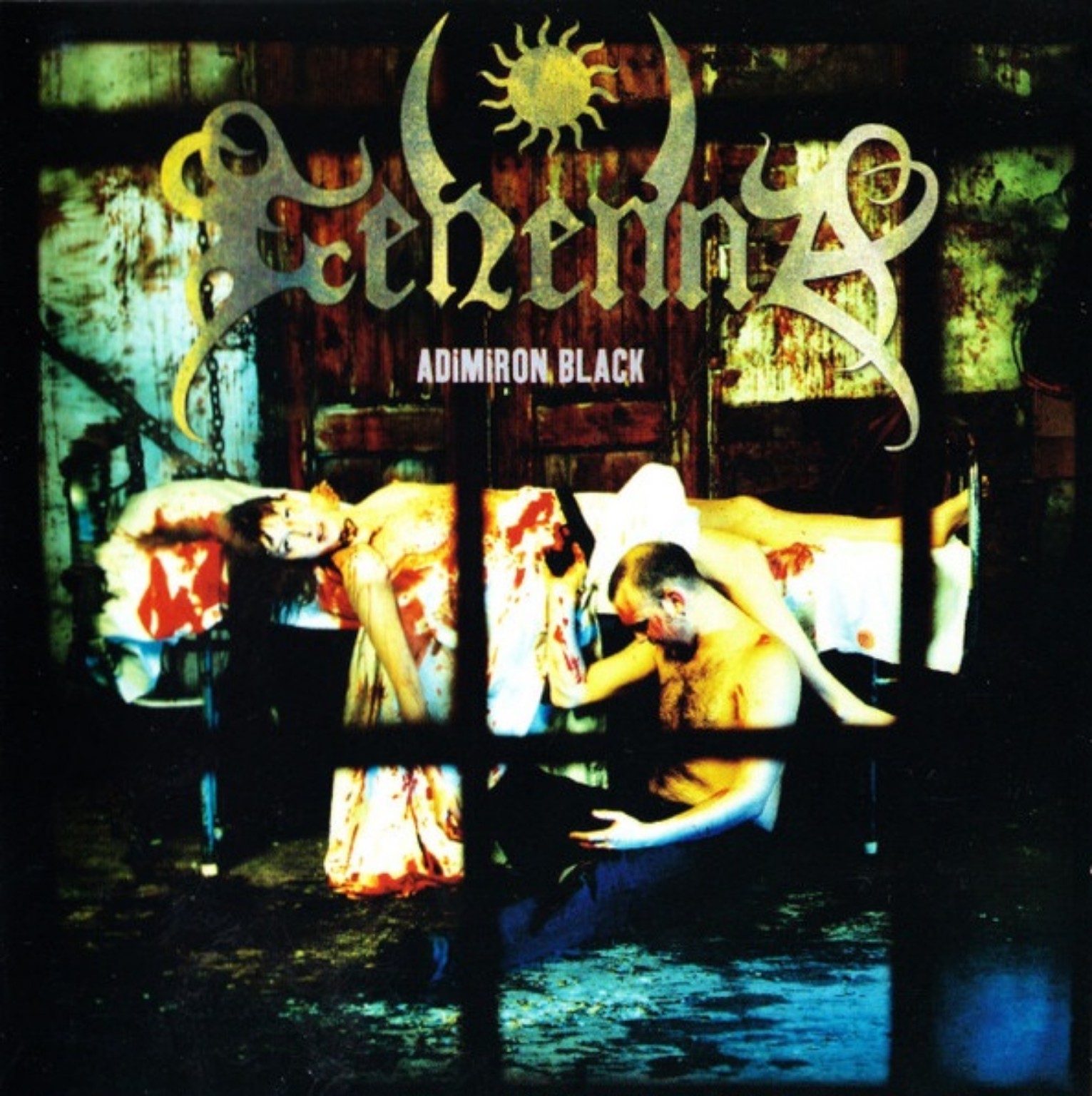
The cover said the same thing in pictures. No forest ruins, no medieval-looking symbols, no romantic death. A dirty, old factory building. White sheets. Blood. A man who, according to one interpretation of the scene, has shot a woman and then turns the gun on himself. The image was not intended as an illustration of any single lyric. It was meant instead as the emotional equivalent of the album as a whole: modern, immediate, hopeless and brutal.
Behind the Bars — The Cover of Adimiron Black
The cover of Adimiron Black reveals a scene as though we were peering into a sealed, abandoned room. In the background are dark-brown, rust-like surfaces and walls mottled with green. In front of them, a pale-skinned woman with long black hair slumps sideways, one arm hanging down. Vivid red, blood-like stains mark the white fabric behind her. Lower down, to the right, a bare-chested man sits or kneels, his head bowed. The proximity of the two bodies and the contrast between their postures create a grave, disturbing connection, yet the photograph does not tell us with certainty what happened to them.
Thick black vertical and horizontal bands intervene between the viewer and the figures. They suggest a window frame, barrier or bars, dividing the image into separate compartments and preventing the eye from passing freely over the bodies, the white fabric and the floor fading into shadow. The colours are almost raw: reds burst from the white, the yellowish light on skin collides with cold greens and blues, and the edges of the composition close in towards near-blackness. Rather than beautifying the spectacle, the photograph’s theatrical lighting and harsh contrasts make it uncanny.
At the top, Gehenna’s elaborately curling golden emblem dominates the space, embellished with motifs resembling a sun and crescent moons. Beneath it, the title ADIMIRON BLACK, set in plain, narrow white letters, seems unusually matter-of-fact. The old ritual symbolism of black metal thus remains suspended above a cold, uncomfortably corporeal scene. The cover draws its force from this tension: in place of the mysterious distance of earlier records comes an unsettling closeness to danger. The same close, violent pressure characterises Gehenna’s change in sound in 1998. The image does not narrate the precise story of any single song; rather, it is the visual counterpart to the album’s harder, less ornamented world.
Nor did the original printed release present the appearance of Adimiron Black as the work of just one person. Petter Hegre took the front-cover photograph and the band photographs. A. Griffin received credit for cover design, additional photography and illustrations. Even the creator of the KATUSCHA typeface used for the lettering was named: Frode Slotnest. As a physical object, then, the album consisted not only of seven recordings but also of meticulously planned visual and typographic work. The listener encountered its title and photographs in the same package that carried the band’s transformed sound.
Another, very different sentence remained at the bottom of the credits. Blod dedicated the album to the memory of Georg Berge. The booklet did not explain who Berge had been in the drummer’s life or what lay behind the dedication. The act of remembrance therefore stands on its own. It needs no invented personal scene, story of friendship or tragedy. Even without those embellishments, the name preserves something the record’s hardest, densest sounds cannot express: that behind the instruments, photographs and printed words, there were human names.
By 1998, black metal could no longer remain suspended in the moment a few years earlier when mystery alone had seemed sufficient. Records were appearing in more and more countries, the genre’s sounds were becoming increasingly distinct, and bands had to choose what to hold on to. Some found strength in melodic monumentality, others in avant-garde fragmentation. Still others returned to an older rawness, or allowed the impact of death metal to move closer to black metal’s body.
In this sense, Gehenna’s decision in 1998 was not an isolated eccentricity but one emphatic answer offered by its era. What had once sounded spacious, mist-shrouded and distant became tighter and less merciful. Yet there was more than one direction in the surrounding scene. Symphonic and gothic metal were gaining strength around Stavanger; across Norway, technical, orthodox and experimental schools were developing side by side; throughout Europe, labels, tours, magazines and physical records connected listeners scattered far apart. Adimiron Black emerged from this noisy, contradictory world. It proclaimed neither the end of black metal nor a single new beginning. A band was arguing with its own past while the entire genre around it searched for its next form.
============================================================
The World of the Seven Songs
When “The Killing Kind” begins, there is no introduction. There is no need to wait for the album to reveal how the band has changed. The change is there from the first instant. The song is short, compact and on the attack. The riffs do not hover; they strike. Human violence appears not as some external demon but almost as an inherent trait of the species. Blood and war are not couched in mythical language; they are stated directly.
“Deadlights” works differently. It is longer, more varied, and allows somewhat more space for the old atmospheric sensibility familiar to listeners of Malice. Perhaps that is why it became one of the period’s representative songs and the title track of the accompanying release. It is a passageway: not the new Gehenna at its most extreme, but a door through which the old audience could enter the next room.
The printed songwriting credits for the seven tracks make Sanrabb’s central role as a composer unmistakable. According to the booklet, he wrote both music and lyrics for the first three songs, as well as for the track called “Devil’s Work”. The two tasks were divided on “Seed of Man’s Destruction” and “Slowly Being Poisoned”: Sanrabb wrote the music and Dolgar the words. Sarcana joined as a co-composer on the closing “Eater of the Dead”, while Sanrabb remained the lyricist. These seven simple credits do not pass judgment on the songs, nor do they tell us how the pieces took shape in rehearsals. They do, however, show where the work came together and where it was divided on a record so often regarded as a sonic rupture in Gehenna’s later history.
============================================================
The Title Track and the New Direction
The title track, “Adimiron Black”, makes it clearer still that the past had not vanished. Sarcana returns as a guest on keyboards, as though a shadow from an earlier era were reaching into the new record. The song is longer and more layered; alongside its physical weight, it retains something of the expansive, dark harmonic world that had previously defined Gehenna. If the title really did evoke black blood in the band’s imagination, then this song embodies precisely that transition: mystical darkness becoming something bodily.
“Seed of Man’s Destruction” pulls the album back towards a more direct assault. The title itself suggests that the seed of destruction lies not outside us. It is not brought by an alien force, but by humanity itself. The lyrics speak of technological terror, genocide and the annihilation of entire nations. In the world of Adimiron Black, the apocalypse need not be supernatural. Human beings are capable of building it themselves.
This matters particularly because Gehenna’s earlier darkness often found expression through archaic and occult imagery. In 1998, machines, weapons, factories and modern warfare moved into the foreground. Civilisation offers no refuge from chaos; it becomes the instrument of chaos. The industrial quality, then, is more than a matter of sound. It is a worldview.
The Weight of Longer Compositions
“Devil’s Work” is the album’s longest piece, and perhaps the clearest evidence that making the music more brutal did not mean simplifying it. Across more than seven minutes, there is room for slower, darker passages, atmospheric keyboards and extended passages of mounting tension. This may be the song in which the old and new Gehenna meet most naturally. It remained in the live set years later, after “Deadlights” had disappeared from it. Not because anyone had decreed it the record’s best track, but because it continued to work on stage.
Meanwhile, the lyrics to “Devil’s Work” make no attempt at subtlety. Their anger against Christianity is overt, harsh and repetitive. They do not employ the distant, ceremonial occultism black metal has so often used. This is closer to an outburst of rage. The same hostility to religion reappears in a still more personal form in “Slowly Being Poisoned”, whose meaning Dolgar himself explained. For him, Christianity is presented here as a force that slowly poisons a person’s life, cultivating guilt and dependence while diverting attention from the present towards a promised afterlife.
That makes the song a peculiar counterpoint to the album’s immediate violence. It speaks not of an explosion but of a slow internal process: of how something can be lost almost without your noticing. The new role of the keyboards is especially palpable here: they offer no release, only coldness. It is as if the darkness of the old Gehenna had ceased to be night and become poisonous air instead.
The Closing Track and Deadlights
At the end, “Eater of the Dead” mixes everything together one last time. Sarcana returns not only as a keyboardist but as a co-writer. Thrashing eruptions, black metal roots and atmospheric layers come together in one final gesture. The song does not resolve the album. It leaves it open, as though to say: this is not the end point.
And indeed it was not. Around the Deadlights release there remained “In Mother’s Tomb”, from the same 1998 sessions, but too long and somewhat too distinct in sound to fit on the tightly constructed album, which runs barely thirty-six minutes. Alongside it stood “Master Satan”, an older thrash piece with an eighties flavour, recorded back in the Malice period. Together, these three songs became almost a secret map: a remnant of an old direction, a companion to the new era, and one of the album’s representative tracks, all in one place.
The Year the Album Appeared
By the spring of 1998, Adimiron Black was essentially finished. The decision was no longer a plan. Sanrabb was already explaining why the record had turned out the way it had. In May he spoke of a launch-style concert in Oslo alongside Gorgoroth and Dødheimsgard. The album appeared on Moonfog in June. Almost at once, the press began discussing the very thing the band itself was talking about: the break with the past.
Europe and Norway in 1998
Nor can late-1990s Europe be captured in a single reassuring image. In one part of the continent, post-Cold War economic and political integration dominated the agenda; elsewhere, armed conflict continued to threaten civilians. On 10 April 1998 the Belfast Agreement, also known as the Good Friday Agreement, was reached. After decades of conflict in Northern Ireland, it established the foundation for a new system of power-sharing institutions, although making peace a practical reality still required further work. In the same year that a longer-term political settlement could once more be contemplated, images of war were arriving from another part of Europe.
Armed conflict escalated in Kosovo from the spring of 1998. A report dated 22 September 1998 by the Parliamentary Assembly of the Council of Europe spoke of refugees and internally displaced people numbering in the hundreds of thousands, uninhabitable homes and difficulties providing humanitarian relief. These events must not be conflated with NATO’s later air campaign in 1999; a historically accurate portrait of the period has to distinguish them carefully. War’s destruction, forced flight and political uncertainty were already part of Europe in 1998. That forms a valid historical backdrop to understanding art concerned with brutality, but it does not establish that any particular Gehenna lyric was about Kosovo.
Another, more long-term tension was also coming into view in European and global thought. The Kyoto Protocol was adopted on 11 December 1997, creating a new framework for international climate policy. This was particularly interesting in a country whose prosperity was closely bound up with the oil and gas industry. Adoption did not mean that the protocol was already in force in 1998; that only happened in 2005. By the end of the 1990s, income from fossil fuels and questions of global environmental responsibility were therefore entering political debate at the same time.
Distant crises also matter to Stavanger’s story because the city’s economy was connected to the entire world through resources extracted beneath the sea. In the summer of 1997, financial turmoil began in Thailand and went on to severely affect the economies of other Asian countries. The crisis deepened in 1998, investor confidence faltered, and the downturn affected demand for energy. By September 1998, the International Monetary Fund was warning that the spread of the Asian crisis and the Russian financial crisis were worsening the outlook for global economic growth.
The next major blow came in August: on 17 August 1998, Russia responded to financial pressure by devaluing the rouble and rescheduling part of its government debt. The consequences did not stop at its borders; uncertainty rose in international financial markets. It would, however, be wrong to claim that Gehenna’s members were responding to these events in the studio: the album had been recorded earlier and was already out in June. The crisis belongs to the story of its year because it shows just how uncertain the world had become by the second half of 1998—an era now easily remembered as one of carefree economic modernisation.
The period is often imagined as a triumphant ending to the 1990s. For Stavanger, the picture is more complex. A growing city in western Norway connected to international industry; an agricultural and maritime economy around it; a functioning welfare state and a new approach to the long-term management of oil wealth at national level; peace negotiations and the devastation of war in Europe; financial contagion and falling commodity prices around the world. Adimiron Black is not a chronicle of these events, but a work made in a year when all of them existed side by side. Knowing the period cannot replace the meaning of the seven songs, yet it brings the world into which the album arrived into sharper focus.
The Album’s Contemporary Reception
Rock Hard gave the record a strong review. Metal Hammer highlighted the new, more mechanical aggression with its leanings towards industrial music. Yet the album did not produce an unequivocal breakthrough. That is one of the strangest aspects of Adimiron Black’s story. It could receive favourable reviews while leaving parts of the old audience unsure what to make of it. Dolgar later recalled that many had simply expected Malice Part 2. That was not what they got.
Nor did the new album attract large numbers of new fans. According to Dolgar, attention at the time was focused much more on other Norwegian bands, such as Dimmu Borgir. A proper tour did not materialise either. That must have been especially bitter for a record born partly out of the logic of live aggression: the band did not get enough opportunities in precisely the setting where the new songs might have proved themselves most effectively.
From outside, it would have been easy to say that Gehenna had abandoned black metal and switched to death metal. Sanrabb did not see it that way. For him, black metal identity was not merely a matter of guitar tuning and drum patterns. Darkness, a satanic and anti-Christian character, contempt for society and aggression mattered more. The instrumentation could change, but the fundamental experience, in his view, remained the same.
Perhaps that is why Adimiron Black is so hard to settle with a single genre label. Black metal heritage, death metal weight, thrash directness and an industrial sensibility are all present at once. Moreover, the machine-like quality is produced by flesh-and-blood musicians: live drums, attacks hardened with triggers, percussive guitars, fuzz-laden bass, an analogue synthesiser and two distinct vocal characters. Organic and artificial at the same time. Human and machine-like.
The Afterlife of a Change in Direction
Two years later, Murder pushed this direction further still. Dolgar would later say that, after Adimiron Black, they really did take the brutality of death/thrash to its limit on that record. Murder retained less of Gehenna’s earlier layers; it became more direct and more extreme. Paradoxically, that is precisely what later revealed how peculiar the 1998 album was. Adimiron Black still stands between two worlds.
After Murder came yet another turn. In 2005, WW returned to more stripped-down black metal roots. It proved once and for all that change was no one-off accident in Gehenna’s history. It was the constant. Sanrabb had said as much back in 1998: they were bored with doing the same thing over and over. Adimiron Black did not establish a new formula for eternity; it showed how far they were prepared to go to avoid repeating themselves.
Gradually, time changed the conversation surrounding the record. What had caused bewilderment in 1998 began to attract increasing praise years later. Older fans no longer listened to it while waiting for another Malice. Once the entire discography was in view, it became possible to see that the album did not fit badly into Gehenna’s story. Its very place in that story was not to fit. It was there to mark a rupture.
Reissue and Reappraisal
Peaceville’s 2011 reissue approached it in precisely that way: as a historical document. A twenty-page booklet, bonus material, songs associated with Deadlights, rare demos, a Darkthrone cover and a concert intro. The workshop of that period could slowly be pieced together again. Dolgar was pleased that, at last, not just the album but the story surrounding it would survive.
Meanwhile, the cover acquired a life of its own. Years later it became subject to legal restrictions in Germany, and when the vinyl was reissued in 2021 it had to be handled in a way that preserved the original image without presenting it to the outside world in quite the same manner. A strange fate for an album cover: what had been the visual counterpart to an aggressive sound in 1998 still carried tangible consequences more than two decades later.
And through it all, the music itself remained. Not pure symphonic black metal. Not wholly death metal. Not truly industrial metal. Not as relentlessly brutal as Murder, nor as stripped down as the later WW. It retains something of each, and lacks something of each. That is exactly why it lives on.
For Adimiron Black is not about the moment a band discovered a new sound. It is about the moment it deliberately lost its old one. What mattered most to Gehenna in 1998 was not that everyone should understand what they were doing. It was that they should not do again what they had already done well once before.
Malice demonstrated how they could build a dark, symphonic world. Adimiron Black showed that they were capable of tearing it apart with their own hands when it no longer felt dangerous enough. Perhaps that is the record’s true black blood: not the cover, not the title, not the brutality, but the stubborn instinct that would sooner accept incomprehension than repetition.
Adimiron Black did not bring Gehenna to an end. It wounded the band—and from that wound the next era grew.
Reader comments
Comments only appear after approval. Messages are displayed in their original language.
Comment submissions are not enabled yet.