

Trapped in the Depths of Eve...
The story of Asgaroth’s first full-length album: Barcelona in the 1990s, its underground scene, the recordings, eleven tracks, enigmatic artwork and the album’s rediscovery.
Prelude — The Gateway to the Depths
Some albums have a story that begins on the day they are released. Others demand that we start much further back. The threads of Asgaroth’s first full-length album lead us to a city whose polished public image held out the promise of a new Europe, while another, quieter life unfolded in its streets and music communities. The protagonist here is not a single person, but the shared musical language gradually developed by three musicians: something captured first on cassette, then in the studio and finally on the album itself.
The title Trapped in the Depths of Eve... already contains the contradiction that runs through this account. The depths confine, yet the music opens up vast landscapes; darkness belongs to the cover, while conjuring the atmosphere takes the work of an entire band. We will not replace documents with invented memories. Instead, we will seek the path that can genuinely be traced backwards through old photographs, song titles, interviews and the words of the music press.
Telling the story of a single album involves more than assembling a track list, a release year and a few details from a band biography. Trapped in the Depths of Eve... marked a turning point for Asgaroth. What began as Lord Lupus’s solo initiative, and developed through his creative partnership with Mythral, became a three-piece band capable of expressing its ideas across a full-length record.
The story begins in Barcelona, but not with the false assumption that every major political or cultural event in a city must necessarily inspire the musicians who live there. This book describes the world in which they may have moved, while consistently distinguishing documented personal influences from events that merely form the background to the period.
The original CD booklet, interviews with the band, contemporary fanzines and later recollections do not all answer the same questions in the same way. The original release is the best place to establish the record’s publication and studio details; the musicians themselves are best placed to speak about their intentions; and the differing opinions of reviewers reveal how the record was received. Together, these distinct perspectives form the story of the debut album.
The complete MP3 collection examined here contains all eleven compositions. A technical analysis of dynamics was carried out across the audio files; it documents changes in sound energy, but cannot stand in for the musicians’ own accounts of their intentions, nor is it equivalent to a person listening to the music. Descriptions of the instrumentation therefore draw on the band credits and the interpretations offered in reviews.
No verified primary document establishes the exact day or month of the album’s release in 1997. Some descriptions from the 2024 reissue label date the original album to 1998, whereas earlier discographies and the copyright line on the CD point to 1997. This discrepancy must be preserved rather than concealed.
The City Where the Sound Was Born
The Barcelona of the 1990s did not take shape in a single moment. A city newly opening towards the sea, international attention and the geography of everyday life were layered over one another. Much of the transformation brought by the Olympic building projects was visible on the surface; Asgaroth's story, however, becomes interesting where that surface gives way to self-organised music. Record shops, small labels, fanzines and clubs made connections possible, even as this worldwide movement still retained the intimacy of parcels sent through the post and copied cassettes.
It was into this environment that Daniel Rubí's initiative emerged. What took shape first was not a fully formed, noisy live band, but a compositional idea seeking expression in a handful of recordings under the title Songs of War. What followed was not a fairy-tale breakthrough but gradual growth: a new creative partner, the real work of being a band, experiments in search of a sound, and titles that hinted at increasingly serious ambitions. Behind the masks and stage names used later, it is worth looking at the decisions that can still be documented rather than at supposed secrets.
The dark imagery of the genre often goes hand in hand with a romantic notion of isolation. The reality here tells a different story. Asgaroth did not emerge from nothing, nor was it merely the echo of a single foreign band. Behind it stood local people, available technologies, links with record labels and the movement of the international underground. None of this diminishes the band's individuality. On the contrary, it shows how many elements had to come together before Asgaroth could find a voice of its own.
Barcelona and Its Underground
The story of Asgaroth, formed in 1995, cannot be understood simply under the label “Spanish black metal”. A more precise map starts with Barcelona and the wider Catalan region. During the 1990s the city had several distinctive identities that seemed almost superimposed on one another. Outsiders saw a renewed Mediterranean metropolis rising to international prominence; musicians and local subcultures, meanwhile, had to sustain rehearsal rooms, clubs, shops, editorial offices and small communities finding their way towards one another in that very same city.
The 1992 Summer Olympics marked an important dividing line in the city's history. The redevelopment associated with the Games opened Barcelona towards its waterfront; the Olympic Village, the road network and the transformation of Poblenou formed part of a broader process of post-industrial urban planning. The social consequences were already being examined in academic work before the Games: in 1991, Elisabeth Tejero Gil warned of the expected social restructuring of Poblenou and the danger of one group of residents being displaced by another. Later scholarship likewise analyses the urban development of the 1980s and 1990s as a long-term structural turning point.
We do not know precisely which neighbourhoods Asgaroth's members lived in between 1995 and 1997, or whether Olympic redevelopment directly affected their work. It would therefore be wrong to write that “the rebuilding of the city alienated them”, or that “the accelerated pace of Barcelona drove them to escape into fantasy”. The research does not support such claims of personal cause and effect. We do, however, need to understand their surroundings: within a city gaining a major international profile, there existed a relatively small, determined, dark and difficult-to-classify musical milieu.
This produces a contrast that also matters in literary terms, though it needs to be expressed with restraint. The sunlit Barcelona of picture postcards did not exclude the Barcelona of smoky rehearsal rooms, dark album sleeves, distorted guitars and small-run fanzines. Both worlds inhabited the same city, but there is no reason to presume an unproven connection of deliberate rebellion between them.
In the mid-1990s Barcelona was not exclusively a metal city. The Sónar festival began in 1994 as a meeting place for electronic and experimental music; in the same period, the city's clubs, independent labels and other music scenes developed in parallel. Later accounts also identify the rapid strengthening of the city's electronic music culture as one of the decade's defining features.
That is not to say that Asgaroth acquired its interest in keyboards, electronic sounds or experimentation from Sónar. There is no statement from the band to support that. Rather, the point is that the technical and atmospheric devices they employed should not be situated on an imaginary artistic island cut off from everything else. Several new musical languages coexisted in a large city, while the extreme-metal scene also maintained institutions of its own.
Clubs and the International Scene
The documented concert history of the Garatge Club at the time offers a useful sense of that diversity. The club hosted other forms of alternative music alongside metal and hardcore; Rockdelux's own historical overview recalls specific performances from the period. A public, community-maintained concert archive lists Sacramentum as having played the Garatge Club in Barcelona on 21 June 1996, and In the Woods... on 24 November that year. Such retrospective concert listings are not as strong as an original ticket or poster, but at present they can serve as evidence of a broader international metal presence. There is no proof that Asgaroth's members attended either performance.
The description of the documentary Blackcelona: Una historia de metal satánico published by Spain's official film register identifies by name important participants and locations in Barcelona's black metal milieu. Among the bands it lists are Asgaroth, Countess, Akerbeltz, Beheaded Lamb, Gorthaur,
Sacrum Sacrificationis, Foscor, Blazemth and Atman. The other half of the system consisted not of guitars but of infrastructure: MetaliKO magazine, the New Gotia and Abstract Emotions labels, Don Simón studio, the Garatge Club and the Anaconda and Hysteria record shops. Asgaroth musicians are also among the documentary's participants. This is some of the strongest evidence that the group belonged to a specific historical scene.
At the time, such a network performed a variety of functions. Record shops did more than sell rare foreign releases: they brought them to people's attention. Clubs provided opportunities to play live and make contacts. Magazines and fanzines helped musicians and listeners discover, evaluate and connect with one another. Labels offered the possibility of issuing recordings and distributing them across the country. This is a general model of how the scene functioned, derived from contemporary sources; we do not know every particular purchase, shop visit or personal meeting involving Asgaroth.
In a press account published around 2024, the director of the film singled out a Sacrum Sacrificationis performance held at Barcelona's Plaça Tetuan in the summer of 1993 as one memorable early turning point. The chronology is particularly important here: this took place two years before the documented beginnings of Asgaroth and belongs to the local scene's earlier history. We cannot claim that Lord Lupus or Mythral took part.
In a later interview, the documentary's director also spoke of rivalries among local bands and of the Asgaroth-related memories explored in the film. This matters because it prevents idealisation. The scene was not necessarily one harmonious “big family”, but details of specific personal disputes could only be written on the basis of actual statements by the musicians involved.
Local Labels and Distribution
The role of local labels is especially important in understanding Asgaroth's early career. New Gotia Records was one of the early specialised enterprises releasing Spanish black metal. Lord Todmir, whose real name is Manel Yélamos, was associated with the label and is credited as executive producer on Asgaroth's 1996 EP. A later reissue announcement explicitly describes New Gotia as one of the first labels specialising in Spanish black metal. The distribution and label connections between New Gotia and Repulse Records also show how an extreme-metal recording from Barcelona could reach beyond its local circle of fans. We do not know the full details of the contractual relationships.
In discussing the genre's background, it is essential to distinguish the atmosphere of the period from proven influences on the band. The symphonic and atmospheric strands of European black metal were gaining wider attention, but Asgaroth's music fitting into that world does not establish that they took any specific Norwegian, Swedish or other group as a direct model. A later Spanish biography mentions links between the early fantasy atmosphere and Tolkien's imagery, but I cannot presently substantiate this point by referring to a specific statement made by the band in 1995–1997.
1995: Lord Lupus and Songs of War
The personal starting point of the story is Daniel Rubí, who used the stage name Lord Lupus at the beginning. Later band biographies and, more valuably, Christopher's recollections from 2005 agree that Daniel started Asgaroth as a solo project and that Christopher joined only afterwards. This is an important qualification of later interviews that sometimes describe the two of them together as the original creative partnership. The founding of the project belongs to Daniel; the development of a lasting identity as a band belongs to the two of them.
The first tangible document is the 1995 demo cassette “Songs of War”. Recorded in May 1995, the original cassette listing credits Lord Lupus with all instruments and vocals. It contains four tracks: “Revenge”, “I Summon the Black Spirit”, “Songs of War” and “Raise the Magic Powers”. The roughly quarter-hour recording was self-released, with a photocopied, three-panel cover. That format says a great deal about the project's earliest state. No major label apparatus was building up a new name: an underground musician had made himself a recorded calling card, one that could circulate according to the conventions of the cassette-trading and small-label culture of the time.
I have no reliable contemporary recollection establishing what equipment was used for the demo, in which room it was recorded, over how many days, or what immediate personal impulse lay behind it. These details therefore cannot be written up as a historical scene. What the recording and later descriptions do make clear is that the compositional idea came before a complete line-up capable of playing concerts. “Songs of War” marks the point of departure from which Asgaroth could soon develop into a band.
Christopher Baque-Wildman, also known as Mythral, joined after the initial one-man period. Later interviews refer to Daniel and Christopher as Asgaroth's two central, enduring members. Christopher helped shape the guitar and keyboard parts and additional vocals, later taking an increasingly prominent role in composition and arrangement. In the band's story, therefore, 1995 is not a single moment but a transformation: Lord Lupus's original creative vision became a shared musical enterprise.
Answering a question in 2005, Christopher also explained that the early stage names and the band's former presentation belonged to a different phase of life. His later creative self had less need for that kind of disguise. We must not project this comment backwards as if we knew every motive behind the choice of names in 1995. It does, however, show that the musicians themselves understood their beginnings as part of a history of personal change.
Christopher was also active in Spain's metal press as a contributor to Hell Awaits magazine. In the 2005 interview, he confirmed that his association with the publication went back to its fanzine period and that he continued to help with its work. This connection illustrates how closely knit the scene was: Asgaroth's members were not merely subjects of the underground press; one of them also took part in making it. That does not automatically mean that any particular magazine or editor invariably treated the band favourably. Christopher himself emphasised that Hell Awaits retained its independent judgement in both positive and negative matters.
…but I have not found complete documentation that can be publicly verified.
New Gotia, Repulse and Underground Contacts
The Repulse Records dossier published by La Factoría del Ritmo on 1 July 1997 is especially important here. It is not a recollection written twenty-five years later but a snapshot of the industry at the time. Under the name New Gotia, the article lists Atman, Xharathorn and Asgaroth, noting that all three groups represent different facets of black metal, from the rawest sounds to atmospheric approaches. The overview discusses New Gotia within Repulse Records' distribution network. It provides directly verifiable, contemporary evidence both of the record's visibility across Spain and of the label network.
An interview with Lucky, one of Repulse's leading figures, appeared on the same day. He explained that the label expected bands not merely to record music but also to take part in press and radio promotion; the label's responsibilities included distribution, production infrastructure and publicity. The text preserves one of the sober realities of the underground economy: simply releasing a record did not automatically make a band well known.
The link with the label is therefore documented as a factor at the A–B evidence level in the band's career. That does not, however, mean the label dictated what a particular keyboard part should sound like, how long the album should run or what the word “Eve” meant in its title. We have no evidence of such direct interference in the creative process.
At the time Trapped... was created, information about metal music travelled in a very different way from today. Recordings reached listeners through cassettes, limited-run CDs, mail-order catalogues, imported stock in shops, review columns and recommendations from friends. The underground of the period was not simply an “internet-free” state of affairs, but an active international network operating according to a different logic.
A first-rate contemporary example comes from the final part of Lucky's 1997 interview. The label representative said that Repulse hoped to obtain an internet connection soon, but that until then its catalogue could be requested by post, with a stamped, self-addressed envelope. The precise instructions concerning the 125-peseta postage cost are themselves a document of the times. This is no theoretical assumption: the 1997 article really did describe this as the way to make contact.
Repulse's “catalog-zine” format was equally characteristic. Commercial catalogue and fanzine overlapped: record reviews, news, release listings and ordering details could all appear in a single publication. Such a medium supported both business and the spread of musical knowledge. A fanzine was not merely a vehicle for advertising; it also generated criticism, connections, aesthetic tastes and a memory of its era.
Hell Awaits provides a particularly personal link in Asgaroth's story. In 2005 Christopher Baque-Wildman confirmed that he had been involved with the magazine since its fanzine days and still helped with its work. He said it had treated the band fairly in both favourable and unfavourable matters. That is a much more accurate claim than suggesting the group had “its own propaganda magazine”. The connection was real, but the musician himself stressed the independence of its reviews.
The band's use of English also belongs within this international underground context. Christopher said in 2005 that several of those involved had British family backgrounds, so using English and communicating abroad felt natural. This remark must not be taken to mean that we know every literary or linguistic decision behind the album's English lyrics. The potential for international connections, however, is plain from his own account.
Everyday Life in the Era: A Historical Supplement
On the Edge of Recovery: Work, Uncertainty and Everyday Life (1995–1997)
In Barcelona in the mid-1990s, another process could be felt alongside the striking signs of renewal: the economy of both city and country was reorganising after a severe downturn. The Spanish recession of 1992–1993 was followed from 1994 by a recovery that was slow at first and then increasingly pronounced. Growth, however, did not eliminate the inequalities that could determine a young person's prospects for work, education and leisure. According to the national labour force survey for 1995, unemployment stood at 22.9 per cent. Among economically active 20–24-year-olds, it reached 40.0 per cent that year. The latter figure does not mean that four out of every ten people in their twenties were out of work: it refers to those of the relevant age who were participating in the labour market, not to all young people. The central point remains stark: for many, the beginning of adult life still offered little security.
Nor can Catalonia's situation be described solely in terms of increased tourism in Barcelona or its refurbished streets. Idescat gives an unemployment rate of 19.7 per cent for the Catalan region in 1995. Comparing the national and regional figures shows that labour-market pressures were not unique to either territory, even though differences in industrial and service-sector structures shaped how each responded. The statistics illuminate a social environment; they tell us nothing about where any member of Asgaroth worked, whether they were studying or whether they experienced unemployment. Without documents relating to their individual lives, such claims cannot and should not be made.
The situation improved over the next two years, but uncertainty did not disappear. A contemporary Eurofound overview published in late 1997 recorded national unemployment rates of 22.2 per cent in 1996 and 20.8 per cent in 1997, alongside economic growth of 3.4 per cent in 1997. Particularly revealing is its treatment of fixed-term employment as one of the labour market's central problems: temporary contracts accounted for almost a third of those in employment. Better economic indicators therefore did not offer everyone a straightforward route to a stable, lasting income. In telling the story of small independent cultural enterprises, this contradiction of the era matters more than any retrospectively constructed and overly simple narrative of success.
Questions of livelihood began outside music itself. How much money did people have left for entertainment, a cassette, a CD or a concert ticket? Who had the time, and when? A young musician did not necessarily have to be wealthy to create music, but access to recording facilities, instruments, free hours, transport and duplication all depended on money and organisation. Without an actual Asgaroth budget from 1995–1997, records of each member's earnings or a travel diary, these observations describe the opportunities and constraints of the time, not a reliably reconstructed biography of the band's members. The mail-order catalogues and label connections already described in the original account thus acquire a broader social context without imagination being used to fill in anyone's life story.
An Industrial City in Transition, Different Cultural Spaces
Barcelona's economic transformation was not simply an Olympic makeover. As early as 1993, Rosa Tello i Robira described a city moving away from its industrial past towards a space organised around management and consumption, with new relationships between public and private capital accompanying its renewal. A study published in 1992 by Joan-Eugeni Sánchez provides a longer perspective: industrial restructuring had begun decades earlier, alongside changing manufacturing technologies and the integration of the Spanish economy into Europe. The major investments therefore accelerated a social and economic transition already under way.
Poblenou became an especially visible symbol of that transition. Areas of a district once associated with industry and railway infrastructure were reshaped by the Olympic Village, transport and waterfront developments and, later, new patterns of property use. In 1991, before these processes had fully unfolded, Elisabeth Tejero Gil expressly examined the possibility of changes to the population's composition and social displacement. Subsequent research documented the district's long-term transformation in property markets and social structure. It would be wrong to conclude that such developments forced the band into particular rehearsal rooms, or that its lyrics concealed a protest grounded in urban sociology. The point, rather, is that the city in which Asgaroth began was at once a cultural centre offering opportunities and a place where residential communities lived under sharply differing conditions.
The city's musical institutions, too, consisted of more than commercial clubs and record labels. La Bàscula, a community institution at the foot of Montjuïc, was established as a civic centre in 1988 and, according to its own retrospective account, began operating as a music venue in 1990. Its openness to performers of different levels and genres shows that urban youth and community infrastructure also created possibilities for live music. La Bàscula is not a documented Asgaroth venue. It is mentioned here solely to demonstrate that Barcelona's musicians potentially had access to several kinds of institutions serving different purposes. This example must not be repeated as a claim about a personal appearance by the band or a rehearsal location.
In this setting, where and through which relationships a band could make itself heard was as much an institutional question as an artistic one. A club could put on an evening's performance; a community space could provide a chance to try something out; a shop made rare records easier to find; and a fanzine could carry a name to people who had never attended a single concert. The book discusses Asgaroth's documented connections separately in its sections on Blackcelona and New Gotia. What matters here is simply the historical distinction between the extent of a city's cultural infrastructure and a band's personal participation in each of its venues.
European Integration: Major Economic Plans, Everyday Consequences
By the mid-1990s Spain had belonged to the European Communities for almost a decade. Yet integration into the European economy and preparations for a single currency required decisions in everyday life. An economic report published by the European Commission in February 1997 stressed that a return to growth and employment following the 1992–1993 downturn could not be taken for granted. Tackling unemployment and developing training remained major challenges. In Spain, inflation, public finances and employment were closely intertwined with meeting the Maastricht criteria.
In his parliamentary investiture speech of 3 May 1996, José María Aznar explicitly identified the Maastricht criteria, the restructuring of the economy and conditions of employment as defining priorities for his government. Speaking of government agreements, he also acknowledged the role of the Catalan Convergència i Unió. These developments therefore belonged not only to the story of political power in Madrid: negotiations with regional parties were also part of the environment in which Catalonia's economic and cultural institutions operated. The Catalan language and regional identity likewise had a place in that political background, but none of this permits conclusions about Asgaroth's lyrics or the personal beliefs of its members.
The particular rhythm of economic change, bringing commercial opportunities and insecurity of employment at the same time, was a wider European phenomenon. Eurofound's 1997 review described agreements on employment security and efforts to reduce the use of fixed-term contracts. This world of agreements and legislation belonged to the same era as the acceleration of international musical connections and the cross-border circulation of small-run releases. Not because the former can be shown to have created the latter, but because modern European integration shaped a broader set of conditions for people's working lives, enterprises and cultural opportunities.
Spanish record shops were not yet charging in euros. The peseta was the actual currency of the period. Earlier in the book, the introduction of the euro as an accounting currency in 1999 is correctly distinguished from the arrival of notes and coins in 2002. Record orders, postal charges and historical prices from 1995–1997 should therefore be reported as contemporary facts only in pesetas or in the currency used by the original source. Any later conversion into euros would be a separate retrospective calculation, not a description of how those transactions were experienced at the time.
Between Letters and Screens: A Transitional Era of Communication
Cultural communication between 1995 and 1997 was both physically slow and technologically fast-changing. Letters carrying music, mail-order purchases, photocopied reviews and cassettes passed along to acquaintances did not vanish overnight when broader internet access became possible. For a time the two systems existed side by side: access to the technology, its cost and the practical difficulties of using it all mattered. This is especially important in the history of small record labels, for which the existing book has already drawn on contemporary sources about building contacts.
In its own history of services, Telefónica dates the nationwide presentation of InfoVía to 13 September 1995, during the Informat exhibition in Barcelona. The retrospective account mentions approximately 100,000 household users and 200 service providers by October 1996. Because this is a service provider's retrospective account, those numbers must not be treated as comprehensive statistics for all internet users in Spain. Rather, they show that an everyday channel of communication began to expand during the very years in which the record was being made. A domestic connection tied up the telephone line, access was charged by time, and speeds were extremely low by today's standards.
Moreover, the arrival of the internet did not instantly replace traditional forms of contact. Finding records, organising catalogues and getting information to interested people abroad could involve different channels. Small distributors had to consider both audiences reached through paper or telephone and those appearing on new electronic platforms. We do not know which computers or modems individual members of Asgaroth used, or what their internet habits were, so no personal scene can be constructed from such details. Nevertheless, this passage between two worlds helps explain one characteristic of independent Spanish music at the time: recordings could travel remarkably far through international networks while practical arrangements still often depended on physical media and slower exchanges of messages.
There are limits to what a study of cultural consumption in that period can establish. In February 1995, CIRES conducted a separate nationwide survey of leisure and culture in Spain, covering music, film, television, radio and leisure habits among its questions. The documented existence of the survey shows that social researchers considered these areas important, but the published description of the data alone cannot tell us what proportion of Catalan young people bought extreme-metal records or how frequently they attended metal concerts. General statistics cannot stand in for missing, genre-specific evidence.
The three years during which Asgaroth's first full-length album took shape thus become easier to see. The simultaneous influences included an industrial metropolis in transition, a country under pressure to integrate economically with Europe, young generations seeking work, communities maintaining cultural institutions, technology that was far from inexpensive, and new channels of communication. It has not been demonstrated that any one of these circumstances directly determined a particular melody, title or lyric. Understanding the period is essential nonetheless: it helps us assess more accurately the organisational, financial and human undertaking that bringing a record from an extreme musical genre, launched in Barcelona, before the public may have involved.
From the First Sounds to the Full-Length Album
Little time passed between the first cassette and the first full-length album, but for the band that brief interval brought a complete change of scale. The early fantasy-themed titles had lost none of their force; what changed was the space opening up around the instruments and the structures. The 1996 EP was no longer merely an announcement of a new name. It was a precursor whose music could later find a place on the album, as though the memory of that early work had made its way into the eleven tracks.
Elsewhere in Europe, the same decade was bringing sweeping changes. In one country the correspondence networks surrounding old demo tapes grew into a scene; in another, compact discs and distribution reshaped what was possible. Political systems and major cities were taking on new forms as well. It would be tempting to project every important historical event onto a dark-sounding album. This account cannot do that. We can describe what certainly formed the band's surroundings; we can identify something as a direct inspiration only when a musician or a primary document actually says so.
At the threshold of the studio, history becomes both concentrated and simpler. A particular period, a named location, three musicians and an engineer: these are the secure points that survive from the making of the record. Nothing else gives us licence to invent a nocturnal recording session. Making a full-length album is an adventure in itself: earlier ideas grow into an extended form, symphonic and extreme elements seek a place together, and future listeners are presented with a sonic world that nobody at the time could yet judge in light of the band's entire subsequent career.
The Sound of European Black Metal
Asgaroth in 1995–1997 belongs to a period when an increasingly expansive form of black metal—built around atmosphere, keyboards, symphonic arrangements and longer compositions—was emerging alongside earlier extreme-metal traditions. The Norwegian reference work Store norske leksikon also discusses the international significance of Norway's second wave. But a broader development across the genre must not be mistaken for evidence that any one band was consciously following a particular model.
The chronology matters. Emperor's In the Nightside Eclipse entered the wider musical consciousness in 1994, before Asgaroth's first full-length record. Limbonic Art's Moon in the Scorpio appeared in 1996. Both illustrate how grand, atmospheric, keyboard-led extreme metal was not confined to one country or circle of musicians. Dimmu Borgir's Enthrone Darkness Triumphant, however, was released on 30 May 1997 according to Nuclear Blast's official listing—after the stated recording period for Trapped... had ended in March 1997. It cannot therefore be presented as an already finished album that directly served as a model during those sessions.
Several reviewers compared Asgaroth's record with other bands regarded as symphonic black metal. Such comparisons are critical observations, not confessions by the musicians. Similarities in arrangement do not prove conscious imitation, nor does a shared stylistic trait show that the members personally listened to every act subsequently mentioned by critics.
In 2005 Christopher named a number of artists he was listening to at the time: Tiamat, Strapping Young Lad, Krux, Ewigkeit, The Doors, Pink Floyd and Alchemist. He also spoke of his interest in Candlemass and of his favourite records. This is a GENUINE, DIRECT statement from a musician about the breadth of his tastes, but the interview question concerned listening habits around 2005 and music still to come. The artists therefore cannot simply be listed as proven inspirations for Trapped... in 1996. The source nevertheless shows that Christopher's own understanding of his musical world extended far beyond a single black-metal category.
Christopher likewise said that Asgaroth was not nearly as closely bound to the black-metal scene as many people assumed; the band's principal aim was to create a personal atmosphere and a musical world of its own. This is one of the most important keys to understanding the group because it comes directly from a musician. The label 'symphonic black metal' may help a listener, but it cannot replace an examination of the band's creative intentions.
Asgaroth's earliest work is notably rich in fantasy and mythical references. The titles on 1995's Songs of War and 1996's The Quest for Eldenhor already conjure war, magic, distant landscapes, heroes and conflict. A Spanish biographical overview from 2017 also links this early period with Tolkien's world. Because this is not a direct statement made by the band in 1996, the specific Tolkien connection is presently supported by a secondary source and should be described as such.
Alongside heroic and martial language, the track titles on Trapped in the Depths of Eve... offer darker, natural, nocturnal and mystical imagery: 'Victorious Men of Earth', 'Omens (Presagios)', 'The Dark Force', 'Lost in Natura', 'The Choirs of the Elemental Deities', and the lengthy title evoking a forest, moonlight and shadows. These offer possibilities for interpretation, but they do not authorise the invention of an entire philosophical system. The documented fact is the choice of titles; the precise meaning of the lyrics needs to be checked against the original booklet.
Images of nature, darkness and mythology are not grounds for attributing any particular political movement, environmental programme or religious conviction to the band. 'Lost in Natura' does not establish an influence from environmental politics; nor does the word 'Eve', by itself, show that the album title arose from any specific reading of the Bible. Such claims would require a statement from the creators or a primary lyrical source.
The early songs, titles and artwork nevertheless reveal a significant development that can be understood within the genre: epic storytelling joins a desire for dark, dreamlike atmosphere. Which literary, visual and musical sources the band itself identified in 1996–1997 remains an open research question.
1996: The Quest for Eldenhor
Between January and February 1996 the duo recorded their five-track EP The Quest for Eldenhor at Control Room studio in Barcelona. According to the credits, Lord Lupus handled bass and vocals, while Mythral played guitar and keyboards; E. Cabral is credited for drum programming and engineering. The recording was produced with Asgaroth's involvement, and Lord Todmir appears in the release and production background. The cover, logo and artwork received separate credits, showing that the band was already seeking a deliberately shaped visual identity for its releases.
The EP's five tracks are 'Legends of the Great Magic War', 'The Freezing Winds of Kiljaarn', 'The Last Battle (Tower of Doom)', 'Soul Screams' and 'The Return of the Hero'. The battles, frozen landscapes, heroes and mystical settings in these titles preserve the epic, fantasy-related language of early Asgaroth. A 2017 Spanish band biography also relates this world to Tolkien's writing. Until a relevant first-hand interview with the creators emerges, the more precise formulation is that the fantasy and heroic motifs are documented, while Tolkien's specific authorial influence is known from a later secondary account.
The recording's importance goes beyond the appearance of a first mini-CD. After the earlier one-person demo, Asgaroth was now presented through a recognisable creative partnership, a more developed sound and a professional studio setting. Biographical sources describe a favourable press reception and the subsequent recruitment of a drummer. The general assessment of a 'very good reception' requires caution: it is not the same as independently substantiating every contemporary review. The more important historical connection is that, after the EP, the band was ready to plan a full-length record.
The names New Gotia and Repulse appear alongside one another in sources concerning this stage. Their presence suggests a meeting between specialist local releases and wider extreme-metal distribution. Equally reliable direct testimony on the creators' intentions, pressing quantities and exact sales at the time is lacking.
Spain and Europe: Historical Context
In the years immediately preceding the album, Spain was already living under democratic institutions and within the process of European integration. Important milestones included the beginning of membership in the European Communities in 1986 and the Barcelona Olympics in 1992. In 1995, when Asgaroth was formed, Felipe González's Socialist government was entering its final period; on 4 May 1996 José María Aznar received parliamentary confidence, ushering in a new period of government. Official archives of the Spanish parliament and government record the event and its date.
Catalonia was an autonomous community with its own political and cultural identity, while Catalan- and Spanish-language cultural life existed side by side in Barcelona. Asgaroth entered the international metal world mainly through English titles and lyrics. Christopher's later comments on language, however, concerned his family background and communication, not a declaration of any Spanish or Catalan political position.
The economic and social changes of the 1990s, urban development and young people's self-organising efforts formed the setting in which local musical subcultures existed. We have no direct evidence, however, of which party the members supported in 1996, whose economic policies they agreed with, or whether the change of government influenced the lyrics of any song. Party politics must not be retrospectively turned into a metal album's hidden manifesto.
The international historical setting in the years leading up to Asgaroth's first full-length album changed rapidly. Following the end of the Cold War around 1989–1991, Europe's balance of power and social relationships were reshaped. Wars broke out across the former Yugoslavia during the 1990s; in Bosnia and Herzegovina, the Dayton peace agreement of 1995 brought the main phase of warfare to an end. The United Nations provides a detailed chronology of the October 1995 ceasefire, the November agreement and the December signing.
This wartime backdrop matters to an understanding of the period because the nearby European world was neither peaceful nor united. Yet it would be wrong to infer from titles such as Songs of War, 'Victorious Men of Earth' or 'Last Battle' that Asgaroth was responding directly to the Bosnian war. Without the lyrics and statements from their authors, that would be an invented connection.
The 1992 Barcelona Olympics symbolised the city's growing international openness; from 1994 Sónar reflected the presence of electronic and experimental music there. Spain underwent a political change of government in 1996. At the end of 1997, the Kyoto climate agreement opened a new chapter in global environmental cooperation: it was adopted on 11 December 1997. That was AFTER THE ALBUM'S STATED RECORDING PERIOD. Consequently, 'Lost in Natura' and the record's natural imagery cannot be explained as though the band had been responding to an already adopted Kyoto Protocol while recording the album.
In Europe, the integration process following Maastricht led to the introduction of the euro as an accounting currency on 1 January 1999; physical euro notes and coins did not appear until 2002. This, too, happened AFTER the album was made. It is relevant background for understanding later international distribution and changes in the record market, but it cannot explain songwriting in 1996.
The central lesson is that world history must be considered on two separate pages. On one, we can reconstruct precisely what happened in the world around the musicians. On the other, we can identify actual influences on the record only where the musicians' own words, lyrics, contemporary documents or material evidence point to them. The gaps between those pages cannot be filled for the sake of literary imagination.
Recording and Verifiable Technical Details
It is easy to misunderstand the period's technical possibilities in retrospect. The 1995 Songs of War demo is documented as a one-person project; the following year's The Quest for Eldenhor EP already involved a studio, a fellow musician and concrete work on a release. According to the original discographic credits, Trapped in the Depths of Eve... was recorded between October 1996 and March 1997 at Control Room Studios. The album credits Lord Lupus on bass and vocals, Mythral on guitar, synthesizers and additional vocals, and Katu Marus on drums and programming; Ed Cabral is also credited as engineer. Recording and mixing are likewise presented as work in which the band participated collectively.
These specific credits tell us far more about the period than any unsupported exclamation about an 'old analogue sound'. The keyboards' actual role in the arrangements, the presence of rhythm programming and the collaboration with a studio can all be documented. There is, however, no verified information on the makes of synthesizers, mixing desk, recording system or effects chain that were used. Nor is there evidence that the sessions took place exclusively on analogue tape or exclusively on a digital system. Such details must not be invented on the basis of today's equipment or the known methods of other bands.
The extended studio period, from October 1996 to March 1997, suggests time-consuming work. It does not prove that the participants were in the studio every day for five uninterrupted months. It is the stated interval for recording and mixing, not a daily studio log.
In a later recollection from 2005, Christopher discussed the relationship between Axtudios and Maxim Sound and said that Asgaroth's records were connected to the same studio milieu. This helps explain the local professional setting. The precise identity, addresses and succession of the various studio names still deserve checking against the original releases, particularly as some databases attach an obviously problematic geographical entry in India to Control Room.
The making of the album: autumn 1996 to spring 1997
After The Quest for Eldenhor came Asgaroth's first full-length record. The recording credits give a period from October 1996 to March 1997. The location was Control Room Studios, part of the Barcelona studio network according to the band's later recollections, and subsequently also known under the name Maxim Sound. Some digital album databases incorrectly place the studio in Bangalore, India; by contrast, the credits of the earlier EP and related later recordings, together with Christopher's account from 2005, point to Barcelona. The Bangalore location should not be adopted as historical fact.
The album was made by a three-member creative line-up: Lord Lupus (Daniel Rubí) on vocals and bass, Mythral (Christopher Baque-Wildman) on guitar, synthesizers and additional vocals, and Katu Marus on drums and programming. Engineering is attributed to Ed Cabral, while the band also took part in production and mixing. The available credits assign the album's additional vocal parts to Mythral, especially on the second, third and tenth tracks.
A central part of the band's developing arrangements was the coexistence of keyboards and traditional extreme-metal instrumentation. Rather than simply assembling fast, raw black-metal songs, Asgaroth gave considerable space to synthesizers, symphonic-style transitions, extended compositions and a dark, dramatic atmosphere. The 1997 album was therefore a far more comprehensive undertaking than the demo or EP. It should nevertheless be stressed that this is a historical summary of the sound, consistent with contemporary and later reviews; the document does not offer a fresh, second-by-second analysis of the entire recording.
The album contains eleven tracks, with a total running time of approximately 48 and a half minutes. The known original order is: 'Cry the Way We Greet Our Fates'; 'Victorious Men of Earth'; 'Omens (Presagios)'; 'A Call in the Winds...'; 'The Dark Force'; 'Last Battle (Tower of Doom)'; 'Lost in Natura'; 'The Choirs of the Elemental Deities'; 'Prelude in Dusk'; 'Placious Echoes at Darkwoods You Greet... Silvering Moon Between My Shadows'; and 'Outroduction'. Particularly striking is that 'Last Battle (Tower of Doom)' also appeared on the 1996 EP: the band brought earlier material back for its first full-length. The identical title alone does not establish that the two recorded performances sound exactly the same in every detail.
It would be misleading to invent a complete story from the track titles alone when interpreting the album's lyrical and visual world. Recurring words associated with war, fate, nature, darkness and cosmic forces suggest a thematic arc, but checking the lyrics line by line against the original booklet remains a task for further research. Alongside substantial, lengthy pieces such as 'The Dark Force', 'Victorious Men of Earth' and 'Omens', the brief introductions and transitions suggest that the musicians conceived of the album as a whole rather than merely a sequence of isolated songs. That is an interpretation, not a quotation from the band.
Even the release year cannot be treated as unambiguously settled. Encyclopaedia Metallum and other discographies date the original New Gotia/Requiem Records CD, catalogue number NGR 007, to 1997. The label's description of the 2024 reissue and related Spanish press coverage, however, give 1998 as the year of the original release. The recording can be documented through March 1997; this does not automatically establish the day of release. Until an original dated document from the first pressing or comparable direct evidence emerges, the accurate formulation is: 'debut album catalogued as 1997; some label sources give 1998'.
Why might Asgaroth's first full-length have mattered in this musical environment? Because, judging by the available sources, it sought not merely greater aggression but a more expansive musical world, with a wider range of colours and moods. The rawness of the black-metal tradition was paired with its documented combination of synthesizers, guitars and vocals, and with structures suggesting more varied sections. An exact account of the music itself would require direct listening and verification track by track; this text does not claim to have reanalysed the entire album recording.
Later critical rankings tend to reduce an album's significance to a single sentence. In 2005, however, Christopher described Trapped... and Absence Spells Beyond... as belonging to a period that had come to an end. Some listeners regarded that period as the band's best, while others understood its subsequent changes. The musicians did not disown their early album, but neither did they wish to remain forever within the same musical form.
In 2007 Christopher confirmed more precisely that, for the planned new album that ultimately never appeared, they wanted to bring back the monumental, exuberantly epic qualities of Trapped..., alongside the more psychedelic and aggressive approaches of Red Shift. This is A-level, first-hand evidence of the early album's lasting importance to its creators. It is more valuable than a later reviewer merely proclaiming the record 'epoch-making'.
Accounts of 1990s black metal frequently emphasise extreme clothing, stage names, satanic imagery, secrecy and outsider identity. These are genuine phenomena in the genre's history, but none is in itself evidence of any individual band's religious, political or personal beliefs. The subtitle of the documentary Blackcelona, referring to the 'history of satanic metal', describes the scene under discussion; it does not automatically establish the faith or political views of any particular Asgaroth member.
In 2005 Christopher said that the era of their early stage names belonged to another stage of their lives, and that later they no longer felt a need to conceal their personal identities in this way. This documents human development, but it does not entitle us to reconstruct the inner fears, religious motives or complete personalities of the young Daniel or Christopher in 1995. A factual account must end where the testimony ends.
The metropolitan underground combined the desire to participate in an international style with the practical work of sustaining a distinct Spanish-Catalan band scene. Through local fanzines, labels, musicians and shops, the foreign genre became more than an imported product: people in Barcelona built their own organisations and bands around it. This was among the scene's strongest indirect influences on Asgaroth's career.
European Sounds and the World of Independent Music
Darkness Expanding in the Mid-1990s: Different Paths Across Europe
By the mid-1990s, the map of European extreme metal was far from being defined by a single centre or ideal of sound. Alongside the characteristic abrasive guitars, rapid drumming and dark imagery of second-wave black metal, more and more bands were exploring ways to combine that harshness with broader melodic lines, slower passages, synthesizers or arrangements constructed almost like theatrical scenes. This was not a stylistic transformation that happened overnight. Raw recordings and carefully layered productions existed side by side, just as the local scenes of different countries did not all emerge from the same background. Genre names often hardened into fixed categories only later: music that one journalist described as black metal in 1995 might have seemed to another like extreme metal influenced by gothic or doom, and could subsequently be classified under several labels.
Asgaroth's story, which began in 1995, developed within precisely this period of multiple directions. Earlier, this book discussed the importance of Emperor's 1994 full-length and Dimmu Borgir's breakthrough in 1997 to the history of symphonic black metal. The former had already become an existing example that listeners across Europe could encounter by 1995–1996; the chronology of the latter, however, demands particular care. Dimmu Borgir's Enthrone Darkness Triumphant appeared in 1997, after Asgaroth's documented album-recording period from October 1996 to March 1997. It is therefore possible to compare the styles of these contemporary releases retrospectively, but not to infer from that comparison that one had directly influenced the earlier creation of the other. For the same reason, the convenient genre categories of later years cannot replace the precise chronology of the records themselves.
Even at the time, the adjective “symphonic” did not necessarily mean that a live symphony orchestra was present. Multilayered keyboard accompaniment, dense harmonies, a longer structural arc or an instrumental interlude could be enough for listeners to perceive orchestral breadth. Studio technology and the number of available musicians also shaped the resulting sound. An independent band working with limited resources occupied a different position from one supported by a larger international record company and wider distribution. This helps explain the different approaches of the period, but in itself proves nothing about the specific instruments, synthesizers or mixing equipment used on Asgaroth's recordings.
British Gothic Imagery, Portuguese Melancholy, Dutch Spaciousness
The contemporary career of Britain's Cradle of Filth shows how narrative, visual spectacle and literary imagery became one possible direction within extreme metal. The band's official discography places the 1996 V Empire EP after The Principle of Evil Made Flesh from 1994, followed in the same year by the full-length Dusk... and Her Embrace. The titles, deliberately gothic historical imagery and longer compositions point to a period in which darkness could assume consciously dramatised musical forms rather than purely raw ones. None of that establishes a direct source of inspiration between those records and Asgaroth. Proven influence would require a reliable statement, not merely similar subject matter.
Portugal's Moonspell approached a comparable question from an entirely different direction. According to the band's own historical account, the 1994 mini-album Under the Moonspell grew out of a vocabulary joining black metal, medieval atmosphere and references to Portuguese culture. Wolfheart, released on Century Media in 1995, then brought the group to wider European attention. Irreligious, from 1996, strengthened its gothic character while retaining the band's metal roots. The original credits for Wolfheart identify choral and keyboard parts, the studio and the collaborators; these are documented examples of arrangement possibilities at the time, not evidence that Barcelona's Asgaroth followed the same production or compositional model. The change between the two Portuguese albums illustrates instead how quickly a band's atmospheric and stylistic emphasis could shift within a single year.
The Gathering's 1995 album Mandylion is another important Dutch example, but not because it can be called black metal. The label's album information documents a recording made with Anneke van Giersbergen on vocals at Woodhouse Studios in Germany in June 1995. The material opened up new audiences through its gothic/doom and atmospheric metal sensibility. Heavy guitars could be accompanied by clean singing, longer, more open structures and a different kind of atmosphere. The later Nighttime Birds, from 1997, continued this direction. The comparison is particularly useful in portraying the period: the growing importance of atmosphere was not a development confined to black metal.
Across the wider metal world, darkness was expressed through strikingly different musical gestures. It could sound cold and austere, gothic and theatrical, or drawn-out, slow and melancholy. The label's description of My Dying Bride's 1995 album The Angel and the Dark River highlights its long, dynamically constructed compositions and its move towards clean vocals. This is further evidence that heavy, atmospheric music was not the property of a single band or geographic area. Asgaroth's deeper-toned, epic passages can therefore be set beside contemporary developments; their origins, however, must not be retrospectively derived from any of the albums mentioned.
The Greek Melodic Approach and the Swiss Crossing into Electronics
For Greece's Rotting Christ, Triarchy of the Lost Lovers in 1996 was a milestone whose melodic and structural construction drew attention at the time. In a September 1996 review for Lollipop Magazine, Chris Dick praised the clearly organised songs, shifts in tempo and melodic consistency. His judgement must nevertheless be treated as the contemporary opinion of a particular writer, not as a universal truth applicable to all bands. The Greek group's official discography also lists the album as a 1996 release. What is especially revealing is that music described in the language of black metal could already encompass far more approaches to melody and rhythm than the genre's earliest stereotypes might suggest.
Another Greek group, Septicflesh, provides a documented example of movement between death metal, dark melody and more gothic atmospheres on its 1997 album Ophidian Wheel. The release, issued in 1997 under a Holy Records catalogue identification, relied on several instrumental and vocal layers, and its credits include a keyboard contribution. There is no reason to blur the difference between Septicflesh and Asgaroth. Quite the opposite: the coexistence of divergent traditions helps explain why such records cannot adequately be sorted into two sealed compartments called black metal and death metal.
The Swiss group Samael offered perhaps an even more striking example of the era's crossing of boundaries. The description accompanying the band's own release of the 1996 album Passage deliberately emphasises the meeting of metallic guitar sound, programmed rhythms and electronic means. The album credits assign the keyboard and programming work to Xy. The recording thus illustrates a historical reality: an extreme-metal band might approach drum machines and electronics not merely as substitutes dictated by necessity, but as deliberate compositional choices. As Asgaroth's original booklet credits Katu Marus both as drummer and in connection with programming, the two records offer a technical parallel from the same period, despite their differing methods. This does not establish direct musical borrowing: it proves neither that the same equipment was used nor that a specific compositional influence existed.
Seen in this light, the albums released between 1995 and 1997 do not form a single ladder of musical progress. One band used more keyboard parts; another found new possibilities in slower tempos, a third in clean vocals and a fourth in programmed rhythm. It does not follow that every album was becoming more “symphonic”, or that quality depended on the number of layers in an arrangement. The multiplication of available choices was precisely the most significant feature of the period's stylistic change.
Barcelona and the Wider Spanish Map
The book has already documented the Barcelona scene in detail, so there is no need to repeat its participants and venues here. For the wider national picture, however, it matters that Catalan bands' connections did not end at the city limits. The later official film-register description of the Blackcelona documentary lists not only bands but a magazine, studio, club, shops and several labels. A separate music-industry database records Repulse Records' Madrid label address and the subsidiary-label relationship involving New Gotia/Requiem. Together these sets of information help distinguish local creative work from access to a more distant public. Music could emerge from Catalan rehearsal rooms and studios while the editing, packaging, wholesale availability or coverage needed to release it could also pass through the wider Spanish network. Yet Asgaroth's particular contracts and business arrangements must be followed only as far as the known documents allow.
Another characteristic of the national network was the unequal freedom of action enjoyed by large and small participants. A label or distributor operating in the capital did not mean a band regularly performed concerts across the entire country. A recording ordered by mail, a review read in a magazine, an address list in a fanzine and a record later appearing abroad each represented a different kind of visibility. The infrastructure listed by the documentary and the details of the album's original physical edition make this networked operation plausible; they provide no basis for inventing pressing quantities, sales by country or particular tour routes.
The Independent Record's Physical Journey: Demo Cassette, CD and the Technology Threshold
In the independent metal industry of the mid-1990s, cassettes and CDs were not simply consecutive rungs on one ladder. A demo cassette could serve as a cheaper, more flexible way of making contact and sharing preliminary material, while a factory-pressed CD could require greater technical and organisational commitment, preparation of artwork and a commercial route to listeners. This is a general relationship of the era. It does not tell us how many copies were made of the Songs of War demo or the Trapped in the Depths of Eve... CD, exactly who paid for what, or what personal equipment was used. Asgaroth's cassette beginnings and its catalogued CD release in 1997 are documented, but missing business details cannot be replaced with estimates.
It would be misleading to project present-day computer-based music production back onto the technology of the time. The Computer History Museum identifies 1995 as a turning point when the price of a consumer CD-R drive first fell below one thousand US dollars: the introductory price of $995 for the Hewlett-Packard HP 4020i alone shows that writing CDs was not yet an obvious, inexpensive operation in every rehearsal room. The museum also distinguishes once-writable CD-R from the rewritable CD-RW process standardised from 1996. None of this establishes that Asgaroth used that device, that medium or any particular digital workflow; it simply makes the contemporary threshold of access tangible.
The technology of physical releases also shaped the significance of cover art and the booklet. A CD was more than a carrier of sound: its fold-out insert could identify musicians, instrumental roles, studio contributors, lyrics, the label's catalogue number and the visual world in which a listener first situated the music. Asgaroth's original booklet and album cover are therefore historical documents worth preserving in their own right. Even within the European market, there was a difference between a homemade duplicable sample and a fully finished CD entering a distribution network. Moving from one to the other required resources, human labour and organisation at the time. That documentary aspect of the release, however, must not be confused with the existing chapters devoted to its actual studio production.
A retrospective account of the German label Nuclear Blast, including comments from its founder Markus Staiger, offers a particularly vivid description of how a mail-order record business could grow into an international metal company. The account identifies 1997 as a turning point, when records by Dimmu Borgir and HammerFall, addressing different audiences, both appeared on the label. The lesson is not that Barcelona's New Gotia followed the same path, but that independent distribution and specialised genres allowed several different models of growth. The underground as a whole never had one uniform audience size, financial foundation or distribution capacity.
The albums of 1996 and 1997 thus existed in two layers of time. One was the finite, practical process involving their creators, studios and physical releases. The other was the memory later rearranged by reviews, reissues and internet catalogues. Records placed side by side in retrospect did not necessarily influence each other when they appeared. For Asgaroth, therefore, the central measure remains precise chronology: the independent beginning in 1995, the EP in 1996, full-length recording from October 1996 through March 1997, and the documented CD of 1997. The European albums discussed alongside it do not prove hidden inspirations. They illuminate the changing musical and industrial world in which Trapped in the Depths of Eve... could come into being at all.
Shaping the Depths
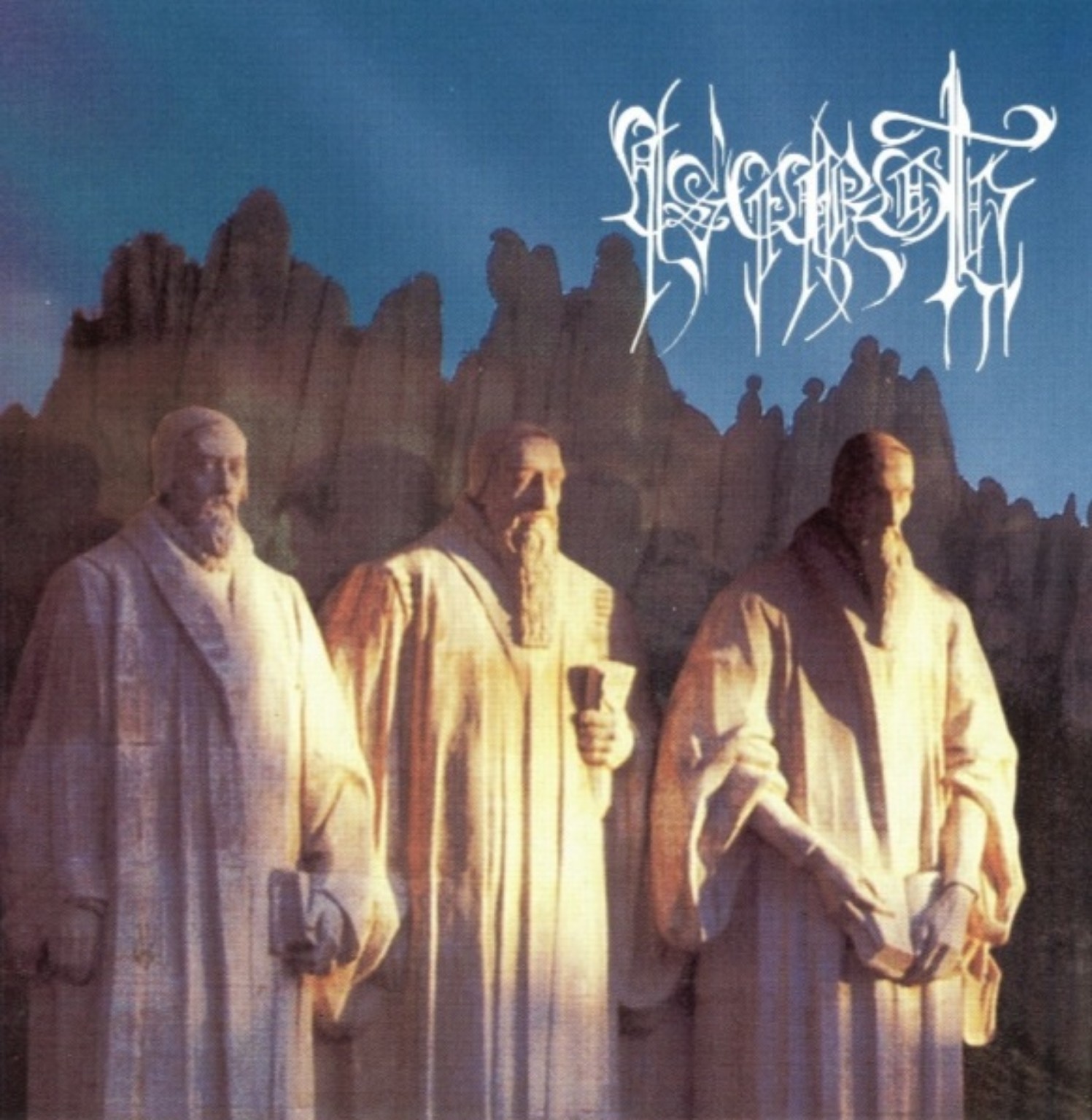
When you hold the original release in your hands, the story briefly becomes something tangible. The album cover is not an illustration added after the fact but the first gateway into the work; the credits anchor the narrative of the preceding chapters in the real world through names and dates. On the surviving printed pages, a symbolic landscape coexists with the concrete details of everyday creative work. Behind the figures standing among the rocks—portrayals based on real people—lies the labour of recording the music.
From here, the story takes a different course. Rather than following changes in the city, the density of its club scene or the circumstances of its record labels, we turn to the question of how eleven successive recordings could be shaped into a world of their own. This book is not here to assign an unsubstantiated emotion to every sound. A more rewarding kind of attention finds a way to bridge the documented lyrics and the imagination that opens up in the listener.
The figures associated with the recording also preserve something of its history, but numbers do not speak a human language. If one track begins more quietly, or another sustains its intensity for long minutes, those are verifiable changes. What they mean becomes perceptible through the structure, the lyrics, the title and their reception taken together. On the pages ahead, technical evidence will remain in the background as the rhythm of storytelling gradually takes the place of the music itself.
The Evidence of Control Room
The most important piece of technical evidence is not a later online summary but the credits page of the original CD booklet. According to that source, the album was recorded and mixed at Control Room Studios between October 1996 and March 1997. Asgaroth produced and mixed the record, with Mr. Ed Cabral credited as sound engineer. Mythral and Lord Lupus are named as the composers, while the band members are credited with the arrangements. Lord Lupus performed the lead vocals; Mythral contributed additional vocals on tracks two, three and ten. Behind the drum kit was Katu Marus, who was also responsible for programming.
A credits page of this kind is especially valuable because it keeps speculation about the recording process in check. We do not know the precise recording date of every track, the mixing console used, the microphone models or every detail of the decisions made in the rehearsal room. What we do know is that, following the earlier EP, the musicians' own material once again became a studio project—this time on the scale of a full album.
The full-length was released under catalogue number NGR 007. The booklet identifies the contributors in considerable detail and, through contact information and personal acknowledgements, makes visible the community of friends and professionals surrounding the band. The album is therefore more than a sound recording: it is also a material and human document of its time.
Three Figures Before the Rocks
The original cover is no straightforward live photograph of the band. Three figures wrapped in pale robes stand before distinctive, dark rock formations. Their bearing has a ritual stillness about it; the landscape is not merely a backdrop but a setting in which human scale meets mythical height. The contrasting textures of the mountains, the sky and the garments establish the album's epic proportions before a note of music is heard.
The booklet does not simply repeat a single image. Red, misty, cloud-filled scenes and motifs of ruined architecture appear behind the lyric pages; portraits of the musicians set natural human faces against a landscape that seems almost magical. Stone, forest, twilight and elevation recur throughout this visual world. We cannot establish with certainty who first conceived these images or which actual geographical landscape provided the precise model for the photographs. Any symbolic reading of the scene is therefore an interpretation, not a documented statement of artistic intent.
The cover and the track titles share a language of thresholds: someone is travelling, something is approaching, something is being left behind or sought. The seemingly boundless natural spaces do not indicate precise historical coordinates; they evoke ideas related to the epic vocabulary of black metal and fantasy. From these fragments, listeners can build worlds of their own without our having to invent the band's specific intentions on its behalf.
A Ritual at Dusk
The cover's unusual power comes from showing the human figures close up while simultaneously making them appear small among the towers of rock. Three people stand in the foreground, wearing long, loose, pale garments. Their bearded faces and motionless, almost ceremonial posture may suggest an ancient community, although their clothing alone tells us nothing definite about whom they are portraying. The central figure holds a dark object resembling a chalice; the others let their arms hang at their sides. There is no visible battle and no clearly identifiable religious ceremony. Instead, the image is filled with the stillness before something happens.
The colours place two distinct worlds side by side. Against the cool blue of the sky and background, yellowish, almost golden light catches the robes. That light does not make the landscape welcoming: the steep outlines of the irregular, finger-like rock formations rising behind them still seem to close in menacingly. The vertical rhythm of the peaks and figures continues in Asgaroth's extraordinarily intricate white logo in the top-right corner. The letters almost seem to be constructed from the same sharp lines and interwoven branches.
The possible scale of the music begins to emerge in this image. The elemental forces evoked by the title “The Choirs of the Elemental Deities” find a natural counterpart in the monumental rocks, while “Prelude in Dusk” resonates with the colours of twilight. The fate and menace suggested by “Cry the Way We Greet Our Fates” and “The Dark Force” become visible not in any particular gesture but in the uneasy balance between the figures and the landscape. These parallels between image and language are possible ways of experiencing the work, not verified intentions of its creators.
What the cover does not show is particularly revealing. The “Eve” in the album title has no direct pictorial equivalent in the form of a woman; neither a biblical story nor any other specific narrative can be established on that basis. The robed figures face the viewer, while the landscape behind them remains unknown. What we see, then, is not the end of a story already told, but a threshold. The album's opening sounds begin on the other side of it.
The Language of Night
The track titles alone suggest a story: fate, triumph, omens, wind, a dark force, a final battle, nature, a choir of elemental deities, a prelude at dusk, moonlight and a farewell coda. Rather than a concept album with a plot that can be verified scene by scene, we encounter a network of recurring images in which power and transience, humanity and nature, darkness and the search for transcendence repeatedly touch.
The booklet contains three pages of lyrics: those for “Victorious Men of Earth”, “The Choirs of the Elemental Deities” and the track with the lengthy title “Placious Echoes...”. The first invokes the fragility of human life and the universality of death in contrast to worldly power. The lyric about choirs and elemental deities uses invocations of nature and the cosmos, while the tenth track, with its moonlit forest imagery, adopts a far more personal and visionary mode of expression. No complete, reliably verifiable transcription of the lyrics to every track on the album is available; we therefore cannot reconstruct all the songs' words from their titles alone.
This distinction also matters in the track-by-track chapters. Where printed lyrics have survived, an analysis of imagery and motifs can begin with the document itself. Where they have not, interpretation is limited to the instrumental structure, the title and observations made by contemporary or later critics. In this way, the album does not become an invented book of poems attributed to its authors.
The booklet page for the tenth track, with its long title. Its visionary motifs of forests and moonlight reinforce the album's romantic and symbolic dimension.
I read the eleven supplied MP3 files in full and measured the audio signal's mean energy level in ten-second windows. This method can provide verifiable information about the album's internal dynamics and the distribution of quieter and more powerful passages. It cannot, however, reliably determine the keys of a riff, every entrance of the vocalist or the precise timbre of a synthesizer. I make no such claims on the basis of these measurements.
The audio files provided have a combined running time of approximately 48 minutes and 2 seconds. The label's track listing gives 48 minutes and 29 seconds. Small differences at the beginning or end of individual MP3 files, possible editing differences or differences between versions could account for the discrepancy, but none of these explanations has been established. On the album information page, I give the label's running time; in the audio appendix, I report the duration of the files actually supplied.
Several proportions stand out. The first ten seconds of the opening “Cry the Way We Greet Our Fates” are substantially quieter than the later part of the track. The average audio energy of “Omens” rises gradually across three larger sections. “Lost in Natura” and “Prelude in Dusk” have lower energy levels than the album's more forceful songs, while “The Dark Force” and “The Choirs of the Elemental Deities” maintain their intensity with comparatively little large-scale fluctuation in volume. Emotional meaning comes not from the measurement but from the complete musical and lyrical context.
Eleven Paths Through a Dark Landscape
Before the album's first notes sound, it is worth looking back at the cover once more. No fully worked-out story is needed between the three pale figures and the dark, rocky landscape: the proportions and juxtaposed symbols create tension on their own. Across the eleven tracks, motifs of fate, earthly power, omens, wind, menace, a final battle, nature and moonlight are not arranged into a conventional novelistic plot. They form, rather, a succession of inner landscapes. That is where this chapter finds its momentum.
Anyone who now tries to read the tracks as one great story will repeatedly encounter two boundaries. One is the work that has unquestionably survived: the titles, the three printed lyrics and the recording itself. The other is a possible interpretation, which puts words to the landscapes evoked by the music. The two may meet, but neither can replace the other. Listening to the album can thus become a journey told in prose without inventing confessions on behalf of its musicians.
01. Cry the Way We Greet Our Fates
The door to the story is still shut, but the first sound has already found its way through the gap. Before fate is addressed, there is no battle and no victory, only the uncertain time of the introduction.
The very title of the opening track works like a gateway. It does not yet relate the whole story; instead, it establishes a relationship with fate. At the start of an album, a short, independent introductory piece often separates the time of ordinary listening from the record's inner world. Asgaroth takes this dramatic function seriously: rather than demanding our full attention at once, the opening ushers us into the scale of the sound.
The energy level measured in the first ten seconds of the supplied recording is conspicuously lower than in the later section, so the dynamic entrance is demonstrably gradual. This does not tell us which instruments enter in what order, but it does support the twofold movement of preparation and opening out. The piece is listed as instrumental on the original track listing.
The word “fates” casts the motif of inevitability over the entire album. Read alongside the earthly victors of the next track, it creates a particular tension: can anyone truly be victorious if they have no power over the limits of their own fate? The opening only begins to unlock that question.
02. Victorious Men of Earth
After the introduction, the space opens wide. The title's victorious men of the earth raise our gaze high enough for the limits of power to become visible.
The first expansive composition reveals in full the musical world that later reviewers would identify as a hallmark of Asgaroth: extended forms, keyboard atmosphere, alternating vocal voices and a melodic sensibility allied to the energy of traditional black metal. A 2007 review on Metal Archives likewise stresses that the second track reveals the album's atmospheric language early on.
The lyrics in the original booklet address worldly power. Their images of rulers, empires and death do not simply celebrate victory; they remind us that triumph has limits, since conquest cannot alter the fact of mortality. This shift also illuminates the relationship between the first two tracks. After fate as a universal power comes humanity's attempt to escape its own finitude.
The supplied audio file runs for about seven minutes, with relatively even volume across its larger sections. This reinforces the impression of an extended, continuous musical idea. According to the original credits, Mythral also contributes additional vocals here: the band uses the voice itself, not only the instruments, as a dramatic device.
03. Omens (Presagios)
Every story has a moment when the future appears not as an event but as a sign. In this musical world, too, omens point towards an uncertain direction.
The title carries a very different tension from the human-scale triumph of the previous song. An omen suggests both that something is approaching and that we may be unable to read the future reliably from the sign. The alternative Spanish title, “Presagios”, reminds us that behind the international language of the genre stood a band working within Catalonia's Spanish-speaking environment.
A later English-language review specifically highlights the keyboards in “Omens” and the reverberant, piano-like character that emerges in intros and middle passages. The mean level measured from the original audio file rises from the opening third towards the final third, which is consistent with increasing intensity. It would be unjustified, however, to assign a specific melodic cause to that change without further evidence.
The instrumentation credits in the booklet show that guitars and synthesizer were two sides of Mythral's instrumental world on this record. The track therefore makes the idea of omens intelligible not primarily as a story told in words, but as a possibility unfolding through sound over time. As the last of the album's three substantial opening tracks, “Omens” brings unease to the foreground.
04. A Call in the Winds...
The wind may begin far away and arrive very close. This short piece never tells us who is calling whom; its unsettling space lies precisely in that uncertainty.
The title of the fourth track contains a call: something calls in the wind, or the wind itself becomes the call. In the landscapes of black metal and fantasy, wind is often more than a meteorological event. It carries distance, motion and a force beyond human control. This is, however, a possible interpretation of the motif, not an established authorial programme.
Compared with the larger compositions, the recording is short, lasting barely two and a half minutes. The technical measurements indicate that the middle section has a slightly higher mean energy level than the opening and closing thirds. This smaller, more compressed structure differs from the roughly seven-minute spans of “Victorious Men of Earth” and “The Dark Force”. Brevity does not imply a subordinate role: pieces of this transitional scale shape the rhythm of the album as a whole.
The title “A Call in the Winds...” enters into dialogue with the images of nature in the later “Lost in Natura” and “The Choirs of the Elemental Deities”. We do not need to invent a separate story for every track to recognise different facets of the same relationship between human beings and landscape within this network of titles.
05. The Dark Force
A dark force need not take physical form to make its presence felt. Here the album dwells on the name for an extended time, as though the threat alone were enough.
“The Dark Force” is one of the album's longest tracks and a composition singled out by several reviewers. An English-language review on Metal Archives gives particular praise to the guitar's lead melodies and their power on this number. The title is a broad, almost mythological idea: rather than naming a person, battle or place, it works through the presence of a frightening force.
An objective examination of the recording's dynamics shows very even levels across its larger sections. The piece cannot therefore be described primarily as a succession of dramatic drops into near silence; it is instead characterised by a sustained energy level. Importantly, small differences between louder and quieter sections do not rule out major changes in tempo, rhythm, arrangement or harmony.
In this sense, the album's darkness is more than the conventional adjective attached to extreme metal. As several later reviews suggest, atmospheric tension between synthesizer, melodic and guitar-driven layers is a defining feature of the work. This track is one of the album's centres of gravity: an extended form, an emphatic title, sustained energy and a forceful instrumental character converge within it.
06. Last Battle (Tower of Doom)
The tower, the struggle and the battle described as the last have long occupied the horizon of fantasy tales. Here, however, the history of the earlier EP can also be heard behind the title.
This is the only track whose title directly leads back to the 1996 EP “The Quest for Eldenhor”, whose original track listing already included a composition called “The Last Battle (Tower of Doom)”. The album version is therefore an especially telling sign of continuity between early and later Asgaroth. The band did not always start from scratch, but also returned to material it had previously developed.
The title conjures a world of heroic fantasy: a final struggle, a tower, a threatening conclusion. The language of the earlier record enters directly into the broader context of the first full-length. The available sources do not establish every change in arrangement and recording relative to the EP version; such a comparison would require a detailed examination of the original 1996 audio as well.
The supplied MP3 is just under six minutes long. Its measured dynamics remain even for a long stretch, with a brief retreat towards the end. Seen in the context of the whole album, “Last Battle” is an axis joining a backward glance at the band's beginnings to an example of its newer, more expansive formal ambitions.
07. Lost in Natura
The human being does not march into the next landscape, but becomes lost within it. Nature does not belong to the victors; it belongs to that experience of suddenly finding the surrounding world greater than ourselves.
The title itself signals a different relationship with the landscape: rather than mastery over nature, it evokes being lost in it. The Latin-sounding “Natura” is particularly well suited to the album's archaic, at times ceremonial language. No reliable statement by the band is known that would require one particular historical reading of the title.
The recording's measured mean energy level is lower than that of the larger metal compositions immediately preceding it. A comparison of three broad sections reveals a gradual increase in intensity that nevertheless remains moderate. This provides an objective indication of the track's different role within the album, but not a full account of its instrumentation.
Together, this song and the following “The Choirs of the Elemental Deities” place two scales of nature side by side. In the first, a human can become lost in the landscape; in the second, the landscape itself can seem almost personal, becoming a choir of deities. If we read the album's dramatic course as a succession of motifs rather than a mere exercise in style, the transition forms a particularly strong central passage.
08. The Choirs of the Elemental Deities
Now it is as if the mountains, the wind and the earth acquire voices of their own. The surviving words in the booklet allow us to regard these not merely as products of imagination but as documented motifs of the song.
One of the three reliably surviving sets of lyrics in the booklet belongs to this track. Its lines speak of mountains, wind, earth and fire, associating the elements with divine and protective images. This is no longer an interpretation based solely on the title: the words can actually be read in the contemporary printed insert.
A later English-language review singles out some of the composition's more memorable, driving melodic turns. According to the measurements, the supplied MP3 maintains an even energy level much like the lengthy “The Dark Force”, although it is substantially shorter. The combination of brevity and a compact dynamic profile may create the impression of a more immediate piece of music. The specific appraisal of the arrangement here belongs to the critic's interpretation.
The song is distinctive in treating nature not as scenery but as an active presence within the imagination. Mountains, wind and the choir of elements suggest an order greater than humanity. Recalling the rock formations on the album cover, words and image appear closely connected—a resonance we can interpret even if the composers never expressly discussed it.
09. Prelude in Dusk
Dusk is not a boundary but a transition. This brief prelude grants just enough time to open a door before the album's last great space unfolds.
“Prelude in Dusk” is the shortest track on the album: the supplied recording lasts barely fifty seconds. There has already been a brief, transitional composition, but this time the title states the function even more plainly. A prelude does not aim to tell a self-contained story; it clears a space for what follows. Dusk, meanwhile, embodies the moment of transition: neither full daylight nor complete night.
The audio energy is considerably lower than in the immediately preceding “The Choirs of the Elemental Deities”. This creates a pause, a chance to breathe and a fresh point of entry before the lengthy tenth track. Such moments are at least as important to the album's structure as its longest compositions.
The title can also be read as a counterpart to “Outroduction”: the ninth track opens a final chapter, while the eleventh, by its own name, leads us out again. Looking at the album's dramatic arc through the sequence of titles, it becomes clear that the band did not entrust its ending to one last powerful song alone but enclosed it within a double frame.
10. Placious Echoes at Darkwoods You Greet... Silvering Moon Between My Shadows
Between the darkness of the forest and the silver of the moon, conquest gives way to the language of memory and echoes. The title itself is long, like a breath left unbroken.
The tenth composition stands apart from the rest of the album in the sheer length of its title. Echoes addressed in dark woods, moonlight and shadows place it within an unusually poetic world of images. The original booklet prints its lyrics, so the visionary language is not merely a later reviewer's invention.
The dark forest is a romantic and sometimes threatening setting, while moonlight can illuminate without dispelling all the obscurity. In the lyrics, the natural landscape and the movement of inner emotion are superimposed. Without a statement from the band, it would be wrong to equate such motifs with particular biographical events; their value lies precisely in remaining open to more than one interpretation.
The recording lasts more than six minutes and maintains a relatively even, intense sound throughout. Mythral's additional vocals on the tenth track are also documented, so the contrasting roles of the voices form one verifiable element of the album's final extended internal scene. After the short prelude in track nine, another expansive composition opens the path towards the ending.
11. Outroduction
An exit is not the same thing as a victory. The closing track does not resolve every question raised by the preceding songs; it reminds us that eventually we must leave this world of sound.
The title of the final piece seems deliberately to turn the word “introduction” inside out. It does not announce a concluding battle or set a single victor at the story's end, but names the act of leaving. At the beginning, the question of fate opened the world; at the end, the listener departs from that same world.
The supplied recording runs a little over three minutes. Its measured average dynamics remain relatively even across the larger sections, and the audio energy recedes at the very end of the file. This can be seen as the technical form of the departure within the running order, although I make no more precise claims about the order in which the instruments fall silent than the data supports.
Looking back over the record, its titles form a frame: fate and victory; omens and dark power; a journey into nature; elemental deities; dusk; moonlight; departure. This frame is no substitute for hearing the songs in full, but it helps explain why “Trapped in the Depths of Eve...” feels like more than a collection of tracks simply recorded one after another. In the act of leaving, an echo of the beginning remains.
The Album’s Arc: From Questions of Fate to the Way Out
The album's formal structure is not a steady increase in volume. Between its major, emphatic pieces lie brief moments to draw breath, smaller transitions and different shades of the dark imagery inspired by nature. The seventh and ninth tracks, whose audio files are quieter on average, make the care taken over the sequence particularly clear. An entire album sustained at a single level of intensity would tire listeners more readily; here, expansive and densely textured passages alternate.
The reuse of “The Last Battle (Tower of Doom)” reveals an organic connection between the EP and the full-length album. The printed lyrics to “Victorious Men of Earth” and “The Choirs of the Elemental Deities” link motifs of power, mortality and nature. In the world of “Placious Echoes...”, those same expansive images take on a more personal language of moonlight and forests. The details of music and words are not clues to one decipherable story but building blocks of a complex atmosphere.
In 2007, Christopher described the album's epic qualities as an important legacy that the band had hoped to draw upon again in later studio plans that ultimately came to nothing. This strongly positive assessment was therefore not merely a label attached by later fans; it was part of the band's own understanding of its work. The album remained a creative point of reference even as Asgaroth's music sought other directions.
When the Album Went Out into the World
An album's story does not end when its final note fades. No sooner had this one entered the world than unfamiliar ears began trying to decide where it belonged. The pages of contemporary fanzines revealed both enthusiasm for something new and a feeling of estrangement. For some, the moments described as symphonic opened a door; for others, they weakened the force of the music's rawness. Those reviews spoke from within their own time. They preserve the judgement of listeners who could not yet know the connections that later decades would make apparent.
From here the story extends to the band's dissolution, and beyond it. The group that followed the youthful band had to face different musical questions. The second full-length was not simply a repeat of the first, and a third never appeared despite lengthy preparations. Yet unrealised plans, defunct bands and subsequent archival releases cannot erase a work that already exists. Asgaroth's debut returned to the ranks of albums available for rediscovery when new witnesses to its history emerged alongside the old recordings.
One of the most human insights to emerge from the surviving interviews is that artistic determination cannot overcome every practical circumstance. Band members may take different paths, everyday life may pull plans apart, and something may nevertheless endure: not an abstract legend, but a tangible sound carrier, a printed booklet, a recording and a handful of statements that can be documented. The album's afterlife is also a story of that endurance.
Reading contemporary reviews is not simply a matter of adding up scores. They tell us what genre expectations a new band had to navigate and which musical choices struck listeners as strengths or flaws. In the case of Trapped..., even defining its style created tension: black metal, symphonic influences, gothic or doom elements, progressive approaches—different critics placed different weight on each.
A contemporary piece in Spain's La Factoría del Ritmo situated Asgaroth within the domestic wave of black metal supported by New Gotia. Its view of the album was inseparable from the local infrastructure: band and label appeared as parts of the same story. A review of the album can also be found on original PDF page 12 of the first issue of La Olla, published in 1998. These sources are important above all because they predate both the band's later dissolution and the retrospective prestige attached to the 2024 reissue.
A review published in 1999 in the Dutch Master of Brutality looked back on the debut through Asgaroth's next release, “Absence Spells Beyond...”, whose mini-CD included the first album in its entirety as bonus material. The review spoke favourably of the symphonic compositions and the melodic writing but questioned whether black metal alone was an adequate label. Since Trapped... was not the article's principal subject, it offers only indirect evidence of the album's reception.
In December 1999, a reviewer called Funker at DARKSIDE.ru awarded the album 7 out of 10. The account provides a particularly interesting counterpoint: Funker did not always find the transitions between raw and symphonic passages sufficiently organic. Where one listener heard a rich atmosphere, another could hear unresolved problems of structure. Differences of this kind are what a genuine history of reception is made of. We need not smooth the reviews into unanimous enthusiasm to appreciate the album's lasting significance.
The Album’s Slow Rediscovery
An English-language review published on Metal Archives in 2007 highlights the keyboards, contrasting vocal styles and melancholy guitar passages; its score of 89 per cent is decidedly favourable. The review explores atmosphere within individual songs in a level of detail that goes beyond early genre classifications. It is important, however, to remember that this is a listener's review: it cannot stand in for either the band's creative intentions or the album's overall reception.
José Luis Romero's 2010 post on the blog La soledad del vampiro discusses the debut while writing about Absence Spells Beyond.... His reading, which brings together symphonic, gothic and black-metal elements, offers retrospective praise: he presents the album as one of the Spanish scene's outstanding achievements. A brief standalone review by Crypt's Burden / Darkest Corners in 2025 likewise singles out the keyboard atmosphere and mixture of genres, and draws a comparison with Summoning in connection with certain vocal or melodic turns. Such parallels are critical comparisons, not proof of an influence acknowledged by the band.
In a Spanish-language retrospective written for TNT Radio Rock in 2025, Jonathan Pernía considers the album in light of the band's later history and the reissue. He can see what a fanzine reviewer in 1998 could not: the subsequent turn taken by the second major album, the ending in 2007 and the reopening of the archives. The reviews thus document two distinct eras. One hears a newly arrived band that is difficult to categorise; the other hears an album preserved over time and approaching cult status.
One lesson of the album's reception is that the strengths and the points of contention surrounding Trapped in the Depths of Eve... stem from the same creative boldness. Some listeners found its extended forms, shifting atmospheres and blend of keyboards and guitars unusually rich; others perceived the result as less coherent. The album's authentic place emerges between those two responses.
Trapped in the Depths of Eve... was Asgaroth's first major work in the sense that the original duo and their shorter epic recordings developed here into a full-length album with more complex arrangements. Decades later, this release continued to shape the band's remembered identity. It was cited not only in subsequent reviews: the musicians themselves also had to reckon with the fact that many listeners preferred precisely this early period.
The strongest evidence is Christopher's interview with The Metal Circus, published on 2 March 2005. The interviewer praised the album in extraordinarily high terms and asked whether fans had accepted the band's later development. Christopher did not claim that everybody thought alike. In essence, he said that many listeners still sought out Trapped...; together with Absence..., it closed a chapter which part of the audience regarded as the band's finest period. Other long-standing listeners, meanwhile, understood the changes. His answer reflects both the debut's enduring prestige and the musicians' insistence on their own artistic development.
More importantly still, in the same interview Christopher distinguished the band's self-understanding from the genre categories imposed on it by outsiders. He said that Asgaroth had never been as closely associated with the black-metal scene as many assumed. That does not make 'symphonic black metal' or 'black/doom metal' meaningless as descriptions used in the press, but it prevents us from constructing an identity or ideological programme out of those labels without evidence. Later statements by the musicians placed greater emphasis on personal atmosphere, authentic expression and experimentation.
Nor should the history of the album's original reception be retrospectively simplified into an unbroken triumph. Contemporary critical writing included both appreciative reviews and reservations. Later interest among collectors and the 2024 reissue are documented features of the record's afterlife, not evidence that every publication greeted it with equal enthusiasm upon release.
1998–1999: The Absence Spells Beyond... Period
The band did not remain unchanged after its debut. Historical biographies mention several line-up changes and difficulties with labels. According to later discographies, Katu-Marus ceased to be the band’s regular drummer around 1998; subsequently, the names J. Arckanus, Julkarn and T. Zarach appear in the line-up. The exact day-to-day sequence of changes and every personal reason are not directly documented, so particular disputes or conflicts cannot be assumed.
Further studio work took place between August and October 1998 at the Control Room and S.M. studios in Barcelona. The new material known as Absence Spells Beyond... contained three original compositions and a cover of King Crimson's 'Epitaph'. The tracks were 'Strengthened Are the Stems of Nasturtium', 'Sinking Trails of Wisdom', 'Absence Spells Beyond...' and 'Epitaph...'. The CD released in 1999 also included the whole of Trapped in the Depths of Eve... as bonus material, alongside the new recordings, which is why it is often catalogued as a fifteen-track release. The recording dates of the four new tracks and the release year of the full CD must be distinguished.
Alongside the two founding figures, the credits name other contributors: Julkarn and T. Zarach on guitar, Katu-Marus on drums, Eduardo Cabral on drums and studio work, Betina Brotons on female vocals, and Baron Sagittar on additional vocals on particular recordings. These contributions must not be collapsed into a single permanent four- or five-member line-up; appearing on a studio recording is not the same as being a regular live member. The label by then was Abstract Emotions.
A video was made for the title track 'Absence Spells Beyond...'; Metal Archives credits Yolanda Ripalda Barroso as director. According to a band biography, the video was also distributed through Nuclear Blast's Beauty in Darkness compilation, an important step towards an international presence. The biography further lists an appearance at the Repulsive Festival in Madrid and Portugal's Barroselas metal festival among the early concerts. The exact dates and set lists of these events would require additional primary concert posters to establish.
Around 1999 guitarist Óscar David Raventós, known as Mr. Ax, joined the band. He later became an important long-term member and studio professional. He was not part of the line-up when Trapped... was made, so the creation of the debut's original sound must not be retrospectively attributed to him. His role was, however, central to the later, more professional studio infrastructure and the band's subsequent period.
For Spanish metal bands, looking beyond national borders meant access both to recordings and to personal contacts. The Repulse dossier from 1997 describes the distributor's network of foreign labels, underground releases and imported goods. The contemporary model was one in which a small label did not necessarily reach every foreign market on its own: distributors, importers, zines and mail-based contact networks supported one another.
For Asgaroth's creative identity, however, international outreach did not necessarily mean assimilation into a genre. Christopher repeatedly explained later that they were interested not in following stylistic fashions but in developing their own atmosphere and personal musical expression. In 2005 he also observed that communicating in English came naturally to several people involved with the band. Taken together, these facts offer a cautious explanation of how international contacts were possible for Asgaroth even though its music did not necessarily conform to any single local trend.
In the end, the album was granted not immediate worldwide fame but a long and layered afterlife. Red Shift later gained international attention through Abstract Emotions and then Peaceville, while the debut eventually became a rare, sought-after release. The underground distribution infrastructure already in place during the Trapped... years formed the first stage of this longer process, but later success with labels must not be projected back onto 1997.
Red Shift and the International Years
Following the changes around 1999, Asgaroth turned towards its next full-length album. A later band biography mentions the arrival of drummer Oisin and studio work around 2000; discographies, meanwhile, give 2002 as the original release year of the new album, Red Shift. Another biographical account dates an earlier Spain-only release to November 2001. The difference between 2001 and 2002 should therefore not be treated as though it unquestionably refers to one release event. Most likely, the initial domestic edition, a later foreign release and subsequent catalogue entries have become mixed together; original copies are needed to resolve the exact release sequence.
Red Shift was not a repetition of the debut. Both band statements and critical reception emphasise the change: the epic, fantasy-tinged symphonic extreme metal gradually gave way to a darker, more psychedelic, experimental and harder-to-classify musical outlook. In 2005 Christopher linked the band's course to changes in their personalities and stages of life. Importantly, he did not say that they had repudiated or felt ashamed of the early album.
The most significant professional turn was the link with the British label Peaceville Records. According to the band biography, representatives of the label encountered the material within the Hell Awaits circle in Barcelona, leading to an international partnership. Peaceville brought Red Shift to audiences abroad. For Asgaroth this meant wider distribution, interviews outside Spain and new concert connections. In 2005 Christopher specifically highlighted opportunities to give telephone interviews to journalists in Europe and America, as well as broader international access. Success in international record distribution does not automatically mean that a band becomes a large commercial enterprise.
Among the period's live appearances, the biography mentions Spanish concerts alongside Alastis in December 2001, including stops in Barcelona, Madrid and Bilbao. In 2005 Christopher also recalled the band's experiences in the United States at Milwaukee Metal Fest. He said they met listeners who had travelled great distances to see them. Even then, however, Asgaroth never became a continuously touring band. By the musicians' own account, they undertook few extended tours, partly because of the line-up and their personal circumstances.
The international interest surrounding the album raised the prospect of another record. Yet it is precisely here that the beginnings of the later crisis become visible: complex studio work, a prolonged creative process, changes in drummers and the organisational burden of keeping the band running did not disappear simply because a respected international label had become involved. This conclusion rests not on a single dramatic incident invented in hindsight, but on mutually supporting statements from the years that followed.
Trapped in the Depths of Eve... was not a final snapshot of a musical world that had stopped evolving. The 1998 recordings for Absence Spells Beyond... already revealed possible directions for further development. A cover of King Crimson's 'Epitaph' appeared on that later release, providing concrete evidence of a subsequent creative connection with progressive-rock material. The fact of recording the cover does not, however, prove that King Crimson shaped every structural element of the 1996 debut.
Red Shift, around 2002, and the international Peaceville connection belonged to a different media environment. In 2005 Christopher spoke of opportunities for telephone interviews across Europe and America; by 2007 an online presence, including references to a Myspace page, had become a normal part of communication. The transition vividly illustrates how fast underground communication changed between the recording of Trapped... in 1996 and the band's final years.
The 2007 interview also offers first-hand insight into practical obstacles to creative work: running a new studio, losing a rehearsal room, moving home, changes of drummer and problems of finance and scheduling all made it harder to finish a third album. Christopher specifically remarked that suitable working space was expensive and difficult to find where they lived. This is direct testimony about urban, logistical and financial pressures—but it came more than ten years after the first album. It cannot be carried back in time as evidence about the making of Trapped....
The 2017 Dejadeath interview likewise documents the personal and practical exhaustion surrounding Asgaroth's dissolution. In their later work the former members deliberately sought a way of making music free from the earlier band's excessive burdens. Their recollections allow an important historical conclusion: the original creative ambition was valuable in its time, but maintaining that ambition involved considerable costs over the following decade. Precise cause-and-effect links to the debut, however, would require fresh sources from the band.
The third album that never appeared
For a long time Asgaroth worked towards a third full-length record. In a 2005 interview with The Metal Circus, Christopher explained that 'Autocrat' was a working title, while 'Passion & Neurasthenia' was the final title intended at that point. He described writing, arranging, lyrics and other decisions as largely his own creative responsibility, and partly attributed the slow progress to his unwillingness to release such complex work unfinished. The difficulties were therefore not merely delays on the record label's part.
On 8 May 2005, a post signed 'Chris' on the Asgaroth online forum, linking to the band's official website at the time, said that they were working on arrangements for the new album and had booked recording time for July. This surviving public message is a valuable snapshot: not a legend invented retrospectively, but a document of the intention to release music while the plan was still alive. It does not, however, prove that the record was completed by the promised date.
A much more complicated picture emerges from the metal.de interview of 3 May 2007. Christopher explained that Mr. Ax was occupied with building his own professional studio, the band had to leave its rehearsal room, the drumming situation became uncertain, and Christopher himself moved home several times. Necessary drum recordings had to be fitted into available slots at the studio. According to the interview, the drummer of the time, David Vega, also departed, requiring a search for another musician. These were not abstract 'musical differences' but genuine infrastructural and personnel obstacles to making music.
The 2007 conversation gives another variation of the title: Christopher then referred to the new material as 'Breath Retail'. The relationship between 2005's 'Passion & Neurasthenia' and 2007's 'Breath Retail' remains incompletely resolved. The interview establishes only that the album in progress was being discussed under a different name by then. It would be wrong to treat the two titles as evidence for two separate completed records.
In the same 2007 interview Christopher said something particularly important about the new music and the history of the debut. The plan was for the next album to combine the psychedelic, aggressive approaches of Red Shift with the monumental, exuberantly epic qualities of Trapped.... In other words, even ten years after the debut, the early work remained a living creative reference point. This is a direct statement from the band, not merely a fan's retrospective assessment.
The new material was never released as a complete, official third studio album. The 2014 compilation 1995–2005 Collection, however, included five previously unreleased studio or demo recordings made between 2003 and 2005, under the working titles 'MNK_demo 1', 'DDN_demo 2', 'MFD_demo 3', 'NKGTR_demo 4' and 'RSN_demo 5'. The collection notes associate these with the planned, unfinished album of the Peaceville period. They document continued creative work but do not turn an uncompleted project into a retrospectively released official studio album.
2007: The Human and Professional Reasons for the Break-up
Asgaroth's active history ended in 2007. Later band databases give the years of activity as 1995–2007. The band's final period is often associated with an appearance alongside Type O Negative. For understanding the specific reasons, however, the most valuable known account is not an outside legend but Christopher and Óscar's subsequent Dejadeath interview in 2017.
In that conversation the former Asgaroth members recalled that, after having the chance to open for one of their favourite bands, Type O Negative, they decided to end Asgaroth for several reasons. They did not name a single sudden quarrel or specific record-label scandal. Instead, they emphasised that great artistic ambition, problems with infrastructure, and family and personal burdens had together reached the point where sustaining the band was affecting their health.
According to the 2017 retrospective, the opportunity to work with a conventional record label arose just as the market for physical music formats was undergoing a marked transformation. They tried to make the most of that opportunity, but the demands of their lives, the urban environment and their individual circumstances exacted a heavy price. This is a much more precise and humane explanation than simply saying that 'their success ran out' or that 'the band fell out'. There is insufficient direct evidence here for those latter assertions.
The musicians did not later disown their Asgaroth years: they also spoke quite positively about the relationships they developed with Peaceville, their overseas concert experiences and the opportunities the band had given them. The end of the group therefore does not erase the development that took them from a home-recorded demo in 1995 to international recognition.
The story does not end with the break-up in 2007, because the ways in which the musicians later discussed their experiences matter to the interpretation of Asgaroth. Christopher and Óscar said in 2017 that Dejadeath began to take shape around 2008, in part because they consciously wanted a different way of working after Asgaroth. With their friend Andrew, they sought a freer, more enjoyable way to make music together without reproducing the former band's overly demanding production system.
The first sketches for Dejadeath material were developed at Christopher's home and later completed in Óscar's studio. In hindsight, the musicians described the process as a kind of therapeutic fresh start. That does not mean they regarded Asgaroth as a mistake; rather, they wanted the organisation and creative freedom of the new project to reflect what they had learned in the previous band.
Dejadeath released several works. At the time of the 2017 interview, its output included The Ageless Pantomime, ¡¡¡¡Viva Dios!!!! and Satan Is Losing Momentum. The two principal members remained important songwriters, and other former Asgaroth musicians, including Oisin, also contributed. Dejadeath thus represented a degree of continuity in personnel, but under a different name, with different aims and a different creative process. It was not Asgaroth's third album released in secret.
2014: The Archive Speaks Again
A milestone in preserving the band's early work was GS Productions' two-CD compilation “1995–2005 Collection”, released on 18 April 2014. Details of its limited digipak edition of 300 copies can be verified. This was no ordinary best-of collection: alongside the complete “Trapped in the Depths of Eve...”, the 1995 demo, the 1996 EP and “Absence Spells Beyond...”, it included previously unreleased material dating from 2003 to 2005.
In retrospect, the compilation made it possible to survey more of Asgaroth's history through a single release: the one-man cassette beginnings, the first full flowering of its symphonic black metal, the transition at the end of the 1990s and traces of the final, unfinished creative experiments. The collection also mattered because it could bring once-rare recordings to new generations of listeners.
2024–2026: Reissues and Memory
In 2024, Down With The Most High made two defining works from Asgaroth's early catalogue available again. The first vinyl reissue of the 1996 EP “The Quest for Eldenhor”, released on 15 April 2024, also included the 1995 demo “Songs of War”. The label paid particular attention to reconstructing the period artwork. According to its press release, the original painting had been lost, so its appearance was evoked through a newly painted oil reproduction. Historical essays and archival images accompanied the reissue.
That same year brought the first double-vinyl edition of “Trapped in the Depths of Eve...”. The 2024 press release gave 10 December as the official date; some album databases list 25 November. This discrepancy concerns the reissue itself and should not be confused with the debate over the original 1997/1998 release date. The double LP came in an elaborate gatefold sleeve with a large-format, 16-page booklet. According to the label's description, it contained an approximately 2,000-word historical essay, rare photographs and contemporary printed memorabilia.
Even more significant is the method behind the historical research. In an interview dated 29 November 2024, Dani Rabadán, head of Down With The Most High, said the reissue team had conducted lengthy video conversations, lasting around six hours, with former Asgaroth members and selected material from these for the booklet's historical account. This matters because details of the band's beginnings absent from the contemporary press may have survived in those conversations. The public interview establishes that this archival research took place; the full content of the multi-hour interviews has not, however, been examined here.
Another major project devoted to preserving the past is Diego López-Fernández's documentary “Blackcelona: Una historia de metal satánico”. The film explores the local history of Barcelona's black metal scene, with former Asgaroth members named among its interviewees. It was screened in a festival setting as early as 2024; Spain's film register records a theatrical release on 20 June 2025 and a running time of 96 minutes. The documentary's existence and participants are verified, but statements actually made in it could only be used after viewing the film and producing an accurate transcript.
As of October 2026, the reliable sources used here do not establish the release of a new official Asgaroth studio album or a demonstrably revived band operating continuously. Reissuing old recordings, undertaking historical research and musicians participating in later projects are separate events. Asgaroth's musical legacy lives on, but the fact of these reissues alone does not justify rewriting the account of the band's cessation in 2007.
According to the description of the 2024 double-vinyl edition from Down With The Most High, the label prepared a large, 16-page booklet of archival images and a historical essay to accompany material from Trapped... that was nearly thirty years old. The label interview confirms that those preparing the release also conducted hours-long video conversations with former band members. This method marked an important shift: the band's history could once again be researched not only as a table of dates but through the recollections of those involved. Without the complete interviews and booklet, however, we can cite the fact of this research project, not every detail that may have emerged from it.
The theatrical distribution of the documentary “Blackcelona” in 2025 continued this local historical work on a broader scale. Spain's official film record explicitly names Asgaroth, other bands from the period and the labels, shops, magazines and venues central to the research undertaken here. The film's historical significance lies precisely in its attempt to present the 1990s scene not merely as a list of albums but as a network of real people and places.
Through these two projects of reissue and documentation, Asgaroth's debut came to represent something more than a product sold on its original release: it became a part of local cultural history. Later esteem, however, is not the same as contemporary reception. In this book, the reviews written around the release, later testimony from band members and present-day historical reconstruction must remain distinct layers in time.
The Debut's Place in the Complete Catalogue
If Asgaroth's history is to be organised around a single album, “Trapped in the Depths of Eve...” is the natural choice. Before it came Lord Lupus's one-man “Songs of War”, followed by “The Quest for Eldenhor”, the EP made by the Daniel–Christopher duo. The debut full-length turned those experiments into a lengthy, fully formed musical work, with arrangements built around the trio and a broader symphonic vision. It was followed by the transitional world of “Absence Spells Beyond...” and then by the increasingly independent, experimental musical thinking of “Red Shift”.
The band's own recollections define the album's significance even more precisely. In 2005, Christopher spoke of the completed early era encompassing “Trapped...” and “Absence...”; in 2007, he recalled the debut's monumental, epic qualities as a creative resource they had hoped to use on a third album that was never released. “Trapped...” was therefore more than an early youthful endeavour: even after the band's subsequent changes, it remained one of the sources of Asgaroth's sense of musical identity.
There is a human lesson in this story as well. The band did not secure an international label overnight, nor did it disappear because of a single spectacular scandal. Its course to 2007 was shaped by interconnected developments: a small demo, a local label, a first full-length recorded in the studio, printed fanzines, early videos, a growing audience, changes in the line-up, international connections and a long, unfinished plan for another album. Testimony from a musician in 2017 also suggests that creative ambition and the practical demands of life cannot always be reconciled.
“Trapped in the Depths of Eve...” thus represents a turning point in two senses. In its own time it was the band's first truly large-scale undertaking; in its afterlife it became a benchmark against which the group was still being measured a decade later, and to which its members repeatedly returned. The carefully produced 2024 vinyl edition and the accompanying historical investigation show that the album has survived as more than a catalogue number from the 1990s: it is a document of Spanish extreme-metal history that can be studied and reconsidered.
The Final Gateway of Memory
By the time the story reaches the reissues, the beginnings too are cast in a different light. An old cassette is no longer just a small object from the earliest days; a forgotten fanzine page is no longer merely a page of newsprint, and the credits in the booklet are no longer incidental small print. Each is evidence that the album belonged to a particular time, place and environment, and that real people paid a price to make it. Sometimes memory can articulate something only much later, something that could not yet be seen at the moment of release.
What falls to us after the silence is not the task of eliminating every doubt. Uncertainty about the precise release date, differing recording lengths and later recollections that are no longer accessible all belong to this story. Preserving them means respecting the distance between an old record and the truth we can tell about it today. The music comes to an end, but the story finds its completeness in our understanding of that distance.
The sequence of events can now be recalled as a single current: not years placed side by side in a table, but a process in which one release prepared the way for the next.
Around 1995: Lord Lupus's one-man demo “Songs of War”; the beginnings of Asgaroth in Barcelona.
January–February 1996: Recording of the EP “The Quest for Eldenhor” at Control Room Studios.
October 1996–March 1997: Recording and mixing of “Trapped in the Depths of Eve...”, according to the original booklet.
Epilogue — What the Silence Preserved
By the end of this story, the album has lost none of its mystery, even though much has come into clearer focus. The world in which it was born cannot account for every note; nor do the musicians’ words exhaust what a listener may discover in it. Yet there has been a rare convergence in which the original release, the contemporary press and later memory can be considered side by side without any of them having to surrender its own truth. The story of Asgaroth thus continues not through final certainty, but through the sound that has survived.
Reader comments
Comments only appear after approval. Messages are displayed in their original language.
Comment submissions are not enabled yet.