Cealaltă parte
The seven-chapter, source-based history of TAINE’s 1999 album.
Album details
♫ Tracklist
- 01. Vanity5:39
- 02. Pierdut3:46
- 03. Ce ești tu?4:59
- 04. Prea Mult4:24
- 05. Psalm I & II6:11
- 06. Lie5:31
- 07. Avoid the Pain1:44
- 08. Cealaltă parte5:38
Total running time: 37:52 · Metal Archives
♟ Band members
- Andy Ionescu
- vocals, guitar
- Ștefan Aldea
- guitar
- Bogdan Vișan
- bass
- Adrian Tăbăcaru
- drums, keyboards
◉ Recording and release
- Glas Transilvan Studio
- Cluj-Napoca · 1998
- Label
- Promusic Production · PM 008
- Producer
- Ioan (Nelu) Brîndușan
- Engineering, mixing
- Oliver Végh
- Mixing
- TAINE / Oliver Végh
♫ Album streaming
No direct release link verified for the 1999 album.
▶ Listen to the full album
↓ Digital purchase
No digital purchase link verified for the original album.
Bandcamp · Decade of Metal (2005)
2005 Decade of Metal compilation – 5 songs from the original album labelled album versions; not the complete 1999 album. Digital purchase: €2 on the checked page.
▣ Physical editions
1999 · Original cassette · PM 008 · Metal Archives
2000 CD-R · Official discography
No current physical purchase offer verified.
Musik-Sammler · Musik-Sammler lists the CD as 1999; the band dates the CD to 2000. The discrepancy remains unresolved.
MusicBrainz · MusicBrainz includes an unconfirmed vinyl entry; no independent vinyl evidence verified.
TheMetalNet · Catalogue entry only, not a purchase link.
Band channels and databases
Official / contact
Artist streaming profiles
Overture — the city where sounds met
Bucharest grew into a city around the medieval princely court on the banks of the Dâmbovița. Artefacts dating back to the thirteenth century have survived at Curtea Veche; the charter of 20 September 1459 confirmed a grant made by Vlad Țepeș. Blacksmiths settled near what is now Sf. Gheorghe, tanners on the riverbank, and tailors and merchants further north. The division of the princely seat between Târgoviște and Bucharest came to an end by 1660. In the nineteenth century, industry, banking and transport transformed the life of the trading city: the railway to Giurgiu in 1869, electric street lighting in 1882 and tram services in 1894 created new connections. Between the two world wars, Bucharest became a national financial and industrial centre; in 1938, some 17 per cent of Romania's major enterprises operated there. Post-war industrialisation and mass internal migration created new urban worlds. The population grew from around one million in 1950 to almost two million by 1990; on the housing estates of Militari, Drumul Taberei and Titan, although new homes were being built, services and communal spaces often failed to keep pace with the growing population. During the austerity of the 1980s, living spaces became more crowded and everyday life more constrained. It was in this city, around Gorjului in the Militari district, that Andy Ionescu grew up. 12345
Lipscani Street also preserves the memory of the workshops of the former princely city; its predecessor was mentioned as early as 1589. Potters worked in the area between Unirii and Colțea; in the eighteenth century, wax processing, cloth manufacturing in Afumați and paper production in Fundeni brought new forms of industry. In 1811, 2,981 people engaged in crafts or commerce were recorded. The sale of the court grounds at auction after 1798 opened up new streets, while the museum created between 1969 and 1974 once again revealed fourteenth-century foundations and walls from Vlad's era. 1125
The municipal authorities trace the beginning of the city's modern history to the revolution of 1821. A city council and five administrative districts were established in 1830, and the first cadastral plan was completed in 1846. The Giurgiu line was followed in 1870 by the railway towards Ploiești, Galați and Roman. Alongside the Filaret and Gara de Nord stations, the opening of Băneasa Airport in 1921, the introduction of an automatic telephone exchange in 1927 and the inauguration of the Telephone Palace in 1933 expanded the city's connections. Bombing during the Second World War destroyed industrial facilities and buildings. 2
The scale of housing construction shows how rapidly this urban world expanded. According to municipal figures, 80,641 homes were built between 1945 and 1964, and 446,100 between 1965 and 1984. In the Ferentari and Cotroceni districts of the 1950s, blocks of three to five storeys with courtyards still followed the Soviet model; after 1956, the emphasis shifted towards cheaper mass construction. The Titan–Balta Albă district was linked to the 23 August industrial area, and young workers, married couples and newcomers often took out housing loans for thirty years. The district had the Gloria cinema and the Magazinul Titan department store, but schools operated in three shifts, a sign of how far services lagged behind. During the years of foreign debt repayment, construction encroached upon green spaces and utility services became unreliable; from 1981, housing estate residents could also be required to carry out work in public spaces. According to the historical study's estimate, the redevelopment of the city centre involved the demolition of about a quarter of the central and semi-central areas. 34
Romanian rock found an audience of its own even under socialism, although restrictions narrowed access to Western records and opportunities for public performances. The ease of copying cassettes, the passing of information from hand to hand and personal connections between musicians remained important after the political transition. A network of friends often brought a record to new listeners sooner than the official market did. 131415
The history of the city's musical institutions preserved a different tradition. Following a decision by Alexandru Ioan Cuza's Council of Ministers, the conservatoire opened on 6 October 1864 under the direction of Alexandru Flechtenmacher. Instrumental and vocal training was accompanied by harmony and solfège; chamber music received its own department in 1900, followed by composition in 1905. Between the wars, teaching in counterpoint and orchestration expanded further, and in 1931 the school became an academy of higher education, with George Enescu as honorary rector. The foundations of concert life were laid by the Philharmonic Society, established in 1868 under Eduard Wachmann's leadership. In the twentieth century, George Georgescu shaped the orchestra through new repertoire, guest artists and international tours; in 1955, it adopted Enescu's name. The concert hall of the Ateneul Român became a permanent centre of the city's musical life. Adrian's percussion studies and practical experience in radio and at the Athenaeum brought the discipline of this long institutional tradition to TAINE. 131498 Alongside chamber music, composition teaching was directed by Alfonso Castaldi; in the 1940s, Mihail Jora headed the academy. After the war, the conservatoire, which bore the name of Ciprian Porumbescu, organised separate programmes for performers and for training in composition, musicology, conducting and pedagogy. After the political transition, the Philharmonic was directed by Dan Grigore and, from 1991, by Cristian Mandeal. 1314
Musical institutions and recording
Wachmann's orchestra gave its first concert on 15 December 1868. Between 1920 and 1944 and again between 1954 and 1964, George Georgescu broadened the ensemble’s artistic horizons not only through guest artists and tours but also through recordings of Beethoven's symphonies. After the war, under Constantin Silvestri and Georgescu, an academic choir, soloists and chamber ensembles joined the city's concert life. 14
Meanwhile, the recording industry evolved from private enterprise into a state-owned record factory. Electrecord began operating in 1932, had its own studio from 1937 and was nationalised in 1948. Vinyl appeared in 1956 and became the sole format in 1967; stereo releases were produced from 1973. According to the company, six to seven million records were manufactured annually in the 1980s, but state control restricted public exposure, radio broadcasts, studio work and record releases. After the political upheaval, new bands had to find ways to distribute their music independently as well as create it. 1617
The company traced its beginnings to Nathan Mischonzniki's purchase of equipment in Germany. Following the political transition, record production declined because of competition and the growing prominence of CDs, and by around 1996 it had stalled for lack of demand. 16
In the 1960s, bands playing in seaside restaurants obtained records from tourists and equipment from other musicians, as Nelu Stratone recalled. The film The Young Ones and the local adoption of beat and psychedelic music converged with school and university competitions; amid restrictions on performing in foreign languages, folk-song adaptations and phonetic singing also gained ground. The Microrama television competition, singles by Sincron, Phoenix, Cometele and Mondial, and the Romanian Pop Music compilations left a record of this era. 9317
One of the early meeting places of the rock scene was Club A in Bucharest. In 1967, Emil Barbu, known as Mac Popescu, envisaged a meeting place for architecture students modelled on Polish student clubs. The basement on Blănari Street opened in 1969; jazz, film, literature, theatre and dance alternated there, while Securitate observers were also present among the audience. At the first festival, Sideral and Roșu și Negru explored territory close to free jazz; Mondial's melodies, Olympic's search for expression and Phoenix's diverse inspirations revealed different directions in Romanian rock. Roșu și Negru received the grand prize; the recognition accorded to fifteen-year-old drummer Ovidiu Lipan and the equipment Chromatic Grup lent to other bands preserve two distinct aspects of the young scene. As restrictions on language and repertoire tightened after the July Theses of 1971, local clubs, competitions, cassette exchanges and amateur radio recordings kept the music alive. The Club A festival returned in 1981 after a hiatus imposed by the authorities, and Electrecord also released a live album. 153817 Eight hundred founding members opened the club. The first festival took place at the Preoteasa cultural centre; according to Rupea's account, three thousand young people listened to the four-hour programme at the gala in Sala Palatului. In 1975, according to the archive, the electricity was cut during Florian Pittiș's reading on human rights; the evening continued by candlelight, and Pittiș was later banned from student clubs. 153817
Andy's earliest musical memories belong to the world of cassettes and listening to music together. He made his selections from the catalogue at a cassette-copying service and returned about a week later to collect the recordings. Iron Maiden's Somewhere in Time, with its fold-out cover, remained vivid in his memory; alongside Judas Priest, Metallica, Megadeth, Coroner and Annihilator, ...And Justice for All, Painkiller, Rust in Peace and Seasons in the Abyss showed him how powerfully composition and sound could shape songs. Sometimes the friends sat silently beside the record player, listening to metal, Jean-Michel Jarre or Vangelis; the act of listening itself became a shared experience. 567 Collecting rare records and recordings also cost Andy money; he kept his old collection in later years. 21
The musicians’ early years
In a conversation in 2024, Andy introduced himself as Andrei Pericle Ionescu and also spoke about his Greek grandfather from Thessaloniki. A report from the period gave his date of birth as 14 February 1974 and stated that he began playing guitar at eighteen. From the Lazăr high school, he took his cassettes to the copying service near the Izvor Bridge. They exchanged American VHS tapes, copied the lyrics from rare original records by hand and later photocopied them. Zakk Wylde's guitar playing appealed to him more than the world of Ozzy or Black Sabbath. Sport was also a family tradition; he practised judo for almost ten years and was associated with Dinamo. 2156 At the evening gatherings of rock fans around Gorjului, Andy recalled that they initially played folk and mountain songs; their shared music-making later gave rise to original compositions as well. 21
The other early musical path led to the drums. Adrian Tăbăcaru's father was a drummer, but his son later recalled that he had not forced the instrument upon him. He began playing at three, was already performing at five and played drums in his father's band at nine. He practised at his grandmother's house and later appeared on the stages of Sala Agronomiei and Stadionul Triumf. He attended the Dinu Lipatti school while playing ice hockey up to the twelfth grade. During a break in a match, he sat behind the drums wearing his skates; his father attached rubber to the pedals to prevent them from slipping on the ice. Classical percussion training, sport and listening to metal were already part of his life before TAINE came together. Alongside Slayer, Iron Maiden and Metallica, sport, work with symphony orchestras and practice filled his days. Adrian recalled only one sacrifice that he truly felt during the early TAINE rehearsals: he slept less. 895 By his own account, he played ice hockey at a professional level until the twelfth grade; the hours spent in TAINE's makeshift rehearsal rooms were added to his work with symphony orchestras and his percussion studies. 8
At an event on the ice rink, Adrian refereed the match himself and then played drums during the breaks. Before his final school examinations, he decided to pursue a career in music. 98 A later rehearsal-room profile describes Adrian's experiments with a musical saw, a gong immersed in water and bottles filled with nails, alongside the marimba and vibraphone; he also worked with the contemporary music ensemble Game. 150 His father attached rubber to the drum pedals so that Adrian would not have to remove his skates for the performance. 153
In December 1989, the protests in Timișoara developed into a nationwide upheaval. Different communities united against the eviction of László Tőkés; on 21 December, television also broadcast the breakdown of order at the mass rally in Bucharest. The dictatorship's leadership collapsed on 22 December. In Bucharest and Cluj-Napoca, violence and uncertain reports continued for days; television and the National Salvation Front became the focus of public attention. On 26 December, Petre Roman became prime minister. The political transition opened up new space for rock music and independent initiatives, but instruments, studios and the means of distribution remained scarce. 10
The tensions of the newly open political arena became starkly apparent during the miners' intervention of June 1990. The chronology of events records police actions, arrests and attacks on opposition organisations. The constitution adopted on 21 November 1991 and approved by referendum on 8 December established a democratic and social state governed by the rule of law. Meanwhile, an almost complete change of ownership took place in the apartments of the housing estates: Marin and Chelcea interpret the 99 per cent privatisation rate at the beginning of the decade as bringing security of ownership while transferring responsibility for maintenance to families. 94954
Artistic expression through sound also fell within the new legal framework of freedom: Article 30 of the constitution protected it and prohibited censorship. Yet the old shortages persisted on the city's streets for a long time. In August 1990, Norihiro Haruta's photographs captured the queue outside the Unic grocery store and the newspaper vendors at Gara de Nord; in January, Andrei Birsan photographed anti-corruption signs and gatherings of people at the entrance to the Politehnica. Meanwhile, the new apartment owners had to provide for the maintenance of shared utility lines and buildings, as the previous system of state housing finance had come to an end. 95584
Ice rink, basement and name
Andy dates the beginnings to 1992. According to The Roots, the idea of forming a band of his own took shape while he was still the guitarist of Punct Mortal, and became a reality in early 1993. Răzvan Alexandru, the later founder of Abigail, and Andi Ioniță, a musician in Mentality, were also associated with the earlier band. The official history highlights thirteen-year-old Adrian alongside Andy and Ștefan Aldea. In a television interview, Andy gave the year as 1993, and Adrian remembered the same year. The rehearsal-room report dates their meeting to the winter of 1992–93, the formation of the band to February and its debut to March. 18192095 In 2019, Andy also named Andrei Niculescu among the founders. 96 According to the rehearsal-room report, Andy heard Adrian playing drums near his grandmother's home. 5 Andy later recalled the young Adrian's arrival in the band by saying that they had no problems with the parents; in his view, the parents were even more enthusiastic than the young musicians themselves. 26
In connection with the name, Andy recalled the lettering on a Dave Mustaine poster: the word TAINE emerged as a distinct form within the design. The band's official explanation links the word, of Slavic origin and meaning secrets, to the desire to understand life, origins, space and time. 1821
The early rehearsals took place in a disused washroom at the National Ice Rink, formerly used to store ice hockey equipment. Adrian's father had connections with the venue as coach of the women's national team; a concert preview also mentions his help in preparing the room. Much of the equipment was improvised. Andy remembered old amplifiers, possibly Vermona models, and the drum shells were made by heating and bending Plexiglas from the rink. A Reghin guitar or an Amati drum kit was a rarity in the second-hand shop on Covaci Street. A report on later rehearsals took the journalist into the basement of a house, accessible through a trapdoor. 21225 The months of rehearsals led to small concerts during the breaks in ice hockey matches. 21 Claudia Ștefu's report from the period took readers into a room two metres wide and four metres long, jokingly called Tranzit W.C. Sala 25: rehearsals began at half past six in the evening. 146 Ten years later, Gabi Gomboș recalled the cold day in February 1993 when he visited the rehearsing band with Liviu Hoișan. 147
The history of the first concerts is made up of similarly tangible details. A wig for Adrian's first performance came from his grandfather's hairdressing salon: it was secured so firmly that it would not fall off while he was headbanging. An anniversary calendar identifies 18 March 1993 as the date of the first performance at the Patinoarul Național. Repent, Secret Place, Confusion, The End and Destin were among the early original songs; they were performed alongside covers. Recordings of The End, Secret Place and Confusion on TVR preserve a moment of national exposure for the early TAINE. Bogdan Tufeanu (Pista), Andrei Nicolescu, Nica Narcis and Mihai Tiulescu all played bass in the early years. After Metal Fan ’93 and Eco Pop ’94, the band took third place at the Posada ’94 festival. In a 1994 news item in Vox Pop Rock, they appeared as a heavy/speed band: they played as the opening act for Plutonium at the headquarters of the Partidul Liber Democrat near Cișmigiu. 8232425 The postscript of 28 January referred to Plutonium's debut; Andy was also a member of this short-lived trio as a bassist. In 1994, Petre Magdin invited TAINE onto his programme Întâlnirea de la miezul nopții. 241920 With this gesture, Adrian wanted to fit into the group; he was also careful to avoid any embarrassment on stage because of the wig. 8 According to the band's own history, four bassists succeeded one another during the first two years; the early songs also appeared on the 1994 Destin demo, which the band recalled being well received by Vox Pop Rock and other domestic metal publications. 19 In a contemporary interview with Face to Face, Andy mentioned an Eco Pop appearance in March, an Alis performance in April and a concert at Sala Rapsodia in June, where Cronos and Galahad also played, following the concert at the party headquarters in February 1994. On 4 May, at the R&M club, they hoped to receive a share of the proceeds from drinks sales. Despite attracting more than a hundred people through posters and telephone calls, hardly any beer was sold, and the owner sent them home. 140 Andy later also recalled a clash between rockers and punks at one of the early concerts around Cișmigiu. He did not take part in the fight; the smoky venue with its rudimentary sound system and the arrival of law enforcement officers revealed another side of the concert scene at the time. 151
Plutonium disbanded after a few concerts, but the fast, technical death metal Andy played there as a bassist became one of the starting points for his own later compositions. In TAINE's early period, technical thrash in the vein of Megadeth and regular appearances in Bucharest clubs shaped the band. 19 According to the band's retrospective account, their friendships in the early years also extended to musicians from Neutron, Abigail, Invers, Plutonium, Cronos, God, Psycho Symphony and CASH. 19
Cassettes and journeys (1994–1997)
From its raw heavy/speed beginnings, TAINE moved towards a more complex sound. In a later conversation, Andy recalled first hearing Death at a party: Chuck Schuldiner's voice and the sensitivity that emerged amid the heaviness impressed him equally. Steve DiGiorgio's playing on Individual Thought Patterns and subsequently the world of Cynic's Focus opened up new possibilities. His friends were initially baffled by the Meshuggah cassette; Andy later came to regard the band's unwavering commitment to its own path as its strength. The momentum of 1980s thrash met asymmetrical metres, rhythmic breaks and denser arrangements in the technical metal of the 1990s; classical, jazz-influenced and progressive structures entered the songs in varying proportions. Adrian's percussion training and Andy's compositional interest in complex forms illustrate the different creative backgrounds within the band. Gabi Gomboș used the contemporary terms techno-thrash, techno-death and technical metal. Andy later considered progressive metal a more precise description and distinguished it from the narrower field of technical death metal: for him, complex metres and changes of tempo served the composition. Adrian, too, placed emotional expression above mere virtuosity. 2662718282828261869322419 For his companions, accustomed to the music of Metallica, Megadeth and Annihilator, Meshuggah was still unfamiliar territory. Andy later distinguished his own progressive approach from the technical death metal exemplified by Necrophagist and Spectral. 2628 Andy placed Cealaltă parte among the beginnings of Romanian progressive metal. In his own recollection, he specifically recalled the designation tehno-thrash, also used by Gabi Gomboș, from a time when the term progressive metal had not yet become established in Romania. 18 In his 2026 interview with Metalfan, Andy recalled the genre vocabulary of the period: progressive rock primarily brought Rush, and perhaps Fates Warning, to listeners' minds; the wave associated with Dream Theater after 1992–93 broadened this world. The precise designation he remembered Gomboș using was tehno-thrash metal. 26
In the American centres of technical death metal, albums were already preceded by long periods of collaborative work. In Tampa, Ace’s Records provided access to imported records, demos and concert contacts, and around 1992 more than forty bands rehearsed in the garages at People’s Storage. At Morrisound, founded in Temple Terrace in 1981, Jim and Tom Morris and Scott Burns helped capture the ideas of different bands on record. Jim Morris recalled that other bands later sought to imitate the sound that had grown out of individual experiments. 109110
On Death's 1991 album Human, Chuck Schuldiner's compositions met Sean Reinert's distinctive drumming and the musical training of Cynic's members; Schuldiner turned away from his earlier world of horror towards human reality. Paul Masvidal had been working with his schoolmate Reinert in Cynic since late 1987; the band's 1993 album Focus grew out of a musical and spiritual exploration that had developed through its demos. That same year, Pestilence found a new direction in the atonal chords and fusion experiments of Spheres; Patrick Mameli also recalled the time he had spent with musicians from Atheist and Cynic. In 1995, while making Symbolic, Schuldiner described Gene Hoglan as an equal creative partner and, after three albums with Scott Burns, sought a different sound with Jim Morris. Among the diverse music emerging from these studios and rehearsal rooms, Death and Cynic became particularly influential for Andy. 11111211311426
Demos and line-up
The early cassettes documented the transformation one after another. Among the songs on Destin, Repent, Secret Place and Confusion had already been performed at the first concerts. The Light of the Truth included Ce esti tu?, Avoid The Pain, Woman, Prea Mult, Repent!, Cealalta Parte and Secret Place; the 1996 Cealalta Parte demo contained Love & Hate, Vanity, Secret Place, Cealalta Parte and Woman. Andy remembered two demos preceding the studio sessions, the television account recorded different titles, and the official discography lists a separate Demo Tape. Woman could reach new listeners through East & Art's compilation Underground Romania Rock 2 (Underground Romania 2). In the years leading up to the album, live performance shaped the repertoire alongside cassette distribution and rehearsal-room recordings. The compilation's documented date is 1996, while the band's history associates 1997 with the recording and release. 192930182031323129191929182032 The 2006 preview of the festival in Seini places Destin in 1993 and The Light of the Truth in 1995, whereas the official history dates Destin to 1994. The television account mentions the titles Prea mult and Destin. The band's history identifies B’Inisor studio as the location of the first professional recording of Woman. 30192031 In 2017, Andy recalled the instrumental Love & Hate, written in 1994–95, as a piece that was still difficult to play. 28 A contemporary interview given to Nelu Tilie dated Destin to 1993 and the seven-track The Light of the Truth to 1995. The guitarists also spoke about their move towards thrash-death: even developing the shorter songs could take two months, and complex ideas sometimes had to be simplified. 141 The band's 2017 press material, however, dated The Light of the Truth demo to 1994, so the surviving accounts give two different dates for this recording. 149
According to the band's own history, both later demos were recorded in the rehearsal room, while the compilation containing Woman achieved commercial success. 19 In the contemporary Face to Face interview, Andy reported that sixty to seventy cassettes had been distributed; at that point, there was not enough money to record the eight songs professionally. 140
The four-piece line-up gradually came together: Andy and Ștefan Aldea played guitar, Adrian worked with drums and keyboards, and Bogdan Vișan played bass. Bogdan came from Cronos, whose concert list identifies him at various times as vocalist and bassist and later as guitarist and vocalist alongside other bassists. Sources date his arrival in TAINE to 1995 or 1996; the precise date is unknown. Alongside rehearsals, Andy studied the history of religions, Ștefan studied architecture, and Bogdan looked for a job in law. Everyday rehearsal-room life also left room for an Easter fishing trip together to Giurgiu. 733532733532 Ștefan also found enjoyment in computer graphics and outings; Bogdan hoped to help finance the recordings with an anticipated pay rise and had even cut his hair because he was looking for work. The Cronos concert list identifies him as vocalist and bassist in 1995 and, at some concerts in 1996, as guitarist and vocalist alongside Bogdan Tufeanu. 533 In Gabi Gomboș's contemporary interview, Andy recalled Mișu's departure in the summer: the three remaining musicians went ahead with the recordings nonetheless, Andy and Fane sharing the bass parts while Adrian worked behind the drums and keyboards. Bogdan initially joined to help with live performances and the increasingly demanding bass parts; their work together ultimately led to his becoming a permanent member. 143
Festivals and the underground
Festivals set the rhythm of their journeys around the country. In its 1995 TOP T preview, Vox Pop Rock mentioned TAINE among the applicants on the basis of submitted biographies and cassettes. The band's own chronology also places Young Rock For Youngs and Constelații Rock in 1995. Between 11 and 14 May 1996, they won the grand prize at the Metalfan festival at Bucharest's Hard’n’Heavy club; at Posada they received an instrumental award in 1996 and the grand prize in 1997. The band's history also preserves the separate awards from Top T, Samus Rock and the events in Dej. The video of Galele Laureaților in May 1997 documents a different festival event from the autumn Posada. Andy remembered journeys by train, equipment shared among musicians and food and drink brought by friends; even an Aria Pro instrument was considered a rarity. They regarded the successes of Psycho Symphony, Gothic, God and Neutron as a source of shared joy. Adrian recalled the Posada parties, the pálinka in Seini and Mișu falling ill, while he associated Bogdan's car-boot story with a later period. 733532481949502518283919 Young Rock For Youngs took place in Piatra Neamț and Constelații Rock in Râmnicu Vâlcea. The organisers of TOP T in Buzău promised meals, accommodation, travel expenses, sound recording and the possibility of a contract. TAINE's history also recalls first place at Top T, the grand prize in Dej, the awards at Samus Rock and Vox Pop Rock's 1996 awards for the band and its drummer. The list of recordings from Galele Laureaților on 23–24 May also includes the names Abigail, Rising Shadow, Dies Irae, God, Implant pentru refuz, Ura de dupa usa and Bad Apples. 481950 Andy looked back on the years from 1993 to 1998 as an especially fertile period: many new rock and metal bands formed, several of them remaining active decades later. TAINE's line-up also changed several times; at the time of his recollection, he was the only original member still playing in the band. 18 For Andy, the TopT, Posada, Dej, Constelații Rock and Piatra Neamț festivals remained important not merely because of the awards: he felt that these events had kept Romanian rock alive during those years. 18 The official history dates both the grand prize in Dej and first place at Top T in Buzău to 1997. According to Vox Pop Rock's 1996 awards, TAINE was the best thrash-death band and Adrian was the best Romanian drummer. The concert itinerary also included Sfântu Gheorghe, Piatra Neamț and Constanța. 19 Among the specific destinations on the festival trips that Andy remembered were Posada and Tulcea, to which they travelled by train. 28 Adrian also associated the episode in which Mișu fell ill with a train journey. 39 According to Gomboș, Adrian narrowly missed a drumming award in 1993 but won a set of Zildjian cymbals in 1996. He dated the festival's grand prize to September, rather than the previously cited date in May. 147 In his retrospective account, Bogdan recalled that Altar and Neurotica had already filled the Arenele Romane before the release of their albums; he also highlighted Psycho Symphony’s album Silent Fall and the technical music of Ultimatum among the achievements of the Romanian scene at the time. 152
In Turnu Măgurele, sixteen-year-old Coro Caraveteanu tried to organise an underground concert in the autumn of 1996. With the money he had earned putting up posters, he planned appearances by TAINE, Gothic and the band that would later become Interitus Dei; the costs were underestimated, and ultimately only two of the bands remained. His companions gave up organising concerts after the setback, but he put on another concert two years later. According to his account, the school intervened over the political posters, and he was taken to the police station; they were released after a short time, but their hair was cut off. News of the metal evening at the freshers’ ball spread to other counties as well. Of the four bands they intended to invite, the source names three but does not identify which two actually performed. 5119 The official band history identifies Turris Metal Night two years later, in 1998. 19
In the first half of the 1990s, Romania's economic transition, the transformation of old institutions and the fragility of new cultural enterprises also shaped the conditions for making music. The new press, television and newly established clubs increased rock's public exposure, but access to Western records, reliable instruments and rehearsal rooms remained haphazard. The vacant room at the ice rink, family connections, shared use of instruments and personal ties among young people in Bucharest made TAINE's early musical world viable. 1034101034 The European transformation of the 1990s also took institutional form in the Maastricht Treaty, signed on 7 February 1992 and in force from 1 November 1993. In the industrial environment of Bucharest's Militari district, factory closures, privatisation and changing services shaped employment opportunities during the same decade. 609798
The European single market began operating in January 1993; the European Economic Area was established the following year, Austria, Finland and Sweden joined the Union in 1995, and travel without Schengen border checks began in March. In Bucharest, transport changed on an entirely different scale: ITB became the autonomous RATB in 1990, Swiss Saurer and French Saviem buses arrived in 1991, and DAF buses entered service from 1994. From the mid-1990s, magnetic-card tickets on express services and new transport projects signalled the modernisation of the network. 6097115
Radio and local concert organisation opened up new avenues in the 1990s. In December 1991, Doru Atomei launched his extreme music programme Antofagasta on Suceava's Top’91 station, from which the idea of the Kogaionon fanzine also emerged. In Cluj-Napoca, Maraton Rock found a home at Casa Tineretului in 1990, at the student cultural centre in 1991 and on the go-kart track in the courtyard of Palatul Copiilor in 1993; the stage for the latter was improvised using school equipment. The Reșița band Necroticism's song Blestem reached listeners through repeated broadcasts on Studio Rock. 707071717272
Lenți Chiriac had worked as a radio technician since 1987; in February 1990, he launched Studio Rock with Florin Silviu Ursulescu and the help of Silvia Velicu. Initially, programmes were recorded on tape, and the script had to be submitted in triplicate. In his Suceava programme, following the late-night BBC broadcast, Doru Atomei usually selected music from ten to fifteen albums; through letters, faxes, telephone calls and mailed flyers, he had acquired more than five thousand international contacts by 1995, according to his own account. The first issue of Kogaionon appeared that year. 116616270
In Bucharest's alternative rock scene, Timpuri Noi's 1992 album, its 1994 unplugged recording and its 1995 album De regiune superior demonstrated the new possibilities for releasing music. A report on the Romanian scene published by SHISM in 1995 mentioned Neurotica's technothrash, Cronos's Nightmare demo, built from doom/death/thrash elements, and Psycho Symphony's technothrash. Technical, atmospheric and hardcore-oriented approaches all coexisted in the underground of the period. 45454646
The successive East & Art compilations also preserved the paths travelled by cassettes. The first, released in 1995, featured live recordings by Rising Shadow and Psycho Symphony; on the second, Woman came after Interitus's Forbidden Epitaph; the subsequent tracks included music from Wiccan Rede, Abigail, Grimegod and Cronos, among others. The third compilation, from 1997, featured punk, hardcore and metal alike; alongside Negura Bunget, Dies Irae, Mentality and God, it also included Zdob & Zdub. 31
The Romanian metal press sought its own distribution channels. At the Popkomm gathering in Cologne in 1994, Chiriac established contacts with Western labels; he dated the promotional issue of Heavy Metal Magazine to August and the first issue to September. Because of the costs, he chose a newspaper format and found the discographies and posters of the Hungarian Metal Hammer valuable even without knowing the language. Following the 1996 copyright law, the street cassette market gradually declined and specialist shops and new labels appeared, but CDs remained considerably more expensive. In 1998, Electrecord sold its equipment to a British company for forty thousand dollars and used the proceeds, together with the money from the sale of the factory building, for a new studio. 11611716
During the television appearance, Andy spoke about the distinction between onstage aggression and everyday behaviour. In response to accusations of Satanism directed at the band, he mentioned Christian themes and biblical texts; the later interpretation of Psalm also preserved this religious dimension. The same interview revealed the members' circumstances: Andy and Fane were university students, Adrian was in secondary school, and Bogdan was looking for work. 2037 Andy wanted rock fans, and the press in particular, to understand that the aggression displayed on stage did not reflect the musicians' everyday conduct. He drew attention to biblical motifs partly because he felt that the Romanian press blamed rockers for various violent incidents and for Satanism. 20 In the rehearsal-room report, Andy described the dominance of rap and dance in the media, the shortage of clubs and the declining audience as mutually reinforcing problems. He felt they could show more of what they were capable of live, in front of an audience, than on cassette. 5
At the time of the conversation, none of the members was married; Adrian was preparing for his final school examinations and for the conservatoire. Andy remembered his dispersed high-school circle of rock fans with affection but doubted that they would come together again. He regretted the absence of music lessons at his own school: he envisaged compulsory music education aimed primarily at shaping taste, introducing pupils to different genres from classical music through jazz and rock to hip-hop and rave. 20 He would have made music lessons compulsory, like religious education, and considered learning about music history and different genres more important than music theory. 20
Cluj-Napoca: from waiting to an album (1998–1999)
The songs on Cealaltă parte took shape over several years. In one recollection, Andy spoke of material written between 1992 and 1997, and in an anniversary interview of material written between 1993 and 1998. The band selected the pieces they considered most mature; in 1998, with a Promusic contract in hand, they prepared to travel to Cluj-Napoca. Andy recalled that Glas Transilvan was the only suitable studio available to them. 183940 For Andy, the journey away from home at such a young age remained a special experience: they had no financial resources, but their enthusiasm was all the greater. 18 Adrian Popescu's contemporary article provides a close view of the obstacles they faced before entering a professional studio. Andy called for more press attention for his own band as well as Psycho Symphony and Cronos. They initially held back the rehearsal-room Cealaltă parte demo in the hope of making a better recording; at the music fair in September 1996, they sought a label in vain. They estimated that the work would require at least two hundred studio hours and cost more than five million lei. A video in which the band members would not appear and a musical vision featuring synthesisers and Gregorian choral sounds were still plans at that stage. 142
Before the journey, Adrian asked one of his father's ice hockey pupils for help. Ionuț owned a club in Piața Amzei; when Adrian told him they wanted to make an album, he immediately gave them money, which sustained them for a while. On the day before their departure, Adrian performed with his high-school orchestra at Sala Radio. The percussion instrument he had played went missing, and because the musician was also absent from school, he was almost asked to leave. The instrument turned up a few days later, but Adrian did not return until much later, and eventually the matter at school was resolved. He himself recalled the story as an example of perseverance, sacrifice and work undertaken for music. 8188 Adrian gave no details of the precise amount of the financial support or how it was spent. 8 Adrian recalled that nobody at school knew where he was or why he was not attending: the instrument's disappearance had coincided with his absence. 8
Cluj-Napoca, the destination of the Bucharest musicians, had been a centre of trade and education in Transylvania for centuries. After ancient Napoca, the medieval town was reorganised; in 1316, Charles Robert granted it independent administrative, judicial and commercial rights. The city walls, St Michael's Church and the church on Farkas Street bear witness to fifteenth-century urban development. Following Stephen Báthory's initiative, the founding charter of 12 May 1581 established a framework for teaching philosophy and theology in Latin. Railways and public buildings brought new momentum in the nineteenth century, and between the world wars the population had already exceeded one hundred thousand. Hungarian and Romanian cultural institutions, university communities and the local rock scene that developed around bands including Semnal M and Compact from the 1970s gave the city its distinctive musical rhythm. At the time of the recording, industrial restructuring was also transforming the daily lives of its inhabitants. 54555657
The city's universities also suffered from twentieth-century border changes and institutional reorganisations. After the Second Vienna Award, the Romanian university moved to Sibiu, while the museum remained in the city; the Holocaust permanently altered the society of Cluj-Napoca. Following the educational reform after 1948, the Victor Babeș and Bolyai universities merged in 1959 under Rector Constantin Daicoviciu. Student numbers rose from 4,502 in 1959/60 to 14,438 in 1970/71, but fell to 5,619 by 1989. The Mănăștur, Gheorgheni, Grigorescu, Zorilor and Mărăști residential districts became new layers of the industrialising city, with heavy machinery and refrigerator manufacturing joining its traditional industries. 56118119
An early centre of institutional music education in Cluj-Napoca was the Hungarian Music Conservatoire of 1819, where teaching took place in German and Hungarian. A Romanian state music academy and opera company were established in 1919; the opera opened on 25 May 1920 with a Romanian-language performance of Aida. The city's Philharmonic began its work in 1955 with a seventy-five-member symphony orchestra and a twenty-member folk music ensemble; an autumn music festival from 1965, a chamber orchestra from 1966 and a choir from 1972 expanded concert life. In 1993, the institution adopted the name Transilvania. After studying in Cluj and Rome, Sigismund Toduță helped shape composition teaching and doctoral education. The legacy of Romanian, Hungarian and Slovak folk music collecting associated with Bartók was also cultivated in the city's later concerts. In the opera's 1990s repertoire, Enescu's Oedip was staged in 1995, Wagner's The Flying Dutchman in 1997 and Toduță's Meșterul Manole in 1998. 111111121235353647
Among the earlier creative forces of the local rock scene, Experimental Q carried on Chromatic's legacy from 1971 with extended instrumental forms and collaboration with contemporary composers. Iuliu Merca and Ștefan Boldijar founded Semnal M in 1977, and the band embarked on national concert tours in 1978–79. Compact grew out of a university club; in 1981, Leluț Vasilescu and Paul Ciuci from the Turda band Telegraf joined it. The 1985 release of Fata din vis was followed by reissues. 57
Studio and recording
At the agreed time, Aurel Tămaș was using the studio; they had to wait two or three weeks, perhaps even longer, before the recording session that had been planned to last a few days. Andy recalled almost a month and the hospitality of Fotzey: the future Truda musician was playing in CASH at the time and took in the musicians who had arrived without money. Andy spoke of yoghurt, bread and wafers; Ștefan mentioned three weeks, bread with bologna sausage, wafers and walking to the studio. Bogdan retained memories of the difficulties with accommodation and meals, of the journey and of solidarity. In time, Cluj-Napoca became a second home for Andy. 1839 Andy struck up a friendship with Răzvan Crivaci during this period. Bogdan recalled that they had only one concert in either 1998 or 1999; Ștefan later treasured his memories of those days of hardship. 39
When the studio finally became available, sound engineer Oliver Végh began working with young musicians who arrived with firm ideas about how they wanted to sound. Andy recalled eight-track ADAT recording and an analogue mixing console; the separate rooms, the condition of the instruments and the dense arrangements all shaped the work. TAINE and Végh mixed the recording together, while Ioan Brîndușan received the production credit. Adrian remembered interference caused by a telephone, later identifying Ștefan's device; Bogdan emphasised the band's experience of recording in the rehearsal room and Andy and Adrian's technical knowledge. In retrospect, they felt that the finished recording lacked mastering. In 2019, Andy still hoped for a vinyl edition, but by 2026 he no longer saw any point in a vinyl reissue; according to him, the master tracks needed to improve the sound of the entire album were unavailable. Separate multitracks were available for later versions of individual songs. 39184126423941423941182642 According to Andy, the complex musical ideas and high expectations required considerable work from Oliver Végh before he captured the sound they were seeking on tape. He later regarded the patience and effort invested as one of the conditions that gave the album its distinctive character. 18 Over time, Andy came to see this first album recording in Cluj as the cornerstone of the band and as proof that genuine passion could survive hardship. 18 In March 1999, after the album had been made, Andy was far more critical of the sound. They had wanted to attain the standard of Western productions, but the recording fell well short of his own expectations. The three-week period at their own expense involved sleeping on the floor and enduring deprivation. Four compositions were left out: they did not fit the selected material, and there was insufficient time or suitable conditions to finish them. He planned a new album for the autumn, with a fuller drum sound, guitar notes held for less time, more singing and layered male and female vocals; this was an intention at the time, not a release that came to fruition. 145
The country’s political development was far from straightforward either. The 1996 election brought a change of government, while privatisation, industrial restructuring and persistent uncertainty shaped the economy. At festivals across the national underground scene, musicians meanwhile relied on each other's equipment, hospitality and organisational work. 4344 Emil Constantinescu succeeded Ion Iliescu; OSCE observers reported improvements compared with the 1992 election. In Cluj-Napoca, prolonged deindustrialisation also displaced workers, while earlier expertise in information technology became the basis of new economic opportunities. The 1998 national reform programme sought to reduce losses at state-owned enterprises through measures aimed at fiscal restraint, privatisation and trade liberalisation. 994359
In Cluj-Napoca after the political transition, the disappearance of old industrial jobs and the opportunities offered by new businesses emerged in parallel. After the former computing institute closed, specialists left for Western Europe, although training continued at the universities. In 1994, thirteen founders, including engineers and banker Iosip Pop, established Banca Transilvania to finance local businesses; from 1995, the Romanian, Hungarian and German teaching streams at Babeș–Bolyai were also organised. In 1998, Cornelius Brody, returning from Germany, founded iQuest. Meanwhile, urban public spaces became arenas for disputes over historical memory: the statue of Avram Iancu unveiled on 1 December 1993, the excavations in the main square in 1994 and the cross on the citadel in 1997 all belonged to this era. 4356118120
From the fast, riff-centred thrash of the 1980s, more technical rhythmic structures, more complex harmonies and progressive forms emerged in the 1990s; the different approaches of Death, Pestilence and Cynic became important points of reference. 381726
Festivals held in different cities across the country created meeting points. Alongside TAINE, bands such as Gothic, Neutron, Abigail, Cronos, Psycho Symphony and CASH appeared in this milieu; differences of genre did not prevent musicians from sharing stages and journeys. They lent each other rehearsal equipment and provided accommodation for those arriving from far away. 733
The two sides of eight songs
Vanity opens the first side of the cassette. Its English lyrics evoke innocents killed in war, those punished for their words or beliefs and the futility of hatred. The speaker of the Romanian-language Pierdut (Lost), by contrast, voices a sense of inner disorientation: longing for forgiveness, yet unable to find the words to ask for it. What Are You? (Ce Ești Tu?) takes the self-examination further, towards a person who has imprisoned themselves in lies. The compressed contrasts of Too Much (Prea Mult) respond to excessive expectations and human limitations. Personal responsibility and self-knowledge thus unfold in several linguistic and emotional registers. 372832 Vanity also questions hatred from the perspective of mortality; the voice seeking forgiveness in Pierdut reaches the point where speech becomes impossible. 37
In Vanity, images of weapons, fire and shattered dreams are accompanied by memories of inner wounds. The voice of Pierdut, by contrast, moves away from conscience and the person being addressed, seeking a new beginning in the opposing images of a sea of tears and a desert. The speaker sees the person being addressed, yet cannot even blink, laugh or cry. In the recurring question of Ce Ești Tu?, lies first raise a person up and then cast them down; the person becomes a prisoner of their own thoughts and sins, a shadow of themselves. Yet at the end of the song, the possibility of returning remains open. The short answers in Prea Mult seek humanity's place within the limits of excellence, faith, knowledge of evil and personal choice. 37
On the second side, Psalm I & II opens with images of sin, fear, time, death, abandonment and grace; Andy identified the Psalms of David as its inspiration. Lie is built on the opposition between truth and falsehood, the mask and one's true identity. Avoid the Pain seeks a way out of poisonous thoughts and inner conflicts; Andy explained its aggressive vocals as a deliberate vocal effect. The title track, Cealaltă parte (The Other Side), brings the longing, sin, joy and pain of a person drawn towards their other self together in a single plea. Andy saw a connection between Lost, What Are You? and Avoid the Pain in the search for oneself, harmony with nature and the universe, and letting go of the ego. The recurring motifs in the songs, however, do not establish that the band had an explicit concept-album plan. 372820
In the supplication of Psalm, the voice of an aching heart and a dying soul questions the nature of death, before the cry of abandonment gives rise to a prayer in the language of the Psalms. The speaker in Lie addresses a person who rejects the truth they have seen: behind the changing face and mask, poisonous words and a life immersed in its own lies, the speaker calls for feelings to be expressed honestly. The approaching night and struggle of Avoid the Pain evoke a reckoning over love experienced; the search for self-control is associated with the image of a game. In the title track, dark gates open, and the speaker remains a prisoner of their own actions and desires. Finally, the speaker turns towards the past in an effort to understand a lost existence. 37
The precise lyrical boundary between the two parts of Psalm is uncertain on the basis of the surviving lyrics. The booklet also preserves the language of faith through the designation Ecclesiastes and an expression of thanks to God. 3742
Both Andy and the reviewer of the later compilation singled out the shorter songs. Andy described Avoid the Pain as the shortest and most aggressive piece on the album; he deliberately intensified the aggression by distorting his voice. A reviewer of a later compilation highlighted the concision of the approximately four-minute Pierdut and the under-two-minute Avoid the Pain. The reviewer approached the dry, disjointed technical thrash of Ce Ești Tu? through Coroner and Deathrow, and heard gothic thrash elements in the sharp, melodic guitar work of Lie. 2078
The alternation between the two languages also shapes the album. Alongside the broader anti-war and social imagery of the English-language Vanity, the tension between truth and falsehood in Lie and the inner conflict of Avoid the Pain find expression. The Romanian lyrics bring the voice of self-examination and inner speech closer. The booklet and the songs echo questions of faith and freedom, community and the individual, survival and identity. Andy connected the ideas of Lost, What Are You? and Avoid the Pain through inner transformation and the relinquishing of the ego; the other participants' accounts and feedback from listeners also add nuance. The questions that echo across the eight songs return to the divided self in the title track. 3737282037282042 Andy also recalled a letter from a listener who said that the cassette had led them to abandon thoughts of suicide. 28 In the same contemporary interview, Andy counted nine musical units behind the eight titles, owing to the two-part Psalm. He said that he had written the lyrics and about three quarters of the music. Pierdut, Ce ești tu? and Lie were especially close to his heart; he saw the struggle between good and evil within the human being as central to the album. 145
Release, reception and legacy
Promusic was founded in 1996; Nelu Brăndușan dates its actual operation as a record label to 1998 and the Romanian Metal Underground compilation. Cealaltă parte was among its early album releases. Brăndușan spoke of the label's nationwide retail distribution and of releases reaching several countries. He associated interest in Transylvania with a shortage of money, and the poorer quality of home recordings with organisational difficulties; the spread of MP3s also affected record sales. It was in this environment that the cassette bearing catalogue number PM 008 appeared in April 1999. The band's chronology gives no precise day. 40192932 Metalfan's album entry published in 2010 gives 1 April, but lists a CD; the precise date of the original cassette thus remains uncertain.85 In Brăndușan's list, TAINE's recording was seventh out of seventeen, after Cronos, Protest, Anarhia, CASH, LNDH and Coman/Hoisan. At the Monday rock evenings at Club MAX, he offered opportunities not only to bands under contract; he considered Bestial's competition an incentive, and sought to alleviate the media's shortage of information through his newsletter. 40 Brăndușan also offered album production as a festival prize; in 2002, he still spoke of label investments that had not been recouped. These statements concern the operation of the label, not itemised costs of the TAINE album. 40
In 1998–99, the recording and distribution infrastructure of Romanian metal was still taking shape. Promusic's early operations, cassette releases, festival organisation and plans for a nationwide retail network arose within a cultural market in which musicians often had to rely on their own contacts for studio work and distribution alike. The Cealaltă parte cassette became a concrete result of this local work, while integration with Western Europe and Romanian economic reforms created uneven conditions. 5859606162
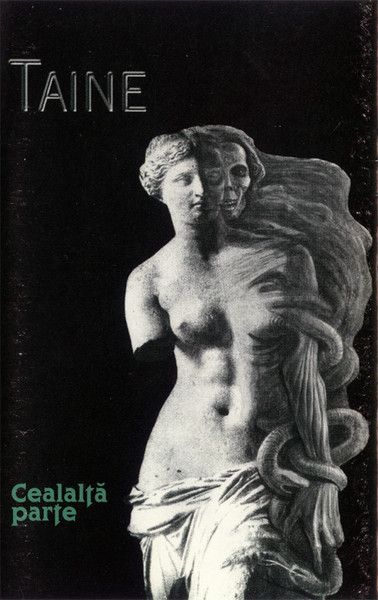
The 1999 cassette documented the four-piece line-up: Andi Ionescu sang and played guitar, Ștefan Aldea played guitar, Adi Tăbăcaru played drums and keyboards, and Bogdan Vișan played bass. Ioan Brîndușan was credited as producer and Oliver Végh as sound engineer; the mixing was credited to TAINE and Végh. Oblio painted the cover, and Sebastian Enache took the photographs. Alongside families, friends and the Romanian music scene, the booklet's acknowledgements also preserve the names Death, Atheist, Cynic, Megadeth and Dream Theater. A biblical quotation also appears, but its exact verse number is not reliably legible. The 2000 CD version followed the cassette as a separate edition. 192932426364426364 Against a black background, greyish-white, sculptural human figures emerge, merging into one another: the image is a possible visual counterpart to the divided self of the title track. The acknowledgements also preserve the names Abigail, Cronos, C.A.S.H., Scamp Heart Killers, Anarhia and Psycho Symphony, as well as, among others, Doru Ionescu, Lenți Chiriac, Noni Hutterer, Adi Popescu, Gabi Gomboș, Florin S. Ursulescu, Alex Revenco, Gigi Tăbăcaru, Cornel Ionescu and Ionuț Biriș. The 2000 CD shows a version of the cover adapted to a square format, a back cover with a blue triangle and an ORDA marking; the producer's name appears there as Nelu Brîndușan. 4263 In a concert preview in the Cluj newspaper Știrea, Bogdan spoke of two well-received appearances in Dej. They had previously won studio time as a festival prize, but without a producer they had been unable to use it; they also hoped for a CD to accompany the cassette made with Promusic's support. According to the report on the Ambasador presentation announced for 1 March, the audience could obtain a cassette at the entrance. This indicates an earlier public presentation than the April release chronology in the official history; the two events need not have been the same. 144
Romania in 1999
In the spring of 1999, Romania was trying to find its footing amid economic recession and the conditions attached to international financial assistance. The euro appeared in financial settlements, while NATO's operations in Yugoslavia directly affected political debates over Romanian airspace. In the anti-war imagery of Vanity, the plight of vulnerable people has universal relevance; the lyrics do not name a specific conflict. 5973607475767737 On 22 January, Prime Minister Radu Vasile and Miron Cozma reached an agreement at Cozia Monastery concerning the miners’ dispute. The euro was introduced on 1 January as the accounting currency of eleven countries; cash only entered circulation later. 10060
Accounts differed regarding the terms of the Cozia agreement. Cozma spoke of a ten per cent wage increase, the reversal of the closure of two mines and two hundred million dollars in European funding intended for the Jiu Valley. Deputy Minister Nicolae Stoiculescu, by contrast, mentioned postponing the closures and committee negotiations to continue until 15 February, and envisaged the wage increase being borne by the company. On 1 April, Traian Băsescu forecast the loss of some one hundred thousand jobs; the following day, a forty-three-million-dollar transaction for 45 per cent of Bancpost was announced. On 5 April, the government outlined a crisis programme aimed at closing loss-making plants and making redundancies. 10077
In Cluj-Napoca, the city where the album had been recorded, the spring days also saw struggles over the future of jobs and the preservation of musical life. On 29 March, Clujana's first-shift workers gathered outside the administrative building to obtain information about the company's future.91 Three days later, on 1 April, the local daily reported on the announced opening of the third Cluj Modern contemporary music festival on 3 April. The Gheorghe Dima Music Academy prepared the event under the artistic direction of Cornel Țăranu on a tight budget; according to the festival preview, many musicians agreed to participate without payment or for a symbolic fee.92
The same front page of 30 March also reported the beginning of the pre-Easter city clean-up and changes to regional railway services. The following day, the front page carried news of the road tax on motor vehicles and the presence of global car manufacturers in Cluj. On 2 April, the daily wrote about the renovation and supermarket plans for the market hall in Mihai Viteazul Square, which had been dragging on for two years, and about the legal dispute between the city administration and Alimentara. 91126127
Cornel Țăranu founded the city's contemporary music festival in 1995; alongside the announced April opening of its third edition, the culture pages also previewed the opening of Carol Pleșa's retrospective exhibition, planned for 2 April. 92128
In Bucharest on 30 March, the Romanian parliament called for negotiations to resume and violence against civilians to cease, while maintaining its commitment to NATO membership. In a survey published that day by Adevărul, 70.9 per cent of respondents supported neutrality.86 The Cluj news also covered a meeting held by Mayor Gheorghe Funar, at which speakers expressed concern about the consequences of events in Yugoslavia for Transylvania.87 On 1 April, NATO General Rupert Smith discussed the Kosovo situation in Bucharest with Defence Minister Victor Babiuc and Chief of the General Staff Constantin Degeratu.88 Meanwhile, the refugee crisis in the country's south-western neighbourhood was becoming increasingly severe: on 3 April, the United Nations refugee agency reported that around 170,000 people had arrived in Albania since 24 March; the following day, it appealed to countries around the world to receive refugees.8990
On 29 March, Romanian radio reported that forty-five people had crossed the Serbian border; Radu Vasile had earlier stated that Romania was ready to receive three to four thousand refugees. On 31 March, the Romanian Foreign Ministry spokesperson reported on the Albright–Pleșu telephone conversation of the previous day. On 2 April, the Ministry of Defence denied reports of NATO aircraft flying in the country's airspace. The UNHCR appeal of 4 April estimated the number of refugees in the previous eleven days at around 350,000. 1298713090
Alongside news from the Balkans, entirely different changes were taking place elsewhere in the world. On 29 March in New York, the Dow Jones closed above ten thousand points for the first time, at 10,006.78. On 1 April, Nunavut was established within Canada's territorial administration. On 31 March, Romania's national football team won 1–0 in a European Championship qualifier at the Tofik Bahramov Stadium in Baku, and on 3 April Dinamo București defeated Olimpia Satu Mare 5–0 at home. 131132133134135
On 5 April, NATO Deputy Secretary General Sergio Balanzino held talks with Romanian leaders; Victor Babiuc indicated readiness to receive six thousand refugees if adequate international assistance was provided. The next day, the temporary suspension of Bucharest–Belgrade railway services was announced. On 19 April, Jamie Shea spoke of the request to use Romanian and Bulgarian airspace, distinguishing it from the stationing of aircraft. On 22 April, Resolution No. 14 of the Romanian parliament authorised unrestricted NATO access to its airspace for the duration of air operations against the territory of the Federal Republic of Yugoslavia; it also requested security guarantees and assistance to mitigate the consequences. 74757677
On 16 April, Adevărul de Cluj reported that Metallica's concert had been announced for 9 June at Bucharest's Stadionul Național; it also mentioned the announced start of ticket sales on 20 April and a domestic support band. The bibliographic record of the Romanian Heavy Metal Magazine's 1999 issues preserves traces of that year's metal press. 5253
Among the spring album releases, Finland's Amorphis opened a new chapter on its path towards progressive metal on 29 March with Tuonela, released by Nuclear Blast. The metal database dates the release of German death metal band Cerebrocide's Delusion, on Cudgel, to the same day. The two releases represented different directions in the same diverse international musical spring. 136137138139
The concert preview promised a one-hour performance by Monster Magnet and a half-hour set by Antract before Metallica's two-and-a-half-hour show. Antract planned to perform songs from Înainte de toate, in preparation at Zone Records; the organisers announced ticket prices between one hundred thousand and two hundred and fifty thousand lei. In the negotiations for the concert, Chiriac encountered the discrepancy between official record sales and actual listener interest: cassettes were cheaper and more widespread than CDs. The official setlist for the 9 June concert comprises nineteen songs, from Breadfan to Battery. 52121116
Record label, stage and memory
The band's official history preserves accounts of favourable reception at the time. The 2004 Hard’n’Heavy Music Magazine review assessed the sound of the 2003 remaster: it praised the precise balance of rhythmic changes and syncopation, considered the 1999 songs enduring, and felt the remaster came closer to the sound the musicians had originally sought. The reviewer heard the instruments as leaving space rather than filling it needlessly; however, the combination of acoustic and electronic drums and drum programming was considered less successful. Alessandro Di Clemente approached the remaster and the 2003 promo received from the band from another angle. He measured the material against Death's Human–Symbolic period, Pestilence's Spheres and Tampa's technical death metal; despite the musicianship and complex structures, he felt that the connection to American models was too close. He gave the remaster 75/100 and the more personal promo 85/100, with a combined rating of 80/100. Both the title variants Invisible Personality and Invisible Absolute survive in the review. He heard the middle section of No Personality as a more mature progressive moment, and the cover of The Philosopher as a powerful version with vocals reminiscent of Schuldiner but an emotional effect different from the original. These tracks from the 2003 releases are distinct from the eight songs on the original 1999 cassette. 65661966651932656619326566 The remaster ran for 38 minutes and 17 seconds. The first reviewer had not considered the combination of drum sounds successful four years earlier either, and found it dated in the new version. The other review also drew comparisons between the approaches of Meshuggah's Nothing and Pestilence's Spheres; the reviewer reported that the cassette had quickly sold out, without providing precise sales figures. 6566 In the rehearsal-room report following the album, Andy also spoke of interest from the Netherlands and France, raising the possibility of recording abroad. In his view, the band could show more of itself in front of an audience than on cassette. 5 The reporter at the Ambasador evening observed limited interest in TAINE at the venue, so this single concert does not preserve the same picture as the later, broadly favourable recollections. 144 According to Gomboș's 2003 retrospective, after the release the band turned its attention from competitions to studio work and live performances. For the April promotion, he mentioned Bucharest, Cluj-Napoca and Buzău, as well as a special TVR programme. 147 In a 2003 interview with Maximum Rock, Andy was still dissatisfied with the results of the mixing and mastering; his criticism was not directed at the songs. 148
The Thrash Metal Guide reviewed TAINE by way of a later seven-track compilation from 2004 and the Resurrection EP. The reviewer found Pierdut layered despite its short form and the under-two-minute version of Avoid the Pain dense. What Are You? (Ce Ești Tu?) recalled the technical thrash of Coroner and Deathrow, while in Lie the reviewer heard a sharper, melodic, gothic thrash direction. Invisible Absolute, No Personality and the cover versions also belonged to the later compilation and releases. In the title track of Resurrection, the reviewer found melodic progressive death metal, in Existence winding riffs reminiscent of Death, and in Love & Hate restless development and a lyrical conclusion. The doom-tinged rhythms of The Devil Inside and the technical melodic embellishments of The Genius Way particularly appealed to the reviewer; in the acoustic version of the latter, it was precisely those embellishments that seemed to disappear. 78783278 The reviewer heard guitars more melodic than those of late-period Death, and natural yet disjointed structures. Invisible Absolute evoked Cynic, Atheist and Coroner, and an orchestral ending; No Personality seemed more straightforward, Death-like thrash. Despite its few tracks, the reviewer regarded the compilation as a treasure. 78
Later critics judged the record by different standards. In 2017, the author of Metal Hut included TAINE among fifty unranked favourites, singled out What Are You? (Ce Ești Tu?), and also saw the album as a source of Romanian cultural pride. A 2025 essay on Romanian death metal judged the debut heavily derivative of Death and suggested that it might have gone unnoticed in the more recent wave of nostalgic death metal. Even in 2020, Bogdan Vișan did not regard the band as having been without rivals: he also identified Psycho Symphony's Silent Fall and a recording by Ultimatum from Timișoara as important. An article on White Walls' Grandeur recalled Cealaltă parte as an earlier benchmark in the country's progressive metal heritage; another rock history overview from 2025 assessed it as progressive death metal of international calibre and highlighted Adrian's drumming. 81824183848182418384 The 2017 author found the album superior even to some Death records; the author regarded CodeRed as a stronger band overall, but placed its debut below TAINE's. The 2025 essay considered Ultimatum more forward-looking. The review of the White Walls album referred to TAINE alongside Altar's Respect, Goodbye to Gravity's Mantras of War and The Thirteenth Sun's Stardust; Fanto also heard the musical legacy of Death, Slayer and Iron Maiden in the debut. 81828384 Bogdan also illustrated the increased interest in rock after the political transition through the examples of Altar and Neurotica: in his view, they attracted large audiences even before releasing records. He felt that many people followed the scene as a matter of fashion at the time, and that the subsequent decline could not simply be explained by the quality of the recordings. 41
The 2000 CD-R presented the same album on a different physical medium and with a distinct cover variation. Metal Archives dates an old cassette entry to 1996; the band's own chronology associates that year with a demo recording and places the first album cassette in April 1999. 192932
The band’s later path
In the years after the album, the band also built its own infrastructure. Andy had long dreamed of owning a record label; after Alinian's Garden Of Alinian album, releases by TAINE and Warganism's Centipede followed under its auspices. They paid for the Live In Studio recording themselves. The earlier Promusic was a separate record-label venture. Nelu Brăndușan dated its establishment to 1996 and its actual launch to 1998. He offered album production prizes at festivals, organised concerts, sought nationwide retail distribution and reached markets beyond Europe with some of the label's releases. Amid the spread of MP3s and plans for a retail network, Andy found that many Romanian concertgoers did not buy records. The merchandise queue at an Opeth–Cynic concert in Munich showed him how audiences could support artists directly. Running the label consumed considerable money, energy and time, and its revenues were slow to recoup the investment. The 2002 concert videos and subsequent European performances brought TAINE's stage world to new listeners; changes in personnel repeatedly required the new line-ups to learn twelve to fifteen songs. 79406740394079806828
In 2002, DRC Image made professional recordings of the performances at Metal Heart I in Costinești and S.R.O.A. at Arenele Romane; the band also appeared at the FIMU festival in Belfort. Fanto recalled his first TAINE concert in the neglected hall at Preoteasa. Dittigheim followed in 2003, and on 13 December came the concert at Sala Polivalentă supporting Kreator. Andi Ioniță's video for No Personality was broadcast by MTV Romania. At the April 2004 anniversary show, alongside Avskild and Psycho Symphony, they experimented with live projections; Andy had difficulty obtaining a screen and projector. Taine Records assembled a multimedia release from concert and archive recordings, an interview with Lenți Chiriac, a photo gallery and Dolby audio. The discography lists 150 CDs in 2004 and 100 DVDs in 2005, while other accounts mention a CD in 2003 or a DVD in 2006. 192928101
After StuffStock in 2005, Robert “Sep” Pieptan took Bogdan's place. Sziget and East West Fest in Seini in 2006 provided opportunities for new encounters. Foreign performances once required visas, and in 2015 a problem at the Serbian border shortened the Balkan tour; Andy regarded even trips that broke even as successes. The multi-camera Live In Studio CD/DVD of 2008 was made in their own studio, mixed by Andy and Adrian, with Dolby audio and English subtitles. The website gives the names Chris Makenson and “Cositn Chioreanu” in the mastering and artwork credits; the original release has not yet confirmed this. Their cover version of The Philosopher paid tribute to Chuck Schuldiner. 1929306728
After the 2009 tour of Romania and Moldova, Ștefan was replaced by Ciprian Martin, who was succeeded in 2013 by Petre Iftimie. The evening at Wings Club in 2011 went ahead despite the cancellation of Opeth and Katatonia: close-ups of the instruments and psychedelic projections followed the live performance precisely. Kistvaen vocalist Fane appeared on Devil Inside; The Genius Way closed the evening. The reviewer, who liked the debut, heard no songs from it on this occasion, but considered the new repertoire a sign of development. After Metalhead Meeting in 2013 and Lithuania's Devilstone, the six-track Resurrection appeared on 28 December, breathing new life into the early Love & Hate as well. 191021032878
They also sought a place for songs outside their own musical world. Petre helped Andy shape the English lyrics, while TAINE's more melodic compositions of a different character found a place in a separate project featuring Sigrid Cornea's vocals. SIGRID's demo Don’t be Sorry became a production with post-production work in Sweden; according to Petre, the two musical approaches could coexist. 676828699122
Following the concert recordings, Sziget and other European appearances, the band's own studio and new line-ups also shaped its path. In interviews in 2016–17, Andy spoke of the reasons for remaining in the Romanian underground, the lack of clubs and the financial risks of foreign tours. Changes in personnel and the constraints of earning a living slowed the completion of new material. Three Days in Darkness, written around 2012, began with audio recordings of the 1977 earthquake and apocalyptic imagery. Andy lost old friends in the 2015 Colectiv fire; The Dark Days of Our Lives was dedicated to them. He continued with the band and the studio after the tragedy. After TAINE, Adrian focused on the rock opera Lucifer and on Souptrip, and described music as personal, spiritual work. Andy experienced his departure as the end of a quarter-century creative partnership. Teo Popp took over on drums; learning the complex metres, working with the metronome and backing tracks and mastering the old repertoire required time, further delaying the new album. The songs of Cealaltă parte lived on onstage with the new line-ups, and friendship, work and the conditions of everyday life remained closely intertwined throughout the band's history. 80682869676828696768286768286919
Petre left in September 2018; Ciprian Martin returned. An anniversary concert with former members and the Mihai Barbu Project was announced for 12 April 2019 at Fabrica. Andy spoke of relearning the old solos and lyrics; despite more readily available concerts and better wages, Bogdan still saw gaps in the infrastructure. Adrian saw progress in talented young musicians, while Ștefan saw it in better studios and more carefully considered lyrics. 1043941
In preparation for the anniversary, Andy had to bring the old solos to life again in an era of lower tunings and seven- and eight-string guitars. Bogdan also praised the work of Spectral, White Walls and The Thirteen Sun; he planned a concert at Fabrica for his forty-fifth birthday in 2020, but his work-related travel and Bucharest's traffic meant that he was not planning a permanent return. 3941
Chaos & Contemplation was recorded between 2018 and 2022. In their own Taine Multimedia studio, instrumental layers were built upon one another; for one song, one account mentions around eighty tracks and another nearly a hundred. External producer Forrester Savell's decisions resulted in a more modern balance between the instruments. Vikram Shankar's piano, Robin Zielhorst's fretless bass and Marius Pop's jazz-fusion playing each lent a distinctive character to the music. Andy returned to record the old Prea mult because he felt the composition was still relevant three decades later. The ten-track album appeared on 15 September 2023; he explained the use of English as a desire to reach an international audience. 10510626107 In a conversation with The Interwission, Andy dated the original recording of Prea mult to 1998 and its release to 1999. He wanted listeners to hear the song again as bonus material on the later album so that the power of the old composition could also emerge under modern mixing and mastering conditions; he believed that its unchanged musical content, with a modern sound, could hold its place in the live repertoire for decades to come. 105
The guests took on distinct roles in the new songs. Neuro played two guitar solos, Mihu contributed vocals to Neuralgia, and Maria Modoran recorded backing vocals for two songs. Andy chose a singer named Kimberly because her vocal timbre recalled the world of Anathema, and Andrei Rusu helped when another vocalist had to be found because of the deadline. Petre recorded his solo at home. Andy highlighted the wordless vocal harmonies of Fusion X and the solos in which Marius Pop and Vikram Shankar answered one another. The album version of the song commemorating Colectiv received newly recorded guitars and real drums, while the vocals and keyboards were partly retained from the earlier recording. 10526106
Their own studio provided the means to record the new album, but external mixing, mastering, artwork and manufacturing still entailed costs. Björn Gooßes created a visual story of his own for the title. Andy remained committed to a physical release alongside digital distribution; he found it increasingly difficult to reconcile the old world of attentive album listening with the era of short videos and frequent singles. 10510626
After the joint evening featuring Gothic, TAINE and L.O.S.T. in January 2024, musicians from the old scene met again at the We Are The Underground events. The 2025 programme at Quantic featured GOD, Gothic, TAINE, Grimegod, L.O.S.T., Cronos and Anarhia. Andy considers Alin, the Gothic musician, the mentor behind the initiative; alongside the old friendships, young listeners also became part of the scene. The Craiova report of 31 January 2025 includes Prea mult, Pierdut and Ce ești tu? alongside the new repertoire; the reviewer praised Sep and Davide's playing and criticised the overly intense strobe lighting. 10626107108
In a recollection from 2026, Andy associated further line-up changes with financial disputes after Artmania and the breakdown of a hired bus. He continued to value Alexei and Petre's work musically, but could not continue working with them. Sep accepted the invitation to return; Andy appreciated Teo's sensitivity to dynamics and his execution of complex rhythms. When Ciprian no longer wanted to play live, he recommended Davide Bucca, a native of Sicily living in Bucharest, for the concerts already booked. Davide had learnt the material by the first rehearsal. 267107
Following the Craiova concert, a different programme was presented at Prog Day on 29 March. According to the report, Invisible Absolute was the oldest composition performed; Fanto considered the newer repertoire an appropriate choice for the progressive evening. Davide, who had come from Spectral, Teo's precise drumming and Sep's return dispelled his earlier doubts; he would have welcomed an appearance by Maria Modoran. In June 2026 at Quantic, before Death To All, images of Chuck Schuldiner and the acoustic version of The Genius Way introduced the set. Vanity, Psalm I & II, Avoid the Pain and Prea mult recalled the debut; Sep's microphone malfunctioned during Avoid the Pain. That evening, Metalfan's writer also saw young people moshing to TAINE's music. 101123
In October 2026, Fanto heard the further development of the band's technical thrash past in Chaos & Contemplation, especially in the instrumental worlds of Seconds and Fusion X. Alongside the guest musicians and Forrester Savell's sound, he also noted the new recordings of Prea mult and Dark Days of Our Lives. After the line-up changes, however, he heard songs from the new album less frequently at concerts, where audiences continued to be attached to the old compositions. 124
The image of the other side runs throughout TAINE's first album. On the cassette, the inner voice responds to the communal and political world; onstage, the young Bucharest musicians built a sound of their own from limited resources; and in later recollections, the hardships of the past take shape in vivid human details. The eight songs of Cealaltă parte remain at the intersection of these three perspectives: those of the city, the band and the person trying to confront the other half of themselves. 1883728
Sources and references
Historical / documentary (141)
- Historical / documentary
Muzeul Curtea Veche – the history of the Old Princely Court; Muzeul Municipiului București; n.d. (institutional overview).
Source record: TAINE-06-071 ↩1 ↩2The Curtea Veche Museum preserves finds from Bucharest dating back to the thirteenth century and evidence of more than five centuries of local habitation. From the fourteenth century, the site housed a residence of the rulers of Wallachia; between 1459 and 1660 Bucharest shared this role with Târgoviște, and after 1660 became the sole capital. After 1798, most of the court grounds were put up for auction, and streets and districts were built on the site. The museum was developed between 1969 and 1974; alongside eighteenth-century remains, sections of walls from the reign of Vlad Țepeș (1456–1462) and fourteenth-century foundations can be seen. The closure in 2015 was a subsequent heritage-conservation event. No direct connection with the band is documented; this is urban historical background.
Exact source location: Muzeul Municipiului București, The Old Princely Court Museum, historical paragraphs 48–51.
Historical relevance: the medieval court and the early urban core of Bucharest.
- Historical / documentary
București – Epoca modernă; Primăria Municipiului București; n.d. (municipal history page).
Source record: TAINE-06-073 ↩1 ↩2The municipal authorities regard the revolution of 1821 as the beginning of the modern era. The 1807 census recorded 3,523 shops; in 1830 a city council and five administrative districts were established, and in 1846 the first cadastral plan was completed. The source records rapid industrial development following the declaration of independence in 1877; the railway connection towards Giurgiu began operating in 1869 and that towards Ploiești–Galați–Roman in 1870. The Filaret station and the later Gara de Nord illustrate the city's role as a national transport hub. A network of trade, banking and public utilities developed in the second half of the nineteenth century; electric street lighting was introduced in 1882 and tram services began in 1894. Between the world wars, the city was a major industrial and financial centre, home to approximately 17% of the major enterprises in 1938. Băneasa Airport opened in 1921, an automatic telephone exchange was operating in 1927, and the Telephone Palace was inaugurated in 1933. The administrative reorganisation of 1926 divided the centre into four sectors and a suburban zone. Bombing during the Second World War destroyed buildings and industrial facilities. The source dates the power station to 1908 and the introduction of tram services to 1894; a causal connection between the two events is therefore not established.
Exact source location: PMB, Epoca modernă, lines 31–46.
Historical relevance: nineteenth-century urban development.
- Historical / documentary
București – Epoca contemporană; Primăria Municipiului București; n.d. (municipal history page).
Source record: TAINE-06-074 ↩1 ↩2According to the municipal history, post-war nationalisation and Soviet-style economic organisation transformed Bucharest under the communist dictatorship until December 1989. Large industrial plants, cultural institutions and mass housing construction changed the city. Employment in construction stood at 39,700 in 1950 and above 97,000 in 1983. Between 1945 and 1964, 80,641 homes were built, and between 1965 and 1984, 446,100; among the large housing estates, the source mentions 40,000 homes in Militari, 63,000 in Drumul Taberei, 90,000 in Titan–Balta Albă and 70,000 in Berceni. The institutional account is critical of the construction quality and comfort of the concrete apartments. Housing statistics for 1992 record 760,751 dwellings. The history of the housing estates provides context for Andy’s own recollections of Militari, but does not establish specific personal living conditions.
Exact source location: PMB, Epoca contemporană, lines 31–40.
Historical relevance: socialist industrialisation and the urban structure of the capital.
- Historical / documentary
The Many (Still) Functional Housing Estates of Bucharest; Springer / Housing Estates in Europe; 2018 (book chapter).
Source record: TAINE-06-080 ↩1 ↩2 ↩3 ↩4Vera Marin and Liviu Chelcea (2018): The Many (Still) Functional Housing Estates of Bucharest, Romania: A Viable Housing Provider in Europe’s Densest Capital City. In Housing Estates in Europe, chapter 8, pp. 167–190, DOI 10.1007/978-3-319-92813-5_8.
Pp. 167–170: According to the authors, the mass-produced socialist housing estates of Bucharest have continued to provide viable housing over the long term, rather than necessarily becoming impoverished, segregated urban ghettos. The proportions quoted from the 2011 census (80–82% of the housing stock and approximately 83% of the population) describe a later situation. The population was approximately 1,025,000 in 1950, 1,366,000 in 1960, 1.8 million in 1975 and 2 million in 1990. From the 1950s onwards, following the nationalisation of inner-city housing, the new mass housing estates accommodated much of the migration prompted by industrialisation, using centralised planning and prefabricated building components. The 99% privatisation of the early 1990s transferred ownership of the dwellings, together with responsibility for their upkeep, to families. According to the authors’ observations in 2018, these estates are socially mixed and their residents are attached to them, but do not always have sufficient money or organisational expertise.
Pp. 171–176: Four periods of housing construction: the early Soviet-style cvartal, with three- to five-storey buildings, spacious courtyards and ornate entrances (for example, Ferentari and Cotroceni), and only a thousand new dwellings in 1954; from 1956 to 1977, functionalist mass construction, Gheorghiu-Dej’s programme for inexpensive, good and beautiful buildings, and a planned national target of 300,000 dwellings for 1960–65. From the late 1960s onwards, the Titan/Balta Albă, Drumul Taberei, Pantelimon and Colentina residential districts accommodated 150,000–300,000 people. A unit of 1,500 residents was to have a playground, kindergarten and school; a micro-district of 4,000–12,000 residents was to have shops, a library, a cultural centre and sports and medical facilities; a district of 40,000 residents was to have a secondary school, cinema, post office and hospital; larger units were also to have a theatre and concert hall. The community infrastructure was not fully completed. A dwelling with running water and heating represented a significant advance over earlier overcrowded rural accommodation; residents shaped their private interiors according to their own aesthetic preferences, distinct from the public space. Drumul Taberei was formerly a military area. Following the 1974 planning law and the 1977 earthquake, buildings in central and semi-central areas were also demolished; Calea Moșilor, for example, was widened and lined with ten-storey buildings.
Pp. 176–180: From 1977 to 1990, increasing building density was associated with repayment of IMF debt and Ceaușescu’s austerity measures, with smaller balconies, windows and green spaces, and poorer aesthetic and communal qualities. Some newer structures were more earthquake-resistant and had larger rooms. Berceni is a characteristic example. Green spaces between earlier buildings were built over, and following a 1981 decree residents were required to undertake compulsory ‘voluntary’ public cleaning work. According to the authors, the civic centre project of the late 1980s demolished approximately a quarter of the central and semi-central area. After 1990, housing was rapidly privatised, and state housing funding, which had previously amounted to approximately 8% of GDP, came to an end. The ratio of private to state funding was 1:7 in 1990 and 10:1 in 2008. Apart from completing buildings already under construction, scarcely any new mass housing was built. The 1990s saw modest private construction, migration back to rural areas and the movement of wealthier residents to suburbs. After 2005 came long-term mortgages and new gated residential developments, which partly reproduced inherited problems in the urban fabric.
Pp. 180–184: Four layouts: perimeter blocks, tower blocks and elongated buildings, parallel elongated buildings, and street canyons of buildings along boulevards. The housing estates are socially mixed; originally, young workers, married couples and relocated employees were among those allocated dwellings, and 30-year housing loans were typical. Later censuses indicate an ageing population; the planned fifty-year lifespan of buildings and four-storey blocks without lifts pose challenges. In the 1980s, the original water, gas, electricity and district heating networks experienced supply difficulties. After privatisation, maintaining pipes within buildings became the responsibility of owners’ associations. In the late 1990s and afterwards, many households disconnected from district heating; later gas prices meant that this did not prove cheaper for everyone. In the early 1990s, centralised planning gave way to an almost complete planning vacuum. Industrial brownfield sites (approximately 15% of the urban area) and green spaces returned through restitution became available for speculative development. Balta Albă’s 300,000 residents were linked to the 23 August industrial area; only one cinema, Gloria, and one department store, Magazinul Titan, are cited as examples, and in the 1980s some schools operated in three shifts.
Pp. 185–188: New developments placed further pressure on schools, kindergartens, utilities and public spaces. After privatisation, housing became a matter of individual economic achievement rather than a right guaranteed by the state. Amid the economic upheavals of the 1990s, the transfer of ownership provided both debt-free housing security and new maintenance burdens. Some owners lost their homes because of unpaid utility bills, while others moved to rural areas or crowded into homes with their children; a lack of effective joint representation and trust was also problematic. The authors advocate data collection, targeted public funding and protection for poorer families. In relation to TAINE, the chapter provides background on the urban environment, generation, family burdens and cultural infrastructure of the 1990s; it does not establish any musician’s address, individual living conditions or the location of a specific rehearsal room.
Historical relevance: housing estates and the everyday urban environment.
- Historical / documentary
ASII ADOLESCENȚILOR, circa 2000
Source record: TAINE-01-007 ↩1 ↩2 ↩3 ↩4 ↩5 ↩6 ↩7 ↩8 ↩9 ↩10 ↩11 ↩12 ↩13The report takes readers into a rehearsal room in a hidden basement of a house, accessible through a trapdoor. It states that the members met in the winter of 1992–1993, that the band was founded in February and made a successful debut in March, and mentions festivals in Satu Mare, Buzău, Câmpulung, Dej, Piatra-Neamț and Bucharest at which they won awards. It describes the previous year’s album as containing five songs in Romanian and three in English; from 1996 onwards, Ionescu, Aldea, Tăbăcaru and Vișan formed the stable line-up.
Profiles: Andy (14 February 1974) grew up in the Militari district; he began playing guitar at eighteen. Adi will turn twenty on 12 May; he inherited his love of drumming and ice hockey from his father. A first-year percussion student at the conservatoire, he is gaining experience in orchestral and contemporary music and experimenting with unusual instruments. Andy heard him drumming near his grandmother’s home. Ștefan Aldea is twenty-four, with a birthday on 23 February; alongside his architectural studies, he works on computer graphics and goes on hiking trips. Bogdan works in the legal field and had his hair cut while looking for work; he hopes to put a pay rise towards recording. At Easter they went fishing together near Giurgiu.
According to Andy, the media favour rap and dance music, while a shortage of audiences and clubs reinforce one another. Interest from the Netherlands and France held out the prospect of recording abroad; the band can better demonstrate what it does live than on cassette.
Historical relevance: the early members’ lives, their rehearsal room, concerts and the contemporary media environment.
- Historical / documentary
Andrei Zbîrnea (interviewer), Andy Ionescu; Interviu cu Andy Ionescu, liderul trupei Taine – partea II; Revista de cultură FAMILIA; interview: 2025-08-06; published 2025-12-30, No. 10/2025.
Source record: TAINE-01-022 ↩1 ↩2 ↩3Andy’s first rock record was Iron Maiden’s Somewhere in Time (1986), with a fold-out cassette cover; he has kept his cassette and CD collection. He was shaped by the production of Metallica’s ...And Justice for All (1988), by Painkiller, Rust in Peace and Seasons in the Abyss (1990), by Death’s Individual Thought Patterns (1993, on which he first heard Steve Di Giorgio), and especially by Cynic’s Focus (1993). Zakk Wylde was closer to his tastes than Ozzy or Sabbath.
In the 1990s, with fewer bands and limited access to music from abroad, local bands had greater visibility through TVR, Petre Magdin, and Lenți Chiriac’s radio and later television programmes. At home with friends, they listened to metal, Jarre and Vangelis around the record player without talking; the lyrics of rare original releases were copied out by hand and later photocopied.
Around 1993–1995 he witnessed clashes between punks and rockers in the Cișmigiu area and at events at the Polivalentă. He himself did not get into fights. His experiences of early clubs included tobacco smoke, occasional objects being thrown, harsh interventions by the gendarmerie, basements with narrow exits and rudimentary sound systems. After Colectiv, he reassessed his own willingness to take risks. Were he seventeen again, he would not choose a different musical path: the technical conditions of the period were what they were. He illustrates the development of festivals in 2025 with Rockstadt and ARTmania; he is planning a national tour with Gothic. Outside music, he was also shaped by his family’s sporting tradition, almost ten years of judo and his attachment to Dinamo.
Exact source location: Albumele care l-au format pe Andy; hand-copied lyrics; club concerts before 2000; memories and festivals; concluding questions on sport.
Historical relevance: Andy’s musical influences and the culture of records and cassettes.
- Historical / documentary
TAINE – band member profiles; TAINE – Meet the people behind the music (Past & Present); TAINE – official website; no date given; accessed 2026-11-20.
Source record: TAINE-05-056 ↩1 ↩2 ↩3 ↩4 ↩5 ↩6The band’s official member page dates Andy Ionescu’s founding of the band to 1993. Born in Bucharest on 14 February 1974, he was a fan of Megadeth, Iron Maiden, Coroner and Annihilator. He studied the history of religion at university. In the mid-to-late 1990s, as the bass player of Plutonium, he encountered technical/progressive death metal; Death, Cynic and Atheist became major influences. He owns the TAINE-MULTIMEDIA studio and works as a producer, composer and session musician, and is also active as a record-label operator. The former members listed are Ștefan Aldea, guitar, 1993–2009; Bogdan Vișan, bass, 1995–2005; Adrian Tăbăcaru, drums, 1993–2016; Andrei Nicolescu, bass, 1993–1994; and Bogdan Tufeanu, bass, 1993. Later members include Robert Pieptan, 2005–2015; Ciprian Martin, 2009–2013 and 2018–2023; and Petre Iftimie, 2013–2018. The histories of the current members document later developments: Teo Popp joined at seventeen on the recommendation of his teachers; Robert returned after nearly ten years; the Sicilian Davide Bucca, who played in Spectral, arrived in late 2024. The member list is the band’s own account; it is not identical to the contemporary album credits.
Exact source location: Andy’s biography, lines 29–39; other members, lines 43–66; Past Members, lines 67–132.
Historical relevance: the musicians’ biographies and the line-up.
- Historical / documentary
Adrian Tăbăcaru’s account for the Open Metal Album Library; November 2026, exact date of the statement unknown.
Source record: TAINE-OMAL-002 ↩1 ↩2 ↩3 ↩4 ↩5 ↩6 ↩7 ↩8 ↩9 ↩10 ↩11Question 1 – Musical beginnings. Tăbăcaru played drums at his grandmother’s house; he rehearsed with his father’s band and had already performed with them at the Sala Agronomiei and Stadionul Triumf. He was an active live musician from an early age, had been drawn to rock from childhood, and listened to Slayer, Iron Maiden and Metallica. He does not describe the circumstances in which he met Andy Ionescu and Ștefan Aldea, referring only to Ionescu’s fond recollection; the specific meeting or first rehearsal cannot be reconstructed from this account.
Question 2 – Everyday life in 1993–1994. A wide variety of activities filled each day: he played ice hockey (professionally until the twelfth grade, according to his own account), studied percussion, worked with symphony orchestras and rehearsed with TAINE in makeshift rehearsal rooms. He describes the period as vibrant; the only sacrifice he recalls is getting little sleep. He does not give a precise daily schedule of his school, family and band commitments.
Question 3 – The financial background to the Cluj-Napoca recording. Before leaving, he visited Ionuț, one of his father’s ice hockey pupils, who had a club in the Piața Amzei area. He told him they wanted to record an album and asked for help; Ionuț immediately gave him money that supported them for a time. The amount and the breakdown of responsibility for studio, accommodation, travel, meals, duplication and release preparation costs are not established. Ionescu’s parallel memories of the Promusic contract, Fotzey’s hospitality and their lack of money appear in separate recollections (TAINE-OMAL-001/2–3).
Question 4 – Personal stories and lessons. His grandfather ran a hairdressing salon; at the first TAINE concert, Tăbăcaru wore a securely fastened wig to fit in with the group, allowing him to headbang without the risk of it falling off and embarrassing him. His second memory concerns the day before leaving for Cluj-Napoca: he performed on the Sala Radio stage with his secondary school orchestra. The percussion instrument he had played went missing. Its disappearance coincided with his departure; nobody knew where he was or why he was absent from school, and he was almost expelled as a result. The instrument was found a few days later, but he himself returned much later. In the end, the situation was fortunately resolved. The story is a personal example of the conflict between school responsibilities and band commitments; it does not state that he took the instrument. His concluding thought is that worthwhile achievements require sacrifices, dedication and sustained work, a truth he regards as timeless.
Source: Adrian Tăbăcaru’s answers in Romanian to four questions from the Open Metal Album Library. The retrospective account concerns the background to the band’s founding, his artistic education, amateur and professional musical life, and the personal circumstances surrounding the studio work in Cluj-Napoca.
Historical relevance: Adrian’s musical upbringing, rehearsals and memories of the Cluj-Napoca recording.
- Historical / documentary
Teodora Minea (interviewer), Adrian Tăbăcaru; Interviu cu Adrian Tăbăcaru – on the founding of TAINE in 1993; Filarmonica de Stat Sibiu – official institutional website; 2020-09-18.
Source record: TAINE-03-041 ↩1 ↩2 ↩3 ↩4 ↩5Adrian Tăbăcaru recounts his beginnings within his family. He received his first lessons from his drummer father, who did not force him into music. He began playing at the age of three, performed on stage from the age of five, and played drums in his father’s band at nine. He played competitive ice hockey until the twelfth grade. At an event at the national ice rink, he refereed a match and played drums in his skates during the intervals: his father attached rubber to the pedals to prevent them from slipping. Before his school-leaving examinations, he chose music and went on to study percussion at university. According to his own account, he founded Taine with his fellow musicians in 1993, followed by performances at home and abroad. The 2017 endpoint should be understood as the end of his own time with Taine, not as evidence that the band ceased to exist. He regards the discipline gained through his conservatoire studies and work with orchestras, Bucharest radio and the Athenaeum as the foundation of his fusion of genres. He later created independent productions combining jazz, classical and electronic elements with visual technology. The rock opera Luceafărul arose from his study of Eminescu and an intense creative period; English was chosen in order to bring the work to an international audience. During the pandemic, he studied interactive technology at CINETic. He emphasises his aversion to routine, the joy of the process and the intrinsic significance of creating art.
Exact source location: introduction; Cu ce trupe ai început?; Ai avut în liceu trupa ta?; questions on the conservatoire and creative work.
Historical relevance: Adrian’s musical education within his family and at institutions.
- Historical / documentary
Cronologie. Decembrie 1989; Muzeul Revoluției Române din Decembrie 1989; n.d. (museum chronology).
Source record: TAINE-06-084 ↩1 ↩2 ↩3 ↩4The museum chronology does not reduce the fall of the dictatorship to a single day in Bucharest. On 15 December in Timișoara, solidarity across denominations and ethnic groups against the eviction of László Tőkés developed into a wider protest. On 21 December, the breakdown of order at the mass rally in the capital made the crisis of the regime visible on television; tensions also grew in Cluj-Napoca and other cities. On 22 December, the effective leadership of the dictatorship collapsed; television and the National Salvation Front played a decisive role in the emergence of the new political order. Violence and uncertain reports did not cease immediately after the collapse. The brief military trial and execution of the Ceaușescu couple on 25 December did not clarify responsibility for the violence. On 26 December, Petre Roman became prime minister. The possibility of political pluralism opened up, while the question of responsibility remained unresolved. This is a later historical summary, not testimony from the band.
Exact source location: Cronologie, 15–31 decembrie; lines 24–68.
Historical relevance: the chronology of the political transition in December 1989.
- Historical / documentary
Opera Națională Română Cluj-Napoca – institutional history; Opera Națională Română Cluj-Napoca; institutional history; n.d.
Source record: TAINE-07-121 ↩1 ↩2 ↩3The Romanian opera in Cluj-Napoca was founded on 18 September 1919 alongside the Romanian theatre and conservatoire. Constantin Pavel, Egisto Tango, Tiberiu Brediceanu and Dimitrie Popovici-Bayreuth contributed to the establishment of the company. Oskar Nedbal conducted concerts on 13–14 May 1920; the opening opera on 25 May was Verdi’s Aida, performed in Romanian, conducted by Alfred Novak and directed by Pavel. The building was erected by the Viennese firm Fellner & Helmer between 1904 and 1906. The list of seasons in the 1990s documents a varied repertoire: Enescu’s Oedipe on 5 June 1995; Wagner’s The Flying Dutchman on 2 July 1997; the world premiere of Sigismund Toduță’s Meșterul Manole on 16 May 1998; and that of C. P. Basacopol’s Cei șapte corbi on 30 November 1998. Falstaff premiered on 22 October 1999, after the album history’s April 1999 cut-off. This documents the musical background of the local institution, not the involvement of TAINE’s members.
Exact source location: Despre noi, lines 23–30; seasons 1990–2000, lines 33–91.
Historical relevance: the institutional history of the Cluj-Napoca opera.
- Historical / documentary
Filarmonica Transilvania – local concert music tradition; Filarmonica de Stat Transilvania; institutional history; n.d.
Source record: TAINE-07-122 ↩1 ↩2The state philharmonic in Cluj-Napoca was founded in the autumn of 1955; its first symphonic concert was conducted by Antonin Ciolan on 4 December. At its foundation, it comprised a 75-member symphony orchestra and a 20-member instrumental folk music ensemble. Its musicians included Dumitru Pop, Gheorghe Halmos and later Ștefan Ruha, and its conductors included Emil Simon, Erich Bergel and Cristian Mandeal. The Toamna Muzicală Clujeană festival began in 1965, and the chamber orchestra was launched in 1966 with the participation of Mircea Cristescu. In 1972, under the directorship of Sigismund Toduță, Dorin Pop established the choir. In 1993 the institution adopted the name Transilvania. International guest artists and tours demonstrate its cultural connections, but the guest list provided does not document a single season in 1999. The source does not claim a direct connection with TAINE.
Exact source location: Istoric and Repere importante, lines 31–67.
Historical relevance: the history of the Cluj-Napoca philharmonic.
- Historical / documentary
The history of the Bucharest conservatoire from 1864; Universitatea Națională de Muzică din București; institutional history; n.d.
Source record: TAINE-07-115 ↩1 ↩2 ↩3Higher musical education in Bucharest originated in a decision made in June 1863 by the council of ministers headed by Alexandru Ioan Cuza; the institution opened on 6 October 1864. Under Alexandru Flechtenmacher’s leadership it offered instruction in instrumental performance, singing, solfège, choral singing and harmony. A chamber music class began in 1900 and a composition class led by Alfonso Castaldi in 1905. Counterpoint, orchestration, aesthetics and music history were added to the curriculum between the two world wars. On 17 July 1931 it became an academy of higher education, with George Enescu as honorary rector. Mihail Jora headed it in the 1940s. From the 1950s, the conservatoire bearing Ciprian Porumbescu’s name had two main educational divisions: performance, and composition, musicology, conducting and pedagogy. From 1990 to 1998 it was called Academia de Muzică București, subsequently Universitatea de Muzică București, and from January 2001 it bore its present national university name. The 2001 name was not yet in use at the time of the events of 1999. The institution’s account of its own history does not in itself establish the studies undertaken by TAINE’s members.
Exact source location: Istoric and Carta UNMB, lines 5–22 and the historical table.
Historical relevance: higher musical education in Bucharest.
- Historical / documentary
Filarmonica George Enescu – the history of the Bucharest philharmonic; Filarmonica George Enescu; institutional history; n.d.
Source record: TAINE-07-116 ↩1 ↩2 ↩3 ↩4The Bucharest Philharmonic Society, established in 1868 under Eduard Wachmann’s leadership, aimed to maintain a permanent symphony orchestra; its first concert took place on 15 December 1868. Alongside the founding in April, the historical account also gives the date 28 July; the precise founding day is therefore uncertain. Between 1920 and 1944, and again from 1954 to 1964, George Georgescu modernised the repertoire and was associated with international tours, guest artists and recordings of Beethoven’s symphonies. After the Second World War, under Constantin Silvestri and Georgescu, an academic choir, soloists and chamber ensembles expanded the institution. In 1955, following Enescu’s death, it adopted his name. At the time of the political transition it was headed by Dan Grigore (1990), then Cristian Mandeal (1991–2009). The Ateneul Român is the orchestra’s home. The annual concert figure given in the institution’s later account is not a statistic for 1999; no direct connection with TAINE is established.
Exact source location: Istorie și moștenire, lines 28–65.
Historical relevance: Bucharest’s symphonic music institutions.
- Historical / documentary
Club A – founding and early festivals; Club A (Clubul Arhitecturii); institutional history; n.d.
Source record: TAINE-07-117 ↩1 ↩2 ↩3In 1967 Emil Barbu (Mac Popescu) conceived an independent club for architecture students, inspired by Polish student clubs. The earth-floored basement in Blănari Street was converted with contributions and labour from his fellow students; the club opened in 1969 with 800 founding members. The weekly programme encompassed theatre, political discussions, literature, jazz, film and dancing; the Securitate planted observers in the club. The first festival was held at the Preoteasa cultural centre and the second in 1971 at the Sala Palatului. After an interruption imposed by the authorities, the festival returned in 1981; Electrecord released a live album. According to the archive, the electricity supply was cut during Florian Pittiș’s reading on human rights in 1975; the audience continued the evening by candlelight, and Pittiș was banned from student clubs. In 1990 Adrian Șoaită took over the club, and from 1991 weekend dance evenings financed cultural programmes attended by a broader audience. In 1997 Paul Radu became programme director; metal concerts took their place alongside rock history forums, underground events and Lenți Chiriac’s RocKultura programme. The thirtieth anniversary gala in 1999 featured, among others, Compact, Timpuri Noi, Semnal M and Sfinx Experience. This list does not establish a performance by TAINE.
Exact source location: Club A – o istorie, lines 27–75, especially 1990–1999.
Historical relevance: Club A and club culture.
- Historical / documentary
Electrecord – the history of the Bucharest record manufacturer; Electrecord; official institutional history; n.d.
Source record: TAINE-07-137 ↩1 ↩2 ↩3Electrecord’s institutional history dates its beginnings to 1932, when Nathan Mischonzniki obtained manufacturing equipment from Germany. It operated its own studio from 1937, and the company was nationalised in 1948. Vinyl appeared in 1956 and became the exclusive format in 1967; stereo releases began in 1973. According to the company, annual production in the 1980s amounted to 6–7 million records. After 1990, production declined owing to competition and the growing prominence of CDs, and around 1996 it stagnated for lack of demand. In 1998, after the equipment was sold to a British company for 40,000 dollars and the factory building was sold, the proceeds were invested in a new studio. This is a direct corporate account of the transformation of the Romanian record industry; it does not establish any specific label relationship with TAINE.
Exact source location: Istoria Electrecord, lines 14–32.
Historical relevance: Romanian state-owned record manufacturing.
- Historical / documentary
Rock-ul românesc în perioada comunistă – a retrospective; Historia.ro; circa 2015; precise publication date unconfirmed.
Source record: TAINE-07-119 ↩1 ↩2 ↩3 ↩4 ↩5The author divides the development of Romanian rock into a relatively open period from the 1960s to the late 1970s, followed by a period of isolation under political pressure. He considers the presence of metal and punk in the 1980s to have been weak. Many of the early school and student bands were short-lived; Phoenix, Cometele, Sfinx, Olympic ’64 and others established a more lasting presence. Documentation of the early period is limited by the lack of recordings. This is the author’s interpretation, not evidence applicable to every Romanian band.
In the continuation published by Adevărul, Ţimonea distinguishes state-controlled television and studio appearances from the more relaxed club environment. The British film The Young Ones and the adoption of beat and psychedelic repertoire were part of the spread of rock in the 1960s. According to him, the July Theses of 1971 tightened restrictions on performing Western covers and singing in English, prompting some musicians to turn towards domestic folk traditions. Electrecord’s Formaţii rock LP series provided opportunities for national and local bands to release music; the author mentions 51 bands, including Experimental Q, Semnal M, Compact, Celelalte Cuvinte and Timpuri Noi. The text speaks of twelve compilations between 1975 and 1989, then lists them up to 1990; the internal chronological discrepancy remains. The Adevărul page gives 15 November 2015 as its publication date and 10 August 2022 as its update date.
The concluding profiles in the article illustrate musical diversity and differing institutional opportunities. FFN released three full-length albums and Metropol from Oradea released four, a rarity according to the author. The beginnings of Holograf as a student band in Bucharest in 1978 and Iris’s 1977 concert at the Sala Polivalentă are early examples of the capital’s scene. According to the article, the television recording of Phoenix’s 1974 performance at Sarmizegetusa was censored; Nicu Covaci left in 1976 and the band followed in 1977. Sfinx progressed from a student circle and cultural centres to a television competition and later international festivals. The author states that Timpuri Noi faced restrictions on radio, television and club appearances in the 1980s because of their lyrics critical of the regime. Voltaj was formed in 1982; its first concert took place at the Mihai Eminescu cultural centre. The article is a secondary source, drawing, among other works, on a rock encyclopaedia from 1999 and Doru Ionescu’s work from 2005; it is not direct evidence concerning TAINE.
Exact source location: Historia, lines 12–18; Adevărul, lines 14–18 and 30–74; Adevărul, Dorin Ţimonea, 15 November 2015, lines 57–99.
Historical relevance: restrictions on the public presence of Romanian rock during the socialist era.
- Historical / documentary
Andy Ionescu’s account for the Open Metal Album Library; November 2026, exact date of the statement unknown.
Source record: TAINE-OMAL-001 ↩1 ↩2 ↩3 ↩4 ↩5 ↩6 ↩7 ↩8 ↩9 ↩10 ↩11 ↩12 ↩13 ↩14 ↩15 ↩16 ↩17 ↩18 ↩19Question 1 – The origins of the songs and the official debut. In Ionescu’s recollection, the story of the album began with the band’s first steps. The compositions selected for the album accumulated from the founding, which he dates to 1992, until approximately 1997; they had already released two demos before entering a professional studio. He remembers the Romanian underground of 1993–1998 as an exceptionally productive, vibrant period, with many new rock and metal bands, some of which were still active at the time of his statement. TAINE’s line-up changed; according to Ionescu, he alone remained from the original line-up. For the official album they selected the songs they considered the best and most mature from their years of musical exploration. Here Ionescu dates the founding to 1992, whereas in his television interview (TAINE-01-009) he mentioned 1993; the official band history also places the formation in early 1993.
Question 2 – Choosing the Cluj-Napoca studio. In 1998 they decided to record. According to Ionescu, they had a contract with Nelu Brândușan’s Promusic label. Glas Transilvan was the only suitable and accessible studio for them. The young musicians’ enthusiasm was accompanied by a lack of money; he remembers the journey far from home as a special experience.
Question 3 – Waiting, subsistence and solidarity. Instead of the recording session planned to last a few days, the musicians found that the well-known Aurel Tămaș had unexpectedly occupied the studio; TAINE could not begin at the agreed time. Ionescu remembers waiting two or three weeks, possibly longer. Fotzey, then a musician in Cash and a member of Truda at the time of the statement, welcomed them into his home; they effectively lived with him while waiting. They had no money for food or accommodation, and there were days when they got by on yoghurt and bread or wafers. Ionescu regards the friendship within the underground and Fotzey’s help as an unforgettable memory of human kindness in difficult circumstances. Tăbăcaru’s separate recollection of financial support received before the journey to Cluj-Napoca (TAINE-OMAL-002/3) complements this account; the amount and details of how the money was used are unknown.
Question 4 – Recording and sound. Once the studio became available, they worked with sound engineer Oliver Végh at the mixing desk. According to Ionescu, their complex musical ideas and high expectations demanded considerable work from Végh before the desired sound was captured on tape. Looking back, he considers that their effort and patience paid off, and that the album became something special. The answer does not establish the exact recording duration, equipment or technical procedures.
Question 5 – The scene and their understanding of the genre. Ionescu places the album among the beginnings of Romanian progressive metal. According to him, the term progressive metal had not yet become established in Romania; their music was called tehno-thrash, and Gabi Gomboș also classified it in this way. They travelled extensively throughout the country, performed at rock festivals and won numerous awards and trophies. He singles out the TopT, Posada, Dej, Constelații Rock and Piatra Neamț festivals, which he believes kept the rock scene of the period alive. He regards their first recording work at Glas Transilvan as the foundation stone of the band and proof that passion endures.
Source: Andy Ionescu’s answers in Romanian to five questions from the Open Metal Album Library. This retrospective account covers the band’s history, the studio and the record label, the social environment, Romanian metal and the genre.
Historical relevance: Andy’s personal memories of the songs, the band’s beginnings and the making of the album.
- Historical / documentary
TAINE; TAINE – The Roots; TAINE’s official band history; retrospective historical account produced later.
Source record: TAINE-01-011 ↩1 ↩2 ↩3 ↩4 ↩5 ↩6 ↩7 ↩8 ↩9 ↩10 ↩11 ↩12 ↩13 ↩14 ↩15 ↩16 ↩17 ↩18 ↩19 ↩20 ↩21 ↩22 ↩23 ↩24 ↩25 ↩26 ↩27The retrospective English-language history on the band’s official website explains the name TAINE, of Slavic origin, as a concept difficult to translate, denoting truth or meaning that is still concealed from human understanding. It associates the word with Eastern European intellectual traditions and the desire to understand life, origins, space and time.
1993–1995 chapter: Andy began thinking about forming his own band in 1992, while playing guitar in Punct Mortal, which also included Răzvan Alexandru (founder of Abigail) and Andi Ioniță (Mentality). TAINE formed in early 1993 with Andy on guitar, Ștefan Aldea on lead guitar and Adrian Tăbăcaru, then thirteen. They moved from the influence of Megadeth towards more technical thrash. Over two years they worked with four bass players: Bogdan Tufeanu (Pista), Andrei Nicolescu, Nica Narcis and Mihai Tiulescu. The early songs Repent, Secret Place, Confusion, The End and Destin were performed alongside covers at their first concert in 1993, at one of Romania’s first metal festivals; the songs also appeared on the 1994 demo Destin. The website claims a favourable reception in the contemporary press, citing Vox Pop Rock as an example. They played regularly in Bucharest clubs; in 1994, at Petre Magdin’s invitation, they performed on the national television programme Întâlnirea de la miezul nopții, and recordings of The End, Secret Place and Confusion survive. Festivals: Metal Fan ’93 and Eco Pop ’94 in Bucharest; Posada ’94 in Câmpulung, third place; Young Rock For Youngs ’95 in Piatra Neamț; Constelații Rock ’95 in Râmnicu Vâlcea. Within the early Romanian metal community they became friends with members of Neutron, Abigail, Invers, Plutonium, Cronos, God, Psycho Symphony and CASH. Despite his youth, Tăbăcaru became an acclaimed drummer and percussionist; he studied at the Dinu Lipatti music school and later at the Bucharest music academy. Andy joined the death metal trio Plutonium as its bassist. The trio disbanded after a short period of activity and a few concerts, but its fast, technical death metal strongly influenced Andy’s subsequent compositions.
1995–1998 chapter: Bogdan Vișan, a member of Cronos whom they had known for a long time, became their bass player. Invitations from promoters, frequent performances and attention from radio and the press ushered in an important period of live activity. Awards: grand prize at Galele Metal Fan Fest, Bucharest, 1996; best instrumental performance at Posada, Câmpulung, 1996; awards at Samus Rock, Satu Mare (the precise categories are not given here); grand prize at Rock Music Dej, first place at Top T, Buzău, and the grand prize at Posada, all in 1997. According to the website, Vox Pop Rock named them the best thrash-death band in 1996 and Tăbăcaru the best Romanian drummer. Further performances in Sfântu Gheorghe, Piatra Neamț, Constanța and Turnu Măgurele (Turris Metal Night 1998). The Light of the Truth demo: Ce esti tu?, Avoid The Pain, Woman, Prea Mult, Repent!, Cealalta Parte, Secret Place. The 1996 Cealalta Parte demo: Love & Hate, Vanity, Secret Place, Cealalta Parte, Woman. Both were recorded in the rehearsal room. According to the band’s website, they entered a professional studio for the first time in 1997, at B’Inisor in Bucharest, to record Woman; the song appeared on East&Art Production’s compilation Underground Romania Rock Vol.2, described by the website as a commercial success. The date differs from the year 1996 given in the discographic record; the discrepancy cannot be resolved from these accounts. With the two later demos and the 1994 Destin, the website lists three releases, in contrast to the references to two demos in the Open Metal Album Library and IMN responses.
1998–2000 chapter: during the decline of the Romanian metal scene, the band recorded its first official album with producer Ioan Brandusan (Promusic Production) at Glas Transilvan studio. The website dates the cassette release to April 1999, followed by a later CD edition; it does not specify the day. It claims a favourable reception and lasting significance in Romanian metal. The eight songs are Vanity, Pierdut, Ce esti tu?, Prea Mult, Psalm (1–2), Lie, Avoid the Pain and Cealalta parte.
Subsequent history: in 2002, professional live recordings by DRC Image at Metal Heart I in Costinești and S.R.O.A. at Arenele Romane; FIMU, Belfort. In 2003, Tribute To Monsters Of Rock, Dittigheim; the No Personality video, directed by Andi Ioniță, on MTV Romania; on 13 December, support for Kreator at Sala Polivalentă. The Înger sau Demon video was made with film students and also appeared on an HMM DVD/CD compilation. In April 2004, A Decade Of Metal anniversary concert on their own Taine Records label, with Avskild and Psycho Symphony as guests and real-time projections; a DVD drawn from concert and archival material, including a Lenti Chiriac interview, concert and backstage footage, Dolby sound and a photo gallery. The website describes it as a first for Romanian metal and a release that quickly sold out. After StuffStock in 2005, Bogdan Vișan left after more than a decade; Robert ‘Sep’ Pieptan (Insepultus, Avskild) replaced him. In 2006 they played Sziget and supported several international acts. In 2008, a live DVD/CD from their own studio: mixed by Andy and Adrian, mastered by Chris Makenson (as spelled on the website); a multi-camera Dolby production, English subtitles, and a graphic design credit to ‘Cositn Chioreanu’ according to the website (the spelling of the name has not been confirmed from the original release). Early album songs returned to the live repertoire; their cover of Death’s The Philosopher paid tribute to Chuck Schuldiner. In 2009, a tour of Romania and Moldova and work on a new release; after Ștefan Aldea’s departure, Ciprian Martin (Spectral) took his place as guitarist, followed in 2013 by Petre Iftimie (Illuminati). In 2011, audiovisual synchronisation, intelligent lighting and projections at Wings Club after two years of research. In 2013, Devilstone in Lithuania; on 28 December the Resurrection EP, six songs and continued experimentation with composition and arrangement. In 2014, Pieptan left to focus on his private life and Alexei Nichiforof became the bassist. In 2015, new songs, an international tour, a reunion at Fabrica with Vișan and Pieptan, and a support slot for Death DTA at Arenele Romane. In 2016, Three Days In Darkness, The Dark Days Of Our Lives (in memory of Colectiv) and the video for The World Does Not Change, filmed by Aldea with post-production by Răzvan Alexandru. The website outlines plans to release the songs individually online, accompanied by graphics and videos, and subsequently as a physical album. The last-mentioned song marks Tăbăcaru’s final appearance on the band’s material; he concentrated on his solo career as a composer and drummer. Seventeen-year-old Teo Popp joined; the album and Rockstadt Extreme Fest appearance in 2017 were plans at the time the website account was written, not evidence that they took place.
Source location: the band’s history entitled The Roots, introduction and chapters 1993–1995, 1995–1998, 1998–2000, 2000–2009, 2009–2013 and 2014–2017. The precise date of the account is not given; it looks ahead to 2017. The members’ direct recollections and the official band history are separate accounts.
Historical relevance: the band’s own history, including its formation, demos, festivals, recording and subsequent career.
- Historical / documentary
Petre Magdin; Andy Ionescu; Taine – interviu Andy Ionescu (TVR1, Întâlnirea de la miezul nopții); TVR1 / later YouTube upload; 1999? (uncertain according to the uploader).
Source record: TAINE-01-009 ↩1 ↩2 ↩3 ↩4 ↩5 ↩6 ↩7 ↩8 ↩9 ↩10 ↩11 ↩12 ↩13[00:00–01:23] The presenter contrasts aggression on stage with the members’ everyday modesty and shyness. Ionescu dates the formation to 1993, names Prea mult and Destin as two demos according to the surviving account, and mentions the 1999 Cealaltă parte cassette on the Cluj-Napoca label Pro Music Record. The precise form of the two demo titles is uncertain. None of the musicians is married at the time of the interview, and Ionescu would like the rock audience, and especially the media, to understand that rockers are not bad people; a stage persona is not the same as the person in everyday life. The presenter illustrates this by referring to actors playing roles, and Ionescu agrees.
[01:24–02:12] Responding to the media portrayal of rockers as Satanists, Ionescu points out that the cassette’s lyrics include Christian themes, biblical passages and verses. In his view, the Romanian press blames rockers for various violent incidents and accuses them of Satanism.
[02:12–02:55] According to Ionescu, Avoid the Pain is the shortest and most aggressive song on the album. The voice-distorting vocal effect was deliberately used to increase its aggression. The song title means avoiding pain; the presenter wittily relates its brevity to avoiding pain quickly, but Ionescu does not confirm this as a reason for the composition. Identification of the title is uncertain, although the same title appears in the discographic data.
[02:55–04:29] Ionescu and Fane are university students; Adi is still at secondary school, preparing for his school-leaving examinations and the conservatoire; Bogdan is looking for work and experiencing some difficulties. Ionescu fondly remembers his secondary school group of rockers; its former members subsequently scattered. The presenter hopes they will return, but Ionescu doubts it. He objects to the absence of music lessons at his secondary school; the meaning of the subsequent remarks about the number of physical education lessons is uncertain. He would make music education compulsory, like religious education, and introduce music history through diverse genres, from classical music through jazz, rock, hip-hop and rave, with little or no music theory and a greater focus on developing taste. The final fragment cannot be interpreted with certainty.
Relevant portion of the television interview: 00:00–04:29. The interview is only partially known; its exact date, the identity of the presenter and certain names and expressions are uncertain. The content after 4:29 is unknown. Discrepancy: formation in 1993 versus the 1992 date in TAINE-OMAL-001; the demo titles differ from those in the official band history, and the discrepancy cannot be resolved with certainty.
Historical relevance: the band’s formation, demos and self-image as recalled in the television interview.
- Historical / documentary
Oana Dușmănescu (interviewer); Andy Ionescu (interviewee); Andy Ionescu – Gorjului/Militari and the rehearsal room at Patinoarul Național (interview); Gazeta Sporturilor (GSP); 12 November 2024.
Source record: TAINE-06-109 ↩1 ↩2 ↩3 ↩4 ↩5 ↩6In 2024, Andy gave his name as Andrei Pericle Ionescu, referring to his Greek heritage through his grandfather from Thessaloniki. He associated the choice of the band’s name with the layout of a Dave Mustaine poster: the word meaning secrets in Romanian took on a life of its own. Evening music-making within their Gorjului community of rockers, initially involving folk songs and mountain songs, led to compositions of their own. Around 1991/92 they rehearsed in a disused washroom at the National Ice Rink, a storage room for ice hockey equipment; Adrian’s father coached the women’s national team. They used old amplifiers (possibly Vermona) and homemade drums fashioned by heating and bending Plexiglas from the rink. A second-hand shop in Covaci Street occasionally had Reghin guitars and Amati drums. Judas Priest, Metallica, Megadeth and especially Iron Maiden (Somewhere in Time, 1986/87) were important influences, though he does not single out any one band as his sole influence. From the Lazăr secondary school, he took cassettes to a place by the Izvor Bridge, selected recordings from a catalogue and collected the copies a week later. American VHS tapes passed from hand to hand. He spent his money on his collection; he values the attentive listening habits of earlier times and regards the accessibility of streaming as an advantage, although he considers its revenue negligible. The equipment accumulated over time became the basis of a home studio, then a rented studio, and now Taine Multimedia, which undertakes band recordings, dubbing, advertisements and audiobooks. The later sporting topics do not establish facts about the album’s history.
Exact source location: Oana Dușmănescu, GSP, 12 November 2024; questions and answers, lines 270–303; the date of the rehearsals at that location is not the date of the formal founding.
Historical relevance: Andy’s memories of Militari, the name and rehearsals at the ice rink.
- Historical / documentary
TimNews / concert preview; Concert TAINE în Club Daos din Timișoara – formation in 1993 and the rehearsal room; TimNews; 17 December 2011.
Source record: TAINE-05-062 ↩1Haris Ciumedean’s concert preview of 17 December 2011 advertises the Timișoara Daos date of the Resurrection Tour, organised by Cavalleria Events, starting at 19:00, with admission of 10 lei and a continuation of the tour planned for 2012. According to the historical introduction, Andy Ionescu, Ștefan Aldea and Adi Tăbăcaru formed the band in February 1993. Adi’s father, then director of the Bucharest ice rink, converted the former washroom into a rehearsal room. They rehearsed there for months, then played small concerts during the intervals of important ice hockey matches, before appearing on Petre Magdin’s TVR1 programme Midnight Meeting. After the 2011 line-up change they played at Wings club and at the OST and Posada festivals; the performance supporting Opeth did not take place. Line-up: Andy, Adrian, Sep Robert Pieptan and Ciprian Martin. Press/PR material, not a direct interview with a band member.
Exact source location: lines 22–44.
Historical relevance: a later account of the rehearsal location at the ice rink.
- Historical / documentary
Andrei Partoș – chronology column; 18 MARTIE – REPERE: TAINE’s first performance at Patinoarul Național (1993); Andrei Partoș – Psihologul Muzical; precise publication date unconfirmed; historical claim: 18 March 1993.
Source record: TAINE-05-068 ↩1In the REPERE section of the musical anniversary calendar for 18 March, the entry for 1993 associates TAINE’s stage debut with Patinoarul Național. The day follows from the structure of the column; no contemporary poster or programme is available. The precise date of 18 March is a retrospective calendar entry not corroborated by an independent contemporary document.
Exact source location: REPERE, lines 217–219.
Historical relevance: the date and location of the first performance.
- Historical / documentary
Vox Pop Rock, 1994
Source record: TAINE-05-054 ↩1 ↩2 ↩3Issue 4 of Vox Pop Rock from February 1994 reports on Plutonium’s debut concert on 28 January. TAINE opened as a heavy/speed band; the performance was advertised for 19:00 at the headquarters of the Partidul Liber Democrat near Cişmigiu. The author, G.G., cites information provided by band member Dragoș Lecca and expresses the hope that the initiative will continue. A postscript on the same page records the favourable reception of Plutonium’s debut. Important clarification: the date 28 January appears in the postscript in connection with Plutonium’s debut; the other news item establishes TAINE’s role as the support act, not a separate date for TAINE.
Historical relevance: an early concert by Plutonium and TAINE.
- Historical / documentary
Posada Rock organisers; Posada Rock – TAINE, the band’s festival history; Posada Rock – festival organiser’s website; page date unknown; it depicts the line-up around 2017.
Source record: TAINE-05-061 ↩1 ↩2The official Posada Rock band profile closely associates TAINE’s history with the festival: they won third place in 1994, the grand prize in 1997, and performed as invited guests in 2011. The text describes a career of nearly twenty-five years, with a line-up of Andy Ionescu, Teo Pop, Alexei Nichiforof and Petre Iftimie. A later website footer advertises a 2026 event, but this does not establish that the biographical text was written in 2026. The awards are listed in a retrospective account by the organisers.
Exact source location: line 3, band profile; line 8, separate website footer.
Historical relevance: awards associated with the Posada festival.
- Historical / documentary
Andy Ionescu – founder, guitar, vocals; Taine pentru toți și Death To All la fiecare – interview with Andy Ionescu; Metalfan România; 2026-06-09.
Source record: TAINE-03-045 ↩1 ↩2 ↩3 ↩4 ↩5 ↩6 ↩7 ↩8 ↩9 ↩10 ↩11 ↩12 ↩13 ↩14Fanto: Taine pentru toți și Death To All la fiecare: interviu cu Andy Ionescu, Metalfan Romania, 9 June 2026; cover photograph by Anca Coleașă. The introduction presents the legacy of Death, the early American influence and the distinctive progressive direction of 2023’s Chaos & Contemplation as Fanto’s interpretation, not Andy’s words.
Questions 1–5 (current activity, Death To All, influences, 2015, repertoire): concerts, rehearsals, travel and hauling equipment fill their days; this is what they wanted. He was pleased that on 11 June 2026 at Quantic they would be able to open for Death To All for a second time. He follows the supergroup of Gene Hoglan, Bobby Koelble and Steve DiGiorgio, admiring the latter’s distinctive fretless playing. An important memory of his early development: when those around him were still listening to Metallica, Maiden, Priest and Megadeth, he was already encountering heavier music. He first heard Death at a party, finding the music extreme, powerful and sensitive at the same time, and Chuck Schuldiner’s voice exceptional. Steve DiGiorgio’s playing on Individual Thought Patterns was a turning point: his own musical outlook shifted from heavy metal towards death metal and progressive music. At the 2015 Arene concert they did not meet the members of Death To All; this was their first performance after Adrian Tăbăcaru’s departure. Victor Stoica (formerly of Dies Irae/Warganism) quickly learnt a few songs, and according to Andy they gave an acceptable performance. There is always intense debate over the setlist between supporters of old and new songs; for the 2026 evening they did not plan to play anything from their latest album.
Questions 6–7 (international encounters and desired collaborators): the interviewer lists Atheist, Kreator, Quo Vadis, Vader, Napalm Death and Sepultura; according to Andy they met most of them backstage. At the Polivalentă, Mille Petrozza came out of the neighbouring dressing room with champagne, asked about the concert and talked about guitars and the Romanian audience. They took Sami to Green Hours, where he drank and danced with the women in the group. After Atheist’s concert at Studio Martin, most members came to their own Studio Bar, although perhaps not Kelly; friends joined them, and they left around six in the morning with a flight at nine and a performance at Graspop that day. They played before Meshuggah at Best Fest; Andy is not sure whether Tristania performed in between. They posed for photographs on the grass backstage and talked about guitars, complex equipment and intricate metres. They met again in a restaurant at Artmania. For him, Meshuggah are an outstanding example in metal, difficult to match. After a concert in Sibiu, they talked about musicians with the members of TesseracT until dawn over red wine. The article’s captions identify a 2007 photograph of Atheist/Psycho Symphony, Paul Masvidal and Amos Williams. He does not have a specific foreign star with whom he wants to perform; he would rather see Răzvan Alexandru (Abigail) back on stage.
Question 8 (genre identity, highlighted): he associates the 1990s terms techno-death and techno-thrash with Gabi Gomboș. At the time, according to him, progressive music meant at most Rush or, for those in the know, Fates Warning. After 1992–93 came Dream Theater and many new bands, and later djent and technical death metal. Gomboș called them techno-thrash metal, but Andy maintains that they never belonged to the category of technical death metal exemplified by Necrophagist or Ciprian Martin’s band Spectral. Today he simply calls his music progressive metal. For him, what makes the music progressive is the interplay of complex metres and tempo changes; this also applies to other progressive rock genres. The contemporary genre label differs from Andy’s later artistic self-definition.
Questions 9–11 (2023 album, mixing, technology): the four-year recording period was due to his own lack of motivation and the departure of Tăbăcaru, who concentrated on Lucifer Rock Opera, mixed by Jens Bogren. Months and years passed before Teo Popp had learnt the songs; finding a drummer is particularly difficult. Even as a hobby, music that generates little income requires weeks or months of studio work and money. He recorded free of charge in his own studio, but Forrester Savell’s mixing was expensive; he does not disclose the amount. He could have mixed the album with Mihai Dincă, Cristi Siteavu or on his own, but he wanted Savell’s vision as a producer who could give the instruments a modern balance. One song had almost a hundred tracks, whereas he mentioned around eighty tracks in The Interwission interview. His own mix was more old-school, Savell’s more modern and progressive; both preferred an organic sound. When Savell asked about DI tracks, Andy told him to work with the miked amplifier recordings; the producer laughed and began work. According to Andy, there was no technological difference between the first recordings in 2018 and the last in 2022: acoustic drums, guitars and bass recorded through amplifiers and cabinets. To Infinity had already been performed live, while The Word Does Not Change and Three Days in Darkness were also released as singles, as was Dark Days of Our Lives, which was composed after Colectiv and re-recorded. The album ranges from fusion to extreme metal.
Question 12 (guests): he had followed Marius Pop’s playing since Marius was a child, at the Ziua Chitarelor competitions and in his solo projects. The son of Călin Pop, Marius was invited to play on two instrumental jazz-fusion-rock pieces and enthusiastically accepted. Vikram Shankar (Pain of Salvation, Within Temptation, Silent Skies, Lux Terminus), whom Andy followed because of Silent Skies with Tom Englund, was accessible on Facebook and sent his tracks for two songs within a few days; Andy compares him to Jordan Rudess in terms of ability. Robin Zielhorst (Obscura) also agreed to play on the song and later indicated by email that he liked the entire album and would gladly work with them again. They posed for photographs at Obscura’s Quantic performance. Andy would have liked to hear his bass playing on more songs.
Questions 13–17 (line-up changes): after the Artmania concert in a packed square, financial disputes, a breakdown of the hired bus (which returned home on a trailer) and arguments Andy describes as toxic led him to end the collaboration with Alexei and the previously returned Petre. He paid them their concert fees and closed the WhatsApp group. They were musically compatible but, from his own perspective, not personally compatible, and he could no longer bear the financial burden. At first he would have disbanded the group, considering them excellent musicians who would be difficult to replace, but after months he decided to continue, just as after Adi’s departure. Robert Pieptan (Sep) had remained on good terms with him, visited the rehearsal room to play and returned immediately when invited. From his first rehearsals Teo Popp proved capable of playing complex songs and showed a sensitive understanding of dynamics. According to the interviewer, Adi and Teo joined as minors; Andy says there was no conflict with their parents, who were perhaps even more enthusiastic. Ciprian Martin no longer wanted to perform live; Andy explains this in terms of rehearsals, setting up equipment, carrying gear, limited results and other commitments. This is Andy’s interpretation, not Ciprian’s own testimony. For the concerts already booked, Ciprian recommended his colleague Davide Bucca, who learnt the songs by the first rehearsal and had lived in Bucharest for over ten years. Andy jokingly describes a live performance of the entire Chaos & Contemplation album as a dream, after which new songs could follow. He is not afraid that Death To All will lure away Davide, who plays a headless eight-string guitar.
Question 18 (We Are The Underground): the interviewer traces the 2025 and 2026 festivals, Grimegod’s participation and joint concerts outside the capital to the Gothic/TAINE/L.O.S.T. album presentation in January 2024. According to Andy, Alin (Gothic) is the mentor of the initiative and brought back several older bands, including Grimegod; they would also like to tempt Abigail’s Răzvan back. He plans to continue in 2027, including outside the capital, following the examples of Brașov and Cluj. They would have liked PsychoSymphony to return but had not yet succeeded in persuading them. The festival recalls the friendships, experiences and shared enjoyment of the earlier Romanian music scene, but he also saw many young audience members, so it is not merely nostalgia.
Question 19 (live sound, historical context): good concert sound is not simply loudness but balanced sound pressure and the band’s performance. The equipment and acoustics of Romanian clubs have improved considerably; in the past, venue acoustics were the greatest problem at concerts. Cristi Trifu (Quantic) previously worked at Andy’s own studio and knows the setup and songs; Horațiu Bodocan (Rockstadt, Posada Rock) has been known to him since the 1990s, when Bodocan played in the progressive band Celest; Radu Boancă from Cluj, Oase/Andrei Spătaru, Alex Zglimbea and Herțu from Bucharest are skilled professionals. His favourite is Ștefan Panea, former Avskild guitarist, whom he last saw at Club Control and who worked well with them at DevilStone in Lithuania. Poor stage sound has not spoiled his enjoyment; during a recent incident of feedback they continued the concert, and after thirty years of experience in Romania they have backup solutions. As an audience member, however, he has encountered very poor sound and would not attend a concert at Arena Națională because of its acoustics; he believes Bucharest has no suitable large concert venue.
Questions 20–22 (musical taste, concept album, infrequent releases): he likes Machiavellian God’s modern, cohesive live sound and RoadKill Soda’s playing through amplifiers and cabinets; he also listens to the older Romanian band Savoy. He considers Opeth’s The Last Will and Testament outstanding, digesting it one or two tracks at a time through studio monitors or headphones because of the density of musical information. Alongside Ihsahn, Pain of Salvation, Evergrey, Silent Skies, Karnivool, Joe Bonamassa, TesseracT and Meshuggah, over time the progressive jazz of Tigran Hamasyan and Moses Yoofee Trio, and Tony Anderson’s ambient music, have also become important to him. He is unsure about making a concept album: TAINE’s stylistic diversity makes its music less homogeneous than that on the Sepultura album cited as an example, which is both an advantage and a disadvantage. The infrequency of his releases reflects the complexity of his motivation and his high standards; he does not want to put out music for its own sake.
Questions 23–25 (studio, reissue of the 1999 album, analogue playing): Taine Multimedia mainly produces television and radio spots, audiobooks, sound design and commercial projects, as well as recording rock bands. They offer creativity and equipment that has retained its value: ENGL Powerball, Mesa Dual Rectifier, a cabinet with Vintage 30 speakers and a Neumann U87. Despite Neural DSP and analogue modelling, he believes the underlying technology has changed only subtly in twenty or thirty years. He is not opposed to technology, but moving a microphone five centimetres, using multiple microphones and incorporating room sound offers endless individual combinations instead of a formulaic digital sound. Redux, with Mihai Dincă, are recording new material through amplifiers and cabinets, with quadruple-tracked guitars. In the absence of a drummer they arrived with programmed drums, and Andy offered a discount to encourage recording with a real drummer. He believes 95% of listeners would not recognise the sound of Superior Drummer, yet the original instrument remains important to him. Important information concerning 1999: the interviewer praises the production of that time and asks about a reissue with improved sound. Andy does not wish to revisit Cealaltă parte as a whole and sees no point in a vinyl reissue. They still play songs from it, and versions subsequently mixed in the studio appeared on YouTube, for which multitrack recordings were available. However, he states that the master tracks and stems needed to improve the album’s sound are no longer available. The survival of recordings of individual songs does not imply the survival of all the original album material. On stage he hears a metronome and guitar in his right ear, and the stage and audience in his left. The feedback between his Mesa amplifier, guitar and body is shaped by physical proximity and movement. He does not mind carrying equipment, and says that some digital pedalboards and racks are even heavier.
Questions 26–28 (concerts, personal attachments, inspiration): Death To All was the last concert confirmed up to that point, and he considers the band well rehearsed. A Dinamo supporter, he asked the audience at a concert in Cluj about the Steaua–Dinamo score; Sep supports FCSB. He remembers the result as 0–0. He found the prospect of defeat against Craiova and FCSB difficult to bear, but would choose a performance at Wacken even over Dinamo reaching the Champions League final, because music is an integral part of his personality. Ten recommended songs: Tigran Hamasyan – War Time Poem; Opeth – &5; Meshuggah – Broken Cog; Ihsahn – Pilgrimage to Oblivion; Ibaraki – Kagutsuchi; Pain of Salvation – Accelerator; Tesseract – Of matter- Proxy; Evergrey – Architects of the new Weave; Karnivool – Ghost; Death – The Flesh and the Power it Holds (titles as given in the article). In closing, Andy expresses gratitude for Metalfan’s return, saying that he recorded the interview as audio, had it transcribed using AI and spent two days correcting it. These later personal statements were not made during the 1990s.
Historical relevance: Andy’s retrospective interpretation of the roots of the genre, the band’s activities and the album’s subsequent history.
- Historical / documentary
Andrei Zbîrnea (interviewer), Andy Ionescu; Interviu cu Andy Ionescu, liderul trupei Taine – partea I; Revista de cultură FAMILIA; 2025-11-26 (updated 2025-12-04); No. 8/2025.
Source record: TAINE-01-021 ↩1In his 2025 recollection, Andy illustrates sustained creative commitment with the example of Meshuggah: his friends in his youth, who listened to Metallica, Megadeth and Annihilator, returned his cassette without understanding it, whereas the Swedish band later created an audience through its consistency. He also emphasises motivation in relation to Opeth. In his view, it is particularly difficult to keep talented bands together without a financial return.
Later career: the material for 2023’s Chaos and Contemplation required nearly four years of composition and recording, followed by another year of post-production. He recalls the contributions of Vikram Shankar, Robin Zielhorst and other guests, sound engineer Forrester Savell and graphic artist Björn Gooßes. Having his own studio helped; a physical release was personally important to him. Even Romanian metal listeners do not necessarily know Taine’s niche music; streaming increased after concerts. Underground Music attempted to build a community through cheaper services, free news, playlists and radio; many registered bands disbanded or did not produce introductory material. He regards short concert videos on social media as useful and overly frequent posting as counterproductive. He does not regard artificial intelligence as a true composer or emotional interpreter; he drew ideas from it for his own album title and a checklist for its release. These later details do not document the recording techniques of 1999.
Exact source location: question sections: Chaos and Contemplation; Factorul-cheie: motivația; Underground Music; social media; ChatGPT.
Historical relevance: Andy’s motivation, musical tastes and independent band activity.
- Historical / documentary
Andy Ionescu – founder, guitar, vocals; TAINE: SUFLETUL FACE MUZICA SĂ VIBREZE – interview with Andy Ionescu; Rockstadt – full-text republication in TAINE’s official press archive; 2017 (day/month unconfirmed).
Source record: TAINE-03-036 ↩1 ↩2 ↩3 ↩4 ↩5 ↩6 ↩7 ↩8 ↩9 ↩10 ↩11 ↩12 ↩13 ↩14 ↩15 ↩16 ↩17 ↩18 ↩19 ↩20 ↩21 ↩22In 2017, Andy speaks about the growing audience for progressive metal and a new festival market. When Adrian left, he experienced the end of a quarter-century creative relationship; Alexei recommended Teo from RockSchool. The early speed/thrash developed into technical thrash/death and then progressive metal. The instrumental Love & Hate from 1994 to 1995 remained difficult to play even later. Psalm draws on the Psalms of David; Ce Ești Tu?, Pierdut and Avoid the Pain express the search for identity, harmony with nature and the universe, and the letting go of the ego. One listener wrote to say that after listening to the cassette they had abandoned their intention of taking their own life. Andy advocates listening to a variety of music. On foreign tours, he counted it a success simply to cover their costs; the shortage of clubs in Romanian cities and difficulty of long-term planning were obstacles. In 2004, they could scarcely find a projector and a screen, and the audience watched the images as if at the cinema. The scene at festivals between 1991 and 1998 was characterised by shared equipment, train journeys to Posada and Tulcea, food and drink brought by friends, and solidarity born of poverty. They were pleased about the successes of Psycho Symphony, Gothic, God and Neutron. They played handmade instruments and effects; an Aria Pro was a rarity. The complexity of the songs on Cealaltă parte, with their differing styles and production, has endured; changes in membership slowed the band’s career. Andy mentions bureaucracy, corruption and the need for solidarity after Colectiv; the interview concludes with the encounter with Kreator in 2003 and the examples of Devilstone in 2013 and Rockstadt. The sales success is asserted by the interviewer; Andy gives no sales figure.
Exact source location: Rockstadt interview, republication by the band, lines 83–166.
Historical relevance: the progressive metal audience and later changes in the line-up.
- Historical / documentary
TAINE (official band discography); TAINE – Discography; TAINE’s official discography; band information page created later.
Source record: TAINE-01-012 ↩1 ↩2 ↩3 ↩4 ↩5 ↩6 ↩7 ↩8The band’s official discography lists two distinct early releases: Cealalta Parte – Demo Tape, cassette in 1996; and Cealalta Parte LP, cassette in 1999 and CD in 2000. This information from the band is not identical to the database record listing a full album in 1996. The 2000 CD release and 2003 remaster are two separate events; the discography does not mention a separate 2003 remaster. Later releases: Decade Of Metal multimedia CD (2004, 150 copies), A Decade Of Metal DVD (2005, 100 copies), Live In Studio CD+DVD (2008), Resurrection digipack EP (2013), The World Does Not Change and Three Days In Darkness singles (2016), Chaos and Contemplation LP (2023).
Exact source location: STUDIO AND MULTIMEDIA RELEASES, especially the last two entries.
Historical relevance: the separate releases of the demo and full-length album.
- Historical / documentary
Festival press material / eMaramureș; Peste 20 de trupe renumite cântă la gala internațională East West Fest – historical introduction to TAINE; eMaramureș; July 2006 (published before the festival).
Source record: TAINE-05-063 ↩1 ↩2 ↩3The eMaramureș preview of 8 July 2006 advertises the East West Fest in Seini following the event in Lille, France, with TAINE scheduled for 21 July alongside Moby Dick, Altar, Legion, Psycho Symphony and Interzis. It introduces the band as having a career of over ten years, dozens of concerts, three demos, a studio album, a DVD and a multimedia CD. Following Legion’s anniversary in 2004, they were expected back in Seini. The list dates the Destin demo to 1993, The Light Of The Truth to 1995, the Cealalta Parte demo to 1996, the full-length album to 1999, the Decade Of Metal multimedia CD to 2003 and the DVD to 2006. The date of Destin differs from the 1994 date given in the band’s account; the 1996 material is treated as a demo, not a full-length album.
Exact source location: 8 July 2006, Friday’s list of performers, TAINE paragraph and discography.
Historical relevance: the 2006 festival announcement.
- Historical / documentary
Compilațiile Underground Romania 1995–1997; Arhiva Mea; 12 January 2015 (archival publication).
Source record: TAINE-07-129 ↩1 ↩2 ↩3 ↩4Arhivamea’s publication of 12 January 2015 identifies East & Art as the rights holder and regards the three compilations as representative audio documents of the period. The twelve tracks on the first instalment, from 1995, include Returnless Path, Rising Shadow (live), Ultimatum and Psycho Symphony (Reality Fall Asleep, live). The second instalment, from 1996, contains eleven recordings: TAINE’s Woman is the second track, preceded by Interitus – Forbidden Epitaph and followed by Iarmarock, Wiccan Rede, Abigail, Grimegod, Cronos, Faraon, New Age, Terente and Astrophagastra. The third compilation, with twelve tracks from 1997, points to a stylistically broader scene through recordings by Axident, Lotul National de Hardcore, Vank, Arca, Zdob & Zdub, Est, Teenage Punx, Negura Bunget, Dies Irae, Mentality, God and Hovercraft. The release of Woman marked a distinct step in the distribution of their music, not in itself evidence that the full album was released in 1996. A comment in 2018 notes the absence of sound on the Vank recording; the author of the page writes of uploading a new version with sound. The compilation data are drawn from the tracklists in the archival publication.
Exact source location: Arhivamea, 12 January 2015, three tracklists (lines 5–58); comments, lines 85–94.
Historical relevance: the Romanian underground compilations and the release of Woman.
- Historical / documentary
Discogs and Metal Archives: TAINE – Cealaltă parte, comparative album data as of 7 November 2026.
Source record: TAINE-OMAL-003 ↩1 ↩2 ↩3 ↩4 ↩5 ↩6 ↩7 ↩8 ↩9 ↩10 ↩11 ↩12 ↩13Comparative discographic data from Discogs and Metal Archives (as of 7 November 2026). The original release of the album by TAINE from Bucharest, Romania, is listed as a 1999 cassette on Promusic Records/Production, PM 008. Discogs (3901855, master 1285622) classifies it as Rock, Death Metal and Thrash; Metal Archives (40493; band 10377) as Progressive Death Metal. Philosophy, human nature and introspection are the stated lyrical themes. The database gives 1993 as the founding year, which does not supersede the differing dates in the band members’ accounts. The line-up at the time: Andy/Andi Ionescu – guitar, vocals; Ștefan Aldea – guitar; Bogdan Vișan – bass; Adi Tăbăcaru – drums, keyboards. Glas Transilvan Studio, Cluj-Napoca; Oliver Végh, sound engineer and co-mixing with TAINE; Nelu (Ioan) Brîndușan, producer; Oblio, cover painting; Sebastian Enache, photography. The insert of the 1999 cassette release directly confirms the studio, mixing and visual credits. A1 Vanity; A2 Pierdut; A3 Ce Ești Tu?; A4 Prea Mult; B1 Psalm I & II; B2 Lie; B3 Avoid The Pain; B4 Cealaltă Parte. Metal Archives also provides English translations of the Romanian titles (Lost, What Are You?, Too Much, The Other Side); the original cassette titles take precedence.
Band membership data in the discographic database: Bogdan Tufeanu, 1993; Andrei Nicolescu, 1993–95; Mihai Țiulescu, 1995; Nica Narcis, 1995–96; Bogdan Vișan, 1996–2005; Robert Pieptan, 2005–15, bass; Ștefan Aldea, 1993–2011, and Ciprian Martin, 2011–13, guitar; Tăbăcaru, 1993–2016, drums, with the starting date for keyboards unknown. The later line-up listed in the discography, including Petre Iftimie, Alexei and Teo Popp, has since changed; the direct account in Metalfan from 2026 is the more up-to-date source. Compilations: Woman – Underground Romania 2 (East & Art, 1996, cassette); Înger Sau Demon – Heavy Metal Magazine Volumul 1 Mai 2006 (DVD). Release list: Metal Archives also lists a separate independent cassette from 1996 (117991), a 1999 cassette and a 2000 CD-R (862235). The 1996 entry is unconfirmed and cannot be described as a proven first release; the contradiction remains unresolved. Discogs: 1999 cassette and 2000 CDr reissue, with no catalogue number for the latter; MA gives PM 008. The label identifier appearing on the 2000 release is not necessarily a catalogue number. MusicBrainz: 1999, RO, release 9dc75b74-8c91-4cb0-ba03-2c1c76053f85, release group 93924a08-edc2-4e06-a56e-b1c18a6ab706. Discogs rating of 4 from four votes at the recorded time, not a written review. Note 37 discusses the interpretation of the eight songs’ lyrics. The short album entry repeats the same information and provides no independent evidence.
Historical relevance: releases, songs and album data, and discrepancies in dates.
- Historical / documentary
Arhivamea – live recordings; Cronos – Live 1995–2006: Bogdan Vișan’s appearances and earlier band involvement; Arhivamea.ro; 24 February 2012 (contemporary videos: 1995–1996 and later).
Source record: TAINE-05-067 ↩1 ↩2 ↩3 ↩4 ↩5Arhivamea’s list of Cronos concert recordings, dated 24 February 2012, identifies Bogdan Vișan as bassist and vocalist in the 1995 recording of Evadat at Sala Polivalentă, and as guitarist and vocalist in the 1996 Hard’n’Heavy recordings Intro/Coșmar and Toamna/Loc blestemat, and the Young Rock for Youngs recordings from Piatra Neamț. On these, Bogdan Tufeanu is the bassist. Vișan does not appear in the line-up for the 1996 Constelații Rock recording; at the 2006 Top T Buzău concert he is again listed as bassist and vocalist. The list supplies credits for recordings rather than a complete membership chronology, so it does not establish when he joined TAINE. Information concerning individual roles is drawn from the written list accompanying the recordings.
Exact source location: lines 5–28, line-ups assigned to recordings.
Historical relevance: Bogdan Vișan’s appearances with Cronos.
- Historical / documentary
Dragoș Lumpan (photographer); Arhiva foto 1992–1993 – Dragoș Lumpan exhibition; ARCUB – Centrul Cultural al Municipiului București; 2023 (archival photographs from 1992–1993).
Source record: TAINE-06-085 ↩1 ↩2Photographer Dragoș Lumpan’s ARCUB exhibition in September 2023 revisited analogue black-and-white street photographs from 1992 to 1993. The Vremuri blurate material depicts people walking along Magheru Boulevard near the Nottara Theatre in early 1992. Three decades later the photographer chose to anonymise the faces, also addressing questions of human identity and likeness. According to his own recollection, in 1983, aged fourteen, he developed his first two rolls of film in his bathroom at home; in 1992 he took nearly three thousand photographs and in 1993 one thousand five hundred. He describes changes in digital technology, fashion, living standards and attitudes towards images in terms of his own experience. The exhibition took place at Hanul Gabroveni, 15 September–1 October. It provides visual and social background to the album’s early years; permission to use the specific images has not been established separately.
Exact source location: ARCUB, 14 September 2023, lines 7–16.
Historical relevance: the visual and social environment of Bucharest at the time.
- Historical / documentary
Sigismund Toduță – musical oeuvre and the Cluj school; Fundația Sigismund Toduță; n.d. (foundation source page).
Source record: TAINE-07-123 ↩1 ↩2After spending his childhood in Simeria, the composer studied piano in Alba Iulia. From 1926 he studied at the Cluj conservatoire, qualifying in music education in 1930 and composition in 1936. In Rome he studied church music and obtained his doctorate in 1938. Receiving his diploma from Rome in 1970 enabled him to organise doctoral studies in Cluj. The 1984 assessment by Voiculescu and Türk associates him with the training of approximately twenty composers; the dissertations written under his supervision indicate scholarly investigation of folk music, musical form, modal harmony and contemporary music. This is a local institutional tradition, not a proven influence on TAINE.
Exact source location: Studiile; Profesorul Sigismund Toduţă; Doctoratul în România, lines 13–52.
Historical relevance: the tradition of composition and musical education in Cluj.
- Historical / documentary
Bartók and the folk music heritage of Transylvania – Radio Cluj; Radio România Cluj; 21 October 2015.
Source record: TAINE-07-124 ↩1Carmen Sas’s radio preview of 21 October 2015 documents the concert held the following day at the Ethnographic Museum of Transylvania. The programme of the Cluj Musical Autumn evokes the legacy of Bartók’s collection of Romanian, Hungarian and Slovak folk music. Alongside the academy’s ensemble and soloists, the programme features a work by Ligeti arranged for two violins, Bartók’s Romanian carols and violin duos, and Marţian Negrea’s folk-inspired suite. The example illustrates the later continuity of folk and art music education in Cluj; it is not an event from 1999 and establishes no connection with TAINE.
Exact source location: Radio Cluj, 21 October 2015, lines 55–76.
Historical relevance: the folk music heritage of Transylvania.
- Historical / documentary
TAINE: Cealaltă parte – eight song lyrics; original cassette insert and Metal Archives lyrics publication, as of 7 November 2026.
Source record: TAINE-OMAL-004 ↩1 ↩2 ↩3 ↩4 ↩5 ↩6 ↩7 ↩8 ↩9 ↩10 ↩11 ↩12The two Metal Archives publications (as of 7 November 2026) contain apparently complete lyrics for all eight songs; they reproduce the same version of the text and are not independent sources. The cassette insert contains printed lyrics for all eight songs; exact textual agreement with the Metal Archives publication has not been established. The booklet retains precedence. The following interpretation is based on the readable lyrics published by Metal Archives and does not attribute intentions to the songwriters.
1. Vanity – English, with vocals. The text evokes innocent victims of war and violence, people who pay with blood and those punished for their beliefs or words. Images of weapons, fire, death and destroyed dreams protest against protracted, senseless war, hatred and emotional wounds. The title is associated with ideas of futility, emptiness and mortality. No specific war is named, nor can one be identified from the text.
2. Pierdut – Romanian, with vocals. Lost thoughts, a distant conscience, an outcry and the desire for understanding turn into a plea for forgiveness and a new beginning. The speaker feels lost amid a sea of tears and an eternal desert; they see the person being addressed but cannot cry, laugh, blink or speak. Inner paralysis, isolation and a longing for connection; the identity of the addressee is not clearly established.
3. Ce Ești Tu? – Romanian, with vocals. Falsehood raises a person up and then casts them down; they become a prisoner of their own thoughts and sins, unable to see beyond them and remaining a shadow of themselves. The possibility of returning, finding a path and becoming true to oneself offers hope. The recurring question is not simply a matter of identification but of ethical self-examination.
4. Prea Mult – Romanian, with vocals. A short text built on contrasts: being the best, forgetting evil, being small or nothing, one’s own faith and choice, discovering evil and feeling something. Expressions of excessive difficulty, quantity and height convey tension between the demands we make of ourselves and our limitations. The song’s subsequent musical history is explained separately in the Interwission account at 23:29–24:17.
5. Psalm I & II – Romanian, with vocals. A cry to God evokes a dying soul, fear and a wounded heart, pleading for mercy and eternal forgiveness. Questions of mortality, eternal torment, time and sinful thought are followed by a question about the nature of death and an outcry of abandonment; the conclusion is a prayer in the language of the psalms. A biblical reference can be seen at the end of the printed booklet, but the exact number cannot be established from the image. The title indicates two parts, but the accessible text does not mark the division.
6. Lie – English, with vocals. A critique of the rejection of visible truth, emptiness behind a mask and a changing face, poisonous words and an ever-deepening falsehood. The repeated appeal urges the expression of feelings, needs and the true self. The conclusion links narrow-mindedness with sin, pain and hatred.
7. Avoid The Pain – English, with vocals. Approaching night, struggle and being called to account for the love one has experienced; the text encourages letting go of poisoned thoughts, faith in the soul, self-control and the resolution of contradictions. The refrain about avoiding pain is associated with a metaphor of a game.
8. Cealaltă Parte – Romanian, with vocals. The speaker is drawn to another part of themselves; dark gates open, they cannot free themselves from wrongful deeds and are their own slave. Physical desire, humanity, pleasure and pain, a plea for life, looking back into the past and the desire to understand a lost existence. The title track’s central motif is the inner division of the self. Questions of truth and falsehood, identity, suffering, sin and redemption run through the album’s Romanian and English songs; this is an interpretation of the lyrics, not evidence of a concept album or a declared artistic programme.
Historical relevance: interpretation of the lyrics of the eight album tracks.
- Historical / documentary
The first Club A festival – publication of contemporary reporting from România Liberă; PostModernism Museum – Arhiva Club A / România Liberă; 26 December 1969 (original printed report).
Source record: TAINE-07-118 ↩1 ↩2 ↩3Andrei Ignat preserved the press material from the first Club A festival, held on 16–22 December 1969. The gala of the student-organised festival was held at Sala Palatului. Rupea’s report highlighted Sideral and Roșu și Negru’s sophisticated approach close to free jazz, Mondial’s audience-friendly melodies, Olympic’s search for expression and Phoenix’s diverse inspirations. According to his description, about three thousand young people attended the four-hour gala; rock was no longer merely dance music. Roșu și Negru won the grand prize, Olympic ’64 the award for Romanian style, Sideral Modal Quartet the award for instrumental virtuosity and Phoenix the award for originality. Fifteen-year-old Ovidiu Lipan won a drumming award; Chromatic Grup made its equipment available to other performers. Sânziana Pop emphasised the high level of preparation and professionalisation of the performers. The published excerpts are contemporary evidence of the coexistence of Romanian rock and jazz, not direct precursors to TAINE. The quoted portions of the contemporary press reports are known; they do not permit conclusions about the contents of the complete issue or the audio recordings.
Exact source location: PostModernism Museum, România Liberă, 26 December 1969 (Rupea); the precise day of Pop’s article is not stated here; lines 27–45.
Historical relevance: the first Club A festival.
- Historical / documentary
Cristian Matei (Mumu); Andy Ionescu, Bogdan Vișan, Adrian Tăbăcaru, Ștefan Aldea; Aniversare pe scena metal din România – TAINE 20 de ani Cealaltă parte; Știrile ProTV; 2019-04-04.
Source record: TAINE-01-013 ↩1 ↩2 ↩3 ↩4 ↩5 ↩6 ↩7 ↩8 ↩9 ↩10 ↩11Introduction (journalist): 1996 demo, 1998 recording, 1999 cassette, 2000 CD; he regards the album as having overcome the technical disadvantages of recording in Romania.
Andy: songs written between 1993 and 1998, inspiration from Tampa, Gabi Gomboș’s techno-death designation, American audio and video cassettes, festival successes from 1994 onwards. Cluj-Napoca: Glas Transilvan, the connection with Nelu Brândușan, recording and mixing by Oliver Vegh, eight-track ADAT, analogue desk, separate rooms, poor instruments of their own. Almost a month at Fotzey’s home, friendship with Răzvan Crivaci; wafers and yoghurt when money was scarce. Cluj became their second home. He regrets the absence of mastering and would like a vinyl release. In 2019, lower tunings and seven- and eight-string guitars, and relearning the original material. Underground Music: 125 registered bands, limited domestic activity and interest from abroad.
Bogdan: solidarity, awards, Magdin’s programme, journeys; in either 1998 or 1999, only one concert, poor accommodation and food. Equipment is better today, but domestic interest is weaker.
Adi: instructive recording sessions, parties at Posada, telephone interference, the pálinka at Seini, Vișan’s car boot episode; Mișu feeling unwell on a train. He is uncertain about the chronology of his memories. He sees development among talented young people.
Ștefan: three weeks at the home of an unnamed friend, bread with luncheon meat and wafers, long walks to the studio; despite the obstacles, a seminal work was created. Better studios today and deliberate lyrical concepts. The struggle to keep going in the late 1990s.
Planned anniversary: 12 April 2019, Fabrica, former members, Mihai Barbu Project.
Andy expected change from involving foreign bands and offering opportunities for comparison; he linked excessive expectations, unwillingness to make sacrifices and bands breaking up. Recalling old solos and lyrics posed a separate challenge. Bogdan mentioned the impact of concerts abroad and inexpensive flights; he praised the music of Spectral, White Walls and The Thirteen Sun. In his view, salaries and the frequency of concerts had improved, while domestic infrastructure had lagged behind. Adi identified Ștefan’s telephone in connection with the interference; he placed the car boot episode at a later time. Fane followed a few domestic acts through social media but could not speak with certainty about clubs. The difficult experiences later became valuable memories for him, and he did not regret what had happened. The three weeks and Andy’s almost one month remain separate recollections. The programme announced doors at 20:00, MBP 20:30–21:15, TAINE at 21:30; the 2019 line-up was Andy, Alexei Nichiforof, Ciprian Martin and Teo Popp. The announcement is a preview, not evidence that the event took place.
Exact source location: Cristian Matei (Mumu), Știrile ProTV, 4 April 2019, introduction, Andy’s questions and answers, the three thematic questions put to the three former members, and concluding concert programme; web text, lines 129–242.
Historical relevance: the album’s twentieth anniversary and the musicians’ recollections.
- Historical / documentary
Nelu Brăndușan – Promusic Production / Promusic Records; Nelu Brăndușan / PROMUSIC RECORDS – interview on the history of the label (part of the compilation ‘Lenti Chiriac – Romania Underground’); Kogaionon; 2002-07-30.
Source record: TAINE-03-029 ↩1 ↩2 ↩3 ↩4 ↩5 ↩6 ↩7Label history (Nelu Brăndușan, 2002): he dates the founding of Promusic to 1996 and its actual launch as a record label to 1998, with the Romanian Metal Underground compilation. Among the seventeen subsequent releases, Cealaltă parte is the seventh item listed, after Cronos, Protest, Anarhia, CASH, LNDH and Coman/Hoisan. The list does not give a separate release day for TAINE. At festivals, the label helped several bands through record-production prizes and organised concerts for its own bands and others. Alongside its nationwide network of shops, it distributed some releases outside Europe in Japan, Canada, Indonesia and Mexico. The latter is not a specific export list for TAINE. The next compilation was hampered by poor-quality home recordings. In Transylvania he saw good bands and interest, but little money. Through Monday rock nights and concerts at Club MAX in Cluj-Napoca, he supported bands that were not necessarily signed to the label. He selected acts according to musical quality and opportunity rather than genre, and regarded competition with Bestial as stimulating. The spread of MP3s made it harder to sell releases. He compiled his newsletter because media coverage was scarce and delayed. His substantial investment had not paid for itself by 2002, but he still took pleasure in continuing. The article also interviews other people; their statements are separate from those of the label’s head.
Exact source location: subsection Nelu Brandusan/PROMUSIC RECORDS, lines 110–143; label history, distribution, plans, Transylvanian scene, competition, newsletter and finances.
Historical relevance: Promusic and the independent Romanian record-label environment.
- Historical / documentary
Bogdan Vișan – former TAINE bassist; Șampanie și rock metal în București – interview with Bogdan Vișan; Știrile ProTV / Cristian Matei; 2020-01-16.
Source record: TAINE-03-040 ↩1 ↩2 ↩3 ↩4 ↩5 ↩6 ↩7 ↩816 January 2020, Bogdan Vișan’s answers. At the height of interest in rock after communism in the 1990s, Altar and Neurotica drew large audiences before releasing albums; in his view, the subsequent situation of Romanian metal cannot be explained by sound quality alone. Many former listeners followed the scene as a matter of fashion, and at concerts today he sees familiar faces and few members of a new generation. He does not regard Cealaltă parte as having been without rivals: he considers Psycho Symphony’s Silent Fall (1997) outstanding and recalls an Ultimatum record from Timișoara. In his opinion, tensions arising from politics, emotions and living conditions drove creativity in the 1980s and 1990s; today there is more money for good equipment, less time, and audiences travel to concerts abroad. In relation to the sound of the 1998 recording, he stresses the advantage of having their own rehearsal room, which later developed into a studio; alongside playing music, Andy and Adrian acquired knowledge of recording. He does not claim that the album was recorded in this studio of their own. He planned the 18 January Fabrica concert for his forty-fifth birthday rather than as an actual return; because of work-related travel and Bucharest traffic, he does not plan to resume playing music. The interviewer’s mention of a 1998 demo is a separate statement, not Bogdan’s answer.
Exact source location: interviewer’s introduction, lines 127–143; Vișan, lines 146–172, particularly questions about the 1990s audience, rival albums, the 1998 sound and a return to music.
Historical relevance: Bogdan Vișan’s retrospective assessment.
- Historical / documentary
TAINE: Cealaltă parte – the original printed insert associated with the 1999 cassette edition.
Source record: TAINE-OMAL-006 ↩1 ↩2 ↩3 ↩4 ↩5 ↩6 ↩7 ↩8The 1999 cassette edition and its booklet. Front: black background, a greyish-white classical sculptural figure, with the outlines of several overlapping figures alongside and behind it; the TAINE name and green title to the left. The artist’s intended meaning is unknown; the multiple figures may be used in a visual interpretation of the inner duality of the title track, but not as evidence of the painter’s intention. According to the booklet, the cover painting is by Oblio. Spine and back: black spine/back, tracks on sides A and B, TAINE and the album title, Promusic Records PM 008, Made in Romania. Release and studio credits: eight songs on the two sides, producer Ioan Brîndușan, recorded at Glas Transilvan Studio Cluj-Napoca, sound engineer Oliver Végh, mixed by TAINE and Oliver Végh, cover painting by Oblio, photography by Sebastian Enache, © and ℗ 1999 Promusic Prod. These are the primary release credits. Musicians’ portraits: four separate portraits with printed captions: Andi Ionescu (guitar, vocals), Ștefan Aldea (guitar), Adi Tăbăcaru (drums, keyboards), Bogdan Vișan (bass). The people are identified by the booklet captions. Acknowledgements: thanks to God, followed by Nelu Brîndușan, Doru Ionescu, Lenți Chiriac, Noni Hutterer and Adi Popescu (HMM), Gabi Gomboș, Nelu Sîrafone (uncertain reading), Florin S Ursulescu, Alex Revenco, Gigi Tăbăcaru, Cornel Ionescu, Frîzi (uncertain reading), Foci, Oli and Vasile (Glas Transilvan Studio), and a separate mention of Ionuț Biriș. Bands thanked: Death, Atheist, Cynic, Megadeth, Dream Theater, Abigail, Cronos, C.A.S.H., Scamp Heart Killers, Anarhia, Psycho Symphony (spellings as printed; some are uncertain because of the small lettering). Special thanks to understanding parents. An English biblical quotation about eternity being placed in the human heart and the inscrutability of God’s work is marked Ecclesiastes; the verse number cannot be read with complete certainty. The acknowledgements provide evidence of connections but do not by themselves establish specific collaborations. Lyrics panel: a fold-out panel with the Romanian or English lyrics of all eight songs; the exact lettering of the lyrics has not been established throughout (source 004). Both sides of the cassette: transparent cassette shell, white side A/B lettering, track order, Promusic Records PM 008, producer Ioan Brîndușan, Romanian manufacture, 1999.
Historical relevance: the release and artistic credits in the cassette insert.
- Historical / documentary
From Rust to High-Tech Hubs – Cluj-Napoca’s transformation in the 1990s; Springer – political economy study; 2024 (later analysis).
Source record: TAINE-06-086 ↩1 ↩2 ↩3Gergő Medve-Bálint (2024): From Rust to High-Tech Hubs: FDI-Led Upgrading of Urban Economies in East Central Europe, Studies in Comparative International Development 59, 740–766. DOI 10.1007/s12116-024-09433-3; based on the full text of the study, the Cluj-Napoca case study and the relevant sections of the comparison (pp. 755–760). The study’s central question is how local actors in semi-peripheral economies dependent on foreign capital can attract high value-added activities. Gdańsk and Cluj-Napoca are exceptional examples that cannot be generalised to all of East Central Europe.
P. 755: Cluj’s multi-ethnic historical and cultural heritage, traditions of trade and craftsmanship, and university-based intellectual milieu. Forced industrialisation under communism changed its economic and ethnic composition; industries included metalworking, heavy machinery and refrigerator manufacture, as well as leather processing, milling and food production. The 1990s were marked by prolonged deindustrialisation, unemployment and the marginalisation of industrial workers; the author discusses a municipal leadership that rejected foreign investment in the context of growing frustration and nationalism. Many dismissed workers with lower qualifications left, while more highly qualified immigrants arrived; Babeș–Bolyai and the Technical University continued to attract young people. This is the urban economic context of TAINE’s recordings of 1999, not evidence of studio financing or the musicians’ personal experiences. The 2022 population of 328,000 in the city and 400,000 in the surrounding area, and a Romanian population share above 80%, describe a later situation.
Pp. 756–757: The computing institute founded in 1968 was important in the history of Romanian electronic computers, software and operating systems. It ceased to exist in the early 1990s, but the expertise of its specialists survived. After the political transition, many IT professionals went to Western Europe; those who returned later built businesses using the experience and international client contacts they had acquired there. A specific example contemporary with TAINE’s era is iQuest, founded in 1998 by Cornelius Brody, who had returned from Germany; its subsequent international growth belongs to the later history. The founding of EBS in 2000 and its management buyout in 2002, the IT tax relief of 2001, the political change of 2004 and Nokia’s arrival in 2006 all occurred after the album. According to the author, a more open municipal leadership, the supply of university-trained specialists and lower wages than in the West helped attract technology investment. The city did not establish a separate investment promotion agency; private development and flexible handling of planning regulations were characteristic. The county leadership supported the Tetarom industrial park and airport development, while Emerson later also established an engineering centre.
Pp. 758–760: Cooperation between higher education and businesses, university autonomy and the multinational companies’ links with local training and research institutions were elements of the subsequent transformation. In the 1990s, local entrepreneurs received few resources from the central government; according to the author, strong protectionism paradoxically protected local firms and promoted their accumulation of capital and mutual cooperation. Collaboration between entrepreneurs in communications, property and transport: in 1994, thirteen founders, mostly engineers together with banker Iosip Pop, established Banca Transilvania, which financed local small and medium-sized enterprises. The bank and its local clients strengthened each other. Later, the technological boom also led to rising property prices, displacement of residents and pressure on transport. The author’s comparative conclusion is that public-private coordination was stronger in Gdańsk, while in Cluj private entrepreneurship and university initiatives predominated; because of the protectionist period of the 1990s, local non-technology businesses are less export-oriented. The 1990s were characterised by the decline of the old industries, the survival of expertise, university life and the formation of local business networks; the high-tech boom was a later development.
Historical relevance: the economic and social transformation of Cluj-Napoca.
- Historical / documentarySource record: TAINE-06-087 ↩1
Mariana Nae – David Turnock: The new Bucharest: Two decades of restructuring; Cities 28 (2011), no. 2, pp. 206–219; earlier online publication in 2010.
The study illuminates the background to the city’s economic transformation.
Exact source location: the abstract published by the publisher; further details from the full study are unconfirmed.
The full study is not known; national claims, specific industrial proportions or detailed methodology cannot be established from the abstract.
- Historical / documentary
The Bucharest band Timpuri Noi in alternative rock; Rock FM; n.d. (online encyclopaedia entry).
Source record: TAINE-07-126 ↩1 ↩2The Rock FM dictionary entry places the beginnings of Timpuri Noi in Bucharest in 1982 around Răzvan Moldovan, Adrian Pleşca and Dan Iliescu. The first performance was associated with the Uremoas club. Radio recordings from the new wave period include Acesta e ritmul and Nepotul; Perfect was already being prepared in 1984. They won first prize at the Constelaţii rock festival in Râmnicu Vâlcea in 1985 and the grand prize at Top T in Buzău in 1988. Changes in the line-up, the models provided by U2 and Simple Minds, touring connections with Semnal M and Riff in 1987 and an appearance on Electrecord’s eleventh compilation illustrate the institutional path of Romania’s alternative scene. The albums listed are Timpuri Noi (1992), unplugged (1994), De regiune superior (1995) and Basca abundenţei (1998). This does not document involvement by TAINE.
Exact source location: Rock FM, Info, Descriere and Discografie, lines 24–38.
Historical relevance: an example of Romanian alternative rock.
- Historical / documentary
SHISM, 1995
Source record: TAINE-07-127 ↩1 ↩2The 1995 SHISM report sees a young, emerging Romanian thrash/death scene, noting both clichés and attempts at innovation. Tectonic (1987): looking for a label for Anomalia; Altar: preparing Welcome to Romania after 1994’s The Last Warning, with vocals particularly convincing live. Neurotica: a technothrash album and an intense live experience. The Bucharest band Cronos’s one-hour concept demo Nightmare is doom/death/thrash with unusual keyboard passages. Grimegod’s Never Come Back cassette achieves local success; the subject of the subsequent comparison with Coroner is not entirely clear in the text; Ultimatum’s demo from the preceding year is mentioned. Coma: grind/death; Damnat: death; Mortuary: death/grind; Epileppsy: death/thrash. The report regards Axial’s technical thrash debut as promising and Gangren’s funk-metal blend as interesting. Platonium is working on techno-death material. Further bands: Psycho Symphony, technothrash; Holocaust, death/thrash; Gothic, thrashy death; Megatrend, power/thrash; Legion, atmospheric doom/death; Excentric, heavy/thrash; Faraon, thrash/death; Paralysis, grinding death; Disinter, occult death/grind; Ura de După Ușă, hardcore/thrash; Necroticism, death/thrash/grind; Rotrave, death; Coprophilia, grind/noise. New names: Delirium, Halley, Assalt, Tornado, Protest, Overlord, Near Death Experience, Mercy’s Dirge, Chaos, Korruptor, Nevrax, Krissis. TAINE is not named: this is contemporary comparative context, not evidence of connections with the band.
Historical relevance: the contemporary Romanian extreme metal scene, not TAINE’s direct connections.
- Historical / documentary
The history of the Gheorghe Dima music academy in Cluj-Napoca; Academia Națională de Muzică Gheorghe Dima; institutional history; n.d.
Source record: TAINE-07-120 ↩1According to the institution’s own history, organised music education was already established in Cluj in 1819 at the Hungarian Music Conservatoire, with classes in German and Hungarian. The Romanian state music academy was established in 1919 as part of post-war educational modernisation. These two years mark different institutional milestones. A personal connection with TAINE is unconfirmed.
Exact source location: Istoric, lines 185–186.
Historical relevance: two distinct institutional milestones in the history of the Cluj music academy.
The account is only partially known; its further content beyond the above is unconfirmed.
- Historical / documentary
Vox Pop Rock, 1995
Source record: TAINE-05-055 ↩1 ↩2According to the preview in the June 1995 issue of Vox Pop Rock, the TOP T festival was planned for 6–8 July in the courtyard of the Youth House in Buzău, with sound and lighting by Edgar Sun Productions. By 1 June, bands including Gothic, Căcealma, Disinter, Dracula, New Age, Zdob și Zdub, J. Walkes, Fatum, Bloodbath, The Order, Sin, China, Taine, Buberry’S and Excentric had submitted material and biographies. Applicants seeking invitations were asked to send a cassette, photograph and biography by 15 June; meals, accommodation and travel expenses were promised, along with audio and video recording of the concerts and the possibility of a record contract for the best bands. TAINE is therefore documented as a band that submitted material; this preview establishes neither the final list of performers nor an actual performance.
Historical relevance: the contemporary list of bands applying for the TOP T festival.
- Historical / documentary
Arhivamea – archive; 1996: Festivalul Metalfan, Club Hard’n’Heavy, București – video and results archive; Arhivamea.ro; 8 January 2015 (archival publication; event: 11–14 May 1996).
Source record: TAINE-05-058 ↩1According to Arhivamea’s archival publication of 8 January 2015, the third Metalfan festival took place on 11–14 May 1996 at the Hard’n’Heavy club in Bucharest. TAINE won the grand prize. Hard’n’Heavy: Scamp Heart Killers, Scalen; techno/progressive: Neutron, Mentality; power: Slammer; doom/death: Gothic, Grimegod. The entry links to two festival diary videos and a live recording of TAINE’s Love and Hate (Jy0QKDEyMQE), as well as performances by Gothic, Grimegod, Negură Bunget, Implant pentru refuz, Hovercraft and Bad Apples and the 1997 Tele7 ABC report. Laura Sinziana Dumitriu and Alin Petrut are thanked in connection with the photographs. Information on festival awards and repertoire comes from the text of the entry and the recording titles; these do not in themselves establish the contents of the recordings.
Exact source location: lines 5–38, results and recording titles.
Historical relevance: the surviving documentation of the 1996 Metalfan festival.
The account is only partially known; its further content beyond the above is unconfirmed.
- Historical / documentary
Arhivamea – video archive; Jurnal: Posada Rock Festival 1997 – Galele Laureaților, video archive; Arhivamea.ro; 10 February 2012 (retrospective archive; event: 23–24 May 1997).
Source record: TAINE-05-059 ↩1 ↩2The archival entry of 10 February 2012 associates five recordings with the Galele Laureaților event at Câmpulung Muscel on 23–24 May 1997. Bands listed: Abigail, Rising Shadow, Dies Irae, God, TAINE, Ura de dupa usa, Implant pentru refuz and Bad Apples; the individuals named are Gabi Gombos, Nelu Tilie, Nelu Stratone and Doru ‘Rocker’ Ionescu. In a comment on 27 March 2012, Coro distinguishes the May gala from the autumn festival, which he attended himself; on 28 March Vlad Buscă confirms that the event was the gala. The band involved in the recollection about the absence of a keyboard player is not demonstrably TAINE, so this cannot be attributed to them. The list documents the context of the event; the exact location and content of TAINE’s appearances in the recordings are unconfirmed.
Exact source location: lines 5–10 and 44–53; five original video identifiers: NjJpurCW6S0, AsN25TtoYPc, LQw99PbZ4rw, NfDv7NNngCE, mYFToEdcqX4.
Historical relevance: the surviving documentation of the 1997 Posada festival.
The account is only partially known; its further content beyond the above is unconfirmed.
- Historical / documentary
Mihai ‘Coro’ Caraveteanu; The Rock Business: Mihai ‘Coro’ Caraveteanu – memories of early metal concerts in Turnu Măgurele; Wall-Street.ro; 2018 (interview).
Source record: TAINE-05-060 ↩1In his 2018 recollection, Mihai ‘Coro’ Caraveteanu discovered metal in his small town of Turnu Măgurele in the early 1990s. In the autumn of 1996, he and his friends wanted to use the money earned putting up posters for the Socialist Party to organise a concert rather than spend it on entertainment. They planned to invite four underground bands, including TAINE, Gothic and the future Interitus Dei; at sixteen, they misjudged the costs, only two bands remained and the venture failed. Because of the political poster campaign, the school authorities intervened, and they were taken to the police station; they were soon released, but their hair was cut. The extreme metal event planned for the freshers’ ball attracted interest from neighbouring counties. His friends gave up organising events, but he continued and staged his first concert two years later. The recollection does not establish that TAINE performed in 1996; the 1998 event is a separate occasion.
Exact source location: 8 October 2018, lines 183–190, Coro’s own recollection.
Historical relevance: underground events in Turnu Măgurele.
- Historical / documentary
Adevărul de Cluj – Metallica concert announcement in April 1999; Adevărul de Cluj / Biblioteca Centrală Universitară Cluj; 16 April 1999 (contemporary newspaper).
Source record: TAINE-07-157 ↩1 ↩2Adevărul de Cluj, 16 April 1999, page 15, a short news item announcing Metallica’s Bucharest concert. It promises a two-and-a-half-hour Metallica concert at Stadionul Național on 9 June, with an hour-long opening performance by Monster Magnet and a half-hour performance by the Romanian band Antract. Antract planned to perform songs from Înainte de toate, an album then awaiting release on Zone Records. According to the news item, the June European itinerary of The Garage Remains the Same world tour was Warsaw on the 1st, Budapest on the 3rd, Milan on the 5th, Zagreb on the 7th, Bucharest on the 9th, Plovdiv on the 11th and Istanbul on the 13th. Tickets were advertised from 20 April at 100,000–250,000 Romanian lei of the time, with a price increase after 15 May; Zone Vision Romania was named as organiser. The article is contemporary evidence of the Romanian rock and metal scene’s international connections and opportunities for domestic support acts in the spring when TAINE’s album appeared. It does not claim that TAINE performed or had any connection with the concert; the preview does not establish the eventual programme.
Historical relevance: the contemporary preview of Metallica’s concert.
- Historical / documentary
1999 issues of Romania’s Heavy Metal Magazine – Cluj library description; Biblioteca Centrală Universitară Cluj; library catalogue, n.d.; year covered: 1999.
Source record: TAINE-07-158 ↩1A single-page handwritten library catalogue card for Heavy Metal Magazine. The title reads Heavy metal magazine, with Laurențiu ‘Lenți’ Chiriac listed as editor, București, Casa de editură Capital, from 1996; parts of the small handwriting are difficult to read. The card lists holdings from 1996 to 2001 by year and issue; the 1999 entry appears to read 1–2 (54), but does not establish a complete annual run. Copies are also listed for 1996–98 and 2000–01. This is a bibliographic source for the existence and availability in the library of the Romanian metal press in the year of the album’s release, not the magazine itself. The card contains no specific article on TAINE, so no such content can be attributed to it.
Historical relevance: the bibliographic trace of Heavy Metal Magazine in 1999.
- Historical / documentary
Istoria Județului Cluj – the historical development of Cluj County; Consiliul Județean Cluj; n.d. (county institutional website).
Source record: TAINE-06-075 ↩1In the county council’s historical overview, the region’s archaeological heritage extends from Neolithic Baciu and the remains of ancient Napoca to the Gepid finds at Apahida. Alongside mentions of Doboka County in 1164 and Kolozs County in 1177, it lists the multilingual names of the settlement (Castrum Clus, Villa Culusvar, Klausenburg, Kolozsvár). The settlement gained town status in 1316 and, according to the source, the status of a free royal town in 1405. In the sixteenth century it was a commercial and administrative centre, and Transylvanian diets were held in St Michael’s Church. Among the region’s diverse cultural traditions, it highlights the 1568 edict of religious toleration at Turda, the Armenian heritage of Gherla and the commercial role of Dej. It associates Bánffy Palace and the castles of the surrounding area with the Habsburg period. In the twentieth century came administration under the Kingdom of Romania, partial Hungarian administration following the Second Vienna Award, then the Cluj region after the war and county status from 1968. This is the historical background of Cluj, where the band recorded in 1998; VisitCluj describes its medieval legal status differently.
Exact source location: Consiliul Județean Cluj, historical section, lines 151–162.
Historical relevance: the historical background of Cluj County.
- Historical / documentary
Istoria orașului din inima Transilvaniei; VisitCluj; n.d. (tourism and history website).
Source record: TAINE-06-076 ↩1VisitCluj associates the status of ancient Napoca with Hadrian’s reign and describes decline after the Roman withdrawal, followed by a medieval revival. In 1316 Charles Robert granted rights of independent administration, jurisdiction and trade; in 1405 Sigismund granted fortification privileges. It associates the completion of St Michael’s Church, the Tailors’ Tower and the Church in Farkas Street, begun in 1486, with the support of King Matthias. The two circuits of walls enclosed approximately seven and forty-five hectares respectively; the description mentions eighteen towers and bastions in the fifteenth century. The Austrian Vauban-style Citadel was built between 1713 and 1716; Stephan Ludwig Roth was executed there in 1849. The account presents the city’s sixteenth-century sense of identity through its civic community, independent administration and multilingual coexistence. This is an institutional tourism narrative, not direct evidence of the social conditions of 1998.
Exact source location: VisitCluj, Moștenirea merge mai departe and Orașul Comoară, lines 4–28.
Historical relevance: the urban history of Cluj-Napoca.
- Historical / documentary
Universitatea Babeș-Bolyai – scurt istoric; Universitatea Babeș-Bolyai; n.d. (university history).
Source record: TAINE-06-077 ↩1 ↩2 ↩3The history of the university in Cluj records an initiative by Báthory in 1578 and a charter of foundation dated 12 May 1581; the Jesuit academy’s Latin-language instruction provided education in philosophy and theology. After the Romanian university began operating in 1919 and was formally inaugurated in 1920, institutes, laboratories, a botanical garden and research centres were established. From 1948, the structure of the parallel Victor Babeș and Bolyai universities was transformed by communist reform; medical education was separated and ideological subjects introduced. Between March and July 1959 they were merged, and in September the six-faculty Babeș–Bolyai began operating with Constantin Daicoviciu as rector. There were 4,502 students in 1959/60 and 14,438 in 1970/71; in the 1970s and 1980s, educational provision and international connections narrowed, leaving 5,619 students in 1989. The declaration of 22 December 1989, the transformations after 1990 and the Romanian, Hungarian and German lines of study from 1995 characterise the university city at the time of the recordings. There is no evidence that TAINE’s members studied at this university.
Exact source location: UBB, institutional history, lines 19–23, 66–71 and 89–108; relevant periods of the earlier and later academic institutions.
Historical relevance: the institutional history of the university in Cluj.
- Historical / documentary
The Cluj rock scene of the 1970s – Semnal M and Compact; Actual de Cluj; circa 2017; exact day unknown.
Source record: TAINE-07-125 ↩1 ↩2The 2017 retrospective describes the material and institutional difficulties of socialist-era rock: rare imported instruments, homemade electronics, limited opportunities for concerts and censorship. In the circle around Semnal M, a 1968 Stratocaster brought from abroad was a rarity; according to the author, Moară reached the BBC through an emigrating fan. From 1971, Experimental Q carried on Chromatic’s legacy with long instrumental forms and collaboration with contemporary composers. Iuliu Merca and Ștefan Boldijar founded Semnal M in 1977; the 1978–79 period of nationwide concerts was significant. Compact, also founded in Cluj in 1977, emerged from the university club environment; in 1981, Leluț Vasilescu and Paul Ciuci from the Turda band Telegraf joined. The 1985 release of Fata din vis was followed by numerous reissues. The music festivals of the 1980s and Kappa’s success at Top T in 1986 indicate the presence of more complex rock. This retrospective is a later account, not a contemporary primary document.
Exact source location: Actual de Cluj, 4 November 2017, lines 44–87 and 104–119; the associated music videos are not evidence of TAINE’s history.
Historical relevance: the antecedents of the Cluj rock scene.
- Historical / documentary
București 1990 – contemporary urban photograph archive; Bucureștiul meu drag; 1990 (photographs), later online archive.
Source record: TAINE-06-088 ↩1 ↩2The captions of the 1990 Bucharest photograph collection document the city in transition: construction on Calea Călărașilor, the church of Delea Noua, a protest at the TCM faculty of the Polytechnic, the burnt-out Caragiale bookshop on Buzesti, the Feroviar cinema and the cemetery of the heroes of the revolution. Everyday commerce is represented by the queue outside the Unic grocery shop, people queuing for chicken, stallholders at Matache and Norilor markets, crates of dairy products and newspaper vendors at Gara de Nord. The locations and subjects are documented by the captions; independent confirmation of the visual details and photographers’ credits is not always available.
Three contemporary photographs: (1) Norihiro Haruta, August 1990, Bălcescu Boulevard, Unic grocery shop: people waiting on a wet pavement, boxes being unloaded from a lorry, with the Scala area in the background; the caption stresses the persistence of food queues. (2) Andrei Birsan, January 1990, Splaiul Independenței, Polytechnic TCM faculty: people gathered at the entrance, anti-corruption signs and two men in the foreground; the source identifies a protest against teachers. (3) Norihiro Haruta, August 1990, Gara de Nord: bundles of newspapers weighed down with stones, street vending and interested passers-by. These are illustrations of the period, not photographs of TAINE.
Exact source location: Anul 1990, captions, lines 5–61; the three photographs identified above.
Historical relevance: Bucharest’s urban environment in 1990.
- Historical / documentary
WTO Trade Policy Review – Romania 1999; World Trade Organization; 1999.
Source record: TAINE-06-092 ↩1 ↩2 ↩3According to the WTO’s announcement of 28 September 1999 and its report summaries, Romania was experiencing its third consecutive year of recession; industrial output had declined, and external financing was also hampered by the Russian debt crisis and the Kosovo conflict. The Secretariat called for reform of state enterprises and more predictable regulation of taxation, investment and privatisation. Emergency decrees and parliamentary amendments resulted in an unstable business environment. Romania had been a founding WTO member since 1995; the EU was its principal trading partner, and accession negotiations had not yet begun. According to the government’s summary, the remaining quantitative export restrictions had been abolished from the beginning of 1998; the reform programme aimed at fiscal restraint, privatisation, reduced losses at state enterprises and trade liberalisation. The two accounts represent different perspectives. The contemporary macroeconomic background does not establish specific record-release costs.
Exact source location: PRESS/TPRB/115; lines 23–24, 73–81, 151–160 and 208–229; public summary, not the full underlying report.
Historical relevance: Romania’s economic and trade environment in 1999.
- Historical / documentary
History of the European Union – 1990–99; European Union – European Commission; n.d. (institutional history page).
Source record: TAINE-06-099 ↩1 ↩2 ↩3 ↩4 ↩5According to the EU’s institutional chronology, the Maastricht Treaty was signed on 7 February 1992 and entered into force on 1 November 1993. The single market began on 1 January 1993 with the principle of free movement of people, goods, services and capital. The EEA came into operation on 1 January 1994. Austria, Finland and Sweden joined the EU on 1 January 1995; on 26 March, travel without Schengen border checks began between seven countries. The signing of the Amsterdam Treaty on 2 October 1997 was followed by its entry into force on 1 May 1999; it strengthened institutional reforms and objectives concerning employment and citizens’ rights. The euro was introduced on 1 January 1999 in eleven countries as a currency for financial and commercial transactions; cash came later. Romania does not appear in any of the accession groups listed. The dissolution of Yugoslavia and the wars provide a parallel regional historical context.
Exact source location: EU History 1990–99, lines 39–69; institutional retrospective, updated 21 April 2026.
Historical relevance: the context of European integration in the 1990s.
- Historical / documentary
Istoric Kogaionon – the beginnings of the Romanian metal fanzine; Kogaionon – Doru Atomei; author’s retrospective circa 2006; exact day unknown.
Source record: TAINE-07-130 ↩1 ↩2In May 2006, the editor traced the origins of Kogaionon to the regional radio station Top’91 in Suceava. From December 1991, on Mondays after the 23:00 BBC broadcast, he hosted Antofagasta for about an hour, typically featuring ten to fifteen albums per programme, as well as interviews and competitions. He stopped in the autumn of 2001 for family reasons. According to his own account, by 1995 he had more than five thousand international contacts. Letters, faxes, telephone calls and flyers sent in envelopes made the exchange of information possible. In contrast to the dominance of death metal, Kogaionon also represented less popular extreme and atmospheric styles; its first issue appeared in 1995. He associates its name with the sacred mountain of Dacian mythology and with Zalmoxis. The simple production gradually gave way to more sophisticated graphics. Opeth, Moonspell, Lacrimosa, In the Woods, Theatre of Tragedy and Summoning, then little known, subsequently became points of reference. He regards detailed, subjective reviews and carefully prepared questions as the basis of his method; he intends the annual printed edition for collectors and the website for periodic news. This is not a TAINE interview but a direct account of the information infrastructure of the Romanian underground.
Exact source location: Istoric Kogaionon, Editor, May 2006, lines 15–36.
Historical relevance: the launch of the Kogaionon fanzine.
- Historical / documentary
Doru Atomei – Kogaionon and the Romanian underground scene; Kogaionon / interview by Iulius Mathe; publication circa 2001 (exact publication date unknown).
Source record: TAINE-07-131 ↩1 ↩2In Iulius Mathe’s November 2001 interview, Atomei partly associates the appeal of the underground in the 1990s with its rebellious messages and the later decline of interest with former fans taking jobs and starting families. He criticises fashionable imitation of Norwegian black metal. He explains the fanzine’s changes in terms of shortages of time and money at different stages: as a student he had time, whereas later he had hardly any free time. The international reception of the two English-language issues was mixed; he regards indifference as worse than criticism. For him, the purpose of interviews is to uncover unknown details rather than ask unprepared questions. He wants the print run of a thousand copies to reach those genuinely interested; he names Giuseppe Ferrillo as a paid graphic contributor and Christophe Szpajdel as the logo designer. Antofagasta: launched on 6 December 1991, Mondays after 23:00, 104 FM Top’91, with a wide range of extreme music. He remembers organising a concert by Wiccan Rede and New Age at the Rockoteca in Suceava around 1995–96; local television portrayed the audience in a condemnatory light, discouraging him from organising further events. He recalls eight people coming from Romania to the Tristania concert in Budapest in 2001. He regards the survival of Grimegod, God and Negura Bunget as crucial. This is an individual editorial perspective, not a comprehensive national assessment.
Exact source location: Kogaionon, November 2001; questions on the scene, editorial method, Antofagasta and concert organisation, lines 25–76.
Historical relevance: Doru Atomei’s memories of the fanzine and the underground.
- Historical / documentary
TAINE: Cealaltă parte – the original booklet associated with the 2000 Promusic Productions edition.
Source record: TAINE-OMAL-007 ↩1 ↩2 ↩3The front of the 2000 Promusic Productions CD edition features the same sculptural motif in a square image adapted to the CD format, a larger white TAINE name and a green album title. The back: a dark cover with the eight tracks in sequence, a blue triangle, producer Nelu Brîndușan, Glas Transilvan Studio, sound engineer Oliver Végh, mixing by TAINE and Oliver Végh, cover by Oblio. The forms Ioan on the cassette and Nelu on the CD differ; Discogs links them as name variations. The CD: a disc with an iridescent metallic surface, the Promusic Productions web address, logo, copyright notice and ORDA marking. The date 2000 derives from the accompanying edition designation and the discography, not from a year readable on the disc itself.
Historical relevance: the CD edition and the data from the surviving booklet.
- Historical / documentary
TAINE: Cealaltă parte – the original front cover.
Source record: TAINE-OMAL-008 ↩1 ↩2An image with the same composition as the cassette cover: a black background, sculptural, blurred, overlapping human figures, the grey TAINE name and green album title. According to the cassette booklet credit, Oblio painted the cover.
Historical relevance: the original composition and credit of the album’s front cover.
- Historical / documentary
Andy Ionescu – founder, guitar, vocals; Mișcarea pentru underground – interview with Andy Ionescu; Știrile ProTV / Cristian Matei; 2016-04-16.
Source record: TAINE-03-034 ↩1 ↩2 ↩3 ↩4 ↩5 ↩6In 2016, Andy speaks about the limited audience for prog metal and the failure to recoup previous investments in records; nevertheless, he regards creation as an inner need for development. For the release planned at the time, he wanted to publish songs at intervals and subsequently collect them on a physical record. He considered the compositions from 2006 to 2010 on the 2013 release modern. The current style builds on death/thrash foundations with fusion, progressive and jazz elements and psychedelic synthesiser sounds, yet he does not wish to abandon the old direction. Three Days in Darkness, released in 2016, was composed around 2012, inspired by an audio recording of the 1977 earthquake and apocalyptic imagery. The band began performing abroad around 2002, when travel still required visas (Sziget, France, Germany, Lithuania); in 2015 their Balkan tour was cut short by problems at the Serbian border. In the 2015 Colectiv tragedy he lost old friends, some of whom he had known for more than twenty years; this reinforced his commitment to the band, studio and stage. He regarded club safety and ventilation as important; around 2005 he had also given up his own rock bar because of tobacco smoke. He asked the audience to attend concerts and buy releases. These are later self-interpretations, not studio data from 1998.
Exact source location: Andy’s answers, lines 124–184: release strategy, style, composition, concerts, Colectiv, clubs and closing message.
Historical relevance: Andy’s position on the independent music scene.
- Historical / documentary
Andy Ionescu – founder, guitar, vocals; Convorbire la ceas de… TAINE – interview with Andy Ionescu; Maximum Rock – reproduced in full in TAINE’s official press archive; circa May 2017 – exact publication day unconfirmed.
Source record: TAINE-03-035 ↩1 ↩2 ↩3 ↩4 ↩5 ↩6Before the Quantic concert of 12 May 2017, Andy explains that he despaired after Adrian moved to a solo career: it was difficult to find a drummer capable of handling complex metres, a metronome click and backing tracks. Eighteen-year-old Teo Popp’s success in the role saved the complex arrangements. Andy took over programming; the projections needed to be filmed again. The Dark Days of Our Lives, written in memory of friends lost at Colectiv, was already made without Adrian. Teo’s examinations and the demanding nature of the compositions slowed the work; Andy regards live performance as a test of the difficult passages devised in the studio. Because of the line-up changes in 2009, 2013, 2015 and subsequently, the new members had to learn twelve to fifteen songs each time, repeatedly postponing the album. He planned to finish a song recorded with Adi and Sep. His continuing presence in the Romanian underground is explained by his musical commitment and hopes of financial improvement, while many of his contemporaries gave up. He interprets Colectiv as a collective loss and a turning point in his own spiritual worldview. Petre helps him with the English in his lyrics, which explore the search for self, peace, letting go of the ego, personal and apocalyptic imagery. He stresses the continuity from Gabi Gomboș’s techno-thrash label to prog-death close to the foundations of 1995–2000; fusion, jazz and djent coloured the music. The joint evening with Poem and Until Rain was initiated by Nelu Brîndușan.
Exact source location: original interview; band republication, lines 31–82.
Historical relevance: Andy’s recollection of band and record-label work.
- Historical / documentary
Adrian Tăbăcaru – founding drummer; Adrian Tăbăcaru – ‘Compun atunci când sunt inspirat…’ (interview); Maximum Rock / DrumStage; 2017-03-14.
Source record: TAINE-03-037 ↩1 ↩2 ↩3 ↩4 ↩5Interview with Adrian Tăbăcaru on 14 March 2017, questions by Bogdan Pavaloi. On leaving TAINE, he passed the role of drummer to Teo Popp, in whom he had confidence and from whom he expected an independent artistic identity. He focused his own career on the rock opera Lucifer and his work with Souptrip. He continued collaborating with former TAINE musicians Petre Iftimie and Alexei Nichiforof at a DrumStage performance. Drumming and music have a personal, healing and spiritual significance for him; he draws on his surroundings, his friends’ stories and his own emotional state. In the recital, he works as composer, performer, video artist and lighting designer. Regarding the future of technical metal, he stresses that virtuosity alone cannot equal emotional communication; artistic maturity, in his view, leads to reducing the means of expression to their essentials. The interview provides no direct details of the Cealaltă parte recordings; it is a source for his later creative outlook and continuity of personal relationships.
Exact source location: Maximum Rock, lines 45–88; questions on departure, composition, instruments and technical metal. Photo credit: Miluță Flueraș.
Historical relevance: Adrian’s creative outlook.
- Historical / documentary
Doru Atomei – Axa Valaha interview; Kogaionon / Axa Valaha Magazine; republication circa 2004, precise date unknown.
In December 2004, Atomei dates the idea of promoting the underground in writing to the end of 1994, as a continuation of the radio programme he had run since 1991. Alongside Iron Maiden and Judas Priest, he also listened to Depeche Mode. The early fanzine was his own work, with help from translators; the interviewer recalls the second issue’s simple printing and brown envelope. Atomei mentions prejudice abroad and domestic pseudo-publications seeking promotional material. He is pessimistic about the future of the printed press but remains attached to it; he collaborates with the editor of Imhotep and does not want to feature mainstream bands. He offers advertising space to old friends at labels and criticises requests for interviews tied to advertising. He explains the limited presence of domestic bands by the few responses he received to his enquiries, rather than by a blanket judgement on the quality of the Romanian scene. During the golden age of death metal, alongside Death, Sinister, Entombed and Morbid Angel, he was especially interested in Atheist and Cynic; he appreciates later imitators less. He supports small club concerts and does not speculate about why major foreign bands stayed away. He relates Romania’s social and economic difficulties to the maintenance of an independent publication as a matter of personal experience. He makes no direct claim about TAINE’s influences.
Exact source location: Kogaionon, Axa Valaha Magazine, 1 December 2004, questions 2–13, 16 and 22–24.
Historical relevance: the operation of the fanzine and underground.
Axa Valaha Magazine, 2004
Source record: TAINE-07-132 ↩1 ↩2 ↩3 - Historical / documentary
Memories of Cluj’s Maraton Rock and concerts from 1990 to 1993; Vanga Iocluj’s organiser blog; 16 December 2016.
Source record: TAINE-07-133 ↩1 ↩2According to the organiser’s personal recollection, the first Cluj Maraton Rock in 1990 took place at Casa Tineretului; people unable to enter broke a glass wall, so the venue would not host another event. The following year, at the student cultural centre, the audience reaction after Altar’s performance and damage to the seating necessitated another move. In 1993, in the courtyard of Palatul Copiilor, on a go-kart track, they improvised a stage with Holy using school equipment; Mesajul studio and Iosif Mureșan assisted with the sound system. The organiser mentions noise complaints from the surrounding area and his commitment to jazz events as obstacles to continuing. The fourth event, which he had already handed over to others, again ended in damage at a suburban cultural centre. The account also recalls the origins of Night Losers and Kumm and the sharing of rehearsal rooms. This is one participant’s recollection, not evidence of a TAINE performance.
Exact source location: ECO–JAZZ BELIŞ, relevant sections of Maraton Rock and Concerte de neuitat!, lines 215–244; 2016 entry, updated in 2023.
Historical relevance: early rock concerts in Cluj-Napoca.
- Historical / documentary
Necroticism and the history of radio support from Studio Rock; Express de Banat; circa 2018; exact day unknown.
Source record: TAINE-07-134 ↩1 ↩2According to Toni Dijmărescu’s statement in 2018, the Reșița band Necroticism was active between 1991 and 1994 and recorded an album entitled Exces Morbid. The line-up included Cosmin Dan, Flavius Paun, Sorin Grindean and Dijmărescu. Their uncompromising death metal and Romanian lyrics won them an audience; Lenți Chiriac broadcast Blestem several times on his Studio Rock programme. Vlad Bușcă and Adrian Dan sang on the 2018 Reșița Rocks reworking. The project launched by Dijmărescu, Adrian Nițulescu and Flavius Suciu was established to preserve the local rock heritage of the 1980s and 1990s and support Banat musicians. This is a direct example of underground distribution through radio, not a claim that the same thing happened in TAINE’s case.
Exact source location: Eugen Cotarcea, Express de Banat, 11 February 2018, lines 44–57; Toni Dijmărescu’s statement.
Historical relevance: the connection between Necroticism and Studio Rock radio.
- Historical / documentary
IMF Approves Stand-By Credit for Romania; International Monetary Fund; 1999 (official contemporary IMF announcement).
Source record: TAINE-06-097 ↩1On 5 August 1999, the IMF approved an eight-month stand-by credit of SDR 400 million, approximately 547 million dollars, in four instalments, with an immediate first instalment of SDR 53 million. The programme aimed at inflation of around 40%, reducing the GDP contraction to 3.5% and limiting the budget deficit to 3.9%; these were targets, not actual year-end results. The programme provided for stabilising the leu, privatisation, restructuring banks and state enterprises, closing mines, redundancies and reducing subsidies. The estimated cost of resolving Bancorex’s problems was 2% of GDP. Unemployment was around 12% in early 1999; the social measures included preserving unemployment and family benefits, redundancy payments, retraining and wage subsidies. In view of the uneven implementation of earlier programmes, the IMF leadership urged sustained reforms and further external private financing. The correspondence between the GDP and inflation tables and the written summary is uncertain; no numerical conclusion can be drawn from this.
Exact source location: IMF, 5 August 1999, Approval and financing terms; Executive Board assessment; Program objectives; Structural reforms; Recent economic performance, lines 20–99.
Historical relevance: the 1999 IMF credit and economic background.
- Historical / documentary
Hotărârea Parlamentului nr. 14 din 22 aprilie 1999; Parlamentul României – Portal Legislativ; 22 April 1999.
Source record: TAINE-06-105 ↩1 ↩2Resolution No. 14 of the Romanian Parliament, dated 22 April 1999, was published on the same day in issue 172 of Monitorul Oficial. At the request of the head of state, Parliament approved unrestricted NATO access to Romanian airspace for the duration of air operations directed against the territory of the Federal Republic of Yugoslavia. Article 2 called on the government to secure guarantees of Romanian security and territorial integrity, hold technical consultations and obtain assistance to mitigate the negative effects of the crisis. Article 3 reaffirmed the intention of joining NATO and the pursuit of a political solution. The two chambers adopted it at a joint sitting; the document names Ion Diaconescu and Petre Roman as presiding officers. The legislation establishes authorisation, not actual overflights or any effect on the band.
Exact source location: Monitorul Oficial 172/22 April 1999, Hotărârea 14, articles 1–3; lines 38–46.
Historical relevance: the Romanian Parliament’s decision of April 1999.
- Historical / documentary
NATO Deputy Secretary General to visit Romania and neighbours; NATO – contemporary press release; 5 April 1999.
Source record: TAINE-06-106 ↩1 ↩2NATO press release 1999/47 of 5 April 1999 announced Deputy Secretary General Sergio Balanzino’s planned visit to Romania, Bulgaria, Macedonia and Albania on 5–7 April in connection with the Kosovo crisis. Planned meetings in Bucharest included President Emil Constantinescu, acting Prime Minister and Defence Minister Victor Babiuc, and Foreign Minister Andrei Pleșu. The purpose of the subsequent journey was to consult regional governments and assess the refugee situation. The itinerary was preliminary; the actual meeting in Bucharest is separately confirmed by the contemporary report 06-108.
Exact source location: NATO Press Release (1999)47, lines 134–169, Annex, Monday 5 April.
Historical relevance: NATO’s diplomatic visit to Romania.
- Historical / documentary
Press Conference – NATO Brussels; NATO – contemporary press conference transcript; 19 April 1999.
Source record: TAINE-06-107 ↩1 ↩2At the NATO press conference on 19 April 1999, Jamie Shea confirmed the request to use Romanian and Bulgarian airspace, distinguishing it from the stationing of aircraft. He described the Romanian governing coalition’s willingness in principle as still subject to parliamentary approval and expected the vote on Thursday. He stressed that the partner states would make their own decisions; the NATO Secretary General had written to the leaders of both governments about the alliance’s interest in regional security. The statement documents NATO’s perspective, not the final decision of the Romanian Parliament, which appears separately in resolution 06-105.
Exact source location: NATO Press Conference, 19 April 1999, Jamie Shea’s answer to Craig (New York Times), lines 226–230.
Historical relevance: NATO’s contemporary briefing.
- Historical / documentary
Newsline – April 6, 1999; Radio Free Europe/Radio Liberty; 6 April 1999.
Source record: TAINE-06-108 ↩1 ↩2 ↩3According to RFE/RL Newsline of 6 April 1999, the Romanian government presented an anti-crisis programme on 5 April aimed at closing loss-making enterprises and making mass redundancies; on 1 April, Traian Băsescu spoke of an expected loss of approximately one hundred thousand jobs. On 2 April, Standard & Poor’s downgraded the country-risk rating for deposits denominated in domestic currency; GE Capital and Banco Portugues de Investimento concluded a 43 million dollar transaction for 45% of Bancpost. On 2 April, the Ministry of Defence denied a Newsweek report that NATO was using Romanian airspace. On 5 April, Timișoara airport reopened; the following day the railway announced the temporary suspension of Bucharest–Belgrade services because of the conflict and low demand. Balanzino met Pleșu, Babiuc and Constantinescu on 5 April; Babiuc expressed willingness to receive 6,000 refugees if adequate international assistance were provided. These are contemporary reports; the plans reported are not proof of their implementation.
Exact source location: RFE/RL Newsline, 6 April 1999, Romanian Government Launches Anti-Crisis Program; Romania Denies NATO Aircraft Using Its Air Space; NATO Official Visits Romania, Bulgaria, lines 146–154.
Historical relevance: the Romanian aspects of the Kosovo crisis.
- Historical / documentary
Unidentified printed press publication, year unconfirmed
Source record: TAINE-03-032 ↩1 ↩2Mircea Toma asks the two musicians about TAINE’s experience of working in their own studio. Andy describes the label as a long-held dream; revenue expectations were not met, and for the time being they had financed their own Live in Studio DVD/CD. The label started with Alinian’s avant-garde album Garden Of Alinian, followed by TAINE and Warganism’s Centipede. According to Andy, few Romanian concertgoers buy records; the long merchandise queue he saw at an Opeth–Cynic concert in Munich was a counterexample. He regarded buying records as a sign of respect for the artist.
Adi describes the studio succinctly: musicians who try the studio and hear the results come back. As a sound engineer, he wants to elicit an increasingly good performance even from a good musician; the first session is tiring, and by the next day the performer is more open. He explains computer-programmed drums in terms of a lack of performing ability, instruments, space or suitable acoustics, or the genre itself. He offers acoustic and electroacoustic drums, drawing on percussion expertise acquired since the age of six and a recently completed doctorate in music. Andy plans an online ordering and payment system, a new label website and promotion of Romanian bands abroad; the label is a hobby consuming much energy and money. The interview provides no new direct information about the 1999 recording.
Historical relevance: Andy’s and Adrian’s statements about the label and the band.
- Historical / documentary
Lenți Chiriac – interviewer; TAINE members (individual interviewees not confirmed); TAINE – A Decade of Metal: band documentary containing a Lenți Chiriac interview; TAINE – The Roots, band history and DVD documentary description; circa 2006 (exact date of the documentary’s production/publication unconfirmed).
Source record: TAINE-03-033 ↩1 ↩2Only the official film description establishes that the documentary contains a historical interview, concert footage and backstage footage. The film’s further contents cannot be determined from this.
Exact source location: 2000–2009 section, lines 97–99.
Historical relevance: the existence of the later band documentary, not the full content of its interview.
The full interview text and timecodes of the film are unconfirmed; the source is solely the documentary’s description.
- Historical / documentarySource record: TAINE-MIKRO-002 ↩1
TAINE – Cealalta parte; Metalfan, album information page, 19 April 2010.
The original information page gives 1 April 1999 and the CD format. This day therefore cannot be regarded as a confirmed cassette release date: the band's chronology specifies only the month of April.
Exact source location: the data row in the original album information page containing the release date and format.
The page does not establish the precise day on which the original cassette went on sale; the physical CD edition from 2000 is a separate piece of information.
- Historical / documentarySource record: TAINE-MIKRO-007 ↩1
Newsline – March 31, 1999; RFE/RL, 31 March 1999.
According to the report, on 30 March the Romanian Parliament called for conditions that would allow military operations to end, for negotiations and for an end to violence against civilians. It upheld Yugoslavia’s territorial unity while reaffirming Romania’s intention to join NATO. In the INSOMAR survey published that same day, 70.9% of respondents supported neutrality, 11% a pro-NATO position and 6.1% a pro-Serbian position.
Exact source location: Romanian Parliament Adopts Resolution on Kosova; Romanian Defense Minister on Possible Yugoslav Threat, lines 221–227.
Contemporary press report; it does not describe the survey sample or methodology. It documents the Romanian political environment, not the band’s personal position.
- Historical / documentarySource record: TAINE-MIKRO-008 ↩1 ↩2
Newsline – April 1, 1999; RFE/RL, 1 April 1999.
The foreign affairs briefing of 31 March concerns a telephone conversation between Madeleine Albright and Andrei Pleșu the previous day. The American side stressed the importance of the security of states bordering Yugoslavia. According to the same report, speakers at a rally in Cluj organised by Gheorghe Funar feared the consequences of the Yugoslav precedent.
Exact source location: Albright Reassures Romania; Romanian Opposition Warns Against Transylvanian Kosova Fallout, lines 229–234.
The specific day of the rally is not given; the speakers’ views cannot be taken as those of the city as a whole or of TAINE’s members.
- Historical / documentarySource record: TAINE-MIKRO-009 ↩1
Newsline – April 2, 1999; RFE/RL, 2 April 1999.
According to a report based on Mediafax, Rupert Smith, deputy commander of NATO’s Allied Forces Europe, discussed the Kosovo situation in Bucharest with Defence Minister Victor Babiuc on 1 April and also met Chief of the General Staff Constantin Degeratu.
Exact source location: NATO Official Visits Bulgaria, Romania, lines 216–218.
The report is dated 2 April, the meeting 1 April; diplomatic and military background, not an event involving the band.
- Historical / documentarySource record: TAINE-MIKRO-010 ↩1
Kosovo Crisis Update; UNHCR, 3 April 1999.
According to UNHCR, approximately 170,000 people had arrived in Albania from Kosovo since 24 March, around 22,000 of them during the night of 2–3 April. This documents the scale of the refugee crisis.
Exact source location: known excerpt from the organisation’s original statement, 3 April 1999, Albania.
Contemporary estimate, not a final total; the institutional statement is only partially known.
- Historical / documentarySource record: TAINE-MIKRO-011 ↩1 ↩2
UNHCR urges the world to receive Kosovo refugees as exodus grows; UNHCR, 4 April 1999.
The organisation called on countries to receive refugees and estimated that about 350,000 people had fled Kosovo during the preceding eleven days. The earlier figure for Albania and this estimate for the entire exodus do not cover the same geographical area.
Exact source location: title and introduction of the institutional press release.
The title and numerical claim are known; the full content of the statement is unconfirmed.
- Historical / documentarySource record: TAINE-MIKRO-029 ↩1 ↩2
Andreea Marcu: Salariații de la S.C. Clujana au cerut conducerii lămuriri; Adevărul de Cluj, vol. IX, no. 2545, 30 March 1999, p. 1.
According to the contemporary newspaper report, on 29 March workers from the first shift gathered outside the administrative building to request information about the company’s future.
Exact source location: BCU Cluj, issue 2545, page 1; lines 42–50.
The text of the news item is partially known; the full contents of the front page are unconfirmed.
- Historical / documentarySource record: TAINE-MIKRO-031 ↩1 ↩2
Festivalul Internațional de Muzică Contemporană – Cluj Modern ’99; Adevărul de Cluj, vol. IX, no. 2547, 1 April 1999, cultural section.
According to the known details, the newspaper reported on the opening of the third Cluj Modern festival planned for 3 April, Cornel Țăranu’s artistic leadership and the limited financial resources. However, participation without payment or for a symbolic fee and the opening of Carol Pleșa’s exhibition planned for 2 April are not established with complete certainty.
Exact source location: BCU Cluj, issue 2547; the issue number and date can be identified on the front page.
The full text and exact page of the cultural section are unconfirmed; the preview is not evidence that the event took place.
- Historical / documentary
Vox Pop Rock and the late socialist antecedents of rock subculture; Nelu Stratone – Rock sub seceră şi ciocan; n.d. (author’s website).
Source record: TAINE-07-136 ↩1Nelu Stratone writes about the period of openness from 1966 to 1970. Bands performing regularly in seaside restaurants obtained new records from foreign tourists and equipment from other musicians. Upon returning home, restrictions on performing in foreign languages led them to experiment with phonetic solutions, while school and university competitions encouraged the writing of original pieces. Folk song arrangements became a more accepted route. The knockout television competition Microrama and the involvement of conservatoire students in rock bands helped professionalise the scene. Electrecord released EPs by Sincron, Phoenix, Cometele and Mondial, among others; the Romanian Pop Music compilation was a separate series. The actual page concerns 1966–70, not direct documentation of the 1990s issues of Vox Pop Rock.
Exact source location: Rock sub seceră şi ciocan II, Nelu Stratone, lines 10–36.
Historical relevance: the antecedents of Romanian rock subculture and the press.
- Historical / documentary
Cronologie – 13–15 iunie 1990; IICCMER – Mineriade archive; n.d. (research institute chronology).
Source record: TAINE-06-083 ↩1IICCMER’s chronology of the Bucharest miners’ intervention of 13–15 June 1990 discusses the police clearance of the square, arrests, violence connected with the protests, the role of television coverage and the head of state’s appeal invoking the restoration of order. On 14 June, violence occurred in university buildings, opposition organisations and newspaper offices; people carrying books, appearing to be intellectuals, wearing beards or glasses, or dressed in ways considered suspicious also became targets. Roma residents in the Rahova and Ferentari areas were likewise subjected to arbitrary action. According to the chronology, România Liberă was unable to appear for four days. On 15 June Iliescu publicly thanked the miners. Contemporary official accusations and the institute’s retrospective interpretation do not have the same evidentiary status. This is background to the urban environment of young people, alternative appearance and press freedom; involvement by the band is unconfirmed.
Exact source location: Dosar 13–15 iunie 1990, sections by day, lines 18–61.
Historical relevance: chronology of the events of June 1990.
- Historical / documentary
Constituția României – original 1991 constitution; Camera Deputaților – Parlamentul României; 21 November / 8 December 1991.
Source record: TAINE-06-090 ↩1 ↩2The original constitution was adopted by the constituent assembly on 21 November 1991 and entered into force following approval in a referendum on 8 December. Article 1 defines the republic as a democratic and social state governed by the rule of law; political pluralism is a fundamental value. Article 4 establishes equality of citizens without discrimination on ethnic, linguistic, religious or other grounds. Article 25 protects freedom of movement within the country and abroad; articles 28–29 protect the secrecy of correspondence and freedom of conscience. Article 30 expressly guarantees creative expression through sounds and other means, prohibits censorship and provides for the establishment of press publications, while listing limits on the exercise of the right. Articles 36–37 establish the rights to peaceful assembly and association. This is the legal environment of public musical activity, not automatic evidence of its practical implementation.
Exact source location: original 1991 version, titles I–II; articles 1, 4, 25, 28–30 and 36–37; parliamentary information page.
Historical relevance: the 1991 constitution and legal background to public cultural activity.
- Historical / documentary
Andy Ionescu – founder, guitar, vocals; [Doi-zece, muzici noi] Andy Ionescu și TAINELE sale – interview; IQads / SpotLight; 2019-04-03.
Source record: TAINE-03-039 ↩1Publicly visible portion (3 April 2019): Andy gives 1993 as the founding year and lists himself, Ștefan Aldea, Adrian Tăbăcaru and Andrei Niculescu among the founders. Tăbăcaru was thirteen and studied in the percussion class at Dinu Lipatti. According to the author’s introductory account, the early rehearsals took place in a disused washroom used as a storeroom at the national ice rink. The latter is not stated in the accessible direct answer. The introduction also indicates the importance of management and the UndergroundMusic initiative. The known portion covers the introduction and the first answer.
Exact source location: IQads, lines 71–84, introduction and first answer.
Historical relevance: Andy’s 2019 statement about the founders.
The account is only partially known; its further content beyond the above is unconfirmed.
- Historical / documentary
Economic and Monetary Union – launch of the euro; European Central Bank; n.d. (institutional history page).
Source record: TAINE-06-101 ↩1 ↩2The ECB’s institutional history regards the European Council decision of June 1988 and the three-stage plan of the committee chaired by Jacques Delors as the antecedents. The first stage began on 1 July 1990 with liberalisation of capital movements and central bank coordination. On 1 January 1994, the European Monetary Institute was established; it did not yet conduct a common monetary policy but coordinated and prepared its institutional and technical framework. The name euro was chosen in December 1995, and the Stability Pact and principles of ERM II were adopted in June 1997. On 2 May 1998 the eleven initial participants were selected; on 1 June the ECB was established, and the remainder of the year was devoted to testing systems. On 1 January 1999 the conversion rates of participating currencies were fixed, and the single monetary policy began; banknotes were scheduled for issue in 2002. Romania was not among the participants; this does not provide data about the band’s specific financial situation.
Exact source location: ECB, Economic and Monetary Union, Stage One–Three, lines 35–112.
Historical relevance: institutional antecedents of the euro’s introduction in 1999.
- Historical / documentary
Răzvan Voinea (historian interviewed); urban transformation of Militari – interview with a historian; B365 / statements by Răzvan Voinea; later newspaper article circa 2023–2024.
Source record: TAINE-06-111 ↩1In Antoaneta Dohotariu’s 2023 report, historian Răzvan Voinea connects the establishment of the commune of Militari in 1878 to the land reform of 1864. Of its 1,182 hectares, 889 belonged to young married couples. In 1900 there were 584 residents, a brickworks, a watermill and agriculture; by 1948 it was an urban commune of more than 15,000 residents. From 1964 to 1977 a micro-district development plan was implemented, with new homes and services, 15,000 new residents, the UREMOAS industrial platform, Veteranilor market, Apusului clinic and a vocational secondary school. Between 1989 and 2000 it was characterised by transformations in industry and services, closures and privatisation; after 2000, commercial and service facilities replaced factory sites. The reporter interprets the housing estate’s subsequent development through the absence of a park and the transformation of the former industrial space. The interview does not establish the specific employment or housing circumstances of Andy’s family.
Exact source location: B365, 11 December 2023, introduction and Răzvan Voinea’s answers, lines 28–29 and 60–65.
Historical relevance: the historical transformation of the Militari district.
- Historical / documentary
1996 In Review: Election Roundup II – Romania; Radio Free Europe/Radio Liberty; December 1996 (annual review).
Source record: TAINE-06-091 ↩1According to the Romanian section of RFE/RL’s 1996 election review, the PDSR lost power and Ion Iliescu was replaced by Emil Constantinescu (CDR). OSCE observers noted improvement compared with 1992, with minor irregularities. They recommended a permanent, professional central electoral bureau and simpler voting and counting procedures; they regarded the slow reporting of results and the excessive workload of election staff as problems for public confidence. They called for incomplete electoral registers to be put in order and published, with time allowed for objections, and civic education, especially in rural areas. This is an assessment of the political transition at the time, not the band’s political position.
Exact source location: Romania subsection, lines 109–114.
Historical relevance: the Romanian change of political leadership in 1996.
- Historical / documentary
Romania: Government Comes To Mysterious Agreement With Miners; Radio Free Europe/Radio Liberty; 27 January 1999.
Source record: TAINE-06-096 ↩1 ↩2Michael Shafir’s RFE/RL analysis of the agreement reached at Cozia Monastery on 22 January 1999. After negotiations between Prime Minister Radu Vasile and Miron Cozma, the document was not made public; the two sides presented the terms differently. Cozma spoke of a 10% pay rise, the reversal of the decision to close two loss-making mines, 200 million dollars in EU funds for the Jiu Valley and a five-year settlement of the mining company’s losses. According to Deputy Minister Nicolae Stoiculescu, the company would cover the pay rise, the closures had merely been postponed, and a joint committee would discuss the matter until 15 February. The author criticised the government’s handling of the crisis; he also reported Interior Ministry state secretary Viorel Oancea’s statement suggesting leaks of internal information, the dismissal of two generals and Gavril Dejeu’s resignation. Fratia and the National Trade Union Bloc indicated the possibility of further strikes. The terms of the agreement cannot be regarded as uniformly confirmed; the page header gives 9 January, while the article’s dateline gives 27 January, which fits the event discussed.
Exact source location: Michael Shafir, RFE/RL, lines 104–118; header and dateline, lines 89–104.
Historical relevance: political background to the miners’ mobilisation of January 1999.
- Historical / documentary
Alex Revenco; Trei trupe din România la Metalhead Meeting; Jurnalul Național; 21 August 2013.
Source record: TAINE-05-070 ↩1Alex Revenco, Jurnalul, 21 August 2013, 18:43, ‘Trei trupe din România la Metalhead Meeting’. The article is a preview of Metalhead Meeting announced for 21 September 2013 at Arenele Romane in Bucharest, organised by Metalhead and Sprint Media with the support of Gala MGMT & PR. The three Romanian performers scheduled to precede Sweden’s Hypocrisy and Lake of Tears and Denmark’s HateSphere were Bucovina, Taine and L.O.S.T. The author calls TAINE one of the oldest Romanian death metal bands, founded in 1993 at the initiative of guitarist and vocalist Andy Ionescu. Early festivals: Metal Fan ’93 and Eco Pop ’94 in Bucharest, Posada ’94 in Câmpulung Muscel, Constelații Rock ’95 in Râmnicu Vâlcea. According to the author, the band quickly developed a recognisable style of its own; he names the American band Death as its strongest influence. According to the 2013 preview, TAINE had been known for several years for concerts combining music, video projections and striking visual effects. The remaining information on ticket prices and sales concerns the organisation of the 2013 event, not the history of the selected album. Source location: authorship and date of the article of 21 August 2013 and paragraphs introducing TAINE. A second-hand press summary, not an interview; the preview does not in itself establish that the later concert took place.
Historical relevance: the historical retrospective in the 2013 concert preview.
- Historical / documentary
TAINE – direct band statement; TAINE: schimbări de componență – the band’s own announcement; UndergroundMusic.ro; 26 September 2018.
Source record: TAINE-05-064 ↩1According to TAINE’s own announcement published on 26 September 2018, Petre Iftimie left after five years. They do not disclose the actual motivation; as in Adrian’s case, they hope it was the desire for development and change. Achievements during Petre’s time include Rockstadt, MetalHead Meeting, Posada, Top T, Lithuania’s Devilstone, domestic and international tours, three singles, a music video and a lyric video. TAINE’s members, together with Sigrid Cornea, made two singles/videos in a parallel project called SIGRID launched under Universal Music. They wished Petre success in his new collaboration; Ciprian Martin returned in his place, having played with them from 2009 to 2012 according to this announcement. After twenty-five years the band still wants to continue, consciously remaining in the underground; it regards the community as responsible for its own changes.
Exact source location: lines 128–143, statement signed by TAINE.
Historical relevance: the official announcement of the 2018 line-up change.
- Historical / documentary
Andy Ionescu – TAINE; Interviu: Taine – ‘A scoate un album astăzi e o nebunie’; The Interwission; circa 2023 – exact day unconfirmed.
Source record: TAINE-03-042 ↩1 ↩2 ↩3 ↩4Andy Ionescu, The Interwission, 00:03–37:18. The precise wording of the conversation is unconfirmed. The conversation concerns the later album and is not a contemporary document of the 1999 recordings.
00:03–02:20: In his view, the principal reasons for the long hiatus after Resurrection were loss of motivation, the difficulties of surviving in the underground, the burdens of personal and artistic life and the lack of support. They have persevered for thirty years but cannot even count on people buying the physical or digital record. In the meantime they released singles, but he insisted on a full album and a physical release. He wanted simultaneous release on digital platforms (YouTube, Bandcamp, Spotify) and in digipack format, with the possibility of a later vinyl edition for collectors; the packaging had not yet arrived.
02:21–04:41: He believes short online formats and regular singles attract listeners more effectively. Listening uninterrupted to a 45–50-minute album is increasingly rare; as an example, he stopped listening to an album he had been given after the fourth or fifth track because of other tasks. Twenty years earlier, people listened to music on the sofa, on a hi-fi system, on cassette, CD or vinyl; a phone player continually offers new content. He explains the change in terms of scrolling and the demand for dopamine; this is his own interpretation.
04:42–08:05: Making an album today is expensive; having his own studio covers only part of the recording costs, while external mixing and mastering, artwork and CD duplication add to the band’s expenses. The recordings took about four years; the demos were already complete, and he retained some good demo tracks for the final mix. As an artist striving for control, he continually added layers to the simple initial ideas, reaching approximately eighty tracks in one song. The many small sonic details, the wish to make the layers audible to listeners with good headphones, and the need for another producer to set impartial priorities were the reasons for outsourcing the mixing, which is attributed to Forrester Savell; in his own mix he would have brought some details too far forward. The later Metalfan interview clearly confirms the name.
08:06–09:53: It was difficult to find a title for the diversity of the new ten-song, fundamentally progressive album, which ranged from extreme metal to ballads. He gave ChatGPT the band’s history, song titles and a description, chose from several suggested titles and kept the screenshot. The graphic artist created a story around the title when designing the cover. According to Metalfan, the album is entitled Chaos & Contemplation.
09:54–12:51: In his opinion, AI will first become widespread in electronic/dance music; the complexity of progressive rock offers temporary protection, but it will eventually spread there too. His commercial studio produces advertisements and audiobooks; he is concerned about the future of film and cartoon dubbing, has heard applications simulating emotion and is participating as a partner in one development. He considers adaptation and legal regulation necessary, mentioning Morgan Freeman’s synthesised voice, the trade in AI images and the work of photographers. This is a later technological perspective, not the situation in the 1990s.
12:52–18:44: Most of the guests were musicians he had followed for a long time. He approached Vikram because of the Silent Skies piano-and-vocal project, his covers and his compositional ability; the musician first listened to the piece and then sent his tracks within roughly a week. Savell also wanted to hear the material in advance. Robin’s fretless playing was needed on one or two songs; Andy had noticed him in connection with the Cynic reunion and Exivious. Alex would also have been capable of the task, but Andy wanted Robin’s distinctive playing. The professional contributors worked quickly, some of them for a fee. Marius Pop knew TAINE and promptly sent his recordings. Neuro, who had not played metal for years and worked as a guitar teacher, enthusiastically recorded two solos. Mihu is Neuralgia’s vocalist; according to Andy, he still remembered his lyrics on the way to the Posada festival. They met Maria Modoran around the time of a concert in Constanța; she subsequently moved to Bucharest and studied at the conservatoire. She provided backing vocals on two songs, which Andy had originally intended to sing himself. Kimberly (surname uncertain) joined the album as a paid vocalist through an online artist agency; he was looking for a timbre similar to Anathema’s female vocal sound.
18:45–20:59: For a song tentatively identified as Before the Day, he had originally thought of White Walls vocalist Eugen, who was unable to undertake the work in time; because of the mixing deadline, Andy could not wait any longer. He presented the lyrics to Andrei Rusu, who was working on his own band project in the studio, and the arrangement worked immediately; Andy would gladly support his further material. Their former guitarist Petre Iftimie, who had been involved during the period in which several songs were composed, recorded his solo at home. According to Andy’s uncertain recollection, he then lived in Piatra-Neamț and later moved to Bucharest.
21:02–23:28: The song dedicated to the victims of Colectiv was written after the tragedy; one member turned towards the Lucifer rock opera and the band was left without a drummer. For the sake of releasing the song quickly, Andy used computer-programmed drums; in his view, nobody noticed because of the quality of the samples. The version from that time remains on YouTube. For the album, they re-recorded the guitars and real drums, retaining several elements of the original vocals and keyboards. The exact song title is uncertain from the conversation; Metalfan gives Dark Days of Our Lives. For the instrumental Fusion X he searched through an online agency for a non-metal, fusion-style voice; the female vocalist built harmonies from ten tracks, vocalising without lyrics. Andy also recalled the exchange of solos between Marius and Vikram. The exact names of Lucas and Martina are uncertain.
23:29–24:17: Important testimony directly relating to the 1999 album: according to Andy, Prea mult was recorded in 1998 and released on Cealaltă parte in 1999. He brought it back as a bonus track on the later album because he wanted to demonstrate it with modern mixing and mastering. In his view, its musical content has not aged even after three decades; the sound is the decisive difference. With a modern sound they can play it for another thirty years, and the audience can continue requesting it. The recording year comes from Andy’s recollection and is not confirmed by independent studio documentation.
24:18–28:15: The structure of the demos had been established in advance, whereas opportunities for guest musicians emerged during recording as layers, lyrics and instruments were added. Through his studio contacts, he also recommends guitarists and drummers for other projects; alongside home recording with plug-ins, there is still demand for miked amplifiers. Integrating the guests was not difficult, and there could even have been more. He does not rank them; he highlights Vikram’s international recognition, modesty, Silent Skies albums and appearance with Pain of Salvation. In connection with Jordan Rudess and the instrumental band Arch Echo, he mentions the newer generation of technical progressive music; the precise forms of some names are uncertain.
28:16–35:24: During mixing, he weighed up using a label against self-releasing the album. He expected no genuine assistance from a small, unknown label and feared losing money and control. With a major label, he saw barriers in viewing figures, connections and Eastern European origins. He cites Lenți Chiriac’s connections only as an example of the chance of getting the music heard, not of obtaining a contract. He regards an international breakthrough for Romanian bands as difficult, citing Negură Bunget, Dordeduh and other bands that cannot be identified with certainty, as well as Ukraine’s Jinjer. He organised an independent campaign: after the first single he created a daily Excel plan for two months, used AI tools to support the writing of text and launched paid Instagram and YouTube campaigns, some of which were rejected for unknown reasons. Without Paul’s help the video and posting work would not have been possible; it consumed at least half of each day. In his view, online promotion requires constant work and money, and a playlist or press mention may bring a breakthrough by chance. He speaks of the absence of a MySpace-like artist platform, Bandcamp’s decline and Spotify’s market share in 2021–22, which he puts at 30–40%; that figure has not been independently checked.
35:25–37:18: For early January he planned a joint double album launch with Gothic at Quantic in Bucharest, with Lost opening and CDs, T-shirts and possibly sweatshirts. He did not remember the exact day. Metalfan’s interviewer in 2026 dates the event that took place to January 2024; the plan and the later report belong to different time periods. Speaking of his own Underground Music website, the interviewer says that perhaps thirty or forty out of around 150 bands are active, but the pages of those that have disappeared are preserved; this is not Andy’s statement. The conversation ends with thanks and music.
Historical relevance: Andy’s retrospective account of creative and release work, especially the recording date and later version of Prea Mult.
- Historical / documentary
Andy Ionescu – founder, guitar, vocals; Trupa TAINE a lansat un nou album ... ‘Chaos & Contemplation’ – interview with Andy Ionescu; Știrile ProTV / Cristian Matei; 2023 (after the new album’s release in September 2023; precise day of the article unconfirmed).
Source record: TAINE-03-043 ↩1 ↩2 ↩3 ↩4According to the reporter’s 2023 album feature, Chaos & Contemplation was made at Taine Multimedia studio between 2018 and 2022, produced by Andy and mixed and mastered by Forrester Savell. The release of 15 September 2023 includes a new version of Prea mult; the author dates the original album to 1998, while other sources date the first release to 1999. The reworking of the old song belongs to the subsequent history of the debut album. The report separately lists Adrian Tăbăcaru as a contributor to the orchestral arrangements on the later material. In response to the question of language, Andy explains that by choosing English he wanted to reach different countries around the world, moving beyond Eastern European isolation; in his opinion Romanian limits the attainable audience, although the situation is different with certain archaic linguistic and black metal approaches. The popularity of the Romanian songs in concert is the interviewer’s assertion. Andy regards making the new album as a personal ambition and a considerable investment of time and money, and the release as the beginning of further distribution and concert work. He does not identify the recording techniques of the original album. Demons from the Past is a separate ballad, not a reworking of Prea mult.
Exact source location: reporter’s introduction, lines 126–148; Andy, lines 153–165 and 199–203, questions on the new album and choice of language.
Historical relevance: recording and production background of the 2023 album.
- Historical / documentary
Cristian Matei / TAINE announcement; We are the underground – TAINE’s concert based on early repertoire and its 2025 line-up; Știrile ProTV; 5 January 2025.
Source record: TAINE-05-066 ↩1 ↩2 ↩3Cristian Matei’s preview of 5 January 2025 presents the We are the underground festival of 10–11 January at Quantic as a gathering for metal fans of the 1990s, featuring GOD, Gothic, TAINE, Grimegod, L.O.S.T., Cronos and Anarhia. TAINE promised an early repertoire with two new members: alongside Andy and Teo Popp, Davide Bucca in place of Petre Iftimie, and Robert Pieptan, returning after ten years, in place of Alexei Nichiforof. The article mentions a 1993 founding in Bucharest and a 1998 debut album; the latter differs from the documented release in 1999. Chaos & Contemplation, released in September 2023, was made at Taine Multimedia between 2018 and 2022, with Andy as producer and Forrester Savell mixing and mastering; the article lists ten tracks, 44 minutes and guest musicians Marius ‘Neuro’ Bob, Marius Pop, Vikram Shankar and Robin Zielhorst. The advertised 1990s programme is not an actual setlist.
Exact source location: lines 25–49 and 165–182.
Historical relevance: the 2025 underground event and the early repertoire.
- Historical / documentary
Morrisound Recording – studio history of Florida death metal; Hillsborough County, Florida; official historical marker; n.d.
Source record: TAINE-07-149 ↩1According to Hillsborough County’s 2025 description of the historic site, Morrisound opened in Temple Terrace in 1981 to record a range of genres. During the 1980s and 1990s, high-quality extreme metal recordings attracted international bands; Jim Morris, Tom Morris and Scott Burns are associated with this. Alongside local bands Morbid Angel, Obituary and Deicide, many foreign and American artists worked there. Referring to a 2022 compilation of statistics, the marker associates twenty-five of the thirty best-selling death metal albums with the studio; the underlying statistics are not supplied separately. The studio was purchased in 2014 by Trans-Siberian Orchestra, with Tampa as the location of its subsequent operations. The marker erected in 2025 bears photographs of the former A and B control rooms, the A recording room and staff in 1982. No direct connection with TAINE’s studio work is established here; it provides international technological and genre background.
Exact source location: Hillsborough County, Historical Markers of Hillsborough: Morrisound Recording, revision of 3 June 2025, lines 9–34.
Historical relevance: the studio environment of Florida death metal.
- Historical / documentary
Why Florida? – an analysis of the regional development of Florida death metal; Journal of Popular Music Studies; 2021 (academic article).
Source record: TAINE-07-150 ↩1The author examines the development of Florida death metal from 1984 to 1994 as a process shaped by social, economic and musical factors and by relationships. In the Tampa and Orlando areas, local punk, differentiation from glam metal, the examples of Savatage and Nasty Savage, garage rehearsals and appearances at Ruby’s Pub helped its emergence. Tape trading created international contacts and label opportunities from the outset. Ace’s Records (Frank Dances) supplied demos, imported records, information and concert contacts; in the spring of 1992 it moved into permanent shop premises. Morrisound’s expertise, affordability and willingness to accommodate the bands’ ideas aided professionalisation. According to the author, new demands from contracts and tours caused line-up changes, while competition for labels’ attention led to conflicts; accounts differing from Masvidal’s recollection of a friendly environment are also presented. The ossification of the successful sound into a formula, market saturation and interest in black metal and grunge contributed to the decline. Alongside initial rejection in the local press, recognition of the scene’s regional cultural importance subsequently emerged. The study is a comparative framework, not a direct document of the Romanian scene.
The study also discusses mechanisms by which regional scenes differentiate themselves. In Florida’s case, the analysis emphasises the studio’s role compared with other scenes centred on clubs and record shops. Morrisound was established in 1981; Scott Burns developed his expertise partly through a shared musical interest with the bands, and ideas captured on garage rehearsal cassettes could be realised in the studio. According to Jim Morris’s recollection, early individual experimentation subsequently turned into imitation of the recognised sound. Trey Azagthoth recalls competition for technical superiority as a driving force of his own; Kelly Shaefer speaks of Chuck Schuldiner’s competitive attitude. Brutality’s beginnings in 1986 and its contract in 1993 illustrate how pioneering participation did not necessarily lead to later recognition. The author discusses the break-ups of Atheist and Nocturnus in 1993, Cynic in 1994, Massacre in 1997 and Obituary in 1998 in the context of declining interest. Saturation following the stabilisation of a regional label is the analytical model, not direct evidence concerning TAINE.
In the author’s model, a local scene consists not only of bands: youthful experiences, rehearsal rooms, economic intermediaries, international tape trading, the movement of musicians and generational change shape it together. Advance information from Cynic also played a part in Rob Barrett’s move to Florida in December 1989. Musicians arriving from Buffalo, Louisiana and other areas indicate the genre’s appeal. A sparsely attended Death concert at Miami’s Cameo Theatre in 1988 brought East and West Coast bands into contact; around 1992 more than forty bands rehearsed in the garages at People’s Storage in Tampa. Fanzines also mediated touring connections, exemplified by Kim August’s connection between Morbid Angel and Immolation. Donald Tardy recalls the 1992 tour as a lesson in personal responsibility and living together. According to the author, audience and press acceptance was aided by the Tampa Bay Metal Awards, appearances at the Ritz Theatre in 1991, the Slammie Awards and clubs that brought several genres together. The author concludes that the scene was deeply rooted in its local economy and culture.
Exact source location: Journal of Popular Music Studies 33/3 (2021), pp. 168–193, DOI 10.1525/jpms.2021.33.3.168; chapters 1–5, sections: lines 104–111, 135–152, 157–166, 174–186, 195–205, 213–222, 230–239, 247–276; additional sections: lines 149–160, 223–235, 239–250; Marco Swiniartzki, JPMS 33/3, 2021, pp. 168–193; web sections, lines 125–146, 162–179, 188–205, 209–219, 255–265, 270–276.
Historical relevance: the regional development of Florida death metal.
- Historical / documentary
Horror Infernal, 1991
Source record: TAINE-07-146 ↩1During the European promotional trip for Human, Schuldiner attributed the abbreviated interview schedule to the two weeks of rehearsals preceding the tour. He explained the earlier tour cancellation in terms of personal and business pressures and rejected accusations of star behaviour. He made personal, independently unverified claims about Morbid Angel's popularity and performance conditions. His personal perspective on the origins of Satanic lyrics and the departures of Bill and Terry differed sharply from Kam Lee's. He continued composing during the break; he claimed to have written all the material for Human, with the Cynic musicians' training and Reinert's different playing style adding energy and a more powerful sound. Paul and Sean were to return to their own band; following Steve DiGiorgio's studio contribution, he found an old acquaintance in Scott for the tour. He was already working on some 25 minutes of new music. He gradually turned from horror-themed lyrics towards human reality, regarding melody, meaning and varied tempos as compatible with brutality. He considered his distinctive use of scales part of his musical voice. While maintaining his underground roots, he wanted to develop; he rejected repeating old albums and confining himself to the genre, valuing listening to other styles. He emphasised the aggression of Human. This is a contemporary artistic perspective, not a TAINE interview; the disputed personal statements are not independent facts.
Historical relevance: Chuck Schuldiner's contemporary statements about the Human era.
- Historical / documentary
Cynic – Paul Masvidal on the Florida scene and the Focus era; Masterful Magazine / EmptyWords; 2006 (interview).
Source record: TAINE-07-143 ↩1According to Masvidal, the development of Cynic, which he started with his schoolmate Sean Reinert in late 1987, was continuous from the demos to Focus. Florida musicians met at concerts, gatherings and Morrisound; isolation and stimulating competition were possible factors. As an old friend of Chuck's, he also helped out on the Leprosy and Spiritual Healing tours, then recommended Reinert for Human on the strength of the Cynic demos. Their friendship provided room for experimentation; during Human they felt like a band. An imagined joint version of Symbolic is merely hypothetical. Kelly Shaefer helped secure the Roadrunner contract through Borivoj Krgin. Technical pioneering was not a deliberate goal; they created music for their own enjoyment and found that few listeners understood what they were doing. The lyrics of Focus, drawing upon personal spiritual practice, and its preliminary studio demos reflected the artists' changing lives. At a German concert, one spectator transcribed the guitar parts. The inclusion of Uroboric Forms on a compilation brought favourable feedback. Masvidal and Reinert financed the remixing of three Portal tracks and the remastering for the 2004 reissue. The releases and DVD mentioned for 2007 were only plans at the time. The text does not establish a direct influence on TAINE.
Exact source location: Masterful Magazine, October 2006, published by EmptyWords, lines 10–37.
Historical relevance: Paul Masvidal's recollections of Cynic's development.
- Historical / documentary
Pestilence – Spheres and progressive jazz-death fusion; Exclaim!; 2013 (band interview).
Source record: TAINE-07-148 ↩1Mameli linked the jazz-fusion direction of 1993's Spheres to time spent with members of Cynic and Atheist: they discovered new musical possibilities, although he did not consider their own technicality to be on the same level. The pursuit of brutality remained. He explained the band's dissolution at the time through dissatisfaction with Roadrunner and the oversaturation of the death metal scene; in his view the label paid them less attention. The creation of Spheres and the decision to disband were connected with this. He claimed to have produced his own albums since Consuming Impulse; as a songwriter he considered directing the engineer important. Atonal harmonies remained a constant alongside technical development and changes in equipment. Discussing the later Obsideo, he sought to reconcile memorable songwriting with brutality; he did not consider virtuosity for its own sake to constitute songwriting, was wary of excessive riff counts, but enjoyed Ron Jarzombek's heavy and complex music. The statements from 2013 are retrospective, not contemporary documentation of the decisions made in 1993. They are not evidence of TAINE's direction.
Exact source location: Exclaim!, 10 December 2013, lines 9–36.
Historical relevance: Patrick Mameli's retrospective account of the genre experiments on Spheres.
- Historical / documentary
Watt, 1995
Source record: TAINE-07-147 ↩1During the Symbolic era, Schuldiner described Gene Hoglan as an equal creative partner, seeing their common roots in early 1980s metal. Hoglan devised his own drum parts for the guitar riffs. Bobby Koelble and Kelly Conlon liked both heavy and progressive music; living in Orlando allowed them to spend time together after work, which Chuck regarded as a sign of genuine band camaraderie. As a continuation of Human and Individual Thought Patterns, the author highlights the balance between progressiveness and aggression. Chuck sought new boundaries, regarded melody as a strengthening of his roots and did not want to repeat an album. Out of respect for the fans' trust, he rejected a complete change of genre under the Death name; he dreamed of a separate traditional metal album with Ronnie James Dio on vocals. After three albums with Scott Burns, he explained his choice of Jim Morris through a desire for change and Morris's broad studio experience. He was concerned about his friendship with Burns and felt that the two albums sounded very different. The author's judgements are not statements by Schuldiner; the translation survives in a later revision.
Historical relevance: Schuldiner's statements about the creative processes behind Symbolic.
- Historical / documentary
Istorie – history of Bucharest public transport in the 1990s; Societatea de Transport București (STB); undated (institutional chronology).
Source record: TAINE-06-082 ↩1Following the beginnings of Bucharest surface transport with horse-drawn trams in 1871 and electric trams in 1894, the 1980s saw a decline alongside underground railway development and the energy crisis. In 1990 ITB became the autonomous RATB, with taxi and shared-taxi operations separated. In 1991 came 150 advertising buses, 22 Swiss Saurer vehicles (later converted into trolleybuses) and 70 French Saviem express buses. In 1992 there was PHARE assistance of 2.3 million ECU; in 1993 a World Bank optimisation study; from 1994 DAF buses; in 1996 magnetic-card express tickets and the CAPTURE project. In 1997 came DANTE, and in 1998 a preliminary PHARE feasibility study and an examination of converting tram route 41 into light rail. In 1999 STB marked its 90th anniversary, the hundredth V3A-M tram and new and modernised tram sections. Transport modernisation forms part of the capital's historical setting; it does not establish any particular band itinerary.
Exact source location: STB, Istorie, lines 116–140, particularly 1990–1999.
Historical relevance: Bucharest transport infrastructure.
- Historical / documentary
Lenti Chiriac's recollections of the beginnings of Studio Rock and HMM; Cațavencii; around September 2026, exact day unknown.
Source record: TAINE-07-140 ↩1 ↩2 ↩3In Lenți Chiriac's 2026 interview with Grig Bute, he recalled obtaining music in the 1980s from acquaintances' recordings on cassettes and reel-to-reel tapes through the Clubul de la Ora 7 community at the Mihai Eminescu cultural centre in Bucharest. He recalled the club being banned around 1985. A radio technician from 1987, he launched Studio Rock in February 1990 with Florin Silviu Ursulescu and the assistance of Silvia Velicu. Initially they recorded onto tape, submitting scripts in triplicate; he also presented programmes on Nova 22, abandoning the parallel work in 1993 because of his employment contract. Popkomm in Cologne in 1994 established his label contacts; Heavy Metal Magazine's promotional issue appeared in August and the first issue in September. The newspaper format kept it affordable; the costs of a magazine the size of Germany's Rock Hard were unrealistic. The posters and discographies in Hungary's Metal Hammer were valuable even without knowledge of the language. Western labels sent advance promotional discs, and Chiriac posted recordings of his programmes on cassette. Following changes in copyright protection, the open cassette market receded but survived: he said recordings were obtained from Bulgaria according to the latest Rock Hard chart. As a PolyGram employee negotiating the 1999 Metallica concert, he encountered the gulf between low official sales and actual interest; CDs were expensive and cassettes cheap. He contrasts the early scene's momentum with later stylistic uniformity. The figures and explanation of how the legislation came about are based on Chiriac's personal recollections.
Exact source location: Cațavencii, Grig Bute, 2026, lines 10–134, particularly lines 26–44, 49–71, 78–113 and 126–134.
Historical relevance: Lenți Chiriac's recollections of radio and the press.
- Historical / documentary
The Romanian Music Scene – Production, Distribution and Consumption in the Post-Socialist Period; musicological study / Academia.edu; 2017 (study).
Source record: TAINE-07-138 ↩1Anda Becut and Elena Trifan's 2017 study analyses the transition from the state recording monopoly to private enterprise. In the early 1990s, street cassette vendors brought music to listeners by copying, selling and playing it on the spot. After the 1996 copyright law, new labels and specialist shops gradually appeared; in the late 1990s, young pop performers operated as family or friendship-based enterprises, organising many aspects of production themselves. The example of Generația Nouă/K1 shows how many roles were initially concentrated in one entrepreneur's hands. Private radio and television gave space to new genres. Later professionalisation was linked to labels and digital distribution. The study focuses on the pop industry; it does not establish the specific distribution network for metal cassettes.
The authors combine statistics, observation and industry interviews in their research. At the change of regime, state popular-music institutions survived: the Golden Stag festival in Brașov, launched in 1968, was revived in 1992; Mamaia likewise provided exposure for popular-music performers. Private channels modified the earlier role of state radio and television in sustaining prevailing tastes: Amerom Canal 38 also broadcast rock, hip-hop and dance; Atomic TV supported music-video production because few videos were available. The entrepreneur associated with K1 recalls 35 groups and 120 employees at its peak; Andre is an example of a family division of labour. The authors consider the subsequent digitisation of consumption and distribution a different era from the 1990s, and the tension between freedom, self-organisation, rural and urban cultural patterns a characteristic of the post-socialist pop industry.
Historical relevance: the post-socialist transformation of the Romanian music industry.
- Historical / documentary
World Bank – Cluj metropolitan territorial history (6.1.2); World Bank / Cluj metropolitan strategic study; undated (later strategic source).
Source record: TAINE-06-078 ↩1 ↩2According to the World Bank's March 2021 territorial development report, successive states shaped the multiethnic and multireligious character of the Cluj region. Cluj served as Transylvania’s capital from 1790 to 1848 and from 1861 to 1867. Roman remains of Napoca survive in today's city centre; the Tailors' Bastion, Locksmiths' Tower and part of the Shoemakers' Bastion survive from the medieval city walls. The eras of Matthias and the Báthory family, the founding of the university in 1581, and the development of railways and public buildings in the nineteenth century were decisive. Between the world wars the city's population exceeded 100,000. The Holocaust and socialist industrialisation transformed the composition of the population; by 1989 it had tripled. The residential districts of Mănăștur, Gheorgheni, Grigorescu, Zorilor and Mărăști and industrial sites were built. In the second half of the 1990s, factory closures, national economic difficulties and local policies that did little to encourage investment caused a downturn. This is the urban context of the 1998 recordings, not direct evidence of studio conditions.
Exact source location: 6.1.2, printed pp. 7–10; March 2021.
Historical relevance: the historical and social background of the Cluj region.
- Historical / documentary
Muzeul Național de Istorie a Transilvaniei – history of the museum; Orașul Cluj – introduction to MNIT; undated (institutional overview).
Source record: TAINE-06-079 ↩1The city portal's institutional history describes the development of the Cluj museum's archaeological, artistic and numismatic collections. The 1900 Paris exhibition brought international recognition; ancient and medieval objects were exhibited separately in the university building. The collection grew through archaeological excavations, church restorations and purchases, but the First World War set research back. The museum building acquired its later form in 1935. In 1940, despite the university's evacuation to Sibiu, the museum remained in Cluj, with some of its objects transferred to Budapest. The university institute returned in 1944; from 1948 the museum operated as part of an academic institution, and from 1963 under state cultural administration. Acta Musei Napocensis was launched in 1965. The account concerns the history of the city's cultural institutions; it does not establish a direct connection with TAINE.
Exact source location: Istoric section, lines 105–148.
Historical relevance: the history of the Cluj museum.
- Historical / documentary
Jakab Albert Zsolt; The Organization of Collective Memory by Romanians and Hungarians in Cluj-Napoca after 1989; Institutul pentru Studierea Problemelor Minorităților Naționale / Jakab Albert Zsolt; 2009.
Source record: TAINE-06-081 ↩1Jakab Albert Zsolt's 2009 study examines the organised character of Romanian and Hungarian politics of remembrance in Cluj. Between 1989 and 2008 he records 163 memorial plaques, statues and monuments; 113 were in Romanian and 34 in Hungarian, with the remainder in other languages or multilingual. The removal of memorials associated with the communist regime opened up space for new public representations of history. The author characterises the Funar era (1992–2004) as a period of deliberate memory politics: Romanian national symbols in public spaces, street renaming and obstacles to obtaining permission for Hungarian commemorative initiatives. The Hungarian public interpreted this as a grievance, and its commemorations were partly confined to indoor institutional spaces. The author's analysis does not establish that members of TAINE participated in these conflicts.
The author interprets changes to public spaces in Cluj after 1989 as competing Romanian and Hungarian strategies of remembrance. In 1990 Vatra Românească placed plaques at sites of the December Revolution; in 1996 the city commemorated the dead by name and age. The statue of Avram Iancu unveiled on 1 December 1993 established an alternative city centre alongside the Matthias statue. The Memorandists' monument was completed in 1994; the inscription placed on the Matthias monument in 1992 and excavations begun in the main square in 1994 are examples of reinterpretations of historical space. The 1997 cross on Cetățuia, the foundation stone for Trajan's Column in 1998 and the plaques timed for 15 March between 1996 and 1999 illustrate the political significance of date and place. The Hungarian community preserved its memories at church and school sites: Reményik Sándor (1991), Bartalis János and Dávid Ferenc (1992), and the anniversary of the two-towered Reformed church (1996). According to Jakab, the ethnic marking of public spaces reflected political relations, but actual community acceptance of this memory is difficult to measure. The band members' personal views cannot be inferred from this.
Exact source location: printed pp. 25, 32–33, English version; Romanian version pp. 9, 16–17; Jakab Albert Zsolt, ISPMN Working Papers 23/2009, printed pp. 26–33.
Historical relevance: Romanian and Hungarian memory politics in Cluj.
- Historical / documentary
Metallica – official documentation of the Bucharest concert on 9 June 1999; Metallica.com; 9 June 1999 (event); website undated.
Source record: TAINE-07-156 ↩1Metallica's official concert archive records Stadionul Național in Bucharest on 9 June 1999 as part of The Garage Remains the Same tour. The programme consists of 19 tracks, 13 in the main set and three encore blocks (3, 2 and 1 tracks). Breadfan opened, followed in the main set by Master of Puppets, Of Wolf and Man, The Thing That Should Not Be, Fuel, The Memory Remains, Bleeding Me, The Four Horsemen, For Whom the Bell Tolls, King Nothing, Wherever I May Roam, One and Fight Fire with Fire. Encores: Nothing Else Matters, Sad But True, Creeping Death; Die, Die My Darling, Enter Sandman; Battery. The official setlist documents the 1999 international metal concert in Bucharest and can be compared with Chiriac's 2026 recollections (TAINE-07-140). The page does not establish TAINE's presence, role as support act or personal experience.
Exact source location: Metallica.com, concert title and tour, 9 June 1999, setlist lines 11–111.
Historical relevance: Metallica's June 1999 performance in Bucharest.
- Historical / documentary
Andy Ionescu – TAINE founder; Petre – fellow musician/SIGRID; Interviu cu Petre și Andy (TAINE), despre SIGRID; Știrile ProTV; 2017-07-12.
Source record: TAINE-03-038 ↩112 July 2017. The interviewer mentions Cealaltă parte as an outstanding domestic death metal album and asks about the relationship between heavy music and the new, melodic SIGRID. Andy says he has always liked melodic metal and, more broadly, genres that are inspiring or valuable musically or technically. They wanted a separate home for more melodic yet technical compositions that did not fit a TAINE album; SIGRID was thus born, with Sigrid Cornea on vocals. Don’t be Sorry was originally a demo whose quality led them to opt for a more substantial production, with recording, mixing and mastering work in Sweden. For their Posada Rock 2017 performance they planned a joint guest vocal appearance and SIGRID songs. According to Petre, the two genres do not exclude one another; the new project has the same instrumentalists, and he still values the physical album format. The later collaboration does not establish details of the creative decisions made in 1999; it is a retrospective source for Andy's musical openness.
Exact source location: 12 July 2017, 17:35; Petre's answers and Andy's three questions (lines 155–170 on the present page).
Historical relevance: Andy and Petre's retrospective account of genre and creativity.
- Historical / documentary
București – Epoca medievală; Primăria Municipiului București; undated (municipal history page).
Source record: TAINE-06-072 ↩1The capital's historical overview dates the beginnings of urbanisation to the second half of the thirteenth century. Charters from 1459 to 1625 mention 41 settlements within today's city limits. The first written mention of Bucharest is on 20 September 1459, in Vlad Țepeș's charter confirming a donation. The princely seat encouraged urban growth; smiths settled near today's Sf. Gheorghe, potters in the Unirii–Colțea area, and tanners on the banks of the Dâmbovița, with merchants and tailors living further north. The predecessor of today's Lipscani is documented as a commercial street from 5 June 1589. Manufactories were established in the eighteenth century: wax (1764), cloth at Afumați (1766), and paper at Fundeni (1767). The 1811 census recorded 2,981 people engaged in crafts or commerce. The medieval urban fabric is the historical foundation of the later cultural centre.
Exact source location: PMB, Epoca medievală, lines 26–32.
Historical relevance: the medieval urbanisation of Bucharest.
- Historical / documentarySource record: TAINE-MIKRO-030 ↩1
Adevărul de Cluj, year IX, no. 2546, 31 March 1999, p. 1.
The front page reports on payment of the road tax at its previous rate and the presence of international car manufacturers in Cluj; it refers readers to page 12 for the latter article. According to the article inside, the automotive and technology fair took place from 30 March to 4 April.
Exact source location: front-page teasers, lines 0–12; C. Berindean, page 12, lines 1227–1230.
The available excerpt of the contemporary newspaper report supports the information; additional content on the full page is unverified.
- Historical / documentarySource record: TAINE-MIKRO-032 ↩1
Primăria – în contra supermarketului și a sentinței irevocabile; Adevărul de Cluj, year IX, no. 2548, 2 April 1999, p. 4.
According to the article, by Easter the market hall in Mihai Viteazul Square had been closed for two years; plans called for its renovation and conversion into a supermarket. The report describes the dispute between the local administration and Alimentara, and the circumstances of the protracted investment project.
Exact source location: page 4, lines 418–425.
The newspaper author's position is not a judicial finding of fact; the article is only partially known.
- Historical / documentarySource record: TAINE-MIKRO-033 ↩1
Festivalul Internațional de Muzică Contemporană Cluj Modern; Academia Națională de Muzică Gheorghe Dima, institutional retrospective, undated.
The academy attributes the festival's foundation in 1995 to an initiative by Cornel Țăranu. The event aims to present different approaches to contemporary composition.
Exact source location: institutional festival history, introduction.
The later institutional account does not date the specific 1999 opening or establish TAINE's participation.
- Historical / documentarySource record: TAINE-MIKRO-005 ↩1
Newsline – March 29, 1999; RFE/RL, 29 March 1999.
The report cites a Romanian radio broadcast on 29 March stating that 45 people had crossed the border. Prime Minister Radu Vasile had previously said that the country was prepared to receive some 3,000–4,000 refugees.
Exact source location: news item titled Romanian Foreign Minister Rejects Kosova Criticism.
The willingness to receive refugees is a statement, not the number actually accommodated; the radio report is an indirect press source.
- Historical / documentarySource record: TAINE-MIKRO-022 ↩1
Newsline – April 6, 1999; RFE/RL, 6 April 1999.
According to the Bucharest bureau, on 2 April the Ministry of Defence denied Newsweek's claim that NATO aircraft had passed through Romanian airspace. The denial alone does not establish the actual circumstances of airspace use.
Exact source location: Romania Denies NATO Aircraft Using Its Air Space, lines 237–239.
The fact that an official denial was issued is established. This column does not substantiate Albright's statement of 4 April.
- Historical / documentarySource record: TAINE-MIKRO-020 ↩1
David Lazarus: Dow Finally Closes Above 10K; WIRED, 29 March 1999.
According to the contemporary financial report, the Dow Jones Industrial Average rose by 184.54 points to close at 10,006.78, exceeding the ten-thousand-point threshold at closing for the first time.
Exact source location: lines 55–68.
A document of a US stock-market event on a particular day, not direct evidence of the Romanian economy or TAINE's activities.
- Historical / documentarySource record: TAINE-MIKRO-021 ↩1
Nunavut; Government of Canada, Canadian Heritage, official territorial overview.
The Canadian government's official overview gives 1 April 1999 as the date of Nunavut's creation. It regards the event as a significant transformation of Canada's territorial divisions.
Exact source location: Date of creation field, historical overview.
A retrospective official summary of the chronology of international events.
- Historical / documentarySource record: TAINE-MIKRO-038 ↩1
National team of Romania – 1999 – statistics; RomanianSoccer, historical match database.
The database records the Azerbaijan–Romania match with a 0–1 final score and a 0–0 half-time score, as a qualifier for the 2000 European Championship.
Exact source location: match entry for 31 March 1999, line 148.
Secondary sports statistics; the stadium name is established by the separate source in note 134.
- Historical / documentarySource record: TAINE-MIKRO-039 ↩1
Romania’s matches from 1999; RSSSF, historical match database.
RSSSF identifies the Tofik Bahramov Stadium in Baku as the venue, the score as 0–1 and the match as a European Championship qualifier. According to the database, Florentin Petre scored the goal in the 49th minute.
Exact source location: 31 March 1999, lines 56–59.
Retrospective statistical compilation on the sporting history of the period.
- Historical / documentarySource record: TAINE-MIKRO-040 ↩1
Liga I: Results of the matches in the season 1998–1999; Natipuj, historical match database.
The table lists Dinamo București as the home team and Olimpia Satu Mare as the away team, with a final score of 5–0.
Exact source location: 3 April 1999, line 293.
The stadium and attendance cannot be established from this entry.
- Historical / documentarySource record: TAINE-MIKRO-016 ↩1
Tuonela; Amorphis, official discography.
The Finnish band's own discography gives 29 March 1999 as the release date of Tuonela.
Exact source location: Released field.
The discography does not establish the specific first day of retail availability in every country; genre interpretation is a separate matter.
- Historical / documentarySource record: TAINE-MIKRO-017 ↩1
Amorphis – Tuonela; Encyclopaedia Metallum, Nuclear Blast Records, digipak CD.
The secondary release record identifies the CD version as a full-length album released on 29 March 1999 by Nuclear Blast Records, catalogue number NB 382-2 / 27361 63822. The date agrees with the band's discography.
Exact source location: release details, lines 69–84.
The release record alone does not establish stylistic development: describing the direction as progressive is a musical interpretation, not a classification as technical death metal.
- Historical / documentarySource record: TAINE-MIKRO-018 ↩1
Cerebrocide – Delusion; Encyclopaedia Metallum, album entry.
The database lists the record as a full-length album dated 29 March 1999, issued by Cudgel in CD format with catalogue number CUD 002.
Exact source location: release details, lines 71–85.
A secondary database; no contemporary label statement establishing the exact day has been verified.
- Historical / documentarySource record: TAINE-MIKRO-019 ↩1
Cerebrocide; Encyclopaedia Metallum, band entry.
The entry identifies Germany and Grimma in Saxony as the band's place of origin, with a foundation date of 1993 and a genre classification of death metal.
Exact source location: band details, lines 65–84.
A secondary database; it does not establish a technical or progressive death metal classification.
- Historical / documentary
Face to Face – TAINE
Source record: TAINE-01-001 ↩1 ↩2Andy's contemporary answers concern the sequence of concerts, the rehearsal-room cassette, the extent of distribution and the failure of the agreement with the club. Studio recording was still a plan at the time.
The exact issue number and year are unconfirmed; the year to which the December date refers cannot be established with certainty.
- Historical / documentary
Nelu Tilie – Important este cum se compune rock metal de calitate
Source record: TAINE-01-002 ↩1Andy and Fane spoke about changes in musical direction, the lengthy refinement of songs and the contemporary dating of the demos.
The account is only partially known; the demo date differs from other sources.
- Historical / documentary
Adrian Popescu – Furie și ambiție
Source record: TAINE-01-003 ↩1The contemporary account of correspondence and submission of the demo records an estimate of studio time, the search for label contacts and musical plans.
The cost is an estimate, not an invoice for the later Cluj recording; whether those plans were carried out remains unverified.
- Historical / documentary
Gabi Gomboș – Trupa zilei
Source record: TAINE-01-004 ↩1Andy's account of recording after the change of bassist and Bogdan's gradual integration into the band.
The exact year of the summer departure cannot be established from the surviving account.
- Historical / documentary
Iulian Haba – Discoteca Ambasador are… Taine; related contemporary concert report
Source record: TAINE-01-005 ↩1 ↩2Bogdan spoke about the performances in Dej, the role of the label that provided the opportunity to record, and plans for cassette and CD releases. The related concert announcement advertises a launch on 1 March, and the report mentions cassette sales at the venue.
The concert launch and nationwide commercial release cannot be treated as the same date; the exact issue dates of the related accounts are partly unknown.
- Historical / documentary
Hard’n’Heavy Music Magazine, 1999
Source record: TAINE-01-006 ↩1 ↩2Andy spoke about the album's completed creative period, the pieces selected and omitted, studio compromises, his religious motivation and plans for the next album.
There is no confirmation that the next album appeared in the autumn as planned. The contemporary dissatisfaction and later pride are positions expressed at two different times.
- Historical / documentary
Rock Românesc – TAINE
Source record: TAINE-01-008 ↩1The size of the rehearsal room, the daily starting time and the band's contemporary self-description can be read in the original report.
The precise publication date is unverified.
- Historical / documentary
Underground Metal Fan, 2003
Source record: TAINE-02-025 ↩1 ↩2 ↩3Gomboș's personal recollection of the February rehearsal, Adrian's festival awards and promotion following the release.
The September 1996 date differs from the May festival information; it is not established that both dates refer to the same event.
- Historical / documentary
Maximum Rock, 2003
Source record: TAINE-03-030 ↩1In the legible interview excerpt, Andy criticised the mixing and mastering of the first album, not the compositions.
The interview is only partially known.
- Historical / documentary
TAINE – Press Kit
Source record: TAINE-05-057 ↩1The official press material dates The Light of the Truth to 1994 and the Cealaltă Parte demo to 1996; it associates the 1999 album with cassette and CD formats.
The press material is not independent evidence of the exact CD release date.
- Historical / documentary
ÁSII ADOLESCENȚILOR, around 2000
Source record: TAINE-01-007 ↩1The profile describes Adrian's instrumental experiments and his contemporary music ensemble.
The account is only partially known, and the exact issue date is uncertain.
- Historical / documentary
Familia – Andy Ionescu interview, part II
Source record: TAINE-01-022 ↩1Andy's personal recollections of early club experiences and conflicts among audiences at the time.
The portion of the account known here concerns Andy's early club experiences.
- Historical / documentary
ProTV – Șampanie și rock metal în București
Source record: TAINE-03-040 ↩1Bogdan spoke about the audience at Arenele Romane and the early technical bands.
The interview is only partially known.
- Historical / documentary
Filarmonica – Adrian Tăbăcaru interview
Source record: TAINE-03-041 ↩1The detail of rubber attached to the pedals is preserved in Adrian's own account.
Critical / review (12)
- Critical / review
Heavy Metal Magazine, 2004
Source record: TAINE-01-023 ↩1 ↩2 ↩3 ↩4 ↩5Noni Hutterer: TAINE – Cealaltă parte, Promusic Records remaster 2003 (38:17), Heavy Metal Magazine 27(87), January 2004, pp. 60–61 (bottom of the right-hand column and the left-hand column of the following page). The reviewer had been waiting for new TAINE material, but until Andy and the others showed further signs of activity he had to make do with the remaster. He suggests that the renewed sound probably approached what the musicians had already wanted to achieve in 1999 but could not at the time; this is the reviewer’s supposition. In his view, the band had long demonstrated that it consisted of excellent musicians and had worked hard to reach that standard. The remaster brings an improvement in quality, and sound quality is particularly important to Andy, rightly so in Hutterer’s opinion. He stresses that technical music does not mean all instruments playing constantly for their own sake: properly executing changes of rhythm and syncopation requires practice. He considers the standard of the songs and instrumental technique indisputable both in 1999 and at the time of the review; in his view, Cealaltă parte remains an admirable album of the domestic underground. His only objection is that electronic drum interventions remain in the remastered audio. Even four years earlier he had not found the combination of acoustic and electronic drums particularly effective, and in 2003 he considers it decidedly dated. No rating is published with the review. He does not single out a particular song; the assessment concerns the entire album. The review discusses a 2003 remaster in January 2004, rather than being a contemporary album review from 1999, and the observation about electronic drums does not in itself establish the technical process of the original recording.
Historical relevance: critical reception of the later remaster.
- Critical / review
Alessandro Di Clemente; Taine – Cealalta Parte (Recensione); TrueMetal.it / Recensioni; 2004-03-23 (remaster and promotional recording reviewed: 2003).
Source record: TAINE-02-024 ↩1 ↩2 ↩3 ↩4 ↩5Alessandro Di Clemente received the remastered CD, biography and promotional recording for the forthcoming second album from the band. He writes of a 1999 ProMusic Records cassette and a remastered CD produced after the cassette quickly sold out. He considers Death’s Human–Symbolic period the decisive influence; Pestilence’s technical approach on Spheres, Tampa death metal and Cynic’s thrash-oriented techniques also come to mind. He acknowledges the musicians’ instrumental skill but regards the first album as techno-death too closely tied to American models, rather than genuinely progressive death metal. The album’s individual score is 75/100.
On the 2003 promotional recording he heard three original songs and a cover of The Philosopher, intended for a planned Death tribute compilation. The promotional material already has a more individual character despite the influences of Death, Pestilence, Atheist and Cynic; he describes its second track as a cross between Meshuggah’s Nothing and Pestilence’s Spheres, and the middle section of No Personality as a mature prog-rock approach. He compares the vocals on the Death cover to Schuldiner and considers the execution strong, but misses the distinctive emotional force of the original. The promotional recording receives 85/100, and the overall 80/100 is the average of the two scores. The second promotional song is called Invisible Personality in the text and Invisible Absolute in the tracklist: the titles differ. The cassette selling out quickly is the reviewer’s statement, not an independent sales figure.
Exact source location: review text, concluding note explaining the score, and tracklist.
Historical relevance: the arguments presented in the Italian review of the album.
- Critical / review
Author unidentified; TAINE (Romania) – Cealalta Parte: track-by-track assessment in The Thrash Metal Guide; The Thrash Metal Guide – T–TE collection of band reviews; publication date unconfirmed.
Source record: TAINE-04-046 ↩1 ↩2 ↩3 ↩4 ↩5 ↩6The accessible English review is NOT a separate, complete review of the 1999 album: its first assessment evaluates the band on the basis of a seven-song compilation from 2004 and then discusses the Resurrection EP. The author considers the Romanian band a little-known but valuable technical thrash/death act, compares them with late Death and hears more melodic guitar passages in TAINE. The songs are complex and elaborate, yet concise; the more aggressive outbursts within the mid-paced, staccato, agile music strike the author as logical and natural. Using Pierdut, around four minutes long, and Avoid the Pain, under two minutes, as examples, the author stresses that a short form is no obstacle to technical complexity and considers the latter song outstanding. The drier technical thrash of Ce Ești Tu? is approached through Coroner and Deathrow, although melody is also present. Lie appears as sharp, technical gothic thrash, with particular praise for the melodies. In the later Invisible Absolute the author senses respect for the music of Cynic, Atheist and Coroner, with a sweeping, orchestral-style ending; No Personality is more straightforward thrash, still technical, with vocals and guitar reminiscent of Death. The author calls the compilation a treasure and considers its mere seven songs unusually few.
For the author, the Resurrection EP represents a return of technical/progressive thrash/death. The title track begins in a melodic progressive death vein; Existence shows shades of Death and intricately winding riffs. The instrumental Love & Hate is an unsettling, labyrinthine technical piece with lyrical passages at its end. The Devil Inside is built on twisting, staccato riffs interwoven with doom; The Genius Way combines energetic, technical guitar playing with melodic progressive embellishments, which disappear in the closing acoustic version. The reviewer praises the fidelity to the early style and the preservation of atmospheric complexity, hoping for a longer release. No numerical score, author’s name or publication date appears in the accessible excerpt. Source location: The Thrash Metal Guide, paragraphs ‘Based on the compilation’ and ‘The EP’, and the three-item discography that follows. The review is only partially known. It cannot be treated as contemporary testimony of the 1999 reception.
Historical relevance: review of the later compilation and EP, not a standalone review of the original album.
- Critical / review
Author of the Metal Hut blog (name unconfirmed on the site); My Favorite 50 Albums! – Taine: Cealalta parte (item 2); Metal Hut blog; April 2017.
Source record: TAINE-02-026 ↩1 ↩2 ↩3In April 2017, the author of Metal Hut lists fifty favourite albums, expressly in no particular order. TAINE is the second item, not demonstrably ranked second. The author explains their personal admiration partly through the merits of the album itself: in their view it may even surpass some Death albums. Secondly, as a Romanian, the author takes pride in a band of this calibre coming from their country. Andy’s band thus holds a special place for the writer, who urges a new release. The favourite song is Ce ești tu? Returning to TAINE in item 7, concerning CodeRed’s Dominions of Our Deceitful Beliefs, the writer places TAINE’s debut higher while considering CodeRed itself the better band; TAINE’s progressiveness is contrasted with CodeRed’s brutality and replay value. No score is given.
Exact source location: introduction, items 2 and 7 (web lines 13–15 and 56–59).
Historical relevance: Metal Hut’s subjective list of favourites.
- Critical / review
Author’s name unconfirmed; Romanian death metal – critical comparison of Taine/Cealalta Parte; Hate Meditations; 2025-05-29.
Source record: TAINE-02-027 ↩1 ↩2 ↩3The essay of 29 May 2025 disputes the idea that the history of death metal can be measured solely in sales and tour figures. Amid the genre’s decline in the West, access expanded in Eastern Europe with the fall of the Iron Curtain, allowing young musicians to explore an established musical language in their own surroundings. Loud Rage Music’s reissues prompted the writer to reassess the Romanian field. Ultimatum’s Among Potential States is regarded as a forward-looking continuation of technical death, thrash and prog, even if synthesiser and 1980s features tie it to its time. In contrast, the writer judges TAINE’s album to be strongly derivative of Death, and believes it would have gone unnoticed amid the nostalgic death metal scene of the 2010s. Necroticism is assessed as traditional death/thrash; for other Romanian examples, the author emphasises the differences between gothic/doom, black and avant-garde directions. The negative judgement on TAINE is a retrospective critical opinion, not contemporary evidence of reception; no score is given.
Exact source location: genre-historical introduction and paragraphs on TAINE/Ultimatum (lines 4–24), concluding Romanian context.
Historical relevance: the critical position of the 2025 essay on Romanian death metal.
- Critical / review
Cristian Matei ‘Mumu’; White Walls a lansat ‘Grandeur’… – critical comparison with Cealaltă parte; Știrile ProTV / Show-Buzz; 2020-11-10.
Source record: TAINE-04-048 ↩1 ↩2 ↩3Cristian Matei’s White Walls review of 10 November 2020 places Grandeur among the outstanding works of Romanian metal after the political transition. He praises its combination of progressive metal, djent and alternative sounds, Forrester Savell’s mixing and mastering, the alternation of melodic and growled vocals, and the rhythmic interplay of bass and drums. As musical and sonic benchmarks he mentions TAINE’s Cealaltă parte and Altar’s Respect, as well as the more recent Mantras of war by Goodbye to Gravity and Stardust by The Thirteenth Sun. This documents the critical standing of TAINE’s debut two decades later, rather than providing a detailed review from 1999. Because of the pandemic, the White Walls release received little attention; the writer also raises the weak media support and financial difficulties of the domestic underground. No score is given.
Exact source location: article introduction and lines 38–61, especially line 48.
Historical relevance: the parallel with TAINE in the White Walls review.
- Critical / review
Fanto; Scurtă istorie a rockului românesc, așa cum o văd eu (Prima parte); Metalfan România / Retrospective / Opinii; 2025-01-08.
Source record: TAINE-04-049 ↩1 ↩2 ↩3In his personal history of Romanian rock dated 8 January 2025, Fanto links his discovery of domestic bands in 1996 to Petre Magdin’s TVR2 programme, Tele 7 ABC galas and radio stations; initially he underestimated the Romanian scene in comparison with foreign metal. After communist censorship and Electrecord’s monopoly, among the material from the 1990s he singles out the technical Ultimatum, Neutron’s officially unreleased Memories, Altar’s Respect, Cargo’s Destin and Psycho Symphony’s Silent Fall, regarding the production of the latter as a disadvantage. He hears TAINE’s 1999 debut as progressive death metal of an international standard, with influences from Slayer and Iron Maiden alongside Death; he particularly praises Adrian Tăbăcaru’s drumming. Some of the records are difficult to buy today, and YouTube and Bandcamp help. He stresses TAINE’s live power in the 2000s; for him, the A Decade of Metal CD (2004) and DVD (2006) are valuable documents. His first live encounter with Avatar surprised him, while concerts by TAINE and Psycho Symphony fulfilled earlier expectations as a fan. The author openly writes a subjective overview that does not aspire to completeness. No score is given.
Exact source location: introduction, lines 34–39, 62–87 and 100–104.
Historical relevance: a personal assessment of the history of Romanian rock.
- Critical / review
Fanto; Bucharest Prog Day – o pălărie cam mare pentru noi; Metalfan România / Concerte; 2025-03-31.
Source record: TAINE-04-051 ↩1 ↩2On 31 March, Fanto writes about Prog Day at Quantic in Bucharest on 29 March 2025. In his view, TAINE drew the largest audience. He had been sceptical in advance because of the departure of Petre Iftimie and Ciprian Martin but found the guitar playing of Davide Bucca, who came from Spectral, extraordinary. Although he likes the classic TAINE songs, here he appreciated the band adapting to the progressive evening and playing nothing from the 1999 album: the oldest song was Invisible Absolute, recorded afterwards. He praises the sound, Teo Popp’s precise drumming and the bass and backing vocals of Sep, returning after ten years; he would have welcomed Maria Modoran’s presence. His first TAINE concert was in 2002 at a student festival at Preoteasa; he also recalls the neglected state of the hall at the time. Twenty-three years later, Andy still impresses him with his stewardship of the band. No score is given.
Exact source location: TAINE section, lines 57–63; date, line 33.
Historical relevance: the 2025 concert review and the band’s later repertoire.
- Critical / review
Ciprian; These words are buried in silence – concert review and retrospective assessment of Cealalta Parte; Trei Bețivi / treibetivi.ro; 2011-06-11.
Source record: TAINE-04-047 ↩1According to Ciprian’s report of 11 June 2011, despite the cancellation of Opeth and Katatonia, the Romanian support bands performed at Wings Club. TAINE used projections throughout: close-up images of the instruments had to be synchronised with the live playing, as Andy also explained from the stage. Kistvaen vocalist Fane appeared as a guest on Devil Inside. The writer likes Cealaltă parte, but the band played nothing from it that day. He interpreted the new material as technical and increasingly progressive death metal, regarding it as a sign of development. Psychedelic projections, a female guest appearing solely on screen and instrumental passages characterised the performance, which ended with The Genius Way. The temporary retreat of the old repertoire and visual and technical innovation are important to the album’s subsequent history. No score is given.
Exact source location: TAINE paragraphs, lines 19–20; author and date, lines 37–39.
Historical relevance: the 2011 concert review and retrospective assessment of the album.
- Critical / review
Dromar; Începutul contemplării sfârșitului – TAINE concert review, Craiova; Metalfan România / Concerte; 2025-02-03.
Source record: TAINE-04-050 ↩1Dromar’s report of 3 February 2025 on the concert of 31 January at Casa de Cultură a Studenților in Craiova describes TAINE’s newer period as more complex progressive music that has moved away from the previously dominant influence of Death. The writer emphasises the music’s technical virtuosity, unexpected structural turns and melodic vocals; in the writer’s opinion this requires more attentive listening, particularly after a decade without local concerts. Sep took over the guest studio vocalists’ growled passages live, and the writer also praises Davide’s distinctive guitar. The author counts three new songs, or four including the new version of Prea mult, and documents the presence of old material and singles. Setlist: Resurrection; Prea mult; No Personality; Neuralgia; Three Days in Darkness; The Anger Within; Dark Days of Our Lives; Pierdut; Înger sau demon; Ce ești tu? The reviewer objects to the lighting (overly intense strobe) but appreciates the sound and the precise, enthusiastic performance. Evidence of the old songs’ survival in 2025, not a description of a concert in 1999.
Exact source location: TAINE section and setlist, lines 79–103.
Historical relevance: the later concert and a critic’s assessment of the band’s musical development.
- Critical / review
Fanto; Florin Diaconescu; Death to All în Quantic – amintirea lui Chuck Schuldiner rămâne vie; Metalfan România / Concerte; 2026-06-14.
Source record: TAINE-04-052 ↩1Metalfan's 14 June 2026 report on Death to All documents TAINE's performance as a set centred on its early, Death-influenced era. According to the author, the choice of support act for the American band was apt, as it had been ten years earlier; TAINE played dynamically and cohesively, although the sound reinforcement was not ideal. The acoustic recording of The Genius Way served as an introduction to the projected images of Chuck Schuldiner. After the debut's opening track, Vanity, the 1999 album was also represented by Psalm I & II, Avoid the Pain and Prea mult; Sep's microphone malfunctioned during Avoid the Pain, but the bass sounded good. New versions of Prea mult and Dark Days of Our Lives appeared on the 2023 album. Înger sau demon is a personal favourite; No Personality and the electric version of The Genius Way were also played. The author saw young people moshing at a TAINE concert for the first time, a personal observation about the old material finding a new audience. No score is given.
Exact source location: TAINE section, lines 53–76; authors, lines 32–33.
Historical relevance: early TAINE repertoire performed at the 2026 Death to All concert.
- Critical / review
Fanto; Taine – Chaos&Contemplation – retrospective critical connection with the 1999 album Cealaltă parte; Metalfan România / Recenzii; 2026-10-12.
Source record: TAINE-04-053 ↩1In his review of 12 October 2026, Fanto retrospectively interprets the loss of energy he perceived in the early 2010s as musical development: the band moved from its techno-thrash past towards an increasingly distinctive progressive direction. The independently released Chaos&Contemplation of 15 September 2023 combines death/thrash-based prog and experimental fusion, particularly in the instrumental pieces Seconds and Fusion X; he praises the composition, playing, Andy's production and Forrester Savell's mixing/mastering. During the four-year recording process two old tracks were remade: 1999's Prea mult and the earlier Dark Days of Our Lives, the latter being the reviewer's favourite. He also mentions guest appearances by Robin Zielhorst, Vikram Shankar, Maria Modoran, Mihu, Marius Pop, Andrei Rusu, Felix Fuerea and Marius Popeangă. In his view, the new album almost disappeared from the set after Petre Iftimie and Alexei Nichiforof left, but the old hits sound contemporary and fans are reluctant to give them up. He praises the playing of Davide Bucca and returning member Robert Pieptan, and already regards the new album as a domestic classic. No score is given.
Exact source location: complete review and album details, lines 34–64.
Historical relevance: the musical changes described by the reviewer of the later TAINE album.