Neurotica
The story of Neurotica’s 1994 album in ten chapters.
Album details
Tracklist · original LP
- 01.Evil Eyes04:59
- 02.God Save Me04:16
- 03.Politicians (I Want ’em Down)04:54
- 04.Sorry04:40
- 05.Malady (Samba Thrash)05:34
- 06.The Risk03:38
- 07.Don't Worry Be Happy03:28
- 08.My Way ?03:55
- 09.Obsession04:24
Total duration: 39:48 · Metal Archives
Line-up and contributors
- Mihai Breazu
- vocals, bass
- Horea Crișovan
- guitar
- Cristian Giorgievici
- guitar
- Florin Cvașa
- drums
Recording and release
- Recording
- Migas Real Compact Studios, București · 12/1993
- Engineer
- Adi Ordean
- Mixing and mastering
- Adi Ordean, Mihai Breazu
- Co-producer
- Richard Andress
- Technician
- Mircea (Ioța) Draghici
- Label / catalogue
- Eurostar / Migas Real Compact · CDS-CS 0144 · LP
- Release
- 1994
Metal Archives lists June 1994 but also mentions a March LP and cassette release. TMLR gives 6 June; no contemporary label document confirms the date. [27] · [62]
Listen to the album
Buy the digital album
No verified availability found.
Physical editions · reissues
Catalogue record, not a purchase offer
The LP catalogue record is not a purchase offer. The cassette edition has not been independently verified.
Band profiles and databases
Firsthand sources
Thanks to Horea Crișovan for sharing his personal recollections.
I. The Memory of the City
Among the layers built up over centuries in Timișoara, rivers, communities, industrial districts and musical institutions reveal different faces of the same city.
Historical layers of the city
The story of Neurotica begins in the long memory of a city. Timișoara's cultural layers, the multilingual heritage of the Banat and the independent paths that rock music developed alongside local institutions form the backdrop from which the band emerged in the early 1990s.
A museum's chronology of the city dates the geographical reference by al-Idrisi to as early as 1154, King Charles I's seat in Timișoara to 1316, and John Hunyadi's tenure in office in Temes County to 1441. Such early dates reflect a historiographical tradition, and the interpretation of the first mention in particular may be disputed. A more firmly established historical turning point was the Ottoman conquest of 1552: the fortress and its surroundings, previously part of a different administrative world, became a frontier region of the empire. The next major change came in 1716, with the arrival of Prince Eugene of Savoy's troops and the beginning of the Habsburg era. These two shifts in the city's position on imperial frontiers were not merely a succession of rulers: they brought new military responsibilities, forms of administration, trade routes, and networks of settlement and religious ties. Timișoara did not enter the twentieth century as an unchanged town with a single, uniform inheritance. 2, 3
Geography here is almost a historical actor in its own right. In the early eighteenth century, the Bega and the surrounding waterlogged landscape made life difficult with marshes, floods and an unhealthy urban water supply. The city's appearance at the time cannot be inferred from its later electric street lighting and Art Nouveau palaces. Under Habsburg rule, Count Mercy commissioned plans for water regulation around 1717; the works of 1728 and the Timiș–Bega system established by 1759 affected trade, transport and the use of the land around the city. In 1774, Karl Alexander Steinlein employed a water-lifting device powered by the river in the Fabric district, with a water tower about sixteen metres high. The river and its associated technology became part of the city's self-image, but the problems of safe drinking water and sewerage remained unresolved for generations. 4, 5
Timișoara's elevation to the status of a free royal city in 1781 marked a new level of civic institutional development within the Habsburg Empire. The revolutionary era of 1848, the telegraph connection of 1853, the railway to Szeged in 1857, electric street lighting in 1884 and infrastructure improvements towards the end of the century integrated the city into an increasingly dense commercial and technological network. During the tenure of Mayor Károly Telbisz, fortifications were demolished and new roads, public buildings and industrial facilities were developed. Yet even behind the city's triumphant narrative of modernisation lay certain limitations: the winning plans in the 1894 sewerage design competition could not simply be implemented because of the slope of the terrain and the financial resources required. Modern Timișoara was the result of continual compromises and prolonged technical work. 2, 4, 5
The city's districts acquired distinct historical identities. Cetate was the military and subsequently civic centre, with its Baroque, Eclectic and Art Nouveau spaces; Fabric was linked to water and trade before becoming an industrial district; Iosefin was a residential and working district also shaped by commercial and railway connections to the west; Elisabetin had parks, university spaces and turn-of-the-century civic surroundings; and Mehala was for a long time a separate village, incorporated into the city only in 1910. The economic and social differences between the districts persisted into the 1990s: the musicians' and concert organisers' opportunities were shaped by the city's varied streets and its transport and cultural hubs. 6, 5, 7
The linguistic diversity of Timișoara and the surrounding Banat is the legacy of successive political regimes, migrations, community organisations and changes of borders. The region's history was shaped by the coexistence and occasional tensions of Hungarian-, Romanian-, German- and Serbian-speaking communities, among others. The political and territorial changes around 1919 placed much of the former monarchy's network of connections within new national borders. The different traditions of the Banat's communities and the ways in which they intersected gave the city its varied cultural environment. 2, 8, 9
The history of the Banat museum's collection makes these layers tangible. The local historical and archaeological society founded in the 1870s had already been collecting municipal records, seals, photographs and maps in earlier times. The register of citizens covering 1717–1832, the charter of 1781, the artefacts from 1848–49 and the album of drawings of the Danube published in Vienna in 1826 preserve the history of successive urban institutions and connections with distant places. The same institution also preserves the original document of the Timișoara Proclamation of March 1990. In the museum's archives, the memory of the old civic Timișoara thus stands alongside that of the political turning point of 1990. 3, 10
During the communist decades after 1945, the city expanded as an industrial and educational centre; nationalised enterprises, residential districts, state cultural institutions and new generations entering the workforce shaped everyday life. Official modernisation did not eliminate the networks maintained by families, schools, circles of friends and minority communities. Western radio broadcasts and cultural products arriving from across the border often made their presence felt amid restrictions, censorship and informal exchanges. This legacy explains why Timișoara before the fall of communism cannot be portrayed either as a place of complete cultural silence or as one of unrestricted Western freedom. 5, 11, 12, 13
Musical institutions and traditions
The musical journey that led to Neurotica's 1994 album did not begin from nothing in Timișoara. Long before the band was formed, the city and the Banat had classical concerts, choirs, institutions devoted to collecting and teaching folk music, club bands and, later, distinctive rock groups that defied easy classification. Several musical idioms coexisted in this multilingual city; local opportunities offered the young musicians of subsequent decades a broad setting in which to make their musical choices. Horea's own recollections will reveal the personal dimension of this urban history. 14, 15, 16, 17, 18, 19, 20
The city's nineteenth-century instrumental music scene had an institution of its own. The Timișoara Philharmonic Society was founded in 1871, rehearsing initially in private homes and, from 1875, using rooms fitted out in the opera house. Its members were interested in more than the concert repertoire: the society organised balls, festive events and, on the occasion of the 1891 industrial and agricultural exhibition, a singing competition. From the renewed life of the association following the fire of 1920 emerged a society bearing George Enescu's name in 1945, followed in 1947 by the state-run Filarmonica Banatul, which had a choir from 1951. Horea's later account offers a particularly intriguing counterpoint: as a child, he attended philharmonic performances with his mother. Here, the history of the institution founded in 1871 intersects with one of Horea's personal childhood memories. 14
The musical map of the Banat is rich beyond the city limits as well. Béla Bartók was born in nearby Sânnicolau Mare in 1881; learning music within his family, studying Hungarian and Romanian and later other folk traditions, collecting folk music with Kodály from 1906, and experimenting with rhythm and harmony became defining aspects of his career. The memorial exhibition in Sânnicolau Mare, open since 1981, preserves this history through photographs, musical scores and documents, but it is not housed in his birthplace, as a cursory tourist description might suggest. Long before the rock era, Bartók's work had made part of the Banat's multilingual musical heritage known around the world. 15, 21
In Lugoj, the Ion Vidu Choir traces its institutional memory of local singing culture back to around 1810. Its namesake worked at the helm of the choir for decades; it took his name in 1931, and later came the long periods of leadership of Filaret Barbu, Dimitrie Stan and Remus Tașcău. Performances in Bucharest in 1987 and later in France show that communal singing, too, had regional and international avenues. Sabin Drăgoi was born in Seliște in 1894, studied in various cities and from 1924 worked as a teacher and director at the Timișoara conservatory, conducting male and mixed choirs and publishing collections of folk songs and Christmas carols. The emergence of choirs, conservatory education and folklore research helps explain the city's history of instrumental training. Florin Cvașa took a very different path to learning music: the drummer later recalled trying to learn Cardinal's songs by humming them. 16, 17, 22
The local rock heritage
Phoenix, founded in Timișoara in 1962, gradually evolved from its beginnings as a beat and rock band towards psychedelic and progressive music, and then folk and ethnic rock. The singles of 1968–69, Cei ce ne-au dat nume (1972), Mugur de fluier (1974) and Cantofabule (1975) document the convergence of different musical forms. By combining folk motifs with rock, Phoenix was seeking a musical language of its own in Timișoara at a time when thrash had yet to emerge. The later generation searched for its own sound in a city where Phoenix was already a local legend, with albums of its own and a legacy of political conflicts. 18, 9
According to the museum's account, Progresiv TM was formed in October 1972, initially under the name Clasic XX. Its early members included Harry Coradini, Ladislau Herdina, Zoltan Kovacs, Helmuth Moszbrucker and Ștefan Pentek. They did not merely perform in clubs: they were also involved with the Hungarian Theatre of Timișoara's production Acest pământ. The release of Dreptul de a visa in 1975 and Puterea muzicii in 1979, appearances on Electrecord compilation records and subsequent personnel changes mark a distinct branch of the city's progressive rock scene. Guitar virtuosity, complex structures and home-grown songwriting were thus already present in Timișoara's rock scene decades before thrash. 23
The story of Pro Musica began with its first concert on 15 January 1973 in the building of the pedagogical high school, followed two months later by local radio recordings. Ilie Stepan's band explored the recording, release and sonic possibilities of the era through Poarta de foc, then Formații rock 9 in 1986 and Rock barock, recorded in 1988 at Bucharest's Tomis studio. Timișoara, written during the December revolution, and its English–Romanian version, later released as a single in Austria, exemplify local music bound up with political events. The legacy of Pro Musica also lived on in Horea’s later collaboration with Stepan. 19, 69
Cargo was formed in Timișoara in 1985 at the initiative of Adrian Bărar. One of the most telling episodes in the band's official history dates to 1990: French journalists heard several songs on a cassette they had received from fans, and contacts in radio and the recording industry then helped the band secure a series of French performances and the vinyl single Ana. In those days, a cassette passed from friend to friend really could open national borders for musicians. Horea's later account of a possible opportunity to join Cargo, which he declined because of his commitment to Neurotica, also attests to the personal proximity of these two musical worlds in Timișoara. 24, 25
The history of the state-owned Electrecord forms a background of its own. Founded as a private company in 1932, it built a studio in 1937 and was nationalised in 1948; by the 1980s, according to its own account, it was producing several million physical recording media a year. The Formații rock series may have offered many bands their only available opportunity to appear on an LP. The emergence of new labels, the cassette market and the spread of CDs after 1989 changed the former monopoly. Neurotica's debut album, however, is not identified as an Electrecord release on the original physical medium: it must be associated with the Eurostar/Migas Real Compact identifiers CDS-CS 0144. Neurotica's 1994 release was already the product of a Romanian record market in transition. 26, 23, 27
One of the new centres of post-war institutional musical life was the Timișoara Opera: the institution was founded in 1946, and its first production was Verdi's Aida in 1947. 28
The city's rock heritage preserves a range of linguistic and cultural influences. In a later recollection, Christian Podratzky also identified Serbian and Hungarian musical influences as part of the Timișoara scene. 29
II. Horea's First Sounds
After the history of the city's institutions, the narrative resumes with a child's first guitar, an instrument that was difficult to coax into sound.
The first guitar and school years
The city's broader musical heritage becomes a personal story in the childhood of Horea Crișovan. His mother's listening habits, his first instrument, his school ensembles and the local rock musicians brought together experiences that would later form one of the foundations of Neurotica's guitar playing.
Several complementary personal stories revolve around that first instrument. A childhood skiing accident forced him to stay at home; in 2024, he recalled a first-grade excursion to the Semenic Mountains, when he hit a mound of snow and fractured his right tibia. He first acquired a mandolin, and then his mother bought him a basic Reghin guitar for 333 lei. At first, Horea mostly strummed it, imagining himself singing in English before he even knew the language; later, the very awkwardness of the instrument forced him to learn his fingerings carefully. In his school folk group, he tried playing a twelve-string guitar whose stiff strings he found particularly challenging. The names of his early teachers survive in different transcriptions in these recollections, but Gheorghe Kalininic/Katalinici and Grigore Bujor Hariga recur in several accounts; the variants still preserve the different spellings in which these memories were recorded. 31, 32, 33, 34, 35
By his school years, he was no longer practising alone. Horea played in the folk ensemble at Timișoara's School No. 24 with his future fellow guitarist, Cristian Georgevici; according to Horea, the two boys knew each other from kindergarten through higher education. They played guitar together and spent years in local student music communities. At the Loga high school, Logaritm was born: an experimental group working on compositions at school, founded, according to Horea, before the fall of the old regime. In a later profile, he mentions Sandu Iacob, Victor Miclăuș and Cosmin Dumitru in connection with this period. TimRock in September 1989 became one of his first major concert experiences; another report also records appearances in 1989 and 1990. Alongside Compact and Celelalte Cuvinte, he later turned his attention to Amon Düül and Grand Funk Railroad. All this took place well before he came to identify with thrash metal. 20, 35, 33, 34, 22
Horea continued to emphasise in later years that he had not attended a conventional specialist music school and could not sight-read music with confidence. After 1989, however, he dared to imagine becoming the best guitarist in the country. Horea recalled that in 1995 and 1996, more than five specialist magazines named him Romania's best guitarist, although he did not identify the publications. His recollection also reveals the personal significance of the recognition. Years later, he valued originality and emotional expression above the mere feat of playing faster than everyone else. 20, 36, 31, 32
Listening and friendships
Horea remembered thousands of hours spent listening to music with his mother. Even within the material constraints of late socialism, the family sought a wide range of musical experiences. Classical and jazz concerts, followed by an interest in rock, illuminate the future guitarist’s varied musical formation. Horea’s precise place of origin remains uncertain. 20, 31, 32
The friendships that grew out of school and concert life were complemented by new connections within Cardinal. Meanwhile, Horea faced the difficult choice between studying history and becoming a professional musician. Friendships with the musicians who left for Germany also endured. 33, 22, 34, 32
Musical influences and access
At the end of the communist era, access to different kinds of music did not mean that the full range of Western records was available in every shop. Local radio memories preserve the importance of Western broadcasts and musical connections across the Yugoslav border, while also documenting censorship and action against artists. Doru Ionescu's later musical walking-tour programme in Timișoara treats Radio Vest, recording studios, jazz clubs, the Bestial Records garage and the Rocka Rolla shop as parts of the city's musical map; the programme is a curated cultural remembrance project, not a contemporary record of every event it names. These different sites of memory preserve the tangible world of Timișoara's rock music, rooted in streets and communal spaces. 11, 12
Horea's childhood listening was not confined to a single style either. Alongside philharmonic and jazz concerts, he mentions the modern sound of records by Iris and Holograf, which gave him a sense of foreign production values despite the technical difficulties in Romania at the time. As guitar influences, he recalled Eddie Van Halen and Greg Howe. His memories evoke different periods, but they reveal the same openness: harmonic, improvisational and rock traditions were already familiar to the young guitarist who would go on to play thrash metal. 34, 31, 20
Music historian and broadcaster Nelu Stratone likewise recalled a Darclee radio and record player, records borrowed from neighbours, Radio Luxembourg and Radio Monte Carlo. In his working life, the opportunities afforded by modern recording studios, new independent labels and imported instruments after the change of regime were counterbalanced by the loss of rehearsal spaces in youth and cultural centres, disappearing jobs and uncertain radio earnings. Stratone's first-hand experiences in broadcasting and bands bring the everyday conditions of Romanian rock to life. He preserved several magazines of the period in his own collection; Pop Rock & Show and Vox Pop Rock are among the very publications that now preserve contemporary evidence of Neurotica's history. 13
Staff at Bucharest's independent Radio Contact, launched in 1990, recalled the freedom to choose music: Judas Priest, Iron Maiden, Megadeth, Black Sabbath, Led Zeppelin and Deep Purple could all be played at the DJ's discretion. The equipment often still consisted of just a few tape recorders, tape-based editing and a simple mixing desk. Yet Horea's remarks about the band's later radio and television exposure, which depended in part on personal connections, become more intelligible against the history of the old monopoly's disintegration and the establishment of new editorial teams. 40, 41
III. Freedom and Uncertainty
The days of December 1989 took the history of both the city and its young musicians in a new direction.
The turning point of 1989
The musical legacy of the pre-revolutionary years comprised institutional traditions as well as personal role models. After 1989, that background encountered a new public sphere and new kinds of economic hardship.
The revolution changed both Timișoara's public spaces and the opportunities available to its young musicians. Alongside the experience of liberation, fear, economic transformation and a new sphere of public cultural activity remained simultaneous realities.
The chronology of the revolutionary days in Timișoara did not begin with the national transfer of power on 22 December. On 15 December, members of local communities gathered to oppose the removal of the Reformed pastor László Tőkés; the demonstration of solidarity grew into a political protest in a multilingual urban setting. By 16 December, explicitly anti-communist slogans and more open resistance characterised the streets. Armed repression and deaths followed on 17 December, and on 18–19 December the authorities sought to conceal the consequences of the violence. By 20 December, strikes and marches had led to the public political occupation of the central square and the emergence of the Frontul Democrat Român. 22 December also marked the collapse of the national regime. Without these distinct dates, the genuine historical tensions of post-revolutionary Timișoara would be lost. 38, 39, 42
For Horea, one of the frightening memories of the revolution involved a guitar case. On the night of 16–17 December, he was returning a handmade guitar belonging to a friend from Craiova when soldiers stopped, searched and threatened him with weapons. He recalled that they may have mistaken the case for a weapons case; he had to open it slowly. He was so frightened that he stayed home over the following days and did not join the demonstrations. Later, in the newfound freedom, he wanted to devote his whole life to music. 37, 36, 38, 39
The local rock tradition is also present in memories of the revolution. Pro Musica's song 'Timișoara', the resumption of Radio Timișoara's broadcasts and the musical expressions documented in the main square on 20 December indicate a change in the community's voice. The later exhibition in Vienna of Constantin Duma's contemporary photographs, and the associated performance by Horea and Doru Iosif, attest to the fact that this past remained a shared cultural point of reference for a long time. 42, 19, 12
Public life after the revolution
In the first months after the revolution, the local press also reorganised itself. In Timiș County, a new issue of Renașterea appeared on 4 January 1990, the newspaper Timișoara on 23 January, and on 11 March George Șerban read out the Proclamation of Timișoara. Many different initiatives arose in place of the previous centralised, state-controlled system of public expression. The first months of greater freedom of speech were still accompanied by institutional and political conflicts. The new political and cultural public sphere offered opportunities to speak out boldly while also raising the question of the continued presence of figures from the former regime. 43, 10, 40
Reducing the thirteen points of the Proclamation of Timișoara of 11 March 1990 to a single slogan that was often repeated in later years would entail a loss of historical understanding. Its authors interpreted the events of December as an anti-communist turning point, emphasised cooperation between different social strata and ethnic communities, and advocated political pluralism and democratic accountability. They particularly criticised the lingering verbal reflexes of communist propaganda and the return of the former ruling establishment in a new configuration. Point Eight sought to exclude former high-ranking Communist Party leaders and Securitate officers from elected public office for three consecutive legislative terms; this was a demand, not a provision automatically in force under Romanian law. The document also addressed coexistence between communities, private property, local decision-making, the cultural contribution of returning émigrés and the proposal for a day of remembrance on 16 December. The proclamation became part of the political debate in Timișoara, while young musicians began their own careers before a new public. 10, 3, 43
Radio Contact began broadcasting in Bucharest on 25 February 1990. The new freedom in radio went hand in hand with the editorial team’s political vulnerability: one participant later recalled the violence suffered by the station during the June 1990 miners’ incursions. 40, 12
The economic transition did not follow a simple, linear course. According to the summary of a 1991 IMF study, the government was working to transform the system of state-determined prices, exchange rates, trade and ownership. The initial plan of May 1990 was followed by a prime ministerial report on 18 October 1990, a reform programme on 26 February 1991 and IMF-linked stabilisation measures. According to a later WTO summary, by 1992 a severe recession had developed, former trading networks had disintegrated and investment conditions had become unpredictable, while the expansion of private enterprise had begun. Both tendencies characterised the country in which the members of Neurotica were trying to build lives as musicians out of instruments, rehearsal rooms and concert tickets. 44, 45
After the constitutional turning point of December 1991, parliamentary elections were held on 27 September 1992; according to the Inter-Parliamentary Union, turnout was around 76 per cent. The Democratic National Salvation Front and the Democratic Convention envisaged different rates of economic and political transformation, with the former securing approximately 28 per cent of the vote without an outright majority. Ion Iliescu won the presidential run-off on 11 October, and Nicolae Văcăroiu became prime minister in November. Contemporary assessments and observers' evaluations of the fairness of the electoral process and the violent episodes during the campaign have differed. It was within this changing political order that the young band organised its first period of activity. 46
A historical encyclopaedia associated with the University of Oldenburg cites important figures on Timișoara's population from the 1992 census. The city recorded 334,115 inhabitants, including 274,511 Romanians, 31,785 Hungarians, 13,206 Germans and 7,841 people grouped under the category 'Yugoslav' in the statistical terminology of the time. The latter category encompassed several South Slavic communities, rather than constituting a single distinct ethnic group. The proportion of German inhabitants fell from 10.55 to 3.95 per cent between 1977 and 1992, but minority communities continued to live in the city in substantial numbers. 8
Municipal and county institutions accommodated a variety of new organisations in the early 1990s. A new urban development concept had been drawn up by 1991; the county chronology records the revival of Almanahul Banatului in 1992, alongside university library and intercultural institutional initiatives. Institutional culture and underground concert promotion developed in different spheres, but competed for space, money and attention in the same political and economic environment. 47, 43
The international thrash metal scene
The early language of thrash metal emerged from the meeting of several musical traditions. The guitar techniques of the New Wave of British Heavy Metal in the late 1970s and early 1980s converged with the terse, stripped-down rhythms of hard, fast and often aggressive hardcore punk. According to music historians, the uncompromising, charging rock of Motörhead, the extreme sound of Venom and the early acceleration exemplified by Overkill helped turn speed and the precision of picking into a musical identity in its own right. According to Joel McIver's retrospective history of the genre, by the early 1990s thrash already carried a decade of evolving tradition. 48
The early history of Metallica is an exceptionally well-documented example of how a scene could form around a demo tape. The contact established between Lars Ulrich and James Hetfield in 1981 was followed in 1982 by the recording of 'No Life ’Til Leather' and a network through which copies were traded. The band's subsequent surroundings in the San Francisco area, the arrival of Cliff Burton, Kirk Hammett's replacement of Dave Mustaine and the 1983 album 'Kill ’Em All' formed a sequence of events that combined the speed of punk with heavy metal composition. The band's 1984 work 'Ride the Lightning' also employed slower, more complex and more melancholic structures; 'Master of Puppets' in 1986 further extended the genre's musical ambitions. The history of making demos, trading tapes and increasing instrumental complexity shaped a musical era that would also reach later Eastern European thrash. 48, 49
No single major band embodies the entire American history of thrash. The raw speed of Slayer's 1983 'Show No Mercy', Megadeth's 1985 debut, Anthrax's early albums and the records released in 1986–87 — 'Reign in Blood', 'Peace Sells…' and 'Among the Living' — offered different answers to the question of how tempo, sound, technique and audiences were related. In his own 2006 recollection, Horea specifically mentioned Megadeth's guitar technique in connection with the first Neurotica album, describing it with self-irony as one of the recognisable directions of their early work. The connection with Megadeth is thus attested by Horea's own memory; the other bands mentioned illustrate the history of the period's diverse thrash sounds. 48, 25
German thrash also took a distinct path. Kreator, Sodom and Destruction, alongside developments in the Ruhr and other local music scenes, represented a more uncompromising, rawer approach to guitar playing and aggressive rhythms. Brazil's Sepultura, meanwhile, began in Belo Horizonte in 1984 according to its official biography, progressing through 'Morbid Visions' in 1986, 'Schizophrenia' in 1987, 'Beneath the Remains' in 1989 and 'Arise' in 1991 to 'Chaos A.D.' in 1993. The latter already belonged to the changes in metal centred on groove, rhythm and social concerns. Sepultura's next major turning point, 'Roots' in 1996, came after the recording of Neurotica's first album. 48, 50, 51
Metallica's 1991 album became one of the most striking examples of a tighter, fuller sound that was more accessible to a wider audience. At the same time, death metal, the newer European wave of black metal, and alternative and grunge rock were attracting increasing attention; classic fast thrash became both an established musical language of an earlier period and a repertoire capable of transformation. Genre historian McIver depicts this change not as a complete disappearance but as a shift in emphasis. Neurotica emerged at a moment when speed, technical complexity, groove and social anger were present in different forms on the international scene. 48, 49, 52
By 1994, British, American and European music audiences had embraced an extraordinarily diverse range of sounds. According to the official running order, the main stage at Monsters of Rock in Donington on 4 June 1994 featured Aerosmith, Extreme, Sepultura, Pantera, Therapy? and Pride & Glory, while the second stage featured The Wildhearts, Terrorvision, Skin, Biohazard, Cry of Love and Headswim. Compared with the Rainbow–Judas Priest–Scorpions line-up of 1980, this already demonstrated how hard rock, groove metal, hardcore and alternative rock could coexist at major events. The programmes on the two stages vividly illustrated the divergent yet coexisting directions of rock in the middle of the decade. 53
Pantera's 1994 'Far Beyond Driven' illustrates the complexity of the musical and commercial situation particularly well. It was released on 22 March, and Dennis Hunt's report in the Los Angeles Times on 1 April documented its number-one position on the Billboard chart in its first week. The contemporary journalist himself found it surprising that such a heavy metal record could succeed in the wider pop market. In Pantera's own later recollections, Dimebag Darrell and Vinnie Paul spoke about the band's creative objectives and heaviness; these interview excerpts date from 1998 and 2014 and look back at 1994. The names of Terry Date, Vinnie Paul and Ted Jensen also mark Pantera's American production; in Bucharest, Neurotica's first album was taking shape during the same period with different equipment and personnel. Heavy music found its way to audiences in 1994 in a variety of rhythmic and production forms. 54, 55
Machine Head's debut 'Burn My Eyes', released on 9 August 1994, was another major record-label event later that year at the intersection of groove and thrash. Nuclear Blast's present-day catalogue entry records the release date, the original Roadrunner label designation and the eleven songs. Neurotica had already recorded its own songs in Bucharest in December 1993; Machine Head's subsequently released album represents a parallel development on the international scene in 1994, not a precursor to the studio work in Bucharest. 56, 27, 57
The heavier end of Timișoara's underground did not evolve in a straight line either. Andrei Racolța recalled the period between 1990 and 1993 when Hades moved from thrash towards grindcore, including a few punk songs and a fight among the audience at a concert in Lugoj. Memories surrounding Haos also preserved the practical side of organising events: a fledgling band could obtain a 15–20-minute festival slot through personal connections, and on one occasion a tractor trailer served as the stage. Adrian Boldan's account of Axar’t also brought to light the rudimentary equipment used at early hardcore concerts in Timișoara. 58, 59, 60
IV. A New Name, a Shared Voice
Neurotica did not emerge from the Cardinal years overnight: the musicians, the name and the songs gradually converged.
The Cardinal years
The band's prehistory consisted of collaborative work, personal relationships and the meeting of different musical tastes. The more melodic Cardinal period led towards the new thrash sound, while the year of formation and the earliest documentable traces do not entirely coincide.
Florin Cvașa saw these beginnings from the other end of the story. As a child, he would bang on his mother's pots and pans; later, he tried drumming on a guitar laid across his lap. At first, he attended Cardinal's rehearsals merely as a spectator. When the drummer disappeared for a week on one occasion, Florin sat in and improvised a rhythm; the others liked what they heard, and he was admitted to the band shortly afterwards. He had borne the nickname 'Flocea' since adolescence. The departure of the former guitarists for Germany and the arrival of younger musicians from Logaritm together set in motion a change in personnel and music that Florin recalls not simply as a change of name, but as a search for a new way of playing. 22
In Horea's own account, his path to Cardinal did not begin with a single invitation that he immediately accepted. He initially turned down Florin Cvașa's invitation, but joined the band in 1991 after all. Cardinal's older repertoire included compositions by Sorin Badin, who had left for Germany; Horea recalled having participated as a co-writer in about six songs. The future Neurotica thus emerged not as a ready-made quartet, but out of collaborative work that already had its own repertoire and a history recalled differently by its members. 33
Horea remembers the Cardinal years as a period of energetic concert activity: he mentions certain festival awards and a stand-alone event at Timișoara's Sala Olimpia in 1993 which, he believes, attracted around a thousand paying spectators. The musical and interpersonal collaboration that led to the quartet thus already had a history on stage. 33
The formation of Neurotica
In 2014, Horea Crișovan recalled that Neurotica formed in 1993, the same year in which he remembered the band writing its debut material together. Several discographies and later summaries give 1992; Andrei Partoș’s 2014 event calendar lists the band among the performers at an international youth gathering in Oradea in 1992. On page two of issue 689 of Zori noi, dated 15 August 1992, the “Puzzle Disco-Rock” column already mentioned Neurotica and Pro Musica from Timișoara. In April 1993, Pop Rock & Show’s ECOPOP ’93 concert review covered Neurotica’s performance and named Mihai Breazu. The precise formation date remains open. 62, 27, 63, 33, 64, 7, 65, 66
Horea clearly regarded the move beyond Cardinal as a new beginning. For him, melodic themes of love were replaced by protest, criticism of the previous regime and an ironic view of Romanian society struggling to adapt to change. The songs evolved from instrumental ideas, spontaneous rehearsals, bass and rhythmic motifs, with the lyrics often following only later. Neurotica was both a conscious break with an earlier melodic world and an attempt by the young musicians to speak about their surroundings in a new way. 67, 68, 69
Horea explained the change in terms of more than just an aggressive guitar sound. Looking back, he also evoked the figure of someone who considered himself modern after the change of regime but struggled to make sense of the newly available freedom: one of the targets of Neurotica's ironic social perspective. 67
The four-piece line-up on the debut album consisted of Mihai 'Miță' Breazu on vocals and bass guitar; Horea Crișovan on lead guitars; Cristian Giorgevici on guitar; and Florin Cvașa on drums. The English and Romanian spellings of the members' names may differ between releases and records, so the credits of the original physical edition must take precedence over later database spellings. Horea specifically recalls Breazu's connection with Oradea; the prehistory of Horea, Cristian and Florin, on the other hand, is documented through their school, Cardinal and Logaritm connections in Timișoara. The members' places of birth and upbringing are not known with equal certainty in every case. 33, 35, 22, 27, 70
For a time, the two guitarists and the rhythm section came from different traditions of musical taste. Horea and Cristian were interested in new thrash and speed metal approaches; Mihai and Florin, musicians a few years older, remained attached to some earlier favourites. Horea sometimes felt that the other two were living in the past. Florin recalled the young guitarists' move towards thrash; earlier, in Cardinal, he had tried to learn the songs by humming them because he could not read music. In Florin's account, Miță Breazu played an important role in consolidating the chosen direction, and Horea's guitar skills helped realise it. The two participants' different emphases together reveal the musical language that was emerging: not the reproduction of a single leader's fully formed vision, but a delicate yet fruitful combination of different habits. 71, 22
According to Horea's recollection, the rehearsal room inherited from the earlier Cardinal was approximately three by two metres. With the drums and amplifiers in such a space, there was hardly any room to move. They wore no hearing protection, and the guitarist attributed his later high-frequency tinnitus to their many loud rehearsals. Despite the cramped conditions, he did not describe a handful of occasional gatherings: they regularly worked all day and often devoted themselves to music instead of going to school. For about two months after the new band began, Cristian handled the guitar duties alone, before Horea joined him. The members fondly recall one another's clothes, their colourful stage outfits and playful comparisons with famous rock musicians, but emphasise that most of their time together was spent working hard. 7, 35
Speaking of their hopes for later success, Horea also recalled that in their youth they already imagined themselves on international stages. Their dreams of performing around the world were not mere posturing: they believed that the energy they invested in their own songs, persistent study and collaborative work might eventually enable them to make a genuine living as professional musicians. 36
Regional and national connections
Alongside Timișoara, the Transylvanian city of Oradea, with its own musical and transport networks, also became part of the band’s life through Breazu’s personal ties and early concert trips whose precise dates are unknown. 33, 34, 63, 35
Arad has its own historical background, linked to commerce along the Mureș River, fortifications, eighteenth- and nineteenth-century industry and railway connections. Its designation as a free royal city in 1834 and its subsequent role as a regional transport hub help explain why a distinct rock scene could exist in Arad alongside that of nearby Timișoara. The work of the organisers of Rock Only Constructorul later provided the setting for Neurotica’s album launch in Arad; the memory of the club became a symbol of communal freedom and new friendships. Arad's cultural institutions were not the same as those of Timișoara; the two places were connected precisely through the movement of musicians and organisers. 72, 73, 74, 75, 76
Petroșani in the Jiu Valley represented another distinct social landscape. Coal mining and the railway connection around 1870 created a nineteenth-century industrial and working-class town. A contemporary Zori noi feature on the 1992 Petroșani rock festival also highlighted Florian Pittiș's role as presenter. This is a contemporary trace of the mining region's own rock scene. 77, 78
For their first album they had to turn towards Bucharest: the presence of the label, the studio and national media in the capital opened up a new cultural sphere for the Timișoara band. 79, 27, 62
In November 1993 the organiser of Rock Only in Arad named Neurotica among the planned club concerts. By the end of the year, the band had made its way from the Timișoara rehearsal room to recording sessions in Bucharest. 73, 36, 27
At the national level, 1993 was also a year of institutional steps towards deeper European integration. The association agreement between Romania and the European Communities was signed in Brussels on 1 February 1993, but did not enter into force until 1 February 1995. On 7 October 1993, Romania became a member of the Council of Europe. The latter is not the same as the European Union or NATO: its objectives in human rights, the rule of law and democracy differ from the later economic and legal system of the EU. The Maastricht Treaty entered into force on 1 November 1993, establishing the EU's new treaty basis; Romania did not thereby become a member of the Union. These agreements and institutional changes laid the groundwork for the country's direction over the following decades. 80, 81, 82
In the same year, the economic transition showed signs of both exhaustion and some stabilisation. According to a later WTO assessment, production figures began to improve moderately after 1992, while the future of investment regulations and privatisation remained uncertain. Horea’s recollections also convey the financial uncertainty of a career in music alongside his studies. 45, 7, 79
Romanian rock in the 1990s did not move towards a single sound. The career of Bucharest's alternative/post-punk band Timpuri Noi, beginning in 1983, represented a different tradition of socially critical lyrics, with a wider audience after 1989 and a significant period of success around 1994–95. Cargo continued Timișoara's tradition of hard rock and openness to wider rock currents. Altar, Tectonic, Grimegod, Ultimatum, MetROCK, Quo Vadis, Implant pentru Refuz and bands from smaller clubs were connected in different ways with fast, aggressive and technically demanding music. SHISM's international scene report of 1995 explicitly portrayed Neurotica as part of a diverse, technically oriented thrash and death metal scene. 83, 24, 84, 85, 86
Vox Pop Rock was one of the centres of national rock publicity. The June 1994 issue, no. 20 (33), cost 300 lei; alongside news of Romanian cassette debuts, it featured Black Sabbath and other international bands. 87
A shared musical language
Horea called this common language, formed from different musical tastes, “syncretism”. 67, 35, 71, 22
Regular practice and the study of different styles were part of Horea’s path towards professional musicianship. 7, 35, 36
The material for the first album grew out of this collective work in the rehearsal room. 67, 68, 92, 93
“Country of Nobody”, a composition with a social message that mattered greatly to Horea, belongs to the later BIO period rather than the first LP. 96, 92, 69
V. The Four Musicians' Workshop
Once the four musicians were playing together, the rehearsal room became the principal place where their songs were born.
Collective songwriting
Neurotica's music did not originate in a predetermined plan devised by a single songwriter. Riffs, bass lines, rhythmic ideas and collective improvisation converged in the work of the quartet; their differing ages and musical backgrounds became just as much a part of the sound as their enthusiasm for the new thrash music.
Neurotica's songs grew out of a variety of small beginnings. According to Horea's recollection, a guitar riff, one of Mihai's bass lines or an idea from Florin on the drums could set the process in motion; the vocal lyrics were subsequently fitted to the musical movement that had already emerged. The band worked out the final arrangements together, and in the studio they also listened to Adrian Ordean's advice. Horea himself does not attempt to reconstruct precisely which passage in which song emerged on which day of rehearsal. The original record sleeve and the release credits on Discogs attribute contributions to individual songs to several people; these are more precise sources for the credits than the generalisations offered in oral accounts. 68, 94, 27, 79
Songs and social messages
Horea recalls no distinct anecdote about the origins of 'Evil Eyes', 'God Save Me', 'The Risk' or 'Obsession'. The 'Samba Thrash' idea that became part of 'Malady (Samba Thrash)' came together largely through improvisation; collective improvisation likewise shaped 'Obsession'. In Horea's memories, then, improvisation was one of the band's important methods of shaping songs. 92, 93, 27
Horea recalled social discontent as one of the album’s underlying creative impulses. 27, 67, 96, 92
VI. December in Bucharest
From the rehearsals in Timișoara, the road led to Bucharest in December 1993: this was where the recording of the debut album began.
The studio and recording
Neurotica was released in 1994 by Eurostar and Migas Real Compact, with catalogue number CDS-CS 0144, on twelve-inch vinyl. It was recorded in December 1993 at Migas Real Compact Studios in Bucharest. The four-piece line-up consisted of Mihai Breazu on vocals and bass guitar, Horea Crișovan on lead guitar, Cristian Giorgevici on guitar and Florin Cvașa on drums. 128, 129, 130, 131, 27
After the rehearsal space in Timișoara, Migas Real Compact Studios became the most important professional setting for the first album. Making the album involved a collective musical effort, travel on a tight budget and studio work made possible in part by friends.
They rose early in the morning, stayed in student accommodation and had very little money; compared with the goal they had envisioned, everyday life in Bucharest remained rough and frugal. He recalls that they recorded many passages together at the same time, then returned to those that contained mistakes or needed refinement, drawing on Ordean's experience. He later associated the organic character of the production with the young musicians' energy and the sound of valve amplifiers. 79, 100
Instruments and collaboration
Help in obtaining instruments came from the network of friendships formed during the Cardinal years. Horea mentions Sorin Badin and Daniel Pape, who, he says, lent them better-quality instruments or made them available for the first recording. Badin lived in Germany; Pape lived a few streets away from Horea's home. The help of these two old friends belongs to the personal history of making the album beyond the four-member creative line-up. Both Pape and Badin appear in the acknowledgements, providing a rare instance in which personal memory and physical documentation reinforce one another. 79, 27
Horea remembers Adi Ordean's personal recognition particularly vividly. The guitarist recalls that the sound engineer found his playing so distinctive that he would have recognised it among many other guitarists. For Horea, this was a lasting boost to his professional confidence: he paid attention to the studio director's advice and greatly valued not only his technical knowledge of sound but also his attitude towards others. The praise survives in Horea's oral recollection, and is so important to him precisely because he experienced it as feedback from a more seasoned musician. Horea also regarded Ordean as a producer in the broader creative sense. 95
Artwork and songwriting credits
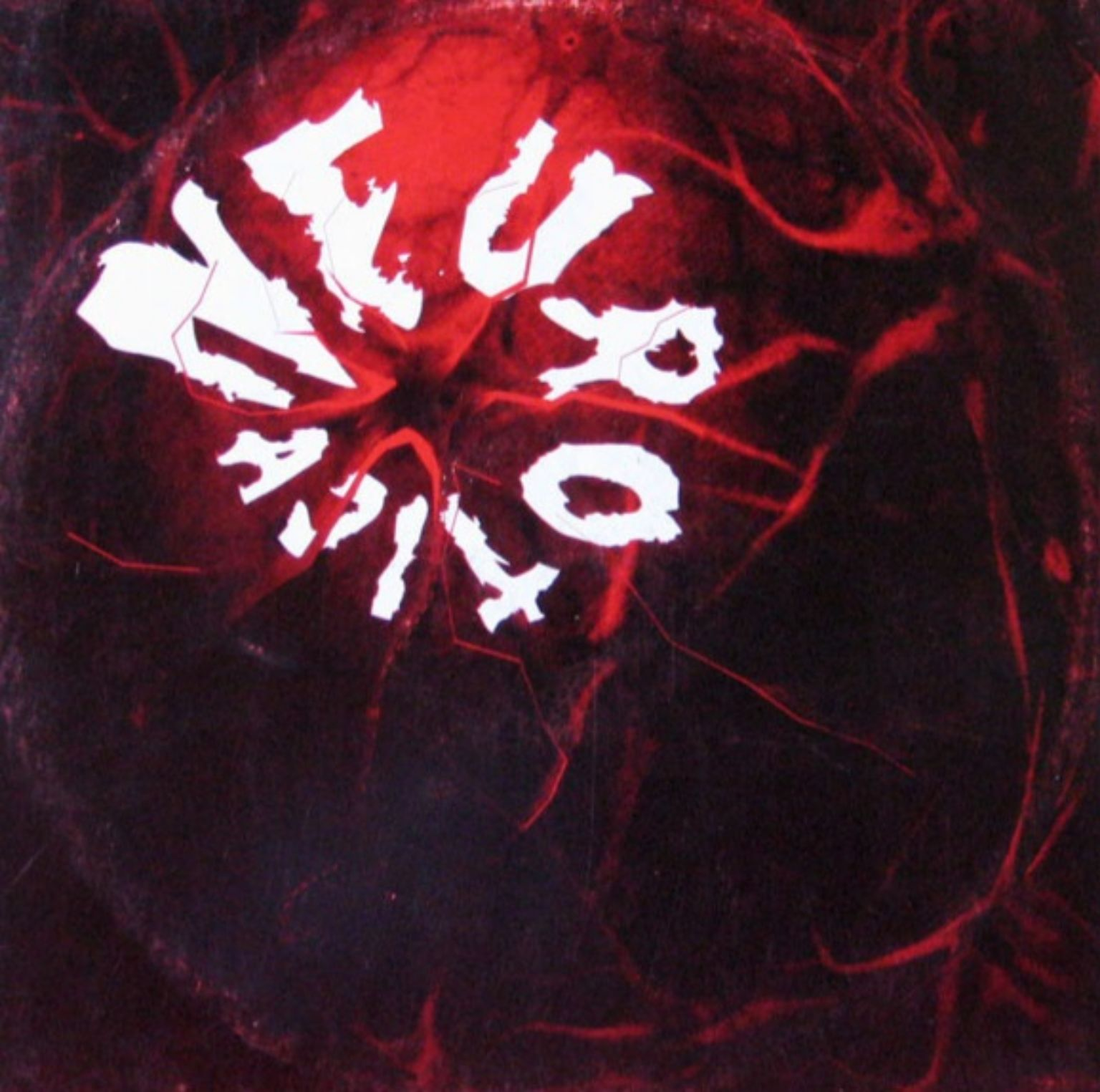
The recording was released with a cover featuring a distorted dark-red-and-black visual composition. 27, 79, 100
The songwriting credits for individual tracks preserve traces of the collective work recorded in the studio. 27, 33, 68, 94
In the Romanian economy of the time, access to imported instruments, amplifiers and studios was not always easy. This is what made the help from friends mentioned earlier so significant. 79, 101, 26
Meanwhile, the city's musical life continued along other paths. Pro Musica's television archive is associated with the memory of a concert on 14 December 1993; this parallel activity illustrates the broader musical background in Timișoara during the period of the Bucharest sessions. 102
VII. Nine Songs, Two Sides
The two sides of the record preserve nine recorded pieces by the four musicians. After the studio, the listener can follow the path of the stylus and discover them one by one.
Side A of the record presented 'Evil Eyes', 'God Save Me', 'Politicians (I Want’em Down)' and 'Sorry'. 'Malady (Samba Thrash)' and 'The Risk' opened Side B, followed by 'Don’t Worry Be Happy', 'My Way??' and the closing track, 'Obsession'. The sequence paired a shorter first side with a second side built around five songs. 27, 128, 129, 130 A performance of ‘Don’t Worry Be Happy’ also survives from the 1995 TVR1 programme Întâlnirea de la miezul nopții. 132
The physical release also preserves the credits for the individual tracks; the total running time is close to forty minutes. 1, 103, 104, 27
The Two Sides of the Record
Evil Eyes
The record begins with 'Evil Eyes'. The opening piece bears songwriting contributions from Mihai Breazu and Horea Crișovan; a year later, the Bucharest concert report also recorded its title in a live setting. The first piece on the album thus lived on in the band's live repertoire. 27, 98
God Save Me
Next comes 'God Save Me', likewise with songwriting credits for Mihai Breazu and Horea Crișovan. The reporter covering VIVO LIVE ROCK NIGHT in 1995 also noted this title; the two songwriters' collaborative work therefore remained part of the set after the album's release. 27, 98
Politicians (I Want'em Down)
Third comes 'Politicians (I Want’em Down)', with songwriting contributions from Florin Cvașa and Mihai Breazu. Alongside its title, one can recall Horea's broader recollections: after the more melodic world of Cardinal, protest and social irony became one of the driving forces behind Neurotica's songs. The precise lyrics are not known, so the meanings of individual lines cannot be established. 27, 67
Sorry
'Sorry' closes the first side, with Mihai Breazu named as the songwriter on the release. The title of this individually credited piece was also preserved in the following year's Bucharest concert report. 27, 98
Malady (Samba Thrash)
Turning the record over brings us to 'Malady (Samba Thrash)'. The credits name Cristian Giorgevici, Horea Crișovan and Mihai Breazu, while Horea remembers collective improvisation as the force that propelled the 'Samba Thrash' idea forward. The song was also played in the concert programme in 1995. 27, 93, 98
The Risk
'The Risk' carries Side B forward. Alongside the shared songwriting credit for Horea Crișovan and Mihai Breazu, there is evidence of the piece from the following year: the 1995 concert report mentions it as part of the live set. 27, 98
Don't Worry Be Happy
The third track on Side B bears an unexpectedly familiar title: 'Don’t Worry Be Happy' is Neurotica's adaptation of Bobby McFerrin's song, with Mihai Breazu credited for the adaptation. It had already appeared in the context of radio rock charts in March 1994, one of the early traces of publicity surrounding the record. 27, 91
My Way??
'My Way??' stands out from the sequence even by virtue of the two question marks at the end of its title. The fourth piece on Side B bears songwriting credits for Mihai Breazu and Florin Cvașa; its unusual spelling has survived on the physical record itself. One database identifies it as a live recording. 27, 92
Obsession
Finally, 'Obsession' closes the nine-track sequence. The songwriting credits name Cristian Giorgevici, Florin Cvașa and Horea Crișovan; Horea also associated this song with memories of collective improvisation. In the final piece on the album, then, we encounter once again the creative method from which several of the band's ideas emerged. One database lists it as an instrumental piece. 27, 93
Roles Credited on the Sleeve
The physical inner sleeve dates the recording to December 1993 and identifies Migas Real Compact Studios in Bucharest as the venue. The printed allocation of roles separately identifies the designation 'PRODUCED BY MIGAS REAL COMPACT', sound engineering, co-production, mixing, mastering, direction, photography and design. Adi Ordean is credited as sound engineer; he shares the mixing and mastering credits with Mihai Breazu. Richard Andress is co-producer, Gheorghe Belean general manager, Mircea Rădulescu appears in the direction/supervision credit, Stelian Acea in photography and Liviu Bulz in design. 99, 27, 94
The Collective Approach to Songwriting
The individual songwriting credits preserve the details of the four musicians’ shared creative work.
The Visual Identity
The dark-red and black front cover, the white Neurotica logo and the booklet images constitute the visual identity of the release itself. Liviu Bulz is credited for the design and Stelian Acea for the photographs. The band composition on the reverse, the black-and-white photographs of the four members and the two record labels preserve different perspectives on the same release. 30, 61
VIII. The Record Sets Out
From the Bucharest studio, the record set out towards the clubs and press pages of the Romanian rock scene in 1994.
The album release
The release of the record was not an isolated date, but an event within the local and national rock networks of the time. The press, clubs, radio, tours and audience feedback carried Neurotica's name onward through different channels.
Holding the finished vinyl in his hands was an almost unbelievable form of recognition for the still very young Horea. Looking back, he said that at the time he could not even fully grasp what the release of an entire album meant. The album certainly dates from 1994; the Discogs and MusicBrainz release entries give 6 June 1994, separate Metal Archives entries mention a cassette in March and an LP in June, while another note also mentions a March record. Particularly important are the brief March 1994 item in Vox Pop Rock stating that Neurotica was nearing completion of an LP, and the advertisement from Arad on 13 June 1994 announcing the presentation of a new record. These establish a strong chronological framework, but do not in themselves conclusively prove a single premiere date. 105, 27, 57, 74, 62
The first record retained its significance as a physical object in Horea's later life, even if he did not always possess a copy. In a 2006 interview, he recalled that by then he no longer had his own copy, while people he knew still took out and listened to the Neurotica vinyl. 25
The authenticity of the object is also part of its story. The catalogue number CDS-CS 0144, the Eurostar and Migas Real Compact inscriptions, the labels on both sides, the inner sleeve and the photographs are identifiable, interconnected elements of a specific Romanian release. Alongside the sound recording, the physical components of the release preserve the history of its original appearance. 27, 62
Concerts and travel
The band had already attracted public attention before the release. In the 1993 Vox Pop Rock readers' poll, published in March 1994, Neurotica placed third among 'speed, thrash, death' bands with 1,860 points, behind Altar and Tectonic; it separately achieved 370 points and third place in the list of newcomer rock bands. Elsewhere in the press, 'Don't Worry Be Happy' also appears in a radio-related context in March 1994, although its precise position in the chart is not entirely clear from this source. 90, 91
Announced concert tours are not equivalent to confirmed performances. For the Manic Depression Tour, the 13 April 1994 issue of Vox Pop Rock associated Schnitt Acht, Beast of Eden, Sin and Neurotica with the Bucharest performance planned for 19 April, and Beast of Eden, Era, Compact and C-Spasm with the Cluj-Napoca plans for 23 April. In contrast, on 13 June 1994 the Arad newspaper announced a Rock Only Club concert at the Gloria stadium on 15 June and Neurotica's new album, with Axar't and Grimegod participating; a subsequent printed report on the rock week, dated 20–26 June, also describes the event. The occasion in Arad thus amounts to considerably more than an unverified poster. 97, 74, 75
In Arad, the concert organisers were not simply looking for a venue. In 1993, Rock Only Constructorul was trying to sustain the rock community as a local youth organisation funded by membership contributions and occasional support; in a contemporary report, Victor Bakacs also mentioned Neurotica among the planned programmes. Decades later, club founder Claudiu Cristea recalled that weekdays were filled with rock records and gatherings of friends, and weekends with live bands. Alongside Neurotica, he remembered Cargo, Ultimatum, Quo Vadis and others. The 1994 weekly newspaper also conveyed the difficulties of local sponsorship and attendance, a counterweight to any retrospective impression that every club was packed after liberation. 73, 76, 75
According to Horea, audiences often heard a new sound that they perceived as foreign, Western music. Personal praise spread by word of mouth, through the small rock publications, posters, radio and television; media exposure, however, was sometimes facilitated by connections that Neurotica enjoyed to a lesser degree. Speaking as a fellow musician in a 2005 recollection, George Pătrănoiu recalled the hierarchy of prestige at the time by saying that his own band was mentioned behind Neurotica and Altar. The period cannot be reduced to a single chorus of praise. 41, 86
Horea provides the best descriptions of everyday life on tour: bitterly cold trains in winter, unbearably hot ones in summer, staying with friends, setting out early for the station, little money and many instruments. In the interview, he recalls approximately twenty to forty performances a year in the early years; in 2024, he gave a broader estimate of forty to eighty involving several bands. Meanwhile, the young members were struggling with school and university obligations, but no longer regarded music as a minor hobby; they saw it as a hoped-for career. They speak not of becoming wealthy, but of how important it was simply to be able to play together. 36, 106, 31, 107
Decades later, Horea remembered a period of travel so intense that, on waking, he sometimes could not immediately recall which city they had reached. 31
Horea associated a small but vivid story with a band trip to Oradea. On one occasion, he ordered '50 wines', thinking of a fifty-millilitre serving, as with whisky. Florin Cvașa continued teasing him about it for a long time afterwards. Horea expressly does not seek to construct a drinking legend: in his own account, he was usually the one who tried to keep the group together while remaining sober. This tiny scene conveys more about the closeness of the band and the young musicians' inexperience than another general statement about touring life would. 34
Similar personal memories survive from foreign trips. Horea recalled the Transmitter festival as a concert experience in Austria, close to the Swiss and German borders, in a line-up that included Pitchshifter and Sick of It All. He bought ten bars of chocolate in a Swiss shop and then hid them in the shared backstage refrigerator. By the time the performance ended, the sweets were gone: the other musicians had eaten them as part of the communal hospitality. In another memory of an Austrian festival, this time from Florin, the audience called for an encore, an emotionally overwhelming form of recognition for him. 34, 22
According to Horea's recollections, opportunities to perform in the West were not solely the result of the band's own ambitions. He also mentioned the intervention of Marcel Breazu and people associated with Celelalte Cuvinte in securing invitations. 33
In the same recollection of Austria, Florin also described a more bitter experience. According to him, they understood that their performance fee was one hundred German marks per person, but subsequently discovered what he believed should have been five hundred; Miță Breazu allegedly explained the difference by referring to plans to purchase a minibus. The drummer experienced this as a moment when trust broke down. At another concert, at Bucharest's Sala Palatului, he claimed that a hundred marks had been demanded for the use of a drum kit from Direcția 5, which the young musicians found humiliating; they ultimately performed. This, too, is his perspective, and is important precisely because it reveals another, more conflict-ridden side of touring. 22
Romania in 1994
At the beginning of 1994, Romania's political and economic transformation was far from complete. Inflation, unemployment and the changing circumstances of state enterprises affected many families. The UNHCR background study issued in November 1994 cites reports of annual inflation approaching 300 per cent at the end of 1993, average monthly inflation of around 6.2 per cent in the first half of 1994, and unemployment of approximately 11 per cent. These figures are estimates published in a report and based on particular contemporary data sources; they do not mean that every urban family experienced the transition in the same way. The study also discusses debates concerning minority rights and the functioning of the state. 108, 45
Emigration was likewise a genuine and often misunderstood element of the period. According to UNHCR, approximately 350,000 Romanian citizens submitted asylum applications in Western Europe between 1988 and 1993; most applied in Germany, but many also tried Austria. This is the number of asylum applications, not the total number of emigrants, and because of repeated applications or differences in counting methods it cannot simply be treated as a net migration figure. Within Neurotica's own circle, the departure of Cardinal's former guitarists for Germany, Sorin Badin's connections and the band's later Western trips are facts separately documented by personal sources. National data on emigration and the musicians' personal relationships preserve different historical perspectives. 108, 33, 79, 34
On 26 January 1994, Romania signed NATO's Partnership for Peace Framework Document, represented by Teodor Meleșcanu. This marked an opening towards cooperation, not NATO membership; the latter came on 29 March 2004. The accession timelines of several countries in the region show that post-socialist states were seeking a new institutional place in Europe. Meanwhile, however, the Yugoslav wars and the UN sanctions of 1992 also affected relations with neighbouring Serbian territories. UN Resolution 757 (1992) introduced specific restrictions on trade, finance, aviation and official cultural exchanges with Serbia and Montenegro, with humanitarian exceptions. This historical context remains relevant to understanding life near the border and opportunities for travel. 109, 110
In the Romanian-European association process, on 20 June 1994 the Council of the European Community decided on a medium-term macro-financial loan facility of up to 125 million ECU for Romania, and on 27 June on an exchange of letters concerning changes to trade law associated with the association process. These documents indicate that the country's financial and foreign trade relations were taking shape while its domestic economy remained in difficulty. At the same time, Arad was already advertising the concert presenting Neurotica's new album, and Timișoara officially opened its Botanical Park on 20 June. International financial decisions, a local urban event and a gathering of the rock audience were three different stories of the same June. 111, 112, 47, 74, 75
Contemporary press and live music
From the spring report in Vox Pop Rock, through the Adevărul announcement of 13 June, to the Știrea report of 20–26 June, the album’s progress towards its public presentation can be traced. However, no primary label document confirms the exact day of release. 57, 74, 75, 27, 62
In the days before the June concert, the weather column of Arad's Adevărul predicted strikingly different summer days. On 3 June, it still forecast daytime highs of 27–31 degrees in the area; the 6 June forecast predicted 19–24 degrees, occasional rain and a north-westerly wind, followed by 14–19 degrees the next day. These were forecasts. Meanwhile, Timișoara airport actually recorded rain or light showers on 5, 6 and 7 June — the airport's measurements are separate, directly observed traces of the local weather. 134, 135, 136, 137
The 6 June issue of the same Arad newspaper covered employment opportunities for 6–11 June, cinema and television schedules, and local matters concerning Environment Day. A week later, the advertisement for the concert presenting Neurotica's new album also appeared amidst such everyday news. The record by the band from Timișoara thus entered the world of the city's everyday activities. 135, 74
On 6 June, while the new week's news appeared in Arad, France commemorated the fiftieth anniversary of the Normandy landings. Bill Clinton delivered a speech at the military memorial at Pointe du Hoc. The Western European day of historical remembrance and local Romanian cultural life entered the same June chronology, with different participants and horizons. 138
Neurotica’s previously mentioned success in the readers’ poll and the financial uncertainty of Arad’s club scene together convey the situation of the young rock movement: growing prestige did not yet mean secure conditions in which to operate. 73, 75, 90, 97
Changes in the music scene
The channels through which musicians reached audiences did not immediately become a commercial industry. The sixteen-page June 1994 issue of Vox Pop Rock brought metal news, international material connected with Benediction, articles about Glenn Hughes and Primal Scream, a tribute following Kurt Cobain's death, radio charts and readers' personal advertisements together in a single publication. Fans of Sepultura, Obituary, Paradise Lost and Cannibal Corpse also appeared among its readers. Their letters make visible the diverse community interested in different kinds of music that was developing around the Romanian rock newspaper. Young people sought one another out through the printed press, radio, cassette tapes and personal encounters. 87, 13
The Romanian music industry at this point was still moving from its past of monopolistic record production towards a world of new businesses, experiments in releasing records and cassette distribution. The history of Electrecord and the 2017 sociological study of music illuminate the change at the institutional level, while the memories of Nelu Stratone and Horea reveal the scarcity encountered in practice. The 1994 album was not merely a version, from the Romanian-speaking world, of an internationally established form of thrash, but an example of how a young, technically accomplished band from Timișoara could make its own physically released LP in the years following the change of regime. 26, 101, 13, 79, 27
In 1994, domestic rock media also reflected wider musical currents alongside metal. The Romanian band Timpuri Noi's unplugged performance on 20 May shows that quite different forms of alternative rock were also finding audiences at the time. Skip Rock ’94, announced on 10 May, attests to the scale of festival organisation in Bucharest that June, but the full extent of its plans and its eventual programme cannot be reconstructed from the announcement alone. Romanian rock at this time was being shaped in parallel by the public presence of death metal, alternative rock, thrash and hard rock. 87, 83, 113
Grimegod from Arad also occupied its own place in the local scene: Kati Tibor's 1995 interview provides information about cassette recordings, small budgets, distribution by post to Western Europe and the difficulties of recording technology in Arad. The 1994 Arad performance by Axar’t, Grimegod and Neurotica belongs to the history of their encounters on a shared stage, although each band built its career in a different way. On that shared evening, the Rock Only community became a meeting point for the new Neurotica album and local bands. 85, 74, 75, 73, 76
The surrounding scene continued to evolve in several directions in the following years. Timișoara's Ultimatum belonged to the death metal scene; the available source notes do not confirm its participation in the 1995 compilation Underground Romania I. Grimegod from Arad was connected with the gothic/doom/death scene. 114, 115, 85
The opening of the Subway club in Timișoara in 1994 marked the emergence of another communal space. The source text attributes the recollection that demand for live underground concerts was already strong during the Ceaușescu era to Lucian 'Ciorti' Ciortan; however, the available note on the club's history does not confirm this attribution. 116
IX. Echoes
After the concert halls, the album's story continued in contemporary reviews and in the later memories of fans.
Contemporary reception and radio
The years following the 1994 debut brought live performances, new musical plans and differing critical judgements. Neurotica did not live on in a single universally accepted ranking: contemporary assessments and later fans' recollections approached it from different perspectives.
A contemporary review with photographs survives of the VIVO LIVE ROCK NIGHT programme in Bucharest on 13–14 May 1995. From Neurotica's set of approximately three quarters of an hour, Vox Pop Rock recorded the titles 'The Risk', 'Sorry', 'Evil Eyes', 'Malady (Samba Trash)', 'God Save Me' and 'Forget It', and reported a strong response to the performance. The article names the same four-piece line-up that had made the earlier record. The spelling 'Samba Trash' is also part of the journalist's account. 98, 27
The international fanzine SHISM's 1995 edited survey of the Romanian scene, mediated through translation from Russian into English, presented Neurotica as a technically accomplished thrash band and favourably described its live energy. Vox Pop Rock had struck a different note in January 1995: in reviewing Tectonic's album 'Anomalia', it mentioned Neurotica and Altar as points of comparison but rated Tectonic's creative standard more highly. Favourable press coverage was therefore not unanimous. In 2025, a Metalfan writer celebrated Neurotica as an exceptional album comparable to international thrash of the period, while a 2025 article about MetROCK praised the record's sound in another explicitly personal ranking. The album's later life among fans and the press debate of 1995 speak from different times and according to different criteria; neither cancels the other. 84, 88, 52, 89
In the professional radio survey published in Vox Pop Rock in March 1995, Attila Daska from Oradea mentioned Mihai Breazu as a bass guitarist. The record attests to Mihai Breazu's professional presence; his precise position in the ranking cannot be established with certainty. In the June issue of the same year, Kati Tibor, the leader of Grimegod, spoke about the problems of distribution, studios and cassette production in the Arad underground. Neurotica also appears in the interview as a benchmark for the Romanian scene; the precise wording of Kati Tibor's assessment is uncertain. These two first-hand contemporary accounts help explain both the proximity and the independence of Romanian thrash bands: groups working alongside one another with different creative ambitions. 117, 85
New musical directions
Until the second half of the 1990s, Horea moved between two kinds of musical life — large stages and small clubs. He took part in the jam session at Timișoara's Crossroads blues club on 26 May 1996 both as a member of Neurotica and as a pupil of Grigore Bujor Hariga. Accompanied by Joe Gaspar and Szilard 'Țiți' Borbely, he encountered numerous older musicians from Timișoara; the crowded, smoky cellar and improvisations lasting until dawn emerge from other participants' memories. Tavi Iepan also recalled the launch of the Flying Wood cassette and CD there, the company of Dixie Krauser and conversations that led towards Locatarii. The night at Crossroads became another episode in Horea's wider musical friendships in Timișoara and his continuing movement between styles. 107
In 1995, Horea also reached another, less conspicuous turning point. According to his own account, he earned his living painting and laying tiles, and arrived at Radio Vest with cement on his hands when Ilie Stepan encouraged him to devote his energy to the guitar. A lengthy profile also places the 1994 performance with Tony Kuhn and Electric Version, the venue Lăptăria lui Enache and the dilemma of abandoning his history studies alongside his emergence as a professional musician. Turning music from a mere dream into a livelihood was a long and difficult road. 33, 32, 34
In the following years, Neurotica's musicians were already searching for a different sound. According to Horea's 2006 account, the later BIO period moved in an industrial/alternative direction, and by the mid-1990s the world of Rammstein was becoming increasingly important to him. Compared with the debut thrash sound that had taken its cue from Megadeth, this represented a different rhythmic, production and visual identity. Horea later interpreted the band's decision to shave their heads in 1995 as a conscious change to the image of the rock musician. Different sources associate the second material with dates in 1996, 1997 and 1998; the precise release chronology therefore remains disputed. 25, 69, 118, 62, 119
Horea regarded the social message of the later “Country of Nobody” as timeless. Compared with the spontaneous, democratic songwriting of the first LP, he described a more purposeful division of creative work on the BIO material. 69, 96, 92, 33
The wider musical landscape
In Europe in 1994, the new international order after the Iron Curtain was still taking shape. Alongside the openings afforded by European association and the Partnership for Peace, the Yugoslav wars continued to complicate regional relations. Performances in Western Europe, instruments arriving from there and the foreign music press appear in the musicians' own recollections; however, the practical difficulties of crossing borders and organising concerts persisted. Neurotica's actual memories of Western concerts are preserved in separate accounts by participants. 81, 82, 109, 110, 22, 31
Neurotica’s reception at the time was part of a diverse rock culture whose international and Romanian developments were reflected in Pantera’s success, the Donington programme and the domestic music press. 54, 55, 53, 87
In the musicians’ careers, new opportunities to travel abroad and release records came hand in hand with an uncertain livelihood. The loss of rehearsal spaces recalled by Nelu Stratone, alongside access to more modern equipment, illustrates how greater creative freedom did not mean institutional security. 26, 13, 101, 79, 33
A band profile from 1995 also recorded participation in Top T Buzău, another trace of the band's live presence after the debut. 66
X. Separate Paths, a Shared Past
After Neurotica's debut album, the musicians went in different directions, but their connections in Timișoara lived on in new forms.
The BIO period
The later BIO period and the members' separate paths do not rewrite the history of the 1994 LP. They show how their shared musical language changed and how relationships between musicians in Timișoara survived in other bands, genres and stages of their careers.
The album titled BIO belonged to the second creative phase of the band while it was still operating as Neurotica. Later, BIO itself became the name of a separate band. 25, 69, 62, 120, 122, 118, 119
The visual shift also involved a deliberate departure from the traditional image of the long-haired rock musician. In a 2006 interview, Horea recalled sixty to seventy concerts a year by the time of the second album, appearances in Austria, Hungary and Germany, and an appearance on RTL. Promotional photographs composed with plastic sheeting and industrial props gave the period its own visual identity. 25, 69, 119
Horea remembered the later BIO recording as a particularly live and organic piece of work. According to his account, they recorded on magnetic tape and, if a passage went wrong, preferred to play it again so that the continuity of the band's sound would be preserved. 69
'Country of Nobody' is perhaps the best-documented creative story of the new sound. According to Horea, the riff came to him first, followed by the solo and main theme; while working at Radio Vest, Ilie Stepan helped him write down the ideas. Mihai Breazu, Gabi Cherlia, Florin Cvașa and Alin Stoianovici also contributed to the later, more complex version; he particularly emphasised Stoianovici's role in connection with the accordion or a distinctive motif. Alex 'Boița' Perin played a decisive production role in the final work. In the interview, Horea estimated his own contribution at close to eighty per cent, while the 2016 account itself names several important creators. The song's social message, video and later creative decisions belong exclusively to the BIO period. 69, 96, 92, 100, 123
Horea's 2016 recollection evokes scenes filmed with director Florin Iepan: a puppet theatre space, the TNT basement, a participant named Poco, the power station towers in Timișoara and footage shot on a moving truck. The presentation of BIO in Bucharest also brings to mind an image involving a truck; Horea thought it might have been a first in Romania. As he remembers it, the song was first performed in the opening set associated with a Scorpions concert in Bucharest. 69, 22
The band’s diverging paths
While the band was moving towards its next material, it remained active through the press and personal connections. In a Mediafax news item dated 5 March 1998, the head of Media Pro Music announced a Neurotica release entitled 'Bio' in the spring schedule. A news item dated 6 February 1998, preserved in the same intermediary archive, also listed Neurotica among the planned Romanian performers at the Ex-Comunism Rock Festival in Bucharest. The former is a contemporary document of a label's intention and the latter of a concert organiser's plans, not of events that can automatically be assumed to have subsequently taken place. Alongside these two sources, later retrospectives also describe BIO as a Zone Records album released in 1998; the different label references can only be used in accordance with their actually documented roles. 122, 118, 62, 119
Horea and Florin tell different stories about the end of Neurotica. According to Horea, different visions of the band's musical future gradually emerged. Mihai Breazu returned from his experiences in Germany with an interest in Oasis and the Smashing Pumpkins, while Horea and Florin turned more towards the heavy industrial sound of Rammstein. Horea felt that the common conception of the band's sound that had brought the first album to life had disappeared. In 2006, he said that they discussed bringing their shared story to an end in 1999. 25
Florin, by contrast, regarded the loss of trust over performance fees in Austria, as described in his own account, as the turning point. He says that for approximately the following year, suspicion weighed on rehearsals and travel. In his account of the loss of trust, Florin singled out Mihai Breazu’s role. In a subsequent correspondent's diary from Belgrade dated 2 April 1999, Breazu was still contacted as a member of Neurotica about a proposed anti-war solidarity concert; the plan ultimately fell through because of passport and organisational difficulties. 22, 25, 124
Sorin Bogdan’s diary preserves another detail of the unrealised plan for Belgrade. According to the journalist's account, Miță Breazu would have been happy to consider performing, but feared that Serbian listeners might not respond favourably to Neurotica's English-language songs. 124
A disputed story also survives concerning the name of the successor band. In 2014, Horea claimed that Mihai Breazu had registered the name NEUROTICA with OSIM without consulting the others; when asked, he made the transfer of the name conditional and subsequently did not get back in touch. According to Horea, this was why they selected BIO, the title of their subsequent material, as the new band's name. The 2016 recollection also mentions an attempt to use the name around 2006, in a somewhat different chronology. 33, 69
In 2011, Raluca Leahu recalled a later period of the band. The later singer spoke of a brief, hazily remembered collaboration with Neurotica: performing a few songs on approximately two occasions, and perhaps making one or two studio recordings whose finished releases she had never heard. She was not even certain whether the Bucharest performance had taken place in Revolution Square or Constitution Square. She identified her own lack of creative inspiration and Miță Breazu's different musical tastes, coloured by experiences in Germany, as factors behind the separation. No released record is known from this later, brief collaboration. 125
Later musical careers
Horea and Florin did not disappear from the Timișoara music scene in the 2000s. In December 2005, România Liberă was already writing about the renewed BIO with a different line-up: Horea on guitar, Florin on drums, Valentin 'Freaky' Popescu on guitar, Piști Czifrak on bass and Gabi Szorad on vocals. After charity and motorcycle events and several local concerts, the group also made its debut at Bucharest's Viking club; a three-song demo containing 'Hello', 'Personal Mistake' and 'V 8' was distributed to the audience. According to Florin's recollection, the 2016 Revolution festival marked another shared return to the stage. 120, 22
For Horea, Blazzaj opened up a different musical life: in the band that emerged from the Funkin’ Le Free milieu around 1997 at Edi Neumann's initiative, he had to focus on the entire ensemble's groove and a much closer club audience rather than individual guitar virtuosity. He subsequently remained active through the different line-ups of Abra, the returns of Ilie Stepan and Pro Musica, and his work with Feli. In a television interview, he said that he sometimes helped Bujor Hariga or Adrian Dinu recover forgotten instrumental memories by playing old Pro Musica guitar parts back to them from memory. A long continuity of musical relationships emerges here, one that far outlasted any individual band's name. 25, 121
The acoustic 'My Real Trip' of 2014 is almost the opposite of the spirited ensemble playing at the former Migas studio. Horea recorded in his 23-square-metre flat, in a small foam-lined sound-absorbing booth, at around two in the morning, using three highly sensitive microphones bought with borrowed money so that the noise of the building and the heating would not interfere. 121 Later, TM Groove, VanDerCris, Amazing Trace with Maria Hojda and other projects also sought new forms of instrumental freedom. Florin Cvașa became his colleague again in VanDerCris, alongside Marcelle Poaty Souami, Dănuț Blaga and Lucian Nagy; according to his own account, the drummer had meanwhile worked at Alcatel for twelve years and tried to sustain his musical life between work, family and touring. In these new bands, the old creative relationships returned again and again. 22
In Horea's later philosophy as a guitarist, sound is particularly important. From a sound engineer referred to as Boian, whose precise identity is uncertain, he learned that the aim was not to win the race for speed but to find a unique, recognisable sound. Over many years, he worked with Italian and German artisan guitar makers, waited years for certain instruments and believed that a prestigious brand could not replace an individual playing style. In the 2024 profile, he also traced his creative process back to the silence of the mountains, cycling and melodies recalled from his dreams. His later ideas about guitar sound matured over a long career extending well beyond the first Neurotica album. 31, 32
A later TVR conversation recorded at different times also preserved a less conspicuous memory of performing. Hearing the harmonic complexity of Post Scriptum as a young man, Horea asked himself whether he would ever be able to play music like that. Later, he adapted the string parts of Pro Musica's 'Metamorfoza' for his own lead-guitar role. Although playing guitar without accompaniment made him anxious, he recalls that he also undertook unaccompanied solo passages at Neurotica concerts. Solo guitar playing beyond the sound of the four-piece studio ensemble remained part of Horea's personal musical history throughout. 121
At another turning point in his long career, the Stepan Project was initially a studio workshop; later, an outdoor concert in the cold in front of the opera house, associated with Romania's accession to the European Union, became an important experience in Horea's memory. Ștefan Iordănescu's theatre team worked on the set. He remained with Blazzaj until 2015, after which seventy to eighty performances a year with Feli became difficult to reconcile with his previous band. In connection with VanDerCris, he also mentioned international performances from Sardinia to Passau, although the precise dates of every appearance are not known. In his more recent compositions, he consciously distinguished between the fixed theme and his fellow musicians' free improvisation. His criticism of the interruption in the transmission of knowledge between generations of Timișoara musicians and of the representation of songwriters' interests during the pandemic years was explicitly expressed as a contemporary experience, not as a historical description of 1994. 121
Neurotica’s legacy
Neurotica's debut was at once a physical sound recording, a collaboration between four musicians of differing ages and tastes, a socially critical experiment seeking a place in the Romanian public sphere, and an early post-socialist studio achievement. The album's own material credits establish the personnel and recording circumstances; the personal stories of Horea, Florin, Raluca and others reveal what could not fit on the inner sleeve: the rehearsal room of a few square metres, the cold train, a thousand plans, the chocolate, the breakdown of trust over disputed fees, the fruitfulness of creative disagreements and the story of songs that migrated to the later album. The nine-track LP can be followed in its own right, but without its antecedents and consequences, the band's history would lose precisely its human dimension. 126, 22, 34, 69, 27
Horea later remembered musical life after the revolution as both experimental and difficult. Young bands faced the pressure of being measured against international models: an original sound could easily meet with condescension, while good performances did not always receive recognition. He identified originality, emotional truth and persistent study as his own standards. This retrospective sheds light on Neurotica's early musical environment and Horea's understanding of himself as a creative artist. 127
Ultimately, Neurotica's story does not end with the release of a single record. Timișoara's past, the shared work of the four musicians and their separate paths after the album remain intertwined: as a sound recording from 1994, Neurotica preserves nine songs; as a story, it preserves a changing era in the life of a city and a band. 27, 127
Sources and References
I. The Memory of the City 29
2. Historical / documentary. Muzeul Național de Artă Timișoara. ‘Timișoara – Timeline.’ Muzeul Național de Artă Timișoara. Undated. https://mnart.museum/timeline/
Entries for 1154–1989 in the bilingual chronology. The city can be understood as a historical frontier area between several empires, states and economic systems. The institutional chronology assigns al-Idrisi's geographical mention to 1154, King Charles I's centre in Timișoara to 1316, and John Hunyadi's office in Timiș to 1441. The year 1552 marks the turning point of the Ottoman conquest, and 1716, with Prince Eugene of Savoy's campaign, the beginning of the Habsburg period. The regulation of the Bega in 1728 altered the foundations of water transport and urban life; 1781 marks the status of a free royal city. The revolutions of 1848, the telegraph connection of 1853, the railway to Szeged in 1857, electric street lighting in 1884 and the change of power in 1919 together help explain the region's transport, industrial and ethnic complexity. The entry for 1989 identifies Timișoara as the starting point of the Romanian Revolution. This is a retrospective outline of urban history; it illuminates the local and social background to the band's history in 1992–94, rather than constituting a direct source on Neurotica. The chronology is a summary, not archival evidence; the early first documentary mention is particularly disputed.
3. Historical / documentary. Muzeul Național al Banatului. ‘Istorie – The historical collection of the Museum of Banat.’ Muzeul Național al Banatului. Undated. https://www.muzeulbanatului.ro/istorie/
Description of the museum's historical collection. The collection can be traced back to the local Historical and Archaeological Society founded in the 1870s; between 1872 and 1918 many important artefacts were registered, and later donations and collecting activities expanded the holdings. The exhibition and archival collections contain weapons, old books, documents, photographs, postcards, guild and municipal seals, posters and historical maps. The citizens' register of 1717–1832, the royal city charter of 1781, relics relating to the conflict of 1848–49, a document concerning Transylvanian and Banat volunteers from 1917 and an album of Danube drawings published in Vienna in 1826 reflect the multilingual and multi-state layers of the region's history. The museum also mentions preserving the original document of the Proclamation of Timișoara of March 1990, the full text of which constitutes a separate historical document. The description of the collection does not claim that it preserves Neurotica photographs or rehearsal-room documents, and does not establish any specific facts about the 1994 album. The institutional reorganisation of 2006 and the current collection figures do not describe the state of the museum in 1994.
4. Historical / documentary. Muzeul Apei Timișoara. ‘Povestea apei din Timișoara / The Story of Water in Timisoara.’ Muzeul Apei Timișoara. Undated. https://www.muzeulapei.ro/patrimoniu-industrial/povestea-apei-din-timisoara?iso=en
Museum text covering the period from the marshy beginnings to early twentieth-century urban planning. According to the description, the area's waterlogged ground, periodic flooding and the sewage burden on the moat mean that the later image of paved, electrified Timișoara cannot simply be projected back onto the early eighteenth century. After the Habsburg conquest, Count Mercy had plans drawn up around 1717 for regulating the waters of the Bega, and some of them were implemented. By 1759, the Timiș–Bega hydraulic engineering system had limited surrounding stagnant waters and floods. In 1774, Karl Alexander Steinlein put a water-lifting mechanism into operation, using a wheel on the Bega River to raise water into an approximately sixteen-metre-high tower in the Fabric district; this technical achievement also appeared in the city's coat of arms. Open drainage ditches and unhealthy drinking water remained longstanding problems in the nineteenth century. In the 1890s, during the tenure of Mayor Károly Telbisz, fortifications were demolished and modern streets, industry and Art Nouveau public buildings were developed; the planning of water and sewerage networks, however, faced financial and topographical difficulties. An international competition for sewerage designs was announced in 1894, but the winning plans were not implemented because the city's shallow gradient demanded costly investment. Alongside the technological innovations of the later industrial city, the prolonged work of providing utilities is thus also part of the story. The museum article makes no statements about Neurotica's musicians or rehearsal rooms; the Bega belongs to the context of urban history, and the article does not connect any specific band event with it.
5. Historical / documentary. Municipiul Timișoara, municipal resolutions archive. ‘Hotărârea nr. 221/2024 – Timișoara's urban structural heritage.’ Municipiul Timișoara, municipal resolutions archive. 2024. 2024. https://hcl.usr.ro/timisoara/2024/h221
The municipal institutional document discusses the historic urban structure of Timișoara as a series of layers built upon one another. It regards the management of the eighteenth-century marshy, riverine environment and regulation of the Bega as one of the conditions for urban development; the arrival of the railway in 1857 was among the nineteenth-century changes in transport. The historic city centre (Cetate) and the districts of Fabric, Iosefin, Elisabetin and Mehala that later became connected to it are not interchangeable place names: each, with its different industrial, commercial and residential functions, grew into the modern city of Timișoara. Nationalisation and industrial expansion after the Second World War again reshaped the area, while by the 1970s the larger transport ring and the urban development practices of the period had also left their mark. Behind the rock scene of the 1990s, venues, industrial districts, schools and transport connections belonged to different urban layers. The document produced in 2024 is retrospective urban historical background, not a concert plan from 1994 or testimony by a band member. It does not establish where Neurotica lived, rehearsed or recorded; such a specific connection can only be established from another source explicitly addressing it.
6. Historical / documentary. Heritage of Timișoara / Prin Banat. ‘Districts: Cetate, Elisabetin, Iosefin, Fabric, Mehala.’ Heritage of Timișoara / Prin Banat. Undated. https://heritageoftimisoara.ro/en/districts
Introductory texts of the five separate district profiles. Cetate is the historical centre, characterised by an eighteenth-century Baroque layout, Art Nouveau groupings, large urban spaces and eclectic façades. Elisabetin is a later historical district that developed mainly around 1900, with parks, trams and a university atmosphere. The name and cultural associations of the western district of Iosefin point to Vienna's Josefstadt; its architecture combines Baroque, Art Nouveau, eclectic and industrial heritage. Fabric is one of the oldest districts: originally an important commercial quarter, it later developed an industrial character. Mehala remained a separate village for a long time and was incorporated into Timișoara in 1910; it is characterised by residential buildings, broad streets, churches of different denominations and suburban architecture. These distinctions help avoid the vacuous picture of 'all of Timișoara as one uniform working-class city'. The source does not specify exactly which district any Neurotica member lived or rehearsed in, so such information cannot be invented from it. The difference between the districts' present-day heritage presentation and the actual cityscape of 1994 would require separate substantiation.
Back to the main text: ↩
7. Historical / documentary. Horea Crișovan. “Horea Crișovan személyes Neurotica-interjúja” [Horea Crișovan’s personal Neurotica interview]. Open Metal Album Library. 18 November 2026. Response to interview question Q04.
The rehearsal space was Cardinal’s former room, approximately three by two metres. The drum kit and guitar amplifiers also had to fit inside. They wore no hearing protection; Horea personally attributes his present-day high-frequency tinnitus to the noise exposure there, but this is not medical evidence of causation. Despite the good atmosphere, rehearsing was hard, all-day work. For roughly the first two months after the band got started, Cristian Georgevici played guitar alone; only then did Horea join. According to his own recollection, he was already involved in writing the first Neurotica album in 1993. There was no rigid rehearsal schedule; he often practised there even when he was absent from school.
Source criticism: Horea Crișovan’s first-hand retrospective account; an individual estimate or assessment does not automatically constitute independent contemporary evidence.
8. Historical / documentary. Online-Lexikon zur Kultur und Geschichte der Deutschen im östlichen Europa (Universität Oldenburg). “Timişoara / Temeswar – történeti népesség és etnikai szerkezet” [Historical population and ethnic composition]. Online-Lexikon zur Kultur und Geschichte der Deutschen im östlichen Europa (Universität Oldenburg). Undated. https://ome-lexikon.uni-oldenburg.de/en/places/temeswar-timisoara
The historical and ethnic population tables, particularly “Changes in the ethnic composition of Timișoara”. The detailed table reports 269,353 inhabitants in 1977 and 334,115 in 1992: these are the historical lexicon’s own figures, not the present-day population figure used in the 2023 city marketing material. The 1992 records list 274,511 Romanians (82.16%), 31,785 Hungarians (9.51%), 13,206 Germans (3.95%) and 7,841 inhabitants classified under the statistical category then known as “Yugoslav” (2.35%); the latter is a period-specific statistical label generally grouping Serbs, Croats and Slovenes together, not a unified ethnic identity. Compared with 1977, the German community’s share fell from 10.55% to 3.95%, which the lexicon associates with post-war migration and the wave of emigration following the opening of the borders. The Hungarian community also changed in numerical terms between 1977 and 1992, but did not disappear; it numbered nearly 32,000 in 1992. Over the longer term, trade and industry in the Banat were shaped by water, railway and road connections, its many religious and linguistic communities, and the Austro-Hungarian and subsequent Romanian periods of state administration. The precise demographic figures can help situate Neurotica’s cultural environment in the 1990s, encompassing Romanian as well as Hungarian, German and Serbian borderlands. The source contains no claim that the band represented a particular ethnic group or that the members’ ethnic backgrounds can be established from this table.
9. Historical / documentary. Timișoara 2023 European Capital of Culture programme. “Visit the city – Timișoara történelme és kulturális topográfiája” [Timișoara’s history and cultural topography]. Timișoara 2023 European Capital of Culture programme. 2023. 2023. https://timisoara2023.eu/en/visit-timi%C8%99oara/
The European Capital of Culture programme’s tourist-oriented introduction presents Timișoara as a cultural hub of the multilingual and multidenominational Banat on the banks of the Bega. It links the development of manufacturing, commerce, the press, institutions and urban arts in the late nineteenth and early twentieth centuries to the geographical openness of the area: the city stands at the intersection of Hungarian, Serbian and Romanian cultural environments rather than in provincial isolation. Among later examples from rock history, Phoenix’s legacy is likewise an important point of reference in the city’s culture, but this source does not establish any direct personal influence on bands of the 1990s. The source is a late cultural-tourism self-portrait: its emphases serve to present heritage and attractions; they do not replace contemporary press reports and recollections that also depict social tensions. The present-day population figure is not the same as the 1992 census data. This city profile contains no independent evidence concerning Neurotica’s 1994 album, recording studio or tour. It provides geographical and institutional background but establishes no specific connection to the album’s history.
10. Historical / documentary. Memoria.ro / archival reproduction of the original 1990 publication. “Proclamația de la Timișoara – teljes történeti szöveg” [Complete historical text]. Memoria.ro / archival reproduction of the original 1990 publication. 1990-03-11. 1990-03-11. https://www.memoria.ro/marturii/memento-proclamatia-de-la-timisoara-11-martie-1990/
The document is a political proclamation of normative intent, written a few months after the revolution, rather than a retrospective summary. Point 1 characterises the Timișoara revolution not merely as the removal of Ceaușescu but as an explicitly anti-communist transformation. Point 2 emphasises the common stand taken by social groups—workers, intellectuals, young people and other participants; point 3 points to cooperation between different generations. Point 4 builds on the practical experience of ethnic and religious coexistence: it presents the joint action of Romanian, Hungarian, German, Serbian and other communities as an example of anti-nationalist solidarity. Point 5 calls for multiparty democracy and pluralism, rejecting extreme political exclusivity; point 6 criticises the linguistic and intellectual reflexes perpetuating communist propaganda. Point 7 questions the credibility of the new ruling elite emerging from the former party hierarchy. The frequently cited point 8 advocated barring former Communist Party leaders and Securitate officers from standing for election for three consecutive legislative terms, with specific reference also to the presidency. Crucially, this was a demand, not a law enacted in Romania in 1990; the history of its application cannot be described solely on the basis of the programme text. Point 9 regards political freedom as more important than short-term income expectations and draws attention to the difficult issues of inflation, investment and economic transition. Point 10 supports freedom of private ownership and enterprise while calling for employee participation and caution against extreme social inequalities. Point 11 calls for broader local and regional decision-making and stronger economic links abroad; point 12 considers it necessary to reconnect with scientific and cultural figures forced into emigration; and point 13 proposes 16 December as a shared day of remembrance for the Romanian Revolution, in contrast to state commemoration narrowed to the change of power on 22 December. The declaration as a whole emphasises the idea of a non-violent social transition and civic action. The text was published on 11 March 1990 as a declaration with a political purpose; it reflects its authors’ political interpretations, not a neutral historical consensus. In a portrait of the Timișoara underground music scene in 1994, it can be associated with local multiethnic identity, post-transition expectations, divisions and economic transformation, but there is no evidence that Neurotica personally signed or agreed with it or turned it into lyrics. The document comprises thirteen points; it is dated 11 March 1990.
11. Historical / documentary. Centrul de Proiecte Timișoara. “Rock, jazz, folk | Timișoara – helyi zenei helyszínek” [Local music venues]. Centrul de Proiecte Timișoara. 1970–1994. https://centruldeproiecte.ro/proiecte-finantate/rock-jazz-folk-timisoara-tur-ghidat-muzical/
The project aims to reconstruct Timișoara’s musical world from the 1970s to the present through oral history, film and photographic material linked to urban locations. Memories from different eras follow one another across Phoenix, Pro Musica, jazz clubs, studios, Radio Vest, the Bestial Records garage and the Rocka Rolla shop. Doru Ionescu recalls a mass electronic-music event associated with Piața Operei in 1993, Pro Musica’s rock opera that had previously been denied permission, and the role of Western radio stations and Yugoslav and Western European records and cassettes crossing the border under communism. The social atmosphere was more complex than the generalised image of a “free Western city”: alongside the cultural climate perceived as more lenient, the document also discusses censorship and action taken against artists. This is a DESCRIPTION of a historical and artistic programme from 2023, not individually authenticated records of all the contemporary events mentioned. Neurotica is not named in the programme description, so specific concerts, acquaintances between band members or stories from their own rehearsal space cannot be attributed to them on this basis.
12. Historical / documentary. Radio România Timișoara. “Radio Timișoara – 1955-ös indulás és 1989. decemberi újraindulás” [Launch in 1955 and relaunch in December 1989]. Radio România Timișoara. 2018. 1955; 1985; 1989. https://www.radiotimisoara.ro/radio/istorie/istoria-radio-timisoara-in-date-186530.html
The history of local radio looks back as far as 1925, from amateur radio initiatives through proposals in the 1930s to the subsequent operation of regional broadcasting. The account stresses that the influence of foreign radio broadcasts was already strongly felt in the Banat under socialism, which may explain the strong musical exchanges but does not prove that Neurotica learnt a song from any particular Western programme. The station’s institutional history also documents the turning points of its dissolution or closure in 1985 and its relaunch in December 1989; a related commemorative page maintained by the station itself cites George Balica’s announcement “Aici Radio Timișoara Liberă” on 22 December 1989 as that of the first public free radio station. The 2018 retrospective also records a story from 18 December 1989: the party propaganda apparatus tried to induce Bogdan Herzog to produce a distorted report on local destruction; according to the article, he refused. The transformation of the city’s media provided the historical conditions for the channels through which bands of the 1990s could be heard, but is not evidence that any particular Neurotica song was broadcast during the first days of freedom.
13. Historical / documentary. Cărți, cafea și tutun. “Nelu Stratone interjúja – kilencvenes évek román rockmagazinjai” [Interview with Nelu Stratone – Romanian rock magazines of the 1990s]. Cărți, cafea și tutun. 2017. https://carticafeasitutun.ro/interviu-cu-nelu-stratone-se-poate-spune-ca-cres%C2%ADcut-odata-cu-rockul-romanesc/
The complete question-and-answer text of the interview. The music historian and broadcaster’s childhood memories include a Darclee radio-record player, records borrowed from neighbours of different nationalities and, later, Radio Luxembourg, Radio Monte Carlo and other international stations. For him, musical diversity was not a doctrinal dispute over genres but an everyday experience of listening to the radio. Recalling his own experience as a musician, he mentions the student band Solaris, his role as singer and bassist and his incomplete instrumental training; as a broadcaster and member of festival juries, he listened to everything from hard rock and thrash metal to doom, death and black metal, and consequently considers it pointless to reduce the musical legacy to a single personal “top three”. He describes the changes after 1989 as both positive and negative experiences. Modern instruments, professional recording studios, record labels, sound technicians and international concert connections emerged; Electrecord’s monopoly ended. At the same time, several trade-union, communist youth association or other youth and cultural-centre venues closed or were repurposed, so many bands lost rehearsal spaces and performance venues, and some even disbanded because of equipment costs. In his political retrospective, the miners’ incursions, the survival of the former communist ruling class and the demands of point 8 of the Timișoara Proclamation are especially important to him—all of this is Stratone’s own retrospective assessment, not a neutral statement of political fact shared by all participants. In his employment history, the loss of his IT job in 1990, a failed trading venture established with associates, variably paid supplementary work in radio and journalism, and later writing work provide concrete examples of economic insecurity in the background of the rock scene; these are personal biographical recollections, not the economic circumstances of Neurotica’s members. The answer listing the press of the 1990s is particularly directly useful in understanding the present chain of sources: Pop Rock & Show, Vox Pop Rock, Heavy Metal Magazine, Metronom, Rocker, Metal fan, Prin Rock, Puls rock and other publications carried music news. He says that he collected and preserved these issues for years and also obtained information for his later books from other music historians, collectors and musicians; he obtained separate permissions to reuse historical articles. This source is not a band interview, but gives a first-hand account of the press and sound-engineering environment of the early 1990s. Stratone’s views on politics or the quality of record labels may only be used with explicit attribution to him, not as Neurotica’s established position.
14. Historical / documentary. Spotlight Heritage Timișoara. “Filarmonica Banatul – 1871-től 1947-ig” [From 1871 to 1947]. Spotlight Heritage Timișoara. https://spotlight-timisoara.eu/pf/filarmonica-banatul/
The “Istoric” section. The nineteenth-century Timișoara Philharmonic Society was founded by local music enthusiasts in 1871, taking European musical societies as its model. Its early rehearsals were held in private homes; from 1875 it was given rooms in the opera house. Its role as an association extended beyond the classical repertoire: it also organised masked balls and New Year’s Eve events; singing competitions were held at the Banat industrial and agricultural exhibition of 1891. Following the fire that struck the opera house in 1920, the musical organisation was restructured and Amicii Muzicii was founded, incorporating former philharmonic instrumentalists. In 1945 a society named after George Enescu was established; it assumed the form of the state-run Filarmonica Banatul in 1947, with the inaugural concert of its first season on 26 October, and a mixed choir was added in 1951. The source documents a century of continuity in urban instrumental music and concert institutions, but establishes no personal or artistic line of descent between their artists and Neurotica. Its significance lies in illustrating the earlier public infrastructure of music in the Banat, which did not develop exclusively through rock.
15. Historical / documentary. Nemzeti Archívum [National Archive]. “Bartók Béla – nagyszentmiklósi születés és bánsági népzenekutatás” [Birth in Nagyszentmiklós and folk music research in the Banat]. Nemzeti Archívum. 2021. https://nemzetiarchivum.hu/stories/Bartok-Bela
Bartók was born on 25 March 1881 in Nagyszentmiklós in the Banat; his father, a school headmaster who played music, and his mother, a teacher, provided a direct musical family background. He learnt to play the piano and compose at an early age, and following studies in Bratislava and Budapest became an internationally known composer and folk music researcher. From 1906 he collected folk songs together with Kodály; besides Hungarian music, his research encompassed Romanian music and that of other peoples. His rhythmic experiments and folk musical idioms became part of his later modernist compositional language, despite much contemporary rejection. In 1940 he emigrated to the United States. The most relevant cultural connection is that the multilingual musical environments of the Banat had produced a figure of international influence long before the rock era. Neither direct inspiration nor a conscious artistic programme linking Bartók and Neurotica is established; the connection concerns local history and cultural surroundings alone, not cause and effect.
16. Historical / documentary. Casa de Cultură „Traian Grozăvescu” Lugoj. “Corul Ion Vidu – a lugosi kórushagyomány” [The choral tradition of Lugoj]. Casa de Cultură „Traian Grozăvescu” Lugoj. https://ccmlugoj.ro/corul-ion-vidu/
The institutional history of the Lugoj choir mentions documents reaching back to 1810 concerning the foundation of local singing culture, initially under the name “Reuniunea română de cântări şi muzică”. Its namesake Ion Vidu directed the choir for nearly four decades; it adopted his name in his memory in 1931. Its later directors were Filaret Barbu and Dimitrie Stan, followed by Remus Tașcău from 1968 to 2013. The page also mentions, with photographs, a performance at the Athenaeum in Bucharest in 1987 and a later appearance in France, illustrating the historical institution’s connections beyond the region. The source shows that musical communities in the Banat did not begin with the rock clubs of the 1990s. The document establishes neither a direct connection between the choral tradition and Neurotica’s compositional practice nor personal acquaintance between members of the two communities.
17. Historical / documentary. AGERPRES. “Sabin Drăgoi – életmű és temesvári kórusok” [Life’s work and Timișoara choirs]. AGERPRES. 2019-06-05. https://agerpres.ro/documentare/2019/06/05/documentar-125-de-ani-de-la-nasterea-compozitorului-sabin-dragoi--321402
Drăgoi was born in Seliște, Arad County, in 1894. After studying music in Iași, Cluj and Prague, he taught harmony, counterpoint and composition at the Timișoara conservatory between 1924 and 1942, also serving as its director from 1925 to 1943. From 1924 to 1932 he conducted the Doina and Banatul male choirs, and from 1936 to 1940 the Crai Nou mixed choir. He combined the collection of folk music with composition: in 1930 he published 303 Christmas songs, later also organising folk-song material from the Almăj and Hunedoara regions. His operas include Năpasta, written in 1927, and Horia, written in 1945; he used elements of local Romanian folklore in various choral works. From 1940 to 1944 he also headed the Cluj–Timișoara opera institution. The biography is valuable because it shows that Timișoara was an independent, advanced centre of conservatory education, choral music and folk music scholarship in the first half of the twentieth century. This source does not establish that Neurotica’s members received conservatory training or arranged any of Drăgoi’s works.
18. Historical / documentary. Phoenix – official band website. “Phoenix – a temesvári zenekar hivatalos története” [The official history of the Timișoara band]. Phoenix – official band website. 1962–1970s. https://www.formatiaphoenix.ro/
The band history and chronology on the home page. The band formed in Timișoara in 1962 and later became known in the West as Transsylvania Phoenix. Its early beat music developed into psychedelic rock, hard rock and progressive experimentation, before turning in the 1970s towards ethnic rock drawing on folk music and archaic Romanian motifs. The official website interprets the political pressure of the period as a factor influencing the activities of Romanian rock bands. Its specific sequence of releases comprises singles in 1968 and 1969; the 1972 LP “Cei ce ne-au dat nume”; “Mugur de fluier” in 1974; “Cantofabule” in 1975; “Transsylvania” in 1981; and the 1992 album “SymPhoenix/Timișoara”. The chronology specifically associates 1992 with a later documented chapter of the city’s musical life. Phoenix is not an earlier name for Neurotica, is not a band of the same style, and this source establishes no shared songwriting or touring activity. The meaningful connection is the Timișoara rock tradition, in which the extreme metal generation of the 1990s could emerge alongside an already existing local cultural memory.
19. Historical / documentary. Radio România Timișoara. “Pro Musica – 1973-as indulás és 1990-es dal” [Beginnings in 1973 and a song from 1990]. Radio România Timișoara. 2018. 1973; 1989–1990. https://www.radiotimisoara.ro/timp-liber/pop-rock/pro-musica-va-canta-astazi-ca-acum-45-de-ani-in-sala-liceului-pedagogic-162385.html
The “Din istoria PRO Musica” section. Ilie Stepan’s band played its first concert on 15 January 1973 in the building of what is now the Carmen Sylva Pedagogical High School; two months later local radio recordings were made with the involvement of Lucia Boleanțu. “Poarta de foc” also appeared on an Electrecord LP following the 1981 Club A concert competition. One side of the 1986 album “Formații rock 9” featured Pro Musica’s songs, and in 1988 the album “Rock barock” was recorded at the Tomis studio in Bucharest; the article names the musicians of the period, including Christian Podratzky on bass guitar. The song “Timișoara” became part of the city’s collective memory of December 1989; its Romanian and English versions were released on a single in Austria in 1990. The article also reports on the “Rock For Revolution” benefit concert of 14–15 February, intended to support more than a hundred families of victims of the revolution; the source places it after the revolution. The 2018 anniversary event and the 2014 comeback belong to later layers of the story and cannot be projected back onto Neurotica’s 1994 recording sessions. The document illustrates local rock traditions, their history with the state record label and their solidarity after the political transition.
20. Historical / documentary. Horea Crișovan. “Horea Crișovan személyes Neurotica-interjúja” [Horea Crișovan’s personal Neurotica interview]. Open Metal Album Library. 18 November 2026. Response to interview question Q01.
He does not trace his musical inclination to an established family tradition in a particular genre. He emphasises the thousands of hours he spent listening to music with his mother, who was interested both in rock bands and classical music; in Horea’s view, this also fostered his dedication to learning and his attention to the harmonic construction of songs. Even before 1989 he had founded the band Logaritm at Loga High School and studied the music of the great guitarists. The political transition meant the liberation of his ambitions: he allowed himself to dream of becoming Romania’s best guitarist, even though he had not attended a specialised music school and could not sight-read music. According to his recollection, more than five specialist magazines voted him Romania’s best guitarist in 1995 and 1996; this is his claim, and the document does not list those magazines. Just when he came to believe in his own potential, the spread of playback and an environment that called the authenticity of real music-making into question disheartened him. He draws a parallel between the metaphor of the “plaster microphone” and the problem of trust created by present-day artificial intelligence.
Source criticism: Horea Crișovan’s first-hand retrospective account; an individual estimate or assessment does not automatically constitute independent contemporary evidence.
21. Historical / documentary. Institutul Național al Patrimoniului (cIMeC). “Expoziţia Memorială „Béla Bartók” – múzeumi gyűjtemény” [Museum collection]. Institutul Național al Patrimoniului (cIMeC). https://ghidulmuzeelor.cimec.ro/id.asp?k=597
The record distinguishes the memorial exhibition founded in 1981 and attached to the cultural centre in Nagyszentmiklós from Bartók’s birthplace: the memorial collection is NOT open to visitors in the house where he was born. Original photographs, documents, sheet music and works depicting the composer preserve the memory of his life. The cIMeC attributes the collection of approximately four thousand Romanian folk songs to him, alongside his study of melodies from other communities; this figure is reported by the museum profile and is not an independently verified itemised catalogue. The collection is a concrete institution preserving the multicultural sonic heritage of the Banat. The opening hours, date of updating and organisational information currently provided in the record do not form part of Neurotica’s history in 1994, and neither a visit by the band nor an inspirational event can be inferred from them.
Back to the main text: ↩
22. Historical / documentary. Florin Cvașa. “Povestea lui Florin Cvașa, percuționistul care a făcut istorie cu Neurotica și BIO.” Pressalert.ro. 2018-04. Retrospective online interview. Early Neurotica, formation in 1993 and performances. https://www.pressalert.ro/2018/04/povestea-lui-florin-cvasa-percutionistul-care-facut-istorie-cu-neurotica-si-bio-despartirea-de-feli-fost-unul-dintre-cele-mai-triste-si-penibile-momente/
This is not a repetition of the Horea interview but Florin’s own first-hand account, which introduces several significant differences in detail and sensitive claims.
As a child Florin tapped rhythms on his mother’s pots and pans; later he laid a guitar across his lap and drummed on it. At first he went to Cardinal’s rehearsals simply out of curiosity; on one occasion the drummer was away for a week, and Florin improvised a rhythm in his place that impressed the musicians. About a month later they brought him into the band. He acquired the nickname “Flocea” in the band’s circle at the age of twelve or thirteen. When Cardinal’s former guitarists left for Germany, the line-up was restructured; meeting the young musicians from the later Logaritm, Horea Crișovan and Cristian Georgevici, marked the beginning of a new musical era.
The author of the report dates Neurotica’s formation to 1993; in Florin’s recollection, the young guitarists played thrash metal. He mentioned their inability to read notation and the practice of humming songs in connection with the earlier Cardinal period. He attributes to Mihai “Miță” Breazu the role of reinforcing the musical direction the band ultimately chose, while Horea’s talent helped establish a sense of cohesion. This is an important qualification to the generational musical tension mentioned by Horea.
Florin recalls a major festival in Austria where they played among international bands and the audience demanded an encore. The situation was emotionally overwhelming for him. He claims they had initially been told of a fee of 100 German marks per person and later learnt that they should have received 500 marks; according to him, Mihai Breazu collected the money and later explained the difference by referring to plans to buy a minibus. Florin lost trust in this situation and describes the subsequent period as one of constant suspicion, during which they tried to keep the band going for approximately another year. THIS CLAIM IS NOT A VERIFIED FINANCIAL FACT BUT A RETROSPECTIVE ACCOUNT BY ONE PARTICIPANT IN THE CONFLICT. The recollection records Florin’s perspective; Horea also mentioned different musical reasons. Florin personally mentions the 1993 appearance as support for Scorpions, but the sources alone do not establish that “Country of Nobody” was performed on that occasion.
At another concert of the period, on the stage of Sala Palatului in Bucharest, he was allegedly asked to pay 100 German marks to use the stage drum kit provided by Direcția 5, and money was also demanded from the guitarist. The young band felt this was humiliating and financially impossible, although they eventually performed. From the musician’s perspective, this story illustrates the hierarchies governing access and technical resources in the Romanian concert industry of the time; it cannot be used to characterise the organisation of all festivals in the same way.
Concerning BIO’s later activities, Florin says that he held a salaried job alongside playing music (twelve years at Alcatel), so he would travel home even from Sofia or Constanța to rehearse only at weekends, which caused family tensions and frustration. He considers BIO’s original compositions particularly valuable; they made a comeback appearance at the 2016 Revolution festival. Later he also expressed strong personal grievances concerning the dissolution of Feli’s backing band; this is a very remote digression into subsequent events in relation to the history of the Neurotica album, and the claims concerning the other party reflect Florin’s personal account. At the end of the interview he expresses the personal opinion that, had Neurotica not disbanded, it might have attained a level of recognition comparable to Zdob și Zdub’s. This is a hypothesis, not an established outcome.
23. Historical / documentary. Muzeul Comunismului în România – virtual exhibition. “Progresiv TM – temesvári progresszív rock” [Timișoara progressive rock]. Muzeul Comunismului în România – virtual exhibition. https://www.comunismulinromania.ro/index.php/category/proiect-expozitional/
– “Muzica anilor `70-`80”, published on 11 March 2015; the page includes the band subsection “Progresiv TM” and an overview of Electrecord’s rock releases. The source is editorial material produced by the museum, not an interview with a member of Progresiv TM or Neurotica. It belongs to the background of the 1970s and 1980s and does not establish a direct connection between the two bands.
According to the exhibition material, Timișoara’s Progresiv TM formed in October 1972 and initially operated under the name Clasic XX. The early members listed are Harry Coradini (Harald Kobl), Ladislau Herdina, Zoltan Kovacs, Helmuth Moszbrucker and Ștefan Pentek. The band appeared not only in concert but also in a pop stage production entitled “Acest pământ” at the Hungarian Theatre in Timișoara, demonstrating the overlap between the city’s rock and theatrical life. The museum account mentions Ilie Stepan, Mihai Farcaș and Gheorghe Torz in a later line-up and dates the album “Dreptul de a visa” to 1975. It also describes the personnel changes over the following years and the break-up that followed 1979’s “Puterea muzicii”, while noting Herdina’s later attempt at reorganisation (Progresiv TM subsection).
The museum’s overview of rock history also presents the “Formații rock” LP series released by Electrecord between 1975 and 1989, noting the different titles used for the early volumes. Progresiv TM appears with two tracks on the first compilation alongside Phoenix, Mondial, Magic, Stereo and other artists; for many bands, a compilation LP may have represented their only release on a recorded medium in the public sphere of rock music. The museum also mentions the early formation of Pro Musica, dated to 1973, and its 1988 LP “Rockul baroc”, thus illustrating a distinct Timișoara rock tradition already active twenty years before Neurotica (Electrecord; Pro Musica subsections).
Limit of the source’s evidentiary value: the dates of 1972 and later come from a retrospective exhibition text edited in 2015; should original contemporary sleeves or band statements indicate otherwise, the discrepancy should be addressed specifically, not automatically resolved. The people mentioned are not members of Neurotica; the museum list establishes no acquaintance, musical influence or joint performance. It is an example of the earlier institutionalisation of rock music in Timișoara and the prehistory of record releases, not primary evidence for Neurotica’s work in 1994. Further band biographies and later museum programmes unrelated to the selected album have justifiably been omitted.
24. Historical / documentary. CARGO – official website. “Cargo – hivatalos zenekari életrajz” [Official band biography]. CARGO – official website. 1985; 1990. https://cargorock.ro/biografie/
Adrian Bărar founded the band in Timișoara in 1985. Their own band website singles out a particularly concrete story from 1990: French reporters heard some of their songs recorded on cassette through fans; the reporters established contact with a Paris record label and radio stations, leading to a tour of France and the recording of their first vinyl single, “Ana”. The protagonists of the story are the fans who circulated the recordings, the intermediaries from abroad, the record label and the band; it demonstrates that a simple cassette tape could play a key role in Romanian music reaching audiences abroad around 1990. According to their own biography, Cargo gradually found its sound in Western rock interwoven with Balkan elements. The site also lists several later hits, awards and the current line-up, but these are not songwriting or studio credits for Neurotica’s 1994 album. The 1998 Mediafax reports N034 and N035 relate separately to Cargo’s wider presence in the Romanian market; neither establishes a joint Neurotica–Cargo recording.
25. Historical / documentary. Horea Crișovan; interviewers Mihai Plămădeală and Horia Diaconescu. “Interviu cu Horea Crișovan – chitarist în Blazzaj, Bio (ex Neurotica).” Muzici și Faze. 2006-05. Interview, May 2006 (a 2009 page date is also visible in the web archive). Question 06/c, “Neurotica”, and related answers. https://www.muzicisifaze.com/interviu.php%EF%B9%96id%3D17.html
; “Interviu cu Horea Crisovan – chitarist in Blazzaj, Bio (ex Neurotica)”; 28 May 2006, Mihai Plămădeală and Horia Diaconescu; the interview took place at Cafe Deko in Bucharest in May 2006. Horea’s answers and the interviewers’ interpretations represent different perspectives.
In question 01, Horea discusses the decline of genuine guitar playing under the dominance of playback between 1996 and 2000; he saw used Gibson and Fender instruments lose value while imitation performers mimicked instrumental work. He hoped for the return of real bands and accomplished instrumentalists after 2000. This is a musician’s highly subjective portrait of the period, not measured data applying to every participant in the industry. In question 02, he says he had liked Rammstein since the early material on 1995’s Herzeleid; Killswitch Engage, Steely Dan, Tower of Power, Peter Gabriel and Greg Howe are just a few of the stylistic affinities he mentions. The Frankfurt instrument fairs and Siggi Braun’s custom guitars attest to his technical development and desire for an individual sound. These accompany the phase of his career following the 1994 LP and cannot be projected back onto the 1993 recording sessions.
In question 03, he describes in detail how Blazzaj began around 1997: it grew out of Timișoara’s Funkin’ Le Free funk environment at Edi Neumann’s initiative, while Horea was playing his final concerts with Neurotica. Looking back from the later line-up, he identifies Alex Perin as “the same Neurotica producer”; this may refer to the BIO period and cannot supersede the original album’s December 1993 engineering, mixing and mastering credits associated with Adi Ordean. The recording of the later Blazzaj album in three days and Perin’s advice to play less like a guitar hero and pay more attention to the music as a whole mark an important stage in Horea’s development. He portrays the move towards Blazzaj not merely as a professional change of name, but as the birth of a different way of thinking about music.
Questions 04–05 describe the domestic musical environment through the promotional problems of the first Blazzaj album, the label’s financial restraint, the negative consequences of Edi Neumann’s absence, an independent club audience and concert trips to Timișoara and Bucharest. Horea advocates live performance, self-organisation and band autonomy; his later concept of a “second mainstream” interprets the alternative public sphere that developed after 1994. The interviewer’s appreciative formulations reflect the interviewer’s opinion rather than the musician’s testimony.
In questions 06.a–b, he mentions Progresiv TM, Pro Musica, Abra, Cargo, Quo Vadis and Implant pentru Refuz within the Timișoara tradition, but considers Neurotica especially important. He says Neurotica made history and names it alongside Altar and Ultimatum among the Romanian hard rock groups of the 1990s worth rediscovering. He also discusses a possible membership of Cargo, which he did not take up because Neurotica was his primary commitment. This choice is a first-hand recollection of loyalty to the band, not evidence of a formal contract or membership.
In question 06.c, he remembers the very first Neurotica album, from 1994, with a degree of self-irony, recognising the influence of Megadeth and contemporary thrash. He thinks the vinyl may still sound good, although he no longer owned his own copy; acquaintances of his listened to it. He considered some of the songs good and wanted to rerecord them in BIO’s new performance style. In question 06.d, he contrasts this with what he himself describes as the 1997 peak of BIO: an industrial and alternative aesthetic, 60–70 performances a year, Austria, Hungary and Germany, and an appearance on RTL. The date 1997 belongs here to the musician’s recollection, while certain databases record a different date. The concept behind BIO’s promotional photographs (plastic sheeting, a cap, an industrial atmosphere) brings together financial considerations and the visual world of the new era.
His important statement about the break-up is that they no longer agreed on the musical direction. According to Horea, Mihai Breazu returned from the West, from Germany, with ideas in the direction of Oasis and Smashing Pumpkins, whereas he and Florin Cvașa listened more to Rammstein; he inferred from this that the band’s cohesion had broken down. This is his distinctive, subjective perspective and does not substitute for the other musician’s position. He says they sat down together in 1999 to bring the band to an end. In the subsequent BIO line-up, he identifies himself on guitar, Florin on drums, and the roles of Freaky, Piști Czifrak and singer Gabi Szorad. He gives his contribution to writing approximately 70% of BIO’s new material as a personal estimate. A statement from 2014 mentions 80%, so the figure should not be treated as immutable without addressing the discrepancy. In this part of question 06, what matters is not only the break itself, but also the divergent listening horizons and the distribution of subsequent creative ambitions.
The interview also touches on Blazzaj’s lyrics and Horea’s personal musical preferences; these are not statements concerning the history of the 1994 Neurotica album. His opinions about other bands, local clubs and musicians in neighbouring countries illustrate the broader context of Horea’s career and the local scene.
26. Historical / documentary. Electrecord – official history. “Electrecord – hanghordozóipar a rendszerváltás előtt és után” [The recording-media industry before and after the political transition]. Electrecord – official history. https://electrecord.ro/despre/
The company was founded in 1932 by Nathan Mischonzniki with record-pressing equipment acquired from Germany; he established his own studio in 1937. It was nationalised in 1948. Developments in vinyl technology and studios from the 1950s to the 1980s provided the organised background for the country’s production of recorded media; the company puts annual production in the 1980s at six to seven million. Following the political transition, the spread of CDs and competition from new labels led to prolonged difficulties; the website mentions the production decline in 1996 and the sale of assets in 1998 as corporate turning points. Neurotica’s 1994 release and studio credits, known from other sources, cannot retrospectively be reinterpreted as an Electrecord release on the basis of either the company’s history or the contemporary Tectonic news item N020. The key historical context is the transformation of the monopolised record industry, the cassette and independent markets, and competition between new Romanian labels, within which Neurotica’s LP appeared. Electrecord’s own chronology is a corporate account by an interested party and does not in itself establish market causation.
27. Historical / documentary. Database. “Neurotica – Neurotica (1994): albumadatlap” [Album entry]. Encyclopaedia Metallum / Metal Archives. 1994-06 (according to the catalogue). Album 533431. Album entry. https://www.metal-archives.com/albums/Neurotica/Neurotica/533431
The album entry provides the full album title, the Romanian label Eurostar, catalogue number CDS-CS 0144, the 12-inch vinyl format and June 1994 as the month of release. Four original members: Cristian Giorgievici, guitar; Mihai Breazu, vocals and bass; Horea Crișovan, guitar; Florin Cvașa, drums. Staff: Stelian Acea, photography; Adi Ordean, engineering, mixing and mastering; Liviu Bulz, design; Mihai Breazu, mixing and mastering. The nine tracks have durations, in order, of 4:59, 4:16, 4:54, 4:40, 5:34, 3:38, 3:28, 3:55 and 4:24; total running time 39:48. The seventh track is listed as a Bobby McFerrin cover, the eighth, “My Way ?”, as a live track, and “Obsession” as an instrumental. The page text says that the cassette and LP were also released in March 1994—THIS CONTRADICTS JUNE IN THE ALBUM PAGE’S MAIN DATA WITHIN THE SAME SOURCE. Recording took place in December 1993 at Migas Real Compact Studios. According to the text, the lyrics were not printed on the album, and the expanded titles of the third and fifth tracks are “Politicians (I Want 'em Down)” and “Malady (Samba Thrash)”. According to the known entry, the Metal Archives database did not contain an album review (“There are no reviews for Neurotica yet”).
Source criticism: a later database and collected release data are not equivalent to a contemporary record-label document establishing an exact date.
Back to the main text: ↩ ↩ ↩ ↩ ↩ ↩ ↩ ↩ ↩ ↩ ↩ ↩ ↩ ↩ ↩ ↩ ↩ ↩ ↩ ↩ ↩ ↩ ↩ ↩ ↩ ↩ ↩ ↩ ↩ ↩ ↩ ↩
28. Historical / documentary. Opera Națională Română Timișoara. “Istoria Operei din Timișoara – az 1946-os alapítástól” [From its foundation in 1946]. Opera Națională Română Timișoara. https://www.ort.ro/info/ro/128/Istoria-Operei-din-Timi%C8%99oara.html
The foundation of Timișoara’s state opera on 30 March 1946 and its first performance of Aida on 27 April 1947; the institutional structure of theatre and classical music. Further details beyond the above cannot be established with certainty from the account.
Back to the main text: ↩
29. Historical / documentary. Pressalert / Zoltan Varga. “Christian Podratzky – személyes emlékek a temesvári rockzenéről” [Personal recollections of rock music in Timișoara]. Pressalert / Zoltan Varga. 2020-08. 1970s–1980s. https://www.pressalert.ro/2020/08/christian-podratzky-muzica-timisoreana-fost-intotdeauna-influentata-mai-mult-decat-cea-din-bucuresti-de-sarbi-si-unguri/
Timișoara rehearsal spaces in the 1970s and 1980s, improvised sound-engineering solutions, the proximity of Serbian and Hungarian musical cultures, and blues, progressive rock and ethnic rock. Further details beyond the above cannot be established with certainty from the account.
Back to the main text: ↩
69. Historical / documentary. Horea Crișovan. “Povești cu cântec – „Neurotica a fost ca o navă spațială...”.” Pressalert.ro. 2016-11-05. Online video report. Article and accompanying video. https://www.pressalert.ro/2016/11/povesti-cu-cantec-neurotica-fost-ca-o-nava-spatiala-pentru-muzica-romaneasca-video/
The article contains a substantial first-hand account by Horea. The album to which ‘Country of Nobody’ belongs can be clarified here; it does not appear on the original LP, and both the article and Horea explicitly associate it with the later BIO album and Neurotica’s industrial/alternative period.
The composition began with Horea’s guitar riff, followed by the solo and main theme, which he wrote. He was working at Radio Vest at the time; Ilie Stepan helped him write down his musical ideas so he would not forget them. He also considers the work of Mihai Breazu, Gabi Cherlia and Florin Cvașa significant in the song’s later, more complex form, while regarding Alin Stoianovici’s accordion or recognisable thematic motif as an addition that defined the sound of the entire band. Alex Boița Perin, who produced the BIO album, put the finishing touches on the production. This detailed chain of creative contributions does not establish authorship of the 1994 debut LP recordings associated with Adrian Ordean; the two working processes must remain separate.
Horea compared Neurotica to a ‘spaceship’ landing in Romanian music. He cited the example of earlier bands that had renewed Timișoara’s culture, naming Phoenix, Progresiv TM, Pro Musica, Post Scriptum and Abra in that order. In 1995 the band members shaved their heads, deliberately challenging the image of the long-haired rock musician of the period. He mentions the television and promotional assistance of Andrei Gheorghe, George/Marius Vintilă and Andreea Raicu: publicity is not the same as official label promotion, but may have contributed to the band’s national visibility.
The video for ‘Country of Nobody’ was directed by Florin Iepan and, according to Horea, received extensive airplay on music television. He associates the song’s first public performance with their appearance as the support act for Scorpions at Bucharest’s Lia Manoliu Stadium; this statement is crucial to the song’s chronology, but the article does not specify the date of the event. He recalls the particularly strong live reception of the song and ‘Don't Worry Be Happy’. Images from the video shoot include a puppet theatre, TNT basements, a figure nicknamed Poco, the towers of the Timișoara thermal power plant, footage shot on a truck and the launch of the BIO album in Bucharest using a truck. The claim that this truck-based album launch was a ‘first’ is Horea’s cautious supposition, not a verified national record.
BIO was recorded on magnetic tape; when they made a mistake, they played the part again so as not to lose the live feel, which is why he regards it as organic and groove-driven. According to his recollection, television channels in 1995–1998 generally played original music on the basis of its professional merits; this is an assessment, not a general measurement of media history. The later intention to reunite: around 2006, with the new band BIO formed together with Florin Cvașa, they asked Mihai Breazu for permission to use the NEUROTICA name, but according to Horea they did not receive it. The details of this story are not entirely identical to the 2014 recollection concerning OSIM; the two accounts do not establish a single legal process identical in every detail.
The approximately 80% estimate of Horea’s own contribution to ‘Country of Nobody’ in his interview for Open Metal Album Library is qualified here: alongside his own initial riff and main theme, the many significant additions by other band members and the producer are also identified in detail. The social message of the song and its creation during the industrial period are two distinct contexts.
II. Horea's First Sounds 13
11. Historical / documentary. Centrul de Proiecte Timișoara. “Rock, jazz, folk | Timișoara – helyi zenei helyszínek” [Local music venues]. Centrul de Proiecte Timișoara. 1970–1994. https://centruldeproiecte.ro/proiecte-finantate/rock-jazz-folk-timisoara-tur-ghidat-muzical/
The project aims to reconstruct Timișoara’s musical world from the 1970s to the present through oral history, film and photographic material linked to urban locations. Memories from different eras follow one another across Phoenix, Pro Musica, jazz clubs, studios, Radio Vest, the Bestial Records garage and the Rocka Rolla shop. Doru Ionescu recalls a mass electronic-music event associated with Piața Operei in 1993, Pro Musica’s rock opera that had previously been denied permission, and the role of Western radio stations and Yugoslav and Western European records and cassettes crossing the border under communism. The social atmosphere was more complex than the generalised image of a “free Western city”: alongside the cultural climate perceived as more lenient, the document also discusses censorship and action taken against artists. This is a DESCRIPTION of a historical and artistic programme from 2023, not individually authenticated records of all the contemporary events mentioned. Neurotica is not named in the programme description, so specific concerts, acquaintances between band members or stories from their own rehearsal space cannot be attributed to them on this basis.
12. Historical / documentary. Radio România Timișoara. “Radio Timișoara – 1955-ös indulás és 1989. decemberi újraindulás” [Launch in 1955 and relaunch in December 1989]. Radio România Timișoara. 2018. 1955; 1985; 1989. https://www.radiotimisoara.ro/radio/istorie/istoria-radio-timisoara-in-date-186530.html
The history of local radio looks back as far as 1925, from amateur radio initiatives through proposals in the 1930s to the subsequent operation of regional broadcasting. The account stresses that the influence of foreign radio broadcasts was already strongly felt in the Banat under socialism, which may explain the strong musical exchanges but does not prove that Neurotica learnt a song from any particular Western programme. The station’s institutional history also documents the turning points of its dissolution or closure in 1985 and its relaunch in December 1989; a related commemorative page maintained by the station itself cites George Balica’s announcement “Aici Radio Timișoara Liberă” on 22 December 1989 as that of the first public free radio station. The 2018 retrospective also records a story from 18 December 1989: the party propaganda apparatus tried to induce Bogdan Herzog to produce a distorted report on local destruction; according to the article, he refused. The transformation of the city’s media provided the historical conditions for the channels through which bands of the 1990s could be heard, but is not evidence that any particular Neurotica song was broadcast during the first days of freedom.
13. Historical / documentary. Cărți, cafea și tutun. “Nelu Stratone interjúja – kilencvenes évek román rockmagazinjai” [Interview with Nelu Stratone – Romanian rock magazines of the 1990s]. Cărți, cafea și tutun. 2017. https://carticafeasitutun.ro/interviu-cu-nelu-stratone-se-poate-spune-ca-cres%C2%ADcut-odata-cu-rockul-romanesc/
The complete question-and-answer text of the interview. The music historian and broadcaster’s childhood memories include a Darclee radio-record player, records borrowed from neighbours of different nationalities and, later, Radio Luxembourg, Radio Monte Carlo and other international stations. For him, musical diversity was not a doctrinal dispute over genres but an everyday experience of listening to the radio. Recalling his own experience as a musician, he mentions the student band Solaris, his role as singer and bassist and his incomplete instrumental training; as a broadcaster and member of festival juries, he listened to everything from hard rock and thrash metal to doom, death and black metal, and consequently considers it pointless to reduce the musical legacy to a single personal “top three”. He describes the changes after 1989 as both positive and negative experiences. Modern instruments, professional recording studios, record labels, sound technicians and international concert connections emerged; Electrecord’s monopoly ended. At the same time, several trade-union, communist youth association or other youth and cultural-centre venues closed or were repurposed, so many bands lost rehearsal spaces and performance venues, and some even disbanded because of equipment costs. In his political retrospective, the miners’ incursions, the survival of the former communist ruling class and the demands of point 8 of the Timișoara Proclamation are especially important to him—all of this is Stratone’s own retrospective assessment, not a neutral statement of political fact shared by all participants. In his employment history, the loss of his IT job in 1990, a failed trading venture established with associates, variably paid supplementary work in radio and journalism, and later writing work provide concrete examples of economic insecurity in the background of the rock scene; these are personal biographical recollections, not the economic circumstances of Neurotica’s members. The answer listing the press of the 1990s is particularly directly useful in understanding the present chain of sources: Pop Rock & Show, Vox Pop Rock, Heavy Metal Magazine, Metronom, Rocker, Metal fan, Prin Rock, Puls rock and other publications carried music news. He says that he collected and preserved these issues for years and also obtained information for his later books from other music historians, collectors and musicians; he obtained separate permissions to reuse historical articles. This source is not a band interview, but gives a first-hand account of the press and sound-engineering environment of the early 1990s. Stratone’s views on politics or the quality of record labels may only be used with explicit attribution to him, not as Neurotica’s established position.
20. Historical / documentary. Horea Crișovan. “Horea Crișovan személyes Neurotica-interjúja” [Horea Crișovan’s personal Neurotica interview]. Open Metal Album Library. 18 November 2026. Response to interview question Q01.
He does not trace his musical inclination to an established family tradition in a particular genre. He emphasises the thousands of hours he spent listening to music with his mother, who was interested both in rock bands and classical music; in Horea’s view, this also fostered his dedication to learning and his attention to the harmonic construction of songs. Even before 1989 he had founded the band Logaritm at Loga High School and studied the music of the great guitarists. The political transition meant the liberation of his ambitions: he allowed himself to dream of becoming Romania’s best guitarist, even though he had not attended a specialised music school and could not sight-read music. According to his recollection, more than five specialist magazines voted him Romania’s best guitarist in 1995 and 1996; this is his claim, and the document does not list those magazines. Just when he came to believe in his own potential, the spread of playback and an environment that called the authenticity of real music-making into question disheartened him. He draws a parallel between the metaphor of the “plaster microphone” and the problem of trust created by present-day artificial intelligence.
Source criticism: Horea Crișovan’s first-hand retrospective account; an individual estimate or assessment does not automatically constitute independent contemporary evidence.
22. Historical / documentary. Florin Cvașa. “Povestea lui Florin Cvașa, percuționistul care a făcut istorie cu Neurotica și BIO.” Pressalert.ro. 2018-04. Retrospective online interview. Early Neurotica, formation in 1993 and performances. https://www.pressalert.ro/2018/04/povestea-lui-florin-cvasa-percutionistul-care-facut-istorie-cu-neurotica-si-bio-despartirea-de-feli-fost-unul-dintre-cele-mai-triste-si-penibile-momente/
This is not a repetition of the Horea interview but Florin’s own first-hand account, which introduces several significant differences in detail and sensitive claims.
As a child Florin tapped rhythms on his mother’s pots and pans; later he laid a guitar across his lap and drummed on it. At first he went to Cardinal’s rehearsals simply out of curiosity; on one occasion the drummer was away for a week, and Florin improvised a rhythm in his place that impressed the musicians. About a month later they brought him into the band. He acquired the nickname “Flocea” in the band’s circle at the age of twelve or thirteen. When Cardinal’s former guitarists left for Germany, the line-up was restructured; meeting the young musicians from the later Logaritm, Horea Crișovan and Cristian Georgevici, marked the beginning of a new musical era.
The author of the report dates Neurotica’s formation to 1993; in Florin’s recollection, the young guitarists played thrash metal. He mentioned their inability to read notation and the practice of humming songs in connection with the earlier Cardinal period. He attributes to Mihai “Miță” Breazu the role of reinforcing the musical direction the band ultimately chose, while Horea’s talent helped establish a sense of cohesion. This is an important qualification to the generational musical tension mentioned by Horea.
Florin recalls a major festival in Austria where they played among international bands and the audience demanded an encore. The situation was emotionally overwhelming for him. He claims they had initially been told of a fee of 100 German marks per person and later learnt that they should have received 500 marks; according to him, Mihai Breazu collected the money and later explained the difference by referring to plans to buy a minibus. Florin lost trust in this situation and describes the subsequent period as one of constant suspicion, during which they tried to keep the band going for approximately another year. THIS CLAIM IS NOT A VERIFIED FINANCIAL FACT BUT A RETROSPECTIVE ACCOUNT BY ONE PARTICIPANT IN THE CONFLICT. The recollection records Florin’s perspective; Horea also mentioned different musical reasons. Florin personally mentions the 1993 appearance as support for Scorpions, but the sources alone do not establish that “Country of Nobody” was performed on that occasion.
At another concert of the period, on the stage of Sala Palatului in Bucharest, he was allegedly asked to pay 100 German marks to use the stage drum kit provided by Direcția 5, and money was also demanded from the guitarist. The young band felt this was humiliating and financially impossible, although they eventually performed. From the musician’s perspective, this story illustrates the hierarchies governing access and technical resources in the Romanian concert industry of the time; it cannot be used to characterise the organisation of all festivals in the same way.
Concerning BIO’s later activities, Florin says that he held a salaried job alongside playing music (twelve years at Alcatel), so he would travel home even from Sofia or Constanța to rehearse only at weekends, which caused family tensions and frustration. He considers BIO’s original compositions particularly valuable; they made a comeback appearance at the 2016 Revolution festival. Later he also expressed strong personal grievances concerning the dissolution of Feli’s backing band; this is a very remote digression into subsequent events in relation to the history of the Neurotica album, and the claims concerning the other party reflect Florin’s personal account. At the end of the interview he expresses the personal opinion that, had Neurotica not disbanded, it might have attained a level of recognition comparable to Zdob și Zdub’s. This is a hypothesis, not an established outcome.
31. Historical / documentary. Horea Silvio Crișovan; interviewer Marko Miloicov. “Despre muzică, munte, inspirație și metode secrete – Interviu cu Horea Silvio Crișovan.” Știri pentru copii. 2024-10-22. Online author-conducted interview. Question “Care este amintirea ta preferată din vremea în care ai cântat alături de Neurotica...” and direct answer. https://stiripentrucopii.com/2024/10/22/despre-muzica-munte-inspiratie-si-metode-secrete-interviu-cu-chitaristul-si-compozitorul-horea-silvio-crisovan/
Horea speaks at the age of 51 in 2024, in an interview consisting of answers to the reporter’s questions; according to the editor, the actual conversation lasted two hours rather than the planned half-hour, but the published interview does not necessarily include the entire two-hour conversation. In the two questions about his childhood, he describes a skiing accident in the Semenic Mountains: as a first-grader, he went on an outing with his mother and a female friend of hers, struck a mound of snow and broke his right tibia. Afterwards he received a mandolin and then the cheapest Reghin guitar, costing 333 lei, which he kept for four school years. At first, for six months he mostly strummed it and imagined singing in English even though he did not yet know the language. The uncomfortable instrument ultimately helped him develop correct fingering and strengthen his determination; he played a twelve-string instrument in the school folk group. This detail provides historical biographical background, not a specific recording session for Neurotica’s LP.
Among his childhood guitar heroes he names Eddie Van Halen and especially Greg Howe, whom he also met in person. Even at 51, Horea describes his own learning as an unfinished process: for him, instrumental development arises precisely from dissatisfaction and further practice. In the direct question about Neurotica, he does not single out one concert but recalls a complex experience of travelling west and playing on several major European stages. He estimates that four Romanian bands—including Neurotica, Direcția 5, Șuie Paparude and Holograf—played as many as 40–80 live concerts a year in that period; touring sometimes reached the point where he woke up not knowing which city they were in. The figure of 40–80 is an order of magnitude from Horea’s 2024 recollection, not a statistic verified for every year and every band listed. Horea also mentions the recording of a later Direcția 5 album, but this belongs to his subsequent career.
He explains the switch to electric guitar as a practical musical necessity: an acoustic instrument cannot be heard over the volume of the drums, so an amplifier and electric guitar are needed. Regarding his own composition, he says musical ideas can come from solitude in the mountains, cycling or dreams; if he cannot recall the melody that appeared during the night on the following day, he usually discards it. VanDerCris and the 2014 album My Real Trip can be linked to personal experiences, but this does not establish that the same method characterised Neurotica’s songs in 1993. Talent alone is not enough for improvisation: he sees training the arm, hand and fingers as a prerequisite for expressing the inner voice musically. He compares the “state of grace” during a performance to the total concentration of a mountain hike, when everyday conflicts recede into the background. He mentions a performance incident involving an injured or stuck finger at a jazz festival in Arad, but does not associate it with Neurotica. He considers the guitar an individual means of expression and collects instruments of different characters and tunings; he advises young people to play the music they love alongside technical exercises, and to distinguish ambitions of earning a living from inner artistic needs. The Neurotica touring experience and his personal musical ethos can inform the portrayal of the musician in 1994, but constitute no new evidence for the contemporary album’s production or release credits.
32. Critical / review. The author of the article is unidentified; portrait subject Horea Crișovan. “Emoția, virtuozitatea și polivalența chitarelor lui Horea Crișovan.” Elita României. Around 2018 (exact publication date unconfirmed). Arta și cultura / musician portrait. Opening section of the article: “Horea Silvio Crișovan mi-a câștigat admirația încă din timpul liceului...”. https://elitaromaniei.ro/emotia-virtuozitatea-si-polivalenta-chitarelor-lui-horea-crisovan/
This portrait of a musician combines the author’s praise, biographical narration and excerpts from Horea’s statements. The author heard Neurotica’s 1994 debut album while still at secondary school and later followed the guitarist’s career across several genres. The author describes BIO as a project containing many original compositions, which gradually lost momentum for lack of adequate promotion; according to Horea, the band is not dead, merely resting. According to the article, Horea hoped that Neurotica would return to the stage one day, and did not rule out a guest appearance on an album by his former band Cardinal. Sorin Badin is identified as Cardinal’s former composer who settled in Germany; Horea continued playing with Florin Cvașa in later years.
The portrait reports a Reghin guitar costing 333 lei that Horea’s mother bought him. He associates the discovery of his vocation with the 1994 Electric Version performance with Tony Kuhn at Lăptăria lui Enache: he was then facing the dilemma of abandoning his history studies in Timișoara and touring with Neurotica. He names his mother, Ilie Stepan, Tony Kuhn, Liviu Butoi and Grigore Bujor Hariga as people who shaped his career; his reading includes Orwell, Süskind and Márquez as well as science fiction. The portrait regards his later Stepan, Mozart Rocks, Feli and TM Groove activities as evidence of his versatility. These form the background to his later career, not the studio personnel of the 1994 album.
In connection with the search for his own sound, Horea speaks in detail about master craftsmen who build instruments by hand. Previously, for a sharp metal sound, he sought instruments made by the German Siggi Braun, and for a softer guitar tone, those of the Italian Andrea Ballarin/Manne. He believes that a major-brand instrument cannot by itself reproduce the sound of a famous performer. Romanian instrument makers should focus first on mechanical stability, playability, proper fret/fretboard design and functionality, not merely appearance. For Horea, musical emotion and originality are indispensable, rather than the unthinking speed of technical runs. On making a name in the West, he says that the technical standard there cannot be surpassed by virtuosity alone; what matters is one’s own voice, sound and inner emotion. The article offers the original sound worlds of Negură Bunget and DorDeDuh as positive counterexamples to mechanical virtuoso imitation. It presents both the author’s opinion and Horea’s statements; in several places it summarises the musician’s words in indirect speech.
He also speaks about the commercial vulnerability of the present-day Romanian scene, making a living in Bucharest and the difficulties of integrating there, and stresses his attachment to Timișoara. In a brief personal episode, he recalls visiting Goran Bregović in connection with an as-yet unreleased project associated with Anca Pop; the two musicians played together and drank wine, but the source does not imply an enduring creative partnership. These matters are relevant to the context of his later career, not to Neurotica’s 1994 record.
33. Historical / documentary. Horea Crișovan. “Horea Crișovan – chitaristul pe bicicletă.” Ziarul Timișoara. 2014. Online feature/interview. “Neurotica” subheading. https://www.ziarultimisoara.ro/2014-01-24-20-25-48/468-horea-crisovan-chitaristul-pe-bicicleta
The appreciative assessment in the introduction to the feature is editorial opinion; the long quoted passages are the interviewee’s words.
Horea dates the first impulse that led him to the guitar to around 1984: while staying at home following a skiing accident, he received an instrument from his mother. He identifies Gheorghe Katalinici as his first guitar teacher and Bujor Hariga as his second; by the age of twelve he was playing in the folk group at School No. 24, and at Loga High School he founded Logaritm. The latter wrote experimental school songs and appeared at the 1989 and 1990 editions of the TimRock festival. This accords with questions 1 and 5 of the interview given to the Open Metal Album Library, providing additional specific dates and people.
Florin Cvașa invited him to join Cardinal; he initially declined but ultimately joined in 1991. The band continued with older material by Sorin Badin, who had left for Germany, and Horea says he contributed as a co-writer to around six compositions. According to his own recollection, Cardinal won first prizes at all festivals during its three-year period, and he mentions a thousand paying spectators at its own concert in Timișoara’s Sala Olimpia in 1993. These achievements derive from his personal memory, not from an individually documented list of events.
Neurotica formed in 1993—he states this unequivocally here—from the nucleus of Cardinal, with Mihai “Miță” Breazu joining from Oradea. Later they were invited to Hungary, Austria and Germany. Horea associates the invitations from abroad with the intercession of Marcel Breazu and the Celelalte Cuvinte circle; this personal help through networks was followed by the gradual construction of an independent band identity. He describes the division of songwriting between himself and Mihai Breazu as roughly equal, while Florin Cvașa, Cristian Georgevici and, later, Gabi Cherlia refined the finished pieces. He highly values Gabi Cherlia’s later role in Neurotica’s final sound and mentions the work of Persona as evidence of its continuing influence. This is an important perspective on the division of creative labour, but it cannot override the original track-by-track credits of the 1994 LP.
A particularly significant and sensitive statement concerning the succession: according to Horea, when they wanted to continue Neurotica, he discovered that Mihai Breazu had registered the name NEUROTICA with the Romanian trademark office OSIM without consulting the others. In Horea’s recollection, he asked to use the name; Breazu allegedly said he would only hand it over if he liked their music. He listened to the rehearsal and, according to Horea, liked it, but then did not respond to telephone calls for approximately two months. Horea then took the name BIO from the title of the second album as the name of the new band. THIS IS ONE PARTY’S ACCOUNT OF A DISPUTE, not independent legal evidence of trademark registration, ownership or Mihai Breazu’s intentions. The account represents Horea’s perspective and does not substitute for the positions of the other people involved. He considers approximately 80% of BIO’s compositions his own, emphasising the refinements made by Florin Cvașa, Gabi Szorad and Piști Czifrak. He believes that in the new band, a predetermined plan resulted in more purposeful work than the instinctive, chaotic world of the old Neurotica.
He also discusses his straitened financial circumstances in 1995: he worked in tiling and painting, and when Ilie Stepan saw his cement-covered hands at Radio Vest, he encouraged him to concentrate on the guitar. Horea considers the professional relationship that began there decisive for his later production work. He describes the move towards Blazzaj as a different, more intimate club experience: from large stages he found himself only a few metres from the audience. This is the next arc in the performing musician’s life, not the same as the thrash album of 1994. The page contains other detailed stories from later years about Feli, Stepan, Aura Urziceanu and instrument makers; for the historical development leading to Neurotica and the direct aftermath of the album, the statements highlighted above are the most important.
34. Historical / documentary. Horea Crișovan. “Povestea chitaristului care bea „50 de vin” ....” Pressalert.ro. 2013-04. Online portrait / quoted participant statements. Cardinal / Neurotica album period. https://www.pressalert.ro/2013/04/povestea-chitaristului-care-bea-50-de-vin-si-este-alaturi-de-fely-sau-mozart-rocks/
In this lengthy portrait, which also contains several distinct personal stories, Horea gives his date of birth as 22 February 1973; he also recounts the story of the 333-lei Reghin guitar and playing music at home following his skiing accident. He played a twelve-string guitar in the folk group at School No. 24, finding its strings difficult to fret. In Logaritm’s student environment he mentions Sandu Iacob, Victor Miclăuș and Cosmin Dumitru; he regards the TimRock concert of September 1989 as his first major stage experience. His influences at the time were Compact and Celelalte Cuvinte, and his musical horizons subsequently broadened through friends to include Amon Düül and Grand Funk Railroad. According to the article, he graduated from the West University in 1995 with a degree in history and English; this substantiates the years in which his studies and musical career ran in parallel.
Among Cardinal’s members he names Florin Cvașa, Don Romeo, Alin Achim and Cristian Georgevici. The report dates the first Neurotica album to 1993—this is the writer’s statement and differs from the widely known dates of recording in December 1993 and release in 1994. Later, Horea recalls the second BIO production with particular pride, praises Alex Boița Perin’s work and regards Mihai Breazu’s idea of involving accordionist Alin Stoianovici as a creative breakthrough. The account relates to the later BIO material, not the recording details of the first album.
Two specific human stories: (1) At the Transmitter festival in Austria—near the Swiss and German borders, in the company of Pitchshifter and Sick of It All—the musician crossed into Switzerland to visit shops that were still open, bought ten bars of chocolate and hid them in the performers’ shared backstage refrigerator. While he was on stage, the others mistook the chocolate for communal hospitality and ate it; they joked about it for a long time afterwards. This is a personal concert anecdote, unrelated to the 1994 studio work. (2) Once in Oradea with Neurotica, he ordered “50 wine”, thinking wine was measured in small quantities like whisky, and thus had fifty millilitres in mind. Florin Cvașa later teased him about it. The anecdote brings together the musicians’ friendship, youthful inexperience and the everyday life of concert tours; it should not be interpreted as evidence of habitual drinking. Horea actually says he was generally the sober one who kept the other musicians in check.
He subsequently mentions thirty-six concerts with A. G. Weinberger, turning down invitations from several major bands, and explains his attachment to Timișoara by the city’s cultural environment. The Feli, Mozart Rocks and instrument-making projects belong to his career after 1994; they do not constitute hidden credits for the contemporary first album.
35. Historical / documentary. Horea Crișovan. “Horea Crișovan személyes Neurotica-interjúja” [Horea Crișovan’s personal Neurotica interview]. Open Metal Album Library. 18 November 2026. Response to interview question Q05.
He had already played with Florin Cvașa in Cardinal. He and Cristian Georgevici had known each other from kindergarten through higher education; they played music together, studied guitar with Gheorghe Kalininic and also participated in the folk group at Primary School No. 24. Their relationship was therefore preceded by a long period of shared learning and growing accustomed to one another, not casual recruitment for a metal band. Their stage clothes were often particularly colourful, and they jokingly compared one another to famous foreign performers. At the same time, he stresses that work dominated within the band and that portraying them as constantly clowning around would be misleading.
Source criticism: Horea Crișovan’s first-hand retrospective account; an individual estimate or assessment does not automatically constitute independent contemporary evidence.
36. Historical / documentary. Horea Crișovan. “Horea Crișovan személyes Neurotica-interjúja” [Horea Crișovan’s personal Neurotica interview]. Open Metal Album Library. 18 November 2026. Response to interview question Q07.
The young musicians imagined themselves on the world’s stages and believed this was a real possibility. Faith in learning, working together, talent and their own compositions was linked to the promise of life as professional musicians. For Horea, music was already his envisioned path in life, not a temporary hobby.
Source criticism: Horea Crișovan’s first-hand retrospective account; an individual estimate or assessment does not automatically constitute independent contemporary evidence.
40. Historical / documentary. Digi24. “Primele radiouri libere – Radio Contact 1990.” Digi24. 2016. https://www.digi24.ro/stiri/actualitate/evenimente/digicult-cum-a-aparut-radioul-independent-in-romania-dupa-1989-598346
A documented report and retrospective interviews featuring Călin Popescu-Tăriceanu, Bogdan Șerban, Andrei Gheorghe, Luca Niculescu and Daniel Klinger. Before 1989, censorship filtered access to Western music and news; in the eyes of programme makers, independent radio after the political transition represented personal freedom. Andrei Gheorghe explains that DJs could select the music themselves. Bogdan Șerban names specific bands—Judas Priest, Iron Maiden, Megadeth, Black Sabbath, Led Zeppelin and Deep Purple—that he could play on his own programme, rather than following a centrally compiled genre list. Radio Contact began broadcasting on 25 February 1990 from the building of the Faculty of Architecture in Bucharest, with a format combining French and Belgian connections, news and music; according to Călin Popescu-Tăriceanu, they also paid deliberate attention to paying copyright royalties. One participant recounts the ransacking of the station during the miners’ incursions in June 1990 as a personal memory, and several speakers describe the rudimentary equipment: two tape recorders, a mixing desk, a small amount of cassette equipment and analogue tape edited with scissors. Radio Delta was later established as well, becoming a training ground for young radio broadcasters. The document offers a first-person portrayal of the media environment for rock music after 1990, but does not claim that Contact or Delta played Neurotica songs and is not evidence concerning the promotion of the known 1994 LP.
41. Historical / documentary. Horea Crișovan. “Horea Crișovan személyes Neurotica-interjúja” [Horea Crișovan’s personal Neurotica interview]. Open Metal Album Library. 18 November 2026. Response to interview question Q16.
Listeners were enthusiastic; some said the band might have come “from the West” or “from another world”, because they sounded so unusual. Feedback spread face to face and through the newspapers, posters, radio and television of the time. According to Horea, visibility on radio and television depended partly on connections they did not have. He describes the audience’s general identification with the band as personal experience; the answer contains no specific representative research or contemporary quantitative measurement.
Source criticism: Horea Crișovan’s first-hand retrospective account; an individual estimate or assessment does not automatically constitute independent contemporary evidence.
III. Freedom and Uncertainty 31
3. Historical / documentary. Muzeul Național al Banatului. ‘Istorie – The historical collection of the Museum of Banat.’ Muzeul Național al Banatului. Undated. https://www.muzeulbanatului.ro/istorie/
Description of the museum's historical collection. The collection can be traced back to the local Historical and Archaeological Society founded in the 1870s; between 1872 and 1918 many important artefacts were registered, and later donations and collecting activities expanded the holdings. The exhibition and archival collections contain weapons, old books, documents, photographs, postcards, guild and municipal seals, posters and historical maps. The citizens' register of 1717–1832, the royal city charter of 1781, relics relating to the conflict of 1848–49, a document concerning Transylvanian and Banat volunteers from 1917 and an album of Danube drawings published in Vienna in 1826 reflect the multilingual and multi-state layers of the region's history. The museum also mentions preserving the original document of the Proclamation of Timișoara of March 1990, the full text of which constitutes a separate historical document. The description of the collection does not claim that it preserves Neurotica photographs or rehearsal-room documents, and does not establish any specific facts about the 1994 album. The institutional reorganisation of 2006 and the current collection figures do not describe the state of the museum in 1994.
8. Historical / documentary. Online-Lexikon zur Kultur und Geschichte der Deutschen im östlichen Europa (Universität Oldenburg). “Timişoara / Temeswar – történeti népesség és etnikai szerkezet” [Historical population and ethnic composition]. Online-Lexikon zur Kultur und Geschichte der Deutschen im östlichen Europa (Universität Oldenburg). Undated. https://ome-lexikon.uni-oldenburg.de/en/places/temeswar-timisoara
The historical and ethnic population tables, particularly “Changes in the ethnic composition of Timișoara”. The detailed table reports 269,353 inhabitants in 1977 and 334,115 in 1992: these are the historical lexicon’s own figures, not the present-day population figure used in the 2023 city marketing material. The 1992 records list 274,511 Romanians (82.16%), 31,785 Hungarians (9.51%), 13,206 Germans (3.95%) and 7,841 inhabitants classified under the statistical category then known as “Yugoslav” (2.35%); the latter is a period-specific statistical label generally grouping Serbs, Croats and Slovenes together, not a unified ethnic identity. Compared with 1977, the German community’s share fell from 10.55% to 3.95%, which the lexicon associates with post-war migration and the wave of emigration following the opening of the borders. The Hungarian community also changed in numerical terms between 1977 and 1992, but did not disappear; it numbered nearly 32,000 in 1992. Over the longer term, trade and industry in the Banat were shaped by water, railway and road connections, its many religious and linguistic communities, and the Austro-Hungarian and subsequent Romanian periods of state administration. The precise demographic figures can help situate Neurotica’s cultural environment in the 1990s, encompassing Romanian as well as Hungarian, German and Serbian borderlands. The source contains no claim that the band represented a particular ethnic group or that the members’ ethnic backgrounds can be established from this table.
10. Historical / documentary. Memoria.ro / archival reproduction of the original 1990 publication. “Proclamația de la Timișoara – teljes történeti szöveg” [Complete historical text]. Memoria.ro / archival reproduction of the original 1990 publication. 1990-03-11. 1990-03-11. https://www.memoria.ro/marturii/memento-proclamatia-de-la-timisoara-11-martie-1990/
The document is a political proclamation of normative intent, written a few months after the revolution, rather than a retrospective summary. Point 1 characterises the Timișoara revolution not merely as the removal of Ceaușescu but as an explicitly anti-communist transformation. Point 2 emphasises the common stand taken by social groups—workers, intellectuals, young people and other participants; point 3 points to cooperation between different generations. Point 4 builds on the practical experience of ethnic and religious coexistence: it presents the joint action of Romanian, Hungarian, German, Serbian and other communities as an example of anti-nationalist solidarity. Point 5 calls for multiparty democracy and pluralism, rejecting extreme political exclusivity; point 6 criticises the linguistic and intellectual reflexes perpetuating communist propaganda. Point 7 questions the credibility of the new ruling elite emerging from the former party hierarchy. The frequently cited point 8 advocated barring former Communist Party leaders and Securitate officers from standing for election for three consecutive legislative terms, with specific reference also to the presidency. Crucially, this was a demand, not a law enacted in Romania in 1990; the history of its application cannot be described solely on the basis of the programme text. Point 9 regards political freedom as more important than short-term income expectations and draws attention to the difficult issues of inflation, investment and economic transition. Point 10 supports freedom of private ownership and enterprise while calling for employee participation and caution against extreme social inequalities. Point 11 calls for broader local and regional decision-making and stronger economic links abroad; point 12 considers it necessary to reconnect with scientific and cultural figures forced into emigration; and point 13 proposes 16 December as a shared day of remembrance for the Romanian Revolution, in contrast to state commemoration narrowed to the change of power on 22 December. The declaration as a whole emphasises the idea of a non-violent social transition and civic action. The text was published on 11 March 1990 as a declaration with a political purpose; it reflects its authors’ political interpretations, not a neutral historical consensus. In a portrait of the Timișoara underground music scene in 1994, it can be associated with local multiethnic identity, post-transition expectations, divisions and economic transformation, but there is no evidence that Neurotica personally signed or agreed with it or turned it into lyrics. The document comprises thirteen points; it is dated 11 March 1990.
12. Historical / documentary. Radio România Timișoara. “Radio Timișoara – 1955-ös indulás és 1989. decemberi újraindulás” [Launch in 1955 and relaunch in December 1989]. Radio România Timișoara. 2018. 1955; 1985; 1989. https://www.radiotimisoara.ro/radio/istorie/istoria-radio-timisoara-in-date-186530.html
The history of local radio looks back as far as 1925, from amateur radio initiatives through proposals in the 1930s to the subsequent operation of regional broadcasting. The account stresses that the influence of foreign radio broadcasts was already strongly felt in the Banat under socialism, which may explain the strong musical exchanges but does not prove that Neurotica learnt a song from any particular Western programme. The station’s institutional history also documents the turning points of its dissolution or closure in 1985 and its relaunch in December 1989; a related commemorative page maintained by the station itself cites George Balica’s announcement “Aici Radio Timișoara Liberă” on 22 December 1989 as that of the first public free radio station. The 2018 retrospective also records a story from 18 December 1989: the party propaganda apparatus tried to induce Bogdan Herzog to produce a distorted report on local destruction; according to the article, he refused. The transformation of the city’s media provided the historical conditions for the channels through which bands of the 1990s could be heard, but is not evidence that any particular Neurotica song was broadcast during the first days of freedom.
19. Historical / documentary. Radio România Timișoara. “Pro Musica – 1973-as indulás és 1990-es dal” [Beginnings in 1973 and a song from 1990]. Radio România Timișoara. 2018. 1973; 1989–1990. https://www.radiotimisoara.ro/timp-liber/pop-rock/pro-musica-va-canta-astazi-ca-acum-45-de-ani-in-sala-liceului-pedagogic-162385.html
The “Din istoria PRO Musica” section. Ilie Stepan’s band played its first concert on 15 January 1973 in the building of what is now the Carmen Sylva Pedagogical High School; two months later local radio recordings were made with the involvement of Lucia Boleanțu. “Poarta de foc” also appeared on an Electrecord LP following the 1981 Club A concert competition. One side of the 1986 album “Formații rock 9” featured Pro Musica’s songs, and in 1988 the album “Rock barock” was recorded at the Tomis studio in Bucharest; the article names the musicians of the period, including Christian Podratzky on bass guitar. The song “Timișoara” became part of the city’s collective memory of December 1989; its Romanian and English versions were released on a single in Austria in 1990. The article also reports on the “Rock For Revolution” benefit concert of 14–15 February, intended to support more than a hundred families of victims of the revolution; the source places it after the revolution. The 2018 anniversary event and the 2014 comeback belong to later layers of the story and cannot be projected back onto Neurotica’s 1994 recording sessions. The document illustrates local rock traditions, their history with the state record label and their solidarity after the political transition.
25. Historical / documentary. Horea Crișovan; interviewers Mihai Plămădeală and Horia Diaconescu. “Interviu cu Horea Crișovan – chitarist în Blazzaj, Bio (ex Neurotica).” Muzici și Faze. 2006-05. Interview, May 2006 (a 2009 page date is also visible in the web archive). Question 06/c, “Neurotica”, and related answers. https://www.muzicisifaze.com/interviu.php%EF%B9%96id%3D17.html
; “Interviu cu Horea Crisovan – chitarist in Blazzaj, Bio (ex Neurotica)”; 28 May 2006, Mihai Plămădeală and Horia Diaconescu; the interview took place at Cafe Deko in Bucharest in May 2006. Horea’s answers and the interviewers’ interpretations represent different perspectives.
In question 01, Horea discusses the decline of genuine guitar playing under the dominance of playback between 1996 and 2000; he saw used Gibson and Fender instruments lose value while imitation performers mimicked instrumental work. He hoped for the return of real bands and accomplished instrumentalists after 2000. This is a musician’s highly subjective portrait of the period, not measured data applying to every participant in the industry. In question 02, he says he had liked Rammstein since the early material on 1995’s Herzeleid; Killswitch Engage, Steely Dan, Tower of Power, Peter Gabriel and Greg Howe are just a few of the stylistic affinities he mentions. The Frankfurt instrument fairs and Siggi Braun’s custom guitars attest to his technical development and desire for an individual sound. These accompany the phase of his career following the 1994 LP and cannot be projected back onto the 1993 recording sessions.
In question 03, he describes in detail how Blazzaj began around 1997: it grew out of Timișoara’s Funkin’ Le Free funk environment at Edi Neumann’s initiative, while Horea was playing his final concerts with Neurotica. Looking back from the later line-up, he identifies Alex Perin as “the same Neurotica producer”; this may refer to the BIO period and cannot supersede the original album’s December 1993 engineering, mixing and mastering credits associated with Adi Ordean. The recording of the later Blazzaj album in three days and Perin’s advice to play less like a guitar hero and pay more attention to the music as a whole mark an important stage in Horea’s development. He portrays the move towards Blazzaj not merely as a professional change of name, but as the birth of a different way of thinking about music.
Questions 04–05 describe the domestic musical environment through the promotional problems of the first Blazzaj album, the label’s financial restraint, the negative consequences of Edi Neumann’s absence, an independent club audience and concert trips to Timișoara and Bucharest. Horea advocates live performance, self-organisation and band autonomy; his later concept of a “second mainstream” interprets the alternative public sphere that developed after 1994. The interviewer’s appreciative formulations reflect the interviewer’s opinion rather than the musician’s testimony.
In questions 06.a–b, he mentions Progresiv TM, Pro Musica, Abra, Cargo, Quo Vadis and Implant pentru Refuz within the Timișoara tradition, but considers Neurotica especially important. He says Neurotica made history and names it alongside Altar and Ultimatum among the Romanian hard rock groups of the 1990s worth rediscovering. He also discusses a possible membership of Cargo, which he did not take up because Neurotica was his primary commitment. This choice is a first-hand recollection of loyalty to the band, not evidence of a formal contract or membership.
In question 06.c, he remembers the very first Neurotica album, from 1994, with a degree of self-irony, recognising the influence of Megadeth and contemporary thrash. He thinks the vinyl may still sound good, although he no longer owned his own copy; acquaintances of his listened to it. He considered some of the songs good and wanted to rerecord them in BIO’s new performance style. In question 06.d, he contrasts this with what he himself describes as the 1997 peak of BIO: an industrial and alternative aesthetic, 60–70 performances a year, Austria, Hungary and Germany, and an appearance on RTL. The date 1997 belongs here to the musician’s recollection, while certain databases record a different date. The concept behind BIO’s promotional photographs (plastic sheeting, a cap, an industrial atmosphere) brings together financial considerations and the visual world of the new era.
His important statement about the break-up is that they no longer agreed on the musical direction. According to Horea, Mihai Breazu returned from the West, from Germany, with ideas in the direction of Oasis and Smashing Pumpkins, whereas he and Florin Cvașa listened more to Rammstein; he inferred from this that the band’s cohesion had broken down. This is his distinctive, subjective perspective and does not substitute for the other musician’s position. He says they sat down together in 1999 to bring the band to an end. In the subsequent BIO line-up, he identifies himself on guitar, Florin on drums, and the roles of Freaky, Piști Czifrak and singer Gabi Szorad. He gives his contribution to writing approximately 70% of BIO’s new material as a personal estimate. A statement from 2014 mentions 80%, so the figure should not be treated as immutable without addressing the discrepancy. In this part of question 06, what matters is not only the break itself, but also the divergent listening horizons and the distribution of subsequent creative ambitions.
The interview also touches on Blazzaj’s lyrics and Horea’s personal musical preferences; these are not statements concerning the history of the 1994 Neurotica album. His opinions about other bands, local clubs and musicians in neighbouring countries illustrate the broader context of Horea’s career and the local scene.
27. Historical / documentary. Database. “Neurotica – Neurotica (1994): albumadatlap” [Album entry]. Encyclopaedia Metallum / Metal Archives. 1994-06 (according to the catalogue). Album 533431. Album entry. https://www.metal-archives.com/albums/Neurotica/Neurotica/533431
The album entry provides the full album title, the Romanian label Eurostar, catalogue number CDS-CS 0144, the 12-inch vinyl format and June 1994 as the month of release. Four original members: Cristian Giorgievici, guitar; Mihai Breazu, vocals and bass; Horea Crișovan, guitar; Florin Cvașa, drums. Staff: Stelian Acea, photography; Adi Ordean, engineering, mixing and mastering; Liviu Bulz, design; Mihai Breazu, mixing and mastering. The nine tracks have durations, in order, of 4:59, 4:16, 4:54, 4:40, 5:34, 3:38, 3:28, 3:55 and 4:24; total running time 39:48. The seventh track is listed as a Bobby McFerrin cover, the eighth, “My Way ?”, as a live track, and “Obsession” as an instrumental. The page text says that the cassette and LP were also released in March 1994—THIS CONTRADICTS JUNE IN THE ALBUM PAGE’S MAIN DATA WITHIN THE SAME SOURCE. Recording took place in December 1993 at Migas Real Compact Studios. According to the text, the lyrics were not printed on the album, and the expanded titles of the third and fifth tracks are “Politicians (I Want 'em Down)” and “Malady (Samba Thrash)”. According to the known entry, the Metal Archives database did not contain an album review (“There are no reviews for Neurotica yet”).
Source criticism: a later database and collected release data are not equivalent to a contemporary record-label document establishing an exact date.
Back to the main text: ↩ ↩ ↩ ↩ ↩ ↩ ↩ ↩ ↩ ↩ ↩ ↩ ↩ ↩ ↩ ↩ ↩ ↩ ↩ ↩ ↩ ↩ ↩ ↩ ↩ ↩ ↩ ↩ ↩ ↩ ↩ ↩
36. Historical / documentary. Horea Crișovan. “Horea Crișovan személyes Neurotica-interjúja” [Horea Crișovan’s personal Neurotica interview]. Open Metal Album Library. 18 November 2026. Response to interview question Q07.
The young musicians imagined themselves on the world’s stages and believed this was a real possibility. Faith in learning, working together, talent and their own compositions was linked to the promise of life as professional musicians. For Horea, music was already his envisioned path in life, not a temporary hobby.
Source criticism: Horea Crișovan’s first-hand retrospective account; an individual estimate or assessment does not automatically constitute independent contemporary evidence.
37. Historical / documentary. Horea Crișovan. “Horea Crișovan személyes Neurotica-interjúja” [Horea Crișovan’s personal Neurotica interview]. Open Metal Album Library. 18 November 2026. Response to interview question Q02.
A personal story from the night of the 1989 Timișoara revolution, from 16 to 17 December. He was trying to return a handmade guitar to a friend from Craiova when soldiers stopped and searched him in the street. They threatened him with weapons and instructed him to open the instrument case slowly; according to him, it reminded them of a rifle cover. The intimidation affected him so deeply that he did not go out to demonstrate in the following days but stayed at home. In his words, he aged two years in a few days. This testimony cannot be replaced by a general history of the revolution: it records that the beginning of the era in his own life was marked by fear and withdrawal, even if subsequent musical opportunities proved liberating.
Source criticism: Horea Crișovan’s first-hand retrospective account; an individual estimate or assessment does not automatically constitute independent contemporary evidence.
Back to the main text: ↩
38. Historical / documentary. Muzeul Revoluției Române din Decembrie 1989. “Cronologie. Decembrie 1989.” Muzeul Revoluției Române din Decembrie 1989. Undated. https://www.muzeulrevolutiei.ro/pagina/cronologie-decembrie-1989
The day-by-day chronology records the growth of the December protest in Timișoara not as a single moment but as a series of successive turning points. On 15 December, the gathering against the removal of Reformed pastor László Tőkés, initially based on solidarity, attracted participants from several communities. On 16 December, the movement transcended the personal religious issue and developed into an increasingly open anti-communist demonstration. The fatalities of the armed repression on 17 December marked a turning point, and several institutional and eyewitness sources preserve separate details of the authorities’ actions at the time. The period of 18–19 December is also remembered for government operations aimed at concealing bodies and suppressing knowledge of events, while strikes at workplaces, marches and organised resistance grew stronger. On 20 December, mass participation in the streets and the emergence of the Frontul Democrat Român in the city centre signalled a political turning point of national significance, and on 22 December the collapse of power in the capital brought nationwide change. The institutional chronology presents the dates and participants not as the eyewitness testimony of a member of Neurotica; it cannot establish a band’s creative intentions, the political message of a particular song or the members’ participation in December. The chronology documents the historical period preceding the 1994 album; the retrospective publication and the dates of the 1989 events remain distinct.
39. Historical / documentary. Muzeul Revoluției Române din Decembrie 1989. “Timișoara. 15–22 decembrie 1989.” Muzeul Revoluției Române din Decembrie 1989. Undated. https://www.muzeulrevolutiei.ro/pagina/timisoara-1522-decembrie-1989
The place-specific museum account offers a separate source perspective on the same revolutionary period and should therefore be used not as a duplicate list of events but as context supporting the social course of the movement. The early phase of the protest was characterised by the gathering in support of Pastor Tőkés and solidarity among Romanian, Hungarian and other local communities; the crowd’s anti-communist demands created a new situation as early as the following day. The violence on the seventeenth and the action against the crowds became associated in later memory with personal sacrifices made for freedom. The repression of the eighteenth and nineteenth was followed on the twentieth by a more organised mass demonstration and the public articulation of political demands. The memory of Timișoara’s freedom on 20 December endured as an important local political identity in the 1990s, which is not equivalent to claiming that any local thrash band represented an explicit programme. The account documents the local chronology before and after the revolution; on its own, it does not settle differing claims about casualty figures, the roles of participants or legal responsibility. The events of 1989 can be discussed as the actual social background to the new world of clubs, labels and the press that unfolded between 1990 and 1994, without inventing fictional scenes involving the band.
40. Historical / documentary. Digi24. “Primele radiouri libere – Radio Contact 1990.” Digi24. 2016. https://www.digi24.ro/stiri/actualitate/evenimente/digicult-cum-a-aparut-radioul-independent-in-romania-dupa-1989-598346
A documented report and retrospective interviews featuring Călin Popescu-Tăriceanu, Bogdan Șerban, Andrei Gheorghe, Luca Niculescu and Daniel Klinger. Before 1989, censorship filtered access to Western music and news; in the eyes of programme makers, independent radio after the political transition represented personal freedom. Andrei Gheorghe explains that DJs could select the music themselves. Bogdan Șerban names specific bands—Judas Priest, Iron Maiden, Megadeth, Black Sabbath, Led Zeppelin and Deep Purple—that he could play on his own programme, rather than following a centrally compiled genre list. Radio Contact began broadcasting on 25 February 1990 from the building of the Faculty of Architecture in Bucharest, with a format combining French and Belgian connections, news and music; according to Călin Popescu-Tăriceanu, they also paid deliberate attention to paying copyright royalties. One participant recounts the ransacking of the station during the miners’ incursions in June 1990 as a personal memory, and several speakers describe the rudimentary equipment: two tape recorders, a mixing desk, a small amount of cassette equipment and analogue tape edited with scissors. Radio Delta was later established as well, becoming a training ground for young radio broadcasters. The document offers a first-person portrayal of the media environment for rock music after 1990, but does not claim that Contact or Delta played Neurotica songs and is not evidence concerning the promotion of the known 1994 LP.
42. Historical / documentary. Horea Crișovan. “Timișoara Incognito – Horea Crișovan zenészi életrajzi ismertető” [Musical biographical profile of Horea Crișovan]. Institutul Cultural Român – Timișoara Incognito. 2024–2025 (institutional programme page). Horea Crișovan’s biography in the “Timișoara Incognito” programme text. https://www.icr.ro/paris/timisoara-incognito-revolutia-romana-1989/en
The cultural institute event in Vienna on 12 December 2024, marking the thirty-fifth anniversary of the Romanian Revolution, presented Constantin Duma’s photographs from December 1989 alongside a folk-rock performance by Doru Iosif and Horea Crișovan. According to the text, the Timișoara demonstrations of 1989 began on 16 December; on 20 December Pro Musica sang against the regime still in office before an enormous crowd. Constantin Duma began taking photographs on 17 December, and the exhibition presented images from 16–22 December. Horea’s biographical profile states that he performed with Logaritm in 1987, mentions Cardinal and places his activities with Neurotica between 1993 and 1998. It also lists several major international bands for whom he opened with Neurotica. These are late biographical claims and do not in themselves establish the dates or precedence of specific joint appearances. The event illustrates the recent politics of remembrance and musical context of the revolution; Horea’s personal experience in 1989 is separately documented in his interview for the Open Metal Album Library.
43. Historical / documentary. Consiliul Județean Timiș. “Cronologia județului Timiș.” Consiliul Județean Timiș. Undated. https://www.cjtimis.ro/judetul-timis/cronologia-judetului-timis/
The historical chronology of the county administration shows from an institutional perspective how the local public sphere was rebuilt after the revolution. The new newspaper “Renașterea” appeared on 4 January, and the newspaper “Timișoara” on 23 January 1990; these are tangible markers in press history of the dismantling of the former state communication framework. On 11 March George Șerban read out the Timișoara Proclamation; the county chronology records this as an important turning point in the city’s public political life in 1990. The changing roles of newly formed or re-established parties, social and ethnic-minority institutions also form part of the local transition; the constitutional referendum of December 1991 and the local elections of 1992 were stages in the stabilisation of state institutions. The chronology also records administrative changes for 1994, such as Făget gaining town status, to which the source attaches no direct event in the history of Neurotica’s album. The essential point is to preserve the historical time layer: in 1990 a new, relatively fragile press and institutional system was still coming into being; by 1994 Neurotica’s album appeared within a functioning but far from conflict-free new public sphere. The county chronology is an official administrative source, not a rock music programme; it establishes neither the exact issues containing articles about the band nor the dates of its concerts.
44. Historical / documentary. International Monetary Fund, IMF Working Paper. “The Romanian Economic Reform Program.” International Monetary Fund, IMF Working Paper. 1991. 1991. https://www.elibrary.imf.org/view/journals/001/1991/080/article-A001-en.xml
The IMF authors’ abstract and summaries of the document’s aims: https://www.imf.org/en/publications/wp/issues/2016/12/30/the-romanian-economic-reform-program-959 and https://www.elibrary.imf.org/display/book/9781557751904/Ch04.xml . According to the documented abstract, Romania was in a severe economic and institutional crisis at the time of the 1989 change, and the previous leadership had made hardly any attempts at market-oriented reform. The initial plan was drawn up in May 1990 as the provisional government strategy for the transition to a market economy; the prime minister’s parliamentary report of 18 October 1990 and the reform programme of 26 February 1991 are further documented stages in the process. The reforms aimed to liberalise price controls, foreign trade, exchange rates and interest rates, broaden the structure of private ownership and reduce the direct economic role of the state. In January 1991 an IMF-supported programme of macroeconomic stabilisation and structural transformation began. The findings reported here are based on the authors’ abstract and the IMF summaries; they do not extend to the study’s full methodology or detailed tables. The source provides general economic background, not financial records for bands or recording studios
Back to the main text: ↩
45. Historical / documentary. World Trade Organization. “Romania – Trade Policy Review 1999 (historical retrospective on the 1990–1994 transition).” World Trade Organization. 1999. 1999. https://www.wto.org/english/tratop_e/tpr_e/tp115_e.htm
Introduction and the ‘Overview’ and ‘Main Economic Developments’ sections of the WTO Secretariat’s 1992–1999 review, together with Romanian government tables. Nearly ten years after the collapse of the regime, the document summarises the initial institutional situation. After 1989 Romania faced the challenges of dismantling the centrally planned economy, ending the state monopoly on foreign trade and liberalising prices and the exchange rate. At the time of the first WTO review in December 1992, the country was in a severe recession; the breakdown of trading relationships associated with the Council for Mutual Economic Assistance also complicated the transition. At the same time, private enterprise had become possible and regulations had become more open to foreign investors. Around the middle of 1992 an export recovery helped industrial production, although this occurred largely in state-owned enterprises. According to the WTO’s calculation, the 1994 current-account deficit was 1.7 per cent of GDP; the government statistical indicators published in the document show that annual GDP and industrial output fell in 1992, with a moderate improvement in 1993–1994. The later recession of 1997–1999 was not an immediate experience of the period when the album appeared in 1994; the later economic figures therefore describe a different period. The WTO’s own conclusion is that changing regulations on privatisation, taxation and investment made the business environment unpredictable. Its significance for music history lies in understanding the possible economic framework for cassettes, studios, record companies, imported Western instruments and travel; it does not establish Neurotica’s actual revenues, studio bills, membership fees, record price or number of copies. All macroeconomic findings must be treated as retrospective analysis from 1999, with the years concerned identified separately.
46. Historical / documentary. Inter-Parliamentary Union (IPU). “Romania: 1992 parliamentary elections – Senatul.” Inter-Parliamentary Union (IPU). 1992-09-27. 1992-09-27. https://data.ipu.org/election-summary/HTML/2262_92.htm
‘Background and outcome of elections’. The elections took place on 27 September 1992 under the new constitution adopted by referendum in December 1991; a new parliament replaced the transitional legislature elected in May 1990. The main issues debated in the campaign were the pace of privatisation and market reform, ethnic-minority questions and the renewal of the political elite. The Democratic National Salvation Front (FDSN/NDSF), associated with President Ion Iliescu, supported more gradual reform; the Democratic Convention, a multiparty opposition bloc, called for a faster transition, foreign investment and democratic accountability. The wing of the National Salvation Front associated with Petre Roman contested the elections separately. According to the IPU, in the parliamentary party contest the Democratic Convention was stronger in urban areas, while the FDSN was more popular among rural and working-class voters; the FDSN received roughly 28% of the vote but no majority of its own. The September presidential election was not decided in the first round; on 11 October Iliescu defeated Constantinescu. The opposition complained of irregularities, while foreign observers deemed the elections essentially fair, although intimidation and violence were also reported: assessments of the election were therefore not uniform. Nicolae Văcăroiu became prime minister in November. The IPU gives turnout as 12,496,430 people and the electorate as 16,380,663 (76.28%); the table contains an apparently contradictory statistical figure in another ‘valid votes’ field, so the field in question cannot be reproduced without context. The source establishes the political period in which Neurotica’s record appeared; it does not reveal the musicians’ political choices.
Back to the main text: ↩
47. Historical / documentary. Consiliul Județean Timiș. “Municipiul Timișoara – a chronology of the city’s local history.” Consiliul Județean Timiș. Undated. https://www.cjtimis.ro/judetul-timis/primariile-din-judetul-timis/municipiul-timisoara/
Entries for 1989–1994 in the long chronology extending back to the Middle Ages. The dates in the local institutional record closest to Neurotica’s prehistory are particularly valuable: the first local reorganisations of planning, culture and education after the change of regime. The comprehensive urban planning document completed in 1991 is described as a correction to late socialist urban planning. In 1992 the publication ‘Almanahul Banatului’ reappeared; its authors associated it with the memory of the former editor and typographer Virgil Molin. The city’s Central University Library also opened in its stated institutional form at this time, and the Intercultural Institute was founded to build relationships among the diverse communities of the Banat. The chronology dates the official opening of the Botanical Park to 20 June 1994. This date is particularly close to the June 1994 snapshot provided by the Arad rock-week report in N028, but it implies no documented shared event involving the band; it is simply another urban event occurring in the same week. The official chronology cannot replace contemporary concert criticism, eyewitness reporting or the musicians’ recollections. The transformation of the city’s administration and community life provides context for the social background of music-making without establishing a causal relationship between Neurotica’s arrangements and the Botanical Park.
48. Historical / documentary. MusicRadar. “A history of thrash metal – hardcore, NWOBHM and speed metal.” MusicRadar. 2010. https://www.musicradar.com/news/guitars/a-history-of-thrash-metal-249162
The sections ‘In the beginning’, ‘Thrash metal’s Year Zero’, ‘The Big Four’ and ‘Death, black and grunge’ of MusicRadar’s genre-history essay provide background. According to the author, the primary musical ingredients in the genre’s formation were hardcore punk’s fast, powerful bass-drum rhythms, the technical guitar playing of the New Wave of British Heavy Metal, and the early experiments with extreme tempos by Motörhead, Venom, Overkill and Leather Charm. In recordings dating back to around 1981, McIver already traces how tight, rapid picking and aggressive, fast drum rhythms developed into a musical language of their own. He particularly emphasises cassette demos: Metallica’s 1982 recordings circulated rapidly through the underground tape-trading network, which connected musicians before recognition by the commercial market or the wider press. He identifies 1983 as a decisive year in the emergence of thrash because of Metallica’s ‘Kill ’Em All’ and Slayer’s ‘Show No Mercy’; he associates 1984 with Anthrax’s first album and 1985 with Megadeth’s debut ‘Killing Is My Business…’. In the following period he interprets Metallica’s more complex song structures, Slayer’s raw brutality, Anthrax’s more audience-friendly rhythms and Megadeth’s guitar technique as different, competing responses within the genre. He regards the records of 1986–1987 – ‘Master of Puppets’, ‘Reign in Blood’, ‘Among the Living’, ‘Peace Sells…’ – as high points of international consolidation. Besides the American Bay Area, he discusses the German trio Kreator–Sodom–Destruction, Brazil’s Sepultura and further European groups; this demonstrates the genre’s international diversity rather than the monopoly of a single city. He connects the rise of death metal, Norwegian black metal and grunge in the early 1990s with changes in the popularity and style of classic thrash; the broader, heavy but more accessible metal sound of the 1991 ‘Black Album’ is one manifestation of this. The author is writing an evaluative, retrospective genre-history essay, not interviewing a Romanian band. Certain parallels in Neurotica’s sound – tempo, guitar language, dynamic shifts and the borderland between hardcore and metal – can be used as an interpretative framework, but do not establish that the band personally imitated any of the listed albums or songs. The musicians’ opinions quoted in the essay appear in McIver’s selection; they are not statements by members of Neurotica.
49. Historical / documentary. Metallica – official band website. “Metallica – official historical chronology.” Metallica – official band website. https://www.metallica.com/history
Sections for 1981–1982, 1983, 1984, 1986, 1988, 1991 and 1996–1997. The website identifies the contact between Lars Ulrich and James Hetfield on 28 October 1981 as the birth of the band; Ron McGovney and Dave Mustaine belonged to the first line-up, and Ron Quintana is also named in the story of how the band acquired its name. The ‘No Life ’Til Leather’ demo circulated through tape trading, and its ability to build an audience can be demonstrated even before the major-label contract. With Cliff Burton’s arrival, the band moved its activities to the San Francisco area; its first album, 1983’s ‘Kill ’Em All’, was made in New York with the support of Megaforce and Jon Zazula, shortly after Dave Mustaine was replaced by Kirk Hammett. The 1984 ‘Ride the Lightning’ was made at Copenhagen’s Sweet Silence Studios with Flemming Rasmussen and introduced slower, more complex and melancholic structures alongside classic thrash aggression. ‘Master of Puppets’ appeared in March 1986; the momentum generated by touring and Cliff Burton’s death in a tour-bus accident in Sweden on 27 September 1986 together marked an important turning point in the band's history. The subsequent recruitment of Jason Newsted and the 1988 ‘...And Justice for All’ marked another sonic era for the band. The self-titled 1991 album (the ‘Black Album’), produced by Bob Rock, with its more simply structured songs, fuller sound, extensive touring and international sales, is a significant example of thrash’s move into the mass market. For 1994 the site specifically mentions the ‘Shit Hits the Sheds’ tour of around fifty dates, followed by a stylistic change in 1996. The source is the band’s own biography, shaped by marketing and memory; Metallica’s members, studios and events cannot be transferred to the history of Romania’s Neurotica. The source provides a basis for comparison with the international musical environment of the 1994 album; it does not establish personal collaboration.
50. Historical / documentary. AllMusic – editorial band biography. “Kreator – Ruhr-area thrash and experimentation in the 1990s.” AllMusic – editorial band biography. https://www.allmusic.com/artist/kreator-mn0000103324
The known portion of AllMusic’s band profile illuminates Kreator’s place in genre history; it does not establish direct inspiration for Neurotica or collaboration between the two bands.
Back to the main text: ↩
51. Historical / documentary. Sepultura – official website. “Sepultura – official band biography.” Sepultura – official website. https://www.sepultura.com.br/pt/band-biography
Original in Portuguese. The group was formed in Belo Horizonte in 1984. The band lists fast drumming, heavy guitar riffs, distinctive Brazilian rhythms and later tribal/percussive elements, as well as socially critical lyrics, among the defining components of its musical character; the evaluative aspect of this initial description is partly the band’s self-description. The official discographic sequence for the period discussed up to 1994 is: ‘Morbid Visions’ (1986), ‘Schizophrenia’ (1987), ‘Beneath the Remains’ (1989), ‘Arise’ (1991) and ‘Chaos A.D.’ (1993). In actual chronological order, this sequence demonstrates that by the time of Neurotica’s 1994 LP, international benchmarks already included groove-oriented, rhythmically experimental metal with more political lyrics, beyond a strictly thrash sound. The 1996 ‘Roots’ appeared only later; it cannot be described as a contemporary, already released model for Neurotica’s 1994 album. The present-day line-up on the official band website differs from that of the classic period, so it cannot be transferred unchanged to the 1993 ‘Chaos A.D.’ line-up. The source presents Sepultura’s own history and makes no claim of direct influence on Neurotica, joint recordings or a Romanian concert. The connection can be used as a contemporary parallel in sound and market context, not as a proven encounter.
Back to the main text: ↩
52. Critical / review. Fanto (author’s credited name). “Scurtă istorie a rockului românesc, așa cum o văd eu (Prima parte).” Metalfan România. 2025-01-08. Opinii / Retrospective / Anii 90. “Anii ’90” subsection, entry beginning “Neurotica – Neurotica”. https://metalfan.ro/2025/01/08/scurta-istorie-a-rockului-romanesc-asa-cum-il-vad-eu-prima-parte/
In particular, the selected albums of “Anii ’90”. The author stresses in the introduction that he began exploring Romanian rock intensively in 1996 and that his work is not a systematic historical survey of every record, but a selection based on his own memories and tastes. He considers Neurotica’s first album, released in 1994, an exceptionally strong thrash record that, in his view, can compete even with the leading international thrash productions of the 1980s. He sees its only serious “fault” as having been released as late as 1994, when, in his reading, much of the classic thrash wave was declining; Overkill is mentioned as an exception. This is a retrospective critical theory about genre timing, NOT an established market cause or the band’s own creative intention. The author could not obtain BIO’s record dated to 1998, so no artistic comparison of it can be quoted from him. The significance of the retrospective lies in showing the committed reception among fans that persists decades later; it differs from the more sceptical tone of Gomboș’s contemporary article about Tectonic. Juxtaposing the two subjective assessments gives a broader picture of reception, but does not turn either into an objective ranking.
53. Historical / documentary. Monsters of Rock – official concert archive. “Monsters of Rock – Donington, 4 June 1994.” Monsters of Rock – official concert archive. 1994-06-04. https://www.themonstersofrock.com/concerts
Entry ‘June 4, 1994 | Donington Park, England’ and concert chronology for 1980–1996. According to the source’s listing, the main stage at Donington Park on 4 June 1994 featured Aerosmith, Extreme, Sepultura, Pantera, Therapy? and Pride & Glory; the second stage featured The Wildhearts, Terrorvision, Skin, Biohazard, Cry of Love and Headswim. Compared with the opening years in 1980, the programme clearly shows how much the stylistic range of major hard rock and heavy metal festivals had broadened: alongside the traditional high point represented by Rainbow, Judas Priest and Scorpions in 1980, thrash, groove metal, hardcore and alternative rock had entered the picture in the 1990s. The early June date matters because, in the historical context of Neurotica’s Romanian album launch in June 1994, this new, harsher sound was not a distant future but an active international concert reality at the same time. The official festival bill does not establish that Neurotica’s members visited Donington, saw any of the bands there or had organisational connections with Monsters of Rock. The 1991 Moscow and Budapest entries and the 1994 South American entries provide separate international contexts, but may only be cited for their specific dates, not as one imaginary continuous tour.
54. Historical / documentary. Pantera – official website. “Pantera – Far Beyond Driven (1994) band document.” Pantera – official website. 1994. Spring 1994. https://pantera.com/farbeyonddriven/
Album information and retrospective excerpts from interviews with musicians. According to the official account, ‘Far Beyond Driven’ was released on 22 March 1994 by East West; it was certified gold on 9 May, while the platinum certification came later, on 7 November 1997. It credits Pantera with writing and arranging the songs, with one important exception: ‘Planet Caravan’ is a Black Sabbath cover. Terry Date and Vinnie Paul are named in the production, engineering and mixing credits, Pantera as co-producer, Nashville (Tennessee) as the recording location, Dallas Sound Labs (Dallas) for mixing, and Ted Jensen and Sterling Sound in New York for mastering. These studios are not documented locations for Neurotica’s 1994 recordings, and thus illustrate only the international label and sound context. In the 1998 Dimebag Darrell interview excerpt associated with the album, the guitarist recalls that the songs came together relatively easily and that he regarded the work as a particularly heavy record with an unrelenting impact; he also spoke proudly of reaching number one on the Billboard chart. In a 2014 Vinnie Paul retrospective, the official website preserves another independent creative story: according to Vinnie, what mattered was not pressure from the record company but their own internal expectations; they wanted to make the most extreme record, and the title was already decided before songwriting began, shaping the entire work. The first statement dates from 1998 and the second from 2014, so both are later recollections by band members about 1994. The bibliography of the original interviews cited – Guitar World, February 1998; Vanyaland, 2014 – forms part of the album page, but neither complete interview is available there, and the excerpts cannot replace them. Pantera’s own creative decisions cannot be attributed to Neurotica.
55. Historical / documentary. Los Angeles Times. “Pantera Far Beyond Driven – US chart leadership in April 1994.” Los Angeles Times. 1994-04-01. https://www.latimes.com/archives/la-xpm-1994-04-01-ca-40866-story.html
The contemporary brief American chart report documents the number-one position achieved by ‘Far Beyond Driven’ in its first chart week and treats it as a surprise that such a particularly heavy metal album debuted ahead of mainstream pop artists on the overall US album chart. Hunt is more cautious about assessing the long-term significance of the first-week triumph: he leaves open how long Pantera’s audience and word-of-mouth popularity would keep the record among the leaders. A particularly notable snapshot of the chart: Pantera was first, Bonnie Raitt’s new album second, with Ace of Base and Soundgarden still in the top ten; meanwhile Mötley Crüe’s new album had fallen to number 28 after one week. The article attributes the contemporary figures to Billboard/Soundscan data. The original 1994 newspaper report and Dimebag’s 1998 recollection cited in N098 refer to the same major commercial success, but they are different source types: the former is direct market reporting, the latter a participant’s recollection. It does not follow that Neurotica’s LP reached the same American market, was handled by a major label or achieved chart sales. In the historical portrait, the report can be used as concrete, dated witness evidence for the genre’s international market expansion in 1994.
56. Historical / documentary. Nuclear Blast – official album-series historical data. “Machine Head – Burn My Eyes, 9 August 1994.” Nuclear Blast – official album-series historical data. 1994-08-09. https://www.nuclearblast.com/pages/album/burn-my-eyes
Album information page. The commercial label website clearly specifies 9 August 1994 as the release date, with 1994 Roadrunner Records as the original label designation. The document lists the original eleven tracks: ‘Davidian’, ‘Old’, ‘A Thousand Lies’, ‘None But My Own’, ‘The Rage to Overcome’, ‘Death Church’, ‘A Nation on Fire’, ‘Blood for Blood’, ‘I’m Your God Now’, ‘Real Eyes, Realize, Real Lies’, ‘Block’. The precise year and release date matter because they allow the album to be placed in the chronology of the international transformation of groove and thrash metal in 1994, avoiding the use of a later musical development as evidence for Neurotica’s earlier creative intentions. The page contains no musical analysis, studio recording history or songwriter’s testimony, and does not document a statement by Robb Flynn on his guitar technique on any particular day. The current product prices and retail packaging shown on the site are not data from the 1994 release. ‘Burn My Eyes’ is not Neurotica’s second release, and Roadrunner is not the verified label of the original Neurotica LP. The source establishes the artist’s name, track list, release date and one element of the international musical environment of the time.
Back to the main text: ↩
57. Historical / documentary. “Actual din rockul nostru.” Vox Pop Rock, 11 (24), March 1994, page 6.
In the narrow right-hand column, in a news item about Tectonic’s new contract with Electrecord, the editor also briefly names Neurotica as a band nearing the completion of an LP. This is a highly significant contemporary chronological reference point. It falls between Neurotica’s recording work dated to December 1993 and the June 1994 Arad advertisement announcing the presentation of a new album: the intermediate status of the LP nearing completion in March is compatible with a release in early 1994, but does not establish any single calendar day for it or the date when the earlier studio recording was completed. The newspaper item is not a studio interview and does not carry the same evidential weight as a record company contract or catalogue. The article’s statement about Neurotica is distinct from the paragraphs about other bands.
58. Historical / documentary. Pressalert / Zoltan Varga. “Andrei Racolța – Hades thrash/grindcore and the birth of Haos.” Pressalert / Zoltan Varga. 2020-04. https://www.pressalert.ro/2020/04/andrei-racolta-solistul-legendarei-formatii-haos-la-cate-probleme-sociale-sunt-pe-la-noi-ar-trebui-sa-cantam-cu-totii-punk/
From the second half of 1990 until 1993, Hades moved from thrash towards grindcore; early punk rehearsals, Haos in 1993 and venues. No further details beyond the above can be established with certainty from the account.
Back to the main text: ↩
59. Historical / documentary. Pressalert / Zoltan Varga. “Haos, early underground concerts and sound equipment limitations.” Pressalert / Zoltan Varga. 2020-07. https://www.pressalert.ro/2020/07/file-din-istoria-muzicala-timisoarei-anilor-90-haos-festivalul-underground-si-concerte-pe-remorca-de-tractor/
The difficulties of playing live in bands in the early 1990s, shared instrumentation, DIY concerts and the later appearance in 1997. No further details beyond the above can be established with certainty from the account.
Back to the main text: ↩
60. Historical / documentary. Adrian Boldan, former bassist of Axar’t. “Povești din scena rock a Timișoarei anilor ’90: Axar’t.” Pressalert.ro. 2020-06. The story of an Axar’t concert and departure from the band, quotation from Adrian Boldan. https://www.pressalert.ro/2020/06/povesti-din-scena-rock-timisoarei-anilor-90-axart-una-din-primele-trupe-hardcore-din-romania/
Boldan recalls a concert in Arad at which Neurotica and Celelalte Cuvinte also performed. It cannot automatically be identified with the Arad event of 15 June 1994 because he names different participants. No further details beyond the above can be established with certainty from the account.
Back to the main text: ↩
IV. A New Name, a Shared Voice 38
7. Historical / documentary. Horea Crișovan. “Horea Crișovan személyes Neurotica-interjúja” [Horea Crișovan’s personal Neurotica interview]. Open Metal Album Library. 18 November 2026. Response to interview question Q04.
The rehearsal space was Cardinal’s former room, approximately three by two metres. The drum kit and guitar amplifiers also had to fit inside. They wore no hearing protection; Horea personally attributes his present-day high-frequency tinnitus to the noise exposure there, but this is not medical evidence of causation. Despite the good atmosphere, rehearsing was hard, all-day work. For roughly the first two months after the band got started, Cristian Georgevici played guitar alone; only then did Horea join. According to his own recollection, he was already involved in writing the first Neurotica album in 1993. There was no rigid rehearsal schedule; he often practised there even when he was absent from school.
Source criticism: Horea Crișovan’s first-hand retrospective account; an individual estimate or assessment does not automatically constitute independent contemporary evidence.
22. Historical / documentary. Florin Cvașa. “Povestea lui Florin Cvașa, percuționistul care a făcut istorie cu Neurotica și BIO.” Pressalert.ro. 2018-04. Retrospective online interview. Early Neurotica, formation in 1993 and performances. https://www.pressalert.ro/2018/04/povestea-lui-florin-cvasa-percutionistul-care-facut-istorie-cu-neurotica-si-bio-despartirea-de-feli-fost-unul-dintre-cele-mai-triste-si-penibile-momente/
This is not a repetition of the Horea interview but Florin’s own first-hand account, which introduces several significant differences in detail and sensitive claims.
As a child Florin tapped rhythms on his mother’s pots and pans; later he laid a guitar across his lap and drummed on it. At first he went to Cardinal’s rehearsals simply out of curiosity; on one occasion the drummer was away for a week, and Florin improvised a rhythm in his place that impressed the musicians. About a month later they brought him into the band. He acquired the nickname “Flocea” in the band’s circle at the age of twelve or thirteen. When Cardinal’s former guitarists left for Germany, the line-up was restructured; meeting the young musicians from the later Logaritm, Horea Crișovan and Cristian Georgevici, marked the beginning of a new musical era.
The author of the report dates Neurotica’s formation to 1993; in Florin’s recollection, the young guitarists played thrash metal. He mentioned their inability to read notation and the practice of humming songs in connection with the earlier Cardinal period. He attributes to Mihai “Miță” Breazu the role of reinforcing the musical direction the band ultimately chose, while Horea’s talent helped establish a sense of cohesion. This is an important qualification to the generational musical tension mentioned by Horea.
Florin recalls a major festival in Austria where they played among international bands and the audience demanded an encore. The situation was emotionally overwhelming for him. He claims they had initially been told of a fee of 100 German marks per person and later learnt that they should have received 500 marks; according to him, Mihai Breazu collected the money and later explained the difference by referring to plans to buy a minibus. Florin lost trust in this situation and describes the subsequent period as one of constant suspicion, during which they tried to keep the band going for approximately another year. THIS CLAIM IS NOT A VERIFIED FINANCIAL FACT BUT A RETROSPECTIVE ACCOUNT BY ONE PARTICIPANT IN THE CONFLICT. The recollection records Florin’s perspective; Horea also mentioned different musical reasons. Florin personally mentions the 1993 appearance as support for Scorpions, but the sources alone do not establish that “Country of Nobody” was performed on that occasion.
At another concert of the period, on the stage of Sala Palatului in Bucharest, he was allegedly asked to pay 100 German marks to use the stage drum kit provided by Direcția 5, and money was also demanded from the guitarist. The young band felt this was humiliating and financially impossible, although they eventually performed. From the musician’s perspective, this story illustrates the hierarchies governing access and technical resources in the Romanian concert industry of the time; it cannot be used to characterise the organisation of all festivals in the same way.
Concerning BIO’s later activities, Florin says that he held a salaried job alongside playing music (twelve years at Alcatel), so he would travel home even from Sofia or Constanța to rehearse only at weekends, which caused family tensions and frustration. He considers BIO’s original compositions particularly valuable; they made a comeback appearance at the 2016 Revolution festival. Later he also expressed strong personal grievances concerning the dissolution of Feli’s backing band; this is a very remote digression into subsequent events in relation to the history of the Neurotica album, and the claims concerning the other party reflect Florin’s personal account. At the end of the interview he expresses the personal opinion that, had Neurotica not disbanded, it might have attained a level of recognition comparable to Zdob și Zdub’s. This is a hypothesis, not an established outcome.
24. Historical / documentary. CARGO – official website. “Cargo – hivatalos zenekari életrajz” [Official band biography]. CARGO – official website. 1985; 1990. https://cargorock.ro/biografie/
Adrian Bărar founded the band in Timișoara in 1985. Their own band website singles out a particularly concrete story from 1990: French reporters heard some of their songs recorded on cassette through fans; the reporters established contact with a Paris record label and radio stations, leading to a tour of France and the recording of their first vinyl single, “Ana”. The protagonists of the story are the fans who circulated the recordings, the intermediaries from abroad, the record label and the band; it demonstrates that a simple cassette tape could play a key role in Romanian music reaching audiences abroad around 1990. According to their own biography, Cargo gradually found its sound in Western rock interwoven with Balkan elements. The site also lists several later hits, awards and the current line-up, but these are not songwriting or studio credits for Neurotica’s 1994 album. The 1998 Mediafax reports N034 and N035 relate separately to Cargo’s wider presence in the Romanian market; neither establishes a joint Neurotica–Cargo recording.
27. Historical / documentary. Database. “Neurotica – Neurotica (1994): albumadatlap” [Album entry]. Encyclopaedia Metallum / Metal Archives. 1994-06 (according to the catalogue). Album 533431. Album entry. https://www.metal-archives.com/albums/Neurotica/Neurotica/533431
The album entry provides the full album title, the Romanian label Eurostar, catalogue number CDS-CS 0144, the 12-inch vinyl format and June 1994 as the month of release. Four original members: Cristian Giorgievici, guitar; Mihai Breazu, vocals and bass; Horea Crișovan, guitar; Florin Cvașa, drums. Staff: Stelian Acea, photography; Adi Ordean, engineering, mixing and mastering; Liviu Bulz, design; Mihai Breazu, mixing and mastering. The nine tracks have durations, in order, of 4:59, 4:16, 4:54, 4:40, 5:34, 3:38, 3:28, 3:55 and 4:24; total running time 39:48. The seventh track is listed as a Bobby McFerrin cover, the eighth, “My Way ?”, as a live track, and “Obsession” as an instrumental. The page text says that the cassette and LP were also released in March 1994—THIS CONTRADICTS JUNE IN THE ALBUM PAGE’S MAIN DATA WITHIN THE SAME SOURCE. Recording took place in December 1993 at Migas Real Compact Studios. According to the text, the lyrics were not printed on the album, and the expanded titles of the third and fifth tracks are “Politicians (I Want 'em Down)” and “Malady (Samba Thrash)”. According to the known entry, the Metal Archives database did not contain an album review (“There are no reviews for Neurotica yet”).
Source criticism: a later database and collected release data are not equivalent to a contemporary record-label document establishing an exact date.
Back to the main text: ↩ ↩ ↩ ↩ ↩ ↩ ↩ ↩ ↩ ↩ ↩ ↩ ↩ ↩ ↩ ↩ ↩ ↩ ↩ ↩ ↩ ↩ ↩ ↩ ↩ ↩ ↩ ↩ ↩ ↩ ↩ ↩
33. Historical / documentary. Horea Crișovan. “Horea Crișovan – chitaristul pe bicicletă.” Ziarul Timișoara. 2014. Online feature/interview. “Neurotica” subheading. https://www.ziarultimisoara.ro/2014-01-24-20-25-48/468-horea-crisovan-chitaristul-pe-bicicleta
The appreciative assessment in the introduction to the feature is editorial opinion; the long quoted passages are the interviewee’s words.
Horea dates the first impulse that led him to the guitar to around 1984: while staying at home following a skiing accident, he received an instrument from his mother. He identifies Gheorghe Katalinici as his first guitar teacher and Bujor Hariga as his second; by the age of twelve he was playing in the folk group at School No. 24, and at Loga High School he founded Logaritm. The latter wrote experimental school songs and appeared at the 1989 and 1990 editions of the TimRock festival. This accords with questions 1 and 5 of the interview given to the Open Metal Album Library, providing additional specific dates and people.
Florin Cvașa invited him to join Cardinal; he initially declined but ultimately joined in 1991. The band continued with older material by Sorin Badin, who had left for Germany, and Horea says he contributed as a co-writer to around six compositions. According to his own recollection, Cardinal won first prizes at all festivals during its three-year period, and he mentions a thousand paying spectators at its own concert in Timișoara’s Sala Olimpia in 1993. These achievements derive from his personal memory, not from an individually documented list of events.
Neurotica formed in 1993—he states this unequivocally here—from the nucleus of Cardinal, with Mihai “Miță” Breazu joining from Oradea. Later they were invited to Hungary, Austria and Germany. Horea associates the invitations from abroad with the intercession of Marcel Breazu and the Celelalte Cuvinte circle; this personal help through networks was followed by the gradual construction of an independent band identity. He describes the division of songwriting between himself and Mihai Breazu as roughly equal, while Florin Cvașa, Cristian Georgevici and, later, Gabi Cherlia refined the finished pieces. He highly values Gabi Cherlia’s later role in Neurotica’s final sound and mentions the work of Persona as evidence of its continuing influence. This is an important perspective on the division of creative labour, but it cannot override the original track-by-track credits of the 1994 LP.
A particularly significant and sensitive statement concerning the succession: according to Horea, when they wanted to continue Neurotica, he discovered that Mihai Breazu had registered the name NEUROTICA with the Romanian trademark office OSIM without consulting the others. In Horea’s recollection, he asked to use the name; Breazu allegedly said he would only hand it over if he liked their music. He listened to the rehearsal and, according to Horea, liked it, but then did not respond to telephone calls for approximately two months. Horea then took the name BIO from the title of the second album as the name of the new band. THIS IS ONE PARTY’S ACCOUNT OF A DISPUTE, not independent legal evidence of trademark registration, ownership or Mihai Breazu’s intentions. The account represents Horea’s perspective and does not substitute for the positions of the other people involved. He considers approximately 80% of BIO’s compositions his own, emphasising the refinements made by Florin Cvașa, Gabi Szorad and Piști Czifrak. He believes that in the new band, a predetermined plan resulted in more purposeful work than the instinctive, chaotic world of the old Neurotica.
He also discusses his straitened financial circumstances in 1995: he worked in tiling and painting, and when Ilie Stepan saw his cement-covered hands at Radio Vest, he encouraged him to concentrate on the guitar. Horea considers the professional relationship that began there decisive for his later production work. He describes the move towards Blazzaj as a different, more intimate club experience: from large stages he found himself only a few metres from the audience. This is the next arc in the performing musician’s life, not the same as the thrash album of 1994. The page contains other detailed stories from later years about Feli, Stepan, Aura Urziceanu and instrument makers; for the historical development leading to Neurotica and the direct aftermath of the album, the statements highlighted above are the most important.
34. Historical / documentary. Horea Crișovan. “Povestea chitaristului care bea „50 de vin” ....” Pressalert.ro. 2013-04. Online portrait / quoted participant statements. Cardinal / Neurotica album period. https://www.pressalert.ro/2013/04/povestea-chitaristului-care-bea-50-de-vin-si-este-alaturi-de-fely-sau-mozart-rocks/
In this lengthy portrait, which also contains several distinct personal stories, Horea gives his date of birth as 22 February 1973; he also recounts the story of the 333-lei Reghin guitar and playing music at home following his skiing accident. He played a twelve-string guitar in the folk group at School No. 24, finding its strings difficult to fret. In Logaritm’s student environment he mentions Sandu Iacob, Victor Miclăuș and Cosmin Dumitru; he regards the TimRock concert of September 1989 as his first major stage experience. His influences at the time were Compact and Celelalte Cuvinte, and his musical horizons subsequently broadened through friends to include Amon Düül and Grand Funk Railroad. According to the article, he graduated from the West University in 1995 with a degree in history and English; this substantiates the years in which his studies and musical career ran in parallel.
Among Cardinal’s members he names Florin Cvașa, Don Romeo, Alin Achim and Cristian Georgevici. The report dates the first Neurotica album to 1993—this is the writer’s statement and differs from the widely known dates of recording in December 1993 and release in 1994. Later, Horea recalls the second BIO production with particular pride, praises Alex Boița Perin’s work and regards Mihai Breazu’s idea of involving accordionist Alin Stoianovici as a creative breakthrough. The account relates to the later BIO material, not the recording details of the first album.
Two specific human stories: (1) At the Transmitter festival in Austria—near the Swiss and German borders, in the company of Pitchshifter and Sick of It All—the musician crossed into Switzerland to visit shops that were still open, bought ten bars of chocolate and hid them in the performers’ shared backstage refrigerator. While he was on stage, the others mistook the chocolate for communal hospitality and ate it; they joked about it for a long time afterwards. This is a personal concert anecdote, unrelated to the 1994 studio work. (2) Once in Oradea with Neurotica, he ordered “50 wine”, thinking wine was measured in small quantities like whisky, and thus had fifty millilitres in mind. Florin Cvașa later teased him about it. The anecdote brings together the musicians’ friendship, youthful inexperience and the everyday life of concert tours; it should not be interpreted as evidence of habitual drinking. Horea actually says he was generally the sober one who kept the other musicians in check.
He subsequently mentions thirty-six concerts with A. G. Weinberger, turning down invitations from several major bands, and explains his attachment to Timișoara by the city’s cultural environment. The Feli, Mozart Rocks and instrument-making projects belong to his career after 1994; they do not constitute hidden credits for the contemporary first album.
35. Historical / documentary. Horea Crișovan. “Horea Crișovan személyes Neurotica-interjúja” [Horea Crișovan’s personal Neurotica interview]. Open Metal Album Library. 18 November 2026. Response to interview question Q05.
He had already played with Florin Cvașa in Cardinal. He and Cristian Georgevici had known each other from kindergarten through higher education; they played music together, studied guitar with Gheorghe Kalininic and also participated in the folk group at Primary School No. 24. Their relationship was therefore preceded by a long period of shared learning and growing accustomed to one another, not casual recruitment for a metal band. Their stage clothes were often particularly colourful, and they jokingly compared one another to famous foreign performers. At the same time, he stresses that work dominated within the band and that portraying them as constantly clowning around would be misleading.
Source criticism: Horea Crișovan’s first-hand retrospective account; an individual estimate or assessment does not automatically constitute independent contemporary evidence.
36. Historical / documentary. Horea Crișovan. “Horea Crișovan személyes Neurotica-interjúja” [Horea Crișovan’s personal Neurotica interview]. Open Metal Album Library. 18 November 2026. Response to interview question Q07.
The young musicians imagined themselves on the world’s stages and believed this was a real possibility. Faith in learning, working together, talent and their own compositions was linked to the promise of life as professional musicians. For Horea, music was already his envisioned path in life, not a temporary hobby.
Source criticism: Horea Crișovan’s first-hand retrospective account; an individual estimate or assessment does not automatically constitute independent contemporary evidence.
45. Historical / documentary. World Trade Organization. “Romania – Trade Policy Review 1999 (historical retrospective on the 1990–1994 transition).” World Trade Organization. 1999. 1999. https://www.wto.org/english/tratop_e/tpr_e/tp115_e.htm
Introduction and the ‘Overview’ and ‘Main Economic Developments’ sections of the WTO Secretariat’s 1992–1999 review, together with Romanian government tables. Nearly ten years after the collapse of the regime, the document summarises the initial institutional situation. After 1989 Romania faced the challenges of dismantling the centrally planned economy, ending the state monopoly on foreign trade and liberalising prices and the exchange rate. At the time of the first WTO review in December 1992, the country was in a severe recession; the breakdown of trading relationships associated with the Council for Mutual Economic Assistance also complicated the transition. At the same time, private enterprise had become possible and regulations had become more open to foreign investors. Around the middle of 1992 an export recovery helped industrial production, although this occurred largely in state-owned enterprises. According to the WTO’s calculation, the 1994 current-account deficit was 1.7 per cent of GDP; the government statistical indicators published in the document show that annual GDP and industrial output fell in 1992, with a moderate improvement in 1993–1994. The later recession of 1997–1999 was not an immediate experience of the period when the album appeared in 1994; the later economic figures therefore describe a different period. The WTO’s own conclusion is that changing regulations on privatisation, taxation and investment made the business environment unpredictable. Its significance for music history lies in understanding the possible economic framework for cassettes, studios, record companies, imported Western instruments and travel; it does not establish Neurotica’s actual revenues, studio bills, membership fees, record price or number of copies. All macroeconomic findings must be treated as retrospective analysis from 1999, with the years concerned identified separately.
62. Critical / review. Manea Mihai “cROCo”. “Vinilul ‘Neurotica’ apărut într-un an prolific pentru thrashul românesc, 1994.” Thrash Metal Lyrics Read / thrashmetal.ro. 2026. Online historical and critical article. https://thrashmetal.ro/manea-mihai-croco-vinilul-neurotica-aparut-intr-un-an-prolific-pentru-trashul-romanesc-1994/
The article presents Manea Mihai cROCo’s experience of listening to the vinyl and his opinion; the website lists Cătălin Statie and 3 April 2026. The piece emphasises the Timișoara quartet’s professionalism, its enduring power on repeated listening, and the significance of 1994 for Romanian thrash. It treats the style and 1994 as a critical retrospective, not as a contemporary review. The text gives 1992 as the founding year; by contrast, a member of the band recalls 1993 in another direct interview. It identifies Horea Crișovan, Mihai Breazu, Cristian Giorgevici and Florin Cvașa as members. It associates Migas Real Compact, Richard Andress and Adrian Ordean’s studio role with the first record. It describes BIO, discussed as the follow-up, as a 1998 Zone Records release, mentions Dorian Ciubuc’s record-label milieu, and lists B. Mizone, Alex Perin, G. Cherlia, H. S. Crișovan, F. Cvasha, Alin Stoianovici, Mircea Ardeleanu and Cristian Sugar in various roles on the later material. The detailed listing of the nine tracks from 1994 and the vinyl personnel is evidently a Discogs-style discographical data set, not independent authorial testimony in every instance. The article claims the date of 6 June and also gives details of the inner sleeve, the December 1993 recording and the various creative credits. The article contains both authorial assessment and discographical credit data; the differing sources do not establish the precise release date unambiguously.
63. Historical / documentary. Editor Andrei Partoș. “25 iulie – Născuți pentru muzică: Neurotica at a 1992 festival in Oradea.” Andrei Partoș / Psihologul Muzical. 2014 (retrospective on the event of 25 July 1992). ‘Repere’ section, 1992 entry. https://andreipartos.ro/25-iulie-nascuti-pentru-muzica/
The compiler lists Neurotica, Metropol, Deák Bill Blues Band and Takács Tamás Dirty Band among the performers at the 1992 international youth meeting in Oradea. This is significant, but it is a concert chronology compiled retrospectively in 2014, not an eyewitness review from 1992. It may conflict with the 1993 starting date given in several later statements by members of the band, while other biographical sources specify 1992. One possibility is early use of the name or a proto-band; another is erroneous backdating. Neither explanation has been established. This later account is one source of the discrepancy between the 1992 and 1993 formation dates; the precise year of formation remains uncertain.
64. Critical / review. “ECOPOP ’93 – Cronică de rocker.” Pop Rock & Show, 17 (115), April 1993, page 14.
This is a particularly important contemporary printed source from 1993, and thus feedback independent of later memories of Neurotica’s LP released in 1994. The column discusses the ECOPOP ’93 live rock event, placing Neurotica in a concert setting alongside other performers – Pansement and Celelalte Cuvinte. The context is not an album review, but a measure of stage power, quality and contemporary expectations. Mihai Breazu’s name occurs in the Neurotica section, which can be used as contemporary confirmation of early membership. The full name of the author is not known with certainty. The precise terms used in the review and the day of the concert cannot be established with certainty.
Back to the main text: ↩
65. Historical / documentary. “Puzzle Disco-Rock”, Știri, informații. Zori noi, issue 689, 15 August 1992, page 2.
A contemporary mention of the Neurotica name in August 1992, preceding the previously known press trace from 1993. The article does not give a formation date, a specific 1992 performance or a full line-up.
Back to the main text: ↩
66. Historical / documentary. Database. “Neurotica – band profile.” Encyclopaedia Metallum / Metal Archives. Accessed: 23 November 2026. band 30461. Main band profile. https://www.metal-archives.com/bands/Neurotica/30461
The Encyclopaedia Metallum profile for Neurotica is a later, editable discographic summary. The starting year specified here does not settle the date of formation when considered alongside the contemporary mention of the name in 1992 and participants’ recollections of 1993.
Source criticism: a later database and collected release information are not equivalent to a contemporary label document establishing an exact date.
67. Historical / documentary. Horea Crișovan. “Horea Crișovan’s personal Neurotica interview.” Open Metal Album Library. 18 November 2026. Answer relating to interview question Q03.
The transition from Cardinal to Neurotica was not a mere change of name. Horea sees it as a new musical era and a radically changed attitude. The former melodic love songs gave way to protest, criticism of the shabbiness of the previous regime and an ironic examination of entrenched Romanian attitudes. They were concerned with the gulf between the institutional emergence of freedom and its actual understanding: their caricature of the ‘modern Romanian’ depicted someone living in a changed society who could not comprehend freedom. Horea describes the political content as a creative intention; this is not a proven lyrical interpretation of every individual song.
Source criticism: Horea Crișovan’s first-hand retrospective account; an individual estimate or assessment does not automatically constitute independent contemporary evidence.
68. Historical / documentary. Horea Crișovan. “Horea Crișovan’s personal Neurotica interview.” Open Metal Album Library. 18 November 2026. Answer relating to interview question Q09.
Songwriting usually began with an instrumental idea: a guitar riff, a bass theme or a rhythm suggested by Florin; the lyrics came afterwards. Looking back, Horea believes that at the time they did not yet consciously work from a predetermined ideological programme or a precisely defined emotional state. Instinct and a visceral impulse were decisive; he sees a greater balance between conscious and instinctive creation in his compositions after BIO.
Source criticism: Horea Crișovan’s first-hand retrospective account; an individual estimate or assessment does not automatically constitute independent contemporary evidence.
69. Historical / documentary. Horea Crișovan. “Povești cu cântec – „Neurotica a fost ca o navă spațială...”.” Pressalert.ro. 2016-11-05. Online video report. Article and accompanying video. https://www.pressalert.ro/2016/11/povesti-cu-cantec-neurotica-fost-ca-o-nava-spatiala-pentru-muzica-romaneasca-video/
The article contains a substantial first-hand account by Horea. The album to which ‘Country of Nobody’ belongs can be clarified here; it does not appear on the original LP, and both the article and Horea explicitly associate it with the later BIO album and Neurotica’s industrial/alternative period.
The composition began with Horea’s guitar riff, followed by the solo and main theme, which he wrote. He was working at Radio Vest at the time; Ilie Stepan helped him write down his musical ideas so he would not forget them. He also considers the work of Mihai Breazu, Gabi Cherlia and Florin Cvașa significant in the song’s later, more complex form, while regarding Alin Stoianovici’s accordion or recognisable thematic motif as an addition that defined the sound of the entire band. Alex Boița Perin, who produced the BIO album, put the finishing touches on the production. This detailed chain of creative contributions does not establish authorship of the 1994 debut LP recordings associated with Adrian Ordean; the two working processes must remain separate.
Horea compared Neurotica to a ‘spaceship’ landing in Romanian music. He cited the example of earlier bands that had renewed Timișoara’s culture, naming Phoenix, Progresiv TM, Pro Musica, Post Scriptum and Abra in that order. In 1995 the band members shaved their heads, deliberately challenging the image of the long-haired rock musician of the period. He mentions the television and promotional assistance of Andrei Gheorghe, George/Marius Vintilă and Andreea Raicu: publicity is not the same as official label promotion, but may have contributed to the band’s national visibility.
The video for ‘Country of Nobody’ was directed by Florin Iepan and, according to Horea, received extensive airplay on music television. He associates the song’s first public performance with their appearance as the support act for Scorpions at Bucharest’s Lia Manoliu Stadium; this statement is crucial to the song’s chronology, but the article does not specify the date of the event. He recalls the particularly strong live reception of the song and ‘Don't Worry Be Happy’. Images from the video shoot include a puppet theatre, TNT basements, a figure nicknamed Poco, the towers of the Timișoara thermal power plant, footage shot on a truck and the launch of the BIO album in Bucharest using a truck. The claim that this truck-based album launch was a ‘first’ is Horea’s cautious supposition, not a verified national record.
BIO was recorded on magnetic tape; when they made a mistake, they played the part again so as not to lose the live feel, which is why he regards it as organic and groove-driven. According to his recollection, television channels in 1995–1998 generally played original music on the basis of its professional merits; this is an assessment, not a general measurement of media history. The later intention to reunite: around 2006, with the new band BIO formed together with Florin Cvașa, they asked Mihai Breazu for permission to use the NEUROTICA name, but according to Horea they did not receive it. The details of this story are not entirely identical to the 2014 recollection concerning OSIM; the two accounts do not establish a single legal process identical in every detail.
The approximately 80% estimate of Horea’s own contribution to ‘Country of Nobody’ in his interview for Open Metal Album Library is qualified here: alongside his own initial riff and main theme, the many significant additions by other band members and the producer are also identified in detail. The social message of the song and its creation during the industrial period are two distinct contexts.
70. Historical / documentary. Horea Crișovan. “Horea Crișovan’s personal Neurotica interview.” Open Metal Album Library. 18 November 2026. Answer relating to interview question Q20.
He has preserved few of his own photographs and documents from the Neurotica years. He regards Mihai Breazu as the most important custodian of band memorabilia; he also hopes that Florin Cvașa may have lesser-known materials.
Source criticism: Horea Crișovan’s first-hand retrospective account; an individual estimate or assessment does not automatically constitute independent contemporary evidence.
Back to the main text: ↩
71. Historical / documentary. Horea Crișovan. “Horea Crișovan’s personal Neurotica interview.” Open Metal Album Library. 18 November 2026. Answer relating to interview question Q06.
There were substantial musical differences within the band, but they did not form hostile camps. Horea and Cristian were exploring newer directions in thrash and speed metal; Mihai Breazu and Florin Cvașa, being a few years older, were more attached to their earlier musical ideals. The two guitarists sometimes felt they were stuck in music that was too old. Today Horea regards the fusion of these different tastes as the source of their success: musical syncretism created a particularly effective collaboration. This internal, multigenerational tension is a participant’s explanation for the album’s varied sonic approaches, not an established stylistic label in itself.
Source criticism: Horea Crișovan’s first-hand retrospective account; an individual estimate or assessment does not automatically constitute independent contemporary evidence.
72. Historical / documentary. Centrul Național de Informare și Promovare Turistică Arad. “Arad – overview of urban history, geography and society.” Centrul Național de Informare și Promovare Turistică Arad. Undated. https://www.cniptarad.ro/ro/arad/arad
The city profile describes Arad on the banks of the Mureș (Maros) River as a long-standing frontier and fortress city and a hub of trade and transport. The construction of the eighteenth-century fortress, historic administrative ranks and nineteenth-century industrial and railway development are all layers that provide the geographical background for Arad’s club and audience network of the 1990s, without constituting direct evidence about the band. The mention of Arad’s status as a free royal city in 1834 is part of the historical tourism overview; it does not mark the institutional birth of Romanian rock music. Arad is a large city relatively close to Timișoara but with distinct traditions; Neurotica’s origins in Timișoara and performance in Arad, and the history of Arad’s Grimegod, are separate local connections. The specific details of the June 1994 album launch in Arad are supported by the N003 advertisement and N028 retrospective, as well as the club founder’s personal account in N033; the tourism profile can neither corroborate nor refine these details. The city’s history provides geographical background; it establishes no specific band itinerary, meeting or joint studio work.
Back to the main text: ↩
73. Historical / documentary. Vice-president of the Rock Only club / Victor Bakacs (according to the newspaper). “Rockerii fanatici spintecă pisici, cei adevărați frecventează „Rock Only” Club.” Adevărul (Arad), Adevărul cultural. 1993-11-04. 4 November 1993, ‘Adevărul cultural’. Printed page 7; lower columns.
The article consists of the reporter’s questions and answers from Victor Bakacs, representative of Arad’s Rock Only club; the bands do not speak for themselves. It presents the club as a meeting point for young people, Romanian rock music and local supporting institutions, providing practical organisational infrastructure for the underground in Timișoara and Arad. The representative interviewed explains that they try to cover the costs of music nights through a low registered membership fee and organisational work; without further sponsors, sustained operation is difficult. The names ‘Damnat’, ‘Black Roses’, ‘Grime God’, ‘Apostasy’, Axar't and Timișoara’s ‘Neurotica’ appear among the planned events. This is contemporary evidence from 1993 that Neurotica was not merely a retrospective memory, but a Timișoara act specifically named within the organisational plans of an Arad rock club. The announced plans do not establish that all the concerts actually took place. The article’s headline is a journalistic device intended to attract attention by challenging urban rocker stereotypes, not a proven allegation against the band or the club’s members.
74. Historical / documentary. Author not identified. “Spectacol rock – advertisement for the Neurotica album launch in Arad.” Adevărul – 24 de ore din 24 (Arad). 1994-06-13. Issue of 13 June 1994. https://digital.bibliotecaarad.ro/files/original/ba0f51f5447b80c7b6cdfef1d27e83c7f0adf211.pdf
The Arad advertisement announces a rock concert for 15 June 1994, at 9 p.m. at the Gloria Stadium, organised by the Rock Only club. Besides Neurotica from Timișoara, it names Axar't, also from Timișoara, and Arad’s Grimegod as performers. The text also promises the presentation of Neurotica’s new album. This is important, dated evidence for the early public reception of the original LP and the musical connections between Arad and Timișoara, as it appeared only a few days before the event. The advertised ‘album launch’ does not in itself establish the date of commercial release, and the announcement is not an eyewitness account; the advertisement cannot establish the actual performance, audience size or reception.
Source criticism: the published programme or concert announcement documents the intended event; it does not in itself prove that the event actually took place.
75. Historical / documentary. Unknown author. “O săptămână grea în rock-ul arădean – Grimegod, Axar’t, Neurotica.” Știrea (Arad), issue 22. 1994-06-20/26. Nr. 22, 20–26 iunie 1994. Printed page 3; ‘O săptămână grea în rock-ul arădean’.
The contemporary report on the major rock week in June 1994 is not a mere advertisement but a retrospective description of events, depicting the Arad music scene at the intersection of the football World Cup, several successive concerts and difficult local infrastructure. Among the previous week’s rock events, the author specifically discusses the concert at Gloria Stadium put together by the Rock Only Club, where Neurotica appeared alongside Grimegod and Axar't. This is the actual subsequent press connection to the contemporary advance concert announcement N003; the evidence for the June appearance in Arad is thus stronger than a poster alone. The article also discusses Grimegod’s performance and the low attendance in front of the stage. Alongside the issues of organising rock fans and inadequate local sponsorship, the author offers a separate assessment of Neurotica, but several letters in the dense print cannot be read reliably. Only the demonstrable connection to the event and general scene problems identifiable from the source can be treated as established facts, not the incomplete critical phrases. The author’s personal ironic remarks, the Arad–Bucharest tension and the simultaneous experiences of sport, rock and festivals should be preserved as contemporary cultural context, not reduced to a financial or concert failure affecting the album.
76. Historical / documentary. Claudiu Cristea, one of the founders of the Rock Only Constructorul club. “Arădenii n-au uitat ce înseamnă libertatea prin rock: „Remember Constru’”.” Special Arad. 2017-04-08. 8 April 2017, statement by Claudiu Cristea. https://specialarad.ro/aradenii-n-au-uitat-ce-inseamna-libertatea-prin-rock-remember-constru-la-club-flex/
Main article and quoted statement by Claudiu Cristea. The article reports on a commemorative rock night held over a number of years, intended to evoke the community atmosphere of Arad’s Rock Only Constructorul club in the 1990s. Former audience members reunited at the Flex club, where Underdose and then Blood & Pain played. According to Gabriel Pecican, singer of Blood & Pain, Constructorul was more than a rock club: it embodied the personal and collective experience of liberation after the dictatorship; this is his interpretation from 2017, not demonstrably that of every former audience member in Arad. Recalling his own organisational work, Claudiu Cristea, a founding participant in the club, explains that they reached an agreement with the venue’s operators and provided opportunities for live performances by bands from Arad, Timișoara and other cities. He specifically names Cargo, Dan Ionescu Electric Version, Ultimatum, Neurotica, Quo Vadis and Călin Pop from Celelalte Cuvinte. The club played rock music every day, with weekends devoted to concerts; Cristea remembers a venue with this profile as an early phenomenon nationally. This is personal eyewitness and organisational evidence, recounted later, of Neurotica’s presence in Arad, linking up with the world of the contemporary 1993 club interview N029 and the 1994 concert sources N003/N028. By itself, however, it gives no exact date for a Neurotica performance and does not establish that all the bands mentioned played together. Everyday record listening, voluntary concert organisation, regular gatherings of the audience and the search for financial support were part of the Arad–Timișoara relationship that also helped create the scope for Neurotica’s activities in 1994.
77. Historical / documentary. Centrul Național de Informare și Promovare Turistică Petroșani. “Municipiul Petroșani – Istoric.” Centrul Național de Informare și Promovare Turistică Petroșani. Undated. https://cniptpetrosani.ro/municipiul-petrosani/
The local history profile places Petroșani within the history of the mining, railway and industrial transformation of the Jiu Valley (Valea Jiului). Coal mining, which began in the nineteenth century, and the railway connection established around 1870 turned the mining district into an urban centre connected to the wider region. Mining labour and the institutions that grew up around it created a distinctive social milieu, different from that of Timișoara as a borderland, university, manufacturing and commercial centre. Separate music-historical sources attest to the Petroșani rock festival in 1992. The history of the 1870 railway and mining does not in itself establish the composition of Neurotica’s audience, the themes of its songs or the origins of the participants. The city profile provides local historical background; separate contemporary and participant sources may attest to the dates, participants and performances of the festival.
Back to the main text: ↩
78. Historical / documentary. “Rockerii de soi.” Zori noi, issue 689, 15 August 1992, page 3 of the digital copy.
The brief contemporary column emphasises Florian Pittiș’s continuing commitment to rock music. It attaches importance to his role as presenter at the Petroșani rock festival and his ability to energise the audience, while the festival activity of summer 1992 emerges as a living urban space. The report portrays the local festival and organisational environment, but does not independently establish Neurotica’s appearance in Petroșani. The title ‘Rockerii de soi’ must not be confused with a contemporary article about Neurotica.
Back to the main text: ↩
79. Historical / documentary. Horea Crișovan. “Horea Crișovan’s personal Neurotica interview.” Open Metal Album Library. 18 November 2026. Answer relating to interview question Q13.
Recording days began early at Bucharest’s Migas Real Compact studio. The band stayed in a student residence; they had hardly any money, but their plans were all the greater. Their approach was instinctive: according to his own recollection, they recorded while playing together, then corrected certain parts thanks to Adrian Ordean’s studio experience. Sorin Badin and Daniel Pape, the former virtuoso members of Cardinal, helped them with high-quality instruments; one lived in Germany and the other three streets away from Horea’s home. The musician ultimately sums it up this way: they set a goal and achieved it. This is a particularly detailed first-hand account of recording, encompassing the location, accommodation, financial circumstances, recording technique, the people who helped with instruments and the producer’s function.
Source criticism: Horea Crișovan’s first-hand retrospective account; an individual estimate or assessment does not automatically constitute independent contemporary evidence.
80. Historical / documentary. Council of Europe. “Romania – Council of Europe member state.” Council of Europe. Undated. https://www.coe.int/en/web/portal/romania
Official member-state data field. Romania became a member of the Council of Europe on 7 October 1993. In the social and political background to 1994, this precise date represents an important and documented European institutional turning point. The Council of Europe’s work is characterised by the protection of human rights, the rule of law and democracy; it is not the European Union, EU membership, military alliance obligations or the Maastricht Treaty. Romania’s accession in 1993 does not mean that all minority and civil rights problems were immediately resolved; the contemporary debates on these matters are still documented in the UNHCR text from 1994 (N059). The Council of Europe’s member-state page gives 7 October 1993 as the date of the event (accessed: 23 November 2026). The October 1994 date mistakenly appearing in source N059 is erroneous in comparison with this precise original information. No automatic causal claim can be made about either a specific Neurotica tour or the band members’ European travel.
Back to the main text: ↩
81. Historical / documentary. Council of the European Union – Treaties and Agreements. “Europe Agreement establishing an association with Romania.” Council of the European Union – Treaties and Agreements. 1993-02-01. 1993-02-01. https://www.consilium.europa.eu/en/documents/treaties-agreements/agreement/?id=1993003
The association agreement was signed in Brussels on 1 February 1993, but the treaty did not enter into force until 1 February 1995; these are two distinct and clearly differentiated status dates in the document. Member-state ratification and deposit procedures took place in 1993–1994; the Council page also shows the final European Community notification of December 1994. Its significance for the 1994 album launch is that the institutional framework for association was already a signed diplomatic programme, but it was not yet fully in legal force when the LP appeared. Association did not mean that Romania was a member of the European Union in 1993 or 1994, nor does it imply free, unrestricted touring or a common music market. The signing and entry into force of the association agreement occurred on different dates.
82. Historical / documentary. European Parliament. “Maastricht Treaty – entry into force.” European Parliament. 1993-11-01. 1993-11-01. https://www.europarl.europa.eu/about-parliament/en/in-the-past/the-parliament-and-the-treaties/maastricht-treaty
The summary of the European Parliament’s official account and the European Union’s official treaty-history page both confirm the key date: https://european-union.europa.eu/principles-countries-history/principles-and-values/founding-agreements_en . The Maastricht Treaty was signed on 7 February 1992 and entered into force on 1 November 1993, establishing the treaty foundations of the European Union. The institutional transformation of the Community in 1993 and Romania’s signing of an association agreement in February 1993 were two separate events; Romania did not become an EU member through the signing of the Maastricht Treaty. The account does not provide comprehensive guidance on the precise legal details. The source documents the central date and the institutional distinctions; it establishes no specific consequences for the band
83. Historical / documentary. Timpuri Noi – official band website. “Timpuri Noi – alternative rock between 1983 and 1994.” Timpuri Noi – official band website. 1983–1994-05-20. https://trupatimpurinoi.ro/despre/
The band started in Bucharest in 1983; during the 1980s it remained underground because of its socially critical lyrics and official restrictions, and according to the band’s retrospective, bans prevented access to radio and television. Its name is an ironic reversal of a communist propaganda expression. After 1989 the band reached a wider audience and describes 1994–1995 as its own period of success. The website documents an unplugged performance at Bucharest’s Ion Creangă Theatre on 20 May 1994, and appearances supporting several foreign bands during the 1990s. This alternative/post-punk and rock direction represents another side of the contemporary Romanian music public sphere compared with Neurotica’s thrash roots. Both bands are named in the 1998 festival announcement N034, but this does not imply collaboration, a shared concert or a common audience at every venue. The later personnel changes and discography on the official website do not imply that Neurotica’s 1994 line-up was similar.
84. Critical / review. “Report on the Romanian Scene.” SHISM, 1995, page 18.
The text is not an interview with the band but an edited fanzine assessment presenting the scene, so it cannot be treated as a participant recollection. The report appeared in Russian; its English translation is a separate language version. It depicts the Romanian metal underground of the early 1990s as a complex, developing field of thrash, death and more technical styles. It classifies Neurotica as technical thrash, mentions the album as having been released, and assesses the band’s live intensity particularly favourably. Altar, Tectonic, Grimegod, Ultimatum and the other names must not be conflated: by juxtaposing participants of varying prominence, the text seeks to convey the existence and distinctive features of the Romanian underground to its international readers. This foreign report provides no precise studio, authorship or track-by-track evidence about Neurotica; the favourable live assessment is the opinion of a contemporary writer.
85. Critical / review. “FACE TO FACE” – interview with Kati Tibor (Grimegod). Vox Pop Rock, 11 (60), June 1995, page 4.
The interview identifies Kati Tibor as the vocalist and leader of Arad’s Grimegod and details the circumstances of the release, studio work and distribution of “Under the Sad and Silent Sky” in 1995. It shows that costs, local studio facilities, small-run cassette distribution and the limitations of postal promotion in Western Europe played a role in the band’s early recording. In the final third of the article they discuss the Romanian rock and metal field, and Neurotica’s name comes up. Neurotica is not the interviewee’s band, so his opinion of it represents the close but external perspective of a contemporary metal musician. The precise stylistic assessment of Neurotica and whether it was positive or negative cannot be established with certainty. The interview and the review of a Bucharest concert published in the same issue are two separate sources.
86. Historical / documentary. George Pătrănoiu (Metrock, The Order, Taxi). “Interviu cu George Pătrănoiu – Neurotica’s place in the 1990s metal scene.” Muzici și Faze. 2005-03-21. Question 4: Romanian rock/metal bands of the 1990s. https://www.muzicisifaze.com/interviu.php%EF%B9%96id%3D12.html
Questions 01 and 04. The interviewee traces his career from Asalt’s speed/thrash beginnings in 1989–90 and his power-metal work with Metrock, which he joined in 1991, through the 1994 album A Kind of Hell and the later The Order to Schimbul 3, Krypton, Taxi and other groups. This matters because he speaks about the contemporary Romanian metal hierarchy as a knowledgeable musician with an insider’s understanding, not as a member of Neurotica. In question 04 on the history of bands and albums in the 1990s, he expressly qualifies his response: he does not remember accurately enough to name a single album representative of the period. However, recalling how The Order was previously regarded, he says that it was considered the third most important Romanian metal band behind Neurotica and Altar. This is Pătrănoiu’s verbal recollection of relative prestige at the time, NOT a named, verified national ranking. He also found the fusion-metal work of Ultimatum, another band he recalls, exciting. In question 01 he also conveys the contemporary event-organising infrastructure of Skip Rock, Dracula Rock, Vivo Live and television galas. This information is particularly interesting because Gomboș’s 1995 comparison is more critical of Neurotica, while another professional instrumentalist recalls a high contemporary reputation; neither opinion can erase the other.
87. Historical / documentary. Vox Pop Rock, volume II, issue 20 (33), June 1994, front cover.
The issue was originally published in June 1994; its online republication dates from 2025. The cover features the magazine’s title, volume and issue number, the price of 300 lei per copy, photographs of musicians and teasers for articles inside.
On the second page, the introduction to Metalchrist and the brief news item about its debut cassette and hopes for live performances are especially significant from the perspective of Romanian rock/metal. This is not information about Neurotica; rather, it shows that in June 1994 the domestic music press regarded the cassette debuts of young rock bands as newsworthy events in their own right. On the same page, announcements of festivals and tour-like appearances reveal an emerging concert world being presented to the audience. These advertisements and announcements are not equivalent to evidence of an event having taken place.
The musical range of the magazine emerges from several directions: domestic concert reports and pop-rock news, international articles relating to Glenn Hughes and Primal Scream, and an interview involving the singer of Benediction. Benediction’s contribution to the Romanian magazine represents an international dialogue about death metal, but provides no direct information about Neurotica; its importance lies instead in documenting the presence of a related musical sound in the domestic press.
The metal-oriented editorial and reader material is particularly evocative of local extreme-music and underground communication. Band names, events and fan statements appear in a way that shows that the audience was informed not by a single official institution but also by press reports, recommendations and participants who made contact with one another. The source provides contemporary evidence of this communication network, not evidence that Neurotica knew particular people or participated in a specific festival.
On subsequent pages, a first-hand report of a Black Sabbath concert, a commemoration following Kurt Cobain’s death, radio charts and music programme recommendations reveal the complex, overlapping rock public spheres in which a Romanian alternative/metal release appeared. Names featured on radio charts or programme pages show that the press paid attention to the bands; the charts do not, however, establish sales or Neurotica’s actual radio airplay.
The correspondence and fan-contact section vividly shows what music interested local young people: Sepultura, Obituary, Paradise Lost and Cannibal Corpse appear among the favourites listed. These are not data from a representative survey of Neurotica’s audience, but sources revealing the tastes voluntarily expressed by specific readers and advertisers. Such a section makes visible the desire among metal fans in 1994 to seek one another out, exchange material and establish contacts, adding a human detail to the everyday world of informal music consumption at the time.
The multipage history of Jethro Tull, the retrospective on Queen, general pop music news and advertisements belong to the complete structure of the issue, but provide no specific information on the 1994 Neurotica album. No independent Neurotica article has been verified in the 16-page issue; the issue documents contemporary press, concert, metal and fan life, not the band’s appearances.
92. Historical / documentary. Horea Crișovan. “Horea Crișovan’s personal Neurotica interview.” Open Metal Album Library. 18 November 2026. Response relating to question Q10 of the interview.
He cannot associate a distinct personal anecdote with the actual creation of “Evil Eyes”, “God Save Me”, “The Risk” or “Obsession”. In connection with these, he remembers only songs assembled from riffs and melodic lines. In the case of “Country of Nobody”, however, he claims a personal songwriting contribution of approximately 80%; this is his own assessment, not a verified album credit.
Source criticism: Horea Crișovan’s first-hand retrospective account; an individual estimate or assessment does not automatically constitute independent contemporary evidence.
93. Historical / documentary. Horea Crișovan. “Horea Crișovan’s personal Neurotica interview.” Open Metal Album Library. 18 November 2026. Response relating to question Q11 of the interview.
“Samba Thrash”, which the LP track listing associates with the title “Malady (Samba Thrash)”, arose largely from improvisation. He also attributes a fundamental role to collective improvisation in the instrumental development of “Obsession”. The detailed technical genesis of the two songs is unknown, but the prominence of improvisation as a method is clearly attested by a participant.
Source criticism: Horea Crișovan’s first-hand retrospective account; an individual estimate or assessment does not automatically constitute independent contemporary evidence.
96. Historical / documentary. Horea Crișovan. “Horea Crișovan’s personal Neurotica interview.” Open Metal Album Library. 18 November 2026. Response relating to question Q08 of the interview.
Of the socially critical songs, he considers the lyrics of “Country of Nobody” the most enduring: he describes the feeling of abandonment of the country and community as a shared burden to this day. “Country of Nobody” does not appear on the track listing printed on the back of the original nine-track 1994 Neurotica LP. Horea’s remark is therefore not a precise identification of a song from the debut album. The details of the composition’s creation and place of release belong to the later BIO story.
Source criticism: Horea Crișovan’s first-hand retrospective account; an individual estimate or assessment does not automatically constitute independent contemporary evidence.
V. The Four Musicians' Workshop 8
27. Historical / documentary. Database. “Neurotica – Neurotica (1994): albumadatlap” [Album entry]. Encyclopaedia Metallum / Metal Archives. 1994-06 (according to the catalogue). Album 533431. Album entry. https://www.metal-archives.com/albums/Neurotica/Neurotica/533431
The album entry provides the full album title, the Romanian label Eurostar, catalogue number CDS-CS 0144, the 12-inch vinyl format and June 1994 as the month of release. Four original members: Cristian Giorgievici, guitar; Mihai Breazu, vocals and bass; Horea Crișovan, guitar; Florin Cvașa, drums. Staff: Stelian Acea, photography; Adi Ordean, engineering, mixing and mastering; Liviu Bulz, design; Mihai Breazu, mixing and mastering. The nine tracks have durations, in order, of 4:59, 4:16, 4:54, 4:40, 5:34, 3:38, 3:28, 3:55 and 4:24; total running time 39:48. The seventh track is listed as a Bobby McFerrin cover, the eighth, “My Way ?”, as a live track, and “Obsession” as an instrumental. The page text says that the cassette and LP were also released in March 1994—THIS CONTRADICTS JUNE IN THE ALBUM PAGE’S MAIN DATA WITHIN THE SAME SOURCE. Recording took place in December 1993 at Migas Real Compact Studios. According to the text, the lyrics were not printed on the album, and the expanded titles of the third and fifth tracks are “Politicians (I Want 'em Down)” and “Malady (Samba Thrash)”. According to the known entry, the Metal Archives database did not contain an album review (“There are no reviews for Neurotica yet”).
Source criticism: a later database and collected release data are not equivalent to a contemporary record-label document establishing an exact date.
Back to the main text: ↩ ↩ ↩ ↩ ↩ ↩ ↩ ↩ ↩ ↩ ↩ ↩ ↩ ↩ ↩ ↩ ↩ ↩ ↩ ↩ ↩ ↩ ↩ ↩ ↩ ↩ ↩ ↩ ↩ ↩ ↩ ↩
67. Historical / documentary. Horea Crișovan. “Horea Crișovan’s personal Neurotica interview.” Open Metal Album Library. 18 November 2026. Answer relating to interview question Q03.
The transition from Cardinal to Neurotica was not a mere change of name. Horea sees it as a new musical era and a radically changed attitude. The former melodic love songs gave way to protest, criticism of the shabbiness of the previous regime and an ironic examination of entrenched Romanian attitudes. They were concerned with the gulf between the institutional emergence of freedom and its actual understanding: their caricature of the ‘modern Romanian’ depicted someone living in a changed society who could not comprehend freedom. Horea describes the political content as a creative intention; this is not a proven lyrical interpretation of every individual song.
Source criticism: Horea Crișovan’s first-hand retrospective account; an individual estimate or assessment does not automatically constitute independent contemporary evidence.
68. Historical / documentary. Horea Crișovan. “Horea Crișovan’s personal Neurotica interview.” Open Metal Album Library. 18 November 2026. Answer relating to interview question Q09.
Songwriting usually began with an instrumental idea: a guitar riff, a bass theme or a rhythm suggested by Florin; the lyrics came afterwards. Looking back, Horea believes that at the time they did not yet consciously work from a predetermined ideological programme or a precisely defined emotional state. Instinct and a visceral impulse were decisive; he sees a greater balance between conscious and instinctive creation in his compositions after BIO.
Source criticism: Horea Crișovan’s first-hand retrospective account; an individual estimate or assessment does not automatically constitute independent contemporary evidence.
79. Historical / documentary. Horea Crișovan. “Horea Crișovan’s personal Neurotica interview.” Open Metal Album Library. 18 November 2026. Answer relating to interview question Q13.
Recording days began early at Bucharest’s Migas Real Compact studio. The band stayed in a student residence; they had hardly any money, but their plans were all the greater. Their approach was instinctive: according to his own recollection, they recorded while playing together, then corrected certain parts thanks to Adrian Ordean’s studio experience. Sorin Badin and Daniel Pape, the former virtuoso members of Cardinal, helped them with high-quality instruments; one lived in Germany and the other three streets away from Horea’s home. The musician ultimately sums it up this way: they set a goal and achieved it. This is a particularly detailed first-hand account of recording, encompassing the location, accommodation, financial circumstances, recording technique, the people who helped with instruments and the producer’s function.
Source criticism: Horea Crișovan’s first-hand retrospective account; an individual estimate or assessment does not automatically constitute independent contemporary evidence.
92. Historical / documentary. Horea Crișovan. “Horea Crișovan’s personal Neurotica interview.” Open Metal Album Library. 18 November 2026. Response relating to question Q10 of the interview.
He cannot associate a distinct personal anecdote with the actual creation of “Evil Eyes”, “God Save Me”, “The Risk” or “Obsession”. In connection with these, he remembers only songs assembled from riffs and melodic lines. In the case of “Country of Nobody”, however, he claims a personal songwriting contribution of approximately 80%; this is his own assessment, not a verified album credit.
Source criticism: Horea Crișovan’s first-hand retrospective account; an individual estimate or assessment does not automatically constitute independent contemporary evidence.
93. Historical / documentary. Horea Crișovan. “Horea Crișovan’s personal Neurotica interview.” Open Metal Album Library. 18 November 2026. Response relating to question Q11 of the interview.
“Samba Thrash”, which the LP track listing associates with the title “Malady (Samba Thrash)”, arose largely from improvisation. He also attributes a fundamental role to collective improvisation in the instrumental development of “Obsession”. The detailed technical genesis of the two songs is unknown, but the prominence of improvisation as a method is clearly attested by a participant.
Source criticism: Horea Crișovan’s first-hand retrospective account; an individual estimate or assessment does not automatically constitute independent contemporary evidence.
94. Historical / documentary. Horea Crișovan. “Horea Crișovan’s personal Neurotica interview.” Open Metal Album Library. 18 November 2026. Response relating to question Q12 of the interview.
They developed the final versions of the songs together. Horea speaks cautiously: “I assume” – he does not claim a precise editing chronology that can reliably be reconstructed for every song. He recalls the democratic way emerging rock bands operated at the time: the members made the arrangement decisions, and producer Adrian Ordean also participated in the process. This statement does not establish any particular alteration or the authorship of any individual riff.
Source criticism: Horea Crișovan’s first-hand retrospective account; an individual estimate or assessment does not automatically constitute independent contemporary evidence.
96. Historical / documentary. Horea Crișovan. “Horea Crișovan’s personal Neurotica interview.” Open Metal Album Library. 18 November 2026. Response relating to question Q08 of the interview.
Of the socially critical songs, he considers the lyrics of “Country of Nobody” the most enduring: he describes the feeling of abandonment of the country and community as a shared burden to this day. “Country of Nobody” does not appear on the track listing printed on the back of the original nine-track 1994 Neurotica LP. Horea’s remark is therefore not a precise identification of a song from the debut album. The details of the composition’s creation and place of release belong to the later BIO story.
Source criticism: Horea Crișovan’s first-hand retrospective account; an individual estimate or assessment does not automatically constitute independent contemporary evidence.
VI. December in Bucharest 14
26. Historical / documentary. Electrecord – official history. “Electrecord – hanghordozóipar a rendszerváltás előtt és után” [The recording-media industry before and after the political transition]. Electrecord – official history. https://electrecord.ro/despre/
The company was founded in 1932 by Nathan Mischonzniki with record-pressing equipment acquired from Germany; he established his own studio in 1937. It was nationalised in 1948. Developments in vinyl technology and studios from the 1950s to the 1980s provided the organised background for the country’s production of recorded media; the company puts annual production in the 1980s at six to seven million. Following the political transition, the spread of CDs and competition from new labels led to prolonged difficulties; the website mentions the production decline in 1996 and the sale of assets in 1998 as corporate turning points. Neurotica’s 1994 release and studio credits, known from other sources, cannot retrospectively be reinterpreted as an Electrecord release on the basis of either the company’s history or the contemporary Tectonic news item N020. The key historical context is the transformation of the monopolised record industry, the cassette and independent markets, and competition between new Romanian labels, within which Neurotica’s LP appeared. Electrecord’s own chronology is a corporate account by an interested party and does not in itself establish market causation.
27. Historical / documentary. Database. “Neurotica – Neurotica (1994): albumadatlap” [Album entry]. Encyclopaedia Metallum / Metal Archives. 1994-06 (according to the catalogue). Album 533431. Album entry. https://www.metal-archives.com/albums/Neurotica/Neurotica/533431
The album entry provides the full album title, the Romanian label Eurostar, catalogue number CDS-CS 0144, the 12-inch vinyl format and June 1994 as the month of release. Four original members: Cristian Giorgievici, guitar; Mihai Breazu, vocals and bass; Horea Crișovan, guitar; Florin Cvașa, drums. Staff: Stelian Acea, photography; Adi Ordean, engineering, mixing and mastering; Liviu Bulz, design; Mihai Breazu, mixing and mastering. The nine tracks have durations, in order, of 4:59, 4:16, 4:54, 4:40, 5:34, 3:38, 3:28, 3:55 and 4:24; total running time 39:48. The seventh track is listed as a Bobby McFerrin cover, the eighth, “My Way ?”, as a live track, and “Obsession” as an instrumental. The page text says that the cassette and LP were also released in March 1994—THIS CONTRADICTS JUNE IN THE ALBUM PAGE’S MAIN DATA WITHIN THE SAME SOURCE. Recording took place in December 1993 at Migas Real Compact Studios. According to the text, the lyrics were not printed on the album, and the expanded titles of the third and fifth tracks are “Politicians (I Want 'em Down)” and “Malady (Samba Thrash)”. According to the known entry, the Metal Archives database did not contain an album review (“There are no reviews for Neurotica yet”).
Source criticism: a later database and collected release data are not equivalent to a contemporary record-label document establishing an exact date.
Back to the main text: ↩ ↩ ↩ ↩ ↩ ↩ ↩ ↩ ↩ ↩ ↩ ↩ ↩ ↩ ↩ ↩ ↩ ↩ ↩ ↩ ↩ ↩ ↩ ↩ ↩ ↩ ↩ ↩ ↩ ↩ ↩ ↩
33. Historical / documentary. Horea Crișovan. “Horea Crișovan – chitaristul pe bicicletă.” Ziarul Timișoara. 2014. Online feature/interview. “Neurotica” subheading. https://www.ziarultimisoara.ro/2014-01-24-20-25-48/468-horea-crisovan-chitaristul-pe-bicicleta
The appreciative assessment in the introduction to the feature is editorial opinion; the long quoted passages are the interviewee’s words.
Horea dates the first impulse that led him to the guitar to around 1984: while staying at home following a skiing accident, he received an instrument from his mother. He identifies Gheorghe Katalinici as his first guitar teacher and Bujor Hariga as his second; by the age of twelve he was playing in the folk group at School No. 24, and at Loga High School he founded Logaritm. The latter wrote experimental school songs and appeared at the 1989 and 1990 editions of the TimRock festival. This accords with questions 1 and 5 of the interview given to the Open Metal Album Library, providing additional specific dates and people.
Florin Cvașa invited him to join Cardinal; he initially declined but ultimately joined in 1991. The band continued with older material by Sorin Badin, who had left for Germany, and Horea says he contributed as a co-writer to around six compositions. According to his own recollection, Cardinal won first prizes at all festivals during its three-year period, and he mentions a thousand paying spectators at its own concert in Timișoara’s Sala Olimpia in 1993. These achievements derive from his personal memory, not from an individually documented list of events.
Neurotica formed in 1993—he states this unequivocally here—from the nucleus of Cardinal, with Mihai “Miță” Breazu joining from Oradea. Later they were invited to Hungary, Austria and Germany. Horea associates the invitations from abroad with the intercession of Marcel Breazu and the Celelalte Cuvinte circle; this personal help through networks was followed by the gradual construction of an independent band identity. He describes the division of songwriting between himself and Mihai Breazu as roughly equal, while Florin Cvașa, Cristian Georgevici and, later, Gabi Cherlia refined the finished pieces. He highly values Gabi Cherlia’s later role in Neurotica’s final sound and mentions the work of Persona as evidence of its continuing influence. This is an important perspective on the division of creative labour, but it cannot override the original track-by-track credits of the 1994 LP.
A particularly significant and sensitive statement concerning the succession: according to Horea, when they wanted to continue Neurotica, he discovered that Mihai Breazu had registered the name NEUROTICA with the Romanian trademark office OSIM without consulting the others. In Horea’s recollection, he asked to use the name; Breazu allegedly said he would only hand it over if he liked their music. He listened to the rehearsal and, according to Horea, liked it, but then did not respond to telephone calls for approximately two months. Horea then took the name BIO from the title of the second album as the name of the new band. THIS IS ONE PARTY’S ACCOUNT OF A DISPUTE, not independent legal evidence of trademark registration, ownership or Mihai Breazu’s intentions. The account represents Horea’s perspective and does not substitute for the positions of the other people involved. He considers approximately 80% of BIO’s compositions his own, emphasising the refinements made by Florin Cvașa, Gabi Szorad and Piști Czifrak. He believes that in the new band, a predetermined plan resulted in more purposeful work than the instinctive, chaotic world of the old Neurotica.
He also discusses his straitened financial circumstances in 1995: he worked in tiling and painting, and when Ilie Stepan saw his cement-covered hands at Radio Vest, he encouraged him to concentrate on the guitar. Horea considers the professional relationship that began there decisive for his later production work. He describes the move towards Blazzaj as a different, more intimate club experience: from large stages he found himself only a few metres from the audience. This is the next arc in the performing musician’s life, not the same as the thrash album of 1994. The page contains other detailed stories from later years about Feli, Stepan, Aura Urziceanu and instrument makers; for the historical development leading to Neurotica and the direct aftermath of the album, the statements highlighted above are the most important.
68. Historical / documentary. Horea Crișovan. “Horea Crișovan’s personal Neurotica interview.” Open Metal Album Library. 18 November 2026. Answer relating to interview question Q09.
Songwriting usually began with an instrumental idea: a guitar riff, a bass theme or a rhythm suggested by Florin; the lyrics came afterwards. Looking back, Horea believes that at the time they did not yet consciously work from a predetermined ideological programme or a precisely defined emotional state. Instinct and a visceral impulse were decisive; he sees a greater balance between conscious and instinctive creation in his compositions after BIO.
Source criticism: Horea Crișovan’s first-hand retrospective account; an individual estimate or assessment does not automatically constitute independent contemporary evidence.
79. Historical / documentary. Horea Crișovan. “Horea Crișovan’s personal Neurotica interview.” Open Metal Album Library. 18 November 2026. Answer relating to interview question Q13.
Recording days began early at Bucharest’s Migas Real Compact studio. The band stayed in a student residence; they had hardly any money, but their plans were all the greater. Their approach was instinctive: according to his own recollection, they recorded while playing together, then corrected certain parts thanks to Adrian Ordean’s studio experience. Sorin Badin and Daniel Pape, the former virtuoso members of Cardinal, helped them with high-quality instruments; one lived in Germany and the other three streets away from Horea’s home. The musician ultimately sums it up this way: they set a goal and achieved it. This is a particularly detailed first-hand account of recording, encompassing the location, accommodation, financial circumstances, recording technique, the people who helped with instruments and the producer’s function.
Source criticism: Horea Crișovan’s first-hand retrospective account; an individual estimate or assessment does not automatically constitute independent contemporary evidence.
94. Historical / documentary. Horea Crișovan. “Horea Crișovan’s personal Neurotica interview.” Open Metal Album Library. 18 November 2026. Response relating to question Q12 of the interview.
They developed the final versions of the songs together. Horea speaks cautiously: “I assume” – he does not claim a precise editing chronology that can reliably be reconstructed for every song. He recalls the democratic way emerging rock bands operated at the time: the members made the arrangement decisions, and producer Adrian Ordean also participated in the process. This statement does not establish any particular alteration or the authorship of any individual riff.
Source criticism: Horea Crișovan’s first-hand retrospective account; an individual estimate or assessment does not automatically constitute independent contemporary evidence.
95. Historical / documentary. Horea Crișovan. “Horea Crișovan’s personal Neurotica interview.” Open Metal Album Library. 18 November 2026. Response relating to question Q14 of the interview.
Horea still remembers the praise Adrian Ordean addressed to him personally: even among a thousand guitarists like him, he would recognise the original Horea Crișovan. The remark later became a memorable affirmation of his self-confidence. In the studio he listened to the producer’s advice and holds him in extremely high regard both as a musician and as a person. We know of this compliment from Horea’s recollection, not from an independent statement by Adrian Ordean.
Source criticism: Horea Crișovan’s first-hand retrospective account; an individual estimate or assessment does not automatically constitute independent contemporary evidence.
Back to the main text: ↩
100. Historical / documentary. Horea Crișovan. “Horea Crișovan’s personal Neurotica interview.” Open Metal Album Library. 18 November 2026. Response relating to question Q18 of the interview.
Today he regards the 1994 album as courageous and organic in sound, defined by valve amplifiers and the sincere energy of young people. Referring to his earlier statement in 2006, he says he would rethink certain songs, above all “Country of Nobody”. At one concert he invited Dan Helciug to sing this song; the date and venue are unknown from the document. The song is absent from the 1994 LP track listing, so its chronological attribution must be treated with particular caution.
Source criticism: Horea Crișovan’s first-hand retrospective account; an individual estimate or assessment does not automatically constitute independent contemporary evidence.
101. Historical / documentary. Anda Becut – Elena Trifan / Musicologica Olomucensia. “The Romanian Music Scene – music industry and cassette distribution in the 1990s.” Anda Becuț and Elena Trifan. Musicologica Olomucensia, volume 25, 2017, pp. 254–264, especially pp. 258–260. https://musicologica.upol.cz/pdfs/mus/2017/02/05.pdf
The 2017 study is a historical and sociological retrospective, not a direct document of the 1994 Neurotica record. The authors examine changes in Romanian popular music production, distribution and consumption after the change of regime; the overwhelming majority of their conceptual and market examples concern popular dance music or mass-market music, and can therefore be applied to the independent rock/metal market only as carefully qualified comparative context.
The study’s historical overview highlights the state monopoly under socialism. Electrecord operated as the country’s dominant record label: originally founded as a private company in 1932, it was subsequently nationalised. State institutions also dominated radio and television, meaning that the small new market participants emerging after 1989 entered markedly different circumstances (study, pp. 257–258). This institutional history identifies the starting conditions of the market; it does not establish any personal connection between Neurotica and Electrecord.
The authors describe distribution in the first half of the 1990s in terms of informal and often semi-official cassette-copying networks. Street and market vendors known as “tarabagii” duplicated and sold cassettes; whether a song reached its audience could also depend on whether the vendors included it in their stock and played it at their stalls. This provides a tangible explanation of why access to music in Romania at the time was not determined exclusively by formal record contracts. It does NOT, however, follow that these vendors actually distributed or copied Neurotica’s 1994 album: a separate source specifically identifying the album would be needed (pp. 258–259).
The study connects the legal and market institutionalisation of the industry with the regulation of copyright in 1996 and the growing role of small private labels. Nova Music, Cat Music and other companies gradually developed a market structure in the 1990s, while pop and dance music grew in popularity (pp. 259–260). The authors’ generalisation about the earlier legal situation does not demonstrate that no copyright rules whatsoever existed before 1996: legislation, enforcement and market practice are distinct issues. The reference to the regulation of copyright in 1996 is sufficient to mark the historical watershed.
Among the cultural forums revived after the change of regime, the authors also mention the “Cerbul de Aur” festival (revived in 1992); this is an example of the widening public sphere for music, not evidence of a Neurotica appearance or album launch. The authors’ quoted case studies from later interviews show that some performers had to manage their own affairs, contracts and release preparations alongside composing music, while family and friends also helped with performance-related tasks. These individual testimonies do not come from Neurotica members and can therefore be situated only within the general context of self-organised activity at the time.
Source criticism: a retrospective study primarily concerned with the pop market; it contains no primary statement about a specific, identifiable Neurotica album, studio or concert. The study illuminates the significance of cassettes, physical distribution, self-organised distribution networks and the fluidity of record-label roles.
102. Historical / documentary. TVR Remix / Arhiva TVR. “Pro Musica – contemporary TVR recordings and the December 1993 concert.” TVR Remix / Arhiva TVR. 2021. https://www.youtube.com/watch?v=BeHxwC9m01I
Television recordings from after 1974, TimRock in 1989, Rock in 1992, and the final concert closing the early period on 14 December 1993. No further details beyond these can be established with certainty from the report.
Back to the main text: ↩
128. Historical / documentary. “Album data and release register.” Release details of the record (compilation; date of creation unconfirmed).
The comparison of release data from Discogs, Metal Archives and MusicBrainz reconciles release variants, the nine songs and known credits. Differing catalogue entries do not establish one common release date.
Source criticism: later database records and compiled release data are not equivalent to a contemporary record-label document establishing a precise date.
129. Critical / review. “Neurotica – album information.” Album data (compilation; date of creation unconfirmed).
According to the information known on 23 November 2026, no standalone Neurotica album review is available on Metal Archives, and the relevant Russian Wikipedia article discusses a different band, Redd Kross. The absence of a review is not evidence of the album’s historical absence.
Source criticism: later database records and compiled release data are not equivalent to a contemporary record-label document establishing a precise date.
130. Historical / documentary. “Neurotica – release and musical data.” Album data (compilation; date of creation unconfirmed).
The compilation contains the nine-track record’s track listing and release details from later databases. It is an auxiliary source, not complete primary documentation of the original physical record.
131. Historical / documentary. “The original Neurotica album cover.” Neurotica, original booklet. 1994 edition.
Reproduction of the original front cover of the 1994 edition. The cover image is primary visual evidence of the release’s visual appearance, but does not in itself establish the exact calendar date of release.
Source criticism: the original image and the text legible on it constitute primary visual evidence, but cannot substitute for missing day-specific release data.
Back to the main text: ↩
VII. Nine Songs, Two Sides 17
1. Historical / documentary. “The original Neurotica booklet page.” Neurotica, original booklet. 1994 edition.
The original rear booklet image of the record, containing nine songs. The visual source documents the song titles assigned to the release, the structure of the publication and the original printed appearance; the details of different editions may vary.
Source criticism: the original image and the text legible on it constitute primary visual evidence, but cannot substitute for missing day-specific release data.
Back to the main text: ↩
27. Historical / documentary. Database. “Neurotica – Neurotica (1994): albumadatlap” [Album entry]. Encyclopaedia Metallum / Metal Archives. 1994-06 (according to the catalogue). Album 533431. Album entry. https://www.metal-archives.com/albums/Neurotica/Neurotica/533431
The album entry provides the full album title, the Romanian label Eurostar, catalogue number CDS-CS 0144, the 12-inch vinyl format and June 1994 as the month of release. Four original members: Cristian Giorgievici, guitar; Mihai Breazu, vocals and bass; Horea Crișovan, guitar; Florin Cvașa, drums. Staff: Stelian Acea, photography; Adi Ordean, engineering, mixing and mastering; Liviu Bulz, design; Mihai Breazu, mixing and mastering. The nine tracks have durations, in order, of 4:59, 4:16, 4:54, 4:40, 5:34, 3:38, 3:28, 3:55 and 4:24; total running time 39:48. The seventh track is listed as a Bobby McFerrin cover, the eighth, “My Way ?”, as a live track, and “Obsession” as an instrumental. The page text says that the cassette and LP were also released in March 1994—THIS CONTRADICTS JUNE IN THE ALBUM PAGE’S MAIN DATA WITHIN THE SAME SOURCE. Recording took place in December 1993 at Migas Real Compact Studios. According to the text, the lyrics were not printed on the album, and the expanded titles of the third and fifth tracks are “Politicians (I Want 'em Down)” and “Malady (Samba Thrash)”. According to the known entry, the Metal Archives database did not contain an album review (“There are no reviews for Neurotica yet”).
Source criticism: a later database and collected release data are not equivalent to a contemporary record-label document establishing an exact date.
Back to the main text: ↩ ↩ ↩ ↩ ↩ ↩ ↩ ↩ ↩ ↩ ↩ ↩ ↩ ↩ ↩ ↩ ↩ ↩ ↩ ↩ ↩ ↩ ↩ ↩ ↩ ↩ ↩ ↩ ↩ ↩ ↩ ↩
30. Historical / documentary. “The original inner Neurotica booklet page.” Neurotica, original booklet. 1994 edition.
The black-and-white group photograph of the four members in the original inner booklet. It attests to the band’s contemporary visual appearance; personal names and roles are recorded in the original record credits.
Source criticism: the original image and the text legible on it constitute primary visual evidence, but cannot substitute for missing day-specific release data.
Back to the main text: ↩
61. Historical / documentary. “The Neurotica band portrait.” Neurotica, original booklet. 1994 edition.
The band portrait among the seven original booklet images, with Stelian Acea’s photography credit. The photograph is visual and credit evidence; it cannot be used to assert an undocumented date or location of photography.
Source criticism: the original image and the text legible on it constitute primary visual evidence, but cannot substitute for missing day-specific release data.
Back to the main text: ↩
67. Historical / documentary. Horea Crișovan. “Horea Crișovan’s personal Neurotica interview.” Open Metal Album Library. 18 November 2026. Answer relating to interview question Q03.
The transition from Cardinal to Neurotica was not a mere change of name. Horea sees it as a new musical era and a radically changed attitude. The former melodic love songs gave way to protest, criticism of the shabbiness of the previous regime and an ironic examination of entrenched Romanian attitudes. They were concerned with the gulf between the institutional emergence of freedom and its actual understanding: their caricature of the ‘modern Romanian’ depicted someone living in a changed society who could not comprehend freedom. Horea describes the political content as a creative intention; this is not a proven lyrical interpretation of every individual song.
Source criticism: Horea Crișovan’s first-hand retrospective account; an individual estimate or assessment does not automatically constitute independent contemporary evidence.
91. Historical / documentary. Vox Pop Rock, 1994.
Vox Pop Rock, 11 (24), March 1994, radio rock chart entry for “Don’t Worry Be Happy”. The contemporary issue mentions a Neurotica song in the context of a radio programme/chart. The title “Don’t Worry Be Happy” here represents an appearance demonstrating an early musical presence, NOT the release date of the contemporary studio album, and the musical relationship with the separate, later BIO recording of the song bearing the same title is unclear. The actual chart position and original page number have not been confirmed.
Vox Pop Rock, 5 (54), March 1995: in Attila Daska’s (Radio Sonvest Oradea) year-end assessment of rock on the radio, Neurotica bassist Mihai Breazu is named among the bass players assessed. It can be located around printed page 10; the exact location has not been confirmed. This is evidence of professional recognition and identification by name, not Mihai Breazu’s own testimony or a review of the band’s album. The precise context of the ranking and neighbouring assessments is not known with certainty.
92. Historical / documentary. Horea Crișovan. “Horea Crișovan’s personal Neurotica interview.” Open Metal Album Library. 18 November 2026. Response relating to question Q10 of the interview.
He cannot associate a distinct personal anecdote with the actual creation of “Evil Eyes”, “God Save Me”, “The Risk” or “Obsession”. In connection with these, he remembers only songs assembled from riffs and melodic lines. In the case of “Country of Nobody”, however, he claims a personal songwriting contribution of approximately 80%; this is his own assessment, not a verified album credit.
Source criticism: Horea Crișovan’s first-hand retrospective account; an individual estimate or assessment does not automatically constitute independent contemporary evidence.
93. Historical / documentary. Horea Crișovan. “Horea Crișovan’s personal Neurotica interview.” Open Metal Album Library. 18 November 2026. Response relating to question Q11 of the interview.
“Samba Thrash”, which the LP track listing associates with the title “Malady (Samba Thrash)”, arose largely from improvisation. He also attributes a fundamental role to collective improvisation in the instrumental development of “Obsession”. The detailed technical genesis of the two songs is unknown, but the prominence of improvisation as a method is clearly attested by a participant.
Source criticism: Horea Crișovan’s first-hand retrospective account; an individual estimate or assessment does not automatically constitute independent contemporary evidence.
94. Historical / documentary. Horea Crișovan. “Horea Crișovan’s personal Neurotica interview.” Open Metal Album Library. 18 November 2026. Response relating to question Q12 of the interview.
They developed the final versions of the songs together. Horea speaks cautiously: “I assume” – he does not claim a precise editing chronology that can reliably be reconstructed for every song. He recalls the democratic way emerging rock bands operated at the time: the members made the arrangement decisions, and producer Adrian Ordean also participated in the process. This statement does not establish any particular alteration or the authorship of any individual riff.
Source criticism: Horea Crișovan’s first-hand retrospective account; an individual estimate or assessment does not automatically constitute independent contemporary evidence.
98. Critical / review. Gabi Gomboș: “VIVO LIVE ROCK NIGHT – București, 13–14 mai 1995 (II).” Vox Pop Rock, 11 (60), June 1995, page 5.
A retrospective review with photographs of the two-day Bucharest event of 13–14 May 1995, examining Neurotica on the more mature national concert stage following the release of its first LP. The report indicates approximately 45 minutes for the band’s set. The article mentions the strong, positive response to the performance. It preserves the following song titles from the programme: “The Risk”, “Sorry”, “Evil Eyes”, “Malady (Samba Trash)”, “God Save Me” and “Forget It”; these identify several songs that provide live evidence for understanding the original nine-track album. The article names the four on stage as Horea Crișovan, Cristian Georgevici, Mihai Breazu and Florin Cvașa, giving the May 1995 line-up a contemporary point of reference independent of later recollections. The reporter reviews the concert rather than publishing an official band announcement or setlist; the listed titles come from a journalist’s observation and transcription, and the song titles and personal names appear in the forms used in the article.
99. Historical / documentary. “The booklet page preserving Neurotica’s recording and personnel credits.” Neurotica, original booklet. 1994 edition.
The original inner sleeve of the release and its personnel details. Direct physical evidence for the track listing, and the original source for the names of those associated with the recordings and the acknowledgements. The exact recording duties of every participant cannot be inferred from it.
Source criticism: the original image and the text legible on it constitute primary visual evidence, but cannot substitute for missing day-specific release data.
Back to the main text: ↩
103. Historical / documentary. “The side A label of the Neurotica vinyl.” Neurotica, original booklet. 1994 edition.
Reproduction of the original side A label of the Neurotica vinyl. The record company, label and track-list markings are primary documents of the first side of the physical record; they are not evidence of the precise release date.
Source criticism: the original image and the text legible on it constitute primary visual evidence, but cannot substitute for missing day-specific release data.
Back to the main text: ↩
104. Historical / documentary. “The side B label of the Neurotica vinyl.” Neurotica, original booklet. 1994 edition.
Reproduction of the original side B label of the Neurotica vinyl. Together with side A, it confirms the original two-sided form of the release and the text legible on the labels.
Source criticism: the original image and the text legible on it constitute primary visual evidence, but cannot substitute for missing day-specific release data.
Back to the main text: ↩
128. Historical / documentary. “Album data and release register.” Release details of the record (compilation; date of creation unconfirmed).
The comparison of release data from Discogs, Metal Archives and MusicBrainz reconciles release variants, the nine songs and known credits. Differing catalogue entries do not establish one common release date.
Source criticism: later database records and compiled release data are not equivalent to a contemporary record-label document establishing a precise date.
129. Critical / review. “Neurotica – album information.” Album data (compilation; date of creation unconfirmed).
According to the information known on 23 November 2026, no standalone Neurotica album review is available on Metal Archives, and the relevant Russian Wikipedia article discusses a different band, Redd Kross. The absence of a review is not evidence of the album’s historical absence.
Source criticism: later database records and compiled release data are not equivalent to a contemporary record-label document establishing a precise date.
130. Historical / documentary. “Neurotica – release and musical data.” Album data (compilation; date of creation unconfirmed).
The compilation contains the nine-track record’s track listing and release details from later databases. It is an auxiliary source, not complete primary documentation of the original physical record.
132. Historical / documentary. Neurotica; Petre Magdin’s programme. “Neurotica – Don’t Worry, Be Happy (IMN); television appearance.” TVR1, Întâlnirea de la miezul nopții. 1995. Video. https://www.youtube.com/watch?v=L9urC5MNez8
The band’s later (1995) release entitled “Don’t Worry, Be Happy” appears in discographical records, but access to the individual original evidentiary material is limited. This finding does not justify giving a precise, unverified recording or release date.
Back to the main text: ↩
VIII. The Record Sets Out 44
13. Historical / documentary. Cărți, cafea și tutun. “Nelu Stratone interjúja – kilencvenes évek román rockmagazinjai” [Interview with Nelu Stratone – Romanian rock magazines of the 1990s]. Cărți, cafea și tutun. 2017. https://carticafeasitutun.ro/interviu-cu-nelu-stratone-se-poate-spune-ca-cres%C2%ADcut-odata-cu-rockul-romanesc/
The complete question-and-answer text of the interview. The music historian and broadcaster’s childhood memories include a Darclee radio-record player, records borrowed from neighbours of different nationalities and, later, Radio Luxembourg, Radio Monte Carlo and other international stations. For him, musical diversity was not a doctrinal dispute over genres but an everyday experience of listening to the radio. Recalling his own experience as a musician, he mentions the student band Solaris, his role as singer and bassist and his incomplete instrumental training; as a broadcaster and member of festival juries, he listened to everything from hard rock and thrash metal to doom, death and black metal, and consequently considers it pointless to reduce the musical legacy to a single personal “top three”. He describes the changes after 1989 as both positive and negative experiences. Modern instruments, professional recording studios, record labels, sound technicians and international concert connections emerged; Electrecord’s monopoly ended. At the same time, several trade-union, communist youth association or other youth and cultural-centre venues closed or were repurposed, so many bands lost rehearsal spaces and performance venues, and some even disbanded because of equipment costs. In his political retrospective, the miners’ incursions, the survival of the former communist ruling class and the demands of point 8 of the Timișoara Proclamation are especially important to him—all of this is Stratone’s own retrospective assessment, not a neutral statement of political fact shared by all participants. In his employment history, the loss of his IT job in 1990, a failed trading venture established with associates, variably paid supplementary work in radio and journalism, and later writing work provide concrete examples of economic insecurity in the background of the rock scene; these are personal biographical recollections, not the economic circumstances of Neurotica’s members. The answer listing the press of the 1990s is particularly directly useful in understanding the present chain of sources: Pop Rock & Show, Vox Pop Rock, Heavy Metal Magazine, Metronom, Rocker, Metal fan, Prin Rock, Puls rock and other publications carried music news. He says that he collected and preserved these issues for years and also obtained information for his later books from other music historians, collectors and musicians; he obtained separate permissions to reuse historical articles. This source is not a band interview, but gives a first-hand account of the press and sound-engineering environment of the early 1990s. Stratone’s views on politics or the quality of record labels may only be used with explicit attribution to him, not as Neurotica’s established position.
22. Historical / documentary. Florin Cvașa. “Povestea lui Florin Cvașa, percuționistul care a făcut istorie cu Neurotica și BIO.” Pressalert.ro. 2018-04. Retrospective online interview. Early Neurotica, formation in 1993 and performances. https://www.pressalert.ro/2018/04/povestea-lui-florin-cvasa-percutionistul-care-facut-istorie-cu-neurotica-si-bio-despartirea-de-feli-fost-unul-dintre-cele-mai-triste-si-penibile-momente/
This is not a repetition of the Horea interview but Florin’s own first-hand account, which introduces several significant differences in detail and sensitive claims.
As a child Florin tapped rhythms on his mother’s pots and pans; later he laid a guitar across his lap and drummed on it. At first he went to Cardinal’s rehearsals simply out of curiosity; on one occasion the drummer was away for a week, and Florin improvised a rhythm in his place that impressed the musicians. About a month later they brought him into the band. He acquired the nickname “Flocea” in the band’s circle at the age of twelve or thirteen. When Cardinal’s former guitarists left for Germany, the line-up was restructured; meeting the young musicians from the later Logaritm, Horea Crișovan and Cristian Georgevici, marked the beginning of a new musical era.
The author of the report dates Neurotica’s formation to 1993; in Florin’s recollection, the young guitarists played thrash metal. He mentioned their inability to read notation and the practice of humming songs in connection with the earlier Cardinal period. He attributes to Mihai “Miță” Breazu the role of reinforcing the musical direction the band ultimately chose, while Horea’s talent helped establish a sense of cohesion. This is an important qualification to the generational musical tension mentioned by Horea.
Florin recalls a major festival in Austria where they played among international bands and the audience demanded an encore. The situation was emotionally overwhelming for him. He claims they had initially been told of a fee of 100 German marks per person and later learnt that they should have received 500 marks; according to him, Mihai Breazu collected the money and later explained the difference by referring to plans to buy a minibus. Florin lost trust in this situation and describes the subsequent period as one of constant suspicion, during which they tried to keep the band going for approximately another year. THIS CLAIM IS NOT A VERIFIED FINANCIAL FACT BUT A RETROSPECTIVE ACCOUNT BY ONE PARTICIPANT IN THE CONFLICT. The recollection records Florin’s perspective; Horea also mentioned different musical reasons. Florin personally mentions the 1993 appearance as support for Scorpions, but the sources alone do not establish that “Country of Nobody” was performed on that occasion.
At another concert of the period, on the stage of Sala Palatului in Bucharest, he was allegedly asked to pay 100 German marks to use the stage drum kit provided by Direcția 5, and money was also demanded from the guitarist. The young band felt this was humiliating and financially impossible, although they eventually performed. From the musician’s perspective, this story illustrates the hierarchies governing access and technical resources in the Romanian concert industry of the time; it cannot be used to characterise the organisation of all festivals in the same way.
Concerning BIO’s later activities, Florin says that he held a salaried job alongside playing music (twelve years at Alcatel), so he would travel home even from Sofia or Constanța to rehearse only at weekends, which caused family tensions and frustration. He considers BIO’s original compositions particularly valuable; they made a comeback appearance at the 2016 Revolution festival. Later he also expressed strong personal grievances concerning the dissolution of Feli’s backing band; this is a very remote digression into subsequent events in relation to the history of the Neurotica album, and the claims concerning the other party reflect Florin’s personal account. At the end of the interview he expresses the personal opinion that, had Neurotica not disbanded, it might have attained a level of recognition comparable to Zdob și Zdub’s. This is a hypothesis, not an established outcome.
25. Historical / documentary. Horea Crișovan; interviewers Mihai Plămădeală and Horia Diaconescu. “Interviu cu Horea Crișovan – chitarist în Blazzaj, Bio (ex Neurotica).” Muzici și Faze. 2006-05. Interview, May 2006 (a 2009 page date is also visible in the web archive). Question 06/c, “Neurotica”, and related answers. https://www.muzicisifaze.com/interviu.php%EF%B9%96id%3D17.html
; “Interviu cu Horea Crisovan – chitarist in Blazzaj, Bio (ex Neurotica)”; 28 May 2006, Mihai Plămădeală and Horia Diaconescu; the interview took place at Cafe Deko in Bucharest in May 2006. Horea’s answers and the interviewers’ interpretations represent different perspectives.
In question 01, Horea discusses the decline of genuine guitar playing under the dominance of playback between 1996 and 2000; he saw used Gibson and Fender instruments lose value while imitation performers mimicked instrumental work. He hoped for the return of real bands and accomplished instrumentalists after 2000. This is a musician’s highly subjective portrait of the period, not measured data applying to every participant in the industry. In question 02, he says he had liked Rammstein since the early material on 1995’s Herzeleid; Killswitch Engage, Steely Dan, Tower of Power, Peter Gabriel and Greg Howe are just a few of the stylistic affinities he mentions. The Frankfurt instrument fairs and Siggi Braun’s custom guitars attest to his technical development and desire for an individual sound. These accompany the phase of his career following the 1994 LP and cannot be projected back onto the 1993 recording sessions.
In question 03, he describes in detail how Blazzaj began around 1997: it grew out of Timișoara’s Funkin’ Le Free funk environment at Edi Neumann’s initiative, while Horea was playing his final concerts with Neurotica. Looking back from the later line-up, he identifies Alex Perin as “the same Neurotica producer”; this may refer to the BIO period and cannot supersede the original album’s December 1993 engineering, mixing and mastering credits associated with Adi Ordean. The recording of the later Blazzaj album in three days and Perin’s advice to play less like a guitar hero and pay more attention to the music as a whole mark an important stage in Horea’s development. He portrays the move towards Blazzaj not merely as a professional change of name, but as the birth of a different way of thinking about music.
Questions 04–05 describe the domestic musical environment through the promotional problems of the first Blazzaj album, the label’s financial restraint, the negative consequences of Edi Neumann’s absence, an independent club audience and concert trips to Timișoara and Bucharest. Horea advocates live performance, self-organisation and band autonomy; his later concept of a “second mainstream” interprets the alternative public sphere that developed after 1994. The interviewer’s appreciative formulations reflect the interviewer’s opinion rather than the musician’s testimony.
In questions 06.a–b, he mentions Progresiv TM, Pro Musica, Abra, Cargo, Quo Vadis and Implant pentru Refuz within the Timișoara tradition, but considers Neurotica especially important. He says Neurotica made history and names it alongside Altar and Ultimatum among the Romanian hard rock groups of the 1990s worth rediscovering. He also discusses a possible membership of Cargo, which he did not take up because Neurotica was his primary commitment. This choice is a first-hand recollection of loyalty to the band, not evidence of a formal contract or membership.
In question 06.c, he remembers the very first Neurotica album, from 1994, with a degree of self-irony, recognising the influence of Megadeth and contemporary thrash. He thinks the vinyl may still sound good, although he no longer owned his own copy; acquaintances of his listened to it. He considered some of the songs good and wanted to rerecord them in BIO’s new performance style. In question 06.d, he contrasts this with what he himself describes as the 1997 peak of BIO: an industrial and alternative aesthetic, 60–70 performances a year, Austria, Hungary and Germany, and an appearance on RTL. The date 1997 belongs here to the musician’s recollection, while certain databases record a different date. The concept behind BIO’s promotional photographs (plastic sheeting, a cap, an industrial atmosphere) brings together financial considerations and the visual world of the new era.
His important statement about the break-up is that they no longer agreed on the musical direction. According to Horea, Mihai Breazu returned from the West, from Germany, with ideas in the direction of Oasis and Smashing Pumpkins, whereas he and Florin Cvașa listened more to Rammstein; he inferred from this that the band’s cohesion had broken down. This is his distinctive, subjective perspective and does not substitute for the other musician’s position. He says they sat down together in 1999 to bring the band to an end. In the subsequent BIO line-up, he identifies himself on guitar, Florin on drums, and the roles of Freaky, Piști Czifrak and singer Gabi Szorad. He gives his contribution to writing approximately 70% of BIO’s new material as a personal estimate. A statement from 2014 mentions 80%, so the figure should not be treated as immutable without addressing the discrepancy. In this part of question 06, what matters is not only the break itself, but also the divergent listening horizons and the distribution of subsequent creative ambitions.
The interview also touches on Blazzaj’s lyrics and Horea’s personal musical preferences; these are not statements concerning the history of the 1994 Neurotica album. His opinions about other bands, local clubs and musicians in neighbouring countries illustrate the broader context of Horea’s career and the local scene.
26. Historical / documentary. Electrecord – official history. “Electrecord – hanghordozóipar a rendszerváltás előtt és után” [The recording-media industry before and after the political transition]. Electrecord – official history. https://electrecord.ro/despre/
The company was founded in 1932 by Nathan Mischonzniki with record-pressing equipment acquired from Germany; he established his own studio in 1937. It was nationalised in 1948. Developments in vinyl technology and studios from the 1950s to the 1980s provided the organised background for the country’s production of recorded media; the company puts annual production in the 1980s at six to seven million. Following the political transition, the spread of CDs and competition from new labels led to prolonged difficulties; the website mentions the production decline in 1996 and the sale of assets in 1998 as corporate turning points. Neurotica’s 1994 release and studio credits, known from other sources, cannot retrospectively be reinterpreted as an Electrecord release on the basis of either the company’s history or the contemporary Tectonic news item N020. The key historical context is the transformation of the monopolised record industry, the cassette and independent markets, and competition between new Romanian labels, within which Neurotica’s LP appeared. Electrecord’s own chronology is a corporate account by an interested party and does not in itself establish market causation.
27. Historical / documentary. Database. “Neurotica – Neurotica (1994): albumadatlap” [Album entry]. Encyclopaedia Metallum / Metal Archives. 1994-06 (according to the catalogue). Album 533431. Album entry. https://www.metal-archives.com/albums/Neurotica/Neurotica/533431
The album entry provides the full album title, the Romanian label Eurostar, catalogue number CDS-CS 0144, the 12-inch vinyl format and June 1994 as the month of release. Four original members: Cristian Giorgievici, guitar; Mihai Breazu, vocals and bass; Horea Crișovan, guitar; Florin Cvașa, drums. Staff: Stelian Acea, photography; Adi Ordean, engineering, mixing and mastering; Liviu Bulz, design; Mihai Breazu, mixing and mastering. The nine tracks have durations, in order, of 4:59, 4:16, 4:54, 4:40, 5:34, 3:38, 3:28, 3:55 and 4:24; total running time 39:48. The seventh track is listed as a Bobby McFerrin cover, the eighth, “My Way ?”, as a live track, and “Obsession” as an instrumental. The page text says that the cassette and LP were also released in March 1994—THIS CONTRADICTS JUNE IN THE ALBUM PAGE’S MAIN DATA WITHIN THE SAME SOURCE. Recording took place in December 1993 at Migas Real Compact Studios. According to the text, the lyrics were not printed on the album, and the expanded titles of the third and fifth tracks are “Politicians (I Want 'em Down)” and “Malady (Samba Thrash)”. According to the known entry, the Metal Archives database did not contain an album review (“There are no reviews for Neurotica yet”).
Source criticism: a later database and collected release data are not equivalent to a contemporary record-label document establishing an exact date.
Back to the main text: ↩ ↩ ↩ ↩ ↩ ↩ ↩ ↩ ↩ ↩ ↩ ↩ ↩ ↩ ↩ ↩ ↩ ↩ ↩ ↩ ↩ ↩ ↩ ↩ ↩ ↩ ↩ ↩ ↩ ↩ ↩ ↩
31. Historical / documentary. Horea Silvio Crișovan; interviewer Marko Miloicov. “Despre muzică, munte, inspirație și metode secrete – Interviu cu Horea Silvio Crișovan.” Știri pentru copii. 2024-10-22. Online author-conducted interview. Question “Care este amintirea ta preferată din vremea în care ai cântat alături de Neurotica...” and direct answer. https://stiripentrucopii.com/2024/10/22/despre-muzica-munte-inspiratie-si-metode-secrete-interviu-cu-chitaristul-si-compozitorul-horea-silvio-crisovan/
Horea speaks at the age of 51 in 2024, in an interview consisting of answers to the reporter’s questions; according to the editor, the actual conversation lasted two hours rather than the planned half-hour, but the published interview does not necessarily include the entire two-hour conversation. In the two questions about his childhood, he describes a skiing accident in the Semenic Mountains: as a first-grader, he went on an outing with his mother and a female friend of hers, struck a mound of snow and broke his right tibia. Afterwards he received a mandolin and then the cheapest Reghin guitar, costing 333 lei, which he kept for four school years. At first, for six months he mostly strummed it and imagined singing in English even though he did not yet know the language. The uncomfortable instrument ultimately helped him develop correct fingering and strengthen his determination; he played a twelve-string instrument in the school folk group. This detail provides historical biographical background, not a specific recording session for Neurotica’s LP.
Among his childhood guitar heroes he names Eddie Van Halen and especially Greg Howe, whom he also met in person. Even at 51, Horea describes his own learning as an unfinished process: for him, instrumental development arises precisely from dissatisfaction and further practice. In the direct question about Neurotica, he does not single out one concert but recalls a complex experience of travelling west and playing on several major European stages. He estimates that four Romanian bands—including Neurotica, Direcția 5, Șuie Paparude and Holograf—played as many as 40–80 live concerts a year in that period; touring sometimes reached the point where he woke up not knowing which city they were in. The figure of 40–80 is an order of magnitude from Horea’s 2024 recollection, not a statistic verified for every year and every band listed. Horea also mentions the recording of a later Direcția 5 album, but this belongs to his subsequent career.
He explains the switch to electric guitar as a practical musical necessity: an acoustic instrument cannot be heard over the volume of the drums, so an amplifier and electric guitar are needed. Regarding his own composition, he says musical ideas can come from solitude in the mountains, cycling or dreams; if he cannot recall the melody that appeared during the night on the following day, he usually discards it. VanDerCris and the 2014 album My Real Trip can be linked to personal experiences, but this does not establish that the same method characterised Neurotica’s songs in 1993. Talent alone is not enough for improvisation: he sees training the arm, hand and fingers as a prerequisite for expressing the inner voice musically. He compares the “state of grace” during a performance to the total concentration of a mountain hike, when everyday conflicts recede into the background. He mentions a performance incident involving an injured or stuck finger at a jazz festival in Arad, but does not associate it with Neurotica. He considers the guitar an individual means of expression and collects instruments of different characters and tunings; he advises young people to play the music they love alongside technical exercises, and to distinguish ambitions of earning a living from inner artistic needs. The Neurotica touring experience and his personal musical ethos can inform the portrayal of the musician in 1994, but constitute no new evidence for the contemporary album’s production or release credits.
33. Historical / documentary. Horea Crișovan. “Horea Crișovan – chitaristul pe bicicletă.” Ziarul Timișoara. 2014. Online feature/interview. “Neurotica” subheading. https://www.ziarultimisoara.ro/2014-01-24-20-25-48/468-horea-crisovan-chitaristul-pe-bicicleta
The appreciative assessment in the introduction to the feature is editorial opinion; the long quoted passages are the interviewee’s words.
Horea dates the first impulse that led him to the guitar to around 1984: while staying at home following a skiing accident, he received an instrument from his mother. He identifies Gheorghe Katalinici as his first guitar teacher and Bujor Hariga as his second; by the age of twelve he was playing in the folk group at School No. 24, and at Loga High School he founded Logaritm. The latter wrote experimental school songs and appeared at the 1989 and 1990 editions of the TimRock festival. This accords with questions 1 and 5 of the interview given to the Open Metal Album Library, providing additional specific dates and people.
Florin Cvașa invited him to join Cardinal; he initially declined but ultimately joined in 1991. The band continued with older material by Sorin Badin, who had left for Germany, and Horea says he contributed as a co-writer to around six compositions. According to his own recollection, Cardinal won first prizes at all festivals during its three-year period, and he mentions a thousand paying spectators at its own concert in Timișoara’s Sala Olimpia in 1993. These achievements derive from his personal memory, not from an individually documented list of events.
Neurotica formed in 1993—he states this unequivocally here—from the nucleus of Cardinal, with Mihai “Miță” Breazu joining from Oradea. Later they were invited to Hungary, Austria and Germany. Horea associates the invitations from abroad with the intercession of Marcel Breazu and the Celelalte Cuvinte circle; this personal help through networks was followed by the gradual construction of an independent band identity. He describes the division of songwriting between himself and Mihai Breazu as roughly equal, while Florin Cvașa, Cristian Georgevici and, later, Gabi Cherlia refined the finished pieces. He highly values Gabi Cherlia’s later role in Neurotica’s final sound and mentions the work of Persona as evidence of its continuing influence. This is an important perspective on the division of creative labour, but it cannot override the original track-by-track credits of the 1994 LP.
A particularly significant and sensitive statement concerning the succession: according to Horea, when they wanted to continue Neurotica, he discovered that Mihai Breazu had registered the name NEUROTICA with the Romanian trademark office OSIM without consulting the others. In Horea’s recollection, he asked to use the name; Breazu allegedly said he would only hand it over if he liked their music. He listened to the rehearsal and, according to Horea, liked it, but then did not respond to telephone calls for approximately two months. Horea then took the name BIO from the title of the second album as the name of the new band. THIS IS ONE PARTY’S ACCOUNT OF A DISPUTE, not independent legal evidence of trademark registration, ownership or Mihai Breazu’s intentions. The account represents Horea’s perspective and does not substitute for the positions of the other people involved. He considers approximately 80% of BIO’s compositions his own, emphasising the refinements made by Florin Cvașa, Gabi Szorad and Piști Czifrak. He believes that in the new band, a predetermined plan resulted in more purposeful work than the instinctive, chaotic world of the old Neurotica.
He also discusses his straitened financial circumstances in 1995: he worked in tiling and painting, and when Ilie Stepan saw his cement-covered hands at Radio Vest, he encouraged him to concentrate on the guitar. Horea considers the professional relationship that began there decisive for his later production work. He describes the move towards Blazzaj as a different, more intimate club experience: from large stages he found himself only a few metres from the audience. This is the next arc in the performing musician’s life, not the same as the thrash album of 1994. The page contains other detailed stories from later years about Feli, Stepan, Aura Urziceanu and instrument makers; for the historical development leading to Neurotica and the direct aftermath of the album, the statements highlighted above are the most important.
34. Historical / documentary. Horea Crișovan. “Povestea chitaristului care bea „50 de vin” ....” Pressalert.ro. 2013-04. Online portrait / quoted participant statements. Cardinal / Neurotica album period. https://www.pressalert.ro/2013/04/povestea-chitaristului-care-bea-50-de-vin-si-este-alaturi-de-fely-sau-mozart-rocks/
In this lengthy portrait, which also contains several distinct personal stories, Horea gives his date of birth as 22 February 1973; he also recounts the story of the 333-lei Reghin guitar and playing music at home following his skiing accident. He played a twelve-string guitar in the folk group at School No. 24, finding its strings difficult to fret. In Logaritm’s student environment he mentions Sandu Iacob, Victor Miclăuș and Cosmin Dumitru; he regards the TimRock concert of September 1989 as his first major stage experience. His influences at the time were Compact and Celelalte Cuvinte, and his musical horizons subsequently broadened through friends to include Amon Düül and Grand Funk Railroad. According to the article, he graduated from the West University in 1995 with a degree in history and English; this substantiates the years in which his studies and musical career ran in parallel.
Among Cardinal’s members he names Florin Cvașa, Don Romeo, Alin Achim and Cristian Georgevici. The report dates the first Neurotica album to 1993—this is the writer’s statement and differs from the widely known dates of recording in December 1993 and release in 1994. Later, Horea recalls the second BIO production with particular pride, praises Alex Boița Perin’s work and regards Mihai Breazu’s idea of involving accordionist Alin Stoianovici as a creative breakthrough. The account relates to the later BIO material, not the recording details of the first album.
Two specific human stories: (1) At the Transmitter festival in Austria—near the Swiss and German borders, in the company of Pitchshifter and Sick of It All—the musician crossed into Switzerland to visit shops that were still open, bought ten bars of chocolate and hid them in the performers’ shared backstage refrigerator. While he was on stage, the others mistook the chocolate for communal hospitality and ate it; they joked about it for a long time afterwards. This is a personal concert anecdote, unrelated to the 1994 studio work. (2) Once in Oradea with Neurotica, he ordered “50 wine”, thinking wine was measured in small quantities like whisky, and thus had fifty millilitres in mind. Florin Cvașa later teased him about it. The anecdote brings together the musicians’ friendship, youthful inexperience and the everyday life of concert tours; it should not be interpreted as evidence of habitual drinking. Horea actually says he was generally the sober one who kept the other musicians in check.
He subsequently mentions thirty-six concerts with A. G. Weinberger, turning down invitations from several major bands, and explains his attachment to Timișoara by the city’s cultural environment. The Feli, Mozart Rocks and instrument-making projects belong to his career after 1994; they do not constitute hidden credits for the contemporary first album.
36. Historical / documentary. Horea Crișovan. “Horea Crișovan személyes Neurotica-interjúja” [Horea Crișovan’s personal Neurotica interview]. Open Metal Album Library. 18 November 2026. Response to interview question Q07.
The young musicians imagined themselves on the world’s stages and believed this was a real possibility. Faith in learning, working together, talent and their own compositions was linked to the promise of life as professional musicians. For Horea, music was already his envisioned path in life, not a temporary hobby.
Source criticism: Horea Crișovan’s first-hand retrospective account; an individual estimate or assessment does not automatically constitute independent contemporary evidence.
41. Historical / documentary. Horea Crișovan. “Horea Crișovan személyes Neurotica-interjúja” [Horea Crișovan’s personal Neurotica interview]. Open Metal Album Library. 18 November 2026. Response to interview question Q16.
Listeners were enthusiastic; some said the band might have come “from the West” or “from another world”, because they sounded so unusual. Feedback spread face to face and through the newspapers, posters, radio and television of the time. According to Horea, visibility on radio and television depended partly on connections they did not have. He describes the audience’s general identification with the band as personal experience; the answer contains no specific representative research or contemporary quantitative measurement.
Source criticism: Horea Crișovan’s first-hand retrospective account; an individual estimate or assessment does not automatically constitute independent contemporary evidence.
45. Historical / documentary. World Trade Organization. “Romania – Trade Policy Review 1999 (historical retrospective on the 1990–1994 transition).” World Trade Organization. 1999. 1999. https://www.wto.org/english/tratop_e/tpr_e/tp115_e.htm
Introduction and the ‘Overview’ and ‘Main Economic Developments’ sections of the WTO Secretariat’s 1992–1999 review, together with Romanian government tables. Nearly ten years after the collapse of the regime, the document summarises the initial institutional situation. After 1989 Romania faced the challenges of dismantling the centrally planned economy, ending the state monopoly on foreign trade and liberalising prices and the exchange rate. At the time of the first WTO review in December 1992, the country was in a severe recession; the breakdown of trading relationships associated with the Council for Mutual Economic Assistance also complicated the transition. At the same time, private enterprise had become possible and regulations had become more open to foreign investors. Around the middle of 1992 an export recovery helped industrial production, although this occurred largely in state-owned enterprises. According to the WTO’s calculation, the 1994 current-account deficit was 1.7 per cent of GDP; the government statistical indicators published in the document show that annual GDP and industrial output fell in 1992, with a moderate improvement in 1993–1994. The later recession of 1997–1999 was not an immediate experience of the period when the album appeared in 1994; the later economic figures therefore describe a different period. The WTO’s own conclusion is that changing regulations on privatisation, taxation and investment made the business environment unpredictable. Its significance for music history lies in understanding the possible economic framework for cassettes, studios, record companies, imported Western instruments and travel; it does not establish Neurotica’s actual revenues, studio bills, membership fees, record price or number of copies. All macroeconomic findings must be treated as retrospective analysis from 1999, with the years concerned identified separately.
47. Historical / documentary. Consiliul Județean Timiș. “Municipiul Timișoara – a chronology of the city’s local history.” Consiliul Județean Timiș. Undated. https://www.cjtimis.ro/judetul-timis/primariile-din-judetul-timis/municipiul-timisoara/
Entries for 1989–1994 in the long chronology extending back to the Middle Ages. The dates in the local institutional record closest to Neurotica’s prehistory are particularly valuable: the first local reorganisations of planning, culture and education after the change of regime. The comprehensive urban planning document completed in 1991 is described as a correction to late socialist urban planning. In 1992 the publication ‘Almanahul Banatului’ reappeared; its authors associated it with the memory of the former editor and typographer Virgil Molin. The city’s Central University Library also opened in its stated institutional form at this time, and the Intercultural Institute was founded to build relationships among the diverse communities of the Banat. The chronology dates the official opening of the Botanical Park to 20 June 1994. This date is particularly close to the June 1994 snapshot provided by the Arad rock-week report in N028, but it implies no documented shared event involving the band; it is simply another urban event occurring in the same week. The official chronology cannot replace contemporary concert criticism, eyewitness reporting or the musicians’ recollections. The transformation of the city’s administration and community life provides context for the social background of music-making without establishing a causal relationship between Neurotica’s arrangements and the Botanical Park.
57. Historical / documentary. “Actual din rockul nostru.” Vox Pop Rock, 11 (24), March 1994, page 6.
In the narrow right-hand column, in a news item about Tectonic’s new contract with Electrecord, the editor also briefly names Neurotica as a band nearing the completion of an LP. This is a highly significant contemporary chronological reference point. It falls between Neurotica’s recording work dated to December 1993 and the June 1994 Arad advertisement announcing the presentation of a new album: the intermediate status of the LP nearing completion in March is compatible with a release in early 1994, but does not establish any single calendar day for it or the date when the earlier studio recording was completed. The newspaper item is not a studio interview and does not carry the same evidential weight as a record company contract or catalogue. The article’s statement about Neurotica is distinct from the paragraphs about other bands.
62. Critical / review. Manea Mihai “cROCo”. “Vinilul ‘Neurotica’ apărut într-un an prolific pentru thrashul românesc, 1994.” Thrash Metal Lyrics Read / thrashmetal.ro. 2026. Online historical and critical article. https://thrashmetal.ro/manea-mihai-croco-vinilul-neurotica-aparut-intr-un-an-prolific-pentru-trashul-romanesc-1994/
The article presents Manea Mihai cROCo’s experience of listening to the vinyl and his opinion; the website lists Cătălin Statie and 3 April 2026. The piece emphasises the Timișoara quartet’s professionalism, its enduring power on repeated listening, and the significance of 1994 for Romanian thrash. It treats the style and 1994 as a critical retrospective, not as a contemporary review. The text gives 1992 as the founding year; by contrast, a member of the band recalls 1993 in another direct interview. It identifies Horea Crișovan, Mihai Breazu, Cristian Giorgevici and Florin Cvașa as members. It associates Migas Real Compact, Richard Andress and Adrian Ordean’s studio role with the first record. It describes BIO, discussed as the follow-up, as a 1998 Zone Records release, mentions Dorian Ciubuc’s record-label milieu, and lists B. Mizone, Alex Perin, G. Cherlia, H. S. Crișovan, F. Cvasha, Alin Stoianovici, Mircea Ardeleanu and Cristian Sugar in various roles on the later material. The detailed listing of the nine tracks from 1994 and the vinyl personnel is evidently a Discogs-style discographical data set, not independent authorial testimony in every instance. The article claims the date of 6 June and also gives details of the inner sleeve, the December 1993 recording and the various creative credits. The article contains both authorial assessment and discographical credit data; the differing sources do not establish the precise release date unambiguously.
73. Historical / documentary. Vice-president of the Rock Only club / Victor Bakacs (according to the newspaper). “Rockerii fanatici spintecă pisici, cei adevărați frecventează „Rock Only” Club.” Adevărul (Arad), Adevărul cultural. 1993-11-04. 4 November 1993, ‘Adevărul cultural’. Printed page 7; lower columns.
The article consists of the reporter’s questions and answers from Victor Bakacs, representative of Arad’s Rock Only club; the bands do not speak for themselves. It presents the club as a meeting point for young people, Romanian rock music and local supporting institutions, providing practical organisational infrastructure for the underground in Timișoara and Arad. The representative interviewed explains that they try to cover the costs of music nights through a low registered membership fee and organisational work; without further sponsors, sustained operation is difficult. The names ‘Damnat’, ‘Black Roses’, ‘Grime God’, ‘Apostasy’, Axar't and Timișoara’s ‘Neurotica’ appear among the planned events. This is contemporary evidence from 1993 that Neurotica was not merely a retrospective memory, but a Timișoara act specifically named within the organisational plans of an Arad rock club. The announced plans do not establish that all the concerts actually took place. The article’s headline is a journalistic device intended to attract attention by challenging urban rocker stereotypes, not a proven allegation against the band or the club’s members.
74. Historical / documentary. Author not identified. “Spectacol rock – advertisement for the Neurotica album launch in Arad.” Adevărul – 24 de ore din 24 (Arad). 1994-06-13. Issue of 13 June 1994. https://digital.bibliotecaarad.ro/files/original/ba0f51f5447b80c7b6cdfef1d27e83c7f0adf211.pdf
The Arad advertisement announces a rock concert for 15 June 1994, at 9 p.m. at the Gloria Stadium, organised by the Rock Only club. Besides Neurotica from Timișoara, it names Axar't, also from Timișoara, and Arad’s Grimegod as performers. The text also promises the presentation of Neurotica’s new album. This is important, dated evidence for the early public reception of the original LP and the musical connections between Arad and Timișoara, as it appeared only a few days before the event. The advertised ‘album launch’ does not in itself establish the date of commercial release, and the announcement is not an eyewitness account; the advertisement cannot establish the actual performance, audience size or reception.
Source criticism: the published programme or concert announcement documents the intended event; it does not in itself prove that the event actually took place.
75. Historical / documentary. Unknown author. “O săptămână grea în rock-ul arădean – Grimegod, Axar’t, Neurotica.” Știrea (Arad), issue 22. 1994-06-20/26. Nr. 22, 20–26 iunie 1994. Printed page 3; ‘O săptămână grea în rock-ul arădean’.
The contemporary report on the major rock week in June 1994 is not a mere advertisement but a retrospective description of events, depicting the Arad music scene at the intersection of the football World Cup, several successive concerts and difficult local infrastructure. Among the previous week’s rock events, the author specifically discusses the concert at Gloria Stadium put together by the Rock Only Club, where Neurotica appeared alongside Grimegod and Axar't. This is the actual subsequent press connection to the contemporary advance concert announcement N003; the evidence for the June appearance in Arad is thus stronger than a poster alone. The article also discusses Grimegod’s performance and the low attendance in front of the stage. Alongside the issues of organising rock fans and inadequate local sponsorship, the author offers a separate assessment of Neurotica, but several letters in the dense print cannot be read reliably. Only the demonstrable connection to the event and general scene problems identifiable from the source can be treated as established facts, not the incomplete critical phrases. The author’s personal ironic remarks, the Arad–Bucharest tension and the simultaneous experiences of sport, rock and festivals should be preserved as contemporary cultural context, not reduced to a financial or concert failure affecting the album.
76. Historical / documentary. Claudiu Cristea, one of the founders of the Rock Only Constructorul club. “Arădenii n-au uitat ce înseamnă libertatea prin rock: „Remember Constru’”.” Special Arad. 2017-04-08. 8 April 2017, statement by Claudiu Cristea. https://specialarad.ro/aradenii-n-au-uitat-ce-inseamna-libertatea-prin-rock-remember-constru-la-club-flex/
Main article and quoted statement by Claudiu Cristea. The article reports on a commemorative rock night held over a number of years, intended to evoke the community atmosphere of Arad’s Rock Only Constructorul club in the 1990s. Former audience members reunited at the Flex club, where Underdose and then Blood & Pain played. According to Gabriel Pecican, singer of Blood & Pain, Constructorul was more than a rock club: it embodied the personal and collective experience of liberation after the dictatorship; this is his interpretation from 2017, not demonstrably that of every former audience member in Arad. Recalling his own organisational work, Claudiu Cristea, a founding participant in the club, explains that they reached an agreement with the venue’s operators and provided opportunities for live performances by bands from Arad, Timișoara and other cities. He specifically names Cargo, Dan Ionescu Electric Version, Ultimatum, Neurotica, Quo Vadis and Călin Pop from Celelalte Cuvinte. The club played rock music every day, with weekends devoted to concerts; Cristea remembers a venue with this profile as an early phenomenon nationally. This is personal eyewitness and organisational evidence, recounted later, of Neurotica’s presence in Arad, linking up with the world of the contemporary 1993 club interview N029 and the 1994 concert sources N003/N028. By itself, however, it gives no exact date for a Neurotica performance and does not establish that all the bands mentioned played together. Everyday record listening, voluntary concert organisation, regular gatherings of the audience and the search for financial support were part of the Arad–Timișoara relationship that also helped create the scope for Neurotica’s activities in 1994.
79. Historical / documentary. Horea Crișovan. “Horea Crișovan’s personal Neurotica interview.” Open Metal Album Library. 18 November 2026. Answer relating to interview question Q13.
Recording days began early at Bucharest’s Migas Real Compact studio. The band stayed in a student residence; they had hardly any money, but their plans were all the greater. Their approach was instinctive: according to his own recollection, they recorded while playing together, then corrected certain parts thanks to Adrian Ordean’s studio experience. Sorin Badin and Daniel Pape, the former virtuoso members of Cardinal, helped them with high-quality instruments; one lived in Germany and the other three streets away from Horea’s home. The musician ultimately sums it up this way: they set a goal and achieved it. This is a particularly detailed first-hand account of recording, encompassing the location, accommodation, financial circumstances, recording technique, the people who helped with instruments and the producer’s function.
Source criticism: Horea Crișovan’s first-hand retrospective account; an individual estimate or assessment does not automatically constitute independent contemporary evidence.
83. Historical / documentary. Timpuri Noi – official band website. “Timpuri Noi – alternative rock between 1983 and 1994.” Timpuri Noi – official band website. 1983–1994-05-20. https://trupatimpurinoi.ro/despre/
The band started in Bucharest in 1983; during the 1980s it remained underground because of its socially critical lyrics and official restrictions, and according to the band’s retrospective, bans prevented access to radio and television. Its name is an ironic reversal of a communist propaganda expression. After 1989 the band reached a wider audience and describes 1994–1995 as its own period of success. The website documents an unplugged performance at Bucharest’s Ion Creangă Theatre on 20 May 1994, and appearances supporting several foreign bands during the 1990s. This alternative/post-punk and rock direction represents another side of the contemporary Romanian music public sphere compared with Neurotica’s thrash roots. Both bands are named in the 1998 festival announcement N034, but this does not imply collaboration, a shared concert or a common audience at every venue. The later personnel changes and discography on the official website do not imply that Neurotica’s 1994 line-up was similar.
85. Critical / review. “FACE TO FACE” – interview with Kati Tibor (Grimegod). Vox Pop Rock, 11 (60), June 1995, page 4.
The interview identifies Kati Tibor as the vocalist and leader of Arad’s Grimegod and details the circumstances of the release, studio work and distribution of “Under the Sad and Silent Sky” in 1995. It shows that costs, local studio facilities, small-run cassette distribution and the limitations of postal promotion in Western Europe played a role in the band’s early recording. In the final third of the article they discuss the Romanian rock and metal field, and Neurotica’s name comes up. Neurotica is not the interviewee’s band, so his opinion of it represents the close but external perspective of a contemporary metal musician. The precise stylistic assessment of Neurotica and whether it was positive or negative cannot be established with certainty. The interview and the review of a Bucharest concert published in the same issue are two separate sources.
86. Historical / documentary. George Pătrănoiu (Metrock, The Order, Taxi). “Interviu cu George Pătrănoiu – Neurotica’s place in the 1990s metal scene.” Muzici și Faze. 2005-03-21. Question 4: Romanian rock/metal bands of the 1990s. https://www.muzicisifaze.com/interviu.php%EF%B9%96id%3D12.html
Questions 01 and 04. The interviewee traces his career from Asalt’s speed/thrash beginnings in 1989–90 and his power-metal work with Metrock, which he joined in 1991, through the 1994 album A Kind of Hell and the later The Order to Schimbul 3, Krypton, Taxi and other groups. This matters because he speaks about the contemporary Romanian metal hierarchy as a knowledgeable musician with an insider’s understanding, not as a member of Neurotica. In question 04 on the history of bands and albums in the 1990s, he expressly qualifies his response: he does not remember accurately enough to name a single album representative of the period. However, recalling how The Order was previously regarded, he says that it was considered the third most important Romanian metal band behind Neurotica and Altar. This is Pătrănoiu’s verbal recollection of relative prestige at the time, NOT a named, verified national ranking. He also found the fusion-metal work of Ultimatum, another band he recalls, exciting. In question 01 he also conveys the contemporary event-organising infrastructure of Skip Rock, Dracula Rock, Vivo Live and television galas. This information is particularly interesting because Gomboș’s 1995 comparison is more critical of Neurotica, while another professional instrumentalist recalls a high contemporary reputation; neither opinion can erase the other.
87. Historical / documentary. Vox Pop Rock, volume II, issue 20 (33), June 1994, front cover.
The issue was originally published in June 1994; its online republication dates from 2025. The cover features the magazine’s title, volume and issue number, the price of 300 lei per copy, photographs of musicians and teasers for articles inside.
On the second page, the introduction to Metalchrist and the brief news item about its debut cassette and hopes for live performances are especially significant from the perspective of Romanian rock/metal. This is not information about Neurotica; rather, it shows that in June 1994 the domestic music press regarded the cassette debuts of young rock bands as newsworthy events in their own right. On the same page, announcements of festivals and tour-like appearances reveal an emerging concert world being presented to the audience. These advertisements and announcements are not equivalent to evidence of an event having taken place.
The musical range of the magazine emerges from several directions: domestic concert reports and pop-rock news, international articles relating to Glenn Hughes and Primal Scream, and an interview involving the singer of Benediction. Benediction’s contribution to the Romanian magazine represents an international dialogue about death metal, but provides no direct information about Neurotica; its importance lies instead in documenting the presence of a related musical sound in the domestic press.
The metal-oriented editorial and reader material is particularly evocative of local extreme-music and underground communication. Band names, events and fan statements appear in a way that shows that the audience was informed not by a single official institution but also by press reports, recommendations and participants who made contact with one another. The source provides contemporary evidence of this communication network, not evidence that Neurotica knew particular people or participated in a specific festival.
On subsequent pages, a first-hand report of a Black Sabbath concert, a commemoration following Kurt Cobain’s death, radio charts and music programme recommendations reveal the complex, overlapping rock public spheres in which a Romanian alternative/metal release appeared. Names featured on radio charts or programme pages show that the press paid attention to the bands; the charts do not, however, establish sales or Neurotica’s actual radio airplay.
The correspondence and fan-contact section vividly shows what music interested local young people: Sepultura, Obituary, Paradise Lost and Cannibal Corpse appear among the favourites listed. These are not data from a representative survey of Neurotica’s audience, but sources revealing the tastes voluntarily expressed by specific readers and advertisers. Such a section makes visible the desire among metal fans in 1994 to seek one another out, exchange material and establish contacts, adding a human detail to the everyday world of informal music consumption at the time.
The multipage history of Jethro Tull, the retrospective on Queen, general pop music news and advertisements belong to the complete structure of the issue, but provide no specific information on the 1994 Neurotica album. No independent Neurotica article has been verified in the 16-page issue; the issue documents contemporary press, concert, metal and fan life, not the band’s appearances.
90. Historical / documentary. “Top Vox Pop Rock 1993.” Vox Pop Rock, issue 9, 22 March 1994, page 5.
The printed results of the magazine’s 1993 readers’ poll, broken down by genre. In the ‘Grupuri speed, thrash, death’ list: 1. Altar, 3,150 points; 2. Tectonic, 1,930; 3. Neurotica, 1,860; 4. Ura de după ușă, 1,710; 5. Pansement, 1,100. This is a quantified, contemporary response from the readership, not a representative survey of the entire Romanian rock market or the verdict of a professional jury. Neurotica’s third place is particularly valuable because, around the wider appearance of the first LP in 1994, it shows visible public attention already based on the band’s activities in 1993. In the ‘Newcomers – rock’ list: 1. Ura de după ușă, 900 points; 2. Zob, 690; 3. Neurotica, 370. The newcomer list and the speed/thrash/death list are different voting categories; the different point totals cannot be added together. The editorial introduction emphasises that the charts were calculated from readers’ letters, on the basis of more than two thousand votes cast, and that incomplete ballots were also processed. The graph and the neighbouring song, instrumental and other categories present separate voting results, not an artistic assessment of the LP.
91. Historical / documentary. Vox Pop Rock, 1994.
Vox Pop Rock, 11 (24), March 1994, radio rock chart entry for “Don’t Worry Be Happy”. The contemporary issue mentions a Neurotica song in the context of a radio programme/chart. The title “Don’t Worry Be Happy” here represents an appearance demonstrating an early musical presence, NOT the release date of the contemporary studio album, and the musical relationship with the separate, later BIO recording of the song bearing the same title is unclear. The actual chart position and original page number have not been confirmed.
Vox Pop Rock, 5 (54), March 1995: in Attila Daska’s (Radio Sonvest Oradea) year-end assessment of rock on the radio, Neurotica bassist Mihai Breazu is named among the bass players assessed. It can be located around printed page 10; the exact location has not been confirmed. This is evidence of professional recognition and identification by name, not Mihai Breazu’s own testimony or a review of the band’s album. The precise context of the ranking and neighbouring assessments is not known with certainty.
97. Historical / documentary. “MANIC DEPRESSION TOUR.” Vox Pop Rock, issue 124, 13 April 1994, page 17.
The printed issue is dated 13 April. The published programme names tour stops in Bucharest on 18–19 April and in Cluj-Napoca on 23 April. It associates Neurotica with Schnitt Acht, Beast of Eden and Sin for the Bucharest event on 19 April, and with Beast of Eden, Era, Compact and C-Spasm for the Cluj-Napoca programme on 23 April. This is important for understanding the transregional, multi-band tour organisation of the Romanian thrash/metal movement: Neurotica appears as a participant in advertised events alongside prominent domestic bands of differing styles. The news item is a document of an exhibition or a planned appearance, NOT retrospective confirmation: it establishes neither that the concert actually took place nor the precise running order, fees, attendance or critical reception.
Source criticism: the published programme or concert announcement documents the intended event; it does not in itself prove that it actually took place.
101. Historical / documentary. Anda Becut – Elena Trifan / Musicologica Olomucensia. “The Romanian Music Scene – music industry and cassette distribution in the 1990s.” Anda Becuț and Elena Trifan. Musicologica Olomucensia, volume 25, 2017, pp. 254–264, especially pp. 258–260. https://musicologica.upol.cz/pdfs/mus/2017/02/05.pdf
The 2017 study is a historical and sociological retrospective, not a direct document of the 1994 Neurotica record. The authors examine changes in Romanian popular music production, distribution and consumption after the change of regime; the overwhelming majority of their conceptual and market examples concern popular dance music or mass-market music, and can therefore be applied to the independent rock/metal market only as carefully qualified comparative context.
The study’s historical overview highlights the state monopoly under socialism. Electrecord operated as the country’s dominant record label: originally founded as a private company in 1932, it was subsequently nationalised. State institutions also dominated radio and television, meaning that the small new market participants emerging after 1989 entered markedly different circumstances (study, pp. 257–258). This institutional history identifies the starting conditions of the market; it does not establish any personal connection between Neurotica and Electrecord.
The authors describe distribution in the first half of the 1990s in terms of informal and often semi-official cassette-copying networks. Street and market vendors known as “tarabagii” duplicated and sold cassettes; whether a song reached its audience could also depend on whether the vendors included it in their stock and played it at their stalls. This provides a tangible explanation of why access to music in Romania at the time was not determined exclusively by formal record contracts. It does NOT, however, follow that these vendors actually distributed or copied Neurotica’s 1994 album: a separate source specifically identifying the album would be needed (pp. 258–259).
The study connects the legal and market institutionalisation of the industry with the regulation of copyright in 1996 and the growing role of small private labels. Nova Music, Cat Music and other companies gradually developed a market structure in the 1990s, while pop and dance music grew in popularity (pp. 259–260). The authors’ generalisation about the earlier legal situation does not demonstrate that no copyright rules whatsoever existed before 1996: legislation, enforcement and market practice are distinct issues. The reference to the regulation of copyright in 1996 is sufficient to mark the historical watershed.
Among the cultural forums revived after the change of regime, the authors also mention the “Cerbul de Aur” festival (revived in 1992); this is an example of the widening public sphere for music, not evidence of a Neurotica appearance or album launch. The authors’ quoted case studies from later interviews show that some performers had to manage their own affairs, contracts and release preparations alongside composing music, while family and friends also helped with performance-related tasks. These individual testimonies do not come from Neurotica members and can therefore be situated only within the general context of self-organised activity at the time.
Source criticism: a retrospective study primarily concerned with the pop market; it contains no primary statement about a specific, identifiable Neurotica album, studio or concert. The study illuminates the significance of cassettes, physical distribution, self-organised distribution networks and the fluidity of record-label roles.
105. Historical / documentary. Horea Crișovan. “Horea Crișovan’s personal Neurotica interview.” Open Metal Album Library. 18 November 2026. Response relating to question Q15 of the interview.
Holding the first Neurotica vinyl record in his hands was an almost unreal event for the very young guitarist; he says that he could not yet fully comprehend its significance. The release was followed by a series of concerts introducing/promoting the record. No precise launch date or list of tour stops can be derived from this answer.
Source criticism: Horea Crișovan’s first-hand retrospective account; an individual estimate or assessment does not automatically constitute independent contemporary evidence.
Back to the main text: ↩
106. Historical / documentary. Horea Crișovan. “Horea Crișovan’s personal Neurotica interview.” Open Metal Album Library. 18 November 2026. Response relating to question Q17 of the interview.
Life between concerts did not separate them from their friends because the Romanian music industry was underdeveloped; in the early years, he recalls approximately 20, 30, sometimes 40 performances annually. Train journeys that were freezing in winter and unbearably hot in summer, sleeping at friends’ homes, waking early to catch the train: these were defining details of the band’s actual everyday life. In the period following BIO’s 1996 album, they were also able to stay in hotels (the wording “1996 BIO album” belongs to the chronological layer of the interview; other sources also give 1997–1998, so it must be treated separately). Rather than financial enrichment, he identifies the joy of making music as the motivation.
Source criticism: Horea Crișovan’s first-hand retrospective account; an individual estimate or assessment does not automatically constitute independent contemporary evidence.
Back to the main text: ↩
107. Historical / documentary. Recollection traced to Mimo Obradov’s book. “Povestea unui concert de neuitat – Timișoara blues club in May 1996.” Pressalert.ro. 2020-04. Passage concerning a club concert in May 1996. https://www.pressalert.ro/2020/04/povestea-unui-concert-de-neuitat-cu-greii-muzicii-primul-club-de-blues-din-timisoara/
A retrospective report from 2020 about the Crossroads club evening of 26 May 1996, containing original statements from several participants. Horea Crișovan took part as a member of Neurotica at the time, as Grigore Bujor Hariga’s pupil and stage partner. Joe Gaspar and Szilard “Țiți” Borbely provided rhythm accompaniment; Dixie Krauser, Tavi Iepan, Lică Dolga, Alex Perin “Boița” and other prominent Timișoara musicians are mentioned among the performers and audience. Horea does not retrospectively identify this jam session as a Neurotica concert: his participation is a personal story about a network of musicians.
According to Horea’s direct recollection, he was already playing in Neurotica at the time, appearing on large stages and going on tours; his teachers were sometimes unhappy about his school absences due to concert trips. He was delighted by the invitation; some of his friends now have children, but he believes the inner fire for making music has remained. Different participants recall from different perspectives the crowded, smoky basement club, the pleasure of meeting up and the improvisations that continued until the following day. The accounts of Arpad Kajtar, Laci Farkaș and Tavi Iepan can provide detailed contemporary historical background to the milieu: spontaneous acquaintances, borrowed instruments, musicians returning for visits after emigrating, and reunions of earlier generations. Tavi Iepan specifically recounts that he and Dixie Krauser were in Timișoara for the launch of Flying Wood’s “Buy Now, Pay Later” cassette and CD; Lică Dolga arranged the jam by telephone, and this became one of the settings for their conversations leading towards Locatarii. The part of the report most directly relevant to Neurotica’s history is Horea’s statement and presence; the broader details should be treated as evidence of Timișoara rock life in 1996, not of the 1994 album.
108. Historical / documentary. UNHCR Refworld / Country Documentation Research. “Romania – Background Paper on Refugees and Asylum Seekers.” UNHCR Refworld / Country Documentation Research. 1994. 1994. https://www.refworld.org/reference/countryrep/unhcr/1994/en/95090
Sections 1.2–1.4, 2.1, 2.2 and 3. This exceptionally valuable UN refugee background paper, produced in the same year as Neurotica’s LP, discusses not only general political chronology but also the immediate consequences of social transition. According to the document, approximately 350,000 Romanian citizens applied for asylum in Western European countries between 1988 and 1993; applications peaked in 1992 and declined by 1993. The vast majority applied in Germany; Austria was also a significant destination. These figures represent asylum applications, not the total number of Romanian individuals who left the country; UNHCR specifically urges methodological caution because of repeat applications and differing national statistical methods. The report describes Romania’s internal economic, social and political transition as fragile, particularly in connection with economic restructuring, ethnic tensions and human rights problems. It cites a contemporary report of annual inflation of around 300% at the end of 1993, and reports average monthly inflation of 6.2% in the first half of 1994 and unemployment of approximately 11%, attributing these figures to the specified contemporary external economic sources. It examines in detail the human rights provisions of the constitution of 8 December 1991, the protection in principle of minorities’ linguistic and cultural identity, and disputes surrounding the implementation of these rights in practice. An important contradiction in source criticism: one paragraph incorrectly places Romania’s Council of Europe membership in October 1994, whereas the Council of Europe’s own official membership page (N061) confirms 7 October 1993. The official Council of Europe membership date is 7 October 1993; the differing date in the UNHCR publication is erroneous. The relationships between political actors, organisations debating minority rights and asylum applications cannot be reduced to a fiction such as “every young Romanian wanted to leave”. The document contains no refugee story, return migration, performance visa or alleged direct political motivation relating to members of Neurotica. It is a source for the social setting of the band’s history in 1994, precisely linked to the period and preserving its contradictions.
109. Historical / documentary. North Atlantic Treaty Organization. “Signatures of Partnership for Peace Framework Document.” North Atlantic Treaty Organization. Undated. https://www.nato.int/en/what-we-do/partnerships-and-cooperation/signatures-of-partnership-for-peace-framework-document
Official list of countries and signatories, an institutional list updated on 7 March 2024. Representing Romania, Foreign Minister Teodor Meleșcanu signed the Partnership for Peace framework document on 26 January 1994. According to the list, Latvia joined on 14 January, Lithuania on 27 January, Hungary on 8 February, Bulgaria on 14 February and the Republic of Moldova on 16 March, making the opening up of South-Eastern and Eastern Europe in early 1994 traceable within a regional chronology. Signing the Partnership for Peace is not NATO membership; the date of Romania’s full NATO membership on the same official NATO list is 29 March 2004. The source is a piece of NATO institutional history, not a contemporary rock review: it indicates the political environment at the beginning of the year, before Neurotica’s album appeared, but does not imply military or geopolitical themes in individual songs. Nor can the signing date and subsequent membership date be interchanged.
110. Historical / documentary. United Nations – Mandate Registry. “Security Council resolution 757 (1992) – Yugoslavia sanctions.” United Nations – Mandate Registry. 1992-05-30. 1992-05-30. https://mandates.un.org/mandate/S/RES/757%281992%29?subject=Sarajevo+%28Bosnia+and+Herzegovina%29
Especially operative paragraphs 3–8, listing countries and measures. The Security Council established a mandatory system of state sanctions against the Federal Republic of Yugoslavia (Serbia and Montenegro) as part of measures connected with the Bosnian war; this was not a cultural ban applied uniformly “against all inhabitants of the entire former Yugoslavia”. States were required to prevent imports of goods originating in the country concerned and specified forms of trade and related financial transactions directed towards it; paragraphs 4–5 also provided for medical, humanitarian and food supply exceptions. Paragraph 7 contained restrictions on flights, overflight and aircraft services, subject to exceptions from the authorised UN committee. Paragraph 8 also required reductions in diplomatic mission personnel, prevention of participation in sporting events by groups representing the sanctioned state, and suspension of officially sponsored scientific and cultural exchanges. Given the Serbian border near Timișoara and the transnational history of the Banat, the document provides important regional context: alongside the earlier movement of music and equipment from the West and Yugoslavia, international political restrictions were now also in place in the early 1990s. However, the resolution alone does not prove that a Neurotica tour was cancelled, that an instrument could not be taken across the border, or that the record’s programme changed because of sanctions. The UN resolution is a legal document, not a personal recollection by the band members.
111. Historical / documentary. EUR-Lex / Council of the European Communities. “Council Decision 94/369/EC of 20 June 1994 – Romania.” EUR-Lex / Council of the European Communities. 1994-06-20. 1994-06-20. https://eur-lex.europa.eu/eli/dec/1994/369
N066 – 94/369/EC, 20 June 1994; https://eur-lex.europa.eu/eli/dec/1994/369 . The Council of the EU approves additional macro-financial assistance to Romania. The source focuses on the transition to a market economy, the balance of payments and the strengthening of foreign exchange reserves. The decision specifies a medium-term loan facility of up to 125 million ECU, with a maximum term of seven years. In the historical explanation, it documents the difficulties of transition and international financial relations, not Neurotica’s financing or the financial circumstances of the 1994 album release.
Back to the main text: ↩
112. Historical / documentary. EUR-Lex / Council of the European Communities. “Council Decision 94/392/EC of 27 June 1994 – Romania trade.” EUR-Lex / Council of the European Communities. 1994-06-27. 1994-06-27. https://eur-lex.europa.eu/eli/dec/1994/392
N067 – 94/392/EC, 27 June 1994; https://eur-lex.europa.eu/eli/dec/1994/392 . It concerns approval of an amendment by exchange of letters between the European Community and Romania affecting the 1993 Interim Agreement on trade and the Europe Association Agreement. The context is Romania’s emerging institutional and commercial integration with Europe; it is not a record-label or touring permit, and nothing supports a specific direct effect on the band.
Back to the main text: ↩
113. Historical / documentary. 1994 press report; archived Apropo portal text reproduced by rockmania.net. “Skip Rock ’94 – programme announcement for an international festival in Bucharest.” 1994 press report; archived Apropo portal text reproduced by rockmania.net. 1994-05-10. https://rockmania.net/cargo/presa/0090/press.htm
The programme announcement dated 10 May 1994, published in the archive, presents the plans for the festival advertised for the following month. Domestic cultural infrastructure and the international rock music offering assume a distinct historical role here: event organisers in the Romanian capital announced a festival for 10–12 June 1994, and the announcement listed the performers according to the public plans at the time. This is a snapshot of the national concert market in 1994, not direct evidence about Neurotica’s record.
Statements in the article concerning plans for future appearances can only be described as announcements. The advertised dates and line-up do not in themselves verify that all concerts actually took place with the line-up unchanged. The announcement documents the event background of international and Romanian rock life in 1994; it establishes neither Neurotica membership, studio work, album release nor a confirmed performance.
Back to the main text: ↩
114. Historical / documentary. Encyclopaedia Metallum. “Ultimatum – the early Timișoara death metal scene.” Encyclopaedia Metallum. https://www.metal-archives.com/bands/Ultimatum/26063
A Timișoara death metal band started in 1991; a 1991 demo and membership overlaps with other local formations. No further details beyond these can be established with certainty from the report.
Back to the main text: ↩
115. Historical / documentary. Encyclopaedia Metallum. “Grimegod – the Arad extreme metal scene.” Encyclopaedia Metallum. https://www.metal-archives.com/bands/Grimegod/17763
The Arad doom/death metal milieu, whose actual connection with Neurotica concerts is documented by the earlier sources N028 and N019. No further details beyond these can be established with certainty from the report.
Back to the main text: ↩
116. Historical / documentary. Pressalert / Zoltan Varga. “Subway – Timișoara underground club, 1994.” Pressalert / Zoltan Varga. 2020-05-22. https://www.pressalert.ro/2020/05/file-din-istoria-muzicala-timisoarei-povestea-primului-club-underground-de-dupa-revolutie-subway/
A club opened in 1994; a shared meeting place for punk, metal, grunge and hip-hop; Austrian equipment and urban infrastructure. No further details beyond these can be established with certainty from the report.
Back to the main text: ↩
134. Historical / documentary. “Adevărul (Arad), issue 1187, 3 June 1994.” Adevărul. 1994-06-03. 1187. Printed page 2.
Matinal: forecast for the Arad area: maximum 27–31 °C, minimum 10–16 °C; not measured daily temperatures.
Source criticism: a forecast describes the conditions expected when published, while an airport code denotes a phenomenon observed there; neither allows reconstruction of the exact weather at the band’s particular location.
Back to the main text: ↩
135. Historical / documentary. “Adevărul (Arad), issue 1189, 6 June 1994.” Adevărul. 1994-06-06. 1189. Printed pages 1–2.
Local newspaper of 6 June: job opportunities for 6–11 June, cinema/TV listings, environmental commemoration; Virgil Stana’s weather forecast: maximum 19–24 °C, minimum 11–16 °C, occasional rain, north-westerly wind, not measurements.
Source criticism: a forecast describes the conditions expected when published, while an airport code denotes a phenomenon observed there; neither allows reconstruction of the exact weather at the band’s particular location.
136. Historical / documentary. “Adevărul (Arad), issue 1190, 7 June 1994.” Adevărul. 1994-06-07. 1190. Printed page 2.
Matinal of 7 June: maximum 14–19 °C, minimum 5–10 °C, variable cloudiness/rain in the Arad area; forecast.
Source criticism: a forecast describes the conditions expected when published, while an airport code denotes a phenomenon observed there; neither allows reconstruction of the exact weather at the band’s particular location.
Back to the main text: ↩
137. Historical / documentary. “Timișoara Traian Vuia Airport, 5–7 June 1994, historical weather codes.” WeatherSpark / NOAA-derived airport data. 1994-06-05–1994-06-07. Timișoara Traian Vuia International Airport. https://es.weatherspark.com/h/s/148476/1994/1/Datos-hist%C3%B3ricos-meteorol%C3%B3gicos-del-verano-1994-en-el-Timi%C8%99oara-Traian-Vuia-International-Airport-Ruman%C3%ADa
5 June 1994: RA and -SHRA; 6 June: -RA and -SHRA; 7 June: -RA observational weather codes. Rain/light rain showers. The table does not establish daily minimum and maximum temperatures, precipitation totals or wind speeds.
Source criticism: a forecast describes the conditions expected when published, while an airport code denotes a phenomenon observed there; neither allows reconstruction of the exact weather at the band’s particular location.
Back to the main text: ↩
138. Historical / documentary. “Remarks by the President at Pointe du Hoc, 1994-06-06.” Clinton White House Archives. 1994-06-06. Pointe du Hoc, Normandy, France. https://clintonwhitehouse6.archives.gov/1994/06/1994-06-06-president-speech-at-pointe-du-hoc-normandy-france.html
Public commemoration of the 50th anniversary of the Normandy landings on 6 June 1994; no established connection with Neurotica.
Back to the main text: ↩
IX. Echoes 34
13. Historical / documentary. Cărți, cafea și tutun. “Nelu Stratone interjúja – kilencvenes évek román rockmagazinjai” [Interview with Nelu Stratone – Romanian rock magazines of the 1990s]. Cărți, cafea și tutun. 2017. https://carticafeasitutun.ro/interviu-cu-nelu-stratone-se-poate-spune-ca-cres%C2%ADcut-odata-cu-rockul-romanesc/
The complete question-and-answer text of the interview. The music historian and broadcaster’s childhood memories include a Darclee radio-record player, records borrowed from neighbours of different nationalities and, later, Radio Luxembourg, Radio Monte Carlo and other international stations. For him, musical diversity was not a doctrinal dispute over genres but an everyday experience of listening to the radio. Recalling his own experience as a musician, he mentions the student band Solaris, his role as singer and bassist and his incomplete instrumental training; as a broadcaster and member of festival juries, he listened to everything from hard rock and thrash metal to doom, death and black metal, and consequently considers it pointless to reduce the musical legacy to a single personal “top three”. He describes the changes after 1989 as both positive and negative experiences. Modern instruments, professional recording studios, record labels, sound technicians and international concert connections emerged; Electrecord’s monopoly ended. At the same time, several trade-union, communist youth association or other youth and cultural-centre venues closed or were repurposed, so many bands lost rehearsal spaces and performance venues, and some even disbanded because of equipment costs. In his political retrospective, the miners’ incursions, the survival of the former communist ruling class and the demands of point 8 of the Timișoara Proclamation are especially important to him—all of this is Stratone’s own retrospective assessment, not a neutral statement of political fact shared by all participants. In his employment history, the loss of his IT job in 1990, a failed trading venture established with associates, variably paid supplementary work in radio and journalism, and later writing work provide concrete examples of economic insecurity in the background of the rock scene; these are personal biographical recollections, not the economic circumstances of Neurotica’s members. The answer listing the press of the 1990s is particularly directly useful in understanding the present chain of sources: Pop Rock & Show, Vox Pop Rock, Heavy Metal Magazine, Metronom, Rocker, Metal fan, Prin Rock, Puls rock and other publications carried music news. He says that he collected and preserved these issues for years and also obtained information for his later books from other music historians, collectors and musicians; he obtained separate permissions to reuse historical articles. This source is not a band interview, but gives a first-hand account of the press and sound-engineering environment of the early 1990s. Stratone’s views on politics or the quality of record labels may only be used with explicit attribution to him, not as Neurotica’s established position.
22. Historical / documentary. Florin Cvașa. “Povestea lui Florin Cvașa, percuționistul care a făcut istorie cu Neurotica și BIO.” Pressalert.ro. 2018-04. Retrospective online interview. Early Neurotica, formation in 1993 and performances. https://www.pressalert.ro/2018/04/povestea-lui-florin-cvasa-percutionistul-care-facut-istorie-cu-neurotica-si-bio-despartirea-de-feli-fost-unul-dintre-cele-mai-triste-si-penibile-momente/
This is not a repetition of the Horea interview but Florin’s own first-hand account, which introduces several significant differences in detail and sensitive claims.
As a child Florin tapped rhythms on his mother’s pots and pans; later he laid a guitar across his lap and drummed on it. At first he went to Cardinal’s rehearsals simply out of curiosity; on one occasion the drummer was away for a week, and Florin improvised a rhythm in his place that impressed the musicians. About a month later they brought him into the band. He acquired the nickname “Flocea” in the band’s circle at the age of twelve or thirteen. When Cardinal’s former guitarists left for Germany, the line-up was restructured; meeting the young musicians from the later Logaritm, Horea Crișovan and Cristian Georgevici, marked the beginning of a new musical era.
The author of the report dates Neurotica’s formation to 1993; in Florin’s recollection, the young guitarists played thrash metal. He mentioned their inability to read notation and the practice of humming songs in connection with the earlier Cardinal period. He attributes to Mihai “Miță” Breazu the role of reinforcing the musical direction the band ultimately chose, while Horea’s talent helped establish a sense of cohesion. This is an important qualification to the generational musical tension mentioned by Horea.
Florin recalls a major festival in Austria where they played among international bands and the audience demanded an encore. The situation was emotionally overwhelming for him. He claims they had initially been told of a fee of 100 German marks per person and later learnt that they should have received 500 marks; according to him, Mihai Breazu collected the money and later explained the difference by referring to plans to buy a minibus. Florin lost trust in this situation and describes the subsequent period as one of constant suspicion, during which they tried to keep the band going for approximately another year. THIS CLAIM IS NOT A VERIFIED FINANCIAL FACT BUT A RETROSPECTIVE ACCOUNT BY ONE PARTICIPANT IN THE CONFLICT. The recollection records Florin’s perspective; Horea also mentioned different musical reasons. Florin personally mentions the 1993 appearance as support for Scorpions, but the sources alone do not establish that “Country of Nobody” was performed on that occasion.
At another concert of the period, on the stage of Sala Palatului in Bucharest, he was allegedly asked to pay 100 German marks to use the stage drum kit provided by Direcția 5, and money was also demanded from the guitarist. The young band felt this was humiliating and financially impossible, although they eventually performed. From the musician’s perspective, this story illustrates the hierarchies governing access and technical resources in the Romanian concert industry of the time; it cannot be used to characterise the organisation of all festivals in the same way.
Concerning BIO’s later activities, Florin says that he held a salaried job alongside playing music (twelve years at Alcatel), so he would travel home even from Sofia or Constanța to rehearse only at weekends, which caused family tensions and frustration. He considers BIO’s original compositions particularly valuable; they made a comeback appearance at the 2016 Revolution festival. Later he also expressed strong personal grievances concerning the dissolution of Feli’s backing band; this is a very remote digression into subsequent events in relation to the history of the Neurotica album, and the claims concerning the other party reflect Florin’s personal account. At the end of the interview he expresses the personal opinion that, had Neurotica not disbanded, it might have attained a level of recognition comparable to Zdob și Zdub’s. This is a hypothesis, not an established outcome.
25. Historical / documentary. Horea Crișovan; interviewers Mihai Plămădeală and Horia Diaconescu. “Interviu cu Horea Crișovan – chitarist în Blazzaj, Bio (ex Neurotica).” Muzici și Faze. 2006-05. Interview, May 2006 (a 2009 page date is also visible in the web archive). Question 06/c, “Neurotica”, and related answers. https://www.muzicisifaze.com/interviu.php%EF%B9%96id%3D17.html
; “Interviu cu Horea Crisovan – chitarist in Blazzaj, Bio (ex Neurotica)”; 28 May 2006, Mihai Plămădeală and Horia Diaconescu; the interview took place at Cafe Deko in Bucharest in May 2006. Horea’s answers and the interviewers’ interpretations represent different perspectives.
In question 01, Horea discusses the decline of genuine guitar playing under the dominance of playback between 1996 and 2000; he saw used Gibson and Fender instruments lose value while imitation performers mimicked instrumental work. He hoped for the return of real bands and accomplished instrumentalists after 2000. This is a musician’s highly subjective portrait of the period, not measured data applying to every participant in the industry. In question 02, he says he had liked Rammstein since the early material on 1995’s Herzeleid; Killswitch Engage, Steely Dan, Tower of Power, Peter Gabriel and Greg Howe are just a few of the stylistic affinities he mentions. The Frankfurt instrument fairs and Siggi Braun’s custom guitars attest to his technical development and desire for an individual sound. These accompany the phase of his career following the 1994 LP and cannot be projected back onto the 1993 recording sessions.
In question 03, he describes in detail how Blazzaj began around 1997: it grew out of Timișoara’s Funkin’ Le Free funk environment at Edi Neumann’s initiative, while Horea was playing his final concerts with Neurotica. Looking back from the later line-up, he identifies Alex Perin as “the same Neurotica producer”; this may refer to the BIO period and cannot supersede the original album’s December 1993 engineering, mixing and mastering credits associated with Adi Ordean. The recording of the later Blazzaj album in three days and Perin’s advice to play less like a guitar hero and pay more attention to the music as a whole mark an important stage in Horea’s development. He portrays the move towards Blazzaj not merely as a professional change of name, but as the birth of a different way of thinking about music.
Questions 04–05 describe the domestic musical environment through the promotional problems of the first Blazzaj album, the label’s financial restraint, the negative consequences of Edi Neumann’s absence, an independent club audience and concert trips to Timișoara and Bucharest. Horea advocates live performance, self-organisation and band autonomy; his later concept of a “second mainstream” interprets the alternative public sphere that developed after 1994. The interviewer’s appreciative formulations reflect the interviewer’s opinion rather than the musician’s testimony.
In questions 06.a–b, he mentions Progresiv TM, Pro Musica, Abra, Cargo, Quo Vadis and Implant pentru Refuz within the Timișoara tradition, but considers Neurotica especially important. He says Neurotica made history and names it alongside Altar and Ultimatum among the Romanian hard rock groups of the 1990s worth rediscovering. He also discusses a possible membership of Cargo, which he did not take up because Neurotica was his primary commitment. This choice is a first-hand recollection of loyalty to the band, not evidence of a formal contract or membership.
In question 06.c, he remembers the very first Neurotica album, from 1994, with a degree of self-irony, recognising the influence of Megadeth and contemporary thrash. He thinks the vinyl may still sound good, although he no longer owned his own copy; acquaintances of his listened to it. He considered some of the songs good and wanted to rerecord them in BIO’s new performance style. In question 06.d, he contrasts this with what he himself describes as the 1997 peak of BIO: an industrial and alternative aesthetic, 60–70 performances a year, Austria, Hungary and Germany, and an appearance on RTL. The date 1997 belongs here to the musician’s recollection, while certain databases record a different date. The concept behind BIO’s promotional photographs (plastic sheeting, a cap, an industrial atmosphere) brings together financial considerations and the visual world of the new era.
His important statement about the break-up is that they no longer agreed on the musical direction. According to Horea, Mihai Breazu returned from the West, from Germany, with ideas in the direction of Oasis and Smashing Pumpkins, whereas he and Florin Cvașa listened more to Rammstein; he inferred from this that the band’s cohesion had broken down. This is his distinctive, subjective perspective and does not substitute for the other musician’s position. He says they sat down together in 1999 to bring the band to an end. In the subsequent BIO line-up, he identifies himself on guitar, Florin on drums, and the roles of Freaky, Piști Czifrak and singer Gabi Szorad. He gives his contribution to writing approximately 70% of BIO’s new material as a personal estimate. A statement from 2014 mentions 80%, so the figure should not be treated as immutable without addressing the discrepancy. In this part of question 06, what matters is not only the break itself, but also the divergent listening horizons and the distribution of subsequent creative ambitions.
The interview also touches on Blazzaj’s lyrics and Horea’s personal musical preferences; these are not statements concerning the history of the 1994 Neurotica album. His opinions about other bands, local clubs and musicians in neighbouring countries illustrate the broader context of Horea’s career and the local scene.
26. Historical / documentary. Electrecord – official history. “Electrecord – hanghordozóipar a rendszerváltás előtt és után” [The recording-media industry before and after the political transition]. Electrecord – official history. https://electrecord.ro/despre/
The company was founded in 1932 by Nathan Mischonzniki with record-pressing equipment acquired from Germany; he established his own studio in 1937. It was nationalised in 1948. Developments in vinyl technology and studios from the 1950s to the 1980s provided the organised background for the country’s production of recorded media; the company puts annual production in the 1980s at six to seven million. Following the political transition, the spread of CDs and competition from new labels led to prolonged difficulties; the website mentions the production decline in 1996 and the sale of assets in 1998 as corporate turning points. Neurotica’s 1994 release and studio credits, known from other sources, cannot retrospectively be reinterpreted as an Electrecord release on the basis of either the company’s history or the contemporary Tectonic news item N020. The key historical context is the transformation of the monopolised record industry, the cassette and independent markets, and competition between new Romanian labels, within which Neurotica’s LP appeared. Electrecord’s own chronology is a corporate account by an interested party and does not in itself establish market causation.
27. Historical / documentary. Database. “Neurotica – Neurotica (1994): albumadatlap” [Album entry]. Encyclopaedia Metallum / Metal Archives. 1994-06 (according to the catalogue). Album 533431. Album entry. https://www.metal-archives.com/albums/Neurotica/Neurotica/533431
The album entry provides the full album title, the Romanian label Eurostar, catalogue number CDS-CS 0144, the 12-inch vinyl format and June 1994 as the month of release. Four original members: Cristian Giorgievici, guitar; Mihai Breazu, vocals and bass; Horea Crișovan, guitar; Florin Cvașa, drums. Staff: Stelian Acea, photography; Adi Ordean, engineering, mixing and mastering; Liviu Bulz, design; Mihai Breazu, mixing and mastering. The nine tracks have durations, in order, of 4:59, 4:16, 4:54, 4:40, 5:34, 3:38, 3:28, 3:55 and 4:24; total running time 39:48. The seventh track is listed as a Bobby McFerrin cover, the eighth, “My Way ?”, as a live track, and “Obsession” as an instrumental. The page text says that the cassette and LP were also released in March 1994—THIS CONTRADICTS JUNE IN THE ALBUM PAGE’S MAIN DATA WITHIN THE SAME SOURCE. Recording took place in December 1993 at Migas Real Compact Studios. According to the text, the lyrics were not printed on the album, and the expanded titles of the third and fifth tracks are “Politicians (I Want 'em Down)” and “Malady (Samba Thrash)”. According to the known entry, the Metal Archives database did not contain an album review (“There are no reviews for Neurotica yet”).
Source criticism: a later database and collected release data are not equivalent to a contemporary record-label document establishing an exact date.
Back to the main text: ↩ ↩ ↩ ↩ ↩ ↩ ↩ ↩ ↩ ↩ ↩ ↩ ↩ ↩ ↩ ↩ ↩ ↩ ↩ ↩ ↩ ↩ ↩ ↩ ↩ ↩ ↩ ↩ ↩ ↩ ↩ ↩
31. Historical / documentary. Horea Silvio Crișovan; interviewer Marko Miloicov. “Despre muzică, munte, inspirație și metode secrete – Interviu cu Horea Silvio Crișovan.” Știri pentru copii. 2024-10-22. Online author-conducted interview. Question “Care este amintirea ta preferată din vremea în care ai cântat alături de Neurotica...” and direct answer. https://stiripentrucopii.com/2024/10/22/despre-muzica-munte-inspiratie-si-metode-secrete-interviu-cu-chitaristul-si-compozitorul-horea-silvio-crisovan/
Horea speaks at the age of 51 in 2024, in an interview consisting of answers to the reporter’s questions; according to the editor, the actual conversation lasted two hours rather than the planned half-hour, but the published interview does not necessarily include the entire two-hour conversation. In the two questions about his childhood, he describes a skiing accident in the Semenic Mountains: as a first-grader, he went on an outing with his mother and a female friend of hers, struck a mound of snow and broke his right tibia. Afterwards he received a mandolin and then the cheapest Reghin guitar, costing 333 lei, which he kept for four school years. At first, for six months he mostly strummed it and imagined singing in English even though he did not yet know the language. The uncomfortable instrument ultimately helped him develop correct fingering and strengthen his determination; he played a twelve-string instrument in the school folk group. This detail provides historical biographical background, not a specific recording session for Neurotica’s LP.
Among his childhood guitar heroes he names Eddie Van Halen and especially Greg Howe, whom he also met in person. Even at 51, Horea describes his own learning as an unfinished process: for him, instrumental development arises precisely from dissatisfaction and further practice. In the direct question about Neurotica, he does not single out one concert but recalls a complex experience of travelling west and playing on several major European stages. He estimates that four Romanian bands—including Neurotica, Direcția 5, Șuie Paparude and Holograf—played as many as 40–80 live concerts a year in that period; touring sometimes reached the point where he woke up not knowing which city they were in. The figure of 40–80 is an order of magnitude from Horea’s 2024 recollection, not a statistic verified for every year and every band listed. Horea also mentions the recording of a later Direcția 5 album, but this belongs to his subsequent career.
He explains the switch to electric guitar as a practical musical necessity: an acoustic instrument cannot be heard over the volume of the drums, so an amplifier and electric guitar are needed. Regarding his own composition, he says musical ideas can come from solitude in the mountains, cycling or dreams; if he cannot recall the melody that appeared during the night on the following day, he usually discards it. VanDerCris and the 2014 album My Real Trip can be linked to personal experiences, but this does not establish that the same method characterised Neurotica’s songs in 1993. Talent alone is not enough for improvisation: he sees training the arm, hand and fingers as a prerequisite for expressing the inner voice musically. He compares the “state of grace” during a performance to the total concentration of a mountain hike, when everyday conflicts recede into the background. He mentions a performance incident involving an injured or stuck finger at a jazz festival in Arad, but does not associate it with Neurotica. He considers the guitar an individual means of expression and collects instruments of different characters and tunings; he advises young people to play the music they love alongside technical exercises, and to distinguish ambitions of earning a living from inner artistic needs. The Neurotica touring experience and his personal musical ethos can inform the portrayal of the musician in 1994, but constitute no new evidence for the contemporary album’s production or release credits.
32. Critical / review. The author of the article is unidentified; portrait subject Horea Crișovan. “Emoția, virtuozitatea și polivalența chitarelor lui Horea Crișovan.” Elita României. Around 2018 (exact publication date unconfirmed). Arta și cultura / musician portrait. Opening section of the article: “Horea Silvio Crișovan mi-a câștigat admirația încă din timpul liceului...”. https://elitaromaniei.ro/emotia-virtuozitatea-si-polivalenta-chitarelor-lui-horea-crisovan/
This portrait of a musician combines the author’s praise, biographical narration and excerpts from Horea’s statements. The author heard Neurotica’s 1994 debut album while still at secondary school and later followed the guitarist’s career across several genres. The author describes BIO as a project containing many original compositions, which gradually lost momentum for lack of adequate promotion; according to Horea, the band is not dead, merely resting. According to the article, Horea hoped that Neurotica would return to the stage one day, and did not rule out a guest appearance on an album by his former band Cardinal. Sorin Badin is identified as Cardinal’s former composer who settled in Germany; Horea continued playing with Florin Cvașa in later years.
The portrait reports a Reghin guitar costing 333 lei that Horea’s mother bought him. He associates the discovery of his vocation with the 1994 Electric Version performance with Tony Kuhn at Lăptăria lui Enache: he was then facing the dilemma of abandoning his history studies in Timișoara and touring with Neurotica. He names his mother, Ilie Stepan, Tony Kuhn, Liviu Butoi and Grigore Bujor Hariga as people who shaped his career; his reading includes Orwell, Süskind and Márquez as well as science fiction. The portrait regards his later Stepan, Mozart Rocks, Feli and TM Groove activities as evidence of his versatility. These form the background to his later career, not the studio personnel of the 1994 album.
In connection with the search for his own sound, Horea speaks in detail about master craftsmen who build instruments by hand. Previously, for a sharp metal sound, he sought instruments made by the German Siggi Braun, and for a softer guitar tone, those of the Italian Andrea Ballarin/Manne. He believes that a major-brand instrument cannot by itself reproduce the sound of a famous performer. Romanian instrument makers should focus first on mechanical stability, playability, proper fret/fretboard design and functionality, not merely appearance. For Horea, musical emotion and originality are indispensable, rather than the unthinking speed of technical runs. On making a name in the West, he says that the technical standard there cannot be surpassed by virtuosity alone; what matters is one’s own voice, sound and inner emotion. The article offers the original sound worlds of Negură Bunget and DorDeDuh as positive counterexamples to mechanical virtuoso imitation. It presents both the author’s opinion and Horea’s statements; in several places it summarises the musician’s words in indirect speech.
He also speaks about the commercial vulnerability of the present-day Romanian scene, making a living in Bucharest and the difficulties of integrating there, and stresses his attachment to Timișoara. In a brief personal episode, he recalls visiting Goran Bregović in connection with an as-yet unreleased project associated with Anca Pop; the two musicians played together and drank wine, but the source does not imply an enduring creative partnership. These matters are relevant to the context of his later career, not to Neurotica’s 1994 record.
33. Historical / documentary. Horea Crișovan. “Horea Crișovan – chitaristul pe bicicletă.” Ziarul Timișoara. 2014. Online feature/interview. “Neurotica” subheading. https://www.ziarultimisoara.ro/2014-01-24-20-25-48/468-horea-crisovan-chitaristul-pe-bicicleta
The appreciative assessment in the introduction to the feature is editorial opinion; the long quoted passages are the interviewee’s words.
Horea dates the first impulse that led him to the guitar to around 1984: while staying at home following a skiing accident, he received an instrument from his mother. He identifies Gheorghe Katalinici as his first guitar teacher and Bujor Hariga as his second; by the age of twelve he was playing in the folk group at School No. 24, and at Loga High School he founded Logaritm. The latter wrote experimental school songs and appeared at the 1989 and 1990 editions of the TimRock festival. This accords with questions 1 and 5 of the interview given to the Open Metal Album Library, providing additional specific dates and people.
Florin Cvașa invited him to join Cardinal; he initially declined but ultimately joined in 1991. The band continued with older material by Sorin Badin, who had left for Germany, and Horea says he contributed as a co-writer to around six compositions. According to his own recollection, Cardinal won first prizes at all festivals during its three-year period, and he mentions a thousand paying spectators at its own concert in Timișoara’s Sala Olimpia in 1993. These achievements derive from his personal memory, not from an individually documented list of events.
Neurotica formed in 1993—he states this unequivocally here—from the nucleus of Cardinal, with Mihai “Miță” Breazu joining from Oradea. Later they were invited to Hungary, Austria and Germany. Horea associates the invitations from abroad with the intercession of Marcel Breazu and the Celelalte Cuvinte circle; this personal help through networks was followed by the gradual construction of an independent band identity. He describes the division of songwriting between himself and Mihai Breazu as roughly equal, while Florin Cvașa, Cristian Georgevici and, later, Gabi Cherlia refined the finished pieces. He highly values Gabi Cherlia’s later role in Neurotica’s final sound and mentions the work of Persona as evidence of its continuing influence. This is an important perspective on the division of creative labour, but it cannot override the original track-by-track credits of the 1994 LP.
A particularly significant and sensitive statement concerning the succession: according to Horea, when they wanted to continue Neurotica, he discovered that Mihai Breazu had registered the name NEUROTICA with the Romanian trademark office OSIM without consulting the others. In Horea’s recollection, he asked to use the name; Breazu allegedly said he would only hand it over if he liked their music. He listened to the rehearsal and, according to Horea, liked it, but then did not respond to telephone calls for approximately two months. Horea then took the name BIO from the title of the second album as the name of the new band. THIS IS ONE PARTY’S ACCOUNT OF A DISPUTE, not independent legal evidence of trademark registration, ownership or Mihai Breazu’s intentions. The account represents Horea’s perspective and does not substitute for the positions of the other people involved. He considers approximately 80% of BIO’s compositions his own, emphasising the refinements made by Florin Cvașa, Gabi Szorad and Piști Czifrak. He believes that in the new band, a predetermined plan resulted in more purposeful work than the instinctive, chaotic world of the old Neurotica.
He also discusses his straitened financial circumstances in 1995: he worked in tiling and painting, and when Ilie Stepan saw his cement-covered hands at Radio Vest, he encouraged him to concentrate on the guitar. Horea considers the professional relationship that began there decisive for his later production work. He describes the move towards Blazzaj as a different, more intimate club experience: from large stages he found himself only a few metres from the audience. This is the next arc in the performing musician’s life, not the same as the thrash album of 1994. The page contains other detailed stories from later years about Feli, Stepan, Aura Urziceanu and instrument makers; for the historical development leading to Neurotica and the direct aftermath of the album, the statements highlighted above are the most important.
34. Historical / documentary. Horea Crișovan. “Povestea chitaristului care bea „50 de vin” ....” Pressalert.ro. 2013-04. Online portrait / quoted participant statements. Cardinal / Neurotica album period. https://www.pressalert.ro/2013/04/povestea-chitaristului-care-bea-50-de-vin-si-este-alaturi-de-fely-sau-mozart-rocks/
In this lengthy portrait, which also contains several distinct personal stories, Horea gives his date of birth as 22 February 1973; he also recounts the story of the 333-lei Reghin guitar and playing music at home following his skiing accident. He played a twelve-string guitar in the folk group at School No. 24, finding its strings difficult to fret. In Logaritm’s student environment he mentions Sandu Iacob, Victor Miclăuș and Cosmin Dumitru; he regards the TimRock concert of September 1989 as his first major stage experience. His influences at the time were Compact and Celelalte Cuvinte, and his musical horizons subsequently broadened through friends to include Amon Düül and Grand Funk Railroad. According to the article, he graduated from the West University in 1995 with a degree in history and English; this substantiates the years in which his studies and musical career ran in parallel.
Among Cardinal’s members he names Florin Cvașa, Don Romeo, Alin Achim and Cristian Georgevici. The report dates the first Neurotica album to 1993—this is the writer’s statement and differs from the widely known dates of recording in December 1993 and release in 1994. Later, Horea recalls the second BIO production with particular pride, praises Alex Boița Perin’s work and regards Mihai Breazu’s idea of involving accordionist Alin Stoianovici as a creative breakthrough. The account relates to the later BIO material, not the recording details of the first album.
Two specific human stories: (1) At the Transmitter festival in Austria—near the Swiss and German borders, in the company of Pitchshifter and Sick of It All—the musician crossed into Switzerland to visit shops that were still open, bought ten bars of chocolate and hid them in the performers’ shared backstage refrigerator. While he was on stage, the others mistook the chocolate for communal hospitality and ate it; they joked about it for a long time afterwards. This is a personal concert anecdote, unrelated to the 1994 studio work. (2) Once in Oradea with Neurotica, he ordered “50 wine”, thinking wine was measured in small quantities like whisky, and thus had fifty millilitres in mind. Florin Cvașa later teased him about it. The anecdote brings together the musicians’ friendship, youthful inexperience and the everyday life of concert tours; it should not be interpreted as evidence of habitual drinking. Horea actually says he was generally the sober one who kept the other musicians in check.
He subsequently mentions thirty-six concerts with A. G. Weinberger, turning down invitations from several major bands, and explains his attachment to Timișoara by the city’s cultural environment. The Feli, Mozart Rocks and instrument-making projects belong to his career after 1994; they do not constitute hidden credits for the contemporary first album.
52. Critical / review. Fanto (author’s credited name). “Scurtă istorie a rockului românesc, așa cum o văd eu (Prima parte).” Metalfan România. 2025-01-08. Opinii / Retrospective / Anii 90. “Anii ’90” subsection, entry beginning “Neurotica – Neurotica”. https://metalfan.ro/2025/01/08/scurta-istorie-a-rockului-romanesc-asa-cum-il-vad-eu-prima-parte/
In particular, the selected albums of “Anii ’90”. The author stresses in the introduction that he began exploring Romanian rock intensively in 1996 and that his work is not a systematic historical survey of every record, but a selection based on his own memories and tastes. He considers Neurotica’s first album, released in 1994, an exceptionally strong thrash record that, in his view, can compete even with the leading international thrash productions of the 1980s. He sees its only serious “fault” as having been released as late as 1994, when, in his reading, much of the classic thrash wave was declining; Overkill is mentioned as an exception. This is a retrospective critical theory about genre timing, NOT an established market cause or the band’s own creative intention. The author could not obtain BIO’s record dated to 1998, so no artistic comparison of it can be quoted from him. The significance of the retrospective lies in showing the committed reception among fans that persists decades later; it differs from the more sceptical tone of Gomboș’s contemporary article about Tectonic. Juxtaposing the two subjective assessments gives a broader picture of reception, but does not turn either into an objective ranking.
53. Historical / documentary. Monsters of Rock – official concert archive. “Monsters of Rock – Donington, 4 June 1994.” Monsters of Rock – official concert archive. 1994-06-04. https://www.themonstersofrock.com/concerts
Entry ‘June 4, 1994 | Donington Park, England’ and concert chronology for 1980–1996. According to the source’s listing, the main stage at Donington Park on 4 June 1994 featured Aerosmith, Extreme, Sepultura, Pantera, Therapy? and Pride & Glory; the second stage featured The Wildhearts, Terrorvision, Skin, Biohazard, Cry of Love and Headswim. Compared with the opening years in 1980, the programme clearly shows how much the stylistic range of major hard rock and heavy metal festivals had broadened: alongside the traditional high point represented by Rainbow, Judas Priest and Scorpions in 1980, thrash, groove metal, hardcore and alternative rock had entered the picture in the 1990s. The early June date matters because, in the historical context of Neurotica’s Romanian album launch in June 1994, this new, harsher sound was not a distant future but an active international concert reality at the same time. The official festival bill does not establish that Neurotica’s members visited Donington, saw any of the bands there or had organisational connections with Monsters of Rock. The 1991 Moscow and Budapest entries and the 1994 South American entries provide separate international contexts, but may only be cited for their specific dates, not as one imaginary continuous tour.
54. Historical / documentary. Pantera – official website. “Pantera – Far Beyond Driven (1994) band document.” Pantera – official website. 1994. Spring 1994. https://pantera.com/farbeyonddriven/
Album information and retrospective excerpts from interviews with musicians. According to the official account, ‘Far Beyond Driven’ was released on 22 March 1994 by East West; it was certified gold on 9 May, while the platinum certification came later, on 7 November 1997. It credits Pantera with writing and arranging the songs, with one important exception: ‘Planet Caravan’ is a Black Sabbath cover. Terry Date and Vinnie Paul are named in the production, engineering and mixing credits, Pantera as co-producer, Nashville (Tennessee) as the recording location, Dallas Sound Labs (Dallas) for mixing, and Ted Jensen and Sterling Sound in New York for mastering. These studios are not documented locations for Neurotica’s 1994 recordings, and thus illustrate only the international label and sound context. In the 1998 Dimebag Darrell interview excerpt associated with the album, the guitarist recalls that the songs came together relatively easily and that he regarded the work as a particularly heavy record with an unrelenting impact; he also spoke proudly of reaching number one on the Billboard chart. In a 2014 Vinnie Paul retrospective, the official website preserves another independent creative story: according to Vinnie, what mattered was not pressure from the record company but their own internal expectations; they wanted to make the most extreme record, and the title was already decided before songwriting began, shaping the entire work. The first statement dates from 1998 and the second from 2014, so both are later recollections by band members about 1994. The bibliography of the original interviews cited – Guitar World, February 1998; Vanyaland, 2014 – forms part of the album page, but neither complete interview is available there, and the excerpts cannot replace them. Pantera’s own creative decisions cannot be attributed to Neurotica.
55. Historical / documentary. Los Angeles Times. “Pantera Far Beyond Driven – US chart leadership in April 1994.” Los Angeles Times. 1994-04-01. https://www.latimes.com/archives/la-xpm-1994-04-01-ca-40866-story.html
The contemporary brief American chart report documents the number-one position achieved by ‘Far Beyond Driven’ in its first chart week and treats it as a surprise that such a particularly heavy metal album debuted ahead of mainstream pop artists on the overall US album chart. Hunt is more cautious about assessing the long-term significance of the first-week triumph: he leaves open how long Pantera’s audience and word-of-mouth popularity would keep the record among the leaders. A particularly notable snapshot of the chart: Pantera was first, Bonnie Raitt’s new album second, with Ace of Base and Soundgarden still in the top ten; meanwhile Mötley Crüe’s new album had fallen to number 28 after one week. The article attributes the contemporary figures to Billboard/Soundscan data. The original 1994 newspaper report and Dimebag’s 1998 recollection cited in N098 refer to the same major commercial success, but they are different source types: the former is direct market reporting, the latter a participant’s recollection. It does not follow that Neurotica’s LP reached the same American market, was handled by a major label or achieved chart sales. In the historical portrait, the report can be used as concrete, dated witness evidence for the genre’s international market expansion in 1994.
62. Critical / review. Manea Mihai “cROCo”. “Vinilul ‘Neurotica’ apărut într-un an prolific pentru thrashul românesc, 1994.” Thrash Metal Lyrics Read / thrashmetal.ro. 2026. Online historical and critical article. https://thrashmetal.ro/manea-mihai-croco-vinilul-neurotica-aparut-intr-un-an-prolific-pentru-trashul-romanesc-1994/
The article presents Manea Mihai cROCo’s experience of listening to the vinyl and his opinion; the website lists Cătălin Statie and 3 April 2026. The piece emphasises the Timișoara quartet’s professionalism, its enduring power on repeated listening, and the significance of 1994 for Romanian thrash. It treats the style and 1994 as a critical retrospective, not as a contemporary review. The text gives 1992 as the founding year; by contrast, a member of the band recalls 1993 in another direct interview. It identifies Horea Crișovan, Mihai Breazu, Cristian Giorgevici and Florin Cvașa as members. It associates Migas Real Compact, Richard Andress and Adrian Ordean’s studio role with the first record. It describes BIO, discussed as the follow-up, as a 1998 Zone Records release, mentions Dorian Ciubuc’s record-label milieu, and lists B. Mizone, Alex Perin, G. Cherlia, H. S. Crișovan, F. Cvasha, Alin Stoianovici, Mircea Ardeleanu and Cristian Sugar in various roles on the later material. The detailed listing of the nine tracks from 1994 and the vinyl personnel is evidently a Discogs-style discographical data set, not independent authorial testimony in every instance. The article claims the date of 6 June and also gives details of the inner sleeve, the December 1993 recording and the various creative credits. The article contains both authorial assessment and discographical credit data; the differing sources do not establish the precise release date unambiguously.
66. Historical / documentary. Database. “Neurotica – band profile.” Encyclopaedia Metallum / Metal Archives. Accessed: 23 November 2026. band 30461. Main band profile. https://www.metal-archives.com/bands/Neurotica/30461
The Encyclopaedia Metallum profile for Neurotica is a later, editable discographic summary. The starting year specified here does not settle the date of formation when considered alongside the contemporary mention of the name in 1992 and participants’ recollections of 1993.
Source criticism: a later database and collected release information are not equivalent to a contemporary label document establishing an exact date.
69. Historical / documentary. Horea Crișovan. “Povești cu cântec – „Neurotica a fost ca o navă spațială...”.” Pressalert.ro. 2016-11-05. Online video report. Article and accompanying video. https://www.pressalert.ro/2016/11/povesti-cu-cantec-neurotica-fost-ca-o-nava-spatiala-pentru-muzica-romaneasca-video/
The article contains a substantial first-hand account by Horea. The album to which ‘Country of Nobody’ belongs can be clarified here; it does not appear on the original LP, and both the article and Horea explicitly associate it with the later BIO album and Neurotica’s industrial/alternative period.
The composition began with Horea’s guitar riff, followed by the solo and main theme, which he wrote. He was working at Radio Vest at the time; Ilie Stepan helped him write down his musical ideas so he would not forget them. He also considers the work of Mihai Breazu, Gabi Cherlia and Florin Cvașa significant in the song’s later, more complex form, while regarding Alin Stoianovici’s accordion or recognisable thematic motif as an addition that defined the sound of the entire band. Alex Boița Perin, who produced the BIO album, put the finishing touches on the production. This detailed chain of creative contributions does not establish authorship of the 1994 debut LP recordings associated with Adrian Ordean; the two working processes must remain separate.
Horea compared Neurotica to a ‘spaceship’ landing in Romanian music. He cited the example of earlier bands that had renewed Timișoara’s culture, naming Phoenix, Progresiv TM, Pro Musica, Post Scriptum and Abra in that order. In 1995 the band members shaved their heads, deliberately challenging the image of the long-haired rock musician of the period. He mentions the television and promotional assistance of Andrei Gheorghe, George/Marius Vintilă and Andreea Raicu: publicity is not the same as official label promotion, but may have contributed to the band’s national visibility.
The video for ‘Country of Nobody’ was directed by Florin Iepan and, according to Horea, received extensive airplay on music television. He associates the song’s first public performance with their appearance as the support act for Scorpions at Bucharest’s Lia Manoliu Stadium; this statement is crucial to the song’s chronology, but the article does not specify the date of the event. He recalls the particularly strong live reception of the song and ‘Don't Worry Be Happy’. Images from the video shoot include a puppet theatre, TNT basements, a figure nicknamed Poco, the towers of the Timișoara thermal power plant, footage shot on a truck and the launch of the BIO album in Bucharest using a truck. The claim that this truck-based album launch was a ‘first’ is Horea’s cautious supposition, not a verified national record.
BIO was recorded on magnetic tape; when they made a mistake, they played the part again so as not to lose the live feel, which is why he regards it as organic and groove-driven. According to his recollection, television channels in 1995–1998 generally played original music on the basis of its professional merits; this is an assessment, not a general measurement of media history. The later intention to reunite: around 2006, with the new band BIO formed together with Florin Cvașa, they asked Mihai Breazu for permission to use the NEUROTICA name, but according to Horea they did not receive it. The details of this story are not entirely identical to the 2014 recollection concerning OSIM; the two accounts do not establish a single legal process identical in every detail.
The approximately 80% estimate of Horea’s own contribution to ‘Country of Nobody’ in his interview for Open Metal Album Library is qualified here: alongside his own initial riff and main theme, the many significant additions by other band members and the producer are also identified in detail. The social message of the song and its creation during the industrial period are two distinct contexts.
79. Historical / documentary. Horea Crișovan. “Horea Crișovan’s personal Neurotica interview.” Open Metal Album Library. 18 November 2026. Answer relating to interview question Q13.
Recording days began early at Bucharest’s Migas Real Compact studio. The band stayed in a student residence; they had hardly any money, but their plans were all the greater. Their approach was instinctive: according to his own recollection, they recorded while playing together, then corrected certain parts thanks to Adrian Ordean’s studio experience. Sorin Badin and Daniel Pape, the former virtuoso members of Cardinal, helped them with high-quality instruments; one lived in Germany and the other three streets away from Horea’s home. The musician ultimately sums it up this way: they set a goal and achieved it. This is a particularly detailed first-hand account of recording, encompassing the location, accommodation, financial circumstances, recording technique, the people who helped with instruments and the producer’s function.
Source criticism: Horea Crișovan’s first-hand retrospective account; an individual estimate or assessment does not automatically constitute independent contemporary evidence.
81. Historical / documentary. Council of the European Union – Treaties and Agreements. “Europe Agreement establishing an association with Romania.” Council of the European Union – Treaties and Agreements. 1993-02-01. 1993-02-01. https://www.consilium.europa.eu/en/documents/treaties-agreements/agreement/?id=1993003
The association agreement was signed in Brussels on 1 February 1993, but the treaty did not enter into force until 1 February 1995; these are two distinct and clearly differentiated status dates in the document. Member-state ratification and deposit procedures took place in 1993–1994; the Council page also shows the final European Community notification of December 1994. Its significance for the 1994 album launch is that the institutional framework for association was already a signed diplomatic programme, but it was not yet fully in legal force when the LP appeared. Association did not mean that Romania was a member of the European Union in 1993 or 1994, nor does it imply free, unrestricted touring or a common music market. The signing and entry into force of the association agreement occurred on different dates.
82. Historical / documentary. European Parliament. “Maastricht Treaty – entry into force.” European Parliament. 1993-11-01. 1993-11-01. https://www.europarl.europa.eu/about-parliament/en/in-the-past/the-parliament-and-the-treaties/maastricht-treaty
The summary of the European Parliament’s official account and the European Union’s official treaty-history page both confirm the key date: https://european-union.europa.eu/principles-countries-history/principles-and-values/founding-agreements_en . The Maastricht Treaty was signed on 7 February 1992 and entered into force on 1 November 1993, establishing the treaty foundations of the European Union. The institutional transformation of the Community in 1993 and Romania’s signing of an association agreement in February 1993 were two separate events; Romania did not become an EU member through the signing of the Maastricht Treaty. The account does not provide comprehensive guidance on the precise legal details. The source documents the central date and the institutional distinctions; it establishes no specific consequences for the band
84. Critical / review. “Report on the Romanian Scene.” SHISM, 1995, page 18.
The text is not an interview with the band but an edited fanzine assessment presenting the scene, so it cannot be treated as a participant recollection. The report appeared in Russian; its English translation is a separate language version. It depicts the Romanian metal underground of the early 1990s as a complex, developing field of thrash, death and more technical styles. It classifies Neurotica as technical thrash, mentions the album as having been released, and assesses the band’s live intensity particularly favourably. Altar, Tectonic, Grimegod, Ultimatum and the other names must not be conflated: by juxtaposing participants of varying prominence, the text seeks to convey the existence and distinctive features of the Romanian underground to its international readers. This foreign report provides no precise studio, authorship or track-by-track evidence about Neurotica; the favourable live assessment is the opinion of a contemporary writer.
85. Critical / review. “FACE TO FACE” – interview with Kati Tibor (Grimegod). Vox Pop Rock, 11 (60), June 1995, page 4.
The interview identifies Kati Tibor as the vocalist and leader of Arad’s Grimegod and details the circumstances of the release, studio work and distribution of “Under the Sad and Silent Sky” in 1995. It shows that costs, local studio facilities, small-run cassette distribution and the limitations of postal promotion in Western Europe played a role in the band’s early recording. In the final third of the article they discuss the Romanian rock and metal field, and Neurotica’s name comes up. Neurotica is not the interviewee’s band, so his opinion of it represents the close but external perspective of a contemporary metal musician. The precise stylistic assessment of Neurotica and whether it was positive or negative cannot be established with certainty. The interview and the review of a Bucharest concert published in the same issue are two separate sources.
87. Historical / documentary. Vox Pop Rock, volume II, issue 20 (33), June 1994, front cover.
The issue was originally published in June 1994; its online republication dates from 2025. The cover features the magazine’s title, volume and issue number, the price of 300 lei per copy, photographs of musicians and teasers for articles inside.
On the second page, the introduction to Metalchrist and the brief news item about its debut cassette and hopes for live performances are especially significant from the perspective of Romanian rock/metal. This is not information about Neurotica; rather, it shows that in June 1994 the domestic music press regarded the cassette debuts of young rock bands as newsworthy events in their own right. On the same page, announcements of festivals and tour-like appearances reveal an emerging concert world being presented to the audience. These advertisements and announcements are not equivalent to evidence of an event having taken place.
The musical range of the magazine emerges from several directions: domestic concert reports and pop-rock news, international articles relating to Glenn Hughes and Primal Scream, and an interview involving the singer of Benediction. Benediction’s contribution to the Romanian magazine represents an international dialogue about death metal, but provides no direct information about Neurotica; its importance lies instead in documenting the presence of a related musical sound in the domestic press.
The metal-oriented editorial and reader material is particularly evocative of local extreme-music and underground communication. Band names, events and fan statements appear in a way that shows that the audience was informed not by a single official institution but also by press reports, recommendations and participants who made contact with one another. The source provides contemporary evidence of this communication network, not evidence that Neurotica knew particular people or participated in a specific festival.
On subsequent pages, a first-hand report of a Black Sabbath concert, a commemoration following Kurt Cobain’s death, radio charts and music programme recommendations reveal the complex, overlapping rock public spheres in which a Romanian alternative/metal release appeared. Names featured on radio charts or programme pages show that the press paid attention to the bands; the charts do not, however, establish sales or Neurotica’s actual radio airplay.
The correspondence and fan-contact section vividly shows what music interested local young people: Sepultura, Obituary, Paradise Lost and Cannibal Corpse appear among the favourites listed. These are not data from a representative survey of Neurotica’s audience, but sources revealing the tastes voluntarily expressed by specific readers and advertisers. Such a section makes visible the desire among metal fans in 1994 to seek one another out, exchange material and establish contacts, adding a human detail to the everyday world of informal music consumption at the time.
The multipage history of Jethro Tull, the retrospective on Queen, general pop music news and advertisements belong to the complete structure of the issue, but provide no specific information on the 1994 Neurotica album. No independent Neurotica article has been verified in the 16-page issue; the issue documents contemporary press, concert, metal and fan life, not the band’s appearances.
88. Critical / review. Gabriel (Gabi) Gomboș: “Un eveniment de excepție...” Vox Pop Rock, 1 (50), January 1995, page 2.
In discussing Tectonic’s album “Anomalia” and its presentation, the author deliberately weighs the wider field of Romanian rock/metal records. He considers Altar, Neurotica and Metrock as bands that had already released records, but rates Tectonic’s creative and performing achievements above theirs. Two distinct pieces of historical information follow. First, by January 1995 Neurotica’s debut album was already sufficiently familiar in Romanian rock journalism to serve as a point of comparison in evaluating other bands. Second, Neurotica’s press reception was not unanimously enthusiastic: in this review Gomboș expresses particular reservations about Neurotica’s creative standard. This is the critic’s individual assessment, not the bands’ creative intention or a general Romanian consensus. The article is not a standalone review of Neurotica’s LP; its main subject is Tectonic.
Back to the main text: ↩
89. Critical / review. Alexandru Arnăutu “Vraciu”. “HorrorShow cu MetROCK – comparison with Neurotica.” Revista Psyche. 2025-11-01. Online article. Comparative introduction to the MetROCK album. https://revistapsyche.ro/2025/11/01/alexandru-arnautu-vraciu-horrorshow-cu-metrock/
The introduction to MetROCK’s album A Kind of Hell, the reference to thrash records from 1992–96 and the phrase “ca și în cazul recenziei pentru Neurotica”. At the beginning of his discussion of MetROCK’s 1994 record, the author gives his own genre ranking: in his view, Neurotica’s 1994 Migas Real Compact / Eurostar record represents the finest recorded achievement in Romanian thrash in the period 1992–1996, while he considers MetROCK’s production good but somewhat less strong. He also compares the material with Tectonic’s subsequently released LP Anomalia. The author thus offers a favourable retrospective verdict on Neurotica precisely in connection with another album. The comparison with Neurotica’s album is separate from the track-by-track analysis of the MetROCK record. The author also refers to an earlier standalone review of Neurotica, whose exact title and availability are unknown. The MetROCK article is a separate publication from that review.
Back to the main text: ↩
92. Historical / documentary. Horea Crișovan. “Horea Crișovan’s personal Neurotica interview.” Open Metal Album Library. 18 November 2026. Response relating to question Q10 of the interview.
He cannot associate a distinct personal anecdote with the actual creation of “Evil Eyes”, “God Save Me”, “The Risk” or “Obsession”. In connection with these, he remembers only songs assembled from riffs and melodic lines. In the case of “Country of Nobody”, however, he claims a personal songwriting contribution of approximately 80%; this is his own assessment, not a verified album credit.
Source criticism: Horea Crișovan’s first-hand retrospective account; an individual estimate or assessment does not automatically constitute independent contemporary evidence.
96. Historical / documentary. Horea Crișovan. “Horea Crișovan’s personal Neurotica interview.” Open Metal Album Library. 18 November 2026. Response relating to question Q08 of the interview.
Of the socially critical songs, he considers the lyrics of “Country of Nobody” the most enduring: he describes the feeling of abandonment of the country and community as a shared burden to this day. “Country of Nobody” does not appear on the track listing printed on the back of the original nine-track 1994 Neurotica LP. Horea’s remark is therefore not a precise identification of a song from the debut album. The details of the composition’s creation and place of release belong to the later BIO story.
Source criticism: Horea Crișovan’s first-hand retrospective account; an individual estimate or assessment does not automatically constitute independent contemporary evidence.
98. Critical / review. Gabi Gomboș: “VIVO LIVE ROCK NIGHT – București, 13–14 mai 1995 (II).” Vox Pop Rock, 11 (60), June 1995, page 5.
A retrospective review with photographs of the two-day Bucharest event of 13–14 May 1995, examining Neurotica on the more mature national concert stage following the release of its first LP. The report indicates approximately 45 minutes for the band’s set. The article mentions the strong, positive response to the performance. It preserves the following song titles from the programme: “The Risk”, “Sorry”, “Evil Eyes”, “Malady (Samba Trash)”, “God Save Me” and “Forget It”; these identify several songs that provide live evidence for understanding the original nine-track album. The article names the four on stage as Horea Crișovan, Cristian Georgevici, Mihai Breazu and Florin Cvașa, giving the May 1995 line-up a contemporary point of reference independent of later recollections. The reporter reviews the concert rather than publishing an official band announcement or setlist; the listed titles come from a journalist’s observation and transcription, and the song titles and personal names appear in the forms used in the article.
101. Historical / documentary. Anda Becut – Elena Trifan / Musicologica Olomucensia. “The Romanian Music Scene – music industry and cassette distribution in the 1990s.” Anda Becuț and Elena Trifan. Musicologica Olomucensia, volume 25, 2017, pp. 254–264, especially pp. 258–260. https://musicologica.upol.cz/pdfs/mus/2017/02/05.pdf
The 2017 study is a historical and sociological retrospective, not a direct document of the 1994 Neurotica record. The authors examine changes in Romanian popular music production, distribution and consumption after the change of regime; the overwhelming majority of their conceptual and market examples concern popular dance music or mass-market music, and can therefore be applied to the independent rock/metal market only as carefully qualified comparative context.
The study’s historical overview highlights the state monopoly under socialism. Electrecord operated as the country’s dominant record label: originally founded as a private company in 1932, it was subsequently nationalised. State institutions also dominated radio and television, meaning that the small new market participants emerging after 1989 entered markedly different circumstances (study, pp. 257–258). This institutional history identifies the starting conditions of the market; it does not establish any personal connection between Neurotica and Electrecord.
The authors describe distribution in the first half of the 1990s in terms of informal and often semi-official cassette-copying networks. Street and market vendors known as “tarabagii” duplicated and sold cassettes; whether a song reached its audience could also depend on whether the vendors included it in their stock and played it at their stalls. This provides a tangible explanation of why access to music in Romania at the time was not determined exclusively by formal record contracts. It does NOT, however, follow that these vendors actually distributed or copied Neurotica’s 1994 album: a separate source specifically identifying the album would be needed (pp. 258–259).
The study connects the legal and market institutionalisation of the industry with the regulation of copyright in 1996 and the growing role of small private labels. Nova Music, Cat Music and other companies gradually developed a market structure in the 1990s, while pop and dance music grew in popularity (pp. 259–260). The authors’ generalisation about the earlier legal situation does not demonstrate that no copyright rules whatsoever existed before 1996: legislation, enforcement and market practice are distinct issues. The reference to the regulation of copyright in 1996 is sufficient to mark the historical watershed.
Among the cultural forums revived after the change of regime, the authors also mention the “Cerbul de Aur” festival (revived in 1992); this is an example of the widening public sphere for music, not evidence of a Neurotica appearance or album launch. The authors’ quoted case studies from later interviews show that some performers had to manage their own affairs, contracts and release preparations alongside composing music, while family and friends also helped with performance-related tasks. These individual testimonies do not come from Neurotica members and can therefore be situated only within the general context of self-organised activity at the time.
Source criticism: a retrospective study primarily concerned with the pop market; it contains no primary statement about a specific, identifiable Neurotica album, studio or concert. The study illuminates the significance of cassettes, physical distribution, self-organised distribution networks and the fluidity of record-label roles.
107. Historical / documentary. Recollection traced to Mimo Obradov’s book. “Povestea unui concert de neuitat – Timișoara blues club in May 1996.” Pressalert.ro. 2020-04. Passage concerning a club concert in May 1996. https://www.pressalert.ro/2020/04/povestea-unui-concert-de-neuitat-cu-greii-muzicii-primul-club-de-blues-din-timisoara/
A retrospective report from 2020 about the Crossroads club evening of 26 May 1996, containing original statements from several participants. Horea Crișovan took part as a member of Neurotica at the time, as Grigore Bujor Hariga’s pupil and stage partner. Joe Gaspar and Szilard “Țiți” Borbely provided rhythm accompaniment; Dixie Krauser, Tavi Iepan, Lică Dolga, Alex Perin “Boița” and other prominent Timișoara musicians are mentioned among the performers and audience. Horea does not retrospectively identify this jam session as a Neurotica concert: his participation is a personal story about a network of musicians.
According to Horea’s direct recollection, he was already playing in Neurotica at the time, appearing on large stages and going on tours; his teachers were sometimes unhappy about his school absences due to concert trips. He was delighted by the invitation; some of his friends now have children, but he believes the inner fire for making music has remained. Different participants recall from different perspectives the crowded, smoky basement club, the pleasure of meeting up and the improvisations that continued until the following day. The accounts of Arpad Kajtar, Laci Farkaș and Tavi Iepan can provide detailed contemporary historical background to the milieu: spontaneous acquaintances, borrowed instruments, musicians returning for visits after emigrating, and reunions of earlier generations. Tavi Iepan specifically recounts that he and Dixie Krauser were in Timișoara for the launch of Flying Wood’s “Buy Now, Pay Later” cassette and CD; Lică Dolga arranged the jam by telephone, and this became one of the settings for their conversations leading towards Locatarii. The part of the report most directly relevant to Neurotica’s history is Horea’s statement and presence; the broader details should be treated as evidence of Timișoara rock life in 1996, not of the 1994 album.
109. Historical / documentary. North Atlantic Treaty Organization. “Signatures of Partnership for Peace Framework Document.” North Atlantic Treaty Organization. Undated. https://www.nato.int/en/what-we-do/partnerships-and-cooperation/signatures-of-partnership-for-peace-framework-document
Official list of countries and signatories, an institutional list updated on 7 March 2024. Representing Romania, Foreign Minister Teodor Meleșcanu signed the Partnership for Peace framework document on 26 January 1994. According to the list, Latvia joined on 14 January, Lithuania on 27 January, Hungary on 8 February, Bulgaria on 14 February and the Republic of Moldova on 16 March, making the opening up of South-Eastern and Eastern Europe in early 1994 traceable within a regional chronology. Signing the Partnership for Peace is not NATO membership; the date of Romania’s full NATO membership on the same official NATO list is 29 March 2004. The source is a piece of NATO institutional history, not a contemporary rock review: it indicates the political environment at the beginning of the year, before Neurotica’s album appeared, but does not imply military or geopolitical themes in individual songs. Nor can the signing date and subsequent membership date be interchanged.
110. Historical / documentary. United Nations – Mandate Registry. “Security Council resolution 757 (1992) – Yugoslavia sanctions.” United Nations – Mandate Registry. 1992-05-30. 1992-05-30. https://mandates.un.org/mandate/S/RES/757%281992%29?subject=Sarajevo+%28Bosnia+and+Herzegovina%29
Especially operative paragraphs 3–8, listing countries and measures. The Security Council established a mandatory system of state sanctions against the Federal Republic of Yugoslavia (Serbia and Montenegro) as part of measures connected with the Bosnian war; this was not a cultural ban applied uniformly “against all inhabitants of the entire former Yugoslavia”. States were required to prevent imports of goods originating in the country concerned and specified forms of trade and related financial transactions directed towards it; paragraphs 4–5 also provided for medical, humanitarian and food supply exceptions. Paragraph 7 contained restrictions on flights, overflight and aircraft services, subject to exceptions from the authorised UN committee. Paragraph 8 also required reductions in diplomatic mission personnel, prevention of participation in sporting events by groups representing the sanctioned state, and suspension of officially sponsored scientific and cultural exchanges. Given the Serbian border near Timișoara and the transnational history of the Banat, the document provides important regional context: alongside the earlier movement of music and equipment from the West and Yugoslavia, international political restrictions were now also in place in the early 1990s. However, the resolution alone does not prove that a Neurotica tour was cancelled, that an instrument could not be taken across the border, or that the record’s programme changed because of sanctions. The UN resolution is a legal document, not a personal recollection by the band members.
117. Historical / documentary. Vox Pop Rock, 1995.
Vox Pop Rock, 11 (24), March 1994, radio rock chart entry for “Don’t Worry Be Happy”. The contemporary issue mentions a Neurotica song in the context of a radio programme/chart. The title “Don’t Worry Be Happy” here represents an appearance demonstrating an early musical presence, NOT the release date of the contemporary studio album, and the musical relationship with the separate, later BIO recording of the song bearing the same title is unclear. The actual chart position and original page number have not been confirmed.
Vox Pop Rock, 5 (54), March 1995: in Attila Daska’s (Radio Sonvest Oradea) year-end assessment of rock on the radio, Neurotica bassist Mihai Breazu is named among the bass players assessed. It can be located around printed page 10; the exact location has not been confirmed. This is evidence of professional recognition and identification by name, not Mihai Breazu’s own testimony or a review of the band’s album. The precise context of the ranking and neighbouring assessments is not known with certainty.
Back to the main text: ↩
118. Historical / documentary. Victor Dobre, Media Pro Music (speaker). “Mediafax: announcement of Neurotica’s new album – Bio.” Mediafax, rockmania.net contemporary press archive. 1998-03-05. Mediafax entry beginning with the date 1998-03-05. https://rockmania.net/cargo/presa/0090/press.htm
Republication of Mediafax news items formerly published on apropo.ro, https://rockmania.net/cargo/presa/0090/press.htm , entries dated “06/02/1998” and “05/03/1998”. The original publisher of both news items was Mediafax, and the later intermediary was rockmania.net; the reading of certain details in the republication is uncertain. N034: The news item of 6 February 1998 reports six foreign bands already contracted by the organisers during preparations for the Ex-Comunism Rock Festival, and names the planned event at Sala Polivalentă in Bucharest on 23–26 April 1998. Among the Romanian performers, Timpuri Noi, Cargo, Vița de Vie and Neurotica appear as part of a performance plan INDICATING INTENTION, not as an established fact of a Neurotica concert that actually took place. N035: According to the Mediafax report of 5 March 1998, Victor Dobre, a record-label executive at Media Pro Music, announces Neurotica’s material entitled “Bio” among the spring release plans, alongside Cargo, Holograf and other Romanian performers. This is a specific statement of the label’s programme and strong evidence of the contemporary appearance of the BIO title, but a forward-looking plan in March does not establish the exact date of the final release, the distribution format or the final track listing. The general wording of the news report concerning eleven songs is not identical to the nine-track listing of the original 1994 Neurotica LP. The two Mediafax news items report two separate events, bearing different dates.
119. Historical / documentary. Summary by the author of the article. “Ovidiu Ioncu ‘Kempes’: Visam nopți la rând că sunt pe scenă – the subsequent stage history of Neurotica/Bio.” HotNews.ro. 2012. https://hotnews.ro/ovidiu-kempes-ex-cargo-visam-nopti-la-rand-ca-sunt-pe-scena-637437
IMPORTANT SOURCE CRITICISM: the article’s title and Kempes’s statement do not mean that Ovidiu Kempes spoke the text under the subheading “Florin Cvașa (percuție, Timișoara)”. The edited introduction to Rezident Ex presents Florin’s professional biography, partly drawing on material of a press/management information nature. According to this account, as a member of the generation emerging after the change of regime, Florin rehearsed intensively every day with Neurotica, and the band was helped forward by the attention of Alex Perin, described as a Timișoara producer who had come from the West. It also names the earlier album entitled BIO, released by Zone Records in 1998, and Western concert invitations (in the orbit of Anathema, Scorpions, Metallica, Pitchshifter and Sick of It All). This account of production and career history refers to the later BIO period; it must not be confused with the very first Neurotica LP recorded with Adrian Ordean in December 1993. The report mentions Neurotica’s dissolution and the later Horea–Florin BIO formation. The dates, “first Western producer” and tour stops are claims in a press summary, not a direct question-and-answer interview with Florin. Its specific context in 2012 is Rezident Ex, not a reissue of the 1994 album.
X. Separate Paths, a Shared Past 22
22. Historical / documentary. Florin Cvașa. “Povestea lui Florin Cvașa, percuționistul care a făcut istorie cu Neurotica și BIO.” Pressalert.ro. 2018-04. Retrospective online interview. Early Neurotica, formation in 1993 and performances. https://www.pressalert.ro/2018/04/povestea-lui-florin-cvasa-percutionistul-care-facut-istorie-cu-neurotica-si-bio-despartirea-de-feli-fost-unul-dintre-cele-mai-triste-si-penibile-momente/
This is not a repetition of the Horea interview but Florin’s own first-hand account, which introduces several significant differences in detail and sensitive claims.
As a child Florin tapped rhythms on his mother’s pots and pans; later he laid a guitar across his lap and drummed on it. At first he went to Cardinal’s rehearsals simply out of curiosity; on one occasion the drummer was away for a week, and Florin improvised a rhythm in his place that impressed the musicians. About a month later they brought him into the band. He acquired the nickname “Flocea” in the band’s circle at the age of twelve or thirteen. When Cardinal’s former guitarists left for Germany, the line-up was restructured; meeting the young musicians from the later Logaritm, Horea Crișovan and Cristian Georgevici, marked the beginning of a new musical era.
The author of the report dates Neurotica’s formation to 1993; in Florin’s recollection, the young guitarists played thrash metal. He mentioned their inability to read notation and the practice of humming songs in connection with the earlier Cardinal period. He attributes to Mihai “Miță” Breazu the role of reinforcing the musical direction the band ultimately chose, while Horea’s talent helped establish a sense of cohesion. This is an important qualification to the generational musical tension mentioned by Horea.
Florin recalls a major festival in Austria where they played among international bands and the audience demanded an encore. The situation was emotionally overwhelming for him. He claims they had initially been told of a fee of 100 German marks per person and later learnt that they should have received 500 marks; according to him, Mihai Breazu collected the money and later explained the difference by referring to plans to buy a minibus. Florin lost trust in this situation and describes the subsequent period as one of constant suspicion, during which they tried to keep the band going for approximately another year. THIS CLAIM IS NOT A VERIFIED FINANCIAL FACT BUT A RETROSPECTIVE ACCOUNT BY ONE PARTICIPANT IN THE CONFLICT. The recollection records Florin’s perspective; Horea also mentioned different musical reasons. Florin personally mentions the 1993 appearance as support for Scorpions, but the sources alone do not establish that “Country of Nobody” was performed on that occasion.
At another concert of the period, on the stage of Sala Palatului in Bucharest, he was allegedly asked to pay 100 German marks to use the stage drum kit provided by Direcția 5, and money was also demanded from the guitarist. The young band felt this was humiliating and financially impossible, although they eventually performed. From the musician’s perspective, this story illustrates the hierarchies governing access and technical resources in the Romanian concert industry of the time; it cannot be used to characterise the organisation of all festivals in the same way.
Concerning BIO’s later activities, Florin says that he held a salaried job alongside playing music (twelve years at Alcatel), so he would travel home even from Sofia or Constanța to rehearse only at weekends, which caused family tensions and frustration. He considers BIO’s original compositions particularly valuable; they made a comeback appearance at the 2016 Revolution festival. Later he also expressed strong personal grievances concerning the dissolution of Feli’s backing band; this is a very remote digression into subsequent events in relation to the history of the Neurotica album, and the claims concerning the other party reflect Florin’s personal account. At the end of the interview he expresses the personal opinion that, had Neurotica not disbanded, it might have attained a level of recognition comparable to Zdob și Zdub’s. This is a hypothesis, not an established outcome.
25. Historical / documentary. Horea Crișovan; interviewers Mihai Plămădeală and Horia Diaconescu. “Interviu cu Horea Crișovan – chitarist în Blazzaj, Bio (ex Neurotica).” Muzici și Faze. 2006-05. Interview, May 2006 (a 2009 page date is also visible in the web archive). Question 06/c, “Neurotica”, and related answers. https://www.muzicisifaze.com/interviu.php%EF%B9%96id%3D17.html
; “Interviu cu Horea Crisovan – chitarist in Blazzaj, Bio (ex Neurotica)”; 28 May 2006, Mihai Plămădeală and Horia Diaconescu; the interview took place at Cafe Deko in Bucharest in May 2006. Horea’s answers and the interviewers’ interpretations represent different perspectives.
In question 01, Horea discusses the decline of genuine guitar playing under the dominance of playback between 1996 and 2000; he saw used Gibson and Fender instruments lose value while imitation performers mimicked instrumental work. He hoped for the return of real bands and accomplished instrumentalists after 2000. This is a musician’s highly subjective portrait of the period, not measured data applying to every participant in the industry. In question 02, he says he had liked Rammstein since the early material on 1995’s Herzeleid; Killswitch Engage, Steely Dan, Tower of Power, Peter Gabriel and Greg Howe are just a few of the stylistic affinities he mentions. The Frankfurt instrument fairs and Siggi Braun’s custom guitars attest to his technical development and desire for an individual sound. These accompany the phase of his career following the 1994 LP and cannot be projected back onto the 1993 recording sessions.
In question 03, he describes in detail how Blazzaj began around 1997: it grew out of Timișoara’s Funkin’ Le Free funk environment at Edi Neumann’s initiative, while Horea was playing his final concerts with Neurotica. Looking back from the later line-up, he identifies Alex Perin as “the same Neurotica producer”; this may refer to the BIO period and cannot supersede the original album’s December 1993 engineering, mixing and mastering credits associated with Adi Ordean. The recording of the later Blazzaj album in three days and Perin’s advice to play less like a guitar hero and pay more attention to the music as a whole mark an important stage in Horea’s development. He portrays the move towards Blazzaj not merely as a professional change of name, but as the birth of a different way of thinking about music.
Questions 04–05 describe the domestic musical environment through the promotional problems of the first Blazzaj album, the label’s financial restraint, the negative consequences of Edi Neumann’s absence, an independent club audience and concert trips to Timișoara and Bucharest. Horea advocates live performance, self-organisation and band autonomy; his later concept of a “second mainstream” interprets the alternative public sphere that developed after 1994. The interviewer’s appreciative formulations reflect the interviewer’s opinion rather than the musician’s testimony.
In questions 06.a–b, he mentions Progresiv TM, Pro Musica, Abra, Cargo, Quo Vadis and Implant pentru Refuz within the Timișoara tradition, but considers Neurotica especially important. He says Neurotica made history and names it alongside Altar and Ultimatum among the Romanian hard rock groups of the 1990s worth rediscovering. He also discusses a possible membership of Cargo, which he did not take up because Neurotica was his primary commitment. This choice is a first-hand recollection of loyalty to the band, not evidence of a formal contract or membership.
In question 06.c, he remembers the very first Neurotica album, from 1994, with a degree of self-irony, recognising the influence of Megadeth and contemporary thrash. He thinks the vinyl may still sound good, although he no longer owned his own copy; acquaintances of his listened to it. He considered some of the songs good and wanted to rerecord them in BIO’s new performance style. In question 06.d, he contrasts this with what he himself describes as the 1997 peak of BIO: an industrial and alternative aesthetic, 60–70 performances a year, Austria, Hungary and Germany, and an appearance on RTL. The date 1997 belongs here to the musician’s recollection, while certain databases record a different date. The concept behind BIO’s promotional photographs (plastic sheeting, a cap, an industrial atmosphere) brings together financial considerations and the visual world of the new era.
His important statement about the break-up is that they no longer agreed on the musical direction. According to Horea, Mihai Breazu returned from the West, from Germany, with ideas in the direction of Oasis and Smashing Pumpkins, whereas he and Florin Cvașa listened more to Rammstein; he inferred from this that the band’s cohesion had broken down. This is his distinctive, subjective perspective and does not substitute for the other musician’s position. He says they sat down together in 1999 to bring the band to an end. In the subsequent BIO line-up, he identifies himself on guitar, Florin on drums, and the roles of Freaky, Piști Czifrak and singer Gabi Szorad. He gives his contribution to writing approximately 70% of BIO’s new material as a personal estimate. A statement from 2014 mentions 80%, so the figure should not be treated as immutable without addressing the discrepancy. In this part of question 06, what matters is not only the break itself, but also the divergent listening horizons and the distribution of subsequent creative ambitions.
The interview also touches on Blazzaj’s lyrics and Horea’s personal musical preferences; these are not statements concerning the history of the 1994 Neurotica album. His opinions about other bands, local clubs and musicians in neighbouring countries illustrate the broader context of Horea’s career and the local scene.
27. Historical / documentary. Database. “Neurotica – Neurotica (1994): albumadatlap” [Album entry]. Encyclopaedia Metallum / Metal Archives. 1994-06 (according to the catalogue). Album 533431. Album entry. https://www.metal-archives.com/albums/Neurotica/Neurotica/533431
The album entry provides the full album title, the Romanian label Eurostar, catalogue number CDS-CS 0144, the 12-inch vinyl format and June 1994 as the month of release. Four original members: Cristian Giorgievici, guitar; Mihai Breazu, vocals and bass; Horea Crișovan, guitar; Florin Cvașa, drums. Staff: Stelian Acea, photography; Adi Ordean, engineering, mixing and mastering; Liviu Bulz, design; Mihai Breazu, mixing and mastering. The nine tracks have durations, in order, of 4:59, 4:16, 4:54, 4:40, 5:34, 3:38, 3:28, 3:55 and 4:24; total running time 39:48. The seventh track is listed as a Bobby McFerrin cover, the eighth, “My Way ?”, as a live track, and “Obsession” as an instrumental. The page text says that the cassette and LP were also released in March 1994—THIS CONTRADICTS JUNE IN THE ALBUM PAGE’S MAIN DATA WITHIN THE SAME SOURCE. Recording took place in December 1993 at Migas Real Compact Studios. According to the text, the lyrics were not printed on the album, and the expanded titles of the third and fifth tracks are “Politicians (I Want 'em Down)” and “Malady (Samba Thrash)”. According to the known entry, the Metal Archives database did not contain an album review (“There are no reviews for Neurotica yet”).
Source criticism: a later database and collected release data are not equivalent to a contemporary record-label document establishing an exact date.
Back to the main text: ↩ ↩ ↩ ↩ ↩ ↩ ↩ ↩ ↩ ↩ ↩ ↩ ↩ ↩ ↩ ↩ ↩ ↩ ↩ ↩ ↩ ↩ ↩ ↩ ↩ ↩ ↩ ↩ ↩ ↩ ↩ ↩
31. Historical / documentary. Horea Silvio Crișovan; interviewer Marko Miloicov. “Despre muzică, munte, inspirație și metode secrete – Interviu cu Horea Silvio Crișovan.” Știri pentru copii. 2024-10-22. Online author-conducted interview. Question “Care este amintirea ta preferată din vremea în care ai cântat alături de Neurotica...” and direct answer. https://stiripentrucopii.com/2024/10/22/despre-muzica-munte-inspiratie-si-metode-secrete-interviu-cu-chitaristul-si-compozitorul-horea-silvio-crisovan/
Horea speaks at the age of 51 in 2024, in an interview consisting of answers to the reporter’s questions; according to the editor, the actual conversation lasted two hours rather than the planned half-hour, but the published interview does not necessarily include the entire two-hour conversation. In the two questions about his childhood, he describes a skiing accident in the Semenic Mountains: as a first-grader, he went on an outing with his mother and a female friend of hers, struck a mound of snow and broke his right tibia. Afterwards he received a mandolin and then the cheapest Reghin guitar, costing 333 lei, which he kept for four school years. At first, for six months he mostly strummed it and imagined singing in English even though he did not yet know the language. The uncomfortable instrument ultimately helped him develop correct fingering and strengthen his determination; he played a twelve-string instrument in the school folk group. This detail provides historical biographical background, not a specific recording session for Neurotica’s LP.
Among his childhood guitar heroes he names Eddie Van Halen and especially Greg Howe, whom he also met in person. Even at 51, Horea describes his own learning as an unfinished process: for him, instrumental development arises precisely from dissatisfaction and further practice. In the direct question about Neurotica, he does not single out one concert but recalls a complex experience of travelling west and playing on several major European stages. He estimates that four Romanian bands—including Neurotica, Direcția 5, Șuie Paparude and Holograf—played as many as 40–80 live concerts a year in that period; touring sometimes reached the point where he woke up not knowing which city they were in. The figure of 40–80 is an order of magnitude from Horea’s 2024 recollection, not a statistic verified for every year and every band listed. Horea also mentions the recording of a later Direcția 5 album, but this belongs to his subsequent career.
He explains the switch to electric guitar as a practical musical necessity: an acoustic instrument cannot be heard over the volume of the drums, so an amplifier and electric guitar are needed. Regarding his own composition, he says musical ideas can come from solitude in the mountains, cycling or dreams; if he cannot recall the melody that appeared during the night on the following day, he usually discards it. VanDerCris and the 2014 album My Real Trip can be linked to personal experiences, but this does not establish that the same method characterised Neurotica’s songs in 1993. Talent alone is not enough for improvisation: he sees training the arm, hand and fingers as a prerequisite for expressing the inner voice musically. He compares the “state of grace” during a performance to the total concentration of a mountain hike, when everyday conflicts recede into the background. He mentions a performance incident involving an injured or stuck finger at a jazz festival in Arad, but does not associate it with Neurotica. He considers the guitar an individual means of expression and collects instruments of different characters and tunings; he advises young people to play the music they love alongside technical exercises, and to distinguish ambitions of earning a living from inner artistic needs. The Neurotica touring experience and his personal musical ethos can inform the portrayal of the musician in 1994, but constitute no new evidence for the contemporary album’s production or release credits.
32. Critical / review. The author of the article is unidentified; portrait subject Horea Crișovan. “Emoția, virtuozitatea și polivalența chitarelor lui Horea Crișovan.” Elita României. Around 2018 (exact publication date unconfirmed). Arta și cultura / musician portrait. Opening section of the article: “Horea Silvio Crișovan mi-a câștigat admirația încă din timpul liceului...”. https://elitaromaniei.ro/emotia-virtuozitatea-si-polivalenta-chitarelor-lui-horea-crisovan/
This portrait of a musician combines the author’s praise, biographical narration and excerpts from Horea’s statements. The author heard Neurotica’s 1994 debut album while still at secondary school and later followed the guitarist’s career across several genres. The author describes BIO as a project containing many original compositions, which gradually lost momentum for lack of adequate promotion; according to Horea, the band is not dead, merely resting. According to the article, Horea hoped that Neurotica would return to the stage one day, and did not rule out a guest appearance on an album by his former band Cardinal. Sorin Badin is identified as Cardinal’s former composer who settled in Germany; Horea continued playing with Florin Cvașa in later years.
The portrait reports a Reghin guitar costing 333 lei that Horea’s mother bought him. He associates the discovery of his vocation with the 1994 Electric Version performance with Tony Kuhn at Lăptăria lui Enache: he was then facing the dilemma of abandoning his history studies in Timișoara and touring with Neurotica. He names his mother, Ilie Stepan, Tony Kuhn, Liviu Butoi and Grigore Bujor Hariga as people who shaped his career; his reading includes Orwell, Süskind and Márquez as well as science fiction. The portrait regards his later Stepan, Mozart Rocks, Feli and TM Groove activities as evidence of his versatility. These form the background to his later career, not the studio personnel of the 1994 album.
In connection with the search for his own sound, Horea speaks in detail about master craftsmen who build instruments by hand. Previously, for a sharp metal sound, he sought instruments made by the German Siggi Braun, and for a softer guitar tone, those of the Italian Andrea Ballarin/Manne. He believes that a major-brand instrument cannot by itself reproduce the sound of a famous performer. Romanian instrument makers should focus first on mechanical stability, playability, proper fret/fretboard design and functionality, not merely appearance. For Horea, musical emotion and originality are indispensable, rather than the unthinking speed of technical runs. On making a name in the West, he says that the technical standard there cannot be surpassed by virtuosity alone; what matters is one’s own voice, sound and inner emotion. The article offers the original sound worlds of Negură Bunget and DorDeDuh as positive counterexamples to mechanical virtuoso imitation. It presents both the author’s opinion and Horea’s statements; in several places it summarises the musician’s words in indirect speech.
He also speaks about the commercial vulnerability of the present-day Romanian scene, making a living in Bucharest and the difficulties of integrating there, and stresses his attachment to Timișoara. In a brief personal episode, he recalls visiting Goran Bregović in connection with an as-yet unreleased project associated with Anca Pop; the two musicians played together and drank wine, but the source does not imply an enduring creative partnership. These matters are relevant to the context of his later career, not to Neurotica’s 1994 record.
33. Historical / documentary. Horea Crișovan. “Horea Crișovan – chitaristul pe bicicletă.” Ziarul Timișoara. 2014. Online feature/interview. “Neurotica” subheading. https://www.ziarultimisoara.ro/2014-01-24-20-25-48/468-horea-crisovan-chitaristul-pe-bicicleta
The appreciative assessment in the introduction to the feature is editorial opinion; the long quoted passages are the interviewee’s words.
Horea dates the first impulse that led him to the guitar to around 1984: while staying at home following a skiing accident, he received an instrument from his mother. He identifies Gheorghe Katalinici as his first guitar teacher and Bujor Hariga as his second; by the age of twelve he was playing in the folk group at School No. 24, and at Loga High School he founded Logaritm. The latter wrote experimental school songs and appeared at the 1989 and 1990 editions of the TimRock festival. This accords with questions 1 and 5 of the interview given to the Open Metal Album Library, providing additional specific dates and people.
Florin Cvașa invited him to join Cardinal; he initially declined but ultimately joined in 1991. The band continued with older material by Sorin Badin, who had left for Germany, and Horea says he contributed as a co-writer to around six compositions. According to his own recollection, Cardinal won first prizes at all festivals during its three-year period, and he mentions a thousand paying spectators at its own concert in Timișoara’s Sala Olimpia in 1993. These achievements derive from his personal memory, not from an individually documented list of events.
Neurotica formed in 1993—he states this unequivocally here—from the nucleus of Cardinal, with Mihai “Miță” Breazu joining from Oradea. Later they were invited to Hungary, Austria and Germany. Horea associates the invitations from abroad with the intercession of Marcel Breazu and the Celelalte Cuvinte circle; this personal help through networks was followed by the gradual construction of an independent band identity. He describes the division of songwriting between himself and Mihai Breazu as roughly equal, while Florin Cvașa, Cristian Georgevici and, later, Gabi Cherlia refined the finished pieces. He highly values Gabi Cherlia’s later role in Neurotica’s final sound and mentions the work of Persona as evidence of its continuing influence. This is an important perspective on the division of creative labour, but it cannot override the original track-by-track credits of the 1994 LP.
A particularly significant and sensitive statement concerning the succession: according to Horea, when they wanted to continue Neurotica, he discovered that Mihai Breazu had registered the name NEUROTICA with the Romanian trademark office OSIM without consulting the others. In Horea’s recollection, he asked to use the name; Breazu allegedly said he would only hand it over if he liked their music. He listened to the rehearsal and, according to Horea, liked it, but then did not respond to telephone calls for approximately two months. Horea then took the name BIO from the title of the second album as the name of the new band. THIS IS ONE PARTY’S ACCOUNT OF A DISPUTE, not independent legal evidence of trademark registration, ownership or Mihai Breazu’s intentions. The account represents Horea’s perspective and does not substitute for the positions of the other people involved. He considers approximately 80% of BIO’s compositions his own, emphasising the refinements made by Florin Cvașa, Gabi Szorad and Piști Czifrak. He believes that in the new band, a predetermined plan resulted in more purposeful work than the instinctive, chaotic world of the old Neurotica.
He also discusses his straitened financial circumstances in 1995: he worked in tiling and painting, and when Ilie Stepan saw his cement-covered hands at Radio Vest, he encouraged him to concentrate on the guitar. Horea considers the professional relationship that began there decisive for his later production work. He describes the move towards Blazzaj as a different, more intimate club experience: from large stages he found himself only a few metres from the audience. This is the next arc in the performing musician’s life, not the same as the thrash album of 1994. The page contains other detailed stories from later years about Feli, Stepan, Aura Urziceanu and instrument makers; for the historical development leading to Neurotica and the direct aftermath of the album, the statements highlighted above are the most important.
34. Historical / documentary. Horea Crișovan. “Povestea chitaristului care bea „50 de vin” ....” Pressalert.ro. 2013-04. Online portrait / quoted participant statements. Cardinal / Neurotica album period. https://www.pressalert.ro/2013/04/povestea-chitaristului-care-bea-50-de-vin-si-este-alaturi-de-fely-sau-mozart-rocks/
In this lengthy portrait, which also contains several distinct personal stories, Horea gives his date of birth as 22 February 1973; he also recounts the story of the 333-lei Reghin guitar and playing music at home following his skiing accident. He played a twelve-string guitar in the folk group at School No. 24, finding its strings difficult to fret. In Logaritm’s student environment he mentions Sandu Iacob, Victor Miclăuș and Cosmin Dumitru; he regards the TimRock concert of September 1989 as his first major stage experience. His influences at the time were Compact and Celelalte Cuvinte, and his musical horizons subsequently broadened through friends to include Amon Düül and Grand Funk Railroad. According to the article, he graduated from the West University in 1995 with a degree in history and English; this substantiates the years in which his studies and musical career ran in parallel.
Among Cardinal’s members he names Florin Cvașa, Don Romeo, Alin Achim and Cristian Georgevici. The report dates the first Neurotica album to 1993—this is the writer’s statement and differs from the widely known dates of recording in December 1993 and release in 1994. Later, Horea recalls the second BIO production with particular pride, praises Alex Boița Perin’s work and regards Mihai Breazu’s idea of involving accordionist Alin Stoianovici as a creative breakthrough. The account relates to the later BIO material, not the recording details of the first album.
Two specific human stories: (1) At the Transmitter festival in Austria—near the Swiss and German borders, in the company of Pitchshifter and Sick of It All—the musician crossed into Switzerland to visit shops that were still open, bought ten bars of chocolate and hid them in the performers’ shared backstage refrigerator. While he was on stage, the others mistook the chocolate for communal hospitality and ate it; they joked about it for a long time afterwards. This is a personal concert anecdote, unrelated to the 1994 studio work. (2) Once in Oradea with Neurotica, he ordered “50 wine”, thinking wine was measured in small quantities like whisky, and thus had fifty millilitres in mind. Florin Cvașa later teased him about it. The anecdote brings together the musicians’ friendship, youthful inexperience and the everyday life of concert tours; it should not be interpreted as evidence of habitual drinking. Horea actually says he was generally the sober one who kept the other musicians in check.
He subsequently mentions thirty-six concerts with A. G. Weinberger, turning down invitations from several major bands, and explains his attachment to Timișoara by the city’s cultural environment. The Feli, Mozart Rocks and instrument-making projects belong to his career after 1994; they do not constitute hidden credits for the contemporary first album.
62. Critical / review. Manea Mihai “cROCo”. “Vinilul ‘Neurotica’ apărut într-un an prolific pentru thrashul românesc, 1994.” Thrash Metal Lyrics Read / thrashmetal.ro. 2026. Online historical and critical article. https://thrashmetal.ro/manea-mihai-croco-vinilul-neurotica-aparut-intr-un-an-prolific-pentru-trashul-romanesc-1994/
The article presents Manea Mihai cROCo’s experience of listening to the vinyl and his opinion; the website lists Cătălin Statie and 3 April 2026. The piece emphasises the Timișoara quartet’s professionalism, its enduring power on repeated listening, and the significance of 1994 for Romanian thrash. It treats the style and 1994 as a critical retrospective, not as a contemporary review. The text gives 1992 as the founding year; by contrast, a member of the band recalls 1993 in another direct interview. It identifies Horea Crișovan, Mihai Breazu, Cristian Giorgevici and Florin Cvașa as members. It associates Migas Real Compact, Richard Andress and Adrian Ordean’s studio role with the first record. It describes BIO, discussed as the follow-up, as a 1998 Zone Records release, mentions Dorian Ciubuc’s record-label milieu, and lists B. Mizone, Alex Perin, G. Cherlia, H. S. Crișovan, F. Cvasha, Alin Stoianovici, Mircea Ardeleanu and Cristian Sugar in various roles on the later material. The detailed listing of the nine tracks from 1994 and the vinyl personnel is evidently a Discogs-style discographical data set, not independent authorial testimony in every instance. The article claims the date of 6 June and also gives details of the inner sleeve, the December 1993 recording and the various creative credits. The article contains both authorial assessment and discographical credit data; the differing sources do not establish the precise release date unambiguously.
69. Historical / documentary. Horea Crișovan. “Povești cu cântec – „Neurotica a fost ca o navă spațială...”.” Pressalert.ro. 2016-11-05. Online video report. Article and accompanying video. https://www.pressalert.ro/2016/11/povesti-cu-cantec-neurotica-fost-ca-o-nava-spatiala-pentru-muzica-romaneasca-video/
The article contains a substantial first-hand account by Horea. The album to which ‘Country of Nobody’ belongs can be clarified here; it does not appear on the original LP, and both the article and Horea explicitly associate it with the later BIO album and Neurotica’s industrial/alternative period.
The composition began with Horea’s guitar riff, followed by the solo and main theme, which he wrote. He was working at Radio Vest at the time; Ilie Stepan helped him write down his musical ideas so he would not forget them. He also considers the work of Mihai Breazu, Gabi Cherlia and Florin Cvașa significant in the song’s later, more complex form, while regarding Alin Stoianovici’s accordion or recognisable thematic motif as an addition that defined the sound of the entire band. Alex Boița Perin, who produced the BIO album, put the finishing touches on the production. This detailed chain of creative contributions does not establish authorship of the 1994 debut LP recordings associated with Adrian Ordean; the two working processes must remain separate.
Horea compared Neurotica to a ‘spaceship’ landing in Romanian music. He cited the example of earlier bands that had renewed Timișoara’s culture, naming Phoenix, Progresiv TM, Pro Musica, Post Scriptum and Abra in that order. In 1995 the band members shaved their heads, deliberately challenging the image of the long-haired rock musician of the period. He mentions the television and promotional assistance of Andrei Gheorghe, George/Marius Vintilă and Andreea Raicu: publicity is not the same as official label promotion, but may have contributed to the band’s national visibility.
The video for ‘Country of Nobody’ was directed by Florin Iepan and, according to Horea, received extensive airplay on music television. He associates the song’s first public performance with their appearance as the support act for Scorpions at Bucharest’s Lia Manoliu Stadium; this statement is crucial to the song’s chronology, but the article does not specify the date of the event. He recalls the particularly strong live reception of the song and ‘Don't Worry Be Happy’. Images from the video shoot include a puppet theatre, TNT basements, a figure nicknamed Poco, the towers of the Timișoara thermal power plant, footage shot on a truck and the launch of the BIO album in Bucharest using a truck. The claim that this truck-based album launch was a ‘first’ is Horea’s cautious supposition, not a verified national record.
BIO was recorded on magnetic tape; when they made a mistake, they played the part again so as not to lose the live feel, which is why he regards it as organic and groove-driven. According to his recollection, television channels in 1995–1998 generally played original music on the basis of its professional merits; this is an assessment, not a general measurement of media history. The later intention to reunite: around 2006, with the new band BIO formed together with Florin Cvașa, they asked Mihai Breazu for permission to use the NEUROTICA name, but according to Horea they did not receive it. The details of this story are not entirely identical to the 2014 recollection concerning OSIM; the two accounts do not establish a single legal process identical in every detail.
The approximately 80% estimate of Horea’s own contribution to ‘Country of Nobody’ in his interview for Open Metal Album Library is qualified here: alongside his own initial riff and main theme, the many significant additions by other band members and the producer are also identified in detail. The social message of the song and its creation during the industrial period are two distinct contexts.
92. Historical / documentary. Horea Crișovan. “Horea Crișovan’s personal Neurotica interview.” Open Metal Album Library. 18 November 2026. Response relating to question Q10 of the interview.
He cannot associate a distinct personal anecdote with the actual creation of “Evil Eyes”, “God Save Me”, “The Risk” or “Obsession”. In connection with these, he remembers only songs assembled from riffs and melodic lines. In the case of “Country of Nobody”, however, he claims a personal songwriting contribution of approximately 80%; this is his own assessment, not a verified album credit.
Source criticism: Horea Crișovan’s first-hand retrospective account; an individual estimate or assessment does not automatically constitute independent contemporary evidence.
96. Historical / documentary. Horea Crișovan. “Horea Crișovan’s personal Neurotica interview.” Open Metal Album Library. 18 November 2026. Response relating to question Q08 of the interview.
Of the socially critical songs, he considers the lyrics of “Country of Nobody” the most enduring: he describes the feeling of abandonment of the country and community as a shared burden to this day. “Country of Nobody” does not appear on the track listing printed on the back of the original nine-track 1994 Neurotica LP. Horea’s remark is therefore not a precise identification of a song from the debut album. The details of the composition’s creation and place of release belong to the later BIO story.
Source criticism: Horea Crișovan’s first-hand retrospective account; an individual estimate or assessment does not automatically constitute independent contemporary evidence.
100. Historical / documentary. Horea Crișovan. “Horea Crișovan’s personal Neurotica interview.” Open Metal Album Library. 18 November 2026. Response relating to question Q18 of the interview.
Today he regards the 1994 album as courageous and organic in sound, defined by valve amplifiers and the sincere energy of young people. Referring to his earlier statement in 2006, he says he would rethink certain songs, above all “Country of Nobody”. At one concert he invited Dan Helciug to sing this song; the date and venue are unknown from the document. The song is absent from the 1994 LP track listing, so its chronological attribution must be treated with particular caution.
Source criticism: Horea Crișovan’s first-hand retrospective account; an individual estimate or assessment does not automatically constitute independent contemporary evidence.
118. Historical / documentary. Victor Dobre, Media Pro Music (speaker). “Mediafax: announcement of Neurotica’s new album – Bio.” Mediafax, rockmania.net contemporary press archive. 1998-03-05. Mediafax entry beginning with the date 1998-03-05. https://rockmania.net/cargo/presa/0090/press.htm
Republication of Mediafax news items formerly published on apropo.ro, https://rockmania.net/cargo/presa/0090/press.htm , entries dated “06/02/1998” and “05/03/1998”. The original publisher of both news items was Mediafax, and the later intermediary was rockmania.net; the reading of certain details in the republication is uncertain. N034: The news item of 6 February 1998 reports six foreign bands already contracted by the organisers during preparations for the Ex-Comunism Rock Festival, and names the planned event at Sala Polivalentă in Bucharest on 23–26 April 1998. Among the Romanian performers, Timpuri Noi, Cargo, Vița de Vie and Neurotica appear as part of a performance plan INDICATING INTENTION, not as an established fact of a Neurotica concert that actually took place. N035: According to the Mediafax report of 5 March 1998, Victor Dobre, a record-label executive at Media Pro Music, announces Neurotica’s material entitled “Bio” among the spring release plans, alongside Cargo, Holograf and other Romanian performers. This is a specific statement of the label’s programme and strong evidence of the contemporary appearance of the BIO title, but a forward-looking plan in March does not establish the exact date of the final release, the distribution format or the final track listing. The general wording of the news report concerning eleven songs is not identical to the nine-track listing of the original 1994 Neurotica LP. The two Mediafax news items report two separate events, bearing different dates.
119. Historical / documentary. Summary by the author of the article. “Ovidiu Ioncu ‘Kempes’: Visam nopți la rând că sunt pe scenă – the subsequent stage history of Neurotica/Bio.” HotNews.ro. 2012. https://hotnews.ro/ovidiu-kempes-ex-cargo-visam-nopti-la-rand-ca-sunt-pe-scena-637437
IMPORTANT SOURCE CRITICISM: the article’s title and Kempes’s statement do not mean that Ovidiu Kempes spoke the text under the subheading “Florin Cvașa (percuție, Timișoara)”. The edited introduction to Rezident Ex presents Florin’s professional biography, partly drawing on material of a press/management information nature. According to this account, as a member of the generation emerging after the change of regime, Florin rehearsed intensively every day with Neurotica, and the band was helped forward by the attention of Alex Perin, described as a Timișoara producer who had come from the West. It also names the earlier album entitled BIO, released by Zone Records in 1998, and Western concert invitations (in the orbit of Anathema, Scorpions, Metallica, Pitchshifter and Sick of It All). This account of production and career history refers to the later BIO period; it must not be confused with the very first Neurotica LP recorded with Adrian Ordean in December 1993. The report mentions Neurotica’s dissolution and the later Horea–Florin BIO formation. The dates, “first Western producer” and tour stops are claims in a press summary, not a direct question-and-answer interview with Florin. Its specific context in 2012 is Rezident Ex, not a reissue of the 1994 album.
120. Historical / documentary. Horea Crișovan (quoted participant); article by Rl online. “Aventura Bio a început în Viking – Horea Crișovan’s statement about BIO.” România Liberă. 2005-12-15. 2005 concert report with a direct quotation from Horea. Penultimate paragraph of the article: “Iata cum defineste acesta conceptul...”. https://romanialibera.ro/economie/foto-interviu/aventura-bio-a-inceput-in-viking-40648/
The report was written in December 2005 and covers the debut at Bucharest’s Viking club of a new Timișoara band named BIO, formed that year. This is not the release of Neurotica’s album entitled BIO around 1998 and should not be projected back onto the songwriting line-up of the first LP in 1994. According to the article, the 2005 BIO brought together guitarists Horea Crișovan and Valentin “Freaky” Popescu (Implant pentru Refuz), bassist Piști Czifrak (Quo Vadis), drummer Florin Cvașa and vocalist Gabi Szorad; they built on Neurotica’s former core but with a different line-up. The report lists the 2005 Rock în Timiș charity programme, the MC Thrust motorcycle festival, the appearance opening for Bonfire, the Rock la Mureș event at Periam, and the first Timișoara club concert on 6 December (The Note). As a report, this source provides specific facts about appearances in 2005, but is not a collection of detailed concert reviews.
The article estimates that about 90% of the early BIO songs were composed by Horea; this percentage, given as a journalistic statement, is not the same as Horea’s later personal estimate of 70–80% for the earlier BIO material from the 1990s. The article also identifies the three-track demo distributed to the audience after the Viking concert: “Hello”, “Personal Mistake”, “V 8”. This is original evidence concerning demo/release history in 2005, not evidence of hidden bonus material on the Neurotica (1994) LP. Horea characterised BIO as a forward-looking return rooted in reality. The new BIO of 2005 and the BIO album made in the late 1990s belong to two distinct chronological layers.
121. Historical / documentary. Horea Crișovan; programme maker Doru Ionescu. “Remix: Horea Crișovan în GuitaROmania – archival interviews and images of Neurotica.” TVR Cultural / TVR (YouTube). 2025-04-15. A 2025 television portrait edited from conversations in 2008/2023. https://www.youtube.com/watch?v=dR1LWWqPjn4
[N023, approx. 00:31–01:37] Horea’s mother took him to performances by the Timișoara Philharmonic and to jazz concerts (Dan Ionescu Electric Version, Eugen Gondi, Johnny Bota, Tony Kuhn). As a child he did not always understand what he heard, yet this was how he absorbed the city’s music. Later he received Iris and Holograf records that sounded foreign to him. He distinguished the local musicians’ limited access to expensive studios from what he considered the immense emotional power of their work. This adds nuance to the same childhood upbringing described in the first answer of the interview given to the Open Metal Album Library, but with new musical surroundings identified by name and an assessment of local recording technology.
[N023, approx. 01:37–02:19] According to the programme’s narrator, the earlier portrait from 2008 was made in a basement rehearsal room in Timișoara and recalled archival excerpts from Neurotica, Blazzaj and other projects. The subsequent new conversation, linked to the 2023 European Capital of Culture year, took place in Horea’s own studio, on the site of the former Radio Vest. The 2008/2023 dates and location are the narrator’s framing of the programme, not Horea’s personal recollection of the album.
[N023, approx. 02:20–04:15] From a sound engineer named Boian, Horea learned to seek the essence of sound instead of trying to play faster and more intricately than others, and to express himself through a simple guitar tone and few effects. In his view, studio work is not an industrial routine: mixing requires empathy with the artist and the right state of mind. The exact form of the engineer’s name is uncertain. The lesson relates to Horea’s later musical development; it does not establish Boian’s involvement in the December 1993 Migas Real Compact recordings.
[N023, approx. 04:16–07:41] Stepan Project was originally a studio project; he recalls with great pride the open-air concert connected with Romania’s accession to the EU, in the cold outside the opera house, with scenery by Ștefan Iordănescu and the theatre team. He played with Blazzaj until 2015; afterwards, playing 70–80 concerts a year with Feli made it difficult to remain involved with his former band as well. These stages of his musical career long postdate the album and may be used only as relevant concluding biographical context.
[N023, approx. 07:42–09:43] The 2014 My Real Trip was based exclusively on acoustic guitar, without bass or drums. In his 23-square-metre flat, Horea constructed a cube of sound-absorbing foam; he recorded at two in the morning with three highly sensitive microphones bought with borrowed money, once the building had quietened and the heating had stopped rattling. This detail marks a later stage in the search for his own sound, not a description of the 1994 recording technology.
[N023, approx. 09:44–13:36] Adrian Dinu became involved through a friendly invitation between fellow musicians, not from a position of authority. Horea says that, through numerous telephone calls, he helped bring Christian Podratzky, Adrian Dinu and Vali Potra together as the Abra trio; he deliberately did not impose his own guitar on the original trio. They subsequently played with Florin Cvașa in other line-ups and also performed in Italy. This longstanding personal network is an important document of the continuity of making music together.
[N023, approx. 13:37–22:27] Ilie Stepan’s perfectionism prompted constant rehearsals and definitive refinement of the details; Horea compares their relationship to the bond between father and son. At rehearsals for the reorganised Pro Musica performances, Horea played some of the old instrumental parts from memory, and Bujor Hariga or Adrian Dinu recalled their original playing on hearing the familiar melodies. Horea humorously considers this a special “musical memory card”. It depicts a concrete way in which the older music of Timișoara was passed on, not an episode from the recording of Neurotica’s album.
[N023, approx. 22:28–25:42] He favours one recognisable, relatively simple guitar tone over hundreds of programmable effects. His later instruments are handmade Italian luthier guitars; he sold his old Gibson and Fender instruments. He is willing to wait even two years for a master-built instrument. He uses professional encounters in Italy for self-criticism and inspiration, because hearing guitarists far more highly trained than himself leads him to focus anew on his own development.
[N023, approx. 25:43–31:25] The name TM Groove appears as Mircea Ardeleanu Jr.’s idea for establishing a separate identity for Feli’s backing band. During the pandemic, he formed a new band named VanDerCris; he also worked on rearranging some My Real Trip themes and names “Sincretist” as his first original track. Amazing Trace, recorded with Maria Hojda, and the freedom afforded to the musicians to improvise could constitute a separate chapter of his later career.
[N023, approx. 31:26–37:19] He mentions international jazz and world music performances in Sardinia, Bad Ischl, Passau and Berlin, but the precise dates of these performances are not known with certainty. In his musical method, written themes constitute the larger part of a piece; as an example, he mentions four minutes of themes in a six-minute work. He shapes the structure but does not wish to dictate his colleagues’ improvisation. He also describes the VanDerCris line-up: Florin Cvașa on drums, Marcelle Poaty Souami on keyboards, Dănuț Blaga on bass and Lucian Nagy on wind instruments. He says of Florin that they have been making music together since 1991, already in the days of Cardinal and Neurotica. Here, the later personal chronology does not in itself settle the dispute over Neurotica’s official founding date.
[N023, approx. 37:20–41:07] The harmonic complexity of Post Scriptum once filled him with awe; he wondered when he would be able to play in a similar way. He incorporated the string parts of Pro Musica’s “Metamorfoza” into a commissioned solo guitar piece. Horea particularly stresses that unaccompanied instrumental solos make him anxious, yet he had to undertake such a performance in Neurotica as well. This preserves a small detail of Neurotica’s concert practice rarely accessible through other sources: an unaccompanied guitar solo in the concert programme.
[N023, approx. 41:08–46:31] Horea speaks about a break in the transmission between Timișoara’s musical generations and sees his own generation, now in their fifties, as a “volleyball net” between those in their seventies and those in their twenties. He associates the belated information about financial support during the pandemic with the insularity and poor communication of radio institutions and professional representative bodies; according to him, the work of more than a thousand studio guitarists is registered with CREDIDAM. These are present-day assessments, not facts about Neurotica’s era.
122. Historical / documentary. Paul Nanca (festival organiser), Mediafax. “Ex-Comunism Rock Festival – Neurotica’s planned appearance.” Mediafax, rockmania.net original contemporary news archive. 1998-02-06. Mediafax entry beginning with the date 1998-02-06. https://rockmania.net/cargo/presa/0090/press.htm
Republication of Mediafax news items formerly published on apropo.ro, https://rockmania.net/cargo/presa/0090/press.htm , entries dated “06/02/1998” and “05/03/1998”. The original publisher of both news items was Mediafax, and the later intermediary was rockmania.net; the reading of certain details in the republication is uncertain. N034: The news item of 6 February 1998 reports six foreign bands already contracted by the organisers during preparations for the Ex-Comunism Rock Festival, and names the planned event at Sala Polivalentă in Bucharest on 23–26 April 1998. Among the Romanian performers, Timpuri Noi, Cargo, Vița de Vie and Neurotica appear as part of a performance plan INDICATING INTENTION, not as an established fact of a Neurotica concert that actually took place. N035: According to the Mediafax report of 5 March 1998, Victor Dobre, a record-label executive at Media Pro Music, announces Neurotica’s material entitled “Bio” among the spring release plans, alongside Cargo, Holograf and other Romanian performers. This is a specific statement of the label’s programme and strong evidence of the contemporary appearance of the BIO title, but a forward-looking plan in March does not establish the exact date of the final release, the distribution format or the final track listing. The general wording of the news report concerning eleven songs is not identical to the nine-track listing of the original 1994 Neurotica LP. The two Mediafax news items report two separate events, bearing different dates.
123. Historical / documentary. Journalistic article presenting the work of Alex Perin “Boița”. “În amintirea lui Alex Perin ‘Boița’ – the role of the Bio production.” Pressalert.ro. 2021-03. Paragraph beginning “Lui îi aparţine...” and mentioning the Bio production. https://www.pressalert.ro/2021/03/amintirea-lui-alex-perin-boita-una-din-figurile-memorabile-ale-scenei-muzicale/
It discusses the studio and sonic significance of the Neurotica – Bio album produced by Alex Perin. The original recording credits of the first album in 1994 do not name him as producer. No further details beyond these can be established with certainty from the report.
Back to the main text: ↩
124. Historical / documentary. Journalist Sorin Bogdan, on a statement by Mihai “Miță” Breazu. “Target: NATO bombardează ministerele de interne din Belgrad – approaching Neurotica.” The personal reporting diary of journalist Sorin Bogdan. 1999-04-02 (event); 2010-04-16 (online publication). Diary entry of 2 April 1999, section “Miță Breazu de la Neurotica”. https://www.sorinbogdan.ro/target-nato-bombardeaza-ministerele-de-interne-din-belgrad/
Passage concerning preparations for a solidarity rock concert planned at Trg Republike. The diary is not a band interview; the author recounts in the first person that, during the NATO bombing campaign, he had the idea of Romanian rock bands playing in central Belgrade in solidarity with civilians. He telephoned Neurotica member Miță Breazu. According to Sorin’s recollection, Breazu would have been happy to come, but worried that Neurotica’s songs performed in English would not be favourably received by the Serbian audience. This is a significant indirect statement from a band member, because the Neurotica name, Breazu himself and the English-language repertoire appear together in 1999. The journalist then tried to reach Adrian Bărar (Cargo) and Nicu Covaci, but abandoned the idea because of difficulties involving passports and making contact. According to the account, the planned concert did not materialise; it cannot be considered a Belgrade appearance that actually took place. The diary conveys both the wartime uncertainty of the period and the difficulties of solidarity within Romanian rock music.
125. Historical / documentary. Raluca Leahu (Bălăjel); interviewer Richard Constantinidi. “Magnolia. Raluca Leahu – on her brief collaboration with Neurotica.” ClickZoomBytes (czb.ro). 2011-07-15. Interview conducted in 2010, published in 2011. Question “CZB: Ai colaborat cu Neurotica?” and Raluca’s answer. https://czb.ro/articol/1783/
The separate question “CZB: Ai colaborat cu Neurotica?” and Raluca’s answer, as well as the relevant paragraph of the preceding overview of the band Nude. Vocalist Raluca Leahu (formerly Bălăjel, later Magnolia) is not describing a guest credit on a completed 1994 album, but a brief later collaboration with the band that remains vague even to her. She explicitly says that it was all so brief and insignificant that she cannot recall with certainty the circumstances in which she met the band’s bassist and vocalist, Miță Breazu. She describes her creative state at the time as a loss of inspiration. She says she performed a few songs with them at approximately two appearances. She recalls the venue only uncertainly: it may have been one of Bucharest’s central squares, Revolution Square or Constitution Square; she knows neither the reason for the occasion nor the date. The songs were written by Miță, and she herself made little creative contribution to them. She seems to recall singing/recording one or two songs in the studio as well; however, she did not hear the finished recording after leaving and does not know whether the planned album ever came out, and at least knows of no released copy featuring her vocals. The signals “parcă” (perhaps) and “nu știu” (I do not know) are of decisive historical importance: the studio recording and the album’s release are merely uncertain personal memories, not established discographical facts.
Raluca attributes the parting primarily to differing musical preferences. Mihai Breazu had just returned from Germany influenced by heavier rock styles she describes as militaristic, and wanted to express these in Romania; according to Raluca, she could not be a creative partner who met his expectations in this sound. This provides an interesting counterpoint to Horea’s 2006 account, which likewise identifies the disintegration of their shared language as a result of different foreign musical influences, but gives different stylistic examples. It cannot be established from the two recollections whether they refer to the same scene or the same parting. The date of Raluca’s collaboration is unconfirmed; her recollection concerns a later stage of the band’s history and does not change the list of participants in the December 1993 album recording. Of her own sense of time, she says she encountered many bands in those days but retained few faces, songs, dates and event names, whereas the music remained with her; this is an important guide for source criticism.
Back to the main text: ↩
126. Historical / documentary. Horea Crișovan. “Horea Crișovan’s personal Neurotica interview.” Open Metal Album Library. 18 November 2026.
In his answers to the Open Metal Album Library, Horea Crișovan recalled the band’s history. This reference denotes the interview as a whole; no separate answer linked to a question number can be associated with it. The direct participant recollection is far removed in time from the events of 1994; the individual answers are described in separate notes.
Back to the main text: ↩
127. Historical / documentary. Horea Crișovan. “Horea Crișovan’s personal Neurotica interview.” Open Metal Album Library. 18 November 2026. Response relating to question Q19 of the interview.
In his retrospective view, musical life after the revolution was experimental and in some respects more difficult than in the 1970s. Comparisons with international models weighed on everyone: those who sounded different could easily be dismissed; those who sounded good did not necessarily gain recognition. Originality, emotion and persistent learning are more important to him than any imitation. Regarding contemporary artificial intelligence tools, he fears that it will become harder to demonstrate authors’ real achievements, and that live instrumental performance will have to emphasise its human character. This is a present-day reflection, not an independent historical fact concerning the conditions at the time of the 1994 album’s release.
Source criticism: Horea Crișovan’s first-hand retrospective account; an individual estimate or assessment does not automatically constitute independent contemporary evidence.
Statements about comparison with international models are Horea’s personal retrospective assessments of the scene, not independently measured data on contemporary public opinion.
Additional sources 1
133. Historical / documentary. “Neurotica band portrait.” Album photograph.
The Neurotica band photograph. Its contemporary or later use can be determined from the documented credits and provenance; the photograph alone does not establish the date it was taken.