

Necroshine
The story of Overkill's tenth studio album: from the early years through the 1998 recording sessions, its ten songs and bone-green cover to the 1999 release and its aftermath. The complete English literary history.
Album details
Tracklist · original 10 tracks
- Necroshine06:03
- My December05:01
- Let Us Prey06:40
- 80 Cycles05:50
- Revelation04:39
- Stone Cold Jesus05:18
- Forked Tongue Kiss04:02
- I Am Fear04:30
- Black Line04:43
- Dead Man04:16
Band members
- Bobby „Blitz” Ellsworth
- vocals
- D.D. Verni
- bass guitar, backing vocals
- Sebastian Marino
- guitar
- Joe Comeau
- guitar, additional vocals
- Tim Mallare
- drums
Guest musicians
- Mary Ellsworth
- guest and backing vocals · “Let Us Prey” and “Revelation”
Recording and release
- Recording
- November–December 1998 · Carriage House Studios, Stamford, Connecticut
- Pre-production
- Gear Rehearsal Studios, Shrewsbury, New Jersey
- Production and mixing
- Overkill and Andy Katz
- Engineer
- Andy Katz
- Mastering
- Roger Lian · Masterdisk
- Original release
- February 23, 1999 · CMC International (US), Steamhammer/SPV (Europe)
- Catalogue number (US CD)
- 06076 86267-2
- Cover artwork
- Travis Smith
- Original format
- CD · a cassette edition is also documented
Official music services
Service catalogues and regional availability may change; a direct YouTube Music album page has not yet been verified.
Digital album purchase
Bandcamp · digital albumPhysical editions – purchase options
Two separate retailers: limited pop-up vinyl and red vinyl
Stock, pricing and delivery to Austria must be checked when ordering. On October 14, 2026, both retailers listed a product page for this specific album.
The original 1999 release contains ten tracks. Differing duration roundings for CD, cassette and later vinyl editions are kept distinct.
“Darkness does not disappear. The light becomes visible precisely because it is surrounded by darkness.”
Prologue – At the Heart of the Dark Hole
PROLOGUE – AT THE HEART OF THE DARK HOLE
There was a word that did not exist in the summer of 1998. It appeared in no dictionary, carried no centuries of history behind it, and demanded no explanations drawn from old books. Bobby “Blitz” Ellsworth wrote it down on a piece of paper, and from that moment it held everything the previous months had forced upon him: the nearness of death and the stubborn radiance of life. Necroshine. The chill of “necro” beside the light of “shine.” A dark hole with a sharp white point still visible at its centre.
The word captured all this so precisely because Overkill had long since learned that life rarely offers clear-cut choices. Nearly twenty years lay behind the band: clubs, records, tours, departed members, new faces, years with major labels, changing fashions, and a musical world that had repeatedly declared thrash metal's time to be over. Yet Overkill kept going. Not because they had stayed exactly the same, but because, somehow, they had always managed to remain themselves while changing.
Now, however, the word survival took on a different meaning. A rapidly advancing squamous cell carcinoma had attacked Ellsworth's face. The tumour grew frighteningly fast, spreading inward and outward, reaching the skull bone and moving towards his brain. Operations and biopsies followed one another. When he could finally say, early in 1999, that he was cancer-free, the man looking back over those months was no longer the same man who had entered them. Mortality was no longer a distant device in song lyrics. It stood at his side, lending a different weight to every hour.
This is where the story of Necroshine begins. But to understand how a single invented word could hold so much, we must return to a time before there was an album, a record label or an international tour: only a handful of young musicians in New Jersey who wanted to play the music they loved louder and harder.
The Band’s Roots
PART ONE – THE GREEN LIGHT
In 1980, a door closed behind D.D. Verni and Rat Skates. Their previous punk band, The Lubricunts, had broken up, but Verni had no intention of stopping. He wanted another band, immediately. In the earliest days they also played under the name Virgin Killer, and their set list was a map of where they had come from: Ramones, Dead Boys, Motörhead, Judas Priest, and later Iron Maiden and Riot. They did not leave these songs untouched. They gave them more distortion, more force, more prominent riffs, as though every cover were a way of discovering what the same music might become in their own hands.
The idea for the name was associated with Robert “Riff Thunder” Pisarek. Overkill—after the Motörhead song. It was a short, hard word, menacing without exaggeration, and before long it no longer meant another band's track but a new group from New Jersey. Early line-ups shifted; guitarists came and went. Yet by around 1981 more and more original songs were taking shape: Grave Robbers, Raise the Dead, Overkill, Unleash the Beast Within, and then Rotten to the Core. Slowly, a voice of their own emerged from behind the covers.
With Bobby Ellsworth's arrival, that voice found a face. Soon everyone knew him as Blitz. D.D. Verni's bass, Rat Skates's drums, Bobby Gustafson's guitar and Blitz's vocals formed the core from which the band's first classic era would grow. They played increasingly often on the New York–New Jersey club circuit, and at some point during those years the fluorescent green logo was born. There was no elaborate marketing strategy behind the choice: too many posters were red. Overkill needed to stand out.
After the Power In Black demo and the Overkill EP came Feel the Fire in 1985. The debut full-length carried both the rawness of the club years and the sense that a larger space had suddenly opened before the band. Hammerhead, the title track and Overkill were no longer meant for a local audience alone. In Europe they played with Anthrax and Slayer. D.D. Verni later remembered Slayer's audience as openly hostile at first. But nights like those did not break the band; they made it faster and better.
The title Feel the Fire itself came out of a physical experience. For the photo shoot they built a huge wall of fire, so hot it was almost impossible to remain in front of it. The second time, they needed an even larger wall and greater distance, while trying to protect themselves with insulating tape beneath their leather clothes. When they saw the pictures, the title required no further argument. You could feel the fire.
Taking Over in 1987 revealed a more assured band. Deny the Cross, Powersurge and Electro-Violence carried their aggressive side forward; In Union We Stand grew into an anthem of solidarity; and Overkill II showed that the group was unafraid of longer, more epic forms. Tours grew longer, the band’s reputation spread, but the road was already exacting a price. Rat Skates left at the end of 1987. Verni later explained it simply: Rat did not enjoy life on tour. What looks from the outside like romantic freedom can, from within, mean suitcases, highways, the ache of being away from home and days that repeat themselves.
Sid Falck took his place behind the drums, and Under the Influence carried the fast, rough language of East Coast thrash onward. Hello From the Gutter brought the band to the screen in a music video, but the stage remained its natural home. Then, in 1989, came The Years of Decay. Time to Kill, Elimination, Skullkrusher, the lengthy title piece and E.vil N.ever D.ies revealed speed, weight and epic ambition at once. D.D. Verni's bass was not background sound; it was one of the structures holding the music up.
Yet internal tensions were growing behind the success. Bobby Gustafson's departure in 1990 brought an era to a close. Verni did not later try to soften the story: the relationship had become impossible to manage, and when he finally said he would no longer work with Gustafson, he felt as though a cloud had vanished from above his head. Overkill had to rebuild. Rob Cannavino and Merritt Gant arrived, two guitars stood side by side, and in 1991 Horrorscope sounded like a band determined not to bury its past but to make its way through it.
After Horrorscope, Tim Mallare took over on drums. I Hear Black in 1993 was deliberately made in a different way: different recording methods, different songwriting, a different balance of bass in the mix, a different vocal approach. W.F.O. then became an angrier answer to a period when Overkill felt increasingly unimportant to its major label. When the Atlantic years ended and CMC came next, a smaller machine surrounded the band, but they moved closer to the working methods that had always suited them: touring, reaching people directly, and refusing to wait for somebody else to decide whether there was still room for them.
In 1995, Joe Comeau and Sebastian Marino replaced Cannavino and Gant. They had not won conventional auditions; the band knew them and knew what they could do. The Killing Kind and then From the Underground and Below were recorded with this line-up. The sound grew heavier, more groove-oriented, and Blitz's voice descended into darker registers. But the old core never disappeared. Overkill had no wish to dress up as their 1985 selves in 1997. For them, development was not one dramatic turn but the accumulation of small changes.
New Jersey in the late 1990s was not one uniform patch of colour on a map. The suburbs whose residents travelled towards New York for work, the coastline tied to the Atlantic Ocean and the older industrial towns moved at different rhythms. Shrewsbury, where Overkill carried out preparatory work for Necroshine, lay in eastern Monmouth County. It was no metropolitan studio district, but a small community that still retained a historic centre and residential streets, close to busier commercial roads and transport links leading to the big city. County figures subsequently compiled for the town show 3,096 residents in 1990 and 3,590 in 2000. This ten-year change offers no month-by-month snapshot of 1998, but it conveys the scale of the place: a nationally recognised touring band's preparations were taking place in a town of just a few thousand people.
Different periods met in the fabric of the town. The spread of newer residential developments had not entirely erased its older buildings; shops and services lined Route 35, and New York could also be reached by rail from nearby Little Silver station. A county planning document describes the area as predominantly residential. None of this means that we know what Gear Rehearsal Studios looked like from the outside or within, or the musicians' daily journeys. The submitted materials provide no detailed evidence for those things. Rather, the geography shows the ordinary American setting in which an important stage of a nationally touring thrash band's work took place.
By then Monmouth County's economy encompassed far more than summer life along the shore. Residential communities, commerce, healthcare jobs, telecommunications and technology companies, and employment connections towards New York and Philadelphia existed side by side. A county financial assessment published in 1999 emphasised the previous year's relatively low unemployment, rising revenues and local development. Yet the expansion did not offer every resident the same security: the county's more affluent homes and households dependent on everyday paid work could exist under very different conditions. The source illustrates these social differences through county income figures, but gives no information about the financial circumstances of Overkill's members.
This northeastern coastal world belonged to the band's long history, but one cannot simply project the clubs of the 1980s onto the streets of 1998. Almost two decades had passed since the beginning. Transport, workplaces, leisure and the places where young people gathered had changed. Nevertheless, the road to Necroshine linked two points within the same broad region: preparations in New Jersey, focused on the work of assembling musical structures, and the final recording of the album in Connecticut. This geography does not replace the personal story already told in this book; it makes visible the ground beneath the work.
Readers today may take it for granted that everyone is instantly reachable, that a song or a news item can be summoned from anywhere, and that a route appears on a phone screen. The average American household of that period still lived in a different world. According to a US Department of Commerce survey, 18.6 percent of households had internet access at home in 1997, rising to 26.2 percent in December 1998. At the latter date, 42.1 percent owned a computer. The network was spreading quickly, then, but it had not yet reached most families' homes. Face-to-face encounters, traditional media and locally established connections still carried considerable weight in daily life. Naturally, these national figures do not establish the particular communication habits of Overkill's studio; they show that the year the music was made stood at the threshold between analogue and digital everyday life.
The towns were not divided along the lines suggested by genre labels on record sleeves. On one side of New Jersey lay the world opening out towards the coast, on the other New York; between them were highways, railway stations, rehearsal rooms, shops and venues visited by more than one kind of audience. Someone looking for heavy music might find it in a small club one night and at an event attended by thousands the next; an established thrash band might play before them one evening, a young hardcore or alternative metal act the next. The scene was not uniform, but even its differences were in conversation with one another.
A deeper layer of the story led back to the 1980s. Around Old Bridge, metal culture was not assembled simply out of imported records. Record shops, clubs, circles of friends and fans built their own network long before most bands had websites. A later recollection by local participant Ray Dill preserved the memory of the import record shop Rock n Roll Heaven and the community known as the Old Bridge Militia; in the local audience's memory, discovering music often meant somebody lending you an unfamiliar record, taking you to a show or organising a performance. This account concerns the earlier scene, not an imaginary rehearsal-room incident in 1998. Even so, it matters: it shows why metal in the region could mean more than a passing chart position.
The late 1990s did not wipe out that culture overnight. Surviving concert listings for New Jersey's Birch Hill Nightclub show Biohazard and Earth Crisis appearing in spring 1998; Slayer, Clutch and System of a Down in June; and Anthrax and Life of Agony in September. That line-up alone sketches an era. Older thrash acts inhabited the same geographical scene as representatives of hardcore and emerging new metal sounds. It does not prove that Overkill's members were in the room on any of those particular nights. What it does show is that the shift in genres was not merely an empty journalistic theory: concert calendars placed the styles side by side.
For musicians and audiences alike, a room like that meant something different from a musical interlude on a television show. Here, a concert could not be adjusted from a distance to suit a ratings curve. People turned up, waited for the music to begin, and by being physically present created something that neither retail sales statistics nor a score in a magazine could fully describe. Metal at the end of the 1990s therefore existed in two different spaces at once: the competition among new sounds marketed to a mass audience, and communities with long memories, sustained from club to club and town to town.
This is particularly important to the history of a band whose identity was forged in the 1980s but which was still making a new album near the end of the following decade. It did not have to choose between moving wholesale back into the past and disowning that past. The region's history offers a third possibility: the old language of metal could endure even as different rhythms and voices began appearing on the stages of neighbouring clubs. What bound these worlds together was not one particular guitar tuning, but the persistence of the people who gathered around the music.
Mortality, Naming and Creation
PART TWO – THE SUDDEN WEIGHT OF TIME
At the end of 1997, time—which until then had been so easy to discuss as though there were an unlimited supply—suddenly became measurable. Ellsworth's illness grew serious while the band was on tour. By the time he reached home, the tumour was growing rapidly. Mohs surgery, biopsies and further procedures followed. The danger was no abstraction: the tumour had reached the skull and was advancing towards his brain.
Blitz did not want to tell this story as an exercise in self-pity, even later. Instead, he kept returning to the idea that what makes a person is not the event itself but the way they respond to it. He brought humour even into the bleakest details. Yet behind the jokes lay a realisation: until then, he had taken time for granted. Now he knew what it felt like to be uncertain how much of it remained.
From that point on, fear was not merely an enemy. Ellsworth spoke of a healthy, natural fear—something better kept in front of you than hidden away. Face it, and it may become a source of strength; bury it, and it can consume you from within. Accepting death did not mean surrendering hope. It meant that the limits of life could no longer be pushed to the edges of thought.
An earlier change also belonged to this period of self-examination. Ellsworth had stopped drinking in January 1995. Four years later, he felt that he had gained more from that sober period than from the previous two decades of excess. He had no wish to turn it into a moral lesson. He could simply see more clearly what mattered to him. And Overkill still mattered.
In an interview in the spring of 1998, he was already speaking about the band's plans to write again once the tour was over. He called Overkill a hard-working band. His image was simple: they built houses, and those houses were their songs. Finish the tour, then start building again. This time, however, the bricks also held fear, sobriety, memories of surgery and the knowledge that nothing comes automatically.
That same year, 1998, had a very different, nationwide face. The United States was in a vigorous phase of the economic expansion of the 1990s. In the official labour-market series, average annual unemployment fell from 4.9 percent in 1997 to 4.5 percent in 1998 and 4.2 percent in 1999. According to a contemporary estimate published in early 2000, real gross domestic product grew by 4.3 percent in 1998. Rising employment and consumption could make it seem to many people that the uncertainties of earlier decades were slowly giving way to more lasting security. Yet a national average is never the same thing as every individual life.
Economic charts could not fully reveal the gulf that might separate two households living near one another. The technological revolution was redistributing opportunity, but by no means equally. A report by the US telecommunications authority, published in 1999 and based on data from December 1998, found that home internet access was much more common among groups with higher incomes and more education. The proportion reached 60.3 percent in households earning more than $75,000, but only 7.1 percent among those earning less than $15,000. The phrase “digital divide,” then, was not a label invented later by historians: it was already an important issue in public policy at the time.
Meanwhile, political news did little to reinforce the picture of a tranquil decade. President Bill Clinton, elected to a second term in 1996, was impeached by the House of Representatives on two articles of impeachment on December 19, 1998. The Senate acquitted him on both on February 12, 1999, and he remained in office. Alongside economic optimism, late-1990s America was therefore marked by sharp arguments over power, trust, public life and institutions. All this forms the political background; it is not a story with any demonstrated direct influence on an Overkill song.
It is worth preserving this duality when recalling the era. Prosperity and insecurity did not rule each other out. One person found a new job in services or technology, while another watched the importance of older occupations and entire industries shift. For someone travelling, working, supporting a family or confronting illness, favourable year-end national figures did not stop the clock. Bobby Ellsworth's illness, recounted earlier in this book, is a personal story grounded in sources; it cannot be used to infer the state of American society. But the two scales can be placed side by side: while the public saw the statistics of a successful decade, the finite nature of time became the starkest reality for one particular person.
Nor was that year isolated from the rest of the world, even when viewed from the United States. A financial crisis that began in East Asia in the summer of 1997 caused deep economic contractions in several countries in 1998, spreading market nervousness to other parts of the globe. Thailand's currency devaluation was followed by a regional banking and currency crisis; South Korea and Indonesia also experienced severe upheaval. According to a historical account by the Federal Reserve, the direct consequences for American trade proved manageable, while global financial uncertainty remained real. The year of prosperity thus also exposed the vulnerability of an increasingly interconnected world economy.
PART THREE – THE BIRTH OF A WORD
In the summer of 1998, Ellsworth wrote down the word: Necroshine. He later told different versions of the moment, once even joking that it might have come to him during a New York Mets–Houston Astros pitchers' duel with few hits, when he either nodded off or started writing his own dictionary. The exact second was lost. The word remained.
Its meaning could not be contained in a single sentence. Good and bad in one expression. A dark hole with a shaft of light at its centre. A balance between negative and positive. Movement out of darkness towards the light. The title song also served as a personal thank-you to those who had stood by him during his illness. The idea of “don't worry about me” was therefore no longer a display of toughness, but an answer to a very real fear.
Gradually, the word came to encompass the entire album in the making. Not every song had to be about cancer—the sources make no such claim. Yet the same images began to recur: cold and dawn, angels and murderous paranoia, prayer and prey, cross and devil, black sunshine, fear given human form, the shadow of a dead man. The world of the record gathered around the title as though the word had known the songs before they were written.
PART FOUR – ONE SONGWRITER MADE OF TWO PEOPLE
D.D. Verni gathered musical ideas throughout the year. He disliked finishing songs too early. He believed that if he completed something months before entering the studio, by the time it was recorded it would already reflect an earlier way of thinking. Instead, he allowed riffs, motifs and structural ideas to mature while he listened to new music, letting contemporary impressions add to what he understood as the sound of Overkill.
The band's songwriting core had long been an unusual pairing. Blitz once put it this way: there was really only one songwriter in Overkill, except that this single songwriter consisted of two people. He was the more emotional, louder, more direct half; Verni was the calmer, more organised force that brought the music into focus. They were different people, but they were building the same house.
Joe Comeau, Sebastian Marino and Tim Mallare could each bring their own instrumental personality to the songs, but the foundation came from Verni and Ellsworth. They did not tell everyone, note by note, how to play. The boundary was simpler: whatever happened, the result had to sound one hundred percent like Overkill.
That rule did not demand immobility. Blitz later called it the “Motörhead syndrome”: the principle that an established band can change two or three things from record to record while remaining within its own territory. If nothing moves, the music becomes rigid; if everything is thrown away, its identity disappears. Necroshine sought a place between those extremes: more modern guitar patterns, additional vocal layers, stronger contrasts, yet the same recognisable skeleton.
Thrash metal had once faced the world with the promise of speed and resistance. In the 1980s, frantic picking, sudden rhythmic changes and hard, shouted vocals were at once a musical method and a mark of collective identity. By the end of the 1990s, these qualities could no longer be turned into a single dominant formula. Metal had not ceased to exist; it had branched out. Some sought still more extreme tempos, others a heavy, repeated pulse; still others tried to open new territory through electronic sounds, hip-hop-influenced rhythms or more radio-friendly melodies. Nor did the tastes of what had once seemed a common audience move in the same direction everywhere.
The established thrash bands therefore responded in markedly different ways. No single directive made every older band slow down at once, and none required them all to abandon the genre. Slayer remained present on the live circuit under its own unmistakable name; Megadeth appeared on the bills of major festivals; and Metallica played to the broader hard rock and metal audience it had developed during the 1990s. A Metallica song won the metal category at the 1999 Grammy Awards. These facts do not mean that every form of classic thrash occupied the same commercial position. Rather, they suggest that the genre's older generation now operated among audiences of different sizes and under different market expectations.
At the same time, American listeners were learning new names. Korn's 1998 album Follow the Leader reached the top of the Billboard album chart. In different ways, Deftones, Coal Chamber, Sevendust and Limp Bizkit were part of a modern metal wave in which lower guitar tunings, an emphasis on rhythm, and the expressive devices of alternative rock and hip-hop were no longer strange visitors. The new music did not constitute one neatly self-contained style. Yet labels, festivals and music programmes saw renewed opportunities in it to reach a wider young audience. A sound that might have appeared alien to major record companies only a few years earlier suddenly became an easier story to sell.
The 1998 Ozzfest line-up made the transition plain: alongside Ozzy Osbourne were Tool, Megadeth, Motörhead, Soulfly, Limp Bizkit, Sevendust and Coal Chamber. Older generations of metal musicians, new rhythm-centred bands and acts emerging from alternative rock stood side by side at a single festival. That did not prove they all played the same kind of music. Quite the contrary: the festival was reaching out to a scene already branching in different directions, yet still spoken of as a shared audience.
Meanwhile, heavy music retained paths of its own. Death metal did not become merely an antechamber to nu metal, nor was underground black metal relegated to some forgotten side street. In different communities, speed, raw sound, complex songwriting or a dark atmosphere carried values very different from the easy memorability of a radio chorus. In music journalism and among listeners, it was therefore possible at the same time to embrace a new crossover sound and to insist on the ethical and musical continuity of traditional thrash. The presence of either did not imply the disappearance of the other.
A March 1999 interview with Bobby Ellsworth is particularly revealing in this debate. Asked about the state of metal, he did not interpret the early-1990s major-label cull simply as a final defeat: in his view, the bands that remained and the genuine fans had, in a sense, gained greater room to manoeuvre. At the same time, he saw the success of Korn and Deftones as a new wave that could lead to another round of fashionable signings and quick imitators. This was his view at the time, not the sole truth of the entire era. Nevertheless, it captures the tension in which an established thrash band worked in 1999: the existence of new sounds could not be denied, but decades of identity need not be discarded for the sake of one suddenly fashionable market trend.
Perhaps this is why the meaning of change matters more here than its quantity. A new riff could be slower, the guitars denser, the singing more layered, without having to imagine a conscious commercial calculation behind every note. The era's sounds supplied possibilities and counterexamples; each band decided how to work among them. Necroshine's place is not explained by any supposed imitation of every new movement, but by the fact that it was born in a year when older distinguishing features had to be preserved amid unusually powerful currents of change.
Shaping the Album
PART FIVE – BEHIND THE DOOR OF CARRIAGE HOUSE
In November and December 1998, the band returned to Carriage House Studios in Stamford, Connecticut. They were not arriving in unfamiliar territory. The studio was also associated with memories of The Years of Decay, Horrorscope, The Killing Kind and From the Underground and Below. Pre-production had taken place at Gear Rehearsal Studios in Shrewsbury; by the time recording began, they wanted most of the deliberation to be over.
Ellsworth called this the “action–reaction” method. The rehearsal room was where you could take things apart, put them back together and weigh the alternatives. In the studio, you had to play. He believed it was possible to overthink an Overkill song until it became sterile. First impressions came from the gut and the heart; add too much intellect to the equation and you lost some of the immediacy that had made them begin in the first place.
Andy Katz worked alongside the band as producer and mixer, and was also credited as engineer. Roger Lian handled mastering at Masterdisk. Behind those technical credits, however, lay the same old Overkill method: rigorous preparation followed by recording at full force.
They also recorded cover songs as a warm-up. Material by Jethro Tull, Manowar, Black Sabbath and Motörhead entered the picture. These were no foreign bodies. They belonged to the same long line that led back to the earliest Virgin Killer days and the Ramones, Dead Boys, Motörhead and Judas Priest songs played then. The band's past was not shut away in a display case; it was still there in their fingers.
Beyond the doors of Carriage House, the daily life of another state went on. Stamford lay in southwestern Connecticut, within an economic and transport region closely linked to New York. It was a much more populous city than Shrewsbury, where pre-production had taken place. An official Connecticut population summary published in January 1998 recorded 108,056 residents at the 1990 census and an estimated 110,056 in 1996. Among the state's larger cities, Stamford was something of an exception during these years: while several old industrial centres lost population, it registered modest growth. These figures cannot reconstruct the studio's street on a particular day, but the difference in scale between the city and the small town of pre-production is plain.
Connecticut had suffered a severe economic shock in the late 1980s. According to an early-1999 report by the state comptroller, the downturn beginning in the winter of 1989 and lasting until the end of 1992 wiped out approximately 158,000 jobs. Recovery began slowly and became noticeably stronger from 1996 onward. Labour-market figures for 1998 were already favourable, but industry's former weight had declined. Manufacturing accounted for 18.6 percent of employment in the state in 1988, compared with 14.1 percent in 1997; the share of services grew in parallel. The official assessment also warned that the benefits of the recovery were distributed unevenly across regions and social groups.
The economic transition also showed in the appearance of towns and cities. Office work, finance, computing, healthcare and other services were becoming increasingly important, while fewer of the old manufacturing occupations remained. This is not an individual life story but a structural change emerging from contemporary state figures. Someone living in Connecticut in the late 1990s was not simply at the heart of a promise of prosperity: they might know both the losses of the previous decade and the new world of work. Even while noting falling inflation and rising incomes, the January 1999 state report made a point of discussing income inequality and poverty affecting children.
Overkill's work in this city took place in November and December 1998. The recording dates, location and Andy Katz’s production work and Roger Lian’s mastering at Masterdisk have already appeared in the earlier account and the album credits; there is no need to tell them all over again. The historical background answers a different question. It shows that as the band recorded another album, the two neighbouring states displayed different faces of the same American economic transformation. There is no demonstrated evidence that this transformation inspired any specific song on Necroshine, but it formed part of the real world in which the record was born.
This is also where the limits of what can be demonstrated about the studio work become clear. We do not know what a particular morning's journey looked like, which café the musicians might have visited, what they said about the city or whether they listened to economic news on the radio. There is no need to invent such scenes. The dates, city population, shifting industries and documented recording location provide a strong enough setting in themselves. The personal story worth preserving becomes no drier for that; the world around it acquires more precise outlines.
In recording studios of the late 1990s, microphones, mixing desks, various analogue and digital recording methods and a succession of human decisions shaped sound. Outside, meanwhile, music usually awaited its audience as an object they could hold. The American record market at the end of the decade was dominated by the CD. Official figures for 1998 recorded manufacturers' shipments of 847 million CD albums in the United States, against 158.5 million cassettes. These are not the same as units actually sold over shop counters; the distinction matters, but the scale is unmistakable. For listeners, an album generally meant a case, a cover, a printed booklet, a track listing and a body of music to be heard in a particular sequence. Cassettes still existed, vinyl albums occupied a narrower market, and the CD was by far the most widely shipped physical format.
A change of technological era did not mean that every band recorded songs in the same way. Multitrack analogue recording, digital editing and computer-assisted work could coexist in different proportions. Engineering decisions were not simply about clarity, but about how drums, bass, rhythm guitar and vocals would share the same limited audible space. The parallel development of different kinds of metal made very different sonic ideals attractive: tightly edited, heavy rhythms; the raw feeling of a live show; a broad wall of guitars; or a denser atmosphere built from keyboards and layered vocals. It cannot be claimed that every one of these techniques was used on Necroshine. What is certain is that the band had to make itself heard within this changing aesthetic environment.
Creating a sound and distributing it were two separate tasks. A demo recording could still open the door to a possible contract, a club booking or a professional contact, but not every demo sounded like a commercially finished album from the outset. Once material had been recorded in the studio, it often had to pass through many hands: producer, engineer, mastering studio, label, manufacturer, distributor, music press and record shop. All of this might have seemed natural to an earlier generation. By the late 1990s, however, the gap was widening between an expensive mass-market campaign and a release aimed at a smaller but loyal audience.
The name CMC International belongs to just such a story of transition. Overkill moved away from their earlier, larger-label environment towards different working conditions in the middle of the decade. The CMC credit for the American release of Necroshine appears in surviving release information. But that fact does not automatically tell us the size of its advertising budget, how many copies reached which shops, or how many radio stations played its songs in any given week. The label credit is real evidence; a detailed business scene imagined behind it would not be. In the market of 1999, smaller infrastructure might afford greater artistic freedom while imposing tighter financial limits, but Necroshine's specific balance sheet would require separate evidence.
The music press of the period connected these two worlds. Internet metal magazines joined printed fanzines and specialist periodicals. Chronicles of Chaos had begun in 1995 as a wholly online publication. According to the editors' later recollections, they chose electronic distribution in part because it allowed them to reach distant metal fans without the costs of paper and postage. Some familiar geographical obstacles were easing, but record shops, concert posters, recommendations and magazines did not become irrelevant overnight. What was new about the transition was precisely that old and new channels of communication operated at the same time.
Technology, then, is not simply a string of dates in which a digital era suddenly replaces an analogue one. A metal fan in the late 1990s could still buy a cassette, correspond with fanzine editors in other countries, read a printed review or discover a new band in a club, yet receive a recommendation by email from another continent in the very same week. The physical album remained a central object in the culture. Its cover was not merely a square on a screen: the visual world surrounding the record, and the musicians' credits, passed into listeners' hands every time they opened the case.
PART SIX – THE SPACE BETWEEN VOICES
One of the most significant changes on Necroshine took place not in a single riff, but in the space between human voices. Joe Comeau was not only a guitarist but an excellent singer. Ellsworth considered Comeau to have a wider technical vocal range than his own, while knowing that the charisma of his own distinctive voice stood at the heart of Overkill. In the new songs, he was already writing with the possibilities of two different voices in mind.
During recording, Comeau had to leave the studio for a time for personal reasons. Blitz took over several passages originally intended for him and tried to draw colours from his own voice that he would otherwise have entrusted to Joe. Comeau can still be heard, among other places, on Black Line, Dead Man and Let Us Prey. In the end, the predicament did not limit the album; it brought further layers of sound to the surface.
Yet the sharpest contrast was not supplied by another male voice. While recording Revelation, Blitz heard Tim Mallare's drumming as though someone were tumbling down a flight of stairs while somehow remaining in control. He laid deep, aggressive vocals over it, but between those passages he wanted a voice that would not merely be different, but almost the opposite pole. Neither he nor Comeau could create such distance. Then he thought of his sister, Mary Ellsworth.
He described Mary's voice as angelic. In Revelation's dark, paranoid world, that angelic colour did not soften the music; it made the space around it seem darker still. Her voice also appeared in the choruses of Let Us Prey. By then Necroshine's central idea was living in more than its title. It had become audible: aggression beside purity, depth beside light.
During those same years, Europe's metal world was undergoing changes of another kind. Its musical map did not correspond to the fashions visible on the American radio and television market. In Germany and Sweden, a more melodic movement drawing on traditional heavy metal was gathering fresh strength. The Swedish band HammerFall's 1997 album Glory to the Brave, followed by Legacy of Kings in 1998, reached listeners for whom traditional heroic melodies and twin-guitar arrangements were not outdated junk but a musical language worth carrying forward. The label Nuclear Blast's later account likewise treats the band's 1997 breakthrough as an important landmark in its own history. The renewed popularity of tradition was not quite the same thing as retro fashion: artists were asking how to make a present-day record out of forms inherited from the past.
Farther north and in other European creative circles, extreme metal was seeking new levels of detail. In some branches of death and black metal, melodic contours, keyboard textures, layered arrangements and longer dramatic arcs became increasingly important alongside brutality. After the Norwegian band Dimmu Borgir's 1997 album Enthrone Darkness Triumphant, Spiritual Black Dimensions, released on March 1, 1999, became another example of extreme metal gaining greater international visibility. Significantly, a contemporary review dated December 1998 and still available on the label's website praised not merely the aggression, but expressly drew attention to complex, large-scale structures and layers of keyboard sound. This was not a model for Overkill's sound, but evidence of just how many different ideals coexisted in the same era of record shops and festivals.
The international scene had its own gateways. A demo reaching a foreign record label, an invitation to a festival, a specialist magazine distributed across several countries or a review written in another language could sometimes mean more to a band than a single radio appearance at home. But crossing borders was not automatic. Not every club was accessible by an affordable touring route, not every shop stocked foreign releases equally, and the internet had not reached every fanzine. European metal was therefore both international and local: the music crossed national boundaries, but every concert, record and news item still required real people to invest their time and effort.
A Satyricon interview published in March 1999 offers a particularly interesting witness to this shift in media. The musician discussed the internet gradually replacing some of the old underground correspondence, while the costs of television promotion and magazine advertisements, and metal's access to radio, remained fundamental issues. The network had not solved everything. Rather, the scene stood at a threshold: older methods still worked, while new ones were already changing what musicians and labels considered possible.
Necroshine thus appeared within a musical moment much wider than any single American trend could show. While nu metal attracted new listeners in some places, power metal drew on older forms elsewhere; extreme metal sought symphonic depth or a still harsher sound, while sections of the old thrash scene tried to redefine their continuity. These were not winners and losers in a single contest, but stories with partly different aims, audiences and record-market systems. One date could bring them side by side: 1999.
The World of the Cover
PART SEVEN – CHALY ABOVE THE COFFIN
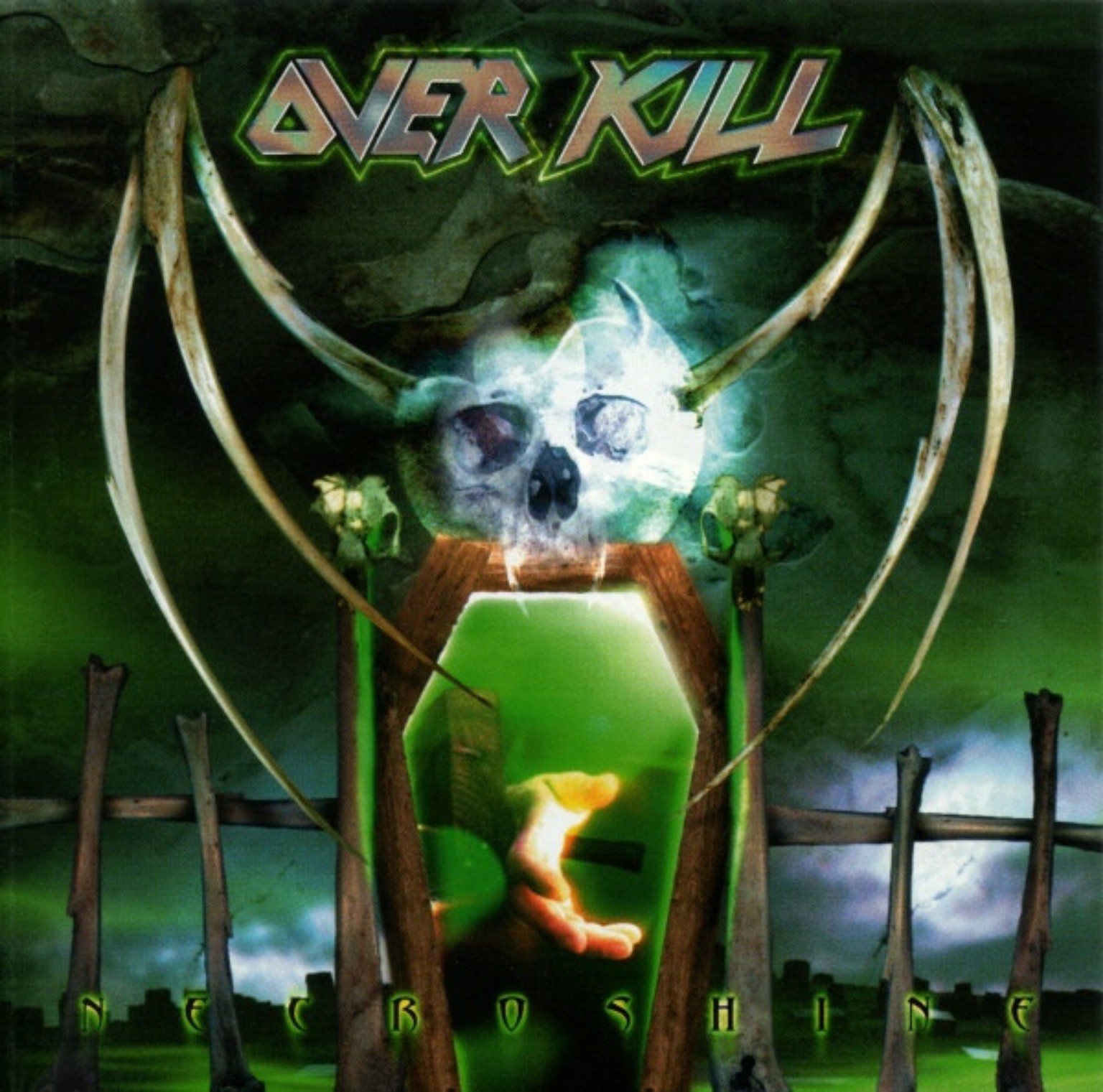
The record also needed cover artwork. Travis Smith created the artwork; the ideas were discussed over the telephone. When the suggestion arose to change the blue background to green, Ellsworth felt that the image suddenly fell into place. Green was Overkill's old colour, but here it no longer served the fluorescent, attention-grabbing purpose of the early club posters. It hung above the coffin and bones as a cold, ominous light.
At the top, the angular, metallic OVERKILL logo stands out against a dark background that looks almost cracked. Below it, an incandescent white skull dominates nearly the entire composition. Its dark eye sockets and the bluish light cast over the bones make it starkly visible and eerily elusive at the same time. On either side, long arcs of bone curve upwards like the ribs of a strange gateway. These sweeping forms guide the eye from the edges towards the centre.
Lower down, a rough, brownish coffin frame draws the eye into the depths. From its open interior, filled with green light, emerges a yellow-orange shape resembling an outstretched hand; whoever it belongs to remains unseen. On both sides, bone-like posts and horizontal bars form something resembling a fence. Behind them stand low dark silhouettes suggestive of gravestones. Fine mist, weathered surfaces and sharp patches of light give the scene the feel of both a painting and an almost photographic reality. The widely spaced NECROSHINE lettering near the bottom nearly disappears into the shadows, in contrast with the band's dominant name above.
The visual tension is thus suspended between the skull hovering high above and the cavity opening below. That pressure within the image echoes the album's heavy, restless rhythms: here, light does not soothe the darkness but makes it more ominous.
Chaly, the band's recurring skull symbol, returned in a new form. The skeletal figure, the coffin and the religious motifs spoke the same language as the songs. Religious symbols had long fascinated Blitz. He described himself as spiritual rather than religious; what interested him was the power of the symbols. The cover of Necroshine therefore became more than a straightforward horror illustration. It offered a visual counterpart to the question running through the whole record: what remains of the light after a person has seen the darkness?
The Ten Songs
PART EIGHT – TEN STOPS IN THE DARK
Necroshine
The album did not rush at the listener immediately. The title track first built a space around itself. The drums and heavy introduction gradually raised the tension, and Blitz's voice entered only later. It was as if the album itself were saying: before we talk about light, we have to show how deep the darkness runs. One critic heard drums hovering like a helicopter at the opening; another pointed out that the song waits more than a minute before introducing the vocals. The delay was no mere gimmick. The word needed time to acquire its meaning.
In the title track, hell and light are not two separate stories. They are experiences of the same human being. After Ellsworth's illness, the idea of “don't worry about me” meant something different from what it might once have meant. It was not a denial of danger, but a declaration that danger would not have the last word. D.D. Verni later chose this song among those capable of showing, in just a few minutes, what Necroshine was about.
My December
The next stop was colder. My December spoke in the first person, and Ellsworth himself linked it to the experience of mortality. December was more than a month; it was a season of the soul: clouds, rain, lightning, a firestorm, memory and dawn. The light was not warm here either. It merely proved that something could still exist beyond the night.
Blitz said that he did not write lyrics like these to display his problems in public. They were more like personal records, written for himself. When he put something into words, he heard it echoed back, and the sound helped him recognise what had happened within him. My December is therefore both a song and an imprint. It was among Verni's personal favourites, even if the other band members did not necessarily rank it in the same place.
Let Us Prey
Let Us Prey was already double-edged in its title. The call to pray and the sound of “prey”—something hunted—came together in the same phrase. The song moved among resurrection, mission, bleeding, weapons and salvation, but it did not deliver a profession of faith. Sacred and violent images slid into one another just as light and darkness did across the record.
Musically, the track built from slow, doom-laden heaviness through a mid-tempo passage to full speed. Mary Ellsworth's voice and Joe Comeau's vocal presence heightened the contrast. Overkill's old dark, heavy side and its aggressive thrash instinct met in one continuous arc.
80 Cycles
80 Cycles moved away from churches and angels and into a world of machinery, engines, petrol and speed. The song sounds as though darkness itself has now been set in motion. Blitz described it as perhaps the album's most modern track. Not because he wanted to copy a contemporary fashion, but because its guitar patterns travelled in a different direction from Overkill's own past.
The question—how low can one sink?—remained human even beneath the mechanical movement. Verni counted the song among those that represented the album's essence. Not every critic felt the same way: for some, this more modernised, groove-oriented world came together less convincingly. Yet the very division showed that the band had not simply made the same album all over again.
Revelation
In Revelation, paranoia met an angelic voice. The lyrics filled the scene with murderers, vultures, sleeplessness and cold hands. The “revelation” did not arrive as a peaceful discovery, but in a nervous, threatening state. And into that very darkness floated Mary Ellsworth's voice.
The story of the recording is almost a miniature version of Necroshine itself. Blitz wanted deep aggression, then realised that genuine tension demanded the opposite pole. The pure female voice was not an escape from the song but a source of light within it. The clearer it sounded, the darker everything around it seemed.
Stone Cold Jesus
Stone Cold Jesus turned religious symbols into a provocation even in its title. Resurrection, the devil, the cross, a congregation and redemption appeared in it, but Ellsworth's spiritual interests did not crystallise into a single dogma. He used symbols for their force, because they could condense centuries of meaning into a single image.
At the opening, D.D. Verni's bass evoked another inheritance. The wah-wah pedal passage referred to Cliff Burton's Anesthesia; Verni acknowledged it as a deliberate tribute. Thus religious iconography and the memory of metal history were present in the same song. Reviews were divided: some admired its psychedelic weight, while others found it harder to embrace.
Forked Tongue Kiss
The kiss of Forked Tongue Kiss was poisoned from the title onward. The devil's embrace, lost innocence, psychopathy, a velvet glove and a second voice sketched a world in which attraction and threat could not be separated. In the album's second half, the song raised the energy again, as though, after the lengthening shadows, the story had suddenly broken into a run.
Several critics singled out precisely that adrenaline. The track was a reminder that the band's early punk instinct still lived beneath the heavier, more layered Necroshine. It was not a separate exercise in a particular style, but a reflex.
I Am Fear
In I Am Fear, fear finally acquired a voice of its own. It did not stand before the listener as an external monster; it spoke from within, taking on the forms of family figures, mediocrity, shadow and unending misery. Fear offered both companionship and a threat to someone left alone.
The song almost literally intersected with Blitz's thoughts in interviews. Fear becomes truly dangerous when it is hidden. Face it, and at least it can be named. The source lyrics are fragmentary in several places, so this account does not attempt to invent missing lines. What remains is enough: one of Necroshine's innermost shadows is speaking.
Black Line
The long black line of Black Line is both a road and an uncertainty. The phrase “black sunshine” seems almost a sibling to Necroshine: a brightness already carrying shadow within itself. The figures move forward, but they do not necessarily know who they are or where they will arrive.
Musically, the song reminded several reviewers of the band's earlier punk and speed-metal momentum. Joe Comeau's backing vocals, the guitar solos and the sheer movement showed that Overkill's old engine was still running alongside the album's more experimental touches. The past was present not as a destination to return to, but as fuel.
Dead Man
Dead Man offered no simple resolution. The dead man remained, clinging to the living, while tomorrow turned into yesterday's news. Images of rockets in the brain, pain and uncertainty closed the album without making the darkness disappear.
And that was precisely what made the ending consistent. Necroshine had never promised that light would defeat darkness. Only that the two could exist at once, and that a person could decide which way to look. The dead man might remain in the background; the next step could still be taken.
Release and Reception
PART NINE – FEBRUARY TWENTY-THIRD
Necroshine was released on February 23, 1999. The German edition included in the source materials carries the Steamhammer/SPV imprint; American reviewers encountered the record as a CMC International release. The album contained ten tracks running for a little over fifty minutes. On the cover was Travis Smith's ominous green-tinted world; inside were the performances of Bobby “Blitz” Ellsworth, D.D. Verni, Sebastian Marino, Joe Comeau and Tim Mallare, guest vocals by Mary Ellsworth, the production and mixing shared by the band and Andy Katz, and mastering by Roger Lian.
By the time of its release, Overkill no longer needed to explain why it existed. Yet every new album still had to answer the same question all over again: what does it mean to be Overkill now? Necroshine's answer was not a single genre label. It was thrash and groove, old instincts and new patterns, Blitz's familiar edge and deeper vocal layers, aggression and a woman's voice, death and light, all at once.
When Necroshine reached record shops in February 1999, the world was considerably more restless and changeable than the American economic boom alone might suggest. The international financial system had experienced another shock in the summer of 1998. On August 17, Russia devalued the rouble and announced a moratorium on debt repayments. The resulting crisis of confidence reached so far that in September the danger of the American investment fund Long-Term Capital Management collapsing raised concerns for the financial system as a whole. In an October speech, the then head of the Federal Reserve Bank of New York spoke of intensifying movements across the world's stock and bond markets. The sense that distant events were connected within one global market was an immediate, tangible experience.
At the same time, Europe was moving in two very different directions. In the history of political and financial cooperation, January 1, 1999, marked a turning point: eleven European countries introduced the euro as their common currency, initially used mainly as book money and for electronic settlements. Euro notes and coins did not enter circulation until 2002. For shoppers paying in cash, the change was therefore less tangible in February 1999, yet it opened a new era for the continent's banks, businesses and commercial relationships. This was a historical event taking place alongside the record, not an explanation of its lyrics or sound.
Several months earlier, another kind of boundary had shifted on the continent's western edge. On April 10, 1998, the Good Friday Agreement, a pivotal milestone in the Northern Ireland peace process, was reached. After decades of violence, it established a framework for power-sharing, recognition of the rights of communities and peaceful settlement of political disputes. It did not resolve every mistrust overnight, but it opened a historic opportunity. This, too, was a face of the age: even in conflicts that appeared at their darkest, some shared way forward might emerge. That last thought is a historical interpretation, not an intention attributed to Overkill.
Agreement did not prevail everywhere. In Kosovo, in the former Yugoslavia, the crisis worsened during 1998, and large numbers of refugees and families forced from their homes appeared. After diplomatic talks failed, NATO began its air campaign on March 24, 1999, and continued it until June 10. These events therefore took place AFTER Necroshine's February release. They cannot be treated as a cause of the album's creation, but they show the European news against which its international life began. Peace and war, a common currency and forced flight were realities of the same year.
Meanwhile, the internet was spreading faster than ever, making connections around the world both closer and more unequal. American figures for the end of 1998 indicate that only about a quarter of households had internet access at home; the technological transformation of the following years was still far from a completed story. Someone trying to discover new music in 1999 faced opportunities and limits of access very different from those of later decades. The more detailed history of the music industry, genres, shops, magazines and concerts, however, belongs to a separate musical portrait of the era. The essential point here from social history is that Necroshine appeared just as the routes connecting people to one another and to the wider world were beginning to change fundamentally.
The green-lit coffin and the returning sound of Overkill did not exist in a vacuum. The musicians' demonstrable personal story can be read in the preceding chapters: illness, the division of creative labour, the studio and the album's songs. Around them one can see a small New Jersey town, a changing Connecticut, an America experiencing both economic growth and social inequality, and beyond it a world filled with crises and hopes. There is no need to claim that the band wrote its songs about these events. It is enough to see clearly the year, the region and the historical moment in which the songs were heard.
By the time Necroshine appeared in February 1999, the record had made a long journey from the studio to its audience even before the first listen. In the conventional release calendar, the label, distribution, forthcoming reviews, interviews arranged in advance, and the shop, specialist magazine or concert where a listener first encountered the album's title all mattered. The music was not met by an internet on which everybody could reach everything at the push of a single button. Listeners were scattered geographically, yet they might recognise the same printed covers, tracks in the same sequence and records passed from one person to another.
The state of metal could not be measured by a single sales curve. The American recorded-music market as a whole grew in 1998 compared with the previous year: manufacturers' CD shipments rose from 753.1 million to 847 million units. But this was an aggregate for every genre, not a separate measure of thrash's popularity. That the industry moved vast quantities of records did not guarantee promotion for a particular band or availability in shops for a particular album. That is precisely what makes the period contradictory: the physical music business was enormous, but attention and money were very unevenly distributed across styles.
Different generations were also strikingly present together in the concert market. An official retrospective listing for Ozzfest 1999 puts Black Sabbath, Rob Zombie, Deftones, Slayer, Primus, Godsmack, System of a Down, Fear Factory and Slipknot on the same festival programme. That bill belongs to the concert season following Necroshine's February release; it was not a precondition of the album's November–December recording sessions. Its importance is that the months after release made this coexistence of generations visible. New interest also meant new competition: for an established band to be noticed by audiences and media, its voice had to carry among an ever wider variety of sounds.
Alongside radio and the printed press, the internet opened a second channel. In the spring of 1999, Chronicles of Chaos published an Overkill interview in the same electronic space where distant fans could already follow news about other bands, countries and scenes. Online publication was not yet the streaming world of today, with its exhaustive catalogues. A complete album was still most readily obtained as a physical copy; at first, the network more often brought news, a review, an excerpt from a lyric or the possibility of making contact.
The year itself subsequently became a genuine turning point for digital music. The launch of Napster in June 1999 gave new impetus to the sharing of MP3 files over the internet. The timing matters: the service began several months after Necroshine was released and cannot be projected backwards into the circumstances of the band's 1998 studio work. But the beginning of a technology that would later reshape almost everything already belonged to the history of that very year. For a short while, the world of the CD in its case and the world of audio files copied from home computers expanded alongside one another before the industry recognised the gravity of the conflict.
Necroshine is therefore tied to a precise moment in the last great era of physical records. The songs the musicians created, and the listeners awaiting them, remain at the centre of the story, not technology. Yet if the jewel case, booklet, cover, concert ticket and pages of a fanzine were all part of what an album meant in 1999, the musical environment can no longer be treated as mere background noise. This was the space into which a thrash band's new record arrived after decades of activity, at a time when both old and radically new sounds could be heard under the name of metal.
PART TEN – WHEN THE WORLD ANSWERS BACK
The reviews did not speak with one voice. CMJ praised the band’s loyalty to its roots: it had not abandoned the traditional thrash path, thereby rewarding its steadfast audience. Chronicles of Chaos heard what might be one of the strongest Overkill records of the 1990s, with thick grooves and a battle-ready Blitz. Rough Edge singled out razor-sharp guitars, thunderous drums and dark lyrics.
Others were less enthusiastic about those same qualities. The Daily Vault felt that a formula which had worked well on earlier albums was beginning to show its age in places, leaving a sense of déjà vu. ZX Power heard a professional sound, but too few songs that made an immediate impression. In Music We Trust found the drums rather thin in some passages. The album did not invite one unanimous verdict. Its layers divided listeners in just the way Blitz had predicted: this was material that needed several listens.
The band's own measure, however, was different. They were not watching the latest fashion but asking whether they could reach people. Ellsworth talked about touring, the many American shows, fanzines, radio stations, and the fact that a route to the audience could still be organised even without help from the great media machine. For Overkill, success was seldom a single explosion. More often, it was something built up over years.
Touring and the Aftermath
PART ELEVEN – BACK ON THE ROAD
Necroshine's European tour promised an intense schedule: almost thirty shows in roughly thirty days. Ellsworth even saw an advantage in the intensity—working at full force for a short stretch, then returning home for longer. But assembling a set list had grown ever more difficult. After ten studio albums, someone missed a favourite song every night. Playing everything would have meant remaining onstage for hours.
Before the tour, Sebastian Marino departed. D.D. Verni later recalled that the musicians worked on a contractual basis and that Marino's commitment had already become questionable as the album was being completed. By the time Marino said he would not continue, the band was already looking for another guitarist. Dave Linsk arrived, whom Verni later described as a real stroke of luck.
Joe Comeau's story took a different turn. In Overkill he was a guitarist and an important additional vocalist, but he wanted more room once again as a frontman and songwriter. Annihilator offered him that opportunity. The change did not erase the work he had done on Necroshine; rather, it showed that the same band can be home to different people for different lengths of time.
PART TWELVE – WHAT REMAINED AFTER THE LIGHT
In 2000, when Bloodletting came into focus, Ellsworth could look back with a little more distance. He described the new record as mixing the full arsenal of old and new Overkill techniques. That also defined Necroshine's place in retrospect. It was not a dead end but a passage between the groove-laden weight of From the Underground and Below and the more direct energy of the following period.
In a 2000 interview with Vampster, Blitz spoke even more plainly about what writing lyrics had done for him. Illness and pain had exerted a powerful influence on the lyrics of Necroshine. He let those darker feelings enter the songs so that they would become less threatening. Art was not presented as a healing spell, but as a place where darkness could take shape—and therefore cease to be nameless.
A year later, he compared his lyrics to an onion. With each album another layer falls away and the person comes closer to the centre. Necroshine remained a special layer in that long process of self-examination, because the experience of mortality had brought the lyrics closer to the person writing them than ever before.
Epilogue – Necroshine
EPILOGUE – NECROSHINE
Overkill's story did not end in 1999, and Necroshine was not intended as a closing statement. Yet something about it completes a circle of its own. Around 1980, a band begins with covers and club shows. It writes its own songs, makes records, loses members, welcomes new people, reaches larger stages, survives changes in musical fashion, and learns along the way that identity is not the same thing as standing still.
Then one of the people who had been there from the beginning—the band’s voice—suddenly confronts the fact that time is finite. He does not make a farewell album. Nor does he try to pretend that nothing has happened. Instead, he invents a word in which death and light can exist together.
Necroshine
The darkness does not disappear. At the end of Dead Man, the shadow is still there. Nor does fear cease to exist. The past does not become easier merely because a person has survived. But the light is no lie either. It becomes clearer because darkness surrounds it. That was Ellsworth's realisation, and it became the album's deepest story as well.
And the band went on. As always. Another riff, another rehearsal, another road, another stage. Not because nothing had changed, but because every change required the same question to be asked anew: what remains of us? Necroshine's answer glowed green in the darkness. SOURCE NOTE
Reader comments
Comments only appear after approval. Messages are displayed in their original language.
Comment submissions are not enabled yet.