

The Sad Realm of the Stars
The complete English history of Odium’s nine-track 1998 album, from its Norwegian beginnings through the studio sessions and star-filled cover to its decades-long afterlife.
Album details
Track list
- Winterpath04:38
- Towards the Forest Horizon05:40
- Palace of Forgotten Dreams04:12
- Thy Eternal Nightfall03:43
- The Sad Realm of the Stars04:11
- Northern Flames03:27
- Through the Sorrowfilled Forest04:10
- The Brightness of the Weeping Kingdom04:24
- Riding the Starwinds05:23
Line-up
- Secthdamon
- guitar, vocals, lyrics
- Charon Martyras
- guitar, lyrics
- Demariel
- bass guitar, lyrics
- Bastadon
- keyboards
- Eek
- drums
Recording / release
- Recording
- Studio Stovner (Norway), 10–23 December 1996
- Mixing
- 4–15 May 1998
- Original label
- Nocturnal Art Productions
- Original release
- 1998 · CD
- Catalogue number
- ECLIPSE 010
- Reissue
- Osmose Productions · 2024 · CD, LP and cassette
Official links
Availability and purchase options depend on the provider.
Digital album purchase
Buy digital album · QobuzPhysical editions – where to buy
CD, vinyl or cassette · labels and specialist record shops
Availability and shipping vary by country. Record Shop X lists a 4–6-week lead time; HR Records may restrict availability depending on the selected delivery country.
The original 1998 edition contains nine tracks. Some later reissues include the 2001 bonus song “Altering the State of Being”.
Prologue — Between Two Years
Some records enter the world as though they were born in a single instant. A date appears on the sleeve or in a collector’s catalogue, and the story behind it seems settled. Odium’s only full-length album resists such simplicity. The Sad Realm of the Stars is remembered as one of the strangely luminous, dark works of Norwegian black metal in 1998, yet the music on it was recorded much earlier, in December 1996. Two moments therefore open before the listener: the time when five musicians made the recording, and the time when an audience was finally able to hear it.
Between those two moments, an entire genre changed its face. By the mid-1990s, Norwegian black metal was no longer solely a matter of elusive tapes and local connections. In the wake of scandals from earlier years, the press had woven a dark mythology around it, while the records themselves were moving in markedly different directions. Alongside deliberately stark, grainy sound, there was growing room for bolder landscapes shaped by keyboards, longer melodic arcs, and imagined worlds. By the time Odium’s album appeared, listeners could measure it against records that had not even existed when it was recorded. The delay sometimes cast the music itself in a different light.
Yet the album’s story is not merely one of delay. Five names remained on the pages of the original booklet; nine track titles appeared on the back cover, alongside a handful of defining studio credits and a painting that draws the eye from earthly shadow into an unknown expanse of stars. Few documents survive from the first years, but later interviews and reviews gradually illuminated what the band had made. Around one complete album grew a story spanning decades. Odium did not release a succession of full-length records: the same work from 1998 returned in new editions, fresh interpretations, and, eventually, onstage again.
To tell this story, we must distinguish between the different voices of memory. An artist’s account is not the same as a journalist’s impression of what they heard; a date printed on an old CD is a different kind of evidence from a database entry written decades later. The music matters because reviewers’ descriptions can be tested against it. The audio files have undergone technical checks, but those checks are no substitute for a verifiable listening examination: when a critic identifies a particular instrument or an instrumental passage, the observation remains the critic’s own. In this way, the narrative can preserve the excitement surrounding the music without inventing an unverified listening experience or a statement the musicians never made.
Chapter One — Beyond the Norwegian Landscape
Odium’s beginnings lead back to Drammen and the Buskerud region. That geographical starting point matters more than it might first appear. Later accounts sometimes reduce Norwegian black metal to a single city, one circle of people, and a few endlessly repeated events. In reality, the underground existed simultaneously in many towns, rehearsal rooms, and groups of friends. Music travelled not only through loudspeakers but on cassette tapes, in letters, through the pages of fanzines and the catalogues of small labels, and, gradually, across the early internet. A band’s prospects were closely tied to who heard its recording, who answered a letter, and where it found someone willing to distribute its music.
For Norway, 1994 was also an exceptional year because of the Lillehammer Winter Olympics and the referendum on membership of the European Union. These events belong to the historical backdrop, but there is no reliable statement suggesting that either directly shaped Odium’s songs. We understand the band best within its own musical surroundings, without automatically assigning to it everything that happened in the same country. The criminal cases and tabloid attention cast over Norwegian black metal were likewise part of the real historical setting; they do not, however, justify attributing undocumented religious or political convictions to individual members of Odium.
Differences within the genre were at least as fierce as the disputes surrounding it. Darkthrone represented one pole of uncompromising rawness and simplicity; Emperor constructed more intricate forms, Arcturus moved towards experimentation, while Limbonic Art and Dimmu Borgir expanded the scope of keyboard-driven, symphonic sound in different ways. Rather than a single school, there were parallel paths. It was within this varied landscape that later reviewers tried to establish Odium’s place. Several emphasised affinities with Emperor, but such comparisons are not the same as influences openly acknowledged and demonstrably held by the musicians.
This distinction is particularly important for a record released after a long delay. If a journalist in 1999 heard similarities to an album that was already well known, we cannot simply conclude that Odium had worked under its influence in 1996. The moment of reception and the moment of creation are different. The resemblances recognised in the music retain their historical value as criticism, but they cannot rewrite the order in which works were made. The original CD stands almost like a sentry on the boundary between those two moments, reminding us that every comparison has its date.
The details of the earliest rehearsals can no longer be reconstructed down to individual streets. No definitive surviving diary records the first afternoons together, the rooms, or the arguments. Even so, a direction can be discerned: alongside the structures of fast, guitar-centred black metal, the band sought a wider imaginative vista, one already suggested by its titles. Forest, winter, twilight, a forgotten dream, stars. Such words do not establish the full meaning of the songs, but they show that from the outset Odium’s world aspired to more than merely naming aggression.
The Riverside Town and a Changing Europe
In Drammen, the river did more than cut through the town: industry, commerce, railways, and residential neighbourhoods met along its banks. Situated on the Drammenselva, Drammen was an important hub in Buskerud, with railway lines heading west and south and a road leading towards Oslo. In the mid-1990s it was no isolated northern outpost, yet its rhythm differed from that of the capital. The short geographical distance between them helps us picture the surroundings in which a local band could exist. There is, however, no evidence identifying the precise routes, clubs, or rehearsal spaces through which Odium’s members made contact with others.
The town’s character was shaped by its industrial past and its evolving role as a commercial centre. Historical population figures for Drammen published by the Great Norwegian Encyclopedia show growth in the wider present-day urban area during the middle of the decade, but subsequent changes to administrative boundaries mean those figures cannot be equated directly with the population of the municipality as it then existed. This gives a sense of everyday scale. To the wider public, black metal might have been synonymous with scandals that made national headlines; for musicians, it remained a creative undertaking squeezed between work, school, friendships, rehearsals, and correspondence. Whether a demo travelled far depended not only on proximity to a metropolis but on the endurance of personal connections.
In 1994, the country presented another face to the world. Lillehammer hosted the Winter Olympics in February: athletes from sixty-seven nations competed, and Norwegian competitors won twenty-six medals. In November, voters decided whether Norway should join the European Union, with 52.2 per cent voting against membership. The first event brought international celebration and attention; the second made visible an internal debate over Norway’s relationship with the continent. We do not know whether these public events directly concerned the musicians of Odium. Nevertheless, they belong to the period’s history: the album was conceived not in some timeless, frozen fairyland but in an outward-looking society debating its own identity and its place in Europe.
The cultural map of post–Cold War Europe was also changing rapidly. Music born in a small northern European town could reach listeners its creators would never meet, carried by tapes sent through the post, records ordered by letter, and international subcultural networks. Language barriers did not vanish, but sleeve artwork, a track sequence, and a musical atmosphere travelled across them more readily than a long explanation in a local language. The internet of the 1990s was already opening new routes alongside these connections, yet it did not erase the importance of correspondence or printed fanzines overnight.
One tension in Odium’s history stems from this very duality. When the recordings were made, the band worked in a particular town, with particular technical means; its song titles, however, invoked forests, dreams, nights, and stars. Fantasy here is not a provable biographical claim about escapism but the unmistakable world of the finished work. Everyday Norway and an imagined, boundless landscape existed side by side. This is what made it possible for an album rooted in a small town to become a personal memory for listeners in entirely different countries.
Chapter Two — Five Names, Two Beginnings
The story of the band’s formation divides into two versions surprisingly early. A band biography circulated in later years gives the names of three founders in 1994: Secthdamon, Demariel, and Charon Martyras. In that account, the later line-up grew from an initial nucleus centred on guitars, bass, and vocals. The old description carries weight of its own, since it came from the band’s self-presentation. The surviving copy available today, however, is not a dated record written on the day the group was formed.
When Secthdamon answered questions for No Clean Singing in 2018, he remembered the beginning differently. In his recollection there were initially two of them: himself and the bassist Goretheon; the other musicians joined later. He also spoke of the difficulties of working together in the earliest days. It would be wrong simply to erase either account in order to give the story a smoother opening. Perhaps the very first collaboration and the three-person core later recognised as a band were distinct stages, but no independent document from the period confirms that possible transition. Two beginnings therefore remain: one preserved in an old collective biography, the other in a musician’s personal memory some twenty years later.
Over the following years, the roster assumed a firmer shape. The biography dates the arrival of drummer Anders Eek and keyboard player Bastadon to 1995. By the time the album was made, the five musicians identified in the original booklet had come together. Secthdamon played guitar and sang; Charon Martyras was the second guitarist; Demariel played bass; Bastadon handled the keyboards; and Eek played drums. The portraits placed together in the booklet establish that these were not connections pieced together retrospectively from the internet: the album’s own physical documentation preserved their names.
The division of labour was richer than the instrumental credits alone suggest. Secthdamon and Martyras appear in the production credits, while the lyrics are credited to Secthdamon, Martyras, and Demariel. The booklet attributes the music and arrangements written between 1994 and 1996 collectively to Odium. It would therefore be unfair to invent an individual author for a particular guitar phrase or keyboard melody. What the surviving record tells us is that the work was shared, and that personal responsibilities overlapped in several directions.
Eek’s individual path nevertheless casts a different light on the five-piece. Also known for his work with Funeral, he spoke in interviews years later, in 2007, of wanting to expand his abilities as a drummer by playing in bands with different styles and tempos. Faster music and unfamiliar instrumental demands offered him room to grow. This was his personal account, not a declaration of purpose on behalf of all of Odium. Still, it reveals something about how people with different musical histories met within the group. One musician sought new rhythmic challenges; another saw broader imaginative possibilities in the relationship between keyboards and guitars. The album preserves that convergence.
It would be easy to mislead readers here by projecting later familiar names backwards. Destructhor, Dominator, and other participants in the reunion are genuinely important to Odium’s history, but that does not make them original studio members of the record made in 1996. At the centre of the album’s world remain the five musicians named in the contemporary booklet, whose shared work produced the band’s only complete full-length album.
Chapter Three — From Cassette to Studio
Before the nine pieces destined for the CD case were completed, there had been a six-track promotional tape. According to the band’s old account, following rehearsals and early recordings the material reached several small labels, and an offer from France’s Velvet Music proved decisive. The promo was more than a preliminary step towards the eventual release: it is evidence in its own right that six of the nine songs already belonged to the band’s repertoire before the album was recorded. ‘Palace of Forgotten Dreams’, ‘Through the Sorrowfilled Forest’, ‘The Sad Realm of the Stars’, ‘Winterpath’, ‘Thy Eternal Nightfall’, and ‘Northern Flames’ did not spring into existence at one late moment in the studio.
The date of the promo tape is less clear. One discographical database lists a particularly limited physical release from 1996. A digital version issued later, by contrast, bears the title Promo tape 1995 and the date 20 September 1995. It is possible that one date refers to recording and the other to distribution, but without the original cassette label and unambiguous primary evidence, this possibility cannot be presented as fact. Some entries also associate a keyboard player named Tolpinrud with the promo, whereas the old band biography dates Bastadon’s arrival to 1995. The precise relationship between the two line-ups remains unresolved.
These details might seem minor, yet they change the picture. The early course of an underground band does not always follow the neat numbering of its later releases. A song can exist before a permanent label is found; a recording may pass from hand to hand while its official release date remains uncertain; and the personnel may change even as the music is taking shape. Odium’s six-song promo preserves precisely such a transitional stage, out of which the prospect of an internationally distributed album took firmer shape.
The most dependable dates for the band’s full-length record survive not in a magazine article but on the credits page of the original booklet. According to that document, recording took place at Studio Stovner between 10 and 23 December 1996. Sound engineer Hans Petter Heggli is credited for the studio work, while Secthdamon and Martyras appear as producers. The precise dates of those two weeks do not prove that every musical idea originated then; on the contrary, the earlier promo shows that some of the songs had already been developing for a considerable time. The studio was thus the place where an extended creative process was captured, not necessarily where the entire music was conceived.
A further, striking interval opened between the December sessions and the CD that eventually reached the shops. The booklet dates the mixing to 4–15 May 1998. Mastering is associated with Strype Audio, Tom Kvålsvoll, and Secthdamon. Recording in 1996 and mixing in 1998 were separate stages of work. Later reviews did not always distinguish them, but the primary testimony of the physical release is clear on this point. The two-year gap should not simply be erased by calling the CD a 1998 recording.
The old band biography describes the breakdown of the relationship with Velvet Music. A reviewer for Chronicles of Chaos in 1999 also mentioned label difficulties behind the delay. No complete account of the contracts has emerged, however: we do not know every letter exchanged, postponement, or decision. Uncertainty is no grounds for inventing a dramatic dispute with the label. What is certain is that the release ultimately came through Nocturnal Art Productions, and the original CD bore the catalogue number ECLIPSE 010. Discographical listings also give 17 August 1998, although the original booklet itself does not independently confirm that precise day.
Another surviving document shows that Odium had already reached beyond its immediate circle before the full album appeared. The title track was included on the French compilation Encyclopedia Pestilentia. The later CD was therefore not everyone’s first encounter with the band. We do not know how many listeners received the compilation or exactly what response it provoked. Its presence nevertheless proves that the band’s story did not begin on the album’s release date, and that its French connection was not merely an unfulfilled promise.
At the Threshold of the Cassette and Keyboard Era
The music Odium recorded in December 1996 took shape in a world where Norwegian black metal no longer meant a single sound. Alongside the deliberately abrasive character of Darkthrone’s records, Emperor’s more elaborate structures, Arcturus’s strange melodic universe, Limbonic Art’s synthesiser-driven breadth, and Dimmu Borgir’s increasingly spectacular arrangements each offered a different answer to the same question: how far could the genre expand without losing its dark atmosphere? These are musical points of reference from the period, not proof that Odium drew direct inspiration from every one of them.
Chronology matters. Emperor’s In the Nightside Eclipse appeared in 1994; Arcturus’s Aspera Hiems Symfonia and Limbonic Art’s Moon in the Scorpio followed in 1996; Dimmu Borgir’s Enthrone Darkness Triumphant was released in 1997. By the time Odium had recorded the material for its first full-length album, some of the records later invoked as comparisons had not yet reached the market. When the album finally appeared in 1998, listeners across the genre were familiar with a different constellation of names. This does not shift the sounds themselves forwards or backwards in time, but it changes which related works listeners place around them.
In such surroundings, a keyboard need not serve merely as decoration hovering in the background. Above fast, densely layered guitars and drums, it could open out longer, continuous fields of sound that might evoke film scores, Romantic landscapes, or fantastic tales. The synthesisers, sound modules, and multitrack recording techniques of the period made this layering possible. There is, however, no evidence establishing the exact manufacturer, model, or recording signal chain used by Odium. What the booklet reliably identifies is Bastadon’s keyboard role, Hans Petter Heggli’s engineering work, Studio Stovner, and the chronology of the later mixing sessions.
An underground recording’s journey did not end when the musicians left the studio. Duplicating demo cassettes, reproducing cover artwork, mailing copies to fanzine editors, and cultivating relationships with small labels by letter all went on side by side. A later exhibition on black metal at the National Library of Norway deliberately displayed albums, master tapes, books, and fanzines together: the genre’s history cannot be written solely as a history of finished CDs. Within an international network, it also mattered who would pay for pressing, printing, distribution, and promotion. These were general conditions of the period; they cannot stand in for Odium’s particular recording or label contract, whose details we do not know.
Different physical formats offered different possibilities. A cassette could serve as a low-cost introduction, copied comparatively quickly, whereas a factory-pressed CD required prepared artwork, an identifiable catalogue number, and organised distribution. Vinyl could give recordings a second life among collectors. Research into the era likewise stresses the role of small international labels: foreign connections often provided the route by which locally created music reached a wider audience. For Odium, however, the firmest evidence survives in the objects themselves: the original Nocturnal Art Productions release, its nine titles, and its studio credits.
The gap between recording in December 1996 and mixing in May 1998 is not simply a technical footnote. The material carries the imprint of two separate moments. The songs already existed, while the conditions of release, decisions at the label, and the audience’s tastes continued to change. The consequences of the delay cannot be measured merely by subtracting one date from another. A work that belonged to an emerging direction when it was conceived could enter public life only later, when that direction was already surrounded by new names and new expectations.
Chapter Four — The Gateway and the Stars
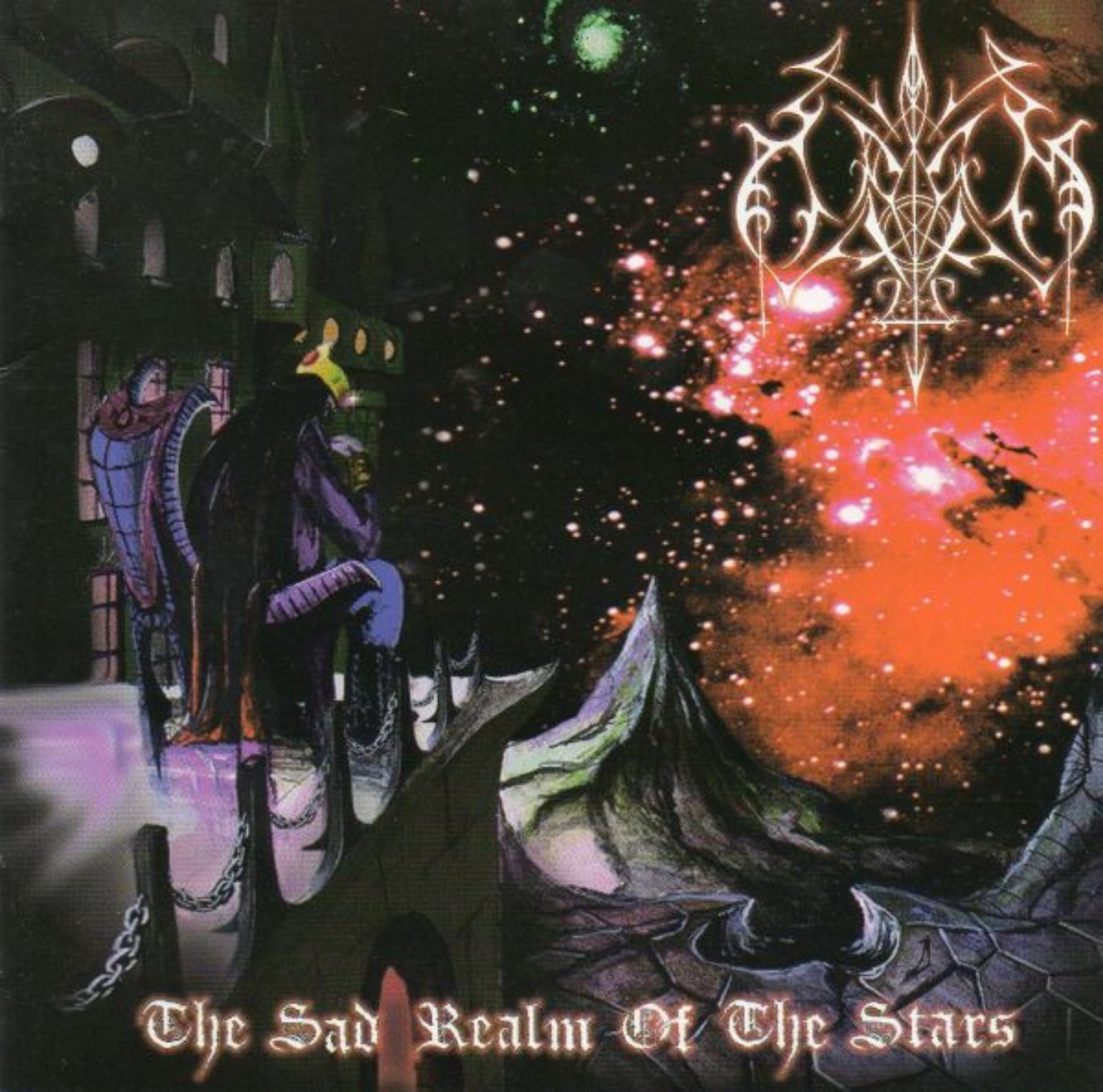
The completed recording needed a face. On the cover of the original CD, a vast space filled with stars and red, swirling lights reminiscent of celestial clouds opens beyond dark and forbidding architectural forms. Rocky and figurative details in the foreground appear to lead towards another scale of existence; above them stretches the band’s intricate, difficult-to-decipher yet instantly recognisable logo. The image cannot be read as a straightforward landscape painting. Together, its colours, the weight of its architecture, and the distance of the cosmos promise a world in which human proportions give way to the boundless. This, of course, is an interpretation made by someone looking at the painting today. No first-hand explanation from its creator covering every motif has survived.
The booklet identifies the cover as the work of Morfeus. That name is not an isolated entry in the network of musical and visual relationships of the period. In an interview with Daemon of Limbonic Art dated 17 July 1998, Morfeus’s interests in drawing and painting, and his background in fantasy and science fiction, were discussed; Odium’s sleeve also came up. The conversation offers valuable testimony from someone close to the artist’s visual world, but it is not a detailed studio interview conducted with the painter himself. The two kinds of source must not be conflated. Nevertheless, it is easy to see why this artistic imagination suited the record: fantasy does not appear as decoration detached from the song titles, but as a visual companion to the spaces they evoke.
Inside the booklet, the faces take centre stage. Portraits of Secthdamon, Charon Martyras, Demariel, Bastadon, and Eek emerge in warm, glowing shades of black and red. Halo-like forms of light both distinguish the musicians and bind them together. We need not imagine a fictitious studio scene around them: the photographs themselves show that the album reached the public as the work of five participants with a deliberately shaped visual identity. The credits for guitar, bass, keyboards, and drums belong to the same object as the painted stars. In a booklet from the CD era, all these elements formed one physical artefact the listener could examine before a note of music had sounded.
The other contributors to the visual design should not disappear behind the beauty of the cover. Oddvar Bråthen is credited for photography, while the logo and a separate drawing are attributed to Einar Fredriksen; N.A.P. and Master V appear in the release’s design credits. On the sonic side, the names Hans Petter Heggli, Studio Stovner, Strype Audio, and Tom Kvålsvoll are recorded in the booklet with equal evidential force. Design, photography, printing, recording, and record production demanded the collaboration of different crafts. When the internet later reduced this material to a single cover image and a clickable play button, much of that collaboration became invisible. That makes a physical copy more than an object of nostalgia: it is surviving evidence of the creative process.
Early reviewers described the sound in notably similar terms, as a meeting of extremes. Against the harder, faster textures of guitars and drums, they heard keyboards enlarging the musical landscape. Not everyone heard the same thing in them. Some emphasised cold melancholy, others the outward-reaching grandeur; still others simply noticed how effectively the instruments could be distinguished from one another. Such differences are no failure of critical method. Listeners encounter both the actual recording and their own expectations, so the album’s strengths and points of contention become apparent in different places to people with different musical backgrounds.
The cover might seem to offer a ready-made interpretation of the titles, but we should not pretend to read the entire lyrical content from it. No reliable original collection containing the complete lyrics to every song is available to us; nor did the booklet pages examined include a full lyric sheet. As early as 1999, Paul Lee remarked that he could not find the lyrics in the release. The snowy path, distant forest, palace of forgotten dreams, eternal night, and stars demonstrably belong to the song titles, but the narrators and stories behind them cannot be recovered from those words alone. Images are free to awaken the imagination; the historian must, at the same time, respect the limits of the evidence.
Beyond the Painted Gateway: The Original Cover
Along the left edge of the cover rises a dark, towering building, pierced by narrow openings, some faintly lit. In the foreground, the outline of a figure in strange, otherworldly garments emerges; beside it, curved structures and hanging chains draw the eye towards the bottom of the picture. This earthly, constructed space does not end at an ordinary wall. To the right, the horizon suddenly opens: a pointed greenish-grey crag stands in the distance, with winding lines before it resembling a path or a petrified riverbed. The eye senses both closeness and startling depth.
Where the two halves meet, the black sky slowly turns into a red-orange vortex flecked with stars. Some patches of light are clear, almost cold white; others glow like burning embers, while tiny stars scatter along the border between darkness and red. The painting therefore offers not simply a nocturnal landscape but a passage between two worlds. The building on the left and the heavy, statue-like figure seem to guard something beyond which familiar measures no longer apply. Diagonal lines running towards the centre lead the viewer’s gaze from the confined foreground into a luminous expanse of stars.
The band’s emblem, woven from pale, thornlike lines, sits amid the light in the upper right corner. Its very complexity makes it part of the picture. Across the bottom runs the title in bright Gothic lettering: The Sad Realm of the Stars. It does not explain who the figures are or where the path leads. Instead, it gives a name to the uncertain space we have just seen. The cover draws its peculiar power from refusing to separate forbidding architecture from the colourful cosmos: it makes each the threshold of the other.
Morfeus is credited as the creator of the image, with other contributors named for the graphic and typographic work. No detailed artistic testimony is known that could definitively decipher every figure and motif in the scene. Reading it as a gateway, a journey, and a distant universe of stars is therefore an interpretation, not a proven statement of the artist’s intentions. Yet it meets the nine song titles organically: from the wintry journey of ‘Winterpath’ to the sky of ‘Riding the Starwinds’, the cover itself prepares a movement in which the unknown is not only threatening but alluring.
Chapter Five — Nine Stations
Winterpath
The record opens with ‘Winterpath’: the winter road. We do not know whether the band intended it as the first chapter of a single continuous story, yet there is something powerful about the fact that the album’s first named place is a road rather than a world already complete. The title suggests movement through a cold landscape, a departure towards a destination still unknown. The piece, lasting roughly four minutes and thirty-nine seconds, was among the six tracks on the early promo and became the opening track of the original album. Those two details alone create a historical connection between the band’s work before the album sessions and the finished release. Descriptions of the instrumental music in surviving reviews can be followed only so far as they genuinely concern the sounds, rather than the writer’s imagination. The winter road therefore appears before us not as a fabricated snowy excursion, but as the symbol chosen to open the record, suggesting cold and distance.
Towards the Forest Horizon
‘Towards the Forest Horizon’ turns towards the distant edge of a forest. At approximately five minutes and forty seconds, it is one of the longest pieces on the original album. Compared with the road named in the first song, the landscape now gains a horizon: it is not merely somewhere to travel through, but somewhere from which to gaze into the distance. The two titles work well in succession even though no specific lyrical connection between them has been established. The atmosphere and sense of breadth mentioned by reviewers matter to an understanding of the whole record, but they do not automatically mean that a particular instrumental event occurs at precisely this point. Here, the title, the sequence, and the contemporary release provide the firm ground for interpretation. Actual musical observation would become a useful cross-check wherever a review identifies a verifiable detail.
Palace of Forgotten Dreams
The third song, ‘Palace of Forgotten Dreams’, opens another kind of space. A building enters the landscape, and with it the possibility of memory or loss. A palace built from forgotten dreams contains a contradiction even in its wording: dreams are fragile, while a palace suggests permanence. This composition, approximately four minutes and twelve seconds long, also appeared on the early promo. The fantastic associations of its title resonate with Morfeus’s painted world, but we have no document establishing that the cover was intended to illustrate this song’s lyrics in particular. The connection is therefore worth noticing as part of the release’s overall effect rather than presenting it as fact. Sometimes the distant kinship of a title and a painting says more about a period’s hunger for atmosphere than an elaborate explanation invented later.
Thy Eternal Nightfall
‘Thy Eternal Nightfall’ almost arrests time through language alone. An eternal night is not simply part of the day, but a state from which the title offers no visible exit. The roughly three-minute-and-forty-three-second piece is likewise known from the original six-track material. Its archaic, unfamiliar form of address belongs to the genre’s linguistic inheritance; in itself it proves neither a religious programme nor a personal story. Even so, it matters that after the winter road and the forest horizon, a title suggesting this densely suspended time arrives. As the listener reads down the back cover, the world becomes less and less geographical and increasingly a landscape of dreams and memory.
The Sad Realm of the Stars
The fifth piece bears the record’s title: ‘The Sad Realm of the Stars’. The sorrowful kingdom of stars had already appeared on the early promo and reached another audience through the Encyclopedia Pestilentia compilation before the full CD was issued. This makes the song not only the album’s internal axis but also a historical bridge between the first efforts at distribution and the 1998 release. The image of a realm made from stars enlarges the settings of the earlier titles: after forest, palace, and night, space becomes more boundless, while sorrow preserves a human scale. The existence and position of the approximately four-minute-and-eleven-second recording are secure; whether the band deliberately intended it as the dramatic centre of the whole album remains an open question. Its title could therefore serve both as a strong visual idea naming the entire work and as the identity of a song that had already circulated in its own right.
Northern Flames
‘Northern Flames’ stands out for its brevity beside the surrounding tracks: approximately three minutes and twenty-six seconds. Flames bring a new energy into the cold, dreamlike imagery heard so far. The word provides no proof of a particular geographical or political symbol, however tempting it may be to fashion a national narrative from the adjective ‘northern’. The piece belonged to the known tracks on the original promo, so this image was part of Odium’s world from an early stage. One listener’s review in 2025 named it as the reviewer’s least favourite song while praising the album as a whole. That opinion is neither a musical fact nor a measurable fault, but it is a revealing trace of how even a cherished record does not shine in the same places for every listener.
Through the Sorrowfilled Forest
The seventh song, ‘Through the Sorrowfilled Forest’, returns to the woods, but unlike the earlier horizon, it does not view them from afar: it passes through them. Four other worlds intervene between the two forest titles, making the return feel almost like a memory. The adjective ‘sorrowfilled’ also links it to the title track. The roughly four-minute-and-eleven-second recording is another piece already present on the early promo. We do not know whether ‘Towards the Forest Horizon’ and this song are two scenes in a shared narrative. Yet the original running order permits us, as readers, to sense a journey from the distant horizon to a passage through the forest. Anyone looking at all nine titles together can recognise such connections without falsely presenting them as statements made by the musicians.
The Brightness of the Weeping Kingdom
The title of the eighth track, ‘The Brightness of the Weeping Kingdom’, places light beside weeping. Brightness traditionally reveals something, while a weeping kingdom suggests grief enlarged to a collective scale. That tension echoes the way several reviewers heard the album’s raw power alongside its more symphonic expansiveness. The track lasts approximately four minutes and twenty-four seconds. Years after the release, a Sputnikmusic writer in 2011 singled out a piano passage in its middle section. This is a rare, precise point that can be tested: a specified instrument in a specified part of a named song. The integrity of the MP3 available to us was confirmed, but a time-based measurement of its loudness cannot identify a piano. The claim therefore remains the critic’s observation in this history. There is no need, and no justification, to disguise it as a discovery made through our own listening. It deserves to be retained because it shows how later interpretations of the album became enriched with concrete details.
Riding the Starwinds
At last comes ‘Riding the Starwinds’. The ninth title seems to leave all the earlier locations behind: no road, forest, or palace is before us now, only motion upon the winds of the stars. At about five minutes and twenty-three seconds, the closing track is one of the longer compositions. In 1999, Paul Lee saw its title as evidence of the band’s fantastical imagination; a later Sputnikmusic reviewer mentioned an introduction that conveyed the music’s more melodic, symphonic side. Technical examination of the audio found a lower average signal level during the first twenty seconds than in the middle of the song, a result compatible with a more restrained opening. The measurement establishes nothing beyond that: neither the instrument involved nor the melodic shape nor any aesthetic quality. In this way the ending illustrates the distinct roles of critic and document as eloquently as the book as a whole. The original 1998 album ends here. Whatever later editions append as bonus material belongs to another period of the band’s history.
Read consecutively, the nine titles move from winter, through forest and dream images, towards the stars. The album thus offers a strong symbolic journey discernible from its sequence and visual world. It would nevertheless be a mistake to claim that the band explained this arc in a reliable interview as one detailed, nine-part story. No such source has been found. What makes the album compelling is precisely that its titles open a space for imagination; the reviews written around it hear different meanings there, while the musicians’ own verifiable words establish how far those meanings may be followed. Imagination and fidelity to sources are not enemies here: one gives reading its motion, the other protects the work from a false history.
Chapter Six — When Others First Heard It
By the spring of 1999, The Sad Realm of the Stars also belonged to listeners and critics, in that peculiar sense in which a work continues in many different minds after its release. The band had made the recording earlier, the label had sent it into the world, and the sleeve and nine tracks became a single new phenomenon for the music press. A review on the Polish site Rockmetal.pl dated 21 March, Paul Lee’s piece for Lollipop Magazine in April, and Nuno Almeida’s review for Chronicles of Chaos on 19 May are three surviving witnesses who were still trying to understand Odium without knowledge of later reissues or a return after twenty years. For them this was a newly released Norwegian scene album whose place had to be found among the music of their own time.
The Polish writer tymothy heard affinities with the atmosphere of Emperor’s In the Nightside Eclipse. That was not simply an accusation of imitation: the reviewer also recognised what seemed to be Odium’s own voice. The separation of instrumental layers, the use of keyboards, and the force of the music drew praise; the score of eight out of ten unmistakably records a favourable reception. A number alone reveals little about the nuances of a review. More important here is that the critic valued the layered sound and did not regard music recorded several years earlier as unnecessarily outdated in 1999.
Paul Lee approached it from another direction. Writing in Lollipop Magazine, he heard the aggressive world of Marduk meeting Emperor’s more symphonic methods. He paid attention to guitar chords, keyboard accents, and the imaginative character of the song titles. He had reservations about the wider genre’s offerings at the time, yet welcomed Odium as a refreshing surprise. He did not suggest that the band had invented a new genre without precedent; instead, he found value in the thoughtful meeting of familiar devices. His words vividly demonstrate how the album could sound at once recognisable and distinctive in a scene where reviewers naturally used stylistic kinship as a point of reference.
Nuno Almeida praised the album even more highly, awarding it nine out of ten. Writing for Chronicles of Chaos, he appreciated the cold, melancholic keyboard atmosphere together with the momentum of the more aggressive elements and Secthdamon’s vocals. His article also sought an explanation for the delay in release, alluding to difficulties with the French label connection. That remark must not, however, be treated as a documented chronology of contracts. The critic’s contemporary information is valuable, but it cannot replace a detailed first-hand record of the parties involved. Almeida also mentioned an earlier Odium review published in Ancient Ceremonies, whose complete original text could not be reliably checked. The mention remains a lead, not a fourth contemporary review examined in full.
The gap of two years later caused a specific factual error. A Sputnikmusic writer in 2011 described the album as recorded in 1998, although the original booklet unambiguously dates recording to 10–23 December 1996 and, separately, mixing to 4–15 May 1998. This is not a matter of taste. A critical impression from 1998 can be experienced in any number of ways, but the date of a studio recording is established by the original physical document. Such small corrections often matter more to the credibility of a historical book than the most spectacular but weakly supported interpretation.
The history of the press must also include what is no longer available to us. A later Swedish recollection mentions an allegedly harsher Close-Up review associated with Andreas Bergh. Its complete original text, however, is not at hand. We cannot put words into it or count it among the period reviews that have actually been examined. Many fanzines and early webzines existed in small print runs or in forms difficult to archive; what can be found today is not an exact map of what people read at the time. Three surviving contemporary reviews are far more than nothing, but considerably less than the opinion of the entire world. Odium’s initial reception therefore shows demonstrably favourable notes, while leaving room for dissenting views in material no longer accessible.
With the passing decades, more people approached the same nine songs not as a new album, but as an old discovery. The 2011 Sputnikmusic review highlighted the coexistence of raw and symphonic elements and heard the two particular musical details mentioned earlier in this context. A 2021 article in Les Eternels awarded fourteen out of twenty, commending among other things the restraint of the keyboard parts. By contrast, a writer at Death Metal Underground in 2022, while acknowledging the strength of the guitar themes, criticised the structural cohesion of certain songs and the way keyboards were integrated in places. These judgements do not mean the same thing, and they should not be blended into an anonymous, artificial consensus. Each identifiable critic spoke at a particular moment and from a particular history of listening.
The differences among the reviews almost add another layer to the album. What one person hears as its frozen magnificence another may regard as excessive orchestration. Where one senses the dignity of the compositions, another hears parts pulling apart. Listening to the recording should therefore not mean using an instrument to declare every judgement of taste true or false. Concrete observations can be checked: whether an instrumental passage is audible, at what point an instrument enters, whether an introduction is distinct. An aesthetic judgement about the whole remains the critic’s own. That is what makes the history of reception human: the same record lives on through multiple interpretations that argue with one another.
Chapter Seven — One Further Song
Odium’s next years did not follow the familiar career path of one album after another. Following the full-length, a stand-alone track, ‘Altering the State of Being’, entered the story in 2001. Some later editions attach it to the 1998 album as a bonus, but that does not make it the tenth song from the original studio sessions. It was born in a different period and documents a different division of work. Sources naming Hof Studio associate the recording with Secthdamon on guitar and vocals, Demariel on bass, Cylohm on keyboards and drum programming, and June Karlsen on guest vocals.
The difference is more than a personnel footnote. Anders Eek played drums on the nine-song album, whereas the 2001 work carries a credit for drum programming. A female guest vocal also signals a new colour. We cannot prove that the one song was intended as a specimen of a fully developed second album, but it does show that the band’s creative thinking had not entirely ended with the first CD. ‘Altering the State of Being’ became a curious subordinate clause in a story whose full-length chapter of continuation never arrived.
Meanwhile, members of the group were also working in other musical worlds. The paths of Secthdamon and Demariel, and of their early associate known as Goretheon, can also be approached through Myrkskog and other projects. In a 2002 MetalBite interview, Destructhor spoke about Myrkskog’s activities; these personal connections later became important to Odium’s return as well. There is no reason, though, to project collaborations that developed in the 2000s back inside Studio Stovner in 1996. A band’s history is not a story of an unchanging roster existing at a single point in time, but of relationships coming together in new ways during different periods.
Looking back, it would be easy to call the long silence a breakup and the next concert a reunion. The surviving old band biography describes it more as a withdrawal into the background: other commitments and bands took precedence, and Odium lost its earlier momentum. Detailed records have not survived of every individual decision, missed rehearsal, or abandoned release opportunity. We therefore cannot fill the silence with undocumented conflicts. What is certain is that no new full-length album appeared for a long time, while the 1998 recording began to take on an increasingly independent life.
After a while, rarity itself became part of the story. The CD that people had once sought through distributor lists, correspondence, and the networks of small labels in the late 1990s later surfaced in databases, discussion forums, and reviews preserved online. The band was not necessarily continually active, but the record was. Some people first saw the logo and sleeve; others read an old recommendation; still others obtained the music through a reissue. In this way, Odium’s name gradually moved away from the familiar model of a musical career. It was kept alive not by a stream of new albums, but by the repeatedly renewed meaning of a single old record.
Chapter Eight — Back in the Record Shops
In 2013, Blood Music turned fresh label attention towards The Sad Realm of the Stars. Announcements surrounding the reissue and a later interview with the label show that Odium’s old material had once again become the subject of an organised release effort. The album did not need to be rewritten in order to reach an audience in a new era. It was enough for someone to recognise its lasting value and make a recording that had become harder to obtain available in another form. The label’s role now concerned preservation and transmission, rather than the original circumstances of creation.
The different editions nevertheless demand careful distinctions throughout. The original Nocturnal Art release contains nine tracks, and the verified combined duration of the nine MP3s supplied is approximately thirty-nine minutes and forty-nine seconds. When a later review mentions ten tracks and a duration of roughly forty-six minutes, it need not be mistaken: the writer may be discussing a reissue with the bonus song. But the difference between the two releases must remain visible. The recording and creative circumstances of the 2001 composition must not slide unnoticed into December 1996. CD, vinyl, and cassette can bring back even the same music in different historical packaging.
Covers and remasters are forms of such packaging too. A new pressing may be a physical object of different size, colour, or material; audio may reach the listener from a new master or through a different technical preparation. Merely calling a version ‘remastered’ does not guarantee that every subsequent edition is closer to the band’s original intentions. That would require specific manufacturing and technical documentation and, ideally, evidence from the artists themselves. In music history, faithfulness sometimes means not declaring new and old identical, but preserving the precise place of each.
On 26 January 2024, Osmose Productions marked another significant stage. Separate listings for CD, LP, and cassette editions are associated with the catalogue identifiers OPCD502, OPLP502, and OPCS502. Commercial traces of coloured vinyl editions also survive from the following year. Exact pressing quantities, sales figures, or detailed remastering procedures, however, must not be supplied through guesswork in the absence of manufacturers’ records. The existence of the editions is enough to establish the album’s long afterlife. Twenty-six years after the first CD, there was again reason for its name to appear on fresh sleeves and in record dealers’ lists.
An article in Undergrounded in 2024 looked back at the record across that distance in time and included the pleasure of a newly accessible edition in its assessment. Other critics’ reservations had not vanished in the meantime. The record could be both a collector’s chance to reclaim a rarity and a musical work still open to dispute. That coexistence matters more than presenting every late review as another stage in a triumphant procession. Survival is not the same thing as universal recognition of perfection. A work can also remain alive because successive generations rearrange its perceived virtues and shortcomings in different ways.
Chapter Nine — The Same Songs, Different People
The Inferno Festival of 2018 became a particularly powerful turning point in Odium’s story. The band returned to a major stage for a concert tied to the twentieth anniversary of its 1998 album. A report accompanying the No Clean Singing interview described roughly nineteen years without a live performance before the show. The returning line-up was no longer the original studio five: alongside Secthdamon, the names Gortheon, Destructhor, Dominator, Righ, and Morindune appeared among later participants. The personnel list itself showed that the past could not simply be recreated. The songs might be the same, but the people and circumstances onstage were different.
In 2018, Secthdamon spoke not only about preparing for the concert, but also about an early musical vision that is especially important to understanding the album’s imaginative background. He recalled the atmosphere, and a theme, from Vangelis’s soundtrack to Blade Runner as a personal inspiration: he had imagined something like a black metal version of that mood. At the concert he also used the theme as an introduction, describing the experience as a way of inhabiting an old vision again. This is a first-hand account from a creator, and therefore carries considerably more weight than a critic’s inference drawn merely from a resemblance in sound.
Even here, however, the limits of the statement must be respected. The Vangelis connection does not prove that every melody, arrangement, or image on the original album came directly from the film score. Secthdamon also evoked wider musical contexts, mentioning a Gorgoroth-related approach to riffs, expanses of keyboard sound, and Windir. Since he said all this in 2018, twenty years later, it must be preserved as personal recollection, not treated as an exhaustive creative diary written in 1996. Yet such testimony is precisely what makes Odium’s history more than a collection of later interpretations: the musician himself offers a glimpse of the imaginative space in which the work was conceived.
Bringing the old material back required work. Secthdamon spoke of his nerves before the concert, of relearning the arrangements, and of how the technical crew had to acquaint themselves with the album if they wanted to preserve something of its sound onstage. The twenty-year-old record was thus both a memory and a thoroughly practical task. The past did not exist only on the poster: the songs had to be made to work again, the musicians and sound brought into alignment. A recording made in 1996 became a starting point once more two decades later, now with different instruments, different human experiences, and a new live setting.
The return did not end with the anniversary. Later reports also point to live appearances in 2019 and 2023. In a 2019 conversation with Metal.hu, Destructhor was already discussed as part of Odium’s later personnel history. Sources surrounding the Inferno Festival in 2023 also mention the performance of a new composition called ‘Infernal Conviction’. That is an important trace, suggesting that the band’s live presence was not necessarily confined to reconstructing old material. The mention of a new song, however, is not evidence of a second officially released full-length album. The story must not end by inventing a discographical continuation that does not exist.
Later statements by Anders Eek, including a 2025 conversation with Revista Marvin, lend another human dimension to the intertwined histories of the scene. The former drummer did not exist solely within the past of one band; he carried connections among several very different musical environments. Such interviews help explain why the careers of Odium’s members cannot be reduced to the weeks in which a single CD was made. At the same time, only remarks that actually concern this collaboration belong directly to Odium’s history. A conversation about another band cannot by itself establish the details of events in Odium.
Epilogue — The Weight of a Single Album
At the end of the story, we can return to the strange interval with which it began. In December 1996, five musicians made a recording at Studio Stovner. The mixing was completed in May 1998, and the Nocturnal Art CD bearing the catalogue identifier ECLIPSE 010 then reached the public. Some secondary discographies give 17 August as the exact day of release, but the original booklet does not independently confirm that date. The music had started taking shape earlier: at least six tracks appeared on the promo tape, while the title song had already travelled through a French compilation before the complete CD. The record thus holds the memory of several connected moments rather than a single date.
Nor did the later story follow a straight line. A stand-alone composition arrived in 2001, not a second full-length album; then came a long silence, different projects, reissues, and eventually a return in 2018 with traces of further live performances. Blood Music and Osmose made newly accessible what had grown difficult to obtain from the original small-scale release. Critics rediscovered the music, sometimes contradicting one another. Some heard an icy, symphonic imagination akin to Emperor; others stumbled over unevenness in the compositions. No review can take possession of every listener’s ears, and none can replace the band’s own precisely dated statements.
The most reliable points of reference are still preserved in the physical edition. The booklet names the five musicians, the sound engineer, those credited with production and mastering, the cover artist, the photographer, and the graphic designers together. The original back cover lists exactly nine songs. The recording and mixing dates are printed on separate lines. Such evidence is less romantic than an imaginary secret studio diary, yet more durable. It allows the story to be told without filling its gaps with false dialogue, invented conflicts, or undocumented instrumental scenes.
Three questions remain unresolved throughout. The band's initial core is described differently in the old biography and Secthdamon's recollections from 2018. The dates of 1995 and 1996 attached to the six-track promo do not fit together perfectly. Nor does the original physical edition confirm the precise day of release. Added to these uncertainties are the absence of a complete, authentic set of lyrics and a methodological boundary: a technical examination of MP3 files must never silently be presented as musical analysis verified by listening. These gaps do not diminish the band's work. Rather, they show how many different kinds of evidence are needed if one wishes not merely to admire a record but to tell its story with integrity.
From the cover’s dark architecture, the same reddish star cloud still opens before us. The nine titles stand one below another, carrying the eye from winter to the starwinds. For a long time, this sole complete full-length album carried the name Odium; afterwards, the histories of the people and labels continued to change. Perhaps that is the strangest thing about it. Music already fixed on tape during two weeks of recording in 1996 became a new work for listeners in 1998, and later found, time and again, people to whom it had previously meant nothing. It needed neither an imagined second album nor a false legend. One real record, five documented contributors, and a stubborn curiosity enduring across decades were enough to open the gates of the sad realm of the stars once more.
Reader comments
Comments only appear after approval. Messages are displayed in their original language.
Comment submissions are not enabled yet.