Drachenblut – The Chronicle of Dragon’s Blood
The complete seven-chapter English historical and literary exploration of Mystic Circle’s Drachenblut (1998), including a separate cover analysis in chapter four.
The Band in Its Early Years
Somewhere in the early 1990s, long before Mystic Circle’s name had become surrounded by devotion, ridicule, controversy and legend, a handful of young people were still trying to make sense of their own darkness. Years later, Beelzebub recalled that period as a time when, at fifteen, he drank heavily and was in a bad place—until the possibility of a band suddenly appeared before him. Rehearsal rooms, other underground groups, playing together, the feeling that in this confused world there might, after all, be something one was meant to do. Mystic Circle emerged from that environment in late 1992.
For Beelzebub, metal was not a new discovery. He had listened to it since childhood, and the classics of AC/DC and Iron Maiden remained part of him alongside the darker, more dangerous music of the 1980s. From the beginning, the band sought the dark side of the soul; although the line-up changed from time to time, that foundation, according to its founding member, never disappeared. Mystic Circle was not devoted to a single formula of sound, but to the feeling that music ought to open up a world that was sombre, extreme and rich in imagery.
In the days of Morgenröte, that world told other stories. Vampires, dark romanticism, motifs familiar to the black metal audience, which it might love or mock. The band later described this period itself as a foundation: the starting point for a development in which each new release aimed to be bigger, more intense and technically more demanding. Yet a curious situation was already taking shape around Mystic Circle, one that would later become almost inseparable from their name. Some adored them; others dismissed them as a band of clichés; there seemed to be little room between those two extremes.
At first, the Mystic Circle name did not yet stand for the distinctive, sweeping keyboard-driven world that Drachenblut would later reveal. The beginnings associated with Ludwigshafen in 1992 were defined by the work of Beelzebub and Aaarrrgon together. Their first attempts were much closer to raw death metal; band databases even mention an unreleased rehearsal recording from 1992. The following year brought a temporary interruption in their work together, but by 1994 they had resumed with a new line-up. This early break and fresh start should not be imagined as a single dramatic biographical turning point: public sources record the fact, not the personal reasons behind the split.
The surviving demos already reveal the search for a musical direction. Dark Passion is associated with January 1994; its four tracks were recorded and mixed at Soundbunker Studio in Ludwigshafen. Documented contributors at this stage include Beelzebub, Aaarrrgon and guitarist Mephisto—credited as Mark Foltz on the release. Titles such as Satan’s Son and Eternal Winter do not yet form a large-scale, continuous story. Instead they show a developing group searching for a voice of its own. The studio and personnel details can be verified; there is, however, no reliable account of what was said in the rehearsal room or during breaks between recordings.
At the next stage, the two guitars and the keyboards assumed more clearly differentiated roles. The known credits for the 1995 demo Von Kriegern und Helden list Beelzebub and Aaarrrgon, the guitar playing of Agamidion and Mephisto, and keyboards by the latter. A 1995 Promotape cassette also appears in release databases, but it would be wrong to treat it as an independent, fully fledged fourth demo on which all sources agree. The main, clearly identifiable sequence of demos runs from Dark Passion through Von Kriegern und Helden to Die Götter der Urväter. By 1996, the last of these had moved closer to Germanic legend in both title and atmosphere. Some of the images that would become a complete narrative on Drachenblut had already flashed into view in those earlier works.
After the tapes, the band moved toward physical releases in small editions. The 1996 two-track, seven-inch single Kriegsgötter – Der Weg nach Walhall is a particularly telling milestone: placing Von Kriegern und Helden and Die Götter der Urväter side by side no longer suggested merely a vocabulary of horror or Satanic imagery. Warriors, ancestors and the name of Valhalla were entering that dark metal language from which the Nibelung story would later emerge. The following year also brought the split release Schwarze Magie with the band Blood; the label behind the first full-length album was Last Episode. Several paths remained open at this point, and Drachenblut’s mythical narrative was by no means a predetermined sequel.
The dates surrounding the release of Morgenröte – Der Schrei nach Finsternis themselves demonstrate how cautiously later discographies must be read. One detailed listing of the early vinyl edition gives December 1996, while an entry for a CD version states 1997. These claims do not necessarily contradict each other, as they may refer to different formats and editions. The recordings were made at Soundbunker Studio in September and October 1996, while Commusication Studio already appears as the mastering location. Mephisto played keyboards, and Agamidion was also among the guitarists. The album is therefore a more significant precursor than the simple label ‘debut album’ might suggest: the old line-up is still visible on it, while the studio connection that led toward the later sound had also been established.
Before Drachenblut, the group’s instrumental configuration changed. Agamidion and Mephisto left the earlier line-up; musicians documented later include Isternos and Ezpharess on guitars and Baalsulgorr on keyboards. Aaarrrgon remained on drums, while Beelzebub stayed on bass and vocals. Continuity and change were present together: the founding pair maintained the band’s direction, but the album about the dragon, Siegfried and Hagen was brought to completion by a different set of instrumentalists from the one that had recorded Morgenröte. This change does not in itself prove that every musical idea came from one of the new members; such a precise division of authorship would require a direct contemporary statement or working documents.
When recording of Drachenblut began at Commusication Studios in early 1998, the lessons of the earlier demos and the first full-length album met the new line-up. Gerhard Magin recorded, mixed and mastered the album. Previously separate motifs now served a pre-defined legendary arc. The full narrative character and the tragic relationships among its figures have already been examined in the earlier novel; here, the band history adds only an account of the steps leading there. Drachenblut was not a turning point that came out of nowhere, but a point of concentration for half a decade of demo recordings, line-up changes, record-label experience and gradual transformation in arrangement.
The Two Banks of the Rhine and a Changing Europe
The City Where the Band Began
When Mystic Circle came into being in late 1992, the Cold War was already history, but the new Europe emerging from it had barely begun to find its own order. Music databases and Eduardo Rivadavia’s band biography alike identify Ludwigshafen am Rhein as the geographical starting point of the band. This is the firm point of reference from which we can approach the world of its beginnings. What we cannot establish through documents, however, is which district the musicians lived in, which street housed their early rehearsal room, or what they saw on their way home after a rehearsal. It would be dishonest to blur these two kinds of knowledge—the verified city and the unknown personal routes.
The mention of rehearsal rooms is nevertheless important. Not because we can now picture a real, verified basement furnished with particular instruments and late-night conversations, but because it represents the ordinary infrastructure of the period: young people finding opportunities to meet, searching for a place to make music, and managing their time and money. The Ludwigshafen in which the group formed was not an isolated rural world, but a city interwoven with industrial, commercial and transport connections. There is no reliable description of the band's actual rehearsal-room surroundings; we therefore cannot speak about those four walls as though we had been there ourselves. The social framework provided by the city, however, can be reconstructed.
Situated on the left bank of the Rhine, Ludwigshafen had been shaped by the chemical industry for more than a century. BASF's presence meant far more than a large factory marked on a map: employees, apprentices, shifts, suppliers, freight transport and the livelihoods of entire families were connected to this industrial centre. Across the river, on its right bank, stood Mannheim in Baden-Württemberg. Neither the city boundary nor the state border formed a closed-off world: in everyday transport, employment and cultural opportunities alike, Ludwigshafen and Mannheim belonged to the same Rhine–Neckar region.
For young people, all this could offer opportunities and impose limitations at the same time. We do not know which jobs, training programmes or family circumstances the members of Mystic Circle were connected with during those years. The region's industrial economy matters nevertheless because it shows the environment into which a fledgling underground band emerged: not a landscape outside economics and history, built solely from dark legends, but the very concrete world of growing up, vocational training, making a living and finding leisure time. It was from here that the imaginative journey began which would later take shape as a story of castles, dragons and kings. This is a historical parallel, not a creative motivation confirmed by the band members.
Everyday Life in Ludwigshafen in the Late 1990s
One of the period's most revealing documents is BASF's 1997 annual report. The company reported that 813 young people began training at its Ludwigshafen plant that autumn. The same report discussed plans to restructure employment and envisaged a workforce of 39,000–41,000 employees, excluding trainees, by the end of 2000; changes in staffing levels were to be managed partly through phased retirement arrangements. New vocational training opportunities were thus opening on one side, while the need for cost reductions and structural adjustment was already being felt on the other. None of this proves that any of the musicians worked for BASF; it shows how significant entry into employment and industrial transformation were in that region.
The company's report for the following year adds further nuance. According to BASF's 1998 report, the first half of the year developed favourably, but in the second half demand weakened and prices declined under the impact of the crises in Asia, Russia and South America. The Ludwigshafen plant formed part of a global market network: financial upheavals on distant continents could therefore be felt in the economic life along the Rhine. A contemporary document establishes this corporate connection to global developments; there is no evidence, however, of their personal impact on the band.
During those same years, everyday media culture was also in transition. Young people did not live amid an unlimited selection of music available on a telephone. According to Germany's 1998 JIM survey, television, CDs and cassettes, and radio were the most frequently used media among 12- to 19-year-olds: 95 percent of respondents watched television several times a week, 94 percent used recorded audio media, and 85 percent listened to the radio. These are nationwide figures for young people, not measurements of Mystic Circle's audience. They do, however, show precisely why we must not imagine 1998 with today's digital habits: the rhythm in which music, images and news were consumed was still shaped overwhelmingly by physical objects and traditional broadcasting.
The internet had appeared on the horizon but did not dominate everyday life. ARD's 1997 survey found online use among 6.5 percent of the population aged over fourteen. In the ARD/ZDF study carried out in spring 1998, that figure rose to 10.4 percent. The limitations imposed by modems, computers, telephone costs and access were therefore just as important as the new technology itself. Bands in the late 1990s stood on the threshold of a changing public sphere: the web was spreading, but the world was not yet available at a single click. We do not know how frequently the members of Mystic Circle used the internet; these surveys describe the period's general media environment.
The city's social and cultural life was not confined to its factories. By 1989, an association supporting youth and cultural activities—the Förderverein Haus der Jugend—had begun operating around Ludwigshafen's “Haus der Jugend”. Its documented purpose was to support young people's own social and cultural activities. This example demonstrates that organised youth-cultural infrastructure also existed in the industrial city. No source verified for the present account, however, states that Mystic Circle rehearsed there, performed there or visited the venue. The historical existence of a place does not establish a personal connection with the band.
The Wider Region: the Rhine, Mannheim, Frankenthal and Beindersheim
Ludwigshafen's geography extends beyond its administrative boundaries. Across the Rhine lay Mannheim, a commercial, cultural and industrial centre; farther away, Heidelberg, the towns of the Palatinate on the river's left bank, the area around Frankenthal and the routes linking the rivers helped define the region. One tangible historical indication of these connections is the establishment, in 1989, of the Verkehrsverbund Rhein-Neckar transport association, intended to coordinate local public transport and provide a common fare system. Mannheim's municipal historical chronology records this date separately. Travel, commuting and movement between towns were therefore not developments that arose only later: organised transport cooperation already existed in the region when Mystic Circle began. This still tells us nothing about which services or routes the musicians themselves used.
Within this geographical setting, Beindersheim was not the band's founding city. Rather, according to the original narrative, it was the location of the studio sessions in February–March 1998: the village in which Commusication Studios was situated. That distinction must not be lost. Beindersheim's municipal history website places it on the Upper Rhine Plain, between the Rhine and the Haardt hills. Historically an agricultural community, it increasingly became a residential municipality from the 1960s onward. In 1969 it was assigned to the then Landkreis Ludwigshafen, and in 1972 it became part of the association of municipalities centred on Heßheim. This setting was quite different from the industrial city of Ludwigshafen: its scale, street scene and local function were not the same.
It is particularly important not to turn the location of a recording into an unsupported account of the musicians' lives. According to the already completed narrative, the band's 1998 studio work can be linked to Beindersheim, but it does not follow that the members lived there, went to school there or founded Mystic Circle there. The history of the local landscape supplies a geographical setting for the recording, not a claim about anyone's personal biography. The plain, the nearby industrial cities, the suitability of the region for commuting and its agricultural past together help explain the different worlds that touched one another west of the Rhine.
The Palatinate and the Rhine–Neckar region were no uniform picture postcard. They consisted of industrial hubs and villages, historic town centres and factory sites, agricultural land and dense transport networks. The medieval and Germanic legendary world toward which Drachenblut would later turn was not a literal continuation of those towns' history in the 1990s. A vast historical distance separated the actual setting of the album's creation from the world evoked by its music. That is precisely what makes the crossing between them so interesting: modern people shaped the legend into music amid modern industrial and media conditions, not in a medieval setting.
The Rhineland, Rhineland-Palatinate: A State with Its Own Rhythm
The band's home region in the narrower sense was Rhineland-Palatinate, the German federal state established in 1946 after the Second World War. The municipal history of Beindersheim records that date alongside the restructuring of local administration. The region therefore combined long-standing Palatine and Rhine-side settlement traditions with a much more recent system of state institutions. Local life at the time was not governed from a single large city; its connections ran among municipalities, districts, industrial centres and state politics.
Following the state election of 24 March 1996, the SPD–FDP coalition led by Kurt Beck was able to continue governing. According to the official election figures, the SPD received 39.8 percent, the CDU 38.7 percent, the FDP 8.9 percent and the Greens 6.9 percent of the party-list vote. National elections often obscure the fact that state politics had already been operating through its own alliances and compromises before Drachenblut. Industrial employment, apprenticeship places and infrastructure between towns were very real issues in regions like this. We do not know the political preferences of the band's members or how they assessed these election results; the figures belong to the historical portrait of the period.
Changes in employment were visible in tangible ways. BASF's 1997 report describes both support for vocational training for young people and structural changes to staff numbers. No such report can tell the full story of a single working family's life, yet these sources remain important: they show the institutions, workplaces and opportunities that gave the period its material reality. The late 1990s were thus not merely a time of new music and old heroic tales, but also of continual adaptation in the local economy.
Germany: After Reunification, Before and After a Change of Government
Mystic Circle's formation in 1992 came only two years after German reunification on 3 October 1990. At the time, Germany did not possess one uniform economic and social reality everywhere. In the former East German states, economic transformation brought the widespread disappearance of established jobs, privatisation, unemployment and shaken social security; in the west, other historical conditions, labour-market structures and economic opportunities prevailed. As a western industrial city on the Rhine, Ludwigshafen cannot be equated with the whole experience of transformation in the east, yet it belonged to the same country that had to deal with the social and budgetary consequences of reunification.
According to official German statistics, the average number of registered unemployed was 4,384,456 in 1997 and 4,280,630 in 1998; the corresponding annual unemployment rates were 12.7 and 12.3 percent, using the denominators defined for that statistical series. These are national indicators, not local figures for Ludwigshafen, and they do not prove that any of the musicians were unemployed. They serve to show that Germany in the late 1990s was not an economically carefree backdrop to young people's plans. Alongside leisure pursuits and artistic ambitions, questions of earning a living and finding work were central to everyday life for many.
While the country grappled with the consequences of reunification, federal politics also reached a turning point. In the Bundestag election of 27 September 1998, the Social Democrats became the largest party with 40.9 percent of the second votes; the result ended Helmut Kohl's long chancellorship and ushered in an SPD–Green coalition led by Gerhard Schröder. This outcome belongs to the political circumstances of the year's closing months; it must not be presented as though it necessarily preceded or influenced the release of Drachenblut, whose precise release day has not been re-examined here.
In Germany in 1998, wallets still held Deutsche Marks. The euro's introduction for financial transactions followed on 1 January 1999, while euro cash did not arrive until early 2002. This is more than a game of dates: if we try to picture prices, starting salaries, concert tickets or records in the late 1990s, we cannot describe them as though people were already living the euro-denominated everyday life of today. We have no authentic figures for Mystic Circle's rehearsal-room fees, travel expenses or record purchases in 1998, so no reliable amounts can be assigned to them.
Europe: Borders Open, Old Conflicts Continue
In the first half of the 1990s, Western Europe developed new institutional connections. The Maastricht Treaty, which established the European Union, entered into force on 1 November 1993; the single market had begun in January of that year. In 1995 Austria, Finland and Sweden joined the Union, and the Schengen system began removing internal border checks in seven countries, including Germany. The Amsterdam Treaty was signed in 1997, and by 1998 preparations for the euro's launch in 1999 were under way. These developments opened new horizons for trade, employment and travel across the continent, even if their effects were not identical in every country or social group.
Alongside this opening, however, the collapse of the South Slavic state revealed another face of Europe. The disintegration of Yugoslavia began in 1991; the Bosnian war and other conflicts left grave memories of violence within the continent, displacement and ethnic nationalism. The European Union's institutional historical overview counts these wars among the defining events of the period. When Drachenblut gave musical form to ancient Germanic heroic myths in 1998, the actual European environment in which those stories were told was far from free of conflict. This observation does not turn the album's legendary wars into a contemporary political allegory: no evidence consulted here establishes such a clear artistic intention.
The continent's political and economic integration affected the industrial regions of the west, the recently transformed countries of Central and Eastern Europe and the war-torn Balkans in different ways. The regional environment of a band from the German Palatinate therefore cannot be treated as the European norm. Geographically close to the musicians was the network of towns along the Rhine; the broader historical picture of the 1990s was of a continent becoming more open yet remaining deeply divided. It was from this world that Drachenblut turned toward a far older, tragic legend.
The World: Economies Become Connected, but Calm Does Not Follow
In July 1997 a financial crisis began in Thailand, quickly spreading to other Southeast Asian economies and having global consequences in 1998. Contemporary summaries by the International Monetary Fund discuss the crises in Indonesia, South Korea and elsewhere, followed by the financial upheaval in Russia, as parts of the same turbulent economic era. At first it may seem surprising that all this belongs in the history of an industrial city in the Palatinate. Yet BASF's 1998 report explicitly linked its weaker second half to the crises in Asia, Russia and South America. At this point, the connection between a worldwide event and an economic organisation operating in Ludwigshafen is not a poetic image but a documented business relationship.
Changes in communication brought a worldwide transformation from another direction. Computer networks began to make access to distant information more commonplace, but access was not yet universal or unrestricted. German online surveys from 1997–1998 capture precisely this transitional condition. Information about music, as well as faces and images, gradually acquired new channels of distribution, while physical recordings, newspapers and electronic media continued to play a defining role. Thus, at the time Drachenblut came into being, its story was both old and new: its subject was centuries old, its medium belonged to the music and media culture of the 1990s, and its wider economic horizon was already part of a globalising world.
This historical background does not claim that Beelzebub and his fellow musicians consciously processed all these developments, or that an election, an apprenticeship, a factory restructuring or a distant stock-market crisis directly gave rise to any particular melody on Drachenblut. Nor does it need to. It matters to understand Ludwigshafen, Beindersheim, the Rhine region, Germany in the years after reunification and Europe in the 1990s because the album was created in real time and in a real society. Its heroes may move through the legendary world of Xanten, Worms and the Rhine, but the musicians' work took shape in the German regions of the final decade of the twentieth century. That makes the distance between the medieval narrative and the 1998 creation historically tangible—and reveals how far Mystic Circle travelled in the imagination when it set out from the world of its own time into the story of dragon's blood.
New Horizons for Dark Music
Along the Rhine: When Rehearsal Rooms Opened to the World
Mystic Circle's beginnings in Ludwigshafen coincided with a period when the European extreme metal scene was reorganising itself. The band did not join a single national movement, nor did it invent a musical language from nothing. By the early 1990s, death, thrash and black metal bands already existed throughout Germany; through those traditions, younger groups encountered the faster, harsher and more atmospheric approaches coming from Scandinavia. At first, no sharp line divided the new style from older genres: different performers inherited the previous decade's vocal styles, guitar techniques and stage imagery with different emphases. The band's early dark metal belongs in this transitional space.
There is an important limitation to any reconstruction of the local scene. We know the city where the band began and that Drachenblut was recorded in Beindersheim in February and March 1998, but we have no verified directory from the period identifying precisely which rehearsal rooms or clubs they used, or how regularly they performed. In a 1999 interview, Stefan, also known as Ezpharess, who was then playing guitar in the band, located his own surroundings in the Worms and Ludwigshafen area. That is not the same as claiming that every member lived there or had personal ties to any particular venue in those cities. Even so, this near-contemporary conversation helps us recognise that Mystic Circle's world must be understood through its connections in the Palatinate and along the Rhine, not through the album's mythical Xanten and Iceland.
There is, however, a more tangible, verifiable trace of the region's musical history. Blacken the Angel, the 1998 debut album by the Mainz-associated band Agathodaimon, was made with the involvement of Gerhard Magin, as was Drachenblut, and its credits also name Commusication Studio. Agathodaimon's sessions took place in October 1997 and February 1998; Mystic Circle's in February and March 1998. The shared studio and producer link the work of two separate bands to a regional recording infrastructure. They do not prove that the musicians met on the same day, listened to one another's rehearsals or borrowed sonic ideas from one another. The parallel matters precisely because of the more modest fact that can be documented: the region already had a professional facility working on several keyboard-rich, melodic extreme metal productions of the period.
The German Scene Had More Than One Voice
When Drachenblut appeared, metal aesthetics that were sometimes considered mutually incompatible existed side by side in Germany. The theatrical, choir-like arrangements and dark romanticism represented only one direction. Elsewhere, raw guitar tone, extended structures, more traditional black metal vocals and a cold, deliberately less ornamented sound remained central values. The works made during that very decade explain the differences better than genre labels applied retrospectively. Nagelfar's Hünengrab im Herbst, released in December 1997, for example, pursued weight and compositional richness differently from the keyboard-oriented Mystic Circle. In a 2002 interview, Nagelfar discussed its demos, the 1997 album recording and its relationship with the small Kettenhund label. Thus, not only the contrasting sounds but also different practices of independent organisation are documented.
On the other hand, the period also had a more melodic, Gothic side. With Blacken the Angel in 1998, Agathodaimon demonstrated that dark music enriched by keyboards was not confined to a single German band. We need not describe the two groups as rivals, friends or successive schools: the shared historical observation is simply that several routes to atmosphere-driven extreme metal existed in the same scene. This was also a studio question: how could distorted guitars, drums, growled or shrieked vocals and a sweeping keyboard layer all remain audible at once? The answer involved not only artistic taste but specific decisions about the balance of the sound.
Looking back from the 2000s, it is easy to reduce the entire period to one uniform chapter of 'symphonic black metal'. Musicians and critics at the time, however, did not always mean the same thing by the phrase. The opposition between 'true' and 'commercial', authentic and theatrical, guitar-centred and keyboard-dominated sound was often a dispute about community and values rather than merely audio engineering: who represented the scene's principles, and at what point did powerful imagery become mere stage decoration? Mystic Circle's controversial reception can only truly be understood against that background. This reconstructs disagreements from the period; it does not authorise repeating the criticisms as established facts.
In the North: Black Metal Expands Its Horizons
In the second half of the 1990s, part of Scandinavian black metal moved beyond its earlier, narrow underground setting and reached a broader international audience. Dimmu Borgir's 1997 album Enthrone Darkness Triumphant was released by Nuclear Blast; the label's own historical account also treats the record as a turning point, linking dark music with sweeping keyboards and a symphonic approach. Nuclear Blast was not Mystic Circle's record label, but it was nevertheless an important participant in the German record market where Drachenblut was also seeking a place.
In the same year, 1997, Emperor released Anthems to the Welkin at Dusk through Candlelight Records. The two Norwegian productions did not follow the same compositional logic. Their shared importance lay in demonstrating that the sound of extreme metal could become more intricate and grander in scale while also growing more visible within international record publishing. Their arrangements often suggested a sonic space larger than the physical band line-up. This ambition also places Mystic Circle's elaborate world of legend within a comprehensible contemporary setting—not because every similar feature was borrowed directly, but because the entire genre was asking how darkness and storytelling might be transformed into large-scale musical scenes.
The words 'classical' and 'symphonic' must nevertheless be used cautiously here. Multilayered keyboards do not, by themselves, demonstrate the presence of a real symphony orchestra, live strings or any particular instrument model. An arrangement can create theatrical, cinematic and orchestral effects even when its timbres are produced by electronic keyboards. The known credits for Drachenblut list Baalsulgorr on keyboards; the original credits consulted do not support a more detailed technical inventory. Its sense of scale can therefore be discussed as an audible aesthetic ambition without inventing an unknown technical background.
Britain and European Dark Romanticism
There was another equally striking European direction to this musical transformation. Following Dusk… and Her Embrace, the British band Cradle of Filth released Cruelty and the Beast in May 1998. The band's own discography confirms the sequence of releases, while a later official retrospective highlights the deliberately structured theme surrounding Elizabeth Báthory. It was an important contemporary example of metal opening itself to vampires, historical horror, theatrical vocals and arrangements, and rich visual imagery. Mystic Circle's early vampire motifs and later Nibelung material thus emerged not in a vacuum; several European bands were conceiving extensive narratives at the same time. Similar interests do not, however, prove a shared authorial plan.
European Gothic metal also belongs alongside the Scandinavian and British developments. Around Velvet Darkness They Fear (1996) and Aégis (1998), Theatre of Tragedy built its sound on contrasting male and female voices, slower atmospheric music and Gothic shades. The band's own archive dates Aégis to 1998. This was a different musical method from Mystic Circle's fast, keyboard-supported, narrative dark metal, yet it belonged to the same period: atmosphere, character-like vocal roles and carefully constructed theatrical worlds were becoming important across an increasing range of metal styles.
It would nevertheless be wrong to claim that all these styles uniformly 'replaced' raw black metal. Alongside the growth of large-scale productions, deliberately leaner and harsher work, loyal to traditional underground values, continued to exist. The tone of the era's debates demonstrates this as clearly as individual albums do. It would therefore be misleading to describe Drachenblut as an inevitable rung on a simple ladder of progress. It chose one possibility among several that were themselves in dispute.
Not Only Black Metal: New Possibilities for the Narrative Album
Medieval stories, legends and fantasy motifs were not confined to black metal in 1998. In that same year, Germany's Blind Guardian released its expansive Tolkien adaptation Nightfall in Middle-Earth. The band's official description and biography portray it as an album deliberately constructed as a continuous narrative, with many shorter storytelling passages and transitions. Its arrangements, vocals and underlying metal tradition were very different, yet the question shared by the period is striking: how can a long epic narrative, its characters and scenes, be expressed not merely as a succession of songs but as a coherent story told by an album?
The parallel between these two narrative albums from 1998 is particularly illuminating when it comes to short transitions. In an album's dramatic structure, spoken, instrumental or atmosphere-building passages can matter even if they are not conventional songs in themselves. On a retail CD, such interludes might appear as separate tracks or as parts of the longer pieces beside them. One verified CD listing for Drachenblut gives sixteen tracks—including several brief sections labelled 'Intro'—whereas other catalogues count nine principal musical units. This does not mean that seven compositions have simply disappeared: the difference in cataloguing and numbering arises from whether the interludes are treated separately. The final publication should display the track list belonging to the specific edition; the existing novel's older wording need not be rewritten because of this.
The distinction is sharper still in relation to the Nibelung legend. The ancient story offers not just a range of themes but a dramatic sequence: a heroic beginning, weapon and dragon, treasure, wedding, betrayal, murder and an inheritance lost to the river. This could be expressed musically in various genres, but for Mystic Circle, extreme metal supported by keyboards supplied the means. Thus the concert and recording world of 1998 saw more than new timbres spreading: the idea was also gaining ground that a metal album's internal form could carry an extended narrative. Any claim about precisely whose idea the creators adopted must rest on their own documented statements; a parallel between two works released in the same year is not proof of such influence by itself.
Sound and Controversy: The Place of the Keyboards
In June 1998, a review of Drachenblut on metal.de, drawing attention to the many keyboard melodies and memorable motifs, compared the band with Dimmu Borgir. The piece was written in a strongly mocking tone, so two aspects must be kept distinct when using it as a source. It documents that a contemporary critic heard the album through the rapidly becoming familiar patterns of symphonic black metal. The judgement about 'imitation', however, is the reviewer's assessment, not a proven fact about the composition of the record. There is no reason to impose the review on present-day readers as a neutral description, but it remains important evidence of resistance at the time.
A year later, in August 1999, Ezpharess, speaking about the band's next album in an interview with vampster, likewise indicated that they had brought the guitars further forward and that the new sound was, in his view, less keyboard-centred than Drachenblut. The conversation also reveals how vigorously questions of 'true' black metal, higher record sales, stage spectacle and comparisons with Dimmu Borgir were being discussed. The musician firmly disputed the suggestion that they worked merely for money. The entire aesthetic conflict sounded both like a musical dispute and a question of how to remain part of an underground community once the music attracted wider attention. The interview should be treated as a first-hand source looking back from 1999, not as words spoken beside the mixing desk in 1998.
The existing novel already discusses the relationship between guitars and keyboards, so that passage need not be written a second time in almost identical words. The genuinely new background is that arguments over their balance existed across the genre. Some critics regarded melodies more accessible to a wider audience as a dilution of tradition; others saw the complexity of arrangements as an opportunity for development. These aesthetic judgements are not mutually exclusive factual claims: listeners could hear the same sound according to different historical and personal standards. That helps explain how the very same Drachenblut could seem to some a convincing, cinematic world of legend, and to others an excessively embellished and insufficiently original piece of music.
Record Labels, CDs and Physical Distribution
Drachenblut appeared in 1998 on Last Episode. The catalogue number of a known early German CD edition is LEP 018 CD, and collectors' discographies preserve information about ordinary CD formats as well as a digipak version. At a minimum, the period's record data agree that this was not an independently distributed bundle of digital files, but a physical sound carrier with label and manufacturing identifiers. It was at once a commercial object, a cover that could be held in the hand, a fixed track sequence and a medium for the band's visual self-presentation.
Last Episode was a different-sized player with a different role in the extreme metal market from Nuclear Blast, which was reaching an ever wider audience through international distribution. A later report on Nuclear Blast's history singles out 1997 as a particularly important year: releases by Dimmu Borgir and HammerFall showed that a German metal label could build audiences across different subgenres. Drachenblut did not appear on that label, but it sought its own place within the competition, label networks and music press of the same German music industry. No contract is available from which Mystic Circle's promotional budget, territorial distribution rights or retail network could be reconstructed precisely; none of these details should be presented as fact.
Listeners encountered such releases through several channels at the time. Record shops, specialist catalogues, mail orders, music magazines, fanzines, demos and concerts all formed part of the underground's public sphere in the 1990s. German studies of young people's media use also indicate the period's transition: CDs and cassettes were everyday media, while the internet was spreading only gradually. Such general data do not establish in which shops, how many countries or how many copies the particular Mystic Circle album was available. The physical nature of the recording nevertheless helps explain the contemporary significance of the cover, track order and lyric booklet: fans could actually hold them and look at them while listening.
The 1999 vampster conversation offers a rare snapshot from the threshold of this change. The interviewer was already asking Ezpharess about an internet presence and CD-ROM content. The musician considered the web's capacity to provide information important, while admitting that he himself could not give a definite answer about the state of Mystic Circle's official website at the time. The same interview mentioned figures from the print-music milieu of Ablaze, EMP and Legacy, along with flyers distributed at Wacken festival. These are concrete statements made close to the time by someone in the band: they show that older print promotion and a new online presence did not replace one another overnight but coexisted. This does not, however, establish that every promotional method mentioned was demonstrably used in the same way for the release of Drachenblut.
The Studio as a Place for the Era’s Arrangement Decisions
The history of Drachenblut's creation already preserves the name Commusication Studios: Gerhard Magin recorded, mixed and mastered the material in February and March 1998. In a musical portrait of the period, what matters is not to repeat that detail again, but to understand its wider context. The power of an extreme metal album comes from more than the sections composed in the rehearsal room. The mixing process also requires choices about the relative prominence of guitars, drums, vocals, bass and keyboard layers that evoke an orchestra. Two mixes of the same song with different balances can create entirely different senses of narrative.
Here the regional comparison is concrete and verifiable: another Commusication production from 1998, Agathodaimon's Blacken the Angel, also documents Magin's involvement. This shows that the same professionals and studios in the region were involved in several productions with related but distinct musical characters. It does not prove that each record was made with the same tape machine, mixing desk, synthesiser, track count or working schedule. The period in which digital and analogue equipment coexisted may therefore be mentioned as general technological history, but a specific list of equipment used for Drachenblut cannot be assembled without sources.
Ultimately, the band's chosen approach was not about the brand name of a piece of equipment. The keyboard layer made it possible to give the legendary events a broader space: courtly ceremony, ominous anticipation, triumph or loss. This is a possible aesthetic reading connected to the sound ideal of the period, not a newly conducted track-by-track listening analysis and not a substitute for the composers' literally documented intentions. The existing novel already tells beautifully what the symphonic layer means for Siegfried's story; the purpose of the supplement is to supply the real studio and contemporary context for that account.
The Year When Great Stories and Professional Debates Met
Drachenblut cannot be placed within the music of 1998 by naming one artist and tracing every later similar sound back to that source. The intricate, dark black metal of Germany's Nagelfar, the atmospheric experiments of Agathodaimon from the Mainz area, the different grand-scale approaches of Norway's Emperor and Dimmu Borgir, the historical-Gothic theatricality of Britain's Cradle of Filth, Theatre of Tragedy's contrasting voices and Blind Guardian's monumental Tolkien narrative did not belong to one school. Yet they show that European metal was trying to redefine itself in many directions at once. Raw sound, polished production, mythic storytelling and theatrical performance were simultaneously choices and subjects of dispute.
Against this background, Mystic Circle posed its own question: could the entire story of Siegfried's downfall be told on a dark metal album while remaining epic in its sound? The finished work from 1998 embodies its answer. A contemporary review shows that not everyone considered it successful or original; the following year's band interview shows that the musicians themselves consciously engaged with the disputed balances in the sound. The album, then, is not merely music written around an old legend, but a document of a moment in the genre when underground authenticity, wider audiences, studio-produced sound and expansive narration collided. That historical setting reveals the weight of the 1998 moment without inventing unknown motives or technical details on the band's behalf.
By 1998, nevertheless, the band was preparing something that demanded far more work than another collection of songs. They did not simply choose a theme. They wanted to tell a story from beginning to end. Beelzebub later described Drachenblut as one of their most difficult albums, because they first had to gather the material, understand the narrative and then find a musical form for every emotional turn. It was not enough for the lyrics to announce: now comes victory, now betrayal, now grief. The music itself had to triumph, betray and mourn.
And so came the story of Siegfried: the dragon, the sword, the Nibelung treasure, Brünhild, Worms, Hagen and the Rhine. But what Mystic Circle constructed was no textbook Nibelungenlied. To the medieval German tradition and the northern legends they added modern fantasy imagery, Odin, Valhalla and assorted Germanic motifs. Philological precision was not what interested the band. They wanted a metal mythology in which every scene would be instantly recognisable, dramatic and theatrical.
In February and March 1998, the story took physical shape within the walls of Commusication Studios in Beindersheim, Germany. Gerhard Magin recorded, mixed and mastered the material. Beelzebub's bass, vocals and lyrics, the guitars of Ezpharess and Isternos, Baalsulgorr's keyboards and Aaarrrgon's drums now ceased to seem like separate instrumental tracks: they were as though assigned roles on a black stage. Guitars supplied movement and collision, drums the march and battle, and keyboards space, castle walls, mist, fire, fields of ice and twilight.
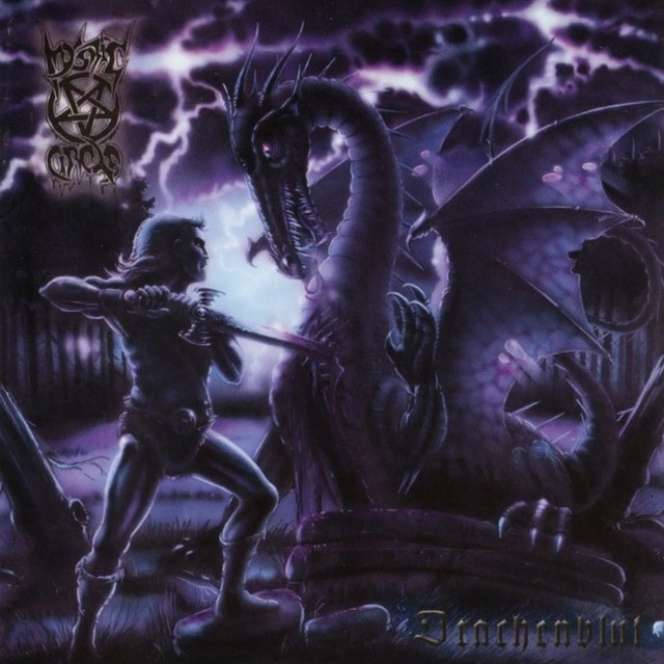
Drachenblut reached listeners in 1998 through Last Episode. Its track numbering is not identical in every edition: one version lists nine main pieces, while another numbers seven brief interludes separately and divides the same legendary arc into sixteen tracks. That difference does not mean sixteen separate stories instead of nine. The recordings were made in February and March 1998 at Commusication Studios with Gerhard Magin's involvement. Jörg Scheibner painted the cover; Frank Babel and other contributors also worked on the release's graphic presentation.
Those very keyboards later became the album's most disputed feature. A year on, Ezpharess spoke openly about his belief that the guitars had been pushed too far into the background in Drachenblut's final mix. He felt that he and Isternos had recorded powerful guitar passages, but much of their work had disappeared behind the symphonic layer in the finished sound. On the next album, they therefore consciously wanted thicker, more prominent guitars. Yet there is a curious truth here: it was precisely that contested balance which made Drachenblut what it is. Its keyboards do not merely accompany the music. They build the scenery.
The Cover: Facing the Dragon
There is no room for quiet contemplation on the cover of Drachenblut. On the left stands a warrior almost entirely cloaked in shadow, his feet planted wide and his whole body turned toward the monster towering over him. He thrusts his sword forward; its blade draws a boundary between man and dragon at the centre of the picture. The hero is smaller, more vulnerable than his enormous, scaly adversary. The dragon’s long neck curls upward, horns or spikes jutting from its head, while its membranous wing spreads to the right and almost swallows a large part of the background. We are not seeing the moment after victory, but the moment in which anything might still happen.
Blackish purple, blue and cold white light seem to collide in the sky. The brightness breaking through the criss-crossing lightning picks out the dragon’s neck, the warrior’s outline and the weapon, yet leaves most details in deep shadow. This gives the image both a fairy-tale quality and a threatening physical weight: the figures in the foreground are strongly modelled, while the distant, dark, structure-like forms make the setting uncertain. The angular band emblem in the upper left and the title Drachenblut, written in old-fashioned lettering in the lower right, reinforce the painting’s sombre, medieval atmosphere.
Knowing the album’s story, it is easy to recognise the struggle between Siegfried and Fafnir in this scene, although the picture itself does not name the figures. The strength of the cover lies precisely in the fact that it does not explain the legend: it condenses it into a single perilous encounter. The warrior’s forward thrust can be associated with the fast, combative guitar passages, while the lightning-torn sky and the dragon’s all-encompassing shape evoke the dark, expansive world of the keyboards. The image awakens the same feeling as Drachenblut’s most dramatic moments: heroism carries the possibility of destruction within it from the very beginning.
Siegfried’s Path to the Dragon’s Blood
At the beginning of the album, there is no tragedy yet. There is only a promise. Ancient Words briefly opens the gates to the old stories: it speaks of warriors, honour, celebration, weeping and feuds between heroes. It offers no explanation. It merely announces that the story is about to begin. And with that, the listener steps out of 1998.
In the castle at Xanten lives a young boy who has grown weary of safety. Siegfried does not wish to remain a royal child; he wants to become a hero. His father therefore sends him to the smith Mimer, so that in the darkness of the workshop, between hammer and anvil, he may learn what no court can teach him. There he hears for the first time of Fafnir, the dragon whom no one has been able to defeat. And while others fail in the stories he hears, a reckless certainty is born in Siegfried: he will be the one to succeed. That conviction is the beginning of every great heroic tale, and the first mistake in every great tragedy.
At night, he forges his sword. Notrum will be more than a weapon: it will stand for the independence he has won with his own hands. As he leaves the workshop, an attacker approaches him from behind with a knife. The boy cuts off his head and goes on his way. So the road to the dragon demands blood even before Fafnir appears.
At dawn, Dragonstone rises before him. A farming family warns him one last time: others have tried before and perished in the flames. But the hero has not entered the legend in order to turn back. Fafnir unleashes his fire, and Notrum strikes the dragon in the heart. The victory is at once complete and fatal. Siegfried bathes in the dragon’s blood, which makes him invulnerable like a second skin. Only a single linden leaf clings to his back. One tiny patch remains unprotected. At the very moment when the hero seems beyond harm, his death is also born.
From here on, the story is no longer merely about monsters. In the realm of the Nibelungs, invisibility, treasure and power await him. Alberich’s magic cap, the two kings who destroy one another, and the guarded treasure all whisper the same warning: everything that can be won has its price. Siegfried prevails, becomes a king and, almost without noticing, moves ever farther from the boy who had wanted nothing more than an adventure.
Betrayal, Blood and the Rhine
Brünhild’s name already heralds the next trial. They sail towards Iceland, driven by the northern wind; Norns stand on the shore, and fire guards the castle. Brünhild is no passive prize but a warrior who sets her own conditions. Three trials must be won. Siegfried wins them. Yet for the first time the triumph becomes morally ambiguous, because the defeated woman’s fate becomes the subject of a political bargain. Siegfried gives her to Gunther so that, in return, Kriemhild may become his. And Brünhild does not forget.
At this point Drachenblut slowly turns into a different kind of story. The dragon is dead, the magical treasure has been won, and the hero has performed mighty deeds. Yet nothing grows easier. A double wedding is held in Worms. To those looking on, it is a celebration; beneath the surface, revenge is already taking shape. Wars follow. Siegfried proves his heroic strength again and again, then returns to his own kingdom and rules for years. But in the background Brünhild and Hagen are already searching for the one place where the legend is made of flesh.
Hagen von Tronje receives a story of his own. Mystic Circle does not portray him simply as a murderer. Black armour, a scar, a single eye, Odin, Valhalla, the pride of a warrior. It is as though the album knows that a great tragedy requires more than a villain. It needs someone who could himself be a hero in another story: someone who prepares for betrayal with the same seriousness with which Siegfried once set out against Fafnir.
Yet fate requires not strength but trust. Hagen goes to Kriemhild and says that he wishes to protect Siegfried. He asks her to mark the single vulnerable spot on her husband’s back, so that he can shield it with his own shield. An act of care thus becomes a map for murder.
On the morning of the hunt, everything begins as though it were simply another event at court. Forest, horse, weapons, game. Siegfried grows tired. He becomes thirsty. At a spring he kneels to drink. The man who slew a dragon, gained a kingdom and vanquished warriors does not fall in a duel. No stronger opponent destroys him. The spear comes from behind, striking precisely where Kriemhild, acting in good faith, had placed her mark.
The blood of Xanten’s king spills onto the earth, and suddenly the title Drachenblut acquires a new meaning. The dragon’s blood once offered protection. Now the hero’s own blood proves that the protection had always been incomplete. The magical power that raised him up at the beginning of the tale has become a tragic irony by its end.
Kriemhild swears revenge, but the album does not follow the full story that medieval tradition recounts over many further pages. Hagen acts faster. He has the Nibelung treasure brought to Worms, then sinks it into the Rhine at night. Rheingold is no triumphant finale. It is closer to a falling silence. The narrator has nothing more to say. All that remains are weeping women and men, and proud knights who died too soon.
This ending is especially important because Mystic Circle did not tell the entire Nibelung saga. Drachenblut brings its own story to a close with Siegfried’s rise, his death and the disappearance of the treasure. The Rhine is both a tomb and a lock. What is consigned to it remains, but becomes unreachable. Years later, this very ending gave rise to the idea of a Drachenblut II, which could continue the saga where the first album had fallen silent.
The Echo and Legacy of Drachenblut
Beelzebub later said that, musically, Drachenblut flowed continuously. Perhaps that is the most accurate description the band itself ever gave. The songs do not follow one another like nine separate little stories. They are more like scenes. On some editions, the short instrumental interludes appear as separate tracks, but in truth they are doorways between locations: from Xanten to the smithy, from there to Dragonstone, then to the Nibelungs, Iceland, Worms, the forest and, finally, the Rhine.
That is why the predominance of the keyboards works, even though Ezpharess himself would later feel it had been excessive. Drachenblut is not simply an album of riffs. The symphonic layer provides the space in which the story unfolds: now a castle wall, now the wind, now fire, now a dark courtyard. The guitar supplies physical movement, but the keyboard establishes how vast the world around it is.
Contemporary critics did not always receive this kindly. In June 1998, metal.de published a sharply hostile review, hearing a strong resemblance to Dimmu Borgir in the album's bombastic, memorable keyboard melodies. The band later disputed the idea that this amounted to straightforward imitation. Ezpharess acknowledged that the arrangements could invite comparisons, but insisted on the path of development that was their own. The argument nevertheless clung to Mystic Circle, as so many other controversies did.
The irony is that, while many outsiders saw clichés, the band spoke instead of the extensive research involved and the difficulty of giving musical form to the story. For them, the question was not how to become even more symphonic. It was how to portray heroism, frost, glory, humiliation, betrayal and grief within a single flowing album.
The record also brought them an audience. In a 1999 interview with Vampster, Ezpharess estimated that, following sales of roughly five thousand copies of Morgenröte, Drachenblut had sold around fifteen to sixteen thousand by that point. This was the band's estimate, not an audited figure; still, it suggests how much more widely their second full-length album had travelled. And the more people heard it, the more pronounced the two extremes around it became: devotion and dislike.
By then Mystic Circle had become one of Germany's most controversial black metal bands. In interviews, they spoke about insulting leaflets, T-shirts made against them and various conflicts. At times, the image surrounding the group was almost louder than its music. Years later, Beelzebub would admit, with some self-criticism, that certain visual ideas had been poorly executed and that audiences may have misunderstood what they had intended. During the Drachenblut period, however, the grand imagery, bombastic music and legend were still pointing in the same direction.
A new world arrived in 1999. Infernal Satanic Verses did not continue the heroic or so-called “Viking” themes, but turned instead to the struggle between the angels of hell and heaven, reworked biblical motifs and a far more Satanic, blasphemous framework. The music changed too: the guitars were pushed forward and the keyboards became less dominant. Drachenblut was therefore not a formula to be repeated. It was more of a milestone from which the band moved on.
Yet they returned to it again and again. By 2001, Beelzebub was speaking of it as a record that many considered the band's finest musical achievement. He himself offered not a simple ranking but a memory: it had been difficult, it had required a great deal of research, and the real task had been to turn emotions into music. Perhaps that is why it remained so vivid. They had not merely needed to write songs. They had needed to live through a legend.
Later reissues and the band's returns gradually turned Drachenblut into an album of enduring legacy. In 1998 it had stood at the very centre of the disputes surrounding contemporary symphonic black metal; two decades later, it had become an imprint of an era. You can hear the passage of time in its sound, the taste of its period in the balance of the keyboards, and the metal mythology of the 1990s in its lyrics. None of this makes it smaller. It makes its place more precise.
The original 1998 release of Drachenblut was issued by Last Episode. The documented catalogue number of that original CD edition is LEP 018 CD; this identifies one particular recorded edition, not every subsequent release. Once the recording was completed, the music took on a life beyond the confines of the rehearsal room and studio. The conflicting verdicts of contemporary reviewers and the band's controversial reputation have already appeared in this narrative. What remains to be added is that divisions among critics and listeners did not prevent further releases or its rediscovery across generations.
The prospect of a sequel to the Nibelung legend was not a notion invented retrospectively by fans. In December 2005, Ezpharess spoke in a metal.de interview of a planned next album explicitly titled Drachenblut 2. His explanation rested precisely on the unfinished nature of the story: the first album had ended with Hagen's deed, when the treasure was sunk into the Rhine. That statement, however, must be read as an intention, not as evidence of a completed record. The catalogues of studio albums released subsequently contain no separate work titled Drachenblut II. Even so, the recollection matters: it shows that the band itself sensed how much untold history still remained on the banks where the first part ended.
In the meantime, the album also survived through its physical editions. Musik-Sammler documents a German CD reissue from 2003 on Massacre Records, catalogue number MAS CD0386. This should not be confused with the original Last Episode disc: the work is the same, but the particular edition is different. The listing identifies sixteen distinct tracks, including several short instrumental interludes. This helps explain how the familiar nine-part presentation, which treats longer compositions as units, can exist alongside a more detailed, sixteen-track listing. The history of track divisions must not, however, be used to assume that every pressing of the original CD had an identical structure.
In later years the band pursued other approaches to sound and other stories. Yet Drachenblut never vanished from their own past. When the group fell quiet towards the end of the 2000s, the album lived on through old CDs, collectors' catalogues and listeners' memories. A genuine new era began when founders Beelzebub and Aaarrrgon resumed working together in late 2020. That was followed by a publicly announced return in 2021 and, in February 2022, a new full-length album titled Mystic Circle. In a 2022 conversation, Beelzebub specifically dated the meeting at which he and his former bandmate reconnected to 23 December 2020. This is a personal recollection, not new evidence about the recording of the 1998 album.
Drachenblut took on particular significance within this renewed story. On 1 July 2022, a statement from the band's label announced that the 1998 album had become officially available in digital form for the first time. The release description listed sixteen separate stages, from Ancient Words to Rheingold, treating the interludes as tracks in their own right. Digital availability placed the same material in a new listening environment, after two decades in which audiences had primarily known it on physical formats. What changed here was not the old artistic judgement but the way the work could be accessed.
There was no long wait for a tangible return either. Fireflash Records issued a remastered blue-vinyl edition of Drachenblut with a gatefold sleeve, dated 17 March 2023. According to commercial listings, it was advertised as a limited edition of five hundred copies; the reference to a 2022 remaster therefore does not mean the vinyl had already reached shops in 2022. More than two decades later, the material from the 1998 album once again acquired a complete physical form, and that belongs to its history just as much as its first appearance did.
The artists' own memories also found a place in the rediscovery. In a March 2023 interview, A.Blackwar—formerly Aaarrrgon—named Wolfgang Hohlbein's Hagen von Tronje and the Nibelung films of 1924 and 1966 among the inspirations for Drachenblut. This does not prove that every verse on the album has one precise literary source. It does show, however, that years later one of its creators identified specific modern novels and films alongside the historical and legendary material. The dragon, the hero and the betrayer thus entered the album's world not only from old manuscripts but also from the visual and narrative culture of the twentieth century.
In another interview from 2023, Beelzebub said that their renewed label arrangement also made room for the older catalogue, explicitly mentioning the reissue of Drachenblut. To him, the collaboration of the founding pair represented Mystic Circle's continuity; his own interpretation of the band's later personnel and activity therefore sometimes differs from the dates in public databases. First-hand memories and discographical records preserve different kinds of information, and neither gives anyone licence to invent undocumented details.
Perhaps the most important, factually traceable feature of the album's long afterlife is this: the old work also illuminated the past of a band in a later era. Digital availability and new vinyl did not erase the raw sound of the 1998 version, the old critical arguments or the sternly tragic ending of the legend. They created a new distance from them instead. Today's listener knows that, for decades, the idea of continuing the story that ends with the Nibelung treasure sinking into the river remained in its creators' minds. Drachenblut itself, however, still ends beside the Rhine.
For Drachenblut's real strength is not that it tells the Nibelung legend flawlessly. It does not. Nor is it that it balances guitars and keyboards perfectly. Even the band never claimed that. Its strength lies in shaping the rise of a hero and his destruction into one continuous movement.
At first the sword signifies freedom; later, it can no longer protect its bearer. At first the treasure signifies power; later, it becomes a curse and a secret that vanishes. Dragon's blood first means invulnerability, then becomes the memory of a fatal weakness. The locations darken too: Xanten is the beginning, Isenstein the trial, Worms the betrayal at court, and the Rhine the place where the story finally sinks its own evidence.
And perhaps that is why the title Drachenblut is more fitting than any single scene. It is not merely Fafnir's blood. Not merely the hero's armour. It is the curse of the entire story: the blood that gives strength and, in the very same instant, marks the one place where the defence can one day be broken.
Drachenblut begins like a heroic legend. And it ends like every truly ancient story: with blood, betrayal, water—and a sentence after which only silence remains.
Reader comments
Comments only appear after approval. Messages are displayed in their original language.
Comment submissions are not enabled yet.