MOPEN METAL
ALBUM LIBRARYFREE PUBLIC ARCHIVE
← Back to the archive
Newsletter updatesSubscribe to the newsletter
RSS
HUENDE

CHAPTERS · 20

0011. The Layers of the Town0022. The Journey of the Cassettes0033. Six People in a Shed0044. Red Covers, Distant Stages0055. How Long Can You Wait?0066. Towns, Work and Waterlines0077. The Limits of the Tape0088. Room for Every Sound0099. Another Singer’s Path01010. Before the Pale Stone01111. Eight Paths Through Time01212. Separate Lives01313. The Routes of a Finished Record01414. The Same Album, a Different Listener01515. From Clubs to Larger Venues01616. The Van Beside the Tour Bus01717. Toward the Next Album01818. An Old Song in Another Voice01919. Together Once More02020. What Remained on the Tape

The Gathering – Always…

HUDE
Uses voices installed in your browser.
THE GATHERING · 1992 · LITERARY ALBUM HISTORY

Always…

Released: 9 June 1992
Available languages:
HUENDE
Start reading ↓

The story of The Gathering’s debut: Oss and Heesch, the early band, Beaufort Studios, and the afterlife of Always….
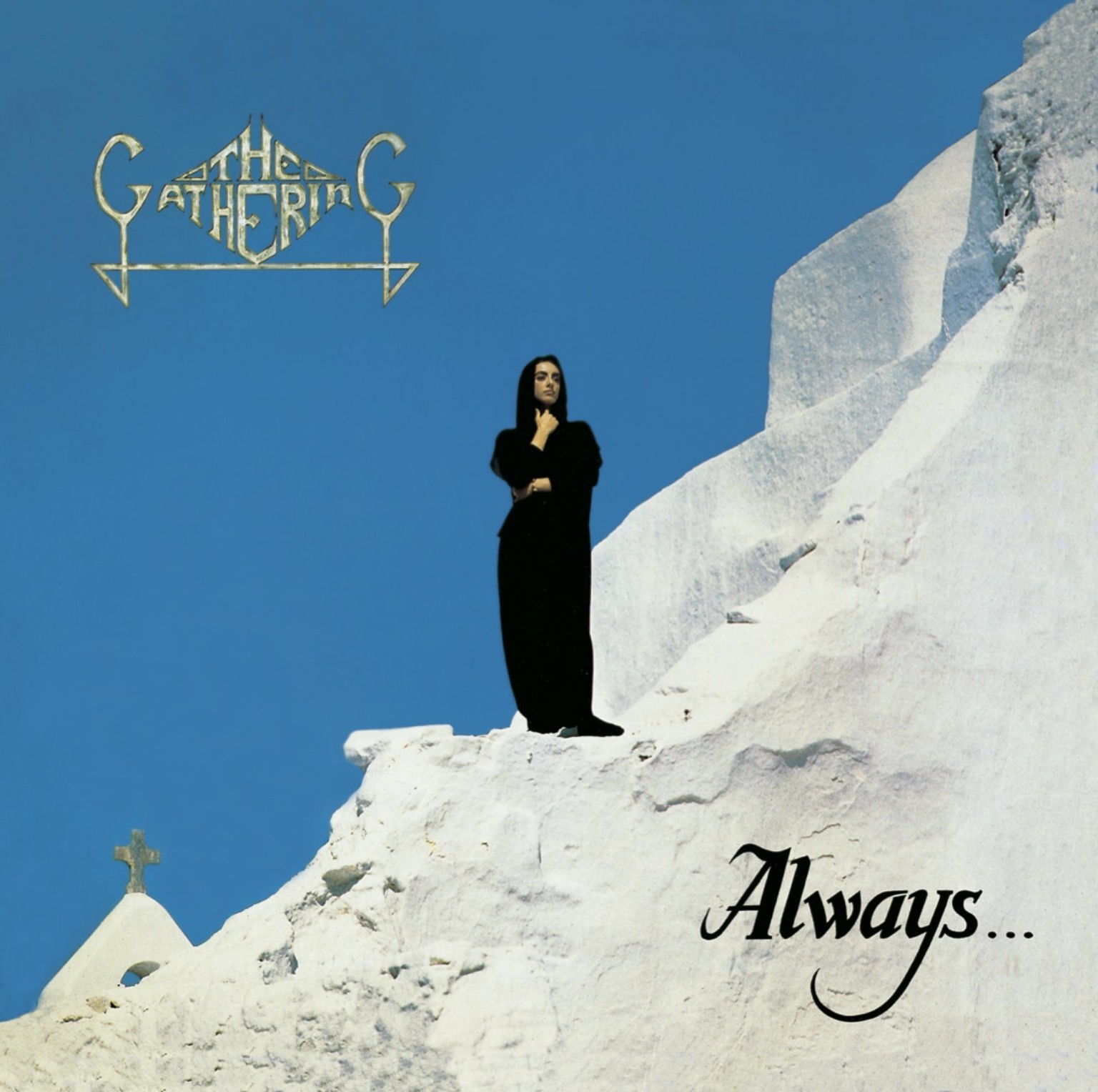
The Gathering – Always… (1992) cover: a black-clad figure on white rock against a vivid blue sky.

Special thanks – Hans Rutten

Open Metal Album Library extends special thanks to Hans Rutten, founding drummer of The Gathering, for the valuable information, personal recollections and photograph he provided. His contribution helps preserve the history of Always… (1992).

Album details

Track list

  1. 01.The Mirror Waters07:10
  2. 02.Subzero06:53
  3. 03.In Sickness and Health07:00
  4. 04.King for a Day06:33
  5. 05.Second Sunrise06:43
  6. 06.Stonegarden04:53
  7. 07.Always...02:40
  8. 08.Gaya's Dream06:04
Total playing time47:56

Band members

Bart Smits
vocals, backing vocals, lyrics
René Rutten
electric and acoustic guitars
Jelmer Wiersma
electric and 12-string acoustic guitars
Hugo Prinsen Geerligs
bass, flute, triangle
Frank Boeijen
keyboards, grand piano
Hans Rutten
drums, wind chimes

Guest musicians and contributors

Marike Groot
female vocals
Henk van Koeverden
electronics, Korg MS-10

Recording and release

Studio
Beaufort Studios, Bovenkarspel, Netherlands
Recording and mixing
28 February – 7 March 1992
Producer, engineer and mixing
Han Swagerman Sr. & The Gathering
Original record label
Foundation 2000 (Europe)
Catalogue number (CD)
FDN 2004 CD

Official album links

Bandcamp1999 remasterSpotify2024 remixApple MusicOriginal 1992 releaseQobuzOriginal 1992 release

Digital purchase

Bandcamp · 1999 remaster · Qobuz · Original 1992 release

Physical editions

CD · 2024 reissueLP · 2024 reissuePeaceville · Label catalogue

The 2024 releases have a different mix and mastering from the original 1992 release.

The eight-track original 1992 CD sequence is shown. Later editions may have different mixes and mastering.

Official band channels and archive

Verified band channels and a separately identified band database profile

Official websiteBandcampMAMetal Archives
Share this article
FacebookXWhatsAppTelegramRedditEmail
01 / 20

1. The Layers of the Town

Oss and Heesch were close enough to cycle between. For Hans and René Rutten, that was the route from their home to the farm building where they rented a rehearsal room and began making music with Bart Smits. Writing a song of their own required time of their own: somewhere to rehearse, and a cassette on which they could show others what they had achieved. When Hans revisited those beginnings in a statement marking the band's twentieth anniversary on 23 October 2009, he still remembered the title of their first composition: Anthology in Black. Before the long distances that lay ahead, there was this short journey linking two neighbouring settlements.H001

The roads and the surrounding land had long been intertwined in the history of Oss. The town lay in the part of North Brabant where lower, wetter clay ground met higher sandy terrain, between ’s-Hertogenbosch and Nijmegen. Its location connected it both to the agriculture of surrounding villages and to trade reaching farther afield. A papal charter from 1161 offers an early written trace: it records a connection between Echternach Abbey and the local parish. The town's name was less easily explained after the fact. Some sought its origins in the ox, others in northern mythology; an etymological interpretation from 1975, recalled by Rien Wols, instead pointed to higher ground beside water.H002

For much of its history, livelihoods in the surrounding area also depended on land held in common. In 1286 John I, Duke of Brabant, granted pasture to the community; questions of land use were later accompanied by the need to defend the borderlands. Conflicts between Brabant and Guelders made a castle and a defensive system necessary. Under Duchess Joanna, town privileges were granted in 1399. Produce, livestock and cloth converged at a market and cloth hall, while administrative autonomy provided a firmer framework for the area's trading centre. Oss depended on the surrounding land for its livelihood, but increasingly served as an intermediary between that countryside and more distant buyers.H003

α · Fire and rebuilding

The settlement had to be rebuilt after the fire of 1751. Yet the older elements of everyday livelihood remained together: craftwork, animal husbandry and trade. By the nineteenth century, the cattle and butter trades had grown into businesses supplying markets abroad. Competition between the Jurgens and Van den Bergh families was rooted in established relationships among producers, intermediaries and buyers in distant places. Later company history traced the beginnings of the Jurgens business to butter received as payment for work and then sold on. In 1860 the family moved to Oss to expand its butter trade. By around 1870, the Van den Berghs were also shipping to England. When the new product appeared, they already knew their customers and how to reach them.H004

In 1871, a new process changed the direction of the butter trade. Following Mège-Mouriès's invention, margarine production began. Local historical accounts remember Antoon Jurgens and the shed behind the family home as the site of the first work; barely a year later, Simon van den Bergh established his own works near Nieuwstraat, Heschepad and Margarinepad. Later company history placed greater emphasis on patent rights and a sample that Jan Jurgens passed to his competitor. These accounts highlight different moments in the beginning of the industry, but lead to the same transformation: the merchant families now had to organise manufacturing as well as trade. Food production demanded new kinds of buildings, labour and transport capacity.H005

Finished margarine travelled by horse-drawn cart from the area of Begijnenstraat to the Maas (Meuse), where boats carried it towards Rotterdam. Raw materials had to make the same journey in reverse, in several stages. Jan, Henri and Arnold Jurgens sought markets in Germany and England, while growing trade created a local need for storage, roads, workers and a larger factory. By 1885 Van den Bergh had erected his own office building on Molenstraat. The town was expanding around both production and commerce, but transferring goods from carts to boats was becoming an increasingly narrow bottleneck on the route to distant markets.H006

The earliest plans for a railway between Tilburg and Nijmegen dated back to the early 1860s. Bringing it into being required tracks and bridges across rivers. The line eventually ran through Ravenstein rather than Grave. A ceremonial special train arrived from Nijmegen on 2 June 1881, stopping at Oss, where Mayor Fenseling and the margarine manufacturer Jurgens delivered speeches. Two days later regular passenger services began, with four trains a day in each direction. The inauguration had quickly become a timetable. A rail connection between Oss and Helmond followed in 1885. The towns of the area gained new links, although industry continued to look for transport options beyond the railway.H007

The proposed canal to the Maas was never built. In 1891 Simon van den Bergh moved his factory to Feijenoord in Rotterdam, where transport conditions offered different opportunities. The Jurgens factories continued expanding in Oss. In 1916 a large industrial building replaced the family home, while halls designed by C. Estourgie rose along Kerkstraat. Hundreds of men, women and children worked within those walls. In 1927 the two major margarine firms merged to form Margarine Unie; following a later merger with Lever Brothers, production in Oss was moved towards Rotterdam. From 1931 the vacated buildings were used to manufacture Philips lighting equipment. The same halls accommodated a different industry; the former Jurgens buildings were demolished in the 1980s. By the time Hans and René formed their band, this great factory site had already become part of the city's vanishing past.H008

For a long time, the land and the factory together sustained individual households in the meat industry. Former small farmers also took jobs at the export slaughterhouses of Hartog and Zwanenberg. In his local history, Henk Buijks records pre-war wages of 1.50 to 1.75 Dutch guilders a day for an unskilled worker, with fourteen cents paid for an hour of overtime. Factory work did not necessarily replace farming. Some worked nights at the plant and tended their animals and holdings by day. The town's industrialisation also unfolded within these divided working days: the new income was added to tasks that remained.H009

β · Workers and industry

In February 1914, eighty Zwanenberg workers stopped work. They were protesting the difference in daily pay between temporary and permanent employees; another 130 workers at Hartog joined them. They marched through the streets singing, while sections of the local press turned against them. Mediation by the trade unions achieved nothing. In Heesch they also met socialist organisers, but the strike ended after a few days without a meaningful pay rise. The expanding production that sustained the town's new factories presented workers with other questions: how their time would be paid for, and whether they had the power to change the conditions under which they worked.H010

Other kinds of institutions developed around music made together. The town concert band Stadsharmonie Kunstliefde Vermag Alles traces its foundation to 1835; a surviving membership award from the mid-nineteenth century points to the same period. Before the Second World War, the band played summer concerts in the pavilion on the Heuvel. Under the occupation it refused to join the Kulturkammer and could no longer operate officially. Yet its own history preserves the memory of secret Friday rehearsals. Competitions and prizes followed the war, until dwindling membership made renewal necessary in 1964. A drum band and youth music education were organised: to carry on, the society also had to train new musicians.H011

In 1981, the railway's centenary was celebrated as the transport network continued to grow. The Oss-West stop opened on 30 May, and free celebratory services ran between Oss and ’s-Hertogenbosch. The local historical account records 8,500 passengers from Oss and 6,000 from Rosmalen. An exhibition at the Jan Cunen centre recalled the inauguration of 1881, while the new stop welcomed the passengers of the present. The railway, once bound up with the factories and commerce of the region, was thus both a preserved history and a connection used every day beyond the town's boundaries.H012

Heesch, nearby, appears under its older name Heze in a document of 1191 concerning tithes. One explanation of the name suggests land covered with scrub and young shoots. Rye, oats and buckwheat were grown in the poor sandy soil; communal land use was known before 1298. A grant dated 18 October 1329 and references to local magistrates in 1364 mark the development of local government. The road between ’s-Hertogenbosch and Grave passed this way, carrying travellers, hauliers and post. Through traffic shaped the settlement alongside the land itself, although its more scattered parts did not form a long continuous street until much later.H013

The construction of the main road between 1818 and 1836 brought about that reorganisation. After the Second World War, Heesch's population grew and new residential areas appeared alongside its agricultural surroundings. In 2015 Henk Geurts, son of the miller at the Witte Molen, recalled the Marian procession of May 1961: an open-air Mass was held behind the mill, with a brass band and choir taking part, as well as monks and nuns. Some surrounding land was still farmed; elsewhere, houses and schools were being built. The development of two industrial and commercial estates also changed the village in the mid-1980s. Heesch retained its own municipal administration until January 1994. When the young musicians from Oss came over to rehearse, they arrived in this nearby village with institutions of its own, where older and newer ways of life continued to exist side by side.H014

02 / 20

2. The Journey of the Cassettes

From the 1960s onwards, young people in the Netherlands had access to an increasingly wide range of music. British and American beat, rock and blues arrived on imported records and over the radio, while electric guitars began to draw a different audience alongside dance-hall music and traditional communal music-making. The Indo bands gave Dutch rock a distinctive tradition of its own. Progressive groups in the 1970s expanded the span of songs through extended structures and more complex instrumental work; hard rock increased the force of distortion and volume. Youth centres and clubs made room for a growing variety of performers, but opportunities did not increase without interruption.H015

In a later television survey of the years 1974 to 1987, pirate radio, discos, punk and youth centres all formed part of a changing musical culture. The closure of concert venues in the 1980s belonged to that history too. More kinds of recordings could be obtained than before, but the number of stages available to an aspiring band was not growing everywhere. The range of music one could hear and the opportunity to play it changed at different rates; a young listener hoping to become a musician needed not only records but a functioning place to perform.H016

The record market, meanwhile, retained its imbalances. Between 1960 and 1990, foreign performers accounted on average for three quarters of the music offered in the Dutch charts. The domestic market was relatively small, while the cost of producing records at home and the uncertainty of success abroad made it difficult for a new group to get started. In figures analysed later, the proportion of debut releases fell from an average of 35 per cent in the 1960s to 27 per cent in the 1980s. Alongside larger companies with international distribution networks, small independent labels acquired particular importance by making room for music whose prospects were still uncertain. Life before commercial success developed its own routes.H017

Only a few hundred people attended the Sex Pistols' early-1977 concerts at Amsterdam's Paradiso. Those audience numbers could hardly yet convey the significance punk would assume. Iggy Pop's television appearance in November reached a wider public; in his 2012 retrospective, Gijsbert Kamer traced the movement's growth between those two forms of exposure. The labels 1000 Idioten, Plurex and Torso, and the record shop No Fun, brought additional intermediaries into the picture. At a small label, an independent shop or a self-organised event, people could encounter a recording before it had any substantial sales behind it. Often it was an enthusiastic intermediary who found the next listener.H018

α · New wave and experiments

Between 1978 and 1984, new wave made increasing room for experiments in sound alongside short guitar songs. As well as Bowie and Iggy Pop, Kraftwerk and krautrock drew attention to different timbres and forms of repetition. Paths led from punk and later post-punk towards electronic experimentation too. A network of small labels, shops and self-organised nights surrounded this music; a personal recommendation or an occasional gig could carry forward what a record had begun. Passing recordings from hand to hand also reduced the distance between musicians and listeners. A new sound might lead to a new circle of people, another shop or a correspondent with whom to exchange letters.H019

Dutch extreme metal in the 1980s became part of this world of multiple intermediaries. In several branches of thrash and extreme metal, the fast, concentrated playing of punk and hardcore met developments arising from heavy metal. Thanatos, Pestilence, Sinister, Asphyx and later Gorefest: different sounds and different opportunities entered the same international circulation. A later sociological study of Dutch metal identified 1989 as the year in which the most new bands were founded. The term Nederdeath lent weight to where the music came from, suggesting authenticity and quality to listeners, even as the bands worked with foreign labels, tour organisers and distributors. A local name therefore belonged to an international network of routes. Alongside cassettes and distant record labels, support slots on American touring packages helped carry Dutch music to audiences in other countries.H020

One of those routes was built by a Dutch business. Cees Wessels founded Roadrunner in 1980, making foreign extreme-metal recordings available; by 1988 it was releasing the Dutch band Pestilence's Malleus Maleficarum. The flow of records coming into the country and bands moving out became interconnected. By 2015, the importance of death metal within this broader development was visible in figures: it represented 29 per cent of the Dutch metal bands recorded in a database covering 1971 to 2015. Behind this long-term picture, however, were individual rehearsal rooms and personal beginnings.H021

In 2017, when Stephan Gebédi told the story of Thanatos, he could still trace it back to Marcel van Arnhem's attic room and a circle of fans at school. The daring of Venom and Hellhammer encouraged them to make their own music. From 1984, he and Remo van Arnhem were exchanging demos abroad: tapes by Death/Mantas, Master, Possessed and early Carcass arrived in the post. It was through such personal deliveries that the names and music of distant bands became familiar. One discovery even changed the name of their own group. They had started out as Whiplash, but when they learned of the existing American band of that name, they became Thanatos.H022

A demo carried the band as it stood at a particular moment. With new members, they could record another account of what they were capable of, and Gebédi later remembered selling several thousand cassettes through this circulation. Live at the Lede, from 1987, preserved an unusual situation: although distributed as a live recording, it was made in a rehearsal room with invited friends and audience noise. The tapes attracted interest from labels, but an offer did not always come with support the musicians could accept. Several companies expected the band to pay for studio time themselves. Their own recording had reached someone prepared to offer a contract; whether they could work under the proposed terms was another decision altogether.H023

Competition also strained the underground's personal connections. Gebédi recalled rivalries with Pestilence and Asphyx, as well as packed clubs of 500 to 800 people in the early 1990s. In 2016 Martin van Drunen also spoke of enthusiastic Dutch audiences, but remembered fewer contacts between bands in their earliest years. A personal acquaintance nevertheless opened a new opportunity for him. He and Bob Bagchus initially exchanged tapes and spoke on the telephone; later Bagchus invited him to join Asphyx. Among competing groups, the same personal channels could provide a new member, a recording or the chance of a concert.H024

The needs of a band also placed a different instrument in Van Drunen's hands. He came to Pestilence as a singer, but with no bassist available he had to learn the bass guitar. He later put that experience to use when composing. He traced his attraction to slower death metal to Black Sabbath, Trouble, Saint Vitus, Winter and Hellhammer. For him, passages of oppressive slowness had always been among the possibilities of early death metal. The movement from speed to crushingly slow playing already existed before names for the emerging directions had settled. Musical forms could be tried out before their separate labels became fixed.H025

A record deal did not bring Thanatos a straightforward path later on either. Looking back, Gebédi was dissatisfied with Shark Records' financing and promotion in 1989, and resented losing influence over the mix. In 1991 they prepared for their second album with a pre-production demo. A more stable line-up and more frequent performances made increasingly complex song structures possible, yet proposed tours with Cannibal Corpse, Exhorder and Carcass fell through. Gebédi did not conceal the band's internal failings. Behind the prospect of a greater international presence, individual groups remained fragile operations: the songs, the label and opportunities to perform did not always come together at the same moment.H026

β · The Stockholm sound

Meanwhile, a recognisable sound was taking shape around a studio in Stockholm. Tomas Skogsberg had been experimenting with his own recordings since the 1970s. At Sunlight, he initially worked with an eight-track system, mostly recording punk bands; the arrival of sixteen tracks made full-time studio work possible. In 2015 he traced his taste for a raw sound to the Beatles and 1970s rock. After Morbid, Treblinka and Nihilist, Entombed's 1990 album Left Hand Path revealed a distinct studio sound that other musicians wanted to achieve for themselves. A recording made in a particular room, with particular equipment and people working together, could carry the studio's reputation much farther than its home city.H027

Skogsberg remembered Leif Cuzner bringing an early BOSS HM-2 pedal into Sunlight. In the signal chain, the distortion pedal was joined by a Peavey combo amplifier, an Audio-Technica ATM41 microphone and a GC2020 compressor. But the way the musicians played, and the use made of compression, were part of the sound as well. David Blomqvist of Dismember wanted to record in the same place after hearing Nihilist's demo, and obtained the effect pedal himself. Accounts of the 1991 recording mention a Peavey Studio Pro 40 and controls turned all the way up. The sound heard on a cassette brought another band into the same studio, where they had to make a recording of their own with the equipment at hand.H028

Entombed, Dismember and Grave became part of this shared studio history. Skogsberg separately mentioned Unleashed as a band he had not worked with. The HM-2 also appeared in the more melodic music of Gothenburg, in a different compositional and arranging context. Niclas Engelin's memories included chances to learn and practise with older local musicians. There was still a discrepancy in the precise dating of the beginnings: a 2015 interview placed Nihilist's second demo in 1988, whereas a later BOSS feature dated Only Shreds Remain to 1989. Both accounts located this studio work towards the end of the decade, but they did not preserve the same year.H029

In Florida, a recording operation of a different scale also began as a mobile system. Jim Morris, Tom Morris, Laurel Morris and Rick Miller started the history of Morrisound in June 1981 with an eight-track analogue setup built into a large van. The mobile studio was followed by rented premises and twenty-four-track equipment; by November 1985 they were working in a purpose-built facility on 56th Street. Albums by Death, Morbid Angel and Obituary became part of the enterprise's history. Demos circulating by post and studios of this kind were workshops on very different scales within the same international music network.H030

Even the sounds of distant places reached Oss by local routes. Hans Rutten remembered record shops in town and in ’s-Hertogenbosch and Nijmegen; Frank Boeijen recalled the Via Via CD lending library. A record could mean a journey, a loan or a copied tape. Music arriving from abroad thus met local musicians and friendships formed at school. Alongside Celtic Frost, progressive rock, punk and electronic music all found room in the new band's listening habits. Obtaining an album was no longer enough for the next step: the people who wanted to play something of their own out of these different musical worlds had to find one another.H031

03 / 20

3. Six People in a Shed

At first, Hans Rutten was in the audience. René and Bart Smits were already playing together, and he had watched the previous band in which his brother and the man who would become The Gathering's vocalist played. That was the beginning of the three of them trying something of their own. In 2019 Hans traced their first steps to the autumn school holiday of 1989 and a shed in Heesch. Bart's memories likewise began with his earlier music-making alongside René and the heavy sounds of two bands, Celtic Frost and Hellhammer. Their very first rehearsal was recorded on cassette; decades later, Bart still said he had kept it. At this point in a story that would eventually involve six musicians, only three were looking for a way to play together.H032

Later, biographies had to reduce the beginnings to a year, and their brief entries did not all preserve the same date. Alongside 1989, 1990 has also survived as the year of formation, including in an answer given to the contemporary fanzine Darkness. The detailed accounts by Hans and Bart point to rehearsals in autumn 1989, but Hans said it took roughly half a year for a permanent line-up to emerge. The promotional biography in Sombre Eve placed Hugo's and Jelmer's arrival in February 1990 and Frank's in April. Months therefore separated the first shared rehearsals from the complete six-piece group. The origin of the discrepancy between the years is not settled by this distinction. Hans and René were born in Nijmegen and grew up in Oss; for the brothers, the town and its surroundings already formed a world of musicians before they had a permanent band of their own.H033

Hans recalled how limited the local entertainment options had seemed, yet how many musicians nevertheless gathered in the pubs. Deafen, Armageddon and Endangered Species were local names attached to real people and active bands. Cromlech and Scarchofanixck also appear among the early antecedents. From farther afield, the Dutch-born Eddie and Alex Van Halen showed how far two musicians starting out together might go. Hans initially envisaged a career in sport. To René, too, sport or industrial work seemed a more imaginable future than life as a professional rock musician. Later he also spoke about friction between the brothers, but regarded their solidarity and underlying trust as enduring. Their ambitions in Heesch covered shorter distances: to write a song of their own, make a demo and secure a support slot before another band.H034

The guitar was already part of René's family home. His father played country and western music on an acoustic instrument, but at first René was as interested in how sound was produced as in the act of playing: what made a particular sound possible in the first place. In an interview with Inferno in 2022, he said he had begun playing guitar at fifteen. As a left-handed player, finding a suitable instrument was difficult, and trying a right-handed guitar did not solve the problem. The guitar sound of Iron Maiden, however, gave his curiosity something to pursue. In his later descriptions of himself, searching for melodies and different textures of sound remained more important than virtuoso soloing as an end in itself.H035

α · The band takes shape

The bassist's place was filled by one of Bart's schoolmates and friends. Hugo Prinsen Geerligs became involved after hearing a rehearsal cassette. He was still a beginner on his new instrument, but was no stranger to learning music: he had spent years playing the recorder. He remembered appearing at a recorder performance wearing a Megadeth T-shirt. The bass offered a different task for that melodic foundation, and Hugo found models in players such as Geddy Lee of Rush and Geezer Butler of Black Sabbath. Later he also named Pink Floyd, the harp music of Andreas Vollenweider and Mike Oldfield's early, repetition-based work among his influences. He approached the bass as an instrument capable of independent melodies. The first idea for The Mirror Waters, however, did not come from the bass: he began developing it at home on his parents' piano.H036

Hugo knew Jelmer Wiersma, so the next connection to the rehearsals came through the musician who had just joined. As a child Jelmer had wanted to be a drummer, but the acoustic guitar his family gave him pointed him towards a different instrument. Alongside skateboarding and distorted guitars, his interests ranged through Bad Religion, Hendrix, Zappa, dub reggae and classic thrash. He met Frank Boeijen at school. In the recollection, the future keyboardist appears as a classmate wearing a Pink Floyd T-shirt; mathematics lessons and music belonged to the same school friendship. The line-up expanded through friendships and classmates, one person leading to another.H037

René remembered a small keyboard arriving with Frank. It brought a new possibility to their shared work: the Roland E30's three-track sequencer could capture ideas and place them alongside one another. In 2014 Frank traced his teenage interest in electronic music to Jean-Michel Jarre, Art of Noise and Depeche Mode; Tomita also featured in the historical recollections. Hans's list from 2019 included Pixies, Jarre, Vangelis and Kraftwerk. The different emphases in those lists convey how much the keyboardist brought into the music being made in Heesch. Alongside the guitars, an instrument gained a permanent place that allowed a melody to be sustained, repeated or layered in different ways.H038

Frank identified the initial idea for the title piece, Always..., as his own. He also recalled the keyboard theme in In Sickness and Health and the long ambient passage organised around two chords in King for a Day. René associated the title track with Philip Glass's approach to musical structure. In these memories, repetition became a way of shaping a composition: a short musical thought could be given time, sounds could remain together for longer, and a different process could unfold beside a guitar riff. Even as the ideas were first taking shape, work on what would become the album was already bringing several instruments and listening worlds together.H039

Their shared musical reference points were themselves changing over time. Hans emphasised Celtic Frost's slow rhythms and the experimental outlook of their 1987 album Into the Pandemonium, alongside the keyboard-driven metal of Nocturnus and Paradise Lost's Gothic. Released in 1991, Gothic added to the band's reference points as they moved towards a full album. René also named Psychotic Waltz, Bathory and Atrocity. For Hans, the crust and hardcore of Axegrinder and Amebix, together with the experience of films and documentaries, widened the musical imagination. Out of these differences, the six musicians had to create songs they could play together.H040

The band's name, too, survived in several recollections of a shared decision. René traced it to a phrase in Highlander, “Gathering”, and to a suggestion by Marin van Sprang; he also liked that it could express people with different interests coming together. Bart later named Hans or Marin as its possible originator, appreciating that the name did not confine the group to one genre in advance. An unnamed band member answering questions in Blasphemous found the name dark and strange. The reference to the film remained common to later memories, but the identity of the person who proposed the name was less certain. A later database listed Marin as an original bassist in 1989, and Bart also described him as a prospective bassist. Yet René recalled that they had not begun rehearsing regularly with him: Marin was studying in Deventer, and the distance made regular rehearsals and concerts impractical. His role in the name and, later, in finding the cover image remained. The six who recorded the first album were Hans and René Rutten, Bart Smits, Hugo Prinsen Geerligs, Jelmer Wiersma and Frank Boeijen.H041

Weekends became their time to work together. Conversation on Saturdays, rehearsals at ten on Sunday mornings: the members remembered a definite routine alongside their school weeks. Their memories of the room held more tangible details. In 2009 Hans described the winter cold and Bart trying to get the heating to work with a match; a collective account from 2014 also recalled the dampness and unpleasant smell of the old agricultural storehouse. Their timetable and the available space together set the conditions for rehearsing. They learned to play together through songs by Black Sabbath and Metallica, then tried Iron Maiden and Rush as well. Hans remembered days of practice, as they tried to understand the inner structure of more difficult songs. He specifically named For Whom the Bell Tolls, while their struggles with Rush's Subdivisions preserved something of the difficulty of making music together.H042

Their first autumn in Heesch was also a time of national political change. The CDA entered a coalition with the PvdA rather than the liberal VVD. An agreement was reached on 26 October 1989, and Ruud Lubbers's third government took office on 7 November. Wim Kok became deputy prime minister and took charge of finance, Hedy d'Ancona received the culture and welfare portfolio, and Hans Alders worked on housing and environmental policy. The programme of social renewal included improvements to schools, childcare, healthcare and local institutions. By preventing early school-leaving and supporting those entering working life, the coalition also hoped to reduce youth unemployment. Municipal autonomy and public participation were among its concerns, alongside regional police organisation, family benefits and public-sector pay. In later years, the cabinet's period in office, which lasted until 1994, was marked by debates over adaptation and fiscal restraint.H043

β · A turning point in Europe

Two days after the government took office, the Berlin Wall opened. Civil-rights protests following the disputed East German local elections of 1989 led to 9 November, after which the state's entire political order changed within months. Turnout in the free parliamentary election of 18 March 1990 was 93.4 per cent, and the Allianz für Deutschland emerged as the leading force. New economic and monetary arrangements took effect on 1 July. On 12 September, in Moscow, the two German states and the four major powers agreed on the external settlement of the German question. Reunification became official on 3 October. Within a single year, the map of Europe had been reorganised into a new institutional and political order.H044

The Dutch coalition agreement also addressed support for Eastern Europe, NATO cooperation and preparations for implementing the Schengen arrangements. Older systems continued to handle the movement of goods across borders. Rotterdam's container infrastructure had developed since the 1960s; in the 1980s, customs forms handled by the CBS's foreign-trade operation in Heerlen were still classified by hand before machine processing. Digital reporting in the early 1990s coexisted with a great deal of paperwork. Meanwhile, the country's population stood at 14,805,240 on 1 January 1989, 14,892,574 a year later and 15,010,445 at the beginning of 1991. The figure of 15,129,150 at the start of 1992 represented an increase of 323,910, or approximately 2.19 per cent, in three years. The Vinex plans of 1990 linked new residential developments to transport networks. Alders's NMP-plus programme called for action on carbon dioxide emissions, acidification, soil remediation, waste management and energy efficiency. Reorganising public transport and the railway's operations became a matter of public finance as well as urban policy. Housing, routes to work and a liveable environment all had to be planned for a growing population.H045

In Oss, public and social life was also looking for new places. Robert van Vlijmen's recollection in 2024 located his youth among the Ruwaard neighbourhood, Maaslandcollege and the working families around the Hartog meat plant. His father worked in the meat industry, and he had a Catholic upbringing; studying in Nijmegen later brought him into a different environment. An appeal in a local newspaper in 1984 led him to the Werkgroep Homoseksualiteit Oss. From conversations and meetings, the working group progressed to press statements, information stalls on the street and dialogue with religious communities. Alongside its meeting place on Peperstraat, a room in the Jongeren Advies Centrum on Torenstraat provided space for the youth group Tom Poes. The initiative grew locally among people seeking opportunities to meet. Family telephones helped them stay in contact; volunteers offered telephone support and organised discussions with the Catholic parish priest of Oijen and a Protestant participant. After questioning figures involved in municipal policy, they submitted recommendations to the mayor. Official records from 1985 to 1992 survive in the municipal archive. In this working-class town, as well as schools, neighbourhoods and religious communities, such gatherings helped determine who could meet and speak to one another.H046

Musicians also gained a more lasting framework for representation at national level. Stichting Popmuziek Nederland, founded in 1975, was able to work with more secure state funding from 1990 onwards. Debates over recognition repeatedly raised the boundaries between amateur and professional activity, how voluntary effort could coexist with business, and how much regulation a spontaneous initiative could bear. Local musicians, meanwhile, had to organise equipment, transport and a group of people who could stay together. The six players in Heesch had to maintain a weekly working routine built out of school friendships. Once they had music they could record, their first cassette of their own became the next attainable task.H047

04 / 20

4. Red Covers, Distant Stages

The participants' account places the completion of An Imaginary Symphony in October 1990. Five song titles belong to it: Second Sunrise; Six Dead, Three To Go; Downfall; Another Day; and Share The Wisdom. Recorded in rehearsal conditions, the material preserved the thinking of a band still finding its form. René and Bart also recalled traces of punk and thrash. Bart experimented with his natural singing voice, although growling became his defining approach. From then on, the songs could travel independently of the place where they were played. A cassette could be handed to someone, placed in an envelope, played to another listener or copied. According to the early band biography, the recording was also sent to magazines. Music rehearsed in Heesch had become an introduction that could reach new listeners without the musicians themselves being present.H048

The account compiled from participants and the early biography both date the first major concert to 25 January 1991. They apparently played at De Meule in Heesch alongside Dead Head and Invocator. In the very village where they rehearsed, they now had to perform their own songs before audiences drawn by other bands. Hans later cited the support slot before Dead Head as an example of how they moved forward in stages: each achievable task led to another opportunity. The cassette and the stage made the same work available in two different ways.H049

By April they had another recording. Participants remembered hiring a mixing desk and mastering the Moonlight Archer material at home. A later demo entry gives 1 April 1991, Caveman Studio and a helper named Johan, describing the material as recorded live. Wim Baelus assisted with the artwork; copies were numbered by hand and their red covers were photocopied. An interviewee in Blasphemous spoke of more than 300 copies, while in Darkness the band mentioned selling approximately 400 demos. These remain self-reported estimates from two separate statements; no precise growth in sales can be calculated from them. The early press preserved another date as well: Blasphemous described Moonlight Archer as the first demo and placed it in April 1990. In the participants' narrative, An Imaginary Symphony belongs to 1990 and Moonlight Archer to 1991. The different contemporary dating remains alongside this later chronology.H050

α · The Moonlight Archer tape

One side of Moonlight Archer contained five songs: Subzero, Anthology in Black, Second Sunrise, Downfall and In Sickness & Health. According to the demo entry, Second Sunrise and Downfall had been recorded again after the preceding demo. Subzero, Second Sunrise and In Sickness and Health subsequently passed from this cassette into the eight-track programme of Always... on cassette and CD. Some of the debut album's repertoire had therefore already been recorded and circulated. There was a history even in a song's return from one tape to another: the same title could signify another stage of work and another recording.H051

During the period surrounding the demo, the singer's position also became uncertain. In an Underground Empire interview recorded on 15 October 1993, Hans said that Bart had temporarily left the band because of the difficulties of growling. He returned after the demo's favourable reception and an improvement in his voice. Hans linked the personal background of The Mirror Waters to this separation, giving White Raven as an early working title. Hugo's piano idea at home and the temporary rupture surrounding the singer preserved two different aspects of the same composition: one concerned its instrumental beginning, the other a personal story attached to it. Both memories lead towards the finished song.H052

Aardschok also played a part in the attention surrounding the cassette. Later recollections from those involved link the positive response to Anthony van den Berg's review of the demo in September 1991. René remembered receiving orders with cash enclosed. The magazine itself began in 1980 as a fan initiative by Metal Mike van Rijswijk and Stefan Rooyackers. In 2005, one of its later contributors recalled reading the magazine as a teenager before beginning to write for it in 1991. Readers could meet its writers at concerts as well. Here, the significance of the Moonlight Archer review is conveyed through the participants' account. Yet the letters and orders were tangible parts of the process by which the band's reputation spread beyond its local circle.H053

Their organisation did not keep pace with the interest in every respect. In Slayer Zine, Bart criticised the band's own lack of organisation: they did not always bring enough demo tapes to concerts. Alongside invitations to play and record-label attention, they still had to solve the simple problem of having cassettes to sell at the venue. The music press was changing as well. To Robert Heeg, grunge in the early 1990s cast the poses of established hard music in a different light; he left Aardschok for the new magazine Watt. Changing tastes and loyalty to the old publication could coexist within the scene. Radio had its own earlier history of heavy music: Alfred Lagarde's Betonuur ran from 1976 to 1982, Hanneke Kappen's Stampij from 1981 to 1982, while Rolf Kroes and Henk Westbroek presented VARA's Vuurwerk between 1987 and 1992. Record shops, concerts, letters, magazines and broadcasts kept news in circulation.H054

The geography of their 1991 performances was widening too. Alongside Heesch, the surviving gig list names Valkenswaard, Hengelo, Veghel, Asten, Bodegraven, Tilburg and ’s-Hertogenbosch. On 17 May they played at Parsival in Valkenswaard with Dildozer and Acrostichon. In June, several local bands appeared on a bill in Hengelo. Among the autumn dates, another entry records a Gathering–Acrostichon show at Zaal 3 in Heesch on 18 October; towards the end of the month they played with Samael in Tilburg. Two dates survive for Willem II in Den Bosch in November, and Morbid Angel appears alongside them on 15 December. Eleven surviving entries trace a route within the Netherlands. These are the dates documented for that year; the band's total number of concerts cannot be established from them.H055

This concert culture in Tilburg had roots stretching back decades. In his local historical recollections, Jules Calis described house and attic bands in the 1960s and 1970s, with young people rehearsing songs by the Beatles and the Rolling Stones. The shortage of rehearsal rooms and complaints about noise from neighbours were already problems in that scene. Events at JC Posjet in 1973–1974 sometimes required the larger room at Nieuwe Harmonie, while the Bat Cave punk café hosted smaller local and foreign groups. Founded in 1986, MuziekKantenWinkel helped musicians with information and the organisation of rehearsal spaces. From 1984, Noorderligt operated at Veldhovenring 79, offering a home for blues, jazz and reggae as well. After further complaints from neighbours, municipal funding helped improve its soundproofing in 1985; the subsidy also supported the installation of a loading entrance and arrangements for freight deliveries. International concerts depended on keeping the sound contained, organising load-in and protecting the peace of the surrounding streets.H056

β · The Noorderligt stage

The Noorderligt calendar for 1991 brought different kinds of sound onto the same stage that spring: Paradise Lost and Cathedral appeared on 30 March, Incubus and Disharmic Orchestra on 21 April, and Sodom and Revenous five days later. Morbid Angel, Sadus and Unleashed played on 24 May, followed by Sepultura, Sacred Reich and Heathen on 7 June, then Candlemass, Skyclad and Dead Head on 23 June. The sequence continued through the autumn: Cannibal Corpse and Loudblast appeared on 20 October, Napalm Death, Massacre and Acrostichon on 10 November. The same venue in Tilburg gave these names a place and date. Noorderligt hosted its varied programme until 1998; the later, better-known 013 opened on 13 November of that year.H057

Among their early opportunities, Hans singled out supporting Morbid Angel at Noorderligt and playing before Death at Willem II in Den Bosch. Chuck Schuldiner's band was among Bart's favourites, which gave the Death support slot special meaning in his recollection. Of the Morbid Angel evening, he remembered the excitement of a larger hall and the friendliness of the headliners. Musicians they had previously known only from records were now close at hand on the same concert bill. Alongside names once heard on recordings, they had their own task as a support act, with a different place and responsibility on the same bill.H058

In the 1992 concert season, Acrostichon and The Gathering shared the bill at Dinges in Venray on 2 February. As their own performances continued, Tilburg hosted Bolt Thrower, Benediction, Asphyx and My Dying Bride on 14 February. On 22 February, The Gathering played at Burgerweeshuis in Deventer with, among others, Beyond Belief, Castle, Acrostichon and Dead Head; this concert still preceded the recording period given for Beaufort. A bill on 8 March listed Thanatos, Dead Head, Sinister, Beyond Belief, Abicinate and Ridiculous; on 3 April it was Carcass, Entombed, Cathedral and Confessor. After the spring concerts, the calendar remained crowded: Obituary and Napalm Death appeared on 22 May, Danzig and White Zombie on 14 September, and Cannibal Corpse, Sinister and Baphomet on 18 October. Deicide, Gorefest and Atrocity played on 22 November, and Kreator, Biohazard and Spina Bifida on 29 November. Slow and fast forms of extreme metal, alongside music opening towards hardcore, all belonged to a single city's concert season.H059

The Gathering's contemporary interview answers revealed similarly wide listening interests. In a 1992 conversation with Blasphemous, influences included Rush, Paradise Lost, Celtic Frost, Dead Can Dance and Cathedral, together with classical music, world and symphonic styles, Nirvana, Bad Religion, Jane's Addiction, Coil and Enigma. In Sombre Eve, whose date is uncertain between 1992 and 1993, Hans also mentioned Kong, techno and house, The Orb, Voivod and The Sisters of Mercy. In Slayer Zine, Bart explained the label death metal largely through the deep vocals. He placed the slow, melancholic atmosphere, keyboards and long songs within a broader conception of the music. In the Blasphemous interview, the respondent also criticised hardcore, hip-hop and certain industrial approaches. Alongside their openness, they voiced firm dislikes. Of their earlier recordings, Bart singled out Second Sunrise in Slayer Zine, while he valued Stonegarden for the unusual atmosphere it created. The band's account of itself drew on their different tastes and on what they found worthwhile in their own songs.H060

Hans also wrote about the Dutch scene himself: in the first issue of Sombre Eve he recommended Moon of Sorrow, Castle and Beyond Belief. In Slayer Zine, Bart named Castle, Dead End and Moon of Sorrow, as well as the fanzines Mortician Mag and Violent Moshground. There, Paradise Lost, My Dying Bride, Bolt Thrower and Samael also figured in his widening interests. An unnamed respondent in Blasphemous praised the Greek bands Rotting Christ and Necromantia, while offering provocatively harsh criticism of Dutch bands he regarded as imitators. That was a judgement of taste made by that respondent at the time. The musicians circulated news of other bands as well as their own. Sending cassettes, arranging gigs and writing reports for magazines became interconnected work. After Moonlight Archer, this circulation brought them two possibilities for a record deal.H061

The magazines' own recommendations spoke in a different voice from the band's interview answers. The editorial introduction in Blasphemous praised brutality, atmosphere and technical ability together. The introduction in Sombre Eve presented the group as one of the most promising and original acts in the Dutch underground, highlighting its melodic quality and powerful weight close to doom, and urging readers to buy the Foundation 2000 album. Using different language, both recommendations were seeking new listeners for the same young band.C039

05 / 20

5. How Long Can You Wait?

The British label Peaceville and the Dutch Foundation 2000 offered different kinds of proximity. One led towards a world of records the band members followed themselves; the other, a smaller company at home, promised an album that could be released sooner. In Slayer Zine, Bart valued the personal attention a smaller label could provide and considered its distribution acceptable despite its shortcomings. He criticised companies that quickly signed bands and then neglected their records. In the 1992 issue of Blasphemous, the choice had not yet been made. They planned to decide in January, record in March and release the album around June or July. They spoke of long songs, sometimes around eight minutes, and The Hopeless was mentioned as a possible title for the album in preparation. The year in which the magazine appeared provides a firm context for these plans, but it does not give the day on which the answers were supplied. The proposed title, the possibility of a single and the finished Always... belonged to different stages of the process.H062

In the first issue of Sombre Eve, Hans was already explaining their decision to choose Foundation 2000. By his account, Peaceville envisaged a smaller budget and no release until 1993, while the Dutch company responded more quickly and offered a two-album agreement. Hans described the short turnaround of the first record as three months. There was also a separate plan for a single with the British label. A band retrospective from 2014 recalled the proposal for a seven-inch record containing a few songs, associated with Paul Halmshaw, known as Hammy; it was never released. According to Hans's later recollection, Hammy had reservations about the demo's sound quality but recognised originality in the music. The interest was already there; the question was how and when something would be made. In Sombre Eve Hans also mentioned a forthcoming Peaceville compilation, associating the plans with Kong, Paradise Lost, Autopsy, At the Gates, Acrostichon and My Dying Bride. These proposals show that contact remained, but do not in themselves establish that the records were produced.H063

α · The record-deal decision

The young musicians chose the more immediate prospect of a full album. The promotional biography in Sombre Eve dated their agreement with Foundation 2000 to December 1991. Mark Fritsma became an important figure at the label; his name also appears in the executive producer credit on the original LP. Twenty-two years later, the band would look back on the decision critically, but at the time what mattered was the possibility of making an album of their own. Before that, they appeared on a Dutch compilation. No Control… About Your Feelings, released in early 1992, was the fourth compilation from D.S.F.A., the label of Aardschok editor Anthony van den Berg. Versions of The Gathering's Gaya's Dream and Always... appeared alongside Polluted Inheritance, Castle, Adetar, Beyond Belief, Bluurgh and God Dethroned. The promotional biography linked the two tracks to an unreleased recording from April 1991; its precise relationship to the demos is harder to trace.H064

Families also had responsibilities when the contract was signed. A joint recollection from 2014 describes musicians aged between sixteen and twenty when recording began, and notes that some of their parents signed on their behalf. It does not name the individuals concerned. The obligations of a debut album were added to school and family life. In 2022 René emphasised the band's creative freedom: he remembered handing the label the finished recording, having made the musical decisions themselves. Other participants' recollections give the label's framework and budget a role in the preparations. Taken together, these accounts do not produce a complete, precise chronology of the contract; René's comparison focuses on how much freer the first album felt than the second.H065

β · The pressure of time

The cost of moving quickly also emerged in Marike Groot's account from 2021. The singer, who would later join the recording, had a stepfather experienced in contracts, and he saw unfavourable clauses in Foundation 2000's offer. Marike remembered the band wanting to move forward rather than wait for another Dutch label. The disagreement caused tension. This remains the judgement she and her family made at the time; without the complete contract, all its terms cannot be reconstructed. The length of the wait and the value of the opportunity carried different weight for different participants. The decision had a concrete outcome: The Gathering made their debut album for Foundation 2000.H066

One source from the months following the decision, a 1992 interview in Darkness, already described an album that had been recorded. The band expected a May release, hoped to distribute it in Germany and referred to an agreement for two albums. The statement captures a point after the studio work: the label had been chosen, but distribution abroad was still an expectation. After making and mailing cassettes themselves, the band now depended on a company to bring the finished music to an audience. To make that music in the first place, they had needed to leave their weekly rehearsal routine in Heesch for a few days and travel to Beaufort.H067

06 / 20

6. Towns, Work and Waterlines

Meanwhile, the future of the factory sites in Oss was changing too. The history of Bergoss began with a cotton-wadding workshop in the mid-nineteenth century. In 1888 Jacob van den Bergh bought a house and a large plot at the corner of Goudmijnstraat and Klaphekkenstraat/Oostwal; it developed into a factory producing upholstery fabrics and carpets. Steam engines and looms were added to kapok processing, and the site later produced modern fitted carpeting. German specialists and internees from Belgium trained workers at the weaving department, which began with four looms in 1916. The office building on what is now Bram van den Berghstraat opened in 1919. Pattern design, spinning, dyeing and weaving brought different kinds of expertise together on the same town site. Mechanics, accountants and transport workers were part of that coordinated factory operation too.H068

The winding down of manufacturing took place in stages. A strike beginning on the night shift in 1973 was followed by years of losses and reorganisation. The company requested a suspension of payments in December 1981, and insolvency proceedings followed in January 1982. Desseaux took over the viable parts. The local historical account mentions around seventy redundancies during the contraction of the early 1980s, while some operations moved to Belgium or other companies. In February 1992, Bergoss BV's administration was fully absorbed into Desseaux NV; in July, the municipality of Oss bought part of the former factory site. The tufting department continued operating until 1992 and the yarn-dyeing unit until 1994. Closure and continuing work could thus exist at the same location at the same time.H069

Between the corporate restructuring in February and the sale of land in July, rescuing the records became urgent. Former workers, archivists and museum staff collected what remained in the emptying plant. According to the condition report, roughly three quarters of the material had been destroyed; the surviving records, some affected by mould, required drying, sorting and acid-free storage. Construction of the later Bergh Kwartier did not begin until the 2000s.H070

α · The changing industrial town

As early as 1991, a cultural plan was taking shape around another industrial building on Kruisstraat. Number 15 had been built in 1912 to designs by Charles Estourgie as the head office of the Solo margarine works, associated with Anton Jurgens's business. The Jurgens company departed in 1929. The building was subsequently used by Philips and a water-management agency; during the Second World War it also served military and ration-card distribution purposes. Philips left in 1979, after which the building housed a toy library, an International Women's Centre, adult education and a free academy. Oscar Jansen, Frank van Wichen and Gert Jongetjes sketched their proposal for a new use of the building—the Groene Engel—on a beer mat. They wanted an open stage for anyone to use, run by local people for the town's cultural community. It opened on 15 October 1999. The old workplace acquired its new purpose over a period of years.H194

The future of work was also being debated nationally. Proposed restrictions in 1991 on the WAO benefit for long-term incapacity for work prompted protests from workers' organisations and supporters of the PvdA. Wim Kok secured backing at an extraordinary party congress, and the issue remained on the agenda in 1992. In the CBS historical figures, unemployment fell from 6.67 per cent in 1989 to 6.08 per cent in 1990 and 5.75 per cent in 1991. Another measure of new opportunities, however, was moving in the opposite direction: the vacancy rate was 1.57 per cent in 1990, 1.33 per cent in 1991 and 0.95 per cent in 1992. Even after the earlier improvement, the pool of unfilled jobs was shrinking. Young people's entry into work, livelihoods and the security of the welfare system remained open social questions of the period.H071

On 7 February 1992, twelve countries signed the next major treaty on European cooperation in Maastricht. The existing communities were supplemented with cooperation in foreign and security policy and in justice and home affairs. National ratifications and debates still stood between the signing and implementation; the treaty entered into force on 1 November 1993. Egon Klepsch, elected president of the European Parliament in January, took office during debates over the institution's stronger role. On 7 April, Parliament supported ratification while criticising certain arrangements concerning its powers. Several further months of decisions separated the signature from the operation of the new system. For The Gathering, meanwhile, the start of recording was approaching at the end of February.H072

β · The road to Beaufort

To reach Beaufort from Oss and Heesch, the band had to travel to West Friesland. Recalling the studio's history, Han Swagerman Sr. distinguished the smaller facility in Berkhout from the larger one in Bovenkarspel. The principal recording of Always... took place in Bovenkarspel. Along the Streek between Hoorn and Enkhuizen, the pattern of fields and rows of houses had already been shaped by the reclamation of peatland in the twelfth century. Drainage created cultivable land, but the balance between soil and water would require repeated management. The Westfries Archief records the settlement's earliest known written mention as 'Bovenkerspel' in an account from 1311. The agricultural villages had to develop forms of shared administration as well as ways of using the land.H073

Among the fields divided by water, common administration also needed a lasting structure: Bovenkarspel and Grootebroek received joint town privileges on 2 August 1364. Their association, known as Stede Broec or often Stede Grootebroek, regulated administration and justice while the villages retained their own institutions. Lutjebroek and Hoogkarspel joined in the early fifteenth century; Bovenkarspel's judicial administration remained linked to Grootebroek until March 1811. Alongside institutional boundaries, water imposed separate responsibilities: Drechterland maintained the Westfriese Omringdijk dike system, while the Het Grootslag polder community managed land drainage. The local Reformed congregation had its own administration. In 1667 some residents of northern Noorderdijk joined the new congregation at Andijk; in January 1812 Noorderdijk and other northern areas became part of the new municipality of Andijk. Boundaries of land, water and religious life changed in different ways over the centuries.H074

Trade built its own routes beside shared government. The settlement obtained harbour rights in 1415, and Broekerhaven, built in 1449, connected the long farming village to waterborne commerce. The later Hoofdstraat, laid out in 1581 and paved in 1671, provided an overland route linking this activity. Market gardening and the vegetable trade expanded in the nineteenth century, followed by the growing importance of flower bulbs; Westfriese Flora was founded in 1919. Produce still had to reach its customers. The ship lift at Broekerhaven, completed in 1923–1924, carried smaller vegetable boats over the protective dike. Pumping stations, roads and the railway station of 1965 added further possibilities alongside the older waterways. The ship lift was restored in 1992–1993, while restoration of the Ceres windmill lasted from 1992 to 1996. Former working machines were by then becoming heritage worth preserving.H075

γ · Older layers of the town

Beneath the history of harbours, roads and factories lay much older layers. A later excavation at Hoofdstraat 40 reached deeper into the settlement's past. Jasper Leek's institutional report of 2023 describes the excavation of April 2021: plough marks and ditches from around 1500 BCE were followed by a period of increasing waterlogging, and the land was cultivated again in the twelfth century. By the fourteenth century, a farm stood on a raised house plot; cellars and foundations survived from a long farmhouse of the seventeenth century. Cheese moulds, fishing-net weights and imported ceramics preserved traces of production, fishing and the movement of goods from farther away. In 1922 Jan Takken commissioned a lemonade factory on the site of the earlier building. It later became a house and was demolished in 1979. On that single plot, agriculture, food production and domestic life left successive traces.H076

Alongside the layers recovered from underground, the village's still-visible heritage also spans the centuries: a bell cast in Bovenkarspel in 1518, public buildings from the nineteenth century and schools from the first half of the twentieth have survived. The Catholic church was built between 1964 and 1966, while post-war residential expansion also followed the railway line. Community celebrations had their own sounds: public music-making belonged to long-established occasions. A caption to a ceremonial procession in 1928 names the Bovenkarspel band Crescendo at the homecoming of a newly ordained local priest. Volharding in Berkhout was founded in 1892; in 1903 the Enkhuizen municipal band played at a reception at Hoogkarspel railway station. Societies called Crescendo in Medemblik and Oude Niedorp were separate organisations. The regional account also includes the practical learning of the flugelhorn. Shared rehearsals led to ceremonial duties, and religious events and railway receptions gave the bands a public role.H077

The old relationships among neighbouring settlements were eventually redrawn by a new system of local government. Modern municipal boundaries were reorganised on 1 January 1979. Stede Broec was formed from the former municipalities of Bovenkarspel and Grootebroek, incorporating Bovenkarspel and Broekerhaven, Grootebroek and Lutjebroek. The West Frisian reform reduced twenty-seven municipalities to thirteen. Records meanwhile preserved the history of a changing administrative map, and the work of keeping them together had begun before the municipal reform. The Archives Act of 1962 required security, orderly arrangement and professional oversight. Many smaller municipalities could no longer afford independent archives. A regional initiative grew from cooperation between Hoorn, Enkhuizen and Medemblik. Records were first housed jointly in 1975 in a former water-management store at the Koggehuis in Medemblik; by the end of 1978, municipalities that had previously been reluctant had joined too. In 1979 the service moved to Hoorn's new town hall, with space for three thousand linear metres of records. Papers from the Stede Broec administration for 1979–1989 and 1990–1999 are held in separate groups. The older place names survived within this new municipal order; Beaufort in Bovenkarspel belonged to it in 1992.H078

07 / 20

7. The Limits of the Tape

According to René's recollections, the guest rooms at the new Beaufort studio were not yet finished. They stayed at a hotel across the street, and their recording days were organised around journeys between the studio and their accommodation. After Sunday rehearsals in Heesch, they now had to work together for several consecutive days, away from their weekly routine at home. Swagerman later praised the young musicians' complex music and the intelligibility of Bart's lyrics despite his growled delivery. Hans recalled an atmosphere free of pressure. The engineer's connections also brought another participant into the story: he had heard a singer on a different demo whom he thought would suit the band, and played each party the other's recording. Marike Groot came to Always... through this professional contact at Beaufort.H079

The original LP credits record the dates of recording and mixing as 28 February to 7 March 1992, at Beaufort Studio in Bovenkarspel. That printed range preserves the full calendar span of the work. The participants remembered the number of actual working days differently. In a 1993 interview, Hans spoke of six days recording and two mixing; in 1999 he said they recorded for five days, while the band's shared account from 2014 referred to four recording days and one day of mixing. These versions cannot be combined into a day-by-day studio diary. Each account nevertheless places preparation behind the brief, intensive sessions. In 2019 Hans again stressed how much time had gone into songwriting, arrangements and regular rehearsals. They arrived at the studio with developed songs and had to record and balance them within the time available.H080

α · The songs take shape

Even before the album was released, an early Blasphemous interview described Frank as a full member of the songwriting team. It attributed the main riff ideas to him and René, while placing the other members' contribution in the collective shaping of the music and its dark, melancholy atmosphere. Later recollections also preserved Hugo's bass melodies, Hans's rhythmic work and Jelmer's guitar playing as parts of the overall sound. The printed songwriting credit assigns the music to The Gathering and the lyrics to Bart Smits. The six musicians turned individual beginnings into shared arrangements; the ideas that became music under the band's name had arrived by several different routes.H081

Bart later described the development of his writing as a movement from fantasy stories towards more personal subjects. An unnamed band respondent in Blasphemous considered both real experience and imagination useful material, while rejecting hardcore clichés. Later, he placed greater emphasis on ageing, the passage of time, loss and relationships that had failed to come about. The statements capture different moments in the development of his writing. Looking back, he regarded the debut album as a collective work shaped by the members' differing listening habits. The lyrics had their own author, while the finished record carried the distinct interests of all six musicians.H082

β · Sixteen analogue tracks

The sounds had to fit within the limited space of the tape. Beaufort used a sixteen-track analogue system. The 2014 retrospective mentions two unusable tracks, leaving fourteen effectively available. In another account, Hans said the first and sixteenth tracks were unreliable, so they assigned less essential sounds to them, including flute and backing-vocal parts. These two memories—tracks being unusable and tracks being less reliable—do not make precisely the same claim about the outer tracks. In both accounts, deciding what sound would occupy what space was a task to be considered in advance. The arrangements devised earlier had to be adapted to the recording system's capacity.H083

As early as 1993, Hans explained that they recorded the basic drum, bass and guitar parts together to save time. In 2026 he again recalled the band playing live as a group and selecting whichever take felt best. Those basic tracks preserved the musicians responding to one another, with additional instruments and voices recorded afterwards. The 2014 account describes several people moving the mixing desk's faders by hand, as well as the sound of the studio refrigerator finding its way into the recording. According to the recollection, they worked without Pro Tools. A later discographical entry reproducing the original technical credits describes non-automated mixing onto two-track analogue tape. They valued preserving their raw sound at the time, and capturing their ideas mattered more to them than eliminating every limitation. Later digital remastering belonged to another era. Here the debut recording had to be made: the additional sounds had to be fitted onto the available tape alongside the basic parts performed together.H084

08 / 20

8. Room for Every Sound

After the electric backing parts had been played together, the other instruments also needed space at Beaufort. René remembered a separate afternoon devoted to acoustic guitar, flute and piano. He had heard that the piano had some earlier connection with Gerard Joling; in that form, the story about its previous owner remains hearsay. Its use, however, is recorded in the printed credits, which list Frank Boeijen on keyboards and piano. The possibilities that had become part of the six musicians' work in rehearsal turned into concrete recording tasks in the studio. Acoustic sounds had to be fitted into the rhythmic and melodic framework already established behind the guitars.H085

The roles printed on the record cover included far more instruments than the customary guitar, bass and drums. Hugo Prinsen Geerligs played bass, flute and percussion, with a triangle specifically named in the detailed credits. Wind chimes were listed alongside Hans Rutten's drums. René played electric and acoustic guitar, Jelmer Wiersma electric and twelve-string acoustic guitar, while Bart Smits supplied lead and backing vocals. Marike Groot and Henk van Koeverden were separately credited as guest contributors. For Hugo, the melodic relationship between bass and voice remained particularly important. After the early piano sketch for The Mirror Waters, he also looked for independent bass movement within the band's shared songs. Each instrument's function was decided within this wider palette.H086

α · The balance of the mix

Not everyone later felt that the balance of the finished sound matched the music they had imagined. Jelmer discussed the shortcomings of the first mix. Frank heard his own keyboards as dry and loud, and associated that sound with Swagerman's choices. He also missed most of the effects he had intended for his Roland keyboard in the original mix. The same instrument that had brought complete compositional ideas and extended passages into the songs was given a defined space and level at the mixing stage. For Frank, the instrument's role in composing the music and its actual sound on the original recording became two different experiences. The importance of what they had committed to tape endured for the members alongside their later reservations.H087

Henk van Koeverden came through personal connections around Nijmegen and Deventer. As a member of Pie In The Sky, he brought experience of psychedelic music close to Hawkwind. At Beaufort, he used a Korg MS-10 and other analogue devices. In his own account, he listened on headphones to the music already recorded and improvised electronic tones, effects and storm-like noises to accompany it. He explored additional sounds during the session, responding to the existing tracks. Later he could not remember precisely which of his ideas had survived on the finished album. The guest's presence and the manner of his improvisation remained easier to trace than the ultimate place of every recorded sound.H088

β · The sound of the Korg MS-10

The MS-10 appeared in 1978 as the smallest model in the MS family. Korg intended it to be accessible even to younger musicians with limited funds. It had thirty-two keys and produced one note at a time; an oscillator, filter, amplifier and envelope generator together determined the resulting sound. A noise source, slow modulation and a patch panel extending the basic signal path offered further ways of shaping it. The Humboldt University's collection description dates its production to 1978–1983. By the mid-1980s digital instruments, including models based on FM synthesis, had come to the fore; interest in analogue instruments revived from the 1990s onwards. Henk was using a small, versatile instrument from an earlier technical generation while the new album was being made.H089

For Bart, electronic instruments reawakened an older interest. In a 2021 Hard Force interview, he recalled his childhood encounters with electronic music in the early 1980s, naming Depeche Mode, Yazoo and Eurythmics; he turned towards metal in the middle of that decade. In this recollection he associated the MS-10 used around Always... with Frank. The guest credit, however, names Henk van Koeverden for electronic sounds and the Korg MS-10. A personal memory associated with listening and the information identifying the recording contributor were preserved in different ways. Bart experienced his encounter with the instrument as a renewal of his curiosity about electronic sound.H090

The original LP credited Han Swagerman Sr. and The Gathering jointly for production and mixing. Swagerman was named as engineer and Mark Fritsma as executive producer. Some later booklets simplified the production credit to the band alone, while retaining the joint mixing and the engineering credit. The Peaceville booklet also included mastering by Studio 2 among the original production details. René remembered sending the mix to the pressing plant on DAT; at that point they understood less about what mastering meant than they would later. Hans remembered a playback through a large sound system at the end of the sessions. The songs familiar from rehearsal and cassette recordings were now heard as parts of a single studio production. The original LP's joint producer credit remains evidence of the first edition alongside these shorter later versions of the credits.H091

09 / 20

9. Another Singer’s Path

Marike Groot had been performing in bands well before The Gathering recorded its debut album. In a 2021 interview for Hard Force, she recalled joining her sister's group, GrabBits, when she was eighteen. They played four songs at their first concert. The punk-oriented band did not last long as the members lost interest. Marike continued with Thank God for Us, where she played with Jacob de Greeuw; after about six months they embarked on another collaboration. By the time her voice was heard at Beaufort, she had already performed with a succession of bands, whose music and ways of working had differed.H092

They went on to play in Little Mary Big with bassist RJ van der Woud. Marike recalled the 1990 album Sophy, the 1991 Too Far Gone EP and reaching the final of the Grote Prijs talent competition. The band's performance of The Waltz at that event stayed in her memory as an appearance under unfavourable conditions, followed by criticism in the press. At home, her listening included the Beatles, Nina Hagen, the Police, Van Halen, Crosby, Stills, Nash & Young and Fleetwood Mac. Strict genre boundaries interested her little, although she had not listened to metal before encountering The Gathering. She arrived at the sound being developed by the six musicians from Heesch with a background in alternative and punk music, experience of releasing records and training in classical singing.H093

α · Meeting The Gathering

Swagerman played The Gathering's music to her while recording the Little Mary Big demo. He explained that the band was looking for a female voice, having already played Marike's recording to the musicians. Each side had therefore heard the other on tape before they worked together. Marike was taking classical singing lessons at the time, and later thought that the high notes on one of her earlier demos might have contributed to the recommendation. She later recalled that she had been slow to respond to the invitation because she was dealing with health problems at the time. The eventual assignment was to develop high vocal lines, often without words. Some took shape in the studio alongside guitars, rhythms and keyboards that had already been recorded.H094

On the album, Bart's growling and Marike's higher voice brought together different performing backgrounds. The female vocals, heard among the keyboard textures, acoustic instruments and slower guitar passages, later became one of the record's most disputed features. Marike also said in 2021 that not all the harmonies she recorded made it onto the released version. In her memory too, the finished record represented a selection from the ideas tried in the studio. She lived about 140 kilometres from the other musicians and initially did not attend the band's rehearsals. She described her own position as a contributor rather than a full member. The studio invitation and later live performances gradually grew into a collaboration: she became the female singer on the debut, although her understanding of that role remained more qualified than the later picture of a single, unified line-up.H095

She first went to see the band perform. A partly joking suggestion from Hugo opened the possibility of appearing on stage together, and Marike sought a stage persona of her own in this unfamiliar setting. Instead of copying the vigorous movement she saw, she chose a calm, statue-like presence. Decades later she still described that decision as her own. Her different musical background thus became visible on stage as well: she developed a personal way of performing within their shared sound.H096

β · The vocals on stage

In concert, the album's arrangements created new demands. Bart also spoke about the strain that growling placed on his voice during the early shows; meanwhile, Marike's participation depended on whether she was available, and she could not attend every date. The band had to reproduce its songs under those conditions. In an interview with Darkness, the musicians rejected the use of prerecorded backing tracks: they wanted to perform the arrangements themselves on stage. Hans remembered the presence of keyboards and female vocals as characteristics that divided the audience. In 2022 René recalled labels that had laughed at the combination of metal, keyboards and a female voice. In the same account, he said Marike's appearance on stage attracted more young female listeners to a concert audience that had previously been predominantly male. At each performance, the balances heard on the record depended on who was present and which parts could be played live.H097

Marike continued singing and playing guitar in later years. Mae West, Wonderlust, the Beatles-cover band The Weavils and Tully Monster all appeared in her 2021 retrospective of her musical career. Her path to The Gathering marked the meeting of a wider musical life with the work of the six musicians. Her earlier experience and openness towards different genres also found their way into the sound of the debut album. What gave the band a new vocal possibility began, for the singer, as a guest contribution in a different musical world.H098

10 / 20

10. Before the Pale Stone

For the album in preparation, the band initially selected an underwater photograph associated with Greenpeace. Hans said in 1993 that permission had first been granted, but that the organisation concerned withdrew it at the last moment. In a later account by the participants, the same plan was remembered as a request that had been refused. The failure of the plan can be established more securely than every stage of the permission process. They needed another image. Hans remembered finding the answer at Marin van Sprang's apartment in Deventer, in a Japan Airlines calendar. They took the photograph to Mark Fritsma, and it became the cover. After his involvement in choosing the band's name, Marin again played an intermediary role in a visual decision around the group. There has been speculation about the location, but these recollections do not securely identify the photographer or the person depicted either.H099

α · The white-rock cover

Against the cover's blue sky rises a light-coloured expanse of irregular rocky ground. A woman in a long black dress stands in front of it, raising one hand to her neck. Her narrow, dark silhouette contrasts sharply with the massive pale surface. The fractures and slopes in the rock lead the eye from her feet towards the upper right corner, while the more uniform field of sky remains open around her. At the lower left, a small white structure resembling a building, together with a cross, gives the scene another sense of scale. The proportions of this small architectural detail, the human figure and the enormous rock surface make distance difficult to judge. An angular band logo in a golden tone occupies the upper left corner; a large, black, slanted Always... inscription appears at the lower right. The band's name and the album title frame the image diagonally.H100

The strong contrast between the bright surroundings and the black dress makes the figure's stillness the dominant impression. The broad, open space invites contemplation and offers visual parallels with songs about time, separation and solitude. Yet the image does not establish the precise nature of the pale material, the location or the scene's original meaning. Bart also helped create the logo and later expressed disappointment with its original printed execution. The final combination of photograph, lettering and physical sleeve was the result of decisions by several people. The other photographers named in the booklet do not resolve the authorship of the calendar image: its path can be traced more confidently through Marin, Hans and the label than back to its creator.H101

β · The title and eight tracks

Decades later, Bart could no longer pinpoint one certain moment when the title was chosen. To him, Always... distilled a common idea in the lyrics about the passage of time. He felt the word was open-ended and abstract within metal, while the three dots kept even the written title unfinished. Unlike the earlier working title The Hopeless, it allowed several interpretations without making any one story the required framework. The track that gave the album its name became an instrumental. Frank's original idea and René's recollection of structural thinking associated with Philip Glass concern a piece in which words give way to instrumental time.H102

The eight-track programme on cassette and CD begins with The Mirror Waters. Subzero, In Sickness and Health, King for a Day, Second Sunrise and Stonegarden follow; the instrumental Always... leads into Gaya's Dream. Subzero is absent from the seven-track original LP, so the opening song passes directly to In Sickness and Health. In the eight-track sequence, another stage separates them. Three pieces from Moonlight Archer—Subzero, Second Sunrise and In Sickness and Health—reached the album through new recording and arrangement work. Among his later favourites, Bart named The Mirror Waters, King for a Day and Stonegarden. He thought they might have been written later and regarded them as more mature compositional work.H103

The programme does not tell one continuous story. Ageing, grief, imagination, social estrangement and self-knowledge appear through different speakers and images; time, dreams and nature recur across several songs. In a later Through Ireland's Eye interview, a band respondent who was not identified by name rejected a question about drugs and related Bart's earlier lyrics to fantasy stories and personal feelings. Longer instrumental sections help shape this world alongside the shorter lyrical passages. Thus, after the individual ideas and collective recording, the songs acquired new meanings through the differing experiences of later listeners.H104

11 / 20

11. Eight Paths Through Time

The beginning of The Mirror Waters leads back to the piano in Hugo's parents' home. An idea developed there became the opening track through the band's collective arrangement, the first entrance into the album's world. The speaker in the lyrics encounters their own ageing self in another person's eyes. Winter follows spring; the marks of age can be concealed, but change itself cannot be stopped. The desire to preserve youth and the fear of confronting mortality meet in the same gaze. The official song introduction summarises this journey as life between birth, ageing and death. The piano-based origin also became important in later reviews: one heard a turn from the opening into more ominous synthesiser sounds, while a 2014 assessment highlighted the union of dark keyboards, a guitar riff and Bart's voice.H105C001

On 15 October 1993, Hans added another strand to the song's history. He recalled the working title White Raven and Bart's temporary removal from the band during the demo period, and rejected ageing as the song's single, exclusive subject. The lyrics' images of time thus survived alongside a more personal memory from the band's past. The poetic speaker's fear and the earlier rupture named by a participant address the same composition on different levels. From a sketch at home and the gatherings in Heesch, the song became an opening piece to which the musicians already attached several distinct stories of their own.H106

Listeners did not agree about the effect of the lengthy opening. A 2025 review found too little variation for a piece of this length after the piano beginning and a promising guitar transition, and regarded the keyboards' growing prominence as a step backwards. Another reviewer chose The Mirror Waters as one of the album's two favourites, while a review revised later classed it with Subzero among the songs with stronger ideas and greater attack. The length of the musical development became both a virtue and a criticism of the same piece. A 2024 description heard a passage reminiscent of Middle Eastern colouration, while a 2018 text noticed keyboard melodies pointing towards darkwave. The piano opening, synthesiser timbres and death metal vocals prompted reviewers to draw on different musical reference points.H107C002

The next stage of the eight-track sequence is Subzero, carried forward from the demo. Bart later remembered it as a recurring audience request at concerts. The lyrics lead to a frozen lake and faces crying silently; the soul is wounded and words convey hatred. The cold becomes an inner ice age, with dwindling emotion and a person estranged from themselves at its centre. In 1993 Hans highlighted social alienation and self-examination in relation to racism. Confronting oneself thus became a communal and moral question as well. Hatred directed outward and the need to examine oneself coexist in the same song.H108

The keyboard opening of Subzero became a recognisable feature in several assessments. A 2021 reviewer described a swirling introduction and heard Frank's instrument as equal to the two guitars. A 2025 critique likewise recognised a progressive quality in the motif but found its timbre less convincing. An Italian review drew attention to brief double-bass-drum passages, bursts of density and tempo changes, while a 2014 appreciation praised the unsettling alternation of the arrangement. In a 2018 reading, the guitar was less expressive, taking more of an accompanying role beside the keyboard. Rhythmic motion, structural divisions and melodic balance brought different aspects of the same arrangement to the foreground.C003

α · The reception of Subzero

A review that was subsequently revised in a more favourable direction counted Subzero among the album's best tracks. An AllMusic user review from 2017 also named it among the most memorable. These opinions came from different times and reviewing contexts, yet they converged with Bart's recollection that concert audiences repeatedly asked for the song. The composition carried forward from an early cassette remained an enduringly recognisable part of the repertoire: for the band, a piece of earlier work; for listeners, a distinct musical landmark.H109C004

The title In Sickness and Health echoes a marriage vow, while the song unfolds the story of a relationship interrupted by death. In a dream, the husband can still see his lost bride; memories of nights spent together are followed by the morning light that reveals her absence. Waking turns the intimacy of the dream back into loss. Images of nature enter the grief: the cold wind speaks of the missing person, and dying flowers suggest the emptiness of life. Reunion remains possible in sleep, yet is also recognised as an illusion. Enduring love confronts the limits of human life, and after the brief return the separation must be faced again.H110

Frank counted the song's prominent keyboard passage among his own compositional contributions. A 2007 review found in it one of the strongest examples of close cooperation between guitar and keyboard. A commentator in 2020 noted the aggression and momentum given by Bart's cries, while a 2006 article highlighted cleaner vocals accompanied by piano. The 2014 appreciation again praised the composition's unsettling changes of structure. Reviews remembered different aspects of the instrumental and vocal contrasts supporting the story of grief. In the collective song, an individual keyboard idea met guitars, changes in vocal delivery and another kind of vocal force.H111C005

Even a 2025 text highly critical of the album placed In Sickness and Health among its two genuine high points. It praised the anguish reminiscent of Paradise Lost's Gothic, the pain in the guitar melodies and the careful arrangement of the instruments. A 2009 critic who was much more positive about the album as a whole nevertheless considered precisely its keyboard introduction unnecessarily contrived. An opinion about the full record did not automatically determine the acceptance or rejection of each part. What made the song an exception for one listener remained a reservation within a highly regarded album for another.C006

King for a Day was among Bart's favourites; Frank recalled its long ambient passage built around two chords. The lyrics give the king a crown for a single day, but no power over time. The crown's weight and the image of a ruler unable to act become an allegory of personal circumstances, alongside choices that demand sacrifice. Dragons and treasure contribute the language of fantasy, while the official introduction directs attention to the struggle each person must fight for themselves. The end of the day brings the end of the reign and the arrival of another king. The band built an extended musical space around the temporary nature of power.H112

This peculiarity became central to the disagreement over the introduction. A detailed Italian review heard a playful, mocking character and connected it with the lyrical questions of role, sacrifice and decision. A French assessment described the keyboard tone as cheap-sounding, yet considered its very strangeness one source of the distinctive atmosphere. In a 2020 criticism, the keyboard stood so far apart from the arrangement that the writer found it harder to absorb the music. Thus, the chosen timbre offered possibilities for interpretation, a distinct identity and an aesthetic obstacle in different later readings.C007

Marike's role divided listeners even more sharply. A 2021 reviewer considered King for a Day one of the high points of the female singing, while a 2018 critic welcomed the shift from the angrier passage into her presence. The hostile 2025 reading heard the dreamlike section as a breakdown in the composition; the later revised review and a 2013 assessment also strongly objected to Marike's delivery. For one listener the contrast built tension, while for another it introduced an alien element into the song. A 2014 appreciation counted the piece among the album's darker highlights. In an Irish interview published in 1994, an unnamed band respondent chose King for a Day as a favourite song from Always..., at a time when the conversation had already turned to the second album. The first record's composition had become part of the past of a band moving onwards.H113C008

Second Sunrise is among the oldest compositions. It appeared on the 1990 An Imaginary Symphony and the 1991 Moonlight Archer demos before reaching the full-length album. In its lyrics, the walls inside people remain standing after the external walls fall. Behind the promise of peace persist conformity, the shifting of responsibility onto others and the threat of destruction. In light of recent changes in Europe, the image of a wall acquires a strong historical resonance, while the song also addresses the distance between the human heart and social action. Homes built of concrete or cardboard, burned-out cities and shattered dreams stand beside the hope for a perfect world. The desire for a new sunrise is accompanied by the work of beginning again among the ruins.H114

A French critic ranked the transitions between keyboards and acoustic guitar among the album's most effective moments of atmosphere-building. A 2018 reading found more space for the female vocals here and praised the heavy, atmospheric doom quality. A 2020 article drew attention to the way the voice lightened the texture. Several favourable approaches located the song's strength in the transitions between instrumental parts. A title inherited from an old demo continued on the album as a composition admired especially for its inner changes and colouration.C009

Reviewers did not even agree about the names of the sounds they heard. An Italian review mentioned theremin, piano and flute; a critic in 2025 identified a sound that bothered them as a didgeridoo. The printed instrument credits list flute, piano and a Korg MS-10 but do not name a theremin or didgeridoo. The instrumental identifications heard by these two reviewers therefore remain separate from the recording's own credits. One writer found an otherworldly atmosphere in the unusual sounds, while the other objected to their becoming circus-like. The same peculiarity could lend the piece scope and create discomfort.H115C010

β · The dreamer of Stonegarden

The dreamer in Stonegarden is journeying towards the Moon. They sail, encountering reefs, wind and the horizon, yet the search remains solitary. The sea and Moon can meet as lovers, while the human figure, after an unsuccessful attempt of their own, returns to the question of being alone. Stars and rocks seem permanent around the dreamer, but the manner of their own survival remains uncertain. The natural images give the landscape an endurance greater than a human lifetime; the dreamer's personal time stretches between desire and the path towards its fulfilment.H116

Bart remembered Stonegarden as one of the compositions he felt was most mature. A 2014 appreciation found an emotional intensity between Marike's translucent singing and Bart's growls that it ranked among significant achievements in Dutch metal. A French critic chose it alongside The Mirror Waters as a favourite, singling out the female voice. A 2007 review named it a highlight along with In Sickness and Health and considered the two singers' alternating, successive or accompanying roles successful across the album. A 2006 article drew attention to a smaller instrument, the cold colour of the wind chimes. Amid the larger instrumental mass, a delicate sound could also determine what a listener retained of the song.H117C011

By contrast, a 2025 review placed Stonegarden among the least successful tracks. It heard an acoustic and synthesiser dreamscape prevailing for too long, with distorted guitar reduced to vocal accompaniment lacking a memorable riff. Maintaining that extended atmosphere did not, for this listener, produce the force that others attributed to the song. The composition itself later took another form. In 2003 Anneke van Giersbergen brought back Stonegarden and The Mirror Waters for the semi-acoustic programme. She searched for new vocal melodies to replace the growls, while sections and riffs were removed and the form shortened. For Anneke the process demonstrated the durability of the underlying melodies. The 1992 original and the later performance shaped the same material by different means.H118C012

The title track Always... introduces no new narrator into the lyrical stories. Frank identified the basic idea developed on his Roland E30 as his own, and René linked it to structural thinking in Philip Glass's minimalist music. A 2018 assessment described a brief ambient piece without the death metal vocals and more forceful dynamics of the other tracks. An Italian critic highlighted the idyll of wave sounds and the abrupt return of distorted guitars in the following Gaya's Dream. A 2006 review heard the more cheerful character of the keyboards as one of the album's important features. Alongside the expectations of a sombre genre, this timbre opened up another emotional space.H119C013

After the solitary quest of Stonegarden, the wordless interlude breaks the sequence of questions expressed in lyrics. Gaya's Dream turns at the close towards the universe and human understanding. The immensity of outer space is set beside the complexity of the mind; the heart may lead towards the gates of the past, and centuries of history meet the paths of individual memory. The speaker searches the sky for answers without even understanding themselves. Despite developments in space technology, human comprehension remains a child's tentative exploration. Stones moving around an immobile person, a blind eye and desolation spreading within all make perception itself uncertain. Alongside the discovery of distant worlds, something also needs to be done with our own inner world; the image of the sunset leaves that task open.H120

A largely negative 2025 review nevertheless found Gaya's Dream to be the album's other true high point alongside In Sickness and Health. It heard a balance between the emotional world of doom/death and the rougher power of death metal, comparing a guitar change at 1:45 with Death's album Human. An Italian account emphasised the return of distortion after the title track, palm-muted picking and shifting riffs. A 2021 reviewer, by contrast, ranked the ending among the record's weaker moments. A 2006 assessment saw Marike's vocals here too as moving the music away from a narrower death metal sensibility. The end of the eight-track journey therefore left another disagreement: the weightier finale, female voice and introspective lyrics carried different importance for different listeners.H121C014

The songs carried over from demos, the later favourites, Hugo's piano idea and Frank's instrumental held together material of different origins. The image of an ageing self was followed by social coldness, grief, brief sovereignty, a longing for peace, solitude and self-knowledge; motifs of time and nature created connections among them. A 2024 review heard numerous internal passages and turns, and valued the bass as an independently audible contribution alongside the keyboards. An Italian analysis heard concise, sometimes raw solos and harmonised, repeating guitar phrases that surrounded the sound. The same article stressed the pendulum movement between anguished and calmer passages. A 2007 Sputnikmusic review admired the dynamics between quicker rhythms and slow doom. A rejection from 2013 acknowledged the many riffs, structural sections and acoustic interruptions but nevertheless found their combined effect weak. Historical distinctiveness and the persuasive power of the compositions remained different measures. The balance among the album's different musical influences could not later be reduced to a single ready-made pattern.H122C015

12 / 20

12. Separate Lives

While the album was being recorded, patterns of everyday living were changing in the Netherlands: the number of separate households rose faster than the population. CBS figures for the beginning of each year recorded 5.872 million households in 1989, 5.978 million in 1990, 6.091 million in 1991 and 6.198 million in 1992. The three-year increase of 326,000, or approximately 5.55 per cent, contrasts with population growth of 2.19 per cent over the same period. The number of people living alone rose from 1.752 million to 1.930 million. Nor did the age groups among those living separately change at the same pace. Among 15–25-year-olds the total grew from 252,000 to 274,000; among those aged 25–45 from 626,000 to 685,000; and among people over 75 from 289,000 to 323,000. Living in a separate home might accompany the beginning of working life or being left alone in old age. Housing and services increasingly had to accommodate households of different sizes and people living alone.H123

At the same time as more, smaller households needed homes and services, economic momentum was weakening. After real GDP growth of 3.9 per cent in 1990, the economy grew by 2.5 per cent in 1991, 1.9 per cent in 1992 and only 1.2 per cent the following year. Consumer prices rose by 3.9 per cent in 1991 and 3.7 per cent in 1992, while nominal wage increases under private-sector collective agreements reached 4.4 per cent in 1992. Production growth was slowing, yet the cost of living kept rising. Under EMU accounting, the government deficit stood at 5.0 per cent of GDP in 1990, 2.5 per cent in 1991 and 3.9 per cent in 1992; government debt reached 74.2 per cent of GDP in 1992. Meanwhile, plans for common European finances were coming ever closer to national budgets. Within these fiscal constraints, funding still had to be found for the educational, welfare and employment needs of social renewal.H124

Slower growth did not produce a simple, one-directional change in employment; small differences reveal a more complicated pattern. In the detailed CBS series, observed unemployment was 5.75 per cent in 1991 and 5.77 per cent in 1992, rising to 6.55 per cent in 1993. A rounded government summary gave 5.8 per cent for both of the first two years, even though the number of unemployed people changed from 404,000 to 411,000. Meanwhile, hours worked still increased by 2.5 per cent in 1992. Among those aged 15–74, the gross labour-force participation rate rose from 61.7 to 62.2 per cent, and the net employment rate from 58.1 to 58.6 per cent. The slowdown and increased participation therefore coincided: despite worsening economic prospects, more people were taking part in employment.H125

α · Figures from the labour market

Later statisticians also quantified the labour market people had experienced using different categories. In a 2020 calculation, CBS placed a modelled, business-cycle-adjusted unemployment figure of 6.49 per cent beside the observed 1992 figure, separating a cyclical component of approximately minus 0.72 percentage points. Use of the benefits system required another unit of measurement. According to the government summary, disability benefit-years increased from 801,000 in 1991 to 805,000 in 1992, while unemployment benefit-years rose from 205,000 to 233,000. A benefit-year measures the system's burden and cannot simply be converted into a count of distinct people. Personal circumstances and the use of institutions appeared in economic statistics in different ways.H126

Behind the changing proportions of households, work and public finances, international trade routes continued to operate. Long-established shipping links connected the Netherlands to foreign markets. Rotterdam received its first container shipment in 1966, and the importance of long-distance freight increased over the following decades. Of exports in 1989, machinery accounted for 22.6 per cent, food, drink and tobacco for 19.7 per cent, chemicals for 18.0 per cent and manufactured goods for 23.8 per cent. The corresponding proportions in 1992 were 24.0, 20.5, 15.8 and 24.7 per cent. The relative weight of these categories had shifted within exports as a whole. Containers, commercial relationships and the new regulations being prepared for the European market formed part of the daily operation of an open economy.H127

Television was also forming new relationships with its audiences. The surviving abstract of the Dutch chapter in Eli Noam's European television study, published in February 1992, linked the weakening of religious and political broadcasting pillars with the effects of pirate stations, European opening and an extensive cable network. Different programmes appeared alongside the earlier institutional order. On 8 June 1992, Dutch public television broadcast the Pinkpop festival from Landgraaf. Mart Smeets and Jan Douwe Kroeske presented the programme; surviving institutional records also list excerpts from Pearl Jam and The Cult performances.H196 On 28 September, an institutional description of VPRO's TV-Nomaden included The Gathering's video for King for a Day, identified as a production made by the programme itself. Presented by Jan Dijsselbloem and Jeroen Bishoff, the youth magazine introduced aspects of young Dutch people's lives from a Belgian city bus. The broadcast also included visits to discos between Epe and Amsterdam, Daryll-Ann's song Times to Come, a short conversation with Anne Soldaat and a report on everyday work. The Gathering segment occupies 20:17:05–20:20:52 in the archived running order. The band's video appeared in a public-service programme that placed different youthful lifestyles and musical forms side by side.H128

β · European referendums

Meanwhile, the future of European cooperation also depended on national votes. On 2 June, Danish voters rejected the Maastricht Treaty by a majority of 50.7 per cent. This decision forced the member-state leaders' February agreement into a new round of negotiation. Four areas of Danish exemption were formulated in Edinburgh in December, and the referendum the following year took place under those conditions. In 1992 the jointly planned future of European institutions thus remained an open political issue. Signature, public opinion and a further agreement influenced the same process at different moments.H129

From 3 to 14 June, the UN Conference on Environment and Development in Rio de Janeiro discussed economic development and the conservation of natural resources together. The Rio Declaration set out states' rights and responsibilities; Agenda 21 provided a programme of action for the next century; and the principles on forests were not, in themselves, binding commitments. The UN Framework Convention on Climate Change had already been adopted in New York on 9 May, and opened for signature in Rio. Seeking to stabilise greenhouse-gas concentrations at a level that would prevent dangerous human interference with the climate system, the convention assigned greater responsibility to the developed industrial countries, including financial and technical assistance to developing countries and regular reporting. It entered into force on 21 March 1994. The 1992 negotiations established the foundations of an international framework that would only become operational later.H130

In Europe, the wars accompanying the breakup of Yugoslavia created an immediate security task for international institutions. On 21 February, the UN Security Council established UNPROFOR. Its original mission was to help create interim conditions for a political settlement by monitoring demilitarised areas in Croatia, supporting civilian protection and the return of displaced people. It had to operate at the intersection of diplomacy, armed conflict and the needs of civilian life. The agreed mandate and the possibility of carrying it out on the ground repeatedly came into conflict.H131

γ · War and international decisions

On 8 June, UN Security Council Resolution 758 authorised the expansion of UNPROFOR's mandate and personnel. It approved the deployment of military observers and associated staff at that stage; the mobilisation of other units was preceded by a report from the Secretary-General on the necessary conditions and a further Council decision. The resolution also required the conditions for safe humanitarian deliveries to be created so that Sarajevo airport could be used for relief operations.H197

On 30 June, at its 3,088th meeting, the Security Council unanimously adopted Resolution 762. It recorded progress in the eastern and western sectors alongside difficulties in the northern and southern sectors. It demanded a complete cessation of hostilities and implementation of the UN peacekeeping plan. It urged the Croatian government to return to the positions held before its operation of 21 June, and called on remaining Yugoslav People's Army units and Serbian territorial defence forces to fulfil their commitments to withdraw and disarm. It proposed establishing a joint commission and authorised an expansion of UNPROFOR by up to sixty military observers and 120 civilian police officers. It reaffirmed the embargo, warned of the grave regional consequences of a collapse of the peacekeeping plan and called for cooperation with the conference on the Yugoslav crisis. Implementing peacekeeping arrangements was not to prejudge the substance of the final political settlement. The mission's responsibilities subsequently changed; UN records follow its operations until 15 December 1995. The missions established in 1995 in Croatia, UNCRO, and Macedonia, UNPREDEP, were separate operations.H132

The summer's news brought together common European institutions, the natural limits of development and the collapse of security in people's homes. Meanwhile, letters, records and concert contacts were travelling ever farther from the Netherlands. After the brief sessions at Beaufort, Always... entered the public life of that same year, 1992. The credits placed the recording between specific dates, but later accounts did not preserve the journey to its audience as one unambiguous release date. The finished songs needed a physical format, a place in shops and people to hear them.H133

13 / 20

13. The Routes of a Finished Record

Several accounts place the album's release at different points in time. A statement issued by the band for an anniversary in 2011 gave April 1992; a later historical account placed it in late May; the official album page gave June; and a later anniversary statement specified 9 June. The year is certain, but the first day on which the record went on sale remains disputed. Contemporary plans add a separate chronological layer: Blasphemous anticipated June or July, Darkness expected May, and the promotional biography in Sombre Eve envisaged a spring release after the band's October 1989 beginnings, the demos and the contract of December 1991. A projected date and a later release date do not describe the same moment. Following the studio work dated from 28 February to 7 March, several different release dates remained in the band's history.H134

Publication delays could leave an interview even further removed from the date on which it had been recorded. Stefan Glas sent Bart his questions on cassette but received no reply. Eventually, he spoke to Hans by telephone on 15 October 1993. The printed issue of Underground Empire did not appear until 18 October 1994, by which time Anneke had already performed with the band. Between the telephone conversation and the appearance of the magazine, the group's line-up had entered a different phase. Other interviews continued to carry statements about earlier plans, so readers could encounter news of Always... as an album still in preparation and as an already released record within the same year. The date on which an answer was given is what puts the present tense preserved in print into its proper place. In Finland, the third issue of Carrion, published in 1993, also contained an interview with The Gathering. Its surviving trace documents the international circulation of fanzines, but the musicians' answers cannot be recovered from the damaged copy.H135

α · The album as an object

As a physical object, the full-length album also operated on a different scale from the red, hand-numbered demos. The name Foundation 2000, credits for the studio and contributors, the printed artwork and the different LP, cassette and CD programmes were prepared for broader circulation. The original vinyl edition carried the designation FDN 2004 LP and played at 33 rpm, while the cassette was labelled FDN 2004 MC. The record's centre label showed a gleaming, tearful face and spherical forms, providing a separate visual surface alongside the photographic front cover. At the same time, the CD booklet continued the earlier direct contact with listeners: An Imaginary Symphony and Moonlight Archer were no longer available to purchase from the band, which suggested trading tapes to obtain them. The acknowledgements brought together family members, bands, fanzines and acquaintances in the record business. An international reply coupon was requested for correspondence. For a listener far away, a letter, a tape, postage and a period of waiting still led towards the music, alongside the record itself.H136

In 2014 Frank contrasted the internet's newer possibilities for independent distribution, Bandcamp and SoundCloud, with the world in which the band had started. At that time, the intermediary record company, the physical copy and the fanzine largely determined who could obtain a recording. In the history of the Dutch record industry, the demo cassette had become a standard way of approaching a label by the 1980s; a company might receive dozens of them each week. Other opportunities came from the Grote Prijs van Nederland, established in 1983, and the chances to make a first appearance at Paradiso and Melkweg. Concerts, talent competitions, radio and personal professional contacts could each take the same artist towards the next stage along different routes. The Gathering's demo led from that world of frequently arriving cassettes to a recording agreement of their own.H137

A new artist could matter more to a smaller label. In Van der Vet's Dutch data covering 1960 to 1990, debuting artists often accounted for between forty and sixty per cent of releases on independent labels, compared with twenty to forty per cent in most cases among the longer-established domestic companies and major labels. Smaller firms had fewer established acts to rely upon, and more of them sought uncertain new music. In the earlier pop market, beginning with a single was common and further success was needed to secure an album; progressive rock had already placed greater emphasis on the album format. The CD created new business from older catalogues but also made it harder for some new artists to obtain their first release. Moreover, a debuting name in the data might conceal musicians who already had experience in another band. A new artist’s name, a new musician and the risk of financing a first record were three different things.H138

For a contract to happen, someone also had to make a decision about a cassette or a concert. An A&R representative might rely on experience, instinct and longer-term development, while a business executive had to weigh costs, sales and media response. At a large company the decision passed through more approvals; at a smaller one fewer people and a tighter budget stood behind it. Because shops could return unsold records, the actual sales outcome emerged only later, yet a rapid, recent success might still carry considerable weight when it came to supporting another album. Van der Vet often interpreted a change of label as a way of keeping a career going, not as a guarantee of improved finances. In choosing Foundation 2000, the availability of a near-term opportunity and speed mattered; later assessments of that choice also reflected the experience of distribution.H139

β · Cassettes across borders

The printing on the Polish Loud Out cassette of 1993, identifying it as licensed from Foundation 2000, is a material trace of the recording's further travels. Its eight songs appeared in another order and with a different division between sides: a local format preserved a new distribution route for the same Dutch production. In the later Wounded interview Hans spoke of approximately sixteen thousand sales; an unidentified respondent in Through Ireland’s Eye estimated fifteen thousand copies. These were estimates by participants at different points in time, not final accounts from the label. As for live performances, Bart's early reply to Slayer Zine mentioned roughly fifteen shows, while Hans's later conversation with Wounded referred to around seventy evenings in the Netherlands. These two chronological snapshots cannot be added together into a precise statistical record of concerts, but they convey the change in scale. The group that had once posted its own cassettes personally was now talking about copies circulating internationally and a much wider range of performances.H140

Reviews could travel on a different timetable from the releases themselves. According to the surviving opening of Rock Hard's review dated 25 March 1993, the album had been available for some time, but the editorial office had not previously received a promotional copy. Information and the physical record reached their destinations at different times. A customer in a record shop might already know the music when a magazine in another country was only just introducing it. Always... continued its journey through concerts, the distribution of physical editions and the press simultaneously; each had its own delays and its own intermediaries.C016

14 / 20

14. The Same Album, a Different Listener

In the album's initial reception, the risks of its new sound became grounds for both praise and reservation. Among the earliest responses, the album received especially strong acclaim in Aardschok. A later historical account records the July 1992 review as awarding the album a maximum rating of ten out of ten. As later recounted, the review saw exceptional potential in the young Dutch group, praising the varied arrangements and its willingness to take greater risks. The prominence of the keyboards and the more melodic, experimental material seemed to unite death, doom, gothic and classical influences in an unusual way. The July–August review in Meltdown also praised the courage to experiment, but the softer sound raised doubts about how audiences accustomed to harder rock would receive it. The phrase “ambient metal” used there sought a name for these unusual proportions. In a feature on the band published in the same issue, Hans said that more straightforward death metal might be more commercially successful, yet they wanted to move towards stranger new songs. These statements survive through the mediation of a later historical account.H141C017

The argument over experimentation continued in the German press, where reservations and recognition appeared side by side. A short trace of the September 1992 Metal Hammer review, preserved at second hand, criticised the structures while acknowledging the music's strange originality. The review in Rock Hard dated 25 March 1993 carried a rating of 8.5/10; its surviving opening called the album worthy of attention beyond the underground. Neither fragment allows the full argument to be reconstructed. Even so, Hans expressed dissatisfaction with the Rock Hard review in his October 1993 conversation with Underground Empire. In that same interview he mentioned Kerrang!'s four Ks, interest from American college radio and the generally positive response from fanzines. A later recollection, however, describes a harsher verdict from Kerrang!. The rating, the recollection and the experience of reading the article have left different pictures; without the complete original reviews, the discrepancy concerning Kerrang! also remains unresolved.H142C018

Alongside scored reviews, recommendation lists showed which other music critics placed the debut among. On a German critic's Metal Hammer year-end list for 1992, Always... came ninth. His first five selections were Dream Theater, Sieges Even, Psychotic Waltz, Armoured Angel and Depressive Age, with Asia closing the list. Yet The Gathering's album stood at the top of the January 1993 Cavelist, ahead of Gravestone, Oliver Magnum, Winters Bane and Airkraft. A year-long ranking and a selection of immediate recommendations provided different comparisons for the same record. In 2002 the same writer returned to it as a revelatory debut, finding the combination of ringing keyboards, doom guitars, low male voice and high female lines significant. He saw a continuation of independence in the band's later career and its return to releasing its own work. He welcomed the restoration of the original covers on the band's self-released Psychonaut editions; earlier Foundation reissues had not always retained them. He regarded the remastered sound as an improvement but missed bonus tracks, since rare demo and concert recordings had been placed on the Downfall – The Early Years collection. The value of the work and that of a physical edition available to buy again had become separate questions.C019

α · New listening perspectives

What had once been a novelty later became the first stage of a much longer career. A listener familiar with the Anneke era could approach the debut with quite different expectations. A 2007 review, ultimately awarding seventy per cent, described the writer's initial disappointment: after Anneke's voice, the debut seemed alien. Months later the reviewer returned to it and gradually grew to love it. He praised the interaction between guitar and keyboard and Marike's vocal control, while finding the percussion less prominent and several compositions less colourful. A change of expectations allowed him to hear other details as strengths. In this experience of listening, the first album by what later became a favourite band required its own period of learning.C020

Later returns to the album brought debate not only over how much it was liked, but over how its early music should be classified. A 2006 review awarding 87 per cent challenged the notion that the early material was simply straightforward, brutal death metal. Its ironic list of instruments—piano, flute, triangle, wind chimes, acoustic guitars and guest contributors—demonstrated the opposite to the writer. He also associated the keyboards with 1980s new wave and heard a distinctive identity in the brighter, sometimes cheerful sounds; Bart's vocals maintained the connection to darker metal. A 2007 appraisal awarding ninety per cent distinguished the impact at the time, historical importance and subsequent standards of judgement. At an old concert he could not date more precisely, the absence of a keyboard player had revealed to him how indispensable the instrument was. He valued originality more than flawless execution by young musicians and found the female vocals, together with Bart's more monotonous but still appropriate delivery, successful overall.C021

Nor did the high scores arise from a single way of listening: favourable verdicts differed over what counted as a weakness. The 2009 Hidden Gem review, awarding 89 per cent, praised the simple yet effective guitars, the clearly present bass and Bart's intelligible low voice. It heard the keyboards more as atmosphere operating in the background, while regarding Marike's vocals as a problem. A review awarding 83 per cent in 2018 argued for the early album's place in its genre and for the distinct styles of the first three albums. The keyboards created an individual identity, yet the lengthy atmospheric passages sometimes continued well beyond the point at which the reviewer had come to expect a guitar-driven outburst. A 2020 review awarding 86 per cent valued both the atmosphere and the variety of aggressive, faster passages, while occasionally finding the synthetic timbres excessive and the movement between slow and fast approaches uncertain. It was nevertheless more welcoming of the female voice than several other reviews.C022

The dispute over the keyboards and female vocals did not mean that outright rejection disappeared in later years. A negative review from 2013 awarded fifty per cent. The writer, who favoured the band's later atmospheric rock, acknowledged many riffs and structural ideas but found their combined effect weak and objected to Marike's voice and the synthesised passages. His conclusions about what the band had supposedly wanted at the outset remained critical conjecture. A score of 52 per cent in 2025 was likewise a forceful rejection, although the reviewer praised Bart's performance and singled out In Sickness and Health and Gaya's Dream as outstanding. Another listener revised an earlier judgement: the original 2015 review gave 59 per cent to an average yet influential record, whereas a later rewritten version, entitled Quiet contender, awarded 77 per cent. Reservations about the thinner guitar sound, female vocals and less memorable sections remained, but the calm, almost antique atmosphere and the distinctiveness of the overall sound acquired much greater value. A documented reappraisal by the same listener showed how substantially an overall impression could change.C023

Other listeners heard the deepest disagreement in the performers' command of their material. An undated French review awarding 9/20 attacked the album's immaturity, the weakness of its production and Bart's control, finding the rhythms rudimentary and the compositions insufficiently memorable. Yet it treated the atmosphere as an exception and acknowledged the creation of an individual style. The reviewer ranked the debut above the particularly disliked Almost a Dance, while locating the band's maturation only in Anneke's arrival in 1995. The 2007 Sputnikmusic review, awarding 3.5/5, found a much more favourable balance. Alongside the simpler riffs and guitar harmonies, it placed the keyboards at the centre of melody and atmosphere, hearing the unusual synthesiser tones as otherworldly. It heard Bart as a vocalist whose words were intelligibly articulated and whose emotional emphases varied, also mentioning his rare speech-like passages. It praised the relationship between philosophical questions and the stories developed from them in the lyrics. Marike's voice was regarded as a colour that relieved monotony, though judged less highly than Anneke's later work. Even the recommendation was conditional: the writer thought an affinity for doom, heavy vocals and atmospheric openness mattered. What one listener regarded as a lack of control became a clearly described skill for another. The album received explicitly opposed characterisations of the same vocal performances.C024

Later retrospectives also paid particular attention to the balance between instruments and to individual musical details. An Italian analysis, written from a distance of roughly twenty-two years and awarding 74/100, followed the bass's independent runs and slides, as well as Hans's brief double-bass-drum passages and changes of tempo. It valued the record as a distinctive preparatory step, found Bart's growls supportive of the musical atmosphere and heard Marike's melodies as partly ethereal, partly strained. Among the timbres in Second Sunrise, it identified a theremin, which is not listed in the printed performance credits. Identifying a sound by ear remained part of the interpretation, while the original credits documented the contributors and their instruments. A French review awarding 16/20 in 2021 emphasised the coherence of epic and melancholic layers, keyboards equal in importance to the guitars and the female voice's significance for the genre. A Dutch retrospective from 2014 returned to the record as a formative musical experience from the writer's youth. Technical execution, place within a genre and a lasting emotional effect carried different weight in these assessments.H143C025

β · Rethinking the reissues

These different readings of the sound also led back to particular editions. The 2014 review in Prog viewed the early doom/death period as a precursor to the band's later, fully developed individual identity. The writer preferred the alternative mix on the bonus disc because it brought the guitars forward and pushed the keyboards back. The Dutch review likewise heard a fuller guitar sound. One article dated the alternative work to 1994 and the other to 1995; the physical Peaceville booklet identified it as an alternative remix from 1994. The choice of sound balance and the dating of the version remained separate questions: preferring one mix does not resolve the disagreement over the year. Rearranging the previously recorded material allowed the original compositions to acquire a different balance of instrumental forces.H144C026

The assessment of the original recording continued to evolve with new releases. A 2024 Metal Music Archives review awarding 3.5/5 valued Bart's voice, the audibility of the bass and the many sections within the compositions, while considering the overpowering keyboards a minor production fault. Alongside the individual sound, the album's transitional place in the band's career remained important to that writer. A 2026 review awarding 4/5 described a discovery that overturned an earlier prejudice: approaching the debut from later albums, the listener ultimately found it among the band's most vivid works. Comparisons with funeral doom, Amorphis and Septicflesh named the experience in the vocabulary of that later listener. An AllMusic user review from 2017, by contrast, also disputed the genre classification; it heard the smoothing effect of the keyboards and the contrast between female and male vocals as rather more clichéd, while responding favourably to the melodies' wider accessibility, the guitar harmonies and the raw production. This was the opinion of an individual user and must not be presented as an editorial position of AllMusic.C027

The young band, the original mix, the remixes and knowledge of the Anneke era each provided a different point of comparison for Always... Early journalists looked for risk and promise; later listeners returned to it from the perspective of a longer career and an increasingly established history of genres. Yet the arguments still came back to particular sounds. How long should a section last? How much space should the keyboards occupy? How should a harsh male voice and a high female vocal answer one another? Ideas conceived in Heesch took on recorded proportions at Beaufort, and each listener selected different details from them. The album's afterlife continued through these differences, while the band also confronted afresh, on stage, the demands of those same parts and contrasts.H145C028

15 / 20

15. From Clubs to Larger Venues

The international underground was searching for a recognisable sound and new opportunities at the same time. Slow guitars, keyboards, differing voices and extended song forms came together in different proportions in different groups. In 1998 Aaron Stainthorpe described My Dying Bride's beginnings as a sequence of attainable goals: first they wanted a demo, then an album, while international touring was not part of the initial plan. They were attracted to a dark, romantic atmosphere, but even in retrospect he did not derive every decision from a single programme. In the story of the musicians from Oss, too, the next original song they could record came before any vision of a distant career. From tasks on a comparable scale, each band proceeded with its own people, instruments and connections.H146

Stainthorpe attached particular importance to the violin in My Dying Bride's dark character and experienced its absence in 1998 as a change of atmosphere. A band's recognisable quality and emotional balance could depend on a single instrument. In The Gathering, Frank's continuous presence on keyboards acquired similar structural importance. When Stainthorpe discussed the later spread of female vocals and violins together, he spoke with the experience of the mid-1990s; the experiments around 1992 still carried an element of strangeness and uncertainty among audiences. In the Netherlands, the smaller doom circle familiar to Hans also offered several approaches. In Sombre Eve he recommended Moon of Sorrow's Tears CD as heavy doom with clean singing, while describing Castle's In Thoughts demo in relation to early Paradise Lost and the keyboards. Beyond Belief's two bassists and former Dead Head members formed another distinct line-up. Even within this small and immediate circle, different paths were opening.H147

α · Death metal in Florida

In Florida, faster death metal also took shape through people and places. In a history covering 1984–1994, Marco Swiniartzki traced school friendships in Tampa and Orlando, encounters in residential neighbourhoods and varied social backgrounds. The local achievements of Savatage and Nasty Savage demonstrated that a band could progress from a rehearsal room to clubs and a recording contract. Ruby’s Pub and all-ages concerts brought young people together, while journeys between cities tightened the network. At Morrisound, Scott Burns helped turn musicians' ideas into recordings through technical experience and personal cooperation. Affordable recording opportunities for young bands were also part of the studio's role. Fast musical passages met playing skills still under development, which meant that the available time, recording location and way of working together also influenced the final shape of a record. Swiniartzki emphasised experimental ideas in the early period; only gradually did later expectations become fixed. After the successes of around 1989–1990, the attention of record labels, including Roadrunner, drew the music of the cassettes into a larger commercial sphere.H148

Interviews and contact lists connected local scenes with readers in other countries. Comatose Zine, Ripping Headaches, Ultimatum Zine, Buttface Zine and Book of Armageddon Zine all participated in that work. Near Tampa, Frank Dances's Ace’s Records became a meeting place for information and moved into a permanent shop in spring 1992. Growth also created competition for label attention and a distinct identity. Swiniartzki discussed James Murphy's recollections as an example of rivalry between bands, and for the years 1992–1994 he also perceived the imitation of successful models and the danger of saturation. Local newspapers followed concerts and award ceremonies; Atheist, Obituary, DVC and The Guff all performed at the 1991 Tampa Bay Metal Awards. As the community became more visible, its internal differences intensified. Behind the news from far away stood the work of record shops, editors, postal addresses and individual intermediaries.H149

β · Dynamo and bigger venues

In the Netherlands, Dynamo's history carried club activity into a larger space. André Verhuysen began organising hard rock concerts at the Eindhoven youth centre in 1981; the organisers' account associates approximately three hundred people with the first Raven show. The first Dynamo Open Air, in 1986, already welcomed Satan, Angel Witch and Onslaught in the club's car park. Estimates of both five thousand and seven thousand spectators survive. In other towns, Bolwerk from 1975, Effenaar from 1971, Baroeg from 1981 and Scum from 1982 provided institutional support. Municipal assistance could also reach musicians indirectly through the running of a venue, though direct funding for bands was a different matter. On 6 June 1992, Paradise Lost, Pestilence, Prong and Skyclad were among the bands listed for the Rock Hard Festival on the Rasenmühleninsel in Jena; several groups also performed at the Eindhoven festival the following day.H195 At the Kunstijsbaan in Eindhoven on 7 June 1992, Pestilence, Paradise Lost, Skyclad, Prong, Corrosion of Conformity, Mordred, Rollins Band, My Sister’s Machine, Love on Ice and The Organization performed. Different musical directions shared the same date, place and audience.H150

House music organised different kinds of night-time community. Gert van Veen's history of ID&T traces a turning point back to Amsterdam's acid house nights in 1988. Club connections with Chicago, New York, London and Ibiza reached the Roxy through the work of Eddy de Clercq, Joost van Bellen and guest DJs. Dancing all night gave being together a different rhythm from the rock concert. Young circles around Mayhem, Beatclub and Multigroove also sought temporary venues and unused industrial spaces; by 1991 harder and faster Dutch electronic sounds were spreading. The Beeld en Geluid collection dates the Tunnel Rave to 7 March 1992, in an abandoned tunnel beneath a cycle path, with approximately fifteen hundred participants. On 11 April, Warehouse Elementenstraat provided another venue. At Rotterdam's Parkzicht club, DJ Rob had built a weekly community since December 1989; regular exchanges of mixtapes recorded there kept a distinct cassette culture in motion. Paul Elstak was working at the Mid-Town Records shop in 1992 when he founded Rotterdam Records. A tape could carry the music of a particular night onward in this world as well.H151

The scale of organisation grew quickly. After an evening at Rotterdam's Ahoy in January 1991, The Final Exam on 20 June 1992 at the Jaarbeurs in Utrecht represented a new order of magnitude. Irfan van Ewijk, Duncan Stutterheim and Theo Lelie mobilised private funds and drew up a simple budget. They promoted the date after the examinations through largely hands-on efforts, contacting schools and student councils as well. The name ID&T combined the initials of the three organisers' first names. They calculated that they would need six to seven thousand paying guests to break even; in van Veen's recollection, around twelve thousand attended. The success was accompanied by logistical shortcomings and disagreements. Theo Lelie distanced himself from the partnership after the event. According to the museum's summary, the first Thunderdome, held on 3 October in the Thialf arena in Friesland, drew more than thirty thousand participants. The Dreamteam collaboration between Dano, Buzz Fuzz, The Prophet and Gizmo brought together urban club traditions. In the same year, Dutch youth music scenes were seeking their own audiences, forms of organisation and new sounds. Frank and Bart's interest in electronic music also belonged to a listening history preserved in personal memories.H152

16 / 20

16. The Van Beside the Tour Bus

In early June 1992, The Gathering were able to support Paradise Lost at shows in the Netherlands. The release of Shades of God still lay ahead, while Atak in Enschede and the Melkweg in Amsterdam already formed part of a working live-music circuit into which the young musicians from Oss could step. Hans recalled the audience of around six hundred at the Melkweg and his excitement as a fan: he could talk with Nick Holmes and his bandmates, musicians he had previously known mostly from records. The contrast in transport was striking. Beside the British group's professional tour bus, The Gathering arrived in a van, with their drums travelling in a trailer under an orange plastic cover. According to Hans, this surprised the British crew as well. Jelmer remembered the encouragement they received on parting. The short run of shows offered a glimpse into the workings of a larger tour and a direct human encounter with the music they had followed.H153

At Zaal Unitas in Brunssum, a small piece of equipment almost caused the show to be cancelled. Hugo recalled that they were supposed to share some gear with another support band, but the other group would not let them use the fastener for the hi-hat cymbals. They had already loaded their equipment back into the van when Paradise Lost's tour manager intervened and settled the dispute. Hugo saw the gesture as a sign of the goodwill that had developed over those few days. Performing the arrangements live presented other obstacles. Hans recalled that some audience members argued about the boundaries of metal after shows, finding it difficult to accept the prominence of keyboards and female vocals. René, by contrast, remembered club owners who were disappointed when Marike was absent. The unusual combination that caused some listeners to reject the band was already, for others, the complete sound they expected from it.H154

α · Dutch stages

On 29 August the band performed at Paradiso alongside Thanatos, Dead Head, Sinister and Acrostichon. The participants' account names The Mirror Waters, Gaya’s Dream, King for a Day, In Sickness and Health and Subzero among the songs played that evening. Tracks from the new album were presented to the audience, and the band's place within the Dutch extreme-metal scene was visible at this shared Amsterdam concert. A later annual concert list also includes Geel and Vosselaar in Belgium. Its overall total contains studio entries as well, so the number of verified concerts cannot simply be read from it. The geographical expansion can nevertheless be traced: the album's journey through the post and the shops was accompanied by an increasing number of face-to-face encounters.H155

Henk Rutten made the journeys possible. Hans and René's father worked as a bus driver. On one occasion he transported fans to an Iron Maiden concert and then managed to get backstage with the other drivers. Hans associated that encounter with a change in his father's opinion of metal. Henk grew fond of the scene and gradually became The Gathering's driver and tour manager. The boys did not yet have driving licences. According to Hans, their father stayed with the band until around 1996–1997. Frank Harthoorn of Gorefest remembered someone who was always willing to talk and who seemed increasingly proud of his sons and the group as he attended more of their shows. Behind the van and trailer stood family work and the time given by others. Fellow performers encountered the community around the band as well as the musicians themselves.H156

After getting home late, René remembered still having to get up at seven the following morning. They considered qualifications and further education important; looking back, he described them as disciplined, down-to-earth young people. He recalled that alcohol did not dominate their lives either; this self-image from the years of touring sits alongside memories of conversations over beer when the group was being formed. On stage they often wore ordinary shirts or white T-shirts, and shorts in warm weather. To René, Bart had the most traditionally metal appearance. His Kong T-shirt signalled an interest in a group that played different music but still felt close to his taste. Between studying, social life and performances, the stage persona could retain something of everyday life.H157

The connection with Gorefest also predated the record deal. In autumn 1988 Harthoorn moved from Goes to Tilburg to study. Metal fans met at his student house, among them Joris Toonen from Oss, who belonged to Hans's circle of school friends. According to Harthoorn, it was through him that the two young bands heard of one another around 1989. Mark Fritsma later signed the groups separately, but personal acquaintance had already made their meetings feel familiar. At Noorderslag in Groningen on 9 January 1993 they could perform before journalists and organisers, on a bill that also included Gorefest, Nerve, The Chords and Hallo Venray. They met Gorefest again at the Hallen in Kortrijk on 20 February. Harthoorn regarded the keyboards and Marike's role as unusual and sensed in them a possibility of reaching a wider audience. Meanwhile, cooperation within the band itself was becoming more difficult.H158

β · Concerts in Israel

On 7 and 8 April they performed alongside the British band G.B.H. at the Penguin Club in Tel Aviv. The club was an important venue for new wave, alternative rock and metal. Maor Appelbaum, later a mastering engineer, was still a schoolboy when he helped the promoter: he received admission in return for putting up posters at night and assisted with moving and setting up The Gathering's equipment. He knew the album from cassette, because, as he recalled, CDs and vinyl records were difficult to obtain in Israel. He heard Frank's keyboards as an organic part of the music and understood the band's distinctive approach partly through Paradise Lost and Tiamat. He had expected impressive equipment and was surprised by the green patches of oxidation on Hans's cymbals. He remembered a full club and an audience that knew the songs and sang along. Henk travelled with them too, partly as a gesture of thanks for the help he had given. The trip held another meaning for Marike: by her own account she had already been dismissed, but the promoter insisted on the presence of the female singer. The pleasure of travelling was followed by a painful return. By then the Always... set also contained Heartbeat Amplifier and A Passage to Desire, pointing towards the new material.H159

On 2 June an opening suddenly became available at the Ahoy in Rotterdam. Gorefest's drummer Ed Warbie had injured his thumb, and the band cancelled its performance supporting Faith No More. Rob Trommelen, the promoter who worked with both groups, invited The Gathering to take their place. According to Hans, they had one day to prepare, and Bart had to be brought back from holiday. The female parts were now sung by the recently arrived Martine van Loon. The audience, later recalled as numbering eight thousand, was of a new magnitude compared with their previous club shows. Jelmer remembered their old van parked among the large tour buses, and himself taking photographs like a tourist; René and Hugo asked him to be the first to go on stage. Peter de Koster mixed the sound, and King for a Day was among the songs played. An eyewitness recollection of that evening and the musicians' accounts alike describe a good reception. What began as a rapid substitution became an evening for which they had to draw upon everything they had learned from earlier performances.H160

After the Ahoy show, Frank had to account for his absence from school to the headmaster the next day. He had stayed away without permission; after hearing his explanation, the headmaster, according to Frank, let him off with a warning, but told him to seek permission in advance next time. School routine followed the experience of a major stage. Jelmer also associated a later magazine anecdote with the concert: Billy Gould was allegedly asked whether the title of Faith No More's King for a Day... Fool for a Lifetime was connected with The Gathering's song. His playfully evasive answer, as remembered, does not establish where that title originated. The more certain consequence of the Rotterdam evening remained the band's shared experience of performing before its largest audience so far.H161

17 / 20

17. Toward the Next Album

As concert activity expanded, the new songs were already moving in another direction. Promo ’92 preserves work between the two albums by the original six musicians. Its six titles were Heartbeat Amplifier, Her Last Flight, On a Wave, The Illusionist, Passage to Desire and Of Pavillions and Fountains. Passage to Desire later appeared on the next album as A Passage to Desire, and Of Pavillions and Fountains became Like Fountains. Five songs were rerecorded; The Illusionist was left out. Encyclopaedia Metallum dates the promo to October, while Spirit of Metal gives December. The catalogue identifies the versions of The Illusionist and Of Pavillions and Fountains as instrumentals. It also provides a broader instrumental list: alongside René's guitar it names theremin and didgeridoo, alongside Frank's keyboards a piano and sampler, alongside Hugo's bass a flute and triangle, and for Jelmer both electric and acoustic guitar. The listing for the promo does not specify which instruments are played on which tracks. Bart still helped shape these compositions; he later estimated that he might have supplied around half of their titles, although the lyrics subsequently changed. The history of the second album thus began partly in rehearsals he shared with the others, even though the published credits for the finished record document a later stage.H162

On 3 July 1993, the Wâldrock festival in Burgum welcomed them alongside Death, Bad Religion, Voivod and Toy Dolls. A later retrospective recalls that the contemporary Aardschok report highlighted three new songs. The reviewer found the new music much more cheerful and experienced the retreat of the earlier heavy melancholy and depressive atmosphere as a loss. The change became public before the album had been recorded. Hans also linked the shift in their tastes to listening more frequently to Pixies and Frank Black. Frank Boeijen named Slowdive and Cranes, and situated Bart closer to Ministry and Sisters of Mercy. Bart's own list also included Kate Bush, Joy Division, Nick Cave, Einstürzende Neubauten and Hawkwind. Their wide-ranging interests had begun to produce aims for the new songs that were increasingly difficult to reconcile. A few days after the festival, Bart was no longer in the group.H163C029

α · The challenge of changing vocals

For Bart, abandoning growling did not immediately yield a workable clean singing voice. In interviews with Mesmika and Hard Force he also discussed reaching an impasse in writing lyrics: he could not find his own place in the brighter songs. Some demo tracks already had established vocals, while on others he was still searching. Even retrospectively, he did not claim that he would definitely have solved the problems of Almost a Dance. He felt the musical distance was real, but the way he described the separation changed from one account to another. In the 2010 Rocking.gr interview, he spoke of a joint decision, placing material by Wish Monochrome beside The Gathering's second record as examples of the two directions. In another recollection recorded later, Bart emphasised that leaving had not been his choice: the others made the decision for him. Jelmer acknowledged that he had been the one to tell Bart it was over. Accepting the difference and feeling the pain of being dismissed received different emphasis in these recollections.H164

The others also later criticised their own impatience. Hans felt they should have given Bart time to find the new voice. Hugo thought they had handled him immaturely on a personal level, while considering the artistic decision justified. Frank believed that the second album should still have been made with Bart, whose lyrics he particularly valued. René regretted the absence of stronger guidance that might have stopped the inexperienced group from making hasty decisions. Bart soon moved away from Oss and remained personally distant for a time. In a conversation from 2010, he also said that he had not wanted a career as a professional musician: the freedom of a hobby seemed preferable to the expectations of the music industry. Wish experimented with two bass guitars, drum machines and samples, followed by the electronic rock of Lindane. Different ways of making music opened where the shared band had been.H165

Marike's departure occurred partly earlier and under different circumstances. In an interview from October 1993, Hans explained it in terms of stage attention and their intended next step. In Marike's own later account, the loss of trust surrounding the contract became central. With the help of her stepfather she had the Foundation 2000 terms examined and judged the balance of rights and obligations unfavourable. She felt that the others regarded her reservations as a lack of commitment. This survives as her personal experience of a contractual dispute. She saw greater potential for clean singing in the new songs, but between the distance, difficulties with rehearsals and the demands on her time, she could not take on the new role. By her account, she fulfilled shows already booked so there would be time to find a successor. She remembered Tel Aviv as a joyful yet cool encounter after her dismissal. An arrangement that had begun with a guest role did not provide the same sense of security and trust to everyone involved.H166

Martine van Loon also saw the next period from a different perspective than the instrumentalists. In a 2021 Hard Force interview, she felt more at home with the heavier music of Always... and described difficult collaboration with Niels Duffhues. Looking back, she imagined Bart as someone who might have allowed her greater freedom because he had experience of working with the earlier female singer. In Wounded, Hans still mentioned Marike's country-rock band and Martine's lack of previous experience as a professional singer. But another opportunity had already opened during Martine's membership, as she told her own story: Lex Vogelaar invited her to appear on Orphanage's Druid demo, on which Frank Boeijen also played keyboards. Its favourable reception helped the new group secure a label connection, and Martine felt she had greater freedom in shaping her parts there. The changes in personnel after the first album thus led on to further musical relationships.H167

β · Recording Almost a Dance

Almost a Dance was recorded in September 1993, with Tom Holkenborg handling recording and mixing at Spitsbergen Studio. The official album page names Hoogezand, whereas the participants' account associates the location with Zuidbroek. According to a later historical account, Holkenborg, later known as Junkie XL, came on Rob Trommelen's recommendation; in 2022 René placed more emphasis on the record company's influence over the selection of producer and singers and said that his disillusionment at the time had brought him close to giving up music. The finished songwriting credits show genuine contributions by Niels and Martine. Niels wrote the music for Nobody Dares and is named for most of the lyrics; he co-wrote the words to Like Fountains and A Passage to Desire with Martine. The five instrumentalists remained, and Hans received arrangement credit on all the songs except Nobody Dares. In 2010 Niels described his natural voice as lower than the one he used on the album. He also mentioned two songs tried out at the time which, in his view, were later reworked with new lyrics and vocals on Mandylion.H168

In the instrumental writing credits, Frank appeared both individually and alongside others, while other pieces preserved contributions by René, Hugo and Jelmer. Speaking to Wounded, Hans expressed particular pride in Like Fountains, written by Frank and René, its atmosphere and female vocals; Dead Can Dance and Philip Glass were also among the music they were listening to. The new album again listed both guitarists' electric and acoustic instruments, and Frank's keyboards and samples. The lyrics offered different stories of personal uncertainty and social responsibility: The Blue Vessel deals with the destruction of the Earth, while Nobody Dares imagines an ideal mountain community. Like Fountains examines recurring emotional wounds, and Proof explores uncertainty about trust and the search for answers. Hans reported nine days of recording and four days of mixing. Even with more time and new collaborators, the hoped-for result did not arrive. Later accounts also included badly received concerts and uncertainty about the relationship between vocals and music. Jelmer, meanwhile, argued in favour of the compositions themselves: they had taken Voivod's renewal as an example and had no wish to make another Always... The speed of the change and its execution became separate sources of regret in retrospect.H169

Hans associated the faster, less conventional forms with Soundgarden, Faith No More and Bob Dylan. In his answer to Through Ireland’s Eye, Pixies, Dead Can Dance, Rush, Voivod and Philip Glass appeared together; the same interview expressed reservations about the singing on the second album and referred to constraints of money and time. Pleasure in the new possibilities coexisted with self-criticism. In the band's statements, the early promise of label interest had become a narrow room for manoeuvre in financing and distribution. The obligation to make two albums remained, while Wounded and the Irish interview already showed an intention to look for a larger partner. Later recollections also stressed haste and inexperience. The line-up that made the first album was broken apart by contracts, age, changing tastes and personal relationships acting together.H170

In 1994, Hans and René's military service also restricted the time available for rehearsals together, as Hans recalled in 2026. This constraint was added to the younger members' school obligations and disappointment over the previous record. They now wanted to take more time choosing their next singer; in both 2019 and 2026 Hans regarded the decision to begin with Niels as hasty. Some songs for Mandylion took shape before Anneke arrived and developed further with her. The new voice, new demos recorded at Beaufort and a contract with Century Media led to the 1995 album. The band continued with a different line-up and different working conditions. Meanwhile, Always... remained their first album, with its own songs, its own contributors and its own audience. Their connection to the old material continued later in new performances, anniversary reunions and returns to the tapes themselves.H171

18 / 20

18. An Old Song in Another Voice

After the departure of the original singers, the story of Always... continued on two different timescales. The band searched for new sounds, while listeners retained the songs in their recorded forms from 1992. Those who first encountered the group through Anneke's voice worked backwards to Bart and Marike; the audience for the early cassettes heard the distance from that music in the new songs. In 1999 Hans was pleased to hear the debut described as an underground classic. He was proud of its atmosphere, but did not want to rerecord the early albums with Anneke singing. He regarded them as works made in their own time. He also felt that Bart and Anneke inhabited different lyrical worlds, so a new recording would have raised questions of poetic outlook as well. He could, however, imagine the songs being played again in concert. Preserving the original record did not rule out another form for the songs on stage.H172C030

Speaking in 2005 from the perspective of a singer who had joined later, Anneke listed Pink Floyd, Hellhammer and Celtic Frost among the starting points. She placed The Gathering among the early bands to combine loud music and female vocals, and mentioned Radiohead as an influence alongside Pink Floyd. She looked for distinctive character, emotional depth and rhythmic and vocal-melodic anchors in a good song. In the recognisable cooperation between drums, guitars, keyboards and voice she sensed continuity across the changes. Meanwhile, the recordings themselves required attention from a record company. In his 1999 interview, Hans spoke of the closure of Foundation 2000, the return of the rights to the first two records and plans to release demos and limited-edition vinyl material. A retrospective account from 2019 linked the struggle for those rights to the creation of Psychonaut. Taking responsibility for their own music now meant retaining control over the old catalogue as well.H173

α · An independent label

Psychonaut gave the musicians the day-to-day work of running a label. In 2003 Anneke described both the independence and its burden: Hugo handled the accounts, Hans and Hugo general management, while she dealt with publicity alongside their colleague Inge. Frank and René worked on merchandise and demos, among other things. The division of responsibilities and the employees eased the overload, but administration still took time away from music. The renewed availability of the old album became part of this hands-on operation. According to Anneke, most of the audience recognised the difference between the music before and after 1995, and there was still particular interest in the first two records. By 2005 she was discussing income lost through CD copying and MP3 downloads as a problem for smaller bands. In the early days, a copied tape could bring a new listener; later, their own label had to balance access with the financing of its work. Copying had a different meaning in these two economic circumstances.H174

Jelmer's personal path also led him away from his original role. In 1999 Hans explained his departure through a loss of enjoyment in guitar playing and a turn towards electronic music. Jelmer gave a different emphasis in 2010: while his bandmates were absorbed in Radiohead's OK Computer, he was drawn to the rawer guitar music of Entombed's To Ride, Shoot Straight and Speak the Truth. Looking back in 2021, he recalled finding himself behind the mixing desk more and more often during soundchecks, growing interested in audio engineering and studying at SAE. As work progressed towards How to Measure a Planet?, René brought in more material and the arrangements came closer to solutions for one guitar, while Jelmer himself was dissatisfied with his playing on demos. After extended reflection and discussion with Anneke, he left. From the late 1990s onward he was also experimenting with software. In 2003 Anneke already spoke of meeting him again at shows in his role as a sound engineer. Jelmer later regarded the separation as a better outcome for both sides. The end of membership left another kind of professional closeness behind.H175

Later accounts of the band's career traced a transformation from the prominent female vocals and more melodic atmosphere of Mandylion to the shoegaze and trip-hop connections of How to Measure a Planet? The editorial biography in AllMusic and a 2016 retrospective in Metal Underground, in different words, both emphasised the route between early death/doom and the later opening towards alternative and electronic music. Seen from that distance, the acoustic and keyboard experiments on the first album also remained early possibilities within a sound that would continue changing for many years. The language of later genres searched backwards in them for signs of what would follow.C031

β · New interpretations

The preparation of a semi-acoustic programme brought Anneke back to Always... in 2003. She chose The Mirror Waters and Stonegarden, adding Like Fountains from Almost a Dance. She had to find usable melodies with her own vocal resources in place of the deep male voice. The work altered the structures too: they omitted riffs and longer sections and created more compact forms. For her, the melodic foundation of the old compositions still worked within these new proportions. The term “semi-acoustic” nevertheless included samples, soundscapes and riffs. Decisions had to be made about what each piece should retain and which passages needed different vocals or instrumental solutions. Anneke was curious how people who loved the original album would respond. A newly developed performance met memories held by the old listeners.H176

A review from 2004 awarding Sleepy Buildings 8/10 appreciated the greater space and intimacy of the new versions. It singled out Anneke's varied singing, Frank's piano and the mostly acoustic guitars, hearing a freer, sometimes improvisational sense of rhythm in the pared-back sound. Alongside the new sides of The Mirror Waters and Stonegarden, Like Fountains linked the programme to 1993. The review concerned the later live album. In 2010 Bart welcomed the chance to hear his songs from another perspective, while feeling that the two eras had become markedly different. Anneke retained the unusual atmosphere she had heard on first listening and, as a performer, searched for new vocal melodies within it. The original lyricist and the later interpreter approached the same material in different roles.H177C032

Archival recordings brought to light the intermediate stages that led to the finished work. A 2008 review of Downfall turned attention, away from the band's later psychedelic and alternative identity, back to the dark early doom/death and its layers of keyboards. It discussed demos, material intended for a single and concerts; a cover of Celtic Frost's Dethroned Emperor led back to the music they had listened to and played in rehearsals. The six recordings retained with Bart on the way to the second album included Heartbeat Amplifier, Her Last Flight, On a Wave, The Illusionist, Passage to Desire and Of Pavilions and Fountains. The original singer's presence documented the transition. The critic found the sound raw and uneven and recommended Always... as the first encounter for a newcomer. The intermediate recording required a different kind of patience and added the story of its formation alongside the finished album.C033

19 / 20

19. Together Once More

An old connection and the memory of a particular venue provided the way to bring back the original group. A statement from December 2011 named a renewed acquaintance with Acrostichon and Willem II in 's-Hertogenbosch: Sunday evenings there, larger bands they had watched as listeners, and their own early performances. After contacting those involved, they announced a show at W2 for 1 April 2012 with Acrostichon and Pentacle, intending to donate the proceeds to the Cystic Fibrosis Foundation. In September Frank was already describing the first evening as a success. They rehearsed the songs again, and the reception brought further invitations; his summary mentioned two additional festivals and four club performances in September. After these, they regarded the undertaking as complete. They returned to forms written in their youth with the experience of instrumentalists gained since then, something Frank experienced as time travel.H178

On 26 September Hans explained the ease of the reunion by the fact that they had not expected themselves to write a new album or new compositions. Performing Always... in its entirety was a clearly bounded task. The rehearsals felt natural, and they spent a great deal of time talking about the old days; meanwhile Hans, René and Frank were also attending to work on Disclosure. Interviews given on different days in September described the end of the run from different moments: Hans spoke of a brief Dutch club tour, whereas Frank was already summing up the performances. In both accounts, the old line-up assembled under the name TG92 remained a finite undertaking. Playing together again did not require them to rediscover common songwriting aims in place of those that had diverged in 1993. The Gathering's later line-up continued working on its own material.H179

α · Memory of the old rehearsal room

In 2014 Frank recalled how quickly the feeling of the old rehearsal room returned. Where possible they also brought out the equipment from those days to recreate the sound. The instruments were accompanied by memories of their old collective routine. In 2022 Hugo confirmed the Dutch concerts for the twentieth anniversary and the relationship that had survived despite the passage of time. Before rehearsals Bart had feared that, after almost two decades, his growling would no longer be usable. In the meantime, however, he had also sung cleanly and, by his account, that experience helped him manage the strain. His voice found its way back to the songs. The short Paradise Lost run in 1992 had seriously affected him; the returning singer now brought practice from other music and techniques to the role. He could take up his old part again with the skills acquired since then.H180

The reunions also produced new work. Bart reconnected with the group as a co-writer and singer on the title track of Afterwords in 2013. A reviewer highlighted his natural speaking and singing voice within the short piece, built around electronic rhythms and keyboards and also approached through trip-hop. In 2021 Bart remembered the duet that grew out of the shared occasion and the absence of rehearsals. Hugo also spoke of other connections: he had written songs with Bart and Wish guitarist Bas van der Kar, and played Depeche Mode material with Frank and Bart under the name Depeche Faux. He used guitar, bass and keyboards there. He also joined Bart's later band Magnus Machina. The old associates could work together with different divisions of roles and different repertoires; their interest in electronic music became the basis of another shared activity.H181C034

β · The twenty-fifth anniversary

The twenty-fifth anniversary called for several eras to be brought together on one stage. In September 2014 Frank was still describing a show in preparation: a meeting among friends had grown into plans for two sold-out performances. The Doornroosje announcement advertised 9 November in Nijmegen under the title 25 Years of Diving into the Unknown, starting at 20:30. Alongside Hans, René, Frank, Hugo, Jelmer, Bart and Marike, the list included Anneke van Giersbergen, Silje Wergeland, Marjolein Kooijman and Niels Duffhues. In 2019 Hans remembered two concerts on the same day, each lasting approximately two and a half hours. He also saw it as a chance to make up for the farewell performance that had not happened when Anneke left in 2007. Across the band's continuous history, the stage brought together several separations and relationships belonging to different years.H182

A 2016 review of TG25: Live at Doornroosje, awarding 7.5/10, appreciated the programme's departure from chronological order: its movement between songs and singers, changes of voice within Saturnine and Nighttime Birds, and a recording heard as warm and clear. Always... was represented by The Mirror Waters and King for a Day. For Marike, the performance also provided an opportunity to discuss old questions that had remained unresolved. Messages from listeners in different parts of the world gave her a fuller sense of the album's significance, and she made new acquaintances alongside Anneke and Silje. Bart counted the anniversary among his most memorable appearances on stage. Jelmer experienced the preparation as a natural continuation; fans brought original records for him to sign. In the meeting between an object preserved over many years and the former guitarist, a distant audience became tangibly close to the early recording.H183C035

Martine preserved a different memory of the anniversary. In an interview from 2021, she said she had not been invited and had not kept in contact with the band since their difficult parting. She added that, with her life having changed, she would not have taken part even if asked. Her name is indeed absent from the advance list in the announcement. Shared history continued to exist for someone missing from the celebratory stage, with a different personal meaning. A Hard Force article from 2019 named Marike's vocal part in King for a Day at Nijmegen as memorable, while Bart regarded the 2014 recordings as evidence of growth in the instrumentalists and singers. In 2019 Hans spoke of offers for another complete Always... concert run, but at the time they wanted to concentrate on their next creative phase. Each occasion required a fresh decision about returning, made from the standpoint of the present.H184C036

20 / 20

20. What Remained on the Tape

Alongside playing the songs again, another route led back to the original work: caring for the old recording. Mixing altered the balance among tracks carrying the preserved performances; remastering meant further processing of material that had already been mixed. The first separately documented remix is dated July 1994 in Foundation 2000's credits, naming Han Swagerman Sr. and Mark Fritsma as executive producer. The purple-and-black, planet-themed Remix contained the album's eight songs. A Foundation pressing from 1996 preserved the same July 1994 production credit, but restored the original photograph to the front cover. A different mix could therefore continue circulating beneath a familiar sleeve. Packaging and audio did not always represent the same historical layer.H185

Among the reviews from 2014, the critic writing for Prog preferred the guitars being brought forward and the keyboards held back, while the Dutch reviewer heard a fuller, heavier sound. The former dated the alternative work to 1994 and the latter to 1995; the surviving credit specifies July 1994. Preferring the later sound is still a listener's judgement, despite this disagreement over dates. The 1999 Psychonaut booklet named another form of post-production: Attie Bauw remastered the material on 30 June at Bauwhaus Studio using Pro Tools. It also retained the dates of the original Beaufort recording, 28 February to 7 March 1992, and the production and mixing roles of Han Swagerman and the band. The eight-song programme and Bart's credit as lyricist remained in the new label setting. Placed side by side, these details connected the recording with its later treatment across a distance of seven years.H186C037

α · The memory of images

Psychonaut's photographs, the names of Jack Tillmans and Ad van Osch, and new artwork and editorial credits also carried the visual memory forward. The personnel list continued to distinguish the six core members from Marike and Henk van Koeverden. The 2000 Vinyl Collectors insert and later Witch of the West material also retained the credit for Attie Bauw's remaster; the back cover of Witch of the West listed three early demo recordings after the album's eight tracks. Other labels gave the old work a new appearance. The painted angel framed in red on the 1993 Pavement cover and the winged figure on the 1996 Metal Mind cassette differed from the original photograph of a figure in black; their credits still pointed back to Beaufort in 1992. The recording reached new listeners in several physical forms, while the original image remained one of its most familiar identifying features.H187

In Peaceville's 2014 retrospective, emphasis fell on preserving the original performance. René's remaster was described as restrained work: they did not want to turn the old material into a different performance by adapting it to more recent tastes. The two-disc package also included the 1994 Alternate Remix. Stage portraits identified by name, memories of Noorderligt, festival material, backstage passes and artist passes in the booklet evoked the band's youthful concert life. A white-vinyl package issued in 2022 displayed old band and concert documents; its sticker indicated a pressing of one thousand copies. On the two sides of Floga's 2025 picture disc, the cover image met a black-and-white photograph; its insert contained four small group photographs of the band and the lyrics of the original songs. Alongside the music, preserved papers and photographs brought images of the old club world back into view.H188

β · Expanded editions

Burning World's larger compilation connected the album to early rehearsals, a cover version and a later concert. Its printed editions placed Dethroned Emperor, In Sickness and Health, Gaya's Dream and Always... alongside separately listed live versions of The Mirror Waters and King for a Day. The title track was marked “extended”; the audio work carried a 2021 date, while a 2023 Burning World imprint also survived on the documents. A band programme associated with the thirtieth anniversary and published in 2024 added three versions connected with an unreleased 1991 single to the recordings from An Imaginary Symphony (1990) and Moonlight Archer (1991). Second Sunrise and Downfall appeared in both demo eras; Subzero and In Sickness and Health led from the 1991 material to the full-length album. The anniversary compilation made the work leading up to the finished record accessible as well as the record itself, while preserving the unfinished label plan through the reference to a single.H189

According to Hans, the original multitrack tapes were still available for the new mix. Guido Aalbers worked from them. The old parts and performances were retained, but fresh decisions could be made about the relative presence of the instruments. Hans felt that the guitars in particular had greater force. Bart was involved from the beginning: by his own account he had never been wholly satisfied with the original result, and the new version came closer to what they had once wanted. He drew attention to clearer details and a better guitar–keyboard balance; according to his recollection, effects missing from the first mix were also applied to the keyboards. Later experience and a new working environment were added to the preserved performance. The original singer could also reconsider his own relationship with the recording.H190

γ · Rediscovered tapes

They found further sections on the tape of the title track. According to Bart, they used some of them, making Always... longer and, to his ears, even more psychedelic. The sound suggesting the sea, however, had a different fate. Originally it had been supplied for mixing from a CD, which they could no longer find, so they sought a similar sound elsewhere. The band's recorded track had survived, while the original source of an external element added during mixing had been lost. Making the new version required a replacement for that missing element; the longer stretches of tape and the substituted ambient sound together gave the instrumental piece a different shape.H191

Mastering was carried out by Maor Appelbaum, the schoolboy who had once helped move concert equipment in Tel Aviv and had since become an engineer based in Los Angeles. He had also worked on The Gathering's Beautiful Distortion and Interference in the meantime; working on Always... felt like a personal fulfilment. He said that with an old album he would normally take account of the listening experience to which fans were accustomed, whereas a complete new mix provided greater freedom. He praised Aalbers's work and considered the sound powerful even alongside contemporary releases. His career also included a later Faith No More album and a remaster of We Care a Lot: the headlining band from Ahoy returned through another professional connection. A later review on Platomania named Richard Schouten as the creator of the new cover, alongside the work of Aalbers and Appelbaum. Its product information gave a release date of 3 May 2024; no independent date can be established for the review itself. It highlighted the early meeting of female and male voices, heavy guitar and keyboards, finding the recording worth hearing anew from the perspective of the band's subsequent progressive path.H192C038

In 2012 Frank described the first album as a youthful, raw, still uncertain work made with clear intentions. In 2026 Hans called it one of the most sincere records of their career. Messages from listeners later gave Marike a fuller sense of her own role, while Bart found in the new mix an answer to some of his earlier dissatisfaction. They returned to the same work at different times and with different purposes. Songs developed in the Heesch rehearsals could acquire new voices; the original group could play together again for a time; and the performance recorded at Beaufort could be heard with different mixing balances. The tape preserved the brief period of shared work by six young musicians, two guests and a studio. Alongside the slow weight, melody and timbre had been given unusually ample space. The creators' paths, the forms taken by the recordings and listeners' expectations changed, but Always... still led back to that meeting in 1992.H193

Sources and references · 236

The complete source-critical annotations are taken from the supplied EPUB. Each in-text reference leads to its matching note.

01. 1. The Layers of the Town · chapter sources14

H001. HISTORICAL / DOCUMENTARY. Evidence and source-critical details: Source ID GA92-Z07: The brothers cycled from their family home in Oss to a rehearsal room rented in a farm building in neighbouring Heesch. This is a documented detail of everyday rehearsal logistics, not a general stereotype about Dutch cycling. Hans identifies Anthology in Black as the first composition they wrote. The recalled place where that song was created in 1989 and its later recorded status on the 1991 Moonlight Archer demo are not the same event. Original source references: Hans Rutten: statement for The Gathering's twentieth anniversary. Metal Underground, 23 October 2009. Source page. Interview with Hans Rutten by Ron Willemsen: The Gathering 30 Years. HeadBangers LifeStyle, 15 December 2019. Source page. Historical information based on recollections of the original participants, provided to the Open Metal Album Library by Hans Rutten (28 October 2026). Identified source section: 10–14.

Original source links: Source page 1; Source page 2.

H002. HISTORICAL / DOCUMENTARY. Evidence and source-critical details: Source ID GA92-T01: The town lies in eastern Brabant in the Maas (Meuse) region, at the meeting point of lower clay terrain and higher sandy ground, between ’s-Hertogenbosch and Nijmegen. Both water and transport have been significant in this geographical border zone. Proposed explanations for the name Oss have included different hypotheses involving cattle, a mythological name, and higher ground amid wet terrain. The etymological interpretation dating to 1975 discussed in the BHIC article favours elevated ground beside water; it should be presented as a historical etymological view, not irrefutable proof of the name's origin. The article links the earliest surviving written record to a papal charter of 1161, according to which the abbot of Echternach played a role in appointing the local priest. The cult of the local patron saint Willibrord can be understood through this connection. Original source reference: Rien Wols / BHIC: Oss in vogelvlucht. Source page.

Original source links: Source page 1.

H003. HISTORICAL / DOCUMENTARY. Evidence and source-critical details: Source ID GA92-T01: On 6 December 1286 John I, Duke of Brabant, granted the inhabitants of Oss, Berghem/Berchem and Duren the shared use of wetter pastures. This is a concrete early trace of communal regulation of land use. Amid the conflicts between Brabant and Guelders in the fourteenth century, defensive earthworks, a castle and town privileges helped Oss fulfil its role in the borderlands. According to the article, the castle was significant for defence between 1374 and 1400; in 1399 Duchess Joanna of Brabant granted town rights. Beyond a permanent market and a cloth hall, the privileges of 1399 were associated with earthworks, moats, two stone gates and the development of local administrative and judicial autonomy. Original source reference: Rien Wols / BHIC: Oss in vogelvlucht. Source page.

Original source links: Source page 1.

H004. HISTORICAL / DOCUMENTARY. Evidence and source-critical details: Source ID GA92-T09: The Van den Bergh family is likewise described as butter merchants from Oss whose business was already exporting to Great Britain around 1870. International butter trading preceded local industrialisation. Unilever's own company history traces the Jurgens family back to eighteenth-century carpentry and the butter trade: according to this account, some customers paid for work in butter, which the family then sold on. This is a corporate origin story, not independent evidence from a municipal archive. Source ID GA92-T01: In the town rebuilt after the great fire of 1751, the cattle and butter trades acquired new economic importance; in the nineteenth century the butter trade developed into margarine manufacture and the food industry. Original source references: Rien Wols / BHIC: Oss in vogelvlucht. Source page. Gineke van der Ree / BHIC: Margarine, margarine en nog eens margarine!, 2007. Source page. Unilever: Our History - 1800s. Corporate historical overview. Source page.

Original source links: Source page 1; Source page 2; Source page 3.

H005. HISTORICAL / DOCUMENTARY. Evidence and source-critical details: Source ID GA92-T08: Antoon Jurgens (1805–1880) traded in butter in Oss. Having learnt around 1870 of the process developed by the French chemist Hippolyte Mège-Mouriès, the family obtained the right to use the margarine recipe. BHIC dates the establishment of the first margarine factory in Oss to 1871. The Jurgens family's first facility for making artificial butter began in the shed behind their own home. Their trading business and early small-scale production developed together. Source ID GA92-T09: According to Unilever, in 1871 the Jurgens family acquired patent rights relating to Mège-Mouriès's invention and marketed the new product, made from animal fat, as a cheaper alternative to butter that could be manufactured on a large scale. BHIC gives the patent rights and the local foundation a different emphasis. The company account states that Jan Jurgens brought a product sample to Simon van den Bergh, who then began developing a similar product. This connection between the individuals is a claim made in Unilever's history; it must not be turned into a proven personal conversation or an invented scene. Original source references: Gineke van der Ree / BHIC: Margarine, margarine en nog eens margarine!, 2007. Source page. Unilever: Our History - 1800s. Corporate historical overview. Source page.

Original source links: Source page 1; Source page 2.

H006. HISTORICAL / DOCUMENTARY. Evidence and source-critical details: Source ID GA92-T08: Margarine was carried from the Begijnenstraat area by horse-drawn carts to boats on the Maas, then transported to the seaport of Rotterdam; raw materials arrived in the opposite direction. This was a supply chain linking several types of transport over considerable distances. The Van den Bergh company's office at Molenstraat 13–15 was built in 1885; the merchant lived at Molenstraat 3. The proximity of the company premises to the owner's home provides a tangible detail of the industrial town's layout at the time. Original source reference: Gineke van der Ree / BHIC: Margarine, margarine en nog eens margarine!, 2007. Source page.

Original source links: Source page 1.

H007. HISTORICAL / DOCUMENTARY. Evidence and source-critical details: Source ID GA92-T10: On 2 June 1881, a ceremonial special train departed Nijmegen at noon behind a locomotive bearing the name Volharding and decorated in the Dutch national colours. It called at several stations, including Oss. The demonstration train was not the beginning of the regular timetable. Regular paid services started on 4 June 1881, with four trains a day in each direction. The ceremonial journey of 2 June must be distinguished from this start of scheduled services. Source ID GA92-T01: Hartog and Zwanenberg were associated with the late-nineteenth-century meat industry, Jurgens and Van den Bergh with the margarine industry. Oss gained a railway connection in 1881 and a tram or railway transport link with Helmond in 1885. Original source references: Henk Buijks / BHIC: Spoorfeesten in Oss, 2016. Source page. Rien Wols / BHIC: Oss in vogelvlucht. Source page.

Original source links: Source page 1; Source page 2.

H008. HISTORICAL / DOCUMENTARY. Evidence and source-critical details: Source ID GA92-T08: Margarine Unie was formed in 1927 by merging the two competing margarine producers. Following the subsequent merger with Britain's Lever Brothers, production in Oss was redirected towards Rotterdam; the loss of local factories had a considerable impact on employment. The Jurgens family home was demolished in 1916 and replaced by a large factory building. The industrial site expanded towards Nieuwe Brouwersstraat and Torenstraat, while the halls along Kerkstraat were designed by the architect C. Estourgie (1884–1950). In 1891 Simon van den Bergh transferred his company's production to Feijenoord in Rotterdam; BHIC identifies difficulties with transport as one concrete reason for the move. The departure of a competing firm also illustrates a shift in the geographical centre of Dutch industry. Original source reference: Gineke van der Ree / BHIC: Margarine, margarine en nog eens margarine!, 2007. Source page.

Original source links: Source page 1.

H009. HISTORICAL / DOCUMENTARY. Evidence and source-critical details: Source ID GA92-T11: According to BHIC, in the years before the First World War the export slaughterhouses of Hartog and Zwanenberg paid unskilled workers 1.50–1.75 Dutch guilders a day. Overtime was paid at fourteen cents an hour. Many farmers worked nights at the meat-processing plants in order to attend to their farms during the day. Factory and agricultural schedules therefore overlapped; the population of the later industrial town did not become wage labourers all at once. Original source reference: Henk Buijks / BHIC: Overwerk voor 14 cent per uur, 2017. Source page.

Original source links: Source page 1.

H010. HISTORICAL / DOCUMENTARY. Evidence and source-critical details: Source ID GA92-T11: On 2 February 1914, eighty Zwanenberg employees went on strike because their demand for equal daily pay for permanent and temporary workers—1.75 and 1.65 guilders respectively—had not been met. A further 130 workers at Hartog joined in solidarity. The strike ended within a few days; temporary workers were allowed to return later, but received no pay rise, although permanent employment subsequently emerged as a possibility. The workers' demands and the actual result were different events. On 3 February, national representatives of the Catholic trade union arrived from The Hague, but the meeting broke down. The representatives left by a rear exit, while protesters met socialists in a shed in Heesch. This location in Heesch represents an actual historical connection with the labour movement. Original source reference: Henk Buijks / BHIC: Overwerk voor 14 cent per uur, 2017. Source page.

Original source links: Source page 1.

H011. HISTORICAL / DOCUMENTARY. Evidence and source-critical details: Source ID GA92-Z01: During the German occupation, the society refused to join the compulsory Kulturkammer, and its official activities were therefore suspended; according to its own history, members rehearsed in secret on Fridays. The source is a retrospective account by the society, not a surviving wartime rehearsal register. Its official history dates the founding of the Kunstliefde Vermag Alles (KVA) band to 1835; a medal awarded on 19 February 1860 in recognition of twenty-five years of membership appears in the account as contemporary confirmation. Before the Second World War, KVA held two open-air concerts each summer at the bandstand on Oss's Heuvel square. This is evidence of regular public community music-making, not of a rock club. Original source reference: Stadsharmonie Kunstliefde Vermag Alles: Historie. Official history of the society. Source page.

Original source links: Source page 1.

H012. HISTORICAL / DOCUMENTARY. Evidence and source-critical details: Source ID GA92-T10: Exactly a century later, the Oss-West stop was inaugurated on 30 May 1981; travel between Oss and ’s-Hertogenbosch was free that day. According to BHIC, 8,500 Oss residents took up the offer. The Jan Cunen exhibition in 1981 commemorated the ceremonial train journey of 2 June 1881. The historical exhibition and the opening of the new stop together show that the century-old railway infrastructure was still expanding through improvements to local mobility. On the same day, 6,000 Rosmalen residents took part in the celebratory journeys because of their new station. These two figures relate to the events of 1981, not passenger numbers from 1881. Original source reference: Henk Buijks / BHIC: Spoorfeesten in Oss, 2016. Source page.

Original source links: Source page 1.

H013. HISTORICAL / DOCUMENTARY. Evidence and source-critical details: Source ID GA92-T02: According to the explanation cited by BHIC, the place name Heesch is related to the old word “haisjo”, meaning scrubland or an area of young shoots; this etymology should not be conflated with the more uncertain origins of the name Oss. The region shows traces of human activity as early as approximately 2000 BCE; the first written record of the settlement, from 1191, mentions tithes at “Heze”. Archaeological evidence and the first written reference belong to different periods. Communal land use was already established before 1298; the source records a further communal grant of land on 18 October 1329 and mentions local magistrates (schepenen) in 1364. Original source reference: Rien Wols / BHIC: Heesch in vogelvlucht, 2009. Source page. Final source-critical limitation: The dates given in BHIC's local historical summary are secondary reports; no independent archival examination of the original charters of 1191, 1329 and 1364 is available. The Bronze Age evidence does not authenticate the written reference of 1191.

Original source links: Source page 1.

H014. HISTORICAL / DOCUMENTARY. Evidence and source-critical details: Source ID GA92-Z02: The account describes an open-air Mass behind the mill, attended by a brass band, a choir, and local monks and nuns. Several local music organisations of different kinds took part in the same public occasion. The photograph was taken from near the Witte Molen; the mill belonged to the speaker's father, Jan Geurts, who worked there as a miller. The source for this personal recollection is Henk Geurts, not a member of the band. Original source references: Rien Wols / BHIC: Heesch in vogelvlucht, 2009. Source page. Henk Geurts / BHIC: Processie in Heesch, 2015, a recollection of 1961. Source page.

Original source links: Source page 1; Source page 2.

02. 2. The Journey of the Cassettes · chapter sources17

H015. HISTORICAL / DOCUMENTARY. Beeld & Geluid: De historie van de Nederlandse popmuziek, 1960-1965. Institutional catalogue description of the programme broadcast on 7 January 1993. Source page. Beeld & Geluid: Nederpop - Met hart en ziel. Disco of jongerencentrum, 1974-1987. Institutional catalogue description of the programme broadcast on 18 May 2003. Source page. Geheugen van Tilburg: Tilburg, muziekstad van het zuiden, 2007. Source page. Olivier N. S. van der Vet: Dutch Pop Music Is Here To Stay. Erasmus University Rotterdam, 2013. Relevant chapters indicated in the text. Source page. Source explanation and evidentiary limitation: The 1993 and 2003 Beeld & Geluid archival CATALOGUE ENTRIES identify historical programmes about Dutch popular music in 1960–1965 and youth centres in 1974–1987 respectively; they do not prove that the complete films were viewed. Jules Calis's 2007 local history of Tilburg documents the different roles of house bands, the Bat Cave, Noorderligt and the MuziekKantenWinkel founded in 1986 within the local club scene. Van der Vet's 2013 study of the music industry deals with the Dutch popular-music offering and record-market opportunities between 1960 and 1990, not with a specific experience of The Gathering in 1992. These four sources illuminate the setting of the period; by themselves, they do not establish the precise chronology of particular Indo-band styles or every genre shift.

Original source links: Source page 1; Source page 2; Source page 3; Source page 4.

H016. HISTORICAL / DOCUMENTARY. Evidence and source-critical details: Source ID GA92-Z05: The documentation discusses the differing venues frequented by disco audiences and youth-centre audiences, as well as the rise of punk. Original source references: Beeld & Geluid: De historie van de Nederlandse popmuziek, 1960-1965. Institutional catalogue description of the programme of 7 January 1993. Source page. Beeld & Geluid: Nederpop - Met hart en ziel. Disco of jongerencentrum, 1974-1987. Institutional catalogue description of the programme of 18 May 2003. Source page. Final source-critical limitation: The Beeld & Geluid programme catalogue identifies the titles and subjects of television broadcasts, not the complete words spoken in them. It cannot establish detailed figures for venue closures or club capacity.

Original source links: Source page 1; Source page 2.

H017. HISTORICAL / DOCUMENTARY. Evidence and source-critical details: Source ID GA92-Z18: From 1960 to 1990, an average of 75 per cent of the material appearing in the Dutch charts came from foreign artists and 25 per cent from Dutch performers (introduction, PDF p. 9; Rutten 1991 as cited by the author). The author argues that Dutch record companies benefited both from distributing foreign repertoire and from recording local artists (PDF pp. 31–52). Original source reference: Olivier N. S. van der Vet: Dutch Pop Music Is Here To Stay. Erasmus University Rotterdam, 2013. Relevant chapters noted in the text. Pages 9, 31–52, 183–184 and 191–192. Source page.

Original source links: Source page 1.

H018. HISTORICAL / DOCUMENTARY. Evidence and source-critical details: Source ID GA92-Z06: Among the participants in the Dutch DIY infrastructure, the author names the small labels 1000 Idioten, Plurex and Torso, and Amsterdam's punk record shop No Fun. They exemplify the growing independence of subcultural record production and distribution. The author estimates attendance at the Sex Pistols' two Paradiso concerts in early 1977 at approximately 400 and 700 people. These are retrospective estimates in an article, not original box-office figures. The author interprets Iggy Pop's November 1977 appearance on Toppop as an important media event that brought punk to a wider Dutch audience. Original source reference: Gijsbert Kamer: No Future: 1977 - het jaar dat punk in Nederland begon. VPRO 3voor12, 27 February 2012. Source page.

Original source links: Source page 1.

H019. HISTORICAL / DOCUMENTARY. Evidence and source-critical details: Source ID GA92-Z06: In Gijsbert Kamer's interpretation, the Berlin recordings made by David Bowie and Iggy Pop in 1977, together with the experimental traditions of Kraftwerk and krautrock, represented musical innovations at least as important as conventional guitar punk. Original source reference: Gijsbert Kamer: No Future: 1977 - het jaar dat punk in Nederland begon. VPRO 3voor12, 27 February 2012. Source page. Final source-critical limitation: The cited 2012 VPRO analysis is a retrospective historical and critical interpretation, not comprehensive contemporary documentation of every Dutch genre transition between 1978 and 1984.

Original source links: Source page 1.

H020. HISTORICAL / DOCUMENTARY. Evidence and source-critical details: Source ID GA92-Z19: Thanatos, Pestilence, Sinister, Gorefest, Altar and Asphyx are cited together as examples of the flourishing Dutch death-metal scene of the late 1980s and early 1990s (PDF p. 4). Dutch bands gained new performance opportunities in that period by taking support slots for major international touring groups (PDF pp. 4–5). Original source references: Pauwke Berkers and Julian Schaap: From Thrash to Cash / Forging and Legitimizing Dutch Metal. Made in the Low Countries, 2018, pp. 61–71. Source page. Gijsbert Kamer: No Future: 1977 - het jaar dat punk in Nederland begon. VPRO 3voor12, 27 February 2012. Source page.

Original source links: Source page 1; Source page 2.

H021. HISTORICAL / DOCUMENTARY. Evidence and source-critical details: Source ID GA92-Z19: The authors describe Roadrunner, founded in 1980 by Cees Wessels, as an important distributor that made mainly foreign extreme-metal recordings available in the Netherlands (PDF p. 4). Pestilence's 1988 Malleus Maleficarum is their example of a Dutch album released on Roadrunner, not a claim about The Gathering's early record contract (PDF p. 4). Original source references: Pauwke Berkers and Julian Schaap: From Thrash to Cash / Forging and Legitimizing Dutch Metal. Made in the Low Countries, 2018, pp. 61–71. Source page. Dávid László's interview with Stephan Gebédi (Thanatos). Rattle Inc., 2017. Source page.

Original source links: Source page 1; Source page 2.

H022. HISTORICAL / DOCUMENTARY. Evidence and source-critical details: Source ID GA92-Z24: Gebédi links the band's foundation in 1984 to a Rotterdam school circle of metal fans and their interest in Venom and Hellhammer. From 1984, he and Remo exchanged international demos and rehearsal recordings; Death/Mantas, Master, Possessed and Carcass are among the discoveries he names. The working name Whiplash was changed to Thanatos after they learned through tape trading of the American band with the same name. Original source references: Pauwke Berkers and Julian Schaap: From Thrash to Cash / Forging and Legitimizing Dutch Metal. Made in the Low Countries, 2018, pp. 61–71. Source page. Dávid László's interview with Stephan Gebédi (Thanatos). Rattle Inc., 2017. Source page.

Original source links: Source page 1; Source page 2.

H023. HISTORICAL / DOCUMENTARY. Evidence and source-critical details: Source ID GA92-Z24: Because the line-up changed frequently, successive demos documented the band with its members at the time. According to Gebédi, several thousand copies of their cassettes reached the underground. The 1987 tape Live at the Lede was not a conventional concert recording: it was made in their rehearsal room in the presence of invited friends. The demos aroused record-label interest, but many offers required the musicians to finance studio time themselves; in 1989 Gebédi chose the promises of support made by Shark Records. Original source reference: Dávid László's interview with Stephan Gebédi (Thanatos). Rattle Inc., 2017. Source page.

Original source links: Source page 1.

H024. HISTORICAL / DOCUMENTARY. Evidence and source-critical details: Source ID GA92-Z24: Gebédi recalls clubs filled to capacity with 500–800 people in the early 1990s. This is a memory of Thanatos concerts, not a nationwide Dutch average. He remembers a distinctly competitive relationship between Thanatos and Pestilence, as well as more difficult relations with Asphyx that developed into friendships years later. Source ID GA92-Z25: Van Drunen recalls arranging matters by telephone at the time. His move to join Asphyx after Pestilence began with a telephone call from Bagchus, not internet communication. Bob Bagchus and Van Drunen were already acquainted through tape trading and had also met to exchange recorded material in person. Original source references: Dávid László's interview with Stephan Gebédi (Thanatos). Rattle Inc., 2017. Source page. Nathan Hernandez's interview with Martin van Drunen: Doomier Than Death. Metal Assault, 26 August 2016. Source page.

Original source links: Source page 1; Source page 2.

H025. HISTORICAL / DOCUMENTARY. Evidence and source-critical details: Source ID GA92-Z25: Among the main influences that Van Drunen identifies for the slow character of death/doom are Black Sabbath, Trouble, Saint Vitus, Winter and early Hellhammer. Pestilence initially intended to employ him as a singer only; he learnt to play bass because they could not find a suitable bassist. Original source reference: Nathan Hernandez's interview with Martin van Drunen: Doomier Than Death. Metal Assault, 26 August 2016. Source page.

Original source links: Source page 1.

H026. HISTORICAL / DOCUMENTARY. Evidence and source-critical details: Source ID GA92-Z24: The cancellation of a 32-date tour with Cannibal Corpse and proposed runs of shows with Exhorder and Carcass curtailed the band's international expansion; Gebédi dates Thanatos's cessation of activity to the end of 1992. Most of Thanatos's second album was written in 1990–1991. According to his recollections, a more stable line-up over a longer period and more frequent concerts enabled the songs to develop more complex structures. Besides problems with the record label, Gebédi mentions mistakes made within his own band; he does not attribute its lack of success to a single cause. Original source reference: Dávid László's interview with Stephan Gebédi (Thanatos). Rattle Inc., 2017. Source page.

Original source links: Source page 1.

H027. HISTORICAL / DOCUMENTARY. Evidence and source-critical details: Source ID GA92-Z27: Skogsberg experimented with his own recordings in the 1970s and began recording mainly punk bands using an eight-track tape machine in the 1980s. Following the success of Entombed's 1990 album Left Hand Path, the studio attracted wider international attention. The producer's musical background includes a strong attachment to the Beatles and 1970s rock; he rejects recordings that sound excessively polished. Original source reference: Robert Wettersten's interview with Tomas Skogsberg. Proletären, 15 April 2015. Source page.

Original source links: Source page 1.

H028. HISTORICAL / DOCUMENTARY. Evidence and source-critical details: Source ID GA92-Z28: The producer's specific recollection of the defining distortion chain includes a BOSS HM-2, a Peavey combo amplifier and an Audio-Technica ATM41 microphone. Blomqvist mentions a Peavey Studio Pro 40 combo and HM-2 in connection with the recording of Dismember's 1991 Like an Everflowing Stream. David Blomqvist says that hearing Nihilist's recordings made Dismember want to record at Sunlight as well, after which he obtained his own HM-2 pedal. Original source reference: Rod Brakes: HM-2 - The Sound of Swedish Death Metal and Beyond. BOSS / Roland, 2021. Source page.

Original source links: Source page 1.

H029. HISTORICAL / DOCUMENTARY. Evidence and source-critical details: Source ID GA92-Z28: The source identifies Entombed, Unleashed, Grave and Dismember as the four defining Swedish groups; Skogsberg explicitly states that he did not work with Unleashed. According to Skogsberg's recollection, Leif Cuzner brought the HM-2 to one of Nihilist's early sessions; the available article associates this with the 1989 demo Only Shreds Remain. Source ID GA92-Z27: Skogsberg links Sunlight's early Swedish death-metal sound with the making of albums by Entombed, Dismember and Grave. The newspaper article dates Nihilist's second demo to 1988; the discrepancy with the more detailed BOSS recording history, which gives 1989, must remain open rather than being silently resolved. Original source references: Robert Wettersten's interview with Tomas Skogsberg. Proletären, 15 April 2015. Source page. Rod Brakes: HM-2 - The Sound of Swedish Death Metal and Beyond. BOSS / Roland, 2021. Source page.

Original source links: Source page 1; Source page 2.

H030. HISTORICAL / DOCUMENTARY. Evidence and source-critical details: Source ID GA92-Z29: The founding team consisted of Jim and Tom Morris, Laurel Morris and Rick Miller; the company's name derives from the Morris family. A new purpose-built studio building opened on 56th Street in November 1985. The original mobile, eight-track analogue recorder operated in a large van; the business did not begin as a large permanent studio complex. Original source reference: Morrisound Recording: Our History. Official studio history. Source page.

Original source links: Source page 1.

H031. HISTORICAL / DOCUMENTARY. Evidence and source-critical details: Frank Boeijen is the specific first-hand witness for the Via Via location in the historical information identified as GA92-U01 and supplied by Hans Rutten. Hans Rutten's memories of record shops in other towns belong to a separate source location, GA92-L08. Original source references: Interview with Hans Rutten. Arrow Lords of Metal, 17 September 2019. Source page. Historical information based on recollections of the original participants, provided to the Open Metal Album Library by Hans Rutten (28 October 2026). Identified source section: 13–17. Source-location check for edition 04, dated 3 November 2026. Directly checked subclaim (GA92-U01): Frank Boeijen speaks in the first person about the Via Via CD lending library in Oss. He, Hugo and Jelmer visited it regularly; among the available records he names Bad Religion, Dead Can Dance and Pixies, followed by his discovery of Philip Glass and film music. This is NOT supported by Hans's 1989 account of the founding of the band. Evidentiary boundary: The precise details of Hans Rutten's record-shop routes through ’s-Hertogenbosch and Nijmegen would require a separate reading of the original text at GA92-L08. The collection of interviews was assembled retrospectively; it is not a contemporary record-shop register. Original document used: Historical information based on recollections of the original participants, provided to the Open Metal Album Library by Hans Rutten (28 October 2026); original information supplied in English.

Original source links: Source page 1.

03. 3. Six People in a Shed · chapter sources16

H032. HISTORICAL / DOCUMENTARY. Evidence and source-critical details: Source ID GA92-L09: According to Bart, the formation of the band cannot be traced to a precisely remembered formal meeting. During an autumn school holiday in 1989, René Rutten and Bart, who were already making music together, played with Hans Rutten, whose interests included Celtic Frost and Hellhammer. Bart kept a cassette recording of the first rehearsal. The identification of an autumn holiday comes from a recollection; the surviving cassette has not been listened to for this project and is not claimed to be held in its archive. Source ID GA92-U01: Hans emphasises that he first rehearsed jointly with Bart and René during the autumn school holiday in 1989. He recalls the preceding Cromlech/Scarchofanixck involvement, the local bands Endangered Species, Armageddon and Deafen, their regular pub-going and Celtic Frost as a central point of reference. The band's original idea was to make slow, heavy music and perhaps a demo, not to follow a fixed death-metal genre programme. Source ID GA92-L07: In Hans's recollection, the first rehearsals of the three musicians began during the autumn school holiday of 1989 in an old shed in Heesch. This is a participant's recollection, not a date verified down to the day. Original source references: Ron Willemsen's interview with Hans Rutten: The Gathering 30 Years. HeadBangers LifeStyle, 15 December 2019. Source page. Interview with Bart Smits: 28 years of Always... Mesmika, approximately 2020; precise publication date unverified. Source page. Historical information based on recollections of the original participants, provided to the Open Metal Album Library by Hans Rutten (28 October 2026). Identified source section: 10–11. The Gathering: 1989-1995. Early band biography republished by Metal Underground. Source page. Darkness, 1992. Sombre Eve, 1992/1993 (original year uncertain).

Original source links: Source page 1; Source page 2; Source page 3.

H033. HISTORICAL / DOCUMENTARY. Evidence and source-critical details: Source ID GA92-L08: HANS RUTTEN. In 2019, he described the band's connection with Oss and Nijmegen as a dual local identity: Hans and René were born in Nijmegen, but their early musical activity took place in Oss. This is a first-hand account, not a birth register. [80–81] Contemporary printed source: The separate promotional biography headed “THE GATHERING BIOGRAPHY” on page 42 dates the coming together of Hans, René and Bart to October 1989; Hugo and Jelmer's arrival to February 1990; Frank's arrival to April 1990; the rehearsal demo An Imaginary Symphony to October 1990; and the Moonlight Archer demo to 1991. It also records interest from Peaceville and Foundation, an unreleased 'single' or promotional recording in April 1991 from which Gaya's Dream and Always... were released elsewhere (DSFA), the Foundation 2000 agreement of December 1991 and a projected spring 1992 album release. The promotional biography does NOT make entirely clear the relationship between the second demo and the earlier 'single' recordings; it must not be read literally as a complete discography reconstructed in hindsight. Original source references: Ron Willemsen's interview with Hans Rutten: The Gathering 30 Years. HeadBangers LifeStyle, 15 December 2019. Source page. Interview with Bart Smits: 28 years of Always... Mesmika, approximately 2020; precise publication date unverified. Source page. The Gathering: 1989-1995. Early band biography republished by Metal Underground. Source page. Darkness, 1992. Sombre Eve, 1992/1993 (original year uncertain). Interview with Hans Rutten. Arrow Lords of Metal, 17 September 2019. Source page. Historical information based on recollections of the original participants, provided to the Open Metal Album Library by Hans Rutten (28 October 2026). Identified source section: 10–14.

Original source links: Source page 1; Source page 2; Source page 3; Source page 4.

H034. HISTORICAL / DOCUMENTARY. Evidence and source-critical details: Source ID GA92-U01: Hans emphasises that he began rehearsing with Bart and René in the autumn school holiday of 1989. He recalls the earlier Cromlech/Scarchofanixck history, the local scene of Endangered Species, Armageddon and Deafen, their regular visits to the pub and Celtic Frost as a primary influence. Their original ambition was slow, heavy music and perhaps a demo, not a predetermined death-metal programme. Source ID GA92-H12: René explicitly denies ever having personally met Eddie or Alex Van Halen. Yet the brothers' Dutch childhood and subsequent international success provided René and Hans with an encouraging example of how a Dutch band could envisage a serious career. The influence was thus indirect, but is confirmed by the musician himself. Source location: opening section about Van Halen. René recalls that Hans joined on drums after René and singer Bart Smits had begun a band together. Hans initially thought of himself as an athlete and discovered his path as a musician later. The brothers' relationship is not presented as trouble-free: René describes disagreements, but their mutual support and ability to resolve arguments remained a defining resource for the band. Source location: the Rutten brothers and the early formation. Source ID GA92-L07: Hans and René grew up in Oss in the southern Netherlands. Hans recalled few local places for people their age to go out, but many local musicians who met in pubs and rehearsal spaces. Original source references: Interview with Hans Rutten. Arrow Lords of Metal, 17 September 2019. Source page. Ron Willemsen's interview with Hans Rutten: The Gathering 30 Years. HeadBangers LifeStyle, 15 December 2019. Source page. Historical information based on recollections of the original participants, provided to the Open Metal Album Library by Hans Rutten (28 October 2026). Identified source section: 10–14. The Gathering: 1989-1995. Early band biography republished by Metal Underground. Source page. Aki Nuopponen's interview with René Rutten. Inferno, 18 September 2022. Source page.

Original source links: Source page 1; Source page 2; Source page 3; Source page 4.

H035. HISTORICAL / DOCUMENTARY. Evidence and source-critical details: Source ID GA92-H12: Their father played country and western music on acoustic guitar. As a child René was more curious about the workings of technical equipment and later built his own amplifiers and pedals. He began playing guitar at fifteen; being left-handed made it difficult to find a suitable instrument, and he even tried playing right-handed. Iron Maiden's sound encouraged him to investigate how guitar tones were produced. By his own account, he was interested in melodies, timbres and soundscapes created with a guitar rather than fast, virtuosic solos. Source location: “Insinöörin ja urheilijan bändi”. Original source reference: Aki Nuopponen's interview with René Rutten. Inferno, 18 September 2022. Source page. Final source-critical limitation: The biographical details attributed to René Rutten in 2022 come from an interview recollection. This handover allows the link to the 9/C source-processing material to be traced, but does not establish that the complete original interview has been reread.

Original source links: Source page 1.

H036. HISTORICAL / DOCUMENTARY. Evidence and source-critical details: Source ID GA92-U01: Hugo had spent years playing the recorder and was a novice bassist; Geddy Lee of Rush and Geezer Butler of Black Sabbath had influenced him. He joined after hearing a rehearsal recording of the band. The memory of a 'Megadeth T-shirt at a recorder performance' reflects a personal tension between musical tastes and formal learning, not a documented audience reaction. Frank's Roland E30 had a three-track sequencer; he claims the initial idea for the title composition as his own, whereas most of the other songs were far more collaborative. He singles out the prominent keyboard part in In Sickness and Health and the long, two-chord ambient section of King for a Day. The electronic influence of Jean-Michel Jarre and Tomita was as relevant to him as heavy-metal compilation tapes. Hugo's interest in Rush, Black Sabbath, Pink Floyd, Andreas Vollenweider and Mike Oldfield, together with his instrumental emphasis, constitutes a specific creative background attributable to the speaker. Source ID GA92-L07: Bart and Hugo Prinsen Geerligs were schoolmates and friends, so Bart's connection brought the bassist into the group; Hugo knew Jelmer Wiersma. Hans and Hugo particularly liked Rush, and the band also listened to Pink Floyd. At rehearsals, they played cover versions to learn the inner structure of songs. Original source references: Ron Willemsen's interview with Hans Rutten: The Gathering 30 Years. HeadBangers LifeStyle, 15 December 2019. Source page. Historical information based on recollections of the original participants, provided to the Open Metal Album Library by Hans Rutten (28 October 2026). Identified source section: 12, 17, 42–45 and 58–62.

Original source links: Source page 1.

H037. HISTORICAL / DOCUMENTARY. Evidence and source-critical details: Source ID GA92-U01: As a child, Jelmer wanted to play drums, but his family gave him an acoustic guitar instead. Skateboarding, distorted guitar sounds, Bad Religion, Hendrix, Zappa, dub reggae and classic thrash helped shape his taste. His school friendship with Frank was the basis of his membership; Frank is remembered as a classmate in a Pink Floyd T-shirt. Source ID GA92-L07: Bart and Hugo Prinsen Geerligs were schoolmates and friends, and Bart's friendship brought the bassist into the group; Hugo knew Jelmer Wiersma. According to Hans, it took about six months for a stable, suitable line-up to emerge. Keyboardist Frank Boeijen was Jelmer's classmate, and joined as the group sought additional timbres. Original source references: Historical information based on recollections of the original participants, provided to the Open Metal Album Library by Hans Rutten (28 October 2026). Identified source section: 13. Ron Willemsen's interview with Hans Rutten: The Gathering 30 Years. HeadBangers LifeStyle, 15 December 2019. Source page.

Original source links: Source page 1.

H038. HISTORICAL / DOCUMENTARY. Evidence and source-critical details: Source ID GA92-L06: FRANK BOEIJEN (IMPORTANT EARLY MUSICAL BACKGROUND). As a teenager he listened to a great deal of electronic music; he specifically names Jean-Michel Jarre, Art of Noise and Depeche Mode. At the time, inexpensive equipment for home production was not yet available to support the solo electronic work he would later pursue. This is first-hand evidence of the musical interests he brought to the band as an early keyboardist. It does not prove that any particular passage on the 1992 album was modelled on one of those three acts. [web 96–101] Source ID GA92-L08: HANS RUTTEN. Frank initially arrived with tastes closer to Pixies, Jean-Michel Jarre and Vangelis; according to Hans, he became more familiar only later with metal bands on the boundaries of the genre, such as Cathedral and Paradise Lost. This is Hans's account of another musician's tastes, to be considered alongside Frank's own memories in GA92-L06, not treated as automatically an identical list. [42–44] Source ID GA92-U01: Frank's Roland E30 had a three-track sequencer; he attributes the initial idea for the title composition to himself, whereas the other songs were mostly collaborative. He specifically recalls the prominent keyboard section of In Sickness and Health and the lengthy two-chord ambient passage in King for a Day. Jean-Michel Jarre and Tomita were as important to him as heavy-metal compilation tapes. Hugo's interest in Rush, Black Sabbath, Pink Floyd, Andreas Vollenweider and Mike Oldfield, together with his instrumental approach, forms a creative background directly attributable to the speaker. Source ID GA92-L07: The sources also mention the crust/hardcore influences of Axegrinder and Amebix alongside Celtic Frost, Cathedral and Paradise Lost, and Frank's alternative listening interests including Pixies, Depeche Mode and Kraftwerk. Original source references: Historical information based on recollections of the original participants, provided to the Open Metal Album Library by Hans Rutten (28 October 2026). Identified source section: 14–17. Interview with Frank Boeijen. Swirls of Noise, 24 September 2014. Source page. Interview with Hans Rutten. Arrow Lords of Metal, 17 September 2019. Source page. Ron Willemsen's interview with Hans Rutten: The Gathering 30 Years. HeadBangers LifeStyle, 15 December 2019. Source page.

Original source links: Source page 1; Source page 2; Source page 3.

H039. HISTORICAL / DOCUMENTARY. Evidence and source-critical details: Source ID GA92-U01: Frank's Roland E30 had a three-track sequencer; he attributes the initial idea for the title composition to himself, while most of the other songs were more collective efforts. He particularly recalls the substantial keyboard part in In Sickness and Health and the lengthy ambient passage in King for a Day, built around two chords. Jean-Michel Jarre and Tomita were as important to him as metal compilation cassettes. Hugo's interests in Rush, Black Sabbath, Pink Floyd, Andreas Vollenweider and Mike Oldfield, together with his instrumental emphasis, constitute a specific creative background tied to the speaker. René remembers Frank arriving at rehearsal with a small keyboard. He regards the discussions they held on Saturdays and their Sunday rehearsals at ten in the morning as important conditions for both shared discipline and musical freedom. In his own musical list, René names Bathory and Atrocity alongside Celtic Frost and Psychotic Waltz, while stressing that the band's aim was not imitation. He specifically links Philip Glass's minimalist music to the title piece Always.... Original source reference: Historical information based on recollections of the original participants, provided to the Open Metal Album Library by Hans Rutten (28 October 2026). Identified source section: 14–17.

H040. HISTORICAL / DOCUMENTARY. Evidence and source-critical details: Source ID GA92-L07: The sources mention the crust and hardcore influences of Axegrinder and Amebix alongside Celtic Frost, Cathedral and Paradise Lost, as well as Frank's alternative musical interests in Pixies, Depeche Mode and Kraftwerk. Hans also names Celtic Frost, Paradise Lost, Rush, Pink Floyd and Philip Glass, and describes films and documentaries as sources that nourished their musical imagination. Source ID GA92-L08: HANS RUTTEN. He defines the band's early sound as doom/death metal, linking it with the slow, heavy tempos of Celtic Frost, then the keyboard sound of Nocturnus and Paradise Lost's album Gothic. This is a direct statement of creative influence by an original band member. [40–41] Source ID GA92-U01: René recalls Frank arriving in the rehearsal room with a small keyboard. He regards the group's discussions on Saturdays and their Sunday morning rehearsals at ten as an important framework for shared discipline and musical freedom. Alongside Celtic Frost and Psychotic Waltz, he names Bathory and Atrocity among his personal listening references, while emphasising that they were not aiming to imitate anyone. He specifically mentions Philip Glass's minimalist music in connection with the title track Always.... Original source references: Interview with Hans Rutten. Arrow Lords of Metal, 17 September 2019. Source page. Historical information based on recollections of the original participants, provided to the Open Metal Album Library by Hans Rutten (28 October 2026). Identified source section: 10–17. Ron Willemsen's interview with Hans Rutten: The Gathering 30 Years. HeadBangers LifeStyle, 15 December 2019. Source page.

Original source links: Source page 1; Source page 2.

H041. HISTORICAL / DOCUMENTARY. Evidence and source-critical details: Source ID GA92-U01: Marin van Sprang is identified as having suggested the name The Gathering. René relates the expression to the film Highlander and explains the choice through the gathering of band members with different tastes. Marin's role in the name and in helping find the album cover does not establish that he played on the album in the studio. Source ID GA92-L09: Bart is uncertain who proposed the band name; he believes it may have been Hans Rutten or Marin van Sprang, whom they had considered as a bassist. The film Highlander and its 'Gathering' motif, which draws immortals towards one another, appealed to the young musicians. They particularly liked that the name did not restrict the music to one metal genre. This is a first-hand recollection of the name's origin with uncertain attribution to an individual. Source ID GA92-H20: In the already processed GA92-L09 interview, Bart Smits remembers that Hans or Marin may have suggested the name; he describes Marin as a prospective bassist and does not claim to know for certain who coined it. In the historical information made available to OMAL by Hans Rutten in 2026, René Rutten recalls directly that Marin was studying in Deventer, away from the band's home town of Oss, and therefore could not commit to regular playing. René expressly says that Marin neither rehearsed nor took the stage with them. Original source references: Historical information based on recollections of the original participants, provided to the Open Metal Album Library by Hans Rutten (28 October 2026). Identified source section: 19–20 and 74–78. Interview with Bart Smits: 28 years of Always... Mesmika, approximately 2020; precise publication date unverified. Source page. Marin van Sprang. Encyclopaedia Metallum, edited musician entry. Source page. Blasphemous, 1992.

Original source links: Source page 1; Source page 2.

H042. HISTORICAL / DOCUMENTARY. Evidence and source-critical details: Source ID GA92-L08: HANS RUTTEN. They played Metallica's For Whom the Bell Tolls and songs by Black Sabbath in rehearsal; they found Iron Maiden and Rush material more complicated. These songs were rehearsal exercises, not official cover versions on Always.... [47–48] Source ID GA92-Z07: Hans describes the rehearsal room as extremely cold in winter. In one specific memory, Bart had to try lighting the heating with a match. This is a participant's memory recorded in 2009, not an on-site temperature record from 1989. Source ID GA92-L07: Hans specifically recalled trying to play Rush's Subdivisions, which they found especially difficult as young musicians. The interview gives the abbreviated title 'Subdivision'; the historical point is their attempt to learn a complex song structure, not proof that the song was ever part of their concert repertoire. Original source references: Historical information based on recollections of the original participants, provided to the Open Metal Album Library by Hans Rutten (28 October 2026). Identified source section: 10–14. Hans Rutten: statement for The Gathering's twentieth anniversary. Metal Underground, 23 October 2009. Source page. Ron Willemsen's interview with Hans Rutten: The Gathering 30 Years. HeadBangers LifeStyle, 15 December 2019. Source page. Interview with Hans Rutten. Arrow Lords of Metal, 17 September 2019. Source page. The Gathering: Always... Peaceville, CDVILEDX494, 2014. Band recollections and republished credits of the original recording.

Original source links: Source page 1; Source page 2; Source page 3.

H043. HISTORICAL / DOCUMENTARY. Evidence and source-critical details: Source ID GA92-T17: Ruud Lubbers was prime minister for the CDA; Wim Kok, of the PvdA, was deputy prime minister and finance minister. Hedy d'Ancona, also of the PvdA, was minister responsible for welfare, health and culture; Jo Ritzen, of the PvdA, for education; and Hans Alders, of the PvdA, for environmental and housing policy. Source ID GA92-T18: The government's original plans for public expenditure—including healthcare, childcare, environmental protection and benefits—were modified in response to budgetary constraints in 1990; programmes under the banner of social renewal were also proposed for municipalities. Source ID GA92-T23: Increased expenditure on environmental policy, healthcare, childcare, benefits and public-sector salaries was among the coalition's stated investment priorities. The 1989 coalition agreement represented a government compromise between the Christian-democratic CDA and the social-democratic PvdA, and formed the basis of the third Lubbers cabinet's programme. The 1989 programme must not be confused with that of the previous government. Original source references: Parlement.com: Kabinet-Lubbers III (1989-1994). Source page. Parlement.com: Cijfers kabinet-Lubbers III. Source page. Parlement.com: Regeerakkoord 1989. Coalition government programme. Source page.

Original source links: Source page 1; Source page 2; Source page 3.

H044. HISTORICAL / DOCUMENTARY. Evidence and source-critical details: Source ID GA92-T25: The institutional source gives turnout at the election as 93.4 per cent. The Allianz für Deutschland received approximately 48 per cent of votes cast, the SPD 22 per cent and the PDS 16 per cent. The East German parliamentary election of 18 March 1990 took place by free and secret ballot; the government source describes it as the GDR's first free Volkskammer election. The opening of the border and fall of the Berlin Wall on 9 November 1989 began a new phase, but must not be confused with German state reunification on 3 October 1990. Original source reference: Bundesregierung: Chronik der Ereignisse 1989/1990. Source page.

Original source links: Source page 1.

H045. HISTORICAL / DOCUMENTARY. Evidence and source-critical details: Source ID GA92-T17: The NMP-plus environmental policy presented by Minister Alders in 1990 addressed carbon dioxide emissions, acidification, waste chains, soil protection and energy conservation. The 1990 Vinex spatial-planning programme envisaged urban expansion and new residential areas connected to infrastructure; it does not automatically establish the specific municipal decisions concerning the Bergoss site in Oss in 1992. Source ID GA92-T23: The proposed European and international policies included preparing to implement the Schengen Agreement, responding within NATO to changes in Eastern Europe, and plans for political and economic support for Eastern Europe. Source ID GA92-T22: The collection of foreign-trade statistics was mechanised early; digital questionnaires already existed in this area of CBS statistics in the early 1990s. This is a documented institutional technological timeline. Original source references: CBS: Tijdlijn internationale handel. 1989: globalisering en Europese integratie na de val van de Muur, 2025. Source page. Parlement.com: Regeerakkoord 1989. Coalition government programme. Source page. CBS: Bevolking; kerncijfers. Population totals as at 1 January, 1989–1992. Source page. Parlement.com: Kabinet-Lubbers III (1989-1994). Source page.

Original source links: Source page 1; Source page 2; Source page 3; Source page 4.

H046. HISTORICAL / DOCUMENTARY. Evidence and source-critical details: Source ID GA92-T14: The youth group Tom Poes used rooms in the Jongeren Advies Centrum (JAC) on Torenstraat and ran a separate telephone support line twice a week, staffed by two volunteers. The historical telephone number need not be repeated in the album book for reasons of privacy and relevance to readers. Werkgroep Homoseksualiteit Oss (WHO) was an independent local association at first, not a local branch of the national organisation COC; it organised discussion and social support for young people. Willy Lourenssen is named among its founders. Original source references: Robert van Vlijmen / BHIC: 40 jaar homo in Oss, 2024. Participant's recollections. Source page. Ron Willemsen's interview with Hans Rutten: The Gathering 30 Years. HeadBangers LifeStyle, 15 December 2019. Source page. Interview with Hans Rutten. Arrow Lords of Metal, 17 September 2019. Source page.

Original source links: Source page 1; Source page 2; Source page 3.

H047. HISTORICAL / DOCUMENTARY. Evidence and source-critical details: Source ID GA92-Z17: The source regards the founding of Stichting Popmuziek Nederland (SPN) in 1975 as a foundation of cultural policy concerning popular music. Original source references: André Nuchelmans: Dit gebonk dient tot het laatste toe te worden bestreden. Boekmanstichting, a review of the 2002 work. Source page. Olivier N. S. van der Vet: Dutch Pop Music Is Here To Stay. Erasmus University Rotterdam, 2013. Relevant chapters cited in the text, pp. 183–184 and 191–192. Source page. Historical information based on recollections of the original participants, provided to the Open Metal Album Library by Hans Rutten (28 October 2026). Identified source section: 10–29. Pauwke Berkers and Julian Schaap: From Thrash to Cash / Forging and Legitimizing Dutch Metal. Made in the Low Countries, 2018, pp. 61–71. Source page. Final source-critical limitation: The surviving source for André Nuchelmans's volume is a review, not the complete book itself. Details of SPN's financing and developments after 1990 are supported only to the extent actually stated in that review and the other named sources.

Original source links: Source page 1; Source page 2; Source page 3.

04. 4. Red Covers, Distant Stages · chapter sources15

H048. HISTORICAL / DOCUMENTARY. Evidence and source-critical details: Source ID GA92-H03: The five documented historical recordings on the 1990 An Imaginary Symphony were Second Sunrise; Six Dead, Three To Go; Downfall; Another Day; and Share The Wisdom. The five documented recordings on the 1991 Moonlight Archer were Subzero; Anthology In Black; Second Sunrise; Downfall; and In Sickness And Health. The two exact song-title repetitions between the demos (Second Sunrise and Downfall) show how the band's early core of compositions was developing. The titles of the pre-album demos relate to documented earlier recordings, not newly written compositions from 2024. Location: Bandcamp track list, tracks 23–32. Source ID GA92-U01: An Imaginary Symphony (October 1990) was made in rehearsal conditions; Moonlight Archer (April 1991) involved a hired mixing desk and mastering at home. René and Bart recall traces of punk and thrash in the early rehearsal recordings. Bart tried his natural singing voice too, but growling ultimately predominated. They gave their first concert at De Meule in Heesch on 25 January 1991, supporting Dead Head and Invocator. The positive printed response to their second demo brought mail orders, gigs and interest from labels. Source ID GA92-H01: The early biography describes An Imaginary Symphony of 1990 as a rehearsal tape sent to music magazines. The account characterises the use of keyboards in metal at that time as unusual; the evaluative nature of this description must be retained. Original source references: Historical information based on recollections of the original participants, provided to the Open Metal Album Library by Hans Rutten (28 October 2026). Identified source section: 22–31. The Gathering: Always... 30 Year Anniversary Deluxe. Band's Bandcamp release entry, 2024; historical demo data. Source page. The Gathering: 1989-1995. Early biography republished by Metal Underground. Source page.

Original source links: Source page 1; Source page 2.

H049. HISTORICAL / DOCUMENTARY. Evidence and source-critical details: Source ID GA92-H01: The biography places the first concert in January 1991 in Heesch, supporting Deadhead and Invocator. This does not supersede the other 1991 dates in concert archives; the band's own early biography is one source for the first performance. Source ID GA92-L07: Hans mentions supporting Dead Head in 1991 as an example of an early performance opportunity, but gives no exact date or place in that source. Source ID GA92-U01: An Imaginary Symphony (October 1990) was made in rehearsal conditions; Moonlight Archer (April 1991) involved a hired mixing desk and mastering at home. René and Bart recall traces of punk and thrash in the early rehearsal recordings. Bart tried his natural singing voice too, but growling ultimately predominated. Their first concert took place at De Meule in Heesch on 25 January 1991, supporting Dead Head and Invocator. The favourable printed response to the second demo brought postal orders, gigs and record-label attention. Original source references: Historical information based on recollections of the original participants, provided to the Open Metal Album Library by Hans Rutten (28 October 2026). Identified source section: 22–31. The Gathering: 1989-1995. Early biography republished by Metal Underground. Source page. Ron Willemsen's interview with Hans Rutten: The Gathering 30 Years. HeadBangers LifeStyle, 15 December 2019. Source page.

Original source links: Source page 1; Source page 2.

H050. HISTORICAL / DOCUMENTARY. Evidence and source-critical details: Source ID GA92-H05: The recording location is given as Caveman Studio. The entry's note, 'Recorded live at the Caveman Studio 1-4-91 with the help of Johan', attributes the recording to 1 April 1991 and credits the assistance of someone named Johan. The source does not give his surname, so none should be supplied. This must not be confused with Beaufort Studio and Han Swagerman Sr., who worked on the 1992 album. (Recording information 138–140; Miscellaneous staff 113–124.) Contemporary printed source: In an interview about the Moonlight Archer cassette, the band reported sales of approximately 400 copies. This may be quoted only as the band's own contemporary estimate. Contemporary printed source: Of the demo's reception, a respondent reported many reactions from abroad and mentioned more than 300 copies; he was not troubled by the relatively small number because he valued remaining in the underground. The figure was self-reported, not an audited sales statistic. Source ID GA92-U01: An Imaginary Symphony (October 1990) was recorded in rehearsal conditions, while Moonlight Archer (April 1991) used a hired mixing desk and home mastering. René and Bart remember punk/thrash elements in the early recordings; Bart experimented with his natural singing voice but growling became dominant. Their first concert took place at De Meule in Heesch on 25 January 1991, supporting Dead Head and Invocator. The favourable printed response to the second demo led to postal orders, gigs and label attention. Original source references: Historical information based on recollections of the original participants, provided to the Open Metal Album Library by Hans Rutten (28 October 2026). Identified source section: 22–31. The Gathering: Moonlight Archer. Encyclopaedia Metallum, edited demo entry with recording information from April 1991. Source page. Darkness, 1992. Blasphemous, 1992. The Gathering: Always... 30 Year Anniversary Deluxe. Band's Bandcamp entry, 2024; historical demo information. Source page.

Original source links: Source page 1; Source page 2.

H051. HISTORICAL / DOCUMENTARY. Evidence and source-critical details: Source ID GA92-H03: The five documented recordings on the 1990 An Imaginary Symphony are Second Sunrise; Six Dead, Three To Go; Downfall; Another Day; and Share The Wisdom. The five documented recordings on the 1991 Moonlight Archer are Subzero; Anthology In Black; Second Sunrise; Downfall; and In Sickness And Health. The exact repetition of two titles (Second Sunrise and Downfall) shows the development of the band's early group of compositions. The demo titles are historical layers from the period before the album, not new compositions made in 2024. Location: Bandcamp track listing 23–32. Source ID GA92-H05: One particularly notable distinction between the early demo material and the finished album is that Anthology in Black and Downfall do not appear on the standard eight-track Always... listing, whereas Subzero, Second Sunrise and In Sickness and Health do. The overlap between the track lists demonstrates a change in the selection of material, but does not on its own prove that a particular composition was rejected or that there was a conflict. (H05 Songs; GA92-H02 tracks 1–8.) The source explicitly states that Second Sunrise and Downfall were re-recordings of songs from An Imaginary Symphony in 1990. Second Sunrise, Subzero and In Sickness & Health later received further versions for Always.... Continuity of composition is demonstrated by the names and descriptions, but without listening to the recordings, differences in arrangements and recording techniques between demo and album cannot be described as established evidence. (Additional notes 131–135; see also GA92-H03.) Original source references: The Gathering: Moonlight Archer. Encyclopaedia Metallum, edited demo entry; April 1991 recording data. Source page. The Gathering: Always... 30 Year Anniversary Deluxe. Band's Bandcamp entry, 2024; historical demo data. Source page. Historical information based on recollections of the original participants, provided to the Open Metal Album Library by Hans Rutten (28 October 2026). Identified source section: 22–31.

Original source links: Source page 1; Source page 2.

H052. HISTORICAL / DOCUMENTARY. Evidence and source-critical details: Source ID GA92-I08 (100–105): In the 1993 interview, Hans described the lyrics on Always... as complicated and personal. In the case of The Mirror Waters, the interviewer suggested a theme of ageing, but Hans did not endorse an interpretation limited to that one subject. He recounted that Bart was temporarily dismissed around the time of Moonlight Archer, when in Hans's view his growling had become strained; the band took him back after the favourable reception of the demo. Referring to a completed but unreleased recording, Hans remembered The Mirror Waters as containing a hidden reflection of that human experience and gave White Raven as an earlier title. This PARTICULARLY IMPORTANT first-hand statement from 1993 warrants detailed treatment. It must not be conflated with Hugo's account, told in the 2020s, of composing the song's instrumental foundations on piano: authorship of the musical basis and a personal story attached to the lyrics are different questions. Source ID GA92-U01: An Imaginary Symphony (October 1990) was made in rehearsal conditions; Moonlight Archer (April 1991) involved a hired mixing desk and home mastering. René and Bart recall punk/thrash traces in the early rehearsals; Bart tried his natural singing voice but growling predominated. Their first concert was at De Meule in Heesch on 25 January 1991, supporting Dead Head and Invocator. Positive printed reactions to the second demo brought postal orders, performances and interest from labels. Original source references: Underground Empire, 1994. Historical information based on recollections of the original participants, provided to the Open Metal Album Library by Hans Rutten (28 October 2026). Identified source section: 42–45. Final source-critical limitation: The White Raven working title and Bart Smits's temporary removal are a participant's recollections reported in a 1993 interview with Hans Rutten. They do not prove the meaning of the lyrics or Hugo's authorship of the piano-based musical beginnings. The direct URL to the scanned contemporary fanzine cannot be published.

H053. HISTORICAL / DOCUMENTARY. Evidence and source-critical details: Source ID GA92-Z19: The founding of Aardschok in 1980 is linked to a school-based fan initiative by Metal Mike van Rijswijk and Stefan Rooyackers (PDF p. 9). Source ID GA92-U01: The historical information supplied by Hans Rutten dates the album's original release to 'late May 1992'; a separate album list from the user gives '9 June', leaving the discrepancy open. The historical information passed on by Hans Rutten reports a 10/10 rating for Anthony van den Berg's July 1992 Aardschok review, while a July–August review by Joy Arpots in Meltdown presents an experimental 'ambient metal' perspective. These reviews must not be quoted as if their complete original magazine issues had already been read on the strength of this information. Their critical observations are attributed to the secondary quotations in the information provided by Hans Rutten until the original issues become available. Source ID GA92-Z20: Aardschok readers regularly engaged with its journalists at concerts as well as through the magazine (Heeg's 2005 recollection, p. 49). Original source references: Historical information based on recollections of the original participants, provided to the Open Metal Album Library by Hans Rutten (28 October 2026). Identified source section: 24–37. Slayer Zine, original publication year uncertain. Pauwke Berkers and Julian Schaap: From Thrash to Cash / Forging and Legitimizing Dutch Metal. Made in the Low Countries, 2018, pp. 61–71. Source page. VPRO 3voor12: Aardschokredactie lijdt na 25 jaar niet aan metaalmoeheid, 23 November 2005. Source page.

Original source links: Source page 1; Source page 2.

H054. HISTORICAL / DOCUMENTARY. Evidence and source-critical details: Source ID GA92-Z19: Dutch public radio featured Alfred Lagarde's Betonuur (1976–1982), Hanneke Kappen's Stampij (1981–1982), and then VARA's Vuurwerk (1987–1992); the continuation to 1992 is particularly important (PDF p. 9). Vuurwerk's presenters were Rolf Kroes and Henk Westbroek. The general presence of metal on the radio is not the same as documented airplay for a specific The Gathering track in 1992 (PDF p. 9). Source ID GA92-Z20: Long-standing contributor Robert Heeg left Aardschok for the new magazine Watt in the early 1990s, as grunge changed his view of established hard-rock posturing (pp. 48–49). Original source references: Historical information based on recollections of the original participants, provided to the Open Metal Album Library by Hans Rutten (28 October 2026). Identified source section: 24–37. Slayer Zine, original publication year uncertain. Pauwke Berkers and Julian Schaap: From Thrash to Cash / Forging and Legitimizing Dutch Metal. Made in the Low Countries, 2018, pp. 61–71. Source page. VPRO 3voor12: Aardschokredactie lijdt na 25 jaar niet aan metaalmoeheid, 23 November 2005. Source page.

Original source links: Source page 1; Source page 2.

H055. HISTORICAL / DOCUMENTARY. Evidence and source-critical details: Source ID GA92-Z11: The record lists The Gathering, Dildozer and Acrostichon together at Parsival in Valkenswaard on 17 May 1991. For 18 October 1991 it records The Gathering and Acrostichon at Zaal 3 in Heesch. This is the SAME event as Z09, not an additional concert. Source ID GA92-H07: 13 September, Veghel / De Zipp; 18 October, Heesch / Zaal 3 with Acrostichon; 19 October, Bodegraven / De Zon with Deafen; 31 October, Tilburg (database: the later name Poppodium 013) with Samael. The contemporary venue name is unverified. These regional concerts document the band's presence on the local scene. 17 May, Valkenswaard / Parsival: The Gathering, Dildozer, Acrostichon; 29 June, Hengelo / Cerberus: The Gathering, Delerious, Deafen, Sacrosanct; 14 July, Asten / Festivaltent: The Gathering. The system provides the mid-year entries as named event records, not documents establishing revenue or audience numbers. Original source references: The Gathering's events in 1991. Concert Archives, community-run concert archive. Source page. Concert Archives: Zaal 3, Heesch; The Gathering and Acrostichon, 18 October 1991. Community event record. Source page. Concert Archives: Acrostichon, early shared concert records, 1991–1992. Source page.

Original source links: Source page 1; Source page 2; Source page 3.

H056. HISTORICAL / DOCUMENTARY. Evidence and source-critical details: Source ID GA92-Z13: Following complaints from residents about noise, the Noorderligt building was soundproofed in 1985 with municipal support. The funding also supported a loading entrance and facilities for freight traffic. Concert infrastructure was shaped by the actual conditions of the town. According to the author, house and attic bands in the 1960s and 1970s played songs by the Beatles and the Rolling Stones; the shortage of rehearsal spaces and complaints from neighbours were central obstacles for local amateur musicians. Source ID GA92-Z12: The Noorderligt NU website describes itself as preserving the memory of the Tilburg concert venue at Veldhovenring 79, which operated from 1984 to 1998; separate event indexes exist for 1991 and 1992. Original source references: Noorderligt NU: event calendar for the Tilburg venue, 1984–1998, including the 1991–1992 programme. Source page. Geheugen van Tilburg: Tilburg, muziekstad van het zuiden, 2007. Source page.

Original source links: Source page 1; Source page 2.

H057. HISTORICAL / DOCUMENTARY. Evidence and source-critical details: Source ID GA92-Z12: The Noorderligt listings include Sepultura / Sacred Reich / Heathen on 7 June 1991, Candlemass / Skyclad / Dead Head on 23 June and Cannibal Corpse / Loudblast on 20 October. The event index also lists Incubus / Disharmic Orchestra on 21 April, Sodom / Revenous on 26 April and Morbid Angel / Sadus / Unleashed on 24 May 1991. These represent several directions in international extreme metal appearing on the same stage. Original source references: Noorderligt NU: event calendar for the Tilburg venue, 1984–1998, including the 1991–1992 programme. Source page. Geheugen van Tilburg: Tilburg, muziekstad van het zuiden, 2007. Source page.

Original source links: Source page 1; Source page 2.

H058. HISTORICAL / DOCUMENTARY. Evidence and source-critical details: Source ID GA92-L09: Bart recalled being nervous about supporting Morbid Angel in a larger venue than the band was accustomed to, and found the headliners friendly. Playing before Death was especially significant to him because Chuck Schuldiner's band was among his favourites. On its own, this recollection does not verify the precise dates of the concerts. Original source references: Historical information based on recollections of the original participants, provided to the Open Metal Album Library by Hans Rutten (28 October 2026). Identified source section: 31–36. Interview with Bart Smits: 28 years of Always... Mesmika, approximately 2020; exact publication date unverified. Source page. Source-location check for edition 04, dated 3 November 2026. Directly checked subclaim (GA92-U01): Among the band's larger performances after Moonlight Archer, Hans Rutten personally names supporting Morbid Angel at Noorderligt in Tilburg and Death at Willem II in Den Bosch. He also recalls the professional connection that led to concert promoter Rob Trommelen. Evidentiary boundary: The interview does not by itself give a firm day or poster for every performance; the emotional appraisal attributed to Bart Smits must be supported by his separate statement. Original document used: Historical information based on recollections of the original participants, provided to the Open Metal Album Library by Hans Rutten (28 October 2026); original information supplied in English.

Original source links: Source page 1.

H059. HISTORICAL / DOCUMENTARY. Evidence and source-critical details: Source ID GA92-Z12: The annual listings include Danzig / White Zombie on 14 September 1992, Cannibal Corpse / Sinister / Baphomet on 18 October, Deicide / Gorefest / Atrocity on 22 November and Kreator / Biohazard / Spina Bifida on 29 November. The year's metal programme was diverse in geographical origin and genre. Carcass / Entombed / Cathedral / Confessor on 3 April 1992 and Obituary / Napalm Death on 22 May show that the venue hosted international death, grind and doom acts in the same year. Source ID GA92-Z10: The participants field lists The Gathering, Dead head, DSFA, Beyond Belief, Castle, Acrostichon and Deadhead: seven DATABASE ENTRIES in all, not demonstrably seven distinct bands. Source ID GA92-Z11: The Burgerweeshuis event in Deventer on 22 February 1992 is also recorded here; it is the SAME event as Z10. Original source references: Concert Archives: Burgerweeshuis, Deventer, 22 February 1992. Community event record. Source page. Noorderligt NU: event calendar for the Tilburg venue, 1984–1998, including the 1991–1992 programme. Source page. Concert Archives: Acrostichon, early shared concert records, 1991–1992. Source page.

Original source links: Source page 1; Source page 2; Source page 3.

H060. HISTORICAL / DOCUMENTARY. Evidence and source-critical details: Contemporary printed source: Musical interests, p. 12: classical music, world and symphonic styles, Nirvana, Bad Religion, Jane's Addiction, Dead Can Dance, Coil and Enigma are named. This list documents that the members did not confine their tastes to the death-doom scene; it does not mean that every named artist demonstrably influenced a particular song on Always.... Directly named inspirations (p. 11): Paradise Lost, Rush, Celtic Frost, Dead Can Dance and Cathedral. The list is a documented contemporary statement of influence by participants, not merely a later stylistic comparison. Contemporary printed source: Reported creative influences include Rush, Kong, Paradise Lost, Celtic Frost (Into the Pandemonium), Dead Can Dance, techno/house, The Orb, Voivod and The Sisters of Mercy. This broad contemporary range, reported by Hans, is important evidence of his tastes. Individual, stylistically distant directions must not retrospectively be declared the 'audible genre of every song'. Original source references: Blasphemous, 1992. Sombre Eve, 1992/1993 (original publication year uncertain). Slayer Zine, original publication year uncertain.

H061. HISTORICAL / DOCUMENTARY. Evidence and source-critical details: Contemporary printed source: Speaking about the Dutch underground, Bart named the bands Castle, Dead End and Moon of Sorrow and the fanzines Mortician Mag and Violent Moshground. He knew some of the latter personally; he did not claim to be surveying the entire national fanzine network. He considered the position of doom and death metal to be changing. He mentioned the interesting new direction of Paradise Lost and My Dying Bride alongside Bolt Thrower and Samael: this was an assessment made in his own time, not a retrospective judgement from decades later. Contemporary printed source: Greek and Dutch underground, p. 12: the respondent speaks positively of the Greek bands Rotting Christ and Necromantia and praises the strength of that local Greek scene, while criticising what he sees as imitative Dutch groups in provocative terms. This judgement of taste belongs to a participant at the time; it is not an objective description of the entire Dutch scene. Contemporary printed source: Dutch doom scene: Hans recommends Moon of Sorrow, Castle and Beyond Belief, while observing that most musicians in the local scene want to play death metal; he considers the doom movement small but worthwhile. This offers a viewpoint and a concrete regional list of names, not a statistical survey. Original source references: Sombre Eve, 1992/1993 (original publication year uncertain). Sombre Eve, 1992/1993 (original publication year uncertain). Historical information based on recollections of the original participants, provided to the Open Metal Album Library by Hans Rutten (28 October 2026). Identified source section: 24–37. Slayer Zine, original publication year uncertain. Darkness, 1992. Blasphemous, 1992.

C039. CRITICAL / REVIEW. Evidence and source-critical details: Contemporary printed source: The editor's assessment (p. 11, introduction) describes the Dutch band as brutal, atmospheric and technically accomplished at the same time. This is an editorial judgement, not the band's description of itself. Contemporary printed source: Shane's introduction recommends the group as one of the most promising and original acts in the Dutch underground, characterising the music as melodic and very heavy, close to doom. It urges readers to buy the debut LP from Foundation 2000. This is an editorial album recommendation, not Hans's assessment of his own band. Original source references: Blasphemous, 1992. Sombre Eve, 1992/1993 (original publication year uncertain).

05. 5. How Long Can You Wait? · chapter sources6

H062. HISTORICAL / DOCUMENTARY. Evidence and source-critical details: Contemporary printed source: Label offers (p. 11): the respondent describes two contracts on offer, from Peaceville and Foundation 2000. The band is still 'negotiating with both' and EXPECTS to decide in January, record in March and release the record in June or July, with The Hopeless as its proposed title. The promised long songs, around eight minutes in length, are also statements of intention. The actual label, title and recording dates are known from other contemporary and retrospective sources. The Hopeless must be understood as an idea at the moment of the interview, not as an official alternative title for the released album. The references to January, March and June–July as future events indicate that the answers were probably given in late 1991 or very early 1992, before the 1992 issue went to print. The precise day is not established. Contemporary printed source: Label decision: Hans described a potentially favourable agreement with Peaceville, but said that the British label could not commit to a release before 1993 and would, in his view, have offered a smaller budget. Foundation 2000, by contrast, approached the band promptly after hearing the demo, and the group chose its two-album contract. Hans gave the debut album's short turnaround as 'three months'. An offer must be distinguished from an actual signed agreement: the earlier Blasphemous answer still describes a choice between two offers. Original source references: Blasphemous, 1992. Sombre Eve, 1992/1993 (original year uncertain). Historical information based on recollections of the original participants, provided to the Open Metal Album Library by Hans Rutten (28 October 2026). Identified source section: 32–37. Slayer Zine, original publication year uncertain.

H063. HISTORICAL / DOCUMENTARY. Evidence and source-critical details: Contemporary printed source: Label decision: Hans said Peaceville offered the prospect of a favourable agreement but could not manage a release until 1993, and in his view the budget would have been tighter. Foundation 2000 contacted them quickly after hearing the demo, so they chose a two-album contract there; Hans characterised the debut album's turnaround as 'three months'. An offer must be kept separate from a contract actually signed; the earlier Blasphemous answer described the band as still weighing the two offers. Peaceville compilation: Hans said that Hammy, who ran Peaceville, liked the band and wanted to include it on a promotional compilation. He associated the project with Kong, Paradise Lost, Autopsy, At the Gates, Acrostichon and M.D.B. At the time of printing, the release was still a future plan for CD and cassette; the later actual track list cannot be established from this source. Source ID GA92-U01: The September 1991 Aardschok demo review by Anthony van den Berg and the connection with Peaceville / Paul Halmshaw are two distinct events in the document. In Hans's later account, the Peaceville contact criticised the demo's sound but found originality in the music. This is not evidence of a completed, accepted Peaceville release. The decision involving Foundation 2000 and Mark Fritsma is explained by budget and timing together. According to Hans, parents also signed on behalf of underage members, an important aspect of the band's legal and family circumstances at the time. Original source references: Sombre Eve, 1992/1993 (original year uncertain). The Gathering: Always... Peaceville, CDVILEDX494, 2014. Band recollections and republished original recording credits. Historical information based on recollections of the original participants, provided to the Open Metal Album Library by Hans Rutten (28 October 2026). Identified source section: 32–37. The Gathering: Always... Foundation 2000, FDN 2004 LP, 1992. Original printed credits and track listing.

H064. HISTORICAL / DOCUMENTARY. Evidence and source-critical details: Contemporary printed source: The separate promotional biography titled 'THE GATHERING BIOGRAPHY' on p. 42 dates the original association of Hans, René and Bart to October 1989; Hugo and Jelmer's arrival to February 1990; Frank's entry to April 1990; the rehearsal demo An Imaginary Symphony to October 1990; and Moonlight Archer to 1991. It records interest from Peaceville and Foundation, an unreleased 'single' or promotional recording from April 1991, versions of whose Gaya's Dream and Always... appeared in another release (DSFA), the Foundation 2000 agreement in December 1991 and a projected album release in spring 1992. The promotional biography does NOT make the relationship between the second demo and the previous 'single' recordings entirely clear. It should not be read literally as a complete discography assembled later. Original source references: The Gathering: Always... Peaceville, CDVILEDX494, 2014. Band recollections and republished original recording credits. Historical information based on recollections of the original participants, provided to the Open Metal Album Library by Hans Rutten (28 October 2026). Identified source section: 32–37 and 32–35. The Gathering: Always... Foundation 2000, FDN 2004 LP, 1992. Original printed credits and track listing. Sombre Eve, 1992/1993 (original year uncertain). Source-location check for edition 04, dated 3 November 2026. Directly checked subclaim (GA92-U01): The historical information supplied by Hans Rutten identifies early-1992 D.S.F.A. compilation No Control… About Your Feelings as containing early versions of Gaya's Dream and Always..., and describes the band choosing Foundation 2000. This is retrospective knowledge compiled from participants. Evidentiary boundary: This passage does not verify the precise day of the December 1991 contract, the exact release day of the compilation or the technical identity of the recordings. The contemporary promotional biography is a separate source. Original document used: Historical information based on recollections of the original participants, provided to the Open Metal Album Library by Hans Rutten (28 October 2026); original information supplied in English.

H065. HISTORICAL / DOCUMENTARY. Evidence and source-critical details: Source ID GA92-H12: AN ESPECIALLY IMPORTANT NEW STATEMENT BY RENÉ: in his account, The Gathering retained creative freedom over Always... because they handed the completed album to Foundation 2000. He draws a clear contrast with the second album: according to his recollection, the label had much greater influence over the choice of producer and singer for Almost a Dance (1993). This is not independent contemporary documentation of the date or exact terms of the 1992 contract, but it illuminates the difference in decision-making between the two records. Compare GA92-U01, which also details the initial talks with Foundation 2000, the financing and the family signatures; these two accounts do not finally establish the exact order of the handover and the contract. Source location: Always... / Foundation 2000 / Almost a Dance. Original source references: The Gathering: Always... Peaceville, CDVILEDX494, 2014. Band recollections and republished original recording credits. Historical information based on recollections of the original participants, provided to the Open Metal Album Library by Hans Rutten (28 October 2026). Identified source section: 32–37. Aki Nuopponen's interview with René Rutten. Inferno, 18 September 2022. Source page. Source-location check for edition 04, dated 3 November 2026. Directly checked subclaim (GA92-U01): Hans Rutten expressly states that the label arrangement offered by Mark Fritsma allowed a faster route, and that the parents of some musicians who were under eighteen signed the agreement on their behalf. This is a separate statement attributed to Hans in the historical information originally supplied in English. Evidentiary boundary: The historical information supplied by Hans Rutten does not include the signed contract, the parents' names, the precise clauses or the day of signing. René's assessment in 2022 is a separate later recollection. Original document used: Historical information based on recollections of the original participants, provided to the Open Metal Album Library by Hans Rutten (28 October 2026); original information supplied in English.

Original source links: Source page 1.

H066. HISTORICAL / DOCUMENTARY. Evidence and source-critical details: Source ID GA92-L12: Marike's stepfather, who had professional experience of contracts, drew attention to unfavourable terms in the Foundation 2000 agreement. According to Marike, the band opted to move forward quickly rather than delay matters while searching for another Dutch label. The decision caused tension. The negative evaluation of the contract belongs to MARIKE AND her family: the full original agreement has not been checked and its alleged shortcomings must not be presented as established legal facts or as a legal judgement. Original source reference: Bruno Cuvelier's interview with Marike Groot. Hard Force, The Gathering Special 6, 13 June 2021. Source page. Final source-critical limitation: Marike Groot's 2021 assessment of the contract is a retrospective first-person recollection. The original Foundation 2000 contract and its complete terms have not been verified; no legal conclusion can be drawn from it.

Original source links: Source page 1.

H067. HISTORICAL / DOCUMENTARY. Evidence and source-critical details: Contemporary printed source: An agreement for two albums was reached with Foundation 2000. The respondent described the first record as already recorded and being prepared under the title Always...; release was expected in May 1992, with distribution in Germany also intended. The projected release and the actual date must not be interchanged. Original source reference: Darkness, 1992. Final source-critical limitation: The May date mentioned in the 1992 Darkness interview was a planned release date. The album's actual month or day of release cannot be established from that statement.

06. 6. Towns, Work and Waterlines · chapter sources12

H068. HISTORICAL / DOCUMENTARY. Evidence and source-critical details: Source ID GA92-T12: In 1888 Jacob van den Bergh bought a house and a substantial plot at the corner of Goudmijnstraat and Klaphekkenstraat/Oostwal. Over the following three decades, a textile works manufacturing upholstery fabrics and carpets grew on the site. The plant also became a location for local political and labour activity. Jan Marijnissen grew up on Goudmijnstraat beside Bergoss; in his recollections he described community organising around working conditions for weavers and spinners. Source ID GA92-T33: The new office building on what is now Bram van den Berghstraat opened in 1919. In the latter half of 1920, the site accommodated weaving, washing, spinning, kapok processing, finishing, rubberising and cotton-wadding production, alongside a smithy, an engineering office, transport and pattern design. The weaving department had begun in 1916 with four looms. The company trained workers from Oss with the help of Belgian internees and German specialists; mechanisation and the transfer of technical knowledge were not purely local processes. Original source references: BHIC: Bergoss BV, company archive 7569. Collection description published through Archives Portal Europe. Source page. Henk Buijks / BHIC: Het Osse Bergh Kwartier. Source page.

Original source links: Source page 1; Source page 2.

H069. HISTORICAL / DOCUMENTARY. Evidence and source-critical details: Source ID GA92-T33: In FEBRUARY 1992, Bergoss BV was completely merged into Desseaux NV for administrative purposes. This is a local historical event in Oss that falls precisely at the beginning of the year in which the album was recorded. In JULY 1992, the municipality purchased part of the former factory site. The administrative merger in February and the land sale in July are SEPARATE events and do not mean that the entire complex was demolished on the same day. Source ID GA92-T12: During the economic downturn in the early 1980s, Bergoss made around seventy workers redundant; the local historical account regards this as the start of the process leading to the factory's closure. In May 1973, a spontaneous strike began on Bergoss's night shift. This became an important element in the later local organisation of the Socialist Party. At the 1974 municipal election, that party won three seats; the BHIC article connects the two events as parts of a local historical development. Original source references: Henk Buijks / BHIC: Het Osse Bergh Kwartier. Source page. BHIC: Bergoss BV, company archive 7569. Collection description published through Archives Portal Europe. Source page.

Original source links: Source page 1; Source page 2.

H070. HISTORICAL / DOCUMENTARY. Evidence and source-critical details: Source ID GA92-T33: The archival description explicitly states that approximately 75 per cent of the material was sent for paper destruction. The surviving records entered institutional custody with help from museum and archive personnel. This 75 per cent is the proportion of the archive collection as described, not a proven proportion of every historical document ever created. In the intervening period, part of the company's former records lay unorganised in workshops and offices; some had already been placed in paper-waste containers. Former employees helped with the rescue operation under the direction of Johan van Heel, deputy regional archivist. Original source references: Henk Buijks / BHIC: Het Osse Bergh Kwartier. Source page. BHIC: Bergoss BV, company archive 7569. Collection description published through Archives Portal Europe. Source page.

Original source links: Source page 1; Source page 2.

H194. HISTORICAL / DOCUMENTARY. Evidence and source-critical details: Source ID GA92-Z08: The present Groene Engel building stands at Kruisstraat 15 in Oss. Designed by Charles Estourgie in 1912, it originally served as the head office of the Solo margarine works in the industrial environment associated with Anton Jurgens. Philips ceased using the premises in 1979, after which the building housed, among other things, a toy library, an International Women's Centre, adult education and a free academy. The cultural proposal of 1991 thus emerged in a town where a public building had already been reused for several different purposes. The Jurgens company left the building in 1929. Subsequently Philips and, later, a water-management organisation used it, while military and ration-card distribution functions were added during the Second World War. Original source reference: Groene Engel: Geschiedenis. Official institutional history. Source page.

Original source links: Source page 1.

H071. HISTORICAL / DOCUMENTARY. Evidence and source-critical details: Source ID GA92-T21: Measured against the same labour-force base, the vacancy rate was 1.256460398 per cent in 1989, 1.573997548 per cent in 1990, 1.327458373 per cent in 1991, 0.947460946 per cent in 1992 and 0.53941029 per cent in 1993. Between 1991 and 1992, the rate fell by approximately 0.38 percentage points. Behind the stagnating unemployment rate, the proportion of jobs available to be filled was shrinking. Source ID GA92-T18: The WAO crisis of 1991 was prompted by proposed benefit restrictions, which provoked wide political and trade-union protests. In September 1992, the resulting bill required further coalition discussions. Original source references: Parlement.com: Kabinet-Lubbers III (1989-1994). Source page. Parlement.com: Cijfers kabinet-Lubbers III. Source page. Lodder and Bierings / CBS: Componenten van werkloosheid, 2020. Historical series on unemployment and vacancies. Source page.

Original source links: Source page 1; Source page 2; Source page 3.

H072. HISTORICAL / DOCUMENTARY. Evidence and source-critical details: Source ID GA92-T26: Beyond the existing European Communities, the treaty established an institutional framework for common foreign and security policy and cooperation in justice and home affairs. The Treaty on European Union was signed in Maastricht, the Netherlands, on 7 February 1992 by representatives of the then twelve member states. Original source references: European Parliament: Maastricht Treaty. History of the signing and ratification. Source page. The Gathering: Always... Foundation 2000, FDN 2004 LP, 1992. Original printed credits and track listing.

Original source links: Source page 1.

H073. HISTORICAL / DOCUMENTARY. Evidence and source-critical details: Source ID GA92-T04: The authors trace the settlement's layout to the twelfth-century reclamation of peatland along the Streek between Hoorn and Enkhuizen. The use of the landscape and the routes through it shaped one another. Source ID GA92-T03: The institutional description links the first written mention of Bovenkarspel to the spelling 'Bovenkerspel' in a baljuwsrekening, a local judicial or financial account from 1311. This is the medieval evidentiary point for the later settlement's history. Source ID GA92-U01: Han Swagerman Sr. distinguishes the smaller first recording facility in Berkhout from the larger studio in Bovenkarspel, where residential accommodation was also planned. René remembers the band sleeping in a nearby hotel because the lodging facilities were not yet finished; this should be presented as a recollection. Swagerman appreciated the band's youth, musical complexity and Bart's words, intelligible even through growled vocals. Hans emphasises the unpressured atmosphere and the documented influence of Paradise Lost's Gothic and Celtic Frost. The producer recommended the guest female singer. Original source references: Historical information based on recollections of the original participants, provided to the Open Metal Album Library by Hans Rutten (28 October 2026). Identified source section: 48–53. Westfries Archief: Gemeente Bovenkarspel, voor 1812. Historical archive description. Source page. Ronald Stenvert and collaborators: Monumenten in Nederland. Noord-Holland. Bovenkarspel, 2006; DBNL. Source page.

Original source links: Source page 1; Source page 2.

H074. HISTORICAL / DOCUMENTARY. Evidence and source-critical details: Source ID GA92-T03: The local Reformed (hervormd) congregation functioned as a community with its own church leadership, while the Catholic population had its own mission station. In 1667, Reformed residents of northern Noorderdijk joined the new congregation at Andijk. Bovenkarspel also included part of the Noorderdijk built-up area later attached to Andijk. On 1 January 1812, parts of the settlement, together with northern areas of Grootebroek and Lutjebroek, were assigned to the new municipality of Andijk, substantially reducing the village's area. Source ID GA92-T05: Bovenkarspel and Grootebroek received joint town privileges on 2 August 1364; the grant used the name Stede Broec, while Stede Grootebroek became frequent in the records. Source ID GA92-T04: Bovenkarspel and Grootebroek received common urban jurisdiction in 1364. Lutjebroek joined the resulting Stede van Broec in 1402, followed by Hoogkarspel in 1403. According to the source, the association was dissolved in 1807, a legal-historical event belonging to an earlier phase in the settlements' development. Original source references: Westfries Archief: Gemeente Bovenkarspel, voor 1812. Historical archival description. Source page. Ronald Stenvert and collaborators: Monumenten in Nederland. Noord-Holland. Bovenkarspel, 2006; DBNL. Source page. Westfries Archief: Westfriese plattelandssteden. Source page.

Original source links: Source page 1; Source page 2; Source page 3.

H075. HISTORICAL / DOCUMENTARY. Evidence and source-critical details: Source ID GA92-T04: The area's water-management heritage includes the Het Grootslag pumping station dating from around 1870 and an engine house from 1907. The ship lift built at Broekerhaven in 1923–1924 carried small vegetable boats over the protective dike. It operated until 1969 and was restored in 1992–1993. Harbour rights granted in 1415 and the construction of Broekerhaven in 1449 opened new commercial connections; Broekerhavenweg ran perpendicular to the settlement's long main route. Extensive market gardening and vegetable cultivation developed from the nineteenth century, followed by flower-bulb growing. Westfriese Flora was founded in 1919 and moved into a new building in 1958. Original source reference: Ronald Stenvert and collaborators: Monumenten in Nederland. Noord-Holland. Bovenkarspel, 2006; DBNL. Source page.

Original source links: Source page 1.

H076. HISTORICAL / DOCUMENTARY. Evidence and source-critical details: Source ID GA92-T07: Jan Takken's lemonade works was built in 1922 on the site of an older house. The building was later converted into a residence and demolished in 1979. In the twentieth century, the plot changed from an agricultural building to a small industrial use and then to housing. A long period of waterlogging and inundation followed the earliest phase of land use, and cultivation resumed in the twelfth century. The area's water system was therefore a historical factor shaping the settlement's development. Original source references: Jasper Leek / Archeologie West-Friesland: Over zoden en keurloden, Hoofdstraat 40, Bovenkarspel. Institutional online summary of the archaeological report, 2023. Source page. Ronald Stenvert and collaborators: Monumenten in Nederland. Noord-Holland. Bovenkarspel, 2006; DBNL. Source page.

Original source links: Source page 1; Source page 2.

H077. HISTORICAL / DOCUMENTARY. Evidence and source-critical details: Source ID GA92-Z03: At Hoogkarspel station in 1903, the Enkhuizen municipal band welcomed the new mayor, D. Brander. The public railway ceremony and the town's musical life came together on that occasion. The publication also describes wind bands called 'Crescendo' in Medemblik and Oude Niedorp. These were separate groups, not three venues of a single Bovenkarspel band. Original source references: Jasper Leek / Archeologie West-Friesland: Over zoden en keurloden, Hoofdstraat 40, Bovenkarspel. Institutional online summary of the archaeological report, 2023. Source page. Ronald Stenvert and collaborators: Monumenten in Nederland. Noord-Holland. Bovenkarspel, 2006; DBNL. Source page. Westfries Genootschap: Ach Lieve Tijd, West-Friesland, chapter on cultural life, p. 19. Source page.

Original source links: Source page 1; Source page 2; Source page 3.

H078. HISTORICAL / DOCUMENTARY. Evidence and source-critical details: Source ID GA92-T13: Modern Stede Broec includes Bovenkarspel with Broekerhaven, Grootebroek and Lutjebroek. These names identify settlements within the modern municipality, not separate counties or places where The Gathering operated as a band. According to the settlement-history entry in Westfries Archief, Stede Broec was created on 1 January 1979 by merging the municipalities of Bovenkarspel and Grootebroek. This is a specific administrative date, not a continuation of the early medieval town privilege in an unchanged legal form. Source ID GA92-T16: Read alongside the earlier source T13 on the creation of Stede Broec, the archival history shows that Bovenkarspel already belonged to the new municipality and regional archival system when Beaufort operated there. The connection with the studio itself comes from separate participants' documents. In 1975 Hoorn appointed an archivist, but the planned archive building in Hoorn was not yet ready; records were first kept in the Koggehuis in Medemblik, a former water-management building. Original source references: Westfries Archief: Gemeente Stede Broec, 1979-nu. Historical archival description. Source page. Westfries Archief: Onze geschiedenis. Institutional history. Source page.

Original source links: Source page 1; Source page 2.

07. 7. The Limits of the Tape · chapter sources6

H079. HISTORICAL / DOCUMENTARY. Evidence and source-critical details: Source ID GA92-U01: Han Swagerman Sr. distinguishes the first recordings at the smaller Berkhout facility from the larger Bovenkarspel studio, for which residential rooms were also planned. According to René, the band slept in a nearby hotel because the accommodation was unfinished; this must be presented as a recollection. Swagerman appreciated the band's youth, musical complexity and Bart's lyrics, intelligible even through growling. Hans emphasises the pressure-free atmosphere and the documented influences of Paradise Lost's Gothic and Celtic Frost. The producer recommended the female guest vocalist. Participants' memories establish Marike's earlier experience with Thank God For Us and Little Mary Big, and her classical singing lessons. Swagerman recommended her via an earlier demo; Marike herself mentions a delayed reply and temporary health difficulties. Her studio contribution consisted chiefly of high-pitched, partly improvised vocal themes without words. Marike came from alternative rock and was enthusiastic about the project despite their different musical tastes. There is no documentation that she participated in the band's founding in 1989. Source ID GA92-L12: The intermediary was studio owner Han Swagerman. While Marike was recording the Little Mary Big demo at his studio, he played The Gathering's music to her and said the band wanted a female voice. According to Marike, the engineer/producer had already played her demo to the band. This was a specific, TWO-WAY introduction through the studio, not an accidental shared concert appearance. The form of the name in the original source is 'Han Swagerman'; the distinction between the older father and his namesake son must be maintained on the basis of the other existing source, not conflated. Original source references: Historical information based on recollections of the original participants, provided to the Open Metal Album Library by Hans Rutten (28 October 2026). Identified source section: 48–56 and 48–67; Bruno Cuvelier's interview with Marike Groot, Hard Force, The Gathering Special 6, 13 June 2021. Source page.

Original source links: Source page 1.

H080. HISTORICAL / DOCUMENTARY. Evidence and source-critical details: Source ID GA92-L01: HANS RUTTEN. In this 1999 interview he gives the duration of the Always... recording as FIVE DAYS. This is retrospective testimony by a direct participant, but it conflicts with his recollection of SIX recording days PLUS TWO mixing days in the 1993 interview (GA92-I08). Different definitions may account for it, but no resolution has been demonstrated. [The same question and answer.] Source ID GA92-U01: Han Swagerman Sr. distinguishes the smaller early Berkhout facility from the larger Bovenkarspel studio, where guest accommodation was planned. René recalls that the band stayed in a nearby hotel because the rooms were unfinished; this must remain a recollection. Swagerman appreciated the band's youth, complex music and the intelligibility of Bart's lyrics despite his growling voice. Hans stresses the relaxed working atmosphere and the documented influence of Paradise Lost's Gothic and Celtic Frost. The producer recommended the guest singer. Source ID GA92-L07: The recordings of Always... and Mandylion were completed within a short period using live playing; Hans stresses the lengthy prior writing, arranging and shared preparation. Source ID GA92-I08, pages 120–125: Hans also confirmed Peaceville's genuine interest in 1993. In his account, the label could not sign them before 1993 because of its capacity, prompting the band's two-album agreement with Foundation 2000. By then he considered the smaller label's advertising and press resources inadequate, and cited the lack of German concert opportunities as a reason for their limited international press exposure. He gave six days of recording and two more of mixing for the original Always..., compared with eight recording and four mixing days for its successor. These figures can be compared with the studio interval printed on the 1992 LP, 28 February to 7 March 1992, but they are not entirely identical measures. The German interview expressly adds that the basic drum, bass and guitar parts were recorded live together to save time. The contemporary source for this statement is Stefan Glas's 1993 interview, not the later participant recollections passed on by Hans Rutten; it must not be attributed solely to the latter. This evidence about the actual 1992 working sequence should be read alongside the later recollections about sixteen-track recording. Original source references: The Gathering, Always..., Foundation 2000, FDN 2004 LP, 1992, original printed credits and track list; Underground Empire, 1994, Hans Rutten interview; Chronicles of Chaos, 16 January 1999, source page; The Gathering, Always..., Peaceville, CDVILEDX494, 2014, band retrospective and reproduced original credits; Ron Willemsen's interview with Hans Rutten, 'The Gathering 30 Years', HeadBangers LifeStyle, 15 December 2019, source page; Historical information based on recollections of the original participants, provided to the Open Metal Album Library by Hans Rutten (28 October 2026). Identified source section: 48–56.

Original source links: Source page 1; Source page 2.

H081. HISTORICAL / DOCUMENTARY. Evidence and source-critical details: Source ID GA92-U01: Bart wrote the lyrics; the music was shaped by René's and Frank's principal ideas and the shared arranging work of Hugo, Jelmer and Hans. Hugo identifies The Mirror Waters as an exception, having drafted it on his parents' piano at home. Looking back, Bart describes a lyrical development concerned with passing time, ageing, loss and relationships that failed to materialise. The earliest fantasy stories and later more personal subjects belong to successive phases, not necessarily to a contradiction. Contemporary printed source: Frank's permanent membership. According to the respondent, the synthesiser and a permanent keyboard player were part of the initial plan, and Frank was a decisive, fully fledged contributor to composition. Consequently, the keyboards were not studio embellishments added to an otherwise completed record. Original source references: Blasphemous, 1992; Historical information based on recollections of the original participants, provided to the Open Metal Album Library by Hans Rutten (28 October 2026). Identified source section: 42–45 and 58–62; The Gathering, Always..., Foundation 2000, FDN 2004 LP, 1992, original printed credits and track listing.

H082. HISTORICAL / DOCUMENTARY. Evidence and source-critical details: Source ID GA92-U01: Bart wrote the lyrics; the music was shaped by René's and Frank's principal ideas together with the arranging contributions of Hugo, Jelmer and Hans. Hugo singles out The Mirror Waters, which he first sketched on his parents' piano. Bart later described his lyrics as moving towards the passage of time, ageing, loss and missed human connections. The earliest fantasy narratives and the later personal subjects represent different stages rather than an automatic contradiction. Contemporary printed source: Asked about Bart's lyrics, the respondent mentions short fantasy stories and tales and rejects hardcore clichés. THIS IS A CONTEMPORARY CLAIM. In the later recollections passed on by Hans Rutten, Bart remembers a move away from early storytelling and towards personal subjects (GA92-U01, paragraph 45). Chronology can partly reconcile them, but they are not identical assertions. On page 12 the respondent speaks of combining fantasy with real experiences. That does not establish a unified fantasy concept album; it should be considered alongside the preceding answer. Original source references: Blasphemous, 1992; Historical information based on recollections of the original participants, provided to the Open Metal Album Library by Hans Rutten (28 October 2026). Identified source section: 42–45; interview with Bart Smits, '28 years of Always...', Mesmika, approximately 2020, exact publication date unverified. Source page.

Original source links: Source page 1.

H083. HISTORICAL / DOCUMENTARY. Evidence and source-critical details: Source ID GA92-U01: The 1992 album was recorded on a sixteen-track machine. Hans said the first and sixteenth tracks seemed unreliable, so lower-priority sounds were assigned to them. René mentions a separate half day or afternoon for acoustic guitar and for flute/piano, and treats the story that the studio piano had come from Gerard Joling as hearsay, not verified equipment history. The basic parts were recorded quickly, with extensive rehearsals helping them work within the technical limits. Original source references: The Gathering, Always..., Peaceville, CDVILEDX494, 2014, band retrospective and original credits reproduced; Historical information based on recollections of the original participants, provided to the Open Metal Album Library by Hans Rutten (28 October 2026). Identified source section: 54–56. Source-location check for edition 04, dated 3 November 2026. Directly verified partial claim (GA92-U01): The historical information supplied by Hans Rutten refers to a sixteen-track analogue recorder; according to Hans, tracks 1 and 16 did not function reliably, so flute or backing-vocal parts that were less central to the arrangement were placed on them. René remembers separate afternoons for acoustic guitar and then flute and piano. Evidentiary limit: 'two entirely unusable tracks' is not a literal equivalent of Hans's description of unreliability. The supposed Gerard Joling piano is hearsay, not a deed of ownership. Original document used: Historical information based on recollections of the original participants, provided to the Open Metal Album Library by Hans Rutten (28 October 2026); information supplied in English.

H084. HISTORICAL / DOCUMENTARY. Evidence and source-critical details: Source ID GA92-H19: The technical note describes sixteen-track analogue recording and non-automated mixing to two-track analogue tape. This is what the source reports; neither the original studio tapes nor equipment logs were examined. Source ID GA92-L15: HANS RUTTEN. According to his account, the band performed the basic drum, bass and guitar tracks together, live, in a single run-through, then selected the best version. This describes a song-by-song procedure of live basic tracks and take selection, not an entire album captured in one continuous performance. [112–113] Source ID GA92-I08, pages 120–125: Hans confirmed Peaceville's real interest in 1993 but said the label lacked capacity to sign them before 1993, which led to their two-album deal with Foundation 2000. He was already dissatisfied with the smaller label's promotional and press resources, and cited a lack of opportunities to perform in Germany among the reasons for limited international coverage. He described six days of recording and a further two days of mixing for Always..., and eight recording plus four mixing days for the next album. This can be compared with the 28 February–7 March 1992 studio interval printed on the 1992 LP, though the two statements do not measure precisely the same thing. In the German interview he expressly says the basic drum, bass and guitar parts were recorded live together to save time. The contemporary source of this statement is Stefan Glas's 1993 interview, not the later participant recollections passed on by Hans Rutten; it must not be attributed exclusively to the latter. The sequence of work in 1992 should be assessed alongside the later recollections of sixteen-track recording. Original source references: Underground Empire, 1994, interview with Hans Rutten; Metalwar, 16 February 2026, source page; The Gathering, Always..., Peaceville, CDVILEDX494, 2014, retrospective and reproduced credits; The Gathering, Always..., Encyclopaedia Metallum entry for the 1993 Loud Out cassette edition, secondary republication of the original 1992 studio credits, source page.

Original source links: Source page 1; Source page 2.

08. 8. Room for Every Sound · chapter sources7

H085. HISTORICAL / DOCUMENTARY. Evidence and source-critical details: Source ID GA92-U01: The 1992 album was recorded on a sixteen-track machine. According to Hans, the first and sixteenth tracks appeared unreliable, so sounds of lower priority were placed on them. René mentions a separate half-day or afternoon for the acoustic guitar and for flute and piano. He presents the story that the studio's piano came from Gerard Joling as hearsay rather than verified equipment history. The band recorded the basic parts in a short period; their many rehearsals helped them work within the constraints. Source ID GA92-H02: Primary credits: Frank Boeijen, keyboards and grand piano; Hugo Prinsen Geerligs, bass guitar, flute and triangle; Hans Rutten, drums and wind chimes; René Rutten, electric and acoustic guitars; Bart Smits, vocals and backing vocals; Jelmer Wiersma, electric guitar and twelve-string acoustic guitar. Additional contributors: Marike Groot, female vocal parts; Henk van Koeverden, electronic sounds and Korg MS-10 synthesiser. Music is credited to The Gathering as a whole, lyrics specifically to B. Smits. This can serve as the original album's basic personnel list; later, track-by-track remaster credits must not be confused with it. Location: 'credits'. Original source references: Historical information based on recollections of the original participants, provided to the Open Metal Album Library by Hans Rutten (28 October 2026). Identified source section: 54–56; The Gathering, Always..., Foundation 2000, FDN 2004 LP, 1992, original printed credits and track listing; The Gathering, Always..., Peaceville, CDVILEDX494, 2014, band retrospective and original credits reproduced; The Gathering, Always..., band's official Bandcamp album page, credits and track descriptions. Source page.

Original source links: Source page 1.

H086. HISTORICAL / DOCUMENTARY. Evidence and source-critical details: Source ID GA92-H02: Primary credits: Frank Boeijen, keyboards and grand piano; Hugo Prinsen Geerligs, bass guitar, flute and triangle; Hans Rutten, drums and wind chimes; René Rutten, electric and acoustic guitars; Bart Smits, vocals and backing vocals; Jelmer Wiersma, electric guitar and twelve-string acoustic guitar. Additional performers: Marike Groot, female vocals; Henk van Koeverden, electronic sounds and Korg MS-10 synthesiser. All music is attributed to The Gathering, and lyrics specifically to B. Smits. This is the basic personnel list from the original album; it must not be conflated with later, song-by-song remaster credits. Location: 'credits'. Source ID GA92-U01: Jelmer emphasises the imperfections of the first mix; Hugo stresses the role he gave independent bass melodies and their relationship with the vocal lines. Henk van Koeverden was a separately invited electronic contributor using a Korg MS-10 and other analogue equipment. He came through personal contacts in Nijmegen and Deventer, bringing experience from the psychedelic, Hawkwind-like band Pie In The Sky. In his own account he listened to the material already recorded through headphones and improvised effects, electronic sounds and storm-like noises over it, but cannot recall exactly which of his attempts made it onto the released album. This uncertainty MUST be preserved: a precise number of effects must not be invented. Original source references: The Gathering, Always..., Foundation 2000, FDN 2004 LP, 1992, original printed credits and track listing; The Gathering, Always..., Peaceville, CDVILEDX494, 2014, band retrospective and reproduced original credits; The Gathering, Always..., official Bandcamp album page, credits and track descriptions, source page; Historical information based on recollections of the original participants, provided to the Open Metal Album Library by Hans Rutten (28 October 2026). Identified source section: 42–45 and 58–62.

Original source links: Source page 1.

H087. HISTORICAL / DOCUMENTARY. Evidence and source-critical details: Source ID GA92-U01: Jelmer points to shortcomings in the first mix, while Hugo stresses his independent bass melodies and the relationship between bass and voice. Henk van Koeverden was a separately invited electronic contributor, using a Korg MS-10 and other analogue equipment. He came from the network of contacts around Nijmegen and Deventer and had experience with the psychedelic, Hawkwind-influenced group Pie In The Sky. Henk says that he listened to the existing material through headphones in the studio and improvised electronic effects, tones and storm-like sounds. He cannot be certain which of his attempts were finally included. That uncertainty must be preserved: no exact count of effects may be invented. Hans's recollection of playing the finished recording back through a large sound system is not proof about sales or mastering equipment. Frank associates what he perceived as the dry and excessively loud keyboard sound with Swagerman's mixing decisions. René describes sending the contemporary mix to the pressing plant on DAT tape, and says they did not clearly understand what 'mastering' meant at the time. Later aesthetic disagreements over the remix express the individual participants' views. Original source reference: Historical information based on recollections of the original participants, provided to the Open Metal Album Library by Hans Rutten (28 October 2026). Identified source section: 42–45, 58–62 and 68–71.

H088. HISTORICAL / DOCUMENTARY. Evidence and source-critical details: Source ID GA92-U01: Jelmer highlights the first mix's imperfections, while Hugo stresses independent bass melodies and their connections with vocal lines. Henk van Koeverden was a separately invited electronic contributor using a Korg MS-10 and other analogue instruments. He came through contacts around Nijmegen and Deventer and had played with the psychedelic Hawkwind-like band Pie In The Sky. As he recalls, he listened to what had already been recorded through headphones at the studio and improvised effects, electronic sounds and storm-like noises. He cannot remember exactly which were used on the finished album. This uncertainty must be maintained; effects must not be assigned to specific tracks without evidence. Original source reference: Historical information based on recollections of the original participants, provided to the Open Metal Album Library by Hans Rutten (28 October 2026). Identified source section: 58–62. Source-location check for edition 04, dated 3 November 2026. Directly verified partial claim (GA92-U01): Henk van Koeverden's own first-person recollection says he was invited through personal contacts in Nijmegen and Deventer. Listening through headphones, he improvised synthesiser sounds and weather-like noise, including with a Korg MS-10. Evidentiary limit: In the same account Henk explicitly says he does not know which experiments appeared in the final mix. Consequently, the assignment of particular effects to particular songs is not permitted. Original document used: Historical information based on recollections of the original participants, provided to the Open Metal Album Library by Hans Rutten (28 October 2026); information supplied in English.

H089. HISTORICAL / DOCUMENTARY. Evidence and source-critical details: Source ID GA92-Z22: The MS-10 was the smallest model in the product family, with thirty-two keys; the MS-20 had thirty-seven (pages 113–120). Source ID GA92-Z23: The MS-10 generates sound by means of an oscillator and a noise generator; filtering and amplification form part of the subsequent sound processing (pages 85–86). Original source references: Korg, 'The History of the MS-20 Monophonic Synthesizer', manufacturer's retrospective on the 1978 MS-10, source page; Nikita Braguinski, 'Korg MS-10 analog synthesizer', Sound and Science / Humboldt-Universität, 28 February 2023, source page; Historical information based on recollections of the original participants, provided to the Open Metal Album Library by Hans Rutten (28 October 2026). Identified source section: 58–62.

Original source links: Source page 1; Source page 2.

H090. HISTORICAL / DOCUMENTARY. Evidence and source-critical details: Source ID GA92-L10: Bart says that electronic music had interested him since the early 1980s. Depeche Mode, Yazoo and Eurythmics were part of his childhood listening; by the middle of the decade he had turned more strongly towards metal, before reconnecting with synthesiser music in the mid-1990s. Bart specifically mentions the presence of Frank Boeijen's MS-10 synthesiser around Always... as a stimulus for renewed interest. This is valuable first-hand testimony about the instrument and its influence: its model is identified from his own interview, not guessed from individual track arrangements. Source ID GA92-U01: Jelmer points to imperfections of the first mix; Hugo to his independent bass melodies and their relationship with vocal lines. Henk van Koeverden was a separately invited electronic performer, using a Korg MS-10 and other analogue equipment. He arrived via the Nijmegen/Deventer contact network, with experience in the psychedelic, Hawkwind-like group Pie In The Sky. Henk says that he improvised electronic effects and storm-like sounds while listening through headphones to already recorded material, but cannot identify exactly which made it onto the final record. This uncertainty must be preserved: no specific effects may be invented for individual tracks. Original source references: Bruno Cuvelier's interview with Bart Smits, Hard Force, The Gathering Special 4, 30 May 2021, source page; The Gathering, Always..., Peaceville, CDVILEDX494, 2014, band retrospective and reproduced original credits; Historical information based on recollections of the original participants, provided to the Open Metal Album Library by Hans Rutten (28 October 2026). Identified source section: 58–62.

Original source links: Source page 1.

H091. HISTORICAL / DOCUMENTARY. Evidence and source-critical details: Source ID GA92-U01: Hans's recollection of a final studio playback over a large sound system does not certify sales or any particular mastering equipment. Frank links the original keyboard sound, which he found dry and loud, to Swagerman's mixing choices. René describes taking the original mix to the pressing plant on DAT tape and recalls their uncertainty at the time about what 'mastering' meant. Aesthetic differences of opinion about the later remix remain the separate views of the individual speakers. Han Swagerman Sr. distinguishes the smaller early recordings in Berkhout from the larger studio in Bovenkarspel, where residential rooms were also planned. According to René, the band stayed in a nearby hotel because accommodation was not ready; this must be presented as a recollection. Swagerman valued the musicians' youth, complexity and Bart's intelligible lyrics despite his growling. Hans highlights the pressure-free atmosphere and the documented influences of Paradise Lost's Gothic and Celtic Frost. The producer recommended the female guest singer. Original source references: The Gathering, Always..., Foundation 2000, FDN 2004 LP, 1992, original printed credits and track list; The Gathering, Always..., Peaceville, CDVILEDX494, 2014, band retrospective and reproduced original recording credits; Historical information based on recollections of the original participants, provided to the Open Metal Album Library by Hans Rutten (28 October 2026). Identified source section: 68–71.

09. 9. Another Singer’s Path · chapter sources7

H092. HISTORICAL / DOCUMENTARY. Evidence and source-critical details: Source ID GA92-L12: Marike began her musical career at eighteen, joining her sister's group GrabBits; they performed four songs at their first show. The short-lived punk-oriented band split up as the members' interest declined. This is a distinct, previously missing part of her actual earlier career. Nor should her childhood and teenage listening be retrospectively reduced to metal. She played with Jacob de Greeuw in Thank God for Us; after approximately six months they decided to continue together, forming Little Mary Big with bassist RJ van der Woud. According to her account, they released the album Sophy in 1990 and the EP Too Far Gone in 1991. They reached the final of the Grote Prijs talent competition, but their performance of The Waltz took place in conditions they did not find favourable; the press reacted critically. This is her own account; the negative newspaper review need not be researched afresh during stage 9. Original source reference: Bruno Cuvelier's interview with Marike Groot, Hard Force, The Gathering Special 6, 13 June 2021. Source page.

Original source links: Source page 1.

H093. HISTORICAL / DOCUMENTARY. Evidence and source-critical details: Source ID GA92-L12: Marike's listening at home included the Beatles, Nina Hagen, the Police, Van Halen, Crosby, Stills, Nash & Young and Fleetwood Mac. She explicitly rejects rigid genre classifications. Metal had not appealed to her up to the time she encountered The Gathering, and she had not listened to it before. It would therefore be a methodological error to present her appearance as the automatic consequence of extensive prior experience as a metal vocalist. She played with Jacob de Greeuw in Thank God for Us; after about six months they decided to continue together, forming Little Mary Big with bassist RJ van der Woud. By her account they made the album Sophy in 1990 and the EP Too Far Gone in 1991. They reached the Grote Prijs talent competition final, but their performance of The Waltz took place in unfavourable conditions and received criticism in the press. This is her testimony, and a new search for the negative review is unnecessary during stage 9. Original source references: Bruno Cuvelier's interview with Marike Groot, Hard Force, The Gathering Special 6, 13 June 2021, source page; Historical information based on recollections of the original participants, provided to the Open Metal Album Library by Hans Rutten (28 October 2026). Identified source section: 63–67.

Original source links: Source page 1.

H094. HISTORICAL / DOCUMENTARY. Evidence and source-critical details: Source ID GA92-U01: Participants' recollections clearly describe Marike's earlier work in Thank God For Us and Little Mary Big and her classical singing lessons. Swagerman recommended her on the strength of an earlier demo. Marike mentions a delayed reply and temporary health difficulties. Her studio assignment consisted primarily of high, often wordless vocal lines, some devised on the spot. She came from alternative rock and was enthusiastic about the project despite musical differences. There is no documentation that she took part in the band's founding in 1989. Source ID GA92-L12: Studio owner Han Swagerman introduced them: during the recording of Little Mary Big's demo, he played The Gathering's music to Marike and told her the group was looking for a female singer. According to Marike, the engineer/producer had already played her demo to the band. This was a concrete, TWO-WAY studio-mediated introduction, not an accidental shared appearance on stage. The original source writes the name as 'Han Swagerman'; the father and son of the same name must be distinguished according to the other existing source rather than merged into one person. Original source references: Bruno Cuvelier's interview with Marike Groot, Hard Force, The Gathering Special 6, 13 June 2021, source page; Historical information based on recollections of the original participants, provided to the Open Metal Album Library by Hans Rutten (28 October 2026). Identified source section: 63–67.

Original source links: Source page 1.

H095. HISTORICAL / DOCUMENTARY. Evidence and source-critical details: Source ID GA92-L12: Marike regarded her initial role as that of a collaborator rather than a full member of the band. She lived roughly 140 kilometres from the other musicians and did not attend their regular rehearsals. Stage 9/D must represent her contribution to the 1992 recording and early shows accurately in these terms and keep it separate from any later view of possible formal membership. Original source references: Historical information based on recollections of the original participants, provided to the Open Metal Album Library by Hans Rutten (28 October 2026). Identified source section: 63–67; Bruno Cuvelier's interview with Marike Groot, Hard Force, The Gathering Special 6, 13 June 2021, source page; The Gathering, Always..., band's official Bandcamp album page, credits and track explanations, source page. Source-location check for edition 04, dated 3 November 2026. Directly verified partial claim (GA92-U01): According to Marike Groot's own account, Swagerman introduced her recording to the band; at Beaufort she contributed partly improvised, largely wordless high vocal lines to the developing album. She also emphasises her different background in alternative rock. Evidentiary limit: The precise distance of 140 kilometres, the discarded vocal harmonies and the question of formal membership remain separately supported by the 2021 L12 interview. Studio participation is not equivalent to contractual band membership. Original document used: Historical information based on recollections of the original participants, provided to the Open Metal Album Library by Hans Rutten (28 October 2026); information supplied in English.

Original source links: Source page 1; Source page 2.

H096. HISTORICAL / DOCUMENTARY. Evidence and source-critical details: Source ID GA92-L12: After being introduced to the band, Marike first went to watch a live performance. Hugo Prinsen Geerligs half-jokingly suggested that she join them on stage. In deliberate contrast to the headbanging typical of the metal scene at the time, she chose a still, statue-like stage persona. This was her personal decision; it has not been established as a collective visual concept of the band. Original source reference: Bruno Cuvelier's interview with Marike Groot, Hard Force, The Gathering Special 6, 13 June 2021, source page. Final source-critical limitation: Marike described the statue-like performance style in her later recollection. This does not establish that she adopted precisely the same pose at every concert in 1992, or that it was a rule imposed by the band.

Original source links: Source page 1.

H097. HISTORICAL / DOCUMENTARY. Evidence and source-critical details: Source ID GA92-H12: According to René, some labels laughed at the then-unusual combination of metal, keyboards and female vocals. The aesthetic decision also affected the composition of the concert audience: he recalled that Marike's performances attracted young women to metal events previously attended predominantly by men. This is a participant's assessment, not quantitative audience research or a statement applying to every label. Source location: 'Naiivit vuodet'. Source ID GA92-U01: Among the 1992 Shades of God tour dates were Enschede/Atak and Amsterdam/Melkweg; Marike joined the live lineup gradually. Hans mentions a Melkweg show attended by roughly 600 people, a conversation with Nick Holmes and the bands' differing travel arrangements; Bart describes the strain of growling on his voice, and Hugo an equipment-related conflict at Brunssum/Zaal Unitas. Several performers at the Paradiso event of 29 August 1992 document ties with the local scene. Marike's absence from certain concerts created logistical difficulties. Hans himself interprets the unusual, divisive live role of female vocals and keyboards. Contemporary printed source: They did not want to recreate their live music with separately prerecorded backing tracks. According to the respondent, they tried to perform the same arrangements in concert, although keyboards, effects, flute and female vocals made that more difficult. It must not be claimed that every guest performer was present at every show. Original source references: Historical information based on recollections of the original participants, provided to the Open Metal Album Library by Hans Rutten (28 October 2026). Identified source section: 90–99; Darkness, 1992; Aki Nuopponen's interview with René Rutten, Inferno, 18 September 2022, source page.

Original source links: Source page 1.

H098. HISTORICAL / DOCUMENTARY. Evidence and source-critical details: Source ID GA92-L12: In the decades following her first period with The Gathering, Marike continued to sing and play guitar in various bands, not all widely known: Mae West, Wonderlust, the Beatles tribute act The Weavils and, later, Tully Monster. The 2021 account contradicts any oversimplification that she gave up music altogether after that early period. Original source references: Bruno Cuvelier's interview with Marike Groot, Hard Force, The Gathering Special 6, 13 June 2021, source page; Historical information based on recollections of the original participants, provided to the Open Metal Album Library by Hans Rutten (28 October 2026). Identified source section: 63–67. Final source-critical limitation: The later career details do not establish her contractual status on the 1992 debut album. This list must be understood within the limits of the information given in the cited 2021 retrospective.

Original source links: Source page 1.

10. 10. Before the Pale Stone · chapter sources6

H099. HISTORICAL / DOCUMENTARY. Evidence and source-critical details: Source ID GA92-U01: The band originally wanted an underwater Greenpeace photograph for the final cover, but permission was not successfully secured. According to Hans, he noticed a photograph in a Japan Airlines calendar at Marin van Sprang's apartment in Deventer and passed it on to Mark Fritsma. Statements about the geographical location are only uncertain guesses, not a verified identification of a photograph taken 'in Greece'. The image was selected for the album's 1990s release without separate permission at that time; this is historical testimony, not a legal finding about OMAL's own current permissions. Bart describes his early logo design and his disappointment with its original printed rendering. Source ID GA92-I08, pages 111–119: In 1993 Hans said that permission for the Greenpeace photograph had initially been granted but withdrawn at the last moment. This must be preserved as a distinct, dated account alongside the simpler narrative in the later participant recollections passed on by Hans Rutten that 'the permission request was refused'. Hans identified the calendar picture found at a friend's home as the final idea. By using nature photographs on the album cover and in its booklet, they wished to move away from conventional death metal visual clichés. According to Hans, the crying sun surrounded by orbiting spheres in the CD's interior artwork was based on an illustration Frank had found in an old book, and they associated it with the Earth's destruction through damaging human behaviour. The location of the original manuscript illustration is unknown; no artificial medieval manuscript title may be invented. Original source references: Underground Empire, 1994; Historical information based on recollections of the original participants, provided to the Open Metal Album Library by Hans Rutten (28 October 2026). Identified source section: 74–78.

H100. HISTORICAL / DOCUMENTARY. The Gathering: Always... (1992). Original front cover.

H101. HISTORICAL / DOCUMENTARY. Evidence and source-critical details: Source ID GA92-U01: The band originally wanted to use an underwater Greenpeace image as the final cover, but permission could not be secured. Hans says he found the image in a Japan Airlines calendar at Marin van Sprang's apartment in Deventer and brought it to Mark Fritsma. The location was the subject of uncertain speculation only, not a verified identification as 'Greece'. The image was selected without separate permission for the album's 1990s release; this is historical testimony and not a legal statement concerning OMAL's own present-day permissions. Bart describes his early design for the logo and his disappointment with the original printed version. Original source references: The Gathering, Always... (1992), original front cover; Historical information based on recollections of the original participants, provided to the Open Metal Album Library by Hans Rutten (28 October 2026). Identified source section: 42–45 and 74–78. Source-location check for edition 04, dated 3 November 2026. Directly verified partial claim (GA92-U01): In the section entitled 'The cover', Hans Rutten recounts the unsuccessful attempt to secure the Greenpeace image and the Japan Airlines calendar at Marin van Sprang's apartment in Deventer. He specifically mentions the photograph on the calendar page for May, which was then submitted to Mark Fritsma for the label's decision. Evidentiary limit: Hans's speculation that the location was 'probably Greece' is not geographical proof. He does not identify the photographer or model. The historical circumstances of the image's use do not replace the project's own present permissions. Original document used: Historical information based on recollections of the original participants, provided to the Open Metal Album Library by Hans Rutten (28 October 2026); information supplied in English.

H102. HISTORICAL / DOCUMENTARY. Evidence and source-critical details: Source ID GA92-L09: Bart's memory of the exact decision to choose Always... as the title had faded. In his own reading, the title brings together themes of passing time and temporality found in many of the album's lyrics, while remaining unusually open and abstract for a metal album. This retrospective interpretation does not prove the precise circumstances in which the title was originally chosen. Source ID GA92-H02: The official album page lists Always... as an instrumental. Its short introduction speaks of expressing through music feelings that cannot be put into words; the piece has no lyrics to sing. Frank Boeijen's original compositional idea, recalled in an earlier detailed account, must be understood alongside this information, without mistaking the official description 'instrumental' for an absence of songwriting credit. Location: track 7. Original source references: Bart Smits interview, '28 years of Always...', Mesmika, approximately 2020, precise publication date unverified, source page; Blasphemous, 1992; The Gathering, Always... (1992), original front cover; The Gathering, Always..., band's official Bandcamp album page, credits and track descriptions, source page; Historical information based on recollections of the original participants, provided to the Open Metal Album Library by Hans Rutten (28 October 2026). Identified source section: 14–17.

Original source links: Source page 1; Source page 2.

H103. HISTORICAL / DOCUMENTARY. Evidence and source-critical details: Source ID GA92-H02: The original eight-track sequence is: 1. The Mirror Waters; 2. Subzero; 3. In Sickness and Health; 4. King for a Day; 5. Second Sunrise; 6. Stonegarden; 7. Always...; 8. Gaya's Dream. The album page identifies the title track as an instrumental. The order listed on the original album page and the playback details of certain original editions must not be confused with durations of later remixes. The duration values are metadata currently supplied by the source, not measurements made by us from the audio. Location: Bandcamp tracks 1–8. Source ID GA92-H05: A notable difference between the original demo material and the finished album is that Anthology in Black and Downfall do not appear in the basic eight-track Always... programme, while Subzero, Second Sunrise and In Sickness and Health do. Comparing the titles demonstrates a change in the choice of material, but does not in itself establish that a particular composition was rejected or that a dispute occurred. (H05 Songs; GA92-H02, tracks 1–8.) The source explicitly states that Second Sunrise and Downfall are new recordings of songs from the 1990 An Imaginary Symphony demo. Second Sunrise, Subzero and In Sickness & Health also received later versions for Always.... The continuity of the compositions is supported by titles and descriptions, but the technical and arrangement differences between demo and album must not be presented as proven without listening. (Additional notes 131–135; see also GA92-H03.) Source ID GA92-L09: Bart named three favourite pieces: The Mirror Waters, King for a Day and Stonegarden. He remembered them as among the last songs written and felt they were more mature compositions. Subzero was repeatedly requested by concert audiences. This does not establish that the seven-track original LP documented by the user had the same track list as the eight-track formats. Original source references: The Gathering, Always..., Foundation 2000, FDN 2004 LP, 1992, printed credits and track listing; The Gathering, Always..., Foundation 2000, FDN 2004 MC, 1992, original cassette insert; The Gathering, Always..., band's official Bandcamp album page, credits and song explanations, source page; The Gathering, Moonlight Archer, edited demo entry in Encyclopaedia Metallum, recording details for April 1991, source page; interview with Bart Smits, '28 years of Always...', Mesmika, approximately 2020, precise publication date unverified, source page.

Original source links: Source page 1; Source page 2; Source page 3.

H104. HISTORICAL / DOCUMENTARY. Evidence and source-critical details: Contemporary printed source: In answer to a question about drugs and the lyrics, the respondent described the former singer Bart's writing as fantasy stories and explorations of personal subjects. The respondent explicitly rejected a drug-based explanation. Bart's own firsthand statement from 1991 carries greater evidentiary weight when establishing his particular original intentions. Source ID GA92-U01: Bart wrote the lyrics; the music grew from René's and Frank's principal ideas and the collective arranging of Hugo, Jelmer and Hans. Hugo names The Mirror Waters as an exception, having first outlined it at home on his parents' piano. Looking back, Bart describes lyrics increasingly concerned with the passage of time, ageing, loss and relationships that failed to materialise. The earliest fantasy stories and later more personal themes belong to successive phases, not necessarily to an inconsistency. Original source references: Historical information based on recollections of the original participants, provided to the Open Metal Album Library by Hans Rutten (28 October 2026). Identified source section: 42–45; Bart Smits's lyrics and accompanying introductions to the songs of Always...; The Gathering, Always..., band's official Bandcamp album page, credits and track descriptions, source page; Through Ireland's Eye, 1994.

Original source links: Source page 1.

11. 11. Eight Paths Through Time · chapter sources33

H105. HISTORICAL / DOCUMENTARY. Evidence and source-critical details: Source ID GA92-U01: Bart wrote the lyrics; the music was shaped by René's and Frank's main ideas together with Hugo's, Jelmer's and Hans's collective arranging work. Hugo identifies The Mirror Waters as an exception, having sketched it at home on his parents' piano. Bart later described a lyrical development towards passing time, ageing, loss and relationships that never came about; the earliest fantasy tales and later more personal themes were successive stages, not necessarily a self-contradiction. Source ID GA92-H02: The editorial sentences printed BEFORE the lyrics of The Mirror Waters identify the recognition of birth, ageing and death, and a desperate attempt to conceal time. The relation between the water's mirror surface and ageing serves as an emotional and visual organising principle in the lyric. This introduction is not a new interview with Bart Smits; it is paratext on the band's official album page. Location: introduction to track 1. Original source references: Historical information based on recollections of the original participants, provided to the Open Metal Album Library by Hans Rutten (28 October 2026). Identified source section: 42–45; Bart Smits's lyrics to Always... and their introductions; The Gathering, Always..., band's official Bandcamp album page, credits and song explanations, source page.

Original source links: Source page 1.

C001. CRITICAL / REVIEW SOURCE. Evidence and source-critical details: Source ID GA92-K05: The reviewer regards the variety of Frank Boeijen's keyboard playing as one of the album's defining strengths. In The Mirror Waters, she hears a piano-led opening give way to ominous synthesiser sounds. Original source references: Giada Boaretto (Arianrhod), 'The Gathering - Always...', Metallized, approximately 2014, exact publication date unverified, source page; reviewed work Always... (1992), rating 74/100, source ID GA92-K05. Jan Didden, 'The Gathering - Always', Podiuminfo, 11 April 2014, source page; reviewed work: the 2014 reissue and alternative mix of Always..., source ID GA92-K10. Final source-critical limitation: The sonic descriptions of The Mirror Waters are critics' observations, not original studio-technical evidence. Exact dates should be treated as certain only where the preserved sources themselves provide them.

Original source links: Source page 1; Source page 2.

H106. HISTORICAL / DOCUMENTARY. Evidence and source-critical details: Source ID GA92-I08, pages 100–105: In the 1993 interview Hans called the world of the Always... lyrics complicated and personal. In discussing The Mirror Waters, the interviewer mentions ageing, but Hans does not confirm a reading restricted to that one theme. He recalls that during the Moonlight Archer period Bart was temporarily dismissed because Hans felt that his growling was being forced too hard, then rejoined after the demo attracted favourable attention. Referring to an already recorded but unreleased version, Hans remembers The Mirror Waters as a hidden reflection of that personal experience, and says its earlier title was White Raven. This firsthand statement from 1993 is OF PARTICULAR IMPORTANCE and deserves detailed treatment. It must not be conflated with Hugo's account from the 2020s of composing the musical foundation at the piano: authorship of the musical basis and the personal history associated with the words are separate questions. Original source references: Underground Empire, 1994; Bart Smits's lyrics to Always... and song introductions. Final source-critical limitation: The early title White Raven and the lineup change during the demos are recollections attributed to Hans Rutten's interview, not historical facts that can be directly extracted from the lyrics of The Mirror Waters.

H107. HISTORICAL / DOCUMENTARY. Historical information based on recollections of the original participants, provided to the Open Metal Album Library by Hans Rutten (28 October 2026). Identified source section: 42–45. Explanation and limits of proof: Paragraphs 42–45 of the participant recollections passed on by Hans Rutten establish background about the band and creative work, NOT evidence for the later reviews cited. The specific critical sources for the disputed opening track include Beren's undated 9/20 review in Les Éternels, which lists The Mirror Waters as a favourite (GA92-K02, K02-04). By contrast, colin040's review of 17 March 2025 (52%) criticises the lengthy structure and the keyboards that later become dominant (GA92-U03/1). Quiet contender's revised review (GA92-U03/4) is a later opinion. The text by UMUR from 2024 (GA92-K07) was only partially accessible during the earlier research; its observation about a Middle Eastern quality must not be treated as primary evidence about the band. These differences of opinion belong to critics, not to the historical information supplied by Hans Rutten. Source-location check for edition 04, dated 3 November 2026. Directly verified partial claim (GA92-U03/1): In the review published on 17 March 2025, rated 52%, colin040 initially finds The Mirror Waters' piano opening promising but argues against its long form and the keyboards becoming too prominent. This observation was checked against the original English review text and must be treated as an opinion. Evidentiary limit: The 2024 UMUR review and the Les Éternels review were not compared in full original form in this check; the band recollections supplied by Hans Rutten does not constitute evidence for criticism. Original document used: original English critic's review preserved in the project's own collection, identified by author and date.

C002. CRITICAL / REVIEW SOURCE. Evidence and source-critical details: Source ID GA92-K02: The critic names The Mirror Waters and Stonegarden as personal favourites and stresses the incorporation of female vocals into the latter. This does not prove that Marike Groot sings only on that track; the original band credits show female vocal contributions at album level (line 77; GA92-H02). Source ID GA92-K07: The writer characterises the album's overall mood as melancholic, at once romantic and epic. In The Mirror Waters, the writer hears a passage suggestive of Middle Eastern musical colouration. This is only a listener's comparison, not documented compositional inspiration or evidence of authentic ethnic instrumentation. Original source references: colin040, 'Outdated concept', Encyclopaedia Metallum, 17 March 2025, reviewed work Always... (1992), rating 52%, GA92-U03/review 1; Beren, 'The Gathering - Always...', Les Éternels / Metal-Immortel, original publication date unverified, source page, reviewed work Always... (1992), rating 9/20, GA92-K02; gasmask_colostomy, 'Quiet contender', Encyclopaedia Metallum, originally 30 August 2015, later revised on an unknown date, reviewed work Always... (1992), rating 77%, originally 59%, GA92-U03/review 4; UMUR, 'The Gathering - Always...', Metal Music Archives, 1 April 2024, source page, reviewed work Always... (1992), rating 3.5/5, GA92-K07; bayern, 'Never Produce This Dark Brooding Feat Again!', Encyclopaedia Metallum, 6 September 2018, reviewed work Always... (1992), rating 83%, GA92-U03/review 3.

Original source links: Source page 1; Source page 2.

H108. HISTORICAL / DOCUMENTARY. Evidence and source-critical details: Source ID GA92-I08, pages 109–110: When discussing Subzero, the interviewer mentions social estrangement. Hans responds by examining human contradictions around racism, and the need for self-examination and for understanding social mechanisms. His views must be carefully attributed to him, not presented as an objective psychological law or general ideological claim. The discussion of lyrical themes must be compared with the actual version of the lyrics provided, and with the distinctions between the digital eight-track edition, the seven-track original LP of 1992 and the eight-track cassette. Subzero is absent from the original LP but appears on the eight-track cassette and CD. Original source references: The Gathering, Moonlight Archer, edited demo entry in Encyclopaedia Metallum with April 1991 recording details, source page; interview with Bart Smits, '28 years of Always...', Mesmika, approximately 2020, exact publication date unverified, source page; Bart Smits's Always... lyrics and track introductions; Underground Empire, 1994. Source-location check for edition 04, dated 3 November 2026. Directly verified partial claim (GA92-U04; GA92-I08 separately): The surviving transcription of the original English lyrics to Subzero does employ images of freezing, vulnerability and estrangement, and these support the literary reading in the novel. Evidentiary limit: The lyrics alone do not establish Hans Rutten's social interpretation from 1993; that must be treated separately under interview GA92-I08, for which no published URL leading to a fanzine scan is available. Original document used: The Gathering, Always..., original English lyrics, transcript in the OMAL collection.

Original source links: Source page 1; Source page 2.

C003. CRITICAL / REVIEW SOURCE. Evidence and source-critical details: Source ID GA92-K05: Alongside Hans Rutten's tight basic rhythm, the writer identifies dense flourishes, brief double-bass-drum passages and unexpected shifts of tempo, citing Subzero as a particular example. No BPM was measured and no studio instructions are established. Source ID GA92-K06: According to the critic, Frank Boeijen's Korg keyboard was equal in importance to the two guitarists and gave each song a distinctive introduction; the swirling beginning of Subzero is singled out. Original source references: Merci foule fête, 'The Gathering - Always...', Les Éternels, 1 June 2021, source page, reviewed work Always... (1992), rating 16/20, GA92-K06; colin040, 'Outdated concept', Encyclopaedia Metallum, 17 March 2025, rating 52%, GA92-U03/review 1; Giada Boaretto (Arianrhod), 'The Gathering - Always...', Metallized, approximately 2014, exact date unverified, source page, rating 74/100, GA92-K05; Jan Didden, 'The Gathering - Always', Podiuminfo, 11 April 2014, source page, reviewed work 2014 reissue and alternative mix, GA92-K10; bayern, 'Never Produce This Dark Brooding Feat Again!', Encyclopaedia Metallum, 6 September 2018, rating 83%, GA92-U03/review 3.

Original source links: Source page 1; Source page 2; Source page 3.

H109. HISTORICAL / DOCUMENTARY. Interview with Bart Smits, '28 years of Always...', Mesmika, approximately 2020, exact publication date unverified, source page. Explanation and evidentiary limits: In this interview, published around 2020, Bart remembers Subzero as a repeatedly requested song in concert (GA92-L09, L09-05). This is a participant's later recollection, not an audience statistic. The later, more positive revised version of Quiet contender's review, rated 77%, places Subzero alongside The Mirror Waters among the more energetic compositions (GA92-U03, review 4). AllMusic's 2017 user review is a separate critical source, associated with the C004 critical citation in the paragraph; the interview does not establish the author or publication day of that user review.

Original source links: Source page 1.

C004. CRITICAL / REVIEW SOURCE. Evidence and source-critical details: Source ID GA92-K09: The writer identifies The Mirror Waters and Subzero as the two most memorable songs and also names Second Sunrise among the notable tracks. The reviewer regards these more melodic passages as the record's principal strength. Original source references: gasmask_colostomy, 'Quiet contender', Encyclopaedia Metallum, originally dated 30 August 2015, subsequently edited, precise revision date unknown, reviewed work Always... (1992), revised rating 77%, original 2015 rating 59%, GA92-U03/review 4; Simone Appolloni, 'Always', AllMusic user review, 12 May 2017, source page, reviewed work Always... (1992), GA92-K09. Source-location check for edition 04, dated 3 November 2026. Directly verified partial claim (GA92-U03/4): The archived original of the 'Quiet contender' review, dated 30 August 2015, contains an editorial history: a previous 59% assessment was subsequently revised to 77%. The positive treatment of The Mirror Waters and Subzero appears in the revised version. Evidentiary limit: The revision date is unknown. The 77% rating must not be backdated as the original 2015 score. The AllMusic user review is a separate secondary source. Original document used: the original English review text held in the project's collection, identified by author and date.

Original source links: Source page 1.

H110. HISTORICAL / DOCUMENTARY. Evidence and source-critical details: Source ID GA92-H02: In Sickness and Health contrasts the bond of marriage with the separation caused by death; shared dreams retain an image of connection after loss. The short introduction on the album page emphasises the endurance of love in the face of life's transience. The detailed narrative that follows in the lyrics is told from the grieving spouse's point of view; it must not be presented as a particular band member's personal bereavement. Location: track 3. Original source references: Bart Smits's lyrics to Always... and their introductions; The Gathering, Always..., official Bandcamp album page, credits and song explanations, source page. Source-location check for edition 04, dated 3 November 2026. Directly verified partial claim (GA92-U04; FDN2004 LP): The original 1992 LP's printed lyric page, 06_booklet.jpg, and the surviving English transcription portray a grieving narrator and the return of a lost partner in dreams after death. Evidentiary limit: The lyrics name no actual bereavement of any band member; a literary reading is not biographical identification. Original documents used: The Gathering, Always..., Foundation 2000 FDN 2004 LP, original printed lyrics and credits; The Gathering, Always..., original English lyrics transcribed in the OMAL collection.

Original source links: Source page 1.

H111. HISTORICAL / DOCUMENTARY. Evidence and source-critical details: Source ID GA92-U01: Frank's Roland E30 had a sequencer that could record three tracks; he claims the basic idea of the title composition as his own, whereas the other songs were much more collective efforts. He also singles out the prominent keyboard part in In Sickness and Health and the long ambient section built around two chords in King for a Day. For him, the electronic influences of Jean-Michel Jarre and Tomita were as relevant as compilation cassettes of metal music. Hugo's interests in Rush, Black Sabbath, Pink Floyd, Andreas Vollenweider and Mike Oldfield, and his emphasis on his instrument, establish a particular creative background attributable to the individual speakers. Original source reference: Historical information based on recollections of the original participants, provided to the Open Metal Album Library by Hans Rutten (28 October 2026). Identified source section: 15–17. Source-location check for edition 04, dated 3 November 2026. Directly verified partial claim (GA92-U01; GA92-U03/2): In the preserved participant recollections supplied by Hans Rutten, Frank Boeijen includes the prominent keyboard part of In Sickness and Health among his personal creative memories. Gothic_Metalhead's review of 7 April 2020, rated 86%, describes Bart's cries as intensifying the song; that later critical opinion is not Frank's statement. Evidentiary limit: Further sonic assessments from 2014 and 2007 belong to their own critical sources; the supplied recollections do not prove them. Original documents used: Historical information based on recollections of the original participants, provided to the Open Metal Album Library by Hans Rutten (28 October 2026); information supplied in English; original English critic's review in the project's own collection, identified by author and date.

C005. CRITICAL / REVIEW SOURCE. Evidence and source-critical details: Source ID GA92-K10: The critic contrasts Marike Groot's translucent female vocals in Stonegarden with Bart's growls, highlighting personal emotional intensity. The alternating, unsettling structures of Subzero and In Sickness and Health are also praised. Original source references: Perplexed_Sjel, 'The History Of The Gathering', Encyclopaedia Metallum, 6 December 2007, reviewed work Always... (1992), rating 70%, GA92-U03/review 7; Gothic_Metalhead, 'Underrated Innovations', Encyclopaedia Metallum, 7 April 2020, rating 86%, GA92-U03/review 2; Gutterscream, 'Always...well, usually forgotten', Encyclopaedia Metallum, 9 February 2006, rating 87%, GA92-U03/review 9; Jan Didden, 'The Gathering - Always', Podiuminfo, 11 April 2014, source page, reviewed work 2014 reissue and alternative mix, GA92-K10. Source-location check for edition 04, dated 3 November 2026. Directly verified partial claim (GA92-U03/2; GA92-U01): In his original English review of 7 April 2020, rated 86%, Gothic_Metalhead regards Bart's outbursts in In Sickness and Health as increasing its aggression, while also expressing some reservations about the balance of keyboards. Frank Boeijen's compositional memory is separate in the participants' recollections supplied by Hans Rutten. Evidentiary limit: No later reviewer can be presented as a contemporary witness of the 1992 studio technology. Each remaining assessment is supported only by its own original article. Original documents used: the original English review text retained in the project's collection, identified by author and date; Historical information based on recollections of the original participants, provided to the Open Metal Album Library by Hans Rutten (28 October 2026); original information supplied in English.

Original source links: Source page 1.

C006. CRITICAL / REVIEW SOURCE. colin040, 'Outdated concept', Encyclopaedia Metallum, 17 March 2025, reviewed work Always... (1992), rating 52%, GA92-U03/review 1. mikeald, 'Hidden Gem', Encyclopaedia Metallum, 26 February 2009, reviewed work Always... (1992), rating 89%, GA92-U03/review 6. Explanation and evidentiary limits: In his review of 17 March 2025, within an album he considers weak, colin040 singles out In Sickness and Health for its melodic anguish and carefully organised guitar–keyboard interplay (original English review in the project's own collection, GA92-U03/1). By contrast, in his review of 26 February 2009, mikeald considers the song's keyboard introduction unnecessarily contrived while praising the record overall (GA92-U03/6). These are two independently published interpretations, not a change in opinion by the same reviewer; the percentages rate the entire album, not this individual song.

H112. HISTORICAL / DOCUMENTARY. Evidence and source-critical details: Source ID GA92-H02: In King for a Day, the fairy-tale motifs of dragons and unicorns become figures for confronting one's own fears and struggles. The tension between the weight of the crown and the brief duration of power creates a distinctive connection between fantasy and existential questions. The editorial introduction suggests that imagination operates close to reality. Location: track 4. Original source references: The Gathering, Always..., Foundation 2000, FDN 2004 LP, 1992, original printed credits and track list; interview with Bart Smits, '28 years of Always...', Mesmika, approximately 2020, precise publication date unverified, source page; Historical information based on recollections of the original participants, provided to the Open Metal Album Library by Hans Rutten (28 October 2026). Identified source section: 15–17; Bart Smits's Always... lyrics and song introductions; The Gathering, Always..., official Bandcamp album page, credits and track explanations, source page. Source-location check for edition 04, dated 3 November 2026. Directly verified partial claim (GA92-U01; FDN2004 LP): In his first-person recollection in the participants' recollections supplied by Hans Rutten, Frank Boeijen specifically identifies a long ambient passage built on two chords as part of his creative work on King for a Day. The original LP lyric insert depicts brief sovereignty, the crown and human choices. Evidentiary limit: The allegorical reading is interpretation, not evidence of a particular political programme of the band; Frank's memory and Bart's lyrics are distinct kinds of source. Original documents used: Historical information based on recollections of the original participants, provided to the Open Metal Album Library by Hans Rutten (28 October 2026); information supplied in English; The Gathering, Always..., Foundation 2000 FDN 2004 LP, original printed lyric and credit sheet.

Original source links: Source page 1; Source page 2.

C007. CRITICAL / REVIEW SOURCE. Evidence and source-critical details: Source ID GA92-K02: Beren describes the keyboard timbre as cheap, sometimes like a home Bontempi keyboard, specifically citing the introduction to King for a Day. He uses this as a negative technical assessment, yet also sees it as a source of the strange, sometimes impressive mood. The reviewer therefore judges the effectiveness of the arrangements and the aesthetic quality of individual tones differently (line 78). Source ID GA92-K05: The introduction to King for a Day strikes the critic as playful or mocking, interpreted in relation to the lyrics' concerns with role-playing, sacrifice and choice. This is the critic's reading of the text, not an explanation provided directly by its songwriter. Original source references: Giada Boaretto (Arianrhod), 'The Gathering - Always...', Metallized, around 2014, exact date unverified, source page, reviewed work Always... (1992), rating 74/100, GA92-K05; Beren, 'The Gathering - Always...', Les Éternels / Metal-Immortel, publication date unverified, source page, reviewed work Always... (1992), rating 9/20, GA92-K02; Gothic_Metalhead, 'Underrated Innovations', Encyclopaedia Metallum, 7 April 2020, rating 86%, GA92-U03/review 2.

Original source links: Source page 1; Source page 2.

H113. HISTORICAL / DOCUMENTARY. Evidence and source-critical details: Contemporary printed source: The interviewer asked the respondent to name a favourite song from the album Always..., and the answer was King for a Day. The song does appear on the printed track lists of both the original 1992 LP and cassette, so the reply is NOT an erroneous album attribution. An earlier note from stage 9/C mistakenly assigned it to Almost a Dance; that note was corrected specifically on the basis of the contemporary physical primary sources. [GA92-OMAL-BOOKLET-LP-1992; GA92-OMAL-BOOKLET-MC-1992] Original source reference: Through Ireland's Eye, 1994. Final source-critical limitation: The respondent to the contemporary Through Ireland's Eye interview is not identified by name in the available transcript. Naming King for a Day as a favourite cannot arbitrarily be attributed to any particular band member.

C008. CRITICAL / REVIEW SOURCE. Evidence and source-critical details: Source ID GA92-K10: The reviewer highlights the beginning of The Mirror Waters with its dark keyboard sound, riff and Bart's growling, and identifies King for a Day and Stonegarden as slow-moving, sombre high points. Stonegarden is called one of the great works of Dutch metal; this is the reviewer's strongly positive judgement. Source ID GA92-K06: The critic sees Marike Groot's female vocal lines as a key element of the album's innovation within its genre and considers King for a Day a particular highlight. Calling her a 'former punk' is secondary critical information; it does not override the different personal details in participant sources U01/I. Original source references: Merci foule fête, 'The Gathering - Always...', Les Éternels, 1 June 2021, source page, rating 16/20, GA92-K06; bayern, 'Never Produce This Dark Brooding Feat Again!', Encyclopaedia Metallum, 6 September 2018, rating 83%, GA92-U03/review 3; colin040, 'Outdated concept', Encyclopaedia Metallum, 17 March 2025, rating 52%, GA92-U03/review 1; gasmask_colostomy, 'Quiet contender', Encyclopaedia Metallum, original review 30 August 2015, subsequently revised on an unknown date, revised rating 77%, original 59%, GA92-U03/review 4; RageW, 'I wanna be with youu, and make believe with youuu!', Encyclopaedia Metallum, 6 March 2013, rating 50%, GA92-U03/review 5; Jan Didden, 'The Gathering - Always', Podiuminfo, 11 April 2014, source page, reviewed work 2014 reissue and alternative mix, GA92-K10.

Original source links: Source page 1; Source page 2.

H114. HISTORICAL / DOCUMENTARY. Evidence and source-critical details: Source ID GA92-H02: Second Sunrise deals with the contrast between the political fall of walls and the divisions that persist in people's hearts. Its introduction treats peace more as emotional and moral change than as a rhetorical declaration. The lyrics refer to wars, following crowds, destroyed cities and starting anew. No single political event of 1992 may be asserted as the song's exclusive inspiration unless the composer's source says so. Location: track 5. Source ID GA92-H03: The five historical recordings listed for the 1990 An Imaginary Symphony are Second Sunrise; Six Dead, Three To Go; Downfall; Another Day; Share The Wisdom. The five listed for the 1991 Moonlight Archer are Subzero; Anthology In Black; Second Sunrise; Downfall; In Sickness And Health. The two exact title repetitions, Second Sunrise and Downfall, show the development of the band's early core of compositions. These pre-album demos are documented historical layers, not new compositions from 2024. Location: Bandcamp tracks 23–32. Original source references: The Gathering, Always... 30 Year Anniversary Deluxe, official Bandcamp entry, 2024, historical demo data, source page; The Gathering, Moonlight Archer, edited Encyclopaedia Metallum demo entry, April 1991 recording details, source page; Bart Smits's Always... lyrics and introductions; The Gathering, Always..., official Bandcamp album page, credits and song explanations, source page.

Original source links: Source page 1; Source page 2; Source page 3.

C009. CRITICAL / REVIEW SOURCE. Evidence and source-critical details: Source ID GA92-K02: In Second Sunrise, Beren considers the shared transitions of keyboard and acoustic guitar among the album's finest moments of atmosphere. This is Beren's musical impression, not our own critical listening or an actual recording note (line 78). Original source references: Beren, 'The Gathering - Always...', Les Éternels / Metal-Immortel, date of original publication unverified, source page, reviewed work Always... (1992), rating 9/20, GA92-K02; bayern, 'Never Produce This Dark Brooding Feat Again!', Encyclopaedia Metallum, 6 September 2018, rating 83%, GA92-U03/review 3; Gothic_Metalhead, 'Underrated Innovations', Encyclopaedia Metallum, 7 April 2020, rating 86%, GA92-U03/review 2. Source-location check for edition 04, dated 3 November 2026. Directly verified partial claim (GA92-U03/3; GA92-U03/2): In the review of 6 September 2018, rated 83%, bayern praises Second Sunrise's atmospheric doom construction and the larger role of female vocals. Gothic_Metalhead's review of 7 April 2020, rated 86%, characterises the female lines as brightening the texture. Evidentiary limit: These are listeners' observations. Beren's precise account of an 'acoustic transition' in an undated French review needs checking against that separate original source. Original document used: original English review texts held in the project's collection, identified by author and date.

Original source links: Source page 1.

H115. HISTORICAL / DOCUMENTARY. Evidence and source-critical details: Source ID GA92-H02: Primary credits: Frank Boeijen, keyboards and grand piano; Hugo Prinsen Geerligs, bass, flute and triangle; Hans Rutten, drums and wind chimes; René Rutten, electric and acoustic guitars; Bart Smits, vocals and backing vocals; Jelmer Wiersma, electric and twelve-string acoustic guitars. Additional performers: Marike Groot, female vocals; Henk van Koeverden, electronic sounds and Korg MS-10 synthesiser. Music is credited to The Gathering collectively and lyrics specifically to B. Smits. This is the original album's basic personnel list; it must not be confused with later per-track remaster credits. Location: 'credits'. Original source references: The Gathering, Always..., Foundation 2000, FDN 2004 LP, 1992, original printed credits and track list; The Gathering, Always..., official Bandcamp album page, credits and song explanations, source page. Source-location check for edition 04, dated 3 November 2026. Directly verified partial claim (FDN2004 LP; GA92-U03/1): The original 1992 LP credits include flute, piano, keyboards and a Korg MS-10 but do not name a theremin or didgeridoo. In colin040's 2025 English review, a sound in Second Sunrise is described as a didgeridoo; this is an impressionistic instrument identification that may be wrong. Evidentiary limit: The credits cannot establish the actual source of every effect. A critic's description must not be turned into a verified recording credit. Original documents used: The Gathering, Always..., Foundation 2000 FDN 2004 LP, original printed lyrics and credits; original English critic's review preserved in the project's own collection, identified by author and date.

Original source links: Source page 1.

C010. CRITICAL / REVIEW SOURCE. Evidence and source-critical details: Source ID GA92-K05: In relation to Second Sunrise, the reviewer describes an almost otherworldly atmosphere alternating among what she identifies as René Rutten's theremin, piano and flute. The instrument names must be checked against the primary credits; the description of the mood is a critic's opinion. Original source references: Giada Boaretto (Arianrhod), 'The Gathering - Always...', Metallized, approximately 2014, exact publication date unverified, source page, reviewed work Always... (1992), rating 74/100, GA92-K05; colin040, 'Outdated concept', Encyclopaedia Metallum, 17 March 2025, rating 52%, GA92-U03/review 1. Source-location check for edition 04, dated 3 November 2026. Directly verified partial claim (GA92-U03/1; FDN2004 LP): In his review of 17 March 2025, rated 52%, colin040 describes a sound in Second Sunrise as a didgeridoo. No such instrument appears in the original 1992 printed album credits. Evidentiary limit: A printed instrument list does not establish the exact source of every effect. The Italian review's description of a theremin is another interpretation that requires checking, not a credit. Original documents used: original English review retained in the project's own collection, identified by author and date; The Gathering, Always..., Foundation 2000 FDN 2004 LP, original printed lyrics and credits.

Original source links: Source page 1.

H116. HISTORICAL / DOCUMENTARY. Evidence and source-critical details: Source ID GA92-H02: In Stonegarden, the dreaming traveller follows the Moon, while the sea and celestial distance provide a setting for a search without end. The song introduction stresses the duality between the traveller's loneliness and the ever-present Moon beside them. Location: track 6. Original source references: Bart Smits's lyrics to Always... and accompanying introductions; The Gathering, Always..., official Bandcamp album page, credits and song explanations, source page. Source-location check for edition 04, dated 3 November 2026. Directly verified partial claim (GA92-U04; FDN2004 LP): The original printed LP lyrics for Stonegarden contain images of the Moon, sea, rock and solitary travel; these are the actual textual elements on which the prose interpretation is based. Evidentiary limit: Such imagery does not document an actual journey to the Moon or a particular event in Bart Smits's life; the novel is presenting literary analysis here. Original documents used: The Gathering, Always..., Foundation 2000 FDN 2004 LP, original printed lyrics and credits; The Gathering, Always..., original English lyrics in the OMAL collection's transcript.

Original source links: Source page 1.

H117. HISTORICAL / DOCUMENTARY. Evidence and source-critical details: Source ID GA92-L09: Bart's three favourite pieces were The Mirror Waters, King for a Day and Stonegarden. He recalled them as among the last songs written and felt that they were more mature compositions. Subzero was a repeatedly requested concert song; this does not prove that the seven-track original LP documented by the user had the same sequence as the eight-track edition. Original source reference: interview with Bart Smits, '28 years of Always...', Mesmika, approximately 2020, precise publication date unverified, source page. Final source-critical limitation: Assessments of Stonegarden are critical judgements reflecting the views of the named writers at particular dates. Wind chimes appear in the printed album credits, but the credit alone does not identify the exact recording moment at which they were played.

Original source links: Source page 1.

C011. CRITICAL / REVIEW SOURCE. Evidence and source-critical details: Source ID GA92-K10: The critic contrasts Marike Groot's translucent voice with Bart's growls in Stonegarden and stresses the personal emotional intensity. The unsettling, alternating structures of Subzero and In Sickness and Health are praised. The opening of The Mirror Waters, with dark keyboards, a riff and Bart's growling, is highlighted; King for a Day and Stonegarden are regarded as the album's sombre, slow-moving high points. The writer calls Stonegarden one of the great works of Dutch metal—an emphatically positive personal assessment. Source ID GA92-K02: This reviewer names The Mirror Waters and Stonegarden as personal favourites and notes the use of female vocals in the latter. That does not prove Marike Groot appears exclusively in this song: the original band credits record female vocals at album level (line 77; GA92-H02). Original source references: Jan Didden, 'The Gathering - Always', Podiuminfo, 11 April 2014, source page, reviewed work 2014 reissue and alternative mix, GA92-K10; Beren, 'The Gathering - Always...', Les Éternels / Metal-Immortel, original publication date unverified, source page, reviewed work Always... (1992), rating 9/20, GA92-K02; Perplexed_Sjel, 'The History Of The Gathering', Encyclopaedia Metallum, 6 December 2007, rating 70%, GA92-U03/review 7; Gutterscream, 'Always...well, usually forgotten', Encyclopaedia Metallum, 9 February 2006, rating 87%, GA92-U03/review 9.

Original source links: Source page 1; Source page 2.

H118. HISTORICAL / DOCUMENTARY. Evidence and source-critical details: Source ID GA92-L02: The semi-acoustic arrangements made the songs more restrained. Sections and riffs were omitted, and several originally long compositions were made more concise. The Mirror Waters and Stonegarden came from the 1992 album, while Like Fountains belonged to the era of Almost a Dance in 1993. These three compositions must not all be assigned to one album. Original source references: Bart Smits's lyrics to Always... and their introductions; 'The Gathering: Buchhaltung ist nicht Rock'n'Roll...', interview with Anneke van Giersbergen, Vampster, 6 November 2003, source page.

Original source links: Source page 1.

C012. CRITICAL / REVIEW SOURCE. Evidence and source-critical details: Source ID GA92-K13: The critic highlights inventive new arrangements of The Mirror Waters and Stonegarden from 1992 and Like Fountains from 1993 on the semi-acoustic album of 2004. These earlier songs had not disappeared from the band's later repertoire. Original source references: colin040, 'Outdated concept', Encyclopaedia Metallum, 17 March 2025, reviewed work Always... (1992), rating 52%, GA92-U03/review 1; Valentina Spanna, 'The Gathering - Sleepy Buildings: A Semi Acoustic Evening', Metalitalia, 27 January 2004, source page, reviewed work Sleepy Buildings – A Semi Acoustic Evening (2004), rating 8/10, GA92-K13. Source-location check for edition 04, dated 3 November 2026. Directly verified partial claim (GA92-U03/1): In the original English text of his 17 March 2025 review, rated 52%, colin040 finds Stonegarden overextended and considers its long acoustic and synthesiser passages a weakness of the composition. Evidentiary limit: This review does not establish the details of the 2003 rearrangement or the reception of Sleepy Buildings in 2004; these require their own original source locations. Original document used: the original English review preserved in the project's collection, identified by author and date.

Original source links: Source page 1.

H119. HISTORICAL / DOCUMENTARY. Evidence and source-critical details: Source ID GA92-U01: René recalls Frank arriving in the rehearsal room with a small keyboard. He regards the Saturday discussions and rehearsals at ten on Sunday mornings as an important creative framework of shared discipline and musical freedom. Beyond Celtic Frost and Psychotic Waltz, his personal musical references included Bathory and Atrocity, although the group did not aim to imitate others. He specifically mentions Philip Glass's minimalism in connection with the title piece Always.... Original source references: The Gathering, Always..., band's official Bandcamp album page, credits and song explanations, source page; Historical information based on recollections of the original participants, provided to the Open Metal Album Library by Hans Rutten (28 October 2026). Identified source section: 14–17. Source-location check for edition 04, dated 3 November 2026. Directly verified partial claim (GA92-U01; GA92-U03/3): Frank Boeijen connects his first work on the title track Always... with the Roland E30 keyboard. In a review dated 6 September 2018, rated 83% and preserved in the original, bayern identifies the short title track as an ambient instrumental. Evidentiary limit: The composer's memory and the later genre description are distinct sources; the critic's opinion does not reveal a precise list of recording tracks used in the studio. Original documents used: Historical information based on recollections of the original participants, provided to the Open Metal Album Library by Hans Rutten (28 October 2026); original information supplied in English; original English review in the project's own collection, identified by author and date.

Original source links: Source page 1.

C013. CRITICAL / REVIEW SOURCE. Evidence and source-critical details: Source ID GA92-K05: The reviewer hears idyllic wave sounds in the title instrumental transition, followed by the abrupt return of distorted guitars in Gaya's Dream. The critic emphasises the structural tension created by palm-muted picking, changing riffs and darker passages. Original source references: bayern, 'Never Produce This Dark Brooding Feat Again!', Encyclopaedia Metallum, 6 September 2018, reviewed work Always... (1992), rating 83%, GA92-U03/review 3; Giada Boaretto (Arianrhod), 'The Gathering - Always...', Metallized, approximately 2014, precise publication date unverified, source page, rating 74/100, GA92-K05; Gutterscream, 'Always...well, usually forgotten', Encyclopaedia Metallum, 9 February 2006, rating 87%, GA92-U03/review 9. Source-location check for edition 04, dated 3 November 2026. Directly verified partial claim (GA92-U03/3; GA92-U01): In his 6 September 2018 review, rated 83%, bayern describes the title track Always... as a brief, entirely instrumental ambient piece. In the preserved participant recollections supplied by Hans Rutten, Frank Boeijen recalls creating the initial idea on his Roland E30. Evidentiary limit: The genre classification is the critic's, while the account of composition is a participant's recollection. The Italian description of the wave sounds must be supported separately by its original article. Original documents used: original English critic's review in the project's collection, identified by author and date; Historical information based on recollections of the original participants, provided to the Open Metal Album Library by Hans Rutten (28 October 2026); original information supplied in English.

Original source links: Source page 1.

H120. HISTORICAL / DOCUMENTARY. Evidence and source-critical details: Source ID GA92-H02: Gaya's Dream contrasts the immensity of the cosmos with the unresolved nature of the human mind. Themes of self-knowledge and space exploration give the album's ending a dual perspective on the larger world and the individual. The lyrics emphasise the limits of human knowledge, as does the editorial introduction. Location: track 8. Original source references: Bart Smits's lyrics to Always... and the song introductions; The Gathering, Always..., official Bandcamp album page, credits and track explanations, source page. Source-location check for edition 04, dated 3 November 2026. Directly verified partial claim (GA92-U04; FDN2004 LP): The printed 1992 LP lyric page and the transcript held in the collection show that the cosmic imagery in Gaya's Dream reflects on self-understanding and the limits of human comprehension; the interpretation in the novel draws on those actual motifs. Evidentiary limit: The images do not themselves constitute a verified philosophical statement by the songwriter; this note presents a reading of the album's words. Original documents used: The Gathering, Always..., Foundation 2000 FDN 2004 LP, original printed lyrics and credits; The Gathering, Always..., original English lyrics transcribed in the OMAL collection.

Original source links: Source page 1.

H121. HISTORICAL / DOCUMENTARY. Bart Smits's lyrics to Always... and their introductions. Explanation and limits of evidence: The official lyrics and introduction for Gaya's Dream attributed to Bart (GA92-U04, track 8) make it possible to interpret motifs of understanding, the universe and inner uncertainty, but do NOT verify the critics' judgements. Those have separate sources: colin040's largely negative review from 2025, rated 52%, which nevertheless considers the closing track a highlight (GA92-U03/1); Arianrhod's Italian analysis rated 74/100 (GA92-K05); a French review from 2021 (GA92-K06); and Gutterscream's 2006 review, rated 87% (GA92-U03/9). The comparison with Death's album Human is the first critic's analogy, not a documented influence on the band. The differences are also set out in critical note C014. Source-location check for edition 04, dated 3 November 2026. Directly verified partial claim (GA92-U03/1): In his original English review dated 17 March 2025 and rated 52%, colin040 names Gaya's Dream alongside In Sickness and Health as one of the two strongest tracks. His comparison of the guitar riff around 1:45 to Death's Human appears in the same text. Evidentiary limit: The Human parallel is the reviewer's analogy, not a proven conscious compositional influence. The Italian and French articles must remain separate original sources. Original document used: original English critic's review preserved in the project's own collection, identified by author and date.

C014. CRITICAL / REVIEW SOURCE. Evidence and source-critical details: Source ID GA92-K05: The critic regards the wave sounds in the title instrumental as idyllic, and the distorted guitar in Gaya's Dream as a sharp return. The tension comes from palm-muted playing, changing riffs and darker sections. Source ID GA92-K06: The reviewer considers the closing track relatively less strong and the original sound mix unbalanced; the writer claims that some of these problems were reduced in 1994 and 1999 reissues. This sonic judgement is not independent evidence for release dates or a discography. Original source references: colin040, 'Outdated concept', Encyclopaedia Metallum, 17 March 2025, reviewed work Always... (1992), rating 52%, GA92-U03/review 1; Giada Boaretto (Arianrhod), 'The Gathering - Always...', Metallized, around 2014, precise date unverified, source page, rating 74/100, GA92-K05; Merci foule fête, 'The Gathering - Always...', Les Éternels, 1 June 2021, source page, rating 16/20, GA92-K06; Gutterscream, 'Always...well, usually forgotten', Encyclopaedia Metallum, 9 February 2006, rating 87%, GA92-U03/review 9. Source-location check for edition 04, dated 3 November 2026. Directly verified partial claim (GA92-U03/1): In his English review of 17 March 2025, rated 52%, colin040 calls Gaya's Dream one of two positive exceptions and compares the riff at approximately 1:45 with Death's album Human. The critic's assessment of genre and guitar sound is first-hand evidence OF THE CRITIC'S OPINION. Evidentiary limit: The comparison at 1:45 does not demonstrate a deliberate Death influence on the band. The 2021 French and Italian opinions require separate verification. Original document used: the original English critic's review held in the project's collection, identified by author and date.

Original source links: Source page 1; Source page 2.

H122. HISTORICAL / DOCUMENTARY. Evidence and source-critical details: Source ID GA92-U01: Bart wrote the lyrics; the music was developed from René's and Frank's principal ideas and the collective arranging of Hugo, Jelmer and Hans. Hugo singles out The Mirror Waters, having sketched it on his parents' piano at home. Bart later described a lyrical world moving towards the passage of time, ageing, loss and relationships that never materialised. The first fantasy tales and later more personal themes are successive phases, not necessarily conflicting statements. Original source references: The Gathering, Moonlight Archer, edited demo entry in Encyclopaedia Metallum with April 1991 recording data, source page; Bart Smits interview, '28 years of Always...', Mesmika, approximately 2020, precise publication date unverified, source page; Historical information based on recollections of the original participants, provided to the Open Metal Album Library by Hans Rutten (28 October 2026). Identified source section: 14–17 and 42–45; Bart Smits's lyrics and track introductions for Always.... Source-location check for edition 04, dated 3 November 2026. Directly verified partial claim (GA92-U03/5; GA92-U03/7): In a review of 6 March 2013, rated 50%, RageW recognises the varied riffs and acoustic transitions but rejects the album's overall effect. A review by Perplexed_Sjel of 6 December 2007, rated 70%, considers the early record's genre position by different criteria. Evidentiary limit: Both are later listeners' evaluations; neither establishes the views of all listeners or the band as a whole at the time. Original document used: original English critic's review preserved in the project's own collection, identified by author and date.

Original source links: Source page 1; Source page 2.

C015. CRITICAL / REVIEW SOURCE. Evidence and source-critical details: Source ID GA92-K05: The critic hears the guitar solos as concise, occasionally raw, and the harmonising, repeating guitar phrases as enveloping the sound. The pendulum movement between anguished and calmer passages is considered a principal compositional feature of the album. The darkness of doom is heard as offset by melancholic and experimental timbres. Original source references: UMUR, 'The Gathering - Always...', Metal Music Archives, 1 April 2024, source page, reviewed work Always... (1992), rating 3.5/5, GA92-K07; Giada Boaretto (Arianrhod), 'The Gathering - Always...', Metallized, around 2014, exact date unverified, source page, rating 74/100, GA92-K05; Trey, 'The Gathering - Always', Sputnikmusic, 11 October 2007, source page, rating 3.5/5, GA92-K03; RageW, 'I wanna be with youu, and make believe with youuu!', Encyclopaedia Metallum, 6 March 2013, rating 50%, GA92-U03/review 5; Stefan Glas, 'The Gathering - Always / Almost a Dance', Online Empire 11, 2002, source page, reviewed work Psychonaut reissues of Always... and Almost a Dance, GA92-K01.

Original source links: Source page 1; Source page 2; Source page 3; Source page 4.

12. 12. Separate Lives · chapter sources11

H123. HISTORICAL / DOCUMENTARY. Evidence and source-critical details: Source ID GA92-T20: Table 4.1.6 gives the number of people living alone as 1.752 million in 1989, 1.813 million in 1990, 1.872 million in 1991 and 1.930 million in 1992. Among people aged 25–45, the figure grew from 0.626 million to 0.685 million; the increase of 59,000 was the largest numerical gain among the age groups over those three years. Original source references: CBS, historical series on Dutch households and living arrangements, 1989–1992, Huishoudensprognose 2024–2070, 2024, chapter 4, source page; CBS, Bevolking; kerncijfers, population totals for 1 January 1989–1992, source page.

Original source links: Source page 1; Source page 2.

H124. HISTORICAL / DOCUMENTARY. Evidence and source-critical details: Source ID GA92-T18: Contractual private-sector wage changes were 3.0% in 1990, 3.9% in 1991 and 4.4% in 1992. These are percentage wage changes as defined by the source, not the same as changes in real earnings. The Dutch government deficit under EMU accounting was 5.0% of GDP in 1990, 2.5% in 1991 and 3.9% in 1992; government debt was 74.0%, 73.6% and 74.2% of GDP respectively. The source reports the deficit in its EMU balance table with a negative sign. Original source references: Parlement.com, 'Cijfers kabinet-Lubbers III', source page; Parlement.com, 'Kabinet-Lubbers III (1989–1994)', source page; Parlement.com, 'Regeerakkoord 1989', coalition government programme, source page.

Original source links: Source page 1; Source page 2; Source page 3.

H125. HISTORICAL / DOCUMENTARY. Evidence and source-critical details: Source ID GA92-T18: For people aged 15–74, the gross labour-force participation rate was 61.5% in 1990, 61.7% in 1991 and 62.2% in 1992; the net employment rate was 57.7%, 58.1% and 58.6%. The 64.0% gross rate for 1992 among people aged 20–64 refers to a different age group and must not be inserted into the same series. The number of unemployed people is given in thousands: 423,000 in 1990, 404,000 in 1991, 411,000 in 1992 and 471,000 in 1993. There was a slight increase from 1991 to 1992. Source ID GA92-T21: The vacancy rate fell by about 0.38 percentage points between 1991 and 1992; behind a stagnant unemployment rate lay a shrinking proportion of unfilled job opportunities. Original source references: Lodder and Bierings / CBS, 'Componenten van werkloosheid', 2020, historical series on unemployment and vacancies, source page; Parlement.com, 'Cijfers kabinet-Lubbers III', source page.

Original source links: Source page 1; Source page 2.

H126. HISTORICAL / DOCUMENTARY. Evidence and source-critical details: Source ID GA92-T21: Against the observed unemployment rate of 5.774834214% in 1992, the modelled rate adjusted for the business cycle is 6.49082311%, with a cyclical component of –0.715988896 percentage points. The minus sign does not signify negative unemployment. The authors distinguish the measured unemployment rate, the theoretical rate adjusted for the cycle and the cyclical component. They are not three separate counts of unemployed people. Source ID GA92-T18: Disability benefit-years, measured in thousands, were 790 in 1990, 801 in 1991 and 805 in 1992. This is not a count of every ill resident of a city, nor necessarily a tally of distinct persons. Unemployment benefit-years, likewise in thousands, were 185 in 1990, 205 in 1991 and 233 in 1992. The number of individuals receiving social assistance was 530,000 in 1990, 499,000 in 1991 and 482,000 in 1992. The units differ: benefit-years must not be conflated with persons. Original source references: Lodder and Bierings / CBS, 'Componenten van werkloosheid', 2020, historical series on unemployment and vacancies, source page; Parlement.com, 'Cijfers kabinet-Lubbers III', source page.

Original source links: Source page 1; Source page 2.

H127. HISTORICAL / DOCUMENTARY. Evidence and source-critical details: Source ID GA92-T22: Within exports in 1992, food, drink and tobacco accounted for 20.5%, machinery for 24.0%, chemicals for 15.8% and manufactured goods for 24.7%. These are SHARES OF EXPORTS, not the composition of the entire economy's GDP. According to the CBS table, the corresponding export shares in 1989 were 19.7%, 22.6%, 18.0% and 23.8%. The article dates Rotterdam's first container shipment to 1966. The longer history of container transport provides context for the structure of Dutch trade in 1989. Original source reference: CBS, 'Tijdlijn internationale handel. 1989: globalisering en Europese integratie na de val van de Muur', 2025, source page.

Original source links: Source page 1.

H128. HISTORICAL / DOCUMENTARY. Evidence and source-critical details: Source ID GA92-H10: According to the episode description, Jan Dijsselbloem and Jeroen Bishoff presented the show from a Belgian city bus, with segments about the lifestyles of young people in the Netherlands. The disco exchange took place between Epe and Amsterdam. Another part featured Daryll-Ann's song Times to Come and a short conversation with Anne Soldaat (lines 23–25 and 82–90). The archive's detailed running order identifies a 'THE GATHERING' segment from 20:17:05 to 20:20:52, featuring the video for King for a Day, described as 'gemaakt door TV-Nomaden'—made by the programme itself. The range 20:17:05–20:20:52 denotes a segment in the ARCHIVED BROADCAST SCHEDULE (three minutes and forty-seven seconds), not a guaranteed playback position within an independent video file (lines 82–85). Source ID GA92-T24: The text contains no personal claim about The Gathering or the specific VPRO broadcast of September 1992. It can support background on the social and technological transition in Dutch television. No invented detail about the episode may be inferred from an abstract. The abstract also identifies declining influence of religious and political elites, and a gradual weakening of divisions between social groups, as reasons for the weakening of the historical pillar system. Original source references: Eli Noam, Television in Europe, chapter 'Netherlands', 6 February 1992, published abstract, source page; VPRO / Beeld & Geluid, TV-Nomaden, 28 September 1992, institutional episode description, source page.

Original source links: Source page 1; Source page 2.

H129. HISTORICAL / DOCUMENTARY. Evidence and source-critical details: Source ID GA92-T27: On 2 June 1992, Denmark rejected the Maastricht Treaty in a referendum, with 50.7 per cent voting no. This is a date-specific turning point in the European setting of June 1992. The Edinburgh agreement of December 1992 set out Denmark's opt-outs in four areas: defence, economic and monetary union, Union citizenship, and justice and home affairs. Source ID GA92-T26: The Treaty on European Union was signed at Maastricht in the Netherlands on 7 February 1992 by representatives of the twelve member states of the time. Original source references: Folketing / EU-Oplysningen, 'De danske forbehold', history of the 1992 referendum and Danish opt-outs, source page; European Parliament, 'Maastricht Treaty', history of signature and ratification, source page.

Original source links: Source page 1; Source page 2.

H130. HISTORICAL / DOCUMENTARY. Evidence and source-critical details: Source ID GA92-T29: The United Nations Conference on Environment and Development (UNCED) was held in Rio de Janeiro from 3 to 14 June 1992; the UN Library conference register gives these dates. The declaration of principles on forests was legally non-binding, unlike international conventions capable of ratification. Source ID GA92-T30: The central objective of the Framework Convention is to stabilise greenhouse-gas concentrations at a level that prevents dangerous human interference with the climate system. It was opened for signature at the UNCED conference in Rio from 3 to 14 June 1992, and subsequently at UN Headquarters in New York between 20 June 1992 and 19 June 1993. Original source references: United Nations, Report of the United Nations Conference on Environment and Development, Rio de Janeiro, 3–14 June 1992, A/CONF.151/26/Rev.1, UN document register, source page; UNFCCC, United Nations Framework Convention on Climate Change, history of adoption and signature in 1992 and entry into force in 1994, source page.

Original source links: Source page 1; Source page 2.

H131. HISTORICAL / DOCUMENTARY. Evidence and source-critical details: Source ID GA92-T28: The mandate included monitoring demilitarised zones in Croatia, responsibilities related to protecting civilians, and assistance with the return of refugees and displaced persons. As the UN describes it, the mission aimed to establish interim security conditions before and during negotiations for a comprehensive political settlement of the Yugoslav crisis. The Security Council's official mission register dates the establishment of UNPROFOR to 21 February 1992. The starting date in 1992 can be checked directly against the source. Original source reference: United Nations Security Council, Repertoire, Peacekeeping Missions, institutional chronology of UNPROFOR, UNCRO and UNPREDEP, source page.

Original source links: Source page 1.

H132. HISTORICAL / DOCUMENTARY. Evidence and source-critical details: Source ID GA92-T31: Paragraph 4 demands that remaining Yugoslav People's Army units, Serbian territorial defence forces in Croatia and other actors fulfil their obligations to withdraw and disarm under the peacekeeping plan. Paragraph 11 urges cooperation with the conference on the Yugoslav crisis and states that implementation of the UN peacekeeping plan does not prejudge the substance of a later political settlement. Source ID GA92-T28: The UN register records UNCRO in Croatia and UNPREDEP in Macedonia as separate missions established in 1995. They must not be treated as independent UNPROFOR foundations in 1992. As the UN puts it, the mission aimed to establish interim security conditions before and during the negotiations required for a comprehensive political settlement of the Yugoslav crisis. Original source references: United Nations Security Council, S/RES/762 (1992), 30 June 1992, source page; United Nations Security Council, Repertoire, Peacekeeping Missions, institutional chronology of UNPROFOR, UNCRO and UNPREDEP, source page.

Original source links: Source page 1; Source page 2.

H133. HISTORICAL / DOCUMENTARY. Original source references: European Parliament, 'Maastricht Treaty', history of signature and ratification, source page; United Nations, Report of the United Nations Conference on Environment and Development, Rio de Janeiro, 3–14 June 1992, A/CONF.151/26/Rev.1, UN document register, source page; United Nations Security Council, S/RES/762 (1992), 30 June 1992, source page; Historical information based on recollections of the original participants, provided to the Open Metal Album Library by Hans Rutten (28 October 2026). Identified source section: 81–99. Explanation and evidentiary limits: The European Parliament's historical page documents the signing of the Maastricht Treaty on 7 February 1992 and its later ratification (GA92-T26). The UN register for the Rio conference of 3–14 June 1992 documents environmental negotiations (GA92-T29), while Security Council Resolution 762 of 30 June 1992 records the diplomatic background of the contemporary Yugoslav wars (GA92-T31). These are independent historical dates and do NOT establish the exact release day of Always.... the participant recollections supplied by Hans Rutten can be compared with the band's release chronology (GA92-U01, paragraphs 81–99), but the precise date of the original 1992 release still cannot be established with certainty from the sources cited here.

Original source links: Source page 1; Source page 2; Source page 3.

13. 13. The Routes of a Finished Record · chapter sources8

H134. HISTORICAL / DOCUMENTARY. Evidence and source-critical details: Contemporary printed source, Record-label offers (p. 11): the speaker describes two available contract offers, from Peaceville and Foundation 2000. They are still “negotiating with both”, and EXPECT to decide in January, record in March and release the album in June–July, under the proposed title “The Hopeless”. The promised long songs, around eight minutes each, are likewise statements of intention. The actual label, title and recording dates are known from other contemporary and retrospective sources. “The Hopeless” must be treated as an idea entertained at the time of the interview, not as an official alternative title of the released album. References in the future tense to January, March and June–July show that the remarks were made before the 1992 publication of the printed issue, probably in late 1991 or at the very beginning of 1992. The precise day has not been established. Source identifier GA92-L04: The 2011 statement places the first album in April 1992. This CONFLICTS with the previously preserved dates of late May and 9 June. We treat it as a retrospective estimate made in 2011, not as proof of the first release day in 1992. [39] Original source references: The Gathering: Always... Foundation 2000, FDN 2004 LP, 1992. Original printed credits and track listing. The Gathering: band statement concerning the twentieth-anniversary Always... line-up. Blabbermouth, 28 December 2011. Source page. Historical information based on recollections of the original participants, provided to the Open Metal Album Library by Hans Rutten (28 October 2026). Identified source section: 81–86. The Gathering: Always... Official band Bandcamp album page, credits and explanations of songs. Source page. The Gathering: Always... 30 Year Anniversary Deluxe. Band Bandcamp listing, 2024; historical demo information. Source page. Blasphemous, 1992. Darkness, 1992. Sombre Eve, 1992/1993 (original year uncertain). Underground Empire, 1994.

Original source links: Source page 1; Source page 2; Source page 3.

H135. HISTORICAL / DOCUMENTARY. Evidence and source-critical details: Source identifier GA92-I08: (original introduction and modern editorial preface, online lines 8–30): Around 1993, Stefan Glas considered Always... exceptionally original, free of clichés and highly atmospheric doom–goth–death metal. This is the critic's own opinion, not Hans Rutten's statement of artistic intentions. The magazine's staff originally sent their questions to Bart Smits on cassette, but after Bart left the band he did not return the material. Hans offered a telephone contact instead, replacing the stalled postal interview. The original article is therefore a witness to the changes of 1993, not a statement made before the debut in 1992. According to the editorial addition of 2015, the long delay between completing the printed article and its appearance meant that by then the band had already performed six concerts with Anneke van Giersbergen; this must NOT be projected backwards onto the answers given in 1993. (120–125): In 1993 Hans also confirmed Peaceville's genuine interest, but said the label's capacity would not allow it to sign them before 1993, which was why they accepted Foundation 2000's two-album agreement. By then he already regarded the small label's promotional and press resources as inadequate, also pointing to the lack of opportunities to play in Germany as a reason for more limited international press coverage. He gave six days for the original Always... recording and another two for mixing, compared with eight recording days and four mixing days for the next album. These figures can be compared with the studio interval of 28 February to 7 March 1992 printed on the 1992 LP, but they do not measure exactly the same thing. In the German interview he explicitly added that the basic drum, bass and guitar parts had been recorded together, live, to save time. The contemporary source for this claim is the Stefan Glas interview of 1993, not the much later participant recollections passed on by Hans Rutten; it must not be attributed exclusively to the latter. In discussing the actual sequence of work in 1992, this evidence should be read alongside the later recollections of the sixteen-track recording system. Original source references: Blasphemous, 1992. Darkness, 1992. Sombre Eve, 1992/1993 (original year uncertain). Underground Empire, 1994. Carrion, 1993.

H136. HISTORICAL / DOCUMENTARY. Evidence and source-critical details: Source identifier GA92-H02: The album's eight tracks appeared in the following original sequence: 1. The Mirror Waters; 2. Subzero; 3. In Sickness and Health; 4. King for a Day; 5. Second Sunrise; 6. Stonegarden; 7. Always...; 8. Gaya's Dream. The album page identifies the title track as instrumental. The track order shown on that page and certain performance details for the original release must not be confused with the durations of later new remixes. The timings are current metadata supplied by the source, not measurements we made from listening to the sound files. Location: Bandcamp tracks 1–8. Primary credits: Frank Boeijen, keyboards and grand piano; Hugo Prinsen Geerligs, bass guitar, flute and triangle; Hans Rutten, drums and wind chimes; René Rutten, electric and acoustic guitars; Bart Smits, lead and backing vocals; Jelmer Wiersma, electric and twelve-string acoustic guitars. Additional participants: Marike Groot, female vocals; Henk van Koeverden, electronic sounds and Korg MS-10 synthesizer. Music is credited to The Gathering as a whole and lyrics specifically to B. Smits. This may be used as the basic list of participants in the original album; later remaster credits assigned to individual tracks must not be mixed into it. Location: “credits”. Original source references: The Gathering: Always... Foundation 2000, FDN 2004 LP, 1992. Original printed credits and track listing. The Gathering: Always... Foundation 2000, FDN 2004 MC, 1992. Original cassette insert. The Gathering: Always... Official band Bandcamp album page, credits and song explanations. Source page. The Gathering: Always... Foundation 2000, FDN 2004 CD. Original CD booklet, instruments and correspondence by post. Source-location verification, issue 04, 3 November 2026. Directly checked subclaim (FDN2004 LP/MC): The Foundation 2000 LP and MC inserts from 1992 held in the project's own collection document separate physical formats. Subzero is absent from the LP's seven-track programme, whereas eight tracks are printed on the cassette; photographs of the original inserts provide direct evidence. Limit of proof: A complete set of original photographs of the very first 1992 CD booklet cannot be unambiguously identified in this package; the CD-specific portion relies on the earlier 9/C documentation. Differences in playing times cannot automatically be treated as measurements of the same audio track. Original document used: The Gathering: Always…; Foundation 2000 FDN 2004 LP, original printed lyrics and credits; The Gathering: Always…; Foundation 2000 FDN 2004 MC, original cassette insert.

Original source links: Source page 1.

H137. HISTORICAL / DOCUMENTARY. Evidence and source-critical details: Source identifier GA92-L06: FRANK BOEIJEN. He mentions independent control over digital distribution through Bandcamp and SoundCloud as an opportunity that did not exist when the band started. This is a later comparative perspective from a participant, useful for placing the physical-demo and cassette-based underground of 1992 in context; it is NOT evidence that digital distribution existed in that period. [web 57–59] Original source references: Interview with Frank Boeijen. Swirls of Noise, 24 September 2014. Source page. Olivier N. S. van der Vet: Dutch Pop Music Is Here To Stay. Erasmus University Rotterdam, 2013. Relevant chapters identified in the text. Pages 91–93. Source page. Final source-critical limitation: The specific distributor credits on the original physical releases differ from later general explanations of record-label and digital distribution. The retrospective account from 2014 is not contemporary evidence of digital distribution in 1992.

Original source links: Source page 1; Source page 2.

H138. HISTORICAL / DOCUMENTARY. Evidence and source-critical details: Source identifier GA92-Z18: Debuting performers generally occur more frequently in the catalogues of independent labels than in those of major/minor companies, but the analysis warns of the danger of conflating effects of the period with effects related to when companies were founded (PDF pp. 183–184, 191). The growth of small independent labels in the 1980s created a separate route for new performers; the author examines this in terms of opportunities to enter the market and the business models of record companies (PDF pp. 191–192). Original source references: Olivier N. S. van der Vet: Dutch Pop Music Is Here To Stay. Erasmus University Rotterdam, 2013. Relevant chapters indicated in the text. Pages 90–109. Source page.

Original source links: Source page 1.

H139. HISTORICAL / DOCUMENTARY. Evidence and source-critical details: Source identifier GA92-Z18: In the author's interpretation, the text often presents changing record labels as a means of continuing a career, not automatically as a promotion (PDF pp. 186–187). Original source references: Olivier N. S. van der Vet: Dutch Pop Music Is Here To Stay. Erasmus University Rotterdam, 2013. Relevant chapters indicated in the text. Pages 60–67, 139–141, 175–176. Source page. Slayer Zine, original publication year uncertain. Historical information based on recollections of the original participants, provided to the Open Metal Album Library by Hans Rutten (28 October 2026). Identified source section: 32–37. Final source-critical limitation: The commercial and genre-related interpretation of changing labels is assembled from several later texts, not from verified internal label records. Contemporary fanzines may still be cited only by fanzine name and original year.

Original source links: Source page 1.

H140. HISTORICAL / DOCUMENTARY. Evidence and source-critical details: Contemporary printed source: Estimated sales of Always... at approximately 15,000 copies. This differs from the approximately 16,000 mentioned in Wounded; the two estimates given by the band at points relatively close in time must remain distinct and must not be turned into a proven accounting total. Original source references: The Gathering: Always... Loud Out Records, 1993. Insert of the licensed Polish cassette of the Foundation 2000 recording. Wounded, 1993/1994 (original year uncertain). Through Ireland's Eye, 1994. Slayer Zine, original publication year uncertain. Final source-critical limitation: The printed details of the 1993 Loud Out licensed edition and the band's own contemporary estimates of sales in fanzine interviews have different evidential value. The figure of 15,000–16,000 copies is not a certified accounting record; the public volume must not contain a link to a scan of a fanzine.

C016. CRITICAL / REVIEW. Evidence and source-critical details: Contemporary printed source: The official credits and date in Rock Hard and the 85/100 score normalised by Metalkompass from the original 8.5/10 refer to ONE and the same review, not two independent reviews. The date of 1 January 1992 on Metalkompass is an aggregated ALBUM date, not the date of the original review, 25 March 1993. Metalkompass preserves only a short part of the review's original opening: the critic says that the record had already been available for a long time, but the editorial office had not previously received a promotional copy, so they reviewed it later. A review published late in 1993 does not prove that the album was released in 1993. In the same fragment, Albrecht considers the record worthy of attention beyond the narrowly defined death metal underground. A later quotation in German Wikipedia attributes to him praise for the gloomy, depressive compositions and a beautiful, chilling overall effect; the latter does NOT represent an independent reading of the entire original article. Original source references: Rock Hard, 1993.

14. 14. The Same Album, a Different Listener · chapter sources17

H141. HISTORICAL / DOCUMENTARY. Evidence and source-critical details: Source identifier GA92-U01: The historical information supplied by Hans Rutten dates the original album's release to “late May 1992”; a separate album list provided by the user gives “9 June”, so the discrepancy remains unresolved. Anthony van den Berg's review in the July 1992 Aardschok appears in the historical information provided by Hans Rutten as a 10/10 rating, while Joy Arpots's review in the July–August Meltdown offers an experimental “ambient metal” perspective. These must not be quoted as if the original complete issues of those magazines had actually been read on the basis of these data. The critical observations are attributed to the secondary account in the information provided by Hans Rutten until an original issue becomes available. The studio work on Almost a Dance in 1993 and the new line-up involving Niels Duffhues and Martine van Loon were the first major consequences in the afterlife of Always.... The historical information provided by Hans Rutten and the band members' later recollections together illuminate the mixed reception and changing expectations among listeners. Before the Anneke van Giersbergen era, the group returned to Beaufort Studio. From Marike's perspective, the 2014 Doornroosje anniversary also meant the mending of personal relations and a belated recognition of the early album's importance. Original source references: Historical information based on recollections of the original participants, provided to the Open Metal Album Library by Hans Rutten (28 October 2026). Identified source section: 81–86.

C017. CRITICAL / REVIEW. Evidence and source-critical details: Source identifier GA92-U01: The historical information supplied by Hans Rutten dates the original album's release to “late May 1992”, while the user's separate album list contains “9 June”; the discrepancy is therefore unresolved. The historical account provided by Hans Rutten presents Anthony van den Berg's July 1992 Aardschok review as awarding 10/10, and Joy Arpots's July–August review in Meltdown as offering an experimental “ambient metal” perspective. These statements must not be cited as though the original complete issues of those magazines had actually been read on the strength of this information. Until an original issue becomes available, the critical observations are attributed to the secondary account quoted in the information provided by Hans Rutten. The recording of Almost a Dance in 1993 and the new line-up with Niels Duffhues and Martine van Loon are the first major consequences in the afterlife of Always.... The historical information provided by Hans Rutten and band members' later memories together illuminate the mixed reception and changing expectations of listeners. Before the Anneke van Giersbergen era, the group returned to Beaufort Studio. For Marike, the Doornroosje anniversary in 2014 also represented a personal reconciliation and a late appreciation of the early album's importance. Original source references: Historical information based on recollections of the original participants, provided to the Open Metal Album Library by Hans Rutten (28 October 2026). Identified source section: 81–86. Source identifier: GA92-U01. Views relayed at second hand: Anthony van den Berg – Aardschok, July 1992 (via the historical information supplied by Hans Rutten). Joy Arpots – Meltdown, July–August 1992 (via the historical information supplied by Hans Rutten).

H142. HISTORICAL / DOCUMENTARY. Evidence and source-critical details: Source identifier GA92-I08: (78–81): In 1993 Hans remembered the debut's reception as distinctly positive. He cited a four-K rating from Kerrang!, airplay on American college radio and generally favourable international fanzine responses. By contrast, he recalled a poor reception in the German Rock Hard; the editor added a sarcastic comment. This conflicts with a much later remark attributed to Hans in the historical information provided by Hans Rutten, describing the Kerrang! review as particularly harsh. The two different claims are preserved as an account from 1993 and a later recollection, respectively; without the full original Kerrang! piece, the question cannot be decided. Hans also spoke of concert audiences who initially watched quietly and then applauded, and of his dislike of stage-diving. Most of the members were studying and saw their music primarily as self-expression rather than a business plan for conquering the world. Source identifier GA92-U01: The historical information supplied by Hans Rutten dates the original album's release to “late May 1992”; the user's separate album list says “9 June”, leaving the discrepancy open. In the historical information provided by Hans Rutten Anthony van den Berg's July 1992 Aardschok review appears as a 10/10 rating and Joy Arpots's July–August review in Meltdown offers an experimental “ambient metal” perspective. These should not be quoted as if complete original issues had actually been read on the basis of this information. The critical observations are attributed to the secondary account in the information provided by Hans Rutten until an original issue becomes available. Original source references: Underground Empire, 1994. Historical information based on recollections of the original participants, provided to the Open Metal Album Library by Hans Rutten (28 October 2026). Identified source section: 81–87.

C018. CRITICAL / REVIEW. Evidence and source-critical details: Contemporary printed source: Metalkompass preserves only a short fragment of the original opening of the review: according to the critic, the album had already been in circulation for a long time, but the editorial office had not previously received a promotional copy and therefore reviewed it later. A review that appeared late in 1993 does not establish that the album was released in 1993. In the same fragment, Albrecht considers the record worth noticing beyond the narrowly defined death metal underground. A later quotation in German Wikipedia attributes to him a favourable view of the gloomy, depressive compositions and their beautiful, chilling overall effect. This is NOT an independent reading of the complete original article. Source identifier GA92-U01: The historical information supplied by Hans Rutten dates the album's original release to “late May 1992”; the user's separate album list gives “9 June”, leaving the discrepancy unresolved. The historical account provided by Hans Rutten presents Anthony van den Berg's July 1992 review in Aardschok as awarding 10/10, and Joy Arpots's July–August review in Meltdown as an experimental “ambient metal” reading. These must not be cited as if the original complete magazines had actually been consulted on the strength of this account. The critical observations should be labelled as secondary reporting through the historical information provided by Hans Rutten until an original issue is available. Original source references: Metal Hammer, 1992. Rock Hard, 1993. Historical information based on recollections of the original participants, provided to the Open Metal Album Library by Hans Rutten (28 October 2026). Identified source section: 81–87. Source identifier: GA92-U01. Views reported indirectly: the different ways participants experienced the Kerrang! and Rock Hard reception; the matter remains open without the complete original texts.

C019. CRITICAL / REVIEW. Evidence and source-critical details: Source identifier GA92-K01: The writer regrets the absence of bonus material because the demo and live recordings had already appeared on the collection Downfall – The Early Years. This is the critic's judgement about the value of a reissue for the buyer, not an explanation of the source material for the original 1992 LP given by its authors. (Line 12.) Source identifier GA92-R03: Among the entries preceding The Gathering on the list are Dream Theater's Images and Words (1st), Sieges Even's A Sense of Change (2nd), Psychotic Waltz's Into the Everflow (3rd), Armoured Angel's Stigmartyr (4th) and Depressive Age's First Depression (5th). The Gathering's ninth place belongs to this individual critic's year-end assessment spanning several metal styles, not to a field restricted to death/doom. (Lines 10–19.) Source identifier GA92-R04: The other ranked entries include Gravestone – Back to Attack (2nd); Oliver Magnum – Drive By (3rd); Winters Bane – Heart of a Killer (4th); Airkraft – In the Red (5th). A separate recommendation marked “C”: Talisman – Talisman. The order reflects the writer's own wide-ranging assessment of styles, not a nationwide metal-sales report for 1993. Original source references: Metal Hammer, 1992. Metal Hammer, 1993. Stefan Glas: The Gathering - Always / Almost a Dance. Online Empire 11, 2002. Source page. Material reviewed: Always... / Almost a Dance, Psychonaut reissues. Source identifier: GA92-K01.

Original source links: Source page 1.

C020. CRITICAL / REVIEW. Perplexed_Sjel: The History Of The Gathering. Encyclopaedia Metallum, 6 December 2007. Material reviewed: Always... (1992). Rating: 70%. Source identifier: GA92-U03 / review 7. Source explanation and evidential limitation: In “The History Of The Gathering” (Encyclopaedia Metallum, 6 December 2007, 70%; the English original supplied to OMAL as GA92-U03/7), Perplexed_Sjel explains that the reviewer expected Anneke's later voice when purchasing Always... and was initially disappointed, only beginning to appreciate the album after returning to it months later. Specific positive observations concern the interaction of guitar and keyboards and Marike's assured control; objections include percussion that sometimes recedes into the background and some less convincing songs. The history of one person's listening does not prove how the original audience reacted in 1992.

C021. CRITICAL / REVIEW. Gutterscream: Always...well, usually forgotten. Encyclopaedia Metallum, 9 February 2006. Material reviewed: Always... (1992). Rating: 87%. Source identifier: GA92-U03 / review 9. morbert: Instant classic in 1992. A sweet memory in 2007. Encyclopaedia Metallum, 9 October 2007. Material reviewed: Always... (1992). Rating: 90%. Source identifier: GA92-U03 / review 8. Source explanation and evidential limitation: Gutterscream's “Always...well, usually forgotten” (Encyclopaedia Metallum, 9 February 2006, 87%; GA92-U03/9) reviews the 1992 Foundation 2000 CD and disputes a description of the album as merely straightforward death metal, pointing to its piano, flute, triangle, wind chimes, female singing and keyboards. morbert's “Instant classic in 1992. A sweet memory in 2007” (9 October 2007, 90%; GA92-U03/8) praises the early genre innovation but retrospectively perceives a lesser impact in the light of later music of a similar kind. The writer recalls attending an old concert without a keyboard player, but the date has not been verified. Claims that old magazines awarded universally or overwhelmingly perfect scores cannot be regarded as verified press statistics without the relevant documents.

C022. CRITICAL / REVIEW. mikeald: Hidden Gem. Encyclopaedia Metallum, 26 February 2009. Material reviewed: Always... (1992). Rating: 89%. Source identifier: GA92-U03 / review 6. bayern: Never Produce This Dark Brooding Feat Again! Encyclopaedia Metallum, 6 September 2018. Material reviewed: Always... (1992). Rating: 83%. Source identifier: GA92-U03 / review 3. Gothic_Metalhead: Underrated Innovations. Encyclopaedia Metallum, 7 April 2020. Material reviewed: Always... (1992). Rating: 86%. Source identifier: GA92-U03 / review 2. Source explanation and evidential limitation: mikeald, the author of “Hidden Gem” from 2009 (89%; GA92-U03/6), praises the guitars' simple and effective playing, the audible bass and Bart's intelligible growls, while criticising the infrequently used female vocals. bayern's “Never Produce This Dark Brooding Feat Again!” (6 September 2018, 83%; GA92-U03/3) values the early relationship between doom/death and gothic as a historical innovation, while acknowledging that the lengthy, sustained sections can sometimes feel overextended. Gothic_Metalhead's “Underrated Innovations” (7 April 2020, 86%; GA92-U03/2) explicitly identifies the 2014 two-disc Peaceville edition as the copy under review; it sometimes considers the keyboards disproportionately prominent but finds the atmosphere and more aggressive passages successful. All three later critics describe their own listening experience; the percentages represent separate reviewers' whole-album judgements.

C023. CRITICAL / REVIEW. RageW: I wanna be with youu, and make believe with youuu! Encyclopaedia Metallum, 6 March 2013. Material reviewed: Always... (1992). Rating: 50%. Source identifier: GA92-U03 / review 5. colin040: Outdated concept. Encyclopaedia Metallum, 17 March 2025. Material reviewed: Always... (1992). Rating: 52%. Source identifier: GA92-U03 / review 1. gasmask_colostomy: Quiet contender. Encyclopaedia Metallum. Original review dated 30 August 2015; later amended, exact date of amendment unknown. Material reviewed: Always... (1992). Rating: 77%; original 2015 version: 59%. Source identifier: GA92-U03 / review 4. Source explanation and evidential limitation: RageW's review of 6 March 2013, awarding 50% (GA92-U03/5), objects to the acoustic interruptions, the female voice and the weak overall effect of the compositions despite their many riffs; it only ASSUMES what the band once intended. colin040's “Outdated concept” of 17 March 2025, awarding 52% (GA92-U03/1), rejects many features but praises Bart's growls and two songs. gasmask_colostomy originally gave the album 59% on 30 August 2015; in the surviving English text later amended under the title “Quiet contender”, the author personally notes a revised rating of 77% (GA92-U03/4). The exact date of the change is NOT known; the two scores do not represent two independent reviewers.

C024. CRITICAL / REVIEW. Evidence and source-critical details: Source identifier GA92-K03: The writer does not consider Bart's vocals exceptional by genre standards, but hears clearly articulated words and varied emotional emphases, also noting rare speech-like sections. This is an explicit counterpoint to Beren's criticism of “uncontrolled growls”, not an objective measurement of two separate vocal performances. (Line 35; GA92-K02.) The author does not recommend the album to every fan of the band's later work: a taste for doom, tolerance of heavy vocals, openness to atmosphere and familiarity with later The Gathering albums may all affect its reception. The writer sees the record's singularity precisely in this position between genres. (Lines 37–38.) Source identifier GA92-K02: The critic identifies weak, low-energy production and compositions that are not sufficiently memorable as the record's main flaws, while making an exception for its atmosphere. The 1993 Almost a Dance is especially strongly rejected; the 1992 debut is ranked higher by comparison because, in the critic's view, it created an independent style. (Lines 79–80.) The reviewer points to very limited financial and production resources, the band's youthful immaturity and Bart Smits's extreme growling. In the reviewer's opinion, the rhythmic elements are rudimentary and the male vocals insufficiently controlled. These are objections raised by a listener, not accounts from the musicians or sound engineers. (Lines 74, 77, 79.) Original source references: Beren: The Gathering - Always... Les Éternels / Metal-Immortel. Exact date of original publication unverified. Source page. Material reviewed: Always... (1992). Rating: 9/20. Source identifier: GA92-K02. Trey: The Gathering - Always. Sputnikmusic, 11 October 2007. Source page. Material reviewed: Always... (1992). Rating: 3.5/5. Source identifier: GA92-K03.

Original source links: Source page 1; Source page 2.

H143. HISTORICAL / DOCUMENTARY. The Gathering: Always... Foundation 2000, FDN 2004 CD. Original CD booklet, instruments and correspondence by post. Source explanation and evidential limitation: The physical booklet of the original Foundation 2000 FDN 2004 CD (02_booklet.jpg) documents the PRINTED credits for musicians and instruments. By contrast, the identification of a theremin in Arianrhod's Italian review, awarding 74/100 (GA92-K05), is a listener's interpretation, not a verified instrument credit. That same review also discusses Hugo's bass, rhythmic changes in the drums and some parts of the high female vocals which the writer considers strained. The French review awarding 16/20 in 2021 (GA92-K06) praises the complementary roles of keyboards and guitars, while Jan Didden's 2014 retrospective (GA92-K10) attributes a lasting, personal effect on his musical tastes to the album from his youth. The critics' judgements above are NOT statements printed in the original CD credits. Final source-critical limitation: The Foundation 2000 FDN 2004 CD credits list documented instruments. A theremin or other instrument heard by a later critic cannot alter the printed roles; not every source of an electronic effect can be identified with certainty.

C025. CRITICAL / REVIEW. Evidence and source-critical details: Source identifier GA92-K05: The reviewer considers Bart Smits's growls supportive of the album's atmosphere, but assesses Marike Groot's singing in mixed terms: some passages feel ethereal, while others sound more strained and stand apart from the whole. For Second Sunrise, the review describes an almost otherworldly atmosphere, with sounds that it identifies as alternating between René Rutten's theremin, piano and flute. Instrument identifications can be checked separately against primary credits; the description of atmosphere remains the critic's own. Source identifier GA92-K06: This review regards the combination of male death-metal vocals, guitars and keyboards not as an awkward experiment but as a coherent expression of epic and melancholic layers; its rating of 16/20 reflects that positive judgement. Original source references: Giada Boaretto (Arianrhod): The Gathering - Always... Metallized, around 2014; exact publication date unverified. Source page. Material reviewed: Always... (1992). Rating: 74/100. Source identifier: GA92-K05. Merci foule fête: The Gathering - Always... Les Éternels, 1 June 2021. Source page. Material reviewed: Always... (1992). Rating: 16/20. Source identifier: GA92-K06. Jan Didden: The Gathering - Always. Podiuminfo, 11 April 2014. Source page. Material reviewed: Always..., 2014 reissue and alternative mix. Source identifier: GA92-K10.

Original source links: Source page 1; Source page 2; Source page 3.

H144. HISTORICAL / DOCUMENTARY. The Gathering: Always... Peaceville, CDVILEDX494, 2014. Band recollections and republication of the original recording credits. Source explanation and evidential limitation: The second disc of the original extended booklet for the 2014 Peaceville CDVILEDX494 is specifically described as the “1994 Alternate Remix” (03/06_booklet.jpg). The earlier Foundation 2000 Remix FDN 2004 2 edition's insert, 07_booklet.jpg, attributes the work to HAN SWAGERMAN SR. and JULY 1994; this is the earlier and more direct witness to its date. In 2014 JS, writing for Prog, preferred the alternative version because the guitars were more prominent and the keyboards further back (GA92-K04, K04-03–04). Jan Didden's 2014 review heard fuller guitars but gave the date as 1995 (GA92-K10, K10-05). The critics' sound preferences are personal judgements; the earlier printed credit of July 1994 differs from the date in the second review. Source-location verification, issue 04, 3 November 2026. Directly checked subclaim (FDN2004 2 / 1994): The lower credit line of 07_booklet.jpg from the original 1994 Foundation 2000 FDN 2004 2 edition states in print that Han Swagerman Sr. made the remix in July 1994. This dates the remix work specifically, not the original 1992 release of Always…. Limit of proof: The later review which gives 1995 does not have the same evidential weight as the contemporary remix credit. Assessment of the sound remains a separate critical opinion. Original document used: The Gathering: Always… Remix; Foundation 2000 FDN 2004 2, original credits from 1994.

C026. CRITICAL / REVIEW. Evidence and source-critical details: Source identifier GA92-K04: JS's specific reason for preferring the sound was that the alternative mix placed the keyboards further back and brought the guitars forward. Describing it as “better” expresses the writer's preference, not an objective sound measurement. The 2014 review considers the alternative mix on a separate bonus disc, dated 1994 by the page, preferable to the original sound; the stated release date and date of mixing are not the result of independently checking an album catalogue. Source identifier GA92-K10: Reviewing the 2014 reissue, the author writes about a mix on the second disc which he dates to 1995, with more pronounced guitars and a sound he perceives as fuller. The GA92-K04 article presents the same mix as dating from 1994. The discrepancy remains open; separate research into the edition's history is prohibited. Original source references: JS: The Gathering - Always. Prog / Louder, 23 April 2014. Source page. Material reviewed: Always..., 2014 reissue and alternative mix. Source identifier: GA92-K04. Jan Didden: The Gathering - Always. Podiuminfo, 11 April 2014. Source page. Material reviewed: Always..., 2014 reissue and alternative mix. Source identifier: GA92-K10.

Original source links: Source page 1; Source page 2.

C027. CRITICAL / REVIEW. Evidence and source-critical details: Source identifier GA92-K09: The writer considers the smoothing role of the keyboards and Marike Groot's female parts clichéd, while setting the male/female vocal contrast alongside the historical precedent of Paradise Lost's 1991 album Gothic. Claims about a “second album” or absolute primacy do not constitute a verified historical ranking of the genre. Source identifier GA92-K08: The reviewer compares the album's slow, sustained passages to the tempos of funeral doom as it developed later, while hearing an old-school death metal foundation in the guitars. “Funeral doom” is retrospective terminology from a later genre category, not the band's description of itself in 1992. Original source references: UMUR: The Gathering - Always... Metal Music Archives, 1 April 2024. Source page. Material reviewed: Always... (1992). Rating: 3.5/5. Source identifier: GA92-K07. siLLy puPPy: The Gathering - Always... Metal Music Archives, 7 May 2026. Source page. Material reviewed: Always... (1992). Rating: 4/5. Source identifier: GA92-K08. Simone Appolloni: Always. AllMusic, user review, 12 May 2017. Source page. Material reviewed: Always... (1992). Source identifier: GA92-K09.

Original source links: Source page 1; Source page 2; Source page 3.

H145. HISTORICAL / DOCUMENTARY. Historical information based on recollections of the original participants, provided to the Open Metal Album Library by Hans Rutten (28 October 2026). Identified source section: 81–99. Source explanation and evidential limitation: This passage is an editorial SYNTHESIS, not a single newly documented event. Paragraphs 81–99 of Robert the historical participant recollections passed on by Hans Rutten belong to the chronological layer of memories about the release and its reception; the 2002 review by Stefan Glas (GA92-K01), the undated Beren assessment (GA92-K02) and later reviews from 2014–2024 (GA92-K03, K07–K08) are separate and sometimes mutually conflicting responses by listeners. They allow specific debates over the balance of guitars, keyboards and vocals to be traced; no individual critical impression should be attributed to the band's artistic intentions in 1992 or to all its original listeners.

C028. CRITICAL / REVIEW. Evidence and source-critical details: Source identifier GA92-K01: In 2002 the writer regarded the 1992 debut as a groundbreaking, revelatory album. The dates of the two sources must remain distinct: the original album appeared in 1992; this later assessment dates from 2002. It is the critic's retrospective judgement, not verified historical consensus that “Gothic Metal actually began then”. (First paragraph of the main text, online line 9.) Source identifier GA92-K07: Rather than reducing the songs to simple verse–chorus alternation, the writer hears numerous internal sections, changes and compositional ideas, and thus offers a favourable view of the longer pieces on the album. Original source references: Stefan Glas: The Gathering - Always / Almost a Dance. Online Empire 11, 2002. Source page. Material reviewed: Always... / Almost a Dance, Psychonaut reissues. Source identifier: GA92-K01. Trey: The Gathering - Always. Sputnikmusic, 11 October 2007. Source page. Material reviewed: Always... (1992). Rating: 3.5/5. Source identifier: GA92-K03. UMUR: The Gathering - Always... Metal Music Archives, 1 April 2024. Source page. Material reviewed: Always... (1992). Rating: 3.5/5. Source identifier: GA92-K07. siLLy puPPy: The Gathering - Always... Metal Music Archives, 7 May 2026. Source page. Material reviewed: Always... (1992). Rating: 4/5. Source identifier: GA92-K08. Final source-critical limitation: The positions of different reviewers within the history of genres are retrospective critical perspectives, not independently established consensus about the origins of gothic/doom metal or the band's conscious direct influences.

Original source links: Source page 1; Source page 2; Source page 3; Source page 4.

15. 15. From Clubs to Larger Venues · chapter sources7

H146. HISTORICAL / DOCUMENTARY. Evidence and source-critical details: Source identifier GA92-Z32: According to Stainthorpe, the band was consciously attracted to a gothic-romantic atmosphere, but even retrospectively he could not reduce their collective creative decisions to a single cause. Original source references: Marco Swiniartzki: Why Florida? Regional conditions and further developments of the death metal scene in Florida, 1984-1994. Journal of Popular Music Studies, 33/3, 2021, pp. 168–193. Source page. Pedro Azevedo's interview with Aaron Stainthorpe (My Dying Bride). Chronicles of Chaos, 19 November 1998. Source page. Gert van Veen: Release: het verhaal van ID&T. Advance publication of the first five chapters, VPRO 3voor12, 2 April 2004. Source page. Historical information based on recollections of the original participants, provided to the Open Metal Album Library by Hans Rutten (28 October 2026). Identified source section: 7–18. Final source-critical limitation: A sociological or critical overview of particular death- and doom-metal scenes does not automatically prove that an artist or member of a band drew direct inspiration from those scenes.

Original source links: Source page 1; Source page 2; Source page 3.

H147. HISTORICAL / DOCUMENTARY. Evidence and source-critical details: Contemporary printed source: Castle: Hans mentions a new demo advertised under the title In Thoughts, containing approximately twenty-eight minutes of slow doom music; he compares it with the early Paradise Lost albums and also draws attention to the keyboards. This provides direct evidence that The Gathering's approaches to arrangement represented one possible response within the same experimental Dutch scene, rather than the only one. The source does not establish that the advertised recording influenced any particular Gathering song. Beyond Belief: the author notes that the group included former Dead Head members. He finds the band exceptionally slow and unusual because the two bass guitarists make for an interesting instrumental line-up. He mentions two demos and identifies the second as Shaded; the lettering of the other title in the scan is not sufficiently clear to justify a guess. Hans presents these observations as enthusiastic recommendations from within the scene, not as an official discography. Source identifier GA92-Z32: Looking back, Stainthorpe noticed that more bands adopted violins and female vocals in the wake of releases after 1993; this observation must not simply be projected backwards onto 1991–1992. In the band's earlier sound the violin provided a melancholic, sombre timbre; according to the speaker, its absence from the 1998 material also changed the atmosphere. Original source references: Pedro Azevedo's interview with Aaron Stainthorpe (My Dying Bride). Chronicles of Chaos, 19 November 1998. Source page. Historical information based on recollections of the original participants, provided to the Open Metal Album Library by Hans Rutten (28 October 2026). Identified source section: 86–88, 102. Sombre Eve, 1992/1993 (original year uncertain). Sombre Eve, 1992/1993 (original year uncertain).

Original source links: Source page 1.

H148. HISTORICAL / DOCUMENTARY. Evidence and source-critical details: Source identifier GA92-Z30: The concert and recording achievements of Nasty Savage and Savatage provided local examples; Ruby’s Pub and the spread of all-ages shows contributed to a denser network of venues and institutions. Initially glam metal and local punk bands were prominent in the Tampa–Orlando region; young metal musicians also drew inspiration from the example of Nasty Savage and Savatage. Original source references: Marco Swiniartzki: Why Florida? Regional conditions and further developments of the death metal scene in Florida, 1984-1994. Journal of Popular Music Studies, 33/3, 2021, pp. 168–193. Source page. Morrisound Recording: Our History. Official studio history. Source page.

Original source links: Source page 1; Source page 2.

H149. HISTORICAL / DOCUMENTARY. Evidence and source-critical details: Source identifier GA92-Z30: The author names early fanzines and editors individually, including Comatose Zine, Ripping Headaches, Ultimatum Zine, Buttface Zine and Book of Armageddon Zine. Under Frank Dances, the record shop Ace’s Records in the Tampa area became a central information hub; in spring 1992 it moved into a permanent retail location. Original source references: Marco Swiniartzki: Why Florida? Regional conditions and further developments of the death metal scene in Florida, 1984-1994. Journal of Popular Music Studies, 33/3, 2021, pp. 168–193. Source page. Historical information based on recollections of the original participants, provided to the Open Metal Album Library by Hans Rutten (28 October 2026). Identified source section: 74–77.

Original source links: Source page 1.

H150. HISTORICAL / DOCUMENTARY. Evidence and source-critical details: Source identifier GA92-Z35: Rollins Band, Love on Ice, Skyclad, Pestilence, My Sister’s Machine, The Organization, Paradise Lost, Mordred, Corrosion of Conformity and Prong appear on the bill. The event listing associates ten performers with the Kunstijsbaan in Eindhoven on 7 June 1992. Source identifier GA92-Z21: The organisers' recollections begin with André Verhuysen and a friend establishing a Hard Rock Café at Eindhoven's Dynamo youth centre in 1981; this was not part of the international Hard Rock Café chain (26, 37). The growth of Dynamo Rock Club led to the first Dynamo Open Air in 1986, initially held directly in the club's car park (27, 38). Original source references: Dynamo Eindhoven: official historical overview of the club and Dynamo Open Air. Source page. Pauwke Berkers – Julian Schaap: From Thrash to Cash / Forging and Legitimizing Dutch Metal. Made in the Low Countries, 2018, pp. 61–71. Source page. Dynamo Open Air, Eindhoven, 7 June 1992. Setlist.fm, community event listing. Source page. Dynamo Open Air, Eindhoven, 7 June 1992. Concert Archives, community event listing. Source page.

Original source links: Source page 1; Source page 2; Source page 3; Source page 4.

H151. HISTORICAL / DOCUMENTARY. Evidence and source-critical details: Source identifier GA92-Z33: Eddy de Clercq and Joost van Bellen brought models from British night-time culture to Amsterdam through acid house events in 1988. Mayhem, The Beatclub and Multigroove drew upon networks of young organisers who also used unauthorised or temporary industrial venues. Source identifier GA92-Z34: Paul Elstak founded the Rotterdam Records label in 1992 while working at Mid-Town Records. The Tunnel Rave of 7 March 1992 took place in an abandoned tunnel beneath a cycle path, with around 1,500 participants according to the museum caption. Original source references: Gert van Veen: Release: het verhaal van ID&T. Advance publication of the first five chapters, VPRO 3voor12, 2 April 2004. Source page. Holly Dicker / Nederlands Instituut voor Beeld en Geluid: A Brief History of Gabber. Captions to collection images. Source page.

Original source links: Source page 1; Source page 2.

H152. HISTORICAL / DOCUMENTARY. Evidence and source-critical details: Source identifier GA92-Z33: The name ID&T was formed from the initials of its three organisers, Irfan van Ewijk, Duncan Stutterheim and Theo Lelie. Theo Lelie distanced himself from the partnership after the event; ID&T's organisational development was not stable from the outset. Source identifier GA92-Z34: According to the museum caption, the first Thunderdome event on 3 October 1992 was held at the Thialf arena in Friesland. The Dreamteam DJ group that was taking shape in 1992 comprised Dano, Buzz Fuzz, The Prophet and Gizmo, with roots in different cities. Original source references: Gert van Veen: Release: het verhaal van ID&T. Advance publication of the first five chapters, VPRO 3voor12, 2 April 2004. Source page. Holly Dicker / Nederlands Instituut voor Beeld en Geluid: A Brief History of Gabber. Captions to collection images. Source page. Interview with Frank Boeijen. Swirls of Noise, 24 September 2014. Source page. Bruno Cuvelier's interview with Bart Smits. Hard Force, The Gathering Special 4, 30 May 2021. Source page.

Original source links: Source page 1; Source page 2; Source page 3; Source page 4.

16. 16. The Van Beside the Tour Bus · chapter sources9

H153. HISTORICAL / DOCUMENTARY. Evidence and source-critical details: Source identifier GA92-U01: Venues from the 1992 Shades of God tour include Atak in Enschede and Melkweg in Amsterdam; Marike became part of the live line-up gradually. Hans mentions an audience of around 600 at Melkweg, his conversation with Nick Holmes and the very different travelling arrangements of the two bands; Bart recalls the strain that growling put on his voice, and Hugo the technical dispute at Zaal Unitas in Brunssum. The multiple performers at Paradiso on 29 August 1992 document links within the local scene; Marike's absence from some concerts caused difficulties with arranging performances. Hans himself interprets the unusual and audience-dividing live presence of female vocals and keyboards at that time. Original source references: Historical information based on recollections of the original participants, provided to the Open Metal Album Library by Hans Rutten (28 October 2026). Identified source section: 78–81, 81, 84. Sombre Eve, 1992/1993 (original year uncertain). Final source-critical limitation: Contemporary performances and later responses to reissues belong to different chronological groups of sources. Participant recollections do not independently verify every precise concert date or audience figure.

H154. HISTORICAL / DOCUMENTARY. Evidence and source-critical details: Source identifier GA92-U01: Venues from the 1992 Shades of God tour include Atak in Enschede and Melkweg in Amsterdam; Marike gradually became part of the touring group. Hans recalls an audience of around 600 at Melkweg, talking to Nick Holmes and the different travelling circumstances of the two groups; Bart mentions the vocal strain caused by growling and Hugo the technical dispute at Zaal Unitas in Brunssum. The multiple performers at Paradiso on 29 August 1992 document connections within the local scene; Marike's absence from particular concerts caused practical difficulties. Hans himself explains how unusual and divisive audiences found the prominent live roles of female vocals and keyboards at the time. Original source references: Historical information based on recollections of the original participants, provided to the Open Metal Album Library by Hans Rutten (28 October 2026). Identified source section: 83, 79–80, 86–88. Final source-critical limitation: Opinions expressed much later about the early sound are retrospective self-assessments, not reviews written in 1992; the judgement of any one participant cannot be projected onto the entire band.

H155. HISTORICAL / DOCUMENTARY. Evidence and source-critical details: Source identifier GA92-H08: 4 July: Dieren/Unknown Venue; 5 July: Vosselaar/Gemeentehal, Mid Summer Metal Meeting. The list records both 28 and 29 August at Paradiso, Amsterdam (one entry labelled “Grote Zaal, Paradiso”); the participants' material processed earlier and another concert source recognise the event of 29 August 1992. The two entries alone do not securely establish two separate, consecutive concerts of the same kind. (Page 2, lines 50–60; GA92-U01.) Original source references: Historical information based on recollections of the original participants, provided to the Open Metal Album Library by Hans Rutten (28 October 2026). Identified source section: 85–86. The Gathering, 1992. Concert Archives, community annual concert list; three pages. Source page. Final source-critical limitation: Contemporary album credits and a retrospective list of line-ups or concerts are different types of documents. The entries around 28–29 August 1992 do not by themselves prove two distinct complete concerts.

Original source links: Source page 1.

H156. HISTORICAL / DOCUMENTARY. Evidence and source-critical details: Source identifier GA92-U01: Henk Rutten assisted the band, whose members included minors and school students, as a driver, organiser and later tour manager. According to Hans, encountering concert culture in his previous work as a bus driver changed his father's attitude towards metal. Frank Harthoorn documents his own move to Tilburg and the connection between Gorefest and The Gathering established through Joris Toonen, a friend from Oss. This tells us more than a mere “shared record label”: it reveals a distinct network of personal friendships. Original source references: Historical information based on recollections of the original participants, provided to the Open Metal Album Library by Hans Rutten (28 October 2026). Identified source section: 89–90, 95. Final source-critical limitation: The organisational and personal details are recollections recorded in the participant recollections supplied to the project by Hans Rutten. They are not equivalent to original contracts, transport records or concert accounts from the time.

H157. HISTORICAL / DOCUMENTARY. Historical information based on recollections of the original participants, provided to the Open Metal Album Library by Hans Rutten (28 October 2026). Identified source section: 11, 91–92, 93–94. Source explanation and evidential limitation: In the participant recollections provided by Hans Rutten, René Rutten recalls getting up early for school after late-night concerts, the importance of further education and ordinary clothes on stage (GA92-U01, paragraphs 11 and 91–94). The Kong T-shirt and Bart's more emphatically metal appearance are specific details of René's own recollection; they cannot be used to establish precisely what was worn at every concert or the lifestyle of the entire group. The retrospective description of alcohol's role is not a contemporary, on-site survey of their habits. The originally supplied source text is not reproduced verbatim.

H158. HISTORICAL / DOCUMENTARY. Evidence and source-critical details: Source identifier GA92-U01: Henk Rutten helped the band, which included minors and school students, as driver, organiser and later tour manager. According to Hans, his father's earlier experience of the concert world as a bus driver changed his opinion of metal. Frank Harthoorn describes his own move to Tilburg and the Gorefest–Gathering connection formed through Joris Toonen, his friend from Oss. This is more than a mere association through a “shared label”: it reveals a separate social network of personal connections. The band played at Noorderslag in Groningen on 9 January 1993 and in Kortrijk with Gorefest on 20 February, then at the Penguin Club in Tel Aviv on 7–8 April alongside G.B.H. As an insider in Israel's metal and alternative scene, Maor Appelbaum recalls how difficult cassettes were to obtain, helping set up the stage equipment, The Gathering's concert and the unusually integral role of the keyboards. This is a recollection from the 2020s of an experience in 1993, not a contemporary published report. Original source references: Historical information based on recollections of the original participants, provided to the Open Metal Album Library by Hans Rutten (28 October 2026). Identified source section: 95, 96–99.

H159. HISTORICAL / DOCUMENTARY. Evidence and source-critical details: Source identifier GA92-U01: The performances at Noorderslag in Groningen on 9 January 1993 and in Kortrijk with Gorefest on 20 February were followed by shows at the Penguin Club in Tel Aviv on 7–8 April alongside G.B.H. Maor Appelbaum, an insider in the Israeli metal and alternative scene, recalls the difficulty of obtaining recordings at the time, the setting up of stage equipment, The Gathering's concert and the unusually organic presence of the keyboards. This is a retrospective account from the 2020s of something experienced in 1993, not a report published at the time. According to Marike, she had already been dismissed by the time of the Israeli shows; she nevertheless travelled because the promoter insisted on the female singer's presence. Marike named legal concerns about the terms of the Foundation 2000 contract, advice from her family and the distrust that resulted as one factor in the breakdown. Other participants emphasised musical differences. These differing explanations, tied to the people who gave them, must be preserved together: reducing the dispute to music alone would distort the sources. Original source references: Historical information based on recollections of the original participants, provided to the Open Metal Album Library by Hans Rutten (28 October 2026). Identified source section: 100–102, 102, 100–103. The Gathering, 1993. Concert Archives, community concert information; partial annual list. Source page. Bruno Cuvelier's interview with Marike Groot. Hard Force, The Gathering Special 6, 13 June 2021. Source page.

Original source links: Source page 1; Source page 2.

H160. HISTORICAL / DOCUMENTARY. Evidence and source-critical details: Source identifier GA92-U01: The Gathering's performance supporting Faith No More at Ahoy on 2 June 1993 was made possible by the injured thumb of Gorefest's drummer, Ed Warbie. The memories of Frank Harthoorn, Hans, Jelmer and Frank describe the rapid substitution, an audience of around 8,000 and the continuing obligations of school life, each supplying different and complementary details. The name of sound engineer Peter de Koster is relevant to the band's local technical network. Original source references: Historical information based on recollections of the original participants, provided to the Open Metal Album Library by Hans Rutten (28 October 2026). Identified source section: 104–106, 104–108. The Gathering, 1993. Concert Archives, community concert information; partial annual list. Source page. Final source-critical limitation: The participant account of the last-minute appearance before Faith No More in 1993 does not in itself reveal all the terms of the original contract for the second album. Recollections and contractual facts must be kept separate.

Original source links: Source page 1.

H161. HISTORICAL / DOCUMENTARY. Evidence and source-critical details: Source identifier GA92-U01: The Gathering's performance supporting Faith No More at Ahoy on 2 June 1993 was made possible by the injured thumb of Gorefest drummer Ed Warbie. The memories of Frank Harthoorn, Hans, Jelmer and Frank describe the rapid substitution, an audience of roughly 8,000 and the continuing obligations of school life, with different and complementary details. Sound engineer Peter de Koster's name is relevant to the band's local technical network. The group originally wanted to use an underwater Greenpeace photograph as the final cover, but the attempt to obtain permission failed. According to Hans, he noticed an image in a Japan Airlines calendar at Marin van Sprang's flat in Deventer and took it to Mark Fritsma. Only uncertain guesses about the geographical location survive, not a confirmed identification of the picture as having been taken in “Greece”. The picture was chosen before its release in the 1990s without obtaining separate permission; this is a historical statement, not a legal conclusion about permissions currently held by OMAL. Bart describes his own early logo design and his disappointment with the original printing. Original source references: Historical information based on recollections of the original participants, provided to the Open Metal Album Library by Hans Rutten (28 October 2026). Identified source section: 107–108.

17. 17. Toward the Next Album · chapter sources11

H162. HISTORICAL / DOCUMENTARY. Evidence and source-critical details: Source identifier GA92-H06: The running order is Heartbeat Amplifier (4:56), Her Last Flight (8:09), On a Wave (5:28), The Illusionist (4:29), Passage to Desire (4:49) and Of Pavillions and Fountains (3:33). According to the catalogue entry, the total duration is 31:24. The entry also marks the sixth piece, Of Pavillions and Fountains, as instrumental. The later association of that title with the renamed Like Fountains is reported by the catalogue and does not prove that the arrangement stayed unchanged. Source identifier GA92-H11: The band gives the nine tracks in this order: On a Wave; The Blue Vessel; Her Last Flight; The Sky People; Nobody Dares; Like Fountains; Proof; Heartbeat Amplifier; A Passage to Desire. Compared with the eight original track titles on Always... in 1992, this is a new programme, but the list alone cannot establish when each piece was conceived or whose original idea it was. (Lines 76–95; GA92-H02.) The 1993 credit line “All music by the Gathering, except...” assigns named instrumental writers to specific songs: The Blue Vessel – René Rutten; Her Last Flight and A Passage to Desire – René Rutten, Frank Boeijen and Hugo Prinsen Geerligs; The Sky People – Frank Boeijen; Nobody Dares – Niels Duffhues; Like Fountains and Heartbeat Amplifier – Frank Boeijen and René Rutten; Proof – Jelmer Wiersma and Frank Boeijen. On a Wave is the only one of the nine for which the list gives no separately named exception. These are direct written credits; they do not enable us to reconstruct the actual details of composition in the rehearsal room. (Line 106.) Original source references: Interview with Bart Smits: 28 years of Always... Mesmika, around 2020; exact publication date unverified. Source page. The Gathering: Almost a Dance. Official band Bandcamp album page, recording, personnel and writing credits. Source page. Historical information based on recollections of the original participants, provided to the Open Metal Album Library by Hans Rutten (28 October 2026). Identified source section: 109–118. The Gathering: Promo ’92. Encyclopaedia Metallum demo listing, 1992 (month uncertain). Source page. The Gathering: Always... 30 Year Anniversary Deluxe. Band Bandcamp listing, 2024; historical demo information. Source page.

Original source links: Source page 1; Source page 2; Source page 3; Source page 4.

H163. HISTORICAL / DOCUMENTARY. Evidence and source-critical details: Source identifier GA92-U01: Bart's departure after Wâldrock in 1993 is interpreted differently by several of the people speaking in the document. Hans's interest in Pixies and Frank Black, the dream-pop direction of Slowdive and Cranes named by Frank Boeijen, and Bart's tastes for Ministry, Sisters of Mercy, Kate Bush, Nick Cave, Joy Division and Einstürzende Neubauten contributed to a separation that developed over time. Jelmer says he was the person who conveyed the difficult professional decision to Bart. Bart makes clear that he did not leave voluntarily; René later remembers the repair of their personal relationship. This history cannot be reduced to a single sentence saying “they quarrelled and Bart quit”. Source identifier GA92-H09: The Waldrock festival in Burgum on 3 July appears in two overlapping entries. One lists Death, Bad Religion, Voivod, Deicide, The Gathering, Psychotic Waltz, Megakronkel and Seventh Sign; the other lists Toy Dolls, Voivod and The Gathering. The website itself labels the second entry as a duplicate. A single festival day must not be counted as two independent concerts. The exact programme, performers' running order and stage times cannot be reconstructed from this view alone. Source location: the two rows for 3 July, marked “Show Duplicate”. Original source references: Historical information based on recollections of the original participants, provided to the Open Metal Album Library by Hans Rutten (28 October 2026). Identified source section: 109–110, 110, 114–115. The Gathering, 1993. Concert Archives, community concert records; partial annual list. Source page.

Original source links: Source page 1.

C029. CRITICAL / REVIEW. Contemporary review reported indirectly and separate participant recollections; without the original Aardschok page, this is not verification of the primary review. Evidence and source-critical details: Source identifier GA92-U01: Bart's departure after Wâldrock in 1993 is interpreted differently by several speakers in the document. The influence of Pixies and Frank Black on Hans, the Slowdive/Cranes dream-pop direction named by Frank Boeijen and Bart's tastes for Ministry, Sisters of Mercy, Kate Bush, Nick Cave, Joy Division and Einstürzende Neubauten contributed to a separation that developed over time. Jelmer said he had conveyed the difficult professional decision to Bart. Bart makes clear that he did not leave voluntarily; René later recalls their personal relationship being repaired. This cannot be reduced to “they quarrelled and Bart quit”. Original source references: Historical information based on recollections of the original participants, provided to the Open Metal Album Library by Hans Rutten (28 October 2026). Identified source section: 109–110. Source identifier: GA92-U01. View reported indirectly: Wim Baelus – Aardschok concert review (via the historical information supplied by Hans Rutten). Source-location verification, issue 04, 3 November 2026. Directly checked subclaim (GA92-U01; original Aardschok issue missing): The preserved participant recollections supplied by Hans Rutten present the musical change after Wâldrock in 1993 and Bart's departure through conflicting recollections of several people. It conveys the tone of an Aardschok concert review but does NOT contain the complete, verified page from the original Aardschok issue. Limit of proof: This note therefore draws on two kinds of evidence: the contemporary criticism is known only through the historical information provided by Hans Rutten's account, while the personal recollections of band members are first-hand oral statements. Primary verification of the contemporary review remains outstanding. Original document used: Historical information based on recollections of the original participants, provided to the Open Metal Album Library by Hans Rutten (28 October 2026); original information supplied in English.

H164. HISTORICAL / DOCUMENTARY. Evidence and source-critical details: Source identifier GA92-L03: BART SMITS (FUNDAMENTAL). Leaving after Always... was a JOINT decision based on diverging musical ideas. Everyone wanted to move beyond the doom/death framework, but Bart was drawn towards darker atmospheres, while the remaining members of The Gathering, as he describes it, sought a lighter and gentler path. He places Almost a Dance alongside Monochrome by Wish, the band he later founded, to illustrate the two diverging approaches. The “joint decision” and differences between the two directions are Bart's OWN recollections, not a position confirmed word for word by every member. [web 109–110] Source identifier GA92-L09: Bart regards the divergence between the songs for Almost a Dance and his own musical direction as the principal professional reason for his departure. He could not find his place in them and struggled with writing lyrics and moving to a clean singing voice. He thinks Wish's later album Monochrome illustrates the different direction. He was still involved in creating the Almost a Dance songs and may, by his own estimate, have supplied roughly half their titles, although the lyrics changed later. That proportion is the participant's estimate. Source identifier GA92-L10: Bart likewise explains his departure here through the difference between Wish's music and the gentler sound of Almost a Dance, which was moving away from his tastes. Searching for a clean voice was not easy; he could not find a natural place in the songs and believes that together they would not have made the right second album either. The substance overlaps with GA92-L09, BUT this is a separate interview with a different interviewer and date. Existing records are therefore retained, and their shared statement is used once, in depth, in the study. Original source references: Interview with Bart Smits: 28 years of Always... Mesmika, around 2020; exact publication date unverified. Source page. Bruno Cuvelier's interview with Bart Smits. Hard Force, The Gathering Special 4, 30 May 2021. Source page. Historical information based on recollections of the original participants, provided to the Open Metal Album Library by Hans Rutten (28 October 2026). Identified source section: 115, 113–115. Giannis Volkas: 20 years of The Gathering. Multi-participant interview, Rocking.gr, 3 July 2010. Source page.

Original source links: Source page 1; Source page 2; Source page 3.

H165. HISTORICAL / DOCUMENTARY. Evidence and source-critical details: Source identifier GA92-L09: Wish experimented with combining electronic music and guitars, then continued briefly under the name Lindane; around 2011 Bart formed Magnus Machina, which Hugo Prinsen Geerligs also joined. Hugo and Frank Boeijen later appeared in a Depeche Mode tribute project. These later activities demonstrate that Bart's interest in electronics remained relevant beyond his membership of the original band. Source identifier GA92-L03: BART SMITS. He does not believe the band would have achieved the same success with him as singer. By his account, it took him a long time to find his own singing voice, and he did not aspire to be a professional musician; treating music as a hobby gave him greater autonomy than the expectations of the music industry. This is an unverifiable counterfactual opinion and personal self-assessment, NOT a factual statement about how successful the band would have become with him. [web 112–114] Source identifier GA92-L10: Wish moved away from the traditional metal line-up: two bass guitars, synthesisers and samples in place of guitar, and a drum machine; later breakbeats, industrial samples and slide guitar also appeared. The change of name to Lindane, Magnus Machina and Depeche Faux trace Bart's long-standing and systematic interest in electronic music. They provide context for later years, not features to be projected backwards onto the studio sound of Always... in 1992. Original source references: Historical information based on recollections of the original participants, provided to the Open Metal Album Library by Hans Rutten (28 October 2026). Identified source section: 110–114. Giannis Volkas: 20 years of The Gathering. Multi-participant interview, Rocking.gr, 3 July 2010. Source page. Interview with Bart Smits: 28 years of Always... Mesmika, around 2020; exact publication date unverified. Source page. Bruno Cuvelier's interview with Bart Smits. Hard Force, The Gathering Special 4, 30 May 2021. Source page.

Original source links: Source page 1; Source page 2; Source page 3.

H166. HISTORICAL / DOCUMENTARY. Evidence and source-critical details: Source identifier GA92-L12: Marike's stepfather, who had professional experience with contracts, drew attention to unfavourable terms in the Foundation 2000 agreement. According to Marike, the band chose to move ahead quickly and did not want to delay by searching for another Dutch label. The decision caused tension. The negative assessment of the contract belongs to MARIKE AND her family: the full original text of the agreement has not been verified and the assessment cannot be presented as an established legal fact or ruling. The new songs for the second album required cleaner singing and a major change in vocal approach. This proved difficult for Bart, while Marike, although she saw more room for herself musically, could not take on the expanded role because of personal commitments and the distance separating her from the other members. She said she eventually completed the shows already booked so that her colleagues could look for another singer. This is a distinct, first-hand explanation of her departure and must not be compressed into the claim that she “left because of the label”. Source identifier GA92-U01: According to Marike, she had already been dismissed by the time of the Israeli concerts; she travelled because the promoter insisted on the presence of a female singer. She identified legal concerns about the Foundation 2000 contract, family advice and the resulting lack of trust as one factor in the breakdown. Other participants stressed musical differences. All these explanations, associated with their individual speakers, must be preserved together; reducing the conflict to music alone would distort the sources. Source identifier GA92-I08: (41–45): Hans's explanation of Marike's departure in 1993 was that she felt uncomfortable receiving more attention than Bart during live shows, and wanted to play other music in future, less closely associated with metal. Hans regarded her as a good singer with a fine voice and an individual artistic identity. THIS IS THE STATEMENT OF ONE SPEAKER IN 1993. In the historical information provided by Hans Rutten, years later Marike also names her legal concerns about the Foundation 2000 contract and the deterioration of trust as important causes. The difference must remain one between separate personal accounts; neither is a neutral judicial finding of fact. Original source references: Underground Empire, 1994. Bruno Cuvelier's interview with Marike Groot. Hard Force, The Gathering Special 6, 13 June 2021. Source page. Historical information based on recollections of the original participants, provided to the Open Metal Album Library by Hans Rutten (28 October 2026). Identified source section: 103.

Original source links: Source page 1.

H167. HISTORICAL / DOCUMENTARY. Evidence and source-critical details: Source identifier GA92-H13: Lex Vogelaar invited Martine to appear on Orphanage's Druid demo while she was still a member of The Gathering; according to her account, Frank Boeijen also contributed keyboards. The demo's response contributed to Orphanage obtaining a recording contract, and Martine later joined that band. The change of bands can therefore be documented, but it cannot be connected directly to the 1992 recording of Always.... Source location: “Quel a été ton parcours musical après ton départ...?” Martine said that Orphanage gave her greater room to shape her own vocal parts and that its heavier musical direction suited her better. She describes even greater vocal freedom in the later Lords of the Stone period, more melodic compositions and a 1995 demo that led to a record deal. A separate full history of the albums from 1995–1997 is not necessary to understanding Always... in 1992. Source location: second answer. Contemporary printed source: Hans describes the changes of singer after the first album by name: Bart Smits and Marike Groot left amid musical and personal differences, and Niels Duffhues and Martine van Loon were the new vocalists. Marike's role in 1992 and Martine's in 1993 must be kept distinct. Marike had formed her own country-rock band around that time. Bart left because he did not like the new songs' less doom-centred direction. According to Hans, Martine had not previously sung professionally in a band. This matters to the understanding of subsequent studio work but must be used with the qualification that it is the band's account. Original source references: Bruno Cuvelier's interview with Martine van Loon. Hard Force, The Gathering Special, 2021. Source page. Wounded, 1993/1994 (original year uncertain).

Original source links: Source page 1.

H168. HISTORICAL / DOCUMENTARY. Evidence and source-critical details: Source identifier GA92-H11: Niels Duffhues is credited with all the lyrics except those for Like Fountains and A Passage to Desire, on which Niels Duffhues and Martine van Loon are named together. This is the source for Martine's co-writing of lyrics in 1993; her participation must not be projected backwards into a guest singing role on Always... in 1992. (Line 107.) The band names Tom Holkenborg, later known as Junkie XL, as the album's producer, engineer and mixer. Recording and mixing took place at Spitsbergen Studio in September 1993. These studio details come directly from the band and can therefore correct the misleading impression in later community concert archives that September entries bearing the studio name were concerts. (Lines 99–105.) Source identifier GA92-L03: NIELS DUFFHUES. Looking back on the Almost a Dance period of 1993, he remembers struggling to reach high notes and finding a more natural, lower range later. He also says that two songs from around 1993 were later reworked for Mandylion with new lyrics and vocals. The claimed identity of these songs is his own recollection; no separate comparison of audio recordings was carried out here. [web 121–128] Source identifier GA92-H12: In René's later assessment, the crisis surrounding Almost a Dance was not merely a judgement about vocal quality. The band's musical interests had broadened: alongside the earlier Cathedral and Paradise Lost, they were listening to other music, while Frank had begun composing foundations for songs on keyboards. According to René, the label pressed them to choose Niels Duffhuës, and the loss of freedom over decisions disillusioned him so severely that he nearly stopped making music. Label pressure and judgements about quality are this participant's interpretation in 2022, not objective proof of every other person's motives. Source location: answer concerning the second album. Original source references: The Gathering: Almost a Dance. Official band Bandcamp album page, recording, personnel and songwriting credits. Source page. Historical information based on recollections of the original participants, provided to the Open Metal Album Library by Hans Rutten (28 October 2026). Identified source section: 117. Aki Nuopponen's interview with René Rutten. Inferno, 18 September 2022. Source page. Giannis Volkas: 20 years of The Gathering. Multi-participant interview, Rocking.gr, 3 July 2010. Source page.

Original source links: Source page 1; Source page 2; Source page 3.

H169. HISTORICAL / DOCUMENTARY. Evidence and source-critical details: Source identifier GA92-H11: On a Wave explores excessive expectations and the search for security, The Sky People hopelessness and a self-appointed purpose, Like Fountains recurring emotional wounds, and Proof uncertainty about trust. Direct examination here is confined to the lyrics shown on the band's official page; the narrator of a song cannot be equated with the author's private life without evidence. (Lines 78–91.) The interpretation of the 1993 songs' lyrics brings out themes of personal doubt, attachment, identity, conflict and vulnerability. The Blue Vessel addresses the destruction of the Earth and the human environment as a separate theme, while Nobody Dares depicts an idealised mountain community. These are a reader's interpretations of the published lyrics, NOT retrospective proof of what the writers intended in the original songs of 1992. (Lines 81–95; the original lyrics are not reproduced.) Contemporary printed source: Hans expressed particular pride in one song from the second album, Like Fountains, written by Frank and René. He described it as atmospheric, praised the female vocals and mentioned the musical thinking of Dead Can Dance and Philip Glass among the inspirations. Original source references: The Gathering: Almost a Dance. Official band Bandcamp album page, recording, personnel and songwriting credits. Source page. Wounded, 1993/1994 (original year uncertain). Historical information based on recollections of the original participants, provided to the Open Metal Album Library by Hans Rutten (28 October 2026). Identified source section: 118–120.

Original source links: Source page 1.

H170. HISTORICAL / DOCUMENTARY. Evidence and source-critical details: Contemporary printed source: Hans mentioned the second album's faster, less conventional structures and the musical examples of Soundgarden, Faith No More and Bob Dylan. This documents the contemporary intention to experiment; it does not follow that the same songs or sounds appeared in the 1992 recordings. Contemporary printed source: The band named Pixies, Dead Can Dance, Rush, Voivod and Philip Glass as part of its current listening horizon, helping explain the musical broadening of 1993. This cannot automatically be used as proof of the origins of individual motifs in the actual Always... recordings of 1992. The interviewee was not entirely satisfied with the vocals on the second album either. He connected the problem with financial and time constraints, mentioned Niels leaving and Martine moving on, and spoke of plans to seek a new male and a new female singer. Original source references: Wounded, 1993/1994 (original year uncertain). Through Ireland's Eye, 1994. Darkness, 1992. Historical information based on recollections of the original participants, provided to the Open Metal Album Library by Hans Rutten (28 October 2026). Identified source section: 112, 120.

H171. HISTORICAL / DOCUMENTARY. Evidence and source-critical details: Source identifier GA92-H12: During the band's hiatus René and Hans were doing military service and their younger bandmates were completing their school studies. After the editor's transitional passage, René describes hearing Anneke van Giersbergen sing in a pub with live music. Following the difficulties with the second album, a demo made with her and the reaction from Century Media represented a new beginning. The year and circumstances of their meeting must be aligned with the separately documented early history of the band; this is not the history of the 1992 line-up. Source location: meeting Anneke, before Mandylion. Source identifier GA92-L16: HANS RUTTEN. In 1994–1995, some of the songs for Mandylion had already been written before the final female vocalist arrived. This refers directly to the songwriting process AFTER the album from 1992 and does not conflate the recording sessions for the two albums. [27–28] Source identifier GA92-L08: HANS RUTTEN. In 2019 he retrospectively regarded the choice of singer for Almost a Dance as hasty, referring to the difficulties of working with Niels Duffhues and of the album's critical reception. This is his own retrospective interpretation, alongside which Niels's different view in GA92-L03 must remain distinct. [69–75] Original source references: Historical information based on recollections of the original participants, provided to the Open Metal Album Library by Hans Rutten (28 October 2026). Identified source section: 121–123. Interview with Bart Smits: 28 years of Always... Mesmika, around 2020; exact publication date unverified. Source page. Bruno Cuvelier's interview with Marike Groot. Hard Force, The Gathering Special 6, 13 June 2021. Source page. Mike's interview with Hans Rutten and Anneke van Giersbergen. Metalorgie, 28 May 2026. Source page. Aki Nuopponen's interview with René Rutten. Inferno, 18 September 2022. Source page. Interview with Hans Rutten. Arrow Lords of Metal, 17 September 2019. Source page. The Gathering: Buchhaltung ist nicht Rock'n'Roll... Interview with Anneke van Giersbergen. Vampster, 6 November 2003. Source page.

Original source links: Source page 1; Source page 2; Source page 3; Source page 4; Source page 5; Source page 6.

18. 18. An Old Song in Another Voice · chapter sources10

H172. HISTORICAL / DOCUMENTARY. Evidence and source-critical details: Source identifier GA92-L01: HANS RUTTEN. In 1999 he did not support rerecording the old period with Anneke van Giersbergen: the records had been made in their own time. He did, however, consider later concert performances of the early songs possible. This is an artistic position expressed in 1999; it does not rule out the reunion of the original line-up in 2012. [Question: re-recording the albums] HANS RUTTEN. The interviewer asks about the underground cult status of Always...; Hans is pleased by it and expresses pride in the atmosphere of the album. He does not regard his subsequent changes of style as a repudiation of the first album, but as part of a fortunate creative period in his youth. [Question: Always is considered as a cult album] Source identifier GA92-L02: Looking back on her first hearing of Always... before she joined the group, Anneke highlighted its distinctive atmosphere; she did not claim to have taken part in its recording. Original source references: Interview with Hans Rutten. Chronicles of Chaos, 16 January 1999. Source page. The Gathering: Buchhaltung ist nicht Rock'n'Roll... Interview with Anneke van Giersbergen. Vampster, 6 November 2003. Source page.

Original source links: Source page 1; Source page 2.

C030. CRITICAL / REVIEW. Perplexed_Sjel: The History Of The Gathering. Encyclopaedia Metallum, 6 December 2007. Material reviewed: Always... (1992). Rating: 70%. Source identifier: GA92-U03 / review 7. Gutterscream: Always...well, usually forgotten. Encyclopaedia Metallum, 9 February 2006. Material reviewed: Always... (1992). Rating: 87%. Source identifier: GA92-U03 / review 9. Source explanation and evidential limitation: This passage combines different types of evidence. The 70% review by Perplexed_Sjel from 2007 (GA92-U03/7) and the 87% review by Gutterscream from 2006 (GA92-U03/9) address listening back from the later Anneke era and the neglect of the original doom/death sound; these are NOT statements by Hans Rutten. Hans's 1999 interview (GA92-L01, 9/C: L01/06–07) is a separate first-hand source: he did not wish to rerecord Always... with Anneke because he regarded the recording as a work belonging to its own time, but did not rule out a new live performance. The synthesis can be substantiated only if the critical reviews and the participant's position remain distinct. Source-location verification, issue 04, 3 November 2026. Directly checked subclaim (GA92-U03/7; GA92-U03/9): Perplexed_Sjel's “The History Of The Gathering” of 6 December 2007, awarding 70%, and Gutterscream's review of 9 February 2006, awarding 87%, are indeed separate late retrospectives dealing with the relationship between the early Always... period and reception after Anneke's arrival. Limit of proof: Hans's opinion in 1999 that he did not want to rerecord the first album with Anneke's voice must be substantiated through a separate contemporary interview, not through those two reviews. Original document used: Original English review texts preserved in the project's own collection and identified by author and date.

H173. HISTORICAL / DOCUMENTARY. Evidence and source-critical details: Source identifier GA92-H14: Anneke names Pink Floyd, Hellhammer and Celtic Frost among the initial influences, speaking in 2005 from the perspective of a musician who joined the band later. She considers rhythmic or vocal-melodic anchors, a distinctive edge and emotional depth fundamental to a good song. This is Anneke's creative aesthetic as expressed in 2005. Source identifier GA92-L01: HANS RUTTEN. Following the return of the rights, he PLANNED to reissue early demos and make a limited-edition vinyl release. The statement does not prove that every edition mentioned at the time was eventually produced. No new research into editions has been carried out. [Same answer] HANS RUTTEN. In 1999 he said that Foundation 2000 had ceased operating and that the rights to the first two albums, including Always..., had returned to the band. THIS IS A STATEMENT concerning the rights position in 1999, not a present-day legal or licensing document; it cannot automatically be extended to the rights governing later editions. [Same answer] Original source references: Markus Eck's interview with Anneke van Giersbergen: Innovation als Destination. MetalMessage, 15 October 2005; German and English versions. Source page. Interview with Hans Rutten. Chronicles of Chaos, 16 January 1999. Source page. Ron Willemsen's interview with Hans Rutten: The Gathering 30 Years. HeadBangers LifeStyle, 15 December 2019. Source page.

Original source links: Source page 1; Source page 2; Source page 3.

H174. HISTORICAL / DOCUMENTARY. Evidence and source-critical details: Source identifier GA92-L02: Hugo and Hans handled general management, Hugo also kept the accounts, Anneke worked on public relations with their colleague Inge, and Frank and René took part in merchandising and selecting demos. According to Anneke, later fans were generally aware of the difference between the earlier and later singers and sounds. Interest in the first two albums and demand caused by the shortage of copies justified the band's decision to make them available again independently. This is a historical statement, not separate research into editions. Source identifier GA92-H14: The interview discusses the difficulties that CD copying and MP3 downloading caused for income among smaller bands. The music-industry situation in 2005 must not be treated as an automatic description of cassette distribution in 1992. Original source references: The Gathering: Buchhaltung ist nicht Rock'n'Roll... Interview with Anneke van Giersbergen. Vampster, 6 November 2003. Source page. Markus Eck's interview with Anneke van Giersbergen: Innovation als Destination. MetalMessage, 15 October 2005; German and English versions. Source page. Historical information based on recollections of the original participants, provided to the Open Metal Album Library by Hans Rutten (28 October 2026). Identified source section: 22–37.

Original source links: Source page 1; Source page 2.

H175. HISTORICAL / DOCUMENTARY. Evidence and source-critical details: Source identifier GA92-L03: JELMER WIERSMA. He illustrates his later departure through differences in musical taste: while the others were buying Radiohead's OK Computer, he chose Entombed's To Ride, Shoot Straight and Speak the Truth; guitar sound and raw force appealed to him more than vocal melodies. The comparison illustrates the LATER split, around 1997, not the disputes during the recording of Always... in 1992. [web 130–131] Source identifier GA92-L11: According to Jelmer, after Nighttime Birds he still had more ideas for relatively heavy songs, while René Rutten became more productive as they moved towards How to Measure a Planet?, and the music increasingly lent itself to arrangements for a single guitar. Jelmer played on demos but did not consider his performances satisfactory and grew increasingly interested in heavier guitar sounds. During soundchecks before shows, he often found himself behind the mixing desk and became more attracted to sound engineering; he was studying at SAE at the time. After extended personal consideration and discussion with Anneke van Giersbergen, he decided to leave so as not to hold back the band's development. This belongs to the history after 1997, but helps explain the original line-up's long musical path and its later divergence. Source identifier GA92-L01: HANS RUTTEN. In 1999 he explained Jelmer Wiersma's later departure as a guitarist by a loss of enjoyment in playing guitar and a new interest in electronic music. This is not the same event as Bart's departure after 1992; Jelmer's answer from 2010 in GA92-L03 places different emphasis on an attachment to rawer guitar music, so the accounts cannot be combined into a single proven cause. [Question: since Nighttime Birds] Original source references: Interview with Hans Rutten. Chronicles of Chaos, 16 January 1999. Source page. Giannis Volkas: 20 years of The Gathering. Multi-participant interview, Rocking.gr, 3 July 2010. Source page. Bruno Cuvelier's interview with Jelmer Wiersma. Hard Force, The Gathering Special 5, 6 June 2021. Source page. The Gathering: Buchhaltung ist nicht Rock'n'Roll... Interview with Anneke van Giersbergen. Vampster, 6 November 2003. Source page.

Original source links: Source page 1; Source page 2; Source page 3; Source page 4.

C031. CRITICAL / REVIEW. Evidence and source-critical details: Source identifier GA92-H21: Jelmer's departure after Nighttime Birds (1997), the change of direction on How to Measure a Planet? in 1998, and the continuing interest in electronic and alternative music provide a later interpretive framework for the band's early experimental tendencies. Original source references: Thom Jurek: The Gathering. AllMusic, editorial biography. Source page. Source identifier: GA92-H18. Sunday Old School: The Gathering. Metal Underground, 18 December 2016. Source page. Source identifier: GA92-H21. Final source-critical limitation: AllMusic's editorial biography, a user review and other summaries of a musical career have different authors and evidential status. The assessment does not directly prove the internal decisions made at the time of recording.

Original source links: Source page 1; Source page 2.

H176. HISTORICAL / DOCUMENTARY. Evidence and source-critical details: Source identifier GA92-L02: The semi-acoustic arrangements made the songs more restrained, omitted some passages and riffs, and reduced a number of originally lengthy compositions to more compact forms. The Mirror Waters and Stonegarden came from the 1992 album, while Like Fountains belongs to the 1993 Almost a Dance period; the three songs must not be assigned to a single album. Original source references: The Gathering: Buchhaltung ist nicht Rock'n'Roll... Interview with Anneke van Giersbergen. Vampster, 6 November 2003. Source page.

Original source links: Source page 1.

H177. HISTORICAL / DOCUMENTARY. Evidence and source-critical details: Source identifier GA92-L03: BART SMITS. Speaking about the reinterpretations of Stonegarden and The Mirror Waters on Sleepy Buildings (2004), he says it is a pleasure to hear the original compositions from another perspective and regards the two eras as strikingly different despite the shared band name. This provides direct later testimony from an original writer about the afterlife of the two songs from 1992. [web 115–116] Source identifier GA92-L02: The Mirror Waters and Stonegarden belong to the 1992 record, while Like Fountains comes from the 1993 Almost a Dance period; the three songs should not be assigned to one album. Recalling her first listening to Always... before joining the band, Anneke highlighted its special atmosphere; she did not claim to have taken part in the recording. Original source references: Giannis Volkas: 20 years of The Gathering. Multi-participant interview, Rocking.gr, 3 July 2010. Source page. The Gathering: Buchhaltung ist nicht Rock'n'Roll... Interview with Anneke van Giersbergen. Vampster, 6 November 2003. Source page.

Original source links: Source page 1; Source page 2.

C032. CRITICAL / REVIEW. Evidence and source-critical details: Source identifier GA92-K13: According to the review, the new versions are set in a more restrained atmosphere, the sound is pared down and the rhythm freer and sometimes improvisatory. These changes belong to the band's later performances; the reviewer does not claim that the songs were conceived with the same acoustic intentions in 1992. For the semi-acoustic album from 2004, the critic singles out innovative rearrangements of The Mirror Waters and Stonegarden from 1992 and Like Fountains from 1993. The earlier songs had not disappeared from the later repertoire. Valentina Spanna highlights Anneke's varied singing voice, Frank's piano and mostly acoustic guitars; in her opinion the rethought presentation strengthens the intimacy of the songs. Original source references: Valentina Spanna: The Gathering - Sleepy Buildings: A Semi Acoustic Evening. Metalitalia, 27 January 2004. Source page. Material reviewed: Sleepy Buildings – A Semi Acoustic Evening (2004). Rating: 8/10. Source identifier: GA92-K13.

Original source links: Source page 1.

C033. CRITICAL / REVIEW. Evidence and source-critical details: Source identifier GA92-K12: According to the writer, the compilation includes six songs from the preparations for the next album, Almost a Dance, with Bart Smits on vocals. The titles listed in the review are Heartbeat Amplifier, Her Last Flight, On a Wave, The Illusionist, Passage to Desire and Of Pavilions and Fountains. This is the content reported for the compilation, without independent testimony on the studio history. Alongside the early demos and material intended for a single, the article mentions a cover of Celtic Frost's Dethroned Emperor and concert recordings dating from 1990–1993. Identifying compositions and periods matters for the historical discussion; different edition variants are not investigated. Truhe judges the sound of the demos and live recordings raw and uneven, while placing greater value on some of the early songs. The judgement of sound quality and artistic merit is based on the writer's listening to the 2008 compilation. Original source references: Truhe: The Gathering - Downfall. metal.de, 16 September 2008. Source page. Material reviewed: Downfall – The Early Years. Source identifier: GA92-K12.

Original source links: Source page 1.

19. 19. Together Once More · chapter sources10

H178. HISTORICAL / DOCUMENTARY. Evidence and source-critical details: Source ID GA92-L05: FRANK BOEIJEN. After two additional festivals and four club concerts in September, the project was considered concluded. The dates and individual venues of every show have not been independently verified; the figures are Frank's own summary. [53] FRANK BOEIJEN. He connected the invitation to the contemporary bands Acrostichon and Pentacle, and described the 2012 W2 event in Den Bosch as a charity performance. This is subsequent participant corroboration of the earlier plan recorded in GA92-L04. [51–53] Source ID GA92-L04: Specifically announced date: 1 April 2012, Willem II / W2, Den Bosch, appearing alongside Acrostichon and Pentacle; Dokk'em Open Air on 29–30 June 2012 was planned. The announcement of a concert is NOT automatic proof that every additional planned appearance took place. [36, 40] The 2012 anniversary appearance by the original line-up was encouraged by renewed contact with members of Acrostichon and shared memories of the Willem II club in Den Bosch. The initiative continued a network of relationships formed in the Dutch underground of the period. [article 36–40] Original source attributions: The Gathering's band statement on the twentieth anniversary of the Always... line-up, Blabbermouth, 28 December 2011, source page. Interview with Frank Boeijen, Musik an sich, 29 September 2012, source page.

Original source links: Source page 1; Source page 2.

H179. HISTORICAL / DOCUMENTARY. Evidence and source-critical details: Source ID GA92-H15: In his view, the concerts had gone well, and a short Dutch club tour was planned for after September. At the same time, his attention, and that of René and Frank, was directed toward Disclosure, a new Gathering album. These 2012 performances must therefore be distinguished from subsequent recording work by a different line-up; they do not establish that the 1992 line-up recorded a new studio album. Source location: the middle sentences of the same answer. Original source attributions: Stella Tsolakou, “The Gathering on Rock Overdose: We all sing in the new album,” interview with Hans Rutten, René Rutten and Silje Wergeland, 26 September 2012, source page; interview with Frank Boeijen, Musik an sich, 29 September 2012, source page; interview with Frank Boeijen, Swirls of Noise, 24 September 2014, source page. Final source-critical limitation: Later retrospective assessments of reissues and anniversary concerts do not supersede the original 1992 album credits. Recollections are not uniform contemporary documents.

Original source links: Source page 1; Source page 2; Source page 3.

H180. HISTORICAL / DOCUMENTARY. Evidence and source-critical details: Source ID GA92-L06: FRANK BOEIJEN. Rehearsing the old songs in 2012 felt to him like travelling through time; playing together quickly brought back the atmosphere of the former rehearsal room. To reconstruct the SOUND deliberately, they also used older instruments and equipment wherever possible. This describes a reconstruction undertaken in 2012, not evidence identifying specific effects, brands or technical parameters used in 1992. [web 24–29] Source ID GA92-L09: At the 2012 reunion Bart feared that he might no longer be able to perform the growled vocals after so many years. Rehearsals showed him that the experience he had since gained with clean singing actually made managing the strain on his throat easier. He recalled the 2014 appearance as an exceptional experience. He considered a hypothetical future album made together in the style of Always... unlikely, since the former members' musical interests had shifted in the meantime. Original source attributions: Interview with Frank Boeijen, Swirls of Noise, 24 September 2014, source page; Bruno Cuvelier's interview with Silje Wergeland, Hans Rutten, Hugo Prinsen Geerligs and René Rutten, Hard Force, 13 August 2022, source page; interview with Bart Smits, “28 years of Always...,” Mesmika, approximately 2020, precise publication date unverified, source page; Historical information based on recollections of the original participants, provided to the Open Metal Album Library by Hans Rutten (28 October 2026). Identified source section: 82.

Original source links: Source page 1; Source page 2; Source page 3.

H181. HISTORICAL / DOCUMENTARY. Evidence and source-critical details: Source ID GA92-L13: HUGO PRINSEN GEERLIGS. He wrote songs separately from The Gathering with Bart Smits and Wish guitarist Bas van der Kar; with Frank and Bart he also formed Depeche Faux, a group performing Depeche Mode covers. Hugo played guitar, bass and keyboards in this setting. This is a concrete example of the original members' later collaborative network, not part of the recording of Always.... [web 28–31] Source ID GA92-L09: Wish experimented with combining electronic and guitar music, then continued briefly under the name Lindane. Around 2011 Bart formed Magnus Machina, which Hugo Prinsen Geerligs also joined. Hugo and Frank Boeijen later participated in a Depeche Mode tribute project. These subsequent developments show that Bart maintained his interest in electronics after his original membership of the band. Source ID GA92-L10: Wish moved away from the conventional metal line-up: two bass guitars, synthetic and sample-based solutions instead of guitar, and programmed drums; breakbeats, industrial samples and slide guitar appeared later. The change of name to Lindane, Magnus Machina and Depeche Faux trace Bart's sustained, systematic electronic interests. This is the context of later years and must not be projected backwards onto the 1992 studio sound of Always.... The later “Afterwords” duet sung with Silje Wergeland grew out of a reunion occasion; Bart mentions that there were no rehearsals. It did not directly shape the original album. Original source attributions: Bruno Cuvelier's interview with Bart Smits, Hard Force, The Gathering Special 4, 30 May 2021, source page; Bruno Cuvelier's interview with Silje Wergeland, Hans Rutten, Hugo Prinsen Geerligs and René Rutten, Hard Force, 13 August 2022, source page; interview with Bart Smits, “28 years of Always...,” Mesmika, approximately 2020, precise publication date unverified, source page.

Original source links: Source page 1; Source page 2; Source page 3.

C034. CRITICAL / REVIEW. Evidence and source-critical details: Source ID GA92-K15: The review distinguishes the 2013 collaboration from his 1992 vocal performance by observing that Bart appeared on this short piece built around electronic rhythms and keyboards using his natural speaking/singing voice. This is the reviewer's listening-based description. The trip-hop/electronic direction attributed to Afterwords by the critic belongs to a later career context. Bart's 2013 participation demonstrates the later reappearance of old musical ties; it does not establish that the artistic intentions of 1992 were identical. The 2013 article names Bart Smits as a co-writer of the title track of Afterwords and clearly identifies him as the original deep-voiced singer from the Always... period. Original source attribution: Luca Pessina, “The Gathering – Afterwords,” Metalitalia, 16 October 2013, source page. Material reviewed: Afterwords (2013). Rating: 6.5/10. Source ID: GA92-K15.

Original source links: Source page 1.

H182. HISTORICAL / DOCUMENTARY. Evidence and source-critical details: Source ID GA92-H16: The advertised performers were Hans and René Rutten, Frank Boeijen, Silje Wergeland, Anneke van Giersbergen, Hugo Prinsen Geerligs, Marjolein Kooijman, Jelmer Wiersma, Bart Smits, Marike Groot and Niels Duffhues. The original page misspells the name “Barts Smits”; identification from other original records confirms Bart Smits. The venue's own event archive announced the band's special twenty-fifth anniversary programme for Sunday, 9 November 2014, at Doornroosje in Nijmegen. It documents a specific later stage programme, not an event in 1992. Source ID GA92-L07: Hans also regarded the 2014 event as making up for the farewell performance that had not taken place when Anneke left in 2007; this later anniversary must not be confused with the original 1992 presentation. Hans experienced the 2014 anniversary as renewed contact among members from different periods of the band. They performed two concerts on the same day, each lasting approximately two and a half hours. Original source attributions: Interview with Frank Boeijen, Swirls of Noise, 24 September 2014, source page; Doornroosje, “The Gathering – 25 Years of Diving into the Unknown,” official venue programme, Nijmegen, 9 November 2014, source page; Ron Willemsen's interview with Hans Rutten, “The Gathering 30 Years,” HeadBangers LifeStyle, 15 December 2019, source page.

Original source links: Source page 1; Source page 2; Source page 3.

H183. HISTORICAL / DOCUMENTARY. Evidence and source-critical details: Source ID GA92-U01: The 1993 studio work on Almost a Dance, with its new vocalists Niels Duffhues and Martine van Loon, was the first major consequence in the aftermath of Always.... The historical information provided by Hans Rutten and the musicians' later recollections together illuminate its mixed reception and the changing expectations of listeners. Before the Anneke van Giersbergen period, the band returned to Beaufort Studio. From Marike's perspective, the 2014 Doornroosje anniversary also brought a human reconciliation and belated recognition of the early album's importance. Source ID GA92-L11: Jelmer remembered preparations and rehearsals for the twenty-fifth anniversary as a continuation of the personal collaboration of decades before. Fans arriving from different countries brought many original copies for him to autograph. His experience is used as personal evidence of the early album's long afterlife, not as a request to assemble a new catalogue of reissues. Original source attributions: Historical information based on recollections of the original participants, provided to the Open Metal Album Library by Hans Rutten (28 October 2026). Identified source section: 123–124; Bruno Cuvelier's interview with Bart Smits, Hard Force, The Gathering Special 4, 30 May 2021, source page; interview with Marike Groot, Hard Force, The Gathering Special 6, 13 June 2021, source page; interview with Jelmer Wiersma, Hard Force, The Gathering Special 5, 6 June 2021, source page.

Original source links: Source page 1; Source page 2; Source page 3.

C035. CRITICAL / REVIEW. Evidence and source-critical details: Source ID GA92-K14: Anneke, Silje, Marike and Bart were among the alternating vocalists on songs including “Saturnine” and “Nighttime Birds”; the reviewer interpreted this as an audible meeting of different eras. The author rated the TG25 concert album 7.5/10, emphasizing the recording's warm, clear sound and its combination of the band's different periods. That score is not a critical rating of the debut album. Original source attribution: Luca Pessina, “The Gathering – TG25: Live at Doornroosje,” Metalitalia, 9 February 2016, source page. Material reviewed: TG25: Live at Doornroosje (2016), documenting the 2014 concert. Rating: 7.5/10. Source ID: GA92-K14.

Original source links: Source page 1.

H184. HISTORICAL / DOCUMENTARY. Evidence and source-critical details: Source ID GA92-H13: According to her own account, Martine was not invited to the twenty-fifth anniversary concert. She said that they had parted on bad terms and had not kept in touch thereafter. She added that, because her life had changed, she would not have agreed to perform even if invited. Her statement must be preserved as her personal, retrospective position, not turned into an account of the organisers' intentions independently confirmed by all parties. Source passage: “Pourquoi n'as-tu pas participé au concert des 25 ans...?” Source ID GA92-L08: HANS RUTTEN. According to his 2019 retrospective, the band did not intend to undertake another complete Always... concert tour, although it had received offers to do so; its aim at that time was a new creative phase. This does not prove that such a proposal could not arise in later years. [85–87] Original source attributions: Bruno Cuvelier's interview with Martine van Loon, Hard Force, The Gathering Special, 2021, source page; Doornroosje, “The Gathering – 25 Years of Diving into the Unknown,” official venue programme, Nijmegen, 9 November 2014, source page; interview with Bart Smits, “28 years of Always...,” Mesmika, approximately 2020, precise publication date unverified, source page; interview with Hans Rutten, Arrow Lords of Metal, 17 September 2019, source page.

Original source links: Source page 1; Source page 2; Source page 3; Source page 4.

C036. CRITICAL / REVIEW. Hard Force, “Always... un album intemporel,” retrospective article, 2019, source page. Source ID: GA92-H17. Source explanation and evidentiary limitation: The original 2019 Hard Force article “Always... un album intemporel” (GA92-H17, H17-06–07) praises a vocal passage associated with Marike in “King for a Day” at Nijmegen in 2014, but it is NOT a source for Martine van Loon's statement in 2021. The original location of Martine's remarks is Bruno Cuvelier's Hard Force interview of 9 May 2021 (GA92-H13, H13-06–07). According to Martine, she was not invited to the twenty-fifth anniversary, would not have attended even if invited in her changed circumstances, and contact had ceased after her departure in 1993. Martine does not appear on the named performers' list of the original Doornroosje announcement of 9 November 2014 (GA92-H16, H16-05–06); the list alone does not prove that nobody approached her. Bart's memories of the 2014 performance appear in the Mesmika interview (GA92-L09, L09-06, 11), while Hans's statement about further concert offers in 2019 appears in his HeadBangers LifeStyle interview (GA92-L07). Martine's contribution in 1993 is not the same as Marike Groot's vocal performance on the 1992 album. Final source-critical limitation: The source of Martine van Loon's statements in 2021 is Bruno Cuvelier's Hard Force interview (GA92-H13), not the 2019 anniversary article (GA92-H17). The Doornroosje named performers' list does not establish a definitive invitation history; Martine and Marike are different people.

Original source links: Source page 1.

20. 20. What Remained on the Tape · chapter sources11

H185. HISTORICAL / DOCUMENTARY. Evidence and source-critical details: Source ID GA92-U01: Hans, Bart and Maor Appelbaum each offer personal assessments of the later new mix; their accounts broadly agree without being identical. Hans mentions the preservation of the old multitrack material, while Bart describes restoring keyboard effects and finding additional tape passages for the title track. Maor was not a producer of the original 1992 tracks but the mastering engineer for a new mix made decades later. Three distinct technical stages must not be conflated: the original 1992 recording and mix, a later remix, and subsequent mastering. Original source attributions: “The Gathering: Buchhaltung ist nicht Rock'n'Roll...,” interview with Anneke van Giersbergen, Vampster, 6 November 2003, source page; The Gathering, Always... Remix, Foundation 2000, FDN 2004 2, 1994, printed album booklet; The Gathering, Always..., Psychonaut Records, PSYN0001 CD, 1999, printed album booklet; Historical information based on recollections of the original participants, provided to the Open Metal Album Library by Hans Rutten (28 October 2026). Identified source section: 125–130; The Gathering, Always... Remix, Foundation 2000, FDN 2004 2, 1996, printed album material. Source-location check for edition 04, 3 November 2026. Directly checked partial claim (FDN2004 2; PSYN0001): The July 1994 remix credit on Foundation's FDN 2004 2 and the 30 June 1999 Attie Bauw remastering credit on Psychonaut's PSYN0001 are separate contemporary printed release details that can be read directly. The former concerns a new mix; the latter concerns remastering already existing audio. Evidentiary limit: Determining the full relationship between the physical image of the 1996 edition and the subsequent post-2000 versions is a separate discographic task. The remix date must not be turned into the remastering date. Original documents used: The Gathering, Always... Remix, Foundation 2000 FDN 2004 2, original 1994 credit sheet; The Gathering, Always..., Psychonaut PSYN0001, original 1999 remastering credit.

Original source links: Source page 1.

H186. HISTORICAL / DOCUMENTARY. The Gathering, Always... Remix, Foundation 2000, FDN 2004 2, 1994, printed album booklet; The Gathering, Always..., Psychonaut Records, PSYN0001 CD, 1999, printed album booklet. Source explanation and evidentiary limit: Two separate post-production operations are documented by two different contemporary physical artefacts. Page 07_booklet.jpg of the 1994 Always... Remix booklet (Foundation 2000, FDN 2004 2) credits Han Swagerman Sr.'s remix in July 1994 (9/C: P94-03); it must not be confused with the original 1992 mix. Page 08_booklet.jpg of the 1999 Psychonaut Records PSYN0001 CD booklet credits REMASTERING by Attie Bauw on 30 June 1999, using Pro Tools at Bauwhaus Studio (9/C: P99-08–10). These two original printed items are primary evidence for the dates and distinct work stages. The 2014 Prog/JS review GA92-K04 dates the remix to 1994, while Jan Didden's GA92-K10 gives 1995; those are later articles. Whether the guitars sound better when brought forward is the critic's aesthetic judgment.

C037. CRITICAL / REVIEW. Evidence and source-critical details: Source ID GA92-K04: The specific basis for JS's listening-based judgment is that the alternative mix places the keyboards further back and the guitars further forward. The claim that this is “better” expresses the writer's preference, not an objective acoustic measurement. Original source attributions: JS, “The Gathering – Always,” Prog / Louder, 23 April 2014, source page; material reviewed: Always..., 2014 reissue and alternative mix; Source ID GA92-K04. Jan Didden, “The Gathering – Always,” Podiuminfo, 11 April 2014, source page; material reviewed: Always..., 2014 reissue and alternative mix; Source ID GA92-K10. Final source-critical limitation: The retrospective sound judgments published by Prog/Louder and Didden are critical assessments, not a mixing log produced in the 1992 studio. The “better mix” is the author's view, not a technical fact.

Original source links: Source page 1; Source page 2.

H187. HISTORICAL / DOCUMENTARY. The Gathering, Always..., Psychonaut Records, PSYN0001 CD, 1999, printed album booklet; The Gathering, Always..., Vinyl Collectors, 2000, printed album booklet; The Gathering, Always..., Witch of the West, WOW001, 2004, printed album material; The Gathering, Always..., Pavement, 1993, printed album material; The Gathering, Always..., Metal Mind Records, MASS 0402, 1996, printed cassette inlay. Source explanation and evidentiary limit: Pages 05–08_booklet.jpg of the 1999 Psychonaut PSYN0001 CD identify the six core musicians and the guest contributions of Marike Groot and Henk van Koeverden, and credit photographers Jack Tillmans and Ad van Osch (9/C: P99-05, P99-09). The photo credits do NOT assign authorship to every individual booklet image, and in particular do not identify the photographer responsible for the original 1992 front cover. The printed Vinyl Collectors 2000 and Witch of the West 2004 editions repeat the existing Attie Bauw remastering credit; the back of the Witch of the West edition also lists three old demo tracks (earlier 9/C image audit). Physical covers from Pavement 1993 and Metal Mind 1996 reproduce different graphics, but the creator's identity cannot be established from the decoration alone. The physical 1996 Metal Mind cassette repeats the Beaufort recording dates of 28 February to 7 March 1992 and the joint production credit (9/C: P96M-04).

H188. HISTORICAL / DOCUMENTARY. The Gathering, Always..., Peaceville, CDVILEDX494, 2014: band recollections and republication of original recording credits; The Gathering, Always..., Peaceville, 2022, printed and photographic documentation of the white-vinyl package; The Gathering, Always..., Floga, 2025, picture disc and printed insert. Source explanation and evidentiary limit: On pages 17–18_booklet.jpg of the 30-image 2014 Peaceville CDVILEDX494 booklet, the band says that René Rutten carried out careful remastering. This is NOT the same as the 1994 Alternate Remix by Han Swagerman included in that two-disc package (9/C: P14-12, P14-14). Photographs, passes and paper memorabilia connected with Noorderligt in the 2014 package do not establish the dates on which all the photographs were taken, nor do they automatically confer permission to reproduce the pictures. A photographed sticker on the 2022 Peaceville VILELP798 white-vinyl release CLAIMS a limited run of 1,000 copies (9/C: P22-03); it is not an independently verified manufacturing total. The supplied images establish the two printed sides, eight-track A/B distribution and four small photographs on the 2025 Floga FL344 picture disc (9/C: P25-01–04); they do not conclusively identify the people shown or the rights relating to the photographs.

H189. HISTORICAL / DOCUMENTARY. Evidence and source-critical details: Source ID GA92-H03: The official page separately lists versions dated 1991 and designated “unreleased 7\"” for “In Sickness And Health,” “Gaya's Dream” and “Always...,” together with a 1991 Celtic Frost cover, “Dethroned Emperor.” They are traces of historical recordings indicating the range of the early repertoire. The designation must not be used to construct an independently verified, commercially released 1991 single or a release catalogue. Location: tracks 17–20. The five historical recordings listed for the 1990 An Imaginary Symphony are “Second Sunrise,” “Six Dead, Three To Go,” “Downfall,” “Another Day” and “Share The Wisdom.” The five listed for the 1991 Moonlight Archer are “Subzero,” “Anthology In Black,” “Second Sunrise,” “Downfall” and “In Sickness And Health.” Two exact repeated titles between the demos—“Second Sunrise” and “Downfall”—show the evolution of the early core of compositions. The titles associated with pre-album demos represent documented historical layers, not new compositions made in 2024. Location: Bandcamp track list 23–32. Original source attributions: The Gathering, Always..., Burning World Records, BWR100BOX, with 2023 printed as the year on the package and 2024 used in the collection catalogue, printed release material; The Gathering, “Always... 30 Year Anniversary Deluxe,” official band Bandcamp entry, 2024, historical demo details, source page.

Original source links: Source page 1.

H190. HISTORICAL / DOCUMENTARY. Evidence and source-critical details: Source ID GA92-U01: Hans, Bart and Maor Appelbaum offer individual assessments of the later remix that correspond in broad outline but are not identical. Hans refers to preserving the original multitrack material; Bart describes restoring keyboard effects and finding additional tape passages in the title track. Maor was not the producer of the original 1992 tracks but mastered a new mix prepared decades later. The three distinct technical phases—1992 original recording/mix, later remix and later mastering—must not be combined. Jelmer emphasizes imperfections in the first mix; Hugo highlights the function of independent bass melodies and their relationship to the vocal lines. Henk van Koeverden was an invited electronic contributor using a Korg MS-10 and other analogue equipment. He came through the Nijmegen/Deventer network, with experience in the psychedelic, Hawkwind-like band Pie In The Sky. According to Henk's own recollection, he listened to the existing studio material through headphones and improvised effects, electronic sounds and storm-like noises over it, but cannot say precisely which were retained on the final record. This uncertainty must be preserved; an invented itemized list or count of effects is not permissible. Original source attribution: Historical information based on recollections of the original participants, provided to the Open Metal Album Library by Hans Rutten (28 October 2026). Identified source section: 125–127 and 127–128.

H191. HISTORICAL / DOCUMENTARY. Evidence and source-critical details: Source ID GA92-U01: Hans, Bart and Maor Appelbaum make personal, broadly convergent but distinct assessments of the later new mix. Hans mentions the preservation of the old multitrack tapes, while Bart describes restoring keyboard effects and finding additional tape fragments for the title track. Maor was not the producer of the original 1992 recording; he mastered a new mix made decades afterward. The three technical phases—original 1992 recording/mix, later remix and later mastering—must not be merged. Original source attribution: Historical information based on recollections of the original participants, provided to the Open Metal Album Library by Hans Rutten (28 October 2026). Identified source section: 128. Source-location check for edition 04, 3 November 2026. Directly checked partial claim (GA92-U01): In the section “The remix” of the historical information supplied in English by Hans Rutten to OMAL, the additional tape passages found for the title track and the replacement of a sea sound that had been taken from the original CD source and subsequently lost are mentioned separately. Both belong to the later remix. Evidentiary limit: This description is not an itemized track sheet from 1992. Mastering of the new 2023 version must not be presented as Maor Appelbaum's early involvement in 1992. Original document used: Historical information based on recollections of the original participants, provided to the Open Metal Album Library by Hans Rutten (28 October 2026); original information supplied in English.

H192. HISTORICAL / DOCUMENTARY. Evidence and source-critical details: Source ID GA92-U01: Hans, Bart and Maor Appelbaum each offer personal, broadly consistent but individual judgments about the later new mix. Hans refers to the surviving multitrack material; Bart mentions the restoration of keyboard effects and additional tape sections found for the title track. Maor was not the producer of the original 1992 tracks but the mastering engineer of a new mix produced decades later. The original 1992 recording/mix, a subsequent remix and later mastering must remain distinct. Other dated performances: Noorderslag, Groningen, 9 January 1993; Kortrijk with Gorefest, 20 February; then the Penguin Club in Tel Aviv with G.B.H. on 7–8 April. Speaking as a participant in the Israeli metal and alternative scene, Maor Appelbaum recalls the scarcity of available tapes at the time, setting up the stage equipment, The Gathering's performance and the unusually integral role of the keyboards. This is a recollection made in the 2020s of his experience in 1993, not a contemporary published concert report. Original source attribution: Historical information based on recollections of the original participants, provided to the Open Metal Album Library by Hans Rutten (28 October 2026). Identified source section: 129–131 and 129–130.

C038. CRITICAL / REVIEW. Evidence and source-critical details: Source ID GA92-K11: The product-related review mentions subsequent remixing and mastering of the original studio tracks, naming Guido Aalbers and Maor Appelbaum, as well as the new cover artwork by Richard Schouten. These are historical claims published on a 2024 product page, NOT the original credits for the 1992 recording. Its central argument is that rehearing the album reveals the character of the band's early music, while The Gathering later moved toward progressive rock. Because the appreciation of the release appears in a commercial retail context, its promotional and critical functions must remain visibly distinguished. Original source attribution: Rosanne de Boer, “Always (30),” Platomania, product-page review, exact publication date unverified, source page; material reviewed: Always (30), retrospective collection. Source ID GA92-K11.

Original source links: Source page 1.

H193. HISTORICAL / DOCUMENTARY. Evidence and source-critical details: Source ID GA92-L05: FRANK BOEIJEN. In a retrospective assessment of the band's albums one by one, he regarded the Always... period as youthful, still uncertain but sincere in its creative aims. This is his personal assessment made in 2012, not a contemporary newspaper review. [57–60] Source ID GA92-L15: HANS RUTTEN. In 2026 he regarded Always... as one of the most honest albums of his creative career and its songwriting period as one of the most intensive. This is a personal artistic value judgment, not a statement that can automatically be extended to every participant. [111–113] Original source attributions: Interview with Frank Boeijen, Musik an sich, 29 September 2012, source page; interview with Hans Rutten, Metalwar, 16 February 2026, source page; Historical information based on recollections of the original participants, provided to the Open Metal Album Library by Hans Rutten (28 October 2026). Identified source section: 124, 127–128, 7–18, 42–68 and 123–131; “The Gathering: Buchhaltung ist nicht Rock'n'Roll...,” interview with Anneke van Giersbergen, Vampster, 6 November 2003, source page; interview with Frank Boeijen, Swirls of Noise, 24 September 2014, source page; The Gathering, Always..., official band Bandcamp album entry, credits and explanations of songs, source page.

Original source links: Source page 1; Source page 2; Source page 3; Source page 4; Source page 5.

Supplementary source notes3

H195. HISTORICAL / DOCUMENTARY. setlist.fm: Rock Hard Festival, Jena, 6 June 1992; community list of performers. Compared with the bill for Dynamo Open Air in Eindhoven on 7 June 1992. TG92-M40–M41. Source page.

Original source links: Source page 1.

H196. HISTORICAL / DOCUMENTARY. Nederlands Instituut voor Beeld & Geluid, 'Pinkpop Live', 8 June 1992, institutional programme catalogue. The original broadcast recording was not viewed; the information given on its catalogue record is cited. TG92-M38, M49 and M51. Source page.

Original source links: Source page 1.

H197. HISTORICAL / DOCUMENTARY. United Nations Security Council, S/RES/758(1992), 8 June 1992, operative paragraphs 2–4 and 8; UN Digital Library, official resolution register. TG92-M08 and M60. Authorisation to deploy military observers must be kept distinct from the conditional deployment of additional forces. Source page.

Original source links: Source page 1.

Official band channels and archive

Verified band channels and a separately identified band database profile

Official websiteBandcampMAMetal Archives

Related albums

More stories in the archive
Dissection – Storm of the Light’s Bane (1995)Dissection – Storm of the Light’s Bane (1995)Amorphis – Tuonela (1999)Amorphis – Tuonela (1999)
Share this article
FacebookXWhatsAppTelegramRedditEmail
OPEN METAL ALBUM LIBRARY · Newsletter

Never miss a new album feature

Get updates when new album features and music research are published.

Subscribe to the newsletter

Subscription opens on the external Brevo website. Your email address is entered there, not on this website. Privacy notice.

OPEN METAL ALBUM LIBRARY · Free public archive
Impresszum és szerzői jogok · [email protected]
Az eredeti borítók nyilvános felhasználásához önálló jogalap szükséges. A jogtulajdonosi bejelentéseket késedelem nélkül kivizsgáljuk.

Search the text