Dreams of the Carrion Kind
The complete nine-chapter, source-indexed English album narrative.
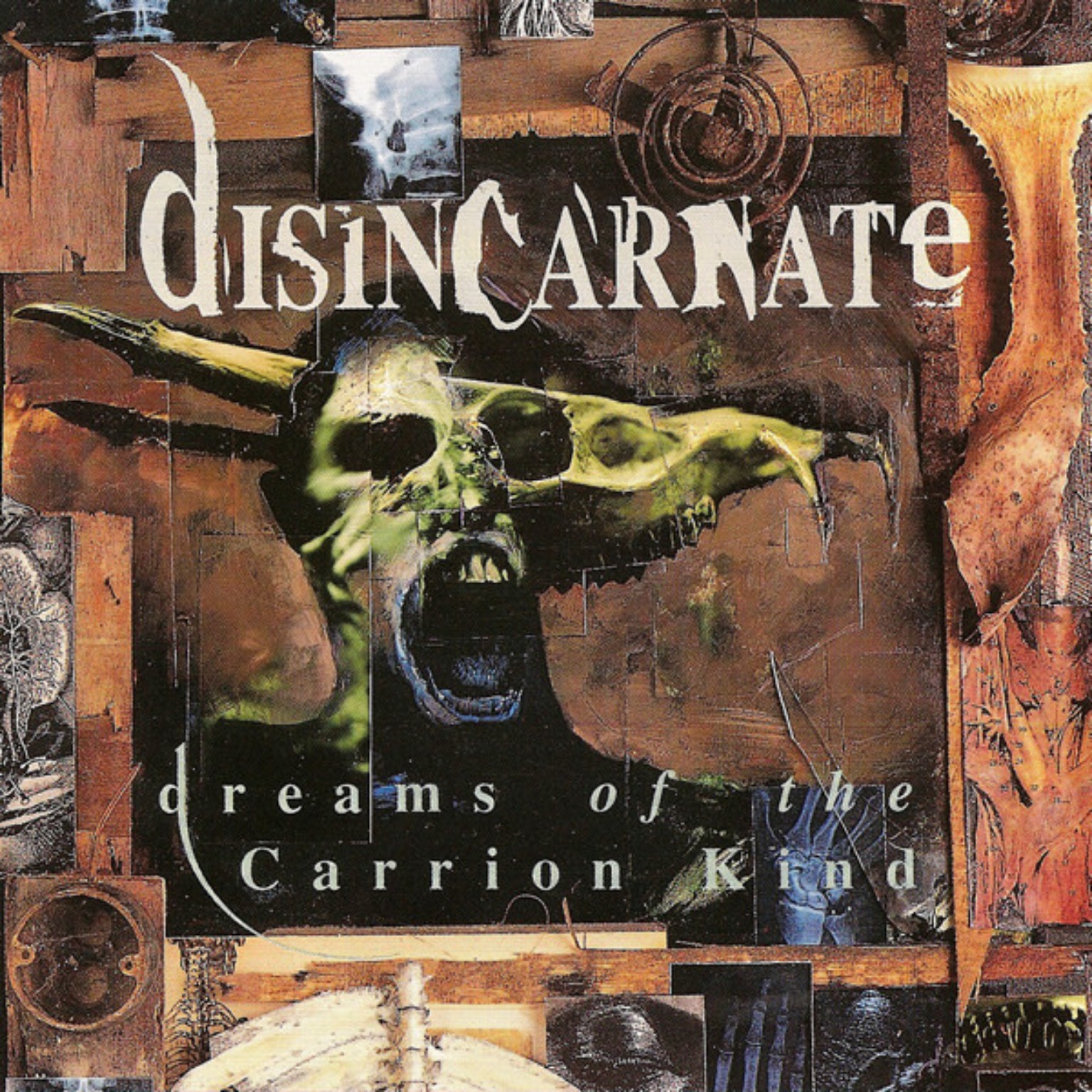
Cover illustration and design: Dave McKean.
Album details
Tracklist · original 1993 album (11 tracks)
- 01.De Profundis (Intro)0:45
- 02.Stench of Paradise Burning4:50
- 03.Beyond the Flesh4:48
- 04.In Sufferance4:56
- 05.Monarch of the Sleeping Marches5:02
- 06.Soul Erosion4:40
- 07.Entranced5:51
- 08.Confine of Shadows5:04
- 09.Deadspawn4:28
- 10.Sea of Tears5:01
- 11.Immemorial Dream (Outro)2:15
47:40 · original edition · Metal Archives total duration
Band members
- Bryan Cegon — vocals
- James Murphy — lead, rhythm and acoustic guitars; bass
- Jason Carman — rhythm guitar
- Tommy Viator († 2024) — drums
Guest musicians
- Aaron Stainthorpe — vocals (track 5)
- John Walker — backing vocals (track 3)
- Pete “Pee Wee” Coleman — keyboard samples
Recording and release
Original label: Roadrunner Records (RR 9102-2). Release: 23 March 1993. Recorded: The Windings (North Wales); mixed: Amazon Studios (Liverpool); mastered: The Hit Factory DMS (New York). Producer and mixing: Colin Richardson; recording engineer: Pete Coleman; mastering: Chris Gehringer. Cover art and design: Dave McKean; art direction: Sarah McKenzie; photography: Joe Giron and Tim Hubbard.
Official music services
Bandcamp: 2019 physical reissue (no digital sale). Spotify, Apple Music, Deezer, Qobuz: expanded 14-track edition.
◉ Physical editions · availability
The editions above are not confirmed as currently orderable.
Band channels
Identified band channels and independent discography
From the Water
Before there was a city name, there was the bay. The Indigenous settlements along the coast shaped their lives around the water: sources of food and routes of travel bound their communities to the same landscape. Traces of that earlier world survive at sites preserving the heritage of the Tocobaga. Much later, a military outpost, a railroad and a port redrew the coastline. Different eras made different uses of the water, but the bay remained the common geographical setting for the settlements spreading around it. T01
The history of Fort Brooke, beginning around 1823–1824, intertwined military presence with the growth of a settlement. The establishment of a village government in 1849 was followed by a city charter in 1855; another change in municipal administration came in 1887. Meanwhile, the routes along the Hillsborough River and through the port reached ever farther. Tampa gradually became part of the commercial network of the southeastern United States. When Henry Plant's railroad arrived in 1884, the link between land and sea gave the city fresh momentum: phosphate, goods and people all began moving more rapidly. T01
At the end of the nineteenth century, the factories of Ybor City began writing a different story within the same expanding city. Workers arriving from Cuba, Spain and Italy found employment in the cigar industry. Around the factories grew clubs, mutual-aid societies, entertainment venues and community cultures sustained in several languages. The voices of readers brought news and literature into working hours; listening together had its own place in the rhythm of production. Later, changes in the industry and its decline transformed life in the district. The fortunes of its buildings and its communities thus remained two sides of the same economic history. T02
In the following century, the port city took on yet another rhythm. From the 1970s onward, the spread of container shipping reorganized the old work of the warehouses and loading areas of the Channel District. Former industrial buildings awaited new uses as services, residential neighbourhoods and entertainment claimed increasing space. The rehabilitation of Ybor City, begun in June 1988, was also a search for new roles. The 1990 census counted about 280,000 people within Tampa's city limits; the interconnected communities around the bay formed a much larger world. T03
Sounds, too, had a history in this part of Florida. During the first half of the twentieth century, the African American communities of Central Avenue provided a home for jazz, nightlife and encounters between local and touring musicians. Ray Charles and Cannonball Adderley are also part of Tampa's musical memory. Jazz, blues and the music of its Latin communities had long been present in the city's cultural life when another generation began searching for its own voice through distorted guitars. T04
WMNF 88.5, which began broadcasting on September 14, 1979, opened up an alternative to commercial radio. Volunteer-made programmes and a diversity of genres gave local communities a chance to be heard. Music could travel by several routes between record shops, radio and clubs: a recording heard on a programme might continue its life on a cassette, at a concert or in another listener's collection. There was no single centre of transmission. T04
Accounts of the concert scene surrounding No Clubs between 1985 and 1995 also include punk, hardcore and alternative bands. The venues, posters, equipment and organisers' work kept different genres in motion. The history that also preserves a 1992 Pearl Jam performance recalls the broad world of guitar music in which bands sought opportunities to play and audiences to reach. Alongside the path to famous names, smaller groups struggled to gain a foothold, often competing for the same opportunities. T05
By the time James Murphy was preparing Disincarnate's first album, Florida death metal already enjoyed an international reputation. Yet in a fanzine interview conducted before recording, he spoke of the shortage of places to play and of audiences who were more readily drawn out by larger acts. Rather than dwelling on local disputes, he wanted to put practice and personal improvement first. In his answers, the album's release still lay in the future. The emerging Disincarnate had to become a functioning band within this environment, receptive to many different sounds yet offering few opportunities. T06
Murphy's study of sound had begun much earlier. As a child, even before he owned a usable instrument, he listened closely to the details of records: the path of a bent note, the construction of a melody, the relationship between a riff and a complete song. He would later single out Tony Iommi as a particularly important model of songwriting. For him, the guitar was not simply an instrument for playing fast. What interested him was how many different musical elements could be brought together into a single expression. T13
Growing up in an American military family, the boy spent part of his childhood in the American school community in Gießen, West Germany. In a 2014 recollection, he described summer odd jobs and mowing lawns to save up for an instrument. A later conversation, in 2025, evoked a black Aria Pro II XX Deluxe Flying V guitar with a yellow lightning bolt. The musical gestures he had listened to again and again now had to be found with his own hands. Practice could bridge the distance between the sound he knew from records and the sound he could draw from an instrument. T13, T14
One of the enduring questions in the story of the album to come was already present in this early attentiveness: what distinguishes a powerful riff, a good solo and a song that is memorable as a whole? At the next stages of Murphy's career, these tasks fell to him in different proportions. In some places he had to learn an existing repertoire; elsewhere he could help build the compositions themselves. The road towards a band of his own passed through these different creative circumstances. T13, T15
In Place of the Solo
In 1987, Murphy played as a guitarist hired for a single tour during Agent Steel's European and British shows. In the early fanzine interview, he later carefully distinguished this period from permanent membership of the band. His musical interests were already drawing him towards death metal and the more extreme end of thrash. In another interview he attributed his reservations about Agent Steel to the vocals; meanwhile, his own listening included Celtic Frost, Bathory, Slayer and Death's first album. T06, T50
In 1989, his path led to Atlanta, to the Atlanta Institute of Music. Sharing accommodation with musicians from Hallows Eve also led to occasional playing together; a later press release presented this as former membership in the band. Murphy disputed that interpretation and named Death as his first real, permanent band. Until then, his musical life had involved different kinds of commitment: practising together, a touring assignment, a guest solo and, finally, a lasting role in a band, each carrying its own work and responsibility. T06
His work on Death's Spiritual Healing also gave him room to help shape the material. On Into the Combine, Murphy distinguished between four songs that already existed and four that were developed together. New sections could emerge as he responded to the ideas of Chuck Schuldiner and the other musicians. He later estimated his own contribution to Ula Gehret at roughly a quarter of the music, mentioning riffs, rhythms and lead parts alike. The estimate summed up the work he himself experienced as creative participation. T15, T50
That period of playing together was accompanied by personal and creative tensions. The interviewer in the early fanzine approached the relationship between Schuldiner and Murphy provocatively, but Murphy was unwilling to feed the rumours. The people involved were the ones to ask about what had happened, he said. At the same time, he spoke appreciatively of the songs and musicianship on Human. Disagreement and respect for another artist's work could coexist within the same answer. T06
The assignment awaiting him on Obituary's Cause of Death was different. According to his accounts from 2014 and 2021, much of the material was already complete when he joined the sessions. With Scott Burns overseeing the recording, there was space for him in the solo passages. His instrumental voice became recognisable, while the overall architecture of the compositions had largely been laid out by others. During this period, Murphy's own musical ideas were beginning to grow in another direction. T13, T16
He traced the idea of forming his own group back to his time with Obituary. On Into the Combine, he spoke of music taking shape around the end of 1990, after the Death tours. Later, in Ville Krannila's 2021 interview, he firmly denied having originally written Disincarnate songs for Obituary and then carried them elsewhere after they were rejected. In his account, he had composed them for his own purposes from the outset. He had also presented the material that way to Trevor Peres, who felt it differed from Obituary's sound. T06, T15, T16
Memories of his departure have survived with differing emphases. Already in the early fanzine, Murphy spoke of knowing that Allen West was expected to return, and in 2021 he again stressed the temporary nature of the arrangement. In 2018, Carl Stokes described it as a dismissal. The two accounts show the different positions of people involved in the story; they did not produce a shared recollection expressed in the same terms. T06, T16, T17
Meanwhile, Murphy's instrumental interests remained broader than the genre identity associated with him. In his conversation with Gehret, he named Stevie Ray Vaughan, Allan Holdsworth and Frank Gambale among his influences. He also acknowledged an openness to jazz, blues, industrial, alternative and progressive rock. He could imagine making other, more experimental music and did not consider guest work incompatible with sustaining his own band. Disincarnate emerged within death metal, but its founder's language as a guitarist drew encouragement from several directions. T50
He initially took part in Cancer's Death Shall Rise by recording a guest solo. The collaboration expanded to further solos and live appearances; Milwaukee Metal Fest and European concerts became part of that association. Promotional photographs, however, gave the impression that he was a regular band member. Even before Disincarnate's first album, the fanzine interviewer asked him about this misunderstanding. Murphy said he had declined an offer of permanent membership because he wanted a band of his own in Florida. T06, T16
Stokes later confirmed the same distinction between roles. Cancer's drummer also spoke about the human side of working together: he recalled his own circle as more easygoing and Murphy as more serious and tense. In his memory, these were different working styles meeting one another. For Murphy, helping Cancer lasted longer than originally planned, even as Disincarnate's music was already taking shape. T17, T50
Other possibilities also seemed open. Bolt Thrower had considered Murphy as a possible replacement if Gavin left, but Gavin stayed. By then Murphy had completed four solos for Solstice's first full-length album. The early statement still presented European distribution through SPV and American distribution through Century Media as part of an expected release. Different bands therefore sought his playing, while he wanted to establish a permanent home for his own songs. T06
He also talked to Gehret about leading a band. In a group that took rehearsals and concerts seriously, he felt that personal friction alone was not sufficient reason to replace someone. He did not want to keep rearranging a functioning line-up merely to gain popularity. At that stage he was still setting out the principles on which his own band might operate in the future: the kind of group he wanted to lead, while Disincarnate's later fate still lay ahead. T50
Reputation brought expectations of its own. For part of the audience, the names Death and Obituary seemed recommendation enough. Yet Murphy also feared hostile preconceptions arising from earlier disputes. In the fanzine, he asked people to listen to the music itself. Even before they were finished, his own songs thus offered both an opportunity and a test on their own merits: the very name that opened doors for them would later bring the harshest expectations. T06
From Hand to Hand
A demo cassette took up little space, but it could travel a long way. In the 1980s, recordings made in rehearsal rooms found their way to other bands, fanzine editors and record labels. Across thrash, punk and hardcore, personal connections and the postal exchange of tapes reinforced one another. These relationships, local circumstances and the possibilities of recording also kept the music moving in the Tampa–Orlando death metal scene between 1984 and 1994. T07
Morrisound began in 1981 through the work of Jim and Tom Morris, using a mobile eight-track system. The move to twenty-four tracks and the opening of a larger, purpose-built facility in the autumn of 1985 also created new opportunities for local bands. Behind the technical advances lay a succession of collaborative efforts: engineers sought solutions to musicians' needs, while musicians learned what they could do with the equipment available. It was through this work that the name Temple Terrace travelled far beyond the area. T08
Scott Burns would later discuss drum recording, the use of triggers, MIDI- and Cakewalk-based methods, and the TC 2290 delay unit. Donald Tardy recalled the world of Obituary's early Executioner demos. An idea developed in the rehearsal room had to be rebuilt in the studio; the extremity of the music posed distinctive challenges for recording the instruments as well. Recording expertise and the experience of the local bands grew together. T09
After moving from Lakeland to Tampa, Murphy began turning his idea for a band of his own into a more lasting collaboration. By 1992, names and responsibilities were already falling into place around Disincarnate. Bryan Cegon and Jason Carman came from the Tampa band INFERNUS; Tommy Viator had previously played drums in ASTAROTH. The early fanzine printed the singer's name as Brian, whereas the later album credits used Bryan. The connection with Astaroth was also preserved in a 1994 SHISM text. T06, T18, T19
A cassette handed over in a record shop also played a part in Viator's path. Murphy later recalled that the drummer gave him a recording at Aces Records, after which he arranged an audition. The same shop recurs as a meeting point in the stories of other local musicians. In 2020, Tony Teegarden recalled another possible route: Murphy once rehearsed with the members of Epitaph and suggested the possibility of combining that group with his own project. They did not accept the idea. The exact date of the rehearsal is unknown, and Disincarnate ultimately came together with a different line-up. T36, T51
Alex Marquez was still the drummer on the 1992 Soul Erosion demo. For the later album, Viator took his place behind the kit. In a 2009 recollection, Marquez mentioned his commitments to Solstice and Murphy's vision of a complete band; in retrospect, he regretted being unable to play on the entire album. He did not specify how much of his earlier drumming ideas survived in the finished material. Recording the demo and establishing the permanent line-up for the album remained separate steps. T21
The question of the bass guitar was not settled early either. On Into the Combine, Murphy remembered an early bassist who had left, while the pre-recording fanzine still described the position as unfilled. In the end, Murphy recorded the bass parts on the album himself. Another musician later helped on tour, but the relevant conversation did not establish his full identity reliably. The quartet working in the studio and the practical demands of live performance therefore did not entirely coincide. T06, T15, T19
Murphy did not want to assemble a supergroup of well-known musicians. In his 2014 account, he spoke of choosing younger players whom he found open-minded from among many auditionees. He was looking for a band that suited the songs and the mood of the album as a whole. The printed credits would later show that his guiding vision also left creative room for others: Carman shared the music credits on five vocal tracks, while Cegon was credited as a co-writer on most of the lyrics. T20, T19
The label's attention had turned to Murphy before the finished demo existed. In the fanzine he said that Roadrunner had been interested in him since his departure from Obituary, but an actual offer came only after the material was completed. The company waited more than a year for the demo. Restless and Peaceville had also been mentioned, but he considered Roadrunner the most proactive. In 2021, he recalled his own recordings built with programmed drums and several guitar tracks, and an agreement reached before the final band line-up had formed. The songs, the demonstration recording and the group itself became definitive at different speeds. T06, T16
Behind Roadrunner stood a system built on listening to demos, A&R work, import connections and international distribution. From the late 1980s onward, Monte Conner became an important figure within it. Earache arrived by another route: Digby Pearson built a network out of the punk and grindcore scene, carrying records by Carcass, Bolt Thrower and Entombed to distant listeners. In both cases, organised distribution grew alongside the personal channels of the underground. T11
Meanwhile, in Sweden, Sunlight and Tomas Skogsberg were making a different sound immediately recognisable. Around Entombed, which grew out of Nihilist, and around Dismember and Grave, the saw-like distortion of the Boss HM-2 met the possibilities of early studio recording. A technical conversation from 1994 and later recollections preserve a process in which even the limitations of the equipment could become the basis of a distinct identity. Recordings from different regions were beginning to be heard side by side by the same international audience. T10
Alongside fanzines and record shops, radio, television and compilation albums all helped spread the genre. The legacy of John Peel's British broadcasts included Napalm Death's 1987 recordings; MTV's Headbangers Ball offered heavy music a new opportunity on screen. Murphy spoke favourably of At Death's Door II, which included one of Disincarnate's songs. A listener who had not yet heard the full demo could thus encounter the band through a single track. T12, T06
Finding a place among so many releases seemed increasingly difficult. Rather than seeing small underground labels disappear, Murphy wanted them to work more selectively; he believed the flood of weaker music damaged the prospects of good bands too. Alongside the possibility of a contract of his own, he was already aware of the genre's growing saturation. At the same time, an item in Billboard's October 10, 1992 issue pointed to page 17 with a Disincarnate headline indicating recognition at a Tampa awards event. The details of the awards are unknown, but the band's name had reached an international trade publication before its debut album. T06, T22
In 1992, the year Disincarnate was being assembled, the United States was still recovering from the recession that had lasted from July 1990 to March 1991; the NBER did not officially establish those turning points until December 22. Across the Atlantic, the treaty for closer European integration was signed at Maastricht on February 7. In June, the United Nations conference in Rio brought the relationship between environment and development to the centre of world politics. During those same months, the Yugoslav wars, and especially the violence in Bosnia, were creating an increasingly grave humanitarian crisis. Economic recovery, the construction of European institutions and news arriving from the war were distant yet simultaneous developments that set the historical rhythm of the year. T23, T24, T25
In the interview conducted before recording, Murphy already mentioned a planned studio start on November 20. He placed it sixteen days after the moment of his answer, pointing to early November 1992; the fanzine's actual publication date is unknown. He tentatively expected the album in February or March of the new year. A full-length album could now follow the demo. The plan does not establish the actual first day of recording, but the next geographical stop on the journey would soon be North Wales. T06
Across the Ocean
In Britain, the pound's departure from the European Exchange Rate Mechanism on September 16, 1992, marked a turning point in economic policy. The Bank of England's December report already reflected the new monetary situation. Meanwhile, the locations where Disincarnate worked in Britain lay in a region undergoing a much longer transformation: the retreat of older industries had reshaped the lives of towns and communities. T24
For centuries, coal and metal had provided work around Wrexham. The mines, foundries and transport routes of the eighteenth and nineteenth centuries sustained one another. The industrial heritage around Bersham preserves the memory of this working culture; the closure of the Brymbo steelworks in 1990 was among the ruptures in the years immediately preceding the recording. The region had to find new purposes after the decline of the old economic order. T26
One of the older voices of community culture belonged to the male voice choirs. The history of the Rhos Male Voice Choir reaches back to 1891. The choral tradition and the past of the mining communities formed part of the cultural memory of the same region in which a residential house and recording studio later opened a working space for very different music. The Windings operated at High Meadow House, associated with the area around Cefn-y-Bedd and the Ffrwd valley. Its combined use as a residence and studio offered visiting bands the chance to concentrate on their work. T26, T27
In 1993, Murphy emphasised precisely this sense of retreat. Colin Richardson had recommended The Windings, and Napalm Death's Utopia Banished, recorded there, provided a professional point of reference. Far from the routines of life in Florida, attention could be devoted to the album taking shape. After the demo produced by Scott Burns, choosing a different producer represented a conscious change. T28
Other details of the decision emerged later. In 2014, Murphy recalled that Monte Conner had argued for Richardson by pointing to the sound of Carcass's Necroticism. According to Murphy's recollection, Burns was personally upset by the choice. Departing from the familiar Florida studio thus carried human tensions as well as professional possibilities. Nevertheless, the new album set out on its own path with the British producer. T20
The desired sound did not immediately make it onto tape. Around the time of release, Murphy described spending roughly four days searching for the right amplifier and guitar sound. They tried various approaches, and equipment associated with Carcass and My Dying Bride was considered; in the end, they went as far as Manchester in search of suitable equipment. Such tangible practical tasks could delay the recording of the music they had imagined. A riff was not yet a finished studio sound until instrument, amplifier and recording work came together in the right proportions. T35
The album was recorded at The Windings and subsequently mixed at Amazon Studios in Liverpool. Richardson is credited as producer and mixer, and Pete Coleman as engineer. The next stop, then, was another city bearing layers of older economic and cultural history. Amazon had previously operated in Kirkby before moving to Parr Street in 1992. T19, T29
From the eighteenth century onward, Liverpool's docks connected the city to global trade. The city's history of maritime wealth also carries the grave legacy of the transatlantic slave trade; later, trade routes and emigration extended its links still farther. The warehouses of Albert Dock, opened in 1846, were built expressions of a trading system in which distant shores became part of everyday life. T30
As the port and industrial sectors lost ground during the second half of the twentieth century, those buildings too acquired new purposes. Rehabilitation in the 1980s brought cultural, museum and leisure activities into the old warehouses. The maritime museum's opening in 1986 and the complex's revival in 1988 mark stages of that transition. Professional studio work continued in a city reorganising itself. T30
Liverpool's musical memory was also built over several eras. The Cavern Club, which opened as a jazz venue in 1957, later became a centre of beat music. Eric's, opened in 1976, provided a space for the punk and post-punk generation. The activity around Probe Records, Inevitable and other independent ventures helped local music in different ways. The studio on Parr Street added a professional recording strand to this varied network of institutions. T31
The final preparation of the sound took the material back across the ocean. Chris Gehringer mastered it at Hit Factory DMS in New York. The metropolis that had grown from the land of Lenape communities into a seventeenth-century Dutch trading port was, by the late twentieth century, experiencing a restructuring of its industrial and harbour economy. Finance, services and the city's studio industry were taking on new relative importance. The changes at Hit Factory between 1987 and 1993 reflect the movement of this professional infrastructure. T32
On another scale, the city's musical networks included the hardcore communities around CBGB and A7, together with the independent work of Revelation Records. Clubs, singles and personal contacts built channels of distribution that reached far afield here too. Meanwhile, the Disincarnate material travelled from a local American demo through recording in Wales and mixing in Liverpool to New York, following the routes of the larger professional recording industry. T33, T19
At the beginning of 1993, dates marking a new era followed one another in Europe and America. The European single market took effect on January 1, and Bill Clinton's inauguration on January 20 began a new political cycle in the United States. The hopeful sequence of institutional milestones was interrupted on February 26 by the World Trade Center bombing, while the Yugoslav wars continued. On March 12–13, the extraordinary storm known as the Storm of the Century struck Florida's west coast, including the Tampa Bay area. Spring was marked both by the building of new systems and by unexpected destruction: this was the world into which Disincarnate's record would arrive in shops within weeks. T34
At the heart of the recording lay the work of four musicians. Bryan Cegon sang, Jason Carman played rhythm guitar and Tommy Viator played drums. Murphy recorded lead, rhythm and acoustic guitar as well as bass guitar. The original CD explicitly credits him with the studio bass parts. He alone wrote the instrumental music for De Profundis and Immemorial Dream; Carman was his co-composer on five vocal tracks, while Cegon worked with him on most of the lyrics. T19
The guests, too, were associated with specific songs. John Walker of Cancer contributed backing vocals to Beyond the Flesh. Aaron Stainthorpe, the singer of My Dying Bride, took the alternating vocal role on Monarch of the Sleeping Marches. Keyboard samples by Pete 'Pee Wee' Coleman also appear in the printed acknowledgements. Monte Conner's A&R credit connects the label side of the business to the project. The recording thus became a collaboration organised around the founder's vision while preserving several kinds of contribution. T19
In a contemporary Metal Hammer interview, Murphy described about eighty per cent of the music as his own work. Alongside his leadership, the booklet's detailed song credits also preserved the other musicians' contributions. Ibanez, Gibson U.S.A., Armadillo Cases and Marshall were among the equipment brands associated with the band. The phonogram copyright notice reads The All Blacks B.V., 1993; the songwriting publishing credits refer to Roadcrew Music and Destructive Music. Legal representation by Chris Qualmann and concert arrangements through Mitch Kando of T.C.I. indicated the professional framework developing around the band. T28, T19
Murphy continued to reflect on the sound long after the album's release. One podcast interviewer heard the demo as more forceful and more compact. Murphy said that he had not compared the two recordings side by side for a long time, but he too felt that some aspects of the album might have been tighter, clearer or more direct. He did not want to lay the complaints at Richardson's door. He regarded his own input and his still-developing studio decisions as part of the result. T15
Yet he consistently described the compositional aim in terms of a dark experience. Fast, technical, heavy, slow and doom-like passages were all meant to serve the same nightmarish world. Nor did he see the walls of the genre as completely closed: in 1993, he hoped to reach listeners of other kinds of metal as well. He later accepted complexity as a reasonable listener's impression, but did not consider his own purpose to have been a technical puzzle for musicians. He now chose an image for this imagined world. T15, T20, T28
Around the Head
At the centre of the cover of Dreams of the Carrion Kind, a gaping mouth opens towards the viewer. The yellow-green, skull-like figure extends in one direction into the shape of an animal bone; its black eye socket and mouth cavity shading into deep blue evoke a remnant of the body at once familiar and made strange. The head never becomes a creature of naturalistic precision. Rather, it is an image in which memories of different bodies have slid over one another. T19
Around it, rust-brown, ochre and orange surfaces meet layers resembling wood, metal and paper. Spirals and circular forms suggest another material order beside the central figure. Smaller anatomical cut-outs and fragments of images interrupt the surface. The white letters of the band's name establish a horizontal direction across the top of the composition, while the elongated bone shape below seems to stretch the same axis farther. The widely spaced letters of the album title cross a dark field, and more details open out towards the edges. T19
The juxtaposition of different materials creates the impression of a damaged space of memory. Alongside the skull, apparently mechanical elements unsettle the boundary between the living, the dead and the artificial. The open mouth can be read as a scream, even as the picture remains motionless. Here, the dream does not break free of objects: it takes shape in bone, surface, metal and cut-out images. The individual artistic meanings of the motifs are unknown, but the montage-like arrangement holds their strangeness together. T19
Dave McKean is credited for the cover illustration, design and layout in the original credits. Murphy had become familiar with his work through the Sandman covers and deliberately approached him. In 1993, he noted that My Dying Bride had already used a McKean image a little earlier. The visual world he had encountered through comics thus became a way into the imagined darkness of his own album. T28
Decades later, the cover could reach a new listener by the same route. In a 2013 retrospective, an interest in comics and McKean became the personal gateway to the recording. The viewer became a listener, carrying a sense of the connected visual and atmospheric world through the entire album. The fragments arranged around the gaping mouth thus continued to exert their influence in the record's reception. K03
The Inner Paths of the Dream
The sequence of recordings begins with De Profundis. This forty-five-second instrumental introduction, written by Murphy, marks the entrance with a title suggesting a voice rising from the depths. The nine vocal compositions still lie ahead; the entire dream world falls between the brief opening and a much longer instrumental conclusion. Later listeners, too, began the shared journey of artwork and music here, or simply perceived it as a space preparing the movement of the album to follow. T19, K03, K12
At four minutes and fifty seconds, Stench of Paradise Burning is the first complete song. Its music and lyrics are Murphy's work alone. The image of paradise turns inside out amid cruelty, moral decay and all-consuming fire. Destruction takes the place of promised purification, and the idyll bursts into flames. One of the album's recurring questions already appears here: corruption can reshape both the outer world and the mind. T19
In 1993, Murphy discussed the song's psychological emphasis; in 2014, he highlighted the destruction of the Earth and environmental concerns. The later explanation added another perspective to the earlier one. The ruined paradise could be read both as an inward state and as a devastated environment. The emphases in the songwriter's own accounts did not remain entirely unchanged over the years. T28, T20
At release, the album version received praise for surpassing the demo previously heard on a compilation. Later appreciations heard a combination of fast and slow passages, deep vocals and technical precision. Another analysis cited it as an example of dense changes in riffs and tempo. The opening song also introduced the terms in which the entire record would be judged: weight, change, virtuosity and song form stood side by side. T35, K05, K09, K12
In Beyond the Flesh, a consciousness separated from its body cannot find peace. Cegon and Murphy wrote the lyrics to music by Murphy and Carman; the four-minute-forty-eight-second track sets physical decay against memory that survives. Attachment to a former life becomes tormenting solitude. For the surviving consciousness, it is precisely the lack of a body that becomes a prison, and the promise of existence beyond death assumes an ever more unbearable shape. T19
John Walker's backing vocals belong to this particular composition. The professional connection with Cancer thus became a collaboration that could be heard within one of the album's stories. Later reviews described a heavy, doom-laden opening, a solo and a slowdown in the middle; readings focused on shifts in riffs and tempos also found an important example here. For another listener, it was simply among the strongest songs. T19, K02, K05, K09, K12
This track followed a separate path in the story of a later purchase in Genoa. A listener already knew it from a Roadrunner compilation when they encountered the full album in a second-hand record shop. Their earlier experience of the song and a sticker advertising connections to Death and Obituary together led them to the CD. A recording placed on a compilation thus opened a way back, years later, to a complete album. K12
In the world of In Sufferance, the body remains, but fear consumes it from within. The four-minute-fifty-six-second song was composed by Murphy and Carman, with lyrics by Murphy and Cegon. Death is certain, while knowledge of the afterlife is uncertain; ritual promises reassurance, yet faith can turn into self-punishment and a shackle. Behind images of an ageing body and an approaching end, regret for a life not fully lived grows. T19
Anxiety about retribution, self-reproach and questions of fate all inhabit the same mind. The lyrics create a sense of pressure without an external monster: the threat operates within the structure of thought itself. Positive reviews of the song praised different sides of this expression. Some admired the slow, melancholy section, others the solo and its instrumental support; the density of the riffs and the power of the song as a whole also drew repeated praise. K02, K05, K06, K12
The five minutes and two seconds of Monarch of the Sleeping Marches give the dream a realm of its own. Murphy and Cegon wrote the lyrics to music by Murphy and Carman. The world of Oneiros, Morpheus as the son of Hypnos, abduction and return from captivity, and the burden of ruling hell are intertwined. In 1993, Murphy named Neil Gaiman's Sandman universe as his inspiration. The words Dreams of the Carrion Kind also recur in the lyrics: the imaginative order established by the cover and the title is concentrated in a single song. T19, T28
Aaron Stainthorpe's alternating vocal role receives a separate credit in the original booklet. The voice arriving from My Dying Bride, the creative interest leading towards Sandman and McKean's art reveal several connections within the same album world. The literary story gives both names and movement to a fear that, in the preceding song, had still taken the form of uncertainty within the mind itself. T19
Even among contemporary reservations, Monarch could remain an exception. A review from 1993 that doubted the memorability of the other songs singled it out. Later praise found the opening themes, the melody of the first part, its groove and its variety particularly convincing; for another listener, it became the favourite track on the album. Different judgements met here at a common point of attention. K06, K07, K12, K14
Across the four minutes and forty seconds of Soul Erosion, the story turns away from the dream kingdom towards the wounded personality once again. The music is Murphy's, and the lyrics are a joint effort by Cegon and Murphy. Memories of tragedy, fear and indifference slowly wear away compassion. Emotions harden, perception becomes numb and human qualities gradually lose their force. The erosion of the title takes place over time: destruction becomes a succession of injuries accumulating on one another. T19
Murphy interpreted the song in psychological terms in both 1993 and 2014. Set beside Confine of Shadows, it sketches two movements in the deterioration of consciousness: in one, emotion wears away; in the other, concealed anger gathers strength. Soul Erosion also carries forward the title of the 1992 demo. The name of the early recording thus remained within the full-length album. T28, T20, T19
The song found recognition even among dissenting opinions. A 2023 review that heard the album as a whole as tired and impersonal nevertheless detected an individual force in the solo. Other readings approached it through guitar sounds recalling Obituary and through densely packed transitions. Murphy's expression as a guitarist could reach a listener who remained unconvinced by the overall compositional world. K01, K09, K12
On the original cassette, side A ended with this song. After turning the tape over, Entranced reopened the programme on side B. At five minutes and fifty-one seconds, it is the longest composition, with music credited to Murphy and Carman and lyrics to Cegon and Murphy. The ancient house, the remains of ancestors and the call of family history draw the narrator ever closer to something from which ordinary experience would keep him apart. The images of home and grave merge. T19
In 2014, Murphy identified Lovecraft as the inspiration behind this story. In the lyrics, inherited corruption and the return of knowledge from the past permeate the present; the attraction of a dark entrance makes destruction strangely familiar. The self seems to sink into a memory older than its own life. A later review emphasising the song's doom elements regarded this weight as one of the album's strengths. In Murphy's conception, slower and heavier passages could belong to the same dark musical space. T20, K02, T15
The five minutes and four seconds of Confine of Shadows follow hatred emerging from concealment. Murphy and Cegon wrote the lyrics to music by Murphy. The language of disease and infection describes a transformation of consciousness: what had long lain dormant now gains control. Shadow is not merely absence, but a hiding place for a force growing inside. By the end of the lyrics, the transformation has fulfilled its own logic. T19
Murphy's later explanation also preserved the kinship with Soul Erosion. Together, the two songs open onto inner worlds that are either being destroyed or distorted. Different reviews praised the harmonies of Confine, a solo passage reminiscent of Death, and the strength of the arrangement and memorable themes. Once again, the praise was not simply for the speed of the player's hands: listeners found the union of instrumental detail and the whole song compelling. T20, K02, K03, K06, K09, K12
In Deadspawn, knowledge belonging to the dead becomes accessible. The four-minute-twenty-eight-second song was composed by Murphy and Carman, with lyrics by Murphy and Cegon. A being that makes contact with the dead draws memory and strength from mortality; bodily finitude and time lose their former boundaries. After the lonely surviving consciousness of Beyond the Flesh, the thoughts of the dead here offer a different possibility of action. T19
The literary background was described differently at two points in time. Murphy mentioned Lovecraft in 1993, but in 2014 associated Deadspawn with Brian Lumley's Necroscope universe. The lyrics themselves also use the term 'necroscope'. The later statement therefore offers a specific point of reference, while the earlier one preserves how the author spoke about the album in its own period. After the inner transformation of Confine, the supernatural motif takes up more space again. T28, T20
A critical reading emphasising the density of details also counted this song among the examples of riff and tempo changes. The movement between outer and inner worlds in the album's themes creates a sense of motion just as, according to that critic, the instrumental construction does within the song. Of the dream's different forms, knowledge after death now comes to the fore, before the final vocal track turns attention back to the body itself. K09
The five minutes and one second of Sea of Tears are built on Murphy's music and lyrics by Murphy and Cegon. Images of flesh surrendered to pain and forced into a new shape bind pleasure to punishment. The promise of purification turns into an alien order, and the body loses its former form. In 2014, Murphy named Clive Barker's Hellraiser world as a source; in this light too, the labyrinth, the configuration and the remade body form a connected sequence of images. T19, T20
An Italian review attentive to frequent shifts heard the album's restless energy in the form of this song as well. In a 2021 interview, the interviewer singled out the final solo for praise, recalling it as part of a long personal attachment to the music. The close of the vocal narratives thus left behind another instrumental moment capable of living on independently in memory. K12, T16
After that, the sound withdraws without words. Immemorial Dream, lasting two minutes and fourteen seconds, is a composition by Murphy alone; its title opens towards a distant dream beyond memory. More than twice as much time is devoted to the ending as to the introduction. After the nine vocal songs and their figures escaping the body, living in fear or undergoing transformation, the album returns to the other instrumental piece that completes its frame. T19
A 2005 appreciation highlighted the pairing of distorted and acoustic guitar; another listener sensed an ominous calm, while a retrospective praising the unity of the visual and emotional world saw the end of the album's journey in it. The record, then, does not finish with one more vocal climax. The track sequence makes a separate space for withdrawal. K03, K08, K12
The printed running time of the eleven tracks totals 47:39. Between the brief beginning and the instrumental ending, the faster, heavier, more melodic and more contemplative passages seek different forms of a shared darkness. Listeners would later debate whether these elements formed a memorable world of songs. One heard a unity of details and atmosphere; another heard repeated formulas or over-crowded arrangements. The difference between Murphy's intentions and the reception of the finished music was already opening up in that first spring. T19, T15
The Spring of Release
The release schedule of an album originally expected in February or March gradually shifted. Spring previews mentioned March 23, while the Roadrunner entry in the April 19 issue of HITS gave April 27 as the street date. Twenty years later, the original label recalled the same date. April 27, 1993, thus became the best-supported date of the American release of Dreams of the Carrion Kind. The earlier dates preserve the changing timetable of anticipation. T06, T36
Later discographies giving March 1 or a date in January carry a different historical weight beside these reports. There is contemporary promotional evidence for the March 23 plan, while the April 27 date is supported by both a trade publication's statement of the retail date and the label's retrospective. A publicly available copy of copyright record PA0000628934 also lists April 27 as the date of publication; registration took place later, on September 21. Different administrative stages in the record's life did not occur on the same day. T36, T37
Meanwhile, the music was already seeking its way onto radio. The Hard Report of April 16 anticipated an add date of April 19. On April 26, Disincarnate appeared in fourth place among the HITS Top Five Most Added and in second place on the Foundations Most Added Albums list. Immediately before the record reached shops, it was also attracting the attention of music-industry broadcasters. T38
Another layer of Tampa's history, preserved in figures, is attached to April 27. The city's 1993 weather summary records a daily low of 58 degrees Fahrenheit and a high of 83 degrees that day—approximately 14 and 28 degrees Celsius—with no measured precipitation. The local data series preserves a spring day in the Florida city. By then Tampa was one of death metal's internationally recognised points of origin, but Disincarnate's new recording had reached the public by way of studio work in Wales, mixing in Liverpool and mastering in New York. That work, crossing several cities, met the Tampa band's history on the day of release. T55
Roadrunner issued the album as CD RR 9102-2, LP RR 9102-1 and cassette RR 9102-4. The track sequence divided across the cassette's two sides began again at Entranced; the CD presented all eleven tracks without a break between sides. These physical formats now made available music whose founder was already a familiar name from other bands' recordings. A sticker advertising his past with Death and Obituary turned that name into a recommendation in the record shop too. The original band photographs were included in the package with a credit to Tim Hubbard. T19
The press, however, did not all hear the same thing in the new recording. On April 10, one voice in the British reception acknowledged the guitarist's abilities but doubted whether the songs were memorable. Monarch remained an exception. Another assessment that month similarly emphasised the difference between technical accomplishment and originality. From the moment of release, the question was how far the familiar instrumental skill had become a compositional world of its own. K14, K15
In April 1993, death metal continued along different musical and label paths in several countries. The British band Necrosanct's full-length Desolate was issued by Black Mark Production, coming from one branch of the British underground. The Swedish band Therion's Symphony Masses – Ho Drakon Ho Megas, released by Megarock Records, stretched death metal structures towards more progressive approaches. Both releases can be dated to April, but the surviving evidence does not establish their exact days as securely as Disincarnate's American street date of April 27. The debate then unfolding over technical ability and an individual compositional voice thus touched different music in several countries, even as the records reached listeners along their own paths. T56, T57
An American A&A review dated April 15 praised the craftsmanship and production, recognised the force of death/doom, but also raised questions about the limits of virtuosity and the need for the genre to move forward. A drumming magazine published that September approached the music from another angle, highlighting Viator's fast double-bass work and thirty-second-note runs in Beyond the Flesh, and the complex changes of Entranced and In Sufferance. The record introduced on the strength of its guitarist's reputation also received attention for the drumming in its own right. K17, K32
On May 3, The Anchor drew a more enthusiastic picture. Alongside Murphy's solos, the entire group's work earned praise: Cegon's deep, intelligible vocals, Carman's rhythm guitar, Viator's tight transitions and Richardson's production. In that reading, the album version of Stench surpassed the earlier demo. In the same article Murphy described the several-day search for suitable amplifiers and the uncertainties surrounding tour plans. Even as the completed recording earned recognition, the band's next tasks remained unresolved. T35
Only a brief trace survives of Rock Hard's restrained 6.5-point verdict; without the full argument, no further objections can be attributed to it. In the contemporary opinions available in greater detail, it was already striking how differently people could interpret the same acknowledged instrumental abilities. K16
Industry attention on radio continued for months after the retail release. HITS Top Thirty Radio listed the album at number 24 on May 3, number 22 on June 28 and number 30 on August 7. On The Hard Report's Hard Hitters chart it rose from the previous number 39 to number 28 on May 7, and stood at number 17 on June 11 after reaching number 13 the week before. These figures indicate fluctuating radio attention, not record sales: professional promotion repeatedly placed the band's name before programme directors. T38
Reaching an audience on stage, however, meant another journey. Billboard's Popular Uprisings column of April 17 included Disincarnate among Roadrunner's actively touring artists. Earlier reports in The Hard Report and Metal Hammer had anticipated shows alongside Bolt Thrower and Benediction. In an early-May interview, Murphy was already discussing plans disrupted by Bolt Thrower's cancellation and mentioned a possibility around Hadley. After the work completed in the studio, arrangements for the coming weeks remained far more uncertain. T39, T40, T28, T35
Around the album's street date, the spring tour plan was already taking geographical shape. Montreal's Backstreet on April 26 and Detroit's Marquee on April 30 survive in archives under the names of all three bands; advertisements also survive for Bogart's in Cincinnati on May 2 and the Thirsty Whale in River Grove on May 4. Collections in Montreal and River Grove preserve several posters. Later concert lists trace a route west from there: The Omni in Oakland appears on May 13 and The Ice House in Fullerton on May 14. The adverts, posters and subsequent lists together outline a possible itinerary; they do not all establish with equal certainty that each show actually took place. T41
Summer planning again outlined a shared tour by three bands—Cancer, Morgoth and Disincarnate. The Foundations column of July 19 named Milwaukee's Central Park Ballroom for July 31 and Cincinnati's Bogart's for August 1. Pollstar published a longer plan that same day: after the first two cities came Columbus, River Grove, Cleveland and Detroit, then Buffalo, New Britain and Hadley, followed by Newark, Huntington and finally Brooklyn's L'Amour on August 13. Behind the names of the cities lay the everyday requirements of touring: a vehicle, travel money and a new audience at each stop. The itinerary printed in the trade paper nevertheless remained a list of planned appearances. T42
Later concert archives add further traces to the planned route. They list the Newport Music Hall in Columbus on August 2 and the Marquee in Detroit on August 5; the Wool Warehouse in Albuquerque appears on August 30 and The Omni in Oakland on September 3. A flyer catalogue for The Outhouse in Lawrence, Kansas, on September 10 lists Order From Chaos and Nosferatu alongside Cancer, Morgoth and Disincarnate. These entries, drawn from different kinds of evidence, reveal the wide geography of organised concerts, while the strength of the evidence for particular dates still varies. T41
In 2018, Cancer drummer Carl Stokes spoke about the joint American tour, also mentioning Demolition Hammer. He recalled transport problems towards the end and expressed uncertainty about California: perhaps they had not even made it that far. In another retrospective, Murphy described a band already back in Florida when its booking agent left two distant California dates at the end of the schedule without adequate guarantees. The cost of the vehicle and the journey seemed unacceptable compared with the expected income. T17, T20
A transcript of the 2022 account gives three such dates. The numbers differ, but the shared burden of the story is travel and financial uncertainty. According to Murphy, contact broke down after a dispute with the booking agent. Despite the record's presence on radio, the stability needed to sustain a working touring band did not prove equally durable. The recording and the band's livelihood revealed their strengths on different timescales. T43, T20
Working at Aces Records, Murphy saw at first hand the shift of interest towards alternative rock and grunge. He recalled this early-1990s record-shop experience in several later conversations. Meanwhile, the growing importance of Type O Negative, Sepultura and Life of Agony within Roadrunner's history showed the increasing weight of other directions. Disincarnate's consistently extreme, dark musical vision sought its next opportunity in this changing market. T15, T43, T44
By Murphy's account, the label asked for another demo before a second album and suggested a change of vocal direction as well. After the tour, his younger bandmates weighed up education, family life and ways of earning a living. He himself recalled losing his job, moving back with his family and going through a personal crisis. Later memories mention Lakeland, warehouse work and rehearsals at which only the drummer and singer still joined him; Carman's participation had become uncertain. T16, T20, T43
It was under these circumstances that the Testament opportunity arrived. In a 2025 conversation, Murphy linked the two parts of the story through Mike Gitter: the professional, previously known as a music journalist, put him in touch with Eric Peterson while working in A&R for Atlantic. Disincarnate's one album had been completed, but the band and infrastructure required for a follow-up had weakened. Murphy later placed the end of the first period in early 1994. From then on, the songs enjoyed a longer life than the original collaboration. T14, T45
Different Times of Listening
The recording had its own fixed sequence, but listening to it did not produce a single definitive result. As the record became available again, it was heard amid different expectations in the following years. Some sought in it the power of 1990s death metal; others expected Murphy's own band to move beyond familiar models. The old reputation arrived ahead of the music again and again.
In a retrospective around the 2004 reissue, fresh attention fell on the complexity of riff structures, counter-rhythms and melodic passages opening towards doom. In this reading, Disincarnate was not simply a showcase for a single lead guitarist: the playing of the whole band gave weight to the songs. From a distance, the meticulous instrumental arrangements sounded like a virtue that prejudices at the time of release might easily have obscured. K18
By the spring of 2005, a one-hundred-per-cent fan verdict had appeared. The album, heard as heavier than Spiritual Healing and more complex than Cause of Death, suggested a voice uniquely Murphy's through its almost doom-like slowness and fast eruptions, precise shifts and melodic solos. Restrained drumming came across as precision, while the acoustic and distorted guitars of Immemorial Dream seemed a deliberate closing statement. In late 2006, a 9/10 review again praised the changes of tempo and heavy sections: two different, enthusiastic encounters connected the strength of the songs with the way they were constructed. K08, K19
A retrospective from 2007 preserved not only the proximity of technical death metal and doom, but also a sense of the story left unfinished. Another appreciative review linked the value of the three bonus demo tracks, the revised booklet and the old standard of musicianship. By then the album arrived together with the physical objects through which it was remembered: early recordings and new packaging offered further ways of getting to know it. K20, K21
The memorability of the songs became the next subject of debate. A one-hundred-per-cent review in 2009 heard clearly distinguishable pieces and motifs that were easy to recall. Alongside Murphy, the intensity of Bryan Cegon and Colin Richardson's production were praised; the first half of Monarch offered a particularly persuasive combination of melody, groove and variety. What some contemporary listeners had heard as insufficiently individual song forms was now taken as evidence of memorability. K07
In spring 2010, a 99-per-cent review highlighted how easily the riffs could be recalled and how the melodic work of the solos was integrated into the songs. The reviewer found the bass less prominent but audible, the drums precise and the vocals unexpectedly convincing. The clarity and weight of the production still stood up by later standards. Fast playing was valuable because it strengthened the themes. K06
Another one-hundred-per-cent appraisal in 2010 came from memories of an overcrowded market around 1993. The reviewer did not ask Disincarnate for experimentation in the manner of Atheist or Cynic, but valued the balance of aggressive riffs, melodic solos and atmospheric slowdowns. The precision of Stench, the weight of Beyond the Flesh, the melancholy of In Sufferance and the energy of Monarch added up to consistently strong material. Moments on the demo that felt rougher did not interfere with full acceptance of the album. K05
Enthusiasm in 2010 did not encompass every listener's experience. In October, a 5/5 review stressed the distinct character of the songs, the constant strength of the riffs and the role of the solos. That same year, another writer gave the record 3/5: the playing and production were considered respectable, but the compositions' individual identity was less convincing. The difference no longer lay simply in the assessment of technical ability, but in whether that technique had created a world of songs of its own. K22, K23
An enthusiastic Italian review available by August 2011 at the latest emphasised the progressive-technical direction and the guitar solos. Yet it also confused the names of the singer and rhythm guitarist and attributed the bass to someone other than the person credited on the original album. The printed record credits clearly distinguish Cegon's vocals, Carman's rhythm guitar and Murphy's studio bass. Praise from listeners and accuracy about personnel did not always go together in later reflections. K24, T19
In July 2013, this question returned under a much stricter standard of genre loyalty. A review rejected most of the album because of influences it considered too rock-oriented and accessible, although it heard Monarch as a partial exception. Melody and groove here represented not an enrichment of expression but a loss of the menace expected from death metal. The very openness others praised in the band became, in this judgement, evidence that the music had lost its genre's severity. K25
In September, the objection reached into the heart of the compositions: a zero-per-cent review acknowledged the professionalism of the performance, the drumming, the technical adequacy of the vocals, the quality of the written lyrics and the interest of some themes. None of this saved the album for the reviewer. Cyclical repetition of riffs seemed to lack development, while the solos sounded more like decoration than a means of taking the songs forward. Recognition of instrumental achievement and complete rejection of the compositions thus parted ways. K04
Coming to this record from familiar albums by Obituary and Cancer, the reviewer had expected more and also suggested a resemblance to Brutality. There was a tension, in this view, between the intellectual ambition of the lyrics and the repetition heard in the music; groove and simplicity, which others regarded as effective strengths, became limitations. Behind the extreme score lay these carefully separated acknowledgements and reservations. K04
In November, a retrospective approaching the record through McKean and comics awarded it 96 per cent. The entire journey from De Profundis through the inner centres of gravity of Monarch and Soul Erosion to Immemorial Dream formed a dark unity. The writer accepted that others might find Cegon's voice monotonous and that the verse–chorus patterns were not always groundbreaking. Yet the sustained atmosphere outweighed these reservations. K03
The disagreement between the extreme verdicts of September and November was not over the accuracy of the instrumental playing. The former critic wanted development and surprise in the larger forms; the latter found the record's strength in consistent atmosphere, also linked to the McKean image, and in assured construction. What sounded to one ear like structures circling back on themselves was, to the other, a dark unity sustained across eleven tracks. K03, K04
The AllMusic editorial review approached the record through its density. Alongside the virtuoso solos, it found the forms difficult to absorb and at times overly elaborate. The shifts in Stench, Beyond the Flesh, Soul Erosion and Deadspawn, the harmonies of Confine, Carman's songwriting contribution and Viator's power all featured in its account. The reviewer heard Murphy's bass as low in the mix, Cegon's voice as serviceable but unremarkable, and described the lyrics as dark and didactic. The material appeared at once excessively elaborate and contemporary within its genre. K09
AllMusic's objection to density brought another dimension to the debate. The countless riff changes within songs could sound like richness or excess, while the larger structural shapes seemed repetitive to some listeners. The apparently opposed complaints of simplicity and overcrowding thus met at two different levels of composition, and neither invalidated the specific objections of the other. K04, K09
In the following years, doubts about a distinctive identity persisted. An AllMusic user in August 2016 heard a largely unoriginal blend of My Dying Bride and Gorguts, considered the complexity superficial and the melodies forgettable, and felt the other musicians were overshadowed by Murphy. In June 2019, another listener likewise recognised familiar genre clichés, yet still valued the energy and intensity. For understanding Murphy's career, this listener therefore continued to regard the album as a worthwhile stop. K10, K11
An Italian retrospective centred on a record-shop encounter and rated at 90/100 made other connections. It heard the Welsh recording as a departure from the Florida template and praised the shifts, heaviness and expressive solos in the songs. The dream world of Monarch made it a favourite, while an earlier experience of Beyond the Flesh on a compilation remained part of the story of buying the record. The music survived not merely as a score but as the rediscovery of a physical object. K12
More recent online reviews revisited the question of ensemble playing through the details of the record. Metal Academy's 2019 article praised extraordinary precision, melodic solos and a coherent, traditional death metal structure, though it also noted repeated riffs and the limited variety of the vocals; it considered Stench the strongest song. On the same site in 2024, another writer began with a youthful encounter and emphasised the Welsh production, the balance of brutality and melody, and above all the interplay of the complete quartet. In this memory, the other musicians were creators, not merely accompanists to the famous guitarist. K26, K27
The album's return did not always mean a new aesthetic assessment alone. In October 2020, a 4.5/5 review praised the balance of technique, groove, melody and near-doom slowness, pausing especially over the deeper tempos of Entranced and Sea of Tears. Two days later, a personal blog recollection described obtaining the long-missed record again; in 2022, another retrospective connected the one Disincarnate full-length to the writer's discovery of his own musical vocation. Listening again became a shared event of music and memory. K28, K29, K30
Disagreement over the tidiness of the sound nevertheless continued from earlier years. An undated Soul Killer review recognised the effectiveness of mid-tempo and slower sections, low-register tremolo, arpeggiated ornaments and clear, weighty production. Yet the writer missed raw aggression: the precise sound did not create the sense of danger expected from death metal. The acknowledged technical qualities therefore did not amount to an aesthetic acquittal in this judgement. K31
In April 2023, an essentially favourable 84-per-cent review likewise held praise and doubt together. The writer liked the kinship with Brutality and early Gorguts, the more restrained tempos and melodic solos, as well as the arrangements, sound and vocals. Still, the album as a whole seemed long and not sufficiently individual in its identity. Solid execution and a missing extra measure of creative originality coexisted in a single, moderately positive verdict. K02
By December of that year, the balance had swung sharply. One writer awarding 25 per cent approached the album with enthusiasm for earlier work by Obituary and Cancer, but even after repeated listening found it uniform, impersonal and tired. The critic objected to an accumulation of Florida formulas, the organisation of sections and the handling of dynamics, and also used Monstrosity's Imperial Doom as a point of comparison. Even in this severe judgement there was one exception: the solo in Soul Erosion was found to have individual force. K01
October 22, 2026, provides an especially telling example of a changed assessment. A writer who had rated the record 3/5 in 2010 now gave it 3.5/5. Alongside early Gorguts, Malevolent Creation and Monstrosity appeared as comparisons for the sound; the technically accomplished, inventive solos and heavy production still won praise. The reviewer nevertheless continued to miss a stronger leading role for Murphy and a more daring songwriting achievement. The passage of time altered the numerical judgement, while leaving the question of an individual band voice open. K13, K23
Zero and one hundred per cent represent the extreme judgements of individual critics and fans, not a survey of the audience as a whole. Across successive listenings, the balance between riffs, song form, virtuosity, melody and aggression repeatedly took on new emphases. In these different memories, the record made by a guitarist seeking his own band outlived the story of the original group. The question of what distinct world of songs had grown out of astonishing instrumental ability remained unanswered.
What Remained on the Tape
Murphy did not abandon the idea of a second album when the first line-up broke apart. In an EvilG conversation in January 1997, the possibility of a follow-up CD was already raised. A written update dated June 27, 1998, preserved a more concrete plan: he wanted to make a new recording by the end of the year, partly from fresh ideas and partly from music remaining from the original band's final period. Tomas Lindberg was mentioned as vocalist and Steve Di Giorgio as bassist. T53, T45
At that stage, the names represented possibilities, not a settled new line-up. After his work with Testament, Murphy once again looked for time and collaborators for his own material. A later recollection attributed to him in Metal Mind promotional material mentioned a studio investment in Oakland around 1999 and a recording envisaged with Nuclear Blast. Lost equipment and memory problems also entered that account. The intention to begin again was met by further interruptions. T45, T46 On March 26, 2001, press reports once again attached specific names to a possible reunion. Voices From The Darkside wrote of a potential fresh start with Bryan Cegon after Murphy's return to Florida; Blabbermouth simultaneously mentioned plans to approach Tomas Lindberg for vocals, with Cegon possibly contributing backing vocals. Both were second-hand, conditional reports: neither established the line-up nor confirmed a completed second album. T58
A message dated June 21, 2002, and published through Ms. Anthrope on June 27 spoke in Murphy's own name about returning to work. It mentioned a recording with Summon and writing new Disincarnate music, while admitting that much material was still missing. In September, an interview with Metal Side looked back on the guest work with Cancer, the Disincarnate hiatus and the turning point with Testament. The prospect of another album had still not disappeared from the plans surrounding these past decisions. T47, T54
A second-hand update on May 14, 2003, again described slow progress with songwriting. Murphy did not want to force the process; he sought material that would meet both his own expectations and those of listeners. Other studio projects and a tribute recording in honour of Death also demanded time. A press republication on May 16 became another stage in the circulation of the same message, while a CMJ item on June 9 reported on planned work. In the statements, the prospect of continuation returned repeatedly, but it did not become a completed second recording. T47, T48
In 2014, Murphy spoke about ideas scattered across several hard drives. He did not describe an album that had been in continuous production for years and was almost complete, but repeated attempts to begin. Paid studio work, recovering health and financial stability, and a lack of free time obstructed the effort at different moments. The composer's intention proved more durable than the circumstances in which it might have been realised. T20
On Into the Combine, he also mentioned the willingness of two former members to take part. In 2022, he spoke more cautiously about possible musicians and the form a new project might take. Statements made at different dates therefore preserve different moments: an idea, material in progress, potential collaborators and another postponement. At the end of the accounts considered here, no completed second Disincarnate studio album had been verified. T15, T43
Meanwhile, the first album returned in physical form. After Roadrunner's 1993 CD, LP and cassette, Sum Records' 2004 edition numbered 2762-2 and Metal Mind's 2006 release MASS CD DG 0987 placed the memory of the demo alongside the album. Early versions of Stench of Paradise Burning, Soul Erosion and Confine of Shadows made the sound of the band's first attempt in 1992 available again. The Metal Mind package advertised two thousand numbered gold-disc copies, digital remastering and new liner notes by Murphy. T49
Listenable's 2018 POSH419 CD and its POSH420 vinyl editions, including a red disc from 2019, became physical objects for another generation. Lindung Production's 2020 cassette, numbered 014, carried the recording into a different format. McKean's motifs remained recognisable in new arrangements on sleeves, labels and cassettes. The old album could be rediscovered through different kinds of physical release. T49
Murphy spoke of a planned Listenable release in which, he said, he had not been involved; he did not know what had happened to the sound. The recording's circulation and its founder's personal participation did not always coincide at later dates. Its presence as a physical object thus followed a path of its own, even as the musician continued considering new material. T15
News of Tommy Viator's death was published in May 2024. Rock Hard quoted Murphy's tribute of May 8 in an article on May 10. Murphy praised the drummer as a decisive shaper of the album's dark and heavy character, emphasising the creation of weight rather than a foundation in what is now understood as blastbeats. An earlier review's use of the term 'blast' reflected a different listener's vocabulary. In the tribute, Viator's work remained part of the album's atmosphere. T52, K18
In 2022, Murphy also spoke with particular concern about the original twenty-four-track analogue tapes. He wanted to locate and preserve them digitally, fearing physical deterioration and having no firm knowledge of any earlier transfer. Reissuing the finished stereo recording was one matter; the survival of the original individual tracks was another. At the time of his statement, there was no verified report that they had been found and restored. T43
Dreams of the Carrion Kind thus continued to live on across different spans of time. The fixed sequence of eleven tracks preserved the work of 1993, while later statements set off again and again towards a continuation. Personal connections around Tampa, the founder's desire to write independently and a sound pursued in a British studio had produced a single full-length album. Its formats, images and conflicting receptions carried it through the decades. At the end, the wish to preserve the old tapes also led back to the same music that had never been relinquished. T19, T20, T43, T49
Sources and references · 90 / 287
Historical and Documentary Notes
Historical and documentary sources · 58
Reviews and critical sources · 32
Critical and Review Notes
Band channels and profiles
Identified band channels and independent discography
Explore related albums
Other death metal albums in the archive