

Individual Thought Patterns
The complete, source-indexed 12-chapter English narrative of Death’s Individual Thought Patterns (1993).
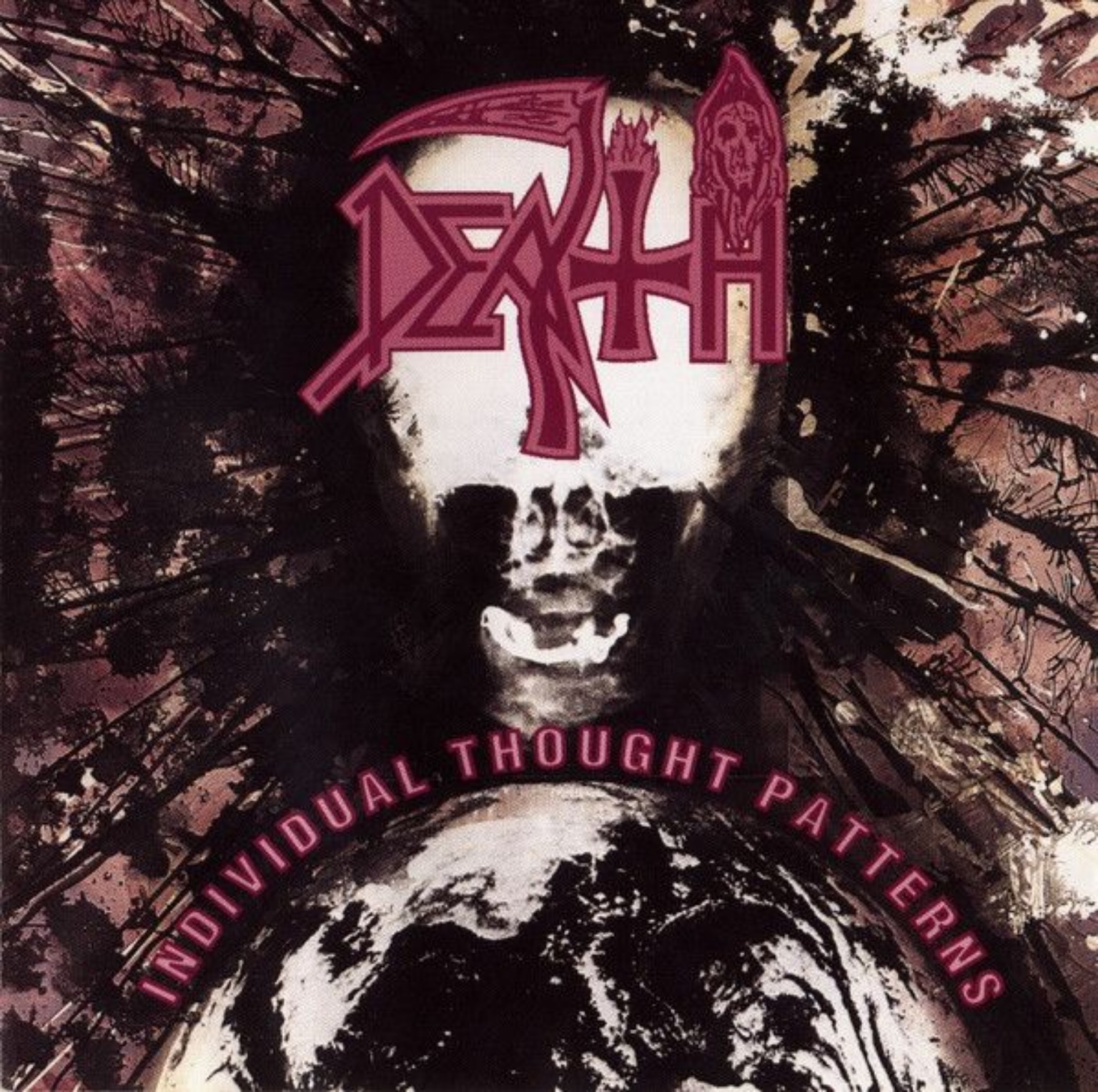
Cover artwork: René Miville
Album details
Tracklist · original ten-track album
- 01.Overactive Imagination3:29
- 02.In Human Form3:56
- 03.Jealousy3:40
- 04.Trapped In A Corner4:13
- 05.Nothing Is Everything3:18
- 06.Mentally Blind4:47
- 07.Individual Thought Patterns4:00
- 08.Destiny4:05
- 09.Out Of Touch4:21
- 10.The Philosopher4:10
Total playing time: 40:05 (original ten-track edition)
Band members
Chuck Schuldiner — vocals, guitar
Gene Hoglan — drums
Steve DiGiorgio — bass guitar
Andy LaRocque — guest lead guitar
Recording & release
Original recording: Morrisound Recording, Tampa; Scott Burns – producer and engineer. Cover art: René Miville.
Physical editions – purchase options
Album release product pages
Original release: 1993 (US: Relativity/Combat; Europe: Roadrunner). In 2011 Relapse issued a remixed, remastered expanded edition. Relapse LP reissue: April 12, 2024.
Band channels
Official channels and verified band profiles
Beyond the River and the Forest
The paths of the four musicians whose work would come together on the album Individual Thought Patterns did not begin in the same place. One of the earliest recollections in this story still belongs to a single family: Chuck Schuldiner's childhood, as remembered by his mother, Jane Schuldiner. In November 2006, Jane recalled that her son had been only a year old when the family moved to Florida. Around the towns of Central Florida, which would grow steadily more built-up in later decades, there were then still wooded stretches and sparsely settled land; children spent much of their time outdoors. Yet the most painful part of that recollection lies not in the landscape. The death of Frank, Chuck's older brother, brought a loss into the family, and afterward his parents sought to give their son something new to occupy him by giving him an acoustic guitar. In this memory, the instrument does not herald the fame that lay ahead. Its meaning is both simpler and more profound: it remained a tangible witness to the care of a grieving family. Behind those Florida childhood years lay the slowly changing world of Orlando and Altamonte Springs; another road, leading toward the recordings still to come, would end in Tampa, at the Morrisound studio. Steve DiGiorgio's school friendships in California and Andy LaRocque's musical connections in Northern Europe were taking shape far away, under quite different circumstances. Years would pass before the title of a single record joined these separate stories.
Long before Death came into being, the region where those later guitar rehearsals would take place had already faced the difficulty of moving people and goods from place to place. For a long time in Central Florida, roads determined the fortunes of settlements. A place could rise above its neighbors if officials, merchandise and travelers could get there; a community left outside the traffic had to find another way of holding its place. Toward the end of 1856, the settlement around Lake Eola was chosen as the county seat of Orange County; the name and site of the courthouse acquired a more settled form the following year. Administration brought the affairs of the surrounding district with it, but it was the arrival of the railroad from the north in 1880 that transformed the city's economic prospects. Citrus growers and cattle traders could reach new markets, while hotels and shops sprang up beside the tracks to serve the passengers. The city center shifted westward. With the railroad, the markets, the jobs and the centers of gravity of everyday city life moved as well. Many decades later, it would be letters and repeatedly copied cassettes, rather than the twin rails, that connected the young musicians of the region; but at this point in the city's earlier history, the plantations' crisis still lay ahead. Then the freeze of the winter of 1894–1895 destroyed a crop that could not be restored by a single more favorable spring. The fruit trees themselves died; they had to be replanted, and then tended for many years before they would bear fruit again. But waiting came at a price. Those without sufficient reserves could lose their land, and smaller holdings passed into the hands of larger operations. Thus the memory of a brief spell of freezing weather endured far longer in altered patterns of ownership and the forced reorganization of people's livelihoods.
After the age of the citrus groves, the Second World War brought another kind of working life to the Orlando area. A military airfield, war production and training drew the region into the demands of the conflict. When the war ended, the military presence did not vanish without a trace: residential neighborhoods grew up around it. From the second half of the 1950s, the missile-industry plant of the Glenn L. Martin Company and jobs connected with space research called for skills that the world of the citrus groves could not, on its own, have given the next generation. In the same region where replanting trees had once meant investing years of work in the future, industrial and technical expertise now offered a livelihood. Nor had that growth yet found its final direction. When Walt Disney World opened in 1971, the region prepared once again for different work and different kinds of arrivals. Alongside the visitors came new residents looking for employment; hotels, housing developments, roads and services multiplied where agricultural land had stood. Every new workplace also brought the need for homes and transport, so prosperity increased the difficulties of housing and daily travel as well. The region once shaped by railroads and plantations had been reshaped first by war work and technology, then by tourism. One later story arising from that transformation, on an altogether different scale, began in 1983, when the name Mantas appeared.
In this increasingly built-up part of Central Florida, Jane Schuldiner's family memories lead us north of Orlando, to Altamonte Springs. One early landmark in the town's history of Euro-American settlement was the arrival of Washington Kilmer in 1870. Later, the Altamonte Land, Hotel and Navigation Company placed its hopes for growth in a combination of land, lodging and transport. After these commercial beginnings, the inhabitants voted to incorporate as a town on November 11, 1920. That framework of local government survived while Central Florida grew more densely developed around it over the following decades. In the town's history, businesses organized land, hotels and roads. Yet the music that would lead toward the story of Death was first preserved not by a town office or a public building: rehearsals took place in the Schuldiner family's garage. At that tiny point within an ever-expanding region, making music together required only a place to play and the determination to keep working.
The first instrument still belonged to a family memory. Later, in the underground, the guitar would be joined by a tape recorder and a cassette that could be sent through the mail. A guitar phrase became a recording. That recording needed an address, an envelope and an acquaintance willing to carry it further. A cassette tape small enough to fit into an envelope could leave behind the walls within which the music had been made. A rehearsal room had one fixed address; copies of the cassette could find ever more recipients. It might hold a song with a rough, rudimentary sound or a succession of ideas from a single musician; one copy could lead to another, and to another acquaintance. In the underground, music passed from hand to hand, and news of a musician's work traveled farther before the musician did.
The Californian path begins
The oldest route of transport in Antioch was the San Joaquin River. In the 1850s, merchandise traveled by water to distant markets, and the riverbank offered settlers both a place to live and the means to make a living. The community established on September 16, 1850, chose the name Antioch on July 4 of the following year. Houses, trades and common concerns accumulated until, in February 1872, a municipal government was formed to administer them. Brickmaking, mining, smelting and pottery joined the transportation trades; from 1889 there was a paper mill as well, and the railroad carried freight onward alongside the river. Each generation found different work to sustain the people who came. More than a century after the first settlers, it was in this same town that schoolboy friendships between musicians gave rise to Sadus. Seen from DiGiorgio's path, this is where the separate journey that would eventually lead to the Florida sessions began.
Steve DiGiorgio and Jon Allen were already playing together as students. Friendship gave the first shared notes their occasion; but the original songs they went on to write with the other future members of Sadus gradually demanded more than simply spending time together. Practice and the search for musical ideas forged a common musical language, one that found wider scope in performance opportunities in California's larger cities. Looking back in December 2006, DiGiorgio did not recall one sudden moment of discovery, but the stages of that long journey. Cassettes carried the songs beyond their circle of friends. What had once been young people practicing together became, to listeners who did not know them, the sound of a band with an identity of its own. This work shaped DiGiorgio's playing before his bass could be heard on Death's recordings; by the time of the collaboration in Florida, he brought an individual instrumental voice patiently developed elsewhere.
While a band of friends in California was learning to speak in its own musical voice, a guitarist on the other side of the ocean was building upon a different past. Andy LaRocque began with the melodic qualities of 1970s hard rock; he would later name Michael Schenker and Randy Rhoads as enduring influences. The early bands in Gothenburg did not mark the end of his road. Through Mikkey Dee's connections, that road led to Copenhagen, where, in June 1985, listening to and playing “Dressed in White” demanded a very real decision from him and his prospective bandmates. He joined King Diamond's band; Metal Forces presented him in 1986 as a member of that lineup. The melodic lines he had been seeking, and the inner structure of solos conceived as musical statements in their own right, had now become part of his daily professional work. From the melodic hard rock of the 1970s, through bands in Gothenburg and an audition in Copenhagen, a career of international work took shape. When LaRocque recorded solos for Death in 1993, that long-developing melodic language had to find its place inside compositions born in Florida.
By the time of the 1993 recording sessions, the paths of musicians formed in different places led to Tampa. Another trade had once given Tampa an entire district. In the neighborhood founded by Vicente Martínez Ybor in 1886, homes and transport links were built alongside the cigar factories. Most of the workers came from Cuba; together with Italian and Spanish communities, they fashioned an environment in which work and family life were closely connected. As the cigar industry declined from its former importance, the buildings remained and new uses had to be found for them. On June 2, 1988, the city designated Ybor City a redevelopment area, and on June 23 it adopted the plan: preserving old buildings and opening up new economic opportunities were parts of the same decision. The neighborhood's renewal as an entertainment district only came to the fore in the late 1990s; 1993 fell between the adoption of that plan and the subsequent transformation. In Tampa, where the memory of cigar-making remained, a recording studio had already earned an international name. It was in this city that the musicians heading for Morrisound would carry out their work.
From the school friendships of Antioch, Steve DiGiorgio brought the musical language he had developed with Sadus; between Gothenburg and Copenhagen, Andy LaRocque had continued to shape the melodic lines of another tradition. In Florida, Jane Schuldiner's family recollection led back to the guitar given to her son at a time of grief. Those stories did not converge in a single rehearsal room, nor on a studio day shared by every participant. They came together on separate recorded tracks in Florida in 1993. Yet in Schuldiner's story the beginning had already been there in 1983: Rick Rozz and Kam Lee beside him, three young musicians rehearsing together, searching for a name and a sound whose eventual form none of them could yet read from the cover of a finished album.
The Name That Outlived the Lineups
The story behind Death's name cannot be read from the cover of the band's 1987 debut album: by then, rehearsals, recordings and a change of name already lay behind them. Before any of that came the region itself, where houses, roads and inhabitants were steadily multiplying, and where three young musicians were trying to find a place and a sound of their own in a garage. Central Florida did not stand still to witness the birth of a new band. It was absorbed in changes of its own, and those changes were swift. At the time of the young musicians' rehearsals, Seminole County had a little over 209,000 inhabitants in 1983; the annual estimate one decade later put its population above 317,000. Behind the wooded, sparsely developed world of Jane Schuldiner's recollections, an increasingly populous residential landscape was gradually emerging. New homes and connections grew along the roads, but population figures did not create the music of Mantas. For that, there had to be three young people rehearsing, their instruments and the cassettes capable of reaching listeners far away. As the settlements expanded, the copies of their recordings carried the names Mantas and then Death onward, first among a few local acquaintances and later among listeners at a greater distance. The growth of the towns and the spread of the band's reputation followed different measures, but both belonged to the history of the same decade.
In 1983 it was still the name Mantas that united the work of Chuck Schuldiner, Rick Rozz and Kam Lee. There was no full-length album whose cover might make their names seem fixed for good, no record-label catalogue offering a ready-made chronology of events. There were rehearsals, and there had to be a cassette capable of carrying something of the extreme music they played together to people who had not been there. Two different accounts of the year of the Death by Metal demo have survived. The record label's chronology dates it to 1984, while Kam Lee recalled 1983 in a later account. Both dates remain side by side. Between them lies the continuity created by those three young musicians and the music they committed to tape. The recording that became a witness to Death's earliest history is, indeed, the very one whose year of origin the sources date differently.
First the cassettes bore the name Mantas, then Death. Yet between those two inscriptions, musical relationships had broken down, and responsibility for the music was beginning to shift. Schuldiner became a more firmly established centre of songwriting and vocals, while his relationships with the others underwent further tests. Florida could no longer hold every experiment leading toward the band in a single place. Opportunities in California followed, as did a brief period with Toronto's Slaughter, but neither road led to a simple and permanent arrival. When Slaughter's original members later recalled their meeting in 1986, they described a short spell of playing together, without a joint concert. The rehearsal room, then, did not become the beginning of a shared history onstage. These abandoned possibilities remained part of the road toward the record: the music taking shape would once more have to find companions among different musicians.
After so many rehearsals and copied cassettes, a professional recording studio proved a remarkable threshold for Chris Reifert. In an interview published in 2022, he remembered the recording of Scream Bloody Gore as his first such experience; he also recalled traveling to Los Angeles with Schuldiner while still a teenager. Until then, rehearsals, demos and recordings passed from person to person had been the principal means by which the music endured. Recording now became a distinct undertaking that could be repeated, and music once heard only by small circles found a lasting place in Death's story as an album in 1987. Reifert subsequently remained in California. Thus the first album both preserved the work they had shared and revealed that the musicians' roads might diverge again once that work had taken shape.
When Leprosy appeared in 1988, the names beside Schuldiner's on the cover were no longer those of the musicians heard on the first album. Yet the sequence of personnel changes did not extinguish what listeners had begun to recognize in the earlier recordings as Death's own sound. Song ideas unfolded behind the weight of the guitars; Don Kaye would later draw attention to precisely those early beginnings that reached beyond sheer musical force. At the time of Leprosy, no one could know which musicians would join him on Spiritual Healing and then Human. Listening to those later two albums, however, makes the peculiar continuity linking three different lineups easier to hear: the writer remains the same, those playing around him change, and with every change the songs face new demands. What had appeared on Leprosy as a tension between heaviness and recognizable melody would later come to shape the very relationship between independent instrumental lines. The 1988 album was therefore more than a second date in a discography. It preserved earlier musical decisions with which every new participant had to reckon.
After Human
On Spiritual Healing in 1990, James Murphy's guitar was heard alongside Schuldiner's compositions. But the following year's Human documented yet another way of playing together: Paul Masvidal, Sean Reinert and Steve DiGiorgio brought considerably more than three new names to the recordings. Masvidal and Reinert's practiced understanding already created a shared sense of rhythm, into which the more independent movement of DiGiorgio's bass traced another line. With the playing of these new colleagues, the space between instruments was rearranged: at times their parts supported one another, at others they formed counterpoints. In the musicians' anniversary recollections of 2021, the rhythmic ideas of Human therefore emerged as the product of work shaped together. The memory of that experience remained present on the road toward the fifth album. Masvidal's connection with Schuldiner, in his own recollection from 2020, reached further back: he recalled an invitation to perform in Mexico City in 1989. Their work together on Human thus followed an earlier point of contact. The concert invitation and the album of 1991 were separate stages on a musician's path that would later branch toward Death and Cynic.
After Human, Schuldiner found himself facing two tasks at once. He had to keep writing Death's music while disputes over earlier work together continued to make themselves heard in public. Again and again, he was called upon to speak about performances that had fallen through and disagreements in the band's past. In a Heavy Rock interview in January 1992, he explained the concert situation in terms of the burden of leadership and exhaustion. A month later, speaking to Metal Shock, conflicts involving the band's name and former members came more sharply to the fore. These were not identical stories repeated beneath different headlines. One emphasized the pressures that had to be explained; the other, judgments about the separations. Schuldiner acknowledged mistakes even as he defended certain decisions. In these statements from 1992, he was the one defending and weighing his own choices; the accounts of former colleagues survived in other testimonies. As the material for the next album developed, the story of those older relationships was still being shaped in public. The route to the songs therefore led through musical work, while the route to the past led through the recollections of different people whose accounts did not necessarily coincide.
The old disagreements did not assume the same shape in everyone's memory. Kelly Shaefer, defending Atheist's technical, jazz-influenced direction, spoke of the ways in which his approach differed from Schuldiner's; he also returned to an earlier personal disagreement and later reported that it had been resolved. Steve DiGiorgio, speaking of that same creative center in Death, remembered friendship and the freedom he had been given to develop ideas of his own. In Shaefer's words, questions of who had done what first in the genre and the former dispute were prominent; in DiGiorgio's, it was the trust of shared work. Both experiences belong to Death's history separately, for they carry traces of different people and different working relationships. The next album could not retrospectively settle those memories. Instead, it set a new task before musicians who now had to create a recording together out of their differing pasts.
The echoes of old conflicts had not yet died away, but the next songs were beginning to take shape. On tour with Human, Schuldiner spoke not only of the past; he also tried to put into words the music ahead of him. On October 20, 1991, he spoke to Frank Stöver about the need to rehearse and rejected the mere repetition of earlier success. In January, answering Heavy Rock, he emphasized that an aggressive musical attack and melody could coexist; nor did he conceal his interest in Queensrÿche and Crimson Glory. The issue went beyond redrawing the rigid boundaries of death metal. It was a songwriter's problem: how might the same force be expressed in different proportions? The next album was still unfinished, yet it was becoming clear that alongside the new guitar parts, the rhythms, bass and melodies would also be asked to perform different tasks.
Schuldiner did not describe his beginnings as a disciple of a single school of music. Among his earliest guitar influences he named Kiss and Ace Frehley. His first encounters with more forceful music involved Venom, Anvil and Mercyful Fate; in later recollections he also mentioned Hellhammer and Raven. These names did not represent the inheritance of one closed musical style. They opened different paths in guitar playing and songwriting before the young musician. Nothing in that musical past meant that Death had to recreate the same demo-era sound forever. By the time he spoke about making the fifth album, sheer speed and heaviness were no longer enough for him. A song had to gain new room to move without losing everything that connected it to its origins.
At the European stops of the Human tour, it was still the songs being played onstage that joined the band to its audience when Rob Clymo met Schuldiner in December 1991. The report evoking the circumstances of the Berlin and Cologne concerts would not reach readers until February 1992; the statement it preserved, however, came from the end of the previous year. Schuldiner then estimated that he had already written roughly three-quarters of the music for the next album. Human's songs were still being played onstage when, by his account, most of the musical material for the next record was already written. The figure of three-quarters referred to music Schuldiner had composed; the finished recording and the shared work of the four musicians who would appear on its cover still lay ahead. Thus the days of the tour and the development of the next album did not follow one another like neatly separated chapters. They overlapped. Anyone who picked up the report in February 1992 could already see the outlines of a future being formed in December 1991.
By the time of the November 1992 Guitar World interview, Allen West and Richard Brunelle were also speaking at Morrisound. According to Schuldiner, most of the musical material for the next Death album had already been written. He envisaged longer, more complex and more atmospheric compositions, and mentioned the possibility of acoustic elements as well. He valued the clarity of Burns's recording work because it allowed densely packed details to be heard more distinctly. With West and Brunelle present, the discussion was still about the future of the next Death record. The authorial shape of the songs therefore preceded the combined sound of the four musicians eventually heard on the album: the instrumental contributions of those later collaborators were not yet part of the music being prepared.
Before 1993, Schuldiner did not speak of only one possible future. While he was shaping the complex structures of Death's new songs, he also kept alive the possibility of a separate project built around more melodic singing. That different musical ambition resurfaced in his statements before the 1993 release. In the Krgin interview, the new Death album was still a recording session planned for March at Morrisound: the record that would later appear remained, at that point, a task lying ahead of the musicians. Songs had already been written for the prospective recording; the separate plan centered on more melodic vocals, for the time being, continued to live in the interviews.
The Gathering of Workshops
When the recording of Death's fifth album brought the musicians to Morrisound in northern Tampa in 1993, more than a decade of work already lay behind the studio. The enterprise had begun in June 1981 with a portable, eight-track analogue system: the equipment had to travel to each recording site. By November, a permanent twenty-four-track recording facility was in operation. The change was not merely a matter of the number of machines. Musicians gained greater scope to record parts separately, in a permanent space where sessions could be planned. In November 1985, a building designed expressly for recording opened on 56th Street. Where the equipment had once travelled from place to place, fixed walls now accommodated not only the instruments but the work of an ever more varied company of musicians. The studio served many genres, yet it was death metal recordings that made its name particularly familiar on the international scene. Schuldiner and his fellow musicians arrived at a workshop where others before them had discovered how the passing sound of a rehearsal might be transformed into a recording that would endure.
The road to Morrisound began long before the musicians reached its door. Long before a session was booked, musicians on Florida's scene had encountered one another at concerts, rehearsal spaces and through correspondence. Behind the rehearsals and recordings lay a whole world of venues in Tampa and Miami, connections in Fort Lauderdale, meeting places such as Ruby's Pub, and cassettes travelling through the post. A musician rehearsed in his own city; a copy travelled to another, where a fanzine might write about it, or a new acquaintance might carry it on to fresh listeners. This movement was not set in motion by the attention of major labels, though their later interest created further opportunities. Through routes forged by personal effort, recordings once heard only locally acquired a name recognised well beyond Florida: Florida death metal. With growing success, however, came another danger. What the earliest groups had fashioned as a sound of their own could be heard by others as a model to follow. Innovation could harden into habit, and surprise, little by little, into expectation. One of the questions at stake in 1993 was therefore not simply how many new albums would appear, but whether the repeated conventions of the genre still left room for another, unfamiliar voice.
Across the ocean, in Stockholm, Tomas Skogsberg and the bands that came to Sunlight were shaping a harsher, deeper guitar sound of their own. Neither a distortion pedal nor a tape recorder could replace the work the musicians did together. The choice of instrument and recording method took on a recognizable character through the decisions of those who shared the work. At the Gates recorded their 1993 album at Sunlight as well, bringing musicians from Gothenburg and the Stockholm studio into a single undertaking. Their recording journey led from Gothenburg to Stockholm while other bands were at work in Tampa. Sunlight and the Florida studios employed different equipment and different performers to shape the sound of extreme music. Albums made within the same era thus carried forward the achievements of several distinct workshops.
In Greg Seymour's recollections, the struggle began before the recording of any album: they first had to find time to rehearse at all. From 1985 onward, he and Jon Schaffer built Purgatory in the Tampa Bay area under difficult circumstances. In 2019 Seymour recalled the competing demands of earning a living and finding hours when they could play together. Songs had to be written and made to work in the hands of the group before their recording could even be contemplated. On that path, time set aside for rehearsal proved as indispensable as the studio would later be.
Rehearsal rooms and stages
Once musicians could play together, another condition arose: where could they stand before an audience? Around 924 Gilman in Berkeley, operating since 1986, an unusual answer took shape. Volunteers maintained the nonprofit performance space, and those involved organized the shows themselves. What time for communal rehearsals meant to Purgatory in Florida was complemented elsewhere by the labour of creating a stage. These were not two stages in the career of the same musicians, but two distinct ways of making it possible for music to reach anyone at all. And beyond the venue doors there remained the task of reaching listeners further away.
If music was to travel to distant towns, the sound of a concert could not remain the exclusive possession of those present. In Earache's early network, fanzines and flexi-discs carried word of new music alongside cassettes; the catalogues of Roadrunner and Britain's Peaceville were already making connections across national borders. There was no single route from the work of a Florida rehearsal room to a faraway listener. Someone had to record the songs, copy them, announce them, release them or pass them along. These different labours of rehearsal, performance and distribution sustained a wider underground public in which personal acquaintance was not required for every new connection. Through this network, Florida's clubs and postal addresses, and the relationships formed around Death, could become part of a larger musical world.
As Florida recordings multiplied, the genre's old certainties seemed less and less sufficient. The question was no longer solely how far the heaviness of a guitar or the force of the drums could be pushed, but also how many new musical ideas a song could bear without losing its own face. No single formula answered that question in every studio. On their 1990 album The Key, Nocturnus had already expanded the audible world with keyboards and guitar figures built around unusual relationships between scales. Patrick Mameli recalled a different opening during Pestilence's Spheres period in 2013: in his account, friendships with musicians from Cynic and Atheist had led them towards an interest in jazz fusion. New harmonic and instrumental possibilities entered their orbit through personal connections. Yet Mameli did not see a solution in an endless proliferation of riffs; he defended song structures that listeners could remember. The value of a new possibility could depend, in other words, on whether the composition remained recognizable as a whole. Nocturnus's keyboards and Pestilence's turn towards jazz fusion had not come down the same path. As Death's fifth album took shape, it had to find its own order at a time when these differing approaches to composition already coexisted.
As instrumental possibilities multiplied, an older question became sharper: who had been first to find these new paths? Kelly Shaefer defended the pioneering place of Atheist's early experiments with technical and jazz-inflected music. Gene Hoglan later also acknowledged the importance of Watchtower, Mekong Delta, Atheist and Possessed. In the distinct workshops of these groups, greater rhythmic complexity and the widening of traditional song forms were not achieved by identical routes. The innovations of technical death metal were enriched by these separate trajectories as well. Schuldiner and his companions worked in a musical environment where innovations were already answering one another, sometimes arguing in the music press about who had arrived at particular solutions first. Anders Björler later connected the dense structures of early At the Gates in 1992–1993 with the number of ideas the band wanted to present; they subsequently turned towards more conventional song forms. The relationship between individual details and the complete composition was thus a problem encountered in the Swedish workshop too.
Hurricane Andrew left its mark on more than Florida's history in 1992: it also interrupted Cynic's route to making a record. Paul Masvidal later described how the disruption affected their work. The following year, Focus was being made at Morrisound, and Jason Gobel's recollections emphasized Scott Burns's intense involvement. Beneath the name of a single studio, the histories of two different periods met: in one, work was interrupted; in the other, recording moved towards completion. For the former Human musicians whose path continued in Cynic, September 14, 1993 marked a new, precisely datable milestone: Roadrunner's release of Focus. Between the hurricane's interruption in 1992 and the following year's album lay months of work, remembered by the participants at different times.
There was a long road from anonymous copies of cassettes to the offices of record companies. By the spring of 1993, however, the once narrower underground had begun to unsettle the ordinary calculations of the music business. More and more bands wanted to release records, and labels had to decide which voices among the many to bring to a wider public. WATT's April survey offered no single verdict on the growth. Monte Conner weighed the number of bands being signed and the competition between releases; Digby Pearson defended the principles behind his own label's choices; Scott Burns addressed the increasingly similar sounds and the rapid changes in critical opinion. The same expansion presented different problems to the person signing bands, the person selecting albums to release and the person shaping their sound in the studio. Death's new material was approaching the public amid these arguments, yet even its expected arrival date did not remain fixed in the contemporary press. WATT anticipated a May release; a label advertisement in the June 14, 1993, issue of HITS was already naming June 22 as the planned day for the American CD to reach shops. Whether the promise, revised on paper, became a reality depended on the work of distributors and record shops; the advertisement alone cannot establish the date on which every individual shop received its copies.
On the Other Side of the Cassette
In 2025 Gene Hoglan recalled that the ties holding Dark Angel's members together had gradually loosened by 1992. After the 1991 album and the concerts, the following year brought the band a different kind of pressure. Death's 1994 newsletter condensed that transition into a single event: Ron Rinehart left Dark Angel in September 1992. Rather than seek a new singer, Hoglan himself was already preparing for other work. It was against this background that Chuck Schuldiner approached Hoglan. The drummer for the forthcoming Death album was not, then, recruited into an already established touring lineup: the invitation came as another band's story was drawing to a close.
The surviving accounts do not agree on a single date for the change. In 2016 Hoglan placed his joining in the late summer of 1992. Speaking in 1995, Schuldiner said that a drummer who was now available did not need to undergo a formal audition. Initially the invitation concerned recording the album; they discussed concerts later. Hoglan also found a division of labour that freed him from the burdens of organizing a band. Where in Dark Angel some of the organizational work and lyric writing had fallen to him, in Death he could attend primarily to the problems of his own instrument. Yet that freedom did not mean simply accompanying completed songs. He had to find a place for the drums within guitar music whose composer wanted both variety and a distinctive ordering of accents.
The invitation had roots older than this latest decision between bands. Hoglan recalled corresponding with Schuldiner as far back as the Mantas period: letters and cassettes addressed to one another in the underground had connected them long before they worked together. Behind the approach that followed Dark Angel, then, was a relationship established in the days of Mantas. That longstanding connection became a musical task when Hoglan had to devise new drum parts for guitar material that had already been written.
What first reached Gene Hoglan was not a full-band recording, but the sound of guitars. In a recollection from 2010, the drummer described guitar tracks Schuldiner had overdubbed using two cassette recorders. He received roughly ten songs' worth of material. The riffs were already there on tape, but many of the rhythmic decisions that would accompany them remained open. It was here that what might seem from outside like mere accompaniment became genuine collaboration. A guitar figure does not unequivocally dictate which accents the drums must reinforce, or where they might place an independent counterpoint. Hoglan had to understand the order of the material already composed if he was to think freely within it. The cassette both set limits and opened possibilities. It carried Schuldiner's compositions, but not yet the intricate rhythmic fabric familiar from the finished record. During the brief preparation period, the final drum accents emerged from this work of building one part upon another.
Rhythm on the guitar tape
Hoglan did not want to understand Schuldiner's musical figures solely from behind the drums. In a recollection from 2017 he said he also followed the riffs on guitar, and that they showed one another where the accents lay as they searched for them. He also proposed moving certain passages into a lower register. He weighed the idea of a lower register, and the riffs he tried out on guitar, against the placement of his drum accents. The songwriting credit remained Schuldiner's; Hoglan's account nevertheless reveals how painstakingly they worked out the rhythmic relationship between riff and drum together.
Gene Hoglan was interested in more than the speed of thundering bass drums: hands, feet and cymbals could move in different directions before their accents met once more. In recollections he mentioned the playing of Steve Gadd, Neil Peart and Sean Reinert; Gadd's music with Al Di Meola was an especially important memory. He was not seeking a single rhythmic formula in those examples. In later conversations, he might turn to the six-eight bembé, or to a shuffle-like pulse built around paradiddles. In connection with Individual Thought Patterns he emphasized Gadd's influence, while also mentioning Deen Castronovo when discussing the later Symbolic. Faced with Schuldiner's guitar cassette, he could therefore attend to the turns within each riff: when should the drums follow the guitar, and when could they answer with a different accent? The result was not a contest between independent parts, but a song in which different movements were joined together again. The word 'technical' reveals little of the many small decisions that brought about that meeting.
Sean Reinert's drumming on Human had been an important inspiration to Hoglan, but the guitar cassette now in his hands did not call for a copy of another drummer's solutions. The songs were more melodic than he had expected, and an independent rhythmic tension had to emerge in them in a short time. In 1995 Hoglan spoke of learning the material and working in the studio as a period of roughly three weeks. In later memories, he applied those three weeks more specifically to the preparation; in 2010 he estimated that the actual recording of the drums took approximately three or four days. The estimates given in different years cannot be assembled into a reliable day-by-day work log, but they mark different boundaries of the same concentrated enterprise. In that short span, he made the rhythms of roughly ten previously written songs his own: he drew on the inspiration he had taken from Reinert not to repeat Human, but to respond to Schuldiner's different guitar material.
Alongside the drums finding their place among the guitar riffs, DiGiorgio's bass demanded room to move on its own terms, though not in the same way. Looking back on his friendship with Schuldiner, he later described a bandleader who did not rein in adventurous bass ideas merely because they threatened to venture too far. The real question was where and when they should be heard. When a bass line moving in counterpoint clashed with a particular harmony in the guitar, Schuldiner might suggest moving the passage elsewhere. The idea could survive; they would find another place for it within the song. The album's distinctive sound was thus the outcome not only of instrumental ideas, but of the adjustments made between them.
The freedom between instruments was apparent in more than the independent motion of their parts. The bass guitar itself was different in DiGiorgio's hands from the one heard on Human: two instruments offered two different kinds of expression in the work of the same musician. On Human he had played the fretted, 1981 Rickenbacker he later identified; for the 1993 sessions he brought a fretless bass he had built himself. It was not the first time he had picked it up as an experiment: he had already played it on Sadus and Autopsy recordings. Death's songs therefore encountered an instrumental language that had already taken shape. On a fretless instrument, the path from one note to another can be traced differently, but that does not mean the bassist was free to separate himself from the guitar at every moment. The sound developed earlier now had to be brought into accord with Death's guitar and drum parts. Contemporary critics noticed the mobility of the bass, sometimes doing no more than suspecting that the instrument was fretless. The musician's later recollection supplied a precise material explanation for something that listeners at the time could, at most, describe as a feature of the sound.
The Time Between Four Names
Andy LaRocque's invitation unquestionably brought him to the Florida studio, but the participants remembered the personal connections that led there in different ways. In 2008, LaRocque named Monte Conner of Roadrunner: it was through him that he was asked whether he would play as a guest on a Death album, while King Diamond's schedule at the time made the journey possible. In 1995, Schuldiner spoke of his unsuccessful search for a permanent guitarist, and then of contacting LaRocque, a man he did not personally know at that time, by telephone, sending him a cassette and asking him to play solos. The label's involvement and the direct telephone call may describe different moments; the disagreement runs deeper, however, over the first meeting in person. In 2015, the guitarist tentatively placed an earlier encounter around 1989; in 2023 he linked their acquaintance to King Diamond performances in Florida. Schuldiner's 1995 memory, by contrast, still described LaRocque as a stranger. The surviving recollections do not allow us to assign a reliable date to their first personal meeting. What is certain is that the work of a guitarist already well established in another band eventually became part of Death's recording.
For LaRocque, the invitation meant a telephone call and a cassette before it meant a brief guest engagement in Florida. A recollection given in 2026 dated the first call from the label to 1992 and the journey to February or early March 1993. Marks indicating the starting and ending points on the cassette showed where the solos belonged: the framework of each composition was ready, but he had to bring his own melodic phrasing into it. The guitarist, who was working with King Diamond, agreed to record guest solos; he did not thereby begin permanent membership of Death. He later remembered a stay of roughly ten days on one occasion and around two weeks on another; the difference between these approximate durations remains. Nor can the five or six recordings he mentioned in 2026 be made identical to the four songs Schuldiner named at the time. This brief guest engagement belonged to the longer preparation of the album; it did not coincide with the presence of every other instrumentalist. Instrumental parts heard side by side on the finished record could have come from successive sessions. After the Florida visit, the personal connection endured: in his 2008 recollection LaRocque remembered New Year's telephone calls that kept him in touch with Schuldiner. Thus the recorded solos were accompanied by a later memory of their continued contact.
In LaRocque's telling, Hoglan left the studio one day before he arrived. The drummer had already completed his part when the visiting guitarist's work on the solos began; they did not meet at Morrisound. In 2024, Hoglan placed even their first meeting in person much later, in 2013. Behind the four names printed side by side in the booklet, then, the musicians had not all spent the recording period together in one room. Yet listeners receive the parts as one musical present: on the finished album, the response of a solo to a drum accent gives no hint of the days that separated the work.
The participants themselves drew the boundaries of the guest's work differently in their memories. In September 1993, Chuck Schuldiner credited LaRocque not only with solos on four songs but also with doubling certain rhythm-guitar tracks. In 2020, the guest guitarist spoke exclusively of solos: he remembered recording no rhythm guitar. Twenty-seven years separated the two accounts. The four guest solos survive on the recording and in its booklet, but the booklet cannot provide a complete track-by-track session log that would settle the matter of the rhythm guitar. Neither testimony, therefore, displaces the other from beside the recorded music. In the participants' accounts this detail of the work remains preserved in two different forms.
The tapes at Morrisound
Scott Burns had to make room for separately recorded parts within the limited number of tracks available on analogue tape. Looking back on the general working practices of the early Florida studios, he recalled projects lasting seven to fourteen days and working days of fourteen to eighteen hours: time imposed limits no less than tape. Death's separate guitar, bass and drum parts came to stand alongside one another within that recordable space. The original credit names Burns and Schuldiner as co-producers; they had to shape audible songs out of those individual performances.
At one turn of the drums in Jealousy, collaboration ceased to be merely a general principle of musicianship and acquired the weight of a single rhythmic choice. That request during the session reveals how the album's dense sound demanded restraint as well as virtuosity. According to Hoglan's recollection in 2019, Burns asked him for a simpler rhythmic pattern. A number of virtuoso solutions may have been open to the drummer, but the recording ultimately captured one particular version: the simplification served the proportions of the song. Amid the dense movements of guitar, bass and drums, the achievement of each instrument had to be measured against the others. The recollection of the exchange about Jealousy preserves this decision, not a complete record of every day in the studio.
The origin of one of the album's more unusual sounds is not to be sought among the usual components of a drum kit. Hoglan used a copper ship's propeller; the band's newsletter connected it with the designation 'prop' in the booklet. When he recalled the instrument in 2010, he named the chorus of Overactive Imagination and the opening of The Philosopher. Even the documents differed over an object this distinctive: the newsletter gave its weight as fifteen pounds, while the interview said ten. Its place in the songs has been preserved, but the accounts do not establish its exact weight. In both tellings, the copper object added to the drum kit served the search for a particular timbre; the memories that associate it with the chorus of Overactive Imagination and the entrance of The Philosopher also give it a place within the music.
An earlier home for the band's rehearsals had been the Schuldiner family's garage in Altamonte Springs, as the September 1993 report in Rox called it. Between the wooded surroundings remembered from childhood and the more densely settled Central Florida of later years, that family room still offered a starting point on a human scale. The album, however, was recorded at Morrisound in northern Tampa, where the different instruments were not worked on simultaneously. Rox put the entire studio process at approximately five weeks; Hoglan recalled a shorter period in connection with his own task. The durations measure different things: one the album as a whole, the other the drummer's participation. With no precise daily schedule surviving, it is impossible to force the participants' work into an authentic retrospective timetable. Over the shared process estimated at five weeks, the parts took their final form one after another until all ten songs had been recorded.
Schuldiner spoke to Guitar School of the return of groove: after complex passages, it could give a listener a renewed point of orientation within a song. Since Human, he had been looking for a balance in which different moods and structural sections could coexist. He measured each succeeding turn against the one before it, guiding the melody towards its eventual return as well. When the completed recording of Individual Thought Patterns reached listeners, those compositional ideas met differing expectations. For some, the groove bound the excursions together; for others, it proved insufficient to do so.
A Face Above the World
René Miville's image gave a face to the recording that had come into being. On the cover, a pale, skull-like head rises above the globe. Broken black lines run around it, separated by brownish-pink and off-white expanses. At the top, the burgundy Death emblem, and below it the curved line of the title, hold the image together. The lines crowd around the head rising above the world in such a way that the eye perceives both a figure and details falling apart: the same opposition that the music shapes by its own means. The title, which names individual thought patterns, thus arches across an image whose restless lines resist confining the music to any single symbol.
With the title of the new album, the old emblem of death acquired a different question. The finiteness of human life now appeared alongside the multiplicity of individual thoughts. The title directed attention not only towards mortality, but towards patterns formed in the human mind. Nor does the world depicted in the image promise one certain explanation: the tension between personal judgment and the human environment shared by all can be felt together. A similar change can be observed in the lyrics. Increasingly, the aggressive musical voice spoke of human behaviour, trust and people's relationships with one another. The interpretation of body, thought and the surrounding world in the image therefore enters into conversation with the album's lyrics; it is not presented as a single, proven interpretation endorsed by the artist.
The painting also lived on in the physical release listeners could hold. The burgundy binding the cover together returned on the CD and credit pages, while photographs of the musicians took the place of the imagined figure inside. In this progression, the image became the work of several people. René Miville's artwork was brought together through David Bett's art direction, Kathy Milone's design and Maria Abril's label coordination. The artwork was therefore more than a single cover image: it became a recurring visual language for the release. Yet the inner pages did not allow the different musicians behind the sound to merge anonymously either. Beside the title track appeared the words 'SOLO: CHUCK'; beside Destiny, 'SOLO: ANDY'. Two short credits mark the separate hands and separate work behind guitar lines heard as parts of one whole.
Behind those two brief booklet credits lay distinct musical journeys. Chuck Schuldiner wrote the music and lyrics for all ten songs, played guitar and sang on the record. Andy LaRocque contributed guest guitar solos; Steve DiGiorgio's bass and Gene Hoglan's drums brought their own voices to the finished recording. Beside Hoglan's name the booklet also preserved the unusual word 'prop', a material reminder of the curious percussion instrument mentioned earlier. These sounds were not captured in a single collective performance; they were assembled from separate sessions at Morrisound. Recording and mixing took place at the same studio. Scott Burns carried out the engineering and shared production duties with Schuldiner. Behind the single face on the cover, then, stand the composer, the performers and the tangible tasks of all those who made the separately recorded parts into a work that could be heard together.
From the cover to the songs
After the cover, the lyrics bring not abstract forms but opposing kinds of human conduct to the fore. Death's own newsletter linked manipulation, envy and the exploitation of others to experiences in the music industry of which Schuldiner had also spoken in public. Each of the ten separate songs approaches the loss of trust, judgment and self-justification from a different position. The newsletter offered more detailed explanations from the band for five compositions; the rest stood alongside them through their lyrics and subsequent, differing interpretations. The ten songs are not ten episodes of a single narrative. Motifs of trust, injury and judgment connect them, just as the instruments' separate paths repeatedly come together as one music.
In September 1993, a journalist heard an echo of the biblical Book of Proverbs in the moral tone of Death's new lyrics. Schuldiner started from a different source. He identified experiences gained in the music industry and did not claim to have written his songs from a deep knowledge of the Bible. The difference between the two perspectives remained important: one interpreted the words already written; the other concerned the lyricist's own stated motive. In the same report, Schuldiner recalled the order of his work. The music came first; only afterwards did the singing and lyrics find their place within the structure that already existed. The anger born of personal abuses and human relationships did not therefore precede the songs: it found its voice within the form of the music as it was being made.
Answering WATT's questions in July, Schuldiner identified sincerity and independence as important achievements of the album. These were not abstract slogans in his words: he spoke of his distrust of managers, intermediaries and the press as a source of personal inspiration. In August's Metal Shock, his objection grew broader. He criticized the practice of hastily signing bands that sounded too much alike. He did not regard speed, evil or a recording contract, taken on their own, as the whole meaning of the genre. It was therefore no accident that the demand for musical independence could be heard alongside the personal grievances of the lyrics. Distrust of middlemen and criticism of hurriedly signed, similar-sounding bands returned to the same question: can a sound of one's own survive where success already has ready-made commercial patterns? Schuldiner's statements at the time did not resolve that tension. They made it more clearly visible.
Overactive Imagination opens the album with a story of one person's power over another. In the band's newsletter, the other's weakness becomes a tool: the manipulator builds power from what makes his companion vulnerable. From the beginning, the drums enter among the guitar figures with accents of their own, while underneath them the bass moves along a separate path. Several voices work around a single impulse. They follow and counterpoint one another, and in the momentum of the opening the ear must constantly choose which line to pursue. Yet favourable criticism at the time of release counted this song among the more immediately approachable pieces. It was easier to enter the album through it than through some of the later compositions. Reviews returned repeatedly to the solos and the force of the opening; successive listens disclosed further details behind turns that had become familiar. In a hostile critique of the progressive construction, however, that richness hardened into overdesign. The song that drew one listener further into its details lost its power to hold together at precisely that point for another.
The second track gives a human face to the destruction revealed in the opening. In the explanation of In Human Form, greed and malicious intent conceal themselves behind a human exterior: the visible form can hide what its wearer is capable of. The music presses on through changing rhythms and fresh turns, as though, after the opening song, it had to examine this familiar yet unknowable figure more closely. The second composition also added to the list of memorable tracks among those who welcomed the beginning of the album. They heard the force of the opener continuing, another reason to venture onward. Criticism that missed a unifying direction stumbled over that very continuation: its many turns remained interruptions to the listener. From there, it was no longer self-evident that each new section followed from the last. The lyrics questioned the intentions hidden behind the human exterior; the reception of the same track called into question the connection between its musical sections.
Rumours and personal injuries lead into Jealousy, bringing the wider story of destructive human conduct closer to its author. Schuldiner identified rumours spread about himself as one of the motives for the song. The newsletter explored envy of other people's abilities and inner gifts: something that cannot be taken away as one might steal an object, and yet arouses hostility towards the person who possesses it. The personal injury speaks anonymously in the composition. Much later, one listener's story linked this very song with a change in his affection for the album. The chorus and the independently moving bass helped him overcome his first resistance. What had previously seemed like forbidding instrumental precision became, through this entrance, the pleasure of listening again. One song was enough to open a path from that earlier resistance towards the entire record. Beside this personal story of the chorus, criticism of Jealousy also survived: a review that was highly favourable overall found here one indication of the album's unevenness. Even within an enthusiastic reception, the song did not receive the same share of praise from everyone.
Trapped in a Corner turns from injury towards resistance. In the newsletter's explanation, the humiliation of others goes so far as to break their dreams; the warning is addressed to the person who crosses that boundary. The song now raises its voice from the side of those who have suffered abuse. Its harsh address is followed by a melodic guitar solo emerging from the rhythmic foundation. Suddenly the music seems to open into a wider space, even as the anger of the lyrics remains tied to the same vulnerability. The voice resisting humiliation and the opening-out of the solo meet within a single composition. Listeners and reviewers would later return to this lead-guitar passage in particular. Trapped in a Corner remained among the successful tracks even in a review that could not come to terms with the construction of the record as a whole. A melody standing out from the album carried that far.
But the way to that point ran through the verses, and this journey won far from universal approval. The melodic climax might call back even a listener unconvinced by the organization of the preceding sections. Such a review preserved the brilliant detail on its own, as though the song as a whole could not rise with it. For a critic praising the bond between rhythmic foundation and melody, however, the unfolding was precisely what mattered: the earlier sections had prepared the way for what the guitar finally opened up. Even behind the praise for the solo there remained a difference between hearing it as an isolated summit and hearing it as the fulfilment of the entire composition.
What Must Still Be Heard After the Fifth Song
After the solo in Trapped in a Corner, the melodic chorus of Nothing Is Everything offers a different kind of return. Among the fifth track's continually changing themes, this melody becomes a point of orientation for the listener. Yet precisely what comes into dispute is whether it is enough to sustain the whole composition built around it. Between the verses and rhythmic turns, this return survived even in the memory of a critic who rejected much of the song. One particularly severe review praised almost nothing from the entire record except this song and Overactive Imagination; another placed Nothing Is Everything, taken as a whole, among the weaker tracks. Its memorable chorus did not nullify that latter objection. After themes that branch in many directions, the melody might sound like a homecoming, but it could just as well remain an isolated tune preserved in the middle of a composition the listener never accepted. A defender of the shorter form followed the song further. For this listener, brevity imposed a discipline in which ideas were measured against one another: each new turn had to find its place among the others before the song ended. In that compression, the sections leading to the chorus acquired their meaning together. What another critic valued only as an isolated fragment belonged, in this favourable reading, to a complete and tightly drawn structure.
In the chorus of Mentally Blind, even an almost imperceptible choice of timbre left its trace. In an interview dated to January 1994, Schuldiner spoke of a faint, synthesizer-like colour: a subtle difference audible amid the guitar riffs and drum changes moving around it. Yet by the time the recording had reached its listeners, the band was contending with more than questions of timbre. In the first issue of The Metal Crusade, under the appeal 'Support Music, Not Rumors', its members answered accusations in the press that they regarded as hostile; in the same issue, they thanked the journalists who supported them. The song's sound acquired its fixed form in the studio, while the printed newsletter took up the struggle against the stories circulating in public. The interview illuminated one decision made in the chorus; the appeal was written so that discussion of the music would not be exhausted by rumours.
To one admirer of Mentally Blind, the chorus exerted enough unifying force to draw the guitar riffs and the parts pursuing separate paths back towards it. Another reviewer felt that the recognizable melody failed to bind the surrounding sections closely enough. The dispute was not over whether the chorus existed, but over the inner order of the song as a whole. From here the journey leads to the title track, where the very name Individual Thought Patterns puts the question in the foreground: when does a multitude of independent ideas become a unified composition?
The words Individual Thought Patterns arc across the cover of the album, yet the seventh track must live not by the meaning of the image but by its own musical order. There was an assessment favourable to the record as a whole that nevertheless counted this particular piece among its less successful moments. A critic demanding greater coherence from the album also found an example here to support the complaint. The expansive title could not, by itself, settle the question of how the riffs and sections fitted together. While listeners named the entire album after individual thoughts, within the song itself they again sought the means by which differing instrumental decisions belonged together. One short line in the booklet, however, points more precisely to a particular detail than any general interpretation: it names the musician who plays the solo halfway through. In the corresponding entry for the following song, another musician's name appears.
'SOLO: CHUCK' — that is all the title track says. Turn the page to the next song and it reads 'SOLO: ANDY'. On Destiny, LaRocque takes the lead-guitar role; after Schuldiner's own solo comes one of the melodies recorded during the Florida guest engagement. These two terse lines place individual names in what sounds on the record like a continuous performance on guitar. The compositional journey of the songs goes on, but the hand playing the solo changes. The places marked in advance on the cassette and the brief work at Morrisound now return as part of the finished track: the booklet's credit preserves the guest guitarist's separate name behind the melody being heard.
Destiny opens more quietly, with an introduction described as acoustic. The dense texture briefly loosens its grip, the sounds take on new proportions before the layers once again multiply. The memory of that beginning remains through what follows: its later richness can be measured against the restraint from which it began. A review combining enthusiasm and reservation found this construction more successful than that of several other songs. For its author, the promise of a greater arc was fulfilled. Reviews that objected to uneven development, however, did not give equal weight to every step after the quiet entrance; a strongly dismissive critic retained only certain details of Destiny. Even so, these reservations cannot sever the song's development from its beginning. The larger form unfolding after the subdued first notes remains what both praise and resistance weighed in the balance.
Towards the closing tracks
In Out of Touch, attention turns again from instrumental proportions to violence between people. The interviewer for Metal Maniacs in 1993 sought the song's addressee in the increasing brutality of death metal; Cannibal Corpse was even raised as a possible target. Schuldiner's answer gave the lyrics a broader reach. He spoke of human behaviour, religious fanaticism and social aggression. The search for a rival within the genre remained in the question; the author pursued the theme as far as the destructive forces recognizable in human society. After the manipulation of the opening tracks and the personal injuries, aggression on a social scale thus found a place among the songs as well.
A personal addressee was also sought in The Philosopher. Interpretations after its release suspected a personal turn, a settling of accounts, a message addressed to a particular individual in the closing song. Schuldiner's contemporary reply did not confirm the suggested allusion. The author's own words placed a limit on the personal story, but the song's musical afterlife continued. One critic kept it among the album's successful moments, while a later reassessment found it less effective. The Philosopher brought the sequence of recorded tracks to an end, but not the debate over its personal target or its merits. By the time the closing song's title had become closely associated with Death's identity, the surviving reviews had already assigned it differing places within the record.
Early promotion singled out The Philosopher from the ten tracks, and later its video carried the song to a television audience. The piece that still occupied the final position on the record acquired a path of its own. Even a review sharply critical of the entire album acknowledged the opening riff; another objected to the simplification of its arrangement, while a third found it less enduring than the opening four songs. Meanwhile the beginning and the bass ending became powerful memories in their own right. DiGiorgio's playing preserves its own line among the farewell notes. The bass, which had so often taken a separate path alongside the guitar during the record, remains a recognizable voice at the very end. This distinctive farewell of the much-disputed closing song belongs to its story no less than the moving images that continued to live on television.
After the bass sounds its last notes, the shared time of the ten songs comes to an end. The renewed attention to the solo in Trapped in a Corner, the defence of the middle section of Mentally Blind and criticism of incomplete song forms belong to the history of later accounts: the 1993 booklet said nothing yet of those returns. In June, the finished Morrisound recording was carried onward by the work of printers, distributors, specialist publications and record shops. The completed parts now set off towards readers and listeners in countries where the musicians themselves did not have to arrive at the same time. What had come together as a single album in the studio over successive working days entered separate times once again in the hands of intermediaries: the advertisement arrived first, an article another time, a copy in a shop on yet another day. Expectation and encounter took over the story.
The Different Clocks of June
In the spring of 1993, news of new music still travelled through letters, telephone conversations, cassettes, fanzines and music magazines prepared and printed well ahead of release. For sound to overcome distance, it needed a physical object, and that object needed someone to pass it on. On April 30, CERN made specified parts of the original software for the World Wide Web available for free use; the decision opened a path towards a different kind of public life across networks. Paper and recordings entrusted to the post would coexist with the new possibility for a long time yet. Death's fifth album approached listeners through the older intermediaries of that same year: printed magazines timed their announcements to the arrival of the physical record, preparing the way for encounters in shops and at concerts over the following months.
In the world of record-shop counters and postal parcels in 1993, CDs and prerecorded cassettes were the more commonplace objects. The annual figures for net US manufacturers' shipments, published later by the RIAA, recorded 495.4 million CDs, 339.5 million prerecorded cassettes, and a combined 1.2 million LPs and EPs. Measured against the country's physical-format shipments, vinyl then occupied a far smaller place than it would in the later revival of the format. Independent labels, shops and mail-order connections serving smaller genres continued to work within that market of hundreds of millions of CDs and cassettes. The national figures convey the scale of physical music distribution; Death's new recording entered the same commercial world through its own, smaller distribution network.
Specialist magazines were already finding readers for the album before its advertised American retail date. On May 29, Britain's Music Week discussed Individual Thought Patterns under the Roadrunner name, describing it as a step forward from Human. On June 11, The Hard Report located the new album's strength in its more personal themes and in the work of the three musicians playing alongside Schuldiner; elsewhere in the same issue, the introduction of the album to radio and plans for a July tour also appeared. The printed judgment, a song chosen for radio and the approaching concerts thus prepared the reception of the new recording while listeners still awaited the appointed arrival of the American CD.
In the June 14 HITS advertisement, a Tuesday's date appeared beside the title The Philosopher as the expected date for the American CD: June 22, 1993. The overseas edition bore the Relativity catalogue number 88561-1168-2; its European counterpart carried Roadrunner RR 9079-2. The ten recordings set off along two commercial routes. The advertisement fixed a retail date for the American one; between the printed promise and a listener's actual encounter still stood the work of distributors and shops.
The days around release
On Sunday, June 20, the weather station at Tampa International Airport measured 17.5 millimetres of precipitation. Alongside the precision of that airport record, a date already living in print was approaching: the June 14 HITS advertisement promised Relativity's American Death CD for the following Tuesday, June 22. The Sunday measurement says nothing about what the musicians themselves experienced that day, but it preserves a day in the region where the album was made. On the following day, June 21, the shuttle Endeavour set off from Kennedy Space Center on mission STS-57, returning only on July 1. The spaceflight was already under way when the album's advertised release date arrived. Separate historical records preserved the space centre's event and the American record-release date; a single June week contained them both.
June 22, 1993 fell on a Tuesday. On that day, the station at Tampa International Airport recorded a minimum temperature of 23.3 degrees Celsius, a maximum of 31.7 degrees, and 0.00 inches of precipitation. After Sunday's rain, the Tuesday airport record showed none; in Relativity's advertisement, this was also the day on which Death's new album was due in American shops. A second death metal album received an American release date on the very same day: Morbid Angel's Covenant, through the Giant label; its British edition was associated with Earache. Relativity listed Death's CD under catalogue number 88561-1168-2. Morrisound had been an important workshop in the histories of both bands, but the recordings represented separate creative worlds and reached listeners through distinct labels and distribution routes. A shared calendar date did not mean a joint launch.
Two days later, on Thursday, June 24, the Tampa airport station recorded 16.8 millimetres of precipitation. In the measured series, then, a rainless Tuesday fell between two days of rain: exactly the day listed as the release date for both Death and Morbid Angel. That Thursday also figures in Nuclear Blast's release history as the day on which Indecent & Obscene, the second album by Sweden's Dismember, appeared. The music originating in Stockholm came from a different studio and label environment from the Florida recordings. Beside the American June 22 dates for Death and Morbid Angel thus stood June 24 for Dismember: three distinct albums from the expanding world of extreme metal, arriving on neighbouring dates. Audiences did not hear them at the same moment or in the same place. Countries, shops, distributors and magazines carried their music onward at different speeds. In later criticism it was not the nearness of their dates but the independent force of the works themselves that came to be weighed.
The contemporary reception
The days of arrival passed, but the debate surrounding the album had scarcely settled. What had been completed studio work for the musicians now became a musical question demanding answers from reviewers. No one writing in the press in 1993 could know what place time would ultimately assign to Death's fifth album; judgments had to be formed from freshly heard songs. Even around its release, the wealth of detail and the ability of the compositions to hold together were heard differently. A Dutch reviewer in July recognized extraordinary instrumental accomplishment, yet found four songs overcrowded. The Czech Metal Breath likewise noticed the virtuosity but missed the sense of surprise that had followed Human. Hungary's Rockinform praised the technical advance while also remarking on the difficulty of listening. These were not three echoes of the same reservation. One critique collided with the density of the construction; another measured the scale of the innovation against the preceding album; the third recorded the simultaneous experience of progress and difficult accessibility. The completed songs no longer changed, but the disagreement between listeners' standards had only begun.
Metal Maniacs' favourable verdict turned attention to a lineup whose members had arrived at Morrisound from different musical backgrounds. In that reading, the differences among the four performers did not tear the compositions apart: the more direct opening and the continuation requiring greater attention were successive possibilities. Less satisfied early critics argued from exactly the opposite direction. To them, the same density produced exhausting fragmentation rather than abundant variety. No one disputed that the music was full of turns; what differed was whether that richness carried the songs in one direction or put another obstacle before the listener with each new section. The distinction would become one of the most persistent critical questions of the decades that followed.
In the autumn, the Polish reception of the album showed how differently the same summer novelty could arrive in listeners' lives. An article in Głos Pomorza on September 29 explicitly treated the record as a later encounter and heard a great leap forward in the momentum of Overactive Imagination, Jealousy and Mentally Blind. In another Polish critical notice dated October 2–3, however, it was precisely the bass sound and the originality of Hoglan's drumming that became grounds for objection. The newspaper and author of the latter item have not been securely identified; its opinion survives more clearly than its exact place in the press. The recording that had crossed geographical distance thus gathered not a single verdict but differing kinds of attention. One Polish listener weighed the momentum of the songs, the other the originality of the instrumental solutions, and they drew different conclusions from the same music.
There was also a peculiar, long-silent witness to the reception in 1993. A German-language text by Ralf Henn was written on October 24 that year. It praised Death's movement towards a more melodic, technically intricate style and looked ahead to autumn concerts. Yet the manuscript was not published at the time. A later archive preserved it, and an associated catalogue record brought it back into view in 2022. An opinion formed in 1993 thus became part of the publicly accessible reception only decades later. The time of writing and the time of discovery diverged, as they have for so many underground documents whose first fate was not permanent preservation in a library or periodical.
The Same Songs, Different Hands
Parts recorded at Morrisound on separate days already sound together on the album. Yet no reel of finished tape could take the musicians' place on stage: people had to learn the intricate songs once again and perform them together. The four names on the record's cover did not mean that the same four musicians would stand side by side at every subsequent concert. In the studio, LaRocque could add his solos after the other tracks had been recorded; a live concert, by contrast, required every performer on the same evening. After the recording, LaRocque was asked to continue with the band, but he declined both membership and touring, citing family commitments and other musical plans. The solos that were unmistakably his on the album would have to be played by someone else on stage. For Death, therefore, the search for another guitarist became necessary just as the released work already existed in its final instrumental form.
Ralph Santolla did not first hear about the material being prepared in an office that arranged tours. As a member of Millennium, he was working in another room at Morrisound while Death recorded the album. According to his later account, Schuldiner showed him the songs during mixing, and Scott Burns was already mentioning a possible invitation to play concerts. Two separate undertakings thus came close to each other at the studio: the Death record nearing completion, and the need for a new guitarist to perform its recorded parts on stage. LaRocque's guest solos by then belonged to the album; Burns's next plan sought a guitarist for the finished music's life on stage.
Santolla's role in Death was not the same as LaRocque's role in the studio. LaRocque had participated in the recording of instrumental parts; Santolla had to take the completed songs onto the stage, first at American concerts and then in Europe. In his later recollections, learning the set and developing trust with his touring companions occupied a more important place than any sensational quarrel. When he left because of prospects connected to his own band, he understood it as a career decision, a departure without conflict. Death's 1994 newsletter recorded him as a participant in the American trips and European festivals. LaRocque's name remained attached to the recorded solos, while Santolla's became associated with the American dates and European festivals. After the album had been completed, the songs' further journey was also shaped by how much time the touring musicians could commit.
Craig Locicero entered the story in another fashion. Steve DiGiorgio telephoned him: Death needed a guitarist for its European tour. Because of plans and a demo recording with Forbidden, Locicero could not simply travel to Florida to rehearse. In his own recollection, Schuldiner eventually travelled to him in Oakland. There they went through the music on guitar, part by part, the songs that had sounded so dense on the record. One memory spoke of three days of learning, another of four, and a full day of rehearsal together also survived in the account. The two estimates need not be forced into a single date. What is certain is that within a few days the invited musician had to turn all that the recording presented as the simultaneous parts of several instruments into knowledge he could use on stage.
In rehearsals, Locicero began to distinguish the recording's dense textures from the individual riffs demonstrated on a guitar. Heard in full, Death's riffs had seemed almost impossibly complicated; the guitar movements shown by the other musicians proved learnable one part at a time. The music did not become simpler. What changed was how he learned to hear and play it. On the recording, the simultaneous bass, drums, voice and guitars place several layers of demand on the listener; in rehearsal, a single performer's line comes to the fore, only to be brought back into alignment with the entire band. Thus the parts heard together on the album became guitar playing that his own hands could follow. He then had to reconnect the line learned separately in rehearsal to the ensemble, so that the new live guitarist could move together with the other instruments on stage.
European performances followed the brief preparation. Locicero would later remember his work with Death's members as enjoyable and good on a human level. Those European shows remained, in his memory, an enjoyable experience marked by good personal relations. The touring guitarist now played before an audience the parts he had learned in rehearsals, while the studio album remained associated with work earlier completed by different musicians. The songs were held together by the same compositional order, but every performance required fresh collective playing on that particular day.
For Locicero, the European invitation did not arrive in an empty calendar. He accepted Death's tour with the agreement of his fellow members in Forbidden; from the beginning, therefore, the concerts also carried obligations to his own band. When the possibility of further American shows arose, he declined, unwilling to abandon that earlier commitment. After learning the songs, his obligations to the two bands now determined which journeys he would undertake: the guitarist became part of Schuldiner's music for a time, then returned to the work for which he had already assumed responsibility.
A new sound on stage
A recording preserves one performance of the songs; a concert places them under new conditions every time. In a July 1993 interview for Germany's Metal Hammer, Schuldiner told Robert Müller of earlier American shows prevented by the weather and evenings troubled by equipment. In the studio, details could be adjusted until the recording reached its definitive shape. A live performance also depended on the venue and on what was possible that day. Morrisound's professional connections appeared in this other kind of work as well: in the European leg Schuldiner recalled, Scott Burns personally helped shape the concert sound. Yet Schuldiner did not judge success solely by the completed technical result or by the number of copies sold. The response of a live audience gave him a more immediate answer as to what crossed the distance between stage and listeners. Death's journey continued after the studio with that experience, and later touring musicians preserved the labour of the concerts in stories of their own.
The participants' memories count the traces of touring differently from a concert itinerary printed in advance. Frank Harthoorn of Gorefest looked back on the American summer support tour of 1993; Kenn Nardi recalled a month-long European journey with Anacrusis, naming Craig Locicero among Death's members. The Hard Report's July plans for America listed Gorefest and Sacrifice alongside Death. The Hard Report was still announcing the July dates to come; Harthoorn and Nardi recalled journeys already made in America and Europe respectively. Two later recollections of touring therefore stand beside the original itinerary.
The advertised June 22 retail date of the American CD did not mark the beginning of the songs' life on stage. By July 1993, Schuldiner recalled having played four new songs at concerts before the record's release. He did not give their titles; no identifiable set list therefore survives to accompany the number four. Some members of the audience could already have encountered the new musical challenges while the arrival of the American CD bearing Relativity's catalogue number was still on the label's calendar. The paths of concert and recording separated: some songs were first presented through live collaboration before the definitive performance preserved on the shop-bought disc reached its own listeners.
Concert history also preserved a small yet revealing contradiction. Death's first newsletter advertised the Waldrock festival for June 3; two later concert archives recorded July 3. The agreement of the two retrospective entries makes July more likely, but the June listing remains a contemporary document: evidence of a plan published at the time. The album's summer journey cannot therefore be sealed here with a false precision. A difference of one month still stands between the printed announcement and the later concert registers.
The Philosopher could find a new audience not only in concert halls but also on a screen: a video was made for the song. John Klausner's crew filmed outdoor scenes near Rock Springs in Central Florida, followed by band footage inside a warehouse. According to Death's account from 1994, a violent storm interrupted the warehouse shoot and the site was temporarily closed until the storm passed. Maria and Suzanne were named as staff members from Relativity; their full names and the exact day of filming have not been established securely. After the outdoor shots, the crew had to wait for the storm to pass at the warehouse as well. Their work ultimately became a sequence of images that could carry the song to television audiences independently of the record.
The Philosopher no longer lived only among the album's ten songs. Its images reached television, and Death's newsletter spoke of showings on Headbangers Ball as events that had already taken place. It did not, however, name the exact date of the first broadcast. A different kind of testimony survives instead: decades later, one listener associated his own purchase of the album in 1993 with that very video. The recollection does not restore a lost broadcasting schedule, but it preserves the way one person could encounter the music. After the passing of cassettes and fanzines, printed reviews and concerts, the screen opened another path for a single song. The Philosopher did not change its place at the end of the album; on television, however, it became an entrance through which a listener might step into Death's world before getting to know any of the other nine tracks.
The Detail That Calls Us Back
Being placed between two masterpieces is not necessarily a blessing: listeners sometimes search the middle record for what they already know from the other two. Individual Thought Patterns followed Human by two years, and Symbolic appeared in 1995. Death's fifth album was thereafter placed ever more frequently between two works held in exceptionally high regard. Their proximity secured its historical place even as it sometimes drew attention away. Someone hearing the 1993 record retrospectively, with knowledge of the band's entire career, could now look back towards it from the vantage point of Symbolic as well. The music had not changed. Overactive Imagination had not grown faster; the turns within the middle songs had not become straighter; LaRocque's solos and the separate paths of DiGiorgio's bass were no different. Yet listeners heard them differently once they knew where the band's journey had led. The reputation of the neighbouring albums could therefore serve as a point of orientation, but it could also conceal what had come into being only on this fifth record. Some listeners treasured its abundance of detail; others sought an order they believed had been lost from the songs as a whole. Between those two kinds of attention began a long afterlife in which a single solo or bass run could, years later, cast the entire album in a different light.
Sometimes it was not the whole record that first returned from the memory of a later listener, but one guitar solo. In reassessments published by 2002, the melodic outburst in Trapped in a Corner was heard through the distance of the intervening years. One reviewer, placing it beside Overactive Imagination and Nothing Is Everything, heard an inner order holding together details that appeared restless. Another missed precisely that order in much of the album and found LaRocque's guest solos at times less at home within Death's sound. Yet even this critic did not deny the worth of Trapped in a Corner or The Philosopher. To one listener, the same guitar solo vindicated the construction of the complete song; to the other, it remained a memorable exception standing out from an unfavourable judgment of the album as a whole.
At times, Steve DiGiorgio's fretless bass veers away from a turn in the guitar line. By following the accents of the drums, it nevertheless stays within the same music, as though crossing by another path the landscape the riff had laid out. That freedom became part of the dispute revived during the reassessments of 2002: did the independent parts enrich one composition, or wander too far apart? A reviewer the following year praised the emotional force of the solos but remained troubled by the vocals and by the difficulty of remembering some of the songs. A 2004 appraisal saw the same mobility as one of the album's greatest strengths: rather than disappearing beneath the guitars, the bass led the way between separate parts. The two judgments concerned no different recordings. A listener who followed a single instrument's melody to the end could discover a different order from someone who demanded the shape of the whole song at every turn. DiGiorgio's playing thus lived on not merely as a virtuoso detail, but as a test of how the complete structure might be understood.
Alongside the virtuoso instruments, there was something that some enthusiastic listeners returning to the album refused to forget: the human stakes of Schuldiner's lyrics. A review published in 2005 approached the instrumental world through questions of humanity and society. In that praise, DiGiorgio's mobile bass and Hoglan's disciplined drumming were not instrumental spectacles alone: they acquired weight together with what the music had to say. Another enthusiastic fan appraisal, hearing the combined momentum of riffs, solos and bass drums, named it the reviewer's favourite Death album. By contrast, a severe critic writing that same year missed the directness of early Death. To that listener the solos were overwrought, the ideas difficult to reconcile, and the production dry. It was not simply a question of wishing for different songs: an established relationship with the older music had led the listener to value something different as the essence of the band.
For one listener, the bass guitar's divergent movement was a unifying force rather than disorder. An appraisal from 2006 celebrated the roaming bass lines, Death's flexible post-Human rhythms and the progressive solos as mutually interlocking parts of the same music. Here the 1993 album was a rich stage along a compositional path that had already opened. A favourable review from 2007 valued the balance it had found between aggressive death metal and more intricate instrumental thinking. Yet a critique from the same year lost its momentum during the segmented, mid-tempo verses. It sought the immediate sweep of Human behind them and did not find that earlier memory again in quite the same way on the newer album. Even so, it preserved the choruses and solos as separate virtues; the middle section of Mentally Blind was among those moments that reservations about the record as a whole could not eclipse.
Songs lasting only a few minutes were peculiar tests of density. What proved too much for one ear was prized by another precisely because the composition allowed no time for ideas to scatter without purpose. To a listener in 2008, short duration imposed discipline on the many themes set side by side. Changes of tempo and riff had to carry the music from one thought to another within minutes. Another reviewer heard recurring formulas even in that compactness, but resisted placing Individual Thought Patterns permanently below Human. Alongside the objection stood a claim for independent stature. Those who praised the harmonized guitars, lyrics attentive to social questions, DiGiorgio's independently moving bass or the precision of the instrumental work traced the inheritance of early death metal into music shaped in a more progressive manner. Human did not cease to be a point of reference. Yet in these short songs, the very same density represented restraint to some and an already familiar formula to others; the disagreement itself showed that the record retained stakes of its own, apart from the albums beside it.
The balance between the opening and the close of the record later became a separate subject of debate. Some listeners heard a marked falling-off after the first four tracks; for others, it was the contrasts in the later songs that gave reason to return. The memory of a chorus, a solo or an instrumental turn preserved more of such encounters than any general ranking could. Meanwhile the recording moved into new physical surroundings: the ten songs acquired different accompanying material, fresh editions, further critical discussion and record objects unlike the original copies. The tracks themselves did not need to change for the text around them and the framework of memory to become different. New paper, a fresh edition and newly recalled experiences left the original sequence of ten songs untouched; more and more stories gathered around the ways listeners found their way back to it.
New Objects, Old Tracks
The tracks recorded in 1993 preserved the work done at Morrisound, while the paper sleeves around them and the language in which listeners discussed them changed again and again. In the Japanese edition of Individual Thought Patterns from 1994, pages in Japanese appeared alongside the English lyrics, supplemented by a commentary booklet and a handwritten insert. The surviving documents do not establish whose handwriting it was; its pages therefore still preserve an anonymous personal trace. A new language and fresh explanations accompanied the ten songs, while the tracks themselves preserved the same musical labour. Relapse's deluxe edition of 2011 looked back on the record with the eyes of another era, adding supplementary material and credits that referred to the original work. On the track listing of a second disc in 2016, the date of an earlier performance then emerged: April 13, 1993, the day of a concert in Germany. Alongside the studio album, a tangible record of that evening on stage survived as well. The Japanese pages introduced listeners in a different language; the retrospectives opened a window onto the making of the album; the German concert preserved an evening from 1993 outside the studio. All three were built around the same album, but each contributed something different to its history.
A new edition once again brought old judgments before listeners. A favourable appraisal from 2010 heard a living continuity beneath the dense instrumental writing; one critic of the 2011 reissue returned to an earlier personal ranking of Death's albums. Until then, that listener had confined Individual Thought Patterns between Human and Symbolic. This time, however, LaRocque's melodic phrasing and the rhythm section's painstaking work attracted greater attention. Instead of ordering the albums, the reviewer increasingly followed the ways in which one part answered another. A further assessment did not deny the difficulty of its first encounter with the music, but after repeated listening recognized that the instrumental technique could also serve song form. New accompanying material had been added to the old recording; the music itself had not changed. Yet what earlier had sounded only dense could now reveal, to more attentive ears, instrumental paths at once independent and interconnected.
As the supplementary material grew, it preserved more and more details of the studio work of years before, but new knowledge did not end the dispute over the album's worth. One reviewer in 2012 admired the dense song construction, tight ensemble playing and new extras, yet still did not place it first in a personal ranking of Death's records. Another article that year heard the jazz-inflected rhythms as self-serving display, the songs as fragmented and the production as artificial. A retrospective the following year expected more even from Hoglan's performance; in the midst of criticism, however, it preserved certain details of Destiny, Nothing Is Everything and Overactive Imagination. Even a severe judgment could not wholly erase cherished moments. The edition offered the same ten songs, but one listener found order in their construction, another heard divergence, and a third rescued a handful of melodies from among the objections.
A fan's ranking often works like family memory: an earlier, important encounter becomes the standard against which a work heard later must prove itself. The Death reviews published on Sputnikmusic between 2006 and 2017 therefore produced no sequence of albums accepted by everyone. Some measured the progressive turns of the compact 1993 songs against Human's more direct sound; others prized the four musicians precisely because they had opened new instrumental possibilities after Human. Alongside opinions that found the music too dense stood those for whom ranking the albums was itself secondary. The difference was not merely a matter of adjectives expressing taste. The period of Death that had become a favourite earlier determined what a lost simplicity meant to each listener, and which details each could hear in the more intricate songs. The same ten tracks reached them all, yet an instrumental gesture condemned in one review might become a quality worth preserving in another.
Later listeners
An appraisal from 2017 already treated Individual Thought Patterns as an important milestone in technical death metal after Human. But the place assigned by genre history is never identical to what a single song means to an individual. On October 10, 2019, the listener writing as journey through death recalled Jealousy as a turning point through which the previously difficult album suddenly revealed new possibilities. Jealousy had always been the third track; it was the listener's relationship with it that had changed. One reviewer in 2020 appreciated the meeting of brutality and progressive construction, yet continued to rank Human higher. Another acknowledged the instrumental achievement but doubted that the compositions held together. For the first listener, Jealousy opened a gate; for the second, Death's earlier record remained the measure; the third searched the structure of the songs in vain for convincing unity. The question already divisive in 1993 — when does abundance of detail serve the complete song? — had lost none of its force after all those years.
The television images of The Philosopher bridged almost three decades in one person's memory. Writing under the name robotniq in 2021, a listener recalled buying the album in 1993 because of the video. Beside that memory of a television encounter, the same year left judgments of quite another kind. A reviewer favourable overall considered Trapped in a Corner, Mentally Blind, Destiny, Out of Touch and The Philosopher the stronger tracks; Overactive Imagination, Jealousy and the title track were less convincing. Another reviewer celebrated the step forward after Human with a maximum score, singling out Hoglan's drumming, distinct from Sean Reinert's, and DiGiorgio's fretless bass. A fourth listener, by contrast, could find no satisfying song form amid the crowded succession of riffs and solos. The Philosopher had once prompted someone to buy the album; decades later, others found its defining qualities in the middle songs, the rhythm section or the riffs they felt had grown too numerous. Memory and judgment approached the music by different routes, neither displacing the other.
The music remained the same, but the objects belonging to it acquired successive layers of memory. Relapse's supplementary material from 2011 joined the old tracks to recollections by Gene Hoglan, Perry Grayson and Alan Douches: work once completed in the studio could be spoken of anew years afterwards. The digital edition labelled ‘2023 Remaster’ no longer needed a physical disc in order to reach listeners again. A year later, however, the physical format itself grew richer. Relapse reported a quantity of 14,336 copies for its sixth LP pressing series of April 12, 2024, whose cover bore silver foil. Black, gold and brown splatter complemented the pink, bone-white and red base pattern; the label's description distinguished between the two colour layers. This sixth pressing series should not be confused with the six colour and distribution variants of the first Relapse edition. What in 1993 meant the release of one album later acquired different forms: spoken memories, a digital remaster and a record object with a distinctive cover. The history of the original recording did not continue inside the studio through these objects, but among the people who passed it on again and again.
Three decades later, Steve DiGiorgio's independent bass playing no longer struck 2023 reviewers with the shock of novelty, but as a long-familiar, still disputed characteristic. Favourable writers heard it as part of progressive composition; detractors saw instead the possibility of instrumental virtuosity for its own sake. Even a critic awarding an almost perfect score acknowledged the difficulty of finding a handhold among constantly changing ideas on first contact; for that listener, the order gradually disclosed by subsequent listens was the foundation of high esteem. Unreserved praise in 2024 bore witness to something different: it remembered the work of the four musicians, the answering guitar solos and the weight of the lyrics as a defining personal experience. The 2023 appraisal preserved a structure slowly recognized through repeated listening; the 2024 account preserved an especially important musical memory within one person's life. The recordings had not changed between them. What differed was the distance from which listeners looked back.
Memory sometimes preserves even what we did not experience. In a later recollection, Death's 1998 performance in Milan survived not as a concert attended but as the trace of a missed encounter: the listener had been unable to go. The memory of that Milan concert arose from its very absence; the album, however, had genuinely sounded again and again for listeners. One listener in 2025 still missed the darker, more direct force of Human; in a favourable assessment from 2026, by contrast, DiGiorgio's presence on bass became the chief evidence of the album's richness. An Italian reassessment of August 1, 2026 singled out Jealousy, Mentally Blind and Destiny, found Out of Touch less effective, and with those distinctions granted the album stature of its own. More than three decades later, the ten songs once written had not changed; the human relationships and different critical standards surrounding them had changed considerably. Their relationship with the old songs therefore remained open. Some returned with the memory of Human, some following the lines of the bass, and others weighing the proportions of the compositions.
The Shared Time Remains
When the old Morrisound building was sold in 2014, the physical setting in which Individual Thought Patterns had been recorded changed hands as well. From 2018 onward, the name continued its journey at another address. That northern Tampa studio had opened in November 1985. The enterprise had begun in June 1981 with a portable eight-track system, and by November of that same year it had found a permanent, twenty-four-track home. The later fate of the original site casts the decades of work in a different light: the studio changed before and after Death worked there, but the birthplace of the sounds recorded in 1993 belongs to that earlier workshop.
The musicians' words travelled along different routes from the copies of the album. Horror Infernal published a shorter German translation of a conversation with Chuck Schuldiner dated October 20, 1991; a later English publication online preserved a longer text. In 2010, the person who republished a 1995 Morbid Voice interview recalled that the old fanzine had circulated in approximately five hundred copies. An English translation was later made of the Russian interview in Terroraiser from 1995, allowing readers of another language to encounter the picture Schuldiner gave of himself in relation to tours and fans. The narrow space of an old fanzine page and the more extensive text of a later online publication did not offer the same kind of encounter to readers. In Death's history, then, not only recorded songs but also surviving words spoken about their creator found their way into new languages, editions of differing lengths and new audiences.
The first issue of The Metal Crusade bears the copyright year 1994, yet inside it the expectations of the preceding year are still alive. It refers to some events of 1993 as though they still lay ahead. The year printed on the publication and the chronology emerging from its sentences do not entirely agree; the surviving copy does not reveal the exact day the text was written. In another respect, however, the pages are an eloquent witness. They give a glimpse behind five compositions, then turn against rumours surrounding the band with the appeal 'Support Music, Not Rumors', while remembering the journalists who supported them. In the second issue, Gene Hoglan's personal writing, the lineups assembled for concerts and the experiences of making a video find their place. The first issue still anticipates events on which the second can already look back. Between the two publications, further events in Death's life had become a past that could be told.
In a Grind Zone conversation attributed to January 1994, Schuldiner was already looking towards his next work. The label environment had raised the possibility of covering songs by Kiss, Slayer and Possessed, but he placed his own compositions first. He spoke appreciatively of the different melodic guitar approaches of LaRocque and Locicero, and welcomed the increasing visibility of Pantera and Sepultura. When the subject turned to Death's promotion, however, he expressed dissatisfaction. He could greet the success of other bands while feeling that his own work was receiving too little public attention; in his plans for the next record, his own songs continued to take priority.
The years that followed
Songs can address aggression within personal relationships. But there are also years when violence becomes an inescapable part of public history, and the artist is called upon to form judgments about more than personal grievances within a profession. In Schuldiner's interviews, the question reached beyond the limits of disputes within the music industry. In statements made between 1993 and 1995, he expressed moral positions on certain developments within the Scandinavian extreme-music scene and on the war in Yugoslavia. His lyrics concerned the human consequences of trust, judgment and aggression; when he turned to actual historical events, he was speaking of forms of those same questions visible in the world.
Speaking of the material for Symbolic in 1995, Schuldiner recalled the preceding record as work full of bends, depth and unexpected turns. On the new album he sought a stronger emphasis on groove. Hoglan illuminated the difference between the two records from the perspective of their working arrangements: while they had worked to tight deadlines during Individual Thought Patterns in 1993, according to his account in 1995 they had already known the new songs for nine months and had rehearsed five days a week for three months. An earlier plan that had still envisaged Burns's possible participation as producer also changed. The contrast between the records could therefore be seen in the time given to the songs no less than in Schuldiner's renewed pursuit of groove; the plans for production ultimately took a different direction as well. The final credits for Symbolic named Jim Morris as producer and Chuck as co-producer.
On tape, the working days separated from one another no longer remained distinct dates. Hoglan and LaRocque — who never met at Morrisound — can nevertheless be heard one after the other on the completed recording, at times seemingly answering each other. It is a peculiar chronology of studio work: the performance sounds simultaneous although the participants recorded their parts at different times. Though the musicians never shared that encounter, their recorded parts come together for the listener by the parts that make up the ten songs.
The songs that left the studio later passed into other hands. Touring guitarists learned the riffs and solos anew; printed reviews found new readers in digital archives, while CDs were joined by fresh physical and digital editions. Some listeners remained attached to the album because of a chorus, others because of a guitar solo, and still others because of the final notes of DiGiorgio's bass. In the construction of the same ten songs, some searched for a clear order while others loved their unusual density; the two judgments did not merge into one even in the decades that followed.
At the end of The Philosopher, the recording falls silent. On René Miville's cover, the pale, skull-like head still rises above the globe; the dark lines around it are the same as when the album first appeared. No one looking at the image can see that four musicians' journeys, formed far apart from one another, led to the music named upon it. Chuck Schuldiner's songs were joined by Steve DiGiorgio's bass, Gene Hoglan's drums and Andy LaRocque's solos, recorded in part on different days, yet preserved in a single recording. The later stories of concert halls, reissues and remembering listeners grew around that completed work. Each time the album is heard anew, the first sound of Overactive Imagination begins from the same place in which it was fixed in 1993. Where it leads from there can only be discovered by listening through all ten songs.
Sources and references · 124 endnotes · 190 sources · 126 citations
Endnotes
Complete bibliography
- Guitar School, 1993
- WATT, 1993
- Metal Maniacs, 1993
- Rox Magazine, 1993
- Metal Shock, 1993
- Metal Hammer, 1993
- Metal Hammer, 1993
- Aardschok / Metal Hammer, 1993
- Terrorizer, 1993
- Grind Zone, 1994
- RIP Magazine, 1993
- Thrash ’n Burn, 1992
- Metal Shock, 1992
- WATT, 1993
- Guitar World, 1992
- Rockinform, 1993/10, 1993
- MetalScans: DEATH — career overview. 1997. ITP-017
- Death — Individual Thought Patterns studio-recording / video excerpts. Recorded in 1993; published later. ITP-018
- Gene Hoglan — Death To All / Death recollections. May 16, 2024. ITP-019
- Guitar World, 2026
- The Metal Crusade, 1994
- The Metal Crusade, 1994
- Metal Hammer, 1993
- Guitar World, 1992
- Heavy Rock, 1992
- Wounded #4, ed. Minda “Plix” Lapinskas, 1993
- Death — Chuck Schuldiner, Bradford Rio Club, 1993: original radio/audio interview. 1993 (original interview); uploaded December 11, 2021. ITP-027
- MTV Headbangers Ball — joint 1993 interview with Chuck Schuldiner and Chris Barnes. 1993 (original television programme); published December 9, 2022. ITP-028
- Heather Williams (interview) / Ville Krannila (publication): Andy LaRocque — 2018 recollection of recording Individual Thought Patterns. March 12, 2018. ITP-029
- Andy LaRocque — new recollections of the studio in 2026. May 7, 2026. ITP-030
- Andy LaRocque — recollections of the studio and guitar solos (2020). October 28, 2020. ITP-031
- Gene Hoglan: The Atomic Interview — memories of recording with Death in 1993. August 27, 2010. ITP-032
- Guitar World, 2023
- Aardschok, 1993
- Metal Maniacs, 1993
- Głos Pomorza, 1993
- Metal Breath #29, 1993
- Horror Infernal, 1991
- Metallian, 1991
- Metal Express (M6): television interview with Chuck Schuldiner, December 8, 1991 (broadcast). ITP-040
- Craig Locicero — recollections of the 1993 Individual Thought Patterns tour, Rock Hard Greece. Online December 12, 2012; original compilation dates from 2006. ITP-041
- Terroraiser #1, 1995
- Mark Morton: republication of Chuck Schuldiner's 1995 MORBID VOICE fanzine interview. 1995 (interview). ITP-043
- Perry Grayson (as credited in the Death TR republication): Hellfrost — April 1995 interview with Death / Chuck Schuldiner; The Chemistry of Death. April 1995. ITP-044
- Metal Hammer, vol. 8, no. 6, 1993
- Kerrang! #449, United Kingdom, June 26, 1993
- Music Week, 1993
- The Hard Report, 1993
- HITS, 1993
- Prepared for Underground Empire 7; author's date October 24, 1993; online archive from 2022. Original date: 1993
- Rumore, 1993
- Gene Hoglan – Modern Drummer: Furious Kick Drumming. 2004-05-12. ITP-052
- Gene Hoglan — Sick Drummer Magazine interview. September 22, 2006. ITP-053
- Gene Hoglan — reflections on the Death years (Metal-Rules, 2005). June 15, 2005. ITP-054
- Andy LaRocque — personal recollection of Chuck Schuldiner, 2008 (exact month to be verified). ITP-055
- Steve DiGiorgio — 2014 Metal-Rules interview (personal significance of Individual Thought Patterns). February 27, 2014. ITP-056
- Gene Hoglan — Death / Death To All interview (Rock Overdose). Circa 2016; uncertain. ITP-057
- Ralph Santolla — extended interview with Dawid Krosnia: Death/Morrisound, 1993. Circa 2017; exact date to be verified. ITP-058
- Gene Hoglan — URM Podcast EP113: Writing for Death (audio and public transcript). April 11, 2017. ITP-059
- Blabbermouth, September 7, 2019; report on the Scars And Guitars podcast, 2019
- Metal Shock Finland, August 26, 2020; republication of a Scars And Guitars podcast, 2020
- Steve DiGiorgio — Metal-O-Mania audio interview, 2020: experiences with Death. October 18, 2020. ITP-062
- Steve DiGiorgio — 2025 D'Addario And Co. conversation about Chuck's creative freedom. February 22, 2025. ITP-063
- Gene Hoglan — My 3 Questions To, 2023: recollections of Chuck Schuldiner. February 20, 2023. ITP-064
- Steve DiGiorgio — Into The Combine Podcast #133: Human and Individual Thought Patterns. April 7, 2023. ITP-065
- Gene Hoglan — Nación Rock Chilean interview about the recording of Individual Thought Patterns. March 5, 2024. ITP-066
- Gene Hoglan — Rockaxis Chile: personal memories of the 1993 Death recording. March 6, 2024. ITP-067
- Gene Hoglan — Expectador Chile: the 1993 invitation and riff cassettes. March 7, 2024. ITP-068
- Gene Hoglan — Capital Chaos TV 2024: the making of Individual Thought Patterns. June 9, 2024. ITP-069
- Jillian Drachman: Andy LaRocque — Sound On Sound studio career and connection to Death in 1993. August 2024. ITP-070
- Gene Hoglan — Garza Podcast #196: Death in 1993, Individual Thought Patterns and Sean Reinert. September 1, 2025. ITP-071
- Gene Hoglan — Where Did Mary Go: extended video interview from 2025. August 31, 2025. ITP-072
- Gene Hoglan — MetalBite interview: reflections on Death, 1993–1995. Circa 2026; exact day to be verified. ITP-073
- Scott Burns — Tape Op: The Definition of Death Metal (history of Morrisound). Exact date to be verified. ITP-074
- Gene Hoglan — Futuro Chile: Death To All recollections from 2024. March 14, 2024. ITP-075
- Rouven Dorn: Individual Thought Patterns, classic retrospective review. January 31, 2002. ITP-076
- Steve Huey: Individual Thought Patterns (AllMusic review). Exact date of review publication unverified. ITP-077
- Thor: Thor – Death: Individual Thought Patterns (Sputnikmusic). 2006-05-26. ITP-078
- mortalsoullefttodie: mortalsoullefttodie – Individual Thought Patterns (Sputnikmusic). 2006-12-22. ITP-079
- Mikesn: Mikesn – Individual Thought Patterns (Sputnikmusic). 2007-03-04. ITP-080
- Adam McAuley: Adam McAuley – Individual Thought Patterns (The Metal Crypt). 2010-12-14. ITP-081
- Smalley: Smalley – Individual Thought Patterns (Sputnikmusic). 2011-06-30. ITP-082
- Neil Arnold: Individual Thought Patterns (2011 Reissue). 2011; exact date unverified. ITP-083
- Chris Ayers: Chris Ayers – Individual Thought Patterns (Exclaim! 2011). 2011-10-25. ITP-084
- Walter: Walter – Individual Thought Patterns (Relapse reissue). 2011-10-25. ITP-085
- Carlos Herrero: Carlos Herrero – Individual Thought Patterns Deluxe Reissue. 2011-11-15. ITP-086
- Andrew Edmunds: Andrew Edmunds – Individual Thought Patterns (Reissue Review). 2011-11-27. ITP-087
- André Bohnensack: André Bohnensack – Death: Individual Thought Patterns (Ox #99). 2011-12 / 2012-01. ITP-088
- Jack Mancuso: Jack Mancuso – Individual Thought Patterns (Sputnikmusic). 2012-09-30. ITP-089
- bullymong: bullymong – Individual Thought Patterns (Sputnikmusic). 2012-12-19. ITP-090
- Brendan Schroer: Brendan Schroer – Individual Thought Patterns (Sputnikmusic). 2017-03-22. ITP-091
- Marco Gallarati: Marco Gallarati – DEATH: Individual Thought Patterns (I Bellissimi). 2026-08-01. ITP-092
- Gyeig: Gyeig – Individual Thought Patterns (Album of the Year 2025). 2025-04-21. ITP-093
- HomeSession3: HomeSession3 – Individual Thought Patterns (AOTY 2026). 2026-06-22. ITP-094
- luancardoso: luancardoso – Individual Thought Patterns (AOTY 2026). 2026-09-09. ITP-095
- Author uncredited (Apple Music editorial staff): Apple Music — Individual Thought Patterns (editorial album description). Initial publication date unverified. ITP-096
- Joel McIver: Individual Thought Patterns (Record Collector), source lead only. November 27, 2013 — secondary account only. ITP-097
- Rick Rozz — 25 years of Leprosy: original recollections. Circa 2013; exact date not verified on the page. ITP-098
- Kam Lee — the early years of Mantas / Death. Original publication date unverified. ITP-099
- Jane Schuldiner and fellow musicians — series of interviews remembering Chuck Schuldiner. Circa 2010; exact initial publication uncertain. ITP-100
- Slaughter — Dave Hewson: Chuck Schuldiner's collaboration in Toronto in 1986. Original publication date unverified. ITP-101
- Massacre — The Story of the Second Coming. Original publication date unverified. ITP-102
- Chris Reifert — 2007 career interview on Death / Autopsy. May 3, 2007. ITP-103
- Chris Reifert — Full In Bloom: Death's 1986 recordings. Circa 2020; exact date unverified. ITP-104
- Paul Masvidal — original personal recollection from 2020. Own account July 5, 2020; news report July 6, 2020. ITP-105
- Paul Masvidal — personal recollections of the Death/Human years from 2006. Blabbermouth date: August 8, 2006. ITP-106
- Decibel — Death: Human, detailed conversation with participants on its 30th anniversary. October 22, 2021. ITP-107
- Decibel — Scott Burns Sessions: freely accessible interview excerpt. September 11, 2023. ITP-108
- Gene Hoglan — contemporary interview from 1995 concerning the 1992–1993 move to Death. Date of original printed interview to be verified; reference to Symbolic in 1995. ITP-109
- Craig Locicero — personal interview about joining Death's 1993 tour. Original publication date unverified. ITP-110
- Death — A Tribute to Chuck Schuldiner: detailed band-history dossier. Commemorative publication after 2001; exact date unverified. ITP-111
- Death — Individual Thought Patterns concert-tour register from 1993. Events in 1993; database accessible today. ITP-112
- Original promotional poster for Death's Individual Thought Patterns on Relativity in 1993 — photographic source lead. Original print dated to 1993; authenticity of the specimen not yet confirmed. ITP-113
- The Hard Report, August 13, 1993; music-industry press, 1993
- The Philosopher — filmographic record of Death's 1993 promotional video. Release year 1993; exact day unknown. ITP-115
- Guitar World — documented retrospective on the career, 2021
- Louder — remembrance of Chuck Schuldiner with the participation of Eric Greif. Circa 2018; exact date to be verified. ITP-117
- Decibel — death of Eric Greif and the history of rights administration for Death albums. October 31, 2021. ITP-118
- Mantas — Death By Metal: authorized early-demo details from Relapse. Original demo from 1984; publication date of the label page unknown. ITP-119
- Chris Reifert — Echoes and Dust, 2022: Death and the early studio recording. October 2022. ITP-120
- Paul Masvidal — Blistering interview from 2008 about Human and Chuck. Circa 2008; exact date to be identified. ITP-121
- Guitar World / Jane Schuldiner, 2006
- Sadus — formation in Antioch, East Bay, and Steve DiGiorgio. Date not stated. ITP-123
- Tana Mosier Porter: Orlando Changes. Orange County Regional History Center, May 27, 2020; from the summer 2016 issue of Reflections. ITP-124
- Seminole County — historical background of Altamonte Springs. Historical section in a later budget document, circa 2020. ITP-125
- City of Tampa historical overview. Publication date unverified. ITP-126
- Ybor City — foundation in 1886 and working-class culture. Circa 2020. ITP-127
- Early local history of Antioch, California. Date not stated. ITP-128
- Official local history of Waukegan, Illinois. Date not stated. ITP-129
- Local history of Gothenburg's shipbuilding crisis. Date not stated. ITP-130
- Hillsborough County: Morrisound Recording historical marker. Commemorative marker, circa 2025. ITP-131
- Population of Seminole County, 1980–1993. Census and annual data series. ITP-132
- Population of Florida, 1980–1993. Data table for 1980–1993. ITP-133
- Orlando's new City Hall, July 1991. Archival publication from later years; July 1991 event. ITP-134
- Ybor City, 1988 Community Redevelopment Area. Background from 1988, contemporary publication. ITP-135
- 1989 Loma Prieta earthquake — Bay Area. Event of October 17, 1989. ITP-136
- Los Angeles social crisis in 1992 — UCLA archive. Archiving events of 1991–1992. ITP-137
- Population and economic portrait of Los Angeles in 1993 — contemporary newspaper. October 2, 1993. ITP-138
- Waukegan Harbor — industrial environmental contamination identified in 1987. Area of Concern designation from 1987; modern background. ITP-139
- Morrisound in Tampa's local history — retrospective from 2025. May 22, 2025. ITP-140
- NBER's official dating of the 1990–1991 US recession. December 22, 1992. ITP-141
- Hurricane Andrew in Florida in 1992 — original report from the period. Report dated December 10, 1993; event in August 1992. ITP-142
- Storm of the Century, March 1993 — Orlando/Sanford area. Event of March 12–13, 1993. ITP-143
- Walt Disney World: operator's original chronology of the local turning point in 1971. Historical dates 1971–1982. ITP-144
- Sweden's Riksbank: banking and currency crisis of 1992. Historical data from 1992. ITP-145
- Berlin Wall in 1989 and European transformation. Events in 1989 and 1990. ITP-146
- Dissolution of the Soviet Union in 1991. Event in 1991. ITP-147
- Gulf War of 1991. Events in 1990–1991. ITP-148
- Maastricht Treaty — historical dates in the European Union. Signed February 7, 1992; in force November 1, 1993. ITP-149
- Swedish financial crisis and international currency markets. 1980s–January 1993. ITP-150
- World Wide Web — CERN in 1989 and 1993. Invented in 1989; public release April 30, 1993. ITP-151
- NASA Endeavour STS-57, June 21, 1993. Launched June 21, 1993. ITP-152
- Original CERN historical note on the free release of WWW software on April 30, 1993. ITP-153
- Official NASA fact sheet on Endeavour's flight, June 21–July 1, 1993. Dated June 25, 1993. ITP-154
- 1983–1993: visual archive documenting a chronology of sites in Florida and California. Image from December 1990, republished in 2021. ITP-155
- Morrisound Recording — Our History: from the portable eight-track beginnings to the 1985 studio. Institutional history. ITP-156
- Metal Forces #17: King Diamond — Diamonds Are Forever: Andy LaRocque joins the band. 1986. Interviewee: King Diamond; author of the article not established by the available excerpt. ITP-157
- Ville Krannila: Andy LaRocque — from early Gothenburg bands to the King Diamond audition. K. K. Downing Steel Mill, May 7, 2008. Interviewee: Andy LaRocque. ITP-158
- Steve DiGiorgio: Sadus — 1986 demo and East Bay thrash conditions. December 2006. ITP-159
- Gene Hoglan: Dark Angel's final album of that period in 1991 and dissolution in 1992. 2025. ITP-160
- Charlie Claesson: Swedish hardcore punk in the 1980s — Anti Cimex, Sprängkullen, Gothenburg. 2021. ITP-161
- Marco Swiniartzki: Why Florida? Regional Conditions and Further Development of Death Metal, 1984–1994. Journal of Popular Music Studies 33(3), 2021, 168–193. DOI: 10.1525/jpms.2021.33.3.168. ITP-162
- Rattle interviewee: Jon and the Florida underground — Tampa clubs in the 1980s and Nasty Savage. September 13, 2019. ITP-163
- Ken McIntyre: Bonded by Blood – the birth of the Bay Area Thrash scene. 2022-09-20. ITP-164
- 924 Gilman — DIY, nonprofit, all-ages concert venue in Berkeley (since 1986). Institutional website. ITP-165
- Richard Franks: Berkeley punk in the 1980s and the crossover at Ruthie's Inn. July 4, 2024. ITP-166
- Dom Lawson: Gothenburg sound — local bus routes, rehearsal rooms and the early metal scene. May 2, 2017. ITP-167
- Peaceville Records: At the Gates — original EP and the Gothenburg transition of 1992–1993. Label's band history. ITP-168
- Tomas Skogsberg: Sunlight Studio and the development of Stockholm death metal — interview. 2015. ITP-169
- Roadrunner Records — distribution and New York operations in the 1980s. Label history. ITP-170
- Digby Pearson: Earache Records, hardcore punk and grindcore label distribution. December 9, 2005. ITP-171
- Louder editorial staff: Earache Records — development of the grindcore label. 2024. ITP-172
- US Census compilation: the American recorded-media market in 1993 — CDs, cassettes and vinyl; Census table. Data for 1993, published later. ITP-173
- Scott Burns: analogue tape, track limitations and a producer's working day. Circa 2000; date to be verified. ITP-174
- Rob Drew: The Cassette in 1980s Indie Music Scenes — independent cassette distribution. April 21, 2019. ITP-175
- Nocturnus AD / Mike Browning: Nocturnus — technical death metal and early use of keyboards. May 29, 2014. ITP-176
- Mike Browning: Nocturnus AD — on the origin of the keyboards and the 1980s. May 16, 2019. ITP-177
- Pestilence interviewee: technical death metal, Cynic/Atheist and the jazz-fusion scene. Circa 2013. ITP-178
- Kelly Shaefer: Atheist — the development of technical death metal in Florida. 2006. ITP-179
- Atheist interviewee: early underground and label relationships in 1990–1991. Circa 2000; date to be verified. ITP-180
- Chris Dick: Cynic's Focus — recording history from 1993 and progressive jazz-fusion environment. October 1, 2009. ITP-181
- Anders Björler: At the Gates — early Gothenburg in 1992–93 and the second album of 1993. October 2014. ITP-182
- Cynic — release of Focus in September 1993 and its Morrisound recording location. September 14, 1993. ITP-183
- Sean Levisman: Paul Masvidal — recollections of Cynic's Focus and Miami in 1993. August 29, 2023. ITP-184
- Tough Riffs / Dima: Jason Gobel — Cynic's Focus, the studio work and lineup in 1993. March 29, 2017. ITP-185
- Rich E. Braden: Andy LaRocque — Shockya/Mayhem Fest 2015, the 1993 Florida studio trip. August 21, 2015. ITP-186
- Zisis Petkanas: Andy LaRocque — Rock Overdose 2018, declined 1993 Death touring membership. December 30, 2018. ITP-187
- Polish regional press, exact newspaper title not yet verified, 1993
- M01: MusicBrainz — Death, Individual Thought Patterns. M03–M04: Morbid Angel's official archive and MusicBrainz — Covenant. M05: Dismember's official Bandcamp — Indecent & Obscene. M06: Nuclear Blast — Dismember. M07: Extreme Weather Watch — Tampa in 1993 (NOAA-based secondary publication). M23–M24: sources on the Morrisound recording connection. The complete list of URLs is retained in the internal research handover.
- University of Central Florida, RICHES: Altamonte Springs Collection. With the participation of the Museum of Seminole County History. OMAL-ITP-H01. Checked October 24, 2026.
Band channels and profiles
Official channels and verified band profiles
Explore related albums
From the same musical world in our archive
Reader comments
Comments only appear after approval. Messages are displayed in their original language.
Comment submissions are not enabled yet.