The Olden Domain
The story of Borknagar’s second album: from Bergen to Woodhouse Studios, through its eight tracks, original artwork and contemporary sources to the album’s legacy.
The Landscape That Had No Name Yet
By the time Borknagar's second album took its final shape in the summer of 1997, Norwegian metal had long ceased to speak a single musical language. The northern underground's reputation had crossed national borders, yet from a distance it could seem as though every new band emerged from the same shadowy, frozen and furious world. The Olden Domain showed just how misleading that simple picture was. The power inherited from extreme metal remained, but something else demanded a place: the patience of longer melodies, compositions shaped around acoustic guitar, the risk of clean human vocals, and the unfathomable scale of time and nature. Anyone who later came to know the band's entire career might easily regard this turn as inevitable. Before the release, however, it was still only a plan, a hope and an untested artistic possibility.
That is why the two printed pages published in October 1996 by the third issue of the Swiss underground fanzine Skogen Magazine are especially significant. Øystein G. Brun was not yet recounting the history of an established classic. He spoke in the future tense about Borknagar's second album, the record we now know as The Olden Domain. He explained how he thought about music, the direction he wanted to pursue, and why he could not imagine the work in progress simply within the established confines of black metal. Those pages preserve the voice of someone who could not yet invoke subsequent success to vindicate himself. His plans still involved risk. That is what makes the conversation so rare and valuable.
Yet the story does not begin here, on a photocopied sheet of paper. Its origins lie much earlier, in the movement between a western Norwegian city and the surrounding fjord country. Bergen is more than a misty backdrop. It is an old port, trading centre and university city, with streets, people, rehearsal rooms, shops and encounters; at the same time, mountains and water are part of its everyday horizon. This dual world should not be reduced to a romantic tale. We do not know on which path, or at what hour, any particular motif on the album was conceived. What we do know needs no invented walk or conversation: years later, Brun himself connected his personal experience of the landscape and his family memories with the vast images of nature that recur in his music.
Memories of summers spent at his family's old farm in the fjord region stayed with him even when he was surrounded by extreme metal. In a 2024 interview, he described a landscape weighted with generations of history, where the force of a tremendous waterfall also left a lasting impression. He returned to that experience in a later visual project. Speaking about the 1997 cover, he likewise said that he had taken photographs for his artwork in that old family area. There is therefore a first-hand, documented connection between those memories and the original cover. But it would not be true to assign a separate waterfall to every riff or a particular mountain peak to every line of lyrics. Personal roots are not the same thing as a detailed creative diary.
Another kind of inheritance also led him towards music. Brun's father was a serious record collector who listened to progressive rock and even looked abroad for rarer recordings. Pink Floyd, Uriah Heep and Jethro Tull are not attractive comparisons applied after the fact: Brun named them in his own recollections. Long compositions, the alternation of quiet passages and eruptions, and larger structures built around melody were therefore no strangers to his childhood home. Of course, the future musician did not merely repeat what he heard. He carried forward foundations from familiar musical languages and found ways to join them to a very different kind of power. The Olden Domain is thus not a heavier reworking of some progressive rock record, but a new form growing out of personal histories.
There was another school, however: Molested. In death metal, Brun came to know the physical force of sound, extreme vocals, tightly coordinated ensemble playing and everyday life in the Norwegian underground. Blod Draum appeared in 1995; the later Stormvold reached listeners in 1997 as a release assembled from earlier recordings. Molested was no pointless detour before Borknagar. It was the setting in which the young musician learned how to turn ideas into music that could actually be heard. In time, however, he came to feel that relentless brutality could not express everything he wanted to preserve in music. He was not rejecting his earlier work; he was searching for a wider space in which it could exist.
According to Brun's later account, the first ideas for Borknagar were already taking shape in his mind around 1993. A label history published in 2021 dated the deliberate formation of a separate project to 1994. Bringing the musicians together and beginning to function as a band belong more properly to 1995, while the debut album appeared in 1996. That is why sources sometimes give different years for the beginning. There is no special mystery here: a band may come into being in someone's imagination before it appears on concert posters. Nor did this line-up emerge from a chance meeting of unknown beginners during shared rehearsals. The musicians who assembled already had histories, audiences and obligations of their own.
Infernus was associated with Gorgoroth; Grim with the circles around Immortal and Gorgoroth; Ivar Bjørnson with Enslaved; and the vocalist Kristoffer Rygg, known as Garm, with Ulver and Arcturus. At first glance the names suggested an underground supergroup, but the artistic situation was much more fragile than any retrospective roll of honour might imply. Each person brought another band, another schedule and another musical sensibility. In 2017, for example, Garm recalled that Infernus's invitation to take part in the debut had seemed more like a one-off contribution from the outset. The fact that he eventually also recorded the vocals for the second album did not change how many different demands were already pulling at his time.
Nor is there any need to search for a lost legend behind the name Borknagar. Brun explained that he wanted a word with no ready-made, obligatory meaning. The songs would have to fill it with content. Thus, even in its name, the band avoided a role that could easily be imposed on it: it was not created to illustrate an ancient legend, but as an artistic space able to redefine itself again and again. When the title of the second album later evoked the image of an ancient domain, that freedom remained. It promised not a geographical atlas but a passage into a world made of real memories and poetic images.
Bergen and the Decade Surrounding the Album
Bergen in the mid-1990s was more than a view of fjords and mountains. It was a port city where work connected to the sea, trade, university education and cultural life operated side by side at different rhythms. Ships and road transport were part of the everyday economy, while higher education and urban services provided connections that kept Bergen from being cut off from Europe. Hordaland, the county at the time, embraced the varied settlements of the western coast: the city itself, the islands, communities nestled among the mountains and smaller settlements along the fjords. The landscape was not a uniform picturesque backdrop, but a space that shaped transport, work and the experience of distance.
By the end of the decade, the city's population was a little over 225,000. That scale matters: Bergen was large enough to sustain a university, concert venues, studios and distinct musical communities, yet manageable enough for the same names, recordings and intermediaries to meet repeatedly within a smaller underground scene. The University of Bergen, the port and Grieghallen appear in this account not as stops on any musician's supposed daily route, but as parts of the same real urban world. We do not know exactly where individual band members went between 1993 and 1997, which services they travelled on, or where they shopped; without recollections, such small scenes from everyday life must not be invented.
In western Norway, water both connected places and kept them apart. Mountain roads, ferries, ports and airport links complemented one another. Alongside coastal trade and fishing, services connected with oil and natural-gas production were becoming an increasingly strong presence in the west's economy. No direct creative cause-and-effect can be established between extreme metal and the workplaces of the coast; nonetheless, it is worth seeing the society in which this music was born. The Norwegian landscape appears on the record as memory and motif, while the country itself was building modern transport, educational and industrial networks.
At the start of the decade, Norway was seeking economic balance after a financial crisis and upheavals in its banking system. The recovery after 1993 and the importance of energy exports did not eliminate debates about employment, public spending and regional opportunity. Two separate European developments of the period reflect this tension particularly well. The agreement on the European Economic Area entered into force on 1 January 1994, bringing Norway into alignment with many rules of the single market. On 28 November of the same year, however, 52.2 per cent of voters rejected membership of the European Union. National self-determination, fishing and rural interests featured in the decision alongside an assessment of the possibilities for economic cooperation.
Europe, meanwhile, was undergoing its post-Cold War transformation. The European Union began operating under a new institutional framework in 1993, while markets, cultural connections and distribution routes in Central and Eastern Europe were being reshaped. The language of international popular music was changing too, but geographical boundaries did not vanish overnight. Newspapers and records still had to be printed, tapes copied and parcels taken to the post office. Home computers and the internet were spreading, but a small underground magazine in 1996 did not exist at the same pace as the instantly accessible online music press of later years.
Across the wider world, recording and communication were becoming faster, but older and newer systems still overlapped. The compact disc was the dominant format for major labels; the cassette remained a simple, inexpensive means of exchange; and vinyl lived on in collectors' circles and small pressings. Musical connections did not suddenly turn digital. A song could travel from a recording studio to a label's office, on to a printing plant and finally to the shelves of a distant record shop, while someone else was still learning about the same band through a fanzine delivered in a hand-addressed envelope.
All this matters because The Olden Domain did not emerge from a timeless forest isolated from the world. It took shape in years when Norway's modernising economy, international cultural exchange and local memory existed side by side. The bark-like surfaces of the cover and the ancient times evoked by the song titles are not statements about contemporary economic history, nor are they answers to the European Union referendum. More interesting is the distance between a modern country woven into European connections and the ancient, more slowly changing sense of time that the album sought to evoke.
A Community Made of Sound
It is all too easy today to tell an oversimplified story of Norwegian metal in the 1990s. International news coverage and later retrospectives developed their own dramatic, dark narrative. Violent crimes and church burnings did take place, and the press made them one of the movement's defining features. But everyday life in the underground consisted of much more. Rehearsals and recordings, handmade magazines, parcels sent through the post, and ideas circulating among labels and musicians belonged to a far broader cultural world. Anyone who hears The Olden Domain merely as a musical echo of the period's scandals misses the actual, documented creative intentions behind it.
For even a new song had to find its way into the world. Cassettes could pass from hand to hand; promotional material had to be packed and mailed; contact was often maintained by letters and faxes. A fanzine depended on the persistence of a tiny editorial community, yet it could build bridges across borders. From the vantage point of today's vast digital collections of music information, everything can seem no more than a click away. In Borknagar's early years, however, information travelled more slowly than the modern listener might imagine. Two pages of a printed interview could preserve artistic statements for decades, accessible even now only through a scan of the original booklet.
In a 2013 conversation, Jens F. Ryland recalled that, after a shared rehearsal, Borknagar's early proposal may have been sent to Malicious Records by fax, and the label's swift interest led directly towards the first full-length album. Ryland was not a permanent member of the original line-up, so this part of his account should be understood as a retelling of the band's history as he later came to know it. It matters nonetheless, because it illuminates the almost unbelievably rapid transition in which a new project reached a proper album without the customary years of demos. The actual contract and the complete fax have not survived in the material examined; the value of the story lies in knowing who told it and what kind of testimony it represents.
Borknagar's debut was recorded in several sessions at Grieghallen in Bergen, from the autumn of 1995 into early 1996. The studio's name was closely associated with engineer Eirik 'Pytten' Hundvin and a number of Norwegian metal bands. The album appeared on Malicious Records in 1996, featuring Norwegian-language lyrics and a rawer black metal sound than its successor. Yet the keyboards and atmospheric elements already present suggested that the band would not stop with that idiom. The first record was both a summation of what the musicians had learned and a prelude to another musical ambition, one even harder to classify.
Each participant approached the collaboration from a different direction. Ivar Bjørnson's work in Enslaved had given him a distinct experience of structure and arrangement. Grim's drumming spoke the direct, physical language of extreme metal. Infernus was at home in a darker, more austere setting; Garm was already active in bands where the voice served not only as a scream or a melody, but as a character and an expressive instrument. Brun's vision as a composer held these differences together. Borknagar's music was therefore not simply the overlap between its members' previous bands. The personal connections were real, but the actual path of authorship for individual compositions can only be traced through primary statements and credits.
Meanwhile, a variety of new directions were growing side by side on the international scene. Some of the musicians associated with Enslaved, Ulver and Arcturus did indeed meet directly within Borknagar; other bands, such as Emperor, Opeth, Tiamat, Moonspell and In Flames, are better understood here as signs of the period's diversity. Mere contemporaneity must not be turned into an invented personal influence. The musical movement is clear nonetheless: the range of possibilities around extreme genres was expanding. Many musicians were rediscovering acoustic sounds, old stories, keyboards, unusual vocal approaches and longer forms. Borknagar belonged to this broader history, but its search for a way beyond established boundaries arose from its own internal reasons.
When the band's lyrics later changed to English, that too cannot simply be described as a concession to the international market. Brun himself emphasised the possibilities of expression: he held the sound of Norwegian poetry in high regard, yet found more natural solutions for his own lyrics in English. Even so, old Norwegian word forms remained within the world evoked by the second album's titles. The distinction suggests that the band did not want to confine cultural memory within the rules of one language or genre. Here, the ancient world was not a ready-made historical fairy tale, but a question the musicians tried to answer through music.
Much could be said about the social setting of the time: Norway's economic structure, its relationship with international markets, the 1994 referendum on European Union membership and the technological changes of the 1990s were all part of the environment in which the band lived. But those facts are not the same as the songwriters' documented motives. Brun did not say that he created the album's lyrics in response to a political turning point. When he identified his own influences, he spoke of his relationship with nature, composing on acoustic guitar and musical memories from his youth. Keeping those things distinct saves the story from overinterpretation. Reality loses none of its richness when we refrain from inventing an external event behind every song.
The Journey of the Music from Bergen to the Wider World
Extreme metal in Bergen during the first half of the 1990s was not the workshop of a single style or band. At the Grieghallen recording studio, Eirik Hundvin, widely known as Pytten, worked on recordings by Immortal, Enslaved, Gorgoroth, Emperor and other artists. These bands were not all looking for the same sound: some emphasised rawness and narrow, stubbornly repeated guitar figures; others were drawn to expansive mythic subjects, more varied structures or the peculiar reverberation of studio spaces. The shared name of the studio therefore indicates not stylistic uniformity but a movement originating in one city and turning in several directions.
The release of albums later regarded as canonical conveys just how much was happening in a short span of time. In 1994, Enslaved developed its vision of the northern past through Vikingligr veldi and Frost; the same year, Emperor unveiled the monumental world of In the Nightside Eclipse, fashioned from keyboards and layered guitars. On Ulver's 1995 album Bergtatt, clean vocals and a folk-inflected atmosphere could stand alongside the ferocity of black metal. Arcturus's 1996 album Aspera Hiems Symfonia suggested, in both its title and arrangements, that extreme metal could employ more than speed and distortion. These are chronological and aesthetic parallels, not proof that any one band directly copied sounds from another.
Borknagar's history began in that environment, but the path towards its second album cannot be explained merely as a fashion of the time. Brun's death metal background and early interest in progressive rock have already figured in the story, as have the experiences the other musicians brought from their bands. What matters is that by 1995–1997 some of the Norwegian scene no longer found it enough merely to intensify extremity. Longer compositions, folk memory, unusual vocal timbres, acoustic departures and keyboard arrangements were gaining legitimacy in several distinct forms. The Olden Domain became a distinctive meeting point for some of these possibilities.
The local community cannot be described solely in terms of rehearsal rooms. The metal scene also functioned as a network for correspondence, copying and mediation. Fanzine editors, tape traders, small labels and local distributors passed demos, concert information, photographs and interviews among themselves. News of a Norwegian band could reach German, Italian or Polish readers without the people involved ever meeting in person. No source is available from which one could reconstruct every visit Borknagar's members made to a shop, club or concert between 1993 and 1997. Yet the way the scene worked can be documented without inventing those personal details.
Elsewhere in Europe, other languages of metal were stretching earlier boundaries. Swedish melodic death metal explored the relationship between guitar melodies and aggressive rhythms; British and continental gothic/doom styles brought slower tempos and atmospheric contrasts to the fore; and progressive music was interacting ever more freely with the devices of extreme metal. Tiamat, Moonspell, Opeth and In Flames followed different approaches; the simultaneous presence of these directions illustrates the broadening horizon of the era. Among them, Borknagar was not merely a transitional waypoint, but a band pursuing a distinct artistic conception. Similarities may be observed, but claims of direct inspiration must rest on statements or other evidence.
An international label operated to a different timetable from that of a local network of friends. After recording and mixing came the cover, production master, catalogue number, press copies, wholesale orders and regional distribution. CDs were economically dominant at the time, but the same record might appear in different countries on different formats, with different catalogue numbers or at later dates. Promotional cassettes and fanzines continued alongside shop-bought CDs. This helps explain why the release of The Olden Domain should not be imagined as a single, identical event in every market: the recorded music remained the same, while its routes and physical embodiments could vary.
Two Pages from the Future
The interview published in the October 1996 issue of the Skogen fanzine now feels like a door left open. The interviewer was Sascha and the respondent Øystein G. Brun; their conversation was preserved on pages four and five of the original magazine. What speaks from those pages is not a carefully edited artistic autobiography assembled decades later, but a musician thinking about music still in the making. Much of the two-page interview is legible, although a few damaged or indistinct lines mean it would be wrong to reconstruct every incomplete sentence with absolute certainty. The ideas that can be identified reliably carry particular weight even without such reconstruction.
Brun regarded Borknagar's next record as a natural progression. He was not merely promising more instruments or more refined studio techniques. Melancholy, atmosphere and a more monumental form of expression occupied a special place in his thinking. Reviews of the album after its release noticed precisely those qualities. That correspondence is not in itself proof of quality, but it offers a rare opportunity to examine which of the composer's intentions were recognisable in the finished work. The chronology matters here: in 1996, no one could yet shape the story to fit the completed album's later reception.
The interview also reveals something of the working method. Brun prepared the foundations of the songs himself, then passed them on to the others using cassettes and notes. The finished pieces did not arise from the imagined process of five musicians spending weeks rehearsing every song together from beginning to end. Borknagar was more a group in which a strong individual compositional plan had to be transformed into a collective performance. This distinction also matters when we come to understand the conditions in the German studio. It does not diminish the collaboration; it shows the form it actually took.
Brun also said he did not want to define Borknagar simply as a black metal band. Personal experience, thought and freedom of expression seemed more important to him than a genre label. He was not asking listeners to conform to a predetermined interpretation. Rather, he hoped the music would open several possible paths. Anyone looking only for the familiar martial symbols of Norwegian metal in the cover and lyrics might not always find what they expected. For him, images of nature and the past did not necessarily represent a literal duty to preserve tradition. There was room for imagination too.
Looking back, it is tempting to call those two pages prophetic. But the document is not a prediction: it is an intention expressed while work was under way. The words are valuable precisely because they could not yet lean on the acclaim that came later. No one in 1996 could know how the finished album would succeed or be debated. By choosing to build on quieter moods and broader musical arcs, the musician risked alienating part of the existing audience. Giving clean vocals more space would not win over every listener. Contemporary criticism preserves that very risk: in 1997 some heard something boldly new, while others found it excessive.
The decades that have passed over the original fanzine pages tell another kind of story. The printed sheets of an interview entered a digital archive, then a research collection, and finally returned to the album's history. The images of that interview are not mere decoration. They are material witnesses to the same period that linked song sketches recorded on cassette, faxes, records passed from hand to hand and an international metal market still taking shape. To understand The Olden Domain, then, it is not enough to read only the familiar story told afterwards. We must also listen to the past in the sense of paying attention to it before it knows how things will turn out.
Alongside the Skogen conversation stands another contemporary interview, originally concerned with Molested. In an issue of the Master of Brutality fanzine, Brun said Borknagar had gradually become his principal musical activity. This reveals how personally significant the change had become. The two pieces are not the same interview, and neither replaces the other. Together, however, they allow us to see Borknagar's beginnings as more than a cold sequence of releases in a discography. They reveal a musician's attention gradually shifting: a composer who emerged from death metal increasingly wanted to give more possibilities to a form of music that he himself refused to imprison in a ready-made category.
The Door That Opened towards Dortmund
Borknagar's debut album reached the public through Malicious Records, taking the band from an idea into the world of released music. It was already unusual that the reputation of the members' previous bands and Brun's compositional plan proved sufficient to secure a record without a long period of demos. The real change began, however, when a larger label with international operations showed an interest. Century Media was not a local venture merely trying to circulate a few cassettes in the Norwegian underground. Founded in Dortmund and operating since 1988, the company had grown into one of the established names in the metal market of the 1990s. For a Norwegian band, such a connection meant far more than a different logo on the back of a record: it could open the way to a new studio, wider distribution and considerably greater expectations.
Jens F. Ryland later spoke in detail about how the band and label found one another. As he remembered it, the German music journalist Robert Müller passed the debut album to Century Media, where Robert Kampf's interest opened the way to a contract. The story clearly illustrates the importance personal and professional contacts could have at that time. But the contractual documents recording the separate stages are not part of the surviving, verified collection; Ryland's account must not be presented as though the label's entire internal correspondence lay before us. The outcome itself is plain on the record: Century Media released the new album, and the band was given a professional studio setting in Germany for its recording.
The new circumstances also tested personal relationships. Infernus, who had played bass on the debut, did not travel to Germany for the second album's sessions because of his commitments to Gorgoroth. Ryland explained this as a practical decision, and the original release credits leave no doubt about its consequence: Kai K. Lie became the bassist on The Olden Domain. It would be easy to treat a change like this as a footnote in the history of the record. Yet it touches on the nature of early Borknagar. The group was not a fixed quintet that had spent years living and working together, but a community of musicians who periodically came together from different creative lives within the underground. Their competing obligations were not accidents that arose later; they were almost a defining feature of the band's operation from the beginning.
Øystein G. Brun, meanwhile, remained at the centre of the compositions. The original 1997 booklet credits all guitar playing to him and identifies him as the principal writer of the music and lyrics, while a separate instrumental composition by Ivar Bjørnson receives an individual songwriting credit. Final arrangements, however, are credited to the band collectively. That distinction matters. The foundations of a song, the final delivery of its vocals, the entry of keyboards and the collective sound are different layers of the same creation. Brun did not release a solo album with guest musicians; the result was still a band record, even though most of its musical starting points were his.
The new label brought greater possibilities and greater expectations at the same time. Speaking on the twentieth anniversary, Brun described the liberating effect of a better studio. A broader technical setting gave more room to the sound he envisioned for compositions first conceived on acoustic guitar and then brought to life by the band. Yet it would be wrong to speak of a bigger budget and a more modern environment as though they could have written the music on their own. The crucial work remained the process of bringing ideas already taking shape together into a coherent world.
Another question was also present for the band, even if it did not dominate the road to the studio. Garm continued to work closely with Ulver and Arcturus. He had always regarded his involvement with Borknagar as a limited commitment, and around the time of the 1997 album he was coming to realise that he could not keep giving equal energy to the demands of three different bands. Both he and Brun later stressed that his departure was not the result of a quarrel. That fact casts a different light on the vocals of The Olden Domain. This was not a final collaboration made amid the ruins of an artistic dispute, but a moment in an important partnership when those involved already sensed that their paths might soon diverge.
Many questions about the contract remain open. What advance did the label provide, under what financial terms was the album recorded, and exactly how many copies were sold? The materials examined provide no reliable itemised figures. Brun later recalled that the second album remained one of Borknagar's most successful releases for a long time; this is worth retaining as a recollection attributed to him. Inventing specific revenue, sales records or a scene in which the deal was signed would be a distortion. The most important historical change is demonstrable without numbers: after this album, Borknagar no longer operated simply as a Norwegian studio project.
Between Two Countries: Tape, Studio and Distribution
The journey from a Norwegian rehearsal room to a German studio was a distance not only on a map. It reveals the particular division of labour involved in making music at the time. The Norwegian compositions already possessed the inner world Brun and his colleagues had created; the technical conditions of recording, however, belonged to a larger network of labels and studios. Century Media's German base and Woodhouse Studios in Hagen were not just scenery in this context, but two points in an increasingly international chain of work. There are no verifiable details here of the band's exact travel route, tickets or accommodation, so we cannot turn the actual journey into a fictional railway or airport scene.
By the mid-1990s, analogue and digital tools coexisted in professional sound recording. Multitrack recording, overdubbing, mixing desks and tape or digital working masters made various practices possible. Without sources, it would be wrong to specify exactly which equipment was used with which settings on each Borknagar track. Producing a CD nonetheless demanded a different discipline from simply copying early demos. The musicians' ideas became recorded, reproducible material ready for manufacture, accompanied by graphic design and a printed booklet.
The German-centred metal market was also an important gateway for distribution. Labels and music magazines could reach European and overseas listeners for whom the Bergen scene had previously been accessible, at most, through a tape trade or a few lines of small print in a fanzine. This did not mean that the local scene ceased to exist. On the contrary, the international route gave music born locally a wider field in which to move. In that respect, The Olden Domain also marks a meeting between two worlds: songs taking shape at home out of landscape and memory, and a music industry operating farther away, with precise deadlines and manufacturing decisions.
Eight Compositions on an Acoustic Guitar
The Olden Domain was born in the loud, distorted world of metal, yet one of the most important insights into its creation leads to the quietest of instruments. In 2017, Brun said that he wrote the foundations of the album's songs on acoustic guitar. That statement contains the key to the musical turn that followed, provided we do not misunderstand it. It does not mean that every track on the finished album was performed unchanged in acoustic form, nor that the musicians had turned away from extreme metal. Rather, melody and structure could take shape before the full weight of the arrangement was added, and the final sound gave new physical form to a world already conceived.
The early interview about the composition process also mentions cassettes and notes. Ideas organised by the songwriter reached the other musicians in this way; the whole record was not created in one shared rehearsal-room process. The players, each with a separate musical life, had to find a common voice in the studio. An outsider might easily imagine that their different musical backgrounds alone guaranteed a progressive result. Reality is not so simple. Guitar, drums, bass, synthesiser and remarkably varied extreme vocals can tell a shared musical story only if the arrangement allows the musicians to listen to one another. The extent to which this happened must be judged from the original recording, credits and musicians' testimony, not simply from the names in the line-up.
Garm played a particularly important role in finding that shared voice. Kristoffer Rygg had already experimented with different aspects of his singing, but by his own recollection Borknagar's second album marked a transition between extreme vocals and a cleaner vocal world, one that could also be shaped differently in the studio. He gradually moved away from the austerity of black metal towards the character of the voice, clean melodies and the subtler possibilities of production. That did not simply make the vocals on the 1997 record softer: the unusual quality lay precisely in the coexistence of different modes of delivery. Not everyone welcomed the choice, but it became one of the strongest features of the band's individual language.
For Brun, clean singing and extreme vocals were not merely two positions of a switch. In compositions that recalled the extended development of the progressive rock of his childhood, different forms of expression could create a wider emotional movement. Pink Floyd, Uriah Heep and Jethro Tull do not form a list of influences that demands a specific Borknagar counterpart for every note they played. Rather, their names suggest the ease, retained since childhood, with which Brun accepted that a single work could accommodate everything from quiet reflection to a resounding climax. He later compared his artistic outlook to a journey through mountains or forest: even the same landscape never looks quite the same, because both the observer's gaze and the momentary face of nature change.
The new album ultimately comprised eight pieces. Six contain vocals; two are instrumental. Their order is not an arbitrary collection of titles. The Eye of Oden opens the work; after the longer journey of The Winterway comes the instrumental expanse of Om Hundrede Aar Er Alting Glemt. From there, A Tale of Pagan Tongue, To Mount and Rove and Grimland Domain carry the imagined wandering onwards. Ascension of Our Fathers offers another stop without singing, before The Dawn of the End closes with a title that promises both an ending and a beginning. There is no need to force a literal plot onto the whole sequence. Instead, we can observe how motifs of ancient memory, the seasons, landscape and mortality are placed alongside one another.
Norwegian tradition offers many images that speak to the world of these lyrics, but misunderstandings are easy. The form Oden may refer to Odin, yet a name alone does not turn the first song into a literal retelling of a particular Eddic story. Nor does the word 'pagan' establish the religious affiliation of any band member. Brun generally emphasised respect for nature and the freedom of the imagination; for him, antiquity did not necessarily mean historical reconstruction. Images of an encounter with an order older than humanity, or one that outlasts individual human lives, create poetic breadth. At the same time, any detailed interpretation would remain precarious without the lyrics printed in the original booklet.
One title contains a particularly intriguing Norwegian sentence: Om Hundrede Aar Er Alting Glemt. In its archaic spelling, the phrase means approximately that a hundred years from now, everything will have been forgotten. The title also coincides with that of a poem published in Knut Hamsun's 1904 collection Det vilde kor. This is a verifiable literary parallel, but it does not in itself prove that Ivar Bjørnson's instrumental work was inspired by the poem. Any possible connection between the titles must remain an open question. The same applies to a note appearing in databases that associates the composition with a dedication to Ivar's father; that too requires separate verification. In dealing with the documents, acknowledging the boundaries of uncertainty is precisely what makes interpretation responsible.
Later reviewers heard the album's inner journey differently. Some praised the organic succession of its longer structures; others noted the predictability of the recurring shifts. The distinction may reflect taste, but it also reveals the boldness of the band's undertaking. To someone expecting a metal album built around one short, direct assault, the long and changing tracks could seem to spread out too far. To someone seeking a broader arc, those same songs could cohere into a shared dramatic shape. The interpretations found in the sources should therefore not be forced into one 'correct way of listening'. The finished record's diversity was itself one of the defining risks of early Borknagar.
The Days at Woodhouse
Remarkably, the studio work on The Olden Domain is documented by more than uncertain recollections. The credits page of the original CD booklet gives precise dates for the work carried out at Woodhouse Studios in Hagen. The first recording period ran from 29 May to 13 June 1997, and the second from 4 to 8 July. Mixing took place between 10 and 12 July with Eroc. These dates provide firmer points of reference than any interview could be expected to retain in detail thirty years later. They do not tell us what happened each day, but they establish the true framework of the story.
The debut had been associated with Grieghallen in Bergen, while the second album was made at Woodhouse in Germany. The move was also a consequence of the agreement with Century Media. In the better studio, the acoustic foundations of Brun's songwriting, distorted guitars, drums, bass, keyboard layers and wider vocal range could all receive closer attention. That does not mean we know every decision made in every recording room. A true account does not need imagined microphone stands, arguments or late-night conversations to convey the studio's importance. The dates, place and artists' own statements are enough to make the scale of the undertaking clear.
According to the original record, Øystein G. Brun played all guitars. Grim recorded the drums, Kai K. Lie the bass, Garm the vocals, and Ivar Bjørnson the synthesisers and organic effects. Arrangement was credited collectively to the band. Matthias Klinkmann was the recording engineer, while Eroc was responsible for mixing. The production credit is especially important: the original booklet names Borknagar. Some later databases also name Waldemar Sorychta as producer, but the original release should take precedence. The discrepancy between the two descriptions can be acknowledged, but neither licenses the invention of specific studio roles.
Garm arrived at the studio in an unusual position. He had not yet withdrawn from the band's creative world, but he later explained that he could not commit to Borknagar's future to the same extent while working with Ulver and Arcturus. On the twentieth anniversary, he recalled enjoying the work in Germany. By his account, recording his vocal parts took roughly two or three days. He also brought a DigiTech effects unit, because he was deliberately thinking about the sound of distorted vocals. This small, specific technical memory tells us far more about the creative process than any imagined drama. The different vocal approaches were not tricks added as an afterthought, but choices requiring attention in their own right.
In Brun's 2017 account, Garm also made a valuable contribution to developing the songs. This is consistent with the distinction between the principal songwriter and the band's collective arrangements. A melody conceived on a single acoustic guitar gains an entirely different human weight when it is sung by the right voice. Certain moments of clean singing later divided critics, but in the studio the band chose a means of moving beyond its previous limitations. Garm's subsequent career likewise supports the view that, at this time, he was interested in the studio as a creative instrument, not merely a technical location.
The shift in the language of the new album's lyrics also pointed towards a wider space. After the Norwegian lyrics of the first release, most of the second album was in English. That did not erase every trace of the northern language: the old Norwegian title of an instrumental track remained. The decision should still be understood as an internal creative matter rather than simply a commercial request from the label. Brun explained that English offered more natural possibilities for his thoughts and rhythms. The finished form of that choice is preserved in the actual booklet. Freeing the musical language from habitual genre boundaries thus went hand in hand with a change in the language of the words being sung.
When work ended in mid-July, the band still had the final preparation and release of the original edition ahead of it. Century Media Records dates the album's release to 18 August 1997. The back cover of the original CD bears the catalogue number 77175-2. The precise release day, recording periods and edition identifier matter because they distinguish this first 1997 version from later reissues, digital releases and remastering data. From that date onwards, the album's history no longer belonged solely to the musicians. The recordings reached homes, reviewers' desks and an audience that did not necessarily know anything about the plans behind them.
The Cover That Opens onto a Landscape
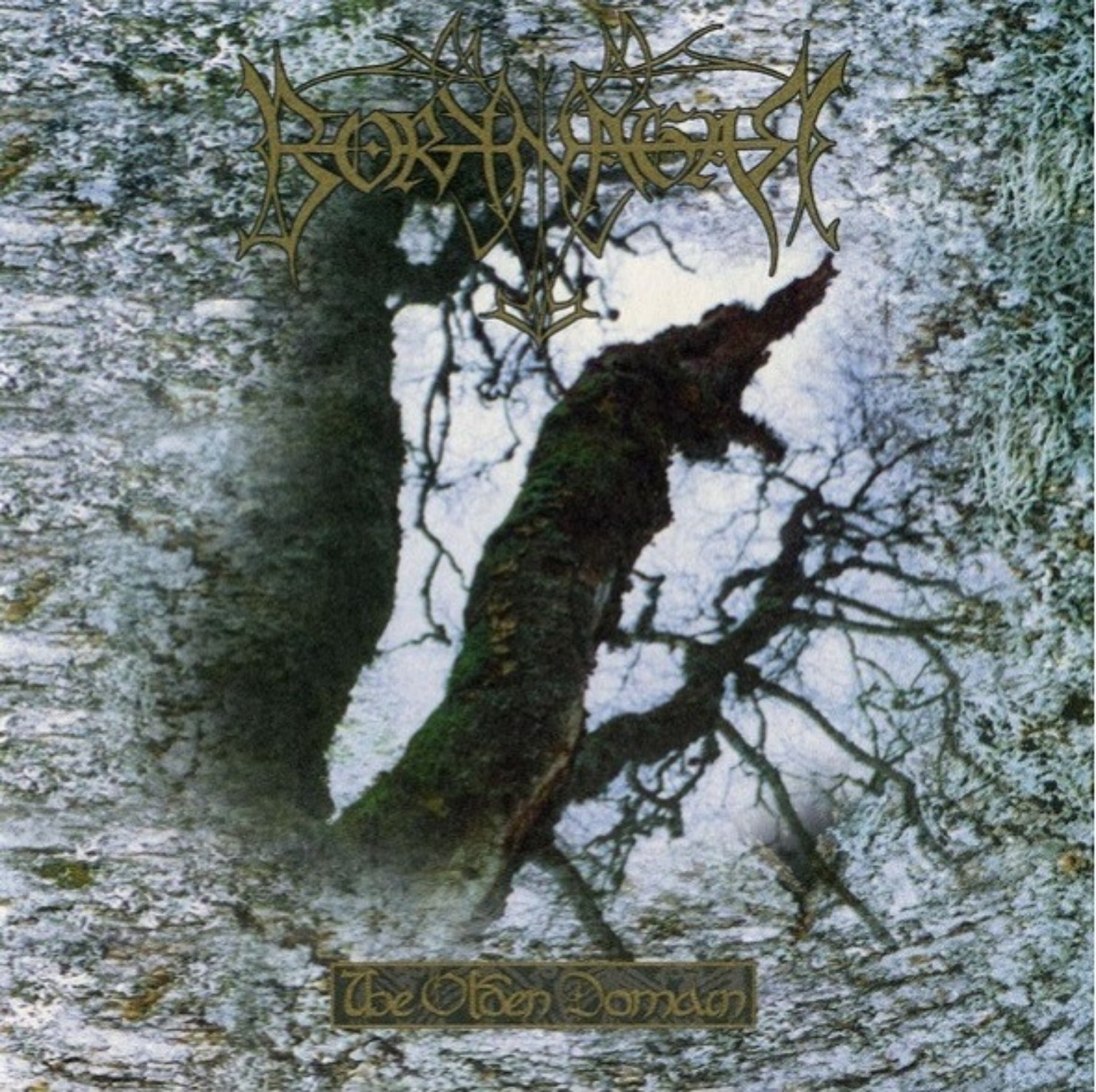
Before the listener heard a single note, The Olden Domain already promised a world of its own. The images of the 1997 edition cannot be separated from the music: landscape, mist, dark and light surfaces, and organic patterns open up the same expansive sense of time evoked by the titles. The booklet is a particularly valuable source today, not only because it preserves the lyrics and the musicians' names, but because it physically demonstrates how the band wanted to present the work to its audience in 1997. These are not illustrations added later on the internet; they belong to the original object. It is therefore fitting that the first page of this book places the album cover alongside the band and studio information: they are two aspects of the same primary document.
The original credits attribute the layout photographs to Øystein G. Brun and other detail photographs to Oliver Recker, while Media Logistics and Carsten Drescher are named in connection with the design. It is not always possible to establish with certainty who made each component of the composite graphics. Brun himself later provided some help: he explained that he took photographs for The Olden Domain in locations connected to his family's old home region among the fjords. His personal environment thus left a visual trace on the record. Yet even this direct connection does not entitle us to name every indistinct landscape detail precisely or to invent a story about the day the photographs were taken. Giving the source priority does not diminish the mystery of the images; it simply prevents that mystery from being filled with false memories.
The lyrics printed one after another in the booklet offer a different kind of insight. Six songs have sung lyrics, while the two instrumental pieces have no verses to be voiced. When we speak of ancient heroes, winter or memory, we can do so on the basis of motifs that can actually be read. Where the words fall silent between instrumental passages, restraint is especially appropriate.
The original CD assembled the eight parts of The Olden Domain in a particular order. According to the edition data supplied, the first track runs for 6 minutes and 1 second, the second for 7 minutes and 51 seconds, and the third for 4 minutes and 12 seconds. The remaining pieces last 6 minutes and 12 seconds, 4 minutes and 55 seconds, 6 minutes and 19 seconds, 3 minutes and 53 seconds, and 5 minutes and 6 seconds. Here, duration is a possibility about which later listeners would reach very different conclusions.
Images related to the record's cover return as echoes on later Borknagar albums. In 2019 and 2024, Brun spoke of his fondness for hiding connections between different points in the band's body of work. On the cover of Winter Thrice, for example, he deliberately referred back to the visual world of the old album. This retrospective gesture does not turn the 1997 sleeve into the first instalment of a story planned in advance for later years. Rather, it suggests that the earlier artistic sensibility had not disappeared. Landscape remained a motif to which the band could return with a different voice and at a different stage of life.
A Closer Look at the Front Cover
On the front cover, what strikes us first is not a story but a surface. Along the sides and bottom, grainy, bark-like bands of greyish white tinged with cold blue frame the lighter central area. The material is not smooth: tiny fissures and patches reminiscent of lichen or tree bark interrupt the light. From the centre rises a dark, thick form that angles upwards; thinner branches or branch-like lines extend from it into the pale space. It is not entirely clear how much of this is a tree trunk, how much is shadow and how much results from the photograph's unusual crop. That uncertainty is one of the image's strongest qualities.
The pale background does not open onto a wide horizon. It feels more like a gap in the dark, greyish material, as though the viewer were trying to emerge into the open air from close against some ancient surface. The central shape reaching upwards creates a movement in the opposite direction: the eye returns to it and then follows its branching lines. The tones are restrained, so the cover works not through spectacular colour contrasts but through the density of its textures and its negative space.
At the top, the interwoven golden Borknagar logo almost becomes a drawing made of branches itself. Below, the album title, smaller and likewise gold, lends the composition a calmer point of balance. The image cannot be shown to depict a god, a battle or a scene from any particular myth. Yet it evokes an ancient world: the aged surface and seemingly living branches suggest decay and endurance at once. This duality connects with the depth of time implied by the title The Olden Domain and with the tension in the music between raw passages and more spacious, contemplative moments.
The Ancient Eye and the Winter Road
The very first title on the record, The Eye of Oden, moves beyond the human scale from the moment it begins. An eye can see, judge and keep watch; the name Oden may evoke a familiar deity of Scandinavian tradition. But the moment this book confines the track to a particular myth or a specific episode from the Eddas, it loses the song's wider range of possibilities. Borknagar did not promise a painstaking scholarly reconstruction of traditional belief. For Brun, poetic and natural motifs were images through which another kind of experience of existence could be expressed. The title is therefore a gateway, not a map. It directs attention towards a world that feels older without dictating exactly what the reader or listener must find there.
In the opening track, the lyrics printed in the booklet suggest images of time, memory and realms beyond the limits of human presence. All this accords with what Brun had already said in Skogen about creative freedom grounded in nature and personal experience. Later reviewers treated the composition as evidence of the album's power as an opening statement and of its monumental character.
The Winterway carries movement in its very title, and as the longest of the eight pieces it occupies a special position. The winter road in the lyrics is not a route plotted on any actual hiking map. The experience of frost, time and landscape suggests a longer, more difficult passage, which reviewers have generally associated with the album's epic side. The writer of a 2005 Sputnikmusic review valued this composition particularly highly, while others sometimes found the record's expansive structures overburdened or repetitive. Thus two readings open onto the same road: for some, length is the condition of fulfilment; for others, it risks disturbing the balance.
Yet the winter road is more than a romantic image of a cold wilderness. Brun did not experience the natural environment of Norway's western coast as a lifeless, barren world, but as a force in constant change. In a later statement, he spoke of nature as beautiful, unpredictable and merciless at once. The 1997 lyrics cannot prove that he would have formulated precisely that thought while composing the song, but his later understanding of his own work sheds important light on the recurring motifs. The winter road can therefore be read as more than northern scenery; it may become a poetic form for the uncertain progress of human existence. This is a possible meaning within the album's world, not a compulsory one.
Together, the two opening tracks show how inadequate it would be simply to call the album 'Viking metal'. The mythological name and the image of northern winter invite that label, but deeper in the lyrics lie questions of memory, movement, the order of nature and human finitude. Brun's personal creative freedom does not set these images against tradition; it merely rejects turning tradition into a single mandatory interpretation. The names of the musicians' previous bands might likewise tempt us to derive the two compositions from elements of Ulver, Arcturus, Enslaved or Gorgoroth. Direct personal connections can be verified, but supposed borrowings within the individual songs cannot. The album remains interesting as a work in its own right.
After the release, this two-part opening became the gateway to the whole record. Within the first few minutes, the listener could choose to search the surface for familiar genre markers or allow the titles and longer musical forms to suggest another sense of time. Borknagar's own path continued to develop around that choice. The band later used more clean vocals, progressive arrangements and acoustic approaches, yet it never disowned the weight inherited from extreme metal. The Eye of Oden and The Winterway are early stations on that journey, ones whose full significance was not yet settled in their own time.
A Hundred Years from Now, in an Old Language
After the third track, we no longer need to look for the continuation of the album in a sung story. Om Hundrede Aar Er Alting Glemt is an instrumental piece, credited in the original release to Ivar Bjørnson. These two facts interrupt the earlier progression at once: spoken words disappear from behind the music, and the principal compositional role shifts for a moment from Brun to the keyboard player. The collective nature of the album becomes especially clear here. Although Brun defined the creative direction of the larger work, the independent instrumental composition is not merely an anonymous interlude. The musical world of the Enslaved member is also part of Borknagar in 1997.
The title speaks of forgetting in an old-fashioned Norwegian spelling. A hundred years is longer than a human life, but almost immeasurably brief in terms of landscape and geological time. The sentence may carry two opposing meanings. On one hand, every human deed fades from memory; on the other, the very act of saying so proves that we can continue talking about things that disappear. The instrumental piece contains no lyrics to tell us how to choose between these poles. The title allows readers and listeners to move forward with their own questions. The passage of time, a motif running through the whole record, takes centre stage here without words.
One of Knut Hamsun's poems, published in his 1904 collection Det vilde kor, bears the same title. The exact correspondence is a fact of literary history and naturally catches an interpreter's attention. But neither the original booklet nor the band interviews examined prove that Ivar chose the title because he intended to set that poem to music. There may be a connection between the two works; on the available evidence, however, it can only be proposed, not asserted. Likewise, a note in an album database concerning a dedication to his father requires further confirmation from a primary source. Naming uncertain points does not drain the story of life; it shows how carefully one ought to approach an older work.
The following song, A Tale of Pagan Tongue, returns us to the realm of words. Its title may suggest a pagan language, ancient speech and a story of the past echoing in the present. The images available in the booklet evoke a broader world of old beliefs, language and memory. Yet the speaker of the text cannot be identified beyond doubt with a particular mythological figure. A work can be story-like without its lyrics becoming a historical source. In its 1997 review, metal.de found certain passages of Garm's clean, theatrical singing questionable in this composition too. The criticism does not diminish the song's importance, but it shows the strength of the reaction the new voice could provoke.
For another listener, the same risky vocal approach could become the strongest evidence of Borknagar's distinctive style. Later reviews repeatedly return to the idea that the album places a clean voice beside extreme vocals in a way that does not simply soothe the listener but creates a new tension. Putting those two judgments alongside one another shows that not every debate can be resolved by technical facts. Often the question is how far a listener is willing to move from the familiar sound of a genre. The record did not try to offer everyone the same readily recognisable voice.
The third and fourth tracks thus create a curious contrast. The instrumental piece says in its title that one day everything will disappear from memory; the next song asks about the possibility of ancient speech surviving. Their sequence may be read as a literary arc, but the band has left no documented concept prescribing it as the one official story. Interpretation therefore remains open, much like the name Brun once deliberately chose without a predetermined meaning. The world of Borknagar does not demand an easy solution. Instead, it invites the listener to find a passage of their own between ancient words and music without words.
The Wandering Road and the Nameless Domain
Two movements meet in the title To Mount and Rove. One leads upwards; the other has no destination fixed in advance. Images of heights and free wandering both inhabit Borknagar's early lyrical world, while the landscapes, cold seasons and ancient signs that emerge from the booklet lie along an imagined journey. We do not know which Norwegian mountain the writer had in mind, and the lyrics provide no reliable geographical identification. That uncertainty is worth preserving. The title is not the heading of a travel report, but a poetic gesture connecting movement to the language of memory.
The wandering also takes place through time. Runic signs from the past, hills and fields, and motifs of a frozen landscape suggest a narrator who seems to be searching for lives long gone. Yet the first-person voice of the lyrics cannot automatically be equated with Øystein G. Brun's diary. In art, the speaker may be an imagined figure, a general human voice or simply the emotional centre of a work. The song may still be rooted in its writer's experiences even if none of its lines is a photographic confession. Here lies the freedom of Brun's approach: feelings about nature and ancient times did not have to be confined to concrete, verifiable events from his life.
The reception of To Mount and Rove is interesting because the critics differed so markedly. A later writer for MetalBite highlighted the memorable chorus with clean vocals; other reviewers found the combination of so many ideas unsteady. There is no need to erase either view. One listener draws energy from the variety, while another hears a lack of unity in the same place. The album's unusual structures carry this double risk throughout: freedom can be liberating, but it can also take music away from familiar forms. Brun had already spoken of that artistic choice in 1996, before the different judgments reached the public.
The sixth composition, Grimland Domain, seems to open another gateway. Its title names a domain for which no reliable map exists. There is no need to look for a specific location in Norway behind the word 'grimland'. The wanderings, inheritance, opposing forces of nature and images of an ancient world in the lyrics suggest the boundaries of an inner landscape. The band's name itself acquired life in a similar way: not as a ready-made inherited meaning, but as a space gradually filled by the songs. Grimland Domain thus stands close to the conceptual heart of the album without literally repeating every image it contains.
Reviews of the song return once again to Garm's two vocal approaches. The metal.de writer in 1997 criticised certain clean-sung passages of Grimland Domain as well as A Tale of Pagan Tongue. Later, however, many regarded precisely this unusual, theatrical alternation as one of the period's most recognisable qualities. It would be wrong to rewrite contemporary criticism as though everyone had immediately understood the band's intentions. At the time of The Olden Domain's release, listeners did not know the decades to come. In 1997, those decisions could still seem like a challenge to comfortable genre habits, rather than part of an already familiar tradition.
Grimland Domain is also significant for the ways it invites us to connect lyrics and music. The idea of an inner domain suits a songwriter who, even decades later, spoke of nature's beauty and danger as forces present at the same time. Nature here is not merely a decorative image that could be placed beside any music. It becomes a tangible form for the immense span of time, human vulnerability and traces of the past. That is nevertheless a poetic reading; it does not mean the song contains one literally reconstructible philosophical doctrine by its author. The surviving lyrical motifs tell us much, but they do not take the place of the music itself.
Within the course of these extended compositions, the songs now form the album's inner centre of gravity. The mythic and wintry imagery of the opening, the third track's instrumental motif of passing away, the memory of pagan speech and the wandering can increasingly come together in the reader's mind as a single imagined landscape. The listener is also entitled to decline to hear them as one continuous narrative. The Olden Domain is not a rock opera whose every character and scene has been preserved by name. Its lyrics form more of a network of images that call to one another. That very openness helps the album remain interpretable in different musical and historical contexts in the years that follow.
Ascension, Then a New Dawn
The title of the seventh composition speaks of the ascent of the ancestors, yet the album continues without a singing voice. Ascension of Our Fathers is the second instrumental piece. After the longer sections filled with words, the absence of vocals can itself become meaningful, but one must not invent original lyrics that the booklet does not contain. Some later reviews treated the piece as a transitional point offering a moment of rest; others heard less strength in it as an independent composition. Uncertainty once again belongs to the nature of reception. What is a vital interval between two larger pieces for one listener may be a less memorable moment for another.
According to release databases, a version of the piece that requires separate verification also appeared under the title The Quest on a 1997 Century Media compilation. The historical connection between the two titles is worth noting, but the materials examined do not establish that every musical detail of the recordings is identical. An archived title is not the same as a direct comparison of two recordings. Ascension of Our Fathers nevertheless has a certain position in the original sequence of The Olden Domain: it stands immediately before the closing composition and opens a wordless space from which the album's final voice can once more begin to speak.
The Dawn of the End sets two familiar concepts against each other in its very title. Dawn signifies a beginning, while an end means closure. Placed together, neither cancels the other; instead, they evoke a cycle. In the booklet, motifs of winter, time, life's finitude and an order greater than humanity establish the language of the ending. There is no need to force the work towards either a triumphant or a despairing conclusion. The title also allows the ending to remain a premonition of another beginning. In that sense, the final song reaches back towards the mythic breadth of the opening piece and the instrumentals' ideas of memory.
The history of The Dawn of the End, however, extends far beyond the 1997 CD. Decades later, the band members recalled that Garm rejoined Borknagar at Oslo's Inferno Festival in 2012 to sing the closing section of the piece. After his former membership had ended, he thus returned briefly to the song with which their album together had once concluded. Band interviews from 2016 also preserve the story of this performance. It was neither a full reunion nor a change to the old studio recording: rather, a living, occasional echo of a partnership long since brought to a close.
Another important stage in the song's later life was Winter Thrice in 2016. Both Brun and Jens F. Ryland spoke about the connection between that album's title and the lyrical world of The Dawn of the End. The familiar-sounding phrase was therefore not merely a coincidence but a deliberate artistic reference. Garm appeared as a guest on Winter Thrice, tracing a remarkable historical arc between the two periods. The former singer's voice returned at a different age and with a different band line-up; this did not make The Olden Domain literally the first chapter of the later record, but it revealed how deeply it remained embedded in the band's self-image.
The memories gathered around the closing track explain why the eight pieces should not be presented merely as a technical inventory. A song can acquire a life of its own even as the album as a whole remains an unchanged recording. On its release, The Dawn of the End was a composition from 1997; in 2012, it became an act of remembrance on stage; in 2016, a further point of artistic reference. All three perspectives turn towards the same original work, but view it from different times. Thus, in Borknagar's history, a title about passing away itself resists oblivion. New connections emerge from the ending, while the original album object and its participants remain matters of historical record.
The Echoes Do Not Arrive All at Once
When The Olden Domain appeared on 18 August 1997, the band could not know how people would speak about it decades later. A review written at the time is therefore a different sort of document from a long, affectionate anniversary retrospective. The reviewer does not possess the band's entire future catalogue: they judge what can be heard then, within the musical environment they inhabit. In many ways, that makes the earliest verifiable reception the most interesting. It does not yet know the work's later established importance, nor does it adapt to a settled consensus among fans. If something jars, the critic can say so; if something comes as a surprise, the surprise is genuine.
In a metal.de review published on 20 October 1997, the writer Akron awarded the album seven out of ten. He acknowledged the band's progress, its nature-centred atmosphere and its more folk-inflected and epic elements, but found several moments of Garm's clean vocals excessively theatrical. His reservations concerned A Tale of Pagan Tongue, To Mount and Rove and Grimland Domain. This judgment cannot simply be merged with those of critics who later enthusiastically praised the very same voice. Akron was evaluating a work from 1997 with his own ears and expectations; his account forms a specific layer of reception identifiable by author and date.
In September 1998, Scott Hefflon approached the same music much more warmly in Lollipop Magazine. His review praised the changes across genres, the cinematic emotional movement and the sense of unity that made the record feel almost like a concept album. He also assessed the sound achieved at Woodhouse positively. He did not assign a numerical rating, so his enthusiastic reception cannot be placed on precisely the same scale as a seven out of ten. Yet putting the two articles side by side tells an important story: unusual vocals and varied compositions were an obstacle for one critic and the very source of the album's strength for the other.
The full text of every contemporary publication is not available. Certain 1997–1998 issues of Germany's Rock Hard, the Czech Big Beng! and various fanzines are known to have featured material on Borknagar, but a bibliographical trace is not a complete interview or a complete review. The account must preserve that caution. We cannot manufacture a uniform public opinion out of missing articles; the two fully identified contemporary reviews instead give the album's first echoes two clear and distinct voices. The dates, languages and actual accessibility of old magazines matter just as much as what somebody claims about them years later.
The album's critical life did not stop when it was released. In 2001, a MetalBite writer gave it 9/10, praising its atmosphere, Garm's versatility and the grandeur of its songs. In 2004, France's Thrashocore pointed to a nuance that had previously received less attention: the recurring patterns in the compositions and the predictability that could result. A track-by-track Sputnikmusic review in 2005 expressed reservations about technical aspects of the sound even while appreciating the strength of the writing. These critics do not simply form a sequence of increasing or decreasing scores. At different points in time, they asked different questions of the same record.
Many community reviews on Encyclopaedia Metallum gave the album exceptionally high ratings, above ninety per cent, but that did not mean all reservations disappeared. Some admired the inner cohesion of the songs; others debated the drum sound, the length or the clean singing. Reviews on Metal Music Archives in 2012, an article on metal1.info in 2013 and other retrospectives each contributed something to the interpretation. Some complete texts appeared on more than one website; they are not separate works merely because they can be read under different headings or in different editorial settings. The true number of preserved opinions depends on the authors' material, not on the number of links.
The 2015 reissue attracted new listeners and new reviews. Writers for Metal Temple, a new MetalBite contributor, the Dutch Zware Metalen and Italian specialist websites returned to the old work with knowledge of Borknagar's later music. For them, the early progressive turn was no longer an uncertain future, but a recognisable beginning. Some noticed limitations in the production, while others heard the album's remarkably enduring power. The reissue did not necessarily alter the recording or substantially expand the music in every case; it was enough for the band's history to have grown long in the meantime to change how the album was received. The same object had entered a different collective memory.
More negative voices also survived in later criticism. Some listeners found the material disjointed, Garm's clean singing irritating or the compositions excessively long. Others, after repeated listening, called it one of the most important Norwegian metal albums. Neither side needs to be falsified. An individual sound does not necessarily produce agreement; sometimes disagreement is precisely a sign of a work's strong and distinctive form. The Olden Domain retained that quality for decades. Those who heard it rarely spoke of it as just another interchangeable record from its year.
The Band That Learned to Go on the Road
After the release of The Olden Domain, a change began in Borknagar's life that cannot be understood solely through the reception of a new record. Within Century Media's international sphere, the band now had to appear on stage as well. Jens F. Ryland later explained that this was by no means self-evident to them. Early Borknagar had functioned above all as a studio project, with Brun recording several guitar tracks; the group had not been organised to withstand long tours immediately. Live performance required another guitarist, regular rehearsals, travel arrangements and a more sustained collaboration. The album thus not only captured a musical turning point, but ultimately transformed the way the band worked.
Ryland became more closely involved with the band in the summer of 1997 and helped prepare for touring. By his recollection, Borknagar set off on its first European tour in January 1998 alongside In Flames, during the Swedish band's Whoracle period. What had emerged from a Norwegian studio and recording sessions in Germany now became a travelling ensemble playing to audiences. The Olden Domain occupies a special place in that change: an album made essentially by the previous line-up and its studio-oriented method opened the way to a live career. Borknagar now had to find a different balance as a performing band.
By then, the original singer had parted ways with them. Garm and Brun later gave consistent accounts of the background to his departure: responsibilities with Ulver and Arcturus left insufficient room for a third band. No documented quarrel slammed the door shut. That distinction matters greatly to what followed. On The Archaic Course, released in 1998, the vocals were performed by Simen Hestnæs, known as ICS Vortex, and his voice opened another important period for Borknagar. Vortex's distinctive, higher clean singing became as closely associated with the band's name over time as Garm's strange, varied voice was with the 1997 release. Knowledge of the band's later work, however, is no licence to confuse the musicians who belonged to the two periods.
Obligations to other bands continued to shape the line-up in subsequent years. Ivar Bjørnson turned his attention to Enslaved; Kai K. Lie departed; and the roles of bass and vocals sometimes came together in a new way in the person of Vortex. Lars A. Nedland, known as Lazare, arrived from the experimental world of Solefald and contributed to a new, distinctive keyboard sound. Asgeir Mickelson later became a defining presence on drums. Grim, an important musician in Borknagar's early history, died in 1999. This account does not invent unverified details about the circumstances of his death; it would do no service to the lost musician's memory to replace missing documents with speculation.
The next full-length record, Quintessence, appeared in 2000. By then, Borknagar was seeking a balance between black metal's force and richer arrangements with a different line-up and musical make-up. The creative freedom established in 1997 remained, although no one simply tried to reproduce the sound of The Olden Domain. Vortex subsequently took on a fuller role in Dimmu Borgir, prompting another change of singer. Andreas Hedlund, known as Vintersorg, assumed the task; Empiricism, released in 2001, was made with his voice, while Jan Erik Tiwaz, or Tyr, appeared among the bassists. With another vocal character and new expressive means, the band continued the same long exploration.
In 2013, Ryland also discussed the financial difficulties of a musical career. International performances did not always guarantee an income. It could be necessary to pay for support slots, while family and work obligations made touring increasingly difficult as the years passed. Some invitations became impossible to fulfil and other opportunities gradually disappeared. Ryland left the band in 2003. Without this history, the personnel changes would look like a mere sequence of discographical facts. In reality, every new voice and every absence involved circumstances of life, work, travel and livelihood, although their details should only be related where the musicians themselves have discussed them.
Epic, released in 2004, presented a smaller Borknagar whose members divided various instrumental duties among themselves. Asgeir Mickelson assumed several roles while Brun and Lazare continued to develop the band's complex world. Origin in 2006 moved still further towards acoustic, traditional and folk-inflected sounds. In that sense, the acoustic compositional foundations of The Olden Domain could reappear years later as a distant relative of a very different release. But the two albums are not identical. The later works grew out of their own series of creative decisions, demonstrating that Brun did not want to repeat a single formula from 1997 indefinitely.
Ryland later returned, becoming a permanent member again in 2007. After Century Media, Borknagar moved to Indie Recordings, and its label arrangements subsequently changed again. Asgeir Mickelson's departure in 2008 was followed by the arrival of David Kinkade, while the compilation For the Elements, surveying the years from 1996 to 2006, showed that the band now possessed a branching body of work capable of being told as a history. The song My Domain on 2010's Universal recalled ideas dating back to 1996–1997. Brun had already spoken in 2006 of wanting to return to such an early piece. ICS Vortex also appeared as a guest on the track. Here, the past became fresh material for creation rather than a rigid model.
The Return of a Voice from the Past
The combination of old and new voices in Borknagar during the 2010s opened an unusual possibility. Vortex's return was officially confirmed in 2011; Urd in 2012 became an album on which the contrasting voices of Vintersorg, Vortex and Lazare could appear together. Rather than simply reverting to an earlier line-up, the band found a new configuration from the experience of periods that had previously followed one another. Baard Kolstad took the place on drums after David Kinkade. Collaborating with different vocalists and musicians from other bands, which had still seemed an uncertain feature at the time of The Olden Domain, had now become a consciously managed part of Borknagar's identity.
The most moving historical turn connected to the old record was Garm's brief return at Oslo's Inferno Festival in 2012. During the closing section of The Dawn of the End, his voice met Borknagar once again. The significance of the episode does not rest on fan memory alone: later interviews with Jens F. Ryland and Brun also described it. The musicians' accounts do not suggest a spectacular reconciliation after old grievances, since no such conflict had been established in the first place. Rather, they reveal the natural connection that can survive the end of a former collaboration. The conclusion of a song briefly brought two decades together.
Urd itself appeared at a time when Brun was consciously searching for the sources of the band's early power. In a 2013 interview, he looked back on The Olden Domain as a defining work. He recalled that the record had made it possible to capture, with an appropriate studio production, the distinctive sound that would shape the band's later career. For him, returning to the old material did not mean reusing the compositions. Instead, he wanted to understand what had been so liberating about that creative situation. This conscious retrospective did not transform the old record itself; it simply added another perspective from which to understand it.
Winter Thrice in 2016 embraced that connection especially openly, not only through its title's reference to the lyrical world of The Dawn of the End, but through Garm's guest appearance. The band made several generations of its own history audible without trying to recreate the circumstances of 1997. Brun, Ryland and the vocalists who had joined later made a work that carried forward some of the older album's ideas. The echo in the title is striking: winter comes for a third time, but the people hearing it are not the same, nor is the band that brings it to life.
On the twentieth anniversary in 2017, Jon Rosenthal spoke separately with Øystein G. Brun and Kristoffer Rygg about The Olden Domain. The anniversary feature in Invisible Oranges is exceptional precisely because each artist recalled the work from his own position. For Brun, what mattered was bringing together the songs written on acoustic guitar with a musical outlook inherited from progressive rock. For Garm, the studio, experiments in reshaping his voice and the demands of a life divided between several bands were central. Their memories do not tell identical personal stories, yet they point towards the same album. A shared work does not erase individual perspectives.
The old record also returned as a memory in later visual material. In 2019 and again in 2024, Brun spoke of small, deliberate visual connections between different albums in the band's catalogue. One motif on the cover of Winter Thrice points back towards The Olden Domain. The family landscape of the fjords, whose photographs appeared on the early release, also resurfaced in the artist's thoughts during the period of Fall. The point is not to reproduce the old location precisely. What remained was the experience of nature as both welcoming and threatening: a beautiful landscape is not without power, and human beings are only brief participants in a story vastly longer than themselves.
On the Far Shore of the Long Journey
Borknagar underwent another significant transformation at the end of the 2010s. Jens F. Ryland left in early 2018, and Baard Kolstad also ended his membership that year because of commitments to other bands. Bjørn Dugstad Rønnow arrived on drums, reportedly on Kolstad's recommendation. In early 2019, Vintersorg withdrew from regular involvement for reasons connected with personal circumstances, work and health. ICS Vortex continued again as principal singer and bassist, while Jostein Thomassen later appeared among the guitarists. The band that had made the record in 1997 was not a single, unchanging team growing old together, but a group whose continued existence depended again and again on finding new forms of collaboration.
True North appeared on Century Media in 2019. In interviews around the album, Brun said that while making Winter Thrice he had sought the creative feeling of The Olden Domain, but during work on True North he had found himself looking back even to Borknagar's very first record. The past was thus not a single shining point but a memory of different periods responding to one another. There was no need to copy old songs out of those earlier influences; it was enough to recover the openness that had once made it worth moving beyond the obvious boundaries of genre.
The pandemic years naturally made the activities of a live band more difficult. Shared songwriting and performances later gathered strength again, and Fall was released on 23 February 2024. The line-up for that period comprised Brun, Vortex, Lazare, Rønnow and Thomassen. In new interviews, Brun returned to the same questions that had animated the poetic foundations of the 1997 album: what is humanity's place in nature, how long do the traces we leave endure, and how can music reveal both the beauty and indifference of a landscape? These later answers were not secretly written into the studio notes of 1997; their interest lies precisely in how one artist's enduring concerns could change over several decades.
Among the label announcements of 2026 were reissues of True North and Winter Thrice, but these are not reissues of The Olden Domain. According to the sources examined, Fall was still the band's most recent full-length album in October 2026. The time since the late 1990s has brought more than an increase in the number of albums. Different generations of singers, label periods, tours and interruptions have followed one another around Borknagar. Looking back at a single album from 1997 makes it clear that The Olden Domain exists neither as an isolated, self-contained island nor as a simple blueprint written in advance for the later works.
As we reach the end of the story, some questions remain without complete answers. We cannot say precisely which guitar or vocal tracks were recorded on which studio days. Discrepancies in secondary production credits cannot be resolved with absolute certainty without further original records. Nor does the shared literary title of Ivar Bjørnson's instrumental piece prove literary inspiration.
The history of The Olden Domain can nevertheless be read as a complete story. The restless search that led to the first album, the two contemporary pages of Skogen, the road opening towards Century Media, the precisely documented summer days at Woodhouse in Hagen, Garm's unusual vocals, the eight tracks of the second album and the divergent critical responses together show what came into being in 1997. The later records and returns do not complete that story but cast fresh reflections upon it. Not every detail can be recovered, but the surviving sources make it possible to understand why this moment mattered to those who created it and to those who revisited it over the decades.
In the end, perhaps the ancient domain cannot be found on any single map because neither the past nor the landscape fits within a ready-made border. People give names to mountains, to time and to music; then others carry those names forward in different voices. Brun chose a band name whose meaning would be created by the songs themselves. The Olden Domain grew from that choice: in 1997, it became the collective work of real people, real instruments and a carefully documented German studio, while preserving the freedom of the imagination. Viewed from a distance approaching thirty years, the album is no mere old object. It is a memory that can still be voiced anew without forgetting its original sound.
Reader comments
Comments only appear after approval. Messages are displayed in their original language.
Comment submissions are not enabled yet.