Uses installed browser voices for narration.
The Archaic Course
A fully source-indexed, five-chapter history of Borknagar’s 1998 album. · 56 complete source notes
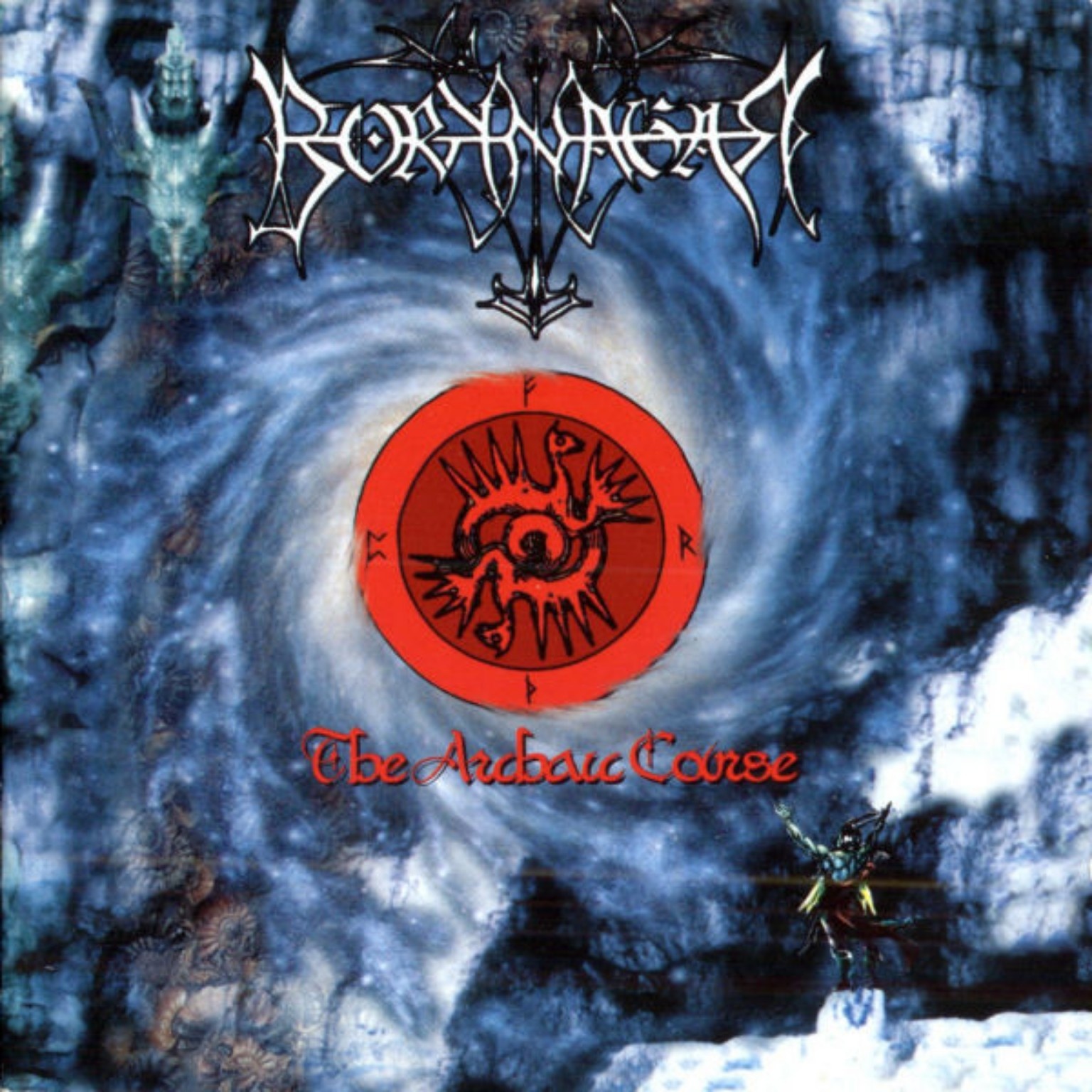
Original cover-issue credits
Cover artwork and layout: Axel Hermann and Carsten Drescher; logo: Christophe Szpajdel; photography: M. Røn. These historical credits do not assert image-use permission.
Album details
Tracklist · original edition (8 tracks)
- 01. Oceans Rise
- 02. Universal
- 03. The Witching Hour
- 04. The Black Token
- 05. Nocturnal Vision
- 06. Ad Noctum
- 07. Winter Millennium
- 08. Fields of Long Gone Presence
37:46 · 1998
Band members and contributors
- I.C.S. Vortex (Simen Hestnæs) — vocals, keyboards, effects
- Øystein G. Brun — guitars
- Jens F. Ryland — guitars
- Kai K. Lie — bass
- Grim (Erik Brødreskift) — drums
- Ivar Bjørnson — keyboards, effects
Recording and release
- Woodhouse Studios · Dortmund, Germany
- Recorded, mixed and mastered: 17 August – 5 September 1998
- Matthias Klinkmann · engineer and producer; Borknagar · co-producer
- Original label: Century Media Records · 1998
Official music services
Digital purchase
Century Media · BandcampDigital album · MP3 / FLACPhysical editions
Band channels and profiles
Taking the Equipment Home
While preparations were under way for Borknagar's third album, Øystein Garnes Brun lost the band's rehearsal room in Bergen. What he later remembered from that period was a small Volkswagen Golf: he loaded it with instruments and equipment and took them to his parents' house. He had rehearsed there before, during his years with Molested. The house again became a place where the band could work, even though the album they were preparing would be recorded in a German studio and released by the label that had brought them onto the European market the previous year.T01
The layered history of Bergen
In Bergen, the harbour had been a route through everyday life since the earliest chapters of the city's history. Around the sheltered inlet of Vågen, a trading town took shape in the eleventh century under Olav Kyrre; by the following century it was gathering products from western Norway and sending them out by sea. German merchants trading in fish from the northern coast established themselves at Bryggen. Bergen housed a Hanseatic trading post, and the wooden buildings along the quay served the business of unloading, storing and dispatching goods. When fire destroyed much of the district in 1702, the houses were rebuilt. After another fire in 1955, archaeologists found traces of even earlier destruction beneath the ground. UNESCO added the surviving Bryggen quarter to its World Heritage List in 1979.T02
The city's musical life was bound up with institutions long before rock bands needed rehearsal rooms. In 1549, Bishop Gjeble Pedersøn obtained an organ for the cathedral and also supported the training of musicians. Instruments, performers and teaching all required a place in the city. Later, that same urban landscape opened its doors to different kinds of music and different audiences. Volunteer-run music clubs also acquired a nationwide organisation: founded in 1982, Norsk Rockeforbund encouraged cooperation between rock clubs, concert promotion and the sharing of information, while magazines and cassette circulation also formed part of its history. Hulen, a club that grew out of student life, and Garage, the concert venue founded in 1990, belonged to the decades when local rock and underground audiences found regular places to meet.T03
Over time, very different districts arose beyond the wooden houses on the waterfront, and the city's transport routes changed with them. In the second half of the nineteenth century, workshops, shipyards and workers' housing expanded in Møhlenpris, Laksevåg and Solheimsviken. Around the turn of the century, the railway and tram opened new connections between neighbourhoods. Late in the afternoon of 15 January 1916, a warehouse caught fire near Murallmenningen. By morning, a substantial part of the city centre lay in ruins. Reconstruction altered the layout of streets and commercial spaces as well. During the Second World War, an explosion in the harbour on 20 April 1944 and the air raids that autumn left further scars on the city. Holen School was struck during the attack on Laksevåg on 4 October. The areas around Nøstet and Engen suffered damage on 29 October.T04
At the centre of the harbour disaster of 20 April 1944 was the Vorboode, a ship carrying explosives. Complementary records of the occupation, civil defence and air raids in the municipal archives preserve the story of the destruction. Alongside those records, traces of Bergen's industrial past have also survived. The railway reached Solheimsviken in 1883, and the tram began running in 1897. Møhlenpris's hall and workshops, built in 1913, were surrounded by workers' homes. The organisation running the technical museum moved into the hall in 1990. The city's industrial districts and working-class neighbourhoods, then, found new uses alongside the old wharf buildings on the UNESCO list: the world of the former Hanseatic trading post and Bergen's own municipal institutions remained visible as legacies of different periods.T33
Among the commercial wharves, industrial workshops and streets marked by war, research and university life were developing institutions of their own. From 1946, the university carried forward the nineteenth-century scientific collections and research of the Bergen Museum. University and student life, older industrial areas and music venues existed side by side, helping to shape the Bergen in which Brun formed a band. The municipal amalgamation of 1972 also expanded the city's boundaries. By the time Borknagar's first album was finished, the Grieghallen could be associated as much with a concert as with the mixing session Jens F. Ryland later remembered attending, perhaps in May 1996.T05
From Molested to Borknagar
Drawn towards the death metal of the late 1980s, Brun first played in Purgation and then in Molested. During the Molested years, regular rehearsals set the rhythm of his musical life. Looking back in 2017, he recalled that for a long time they met almost every other day. Military service and studies later disrupted that routine. At the same time, another, older path into music had begun at home. Among his father's records he listened to Pink Floyd, Jethro Tull and Uriah Heep, and as an adult he returned to seventies rock when discussing the extended forms and shifts of atmosphere in his own songs.T06
In a 1998 radio interview, Brun began the story of Borknagar with the raw, brutal music of Molested. He described that band's dense riffs and extreme drumming tempos as part of his earlier pursuit of the most brutal sound possible. On a later tour he met a fan who had tattooed an old Molested cover design on his arm; in the 1998 interview Brun also left open the possibility of eventually releasing older recordings, perhaps including previously unreleased material. At that point it remained only a plan. He began working on new pieces and then approached Erik “Grim” Brødreskift. At rehearsal with the drummer, ideas developed at home first acquired the shape of a band. Musicians associated with Gorgoroth, Enslaved, Immortal and Ulver brought different experiences to the group. Their other commitments would also determine how much time they could devote to the new project. Brun described images of nature, mythology and elemental forces as a personal language of expression: he deliberately left part of the lyrics' meaning for listeners to interpret themselves, and welcomed hearing that someone had recognised their own feelings or ideas in the music. The debut album of 1996 already took the form for which Brun had begun the work: acoustic passages appeared alongside aggressive guitars, while Garm's voice connected the two modes of expression.T07
Brun dated his earliest ideas to around 1993. Grim's presence showed how closely linked the early bands were. He appeared on the cover of Immortal's Pure Holocaust, although Abbath played drums on the record itself. Grim's playing can be heard on Borknagar's first three albums. The new band took shape rehearsal by rehearsal, while its members still had to make time for their commitments to other groups.T32
According to Ryland's recollection, contact with Malicious Records began with a fax. Infernus sent it to the label, and an agreement was reached quickly. Ryland learned of the contract while still outside the band, whereas he remembered hearing the mix at the Grieghallen from personal experience. He likewise associated the next step towards a German label with two people: in his account, Robert Miller showed the finished album to Robert Kampf at Century Media. To Brun, the first label had provided support for studio time and artwork. In 1998, he said that Malicious had handled the initial studio and cover costs properly, but he was dissatisfied with the later accounting between them and spoke of royalties that he believed remained unpaid. Thus, his 1998 account distinguished a successful beginning from the subsequent disagreement over payments. For the next album he was looking for a partner prepared to take on more of the work of distribution and promotion. His overall assessment of Century Media, by contrast, was positive: he acknowledged minor disputes but felt that the label took Borknagar seriously and represented the band effectively, particularly within their own area of metal.T08
By spring 1997, the debut album had reached foreign reviewers who singled out the shifts between electric guitar and acoustic passages, as well as Garm's voice, as strengths in their own right.K01 For the recording of The Olden Domain, Brun developed the foundations of the songs on acoustic guitar. Garm helped shape them, while Waldemar Sorychta worked with the band at Germany's Woodhouse Studios. By then the band's name appeared on two completed records. Brun called Borknagar an invented word in 1998. In 2004, he added that he had shaped it around 1994 and that the sound of a Scottish mountain's name had played a part.T09
A Place for the Second Guitar
A long musical history preceded the Grieghallen concert hall and the studio world associated with it. In the building where Ryland heard the first Borknagar album being mixed, Grieg's Norwegian Dances were performed under Karsten Andersen's baton on 12 May 1978. Grieg had proposed a performance venue to the city as early as 1894. Eighty-four years passed before the hall opened. Harmonien, the orchestra at the inaugural concert, had been building its audience since 1765. In the nineteenth century, Ole Bull's violin playing and international career also helped bring folk melodies into concert life, while Edvard and Nina Grieg's home at Troldhaugen became a place of artistic work from 1885. Grieg worked with Harmonien between 1880 and 1882 as well. Over time, entire institutions grew up around concerts, teaching and musical performance in Bergen. The academy founded by Torgrim Castberg in 1905 entered state ownership in 1980 and became part of the university in 1995.T10
Alongside the history of concert halls and academies, western Norwegian melodies lived on through generations of instrument makers and musicians. The resonating strings of the hardingfele, or Hardanger fiddle, belonged to a tradition sustained by instrument-making families and by playing passed down by ear. The Jåstad instrument, dated to 1651, is a surviving physical witness to that tradition. In the eighteenth century, the names of Isak and Trond Botnen became associated with its manufacture. Local historical memory also preserved a meeting between Grieg and the folk musician Sjur Helgeland. In the late twentieth century, Garage opened in 1990, while from 1994 Nattjazz could spread its programme across several rooms at USF Verftet, a former canning factory. According to the festival's own history, its first year there attracted around thirty thousand visitors.T34
People drawn to festivals, clubs and newer forms of urban music sought meeting places different from those of the concert-hall audience. Alongside the Bergen International Festival, which began in 1953, jazz enthusiasts wanted their evenings to last longer. Dexter Gordon performed at the first Nattjazz in 1973; later, the former industrial site of USF Verftet became one of the festival's defining venues. Hulen opened in 1969 in an air-raid shelter, through the voluntary work of students. At the turn of the decade, Bergen's punk and new wave also found an audience around The Aller Værste! For Old Funeral, the Grieghallen already offered a place where early Norwegian extreme-metal recordings could be made with Eirik “Pytten” Hundvin. The concert hall and the shelter offered different possibilities, yet both helped determine what kinds of music could be heard in the city.T11
Norway’s musical connections
Personal connections sometimes opened the way to early metal recordings. Looking back on the Abduction of Limbs demo, Tore Bratseth recalled that his father's old school connection helped them reach Pytten. Old Funeral recorded the demo in 1990 and played in Haugesund on 11 May 1991. Meanwhile, several distinct musical languages were developing in the region. Immortal emerged around Demonaz and Abbath in 1990; following Horgh's arrival in 1996, Blizzard Beasts became the work of a new line-up. Founded in 1992, Helheim turned towards Norse mythology; after two demos, the band recorded Jormundgand at the Grieghallen in 1995 and toured Europe in 1996. Between its formation in 1993 and its debut in 1997, Aeternus drew on folk and classical elements alongside death and black metal. Borknagar searched for its own song forms in proximity to these parallel paths.T28
South of Bergen, in Haugesund, Ivar Bjørnson and Grutle Kjellson moved from the death metal of Phobia to Enslaved, which began in 1991. In Grutle's recollection, the early audience amounted to a few dozen people. Memories preserved of Old Funeral's 1991 concert in Haugesund also describe a scene in which a visiting band's performance was a personal occasion. Later, in the same city, Constant Rain performed at Sildajazz, and the experimental Safe as Milk programme began in the summer of 1998. Meanwhile, Bjørnson, alongside his work with Enslaved, also contributed to the keyboard arrangements of Borknagar's third album.T12
Jens F. Ryland brought a childhood spent much farther north into the band. He grew up near a small farm overlooking a large fjord, north of the Arctic Circle. In winter the sun did not rise above the horizon for six weeks; in summer the nights remained light. Whales came alongside the boat when he went fishing. Around his home, he saw moose and reindeer. His first encounters with playing music came on an organ in the house and then on his father's guitar, discovered at his grandparents' home. He learned songs by listening to cassettes and, at fourteen, tried an electric guitar at a youth club with one of Gary Moore's slower pieces. When he spoke years later about the natural world present in his music, he returned to these places.T13
The new guitarist and singer
On Borknagar's second album, Brun could layer guitar tracks in the studio. After The Olden Domain, Century Media wanted live performances, but someone had to play the second guitar on stage. That was how Ryland joined the band. According to his own recollection, the live line-up made its debut in January 1998 on the In Flames Whoracle tour. On that trip, the new guitarist still had to find his place in music from the previous two albums.T14
Garm initially expected his work singing for Borknagar to be a one-off commitment. After the second album, his involvement with Ulver and Arcturus made permanent membership impossible. Brun and Garm later described the separation as one that preserved a good personal relationship. Garm recalled that he might have been the person to suggest Simen Hestnæs. In Jens Ryland's recollection from 2016, Brun had already spoken to him about the possibility of touring in the summer of 1997. Looking back in 2024, Hestnæs recalled a more tangible moment: in 1997 Jens approached him at the Elm Street rock bar in Oslo, told him of Garm's departure and recommendation, and, Hestnæs said, he travelled to Bergen soon afterwards to rehearse with Borknagar. Hestnæs was born in Oslo, moved with his family to Langhus at around four years of age and attended secondary school in Kolbotn. On the capital's southern edge, the railway connected settlements that had grown from former farmsteads. Kolbotn had a railway stop by 1895; a station and freight building followed in 1912, and the line was electrified and doubled in 1936. Another underpass was built in 1998. For Hestnæs, family songs on weekends, marching-band percussion and trips to record shops helped shape his musical upbringing in these suburbs. In Langhus, gatherings at which relatives sang and played guitar included songs by The Mamas & the Papas and Crosby, Stills, Nash & Young. As a child Hestnæs learned recorder and then piano, and also played percussion in a wind band. Kjetil Manheim, later the drummer of Mayhem, marched ahead of him in that band. As a teenager, local punk and metal circles led him towards Lamented Souls and Oslo's Elm Street.T15
Kolbotn, a place from Hestnæs's childhood, still belonged to the separate municipality of Oppegård in 1998. The railway reached the area in 1879. After the municipality became independent in 1915, a movement to build a church began in 1918, and the building opened in 1932. Farther north, Oslo had acquired a new street plan after the fire of 1624, merged with Aker in 1948 and subsequently linked its growing urban area through metro and suburban services. From the old Kullebunden farmstead, the journey into Oslo's clubs and record shops had come to mean a very different distance.T35
At fourteen, Hestnæs learned the basics of guitar from his father. He had previously collected photographs of Kiss, and the first cassette of his own was Hotter than Hell. W.A.S.P. and Iron Maiden were also among the bands he listened to early on. At fourteen, he played songs by the Sex Pistols and the Stooges in the punk band Psychos; later he drummed in Penthouse Petz and explored doom metal with Lamented Souls. He also recalled the proximity of Darkthrone, Cadaver and Mayhem as part of the musical environment of his adolescence. When Brun spoke of the new singer in 1998, he mentioned drums and keyboards as well: the band had gained a musician who could explore how a part fitted into a song on several instruments. On the third album he ultimately contributed a composition of his own and took his place at the Hammond organ.T16
Two Line-ups That Summer
As Norwegian bands crossed national borders more and more often, economic and political institutions were changing too: Norway joined the European Economic Area on 1 January 1994. In November of the same year, 52.2 per cent of voters rejected membership of the European Union. During Gro Harlem Brundtland's third government, in office from November 1990 to October 1996, economic integration and political membership followed separate paths. Meanwhile, Dortmund-based Century Media and other independent labels brought more Scandinavian records to international markets. Cassette traders, fanzines and mail-order distributors had already helped establish their audience. Hervé Herbaut was distributing music by post in 1986, before Osmose Productions developed into a record label around the turn of the decade. Norway's network of concert organisers and NRK P3, launched in 1993 for a younger audience, provided other outlets for new music.T17
Bergen's routes were being redrawn during this decade of increasing international connections. The Askøy Bridge in the early 1990s and the Nordhordland Bridge in 1994 opened new links around the city. TV 2 began broadcasting in 1992 with its headquarters in Bergen. The region's industry changed in autumn 1995 with production from the Troll field and gas processing connected to Kollsnes. Ingmar Ljones succeeded Bengt Martin Olsen as mayor in November 1995. Nationally, after Brundtland's government, Thorbjørn Jagland took office in October 1996 and Kjell Magne Bondevik on 17 October 1997. Another focus of international attention earlier in the decade had been the 1994 Winter Olympics in Lillehammer, whose sporting facilities and environmental-planning institutions survived the Games.T36
Tours and line-ups
In a 1998 interview, Hestnæs offered a pessimistic forecast for Arcturus. Because the members had different plans, he thought the band would probably come to an end, perhaps after releasing a record of remixes and possibly two new songs. His words reflected the band's uncertain future as it appeared in 1998. While transport, media and the music industry were changing, Norwegian groups were making records that differed sharply from one another. Sverd later described the shift from Aspera Hiems Symfonia to La Masquerade Infernale as a natural continuation of Arcturus's work. Ihsahn saw a more unified vision in Emperor's 1997 Anthems to the Welkin at Dusk than in its predecessor, assembled from older and newer pieces. Discussing Enslaved's direction, Grutle and Ivar emphasised seventies music and the members' differing tastes. Recalling Immortal's beginnings, Demonaz mentioned the cold images of northern landscapes alongside Venom, Celtic Frost and Bathory. Independent labels and concert promoters helped make these different directions audible to a wider public. Nuclear Blast traces its own network back to 1987. Alongside Norwegian radio programmes for younger listeners and an expanding record market, changes could be seen in the awards too: Covenant won the hard-rock category at the 1998 Spellemann awards with Nexus Polaris.T37
Four musicians stood on the German festival stage in August 1998. Kai K. Lie had not travelled with them; a stand-in drummer took Grim's place, while Hestnæs sang and played bass at the same time. According to Brun, the band made many mistakes at Wacken. The flight and the heat left them exhausted, and the backstage arrangements were difficult to navigate. He nevertheless remembered the festival itself favourably. Brun also spoke of limited rehearsal opportunities and of the advantage enjoyed by larger bands that had their own sound engineers and lighting technicians. Hestnæs attributed the roughness of their live sound to the absence of keyboards, but suggested that a guest might play those parts in future. One interviewee whose identity cannot be established with confidence discussed Covenant and Dimmu Borgir as examples of bands taking sound and organisation more seriously; cassette trading was a valuable part of the past, in this speaker's view, but no longer a sufficient working method for everyone. Another respondent, also not securely identified in the transcript, emphasised practical lessons learned on tour and direct meetings with fans. For the next concerts, Brun wanted more time for the line-up to develop together, more reliable sound, lighting and a stage show; Hestnæs raised the possibility of a guest keyboard player or permanent member, depending on whether Ivar might tour. Having seen the advantage that larger touring partners gained from their own technical crews, these remained proposals expressed in 1998. Rather than hearing only the label's reports by telephone and fax, they could experience firsthand what audiences responded to.T18
The Woodhouse sessions
The album's studio line-up began working at Woodhouse Studios on 17 August. Brun and Ryland played guitars, Kai K. Lie played bass, Grim played drums and Hestnæs sang. Matthias Klinkmann engineered the recordings and shared the production credit with the band. The period ran through 5 September, with the booklet identifying Woodhouse as the location of recording, mixing and mastering. Recalling the sessions twenty-six years later, Hestnæs estimated that his vocal tracks took a day and a half and Grim's drums roughly two weeks. He particularly remembered the drummer's stubborn, hard-fought approach to playing. In 1999 Brun attributed the arrangements and artistic decisions to the band, while describing Klinkmann's contribution in terms of recording.T19
According to Ryland's recollection, Brun also brought out older instrumental sketches, and the musicians developed the existing material further at rehearsals. The original booklet credits the arrangements to the entire band. Bjørnson recorded synthesizers and effects, while the keyboard part on Ad Noctum was played by Hestnæs. The artwork for the release was assembled from several different photographs. In the contemporary radio interview, Brun linked the symbols in the red motif to the four elements and the cardinal directions. The booklet attributes the visual concept to the band, the graphic execution to Carsten Drescher and Axel Hermann, and the band photographs to M. Røn.T29
While recording was taking place in the German studio, international financial developments were becoming a subject of public debate in Norway. On 28 August, Kjell Storvik, governor of the Norwegian central bank, discussed the Asian financial crisis, uncertainty in Russia and the position of the krone. The launch of the European single currency was approaching. The country's international air gateway also changed in the autumn: on 8 October, Gardermoen took over from Fornebu, with staff and equipment moved overnight. According to a ministry report, about 39 per cent of the Norwegian population had some form of internet access by December. Yet most listeners still encountered the Borknagar album through CDs pressed, mailed and delivered to shops and editorial offices. The contemporary promotional sheet announced 26 October for Europe and 27 October for the United States.T20
The world around the 1998 release
In Bergen, the European release on 26 October 1998 came immediately after the final round of the Norwegian football championship. On 25 October, before 7,236 spectators at Brann Stadion, Brann beat Bodø/Glimt 2–1.T42 The Archaic Course was released in Europe the following day. Bergen experienced cool, rainy weather on 26 October: the day's recorded temperatures ranged from 4.3 to 8.5°C, with 4.6 millimetres of precipitation. It grew colder for the American release on 27 October, when daily temperatures ranged from 3.0 to 6.6°C and precipitation rose to 23.5 millimetres. Rain persisted on 28 October.T43
At the end of October 1998, black-metal releases were also taking different paths. Discographies likewise date the German band Black Messiah's Sceptre of Black Knowledge, issued by Last Episode, to 26 October.T44 Two days later, on 28 October, they place Enslaved's Blodhemn, released by Osmose Productions.T45 Ivar Bjørnson's documented work connected these two Norwegian albums released only days apart: he was among the creators of Blodhemn as a member of Enslaved, while on The Archaic Course he contributed keyboards and effects as a guest.T46
Behind the physical copies reaching shops and editorial offices, the rules governing trade and information flows were also changing. The WTO began operating in 1995, the Information Technology Agreement was concluded in 1996, and ministers met in Geneva in 1998. The Kyoto Protocol, adopted in December 1997, did not enter into force until 2005. At home, meanwhile, a Norwegian ministry survey found that 54 per cent of businesses had internet and email access, and 27 per cent already had their own websites. The ITU put actual internet use among the Norwegian population in 1998 at approximately 23 per cent. Music could already be ordered online, even as physical copies continued to arrive at record shops, radio stations and editorial offices.T38
From the Ocean to the Fields
In the album's opening minutes, the movement of the ocean sets the scale of the music, opening onto the changing landscapes of its eight tracks. Dense guitars and a harsh voice in Oceans Rise give way to a high, clean-sung chorus, after which the acoustic guitar leaves space for the sound to fade. In the lyrics, the storm leads towards the dawn of a new era. The song also travelled on compilations: Feuersturm Volume II and, later, Identity Five brought it to listeners who had not yet heard the whole album. Years afterwards, one such listener bought a second-hand copy precisely because of the acoustic passage. To that listener, however, the passage remained more an exception within the album, while others found its attraction in the shifting moods themselves.T21K02
In discussing Universal, Brun recalled the shaping of its riffs and the sound of Hestnæs's vocals. The mountains, rivers, sky and four elements form images of a cyclical order. According to Brun's contemporary statement, these natural motifs did not constitute a system of symbols with prescribed meanings: the lyrics were personal, and he left some of their connections for the listener to interpret. In 1999 Brun described this song as coming closest to his musical and lyrical ideal up to that point. One later reviewer thought clean singing found its strongest place here, but felt it was too far forward in the mix relative to the guitars elsewhere on the album. Even the critic who specifically praised the clean vocals in Universal did not judge the balance between voice and guitars consistently across the record; changes in the album's sound prompted different reactions by that listener's own standards.T22K03
Through the eight tracks
Brun and Bjørnson wrote the music for The Witching Hour, with lyrics by Hestnæs. The northern landscape before dawn, its shadows and storms, becomes a personal vision. One contemporary review found the song less memorable, while another ranked it among the album's strongest tracks. In the lyrics of The Witching Hour, a frozen ocean rises towards the mountains at daybreak; amid green lights and dreamlike creatures, the speaker eventually searches for the path of the ancestors through the storm. Hestnæs thus turns the landscape into a personal vision in motion. After this vision of dawn, the river in the fourth track brings together time, origins and return. Some listeners regarded the clean vocal theme in The Black Token as the album's high point; others found Hestnæs's high voice excessive precisely here. The river in The Black Token runs from mountains to shores, and the search for personal origins expands through juxtaposed images of the eagle's freedom, the storm and the silence of a flower. A later review awarding 50 per cent objected to one vocal moment it found overwrought, while an assessment awarding 82 per cent praised the structure of the synthesizer-led ending. After the chorus, the synthesizer-coloured outro adds another layer to the song.T23K04
The path through Nocturnal Vision is narrower, and its images of fire and falling more personal. Hestnæs wrote the lyrics to Brun's music. Even among listeners who objected to the density of the compositions, there were some who returned to particular details in this track. In the fever dream narrated by Nocturnal Vision, a thread cuts the fingers that touch it, and after an ever-deeper fall a wall of fire bars further progress. Among the reviews, therefore, a response survives that appreciated ideas heard even in this song while finding the album as a whole too dense. Fire returns in the next song after the vision and the fall, but the sound now incorporates a Hammond organ. Hestnæs composed the music of Ad Noctum and shared its lyrics with Brun. He played the organ himself, looking for some of the momentum of seventies rock. The song's sung images revolve around a river flowing from the mountains, the night, and inner forces that erupt and then reorganise themselves. The organ passage makes audible the seventies inspiration Simen himself identified in 1998 and offers a direct clue to the song’s musical conception. Brun was particularly fond of performing it live. In critical responses, the combination of vintage organ tone and fast guitar became an example both of the record's boldness and of its less immediately accessible moments.T24K05
The sound and closing motifs
Among Brun's musical memories from home were Black Sabbath, Led Zeppelin and Steppenwolf. With Hestnæs's arrival, seventies approaches to instrumentation gained more room in the band's work. Ryland said that Brun worked from sketches of various ages which the other musicians developed further. Brun later said that he also made space for unexpected turns in the studio. In an earlier interview he described instrumental passages as places where the music could breathe before taking on another form.T39
After the organ and the imagery of fire, Winter Millennium, the final song with vocals, shifts to a broader timescale. The winter landscape brings the ancient human world and the passage of time to the foreground. Later admirers heard the vocal harmonies and the rising movement of the ending as particular strengths. In the lyrics of Winter Millennium, a speaker wandering across millennia passes images of cold, vanished generations, belief and deception, while the final vista opens onto time and existence as a whole. Fields of Long Gone Presence follows. After Bjørnson's instrumental closing track there is no further chorus. The album ends with an instrumental sound to which the vocals in earlier songs had so often given way, letting it emerge alongside or behind the singing.T25K06
Two Shores, Two Different Paths Forward
After the October release, one Italian review awarded the album 8.5 out of ten. The sweep of the first two songs and the vocals on The Black Token played a major part in that judgment. An English-language review in January followed with eight points, though its author found Garm more expressive and preferred the preceding album. In September 1999 a German review gave the record nine points, praising the melodic singing and epic structures while wishing it had lasted longer. The album's reception was already diverging in those early months: the Italian reviewer responded enthusiastically to the songs' shape and the vocals, the January critic missed the earlier voice, and the German reviewer in the autumn wanted even more of the large-scale forms.K07
Beyond the CDs, individual songs took shorter journeys of their own. Oceans Rise appeared on the compilations Knuckletracks XI and Dynamit Vol. 14. Ad Noctum travelled on Terrorized Vol. 1 and Psychosonic! Vol. 1, while The Black Token appeared on Hard N’ Heavy Vol. 8. Brun himself pointed out in 1999 that the opening song's radio play and compilation appearances had helped spread the band's name. For many listeners, then, a single track became the starting point for their response to the album.T30
Tours and transitions
After the first European tour with In Flames, a later label account records a second tour alongside Cradle of Filth and Napalm Death. In 1999 came North America, in the company of Emperor and Witchery. Brun gave a telephone interview from Century Media's Santa Monica office. In addition to the shows, the World Trade Center, Niagara Falls and the Pacific coast entered the conversation. He and Ryland set off from the San Francisco area in a rented car. In a much later interview he spoke of van journeys in the heat and of a video camera he had bought before departure. He still kept some of the footage when a Chicago journalist mentioned the concert at the Congress Theater on 9 July 1999.T26
Surviving concert lists place dates in Austria and Germany in early 1998, followed by more European performances in November and December. The community-maintained record lists 47 events for that year. A contemporary interview describes the American trip the following summer as a tour of approximately four weeks. A later label biography gives a May start, whereas the July date of the Chicago show is a separately verifiable stop. In interviews from 1999, Brun linked the title The Archaic Course to the previous album: for him, it expressed the band's decision to continue following its own path.T40
On tour, Hestnæs again played bass and sang, with Nicholas Barker on drums. The set became harder-edged, and some of the acoustic passages were left out. Brun was already talking about the next songs: he wanted a heavier guitar sound and envisaged a rawer record. In the 1998 radio interview, he had also mentioned cassette recordings of ideas he kept at home, different from Borknagar's sound. He raised the possibility of a separate musical project in the future but could not pursue it then because of touring and band commitments; the idea mentioned in the interview was not news of a completed, released album. In an autumn fanzine conversation he also recalled his beginnings as a guitarist and the thought of writing film music. Iron Maiden, Metallica, Bathory and Venom were among the bands he had listened to early on. The new work took a different direction, while the 1998 album kept resurfacing for years in interviews about his records. In 2008 Brun placed it among the few works of his own that he could listen to all the way through without concentrating on details he wanted to change. Nor did the 1998 interview end with a single definition of metal: one speaker whose identity is unknown named the guitar and Slayer's Raining Blood, another saw professional music-making alongside the need to earn a living, and a further respondent said they were actually living in the rehearsal room. Three different experiences—the instrument, music as a profession and everyday life centred on a rehearsal space—met in that short conversation.T27
The album’s later life
Some ideas formed in the early years continued to develop for a long time. An acoustic version of Oceans Rise appeared on Origin in 2006; Brun said that the original song's acoustic foundations had made it possible. Another idea from around 1996–97, My Domain, took a longer route before it appeared on Urd in 2012 with the returning Hestnæs. Meanwhile, in 2001 Brun was already speaking about the arrival of Vintersorg and Tyr and the Norwegian studio sessions for Empiricism. When he associated the new Simen–Lars vocal line-up of 2019 with the eras of The Archaic Course and Quintessence, those older records offered points of reference within a changed band.T31
Contemporary enthusiasm and reservations did not settle into a single retrospective verdict: later critics continued to argue about the album's sound. In 2001 one review took the change of singer and the rock-influenced organ as signs of greater musical freedom. In 2004 another review valued the same development but also objected to the density of guitars and keyboards. Later still, one critic found too little bass in the same mix, while another could clearly follow Kai and Grim's playing and instead wished the guitars and synthesizers had been separated more distinctly.K09
Looking back through criticism
As the band released more albums, the older record acquired new meanings, but listeners' memories did not become uniform. A review in 2012 heard the late 1990s echoed in the progressive construction of a newer Borknagar album. In a Czech column in 2022, two contributors recalled a strong period for the band, while a third found this the most distant of its albums from those years. The writer of a 2024 review first encountered the early Century Media albums as second-hand copies. A reassessment in 2026 singled out the balance of Oceans Rise and the daring of Ad Noctum, while hearing some unevenness in the transition through the dense guitars and keyboards.K10
In the early 2000s, Brun said he would put recordings of Oceans Rise and Universal into the hands of someone who had never heard Borknagar. My Domain took a more circuitous route. According to Ryland, it had already been considered for the third album. Later, a new pre-production version was made, and Hestnæs was invited back to record the vocals. Even the story of the band's name continued to develop in recollection: in a 2024 conversation, Brun connected the character Borka from the story of Ronja with Lochnagar.T41
Listeners continued to approach the album from different points. For some, the structure of its transitions fell apart after the acoustic opening song. Others praised precisely the freely changing forms and the agile playing of Grim and Kai. To one listener the keyboards sounded too dense; to another the Hammond was the record's best idea. Some heard the voice too far in front of the guitars, while others felt it was buried too deeply. In later Metal Archives contributions, the same disagreement emerged in eight opinions attributable to different authors. Judging the other songs against the promise of the acoustic passage in Oceans Rise, HealthySonicDiet found their structures disjointed and their singing overdone; Zaphod likewise acknowledged the quieter opening but criticised the high voice and the cohesion of the songs. Doomknocker found worthwhile ideas in Universal, Nocturnal Vision and Ad Noctum, yet objected to the accumulation of keyboards and one vocal device in The Black Token. Lukretion found the ideas in Ad Noctum more convincing than several turns in The Witching Hour and The Black Token. More favourable reviews cast the same devices in another light: Agonymph praised the progressive and folk-influenced freedom of Oceans Rise, Universal and Ad Noctum; woeoftyrants singled out the rhythms, melodies and synthesizer ending of The Black Token, even without considering the album the band's best. For Kveldulfr, the change of vocalist, Ryland's guitar and Grim's drumming cohered into a larger compositional whole; autothrall found the achievement in Hestnæs's varied vocal role, Lie and Grim's rhythm section, and the arc from Oceans Rise to Ad Noctum. Those eight later assessments preserve disagreements about melodies, singing and structural richness as distinct listening experiences. The Archaic Course retained the same recordings for all these debates: the songs of the Bergen band's third album, which had set out once again from the family home after the loss of a rehearsal room.K08
Sources and references · 56
Select a superscript source marker to open its complete note.