

Onwards Into Battle
The story of Bloodthorn’s 1999 album Onwards Into Battle: Trondheim in the 1990s, the music scene, the cover painting, the seven-piece line-up and eight tracks. The complete English book.
Copyright: © Bloodthorn[email protected]
Cover artwork: Luis Royo[email protected]
Art enquiries: Laberinto Gris.
Album details
Tracklist · original 8 tracks
- As One in Darkness07:51
- ...of Aeons to Come00:53
- Death to a King06:41
- Dead Silence01:54
- The Day of Reckoning06:58
- Sounds of Death07:16
- Beneath the Iron Sceptre06:54
- The Brighter the Light, the Darker the Shadow11:13
Band members
- Krell
- vocals
- Christine Hjertaas
- vocals
- Tom “Tommen” Johansen
- guitars
- Kai
- guitars
- Harald Brovold (“Füzel”)
- bass
- Knarr
- drums
- Geir Mikael
- keyboards
Guest musician
- Fredrik Schälin
- guest vocals · prelude to track 8
Recording and release
- Recording
- 1999 · Studiomega (Studio Mega), Sweden
- Original label
- Season of Mist · 1999
- Original catalogue no.
- SOM 018
- Original format
- CD · four-panel digipak with 12-page booklet
- Studio work
- Christian “Bullen” Silver: recording, production, mixing; Kristian “Krille” Olsson: editing and mastering
- Cover artwork
- Luis Royo
- Reissue
- Back on Black · 2024 · double CD (BOBV1147CD), Onwards Into Battle on disc 2
Official music services
Music-service availability varies by region. Only verified album-specific links are included.
Physical editions – availability
2024 double-CD edition including the album, separate from the 1999 original CD
Stock, prices and international shipping may change. The 2024 double-CD release includes this album on its second disc.
The eight-track original release (Season of Mist, SOM 018, 1999) and the two-disc Back on Black reissue (2024) are separate editions. Only the release year 1999 is displayed as verified.
Historical Background
TRONDHEIM BETWEEN TWO ERAS
In Trondheim in the early 1990s, different faces of Norway coexisted. The city, set along a bend in the River Nidelva and opening towards the fjord, preserved its medieval past: the religious and political heritage of Nidaros, its cathedral, and the streets of the old trading town. A few kilometres away, laboratories, lecture halls, workshops and student accommodation suggested that Trondheim's future was tied at least as closely to science as to its harbour and old industries. New rock bands taking shape in Trondheim found their home not in an isolated northern town but in a regional centre undergoing change.
The population was growing slowly but noticeably. According to the historical figures published by Store norske leksikon, Trondheim had almost 144,000 inhabitants in 1992 and more than 152,000 by 1999. These numbers explain not a single guitar riff. They do show, however, that the seven years covered by Bloodthorn's story unfolded against a changing urban backdrop. Young people arrived to study and work, the city's institutions were reorganised, and cultural life offered ever more opportunities to meet. Trondheim remained deeply rooted in its region while becoming increasingly open to networks beyond Norway.
One particularly clear date in this transformation is 1996. That year saw the establishment of the Norwegian University of Science and Technology, or NTNU, through the institutional merger of the former technical college, science faculties, medical training, the academy of fine arts and the music conservatory. The tradition of technical education reached much further back, to 1910; nevertheless, the new university structure became part of a changing cityscape. Its existence does not prove that members of Bloodthorn studied there or moved in university circles. But to understand the urban setting, it matters that research, student life, industrial work and artistic education all operated in close proximity in Trondheim.
By the beginning of Bloodthorn's story, Norway's social model, supported by its oil economy and extensive public services, was already well established. Trondheim, however, was not simply an oil-industry town. As a transport hub it connected the inner fjord region, railway lines to the south and routes leading north; its importance as a university and commercial centre grew alongside harbour and industrial activity. Everyday life in the city during the 1990s did not resemble the uniformly bleak picture that the international mythology of northern black metal might suggest. Different scenes lived alongside one another; none represented the city in its entirety.
SVARTLAMON: THE NEIGHBOURHOOD THAT SURVIVED
Within the city, a distinctive story was unfolding around Lademoen and the old working-class neighbourhood of Svartlamon. Wedged between the railway, Strandveien and industrial sites, the district had long been earmarked for demolition. Its name had once been associated with poverty and social stigma; later, young residents, alternative communities and cultural initiatives turned that very name into a symbol of preservation. During the 1990s, the fate of the neighbourhood was a genuine public controversy. Organised action by residents and supporters secured its survival as a residential area by 1998; its official reclassification in 2001 belongs to the following decade's story.
Svartlamon matters to this album's history not because we know of any Bloodthorn member living or rehearsing there. The sources available so far establish no such link. Yet the neighbourhood illuminates something about Trondheim's culture at the time: young people did not merely want new clubs and bands; they also wanted to preserve certain places for their own communal life. Here the underground was not just a mood evoked by an album cover. It was part of a debate about the city, housing and the right to independent initiatives.
The alternative youth centre known as UFFA was an important venue within this wider milieu, rooted in punk and hardcore. It was not solely a metal venue: it hosted concerts, community gatherings and encounters between different musical styles. Later accounts and surviving concert records indicate that the building continued to play a significant role throughout the 1990s. Mentioning UFFA or Svartlamon therefore provides historical context, not a claim that Bloodthorn performed there. The band's own concerts must still be tied only to dates and venues that can be documented.
AROUND THE FJORD: THE TWO PARTS OF TRØNDELAG
Trondheim faces the Trondheimsfjord, but life moved to a different rhythm on the opposite shores, in the tributary valleys and in the small settlements along the coast. During the years in which the album took shape, today's unified county of Trøndelag did not yet exist: Sør-Trøndelag and Nord-Trøndelag were separate administrative units. They were not merged until 2018. When referring to the 1990s, therefore, “Trøndelag” should be understood as a geographical, historical and cultural region, rather than projecting today's administrative boundaries back into the past.
To the south, the river systems of the Gaula, Orkla and Nidelva shaped the landscape; to the north, it was divided by the agricultural districts of Innherred and the valleys of Namdalen. Communities along the fjord, coastal fishing, livestock farming, forestry and the old mining heritage of Røros all carried different economic histories. Some older industrial workplaces had disappeared by the end of the century: several mines in the region had already closed during the 1980s, while the Fosdalen iron-ore mine ceased operations in 1997. Thus, at the very time a new university was taking shape in Trondheim, older industrial eras were drawing to a close across the wider region.
Distances were measured in more than kilometres on a map. Roads between the western coast and the inland valleys, between Trondheim and smaller settlements, together with the railway and the E6 highway, formed the everyday infrastructure of employment, education and cultural connections. For musical communities in northern and southern Norway, the country's sheer length, the distances between major cities and the cost of travel were practical realities. We have no evidence that any particular route caused special difficulty for individual Bloodthorn members. In general, though, life in a Scandinavian band cannot be imagined as if every rehearsal room and record label were located within a single neighbourhood.
NORWAY AFTER THE REFERENDUM
One of Norway's major public questions in the mid-1990s was its relationship with European cooperation. The European Economic Area agreement came into force in 1994, while in a referendum held that same year the country once again rejected membership of the European Union. The “no” vote amounted to approximately 52.2 per cent. Neighbouring Sweden and Finland joined the EU the following year, while Norway remained outside it, maintaining close ties with the European market.
This duality—cooperation and separation—is not a coded message behind Bloodthorn's songs. It does, however, accurately characterise the historical setting. When the band released its demo on cassette in 1996 and became associated with a French label from 1997 onwards, it was operating in a Europe where commercial, travel and communications links were expanding, even as national institutions and cultural differences continued to matter. The influence of European integration should therefore not be confused with the specific shipping, record-label or financial arrangements made by the musicians; those would require separate documentation.
BEYOND THE BORDERS: EUROPE AND THE WORLD, 1992–1999
Bloodthorn's earliest ideas emerged in the new era after the Cold War. The Soviet Union had already dissolved, new countries and political frameworks had appeared in Europe, and the Yugoslav wars were demonstrating that the continent's history had by no means become peaceful. The single market began operating in Western Europe in 1993, and at the decade's end, in January 1999, the euro entered financial and accounting transactions, although banknotes and coins would not arrive until 2002. The fate of a Norwegian band cannot be connected to these changes through any single chain of cause and effect. Yet the broader period helps explain the world in which an underground group from Trondheim could, within a few years, find itself with a foreign record deal, a Swedish studio and an international audience.
In the late 1990s, the CD remained a central physical format, and international underground distribution often operated through printed publications, the postal service and commercial relationships. The internet was present, but the later age of instantly available streaming must not be projected back onto 1999. People often first learned of a record through its title, an advertisement, a distributor's list or a review, and only then had the chance to hear it. The next chapter explores the musical and distributional implications of this in greater detail.
THE SWEDISH STUDIO: TWO COUNTRIES, ONE RECORDING
By the time Onwards Into Battle was recorded, the band had moved beyond Trondheim: according to the album booklet and the label's historical account, recording and mixing took place at Studiomega in Sweden. The people involved in the studio work can also be identified precisely: Christian “Bullen” Silver and Kristian “Krille” Olsson are credited. Varberg is sometimes named as the recording location, but the original booklet says only “Studiomega, Sweden”. Confirming the exact town therefore requires further independent evidence. Reliable details about the musicians' accommodation, their daily travel routes or encounters around the studio are unavailable.
Varberg is a town in Halland on Sweden's west coast, with an old fortress and a history of maritime and industrial activity. If its role as the recording location can be independently confirmed, that local background may add further dimensions to the story. What is certain is that a border was crossed: this Norwegian creative collective worked with specialists in Sweden to shape its final sound. The available credits alone cannot establish whether the decision was driven by financial, technical, personal or record-label considerations.
RETURN TO THE TOWER
When Bloodthorn reached its second album in 1999, then, there was no single spectacular historical event behind the band. A growing university city, an alternative neighbourhood fighting for survival, the different ways of life around the fjord, a new order of European connections and a cultural economy built on physical record releases all formed the age in which it operated. Without evidence, none of these developments can be described as a hidden source of Bloodthorn's songs. Together, however, they help put the story into perspective: the imaginary realm of Tower Bloodthorn was created by a very real band whose life was shaped by actual cities, studios, journeys and working relationships.
The Musical World of the Era
TRONDHEIM SPOKE WITH MANY VOICES
The Trondheim of the 1990s accommodated widely differing musical worlds. There was punk and hardcore, experimental guitar music, psychedelic rock, melancholy doom metal, different strains of Norwegian black metal, and everything that concert organisers, students and volunteers could bring into being in a university city. A band did not have to play the same music as another rehearsing in the next street. What they shared was a much more practical need: somewhere to rehearse and perform, people willing to organise events, and ultimately a way for their music to reach beyond the city.
The UFFA centre was one of the early focal points of this independently organised concert culture. According to Motorpsycho's own band biography, they played their first official concert there in 1990, supporting Turboneger. The concert matters beyond that one evening because it shows that Norwegian rock acts that later became internationally known also started in small alternative venues. UFFA belonged to no single genre. Alongside punk and hardcore, other scenes could take part in a concert culture in which the venue and its audience often mattered more than commercial returns. There is no evidence that Bloodthorn rehearsed or performed there; the centre is a documented example of Trondheim's musical infrastructure.
Another important turning point came in 1995, when Veita Scene was established. According to a 2003 Ballade article based on the recollections of participants in the local rock scene, communities with different backgrounds—from blues, folk and world-music circles, UFFA and rock—worked together under the umbrella of Scenesyndikatet. The retrospective mentions around 120 concerts organised by volunteers each year. That figure should be treated as a later local recollection, not an official, itemised concert register for an entire year. The central point remains tangible: while Bloodthorn was making its demo and becoming a full band, the city was creating venues for a wide range of concerts, supported not by major record companies but by organised local communities.
BRYGGA STUDIO: WHERE DIFFERENT PATHS CROSSED
By the beginning of the decade, Brygga Studio in Trondheim had become an established point of reference for independent music. According to Motorpsycho's official biography, their 1992 mini-album Soothe and the recordings for Demon Box were associated with the studio. Bloodthorn later recorded its debut album in the same city, at Brygga, in 1997. The two bands' musical languages are unmistakably different: one became a major Norwegian force in psychedelic, experimental rock, while the other built its dark-fantasy narrative through black metal and symphonic devices. Yet the same local recording infrastructure allowed artists from different genres to produce more professional releases.
Sharing a geographical location does not in itself prove a personal connection between musicians. We cannot claim that Motorpsycho directly influenced Bloodthorn, or that the two bands met there. Brygga is important precisely because no such invented story is needed. In the 1990s, the choice of recording venue affected how an instrument sounded, how much time was available for editing and how a work destined to circulate on cassette or CD acquired its final form. The move from Bloodthorn's first album to later studio work in Sweden becomes historically meaningful against this broader progression from local opportunities to international production.
DIFFERENT KINDS OF DARKNESS IN THE SAME CITY
Trondheim's metal scene at the time was not a single movement either. Manes had been active in the city since 1993, initially as a black-metal-associated project that later became strongly experimental. Tom's career was genuinely linked to the history of Manes: his departure from that band preceded the founding of Bloodthorn. This is a real biographical connection, not merely a geographical resemblance. Other local bands illustrate the scene's breadth in their own right. Keep of Kalessin formed in Trondheim in 1993 and began building its own album history with Through Times of War in 1997 and Agnen: A Journey Through the Dark in 1999. Atrox began in melodic doom/death metal before gradually moving towards avant-garde and progressive expression.
The trajectory of The 3rd and the Mortal is especially revealing. Band databases trace the Trondheim group back to 1992; in its earliest phase it sought a balance between heavy guitar music and clean female singing, before gradually moving away from conventional metal forms around the middle of the decade. After the 1994 release of Tears Laid in Earth, Painting on Glass in 1996 and In This Room in 1997 ventured into a very different emotional landscape. Their story is not a “prototype” for Bloodthorn, and here too a direct artistic influence cannot be asserted without documentation. Far more interesting is the fact that, in the same northern city and within a relatively short span of years, musicians arrived at different solutions to the challenge of combining heaviness, melody, female vocals and atmosphere.
This diversity dispels the easy explanation that traces all Norwegian extreme metal back to one sound and one circle of musicians. Bloodthorn emerged from a genuine black metal tradition, but in Trondheim between 1997 and 1999, recording technology, the blending of genres and the abundance of small, independent communities also mattered. The world of Tower Bloodthorn, constructed from voices, layers of guitar and keyboards, became possible within this era of multiple directions.
THE SECOND ACT OF NORWEGIAN BLACK METAL
When Bloodthorn's second full-length album was being made, Norwegian black metal already had an internationally recognised past. In the early 1990s, recordings by Darkthrone, Mayhem, Emperor and other bands had helped establish an ideal of a rawer, often deliberately abrasive sound; demos, underground releases and early albums became partly identified with that recognisable aesthetic. After the middle of the decade, however, the aesthetic did not stand still. Carefully structured long compositions, keyboard-generated atmospheres and the layering of different vocal roles grew increasingly important.
Emperor's 1994 album In the Nightside Eclipse is now widely regarded as a major early example of symphonic black metal. Anthems to the Welkin at Dusk (1997) subsequently brought a different kind of compositional density and technical complexity. Dimmu Borgir's Enthrone Darkness Triumphant (1997) was released by Nuclear Blast; the band's official discography also confirms the label and chronology. Spiritual Black Dimensions (1999) already belonged to an era in which instrumentation and studio production were themselves frequent subjects of debate. This was not simply a matter of everyone adding more keyboards to their music. Bands sought new balances between a clearer sound, symphonic layers and black metal's earlier rawness—and audiences did not always agree on which qualities counted as strengths.
Bloodthorn occupied an unusual position in this wider movement. The overlapping roles of female vocals, harsh male singing, keyboards and two guitars demanded that the album remain both aggressive and intelligible. Later recollections by the band about the mix produced at Studiomega also reveal how controversial that balance became. In 1999 the relationship between guitars and keyboards was not some isolated technical detail; it touched on one of the genre's central questions. That does not, however, entitle us to attribute further undocumented intentions to the musicians.
BEYOND THE STAGE: CASSETTE, SPLIT, CD
Bloodthorn's 1996 demo Natteskyggen used one of the most characteristic formats of the 1990s underground: the cassette. Cassettes could be duplicated relatively cheaply, mailed and traded. A demo was not merely an inferior precursor to a later album: it could be a means of making contact, introducing a band, or offering a potential new musician or label partner the first evidence of what it could do. The two extended pieces on Bloodthorn's first cassette allowed the band to present its musical world through complete compositions rather than short promotional excerpts.
War Vol. I, the 1998 split with the Finnish band ...and Oceans, followed a different geographical and label logic. Each band could contribute its own material to a split release, while the shared record could reach listeners who had previously known only the other artist. Season of Mist's band biography particularly emphasises that this was the first recording on which Bloodthorn worked as a complete seven-member group. The format was therefore both a document and an introduction: it connected two northern bands operating far apart while capturing a changing line-up.
Onwards Into Battle was a fully realised physical album, with its own graphic design and printed presentation. The booklet made track titles, running times, musicians' roles, writing credits and studio information tangible; the period digipak and CD were therefore carriers of information as well as sound. A record buyer at the time received not only the music but also cover art, typography, an artistic world and the names of the people involved. The Royo illustration could become central to the band's musical identity because the appearance of the physical release as a whole was part of the experience of discovering the work.
THE RECORD LABEL AND THE AGE OF POSTAL EXCHANGES
Bloodthorn's releases on Season of Mist during the 1990s show that the Norwegian scene did not depend solely on domestic distribution. On the label's present-day retrospective pages, the 1997 In the Shadow of Your Black Wings bears catalogue number SOM006, War Vol. I (1998) bears SOM011, and Onwards Into Battle bears SOM018. These are concrete, verifiable examples of how an international specialist record company connected bands active in different countries.
The speed of access also matters when trying to understand the era. Today a digital catalogue can place Norwegian, Finnish and French artists side by side almost instantly. In 1999 a fan might first read about a foreign release in a printed fanzine, a magazine or a distributor's list; hear about it through a letter, a trading contact or an early website; and then wait weeks before actually receiving the record. A magazine review and the label address printed on the cover were genuine parts of the relationship between artist and listener. Different musical communities used different channels, but none enjoyed the immediacy of later streaming catalogues.
The shift towards digital communication did not, however, begin overnight. Music websites, mailing lists and online forums were already active by the late 1990s. A more accurate picture of the period is one in which printed fanzines, postal trading, CDs, web-based contact and early online publication of texts temporarily coexisted. This makes surviving interviews and reviews from the time especially valuable: a statement from 1999 placed the same album in a very different listening and technological context from a recollection offered decades later.
ARRANGEMENTS AND STUDIO WORK AT THE TURN OF AN ERA
On symphonic black metal recordings of the 1990s, keyboards were not necessarily an anonymous backdrop behind a live band. They often defined the spaciousness of a song themselves, while the density of the rhythm guitars, the pulse of the drums and the vocal parts all had to be preserved. Onwards Into Battle brought an unusually large cast into play: two guitars, bass, drums, keyboards and two fundamentally different vocal registers. The instrumental line-up alone makes clear that choices about the mix could strongly affect the listening experience. That is an acoustic and production-related observation, not a claim about the musicians' psychology.
The original booklet names Studiomega in Sweden and distinguishes between production, engineering, mixing, digital editing and mastering. The presence of digital editing shows that such a recording was no longer simply a live performance captured unchanged on tape. It does not, however, allow us to deduce the specific equipment or software used, or the sequence in which individual sounds were edited. Harald's statements at the time and his later recollections reflect different perspectives, so it is important to distinguish them. Dissatisfaction with the sound is documented in the band's recollections; it is not proof that every listener experienced the release in the same way.
WITHIN THE LARGER STORY
Bloodthorn's journey from a two-track demo through a split release to a full album in 1999 was more than a succession of three record formats. The route from Trondheim's local infrastructure through a recording venue in Sweden to the international catalogue of a French label reveals what growth meant for an underground metal band at the time. Each step brought new opportunities but also new constraints: more musicians to coordinate, more ambitious arrangements to make audible, deadlines to meet and an ever broader audience to face.
The war in the story of Tower Bloodthorn is, of course, not an allegory for Trondheim's concert scene. Yet anyone aware of the many musical and social developments taking place in the background may hear the album in a different light. What emerged in 1999 was not merely another iteration of the label “Norwegian black metal”, but a record by a band constructing its own narrative world—one whose sound, imagery and international trajectory were also shaped by the real musical infrastructure of its time.
The Painting: Power and Fragility
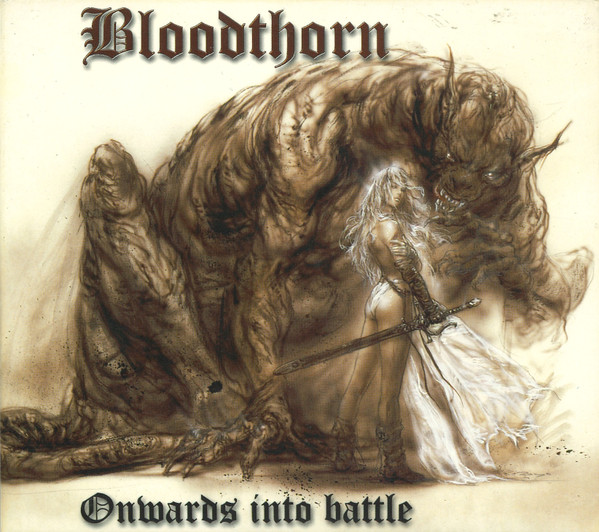
The cover presses two figures close together, as if two different worlds were entering the picture at the same instant. In the background, a huge, grotesque creature crouches over the ground. Its body is covered with intricately drawn details suggesting fur, folds of skin and armour-like masses. Its head comes close to the long, fair-haired woman in the foreground; the dark areas around its eye and face and its pointed, forward-projecting features are particularly striking. One heavy limb of the monster rests on the left side of the image. Its immense bulk almost fills the background, yet it does not swallow up the more fragile human figure.
The woman, wrapped in light-coloured fabric with fraying edges, forms one of the brightest areas in the foreground. She holds a long sword: its hilt rests beside her body, while the blade runs diagonally towards the lower left. The line of the weapon cuts across the space between the two bodies. The painting does not clearly tell us whether she is a protector, prisoner, victor or threatened figure. The monster's power and the presence of the armed human therefore remain in tension, never settling into a scene with an easily narrated and certain outcome.
Luis Royo's image is built from warm browns, greys and off-whites. Against a soft yellowish background, the creature's dark body seems almost to acquire physical weight; the lighter areas of the woman's hair, skin and drapery provide a luminous counterpoint. Scratched, layered surfaces and dust-like patches make the setting uncertain: we cannot tell whether the scene takes place in a hall, a wasteland or some unnamed imaginary location. The band's Gothic-lettered name frames the image above and the album title below, compressing the composition between them into something almost emblematic.
The sound and story of Bloodthorn's second saga bring to the fore characters confronting overwhelming forces, struggle and tragic uncertainty. In that sense, the cover speaks the same language as the music: beside the gentler, brighter surface stands a larger, threatening mass, just as harsher male vocals stand beside clean female singing and attacking guitars surge beneath keyboard atmospheres. This is an interpretation based on the image and the album's documented instrumentation, not a documented statement of artistic intent by Luis Royo or the band. The image is powerful precisely because it compresses the album's central question into a single moment: on the threshold of battle, nothing has yet been decided.
Beginnings and the World of the Tower
Some records carry a single, easily told story from the moment they appear. They are made, embraced or rejected; over the years, the controversies surrounding them gradually settle, leaving behind a more or less shared memory. Onwards Into Battle is not one of those records. It has two lives, intertwined. The first begins in 1999, when Bloodthorn still spoke of it as an ambitious second chapter, a work intended to be darker, more dramatic and rawer. The second begins a few years later, when several of its creators had come to regard it as a rushed, poorly balanced and overcrowded stage in their development. There is no simple truth between the two. That is precisely what gives the record its peculiar power: the same music became both a source of pride and a disappointment, an ending and a beginning, the culmination of an era and proof that the band no longer wanted to return to the same place.
The story begins much earlier, in Trondheim, sometime around 1992 or 1993. Even the founding year cannot be established with complete certainty; it becomes somewhat blurred in later recollections. After leaving Manes, Tom started Bloodthorn, initially as a solo project. There was no complete band behind him yet, no line-up ready to play concerts, and no release from which an outsider could tell exactly where he was heading. What existed was more a musical direction: sombre, primitive, yet not merely raw black metal, with a taste for longer forms and atmosphere. In its early days Bloodthorn was more a possibility than a finished entity.
With Krell's arrival, that possibility began to take shape. The solo project gradually became a creative space shared by two people, and in 1996 the first official trace appeared: the Natteskyggen demo cassette. Tom played guitar, Krell sang and the drums were programmed. It contained only two tracks, March to War and Natteskyggen, but those two long compositions already revealed much of what would remain constant. Bloodthorn did not think in terms of short ideas that quickly came to an end. They wanted to give the music time to build an environment around itself, so that a song would be more than a sequence of riffs: it would become a space the listener could enter.
The demo opened the door through which the project could become a fully fledged band with a record deal. By the time they came to record In the Shadow of Your Black Wings, more people were working around Bloodthorn. Knarr played drums and additional guitar, Geir Mikael took his place at the keyboards, Flipp played bass, and Kristine—later credited as Christine—added female vocals alongside the male voice. The debut was recorded at Brygga Studios in Trondheim in February and March 1997 and released that autumn by Season of Mist. Bloodthorn had done more than simply make its first full-length album. It had laid down the first major chapter of a world.
The Bloodthorn saga, a fictional realm organised around Tower Bloodthorn, was not decoration added after the fact. The band and Torstein D. Parelius developed the names and the world together, one in which oppression, supernatural forces, power and darkness bound the songs into a whole. The first album was no longer only about what a Norwegian black metal band might sound like in the second half of the 1990s, but also about how a record could be built as a story. The songs became parts of a larger arc, an arc that later led directly to Onwards Into Battle. The second album did not have to be invented from nothing: the tower already existed, the oppressed already existed, and so did the darkness from which the next story would have to break free.
After the debut, however, Bloodthorn had to answer a different kind of question. If it was truly going to be a band, it could not remain merely a studio project. The musicians wanted to play live. A more complete line-up therefore formed from earlier contributors and new members. Harald Brovold arrived on bass, while Kai Nergård became an important part of the guitar sound. According to Harald's later memories, the first concert took place in April 1998, followed by a short tour. From then on, Bloodthorn existed not only on recordings; on stage, too, the musicians had to learn how to make the same dense, multi-layered music work.
In 1998, Season of Mist released War Vol. I, a split with another of its bands, the Finnish group ...and Oceans. Bloodthorn contributed four tracks. Spite and The End Offensive were original compositions, accompanied by two cover versions. The label's later biography particularly emphasised that this was the first Bloodthorn recording by the complete seven-member line-up. That was its significance. They carried the world of the debut with them, but were now arranging music that had to make room at once for two guitars, bass, drums, keyboards and male and female vocals. The richness that some listeners would later hear as monumental and others as overcrowded was now becoming the band's everyday musical language.
From the outside, Bloodthorn might have seemed to be reaching its full potential. Within the band, however, matters were already less straightforward. Harald later said that, even before recording the second full-length album, they sensed the line-up was not really working. This casts a strange shadow over everything that followed. Onwards Into Battle became the most complete record of Bloodthorn’s seven-member incarnation, even as that very configuration was already showing cracks while it was being made. The record preserves a band whose complete form existed for only a short time.
The songs for the second album were written quickly. In an interview with an American fanzine around 2000–2001, Harald said that the material had been written in less than four months and that, in hindsight, he felt they had allowed themselves too little time. By then he was speaking in the voice of retrospective self-criticism; in 1999 the emphasis had still been on ambition. Season of Mist described the new album as bringing back the debut's dark atmosphere while pushing it in a more brutal and energetic direction. Harald spoke of it in similar terms that December: the aim was not to abandon melody, but to let the darkness pull the listener in more deeply and the aggression break through more rawly.
The title was not born as a simple battle cry. In the story, the oppressed finally march against Tower Bloodthorn. Onwards Into Battle therefore signifies movement: a departure from the world in which fear, confinement and domination had shaped the characters' lives. Yet the march to war is not undertaken in the certainty of victory. In Bloodthorn's narrative, hope is never a permanent state; it is more like a brief flash of light that casts an even darker shadow behind it. The album's very title contains a promise that will later be revealed as leading towards tragedy.
The Seven-Member Band in the Studio
The band had meanwhile travelled from Norway to Studiomega in Sweden, which some accounts locate in Varberg. Sources do not entirely agree even on how long they spent there. In 1999 Harald spoke of three full weeks; the label's later biography mentioned four. The difference may seem minor, yet it neatly illustrates how difficult it is, years later, to turn an intense studio period into a precise chronology. The roles of those involved in the recording, by contrast, are clear. Christian “Bullen” Silver co-produced the record with the band and also handled engineering and mixing. Kristian “Krille” Olsson took part in digital editing and mastering, sharing the latter work with Bullen.
At the time of release, Harald described the period as stressful but wonderful. He regarded the rawer sound as a deliberate choice. The record was supposed to be icier, starker and more dramatic, so that the war in the story would be felt in the music, not just the lyrics. A few years later, however, different details emerged about the same studio process. Harald said there had been an initial mix that he considered better, but Season of Mist was unhappy with it, so the material was remixed. In his recollection, the second version brought the keyboards forward and pushed the guitars back; this later became one of the main reasons why the band's core looked back on the album with dissatisfaction.
Importantly, he did not place the blame on Bullen or the studio. Even years later, he said he would gladly work there again. He saw the problem rather in the band's willingness to go along with decisions it would later be unable to stand behind. This makes the sound of Onwards Into Battle a story not of one bad technical choice but of compromises. A seven-member band, a label's expectations, the time available, the musicians' ambitions and the proportions established during mixing all helped create a wall of sound that listeners over the following twenty-five years would interpret in radically different ways.
The line-up really was enormous. Krell sang, Tom played guitar, Kai Nergård handled lead and acoustic guitars, Harald played bass, Knarr played drums, Geir Mikael played keyboards, and Christine Hjertaas provided female vocals. Frederik Schälin, singer with Anata, also appeared in the introduction to the closing track. These were more than a collection of names in a booklet. Tension between the elements was essential to Bloodthorn's music. In 1999 Harald described Krell's and Christine's voices almost as moral opposites: the brutal male voice represented evil, the clean female voice goodness and hope. The story thus existed not only in the lyrics but in the contrast between the timbres themselves.
The same tension ran between guitars and keyboards. Some contemporary reviews argued that Bloodthorn's strength lay precisely in the synthesiser's role: instead of merely decorating the music, it helped create the atmosphere as an equal partner. Other listeners later felt that the instrument occupied too much space and buried the guitars beneath it. What might have sounded like richness in 1999 returned as a feeling of overload in the band's own recollections a few years later. Onwards Into Battle consequently became not one stop along a stable stylistic path but a singular meeting point, where everything early Bloodthorn liked to use was present at once and at full force.
Eight Tracks, One Battle
When the record begins, it does not take us straight onto the battlefield. First it reveals the place from which the war will emerge. Across nearly eight minutes, As One in Darkness conjures mist-shrouded mountains, twisted trees, traces of storms and the threatening presence of Tower Bloodthorn. At first the story is not about armies, but about darkness reaching into the individual. Evil demands body, soul and fear; the image of becoming one offers no consolation, only absorption. Before anyone raises a sword, the album shows what it means to be lost in this world.
Later critics were divided even over this first extended piece. According to the French publication Nightfall, the production erects such a dense wall that keyboard melodies, guitars and subtler details are difficult to distinguish. LARM, on the other hand, praised the layered quality of the album as a whole and the interaction between guitars and keyboards. The same sound could thus become either a labyrinth or a monumental map. Regardless, the track's dramatic purpose remains clear: the mountains and tower are not mere scenic backdrops, but the boundaries of the world from which everything else will follow.
After the first major movement comes an interlude barely a minute long. ...of Aeons to Come lasts just fifty-three seconds. The available lyrics source contains no lyrics for it, and without directly examining the complete recording we cannot say with confidence exactly how it is structured. Its position, however, speaks for itself. Bloodthorn thought in long forms, so the short interludes are not incomplete songs but moments in which to draw breath. After the first act, it is as though the tower door closes for an instant, allowing the next long composition to reveal an army already on the move.
In Death to a King, the darkness that had remained hidden begins to advance. Red eyes appear on the misty mountain slopes, the army descends, and cold metal is no longer a symbolic threat but a weapon. Morthion rides a black horse, wielding a warhammer, and from this point the story acquires a truly military character. Ancient evil becomes an army drawn up for battle. Years later Metal1 regarded this as one of the album's most memorable tracks, while Nightfall again emphasised the density of its sound. The two viewpoints illuminate the same contradiction: many heard powerful ideas in the compositions, but not everyone felt that the mix allowed those ideas room to breathe.
The title suggests regicide, but the images in the song describe destruction on a much greater scale. What matters is not the death of one ruler but the collapse of an entire order. After the army's advance, the album pauses again. Dead Silence is barely two minutes long, and surviving accounts do not even fully agree on how it should be heard. Nightfall remembered it as a majestic, instrumental and deeply sorrowful interlude, while MetalIndia mentioned classical influences, acoustic guitar, airy synthesiser and operatic singing. The details differ, but the function is shared: to create silence, or at least a withdrawal, between two larger clashes.
That silence matters because the war then begins from the mortals' side. In The Day of Reckoning, ten thousand people gather at dawn. Banners, pride, a king's speech and promises of freedom and glory accompany their march. Here, too, the thought behind the album title is voiced: onwards into battle. The name of the record now becomes an action within the story. These warriors are not marching metaphorically; they set out towards the tower, and all the album's earlier preparation converges on this instant.
The listener, however, already knows more than they do. According to Harald's explanation at the time, the story does not end in heroic victory. That knowledge lends tragic irony to the optimistic images of The Day of Reckoning. The people marching towards freedom are actually heading into a war they will lose. Nightfall heard the track as one of the album's high points, with powerful symphonic keyboards and a quieter middle section. Metal1 also singled it out. Years later, however, The Murder Inn cited this very piece as an example of how confused it found the arrangements as a whole. Perhaps no other song on the record makes the divide so clear: what one pair of ears hears as epic drama, another hears as overload.
Sounds of Death is no longer preparing for battle. It is in the midst of it. A voice from beneath the earth commands the dark legions to come into the light and bring death. Darkness pours across the field like a torrent, the mortal army meets it with weapons, and the two sides collide. Forces that had existed separately until now meet fully for the first time. Nightfall's reviewer heard an almost cinematic panorama of war in the song, with grand keyboards and a conquering momentum. That description fits the way Bloodthorn used symphonic elements in this period: not as background, but as action.
It is no coincidence that Sounds of Death later appeared on compilations too. In the late 1990s and the early internet era, magazine cover discs and sampler CDs still had remarkable power to introduce bands to new audiences. A single song had to represent everything Bloodthorn stood for across an entire album's world. Sounds of Death proved suited to the task: it held the brutality, the symphonic ambition, the war narrative and the density that would later provoke so much disagreement.
Beneath the Iron Sceptre no longer asks who will win. Here war becomes domination. Images of iron hooves, plague, fire, ashes, pain and torture succeed one another. Under the iron sceptre, the mass of humanity is no longer an opponent but material to be subjugated. The earlier hope vanishes from the story. If The Day of Reckoning carried the promise of freedom, here there is neither refuge nor redemption. According to Nightfall, the dense production still obscures some melodic detail, yet the lyrical world seems almost to demand this weight. The song is not about fine distinctions. It asks what it might feel like for an entire world to be crushed beneath a single force.
Only the final movement remains, and Bloodthorn does not attempt a brief farewell. The closing track, The Brighter the Light, the Darker the Shadow, lasts more than eleven minutes. Frederik Schälin makes a guest appearance in its introduction, and the narrative then opens on an image of the last stand: the ground is covered with the fallen, and the surviving warriors know they will not return home. Nature itself participates in the devastation. Thunder, lightning, rain falling like blood, a darkening sky and an extinguished sun accompany the advance of darkness.
The paradox of the title now becomes the governing law of the entire album. The brighter the light, the darker the shadow. Hope does not banish evil; it brings its outline into sharper relief. Those who marched to defeat the darkness ultimately find themselves trapped within it. Harald's 1999 summary leaves no doubt about the outcome: evil triumphs, and its reign continues. The saga's second chapter therefore ends not in resolution, but in enclosure.
In its critical afterlife, the closing track became one of the clearest examples of how the same grandeur could work differently for different listeners. For Nightfall, those eleven minutes embodied the album's cumbersome, demanding side. In 2025, Black Devotion took precisely the opposite view, calling it the record's absolute high point. What is too long and too dense in one reading is cathartic in another. Curiously, both interpretations fit Bloodthorn's history: the band itself looked back on the album with conflicting feelings.
The Release and Its Changing Reception
Alongside the musical story there was also the physical object. The original edition of Onwards Into Battle came in a four-panel digipak with a twelve-page booklet. Luis Royo's cover image captures almost in a single moment the opposition Harald also described in the vocals: an immense, distorted, threatening force, and before it a far more fragile human figure. Brutality and beauty appear not as separate worlds but side by side. The picture contains the same tension that runs through the music between harsh male and clean female voices, heavy guitars and atmospheric keyboards.
Even reviews that had reservations about the music often acknowledged the visual power of the release. Nightfall specifically mentioned Royo's artwork and the detailed booklet. The physical edition was therefore more than packaging. It remained part of the band's world-building. In the credits, the musicians, the studio, the photographers and the graphic design appeared in the same document as the names of the Bloodthorn saga. The listener received not merely a CD but a physical imprint of a story.
The precise release date is still not entirely clear. The year was 1999 and the catalogue number SOM 018, but the date varies from source to source. Season of Mist's current catalogue gives 1 January, while Harald later recalled September or October. This uncertainty does not change how the band regarded its own work at the end of the year. In December 1999, Harald still spoke with conviction about the darker, more dramatic album, the story's second chapter, the contrast between male and female voices and the weeks spent in the studio. At that point, Onwards Into Battle was not a catalogue of mistakes to him, but a finished work he stood behind.
Nor was the early critical reception one of unanimous rejection. LARM’s review from around 2000 was almost enthusiastic. The reviewer heard something monumental, dark and heavy, in which slow, dreamlike passages coexisted with blastbeat-driven outbursts, heavy-metal guitar solos, male and female singing and prominent keyboards. The critic regarded it as one of the stronger extreme-metal releases of 1999. Other early assessments found it less original, but still acknowledged its story, production and presentation.
Yet the seed of the later argument was already there: did all these different elements come together harmoniously, or was there simply too much happening at once?
The band's internal assessment changed faster than the outside world's. Within just a few years, Harald was saying that, for him, most of the songs had not stood the test of time. He felt the keyboards dominated the mix while the guitars had been pushed into the background, and increasingly came to regard the entire album as rushed. At the same time, he did not deny that it had received good reviews. This duality gave the record an unusual life. While some listeners remembered it as an atmospheric, epic achievement, several of its own creators were already heading down a different road.
The turn had in fact begun during recording. In 2006 Harald recalled that he and Krell had already talked at Studiomega about the next album needing to be harder and darker. In other words, before Onwards Into Battle was even entirely finished, two of the band's defining members already felt the need for change. It was not merely a later shift in taste. Every hallmark of early Bloodthorn appeared magnified on the record, and perhaps that very excess made it clear what they did not want to repeat in quite the same way.
A European tour followed the release, but the line-up was also being reshaped. Female vocals and keyboards, two of the defining characteristics of Onwards Into Battle, disappeared from the band's next period. Harald later explained that this was not simply a series of personnel changes. Different people began writing the music, the atmosphere within the band changed, and its entire direction changed with it. Under the Reign of Terror (2001) became almost a deliberate rejection of what had defined the second album: the keyboards receded, female vocals vanished, and the guitars and death-metal aggression moved to the fore.
Harald did not later describe this as an attempt to follow trends. Quite the reverse: he believed that, had the band wished to stick with the more marketable and successful formula, it would have remained on the path of the first two albums. For them, the change proved that they did not want to keep living off the same approach. In this sense, Onwards Into Battle became not only the end of an era but a necessary collision. It showed how far the early Bloodthorn formula could be taken—and what happened when the band felt there was nowhere further to go along that route.
The relationship with Season of Mist ended as well. In later interviews, Harald expressed dissatisfaction with financial and promotional matters, and Bloodthorn eventually moved to Red Stream. The change was therefore musical, personal and contractual all at once. Meanwhile, songs from Onwards Into Battle disappeared from the new line-up's concert programme. According to Harald, tracks from the debut remained, but they no longer played anything from the second album. A record rarely becomes a historical document within its own band quite so quickly.
Time, however, would not allow the argument to be settled. In 2004 the French publication Nightfall revisited the album, speaking both of magnificent moments and of suffocating production. Dead Silence, The Day of Reckoning and Sounds of Death stood out for the reviewer, while the dense sound of guitars and drums often obscured keyboard melodies, solos and Christine's singing. This was no longer the excitement of a new release, but a frustrated kind of admiration formed from a distance of several years.
A year later, Metal Crypt passed a far harsher judgement. To its reviewer, the keyboards, female vocals and drum sound seemed more like clichés than strengths, and there was little to hold on to apart from Krell's lead vocals. In 2007, by contrast, the Spanish publication To Live for My Death heard the same material differently again. It argued that Bloodthorn was not simply imitating other Norwegian symphonic black metal bands; the mid-tempo development, female vocals and monumental keyboards gave the music a character of its own. Metal1 similarly stressed in 2013 that the album demanded repeated listening, but praised the epic melodies of Death to a King and The Day of Reckoning.
In 2019, The Murder Inn again approached the negative extreme. Its reviewer heard the keyboards, the overall sound and the accumulation of styles as a muddled mass, singling out The Day of Reckoning in particular. Six years later, in 2025, Black Devotion offered almost the mirror image of that verdict. Its writer described having previously underestimated the album, then changing his mind upon listening again and coming to regard the closing track as a monumental high point. A quarter of a century had passed, yet there was still no consensus about Bloodthorn's second album.
Perhaps this is the most fitting afterlife for a work whose creators themselves remembered it differently at different times. In 1999 it was driven by pride and purpose. Around 2000–2001 disappointment and self-criticism had already set in. In 2006 Harald could say, with the benefit of historical distance, that it had not turned out as they had wanted. Meanwhile the album continued to be heard, collected and reassessed. Gradually, the band's own judgement and its listeners' relationship with the record grew apart.
The Afterlife of the Tower
Bloodthorn, meanwhile, moved on. Under the Reign of Terror in 2001 represented a different world and a different sound; Genocide in 2006 became another chapter, and in 2011 the band ceased operations. By then, Onwards Into Battle had long since ceased to feel like a contemporary release. It had become a document of an early era, preserving a version of Bloodthorn that even the band itself would not later wish to reconstruct.
Yet it did not disappear. It remained in Season of Mist's catalogue, became accessible again on digital platforms, and appeared on Bloodthorn's Bandcamp page in 2018. This is a curious transformation for a record whose original impact depended so strongly on the digipak, the booklet, Luis Royo's image and its tangible physical world. In the digital era, the tower no longer stands between sheets of cardboard; it is rebuilt from files, cover images and archived interviews. But the story still leads to the same place: into battle, and then defeat.
According to AllMusic's 2006 retrospective, the mixture of aggression and beauty might have sounded fresher in 1999 than it did a few years later, when similar approaches had become more widespread. That observation helps explain why opinions of the album could change so much. A record does not age in isolation. The music around it changes too. What seems a bold imbalance, an unusual combination or a new kind of grandeur in one year may later become more familiar—or, on the contrary, seem stranger and more firmly bound to its time.
With Onwards Into Battle, that connection to its era is not a weakness. It is an imprint. The record contains the late 1990s' openness to symphonic black metal, faith in extended compositions, the contrast between male and female vocals, fantasy world-building, the material culture of the digipak, and the conviction that an extreme-metal album could be story, image and sound at once. It also reveals how easily the very same set of tools could become too much for the people who brought it together.
The record is therefore more than simply a second album. It is a fault line. Every route from Tom's initial solo project through the Natteskyggen demo, the debut album and War Vol. I converged here. And almost at that same moment, another path branched away. After recording, Bloodthorn did not continue refining this world: it dismantled it. The female voice disappeared, the keyboards retreated and death-metal aggression advanced. The tower's story continued, but the musical structure in which its second chapter had sounded was never rebuilt in quite the same way.
Perhaps that is why the record still divides listeners so readily. Those who hear richness in its layers find that every keyboard flourish, every vocal contrast and every extended build-up belongs to a larger world. Those who experience the same qualities as overcrowding find that the details conceal one another. No simple sentence can erase either experience. Nor is one needed. Onwards Into Battle has remained interesting not because everyone ultimately agreed about it, but because it can still provoke debate a quarter of a century later.
Within the Bloodthorn saga, the second chapter ends with darkness victorious. At first glance, this might seem to fit the band's later self-criticism, which treated the album as a flawed stage in its development. But the two defeats are not the same. In the fictional story, evil wins by design: that was the concept. In the band's history, disappointment did not destroy the album; it forced a new direction. Onwards Into Battle thus became an experience from which the next era could emerge.
Perhaps this is the record's most intriguing legacy. A work shapes its creator not only through what succeeds within it, but also through what the creator wants to do differently next time. Harald's later words were harsh about the mixing, the haste and the old line-up, but they did not erase the fact that in 1999 Bloodthorn genuinely believed in this ambitious second chapter. Both states are true at once. Enthusiasm does not become false because disappointment follows it, and disappointment does not become meaningless because some listeners continue to love the record.
Time eventually separated the band from the album. Bloodthorn broke up, its members went their separate ways, and the early period became an archive. Onwards Into Battle, however, remained accessible through subsequent editions, digital platforms, old reviews and belated rediscoveries. A listener discovering it twenty-five years later does not need to know about the tensions at Studiomega, or of how the band later judged the mix. The music has a life of its own. But for anyone familiar with those stories, the album's shadows grow deeper.
The tower thus remains both fiction and monument. Fiction, because it stands within the Bloodthorn saga, amid oppressive forces, armies and final battles. Monument, because it preserves an entirely real moment in the life of a band: seven people trying to give voice, together, to everything they had built up until then. The enormous creature and the fragile figure standing before it on the cover still hold that tension within a single image. The same thing happens in the music. Brutality and beauty, conviction and doubt, hope and defeat stand side by side.
The final picture is therefore neither that of a band making a flawed album nor of posterity at last vindicating a misunderstood masterpiece. Both stories would be too simple. The value of Onwards Into Battle lies instead in its refusal to be settled so easily. It was an ambitious undertaking in its own time. To its creators it soon became a troubled memory. For more than two decades, critics heard markedly different things in it. And throughout, the record remained what it was, with the same eight movements, the same tower and the same war.
Perhaps that is its most beautiful contradiction. In the story, light falls, shadow wins and the reign of evil continues. In the history of the record, however, time itself prevented any final victory. Disappointment could not erase the original enthusiasm. Negative reviews could not put an end to later admiration. The band's change of style could not wipe away the Bloodthorn that existed in 1999. With every new listening, every interview brought back to light and every old digipak, the same gate opens once more.
And somewhere around this point, it becomes clear why Onwards Into Battle remains more than an entry in a discography. It shows not only what Bloodthorn became, but what it might have become had it remained longer in that seven-member, symphonic world built around two contrasting voices. We cannot know what a third album in the same form would have sounded like, because the band itself closed that path. The second chapter is therefore also the last complete moment of that incarnation.
The shadow of Tower Bloodthorn thus falls not only across the lyrics. It reaches over the band's history as well. Within the music, the tower symbolises oppression; beyond it, the tower commemorates the period when Bloodthorn still believed that darkness should be constructed with every means available: long songs, keyboards, two kinds of singing, heavy guitars, fantasy mythology and a monumental visual world. The band later left much of this behind. The record, however, did not move on with them. It stayed in 1999, and that is precisely why we can still return to it today.
The battle ends, but the album does not. The turntable, CD player or digital file eventually falls silent, leaving quiet after the closing song's final moment. In the story, darkness has won. In Bloodthorn's history, a new line-up, label and sound would soon follow. But the true afterlife of Onwards Into Battle begins with what comes next: when the band is no longer there to explain how it should be heard. When listeners are left alone with the tower, the armies, the sound they find either overcrowded or majestic, and the question to which a quarter of a century has offered no single answer.
Perhaps it does not need one. Some records endure not because they are flawless, but because their meanings never run out. Onwards Into Battle is one of them. The complete imprint of a short-lived line-up, the second chapter of a fantasy war, a disputed mix, an aesthetic later disowned, an image by Luis Royo, a handful of interviews and a succession of clashing reviews: all of it enclosed within an album of around fifty minutes.
In the end, there is nothing left but to return to the title. Onwards Into Battle. Forward into battle. In 1999 those words described the movement of the story's characters. For Bloodthorn they were a creative gesture. Later they became a self-critical memory. Today they are a call to step once more into this strange world, beautiful and oppressive at once, and let the light and shadow confront each other again.
Reader comments
Comments only appear after approval. Messages are displayed in their original language.
Comment submissions are not enabled yet.