

Niemals krönender als was einst war
The story of Berlin band Arathorn’s debut, in ten chapters: the sessions, four long tracks, cover artwork and legacy.
Album information
Track listing · original CD (4 tracks)
- In Spectren pulsierender Todesrinnung8:54
- O ultima privire asupra luptei din ţinuturile Transilvaniei (An Armageddish View over the Landscapes of Transilvania)10:10
- Die Inthronisation (Der Koenig erwartet euch...)6:23
- Die Hymne des Winters Zorn16:35
Musicians · original recording
- Sköll
- Drums, flute, tenor vocals
- A. K.
- Vocals, guitar, bass
- M. Gericke
- Keyboards, accordion, acoustic guitar, baritone vocals
Recording and release
- Released
- 5 June 1997
- Recording
- Octosound Studio, Berlin · 27 January – 5 February 1997
- Mixing
- 10–12 February 1997
- Mastering
- SoundQuest, Berlin
- Original label
- Folter Records
- Catalogue number
- FR 008
- Format
- CD · 4 tracks
- Artwork and layout
- Alexander Schulz (artwork/layout; photography rights not established)
Information for the original 1997 Folter Records CD (FR 008); the 2024 LP is a separate reissue.
Cover artwork and its interpretation: Interlude
Official music pages
Folter Records · official Bandcamp album; listen to and purchase the full digital release.
Listen to the full album
Full-album video published by Folter Records; this is not a YouTube Music album page.
Physical editions · vinyl and CD catalogue
Original CD: 1997, FR 008. Reissue: 2024, ASR333 (LP).
Prices and availability can change. A currently orderable original 1997 CD has not been verified; the LPs are the 2024 reissues.
01 / 10
I. From Berlin into Winter
Every record has a moment when it is not yet a record. It has no catalogue number, no cover, no precise running time, no place on a shelf or in a record company's inventory. There are only fragments of melodies, unfinished rehearsals, thoughts wandering among instruments, and a handful of people who can hear something in their heads that no one else has heard. Arathorn's first full-length album grew out of just such a state: not out of a single decision, but out of overlapping Berlin projects, earlier attempts, friendships, musical explorations, and that distinctive underground world of the 1990s, in which a cassette, a letter or a page in a fanzine could sometimes matter more than any official advertising.
Berlin, a City Still Taking Shape
After the opening of the Berlin Wall in November 1989 and German reunification in 1990, Berlin had only a few years in which to grow accustomed to the fact that a border no longer ran through its centre, separating two distinct worlds. Yet the eastern and western parts of the city did not simply join together. Former government offices, businesses, residential buildings and cultural venues found new owners, new purposes or uncertain futures. For some, the changes brought room to manoeuvre; for others, they meant losing their jobs and watching their former lives fall apart. Familiar routes opened up, while new divisions often arose around rents, access to jobs and institutions.
Political decisions followed one another in rapid succession. Berlin became the capital of reunified Germany in October 1990; in June 1991, the Bundestag decided to move the seats of parliament and government from Bonn to Berlin. The process was regulated by the Berlin–Bonn Act of 1994, but parliament did not actually relocate until 1999. Thus, when Arathorn was taking shape, Berlin was not yet functioning as the seat of government that would later become familiar. Building sites, property disputes, business closures and suddenly available cultural spaces all shaped the atmosphere of the city at once.
The reunifying city also made space for the freedom to be different. Abandoned buildings, or buildings temporarily put to new uses, in the former eastern part of Berlin offered opportunities for exhibitions, band rehearsals, screenings and nighttime events. Artists occupied the Tacheles arts centre in 1990 to save it from demolition; it later housed studios, rehearsal rooms and performance spaces. The most widely recognised sound of Berlin in those years came from techno, electronic dance music and the Love Parade. This is not a history of Arathorn's musical style, but it provides an important counterpoint in the history of the city: in the very same Berlin that presented itself to the outside world as open, new and celebratory, many smaller communities were seeking a place among darker, less visible genres.
The personal connections between Silentium, Nox Intempesta and Arathorn trace another, much smaller musical network within that city. At this level, a community was not an entire district or a single legendary club, but a few musicians, overlapping plans, cassettes, recordings passed on to acquaintances, and people working together. The surviving material does not establish with certainty which neighbourhoods the members once lived in or where they regularly rehearsed. The story therefore becomes tangible where reliable traces survive: in the relationship between Arathorn and Nox Intempesta, in their work with the label, and in the brief, intensive days spent at Berlin's Octosound studio in 1997.
One of the earliest antecedents of this story was Silentium. The project began in Berlin in the early 1990s, around 1993, and several of Arathorn's future members were already working together there. The musicians who would later contribute to Niemals krönender als was einst war therefore already knew one another. A.K., Sköll and M. Gericke had learned what it meant to think in the same dark musical space, and what it was like to construct a song in which other colours could seep into the traditional vocabulary of black metal.
Meanwhile, another story was unfolding. From 1994 onward, M. Gericke and A.K. — Mordra and Tyrann in the world of Nox Intempesta — were also working together in a much harsher, more direct band. Nox Intempesta was no mere side story, but a different path through the same Berlin underground. A duality was thus present almost from the beginning: on one side, the more open, folkloric and atmospheric approach that led towards Arathorn; on the other, a black metal band growing progressively more aggressive. For a long time, the same people carried both possibilities within them.
Even today, Arathorn's precise birthday cannot be circled on a calendar with a single confident stroke. A review published in early 1998, very close to the period itself, mentions September 1995, while later biographical summaries speak of the summer of 1996. The difference need not be a contradiction. Rather, it shows that an underground band is rarely born like a formally registered institution. First come a few songs, a few rehearsals, a few names, a small circle that already knows something is happening. Only later does it become clear when all of that began to count as a band in its own right. What can be said with the greatest confidence is that the core from which Arathorn's first era emerged took shape around the turn of 1995 and 1996, and that by 1996 the three-piece line-up preserved on the debut album was in place.
The band's name was revealing in itself. Arathorn is a name familiar from Tolkien's world, but the band never confined itself to a single fantasy universe. The titles on its first album already lead much further afield. Transylvania, winter landscapes, thrones, lost orders, pre-Christian imagery, death, the past and timelessness mingle within them. The name became a gateway rather than a programme: a sign that the band was interested not in the ordinary present, but in the place where history, legend and personal imagination meet.
Instruments took on different roles in this world, too. Alongside the distorted guitars and drums of black metal came keyboards, piano-like passages, acoustic guitar, flute and even accordion. They were not embellishments intended to make the music lighter, but sounds that seemed to give voice to a more distant age. The accordion, for instance, brought no cheerful tavern atmosphere, but something peculiarly sombre and archaic. The flute did not dispel the darkness; it let air into it. And the keyboards did more than provide a backdrop: they built a landscape.
The three musicians thus arrived at the four long compositions that would become first a demo and then an album. Later discographies date the four-track demo Niemals krönender als was einst war to 1996. It is no coincidence that the full-length album would bear the same title. Even then, the band was not thinking in terms of a loose collection of songs. It wanted to create one enclosed world, with four long paths leading through different landscapes, all breathing the same cold air.
The demo reached Folter Records. The Berlin label was still young, but it was already seeking precisely the kind of underground environment in which Arathorn operated. The agreement offered a chance for something more lasting to emerge from behind the cassettes and rehearsal-room versions. The record would later receive the catalogue number FR 008, only one step removed from Nox Intempesta's FR 009 release. At this point, the two stories were almost moving in each other's shadow.
The Small Label and the Underground Network
It would be easy to equate Berlin's mid-1990s musical life with the history of its famous clubs. Yet extreme metal did not always make itself visible in the same public spaces as the city's other loud new genres. For small bands, connections that helped them record, distributors willing to handle mail orders, and editors prepared to give them space in a fanzine with a print run of only a few hundred copies were all equally important. Berlin's cultural freedom did not automatically mean a large audience. The boundaries of the local underground were better revealed by whose hands a demo reached, and who was willing to pay for the next step.
Folter Records was a crucial link in this respect. Jörg Schröder founded the Berlin enterprise in 1991, initially as a distribution operation. The label's early story was not exclusively about black metal: a limited-edition single by Dead in 1994 and an EP by As Divine Grace in 1995 also helped build its catalogue. Small labels often worked not by drawing rigid boundaries between genres, but by acting as trusted intermediaries. A distribution contact could become an order, a demo sent through the post could lead to a release decision, and an acquaintance could open the way to another recording.
In this setting, the proximity of Arathorn's and Nox Intempesta's catalogue numbers is particularly telling. FR 008 and FR 009 are not simply identifiers for two releases, but surviving evidence that two works with different sounds, created by a small circle of Berlin musicians, were given the chance to appear almost simultaneously. Folter was not some all-powerful arbiter of taste; it was one of the points of connection without which many recordings would have found it much harder to move beyond the world of demos. The relationship between the musicians, the studio and the label can be established here with far greater confidence than any Berlin concert venue retrospectively associated with them.
The smaller musical communities of the time were almost impossible to represent on a single map. A recording was made in Berlin; a reply to a letter arrived from somewhere else; a review appeared in a third country. A band's presence was thus dispersed across several places. This is also what makes the story of Arathorn's first album intelligible. The studio was a real place. The record's journey through the world, however, consisted less of streets than of human connections and of recordings passed from one person to another.
By the end of 1996, then, everything was in place for the four long compositions to become a real record. But what looks like a simple process on paper — band, label, studio, release — was in fact the beginning of a short and intense period. By the time the album was complete, the same musicians were already pulling their musical futures in two directions. Looking back, Niemals krönender als was einst war therefore seems more than a mere debut album. It is more like a snapshot in which three people were still standing together, even as their next steps were already leading them down different paths.
Germany and Europe in the Middle of a New Decade
The transformation taking place in Germany did not stop at Berlin's city limits. The redistribution of ownership in former East German factories and the restructuring of the economy left many families facing uncertainty during the 1990s. Life in the western federal states and everyday experience in the eastern part of the country did not become identical overnight. New opportunities for travel and cultural exchange opened up for young people, but not everyone experienced that new freedom under the same conditions. The market structures that replaced older institutions sometimes brought opportunity and sometimes anxiety.
Meanwhile, Europe's political map was changing as well. The Maastricht Treaty entered into force in November 1993, establishing the European Union. The single market had begun operating that same year; Austria, Finland and Sweden joined the Union in 1995, and the Schengen system abolishing internal border controls came into effect among seven countries. None of these decisions explains a single chord played by a band. Yet they place this album in an era when connections across the continent were growing denser, and crossing borders and international exchange gradually took on a different everyday meaning.
The mid-1990s were not, however, one uniformly peaceful shared European story. The breakup of Yugoslavia was accompanied by wars, while economic differences between East and West did not disappear. Openness and the sense of a lost former order existed side by side. Arathorn's lyrics, with their turn towards myths and vanished ages, cannot be derived from these political events without evidence. Nevertheless, the period shows the present from which songs about medieval kings, winter and historical loss emerged: a Europe attempting to rearrange its own recent past.
Everyday cultural exchange changed more slowly. Listeners still often discovered an intriguing record through a printed review, a copied cassette or a catalogue ordered by post. Political talk of a new Europe moved much faster than the parcel an unknown band sent to an editor abroad. The music library that would later be available with a single click was, in those days, at most a distant possibility.
02 / 10
II. The Days at Octosound
At the end of January 1997, Arathorn entered Berlin's Octosound studio. The exact dates have survived: recording began on January 27 and continued until February 5. A few days later, between February 10 and 12, the material was mixed. The final mastering was carried out at SoundQuest. The credits list Andreas Roemer and Vito Schneider as producers, Mat Mission for mixing and Sven Conquest for mastering, while Alexander Schulz is associated with the artwork.
These may look like dry facts, but a remarkable concentration of activity lies behind them. On January 30, while Arathorn's studio session was still under way, Nox Intempesta was working at the same Octosound studio on Die Lieder von Tod und Ewigkeit. The same studio, the same city, some of the same people, the same circle of producers and mixing personnel. It was as though two records were branching away from the same trunk, side by side. One moved towards frozen landscapes, gradual development and folkloric colours; the other increasingly towards more direct, aggressive black metal.
This is precisely what made the difference so interesting. Arathorn had no wish to erase the music's rawness. The guitars were not polished to a glossy sheen, the drums did not become sterile, and the bass — unusually — did not vanish into the background. Later reviews repeatedly noticed that the record was rough-edged and richly detailed at the same time. The guitars are dirty, the bass full-bodied, the keyboards clear, and the non-metal instruments enter the compositions as genuine participants.
Perhaps the most important thing, however, was that the band did not hurry. There were only four tracks on the album, yet together they amounted to more than forty minutes of music. That choice shaped the very way the record had to be heard. There was no reaching a chorus after a couple of minutes and then moving on. The songs unfolded slowly, repeating motifs, letting in new colours and then returning to the same idea, as though one were walking around a landscape where the same mountain takes on a different light at every turn.
A.K. handled vocals, guitar and bass guitar. Sköll played drums and flute, and also sang tenor parts. M. Gericke played keyboards, accordion and acoustic guitar, enriching the sound with his baritone voice as well. The distribution of instruments and vocal parts alone makes clear that this was no conventional three-piece metal band. All three musicians reached in several directions, and in the studio those directions were layered upon one another.
Possible Neighbours in Sound
By 1997, black metal no longer meant a single sonic model familiar from Norway. Alongside the raw, attacking form of the early 1990s, more and more European bands were turning towards lengthy compositions, keyboard atmospheres, medieval-sounding melodies and folklore. The difference was not always a matter of speed. Musicians were also reconsidering what sort of space clean singing, synthesisers and even acoustic instruments could create alongside distorted guitars.
In Germany, Falkenbach combined mythical Nordic subjects with elements of folk and black metal; its first full-length album appeared in 1996. Also from Germany came Empyrium, founded in 1994, which approached nature, melancholy and romantic landscapes from another direction — that of folk and doom — on A Wintersunset... in 1996 and Songs of Moors & Misty Fields in 1997. These were not demonstrable models for Arathorn. Rather, they illustrate the musical possibilities of the time: darkness could be expressed with more than fast tempos and raw vocals.
In Austria, Summoning formed in 1993 and soon began developing themes from fantasy literature in long structures built around keyboards and recurring rhythms. In Norway, Ulver's 1995 album Bergtatt made the passage between black metal and acoustic, folk-inflected moods central to its voice, while Emperor's 1994 In the Nightside Eclipse revealed the dramatic potential of symphonic layers. These examples do not form a direct chain of descent. Instead, they show how, in various parts of the continent during the same decade, musicians were expanding the originally rather narrow palette of extreme metal in different ways.
Arathorn's line-up responded to this expansion in an unusual way. Flute and accordion were not incidental effects listed in the album credits: they had genuine roles in the instrumentation of drummer Sköll and keyboardist M. Gericke respectively. Yet the medieval impression does not depend on these instruments evoking one particular, historically accurate period. Modern studio instruments, distorted guitars, acoustic passages and long musical developments together create the imagined landscape to which the album's lyrics lead us back.
It is this that makes the Berlin picture and the wider European one feel both close and distinct. While many well-known black metal bands worked to make their sound ever denser, others increasingly made room for silence, repetition and contrasting timbres. Niemals krönender als was einst war did not attach itself to this search for new directions in retrospect; it was made in its own time, in 1997. Without reliable testimony from the band members, its individual musical choices must not be confused with the intentions of other groups. What can be heard, and traced in the credits, is that three Berlin musicians created an independent world of four songs within this same widening range of expression.
That layering can be felt from the record's opening moments. The music is not simply fast or slow; no single adjective can contain it. There are marching passages, almost weightless keyboard spaces, acoustic sections and long, repeating motifs. Clean and extreme vocals are not mutually exclusive devices, but two faces of the same world. One seems to be telling the story; the other seems to be crying out from within it.
By the end of the studio sessions, an album had come into being in which the rawness of 1990s black metal met a longing for a much older, imagined Europe. It was not a history book. Nor was it an exact reconstruction. It was, rather, music that sensed the past not as data but as temperature: as cold, mist, a distant horn call, stone, snow and a road leading away from the present.
03 / 10
Interlude – The Red Sky and the Dark Road
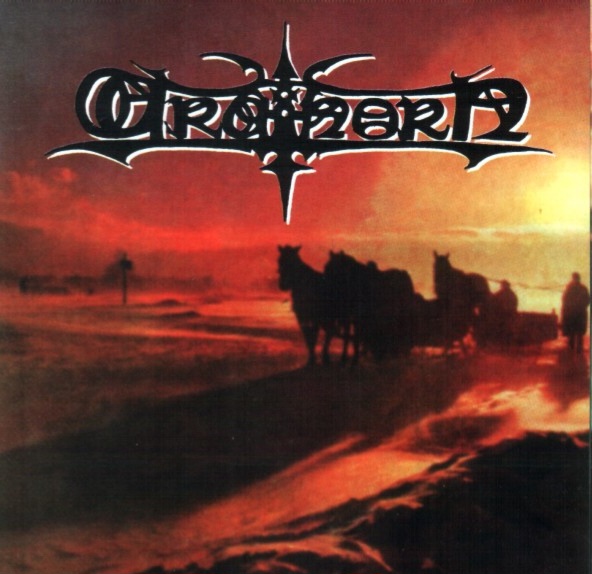
At first glance, the cover does not evoke the colours of winter. There is no pure whiteness, no reassuringly recognisable expanse of snow. The upper part of the image burns with red and orange light, brightening towards a yellowish horizon. By contrast, the ground is almost black. A road that looks wet and glistening recedes through the centre, with dark patches, shapes and merging outlines upon and alongside it. The colours do not depict a peaceful sunset: light and the shadows in the foreground almost seem to strain against one another.
Along the upper edge of the image stretches the band's logo, fashioned from branching letters that are difficult to decipher. Its white outline stands out against the dark sky like an engraving or a sign woven from bare branches. Beneath it, the gaze drifts downwards to the road, whose far end offers no clear answer as to where it leads. In the foreground, there are heavy, animal-like silhouettes and a dark form resembling a cart; farther away, on the right, a vertical shape that appears to be a human figure stands apart. The original low-resolution reproduction does not allow every patch to be identified with certainty. Yet that very uncertainty is part of the picture's effect: the road seems to promise both progress and obstruction at once.
The artwork is not a historically faithful depiction of the Middle Ages. Clothing, vehicles and location cannot be assigned to any particular century, and there is no reliable statement of the creator's artistic intentions. Instead, the image meets the album's lyrical world in another way. The eye travelling down the dark road arrives at a recurring question also raised by the title: where does the road lead if there is no real way back to an idealised past? The contrast between the fiery sky and the long, icy pieces of music is therefore much stronger than any literal winter landscape would have been.
The frozen landscapes, kings, dead and abandoned orders evoked by the four songs do not appear as straightforward illustrations. Rather, the cover preserves that uncertain moment when the eye can still see a road but can no longer recognise its destination. The cover offers no resolution to the music; it sends the listener on their way with the same dark question.
04 / 10
III. Four Gateways
The album's opening song, In Spectren pulsierender Todesrinnung, chooses a language that refuses to be easy, even in its title. The music does not offer an introduction here, but an entrance. The lyrics begin with a snowstorm, a crystalline world, crimson ice and madness freezing over. Winter is not a backdrop. Winter itself becomes the protagonist. It moves, suffocates, covers and preserves. The flowers of death remain trapped in the ice, while the figures approaching on white steeds are not everyday characters, but inhabitants of a vision.
One of the song's most important lines eventually leads to the album's title: never crowned more majestically than what once was. This idea is not mere nostalgia. It makes a far harder claim: the present cannot surpass the lost past. The past is not a prelude, but a standard. Measured against it, every later age becomes poorer, noisier, faster and less complete.
The music does much the same thing. The song is in no hurry. Layers of instrumentation arrive and disappear as though the listener were gazing through mist. The keyboards do not simply play a tune; they create space. Rather than drowning them out, the guitar lends tension to the background. The bass sustains the weight, while the drums provide movement rather than a constant assault. Already in the first few minutes, the album's entire method is present: extended form, shifting density, dark historical imagination, and an arrangement unwilling to decide whether its language should be metal, folk or something in between.
The second piece carries us farther still. Its title opens in more than one language: O ultima privire asupra luptei din ținuturile Transilvaniei, followed by the English An Armageddish View over the Landscapes of Transilvania. At the start of the song, a brutal image of history appears. Stakes, mutilated bodies, remains rotting in the summer heat, and birds of prey over the Carpathians. The tradition of horrific tales associated with Vlad Țepeș and the Ottoman wars is recognisable, but the lyrics soon leave historical ground behind.
The landscape turns into mist, the mist into a vision, and the vision into cosmic space. Winter horns sound, northern winds arrive, and the speaker approaches the gates of eternity. Here Transylvania is no longer a geographical place, but a passageway. Historical violence becomes an inward journey; the grave becomes a crypt, and the crypt opens into a space facing the stars. By the end of the song, endless winter is more than weather: it is a state in which death and ascension come to mean almost the same thing.
Transylvania and Wallachia: Two Distinct Histories
The Romanian and English titles of the second song name Transylvania, but the stakes and executed bodies evoked at the outset also point towards another historical region. Vlad III, or Vlad Țepeș, was chiefly the ruler of Wallachia in the fifteenth century. Wallachia was a principality south of the Southern Carpathians, stretching towards the Danube; Transylvania was a historical region inside the mountain ring, connected to the medieval Kingdom of Hungary. The two territories had ties, but they were not the same state, nor were they two interchangeable names for a single country under a single ruler.
The period was shaped by pressure from two greater powers. The princes of Wallachia tried to preserve room for manoeuvre between the Kingdom of Hungary and the expanding Ottoman Empire. Vlad's reign was marked by internal struggles for power, military clashes and opposition to Ottoman expansion. The memory of the campaign of 1462 and the brutal reprisals remained especially vivid. The practice of impalement is associated with the historical figure, but the stories about him that spread across Europe could already serve political and propagandistic purposes in his own time. Not every dreadful detail can be verified with equal certainty.
The later Dracula myth added another layer to this memory. The fifteenth-century prince, Western perceptions of Transylvania and the modern vampire story have often been fused into a single dark legend. But the song is not a historical study. Images of real violence gradually dissolve in its lyrics into mist, winter, crypts and eternity. The Transylvania that emerges is not one reconstructable battlefield, but a meeting place for historical memory and later Gothic imagination.
The distinction matters because we hear the song differently once we know where the verifiable historical connections end. The real geography of the Carpathians, fifteenth-century power struggles in Wallachia and romanticised images of Transylvania may all inform an interpretation, but none can stand in for the others. Arathorn did not make a musical chronicle drawn from the archives: it used scattered fragments of history to create a much broader vision, one that leads through death and time.
The music follows this transformation. Its long form does not illustrate a story step by step, but gradually dissolves the concrete images. It is as though the listener were standing on the edge of a battlefield, only for the ground suddenly to vanish beneath their feet. The keyboards sketch the distance, the distorted guitar the threat, while the rhythms hold the two together without ever allowing the piece to settle into complete calm.
The third track, Die Inthronisation (Der Koenig erwartet euch...), opens a different kind of space. After the endless landscapes, a single centre suddenly appears: the throne. Gates, storms, centuries of darkness, a ruler turned to stone. The king is not a historical individual but a figure, as though power, solitude and time had condensed into one body.
This is the shortest piece on the record, yet it still lasts more than six minutes. For Arathorn, even concision required a long breath. Its dramatic function is therefore unusual. The first two compositions lead the listener horizontally across landscapes. The third shifts to a vertical axis, drawing the world together around a single point. The throne is not just a place, but an axis. The listener seems to enter a hall where all movement slows and the story abruptly becomes ritual.
Then comes the fourth song, Die Hymne des Winters Zorn. At sixteen and a half minutes, it is not merely the finale, but the gravitational centre of the entire album. A contemporary German review singled it out, and later listeners regularly described it as the record's epic climax. The title already contains the whole of Arathorn's imaginative world: winter, wrath, hymn. Nature, emotion and ritual brought together in one phrase.
The lyrics open with images of an idealised northern past. White mountains, dark lakes, an ancestral land covered in snow, ancient gods. Against these, the present appears as decline, while Christianity is portrayed as a force that has defiled the old order. The text is combative and at times uses explicitly extreme imagery, but the emotion beneath the music is more complex. Its centre is not merely hostility towards a religion, but loss: the feeling that something has vanished and can never be restored in quite the same way.
The Afterlife of the Northern Gods
The wrathful northern past evoked in the closing song presents the pre-Christian world as though it had once been a unified, pure and inviolable order, later wiped away by a single historical turning point. The history of northern Europe is more complex. In Scandinavia, Christianity did not replace older beliefs in a single year or through a single battle. Trade contacts, missionaries, decisions by rulers and the customs of local communities shaped the transition over centuries.
Christian missionaries had already reached Denmark in the eighth and ninth centuries; the policies of King Harald Bluetooth in the middle of the tenth century became an important turning point, but his decisions did not mean that the beliefs of all his subjects changed overnight. Archaeological finds point to a transitional world in which the cross and Thor's hammer could appear side by side. The spread of the new religion was sometimes accompanied by violent conflict; elsewhere there was prolonged coexistence, reinterpretation and gradual change in customs. Nor did the histories of the northern countries unfold in identical ways.
Old Norse myths were not preserved in one intact book written by their own contemporaries. Stories recorded later, archaeological objects and folk traditions surviving into the Christian era all carry messages from different periods. Romanticism, followed by modern popular culture, repeatedly projected its own questions onto them. When a late-twentieth-century metal band invokes old gods, snowy mountains and a corrupted ancestral world, it also encounters these later images.
Die Hymne des Winters Zorn therefore cannot be treated as an objective account of Christian conversion. Its wrath and sense of loss belong to the song's poetic viewpoint, not to the historian's evidence. The music's unusual power stems precisely from the way it transforms that idealised past not into historical certainty, but into a recurring longing that is difficult to relinquish. The actual past was full of divergent customs, changing beliefs and human contradictions. In the song, however, it survives as one immense winter, its fury pushing historical complexity into the background without quite erasing it.
This sense of loss gives the song its true weight. The long form does not allow the anger to become a simple outburst. It returns again and again, changing into mourning, pride and a longing for some impossible return. Here, too, the folkloric elements do not make the music more cheerful, but draw it deeper. Flute, accordion, clean singing and keyboards sound as though the memory of an old melody were seeping through a wall of distorted guitars.
When the final notes fall silent, the album offers no resolution. There is no triumphant return, no historical reckoning, no reassuring conclusion. All that remains is the sense of having travelled through an immense and frozen world whose gates have now closed behind us. By then, the title is no longer simply one of the opening song's ideas. It has become the album's own motto: perhaps what once existed can never be crowned again.
05 / 10
IV. An Album Enters the World
On June 5, 1997, Niemals krönender als was einst war was officially released by Folter Records. Arathorn's name appeared on the cover, and the release carried the catalogue number FR 008 in the label's records. The album was no longer the private affair of three people and a handful of studio days. It left the small circle in which it had been born and set out through the slow network of fanzines, correspondence, record shops and underground connections.
The Record's Journey – Paper, Cassette, Disc
When a small black metal release appeared in 1997, a simultaneous worldwide premiere was by no means a given. The label sent copies to distributors, shops, correspondents and editorial offices; bands mailed out demos, letters and promotional material. The editor of a printed fanzine often wrote, laid out, duplicated and posted the publication personally, while requesting records for review through the same channels. An envelope arriving late was more than a minor inconvenience: it could delay an album's discovery in another country by months.
The older network of cassette trading, inherited from the 1980s, continued to shape the connections of extreme metal in the 1990s. The CD was gradually becoming the more important commercial medium, but demos, copied recordings and correspondence did not disappear overnight. This system was not simply a slower version of the internet. Because of handwritten recommendations, the personal voice of a fanzine and the way small catalogues built upon one another, knowledge of a record often depended on trust between particular people.
The scattered traces of Arathorn's reception fit this pattern. A German review in 1998, a later assessment in a Greek magazine and a French review were not simultaneous messages in the same news feed. The recording, information about it and opinions on it all needed time to travel through the network. Alongside differing tastes, the time that elapsed between the publications also tells a story. The album did not simply leave Berlin: each time it was passed on, it entered a new setting, where it was placed differently alongside familiar examples of the genre.
The internet already existed by the middle of the decade, but extreme metal's international presence did not yet operate like the social platforms that would come later. Websites and email correspondence appeared gradually, while paper, physical recordings and ordinary post remained essential. The fact that the album can now be heard in seconds does not erase that older story, in which music passed from hand to hand before reaching a listener. Digital access cannot explain the conditions of its 1997 release; instead, it makes the difference between the two eras visible.
Extreme metal in the late 1990s thus reached its audience at a very different pace from music in the later digital era. An album might arrive in another country months after its release; a review written there could then awaken the curiosity of still more people. The reception of Niemals krönender als was einst war was likewise assembled from fragments scattered across time.
In January 1998, a reviewer at metal.de called Arathorn one of the black jewels in Berlin's black metal sky. The reviewer highlighted not brutality first, but versatility and innovation. The review praised the movement between slow, experimental and fast sections, the musicians' technical assurance and, above all, the long closing track. A few months later, Greece's Seventh Sign Magazine, in a much more restrained tone, noticed the same characteristics: long songs, frequent shifts, a mid-tempo foundation, keyboards, flute and accordion. By 1999, the reviewer at the French publication Sang Frais seemed to hear the piano almost before anything else.
Three countries, three different tastes, yet the same recognition: Arathorn did not seek to stand apart by playing faster or more aggressively than everyone else. The difference lay in the space. In how the band left air between the sounds; in how non-metal instruments gained weight within the long compositions; and in how atmosphere became more important than an unbroken attack.
The album was not a widespread breakthrough. It did not make the opening pages of the genre's grand histories, and no international cult immediately formed around it. But those who heard it often remembered it as something not quite like anything else. That impression only grew stronger later. Reviews on Metal Archives in the 2000s saw more than an old underground album: they saw a lost treasure. One writer described it as a work of overlooked distinction; another awarded it 96 percent and praised its medieval atmosphere, clearly audible bass, alternation of clean and extreme vocals, and the defining role of the keyboards.
Time worked strangely upon the record. What had been a young Berlin band's debut album in 1997 seemed, a few years later, like a document of a vanished sound. The musical world changed rapidly; the vocabulary of pagan and folk metal expanded, and keyboards, flutes and folk instruments became far more commonplace. Yet Arathorn never turned, even in retrospect, into cheerful folk metal. Its distinctive quality remained precisely that it did not use these instruments to lighten the darkness, but to uncover still deeper layers within it.
Meanwhile, the band's own story had already taken another turn.
06 / 10
V. The Fracture
Arathorn did not stop immediately after the album. According to Sköll's later recollections, the band was already working on new songs for a planned mini-CD. A continuation therefore seemed a genuine possibility. But it was at precisely this point that the story broke apart.
Nox Intempesta was now becoming a truly active band. A.K. and M. Gericke devoted more and more of their attention to it. The project that had once run in parallel was no longer a side road, but the main direction. They made their live debut at the end of 1997, supported Mayhem in Berlin and Leipzig in January 1998, and went on to release further material and pursue a harder musical course. They abandoned keyboards as well, moving ever further from the sound represented by Arathorn's first album.
Sköll wanted to take the music in a different direction. Increasingly, he imagined music in which black and pagan metal met medieval folklore, neofolk and even a classical approach to composition. For Arathorn, these were not incidental decorations, but something essential. Little by little, the difference between the two directions proved to be more than a matter of taste: it was the fate of two separate bands.
And so the three-piece Arathorn fell apart. Not in a great scandal, nor with a spectacular farewell concert, but through that much more ordinary and final movement in which people set off in different directions and suddenly discover that the shared rehearsal room no longer means the same thing to everyone.
From that moment, Niemals krönender als was einst war acquired a peculiar status. It was not simply a first chapter soon to be followed by a second, but the complete imprint of an era that had ended. A.K., M. Gericke and Sköll would never make another Arathorn album together in that same configuration. With time, the record therefore became not only a musical work, but a document: evidence of a brief creative convergence.
Sköll, however, did not abandon the name. For a long time, he tried to find musicians suited to the sound he could hear in his head. Later, with bitter irony, he recalled that even in a city the size of Berlin he had failed to find companions who truly understood this world poised between black/pagan metal, medieval folklore and neofolk. Eventually he decided to carry on alone.
But years passed between that decision and its realisation. Financial difficulties, personal circumstances and the simple weight of life pushed music aside again and again. Arathorn did not disappear entirely, but for a long time it became a shadow. It was almost as though the band itself had entered the frozen condition described in the songs on its first album: not dead, but motionless; not gone, merely sealed beneath the ice.
07 / 10
VI. The Past Does Not Remain Silent
When Sköll began speaking about Arathorn again years later, it became clear that to him the band had never been merely a musical style. In a lengthy interview conducted in 2008, he returned again and again to questions of history, myth, nature and human memory. Treue & Verrat was another album from another era, but the thinking behind it also illuminated much about the 1997 record.
Sköll spoke of Arathorn as the place where feelings, moving moments and an interest in history could be transformed into music. To him, myth was not a costume. He did not return to old stories because they seemed more exotic than the present, but because he sensed within them human questions that survive from age to age: loyalty, betrayal, loss, death, honour and fate.
In the later songs, the Nibelungenlied, the Edda, Ragnarök, Siegfried and Hagen moved to the foreground. But if we listen to Niemals krönender als was einst war again, the same approach is already there, though it is built less around stories than around landscapes and images. Winter, Transylvania, the throne and the northern past are all variations on the same gesture: stepping out of the present to connect with an older, weightier, slower sense of time.
An attraction to nature is also constant in Sköll's later statements. In contrast to the acceleration of modern life, he felt that earlier ages, the pre-industrial world, local stories and cultural memory felt more closely connected to human life. This outlook does not make Arathorn's lyrics more historically accurate, but it makes their consistent longing for the past more understandable. The album does not claim to know exactly what a vanished age was like. It says that, looking out from the present, it needs an image of such an age.
This distinction matters. Niemals krönender als was einst war is not a history book. Its Transylvania is part history, part horror story and part cosmic fantasy. Its northern past is romanticised, while its images of religious conflict bear the exaggerated rhetoric of 1990s pagan/black metal. Yet this is precisely what makes the album a document: not necessarily of what it thinks it is describing, but of how an underground band in 1997 imagined a lost Europe.
In December 2004, Sköll finally made Arathorn audible again through a limited promotional recording. A few years later, in January 2008, Treue & Verrat appeared, again on Folter Records. Eleven years separated the two full-length albums. In that span, an entire musical scene can change, a generation can grow up, and a style can move from the margins into fashion and then back to the margins once more.
Yet this did not diminish the first album’s place in the story. Quite the opposite. The long silence prevented it from blending into a succession of similar records. It never became a formula. It remained a strange, self-contained work to which even the band could not simply return later.
08 / 10
VII. What the Fanzines Preserved
Much of underground history does not survive in official archives. It is preserved by a fanzine, an old letter, an interview returned through the post, or a review printed in a few hundred copies. Arathorn's world, too, can be reconstructed only from fragments of this kind.
The Distance Between Reviews
The value of surviving traces in fanzines and magazines does not come from their authors all reaching the same final verdict. One editor might emphasise the extended forms, another the keyboards, a third the rawness of the sound. A review was not merely a factsheet, but an encounter with music that was difficult to obtain. The German, Greek and French responses, taken together, show that a small Berlin release had recognisable traits even when heard through very different habits of musical interpretation.
Printed criticism played a mediating role: an editor often wrote about a recording that the eventual reader could not yet find in a local shop. A review was therefore not only an opinion, but also a guide. In the underground postal network, a sentence at the edge of a page, in a distributor's catalogue or in a letter could sometimes outlive the first announcement of a release. In this way, a handful of scattered, differing assessments preserved something of the sound of an album whose original audience was never large.
The story of the Hungarian fanzine Aegis illustrates this especially well. Years later, András Jeszenszky recalled that Aegis had begun around 1998 and that its first issue came out around 1999 or 2000. The fanzine was a small, personal undertaking that required time, money and a great deal of correspondence. Many interviews were conducted through the traditional post. When naming his favourites later, he also mentioned Nox Intempesta specifically, remarking that only much later did he realise that Malte Gericke had been behind the band — a musician known for his later work in a different musical setting.
That small memory says more about the period than one might initially think. The musicians of Nox Intempesta and Arathorn were never in the full public spotlight. Their connections were maintained through fanzines, tape trading, letters and small labels. Completing an interview could take weeks. The discovery of a record was helped not by an algorithm, but by relationships built up between people. Someone heard it, passed it on, wrote about it, sent it to another country, where someone else copied it or ordered another copy.
Perhaps this is also why Arathorn's first album remained such a closed, personal object. There was no continuous stream of explanations to accompany it, no endless accumulation of online interviews and promotion. Much of the music was left to stand alone. Listeners had to enter that world and construct their own understanding of it.
Later reviewers therefore sometimes got the facts wrong. Some placed the band in Eastern Europe, though it came from Berlin. Others recalled the musicians' roles or the order of events inaccurately. Yet their impressions remained remarkably consistent: a dark medieval atmosphere, long compositions, distinctive keyboards, clearly audible bass, striking, unconventional timbres, and an atmosphere that was difficult to compare with the work of other bands.
So the legend did not grow because everyone repeated the same facts. Rather, it grew because they passed on the same feeling.
09 / 10
VIII. The Record Returns
In time, what had originally been a small underground release was given a new life. Folter Records made the album available digitally, so Niemals krönender als was einst war was no longer accessible only through old CDs and collectors' copies. Later, an official vinyl reissue appeared as well, with restored artwork and remastered sound. The promotion now openly described it as a hidden underground treasure.
In retrospect, that description seems almost too fitting. The record was never literally lost. It had not vanished. For a long time, very few people had simply been paying attention. A “hidden treasure” means, rather, a work that has outlived the age in which it had a natural place and has begun speaking again in a new context.
In 1997, the use of flute, accordion, acoustic guitar and keyboards on a black metal album like this was still a distinctive choice. Decades later, folk and pagan metal had developed a vast instrumental vocabulary, yet Arathorn's strangeness had not disappeared. That is because the band did not use these instruments to give the music a festive air. The music did not want to dance. It wanted, instead, to remember.
The long songs have a different effect today as well. In an age when attention is constantly fragmented, a four-part, forty-minute structure can seem almost like an act of resistance. The record demands that we give it time. It refuses to be understood from a single fragment. Themes return, the atmosphere slowly grows saturated, and the songs do not always end where a conventional rock number would.
Perhaps that is also why it has aged in such an unusual way. Technically, of course, the sound belongs to the 1990s. At times the production is rough, sometimes constricted, sometimes excessively raw. Yet today that is not necessarily a flaw. It is more like a mark of its time. The album does not sound as if it is trying to perform the past from the present day. It genuinely comes from an era we can now only recall.
And here the story returns once more to the title.
10 / 10
IX. Never Crowned More Majestically
At first glance, the title Niemals krönender als was einst war seems solemn, perhaps even excessively grandiose. But the further we follow the record's story, the less accidental it appears. The album itself became a prisoner of the very thought it expressed: the past became a standard to which later ages return again and again.
In 1997, three musicians recorded four long songs in Berlin. A few months later, that same world of three people no longer existed. A.K. and M. Gericke turned towards Nox Intempesta, while Sköll spent the long, solitary years that followed trying to preserve and develop the name Arathorn. Thus the debut album became a beginning and an ending at the same time.
Therein lies its peculiar strength. If Arathorn had continued releasing new albums every year with the same line-up, Niemals krönender als was einst war might have been merely one among many. Instead, it remained a single, enclosed moment. It is not perfect, nor does it pretend to be. The sound is rough in places, the lyrics extravagant, the historical images romanticised, the songs long and stubbornly committed to their own pace. Yet all these qualities together give the impression that the album possesses a climate of its own.
Its own cold air. Its own light. Its own distance.
Look at the cover, read the four titles in succession, or listen to the opening keyboard figures, and the same world unfolds: not the real Middle Ages, not a historically precise Europe, but a dream of it imagined by three Berlin musicians in the middle of the 1990s. A Europe where landscapes still carry myths, where winter is not a season but a memory, where the throne is not furniture but fate, and where death is not merely an ending but a gateway into another state of being.
The album's afterlife shows that these images have not entirely lost their power. Reissues, later reviews and new listeners return to it not because every detail is flawless, but because, flaws and all, it remains unmistakably itself. It is not interchangeable with just any other black metal album from 1997.
Perhaps this is one of the underground's strangest paradoxes. Some works made with the smallest resources survive precisely because they never had to please the masses. Niemals krönender als was einst war is not a monument standing at the centre of an era. It is more like a secluded building at the edge of a forest. No broad road leads to it, and it bears no great sign. But those who find it rarely forget its shape.
And when silence returns after the closing song's final minutes, perhaps this is what remains most vividly: not the ratings, not the catalogue number, not the exact seconds, but the feeling that for a short while we entered a world held together, from the moment of its birth, by an awareness of all that was already lost.
Winter passed over Berlin. The studio days came to an end. The three musicians went their separate ways. The fanzines yellowed, the letters were put away in drawers, the CD became a rarity; later, the album returned in digital form and on vinyl.
But something in the four songs did not move.
It remained beneath the snow.
It remained in the mist.
It remained in the empty spaces between sounds, where the past has not simply passed away, but is still waiting for someone to hear it again.
Reader comments
Comments only appear after approval. Messages are displayed in their original language.
Comment submissions are not enabled yet.