The Dynamic Gallery of Thoughts – A Gallery of Thought
The story of the Finnish band’s extraordinary debut: from its coastal origins to the studio, the eight songs and their afterlife, with an analysis of the original album cover.
I. The Beginnings and Their Era
The Town with Two Names for One Place
Pietarsaari and Jakobstad were not two separate towns. They were Finnish and Swedish names for the same settlement on the Gulf of Bothnia, two names with centuries of coexistence behind them. In this coastal part of western Finland, Swedish was no foreign visitor. It was the language of families, schools, newspapers and communities, with Finnish also part of everyday life. Across Finland as a whole, native Swedish speakers accounted for roughly 5.8 per cent of the population in 1995, but their share could be far higher in towns and villages along the western coast. Someone growing up in that environment might see multilingualism not as an unusual ideal but as an ordinary fact of street signs, familiar names and the world around them. Only the musicians' own recollections, however, could tell us how it figured in their individual lives.
The sea was not the only force that shaped the town; industry mattered too. Alongside its older history of shipping and shipbuilding, timber, pulp and paper production, and other manufacturing plants left their mark on everyday life. Industrial activity connected to wood had been taking place in the Alholmen area since the late nineteenth century, and by the second half of the twentieth, paper and pulp production had become one of the town's economic mainstays. It is easy to miss this more tangible background when looking for Pietarsaari only on the atmospheric map of icy Scandinavian metal: factories, workplaces, the harbour, residential neighbourhoods, schools, decisions after secondary education and the ordinary routine of going to work.
By the mid-1990s, moreover, the old decades of industrial security were no longer simply continuing. According to the town's own historical account, the beginning of the decade brought an economic downturn that led to cuts in state and municipal services. Yet signs of new beginnings were part of the same story. Jacobstads Wapen, a vessel built to a historical design and launched in 1992, made its maiden voyage in May 1994; the town inaugurated its pedestrian street that October. Renewing the centre and recalling the past received attention at the same time, even though the economic troubles did not disappear overnight. After more than three decades, the regular ferry service between Pietarsaari and Sweden ended; the opposite shore nevertheless remained close in local memory.
The year 1998 brought a particularly telling end to an old industrial story. Local tobacco production under the Strengberg name, whose origins went back to the eighteenth century, ceased that year. In its day, the factory had been one of the town's largest employers, and its buildings formed part of the centre's appearance. We do not know whether its closure personally affected any member of …And Oceans. What is certain is that the year of the band's first full-length album also marked a turning point in the history of its home town. The birth of a new creative voice and the end of a long industrial tradition took place independently at the same time, in the same geographical setting.
Prologue – Before the Sea
In Pietarsaari, the sea was never very far away. At the edge of town, the air retained a hint of cold and salt, and that peculiar northern light which, in winter, seemed less to illuminate the houses than to trace their outlines. Many years later, sitting on a tour bus, Timo Kontio tried to recall how it all began. By then, whole decades lay behind the band's name. Yet at the beginning there was no gallery, no ocean and no symphonic black metal. There were only a few young people who wanted to play loud music.
In the late 1980s, metal was not yet history to them. It was the present tense, something you did rather than analysed. German thrash, death metal, rehearsal rooms, demos, cassettes, names that seemed more important than anything one week and appeared on another band's door the next. Festerday became the most important of those names. They played brutal death metal, gave concerts, recorded demos, and gradually learned what can only be learned over years—in the studio, onstage and alongside one another.
They would later say they had not been following a trend. It was not as though they woke up one morning as death-metal musicians and the next as black-metal musicians. The music around them was changing, and they changed with it, increasingly unwilling to repeat the same clichés. Yet they retained a sense of nostalgia for Festerday. Over time, the names of first bands acquire strange meanings beyond what they were originally supposed to signify. They preserve memories: cold rehearsal rooms, first riffs, botched recordings, a period when no one yet knew what would come of it all.
Then came 1995. The old story did not simply carry on. A new one began. Its name sounded like the middle of a sentence: …And Oceans.
Chapter I – The Three Dots
The three dots were the most important part of the name. They did not tell you what came before. They did not force a picture into the listener's mind. There was no Satan, blood, hell or any other instantly recognisable black-metal slogan. Neptune later laughed that they had had enough of all those “evil” and “true” names. They wanted something different. Timo, meanwhile, remembered the name as something that could provoke thought: everyone was free to imagine the missing words for themselves.
That absence became their first statement of intent. The band did not want to prescribe how people should see them. They abandoned corpsepaint too. They had used it before, in several colours, and even had their own designer, but eventually found it too complicated and too restrictive. In a 1998 interview, K-2T4-S firmly objected to being confined to the category: he understood why people called them black metal, but did not want the genre's ideological trappings to define the band.
The same was true of language. Finnish, Swedish and English appeared, as had German and Latin earlier on; French also found a place on the debut. Not because someone had sat at a desk and worked out a grand multilingual artistic concept. The languages were simply present in their lives. According to K-2T4-S, they gave the lyrics a different depth and helped thoughts to flow. Decades later, Timo explained it much more plainly: the singer spoke Finnish and Swedish, English was the language of metal, and French survived chiefly in a title.
A Bilingual Coast, a Wider North
Pietarsaari lies on the coast of historic Österbotten, known in Finnish as Pohjanmaa. It is important to distinguish this region from the much larger area casually described as northwestern Finland: related geographical names also occur in several present-day regions. For the town and its surroundings, the Gulf of Bothnia was not just a landscape but also a reminder of old trading links. Finnish and Swedish speech, sea transport, local industry, and family or economic connections reaching across borders together gave the area its particular character.
Seen from this setting, nationality and spoken language did not always match neatly. Within the Finnish state there was a substantial Swedish-speaking community, while Finnish was present too. Being a Swedish speaker in Finland is not the same thing as holding Swedish citizenship, and lyrics written in Swedish do not necessarily tell a story originating in Sweden. This distinction matters when placing the band's multilingual lyrics in context: words could come from different languages while the group remained firmly based in Finland. As for the artistic purpose of the lyrics and the choice of individual languages, the musicians' statements already used in this narrative must remain the authority. A local social background does not justify assigning intentions to them after the fact.
Another important feature of the coastal town was its scale. Young people did not have the limitless choices of a great metropolis immediately at hand, but a defined local network of institutions, nearby settlements and wider Finnish connections. The distances between northern towns, the different linguistic characters of the regions and the possibilities open to young adults outside major cities all provide a spatial framework for the history of self-organised musical activity. But none of this establishes where the band rehearsed, how it travelled, where its members worked or what their family relationships were. This project has no verified first-hand evidence for those details. A narrative cannot supply them by inventing places or conversations.
Finland After the Crisis: 1995–1998
As the years leading to …And Oceans' first album began, Finland was struggling to emerge from an exceptionally severe economic crisis. The country's economy had contracted sharply in the early 1990s. Financial analyses from the time described the combined effects of a banking and credit crisis, collapsing demand, shocks to foreign trade and a devastating loss of jobs. The downturn reached its lowest point around 1993, but unemployment fell far more slowly than output began to recover. One international analysis published in 1995 put Finland's unemployment rate in 1994 at 18.4 per cent, and unemployment among 15-to-24-year-olds at 33.6 per cent. These are national figures, not evidence of the musicians' individual circumstances, but they show the severe constraints under which many young people had to look for work or a path in life.
The country did not remain frozen in that single condition. From 1994 onwards, industrial exports and economic recovery offered increasing grounds for hope; by the summer of 1998, the OECD was reporting average annual real economic growth of almost five per cent over the four years since the low point in 1993. That did not immediately mean a new job or renewed security for everyone. Recovery and high unemployment existed side by side. The distinction matters: Finland in the mid-1990s was not simply a “poor and dark” country, but a society changing rapidly, where economic renewal, memories of lost jobs and the technological promise of the future lived alongside one another.
The crisis also shaped what public services and municipal institutions could provide. For someone young at the time, further education, employment or moving away from home was not purely a private matter; each depended in part on the wider labour market and opportunities in the place where they lived. Later social-historical research showed that unemployment experienced at a young age could have lasting consequences. Not every creative work of the 1990s can be explained this way, still less can a band's sound be derived from an economic chart. The context simply makes visible the fact that this album did not emerge from some realm outside history and society.
Meanwhile, by 1998 Finland had become one of Europe's centres of rapid technological change. Advances in telecommunications and electronics, the industrial network surrounding Nokia and investment in information technology signalled a new economic era alongside the traditional timber and paper industries. Yet everyday life in a coastal industrial town did not necessarily move to the same rhythm as the nation's technological success story. Local factory closures were as much a part of 1998 as the spread of new devices and channels of communication. That was one of the era's contradictions: the future had become visible while, in many places, institutions of the past were crumbling.
The Small-Town Band and the Distant Listener
In the mid-1990s, you did not have to live in Helsinki or Stockholm to become part of the international metal underground. Pietarsaari was a much smaller place, but the musicians' connections did not end at the town limits. Extreme metal had already developed a world of its own that bridged geographical distances before the internet became widely available. Demos, photocopied fanzines, letters and cassettes were routes by which the music of an unknown band could reach other countries. The small town and the international scene were therefore not mutually exclusive realities. Music rooted in local rehearsals and relationships could cross borders through a series of small, slow steps.
In this story, Festerday was not merely …And Oceans under its previous name: it represented experience gained from a different way of making music. Formed in the late 1980s, the death-metal precursor learned its craft through demos and live performances. Timo Kontio's later recollection does not suggest that black metal replaced death metal overnight. Instead, he described a creative impasse within the earlier genre: Festerday's members searched for new forms while other bands across Finland and Scandinavia were changing their music too. The shift was both a personal decision made within the band and part of a wider movement of the period.
The sources used here, however, offer no reliable, named inventory of Pietarsaari venues and local concerts from 1995 to 1998. It would be wrong to populate the town retrospectively with unverified clubs or performances that the members never mentioned. In a 2020 interview, Timo spoke of relatively few metal events in the town as he knew it then, but that is no basis for reconstructing an exact concert calendar for the 1990s. What this account can safely preserve is the existence of a local musical community and the reality of underground bands looking outward towards international connections.
Finnish Death Metal Was Not Followed by Silence
By the years when …And Oceans took shape, extreme metal was no fledgling genre in Finland. Death-metal bands from the turn of the previous decade had prepared the ground, but by the mid-1990s the next steps increasingly refused to follow the rules of any single school. Amorphis's 1996 album Elegy brought a heavier metal vocabulary together with Finnish folk-poetic traditions, melody, clean vocals and keyboard arrangements. It is a good example of a Finnish band emerging from death metal without necessarily seeing its future in perfecting its earlier sound. Change within the genre could affect song structure, the role of the voice or cultural references.
Very different Finnish paths existed at the same time. Impaled Nazarene remained a familiar example of a rawer, more aggressive extreme metal in the mid-1990s, while Thy Serpent's 1996 album Forests of Witchery favoured more expansive, atmospheric black metal. The latter is of particular interest here because it was recorded at Tico-Tico Studios in Kemi in June 1996 with Ahti Kortelainen involved. Finnish extreme metal could therefore be raw, open to folk influences, or built around keyboards and melancholic moods—all at once. These were not mandatory stages of a single development, but choices existing in parallel.
Children of Bodom's debut Something Wild, released in November 1997, made yet another possibility audible: technically accomplished guitar work, fast melodic themes and a prominent role for keyboards. The Finnish group worked in a different town and a different studio. The example does not demonstrate any personal connection to …And Oceans, but shows that by then keyboards could function as a creative force in several distinct Finnish metal styles. The variety of the Finnish scene cannot be settled by invoking a single “Finnish sound”.
It Was Not Simply One Band Moving Under Another Name
It would be easy to tell this story as though Festerday had merely painted a new name on its rehearsal-room door in 1995. Yet years later, Timo Kontio rejected precisely that simplification. He did not consider Festerday, …And Oceans and the later Havoc Unit to be the same band under three names. They were linked by musicians in common and overlapping personal histories, but he regarded them as distinct groups. Festerday's death-metal era did not pass into the new formation with an entirely unchanged membership: some old companions remained, others joined, and the purpose of their work changed with them.
The nuance matters because surviving release information gives us a clear picture of the six-piece line-up on the debut but not of every intermediate change during the earliest rehearsals. On The Dynamic Gallery of Thoughts, K-2T4-S sang, Neptune and de Monde played guitars, Mr. Oos played bass, Grief was on drums, and Anzhaar handled keyboards. These pseudonyms are no mere footnote: the band even presented its members as figures who could be reinvented. According to Kontio's later recollection, the musicians' aliases could change from album to album, a game often associated with the singer, Kena Strömsholm. That does not mean every pseudonym belonged to a consistent, fully developed persona. Quite the opposite: the absence of permanence was part of the point.
The story of the band's first drummer also demonstrates the care needed with later line-up lists. In 2020, Kontio specifically mentioned that the original drummer from the 1995–1997 period had joined the first reunion rehearsals. He cannot therefore be automatically identified with the drummer credited as Grief on the debut. The album credits offer a firm starting point for the 1998 recording, but they cannot supply a complete month-by-month personnel history reaching back to the formation in 1995. Respecting that limit does not diminish the truth of the story.
The two explanations need not contradict each other. A young band often does something first and only later understands why it mattered. For …And Oceans, language was not a rule but material. It could be shaped just like the sound of a guitar or synthesizer. A Swedish sentence curved differently from an English one. A Finnish word landed with another weight against the music. A French title glimmered strangely among the rest.
The first demo, Wave, did not yet present the band that would look back from the cover of The Dynamic Gallery of Thoughts a few years later. It was more technical, more rooted in death metal. But the change had begun. Something about familiar forms unsettled them. As though another room already existed beyond the wall, and all they needed to discover was how to break through its skin.
Chapter II – The Letter to France
The great turning point happened not in some famous club, but with two recordings. They had been made for a compilation by a local music community. According to Timo's later recollection, they sent them to Michael at Season of Mist. There was no elaborate strategy behind it. An underground band sent music to a label, as so many did in those days. Except this time, a reply came.
Michael liked the songs. He offered a contract.
In their 1998 interview, the band recalled that Season of Mist had made the fairest offer and was among the few labels to actually get in touch. They did not feel they needed to compete with the label's other bands. With an almost extravagant enthusiasm, they described the support they received as 110 per cent.
The lovely irony is that, by the time the next substantial recording was completed after the contract, the band had changed again. Mare Liberum was far more symphonic black metal than the two songs that had first caught Michael's attention. The label was surprised. Decades later, Timo could still recall the essence of its response: all right, let's go with this, then.
That simple agreement meant more than it might sound. Another label might have asked the musicians to recreate whatever had earned them the contract in the first place. Season of Mist instead let them follow the sound that was taking shape within the band.
A New Place on the Map of Europe
Finland joined the European Union on 1 January 1995. The decision followed decades of political and economic change, particularly the end of the Cold War. Finland's earlier policy of neutrality, its special eastern relationship with the Soviet Union and the limits of Western integration all entered a new context in the 1990s. In the 1994 referendum, a majority of Finnish voters supported membership: President Martti Ahtisaari referred in March 1995 to a yes vote of around 57 per cent. The decision was not unanimous, however, and reservations were particularly strong in rural and northern areas.
This new European situation must not be confused with the band's particular record contract. It would be wrong to claim that EU membership caused or directly enabled …And Oceans' relationship with a French label. Rather, Finnish public life, trade and the country's sense of its international position were changing just as the group began looking beyond its local beginnings towards listeners across Europe. The coincidence in time is historically significant, but any personal or contractual connection would have to be established separately.
Despite the new European framework, Finland did not yet use the euro in 1998. The OECD's 1998 report identified the markka, the Finnish mark, as the national currency. The common European currency was introduced the following year as an accounting currency. Across these few years, Europe's economic and institutional boundaries were changing faster than every consequence could be felt immediately in daily life. Distances between labels and bands were still measured in postal parcels, the journeys of physical recordings, personal acquaintances and newspaper coverage. The music-industry detail of these networks belongs to the following H2 task.
Across Europe, the end of the East–West confrontation brought new institutions, new markets and new cultural connections. The growth of the internal market, the 1995 enlargement and the accelerating digital changes of the second half of the decade formed the background to an era in which it was no longer unimaginable for an artist from a small Finnish town to reach listeners on the other side of the continent. Yet in the case of this band, the route itself is shown by the documented demos, recordings sent out, label decisions and released album—not by sweeping historical developments alone.
Black Metal's Expanding Rooms
Between 1995 and 1998, European black metal began branching out in particularly conspicuous directions. The rawness and austere image of Norway's early second wave remained, but more records appeared in which the keyboards contributed more than background noise or a mysterious introduction. They carried themes, changed harmonies and shaped entire compositions. In this period, “symphonic” did not necessarily imply a real orchestra. It often referred to string-, choir- or organ-like textures created with synthesizers; even a recording by a small band could convey a sense of enormous scale.
In Norway, Limbonic Art's 1996 album Moon in the Scorpio foregrounded expansive structures, ambient textures and an all-pervading keyboard sound. Emperor's Anthems to the Welkin at Dusk, released in 1997, gave large-scale composition a different weight: the dense forces of guitars and drums, the carefully constructed changes and the elevated atmosphere were more than decorations for one another. Dimmu Borgir's Enthrone Darkness Triumphant, also released in 1997, brought melody and symphonic grandeur to the attention of a wider international audience. Arcturus's La Masquerade Infernale, another 1997 record, opened towards theatrical, avant-garde and chamber-music expression. In the British Isles, Cradle of Filth's 1996 Dusk... and Her Embrace offered another marriage of gothic horror, theatrical performance and black metal; it even appeared on the UK's rock and metal charts. These bands did not play the same music or pursue the same artistic goals. What united them was the conviction that black metal held far more possibilities than its earlier, narrower boundaries suggested.
…And Oceans' debut arrived amid this movement in 1998. It would not be fair to present the albums just listed as proven direct influences on the musicians: that would require individually verifiable statements from them. Still, the records help us locate the era. While …And Oceans was discovering its own overflowing keyboard-driven world, Europe's wider black-metal scene was debating what the genre could become. Atmosphere was no longer necessarily a by-product of distortion. Increasingly, it took a leading role of its own.
Marseille and the Recording That Was Sent
Michael Berberian was not the head of an old, enormous record company when …And Oceans' material reached him. He was building Season of Mist in Marseille after coming through the worlds of concert promotion, fanzines and tape trading. In his own retrospective account, the venture began in a university room in 1995; the first actual record appeared in 1996. Other databases give 1996 as the founding year. The two are not necessarily irreconcilable: starting a venture and releasing its first documented record can happen in different years. The exact institutional date should therefore not be forced into a single certainty.
Berberian had worked on the fanzine scene around Decibel Storm, organised concerts and traded tapes. The label's first release, Oxiplegatz's 1996 album Worlds and Worlds, already suggested that he was interested in music that resisted easy categorisation. Early Season of Mist catalogues also featured Norwegian and French underground acts, including Bloodthorn, Kampfar and Seth. The label was still small, and Berberian ran it alongside his university studies. In such a setting, a young Finnish band with a rapidly changing sound was not simply one anonymous applicant to a huge corporation. Its oddness might even work in its favour.
According to Timo Kontio's later account, they originally sent Michael two tracks recorded for a local music-community compilation, and the offer followed. In another interview he remembered the circumstances more precisely: the contract offer arrived by email in 1997, and the musicians went together to the bassist's home to read it because not everyone had internet access at home. The chapter title “The Letter to France” is a literary expression. The recollection confirms that the offer arrived by email, but does not establish precisely how the two original recordings were sent. The period was neither purely postal nor fully online: the two worlds already coexisted.
When Berberian subsequently heard the far more symphonic Mare Liberum, he did not force the band back towards the sound of those earlier tracks. Kontio remembered that the label accepted the new direction. For a small company, that decision could represent a considerable degree of artistic freedom. In 1998, Season of Mist released The Dynamic Gallery of Thoughts under catalogue number SOM 008. The label relationship therefore led not merely to an agreement but to an actual physical record people could hold in their hands.
Mare Liberum was recorded in the summer of 1997. It contained four songs, but was already the shadow of half an album. Trollfan. September. Som öppna böcker. Uråldrig Saga Och Sång. When the band later entered Tico-Tico Studios, those pieces did not disappear. They changed shape and found new positions, carrying the entire demo era into the studio with them.
By then, the band knew it was making an album. What it did not yet know was how it would feel to make a whole album.
The Limits of the Period, the Place of the Story
Between 1995 and 1998, several different historical rhythms were unfolding at once. Pietarsaari, an old industrial town, was experiencing the after-effects of recession and local change. As Finland emerged from a national crisis, it sought a new place in Europe while becoming ever more deeply involved in technological development. Former dividing lines between East and West were shifting, and older and newer means of communication operated side by side in public life. There was no single, all-defining “1990s atmosphere”: some sections of society were already enjoying recovery, while for others the crisis remained an everyday reality.
The history of …And Oceans is best placed among these layers. The existing narrative tells the story of the band's past and decisions on the basis of surviving statements and release information. Social history cannot explain artistic intentions on the musicians' behalf. Instead, it clears away blind spots. It shows that the small town had two names and two living linguistic traditions; that Finland experienced a prolonged crisis and renewed growth at the same time; that European integration was a concrete political process; and that the studio in Kemi was not the starting point, but a later stop. The already written story of the songs is not thereby burdened with extraneous material. Rather, it gains a real time and place through which the broader world of the album's creation becomes easier to understand.
Four Songs That Already Carried the Future
The demo years were special because a band's development could sometimes be traced across two cassettes that followed one another in the listener's hands. …And Oceans' early release Wave still approached its music from the direction of death metal; Mare Liberum, by contrast, already captured the beginnings of a far more atmospheric and symphonic vocabulary. Of the four tracks on the 1997 Mare Liberum, Trollfan, September (När hjärtat blöder), Som öppna böcker and Uråldrig saga och sång later became part of the debut album's world. These were not four incidental experiments that had been cast aside. Many of the full-length album's fundamental ideas were already taking shape on those recordings.
The cassette format itself is part of the story. Surviving collectors' release information identifies Mare Liberum as a 1997 Defender Productions demo, catalogue number DEF 001, lasting roughly twenty-two minutes. Holding such a tape in your hands meant a very different relationship with music from gaining instant digital access to an album later on. The recording could travel from person to person, new copies could be made, someone could pass its title to a friend, and someone else might read about it in a fanzine. However, a specific pressing figure stated on a collectors' site cannot be treated as verified sales documentation, so this book does not present it as a confirmed number of copies.
Mare Liberum's musical importance does not call for another track-by-track review. This narrative already explains how its songs passed into the full-length album and how the Season of Mist representative was surprised by the change of style. The historical setting adds only the key to that process: changing from demo to demo was commonplace, not exceptional. A finished artistic identity was not always preceded by a precise plan drawn up by a record label. Often the recording itself was the proof that the band was already heading somewhere else.
II. The Studio and the Making of the Album
Chapter III – Tico-Tico
Kemi lies far to the north. The name Tico-Tico Studios would later appear in the credits of countless Finnish metal records, but to …And Oceans it was not yet the stuff of legend. It was a workplace: somewhere every riff, every drumbeat and every synthesizer line suddenly had to assume its final shape.
Ahti Kortelainen was on the other side of the recording desk: producer, engineer, mixer. And the band was young.
Timo made no attempt to romanticise that in later years. They had recorded demos with Festerday, but not really a full-length album. Recording an entire record demanded a different kind of discipline. Guitars needed careful tuning. Passages had to be played back again and again. They had to decide which small imperfections could stay, and which parts needed another take.
Decades later, Timo said the playing had not been perfect. He could hear mistakes. Back then it was not as easy to correct everything as it would be in later digital studios. But there was no embarrassment behind that admission. He said he still loved the album, because it had feeling.
Perhaps that is one of the most important things anyone has ever said about this record.
For The Dynamic Gallery of Thoughts really is not sterile. The guitars do not move with the precision of an engineering drawing. At times there almost seem to be too many keyboards. Sometimes the music behaves like the canvas of a young painter who has not yet learned when to stop, and adds one more colour, draws one more line. Yet that is what gives it life.
K-2T4-S's voice scratched at the surface. Beneath it, Neptune's and de Monde's guitars slid across one another. Mr. Oos's bass supplied the weight, Grief's drumming drove the music forward, and Anzhaar's keyboards did not merely decorate the songs: they built new walls around them.
In the studio, a forty-eight-minute world slowly took shape. Eight rooms. Eight pictures. One gallery.
Chapter IV – Trollfan
Kemi Is Not Their Home Town
Kemi is not another name for Pietarsaari, nor is it where the band originated. It is a separate town, considerably farther north, on the northern shore of the Gulf of Bothnia near the mouth of the Kemijoki River. Its local history is different too: the timber of northern Finland's forests, log floating along the river, sawmills, pulp and paper production, and the port. Kemi was shaped by the demand for timber exports and by the economy that grew around the river. Log floating on the Kemijoki came to an end in 1991, but the meeting of river and sea remained central to the town's character.
Between Pietarsaari and Kemi, then, lay not only the miles but the histories of two distinct towns, both with industrial heritages. Tico-Tico Studios, mentioned in this account, was based in Kemi; the surviving album credits also identify it as the place where The Dynamic Gallery of Thoughts was recorded. In this story, the town is above all a place where work was done and music recorded. The materials available here do not establish exactly how the musicians travelled there, how long they stayed, where they slept or where they went between sessions. Such scenes should not be smuggled into a factual description of the setting.
The connection nevertheless matters. Finland's industrial coastal towns were places of economic transformation and musical creation at the same time. Behind the record being made in the studio lay not some fairy-tale North but the everyday lives of real communities. The sea, industry and long distances are not compulsory allegories for the album's lyrics. Its atmosphere might still speak to the imaginative landscape that listeners associate with northern Finland. But interpretation and established biography must remain separate here too.
The Kemi Studio Was Not Built for One Band Alone
Tico-Tico was not a location unique to the story of …And Oceans. The studio in Kemi became a recognisable workshop for Finnish heavy music, its name appearing in the credits of records from the period. Ahti Kortelainen's engineering work is particularly easy to trace: Thy Serpent recorded Forests of Witchery there between 3 and 18 June 1996, and the original release credits Kortelainen as engineer. Two years later, he was involved in recording, producing and mixing …And Oceans' debut album. This does not prove that the two bands met, influenced one another or used the same settings. It does show that the studio provided a working environment for artists with very different sounds on the Finnish scene.
It is easy to imagine recordings made in the 1990s as though the musicians had all the conveniences of today's software at their disposal. In reality, recording and editing capabilities varied greatly from studio to studio and from one set of equipment to another. Instrumental passages written in rehearsals still had to be played; correcting mistakes took time and attention; and the balance between sounds had to be established during recording and mixing. The sources currently available, however, provide no reliable detailed account of the album's track count, recording machine, analogue-tape or digital workflow, or microphone setup. Those details must not be invented for this narrative.
Timo later retained his memories of the early album's flaws as well. He did not conceal that, listening now, he found some of the performances imperfect, yet he still loved the vitality captured on the recording. The existing narrative already expresses that well and does not need rewriting. The studio's historical context adds this much: in 1998 the sound emerged from real decisions made together by the band and the recording engineer, under constraints of time and equipment—not from a computer file that could be reshaped without limit after the fact.
A Map for the Imagination
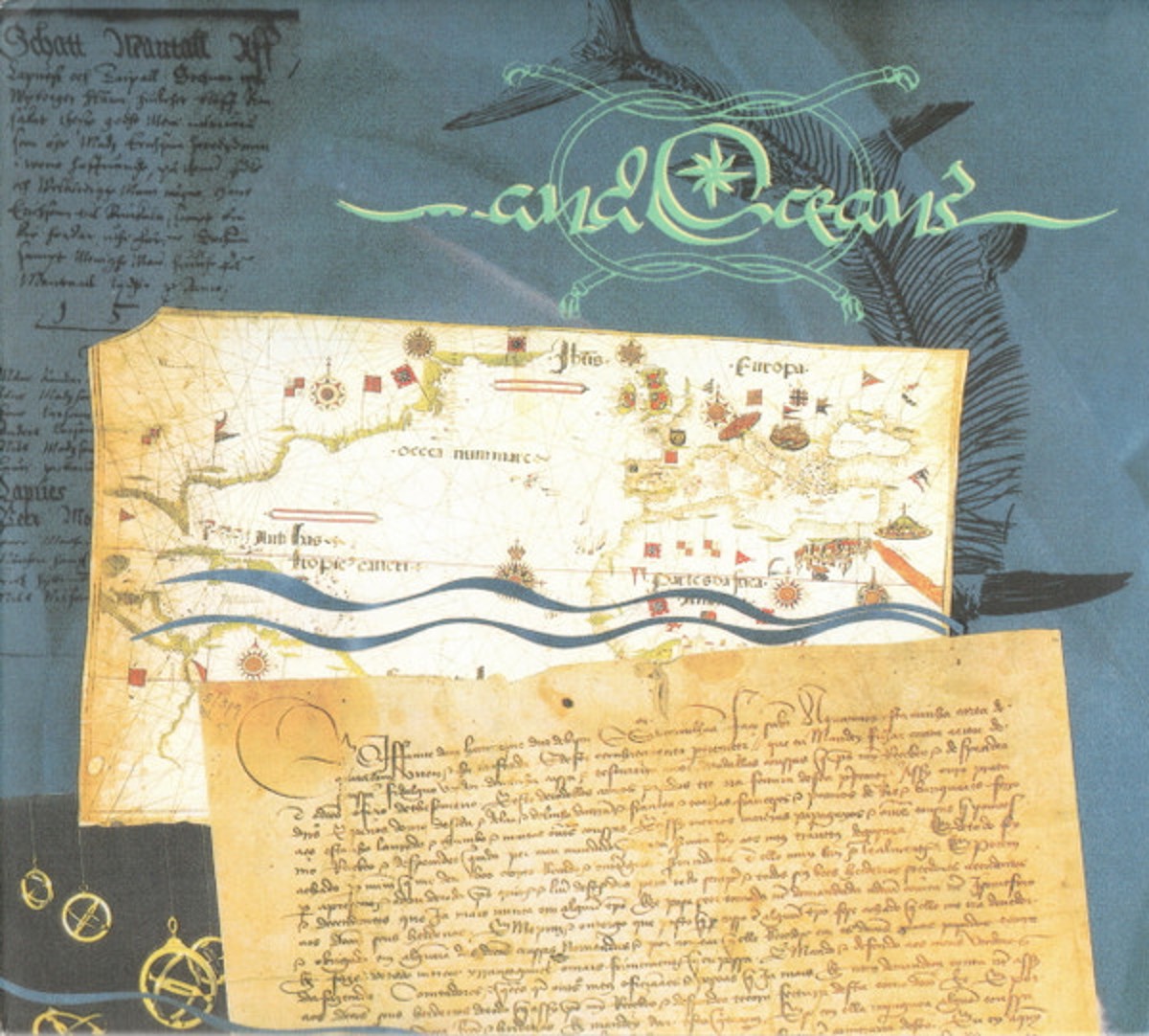
At first glance, an old nautical chart unfolds before us. Small flags, directional markings, ornate compass roses and barely legible inscriptions crowd the faded yellowish sheet. Pale, almost empty spaces remain between the coastlines, as though the map depicted not only known lands but places yet to be explored. Two long blue wavy lines run across the page. They look less like natural features of the landscape than marks drawn there by hand, evoking both the sea and movement.
Writings that seem to belong to other ages cover the chart. At the bottom lies a golden-brown sheet of parchment, crowded with dense, curling handwriting; at the upper left, lines of dark ink run across a bluish-grey background. The sheets do not form a neatly ordered archival collection. They overlap, concealing some details and revealing others. The eye keeps finding another mark, but never receives one definitive key to its meaning.
Above them floats the band's name in curved, pale-green lettering, with a star-like mark inside one of its rounded characters. Fine lines, arcs and shapes reminiscent of pen-and-ink drawings surround it. The contrast between the cool background and the warm parchment colours makes the whole image seem both distant and tangible. There is no central human figure, no marked destination and no single dramatic event: we see the tools of discovery, not the discovery itself.
That openness is particularly well suited to the music on The Dynamic Gallery of Thoughts. The sometimes exuberant keyboard lines layered over fierce guitars, and lyrics delivered in different languages, also suggest worlds laid one upon another. The cover does not try to explain the album in musical notation. Instead, it leaves us with the sense that someone has drawn a new route along the edge of an old map—and that the listener must decide where to go next.
III. The Eight Rooms of the Gallery of Thoughts
The album does not knock. Trollfan simply opens the door.
In its lyrics, burning water sits alongside melting snow. Dry, hot sand; a splendid garden; fruit, flowers and vines. These images make no attempt to form a real geography. They follow the logic of dreams instead. Snow melts in someone's hand while they cross burning waters. The garden is beautiful and disturbing at once.
The music is much the same. Above the rapid movement of black metal, the keyboards offer no reassurance. Quite the opposite: they make the space feel vaster still. The song had already appeared on Mare Liberum, which means the band inhabited this world of images even before the full-length album.
Some later reviewers considered it the album's strongest track. It is not hard to see why. Trollfan needs no explanation yet. Everything happens at once: the weight of the old death metal, the new symphonic layer, melody and assault.
And after those first minutes, the listener is no longer standing outside the gallery. They are inside.
Chapter V – The Skin of the Wall
The second room contains a thousand arts.
The lyrics of The Room of Thousand Arts invite us to break through the skin of the wall, into a world without sound, into an abyss, towards a sea without water. A painting comes into being, yet it is as though the great artist behind it is missing. The nameless picture becomes a ship without a harbour.
The images are strange in themselves, but they become more powerful within the album as a whole. It is almost as though the band were speaking about its own creative position without saying so outright. Young musicians break into a room whose rules they do not yet know. They cannot say exactly where it leads. They only know that something lies beyond the wall.
The music is fast. A later review called it supersonic. Yet there is no emptiness behind the speed. Thanks to the keyboards, another space opens up behind every blow. The room truly seems a room of a thousand arts: too many details, too much movement, too much colour.
And still it works. Perhaps because the band had not yet learned to be afraid of excess.
Chapter VI – Open Books
The title Som öppna böcker promises open books, but nothing in the lyrics can simply be read at face value. A black box, nails on clothing, a corrosive tongue, magical lips, pages that resemble one another. The speaker says: interpret me as you wish. And then asks: am I the last chapter?
That question seems almost uncannily well suited to …And Oceans. The band's whole early identity rested on freedom of interpretation. The three dots in its name did the same. So did its use of several languages. So did the surreal images in its booklet. None supplied a single key.
In 1998, K-2T4-S said that the languages added depth and helped thoughts to flow. He did not want listeners to reduce every line to one fixed explanation. In Som öppna böcker, the book is open, but openness does not make it easy to read.
By now the music is beginning to move in familiar ways. After three songs, the listener has learned the rules—if rules exist at all. The keyboards can become a melody, a mist, a wall or a light. The guitar can be both blade and backdrop. Aggression and melancholy do not take turns: they inhabit the same moment.
After the gallery's first three rooms, it becomes clear that this is not a story leading from point A to point B. It is a sequence of images that gradually begin to explain one another.
Chapter VII – The Beautiful Mask
The fourth track lasts eight minutes. Its length alone tells us that time is about to change.
Je te connais beau masque. I know you, beautiful mask.
The lyrics open white doors onto a field of thoughts. The light does not dance. Words take shape in the gallery of thought. Knowledge is power in the rooms of teachers. Here the album's title seems to step into its own lyrics. The gallery is no longer merely a metaphor on the cover. It becomes a room where thought turns into image, words into objects, and knowledge into strength.
The long introduction allows the music room to breathe. A later French critic described an almost underwater sensation before the drums suddenly broke through the surface. That transition is one of the album's clearest dramatic moments. It is effective not because it is faster than everything else, but because it first teaches us to wait.
Meanwhile, the image of the mask remains. Black metal has always had its masks: corpsepaint, postures, names, ideologies. …And Oceans played with precisely these things. They adopted them, then threw them away. They chose curious aliases and then laughed at categories that took themselves too seriously. Willingly or not, the “beautiful mask” thus casts its shadow over the band's own position.
I know you, mask. I know you are a mask. That does not mean you cannot be beautiful.
Chapter VIII – Ancient Story, Microscopic World
Two eras collide in the title Mikrobotik Fields / Ur åldrig Saga och Sång. On one side lies something tiny, mechanical and futuristic: a field of microtechnology. On the other, an ancient story and song.
The band's history stood at precisely such a crossroads. Festerday's death-metal past still lived in their fingers, even as the keyboards began exploring sounds beyond the traditional instruments of metal. Timo later explained that both he and Kena Strömsholm were fond of the world of Cold Meat Industry, of ambient music and projects that built strange atmospheres. The later turn towards electronics therefore did not come from nowhere.
In this song, a piece from the earlier Mare Liberum takes its place within a new structure. The past does not vanish; it finds a new setting. It is as though an old fresco were cut from a crumbling wall and then hung in a futuristic gallery.
By the album's midpoint, the listener can feel that to …And Oceans, style is not a question of allegiance. There is no need to choose between ancient and modern, metal and ambient, aggression and weightlessness. Both can occupy the same room.
Ambient Is Not a Sideline
Metal musicians in the 1990s did not listen exclusively to metal. This matters particularly in the case of …And Oceans because, by Timo Kontio's own account, both he and vocalist Kena Strömsholm enjoyed the music surrounding the Swedish label Cold Meat Industry, ambient and its related, unusual soundscapes. That is a musician's actual recollection, not a comparison later imposed by critics. Founded by Roger Karmanik in 1987, Cold Meat Industry became one of the defining outlets for dark ambient, industrial and other experimental music built around dark atmospheres. Brighter Death Now, raison d'être and several other projects worked with timbres and structures that often created a situation, a space or a state of mind rather than a conventional verse-and-chorus song.
It is easy to call keyboards background music in metal when all they contribute is a gust of wind, a bell or a short introduction. On …And Oceans' debut, however, they often became an independent melodic and dramatic force. There is no need to explain that afresh for each track; this account already takes the reader through the songs. Mentioning ambient instead broadens our understanding of the musicians' creative horizons. A black-metal band member's everyday listening might also include music in which events unfold through long, sustained changes in timbre rather than rhythmic attack.
The distinction between an actual influence and subsequent development is important. Kontio speaks of an interest in ambient, but that alone does not establish that every synthesizer part on the debut derived from a particular Cold Meat Industry recording. Nor does the band's later path—allowing electronics and industrial music ever further into its sound—justify retrospectively calling the 1998 album industrial metal. The curiosity was already present; the transformation after 1998 belongs to another chapter and another time.
Chapter IX – A Conversation with Thoughts
Samtal med Tankar. A conversation with thoughts.
If the essence of The Dynamic Gallery of Thoughts had to be compressed into a single title, this might be it. Not a declaration, not a lesson, not a confession. A conversation.
Throughout the album, the lyrics behave as though someone were throwing images into a dark room and watching which ones light up. “Halo of Words” takes this further still. A word is not merely a carrier of meaning; it is a source of light. Meanings appear around it.
Years later, a French writer recalled first encountering …And Oceans through this very song on a sampler CD. That small story shows how the metal underground operated in the 1990s. One song appeared on a compilation. Someone heard it, remembered the name and sought out the album. In this way, a distant Finnish band took up residence in the memory of a listener in another country.
So within the record, the song converses with thoughts; outside it, the song finds listeners. The halo of words slowly traces real circles around the band.
Chapter X – September
In the North, autumn does not begin as a metaphor. First, the light simply changes. The sun stays for less time. The air feels different against the skin. Slowly the landscape loses the colours of summer.
September (När hjärtat blöder). September, when the heart bleeds.
The title is more direct than most of the album's surreal imagery. You do not need a gallery to feel it. The song came from Mare Liberum, which means it carried this melancholy even before the album.
In a 1998 interview, the band described its own music as aggressive and melancholic in mood. It would be hard to sum up September's place more precisely. The two feelings do not cancel one another out. Speed does not make it any less sad, and melancholy does not weaken the attack.
Later critics spoke of Finnish melancholy. Perhaps because sadness in this music does not stop to brood. It moves. It runs. At times it almost flees.
And September slowly comes to an end.
Chapter XI – The Pale Hands
Kärsimyksien vaaleat kädet. The pale hands of suffering.
The Finnish title closes the album as though, at the end of a journey through languages, the band had come home. After eight songs, the listener no longer asks why Swedish, English, French and Finnish sit side by side. By then, languages have become as much a part of the arrangements as the keyboards.
The closing track does not resolve the album. It offers no answer to what the gallery meant. It simply shuts the door.
A contemporary review in Chronicles of Chaos awarded the record seven points. It praised the clear production, competent playing and keyboard melodies but found relatively few truly outstanding moments. The observation is interesting because, as the record lived on, the coherence of its world became one of its greatest strengths. No single song rose so far above the others as to leave them behind. The eight rooms stayed together.
When the last note fell silent in 1998, no one could have known that twenty-eight years later, Timo Kontio would still be talking about this record on a tour bus in Milan.
IV. From Release to Reunion
The Underground Press and the Letterbox
In 1998, a new metal album's journey did not revolve around a single digital release date and the statistics generated the following day. Fanzines, small labels, local record shops, distributors, concert promoters and private correspondence formed an interconnected system. Photocopied publications covering demos did more than print reviews. They forged connections, passed on addresses and sustained interviews and correspondence. One enthusiastic recommendation could bring a band's name to someone who otherwise would never have heard of Pietarsaari. Equally, a negative review or an issue appearing several months late was an entirely ordinary part of that slow circulation.
Later archival research has also documented how tape trading and postal distribution worked. Cheaply reproduced cassettes, local networks, mail-order packages, fanzines and alternative radio programmes allowed music independent of the major record companies to establish its own international channels. The system was imperfect: sound quality could deteriorate from copy to copy, parcels could go astray, and small labels had limited budgets and pressing runs. Yet it helps explain how a recording by an oddly named Finnish band could become important to someone listening thousands of kilometres away.
Email was already part of this story in 1997, as Kontio's recollection of the record contract shows, but that did not make cassettes, printed reviews and physical releases disappear. The second half of the 1990s was defined by precisely this period of transition. Telephone calls, letters, belated press materials and newly emerging electronic possibilities existed side by side. A label could send a message in moments while the eventual album still had to be manufactured, packaged and physically shipped.
What Did a CD Mean in 1998?
A debut album carried different stakes in an era when a longer work had to be released as a physical object. SOM 008, the catalogue number of the original 1998 Season of Mist CD of The Dynamic Gallery of Thoughts, is an identifiable release detail. A catalogue number is not a complete commercial history, but it establishes that the recording existed as a real release within a label's sequence. The printed cover and booklet were not merely decorative. The band's name, multilingual lyrics, visual imagery, acknowledgements and recording credits together made up the object the listener bought.
For …And Oceans, cassette and CD were successive but overlapping stages. The Mare Liberum demo cassette still carried the band's developing sound in 1997; by 1998, the album had entered international circulation as a label-issued CD. That same year, Season of Mist released War Vol. I, a split with the Norwegian band Bloodthorn, under catalogue number SOM 011. It is a concrete example of a label deliberately pairing metal bands from two countries. The fact that the record appeared does not, by itself, justify claims of personal friendship or a shared rehearsal space. The record itself demonstrates that the label's network could bring geographically distant artists together on one release.
Picture discs, vinyl records and cassettes were also circulating at the time, but every edition of this particular album would need separate documentation for a comprehensive release history. That is not the purpose here. What matters historically is the transformation: by 1998, the young band's modest demo recordings had given way to a standalone, identifiable album on an international label. The physical format, the booklet and the work of distribution belong to music history; they are not footnotes unrelated to the songs.
Chapter XII – When the Album Went Out into the World
Once released, The Dynamic Gallery of Thoughts no longer belonged to the band alone. It found its way into shops, fanzines, the hands of critics and the collections of listeners. A picture LP was reportedly made, planned as a run of five hundred copies and accompanied by a poster. There was a cassette edition too. Season of Mist distributed the record, and the underground passed it from hand to hand.
The reviews spoke with more than one voice. Some compared it to the symphonic black metal Dimmu Borgir were playing at the time. Others felt the keyboards were too thick, too strange, sometimes bordering on kitsch. Still others loved them for precisely that reason. One person found the booklet ugly; another considered it visionary.
Meanwhile, the band did not stop to decide who was right. They were already working on the next material. The War release was rawer and faster. The Symmetry of I – The Circle of O, in Timo's later judgement, was a more balanced album. On the debut, they were trying this and that; on the second record, they truly found the sound they wanted to play at that time.
That observation is particularly important. In the band's own account of its history, The Dynamic Gallery of Thoughts did not necessarily stand as the ultimate masterpiece. It was a first step. An experiment. A young band's record.
For listeners, however, it worked differently.
Some first heard the band on sampler CDs. Others had followed them since Mare Liberum. Years later, Mathias Lillmåns spoke of how profoundly it had affected him that such an album could come from the same small local scene he himself knew. Little by little, the record became more than the band's past: it became a starting point for other musicians.
Chapter XIII – The Gallery Closes, Then Opens Again
After the debut, the story of …And Oceans became increasingly unpredictable. They moved from symphonic black metal towards more electronic and industrial directions. A.M.G.O.D. and Cypher built different worlds. Anyone who imagined The Dynamic Gallery of Thoughts marked the beginning of a fixed formula soon discovered that it was one stop along the way.
Then, for a while, the name disappeared.
The musicians played in other projects. Festerday returned as well. In the meantime, time did strange things to the old recordings. What had once sounded excessive, immature or peculiar became character. The keyboard sound became recognisable, multilingual lyrics a tradition, and the surreal visual world a memory.
When …And Oceans reunited, the early era was no longer a burden. They could open it up again.
Season of Mist reissued the album. New listeners discovered it; old listeners took it down from their shelves. The songs young musicians had recorded in a studio in Kemi were played through new sound systems and on digital platforms, in a world they could scarcely have imagined in 1998.
And Timo did not try to rewrite the past.
The mistakes are there, he said in essence. But so is the feeling.
And if he must choose between the two, he chooses the feeling.
A Scene They Did Not Have to Resemble
In 1998, …And Oceans entered a world that liked to define precisely what counted as true black metal and what crossed its boundaries. Yet records released in the preceding years had already shown that densely layered keyboards, proportions borrowed from classical music, experimental sounds, folk references and electronic atmospheres could all carry extreme metal in different directions. The same period accommodated the brutality of Impaled Nazarene, the melodic transformation of Amorphis, the darker constructions of Thy Serpent and the theatrical strangeness of Arcturus. There was no single mandatory stylistic destination.
The value of The Dynamic Gallery of Thoughts therefore does not depend on whether an earlier, similar record can be named. Its artistic individuality is clearer in the way it draws together the discipline and assault inherited from death metal, multilingual poetic imagery, insistent keyboard lines and the band's distinctive identity into one early album. The documented context helps us understand the moment of release, but it does not take the place of the music—or of the musicians who actually made the decisions behind it.
So the debut's story leads from a town to demo recordings, from there to a studio and a young French record label. Along the way, the map of Europe's underground opens up behind it. None of this inflates the band's importance or reduces it to a single label for an era. It simply shows more clearly how many paths converged in the year the gallery first opened its doors.
Two Different Faces of the Band in One Year
In 1998, the debut presented …And Oceans' developed sound across eight tracks. Another, quite different document of the band appeared that same year: Season of Mist's War Series Vol. I, a split release with Norway's Bloodthorn. The label's catalogue lists it under 1 August and the identifier SOM011. On the …And Oceans side, two original compositions—…Ja Kylmä Vesi Nuolee Oksaa and 100 Meters Final [Accelerate]—appeared alongside two covers: Flesh by GGFH and Breed the Evil Inside by Bloodthorn. Bloodthorn, in turn, covered …And Oceans' Kärsimyksien vaaleat kädet. This went beyond the chance printing of two names side by side: through actual songs, the two bands entered each other's repertoires.
War neither replaced The Dynamic Gallery of Thoughts nor became a second version of it. It stood beside the album, in the same year that the debut was still fresh. Anyone who knows only the original eight album tracks has not heard everything the band did in 1998. The covers and new compositions capture a group that did not have to wait for another full-length record before trying different directions. The chronology of those twin releases can be traced through the label's documentation; imagination cannot substitute for undocumented studio conversations or the participants' unrecorded opinions of one another.
The Second Album Meant a Different Line-up and a Different Standard
The Symmetry of I – The Circle of O, released in 1999, was a swift follow-up for the band, but for listeners it was no mere repetition. Some versions of the original release included a second disc of experimental material alongside the main album. According to Kontio's 2026 interview, the ambient-oriented bonus disc was not conceived as part of a grand plan: they used time left over in the studio to experiment with sounds, fragments taken from radio broadcasts and assorted ideas. It is an important distinction between the album's planned songs and material that emerged as an offshoot of the recording sessions. Even the period artwork and different editions tell us how differently listeners could encounter the same album title.
Membership changed after the debut too. Later recollections and discographical records indicate that, in the following period, bassist Mr. Oos was replaced by Mika Aalto, also known as Gaunt. Because of the band's system of aliases, it is particularly easy to confuse individuals with their stage names. It would therefore be misleading to assign an exact date to a personnel change for which only an approximate chronology survives. What matters here is that the six-piece line-up of 1998 was not a frozen portrait; the next album was already the work of a group continuing to evolve.
In 1999, the band embarked on its first European tour with Bloodthorn and Agressor. This is not merely a later fan's recollection: Kontio himself named it among his formative experiences in a 2023 interview. The year and the two accompanying bands can be verified; the same statement does not support a complete list of cities and venues. The importance of that first European journey is clear nonetheless. A Finnish band that only a few years earlier had been sending recordings to labels had become a touring act moving between countries.
They Did Not Disappear After the Symphonic Albums
The next major turn grew not from inactivity, but from a new contract and a different way of working. …And Oceans moved to Century Media. In a contemporary Chronicles of Chaos interview published in December 2000, Kena Strömsholm explained that they had sent promotional material to several labels, received interest from several quarters and ultimately felt that moving forward with Century Media made sense. At that point, they were still working on the new music; the interview discussed preparations for the next record and possible future tours. This contemporary account is especially valuable because it does not retrospectively shape completed events into a neat story. It shows how much was still undecided.
A.M.G.O.D. appeared in 2001 and Cypher in 2002, and neither can be adequately described using the unchanged image of the band's earlier symphonic black metal. For the 2001 album, the band also worked at Abyss Studios in Sweden; Kontio later singled out the engineering work of Tommy Tägtgren. By the time of Cypher, de Monde—Teemu Saari—had stepped away for a period, while Petri Seikkula took on a larger role as guitarist and songwriter. According to Kontio, Seikkula wrote many of Cypher's themes, while his own contribution was smaller. The change in sound cannot therefore be attributed solely to outside musical fashions: the people involved and the balance of songwriting contributions changed too.
The band's touring history progressed as well. Contemporary reports on the 2001 No Mercy tour named …And Oceans alongside Marduk, Vader, Mortician and other groups. The first European tour in 1999 and the large, multi-act tour in 2001 were two separate events and should not be conflated. Between them, the band changed not only its music but its professional circumstances: for a time, a group that had started on a small label became part of a much broader international touring circuit.
The Pause in the Name Was Not the Same as the Return
Momentum faltered in the years after Cypher. In a later interview, Kontio recalled that some planned tours fell through; the live schedule envisioned for 2003 did not come about, and the band played some of its last shows in Finland in early 2005. They did not decide overnight that the group would cease to exist. Meanwhile, new music was taking shape and moving further from what they wished to release under the …And Oceans name. Their relationship with Century Media also came to an end. The 2005 name change therefore had an artistic logic: a different direction opened up space for a different band, Havoc Unit. The continuation acquired a new name not because anyone wanted to forget the 1998 album, but because the musicians working together had redefined what they wanted to do.
In 2008, Havoc Unit released its only full-length album, h.IV+ (Hoarse Industrial Viremia). In Kontio's later account, only a few former …And Oceans members continued with that project, and maintaining a full, permanent live line-up proved difficult in the years that followed. Music continued elsewhere, under other names. Kontio made albums with Magenta Harvest, while Festerday reunited in 2013. None of that proves that …And Oceans itself had secretly continued without interruption. More precisely, several different bands' stories carried on alongside one another in the lives of the same musicians.
The story turned again at the end of 2017. Around Christmas, Kontio and his colleagues began rehearsing together once more in Pietarsaari. They posted a recording of a rehearsal, and the Finnish music press soon noticed. At first, the return was confirmed not by a new album but by playing the old songs again and resuming live appearances. After the success of the 2018 concerts, the idea of …And Oceans becoming more than a former band that occasionally revisited its back catalogue grew more serious. Kontio said that uncertainty preceded the decision: could they write new material they would consider worthy of the name?
The answer arrived in 2020 with Cosmic World Mother, again released through Season of Mist. This studio album was not recorded with the vocalist from The Dynamic Gallery of Thoughts: Mathias Lillmåns handled vocals. Kontio said in 2020 that they knew Lillmåns's abilities from earlier work together, so they were able to collaborate quickly when the band needed a new singer. He declined to discuss the personal details behind the parting, and this account must respect that boundary too.
The continuation became tangible in As in Gardens, So in Tombs (2023) and then The Regeneration Itinerary (2025). These titles matter not because we should read some fateful prophecy into the 1998 album, but for the opposite reason: the debut lives on differently depending on the era from which it is viewed. In 2026, Kontio still spoke of it as a youthful recording he loved despite its flaws, while refusing to regard the newer albums as mere repetitions of the old songs. Thus the gallery's first incarnation is not a final destination reached after the fact; it is the preserved beginning of a long career marked by interruptions.
What Lived On Behind the Cover
The most secure starting point in the release history of The Dynamic Gallery of Thoughts is the 1998 CD issued by Season of Mist under catalogue number SOM 008. The cover discussed earlier in this book and the band's line-up at the time belong to that eight-track album. The label's official catalogue gives 1 January as the release date, but that field alone does not establish that the record reached shops in every country on precisely that day. It is better to retain the reliably established year 1998 and avoid assuming a precise date.
The album was not encountered solely on CD. A Polish cassette edition from Mystic Production appears in specialist discographical records as a 1998 release under catalogue number 122, reportedly issued under licence from Season of Mist. This documented edition helps clarify the brief mention of cassettes earlier in the narrative: it was not merely a fan-made copy of the kind that might circulate widely, but an identifiable licensed release. However, a discographical listing is not a sales report, so its actual distribution cannot be determined from that information alone.
Another official CD edition appeared in 2021 under the identifier SOM008R. Season of Mist's own US product page gives 15 January as the date, whereas some distributors list 5 February. The reliable common ground is therefore the 2021 reissue; the exact retail date should be understood in light of distribution information from the relevant countries. The new CD contains a twenty-page booklet and four bonus tracks: the …And Oceans recordings from the 1998 split War Vol. I. This pressing did not present the old album as a newly recorded studio work; instead, it placed a brief further chapter from the period of the debut alongside it.
Also in 2021, Those Opposed Records released a licensed vinyl edition, TOR 104, in collaboration with Season of Mist. A detailed collectors' entry reports 500 copies in three colour variants: 100 black, 200 blue and 200 blue-on-clear vinyl. Those figures relate to a specific later edition and cannot automatically be equated with the reportedly 500-copy earlier picture LP mentioned in the narrative. Where the label and year of an item cannot be established with comparable confidence, details from a different edition must not be silently transferred to it.
Ultimately, the importance of the reissues lies not in the number of formats. In 1998, the band laid its first full-length record on the table and then moved on. Decades later, the same music returned to listeners under a new catalogue number, in different packaging, with additional tracks. In the meantime, the musicians wrote new works, disappeared from behind the …And Oceans name and eventually returned to it. The original eight songs did not change. Only the story surrounding them grew longer.
V. Epilogue
Epilogue – The Gallery of Thoughts
It is easy to reduce an album to a set of facts. Eight songs. Forty-eight minutes and thirty-one seconds. Season of Mist. SOM 008. Tico-Tico Studios. Ahti Kortelainen. Six musicians.
But none of those facts lets us hear a thing.
We cannot hear Festerday's rehearsal room. We cannot hear the letter that reached Season of Mist. We cannot hear Michael's surprise when the next demo revealed an entirely different band. We cannot hear the young guitarist's uncertainty in the studio. We cannot hear the first reviewer writing a seven at the bottom of the page. We cannot hear the French listener who sought out the album after hearing a track on a sampler. We cannot hear the later vocalist who had listened to it as a fan twenty years earlier.
Nor can we hear the images conjured by the lyrics: burning water, snow melting in a hand, the skin of the wall, a sea without water, open books, white doors, a field of thoughts, the halo of words, bleeding September, and the pale hands of suffering.
Together, these are what make the record what it is.
The Dynamic Gallery of Thoughts has endured not because it was perfect. Perhaps it has endured precisely because it was not. Because you can hear a band searching. You can hear that moment when musicians do not yet know exactly what they will become, and so try everything that interests them at once.
In the gallery, a few pictures hang crookedly. Some colours are too strong. In one room, too much is happening. In another, the light falls strangely.
But when you leave, you remember it.
And in a way, that was the whole point.
Reader comments
Comments only appear after approval. Messages are displayed in their original language.
Comment submissions are not enabled yet.