

Christcrusher
The literary story of Thy Serpent’s third full-length album, from its Finnish beginnings through the 1998 recording sessions and eight tracks to its reception and original cover artwork.
A Country in Crisis and Renewal
Thy Serpent's first demo tapes were not made in a peaceful, unchanging Finland. At the beginning of the 1990s, the country lost much of its former economic security and the familiar framework of its foreign relations almost simultaneously. The rapid growth of the late 1980s gave way to a severe financial shock. Banks and businesses were thrown into difficulty, and unemployment rose to levels that had previously seemed extraordinary. The downturn of 1991–1993 changed the way an entire society saw itself. When Sami Tenetz began searching for his own musical direction around 1992, this was the country around him: a place of harsher daily realities and an uncertain future.
The figures convey the scale of the rupture, but they cannot tell the whole story. Finland's total output fell by more than a tenth over a few years, and unemployment reached an exceptionally high level in 1994. Jobs once thought secure and financial plans once considered dependable no longer offered every family a firm foundation. Although the recovery began after 1994, the national mood could not be transformed overnight. By 1998, the world in which Christcrusher appeared was also shaped by renewed growth, but the long shadow left by the recession still belonged to the period.
Meanwhile, the political map was changing as rapidly as the economy. The dissolution of the Soviet Union brought to an end the relationship with Finland's eastern neighbour and the trading order to which the Finnish state had adapted over decades. On 1 January 1995, the country joined the European Union. It was one of the great turning points in Finland's post-war history: more than accession to a new set of institutions, it meant rethinking the country's place in a changing Europe. The album's subsequent international journey cannot be traced back to a single political date, yet it took shape in this more open environment, increasingly oriented towards new connections.
We must be cautious about drawing conclusions from this background about Thy Serpent's personal history. The economic crisis tells us nothing reliable about Sami's or his bandmates' livelihoods, family circumstances or political views. The verifiable story begins elsewhere: with one musician's idea, two demo tapes and, later, a relationship with a small record label. Even so, the surrounding world matters. It shows what sort of country a new band had to navigate when looking for rehearsal space, instruments, postage money, studio time and an audience—and why it mattered so much when a handful of people patiently built a network of their own.
That network was not confined to one city. Espoo and Helsinki could offer the denser cultural connections, rehearsal spaces and record-label opportunities of the capital region; Thy Serpent's documented contacts also led into this world. Kemi, where Christcrusher was recorded, lay much farther north and occupied a very different place on the map. It matters not because we can establish that the band was based there—we cannot—but because it was home to the studio whose sound had already become familiar through earlier Finnish metal releases.
The distance between these places reveals something important about Finnish musical life. There was no need for every stage of the work to happen in the same location. The original idea, the musicians' contacts, the record label, the recording sessions and the final sound could each belong to a different place. Christcrusher was recorded in Kemi in February 1998 and mastered at Finnvox in Helsinki. In both geographical and professional terms, the record thus brought different workshops together. Heavy music was increasingly the result not simply of isolated rooms and individual efforts, but of collaboration.
Elsewhere in Europe, these same years were marked by the search for a new order after the Cold War. New routes opened between economic and cultural regions that had once been sharply divided, while serious conflicts in several parts of the continent showed that change was not necessarily peaceful. For Finnish metal, this did not amount to a political programme; rather, it created a distinctive international space in which bands, journalists and listeners could make contact across borders. In Thy Serpent's case, such connections are documented through correspondence, foreign fanzines and interviews from 1997. They do not, however, give us licence to invent particular motives for the songwriting.
A broader transformation was also taking place in communication. By the end of the decade, the internet had already become an important everyday tool in Finland, but in 1998 it had not yet displaced the post, paper fanzines or cassette tapes. Thy Serpent's early period stood at the meeting point of two eras: the tradition of demos slowly passing from hand to hand and an international musical community becoming connected at greater speed. If we hear a sense of distance in the world of Christcrusher, it is not merely geographical. An older way of keeping in touch echoes through it too, just as that way of life was beginning to fade.
Tapes, Studios and Maps Made of Sound
The extreme metal of the 1990s did not grow by drawing every band towards a single centre. Cities were connected by cassettes, fanzines, handwritten letters and personal recommendations that developed gradually over time. An early recording first had to find a listener; often it travelled onward as another copy in another envelope. Thy Serpent's demos emerged from this world. Frozen Memory and Into Everlasting Fire were more than tentative early recordings: they were entry points into an international conversation that could not yet be followed with a few clicks.
Local and international scenes did not operate in opposition to one another. Encounters around the capital, the work of Finnish labels and correspondence with people abroad were different levels of the same process. Someone might first write a brief recommendation for a record; it could then reach a fanzine in another country, where an interview might follow. None of this guaranteed success for the band. It offered a possibility, and evidence that the music meant something even to a listener far away. Signing with Spinefarm did not replace that movement. It gave it a more durable framework for releasing records.
In the middle of the decade, Spinefarm was not yet synonymous with the much more visible Finnish metal industry that would later make some of its artists known around the world. At the time of Thy Serpent, the small label's work was decidedly practical: releasing records, arranging distribution, sending out promotional copies and giving a recognisable identity to a catalogue in which different bands had an opportunity to be heard. The relationship with the label became a bridge between an underground rooted in bedrooms and rehearsal rooms and physical releases finding their way into shops, magazines and collections abroad.
Kemi's contribution was more tangible still. Tico-Tico Studio had been operating since 1987. Its owner, Ahti Kortelainen, built up the facility over many years through his own work, upgrading its equipment step by step. The studio's history is instructive because it did not begin as a prestigious project in the capital. In later recollections, Kortelainen spoke of musical instruments, borrowed sound equipment and early multitrack recording gear. The studio earned its professional standing because band after band was able to make genuinely good recordings there.
The original Christcrusher booklet identifies two key locations precisely. The record was made at Tico-Tico, while the final mastering was carried out by Mika Jussila in Helsinki. These are more than two names in the credits. Recording establishes the spatial character of a performance, the relationship between the instruments and the weight of the sound; mastering gives the finished material its final sonic form. We do not know, and cannot claim, that the engineer determined Thy Serpent's musical direction. What we can say with certainty is that by this stage the band's dark, keyboard-expanded music reached listeners through the work of experienced professionals.
Technological change is not simply a story of old, bad sound being replaced by something better. The graininess of demos, the greater sense of space on a studio album and the cleaner reproducibility of the CD each offered different aesthetic possibilities. The more slowly developing pieces on Christcrusher needed room for their details to breathe: guitars and keyboards could create both weight and distance at once. This was a combined achievement of arrangement, performance and recording, not some unproven technical miracle.
By the time the album reached its listeners, the world of printed fanzines was already sharing space with a growing number of online publications. Reviews could still arise, however, from a package addressed to a label, a CD arriving in the post or a long exchange of letters. This is what makes Thy Serpent's position in 1998 so striking: the band was already part of a new, more visible era of Finnish metal, while its working methods remained deeply rooted in the underground practices of the previous decade. Christcrusher is not a commemorative plaque to that transition. It is its imprint in sound.
Beneath the Red Sky
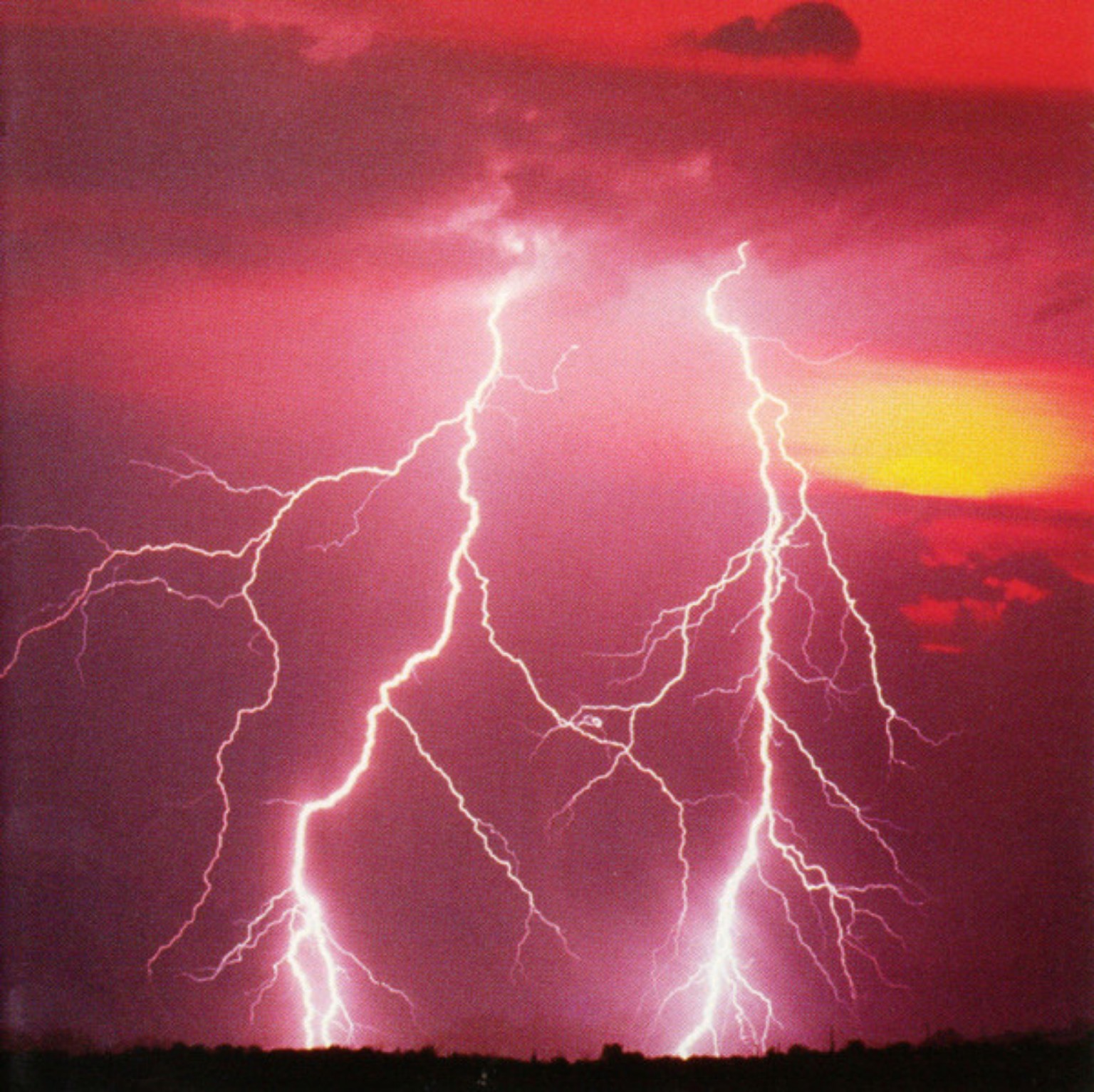
It is not a human figure that dominates the cover, but the sky. Clouds deepen into red and purple across the upper part of the image; to the right, near the horizon, yellowish light cuts through the gathering darkness. Along the bottom runs a nearly featureless strip of black land. Between them, white-hot branches of lightning spread out: one drives towards the lower left of the image, another flashes down on the right, while smaller forks seem to search for the ground in several directions at once. This is not a disc or a constructed object, but the momentary, dazzling structure of a storm.
The band's dark, difficult-to-decipher emblem appears to hover before the storm. Below it, the title Christcrusher is much easier to read, yet takes on another weight when seen alongside the lightning. The band name running vertically down the left edge frames the composition. The black letters do not separate cleanly from the image; they seem instead to settle over the sky. The original booklet credits Jim Zuckerman with the cover artwork, while other designers contributed to the rest of the visual presentation.
At first glance, the title and the flash of lightning suggest the same things: destruction, sudden force and menace. The album itself, however, is more nuanced than that initial promise. In its long, frost-laden songs, light is no triumphant sunrise; it is more like a brief opening in the darkness. Lightning reveals the landscape without dispelling the night. Here the image meets music that, alongside its raw attacks, returns again and again to feelings of distance, loss and solitude.
The cover's power lies precisely in its refusal to illustrate the album title literally. It depicts no scene, no human figure and no destruction of religious symbols. Instead, it captures a moment in nature that is both beautiful and unsettling. Before the first track begins, the listener has already seen one of Christcrusher's central tensions: the force of advancing light against the darkness that remains motionless beneath it.
The Serpent's First Shadow
Before Thy Serpent was a band, it existed only as an idea. There was no stage, no tour, no settled line-up: just one man's vision of the music he wanted to hear, even if nobody else was going to make it for him. Sami Tenetz later traced the beginning to 1992. At that time, Finnish extreme metal was not yet the internationally recognised phenomenon it would become a few years later, and connections were not made through algorithms and social networks. Tapes passed from hand to hand, letters crossed borders, fanzines were assembled in bedrooms and basements, and news of a band often travelled more slowly than its music.
The project was originally going to be called simply Serpent. Then Sami learned that a Swedish band was already using the name, so he added 'Thy'. The choice was more than a way of avoiding confusion. It gave the name an archaic, strange and sombre quality while steering clear of the overly direct Satanic or blood-soaked theatrics of which, by his own later account, Sami was already tired. That duality—darkness, but not necessarily darkness reduced to cliché—would remain in the music as well.
Nor did Sami's listening history grow out of a single style. Early heavy metal favourites such as Twisted Sister, W.A.S.P., Accept and Judas Priest gave way to heavier sounds: Sodom, Possessed, Kreator, Mercyful Fate and King Diamond, followed by Bathory. That sequence says more about Thy Serpent's roots than any label attached in retrospect. Beneath the guitars lay classic heavy metal's sense of melody, the tautness of thrash, the darkness of the first wave and the chill of early extreme metal. When asked years later what influenced him, Sami did not try to prove anything by producing more names. His answer was essentially this: everything he saw and heard.
By 1994, the solitary vision had found a voice. The Frozen Memory demo came from a world in which a cassette was not merely a format but a message. Whoever received it might copy it, pass it on, write about it or send a letter in reply. A year later, Into Everlasting Fire showed that this was not a one-off experiment. Thy Serpent was gradually beginning to emerge from the space where one person had to carry every instrument and every decision.
The decisive turning point came in 1995 with a contract from Spinefarm Records. Sami did not respond by tightening his grip on every detail. On the contrary, he began building a fuller line-up. He later spoke openly about wanting a better final result and finding musicians who were stronger on their own instruments than he was. The arrival of Azhemin, Agathon, Luopio and others therefore did not mean abandoning the central vision, but expanding its reach. Thy Serpent remained organised largely around Sami, yet it was no longer a one-man bedroom project.
Everything moved at a different pace in the early-1990s underground. A demo could be recorded in a few days, then take months to become known in another country. Correspondence carried weight: an envelope might contain photographs, a brief introduction, a cassette and addresses copied out by hand. A good fanzine article or an enthusiastic trading partner could matter more than an entire day's online visibility does now. Sami later said he stopped actively trading tapes around 1995. That small detail shows precisely where Thy Serpent stood: the first two demos still belonged entirely to this slow, personal network, while the Spinefarm deal was already beginning to lead the group beyond it.
The change did not happen overnight. The contract did not erase the fanzine world, and a professional studio did not suddenly make Thy Serpent a mainstream act. The two systems overlapped. Cassettes and underground correspondence continued alongside proper label support, catalogue numbers, national distribution and more serious studio facilities. One of the peculiar beauties of the band's story lies in this dual existence: the same artist who had circulated his own music on tapes only a few years earlier would soon be working within a system that later became one of Finnish metal's most influential export networks.
The First Album and the Changing Sound
Forests of Witchery appeared in 1996. Recorded at Tico-Tico Studio in Kemi with Ahti Kortelainen, it carried Thy Serpent's sound into another dimension. The cold world of the demos did not disappear, but it gained space. The keyboards did more than decorate the music: they placed mist, distance and depth behind the guitars. Slower, more contemplative passages opened between the faster sections, and the band sounded less and less like just another black metal group.
This was why Sami preferred the term 'dark metal'. For him it was not a meticulously defined subgenre. It was dark metal with dark lyrics; it could contain anti-Christian anger without automatically implying a Satanic identity. The essentials were atmosphere, emotion and aggression—not one in place of another, but all three together.
Forests of Witchery brought them increasing attention. Yet their attitude towards what most bands would have considered the natural next step remained unusual. Offers to tour arrived, including opportunities abroad, but Thy Serpent continued to say no for a long time. Sami did not romanticise the stage. For the band, the studio and the music itself mattered more than remaining constantly in view.
After Forests of Witchery, Sami remarked that the band had developed enormously since its early demos. The description was exuberant, but its substance is difficult to dispute. Thy Serpent had learned how to present its initial ideas not merely with greater clarity but within a wider dramatic space. The slower sections had time to breathe, the keyboards possessed depth, and the guitars no longer had to prove the same aggression at every moment. This was the language Christcrusher would later speak.
It was also becoming increasingly clear that Sami did not measure the band's seriousness by the number of concerts it played. Opportunities arose in France, Germany and elsewhere in Europe, but Thy Serpent turned them down. In 1997 he allowed only that things might change after the next full-length album. That caution would later contrast strangely with the Finnish groups rising around them, for whom touring was precisely what accelerated an international career.
Lords of Twilight and the Finnish Metal Scene
In 1997, Lords of Twilight brought one period to a close while preparing the way for another. The release was assembled from new recordings of old demo material, which is why Sami did not later regard it as a true second full-length. While these early songs found fresh life in better sound, the music he intended for the next real album was already taking shape.
That same year, Finnish metal was developing into an ever denser network. One release, The Carpenter, placed three names side by side: Nightwish, Children of Bodom and Thy Serpent. Today that looks almost like a historical photograph, but no one then could know how different their paths would become. In the Espoo and Helsinki scene, musicians, labels, rehearsal rooms and friendships intersected. Alexi Laiho himself briefly entered Thy Serpent's orbit before concentrating on Children of Bodom. He later recalled that being involved with both bands at once was simply too much. Even so, the connection remains evidence of how closely their paths ran before they diverged for good.
The Finnish metal scene of 1997 also matters because we cannot simply project a retrospective 'golden age' onto it. Much was still in the making. Larger labels had not necessarily seen commercial potential in domestic metal, leaving room for smaller players. Spinefarm grew out of that opening. By the time Thy Serpent reached Christcrusher, the label was more than one company among many: it had become a hub. Demos arrived there, bands met through it, and studios and musicians entered the same circulation.
The Carpenter split is therefore far more than a footnote in a discography. It shows Nightwish, Children of Bodom and Thy Serpent still sharing a record-label horizon. Within a few years, they would be discussed on entirely different scales, but in 1997 their futures were not yet written. Thy Serpent was not a cult band on the brink of disappearance; it was a developing group preparing its second full album.
The next record, then, did not appear out of nowhere. In the summer of 1997, Sami was already talking about material for a 'second full-length'. After Forests of Witchery, the band did not set out to reinvent itself at any cost. Rather than seeking a new style, it tried to define more precisely its own particular space, where melody, icy keyboards, heavy guitars, a driving mid-tempo pulse and sudden aggression could coexist. That process led them into the winter of 1998.
The Winter in Which the Album Took Shape
In February 1998, Thy Serpent returned to Tico-Tico Studio in Kemi. The place was already familiar. Ahti Kortelainen's studio had become an important address in Finnish metal, serving bands that needed someone who understood how to record heavy, distorted and often densely layered music without letting it collapse under its own weight. We do not know what was said inside the studio or what expression anyone wore when they heard the first take played back. There is no need to invent such scenes. The established facts are enough: Christcrusher was recorded there in February with Kortelainen engineering, then given its final form through Mika Jussila's mastering at Finnvox in Helsinki.
On the album, Thy Serpent appears as a three-piece studio line-up. Sami plays guitar. Azhemin handles vocals, bass and synthesizers. Agathon plays drums and contributes backing vocals. These roles are simply defined, but a strong central creative direction remained in place. Sami later explained plainly that the purpose of having a full band was to achieve a better result. If someone was a better bassist, singer or keyboard player, or if a real drummer could contribute more than a machine, that was what the music should have. Jukka Lappi's research years later, based on a personal interview with Sami, draws much the same picture: Tenetz was not only the band's organiser but also the principal guiding force behind its overall sound, style, compositions and arrangements.
The lyrics, however, came from several hands. Toni Mäensivu wrote the words for six of the eight tracks, while two were credited to Thy Serpent itself. Sami's later explanation was strikingly simple: Mäensivu was their friend, and they liked his lyrics. There was no elaborate theory of a grand concept, no mystical account of how a continuous epic came into being. Yet once the eight songs are placed side by side, their imagery begins to connect. Stars, forests, wolves, ice, dark landscapes, pain, death, religious enemies and inner isolation recur. Rather than telling one continuous story, the songs illuminate different corners of the same cold world.
The cover belonged to that continuum too. Sami would later look back on the artwork for Forests of Witchery, Lords of Twilight and Christcrusher as an initial visual trilogy, linked by nature and colour. Christcrusher's red lightning appears to reveal the same landscape that had earlier been forest and twilight, now split open by a flash of light. Jim Zuckerman's photograph, Toni Härkönen's band photographs and Michael Peippo's layout thus became more than packaging: together they formed the final major visual chapter of Thy Serpent's early world.
A Changing Finnish Metal Scene
Finland was changing around them. Metal was no longer confined to the enclosed world of small fanzines and cassettes. Spinefarm was growing quickly, and some young bands had already begun to reach the national charts. Children of Bodom was gaining momentum; by the end of the year, Nightwish's Oceanborn would set that band on a course that soon extended far beyond the Finnish underground. Helsinki hosted its first Tuska festival in the summer of 1998. Across Europe, melodic, keyboard-driven and symphonic approaches were finding an increasingly prominent place in extreme metal. Dimmu Borgir had already reached a larger audience through Nuclear Blast, while Cradle of Filth appeared on the British album chart that same year.
The international setting was changing as well. By then, the scandals and violent episodes associated with the early-1990s second wave of Norwegian black metal had entered the wider musical consciousness, even as the style itself branched in numerous directions. Some musicians regarded raw, deliberately primitive sound as the mark of authenticity; others welcomed melody, keyboards, more expansive studio production and symphonic thinking. Dimmu Borgir's breakthrough in 1997 showed that an aesthetic rooted in black metal could reach a much broader public. Cradle of Filth also entered the British album chart in 1998. Meanwhile, mainstream heavy music was moving elsewhere, with nu metal spreading rapidly. Christcrusher therefore arrived not at the centre of a unified era, but in a year when different worlds of metal were moving both apart and towards one another.
In Finland, the changes were more immediate still. Amorphis, Sentenced and Stratovarius had already demonstrated that Finnish bands could make their mark abroad. Children of Bodom gathered pace from 1997 onward, Nightwish opened a wider door with Oceanborn at the end of 1998, and HIM stood on the threshold of an international breakthrough. The next year would bring still more names to prominence. The image of Finland as a 'metal country' was not a ready-made backdrop awaiting Thy Serpent. It was taking shape around the band in real time.
The first Tuska, held in Helsinki in July 1998, was still a two-day indoor festival in the vicinity of Tavastia. Its programme included Gorgoroth, Impaled Nazarene, Barathrum, Babylon Whores and others. Thy Serpent was not the central story of that event, but its album appeared in the same country and year that the extreme-metal audience had become large enough to establish a festival of its own. This backdrop did not write Christcrusher's songs, but it reveals how rapidly the world receiving them was changing.
Thy Serpent’s Own Path
Thy Serpent occupied an unusual position within that world. It was not as extravagantly symphonic as some of the international breakthrough acts, nor did it represent the rawest edge of Finland's underground. Speed was not its sole measure of worth. Its territory was slower, mistier and more melancholy. Beneath the keyboards lay not operatic grandeur, but a cold sense of distance. The guitars developed the music through layered riffs and melodic arcs rather than relentless speed. Aggression could break through at any moment, but the passages where the music withdrew and became contemplative were just as important.
Kemi's part in the story is interesting because it unsettles the convenient notion that Finnish metal revolved entirely around Helsinki. Tico-Tico had operated under Ahti Kortelainen since 1987, and by the middle of the 1990s bands such as Sentenced and Impaled Nazarene had recorded there. Ahti had worked as a musician and in live sound before recording claimed more and more of his time. The studio was thus not merely a room for hire, but a working environment with direct experience of extreme metal's dense textures.
In the case of Christcrusher, we cannot establish that Kortelainen gave the band its artistic direction, and there is no reason to assign him such a role. His more important contribution was structural. Thy Serpent could work in a place where the engineer was not put off by distorted guitars, layered keyboards or more extreme vocals. Mastering at Finnvox added another point of professional expertise. The route from the Espoo–Helsinki region to Kemi and back to Helsinki effectively draws a geographical map of Finland's metal network at the time.
Confusion later arose over the precise day on which the album was released. Several databases give 11 August, yet the official Finnish album chart already lists Christcrusher as a new entry at number thirty-eight on 19 April. The reliable fixed point is therefore not a date entered into a database later on, but the moment when the record was demonstrably present in Finland. It spent two weeks on the chart. It never became a mass-market sensation, but in terms of the band's journey this was an immense distance from the cassette demos of 1994.
Two years later, Sami placed the album within the band's story in a single sentence: Christcrusher was their second true full-length. That distinction contains everything that discographical labels can so easily conceal. Lords of Twilight was a transition; Christcrusher was a statement in its own right. Not an appendix or a backward glance, but the complete face of Thy Serpent at that moment.
When the Sky Opens
The opening sounds of Christcrusher do not arrive like a wall. Chambers of the Starwatcher first opens up a space. The sound is briefly restrained, then settles into the steady, dark momentum that will become one of the album's defining languages. Keyboards and guitars do not compete; together they sketch out a larger, colder expanse in which the human figure seems small from the outset. The song does not simply build in a straight line. It moves in waves, recedes and then tightens again in its closing passage. Even here, it is clear that this album does not seek its power in relentless speed.
The lyrics summon a figure who is too vast for human time. The starwatcher is observer and creator, earthly and celestial at once, as though nature's long, indifferent existence had been given a personality. At the end, the image of the serpent brings it all back to the band's own name. No single interpretation can close off the poem; its archaic, dreamlike language is more like the mist behind the music. The listener is given not a story, but a sense of distance.
That distance allows the devastation of the next song to feel closer. Curtain of Treachery begins with greater restraint, then slowly fills out. It does not fall upon us at once, but grows denser by degrees, as though an image were at first only a dream whose details become increasingly sharp. Wolves' teeth, black riders, war, blood, lightning and destruction move through the words. There is no release behind the curtain: what is revealed is betrayal and violence. Accordingly, the second half becomes heavier and more saturated, until the initial sense of distance has almost entirely vanished.
The contemporary fanzine Sang Frais singled out this track as one of the strongest expressions of the band's distinctive style. Years later, a Brazilian retrospective heard in its delicate, almost acoustic opening proof of the attention lavished on detail. Listeners from two different periods noticed the same gesture: the way Thy Serpent does not simply rush forward, but constructs its darkness.
By Thou Bade Nothingness, the album no longer needs to introduce itself. The music here is denser and more even. It does not explore quite the dynamic depths of the longer pieces that follow, but maintains constant pressure, becoming one of the record's supporting pillars. Critics writing in different decades have instinctively returned to it when looking for Christcrusher's strongest moments. The balance between melody, keyboards and weight feels particularly natural here.
The lyrics, however, seem almost deliberately resistant to a clear reading. Autumn, moonlight, forest, a nocturnal bird, a lost path and the impossibility of return flicker into view. The archaic English is not merely decoration. Its breaks and uncertainties make the lines feel less like a logical account of events than fragments of a partly remembered dream. The music works in much the same way: it does not dispel the obscurity, but makes it a place one can inhabit.
Somewhere around this point, it becomes unmistakable that the title Christcrusher may be a misleading key to the album. The cover's lightning and the title itself promise a frontal assault, but the first three songs are more like a landscape gradually coming into view. Force is present, yet it does not rule alone. The darkness is cosmic, natural and deeply personal all at once.
So Free Are the Wolves expands that landscape. It is the longest track on the album, and its position near the centre feels entirely fitting. The first half grows in intensity and density; then the second gradually sheds some of that weight. Towards the end, the music seems to sound from farther and farther away, until, in the final half-minute, it almost freezes out of the landscape. It does not simply end. It disappears.
This time the lyrics tell a surprisingly clear story. The speaker sees wolves in a snowy forest, approaches them and experiences a brief moment of acceptance. Freedom is not an abstract ideal, but the natural condition of the animals' existence. They ask no permission and offer no explanation for themselves. Yet the moment cannot be held. A storm comes, the wolves run towards the setting sun, and the human cannot follow. The final images are icy water and death.
The misanthropy in this story is much more complex than straightforward hatred of humanity. What stands opposite humankind is not another ideology, but nature. The narrator draws close, briefly, to a mode of existence from which being human ultimately excludes him. Death is therefore no triumphant gesture. It is closer to the recognition that the freedom he longs for cannot be carried over into human life.
Later reactions to the track were divided. Some praised the lower-pitched vocal introduction and the dark keyboard atmosphere; others found its longer, experimental form less convincing. Yet it is precisely this extended shape that defines its place on the record. Here the first half of Christcrusher travels furthest from the instincts of fast metal. The music does not race ahead; it sinks ever deeper into the same landscape.
The Circle Closes
Circle of Pain breathes differently. Its steady mid-tempo pulse initially feels tighter, but the music pulls back in the middle, as though the two halves of the song briefly came apart, before rebuilding towards its ending. That gesture is enough to make the track more than a mere transition between the long tale of the wolves and the title track's attack.
Here the lyrics move closer to the body. Blood, torture, recurring pain and inverted images of Christian martyrdom come into view. Religious suffering is not redemptive but grotesque and profaned. The speaker's cruelty does not arrive from some metaphysical distance; it feels almost physically close. Until now, much of the album's darkness has arisen from the indifference of nature or the cosmos. Here it becomes human violence.
This prepares the way for the title track, Christcrusher. Running to around three and a half minutes, it is the album's shortest piece, and sounds as though someone has abruptly reduced the language of the long, mist-shrouded passages to a single cry. The music opens with greater energy, pulls back in the middle and then gathers force again. There is less wandering here than in the surrounding songs. Guitars and drums are more direct, the structure tighter, the attack less concealed.
The lyrics shed their earlier mist as well. The stars, wolves and extended images of nature are gone. In their place come violent invocations directed against Christian institutions and symbols, and hostility to religion rooted in historical grievances. This time the writing credit belongs not to Toni Mäensivu but to Thy Serpent itself, and the difference in voice is almost immediately apparent in the words.
This is precisely why the song became the most divisive point on the album. The reviewer at Sang Frais liked the record, but found these lyrics primitive. Years later, Thrashocore likewise identified the track as a weak point. Others valued its raw energy: a Brazilian retrospective written twenty years later heard it as the album's fastest, most unmistakably black-metal assault. Beneath the disagreement lay a question about what Thy Serpent should fundamentally be. Mist or blade? A slow unfolding or an outburst of direct fury?
The album itself never makes a final choice between the two. As soon as the title track falls silent, Crystalmoors opens up the space again. It begins more quietly, then gradually intensifies. Rather than trying to reach an even greater climax than Christcrusher, it takes the listener back to the cold inner landscape from which the record began.
The 'crystalmoors' are not a real place. They are more like an inner country, a translucent and frozen expanse in which the speaker contemplates mortality and isolation. Ageing stars, the night and an uncertain memory of daylight once again link human time to something immeasurably larger. In this way the song returns to the world of Chambers of the Starwatcher. The circle nearly closes: after the title track's anti-religious cry, darkness once more becomes not an enemy but a condition of existence.
Calm Blinking does not end the record in quite the way one might expect after such a long, melancholy journey. It does not simply fade away. There are moments of withdrawal in its second half, but the final minute gathers the tension into one last concentration before everything falls silent. The album's closing movement is therefore not complete surrender, but a final inward contraction.
In the lyrics, however, the end is very near. An 'old friend', red liquid, cold grass, a knife and blood appear. No external narrative resolves these images. The wolves, riders and cosmic figures vanish; only the body and an inward compulsion remain. The serenity of the title is therefore especially cruel. 'Calm blinking' feels less like a peaceful state of life than the threshold of disappearance.
This sequence reveals a great deal about Christcrusher. Had the title track been the last song, it would be easy to remember the whole album as an anti-religious assault. But it is not. The final image is personal, cold and melancholy. The album's last word is not attack, but extinction.
Looking at the lyrical world as a whole, what is particularly striking is how little ordinary space it contains. There are no cities, streets, workplaces, clubs or rooms. Its speakers move beneath stars, through forests, across ice, in moonlight and across unnamed inner territories. Nature is not a backdrop, but a moral and emotional counterpoint. The freedom of wolves is worth more than human society; the time of stars dwarfs a human life; cold water and dark fields become borderlands where individual suffering might dissolve into something greater and indifferent.
These motifs are closer to Sami's remarks about melancholy and misanthropy than to the religious provocation one might expect from the album title. The anti-Christian element is forceful when it appears, but it does not fill the entire horizon. The intimate violence of Circle of Pain and Christcrusher strikes all the harder because the darkness of the surrounding songs is so often impersonal. The album does not name one enemy alone. More often, it seems to find the very limits of human existence too narrow.
The eight songs are thus not eight separate worlds, but different concentrations of the same dark landscape. The cosmic distance of Chambers of the Starwatcher, the visionary destruction of Curtain of Treachery, the mist of Thou Bade Nothingness, the wolves' freedom, the circle of pain, the frontal rage of the title track, the frozen inner country of Crystalmoors and the self-destructive silence of Calm Blinking follow one another without the album ever losing its particular temperature. It remains cold when it speeds up, and cold even when it almost ceases to speak.
Those Who Heard It First
When an album is released, it has no legacy yet. There are no anniversary retrospectives, no cult status, no established account of what it 'meant'. There is only a new record, its listeners and the first reactions. In Christcrusher's case, those reactions were divided from the beginning.
The 1998 review in Sonic Seducer recognised the orderly musicianship, prominent keyboards, clean production, acoustic transitions and mid-tempo character. Yet it took these same qualities as signs not of excellence but of excessive smoothness. Even the faster, more thrash-influenced title track seemed out of place to the reviewer. What others heard as the band's consistent identity sounded, in part, like monotony.
The Canadian fanzine Sang Frais, by contrast, responded much more warmly. Curtain of Treachery and Thou Bade Nothingness seemed particularly strong; the drumming and keyboard atmosphere worked, while the comparison with early Samael reveals the reference points reviewers used to locate this music at the time. Even here there was resistance: the simplicity of the title track's lyrics did not go down as easily as the more mist-shrouded pieces elsewhere on the album.
The Chronicles of Chaos archive preserves a rating of six out of ten. The full review has not survived in the material available here, so it would be wrong to invent the arguments behind that score. The middling mark nevertheless indicates that Christcrusher was no automatic triumph even among the underground press that had previously taken an interest in Thy Serpent.
By the spring of 1999, Lollipop Magazine was writing in a very different voice. According to Paul Lee, the title and cover might create a more primitive impression than the music warranted. He heard intelligent, creative and atmospheric black metal, singled out the melodies of Thou Bade Nothingness and the deeper vocal colours of So Free Are the Wolves, and warned against reducing the band to comparisons with Emperor or Dimmu Borgir.
In fact, these early responses circle around the same question. By 1998, Christcrusher was professional enough to be measured against the international extreme-metal field, yet distinctive enough to resist any comfortable template. Listeners seeking speed and continual peaks could find it too even. For those attentive to the slowly developing atmosphere, the cold spaces made by the keyboards and the melodic details, that very consistency was its strength.
The album's critical history is also revealing because it shows how uncertain the language of criticism still was for music of this kind around 1998. Reviewers repeatedly reached for other bands as reference points: Samael, Emperor, Dimmu Borgir and others helped outline something Thy Serpent itself simply called dark metal. The comparisons were not necessarily wrong, but they never encompassed the whole record. Christcrusher was slower, less bombastic and often more contemplative than one might expect from the period's most spectacular symphonic black metal.
The division of opinion at the time can therefore be read, in retrospect, not as a failure but as evidence. The record offered no universal key. Its title and artwork promised one kind of aggression, while much of the music sought tension elsewhere. Those expecting an immediate assault could easily be disappointed. Those willing to follow the slower pace and the space opened by the keyboards could go much deeper into it.
It is also worth remembering that people were not yet judging Thy Serpent from the perspective of everything that came later. Nobody knew how far Nightwish and Children of Bodom would go, how significant Sami's role in the record business would become, or that another full-length Thy Serpent album would not arrive for decades. Christcrusher was a new release, not a historical dividing line. It became one only in hindsight, once we knew what followed.
The Road That Turned Away from the Album
After Christcrusher, Thy Serpent did something it had repeatedly refused to do before: it went onstage. A brief period of concerts followed in Finland, including shows with Barathrum. Sami did not later pretend that he had suddenly fallen in love with touring. Practical concerns—audience demand, promotion and money—were part of the decision. That clear-eyed attitude says a great deal about him. Thy Serpent was an artistic project, but it did not need a romantic legend of chaos to justify itself.
The line-up changed in the meantime. Agathon departed, Teemu Laitinen took the drum stool, and Tomi Ullgrén joined as a second guitarist. In 2000 the Death EP appeared, recorded this time at Studio Walltone in Savonlinna. Contemporary reviewers heard new colours in the music, as though the band stood on the threshold of another era. With hindsight, however, that doorway did not open onto a continuing stream of albums. Death became, instead, the last forceful movement before a long silence.
Sami's life was gathering speed in another direction. In 1999 he launched Spikefarm, a Spinefarm sublabel devoted to more extreme and marginal music. He later recalled that the relationship had developed naturally: he already knew Spinefarm, and Spinefarm knew him, since the Thy Serpent records had been released there. The band's story did not continue with Sami disappearing from metal. Quite the opposite. He became more deeply involved in the same world, only now on the other side of the stage and the studio.
After Death, regular Thy Serpent releases ceased. There was no new full-length album, but no definitive disbandment was announced either. The project became something like an ember: almost invisible for long periods, yet still capable of flaring up from time to time. Sami spoke of new recordings in 2015. Impaled by a Thousand Shadows appeared in 2019, and the early demos also returned in official editions around the same time. In 2022–2023, the lengthy composition The Endless Journey Begins appeared on a split release.
In an unusual way, Sami's later label work carried forward what he had learned in Thy Serpent's early history. He now understood the relationship between the underground and the record business not only through his own band, but from the perspective of others. Spikefarm made room for material considered more extreme or harder to market than Spinefarm's main catalogue. The man who had once posted his own demos and tried to find a place for his music was now helping other artists find a path from the opposite side of the system.
For that reason, Thy Serpent's long silence should not be mistaken for a simple disappearance. The band's creative engine continued to work within the same musical world, but in a different role. When Sami spoke of new Thy Serpent recordings years later, the project did not sound like a nostalgic re-formation. It sounded like something that had never quite been closed. Its rare new songs and reissues of the old catalogue testify to that slow continuity.
The old records acquired fresh lives as well. Christcrusher returned in a KVLT reissue in 2021 under licence from Spinefarm, followed later by a vinyl edition. There is something peculiarly circular about it: a record originally made in 1998 under Sami's direction for a growing Finnish label found a new physical form decades later partly within the same man's subsequent record-label world.
Retrospective reviews did nothing to settle the old arguments. In 2010, Lunar Hypnosis celebrated the record almost as a rediscovered legacy, highlighting Chambers of the Starwatcher, Circle of Pain and Calm Blinking. Thrashocore considered it a good but uneven album and continued to criticise the title track harshly. Around its twentieth anniversary, Mystification Zine gave it a place in the history of melodic black metal; Metal Skunk heard a step backwards after Forests of Witchery; Metal e Loucuras, by contrast, found it strong and consistent, praising the final four songs and the energy of the title track. Arson Cafe later offered another mixed assessment: a modest shift in direction, strong compositions and questionable lyrics.
Christcrusher did not become a cult record because everyone eventually agreed about it. Quite the reverse. It remained alive because it resisted any final verdict. For some it was one of Thy Serpent's high points; for others, a transitional work overshadowed by Forests of Witchery; for still others, a strong but uneven release. One review treats the title track as a low point, another as a surge of energy. Some listeners find the long, atmospheric tracks hypnotic; others find them too polished and uniform. What grew around the album was not consensus, but a lasting tension.
After the Lightning
If we place the images of Thy Serpent's early history side by side today, Christcrusher occupies a peculiar position among them. It began with one man and a few tapes. Then came the demos, the fanzines, Spinefarm, a fuller line-up, Tico-Tico, Forests of Witchery, Lords of Twilight with its rerecorded early material, and the sudden thickening of Finland's metal scene. By 1998, all of these were present at once.
The record is difficult to classify partly because it was made at a historical moment when every category around it was shifting rapidly. Black metal was admitting a wider range of sounds. Metal was becoming increasingly visible in Finland. Small labels were building more professional networks. Recording and mastering studios gave underground bands technical resources that only a few years earlier had been much less readily available. At the same moment, Thy Serpent reached the clearest form of its own early identity.
Yet this is not the story of a band becoming an international superstar. Within the same Spinefarm circle, Nightwish and Children of Bodom would soon embark on careers of a wholly different scale. Thy Serpent's path turned inward. That does not diminish Christcrusher. It gives the record a different kind of weight: it preserves a moment that would not recur in quite the same way.
Musically, the three-and-a-half-minute title track does not contain the album's whole truth either. Its real gravity lies in the five- and six-minute compositions, the patient passages where guitar and keyboard do not try to defeat one another, but create a shared space. Wolves, stars, the moon, ice, dark forests and a human being watching himself occupy far more territory than direct anti-religious slogans. The title is aggressive, but melancholy is at work deep inside the record.
Perhaps that is why Sami's own description matters so much: 'dark metal'. Not because it is a perfect definition of a genre, but because it shifts attention away from prescribed rules. Darkness is not a tempo, a form of makeup or a single ideological position. It can be cosmic distance, a winter forest, anti-religious fury or the recognition of one's own mortality. Christcrusher holds all these possibilities together without entirely reconciling their contradictions.
Seen in retrospect, the lightning on the cover becomes an almost more exact symbol than it first appeared. A moment of light above a dark landscape. It does not turn night into day; for a short time, it simply reveals what had been hidden. Thy Serpent's early history, Sami's guiding role, the growth of the Finnish underground, the networks surrounding Tico-Tico and Spinefarm, the forests and cosmic images of the lyrics, the mid-tempo weight and the sudden aggression all flash into view together.
Then the light goes out.
But the landscape does not disappear.
Reader comments
Comments only appear after approval. Messages are displayed in their original language.
Comment submissions are not enabled yet.