

Under Ein Blodraud Maane
The story of the Norwegian black metal debut: Trondheim, early demos, recording sessions, six compositions and the original red cover painting. Complete English edition.
Album details
Tracklist · original 6 tracks
- Min Trone Står Til Evig Tid05:34
- Maanes Natt06:18
- Uten Liv Ligger Landet Øde05:41
- De Mørke Makters Dyp07:37
- Under Ein Blodraud Maane05:33
- Til Kongens Grav De Døde Vandrer06:28
Band members
- Cernunnus (Tor-Helge Skei)
- guitars, keyboards, drum programming, music and lyrics
- Sargatanas
- vocals
Recording and release
- Recording
- November 1997 – September 1998
- Studio
- Jotunsinne Studios
- Mixing and mastering
- Manes
- DAT transfer
- Rune Sørgård
- Original release
- April 1999 · Hammerheart Records · HHR 031 · CD (6 tracks)
- Verified later reissue
- 11 May 2018 · Hammerheart Records · remastered
- Cover painting
- Monika Edvartsen (as confirmed by the band founder in 2026)
- Documented formats
- CD, LP and cassette documented
Official music services
The Bandcamp link points to the 2018 remaster; do not confuse the original six-track 1999 album with bonus-track reissues. External availability may vary.
Digital album purchase
Bandcamp · 2018 remaster · buy digital albumPhysical editions – record shops
CD · 1999 / 2002 / 2012 / 2018
Stock and regional availability may change. Original CDs and reissues are labelled separately.
The City That Lived in Several Times
It is difficult to begin Trondheim's history with a single year. The music Manes released on record in 1999 had taken shape in the first half of the 1990s, yet it was rooted in a city whose streets and institutions carried a much older history. The Nidelva flowed towards Trondheimsfjord; the quays bore the legacy of trade, while successive periods of education and industry had shaped the inner city. The memory of medieval Nidaros remained present in the everyday surroundings of modern Trondheim. One of the firm geographical facts of Manes's history is precisely this city: the early band formed and worked here. Beyond that, however, imagination must not take the place of evidence. We do not know every childhood address of the two musicians, the location of their first rehearsals, or the route they took to the studio on any particular recording day.
Anyone looking at Trondheim in the 1990s could find the authority of Nidaros Cathedral alongside older buildings by the river, districts devoted to higher education, the harbour and industrial areas, and new alternative cultural communities. Tradition dates the foundation of Nidaros to 997; the cathedral and the former archiepiscopal centre are sites of national importance in Norwegian history. Yet in the final decade of the twentieth century, historical heritage did not displace modern urban life. The development of universities and research institutions, railway lines arriving from the south and north, road connections, trade and new bands were all different stories unfolding within the same city.
Behind this landscape lay the longer history of Sør-Trøndelag. The past of the settlements along the fjord, the inland areas, transport routes and South Sámi communities cannot be contained in an account devoted exclusively to Norway's majority population. Museum collections around Røros also preserve memories of reindeer herding, legal restrictions and the beginnings of South Sámi organisation in the early twentieth century; the Sámi congress held in Trondheim in 1917 is a particularly important date in that history. All of this belonged to the setting of central Norway, but none of it constitutes a demonstrated source of folk music or mythology for Manes. Knowing the history of a city does not entitle us to invent the thoughts of the musicians who lived there.
Trondheim's music spoke in many languages, too. Alongside its classical and ecclesiastical institutions, the city had jazz, rock, punk, folk and experimental music. The Trondheim Symfoniorkester, the TrondheimSolistene, the conservatory and the sounds of Nidarosdomen did not operate in the same setting as the underground network formed around a cassette produced in small numbers. These were not, however, two entirely separate worlds: they were different ways of gaining access to people and opportunities for collaboration within the same city. From 1981 onwards, UFFA served as an alternative, self-organised meeting place, hosting events connected with punk and underground culture, among other things. There is no surviving evidence that early Manes performed a concert there. UFFA matters here as part of the cultural setting, not as the venue of an invented band appearance.
Decades later, Tor-Helge Skei nevertheless identified a personal experience of sound in Trondheim that reaches beyond this general portrait of the period. In an interview published in 2026, he recalled the organ meditations at Nidarosdomen: the sound of the organ and the reverberation of that immense space had made a powerful impression on him. He distinguished the experience from its religious content and spoke of his attraction to the organ's sound. This is no longer a supposition drawn from local history but the musician's own recollection. Even so, the statement does not establish the exact years of his visits, nor does he say that any particular melody on Under Ein Blodraud Maane came directly from the cathedral. No fictitious bridge should be built between a personal experience and a specific compositional decision.
Both university life and independent culture were changing in the city at the time. The revival of JazzMazz in 1994, the establishment of Veita Scene in 1995 and the later history of the Trondheim Jazzfestival testify to the variety of its concert life. Folk-music pub evenings associated with Søndre Trondhjem Spellmannslag, which began in 1996, provided a space for another kind of living heritage. Motorpsycho's psychedelic, alternative and progressive rock recordings offered a distinctive local counterpoint to the metal bands, while The 3rd and the Mortal and Atrox showed how many different relationships could develop between heavy guitar music, atmosphere and vocals. The diversity of this environment is a fact. It is not a fact that every element personally influenced the composers of Manes.
For a long time, musical information still travelled in tangible objects. Imported records, cassettes, postal packages and fanzines were not simply primitive precursors of the way people listen to music today: through them, communities themselves determined what reached them and what remained out of reach. Rockin’, which focused on metal, operated in Trondheim between 1987 and 2001, and Aftermath Music from 1997 onwards. We do not know where Skei bought particular records; what can be established is that the trade in physical recordings and the institutions of the local record shop still mattered at the dawn of the digital age. Records should be imagined not as a motionless collection but as sounds passed on, introduced to others and exchanged.
The origins of Manes, then, should not be organised around one spectacular event. The city had its long history, the country was undergoing economic and political change, several traditions coexisted in the local music scene, and two young musicians found a way to work together. How all of this eventually produced the 1999 album is a story told by the recordings themselves and the surviving accounts of them.
Two Names Before an Album
Tor-Helge Skei's name later appeared as Cernunnus on the early Manes releases. The two names represented two layers of the same musical life: the individual who created the music and the artistic identity under which he made his black metal recordings. Skei had begun exploring heavier metal in the mid-1980s. His later recollections also confirm the importance of the early experience he gained in Trondheim's Atrox. In a conversation in 2026, he dated the beginning of his work with Eivind Fjøseide to 1990. The relationship between these musicians forms an important part of the prehistory, even though Fjøseide's later involvement in Manes cannot be projected backwards onto the original two-person studio line-up of the 1999 record.
The shorter-lived collaboration called Perifa leads particularly close to the first Manes recordings. It was in that circle that Skei met the singer who would become known as Sargatanas. Some biographical databases also mention an earlier project called Obscuro. The varying accounts, however, cannot be assembled into one flawless, day-by-day chronology. What is clear is that Skei's musical path ran through several early attempts before reaching the duo whose first recorded documents emerged in the early 1990s.
Even the year in which the band was formed serves as a warning about the nature of the sources. The band's own later website places the beginning in 1992, while its entry in Encyclopaedia Metallum gives 1993. Acquaintance, the launch of the project and the start of regular recording may conceivably have occurred at different times, but the surviving documents do not settle that interpretation. The more important historical turning point is that by 1993 a recording already existed in which one aspect of the later album's identity can be recognised. Manes did not develop at this point as a large, frequently performing live band. Two people established a way of working in which writing music and making recordings took priority.
Cernunnus created the greater part of the music and instrumental sound; Sargatanas's voice became an integral element of the early material. The much larger list of musicians associated with Manes in later years must therefore not be used as a list of performers on the 1999 album. Torstein Parelius, for example, became an important participant and a valuable witness in later years, but he was not part of the original two-person studio core of the first album. At the same time, the printed lyric credits on the first record include the name Sin alongside Cernunnus. That credit must not be omitted simply because the band line-up was simpler; nor can Sin's precise identity and contributions to individual songs be filled in through guesswork.
Skei later preserved a rarely cited technical memory of the duo's recording methods. On one early demo, he programmed the drums using Scream Tracker and then worked with a four-track tape machine. This is not a retrospective legend about a supposedly primitive underground scene. Programmed rhythms and magnetic tape were practical tools that made it possible for a single instrumentalist to assemble multiple parts. Naturally, the method also imposed limitations. But a limitation need not amount to a musical deficiency: it can determine the order of decisions, the layering, the emphasis and what comes to the foreground of a recording.
The memory associated with Scream Tracker cannot, however, be extended to every phase of the 1997–1998 album sessions. The equipment used for one demo was not automatically the complete set-up for the later album. The cassette and the full-length record are two distinct historical documents precisely because they were made at different times, for different purposes and under different working conditions. Nor can it be claimed that the demos' original sound and the album versions were wholly identical without the missing comparative audio sources.
In the first half of the 1990s, Norway's black metal scene was changing amid experiments in many directions and rapidly growing international attention. Darkthrone, Emperor, Enslaved and Thorns developed different ideas about rhythm, timbre and the expression of musical darkness. Manes belongs to that national history but cannot simply be identified as a copy of one of its contemporaries. Critics later heard various similarities on the album; such comparisons form part of listeners' interpretations, not necessarily of documented influences on the composers.
Meanwhile, Norway was dealing with the consequences of the banking crisis of 1988–1993. According to a later overview by Norges Bank, the problems had become systemic around 1991 and began to ease by 1993. This economic background is no hidden explanation of Manes's lyrics. Rather, it makes clear that the early material was not created in some sealed darkness outside history: it emerged within the same Norwegian society in which institutions and everyday opportunities were changing. There is insufficient evidence about the musicians' personal financial circumstances or any musical decisions they may have made because of the crisis.
Trondheim's alternative civic life was not standing still either. Documented disputes over housing, squatting and community life around Elgeseter and Svartlamon, the continuing underground organisation around UFFA, and new concerts and cultural associations marked a changing urban world. No source establishes that either Manes musician participated in those movements. What matters is the scale and variety of the setting: alongside the official Trondheim of the cathedral and civic celebrations, youth communities were also creating their own infrastructure. The beginnings of Manes can be placed within this layered environment, but not by turning the musicians into participants in a civic story for which there is no evidence.
The Journey of Three Cassettes
The first recording, made in 1993, was titled Maanens natt. A year later came Ned i stillheten, followed in 1995 by Til kongens grav de døde vandrer. The three titles alone define a range of moods: night, silence and the king's grave all have connections with the imagery of the later album. These cassettes were not merely preliminaries to a full-length record that had yet to be written. According to later label documents, the six songs released in 1999 grew out of the material on those three demos. Correspondences between individual titles can be identified, although the history of the different song versions cannot be reconstructed sound by sound.
There are several layers to the relationship between the demos and the finished album. First a composition or theme came into being and entered circulation. Then its title, lyrics and musical idea could endure while the technical execution changed. Finally, during the studio work of 1997–1998, the earlier material acquired a unified album form. Not every original copy or separate recording of the period's cassettes is present among the comparative materials supplied; changes between individual drum hits, guitar tracks and keyboard notes therefore cannot be described as established facts. The continuity of the compositions is supported by the titles and the original label statement, not by an account of a listening comparison that was never carried out.
The story of the Trondheim project cannot be recovered from a long succession of concert reviews. What survives instead is a handful of small but important paper documents: a contemporary interview with Sargatanas in the first issue of Exstinctio Sensus and one with Cernunnus in the second issue of Total Darkness. These publications preserve evidence of the band's presence in the underground public sphere before the album. In an interview printed in a fanzine, the future was still open: the plans and possibilities mentioned there did not necessarily have to come to fruition. Knowing the eventual outcome, it would be easy to turn every contemporary remark into a guaranteed step towards the Hammerheart album, but that would alter the original time and meaning of the source.
The world of cassettes and fanzines rested on networks of people. Editors, musicians and listeners had to write letters, duplicate recordings and prepare covers or track lists; postal routes and the magazines that actually reached readers determined access to the music. No documented list survives of all Manes's tape-trading partners or of the numbers in which the demos were made. The general workings of that environment must therefore be discussed alongside, but separately from, the band's actual surviving interviews. The mechanisms of the underground scene are not the words of a hypothetical personal letter.
The wider history of Norway in 1994 was shaped by particularly striking events. On 1 January, the Agreement on the European Economic Area entered into force, strengthening Norway's economic ties with the European market. In a referendum held the same year, however, approximately 52.2 percent of voters rejected membership of the European Union. Meanwhile, the Winter Olympics in Lillehammer brought the country into the international spotlight in an entirely different way. No direct influence on Manes from either of the political and economic developments or the sporting event has been demonstrated. Even without such a link, these events help to define more precisely the setting in which one of the cassette demos appeared.
Trondheim's educational institutions also underwent change: the Høgskolen i Sør-Trøndelag was established in 1994, and the foundation of NTNU in 1996 gave the city's substantial university and research sector a new organisational basis. Veita Scene, founded in 1995, reflected another aspect of its expanding cultural life. The third Manes demo appeared amid these changes, but the recording cannot be explained as a consequence of new educational institutions. Events occurring at the same time are part of the historical setting; they amount to cause and effect only where a connection is documented.
Trondheim was not an isolated island in Norwegian metal, either. The 3rd and the Mortal's 1994 album Tears Laid in Earth approached slow, powerful musical forms from a different, atmospheric direction. Atrox's own career, other local extreme-metal musicians who would later achieve worldwide recognition, and the wider Norwegian black metal scene continually revealed new expressive possibilities. The sounds of Thorns, Darkthrone, Emperor and Enslaved could differ as greatly from one another as a demo recorded in a garage or small studio differed from an album backed by a record company. Mere proximity is not proof of interaction; Manes's own artistic decisions should primarily be described on the basis of documented work.
The demo titles can also be recognised retrospectively in the listening sequence of the finished album. Maanes Natt preserves the memory of one of the earliest recordings, while the closing track takes its title directly from the third cassette. That connection is strong enough to form the backbone of the story stretching from the beginning to the full-length release. Yet the recurrence of words does not establish that every musical part remained unchanged. In music history, continuity often means precisely that an old idea finds a new place while retaining its recognisable identity.
The survival of the short written interviews is also important because the band's later history could so easily overshadow its beginnings. An interview conducted in 2018 or 2026 looks back on the same years through the perspective of a Manes that had changed dramatically. Exstinctio Sensus and Total Darkness, by contrast, preserve a period in which Vilosophe did not yet exist, more than twenty years of subsequent reception lay in the future, and Under Ein Blodraud Maane had not yet appeared in its final form. Later memories may add details, but they cannot replace the voices preserved on paper at the time.
The Long Time of Recording
The route from the demos to the album was not the result of a single sudden decision. Through the Dutch label Hammerheart Records, songs Manes had written earlier received an international physical release. The exact date when the contract was signed, the entire course of the negotiations and the label's internal decisions cannot be reconstructed from the surviving sources. The outcome, however, is tangible: the Norwegian two-person project's material appeared under catalogue number HHR031, on CD and limited-edition LP, with additional promotional versions from 1999 recorded in later discographies. The album was released in 1999, even though its composition and recording history reached much further back.
The original printed LP preserves an unusual chronology. It dates the music to the period from 1990 to 1994, but places the album recordings at Jotunsinne Studios between November 1997 and September 1998. These figures must not be merged into a single date for the same creative process. The first identifies the period in which the musical foundations originated, the second the longer interval of later studio recording, and the third, 1999, the year in which the record entered public circulation. An early composition date does not establish that Manes already existed in its final form in 1990. Rather, it shows how long the ideas destined for the first album had been accumulating.
Jotunsinne Studios is the recording location named on the release. There is no need to conjure up a studio interior, a mixing desk, a disagreement or late-night arguments that cannot be verified. The surviving credits are brief but revealing: Manes itself handled the mixing and mastering, while Rune Sørgård is credited with the DAT transfer. These roles show that the band remained involved in shaping its sound right through the final stages. They do not, however, prove that every instrumental part was recorded in one take or with the same equipment.
Cernunnus was the principal creator of the music and instrumental parts, while Sargatanas's voice was indispensable to the album's early identity. The printed lyric credits also preserve the name Sin alongside those of the central musicians, although the precise allocation of individual lyrics is not fully known today. The line-up and the songwriting credits are therefore not entirely identical; it is worth considering them separately. A two-person studio core can also work with lyrics to which an additional name is attached.
Trondheim celebrated an anniversary in 1997. The city commemorated the thousandth anniversary of its traditional foundation, and the Nordic World Ski Championships also drew substantial crowds. Nidarosdomen, the former royal and ecclesiastical centre, attracted renewed attention; local historical accounts even mention as many as forty thousand visitors at certain evening award ceremonies. This last figure refers to an event crowd, not the city's population. Kings' graves, dominion and the dead would later appear in the imagery of Manes's first album, but neither the anniversary nor the championships can be documented as a direct influence on songs that the release itself dates considerably earlier.
According to the label information, studio work had ended by the autumn of 1998. The political setting included the government of Kjell Magne Bondevik, which took office in 1997, the consequences of Norway's 1994 decision against EU membership, and the country's close economic links with Europe. The music industry was changing at a different pace. Physical media and the underground postal network continued to operate, while digital editing and recording made an increasingly wide range of technical possibilities available. The analogue tradition of Trondheim's Brygga Studios can be documented in the histories of other local bands; the 1999 Manes album, however, cannot be said to have been recorded there, since the printed source names Jotunsinne.
In 1998, a year before the album reached the market, there was no single exclusive conception of black metal in the musical world. Raw guitar textures, clean and extreme vocals, the role of keyboards, slow atmospheric structures and more ambitious production techniques could be combined in many ways. Under Ein Blodraud Maane retained the extreme-metal foundation of early Manes, but the keyboard layers and slower forms so often emphasised in later reviews cannot simply be treated as fashionable additions made in 1999. Critics found these qualities already embedded in the album's sonic structure. The available sources do not permit every instrumental decision taken in the studio to be reconstructed precisely, but they consistently document the atmosphere-building character of the finished record.
The 1999 release can therefore be understood both as the endpoint of an earlier journey and as the opening of a new phase. After three demos, the band reached the more widely available physical full-length album, although much of its musical material was not a product of the year in which it went on sale. Listeners who later encountered Manes first through the CD received the condensed outcome of several years of work in a single form.
The Story of the Red Image
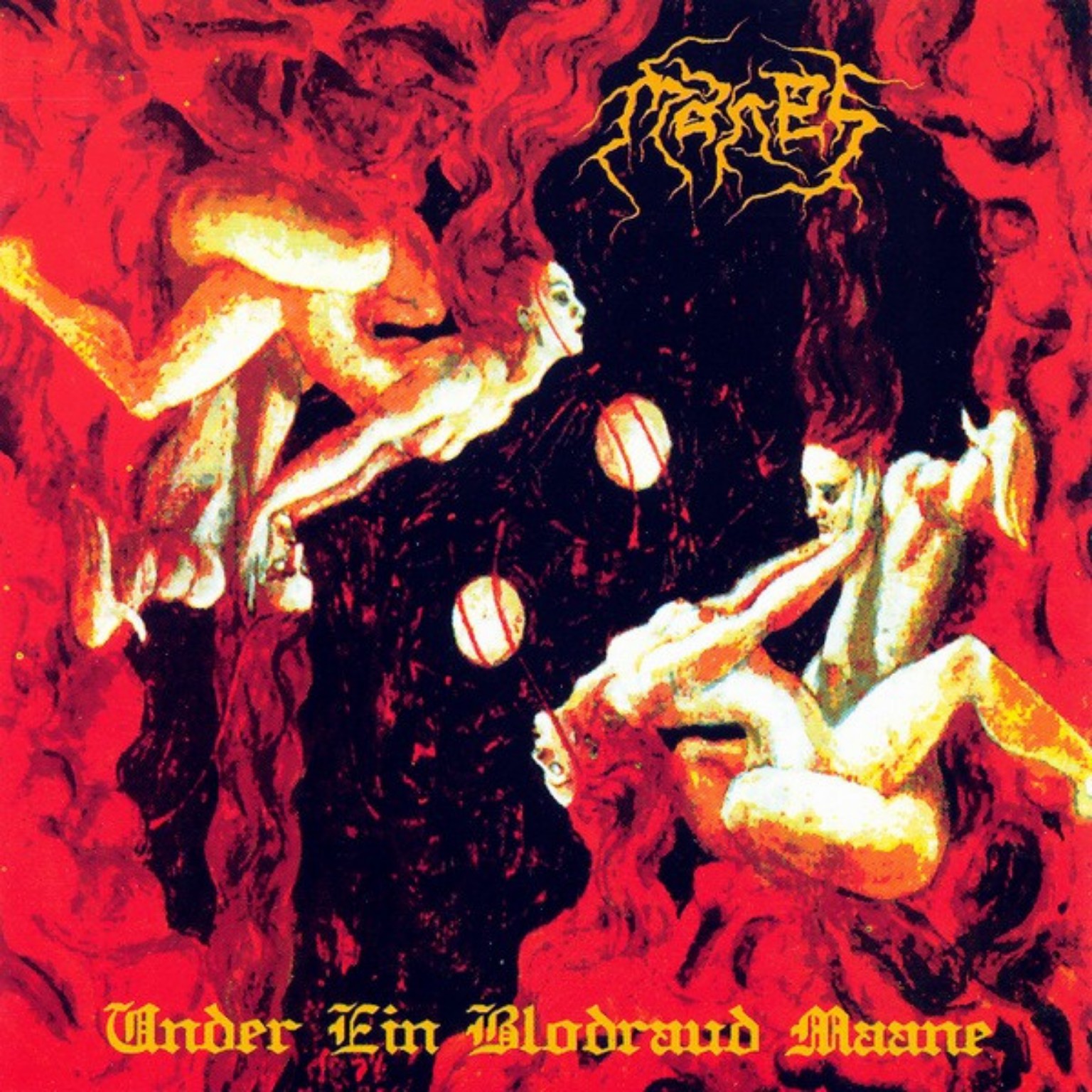
The original CD cover could reach a listener before the music did. The surface of Hammerheart's 1999 release is dominated by dark red, black and ochre tones. Rather than presenting a single central figure, the image alternates between bodily and bone-like details and painterly shapes that dissolve into one another and resemble flames. On the right, a lighter figure appears to be hunched over, while two smaller bright patches interrupt the dark central area. No regular horizon is visible. The image derives its force not from figures that can be identified precisely, but from its unsettled space and the tension between its colours.
The intricately drawn Manes emblem occupies the top of the cover; below, golden letters reminiscent of Gothic forms spell out the title Under Ein Blodraud Maane. The warmth of the colours does not soften the scene; instead, it intensifies the blackness opening in the centre. Light seems to emerge from the painted patches themselves rather than from a distant source. Parts of the figures merge with the background, making the space appear at once deep and uncertain. Interpretations involving death, threat or ritual may arise, but these are possibilities open to the viewer. No known symbolic key supplied by the artist assigns a single compulsory meaning to every shape.
The front cover also seems to echo the album's musical proportions. Much like its dense and dark guitar sound, the painted forms press upon one another, while brighter details create peculiar openings. In this way, the visual image can be related to the keyboard-expanded black metal sound that later reviews so often highlighted. The connection is aesthetic, not the discovery of a concealed programme devised by the band: there is no evidence that any particular figure in the painting depicts a character from a particular song. The tension between dark and bright surfaces is enough in itself to make the image feel like more than mere decoration.
The image also has a separately preserved history, one that extends far beyond the printed album credits. In a personal recollection sent to Open Metal Album Library on 15 October 2026, Tor-Helge Skei explained that Monika created the painting for the album. The process began with black-and-white pencil sketches. Skei chose one of these versions, which was subsequently developed into a colour painting on canvas. The cover, then, was not simply an existing illustration adopted for the record: distinct choices and actual work with paint preceded the reproduction used on the release.
According to Skei, the canvas was sent to the Hammerheart label to be digitised. He was dissatisfied with the image quality of the resulting CD cover. Compared with the original artwork, he found the label's reproduction excessively cartoon-like. In the story as he recalled it later, the result upset Monika so much that she ultimately bought back the original physical painting. This is a personal memory expressed many years afterwards, not a separate, independent account from the artist. Precisely for that reason, the identity of the person speaking must be preserved: the story reveals the human side of the record's artwork without adding unknown scenes or imaginary conversations.
Monika's surname appears in the surviving information in two forms, Edvartsen and Edwardsen. Skei's account supports Edvartsen; another spelling appears in some of the band's online release information. This does not conclusively settle the question of her identification. Anyone telling the story of the painting owes it to the artist not to alter her name without evidence or to expose details of confidential correspondence or of a private photograph received separately. Earlier consent to use an image on a public website does not in itself amount to permission covering every form of publication.
The record's other original format had different artwork. The front of the limited Hammerheart LP released in 1999, darker and built around a skeletal motif, was not merely a resized version of the red CD cover. The same music was thus associated with two substantially different physical presentations. That does not make the two versions separate albums, nor does comparing their images require a technical examination of the sound carried by the formats. Rather, it demonstrates how a physical release could communicate the same collection of dark compositions through different visual forms.
Placed side by side, the red painting, the black LP front and later reprints form part of the album's material memory. Listeners could associate different images with the same six pieces, depending on which edition they knew. The images are therefore part of the story, but none can stand in for another. Preserving the personal memory connected with the original red CD painting is especially valuable: alongside the sound recording, it makes visible the journey of an artistic work whose selection, painting and reproduction all depended on human decisions.
Six Pieces from the Darkness
When Under Ein Blodraud Maane was released in 1999, it brought music begun years earlier together in six tracks. Their order is more than a list of data: the experience of listening is shaped by the relationship between the opening, the changing moods in the middle and the conclusion. The original record begins with Min Trone Står Til Evig Tid, followed by Maanes Natt, Uten Liv Ligger Landet Øde, De Mørke Makters Dyp and the title track Under Ein Blodraud Maane. Til Kongens Grav De Døde Vandrer provides the ending. This sequence of titles is one of the surest maps of the memory stretching from the early demos to the album.
The opening track: Min Trone Står Til Evig Tid
The opening song places the image of a throne at its centre. The Norwegian title Min Trone Står Til Evig Tid conveys the idea of dominion regarded as eternal, while the printed lyrics give weight to images of power and a rise above time. Reviewers noted a keyboard introduction reminiscent of an organ, followed by the arrival of a heavier guitar sound. Henri Kramer, writing in 2004, also emphasised this atmospheric, keyboard-driven aspect. For the listener, the record thus begins not merely with a fast metal song but with an overture in which space and anticipation may matter as much as the force of the music itself.
Viewed in the light of the whole album, the throne motif takes on a peculiar meaning. In the final song, the dead make their way towards the king's grave. Power that appears timeless at the beginning is brought into the same space as death and memory at the end. This is a compelling possible reading of the sequence, but not proof of a story planned in advance as six scenes. Manes left no statement from its creators arranging all the songs into one detailed plot. An account of the album may therefore follow recurring motifs, but it cannot invent kings, conversations between characters or events to connect them.
The central pieces
Coming immediately after the opening, Maanes Natt takes us back to the period when Manes was still a cassette project. Its title recalls the world of the early Maanens natt; on the subsequent album it occupies a place in the final release sequence. In the printed lyrics, images of a nocturnal natural landscape, forests and valleys are not gentle descriptions of scenery. Nature can carry a threatening, alien power, and the fixed points of human order become uncertain within it. Critics have often highlighted the combined effect of slower, weightier riffs and suspended keyboard tones. The song is among those in which many later listeners found the atmospheric aims of early Manes most readily apparent.
In a user review published on AllMusic in 2018, Simone Appolloni singled out Maanes Natt as one of the album's better moments. His personal taste did not thereby become a retrospective declaration of the band's beliefs, nor did the genre comparisons associated with the song turn into proven inspirations. A critic's listening experience is a source for the album's later reception. The composers' intentions at the time require different questions and different evidence. Together, the two perspectives establish the song's historical place: one shows where its title came from, the other how the finished recording affected a later listener.
The third track, Uten Liv Ligger Landet Øde, moves from a threatened landscape to a broader image of devastation. The uninhabited earth, a world emptied of life and imagery reminiscent of the sky tearing apart lend a cosmic scale to the darkness that the opening approached through power and the nocturnal natural world. Certain parallels with Norse mythology may suggest themselves, but the material available does not prove a wholly literal origin in the Eddas for particular lines of the lyrics. One small but important matter of reading illustrates the value of the printed source: an inaccurate internet transcription can easily steer the wording about the rending of the sky towards a different meaning.
That is why the legible lyric pages of Hammerheart's 2012 reissue are more than packaging. They are original label-issued textual witnesses against which the older, more difficult-to-read printing can be checked. The 1999 LP is itself a primary source, although details of the letters are less certain in some photographs of it. When interpreting the album's lyrical world, it is wrong to elevate an unchecked line copied from the internet into definitive evidence. There is no need to reproduce the entire copyrighted lyric to avoid that error. The interpretation remains precise by retaining the central images of landscape and global destruction while refusing to build an elaborate theory on a reading that has not been established letter for letter.
Several reviews hear the guitars and keyboards of Uten Liv Ligger Landet Øde as having intertwined musical roles. The relationship between the instruments should not be treated merely as a familiar feature of black metal, since shifts of emphasis and layers of musical space would remain important in the subsequent history of Manes. Yet looking backwards demands caution. The electronic Manes that emerged after 2003 was not the same production as this earlier extreme metal shaded with synthesisers. Musical similarities can be interpreted, but the later period must not be copied back onto the first album as though it had already happened.
In fourth position, De Mørke Makters Dyp names the depths of threatening powers. Its printed lyrics combine images of punishment, fear and prolonged darkness. A widely circulated online transcript omitted sentences from the end of the song, so someone who sees only that version may understand the proportions of the text differently. Here too, the printed label source is indispensable. Musically, several later reviews drew attention to gradual development, a longer atmospheric progression and a greater sense of space. Which detail a particular listener remembers most vividly is also shaped by taste and expectations.
Alongside Maanes Natt, Appolloni named this fourth piece in his 2018 review. His selection directed attention to two tracks in which a slowly unfolding dark atmosphere may play a defining part. To other critics, the same length or suspension seemed cumbersome instead. The two listening experiences are not necessarily contradictory assertions of fact. The same musical form can be convincing or less convincing according to different expectations. Measurable volume or frequency in a sound recording cannot settle that dispute by itself, nor can it replace attentive listening to specific musical details.
The fifth track states the album's own title: Under Ein Blodraud Maane. The image of a blood-red moon provides a powerful concentration of the recurring dark motifs. One peculiarity of the song, however, is that despite its Norwegian title, the printed lyrics are essentially in English. That small difference of language matters. It would be incorrect to describe the record as though all six sets of lyrics were Norwegian without exception. Some of the unusual names and spellings in the title track cannot, without an independent source, be connected with certainty to particular figures from religious history or mythology. Readers may genuinely experience the lyrics as dark; precise etymology is another matter.
Towards the closing track
Musical descriptions repeatedly highlight the title track's keyboard theme. Here too, the synthesised layer can be understood not simply as background texture but as a component that organises the character of the piece alongside the guitars and voice. Images of dominion, night and destruction accumulated through the first four tracks may coalesce in the title into one powerful symbol. This is an interpretation arising from the order of the released record, not a detailed dramatic plan demonstrably laid out by the band. Placing the title track fifth also means the album does not announce every one of its concerns with its very first sound.
The conclusion arrives with Til Kongens Grav De Døde Vandrer. The image of the dead proceeding towards the king's grave reaches back to the opening song about the throne. The album provides no prose narrative linking these two scenes, but the relationship between the motifs is strong for listeners and readers alike. The imagined eternity of earthly dominion confronts questions of memory, burial and mortality. No fictional ruler or nameless procession needs to be supplied for the two titles to illuminate one another.
Reviews of the closing song mention shifts between faster passages and more melancholy transitions. According to these descriptions, the force of early black metal and the sustained atmospheric sections are not mutually exclusive worlds but two expressive possibilities within the same composition. An abbreviated lyric heading in the 2012 booklet does not retrospectively change the original 1999 song title. The sixth track is also connected with the name of the third demo, so the end of the full-length record points back towards the beginnings of its recorded history.
The musical and lyrical progression of these six tracks can therefore suggest a possible internal arc: dominion, night, destruction, dark powers, red moon, king's grave. The stages share moods and ideas, but there are no characters or single declared plot. This is precisely the freedom of an account that remains faithful to the record: it can follow the listener's path without replacing the music with unproven scenes from a novel. The songs document not a historian's imagination but the actual album made by Cernunnus and Sargatanas, with the additional contribution preserved in the printed credits.
Spring, 1999
The six compositions on Under Ein Blodraud Maane, released in 1999, had already taken shape earlier. The physical record, however, brought them a new public presence. The Dutch label Hammerheart Records made the material available on CD and a limited-edition LP; catalogue number HHR031 is not merely a collector's detail but one identifier of the actual link established between early Manes and the international trade in recorded music. Separate entries for promotional CD editions remind us that the press and commercial chronologies of an album's appearance are not always the same.
AllMusic associates 20 April with the album's release. The review entry dated 23 February 1999 for issue 142 of Rock Hard, however, already indicates a press presence before that date. The difference may be consistent with promotional copies circulating before broader retail availability, but the exact date on which such copies were supplied is not stated in the available sources. The secure claim is that Hammerheart released the album in 1999, while the commercial date of 20 April and the February press record must each be preserved in accordance with their own source. Evidence of a contemporary review does not by itself establish that retail distribution began at the same time.
Trondheim's population grew over the course of the decade. Figures published by SNL give 141,652 inhabitants for 1990 and 152,032 for 1999. The increase is one numerical sign of the city's institutional, educational and service-sector development, not an estimate of Manes's audience. Changes in higher education, historical sites, concerts and alternative communities continued to coexist in 1999. The city developed according to a cultural rhythm quite different from the way songs released on cassette in 1993 eventually became a record issued by a Dutch label.
The spread of information technology was also accelerating in Norway. The relevant 1999 statistics from SSB indicate personal-computer access of approximately 67 percent and internet access of 36 percent. These figures do not mean that every young Norwegian was online, or that promotion of the Manes record took place primarily over the internet. Instead, they show the scale of an approaching change. Cassettes, mail-order catalogues and printed fanzines had not yet vanished, but another form of musical public life was visibly taking shape. Napster began operating in June 1999, after the April date associated with the record; it cannot automatically be used to explain either the album's creation or its early distribution.
Europe's political and economic systems were changing that year as well. On 1 January, the euro was introduced as an accounting currency in the participating states, and in March NATO began its air campaign in Kosovo. These events belong to the history of the continent, but neither can be cited as an influence on Manes's songwriting between 1990 and 1994. Norway's state accounts for the full year 1999 recorded revenue of 499.6 billion kroner and expenditure of 467.0 billion; these figures were established after the year had ended. They do not describe the public mood in Trondheim in April. A historical portrait becomes credible only when events known retrospectively to historians are not confused with those already visible to the people living at the time.
Musically, 1999 was a particularly interesting year for a record of this kind. Norwegian black metal had by then acquired an international reputation, even as the genre encompassed very different relationships with raw instrumentation, synthesisers, melody and studio production. Manes's first full-length record appeared as the culmination of its early work just when several other Norwegian extreme-metal musicians were reshaping their sound. Keep of Kalessin's 1997 album Through Times of War was already an existing regional point of comparison, whereas Agnen, released in October 1999, came after the Manes record's spring appearance. The dates matter if the musical background is not to become a series of arbitrary comparisons detached from chronology.
Listening to the early album in the light of Manes's later electronic and alternative language, its experiments with keyboards may appear especially significant. Yet the 1999 album remains fundamentally a black metal recording. The fact that its creator later chose different approaches to instrumentation, rhythm and vocals does not retrospectively change the genre of the first record. When Vilosophe truly opened up a different world in 2003, Under Ein Blodraud Maane also became the distinct document of an earlier phase. Further events and interpretations by listeners, however, lie between those two points.
Reception was divided from the outset. On metal.de, the same album received a score of 2/10 in March 1999 and 7/10 in May. The publicly available entry for issue 142 of Rock Hard gives 7/10. A review in Underground Empire #11 by The Mighty SCI! awarded the record 5/10, while the editorial average was 5.67/10. These numbers are not differently rounded versions of an imaginary critical consensus. They reflect separate writers, differing expectations and contrasting musical criteria. Much of the surviving criticism consequently tells us more when each account is allowed to retain its own voice.
In the review attributed to The Mighty SCI!, the album's noise and its difficult-to-define character produced a negative listening experience. Other critics praised its atmosphere and keyboard themes in precisely those aspects where a less satisfied listener perceived uncertainty and excessive length. The two assessments on metal.de are particularly striking evidence of polarised contemporary reception. The full text of Rock Hard's February review is not available in the completed research collection, so its author's full argument cannot be reconstructed from the 7/10 score. A history of criticism need not fill every gap with sentences that merely sound plausible.
Among contemporary press records, the archived heading for Underground Empire also bears a 1998 designation, although other clues in the issue's contents suggest a later date. Henri Kramer's 2004 review on PowerMetal.de likewise gives 1998 as the album year. Such discrepancies cannot be resolved simply by silently adopting one date in the book and forgetting the others. The original physical release in 1999 is documented; divergent dates appearing in reviews should be identified as features of their respective sources. The story remains intelligible even when the precise dating of a press item is unresolved.
The first album occupied a distinctive and sometimes disputed position in the metal world approaching the turn of the millennium. Alongside dense guitars and powerful distorted vocals, the slower passages shaped by keyboards were particularly divisive. There is no evidence that this divided reception directly prompted any particular subsequent compositional decision. What does belong to the album's later history is the radically different direction Manes eventually took and the frequency with which listeners then interpreted the first release as a precursor or as the record of a completed phase.
What the Years Added to the Listening
The interval between the first judgements passed on the record and later retrospectives was more than a matter of release dates. Those who wrote newer reviews already knew where Manes's career had led. At the end of the 1990s, reviewers had to place a new Norwegian black metal album among the rapidly changing offerings of the genre. A few years later, however, the same recording had become the opening phase in an unusual band history. The recording itself had not changed; its listeners' circumstances and points of comparison had.
In 2004, Henri Kramer wrote about the songs on Under Ein Blodraud Maane in detail for PowerMetal.de. His attention was drawn to more than the raw sound associated with the genre. Keyboard passages, at times organ-like, the dark mid-tempo pace and a production he considered more unified than the earlier demos were defining elements in his interpretation. Kramer cited 1998 as the year of release, whereas the original Hammerheart edition dates from 1999. This difference warns us that the surviving data for the review and for the album's release do not have the same accuracy; it does not invalidate the writer's observations as a listener.
An AllMusic user review from 2018 brought another perspective. Simone Appolloni found the album listenable but not particularly original. Early Emperor, Immortal and Burzum appeared in his comparisons. These were not admissions of influence by the musicians themselves but the musical relationships a critic heard on the basis of his own experience. Even so, Maanes Natt and De Mørke Makters Dyp stood out for him among the six compositions. The dual character of his assessment demonstrates that recognising the atmospheric strength of a song need not involve praising the originality of an entire album within its genre.
Meanwhile, simple numerical scores in different databases continued to circulate in discussions of the music. Lycanthropia's Legacy Score of 90 percent, for instance, does not by itself mean there is a lengthy, verifiable argument by an identifiable author to consult. The database entry also indicates the absence of an actual readable review. Such markers document the album's visibility on the internet but cannot be treated as independent aesthetic narratives. Likewise, the contemporary scores of 2/10, 5/10 or 7/10 do not replace an examination of what each writer criticised or enjoyed.
Both kinds of judgement therefore have a place in this history. The striking contrast between the two metal.de reviews published in 1999 shows how differently contemporary listeners could respond. The Mighty SCI! criticised the blurred, noisy sound; years later, Kramer found value in the building of atmosphere and the role of keyboards. Appolloni appreciated particular songs while finding the album as a whole less distinctive. The record gains nothing if these voices are retrospectively assembled into a single chorus of praise. Their differences also document the questions that surrounded the continuing life of early Manes.
The reissues preserve another process of remembrance. After Hammerheart's original CD and limited LP in 1999, a limited digipak CD appeared in 2002. Several LP variants are associated with 2011, as is a numbered A5 digipak from The Oath; the release data also include clear and red vinyl and an official test pressing. The last of these was not a normal retail edition. The Oath release bears catalogue number OATH 019, while Hammerheart's 2011 LP variants are listed as HHR2011-15; the red version also carries the name Ordo MCM and the designation MCM003. These letters and numbers help distinguish individual physical reissues without turning the six songs into separate albums.
In 2012, Hammerheart issued CD and LP versions under HHR2012-24, with HHR2012-24US on the CD associated with the United States. The release database also records a digital album consisting of six FLAC files, together with several colour variants of the LP. The 2018 reissue series carries the designation HHR 2018-13; its CD is identified as remastered, and several LP variants are also documented. The term remaster is a label or database description in this case, not the result of an independent technical comparison of the audio. Some catalogues list a title variant, Vnder Ein Blødravd Maane, without a date, alongside catalogue number HHR2012-24. The alternative spelling and missing date can be preserved without inventing another album or an arbitrary year of release.
The abundance of physical variants is not a story about collecting for its own sake. It illustrates the memory of a band growing out of the early cassettes and the first full-length album: when the musical world of early Manes had already come to a close, listeners could still encounter it on a newly printed cover, another physical format or a digital release. The 2012 label booklet is especially useful for retrieving lyrics and the original credits. A later reprint does not rewrite the past in such a case; it makes accessible a document whose earlier copies may be harder to read. The date of publication changes, not the date when the original compositions were created.
Critics' judgements and the album's reissues form the two sides of the same afterlife. One continually asks how to evaluate the recording as music; the other preserves it as something that can still be heard and identified. Both processes matter to its history, but neither retrospectively supplies evidence of recording details that the original participants never described. The boundaries of the album's past are marked by the surviving witnesses, and within those boundaries a sufficiently remarkable story emerges.
One Name, New Instruments
The story of Manes did not end after the 1999 album, but it changed substantially. In the earlier two-person incarnation, Sargatanas's singing and Cernunnus's instrumental work defined the sound. In the early 2000s, from around 2002 onwards, Manes became more active again with new collaborators, and Vilosophe, released in 2003, revealed an entirely different musical world. The album appeared through Code666 and was made with the participation of Torstein Parelius, Rune Hoemsnes, Eivind Fjøseide—the musician also known as viNd—and others. The group had expanded, the balance of vocals and instrumentation had changed, and the new record was no longer a direct stylistic continuation of the 1999 recording.
Vilosophe employed electronic elements, trip-hop and alternative rock, clean vocals, samples and novel forms of musical arrangement. To listeners accustomed to the earlier language of black metal, the shift could seem abrupt. Yet the band's later spokespeople did not always describe it as a deliberately planned break. In a Greek interview in 2018, Torstein Parelius remembered the new direction more as a process of trying out ideas, building up new layers and rearranging them, rather than following a ready-made genre blueprint drawn up from the outset. This is how the second period was described by its participants; it does not tell us how the musicians worked on their early demos in 1993.
The subsequent sequence of albums increasingly confirmed that the name Manes did not refer to one sound alone. The 2006 [view] EP opened towards covers and electronic experiments. How The World Came To An End, released by Candlelight in 2007, Be All End All in 2014 and Slow Motion Death Sequence in 2018 brought further changes. Clean singing, heavier or more restrained guitars, digital rhythms and alternative musical structures outlined a very different band history from that of Maanens natt or Under Ein Blodraud Maane. Yet the differences do not render the earlier compositions invalid; rather, they make clear that the beginnings belonged to a distinct creative situation that existed for a limited time.
The relationship between the old repertoire and the new band was not completely severed. In an Italian interview in 2018, Parelius recalled that a later incarnation of Manes had once played a song from its first full-length album live. He was uncertain about the date, suggesting perhaps around 2004, and did not name the track. The band performed it differently, in a manner consistent with its newer approach, but according to his recollection there were no plans to bring that material back into the regular repertoire. This small historical memory tells us a great deal about the relationship between the two periods: the first album was not a past to be denied, but neither did it automatically become the foundation of the new Manes's concert activity.
The band's later live presence offers a particularly sharp contrast with its beginnings. A surviving photograph of Manes performing at Blastfest in 2016 shows the appearance of the later era, not the two early album creators performing together in the 1990s. Another, later group photograph likewise depicts people from a different phase of the band's existence; where the individuals or the date of the photograph have not been reliably identified, a caption must not invent earlier roles for them. The essential point of the images is that Manes eventually became a multi-member live band, whereas the first full-length album remained a document of two-person recording work.
Parelius did not later remember the quieter period around 2011 as a definitive dissolution. He spoke instead of slower working methods, different creative tasks pursued by individuals and ideas temporarily set aside. Some digital releases of the period also served to share old sketches and alternative versions. In the history of an artist's later life, a pause is not always an ending: sometimes works simply emerge at a different pace. In the case of Manes, widely separated release years and lengthy periods of silence matter more than a simplistic biography that imagines uninterrupted touring in every year.
The musical relationship with the early vocalist Sargatanas returned in another form as well. Cernunnus connected the later material made under the name Manii with a distinct historical situation. In a label statement, he explained the choice of name in terms of the expectations attached to the two periods of Manes and the wish to distinguish a new creative phase. Manii does not rewrite the credits of the 1999 album, nor does it make Sargatanas the vocalist on every subsequent Manes recording. Instead, it shows that old artistic relationships can retain independent significance even when the band name has meanwhile encompassed different people, styles and instruments.
In a conversation in 2026, Skei also spoke of an outlook that placed atmosphere, the construction of a whole album from details and the importance of a creative mood ahead of merely flawless technical playing. This late self-description helps explain why experiments with atmosphere, rearrangements of instrumental forms and movement between genres endured for so long in Manes's career. Yet its every sentence must not be projected back into the studio in 1997. An artist's later account of himself is important evidence of his thinking, but it is not necessarily a contemporary record of every decision made during early recording sessions.
What is distinctive about the band's history is not simply that Manes eventually moved away from black metal. More interesting is how the early album retained such a strong, independent identity alongside the newer sounds. Synthesisers may suggest a certain continuity in outlook between the two periods, but the instrumentation and vocal world were genuinely different. Looking back from Vilosophe, it is easy to discover in the first record a precursor of the later creative openness, yet that new direction was not already complete when the first album was made. Later achievements cannot rewrite the past; they can only cast it in a new light.
The Time That Remained from the Cassettes
On first hearing, Under Ein Blodraud Maane is a 1999 album. In its actual history, however, several distinct periods coexist. The original printed credits date some of the music to 1990–1994; the three demos are dated 1993, 1994 and 1995; the recordings at Jotunsinne Studios ran from November 1997 to September 1998; and Hammerheart Records made the six tracks available in 1999. Anyone confusing those timelines could easily imagine that every note, lyric and image on the record came into being in the spring of its release. In fact, it was the long life of the earlier material that became audible on the full-length album.
The album's geographical history similarly unfolded across several places. Trondheim was the documented urban setting of the early project. The Norwegian underground helped preserve and circulate recordings on cassette, while the Dutch label Hammerheart placed the material in an international commercial form through which it could reach a wider audience than the first demos. Norway's changing society, a city expanding its cultural institutions and a digital world gathering pace towards the turn of the millennium were all present at different stages of the journey. These external events are not secret explanations of the songs; they make the world of their recording and release historically tangible.
The history of the image tells of overlapping periods, too. Monika's painting began with black-and-white pencil sketches, followed by the canvas, then digitisation by the label, and finally the CD cover. Skei spoke in 2026 about his dissatisfaction with the resulting image and about the painting's later fate. His recollections add a great deal to the object's history, but the weight of historical words also depends on when they were spoken and by whom. A printed release, a contemporary fanzine and a private letter written decades later do not provide the same kind of evidence, although each belongs to the album's past.
The sequence of six songs can lead an interpretation from the royal throne to the king's grave. Along the way are the nocturnal landscape, the world emptied of inhabitants, the depths of dark powers and the blood-red moon. The relationship between keyboards and guitars, the extremes of contemporary criticism and the reappearance of titles from the old cassettes all enrich the journey. But the songs do not become a literal novel divided into scenes simply because related motifs can be discovered in their titles. Their story is, rather, the story of the people, recordings and objects without which the album would not exist today.
As Manes later moved towards clean vocals, electronic rhythms and alternative instrumentation, its first record increasingly became a clearly defined period in the band's history. Not the opposite of its subsequent path, but another, completed solution within the same broad creative life. Vilosophe in 2003, [view] in 2006, How The World Came To An End in 2007, Be All End All in 2014 and Slow Motion Death Sequence in 2018 did not erase the six tracks from 1999. Instead, they showed how different sonic worlds could be united by the name of a single band, and how independent the musical document of its beginnings could remain.
Looking back on early Manes is therefore not merely an exercise in nostalgia. What emerges is the journey of a small musical project working with limited means, moving from demo recordings and fanzines to an album released by a record label. Contemporary critics did not all hear the same things in it; later writers were equally divided, and reprints preserved the music in different physical forms decades afterwards. The story does not end with a final score or a legend that explains everything. Its conclusion is the recording itself: six tracks that continue to preserve the overlapping times of the cassette beginnings, the long studio sessions and the end of the 1990s.
Reader comments
Comments only appear after approval. Messages are displayed in their original language.
Comment submissions are not enabled yet.