Failures for Gods
A literary history of the making and legacy of Failures for Gods
Start reading ↓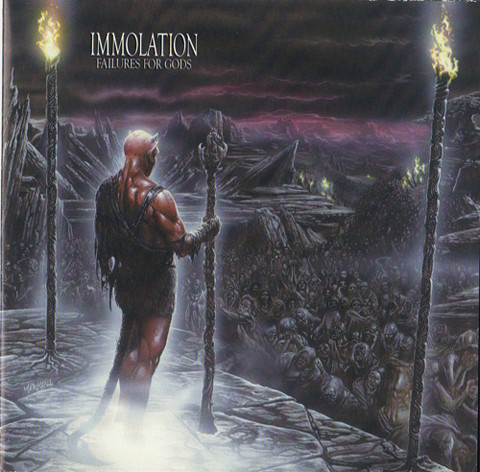
Prologue – The Shadow of the Third Album
The beginning of an album's story can rarely be pinpointed with certainty to the day of its release. The disc arriving in shops, the cover one can hold in one's hands, and the title printed upon it merely make visible something that, until then, had consisted of years of rehearsals, uncertain agreements, tours, and painstakingly considered musical ideas. Immolation's third full-length album, Failures for Gods, reached listeners in 1999, but its true beginnings stretch back to the middle of the preceding decade. Its formation bore the imprint of an early band still operating under another name, the underground network around New York, a recording session in a Berlin studio, a painful hiatus involving the record label, and the renewed momentum found in 1996.
The fate of the third album is unusual because there was no consensus about it even in its own time. Some found it exceptionally raw, overcrowded, almost impossible to decipher, while others saw in that very density proof of Immolation's distinctive voice. One reviewer took issue with the drum sound; another praised the musicianship. In 1999, the musicians spoke of the material as a creative step forward, but much later they described some of its choices as overly busy. Neither statement cancels out the other. The pride recorded at the time of the work's release and the self-criticism voiced ten years later may each be an honest expression of a different moment in life.
By the end of this story, the cover, the titles of the eight songs, and the tape recorded in the summer of 1998 will no longer be separate pieces of information. Together, they will show how a band searching for its own sound can move forward while also arriving at choices it will later reconsider. Failures for Gods is not the endpoint of something. Rather, it is a turning point whose significance becomes truly apparent on the next album, on subsequent tours, and in the band's own memory.
Chapter One – The Two Banks of the River
When we hear the name New York, it is easy to picture the heart of the city, yet the story of Immolation does not begin in Manhattan. On the eastern bank of the Hudson, at the southwestern edge of Westchester County, lies Yonkers, with the Bronx beginning just beyond its southern boundary. The city belongs at once to the orbit of the metropolis and to a history of its own. The industries bound to the river, the older built-up neighborhoods, the residential districts on higher ground, and the later expansion of the suburbs do not form a single, uniform picture. Even a 1995 federal urban development report emphasized the differences between the central city and its outlying areas; citing the 1990 census, it gave the city's population as 188,082.
The areas around the Hudson and the Saw Mill River had long fostered economic connections. Getty Square, the historic downtown, the former industrial spaces, and the transport routes leading toward the Bronx offered residents different possibilities. In the 1990s, local housing, economic disparities, and urban development were matters of public debate. These circumstances matter to an understanding of the period, but no surviving document entitles us to derive a particular Immolation song from any specific social conflict in Yonkers. The setting is the real framework of people's lives, not a ready-made explanation for every creative decision.
For the musicians, the city's proximity to New York's larger concert and record markets may have represented an important opportunity. Local rehearsals and musical events in the metropolis or the wider region were not mutually exclusive worlds. But connections did not stop at state borders, or even at the Atlantic Ocean. In the second half of the 1980s, fans and fledgling bands wrote letters to one another, copied demo cassettes, and mailed fanzines. A reply from a distant city often meant more than hearing a new song: it was proof that someone elsewhere was paying attention to unfamiliar, extreme music.
According to Ross Dolan and Robert Vigna's later recollections, the early demos travelled so far that one recording was even played on Italian radio. The musicians did not recall this as evidence of instant fame, but as a testament to the strength of the underground network. Personal messages, covers made by hand or on typewriters, addresses, and fanzine recommendations travelled alongside the tapes. Acquaintances were formed in much the same way in circles around Autopsy and Sepultura, as participants would recount many years later. Looking back from the age of the World Wide Web, it is easy to forget how much time, patience, and money this seemingly simple form of communication required.
The New York extreme metal scene already had its characteristic approaches: the alternation of fast and heavy passages, down-tuned guitars, distorted vocals, and subjects beyond the vocabulary of radio-friendly rock. Yet there was no single compulsory formula. Florida death metal, the musical environment of the northeastern United States, and European extreme music all helped shape the international landscape at once. The future members of Immolation began as part of this wider world, but one can say with certainty which particular record influenced which specific musical choice only where the participants themselves documented that connection.
In this environment, the local and the international were intertwined. Yonkers figures in the story as more than a place of origin: it was the starting point for young musicians who gradually searched for a sound of their own alongside their jobs, rehearsals, and tours. The price of that search, and the length of the road to the 1999 album, cannot be shown on a single map. The years that followed nonetheless trace its direction.
The city's geographical position does not, by itself, tell us everything about the opportunities available to its residents. The north–south transport connections along the Hudson passed through worlds quite different from the residential neighborhoods extending eastward from the river. Yonkers had an old, densely built-up center, surviving buildings from its industrial past, and neighborhoods whose way of life more closely resembled that of the suburbs surrounding the metropolis. The proximity of the Bronx did not erase this internal diversity; rather, it sharpened the contrast between the urban corridor connected to the metropolis and the landscape reaching farther into Westchester County.
One of the defining experiences of Yonkers before the turn of the millennium was that the old industrial order no longer offered ready answers about the future. In the first half of the twentieth century, parts of the lower Saw Mill River had been channelled underground, while roads, buildings, and parking lots reshaped its surroundings. The later story of urban renewal began here precisely because the decline of former economic functions had left behind empty, deteriorating spaces or areas awaiting new uses. The cityscape of 1998 was not yet the restored waterfront visible in photographs from subsequent decades. Sections of the river in the downtown area would not be uncovered until much later. What was already apparent in the period under consideration, however, was that reimagining historic industrial land and public spaces was not merely a matter of architecture: it also concerned jobs, housing, and the future of downtown. In 1999, the environmental partnership initiative Groundwork Yonkers was launched; it would later help prepare the way for bringing the Saw Mill River back to the surface.
Another burden of the city's past, felt even more directly, lay in inequalities of housing and schooling. In proceedings brought by the federal government and local civil-rights organizations, it had already been established in the 1980s that Yonkers had deliberately maintained segregating practices in subsidized housing and public education for decades. The court rulings therefore demanded not merely a change in principle, but also that opportunities for subsidized housing should no longer be concentrated in parts of the city already disadvantaged. Putting that into practice was much harder than drafting a single ordinance. At the end of the 1990s, disputes still continued over the actual results of the mandated housing program, over who would receive new homes, and over whether the new moves would genuinely reduce patterns of segregation entrenched in earlier years.
The years 1997–1999 were therefore not simply an after-echo of an urban conflict from the 1980s that had long since been settled. In the housing case, disagreements arose in both 1997 and 1998 over how subsidized homes were to be credited toward the requirements; in September 1999, the court reviewed the program's progress again, before imposing further requirements at the end of the year. The state of the schools was likewise shaped by prolonged legal proceedings and debate about educational opportunity. In this city, an address, a school, and a person's social position were not merely private matters: they appeared simultaneously in everyday life and in the national legal arena. All of this forms an important part of the period's local history, regardless of whether any member of Immolation discussed it in a personal interview.
At the same time, 1998 marked a genuine turning point in the city's finances. Yonkers had previously fallen into such a severe budget crisis that New York State established a special financial control board for it in 1984. For many years, this body did more than monitor the city's financial plans: it also supervised contracts, borrowing, and other major financial commitments. Its authority extended to the school district and other municipal bodies. It was no distant, abstract institution; its operation signalled that decisions at the state level had constrained the freedom of the local government for years. In July 1998, the control board declared that the financial emergency which had led to its creation was over; its active supervisory authority consequently ended, and the board's existence formally came to a close in January 1999. The change was already a fact between those two dates, but not enough time had passed for every social problem that had developed over the years to disappear.
Thus, in the summer of 1998, Yonkers carried two stories at once. One concerned the restoration of the city's financial autonomy. The other concerned housing and educational inequalities so deeply rooted that court orders and disputes within local communities were still attempting to resolve them. The two must not be confused. The end of the financial control board did not mean the end of the segregation lawsuit; nor did the persistence of the housing conflict negate the change in the city's budgetary position. The city was in motion, but its changes were not proceeding at the same pace.
This layered environment became still more complex across the county and the greater metropolitan area. Westchester was not Yonkers alone. Along its southern edge, the Bronx and New York City connected with residential towns and suburban communities farther north; people's routes crossed administrative boundaries. Work, shopping, cultural events, and family connections in the region did not fit within a single city map. Railways, roads, and bus services offered the possibility of travel, but every journey cost time and money. This fact also belongs to any understanding of the general circumstances of musicians who held regular jobs and rehearsed frequently. These sources do not tell us, however, what vehicle each band member used, which route he took, or exactly how many minutes it took him to get from work to rehearsal. It would be wrong to insert such details into the story.
Nearby New York City was undergoing change on an entirely different scale in 1998. A September report from the mayor's office described a substantial decline in crime, improvements in the condition of public spaces, and growth in employment. According to city figures published early the following year, private-sector employment had increased by more than eighty-four thousand in 1998, while tourism was also exceptionally brisk. City leaders presented these developments as successes of their administration; for precisely that reason, the reports cannot be taken as evidence that every resident had an equally favorable experience. Alongside the picture of economic expansion, the city's social policy was also being reorganized: the number of people receiving public assistance fell, while forms of support tied to work received greater emphasis. The merits of such changes were politically contested at the time. The figures describe the city's economic and administrative movement; they do not prove that life had become easier for every resident.
A striking contradiction thus emerged between two settings only a few miles apart. In New York, city leaders spoke of records: more jobs, more visitors, falling crime. In Yonkers, state financial oversight had just ended, yet long-running housing disputes had not subsided. For any one person, the everyday concerns of rent, commuting, job security, and managing one's time could persist beneath the public optimism. The region was therefore not a backdrop painted in one color, whether triumphant economic growth or decline, but a place where some institutions and neighborhoods moved in different directions from others.
Immolation's third album was recorded amid this particular moment in the city and the county, while the band was already following its own documented path. The rehearsal room, day jobs, travel, and the recording sessions of 1998 are discussed in detail in other chapters of this novel. The additional history of the surroundings cannot explain any one riff, lyric, or personal decision in their place. What it can do is show the geographically and socially contradictory world in which the material that listeners encountered in 1999 came into being.
Had someone traced the Hudson on a map in the closing years of the 1990s, it would have been easy to imagine finding different stations of one musical world around the metropolis. Yet the roads crossing the river, the streets opening toward the Bronx, the more distant towns of Long Island, and the communities of New Jersey were not home to some unified school of death metal. A network was formed by a multitude of bands, circles of friends, venues, and short-lived business arrangements. Within that network, proximity offered real possibilities, but it did not necessarily imply identical musical aims.
In the urban concert scene, bands with quite different approaches could share a stage on the same evening. One surviving concert database, for example, lists performances by Cannibal Corpse, Angelcorpse, Evilution, and Immolation at New York's Coney Island High club on July 31, 1998. The entry alone cannot stand in for a period concert poster or an eyewitness account, but it conveys the region's connections more precisely than the abstract statement that the underground 'stuck together.' The names could appear together on a single bill without their musical ideas blending into one another. The connection was practical: reaching the same audience, gaining temporary access to the same stage, and continuing the journey at the next stop.
The earlier history of the New York and New Jersey music scene offers a similar warning. In a retrospective account given years later, John McEntee, leader of Incantation, did not speak of a single mythical club, but named several venues: Gee Willikers in New Jersey and Studio One in Newark appeared in his list, alongside other places in the area where concerts took place. His recollection chiefly concerns the early years; it does not prove that Immolation played at every club he mentioned in 1998. What it does show clearly is how connections between bands came into being: through the slow work of local performances, opportunities to play as an opening act, and smaller-scale arrangements reaching across borders. The region was not one stage, but many little entrances into the same underground world.
Death metal itself did not mean a single musical gesture. In the orbit of Long Island's Suffocation, heavy, jagged rhythms, extreme drumming techniques, and fast passages that scarcely left room to breathe were arranged differently than in Immolation's music. The dark, low-pitched guitar sound of Incantation gave slowness and tension another kind of weight. Mortician, Ripping Corpse, Morpheus Descends, and the region's smaller bands—many of which left traces only on cassettes or short releases—each searched for a different boundary between furious tempo, heaviness, and unusual form. This is not a supposed 'list of ingredients' for Immolation's album, but the audible diversity alongside which the band had to develop a voice of its own.
It is important that later generations do not blur the beginnings together with what came afterward. A band that still seemed a rare novelty at the start of the 1990s was, by 1998, part of a changing field. Some older participants faced lineup changes, shifting interest from record labels, or extended periods of inactivity. Other groups sought ways to carry on within smaller circles and with the help of new companies. The story cannot be told as though the genre simply vanished and then unexpectedly returned. Rather, the possibilities were rearranged: one band received less attention, another made a new connection, and a third reached the same listeners in a completely different musical language.
A concert venue did not offer opportunities only to musicians. It was also a place where a listener might encounter records and names previously known only from a magazine. The fanzine and the promotional disc were not by-products standing behind the 'real' music. With a hard-to-find release, they might be precisely what established the first contact with a listener. Clubs, interviews arranged by letter, shops, and parcels sent through the mail were different points in the same circulation. The journey of the music also included the time it took for the other person to reply, for a record to arrive, and for the next performance to take place.
Being close at hand, however, did not mean having comfortable working conditions. Rehearsals, day jobs, and concerts competed for the same hours. For a band in the New York area, a neighboring state border might be geographically close, yet a performance or an extended tour still demanded planning, money, and days away from work. The pressure to make a living, already encountered in Immolation's story, was therefore not some peculiar private episode; it was consistent with the general conditions under which the underground operated. In the band's specific case, evidence for individual tours and working circumstances still comes from the surviving statements of its members themselves; the regional context broadens the background against which those accounts can be understood.
From this perspective, Yonkers is not an exaggeratedly symbolic place at the center of a great musical movement, but a real point of departure. Understanding the setting helps us imagine the distances and the limits of what could be reached. It does not tell us how any individual Immolation riff was written; it does show the dense, varied, and yet fragile connections through which the music had to travel from rehearsal room to concert, from there to the recording, and finally to a listener in another country.
Chapter Two – Before the Name
Immolation's prehistory begins in 1986, under a different name. Rigor Mortis is more than a footnote, although later biographies often connect the two bands through a single change of name. The early group's musical experiments, demos, and relationships among its members were indeed forerunners of Immolation, but the creative identity of the two bands is not quite so simple. The 1986 recording Peace Through Tyranny, 1987's Decomposed, and the early material associated with Warriors of Doom reveal a developing circle of musicians still searching for its form. According to the interviews that have survived, Andrew Sakowicz played a defining role in the band's early lyrics and songs.
Ross Dolan was not yet a member of the group. He knew the musicians, had seen their local performances, and was friends with Sakowicz. That does not turn the early history into a sequence of romantic coincidences. It simply means that the members of the later band had moved within the same musical and personal network even before it began. Their interest in heavy metal generally started with the classic names. Dolan recalled Black Sabbath, Iron Maiden, Judas Priest, and Dio as part of his youth; later, Slayer, Possessed, Kreator, Destruction, Sodom, Venom, Celtic Frost, and early Sepultura grew increasingly important to him. Death, Morbid Angel, and Necrophagia also came up in other interviews.
Such lists are valuable only if we do not mistake them for a family tree from which every note of the later album can be traced. The young musicians heard and loved certain artists; that much is documented. But no particular riff on Failures for Gods can be attributed retrospectively to one of them without evidence. Musical influence is not mechanical imitation. It is a process shaped by many different memories, developing technique, and collective practice, and interviews preserve only some of its specific stages.
The decisive personnel change came early in 1988. In February, Dolan replaced Andrew Sakowicz as vocalist and bassist. Robert Vigna brought new compositional directions to the group, and the old name no longer accurately expressed the music taking shape. With the change of name, Immolation was born. The musicians later recalled that the new word might also have been connected to a misheard passage from a Death song, with Neal Boback mentioned in the story. This recollection, however, must not be presented as a contemporary fact established with the same precision as a dated studio credit.
The early lineup was in transition. Dave Wilkinson was still involved briefly during this period; after his departure, Neal Boback became the drummer. Later, simplified lists of members often give the impression of a fully formed band, although the reality was one of formation. The name, the lineup, and the musical direction changed almost simultaneously. It was not record companies or critics who could yet determine how firmly distinctive a sound would emerge from all this. That would be demonstrated by the demos, the rehearsals, and sustained work.
Immolation's 1988 demo already marked a new period. Recordings titled Dawn of Possession and Immolation found their way through postal and personal connections. It is worth recalling this early world because the band's 1999 record cannot be understood without seeing where its attraction to a dense, nervous, and unconventional instrumental language came from. For fans, the third full-length album could prove unexpectedly demanding; for those who had followed the group since its demos, it revealed a later, increasingly independent stage of the same search.
Chapter Three – The Journey to Berlin and the Long Silence
Released in 1991 as the band's debut full-length album, Dawn of Possession had already moved beyond the limitations of copied cassettes. Through Roadrunner and its R/C label operation, Immolation entered the international extreme metal market. The album was recorded at Musiclab Studios in Berlin with Harris Johns. The choice of location was anything but accidental: the musicians greatly admired Johns's earlier thrash and extreme metal productions, and they expected him to deliver a sound capable of preserving their music's rawness. For the young group, the journey to a foreign studio was both professional experience and a serious undertaking.
By the time the debut was recorded, Craig Smilowski was playing drums. Neal Boback had left before the session; Smilowski joined not as an anonymous, one-off contributor, but as a touring and creative member for the years that followed. It is important to keep this distinction accurate: several personnel changes took place over the years, and it is easy to project the lineup of a later concert backward onto an earlier album. One of the quiet but important lessons of Immolation's history is that a band's name can endure longer than the precise lineup responsible for any one recording.
Five years passed between the first and second full-length albums. In a discography, the two dates look like distant points, although the intervening years were not empty. There was songwriting, there were performances and searches for a record label, and, above all, there was the need to earn a living alongside making music. Ross Dolan later spoke candidly about the expectations they had held in their youth when signing with Roadrunner. The members believed the backing of a record company could, by itself, bring a major breakthrough. In reality, the label had limited means of promoting the group, and the two sides' expectations did not coincide.
This was not, then, a forgotten or vanished band. Immolation itself asked to be released from its contractual obligations, and the label let the group go. Dolan later admitted that they could not yet foresee all the consequences of that decision. Freedom came at a price: they had to find new backing, and work on the next album was prolonged. There is no need to invent a hidden drama around this. The documented reality is complicated enough: young musicians, high expectations, little financial room to maneuver, and the realization that a contract does not automatically solve a band's everyday problems.
The songs did not fall silent during that long period. Three known tracks from the promotional demo recorded in 1994—Away from God, Towards Earth, and Christ's Cage—anticipated the world of Here in After. The 1995 Stepping on Angels… Before Dawn, meanwhile, gave older Rigor Mortis and Immolation recordings and live material a belated home. The compilation was not a second studio album. It was, rather, proof that the group's past had more layers than the official sequence of full-length records could preserve by itself.
The new contract ultimately led to Metal Blade Records. Here in After appeared in 1996, having been recorded at Water Music Studios in New Jersey with Wayne Dorell. In both sound and structure, it departed in several respects from the debut. The band later recalled that the smaller budget and search for a local professional were also practical decisions. The music, however, sounded less like a practical compromise than a more complex, angular, and increasingly recognizable language. In Dolan's later words, the patterns of the band's youthful influences could by then be heard less directly, while Immolation's own character had come more clearly to the fore.
After the new album, the stage became one of the band's principal meeting places with its audience. According to later interviews, tours with Cannibal Corpse were especially helpful in returning the group to public view after the prolonged hiatus. Six Feet Under also appears in memories of concerts from the period. Touring, however, did not mean an end to civilian work. To set out on the road, the musicians had to weigh up time, leave from their jobs, and financial security. Behind the second album stood not just artistic change, but the ongoing practical work of survival.
Chapter Four – From the Rehearsal Room to Millbrook
By the beginning of the journey toward the 1998 studio sessions, Immolation had two full-length albums behind it and had been performing relatively frequently. With Here in After, the group had regained visibility through a record label, but it had also encountered new expectations. The musicians did not want to leave their next material hanging as another promise five years in the making. Yet the conditions under which they made music remained demanding: the members held regular jobs, often working six days a week, and had to find time for rehearsals, tours, and recording while earning a living. This was as real a circumstance in the making of the third album as an instrument or a studio address.
Robert Vigna was taking on an increasingly significant compositional role, but statements made in 1999 do not permit us to describe the music as the solitary creation of one person. Dolan spoke of collective work: the band tried out riffs, arranged them, and learned to play them together, often developing material with the aid of tape recordings. There was no mandatory creative timetable that applied to every member and every song. Some ideas took shape more quickly; others were worked on for longer. Gradually, the music moved beyond a sequence of conventionally connected riffs. Unexpected turns, themes interlocking with one another, and unusual rhythmic relationships became defining features.
By this time Alex Hernandez was behind the drums. Craig Smilowski had been an important figure on the earlier records, but it is Hernandez's playing that can be heard on the July 1998 recording sessions for Failures for Gods. Robert Vigna and Thomas Wilkinson formed the guitar pair; Ross Dolan supplied vocals and bass. John McEntee does appear in reports of concerts from 1999, but his name must not be allowed to rewrite the studio credits. On certain tours McEntee stood in for Wilkinson, because Tom's own business did not always allow him to be away for extended periods. The personnel on stage and in the studio were not invariably identical; the accuracy of the story depends on recognizing that difference.
The musicians wanted to unite two different strands of their own tradition. They sought to preserve the oppressive, dark atmosphere of the first album while carrying forward the aggression and increasingly unconventional structural ideas of Here in After. They were not interested in radio-friendly forms, regular choruses, or simple patterns of tempo. Instead, the compositions were built on sustaining tension and repeatedly unsettling the listener's sense of direction. Dolan himself discussed this in 1999: the intended atmosphere, the dynamics, and instinctive reshaping in the rehearsal room were all present at once. The fact that later critics sometimes found the result difficult to follow belongs to the history of its reception.
Millbrook lies in New York State, north of Yonkers, and it was there, at Millbrook Sound Studios, that the four musicians recorded their third full-length album in July 1998. Paul Orofino worked with them as producer and recording engineer; the booklet also credits the band with a role in production. The original mastering is associated with Brad Vance and Quadim Studios. Later interviews also established that the sessions used an analog tape-based method. This can be treated as part of the recording reality of its time, not as though the presence of tape, by itself, could tell us whether the album's rhythmic world was good or bad.
Paul Orofino's name would return again and again in Immolation's history in the years to come. The working relationship that emerges from the musicians' later accounts grew closer after their encounter in 1998; the producer came to understand the band's unusual requirements more thoroughly. During Failures for Gods, however, both sides were still learning that language. Critics later objected to aspects of the drum sound or certain mixing choices, but claims about the original studio work must not exceed what the surviving documents actually establish. Judgments about the sound and technical facts about how it was made are not the same thing.
The recording was finished, but the album was not. For listeners, the time before a release often remains invisible; in the case of Failures for Gods, it was precisely during this interval that the visual world took shape without which the band did not want to bring the album to market. The tape, then, belongs to the summer of 1998, while the physical release belongs to 1999. The months between them signify not emptiness, but further decisions and waiting.
Chapter Five – The Image Behind the Delayed Release
The eight songs already existed while the cover was still being made. The band was not prepared to settle for an arbitrary piece of artwork. Interviews from the period show that the musicians regarded the album's imagery as an important creative element, integral to its lyrical world and overall impact. It is at this point in the story that Andreas Marschall's name becomes connected to the recording. The artist produced an image whose threatening religious and apocalyptic symbolism accompanied the music as a powerful visual work in its own right. We cannot invent a detailed, unambiguously reconstructable set of instructions commissioning the cover. The band's statements do, however, confirm both the collaboration and the importance of the finished picture.
The delay was also discussed in an interview published by Canadian Assault in the summer of 1999. According to the musicians' account, the cover was not completed until February 1999. By the time physical manufacturing, promotion, and the label's schedule could be brought into alignment, the material recorded the previous summer was pushed back to a 1999 release. In retrospect, it would be easy to call this merely lost time. Yet the band's attitude at the time suggests that having the artwork fully realized mattered more to them than releasing the album at all costs as quickly as possible. That direction of decision-making is documented, even if we do not know every internal letter or every deadline set by the label.
The visual work did not stop at the picture on the front. On the booklet's pages, the artwork, the band's logo, the lyrics, the photographs, and the studio credits came together as a single physical object. Its imagery carried a distinctive golden, engraving-like, and dark atmosphere. The precise printed edition represented by every surviving page image cannot be identified with complete certainty, so those images are best used with their limitations in mind. The appearance of the title of a later album in one graphic detail does not, by itself, prove that the whole collection was assembled at a later date: such lettering is also known as a visual element beneath the disc tray.
The original album was released by Metal Blade Records. The band's own album page and some digital catalogues give June 1, 1999, as its release date. European catalogues, however, also give May 31 or even June 9, while another source lists July 9. Such discrepancies should not be collapsed into a single, unproven moment of precision. Regional release or distribution dates, catalogue entry dates, and subsequently digitized metadata may have differed. The secure center of the story is the original Metal Blade release of 1999, with CD catalogue number 3984-14197-2.
Holding the album in their hands, listeners could find the names of four musicians and several other contributors alongside the eight song titles. Ross Dolan sang and played bass; Robert Vigna and Thomas Wilkinson played guitar; Alex Hernandez played drums. Paul Orofino figures in the recording and production, Brad Vance in the original mastering. The booklet also names photographer Jeff Wolfe and includes graphic work by Brian Ames. These names place another truth beside the band's history: an album becomes a tangible object when the work of professionals outside the music itself comes together as well.
In the age of CD and vinyl record sleeves, the imagery was not merely a thumbnail to skip past on a screen. A record sleeve could be placed as a physical object before a fanzine editor, a retailer, or a fan. The artwork therefore shaped the first impression of the album alongside the songs. In the case of Failures for Gods, the title, the world of the lyrics, and Marschall's imagery belonged to the same uncomfortable set of questions: what does a person do with power born of faith and authority when, instead of the promise of salvation, they see helplessness? The question is a literary interpretation, not an assumed transcript of the artist's personal convictions.
Chapter Six – Before the Turn of the Millennium
When Immolation released its third album in 1999, it stood in the midst of a transformation of the international music world. In the late 1990s, the recorded-music market still depended overwhelmingly on physical formats. The CD industry operated on an enormous scale, yet cassettes and vinyl records remained important for underground distribution. Record stores, fanzines, radio, and concert venues were active channels through which music could be discovered. At the same time, digital tools that would later become decisive were already appearing, along with the possibilities offered by MP3 and networked file sharing.
Changes in the early internet created a particularly unusual overlap of eras. In Immolation's interviews from 1999, correspondence with fanzines could be mentioned alongside the band's website under construction, and traditional label promotion alongside its new presence on the web. The band spoke of interviews organized from the label's German office while maintaining ties with its older underground network. The past and the future existed simultaneously, without a sharp dividing line between them. This is an essential feature of the period; it does not mean that the album was recorded using modern digital studio technology.
Internet file sharing, which began to emerge in 1999, would transform the entire music industry in the years that followed. At the time of the album's release, however, most fans still encountered the band through more personal and tangible channels. A promotional disc arriving by post, a concert date written down, or an interview with a musician in a magazine might precede a new album. The image on the record and the words of a critic discussing it could stay with the listener longer than today's recommendations, which can be passed over in minutes. The band's network likewise depended on this dual reality: international reach grew, but the limitations imposed by regular jobs and touring expenses did not disappear.
The state of the death metal scene was not a straightforward story of growth either. Following the greater attention paid to it by the industry in the early 1990s, many sensed that interest was waning, although new directions in extreme music and the established genres' own core audiences survived. Scandinavian black and death metal, American groove and alternative styles, and nu metal spreading through the wider rock market all existed within the same musical period. They did not influence Immolation uniformly, nor are such influences all established by evidence. Their coexistence shows instead how many different cultural offerings an extreme band, reliant on a relatively narrow audience, had to compete with.
The social and political backdrop was equally a period of far-reaching change. In the United States, late-1990s economic growth, technological optimism, and inequalities within major cities all formed part of the historical picture. In Europe, the Kosovo War and expanding forms of international cooperation, and globally, the spread of digital communication, reveal the weight of the times. These events place the album in history, but they provide no evidence that the musicians wrote a particular riff, image of an angel, or passage of religious criticism as a direct response to any of them.
Failures for Gods is therefore a memory of a distinctive moment. Emerging from the postal underground of the 1980s, the group now worked with a larger international label, yet still recorded its music on analog tape. Fans could read interviews online, but fanzines continued to preserve much of the musicians' personal testimony. The album's release fell on the boundary between technological eras. Its distinctive musical language cannot, however, be explained merely by saying that the year 2000 was approaching. The historical background suggests, rather, the size of the stage upon which four musicians pursued their own consistent creative experiment.
The late 1990s are often remembered as a period of carefree economic expansion and the rise of the internet. That picture is only half true. The United States was indeed experiencing a strong cycle of growth, and unemployment fell to levels that would have been difficult to imagine in earlier years. According to federal labor statistics, the average annual unemployment rate was 4.5 percent in 1998 and 4.2 percent in 1999. Expansion was accompanied by growth in services, investment, and consumption. Later official surveys reported real GDP growth of 4.3 percent for 1998, with rapid expansion continuing in 1999. These are national indicators, not figures for the band members' incomes or statistics for individual neighborhoods in Yonkers.
Growth did not mean that poverty had ceased to be a problem. The United States Census Bureau calculated a national poverty rate of 12.7 percent for 1998, an improvement on the previous year's 13.3 percent, but still affecting tens of millions of people. Despite favorable employment figures, low incomes, insecure work, and the difficulty of supporting a family remained part of American society. Statistics do not allow us to read the distribution of prosperity among neighborhoods, families, and occupations from a single national average. An account of an era of nationwide growth becomes credible precisely when it does not exchange optimism for a false story in which everyone prospered equally.
Beneath the social changes lay a peculiar tension created by technological developments. Computers and communications networks grew increasingly important in workplaces and institutions, yet public debate was preoccupied with whether those systems would be able to cope with the beginning of the year 2000. The so-called Y2K problem was not a fear invented after the fact: reports published in 1998 and 1999 by the United States General Accounting Office discussed in detail tests of government information systems and the risks associated with the change of year. On the threshold of a new century, the promise of technological progress existed alongside the fear that older systems might fail. People were turning toward a connected future while also beginning to worry about infrastructure they had scarcely noticed before.
American domestic politics was not without turmoil either. During Bill Clinton's second presidential term, a serious political and constitutional dispute unfolded around the impeachment proceedings against him, even as the economy continued growing. Prosperity and political conflict did not cancel one another out. Indeed, one of the period's defining characteristics was that optimistic economic indicators did not resolve divisions in public life. This context helps place the band's story in time, but provides no information about the individual musicians' attitudes toward the president or the national controversy.
In Europe, 1998 and 1999 marked a different kind of turning point. On April 10, 1998, the Belfast, or Good Friday, Agreement was reached, establishing a foundation for new political cooperation after decades of conflict in Northern Ireland. Institutionalizing peace did not make old fears and disagreements disappear overnight, but it opened a historic opportunity. In the same year, the establishment of the European Central Bank brought European Union countries closer to a new phase of economic integration. On January 1, 1999, eleven participating states introduced the euro as a common currency in financial and accounting systems; physical notes and coins would arrive only later. Initially, the change was tangible in commercial and banking settlements, but it also became a symbol of a longer-term transformation in cooperation.
Behind the image of European integration, however, armed conflict was unfolding in the continent's southeast. In Kosovo, tensions erupted into open violence in 1998, and despite diplomatic efforts, a humanitarian catastrophe developed by 1999. NATO began its air campaign against the Federal Republic of Yugoslavia on March 24, 1999; the campaign ended on June 10. The events almost coincided with the arrival of Immolation's third album on the market. A new CD available in a European record shop in late spring 1999 and a war taking place elsewhere on the continent were two radically different parts of the same historical moment. This is a parallel, not a claimed source of inspiration for the band: neither the album's title nor its religious motifs can be traced to the conflict without specific evidence from the musicians.
Nor did the international economy behave as though American prosperity extended to every country. The consequences of the Asian financial crisis, which broke out in 1997, remained visible in both 1998 and 1999. Russia's financial shock in 1998 and the pressure mounting on Brazil showed how rapidly distrust could spread through international capital markets. By the autumn of 1998, the International Monetary Fund was explicitly identifying worldwide financial turbulence as a significant risk, and its 1999 assessment discussed problems in Russia and Brazil together with the continuing effects of the Asian crisis. In one part of the world, growth and consumption accelerated; elsewhere, the stability of currencies and banking sectors came under threat. An interconnected economy could mean both greater reach and greater vulnerability.
The security news of 1998 was not limited to Europe. In May, India and Pakistan carried out further nuclear tests, prompting the United Nations Security Council to condemn them unanimously in a resolution on June 6 and to call for restraint from additional testing. The end of the Cold War had not, therefore, ended international concerns about armament. Trade networks, information flows, and financial markets connected countries ever more closely, while regional wars, nuclear tensions, and financial shocks served as reminders of how fragile security could remain.
The history of the late 1990s consequently resists any simple label. A strengthening economy and unresolved social tensions existed side by side in America. In Yonkers, the end of financial supervision and the persistence of housing litigation were both realities of the same city. Europe witnessed the arrival of a new common currency and a peace agreement while war raged in Kosovo. Global markets were shaped by successive financial crises as well as the promise of growth. Sound recording and music distribution were moving toward a digital transition, although the separate, detailed history of its musical and industrial dimensions belongs to the next addition to this account.
It was in this period, in July 1998, that Immolation recorded the eight compositions released in 1999 as Failures for Gods. World events of the time do not unlock the musicians' private thoughts; historical context is not personal testimony. Still, it matters that the album should not float beneath a vague, dateless label reading 'the nineties.' The months between recording and release passed in real historical time. Local institutions were changing, entire countries were altering the way their economies operated, and the technological future looked promising and uncertain at once. The band's own story continued amid these historical circumstances, without requiring us to attribute a direct songwriting consequence to every turn in public life.
A record store in 1999 revealed more than which albums had been made. It also revealed how differently two worlds of rock music received attention in the same year. For larger American labels and bands close to the mainstream media, the final years of the 1990s marked a golden age of the CD. According to figures from the Recording Industry Association of America, 847 million full-length CDs were shipped in the United States in 1998, rising to 938.9 million in 1999. These were not sales figures for Immolation, or even for death metal; they measured the entire American market. The distinction is precisely the point. Momentum in the physical record market did not rule out difficulties within a narrow underground genre. An industry could be growing overall while certain bands found it increasingly hard to reach a wider audience.
Cassettes were moving in a different direction over the same period. American figures recorded shipments of 158.5 million prerecorded music cassettes in 1998 and 123.6 million in 1999. The numbers point clearly downward, but not to a format that became worthless overnight. Cassettes could still play a role in exchanging older demos, circulating smaller releases, and building fans' collections. The balance sheet of the mass market differed from that of everyday underground life: something whose commercial importance was already shrinking in one world could remain a useful tool in the other.
Death metal's own path was not a straight line either. Following the early American wave, the genre had to prove it could survive on more than the force of its original novelty. The Florida band Morbid Angel, for example, released Formulas Fatal to the Flesh in 1998 with a changed lineup and Steve Tucker on vocals and bass. The year, the label, and the musicians' names can be documented. Mere proximity in time, however, cannot establish that Immolation's third album was a reaction to that record. The more significant historical lesson is that the major names of early death metal continued to create with changing personnel and ideas; they were not frozen forever in their 1991 form.
At the other end of the spectrum, younger or newly visible groups were reshaping the field. South Carolina's Nile came to prominence in 1998 with Amongst the Catacombs of Nephren-Ka on Relapse Records. Exceptionally fast and forceful death metal was accompanied by a carefully developed world of Egyptian imagery and history. This newcomer matters to the period surrounding Failures for Gods not because it demonstrably influenced the album, but because it illustrates a direction from which fresh energy was entering the genre. Seen from later years, it is easy to project Nile's subsequent importance back onto 1998, although listeners then were encountering the work of a band still developing. An interview from 1999 about European touring already indicates how rapidly feedback from audiences could become international for an American underground group.
Technical complexity did not mean the same thing for every band, either. The Canadian group Cryptopsy's 1998 album Whisper Supremacy placed ceaseless rhythmic motion and dense instrumental construction at the forefront, pushing against the limits of human performance. Another Canadian band, Gorguts, took a different route with 1998's Obscura, seeking a more rigorous form through unusually displaced guitar notes and rhythms that disoriented the listener. Mentioning the two albums is neither a ranking nor a claim that they followed some shared recipe. It demonstrates that 'complex death metal' could describe several quite different approaches in 1998. Neither record, on its own, explains the nature of Vigna's riffs, but both help show why Immolation's music cannot be placed solely according to speed or tuning.
Europe, meanwhile, was not simply echoing American music. The melodic death metal of Gothenburg had marked out a path along which heaviness and memorable guitar melodies remained equally important. In Flames' Whoracle from 1997 and Colony from 1999 are two readily documented stages in that development. From the perspective of Immolation's dark, angular compositions, they offer a particularly interesting contrast. Both kinds of music could belong to the same broad family of genres while treating the recognizability of melody, rhythmic resolution, and the listener's points of orientation differently. There is no need to call either style a 'more advanced' or 'easier' version of the other. The period's significance lies precisely in this branching out of possibilities.
Dark Tranquillity's Projector, released in 1999, likewise suggested that melodic death metal had paths beyond guitar harmonies alone. The use of the voice, the range of moods, and the colors of composition could all expand. At the same time, a branch of Norwegian black metal with a stronger presence among labels and festivals was exploring more expansive arrangements. In promotional material from the period, Nuclear Blast characterized Dimmu Borgir's 1999 album Spiritual Black Dimensions by its combination of dark aggression and monumental, richly detailed arrangements. A label's copy naturally serves advertising purposes, but it provides firsthand evidence of the qualities used to introduce the music to its contemporary audience. Rather than pursue this sort of symphonic monumentality, Immolation sought a somber weight within the tensions of its own interwoven guitars. That is a comparison made from the listener's standpoint, not a statement attributed to the band's members.
Festival lineups make the simultaneous existence of so many kinds of music especially clear. Contemporary accounts of the Dynamo Open Air festival held near Eindhoven in May 1999 mention Nile, Hypocrisy, Cradle of Filth, Sodom, The Gathering, Meshuggah, Madball, and other acts differing considerably from one another. In such a lineup, 'metal' no longer denoted a single sound but a meeting place for different audiences. Appearing on one poster did not mean the genres dissolved into one another; it created an opportunity for a spectator to encounter their differences over a single weekend.
In America, the Milwaukee Metalfest held in late July 1999 offered a similarly complex picture. Surviving concert archives list Immolation alongside Nile, In Flames, Mortician, Dying Fetus, Gorguts, and numerous performers assigned to widely separated styles. An online list should not, by itself, be regarded as a verified firsthand record of every individual performance, but it does convey the event's stylistic variety. A festival like this consisted of more than a stage and amplifiers. It required contracts, transportation, a venue, human coordination, and functioning equipment. Organizing performances could therefore be at least as important to the history of the underground as the lists of names compiled afterward to document them.
The record labels behind these bands played an equally important part, although their work survives less visibly in photographs. Immolation had reached its third full-length album within the Metal Blade world. Elsewhere, but within the same international underground, Relapse, Century Media, Earache, and Nuclear Blast operated with distinct identities, catalogues, and systems of distribution. A label's name is not just lettering on the back of a CD. It represents links with studios, manufacturers, catalogues, advertising outlets, journalists, and countries. Each label distributed risk differently. Immolation's previously described journey between labels becomes more comprehensible when the meaning of a record contract is not reduced to the single question of 'success or failure.'
A later retrospective marking a quarter-century of Relapse Records clearly shows how underground distribution could develop into an organized label operation. The author, Kim Kelly, had herself worked on the company's mail-order publication, Resound, and had helped prepare envelopes. That is personal, verifiable working experience, not a general rule that can be extended to every label. Through it, however, we can understand the world of postal addresses and printed catalogues: a name appearing in a fanzine would later turn up in a label's record list, and the list would one day become a parcel arriving at a fan's home after days or weeks.
Meanwhile, the music-industry magazine Mix, in its July 1999 issue, was already examining the many routes of distribution between large record-store chains and newly available access over the internet. It did not write exclusively about metal bands: it also presented cases in which labels sought audiences outside traditional shops. The lesson nevertheless applies to the underground's economic environment. New technology did not cause old physical objects to vanish from one day to the next; initially, it multiplied the possible routes along which a record could reach a listener.
In this environment, the fanzine was changing as well. Alongside small-circulation magazines, often photocopied and sent through the mail, increasing numbers of editorial teams published articles that could be read immediately online. The two forms did not separate neatly from one year to the next. A musician's interview in 1999 might still follow the logic of old correspondence between cassette traders, yet its words could now appear on a website accessible throughout the world. Promotion was not merely an expensive label operation invisible to fans. Interviews, reviews, club listings, catalogues, and concert reports together created the record of events from which the album's journey could be reconstructed years later.
By the middle of 1999, however, a new technological possibility had emerged whose significance could not yet be fully understood. According to a June 16 report in Wired, MP3 was becoming increasingly familiar, but the circulation of music on computers by no means implied that the established record market had already disappeared. Participants in the survey transferred files by FTP servers, electronic mail, and online conversations. Napster also launched in 1999, but it would be a mistake to project the full scale of the later mass file-sharing era backward onto the recording Immolation made in July 1998. What can be established about the band is that the album's recording and release coincided with the meeting of physical album culture and accelerating digital distribution.
This duality also encompassed the significance of the cover and booklet. The physical arrangement of artwork, lyrics, credits, and track titles did not cease to matter simply because MP3 had become known. In a 1999 survey on digital music, participants continued to regard cover art and accompanying text as valuable. The respondents were not Immolation fans, so the result must not be cited as evidence of a habit peculiar to the band's audience. The wider market phenomenon does, however, help explain why it mattered so much that Failures for Gods reached listeners not merely as a sequence of audio files, but as a record assembled with its original artwork and information.
One of the most important musical contrasts of the late 1990s becomes clearer against this background. While Korn's 1998 Follow the Leader and Limp Bizkit's 1999 Significant Other drew mainstream attention toward nu metal, underground death metal continued along several paths that differed even from one another. Nile demonstrated the force of new ideas; Cryptopsy and Gorguts showed two different forms of complexity; Scandinavian bands opened up other possibilities in melody, darkness, and larger-scale arrangement. In this many-voiced environment, Immolation did not make its third album by searching for some commercial average among these directions. According to the band's already documented interviews, it concentrated on expressing its own intentions more consistently. The world was moving in many directions; the album's makers still had to hold together their own unusually dense musical structures.
Failures for Gods is thus not merely a 'difficult' album from an era when many other bands were also playing heavy music. It arrived in a year when the old framework of the death metal scene could no longer be taken for granted, while different forms of renewal were emerging alongside one another. Labels and festivals opened new routes for connections, the CD market as a whole was exceptionally strong, yet the underground's physical distances remained, and digital change was only beginning to reshape listeners' habits. None of this is a secret solution to the songs' lyrics or a confession voiced on behalf of Immolation's musicians. It is the broader setting of the period: a world moving in many directions, in which eight songs recorded in the summer of 1998 became a tangible, internationally released album in 1999.
Chapter Seven – Eight Titles, One Restless World
The eight-track album runs for a little over forty minutes. Understanding its inner world takes more than breaking it down into timestamps. In the case of Failures for Gods, one reliable point of reference is the network of connections between the titles and the lyrics preserved in the booklet. Another is what the musicians and contemporary critics said about the sound.
The album's title already contains a strange reversal. People are accustomed to owing something to the gods: faith, obedience, sacrifice. Here, however, the idea of failure takes the place of customary reverence. Who has failed? The heavenly order in which people placed their trust? Or those who repeatedly turn to a power that does not keep its promises? The songs' imagery does not resolve this tension through a single definition; instead, it approaches it from different angles. False saviors, deceived crowds, lost protectors, a promised heaven, and a consciously embraced position as an outsider all appear.
In interviews discussing the band's lyrical world, Ross Dolan emphasized resistance to institutional religious power. That is a more important and more accurate starting point than having an outsider attach a ready-made ideological label to the band on the basis of satanic imagery alone. The images are offensive and challenging, the language often apocalyptic, but the speaker's anger must not be read as a direct, literal autobiographical confession. The eight titles create a connected symbolic landscape rather than, as far as can be demonstrated, a single plot with characters named in advance.
Descriptions of the music from the time and from later years must therefore be kept in their proper place. Critics frequently speak of rhythms that are hard to untangle, counterpointing guitar parts, dissonance, and a peculiar drum sound. The MP3 files supplied are technically intact, but this study did not include a genuinely detailed, close listening session. Thus, when instrumental passages are discussed below, the observations are the listening memories of the named critics or musicians, not new acoustic findings established independently here. The lyrics and interviews nevertheless provide enough of a basis to follow the individual stories of the songs.
Chapter Eight – The Anointed Stranger
The opening track's title, Once Ordained, leads in just two words to a mysterious moment of authorization. Someone has been anointed, designated for a purpose, elevated above others. In religious and royal language, consecration can confer legitimacy upon the chosen person. Yet from its first images, the song questions whether designation and truth are the same thing. The motifs preserved in the booklet evoke a leader whose ascent offers followers not reassurance, but the possibility of destruction. The messianic figure loses any secure moral authority, while the community of believers appears not as a protected fellowship, but as a crowd exposed to danger.
What makes the threat especially unsettling in this lyrical world is that it does not simply come from a distant enemy. Danger can arise from the inner logic of following itself. Someone who gives up their own judgment may more easily become vulnerable to the very power from which they expect protection. This is a literary reading, not proof that the band had a fully developed political explanation in mind for every image in the song. It nevertheless fits naturally with Immolation's interest in criticizing religion: where does faith end, and where does the surrender of one's own agency through obedience begin?
At five minutes and twenty-two seconds, the track opens the record. Its position is itself meaningful: the listener first encounters not a general statement of the album's title, but the tension between a human figure and a community. From there, the picture can expand in later tracks, moving from individual religious symbols to an entire system of power and failure. The opening thus establishes one of the roles that recur elsewhere on the album. The crowd is sometimes a victim, sometimes a participant in its own deception, and sometimes seeks an external leader to avoid exercising its own judgment.
Sources discussing the music regarded this opening as a significant track. Reviews published in 1999 by Vampster and Necrosis Mag mention it among the album's highlights. A later critic, Mikhail95, heard numerous rhythmic and guitar details that took several listens to absorb. These judgments describe their authors' experiences; this work does not claim to have independently verified each specified musical passage by ear. The repeated assessments nevertheless suggest why the opening could serve as the gateway to the entire album's atmosphere: musical density and lyrics depicting the dangers of following others point in the same threatening direction.
By the end of Once Ordained, the reader can no longer take it for granted that an appointed savior will bring salvation. The album's first question concerns not the existence of a deity, but the authority people recognize—or fail to recognize correctly. The songs that follow build on that uncertainty. What religious language traditionally presents as certain is called into question, one assumption after another.
The music of this opening song about the granting of authority has nothing of a ceremonial procession about it. After a brief restraint at the beginning, the instrumental texture suddenly fills with force. In the minutes that follow, shifting centers of gravity, rather than reassuring repetition, keep it moving. The melody offers no steady guidance; guitar figures repeatedly interrupt its progress, as if denying the order established only a moment before. Ross Dolan's deep voice does not rise above the music to explain the lyrical threat but seems almost compressed into it. Through the intertwined disorder of its sounds, the opening asks the same question as the words: can we trust something that confronts us with apparent certainty and refuses to be questioned?
The relationship between guitars and drums is illuminated by the fact that several later listeners remembered not sheer speed, but sudden increases in weight. Mikhail95 heard, around the two-minute mark, a more deeply grounded, driving rhythmic figure tightened by unusual intervals, and near the third minute identified a more direct and heavier-feeling hesitation. There is no need to imagine a flawless score from these remarks. What matters is the succession of changing effects: at one moment, the rhythm's articulation forces the body into motion; at another, the guitars' soaring, almost squealing notes make the ground feel uncertain. Even a fractured passage need not mean a pause. It may be a continuation that places a different weight upon the same emotion.
In 2012, HanSathanas specifically emphasized the threatening power of repeated vocal lines. That observation matters because it shows that, alongside the complex guitar work, the song contains recognizable points of return. Dolan's voice and the reappearing rhythmic phrases can create the impression that a declaration addressed to a crowd is receiving an ever louder echo. Yet the music offers no triumphant, liberating frame around it. The more powerful later passages reveal another face of the same threat; their density does not dispel the doubt but sustains it. The opening track's weight lies not merely in volume or speed, but in the difficult balance through which recurrence and sudden deviation keep each other alive.
Chapter Nine – The Name of Denial
No Jesus, No Beast rejects the alternatives presented to it in its very title. On one side stands the central figure of the Christian story of redemption, on the other its demonic opposite; the song's speaker refuses simply to choose sides between those poles. The lyrics confrontationally revoke the authority of familiar religious symbols. Their cries and sequences of negation are not the instruments of a calm philosophical debate. The attacking tone belongs to the work, and for that very reason its meaning must not be softened into a gentle generalization that reassures everyone equally.
Denial in this song is not an empty gesture. Religious hierarchy, the appointed savior, and the feared adversary all lose their self-evident power at once. The speaker seeks freedom while the imagery and vocabulary evoke the extremes of familiar religious language. Here lies the text's internal contradiction: a voice rebelling against institutional words itself uses apocalyptic, judgmental language. There is no need to resolve that contradiction artificially. The tension is precisely what makes Immolation's provocative lyrical world recognizable.
In a statement from the period, Ross Dolan singled out this composition as one of the most important songs. He spoke in particular about its dynamics and dark, tension-filled construction, about the way the momentum of a composition falters before continuing with renewed force. This was a firsthand creative assessment. Vampster, Necrosis Mag, and an article by Tim Den in Lollipop also took notice of the track in 1999. When, many years later, a Sputnikmusic writer criticized its chorus-like repetitions, that writer was expressing a different kind of listening expectation: what one listener finds a memorable structural anchor may strike another as excessively repetitive.
The differences between these opinions amount to more than a variation in scores. No Jesus, No Beast shows particularly clearly what an unusual undertaking the third album was. The band sought a raw and extreme impact while using complex musical forms. Those two aims could reinforce each other, but at times a solution might also become tiring to someone expecting a different pace or kind of repetition. Individual reviews differ as to whether this constitutes success or a mistake from the creators' point of view. A fresh narrative verdict cannot simply erase that difference.
By the end of the second song, the images of both savior and adversary have been shaken. It is no longer sufficient to ask which figure someone believes in, because the speaker questions the very pressure to locate themselves between predetermined symbols. From here the album turns toward wider failures within communities. An individual's denial gradually becomes a more general vision of power exploiting faith.
If the first song made the appearance of authority threatening, the second advances by denying even the audible order of that threat. Yet No Jesus, No Beast is not simply a mass of sound. Among its downward-pulling rhythms, a readily recognizable instrumental and vocal structure recurs, and several later critics singled it out for its memorability. This is an important counterweight to an image of Immolation's music as nothing but impenetrable dissonance. The listener can find recurring reference points, but just as they begin to trust them, the guitars break the direction from a new angle.
Mikhail95 characterized Vigna's soloing through rapid, sharp runs and high-pitched harmonic sounds: notes that do not smooth over the gloom of the rhythm guitar but cut into it. Nor did the relationship between the two guitars seem to the critic simply that of lead and accompaniment. While one voice climbs and turns at a sudden angle, the other maintains the heavy, dissonant foundation without which the solo would hardly seem so dangerous. The drums do not necessarily sound like a machine living a separate life at such moments. HanSathanas specifically praised Alex Hernandez for tying his strikes to the guitars' rhythmic turns, preserving a connection beneath the complexity.
Mercyful Trouble wrote in 2019 about one evocative turning point within the track. After recurring verses and chorus-like sections, the reviewer heard a threatening transition that gradually brought the composition into a new passage. Its significance does not lie in the delivery of a single line of text. Rather, the security created by recurring figures suddenly contracts. By then the listener believes they know the song's face, only for the same furious material to erupt unexpectedly from another direction. The strength of No Jesus, No Beast remains between the anchors that can be held and those withdrawn: the music constructs a form made memorable precisely by its relentless tension.
Chapter Ten – At the Center of Failure
The title track, Failures for Gods, is the longest of the eight pieces, running for approximately six minutes and twenty-six seconds. Its title casts a shadow over the entire album, but the song does not simply summarize the previous two sets of lyrics. Instead, it widens the perspective. Images of false leaders, blindly following crowds, suffering, famine, and war ask what remains of the promise of redemption when the result is further helplessness. Some of these images extend beyond religious dispute: they may also evoke the connection between spiritual subordination and worldly power.
It is not easy to state in a single sentence precisely who or what fails in the title. Figures invested with authority? The people following them? A society that repeatedly believes stories promising certain salvation? The lyrics' symbolism remains open in several directions. The band's established critique of institutions offers a point of reference, but does not require every expression to be assigned to a particular politician, religious organization, or historical event. A powerful metaphor is not the same thing as an indictment bearing a place and a date.
Ricardo, writing in a contemporary VM-Underground review, regarded the title track as exceptionally strong. Other, later writings emphasize the complex interplay of guitars and rhythm section in the longer composition. In listeners' interpretations, overcrowding and monumental construction are almost two sides of the same experience. The first response would prefer a motif to develop further; the second draws its tension from ideas piling up against each other. Here the song's structure can be discussed only on the basis of the experiences reported by the named writers, but their recurring observations matter in themselves to understanding the work's reception.
Within the album's internal story, the title track resembles a dividing line. The first song evoked an anointed person; the second rejected the entire set of religious formulas; here, the accusing gaze extends to followers, communities, and different forms of authority. The narrative becomes larger than the fate of a single believer. The promise of redemption becomes a social mechanism, viewed through the tragic consequences described by the lyrics.
The plural in the title—gods—also creates an interesting possibility. Rather than a single religious actor or system, it suggests a recurring pattern of figures treated as higher powers. This is a literary inference, but it accords with the band's stated critique of institutions. The song does not close its idea with a ready-made solution. Instead, it leaves the listener before the next track with none of the previously reassuring concepts untouched.
The title track has more time than any other song to establish its own world. Across nearly six and a half minutes, the musical material does not unfold as a single extended charge. Some critics emphasized the riffs repeatedly pressing against one another and the restless interaction between guitars and rhythm section. Its length is not a comfortable detour but more space for collisions: just as the listener begins to understand the accents of an instrumental phrase, another can arrive and redirect them. The raw sound does not conceal every structural difference, but neither does it illuminate them effortlessly. It demands attentive work, just as the crowds and symbols of power evoked in the words refuse to sort themselves neatly into good and evil.
For the recording's first three or four minutes, the overall energy remains consistently high and relatively even. Around the four-minute mark, a clearly distinguishable, more restrained section appears, from which the music resumes with greater force. In literary terms, this movement matters: intense pressure seems to make room for a moment in which a person can sense the weight that has been bearing down upon them. The momentum then returns, and because of the contrast, the same force feels different from before. The pause-like easing is not an escape; it is a condition for the renewed descent of weight.
In his early VM-Underground assessment, Ricardo heard the title track as outstanding; emperorjvl later regarded it as a monumental, epic death metal composition. Others objected to the overpacked riff changes. The difference between these views leads us back to the musical structure itself. What one listener perceives as an arc built over time, another may experience as a development interrupted too often. The song need not settle that dispute. Its form is enough to reveal the price of creating an uncomfortably vast scale in music as well: the listener can safely return neither to complete order nor to complete chaos.
Chapter Eleven – Those Who Were Not Saved
The title Unsaved signifies both an absence and a condition. In religious discourse, the state of not being saved is something from which a believer ought to be lifted. The song's speaker, however, does not necessarily wish to accept that definition. The lyrics question images of heavenly glory, angelic escort, and deliverance, as salvation, traditionally considered desirable, takes the place of a promise being refused. The idea is not subtle, but it is consistent: not everyone asks for the rescue that an order of power presents as an obligatory goal.
The text's inner tension arises precisely because the pursuit of independence does not lead to peaceful agreement. The speaker is angry, religious images are turned inside out in offensive ways, and the language of freedom sometimes itself employs words of violence and annihilation. That does not make the song a philosophical treatise. It remains part of the extreme poetry in which Immolation had repeatedly set individual judgment against institutional authority before.
After the great crowds and oppressive communal images of the preceding composition, personal status becomes important here. For someone who is 'unsaved,' an absence defined by others is not necessarily identical to their own experience of life. The title can thus imply a reversal of values in itself. Between the album's third and fourth tracks, the shift is not one of plot but of perspective: we move from society's judgment to the individual's reply.
The critics, however, were not primarily concerned with this question. A 2019 review by Mercyful Trouble praised the atmospheric and instrumental qualities of Unsaved. A Sputnikmusic assessment in 2022 remembered it more positively, while Mikhail95 in 2025 nevertheless found fault with some of its slower passages, which seemed overlong. None of those opinions proves an instrumental flaw. Persistence that creates tension for one listener may seem to another an overextended piece of dramatic construction. Immolation's later self-criticism concerning riffs crowded together cannot, for that reason, be applied mechanically to every passage and every critical reservation.
Unsaved is the fourth track, moving toward the midpoint of the full album. Looking at the imagery behind all eight titles together, it becomes especially clear here that the lyrics are not simply turning a single religious story inside out. Again and again they ask the same question through different figures: who is entitled to tell someone what condition they are in, and what they must believe in order to be saved? The answer offers no reassurance, but the lyrical world remains consistent.
Unsaved does not seize attention in quite the same way as the title track. The surviving accounts of listening to it repeatedly mention a slower, weightier opening. Enshinkarateman found the initial descending riff particularly convincing in 2010, while HanSathanas later emphasized its somberly pulsing mid-tempo. Neither description implies that the track proceeds at one unchanging speed; rather, measured force has a greater role here. The guitars' center of gravity does not rush forward so much as pull downward, and what makes each blow threatening is that the weight of the previous one still hangs in the air when the next arrives.
Not everyone responded to the slower parts alike. In a later retrospective, Mikhail95 found certain passages of Unsaved distinctly drawn out. By contrast, Mercyful Trouble emphasized a powerful, almost penetrating groove that, in the reviewer's view, combined with Ross Dolan's deeper vocal sound to give the band a character different from some of its earlier approaches. Together the two perspectives illuminate the track's particular risk. A tightly maintained, heavy pulse can allow a listener to experience every beat of tension; the same persistence may already seem excessive to someone else. Immolation does not always build pressure by continuously intensifying it, but sometimes by refusing to release it too early.
The alternation of mid-tempo sections and passages perceived as faster surges creates its own dramatic movement. It is as though the same declaration sometimes approaches with heavy steps, and at other times bursts out in a shorter span. The lyrical decision to inhabit an unsaved condition is therefore accompanied not by a light or triumphant melody, but by musical motion balanced between resolve and exhaustion.
Chapter Twelve – Sanctity and Filth
At around four minutes, God Made Filth is one of the album's shortest tracks, yet the blow struck by its title is hardly shorter or gentler than the others. It forces the concepts of the holy and the unclean into a proximity that familiar religious language would seek to keep apart. The title invokes the source of sanctity, then abruptly links it with imagery of filth. In the lyrics, corruption, deception, and destruction appear as motifs that tear away the ceremonial covering from the promise of purification.
The speaker's perspective is particularly important to preserve here. This is not a historical claim that all religious communities in every age have functioned identically, but an angry artistic accusation. The language mercilessly confronts promised moral purity with what the speaker sees as hypocrisy and self-deception. Images of stench and filth therefore evoke more than physical disgust: they are devices for a moral reversal of religious symbols. Redemption and decay are brought into the same symbolic space.
A contemporary Lollipop article mentioned the song by name. Later, several particularly favorable retrospective reviews on Metal Archives also treated it as a prominent example. The listeners share a starting point in the music's extremity, but by no means judge that extremity alike. Some discover a distinctive organizing order in the rhythmic agitation; for others, the same sound makes too many simultaneous demands. The harshness of the title alone, however, cannot establish whether the guitar work is successful or unsuccessful.
The fifth track deepens one of the preceding songs' important questions. If the speaker does not believe in the salvation offered by gods and prophets, then the symbols of promised purity lose their privileged status too. Increasingly, the album depicts a world in which human interests, fears, and power relations can be glimpsed behind exalted concepts. This is a possible interpretation; it does not require us to rewrite the musicians themselves as proponents of a social theory assembled after the fact.
At the album's midpoint, God Made Filth uses brief, hard-edged images to create a passage toward the next track. After filth comes the promise of heaven, as though the images were rising ever higher while their meanings fell ever lower. It has not been established that the band constructed so tightly planned a literary sequence for the eight songs. Yet their order and recurring symbols reasonably allow us to discern this possible internal arc.
God Made Filth is far shorter than the title track, but its tighter span contains dense, unpolished anger. The song becomes oppressive not because a single, unchanging wall of sound stands before the listener. Different instrumental gestures almost interrupt one another. Mercyful Trouble's 2019 review paid particular attention to a chorus-like passage in which Ross Dolan's voice is followed by sharp, broken guitar movement. The observation describes more than the violence of the vocal delivery. A response develops between the parts: the words seem to open a wound, and the guitar refuses to let it close. In this exchange, the instrument ceases to be simple accompaniment and becomes another form of the same expressed anger.
The rawness of the album's production can become particularly important in this shorter composition. Higher, more cutting sounds split open the mass of the low frequencies, while the drums prevent the listener from settling at a comfortable distance from the assault. A digital level analysis of the recording shows sustained high energy and perceptible fluctuations after the middle section. This is neither an artistic judgment nor an exact transcription of riffs. It establishes only that the few minutes of sonic density are not motionless. Heavy passages and more cutting turns sustain the impression that fresh pressure is continually forming inside the song.
Here the disagreement between reviews is especially instructive. For some listeners, God Made Filth is concentrated proof of the album's heaviest ideas, whereas emperorjvl considered it less outstanding than the title composition. Neither verdict changes the task the song undertakes in its position: following larger forms, it does not let the tension escape, but carries it onward at a different density. The image of filth is not merely lyrical provocation here. The cutting, fragmented sound described by the critic may also evoke a sense of corrupted order without assigning a predetermined symbolic meaning to any one guitar note.
Chapter Thirteen – The Stench of High Heaven
The strange title Stench of High Heaven is not simply an anti-religious slogan, but a contradiction felt through the senses. Heaven traditionally symbolizes purity, perfection elevated above the earth, and eternity. Stench, by contrast, evokes a bodily, transient, and repulsive experience. The song slides these two worlds over one another, questioning the promised paradise by making its undisturbed, exalted image impossible from the title onward. Height offers no assurance of purity; eternity does not automatically become a reward.
In the lyrics, absence and disappointment appear where ascension should be. The place awaited by a believer offers no proven refuge, and the promise of an order after death is reversed. The song's images therefore do more than ridicule the concept of heaven. Their gesture is harsher: they fill the familiar symbol with its own opposite. Someone expecting a pure realm above encounters something corrupted instead. This opposition runs through the entire album, but perhaps nowhere is it felt more immediately than in this title.
A 1999 review in Lollipop Magazine also highlighted the composition. Writing as HanSathanas in 2012, another critic praised the variety of the drumming and the maintenance of tension. These musical observations belong to their respective writers; no independent listening test was carried out to establish exactly where or how the instrumental arrangement changes. Nevertheless, the attention paid by the critics suggests that, in the history of the album's reception, the extreme themes were not merely independent texts with incidental soundtracks laid beneath them.
It is easy to see a visual relationship between the cover and the song. Andreas Marschall's dark religious and apocalyptic imagery and lyrics that turn the heavenly world inside out may stir similar feelings. This can be described as a literary and visual parallel, but not as proof that the artist illustrated precisely this song under literal instructions from the band. At times, an album's unity can be seen in meaningful echoes between its different elements. There is no need to invent an unverifiable story of creation behind every connection.
The sixth track presents the promise of purity as corruption. In the next, even the figure of the mediator and protector disappears. Fewer and fewer supports remain in the lyrical world the album has built. This loss is not a concrete autobiographical confession of personal grief, but a gradual dismantling of conventional religious imagery.
At roughly four minutes long, Stench of High Heaven seems almost like a reversed ceremonial composition in the eyes of the critics who wrote about it. The guitar does not seek celestial heights; it repeatedly scrapes away the comfortable distances between sounds. HanSathanas praised the shared dissonant character of the solos and rhythms in this particular song in 2012. The parts thus do not form two separate worlds, one establishing order and the other disturbing it. The sharper sounds that burst through belong to the same disordered world. In the critic's impression, Ross Dolan's deep voice leads through this changing instrumental landscape rather than offering a comforting explanation of it.
HanSathanas also recorded surprisingly precise listening memories. Around one minute and eleven seconds, the critic heard a break and a new kind of instrumental gesture; near two minutes and thirteen seconds, another, heavier rhythmic section appeared, in which the bass-drum work seemed especially important. These timestamps belong to the critic and are not independently identified bar boundaries established instrument by instrument in the present analysis. Nevertheless, they allow us to imagine the song as something other than homogeneous noise. Between the two noticeable shifts, the listener might be growing accustomed to one pressure, but the next passage offers resistance of another kind. The body does not experience deeper blows and the guitars' peculiar dominance in the same way once a new accent intervenes.
A digital audio analysis likewise indicates a visible change in the sound around the song's second minute and in the passages that follow, although neither rhythmic genre nor instrumental technique can responsibly be inferred from it. That movement adds nuance to the title's unpleasant contradiction. The upward-pointing religious image and the downward-pulling music are not merely two opposites but interwoven experiences: the guitar may strike upward, the rhythm pulls it back, and a line seeming to promise melody abruptly becomes angular. Anyone searching for order must begin finding their bearings again. One critic celebrated the song's inner variety; others found it less powerful than the title track. Such assessments do not turn its meaning into established authorial intent, but differences in reception show the unusual devices with which Immolation tried to sustain tension.
Chapter Fourteen – A Dead Angel
Your Angel Died seems one of the most personal titles among the eight songs. An angel normally guards and mediates, carrying the promise of protection from a realm above the visible world. The song denies all of that with a single definitive statement. The person being addressed no longer has a reliable heavenly protector. The image's force comes not merely from the idea of death, but from the fact that the disappearing figure was supposed to stand above mortality and danger in the first place. The familiar symbolic order turns against its own rules.
The angel does not become a costume for an identifiable historical person. Rather, it symbolizes the connection people imagine between a higher realm and the everyday world. When the song abolishes that mediation, more disappears than a beautiful religious image. The possibility of safety, consolation, and a trustworthy promise is shaken as well. The band's lyrical world offers no simple new guardian to replace the rejected old one; it leaves absence as a grave consequence.
Contemporary writer Tim Den and several later critics paid particular attention to the composition. Mikhail95's 2025 assessment found certain slower passages less convincing, while other writers emphasized the track's inner tension. Its duration of five minutes and twenty-six seconds tells us little by itself about either speed or slowness. But the two kinds of critical judgment revive a central difficulty in receiving the album: what one listener experiences as threatening persistence, another hears as imbalance. The musicians' own later self-assessment is an important part of the debate, but cannot decide every critical viewpoint in a single stroke.
The visual layer also belongs to the album's atmosphere. On surviving booklet pages, artwork and text together create a powerful, dark visual space. Particular typographical errors or differences introduced during digitization must not be passed on as established fact. Nevertheless, the motif of an angel's death is clear from the title and the more reliably identifiable passages of text. This is not a retelling of a literal biblical narrative, but a symbolic attack on the idea of religious protection.
Your Angel Died is the seventh track. By this point, the listener—or the person reading the lyrics—has passed through the worlds of the anointed leader, the rejected savior, fallen authority, and heaven turned inside out. After the angel disappears, no intermediary figure remains upon whom the story can securely lean. In this way the album reaches its final title, remarkable for its unusually personal tone.
According to the critical descriptions preserved about it, Your Angel Died is built on a curious duality. The opening is harsh, almost tearing in its force, but the song does not remain at the same pitch of forward motion throughout. Emperorjvl identified faster verse passages, then a slower transition, sections related to a solo, and returning vocal units. We cannot reconstruct a musical score from the description, but it does reveal that the sense of speed arises from the sequence of passages. Faster charges create immediate danger, while slower sustained sections allow time for the weight of that danger to arrive. The music refuses to let us decide whether pursuit or immobility is the crueler condition.
Beginning at one minute and thirty-three seconds, HanSathanas drew attention to the richness of Alex Hernandez's drumming: its movement between the varying accents of bass drum, snare, toms, and cymbals. The observation also makes one of the essential tensions in Immolation's music tangible. The drums are not merely a clock telling the guitars when to sound next. Fills, attacking accents, and the distribution of gestures repeatedly reshape the listener's experience of time. Before a repetition can become entirely familiar, another drumming movement opens it up. The guitars' angular language does not simply sit upon the rhythm; it finds both an adversary and a companion inside the rhythm itself.
Mikhail95 criticized the composition for passages perceived as slow and extensively drawn out, while HanSathanas considered it an especially exciting example of varied drumming. The difference does not necessarily mean that one of them listened less attentively. One listener loses momentum in a hesitation; another gets closer to the detail at exactly that point. The digital recording shows sustained high intensity in the later minutes, followed by a marked decrease in volume at the very end: the instrumental pressure does not simply vanish from the file from one instant to the next. This demonstrable sonic arc subtly complements the lyrical picture of lost protection. By the end of the song, no certain answer remains as to what could keep someone safe in the absence of that protection.
Chapter Fifteen – The Devil I Know
The Devil I Know does not simply intensify the number of religious symbols previously invoked. As the closing track, it changes the perspective instead. No longer does it speak about a messiah, a community, or a heaven, but about something the speaker knows. The tension between familiar evil and an unknown salvation offered from outside becomes far more immediate. The song need not be read as an attempt to prove the existence of a particular supernatural being. Here, the devil can also stand for familiar darkness, accepted danger, and dubious alternatives.
Earlier tracks took away the listener's confidence in choosing. Someone searching for a savior might encounter a false leader; someone trusting in heavenly purity might find corruption; someone turning toward angelic protection would see the song withdraw precisely that mediator. The final title can therefore function as a reckoning in literary terms. Is it better to face the darkness we already know than to submit once again to an authority promising deliverance? This is not an authenticated, complete concept-album scenario announced by the band, but a possible reading that emerges from the eight titles and the imagery of the lyrics.
The reception of the closing track partly supports its independent role. A review preserved under the name erebuszine and uploaded at a later date emphasized the song's dramatic closing character. A retrospective on Sputnikmusic in 2022 saw particularly valuable structural solutions in it. The date when one of those pieces was written, however, is not entirely clear: its 2013 internet date does not necessarily match the original time of composition. This is a small distinction in source criticism that can easily disappear in a summary, but deserves a place in a historically minded narrative.
The eighth track runs for approximately five minutes and twenty-four seconds. The album does not merely reach the end of its numbered songs. Its symbolic journey can also come to a close: questions beginning with the community eventually return to the individual's relationship with what is familiar. The person addressed no longer has self-evident heavenly protection, yet remains subject to the pressure of choosing and to fear grounded in familiarity. The original lyrics do not make this interpretation compulsory, but allow the album to appear not as a series of scattered provocations, but as a chain of images arguing with one another.
After The Devil I Know, the CD ends in the physical sense. Yet the titles continue to influence one another. The anointed leader no longer looks like a pure beginning, but a possible counterpart to the familiar demon of the final song; heaven turned inside out becomes the background to salvation refused. The album's world of ideas consequently does not end with a reassuring thesis. It leaves behind uncomfortable questions to which the band's later interviews and the critics' conflicting opinions returned again and again.
The Devil I Know reaches the end of the album without trying to surpass all the preceding weight simply through greater speed. A later critic, emperorjvl, thought the slow, heavy guitar movement at the beginning recalled the world of a song from the earlier Here in After period. That is a personal comparison, not a documented deliberate reference by the composer. It nevertheless helps describe the character of the ending: the composition has not forgotten the possibility of the dark, slower development familiar from previous years. When faster and mid-tempo sections arrive, they do not erase the opening weight; they change the distance around it. Haste at the album's end no longer means what it meant at the beginning. What unsettles us instead is that the music could race forward, yet keeps returning to the heavier movement.
HanSathanas also highlighted the alternation of rhythmically recurring passages and sharper eruptions. The band's characteristic fragmentation does not disappear from the final song; it receives a different frame. Brief instrumental releases do not lead to easy catharsis. Hames_Jetfield emphasized what seemed to be Robert Vigna's more painful-sounding lead guitar in the song and heard in it an atmospheric bridge toward the next Immolation album. Mercyful Trouble, meanwhile, stressed the dark closing power of the final guitar solo. Both observations approach the same peculiar turn: while the music preserves its earlier angular, heavy force, it also makes room for notes with a longer, almost lamenting arc. This is not absolution, but the sound of a scar remaining inside the brutality.
At the end, according to the critics' descriptions, the heavier, slower turns and the returning vocal passage gradually disappear into the close. The final seconds of the digital audio material likewise show declining intensity, although the measurement cannot identify an exact motif on its own. The ending is thus not an abrupt slamming of a door. It is more like a movement that allows the repeatedly uttered threat to echo from farther and farther away. As the sound grows quiet, the familiar evil has not become good, and the band offers no easy melody of victory in its place. After eight tracks, the deepest unease remains: the world built out of sound has already brought itself to an end, yet continues to work upon the listener's memory.
Chapter Sixteen – The Album Enters the World
After its release, an album no longer belongs exclusively to its creators. The musicians may still remember the rehearsals, the difficulties of recording, the months spent waiting for the cover, and their intentions in arranging the songs in a certain order. The listener, however, encounters the finished object. They need not know which guitar part took a long time, which song came together quickly, or when the final artwork was assembled. In the story of Immolation's third full-length album, release therefore opens a new chapter: the band's ideas move beyond the participants' control and become subjects of debate, memory, and criticism.
The earliest reception immediately demonstrated how differently the same material could be understood. On metal.de, JJ awarded only five out of ten in a review dated May 18, 1999. The writer acknowledged the musicians' technical ability but found the record less interesting and persuasive. Barely ten days later, Fierce of Vampster emphasized entirely different qualities. The variety of the guitar work, the somber atmosphere, and the force of Alex Hernandez's drumming became arguments in the work's favor. The difference was not merely that one critic was somewhat stricter and another more forgiving. They valued different aspects of the same sound.
In June, Ricardo's VM-Underground review singled out the title track and tried to understand Immolation's independent musical language while recognizing a kinship with Morbid Angel. Writing for Lollipop Magazine in September, Tim Den connected the unusual rhythmic construction, strange guitar playing, and raw production with the album's character. Other writers found that very rawness troubling. A Necrosis Mag review preserved from around 2000, meanwhile, heard the record as sounding much clearer and more convincing than some of the writer's fellow critics did. Thus, even in the album's earliest years, judgments about the sound did not converge.
That conflict is more important than setting the ratings side by side. Immolation sought its own sound while repeatedly rearranging the familiar instrumental reference points. Some listeners perceived an inner order, while others could not find the conventional repetitions and proportions they hoped to grasp. The album can be described neither as a classic instantly recognized by everyone nor as a dead end unanimously rejected. The reviews that survive demonstrate that its reception was divided from the outset.
The critical range widened further with a Chronicles of Chaos review credited to Paul Schwarz on July 7, 1999, which awarded nine and a half out of ten. An interview with Ross Dolan from the same period is also known to have appeared on the site. Mentioning them does not mean recounting unverified details of the entire review. Rather, it shows the breadth of assessments already present in the first year, from middling marks to exceptional praise.
Writing in Ink 19 in March 2000, Nathan T. Birk sought a different context. He contrasted the record with a work by Mortification, a band from the Christian death metal side of the genre. His text was not simply a standalone review of Immolation, but a comparative article juxtaposing differences in music and worldview. Its place is therefore different from that of a straightforward album review. It remains significant because Failures for Gods appeared before readers not merely as instrumental performance, but also as a representative of a disputed ideological and symbolic musical world.
The band, meanwhile, did not live off reviews. Concerts and travel followed the release, and direct meetings with audiences remained as much a part of the album's fate as printed or online criticism. Conversations preserved in fanzines convey at once appreciation of the support of the label, a sense of underground identity, and the wish to reach an even wider circle of listeners. The reception of the third album became more than the events of a single day; it marked the beginning of a long conversation extending from concert halls to magazine pages.
Chapter Seventeen – On the Road While Life Goes On
Band interviews make the contradictions between working on albums and touring especially vivid. Immolation did not operate like an already famous act that had achieved complete financial security. The members regularly worked outside the band, and longer journeys had to be reconciled with obligations to employers or their own businesses. Releasing an album did not remove those necessities. Contemporary statements from 1999 show precisely that, despite the band's increased presence through its label, the musicians still fundamentally saw themselves as an underground group operating with limited resources.
Thomas Wilkinson's situation deserves particular attention. Because of his own business, he was unable to take part in some longer tours, and John McEntee, guitarist of Incantation, took his place. Ross Dolan emphasized that this was done by mutual agreement, that Tom remained a member of the band, and that he continued to take part in its musical work. Seeing McEntee in a concert photograph from 1999 does not mean he recorded the guitar tracks on Failures for Gods. Confusing these two roles would obscure precisely the real-life difficulties that made the substitution necessary.
Concert life was also made up of personal anecdotes. Interviews from the time recall difficulties crossing borders, complications over travel documents, broken-down vehicles, and days off requested from work. Such details show how much energy touring consumed away from the stage. It would be wrong to assign every recounted difficulty to a single invented date or construct cinematic personal dramas out of brief allusions in interviews. The documented particulars are already enough to illuminate the determination required to maintain a continuous international presence.
American tours with Six Feet Under and the band's own tours opened different audiences to the new album. Conversations with VM-Underground around 2000 show that the band consciously considered the importance of tour routes, label promotion, and personal contact with fans. A surviving interview in the fanzine Amputation #6, in which Robert Vigna discussed the album and future plans in the autumn of 2000, matters because the physical underground press and international record distribution still existed side by side at the same historical moment.
The band came to see this period in a darker light later on. In a 2024 retrospective, Ross Dolan said that while touring around Failures for Gods, they sometimes experienced waning interest in death metal. He later read about similar experiences of crisis among other bands and labels. This cannot be converted into a precise, direct statistic of ticket sales; it remains a musician's personal recollection expressed years afterward. It matters nonetheless because it shows that the achievement of making the album did not eliminate uncertainty from everyday life.
The dual existence of touring and regular employment was more than a financial obstacle. It also defined what belonging to the band meant. For many years, Immolation's members sought to develop an independent musical world without being able to detach themselves completely from the requirements of earning a living. This reality needs no fictional scenes of heroism. The evidence of perseverance is already present in the years between recordings, the sequences of concerts, and the fact that the band went on creating new songs even after difficult periods.
Chapter Eighteen – What They Saw Ten Years Later
Reviews of the album did not reach a consensus in the 2000s either. In May 2000, Michel Renaud awarded three and a half out of five on The Metal Crypt. He acknowledged the darkness and heaviness but felt that certain songs were difficult to distinguish from one another. A Metal Archives assessment published under the name emperorjvl in 2005 discussed shortcomings in the production, while mmk11426 in 2006 valued the unusual structural approaches more highly. Contradictory listening experiences slowly became part of the album's lasting story. The third full-length record refused to let posterity settle its meaning with a single, easily remembered verdict.
Reviews by HanSathanas and 6CORPSE6GRINDER6 in 2012 praised the complex rhythmic construction, instrumental tension, and role of the drums. In 2019, Mercyful Trouble gave the album an exceptionally high rating, emphasizing its dissonant guitar language, Ross Dolan's vocals, and the individuality of its compositions. A Sputnikmusic piece credited to FreakMachine in 2022 distinguished the strengths of the songwriting from production decisions the writer considered questionable. Another critic gave it the maximum score in 2022, while Mikhail95 wrote in 2025 that repeated listening revealed more and more order and meaning in a work previously experienced as difficult. Its afterlife was therefore not simply a repetition of the initial judgments.
One point in the retrospectives became especially significant: the musicians themselves began speaking about the record differently. In 2009, Ross Dolan acknowledged that during the writing of Here in After and Failures for Gods, they often piled too many riffs on top of one another. At times they did not let a strong theme establish itself for long enough before another idea arrived. This was not a rejection of the album, but an act of artistic self-criticism that could only become clear in the light of later experience. The density embraced at release became, in retrospect, a question the band tried to answer through later songs and records.
Ross Dolan mentioned another side of the same work as a positive development in 2005. He connected Failures for Gods with a more conscious use of layered guitar parts and textures that increased tension. The two recollections do not exclude one another. A band can discover new possibilities in arrangement while also producing overly complex song forms. What seems a gain in one area may later seem, in another, a question of proportions that needs adjustment. The 1999 album matters not as a solution final in every detail, but as one dense stage in a process of creative learning.
Among the band's later musicians, Steve Shalaty is a particularly interesting witness. He joined Immolation as its drummer at a later stage, so he cannot be an eyewitness to the 1998 recording sessions. When he spoke in 2022 about the intensity of Alex Hernandez's earlier drum parts and the physical difficulty of learning them, he was describing his own performance experience. That is firsthand testimony about the demands older Immolation songs place on a later permanent member, but it is no substitute for documentation of Hernandez's original studio experience.
Taken together, the different periods of criticism and musicians' memories provide a nuanced picture. On one side stands the band at the time, feeling its music to be increasingly dark and distinctive. On another are the listeners, some attracted and others repelled by its complexity. A third voice belongs to the creators who gained experience afterward and began seeking different proportions. There is little value in compressing all three voices into a single sentence of judgment. Their very differences give Failures for Gods its enduring historical weight.
Chapter Nineteen – The Next Step
After Failures for Gods, the band reached its next full-length album more quickly than it had at any earlier interval between the first three. Close to a World Below appeared in 2000, still during the Metal Blade years. In 2001, Robert Vigna explained that the group did not want to wait years again before releasing new material. Preparing songs and organizing the recording had become more deliberate and focused. By then, Paul Orofino was more familiar with the unusual musical language the band wanted to bring to life within the walls of Millbrook Sound Studios.
It would be inaccurate to regard the fourth album simply as a corrected edition of the third one's mistakes. On the basis of the musicians' documented statements, the experiments of the past had instead acquired different emphases. The somber atmosphere, the complex guitar world, and rhythmic freedom remained, but the band wanted to give compositions more room to breathe and motifs a clearer place. It did not disown Failures for Gods; it thought further about it. The development traceable from the demos of the 1980s to the album of 2000 is interesting precisely because the search for an individual sound did not end with the first recognizable stylistic traits.
The lineup changed again in the years that followed. After Thomas Wilkinson's departure, Bill Taylor joined on guitar and became a defining member for a long period. Label relationships opened new routes too. Listenable Records in Europe, and connections with Olympic and Century Media in other territories, became associated with Immolation's releases. Ross Dolan later described his relationships with the people at Listenable in terms of personal trust as well. There is no need to reduce this to a single story of catastrophic label failure or forced retreat. The band continued to look for a workable form of international operation on its own terms.
Unholy Cult became another important full-length album in 2002. Following Alex Hernandez's departure, Steve Shalaty took over on drums; his playing is preserved on 2005's Harnessing Ruin. The band's subsequent years were marked by Shadows in the Light, the Hope and Horror EP, and Majesty and Decay. By the time of the 2010 album, its label path had led to Nuclear Blast. In later interviews, Dolan mentioned the advantages of more organized international distribution and greater label backing without denying the significance of earlier professional relationships. Changing labels thus meant not an end to the band's identity, but a reorganization of its circumstances.
In the following period, the Providence EP, Kingdom of Conspiracy, and Atonement brought fresh emphases. After Bill Taylor left in 2016, Alex Bouks joined on guitar, making 2017's Atonement the work of a new lineup. Acts of God appeared in 2022, while Descent, dated April 10, 2026, is listed in the official label information available at the close of the research as the band's newest, twelfth studio album. No claim of independent listening to these later works is made here, but the dates and lineups show that a long and eventful career followed the 1999 record.
Throughout the long story, Ross Dolan and Robert Vigna remained its two constant names. That does not mean every note was identical across the decades. Technology, audiences, distribution, and membership all changed around the band. Many transitions led from early cassettes to online releases, and from its former analog work to newer modes of digital preparation. Immolation nevertheless consistently preserved something from its beginnings: the search for a distinctive, dark musical character that would not readily be tamed.
Chapter Twenty – The Record That Remains in Our Hands
Following its original release, Failures for Gods returned in a variety of formats. It could reach new listeners on CD, cassette, vinyl, and, later, in digital form. Metal Blade's 2017 Originals-Series release introduced several color variants and a new vinyl master. The work associated with Patrick W. Engel is clearly distinct from the 1998 recording and the story of the original mastering. Later Japanese, Brazilian, American, and European editions, limited colored records, cassettes, and picture discs sustained interest in the physical object. A detailed numbered list of variants belongs to the documentation of the comprehensive album study; in this novel-like narrative, the meaning of repeated releases matters more than a string of catalogue numbers.
A reissue always meets its listener at a different moment in time. Someone who bought the record in a shop in 1999 heard it in a different cultural setting from someone who obtained the remastered vinyl in 2017, or who came across the songs much later on a digital album page. The cover, titles, and history of the creators can remain the same, but the listener's expectations change. Contemporary critics wrote about a new product of a living scene; later reviewers positioned it alongside earlier and subsequent stages in the band's work. The story of a record is thus simultaneously a history of manufacture, a history of musical development, and a history of continual reinterpretation.
The original physical booklet has a special place in this story. The artwork was brought together with the lyrics, musicians' names, recording credits, and cover to form a whole. Digitized pages still have evidentiary value today, even when it is not always possible to determine whether they came from a single printed edition. Preserving the images is therefore not merely decorative within the history. They help demonstrate that the 1999 album was not simply eight successive audio files, but an object made complete through the work of several people and several forms of artistic expression.
In interviews about Immolation's later career, the 1999 record returns sometimes as one of its most complex works and sometimes as one of its richest lessons. Vigna's and Dolan's recollections discuss their long relationship with the studio, layered guitar sounds, and songwriting structures that they later managed more consciously. None of this means the album's value can be measured by one final ranking. Its significance stems partly from the fact that, in understanding their own career, the musicians had to revisit the questions it raised.
A contemporary critic objected to the unusual drums, a later listener praised the resistant compositions, and the singer himself spoke of riffs following one another too quickly. Those statements do not disappear because the record is reissued. On the contrary, continued availability allows old debates to be resumed before new listeners. The afterlife of Failures for Gods is therefore not a quiet museum room of the past, but the long presence of a musical work whose difficulties and virtues often arose from the same distinctive urge to construct.
Chapter Twenty-One – What Remains After Failure
When we turn back toward Yonkers, we no longer see quite the same place as at the beginning of the story. The city's geographic position has not changed, but its meaning has. Now it is more than the name of a settlement near New York: it is the point of departure for years in which young musicians exchanged demos, sought connections, and formed their own sound step by step. From the Rigor Mortis recordings through the debut made in Berlin and the new beginning with Metal Blade to the studio in Millbrook, the path was connected, though far from unobstructed. The third album is one of the densest records of that journey.
The title's particular contradiction can also echo through the band's history as a whole. Failures for Gods is a work about the distance between promised authority and experienced reality. During its creation, the musicians repeatedly had to face the fact that success expected from outside is not the same as what is actually available. A label contract did not automatically provide a livelihood; completed studio material could not reach the shops at once; greater promotional backing did not remove the need for exhausting travel. This parallel is a literary interpretation, not the band's account of the title's origin. The documented course of their lives nevertheless justifies setting the two experiences side by side.
The record is a monument neither to a single victory nor to a single failure. It carries the settled lineup of 1998, Paul Orofino's work, unusual songwriting structures, Marschall's highly significant cover, the wait for release, and the critics' divided reception. It also carries what the musicians understood better only afterward. The layered guitar world opened new possibilities, while the overly dense linking of motifs posed new questions. The next album was created with both lessons in hand.
If we now read the titles of the eight songs in sequence once more, the movement becomes clearer. The album begins with an anointed leader, challenges the traditional poles of savior and demon, then reverses more and more religious symbols through communal and personal failures. At its end, a person arrives at their own familiar darkness. There is no need to claim that every song was planned beforehand as a scene in a single narrative. The strength of the shared imagery may arise precisely from the echoes that allow connections to form between independent compositions.
As decades passed, the 1999 record's meaning did not narrow to the original reviews. Some later understood it better; others continued to see problems with its sound and excessive complexity. The musicians did not convert their past into a single celebratory story either. They examined their own work from new perspectives while continuing to perform and release albums. That continuation is one of the strongest retrospective meanings of Failures for Gods: rather than bringing the band's language to a close, it helped shape its future.
The final image, therefore, is not four musicians standing still on an imagined dark stage. Such an image would not be a document, merely convenient fiction. The real story is more fragmented and richer: cassettes, record sleeves, long flights and car journeys, recorded interviews, differing release information, changing lineups, contradictory reviews, an analog recording from 1998, and songs that were still being discussed much later. Immolation's third album remains present within this many-voiced past, continually reinterpreted. Its title names failure; its history, however, is complex and by no means self-evident evidence of perseverance.
Regional discrepancies over the exact original release date remain: alongside June 1, 1999, given by the band, other catalogues, primarily European ones, also list May 31 or June 9.
The Cover’s Visual World and Meaning – Height, Multitude and a Vision of Failure
A separate web-only cover analysis of the original 1999 album; the existing literary chapters remain unchanged.
The cover of Failures for Gods reveals a spectacularly dark landscape, yet its force comes less from the number of details than from the viewpoint. At the left foreground, a nearly unclothed and muscular human figure stands at the edge of a rocky height. His back is turned towards us as he faces the space below. The body provides a scale: the landscape around him is enormous, and a crowd gathers beneath. We are not placed at the centre of the world but at a threshold from which its desolation can be surveyed.
The composition is built in descending layers. Nearest are the body, the rock ledge and the pale bluish mist. Beyond them come dark slopes, lower terraces, stake-like forms and densely packed human shapes. Farther away, jagged and seemingly ruined or unnaturally elongated structures emerge. The crowd is not a collection of distinct portraits; its individuals almost merge into one turbulent substance. Depth here is therefore more than a spatial device. It creates a hierarchy between the solitary figure above and the compressed multitude below.
Tall torches with yellowish flames frame the scene on both sides. Their vertical lines hold the composition together like pillars, yet their fire offers little reassurance. Near the central figure rises a long, dark staff- or post-like shape that reinforces a ceremonial atmosphere. Care is needed, however, to separate observation from invention. The image does not explicitly identify a priest, a ruler or a god. Such roles are possible readings suggested by the arrangement, not established identities of the figures.
Cold blues, slate greys, a purple-streaked sky and dark earthen tones dominate. The few yellow flames are the brightest accents, but cannot warm the scene. Above the horizon, thick storm-like cloud bands stretch across the sky; the distant world resembles a battlefield of ruins and an otherworldly landscape at once. Mist makes both height and distance uncertain. Instead of locating a real geographical place, these devices evoke a condition in which the promise of salvation seems to have disappeared.
The name IMMOLATION, with FAILURES FOR GODS immediately beneath it, appears discreetly in the upper left. The slender light lettering does not overpower the painting; it recalls a sombre engraved caption. The title is itself provocative. Whose failures are at issue, and in whose eyes has someone failed? The image resists any simple answer. The figure on the height might be a witness, leader, outsider or potential victim, just as the people gathered below might be followers or the abandoned.
The visual language of Andreas Marschall—identified as the cover artist in the existing album history—is visionary rather than documentary. Perspective and stillness carry much of the meaning. The crowd seems restless, while the figure above stands almost like a statue. This contrast permits several narratives: judgement, abandonment, false promise, or the observation of a collapsed system of belief. They are interpretations that can be supported by what we see, not evidence of a single documented intention on the artist’s part.
The encounter between scale and sound offers a way of connecting the image to the record. Immolation’s dissonant, densely layered death metal can make an individual musical line seem confronted by something vast and hard to comprehend. On the cover a comparable relationship is visible: one human body faces a seemingly uninhabitable expanse and a faceless multitude. The inversion of religious symbolism and the questioning of divine authority also resonate with the album’s title and themes. That does not require us to claim that the painting literally illustrates a particular song or lyric.
The cover’s most striking critical quality is its uncertainty. We may feel that something terrible has already happened, although the painting offers consequences rather than a clearly narrated event. There is no unmistakable miracle or proclaimed verdict: only distance, a crowd, torchlight and a silent figure at an edge. This is why the full composition matters. The relationship between foreground and depth, the flanking torches, the sky and the printed title work together to make meaning. In this reading, the cover is not decorative packaging but an independent, disputable layer of interpretation within Failures for Gods.
The existing album history names Andreas Marschall as the cover artist. The interpretation of symbols below is critical analysis, not a claim to document the artist’s intentions.