IX Equilibrium – The Ninth Balance
The complete English literary exploration of Emperor’s IX Equilibrium (1999), with a separate cover analysis in chapter 38.
When Two Sounds Meet
At the beginning of Emperor's story, there is no Emperor yet. There are no golden-brown album covers, no long tours, no talk of a nine, of equilibrium, or of the peculiar position that the band would occupy by 1999 between black metal and a broader musical territory that was harder to name. There are, however, two very young musicians in Norway who still have to discover what kind of music they want to play. Vegard Sverre Tveitan, later known as Ihsahn, is interested in more than the sound of the guitar from an early age. He wants to know how different parts can be layered, how a melody changes when another voice is placed above or below it, and how the recording itself can become part of composing. Tomas Haugen, the future Samoth, approaches music with different instincts. He is drawn to the force of a riff, to weight, tempo and the physical side of metal. For a long time, these two inclinations do not pull them apart; they are precisely what brings them together.
Looking back on their first meeting, Ihsahn recalled a youth music workshop. It was not some mythical moment in which a world-famous band suddenly stood ready to begin. It was a far more prosaic, and therefore more convincing, beginning: two young people who wanted to hear the same records, to push the same boundary a little farther, and who were willing to try again and again. The heavy metal of the late 1980s, the increasingly sharp forms of thrash, the new brutality of death metal and the underground spreading through tape trading all entered their field of vision at once. At that point music was not a fixed identity, but something in motion. They were not setting out to establish a black metal band according to a definition that would only harden later. First they wanted to be musicians, and every new name and every new demo showed that they were still searching for a sound of their own.
Names on the Rehearsal-Room Wall
Dark Device, Xerasia, Embryonic. The names change, but the process remains the same: rehearsal rooms, the beginnings of songs and a steadily growing store of technical experience. Embryonic already leaves a trace behind. In November 1990, they record the demo The Land of the Lost Souls at Notodden Lydstudio. The recording still speaks the language of technical death metal, but something matters more than how much Emperor we can hear in it with hindsight. It is the experience itself: recording music of their own, making decisions in a studio, hearing a rehearsal-room idea become a physical recording. For Ihsahn, the studio soon becomes more than a room in which to document a performance. Even then, a way of thinking is beginning to take shape that will become one of the foundations of IX Equilibrium years later: sound is not the packaging around a song; it is part of the composition itself.
In 1991, Embryonic becomes Thou Shalt Suffer. The change is more than a different nameplate on the door. Into the Woods of Belial and Open the Mysteries of Your Creation seek a darker, more airless and atmospheric world. Death metal still pulses through the musical ideas, but keyboards, broader sweeps of atmosphere and a colder harmonic approach gradually draw the material elsewhere. Samoth later recalled that during 1991 they began writing riffs that no longer fitted naturally within Thou Shalt Suffer. The new ideas needed a place of their own. Out of that separate space, Emperor would grow.
Letters from the Norwegian Night
The Norwegian underground was still a small world. Bands knew of one another through letters, tapes, a handful of fanzines and personal meetings. The scene gathering around the Helvete record shop in Oslo became especially important. Ihsahn and Samoth both made their way there and met others who likewise felt that something beyond death metal was needed. Later legends often speak of this period as though every gesture had been destined to play a historical role. The sources paint a far more down-to-earth picture. Young musicians were searching for rules of their own, while a musical environment was taking shape around them that would later define an entire generation within the genre.
The Birth of Emperor
Emperor takes shape during 1991. Sources do not entirely agree on the precise season, but the story does not hinge on that single date. Ihsahn, Samoth and Mortiis begin running the band as a separate project. Their roles are not yet those familiar from the later records. Samoth plays drums, Ihsahn handles guitar, vocals and keyboards, and Mortiis plays bass. The name alone suggests a grander gesture. Speed and rawness are no longer enough in the music, either. They are striving for a space in which something solemn, ritualistic and almost cinematic moves like a shadow behind the guitar and drums.
Wrath of the Tyrant
The first known concert takes place in April 1992, and Wrath of the Tyrant is recorded that May using simple four-track equipment. The demo sounds raw, but the band's identity is already much less uncertain. Speed, cold guitar tones, keyboards and Ihsahn's extreme vocals all point in the same direction. The tape begins to circulate, and Emperor's name spreads with it. It attracts the attention of Candlelight Records. This is no immediate admission to some comfortable world of the music industry, but an opportunity: for the first time, there is a realistic prospect of the band reaching listeners beyond its local underground.
Faust's arrival changes the structure of the line-up. Samoth moves from behind the drums to rhythm guitar. This is no insignificant technical reshuffle: it is one of the conditions that will make Emperor's later sound possible. From this point onward, Ihsahn and Samoth can also distribute between two guitar parts some of the tension that had previously fallen partly to the keyboards. New material is made at the end of 1992, and in 1993 Emperor's own EP and the split release with Enslaved reach an international underground audience. Mortiis leaves, Tchort arrives, and the band is drawn ever more quickly into situations for which, only a few years earlier, it had no model at all.
On the Threshold of Nightside
The British tour, overseas concerts and the prospect of a full-length album all make the band's work more serious at once. In the summer of 1993, they record the material for In the Nightside Eclipse at Grieghallen. Once again, the studio is more than simply a location. The music is given more room, its layers can be distinguished more clearly, and the architecture of keyboards and guitars built above one another produces an album that will later take its place among Emperor's most important works. But by the time the record appears in 1994, the band that recorded it has, for practical purposes, fallen apart.
The Fracture Behind the Legend
Retellings of Norwegian black metal history around 1993–94 are often overlaid with sensational images. In Emperor's biography, however, these events are not aesthetic props. Faust is arrested and convicted for a murder committed in 1992. Samoth goes to prison for his involvement in church arson. These are real crimes with real consequences. The band loses the ability simply to carry on with the same line-up. The success of Nightside and the collapse of its capacity to function arrive almost simultaneously. As the record reaches more and more listeners, the musicians have to decide whether there is still an Emperor capable of carrying that attention forward.
Making Music Across the Distance
In later statements by Ihsahn and Samoth, there is no sign that they saw giving up as the natural end of the story. The enforced separation changes their way of working instead. Riffs, ideas and tapes travel from one place to another. Ihsahn takes on an increasing number of roles in the arrangements and the technical realization of the music. Samoth continues to represent the heavier, more instinctive world of riffs. For the albums to come, this period is an unusual apprenticeship: it teaches them to work together even when the whole band cannot always be present in the same room.
The Reassembled Quartet
By 1995, a functioning band gradually comes together again. Alver becomes the permanent bassist. Trym Torson, arriving from Enslaved, takes over the drums. Trym later recalled that when he joined, Samoth was still in prison, and much of the new material already existed in Ihsahn and Samoth's minds, on their tapes and in their notes. The drummer's task is therefore not to invent a role in an empty space, but to enter a musical system that is already being densely organized. His technical abilities open up new possibilities for precisely this task. Speed is no longer a limitation, but a tool.
Over the following period, Emperor reclaims its sense of continuity. The recordings of Reverence and Anthems to the Welkin at Dusk show a band that has been rebuilt. The songwriting partnership of Ihsahn and Samoth remains central, while Trym and Alver provide a stable instrumental framework within which the compositions can grow increasingly complex. Anthems becomes more than a successful second album. For the band, it is proof that they can function again after the earlier rupture and, indeed, continue to make their own musical language more intricate.
The Underground Country of Tapes
The surroundings in which all this happens are particularly important. In Norway in the early 1990s, there is no ready-made infrastructure through which an extreme metal band can rapidly become professional. Musicians have to build their own connections, correspond with others, copy demos and send material to fanzines. Listeners do not discover them through algorithms, but through the cover of a tape, the thank-you list of another band, a letter or a club. Emperor's early identity therefore grows not only out of musical decisions, but also out of the way an underground band is forced to organize its own existence.
The early changes of name reflect this search as well. Dark Device is still chiefly a name used by young people playing together; Xerasia and Embryonic already attempt to establish a more deliberate identity, while Thou Shalt Suffer suggests a much darker and more serious image. Meanwhile, the musicians do not simply want to be faster or heavier. They become increasingly concerned with how to create atmosphere. This is why the keyboard does not enter as an ornament. It becomes a means of creating space, capable of suggesting something larger behind the raw guitar.
The Riff and the Counterpoint
Even at this stage, Ihsahn's musical interests extend beyond the narrow confines of extreme metal. Classical music, orchestration and structural thinking play an early part in his outlook. This does not mean that early Emperor consciously sets out to translate classical music into metal. Rather, he is continually occupied by the relationships between melodies, by counterpoint and by the question of larger musical arcs. Samoth brings a different instinct to this: a riff needs body, attack and something that works immediately. Together, the two approaches become the long-term engine of Emperor's songwriting.
Mortiis's presence in the earliest Emperor is important too. His later career takes him in a completely different musical direction, but in that early period he is the bassist and one of the documented members of the Wrath of the Tyrant line-up. The fact that all three musicians later follow such different paths is itself a retrospective illustration of how open and still-forming Emperor's beginnings were. They were not carrying out a finished aesthetic programme, but were young musicians creating their own rules as they went along.
The Echo of the Four-Track Recording
Wrath of the Tyrant is decisive because it is the first to bring together in a single document so much of what Emperor will later become. The technical limitations keep the sound from being refined, but the intention is clear. The keyboards do not soften the rawness; they make it stranger still. The guitars make no attempt to create a conventional rock sound. The drums and vocals, meanwhile, are not a backdrop but part of an atmosphere under constant upward tension. The true consequence of the demo's success is that Emperor suddenly receives feedback from outside: this strange musical language of its own is recognizable to other people as well.
The relationship with Candlelight, then, is more than a business turning point. It confirms the band in its conviction that the direction it has chosen is not a dead end. And the split with Enslaved becomes a document for an entire generation, evidence that a genuinely new metal language is taking shape in Norway. Emperor and Enslaved do not play the same music, yet they are two faces of the same cultural movement. Their releases travel abroad, and the term Norwegian black metal gradually ceases to describe a merely local phenomenon and becomes a point of reference internationally.
The Layers of Grieghallen
During the Nightside sessions, Emperor could already sense that more could happen in the studio than merely reproducing their live sound. Grieghallen and Pytten's work gave the different layers room to breathe. Keyboards, guitars and vocals were placed one behind another, and the songs grew into structures on a larger scale. This development would later prove important, because the change of studios for IX Equilibrium did not mean that the studio itself had become less significant. On the contrary: by then production mattered so much to the band that they sought a new environment for it.
The Invisible Thread of Continuity
After the band's disintegration, it was above all the songwriting partnership that kept its continuity alive. This was the point at which Emperor ceased to be merely a list of members. The collaboration between Ihsahn and Samoth proved to be a backbone strong enough to survive the collapse of the working line-up. That would also be essential to IX Equilibrium: the two principal composers had already learned that the band's identity did not necessarily depend on every member being in the same room at the same moment.
Alver and Trym's arrival was therefore not a matter of simply filling vacant positions. The Emperor being rebuilt was a different band from the one that had recorded Nightside. Trym's technical capabilities, in particular, opened new doors. Speeds and rhythmic details that could now be played reliably began to alter the very structure of the compositions. An idea no longer had to be held back because it would be too difficult to perform live. In this way the drummer's virtuosity directly influenced the writing process.
Anthems: A School on Stage
During the Anthems to the Welkin at Dusk period, Emperor learned once again how to exist as a functioning band. Touring brought not only popularity but discipline. The same songs had to be played in different halls, through different sound systems and before different audiences. In those circumstances a musician begins to sense differently which passages are genuinely powerful and which make their impression only in the studio. Ihsahn and Samoth would later trace some of IX Equilibrium's more direct riffs back to this experience.
The Weight of a New Album
The success of Anthems also raised expectations for the next record. Emperor was no longer a band whose mere appearance with new material came as a surprise. Fans and critics had formed a definite picture of how an Emperor album ought to sound. Paradoxically, that picture was beginning to harden just as the musicians themselves were moving on. One of the later conflicts surrounding IX Equilibrium grew from this: part of the audience expected a continuation, while the writers experienced the differences as a sign of growth.
From 1997 onwards, touring became increasingly important. Emperor played in several European countries, and their international presence continued to expand. A concert was no longer a rare occasion surrounding a record release, but a regular part of the band's life. That change would be written directly into the music of IX Equilibrium. Ihsahn and Samoth would both speak of how playing live so often changed their sense of which riffs truly worked onstage. They did not want simpler songs. They wanted themes that made an immediate physical impact.
The Departing Bassist
Yet the cost of keeping the band going also rose during the touring years. Alver found it increasingly difficult to reconcile his civilian job with rehearsals and travel. He left in 1998. Speaking about this the following year, Samoth described the situation calmly, without personal drama: the band required more rehearsals and greater availability than Alver could provide. The consequences would be heard directly in the structure of the album then taking shape, as Ihsahn also took over the recording of the bass guitar in the studio.
For live performances they looked for another bassist. Tyr answered an advertisement in Scream Magazine, attended an audition and got the position. The musical background he brought with him was almost symbolic: progressive metal, Dream Theater, a different approach to technical playing. By this point Emperor was no longer such an enclosed genre environment that only one kind of previous experience could be acceptable. The band's music was drawing on more and more directions, and Tyr's presence in the touring line-up showed that openness particularly clearly.
The Music Reaches the Other Shore
By the summer of 1998 Emperor was appearing on stages in America as well, including Milwaukee Metalfest. The band's path had now moved a conspicuously long way from the early world of tape trading. Behind the name stood a label, distribution, international touring plans and an audience of whom some encountered the band for the first time through finished albums, magazines or American concert venues. The next album therefore had to do more than determine where the music would go. It also had to show what Emperor had become after the period, only a few years earlier, when the band had been unable even to function.
A New Door in Akkerhaugen
The first part of the answer was already contained in the choice of studio. Instead of Grieghallen, so strongly associated with their first two full-length albums, they turned to Akkerhaugen Lydstudio. In 1999 Samoth did not describe the move as a hostile gesture. They simply felt a need for fresh impulses, and they had not been entirely satisfied with the production of Anthems either. The nearer studio also allowed a different working rhythm: they could book a longer period, avoid the same pressure of travelling, and work for weeks or months within one consistent technical environment.
Three Musicians, Countless Parts
Between October 1998 and January 1999, the new album gradually took shape. The core studio line-up numbered three: Ihsahn, Samoth and Trym. Ihsahn sang and played guitar, bass and keyboards; Samoth played rhythm guitar; Trym played drums. Thorbjørn Akkerhaugen worked with them as producer and engineer. Compared with the earlier records, this arrangement brought greater concentration. The layers of bass, guitar, keyboards and vocals came together in the hands of the same principal songwriter, while Samoth's riffs and Trym's drums continually pulled the music back towards physical weight.
Samoth would later recall specific details of the equipment: Marshall amplifiers, DigiTech distortion units and a Jackson U.S. Custom Randy Rhoads guitar. Those details do not in themselves tell us what kind of album was made, yet they fit what critics would notice repeatedly afterwards. The guitars moved to the foreground. The amplifiers gave the sound weight. The hazier symphonic space of earlier Emperor did not disappear, but it was contained within far sharper edges.
Trym and the Limits of Precision
Trym's drumming drove this sound. Anthems had already demanded speed from him, but the new production concealed fewer details. The drums sounded more immediate, and the double bass drums and blastbeats cut through the mix more forcefully. Critics would later argue about exactly this: some heard astonishing precision, while others heard something too mechanical, too insistently clicking. The contrast is interesting because both sides were describing the same quality. Nearly every major dispute surrounding IX Equilibrium took this form. The question was rarely what the record contained; it was whether what it contained represented a gain or a loss.
A New Role for the Keyboards
The keyboards did not disappear either. They simply began to behave differently. Compared with the vast, mistlike layers of In the Nightside Eclipse or Anthems, they more often became an accent, a counterpoint, a fleeting Baroque or classical colour. For Ihsahn this was not a rejection of the symphonic side, but an exercise in control. The number of tracks, the possibilities of arrangement and the time available in the studio could easily have tempted them towards a monumentality that filled every space. On the new album, however, they often did the opposite, leaving more room for the guitar.
Another Face of the Human Voice
The change in the vocals was even more striking. After one of his vocal approaches on Anthems, Ihsahn sought out a singing teacher. By the time of IX Equilibrium, the black-metal shriek was no longer the only instrument at his disposal. Clean singing, high falsetto, choir-like layers and gestures familiar from classic heavy metal began to appear. The frontman would not later describe this as some provocation intended to destroy the genre. He simply wanted to know more about his own voice. In 1999, however, the result sounded far more radical to many listeners than the change had seemed from within the band.
A Town Among the Mountains and the Orchards Beyond
As Emperor set out for ever more distant stages towards the end of the 1990s, following their second full-length album, one small, clearly defined part of Norway remained on the map of their story. Notodden and Akkerhaugen to its south were not capitals of the world's metal scene. Nor were they part of the nameless, snow-covered landscape imagined by later legends of black metal. These were real settlements, with real work, transport difficulties, communal habits and ways of life that were close to one another yet distinct. The roads leading out of them belonged to the everyday network of Norwegian society. And it was within this frequently prosaic geography that a band operated whose records, by 1999, were known in distant countries.
Notodden lies towards the interior of Telemark, where the waters of the Tinnelva meet Heddalsvatnet. Near the town the valleys widen, but the surrounding hills and wooded heights soon narrow the horizon again. Someone familiar only with the dark landscapes of later releases might easily imagine that mountains and forests explained the history of the area. Yet the river is at least as important. Here water is not merely nature: it is a source of energy, a route of transport and a repository of industrial memory. Generations of work were organised around it. The town's houses, old factory grounds, residential neighbourhoods and workers' routes grew from that particular relationship, long before anyone painted the word Emperor on a rehearsal-room cassette.
The River and the Memory of the Factory
The names Tinfos and Norsk Hydro marked an entire era in the town's modern history. The electricity generated by waterfalls first offered opportunities to manufacturing and then to large-scale chemical production. At the beginning of the twentieth century, Notodden did not become a collection of factories built on the edge of an established major city. It became a settlement shaped by the factories themselves. Housing, streets, public buildings and infrastructure sprang up around the industrial plants. The industrial areas near the shores of Heddalsvatnet and the working-class residential districts rising above them created an urban pattern that remained recognisable long after the peak years of production had passed. In such a place, everyday life cannot be separated from industrial memory, even when its inhabitants must seek other kinds of work.
By the very end of the 1990s, the town no longer saw the same future ahead of it as it had a few decades earlier. Tinfos's local ironworks had closed in 1987. Norsk Hydro's operations were gradually declining, although their final relocation in 2001 still lay ahead. Notodden in 1998 was therefore a town in transition: the buildings and memories of the old industrial order were still part of the present, but the structure of employment was already changing. It would be wrong to portray everyone as walking the streets unemployed. Economic transformation is not the same as a single story that applies to every resident. But it would be equally false to soften the end of the factory era into a merely picturesque backdrop. For many families in the region, the shift between industrial work, commerce and services affected the basic conditions of daily life.
Population figures from the period also provide a sense of scale. According to Norway's statistical office, the entire municipality of Notodden had approximately 12,150 residents at the beginning of 1998. At the same time, the municipality of Sauherad had somewhat fewer than 4,400 inhabitants. These numbers cannot tell us how many young people listened to black metal, how many played music or who sat in any particular rehearsal room. They do, however, help make visible the scale of the place from which Emperor's international journey emerged. Its beginnings were not set in a vast, anonymous metropolis of millions, but among a handful of connected small towns and rural communities, where making music often depended on personal acquaintances and whatever rooms were available.
Akkerhaugen and the World of Orchards
Akkerhaugen is an especially revealing place in this respect. Today it would be easy simply to describe it as part of Midt-Telemark, but at the time the album was made it was still the administrative centre of the separate municipality of Sauherad. It stood at the northern end of Norsjø, between Notodden and the agricultural countryside around Gvarv. The surrounding landscape was not a repetition of vast industrial works: lakeside settlements and villages in the valleys, smaller centres, cultivated land and forested heights formed another kind of pattern. It should not be imagined as an isolated valley cut off from the world, but as part of an area whose residents regularly travelled to other communities for work, administrative errands or education.
The land played a particularly important role here. The orchards around Gvarv, and above all apple cultivation, had long been one of the region's distinguishing features. In Sauherad, farmland, grain growing, forestry, small workshops and the timber industry existed side by side. Not every day and every season therefore followed the same rhythm. Plantations, fields, forests and lakes shaped the appearance of the landscape as much as the institutions available in its communities. If suitable work could not be found in one settlement, the road to another centre meant an ordinary commute rather than a distant adventure. This is not evidence of what job any particular member of Emperor left for each morning; it is a fact about regional living conditions, the context in which musical activity was possible.
Gvarv's past brings another detail into view. Its old commercial street once connected the surrounding villages through a post office, shops, craftspeople, administrative offices and everyday services. In time, railways and then motor traffic displaced transport by water. By the 1980s special attention had to be paid to preserving the old streetscape, because modernisation had changed the settlement's appearance. Sauherad at the end of the 1990s was therefore neither an untouched peasant past nor a completely industrialised urban world: remnants of different eras stood alongside one another. That diversity matters as much as the beauty of the landscape.
Everyday transport traced the practical side of these connections. In Sauherad, Route 360 led towards Notodden and met Route 36 at Gvarv. The Sørlandsbanen railway ran through the area, while Nordagutu provided a connection with the Bratsbergbanen. This network was more than decoration on a map: for employees, students and visitors, it determined which routes were available between settlements. Part of the old railway world of Notodden's industrial history, however, had already vanished. Passenger service on the line towards Tinnoset ended in 1991; one cannot evoke every former railway route as an active, continuous service during the years when the album was made. Alongside the traces of earlier industrial transport, a new network of everyday routes was also taking shape.
A Meeting Place in a Basement
Emperor's early history comes into clearer focus against this background. Decades later, the Telemark musician Nidhogg spoke about the basement of the youth club in Akkerhaugen, a place where young people who would later belong to Emperor's circle met, experimented, rehearsed and made demos. An old bank vault was also put to such use. The detail matters more than it might first appear. There is no need to imagine a special big-city music-industry hub. A youth meeting place in a small community could also give very different kinds of music and personalities a chance to encounter one another. This recollection concerns the early 1990s, not the rehearsal schedule of the 1998 studio sessions. Even so, it reveals the material and communal conditions in which the earlier local scene gathered.
The simplicity of that room should not be turned into an arbitrary, straight-line tale of progress towards the later album's studio work. There is no evidence that the vault subsequently became the recording site; Akkerhaugen Lydstudio was a separately identifiable professional studio. Yet their geographical proximity still carries a peculiar significance in this story. Between October 1998 and January 1999, the band did not make a new album by travelling to the opposite end of the world. The studio move documented in this account took them into a Telemark environment close to home. What appears on the cover as a grand, dark and almost timeless world actually became recorded sound in a precisely identifiable rural studio.
Black metal was not the only music present in the region. The Notodden Blues Festival began in 1988, and in 1998 it received Telemark county's cultural award. The history of this part of local musical life was also bound up with memories of industrial change: a small town whose former security rested on large employers developed a lasting way to bring people together through culture. This fact provides a striking counterpoint to Emperor's story. While the international press was paying attention to the sound of Norwegian black metal, blues was becoming one of the defining carriers of local identity in the same town. The parallel existence of the two histories is interesting enough in itself; there is no need to join them together by imagining musical influences that have not been established.
A Musical Map of the Region
Looking towards Telemark therefore reveals a different picture from isolated photographs of the band. On one side stands the industrial town built on the power of the river, where new economic opportunities had to be sought after the closure of the ironworks and the retreat of major-company operations. On the other is the world of agricultural municipalities, where apples, grain, forests and work in neighbouring settlements shaped much of everyday life. Between them ran roads, railway connections, old shopping streets and community rooms. Despite their proximity, not everyone belonged to the same social group, working culture or musical world. The band emerged from this layered environment without the entire region having to be simplified into its legend.
So when the thick guitar sound, cutting drumbeats and densely layered vocals of IX Equilibrium took shape, more than studio technology and debates about genre lay behind the story. There was also the real setting in which the record could be made: Telemark in transition at the end of the 1990s. Nearby lakes and forests, distinctly different small settlements, industrial history and agricultural routines, cultural initiatives organised by local communities and transport connections all belonged to it. None of these facts needs to explain a single riff through some secret, direct influence. Their significance lies in returning the music to a time and a place. Emperor's world does not become any less strange as a result. Rather, it becomes easier to understand how such an unusual record could be created in such a very real region.
Approaching the End of an Extraordinary Decade
At the very end of the 1990s, Norway could appear both remote and more closely connected to the rest of the world than ever before. In a country marked by a long coastline, mountains and settlements far apart, the peculiar sense of northern distances still existed. Yet the exchange rate of the Norwegian krone, the price of oil extracted from the North Sea and the panic taking hold in Asian financial markets all belonged to the same economic system. A major change in international markets did not stop at the border. Everyday life was also shaped by employment, prices, credit, transport and government decisions; together these formed a historical reality of their own beyond the underground music scene.
When Emperor's third full-length album was being written, Norway had already lived for years within a world of the welfare state, strong public services and substantial export revenues. But prosperity did not mean permanent tranquillity, nor did it mean that everyone lived in the same circumstances. Urban workplaces, industrial districts, rural communities and an economy dependent on maritime resources offered different experiences. National averages tell us no more about a musician's personal budget than the outward monumentality of the music tells us how its creators spent an ordinary weekday. Still, an account of the period needs these averages and changes; without them, the album would remain confined to the underground's own calendar.
By 1997, the Norwegian economy had experienced several years of recovery. The higher unemployment of the first half of the 1990s had declined: according to the historical series published by Statistics Norway, the unemployment rate stood at 4 percent in 1997 and at 3.2 percent in both 1998 and 1999. But numbers do not speak for themselves. An improving labour market meant both more opportunities and growing demand for workers. Amid rapid economic expansion, rising wages, capacity constraints and fresh imbalances also emerged. Norwegian society in the late 1990s was not the seemingly limitless story of oil wealth that would come later, but a transitional chapter in the life of a successful yet vulnerable economy.
Politics Takes a Quiet Turn: 1997
The immediate political background to the album's creation also brought a change. Following the parliamentary election of 14 September 1997, Thorbjørn Jagland's Labour government left office; on 17 October Kjell Magne Bondevik became Norway's prime minister. The new cabinet was formed by the Christian Democratic Party, the Centre Party and the Liberal Party, and rested on a minority position in parliament. In other words, what followed was not the rule of one commanding political bloc with a large majority, but government based on coalition negotiations and the search for parliamentary support.
This change did not amount to the sudden abolition of Norway's social order. Political actors placed different emphases on the economy, the environment, agriculture, the budget and communal values, but the foundations of the state's operation remained continuous. In Norway at the end of the 1990s, political debate was not confined to abstract ideologies: budget decisions, the interests of rural areas, revenues from oil and international relations all came to the negotiating table. The grandeur of Emperor's period found a very different expression in the album's music than in this day-to-day political life, yet both unfolded on the timeline of the same country.
Norway's relationship with Europe was likewise not a simple matter of yes or no. Voters rejected membership of the European Union in the 1994 referendum, but the agreement on the European Economic Area had already been in operation since the beginning of 1994. The country was therefore closely linked to the European single market even without EU membership. This curious intermediate position matters to an understanding of the period: political borders remained, while commercial and economic integration deepened. Norway's later participation in Schengen must not be projected backwards onto 1998: the actual implementation of Schengen rules in Norway belongs to 2001.
The Promise of Oil and the Shock of 1998
By this point, Norway's oil story had long ceased to be merely about drilling platforms and export vessels. In 1990, the legal framework for establishing a state petroleum fund was adopted; the first actual transfer of capital took place in 1996; and on 1 January 1998, a dedicated investment-management organisation began managing the fund's assets within the central bank. Thus, in the very years when the album was taking shape, the idea of building up reserves for generations to come had already acquired a concrete institutional form. Yet the enormous Norwegian fund familiar from later decades must not be imagined as though, in 1998, it already operated on the same scale and in the same mature form.
The very existence of the petroleum fund was also an acknowledgement that an economy relying on oil revenues remained vulnerable to changes in global markets. This became strikingly clear in 1998. The Asian financial crisis, uncertainty about international demand and falling oil prices worsened Norway's prospects. Although growth had previously been strong in many sectors, the krone came under pressure during the year. Norway's central bank raised its key interest rates in several steps. According to a retrospective summary given by Norges Bank in 1999, there were seven interest-rate increases in 1998, amounting to a total of four and a half percentage points; by the end of August, the deposit rate stood at eight per cent. These are not superfluous economic figures tacked onto a story about rock music. They offer evidence of a period in which growth that had seemed secure encountered new risks.
Movements in exchange rates and interest rates were not directly audible in the sound of a guitar. Rather, they brought a different kind of uncertainty to society: to households living on credit, companies trading abroad, workers planning how to make a living, and politicians debating public expenditure. None of this meant that Norway suddenly became poor, or that it sank into a general crisis comparable to those experienced by certain Asian countries. Even with established welfare structures and considerable resources, however, it became clear that no northern state could live entirely independently of the nervous system of the global economy.
The experience of 1998 is particularly revealing when describing an era in which continuity and change existed side by side. Norway's previously vigorous economic growth slowed, while unemployment remained low compared with earlier years. The two developments are not mutually exclusive: even in a period that remains relatively favourable for a society's workforce, changes in foreign trade, exchange rates and interest rates can generate uncertainty. Stages, recordings and opportunities for distribution form part of the album's history; behind them, however, national economic decisions and contradictions such as these were also unfolding.
The Two Rhythms of Everyday Life: Roads, Work and Screens
The transformation of society during these years can also be seen in the almost tangible changes to Norway's transport and communications infrastructure. Oslo's Gardermoen Airport began operating as the main air gateway for Oslo and Eastern Norway on 8 October 1998. That date almost coincides with the recording period of IX Equilibrium, which began in the autumn of 1998. This does not establish that the opening of the airport shaped the band's specific journeys; the material underlying this account offers no evidence of such a connection. It nonetheless matters to the historical setting: the country was building new infrastructure for international travel and European connections while the underground continued to rely on its own mixture of older and newer networks.
Another change took place more gradually, in living rooms and workplaces. Personal computers, electronic communication and the internet did not become available to everyone at once. According to Norwegian statistics, in 1999 the share of the population covered by the survey who had internet access at home was around 36 per cent. This was already considerable expansion, but access was still far from universal. Anyone accustomed today to finding information about an album, a band or a distant town in a few seconds may find it difficult to grasp how transitional that time was. Faster digital connections were arriving, but the traditional press, letters, telephones, shops, community gatherings and dealings with public institutions had not disappeared from the fabric of everyday life.
As the new millennium approached, the way computer systems handled dates became a matter of national concern. The so-called Year 2000 problem arose because some older systems stored the year using only two digits, raising the prospect of incorrect calculations when the date moved from 1999 to 2000. Throughout 1998 and 1999, Norway undertook government-led preparations and extensive checks. This one concrete detail captures the hopes and fears of the period. The world was becoming increasingly reliant on networks and computers, yet at the same time worried that those systems might not cross into the new millennium without difficulty. The eventual success of the actual transition in 2000 must not be presented as something people living in 1999 already knew with certainty.
Everyday life in 1998–1999, then, cannot be treated either as a wholly analogue past or as an already fully digital present. Two rhythms overlapped. One was that of familiar working life, public administration, transport and family routines; the other was that of accelerating information, international markets and new possibilities for communication. The particular transition taking place in the music press and record industry will be examined separately and in detail in the H3 musical portrait of the period. Here, the social and technological change of era has a distinct, demonstrable historical significance.
Norway and the Europe to Which It Both Belonged and Did Not Belong
When eleven European countries launched the euro as their common currency on 1 January 1999, the new money did not initially arrive in everyday life as fresh banknotes and coins. It appeared primarily in financial, accounting and electronic systems; euro cash would not follow until 2002. Even so, the introduction was a historic turning point, marking a new degree of economic integration across the continent. The event coincided with the recording work on IX Equilibrium and the January mastering. This is a genuine chronological parallel, not evidence that the development influenced the album's creation.
Norway, meanwhile, retained its own krone and did not join the euro area. Yet it did not stand apart from European developments as though they were taking place on another planet. Through the European Economic Area, the country continued to participate in the single-market system; goods, services and economic decisions were connected with those of the rest of the continent. This was the historical setting in which international relationships increasingly reached beyond simple geography. Having ties to Europe did not automatically mean belonging to every European institution. The Norwegian model demonstrated precisely that distinction.
On the other side of the European story, the political landscape was being rearranged after the Cold War. In 1999, the Czech Republic, Poland and Hungary joined NATO. This enlargement into east-central Europe was both an institutional step towards overcoming the continent's earlier division and a sensitive transformation of its security architecture. Norway had been a NATO member for much longer, so its foreign and security policy was also connected to these developments. Europe at the end of the 1990s was therefore not a peaceful and finally settled aftermath of history: it was marked, on the one hand, by the promise of integration and, on the other, by new international tensions and the persistence of old conflicts.
In April 1998, the Good Friday Agreement was reached in Northern Ireland. After decades of violence, the possibility of political compromise offered not only hope in Britain and Ireland but also a symbol of European hopes for peace. In 1998, the Norwegian Nobel Committee awarded the Peace Prize to John Hume and David Trimble. The ceremony's setting in Oslo connected the distant north, in an unusual way, with efforts to bring another country's conflict to an end. Reconciliation was not completed by a single signature, just as political histories cannot be resolved all at once. Even so, there was a moment in Europe when negotiation and agreement appeared to offer a real possibility, watched around the world.
Another Face of Fear: The Balkans, War and Displacement
Europe's approach to the turn of the millennium was also overshadowed by the legacy of war in the former Yugoslavia. Tensions in Kosovo intensified in 1998, increasing numbers of people were forced to leave their homes, and international diplomacy made repeated attempts to reach an agreement. The crisis cannot simply be confined between two dates, nor can any single political formulation adequately convey the suffering of civilians, the responsibilities of the armed actors and the controversies surrounding international intervention. One thing, however, is clear: alongside visions of Europe's future at the end of the 1990s, the reality of war within the continent remained very much present.
On 24 March 1999, NATO began its air campaign against the Federal Republic of Yugoslavia, which continued until 10 June. The humanitarian justification for the military intervention, its consequences and its legal and political standing have been assessed differently ever since; the NATO history used as a source reflects the organisation's own interpretation. The timing deserves particular care here. The February 1999 release date associated with Emperor's album precedes the start of the air war, so the March operation cannot be treated as a direct antecedent of the studio work or of songs that had already been completed. It did, however, form part of the wider world in which the album was received internationally in 1999.
For Norway, these events did not remain merely distant stories on the news. Alongside its NATO membership came practical responsibilities for receiving refugees and providing humanitarian assistance. According to a government report from the time, Norway admitted more than six thousand refugees evacuated in connection with the Kosovo crisis in 1999, with further family reunifications taking place as well. Behind the figures lay journeys, accommodation, administrative procedures, language barriers and social adjustment. The point here is not that any member of Emperor personally encountered these experiences, but that in the year the album appeared, the Norwegian state and society were also dealing with the human consequences of an international conflict.
The contrast is not intended to turn political events into symbolic explanations of the songs. On the contrary, it helps keep artistic metaphor separate from documented events. A band may sing of struggle, inner fracture, power and extremes without those words having to refer to a real war. The processes of war and peacemaking in Europe at the end of the 1990s were historical realities in their own right. A literary account of an album gains credibility when the two are not blurred together.
The Crisis in World Markets: A Distant Beginning That Reached the North
The crisis that put pressure on Norway's economy in 1998 did not begin in Norway. The Asian financial upheavals began in 1997 and brought severe downturns to several countries in the region the following year. Financial systems, currencies, investment and jobs all came under strain. The crisis later spread to other continents as well, partly through investors' growing aversion to risk. Global markets showed with particular clarity how the finances of different countries could be interconnected even when the people living in them never met.
In August 1998, Russia's financial crisis deepened the uncertainty. On 17 August, Russian authorities announced extraordinary debt-management measures affecting rouble-denominated government securities; the rouble's exchange-rate arrangements were also shaken. Investors grew more cautious, moved some of their money into markets they considered safer, and the repercussions reached Norway. Norges Bank's own assessment links the Asian crisis and then the Russian crisis with declining oil prices and the pressure on the Norwegian currency. This historical chain of events best illustrates just how far the world surrounding Norway extended in 1998.
The interconnectedness of global trade and finance certainly did not mean that every part of the world moved at the same pace. Some countries struggled with severe recessions, troubled banks and heavy social costs, while other developed economies continued to grow. For the same reason, it would be misleading to claim that everyday life in Norway became an exact replica of the Asian crisis. The consequences seen in Norway were shaped by its own economic structure, dependence on oil, the krone's exchange rate and the state's response. Local and global history met, but did not merge into one.
This world also had two different technological faces. Financial markets and international information flows were accelerating, and events far away appeared on screens ever more quickly. At the same time, part of the population was only beginning to gain access to the internet that would later become an everyday essential. Digital interconnectedness was already a force, but personal communication, paper and analogue equipment still played important roles. In this unevenly changing environment, the world became faster and more difficult to comprehend at the same time.
The Future of Nature Was Already a Political Question
Among the great international concerns of the period was the search for a collective response to climate change. On 11 December 1997, the Kyoto Protocol to the United Nations Framework Convention on Climate Change was adopted. The agreement, so often mentioned in later years, was then still a new undertaking, not a completed regulatory framework that had already been in operation for years. It did not enter into force until 2005. The precise difference in timing matters, because expectations before the turn of the millennium cannot be exchanged for the successes and failures that followed.
For Norway, the issue involved a particular contradiction. Extracting fossil fuels was one of the most important sources of economic revenue, while environmental policy and international climate cooperation were becoming ever more prominent. The coexistence of these two realities is not a story about the hypocrisy or awareness of any single individual, but one of the great questions facing modern industrial society. How much security for the future is provided by something that generates income today? And how can an economy be sustained without removing the needs of coming generations from the calculation? These questions were present during the very same years, 1997–1999, in which the album was created.
Norway's petroleum fund and the Kyoto agreement approached the future from entirely different institutions and with entirely different purposes. Yet both signalled that the question of responsibility over the long term was becoming more prominent in the political thinking of the late 1990s. This offers no grounds for attributing an environmental message to any Emperor song. What matters far more is that a historical portrait should not consist merely of a calendar of prime ministers and wars: it must also acknowledge the global questions that defined the period while unfolding more slowly.
The Late 1990s as a Time of Transition
In the opening months of 1999, signs of change crowded together. Norway's economy was dealing with the consequences of the previous year's upheaval. The common European currency was already in use for financial accounting, but euro notes and coins did not yet exist. The renewal of airport infrastructure and digital communications was a visible, if uneven, process. The hope of peace in the Balkans and the reality of war confronted the continent at the same time. Climate diplomacy was making new commitments, while oil remained one of the most important foundations of Norwegian prosperity. And a society preparing for the technical risks of the millennium's end could not yet know with certainty what the first morning of the new century would bring.
These developments belong alongside the story of Emperor not because the band members drew their music from a particular newspaper article or government decision. The account available to us does not establish that. They matter because they restore a sense of the world's proportions. An album released in 1999 did not appear in an empty historical space. That year encompassed the reality of a recording studio in rural Norway, an increasingly international cultural public sphere, the transformation of European institutions and signs of uncertainty on a global scale.
The music of IX Equilibrium, together with its documented creative history, already constitutes a complete artistic world in its own right. A portrait of the times cannot explain its riffs, arrangements or lyrics in its place. What it can show is that, when the record came into being, Norway and the wider world were not an unmoving backdrop but a multitude of changing, interwoven stories. The ninth equilibrium thus stands not only at a particular point in a band's career, but also at the threshold of an era. Musicians' testimony and recordings speak to the former; contemporary political, economic and social documents make the latter visible.
Faces Within Layers of Darkness
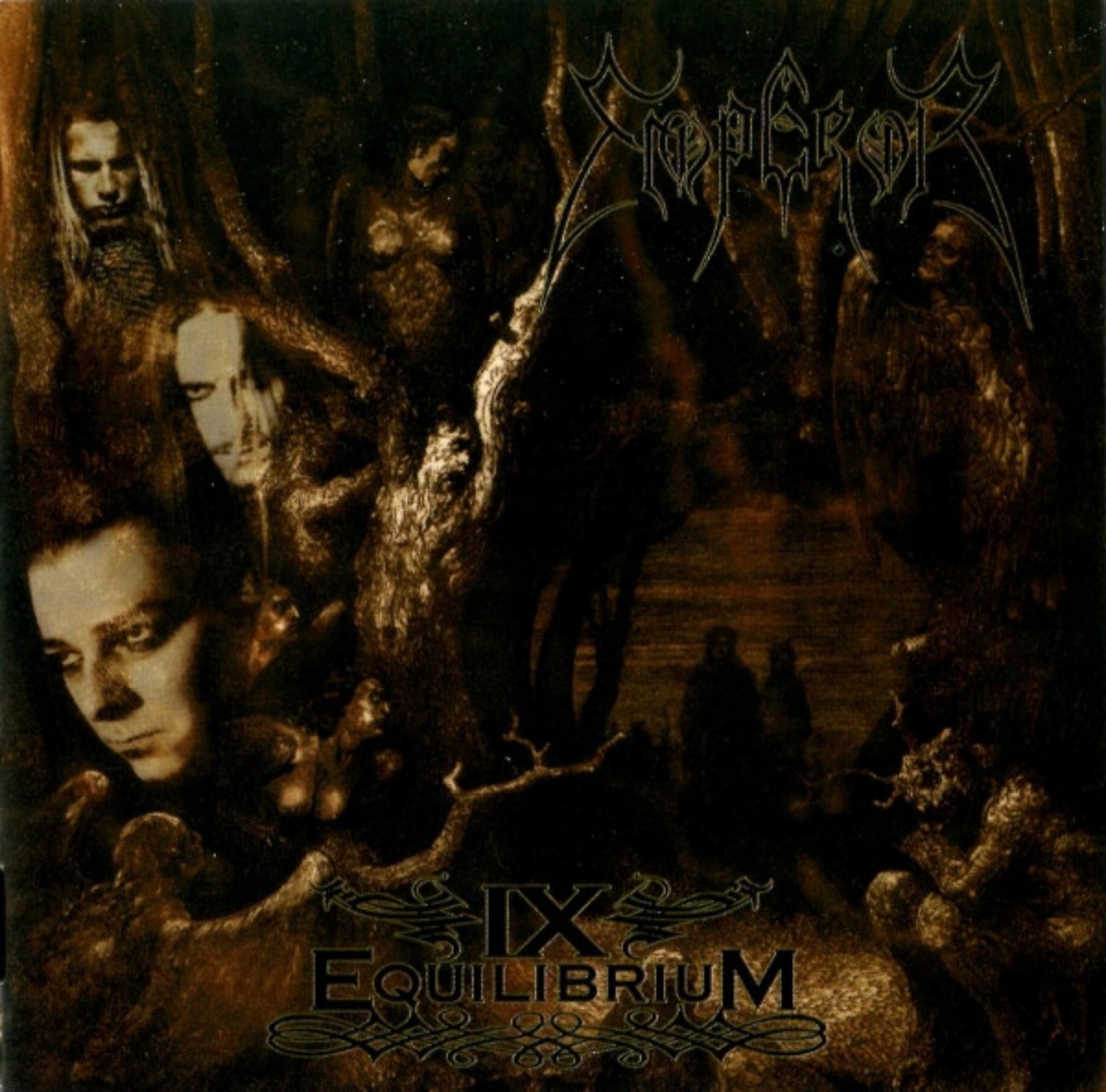
The cover of IX Equilibrium does not depict a single scene. Instead, it creates a world out of several images dissolving into one another. What first catches the eye is the almost black overall impression, touched by a brownish-gold light. Then faces, human figures, gnarled branches and trunk-like shapes gradually emerge from the gloom. The image is dense and sombre, in places deliberately difficult to take in: fragments seemingly drawn from different distances and different moments have been pressed together onto one surface. The viewer is given no secure vantage point from which everything can be surveyed. The artwork compels the eye to travel across it again and again.
Several human portraits dominate the left side of the composition, though not on the same scale. Near the top, a grave, long-haired face emerges from the darkness; lower down, another face appears, strongly illuminated yet partly submerged in shadow. In the foreground, a larger, brighter face turns downwards and to one side, its gaze not directed towards the viewer. The lighting picks out forehead, nose and cheekbone while the neck and surrounding details slowly disappear into brown-black patches. The sense of personal presence is strong, yet there is no direct contact: these portraits do not introduce themselves, but seem to appear on different levels of a dark inner space. In the upper and right-hand areas, further, less clearly outlined figures can be glimpsed; farther back, near the centre, two tiny figures stand close together, almost condensed into shadow. The contrast in scale between the large faces and the small silhouettes makes the space seem both deep and dreamlike.
The centre of the picture is divided not only by people but by forms recalling trees, roots or dried-out branches. A lighter, twisting section of trunk rises across the dark field; below it, branching shapes with rough surfaces join together. This organic, irregular network almost binds the facial details, which look like fragments of separate photographs, into a whole. The eye readily seeks a single central symbol, but the cover does not tell us whether to see a tree, a sculptural body or merely textures layered over one another. Here uncertainty is not a shortcoming. The merging of seemingly natural details with forms resembling human figures creates a space in which matter, body and shadow turn into one another.
The background is more ambiguous still. Its dark vertical shapes suggest a forest or an interior difficult to see through, while brown bands in the middle distance hint at a more distant plane. There is no clear horizon; we cannot be certain whether it is day or night, and the light follows no single natural direction. Some faces are illuminated as though singled out, before shadow swallows their details once more. Among the browns appear tones reminiscent of copper, bronze and antique gold, yet the image never becomes truly radiant. This is not the triumph of blazing gold, but something like a long-concealed, dark surface glimmering in scant light. The grainy, coarse, at times almost worn appearance further strengthens the sense of being outside time. The montage-like layering of different visual elements is one of the cover's defining qualities; from the image alone, however, we cannot determine with certainty exactly what photographic material or technical processes were used to make it.
The two inscriptions play different roles. Emperor's spiky, towering, intricate logo occupies the upper right-hand area. Its lines seem to continue the branches and pointed shapes of the background; the name has not simply been placed over the picture, but appears almost woven into its darkness. By contrast, the title “IX Equilibrium”, near the lower centre, establishes a firmer structural order. The large Roman “IX” forms a focal point of its own; below it, the more widely spaced, more readily legible letters of “Equilibrium” spread out. Around them sit angular, tendril-like ornamental lines arranged with an impulse towards symmetry. Despite the agitation of the upper imagery, these shapes evoke a measured, almost ceremonial order. The cover's most intriguing formal opposition therefore lies between the swirling mass of images above and the more organised system of lettering below.
The idea of “equilibrium” is thus already present in the image before the listener has heard a note. What we see is not perfect, tranquil symmetry: the left side carries greater weight because of the large, bright faces, while deeper darkness and differently distributed figures dominate the right. Gnarled forms cut across the centre line, and foreground and background keep slipping into one another. Yet the composition does not fall apart. The decorative order of the lettering below, the unity of the bronze-toned palette and the recurring vertical, branch-like movements hold it together. The cover may therefore suggest not a peace already found, but a balance that is difficult to sustain. This is an interpretation, not a verified explanation by its creators, though it arises directly from the visible structure.
The music, too, is built from forces pulling in different directions. In Emperor's sound of 1999, extreme speed, razor-edged guitar figures and relentlessly striking drums are joined by an increasingly important concern for disciplined arrangement, shifting dynamics and larger-scale, at times almost symphonic musical thinking. The attacking force of the opening of “Curse You All Men!” can be heard as an echo of the cover's dense, dark mass; the more varied, dramatic movement of “An Elegy of Icaros” comes closer to its interlocking visual layers. The icy, timeless imagery of “Sworn” likewise sits comfortably with the impression that the figures on the cover meet not in a single real space but among memories and shadows. These are not solutions to riddles planted in the artwork for individual songs, but parallels that can be drawn between its visual language and the music's way of thinking.
The cover of IX Equilibrium is not merely dark, nor does it simply repeat the familiar symbols of its genre. It sets the human face against natural forms, the closeness of a portrait against the distance of small figures, and the disorder of image fragments against the discipline of ornamental lettering. The viewer focuses first on one face, then searches for the two figures standing in the background, then loses all sense of direction among black branches and brown surfaces. In this very way, the artwork prepares us for the record: it promises no safe place, but a world in which extremes do not cancel one another out. Together, they sustain the tense, restless condition to which the album gives the name equilibrium.
A Language Beyond Black Metal
By this point, the band was openly thinking in a broader language of metal. In interviews from the period, Ihsahn mentioned Bathory and Celtic Frost alongside thrash, death and power metal, as well as the vocal traditions of classic heavy metal. Samoth likewise emphasised that influences from the 1980s and other branches of metal had not entered the material as part of a programme. They simply listened to and loved this music, and it found its way naturally into the riffs. The term “change of style” is therefore both true and misleading. The finished album really is different, but that difference did not arise from a single decision. It is where years of touring, changes in personnel, technical development and varied musical tastes meet.
Equilibrium, Nine Times Over
In the end, the title itself seems to try to hold all this movement together. IX Equilibrium. In 1999 Ihsahn explained the play on the number nine through several specific coincidences. The year was 1999. Mastering took place on 9 January and lasted nine hours, and the finished album contained nine tracks if the brief hidden outro was included. The Roman “IX” is at once playful and solemn. The word “equilibrium”, meanwhile, would acquire even greater meaning later. Years afterwards, Samoth would see the record as a balance between its aggressive and progressive sides. It is not certain that this was precisely the title's original intention, but it is hard to find a more fitting word for what happens in the music.
The Final Hours of the Master Tape
In January 1999, mastering was carried out at Strype Audio with Tom Kvålsvoll. By the time the work was finished, Emperor had a sound in its hands that differed from the world of its two previous full-length albums from the very first moment. Greater weight, sharper drums, thicker guitars, more direct riffs, less unbroken haze. Yet behind the change remained the same outlook that had accompanied the band since the early demos: a song need not be faithful to a single language of metal if its own inner logic holds it together.
The cover and booklet accompanied this musical shift not with modern, technicist imagery but, on the contrary, with visuals carrying a historical, otherworldly, almost religious weight. Samoth was responsible for the artistic concept, Stephen O'Malley for the design and artwork, Knut Jacobsen for the photographs and Christophe Szpajdel for the logo. Details from Gustave Doré's illustrations of Dante also found a place in the release. The rusty-gold, earthy palette differs from the colder visual world of earlier Emperor records. It is no less monumental, only weightier and more material.
Two Dates, One Album
The precise release date itself shows how difficult it can be to pin the history of an old record to a single day. Candlelight's current official catalogue gives 22 February 1999, while certain European physical editions are documented with a date of 15 March. The difference need not be a contradiction: it may refer to another distribution event, another market or another specific edition. What is certain is that by the spring of 1999 IX Equilibrium was in front of its audience, along with the question: was this still the same Emperor?
A Mirror of the New Sound
During the months spent in Akkerhaugen, the musicians did more than record songs: they also rearranged Emperor's image of itself. The band had previously gained a great deal from allowing the instruments to merge into an atmospheric mass. Now they wanted more detail to be heard. The guitar should not merely be texture, but a riff. The drums should not merely convey speed; every strike should have its own place. The keyboards should not build an unbroken wall, but come to the fore when there was a musical reason for them to do so.
Clearer production was therefore not simply a technical improvement. It was an aesthetic choice. The listener came closer to the music, but in doing so also lost some of the distance that had been part of the magic of earlier Emperor. This duality would return again and again in later reviews. Listeners interested in detail heard liberation; those who loved the haze heard loss. Within the walls at Akkerhaugen, however, the musicians were not making reviews. They were simply searching for the sound that felt true to them at that moment.
The Musicians Behind the Instruments
Ihsahn's role in the studio was particularly complex. After Alver's departure, he also took over the bass, even though he was already responsible for a substantial share of the guitars, keyboards and vocals. This concentrated creative control in the hands of one musician. The bass seldom emerged as a virtuoso voice in its own right; instead, it blended into the overall weight of the composition. Guitar and keyboard could become different aspects of the same musical idea. The voice, meanwhile, behaved increasingly like an instrument: a command required one colour, inner doubt another, and the expanses of mythology yet another.
Samoth's presence, by contrast, continually brought the music back to the tangible substance of the riff. Later, once the two were working in separate bands, it became easy to view this period as though their differing tastes had always been pulling them apart. Statements from the time tell a more nuanced story. The difference was a creative force. Samoth did not merely “add brutality”, any more than Ihsahn merely supplied “symphonic elements”. Both drew upon several styles, and the album is so difficult to disentangle precisely because its influences cannot be assigned neatly to individual people.
For Trym, the album was a test of precision. The drums could not hide in the mix. The technique would be audible, and therefore every mistake would have been audible too. Some critics would later find his performance superhuman; others would hear it as excessively mechanical. Slayer and Kreator form part of the drummer's own musical background, and the tightness of those bands sits comfortably alongside Emperor's complicated structures. Trym was not simply fast. He maintained a sense of form even at speed.
Songs That Did Not Make the Album
During the studio period, they also tried their hand at cover versions, experimenting with material by Mayhem and Darkthrone. These pieces did not become part of IX Equilibrium itself, but they remain intriguing sidelights. Even as the band moved ever further from the strict genre image of black metal, it was actively reaching back to foundational works from its own scene. Development and tradition were therefore not mutually exclusive paths here either.
Learning the Freedom to Sing
The story of the singing lessons belongs within this larger picture. Ihsahn did not learn to sing cleanly because he wanted to abandon extreme vocals. He studied because certain harmonies on Anthems had shown him that his voice still held untapped possibilities. On IX Equilibrium those possibilities appeared side by side, sometimes so dramatically that part of the audience experienced them as a provocation. From the musician's point of view, however, this was more a matter of professional development.
The Playfulness of the Number Nine
The symbolism of nine that gathered around the mastering process feels particularly characteristic of Emperor because it is both serious and playful. A date of 9 January, nine hours of work, nine tracks, the year 1999. There is no need to construct an occult system out of these coincidences for the title to work. The number simply begins to accumulate meanings. The band recognises that this accumulation suits the idea of “equilibrium”. The album title thus does not lock itself into a single explanation; it contains several layers resting on one another.
The visual world does much the same thing through images. The historical and otherworldly monumentality associated with Doré connects the record to Emperor's earlier aesthetic, while the palette and design lend it a different weight. The booklet's inner pages, typography, photographs and arrangement of lyrics carry more than information. The listener enters an atmosphere before the record has even begun to play.
Curse You All Men! – A Curse at the Gate
The first sound the record hurls at its listener is no cautious reply. Curse You All Men! does not introduce itself; it makes a declaration. Critics almost without exception sense its new physical force. The riffs are tighter, the drums are brought further forward, and the weight of death and thrash metal is more immediate. The lyrics speak in a sovereign, prophetic voice, as though their aim were not to win an argument but to demand submission. The “theatre of misery” and a speaker proclaiming himself to be fate immediately establish a sense of sovereignty, whose musical counterpart is the production's head-on attack.
Even critics who later find the album too dense, too clean or too modern often concede that the opening track works. Not because it takes the listener back to the old Emperor, but because it knows exactly what it wants to be. The guitar parts strain against one another, the drums do not decorate but drive, and Ihsahn's voice leaves no breathing space between the lines. In the record's first minutes, it becomes clear that the earlier monumentality has returned in another form: not as a distant landscape, but as pressure felt at close quarters.
Decrystallizing Reason – Certainty Begins to Fracture
Decrystallizing Reason does not release this pressure, but turns it in another direction. In the title, reason's crystalline structure begins to dissolve. The lyrics do not simply celebrate irrationality. Rather, they challenge the moment when reason itself becomes an unquestionable deity. Images of stone, a blindfold, lost youth and approaching autumn suggest that rigid certainty can be as much a prison as blind faith. Musically, too, the song opens up a more intricate space: reviews speak of dramatic keyboard themes, sudden eruptions and a sweeping conclusion.
This is where it becomes genuinely apparent that more direct does not mean simpler. IX Equilibrium is not Emperor stripped to the bone. The changes remain densely packed; the outlines of the individual parts are simply sharper. What might have dissolved into mist on Anthems now takes on a more distinct form. The listener can hear more clearly when the guitar shifts, when the keyboards cut in and when the drums change. As a result, the album can seem more comprehensible and more exhausting at the same time. More is visible, and for that very reason more demands attention.
An Elegy of Icaros – A Shadow Rising Towards the Heights
With the third track, the album seems to allow itself, for the first time, to do something other than race forward. An Elegy of Icaros was Ihsahn's personal favourite on the record, and when he spoke about it, he singled out its structure and dynamics. Nor does he use the myth of Icarus as a conventional moral fable. The fall is not simply a punishment for excessive ambition. The figure who turns against gravity on the wings of faith instead becomes a symbol of someone willing to risk falling in order to rise at all.
Suddenly, more air opens up around the song. A contemporary profile in The Washington Post also drew attention to its Greek mythological background and its softer, string-like colours. Clean singing is no longer a brief experiment here. It has a dramatic function. It reveals another face of the same voice that issued commands in the opening track. Some critics regard this as one of the album's high points for precisely that reason. Others feel here, for the first time with particular force, how far Emperor has travelled from the world that In the Nightside Eclipse represented to them.
The Source of Icon E – A Storm of Symbols
The Source of Icon E draws the space tight again. It is shorter and denser, its symbolism more fragmentary. Waves, chosenness, destruction, a raven and a return appear within it, as though fragments of several myths were sliding over one another. Yet for many listeners, the defining memory of the track is not the lyrics but Ihsahn's high falsetto. The gesture recalling King Diamond was a genuine dividing line in 1999. Some found it liberatingly bold; others heard it as alien or excessively theatrical.
This division, in fact, offers an exceptionally precise portrait of the album as a whole. Emperor did not find itself at odds with its own audience because extremity had disappeared from its music. Quite the opposite: extremity took several different forms. Trym's drumming remained merciless, Samoth's riffs seemed almost to slice through the body of each song, and Ihsahn was not holding himself back but moving towards new registers and new roles. By the old rules, this might have been less pure black metal. By the band's own logic, however, it was simply a wider range of tools with which to express the same unrest.
Voices from the Moment of Release
The surviving extracts from the French magazine Hard N' Heavy's March 1999 coverage are especially important because they preserve the moment immediately surrounding the album's release. The record is not discussed from a historical vantage point, but as a fresh change. Its more death-metal-oriented direction, Alver's departure and the band's development are raised together. At such a moment, nobody yet knows what significance the album will take on two or twenty years later. The uncertainty surrounding recently made decisions is still present in the words.
No Mercy and the Everyday Work of a Band
An interview with Samoth and Tyr from the No Mercy tour brings us even closer to the band's day-to-day working life. Samoth discusses the decision to leave Grieghallen in detail. He does not construct a myth; he compares working conditions. They wanted a different sound, more time in the studio and a place to work closer to home. He speaks just as matter-of-factly about Alver's departure. In accounts of bands, changes of personnel are often retrospectively inflated into major conflicts. Here the source instead suggests that the demands of an increasingly professional touring band collided with a member's life outside music.
Tyr's contribution is distinctive because he arrived from outside a world that already seemed fully formed. He had not grown out of the early Norwegian black metal scene in quite the same way as the others. He joined with a progressive-metal background and experience closer to Dream Theater. His presence is evidence in itself that, by 1999, Emperor was no longer recruiting musicians from a single closed cultural circle. Instrumental ability and the demands of the role came to the fore.
Ihsahn on Music Without Boundaries
A different side of Ihsahn emerges in his interview with Lollipop Magazine. He speaks less about band logistics and more about musical language. For him, black metal is no longer a narrow definition but a starting point. Bathory, Celtic Frost, thrash, death and power metal, classic heavy metal: all are sources one can draw upon, provided the result remains Emperor. The emphasis is on freedom. A label should not dictate which sounds or vocal techniques are permitted.
In the same interview, Ihsahn describes songwriting in a way that helps explain the album's sudden changes. One riff does not necessarily lead to the next according to a plan drawn up in advance. Sometimes the connection is instinctive, becoming intelligible only afterwards. The music is therefore both mathematical and intuitive. From the outside, a listener may hear a rupture where the composer, from within, experiences a natural progression. That difference is one of IX Equilibrium's most profound characteristics.
The Drummer's Own Standard
Trym's June interview with The Plague opens up another line of thought. The drummer speaks primarily not about the title or the philosophy of the production, but about how he experiences the new material as a musician. He finds it more mature, while naming Slayer and Kreator among his own influences. This is more than a list of musical preferences. The precision of thrash, rhythmic aggression and sustained energy are genuinely at work in his drumming.
Before the American Press
The July profile in The Village Voice already signals the different scale of the American public sphere. Emperor appears not as an underground secret but as a band that readers of a larger cultural newspaper might also encounter. Here Ihsahn makes a particularly forceful attempt to separate the music from the sensational stories of Norwegian black metal's past. He does not deny what happened, but he does not want those events to become the only lens through which Emperor is viewed.
An article in The Washington Post a few days later broadens that picture still further. Greek mythology, an interest in classical music, vocal training and the American tour are all placed in context at once. Here An Elegy of Icaros is not merely the title of a song in the middle of the album, but a sign that Ihsahn is opening up other cultural territories in his subject matter as well. By this point, the world of Emperor's lyrics can be described far less adequately through a handful of early black metal conventions.
The Fragile Memory of Interviews
The fragmentary state of the surviving passages from The Lodge is itself characteristic of the way the memory of such an era is preserved. Not every interview has survived in full. Sometimes all that remains is a quotation, a copy or a later reprint. Yet it is from these fragments that we know Ihsahn kept track of the coincidences surrounding the number nine and felt a particular closeness to An Elegy of Icaros. A single surviving sentence can offer a key to an artist's thinking that even thirty reviews cannot replace.
One thing the interviews conducted around the release have in common is that none of the band members speaks of an album made in crisis. Knowing the later story, it is easy to search every sentence for a portent of the breakup. In 1999, however, the primary subject is not the end but the band's work in progress. Studio, tour, new bassist, new vocal technique, new markets. The musicians are talking about their own future, not about the closing of a chapter in history.
A Scene No Longer Contained Within a Single Sound
Looking back, it is easy to see Norwegian black metal in the first half of the decade as one uniform, ice-cold mass. Forests, mountains, black-and-white faces and austere lettering appear on the covers; the music is often characterised by rapid drumming, crackling guitars, high, raw vocals and a deliberately narrow, piercing sound. Yet by the time 1997 arrives, that picture can no longer accommodate everything that is happening. From the same underground, bands set out towards different futures. Some preserve the early, glacial sound; others bring the weight of the riffs and tightly controlled structure to the foreground; still others make room for keyboards, clean singing, the memory of folk music, theatre, experimental electronics or the long arcs of progressive rock.
This does not happen as though one musical movement simply disappears within a year and the next takes its place. The rawest forms live on; in record shops and fans' collections, the old foundational albums stand beside newer records that differ from them more and more. The disputes within the genre arise precisely because there is no shared agreement about change. One listener calls clearer production progress; another hears the loss of the danger and strangeness once held to be essential. One band experiences new arrangements as an expression of its own freedom, while another still discovers fresh expressive power in the old tools. The most important fact about the Norwegian scene between 1997 and 1999 is not the victory of either camp, but the simultaneous existence of these paths.
This diversity matters for understanding the world of IX Equilibrium because the musical air surrounding the album's own story is no longer that of the early 1990s. When listeners first hold Emperor's third full-length album in their hands in 1999, the metal scene of the time already knows works that have opened up symphonic, folk-influenced, melodic, avant-garde and industrial paths for black metal. This does not change the reasons behind Emperor's own choices; it simply makes it easier to understand how many possibilities, and how many expectations, existed side by side.
Symphonic Expansion and the Broadening of Boundaries
Dimmu Borgir's 1997 album Enthrone Darkness Triumphant offers a good example of how atmospheric arrangements and black metal aggression could also move towards a larger international market. Released by Nuclear Blast, the album placed particular emphasis on the keyboards' ability to create a sense of space, on strongly defined songs and on a monumental sound. The intermediate 1998 release Godless Savage Garden, followed by Spiritual Black Dimensions in March 1999, marked out a course in which both the musical style and the international record-label infrastructure became increasingly conspicuous. The March album, however, cannot in any way be cited as a direct precursor to Emperor's recording, which had been completed in January. These two significant sounds from the beginning of the same year are better understood as parallel paths within the scene.
The question of keyboard sound, meanwhile, is not simply a matter of whether something is labelled symphonic. In metal at the time, instrumental layers were being given quite different tasks, ones with which far fewer artists had previously experimented. In one place, long sustained notes lift the composition above the guitars; elsewhere, a synthesiser colour flashing up for a few bars, or the illusion of a choir, opens a new perspective. A larger sonic space does not necessarily arise from a greater number of instruments. Sometimes clearly separated guitars, an audible bass and forceful drums create an impression at least as grandiose as keyboards piled one upon another. The differences between albums are not only differences in arrangement, but also differences in the conception of production itself.
Viewed through the later metal vocabulary of the 2000s, all this may seem self-evident. In the context of 1997–1999, however, one of the most exciting changes was precisely that the idea of early black metal as a music defined by its own narrow set of tools lost its exclusive authority. More and more bands began to treat what had once been a rule of sound marking membership in a scene as just one possible starting point. The original Norwegian rawness did not disappear, but it no longer possessed a single, unquestioned vision of the future.
The Paths of Classical Music, Folk Memory and Progressive Thinking
Borknagar's 1997 album The Olden Domain, followed by The Archaic Course in 1998, offered a different horizon. In this world, harsh metallic riffs were joined by more expansive melodic lines, sometimes marked by folk music or progressive influences, and by shifting forms of singing. Century Media's label archive still describes the first album as a mixture of folk, black and progressive metal, while in the case of the next it highlights the arrival of I.C.S. Vortex, with his clean vocals, and the epic song structures. Between the two albums, the same band's means of expression are rearranged: what we observe is not the disappearance of brutality, but the increasing amount of time and space allotted to melody, the relationships among instrumental layers and the independent trajectory of the voice.
Enslaved likewise occupies a distinctive position at this point. The split release shared with early Emperor and the former personal contacts between the two bands are already part of the novel's account and need not be retold. In terms of the genre's background, Enslaved's Eld from 1997 and Blodhemn from 1998 matter because they show that, alongside Norwegian black metal, a separate current of historical and mythological themes, longer compositions and rhythmic and harmonic experimentation also survived. Later progressive turns must not be projected backwards as though everything had already taken exactly the same shape by the end of the 1990s; the period testifies instead to the openness of possible directions.
Arcturus's difficult-to-classify 1997 album La Masquerade Infernale takes the listener into an even more expansive territory. Its layering of unusual voices, theatrical gestures, fragments of classical music, surreal soundscapes and a hard metal foundation is no longer simply the familiar symphonic enlargement of black metal. The band plays with, dismantles and reorganises the genre's traditional seriousness and, at times, its very identity. It is as though the most important thing in making music has become not proving fidelity to one's origins, but the freedom of the whole instrumental and vocal imagination.
These parallels do not amount to a single school of musicianship. Rather, they demonstrate that by 1997 in Norway, so-called extreme metal already possessed an internal diversity that the uniform label of black metal used by the outside world could not describe accurately. It was not unusual for the same listener's collection to contain a fiercely raw recording alongside a richly arranged album employing clean vocals.
The Countercurrent: Rawness, Simplicity and Keeping the Old Metal Alive
Stories about progress can easily create the false impression that older sounds simply wore out. Yet Norwegian black metal was unusual precisely because, after the stylistic divisions, it did not settle back into a single direction. Darkthrone remained one of the defining examples of an approach associated with simpler, more instinctive and less polished production. The band's recordings from the 1990s, including 1999's Ravishing Grimness, are close to the idea that the strength of a distinctive musical language does not necessarily depend on the number of instrumental layers or on technical perfection.
Immortal's career traces a different variation. After 1997's Blizzard Beasts, the 1999 album At the Heart of Winter also opened the band's sound towards riff structure, weight and a more traditional kind of metal power. This shift should not be confused with the band abandoning its own imaginative world. What is interesting is precisely that the same genre identity can live on through different guitar sounds and musical structures. That possibility lay at the root of one of the listening public's debates at the time: what makes a band itself when the music it produces is visibly changing?
Thus the Norwegian scene could contain both the tangible, austere riff and almost cinematic orchestration at the same time. The distinction between the two is not a judgement of advanced versus undeveloped, or clean versus faulty; it represents different aesthetic choices. A badly recorded album is not necessarily the same thing as an album deliberately left raw. For a listener, the amount of distortion, the blurring of the drums and the separability of the instruments could all carry meaning. The mere availability of a technical possibility in the studio does not oblige everyone to use it in the same way.
The Experimental Turn: Towards Electronics, Industrial Sounds and Other Genres
Ulver's story challenged even more visibly the expectation that a band should repeat its own early form forever. After the raw world of Nattens Madrigal, the 1998 Themes from William Blake's The Marriage of Heaven and Hell revealed an entirely different way of thinking about music: rather than an intensification of the old black metal formula, it was a literary, electronic and experimental work. Metamorphosis, released in 1999, documents another change of direction within the decade, but its release must be placed after the completion of Emperor's album. Release-history details are particularly important here, because later reissues and digital dates attached to older works can easily mislead anyone looking back.
Dødheimsgard's 1998 release Satanic Art and 1999's 666 International represent another route across similar boundaries. The band, rooted in early black metal, increasingly incorporated fractured, industrial and avant-garde elements. Peaceville's retrospective account of the label's releases specifically identifies this change as an important turning point in the band's history. Yet the appearance of the latter album in 1999 should not be understood as a precursor to Emperor's studio work in 1998; it belongs instead to the picture of a scene that was becoming visible over the course of that year.
In the autumn, after the February release of IX Equilibrium, Satyricon's Rebel Extravaganza also demonstrated this movement forcefully. This time, industrial rhythms, changing metres, extended structures and unconventional instrumental solutions stretched the established image of black metal. This later release should not be read backwards as an explanation of Emperor's sound, but understood as another expression of the stylistic restlessness of an entire Norwegian generation. An accurate picture of 1999 is possible only if the albums' original release dates are respected.
Norway's Local Scene Becomes a Nationwide Network
Human relationships still held the metal scene together at the end of the 1990s. A band might rehearse in one place, record its album somewhere else, find a label in a third city and perform in a fourth country. Within Norway, the rural communities of Telemark, Oslo's concert venues, Bergen and the other cities with active scenes did not constitute one and the same musical space, yet they could all be connected to the same networks of communication and distribution. Letters, telephone calls, newly available internet connections, tapes and shared performances bridged geographical distances. The H1 section has already introduced the specific locations; what matters here is the distinctive pattern in which recorded music circulated.
The size of concert venues became an increasingly significant distinction for bands during the 1990s. Oslo's Rockefeller Music Hall had operated since 1986, while the smaller John Dee venue, created beneath it, opened in 1997. Together, they clearly illustrate how smaller club audiences and larger concert crowds could be served by venues of different capacities. The sources establish the existence and history of these places; they do not, by themselves, establish that Emperor played at either of them on any particular day while the album was being made. No such specific concert claim belongs in this supplement without verified event information.
For the same reason, the memory of Mars, a venue within Oslo's alternative club scene, is important. In a reminiscence published later, in 2025, Jan-Martin Jensen recalls Mars as a place visited during the 1990s by Emperor, Mayhem, Dimmu Borgir, Tulus and other Norwegian and international metal bands; the venue closed in 1999. This later recollection documents the relationship between the club and the scene. It is not a concert calendar and does not establish that every band named performed there within the 1998 album-recording period.
Norwegian metal culture before the turn of the millennium therefore already possessed specialised venues and connections, but the Oslo-based Inferno Metal Festival, which would later become influential, did not yet exist. The festival began only in 2001; a report published at the time on Ballade conveys precisely how much a separate, larger Norwegian gathering for extreme metal had been missing. This negative historical fact matters too. The musical world of 1998 must not be repainted in the image of festivals and industry meetings that became established only later.
Record Shops, Mail Order, Magazines and Fanzines
The journey of a recording did not end at the studio door. A finished album had to reach the manufacturer, then the wholesaler or retailer, and finally the listener. For some performers, a record shop was not merely a place to buy music but an information centre: there one could find out what had been released, which other bands were worth hearing and where to obtain material absent from conventional radio and television. Norway's Platekompaniet began in 1992 in a space beside an Oslo metro station. The company's later history does not establish its turnover in 1998, but its founding date shows that the specialist retail infrastructure of the CD era was already taking shape before the years under discussion.
Specialist magazines and smaller fanzines also helped shape the language used to describe different musical directions at the end of the 1990s. They did not merely pass judgement; they supplied names and categories for sounds among which audiences wanted to find their bearings. The Scream Magazine advertisement documented in the original novel, through which Tyr came into contact with Emperor, is a single but particularly vivid example: a message placed on paper or on a magazine page was not simply advertising, but a means through which real decisions about a band's personnel could be made. The book has already dealt with that particular story in its proper place; here it is enough to recognise that the printed press was still actively bringing people into contact with one another.
The regular publication of magazines and the small print runs of fanzines were not necessarily in opposition; they could represent a division of labour. A more widely distributed magazine could report on releases from several countries and labels. A homemade publication circulated by correspondence or at concerts, meanwhile, could make room for little-known bands that had not yet reached the larger press. Early websites did not immediately abolish this ecosystem: news might travel more quickly online, while a fan could still read a lengthy interview in a magazine and order the album by post.
Record Labels and the International Division of Labour
One of the defining conditions for black metal's international spread during the 1990s was the growing strength of specialised independent record labels. These businesses did not serve musicians from a single country. Germany's Nuclear Blast began in 1987 within the punk and hardcore milieu, before working with thrash, death, melodic and black metal releases, among others. Century Media, which originated in Dortmund, likewise became a significant participant in independent metal distribution. Borknagar's Century Media albums and Dimmu Borgir's Nuclear Blast releases demonstrate that, for Norwegian bands between 1997 and 1999, international connections were no longer merely a hope; they could also amount to functioning label arrangements.
Norway's Moonfog shows the same transformation from a different angle, as an enterprise with local roots. The initiative surrounding Satyricon grew from early distribution and label activity into an organisation that released several important Norwegian black metal albums. Its history reminds us that a scene organising itself and professional record-label activity need not be adversaries. Mail order, distribution and promotion born of a fan's enthusiasm could gradually become specialised work, a business risk and a long-term organisational responsibility.
The existence of different regional partners also meant that the same album did not necessarily reach every country on the same day, with the same cover variation or under the same catalogue number. Contracts, manufacturing, local distribution and promotion all took time. The novel has already mentioned the regional labels responsible for Emperor's album; a detailed inventory of its original editions is not the purpose of H3, but of the separately designated H4. Here the aim is to understand the structure of the industry, not to produce a new discography that repeats the same information twice.
The CD Becomes Commonplace, the Cassette Lives On
The recorded-music market of 1998 must not be imagined as a rudimentary copy of the streaming world that came later. The CD was the dominant physical format in major international trade. An album occupied shelf space and had a barcode, a catalogue number, packaging, promotional copies and shipping costs. Within this system, the back cover, booklet and photographs were not supplements to something viewed on a screen, but tangible parts of the release itself. In metal, detailed artwork, logos, the layout of lyrics, original photographs and differences between regional editions carried particular weight.
The cassette, meanwhile, had certainly not disappeared. Demos, older collections, sales in certain markets and exchanges among fans continued to make use of it. By the late 1990s, vinyl occupied a much less central position in the broader market, yet in several underground communities it retained a special cultural and collectors' significance. The difference between physical formats was not merely technical: a cassette was easier to copy personally, vinyl offered a large surface for cover art, and the CD was considered a durable, relatively compact solution well suited to wide international distribution.
The scale of the contemporary industry is also suggested by a later economic-history overview drawing on IFPI figures from 1998: it estimates the global recorded-music market at approximately 38.7 billion US dollars. That figure concerns the recorded-music market as a whole, not sales of extreme metal, and it should not be equated with figures from later reports without accounting for differences in methodology. The essential point is not one particular dollar amount, but that music distribution in 1998 was still part of a high-value global economic system organised overwhelmingly around tangible products.
Recording an Album: Studio Work, Arrangement and the Possibility of a Clearer Sound
Changes in the musical scene were also shaped by how recording studios operated. Multitrack recording, separately miked drums, keyboard layers, guitars recorded on separate tracks and more careful mastering were already familiar techniques. By the late 1990s, however, an increasing number of extreme metal bands could regard making a recording as a sequence of conscious aesthetic decisions. The question was no longer merely whether the musicians could be heard, but also how much detail should remain identifiable, and how the drums, riffs and atmosphere should relate to one another.
We are not describing a single line of technical progress. One band might deliberately embrace a noisy, abrasive recording, while another might prefer instruments separated with precision. A clear recording allows a different kind of listening when the music is fast and structurally complex: the rhythmic pattern of snare and kick drums, the harmonic movement of a second guitar or a keyboard part in the background can be perceived differently. Denser arrangements can also be more demanding on the ear. Technical clarity and atmospheric blurring are not opposite ends of the same scale of quality; they often express two distinct artistic intentions.
Across the Norwegian scene, studios and their collaborators formed an interconnected network: there were established places that had played a role in the making of several major black metal albums, as well as newer technical partnerships. The novel has already recounted the specific Grieghallen–Akkerhaugen transition significant to Emperor, together with the professional roles and disputes about sound. H3 therefore does not invent additional rehearsal-room incidents, engineering decisions or lists of unidentified recording equipment. The broader insight still needed is that the musical milieu as a whole was wrestling with the same questions: could the brutality of metal be expressed more powerfully through blurred noise or through the precise revelation of its details?
Other Sounds Across the Continent: Sweden, Britain and New Crossings Between Genres
Norway was no longer a separate musical island. From Sweden, melodic death metal was speaking in a powerful voice of its own. In Flames' Whoracle from 1997 and Colony from 1999 represented distinct possibilities for guitar melody, rapid rhythms, heavy metal riffs and more accessible song structures. This development should not be treated as a verified list of records that Emperor's musicians personally listened to, but as a sign that international audiences were encountering very different languages of extreme metal during the same period.
Cruelty and the Beast, the 1998 album by British band Cradle of Filth, marked another distinctive direction. Its elaborate narrative concept, Gothic aesthetics, keyboard layers and intense metal emphasised theatrical effect and imagery drawn from horror literature. The album also appeared on the official British album chart in 1998. This does not mean that the entire underground had become equally popular, but it demonstrates the possibility of media exposure beyond the confines of small fanzines. From the Cradle to Enslave, released in 1999, belongs in the discussion only as a later continuation from a different moment.
More technical and progressive forms of death metal, Gothic and doom styles, and European power metal also existed alongside these developments. They had not all emerged from black metal; many drew upon different musical inheritances. Nevertheless, they formed part of the scene's breadth, because they could appear in the same specialist magazines, record catalogues, mail-order systems, clubs and international festivals. Metal between 1997 and 1999 was not a single process or passing fashion, but a meeting place for parallel musical languages. The coexistence of different directions does not, in itself, prove direct influence between any two particular bands.
The International Routes of Rock and Metal Culture
As independent labels and specialist concert promoters grew stronger, increasing numbers of bands were eventually able to reach several European countries, as well as certain American and Asian markets. For the underground, this represented a major organisational leap. A concert required more than the presence of musicians and instruments: it needed an itinerary, a local promoter, equipment, printed advertising, recordings to distribute and press contacts through which a band's name could reach an audience before the performance. The stage and the record business could thus develop into mutually reinforcing systems.
Alongside the recognition enjoyed by large European and North American events, smaller clubs remained places where bands seeking to establish themselves could look for regular performance opportunities. The novel has already covered Emperor's specific international tours and their appearance at Milwaukee Metalfest in 1998, so another tour calendar is unnecessary here. The question is rather what kind of environment made all this possible. A band whose name a distant listener had first read on a cassette cover only a few years earlier could now appear before that listener through cooperation between a local concert promoter and a foreign label.
This transformation must not be romanticised excessively. A specialist metal market did not automatically provide a comfortable livelihood, and professionalisation did not benefit every band equally. Touring demanded time, money and adaptability. Relationships between a club and a record label could be uncertain, while each international market meant audiences with different languages and traditions. The underground did not therefore cease to exist in the late 1990s; rather, it had to continue functioning within a new economic and organisational environment.
The Early Internet: A New World at the Threshold
Digital music already existed by the end of the 1990s, but it did not dominate everyday life in the way it would later. Standardisation of the MP3 audio format had begun considerably earlier, and the '.mp3' filename extension was named in 1995. According to Fraunhofer's historical overview, MP3.com in 1997 and the early portable players appearing in 1998 already signalled new possibilities for digital distribution. Even so, an extreme metal fan in 1998 would very often have discovered new music through a parcel received by post, a CD bought in a shop, a cassette or a recording sold at a concert.
Websites and email accelerated the circulation of news, addresses, concert information and contacts. But access to the internet, connection speeds, payment methods and the limitations of computer equipment still posed obstacles in many places. There were no social-media platforms in today's sense, streaming algorithms or music catalogues available on every phone. Internet presence before the turn of the millennium was therefore part of a hybrid period: digital news could accompany a physical release without necessarily replacing it.
One clearly datable sign of the change was the arrival of Napster in June 1999. That, however, happened only after the February release of IX Equilibrium. The story of Napster cannot therefore be attached to the album's creation as though the band had already been reacting to it during the 1998 recording sessions. Its historical significance lies precisely in the contrast: when the album was being made, physical media and conventional distribution still formed the centre of the metal labels' operations; by the end of 1999, the dilemma of sharing music over the internet was increasingly visible as well. The legal and economic conflicts that followed must not be smuggled backwards into the situation at the beginning of the year.
1999 as a Double Milestone
If someone standing before the shelves of a record collection in later years places IX Equilibrium alongside Dimmu Borgir's Spiritual Black Dimensions, Immortal's At the Heart of Winter, Dødheimsgard's experiment 666 International and Satyricon's Rebel Extravaganza, they might seem to be documents of a single transformation, all born at the same moment. Yet the chronology is not so simple. Emperor's recordings were completed in January 1999, and while the album was released in February, other important works did not reach audiences until the spring or autumn. The fact that these records belong to the same year does not establish a causal creative relationship between them.
The differences in sound are nevertheless revealing. In some, the monumentality of the arrangements comes to the fore; elsewhere, the refinement of riffs and elements of traditional heavy metal; elsewhere still, electronics, fragmented rhythms or unusual forms of singing. Their common denominator is the possibility of change. By then, Norwegian black metal was no longer simply the export of one particular sound. It was becoming a shared point of departure for artists who imagined different continuations of the same origins.
A listener at the time could not yet see how this world would develop. They could not know which experiment would later become a classic, which sound would come to seem natural to many people, or which direction that seemed daring in the present would lead to a complete change of artistic course. These albums were not objects of genre history arranged according to a retrospective ranking: they were new music whose reception was still uncertain. Someone listening to IX Equilibrium in 1999 was not hearing the conclusion of a completed historical era, but one possible voice of the present.
Returning to the Ninth Equilibrium
There is no need to force other bands' albums into Emperor's story. The novel itself shows how the band reached its third full-length album and what specific intentions its members spoke of. A portrait of the period's music provides a different kind of help: it shows what was happening meanwhile to the music surrounding them, what technical and commercial environment was operating, what aesthetic arguments were taking place, and why the changes heard on an extreme metal album could be understood in so many different ways in 1999.
The counter of a record shop, a small club, a stage crowded with amplifiers, the paper of a specialist magazine, a record label's catalogue and digital sound that was still spreading slowly all belonged to the same era. The arrival of one did not mean the disappearance of another. In the metal world of 1997–1999, the personal habits of the old underground coexisted with the increasingly large organisations of an international industry. Musicians had more sounds and more means of distribution available to them than in earlier years, but each choice also brought new expectations.
It is within this world, divergent yet interconnected, that IX Equilibrium acquires its genuine historical setting. The specific structure of a riff, a vocal theme or a studio decision must still be explained using Emperor's own sources. The surrounding world, however, cannot be reduced to the names of a few other bands or a single sentence about a 'changing scene'. Norwegian and international metal culture in the final years of the 1990s has a history of its own: a history of musical diversity, of the age of physical recordings, and of the approach of a new digital future that was still unknown.
The Eternal Circle of the Oath – Sworn
In Sworn, images of the oath and of separation come to the fore. Four eyes that are one as two; circular vision; a journey outside time; ice, mist and a land of shadows. The words sketch an alliance that does not exist according to the rules of the everyday world. In the view of several critics, the music achieves one of the album's most successful balances: classically inspired runs, a heavy foundation, Baroque-like colours and memorable riffs hold it together.
The later history of Sworn also shows that the composition remained open to reinterpretation. Ulver made a remix of it, which was included on later editions. The remix itself divided listeners, but the gesture is revealing. The songs of IX Equilibrium did not survive as sealed relics. Both the label and the band were willing to place them in a different sonic environment, as though the album's fundamental question—how much Emperor's own musical language could accommodate—continued to work itself out in its afterlife.
The Ninth Ritual – Nonus Aequilibrium
Nonus Aequilibrium is the album's ritual centre. The repeated number nine enters a vocabulary of devotion, consecration, immortality and unity like a mantra. The title no longer stands merely on the cover. It becomes a sounding sign. Both threefoldness and unity appear in the song, and although this cannot be taken as evidence that the three-member studio line-up was an intended reference, the coincidental parallel nevertheless casts a strange light on the reality of making the album: three musicians record a work whose very title makes nine and equilibrium its central symbols.
The Warriors of Modern Death
The Warriors of Modern Death evokes a different kind of past. It does not return to medieval or otherworldly imagery, but to the archetype of the warrior, who needs new tools in the modern world. The ancient sword can no longer win the wars of the present; it gives way to steel of the mind, cold fury and a calculated verbal weapon. The words are therefore not simply nostalgic. They ask how an old ideal can be preserved without turning it into a museum piece.
Musically, many critics hear a strong Bathory legacy in the song. Yet the spirit of old extreme metal appears within the massive, clean production of the late 1990s. It is as though the idea organising the whole album were being repeated: the past stays alive only if it changes. For some listeners, that makes the song monumental; for others, too direct or too close to rock. Once again, the song does not allow a neutral middle ground.
Of Blindness – The Limits of Sight
At the end, Of Blindness & Subsequent Seers turns inward the gaze that still cursed the outside world in the opening song. A shadow rises behind the speaker; their own reflection appears, along with uncertainty between past and present; and the recognition returns again and again: I was blind. This is no single conversion. With every new certainty comes the possibility that another wall will be built. Thus the seers of the title are born not of omniscience, but of the experience of blindness.
Several critics feel that this song comes closest to the epic world of Emperor's earlier work. Its longer form, its layers and its broader atmosphere do indeed bring back something of the monumentality that characterised Anthems, but the middle passages still speak the more direct language of IX Equilibrium. The song is therefore not a return. It is, rather, a summation. After the sovereign certainty of the opening track, the album arrives at self-examination by its end.
Twenty-Nine Seconds of Silence
The short, untitled outro does not seek to open another story. In its twenty-nine seconds, it instead releases the tension from a system that has scarcely allowed complete repose throughout eight songs. The ninth piece thus becomes a quiet frame around the title: the album reaches nine and then lets the listener go.
A New Kind of Public Visibility
By the time the album appeared, Emperor was no longer operating in the same media landscape as in the days of the early demos. Candlelight's European network, Century Media's American distribution, a Japanese edition, metal magazines, webzines and fanzines were all discussing the band at once. Yet the band's history kept drawing questions back to the scandal-ridden years of Norwegian black metal. Several interviews from 1999 again raised the prisons, church burnings and Lords of Chaos. Ihsahn consistently tried to bring the focus back to the music.
This effort was not merely a communications strategy. IX Equilibrium itself seems to say in sound what Ihsahn was saying in words: Emperor did not want to become frozen into a single image from the past. Clean vocals, the weight of death and thrash metal, more progressive structures and gestures drawn from classic heavy metal all demonstrate that the band did not regard preserving its earlier form as an obligation. This was hardest of all for those who already heard the first two albums as a kind of perfect, untouchable aesthetic.
Two Songwriters on the Opening Track
Ihsahn's and Samoth's names appear together in the songwriting credit for the opening track. This small detail is particularly interesting in the light of later retrospectives. One of the album's most aggressive statements of intent was not the product of a single creative pole. The weight of the riffs and the complex structure were a shared effort. That fact alone contradicts the simple formula that would assign brutality exclusively to Samoth and complexity exclusively to Ihsahn.
Divided Judgements on the Opening Track
Strikingly, the reception of Curse You All Men! includes a great deal of enthusiastic agreement. An early Polish critic writes about the record almost as an instant conversion and singles out the opening track's aggression and dynamism. The Vampster writer describes the new Emperor as elemental, loud and fast. Later track-by-track analyses also frequently return to this song as evidence: if someone wants to understand what had changed by 1999, they need only listen to the balance between guitar and drums in the opening minutes.
The Musical Structure of Reason
A different kind of enthusiasm gathers around Decrystallizing Reason. Contemporary reviews often single out the keyboard theme, as though it offered proof that the symphonic Emperor had not disappeared. It has merely moved to a different place within the soundscape. The song therefore forms a bridge between two eras. The riff and drums are more direct, yet the dramatic harmony can still spread a greater sense of space above the music.
Icarus in the Eyes of the Critics
With An Elegy of Icaros, the language of criticism often changes. Words such as melodic, expansive, emotional and beautiful begin to appear. That alone shows how far Emperor had travelled from the moment when many people sought black metal's value precisely in ugliness or rawness. Beauty here, however, does not mean lightness. In the story of Icarus, the possibility of falling is inherent in the ascent itself.
The Test of Falsetto
The falsetto in A Source of Icon E is almost a touchstone. The listener can decide how far they are willing to follow Ihsahn towards the traditions of classic heavy metal. For someone who feels a natural kinship with King Diamond's world, the gesture is liberating. For someone who associates Emperor's vocal identity with its earlier screams, it sounds alien. In the space of a few seconds, the song thus condenses an aesthetic debate that will fill many pages.
Sworn – Between the Baroque and Heaviness
In Sworn, Baroque and classical influences do not appear as a separate layer of ornamentation; they are built into the structure of the riffs. That is precisely why several critics would later regard the piece as one of the album's most balanced moments. The physical energy of extreme metal and Ihsahn's harmonic thinking are less at odds here: instead, they serve the same movement.
Nonus – Echoes from the Centre
In the title Nonus Aequilibrium, the solemnity of its Latin sound and the play on the number nine are present at the same time. The song does not explain the whole album, yet it functions as a centre. Critics single out a solo, a bridge and heavy downbeats, while the lyrics speak of devotion and perfection. It is as if, for a brief moment, the album itself believes that its many opposing forces can truly be arranged into a single form.
A New Age for the Ancient Sword
The Warriors of Modern Death matters for a different reason. On the one hand, it looks unmistakably back towards metal's past, towards Bathory and the ancient image of the warrior. On the other hand, the title itself makes the point: these are warriors of modern death. The old icon is no longer enough. The music acquires modern armour just as the warrior in the lyrics does. It is this self-reflection that makes the song particularly interesting within Emperor's career as a whole.
Looking Back from the Closing Track
The closing position of Of Blindness & Subsequent Seers is powerful because it retrospectively reinterprets the confidence of the entire album. At the beginning of the record, the speaker commands and curses. At the end, that same broader lyrical world allows for the possibility of its own error. This does not necessarily make the speaker a single, consistent narrative character, but the contrast between the two endpoints is dramatic nonetheless. The album does not end where certainty is strongest, but where certainty begins to falter.
The hidden outro's smallness provides a strange counterpoint to the density of the record as a whole. After so much music, so many sounds, so many layers, barely half a minute remains for the music to die away. The ninth piece is no grand finale. It is more like a door closing. The listener suddenly finds themselves outside the space in which the preceding forty-four minutes had scarcely allowed them any rest.
Where the Reviews Intersect
Contemporary reviews are therefore remarkably similar in their observations, yet opposed in their judgements. Many writers notice the same things: stronger guitars, sharper drums, a heavier death-metal character, cleaner production, fewer sustained washes of keyboards and new vocal approaches. Yet their conclusions split apart. Some feel that at last they can hear just how much detail the compositions contain. Others believe that the very sharpness of those details destroys the mystical distance Emperor once possessed.
The New Songs on Stage
In the spring and summer of 1999, the album faces its test onstage as well. The European No Mercy Festival tour, followed by North American plans and concerts, shows the band immediately taking its newer, more direct songs into a live setting. Tyr now has to play, night after night, the bass parts he did not perform in the studio. For Trym, the technical density is not a recording trick but a reality that must be reproduced. Here one of the album's underlying principles—that the experience of touring had shaped the riffs in return—comes full circle.
In American interviews that summer, Ihsahn already speaks of IX Equilibrium as a finished work. In the Village Voice, its more direct and technical character comes to the fore. In Lollipop, he describes the musical space in which Emperor moves as a broader field of genres. In surviving excerpts from The Lodge, alongside an explanation of the title's play on the number nine, he names An Elegy of Icaros as his personal favourite. The Washington Post, meanwhile, highlights aspects that go beyond the earlier black-metal image: classical vocal training, Greek mythology and more complex approaches to singing and composition.
Trym's comments in June lend a different voice to the same story. He speaks from a drummer's perspective about a more mature work and mentions Slayer and Kreator among his own musical influences. That background helps explain why the more thrash-oriented, fiercely precise attack heard on the album comes so naturally to him. Meanwhile, the outlines of other projects, including the forthcoming Zyklon, are already beginning to appear. In 1999, then, Emperor's members are simultaneously working around a successful record and building paths of their own.
From a Distance of Two Years
The audience's response does not resolve into a single picture. Some listeners accept the change immediately; others feel that the band has lost something of the atmosphere of its previous two albums. The critical divide does not disappear with the years. Between 2000 and 2008 the same argument returns time and again: is the album overcrowded and cold, or is that very technical control what reveals Emperor's true strength? Scores and judgements vary to extremes, but the record never fades from the conversation.
By 2001, Ihsahn is looking back from a distance of two years and calls IX Equilibrium the band's greatest step forward, particularly in terms of production. That distinction matters. He does not say it is necessarily the best Emperor record. He says this is where the greatest advance took place. The studio work, the sound, the arrangements and the degree of control reach a level without which the band's next period would be impossible to understand.
Around the same time, he also clarifies that the death-metal character cannot simply be attributed to Samoth. Later interpretations tend too easily to turn the two principal songwriters into opposite poles: Samoth as brutality, Ihsahn as progression. The reality is more complicated. Both listen to extreme metal; both work with ideas that step outside Emperor's earlier sound. The difference between them is real, but IX Equilibrium is still a shared language.
Recurring Images in the Lyrics
Reading the lyrics deepens this picture further, because the album does not tell a single story, yet the same words and oppositions keep returning. Sight and blindness. Faith and reason. Being chosen and falling. The ancient weapon and modern combat. Devotion and power over oneself. It is as though the music's search for stylistic equilibrium becomes, in the lyrics, a search for philosophical equilibrium.
The Curse Pronounced
The confidence of Curse You All Men! almost overflows. The speaker does not ask permission to exist. He proclaims his own truth as destiny. Set against the band's history, it would be tempting to read this as an autobiographical confession, but there is no source to support that. It is far safer to say only this: the song's rhetoric carries the same head-on force that the production also creates musically.
The Risks of Reason
Decrystallizing Reason, by contrast, already questions certainty, though from another direction. Reason becomes dangerous when it hardens into stone. This idea forms an intriguing parallel with Emperor's own position within its genre. Black metal, too, could become a 'crystallized' set of rules, if the band allowed it to. One of the constant gestures of IX Equilibrium is precisely that it does not.
The Freedom of Icarus
The figure of Icarus speaks even more directly of crossing boundaries. The traditional story is a warning: do not fly too high. In Ihsahn's lyrics, the risk of ascent itself becomes something of value. The fall does not erase the meaning of the attempt. This reading can be applied not only to the song but also to the aesthetic risks of the entire album, without claiming that its author consciously wrote an allegory about the album itself.
Oaths and Consecration
Sworn and Nonus Aequilibrium explore other forms of belonging and devotion. One evokes the state of having sworn an oath and of standing apart from the world; the other, a will dedicated to perfection. In these lyrics, strength is no longer simply individual domination. It may also mean belonging to something, giving oneself over to something. In lyrical terms, then, the album is not a straightforward individualist manifesto either.
The Ethics of the Modern Warrior
The Warriors of Modern Death speaks particularly clearly about the need for modernization. The ancient sword alone is no longer enough. The pride of the warrior of old can survive only if it finds a new tool. The image almost invites comparison with the band's musical decisions, but caution is needed here as well: this is not a proven statement of artistic intent, but a motif that resonates strikingly well with the album as a whole.
Blindness and the Final Recognition
Finally, Of Blindness & Subsequent Seers withdraws the comfort of absolute certainty. Looking back upon himself, the speaker repeatedly realizes that he was blind before, yet even his newfound clarity does not remain secure. The ending is powerful precisely because it does not bring the lyrical world to a close with victory. Instead, it leaves self-examination open. The album's 'equilibrium' is therefore not a final solution but a condition that must be created again and again.
The First Shadows of Diverging Paths
By the time of the 2006 Inferno Festival, they were already speaking about this period in the light of what happened later. Samoth describes the album as a natural progressive turn, while Ihsahn stresses that the increased heaviness and more live-oriented character were not part of a premeditated stylistic change. The many concerts, their developing instrumental skills, the new studio and their differing musical interests all helped shape the material. In retrospect, the album thus appears less like a decision than a consequence.
Yet the same retrospective view also traces the outline of another story. According to Ihsahn, it was after IX Equilibrium that their diverging musical interests became increasingly obvious. Samoth was drawn more and more towards the physical side of extreme metal and the world of Zyklon; Ihsahn, towards the studio, progressive structuring and control over composition. For a long time the two tendencies reinforced each other. By 1999, however, it was already possible to see that the very equilibrium that makes the album exciting would be difficult to maintain forever.
When the Critic Does Not Yet Know the Future
The earliest reviews are especially valuable because their writers do not yet know what reputation the album will eventually acquire. The Polish rockmetal.pl review of March 22 describes, in an enthusiastic and personal voice, how the record won its author over. The reviewer registers the booklet's brown-and-gold visual world, the songs' aggression and their dark atmosphere all at once. He listens to the album almost constantly and loves precisely the oppressive force that other critics would later find exhausting.
A few weeks later, Vampster is even more emphatic. Elemental, loud, fast — and then the writer adds a word that sounds unusually striking in descriptions of the old Emperor: beautiful. For this reviewer, the clearer structure, the new vocals and An Elegy of Icaros represent development rather than betrayal. He even regards IX Equilibrium as Emperor's best album up to that point. Such enthusiasm makes clear that the story of this 'divisive album' does not begin with universal rejection followed by later rehabilitation. It already had its admirers in 1999.
The First Cracks in the Album's Reception
The June review in In Music We Trust is more nuanced. It acknowledges the band's superior songwriting and willingness to take risks, but already regards the clean vocals as dangerous territory. For this writer, they mostly detract from the music, and Anthems remains the stronger masterpiece. Yet respect is evident even in this qualified judgement: Emperor is not afraid to make its own fans uncomfortable.
The B-minus awarded by Daily Vault represents another position somewhere in between. Neither collapse nor triumph. The record has its great moments, but it demands considerable attention from the listener. Ink 19, by contrast, welcomes the change more energetically, seeing the heavier attack, which opens out towards Slayer as well, as one of the band's strengths. Already within that same year, it is clear that there is no single contemporary consensus.
Taking Stock at the Turn of the Millennium
In 2000, the more negative perspective offered by Guts of Darkness brought a new emphasis to the debate. Excessive complexity, the instruments competing with one another, and the disintegration of the atmosphere came to the fore. Even this critic acknowledges Trym's playing, but finds the album as a whole harder to accept. The review matters because it clearly articulates an objection that would persist in many later fan discussions: had technical control killed the mystical unity that had seemed so natural on the first two albums?
MetalBite was considerably more positive again in 2001. The cleaner production, more elaborately developed melodies, and Trym's performance were presented as strengths. In 2002, Metalfan.nl virtually celebrated the album, awarding it 97 out of 100. For that writer, the very direct, more death-metal-oriented sound that others heard as a problem was what made it powerful. The history of its critical reception gradually became circular: every objection could be matched by its positive mirror image.
Many Verdicts on a Single Album
Online reviews published between 2004 and 2008 widened the range still further. Different writers on Metal Archives awarded scores ranging from 56 to 100 percent. One person described the same record as middling, another as almost perfect. One Sputnikmusic review from 2005 gave it 2.5 out of 5, while another writer in 2007 rated it at around 4 out of 5. The numbers themselves are less interesting than the persistence of the argument.
In 2005, Thrashocore arrived at a position that would later become particularly important: the album should not be heard as a copy of Anthems. It might disappoint on first hearing, but understood in its own language, it forms a bridge towards Prometheus. Around the same period, Spirit of Metal regarded the death-metal riffs, Ihsahn's new vocals, and Trym's blast beats as elements pointing in a new direction without extinguishing Emperor's essential character.
Some reviews from 2007 and 2008 already listened from a historical distance. The shock of novelty had faded. In an extended analysis, TrueMetal.it attempted to understand, almost song by song, how the heavy, thrash, death, progressive, and symphonic components worked together. By then, the record was no longer the scandal of 'the new Emperor', but a complex musical object that could be examined in detail.
The Internet's Long Memory
After 2011, the modern online canon scattered opinions even more widely. Some felt that IX Equilibrium had always been Emperor's underrated high point. Others still placed it behind the first two full-length albums. The division became less and less a matter of generations. Younger listeners could be more conservative, while longtime fans might discover new value in the record only later.
A lengthy 2020 review on Album of the Year represents a particularly interesting shift. Its author suggests that the album should not be heard exclusively as black metal or as a continuation of Anthems. Approached instead as a technical, progressive extreme-metal record, its structure comes into a different light. The riffs and instrumental performances take centre stage. With that, the album's afterlife enters a new phase: it is not simply rehabilitated, but assigned a new category of its own.
Metal Academy preserves several extensive reviews dating from 2019 to 2026, and these too reach no single verdict. Some hear the more direct black-metal side as the stronger element; others hear the progressive language pointing towards Prometheus. Their differences show that even twenty-seven years have not made the album any simpler. IX Equilibrium has not dissolved into the canon.
Two Distinct Forces Within One Band
This enduring division is itself part of the album's legacy. Debate surrounding many records simply dies away once their initial novelty has passed. That did not happen here. The production, Ihsahn's clean singing, the more death-metal-oriented riffs, and the balance of the symphonic elements remain questions that compel new listeners to take a position. The album has not become a politely regarded historical artefact.
Samoth later described his relationship with Ihsahn in terms of yin and yang. The image is apt because it does not imply enemies. It suggests two different forces that together create a third thing. IX Equilibrium may be the clearest document of that relationship. The heavy, death-metal riff and the classical, progressive construction do not appear one after the other, but within the same song. The black-metal past and the heavy-metal tradition do not simply exclude each other: they unsettle and complement one another.
Twenty-five years later, critics still stumble over precisely this point. Some modern reassessments no longer ask why the album does not sound like Anthems. They try instead to hear it as a work in its own right. A different picture then emerges: a riff-centred, technical, progressive extreme-metal record in which black metal does not disappear, but becomes part of a larger system. Other reviewers continue to feel that something of the earlier mystique was lost with the cleaner production. The debate is therefore not resolved; it merely becomes more precise.
The Second Life of the Reissues
Meanwhile, reissues continually keep the album alive. Different CD and vinyl editions, remasters, and collectors' releases appear. Alongside the original record, the special 2007 edition includes a live version of Curse You All Men! recorded at London's Astoria in 1999, an Ulver remix of Sworn, and a reprint of a 1999 Terrorizer interview, linking those materials back to the album’s original era. In this way the edition becomes a time machine: it does not merely sell the music again, but reconnects the record with the sound and the music press of its original release.
In 2020, Ihsahn recalled that IX Equilibrium had sold around fifty thousand copies in three weeks. This must be treated as a personal recollection rather than an audited industry figure, but the statement vividly conveys how he remembers the album's significance. To him, it marked the first moment in Emperor's history that felt like a genuine commercial breakthrough. A band that only a few years earlier had been struggling to survive amid prison sentences and personnel changes had now released an album operating on an international scale.
The World of Touring Routes
During the touring years of 1997–98, constant movement became the norm for the band. Airports, clubs, festivals, soundchecks, and performances following one another in rapid succession organised their everyday lives. The sources do not provide a detailed diary for every day, so there is no point filling the gaps with invented backstage scenes. Yet the established fact speaks volumes on its own: the band played live with increasing frequency, and both Ihsahn and Samoth would later cite that experience as one reason for the new songs' more direct character.
The stage subjects a composition to a test of its own. A layer that sounds overwhelming in the studio can easily be lost in performance. Something complicated on paper may work immediately in front of an audience if its rhythmic core is strong. The riffs on IX Equilibrium condense that practical knowledge. The songs do not become simple, but they offer more points of contact that can be felt instantly even in a concert hall.
Emperor's appearance at Milwaukee Metalfest in 1998 is a symbolic milestone in this transformation. Emperor was no longer a name known only within European extreme-metal circles. The band was playing before a real audience in America too. The experience did not necessarily rewrite any particular song, but it reinforced the fact that the band's musical decisions now had to work in a variety of listening environments.
The Bass Guitar's Place in the New Line-up
Alver's departure occurred amid this constant motion. The bassist did not become dispensable because the band had decided to abandon his instrument musically. Quite the opposite: growing activity demanded a greater commitment of time than he could reconcile with civilian life. Seen in this light, the decision was one of the costs of becoming more professional. Emperor was less and less a project that musicians could join whenever time permitted.
When Ihsahn also took on the bass in the studio, the album's instrumentation became even more directly connected to him. That does not, however, make IX Equilibrium a one-man work. Samoth's compositional contribution was decisive in several key songs, while Trym's drumming constantly reshaped the way the riffs functioned. The album is therefore concentrated and collective at the same time.
The Weight of the Past in Promotion
One striking aspect of the band's communication in 1999 is how little its members wanted to dramatise the change. Many critics heard a stylistic turning point, while the musicians spoke instead of natural development. Such a difference is not unusual between artists and their audiences. What looks like a leap from the outside is often, from within, the result of many small steps. In Emperor's case, those steps had been under way for years: a new drummer, tours, a new vocal technique, broader musical interests, and a different studio.
The release infrastructure was also far larger than before. Distribution by Candlelight in Europe and Century Media in America, together with a separate release presence in Japan, helped the album become visible in several markets at once. This growing infrastructure changed the record's life. More reviews appeared, more interviews were conducted, and a wider variety of audiences encountered the same material.
Promotion also brought growing curiosity about the past. However much Emperor's members wanted to talk about music, some of the press returned again and again to the violent history of Norwegian black metal. Ihsahn's replies often suggest that he wanted to separate the band's artistic identity from acts committed outside the band. He tried to steer attention back towards the compositions, the musicians' development, and the new record.
The Dividing Line Among Listeners
This effort resonates particularly strongly with the aesthetic of IX Equilibrium. The record is different not only because the band changed musically. It also seems intent on proving that Emperor is far more than the image some of the press constructed from the early Norwegian scene. Technical ability, references to classical music, mythological lyrics, and heavy-metal vocal techniques all support a more complex self-image.
The audience, however, is not a single body. Some immediately welcomed this opening up. For others, black metal's authenticity lay precisely in the earlier distance, mist, and coldness. The clean, thick sound of IX Equilibrium was thus not simply a new production style, but a question of identity. What makes Emperor Emperor? The melodies? The atmosphere? The relationship between riffs and keyboards? Ihsahn's voice?
Or the constant development that had been present since the beginning?
It is really this question that lies behind the critical argument. Those who measure the band against its first two albums often hear the change as a loss. Those who perceive its entire career as a process of movement find it easier to accept the new elements. This is why the very same clean vocals can sound like a bold expansion to one listener and a foreign body to another.
Clear Sound, Unfamiliar Vocals
The disagreement surrounding the production runs just as deep. Greater clarity objectively allows more details to be heard, but that does not make it objectively better. A certain magic of the earlier records arose precisely from their layers blending together. IX Equilibrium instead forces the ear to make choices: several distinct instrumental events can be followed at once. For some listeners this is richness. For others, overload.
The drum sound matters especially to that impression. Trym's playing is technically astonishing, but the upfront mix does not allow the speed to dissolve into a blurred atmosphere. Each drumbeat arrives as a concrete impact. In this way, the band steps physically closer to the listener. In place of Emperor's earlier distant, snow-covered landscapes, it is as though the same monumental force were now compressing the air within an enclosed space.
A Second Reading of the Lyrics
The guitars' more classically metal-oriented role marks a similar change. The riff is not merely a foundation above which keyboards and vocals build an atmosphere. Often it becomes the main event in itself. Solos, lines moving in opposing directions, and more traditional metal gestures bring the musicians' instrumental skill further into view. This is one reason why later critics increasingly interpret the album through the lens of progressive or technical extreme metal.
The debate around the clean vocals has changed particularly markedly over time. In 1999, a black metal singer using a high register reminiscent of King Diamond or Rob Halford represented a daring breach of boundaries for many listeners. Two decades later, alternating between extreme and clean vocals is a much more familiar device. Historical distance does not necessarily make the record better, but it does change which elements of it seem radical.
The lyrics, too, benefit from this broader perspective. Given Emperor's early image, it would be easy to read every lyric within a single dark ideological framework. Yet IX Equilibrium is more concerned with personal and philosophical concepts: meaning, faith, downfall, self-knowledge, modernity. Mythology and ritual language remain, but increasingly they are more than simple badges of genre identity.
The song about Icarus is particularly powerful in this respect. The figure is interesting not simply because he brings a story from antiquity into a black metal album, but because Emperor's entire development operates according to a similar logic of risk. Every further step carries the possibility that part of the audience will turn away. Yet the band repeatedly accepts the need to move beyond what it has already accomplished successfully.
The Warriors of Modern Death reveals another side of the same idea. Here the issue is not soaring upwards but holding on to tradition. An ancient sword is inadequate for modern warfare, yet the warrior spirit is not necessarily dead. The idea can be read across the entire album: the spirit of the old Emperor can stay alive only if it does not cling to the old tools.
Rediscovered Recordings
Throughout the album's afterlife, its physical editions preserve this duality as well. Reissues, picture discs, remastered versions, and coloured vinyl carry the same music forward in new material forms. Collectors’ culture preserves it, while also bringing the album to new audiences. The special 2007 edition, by including interview and concert material, consciously transforms it into a historical document.
The later release of the 1999 Astoria recording is an especially good reminder that this album was not originally an archival object. These songs lived as part of a touring set. Curse You All Men! existed not only in the studio; it also had to demonstrate before an audience the direct force that the musicians explained as an effect of their touring years.
Two Kinds of Memory
During Emperor's later returns, IX Equilibrium has always occupied a slightly unusual position. It is easier to build a celebratory narrative around performances of Nightside and Anthems in their entirety. With IX, the band has been more cautious. Ihsahn later stresses that they do not want to turn every anniversary into the same concert format. This, too, helps the album remain less of a museum piece, less of a classic fixed in place by ritual.
Thus two versions of IX Equilibrium live side by side in fans' memories. One is the disputed third album, which, after Anthems, became too modern and too death-metal-oriented. The other is an underrated turning point without which many subsequent directions in extreme metal are difficult to see from quite the same perspective. These images do not exclude each other. They are two historical functions of the same work.
Ihsahn's 2004 observation about the fans' canon is especially apt. There is no single Emperor album that everyone regards as the band's peak in the same way. The timing of a listener's first encounter matters, too. Someone who discovered the band through Nightside hears IX with different expectations from someone who arrives at it later, working backwards from Prometheus or Ihsahn's solo albums.
This nostalgia is not merely bias. It is part of listening to music. An album is often not only a sound, but a period of life, a particular situation, a first encounter. The divisions surrounding IX Equilibrium therefore arise in part because it followed a predecessor to which listeners had formed a powerful emotional attachment. In such circumstances, change is not merely a musical difference; it affects a listener's relationship with their own memories.
Later reassessments are interesting precisely because they can change that relationship. An album that initially disappointed may speak in a new context ten years later. Several reviews tell just such a story: after initial resistance, the structure slowly becomes visible. IX Equilibrium is particularly suited to this process because its density makes it difficult for every detail to settle into the mind after a single listen.
What Remains of the Ninth Equilibrium?
This is why the sources used in this book give just as much weight to enthusiastic contemporary writing as to outright rejection. If we used only positive reviews, we would create a misleading story of unbroken triumph. If we used only negative ones, it would seem as though the album had needed to be rescued after the fact. The real story is far more interesting: it has been a subject of debate from the beginning, and the debate has never entirely stopped.
The same is true of statements by the band. Not every recollection emphasises the same thing. Ihsahn sees progress in production; Samoth sees a balance between aggression and progression; Trym sees the challenge it presented to him as an instrumentalist. There is no need to manufacture one official explanation out of these accounts. It is precisely their differences that reveal how many layers there were to the creative process.
The story of IX Equilibrium therefore does not end in 1999. Its release is merely the moment when the band hands the work over to its listeners. From then on, the album begins accumulating new meanings. Reviews, concerts, reissues, interviews, anniversaries, and new generations gather around it. The equilibrium in the title is no longer only a balance among its creators, but also a balance between the work and the memory of it.
Yet the commercial story is not the album's most important legacy. IX Equilibrium refuses to settle comfortably into the discography because it will not let us draw Emperor's history as a single clean line. It is not merely a transition between Anthems and Prometheus, though it does connect them. It is not merely a return to death-metal roots, although Samoth says those early instincts reappeared. It is neither simply modernisation nor simply a break with black metal.
The record is instead a point at which Emperor's past and future are visible at the same time. The early years spent learning death metal remain in the weight of the riffs. Nightside's symphonic vision survives in keyboards that recede into the background but never disappear. The technical and compositional ambition of Anthems lives on in the extended forms. Ihsahn's later progressive world is foreshadowed by the clean singing and the use of the studio as a compositional tool. Samoth's later path in extreme metal can already be heard in the frontal, physical aggression.
It is therefore especially fitting that the album's title speaks not of stillness but of equilibrium. Equilibrium here is not peace. It is not the silent immobility of two identical weights. It is closer to constant correction, tension, and the ceaseless movement of the scales. The band's three members work in the same studio, but are no longer seeking quite the same thing. The audience listens to the same record, but does not hear the same things in it. Critics list the same qualities and arrive at opposite verdicts.
The Debating Voices of Later Generations
The reviews accumulated over many years on Metal Archives offer particularly clear evidence that the fan canon is not uniform either. By 2004, markedly different scores were already appearing. Some writers praised the production and instrumental performances; others felt that the songs had lost their direction. What matters is not which score is 'correct', but the fact that listeners interpret the same density in completely different ways.
By around 2007, the record is eight years old, and a kind of nostalgia emerges that had previously surrounded only the first two albums. IX Equilibrium itself becomes a document of a bygone era. Vocal and production choices that may have seemed scandalously modern in 1999 have by now become hallmarks of an earlier period in Emperor's career. Time does not resolve the argument, but it redraws the perspective.
The 2008 TrueMetal analysis is especially valuable because it does not stop at general adjectives. It breaks down the album song by song and attempts to trace the roles of the guitars, drums, keyboards, and vocals. Reviews of this kind show how the album's reception changed: after the initial shock, increasing numbers of listeners began studying it as an object of technical and compositional interest.
During the 2010s, online metal discourse creates an even larger archive. Old reviews remain in circulation, new listeners write new texts, and the record now belongs simultaneously to history and to the present. Scores continue to vary widely, but the arguments become more nuanced. It is increasingly insufficient simply to say that it is 'not like Anthems'. The more meaningful question becomes: what is it trying to do on its own terms?
Moreover, the modern listener comes from a different metal world. Since 1999, the crossover between black and death metal, large-scale production, alternation between clean singing and extreme vocals, and progressive composition have all become much more familiar. What once sounded like a breach of the rules later became a natural part of new musical vocabularies. This does not mean that every choice on IX Equilibrium has stood the test of time, but it changes how radical those choices sound to us.
Reviews from 2026 complete a remarkable historical circle. They come from writers for whom 1999 is already a distant past. Emperor's early history, the Norwegian scene, and the musicians' later solo careers are all familiar background. Even so, both near-perfect and considerably more restrained assessments continue to appear. The lack of consensus was not simply a misunderstanding confined to the time of release. The album itself resists any uniform ranking.
The Road to Prometheus
After IX Equilibrium, Emperor make one more full studio album. Prometheus: The Discipline of Fire & Demise, however, emerges from a different creative situation. Ihsahn's role in composing becomes far more dominant, while Samoth's energy flows increasingly towards Zyklon. A process that could still be heard as equilibrium in 1999 gradually becomes an actual separation.
In retrospect, this casts IX Equilibrium in a peculiar light. Heard from the perspective of Prometheus, it foreshadows the progressive, carefully structured, studio-centred side of the band. Heard from the perspective of Samoth's later work, the heavier death-metal riffs and physical aggression sound prophetic. The same record points towards two different futures.
The band's later dissolution, therefore, is not simply the story of a conflict. Its members are able to pursue in different directions the aspects of music that interest them most. Ihsahn's solo career becomes increasingly and openly progressive, crossing genre boundaries. With Zyklon, Samoth continues developing the more direct force of extreme metal. Trym carries on drumming in other projects. In time, the name Emperor returns to the stage, but without a new studio album.
Returning Musicians, Changing Memory
When they play together again later, Emperor's past is no longer quite the same past. The canonical status of Nightside and Anthems has solidified. IX Equilibrium remains the album that always invites an explanation: why does it sound like this, why did the vocals change, why is there more death metal, why are the keyboards different? Yet this very need to explain proves that the album has an identity of its own. If it were merely an inferior copy, it would not demand so much interpretation.
Around its twentieth anniversary, the question arises as to why the band does not perform it in full, as it has done with other classic albums. Ihsahn later says they do not want to treat every album anniversary according to the same formula. They had particularly strong personal reasons for the complete performances of Nightside and Anthems. Even in the way it is celebrated, therefore, IX Equilibrium takes a different path.
In later interviews, none of the members speaks of it as a mistake. Trym more readily names Anthems as his personal favourite, but regards IX as an essential stage. Samoth hears a balance of aggression and progressive ambition in it. Ihsahn sees a leap in production and the greatest step in the band's development. These descriptions do not say exactly the same thing, yet they point in one direction: for the musicians who made it, the record was a necessary stage in their journey.
The Album Never Performed in Full
For the listener, perhaps this offers the book's final perspective. IX Equilibrium need not be 'rescued' from its critics, nor does it have to be declared the band's best album at all costs in order for us to recognise its importance. It is enough to see that it documents a band already too experienced simply to repeat itself, yet still sufficiently united for different creative desires to collide within a single record.
At the time of its release, nobody could hear the album as we hear it today. Listeners did not yet know Prometheus; they did not know that Emperor would later stop making studio records together; they had not seen Ihsahn's solo career or Samoth's subsequent projects. This is why the reviews from 1999 are irreplaceable. Those reviewers were not listening to history, but to new music. They were surprised, thrilled, irritated, and all without knowing which elements would later be regarded as 'signs of what was to come'.
Later critics, by contrast, can no longer forget what followed. Every reassessment is coloured by the knowledge that this third full-length album stands on the threshold of a change. In this way, it lives in two times at once: in 1999, a daring new record; decades later, a key to understanding a story.
The Listener and the Passage of Time
The booklet images, old interviews, tour photographs from 1999, and later reissues have now come together to form an archive. But an archive does not render the work motionless. Every new listening raises the same questions anew. How much can a band change and still remain itself? When does technical development turn into excessive control? Where does the boundary lie between tradition and self-repetition?
Back to the Two Young Musicians at the Beginning
At the beginning of Emperor's story, Ihsahn and Samoth were simply searching for music of their own. By the end of IX Equilibrium, the question has become how long two such powerful creative impulses can remain under one name. Less than a decade has passed between those two points, yet musically the distance spans several eras. Perhaps this is the album's true greatness: it does not preserve a static condition, but captures the most tense moment of a transformation.
If the story had to be compressed into a single movement, it would be neither a fall nor a victory. It would be the moment of the scales, when neither side has yet fallen, but the difference in weight can already be felt. IX Equilibrium is such a moment. For a brief time, it holds together the atmosphere of the old Emperor, riffs toughened by touring, Ihsahn's growing progressive interests, Samoth's extreme-metal instincts, and Trym's technical power. Then the scales move again.
The Scales' Final Movement
And when we look back decades later, perhaps the most interesting question is no longer who gave the album 56, 83, 97 or 100 per cent. Far more important is that the record can still provoke debate. Within that debate, the very tension that existed inside the band lives on: how much of the past must be preserved for the new to remain authentic, and how much must be risked in the pursuit of something new so that the past does not become mere repetition?
And so the story circles back to those two young musicians who, years earlier, were still only trying to work out what kind of music they wanted to play. The differences between Ihsahn and Samoth were present from the beginning. By the time of IX Equilibrium, those differences had not disappeared; they had become fully audible. Perhaps this is the album's deepest testimony: not to the purity of a style, but to the moment when two creative directions could still find equilibrium within the same band, on the same record.
Behind the Golden-Brown Door
In the end, the cover's sombre, golden-brown world remains before our eyes like a door behind which more than one story reaches its conclusion. The four-track rawness of Wrath of the Tyrant, the icy monumentality of Nightside, and the lofty density of Anthems are all there behind it, but none is repeated. Asked what Emperor's next step should be, IX Equilibrium offered no cautious answer. Instead, it posed new questions.
And perhaps that is precisely why it remains alive. Because it refuses to let us classify it comfortably. It does not apologise for change, yet neither does it disown its past. It does not resolve its own contradictions. It shows them. At the end of the record, when the brief outro fades into silence after the self-examination of Of Blindness & Subsequent Seers, no simple lesson remains. Only that strange sense that the equilibrium promised by the title was never a state of rest. It was movement. And in Emperor's story, it was precisely this movement that carried them to a point from which they could no longer turn back in quite the same way.