Enthrone Darkness Triumphant – The Throne of Darkness
The story of the breakthrough album: the band’s beginnings, its recording, songs, reception and enduring legacy, with an original cover analysis.
Before the Fog
In the summer of 1993, there was still no sign that a handful of young Norwegian musicians would, within a few years, release an album whose title would be mentioned again and again decades later whenever people discussed the origins, breakthrough or limits of symphonic black metal. There was no international record label yet, no major European tours and no magazine covers. But there was an idea that the darkness of black metal could be not only raw but monumental; that keyboards could rise behind the guitars not as mere decoration but as an emotional force in their own right; and that the icy Norwegian atmosphere would lose none of its power by acquiring melody.
Silenoz later recalled that he started the band with Shagrath and Tjodalv. Brynjard Tristan soon joined on bass, followed by Stian Aarstad on keyboards and piano. Even this line-up suggested that Dimmu Borgir did not intend to be merely one among the many Norwegian black metal groups emerging at the time. The piano and synthesizer were not alien presences in the rehearsal room. Melody, dark romanticism and raw aggression were all seeking their place at once.
The Inn I Evighetens Mørke single still bore the sound of a very young band. For All Tid then revealed this world in a longer form: misty and cold, deliberately abrasive in places and unexpectedly melancholy in others. There was always a duality in early Dimmu Borgir. The guitar sounded threatening while the keyboards often traced a melody above it that might have echoed through the empty space of a ruined cathedral. The contrast was not yet fully developed, but it was already recognisable.
By the time of Stormblåst, this language had grown more secure. Many would later regard that record as the essence of the early period: Norwegian lyrics, an enveloping atmosphere, a cold sound, and yet a much more prominent role for keyboards than on an average black metal album. The band itself, however, was not entirely satisfied. Years later, Silenoz returned repeatedly to the idea that the songs contained more than the production of their day could reveal. It was as though the image of a larger space already existed inside the music, but the walls were still too close together.
Meanwhile the line-up was changing. After Brynjard Tristan left, Nagash arrived. Military obligations kept Stian Aarstad away for a time, and the Devil’s Path EP therefore presented a different, transitional picture of the band. Yet that EP became one of the bridges to the next era. The songs were harder and more direct, and it was increasingly clear that the narrow underground framework of small labels was no longer enough for what the musicians hoped to achieve.
The name Nuclear Blast was drawing steadily closer. This was not merely a business decision. Within the black metal scene of the 1990s, signing to a larger label could feel like a test of principles and identity. Part of the genre regarded distance from the mainstream, poorly copied cassettes, fanzines and tiny print runs as signs of authenticity. Dimmu Borgir, however, wanted the music to travel farther. They knew that this would bring attacks. They continued nevertheless.
And somewhere here the story of Enthrone Darkness Triumphant truly began: not in January 1997 at the studio door, but when the band realised that it had outgrown the musical world in which it began.
In Norway in 1993, the starting point of Dimmu Borgir's story was not some distant, fairy-tale northern fortress but Oslo. The capital and its surroundings offered possibilities for travel, meeting other musicians and making musical connections that differed from those of the country's more sparsely populated regions. Shagrath, Silenoz and Tjodalv founded the band in the summer of 1993, and the line-up expanded during the following months. The music emerged not in a legendary northern stronghold but from young musicians working and rehearsing within Norway’s emerging extreme-metal scene. In that world, encounters between musicians and hours in rehearsal rooms shaped the band, long before the first large audiences abroad.
The country itself was approaching a turning point. After the economic difficulties of the early decade, a more sustained recovery began in 1993. Investment linked to oil, foreign trade and rising employment gradually changed the mood of the 1990s. That recovery, of course, tells us nothing by itself about the band members' personal circumstances or the inspiration for their songs. Even so, releasing an album in 1996 meant operating in a different environment from just a few years earlier: professional distribution and international performances were becoming more realistic prospects.
Politics and everyday notions of identity were also in motion. Norway entered the European Economic Area on 1 January 1994, but in the November referendum, 52.2 percent of voters rejected membership in the European Union. The decision reflected both the importance of European economic ties and a public attachment to political independence. This referendum does not disclose a hidden political message in the album; rather, it marks a characteristic historical moment in the Norway where the band was born.
Cultural distances were measured differently in those years. Telephones, mail and printed publications remained important, even as the internet began moving towards everyday use. One of Norway's first public commercial internet providers, Oslonett, started operating in 1993, and networks and the World Wide Web spread rapidly over the years that followed. But this was not yet an era of instant global music sharing. A photograph, a concert date, a cassette or a new review often made its way through the postal system and record shops before reaching a distant fan.
Another border had opened as well. Following Europe's political transformations, cultural markets were expanding through new connections, touring routes and distribution networks by the mid-1990s. For the Norwegian band, the continent was no abstract map: a German record company, subsequent European concerts and studio work in Sweden all required practical cooperation across national borders. The continent's history cannot by itself explain the band's sound, but it shows the channels by which news of the band could travel beyond its original small circle.
The next destination was therefore geographically significant too. Founded in Norway, the band worked in January 1997 at The Abyss studio in Sweden, with Peter Tägtgren responsible for engineering the recordings. The studio was based in the Dalarna region, in the Swedish countryside near Ludvika—not Oslo or any of the Norwegian black metal scene's early centres. Crossing the border was an artistic decision here: the group sought a technical environment in which it could give the scale they imagined for their music into sound.
By the time the album appeared on 30 May 1997, Norway was experiencing years of economic recovery and accelerating communication, while Europe's metal audiences were increasingly connected across borders. In this world, Dimmu Borgir's archaic and threatening imagination stood in striking contrast to the thoroughly modern means by which its music travelled. The darkness pictured on the cover and heard in the songs was not a literal reflection of social conditions. It was an independent artistic world discovered by listeners in a changing and increasingly interconnected Europe.
The Gate Opens
By the end of 1996, several changes were pointing in the same direction. Working with Nuclear Blast promised wider distribution, and the band was thinking increasingly deliberately about how to preserve its own world while reaching far more people. The switch to English fitted into this process. The earlier Norwegian lyrics belonged to the world from which the band had emerged, but for many listeners abroad they functioned mainly as atmosphere. In interviews at the time, Silenoz spoke openly about the decision to write the new lyrics in English: the band wanted people to understand what it was saying.
That decision did not change the band's themes overnight. Anti-religious attitudes, satanic and demonic imagery, death and a dark supernatural realm all remained. Only the language became more accessible. The change resembled opening the doors of a dark church a little wider: the same cold space lay inside, but more people could see into it.
The change in songwriting was just as important. According to later recollections, the band had previously often assembled songs from separate parts. During the making of Enthrone Darkness Triumphant, the musicians developed a more collaborative way of writing. Keyboards were no longer simply a layer placed behind a finished guitar theme; they could themselves provide the starting point. A melody, a chord progression or a choir-like sound could set a composition in motion just as readily as a guitar riff.
The sound itself posed another challenge. Stormblåst had achieved its atmosphere, but the group wanted a bigger, clearer and more powerful recording. Shagrath later recalled that the sound of Dark Funeral's The Secrets of the Black Arts drew their attention to Peter Tägtgren's Abyss Studio. Tägtgren's name was appearing on a growing number of extreme-metal records, and he was capable of capturing precisely the weight, clarity and aggression that Dimmu Borgir needed.
That was why they headed for Sweden in January 1997. They did not carry a finished recipe with them. Instead they brought a series of decisions already made: they wanted a bigger sound, songs shaped together, English lyrics and an album that would not simply copy the previous two. In the studio, those ambitions had to take shape.
The Abyss was not some romantic place of myth. It was a workplace: cables, amplifiers, drums, keyboards, retakes, mixing decisions and long hours. Yet something exceptional can be sensed in later recollections. Tägtgren did not necessarily understand exactly what the band was seeking at first, but their shared goal became clearer during the sessions. The guitars needed to sound thicker, the drums needed to strike more sharply, and the keyboards had to fill the space without burying the group beneath them.
Stian Aarstad's return was crucial. Piano, string-like synthesizers and choral sounds once again formed part of Dimmu Borgir's inner language. Tjodalv's drumming gained a much more immediate force in the new production. Nagash's bass and backing vocals thickened the sound. Silenoz and Shagrath’s guitar parts now worked more closely with the keyboards. And Shagrath's voice no longer had to break through the noise as it had on the early recordings: space had been built around it.
When the recordings were finished, the band leaving the studio was no longer quite the same one that had entered. Every essential instinct of the old Dimmu Borgir remained in the music, but for the first time those instincts had taken on dimensions that reached far beyond the Norwegian underground.
When Dimmu Borgir made its first recordings, black metal was much more a network of relationships than a unified industry. The band's links to Oslo do not tell the story of one particular club or rehearsal space: the local scene was held together by friendships among musicians, small labels, concerts, correspondence and printed fanzines. In such a world, recording a demo or hearing from a distant listener could feel like a more momentous event than a digital release made instantly available today.
There was no single mandatory sound for Norwegian black metal. Alongside a raw, spare and austere approach grew an interest in melody, atmospheric keyboards and larger, almost ritual-like musical forms. Keyboards had already ceased to be foreign decoration on Dimmu Borgir's early albums, but by Enthrone Darkness Triumphant they were woven more deeply into the structure of the songs. The aim was not to replace the entire genre but to realise that speed, piercing guitars and tragic melody could occupy the same musical space.
The Scandinavian scene at the time was diverse in both geography and taste. In Norway, alongside the stricter sound associated with Mayhem or Darkthrone, other bands were seeking new forms. Emperor's more expansive compositions and the strange theatrical world of Arcturus also demonstrated that black metal need not be confined to a handful of simple atmospheres. In Sweden, the technical and studio traditions of death metal met the development of melodic extreme metal and a different approach to sound. These directions unfolded alongside each other; similarities between them did not necessarily mean direct influence.
In a 1996 interview, Silenoz mentioned listening not just to traditional heavy metal but also to classical and operatic music, electronic dreamlike sounds and old black metal. This indicates a far more varied background than an image of inspiration drawn exclusively from guitar music. The album's monumental character therefore comes not merely from the presence of keyboards, but from the tensions created when sustained tones, melodies and rhythmic assaults coexist. A closer discussion of the songs belongs to the next chapter of this narrative; here it is the possibilities of the era that come into view.
The practical business of releasing records mattered just as much. After No Colours and Cacophonous, Nuclear Blast represented more than a new logo on the back cover: it connected the band to a larger international promotional and retail network. Founded by Markus Staiger, the German label was already handling numerous extreme-metal releases in the 1990s. Touring, foreign reviews and distribution could thus reinforce one another. In August 1997 Nagash reported that audience reactions during a run of concerts in Germany had exceeded their expectations; his account is a direct contemporary trace of the rapidly growing audience.
The world of physical formats was not uniform either. The CD became one of the most important durable, easily distributed album formats of the 1990s, but cassettes and vinyl records lived on among other, sometimes smaller groups of fans. Fanzines, mail orders, borrowed records and record-store recommendations were common ways of discovering music. Internet growth was already noticeable, but early websites and email had not everywhere replaced the roles of print media, promotional copies sent through the post or tour posters. The various CD and vinyl editions of Dimmu Borgir's album are themselves documents of this era of physical media.
In the studio, all this became a different question: how could an increasing number of layers be recorded without making the songs impossible to follow? By the mid-1990s, multitrack recording, careful adjustment of amplifier tones and the range of available keyboard sounds demanded a new kind of production discipline. Peter Tägtgren's engineering and mixing work on the January 1997 sessions at The Abyss is documented, but the importance of the studio work does not lie in listing the equipment used. The clearer separation and interplay between the instruments, and contemporary responses to the resulting sound, reveal the significance of the achievement.
In the crowded musical year of 1997, Enthrone Darkness Triumphant brought the relationship between underground authenticity and a wider audience into unusually sharp focus. It was not the first symphonic or melodic black metal recording, nor did the raw Norwegian tradition suddenly disappear. Yet a young band had found an immediate and recognisable form in which black metal's harsh severity, melodic richness and carefully constructed sound could coexist. This musical portrait of the period ends where the next chapter begins: listeners can now understand the world from which these songs emerged.
The Face of Darkness – The Original Album Cover
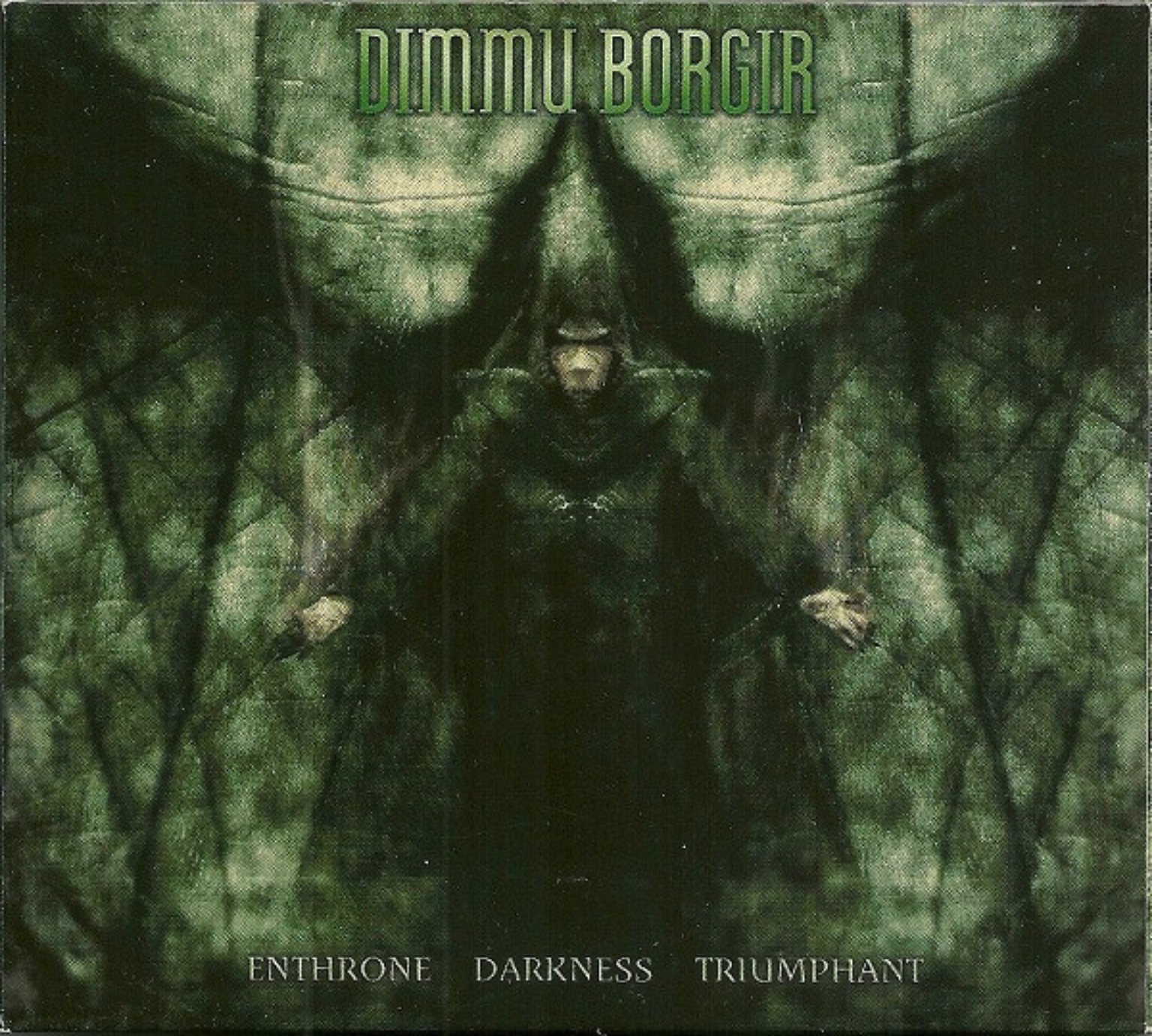
At first glance, the cover shows a hooded male figure in dark clothing, facing the viewer. His face remains partly in shadow, yet it immediately draws the eye. His arms open to either side, as though holding or ruling the space that unfolds behind him. That posture is the visual centre of the composition: the figure is not fleeing the darkness but standing in its midst.
The branching forms, almost mirrored across the image in the background evoke bare trees, wings and cracked stone all at once. Viewers cannot name any of these with absolute certainty. That uncertainty is precisely what makes the picture unsettling: symmetry promises order while the pattern makes us unsure what we are actually seeing. The greenish, ash-grey light does not illuminate the scene like sunshine; it seems to seep from the fog itself. The black garment almost merges into a single mass with the surrounding shadows, broken only by the face and hands.
At the top, the name DIMMU BORGIR, written in tall, narrow letters, closes the image; the more delicate lettering of the album title draws a horizontal line at the bottom. Between them, the threatening human figure and the landscape-like yet unfamiliar setting form a single composition. The picture tells no single, unambiguous story, and it does not conclusively depict either a demon or a specific building. Instead, it suggests a dark throne room somewhere between a natural landscape and a Gothic stage set.
This vision also resonates with the structure of the music. The sharp movements of guitars and drums are enclosed by the keyboards in a larger, almost architectural space, just as the branching background is organised around the central figure on the cover. Whatever the artist's precise intention, image and sound achieve a comparable effect: a sense of order beneath which every movement seems charged with menace.
At the Palace Gates
The album wastes no time drawing us into its world. The first moments of Mourning Palace seem to draw apart a dark curtain. The keyboards do not simply create an introductory atmosphere: they define the space in which the whole album will move. Then the band enters, and in a single gesture it becomes clear how this record differs from what came before. The guitars sound fuller. The drums hit harder and feel closer. The synthesizer is no longer fog in the background, but walls and ceiling at once.
The song moves with the solemnity of a procession yet seems to float. The mourning palace of its title appears not as an actual building but as an inner place where death, remembrance and ghostly presence merge into a single image. And while the words pull towards darkness, the music paradoxically lifts the listener. This will be one of the album's great secrets: aggression and monumentality do not weaken one another, but magnify one another.
Spellbound (By the Devil) does not merely continue this world: it organises it into a ritual. The choir-like timbres, organ-like moments and repeating motifs create the feeling that the song itself is a ceremony. Here we begin to understand why the album reached listeners even to those who found the raw sound of earlier Norwegian black metal alien. It had not become less dark. It simply showed more clearly where the walls stood and where the stairs led.
In Death’s Embrace lets lyrical passages emerge naturally from fast, sweeping sections. Death's embrace is both a threat and an attraction. This duality is one of the clearest surviving traces of early Dimmu Borgir's romantic side. The shadow of Stormblåst still lingers; it is simply illuminated by a much larger light now.
Relinquishment of Spirit and Flesh breaks that seductive balance. It is harder, denser and less contemplative. It is as though the record wants to remind us that behind the scenery lives the same attacking instinct from which the band was born. The keyboards step back, the rhythm section pushes forward, and suddenly the album forces the listener into a narrower corridor.
Then The Night Masquerade arrives, and the space opens wide again. Bente Engen's female vocals are not merely a guest appearance. They introduce another colour to the album's palette, as though a new figure suddenly emerged from the darkness at the masquerade. The female voice and Shagrath's vocals do not engage in a peaceful dialogue; they create tension. The song is theatrical but not light. Here theatricality is not a pose but part of the music's construction.
After Tormentor of Christian Souls, there can be no doubt about how the band defined itself in 1997. Its anti-religious stance is not a hidden reference in the background but an open declaration. Accordingly, the song's energy is less romantic and much more combative. Yet it is held together by the same expansive sound that unites the entire album. Here the synthesizer does not soften the music but makes it sharper.
Entrance may promise an arrival, but the song feels more like a passage between worlds. In the album's second half, it resembles another gate. The arrangement is more spacious, the harmonies linger longer and the music is, for a while, less intent on rushing forward. Here the listener realises that the album is not built from one speed alone. Its sense of drama depends on shifts in perspective: sometimes it brings the music close, sometimes it opens an enormous space around it.
Master of Disharmony is a piece brought back from the past. It comes from the Devil's Path period but acquires a new body in the sound of The Abyss. This moment is especially revealing. The band does not disown what immediately preceded it; it merely demonstrates how the same instinct sounds in a new environment. The song is leaner, faster and less romantic, which makes it an important counterweight to the symphonic side of the record.
Prudence's Fall mixes everything together again. Piano, fast drums, melancholy and sudden aggression stand side by side. If Enthrone Darkness Triumphant contains a track that reveals most of the album's faces within a single composition, this is one of the strongest candidates. It never quite settles; the song keeps tipping from one mood into another. That instability makes it exciting.
And on numerous editions there is also Raabjørn Speiler Draugheimens Skodde. The re-recording of an older song makes a strange and perfect epilogue. Its Norwegian lyrics, its roots in the early years and Silenoz’s lead vocal briefly reopen the gate to the world of For All Tid. Yet it no longer sounds the same. The distance the band travelled in three or four years is almost physically audible. The past does not disappear; it returns with greater force and breadth.
Spring 1997
Even before the record was released, Dimmu Borgir was already on the road. On the Gods of Darkness tour, they shared stages with bands including Cradle of Filth, Dissection and In Flames. The pairing was telling. Different strands of European extreme metal met on the same evening, and Dimmu Borgir was no longer an unknown Norwegian name at the foot of the poster.
The interviews surviving from the spring of 1997 still convey the excitement of transition. The band discusses the new album, Nuclear Blast, the English lyrics and the reactions it expects. None of the assurance that comes with hindsight is present yet. They do not know that Mourning Palace will one day be a permanent fixture in their concerts. They do not know that the album title will still be written again and again decades later. They know only that something has changed, and that the audience can feel it too.
The concert at Cologne's Live Music Hall on 31 March 1997 later became part of the Live & Plugged Vol. 2 release. Excerpts from interviews were interspersed with the concert footage. This document is especially fascinating today because it shows the band immediately before its breakthrough. Its stage image was already established: corpse paint, black clothing, a theatrical presence. Yet the live production was still far smaller than it would become a few years later.
At the end of May, the album finally appeared. With Nuclear Blast's distribution, the record reached shops and countries where earlier releases had struggled to arrive. Its cover gave the music an instantly recognisable visual identity. The dark figure in the centre, the cold green-black tones and the new, more legible logo conveyed visually the same transformation heard in the music: the darkness remained, but every contour was sharper.
The response was swift. In an interview from the summer of 1997, Nagash was already talking about tens of thousands of copies sold in Europe. For a black metal band at the time, that figure immediately raised new questions. If so many people were listening, was it still underground? If a major label promoted it, did the music still mean the same thing? If the songs were catchier but their themes and atmosphere remained dark, at what point did accessibility become compromise?
The band did not need to provide a theoretical answer. The answer was already taking shape in concert halls and record shops. Enthrone Darkness Triumphant had struck a chord. Listeners disagreed about what it meant, but few could ignore its impact.
Years of Debate
The most interesting debate surrounding the album was never purely musical. Positive reviews at the time praised the clearer sound, the interplay between keyboards and guitars, the songs’ memorable melodies and Peter Tägtgren's production. Others regarded those very qualities as suspect. For part of the black metal world, poor sound was not a technical deficiency but an aesthetic statement. In 1997, Dimmu Borgir offered a different answer through its music: darkness does not have to sound murky to remain dark.
The debate extended to the use of English. The sense of distance created by Norwegian-language lyrics fell away. A German, British, American or French listener could now directly understand the anti-religious and demonic images in the words. That both increased the album's force and made it easier to attack. Those who had previously heard only the atmosphere now had to confront the words as well.
The move to a larger record label provoked even stronger reactions. Nuclear Blast made its presence felt. It promoted and distributed the music, supported tours and cultivated new listeners. According to the logic of the underground, this could readily mean a loss of purity. But here Dimmu Borgir's story took another turn. Rather than retreat, the band continued to broaden its ambitions.
Internal changes accompanied that expansion. Stian Aarstad, without whose keyboard playing Enthrone Darkness Triumphant would be a very different album, could not participate reliably in touring. Kimberly Goss subsequently helped out in live performances, before Mustis arrived. Guitarist Astennu joined the touring line-up so that Shagrath could concentrate more fully on singing. Success did not preserve the band as it was: it accelerated its transformation.
By 1998, Godless Savage Garden stood between two worlds as a transitional release. New songs, re-recordings, live material and a cover version signalled that the band was moving onward. Spiritual Black Dimensions introduced further symphonic and vocal layers in 1999. What had been a daring balance between guitars, keyboards and drums on Enthrone… grew steadily more monumental over the following years.
Yet it was precisely that growth which later made the 1997 record so distinctive. In hindsight, it seems to capture a moment when Dimmu Borgir had already left its early period but had not yet reached its later orchestral world. It stands between them. Perhaps that is why no simple label can adequately describe it.
The Test of Time
As the years pass, the meaning of an album inevitably changes. In 1997, Enthrone Darkness Triumphant was a new release caught up in contemporary controversy. By the early 2000s, people were listening to it as the breakthrough record of a now successful band. A decade later it returned to the shops as a classic reissue. After twenty and then twenty-five years, it had acquired a place in history.
Critics returned to it repeatedly. Some praised the record's balance: in their view, the symphonic elements had not yet overwhelmed its black metal foundations. Others felt that its production now sounded too clean and some of the keyboard timbres too firmly rooted in their era. Some found the middle of the album less memorable; others loved precisely its sustained intensity.
The remarkable thing is that these arguments did not erase the record; they kept it alive. Few forgotten records provoke such arguments decades after their release. Yet Enthrone Darkness Triumphant continues to raise familiar questions: how much of it is black metal, how much symphonic, how underground or accessible is it, and was the band’s later direction already inevitable?
In later interviews, Silenoz often did not describe the period as though it had been a carefully planned career strategy. Songs came together quickly. If an idea failed, it was discarded or restarted. A studio booking created a deadline. Nuclear Blast offered an opportunity. Many decisions were practical rather than mythic. Yet in retrospect those everyday decisions now form what we recognise as a turning point.
Later retrospectives in Metal Hammer and other major publications placed the album in a wider context than the band’s own history. They began to describe it as one of symphonic black metal's important blueprints, and as one of the defining metal records of the 1990s. That does not, of course, mean that nobody had previously used keyboards, choral sounds or monumental structures. Emperor and other groups had already expanded black metal's sonic space. Dimmu Borgir's particular achievement was to bring this language to a wider audience in an exceptionally immediate, recognisable and lavishly produced form.
The album's reissues also provided tangible evidence of its lasting appeal: CDs, digipaks, different vinyl variants, picture discs, a Japanese edition, deluxe versions and later repressings. A record that had once represented the next step forward slowly became a collector's object and a cornerstone of the catalogue.
Meanwhile, Mourning Palace remained a fixture onstage. Even as the line-up and sound changed over the years, it remained instantly recognisable. As the years passed, it was no longer merely a song from 1997. It became a gateway through which each new generation could return to the moment when the band first found the scale that would later become synonymous with its name.
The Throne of Darkness
Looking back at Enthrone Darkness Triumphant nearly three decades on, it is easy to see a story that seems already complete. Every earlier step may appear to have led here inevitably: the fog of For All Tid, the romanticism of Stormblåst, the hardness of Devil's Path, the Nuclear Blast deal, Peter Tägtgren's studio and the English lyrics. It is as though the band could have travelled along only one predestined path.
The interviews from the time tell a different story, however. The legend has not yet taken shape. Young musicians talk about plans, problems, tours and the things they want to do better. Later retrospectives know the consequences of their decisions, but in 1997 nobody could have known them for certain.
Perhaps that is precisely why this album is worth hearing not just as a classic, but as a moment in time. It captures the urgency of a single winter and spring. A band old enough to have developed its own language but still young enough to change radically. A genre simultaneously guarding its underground self-image and beginning to enter the international metal industry. Studio technology showing that black metal could sound clear and still be threatening. And an audience, one part of which celebrated the transformation while another watched it with suspicion.
The title—Enthrone Darkness Triumphant—now almost explains itself. The idea of darkness enthroned in triumph extends beyond the lyrics and artwork. Something similar happened to the music itself. Dimmu Borgir suddenly revealed, on an enormous scale, the dark, melodic, sound built around intertwining keyboards and guitars it had previously been building in smaller spaces.
And when silence remains after the last notes, the story has not really ended. The later albums, orchestral experiments, world tours, line-up changes, disputes and reissues can all be seen in a new light when viewed from this moment. Not because Enthrone Darkness Triumphant contained every subsequent decision, but because after this album the stakes were different.
The palace doors opened in 1997. Countless people have passed through them since. Some came to find one of black metal's most important turning points. Others came to argue with it. Still others came simply because the opening keyboard notes of Mourning Palace still make them feel the same thing: a vast, dark space unfolding before them.
And perhaps that is the greatest thing an album can hope for after thirty years.
Reader comments
Comments only appear after approval. Messages are displayed in their original language.
Comment submissions are not enabled yet.