Slaughtersun (Crown of the Triarchy)
A complete account of Dawn’s 1998 album Slaughtersun, covering the band’s origins, the sessions, the artwork, seven tracks, and its reception.
1. Before Dawn – Fredrik Söderberg's musical beginnings
The story of Slaughtersun begins neither in 1998 nor with Dawn's first demo. In later interviews, Fredrik Söderberg repeatedly described how his approach to the guitar had been taking shape since the mid-1980s. His early years in Legion and Obduracy were more than a prelude: they established the guitar-driven, heavy metal outlook that would remain recognisable even in Dawn's darkest and fastest music.
Among his formative influences, Fredrik named Dio, Mercyful Fate and Manowar, alongside Ozzy Osbourne's first two solo albums and Randy Rhoads's playing. The aggression of Celtic Frost, Slayer and Kreator was another vital element. Dawn's later music, then, cannot simply be explained as a product of Sweden's black/death metal wave of the 1990s. Behind the band's guitar language lies an older tradition in which a riff has its own character, a melody stays in the memory and a song follows a dramatic arc.
Obduracy already marked a move towards a rawer sound. Fredrik singled out Infernal Majesty's album None Shall Defy in particular. The drumming on “S.O.S.” struck him so forcefully that he began writing faster songs; blastbeats entered his musical vocabulary not as part of a ready-made style, but through a specific musical shock. Morbid Angel also became an influence around this time. One of Slaughtersun's defining qualities grew out of this mixture: speed did not displace the melodic instincts of traditional heavy metal, but was built upon them.
Sources disagree about Dawn's earliest chronology. Some databases trace the name back to a one-man project Fredrik began in 1986, while his own later account places the formation of Dawn as an active band in late 1990 or 1991. These claims need not be mutually exclusive. The earlier date can be understood as part of Fredrik's personal creative development, and 1990–91 as the period when Dawn actually emerged as a band.
“Why do I play guitar?” In 2021, Fredrik used those words to express the question that became his personal benchmark after the Slaughtersun sessions: what mattered was not technique for its own sake, but the feeling, the sound and the reason behind the performance.
2. Linköping, demos and tape trading – the birth of Dawn
As Fredrik recalled, finding musicians in Linköping who shared his obsession with extreme metal was far from straightforward. In late 1990, he found a kindred spirit in vocalist Henke Forss, and the outlines of Dawn began to take shape. Guitarist Andreas Fullmestad and drummer Karsten Larsson joined the core line-up. The bass position changed hands during the early years; after Dennis Karlsson, Lars Tängmark became the key figure.
In March 1992, the band recorded its first two-song demo at Studio Arrogance near Linköping. The next major step was Apparition, recorded at Dan Swanö's Gorysound studio in Finspång. Fredrik later remembered this period as one of intense experimentation: heavy, thrash and death metal elements converged, while the vocals sought a distinctive place between deeper death metal growls and higher, harsher delivery.
Tape trading was one of the foundations of the Swedish underground at the time. Music did not arrive through algorithms, streaming playlists or instant links. Demos, photocopied address lists, letters, parcels and personal recommendations sustained the network. Fredrik stressed in 2025 that, without mobile phones or social media, musicians had to meet, travel and rehearse together. Dawn's identity took shape within this slower, physically connected underground scene.
After Apparition, Dawn's members encountered music that drew them away from the standard Swedish death metal formula. Fredrik specifically mentioned Eucharist and early Sentenced, but also Sisters of Mercy, Fields of the Nephilim, Arcana and the darker electronic world of In Slaughter Natives. These influences matter because they reveal that Dawn's atmosphere did not arise solely from the internal logic of one metal subgenre.
By 1993, around the time of Promo '93, the band's more melodic and darker character had become much clearer. Its international tape-trading connections brought Fredrik into contact with Paul Thind, who would go on to run Necropolis Records. Fredrik sent promotional material, and the American label offered the band a deal. Personal recommendations—including the name of Patrik Jensen—and the international underground's correspondence network converged in this one story.
3. Necropolis, the debut album and an enforced break
The deal with Necropolis opened the way for Dawn's first full-length album. The material for Nær Sólen Gar Niþer For Evogher took shape during 1992 and 1993, and the recordings were made with Dan Swanö in 1994. Sources do not entirely agree on the year of release: some give 1994, others early 1995. What is certain is Necropolis's involvement and the album's importance as an early title in the label's European distribution.
Fredrik later emphasised that he had never heard this music as a simple blend of black and death metal. He listed heavy metal, thrash, death metal, alternative music and classical guitar influences. That distinction matters: it presents the development towards Slaughtersun not as a succession of genre labels, but as an increasingly deliberate approach to composition.
The band's momentum was interrupted by a serious personal event. Fredrik badly injured his hand in an accident while working at a butcher's shop. He needed surgery and could not play guitar for a long time. The gap between albums therefore cannot be understood merely as a slowdown in writing: Dawn temporarily lost its principal songwriter's ability to play his instrument.
When Fredrik gradually returned to the guitar, the next step was not a return to where they had left off. The band wanted a darker atmosphere, stronger performances and a more powerful sound. That ambition led them towards Abyss Studios and put them on the direct path to Slaughtersun.
4. Sorgh på svarte vingar fløgh – the road to Abyss Studios
Dawn began moving forward again in 1995. They had originally intended to work with Dan Swanö once more, but scheduling at his studio forced them to look elsewhere. This brought Peter Tägtgren and the still relatively new Abyss Studios into the picture. According to Fredrik's recollections in 2021, the aim was clear: a darker atmosphere, better sound and stronger performances.
The mini-album Sorgh på svarte vingar fløgh, recorded in late 1995, became a testing ground. Alongside original compositions, a cover of an Infernal Majesty song connected Fredrik's influences from the 1980s directly with Dawn's new music. At Abyss they found an environment in which extreme speed and a clearer, more layered sound could coexist.
Following the mini-album, the band rehearsed far more often, acquired better equipment and tightened its playing through live performances. According to Fredrik, three or four rehearsals a week were not unusual in the period leading up to Slaughtersun. With this working method, the studio was not where unfinished songs were rescued; it was where performances already worked out in detail could be captured.
In May 1996, Dawn played their first concert abroad, in Denmark. A larger touring opportunity also arose that year: according to the band's old biography, they had been invited to join Cradle of Filth's European tour. The plan fell through, however. Drummer Karsten Larsson's commitments to other bands, followed by a change of drummer, meant Dawn could not undertake the trip.
In the short term, the setback was a loss. In the longer term, it brought a pivotal figure into the story: Jocke Pettersson.
5. The era in which Slaughtersun took shape
The success of Swedish death metal – and the need to stand apart
Dawn were searching for their own voice at a time when Swedish death metal was no longer solely an underground phenomenon. Fredrik later recalled specifically that seeing Entombed in the charts and on television made him realise that the style had acquired a recognisable, partly commercially viable formula. Dawn's response was not to imitate that formula more accurately, but to move away from it.
That intention also informed technical choices. According to Fredrik, they did not want the typical Swedish death metal sound, with guitars tuned far down. They tuned down by only a semitone, while Henke Forss's vocals moved towards a higher, raspier and more atmospheric delivery. The aim was not “originality” as an advertising slogan, but to turn their existing influences into a musical language in which the band could recognise itself.
Linköping and Östergötland – a local network, not isolation
Nor was the local scene an empty space. In later interviews, Fredrik mentioned Seance, Marduk and other Swedish bands among his inspirations, and regarded At the Gates as particularly important to the wider development of melodic extreme metal. Dawn's history is therefore both local and international: rehearsal rooms, personal acquaintances and journeys intersected with tape trading and correspondence with America's Necropolis.
Geography could nevertheless present practical obstacles. The members did not always live in the same town and had to travel to rehearse. Later, Fredrik and Jocke's moves to Stockholm stretched the band even further apart. Slaughtersun required a great deal more than inspiration: it also demanded considerable logistics.
The underground before the internet
One of the most important historical realities of the mid-1990s was not a political event but the speed of communication. Fredrik pointed out in 2025 that there were no mobile phones in the band's classic era, nor was everyday internet access organising the scene. New music was discovered through record shops, demos, letters and trading parcels. Maintaining international contacts required time, money and patience.
Paul Thind's recollections of Necropolis describe the same system from the label's perspective: the company worked by post, fax and telephone, sending out physical promotional materials. The distance between a Swedish band and an American label was a real organisational consideration. This helps explain why months could pass between recording and release, and why the loss of a tour opportunity was far harder to remedy than it would be today.
Historical background – what must not be mistaken for a direct influence
Dawn's rise coincided with a period of rapid change in Sweden and Europe. Sweden experienced a severe economic downturn in the early 1990s and joined the European Union in 1995. The Cold War had ended, the political systems of Eastern and Central Europe were changing, and wars were being fought in other parts of the continent. Meanwhile, the rapid spread of digital communication would completely reshape the underground's infrastructure within a few years.
These events belong to the background of the period, but no known Dawn statement directly links the songs on Slaughtersun to EU membership, Sweden's recession or any particular geopolitical event. This book therefore makes no artificial connections. The influences that can be documented are records, local bands, tape-trading culture, the practical difficulties of rehearsing, the choice of studio, changes in line-up and Fredrik's own creative methods.
The city and its age – the social backdrop to Slaughtersun, 1995–1998
Dawn's story did not unfold in a remote settlement where news from the outside world arrived only after a considerable delay. In the mid-1990s, Linköping retained its old traditions as a religious and educational centre while also participating in the everyday life of modern industry and university research. This combination matters more for understanding the album's origins than any romanticised notion of “Swedish isolation” invented after the fact. The musicians' own accounts supply the concrete history of rehearsals, journeys and work; the city's past and social organisation illuminate the setting in which all those things had to be arranged.
Aircraft manufacturing was central to modern Linköping's identity. Aviation-related work developed out of the ASJ railway vehicle factory, and Saab's growing presence in Linköping from 1939 onwards created not merely employment but a lasting culture of engineering, skilled industrial labour and technical education. Services and community institutions grew up around the factory; according to the company's historical account, communal and cultural activities associated with working life were lively as well. By the mid-1990s, this industrial heritage, several decades old, was already part of the city rather than some new investment created from nothing. The first production version of the JAS 39 Gripen was delivered in 1993 and entered service with the Swedish air force in 1996, a reminder that aerospace technology remained a nationally significant field of contemporary development. None of this, however, establishes that members of Dawn worked for Saab or that aircraft manufacturing directly influenced their music.
The other defining institution was Linköping University. It gained university status in 1975 as Sweden's sixth university and, through engineering, natural sciences, medicine and social sciences, brought a different rhythm to urban life alongside heavy industry. Kårallen, which opened in 1987, became one of the institutional centres of student social life. An unusually early interest in computing was also evident: the university's Lysator student society was among Sweden's pioneers of the web in 1993. A functioning computing environment therefore existed in Linköping while most young underground bands still relied on letters, landline telephones and cassettes to maintain contact. There is no contradiction here: the arrival of a technology within an institution is not the same as widespread, inexpensive access from home. Nor does this tell us whether Dawn's members had any personal connection with the university computing scene.
Between these two institutional worlds lay the city's more ordinary face: the need to reconcile working hours, transport, housing and free time. The interviews already used in this book make that constraint tangible precisely because making music did not appear as an endlessly funded, full-time occupation. Fredrik Söderberg's severe hand injury at his day job, his prolonged recovery, songwriting at weekends and rehearsals involving travel between towns are not atmospheric inventions but documented circumstances in Dawn's history. The social background of the period does not add speculative stories about the musicians' private lives; it reminds us that making an album meant coordinating working time, space, journeys, money and other people's availability. There is no source establishing that these difficulties were directly caused by the Swedish economic crisis.
Östergötland: towns, industrial districts and distances
Linköping belongs to the Östergötland region. It is a mistake to picture the surrounding area as one city organised around a single centre. Norrköping had its own industrial traditions, and among smaller towns Finspång was a distinctive site of Sweden's ironworking and metalworking heritage. The municipality's local history describes an iron-industry centre that evolved over a long period: some old works closed, while others survived through new production areas or more modern technology. This helps situate the region's variety of occupations and social traditions, but it does not show that Dawn's members or their families had personal or professional ties to those industries.
The region's educational landscape also changed during the second half of the 1990s. In 1997, Linköping University opened a new campus in Norrköping: former industrial buildings took on new roles as classrooms, a library, research facilities and places for student life. This is an especially vivid example of how Sweden's industrial society and the new knowledge economy did not replace one another overnight. In the same buildings and on the same city streets, an older history of manufacturing met new educational purposes.
Transport changed in equally tangible ways. Östgötapendeln, a suburban and regional railway service, began operating in 1995. Its purpose was to make commuting to work and school between the region's settlements, above all the larger towns, easier. This is an important qualification to the period's regional history: it was not a place without transport connections or a wholly isolated world. Timetables, changes of train, travel expenses and the restrictions of working hours could nevertheless remain real barriers for individuals. We do not claim that Dawn used this railway for any particular rehearsal or studio journey; the available book contains no such evidence.
What matters is the interplay of different scales. Finspång is genuinely part of Dawn's history through the band's earlier studio connections. Linköping was the place where Dawn formed and built local relationships. Norrköping was the region's other major industrial centre and later a new centre of university activity. Östergötland is therefore not merely an atmospheric backdrop but a working space connecting different opportunities and obligations. Even so, the historical facts uncovered about its towns must not be presented as if they were personal experiences of the band or direct sources of creative inspiration.
Stockholm: a new pattern of work, not a new point of origin
Dawn's original environment remained tied to Linköping even as parts of the band's daily life shifted towards the capital. According to the album book, Fredrik Söderberg's and Jocke Pettersson's moves to Stockholm complicated working together. The significance of the Stockholm connection is thus primarily practical: regular rehearsals and coordination became harder for members spread across several cities. To summarise this by saying that “Dawn became a Stockholm band” would be misleading; the creative foundations and relationships behind the album predated those moves.
Even within one country, Sweden comprised different centres of employment, education and culture. The capital operated on a different scale from a regional home town in terms of transport connections and institutions. The mastering at Cutting Room and the moves to Stockholm, already described in the album book, are specific facts about the band; the capital's national importance is historical context. There is no need to link the two with imagined new meetings, clubs or personal decisions. The existing interviews tell us enough: completing an album does not necessarily make a band more geographically united.
Sweden: the years after the economic crisis
Work on Slaughtersun took place after one of the sharpest upheavals in modern Swedish economic history, although its consequences had not disappeared. During the 1991–93 downturn, problems in banking and property markets were accompanied by fiscal austerity and a steep decline in employment. A Swedish government budget document from December 1994 reported that about 414,000 jobs disappeared across 1992–93, while open unemployment reached 8 per cent in 1993. The contemporary report gave a higher figure, around 12.5 per cent, for a more broadly defined measure of unemployment. These are nationwide numbers calculated using different methods; they are not figures for Linköping or for Dawn's members.
The Swedish economy began growing again in 1994, but the social consequences did not vanish in a single year of recovery. A comparative government study published in 2000 and accessible through the Swedish parliament's archives stresses that employment problems persisted for years after the turnaround in 1993. The period 1995–1998 should therefore be identified neither with the very depths of the crisis nor with a carefree boom. Balancing work, travel and leisure was a social question, even if we do not know the precise financial circumstances of Dawn's individual members.
The rules governing the financial system were changing too. The inflation-targeting framework announced in 1993 by Sweden's central bank, the Riksbank, formally adopted a target of 2 per cent from 1995. This reflects both the period's economic uncertainty and efforts to establish a new kind of stability. It is not an explanation of the band's history, but it helps define the country in which the musicians worked on their songs alongside their ordinary jobs.
Sweden's foreign economic and political position was also changing. Following the 1994 referendum, the country joined the European Union on 1 January 1995, alongside Finland and Austria. This did not mean adopting the later arrangements of the eurozone: the Swedish currency of daily life in 1998 was still the krona. Nor should membership in 1995 be confused with the idea that Sweden had already joined the fully developed Schengen travel system of today. EU accession formed part of the economic and legal setting for cross-border activity; it is not an established explanation for Dawn's record deal or any of their lyrics.
Europe: expanding connections, but borders remained
The years in which the album was made coincided with a reordering of Eastern and Western Europe. The Maastricht Treaty came into force in 1993, establishing the European Union, while the single market launched that year provided a new institutional framework for the movement of goods, services, people and capital. The EU expanded to fifteen members in 1995; that year also saw border-control-free travel begin under Schengen among seven countries. The development did not automatically apply to every European country or border. It would therefore be wrong to explain the challenges of organising a low-budget tour to Denmark or another country simply by referring to European integration.
Another face of this historical background was far darker. The wars in the former Yugoslavia were part of European reality during the 1990s. A ceasefire took effect in Bosnia and Herzegovina in October 1995; the Dayton peace process produced an agreement in November, and the document was signed in Paris on 14 December. The peace settlement did not make the social consequences of the war disappear at a stroke. These events belong to the history of the continent on which Dawn recorded their album, but there is no evidence that the band drew the themes of Slaughtersun directly from the wars in the former Yugoslavia.
The Treaty of Amsterdam was also signed in 1997, laying the groundwork for further changes in EU cooperation. It did not come into force until 1999. Likewise, the euro was introduced as an accounting currency in 1999, after the original release of Slaughtersun. The chronology is worth keeping exact, since hindsight can make later institutions and habits appear as if they had already been fully established in 1997–1998.
The world in 1997–1998: accelerating connections, unequal access
Of all the worldwide changes, the transformation of communication comes closest to Dawn's history. But it needs a more precise chronology than the simple claim that “there was no internet yet”. The World Wide Web already existed early in the decade. During the 1990s commercial providers, early websites and online portals appeared in Sweden. Linköping University's pioneering role in 1993 shows particularly clearly that the technology was not unknown. Access, however, was far from universal, and international communication did not instantly become fast, cheap and equally available to everyone.
The scale of the change is illustrated by a time series based on Nordicom and statistical sources, later reproduced in a Swedish government document. Among people aged 9–79, the proportion with internet access at home was 3 per cent in 1995, 8 per cent in 1996, 17 per cent in 1997 and 31 per cent in 1998. These figures describe access among the population, not the connectivity of individual bands. Nevertheless, the growth is revealing: in the years when Slaughtersun was written and released, a genuine technological boundary was shifting.
Dawn's documented network of cassette exchanges and postal correspondence is therefore entirely compatible with Sweden's early participation in the digital world. The significance of the band's correspondence with Necropolis is not that nobody could send an electronic message in 1998, but that underground musical collaboration still depended heavily on physical recordings, postal services, arrangements by telephone and personal relationships. Slow-moving information, copying and mailing materials, timing and availability were all part of the work surrounding the creative process. The historical evidence reinforces the book's earlier interview-based account at the level of the period; it does not replace that first-hand testimony.
A different aspect of global economic integration was becoming visible as well. The Asian financial crisis, which began in Thailand in July 1997, spread quickly to several countries. According to contemporary and subsequent analyses by the International Monetary Fund, its financial significance was already global by 1998. This date in world history helps establish the era in which Slaughtersun appeared, but it does not support any direct connection to Dawn's working methods, record release or lyrical subjects. Here too, careful historical distinction is worth more than a striking but unsubstantiated parallel.
Why does this background matter?
The story of Slaughtersun in 1998 thus unfolded at two different speeds. The region's railway links developed, industrial districts and university institutions changed their functions, Sweden emerged from a severe economic crisis and joined a new European institutional framework, and within a few years the internet reached increasing numbers of homes from its earlier bases in research centres. Yet the everyday life of a band whose members had to earn a living did not become frictionless. They still had to get to rehearsals, fit music around work, find time and money for recording and coordinate with the label. In Dawn's case, the documented human stories already told in this book make these demands concrete.
This historical panorama is not a secret key to the album. It does not claim that EU membership, the economic crisis, industrial changes or the Balkan wars formed part of any song's conscious message. Rather, it shows the conditions under which a band worked when it was no longer entirely local but could not yet rely on today's instant online networks. The music of Slaughtersun still needs to be explained primarily through the musicians' words, the recordings and the contemporary reception. Historical context supplies verifiable time, place and distance behind those sources—no more and no less.
The musical environment from which Slaughtersun emerged
Linköping: not just one band, but a living concert scene
It would be easy to squeeze the setting in which Slaughtersun was made between the histories of Sweden's two great musical centres, Stockholm and Gothenburg. Linköping, however, was not merely a point on the map from which a few young musicians later departed. It had a concert scene of its own, while its proximity to Norrköping, Finspång and smaller neighbouring towns meant that an emerging band could seek musicians and audiences beyond its immediate locality. No single, all-embracing metal institution kept this culture alive; it relied on connected clubs, friendships between fans, radio programmes and independently organised concerts.
Linköping's Seance is a particularly important local example. Formed in the early 1990s, the band went on to release records through Black Mark: Fornever Laid to Rest in 1992, followed by Saltrubbed Eyes, placed the city's name on the national metal map. Their presence shows that the area contained more than rehearsal-room aspirations; there were functioning links between local musicians and the professional record business. But this does not mean every Linköping band followed the same sound, audience or trajectory. Seance illustrates what was possible in the region; its history does not replace the separately documented origins of Dawn.
The surviving gig records of one venue make the period more tangible still. The community archive of shows at Skylten in Linköping in 1996–97 includes extreme metal alongside hardcore, punk and rock bands. A listed Necrophobic concert on 22 November 1997 is particularly revealing: a stage existed in the area for heavier underground sounds. The date comes from a retrospective concert database, not a contemporary poster or ticket, so it illustrates the venue's activity rather than providing a complete concert calendar. There is no evidence that Dawn performed at any of these shows.
Östergötland: radio, record shops and connections between towns
Dan Swanö's later recollections offer rare, detailed insight into the metal network around Linköping. According to his account, the Power Hour metal radio programme began broadcasting from Norrköping in 1987, and its signal reached Finspång and Linköping. Records available from the Spiralen shop in Norrköping sometimes made their way to the radio presenters through listeners themselves. A single imported record could thus pass between several people and find its way onto local radio before a wider audience had even heard of it. Radio, record shops and personal relationships strengthened one another rather than serving as substitutes.
In the same recollections Swanö mentioned performances he saw in Norrköping, including at Nya Strömmen, as well as Thrash Bash concerts held in Linköping and Norrköping. He also organised shows in Finspång himself. These memories chiefly concern the connections established during the late 1980s and early 1990s, not a complete programme of concerts for 1997. Nonetheless, they are important precedents: they show which people, routes and meeting places had already made it possible for the region's musical life to develop by 1995–1998.
Another interview about the period's music scene also sheds light on the region's smaller towns. According to a member of Traumatic, Mjölby and nearby Motala had death metal bands, local rehearsals and occasional gigs, although arranging concerts was not easy. This distinction mattered. A handful of bands and enthusiastic listeners might be enough to sustain a regional community; performing regularly before an audience also required a venue, promoter, equipment, transport and time. Dawn's documented organisational difficulties fit within this broader pattern, but Traumatic's memories must not be attributed to Dawn's members.
One distinctive strength of the region was the relatively short route to recording studios. In Finspång, Dan Swanö developed his recording activities out of work associated with a rehearsal space and basic recording equipment. Several Swedish extreme metal records began in the workshop first known as Gorysound and later Unisound; the connection already features in this book's account of Dawn's early years. The additional lesson of the historical setting is the model itself: a provincial rehearsal room and the skills of a musician-engineer could do more than provide a cheap solution. They could increase the musical independence of an entire region. Not every demo required a journey to Stockholm or abroad.
Stockholm and Gothenburg: two influential ideals of sound, not two closed schools
During Dawn's formative years, Swedish death metal was already exporting a recognisable sound. Around Stockholm, the recordings of Entombed, Dismember and other bands were associated with Tomas Skogsberg's Sunlight studio. The heavily distorted, dense and distinctively abrasive guitar sound became one of the best-known signatures of early Swedish death metal. Distortion pedals and guitar tuning are only part of the explanation: recording, musicians' playing and the balance of the mix together produced what would later be called the “Stockholm sound”.
In Gothenburg, meanwhile, different priorities emerged. In the work of At the Gates, Dark Tranquillity and In Flames, melodic guitar leads, harmonised parts and more clearly separated instruments offered a new model for heavy music. Slaughter of the Soul and The Gallery, both released in 1995, followed by In Flames' albums from 1996–1997, did not simply make death metal “prettier”. Guitar melodies took on a larger structural role, while arrangements increasingly distributed the energy in ways that kept motifs intelligible alongside high speed. Of course, this does not mean that every Gothenburg band was melodic and every Stockholm band uniformly raw. City labels are historical points of reference, not immutable rules of music.
By around 1995, both approaches were well known internationally. For a new Swedish group, the question was not only whether it could play as aggressively as its predecessors, but whether it could be recognised as different from them. This is the context in which the Söderberg statement quoted earlier in the book—describing his conscious rejection of the familiar, deeply down-tuned Swedish death metal guitar sound—finds its proper perspective. The national sound models were certainly part of the musical background, but claims that the musicians drew a particular melody from any specific record of the period require a direct statement or other documentary evidence.
The shifting boundary between black metal and melodic metal
One important development in the second half of the 1990s was that not every band wanted a sharp boundary between black and death metal. Dissection's 1995 album Storm of the Light's Bane is among the clearest examples of how black metal's sombre atmosphere could coexist with elaborate guitar melodies related to death metal and classic heavy metal. This is not to suggest that every similar Swedish album followed from that one record; rather, audiences of the time already knew works in which fast, abrasive music retained a taste for expansive melodic writing.
In Norway during the same years, another strand of black metal broadened the possibilities of keyboards and arrangement. Emperor's Anthems to the Welkin at Dusk (1997) placed greater emphasis on intricate compositions and orchestral-sounding layers, an approach Ihsahn later described as increasingly deliberate. Dimmu Borgir's Enthrone Darkness Triumphant, also released in 1997, demonstrated the wider international visibility of a more melodic black metal lavishly coloured by keyboards. In a 1996 statement, members of the band themselves spoke of combining heavy metal, classical music, and fast and slow elements.
These musical directions should be considered alongside one another, not blurred into a single approach. Dawn's guitar-centred music, constructed on a large scale, followed a different path of arrangement from the more symphonic Norwegian bands. Nevertheless, they shared a question of their era: how could black metal retain its extreme intensity while developing more complex forms, carefully sustained atmosphere or memorable melodic structures? This is a comparative framework for music history, not proof that Dawn directly followed or imitated any particular band named above.
Europe and the Atlantic connection: the genre did not stand still
By this point, records by Swedish bands belonged to a much wider European and transatlantic music market. Germany's Nuclear Blast, British and other European independent labels, and American underground labels did not direct the music from a single centre. In parallel, they built contracts, licensing agreements, distribution networks and touring opportunities. A band could record in Sweden while its releases were promoted and sold in another country. This formed a network in which geographical distance remained expensive, but did not necessarily mean cultural isolation.
Contemporary statements also convey the reality of this world across borders. As early as 1996, Dimmu Borgir connected the opportunity to tour more widely with their deal with Germany's Nuclear Blast; in a 1997 interview, the band discussed German concerts and European record sales. These are not Dawn's commercial results or budgets. They illustrate the practical importance of a strong distributor during the period. Dawn's documented relationship with the American label Necropolis represented another route towards international activity, operating on a smaller budget. The existing book already records its concrete details, which need not be retold here.
Opinions travelled between countries, just as records did. Photocopied fanzines, promotional copies sent by post and established metal magazines operated side by side. A review in Germany or America could be valuable for an underground demo, but its impact depended heavily on whether it caught the attention of a record label, distributor or concert organiser. One participant in the tape-trading network could reach interested listeners in another country, while fanzine editors often exchanged letters and recordings themselves. The communication network helped people discover music; it was not merely a means of advertising a finished product after the fact.
Studio technology: when rehearsal rooms and professional sound drew closer
Recording was one of the principal areas in which musical differences took shape. Recalling his early workshop, Dan Swanö explained how he began with a four-track cassette recorder, then experimented with a broader sound through two machines and the process of combining tracks. This approach had an obvious cost: once separate tracks were merged, it became harder to remix them independently later. The technical limits of early equipment were therefore not merely a financial disadvantage; they also forced decisions about composition and arrangement.
By contrast, larger studios offering more tracks and greater scope for intervention made it easier to treat drums, layers of guitar and vocals separately. Yet the period's recording ideals did not move in a straight line from raw sound towards sterile clarity. Some musicians sought a heavy, blended texture, others intelligible, intricate guitar parts, and still others an echoing soundscape deliberately made to seem distant. The importance of the studios associated with Tomas Skogsberg, Dan Swanö, Fredrik Nordström and Peter Tägtgren consequently lay in more than any individual piece of equipment: different methods of working became associated with particular sonic worlds.
Under Peter Tägtgren, Abyss Studios became an important meeting place for black and death metal in the second half of the 1990s. The producer's work during these years included records by several Swedish and Norwegian bands, and Dawn's 1997 sessions were part of that period. The completed album book already describes Dawn's specific recordings at Abyss in detail, so the sequence of sessions, production methods and mastering venue are not repeated here. The broader lesson is that one professional environment could serve very different artistic goals. Abyss did not impose an identical sound on every band that worked there.
The age of the CD, and the cassette's persistence
By the late 1990s, the CD dominated Sweden's recorded-music market. A music industry study prepared for the Swedish government in 1999 reported that CDs accounted for 92 per cent of recorded-music sales in 1997, compared with 27 per cent in 1988. These figures describe the entire market, not a separate statistical breakdown for metal fans, demo collectors or Dawn's buyers. Even so, they explain a seeming contradiction: the CD was already the obvious commercial medium for an official album, while demos, rehearsal recordings, private copies and cassette trading continued to thrive underground.
The same study noted that CD manufacturing had become an industry in its own right, with several pressing plants in Sweden accepting both domestic and foreign orders. Producing a record therefore extended beyond the final master that left the studio: it required separate decisions about manufacturing, booklet printing, shipping, stock and distribution to target markets. Independent labels contributed their identity and artistic relationships, but often needed other companies to handle production and distribution. The later chapters of this book address Dawn's own release circumstances; here the point is solely the broader industry context of the period.
Concert opportunities presented similar difficulties. An album could be manufactured even if its musicians lived in different cities, but regular live performances required joint rehearsals, moving equipment, agreeing working schedules and reliable organisation. An independent label's contacts could help a band travel abroad, yet a recording contract did not automatically produce a tour. Why a particular group abandoned a planned journey must still be established from that band's own documents. This book has its own sources for Dawn's known missed touring opportunities; there is no reason to invent a new story about them here.
Slaughtersun's place in this musical landscape
By 1998, Scandinavian extreme metal was not following one line of development. The legacy of raw death metal, the melodic Gothenburg school, the overlap between black and death metal, more symphonic arrangements and the less conspicuous regional underground linking them all existed at once. A band's place within this landscape depended not simply on its country, chosen studio or record label, but on how its music was composed and on the decisions made by the individual musicians.
In Dawn's case, the original album book already sets out those distinctive choices: the tuning of the guitars, the approach to vocals, the construction of extended tracks and the history of the recording. This historical overview does not seek to replace that account with a new analysis. Instead, it explains why finding a distinctive voice mattered so much at a time when Swedish extreme metal already spoke several internationally recognisable musical languages. Slaughtersun was not created in a vacuum, but its worth cannot be reduced to one city's school, one label or one related genre. The album should be understood as the work of the musicians; the musical networks of its era trace the background behind it.
6. Jocke Pettersson and the writing of Slaughtersun
In Fredrik's recollections from 2025, the change of drummer emerges not as a minor personnel adjustment but as a turning point. Karsten Larsson split his time between several bands, and Dawn had to work around his schedule. By contrast, Jocke Pettersson put Dawn first “one hundred per cent”, in Fredrik's words. The music began to change rapidly.
The first seeds of Slaughtersun had appeared by late 1995, during the recording of Sorgh. In the basement of his parents' house in the countryside, Fredrik set up two Marshall amplifiers and spent hours working on riffs at weekends. Initially, the songs were written without drums. He began with a riff he felt was strong enough to stand on its own, then sought a following section that would not merely fill time but provide another high point.
One of the most revealing remarks in the 2025 interview was that Slaughtersun was built around “the main riff idea”. The structures were not made to fit a predetermined running time. The band played, recorded demos and added new sections; if the song seemed to demand more, it continued. Fredrik described the period in terms of “more is more”.
Jocke's contribution was decisive because the drums were not simply laid behind an already completed guitar framework. Fredrik cited a particular example: a tom passage in the middle of The Knell and the World, which he remembered as unlike anything he had heard on another record. The extended tracks therefore became more than long sequences of riffs; they were compositions whose dramatic shape was influenced by the drummer as well.
The frequency of rehearsals was directly connected to the recording method. According to Fredrik, the band could not rely on unlimited opportunities to correct a performance later in the studio. The playing had to be ready when they walked through the door. Three or four rehearsals a week were thus not a romantic legend but a technical necessity.
“More is more.” No running time was set in advance for Slaughtersun's songs. A composition ended when the band felt that its musical idea had reached its conclusion.
7. Abyss Studios, April 1997 – the recording story
Dawn returned to Abyss Studios in April 1997. They had already tried Peter Tägtgren's studio on the mini-album Sorgh, and both the band and Necropolis had been pleased with the result. Recording Slaughtersun was therefore not a leap into the unknown, but a deliberate continuation of an earlier collaboration.
In 2021 Fredrik reconstructed the sessions in unusual detail. The entire recording process took roughly two weeks. Jocke recorded his drums in a single day. Fredrik and Andreas finished the guitars—including overdubs and acoustic parts—in about three and a half days. Bass took a day; Henke Forss recorded his vocal tracks across several evenings. Mixing consumed much of the remaining time.
Two weeks later, a six- or seven-hour mastering session at Cutting Room in Stockholm followed the studio work. The original booklet gives a straightforward record of the production chain: Abyss Studios, April 1997; engineer Peter Tägtgren; mixing by Dawn and Tägtgren; mastering at Cutting Room; executive producer Paul Thind.
A later recollection from the label singles out the drum sound. Paul Thind felt that Jocke's performance and the technical methods used at Abyss combined to produce a particularly powerful result. In a subsequent technical conversation, Dan Swanö also discussed Tägtgren's triggering and sample-layering techniques. The point, however, is not to force the sound into categories of “natural” or “artificial”: the sources emphasise both the processing involved and Jocke's genuine, physically demanding playing.
A physical constraint also helped determine the album's final form. In a 1999 Metal Vision interview, Fredrik said he had material for thirteen songs. Nine were recorded, but the playing time of a CD meant that only seven made it onto the album. Two completed recordings were left out. Slaughtersun's running time of almost an hour thus came close to the practical limits of the format for a reason.
8. The object takes shape – cover, booklet and release
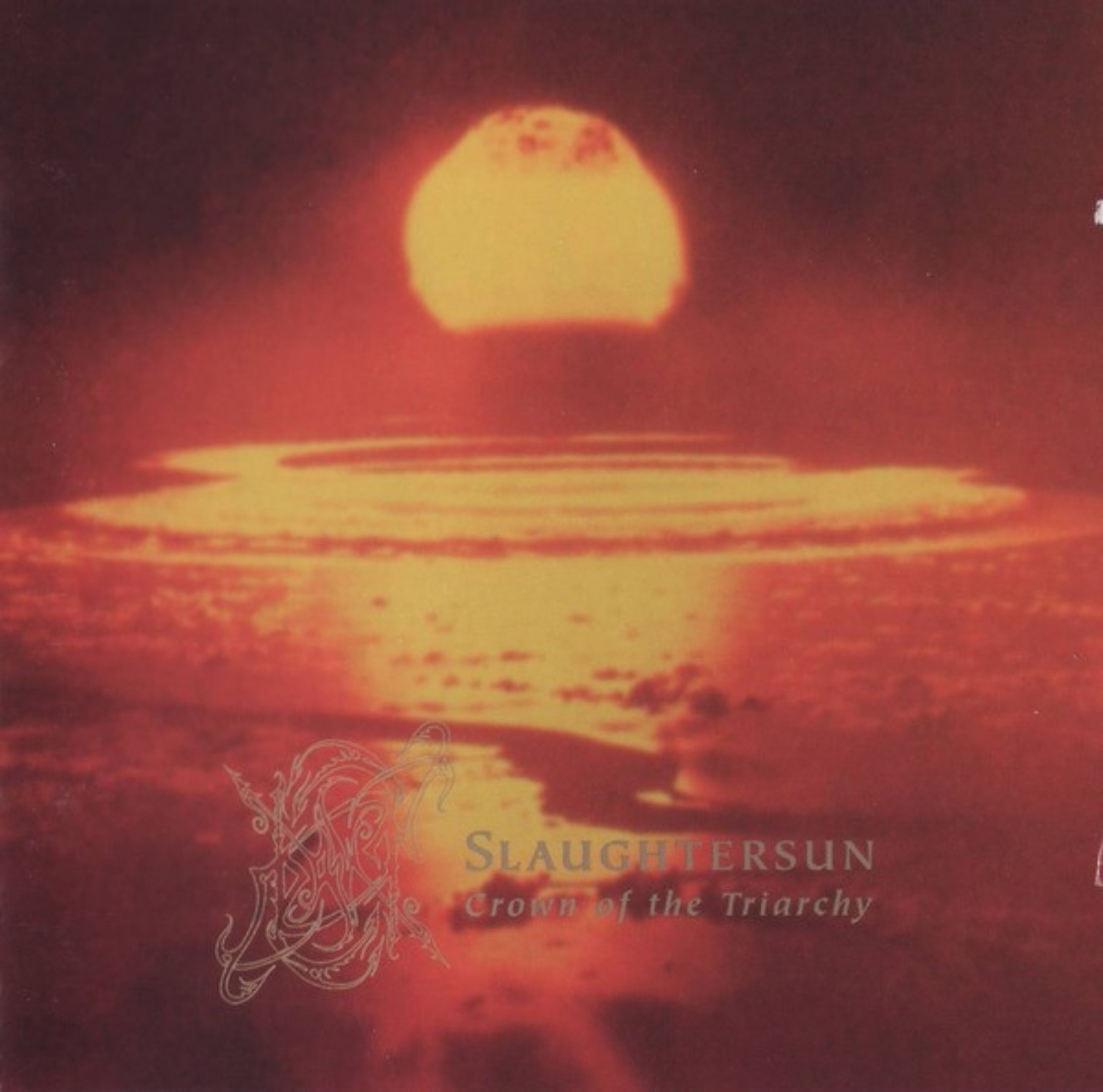
Slaughtersun was conceived with care as a physical release as well. According to the booklet, the cover concept came from Dawn themselves; the band worked with Deanna Alcorn on the design, and the band photographs were taken by Anton H. LeClercq. The first Necropolis edition bore catalogue number NR 021 and barcode 7 92658 00212 2.
The red-orange sun and dark expanse of water on the cover form an image that has since become almost inseparable from the record. Interestingly, several later critics highlighted the atmosphere shared by the artwork and music: beauty and destruction seem to exist at once. It matters, however, that this is a critical interpretation. The original booklet credits the band with the concept but offers no detailed account of its symbolism.
Not all later databases agree on the exact release date. The project's detailed discographical record and Metal Archives date the first American Necropolis edition to 7 May 1998, while some later reviews give August 1998. Label head Paul Thind's retrospective refers to May 1998. This book therefore uses 7 May 1998 as its principal date without concealing the disagreement between sources.
One of the names in the album's line-up offers another instructive example of source criticism. The original booklet prints “Lars Rosenburg” as the bassist's name. Discogs treats this as an alternative form of Lars Tängmark in the credits for the same edition. Most later databases list Tängmark. This book therefore records both forms, giving priority to the original physical source when establishing what name was printed.
The red sky and the water dissolving into light – the original front cover
No person, building or recognisable landmark appears on the original Slaughtersun cover. An immense yellowish-white disc glows in the upper part of the picture against a dark burgundy sky. Reddish patches mark its surface, and a narrow, darker band crosses its lower edge. The eye then travels down to the water, where the light spreads into broad, flattened rings and streaks that almost merge with one another. In the foreground, the more distant bands of brightness give way to broken, shimmering reflections. The scene suggests both a sunset and some extraordinary, overwhelming flare of light; it never makes clear where natural illumination ends and an unsettling vision begins.
Red, orange and copper tones almost entirely crowd out cooler colours. There are no sharp contours: the grainy, slightly blurred surface makes the boundaries between sky, water and reflection uncertain. The composition is held in balance by the glowing orb above and the horizontal bands of light spread beneath it. In the lower third, Dawn's interwoven emblem appears beside the title Slaughtersun and the subtitle Crown of the Triarchy. The lettering is restrained, as though it too were emerging from the reddish glow.
The cover's power lies in this duality: breathtaking at first sight, then increasingly disturbing. The broad sweep of light and the dark foreground call to mind the album's surging, long-arched melodies and its sombre, tightly wound atmosphere. This is an interpretative parallel between image and music, not an established statement of artistic intent. The band claimed the cover concept, but no surviving explanation assigns a single definitive meaning to each of the image's details.
9. Slaughtersun's musical character in the light of the sources
One of the most interesting features of the reviews of Slaughtersun is how often the same qualities receive opposing judgements. For one listener the long songs are monumental constructions; for another they are needless repetition. Peter Tägtgren's clean Abyss sound means power and clarity to some, excessive polish to others. One writer hears an ecstatic rush in the speed, another monotony. This is precisely what makes the history of the album's reception useful: it offers no single “correct” reading, but shows which qualities are strong enough to provoke disagreement.
The contemporary Chronicles of Chaos review considered Dawn's balance of speed, aggression and melody their greatest strength. Despite the eight- to ten-minute compositions, the writer found scarcely a dull moment and felt that the band stood on its own rather than merely in the shadow of Dissection or Sacramentum. Lollipop Magazine also singled out the length and epic character, paying particular attention to the acoustic “dreamscapes”, restrained keyboards and Jocke Pettersson's relentless, densely packed drumming.
Aiding & Abetting chose a different language, hearing traditional heavy metal movement in the guitars, almost as if Iron Maiden had been placed in a black metal setting. This observation is especially interesting in light of Fredrik's own list of influences: the songwriter had indeed brought a melodic and riff-based sensibility from classic heavy metal. Here a contemporary critical impression and the band's later account of itself reinforce one another without saying exactly the same thing.
The negative metal.de review from the period, by contrast, argued that Dawn blended too readily into the Swedish melodic death/black metal scene, and found Tägtgren's production formulaic. The review remains valuable because it demonstrates how differently the same album could be heard in early 1998, when so many new releases from Sweden's melodic extreme metal scene were appearing at once.
Later interpretations increasingly emphasised Slaughtersun's distinctive traits: hypnotic tremolo-picked passages, extended forms, powerful drumming, the overlapping of melody and aggression, and the sense that the album is at once furious and disciplined. Nevertheless, its length and relative uniformity remain recurring criticisms, even in writing by admirers. That tension is one of the keys to the record: the very consistency that creates a trance-like whole can sound excessively repetitive to another listener.
10. Seven tracks – song by song
The following chapter draws on the lyrics, statements by band members and contemporary and later reviews. It is not an analysis based on direct listening: where a musical detail is mentioned, it is supported by a cited review or recollection from the band. The complete lyric corpus was consulted for the readings of the texts, but only brief fragments and thematic summaries are reproduced here.
1. The Knell and the World – an opening image of the world's self-destruction
The opening song's lyrics depict collapse on a global scale: psychosis, violence, epidemic disease, famine, infertility, religious and social disintegration, environmental catastrophe and, finally, “world suicide”. The voice is not that of an outside chronicler but of an apocalyptic indictment. In Martin Hellkvist's text, humanity is not a passive victim but a participant in its own destruction.
Almost every significant review singles out the song's musical importance. Chronicles of Chaos described it as a monumental opener, while later writers have regarded it as one of the record's most memorable pieces. In 2025 Fredrik recalled a particular arrangement detail: Jocke Pettersson's tom playing in the interlude struck him at the time as unusually inventive. In its very first minutes, the opener thus establishes the album's approach: long forms, recurring riffs, imagery on a grand scale and a distinct dramatic role for the drums.
2. Falcula – from exclusion to judgement
Falcula's first-person lyric follows a downward social and psychological spiral. The speaker sees himself as hated, despised and without hope, until the experience of exclusion gives rise to fantasies of revenge. The recurring idea of “I am your judge” turns wounded resentment into a power that passes judgement. Social rejection is not overcome; it transforms into violence.
Both early and later reviewers have frequently named Falcula as one of the album's strengths. A Metal Archives review praised its almost thrash-like, more majestic breaks; MetalItalia's 2012 retrospective placed it alongside the opener and The Aphelion Deserts among the strongest tracks. The song also illustrates Henke Forss's contribution as a lyricist: instead of cosmic or historical imagery, it centres on immediate, personal rage.
3. To Achieve the Ancestral Powers – two minutes of breathing room
The third track is instrumental, so no narrative meaning can be derived from lyrics. Critics, however, have mentioned it remarkably often. Aiding & Abetting used it specifically to show that Dawn thought in terms of songwriting and acoustic interludes rather than adhering to the stricter expectations of “traditional” black metal. Lollipop described moments of this kind as “acoustic dreamscaping”.
On the evidence of the sources, what can safely be said of the two-minute piece is that it offers contrast between the long, fast compositions. Its title, “to achieve the ancestral powers”, also resonates with the archaic and cosmic imagery of the following songs, but there is little reason to impose a specific story upon it.
4. Ride the Wings of Pestilence – in the voice of the plague
The fourth song's lyrics were written by Philip von Segebaden, and their narrative device is clear: the plague itself speaks. The epidemic moves through the city as a nocturnal, invisible force, conjuring black rats, funeral pyres, dying families and mass death. The speaker not only destroys but understands itself as a form of “punishment”, turning the historical epidemic into a religious and demonic allegory.
The lyric also mentions 1382, but that should be treated as a claim within a work of poetry, not a historical statistic. The song's power lies precisely in this personification: the plague proclaims its victory, then threatens to return in other forms. Later fan reviews have described this track as particularly epic, and its imagery does operate on a sweeping historical scale.
5. The Aphelion Deserts – cosmic distance and inner darkness
Martin Hellkvist's second lyric moves into an entirely different space. The astronomical concept of aphelion—the point in an orbit farthest from the Sun—functions here not as a scientific explanation but as a cosmic metaphor. The text sets opposing pairs against each other: dusk and dawn, truth and falsehood, love and hate, life and death. Images of the universe intermingle with an inner psychological landscape.
Vultures, a black horizon, the suspension of time and a “finale without end” create a pattern of images in which the cosmos and the self slip into the same emptiness. One reviewer on Metal Archives emphasised the song's anger and madness, while MetalItalia counted it among the record's outstanding pieces. In terms of its lyrics, it is one of the album's most abstract tracks.
6. Stalker's Blessing – from vulnerability to a predatory identity
Stalker's Blessing is one of Henke Forss's darkest psychological texts. It begins with a “soul assassin” who drains away hope and the desire to live. At first the speaker sees himself as a possible victim and confronts his own death, but then the story turns: weakness hardens into coldness, fear into hatred, and the position of victim into an aggressive identity.
The lyrics are not a simple tale of triumph. The price of becoming “stronger” is that the speaker grows merciless and soulless himself. This moral ambiguity is far more compelling than a straightforward rise to strength: oppression ends, but the escape from it is itself dehumanising.
7. Malediction Murder – the monster within and the conclusion
The lyrics of the album's longest track follow the emergence of a violent inner personality. The narrator senses a strange, cruel “species” imprisoned inside himself. Images of mutilation, blood loss, “black light” and a homicidal law lead gradually into a state of mind that rationalises murder as purification.
At the lyric's conclusion, personal self-destruction merges with a genocidal logic projected onto the wider world. Thematically, this circles back to the opener: the social apocalypse depicted in The Knell and the World returns in the closing track as inner, personal corruption. On the evidence of the surviving lyrics, the album can therefore be read as a framed composition: the first song depicts a sick world, the last a sick individual.
Later reviewers often rank the opening and closing pieces as the strongest. One Metal Archives review complained that the album's length made the journey towards Malediction Murder exhausting, despite regarding the track itself as exceptional. That captures one of the central points of disagreement about Slaughtersun: its monumental scale is both an achievement and a risk.
11. 1998 – the contemporary reception
The most valuable layer of Slaughtersun's reception is the one that knew nothing of the album's later cult status. Those reviews addressed not an established “classic”, but a new promotional copy or a newly released record. The opinions differ strikingly.
The negative response: metal.de
A review published by metal.de in January 1998 now reads almost like a provocation. The writer considered Dawn technically competent but lacking an identity of their own, hearing the record as a reheating of elements already familiar from Dissection, Dark Tranquillity, In Flames, Gates of Ishtar and Naglfar. Peter Tägtgren's production received no praise either: to that critic, the “Abyss sound” had already become a self-repeating formula.
This review, precisely, shows how crowded the Swedish melodic extreme metal field had become. What Dawn would later describe as their individual voice, a contemporary critic heard as an accumulation of familiar ingredients. Later readers' comments challenged the early verdict almost unanimously, but its original 5/10 rating remains significant: classic status was never a foregone conclusion.
Immediate enthusiasm: Chronicles of Chaos and Aiding & Abetting
A few weeks later, Aiding & Abetting heard a very different album. The writer highlighted the traditional metal sensibility, reminiscent of Iron Maiden, within the black metal setting, and treated the acoustic interlude To Achieve the Ancestral Powers as evidence that Dawn were unafraid to step beyond narrow genre rules. To this reviewer, the album represented development, not a “sell-out”.
Chronicles of Chaos went further still in its March review, scoring Slaughtersun 9/10 and placing it among the finest releases of 1998 up to that point. According to the article, Dawn lost none of their energy in longer compositions, balanced fast aggression with melody, and had clearly progressed through Henke Forss's restrained yet anguished vocals and Jocke's new drumming.
A fanzine perspective: Nihilistic Holocaust #2
The short review in the French Nihilistic Holocaust #2 is especially valuable because it appeared in a typical underground fanzine environment among dozens of demos and singles. The writer felt that Dawn had previously been closer to death metal, but by 1998 played a fast, melodic death/black style that could also be linked to Hypocrisy's more recent sound. Yet the band was not dismissed as another anonymous member of a passing trend: the album was described as respectable, coherent and easy to remember.
These few lines reveal much about the logic of fanzines at the time. There is no historical distance or subsequent canonisation—only the immediate question of which of the flood of incoming promotional releases had enough character to leave an impression.
Terrorizer and Lollipop – cinematic and epic interpretations
The full original Dawn page from Terrorizer #54 is not available in the present collection, but a later source preserved a statement by Henke Forss from that issue. Speaking about the unusually long tracks, Henke said that they did not write ten- or twelve-minute songs simply to make them long; the compositions developed naturally into that form. His account closely matches Fredrik's later recollection that song lengths were not set in advance.
Lollipop's September review already belonged to the period following the physical album's release. Seven tracks, almost an hour of music: the critic saw this not as a flaw but as part of the album's epic character. Alongside the breakneck tempos, the review singled out the gentler, dreamlike acoustic sections and restrained keyboards, describing Jocke's drumming as almost constant motion.
12. The album's afterlife and later reappraisals
As 1998 receded into the past, Slaughtersun came to be regarded less as one current Swedish extreme metal release among many and more as a reference point in its own right. The contemporary argument over “clone or distinctive voice?” gradually receded. In its place came discussions of extended forms, hypnotic riffs, production and cult status.
A 90/100 review on Metalfan.nl in 2002 already treated the album as an exceptionally strong candidate for classic status. Sputnikmusic's 4.5/5 assessment from 2009 praised its gradual development, melancholy and production. In 2012 MetalItalia rated it 9/10, examining the strengths of The Knell and the World, Falcula and The Aphelion Deserts in particular; the author felt Dawn achieved an unusually strong balance between the melody and brutality of Swedish black/death metal.
The 93/100 retrospective published by Metallized.it in 2014 approached the record almost as an essay: rather than merely assessing the songs, it found an aesthetic suspended between destruction and ecstasy. Around the same time, Century Media reissued Dawn's early catalogue. Dan Swanö remastered the album in November 2013, and the new edition appeared in 2014 with revised artwork and layout.
The eight user reviews on Metal Archives vary widely in their scores, but return to similar themes. Positive accounts praise an individual, hypnotic guitar language, powerful vocals, technically accomplished drumming and an epic sense of continuity. More critical writers emphasise the reverse side of those same qualities: overly long songs, numerous repetitions, limited dynamic contrast and an excessively clean Abyss sound. Decades later, the debate continues to return to the same question: Slaughtersun's power lies in its consistency—but at what point does consistency become monotony?
In 2024, a 4/5 review on Metal Academy portrayed the album as an almost “pure” model of melodic black metal. The writer argued that its limited experimentation and nearly continuous pattern of tremolo melodies and blastbeats were precisely what made it iconic. That same year, a longer user review on Album of the Year gave it 59/100, mainly objecting to its length and the way ideas were drawn out. Side by side, these judgements show perfectly that Slaughtersun is not a neutral classic even today: its method either draws the listener in completely or leaves them exhausted.
13. The disintegration after the release and the long silence
One of the bitter ironies of Slaughtersun's history is that it appeared just as the band structure that had created it was beginning to fracture. Fredrik moved to Stockholm in late 1997; Jocke Pettersson also relocated to the capital and took a job at Sunlight Studios. Geography and schedules made it increasingly difficult for Dawn to function.
In 1998, guitarist Andreas Fullmestad and bassist Lars Tängmark—credited as Lars Rosenburg in the album booklet—left the band. The classic Slaughtersun line-up was therefore unable to support the album's success with extended tours. That was particularly painful because concrete opportunities were lost. The band had been due to appear at Milwaukee Metalfest, possibly as part of an American tour; earlier European plans had also fallen through.
Looking back decades later, label head Paul Thind believed Dawn could have become far bigger if they had toured regularly. This is an opinion, not an established fact, but the underlying reality is clear: the album became known mainly through promotional copies, reviews, distribution and its later fan reputation, rather than through an extended concert cycle.
Drummer Tomas Asklund joined the new line-up in 1999, followed by bassist Philip von Segebaden; guitarist Stefan Lundgren arrived in 2000. Dawn did not simply disband, but tried to move ahead with a different structure. Fredrik was already working on the next album soon after Slaughtersun.
The history of The Fourfold Furnace, however, became a history of postponements. According to Fredrik's 2025 account, one version of the album was complete by 2002. WAR Music planned a release in 2003 and MNW another around 2004–2005, but both labels folded before either plan could come to fruition. Nuclear Blast also made an offer in 2003, which the band declined because of the terms. Tomas Asklund's obligations with Dissection, followed by other work, cost further years. Fredrik, meanwhile, could not find another drummer with whom he remained satisfied in the long term.
The silence did not mean that all creative activity had stopped. Fredrik continued practising at home, recording riffs and constantly revising the next material. In 2021 he said that, during long stretches, he practised guitar for four or five hours a day, but retained an idea only if it felt genuinely special. To the outside world Dawn had “disappeared”; within the band, however, the next album never ceased to exist.
14. What remained after Slaughtersun?
Slaughtersun occupies a remarkable position because it represents both a summit and an interruption. Dawn's development can be traced clearly from demo to demo, then through their debut album and the Sorgh mini-album. By 1998, that trajectory had reached a form the band would continue to use as a benchmark—yet the natural next step did not appear within the following few years.
The 2004 Necropolis reissue, and particularly the Century Media campaign in 2014, breathed new life into the material. Dan Swanö's remaster, the revised packaging and the organised reissues of the demos ensured that Dawn did not remain merely a band remembered through second-hand CDs and tape-trading stories. The music reached new generations without being followed by a steady succession of new studio albums.
In a peculiar way, this absence strengthened the Slaughtersun myth. The record never became merely one entry in a lengthy discography. Fans were not given a following album that might resolve its questions or reinterpret it through a new phase. Slaughtersun was left almost on its own, and each new review, reissue or interview with Fredrik returned to it.
According to the most recent first-hand interviews in the research collection, conducted in 2025, Dawn were still working on the next album. The story is therefore unfinished. But this book should end not with the promise of an unreleased record, but with what Slaughtersun undeniably achieved.
It endured not because every critic heard the same things in it. Quite the opposite. “Too long” is the shadow cast by the same form that others call “epic”. “Too clean” is the reverse side of the same Abyss production praised as “powerful and precise”. “Swedish clone” and “distinctive riff language” are two readings of the same historical situation. Slaughtersun's staying power lies in the fact that it does not easily resolve these contradictions.
In the band's own memories, what lay behind the album was not genre calculation but obsessive work: weekend riff-writing in the basement of a rural house, several rehearsals a week, the arrival of a drummer wholly committed to the band, two intense weeks at Abyss, then months of waiting for the release. Critics subsequently added their own meanings, but the core remained simple: a band tried to surpass everything it had previously been.
Ultimately, the story of Slaughtersun is not about a single stylistic label, but about how Dawn's earlier influences, geographical and personal difficulties, rehearsal-room discipline and individual approach to riffs came together in an almost hour-long album that still provokes debate today.
Reader comments
Comments only appear after approval. Messages are displayed in their original language.
Comment submissions are not enabled yet.