


Tom Angelripper
Tom Angelripper · Exclusive interview
Interview archive
Share this feature
Interview
Question 1
Open Metal Album Library:
Tom, you left your job in the mines for good in 1989, and by the time Better Off Dead was released in 1990, you were already able to make a living solely from music. At almost exactly the same time, the world was undergoing fundamental changes: Germany was reunified, the Cold War ended, and the Soviet Union collapsed.
You experienced these changes in the Ruhr region, in what had been West Germany, where living conditions were very different from those in the East.
Which social or political change affected you most personally between 1990 and 1992, as you were moving towards Tapping the Vein? And how did you see your own future in that radically changing world—not as Sodom’s frontman, but simply as Tom?
Tom Angelripper:
For us in the Ruhr region, not much changed after the Wall came down. Busy everyday life carried on as usual. But of course we were happy about it, especially for those who had relatives and friends living in the Eastern Zone. And yes, my decision to quit my job ultimately proved to be the right one. Every musician dreams of earning a living from music. And that dream came true. I was glad I could finally leave that hard work underground behind me. My parents, though, would have preferred me to stay at the mine and continue my education at a school for mining foremen. But I wanted to devote all my time to the band. Besides, even then it was already clear that mining had no future and that production could only be kept going with government subsidies. A lot of miners were already worried about their jobs at the time. All the better that I got off the sinking ship in time.
I served in the Bundeswehr in 1983, so I also lived through the Cold War. Everyone was on edge back then, preparing for the worst. But after the Wall came down, I knew that relations with the Soviets had improved considerably; otherwise they would certainly have opposed our reunification. For us musicians, the world then opened up to the east as well, creating a new market. Of course, Sodom’s name was already known in the new federal states.
Question 2
Open Metal Album Library:
Tom, in earlier interviews you have often recalled your performances in Katowice in 1989 and especially in Sofia in 1991, which rank among the most unforgettable experiences in Sodom’s history for you.
But I would like to explore another, less familiar side of those years.
I come from Transylvania, and I lived through a time when even taking a single book across the border could be difficult—let alone getting hold of tapes containing Western metal music. With the fall of the Iron Curtain and the political changes in Eastern Europe, the previously largely isolated underground scene suddenly had entirely new opportunities to build international connections.
I know that Sodom had already been in contact with fans in Eastern Europe before that, and that you yourself were very familiar with correspondence and tape trading.
I am curious whether, after 1989, you personally noticed any change in the letters, demo tapes or approaches from musicians coming from the former Eastern Bloc countries. Were new connections established that had previously been difficult, or even impossible, because of the political borders?
And when you were working on the songs for Tapping the Vein in 1991–1992, were you still in direct contact with these Eastern European musicians, bands or other people involved in the underground scene? Is there a particular person, letter, demo tape, encounter or story from that time that has stayed with you?
Tom Angelripper:
The opening of the Iron Curtain was a gradual process. But we had no correspondence with fans in the East at all. At that time, our record label and management handled the fan mail, so we hardly noticed any of it ourselves. I do know, however, how difficult it was for fans—for example, back in the days of East Germany—to get in touch with bands or even to exchange tapes and records. The fall of the Wall, and later the eastward enlargement of the European Union, brought us considerably more offers to play live. We could feel how eager the fans were to see Western bands. They had been deprived of that for far too long. Later on, we played in Russia every year, but unfortunately that has now come to an end as well. Through social media, of course, I can see how much the Russian and Ukrainian fans are suffering because of this. Apart from that, though, we had hardly any contact with Eastern European bands.
Question 3
Open Metal Album Library:
Tom, in earlier interviews you have spoken several times about the close bonds of camaraderie that have long existed among the pioneers of German thrash metal. We also know that, when making Tapping the Vein, Sodom had no intention of following the musical trends of the day.
What I would like to know, though, is what role those personal relationships played in 1991 and the first half of 1992, when the metal scene was undergoing major changes.
After 1990’s Coma of Souls, Kreator began looking for a new musical direction, which later took shape on Renewal, released in the autumn of 1992. At the same time, you were working on the songs for Tapping the Vein.
Do you remember whether you spoke with Mille Petrozza, Frank Blackfire or other musicians from the German thrash scene at the time about the future of metal and your planned albums? If so, did those conversations give you any advance indication, for example, that Kreator intended to take a markedly different musical path?
In the letter you wrote to us, you also linked the creation of Tapping the Vein to defiance and the anger that came with it. Looking back at 1991–1992, do you remember any personal conversation or experience that may have intensified that feeling? Do you think it is possible that the changes taking place around you—even if you were not consciously aware of it at the time—contributed to the determination with which Sodom continued to follow its own path? Or did that defiance have entirely different roots?
Tom Angelripper:
Of course there was a sense of camaraderie among German bands despite the competition. Even today, I admire those fellow musicians who are still managing to succeed in this difficult business after so many years. But trends never interested us. We never paid attention to what other bands were doing. Back then, just as today, we knew exactly what mattered on a Sodom album: keeping its distinctive characteristics intact. That was always our guiding principle, even though our label would have liked us to adapt to mainstream musical tastes. But grunge has no place in music, and certainly no place in Sodom.
By that time we barely had any contact with Kreator, not until later, when we toured with Motörhead in 1993. But we never talked about where we were heading musically. I did know, though, that Mille wanted to go in a somewhat more commercial direction to counter declining record sales. We were always happy to run into one another; the mood was always cheerful and full of camaraderie. But everyone went their own way. We rehearsed, and then one day a new album would come out.
That defiance had already taken root in me back in 1982, when everybody was against us. Whether it was parents, teachers or our vocational instructors, nobody understood what we were doing. My motto back then was: now I’m going to do it just to spite them! From that point on, I realised how important it is to listen to your own heart and instincts, to disregard all that supposedly good advice, and to see through what you have set out to do without compromise. That anger and determination are the best companions you can have in this business. That is how you develop the passion you need to stay authentic and not let your fans down. That is how we made it through the nineties unscathed and full of confidence.
Question 4
Open Metal Album Library:
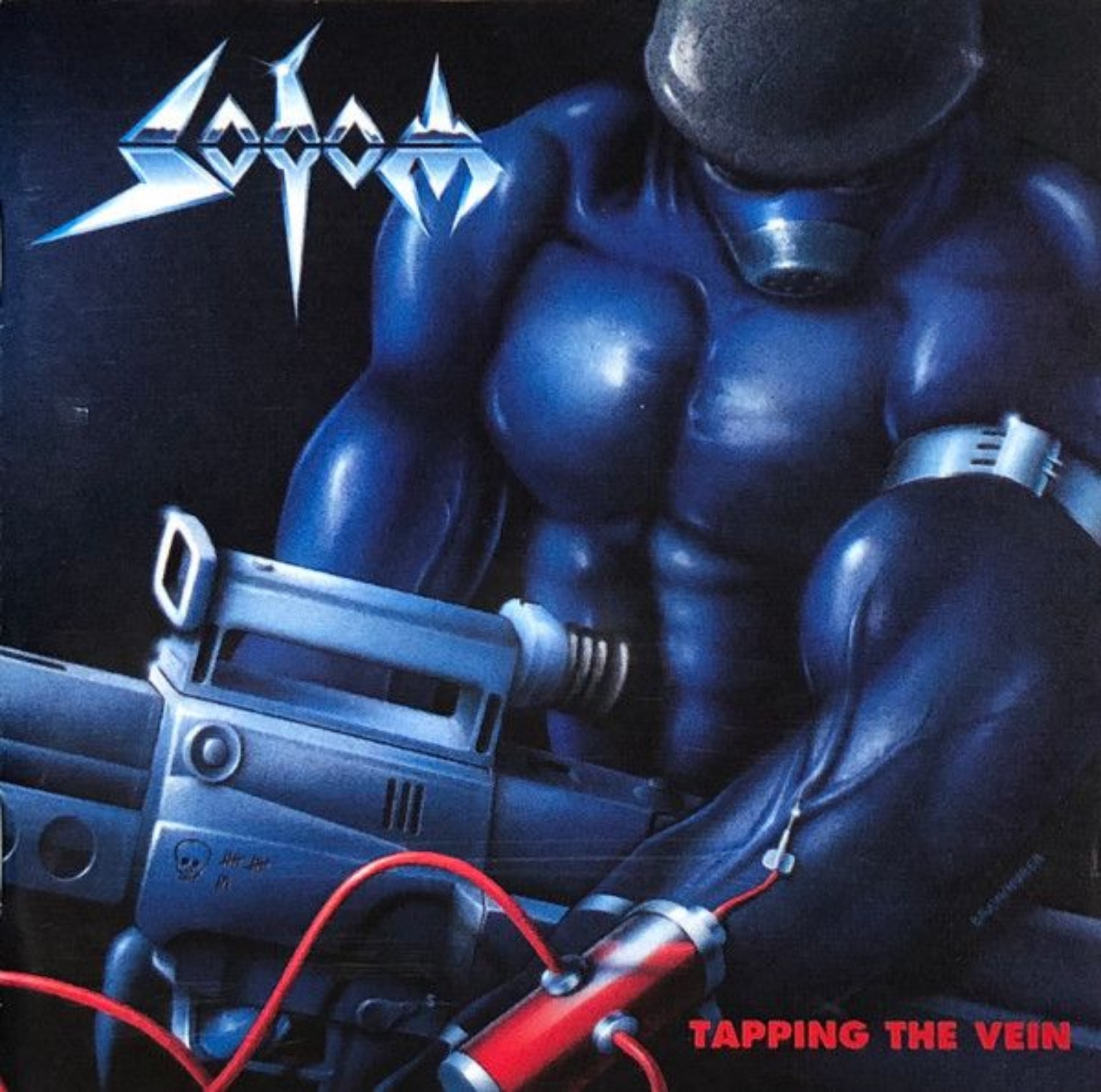
Tom, I would like to take you back once more to August 1992, when Tapping the Vein was released in Germany. How did you find out exactly when the album would reach German record shops, and how did the release itself fit into the day-to-day life of Sodom?
Did anything special happen around the release—perhaps a celebration together or a meeting with fans—or did you simply carry on with your everyday work? How did you personally experience that period: as the end of a long project that you wanted to celebrate, or as an entirely ordinary phase in the band’s life? If you remember any particular event or little story from those days, we would love to hear it.
Tom Angelripper:
Of course we were told the release date. But all of that happened in the background. As with all our records, I went and bought myself a copy at our local record shop. That’s a lifelong habit of mine. A few days after the release, we were already getting feedback about whether the record was actually selling or just sitting on the shelves like lead. Our management and label were very pleased, though, including with the pre-orders. So there was nothing standing in the way of the tour.
As far as I know, there was just one signing session, at Idiots Records in Dortmund. Apart from that, we rehearsed twice a week to put together the live set. We did celebrate every day, though—at least Chris and I did. Chris was completely fired up after the recordings and was bursting with happiness. We quickly forgot the problems and hardships we had faced during recording. Besides, by the time a record comes out, you’re already well into the mindset of writing the next album. When you think that we used to put out a new record every year, there’s no way we could manage that today, in this fast-paced world.
Question 5
Open Metal Album Library:
Tom, to finish, I would like to take you back once more to the first few months after Tapping the Vein came out in 1992, when metal fans were gradually getting to know the new songs.
Tom Angelripper:
Unfortunately, I can barely remember that now, but the reviews were positive across the board. Of course, that gave us a good opportunity to plan the upcoming tour. As before every tour, you have to invest money and time up front to make sure everything is on a solid footing. For me, though, this album was a successful debut with Andy. The response to the songs was fucking great across the board. A lot of people praised our supposed “death metal” influences, because that style was hugely popular at the time. But none of that was intentional. To us, it was a typical Sodom album, just with a heavier sound and a much more elaborate production this time around…
Greetings to everyone!
TOM