Eclipse – Two Shores of the Eclipse
The complete English literary history of Legenda’s 1998 Eclipse album, including a separate analysis of the original artwork.
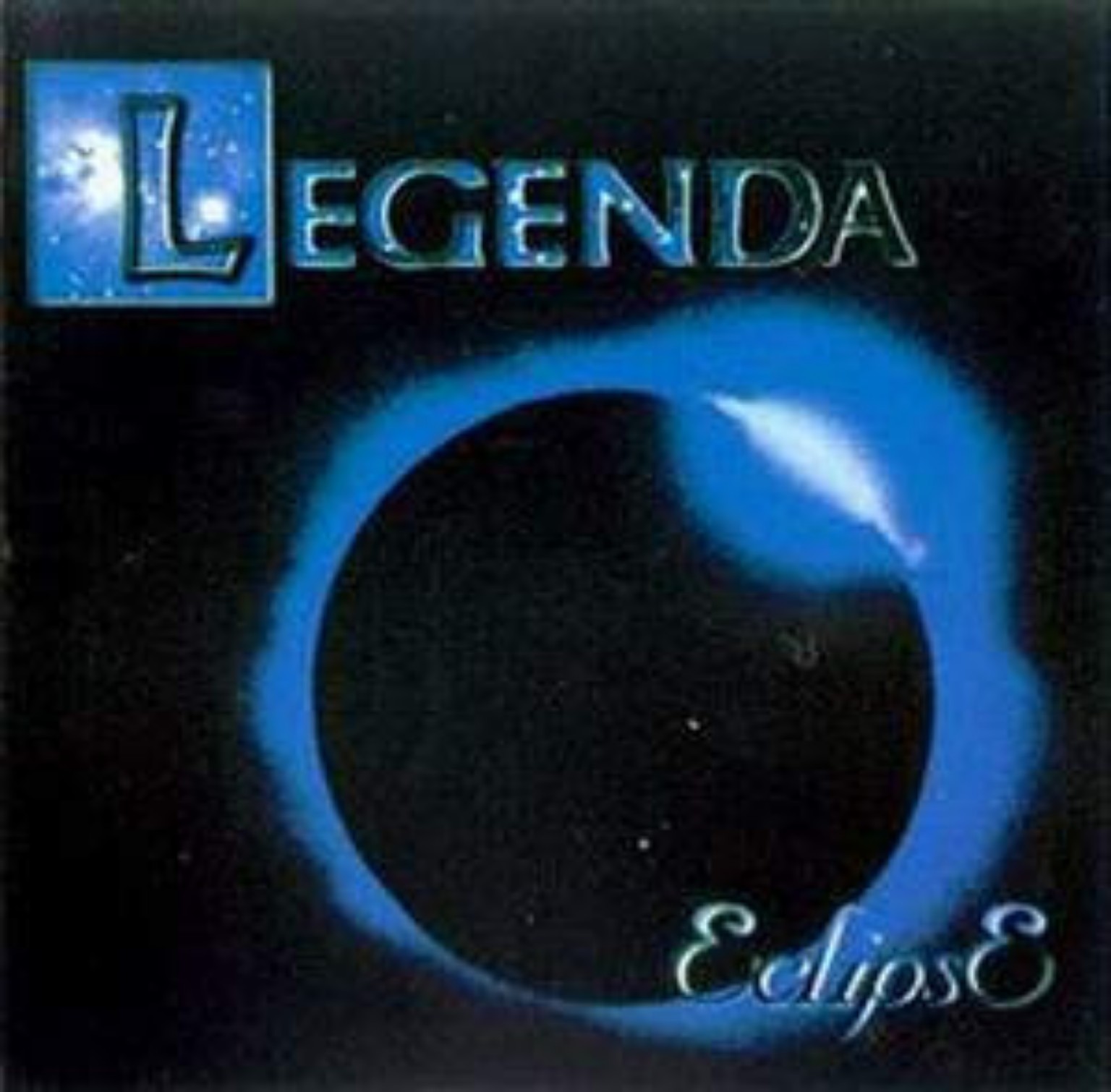
Prelude – The Blue Light
The story of a record does not necessarily begin with its first note. Sometimes it begins much earlier, in another band, in the aftermath of an interrupted recording session, or in the distance growing between people setting off in different directions. Legenda's second album, Eclipse, released in 1998, preserves just such a story. Its twelve tracks are more than the last known full-length album of a short-lived Finnish group: they stand at the boundary between two overlapping eras. On one side lies the fast, noisy, raw youth of northern extreme metal, constantly reinventing itself; on the other, a creative longing for slower, more melodic and more sombre sounds. These two worlds need not exclude each other. They may coexist within a single person, even when the other members of a band can no longer imagine both belonging to the same shared future.
An almost entirely black circle occupies the cover. It is surrounded by a bluish glow, a colour that appears both cold and alive in the printed image. The title is Eclipse: an obscuring of light. We have no authenticated statement by the musicians to establish that the image was intended to foreshadow the end of Legenda's career. Yet later generations can hardly help seeing it that way: the light is passing into shadow, and the span of an album is all that remains in which to observe what emerges along the dark rim. This is a literary reading, not a lost declaration by the people who made the record. The musicians' actual story is more down-to-earth than that, and all the more interesting for it.
The record originally reached listeners through the French label Holy Records, under the catalogue number HOLY36CD, in a six-panel digipak. The date recorded in the label's catalogue is 7 August 1998. Some secondary accounts give other dates; the label's date should therefore be understood for precisely what it is. Across twelve titles and almost fifty-one minutes, the album travels from the opening of The Night Has Drawn Nigh to its closing title track, Eclipse. Elsewhere, very different things were happening at the same time: Finland was still recovering from the economic shock of the early 1990s; Oulu was growing from a university city and industrial centre into a prominent technological hub; and Europe was searching for its place within new political and commercial frameworks. None of this automatically explains Legenda's music. But the era surrounds it, even if not one of the songwriters named these events as a source of inspiration.
Time is a peculiar adversary for bands with short careers. Two full-length records appeared scarcely a year apart, followed by decades in which the story continued chiefly through interviews, reissues, retrospective reviews and the memories of record collectors. Nor can the lives of Legenda's musicians, onstage, in studios and in other bands, be reduced to the number of releases bearing the band's name. To come closer to that blue disc, we must first begin somewhere further away.
Part One – At the River's Mouth
Oulu lies north of the route along which outsiders often trace the history of Finnish rock and metal. Yet the city that grew near the Gulf of Bothnia, at the mouth of the Oulujoki River, was not an isolated outpost in the 1990s. River and sea provided old trading connections; roads, railways and the harbour brought modern flows of traffic and commerce; and the university attracted young people, teachers and technical knowledge. The seasons' dramatic changes in light are part of the landscape, but the city was no frozen backdrop of perpetual winter. University corridors, workplaces, rock clubs, radio programmes, building sites and home-recorded demos all existed within the same geographical space.
At the beginning of 1990, Oulu had a population of around 100,350; by the beginning of 2000, the number had grown to almost 118,000. A change of this scale is more than a line in a statistical table. New homes, roads and services appeared, bringing unfamiliar faces and fresh opportunities to meet. The rise of the technology sector came alongside older industries. By the middle of the 1990s, Nokia's presence in Oulu and the technology village launched in 1982 were no longer marginal items of local news. Industry, science and communications set a new rhythm. But alongside the economic upswing lived the memory of the older industrial city and a musical network determined to develop a sound of its own, rather than simply follow the examples of Helsinki or Tampere.
In 1980s Oulu, punk, hard rock, thrash, speed metal, synthesiser-driven new wave and alternative music existed not one after the other but side by side. The city's musical history archive preserved the internal variety of its rock scene. There was no single Oulu sound to which every band was obliged to conform. One concert might take place in student accommodation; a loud club night would draw a different audience; and the hoped-for listener of a homemade cassette might already live in another country. Geographical distance both forced musicians to find their own way and made their connections more valuable.
Venues such as 45 Special, which opened in 1990, and Rauhala formed part of the city's musical infrastructure. There is no proof that Legenda played at every one of them; naming these places does not amount to a concert diary. Their importance lies rather in showing that music-making in Oulu did not spring from nothing. There was an environment in which the mention of a rehearsal room, a live performance, an older friend's band or the title of a fanzine meant something to the people who heard it. Every local community has places where musicians leading otherwise separate lives can come to know one another. The precise location of an individual meeting becomes a historical fact only when someone has preserved evidence of it.
Recorded music circulated differently too. Cassettes were cheap, could be copied and could be sent through the post. Printed fanzines arrived slowly, sometimes months after an interview or a concert, yet they could give a song the kind of life a small band needed. The early internet already existed, and online metal magazines are not a later invention projected back into the past. But in 1998 the underground was not expanding through a world of social media that opened in seconds. You had to write letters, send promotional recordings, wait for reviews and often wonder whether the envelope had even reached its destination. Later recollections by members of the Finnish band Demigod describe this sort of network. It offers an important historical parallel, but it is not Legenda's own complete address book.
Local radio stations and small record labels offered further possibilities. Radio Mega and Radio Kaiku had operated since the late 1980s, while the national station Radiomafia began in 1990. The independent label Bad Vugum developed another branch of alternative music. Legenda did not release Eclipse through Bad Vugum, and there is no evidence that the band's music was played on every radio station mentioned here. Oulu's wider musical world is nevertheless clear: many different paths led from rehearsal rooms to other people's ears. The story of a two-person metal band that would eventually release records on a French label belonged to that real environment.
Around the city stretched another map of northern Finland. Kemi, northwest of Oulu, was more than a stop along the highway: it was home to the Tico-Tico studio, associated with several important Finnish metal recordings of the period. A point on the map had become a hub in recording history. Both of Legenda's full-length albums were recorded there. There is no need to turn geographical proximity into an imagined influence: the recording credits show plainly how a local band and a regional recording studio came together.
Part Two – Two Brothers, Different Futures
Kimmo and Mika Luttinen shared a history that began long before Legenda. Interviews published later, preserving the voices of both brothers, trace the story back to a band called Mutilation: by 1989 they were already playing together in a death metal group. At that time, extreme music was still taking shape partly through the drive of thrash and the raw gestures of early extreme metal. The name Venom also appears among the historical influences. None of this proves the origin of any particular Eclipse riff. Rather, it identifies the environment in which the young musicians developed their instincts, musical vocabulary and habits of playing together.
By the end of 1990, a new band had formed under the name Impaled Nazarene. Mika was the vocalist, Kimmo the drummer, and several other musicians joined them in the original line-up. Personnel and instrumental responsibilities changed over the following years, while the band established a distinct identity within Finnish extreme metal. Tol Cormpt Norz Norz Norz appeared in 1992, followed by Ugra-Karma in 1993. Even the titles evoke a world with little inclination to accommodate middle-of-the-road tastes. For Kimmo, however, the story could not be reduced to speed and sonic extremity.
He later recalled that drums had appealed to him more than any other instrument since childhood. He acquired his own kit at eleven or twelve. That early sense of himself as a musician took on a particular significance during the Legenda years: even when he later became responsible for most of the drumming, guitars, keyboards and vocals within a single band, he still often described himself primarily as a drummer. There is no need to invent some private inner torment out of the tension between these roles. The division of instrumental labour is telling enough: keeping a band's rhythmic foundation alive is a very different task from organising the creation of every layer of an entire album.
By the time of Suomi Finland Perkele in 1994, the band's shared music had begun to reveal a search for less conventional directions. According to various accounts, Kimmo also played a major songwriting role in the more melodic, slower and more brooding material. The frequent references to Blood Is Thicker Than Water subsequently became a particular point of dispute. Even years later the brothers did not see this change in the same light. Mika's interests lay more in rawer, harder and faster music; Kimmo considered it natural to experiment with different moods and techniques. This difference does not prove that one of them was right and the other wrong. It shows that the same band represented different kinds of future to each brother.
In a retrospective published in 2017, Kimmo named Dead Can Dance, The Mission, Sisters of Mercy and film scores as important parts of his earlier musical development. Mika, drawing on his own memories, also recalled Danzig and Björk. These artists are widely separated from one another, yet together they could reveal something important: a dark mood does not have only one tempo, one instrument or one rhythmic pattern. Critics would later form their own views of Legenda's musical character, but these documented listening experiences belong to the background described by the musicians themselves. They do not justify declaring any particular Eclipse song an imitation of a specific track merely because one of these names was mentioned.
The distance between them was not only musical. After the recording of Ugra-Karma, Mika moved to Belgium. In a later conversation, Kimmo recalled how difficult it was when planned songs had to travel between musicians on cassettes through the post. The tapes preserved many things, but could not replace time spent rehearsing together. Replies arrived late, plans changed, and the band's internal rhythm no longer matched that of the person at home trying out a new melody. The musicians' recollections document this difficulty; what we cannot know is which exact parcel caused any one song to be written or abandoned.
In the spring of 1995 the band toured Europe with Absu and Sadistik Exekution, then prepared for another recording session at Tico-Tico. In later recollections, this sequence of events culminated in a serious conflict. During the studio work, a confrontation took place between Kimmo and Taneli Jarva. Inferno's account also speaks of an interrupted recording, damaged property and police involvement. Within this story, the rupture is more real and tangible than anything a symbol drawn on an album cover could convey: a plan that had once been called shared could no longer continue in the same form.
Whether Kimmo left or was dismissed is not so straightforward. In an interview of his own from around 1996, he said he had left Impaled Nazarene of his own accord. In 2004, Mika recalled that his brother had been removed from the band. Kimmo again spoke of leaving in 2000, but by 2017 his own memory had become uncertain: he was no longer sure which formulation was accurate. What remained beyond doubt was the separation of their musical and personal paths. There is no need to end the story with a single verdict. Conflicting accounts given years later by people who shared a brief but significant period can sometimes reveal more about the depth of a conflict than a confident sentence unsupported by the sources.
Part Three – A Name of Their Own
Legenda did not begin life with a finished album title. In Kimmo's own recollection, an early version of the idea dated back to 1993, when it was associated with a different name and lineup. Databases generally identify 1995 as the year the band was founded. The apparent contradiction can be resolved without forcibly changing either date: the first seed of the music and the later, independent identity of a band do not necessarily come into being on the same day. The original early name and the complete lineup from that period are unknown, however, so the missing part of the story cannot be filled with an invented scene.
For a time, the one-man project Isänmaa also played a part in Kimmo’s life after he parted ways with Impaled Nazarene. Kimmo stressed even then that he did not necessarily consider it permanently defunct: work of that kind could resume after a long break. Legenda, then, did not emerge through a mechanical replacement of the name of a lost band. The music that the former group could no longer fully accommodate needed a framework of its own.
In the spring of 1996, bassist Niko “Herr” Karppinen joined Kimmo. The lineup was unusually small, yet the creative work extended across numerous instruments and timbres. Karppinen had previously played in Maple Cross and had also been associated with the live lineup of Sentenced. That latter connection is not the same as proof that he recorded the bass parts on a Sentenced studio album. Karppinen was no mere decorative presence in Legenda: he provided the bass guitar, while most of the vocals, guitars, drums and keyboard parts became Kimmo's responsibility.
The two-member format created opportunities and limitations at the same time. The musicians did not have to reconcile five different sets of ideas into an arrangement everyone could accept. At the same time, studio work concentrated in the hands of one person demanded far more than playing a single instrument in an earlier band. In an interview from that period, Kimmo spoke with satisfaction about the division of work. Not every detail can be reconstructed, but the instrumental credits and the musicians' own accounts point in the same direction: Legenda was not formed according to the familiar model of a permanent four- or five-piece rehearsal-room band.
A five-track promotional cassette was completed in 1996. Within that musical milieu, such an object was an introduction, a personal letter and a promise all at once. Anyone receiving the recording did not hear a finished full-length album, but evidence that the new band was no longer merely an idea. Sources allow us to examine specific links between the cassette and the later album, but the complete mailing list is unknown. We cannot claim that it definitely reached every important editorial office, record label or musician. One decisive development, however, is documented: the French label Holy Records signed Legenda.
The relationship between the Finnish duo and the French label is a small but revealing example of the international underground of the 1990s. A contract did not replace daily work, time in the recording studio or the organisation of concerts, but it marked out a path from music made on their own terms to records distributed abroad. The surviving sources do not fully explain how often the label and the members spoke by telephone or fax, or how much money was set aside for the project. That is precisely why later interviews are so valuable: they speak not only about the promise of success but also about the difficulties of the relationship.
Part Four – The First Autumn
In 1997, Legenda released its first full-length album, Autumnal. One title evokes autumn, the next an eclipse; it would be tempting to turn the pairing into a complete, consciously composed double symbol. The sources do not say that the two album titles were conceived as chapters of a single, predetermined story. For listeners and readers looking back, however, they inevitably come to stand beside each other. Both belong to a visual language of passing away, growing darkness and transition. The connection offers a literary possibility, not a secret confession by the band.
Autumnal matters historically because it showed that, after the musical rupture around 1995, the idea of making a different kind of music had become more than an intention. The duo made a complete record, and that material was released abroad. In an early interview, Kimmo also mentioned that two compositions associated with Autumnal might originally have appeared on Impaled Nazarene's unfinished 1995 mini-CD. He did not identify the tracks. What he made clear, though, was that personnel and creative ideas passed between the two histories. The bands went their separate ways, but the boundary within music does not always fall in the same place as the point where a member walks out of a rehearsal room.
The name of Tico-Tico Studios appears again. Ahti Kortelainen, an important recording engineer for the region's metal productions, also worked on capturing Legenda's sound. His involvement in recording and production is documented, but a complete inventory of the equipment, the order in which the instrumental tracks were laid down and the timetable of individual sessions are not. The studio therefore cannot be presented as a secret workshop in which the band members spoke their thoughts in scenes written in advance. We know this much: the material made by the two-person lineup moved beyond the planning stage and took physical form as an album.
In contemporary reception, the differences between Autumnal and Eclipse later became a significant point of comparison. In his 1998 review of Eclipse, Pedro Azevedo wrote of faster pieces, greater variety and stronger contrasts. Several later writers emphasised the more individual character of the second album. Critics, of course, judge by their own ears and tastes; their reviews do not prove that Kimmo reshaped the follow-up specifically in response to complaints in earlier criticism. The release dates of the two records do show, however, that work on the next studio album began within a very short time.
After the first album, it may still have seemed realistic that Legenda would continue for several more years. Every important outward sign pointed in that direction: there was a regular bassist, a record label, an established studio relationship, and a second album that would also be completed. What each participant felt about their shared future at the time has not always been preserved. Neither a triumphant celebration nor a private conversation anticipating the band's breakup can simply be added to the record. The rapid succession of releases nevertheless reveals one of the most concentrated creative periods in the life of a short-lived band: a great many decisions taking their final form in very little time.
Part Five – On the Threshold of the Second Album
By 1998, Legenda’s two musicians were once again working at Tico-Tico Studios. The credits for Eclipse list Kimmo Luttinen on vocals, guitar, drums and keyboards, and Niko Karppinen on bass guitar. Sami Huotari also contributed guest vocals to “Sister Shadow Sister (Blooddance-Mix).” Ahti Kortelainen was the recording engineer and participated in production alongside Legenda. The exact order in which the instrumental tracks were recorded and the full schedule of the studio sessions are unknown, but the complexity of this multi-instrumental creative work is apparent from the credits alone.
The making of the album cannot be enclosed within a single, simple genre label. Reviewers wrote about black metal, a gothic atmosphere, doom-like heaviness, layers of keyboards and, at times, faster and more aggressive passages. These descriptions sometimes overlap and sometimes disagree. Legenda's character is revealed precisely in the fact that genre names cannot explain everything. Speed and sombre melody were not assigned to two separate records here. According to later reviews, they alternate within the same album, and the 1998 review greeted that variety with conspicuous enthusiasm.
Twelve titles appear one below another on the back of the original CD: The Night Has Drawn Nigh, Where The Devils Dance, Rev. 66, Shades And Shadows, Dead Red Roses, Melancholy, Cohorts Of Demons, Sister Shadow Sister (Blooddance-Mix), The Fall Of Crow, Springrealm, The Heart Of The North and Eclipse. Examination of the physical back cover confirmed the correct spelling “Nigh” in the first title; the erroneous “Night” in a digital filename cannot override contemporary physical evidence. The sequence is no trivial detail. Anyone listening to the album in full passes through these tracks in this order, not through a playlist arbitrarily rearranged years later.
The blue radiance on the cover is striking, yet there are few words. Packaging on older CD releases often communicated more through artwork and typography than through printed lyrics. Contemporary and later descriptions indicate that the original Eclipse came in a six-panel digipak, without a separate booklet containing all the lyrics; they mention the presence of the title track's lyrics. Without all the original panels, the interior images and every inscription cannot be reconstructed with complete certainty. Nor can we assume that lyrics attached to a song on the internet are authentic when they plainly belong to a work by another artist. The album as a physical object thus preserves a great deal, while also leaving questions open.
The label gives 7 August 1998 as the date of the album's first release. After that date, the work no longer belonged only to those who made it. It entered the world of distribution channels, promotional materials and reviews, where more people could write about a melody than had taken part in recording it. Both the back cover and the catalogues preserve the name Holy Records. The record did not remain a private cassette circulating locally: it left the Finnish studio as an object intended for international distribution. What follows is the story of those twelve titles, approached through surviving criticism and the documented running order rather than invented scenes in a recording studio.
At the Edge of the Light – An Analysis of the Eclipse Album Cover
The cover of Eclipse does not open a door onto a depicted landscape. It sets no musicians, ruins or imaginary characters before us. It strips away almost everything to which the eye would ordinarily attach a story. Against a dark, almost black surface, only a few shapes illuminated in blue and two inscriptions can be seen. At first glance it looks simple, yet it is difficult to take it all in quickly: the eye keeps returning to the black circle gaping at the centre and the blue rim that surrounds it. That repeated return is precisely what makes the image memorable. Rather than narrating an event, the cover holds a moment in suspense—the moment when the boundary between light and concealment becomes more important than anything that might lie beyond it.
The square image is strikingly economical in its construction. The name LEGENDA dominates the upper band, while a large, dark disc occupies the central and lower areas. The title, Eclipse, sits at the bottom right, close to the curved form of light. The inscriptions above and below therefore do not function as labels simply stacked one beneath the other: they stretch the composition between two anchor points. The band's name, set in relatively firm, straighter lettering, and the album title, with its softer calligraphic curves, introduce two different rhythms into the same image. The dark body placed at the centre is the great, silent form against which both rhythms are measured.
The first letter of LEGENDA stands apart inside a brighter blue square. Its tall, elongated and ornamented L is not merely the beginning of the word but a small emblem in its own right. The blue within the square is uneven: luminous patches and glint-like details break up the colour. Together, the frame and the letter suggest a badge lit by its own small source of light, as though it were guarding the first sound of the band's name. Beside it, the letters EGENDA stretch more broadly towards the right. Their outlines and inner glow shift from pale blue to faint, almost white tones, while the background around them absorbs nearly all the light. The inscription is not a foreign object placed on top of a dark field; it is made of the same cold, bluish radiance as the rim of the central circle.
The image's true mass is not light but darkness. The inner part of the disc is deep black, and the shape seems slightly elongated, its weight bearing down towards the lower half of the picture. Its edge is not equally sharp all the way around: at some points the band of light hugs it closely, while elsewhere it spreads into a wider, mist-like halo. This gives the form a quality of being both definite and uncertain. It has a centre and an outline, yet it is hard to decide exactly where the dark body ends and the surrounding blackness begins. The darkness inside and outside are akin to one another. Only the blue ring wedged between them makes the difference visible. It is as though we were looking not at the object itself but at the consequence of its concealment.
The luminous rim is not a regular line resembling a technical diagram. It runs more narrowly down the left side; across the top and upper right it becomes much more saturated and cloudlike. Blue appears in several shades, from a deep blue that almost merges with black, through an intense, flashing azure, to whitish highlights. This single family of colours governs the whole composition. There is no warm red, sunset yellow or earth tone beside it to soften its coldness. The viewer therefore thinks less of the familiar daylight of the natural world than of some distant, alien radiance that seems to exist on its own. The blue may suggest both the cold of ice and the pulse of electricity; these, however, are impressions evoked by the image, not proven symbols intended by its creator.
In the upper-right quarter, close to the inner side of the ring, a narrow, curved patch glows white. It is not a precise, pointed crescent, nor a celestial body rendered in detail: it looks more like a radiant brushstroke, slanting across the surface with softer edges. The blue around it is stronger, making this white patch the brightest point in the composition. From here the eye readily travels along the blue rim on the right, then around the lower arc of the dark disc towards the title. The small size of this peak of light matters particularly. If the entire circle shone with equal intensity, the image would be calmer, more like an ornament. Instead, the light intensifies in just one place and immediately raises a question: why does the radiance break through most strongly there?
Near the lower-right edge of the image, the title Eclipse is written in delicate, flowing, decorative lettering. Their pale blue-white colour and supple outlines seem to continue the visible ring of light. The lettering partly answers the rounded curve of the large shape, though it does not follow it slavishly. The flourishes at the beginning and end of the word suggest a livelier, more handwritten gesture than the band's name above. The contrast between the two styles of lettering repeats the tension felt across the cover: strict geometry meets blurred light, silent blackness meets lines that seem to move. The title is relatively small beside the disc. It does not seek to dominate the image; it names what the eye has already instinctively begun trying to understand.
The word “eclipse” offers an obvious frame for interpretation, but the image is not an astronomical teaching diagram. It shows no measurable orbits, constellations, surface details or clues of perspective that would allow any particular celestial body to be identified with certainty. Even so, the nearly complete dark circle, the radiance breaking through at its edge and the title together evoke the sight of an obstruction. That reading is supported by the relationship between the depicted form and its inscription. The disc might equally be a visionary planet, a disc-shaped shadow or an abstract phenomenon of light; part of the artwork's strength lies in its refusal to resolve that ambiguity completely.
The handling of space is unusually spare as well. There is no horizon, no figure standing in the foreground or road running into the distance, and no built environment against which the disc's size could be measured. The eye must construct a sense of space from a single large visual body and the emptiness surrounding it. The transitions between shadow and light produce a slight impression of depth, as though the dark shape were floating before us. At the same time, the background remains almost flat. For this reason, the cover does not draw us towards a depicted place; it works more like an inner vision. The longer we look, the more it creates a world of its own, without any fixed scale.
The surviving front-cover image also shows fine grain and occasional mottled changes of tone, especially in the transitions between black and blue. Rather than being built from completely sterile, perfectly smooth fields of colour, the surface has a slightly rougher quality reminiscent of a printed picture. The available reproduction, however, cannot tell us how much of that grain belongs to the original artwork and how much came from printing, scanning or later copies of the image. The combination of bright edges and blurred halos suggests layers of graphic treatment, but it does not establish any particular method of painting, photography or digital production as a fact.
The proportions of the image also invite reflection. The central black disc is almost too large to function as a mere emblem, yet it does not fill the square entirely. The dark strips left at the edges frame it, allowing the light to flare while preventing the mass from becoming completely enclosed. A circle can suggest completeness, repetition or return, but here the dark interior reverses that familiar meaning: the entire form is before our eyes, yet its contents remain concealed. It is not a luminous body that occupies the centre, but an absence whose existence is outlined by a border of light. One of the cover's most intriguing paradoxes is that absence becomes its largest visible shape.
None of the familiar, readily recognisable accessories of the genre appear here: no skulls, cemetery crosses, blood, battle scenes or demonic figures. Their absence is not, in itself, a declaration about musical genre, but it decisively shapes the first impression. Darkness does not threaten us through a character or an action. It is quiet, cold and motionless, while the blue light around it seems poised to move. Instead of presenting fear in spectacular form, the image invites us to contemplate the unknown. The eye does not flee the disc; it keeps searching for what else might be seen within it. There is an unusual dignity in that restraint. The cover does not attempt to say everything about the album, as though the tension between utter darkness and a little light were enough in itself.
This approach enters into a fruitful dialogue with Legenda's music. Across the twelve tracks of Eclipse, shorter, harder-edged passages alternate with longer, more sombre compositions that employ a keyboard-driven atmosphere. The image likewise holds firmly defined form beside a dissolving rim, compact darkness beside radiance gradually unfolding. The parallel does not imply that a particular patch of blue represents a specific guitar part, or that the dark circle stands for the lyrics of a particular song. Such correspondences would require a verifiable explanation from the creators. The affinity between the visual and musical experiences lies rather in their structure: both make it clear that harshness and a floating, finely shaded atmosphere need not cancel one another out.
The cover's cold blues come particularly close to the mood evoked by contemporary and later descriptions of the longer, more melancholy passages. The darkness of the music need not be reduced to a single theme or emotion, just as the circle does not carry only one meaning. The faster, rawer passages, meanwhile, can be associated in thought with the sharper, flashing sections of the rim. That association is the listener's own, not a secret musical score encoded in the artwork. What can be said with confidence is that the album's title, its stylistic diversity and the cover's spare world of light and shadow create a unity in which the image does not illustrate the music from beginning to end. Instead, it prepares the listener's attention for what is to come.
There is something beautiful, too, in the way the cover keeps the band's name at the top and the album title at the bottom, with silent blackness between them. The eye has to cross that distance. Above is a name: the story of people and a band's past. Below is a title: the name of a fleeting celestial phenomenon. Between them lies the great shadowed form—not a narrated event, but a boundary we can perceive. In this way the image establishes its own time of anticipation even before the first track begins. It works not by filling the scene with visible objects, but by compelling the viewer to look for longer. An eclipse need not signify only the loss of something; it can also name that rare occasion when the edge of light becomes visible precisely because something stands in its way.
The surviving front cover does not disclose the designer's exact intention, the full process of its creation or any personal story that might lie behind the shape of light. A confidently invented legend cannot take the place of that missing knowledge. Yet the visible image is complete in itself: a blue emblem and the band's name above, an almost black disc at the centre, an uneven halo of cold light, one white flare and Eclipse written in the lower corner. The relationship among these few elements gives the cover its force. By the time the record begins, the listener already knows that relationship. Darkness here has an outline, and light has a boundary. The music need not act out the picture; it need only open up the space left between the black disc and the blue glow.
Part Six – Twelve Doors, First Half
Sometimes the first three minutes of an album accomplish more than a lengthy statement from a band: they immediately reveal where the musicians want to direct the listener's attention. In this respect, the two-and-a-half-minute opening of Eclipse, The Night Has Drawn Nigh, is especially revealing. Years later, Lane interpreted the short, aggressive introduction in light of the old Impaled Nazarene, while Childeric Thor felt that its straightforward black-metal character made it less representative of Legenda at their most distinctive. There is no need to choose between these opinions. The same brief song can point back towards its creator's earlier instrumental language and, at the same time, stand in sharp contrast to what the slower and more atmospheric tracks later offer.
Even the correct spelling of the title presents a small test of historical accuracy. The contemporary back cover says Nigh, not Night. A single letter separates them, but an original physical artefact and a digital file renamed years later are not witnesses of equal weight. In this narrative, the song opens the door not because the musicians can be shown to have intended that symbolic role, but because the original running order really does begin with it. After the brief opening, Where The Devils Dance follows, lasting more than five minutes, and time suddenly expands.
Writing about the second song, the French review of 2015 emphasised the layered keyboards and the work done to create its dark atmosphere. Where the first track is defined by compression, the second allows different textures considerably more room. This reveals a quality that returns repeatedly in the critical discussion: the band creates weight through more than tempo alone. Layers of arrangement, sombre melodies and the harsher language of the guitars stand alongside one another. The vocabulary of 1990s gothic and doom metal readily gathers around this sound, yet no record deal or retrospective genre definition can be substituted for the composition itself. The surviving material does not reliably preserve the song's complete original lyrics, so the demonic suggestion of its title remains just that: a title, not a story whose details can be reconstructed.
Rev. 66 is another short piece, but it is remarkable for a tangible connection reaching beyond Legenda's musical career. In 2000, Kimmo said he had directed a video for it. In his own recollection, it was a work of black humour, and he also linked it to events devoted to music videos in Oulu. The song thus found expression in another medium, one that at the time could circulate on physical formats and through screenings, club nights and festival programmes. Oulu's music-video festival began in 1994; the existence of the event is established, but neither a complete surviving copy of this particular video nor every screening date has been verified. The distance between these two kinds of evidence cannot be erased by an elegantly worded sentence.
Rev. 66 also exposes another limit of reliability. A set of collected materials included lyrics that plainly did not belong to the song: the words to the Beatles' Let It Be appeared beneath its title. That mistake must not colour either the meaning of the track or this account of it. Without the genuine complete lyrics, we cannot say what the number 66 meant within the composer's own thinking. The musician's statement about the video is sufficient in itself to show that the short song also had an artistic life beyond its audio recording.
Next comes Shades And Shadows, lasting almost three minutes. The later French review also considered it in terms of its keyboard-led, more symphonic sound. The title brings shades and shadows together, and it would be easy to treat it as the opening words of a fully developed symbolic narrative. The available sources, however, do not tell us the story of the original lyrics. Here, once again, the literary image and the statement of musical history have different grounds for being made. After the rapid opening, the album's sequence allows ever more timbres to emerge; it is partly for this reason that critics find it difficult to assign the record a single label. That is enough to let us trace the movement between the tracks without putting imaginary lines into the musicians' mouths.
This composition, shorter than three minutes, has another characteristic that a list of titles alone cannot disclose. For most of its duration the sound fills the space available to it, but in approximately the final twenty seconds it does not simply vanish in one abrupt gesture. From around two minutes and thirty-five seconds, the mass of sound gradually recedes, until its presence carries less weight than before. Alongside the two kinds of shadow suggested by the title, the recorded music itself therefore contains a movement of fading away. That does not prove the existence of a preconceived symbolic programme. It matters to the listening experience, however, that the longer song which follows is preceded not by a sharp blow but by a slowly released ending.
The fifth stop is Dead Red Roses. Looking back across many years, Childeric Thor singled out the five-and-a-half-minute piece as one of the album's darkest and most beautiful moments. Its title presents an especially forceful image: a red rose from which life has already gone. The form Dead Read Roses, appearing in a later promotional text, is a typographical error, not the name of a second composition. The original title is clear enough on its own, but it does not automatically lend authenticity to any stories we might imagine behind it. We do not know all the words or whether they refer to a particular person, event or place. The emotional weight documented by the review nevertheless makes the song one of the record's strongest points.
Dead Red Roses seems to allow its own sound to approach from a distance. For approximately the first thirty-five seconds, the recording is considerably more restrained, with less weight in the lower frequencies than in the full passages that follow. Between thirty-five and forty-five seconds, a much heavier soundscape takes its place. The arrival feels decisive precisely because it is preceded by enough time spent with less: the piece does not begin with the density it will eventually carry. At around three minutes and twenty-five seconds, the lower frequencies briefly become especially prominent again, before the recording's tonal range opens out. Its ending offers another counterpoint. During the final half-minute, the sound gradually fades; this long, unhurried conclusion does more than increase the running time. After the restraint of the beginning, the ending too makes space for the journey towards silence. This cannot reveal the story behind the roses, but the temporal form of the sound can genuinely be followed.
The sixth track bears a single-word title: Melancholy. In a statement from around 1996, Kimmo Luttinen had already spoken about the way occasionally melancholic melodies do not always arise from a conscious decision, but take shape in the act of composition. It is tempting to see in this later title the preservation of a specific, identifiable creative moment. There is no evidence for that. Yet the musician's general description from the period and the praise a critic gave this particular track in 2015 do meet at a point. One speaks about an approach to music; the other, about the atmospheric result. The first half of the record ends with this longer, sombre song, though we cannot know whether the musicians deliberately conceived it as a halfway boundary. The original sequence nonetheless permits an arc in which, after the short, attacking opening, progressively more room is given to different forms of melancholy.
Taken together, these six titles still do not provide a complete narrative drawn from the lyrics. The old CD did not preserve every song's full text alongside the music, and the copies circulating online demonstrably include at least one false entry. An honest account therefore tells the story of the six works' contrasting characters, durations and reception, together with the band's verified history. The dark flower, the dance of devils, the sister's shadow and the northern heart all belong to this same album, but they do not entitle us to ascribe unrelated invented myths to the band. This distinction takes nothing away from the imaginative power of the music. On the contrary, it leaves room for the listener's own images while protecting the documented history from false assertions.
Part Seven – Twelve Doors, Second Half
The second half of the record opens with Cohorts Of Demons. In two minutes and forty-eight seconds, the album brings its harder side to the foreground once again, at least as later critics described it. The French writer of 2015 found memorable musical ideas even in this faster number, while a review from 2023 connected it to the more aggressive side of Eclipse. It would be easy to turn the “cohorts of demons” into a detailed battle scene, but that would be a separate story, not an account of the band's own words. The martial force of the title and the reviewers' observations about tempo are enough to show that the melancholy developed earlier is not simply followed by more of the same atmosphere.
The longest track on Eclipse, Sister Shadow Sister (Blooddance-Mix), lasts more than six minutes. At this point in the record's history, a third voice can be named: Sami Huotari contributed guest vocals to the recording. In the album's documented credits, this is the sole specifically identifiable guest appearance alongside Legenda's two permanent musicians. Pedro Azevedo's review in 1998 paid particular attention to the cleaner singing, although he found the song itself perhaps a little too long. Many years later, Childeric Thor regarded this same recording as one of the most memorable arrangements on the album. The two critics encountered the same voice, but attached different importance to it.
The longest composition does not reveal its full sonic extent at once. The first few seconds are distinctly restrained, after which the recording reaches the density of its principal section almost in stages: by about ten seconds a change is already perceptible, and around twenty seconds the sound has become appreciably fuller. Nor do the minutes that follow unfold as a single surface of unchanging tone. By the middle of the first minute, for example, higher-frequency components become much more prominent, before the emphasis shifts back to a sound more heavily saturated in the lower range. The very end again brings a quieter conclusion. Length here means more than extra time for a guest vocalist: the opening, the changing sonic spaces and the decay create distinct passages in time. This signal analysis does not reliably establish which instrument or vocal line is responsible for each transition, and therefore makes no such claim.
The designation “Blooddance-Mix” forms part of the contemporary song title. On its own, it does not prove that a separately released, independent original mix existed elsewhere. It is worth drawing a boundary between a word and material evidence. The title suggests something, but a release for which no trace exists cannot be entered into the discography. Nor do the available documents preserve the exact date on which the guest vocals were recorded. What is documented is that, at this point on the album, a musical world built largely around Kimmo's voice gained another vocal character. Perhaps this helps explain the contrast between the two reviews: one listener was troubled by the duration, while the other was attracted by the widening of the familiar lineup's palette of voices.
The Fall Of Crow then occupies almost four minutes. The later Music Waves review also placed it among the examples of the more symphonic, keyboard-coloured sound. In several places its title appeared as The Fall Of Crown, but Crow, as printed on the original back cover, is authoritative. Once again, this is a small but significant distinction: the fall of a bird and the fall of a crown are not the same image. A misreading can readily acquire a meaning all its own if we do not return to the contemporary printed title. In the record's original sequence, the song follows the guest-vocal track and marks another shift in character on an album which the critics themselves recognised as unusually varied.
The Fall Of Crow opens with a brief build-up that its title cannot explain for us. The sound is more restrained during the first ten to fifteen seconds, becoming fuller around twenty to thirty seconds. This is not followed by an uninterrupted rise throughout the composition: there are places where the balance of frequencies shifts again. A brighter, higher-register timbre is particularly noticeable around the third minute, before the ending draws the sound back towards a heavier centre. The final seconds bring a drop in intensity. The movement traces the internal passage of time within a four-minute piece without any need to invent a false story from the apparently harmless error Crown.
Springrealm affected later commentators in different ways. In 2023, Lane heard a lighter atmosphere than in several of the record's more threatening pieces; in 2015, by contrast, Childeric Thor placed it among the weaker moments of the closing third. These judgements need not contradict one another: one stresses the colour of an atmospheric change, the other its value within the album as a whole. The title evokes a realm of spring, which may seem surprising on a record like this. Without the lyrics, however, we cannot decide whether rebirth, the cycle of nature or something entirely different stood behind it. The listener may find several meanings, but a historian must preserve the difference between speculation and a statement of the creator's intention.
The opening twenty seconds of Springrealm form one of the most striking sonic thresholds in the record's second half. The introduction is extremely quiet compared with what follows, and the higher-frequency elements have a greater relative presence. Around the twentieth second, however, the sound suddenly fills the space; over the next few seconds the song settles into a far more powerful body of sound. The contrast is not simply a matter of one composition being faster and another slower. Within a single song, the listener's position changes: at first it is as if we perceive only the edge of what is about to sound, and then we find ourselves inside it. Later reviewers judged the piece differently, but this abrupt, high-amplitude change at the beginning is an observable feature of the recording's construction, not something dependent on posterity's assessment.
The penultimate position belongs to The Heart Of The North. After Oulu and Kemi, “the heart of the North” sounds almost too obvious an expression. The cities' geographical reality meets the vocabulary of the title, but no causal link has been proved. We do not know what landscape, memory or independent fictional world Kimmo associated with this song. The later French critic did not consider it one of the album's strongest passages. Yet the title demands attention because it stands immediately before the closing track: it is as though the naming of a northern place were suddenly followed by a vision of the entire sky. This is a literary reading suggested by the album's order, not a concept authenticated by the band.
The sonic space of The Heart Of The North cannot be identified with a single colour sustained throughout. Around the half-minute mark, a brief passage rich in higher-frequency components comes to the foreground. Later, from approximately three minutes and twenty-five seconds for several tens of seconds, the balance shifts in the opposite direction: the lower register acquires particular weight while the higher components recede. Around four minutes and five seconds, the proportions change again. If listeners associate the North in the title with a memory of the Finnish landscape, that remains their interpretation. Independently of it, the music has its own internal movement of light and shadow, describable in measured time. The three passages cannot reliably be labelled a chorus, solo or entry by a particular instrument: such an identification would require a different kind of listening-based examination.
The twelfth track is Eclipse. The title composition lasts five minutes and twenty-seven seconds. A 2023 analysis described it as a meeting of faster drumming and grand keyboard textures, and compared some of its devices to early Rotting Christ recordings. The review from 2015 mentioned it among the album's most atmospheric moments. Read together, these judgements return us to the major contrast running through the entire record: a fast, extreme-metal tradition on one side, and a dark, more solemn atmosphere on the other. After the brief attack of the opening track, the ending takes a more expansive form. The album's title and final song share a word, but this is not in itself proof that the two musicians had conceived a fully worked-out narrative concept album in advance.
The last song does not begin in the manner of the record's short, attacking opener. During the first ten seconds of Eclipse, the sound carries less energy than the sections to follow; by around the fifteenth second it assumes a substantially fuller, heavier form. As this several-minute movement approaches its end, another important change occurs. Around four minutes and forty seconds, the recording takes on an especially weighty sound centred on lower frequencies; from the five-minute mark, however, a gradual, prolonged fade extends all the way to its final second. The title track thus provides closure through more than its position in the sequence: the music itself ends by slowly fading away. Readers may associate this with the image of an eclipse, but they cannot turn that association retrospectively into a proven authorial intention. The title chosen by the artists, the recorded musical ending and its later literary significance are three different kinds of statement.
According to the surviving description, the six-panel digipak from the period printed the complete lyrics of just one song: the title track. It is not possible to reconstruct the full, undamaged text of every panel from the images currently available. That single focus on lyrics already indicates how much the arrangement of a physical release can mean, but it does not license the invention of a complete text supposedly available for quotation. Listening to the record and writing about it remain two different operations: the latter uses surviving documents to describe how the tracks were placed together and what aspects of the album later critics perceived.
Behind the twelve doors do not stand twelve musicians' confessions that can be reconstructed with certainty. There are actual titles, durations, credits and release information; there was a real video, an identifiable guest vocalist and several independent critical opinions. There are silences too. With all its fragmentary documentation, Legenda's record remains a complete work. It is the story written about it that must accept that not every secret in the music can be translated into confident sentences in a single book. Even in the history of a dark record, uncertainty precisely stated is among the clearest forms of light.
Part Eight – Beyond the Record
In 1998, a physical album was more than a collection of sounds. The feel of cardboard, the blue of the printed sleeve, the artwork repeated on the CD and the track titles lined up on the back all shaped the object a listener encountered when holding the record. In the case of Eclipse, the six-panel digipak is particularly important. Instead of a single ordinary jewel case, it offered a fold-out sequence of images and text, whose complete reconstruction today would require accurate, high-resolution documentation of every panel. The surviving images and details of the original CD are valuable, but they do not automatically amount to the complete original packaging.
The cover places the band's name in luminous blue lettering above the dark circle. Looking at the physical image, one is struck by how little the object says.
It needs no elaborately explained mythology to remain memorable. The word “eclipse” contains movement: something obscures something else, which may become visible again as time passes. Yet the album remains even after the band no longer plays together. For later generations, its visual motif may therefore take on a peculiar durability, although we lack a complete firsthand account of the artists' original graphic intentions.
Alongside the tracks, the studio credits offer concise but essential information. Kimmo “Sir” Luttinen was responsible for much of the drumming, guitars, keyboards and singing; Niko “Herr” Karppinen played bass; Sami Huotari sang on Sister Shadow Sister. Tico-Tico Studios in Kemi is associated with the recording through the engineering and production work of Ahti Kortelainen. The exact technical path to the master recording, the date on which every track was laid down and the possible history of later remasters are not fully known, however. Credits record the division of labour; they are not a novel about daily life in the studio.
The geographical distance between the French label and the Finnish musicians was one of the realities of producing the CD. A small underground venture does not operate in the same way as a larger international distribution network. In 2017, the head of Holy Records recalled that Legenda was among the foreign bands signed to the label whose members he had never met in person. This does not imply that they did not work together. On the contrary, it shows how a record-label relationship could be built across considerable distance. Paper, telephone calls, faxes and recordings travelling through the post were all part of the music business of the time, a world difficult to imagine from today's habit of exchanging direct digital messages.
The work did not stay within one country. Through the Holy Records catalogue, distributors and the metal press, it travelled into communities speaking other languages. The release made it possible for a reviewer associated with Portugal, a French listener or, years later, a German critic to encounter it from their own perspective. We do not possess adequate primary documentation for the number of buyers or complete contemporary sales figures, so the actual history cannot be replaced by an invented chart success or sales record. One conclusion does follow securely from the existence of the pressed disc: Legenda's music left the narrower circle of musical acquaintances in Oulu and entered the international metal trade of the late 1990s.
Eclipse also appeared in another, separate context that same year: Dead Red Roses appeared on one of Hard N’ Heavy’s covermount releases from 1998. That appearance is neither an album review nor an independent interview with the band, but a surviving trace of the period's physical promotional practices. It shows one route by which a track from an album could reach a magazine reader. Distinguishing earlier and later editions is just as important. Following the original French CD of 1998, Russia's Irond Records issued a licensed CD edition in 2003, under catalogue number IROND CD 03-584. The separate release is documented, but remastering has not been established. The album also appeared on digital services; its exact first online release date cannot be inferred from the original year 1998 displayed on their interfaces.
Part Nine – The Time of Reviews
On 19 November 1998, Pedro Azevedo's review of Eclipse appeared on Chronicles of Chaos. Its tone was exceptionally favourable: he awarded the record nine out of ten. Compared with the debut, he heard a more varied album with a stronger identity; faster and more sombre passages coexisted, while the keyboards and shades of doom created a distinctive world. Such a positive assessment does not make every detail in it a universal truth. It is one writer's judgement, formed while listening at a particular moment. Yet it is an exceptionally important witness: it stands only a few months from the release, rather than at the distance of several decades of recollection.
Music journalism was moving at several different speeds in that year. A printed magazine reached its readers through a longer process of production and distribution; an early webzine could publish its work more quickly. But there was still no means of making every recording instantly accessible from anywhere in the world. A contemporary review is therefore a particular kind of imprint of an early encounter with a work. To someone writing about Eclipse in 1998, the album was not the closing chapter of a historical catalogue consisting of two records. That writer could not necessarily have known that there would be no third Legenda full-length. In the contemporary reception of the music, the horizons of possibility and expectation differed from those of today's retrospective view.
Over the following years, Legenda's name increasingly survived on database entries, discographies and in accounts of the musicians' other projects. Then, after a long interval, the album once again received critical attention in its own right. On 6 April 2013, Jan Müller gave it eight out of ten at Metal1.info. He singled out the distinctive sound of the two-member line-up, the dark melodies and the melancholy arrangements. His writing offers the perspective of a later listener, no longer concerned with the immediate future of a newly released album, but with the force the work retained after many years.
In May 2015, Childeric Thor chose a different emphasis. Writing for the French site Music Waves, he awarded the record three out of five. He particularly admired its most sombre, keyboard-rich passages, but found the final third of its overall structure less convincing. The two scores cannot simply be set against each other as though they belonged to one objective scale: the writers are expressing taste, attention and interpretation. Their difference shows precisely that Eclipse is not a uniform musical object. A quality one critic hears as a strength can strike another as a problem of proportion.
At the end of 2023, Lane rated the album seven and a half out of ten on Archaic Metallurgy. The contrast between black-metal aggression and a more gothic, darker atmosphere came to the fore, along with the distinct roles of the keyboards and guest vocalist. Copies of the review republished elsewhere are the same text, not further independent critical judgements. Writing a quarter of a century after the release, the reviewer was looking back from a point at which the band's career had ended, or at least come to a standstill, and its two earlier albums had taken on a definite historical shape.
Four moments in the album’s critical reception reveal different worlds. The first belongs to the time of the release; the three later ones to the record's survival. Behind the scores lie different paths of listening. All four writers emphasised something about the album's contrasts, yet none of their opinions can explain the rift between the band members, the terms of the Holy Records contract or the reasons a third album never materialised. The critics bear witness to the music. For the musicians' own story, we must listen to them where they actually spoke.
Part Ten – The Camera and the Stage
It is easy to claim too much about a band's life on the evidence of its studio albums alone. In Legenda's case, the twelve recordings on Eclipse and the preceding Autumnal provide the strongest surviving evidence of its musical output, but the band was not confined to the interior world of a studio and an album sleeve. Other sources mention moving images and live performances. The distinction matters: in the studio, a musician can choose when and how to record another track, whereas a stage performance demands a different sort of collaboration and the presence of other people. These surviving fragments therefore open a part of the story that the album cover cannot tell on its own.
In May 2000, Kimmo Luttinen spoke about the video for Rev. 66. He did not describe it as an unfamiliar promotional film commissioned from somebody else: he spoke of it as his own directing work and associated it with black humour. Moving images connected to the music were an intriguing choice for a two-member outfit, carrying the possibility of a visual statement independent of the sound recording. Yet we cannot describe specific frames when no complete, verified copy of the clip has been shown to be accessible. The title and the musician’s account are known, but the full contents of the film are not. That gap in the story must not be covered with scenes assembled out of imagination.
The history of Oulu's music-video festival, meanwhile, can be independently verified. In the 1990s the event offered a means for videos by bands outside the major institutions of popular music to find a local audience. In his own recollection, Kimmo connected Rev. 66 with screenings there. The available programme records, however, do not allow us to assign it a certain screening date, venue or year. Two pieces of evidence fit together closely enough for the connection to be credible, but not closely enough to resolve every detail. This is one of the clearest examples of how Legenda's history can be told accurately without losing its narrative life.
A later musician's testimony opens another door, this time towards the stage. Petteri Lammassaari, who later became known through the band Bloodride, said in 2023 that Kimmo had invited him to play drums for a Legenda performance at Tavastia in Helsinki. It was at this concert that he met Niko Karppinen. For Lammassaari, the memory became the beginning of a later collaboration; for Legenda's history, it is important evidence that the two-person instrumental structure of the studio recordings did not necessarily reflect the full line-up at live appearances. The invitation, the venue and the meeting are known from the musician's own words; a complete setlist and an exact concert date would require further documentation.
The distance between Helsinki and Oulu is not merely an inconvenience but a geographical fact. Tavastia is one of the established institutions of Finnish rock culture, and even this one attested performance connection to the venue is a significant link between regional and national musical life. The story becomes false if we turn it automatically into a full European tour, a regular series of club appearances or a list of concerts with precise dates. The recollection available to us supports one important encounter. Anyone who understands its significance need not imagine fifty more.
During the 2000s, the video and the concert increasingly survived as separate traces: sentences in interviews, musicians' later recollections and occasional database entries. The physical evidence of the records can still be held in one's hands, while a moving image or the atmosphere of a single evening is more easily lost. Legenda is therefore a band documented both well and poorly. Well, because its album titles, label, core line-up and important statements survive in numerous places. Poorly, because the full story of its live appearances and video is not covered by equally strong physical sources. The gaps do not make the performance any less real, but they limit what can responsibly be said about it.
Rev. 66 and Tavastia are two separate, complementary memories. The first shows a musician working in visual expression beyond the sound recording; the second shows that the recorded music sometimes entered the setting of a live performance. Neither is another full-length album. Neither proves that a large or lengthy tour took place around Eclipse. Yet together they prevent Legenda's history from being reduced to a motionless catalogue of two CDs and a handful of opinions.
Part Eleven – The Different Names of Silence
No third Legenda full-length album appeared after Eclipse. That simple fact could be explained in many ways, but not every explanation has primary evidence behind it. The musicians' other bands, the end of the label relationship, Karppinen's departure, new creative opportunities and personal exhaustion are all circumstances that can easily be placed side by side and tied off with the word “therefore”. The sources preserve a more complicated picture. We do not know the exact date of the band's final dissolution, and in 2000 Kimmo himself did not speak of Legenda as a project irreversibly closed, with no possibility of a future.
Another important connection emerged around 1997–1998. Taneli Jarva, with whom Kimmo had come into conflict during their earlier Impaled Nazarene years, was working on the formation of The Black League. In a later recollection, Kimmo thought Jarva might have contacted him in the spring of 1997. He was not entirely certain of the date. By the time The Black League released Ichor in 2000, Kimmo was playing drums on the album, and he took part in further work as well. The new band was not Legenda under a different name, nor did joining it necessarily amount to a rejection of Eclipse. In his own account, Kimmo emphasised how different the duties of an instrumentalist in a band were from having to hold together many songs, instrumental layers and vocal parts largely by himself.
The renewed collaboration after an earlier conflict is a revealing turn in the musicians’ relationship. It needs no invented conversation of reconciliation. The fact that Jarva and Kimmo found themselves working together musically again is enough to reveal the more complicated nature of relationships between musicians. A clash in a studio, a decision that brought one shared band to an end, and another collaboration a few years later are not necessarily mutually exclusive events. Human relationships can change over time. But we could write about who forgave whom, at exactly what moment, or what either man thought privately only on the basis of their own statements.
The relationship with Holy Records was not a straightforward success story either. The two-album agreement came to an end after Eclipse. Looking back in 2000, Kimmo expressed dissatisfaction with the label's work: he mentioned promotional T-shirts arriving late, faltering organisation and slow communication. At the same time, he acknowledged his own difficult temperament. This statement records the musician's actual opinion at the time; it is neither a complete legal analysis of the contract nor a final verdict on everything the label did. A personal experience of poor communication and a formal allegation of breach of contract are two different things. The sources do not substantiate the latter with detailed financial records.
In 2017, Philippe, the head of Holy Records, discussed the workings of independent record labels in that period in a lengthy interview. He specifically named Legenda among the foreign bands whose members he had never met in person. At first sight, the remark might seem sharply at odds with Kimmo's earlier complaints, but the two statements do not actually address the same question. One concerns the quality of the work and frustration caused by communication; the other establishes the absence of a face-to-face meeting. It is possible that the conditions of long-distance cooperation led to many misunderstandings, but reconstructing particular incidents would require correspondence, the contract and promotional accounts. These are not fully available.
Niko Karppinen's departure likewise belongs to the end of the 1990s. In May 2000, Kimmo recalled that his former bandmate had left Legenda approximately two years earlier. This is an estimate, not a dated record of his departure. What matters is that Karppinen still belonged to the actual studio line-up for Eclipse in 1998, but later no longer worked with Kimmo within the same group. Under the band's name, the multi-instrumentalist who had set the whole enterprise in motion may thus have been left alone for a time.
Kimmo himself did not rule out returning to Legenda one day when he spoke in 2000. He mentioned song ideas that did not fit the sound of The Black League and that might, in principle, have led towards an opportunity with another record label. Turning those possibilities into proof of a third album would be as mistaken as presenting the pause as a fully documented story of a break-up. Later discographies list two full-length albums. Eclipse remains the last known Legenda studio album. The silence in the release history is certain; of the thoughts behind it, only those actually expressed by the people involved have survived.
Part Twelve – Continuing in Other Bands
After Legenda, Kimmo Luttinen's name appears in the histories of several other bands. In addition to his work as a drummer with The Black League, he also became involved with Catamenia. In a 2002 interview, members of Catamenia themselves discussed the change of drummers through which Kimmo succeeded Toni Tervo during the Eternal Winter's Prophecy era. The bands differed in musical language, division of roles and purpose. To call every subsequent instrumental appearance a continuation of Legenda would deprive those new projects of their own significance.
Yet for Kimmo, these different roles also illuminate what made Legenda unusual. In a conventional line-up, a drummer is responsible for a defined part of the music made collectively. The credits for the Eclipse studio sessions reveal a composer directly involved in the vocals, guitars and keyboards as well, someone who brought together much of the overall sound. In later work with other musicians, he could return to his original instrument. Whether he experienced that as a relief, a new freedom or a different kind of difficulty can only be established from his own words. The contrast between the roles is striking nevertheless.
Karppinen's later path led to the thrash metal band Bloodride. According to the band's own biography, Niko and Petteri Lammassaari founded the group in 2000; their first demo was completed in April 2003. The connection reaches back to the remembered Legenda concert in Helsinki. Here an unusually fortunate chain of evidence emerges: an earlier band's performance, a personal encounter and then the creation of a wholly different group. Bloodride's music, however, must not be described as Legenda's unfinished third album. It involved different musicians, a different shared intention and a different sound.
Karppinen's name also appears in connection with Maple Cross, Sentenced's live line-up, Bloodride and, later, National Napalm Syndicate. Not every association involved a studio recording, not every one involved concerts, and the musician did not necessarily occupy the same role in each. A single name can conceal several kinds of membership, guest appearance or musical period. Making the distinctions accurately is an essential part of writing band history. It would be easy for Legenda almost to disappear amid a list of later groups, although that brief period together is precisely what shows the unusual creative framework in which Kimmo and Niko worked in the second half of the 1990s.
Later interviews continued to preserve the relationship between the two brothers from Impaled Nazarene as part of musical history. Their accounts of the 1995 split still differed in wording, but neither their time together nor the fact of the rupture in the studio disappeared from the record. Legenda is not merely a side branch to be disposed of in a few lines of a more famous band's biography. It both carried something forward and brought something to an end: it separated Kimmo's diverse musical interests from his former group, while the instrumental resources he had brought from extreme metal remained present in the world of the new records.
The documented references to world-music and gothic influences, the French label connection, the studio in Kemi, friendships among musicians in Oulu, the Helsinki performance and the later interviews together form a network of relationships extending far beyond the two CDs. Part of the band's afterlife unfolded under other band names, and part survived in writing about its own albums. A listener who discovers Legenda years later through The Black League or Bloodride finds another entrance to the same story. Eclipse remains part of the two musicians' shared past even after their separate paths cease to lead towards further Legenda recordings.
Part Thirteen – The Decade Around It
Eclipse emerged during an exceptionally eventful period in Finnish music in the late 1990s. Amorphis, Sentenced and numerous other groups showed, each along a different path, that Finnish metal was not a single voice, a single timbre or a single speed. Different studios, clubs, local networks and relationships among musicians developed in and between Oulu, Kemi, Helsinki and other towns in the region. The coexistence of melodic death metal, doom, black metal, gothic approaches and synthesiser-based arrangements helps explain why a listener might recognise different musical faces in Eclipse. But the mere fact that two bands used keyboards or slow passages at the same time does not establish a direct influence between them.
By the middle of the decade, metal was no longer a newly discovered language in Oulu. The community had its own places, older bands and established ways of obtaining recordings and making contact abroad. A young listener did not have to attend a concert to discover what interested them: a foreign record in a shop, an unfamiliar track on the radio or a demo passed from hand to hand might equally redirect their attention. The history of Oulu's extreme-metal scene between 1988 and 1995 was later explored in a detailed university study drawing on the recollections of musicians and organisers. According to that research, the Diskeri record shop, the local metal-radio scene, letters sent abroad and musicians playing in several bands at once were not incidental details but active connections within the northern scene. The period examined by the study ends in 1995. It therefore provides background to Eclipse, not evidence that a particular later Legenda song was inspired by a particular record-shop shelf or radio broadcast.
The first particularly intense period peaked around 1991–1993. Yet the momentum of the early days and the community of youth did not imply permanent loyalty to an unchanged musical form. By the middle of the 1990s, several bands in northern Finland had abandoned their original configuration, changed members or begun looking for other forms of expression. From the outside, fewer concerts of the old local kind might have looked like the decline of a scene. Seen through recordings, foreign contracts and tours, however, the legacy of that early community was spreading during those same years. Impaled Nazarene and Sentenced had already become acts with a presence beyond Finland. Northern Finland's peripheral geographical position did not prevent records originating there from entering an international musical world.
The history of 45 Special, which opened in Oulu in 1990, preserves that diversity in a distinctive way. Its founders and organisers included musicians from earlier rock bands and concert promoters; the venue was not conceived as an enclosed centre for a single extreme-metal style. Concert venue, record shop, local radio station and band rehearsal room were environments that touched one another but were not identical. We do not know Legenda's personal connection to each of them. Nor, however, can we imagine the world in which the band emerged as though only two opposing genres existed in Oulu: fast black metal and slow gothic metal. Thrash, death metal, hard rock, alternative rock and entirely different kinds of music could also be heard. In that network, a new melody did not necessarily mean a repudiation of an older sound; it might instead mean arranging earlier experience in a different order.
Nearby Kemi served a different function. Tico-Tico was not an abstract location printed on the back of Eclipse: it was a place where an idea from the rehearsal room could become a multi-layered studio recording ready for release. Numerous earlier releases by musicians from Oulu and the wider Finnish extreme-metal scene had connections to Tico-Tico, as did both of Legenda's albums. That did not mean a shared sound or an identical production formula for every band. The regional connection matters for a simpler, more precise reason: a workable route already existed between the musicians' urban network and the professional studio operating farther north. By the time of Eclipse, that route did not have to be created from nothing.
One important change in Finnish metal between 1995 and 1998 was that heaviness became less and less exclusively associated with speed, distorted vocals or dense guitar sound. A contemporary critic writing about Amorphis's 1996 album Elegy was already describing a new clean singing voice, more elaborate arrangements, the joint expansion of the guitars and keyboards, and even experimentation with rhythm and timbre. This did not mean every extreme-metal band was moving in the same direction. Rather, one notable participant in the northern scene was admitting an ever wider range of structural and performing possibilities into a framework previously regarded as narrower.
Sentenced followed a different path. In 1996, Down moved towards a darker, melodic and more direct song form, and Frozen continued that direction in 1998. A review of Frozen published in September 1998 particularly praised the way the songs fitted together, the memorable vocal melodies and the keyboard arrangements, which remained important even while subordinated to the guitar sound. An interview with the same band in 1998 looked back upon its earlier death-metal roots from a present that had clearly changed. This contrast, visible within a single career, reveals what was at stake musically in the period: could the sensation of darkness remain even when the sound was less extreme and the voice carried a melody instead of functioning as a layer of noise as forceful as the guitars?
The contrasting direction was just as important. Contemporary reviewers approached Impaled Nazarene's Latex Cult (1996) and Rapture (1998) in quite different terms: they spoke of a faster, punk-inflected, aggressive, more compact and unrelenting instrumental language. Even those assessments differed, with one critic celebrating the simplification in 1996 and another finding it repetitive by 1998. The continued coexistence of opposed directions matters more than either reviewer's taste. There was no uniform change of genre in which death- and black-metal bands all discarded their former selves at once. Rather, the distance grew between those who wanted to sharpen the speed still further and those who sought different means of creating darkness.
Within this crowded period, Legenda's Autumnal (1997) and Eclipse (1998) took shape in the band's own two-person creative setting. There is no need to call Legenda a direct continuation of any of the Finnish bands mentioned above. Yet the historical surroundings can be described with some clarity: fast, violent rhythms and slower, more melodic structures coloured by keyboards were both intelligible, audible possibilities. Extreme music itself had not disappeared. What was disappearing was the earlier certainty that one way of sounding could speak for an entire community.
During the second half of the 1990s, the role of keyboards changed fundamentally across several branches of metal. A synthesiser might provide a few seconds of mist before the song began, but it could also become one of the chief organising forces of an entire arrangement. The difference was not simply a matter of volume. When keyboards served only as an introduction, the musical argument generally passed to other instruments once the guitars entered. But when they carried a long melody, harmony, contrary motion or a repeated background plane, the balance of mood and structure changed across the whole piece. The rhythm section still drove forward, but above it a melody that seemed to move more slowly opened up a larger space.
The Norwegian band Dimmu Borgir's 1997 album Enthrone Darkness Triumphant, as also confirmed by its official discography, is an important example from the period of how black-metal speed could meet more expansive, symphonic-sounding keyboard arrangements and a larger international record label. A contemporary review of Emperor's album from the same year, Anthems to the Welkin at Dusk, acknowledged its more complex compositions while criticising certain aspects of the sound, especially the balance between guitars and keyboard layers. Musical expansion therefore did not count as unquestionable progress in everybody's ears. A listener who favoured sharper sound might miss its former force, while others could hear the opening up of the genre in these new approaches.
Arcturus's 1997 record La Masquerade Infernale presented an entirely different possibility. In the spring of 1998, a contemporary review described an almost inseparably complex coexistence of black metal, theatrical clean and harsh vocals, classical forms and electronic rhythmic influences. That creative direction was not a regular stage of "advancement" above traditional black metal, but an enlargement of the style's boundaries. The same basic rock-band instruments could build entirely different soundscapes depending on whether guitar and drums dominated the space alone or sounded as part of a more complex theatrical picture saturated with keyboards and voices.
The countervailing direction remained powerful too. A contemporary review of Enslaved's 1998 recording Blodhemn emphasised the combined force of high speed and atmosphere, not the music becoming easier or lighter. The period cannot, then, be arranged into simple rows of "old, raw" bands and "new, symphonic" ones. Layering a sound, keeping the rhythms compact, allowing melody independence and bringing the vocals forward or pushing them back were separate decisions. A band playing a sombre, slow passage could not be assigned to one new movement on the basis of a single timbre.
That distinction is precisely what we need in order to understand the keyboard melodies in Legenda's music. Synthesiser colour can do more than create atmosphere: it can sustain a mood while drums and guitars continue to change speed. Its relationship with the musical vocabulary of the day is a parallel, not proof that Kimmo Luttinen borrowed the idea for any particular Eclipse part from the albums listed above. The musician's actual personal influences can be discussed only on the basis of his own statements already cited.
Slowness took several clearly distinguishable forms in the 1990s. Traditional doom often developed from a heavy, sustained guitar figure and its almost physical weight. Death/doom could combine that approach with growled vocals and more extreme distortion. In gothic metal, however, gloom sometimes came not from increasing the weight but from the balance between clean singing, melodic guitars, repeating chord progressions and a keyboard backdrop. These labels could overlap. The genre name printed on an album cover could never, by itself, tell us how an individual song was constructed.
A contemporary review published in February 1997 introduced the Norwegian band Theatre of Tragedy's 1996 album Velvet Darkness They Fear by treating the coexistence of contrasting kinds of singing as one of its defining characteristics: female clean vocals were set against a lower male voice, heavier guitars and arrangements with a classical quality. Two years later, the response to 1998's Aegis had shifted towards its more restrained, calmer and more gothic sound. The critic found it less exciting, while for another listener the very quietening of the music might have been its value. Here, changing genres did not amount to the victory or defeat of a band, but to the visibility of different expectations.
On the Swedish band Katatonia's 1998 album Discouraged Ones, the greater prominence of clean singing and the use of more conventional song structures likewise attracted contemporary attention. In a 2001 interview, Jonas Renkse later explained in his own words why the group felt that vocals without growling opened up broader melodic possibilities, and why the structures had to be simplified to make room for them. This is an important example of an authentically documented creative decision—one made by Katatonia's musicians, not Legenda's. The fact that two albums appeared in the same year does not constitute evidence that their creators knew each other's work or influenced one another directly.
From Portugal, Moonspell's 1998 album Sin/Pecado posed a different question. Contemporary criticism was already debating its sampled sounds, electronic rhythmic patterns and approaches moving away from conventional metal. In England, a review of Cradle of Filth's Cruelty and the Beast, also released in 1998, highlighted a more theatrical and at times slower arrangement style than before, along with a strong concept—without overlooking the results of the recording and engineering. A theatrical, narrative character did not necessarily mean becoming lighter or more melodic. Denser arrangements, vocal styles, visual presentation and production could each move in a different direction.
In Finland, a review of Skepticism's 1998 album Lead and Aether described the distinctive world of funeral doom through its exceedingly slow, organ-like keyboard sound and the rhythmic image of a funeral procession. It would be difficult to identify that sombre colour with the faster, sharper passages on Eclipse. That is precisely why we must distinguish between kinds of darkness that do not necessarily signify the same musical structure. Legenda's alternation of shorter, faster and slower units may represent an entirely different organising principle from the gradual accumulation of weight in a monotonous, drawn-out funeral-doom piece. The difference also helps us understand the true musical diversity of the period.
The metal of the 1990s so often described as "melodic" was no unified movement either. A guitar melody might act as a clear counterpoint to growled singing; it might be built from harmonised runs on two guitars; it could take the form of an expansive motif accompanied by keyboards; or it might emerge as a recurring vocal chorus. Such devices changed not only the mood but the perception of time. The return of a short motif could make a song familiar regardless of its speed; a long background melody might open an immense space even over rapidly played drums.
A review of the Gothenburg band In Flames's 1997 album Whoracle, published in January 1998, particularly highlighted memorable melodic writing based on guitars and rhythm section. The author also compared changes in the recording's sound with its predecessor, The Jester Race. This is a different kind of melodic approach from the prominent keyboards of Norwegian symphonic black metal or the more restrained, chorus-centred form of Sentenced. The expression "melodic metal" does not, by itself, describe a firm genre boundary. It names several possible decisions about arrangement and composition.
In the second half of the 1990s, studio sound in heavy music also became a more contentious subject. A new production could retain the aggressive attack of the guitar while making bass, drums, keyboards and vocals easier to distinguish. This did not always mean a better or more expensive recording: synthesiser layers that were too dense could push the guitars into the background, while an excessively clean or thin sound could extinguish the intended rawness. Contemporary reviews of Emperor's 1997 album and Cradle of Filth's 1998 record are valuable precisely because, alongside praising the arrangements, they also raised objections about the balance of the mix and the drum sound. More elaborate studio work was not the same thing as flawless production.
For Legenda, none of this gives us licence to invent separate, undocumented studio techniques. We know the recording location and the actual credits. Here, however, there is no fresh primary evidence of the order in which individual tracks were recorded, the microphones used, the kinds of keyboards or the precise mixing procedure. The historical context allows only a limited conclusion about the musical expectations surrounding the release of a Finnish album lasting nearly fifty-one minutes and combining guitars, keyboards, changing tempos and different kinds of singing. Its details were judged by listeners with widely differing tastes, and none of those tastes can automatically be equated with the creators' intentions.
In the year it appeared, Eclipse was not presented to listeners as a keepsake from a career already over. The audience encountered the second Legenda album. Its familiar, sombre, often mid-tempo sound threaded with keyboards was now joined by fast passages more varied than those on the earlier record. This difference was recognised at the time, not invented retrospectively. In his nine-out-of-ten review published by Chronicles of Chaos on 19 November 1998, Pedro Azevedo specifically highlighted the faster tracks, the slower and more doom-laden passages, the transitions between songs and instruments, and the album's strongly keyboard-led sound. The review matters because it is about the very work whose place in its period we are trying to understand. It does not, however, prove direct compositional influences or replace a track-by-track examination of the recording.
Comparisons with the surrounding period help us hear the qualities described in the review as more than empty genre labels. In a fast piece, drums and guitars propel the music forward; in slower passages, sustained harmony and returning melody can prolong the same dark feeling. When keyboards and guitars do not always reinforce the same line, the two layers can take turns coming to the fore. Several quite different musical styles of the period used this principle in different proportions. That made Legenda not an alien presence, but a recognisable and distinctive part of the musical possibilities available in the late 1990s.
Still, the album as a whole cannot be explained by a single comparison. The growing role of clean vocals in Amorphis, Impaled Nazarene's compressed punk-like speed, Sentenced's chorus-led melancholy, the increasingly layered arrangements of Norwegian symphonic black metal and Katatonia's stripped-back, more restrained structures were different choices. Legenda was not a straight line towards any one of these sounds; it was a document of their coexistence. Nor should we conceal the fact that critics at the time often judged these same changes in opposite ways. What gave one listener clarity and expressive power seemed to another a surrender of an older severity. In the continuing life of these works, the debate itself becomes a historical fact.
In the story of how a metal album came into existence in 1998, studio and label were not the same stage. A melody devised in the rehearsal room or at home had to be recorded; the recording had to be turned into a master suitable for reproduction; the artwork and text needed to be prepared for print; the finished material had to reach a manufacturer, distributor, editorial office and shop. A CD had both a price and a physical journey, while a promotional package might be a real parcel rather than a click. The process could involve telephone calls, faxes and letters. But we do not know the precise number, expense or routes of individual Legenda packages. What the technology of an era made possible and what one particular band actually did are two different claims.
It would be wrong to speak of the late 1990s as though the CD had already lost its importance. American recording-industry figures for 1998 reported net shipments of 847 million album CDs, compared with 158.5 million prerecorded music cassettes. The number of CDs had risen from the preceding year, while that of cassettes had fallen. These are figures for the United States market, not sales data from Finland or for Legenda. They nevertheless help locate the international label environment: in the mass market, the CD remained a dominant and commercially growing format. Underground cassettes had not thereby lost their purpose; demos, tape trading and lower-cost personal networks often worked according to a different logic from commercially sold album CDs.
Format and packaging also shaped the first impression made by the music. A fold-out digipak felt different in the hand from an ordinary plastic jewel case. Cover image and sound carrier remained objects that reinforced one another. The surviving release details and images for Eclipse provide direct evidence of the physical issue. Missing images of undocumented panels, however, cannot be supplied from general knowledge of the era. We can discuss the importance of packaging without inventing lost inscriptions, hidden drawings or a separate booklet that never existed.
Meanwhile, another means of communication already existed. According to its own history, the webzine Chronicles of Chaos began in the summer of 1995 and published album and demo reviews, interviews and a concert report in its very first issue. That does not prove that every metal listener around the world had an internet connection in 1998. It shows instead that underground music journalism was already using electronic channels alongside paper. The Legenda review it published in 1998 is therefore particularly telling: an album issued in France by a Finnish band reached a writer in another country, whose opinion appeared in a medium that did not have to wait for a print run the following month.
The CD, the paper fanzine and the electronic magazine did not belong to three sharply separated, successive ages. Each channel could support the others at the same time. A magazine could include a physical recording, a label could prepare promotional material, a listener could seek out a record after reading a review, and a conversation about music could continue through letters or early online networks. The surviving Hard N' Heavy supplement and the contemporary Chronicles of Chaos review are factual traces of two different routes by which Eclipse circulated. Neither replaces the other, and neither permits us to calculate exact print runs or commercial success. They do show that by 1998 underground metal was no longer solely a local genre tied to a particular town: the sound carrier, the review and the label together created a space for international contact.
Knowledge of the musical surroundings does not make the musicians' own words redundant. In earlier interviews and later reminiscences, Kimmo Luttinen named formative listening experiences that extended beyond metal; the original narrative has already told that story. A long list of possible genre parallels must therefore not be rewritten into fresh statements that merely appear authentic. The fact that albums by Dimmu Borgir, Emperor, Arcturus or In Flames appeared in shops in 1997 does not mean any one of them was a specific compositional source for the songs on Eclipse. The same applies to the well-documented changes in doom and gothic metal between 1996 and 1998.
Yet it is among these sounds that Legenda's record must be understood. At the end of a decade when fast and slow, raw and layered, harsh and clean, personal and theatrical forms of music did not replace one another but offered different futures side by side, Eclipse chose its own balance. The band's story behind that balance is revealed by surviving comments from its members, the actual recording and the physical documents still available. The wider surroundings answer a different question: why might a listener in 1998 have heard so many distinct intentions and memories of genres in a single fifty-one-minute disc? The work speaks without that context, too; with it, we can see just how many kinds of music existed at once around the edge of the dark circle.
The technological changes in the record market were also part of the period. Analogue cassette and CD were not merely differently sized carriers: they involved different expectations of sound quality, manufacturing costs, distribution networks and archiving practices. VHS and music video, paper fanzine and fledgling online magazine likewise operated on different timescales. A fanzine interview sometimes entered a web archive years later, so its online publication date need not be the date when the conversation originally took place. One of the more fortunate accidents in the history of Eclipse is that printed and digital traces of the same work have survived from successive decades.
At the same time, Finnish society had lived through a severe economic crisis early in the 1990s, with significant consequences for work, young people's prospects and the country's image of itself. Unemployment was exceptionally high in 1994, and not all its effects had disappeared by 1998. Oulu's technological growth became part of a wider transformation. Anyone trying to understand the period must consider the labour market, urban development and economic adaptation alongside clubs and demo tapes. Not because Kimmo supposedly composed melodies from unemployment statistics, but because artists lived in a real society, not in the isolated time capsules of music-history books.
Finland joined the European Union in 1995. Across Europe during the 1990s, efforts to coordinate economic relationships were gathering force; the introduction of the euro in 1999 marked another institutional turning point. The changes in Eastern Europe after the Cold War, faster transport and communication, and the internationalisation of mass media formed a historical background in which a Finnish underground band signing to a French label was not an isolated miracle. The reasons for the actual record contract, however, can only be inferred from contractual and musicians' sources. There is no established direct link between EU membership and Legenda's songwriting.
Nor do great world events automatically supply a key to individual songs. The dissolution of the Soviet Union in 1991, the wars in Yugoslavia, globalising communications and changes in the record market were processes of different kinds. Each can have a place in a historical portrait, but none should be turned into an unproven motive attributed to a musician. If a musician never said that a particular Eclipse song responded to a historical event, the event must remain in its proper place in social history. That does not make the music any less historical. It simply leaves it free of a meaning imposed after the fact.
Had someone spread a map before them in northern Finland in the mid-1990s, they would have seen more than a network of towns and highways. Another, less obvious layer of the map consisted of people going to work, businesses closing or recovering, industrial shifts, opportunities for further study and family conversations about an uncertain future. Oulu's rise through its university and electronics sector was real, but it was not the same story everywhere in the northern part of the country. People on the coast and farther inland made their living in different ways, had different relationships with foreign trade and did not necessarily experience the recovery equally. The same era presented another face when seen from Kemi, where the album was recorded, and nearby Tornio: that of steel, mining, forestry and heavy industrial production. These differences did not isolate the towns from one another. They showed how many parallel ways of life could exist within a relatively small geographical area.
The industrial region around Kemi and Tornio is particularly useful if we want to see it as more than the background to a remote metal studio. Important parts of its industrial network included the chromium-ore mine at Kemi and steel production in Tornio. According to Outokumpu's historical records, after a capacity expansion at the Tornio stainless-steel plant in 1991, the company was considering another major development within a few years; in 1997, management also put a greater focus on stainless steel onto its agenda. The historical significance lies in more than one business decision. Such plants supported suppliers, technical expertise, rail and road transport, household livelihoods and relationships with changing global demand. We need not therefore make Oulu's expanding information-technology businesses the only economic reality of northern Finland. At the same time as new information systems were being built, the north was also processing established materials by modern methods. The coexistence of a studio and heavy industry is a geographical fact. Nothing, however, proves that a development in steelmaking determined the music of Eclipse.
At the end of the 1980s, all this had been surrounded by different economic hopes. Finland's financial system was changing rapidly: removing earlier restrictions on borrowing and international capital flows opened the possibility of growth, but also brought heavy indebtedness and overheated expectations. The collapse in the early 1990s cannot therefore be explained by a single external shock. The disruption of domestic credit and property markets, difficulties faced by banks, the burden of earlier debts and the abrupt decline of trade with the Soviet Union were mutually reinforcing processes. A later study by the Bank of Finland makes that point explicitly: the loss of the Soviet market was extremely important, but could not by itself have caused the entire economic slump. The crisis also had domestic Finnish causes. Only by recognising both can we understand the historical shock in proportion. It was not merely the closing of one border, but the breakdown of an entire previous economic balance.
An old debt, a lost job or postponed studies could remain part of everyday experience long after the word "recession" had disappeared from an economic-policy summary. In the consistent labour-market series subsequently published by Statistics Finland, the unemployment rate was 16.6 percent in 1994, 15.4 in 1995, 14.6 in 1996, 12.7 in 1997 and still 11.4 percent in 1998. The series reveals improvement and its limits at once. Unemployment was coming down from the peak of the crisis, but many people were still without work near the decade's end. From the perspective of starting a career, entering education, setting up a home or making family plans, national headlines about recovery were not enough. It also mattered where a particular person lived and which jobs were actually available. Older preliminary figures or different definitions of unemployment may yield different numbers; the basis of comparison here is the later consistent series.
Meanwhile, the national economy was growing again. According to the official Finnish national-accounts series, real GDP increased by 3.9 percent in 1995, 3.7 percent in 1996, 6.1 percent in 1997 and 5.2 percent in 1998. This did not mean an undisturbed golden age that reached everyone equally, but a rapid nationwide recovery after a deep social rupture. Economic output and employment indicators did not move at exactly the same pace. The conspicuous success of certain exporters could coexist with difficulty replacing jobs lost earlier; improved conditions might become a personal reality sooner in some regions than others. That duality deserves to remain in the story, because posterity often reduces the decade to a single description: either crisis or technological success story. In reality, both movements were present.
The contrasts among northern towns thus mirrored Finland’s wider structural changes. Alongside Oulu's older industries, electronics, telecommunications and research-based businesses grew spectacularly. That development had roots extending much further back; it did not begin overnight in 1995. The city's own historical account places a significant local Nokia presence in the early 1970s and the founding of its technology centre in 1982. The acceleration of the late 1990s therefore built upon accumulated knowledge, local institutions and earlier industrial choices. This helps explain why Oulu could become one of the most conspicuous centres of Finland's recovery. It does not prove that everyone living there experienced the same rapid ascent. Expanding expertise and lingering economic insecurity were two simultaneous aspects of ordinary life.
The transformation of the welfare state was a less visible but no less important part of the period. Rising unemployment expenditure during the recession, deteriorating public finances and pressure on municipal services did not appear only in budget tables. Decisions also had to be made about education, healthcare, social benefits and funding for local public responsibilities. The OECD's 1995 report on Finland was already examining the welfare system's sustainability and the adjustment of public expenditure after the crisis. Later, Finland's own social-research programme counted persistent poverty, inequalities and the human consequences of adaptation among the defining issues of the period. The Finnish model did not disappear, but the 1990s tested it. The cultural life of a young community did not exist in a vacuum either: opportunities for leisure, travel, study and longer-term plans generally depend upon available time and money. That is a social connection, not a documented confession about the private lives of Legenda's members.
Finland's position in foreign affairs was also being rearranged. It became a member of the European Union on 1 January 1995, after 56.9 percent of those voting in the consultative referendum of October 1994 had supported accession. EU membership brought Finland closer to Western Europe politically and economically, but did not magically solve unemployment or regional inequalities. Finland now took part in shaping the single market and common financial rules through EU institutions. In everyday life, however, people still paid in Finnish markka: the euro entered accounting and financial systems at the start of 1999, while euro banknotes and coins did not replace national cash until 2002. When Eclipse appeared in 1998, then, Finnish society was living after European accession but before the arrival of the common currency.
The debates around integration concerned not only the future of countries that had already joined. After the Cold War, a succession of Central and Eastern European states was looking for a place within the continent's new political and economic order. The European Commission's Agenda 2000, published in July 1997, discussed EU institutions, the budget and the conditions for the next enlargement within a single framework. Preparatory cooperation with aspiring member countries entered a new institutional phase in the spring of 1998. These processes responded to the very different historical experiences of different countries. Western and Eastern Europe did not suddenly become one identical economic region, but reorganised and increasingly dense connections became a growing influence on European public life. Viewed from the perspective of political boundaries, Finnish–French musical cooperation too had a place in this more open era. The causes of the particular contract with Holy Records, however, can still only be illuminated through the records of the label and musicians.
By the spring of 1998, the coming euro was no longer merely a distant plan. A decision of the Council of the European Union dated 3 May 1998 named Finland among the eleven states meeting the requirements for the common currency's launch on 1 January 1999. Behind a Finnish record released in 1998, therefore, stood a country simultaneously rebuilding an economy shaken by crisis, integrating with EU structures and preparing for another transformation of its financial system. Historians can now set these changes into a clear chronology. For people living through them, they were a succession of decisions whose outcomes remained partly uncertain. We can see events now alongside their consequences; nobody in 1998 could read the later results in advance.
On another side of the world economy, developments were moving in quite a different direction. The financial crisis that erupted in Thailand in July 1997 shook several Asian economies, and by 1998 strong uncertainty had spread through international markets. Reports by the International Monetary Fund at the time were already analysing the contagion of the crisis, its effects on capital markets and the slowing of economic growth. The distance between Europe and Southeast Asia was considerable on the map, but financial and commercial networks had brought them closer than before. The world in which technology and exports became central to Finland's recovery also remained vulnerable to disturbances originating in foreign markets. Both sides of interconnectedness belonged to the same period: new opportunity and new fragility.
In August 1998, Russia's financial crisis brought another rupture, geographically much closer to Finland. It must be placed in the story of Eclipse according to its actual chronology. It cannot retrospectively explain the album's recording sessions, nor has the August crisis been shown to be a personal starting point for its songs. According to a 1999 analysis by an institute of the Bank of Finland, in the wake of the rouble crisis the volume of Finnish exports to Russia in 1998 was 11 percent below the preceding year's level. The report also stressed, however, that the Russian market had by then become far less important than it had been at the time of the collapse of Soviet trade. In 1998, exports from Finland to Russia represented approximately 6 percent of total Finnish exports and roughly 2 percent of GDP. The overall economic impact was thus not comparable with 1991, although particular companies and industries could be hit much harder. The two eastern shocks, seven years apart, illustrate the scale of the intervening transformation: Finland's trade structure and European integration had changed in the meantime.
As these financial events moved between countries and continents, another connection spread—less conspicuous, perhaps, but even more far-reaching in the long term: the internet. This new world of communication did not come into being on a single morning in 1998, and Finnish bands at the time did not use it as they would a present-day social-media site. Access was growing quickly, but was far from universal. According to a World Bank series later compiled and also published through the Federal Reserve Bank of St. Louis, the number of internet users per hundred people worldwide was approximately 0.68 in 1995 and around 3.14 in 1998. The proportion multiplied within a few years, yet the internet remained far from an everyday tool for the majority of humankind. A later summary by the International Telecommunication Union likewise documented the rapid growth of access. The figures speak of breakthrough and absence together: global connections were beginning to form, while traditional correspondence, printed journalism and physical recordings remained indispensable.
Finland was not merely a user of this communications transformation. Nokia's rapid international growth and the strengthening of the country's electronics-based export sector were characteristic of the second half of the 1990s. A historical summary published by the International Telecommunication Union in 1999 already documented the swift rise in Nokia's sales between 1994 and 1998 with figures. But the international success of the company as a whole was not identical with the financial situation of any one town or every Finnish household. In Oulu, technical research and telecommunications opened significant new opportunities. Elsewhere in the country, different economic structures and development proceeded at a different pace. The spread of new technology should thus be seen not as an uncomplicated triumphal march, but alongside older industry and a society still emerging from crisis.
Faster communication created, in a curious way, two different experiences of time. International business news and market quotations arrived ever more quickly, while producing an underground release could still take months. A physical promotional CD had to cross national borders, replies required waiting, and there was no guarantee that a review would even reach the band. The culture surrounding albums such as Eclipse was therefore not the opposite of the digital world but one of its transitional forms. The slowness of the post, the material reality of printing and the promise of faster international information all existed together. Historians may later find digital copies of material whose original interview was typed on paper. That does not change the circumstances in which the source was first produced.
For that reason, the final third of the 1990s cannot be reduced to a single story of crisis, European unification, or mobile phones and networks. The industrial region of Kemi, Oulu's growing knowledge economy, changes in the national welfare system, EU membership and the turbulence of international financial markets all shaped the world in which two musicians could make a record in a Finnish studio and, through a French label, bring it to listeners abroad. Precisely which of these wider developments they experienced personally, considered important or endowed with creative meaning can be discussed only on the basis of their own documented words. What certainly remains is the variety of the historical setting: 1998 was more than a date on an album cover. It was a cross-section of an era changing rapidly while still carrying its older burdens.
Throughout this period, Oulu’s own story remained connected to the international metal scene. Finnish musicians could listen to recordings from other countries, correspond with foreign journalists and make albums intended for international distribution in regional studios. Later, even this album received a licensed Russian release, and decades afterwards it entered into dialogue with critics from other countries. Legenda is interesting not because its music became a summary of every historical turning point. It is interesting because it shows how connected a musical world could already be, even when it appeared isolated from the outside.
Closing Part – What the Dark Circle Preserves
Two albums in rapid succession, followed by a long silence. Autumnal appeared in 1997 and Eclipse in 1998. In the years after the latter's release, the stable two-person line-up fell apart, the contractual relationship came to an end, Kimmo worked with other bands and Karppinen continued within new musical circles. The movement through time suggested by the title Eclipse becomes a peculiar image when applied to the entire recorded output: perhaps the light does not go out at all. It simply leaves the record catalogue of one name and reappears in other people's histories, recordings and memories.
Even after many years, the printed six-panel digipak remains a physical witness to decisions made in 1998. The blue artwork, twelve titles and label identification have survived in the same arrangement. A critic writing about the record in 1998 could still imagine an open future for the band. Writers in the second and third decades of the new millennium were already considering a body of work consisting of two albums. The official licensed Russian edition of 2003 and later digital availability brought the music to other listeners, although a complete comparison of the audio masters used by the different editions is not available.
The statements revisited here contain stable points and unresolved contradictions. Kimmo was searching for his own artistic direction. Niko joined him on bass. Together they made two full-length albums. The brothers remembered details of their split in 1995 differently, and later even the uncertainty of their own recollection became a subject of discussion. Kimmo found the relationship with the label difficult; decades later, the label's director said they had never met in person. The sources do not settle into one convenient story. They can nevertheless form a coherent narrative if it remains faithful to what can actually be demonstrated.
Among the titles surrounding the music are night, dance, shadow, rose, melancholy and a northern heart. Any one of them could open an independent tale. This work, however, does not turn them back into imaginary lyrics, pretend to have witnessed an undocumented conversation in the studio, or attribute to a musician an emotion that is only a listener's association. The music retains its freedom, and the facts retain their precision. Together, they may offer the clearest form in which Legenda can be remembered.
The final image is the one with which we began: a blue glow around a black disc. In astronomical terms, an eclipse is not the extinction of light, but its temporary obstruction. The album of 1998 became the final stop for a long time, yet it did not disappear. It remained on the physical record, in reissues, in the musicians' memories, in critics' disagreements and in those late encounters when someone hears it for the first time. Legenda's story therefore does not end with the promise of a third album that was never completed. It ends with the tangible existence of the two records we know: a brief, intense creative life whose after-sound lasted far longer than the band's shared career.